1. Introduction
High-accuracy indoor positioning and timing have attracted increasing attention in recent years due to their critical role in applications such as intelligent transportation, robotics, emergency response, and industrial automation. Although Global Navigation Satellite Systems (GNSS) provide reliable positioning and timing services in outdoor environments, their performance degrades severely indoors due to signal attenuation, blockage, and multi-path propagation. As a result, alternative or complementary solutions are required to extend GNSS-like services to indoor and GNSS-denied environments. Representative indoor positioning solutions include Wi-Fi fingerprinting, Bluetooth Low Energy (BLE), Ultra-Wideband (UWB) [
1,
2,
3]. Wi-Fi and BLE-based techniques benefit from existing infrastructure but often suffer from limited accuracy and sensitivity to environmental changes. UWB systems can achieve decimeter-level or even centimeter-level accuracy; however, they typically require dense anchor deployment and dedicated hardware, and they do not inherently provide high-stability timing services. Consequently, no single technology can universally satisfy the combined requirements of accuracy, coverage, scalability, timing capability, and robustness in complex indoor environments.
Ground-based positioning systems that emulate GNSS signal structures, commonly referred to as pseudolite systems, have emerged as a promising solution for achieving seamless indoor–outdoor integration, offering high positioning accuracy and low system latency [
4,
5]. In a broad sense, pseudolites are terrestrial transmitters that generate GNSS-like signals and enable receivers to perform ranging and positioning using similar principles to satellite-based navigation. Representative systems such as Locata and other ground-based GNSS-like networks have demonstrated high-precision positioning and timing performance in indoor and GNSS-denied environments. Importantly, modern pseudolite systems do not necessarily replicate satellite signals exactly; instead, they adopt GNSS-compatible or GNSS-inspired signal structures tailored to local deployment requirements. As the PL positioning technology has outstanding advantages over many indoor positioning technologies, such as high positioning accuracy and seamless connection between indoor and outdoor, the PL positioning technology has become a key hot spot technology to solve the new generation of indoor positioning [
6,
7].
In recent years, the Distributed Array Pseudolite System (DAPLS) has emerged as a promising solution to achieve seamless indoor positioning. Unlike single-transmitter pseudolite systems, DAPLS utilizes multiple synchronized transmitters arranged in a distributed array to create a controlled navigation environment. This configuration offers enhanced signal strength, geometry diversity, and system redundancy. However, the distributed nature of DAPLS also introduces significant technical challenges, including maintaining synchronization among transmitters, ensuring spatial coordinate accuracy, and preventing signal distortion caused by multi-path or hardware imperfections.
Previous studies on pseudolite systems have primarily focused on signal generation, synchronization techniques, and positioning algorithms. For example, research has explored the use of optical fiber synchronization, wireless timing references, and multi-frequency pseudolite designs to improve system coherence [
8,
9,
10]. Other works have addressed pseudolite interference mitigation and positioning accuracy optimization [
11,
12,
13,
14]. Nevertheless, few studies have systematically investigated the monitoring and assessment of pseudolite signal quality from a system-level perspective. Without effective monitoring, it is difficult to ensure the long-term stability and reliability of DAPLS in real-world environments.
After decades of development, GNSS has a large number of ground station facilities for real-time monitoring of satellite signals. They can ensure that the GNSS system can provide navigation and positioning services normally. However, in the indoor pseudolite positioning system, there is basically no monitoring station equipment specifically aimed at monitoring the quality of pseudolite signals. Moreover, most of the methods for evaluating the quality of navigation signals are based on outdoor GNSS signals, and there are few methods for evaluating the quality of indoor PL signals. Although the positioning principle of the PL system is similar to GNSS, the mature theory of GNSS cannot be fully applied to indoor positioning. Due to the immobile transmitters of the PL system and the complexity of the indoor environment, the research hotspots of indoor PL positioning systems and GNSS are quite different. For GNSS signal assessment, it can be monitored in real-time through ground monitoring stations, and a relatively complete set of GNSS quality assessment methods and relevant software are already available [
15,
16]. In the GNSS system, the signal monitoring station is an indispensable facility to ensure the normal operation of the GNSS system. Most of the signal quality monitoring for GNSS is performed by monitoring stations distributed around the world, which can effectively monitor the entire GNSS signal distribution and system service operation [
17]. The monitoring of GPS military signals is mainly performed by the United States Department of Defense (DOD) monitoring network [
18]. In addition, there are some regional and global civil signal monitoring networks, such as the Global Differential GPS (GDGPS) system and the International GNSS Service (IGS) and National Geospatial Agency (NGA). The monitoring method of GNSS signals has also become a theoretical system. For example, Phelts have done a lot of research work on the modeling of navigation signal distortion and its impact analysis [
19,
20]. There are many studies on GNSS multi-path or interference signals using signal correlation calculation methods [
21,
22,
23,
24]. For the navigation signal of the new system, the signal volume evaluation method is also improved according to its characteristics [
25,
26,
27,
28,
29]. For real-time signal monitoring methods, a large number of correlation calculations usually requires modeling for signal distortion feature extraction, interference, and multi-path detection processing methods, and the calculation amount of the algorithm needs to be adjusted according to the different signal characteristic parameters that need to be monitored [
30,
31].
For PL signal quality assessment, the monitoring focus is slightly different, and there is no mature method for assessing the quality of PL signals. Therefore, it is very necessary to conduct real-time monitoring and signal quality assessment of PL navigation systems, and to establish a complete theory for assessing PL system signals [
32]. The multi-path effect of indoor pseudolite signals seriously affects the performance of pseudolite positioning, and even often causes the receiver to be unable to lock the pseudolite signals. The near-far effect of the signal also affects the capture effect of the pseudolite signal [
33]. As a unique pseudolite system, Locata signal performance monitoring and evaluation are also different from GNSS [
34,
35,
36].
In summary, in the indoor pseudolite positioning system, the signal monitoring station is the guarantee for the good operation of the pseudolite system; signal quality assessment can effectively monitor the status and performance of the pseudolite positioning system. But there is no device or signal analysis method specifically for indoor pseudolite signal quality monitoring at present, and there are few methods for evaluating the quality of indoor pseudolite signals. Therefore, it is very necessary to study the indicator system of pseudolite signal monitoring and quality assessment.
The technical problem to be solved in this work is to provide a pseudolite signal quality analysis method and device to achieve the purpose of quality evaluation and positioning performance verification of indoor and outdoor pseudolite signals. To address these challenges, this study proposes a Pseudolite Monitoring Station (PMS) and a corresponding Signal Quality Assessment (SQA) framework specifically designed for DAPLS. The PMS performs real-time signal observation, synchronization verification, and performance evaluation. It introduces a hierarchical monitoring strategy with three levels of metrics—Signal Quality Monitoring (SQM), Receiver Processing Monitoring (RPM), and Measurement Quality Monitoring (MQM)—covering the entire signal chain from transmission to final observables. Furthermore, the SQA framework evaluates DAPLS from four key dimensions: constellation status, time reference, spatial coordinate reference, and signal anomaly detection. Together, these tools form a complete monitoring and diagnostic system for distributed pseudolite networks.
The main contributions of this study are summarized as follows:
A practical PMS architecture for distributed array pseudolite systems is designed and implemented.
A comprehensive SQA metric framework is established, covering signal quality, receiver processing behavior, and measurement integrity.
A composite quality index is proposed to support real-time anomaly monitoring and system assessment.
Experimental results in an indoor environment validate the feasibility and effectiveness of the proposed approach.
The remainder of this paper is organized as follows:
Section 2 describes the architecture of the DAPLS monitoring station, the monitoring metrics, and the methods of signal quality assessment;
Section 3 presents the experimental setup and results, demonstrating the effectiveness of the proposed monitoring system;
Section 4 discusses the findings and implications of the results; finally,
Section 5 concludes the paper and outlines future research directions.
2. Materials and Methods
2.1. Indoor Pseudolite Monitoring Station Architecture
2.1.1. Distributed Array Pseudolite System (DAPLS)
The Distributed Array Pseudolite System (DAPLS) is a local radio positioning system that combines pseudolite technology and array communication technology. It is designed to provide high-precision positioning services for environments where GNSS signals are difficult to cover or weak, such as indoors, underground, and in urban canyons. The DAPLS deploys multiple array pseudolites base stations in the target area to form a distributed network to enhance positioning accuracy and anti-interference capabilities and provide an alternative or supplement to GNSS signals.
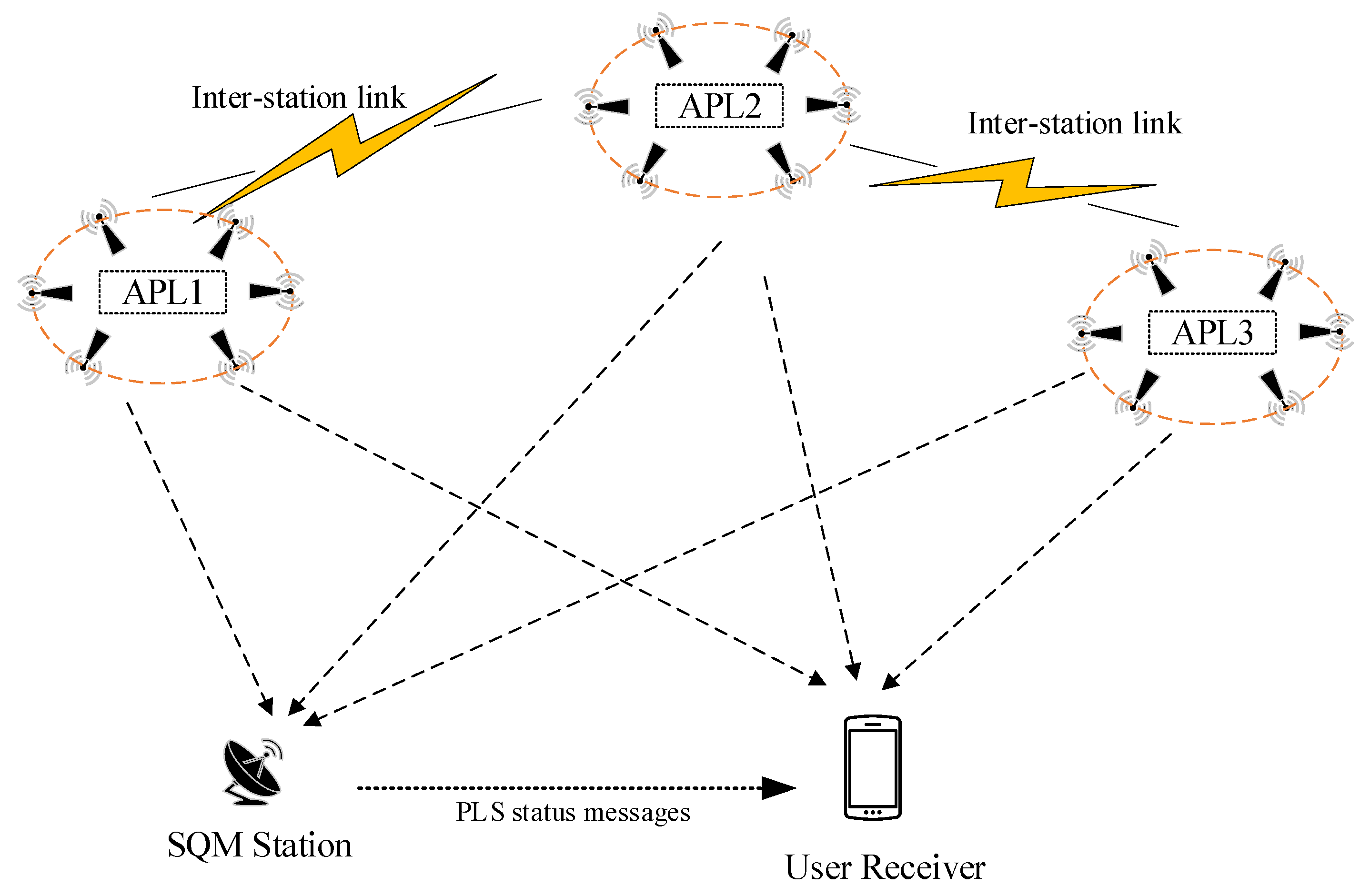
Similar to the GNSS, the DAPLS is mainly composed of three parts: array pseudolite (APL) transmitter, user receiver (UR), and SQM station, as shown in
Figure 1. In the DAPLS system, the APL transmitter functions like a GNSS satellite and transmits navigation and positioning signals. Multiple pseudolite transmitters are combined to construct a pseudolite positioning constellation; the user terminal mainly refers to the PL receiver, which performs the signal after receiving the navigation signal. The process of processing and positioning solution obtains the user’s PVT (position, velocity, time) and other information. The pseudolite ground monitoring part mainly plays a role in signal monitoring, time-frequency reference maintenance, ephemeris calculation, navigation message injection, and system control. Among them, the signal monitoring station is an indispensable part of the pseudolite positioning system to maintain normal operation. However, the current pseudolite positioning systems generally do not have a complete set of pseudolite signal monitoring systems, which monitor the quality and availability of pseudolite signals like GNSS monitoring stations. Although the GNSS signal spatial quality monitoring and evaluation method can also be applied to the pseudolite signal monitoring, there is still a big difference between indoor signal propagation and GNSS signal propagation, and a separate set of quality evaluation index system suitable for indoor pseudolite signals needs to be established.
Within a single APL station, all pseudolite transmitters are driven by a common clock. However, multiple APL stations deployed in an indoor environment may experience inter-station clock offsets and clock drift due to imperfect or heterogeneous synchronization mechanisms. In this study, augmentation refers primarily to real-time monitoring and assessment of signal quality, synchronization consistency, and measurement integrity, rather than atmospheric error correction.
DAPLS is not a conventional pseudolite system that directly rebroadcasts or relies on satellite signals. Instead, the DAPLS signal is GNSS-like rather than satellite-derived. Specifically, the DAPLS signal structure is designed to be compatible with GPS L1 and BDS B1 signal schemes in its fundamental architecture. In particular, the DAPLS signal adopts an orthogonal modulation framework in which the in-phase (I) and quadrature (Q) branches carry different ranging codes. The I-branch modulates a rough code that follows exactly the GPS L1 C/A signal structure (with a chip rate of 1.023 MHz) or the BDS B1I structure (2.046 MHz). This design choice enables compatibility with conventional GNSS receivers for indoor positioning applications. The Q-branch modulates an improved precise code, which is a self-defined high-rate code with a chip rate of 10.23 MHz, inspired by the Locata signal design and conceptually similar to the GPS P-code in terms of chipping rate, but with a much shorter code length and without military restrictions. This design enables interoperability with conventional GNSS receivers while allowing enhanced performance using customized receivers.
To mitigate near–far effects in dense deployments, time-division multi-plexing (TDM) control and time-hopping CDMA (TH/DS-CDMA) techniques may be applied on the I- or Q-branch. These measures do not significantly affect the receiver tracking architecture and remain transparent to standard GNSS-compatible processing. By adding the time-hopping mechanism, DAPLS can ensure that pseudolite positioning signals of different APLs are transmitted in different time periods. It is through the control of the time-hopping sequence, continuous DS-CDMA signals can be output in the form of random pulse signals, so as to separate the transmission time periods of pseudolite signals of different arrays, thereby reducing cross-correlation interference.
Accordingly, the DAPLS system supports both conventional GNSS receivers (using C/A-like pseudorange or carrier-phase measurements) and enhanced receivers for high-precision indoor positioning. In this work, the PMS is mainly designed and evaluated using the GNSS-compatible rough code signals to demonstrate the monitoring methodology. Monitoring of the precise code signals will be addressed in future work.
2.1.2. Pseudolite Monitoring Station (PMS)
The quality assessment of pseudolite indoor space signal is mainly completed by pseudolite signal monitoring station. The main content of this work is to design a pseudolite signal monitoring device and a signal quality analysis method. The pseudolite signal monitoring station mainly includes an antenna, a radio frequency front end, a software receiver unit, a PVT unit and a signal quality analysis unit. The monitoring station adopts the software radio architecture, which reduces the development difficulty of the pseudolite signal receiving and analysis system. The measurement and analysis of pseudolite signals are realized through the low-cost general software radio peripheral USRP, which greatly reduces the development cost. The monitoring station runs the pseudolite signal monitoring software (PL-SQM) to evaluate the pseudolite signal from the aspects of signal analysis, receiver processing response analysis, and positioning performance analysis. With the help of the powerful storage space and database software of the server, the measurement data can be stored in the database with the time query function, the detailed data processing can be carried out later, and the monitoring of the pseudolite signal changes can be completed by using the data analysis function in the database. In the process of pseudolite signal post-processing and analysis, individual elements of pseudolite signal quality and comprehensive evaluation content can be extracted, the evaluation content can be comprehensively analyzed and processed, and the quality of the received navigation pseudolite signal can be comprehensively evaluated.
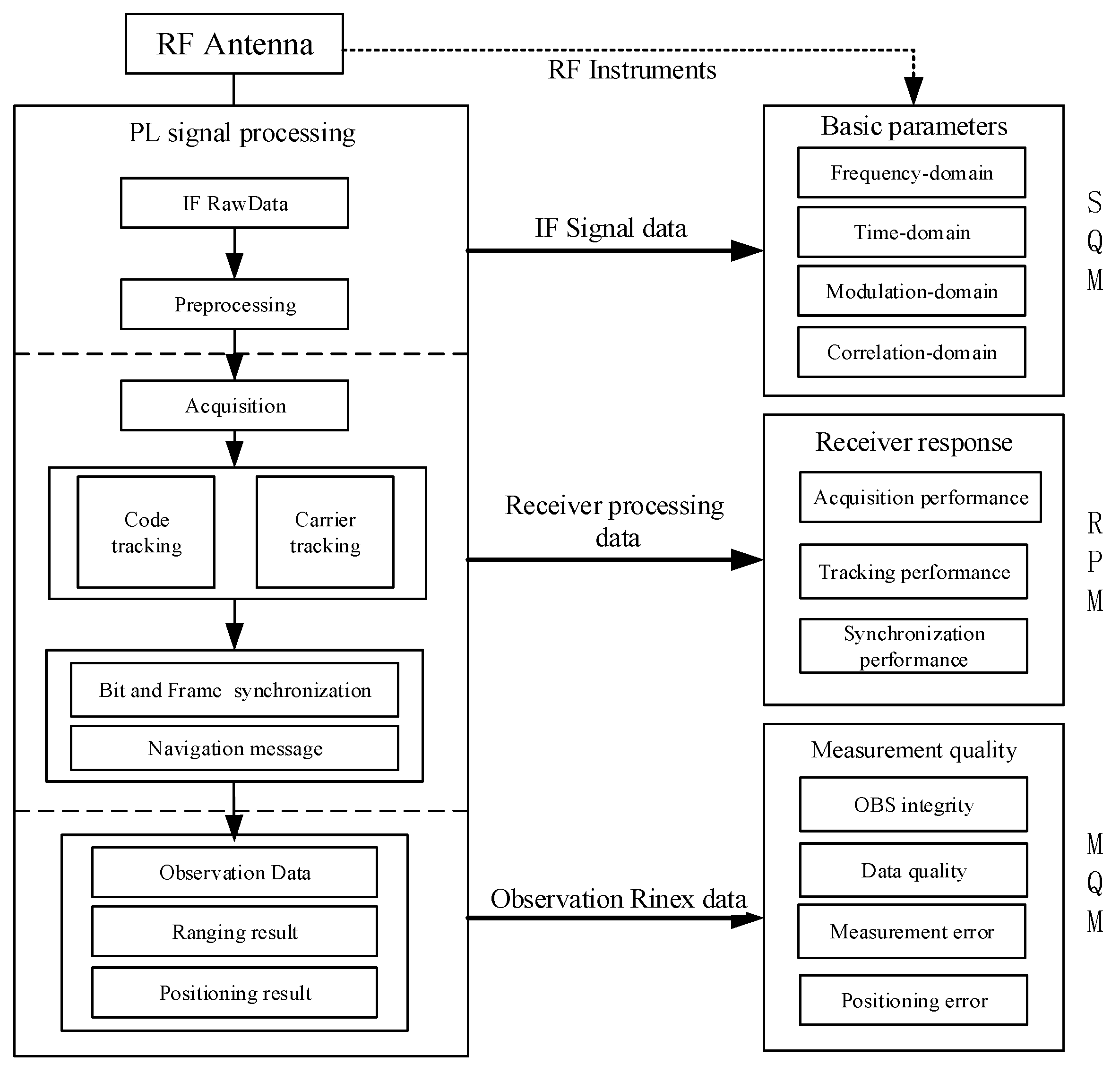
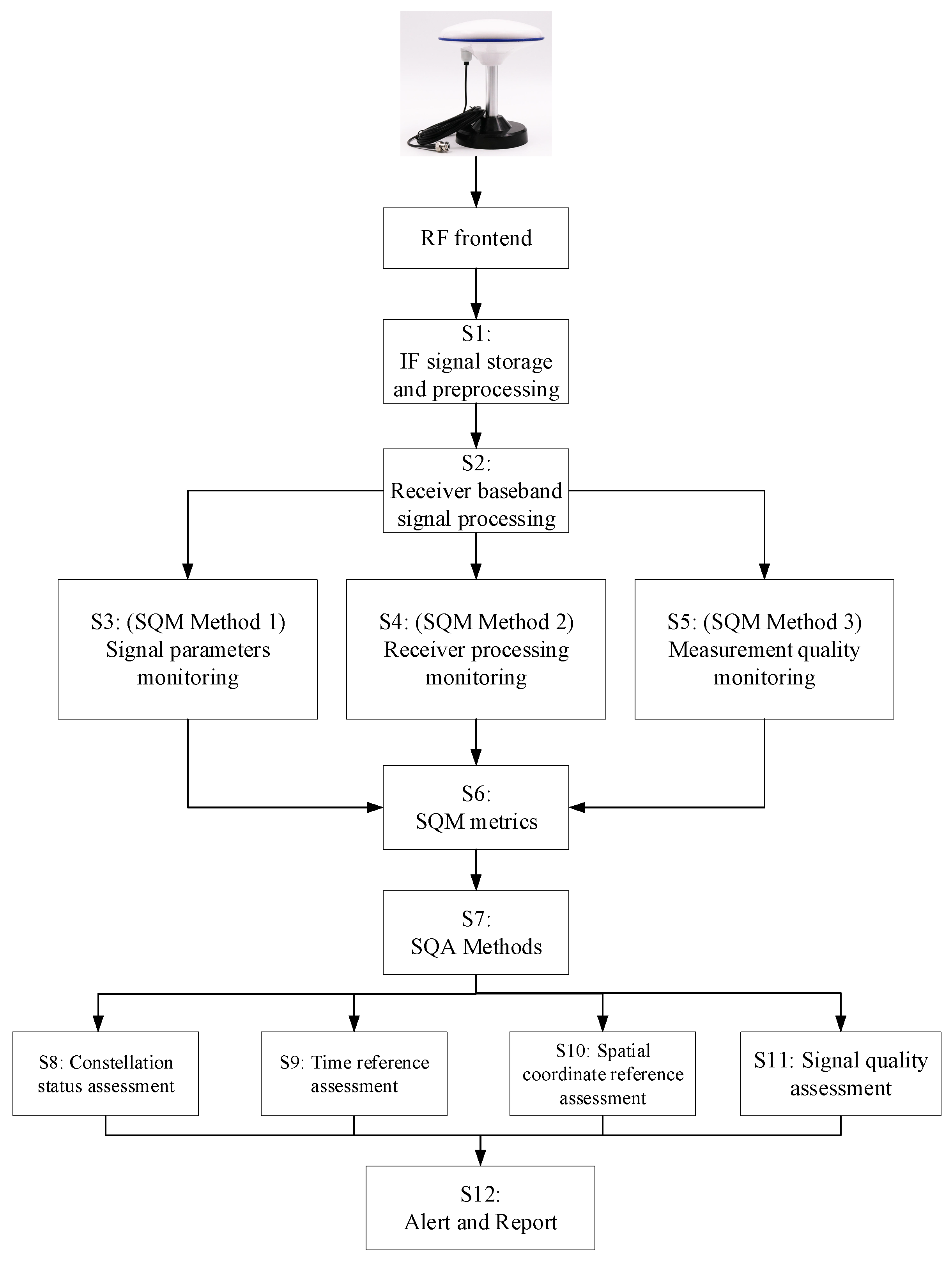
Based on the deployed pseudolite signal transmitter and software receiver platform, the pseudolite signal transmission and reception experiment test is performed, and with the aid of the pseudolite signal quality analysis method and device, the pseudolite signal quality analysis can be realized. As shown in
Figure 2, the pseudolite signal monitoring receiver for pseudolite signal processing mainly includes the following steps:
S1: IF signal storage and preprocessing. Use RF front-end equipment to sample and record IF data. Preprocess the recorded IF data, such as data normalized, decompression or decoding, format conversion, etc.
S2: Signal preprocessing. Use the software receiver PL-SDR to acquire, track, and demodulate the signal. At the same time, save the demodulation, dispreading and other intermediate data. During the processing of the software receiver, record the response status of the software receiver and the processing results of each process in real-time.
S3: Signal quality monitoring (SQM). The multi-channel signal is separated by the frequency-domain structure model at the same frequency and thereby the single-channel signal is obtained. The single channel signal is analyzed from the aspects of power, time-frequency domain, and eye diagram.
S4: Receiver processing monitoring (RPM). Pl-SDR is used to acquire and track signals, save intermediate data such as demodulation, monitor and analyze the processing process, and draw relevant curves for capture and tracking.
S5: Measurement quality monitoring (MQM). Demodulate the observation data, obtain the positioning result and precision factor, and analyze the positioning error.
S6: SQM metrics: Through the signal analysis and evaluation results in steps 3, 4, and 5, according to the SQM metrics, the signal quality of the signal to be measured is comprehensively reflected. According to the signal quality evaluation results, analyze the operating status of the pseudolite system to determine the possible cause of the pseudolite system failure.
S7: SQA method: The SQA method includes four methods: constellation status assessment (S8), coordinate bias assessment (S9), clock bias assessment (S10), and signal anomaly assessment (S11).
S8: Constellation status assessment: For DAPLS, constellation status assessment mainly needs to assess the geometric layout of the constellation and the operating status of the constellation. It mainly uses the system layout coordinate parameters and the data of the normal operation of the PL signal. By comparing the system operation data with the theoretical data, it can be assessed whether the DAPLS constellation is operating normally.
S9: Coordinate offset assessment: The coordinate reference deviation assessment is mainly to conduct real-time monitoring of the coordinates of the calibrated DAPLS transmitting antenna and the monitoring station receiving antenna to ensure the accuracy of the coordinates of each antenna.
S10: Clock bias assessment: For the DAPLS system, monitoring the clock difference between each array is very important for the operation of the entire system. The clock difference parameters between each base station monitored by the monitoring station are used to evaluate the clock difference of the system, and the real-time clock difference results can be broadcast to the user receiver for use to improve its positioning accuracy.
S11: Signal anomaly assessment: Signal anomalies are unavoidable during the operation of the DAPLS system. The signal parameter indicators monitored by the monitoring station can be used to comprehensively evaluate what kind of abnormal situation the system has encountered.
S12: Alert and report: Each indicator of SQM and SQA has a corresponding default threshold. The comparison between real-time monitoring data and the threshold determines whether an alarm mark should be generated.
Figure 2.
Signal processing flow chart of pseudolite signal monitoring station.
Figure 2.
Signal processing flow chart of pseudolite signal monitoring station.
2.1.3. Pseudolite Signal Quality Monitoring Block in PL-SDR
The PL-SDR, which is improved by GNSS-SDR [
37,
38], provides an interface to different suitable RF front ends and implements all the receiver for chaining up to the pseudolite navigation solution. Its design allows any kind of customization, including interchangeability of signal sources, signal processing algorithms, interoperability with other systems, output formats, and offers interfaces to all the intermediate signals, parameters and variables. PL-SDR runs in a personal computer and provides interfaces through USB and Ethernet buses to a variety of either commercial or custom-made RF front ends, adapting the processing algorithms to different sampling frequencies, intermediate frequencies, and sample resolutions. This makes possible rapid prototyping of specific receivers intended, for instance, to indoor positioning applications, signal quality monitoring, or carrier-phase based navigation techniques. The PL-SDR mainly performs functions such as radio frequency receiving, signal conditioning, baseband signal processing and pseudolite navigation, decoding GPS-like or BDS-like pseudolite signals. The software receiver contains a radio frequency front-end unit, a baseband signal processing unit, and a navigation solving unit.
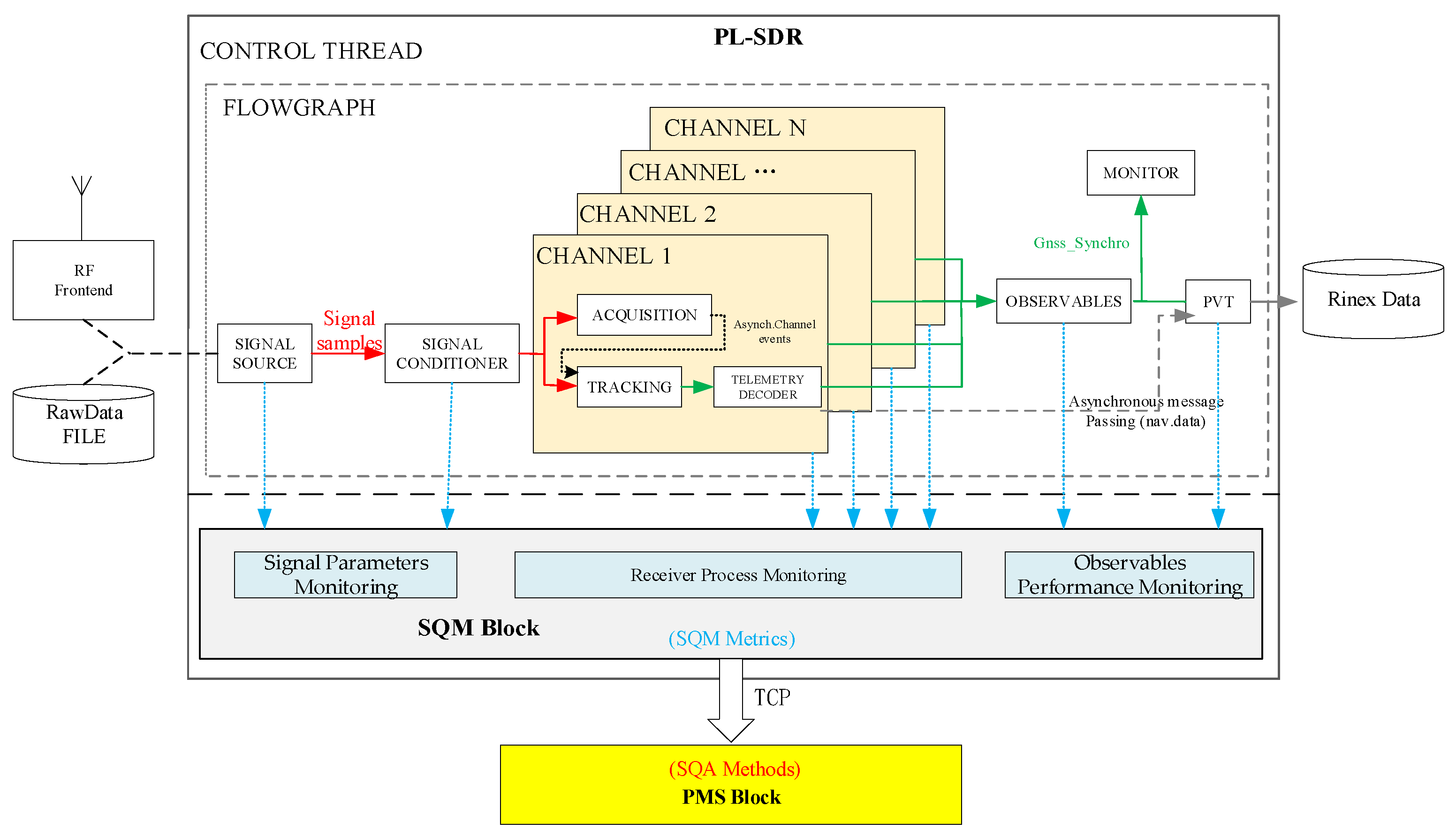
As shown in
Figure 3, the SQM block is a newly added module in PL-SDR. The main function of the SQM block is to collect the intermediate process data generated by each signal processing module of the receiver in real time, and output it in the format of a data stream, which can be used as the operating status and performance evaluation data of the receiver. In order to evaluate the response performance of the receiver to the signal, it is necessary to evaluate the intermediate process data generated by each signal processing link in the PL-SDR collected by the analysis module. PMS block uses the data collected by the SQM block to monitor and assess the response performance of the receiver, thereby indirectly reflecting the quality of the signal input to the receiver.
2.2. Metrics of the Signal Monitoring Station
In order to comprehensively evaluate the health and reliability of the Distributed Array Pseudolite System (DAPLS), the monitoring station employs a multi-layered set of performance metrics. As shown in
Figure 4, these metrics are grouped into three major categories: Signal Quality Monitoring Metrics (SQM), Receiver Processing Monitoring Metrics (RPM), and Measurement Quality Monitoring Metrics (MQM). Together, they form a hierarchical monitoring framework, covering the entire signal chain from transmission to final observables.
2.2.1. Signal Quality Monitoring Metrics (SQM Metrics)
SQM metrics focus on intrinsic properties of the transmitted pseudolite signals, independent of specific receiver implementations. By analyzing signals from multiple domains—time, frequency, correlation, and modulation—the station can detect subtle degradations at the physical layer.
Estimated from correlator outputs over integration time
:
where
is the coherent correlator output and
is the noise variance.
reflects received signal strength relative to noise and is a primary indicator of link quality.
- 2.
Multi-path Indicator (MPI)
Based on early
, prompt
, and late
correlator powers:
A higher MPI indicates stronger multi-path interference, which is critical in indoor DAPLS environments.
- 3.
Error Vector Magnitude (EVM)
EVM is a widely used metric in digital communication systems to evaluate modulation quality and transmitter fidelity. In the context of pseudolite signal monitoring, EVM quantifies the deviation between the received complex baseband samples and the ideal constellation points of the modulation scheme. It captures imperfections caused by transmitter non-linearities, phase noise, I/Q imbalance, or external interference. The following is used to assess modulation integrity:
where
are ideal constellation points and
are the measured symbols at the receiver.
- 4.
S-curve bias (SCB)
The SCB quantifies the distortion of the discriminator’s S-curve caused by signal deformation or multi-path. In the correlation domain analysis of navigation signal quality, the S-curve bias (SCB) is a common index to measure the navigation ranging error. S-curve refers to the code-discriminator curve of the early–late correlation value in the receiver code tracking loop, which varies with the different code-discriminator algorithms. The theoretical zero-crossing point of the S-curve was located at the zero point of code tracking error. In fact, due to the influence of channel transmission distortion and nonlinear effect of the power amplifier, the discriminator curve of code loop was usually locked in the place where a code phase deviation existed, resulting in SCB. It is defined as the discriminator bias error relative to the true code phase:
where
is the discriminator output at code offset
. Ideally, SCB should be close to zero, indicating a symmetric correlation function. Non-zero SCB values reflect distortions in the signal autocorrelation, often induced by hardware non-linearities or multi-path.
2.2.2. Receiver Processing Monitoring Metrics (RPM Metrics)
While Signal Quality Monitoring (SQM) metrics characterize the physical-layer properties of pseudolite signals, Receiver Processing Monitoring (RPM) metrics evaluate how a receiver responds to those signals in real time. These metrics reflect the performance of acquisition and tracking modules inside the monitoring receiver and thus provide insights into the usability of signals for navigation.
RPM metrics describe how well the receiver processes pseudolite signals in real time. These reflect the second layer of monitoring, focusing on acquisition and tracking performance. In the method of evaluating pseudolite signals using the receiver response, the parameters of the receiver need to be set in a uniform situation, that is, there is only one variable of different input signals, and the receiver settings are exactly the same. In the receiver, the process data generated by each link of the receiver is evaluated to determine the working status of each module of the pseudolite receiver. According to the response status and processing results of the software receiver recorded in the analysis blocks, we use the result data of the software receiver to evaluate the average acquisition time, false alarm probability, and other parameters, and analyze the changes in the acquisition curve and the acquisition probability in the repeated acquisition state. Indicators such as relative peak changes reflect how difficult the signal can be detected, and it can indirectly reflect the quality of the signal to be measured. In the tracking process, the output power of the PLL and DLL loop of the tracking module and the carrier-to-noise ratio density C/N0 are analyzed. Code the loop lock detector output, carrier loop lock detector output, and other indicators to judge the stability of the signal tracking loop, which indirectly reflects the quality of the input signal; in the synchronous demodulation link, the baseband data waveform and bits can be demodulated. Indicators such as synchronization error, frame synchronization error, bit error rate, and bit error rate are used to evaluate the quality of the demodulated baseband signal, which indirectly reflects the communication quality of the channel and the distortion of the signal.
Acquisition probability measures the likelihood that a receiver successfully detects and acquires a pseudolite signal during an acquisition attempt. It is defined as:
where
is the number of successfully acquired signals. A drop in acquisition probability below
indicates degraded detectability.
- 2.
Code Tracking Jitter
The stability of the Delay-Locked Loop (DLL) is monitored through code tracking jitter, which can be approximated as:
where
is the coherent integration time,
is the carrier-to-noise density ratio,
is the code loop bandwidth, and
is the early-late correlator spacing (in chips). Excessive jitter (>0.10 chips) indicates noisy or distorted signals, which may eventually lead to loss of lock.
- 3.
Carrier Tracking Jitter
Carrier loop stability is quantified using Phase-Locked Loop (PLL) jitter:
where
is the coherent integration time,
is the carrier-to-noise density ratio, and
is the loop bandwidth in Hz. When
exceeds
RMS, carrier lock becomes unstable, and phase measurements lose reliability.
- 4.
Lock Detector metric (LD)
To evaluate whether the receiver’s carrier tracking loop remains locked, a Lock Detector (LD) function is applied to the prompt in-phase (
) and quadrature (
) correlator outputs:
when the receiver is phase-locked,
dominates and
, producing
. During loss of lock or severe phase noise,
decreases while
increases, driving
toward 0 or negative values.
A lock status flag is generated as:
where
is an empirical threshold (typically 0.7–0.8).
This metric provides instantaneous lock status for each channel and is aggregated into a lock ratio:
representing the proportion of epochs in which the receiver remains phase-locked. A sustained decrease in
signals potential synchronization loss or dynamic stress.
2.2.3. Measurement Quality Monitoring Metrics (MQM Metrics)
Measurement Quality Monitoring (MQM) metrics evaluate the accuracy, integrity, and completeness of the observables generated by the receiver. Unlike SQM and RPM, which focus on the signal and tracking processes, MQM assesses the end results—pseudorange, carrier phase, and Doppler—which are directly used for positioning. These metrics provide the final layer of assurance that the DAPLS outputs are reliable for navigation.
The pseudolite signal receiver outputs the raw observation data with RINEX, which includes pseudo-range, carrier-phase, doppler-shift, carrier-to-noise ratio and other observations. The observations output by the receiver can be used to evaluate the data integrity of the pseudolite signal and the ranging and positioning performance, mainly including data stability analysis, accuracy performance analysis, integrity performance analysis, continuity performance analysis, availability performance analysis, vulnerability performance analysis, etc. To analyze the quality of the original observation data received by the pseudolite receiver, it is necessary to analyze the type, availability, accuracy, error characteristics, etc., of the original observation value under static positioning, and analyze the quality of pseudolite observations through the methods of inter-satellite difference, inter-station difference, and inter-epoch difference.
The number of received observations of visible pseudolites at the current station position is the theoretical data that should be received; the actual received data is counted according to the actual number of receivers. This indicator can describe the signal tracking of the receiver in the range of different cut-off height angles. The integrity rate is the percentage of the actual data received by a certain satellite at a certain frequency point to the theoretical data that should be received, which can be calculated with the following formula:
where
is the number of valid observables and
is the total expected number of epochs.
A drop in indicates data loss due to lock interruptions or tracking failures. Under nominal conditions, is typically maintained in a stable pseudolite environment.
- 2.
Pseudorange Quality
The quality of pseudorange measurements is assessed by comparing measured pseudoranges against reference values derived from surveyed ground-truth coordinates:
where
is the measured pseudorange and
is the reference pseudorange for pseudolite
. A standard deviation of residuals less than 0.5 m is typically considered nominal, while values above 1 m suggest multi-path or clock bias errors.
- 3.
Carrier-Phase Stability
Carrier-phase continuity is critical for precise navigation and differential processing. The reliability of carrier phase observables is ensured by monitoring phase noise and detecting cycle slips. Cycle slip detection is performed by comparing the measured phase change with the Doppler-predicted phase change:
where
is the measured carrier phase of pseudolite
at epoch
is the Doppler frequency, and
is the epoch interval. Large discontinuities indicate cycle slips, which severely affect carrier-based positioning accuracy. The cycle slip rate quantifies the frequency of discontinuities detected in the carrier phase measurements:
where
is the number of detected phase discontinuities and
is the number of total epochs.
A low indicates good tracking stability. Frequent slips are usually caused by phase lock loss, high dynamics, or abrupt interference.
- 4.
Doppler Measurement Accuracy
Doppler measurements are validated by comparing measured Doppler shifts with predicted dynamics:
where
is the measured Doppler shift, and
is the predicted value based on the geometry and kinematics of the receiver. Errors greater than
over short intervals indicate anomalous tracking or oscillator drift.
- 5.
Observation Consistency Index (OCI)
To assess the overall stability of the measurement domain, the Observation Consistency Index compares the short-term variance of observed measurements to a reference variance:
where
is the current standard deviation of a set of observables and
is the nominal variance under normal conditions. A value of
indicates stable and consistent measurement quality, while higher values reveal increased dispersion or bias in the measurement data.
2.2.4. Summary of Monitoring Metrics
As shown in
Table 1, the three categories of metrics—SQM, RPM, and MQM—form a multi-layer monitoring strategy. SQM ensures signals are spectrally clean, temporally stable, and free from distortion; RPM ensures signals can be robustly acquired and tracked by receivers; MQM ensures that final observables are accurate and reliable for positioning. This comprehensive monitoring framework enables the DAPLS monitoring station to detect anomalies across different layers, ensuring system robustness and positioning accuracy.
2.3. The Methods of Signal Quality Assessment (SQA)
The Signal Quality Assessment (SQA) framework is designed to interpret monitoring metrics into actionable system-level evaluations. While the metrics described in
Section 2.2 provide raw indicators, the SQA methods define how these indicators are analyzed, compared against thresholds, and combined to form final assessments. The assessment framework includes four key components: constellation status assessment, time reference assessment, spatial coordinate reference assessment, and signal anomaly assessment.
During the operation of DAPLS, the APL constellation status, coordinate-base unification and maintenance, time-base unification and maintenance, and navigation signal quality have a huge impact on the system positioning results, so these states need to be monitored and evaluated in real time. By performing data processing such as data classification, component extraction, statistical analysis, and AI intelligent judgment on the previously monitored SQM indicator parameters, DAPLS system monitoring, and evaluation can be realized. The content of DAPLS system monitoring and evaluation includes five categories: constellation status assessment, time reference deviation assessment, coordinate reference deviation assessment and signal anomaly assessment.
2.3.1. Constellation Status Assessment
Constellation status assessment is a key component to ensure the effective operation of APL stations and the stability of constellation layout in the DAPLS system. It comprehensively monitors the status of distributed base stations in real time, identifies and evaluates abnormal events in the system, ensures stable operation of the system and improves positioning accuracy and service reliability. DAPLS constellation status monitoring covers three aspects of abnormal monitoring: APL station run status, constellation geometry layout, and inter-PLS link status.
Node operating status: Monitors whether each pseudolite transmitter is online/offline, including power amplifier status and transmitted power.
Signal visibility: Records the number and geometry of visible pseudolite signals and computes the dilution of precision (DOP).
Constellation Health: Detects abnormal or failed transmitters and evaluates constellation availability.
2.3.2. Time Reference Assessment
For the DAPLS system, integrating multiple APL base stations to build a positioning constellation network with a unified time and space reference is the core of its multi-constellation collaborative positioning. Therefore, monitoring the clock difference between each APL array is very important for the coordinated operation of the entire system. The APL base station of the DAPLS system usually uses an OCXO high-stability crystal oscillator, which has good short-term stability but poor long-term stability. The clock difference parameters between each base station monitored by the monitoring station are used to evaluate the system clock difference, and the real-time clock difference results can be broadcast to the user receiver for use to improve its positioning accuracy.
Local clock stability: Evaluated using short-term jitter and Allan variance at the monitoring station.
Inter-node synchronization error: Continuously measures 1PPS offsets among transmitters to ensure synchronization within the nanosecond level.
Time drift trend: Detects long-term accumulation of relative drift between transmitters.
2.3.3. Spatial Coordinate Reference Assessment
For the positioning system, the spatial reference unification and calibration of anchor nodes are the prerequisites for the realization of positioning functions. The coordinate reference of DAPLS in indoor environments usually adopts the local coordinate system, and multiple APL constellations are linked by spatial coordinate reference transmission to build a unified positioning coordinate system. The coordinate reference deviation assessment is mainly for real-time monitoring of the coordinates of the calibrated DAPLS transmitting antenna and the monitoring station receiving antenna to ensure the accuracy of the coordinates of each antenna.
Coordinate consistency: Verifies whether the broadcast positions of pseudolites match their true deployment coordinates.
Differential reference check: Uses signals collected at known reference points to compare estimated positions with ground truth, detecting coordinate biases.
Array geometry stability: Continuously monitors the geometric configuration of pseudolite arrays, ensuring long-term stability.
2.3.4. Signal Anomaly Assessment
It is inevitable that there will be signal abnormalities during the operation of the DAPLS system, and the signal parameters monitored by the monitoring station can be used to comprehensively evaluate what kind of abnormalities the system encounters. Signal anomaly assessment is the final and most critical stage of the monitoring framework. It integrates raw metrics from SQM, RPM, and MQM into a unified process that detects, classifies, and interprets abnormal conditions in DAPLS. This ensures that even subtle degradations—often invisible in individual parameters—are identified before they compromise positioning performance.
Threshold-based detection: Each metric is compared with predefined thresholds.
Statistical monitoring: Long-term trends are monitored by comparing metric deviations from their running mean:
where
and
are the moving average and standard deviation, and
is a confidence factor. This detects gradual drifts and sudden anomalies.
Model-based comparison: Metrics are compared against theoretical models for validation.
Composite quality index (CQI):
A global health score is computed as:
where
are normalized sub-scores, and
are empirically determined weights.
Signal quality metrics are assigned a slightly higher weight, as impairments at the signal level propagate to receiver tracking loops and measurement formation. Receiver processing metrics and measurement quality metrics are given comparable weights, reflecting their complementary roles in positioning reliability.
The composite quality index is calculated as a weighted combination of signal quality metrics, receiver processing metrics, and measurement quality metrics. The weighting factors [0.4, 0.3, 0.3] are selected based on engineering considerations, reflecting their relative importance in indoor DAPLS performance.
3. Results
To evaluate the performance of the proposed monitoring station and the effectiveness of the signal quality assessment framework, a series of experiments were conducted in a laboratory-scale DAPLS testbed.
3.1. Experiment Setup
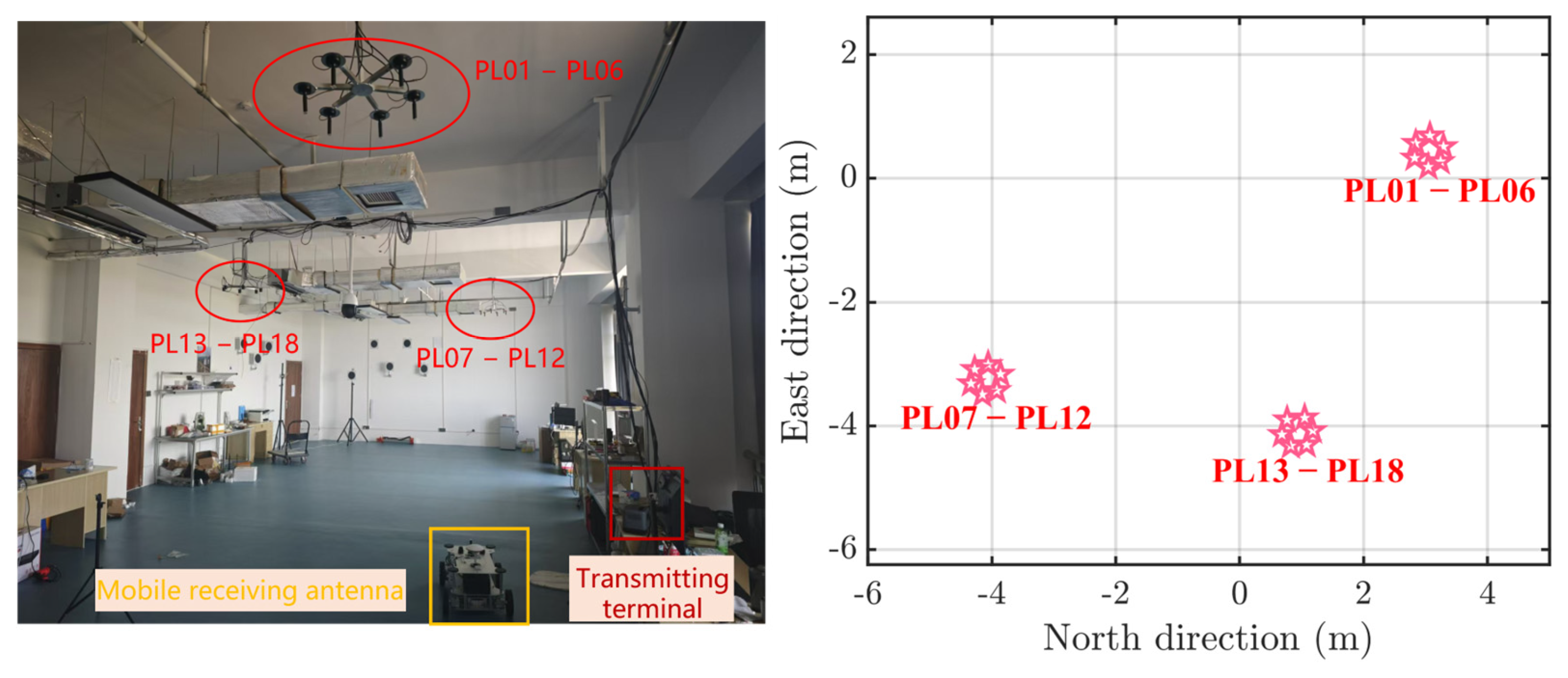
In order to verify the functions of pseudolite monitoring station and the signal quality assessment method, a pseudolite indoor positioning test platform was built using pseudolite equipment in an indoor environment, as shown in
Figure 5. Layout of the experimental testbed: three pseudolite groups arranged in triangular distribution, each group forming a compact hexagon. Transmitter antennas were ceiling-mounted at 2.8 m height. Each group shared one OCXO. The three groups were synchronized via cables. A monitoring station was centrally located, while a mobile receiver mounted on an RC vehicle that traversed the test area.
Each array-pseudolite group consisted of six pseudolite transmitters, arranged in a compact hexagonal pattern with a diameter of approximately 1 m, resulting in a total of 18 transmitters. Each transmitter antenna was mounted on the indoor ceiling at a height of approximately 2.8 m, providing overhead coverage across the entire test area. The elevated installation reduced line-of-sight obstruction but also introduced potential ceiling-induced multi-path effects.
A fixed monitoring station was installed near the center of the test area, with line-of-sight to all transmitters. The monitoring station collected both raw intermediate frequency (IF) samples and real-time processed monitoring indicators, ensuring comprehensive observation of constellation status, timing, coordinate consistency, and signal quality.
A mobile receiver was mounted on a small wheeled remote-controlled (RC) vehicle. The vehicle followed predefined trajectories inside the test area, enabling collection of kinematic pseudolite signals and positioning data. This setup allowed direct correlation between monitoring station indicators and the actual user positioning performance observed by the moving receiver.
Each transmitter group of six pseudolites was driven by a common OCXO, ensuring intra-group frequency and time alignment. Synchronization between the three groups could, in principle, be established via synchronization cables, optical fibers, wireless signals or GPS-DO. In this experiment, synchronization cables were used to provide reliable and stable inter-group time synchronization, ensuring that all 18 pseudolite signals remained aligned to a common timing reference.
Test scenarios
Normal operation: All 18 transmitters active and synchronized.
Node outage: Selected transmitters disabled to simulate hardware faults.
Synchronization drift: Disciplining disabled on one group’s OCXO to emulate clock drift.
Interference injection: Wideband noise introduced to degrade signal quality.
Positioning experiment: The RC vehicle carrying the mobile receiver traversed predefined tracks to evaluate positioning accuracy under different conditions.
Set up different signal monitoring experiment groups to test the function of the monitoring station. Based on the normal indoor positioning environment, some signal change factors are added to obtain different monitoring data. Then PL-SQM method is used to obtain various monitoring metrics.
3.2. Experiment Results
The results are presented according to the four categories of monitoring indicators: constellation status, time reference, spatial coordinate reference, and signal anomaly.
3.2.1. Constellation Status Monitoring and Assessment
The monitoring station continuously evaluated the operational status of the 18 pseudolite transmitters deployed in the experimental field. By analyzing the received signal strength, navigation message availability, and visibility geometry, the constellation-level health of the Distributed Array Pseudolite System (DAPLS) was assessed.
Node availability: Under normal operation, all 18 transmitters remained active, and the monitoring station successfully tracked their signals throughout the 24 h experiment. Each transmitter exhibited operational availability above 99.8%. To emulate hardware failures, selected transmitters were intentionally powered off during test intervals. The monitoring station detected each outage within 2–3 s, automatically updating the constellation health status and flagging the affected nodes.
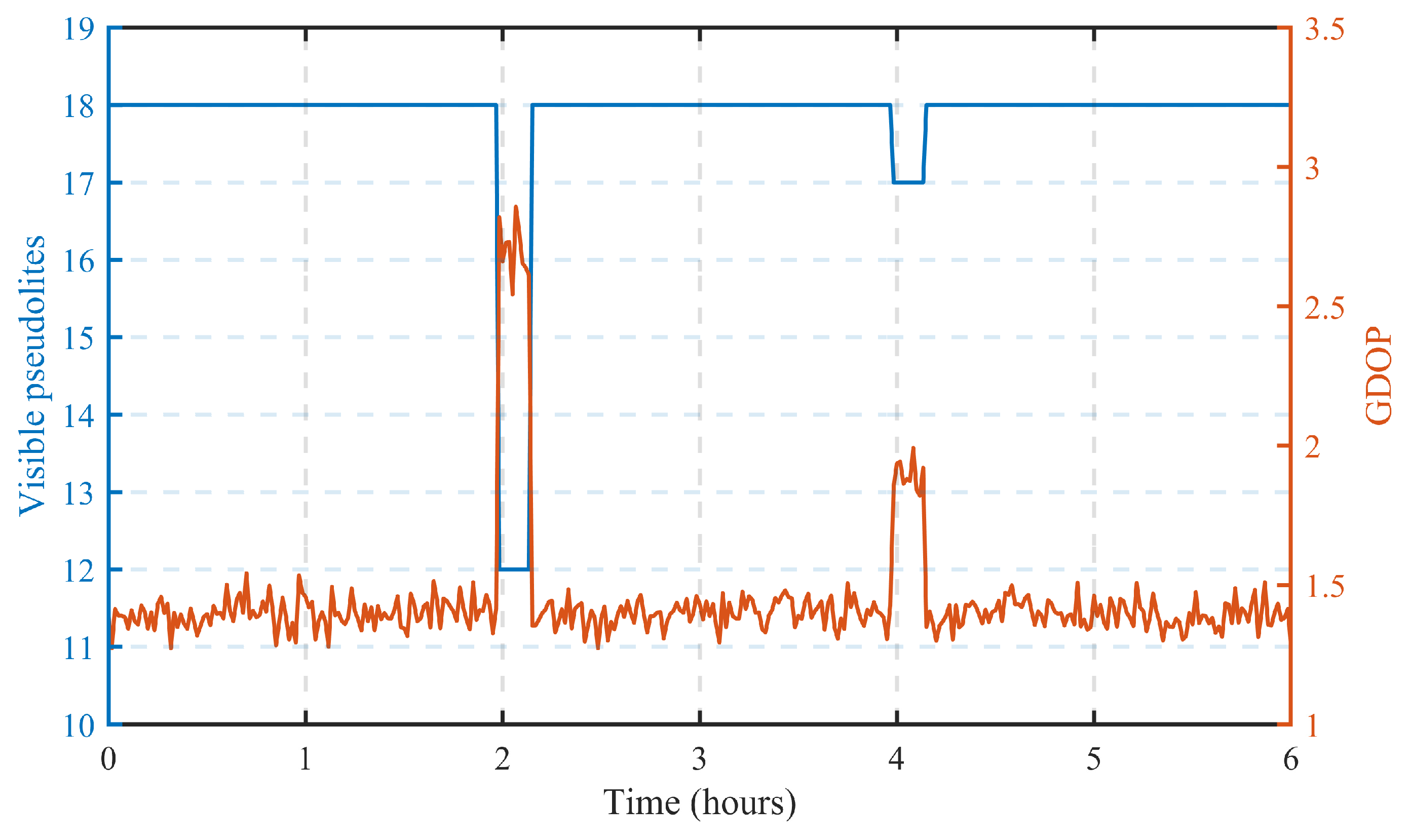
Visibility and geometry: With all nodes active, the monitoring station consistently received 18 signals. The pseudolite geometry, resulting from the triangular group deployment, provided strong coverage across the 15 m × 25 m field. The computed geometric dilution of precision (GDOP) ranged from 1.2 to 1.6 under full constellation conditions, reflecting excellent positioning geometry.
Constellation degradation: When one pseudolite group (six transmitters) was disabled, the number of visible signals dropped from 18 to 12, and GDOP increased to 2.5–2.8, indicating degraded positioning accuracy. When an individual node was switched off, GDOP increased modestly to 1.9, showing that DAPLS retained redundancy against single-node failures but was more vulnerable to group-level outages.
Assessment of constellation health: The monitoring framework classified constellation availability into three levels:
Healthy: ≥18 signals, GDOP < 1.6.
Degraded: 12–17 signals, GDOP 1.6–3.0.
Critical: <12 signals or GDOP > 3.0.
During normal operation, the constellation remained in the healthy state. Fault-injection experiments confirmed the system’s capability to promptly transition to degraded or critical states as soon as transmitter outages occurred.
As shown in
Figure 6, these results confirm that constellation-level monitoring enables operators to rapidly detect node outages and evaluate the impact on positioning geometry.
As shown in
Table 2, summary of constellation status monitoring results illustrating the ability of the PMS to detect transmitter availability changes and geometry degradation.
3.2.2. Time Reference Monitoring and Assessment
Accurate time synchronization among pseudolite transmitters is essential for Distributed Array Pseudolite System (DAPLS) operation, as even nanosecond-level misalignments can translate into significant ranging and positioning errors. In the experimental setup, each group of six pseudolite transmitters was driven by a common OCXO, while inter-group synchronization was achieved through synchronization cables, providing a shared time reference across the entire array. The monitoring station continuously evaluated timing stability at both intra-group and inter-group levels.
Intra-group synchronization performance: Since all six transmitters within a group were driven by the same OCXO, intra-group synchronization offsets were negligible (<0.5 ns) throughout the 24-h observation. No measurable drift was detected under normal conditions, confirming the reliability of the group-level design.
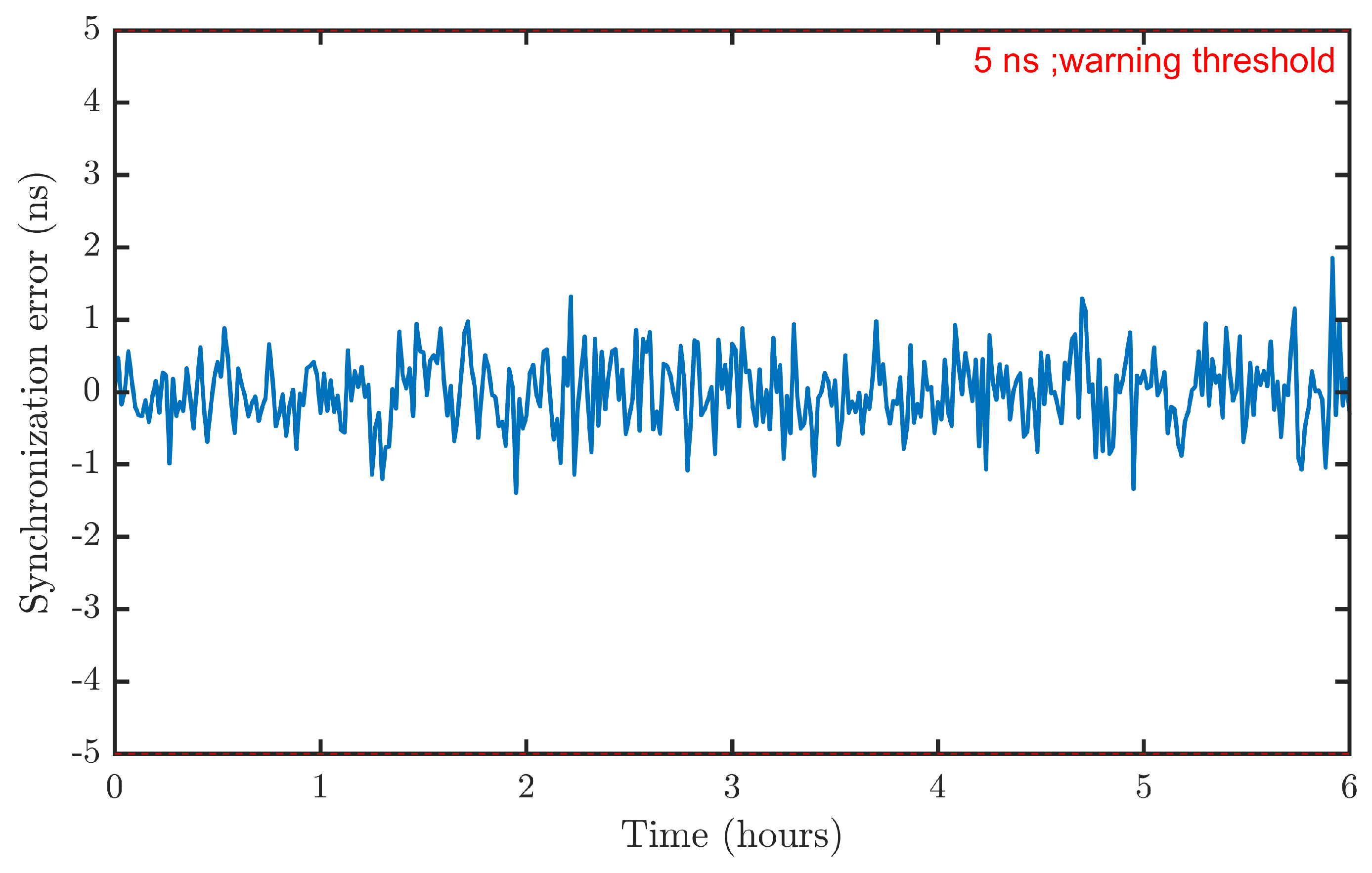
Inter-group synchronization performance: With cable-based synchronization, offsets among the three pseudolite groups were typically maintained within ±2 ns.
Figure 7 shows the time history of measured 1PPS differences between the groups, where variations remained well below the preset 5 ns threshold.
Oscillator stability: The Allan deviation of the OCXOs, measured indirectly from code and carrier tracking residuals, was approximately 3 × 10⁻¹¹ at 0.1 s, and improved to 5 × 10⁻¹³ at 1000 s averaging time. These results were consistent with manufacturer specifications and confirmed stable operation.
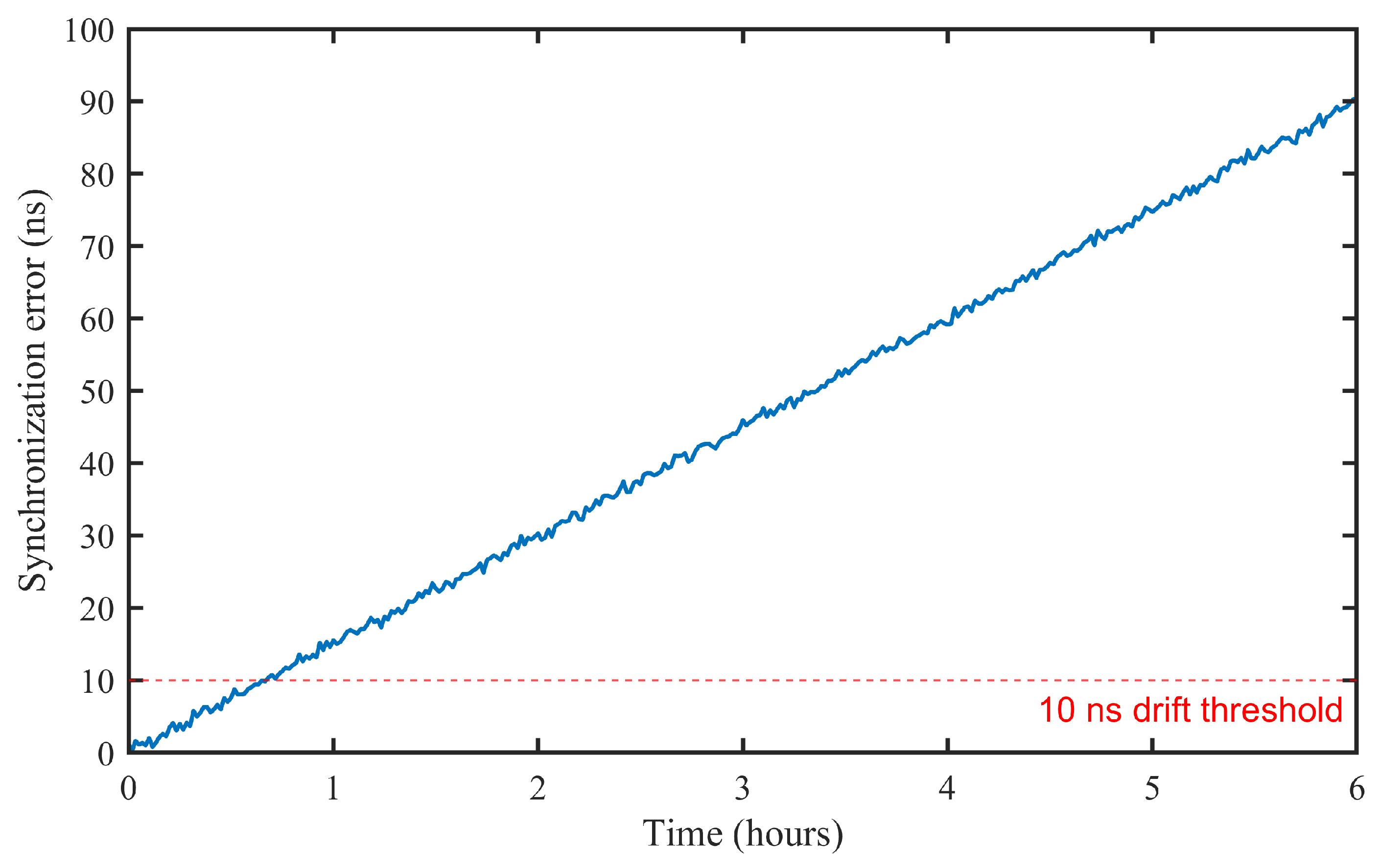
Fault scenario—synchronization drift: To test anomaly detection, GPS disciplining was intentionally disabled on the OCXO of one pseudolite group. As a result, synchronization drift accumulated at an average rate of 14–16 ns per hour. The monitoring station detected this divergence within 20–30 min, raising an alarm once the offset exceeded the 10 ns threshold.
Figure 8 illustrates the drift trajectory under this condition.
Assessment of synchronization health:
The monitoring framework classified timing stability into three states:
Synchronized: Inter-group offsets ≤ 5 ns.
Warning: 5–10 ns offsets sustained for >5 min.
Drift alarm: Offsets > 10 ns.
During normal operation, the system consistently remained in the synchronized state. Under fault emulation, the drift alarm was triggered as expected.
Shown in
Table 3 is a summary of time reference monitoring results demonstrating the PMS capability to identify inter-station clock offsets and drift behavior.
3.2.3. Spatial Coordinate Reference Monitoring and Assessment
In DAPLS, unlike GNSS satellites with precisely known orbital ephemerides, pseudolite transmitters rely on surveyed ground coordinates. Any deployment errors, antenna displacement, or long-term instability can directly bias positioning results. To address this, the monitoring station continuously compared pseudolite broadcast coordinates with surveyed reference data and performed differential checks at multiple ground reference points.
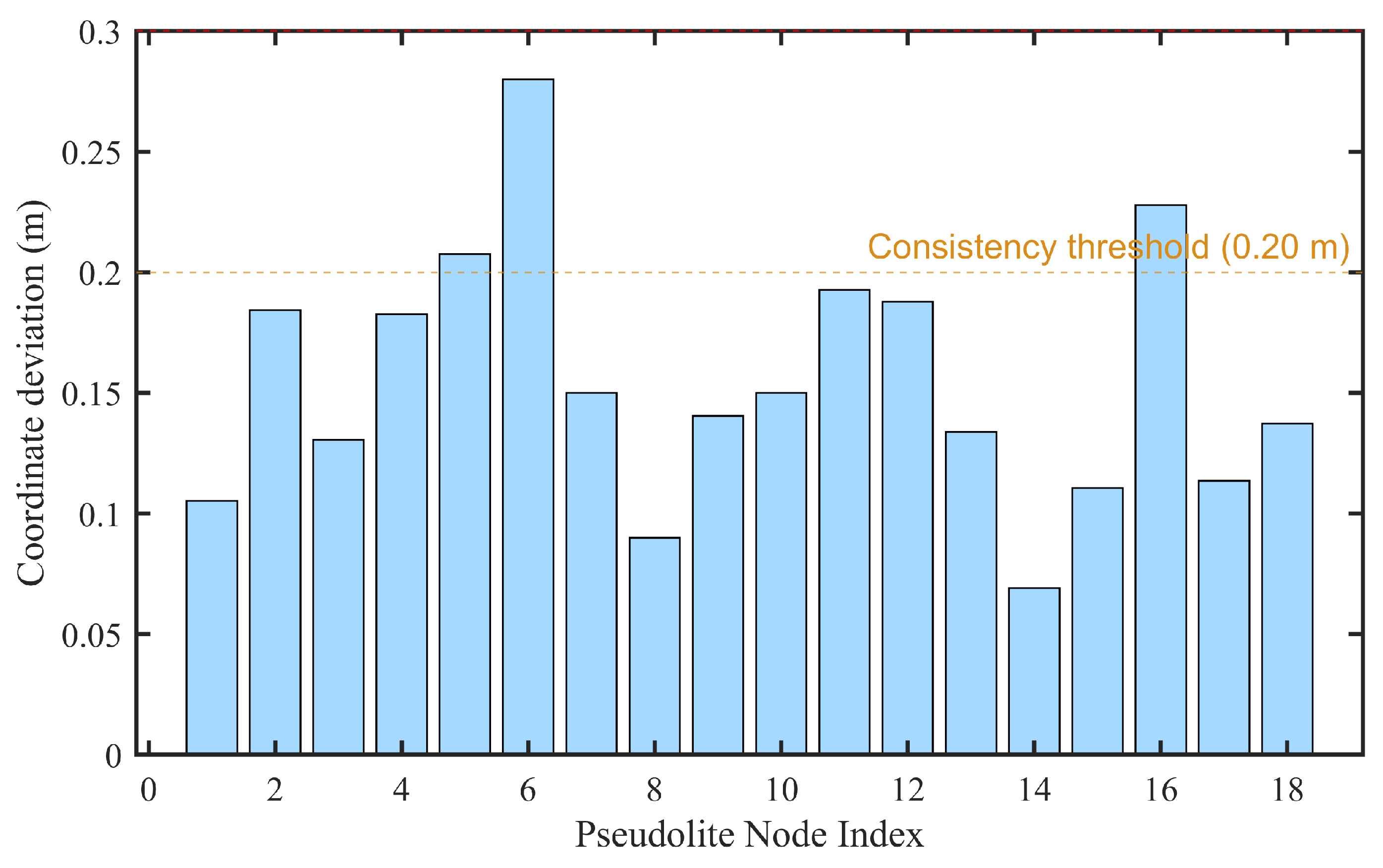
Coordinate consistency: The surveyed positions of all 18 pseudolite transmitters were obtained using a total station with centimeter-level accuracy. During the experiment, broadcast coordinates were compared against these surveyed values. The average deviation was 0.15 m, with the maximum offset measured at 0.28 m for one transmitter. These values met the experimental tolerance requirement of <0.3 m. The tolerance error is defined as the three-dimensional positioning error expressed in a local East–North–Up (ENU) coordinate system, with the origin located at a surveyed reference point within the experimental area. The tolerance threshold is set to 0.3 m. The 0.3 m tolerance corresponds to typical indoor pseudolite geometry (GDOP ≈ 1.5–2.0) and realistic pseudolite ranging noise.
The positioning error is computed as
where
denotes the estimated receiver position in the local ENU frame, and
represents the corresponding reference position obtained from the ground-truth trajectory.
In the indoor DAPLS environment, the positioning error is mainly influenced by pseudorange measurement noise, residual inter-APL clock offsets, and multi-path propagation effects.
Differential reference checks: To further validate coordinate consistency, two fixed reference points within the test field (located 10 m and 15 m from the monitoring station, respectively) were used to compute differential positioning solutions. The horizontal errors at these points were 0.21 m and 0.34 m, respectively, with vertical errors <0.20 m. The errors were attributed mainly to multi-path reflections from walls and ceiling rather than coordinate biases, as confirmed by the consistency across multiple test sessions.
Array stability: Over the 24 h monitoring period, reconstructed transmitter geometry remained highly stable. The root-mean-square (RMS) displacement of pseudolite antenna positions was <0.05 m, indicating no significant drift or displacement in hardware setup. This confirmed that ceiling-mounted antennas maintained structural stability during continuous operation.
Assessment of spatial reference health: Based on these results, the monitoring station classified spatial reference conditions into three categories:
Consistent: Mean deviation ≤ 0.20 m and RMS geometry drift ≤ 0.05 m.
Warning: Mean deviation 0.20–0.50 m or noticeable geometry distortion.
Critical: Mean deviation > 0.50 m or large-scale misalignment detected.
As shown in
Figure 9, in all nominal tests, the constellation remained in the consistent state. Fault emulation through manual coordinate bias injection (artificially shifting broadcast positions by 0.5 m) caused the system to flag a critical condition immediately.
Shown in
Table 4 is a summary of spatial coordinate reference monitoring results reflecting the stability and consistency of the indoor positioning reference frame.
3.2.4. Signal Anomaly Monitoring and Assessment
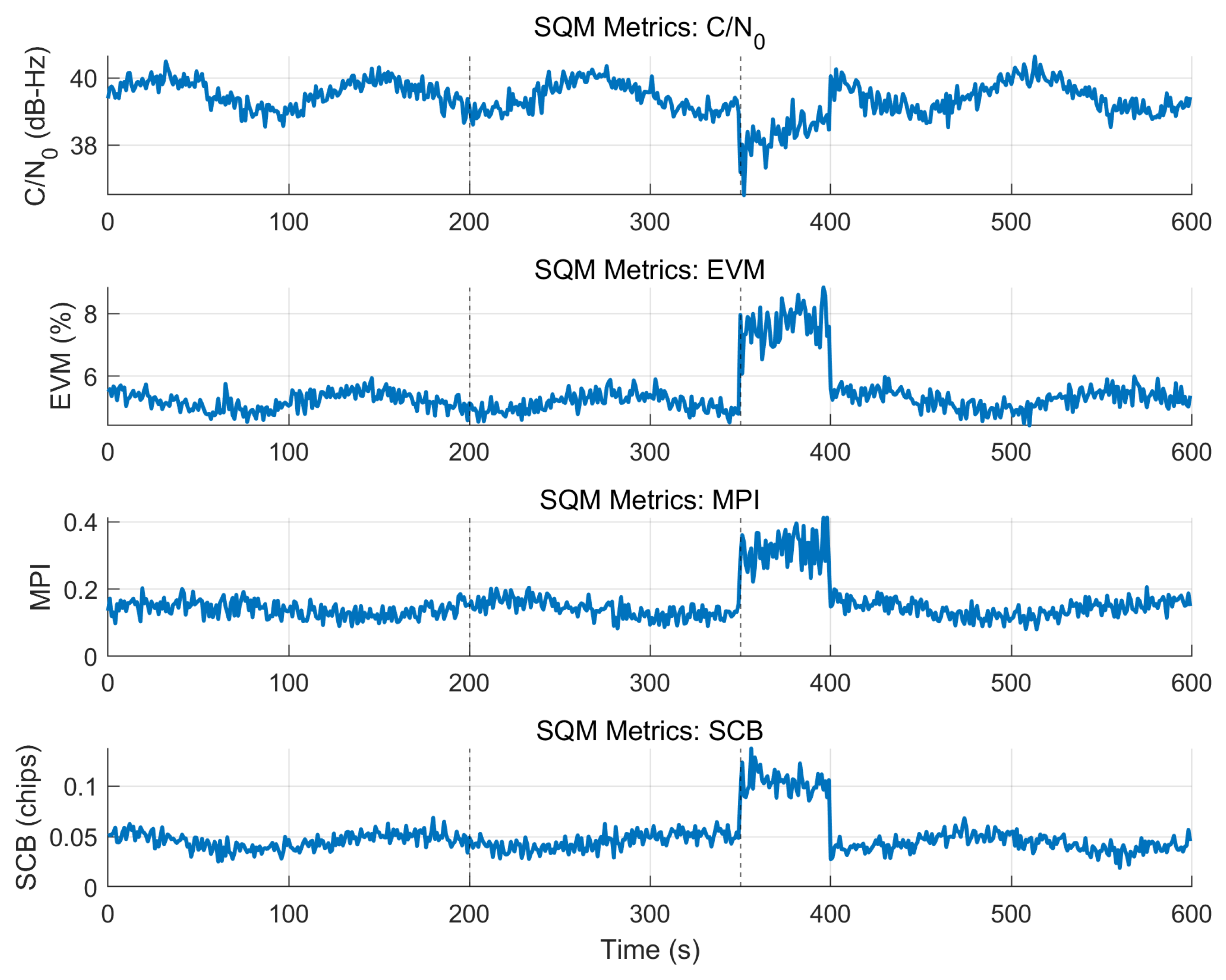
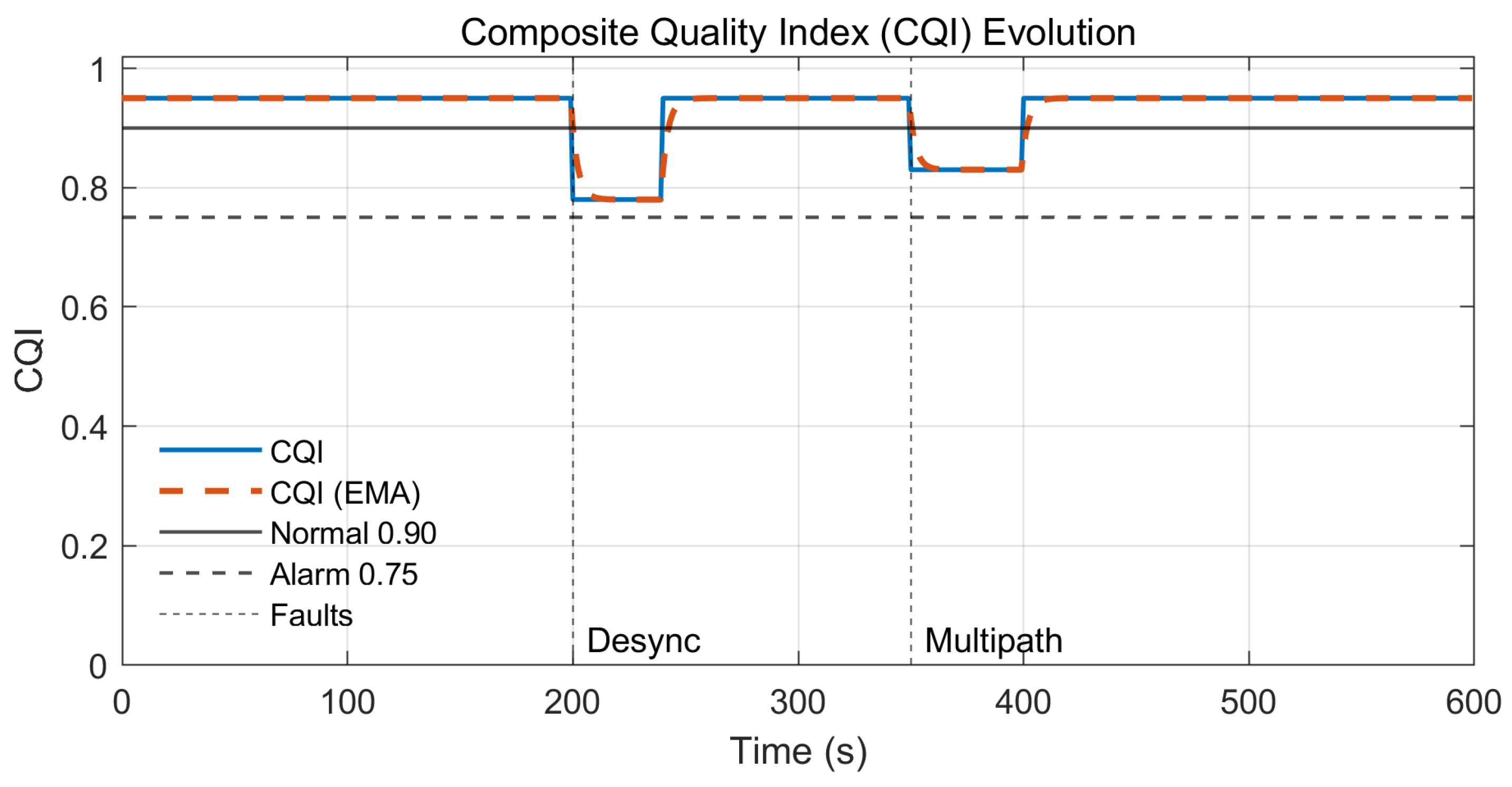
Signal anomaly monitoring is the final and most critical layer in assessing the health of a Distributed Array Pseudolite System (DAPLS). To validate the anomaly detection capability of the PMS, a 10-min indoor experiment was conducted under nominal conditions and two injected faults: (i) desynchronization of one transmitter (≈15 ns offset) at t = 200 s, and (ii) multi-path enhancement near a reflective surface at t = 350 s.
The PMS continuously recorded all SQM, RPM, and MQM metrics at 1 Hz and derived the Composite Quality Index (CQI) according to the weighting model.
(a) Signal-Domain Response
Figure 10 illustrates the evolution of the Signal Quality Monitoring (SQM) indicators: carrier-to-noise ratio (C/N
0), error-vector magnitude (EVM), multi-path indicator (MPI), and S-curve bias (SCB). During nominal operation (0–200 s), all parameters remained within stable ranges:
, and
chips. After
, the deliberate multi-path disturbance caused clear degradations.
dropped by , EVM increased by , MPI rose to , and SCB shifted to chips. No significant variation occurred at 200 s, confirming that the first fault (timing drift) did not distort the RF waveform.
As shown in
Table 5, summary of SQM results derived from time-domain, correlation-domain, and modulation-domain analyses.
(b) Receiver-Domain Response
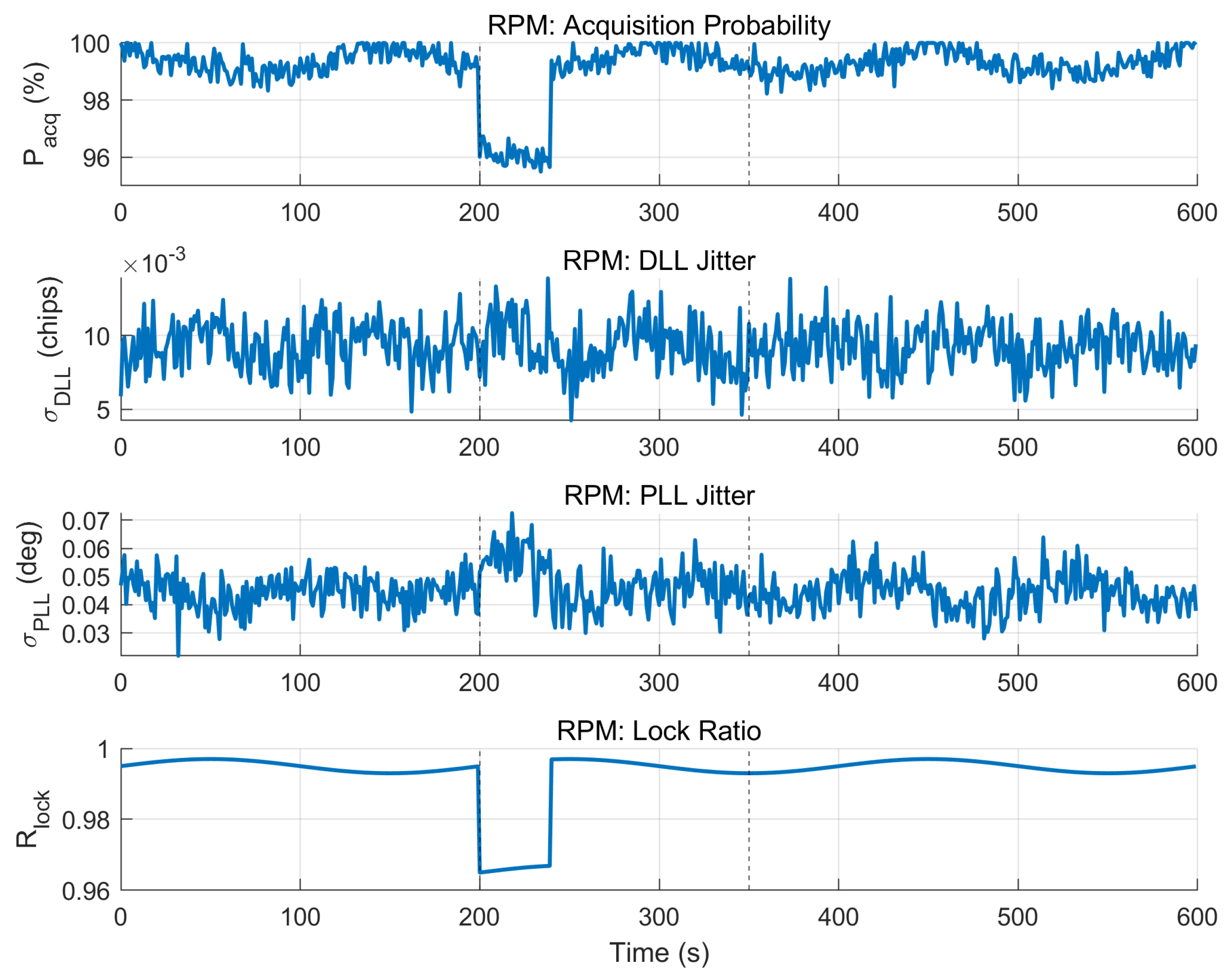
Figure 11 shows the Receiver Processing Monitoring (RPM) metrics: acquisition probability (
), DLL jitter, PLL jitter, and lock ratio (
). Before the fault,
, and
. At the desynchronization event (200–240 s),
temporarily fell to
and
increased by
, while DLL jitter remained nearly unchanged. The PMS immediately flagged an unlocking episode (<0.5 s latency). During the multi-path phase, PLL jitter and lock ratio exhibited only mild variations, consistent with preserved phase coherence but slightly distorted correlation peaks.
Shown in
Table 6 is a summary of RPM results reflecting acquisition and tracking loop stability.
(c) Measurement-Domain Response
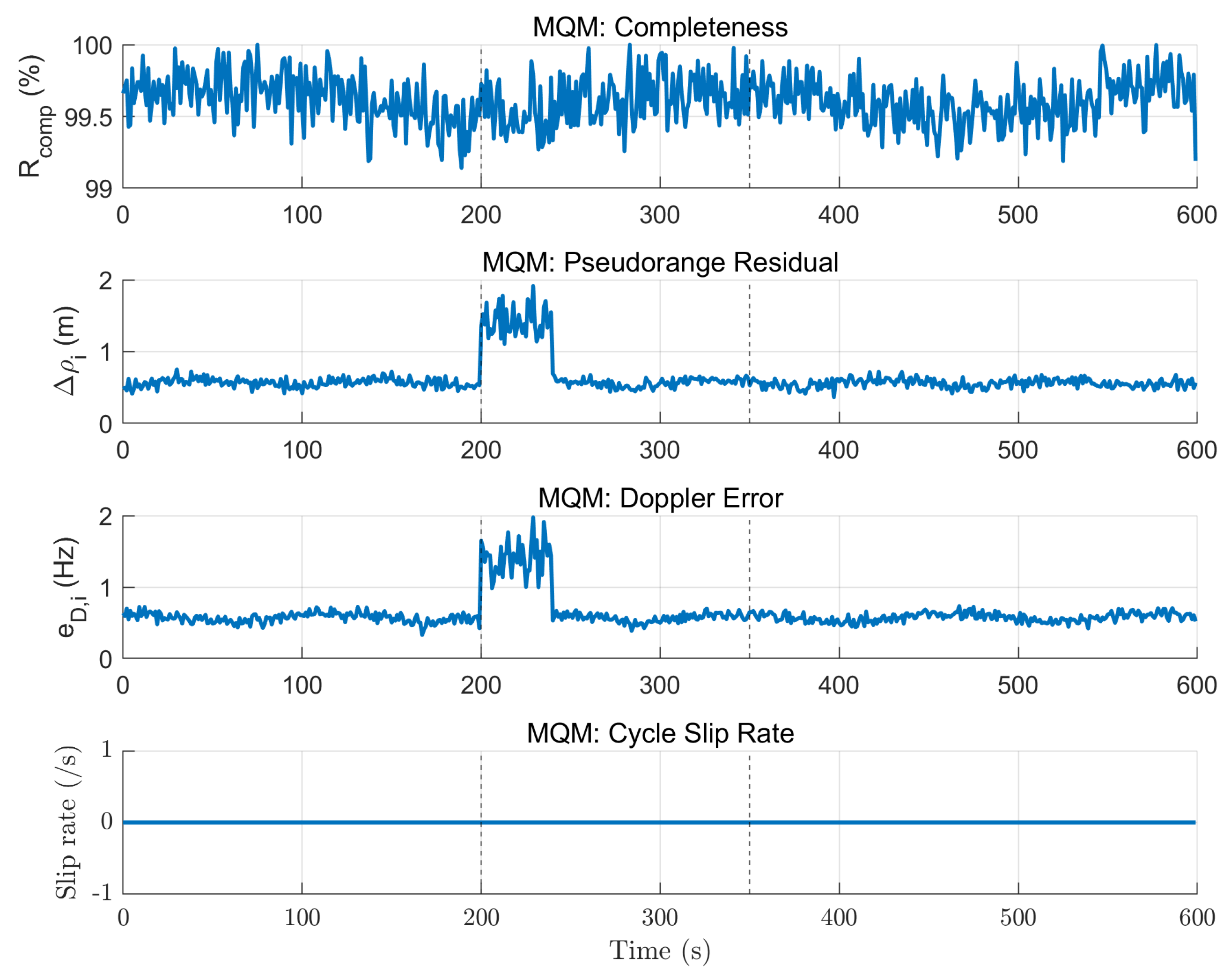
Figure 12 presents the Measurement Quality Monitoring (MQM) results: measurement completeness (
), pseudorange residual (
), Doppler error (
), and cycle-slip rate. Under nominal operation,
was
, pseudorange residuals
, and no cycle slips occurred. When desynchronization was introduced, pseudorange residuals and Doppler errors abruptly increased by
and 0.8 Hz, respectively, and
briefly dropped to
. These errors quickly recovered after the fault cleared (
). In contrast, the multi-path condition (350–400 s) produced smaller residual variations (<0.3 m), confirming that most degradation originated from RF distortion rather than time bias.
Shown in
Table 7 is a summary of MQM results derived from observation-level consistency checks.
(d) Composite Quality Index (CQI) and Decision Logic
Figure 13 depicts the CQI evolution, combining all normalized metrics through the weighting vector
for SQM, RPM, and MQM domains, respectively:
Each sub-score was computed as a normalized quality level from 0 (alarm) to 1 (normal).
The CQI thresholds were defined as follows:
During nominal operation, CQI fluctuated slightly around 0.95.
At the desynchronization event, it fell rapidly to (WARNING state) and recovered within 5 s after correction.
The multi-path disturbance produced a moderate dip to followed by smooth restoration after .
The exponential moving-average (EMA) smoothing provided a stable visual trend without masking abrupt transitions.
(e) Assessment of signal quality health by CQI
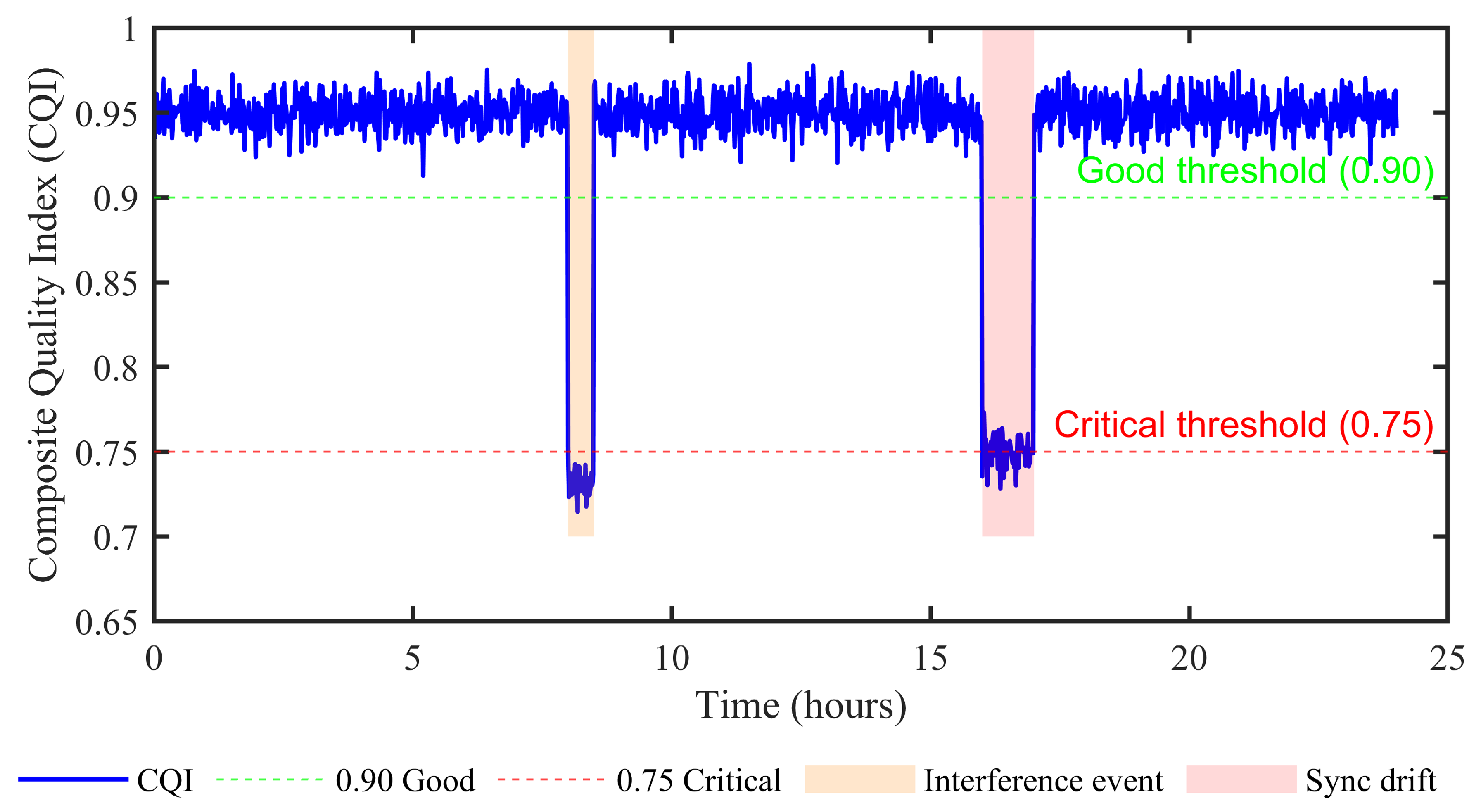
The system was classified as good for most of the 24 h experiment, transitioning to degraded or critical only during deliberate fault injections as shown in
Figure 14.
As shown in
Table 8, The CQI provides a compact and intuitive representation of system health and enables rapid identification of abnormal operating conditions.
These results confirm that the proposed PMS provides fast, specific, and quantitative monitoring for distributed pseudolite systems, ensuring early fault detection and improved system integrity in real-time DAPLS operation.
3.3. Summary of Results
The experimental results obtained from the DAPLS testbed demonstrate that the proposed monitoring station effectively performs multi-layer monitoring across constellation status, time synchronization, spatial coordinate reference, and signal quality. (1) Constellation status monitoring enabled rapid detection of transmitter outages and visibility degradation, with real-time GDOP assessment. (2) Time reference monitoring successfully quantified both absolute and relative stability, detecting synchronization drift as small as 15 ns/h. (3) Spatial coordinate reference monitoring validated that broadcast coordinates remained consistent with surveyed positions, ensuring array geometry reliability. (4) Signal quality monitoring captured variations in SQM, RPM, and MQM metrics, with results summarized by CQI for intuitive system health assessment. Overall, the monitoring station proved capable of comprehensive, multi-layer evaluation of DAPLS, supporting reliable operation in both normal and fault conditions.
4. Discussion
The experimental results demonstrate that the proposed PMS and the SQA framework can effectively evaluate the signal integrity and performance of the DAPLS. This section discusses the implications of these findings, compares them with existing pseudolite and GNSS integrity monitoring methods, and identifies future improvement directions.
(1) Multi-Layer Monitoring Capability
One of the primary contributions of this work is the multi-layer monitoring framework, which simultaneously evaluates constellation status, time reference, spatial coordinate reference, and signal quality. Unlike traditional GNSS integrity monitoring—such as Receiver Autonomous Integrity Monitoring (RAIM) and Signal Quality Monitoring (SQM), which typically focus on signal integrity at the user receiver, the proposed monitoring station addresses the entire system hierarchy.
Constellation status monitoring provides real-time availability and DOP information, enabling operators to respond promptly to transmitter outages. Time reference monitoring ensures nanosecond-level synchronization across distributed pseudolite transmitters, a requirement more stringent than in GNSS satellites, which inherently rely on precise onboard atomic clocks. Spatial coordinate reference monitoring validates the geometric consistency of the pseudolite array, a unique need in DAPLS where transmitters are ground-based and subject to potential relocation or installation errors. Signal quality monitoring integrates physical-layer and data-layer parameters into a unified CQI metric, providing both detailed diagnostics and intuitive system health evaluation.
This holistic approach ensures that anomalies can be detected not only at the signal level but also at the constellation, timing, and coordinate reference levels.
(2) Comparison with GNSS Monitoring Systems
Traditional GNSS monitoring networks, such as the International GNSS Service (IGS) or ground-based augmentation systems (GBAS), primarily focus on detecting signal distortions, ephemeris errors, and ionospheric anomalies. In contrast, DAPLS monitoring faces both similar and distinct challenges.
Similarities: Both systems require continuous monitoring of signal quality, multipath, and timing stability. The metrics used (e.g., C/N0, MPI, parity checks) are conceptually consistent across GNSS and pseudolites.
Differences:
Synchronization requirement: In GNSS, satellites operate with onboard atomic clocks; synchronization is ensured via global time references. In DAPLS, however, synchronization must be actively maintained across distributed ground transmitters, making inter-transmitter monitoring essential.
Spatial reference validation: GNSS satellites have well-defined orbital ephemerides, while pseudolite coordinates must be surveyed and continuously verified, since deployment errors or relocations can directly bias positioning.
Environmental effects: DAPLS operates in indoor or urban canyon environments, where multi-path is much stronger than in open-sky GNSS conditions, necessitating more sensitive multi-path detection and mitigation strategies.
These differences highlight that while DAPLS can leverage GNSS monitoring methodologies, its ground-based, distributed, and interference-prone nature requires a tailored monitoring framework.
(3) Practical Implications for DAPLS Deployment
The monitoring station enables several practical benefits for real-world deployment of DAPLS:
Fault detection and isolation: By distinguishing between constellation, timing, spatial, and signal-level anomalies, the system supports rapid fault diagnosis and recovery.
Operational assurance: Continuous monitoring builds confidence in DAPLS operation, particularly in safety-critical indoor or urban positioning applications.
Deployment optimization: Metrics such as MPI and coordinate consistency can guide the placement and calibration of pseudolite transmitters to minimize multi-path and geometric biases.
These features make the monitoring station an integral part of DAPLS deployment, rather than an optional add-on.
(4) Comparison with Other Indoor Localization Methods
Representative indoor positioning solutions include Wi-Fi fingerprinting, Bluetooth Low Energy (BLE), Ultra-Wideband (UWB), radio-frequency identification (RFID), and vision-based methods. Wi-Fi- and BLE-based techniques benefit from existing infra-structure but often suffer from limited accuracy and sensitivity to environmental changes. UWB systems can achieve decimeter-level or even centimeter-level accuracy; however, they typically require dense anchor deployment and dedicated hardware, and they do not inherently provide high-stability timing services.
In contrast, the DAPLS approach provides a controlled signal environment with deterministic geometry, signal structure, and time reference, enabling GNSS-like ranging and timing capabilities in indoor or GNSS-denied environments. Although this requires dedicated infrastructure, it offers key advantages such as absolute positioning, time synchronization, predictable error characteristics, and compatibility with GNSS-based navigation principles. These features are particularly relevant for applications requiring high reliability, traceability, and timing consistency, such as industrial automation, indoor timing distribution, and safety-critical operations.
It should be emphasized that the proposed PMS and SQA framework is not intended to compete directly with infrastructure-free indoor localization techniques in terms of deployment simplicity. Instead, it complements existing methods by providing system-level monitoring, integrity assessment, and augmentation capabilities that are generally unavailable in opportunistic localization systems. Moreover, hybrid localization architectures combining DAPLS with Wi-Fi, UWB, or inertial sensors represent a promising direction for future research.
(5) Limitations and Future Work
While the proposed monitoring framework demonstrated strong performance in controlled experiments, several limitations remain:
Scalability: The current implementation monitored up to four transmitters. Scaling to larger arrays may require additional hardware channels and computational resources.
Environmental diversity: Experiments were limited to laboratory and semi-open corridors. Further testing in complex environments such as shopping malls, tunnels, or dense urban canyons is needed to validate robustness under severe multi-path and interference.
Adaptive algorithms: Fixed thresholds and weights may not generalize across all conditions. Future work will investigate machine learning-based adaptive assessment models to improve anomaly detection accuracy.
Integration with positioning results: While this study focused on signal-level monitoring, integrating monitoring outcomes with user positioning performance would provide end-to-end quality assurance.
Future research on DAPLS systems will primarily focus on the following:
Adding monitoring of precision-coded signals to improve the monitoring of all signals in the DAPLS system.
Integrating the PMS with the APL transmitting station, sharing the same transceiver hardware and antenna infrastructure. This integration enables a transceiver-integrated design, supporting simultaneous transmission and reception of multiple signals and effectively forming a multiple-input multiple-output (MIMO) configuration.
Proposing a fully integrated APL station based on the transceiver, which possesses mutual monitoring and collaborative enhancement capabilities, enhancing time synchronization, communication networking, and automated deployment for indoor positioning and timing applications.
With respect to robustness, the PMS is capable of identifying transmitter anomalies, signal outages, and degradation through constellation status monitoring and measurement quality assessment. A systematic robustness analysis considering multiple simultaneous transmitter failures will be investigated in future studies.
In summary, the monitoring station for DAPLS introduces a comprehensive, multi-layered monitoring paradigm that extends beyond conventional GNSS integrity monitoring. It provides effective detection of anomalies across constellation, time, space, and signal domains, enabling robust and reliable operation of pseudolite-based positioning systems. Although challenges remain in scalability, environmental robustness, and adaptive weighting, the proposed framework establishes a solid foundation for practical deployment and future research in distributed pseudolite monitoring.
5. Conclusions
This study presents the design and implementation of a Pseudolite Monitoring Station (PMS) for Distributed Array Pseudolite Systems (DAPLS), together with an integrated Signal Quality Assessment (SQA) framework tailored for indoor positioning and timing applications. The proposed PMS provides a unified monitoring solution covering signal quality, receiver processing status, and measurement-level integrity, enabling comprehensive and real-time assessment of pseudolite system performance.
A hierarchical set of monitoring metrics was established, including Signal Quality Monitoring (SQM) metrics derived from time, frequency, correlation, and modulation domains; Receiver Processing Monitoring (RPM) metrics reflecting acquisition, tracking, and lock status; and Measurement Quality Monitoring (MQM) metrics evaluating observation consistency and availability. Based on these metrics, multiple signal quality assessment methods were developed, encompassing constellation status assessment, time reference assessment, spatial coordinate reference assessment, and signal anomaly monitoring. In particular, a composite quality indicator (CQI) was introduced to fuse multiple monitoring metrics into a unified indicator for anomaly detection and system health evaluation. A comprehensive Signal Quality Assessment (SQA) framework is further introduced, including four dimensions of evaluation: constellation status, time reference, spatial coordinate reference, and signal anomaly detection.
Experimental results obtained in a controlled indoor environment demonstrate that the proposed PMS and SQA framework can effectively detect signal distortions, synchronization deviations, and abnormal operating conditions, while providing quantitative indicators that support reliable indoor positioning and timing. Experimental results showed stable synchronization within ±5 ns, coordinate accuracy within 0.2 m, and consistently high signal quality. CQI provided an intuitive health score, with values >0.92 under normal operation and drops to below 0.75 during fault scenarios. The monitoring station effectively detected minor signal distortions and synchronization deviations, confirming its diagnostic precision and robustness. The results confirm that, even in environments without atmospheric effects and with partial clock synchronization, continuous monitoring remains essential due to multi-path propagation, clock drift, and dynamic interference.
Overall, this work provides a practical monitoring architecture and a systematic signal quality assessment methodology for distributed indoor pseudolite systems, laying a solid foundation for reliable deployment, operation, and future expansion of high-precision indoor positioning and timing infrastructures.
6. Patents
During the research process, this work has applied for the following related patents: ZL 2021113498922, ZL2021113480967 and ZL202011227799.