Article

Enhancing Precise Point Positioning Under Active Ionosphere Using Wide-Range Ionospheric Corrections Derived from MADOCA Service


1
College of Geographical Sciences, Changchun Normal University, Changchun 130032, China
2
College of Environment and Resource Sciences, Zhejiang A&F University, Hangzhou 311300, China
*
Author to whom correspondence should be addressed.
Appl. Sci. 2026, 16(1), 184; https://doi.org/10.3390/app16010184
Submission received: 21 November 2025 / Revised: 20 December 2025 / Accepted: 22 December 2025 / Published: 24 December 2025
(This article belongs to the Special Issue Advanced GNSS Technologies: Measurement, Analysis, and Applications)

Abstract

The performance of the MADOCA-PPP (Multi-GNSS Orbit and Clock Augmentation-Precise Point Positioning) wide-range ionospheric correction requires further investigation during periods of high ionospheric activity, particularly regarding its impact on the convergence time and positioning accuracy of both PPP and PPP with Ambiguity Resolution (PPP-AR). Thus, the present study selects the month with the highest average Kp index between January 2023 and May 2025 and conducts positioning analyses at nine stations. Results indicate that applying wide-range ionospheric corrections reduces PPP convergence time by 47% in static mode and 54% in kinematic mode. When these corrections are integrated into PPP-AR, they shorten the convergence time by 69% in static mode and 72% in kinematic mode. Moreover, PPP-AR enhanced with wide-range ionospheric corrections achieves the highest positioning accuracy across both modes: in static mode, the horizontal and vertical root mean square errors (RMSEs) are approximately 5.2 cm and 6.9 cm, respectively, while in kinematic mode, these values are 5.6 cm and 8.0 cm. These findings demonstrate that the wide-range ionospheric corrections provided by the MADOCA-PPP service effectively enhance PPP performance during periods of heightened ionospheric activity.

1. Introduction

Precise Point Positioning (PPP) that leverages State Space Representation (SSR) corrections for precise orbits and clocks has emerged as a key high-precision positioning technology within the Global Navigation Satellite Systems (GNSS) domain. Depending on whether observations are combined across different frequencies, PPP is generally categorized into ionosphere-free PPP (IF-PPP) and Un-combined PPP (UC-PPP). IF-PPP eliminates first-order ionospheric delays through linear combinations of multi-frequency observations, but this comes at the cost of reduced signal-to-noise ratio and amplified observation noise. In contrast, UC-PPP estimates the slant ionospheric delay for each satellite, which is highly correlated with the carrier-phase ambiguity parameters [1]. The filter must rely on prolonged continuous observations and changes in satellite geometry to gradually decorrelate these parameters. As a result, conventional dual-frequency PPP typically requires several tens of minutes to achieve centimeter-level accuracy [2,3].
To accelerate PPP convergence, researchers have focused on restoring the integer nature of carrier-phase ambiguities, leading to the development of PPP with ambiguity resolution (PPP-AR). Correctly fixing the ambiguities provides highly precise constraints to the observation equations, enabling immediate high-precision positioning. Current research focuses on multi-constellation and multi-frequency PPP-AR [4,5,6,7]. For instance, using four systems (GPS, BDS, GLONASS, and Galileo, abbreviated as GCRE) in dual-frequency mode achieves the fastest time-to-first-fix (TTFF), reaching approximately 9 min under a 7° cutoff elevation angle [8]. Meanwhile, triple-frequency observations from GCEJ (QZSS, abbreviated as J) reduce the initialization time to 3 min with 20–21 visible satellites [9]. Additionally, the use of BDS-3 and Galileo four-frequency signals further shortens the TTFF by about 14% compared to triple-frequency solutions [10].
Additionally, atmospheric delay, particularly ionospheric delay, constitutes another critical factor affecting PPP convergence. The use of external high-precision ionospheric corrections enables rapid, or even instantaneous, ambiguity resolution in PPP [11,12,13], resulting in positioning performance comparable to that of traditional real-time kinematic (RTK) positioning [14,15,16]. However, generating such precise ionospheric corrections typically relies on dense regional reference station networks [17,18,19], which limits their applicability in areas with poor ground infrastructure, such as deserts, forests, and open seas. Currently, the multi-GNSS advanced orbit and clock augmentation-PPP (MADOCA-PPP) service of QZSS offers a wide-range ionospheric correction service based on a relatively sparse reference network [20,21].
While preliminary assessments of the MADOCA wide-range ionospheric corrections have been conducted, existing evaluations [22] primarily utilized data from periods of low ionospheric activity (e.g., July 2024). Consequently, a critical gap remains: the effectiveness of this service in accelerating PPP convergence during periods of high ionospheric disturbance has not been established. To address this gap, the primary objective of this study is to comprehensively evaluate the performance of the MADOCA wide-range ionospheric corrections for PPP/PPP-AR under conditions of significant ionospheric activity. Specifically, we aim to quantify the improvement in convergence time and positioning accuracy achieved by applying these corrections, compared to standard PPP/PPP-AR without ionospheric aid, in both static and kinematic positioning modes.
The remainder of this paper is organized as follows. Section 2 introduces the wide-range ionosphere-enhanced PPP model. Section 3 describes the selected GNSS observation period characterized by high ionospheric activity and outlines the data processing strategy. Section 4 presents a comparative analysis of positioning performance with and without ionospheric enhancement. Finally, the paper concludes with a discussion of the results and a summary of the main findings.

2. Methods

Consistent with the MADOCA-PPP technology demonstration incorporating ionospheric correction [22], this study also adopts a dual-frequency uncombined PPP model, which facilitates the integration of external ionospheric constraints. Specifically, this section also presents the methodology and implementation procedures for the wide-range ionospheric corrections used in PPP.

2.1. Dual-Frequency Un-Combined PPP Model

The dual-frequency pseudorange and carrier-phase observations of a satellite are associated with multiple factors, including the user position, clock offset, tropospheric delay, ionospheric delay, phase ambiguity, and the hardware biases of pseudorange and phase. These relationships are mathematically described by the observation equations presented below [23]:
P r , 1 s = ρ r s + δ r δ s + m r s T + I r , 1 s + d r , 1 d 1 s + ε P P r , 2 s = ρ r s + δ r δ s + m r s T + f 1 2 / f 2 2 I r , 1 s + d r , 2 d 2 s + ε P L r , 1 s = ρ r s + δ r δ s + m r s T I r , 1 s + λ 1 N r , 1 s + b r , 1 b 1 s + ε L L r , 2 s = ρ r s + δ r δ s + m r s T f 1 2 / f 2 2 I r , 1 s + λ 2 N r , 2 s + b r , 2 b 2 s + ε L
where P r , i s and L r , i s denote the pseudorange and phase observations from the receiver r to the satellite s , and i = 1 , 2 is the frequency index. ρ r s represents the geometric distance between the satellite and the receiver. δ r and δ s denote the receiver clock offset and the satellite clock offset, respectively. T is the zenith tropospheric delay (ZTD) and its mapping function is m r s . I r , 1 s is the first-order slant ionospheric delay, and it is correlated with the second frequency through f 1 2 / f 2 2 , with f i being the frequency. d r , i and d i s are the receiver-specific and satellite-specific pseudorange biases on frequency i , respectively. b r , i and b i s are the receiver-specific and satellite-specific phase biases on frequency i , expressed in units of cycles. N r , i s refers to the integer ambiguity. λ i is the wavelength. ε P and ε L denote the pseudorange and phase observation noise. For the analyses presented, user site displacement, phase wind-up, and receiver antenna phase center characteristics have been corrected for, so they are not included in the equations.
When applying the precise clock offsets and observable-specific signal biases (OSBs) provided by the MADOCA-PPP service, the pseudorange and carrier-phase equations can be expressed as follows:
P ^ r , 1 s = ρ r s + δ ˜ r + m r s T + I ˜ r , 1 s + ε P P ^ r , 2 s = ρ r s + δ ˜ r + m r s T + f 1 2 / f 2 2 I ˜ r , 1 s + ε P L ^ r , 1 s = ρ r s + δ ˜ r + m r s T I ˜ r , 1 s + λ 1 N ˜ r , 1 s + ε L L ^ r , 2 s = ρ r s + δ ˜ r + m r s T f 1 2 / f 2 2 I ˜ r , 1 s + λ 2 N ˜ r , 2 s + ε L
where P ^ r , i s = P r , i s + δ ^ s + d ^ i s and L ^ r , i s = L r , i s + δ ^ s + λ i b ^ i s denote pseudorange and phase observations corrected with precise clock offsets and OSBs with δ ^ s being precise clock offsets, d ^ i s being pseudorange OSBs, and b ^ i s being phase OSBs. After reparameterization, the receiver clock offset, ionospheric delay, and ambiguity parameters can be written as follows:
δ ˜ r = δ r + d r , I F I ˜ r , 1 s = I r , 1 s d r , I F d r , 1 λ 1 N ˜ r , 1 s = λ 1 N r , 1 s + b r , 1 2 d r , I F / λ 1 + d r , 1 / λ 1 λ 2 N ˜ r , 2 s = λ 2 N r , 2 s + b r , 2 2 d r , I F / λ 2 + d r , 2 / λ 2
where d r , I F is the receiver IF pseudorange bias. It can be observed that after applying satellite-specific OSB corrections, the float ambiguities absorb only receiver-related biases. Such biases can be removed via between-satellite single differencing, thereby retrieving the integer characteristic of single-differenced ambiguities [24,25]. It should also be noted that the satellite phase OSBs provided by the MADOCA-PPP service contain discontinuity indicators. Therefore, it is recommended that these phase OSBs be applied only when performing AR. Thus, it is advised that these phase OSBs be utilized solely during AR implementation.

2.2. MADOCA-PPP Wide-Range Ionosphere Correction Model

When the receiver lies within the service coverage k , the ionospheric delay correction for the satellite s can be calculated as follows [20]:
I ^ r , i s = 40.31 × 10 16 f i 2 × S T E C k s
where I ^ r , i s is the wide-range ionospheric delay correction in meters, and S T E C k s represents the corresponding correction in total electron content units (TECU). The S T E C k s can be determined based on the polynomial part of the correction message type as follows:
S T E C k s = C 00 , T y p e = 0 S T E C k s = C 00 + C 01 φ φ 0 + C 10 λ λ 0 , T y p e = 1 S T E C k s = C 00 + C 01 φ φ 0 + C 10 λ λ 0 + C 11 φ φ 0 λ λ 0 , T y p e = 2 S T E C k s = C 00 + C 01 φ φ 0 + C 10 λ λ 0 + C 11 φ φ 0 λ λ 0 + C 02 φ φ 0 2 + C 20 λ λ 0 2 , T y p e = 3
where λ , φ represent the longitude and latitude of the receiver position, respectively, and λ 0 , φ 0 denote the longitude and latitude of the reference coordinate for the area k . The terms C 00 , C 01 , C 10 , C 11 , C 02 , and C 20 are all polynomial coefficients. The term T y p e denotes the ionospheric correction message type. When applying I ^ r , i s , the observation equation is constructed as follows [26,27,28]:
I ˜ r , i p s = I ^ r , i p s + σ I ^
where I ˜ r , i p s = I ˜ r , i p I ˜ r , i s represents the between-satellite single-differenced ionospheric delay for satellites p and s, estimated through the user’s own processing. I ^ r , i p s = I ^ r , i p I ^ r , i s denotes the corresponding single-differenced ionospheric delay correction for the same satellite pair. σ I ^ denotes the accuracy of the ionospheric delay correction, which can be determined based on the SSR quality indicator [20].

3. Data and Strategy

Kp index is a key indicator of ionospheric activity [29,30,31]. Based on this metric, this section identifies the months with the highest ionospheric activity during the period from January 2023 to May 2025 using average Kp values. Subsequently, nine stations are selected, specifically three located in Japan and six distributed across Asia and Oceania. Lastly, the PPP processing strategies are described, including both static and kinematic modes.

3.1. Data Collection

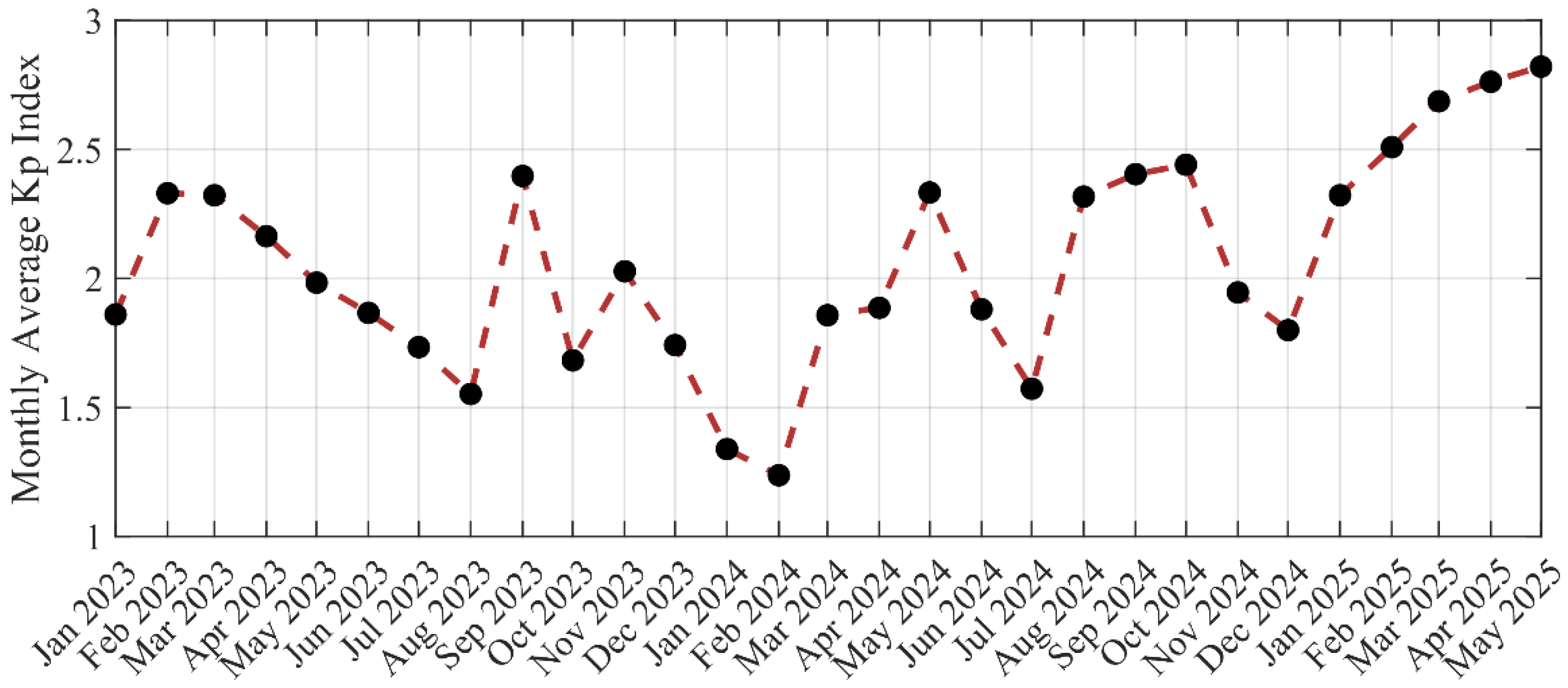
The daily Kp indices from January 2023 to May 2025 were downloaded from the website https://kp.gfz.de/en/data (accessed on 28 August 2025) [32]. Subsequently, the monthly average Kp index was calculated and statistically analyzed, as illustrated in Figure 1. It can be observed that May 2025 exhibits the highest monthly average Kp index, with a value approaching 3.0. This value was significantly higher than the ionospheric correction evaluation result provided by CAO (Cabinet Office) for July 2024, which is approximately 1.5. Therefore, the GNSS observation time period selected in this study was set from 1 May to 31 May 2025.
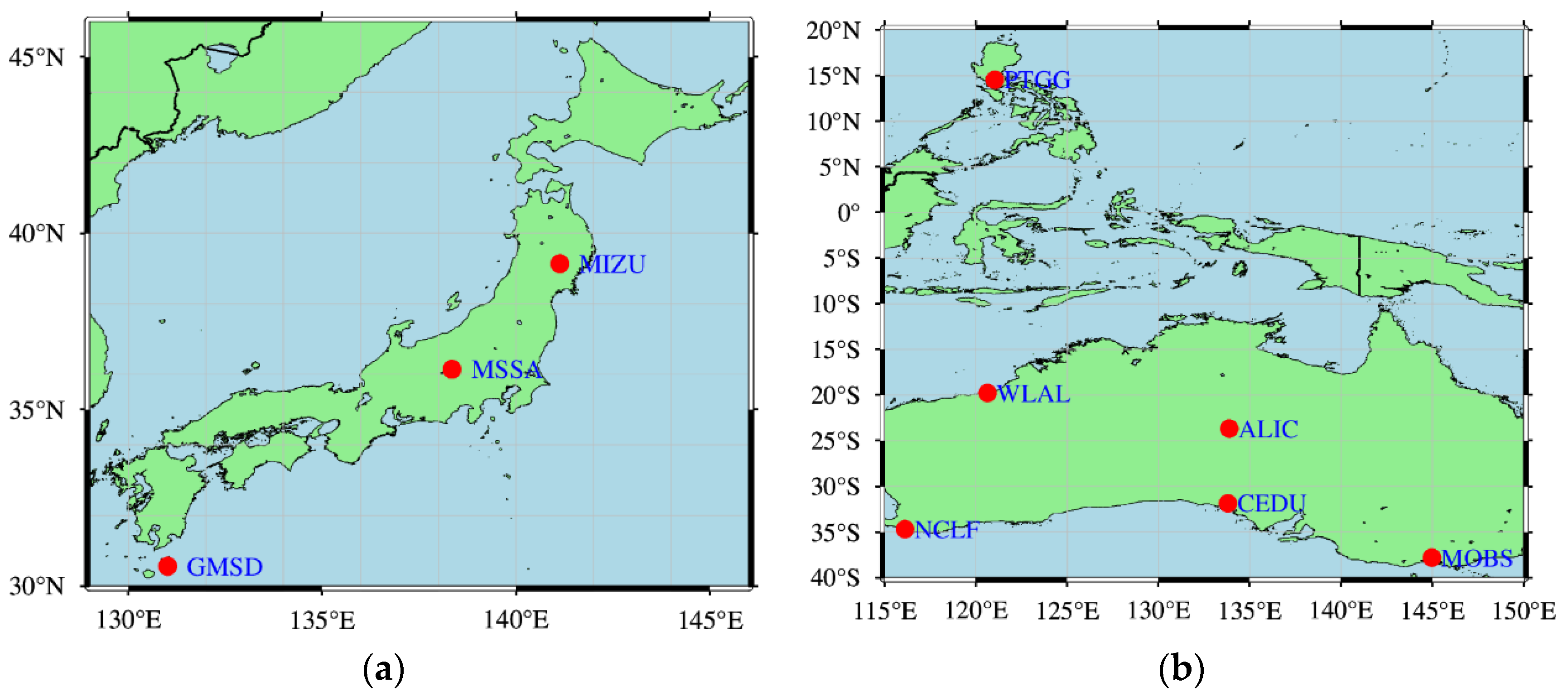
Subsequently, three Japan GNSS stations and six Asia–Oceania GNSS stations with four-system (GECJ) observation capability were selected for this study. Among these stations, the six Asia–Oceania ones are consistent with those adopted in the ionospheric correction evaluation conducted by the technology demonstration [22]. The spatial distribution of all nine stations is presented in Figure 2. Observation data in receiver independent exchange format with a 30 s sampling interval from nine stations were obtained from the following directory: https://go.gnss.go.jp/rinex/daily/2025/DOY/25d/ (accessed on 29 August 2025). Precise orbit corrections, clock offset corrections, and code/phase biases from the MADOCA-PPP service were acquired from https://l6msg.go.gnss.go.jp/ (accessed on 30 August 2025), specifically files with the suffixes 204.l6 and 206.l6. Additionally, wide-range ionospheric corrections were retrieved from the same source, corresponding to files with the suffixes 200.l6 and 201.l6.

3.2. Processing Strategy

During the processing of UC-PPP, both static and kinematic modes are employed to assess positioning performance under different conditions. In static mode, the receiver is assumed to be stationary (like on a tripod), allowing us to analyze the best achievable accuracy and convergence time when the user position is fixed. In contrast, kinematic mode simulates a moving receiver (such as in a car or on a person), which better reflects real-world dynamic applications and tests the system’s ability to provide continuous, high-precision positioning in motion. For each mode, three processing approaches are implemented: (I) PPP without ionospheric corrections; (II) PPP with ionospheric corrections; (III) PPP-AR with ionospheric corrections. Here, in the first strategy, the ionospheric delay for each satellite is estimated. In the second strategy, the ionospheric delays are estimated concurrently but constrained using wide-range ionospheric corrections.
Considering that official MADOCA-PPP ionospheric corrections for BDS are not yet available in post mode and that PPP-AR is difficult to achieve for GLONASS, the GPS, Galileo, and QZSS (GEJ) systems are adopted. In alignment with the ionospheric correction technology demonstration, dual-frequency observations are used, specifically G (L1, L2), E (E1, E5a), and J (L1, L2).
For the ambiguity resolution, a sequential approach is adopted: first fixing the wide-lane ambiguities, followed by the narrow-lane ambiguities. After the wide-lane ambiguities are successfully fixed, they are applied as constraints to update the parameters of station coordinates, tropospheric delays, ionospheric delays, and raw ambiguities. The wide-lane ambiguities are fixed using a simple rounding method, while the narrow-lane ambiguities are resolved using the LAMBDA (least-squares ambiguity decorrelation adjustment) method [33,34].
When applying the LAMBDA method, we employ a partial ambiguity resolution (PAR) with a minimum of four satellites required for fixing. To validate the correctness of the fixed ambiguities, a ratio test is performed with an initial threshold set to 1.5. This threshold is subsequently adjusted based on the number of satellites involved in the ambiguity fix [35,36]. The main processing strategies used for our UC-PPP processing are summarized in Table 1.

4. Results and Analysis

In this section, the performance of different PPP processing approaches is evaluated in both static and kinematic modes. The parameters are reset hourly to restart the solution process. The analysis focuses on both convergence time and positioning accuracy. Convergence time is defined as the duration from the initial epoch until the point at which the horizontal positioning error remains below 15 cm and the vertical error below 30 cm for five consecutive epochs. Positioning accuracy is assessed by calculating the RMSE (root mean square error) of the positioning errors from all epochs after convergence. The reference station coordinates are derived from the daily static PPP solutions with Net_Diff software (V1.16) over a 31-day period [37,38].

4.1. Static Positioning Performance

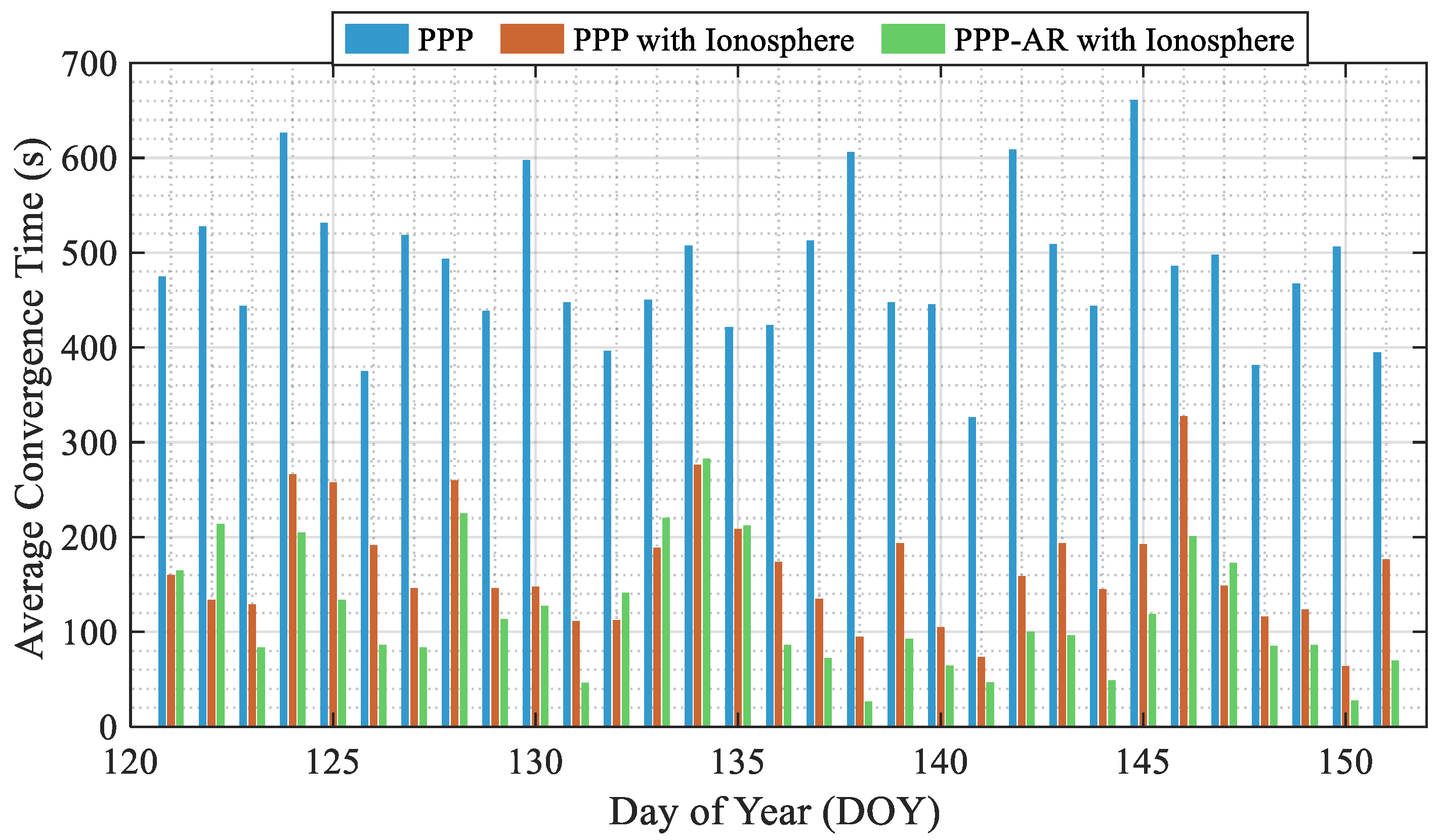
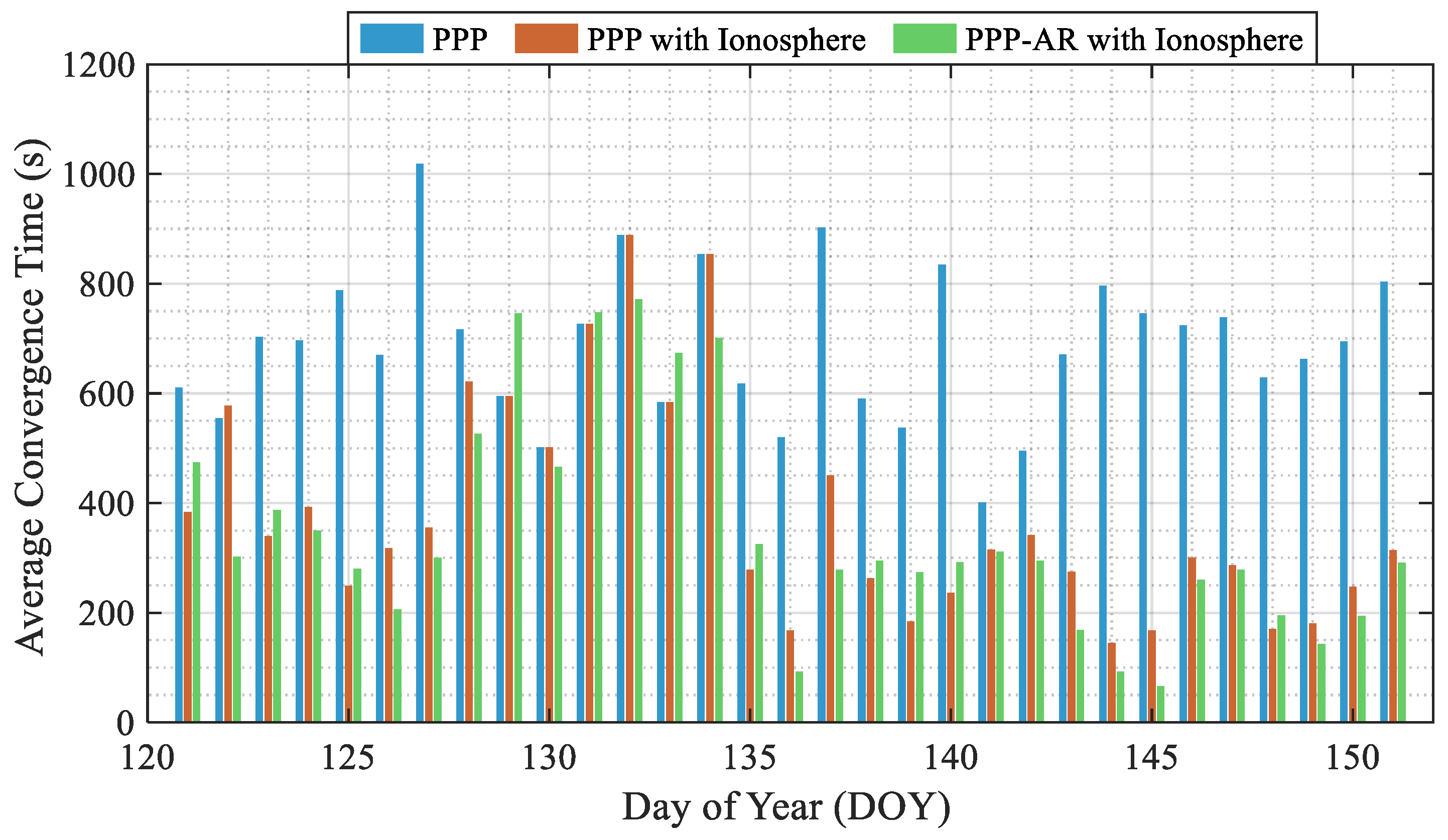
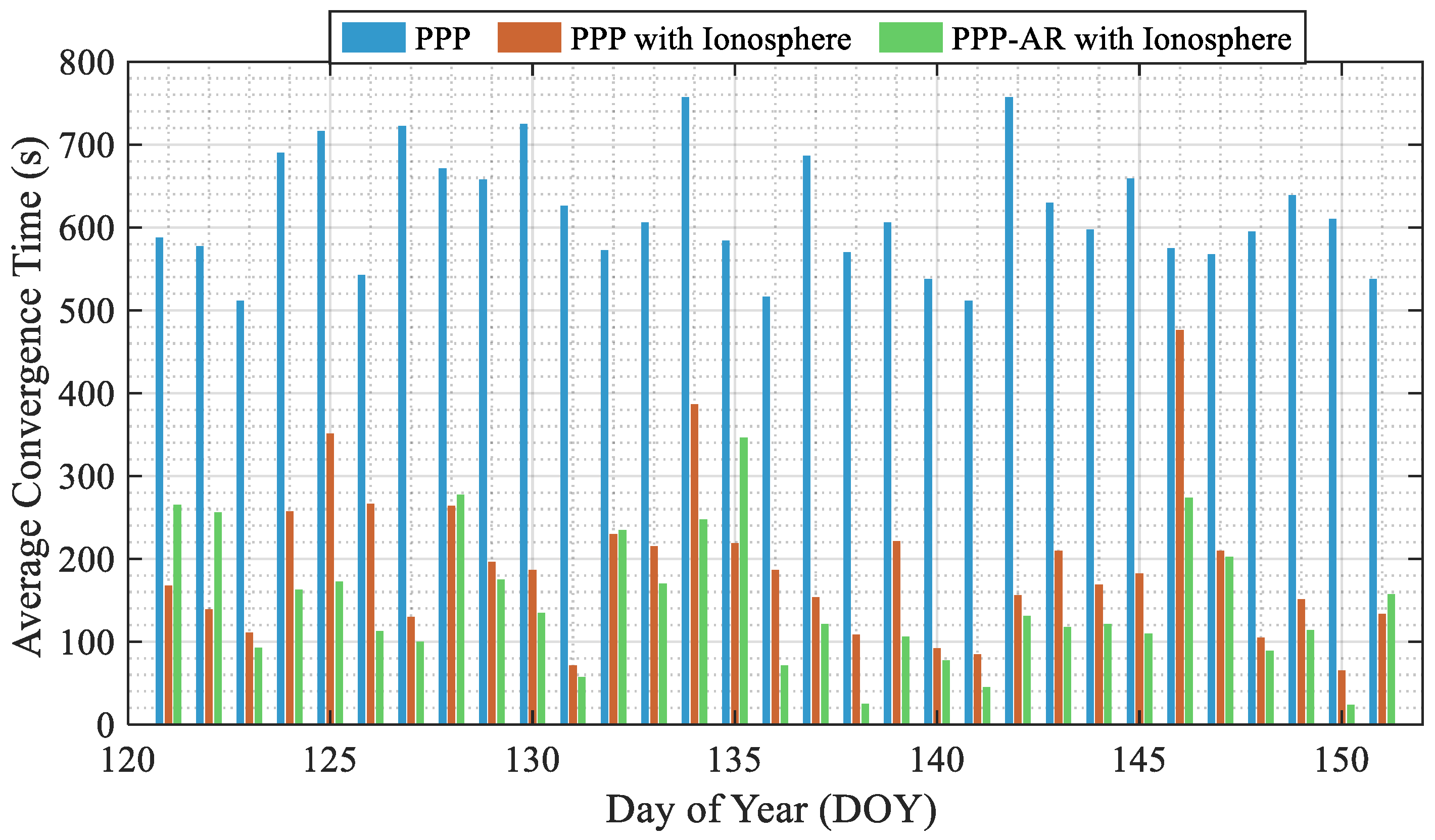
The daily average convergence times for three different PPP processing approaches in static mode are presented in Figure 3 and Figure 4, using the northern hemisphere’s lowest-latitude station PTGG and the highest-latitude station MIZU as examples. It can be observed that after applying wide-range ionospheric corrections, the convergence time at station PTGG is generally reduced to within 400 s, except during the period from DOY 129 to DOY 134. During the period from DOY 129 to DOY 134, the average Kp index was 2.4, indicating relatively quiet ionospheric conditions. However, the application of wide-range ionospheric corrections did not lead to any improvement in the convergence time of PPP. This suggests that the accuracy of the wide-range ionospheric corrections was relatively low at this low-latitude station during the specified period.
In addition, a notable performance improvement is achieved through ambiguity resolution, which reduces the convergence time to within 300 s on most days. At the higher-latitude MIZU station, the application of wide-range ionospheric correction consistently accelerated convergence, with times falling below 200 s on the majority of the days. These results indicate that, compared to the low-latitude Asia region, the wide-range ionospheric correction offers more stable and reliable performance in the high-latitude Japan region.
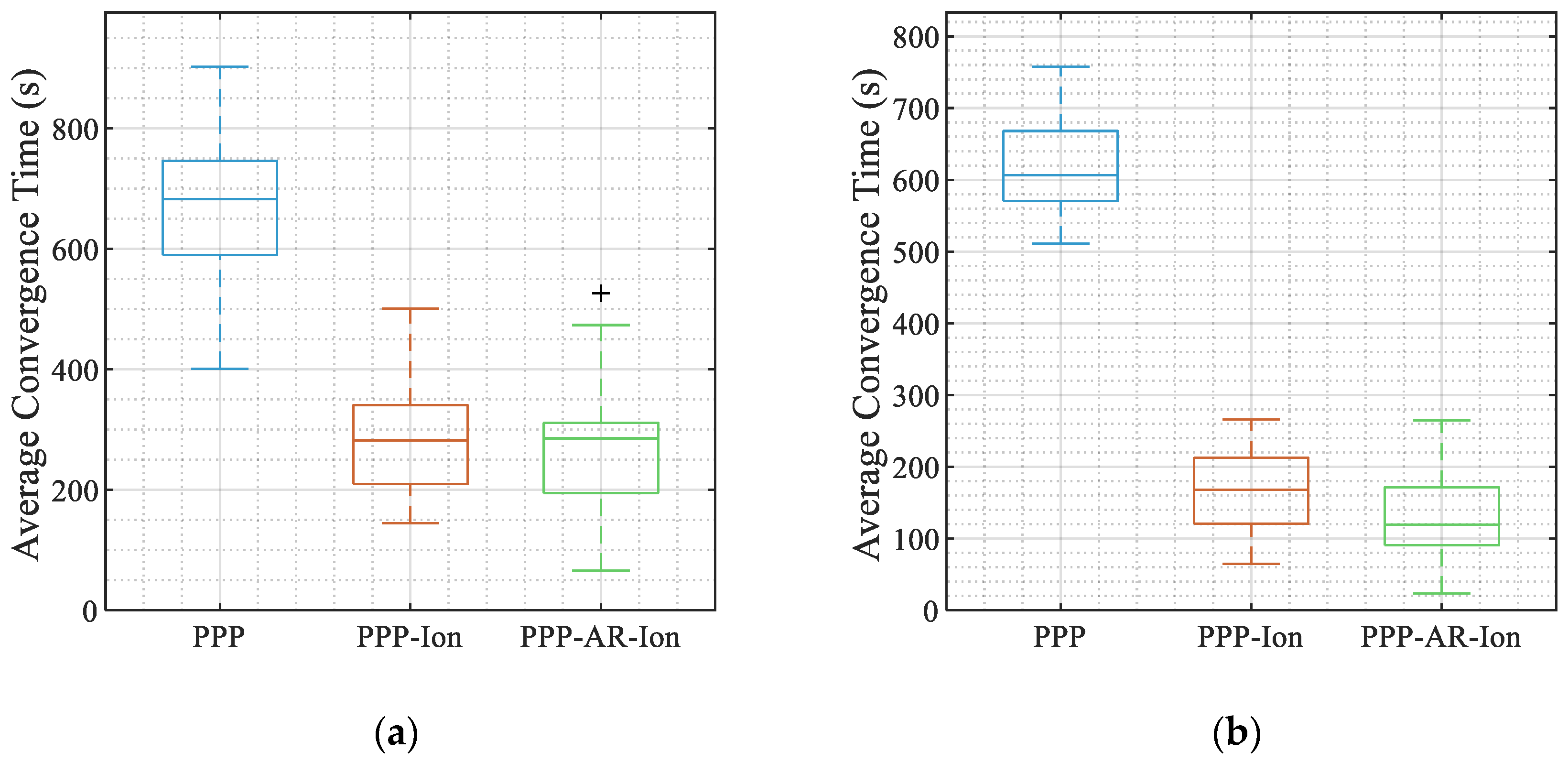
Then, to better illustrate the statistical variability and central tendency of the daily average convergence time across the 31-day dataset for stations PTGG and MIZU, Figure 5 presents the results in the form of a boxplot. In the boxplot analysis, outliers exceeding three times the average convergence time were excluded. Across both scenarios, PPP exhibits the longest convergence time, while PPP-AR with wide-range ionospheric correction consistently achieves the shortest (medians ~200 s for PTGC, and ~80 s for MIZU). These results highlight that PPP/PPP-AR with wide-range ionospheric correction outperforms PPP in reducing convergence time across the evaluated conditions.
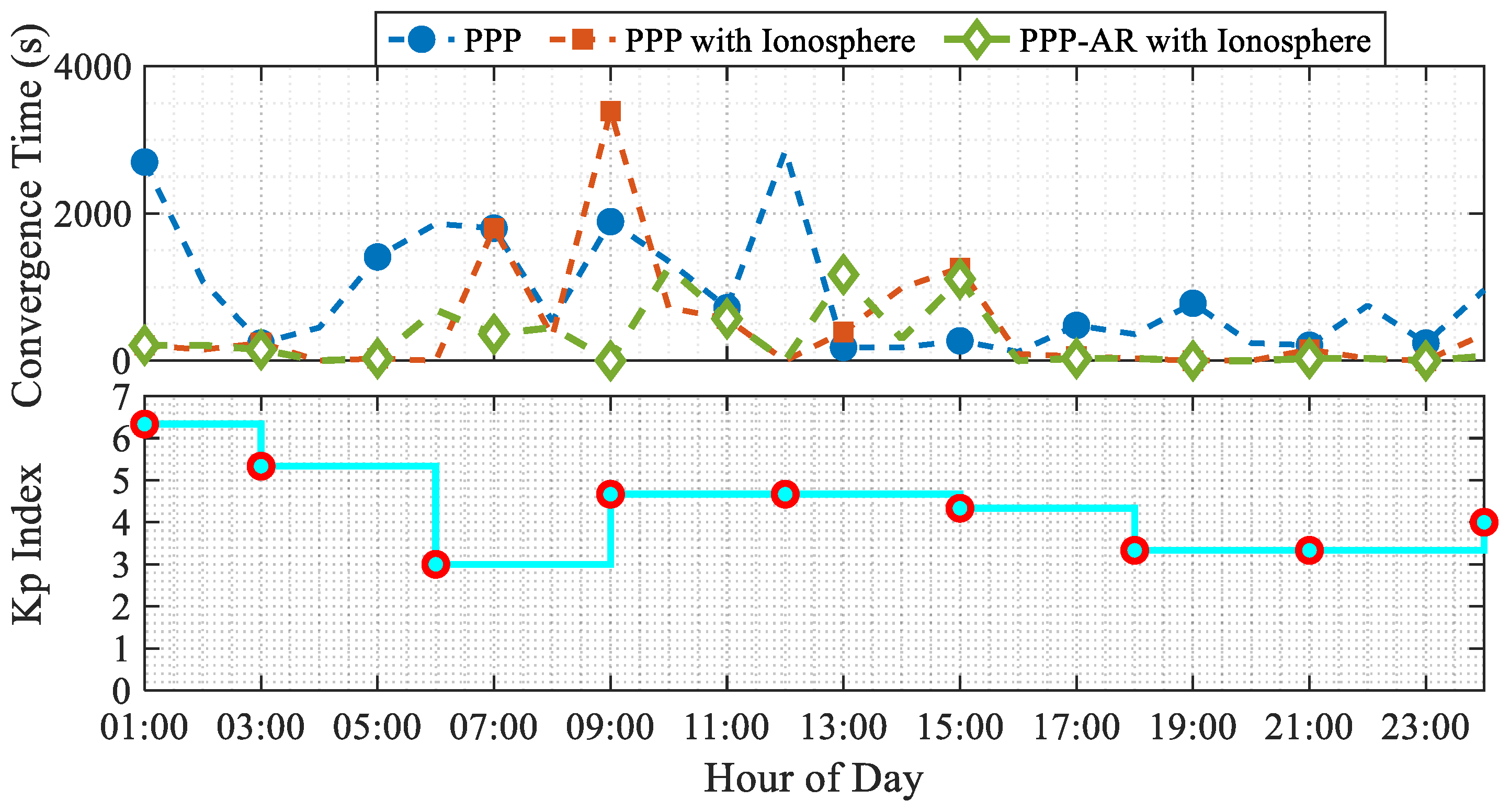
Additionally, Figure 6 shows the hourly convergence behavior on DOY 137 at station PTGG in static mode, during which the average Kp index is 4.4. We can see that the convergence time is improved in most hours after applying wide-range ionospheric corrections. However, at certain times, such as 09:00 and 14:00, the corrected convergence time becomes longer. This can be primarily attributed to the lower accuracy of actual ionospheric corrections in low-latitude regions.
Excluding outliers beyond three times the average convergence time, the statistically averaged convergence time in static mode across all days in May for the nine stations is presented in Table 2. It is obvious that the convergence time is generally inversely related to the station latitude: stations at lower latitudes exhibit longer convergence times. This pattern is primarily attributed to more severe ionospheric delays in low-latitude regions. After applying wide-range ionospheric corrections, the PPP convergence time is reduced by an average of 47%. Furthermore, an additional reduction of 22% is achieved after applying PPP-AR.
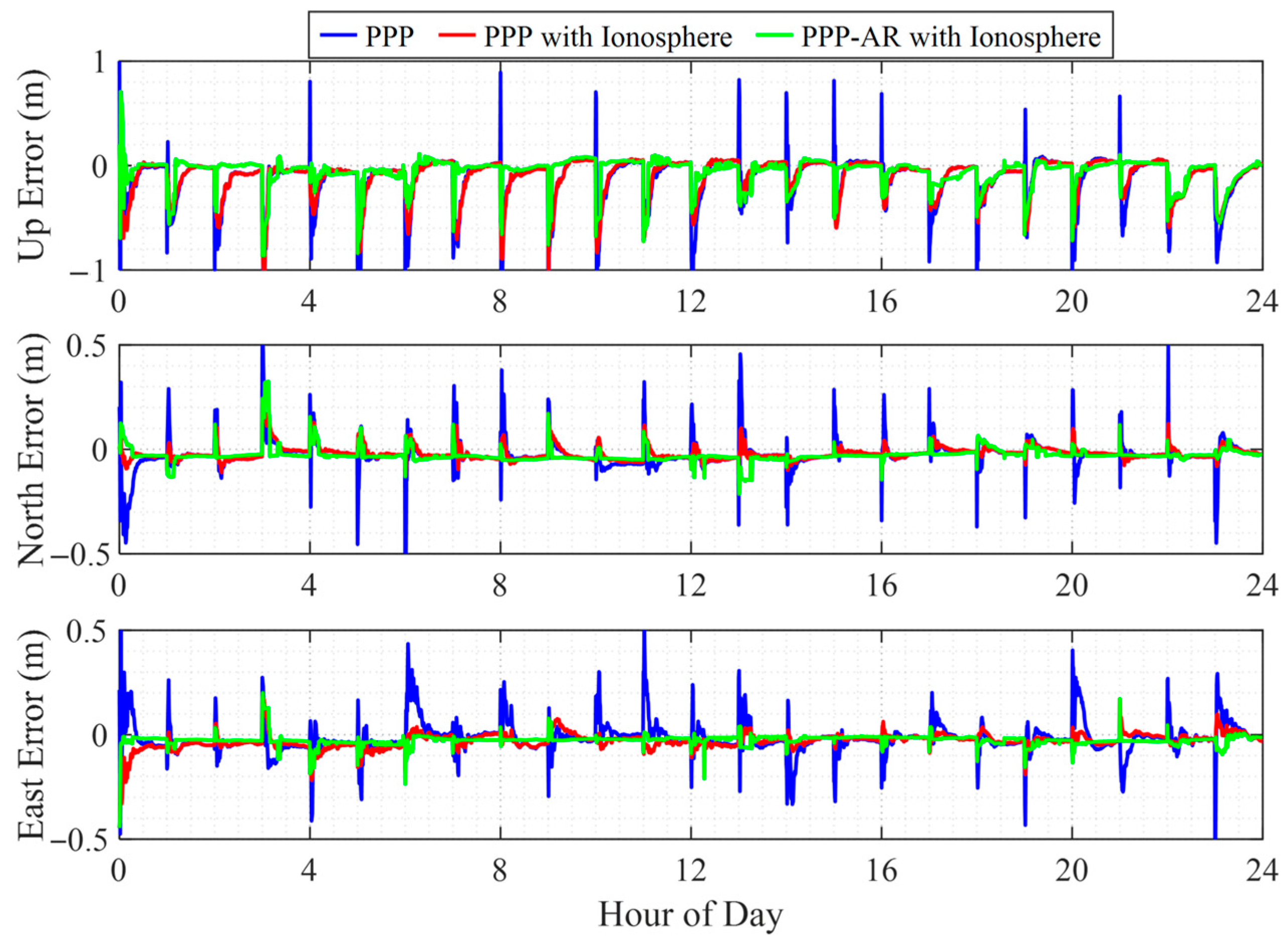
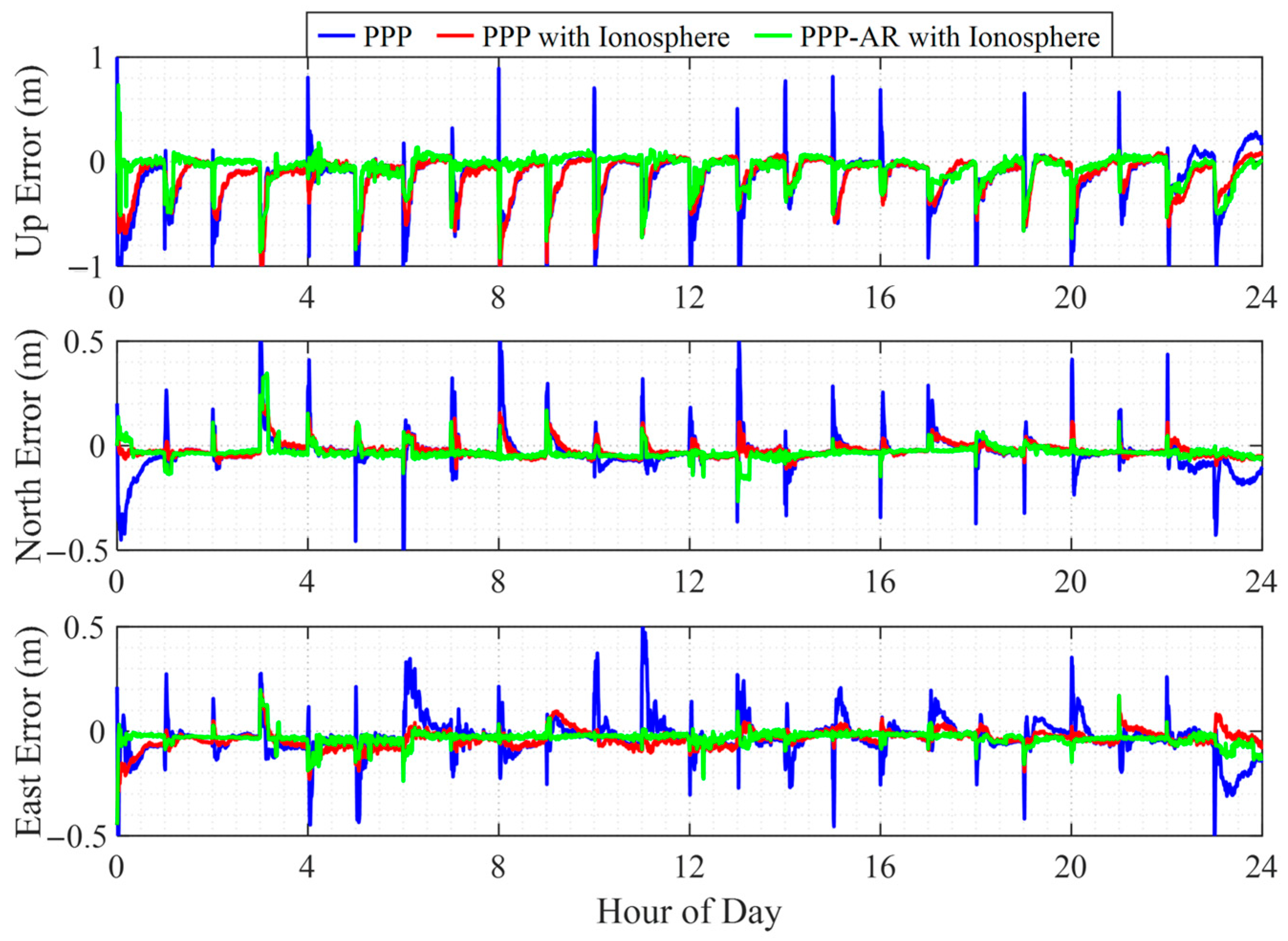
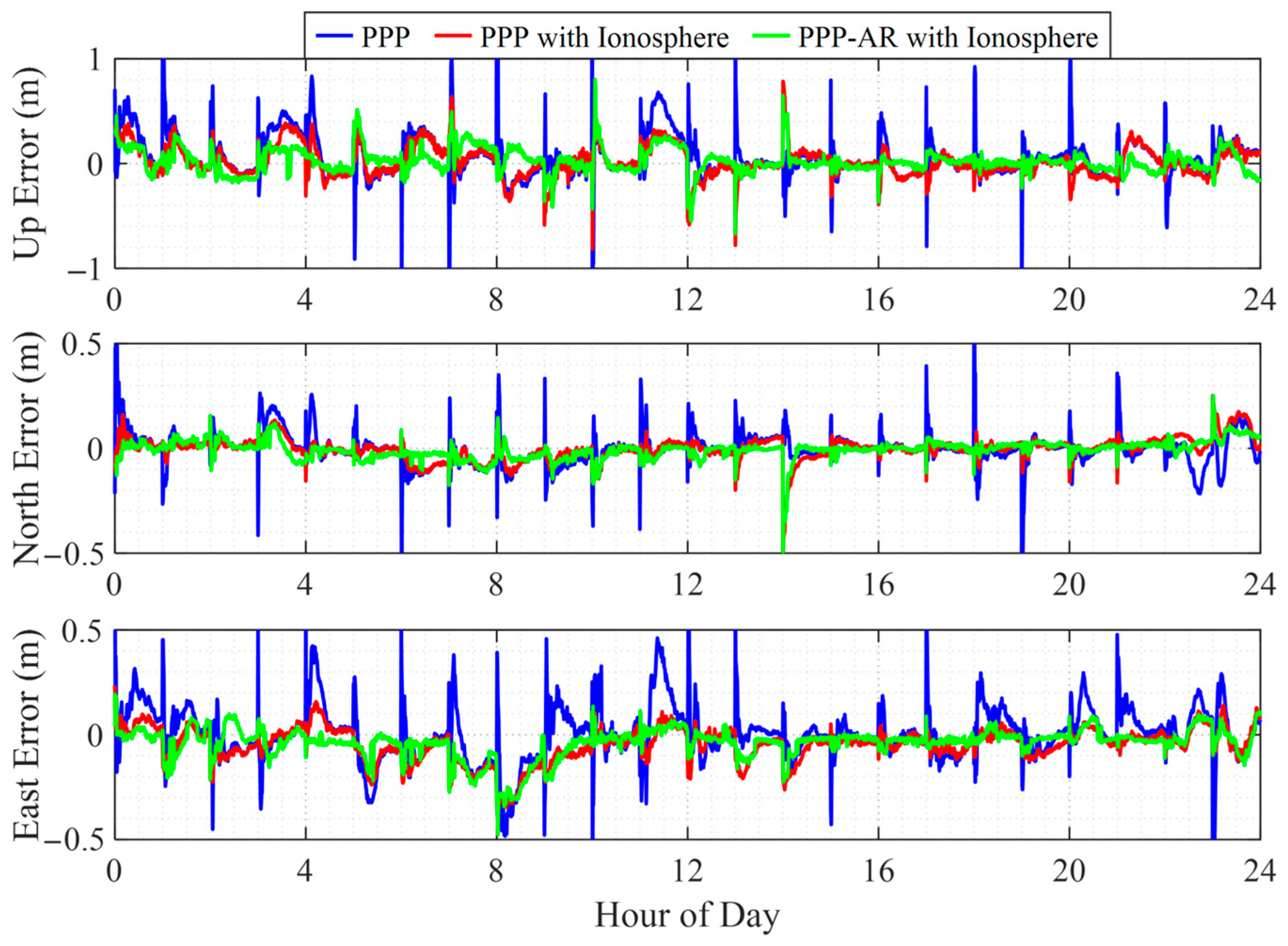
Figure 7 and Figure 8 show the positioning error sequences for PTGG and WLAL stations, which represent the sites with the lowest latitudes in the Northern and Southern Hemispheres, respectively, in static mode over the entire day of DOY 137. It can be observed that during each hourly re-convergence process, the PPP solutions mostly achieve centimeter-level accuracy in all three directions. With the application of wide-range ionospheric corrections, the convergence to centimeter-level accuracy is accelerated. Furthermore, after ambiguity resolution, the error sequence becomes more stable, and the overall accuracy is improved.
It can also be observed that compared with WLAL, PTGG yields more incorrect fixed solutions during the convergence phase. For instance, in the time period of 8:00–9:00, this phenomenon is mainly attributed to the overestimated accuracy of wide-range ionospheric correction at low latitudes, which leads to incorrect ambiguity fixing.
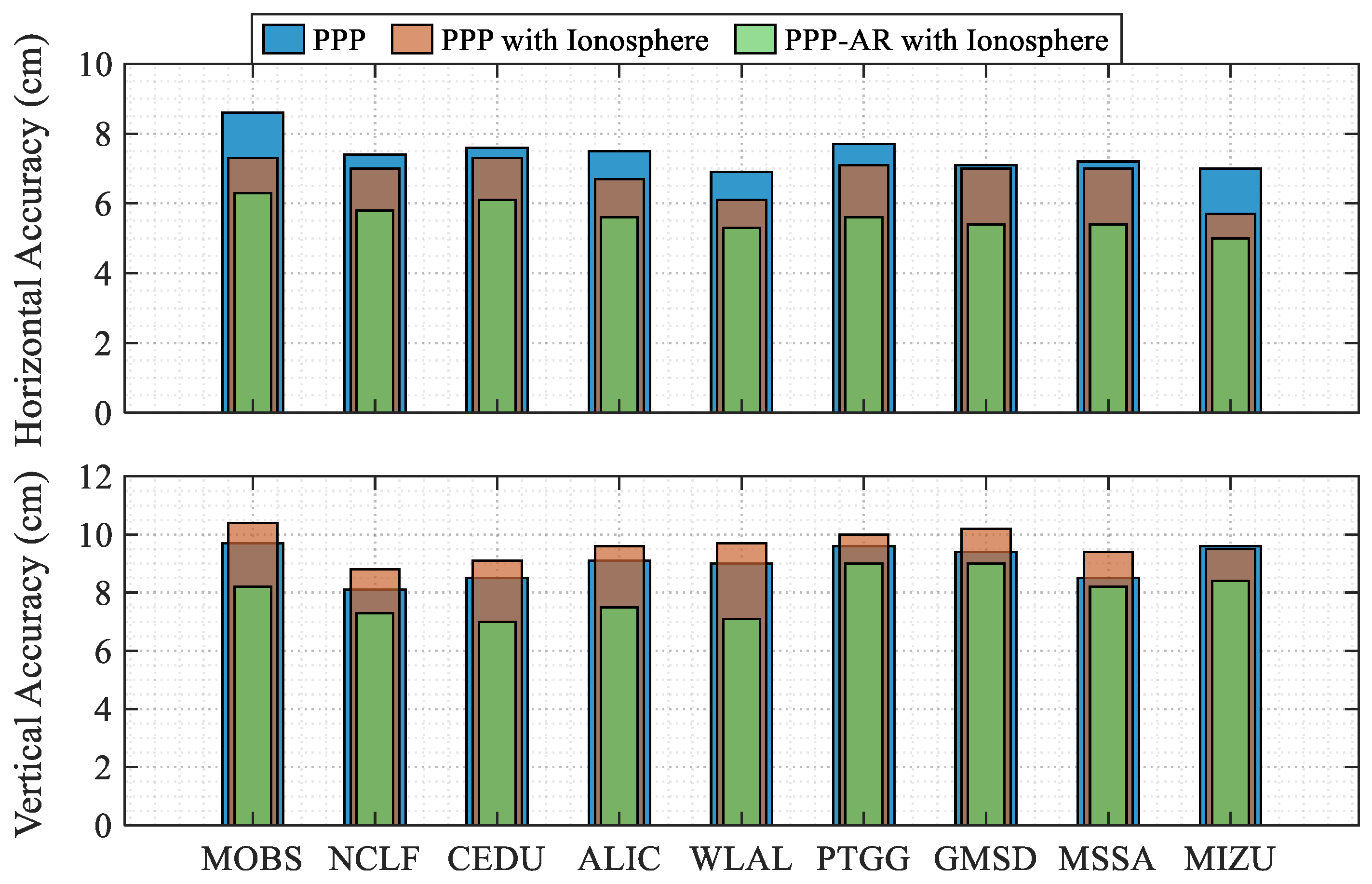
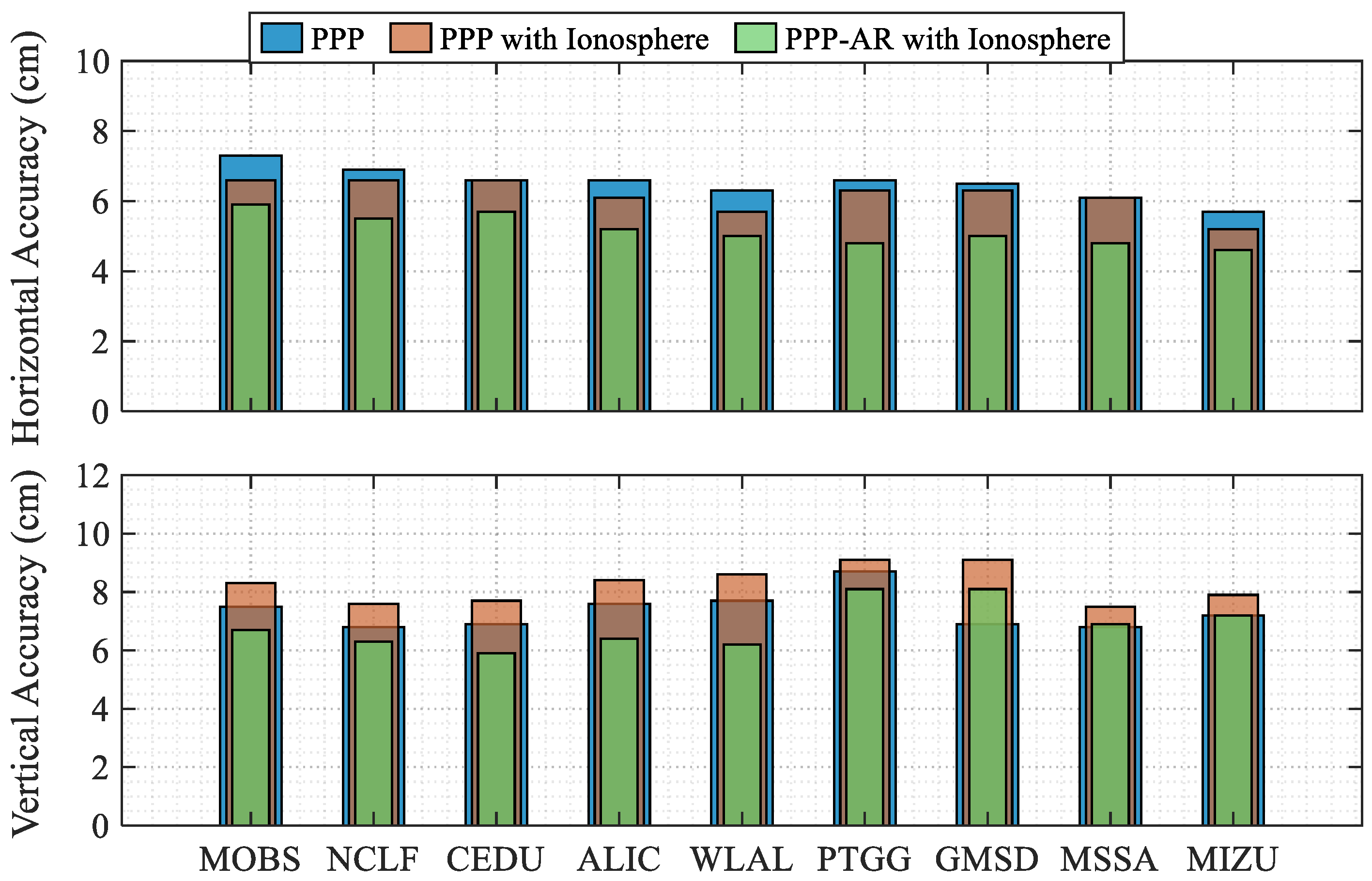
The daily average positioning accuracy, quantified by the RMSE, after convergence for the nine stations in static mode, is illustrated in Figure 9. In the horizontal component, the positioning accuracy shows certain improvement with wide-range ionospheric corrections, with an average enhancement of approximately 0.3 cm. However, the vertical component exhibits a degradation in accuracy, with an average reduction of approximately 0.9 cm. This is likely attributable to the accelerated convergence, combined with the limited accuracy of wide-range ionospheric corrections, causing residual ionospheric errors to manifest predominantly in the vertical direction. However, after ambiguity resolution, both the horizontal and vertical positioning accuracy are improved by approximately 1.3 cm and 0.5 cm, respectively, resulting in final accuracies of 5.2 cm in the horizontal and 6.9 cm in the vertical.

4.2. Kinematic Positioning Performance

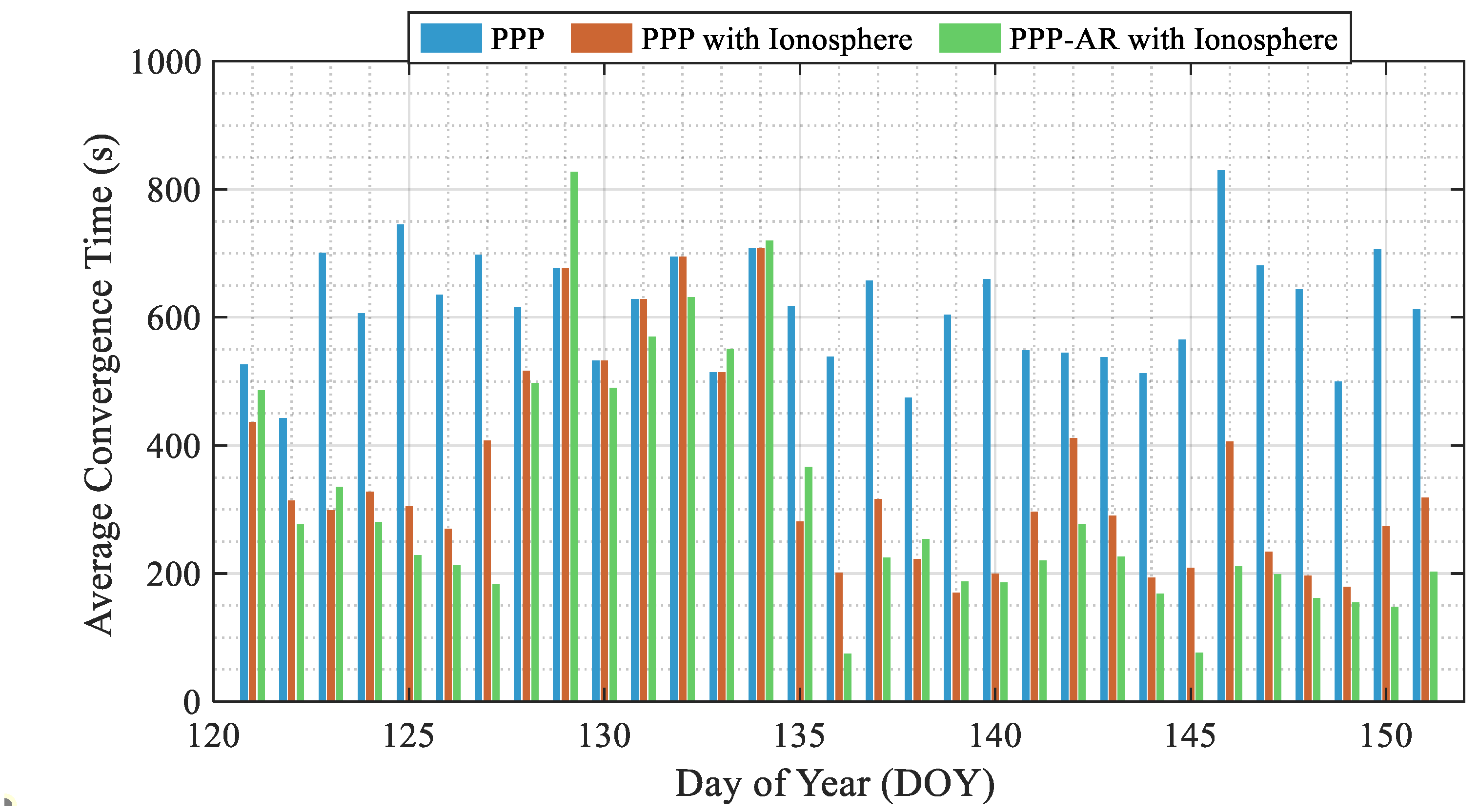
Kinematic-emulation processing using static station data offers a realistic assessment of a PPP algorithm’s practical performance in terms of convergence, error sensitivity, and ambiguity resolution. Figure 10 and Figure 11 present the daily average convergence times for three different PPP processing methods in kinematic mode at the PTGG and MIZU stations, respectively. Compared to the static mode, the kinematic mode demonstrates longer convergence times, with the PTGG station exceeding 800 s on certain days and the MIZU station surpassing 700 s. Following the application of wide-range ionospheric corrections, a significant reduction in convergence time is observed at the PTGG station during DOY 135–151, while the MIZU station exhibits consistent and notable improvements on a daily basis. Moreover, with ambiguity resolution enabled, both stations achieve the shortest convergence times on most days, indicating that PPP-AR combined with wide-range ionospheric correction delivers the optimal convergence performance.
Analogous to Figure 5, Figure 12 uses boxplots to depict the daily average convergence time of three approaches over a 31-day kinematic mode observation period. In both scenarios, PPP demonstrates the slowest convergence, whereas PPP-AR with wide-range ionospheric correction reliably delivers the fastest, with medians around 300 s (PTGC) and 120 s (MIZU). These findings underscore that PPP/PPP-AR, incorporating wide-range ionospheric correction, outperforms standalone PPP in minimizing convergence time across the tested conditions.
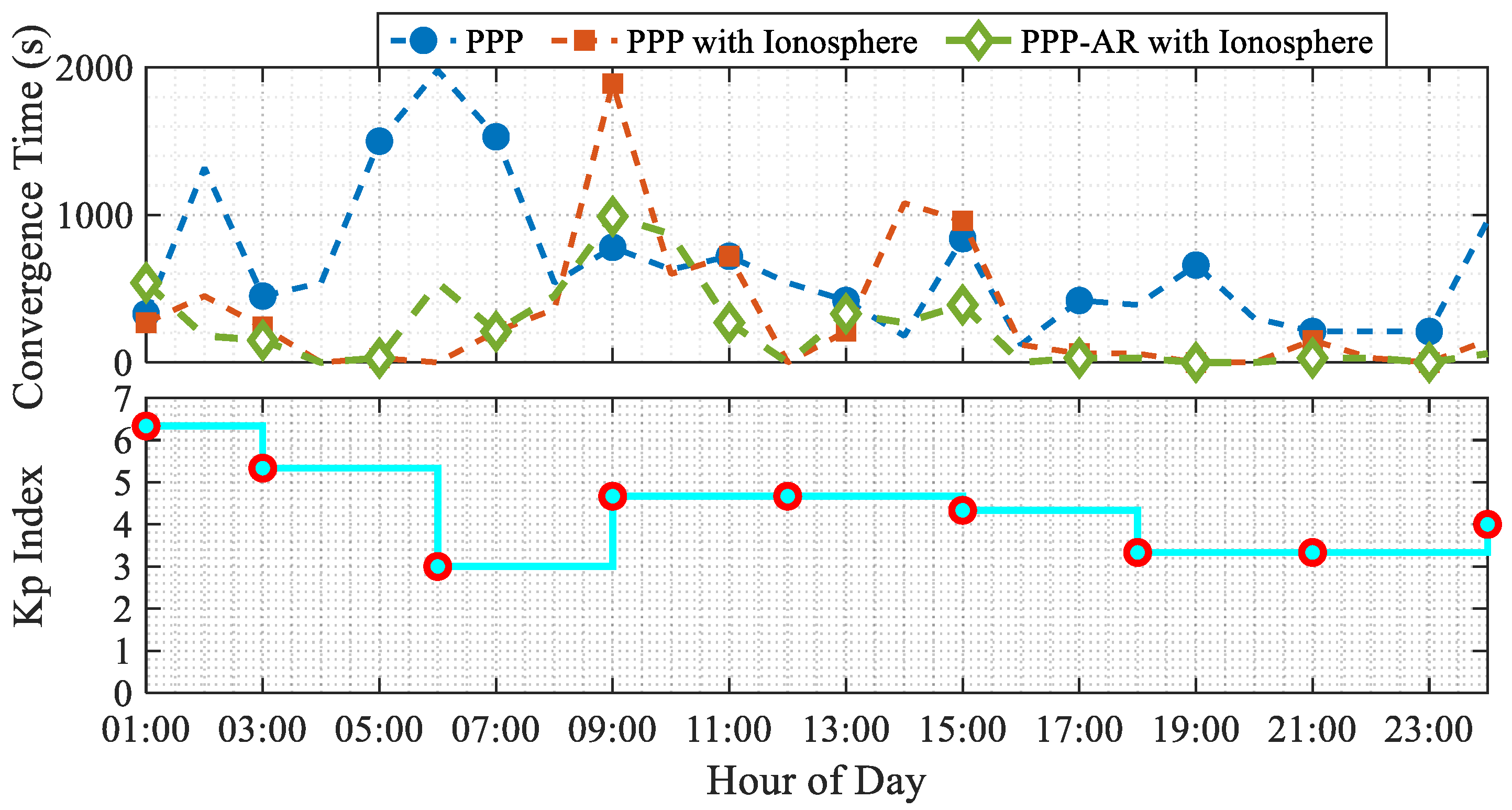
Figure 13 illustrates the hourly convergence behavior on DOY 137 at station PTGG in kinematic mode. During the period from 00:00 to 15:00, when the Kp index is relatively high, the convergence time exhibited significant fluctuations. Following the application of ionospheric corrections and ambiguity resolution, the convergence time improved markedly during most hours. However, at 09:00 and 15:00, the corrected convergence time increased, which can also be primarily attributed to the lower accuracy of the ionospheric corrections during these periods.
Similar to Table 2, Table 3 presents the statistically averaged convergence time in kinematic mode across all nine stations throughout May. Compared to the static mode, the kinematic mode exhibits an average increase in convergence time of approximately 118 s. However, after applying wide-range ionospheric corrections, the difference in convergence time between kinematic and static modes is reduced to only 20 s. The incorporation of wide-range ionospheric corrections in kinematic mode shortens the convergence time by an average of 54%. Furthermore, with the application of ambiguity resolution, an additional 18% reduction is achieved.
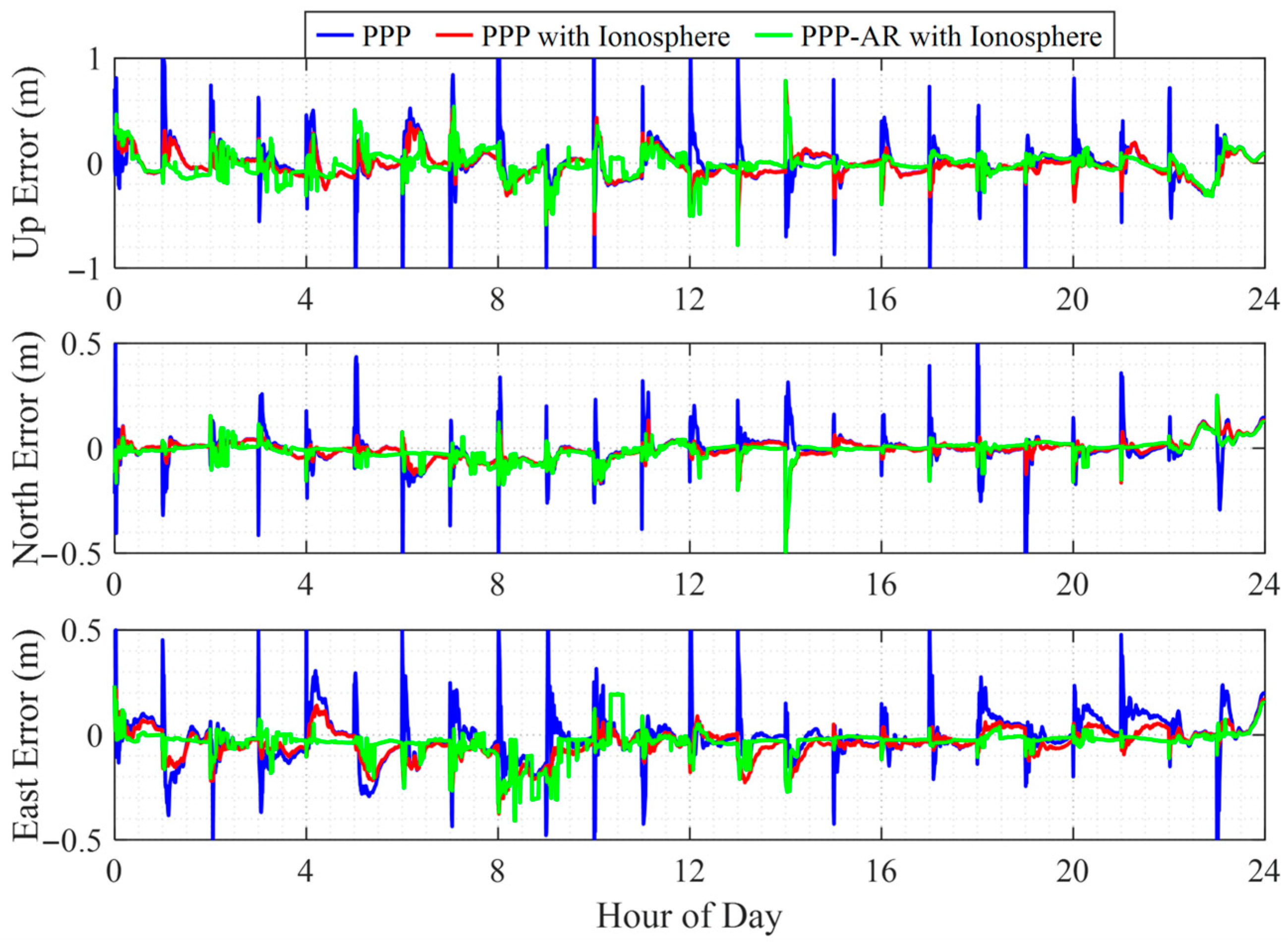
Figure 14 and Figure 15 show the positioning error sequence for PTGG and WLAL stations in kinematic mode over the entire day of DOY 137. Similar to the static mode, in kinematic conditions, the application of wide-range ionospheric corrections considerably accelerates the convergence to centimeter-level accuracy across all three directions. Furthermore, after the incorporation of ambiguity resolution, the positioning error series demonstrates enhanced stability, achieving the optimal positioning performance.
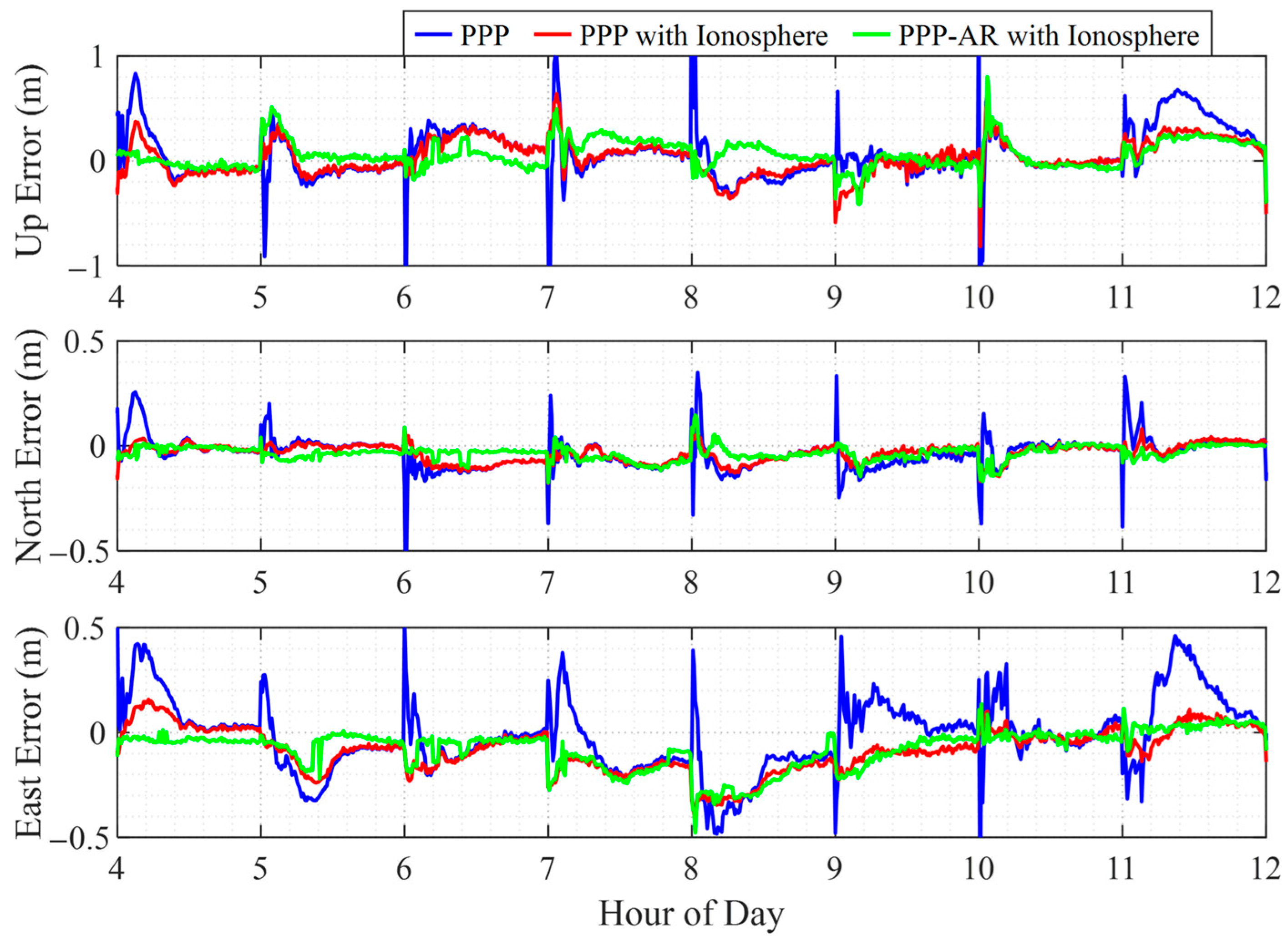
Figure 16 shows the positioning error sequence for the PTGG station during 4:00–12:00 of DOY 137 in kinematic mode. During this period of relatively active local ionosphere, the PPP sequence corrected by wide-range ionospheric correction can converge to centimeter-level accuracy for most of the time. However, it fails to achieve centimeter-level accuracy in certain components during the time intervals of 8:00–9:00 and 11:00–12:00. This indicates that for low-latitude stations, even with the application of wide-range ionospheric correction, their positioning accuracy may still be significantly affected during periods of ionospheric activity. In particular, during specific time intervals, the stability and reliability of ambiguity resolution may decrease, thereby leading to an increase in positioning errors.
The daily average positioning accuracy, quantified by the RMSE, after convergence for the nine stations in kinematic mode, is illustrated in Figure 17. Similar to the results in static mode, the application of wide-range ionospheric corrections leads to an improvement in horizontal accuracy but a slight degradation in vertical accuracy. Following ambiguity resolution, both the horizontal and vertical accuracies are further improved, with average enhancements of approximately 1.8 cm and 1.1 cm, respectively. This results in final achieved accuracies of 5.6 cm in the horizontal component and 8.0 cm in the vertical component.

4.3. Comparison with Previous Studies

To evaluate the kinematic PPP-AR convergence performance with wide-range ionospheric correction enhancement in comparison with the technology demonstration [22], we reprocessed data from five stations located in the Asia and Oceania regions. The processing strategy adopted the same parameter configuration as used in the demonstration [22], including the use of multi-GNSS (GREJ), dual-frequency observations, among other settings. The convergence time was defined as the duration required for the positioning accuracy (at 95% confidence level) to achieve 30 cm horizontally and 50 cm vertically, starting from the initiation of PPP processing. A comparison of the convergence time between our results (denoted as “This work”) and those reported in the technology demonstration (denoted as “Report”) is presented in Table 4.
As observed, the convergence time at the four monitoring stations—CEDU, MOBS, PTGG, and WLAL—increased by 210 s, 120 s, 90 s, and 60 s, respectively. This can be primarily attributed to the fact that the data were processed during months with relatively high average Kp indices. Under such conditions, increased ionospheric activity degrades the accuracy of wide-range ionospheric corrections, thereby prolonging the convergence time. Overall, however, during periods with large Kp indices, the PPP convergence time of low-latitude stations can still be better than 10 min.

5. Discussion

In this investigation, we demonstrate that the wide-range ionospheric correction of the MADOCA-PPP service can accelerate the convergence of PPP even during ionospherically active periods. Specifically, in static mode, the PPP convergence time is reduced by 47%, whereas a more significant reduction of 54% is achieved in kinematic mode. This finding aligns with the previous work by [22]; however, the convergence time observed in our study is longer, primarily due to the relatively higher ionospheric activity during the evaluation period. These results hold important implications for enhancing the stability and efficiency of PPP/PPP-AR under complex space weather conditions.
Nevertheless, several limitations of this investigation should be acknowledged. Firstly, we selected the months with the highest average Kp index between January 2023 and May 2025 as the ionospherically active period, which only allows for a general demonstration of the correction effectiveness rather than capturing fine-grained variations. Secondly, this study did not conduct dedicated comparisons for each geomagnetic day; further research is therefore required to explore the performance of the MADOCA-PPP correction across different geomagnetic activity levels.
To summarize, we have identified the wide-range ionospheric correction of MADOCA-PPP as a key factor in accelerating PPP convergence during ionospherically disturbed periods, with promising potential for optimizing high-precision positioning systems in challenging space weather environments.

6. Conclusions

The impact of the MADOCA-PPP wide-range ionospheric corrections on the performance of both PPP and PPP-AR is evaluated during periods of high ionospheric activity in this paper. Performance is assessed using two metrics: convergence time and positioning accuracy. Convergence time is defined as the period from the initial epoch until the horizontal positioning error remains consistently below 15 cm and the vertical error below 30 cm for five consecutive epochs. Positioning accuracy is quantified by the RMSE of all positioning errors after convergence.
In static mode, the application of wide-range ionospheric corrections reduces the PPP convergence time by 47%, while in kinematic mode, a 54% reduction is observed. For PPP-AR aided by these corrections, the convergence time is shortened by 69% in static mode and 72% in kinematic mode. Furthermore, PPP-AR with wide-range corrections achieves the highest positioning accuracy in both modes, with horizontal and vertical RMSEs of approximately 5.2 cm/6.9 cm in static mode and 5.6 cm/8.0 cm in kinematic mode.
In conclusion, the key scientific contribution of this study lies in the experimental validation that the MADOCA-PPP wide-range ionospheric corrections significantly mitigate ionospheric delays during active periods, dramatically accelerating convergence and improving accuracy for both PPP and PPP-AR. This provides a practical solution for high-precision positioning under space weather disturbances. It should also be noted that during periods of low Kp index, the benefit of wide-range ionospheric corrections is less pronounced at low-latitude stations. This suggests that the stability and accuracy of such corrections in low-latitude regions require further improvement, which will be a focus of future work.

Author Contributions

Conceptualization, X.Y.; methodology, X.Y.; data curation Q.B.; software, X.Y.; validation, Q.B.; writing—original draft preparation, Q.B.; writing—review and editing, X.Y.; visualization, Q.B. All authors have read and agreed to the published version of the manuscript.

Funding

This work was supported by the Zhejiang Provincial Natural Science Foundation under Grant No. TGN24D040001. It was also funded by the Science and Technology Research Project of the Department of Education of Jilin Province under Grant No. JJKH20251041KJ.

Institutional Review Board Statement

Not applicable.

Informed Consent Statement

Not applicable.

Data Availability Statement

The 30s sampling interval RINEX observation data from nine stations are available at https://go.gnss.go.jp/rinex/daily/2025/DOY/25d/ (accessed on 29 August 2025). Precise orbit corrections, clock offset corrections, code/phase biases (suffixes: 204.l6, 206.l6), and wide-range ionospheric corrections (suffixes: 200.l6, 201.l6) from the MADOCA-PPP service can be accessed via https://l6msg.go.gnss.go.jp/ (accessed on 30 August 2025).

Acknowledgments

We are grateful to the International GNSS Service (IGS) and the MIRAI project for the GNSS observation data. Furthermore, we extend our sincere thanks to the MADOCA-PPP service for providing the wide-range ionospheric corrections.

Conflicts of Interest

The authors declare no conflicts of interest.

Abbreviations

The following abbreviations are used in this manuscript:
MADOCA-PPPMulti-GNSS Orbit and Clock Augmentation-Precise Point Positioning
ARAmbiguity resolution
RMSERoot mean square error
SSRState space representation
GNSSGlobal Navigation Satellite System
IFIonosphere-free
UCUn-combined
TTFFTime-to-first-fix
RTKReal-time kinematic
ZTDZenith tropospheric delay
OSBObservable-specific signal biase
TECUTotal electron content unit
LAMBDALeast-squares ambiguity decorrelation adjustment
PARPartial ambiguity resolution
DOYDay of year

References

  1. Teunissen, P.J.G.; Khodabandeh, A. Review and principles of PPP-RTK methods. J. Geod. 2014, 89, 217–240. [Google Scholar] [CrossRef]
  2. Héroux, P.; Kouba, J. GPS Precise Point Positioning Using IGS Orbit Products. Phys. Chem. Earth 2001, 26, 573–578. [Google Scholar]
  3. Jin, S.; Su, K. PPP models and performances from single-to quad-frequency BDS observations. Satell. Navig. 2020, 1, 16. [Google Scholar] [CrossRef]
  4. Geng, J.; Bock, Y. Triple-frequency GPS precise point positioning with rapid ambiguity resolution. J. Geod. 2013, 87, 449–460. [Google Scholar] [CrossRef]
  5. Li, P.; Zhang, X.; Ge, M.; Schuh, H. Three-frequency BDS precise point positioning ambiguity resolution based on raw observables. J. Geod. 2018, 92, 1357–1369. [Google Scholar] [CrossRef]
  6. Xiao, G.; Li, P.; Gao, Y.; Heck, B. A Unified Model for Multi-Frequency PPP Ambiguity Resolution and Test Results with Galileo and BeiDou Triple-Frequency Observations. Remote Sens. 2019, 11, 116. [Google Scholar] [CrossRef]
  7. Li, P.; Jiang, X.; Zhang, X.; Ge, M.; Schuh, H. GPS + Galileo + BeiDou precise point positioning with triple-frequency ambiguity resolution. GPS Solut. 2020, 24, 78. [Google Scholar] [CrossRef]
  8. Li, X.; Li, X.; Yuan, Y.; Zhang, K.; Zhang, X.; Wickert, J. Multi-GNSS phase delay estimation and PPP ambiguity resolution: GPS, BDS, GLONASS, Galileo. J. Geod. 2017, 92, 579–608. [Google Scholar] [CrossRef]
  9. Geng, J.; Guo, J.; Meng, X.; Gao, K. Speeding up PPP ambiguity resolution using triple-frequency GPS/BeiDou/Galileo/QZSS data. J. Geod. 2020, 94, 6. [Google Scholar] [CrossRef]
  10. Li, J.; Xu, S.; Guo, J.; Zhao, Q. Multi-GNSS and Multi-Frequency Precise Point Positioning Based on High Accuracy Products from IGS Analysis Centers. Geomat. Inf. Sci. Wuhan Univ. 2025, 1–25. [Google Scholar] [CrossRef]
  11. Li, X.; Zhang, X.; Guo, F. Predicting atmospheric delays for rapid ambiguity resolution in precise point positioning. Adv. Space Res. 2014, 54, 840–850. [Google Scholar] [CrossRef]
  12. Li, Z.; Chen, W.; Ruan, R.; Liu, X. Evaluation of PPP-RTK based on BDS-3/BDS-2/GPS observations: A case study in Europe. GPS Solut. 2020, 24, 38. [Google Scholar] [CrossRef]
  13. Psychas, D.; Verhagen, S. Real-Time PPP-RTK Performance Analysis Using Ionospheric Corrections from Multi-Scale Network Configurations. Sensors 2020, 20, 3012. [Google Scholar] [CrossRef] [PubMed]
  14. Yin, X.; Chai, H.; El-Mowafy, A.; Zhang, Y.; Zhang, Y.; Du, Z. Modeling and assessment of atmospheric delay for GPS/Galileo/BDS PPP-RTK in regional-scale. Measurement 2022, 194, 111043. [Google Scholar] [CrossRef]
  15. Yin, X.; Chai, H.; Xu, W.; Zhao, L.; Zhu, H. Realization and Evaluation of Real-Time Uncombined GPS/Galileo/BDS PPP-RTK in the Offshore Area of China’s Bohai Sea. Mar. Geod. 2022, 45, 577–594. [Google Scholar] [CrossRef]
  16. Zhang, W.; Wang, J.; Khodabandeh, A. Regional ionospheric correction generation for GNSS PPP-RTK: Theoretical analyses and a new interpolation method. GPS Solut. 2024, 28, 139. [Google Scholar] [CrossRef]
  17. de Oliveira, P., Jr.; Morel, L.; Fund, F.; Legros, R.; Monico, J.; Durand, S.; Durand, F. Modeling tropospheric wet delays with dense and sparse network configurations for PPP-RTK. GPS Solut. 2017, 21, 237–250. [Google Scholar] [CrossRef]
  18. Li, X.; Huang, J.; Li, X.; Shen, Z.; Han, J.; Li, L.; Wang, B. Review of PPP–RTK: Achievements, challenges, and opportunities. Satell. Navig. 2022, 3, 28. [Google Scholar] [CrossRef]
  19. Cui, B.; Jiang, X.; Wang, J.; Li, P.; Ge, M.; Schuh, H. A new large-area hierarchical PPP-RTK service strategy. GPS Solut. 2023, 27, 134. [Google Scholar] [CrossRef]
  20. Cabinet Office of Japan. Quasi-Zenith Satellite System Interface Specification: Multi-GNSS Advanced Orbit and Clock Augmentation—Precise Point Positioning; Cabinet Office of Japan: Tokyo, Japan, 2025. [Google Scholar]
  21. Ozeki, T.; Kubo, N. Evaluation of MADOCA-PPP in actual environment using MADOCA products decoded in real time processing. In Proceedings of the 2024 International Technical Meeting of The Institute of Navigation, Long Beach, CA, USA, 23–25 January 2024; pp. 830–839. [Google Scholar]
  22. Cabinet Office of Japan. Quasi-Zenith Satellite System Service Performance Report: MADOCA-PPP Technology Demonstration (Ionospheric Correction); Cabinet Office of Japan: Tokyo, Japan, 2025. [Google Scholar]
  23. Zhang, B.; Teunissen, P.J.G.; Odijk, D. A Novel Un-differenced PPP-RTK Concept. J. Navig. 2011, 64, S180–S191. [Google Scholar] [CrossRef]
  24. Liu, M.; Yin, X.; Xiang, M. Improved PPP-RTK positioning performance by using the elevation-dependent weighting model for the atmospheric delay corrections. Meas. Sci. Technol. 2023, 34, 055003. [Google Scholar] [CrossRef]
  25. Yan, Z.; Zhang, X. Assessment of the performance of GPS/Galileo PPP-RTK convergence using ionospheric corrections from networks with different scales. Earth Planets Space 2022, 74, 47. [Google Scholar] [CrossRef]
  26. Zha, J.; Zhang, B.; Liu, T.; Hou, P. Ionosphere-weighted undifferenced and uncombined PPP-RTK: Theoretical models and experimental results. GPS Solut. 2021, 25, 135. [Google Scholar] [CrossRef]
  27. Wang, A.; Zhang, Y.; Chen, J.; Wang, H. Improving the (re-) convergence of multi-GNSS real-time precise point positioning through regional between-satellite single-differenced ionospheric augmentation. GPS Solut. 2022, 26, 39. [Google Scholar]
  28. Wang, S.; Li, B.; Tu, R.; Lu, X.; Zhang, Z. Uncertainty estimation of atmospheric corrections in large-scale reference networks for PPP-RTK. Measurement 2022, 190, 110744. [Google Scholar] [CrossRef]
  29. Thomsen, M. Why Kp is such a good measure of magnetospheric convection. Space Weather 2004, 2, S11004. [Google Scholar] [CrossRef]
  30. Filjar, R.; Kos, S.; Krajnovic, S. Dst index as a potential indicator of approaching GNSS performance deterioration. J. Navig. 2013, 66, 149–160. [Google Scholar] [CrossRef]
  31. Bakota, M.; Jelaska, I.; Kos, S.; Brčić, D. Statistical Approach to Research on the Relationship Between Kp/Dst Geomagnetic Indices and Total GPS Position Error. Remote Sens. 2025, 17, 2374. [Google Scholar] [CrossRef]
  32. Matzka, J.; Bronkalla, O.; Tornow, K.; Elger, K.; Stolle, C. Geomagnetic Kp index. GFZ Ger. Res. Cent. Geosci. 2021, 11. [Google Scholar] [CrossRef]
  33. Teunissen, P.J.G. The least-squares ambiguity decorrelation adjustment: A method for fast GPS integer ambiguity estimation. J. Geod. 1995, 70, 65–82. [Google Scholar] [CrossRef]
  34. Chang, X.W.; Yang, X.; Zhou, T. MLAMBDA: A modified LAMBDA method for integer least-squares estimation. J. Geod. 2005, 79, 552–565. [Google Scholar] [CrossRef]
  35. Verhagen, S.; Teunissen, P.J. New global navigation satellite system ambiguity resolution method compared to existing approaches. J. Guid. Control Dyn. 2006, 29, 981–991. [Google Scholar] [CrossRef]
  36. Wang, J.; Feng, Y. Reliability of partial ambiguity fixing with multiple GNSS constellations. J. Geod. 2013, 87, 1–14. [Google Scholar] [CrossRef]
  37. Zhang, Y.; Kubo, N.; Chen, J.; Wang, J.; Wang, H. Initial positioning assessment of BDS new satellites and new signals. Remote Sens. 2019, 11, 1320. [Google Scholar] [CrossRef]
  38. Zhang, Y.; Chen, J.; Gong, X.; Chen, Q. The update of BDS-2 TGD and its impact on positioning. Adv. Space Res. 2020, 65, 2645–2661. [Google Scholar] [CrossRef]
Figure 1. Monthly average Kp indices from January 2023 to May 2025.
Applsci 16 00184 g001
Figure 2. Geographical distribution of observation stations: (a) Stations in Japan; (b) Stations in Asia and Oceania.
Applsci 16 00184 g002
Figure 3. Convergence time for three different PPP processing approaches at station PTGG in static mode.
Applsci 16 00184 g003
Figure 4. Convergence time for three different PPP processing approaches at station MIZU in static mode.
Applsci 16 00184 g004
Figure 5. Boxplot of the daily average convergence time over the 31-day observation period in static mode: (a) PTGG; (b) MIZU.
Applsci 16 00184 g005
Figure 6. Hourly convergence behavior on DOY 137 at station PTGG in static mode.
Applsci 16 00184 g006
Figure 7. The positioning error sequence for the PTGG station on DOY 137 in static mode.
Applsci 16 00184 g007
Figure 8. The positioning error sequence for the WLAL station on DOY 137 in static mode.
Applsci 16 00184 g008
Figure 9. Daily average positioning RMSE at nine stations after convergence in static mode.
Applsci 16 00184 g009
Figure 10. Convergence time for three different PPP approaches at station PTGG in kinematic mode.
Applsci 16 00184 g010
Figure 11. Convergence time for three different PPP approaches at station MIZU in kinematic mode.
Applsci 16 00184 g011
Figure 12. Boxplot of the daily average convergence time over the 31-day observation period in kinematic mode: (a) PTGG; (b) MIZU.
Applsci 16 00184 g012
Figure 13. Hourly convergence behavior on DOY 137 at station PTGG in kinematic mode.
Applsci 16 00184 g013
Figure 14. The positioning error sequence for the PTGG station on DOY 137 in kinematic mode.
Applsci 16 00184 g014
Figure 15. The positioning error sequence for the WLAL station on DOY 137 in kinematic mode.
Applsci 16 00184 g015
Figure 16. The positioning error sequence for the PTGG station during 4:00–12:00 of DOY 137 in kinematic mode.
Applsci 16 00184 g016
Figure 17. Daily average positioning RMSE at nine stations after convergence in kinematic mode.
Applsci 16 00184 g017
Table 1. UC-PPP processing strategies.
ItemStrategy
Sample30 s
Elevation cutoff angle15°
Antenna phase centerigs20.atx
Station coordinatesStatic mode, process noise of 0 m
Kinematic mode, process noise of 60 m
Receiver clock offsetEstimated per epoch
Inter-System biasEstimated per epoch
Tropospheric correction methodEstimate zenith tropospheric delay
Ionospheric correction methodEstimate slant ionospheric delay
Initial ratio test threshold1.5
Table 2. Average daily convergence time for three static PPP solutions in static mode (in seconds). The percentage in parentheses indicates the improvement ratio relative to the PPP convergence time.
StationPPPPPP with IonospherePPP-AR with Ionosphere
ALIC468204 (56%)107 (77%)
CEDU484296 (39%)181 (63%)
MOBS460234 (49%)113 (75%)
NCLF461301 (35%)220 (52%)
PTGG580279 (52%)223 (62%)
WLAL571361 (37%)175 (69%)
GMSD586337 (42%)181 (69%)
MSSA523302 (42%)168 (68%)
MIZU465128 (72%)65 (86%)
Table 3. Average daily convergence time for three PPP solutions in kinematic mode (in seconds).
StationPPPPPP with IonospherePPP-AR with Ionosphere
ALIC570206 (64%)112 (80%)
CEDU628319 (49%)188 (70%)
MOBS587254 (57%)131 (78%)
NCLF544335 (38%)234 (57%)
PTGG644272 (58%)236 (63%)
WLAL665394 (41%)186 (72%)
GMSD736369 (50%)244 (67%)
MSSA698349 (50%)188 (73%)
MIZU593125 (79%)69 (88%)
Table 4. A comparison of the convergence time between our results and those reported in the technology demonstration.
StationReportThis Work
ALIC180180
CEDU90300
MOBS90210
PTGG330420
WLAL270330
Disclaimer/Publisher’s Note: The statements, opinions and data contained in all publications are solely those of the individual author(s) and contributor(s) and not of MDPI and/or the editor(s). MDPI and/or the editor(s) disclaim responsibility for any injury to people or property resulting from any ideas, methods, instructions or products referred to in the content.