1. Introduction
The stable operation, monitoring, and protection of modern power systems fundamentally rely on accurate, reliable, and secure time synchronization [
1]. Accurate timing enables coordinated measurements, fault localization, and protection actions across geographically distributed substations. As power systems evolve to incorporate more distributed energy resources and advanced automation, Global Navigation Satellite Systems (GNSS) have become the dominant external timing reference for Power Time Synchronization Systems (PTSS) in China and worldwide [
2,
3]. However, the open and low-power nature of GNSS signals makes PTSS inherently vulnerable to spoofing attacks. By transmitting counterfeit GNSS signals, attackers can manipulate PTSS timing solutions, leading to timing offsets that may cause protection miscoordination, system maloperation, or even regional power outages [
4]. Therefore, improving the spoofing resilience of PTSS has become a critical requirement for ensuring the security and robustness of modern power grids.
To counter GNSS spoofing threats, the power industry has adopted a multi-layered defense strategy. The first layer involves the internal anti-spoofing mechanisms of the PTSS devices. Modern PTSS devices are often equipped with dual GNSS antennas and independent GNSS timing modules, providing dual redundant timing signal streams. These devices perform consistency checks between the two streams to detect anomalies. Additionally, they employ signal-based detection methods, such as monitoring for abnormal signal power levels and Doppler shifts that deviate from expected satellite motion patterns. These techniques provide a fundamental, device-level defense against simple spoofing attacks. The second layer involves deploying a dedicated Spatio-Temporal Security Isolation Device (STSID) between the GNSS antenna and the PTSS device. The STSID actively monitors incoming signals using a high-accuracy atomic clock as a reference. When a spoofing threat is detected, it disconnects (or isolates) the GNSS input, forcing the downstream PTSS device into holdover mode. The goal is to protect the system from being misled by the spoofing signal, albeit at the cost of losing the high-precision external GNSS time reference.
While this two-tiered approach forms the current operational backbone, it faces significant limitations in complex environments. The internal consistency checks can be bypassed by sophisticated spoofing attacks. More critically, the isolation strategy of the STSID represents a fundamental trade-off between security and precision. In a prolonged spoofing scenario, the timing accuracy of PTSS can degrade quickly as the internal clock drifts, which is unacceptable for long-term, high-precision power system operations. Furthermore, these conventional methods are increasingly challenged by the specific and complex power system environments. They are particularly vulnerable to sophisticated, low-power, and slow-pulling spoofing attacks. Such attacks subtly manipulate the timing solution without triggering alarms based on signal power or consistency checks, thereby evading the primary detection mechanisms of current PTSS [
5]. This threat is compounded by the inherent environmental interference prevalent in substations. Our prior field investigations within 220 kV substations confirmed the presence of significant interference, including pervasive narrowband interference with carrier-to-interference ratios exceeding 50 dB and broadband interference spanning over 70 MHz in line entrance areas. Critically, the deployment of GNSS-based unmanned aerial vehicle mitigation systems has also introduced a new threat. These systems can broadcast spoofing signals, which have been observed to cause irregular jumps in GNSS positioning and timing outputs, directly degrading the performance and reliability of the PTSS [
6]. This confluence of stealthy spoofing, substation environmental interference, and unintended spoofing from protective countermeasures creates a uniquely challenging operational environment for timing-critical power applications [
4].
Following the identified limitations of existing countermeasures specific to PTSS, it is necessary to review general GNSS anti-spoofing studies to identify a more suitable approach. Existing work can be broadly evaluated for deployment in PTSS [
7]. Signal authentication-based techniques, such as Navigation Message Authentication (NMA) and Spread Spectrum Code Authentication (SCA), provide a promising layer of security by verifying signal integrity [
8]. However, they are not universally available across all constellations. Furthermore, their adoption necessitates receiver hardware and software upgrades, creating significant deployment barriers for the vast installed base of legacy PTSS equipment [
9,
10]. Conversely, spoofing countermeasures based on signal acquisition, tracking, and processing within the receiver, such as signal quality monitoring or multi-correlator structures, are implemented primarily at the receiver level [
11,
12,
13,
14,
15]. While potentially effective against simplistic spoofing attacks, these methods often struggle against sophisticated spoofing strategies that meticulously replicate authentic signal parameters, making them unreliable as a standalone solution. Approaches that leverage external sensors, such as inertial sensors and vision systems, can enhance robustness by providing spoofing-immune measurements [
16,
17]. However, they impose substantial integration burdens, including additional hardware costs, calibration complexities, and potential modifications to the PTSS infrastructure, which are often impractical for widespread, cost-sensitive power system deployment. Similarly, emerging artificial intelligence-driven spoofing detection methods, despite their adaptive learning capabilities, demand substantial computational resources and extensive datasets for training, leading to concerns regarding power consumption and real-time performance within the stringent constraints typical of power infrastructure [
18,
19,
20].
In contrast, multi-element anti-spoofing array antenna technology presents a compelling and more suitable solution for PTSS applications [
21]. This methodology operates at the signal front-end, leveraging spatial processing techniques [
22,
23]. A pivotal advantage lies in its ability to inherently suppress interference signals before they corrupt the receiver’s tracking loops. By forming a high-gain beam towards genuine satellites and steering spatial nulls in the directions of spoofing signals, the array antenna can effectively attenuate spoofing signals [
24]. This spatial filtering capability not only mitigates spoofing but also enhances the signal-to-noise ratio of authentic GNSS signals. Consequently, the purified signal stream delivered to the downstream PTSS device enables transparent timing under spoofing conditions. This add-on protection mechanism requires no modification to the existing PTSS device, offering a significant advantage. Therefore, given its front-end operational nature, strong interference suppression capability, and minimal intrusion on legacy systems, the array antenna-based approach emerges as a highly viable strategy for achieving spoofing-resilient timing in power systems.
A critical prerequisite for effective spatial processing is accurate knowledge of the array attitude. Accurate estimation of signal Direction-of-Arrival (DoA) has been extensively studied in array signal processing literature under various signal conditions, providing strong theoretical foundations for spatial signal separation [
25,
26,
27]. However, in compact GNSS array configurations deployed for power timing protection, DoA estimation accuracy is not solely determined by the signal processing algorithm, but also critically depends on the precise knowledge of array attitude. Spoofing detection relies on comparing the estimated DoA of signals with the known directions of authentic satellites. Errors in array attitude estimation propagate directly into DoA estimation errors, which in turn degrade the achievable null depth of spatial suppression and ultimately weaken timing protection performance. Therefore, array attitude accuracy fundamentally determines the effectiveness of spoofing mitigation in timing-critical applications. While research exists on array antennas for spoofing mitigation, the specific challenge of precise attitude determination for small-scale arrays has received less attention.
This paper proposes a sensing-assisted array antenna-based approach for GNSS spoofing mitigation tailored for power timing applications. The proposed method enables front-end suppression of spoofing signals while preserving authentic GNSS signal reception, thereby ensuring reliable timing for downstream PTSS devices. To further clarify the positioning and engineering advantages of the proposed framework relative to representative existing spoofing mitigation strategies, a structured comparison is summarized in
Table 1.
The key contributions of this work can be summarized as follows:
A sensing-assisted anti-spoofing array antenna architecture is developed. Compared with conventional anti-jamming array designs, a dedicated spoofing sensing path is introduced to estimate spoofing signal DoA and provide feedback to the beamforming processor. This closed-loop architecture enables adaptive null steering toward spoofing sources while maintaining gain toward authentic satellites, allowing generation of a purified GNSS timing signal without modifying existing infrastructure.
A unified attitude determination method is developed for compact array antennas operating under very short baseline (BL), single-frequency, and environmental error conditions. The method integrates constrained ambiguity resolution using the C-LAMBDA algorithm, attitude accuracy enhancement using a redundant antenna element, and iterative refinement for mitigating environmental phase biases. This method provides reliable and accurate spatial reference required for spoofing DoA estimation and adaptive beamforming.
The effectiveness of the proposed method is validated using semi-simulated GNSS observations representative of compact array antenna configurations in power environments. The results demonstrate that the proposed method achieves reliable attitude estimation accuracy and effectively mitigates environmental error, satisfying the spatial accuracy requirements for spoofing suppression.
The remainder of this paper is organized as follows.
Section 2 details the anti-spoofing array antenna architecture and presents a unified attitude determination method.
Section 3 presents the test results of the proposed attitude determination method using semi-simulated observations.
Section 4 analyzes the impact of redundant antenna elements and iterative refinement on attitude accuracy and robustness. Finally, conclusions are drawn in
Section 5.
2. Materials and Methods
In this section, we present an array antenna-based approach for enhancing GNSS timing security in power systems. The objective is to maintain continuous high-precision timing under spoofing attacks by suppressing spoofing signals at the antenna front-end. To achieve this objective,
Section 2.1 introduces an anti-spoofing array antenna model, which generates a purified GNSS signal that can be directly used by downstream PTSS timing devices without modifying existing infrastructure.
Effective spoofing suppression requires accurate knowledge of the array antenna attitude, which establishes the spatial reference needed for reliable DoA estimation and adaptive beamforming. Accordingly,
Section 2.2,
Section 2.3 and
Section 2.4 jointly develop a high-precision attitude determination framework. This framework sequentially addresses baseline ambiguity resolution, accuracy enhancement through a redundant antenna element, and environmental error mitigation via iterative refinement.
2.1. Model of Array Antenna-Based Anti-Spoofing System
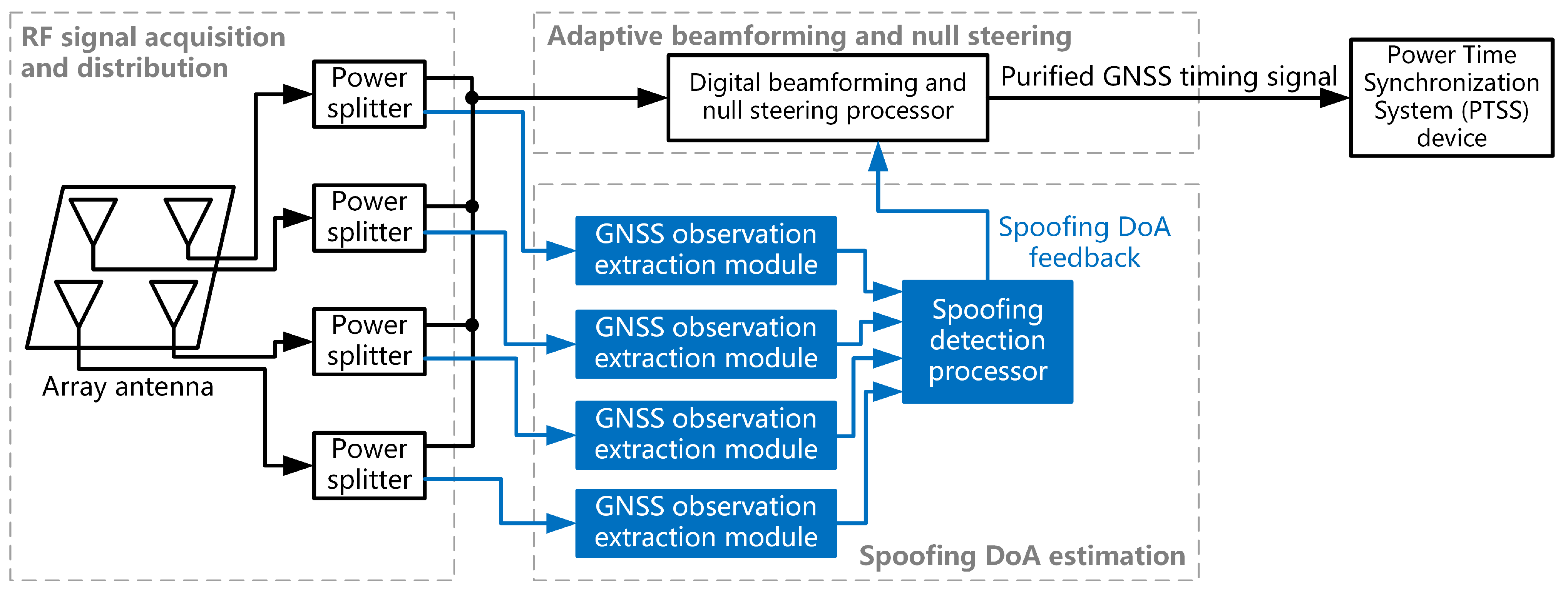
The proposed system employs an anti-spoofing array antenna as a front-end protection layer to suppress spoofing signals before they enter downstream timing devices. The functional architecture and signal processing workflow are illustrated in
Figure 1.
Compared to conventional anti-jamming array antennas, the proposed architecture introduces an additional spoofing sensing path to enable real-time estimation of spoofing signal DoA. Specifically, the RF signal received by each antenna element is divided into two parallel paths using power splitters. One path feeds a digital beamforming and null steering processor, which performs spatial filtering. The other path feeds independent GNSS observation extraction modules, whose outputs are processed by a spoofing detection processor.
By analyzing the spatial consistency of multi-channel GNSS observations, the spoofing detection processor identifies spoofing signals and estimates their DoA. The estimated spoofing DoA is fed back to the beamforming processor, enabling adaptive null steering toward the spoofing source. This closed-loop sensing-assisted beamforming mechanism suppresses spoofing signals while preserving gain toward authentic satellites. As a result, the system generates a purified GNSS timing signal, which can be directly supplied to downstream PTSS devices.
It should be emphasized that the downstream PTSS device, including its internal GNSS timing module, is not modified in the proposed framework. The purified GNSS timing signal generated by the array antenna system is directly supplied to the existing PTSS device, preserving its original structure and operation.
Reliable spoofing suppression requires accurate spatial reference frame. The spoofing signal DOA is initially estimated in the array antenna body frame, whereas the directions of authentic satellites are defined in the local East-North-Up (ENU) frame. Therefore, accurate transformation between these coordinate systems is essential, which depends on precise real-time knowledge of the array antenna attitude.
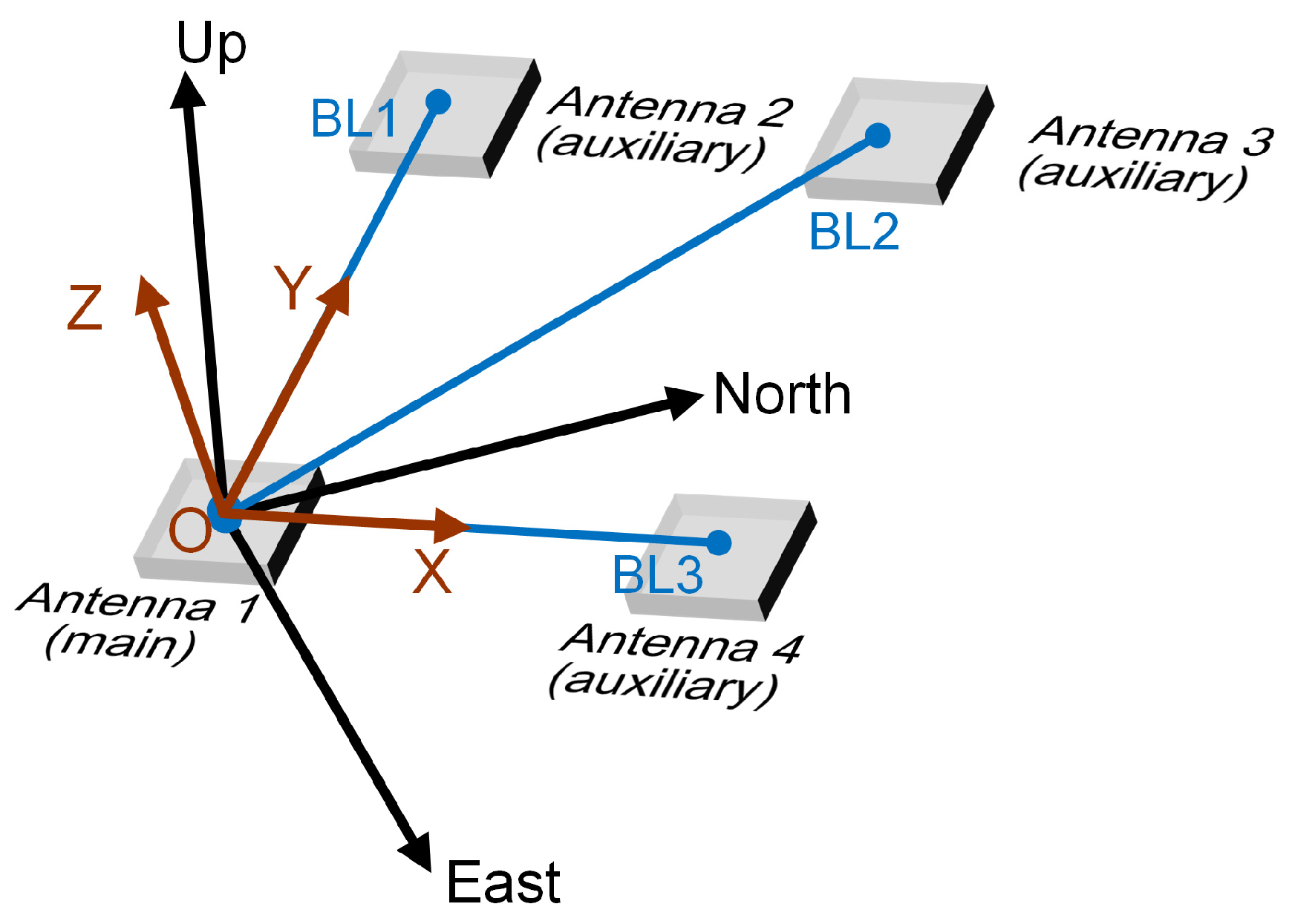
The multi-element attitude determination model for array antennas is illustrated in
Figure 2. The array consists of four antenna elements mounted on a rigid plane, forming three independent, non-collinear baselines. The attitude determination problem involves estimating the rotation matrix that maps vectors from the antenna body frame (red axes) to the local ENU frame (black axes). According to [
28,
29], a common convention of the body frame aligns the y-axis with a primary baseline, the x-axis perpendicular to y within the antenna plane, and the z-axis completing the right-handed system normal to the plane. From the rotation matrix, the heading, pitch, and roll angles can be extracted.
However, attitude determination for compact array antennas in power environments faces several practical challenges:
Very short baselines of 10 cm-level, leading to a geometrically weak model.
Single-frequency observations, further weaken the GNSS ambiguity resolution performance.
Environmental interference, including multipath and interference, which introduce systematic errors.
The following subsections present a unified attitude determination framework to address these challenges and enable reliable attitude determination for the proposed anti-spoofing array antenna system.
2.2. Baseline Vector Resolution Using the C-LAMBDA Algorithm
Reliable attitude determination requires accurate estimation of baseline vectors between antenna elements. However, under very short baseline conditions of 10 cm-level and single-frequency observations, the ambiguity resolution model becomes geometrically weak, resulting in frequent float solutions or incorrect fixes. To address this limitation, the C-LAMBDA algorithm is employed to resolve integer ambiguities. The C-LAMBDA algorithm can effectively incorporate a priori baseline length into the integer ambiguity search process, thereby strengthening the model and improving the success rate of correct integer estimation [
30,
31,
32].
The model of the C-LAMBDA algorithm is built upon the standard LAMBDA model, which can be formulated as:
where
and
denote expectation and variance operations, respectively;
comprises double-differenced measurements (pseudorange and carrier phase);
denotes the integer ambiguity vector;
denotes the three-dimensional baseline vector;
and
are design matrices.
The standard LAMBDA algorithm solves the integer least-squares problem by searching for integer vector that minimizes , where denotes the float ambiguity estimate.
The C-LAMBDA algorithm augments this model by integrating the known baseline length
as a weighted constraint:
The objective function of ambiguity resolution is then transformed to:
Unlike the standard ellipsoidal search space of LAMBDA, the ambiguity search space is no longer a hyper-ellipsoid due to the additional baseline length constraint, and the part associated with the baseline vector in (3),
, will not vanish. Therefore, a nonlinear minimization problem needs to be solved for each integer candidate vector:
However, the computational efficiency of C-LAMBDA algorithm can be maintained by employing bounding functions to limit the search space. And the final fixed solution can be expressed as:
Our previous studies indicate that while the C-LAMBDA algorithm significantly improves the ambiguity resolution success rate, it introduces a characteristic effect on positioning accuracy [
33]. The constraint enhances the estimation of the component along the baseline direction; however, the accuracy of the component perpendicular to the baseline may experience a relative reduction. Nevertheless, for very short baselines with single-frequency data, the substantial gains in ambiguity resolution success rate and solution availability far outweigh this minor compromise, making C-LAMBDA the more suitable and reliable choice for our application.
The fixed baseline vectors obtained through this process provide the fundamental geometric input for subsequent attitude determination. Their accuracy directly affects the reliability of the attitude solution, which is further enhanced in the following subsection using a redundant antenna element. These fixed baseline vectors can also provide an inherent geometric consistency check during system initialization. In the presence of spatially inconsistent signals, abnormal residuals or unstable ambiguity fixing across multiple baselines can indicate potential spoofing before reliable attitude estimation is performed.
2.3. Attitude Accuracy Enhancement Using a Redundant Antenna Element
Building upon the resolved baseline vectors, attitude accuracy can be further improved by exploiting the redundant antenna element. For compact array antennas, the vertical component of baseline vectors typically exhibits lower accuracy due to geometric limitations, which directly affects pitch and roll estimation accuracy.
Since all antenna elements are mounted on a common rigid plane, the redundant antenna element provides an additional baseline that enables a planar constraint to be imposed. This constraint allows correction of the vertical components of baseline vectors, thereby improving the overall attitude determination accuracy.
Assume there are
independent baselines
formed by introducing the redundant antenna element. These baseline vectors should lie on the same physical array plane. The plane equation under the local ENU frame can be written as:
where
,
, and
denote the east, north, and up components of a baseline vector, respectively.
and
denote the unknown plane parameters.
For
baselines, Equation (6) yields the following overdetermined system:
Applying the least-squares method gives the estimated plane parameters
and
:
Using the fitted plane Equation (8), the up-components of baseline 1 and baseline 2 vectors can be corrected:
The three-dimensional attitude angles, i.e., heading
, pitch
, and roll
, can be calculated using the corrected baseline vectors. Heading and pitch are obtained from the first baseline:
To compute roll angle, the second baseline is transformed into an intermediate frame by rotating the ENU frame first by
around the z-axis and then by
around the x-axis. From the resulting coordinates
, the roll angle
can be derived:
The rotation matrix from the ENU frame to the antenna body frame can then be derived:
In summary, the redundant antenna element improves attitude accuracy by exploiting a planar constraint on the baseline vectors. This correction enhances the reliability of the initial attitude estimate, which serves as the input for the subsequent iterative refinement process. If vertical displacement errors affect the reference and auxiliary antenna elements in a consistent manner, their influence is common-mode across the resolved baseline vectors. In such cases, the least-squares plane fitting mainly results in a uniform shift of the fitted plane rather than altering its orientation, and therefore can not significantly degrade the attitude angles derived from the plane normal.
It should be noted that the array geometry is fully known a priori for rigid-body array configurations. In the present framework, geometric information is incorporated progressively through scalar baseline length constraints in the ambiguity resolution stage (
Section 2.2) and planar coplanarity constraints in the redundant element enhancement stage (
Section 2.3). This design enables effective utilization of essential geometric relationships while maintaining model simplicity and robustness under very-short baseline and environmental disturbance conditions. Further integration of additional rigid-body geometric constraints into the ambiguity resolution process may potentially strengthen the model and represents a valuable direction for future investigation.
2.4. Iterative Attitude Refinement for Environmental Error Mitigation
Although the redundant antenna element improves attitude accuracy, systematic phase errors caused by multipath, antenna characteristics, and environmental interference still introduce residual biases in baseline vector estimation. These biases propagate into the attitude solution and limit achievable accuracy. It should be noted that in this work, the term complex electromagnetic environment refers to the impact of environmental factors on GNSS carrier-phase observations, such as multipath and direction-dependent phase biases. This study focuses on mitigating their effects at the observation level rather than performing electromagnetic field propagation analysis.
To mitigate this issue, an iterative attitude refinement method is developed in this section. The refinement process follows a recursive estimation principle, where the solution from the previous iteration serves as the current state estimate.
After pre-calibration, the composite phase bias for each antenna element can be represented as a function of signal azimuth and elevation in the antenna body frame. Consequently, once an initial coarse attitude is obtained, the approximate DOA for each satellite in the body frame can be computed, enabling the estimation and subsequent removal of the corresponding phase bias from the raw carrier phase measurements.
The first iteration begins by ignoring all environmental errors. The baseline vectors are resolved directly from raw carrier phase observations with C-LAMBDA algorithm. Subsequently, the three-dimensional attitude angles
are calculated from these baseline vectors using the standard formulas, and the corresponding initial attitude matrix
can be constructed according to the redundant antenna element-based model described in
Section 2.3.
Beginning with the second iteration, the algorithm enters a refinement loop. This step is actually a measurement update of a Kalman Filter, using environmental-error-corrected observations to refine the current state estimate.
In the i-th iteration (
), the attitude matrix
from the previous iteration is used to obtain a more accurate estimate of satellite line-of-sight directions in the array body frame. First, the unit line-of-sight vector to satellite
is computed in the ENU frame from the broadcast ephemeris. This vector, denoted as
, can then be transformed into the body frame using the current best estimate of the attitude:
From these coordinates, the azimuth and elevation angles of satellite
in the body frame can be derived:
Given these direction angles, the pre-calibrated environmental error model can be consulted to estimate the associated carrier phase error. This estimated error is then removed from the raw carrier phase observations for that satellite. Using the corrected phase measurements, the baseline vectors are resolved anew, and an updated set of attitude angles and the corresponding attitude matrix are derived.
This iterative process of line-of-sight direction estimation, error correction, and attitude computation is repeated. The algorithm is considered to have converged when the changes in all three attitude angles between successive iterations fall below a set of predefined thresholds. The convergence criterion is formally expressed as:
where
,
, and
denote the convergence thresholds for heading, pitch, and roll, respectively. Upon satisfying (18), the iteration halts, and the final set of attitude angles is output as the high-precision attitude determination solution.
It should be clarified that the convergence thresholds in (18) are applied to the incremental changes between successive iterations rather than to the absolute attitude estimation error. The thresholds are selected as practical stabilization tolerances, which are significantly larger than the typical carrier phase noise-induced attitude fluctuations.
Through this iterative correction process, residual systematic errors are effectively mitigated, resulting in a high-precision and robust attitude estimate suitable for reliable spoofing DoA estimation and adaptive beamforming. It should be noted that no temporal state propagation across epochs is introduced, as the method is intentionally designed for single-epoch processing to preserve sensitivity to abrupt spoofing events.
3. Results
In this section, the proposed array antenna-based attitude determination method, which enables spoofing mitigation through spatial processing, is evaluated using semi-simulated GNSS observations. The evaluation follows the three successive processing stages introduced in
Section 2: baseline resolution, redundant antenna element-based enhancement, and iterative refinement.
The experimental dataset is constructed from authentic multi-antenna GNSS observations of Curtin University under open-sky conditions. The original dataset spans approximately 24 h (83,745 epochs), with an average of about 9 visible satellites per epoch. These real observations are publicly available and preserve authentic satellite–receiver measurement characteristics.
Following the approach established in our prior work [
33], the original meter-level baseline measurements are geometrically transformed by scaling the baseline lengths to simulate very-short 10 cm-scale baselines, while maintaining the original observation structure and satellite geometry. The simulated antenna geometry, comprising four coplanar elements and three 10 cm independent baselines, is representative of compact anti-spoofing arrays. This semi-simulation strategy enables controlled evaluation under compact array conditions while retaining realistic measurement noise and satellite distribution.
All tests are conducted using single-epoch data, where each epoch is processed independently using only the observations from the current epoch, without incorporating prior epoch information. This choice serves two purposes: (1) it evaluates the intrinsic algorithm performance under the most challenging conditions; and (2) it reflects practical deployment scenarios in which spoofing may occur abruptly, requiring rapid detection based on instantaneous spatial information. The satellite elevation mask is set to 5°, representing a typical operational condition where low-elevation satellites might be utilized. For the iterative refinement process, the convergence thresholds for heading, pitch, and roll are set to 0.5° in the experiments. A maximum iteration number of 20 is also imposed to prevent indefinite cycling. These settings ensure a controlled yet realistic evaluation environment representative of compact array deployment in power substations.
3.1. Baseline Resolution Results of the C-LAMBDA Algorithm Under Very Short Baselines
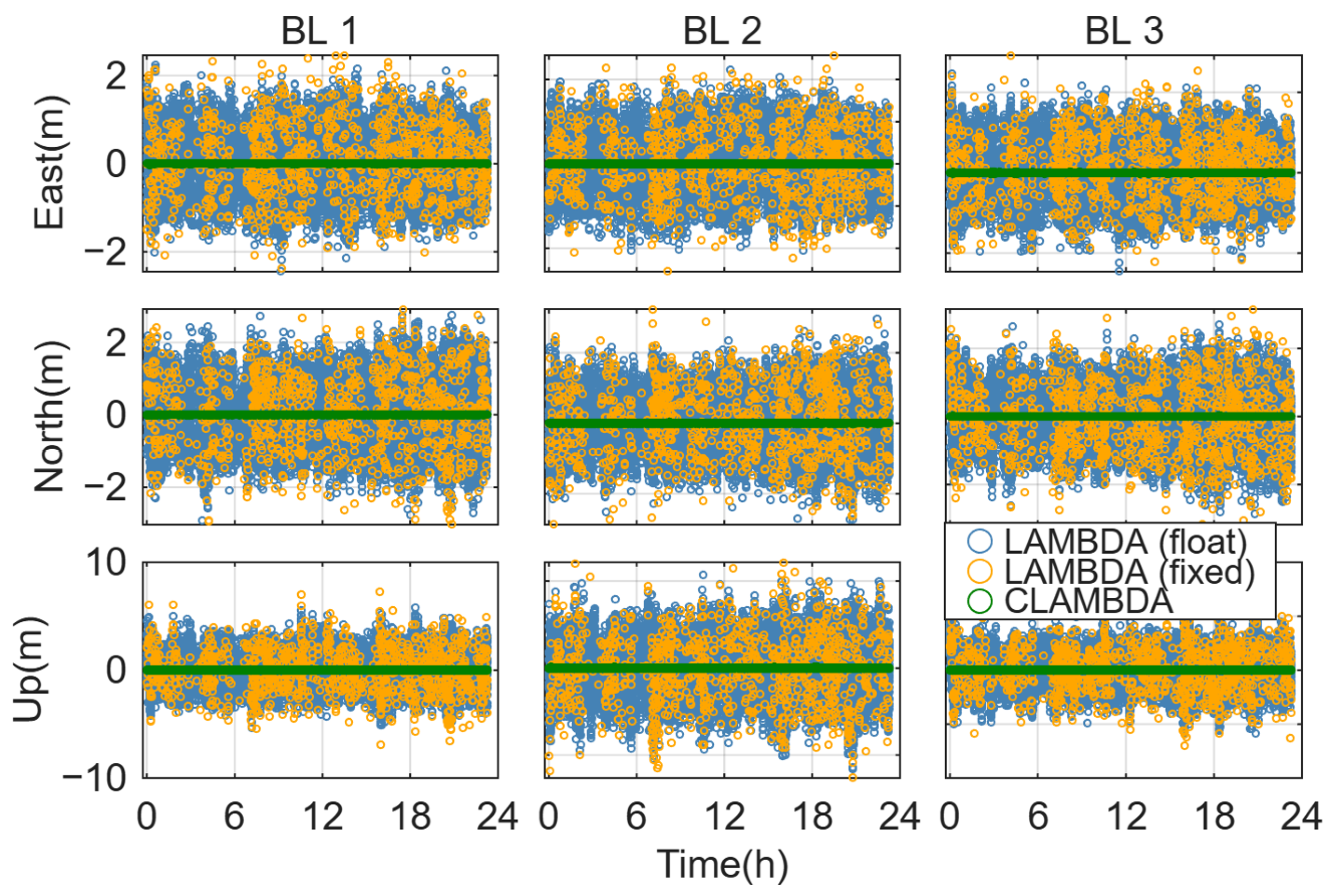
Figure 3 compares baseline vector estimation results obtained using the C-LAMBDA and standard LAMBDA algorithms under very short baseline conditions. The C-LAMBDA solutions, represented by green markers, demonstrate remarkable precision, with errors tightly clustered near zero for all vector components across the three baselines. This indicates the algorithm’s robustness and high success rate in resolving integer ambiguities correctly, even when challenged by the weak geometric model inherent to centimeter-scale baselines.
In contrast, the solutions from the standard LAMBDA algorithm exhibit significant limitations. The floating solutions, denoted by blue markers, are highly dispersed, accounting for approximately 70% of the total solutions. This high proportion of floating solutions underscores the algorithm’s fundamental difficulty in achieving reliable integer ambiguity resolution under such constrained conditions. Furthermore, even when the LAMBDA algorithm does produce fixed solutions, indicated by yellow markers, a non-negligible number of outliers and incorrect fixes are observed, particularly in the vertical component. This susceptibility to erroneous fixes renders the standard LAMBDA algorithm unsuitable for high-integrity applications like power timing, where reliable and precise vector solutions are paramount for subsequent spoofing mitigation and accurate attitude determination. The superior performance of C-LAMBDA, attributable to the effective incorporation of the baseline length constraint, validates its selection as the core ambiguity resolution technique for the proposed anti-spoofing methodology in this challenging operational scenario.
These reliable baseline vectors provide the necessary geometric input for the subsequent attitude determination stages evaluated in
Section 3.2 and
Section 3.3.
3.2. Attitude Determination Results After Redundant Antenna Element-Based Enhancement
This section evaluates the effect of introducing a redundant antenna element on baseline consistency and attitude accuracy.
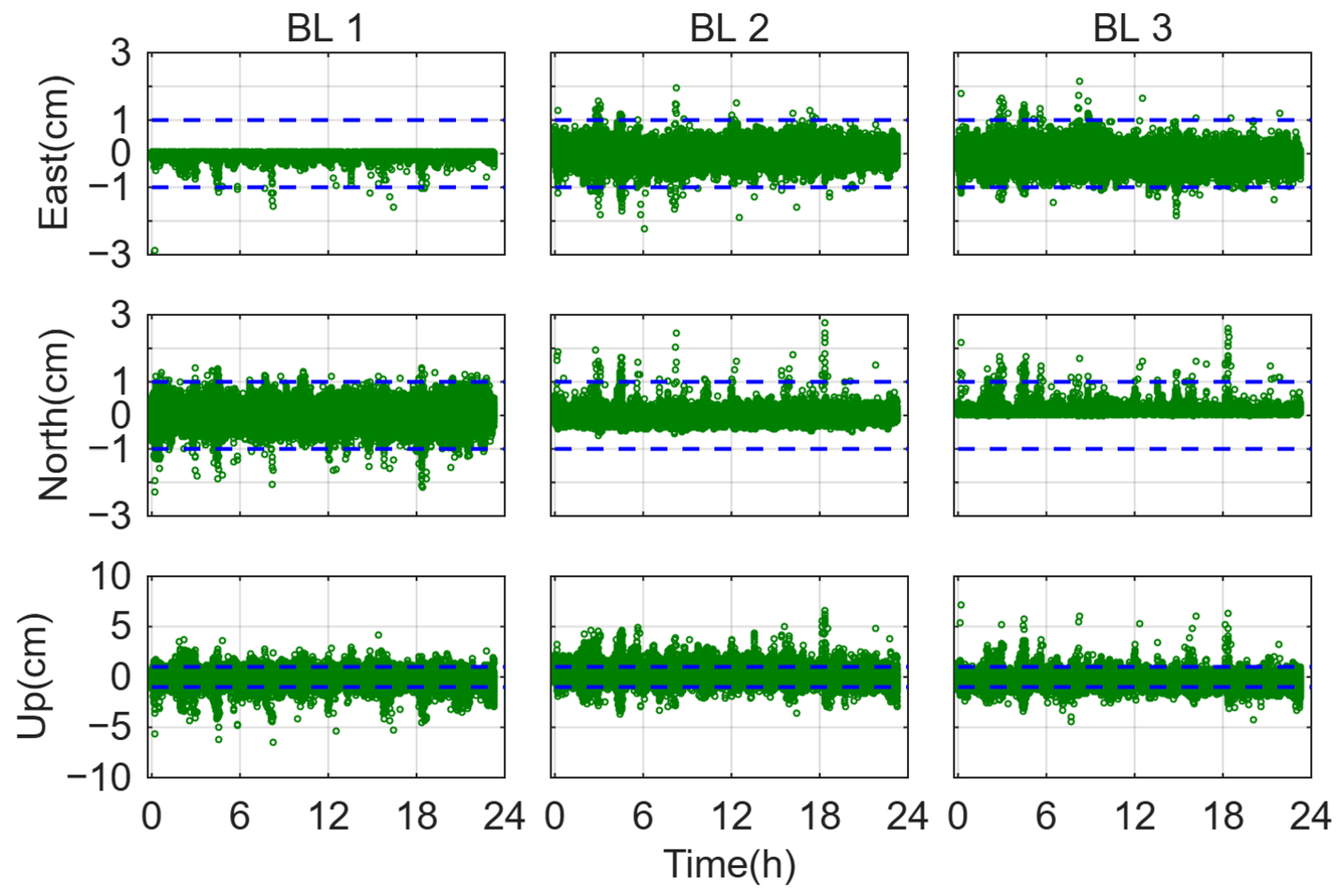
Figure 4 displays the baseline vector deviations of three independent baselines. The blue dashed lines indicate the 1 cm reference threshold, serving as a benchmark for comparison. The deviations cluster tightly around zero across all three baselines and vector components, confirming that the proposed method delivers high-precision baseline vector estimates under very short baselines. Such precision is critical for accurate attitude determination, where deviations in baseline vector solutions can propagate into angular uncertainties.
Building upon the baseline vector estimates,
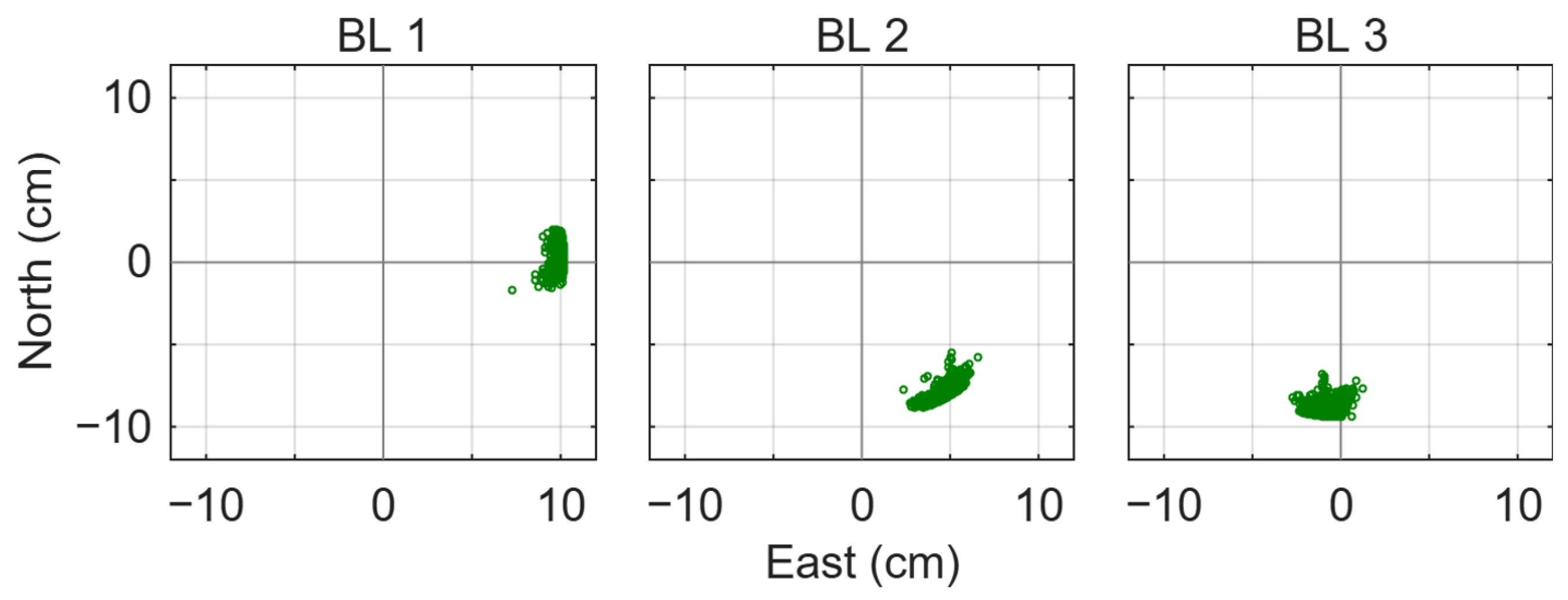
Figure 5 examines the horizontal-plane scatter distribution of the three baseline vectors. Because the C-LAMBDA algorithm incorporates baseline length constraints directly into the ambiguity resolution process, the resulting horizontal projections exhibit markedly tight clustering. The compact scatter pattern validates the effectiveness of the C-LAMBDA framework in exploiting a priori geometric knowledge to refine GNSS-derived baseline vector solutions.
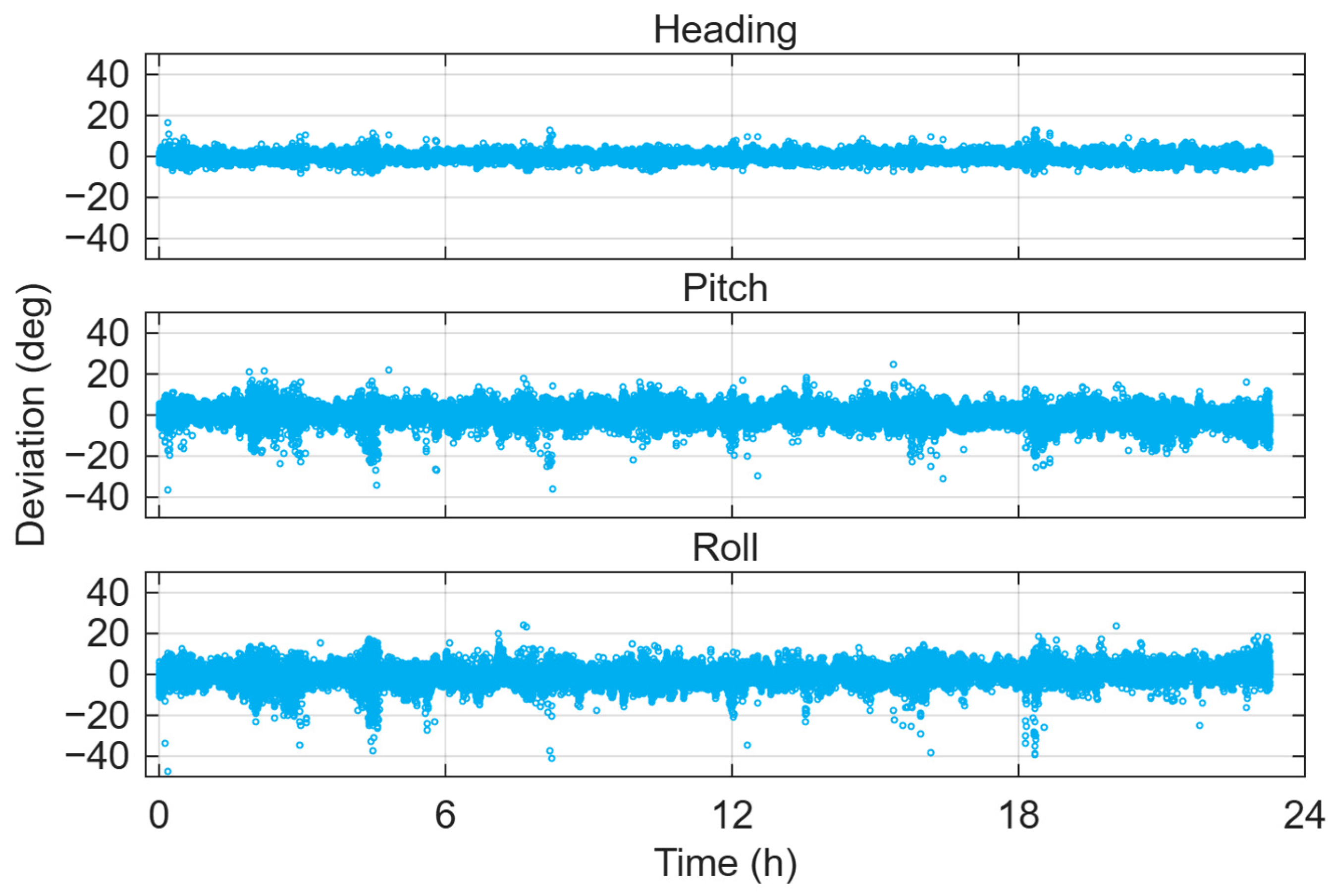
Figure 6 reports the time series of the three attitude angles, i.e., heading, pitch, and roll. The heading angle demonstrates consistently high precision, with deviations remaining well within a narrow range throughout the test period. In contrast, the pitch and roll angles show slightly larger variability, reflecting the intrinsic limitations of GNSS in resolving vertical components. This underscores the advantage of employing redundant antenna elements to fit the array plane accurately, thereby enhancing vertical-direction baseline vector estimation and improving overall attitude determination reliability.
These results confirm that introducing the redundant antenna element significantly improves vertical baseline consistency and enhances overall attitude estimation stability.
3.3. Attitude Determination Results After Iterative Refinement
This section evaluates the effectiveness of iterative refinement in mitigating environmental phase errors. The environmental bias is iteratively removed during the attitude determination process.
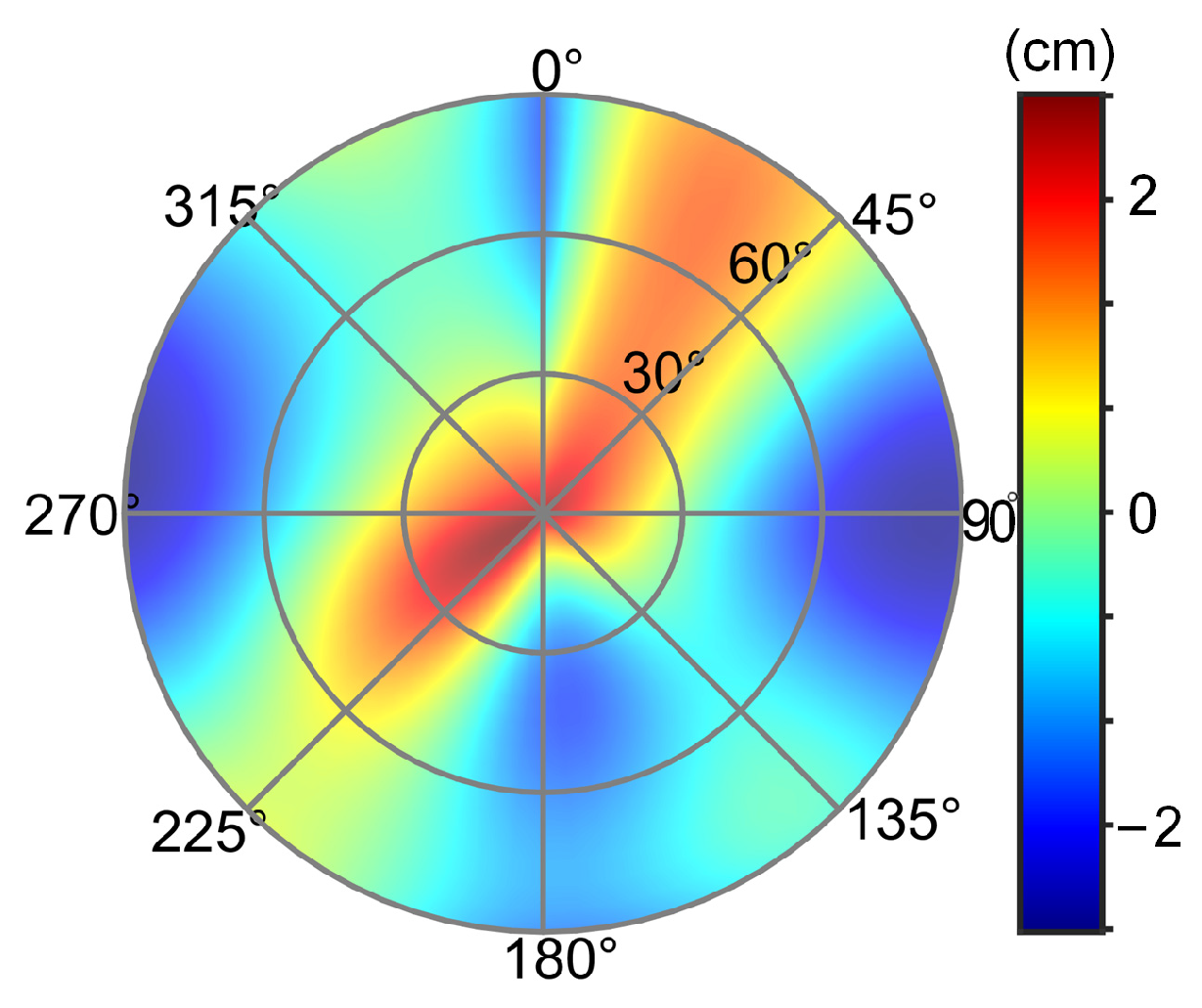
Figure 7 shows a phase pattern model with error magnitudes varying between –2 cm and 2 cm depending on the signal’s incident angle. This phase bias pattern is a predefined direction-dependent phase bias model used to simulate environmental errors at the carrier-phase observation level. It does not represent real-time interference monitoring results. Instead, the pattern is constructed based on prior antenna phase pattern reported in our previous work [
34], and is used here to introduce controlled and repeatable centimeter-level systematic errors for quantitative validation of the iterative refinement algorithm.
The efficiency of the iterative process is illustrated in
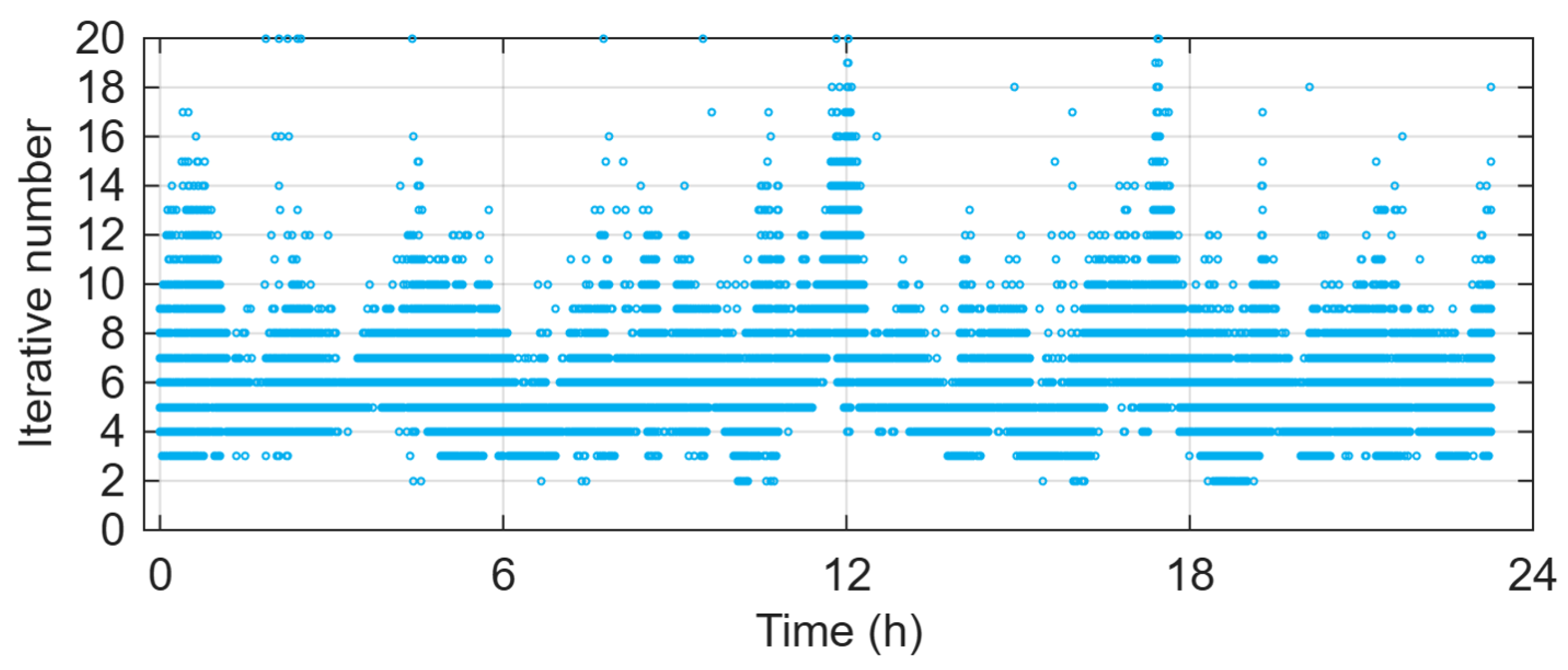
Figure 8, which depicts the number of iterations per epoch. The mean iteration number is 5.71, and 95% of epochs converge within nine iterations, with the upper limit is set to 20 iterations. This confirms that the method achieves rapid convergence in most cases. Given the very-short baseline configuration, the ambiguity search space in C-LAMBDA remains limited, and the average number of iterations is modest. Since the algorithm operates at single-epoch level without temporal filtering, the computational load per epoch remains moderate and compatible with real-time timing protection requirements.
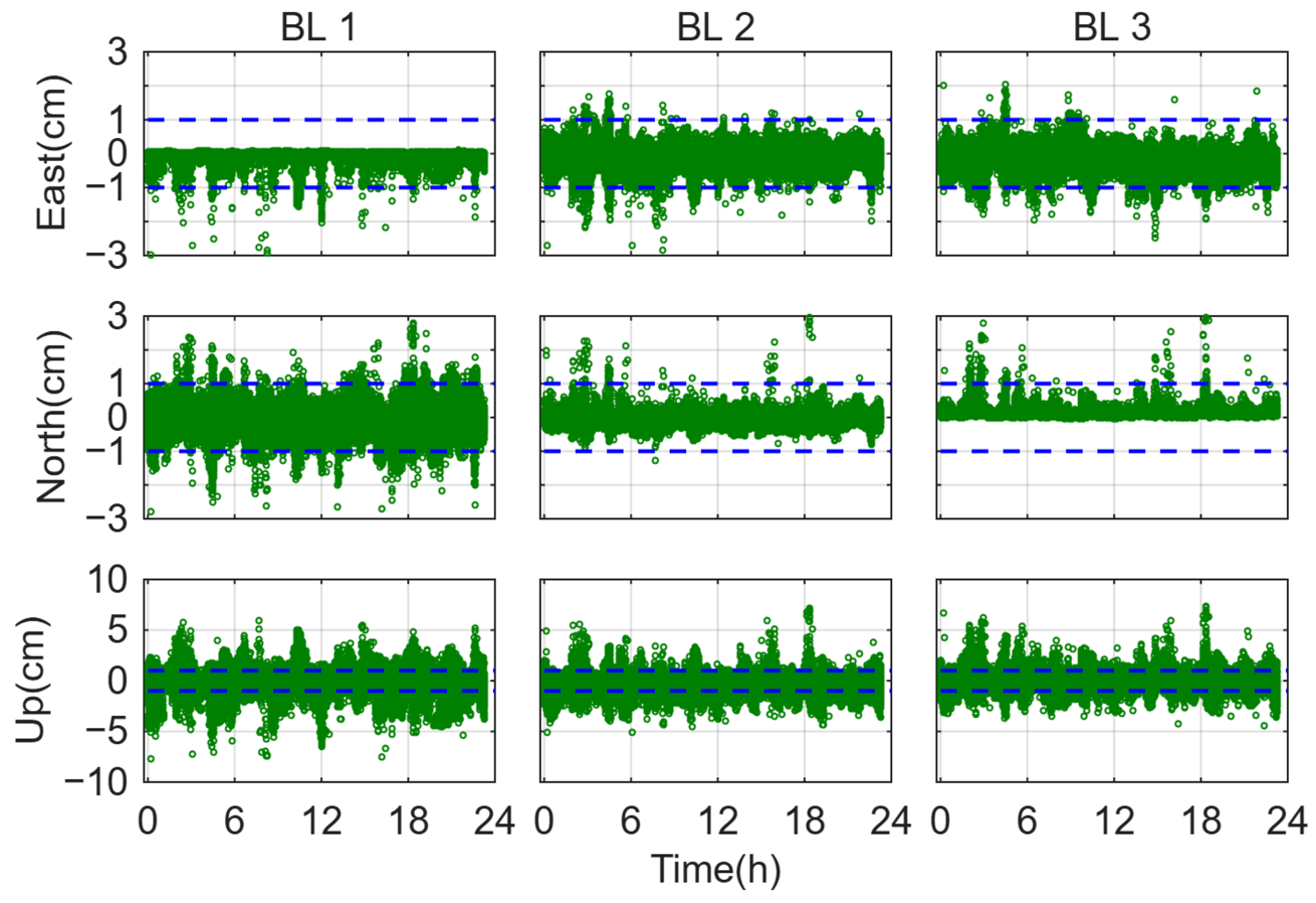
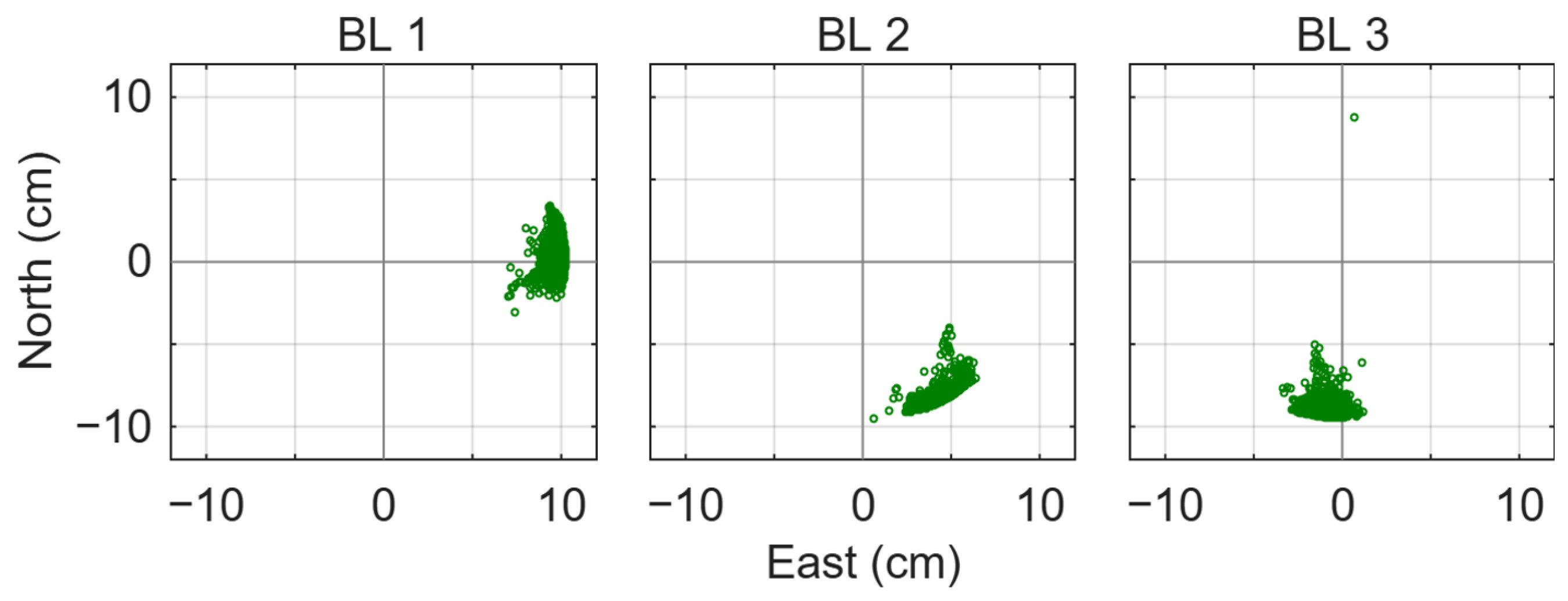
Figure 9 and
Figure 10 present the baseline vector deviation time series and the corresponding horizontal-plane scatter distributions for the three baselines. The deviations remain tightly clustered around zero for nearly all epochs, with the majority of errors lower than 1 cm. Specifically, the Root Mean Square Error (RMSE) for the horizontal components are 4.57 mm, 3.68 mm, and 4.43 mm for BL 1, BL 2, and BL 3, respectively, while the vertical components yield RMSE of 11.40 mm, 10.76 mm, and 6.52 mm. Compared with the results in
Figure 4 and
Figure 5, despite the introduction of the modeled centimeter-level environmental errors, the iterative approach maintains comparable precision, thereby validating its robustness.
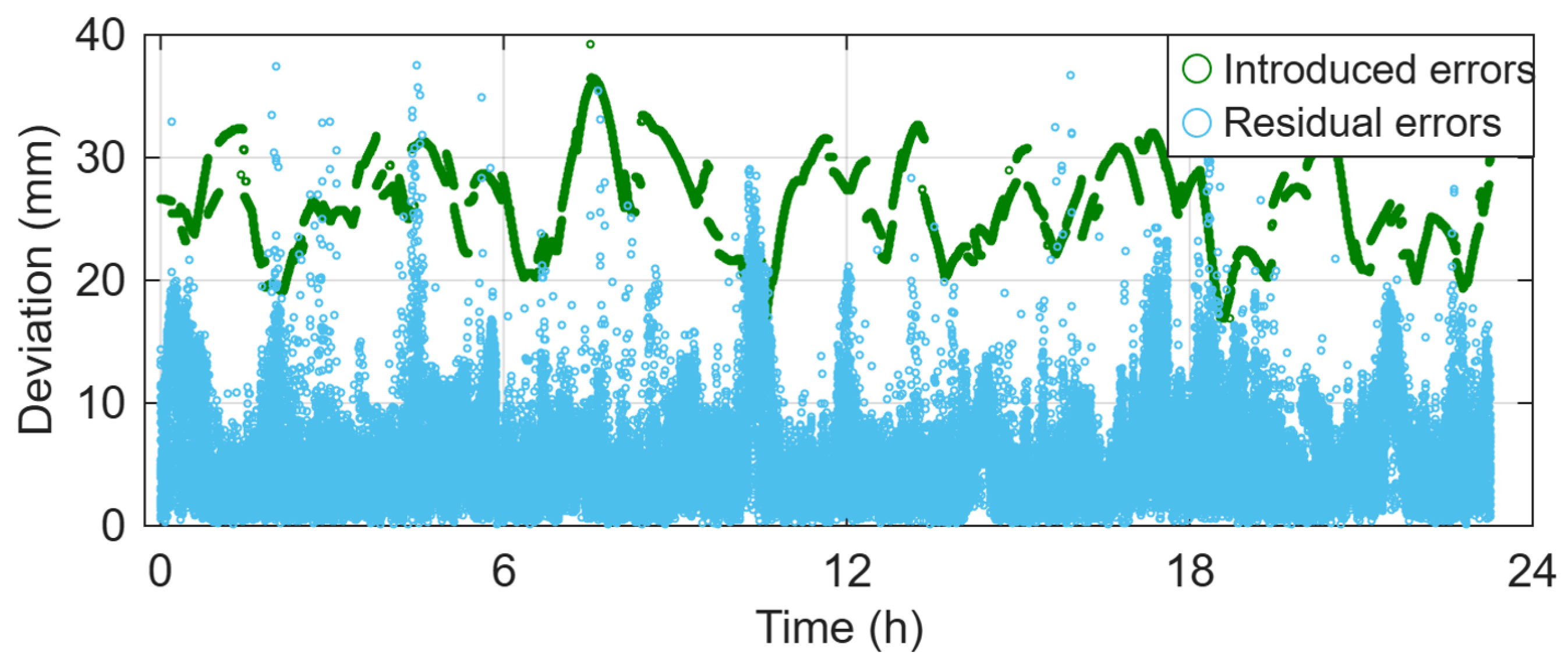
The effectiveness of the iterative procedure in reducing environmental errors is further demonstrated in
Figure 11, which compares the artificially added phase errors (green markers) with the residual errors after processing (blue markers). The algorithm eliminates approximately 80% of the modeled environmental error, as evidenced by the significant reduction in deviation magnitude. This result highlights the method’s capacity to iteratively correct systematic biases, making it well suited for power timing applications where such errors are prevalent.
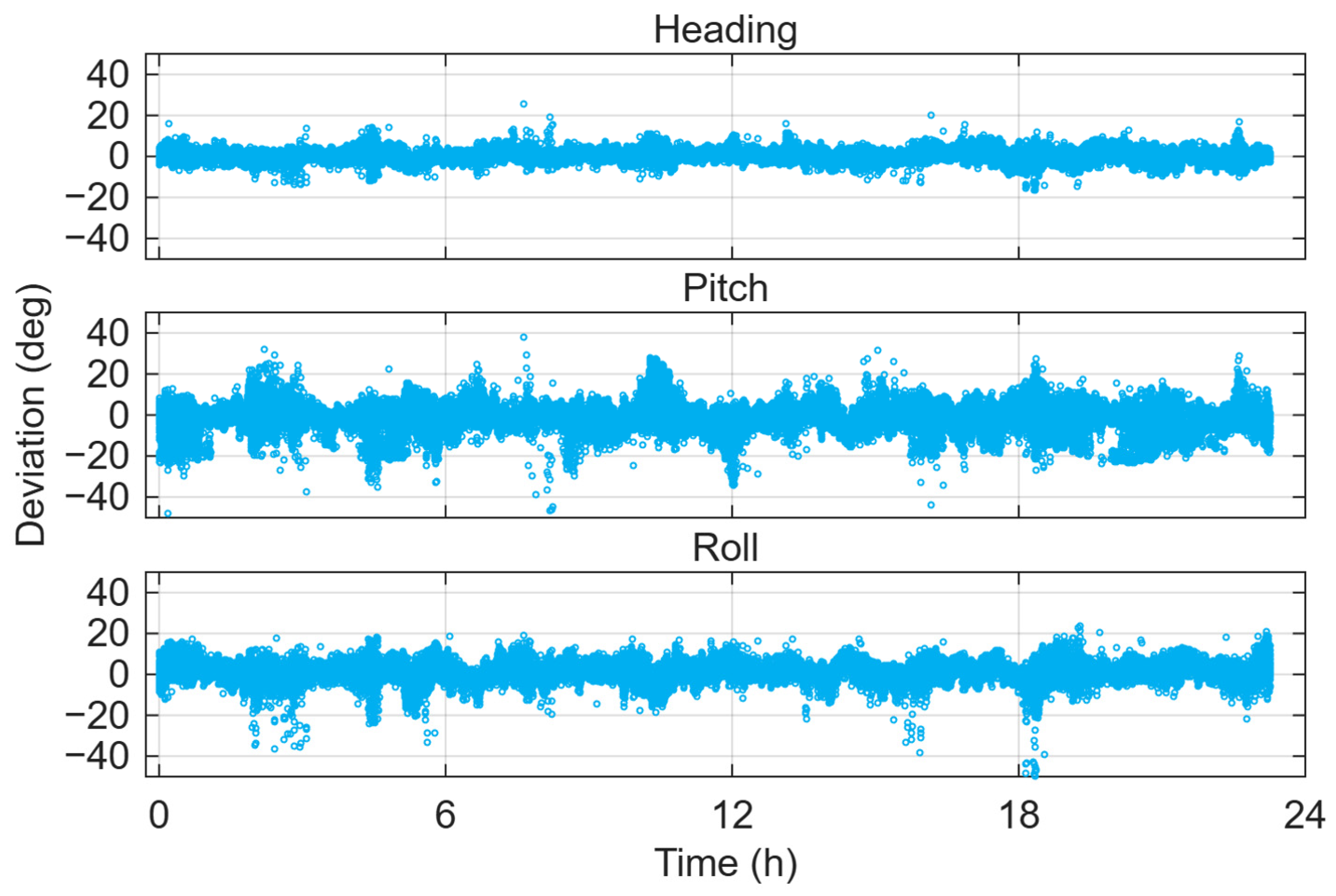
Figure 12 shows the time series of the attitude angles computed by the iterative method. The estimates remain stable and accurate throughout the test period, with fluctuations confined to a narrow range. When compared with the results from the previous section, the iterative method continues to deliver high-quality attitude solutions even under the influence of the environmental interference, confirming its suitability as a practical solution for GNSS-based attitude determination.
4. Discussion
In this section, we discuss the test results, as well as analyze the underlying mechanisms influencing the performance of the proposed attitude determination method. First, we examine the impact of redundant antenna elements, followed by an analysis of the effect of iterative processes. Through this analysis, the stability and applicability of the proposed framework for spoofing-resilient timing are further clarified.
4.1. Effect of the Redundant Antenna Elements
The benefits of incorporating a redundant antenna element for GNSS-based attitude determination are quantitatively evaluated in this section. Two distinct scenarios are analyzed: an ideal case without environmental errors (
Table 2) and a realistic case that includes simulated environmental errors, which are mitigated by the proposed iterative method (
Table 3). The performance is assessed using a 3-element configuration, compared against a 4-element configuration that includes one redundant element.
Table 2 presents the results under error-free conditions. The 4-element configuration demonstrates clear advantages over the 3-element baseline. The heading angle accuracy shows no improvement, since the calculation of the heading angle relies primarily on the horizontal vector components, which are not directly enhanced by the addition of a vertical-redundant element. In contrast, significant enhancements are observed for pitch and roll estimations. The pitch angle shows an improvement of approximately 14%, while the roll angle exhibits a more substantial average gain of nearly 30%. This result directly validates the effect of the redundant element, which provides an additional independent measurement vector, enabling a more accurate geometric fit of the antenna array plane.
It should be emphasized that the independent baseline lengths remain unchanged between the 3-element and 4-element configurations. Therefore, the observed improvements in pitch and roll are not primarily attributable to an increased spatial aperture, but rather to the overdetermined planar constraint and statistical redundancy introduced by the additional element. This improved plane estimation subsequently refines the vertical component of the baseline vectors, which is critical for accurately resolving the pitch and roll angles. Therefore, even in an ideal scenario, the redundant element configuration provides a significant performance gain for full three-dimensional attitude determination.
The analysis is extended to a more practical scenario in
Table 3, where the system is subjected to modeled environmental errors. In this case, both configurations utilize the iterative method to mitigate these errors. The 3-element configuration results represent the baseline performance with error mitigation but without the benefit of redundant antenna element. The 4-element configuration results combine error mitigation with the geometric constraint provided by the redundant antenna element. A comparison reveals that all three attitude angles benefit from the redundant antenna element when environmental errors are present. The heading angle, which was unaffected in the ideal case, now shows a consistent improvement of about 8% across all statistical metrics. This gain can be attributed to the iterative process. The improved estimation of pitch and roll angles, aided by the redundant antenna element, provides a more accurate initial attitude for subsequent iterations. This, in turn, refines the overall estimation, including the heading. The pitch angle accuracy is improved by approximately 9%, and the roll angle shows the most significant gain of about 25%. These results underscore that the iterative method can effectively suppress environmental errors, while the redundant element provides the geometric robustness necessary to translate this suppression into superior attitude accuracy across all axes. Consequently, the combination of iterative error mitigation and array redundancy proves to be a powerful strategy for reliable attitude determination in challenging operational environments like power substations.
4.2. Effect of the Iteration Number
In this section, we analyze the effect of the iteration number on the performance of the proposed method.
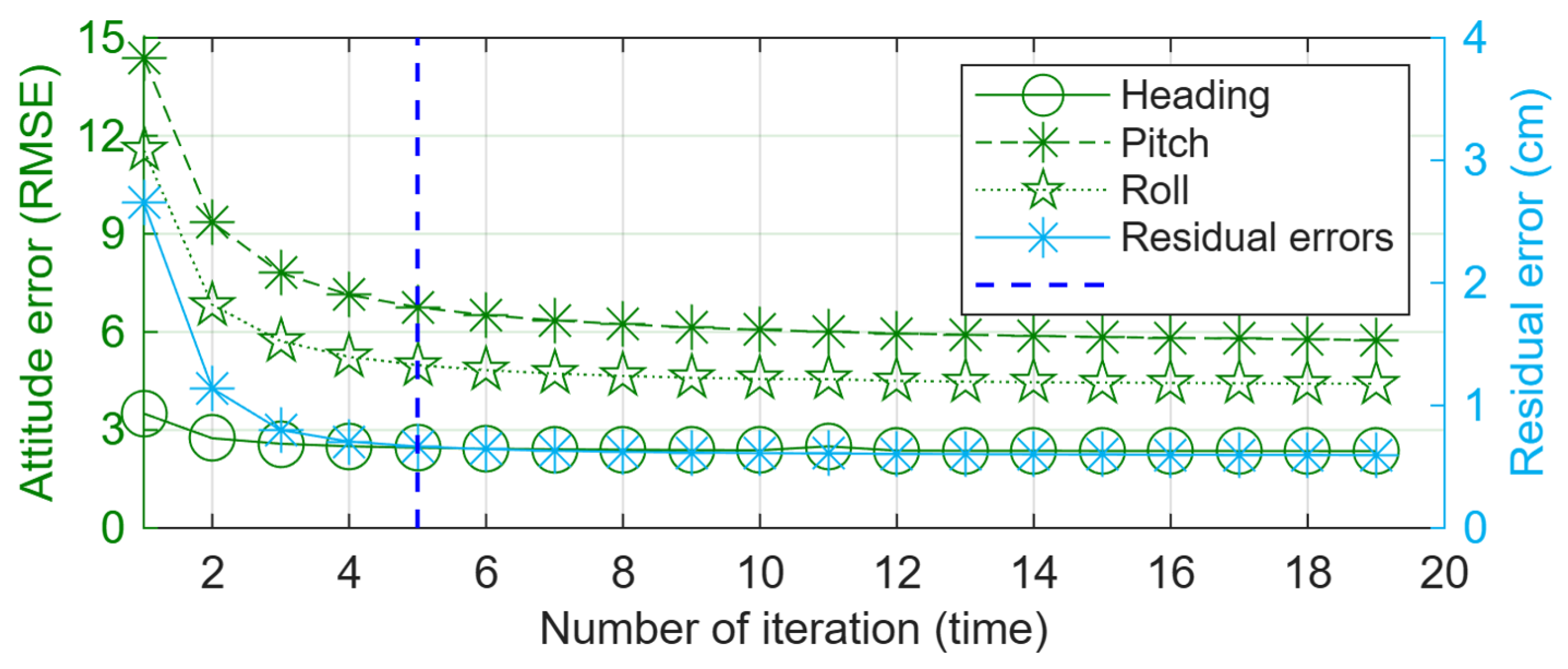
Figure 13 illustrates the convergence behavior of the iterative method by plotting the RMSE for the attitude angles and the residual carrier-phase error as a function of the iteration number. The results show a clear trend that as the iteration number increases from 1 to 19, the estimation accuracy improves significantly. Specifically, the RMSE for heading decreases from 3.50° to 2.35°, for pitch from 14.39° to 5.75°, and for roll from 11.57° to 4.41°. Concurrently, the residual error, shown on the secondary axis, also decreases. This demonstrates that the iterative process can progressively correct the systematic environmental errors, leading to more accurate baseline vectors and, consequently, more precise attitude estimates.
However, the rate of improvement is not constant. The vertical reference line in
Figure 13 highlights that the most substantial gains occur within the first few iterations. After approximately 5 iterations, the curves for both attitude RMSE and residual error begin to flatten, indicating diminishing returns with additional computational effort. This observation is critical for practical implementation. It justifies setting an upper limit, e.g., 20 iterations, in the algorithm to prevent unnecessary computational overhead while ensuring that the solution has sufficiently converged. The choice of this limit represents a balance between achieving high precision and maintaining computational efficiency for real-time applications.
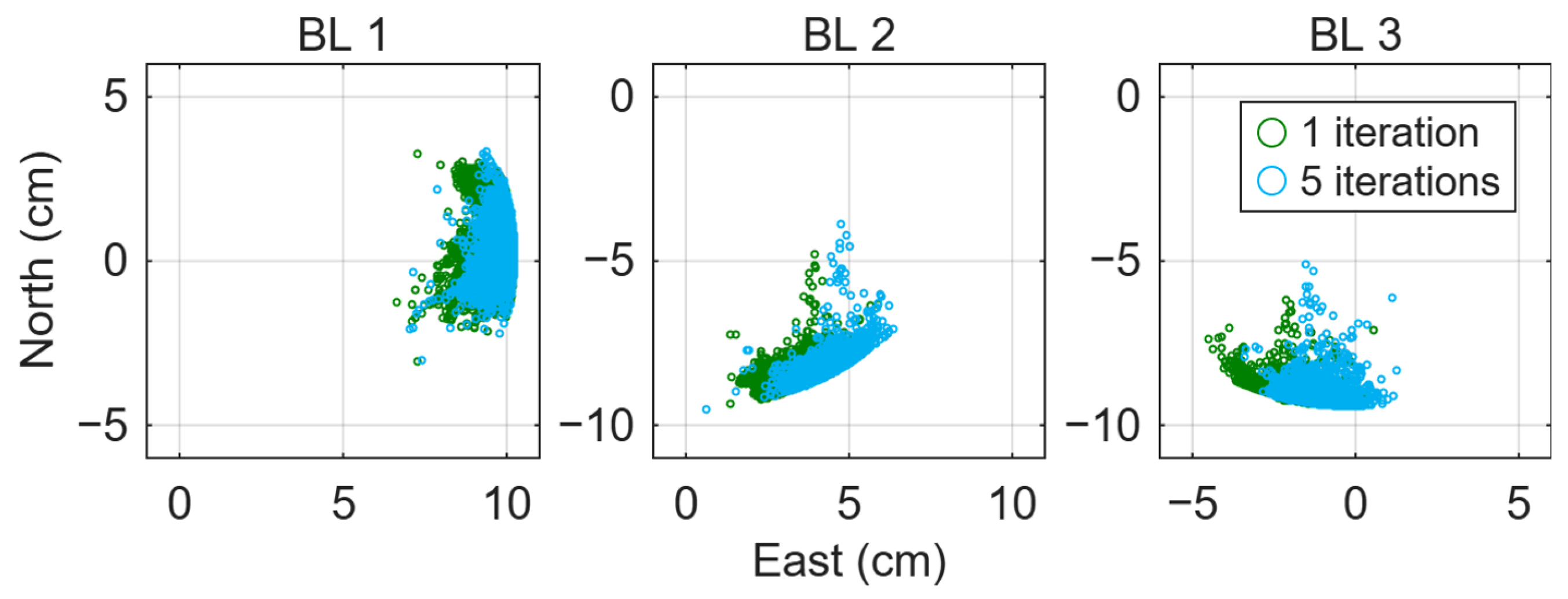
Figure 14 compares the horizontal distribution of baseline vector solutions after 1 and 5 iterations. The solutions after just 1 iteration (green markers) are noticeably more dispersed. In contrast, the solutions after 5 iterations (blue markers) are significantly more clustered and concentrated around their true values. This visual evidence directly correlates with the quantitative accuracy improvements shown in
Figure 13. The iterative process effectively suppress the environmental error, yielding more consistent and reliable baseline vector estimates, which is the direct input to the subsequent attitude determination algorithm. The analysis confirms that a limited number of iterations (around 5) is sufficient to achieve most of the potential performance benefit, making the algorithm suitable for practical deployment.
In summary, the iteration process is fundamental to the robustness of the proposed method. It enables the precise attitude determination necessary for spoofing mitigation in challenging environments like power substations. By effectively mitigating centimeter-level environmental errors, the iterative approach makes reliable attitude estimation with a compact antenna array feasible. This capability provides the necessary spatial reference for reliable spoofing DoA estimation and adaptive beamforming in the proposed spoofing mitigation architecture.
From a practical deployment perspective, it is important to note that while the present study employs semi-simulated data to preserve realistic carrier-phase noise characteristics, real substation environments may introduce more complex and non-stationary multipath effects. These effects primarily influence environmental phase bias patterns rather than the rigid-body geometric consistency across antenna elements exploited by the baseline-length and coplanarity constraints. Therefore, the core array-based architecture and attitude determination framework would not require structural modification, although site-specific calibration and environmental bias modeling would be necessary for practical deployment.
Given that site-specific calibration is required, its practical implementation can be conducted during system commissioning by collecting GNSS observations under normal open-sky conditions over a certain period. The direction-dependent phase bias pattern can then be constructed using the known satellite trajectories and the estimated array attitude. Since the structural environment of substations is generally static, the multipath characteristics tend to remain quasi-stationary, meaning that calibration is typically required only once or infrequently. The process can be automated and does not require interruption of timing services, making it practical for large-scale deployment.




 ,
,