Article

Pre-Operative Assessment of Periodontal Splints: Insights from Parametric Finite Element Analyses


1
Engineering Department, University of Campania “L. Vanvitelli”, Via Roma 29, 81031 Aversa, Italy
2
Department of Structures for Engineering and Architecture (DiSt), University of Naples Federico II, Via Claudio 21, 80125 Napoli, Italy
3
Department of Engineering, Telematic University Pegaso, Centro Direzionale ISOLA F2, 80143 Napoli, Italy
*
Author to whom correspondence should be addressed.
Appl. Sci. 2026, 16(3), 1328; https://doi.org/10.3390/app16031328
Submission received: 30 December 2025 / Revised: 22 January 2026 / Accepted: 24 January 2026 / Published: 28 January 2026

Featured Application

The proposed approach serves as a pre-operative decision support tool for periodontal splinting, enabling a parametric and geometry-tailored assessment of tooth mobility reduction and interface stress through parametric finite element analyses. By linking splint geometry to mechanical safety via a stress-based indicator, the method supports the optimized design and selection of splints, improving treatment reliability while preserving comfort and clinical effectiveness.

Abstract

The present work explores the effects of dental splints from a mechanical standpoint, aiming to provide a practical tool for the surgical decision-making process regarding splint cross-section dimensions. Our investigation centers on the anatomical structure of a pentamorphic dental arch encompassing central and lateral incisors and one canine on each side. Using parametric in silico models built up by means of an ad-hoc procedure, geometry, material properties, and boundary conditions are defined on a parametric anatomical model that can be tailored using RX-derived geometrical information. Two general cases have been considered, one with the splint and the other splintless, and a sensitivity analysis has been performed by varying the splint section height and thickness. The results show the diminishing mobility at the apex and basis of the diseased incisors, demonstrating the effectiveness of the periodontal treatment. Moreover, the stress due to physiological loads moves away from diseased teeth toward the healthy ones due to the splint effects, focusing on the splint–glue–canine contact zone and highlighting the crucial role played by the canine in fixing the entire dental structure. To establish a preliminary mechanical assessment of the dental structure’s safety and to confine its actual value within a mechanically reasonable range, a synthetic “traffic-light” indicator of stress-based failure risk is proposed. It is felt that the tool proposed in this study can help surgeons assess the pre-operative patient-specific mechanical effects of the splint treatment, driving the design and choice of periodontal splints. By linking splint geometry to mechanical safety via a stress-based indicator, the method supports the optimized design and selection of splints, improving treatment reliability while preserving comfort and clinical effectiveness.

1. Introduction

Periodontal disease is an inflammatory pathology affecting the supporting tissues around the tooth, i.e., the gum, bone, and periodontal ligament. The untreated disease outcome leads to the loss of supporting tissues and teeth [1]. Periodontitis is a complex dental disease with a multifactorial etiology, primarily characterized by the body’s inflammatory and immune response to bacterial plaque [2,3]. While bacteria undoubtedly play a central role in developing periodontal pathology, other contributing factors, including individual susceptibility, systemic diseases like diabetes, and harmful habits such as smoking, influence its onset and progression [4]. Moreover, excessive occlusal stress can act as a co-factor, exacerbating the disease’s impact [5,6]. In recent years, greater attention to the international scientific consensus on occlusal and masticatory dysfunctions has grown to include these aspects as factors characterizing the staging of the periodontal classification [7]. Therefore, beyond addressing bacteria and harmful lifestyles, therapeutic strategies must also focus on controlling the occlusal forces that can be abnormal in intensity and direction, causing excessive teeth mobility and affecting the treatment efficacy [8]. With the development of the disease, the degree of teeth mobility gradually increases, eventually leading to shedding or loss [9]. Consequently, mobility becomes a parameter for assessing the state of dental support, developing treatment options, and defining diagnostic indicators [10]. Moreover, it is advisable to reliably stabilize the elements involved in this increased mobility, especially in those teeth where an incipient worsens the mobility [11,12]. Clinical approaches to achieve dental stability involve a combination of periodontal treatment and occlusal correction [13,14]. Furthermore, teeth mobility can result from traumatic incidents or periodontal factors, including reduced supporting tissue and increased width of the periodontal ligament (PDL), and affects function, aesthetics, and the patient’s comfort, prompting the use of dental splints as a viable solution for managing periodontally compromised teeth [15]. There is no doubt that splinting reduces tooth mobility, realigning and stabilizing displaced teeth, promoting healing, and preventing further damage [16,17]. When properly designed and maintained, periodontal splints exhibit long-term durability and withstand daily oral stresses, providing ongoing support to the treated teeth.
To guarantee a successful therapy, the dental splint must be durable for all the time required, easy to clean to maintain healthy periodontal conditions, aesthetically pleasing if possible, and worn 24 h/day when needed. Ultimately, the common goal of these splints is to keep the teeth stable, allow proper cleaning of the teeth, and promote the healing phases. To achieve these aims, the splint must not detach from the teeth. Moreover, it is crucial that the splint remains stable over time without any continuous adjustments.
The use of splints can take place at different moments of the therapy. Depending on the daytime, they stay up on the teeth and are broadly classified as fixed and removable splints. Fixed splints are designed to immobilize teeth in a specific position and exhibit high stiffness to ensure the teeth remain fixed. Conversely, removable splints can be taken off by the patient. They offer a more flexible solution, often used for maintaining tooth position and function while allowing easy removal and proper cleaning. Each category can also be divided, concerning the material’s properties and the shape of the splint, as rigid, elastic, and orthodontic-like. In particular, rigid splints present a very high stiffness to hook the teeth in a fixed position, elastic splints can maintain the teeth in a stable position, and orthodontic-like splints allow the teeth to improve the teeth–splint contact area [18,19]. Moreover, splints can be external or internal regarding the teeth crown position. Finally, being the application time of great importance in postoperative healing, splints are further classified as temporary, provisional, or permanent. Notably, temporary splints are used for shorter durations, typically under six months [20]. They provide immediate support during postoperative healing or while awaiting more permanent solutions. Provisional splints are employed for longer durations, typically six months to over a year [21]. They serve as an intermediate solution before considering more permanent options. Permanent splints are designed for long-term application and are intended to provide lasting support and stability for teeth, often as part of a comprehensive treatment plan [22,23]. The use of splints in dentistry is versatile, addressing various dental issues by considering factors such as rigidity, material, tooth position, and the duration of application. Each type of splint is chosen based on the specific needs and conditions of the patient. Dentists carefully evaluate these factors to provide the most effective and comfortable treatment. Dental splints’ clinical efficacy and success hinge on their design, materials, and mechanical properties, which are pivotal in achieving the desired therapeutic outcomes. Various studies have compared different splint materials and nylon and wire composites, finding no significant differences in their effectiveness once they resist loading [24,25]. In addition to environmental and microbial factors, genetic susceptibility plays a crucial role in the etiology of periodontitis. Recent studies have highlighted the importance of so-called “hub genes”, which act as key regulators in inflammatory and immune-response networks and significantly contribute to disease onset and progression [26]. Moreover, the oral cavity may represent an early indicator of systemic diseases, as several general disorders can initially manifest through oral signs and symptoms. Conditions such as halitosis and oral lichen planus have been associated not only with local oral pathology but also with systemic metabolic, inflammatory, and immune disorders, highlighting the diagnostic value of oral examination and the close relationship between periodontal and systemic health [27]. Complementary mathematical descriptors, such as fractal dimension and texture analysis methods, have been successfully employed to characterize the microstructural organization, surface irregularity, and degradation of dental and polymeric materials [28,29].
In this realm, the proposed study harnesses the capability of parametric finite element-based simulations to provide a tool for guiding the surgical decision-making process on selecting dental splints. The research centers on studying an anatomical structure of a pentamorphic dental arch comprising two incisors and one canine, with or without a splint with a rectangular section. The approach involves the creation of a parametric model thoughtfully tailored to suit individual patient-specific data acquired by RX scan. To this aim, a custom-made algorithm was ad hoc written using the ANSYS Parametric Design Language (APDL) within ANSYS version 11.2 (ANSYS Inc., Canonsburg, PA, USA). To evaluate the mechanical response of the structure under physiological loads, a sensitivity analysis has been carried out by varying the geometrical dimensions of the splint. The results obtained from the model with or without the splint have been compared, showing a consistently decreased mobility of the treated teeth, confirming the clinical therapy’s effectiveness. Finally, the reduced mobility has been related to the increment of the section, paving the way to the development of mechanical-based guidelines that drive the splint’s design.

2. Materials and Methods

In literature, the generation of finite element (FE) models from medical data is achieved by the geometry-based [30,31] and the voxel-based approach [32]. Both methods utilize data from computed tomography (CT) scans. As known, CT is a methodology used to acquire volumetric densities of tissues. The voxel-based meshing technique is achieved by matching each CT voxel to a single hexahedral finite element, and the main advantage of this strategy is that it is an automated technique. However, curved and smooth surfaces cannot be adequately represented by brick elements; the jagged-edged surface, for instance, causes peak stresses and strains, which thus constitutes a disadvantage when accurate mechanical data are also needed at those surfaces. Moreover, unstable elements (i.e., elements insufficiently anchored to the whole model and thus potentially involved in partial rigid body motion) can be generated during the 3D reconstruction, which is a crucial problem in obtaining consistent FE models, hindering mechanical analyses. Moreover, a high number of elements is generated with consistent computational costs. Hence, a geometry-based meshing strategy is preferred. It concerns the extraction of the outer contours of the region of interest by applying a related Hounsfield unit (HU)-based filter and the subsequent creation of areas, volumes, and mesh. To derive the mechanical properties of the considered structure, both strategies require converting CT numbers into densities. Then, the material properties of the tissues are estimated from these data.
Both strategies imply high radiological exposition to the patients, a long and complex methodology to build the model, and consistent computational times to achieve outcomes. Consequently, a different, direct, and straightforward approach is used in this work. The patient-specific anatomical data can be acquired from RX scans, assuring a low radiological absorption for the patients. These data are easily obtained by the surgeon and used to tailor the numerical model of the patient’s pentamorphic dental arch composed of three teeth, i.e., the medial (R1) and the lateral (R2) incisors, and one canine (RC) for each side. Two three-dimensional finite element models have been built up, one splintless and another equipped with a steel splint connected to the teeth through a dental flowable composite resin. The bone tissue had different in-bone heights, specifically 9.3 mm for the healthy canine and 4.6 mm for the diseased incisors. The different incisors’ heights are representative of bone absorption. Teeth have been modeled into two parts divided by the splint position, with a 10-degree inclination angle on the frontal plane. Both parts had elliptical cross-sections; the upper was cylindrical, and the lower was a truncated cone. Ligaments surrounded the lower part of the teeth, and were found to be healthy for canines and diseased for incisors. Then, teeth and ligaments were embedded into bone tissue, with cortical bone externally and cancellous bone internally. The splint has a rectangular cross-section adhered to the teeth’s surface within a glue layer covering 80% of the width of the teeth. The adopted parametric approach allows us to model the geometry by taking into account patient-specific data acquired by RX scans. Additionally, we explored different dimensions for the rectangular section of the splint, encompassing both height, H, and thickness, δ , ranging from 0.4 mm to 0.7 mm, to furnish a pre-operative assessment of the splint.
All the geometrical data utilized in this work for the analyses are listed in the synoptic Table 1, and can be parametrically varied according to patient-specific dental arch morphology.
The pentamorphic arch describes a dental arch morphology that can be subdivided into five geometrically and anatomically distinct segments, reflecting variations in curvature and functional loading along the arch, as shown in Table 1.
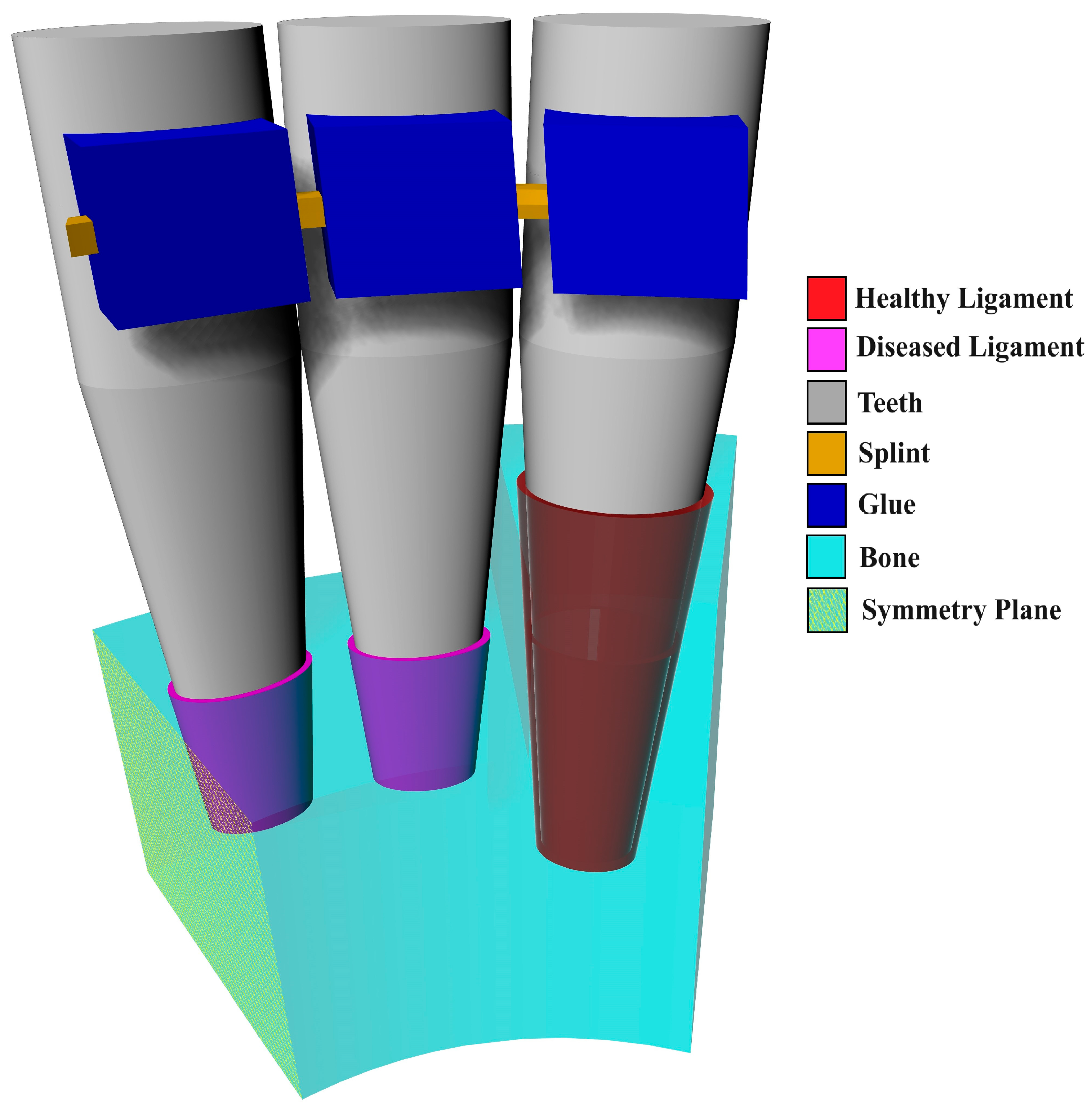
To optimize computational efficiency, we harnessed the geometric symmetry of the model relative to the medial plane section. Consequently, only half of the model has been considered, resulting in significant computational cost savings. The geometric representation of the model is shown in Figure 1, where the symmetry plane is depicted with a yellow mesh. The model has been meshed using quadratic 10-node tetrahedral elements (three degrees of freedom for each node). The robustness of the discretization has been evaluated by performing a sensitivity analysis in terms of strain energy convergence.
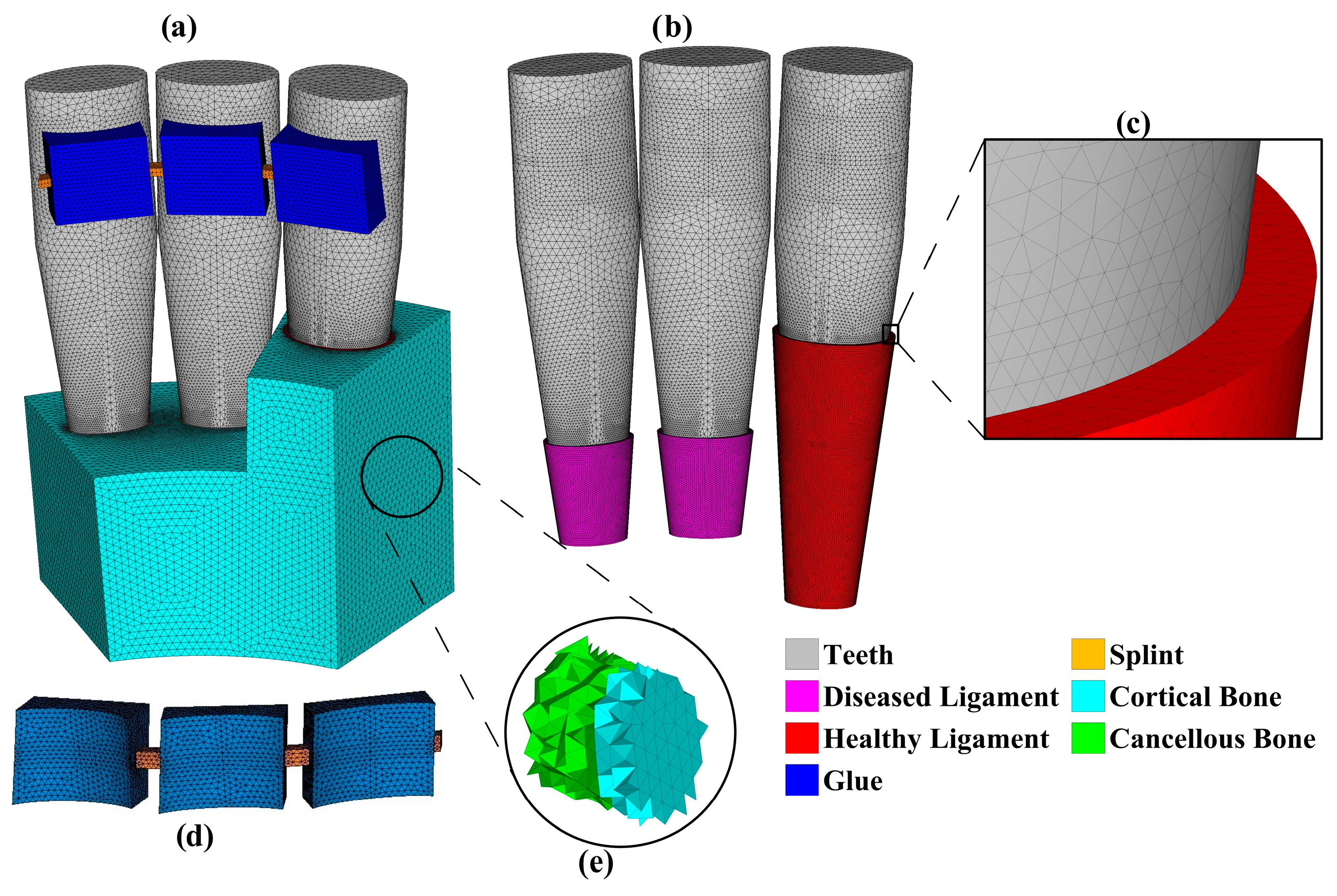
Figure 2 shows the mesh of the whole model in the splinted case (a), a detail of the cortical (light blue) and cancellous (green) bone in the zoomed circle (e), only the teeth and ligament (b), and the splint immersed in the glue (d). It has to be noted that the ligaments’ thickness has been discretized by at least three elements, as shown in the zoomed square (c).
Materials are linear, isotropic, and homogeneous. Young’s moduli are 20,300 MPa in the case of the teeth [33], 20,000 and 4000 MPa for cortical and cancellous bone [30], 50 MPa and 5 MPa for healthy and diseased ligaments [34], and 7300 MPa for the glue [35]. All of the adopted constitutive properties are listed in Table 2.
The loading condition comprises an incisal bite load, which includes a vertical force applied in the axial direction of the teeth with a magnitude of 190 N, applied on the upper surface of each tooth [36]. All translational degrees of freedom of nodes at the basis of the model have been constrained. Parametric analyses have been performed by systematically varying the splint’s height, H, and thickness, δ , within the 0.4 mm to 0.7 mm range, with increments of 0.1 mm.
To establish a straightforward estimation of the safety of the dental structure and confine its actual value within a mechanically reasonable range, the Mises stress was considered as a reference and expressed as a simple “traffic lights” color code to provide immediate, concise and intelligible information to surgeons, being the procedure once open to host other stress measurements. The yield limit of the glue, σ Y , is assumed as the upper bound of the stress, representing the value beyond which the splint–teeth structure can be considered at a higher mechanical failure risk. Namely, when σ V M > σ Y , the structure can be considered to be at a high risk of failure; when σ Y < σ V M < 0.8   σ Y , the dental structure has to be considered prone to failure; and, finally, when σ V M < 0.8   σ Y , the whole dental structure can be considered to be at a low risk of failure, i.e. safe. The threshold of 0.8 σ Y has been chosen according to the statistical distribution, with the operative value carried out by calculating the mean and standard deviation, tested for homogeneity of variance using Bartelett’s test, and then subjected to one-way analysis of variance at a significance level of 0.05 [37]. A table of results containing the maximum displacements and stresses for each tooth is proposed with the aim of furnishing a helpful tool to the surgeon for the pre-operative decision-making process related to the choice of the optimal cross-section dimensions of the splint. To this scope, the green cells indicate the splint cross-sections for which the dental structure can be considered safe, orange represents those prone to failure, and red indicates those at high risk of failure.

3. Results and Discussion

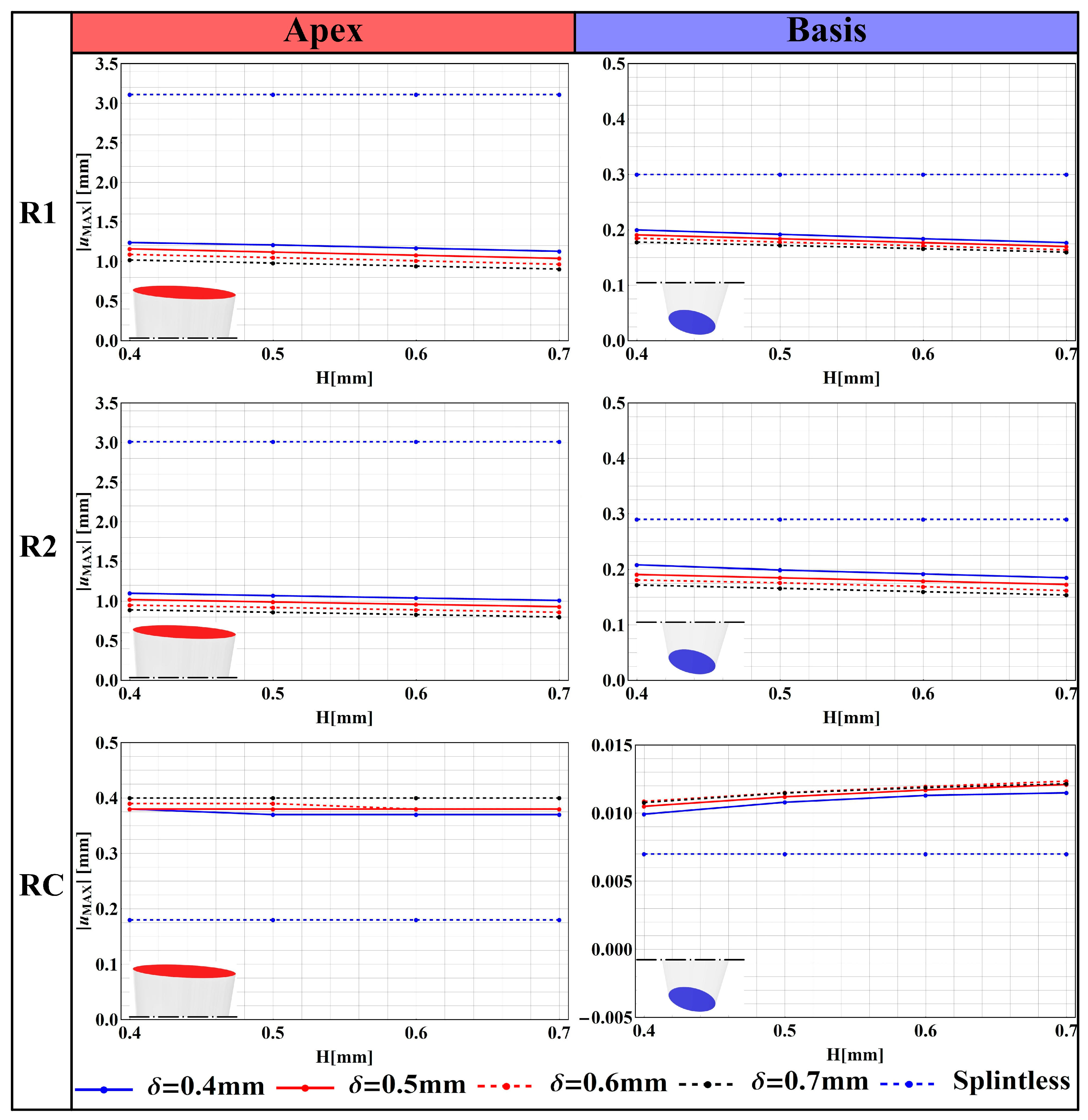
In this realm, the present in silico parametric analyses highlighted the beneficial effects of the splint treatments in reducing teeth mobility. The maximum displacements’ vector sum, here denoted with u M A X , at the apex and the bases of R1 (up), R2 (center), and RC (down) and obtained by varying the splint section dimensions, have been plotted on the left- and right-side column of Figure 3. On the graph’s x axis is reported the variation of the splint height, H, and each color refers to a different splint thickness, that is, δ = 0.4 mm (blue), δ = 0.5 mm (red), δ = 0.6 mm (dashed red), and δ = 0.7 mm (dashed black), as reported in the legend.
As said, diseased ligaments have been considered around incisors, while healthy ones surround the canine. It has to be noted that both the splinted incisors showed reduced displacements at the basis of the teeth. The percentage decrements in displacements between the smallest splint cross-section size (0.4 mm × 0.4 mm) and the splintless case are 46% for R1 and 36% for R2, whereas a 27% increment is observed for the canine (RC). Furthermore, comparing the case of the largest splint cross-section (0.7 mm × 0.7 mm) with the splintless case, decrements of 87% and 86% in displacements occurred for R1 and R2, respectively, and a 40% increment in displacement is observed for the canine RC, as represented in the right bottom plot in Figure 3. This finding is a consequence of the fixation of the diseased teeth to the healthy ones. The splinted canine, absorbing the more significant part of the applied load, becomes the principal actor of mechanical behavior. By paying a more significant displacement at the basis of the tooth, the canine determines the reduction of the maximum displacement of the diseased teeth. Finally, it is possible to note a remarkable 70% reduction in maximum displacements, on average, at the incisor apex (left-sided plots) when the splint is employed.
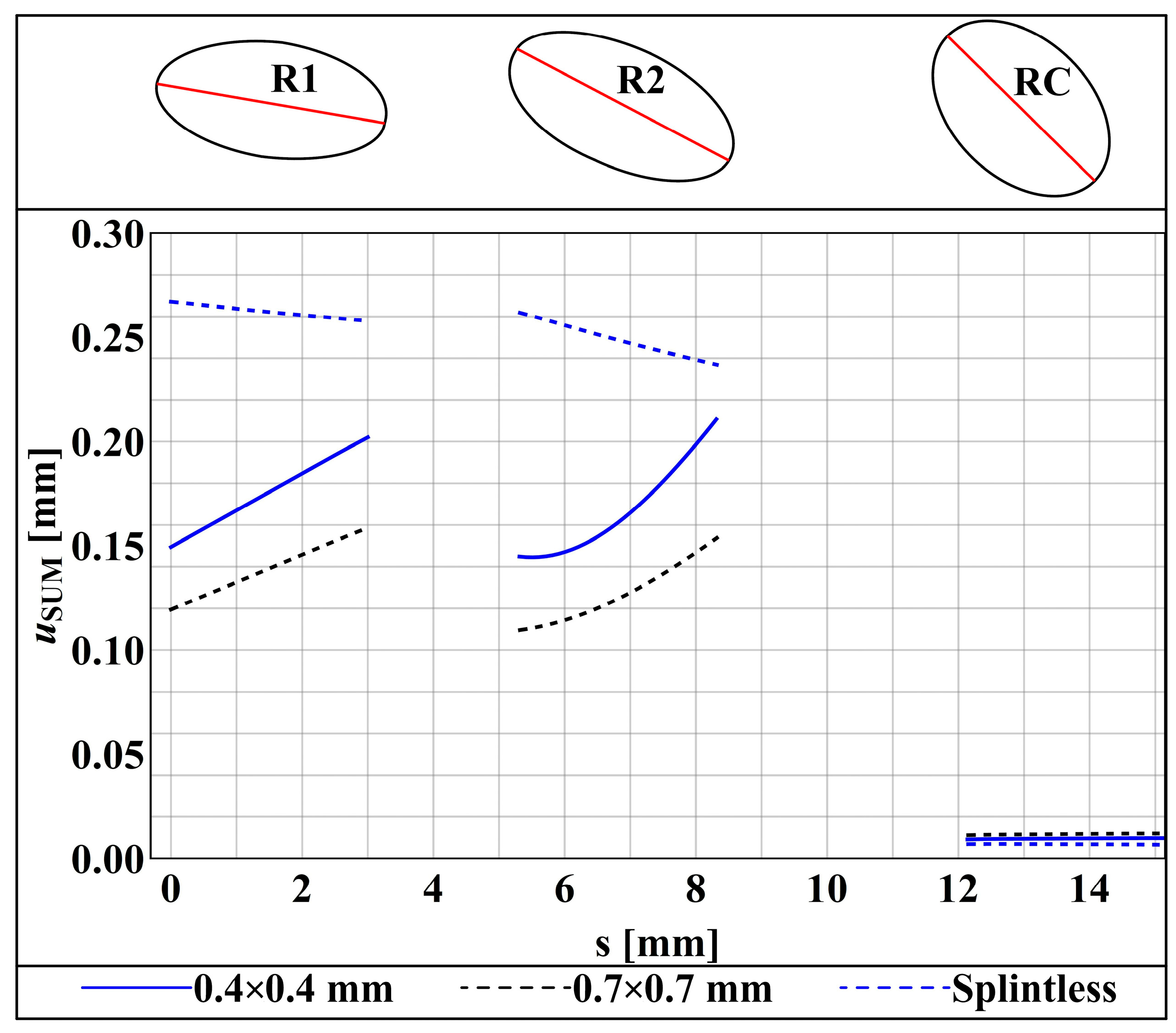
In Figure 4, to give confinement in terms of displacement vector sum at the basis of each tooth, the results related to the more flexible (0.4 × 0.4 mm) splint (blue) and the stiffer (0.7 × 0.7 mm) splint (dashed blue), compared with the splintless case (dashed black), are depicted.
In particular, the curves have been mapped onto paths along with the major diameter of each tooth (red lines), as shown in the upper part of Figure 4. Once again, the outcomes indicate the displacement reduction on the basis of the diseased teeth, proving the effectiveness of the splint treatment.
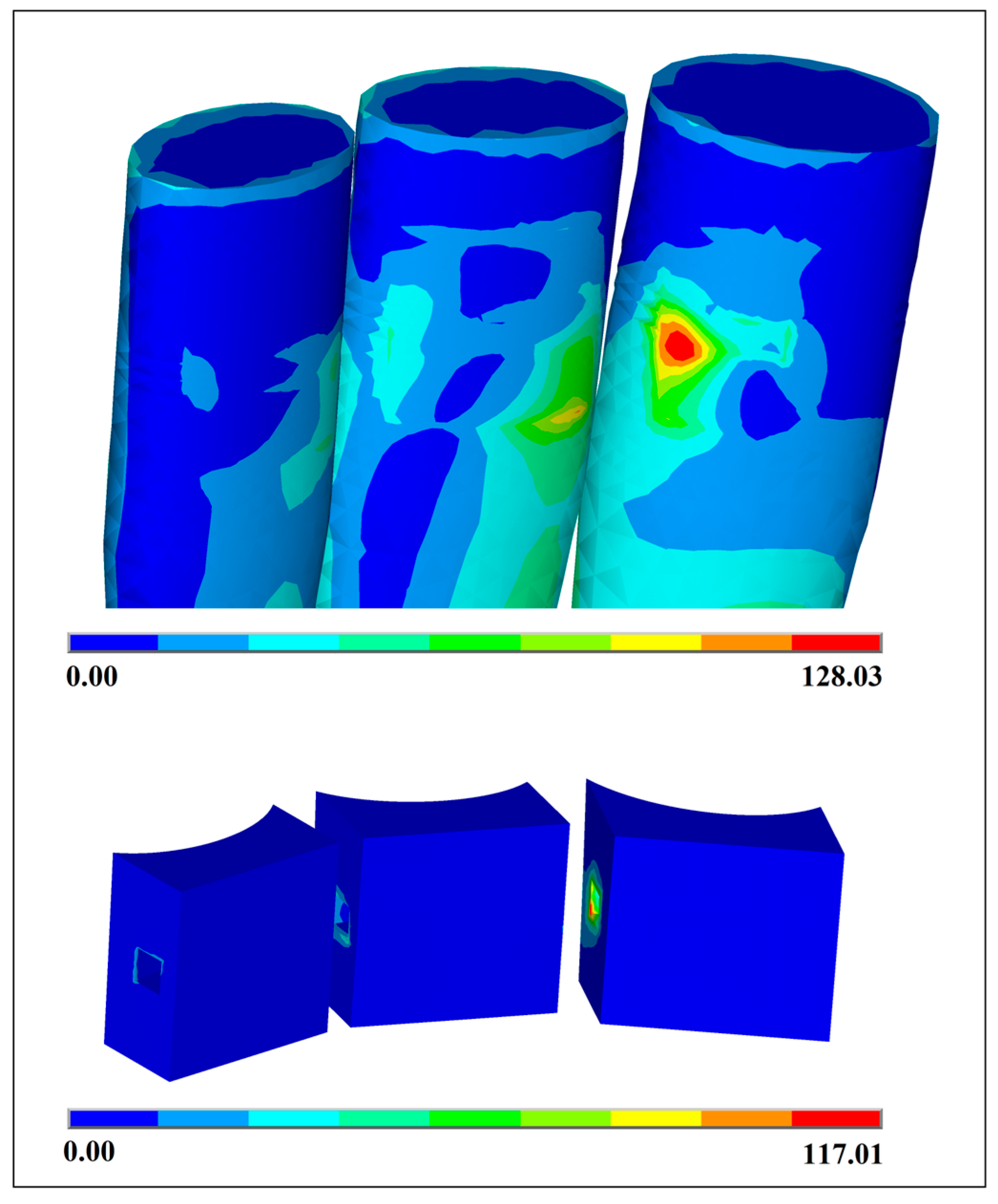
Figure 5 shows the Mises stress, σ V M , at the teeth–glue (up) and splint–glue (down) interfaces in the case of H = 0.7 mm and δ = 0.7 mm.
In this case, the maximum stress is localized on the canine, confirming the crucial role played by this tooth in fixing the entire dental structure. Furthermore, the maximum stress intensity is exerted on the canine–composite interface [38,39], remaining under the yield limit of the glue, σ Y , which is 158.4 MPa [37].
Table 3 summarizes all results obtained by parametrically varying the splint cross-section dimensions. The maximum displacements at the basis of R1, R2, and RC, and the maximum Mises stresses σ V M in the composite are listed, with the data obtained by varying the height, H, and thickness, δ , of the splint cross-section.
Notably, each increment of 0.1 mm of the rectangular cross-section, in terms of height or depth, produces a displacement decrement of 2.5% on average. It has to be noted that splints may be affected by artificial aging of the material, as exposure to thermal, mechanical, and humid conditions could potentially influence their long-term clinical outcomes.
In general, thicker splints can affect the patient’s comfort and may cause the insurgence of bacterial plaque. Contrarily, reducing the splint cross-section facilitates easier positioning, yielding enhanced flexibility and adaptability to the patient’s dental morphology, enabling simplified cleaning procedures. The maximum stress in the glue is always localized in the canine splint–glue interface, and decreases when the splint cross-section dimensions are increased. As a consequence, the effectiveness and safety of the splint treatment is strictly related to the glue structure’s integrity. The traffic light color code shown in Table 3, concerning the present patient-specific simulations, suggests treating the dental mobility with at least 0.6 × 0.7 mm or 0.7 × 0.6 mm cross-section dimensions of the splint, representing the smallest section that provides the best stress redistribution within the adopted assumptions.

4. Conclusions

The insights gained from numerical analyses suggest that the proposed procedure could serve as an effective tool to ensure the stability and safety of the splint treatment and providing a tool to prevent interface stress levels from exceeding the composite’s threshold limit. The proposed framework is mainly intended to highlight comparative mechanical trends among different splint geometries and configurations, rather than to provide absolute quantitative predictions of clinical failure or safety. The model is fully parametric, allowing all geometric dimensions and constitutive properties to be easily tailored to suit patient-specific RX scans. Moreover, the use of standard primitive geometries enables rapid modeling, without complex geometry or voxel-based procedures, from CT data. The present work, although not addressing the dynamic aspects of teeth and surrounding periodontal tissues, demonstrates the efficacy of the splint treatment in reducing mobility, which is crucial for the optimal healing process. Specifically, a 2.5% reduction in displacements for each tenth of a millimeter increment in the splint’s rectangular cross-section has been observed. It is worth noting that the maximum stress migrates to the canine, underscoring the pivotal role of this tooth in stabilizing the entire dental structure. The stress at the glue–teeth interface remains limited within the admissible domain, avoiding teeth–glue debonding, while the splint–glue interface, being subjected to the maximum stress, could experience sudden failure. The loading conditions considered in this study are limited to a static axial incisal bite force, while the periodontal ligament and the cortical and cancellous bones, are modeled as isotropic and homogeneous materials. Moreover, neither post elastic behavior nor a specific interfacial debonding physical criterion have been considered. Furthermore, the present study is based on a numerical and parametric modeling framework and does not include direct validation against experimental or clinical data. Although these assumptions represent limitations of the current model, they clearly define its domain of applicability and open directions for future research. Finally, the procedure provides computational efficiency in predicting the mechanical behavior of the splint–teeth structure and allows for preliminary evaluations and systematic parametric analyses, paving the way for the development of a user-friendly pre-operative tool for surgeons and thereby enhancing the feasibility and success of dental splint treatment in clinical practice.

Author Contributions

Conceptualization, S.P., R.Z., M.F., F.F. and L.E.; methodology, S.P., R.Z., M.F., F.F. and L.E.; software, S.P., R.Z. and L.E.; validation, S.P., R.Z., M.F., F.F. and L.E.; formal analysis, S.P., R.Z., M.F., F.F. and L.E.; investigation, S.P., R.Z., M.F., F.F. and L.E.; resources, S.P., R.Z., M.F., F.F. and L.E.; data curation, S.P., R.Z., M.F., F.F. and L.E.; writing—original draft preparation, S.P. and L.E.; writing—review and editing, S.P., R.Z., M.F., F.F. and L.E.; visualization, S.P., R.Z., M.F., F.F. and L.E.; supervision, F.F. and L.E. All authors have read and agreed to the published version of the manuscript.

Funding

This research received no external funding.

Institutional Review Board Statement

Not applicable.

Informed Consent Statement

Not applicable.

Data Availability Statement

The original contributions presented in the study are included in the article, further inquiries can be directed to the corresponding author.

Acknowledgments

The authors would like to thank the editor and the reviewers for their valuable suggestions and observations which have allowed us to improve this work.

Conflicts of Interest

The authors declare that they have no known competing financial interests or personal relationships that could have appeared to influence the work reported in this paper.

References

  1. Ericsson, I.; Giargia, M.; Lindhe, J.; Neiderud, A.M. Progression of periodontal tissue destruction at splint-ed/non-splinted teeth: An experimental study in the dog. J. Clin. Periodontol. 1993, 20, 693–698. [Google Scholar] [CrossRef]
  2. Passarelli, P.; Lopez, M.; Netti, A.; Rella, E.; Leonardis, M.; Ferro, L.S.; Lopez, A.; Garcia-Godoy, F.; D’Addona, A. Effects of Flap Design on the Periodontal Health of Second Lower Molars after Impacted Third Molar Extraction. Healthcare 2022, 10, 2410. [Google Scholar] [CrossRef]
  3. Sanz, M.; van Winkeloff, A. Periodontal infections:understanding the complexity. Consens. Seventh Eur. Workshop Periodontol. 2011, 38, 3–6. [Google Scholar] [CrossRef]
  4. Rosa, R.A.C.; Rodrigues, J.V.S.; Cláudio, M.M.; Franciscon, J.P.S.; Mulinari-Santos, G.; Cirelli, T.; de Molon, R.S.; Gouveia Garcia, V.; Theodoro, L.H. The relationship between hypertension and periodontitis: A cross-sectional study. J. Clin. Med. 2023, 12, 5140. [Google Scholar] [CrossRef]
  5. Darveau, R.P.; Tanner, A.; Page, R.C. The microbial challenge in periodontitis. Periodontology 2000, 14, 12–32. [Google Scholar] [CrossRef] [PubMed]
  6. Glickman, I. Periodontal Disease. N. Engl. J. Med. 1971, 284, 1071–1077. [Google Scholar] [CrossRef]
  7. Tonetti, M.S.; Greenwell, H.; Kornman, K.S. Staging and grading of periodontitis: Framework and proposal of a new classification and case definition. J. Periodontol. 2018, 89, S159–S172. [Google Scholar] [CrossRef] [PubMed]
  8. Fleszar, T.J.; Knowles, J.W.; Morrison, E.C.; Burgett, F.; Nissle, R.; Ramfjord, S.P. Tooth mobility and periodontal therapy. J. Clin. Periodontol. 1980, 7, 495–505. [Google Scholar] [CrossRef]
  9. Forabosco, A.; Grandi, T.; Cotti, B. The importance of splinting of teeth in the therapy of periodontitis. Minerva Stomatol. 2006, 55, 87–97. [Google Scholar]
  10. Lemmerman, K. Rationale for Stabilization. J. Periodontol. 1976, 47, 405–411. [Google Scholar] [CrossRef] [PubMed]
  11. Lindhe, J.; Lang, N.P. Clinical Periodontology and Implantology, 6th ed.; John Wiley & Sons: Hoboken, NJ, USA, 2015. [Google Scholar]
  12. Lee, H.; So, J.S.; Hochstedler, J.L.; Ercoli, C. The accuracy of implant impressions: A systematic review. J. Prosthet. Dent. 2008, 100, 285–291. [Google Scholar] [CrossRef]
  13. Bernal, G.; Carvajal, J.C.; Muños, C.A. A review of the clinical management of mobile teeth. J. Contemp. Dent. Pract. 2002, 3, 10–22. [Google Scholar] [CrossRef]
  14. van Steenberghe, D.; Rosenberg, D.; Naert, I.E.; Van den Bossche, L.; Nys, M. Assessment of Periodontal Tissues Damping Characteristics: Current Concepts and Clinical Trials. J. Periodontol. 1995, 66, 165–170. [Google Scholar] [CrossRef]
  15. Kathariya, R.; Devanoorkar, A.; Golani, R.; Shetty, N.; Vallakatla, V.; Bhat, M.Y.S. To Splint or Not to Splint: The Current Status of Periodontal Splinting. J. Int. Acad. Periodontol. 2016, 18, 45–56. [Google Scholar] [PubMed]
  16. Serio, F.G.; Hawley, C.E. Periodontal trauma and mobility: Diagnosis and treatment planning. Dent. Clin. N. Am. 1999, 43, 37–44. [Google Scholar] [CrossRef] [PubMed]
  17. McGuire, M.K.; Nunn, M.E. Prognosis Versus Actual Outcome. III. The Effectiveness of Clinical Parameters in Accurately Predicting Tooth Survival. J. Periodontol. 1996, 67, 666–674. [Google Scholar] [CrossRef]
  18. Kahler, B.; Hu, J.Y.; Marriot-Smith, C.S.; Heithersay, G.S. Splinting of teeth following trauma: A review and a new splinting recommendation. Aust. Dent. J. 2016, 61, 59–73. [Google Scholar] [CrossRef]
  19. Kwan, S.C.; Johnson, J.D.; Cohenca, N. The effect of splint material and thickness on tooth mobility after extraction and replantation using a human cadaveric model. Dent. Traumatol. 2012, 28, 277–281. [Google Scholar] [CrossRef]
  20. Hardita, A.; Adena, A.S.; Naini, A.; Kristiana, D. Prosthodontic management for loss of periodontal support in the anterior region with a lower immediate denture. World J. Adv. Res. Rev. 2023, 18, 1170–1173. [Google Scholar] [CrossRef]
  21. Zreaqat, M.; Hassan, R.; Hanoun, A.F. A CAD/CAM Zirconium bar as a bonded mandibular fixed retainer: A novel approach with two-year follow-up. Case Rep. Dent. 2017, 1, 1583403. [Google Scholar] [CrossRef] [PubMed]
  22. Hinckfuss, S.E.; Messer, L.B. Splinting duration and periodontal outcomes for replanted avulsed teeth: A systematic review. Dent. Traumatol. 2009, 25, 150–157. [Google Scholar] [CrossRef]
  23. Evans, D. Splinting duration for replanted avulsed teeth. Evid. Based Dent. 2009, 10, 104. [Google Scholar] [CrossRef] [PubMed]
  24. Huang, H.L.; Hsu, J.T.; Fuh, L.J.; Lin, D.J.; Chen, M.Y. Biomechanical simulation of various surface roughnesses and geometric designs on an immediately loaded dental implant. Comput. Biol. Med. 2010, 40, 525–532. [Google Scholar] [CrossRef] [PubMed]
  25. Jacob, J.; Nandlal, B. Bond strength of wire-composite resin interface of dental splints using different wire surface treatments—An in vitro study. Endodontology 2003, 15, 2–6. [Google Scholar] [CrossRef]
  26. Yadalam, P.; Shivasankari, S.; Marrapodi, M.; Ronsivalle, V.; Cicciù, M.; Minervini, G. Prediction of interactome hub genes in oral cancer and chronic inflammatory periodontitis. Dent. Med. Probl. 2025, 62, 1099–1108. [Google Scholar] [CrossRef]
  27. Rajasekaran, J.; Krishnamurthy, H.; Bosco, J.; Jayaraman, V.; Krishna, K.; Wang, T.; Bei, K. Oral Microbiome: A Review of Its Impact on Oral and Systemic Health. Microorganisms 2024, 12, 1797. [Google Scholar] [CrossRef]
  28. Paradowska-Stolarz, A.; Wieckiewicz, M.; Kozakiewicz, M.; Jurczyszyn, K. Mechanical properties, fractal dimension, and Texture Analysis of Selected 3D-Printed Resins Used in Dentistry That Underwent the Compression Test. Polymers 2023, 15, 1772. [Google Scholar] [CrossRef]
  29. Skośkiewicz-Malinowska, K.; Mysior, M.; Rusak, A.; Kuropka, P.; Kozakiewicz, M.; Jurczyszyn, K. Application of Texture and Fractal Dimension Analysis to Evaluate Subgingival Cement Surfaces in Terms of Biocompatibility. Materials 2021, 14, 5857. [Google Scholar] [CrossRef]
  30. Esposito, L.; Bifulco, P.; Gargiulo, P.; Gíslason, M.K.; Cesarelli, M.; Iuppariello, L.; Jónsson, H.; Cutolo, A.; Fraldi, M. Towards a patient-specific estimation of intra-operative femoral fracture risk. Comput. Methods Biomech. Biomed. Eng. 2018, 21, 663–672. [Google Scholar] [CrossRef]
  31. Esposito, L.; Minutolo, V.; Gargiulo, P.; Jonsson, H.; Gislason, M.K.; Fraldi, M. Towards an app to estimate patient-specific perioperative femur fracture risk. Appl. Sci. 2020, 10, 6409. [Google Scholar] [CrossRef]
  32. Esposito, L.; Bifulco, P.; Gargiulo, P.; Fraldi, M. Singularity-free finite element model of bone through automated voxel-based reconstruction. Comput. Methods Biomech. Biomed. Eng. 2016, 19, 257–262. [Google Scholar] [CrossRef] [PubMed]
  33. Gerami, A.; Dadgar, S.; Rakhshan, V.; Jannati, P.; Sobouti, F. Displacement and force distribution of splinted and tilted mandibular anterior teeth under occlusal loads: An in silico 3D finite element analysis. Prog. Orthod. 2016, 17, 16. [Google Scholar] [CrossRef][Green Version]
  34. Fill, T.; RW, T.; Major, P.; Carey, J. Analytically determined mechanical properties of, and models for the periodontal ligament. Critical review of literatur. J. Biomech. 2012, 45, 9–16. [Google Scholar] [CrossRef] [PubMed]
  35. Tanimoto, Y.; Nishiwaki, T.; Nemoto, K. Dynamic viscoelastic behavior of dental composites measured by Split Hopkinson pressure bar. Dent. Mater. J. 2006, 25, 234–240. [Google Scholar] [CrossRef][Green Version]
  36. Osborn, J.W.; Mao, J. A thin bite-force transducer with three-dimensional capabilities reveals a consistent change in bite-force direction during human jaw-muscle endurance tests. Arch. Oral Biol. 1993, 38, 139–144. [Google Scholar] [CrossRef] [PubMed]
  37. Sumino, N.; Tsubota, K.; Takamizawa, T.; Shiratsuchi, K.; Miyazaki, M.; Latta, M.A. Comparison of the wear and flexural characteristics of flowable resin composites for posterior lesions. Acta Odontol. Scand. 2013, 71, 820–827. [Google Scholar] [CrossRef]
  38. Palladino, S.; Fraldi, M.; Minutolo, V.; Esposito, L. Steering Cracks via Auxetic Zebra-Composites. Eng. Fract. Mech. 2025, 327, 111486. [Google Scholar] [CrossRef]
  39. Palladino, S.; Esposito, L.; Ferla, P.; Zona, R.; Minutolo, V. Functionally Graded Plate Fracture Analysis Using the Field Boundary Element Method. Appl. Sci. 2021, 11, 8465. [Google Scholar] [CrossRef]
Figure 1. Geometry of the model.
Applsci 16 01328 g001
Figure 2. Mesh of the model: The whole model with the splint (a), teeth and ligaments (b), detail of teeth and ligament (c), glue and splint (d), and detail of cortical and spongy bones (e).
Applsci 16 01328 g002
Figure 3. Maximum of the displacements’ vector sum, u M A X , at both the apex and the bases of teeth R1 (up), R2 (center), and RC (down).
Applsci 16 01328 g003
Figure 4. Displacement vector sum paths related to the more flexible (0.4 × 0.4 mm) splint (blue), the stiffer (0.7 × 0.7 mm) splint (dashed blue), and without splint (blue-dotted lines), and mapped onto paths represented by the red lines.
Applsci 16 01328 g004
Figure 5. Maps of the Mises stress at the interface between teeth and glue (up) and splint and glue (down) in the case of H = 0.7 mm and δ = 0.7 mm.
Applsci 16 01328 g005
Table 1. Pentamorphic arch (left). Geometrical dimensions of the model (expressed in millimeters) for teeth (gray), bone (light blue), ligaments (orange), splint (yellow), and glue (blue).
Pentamorphic ArchTeethBone
Radius           23R1Ellipse Semi-Major Axis3Height14
Ellipse Semi-Minor Axis1.5
Height22Thickness4
In-bone Height4.6
Applsci 16 01328 i001R2Ellipse Semi-Major Axis3Ligaments
Ellipse Semi-Minor Axis1.5Thickness0.25
Height22
In-bone Height4.6
RCEllipse Semi-Major Axis3Splint
Ellipse Semi-Minor Axis1.5Height0.4–0.7
Height22Thickness0.4–0.7
In-bone Height4.6
Inclination Angle on the Frontal Plane          10Glue
Thickness1.2
Height4
Teeth Perceptual Coverage80%
Table 2. Material properties adopted in the model.
Young Modulus [Mpa]Poisson’s Coefficients
Cortical Bone18,0000.26
Cancelleous Bone50000.26
Teeth (Dentin)18,6000.30
Healthy Ligament500.45
Diseased Ligament50.45
Splint220,0000.30
Glue73000.30
Table 3. Maximum norm of the displacements’ vectors, u m a x , at the bases of R1, R2, and RC, and Mises stresses, σ V M , in the composite, obtained by varying the height, H , and thickness, δ , of the splint cross-section. The red cells refer to the cases where the splint–glue–tooth structure is unsafe.
δ [mm]
0.40.50.60.7
R1R2RCR1R2RCR1R2RCR1R2RC
H [mm]0.4|umax| [mm]0.20500.21060.00990.19690.19890.01020.19100.18870.01050.18520.17890.0107
σVM [MPa]115.80147.45230.39109.05129.70198.7992.37111.26170.4987.68113.03157.63
0.5|umax| [mm]0.19330.20100.01050.18590.18790.01090.17940.17750.01120.17570.16950.0112
σVM [MPa]96.89121.55188.0289.54110.89164.8574.1095.66149.4875.8193.30142.04
0.6|umax| [mm]0.18410.19220.01110.17700.17940.01140.17110.16900.01160.16620.16000.0117
σVM [MPa]90.71106.73174.3173.1499.60150.1068.1582.83138.3163.9473.57126.45
0.7|umax| [mm]0.17630.18450.01140.17010.17290.01180.16440.16250.01200.16020.15370.0121
σVM [MPa]79.8994.91152.1465.7286.48139.1260.6171.37127.5856.9064.05117.01
Disclaimer/Publisher’s Note: The statements, opinions and data contained in all publications are solely those of the individual author(s) and contributor(s) and not of MDPI and/or the editor(s). MDPI and/or the editor(s) disclaim responsibility for any injury to people or property resulting from any ideas, methods, instructions or products referred to in the content.