Article

A Machine Learning Pipeline for Cusp Height Prediction in Worn Lower Molars: Methodological Proof-of-Concept and Validation Across Homo

by
Rebecca Napolitano
1,
Hajar Alichane
2,3,
Petra Martini
4,*,
Giovanni Di Domenico
5,
Robert M. G. Martin
6,
Jean-Jacques Hublin
3,7 and
Gregorio Oxilia
8,*
1
Department of Translational Medicine, University of Ferrara, 44121 Ferrara, Italy
2
École Pratique des Hautes Études, Université Paris Sciences & Lettres (PSL), 75014 Paris, France
3
Centre de Recherche Interdisciplinaire en Biologie (CIRB), Centre National de la Recherche Scientifique (CNRS), Collège de France, Université Paris Sciences & Lettres (PSL), 75005 Paris, France
4
Department of Environmental and Prevention Sciences, University of Ferrara, 44121 Ferrara, Italy
5
Department of Physics and Earth Sciences, University of Ferrara, 44121 Ferrara, Italy
6
Department of Anthropology, University of Toronto, 19 Ursula Franklin Street, Toronto, ON M5S 2S2, Canada
7
Max Planck Institute for Evolutionary Anthropology, Deutscher Platz 6, D-04103 Leipzig, Germany
8
Department of Medicine and Surgery, “LUM” Giuseppe Degennaro. S.S. 100 Km. 18, 70010 Casamassima, Italy
*
Authors to whom correspondence should be addressed.
Appl. Sci. 2026, 16(3), 1280; https://doi.org/10.3390/app16031280
Submission received: 3 November 2025 / Revised: 9 January 2026 / Accepted: 16 January 2026 / Published: 27 January 2026
(This article belongs to the Section Applied Dentistry and Oral Sciences)

Featured Application

The presented proof-of-concept machine learning pipeline enables the reconstruction of original cusp morphology at the enamel–dentine junction (EDJ) in worn lower molars using standard morphometric data. The pre-trained models and automated prediction tools can be applied to new fossils, archaeological, or clinical datasets that provide compatible EDJ measurements, without requiring programming expertise. In its current form, the pipeline offers a ready-to-use framework for EDJ-based reconstruction in research settings and establishes the foundation for future automated systems capable of predicting enamel thickness and full crown morphology in worn or damaged teeth.

Abstract

Reconstructing original cusp dimensions in worn molars represents a fundamental challenge across dentistry, anthropology, and paleontology, as dental wear obscures critical morphological information. In this proof-of-concept study, we present a standardized machine learning pipeline for predicting original cusp height, specifically the horn tips of the enamel–dentine junction (EDJ), in worn lower molars using three-dimensional morphometric data from micro-computed tomography (micro-CT). We analyzed 40 permanent lower first (M1) and second (M2) molars from four hominin groups, systematically evaluated across three wear stages: original, moderately worn (worn1), and severely worn (worn2). Morphometric variables including height, area, and volume were quantified for each cusp, with Random Forest and multiple linear regression models developed individually and combined through ensemble methods. To mimic realistic reconstruction scenarios while preserving a known ground truth, models were trained on unworn specimens (original EDJ morphology) and tested on other teeth after digitally simulated wear (worn1 and worn2). Predictive performance was evaluated using root mean square error (RMSE) and coefficient of determination (R2). Our results demonstrate that under moderate wear (worn1), the ensemble models achieved normalized RMSE values between 11% and 17%. Absolute errors typically below 0.25 mm for most cusps, with R2 values up to ~0.69. Performance deteriorated under severe wear (worn2), particularly for morphologically variable cusps such as the hypoconid and entoconid, but generally remained within sub-millimetric error ranges for several structures. Random Forests and linear models showed complementary strengths, and the ensemble generally offered the most stable performance across cusps and wear states. To enhance transparency and accessibility, we provide a comprehensive, user-friendly software pipeline including pre-trained models, automated prediction scripts, standardized data templates, and detailed documentation. This implementation allows researchers without advanced machine learning expertise to explore EDJ-based reconstruction from standard morphometric measurements in new datasets, while explicitly acknowledging the limitations imposed by our modest and taxonomically unbalanced sample. More broadly, the framework represents an initial step toward predicting complete crown morphology, including enamel thickness, in worn or damaged teeth. As such, it offers a validated methodological foundation for future developments in cusp and crown reconstruction in both clinical and evolutionary dental research.

1. Introduction

The reconstruction of the original dimensions of cusps in worn molars is a critical challenge in both dental medicine and paleoanthropological research. Dental wear, a phenomenon observed in both contemporary [1,2,3,4] and ancient populations [5,6,7,8,9,10,11,12,13], significantly alters crown morphology and complicates the assessment of a tooth’s original features. When wear extends to the dentine, there is a substantial loss of morphological information that is crucial for both evolutionary biology and restorative dentistry. The original combination of cusp morphology, crests, grooves, and accessory cusps provides key parameters for the taxonomic attribution of human and non-human species [14,15,16,17], as well as for reconstructing functionally reliable teeth and facilitating prosthetic and restorative rehabilitation [18,19]. However, the analysis of fossil teeth is often hampered by wear and fragmentation, which can significantly reduce the amount of usable morphological data, especially when more than approximately one-third of the dentine horn is missing, and limit the application of analytical methods that account for the three-dimensional complexity of the outer enamel surface (OES) [20].
In this context, numerous studies have highlighted dental morphology as a highly informative and reliable anatomical feature for reconstructing original crown shape and structure [21,22,23,24,25]. Among the anatomical structures of the tooth, the enamel–dentine junction (EDJ) has emerged as a particularly informative and reliable reference for reconstructing original crown morphology. The EDJ is established during the bell stage of tooth development through the folding of the inner enamel epithelium (IEE), effectively serving as the morphogenetic “blueprint” of the tooth. In contrast, the OES is subsequently shaped by enamel deposition, which can modify or even mask features initially defined at the EDJ [26,27,28]. The extent of these modifications depends largely on enamel thickness [11,29], highlighting the limitations of relying solely on OES-derived characters for phylogenetic discrimination. The OES is more susceptible to homoplasy and rapid evolutionary changes [29,30,31], whereas the EDJ is more evolutionarily conservative and thus provides a more stable and reliable basis for reconstructing original morphology and analyzing phylogenetic relationships [26]. For these reasons, accurate reconstruction of the EDJ is fundamental for recovering taxonomically informative features essential to the study of human and non-human phylogeny. The recent advent of micro-computed tomography (micro-CT) and the application of machine learning techniques, particularly deep learning, have further revolutionized digital dental reconstruction. These technologies now enable more accurate and comprehensive reconstruction of both partial and complete crowns, overcoming many of the limitations of previous methods [18,32,33]. While traditional geometric and interpolation-based techniques are often effective when a substantial portion of the crown is preserved, they become less reliable as occlusal wear removes the external enamel landmarks. By contrast, machine-learning approaches can leverage the stable morphogenetic “blueprint” provided by the EDJ to reconstruct original dimensions even when the outer enamel surface is largely lost.
In this study, we present a morphometric approach centered on the analysis of the enamel–dentine junction (EDJ), capitalizing on its proven ability to preserve original tooth morphology and phylogenetic information even in the presence of significant wear. To address the challenge of estimating original cusp height in worn lower molars, we integrate advanced machine learning techniques with three-dimensional morphometric data obtained via micro-computed tomography (micro-CT). Our pipeline employs predictive models, specifically Random Forest and multiple linear regression, trained exclusively on unworn teeth and validated on an independent set of specimens after digitally simulated wear. By combining these models in an ensemble framework, we ensure stable and robust predictions across varying degrees of dental wear, achieving high accuracy with mean errors typically below 0.25 mm for most cusps. To ensure the reliability of the results and avoid data leakage, the validation is performed using a strict tooth-level split, ensuring that the models are tested on individuals never seen during the training phase. This standardized and easily implementable methodology not only overcomes many limitations of traditional reconstruction techniques but also enhances the accuracy, efficiency, and reproducibility of dental reconstructions in both anthropological and clinical contexts.

2. Materials and Methods

This study is based on a dataset comprising 40 original permanent lower molars in unworn condition (stage 1 [34]; 19 first molars, M1, and 21 second molars, M2) from four hominin groups: Fossil Homo sapiens (Fossil_H_S, n = 6), Recent H. sapiens (Recent_H_S, n = 8), Neanderthals (NEA, n = 3), and contemporary individuals (Contemporary, n = 23). These teeth were selected according to the following criteria: (i) fully preserved M1 or M2 crowns with intact EDJ morphology and no defects affecting cusp shape; (ii) availability of high-resolution micro-CT scans suitable for precise EDJ segmentation; (iii) secure attribution to one of the four Homo groups listed above; and (iv) preservation of an unworn state (stage 1 [34]), allowing original cusp height to be treated as a ground-truth reference for the digitally simulated worn conditions. Within these constraints, the dataset was intentionally designed as a proof-of-concept sample representing Homo lower molars with preserved EDJ and high-quality imaging, rather than as a taxonomically balanced, demographically representative population sample. The teeth span a temporal range from the Middle Paleolithic to modern populations, providing broad taxonomic and chronological coverage for morphometric analyses (Table 1). For all 40 teeth, measurements of cusp area, volume, and height were taken in the original (unworn) condition. A subset of 30 teeth was then randomly selected for model training, and for these teeth only the unworn state was used in the predictive modelling. The remaining 10 teeth were reserved as an independent test set: for these specimens, the original crowns were artificially worn to generate two additional preservation states defined as worn1 (“cusp pattern partially or completely obliterated; small dentine patches”, stage 3 [34]) and worn2 (“three or more small dentine patches”, stage 4 [34]). These worn1 and worn2 configurations of the 10 test teeth were used exclusively to evaluate model performance. For each configuration, area, volume, and cusp height were measured for the five main cusps in M1s (protoconid, hypoconid, hypoconulid, entoconid, and metaconid) and for the four main cusps in M2s (protoconid, hypoconid, entoconid, and metaconid).
The fossil molars analyzed in this study, including Neanderthals, fossil Homo sapiens, and recent Homo sapiens, were scanned using micro-computed tomography (micro-CT) at two research institutions: the Max Planck Institute for Evolutionary Anthropology (Leipzig, Germany) and the University of Ferrara. At the Max Planck Institute, the scanning was performed with either a BIR ACTIS 225/300 industrial microscanner (BIR, Manchester, UK) (130 kV, 100 μA, 0.25 or 0.50 mm brass filter) or a SkyScan 1172 microscanner (Bruker microCT N.V., Kontich, Belgium) (100 kV, 94 μA, 0.5 + 0.04 mm aluminum and copper filter), resulting in voxel sizes of 30 μm. To enhance image clarity, a three-dimensional median filter (core size 1 or 3) was applied, followed by a medium variance filter of the same size. This filtering protocol was designed to standardize grey levels across tissue regions, improving the differentiation between enamel and dentine while preserving the structural integrity of the enamel–dentine junction (EDJ) [27,35]. Contemporaneous individuals were scanned using micro-CT at the University of Ferrara, with a voxel size of 30 μm. Scanning parameters included 70 kVp, 0.25 mm aluminum filtration, 360 projections over 360°, and 0.5 mAs per projection, with a total scan time of 30 min per sample. Alignment optimization, beam hardening, and ring artifact corrections were performed using a modified Feldkamp algorithm. The resulting micro-CT volumes were segmented using Avizo 9.2 software (Thermo Fisher Scientific, Waltham, MA, USA). Three-dimensional models of the dental tissues (enamel, dentine, and the preserved portion of the pulp chamber) were further refined in Meshlab (version 2025.07) to optimize triangle meshes and ensure fully closed surfaces. Enamel and dentine were segmented in Avizo 9.0.1 based on 3D voxel value histograms and grayscale thresholds, and the EDJ surface was generated with unconstrained smoothing.

2.1. Post-Processing and Variable Extraction Procedure

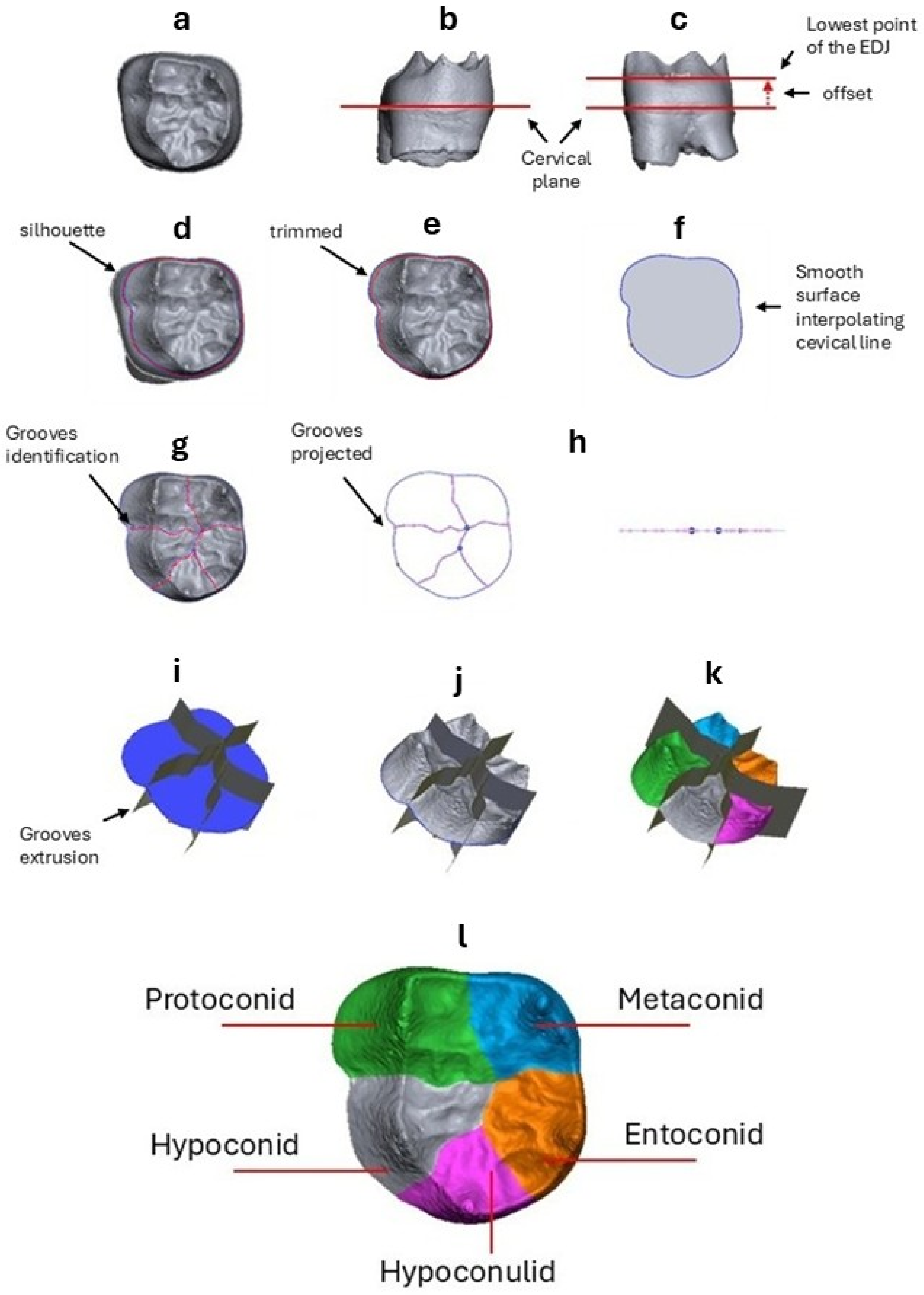
The “original” models were obtained as illustrated in Figure 1. Each 3D model was first imported into Meshlab (version 2025.07) software and oriented according to a cervical reference plane (Figure 1a). This plane was used to align the tooth along the x-axis, with the mesial side facing upwards (Figure 1b), ensuring consistent orientation across all specimens. The cervical plane was then translated (offset) to the lowest point of the enamel–dentine junction (EDJ) surface (Figure 1c). Once established, this plane served as the basis for extracting the silhouette resulting from the intersection between the plane and the mesh (Figure 1d). The mesh was subsequently trimmed to retain only the region of interest, from the basin to the horn tips (Figure 1e). The resulting silhouette was filled to create a closed mesh at the base of the digital model (Figure 1f), enabling the calculation of the coronal volume. On the EDJ surface, grooves were traced to delineate the boundaries of each cusp (Figure 1g), and these boundaries were then projected onto the silhouette to ensure precise alignment with the cutting plane (Figure 1h). To further analyze cusp morphology, the curves representing cusp boundaries were extruded using a mid-plane method, extending orthogonally to the cutting plane in both directions (Figure 1i). This approach allowed for the comprehensive capture of each cusp’s morphology (Figure 1j). As a result, a precise morphological subdivision of each cusp was achieved (Figure 1k,l), enabling the extraction of all relevant variables for subsequent analysis (see also Figure 2).

2.2. Simulation of Occlusal Wear Stages (Worn1 and Worn2)

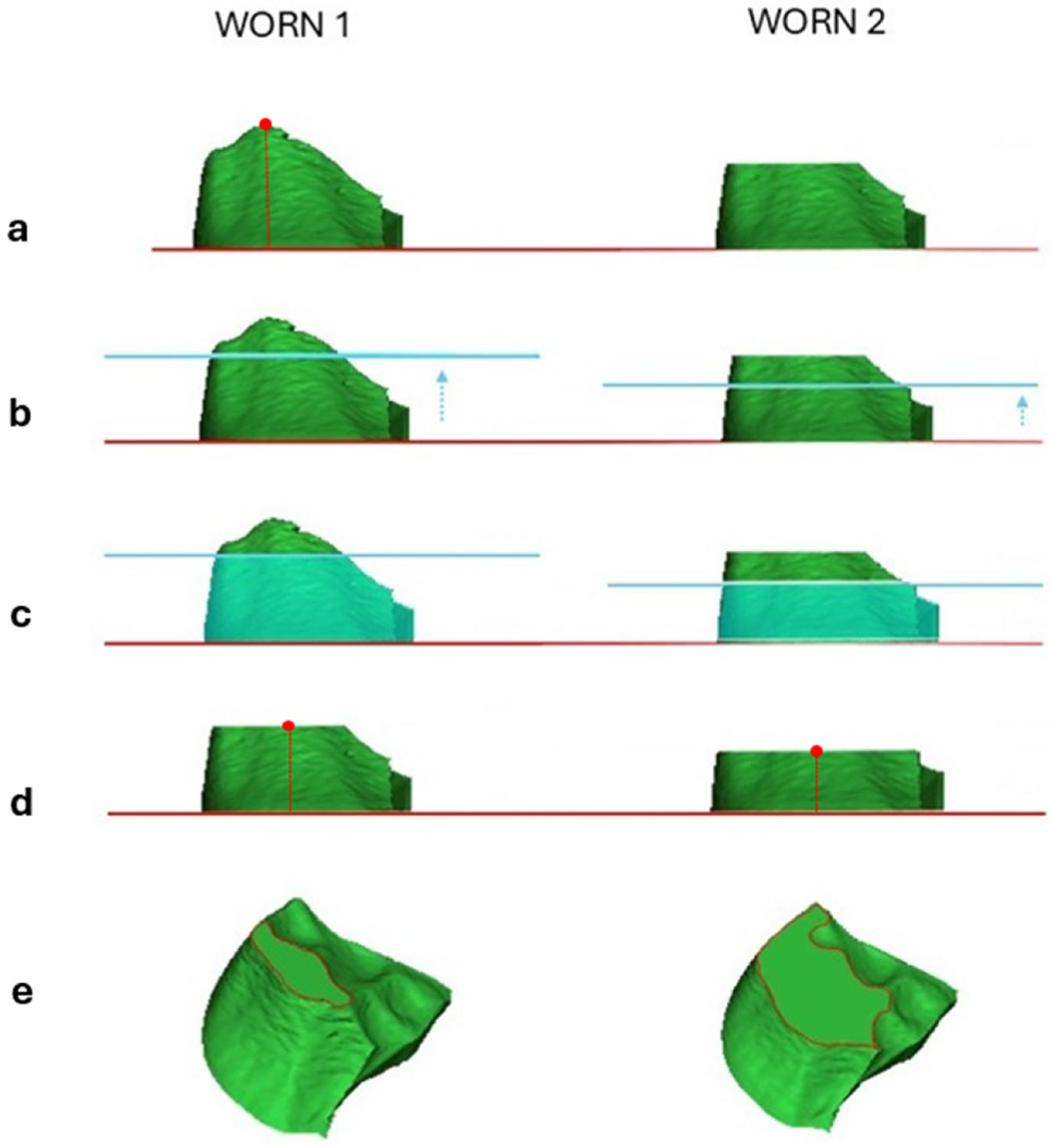
The second step involved generating the worn1 (stage 3) and worn2 (stage 4) conditions for each tooth by simulating two progressive stages of artificial wear (Figure 3). First, the cutting plane was created at the level of the occlusal basin on the enamel–dentine junction (EDJ), which standardizes the cutting process across different teeth and cusps. This approach helps to avoid anomalies frequently caused by cervical pathologies such as caries, which could otherwise alter the coronal integrity of the tooth. By aligning the plane to the occlusal basin, the risk of intersecting invasive pathologies is minimized, ensuring more consistent and reliable measurement. The plane was then offset vertically and parallel to the original occlusal basin plane. While this vertical offset does not perfectly replicate the natural, often inclined, dynamics of dental wear, this simplification is acceptable for the current methodological framework because the model aims to predict cusp height regardless of wear inclination. This inclination does not impact the reconstruction since, after predicting the cusp height value (where the operator inputs the volume and area of the cusp), the exact position and orientation of the unworn cusp tip are determined based on mesial and distal points of the worn dentine pit. This precise placement overcomes the limitation posed by inclined wear planes [36]. The sectioning is performed at different heights for each cusp to realistically replicate natural wear patterns and to rigorously test the algorithm’s predictive capabilities. This method thus yields not only the predicted unworn cusp height but also the accurate position of the unworn horn tip beyond the constraints imposed by tilted wear planes.

2.3. Predictive Modeling and Validation Strategies

Before the main analyses, we quantified inter-observer reliability on a subset of 10 lower molars (M1 and M2) independently measured by two trained operators. Inter-operator agreement was quantified using intraclass correlation coefficients (ICC, two-way random-effects model, absolute agreement) and Pearson’s correlation. Following this reliability assessment, the full dataset was processed. For each tooth, three morphometric features which present, area (Figure 2b), height, and volume (Figure 3a,d,e), were measured for each cusp under three wear conditions (unworn, worn1, and worn2). The analysis included the protoconid, metaconid, entoconid, hypoconid, and hypoconulid for M1 molars, and the protoconid, metaconid, entoconid, and hypoconid for M2 molars. Data were processed in R (version 4.5.0) using the packages randomForest, caret, dplyr, ggplot2, tidyr, reshape, lme4, rstatix, and car [37,38,39,40,41,42,43,44,45,46]. Each specimen was assigned a unique identifier to allow direct pairing of measurements across its unworn and worn states. To ensure model robustness, we initially considered all specimens with a complete set of measurements across all preservation conditions (n = 40). These were then partitioned at the tooth level into a training set (30 teeth) and an independent test set (10 teeth; see below). To evaluate the influence of species on the raw morphometric variables, we performed separate statistical tests on the unworn condition for each combination of variable and cusp. Normality was assessed with the Shapiro–Wilk test and homogeneity of variances with Levene’s test. Depending on these diagnostics, either parametric (ANOVA) or non-parametric (Kruskal–Wallis) tests were used to compare means among the four species groups at a significance level of α = 0.05. Although several cusp height and volume variables showed significant interspecific differences, species was deliberately excluded as a predictor in the subsequent modelling. Given the limited and taxonomically unbalanced sample (the small number of Neanderthal and Fossil Homo sapiens molars), taxon-specific models or fully stratified validation schemes would have been statistically unstable and at high risk of overfitting. We therefore adopted a pooled modelling strategy across Homo and assessed taxon-wise robustness post hoc by comparing prediction errors among species groups. This choice was motivated by two considerations: (i) interspecific morphological variation provides useful diversity in size and shape that can improve model generalizability; and (ii) including species as a covariate would further increase the risk of overfitting given the small and unbalanced sample. Thus, multi-species variability was treated as a source of desirable heterogeneity rather than as an explicit explanatory variable. Because of anatomical differences between tooth types, notably the presence of the hypoconulid only in M1, the dataset was subdivided into M1 and M2 molars, and separate models were built for each type. For each cup, two regression models were developed: a Random Forest (RF) model, to capture non-linear relationships, and a multiple linear regression (LM) model. Random Forest models were fitted using the default settings of the randomForest package (ntree = 100, mtry equal to the default number of predictors, and default nodesize), in order to ensure stable behavior and to minimize overfitting given the limited training sample. The response variable was the height of the cusp in the unworn condition, while the predictors were the area and volume of the same cusp measured on worn teeth. Before fitting the models, potential multicollinearity between area and volume was assessed using the Variance Inflation Factor (VIF). For all cusps, VIF values remained below the threshold of 5, indicating that both predictors could be jointly included. For a given observation ii, the linear model was expressed as:
hunworn,i = β0 + β1Aworn,i + β2Vworn,i + ϵi
where hunworn,i is the predicted original (unworn) cusp height for observation i; β0 is the intercept; β1 and β2 are the regression coefficients for cusp area (Aworn,i) and cusp volume (Vworn,i) measured in the worn condition, respectively; and εi represents the residual error.
To avoid data leakage, model development followed a hold-out strategy at the tooth level. The 40 teeth were randomly partitioned into a training set of 30 teeth and an independent test set of 10 teeth. This 30/10 (75/25) split was chosen as a pragmatic compromise for a small dataset, providing sufficient training data for stable model fitting while retaining a non-trivial independent test set to obtain conservative estimates of generalization performance on unseen teeth. The unique identifier ensured that each tooth, and all its associated wear states, appeared in only one of the two sets. The models were trained on the unworn (original) condition of the 30 training teeth to establish the baseline relationship between height, area, and volume. The final models were then applied to the 10 independent test teeth to predict their original cusp height from measurements taken in the worn1 and worn2 conditions. For each tooth-cusp combination, we obtained RF, LM, and ensemble predictions (the average of RF and LM). Model performance on the independent test set was quantified using RMSE, normalized RMSE (nRMSE, as a percentage of the mean original height), and R2. Finally, to investigate whether prediction accuracy varied among taxonomic groups, we computed the absolute prediction error |OriginalHeight − EnsemblePrediction| for the test set and compared these errors among the four species groups using a Kruskal–Wallis test and epsilon-squared (ϵ2) as a measure of effect size. For analyses involving prediction error across taxa, we additionally computed a tooth-level summary error by averaging the absolute ensemble error across all available cusps for each tooth (worn2 condition). This tooth-level mean absolute error was then used as the unit of analysis in non-parametric tests to account for the non-independence of cusps within teeth.

2.4. Model Robustness

To evaluate model robustness with respect to training sample size and to assess the stability of morphometric predictors, we additionally computed learning curves and performed a bootstrap analysis of feature importance for two representative cusps (Protoconid and Hypoconid). For each cusp, the sample was split at the tooth level into a training set (30 teeth) and an independent test set (10 teeth). Learning curves were obtained by repeatedly (30 repetitions per step) training the ensemble model on increasing numbers of training teeth and computing the RMSE on the fixed test set. Feature importance stability was assessed by resampling teeth with replacement (100 bootstrap iterations), refitting the Random Forest component of the ensemble, and recording the increase in node purity for worn height, cusp area, and cusp volume at each iteration.

3. Results

Intraclass correlation coefficients (ICC) were consistently very high (all ≥ 0.99, with the lowest ICC = 0.99 for Protoconid height and ICC ≥ 0.999 for all other variables), and Pearson’s r between operators exceeded 0.99 for every measure (Supplementary Table S1). Mean absolute differences between operators were negligible (<0.3% of the Operator 1 value for most variables, and at most ~1.3% for Protoconid height), indicating excellent reproducibility of cusp measurements and supporting the robustness of the subsequent analyses. Moreover, the highly standardized, stepwise workflow adopted for each tooth (from EDJ segmentation to cusp boundary delineation and measurement extraction), together with the operators’ detailed anatomical knowledge of lower molar morphology, makes the acquisition of cusp height, area, and volume values inherently unlikely to be affected by gross measurement errors. Preliminary analysis of the morphometric variables (height, area, and volume) of lower molar cusps in the original condition (M1 and M2 combined) revealed heterogeneous patterns of interspecific variability among the four species groups (Fossil Homo sapiens, Neanderthals, Recent Homo sapiens, and Contemporary humans). The areas of all cusps (protoconid, metaconid, entoconid, hypoconid, hypoconulid) did not exhibit significant differences between species (all p > 0.05; Supplementary Table S1). In contrast, several height and volume variables displayed statistically significant interspecific variation. The heights of the protoconid, metaconid, entoconid, and hypoconid differed significantly among species (Kruskal–Wallis or ANOVA, all p < 0.01), whereas the height of the hypoconulid did not (p = 0.41). For cusp volume, only the protoconid and metaconid showed significant interspecific differences (p = 0.015 and p = 0.0005, respectively), while the other cusps did not (all p > 0.05; Supplementary Table S1). Overall, these results indicate that cusp height, and to a lesser extent volume, are more sensitive than area to interspecific differences in this sample.
For those variables showing significant differences between species, post hoc pairwise comparisons were performed using Dunn’s test with Bonferroni correction to identify which species pairs differed significantly (Supplementary Table S2). The most consistent and pronounced differences were observed between the Contemporary group and both Fossil and Recent Homo sapiens, particularly for cusp height variables and for the volume of the metaconid. All four cusp heights (h_Protoconid, h_Metaconid, h_Entoconid, h_Hypoconid) and V_Metaconid differed significantly in the contrasts Contemporary vs. Fossil H. sapiens and Contemporary vs. Recent H. sapiens. V_Protoconid, differed significantly only between Contemporary and Fossil Homo sapiens. In contrast, no significant differences were observed between Fossil Homo sapiens and Neanderthals, nor between Neanderthals and any of the other groups, for any of the variables analyzed (Supplementary Table S2).

3.1. Predictive Performance for Cusps

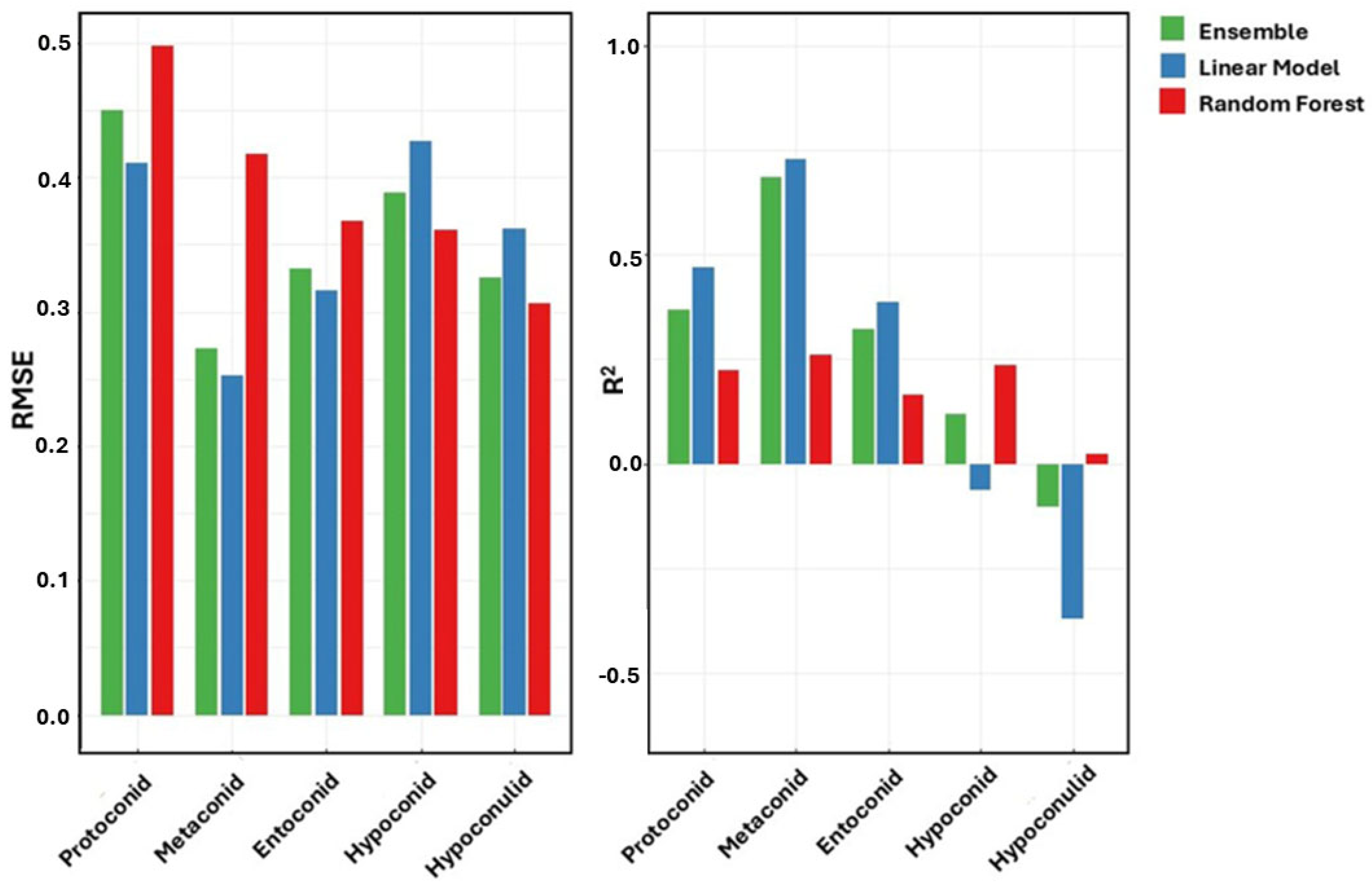
Model performance on the independent tooth-level test set (worn1 state) is summarized in Table 2 and Figure 4. Models were trained on the original (unworn) measurements of 30 teeth and tested on the worn1 measurements of 10 previously unseen teeth, predicting their original cusp heights. Preliminary checks on the training set confirmed that multicollinearity between area and volume was negligible, with Variance Inflation Factors (VIF) consistently below 1.5 for all cusps. For the Protoconid, the ensemble model achieved an RMSE of 0.450 mm, corresponding to a normalized RMSE (nRMSE) of 16.5% relative to the mean unworn height, and an R2 of 0.37. The Metaconid displayed the best overall performance, with the lowest prediction errors (Ensemble RMSE: 0.273 mm; nRMSE: 11.1%) and relatively high R2 values, especially for the LM (R2 = 0.73) and the ensemble (R2 = 0.69). For the Entoconid, prediction errors remained moderate (Ensemble RMSE = 0.332 mm; nRMSE = 16.9%) with R2 values around 0.32–0.39 across models. Predictive performance was lower for the Hypoconid and Hypoconulid, which are more variable and, in the case of the Hypoconulid, less frequently represented. For the Hypoconid, the ensemble yielded an RMSE of 0.389 mm (nRMSE = 16.9%) and a modest R2 of 0.12, while LM showed a negative R2 (−0.06), indicating unstable predictions on unseen teeth. For the Hypoconulid (n = 19 total), the ensemble achieved an RMSE of 0.325 mm (nRMSE = 14.5%) but an R2 close to zero (−0.10), reflecting the limited sample size and higher uncertainty for this cusp. Overall, the ensemble models provided balanced predictions, with normalized errors ranging between 11% and 17% of the mean cusp height across the dental group (Table 2).
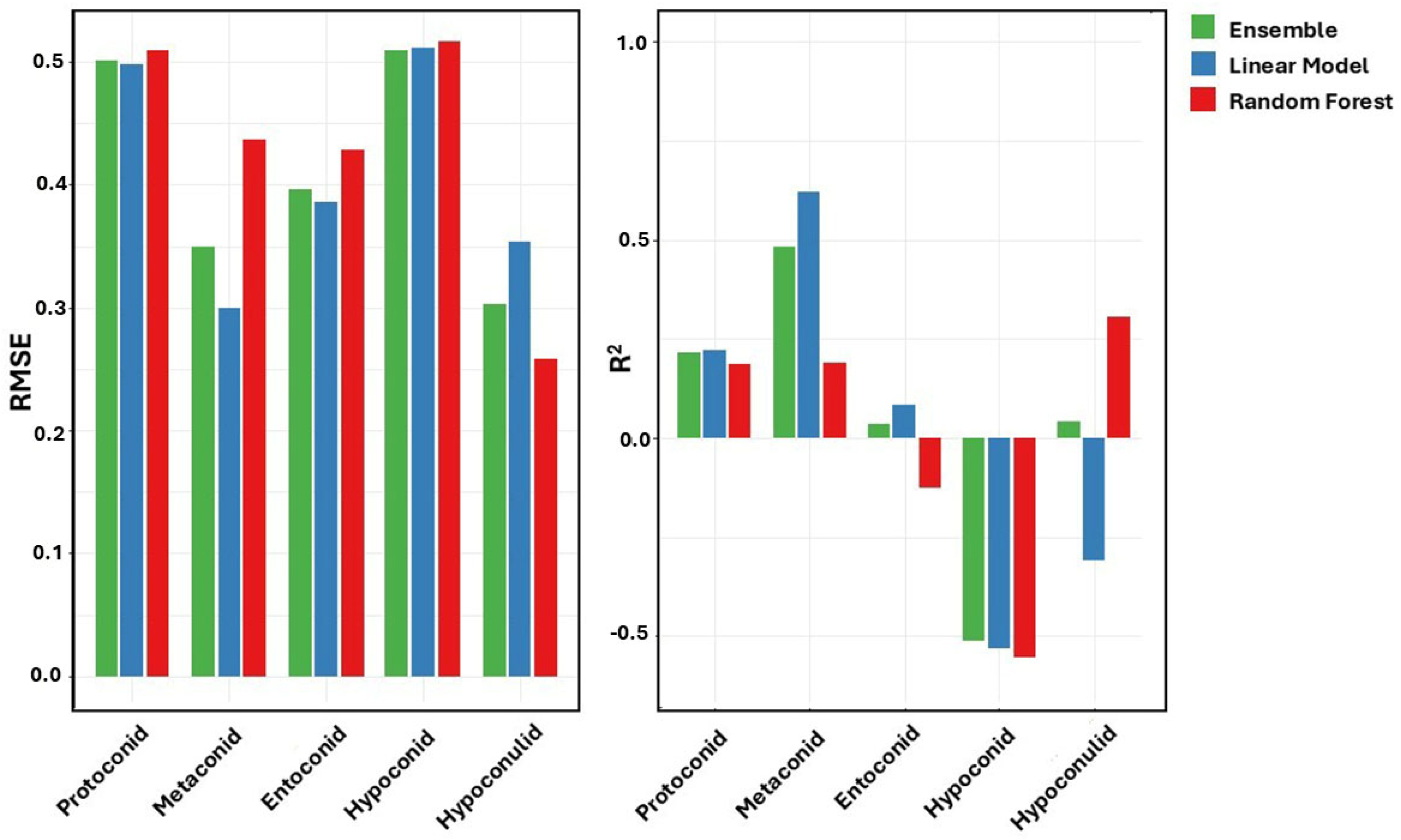
To assess the effect of more advanced wear, we repeated the evaluation using the same 10 test teeth but considering only their worn2 state, while keeping the training set unchanged (original measurements of the same 30 teeth; Table 3 and Figure 5). The same modelling strategy adopted for worn1 was applied: RF, LM, and ensemble models were trained on unworn cusp heights and corresponding unworn area and volume and then tested on worn2 measurements to predict the original heights. For each cusp, RMSE, R2, and nRMSE were computed in an analogous way to the worn1 analysis. When moving from worn1 to worn2, ensemble RMSE increased for four out of five cusps: from 0.450 to 0.501 mm for the Protoconid (+1.9 percentage points in nRMSE), from 0.273 to 0.349 mm for the Metaconid (+3.1 pp), from 0.332 to 0.396 mm for the Entoconid (+3.3 pp), and from 0.389 to 0.509 mm for the Hypoconid (+5.2 pp). In relative terms, ensemble nRMSE reached 22.2% for the Hypoconid, and R2 values dropped markedly, becoming almost null or even negative for the Entoconid and Hypoconid. Only the Hypoconulid showed a slight improvement in nRMSE (from 14.5% to 13.5%, −1.0 pp), although this result should be interpreted with caution due to the small number of available teeth for this cusp (n = 19). A direct comparison of ensemble performance across wear stages is provided in Table 4. Overall, these patterns indicate that the prediction of original cusp height remains reasonably accurate under moderate wear (worn1) but becomes progressively less reliable as wear advances to worn2, particularly for the Hypoconid and Entoconid.

3.2. Effect of Increasing Occlusal Wear on Predictive Performance (Worn1 vs. Worn2)

A direct comparison of ensemble performance between the worn1 and worn2 conditions is reported in Table 5. For the protoconid, ensemble RMSE increased from 0.450 mm (nRMSE = 16.5%, R2 = 0.37) in worn1 to 0.501 mm (nRMSE = 18.4%, R2 = 0.22) in worn2, corresponding to an absolute increase of 0.051 mm and +1.9 percentage points in nRMSE. For the metaconid, ensemble RMSE rose from 0.273 mm (nRMSE = 11.1%, R2 = 0.69) to 0.349 mm (nRMSE = 14.2%, R2 = 0.48), with ΔRMSE = +0.076 mm and ΔnRMSE = +3.1 percentage points. The entoconid showed a similar pattern, with ensemble RMSE increasing from 0.332 mm (nRMSE = 16.9%, R2 = 0.32) to 0.396 mm (nRMSE = 20.2%, R2 = 0.04), for a difference of +0.064 mm in RMSE and +3.3 percentage points in nRMSE. For the hypoconid, ensemble RMSE changed from 0.389 mm (nRMSE = 16.9%, R2 = 0.12) in worn1 to 0.509 mm (nRMSE = 22.2%, R2 = −0.51) in worn2, with an absolute increase of 0.120 mm and +5.3 percentage points in nRMSE. The hypoconulid represents the only case in which ensemble RMSE and nRMSE decreased between the two wear stages: from 0.325 mm (nRMSE = 14.5%, R2 = −0.10) in worn1 to 0.303 mm (nRMSE = 13.5%, R2 = 0.04) in worn2, corresponding to ΔRMSE = −0.022 mm and ΔnRMSE = −1.0 percentage point. Overall, these results indicate that increasing occlusal wear generally reduces the accuracy and explanatory power of cusp height reconstruction, with the strongest deterioration observed for the hypoconid and entoconid.
Table S3 summarizes the observed and predicted cusp heights for the 10 independent test teeth, providing a detailed overview of model performance across teeth and cusps. For each tooth–cusp combination and wear state (worn1 and worn2), the table reports the original (unworn) height together with the corresponding predictions from three models: Random Forest (RF_Prediction), multiple linear regression (LM_Prediction), and the ensemble model (Ensemble_Prediction, computed as the mean of the RF and LM estimates).
This structure enables a direct comparison between observed and predicted values for each cusp and wear stage and illustrates how the different modelling approaches behave at the individual-tooth level. Overall, the results show that, for most cusps and teeth, predictions are close to the original unworn heights, with mean deviations often below 0.25 mm, particularly under moderate wear (worn1). The ensemble model is especially robust: by averaging RF and LM estimates, it tends to smooth out over- and under-predictions of the individual models and provides stable, intermediate values that track the observed heights more consistently across teeth and wear stages.
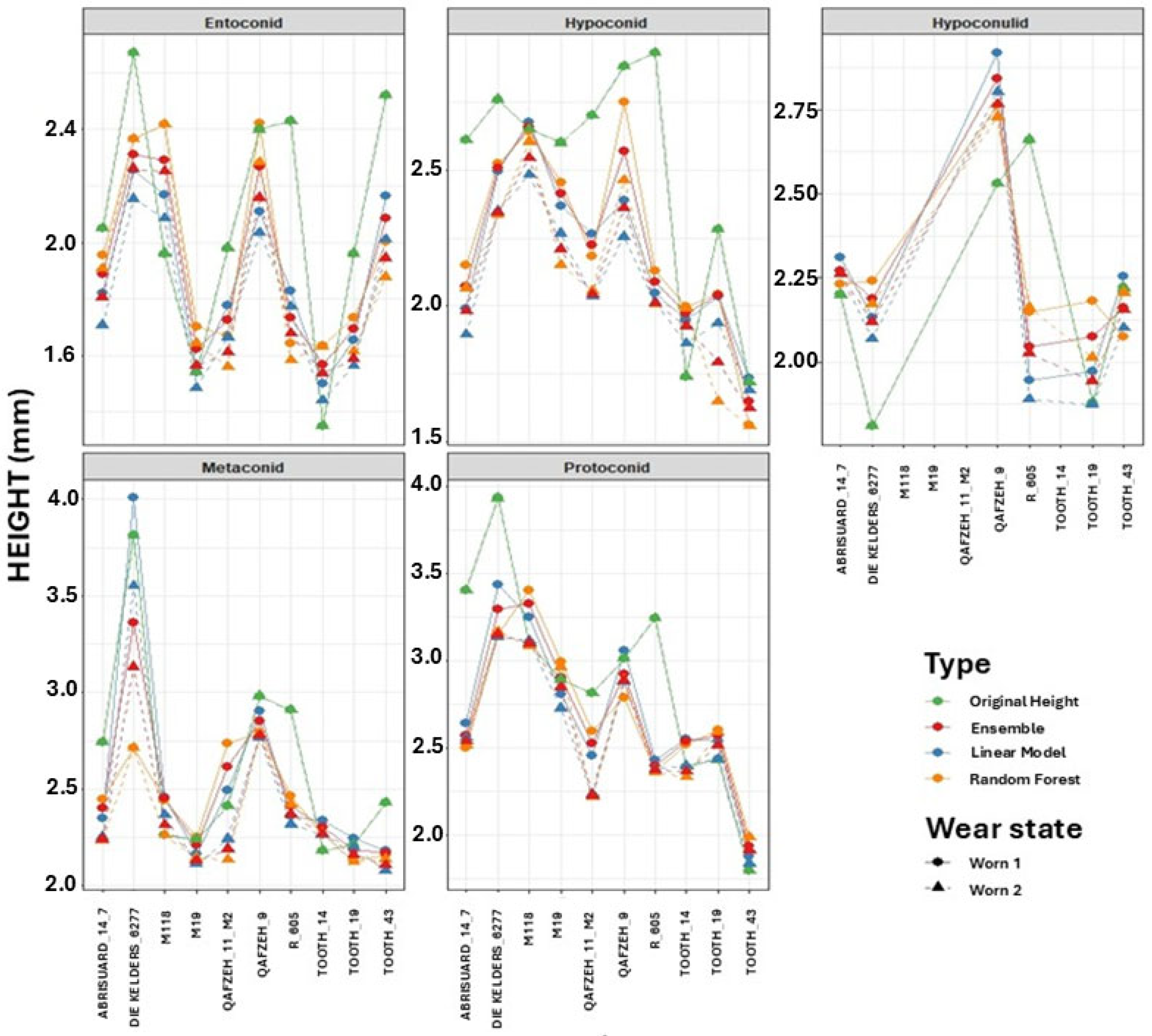
Graphical inspection of the results (Figure 6) confirms these patterns. For the protoconid, metaconid, and entoconid, ensemble predictions generally lie very close to the observed values across both worn1 and worn2 conditions, with only a modest increase in error under severe wear. For the hypoconid and, especially, the hypoconulid, deviations from the original heights are larger and more variable, reflecting both the greater morphological variability of these cusps and the smaller number of available teeth for the hypoconulid. Nevertheless, even in these more challenging cases, the ensemble typically performs at least as well as, and often better than, either RF or LM alone.
The variability observed among cusps and among teeth underscores that predictive performance is inherently cusp-specific and sensitive to local morphology and data availability. Rather than relying on a single model type, the use of an ensemble provides a simple yet effective way to obtain robust predictions across this heterogeneous landscape. Taken together, Table S3 and Figure 6 indicate that the ensemble approach yields accurate and generalizable reconstructions of cusp height at the tooth level, while making the behavior of the models transparent for each individual specimen and cusp.

3.3. Model Robustness: Learning Curves and Feature Stability

To assess the robustness of the reconstruction models and their dependence on sample size, we computed learning curves for two representative cusps (Protoconid and Hypoconid). For each cusp, the ensemble model was trained on increasing numbers of teeth from the training set and evaluated on an independent hold-out set. Ensemble RMSE decreased monotonically as the number of training teeth increased. For the Protoconid, RMSE declined from approximately 0.40 mm (SD = 0.09) when training on 10 teeth to about 0.35 mm (SD = 0.01) with 25 training teeth. For the Hypoconid, RMSE decreased from ~0.40 mm (SD = 0.11) to ~0.29 mm (SD = 0.02) over the same range. The concomitant reduction in the standard deviation of RMSE indicates that model performance becomes increasingly stable as the training sample grows (see Supplementary Table S4 for full numerical summaries). We also evaluated the stability of morphometric predictors via a bootstrap analysis of Random Forest feature importance (100 resamplings at the tooth level). For both Protoconid and Hypoconid, cusp volume and area consistently emerged as the most influential predictors, followed by worn cusp height. For example, in the Hypoconid, mean increase in node purity was 7.62 ± 1.43 for volume, 7.20 ± 1.35 for area, and 5.42 ± 0.94 for worn height. The relatively low variability of importance scores across bootstrap iterations indicates that the ranking of predictors is stable across different samplings of the data, suggesting that the reconstruction models rely on a robust combination of three-dimensional morphometric information and residual worn height rather than on a single, unstable predictor (see Supplementary Table S5 and Figure S1).

3.4. Species-Related Variation in Prediction Error

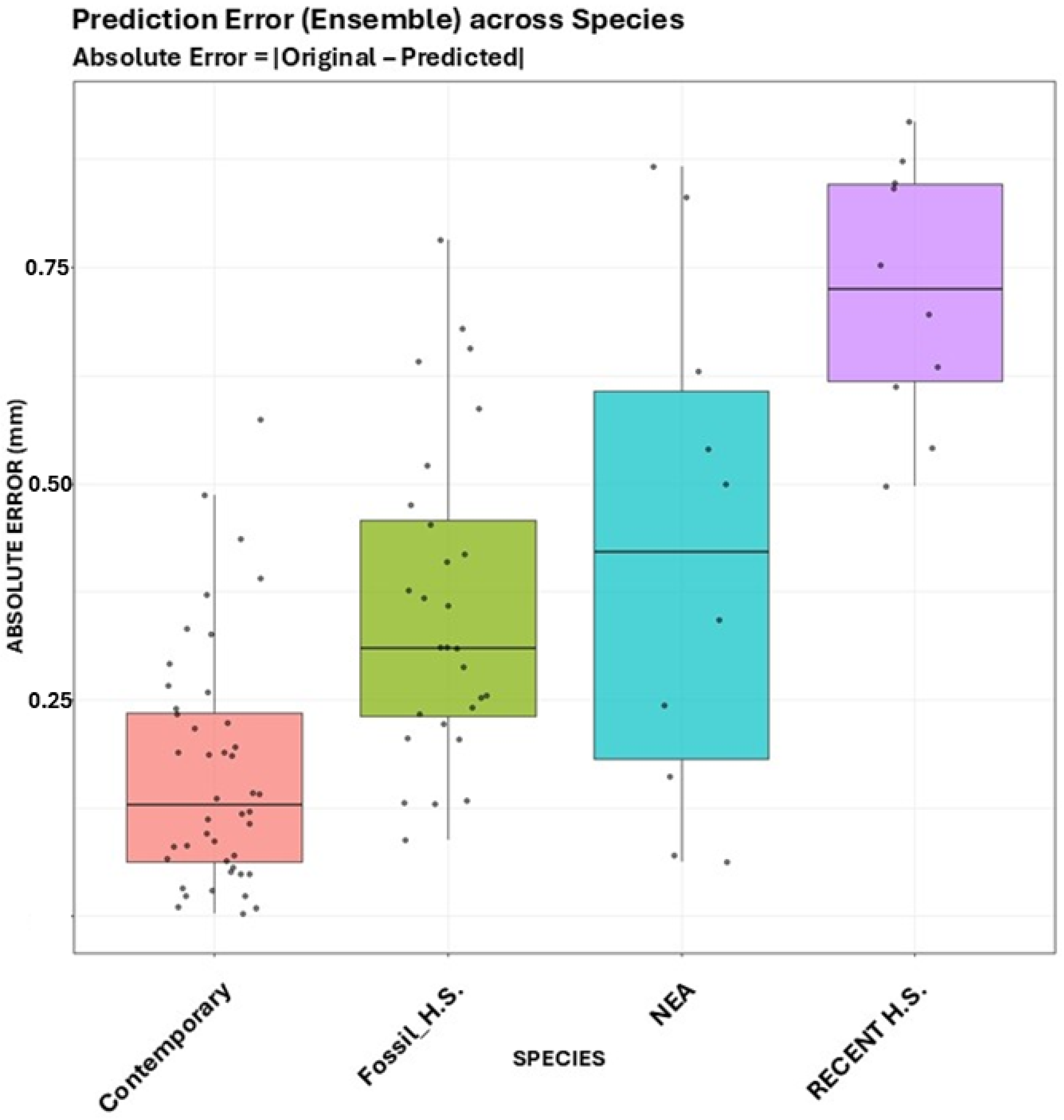
To assess the robustness of the reconstruction across taxa, we examined whether the prediction error of the ensemble model varied among species groups. A Kruskal–Wallis test revealed significant differences in absolute error (|Original − Predicted|) between groups (p < 0.001, η2H = 0.426; Figure 7). Contemporary Homo sapiens showed the lowest errors (median = 0.13 mm), followed by Fossil H. sapiens (median = 0.31 mm) and Neanderthals (median = 0.42 mm), whereas Recent H. sapiens displayed the highest median error (0.73 mm). Despite these differences, the model maintained sub-millimetric accuracy for most groups, indicating that it can reliably reconstruct cusp heights even in the presence of marked interspecific and population-level morphological variation within the genus Homo.
When prediction errors were summarized at the tooth level by averaging the absolute ensemble error across cusps (worn2), a Kruskal–Wallis test showed a similar trend, with lower median errors in contemporary humans (0.14 mm, n = 5 teeth) and higher median errors in Recent Homo sapiens (0.74 mm, n = 1 tooth), and intermediate values in Fossil Homo sapiens (0.46 mm, n = 3 teeth) and Neanderthals (0.46 mm, n = 1 tooth), although the global test did not reach conventional significance (p = 0.060, η2H = =0.733). This indicates that the species-related pattern in prediction error is preserved when accounting for the non-independence of cusps within teeth, despite the small and unbalanced sample size at the tooth level.

4. Discussion

The reconstruction of original cusp dimensions in worn molars remains a major challenge at the intersection of dental medicine, evolutionary biology, and prosthetic rehabilitation. In this study, we show that a standardized machine learning pipeline based on morphometric analysis of the enamel–dentine junction (EDJ) and high-resolution micro-CT data can provide accurate estimates of original cusp height even in the presence of substantial occlusal wear. Although prediction accuracy declines as wear severity increases, particularly for highly variable cusps, the models consistently achieve sub-millimetric errors for most cusps and across different hominin groups. In this way, our approach directly addresses the loss of morphological information due to wear, a limitation that has long hindered taxonomic attribution, functional reconstruction, and comparative analyses, especially in paleoanthropology. Beyond the proof of concept, this work establishes a reproducible and user-friendly workflow that can be readily adopted by other researchers. The pipeline includes pre-trained models for all five major cusps, automated prediction scripts, standardized data templates, and step-by-step documentation. Because it relies only on standard morphometric measurements at the EDJ (height, area, and volume), the method can be implemented without advanced expertise in machine learning, lowering the barrier to applying sophisticated reconstruction techniques in both clinical and evolutionary contexts. Moreover, by digitally simulating progressive wear stages (worn1 and worn2) on originally unworn teeth, we could isolate the effect of increasing occlusal wear on model performance while holding individual morphology constant, rather than conflating wear with inter-individual variation.

4.1. Interspecific Variation and Model Generalizability

Preliminary analyses on unworn molars showed that interspecific differences are most pronounced in cusp height and, to a lesser extent, in cusp volume, whereas cusp areas remain relatively stable across species (Table 2). This pattern suggests that height and volume are more responsive to functional and adaptive pressures, reflecting their central role in occlusal dynamics, while occlusal area may be more tightly constrained by shared biomechanical requirements [47,48,49]. The fact that the largest differences occur in the main load-bearing cusps is consistent with hypotheses of dietary adaptation, whereas the relative uniformity of more accessory cusps fits their less critical role in mastication [50]. These findings naturally raise the question of whether species should be explicitly included as a predictor in the reconstruction models. We chose not to do so, for two main reasons: (i) the sample is taxonomically unbalanced, so adding species as an explanatory variable would increase the risk of overfitting; and (ii) in many realistic paleoanthropological scenarios, taxonomic attribution is uncertain or debated. Pooling all specimens into a single Homo framework therefore reflects the intended use case: a tool that can be applied to worn teeth without requiring prior, confident species identification. The analysis of prediction errors across taxa supports this choice. Although absolute errors differ among groups, the ensemble model maintains sub-millimetric accuracy for most of them, indicating that the pipeline can tolerate a substantial degree of interspecific and intra-specific variation without collapsing. The learning-curve analyses and the stability of feature importance further reinforce this impression: as the number of training teeth increases, errors tend to decrease and stabilize, and the relative importance of key predictors (particularly cusp volume and area) remains consistent across bootstrap resamplings. Taken together, these observations suggest that the models are capturing robust morphometric signals that generalize across the genus Homo, rather than idiosyncratic patterns driven by a few atypical individuals. Although we did not explicitly fit models including species as a predictor in this proof-of-concept study, our analyses of interspecific differences in the raw morphometrics and of species-related variation in prediction error provide empirical support for a species-agnostic modelling strategy. Future work with larger and more taxonomically balanced samples will be needed to test explicitly whether adding species or population labels as covariates yields stable and practically useful improvements in reconstruction accuracy.

4.2. Effects of Occlusal Wear on Predictive Performance

At the cusp level, model performance clearly depended on both cusp identity and the degree of wear. Under moderate wear (worn1), the ensemble models reached normalized errors on the order of 11–17% of mean cusp height, corresponding to sub-millimetric deviations for most cusps, with particularly good performance for the metaconid. This level of accuracy is well within the range required for most evolutionary and clinical applications. When the same models were tested under more advanced wear (worn2), predictive accuracy declined systematically for the majority of cusps. Errors increased and, in several cases, explained variance (R2) dropped towards zero or even negative values, indicating that once a substantial portion of the crown is removed the residual EDJ morphology becomes less informative for height reconstruction. The deterioration was most pronounced in structurally variable cusps such as the hypoconid and entoconid, which combine complex geometry with greater sensitivity to wear. The hypoconulid represented a partial exception, but its behavior must be interpreted with caution given the small number of available teeth and its highly idiosyncratic morphology. Overall, these patterns highlight a practical boundary condition of the method: reconstruction from EDJ morphometrics remains feasible and accurate under moderate wear, but reliability decreases as occlusal wear becomes severe, especially for morphologically complex or sparsely represented cusps. This has direct implications for specimen selection and for the level of confidence that should be assigned to reconstructions from heavily worn crowns in both paleoanthropological and clinical contexts.

4.3. Model Architecture, Validation Strategies, and Cusp-Specific Calibration

Random Forests and multiple linear regression exhibited complementary strengths. Random Forests were particularly effective at capturing non-linear relationships and interactions, which are likely more relevant for cusps characterized by greater geometric variability or complex EDJ topography. Linear models, by contrast, performed very well for more regular cusps (such as the metaconid) and offered a transparent, coefficient-based view of how height relates to area and volume. By combining the two in a simple ensemble, defined as the mean of Random Forest and linear predictions, we systematically reduced prediction variance and, for most cusps, obtained the lowest errors. This illustrates the benefit of integrating algorithms with different bias–variance profiles even in a moderately sized dataset. A central methodological aspect of this work is the explicit, cusp-specific evaluation of model behavior across wear stages under a strict tooth-level validation scheme. All models were trained on unworn EDJ morphometrics and tested only on independent teeth, in both worn1 and worn2 conditions. This design allowed us to track how reconstruction accuracy changes as occlusal wear progresses, without ever mixing data from the same tooth between training and testing or inflating performance by pooling correlated measurements. Within this framework, clear cusp-specific patterns emerge. Some cusps, such as the protoconid and metaconid, remain reliably reconstructable even under moderate wear, whereas more morphologically complex or sparsely represented cusps, such as the hypoconid and hypoconulid, are intrinsically more challenging. The detailed tooth-level breakdown of predictions and the visual comparison between observed and predicted heights show that ensemble estimates closely follow original values across the independent test teeth, supporting the robustness and interpretability of the proposed pipeline. These observations are further reinforced by the learning-curve and bootstrap analyses. As the number of training teeth increases, prediction errors decrease and stabilize, and the relative importance of key predictors, particularly cusp volume and area, remains consistent across resamplings. Together, these findings indicate that the ensemble architecture is not only accurate, but also grounded in stable and biologically plausible relationships between EDJ morphometrics and reconstructed cusp height, rather than being driven by sampling noise or a few atypical individuals.

4.4. Evolutionary and Clinical Implications

From an evolutionary perspective, the ability to reconstruct original cusp height from EDJ morphometrics has substantial implications for the study of dental evolution, phylogeny, and functional adaptation. By partially decoupling taxonomically and functionally informative features from the confounding effects of wear, the method allows worn fossil teeth to be reintegrated into comparative datasets [14,15,16,17]. This increases statistical power, reduces sampling bias toward unworn or only mildly worn teeth, and enables more comprehensive reconstructions of dental evolution within Homo and across hominin lineages. From a clinical perspective, the EDJ represents the structural template for the unworn outer enamel surface [27]. Accurate estimation of original cusp height from EDJ morphology therefore lays the groundwork for future prediction of complete coronal anatomy. In prosthetic and restorative dentistry, such reconstructions could support more conservative, anatomically faithful occlusal designs that respect the patient’s original functional morphology and occlusal scheme.

4.5. Limitations, and Future Directions

Despite the promising results, several limitations must be acknowledged.
First, the sample size is modest (n = 40) and taxonomic/cusp representation is uneven, especially for the hypoconulid, which calls for caution when interpreting species-level differences. At the same time, the learning-curve analysis shows a monotonic reduction and stabilization of RMSE as training size increases, and the bootstrap analysis indicates stable rankings of feature importance across resamplings (Supplementary Figure S1). Together, these diagnostics suggest that the observed performance is not driven solely by a small subset of unusual individuals, although broader and more balanced sampling will be required to confirm interspecific patterns. Second, we used a hold-out validation scheme specifically designed to mimic realistic scenarios in which models trained on a reference set of unworn teeth must predict original dimensions in different individuals and wear stages. Although this approach is conceptually appropriate and avoids data leakage at the tooth level, future work should integrate stratified cross-validation and more extensive hyperparameter optimization (where appropriate) and repeated/stratified cross-validation to better quantify predictive uncertainty. Third, the current models rely on a restricted set of morphometric predictors (area, volume, and worn height), whereas a wealth of additional information resides in three-dimensional shape descriptors and geometric morphometric landmarks. The choice of Random Forest (RF) and Multiple Linear Regression (MLR) involves specific trade-offs: MLR offers high interpretability and stable behavior in small samples but is limited to capturing linear relationships; conversely, RF can flexibly model non-linear interactions without a priori functional assumptions [51], but it is more prone to overfitting in small samples and its “black-box” nature can obscure the underlying anatomical logic. Our ensemble approach aims to combine the robustness and interpretability of MLR with the non-linear capacity of RF, at the cost of additional complexity and without guaranteeing consistent gains across all wear stages or cusps. Integrating richer descriptors, as well as curvature-based or topological features of the EDJ, may substantially increase predictive accuracy, especially in highly worn crowns. In addition, the present implementation uses a simplified planar occlusal reduction to simulate wear, which provides a controlled and reproducible framework but does not capture the full complexity of physiological wear facets. The models are therefore validated under an idealized wear configuration. Future work will need to incorporate sensitivity analyses to different wear-plane orientations and more realistic, facet-based wear patterns in order to better approximate clinical and archeological conditions. In the broader context of cusp reconstruction, our EDJ-based machine-learning approach complements, rather than replaces, existing methods. Classic geometric or interpolation-based techniques typically operate on the external enamel surface and are most effective when a substantial portion of the crown is preserved. These methods are computationally simple and conceptually intuitive, but they become less reliable when the outer enamel is heavily worn or damaged, even if the underlying EDJ is intact. By contrast, the present framework is explicitly centered on EDJ morphometry (area, volume, and worn height), which can often be segmented accurately from micro-CT scans even in severely worn molars. This makes it particularly suitable for fossil specimens and for clinical cases in which external crown morphology is compromised. Deep-learning and generative approaches, such as autoencoders or GAN-based models, offer a powerful alternative for modelling high-dimensional, complex morphology [52,53] and may ultimately capture more subtle shape variation. However, these architectures generally require substantially larger and more homogeneous datasets than are currently available for EDJ-based analyses and can be less straightforward to interpret in anatomical terms. Given the small and taxonomically heterogeneous sample analyzed here, and our focus on heavily worn crowns, we therefore opted for relatively simple, data-efficient models (Random Forest and multiple linear regression) as an appropriate proof of concept, and we identify formal quantitative comparisons with geometric and deep-generative approaches as a key objective for future work. Finally, the present implementation focuses on isolated molars; extending the pipeline to multiple teeth and to the full dental arcade will be essential to capture occlusal relationships and arch-level functional constraints. Addressing this limitation naturally motivates several methodological developments, including (i) expansion of training sets across populations and taxonomic groups, aiming for larger and more balanced datasets (e.g., ≥100 teeth) to enable robust population-level inference and finer taxonomic calibration; (ii) integration of advanced three-dimensional shape analysis and deep-learning-based feature extraction; and (iii) development of integrated software solutions, such as plugins for micro-CT platforms and web-based interfaces, to facilitate use in clinical, museum, and field settings. Together, these developments would further enhance the practical advantages of the present workflow, which already provides a time-efficient and cost-effective alternative to more complex geometric reconstructions. Notably, our approach relies on a free, open-source computational framework that requires limited specialized expertise and no commercial software licenses, making it readily accessible for routine research and clinical applications. In this context, deep architectures based on non-linear factorization and attention mechanisms [54,55], as well as multi-scale descriptors such as wavelet-based representations of cusp contours, represent particularly promising avenues. While such models could capture more subtle and spatially localized EDJ features and help maintain predictive accuracy under severe wear conditions, their reliable implementation will require substantially larger and more homogeneous training datasets than are currently available. Together, these developments will be essential for translating the present proof of concept into a routine tool for both research and practice. Although the current study should still be regarded as exploratory, it already provides a practical and user-friendly framework that can be applied to new samples to investigate predictive reconstructions, while anticipating future methodological and software advances that will further improve performance and integration into standard research and clinical workflows. Potential applications include digital planning of full-coverage restorations, reconstruction of worn dentitions, and customization of occlusal schemes in complex rehabilitations, ultimately aiming to improve function, comfort, and treatment longevity.

5. Conclusions

By establishing and validating a robust pipeline for predicting original cusp height from EDJ morphometrics using machine learning, this study provides a new framework for linking dental evolutionary research and clinical practice. Our results show that, under moderate wear, ensemble models achieve high accuracy and sub-millimetric errors across multiple cusps and species, while maintaining acceptable performance even at more advanced wear stages for many structures. This capability enables the systematic inclusion of worn teeth in quantitative morphometric and phylogenetic analyses, mitigating one of the main barriers in paleoanthropological research. At the same time, the method offers a principled foundation for reconstructing patient-specific occlusal morphology in restorative and prosthetic dentistry, with the potential to improve functional outcomes and anatomical fidelity. By making the workflow reproducible and accessible, and by explicitly addressing model generalizability across taxa, cusp types, and wear stages, this work moves the field closer to a fully integrated, data-driven approach to dental reconstruction, one that connects evolutionary history, biological form, and clinical function within a single methodological framework.

Supplementary Materials

The following supporting information can be downloaded at https://www.mdpi.com/article/10.3390/app16031280/s1. Table S1: Results of statistical tests on interspecific differences in morphometric variables of lower molar cusps (original M1 + M2); Table S2: Results of the Dunn’s test for multiple comparisons between species groups for the analyzed variable; Table S3: Observed and predicted cusp height values for each tooth and analyzed cusp. Table S4: Learning curve summary (ensemble RMSE and SD across increasing training sample sizes for Protoconid and Hypoconid). Table S5: Bootstrap summary of Random Forest feature importance (mean ± SD of increase in node purity for cusp area, volume, and worn height in Protoconid and Hypoconid). Figure S1. Model robustness: learning curves and feature stability. (A) Learning curves for the ensemble model predicting original (unworn) cusp height for Protoconid and Hypoconid. Mean RMSE (mm) on the independent test set is plotted against the number of training teeth; shaded bands indicate ±1 SD across 30 tooth-level resampling runs at each training size. (B) Random Forest feature-importance stability assessed by bootstrapping (100 tooth-level resamplings). Violin/boxplots show the distribution of increase in node purity for the three predictors (worn cusp height, cusp area, and cusp volume), separately for Protoconid and Hypoconid, indicating a stable ranking of predictor importance across resamples.

Author Contributions

Acquisition, processing of images, and creation of 3D models (H.A., R.M.G.M., G.O. and G.D.D.); development of the machine learning algorithm, model building, and final code implementation (G.O.); interpretation (G.O.); drafting of the manuscript (G.O. and R.N.); critical revision of the manuscript and approval of the article (G.O., R.N., H.A., P.M., J.-J.H. and R.M.G.M.); project coordination and design (G.O.). All authors have read and agreed to the published version of the manuscript.

Funding

This research received no external funding.

Institutional Review Board Statement

Not applicable.

Informed Consent Statement

Not applicable.

Data Availability Statement

All data supporting the findings of this study, including the morphometric datasets, trained machine learning models, and the complete user-friendly prediction pipeline, will be made publicly available on GitHub website immediately upon publication. The repository will include raw and processed data, detailed documentation, and executable scripts to enable full reproducibility and accessibility for researchers without programming expertise. This open-access release aims to promote transparency, usability, and further development of automated approaches for EDJ morphology reconstruction.

Acknowledgments

We kindly acknowledge the Max Planck Institute for Evolutionary Anthropology for providing access to the fossil remains. We thank Alberto Cecere and Mauro Tomasella for making available the recent teeth, which form part of a collection assembled over the years and kindly provided by them. We also thank Licia Uccelli and Alessandra Boschi from the University of Ferrara for granting access to the LINC (Laboratory of Nuclear Imaging and Computed tomography) facility for dental segmentation and analysis.

Conflicts of Interest

The authors declare no conflicts of interest.

References

  1. Bronkhorst, H.; Kalaykova, S.; Huysmans, M.C.; Loomans, B.; Pereira-Cenci, T. Tooth wear and bruxism: A scoping review. J. Dent. 2024, 145, 104983. [Google Scholar] [CrossRef]
  2. Oudkerk, J.; Grenade, C.; Davarpanah, A.; Vanheusden, A.; Vandenput, S.; Mainjot, A.K. Risk factors of tooth wear in permanent dentition: A scoping review. J. Oral. Rehabil. 2023, 50, 1110–1165. [Google Scholar] [CrossRef]
  3. Shellis, R.P.; Addy, M. The interactions between attrition, abrasion and erosion in tooth wear. Monogr. Oral. Sci. 2014, 25, 32–45. [Google Scholar]
  4. Oxilia, G.; Bortolini, E.; Martini, S.; Papini, A.; Boggioni, M.; Buti, L.; Figus, C.; Sorrentino, R.; Townsend, G.; Kaidonis, J.; et al. The physiological linkage between molar inclination and dental macrowear pattern. Am. J. Phys. Anthropol. 2018, 166, 941–951. [Google Scholar] [CrossRef]
  5. Godinho, R.M.; Umbelino, C.; Garcia, S.; Gonçalves, C. Changes in dental wear magnitude in the last ~8000 years in southwestern Iberia. Arch. Oral. Biol. 2023, 147, 105626. [Google Scholar] [CrossRef]
  6. Forshaw, R. Dental indicators of ancient dietary patterns: Dental analysis in archaeology. Br. Dent. J. 2014, 216, 529–535. [Google Scholar] [CrossRef]
  7. Molnar, P. Extramasticatory dental wear reflecting habitual behavior and health in past populations. Clin. Oral Investig. 2011, 15, 681–689. [Google Scholar] [CrossRef]
  8. Fiorenza, L.; Kullmer, O. Dental wear and cultural behavior in Middle Paleolithic humans from the Near East. Am. J. Phys. Anthropol. 2013, 152, 107–117. [Google Scholar] [CrossRef]
  9. Oxilia, G.; Peresani, M.; Romandini, M.; Matteucci, C.; Spiteri, C.D.; Henry, A.G.; Schulz, D.; Archer, W.; Crezzini, J.; Boschin, F.; et al. Earliest evidence of dental caries manipulation in the Late Upper Palaeolithic. Sci. Rep. 2015, 5, 12150. [Google Scholar] [CrossRef]
  10. Oxilia, G.; Bortolini, E.; Badino, F.; Bernardini, F.; Gazzoni, V.; Lugli, F.; Romandini, M.; Radini, A.; Terlato, G.; Marciani, G.; et al. Exploring Late Paleolithic and Mesolithic diet in the Eastern Alpine region of Italy through multiple proxies. Am. J. Phys. Anthropol. 2021, 174, 232–253. [Google Scholar] [CrossRef]
  11. Oxilia, G.; Zaniboni, M.; Bortolini, E.; Sartorio, J.C.M.; Bernardini, F.; Tuniz, C.; Di Domenico, G.; Pavičić, D.T.; Los, D.; Radović, S.; et al. Enamel thickness per masticatory phases (ETMP): A new approach to assess the relationship between macrowear and enamel thickness in the human lower first molar. J. Archaeol. Sci. 2023, 153, 105776. [Google Scholar] [CrossRef]
  12. Kaidonis, J.A.; Ranjitkar, S.; Lekkas, D.; Townsend, G.C. An Anthropological Perspective: Another Dimension to Modern Dental Wear Concepts. Int. J. Dent. 2012, 2012, 741405. [Google Scholar] [CrossRef]
  13. Puech, P.-F.; Serratrice, C.; Filce Leek, F. Tooth wear as observed in ancient Egyptian skulls. J. Hum. Evol. 1983, 12, 617–629. [Google Scholar] [CrossRef]
  14. Guatelli-Steinberg, D. What Teeth Reveal About Human Evolution; Cambridge University Press: Cambridge, UK, 2016. [Google Scholar]
  15. Estalrrich, A.; Marín-Arroyo, A.B. Evidence of habitual behavior from non-alimentary dental wear on deciduous teeth from the Middle and Upper Paleolithic Cantabrian region, Northern Spain. J. Hum. Evol. 2021, 158, 103047. [Google Scholar] [CrossRef]
  16. Garralda, M.D.; Maureille, B.; Le Cabec, A.; Oxilia, G.; Benazzi, S.; Skinner, M.M.; Hublin, J.-J.; Vandermeersch, B. The Neanderthal teeth from Marillac (Charente, Southwestern France): Morphology, comparisons and paleobiology. J. Hum. Evol. 2020, 138, 102683. [Google Scholar] [CrossRef]
  17. Chapple, S.A.; Skinner, M.M. A tooth crown morphology framework for interpreting the diversity of primate dentitions. Evol. Anthropol. 2023, 32, 240–255. [Google Scholar] [CrossRef] [PubMed]
  18. Broll, A.; Goldhacker, M.; Hahnel, S.; Rosentritt, M. Morphological effects of input data quantity in AI-powered dental crown design. J. Dent. 2025, 159, 105767. [Google Scholar] [CrossRef]
  19. Oxilia, G.; Tomasella, M.; Cecere, A. Dental morphology in restorative dentistry: A pilot study on morphological consistency and variability in human upper first molars. Dent. J. 2025, 13, 122. [Google Scholar] [CrossRef]
  20. Kaifu, Y.; Kono, R.T.; Sutikna, T.; Saptomo, E.W.; Jatmiko; Due Awe, R. Unique Dental Morphology of Homo floresiensis and Its Evolutionary Implications. PLoS ONE 2015, 10, e0141614. [Google Scholar] [CrossRef]
  21. O’Hara, M.C.; Le Cabec, A.; Xing, S.; Skinner, M.F.; Guatelli-Steinberg, D. Safe casting and reliable cusp reconstruction assisted by micro-computed tomographic scans of fossil teeth. Anat. Rec. 2019, 302, 1516–1535. [Google Scholar] [CrossRef]
  22. Modesto-Mata, M.; García-Campos, C.; Martín-Francés, L.; de Pinillos, M.M.; García-González, R.; Quintino, Y.; Canals, A.; Lozano, M.; Dean, M.C.; Martinón-Torres, M.; et al. New methodology to reconstruct in 2-D the cuspal enamel of modern human lower molars. Am. J. Phys. Anthropol. 2017, 163, 824–834. [Google Scholar] [CrossRef]
  23. Broll, A.; Goldhacker, M.; Hahnel, S.; Rosentritt, M. Generative deep learning approaches for the design of dental restorations: A narrative review. J. Dent. 2024, 145, 104988. [Google Scholar] [CrossRef]
  24. Modesto-Mata, M.; de la Fuente Valentín, L.; Hlusko, L.J.; de Pinillos, M.M.; Towle, I.; García-Campos, C.; Martinón-Torres, M.; de Castro, J.M.B. Artificial neural networks reconstruct missing perikymata in worn teeth. Anat. Rec. 2024, 307, 3120–3138. [Google Scholar] [CrossRef]
  25. Feng, Y.; Tao, B.; Fan, J.; Wang, S.; Mo, J.; Wu, Y.; Liang, Q. 3D reconstruction for maxillary anterior tooth crown based on shape and pose estimation networks. Int. J. Comput. Assist. Radiol. Surg. 2023, 18, 1405–1416. [Google Scholar] [CrossRef]
  26. Avishai, G.; Müller, R.; Gabet, Y.; Bab, I.; Zilberman, U.; Smith, P. New approach to quantifying developmental variation in the dentition using serial microtomographic imaging. Microsc. Res. Tech. 2004, 65, 263–269. [Google Scholar] [CrossRef]
  27. Monson, T.A.; Fecker, D.; Scherrer, M. Neutral evolution of human enamel-dentine junction morphology. Proc. Natl. Acad. Sci. USA 2020, 117, 26183–26189, Erratum in Proc. Natl. Acad. Sci. USA 2020, 117, 29241. https://doi.org/10.1073/pnas.2021545117. [Google Scholar] [CrossRef] [PubMed] [PubMed Central]
  28. Smith, T.M.; Tafforeau, P.; Reid, D.J.; Pouech, J.; Lazzari, V.; Zermeno, J.P.; Guatelli-Steinberg, D.; Olejniczak, A.J.; Hoffman, A.; Radovčić, J.; et al. Dental evidence for ontogenetic differences between modern humans and Neanderthals. Proc. Natl. Acad. Sci. USA 2010, 107, 20923–20928. [Google Scholar] [CrossRef]
  29. Morita, W.; Yano, W.; Nagaoka, T.; Abe, M.; Ohshima, H.; Nakatsukasa, M. Patterns of morphological variation in enamel-dentin junction and outer enamel surface of human molars. J. Anat. 2014, 224, 669–680. [Google Scholar] [CrossRef]
  30. Hunter, J.P.; Jernvall, J. The hypocone as a key innovation in mammalian evolution. Proc. Natl. Acad. Sci. USA 1995, 92, 10718–10722. [Google Scholar] [CrossRef]
  31. Pampush, J.D.; Duque, A.C.; Burrows, B.R.; Daegling, D.J.; Kenney, W.F.; McGraw, W.S. Homoplasy and thick enamel in primates. J. Hum. Evol. 2013, 64, 216–224. [Google Scholar] [CrossRef]
  32. Chen, D.; Yu, M.Q.; Li, Q.J.; He, X.; Liu, F.; Shen, J.F. Precise tooth design using deep learning-based templates. J. Dent. 2024, 144, 104971. [Google Scholar] [CrossRef]
  33. Cho, J.H.; Yi, Y.; Choi, J.; Ahn, J.; Yoon, H.I.; Yilmaz, B. Time efficiency, occlusal morphology, and internal fit of anatomic contour crowns designed by dental software powered by a generative adversarial network: A comparative study. J. Dent. 2023, 138, 104739. [Google Scholar] [CrossRef] [PubMed]
  34. Molnar, S. Human tooth wear, tooth function and cultural variability. Am. J. Phys. Anthropol. 1971, 34, 175–190. [Google Scholar] [CrossRef]
  35. Wagendorf, O.; Nahles, S.; Vach, K.; Kernen, F.; Zachow, S.; Heiland, M.; Flügge, T. The impact of teeth and dental restorations on gray value distribution in cone-beam computer tomography: A pilot study. Int. J. Implant. Dent. 2023, 9, 27. [Google Scholar] [CrossRef]
  36. Hajar, A.; Gunz, P.; Martin, R.M.G.; Coqueugniot, H.; El Hajraoui, M.; Oxilia, G.; Hublin, J.-J. Comparative analysis of the enamel-dentine junction of the lower molars among late Middle Stone Age hominins from northwestern Africa. Palevol, 2017; in press. [Google Scholar]
  37. R Core Team. R: A Language and Environment for Statistical Computing; R Foundation for Statistical Computing: Vienna, Austria, 2025. [Google Scholar]
  38. Liaw, A.; Wiener, M. Classification and regression by randomForest. R News 2002, 2, 18–22. [Google Scholar]
  39. Kuhn, M. Building predictive models in R using the caret package. J. Stat. Softw. 2008, 28, 1–26. [Google Scholar] [CrossRef]
  40. Wickham, H.; François, R.; Henry, L.; Müller, K.; Vaughan, D. dplyr: A Grammar of Data Manipulation, R Package, version 1.1.4; PBC: Boston, MA, USA, 2023. Available online: https://CRAN.R-project.org/package=dplyr (accessed on 30 October 2025).
  41. Wickham, H. ggplot2: Elegant Graphics for Data Analysis; Springer-Verlag: New York, NY, USA, 2016. [Google Scholar]
  42. Wickham, H.; Vaughan, D.; Girlich, M. tidyr: Tidy Messy Data, R Package, version 1.3.1; Posit Software; PBC: Boston, MA, USA, 2024. Available online: https://CRAN.R-project.org/package=tidyr (accessed on 15 January 2026).
  43. Wickham, H. Reshaping Data with the reshape Package. J. Stat. Softw. 2007, 21, 1–20. [Google Scholar] [CrossRef]
  44. Bates, D.; Mächler, M.; Bolker, B.; Walker, S. Fitting linear mixed-effects models using lme4. J. Stat. Softw. 2015, 67, 1–48. [Google Scholar] [CrossRef]
  45. Fox, J.; Weisberg, S. An R Companion to Applied Regression, 3rd ed.; Sage: Thousand Oaks, CA, USA, 2019. [Google Scholar]
  46. Ogle, D.H.; Wheeler, P.; Dinno, A. FSA: Fisheries Stock Analysis, R Package, version 0.9.5; Northland College: Ashland, WI, USA, 2023. Available online: https://CRAN.R-project.org/package=FSA (accessed on 15 January 2026).
  47. Grine, F.E.; Daegling, D.J. Functional morphology, biomechanics and the retrodiction of early hominin diets. Comptes Rendus Palevol 2017, 16, 613–631. [Google Scholar] [CrossRef]
  48. Wang, M.; Mehta, N. A possible biomechanical role of occlusal cusp-fossa contact relationships. J. Oral. Rehabil. 2013, 40, 69–79. [Google Scholar] [CrossRef] [PubMed]
  49. Constantino, P.J.; Bush, M.B.; Barani, A.; Lawn, B.R. On the evolutionary advantage of multi-cusped teeth. J. R. Soc. Interface 2016, 13, 20160374. [Google Scholar] [CrossRef]
  50. Kullmer, O.; Benazzi, S.; Fiorenza, L.; Schulz, D.; Bacso, S.; Winzen, O. Technical note: Occlusal fingerprint analysis: Quantification of tooth wear pattern. Am. J. Phys. Anthropol. 2009, 139, 600–605. [Google Scholar] [CrossRef]
  51. Breiman, L. Random Forests. Mach. Learn. 2001, 45, 5–32. [Google Scholar] [CrossRef]
  52. Goodfellow, I.; Bengio, Y.; Courville, A. Deep Learning; The MIT Press: Cambridge, MA, USA, 2016. [Google Scholar]
  53. Qi, C.R.; Su, H.; Mo, K.; Guibas, L.J. PointNet: Deep learning on point sets for 3D classification and segmentation. In Proceedings of the IEEE Conference on Computer Vision and Pattern Recognition (CVPR); IEEE: New York, NY, USA, 2017; pp. 652–660. [Google Scholar] [CrossRef]
  54. Vaswani, A.; Shazeer, N.; Parmar, N.; Uszkoreit, J.; Jones, L.; Gomez, A.N.; Kaiser, Ł.; Polosukhin, I. Attention is all you need. In Advances in Neural Information Processing Systems; Guyon, I., Von Luxburg, U., Bengio, S., Wallach, H., Fergus, R., Vishwanathan, S., Garnett, R., Eds.; Curran Associates, Inc.: Red Hook, NY, USA, 2017; Volume 30. [Google Scholar]
  55. Bengio, Y.; Courville, A.; Vincent, P. Representation Learning: A Review and New Perspectives. IEEE Trans. Pattern Anal. Mach. Intell. 2013, 35, 1798–1828. [Google Scholar] [CrossRef] [PubMed]
Figure 1. This figure illustrates the post-processing workflow applied to the original 3D tooth models, using contemporary individual no. 19 as an example. (a) Micro-CT-derived 3D model of a lower molar imported into MeshLab and oriented according to a cervical reference plane aligned along the x-axis with the mesial side facing upwards. (b) Lateral view showing the cervical plane used for consistent orientation across all specimens. (c) The cervical plane is translated (offset) to the lowest point of the enamel–dentine junction (EDJ) surface, establishing the reference for subsequent measurements. (d) Extraction of the silhouette resulting from the intersection between the cervical plane and the mesh (purple outline). (e) The mesh is trimmed to retain only the region of interest, from the basin to the cusp tips. (f) The silhouette is filled to create a closed mesh at the base, enabling calculation of coronal volume (smooth blue surface interpolating the cervical line). (g) Grooves are traced on the EDJ surface to delineate the boundaries of each cusp (pink lines). (h) The cusp boundaries are projected onto the silhouette, perfectly alienated with the reference plane (showed here in lateral view) to ensure precise alignment with the cutting plane. (i) The curves representing cusp boundaries are extruded orthogonally to the cutting plane using a mid-plane method (blue extrusion shown for one cusp). (j) Complete 3D capture of individual cusp morphology after extrusion. (k) Color-coded segmentation of all five cusps (Protoconid in green, Metaconid in blue, Entoconid in orange, Hypoconid in grey, Hypoconulid in magenta). (l) Final 3D model with all cusps individually segmented and labelled, enabling extraction of height, area and volume for each cusp for subsequent machine-learning analysis.
Applsci 16 01280 g001
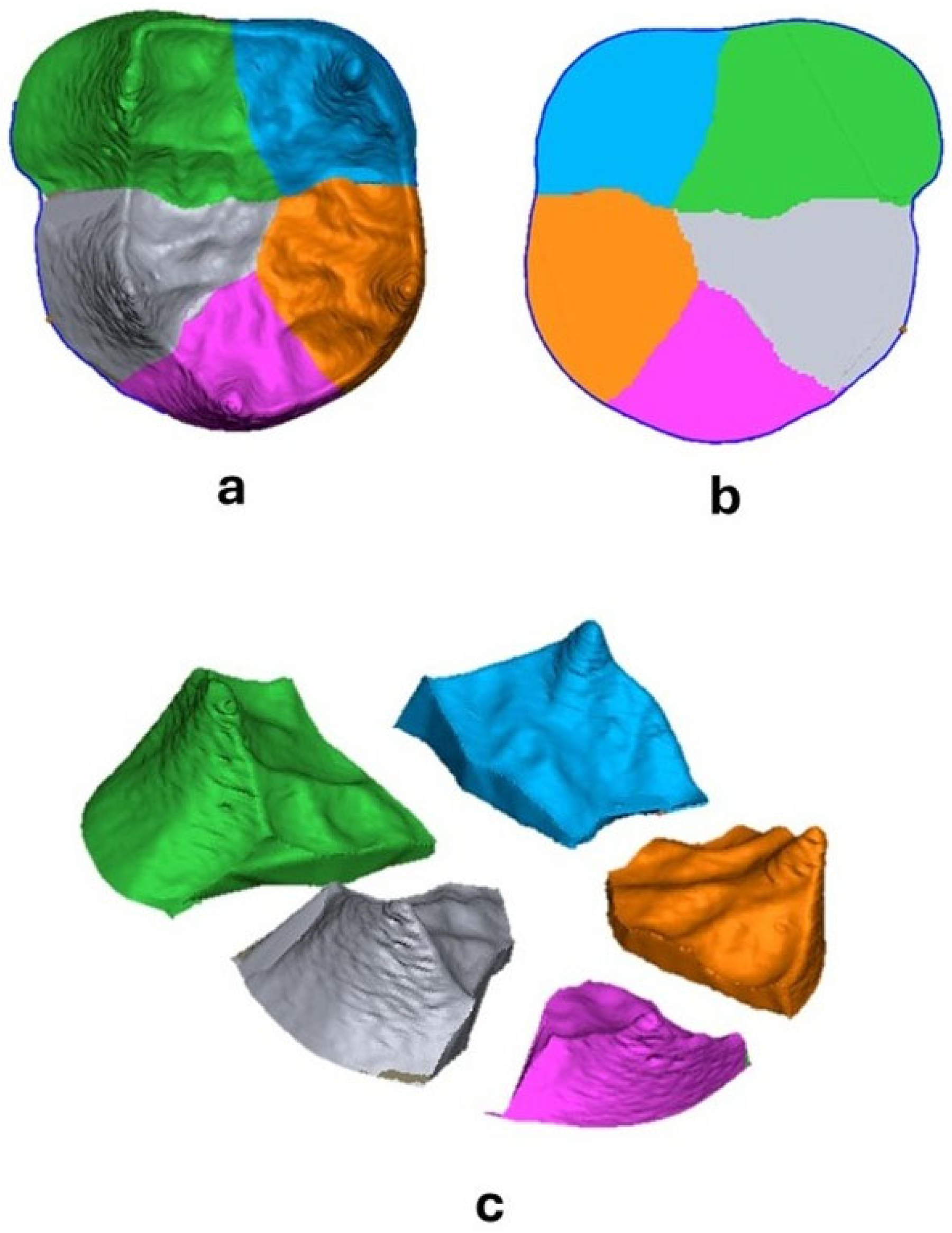
Figure 2. Illustration of the main steps for cusp-level morphometric extraction. (a) Identification and color-coded segmentation of individual cusps on the enamel–dentine junction (EDJ): Protoconid (green), Metaconid (blue), Entoconid (orange), Hypoconid (grey), Hypoconulid (magenta). (b) Measurement of the area of each cusp, obtained by projecting cusp boundaries onto the cervical reference plane. (c) Calculation of the volume of each cusp, extracted from the 3D segmented mesh between the cusp tip and the cervical plane. This workflow enables the extraction of height, area and volume for each cusp.
Applsci 16 01280 g002
Figure 3. Procedure for simulating artificial wear on each tooth. (a) Unworn tooth with EDJ outline (green) and highest cusp point (red dot) for unworn and worn tooth. (b) Offset of occlusal basin plane (blue line) upward (blue arrow) to define cutting plane for worn1 and worn2 stages. (c) Worn1 stage after sectioning at light wear level (cyan surface). (d) Highest cusp point (red dot/line) for worn1 as reference for worn2. (e) Occlusal view of artificial wear for worn1 and worn2 (final worn morphology). Legend: Red line/dot = highest cusp point/wear reference; blue line = occlusal basin plane/cutting plane on EDJ; blue arrow = upward offset movement of the reference plane to generate cutting planes for artificial wear simulation.
Applsci 16 01280 g003
Figure 4. Predictive performance of the models for each lower molar cusp using the independent tooth-level split (training on original cusps, testing on worn1 cusps). The (left) panel shows the root mean square error (RMSE) values, while the (right) panel reports the coefficients of determination (R2) obtained with the Random Forest, multiple linear regression, and ensemble models. The figure highlights differences in accuracy and explanatory power of the three modelling approaches across the five analyzed cusps.
Applsci 16 01280 g004
Figure 5. Predictive performance of the models for each lower molar cusp evaluated on the more advanced wear stage (worn2). The left panel shows the root mean square error (RMSE) values, while the right panel reports the coefficients of determination (R2) obtained using Random Forest, multiple linear regression, and the ensemble model. The figure illustrates the increased difficulty in height reconstruction under advanced wear conditions, as evidenced by higher RMSE and lower (often negative) R2 values compared to the worn1 stage.
Applsci 16 01280 g005
Figure 6. Comparison between observed (original) and predicted cusp heights for the independent test set (n = 10 teeth). Each panel represents a specific cusp. Green points indicate the original unworn height, while colored points represent predictions from the Random Forest (orange), Linear (blue), and Ensemble (red) models. Different symbols denote the wear state used for prediction. The ensemble model consistently tracks the original height across different teeth and wear stages, demonstrating high predictive stability.
Applsci 16 01280 g006
Figure 7. Boxplots of the absolute prediction error of the ensemble model across species groups. The y-axis shows the absolute error (|Original − Predicted|, in mm) for cusp-height reconstructions in the independent test set, and the x-axis reports the four taxonomic groups (Contemporary Homo sapiens, Fossil H. sapiens, Neanderthals, Recent H. sapiens). Points represent individual tooth–cusp estimates.
Applsci 16 01280 g007
Table 1. Summary of analyzed teeth included in the study by taxonomic group and individual identifier.
Tooth_TypeSpeciesTooth_Id
M1Fossil_H_SDie_Kelders_SAM_AP_6277
M1Fossil_H_SQafzeh_9
M1Fossil_H_SQafzeh_11_M1
M1Fossil_H_SSkhul
M1Recent_H_SM5
M1Recent_H_SR605
M1Recent_H_SR258_144
M1Recent_H_SR1101
M1Recent_H_SR1140
M1Recent_H_SR1160
M1Recent_H_SR2602
M1Recent_H_SULAC_797
M1NEAABRISUARD_14_7
M1NEAKrapina_53
M1contemporarytooth_2
M1contemporarytooth_19
M1contemporarytooth_20
M1contemporarytooth_43
M1contemporarytooth_47
M2contemporaryM19
M2contemporaryM118
M2contemporaryR1989_1382
M2contemporaryR752_692
M2Fossil_H_SQafzeh_11_M2
M2Fossil_H_SQafzeh_26
M2NEAKrapina_54
M2contemporarytooth_15
M2contemporarytooth_3
M2contemporarytooth_14
M2contemporarytooth_17
M2contemporarytooth_37
M2contemporarytooth_42
M2contemporarytooth_45
M2contemporarytooth_46
M2contemporarytooth_49
M2contemporarytooth_56
M2contemporarytooth_58
M2contemporarytooth_59
M2contemporarytooth_64
M2contemporarytooth_66
Table 2. Aggregate predictive performance metrics for each lower molar cusp in the worn1 condition. Root mean square error (RMSE, in mm), coefficient of determination (R2), and normalized RMSE (nRMSE, %) are reported for the Random Forest (RF), multiple linear regression (LM), and their simple ensemble (average of RF and LM predictions). N_samples indicates the number of teeth included for each cusp.
CuspRF
RMSE
LM
RMSE
Ensemble
RMSE
RF_R2LM_R2Ensemble
R2
Ensemble
nRMSE %
N_Samples
Protoconid0.4980.4110.450.2250.4710.36716.540
Metaconid0.4180.2530.2730.2610.7290.68511.140
Entoconid0.3680.3160.3320.1670.3870.32316.940
Hypoconid0.3610.4270.3890.238−0.0620.11916.940
Hypoconulid0.3060.3620.3250.024−0.369−0.10314.519
RMSE = root mean square error; nRMSE = normalized RMSE; R2 = coefficient of determination; RF = Random Forest; LM = multiple linear regression.
Table 3. Aggregate predictive performance metrics for each lower molar cusp in the worn2 condition. Root mean square error (RMSE, in mm), coefficient of determination (R2), and normalized RMSE (nRMSE, %) are reported for the Random Forest (RF), multiple linear regression (LM), and their simple ensemble (average of RF and LM predictions). N_samples indicates the number of teeth included for each cusp.
CuspRF_
RMSE
LM_
RMSE
Ensemble_
RMSE
RF_R2LM_R2Ensemble_
R2
Ensemble_nRMSE_%N_
Samples
Protoconid0.5090.4980.5010.1890.2240.21518.440
Metaconid0.4370.2990.3490.1910.6220.48414.240
Entoconid0.4280.3860.396−0.1250.0840.03620.240
Hypoconid0.5160.5120.509−0.551−0.531−0.51122.240
Hypoconulid0.2580.3540.3030.306−0.310.04113.519
Root mean square error (RMSE), coefficient of determination (R2), Random Forest (RF), multiple linear regression (LM).
Table 4. Comparison of ensemble performance between worn1 and worn2 states.
CuspENS_
RMSE_w1
ENS_
R2_w1
ENS_nRMSE_
w1_%
ENS_
RMSE_w2
ENS_
R2_w2
ENS_nRMSE_
w2_%
Delta_
RMSE
Delta_
nRMSE_%
Protoconid0.450.36716.50.5010.21518.40.0511.9
Metaconid0.2730.68511.10.3490.48414.20.0763.1
Entoconid0.3320.32316.90.3960.03620.20.0643.3
Hypoconid0.3890.11916.90.509−0.51122.20.125.2
Hypoconulid0.325−0.10314.50.3030.04113.5−0.022−1
Table 5. Comparison of ensemble model performance between worn1 and worn2 states. Root mean square error (RMSE), coefficient of determination (R2), and normalized RMSE (nRMSE, %) are reported for each cusp, along with absolute differences (ΔΔ) between the two wear stages. ΔΔ = difference (worn2 − worn1); pp = percentage points.
CuspENS_
RMSE_
w1
ENS_
R2_
w1
ENS_
nRMSE_
w1_%
ENS_
RMSE_
w2
ENS_
R2_
w2
ENS_
nRMSE_
w2_%
Delta_
RMSE
(mm)
Delta_
nRMSE_%
(pp)
Protoconid0.450.36716.50.5010.21518.40.0511.9
Metaconid0.2730.68511.10.3490.48414.20.0763.1
Entoconid0.3320.32316.90.3960.03620.20.0643.3
Hypoconid0.3890.11916.90.509−0.51122.20.125.2
Hypoconulid0.325−0.10314.50.3030.04113.5−0.022−1
Disclaimer/Publisher’s Note: The statements, opinions and data contained in all publications are solely those of the individual author(s) and contributor(s) and not of MDPI and/or the editor(s). MDPI and/or the editor(s) disclaim responsibility for any injury to people or property resulting from any ideas, methods, instructions or products referred to in the content.