Article

Effects of Longwall Mining Subsidence on Cadastral Parcel Areas: A Case Study from the Upper Silesian Coal Basin (Poland)


Faculty of Civil Engineering and Geodesy, Military University of Technology, gen. S. Kaliskiego 2, 00-908 Warsaw, Poland
*
Author to whom correspondence should be addressed.
Appl. Sci. 2026, 16(3), 1281; https://doi.org/10.3390/app16031281
Submission received: 8 December 2025 / Revised: 8 January 2026 / Accepted: 16 January 2026 / Published: 27 January 2026

Abstract

Underground coal mining leads to surface subsidence and ground deformation, which may affect the accuracy of cadastral data. This study evaluates mining-induced displacement caused by longwall VIII-E-E1 extraction in seam 703/1 and examines its potential impact on the Polish EGiB cadastral register. In 2018–2021, precise GNSS observations were collected on a specially designed geodetic monitoring polygon located in the affected area. These measurements enabled a detailed assessment of surface deformation during and after exploitation. The maximum subsidence was recorded above the extracted longwall and decreased outward, forming a typical post-mining deformation basin. Although boundary-point displacements remained generally within acceptable limits, the cumulative reduction of parcel areas reached about 43 m2 in total. Five parcels (0.8% of the dataset) showed area changes exceeding 1 m2. The results indicate that a single longwall has a limited effect on cadastral data integrity; however, continued multi-panel mining may lead to progressive boundary shifts, compromising the spatial and legal reliability of cadastral resources. The study confirms the effectiveness of integrated geospatial monitoring in detecting mining-related deformation and highlights the need for continuous control of cadastral datasets, especially in the Upper Silesian Coal Basin, where large-scale mining remains active.

1. Introduction

Underground mining is widely recognized as one of the most significant anthropogenic factors affecting the mechanical stability of the Earth’s near-surface environment. The extraction of mineral resources leads to changes in the stress state of the rock mass, initiates complex geomechanical processes, and results in long-term surface deformation [1,2]. These impacts are not limited solely to the period of active exploitation but may persist for many years or even decades, posing challenges to infrastructure safety, land management, and spatial planning [2,3]. Consequently, mining areas constitute important natural laboratories for investigating the coupled evolution of subsurface processes and their surface manifestations [3,4,5].
The complexity of processes induced by mining activity in the Upper Silesian Coal Basin (USCB) in Poland has been demonstrated in numerous geophysical and geodetic studies, including analyses of gravity field disturbances associated with exploitation and increased seismic hazard [6], as well as the implementation of advanced regional monitoring systems such as the Upper Silesian Geophysical Observation System operating within the EPOS initiative [7]. Importantly, surface deformation related to mining activity should be interpreted as a surface manifestation of subsurface geomechanical processes, particularly stress redistribution, rock mass compaction and dilatancy, and the activation of mining-induced seismicity. In the USCB and other hard coal mining regions, induced seismicity has been analyzed using integrated seismological and geomechanical approaches, demonstrating that mining activity may activate pre-existing tectonic stresses rather than generate purely local seismic responses [8]. It has also been shown that geological heterogeneity and fault systems exert a strong control on seismic source mechanisms and energy release, especially in areas of deep and multi-seam exploitation [9]. Long-term seismic observations further indicate that the geometry and advance of longwall panels, as well as their orientation relative to regional tectonic structures, govern the spatial distribution and temporal evolution of mining-induced seismic events [10,11]. These studies demonstrate that surface deformation patterns are strongly conditioned by the evolution of stresses within the rock mass rather than by purely kinematic surface subsidence.
A complementary perspective is provided by time-lapse gravimetric investigations conducted above active longwall panels in coal mines, where differential gravity anomalies have been linked to changes in rock mass density resulting from evolving stress states and seismic activity. In particular, ref. [6] demonstrated, based on a deep longwall panel in the USCB, that zones of positive differential gravity anomalies—interpreted as rock mass densification and stress accumulation—spatially coincide with the distribution of stronger seismic events, whereas negative anomalies may reflect stress relaxation and local loosening following seismic energy release. Similar conclusions regarding the coupling between density changes, stress redistribution, and seismic response have also been reported from other coal mining regions based on integrated gravimetric and seismological observations [12]. These findings emphasize that the interpretation of surface responses, including horizontal displacements, benefits from being explicitly discussed within the geomechanical and seismic context that drives them.
Surveyors were among the first professionals to document mining-induced surface deformation, although early observational capabilities were limited to episodic measurements with sparse spatial coverage. Technological progress has significantly improved monitoring methods, particularly through the application of Global Navigation Satellite Systems (GNSS), which enable continuous, cost-effective, and highly accurate measurements [13,14,15]. In addition, the integration of GNSS data with radar interferometry (InSAR), supported by advanced algorithms such as Kalman filtering, provides further improvements in detecting and modeling nonlinear and spatially heterogeneous deformation in mining areas [16]. These advances have shifted research focus from descriptive subsidence mapping toward quantitative analyses of deformation mechanisms, their temporal evolution, and delayed post-mining responses. Recent studies focusing on the temporal evolution of mining-related deformation in the USCB indicate that ground movements may persist for many years after mining operations have ceased, with the final stabilization phase often extending well beyond the commonly cited period of two to five years [17]. Long-term monitoring based on differential LiDAR data (2012–2021) and InSAR observations (2015–2020) confirms that subsidence remains an active process in multiple parts of the basin, particularly in areas subjected to deep, sequential longwall exploitation [18]. Moreover, modern satellite-based approaches enable detailed detection of subtle post-seismic displacements induced by mining tremors, contributing to a better understanding of the spatial dynamics and nonlinear nature of deformation in underground mining environments [19].
From a methodological perspective, recent research increasingly emphasizes the need to translate geodetic and geophysical observations of mining-induced deformation into practical implications for surface-related systems, including infrastructure management and cadastral databases. While GNSS, InSAR, and gravimetric methods primarily quantify displacement fields and deformation patterns, their results are also used to assess the stability of geodetic control networks, boundary points, and legally defined spatial objects in mining regions. This approach represents a shift from purely descriptive deformation monitoring toward evaluating the functional reliability of surface elements affected by underground activity, providing a direct methodological link between deformation research and land administration practice.
A significant issue associated with underground mining is the displacement of geodetic control points, including cadastral parcel boundary markers. Even a single mining operation may cause noticeable and long-lasting surface point displacements over several square kilometers, directly affecting the spatial integrity and clarity required in land and building registers [20]. The reliability and internal consistency of cadastral information constitute a critical component of land management and spatial planning, as inconsistencies may lead to legal disputes, distorted property valuation, and hinder sustainable development [21,22]. In practice, cadastral boundaries form the basis for a wide range of land-related procedures, including the preparation of survey maps for design purposes, where the stability and up-to-date representation of boundaries are essential for planning and investment processes [23].
In Poland, cadastral parcel vertices belong to the highest accuracy class and are determined with a positional accuracy on the order of 0.10 m. Parcel areas are derived quantities whose reliability depends on the positional accuracy of boundary points and is assessed differently depending on the application, while land and mortgage registers do not impose geometric accuracy requirements. For agricultural subsidy schemes, parcel areas are evaluated within the Land Parcel Identification System framework [24] using remote sensing data; therefore, minor area changes caused by small boundary-point displacements are generally negligible and do not affect subsidy eligibility.
In Poland, numerous studies highlight deficiencies in cadastral records, such as discrepancies between recorded and actual parcel boundaries or areas, often resulting from outdated surveys or boundary point displacements [25,26]. Moreover, the broader context of spatial data management emphasizes the importance of a robust Spatial Data Infrastructure (SDI), which enables proper access, integration, and updating of cadastral datasets to support environmental and administrative decision-making [27,28]. In mining regions, these challenges are further amplified by long-term and delayed deformation processes, underscoring the need to integrate deformation monitoring results with cadastral data maintenance and updating procedures.
Beyond purely mechanical and geometric effects, mining-induced surface deformation may also contribute to the development of preferential migration pathways for subsurface gases, including methane, carbon dioxide, and naturally occurring radioactive gases such as radon. Previous studies have shown that stress redistribution, rock mass fracturing, and post-mining relaxation processes can significantly increase the permeability of the overburden, facilitating upward gas migration toward the surface, particularly in residential areas located above or near mined-out panels [29,30,31,32]. Such phenomena have been documented in various coal mining regions worldwide, including the Upper Silesian Coal Basin, the Saar Basin, the Kuznetsk Basin, as well as coalfields in the United Kingdom, China, Germany, and Australia [1,33,34]. In this broader context, spatial analyses of post-mining surface deformation provide valuable indirect information on zones potentially prone to enhanced subsurface permeability and delayed environmental impacts, thereby increasing the relevance of deformation monitoring for interdisciplinary studies related to mine closure, land reuse, and post-mining risk assessment.
The objective of this study is to assess anthropogenic surface changes in cadastral land parcels in the Upper Silesian Coal Basin region caused by underground mining activity. The analysis focuses on the MUSE (Multidisciplinary Upper Silesian Episode) study area established within the EPOS-PL project, co-funded by the European Union through the European Regional Development Fund (ERDF) [7]. Between 2018 and 2021, a research team from the Military University of Technology (MUT) conducted periodic GNSS measurement campaigns at the site. Based on these data, horizontal displacements of cadastral boundary points were estimated and analyzed. The aim was to evaluate the extent to which mining-induced ground deformation—driven by complex geomechanical and seismic processes in the subsurface—affects the reliability, accuracy, and temporal validity of national cadastral registers.

2. Materials and Methods

2.1. The Area of Analysis

The Upper Silesian Coal Basin (USCB) is the largest coal basin in Poland. Mining activities in the region began as early as the Middle Ages, while hard coal extraction started in the 18th century. It is estimated that post-mining voids in the rock mass have an average height of approximately 5.5 m. In some areas of the USCB, subsidence rates have reached up to 4 cm per day; currently, typical rates range from 1.0 to 1.5 m per year. According to studies on the dynamics of terrain deformation, approximately 80% of surface changes occur during mining operations, while the remaining 20% manifest within two to five years after mining ceases [34]. Underground mineral extraction leads to numerous displacements and deformations of the rock mass, which include both continuous deformation (e.g., subsidence basins) and discontinuous deformation (e.g., ground fissures and landslides), posing significant hazards to infrastructure and living conditions [35,36].
The study area is located in the Upper Silesian Coal Basin (USCB), in the western part of the Rybnik Plateau, within the influence zone of the KWK Rydułtowy-Anna mine (currently operating as ROW Ruch Rydułtowy). The geological structure of the region is defined by a complex fold-and-fault system, where Carboniferous strata form a basin affected by numerous dislocations. The dip of productive coal seams varies locally from nearly horizontal to approximately 30°, depending on the sector. This structure contributes to asymmetric deformation characteristics observed at the surface during and after underground mining operations. The terrain is densely urbanized and includes the towns of Rydułtowy, Radlin, and parts of Rybnik, with a predominance of residential buildings and essential public infrastructure. The high level of development increases the sensitivity of the area to ground movements and highlights the importance of monitoring mining-induced deformation. The investigated mining operation concerns longwall VIII-E-E1 in coal seam 703/1, extracted at an average thickness of approximately 2.15 m between February and December 2019, at a depth of about 1000–1100 m. The longwall was mined from February to December 2019, marking one of the most recent deep-level extraction activities in this region. Due to the depth of exploitation and the presence of geological discontinuities, the deformation field exhibits significant spatial variability and includes both continuous subsidence and localized discontinuous features. As the mining ceased relatively recently, the area is still undergoing post-extraction ground stabilization, making it a representative and relevant site for analyzing the dynamics of mining-related surface deformation [6,7,37,38].

2.2. GPS Data

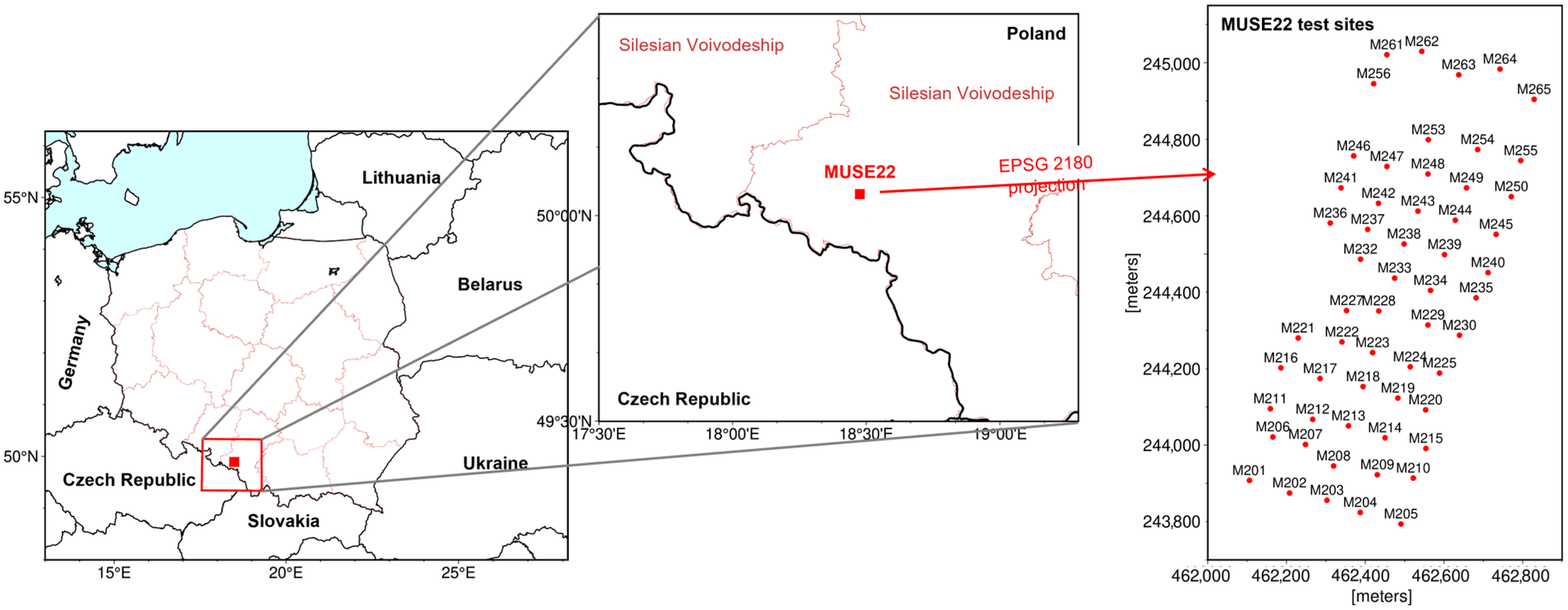
Above the mining panel VIII-E-E1 in coal seam 703/1 of the ROW–Rydułtowy coal mine, 57 control points were established and stabilized in a regular measurement grid of approximately 100 × 100 m. The adopted spacing represents a compromise between spatial resolution, network stability, and practical constraints of GNSS field measurements. This grid density was selected to ensure adequate coverage of mining-induced deformation gradients, including the central part of the subsidence basin, where deformation is expected to evolve smoothly over relatively large spatial scales. In the case of single-longwall extraction at significant depth, such spacing is sufficient to capture both vertical subsidence and associated horizontal displacement patterns without spatial aliasing. The monitoring network was developed as part of the EPOS-PL project, which supports geodetic, geophysical, and geotechnical observations in the Upper Silesian Coal Basin [7]. The spatial distribution of the points is shown in Figure 1 (network called MUSE22).
The control points were stabilized in 2018 using stainless steel rods with a 5/8″ thread, embedded approximately 1.5 m deep in the ground and with a diameter of about 0.30 m. The selected installation depth was determined based on the local ground freezing conditions. To enhance the structural stability and durability, additional stabilizing anchors were installed to secure the rods in their original position. Moreover, the rods were encased in concrete to further improve their long-term durability.
Between 2018 and 2021, a total of 10 GPS measurement campaigns were conducted at control points located within the MUSE22 test sites (Figure 1), where displacement monitoring was crucial for the implementation of the project. Due to the location of the control points and the nature of GNSS measurements, which require an unobstructed sky view, the campaigns were scheduled—when epidemiological conditions allowed—for early spring and late autumn. This timing aimed to minimize the adverse impact of vegetation (trees and shrubs) on GNSS satellite visibility. In addition, the number of measured control points varied between campaigns due to limited accessibility or the occasional loss of individual points in the field. The GNSS observations collected during each measurement campaign were processed to determine the horizontal displacements of the control points. All computations were carried out using the infrastructure of the GNSS Data Research Infrastructure Centre (CIBDG) [39]. In total, six permanent stations from the ASG-EUPOS, HxGN SmartNet Poland, and TPI NETpro networks, as well as the EPOS-PL station RES1 [40], were included to strengthen the geometry of the network and enhance the accuracy and reliability of the estimated coordinates. The processing was referenced to the closest stations of the EUREF Permanent GNSS Network [41], whose data are publicly available.
The GNSS data processing strategy was similar to that employed by MUT AC in their studies [42,43]. GNSS data were processed in the GAMIT software (v. 10.71) using GPS observations. The analysis applied non-redundant double differences with the ionosphere-free linear combination, while pseudorange measurements were used only for receiver clock estimation and the resolution of Melbourne-Wübbena wide-lane ambiguities. Satellite orbits and antenna phase center corrections followed the IGS14 reference model (igs14.atx), with satellite clock parameters estimated during processing. Receiver antenna models were applied using frequency- and direction-dependent absolute phase center corrections, including individual calibrations where available. Tropospheric and ionospheric effects were rigorously modeled (VMF1 mapping functions, ZTD estimation, and higher-order ionospheric terms). Solid Earth, ocean, and pole tide corrections followed the IERS conventions. The resulting coordinates were estimated in the ITRF2014 reference frame, constrained by a set of seven nearby EPN stations. The processed data were converted to the GDF [44] format and made available on the Episodes Platform as part of the MUSE2 episode [45]. Following the processing, the station coordinates were transformed to the ETRF2000 reference frame and subsequently projected into the local plane coordinate system (EPSG 2180).

2.3. Cadastral Data

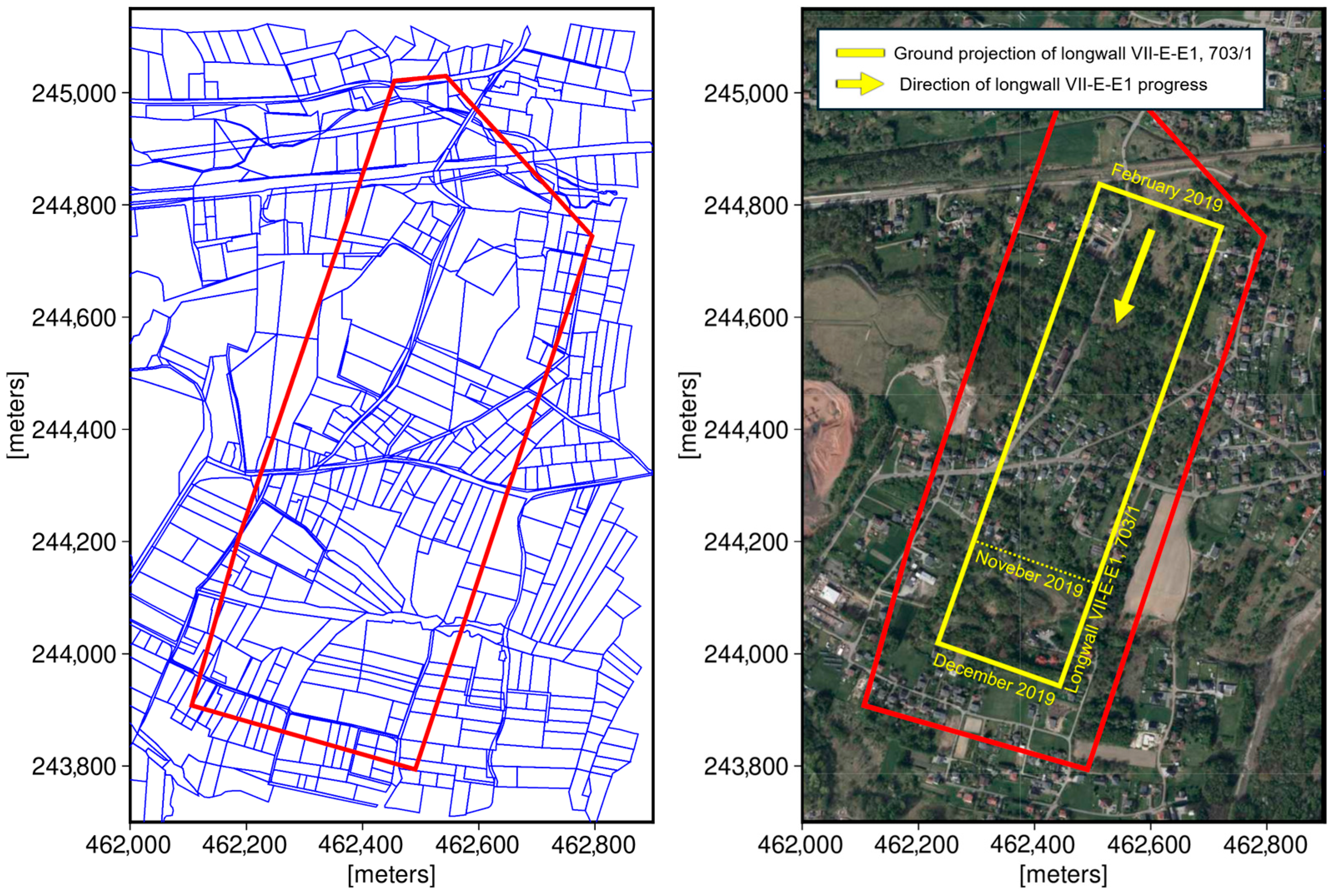
Parcel geometries were retrieved using the official Polish cadastral API ULDK (land parcel location service) provided by the Head Office of Geodesy and Cartography (GUGiK). As described by [46], cadastral web services in Poland are maintained at the county level and aggregated into national portals, which directly affects the accessibility and structure of APIs such as ULDK. Since the service does not allow direct bulk download of all parcels within a given area, a sampling-based approach was applied. A regular grid of query points was generated over the area of interest, and for each point, a request to the ULDK endpoint was issued, returning the identifier of the parcel intersecting that point together with its geometry in Well-Known Text (WKT) format. Duplicate parcel records were removed, and the resulting unique polygon geometries were parsed to extract all boundary vertices. In this way, a complete set of parcel outlines covering the investigated region was obtained (Figure 2).
Across the study area, parcel sizes ranged from less than 6 m2 (part of the road) to nearly 55,000 m2. The average parcel area was slightly below 2000 m2 (1903 m2). In total, 644 parcels were included in the analysis. Some of them represent road infrastructure or railway corridors. Nearly 70% of the parcels fall within the 500–3000 m2 range. A significant number of these parcels are classified as residential land, particularly small ones. This is confirmed by the Polish Land and Building Register (EGiB) resources, which provide information on land designation and buildings [48,49].

3. Results

3.1. Ground Displacement

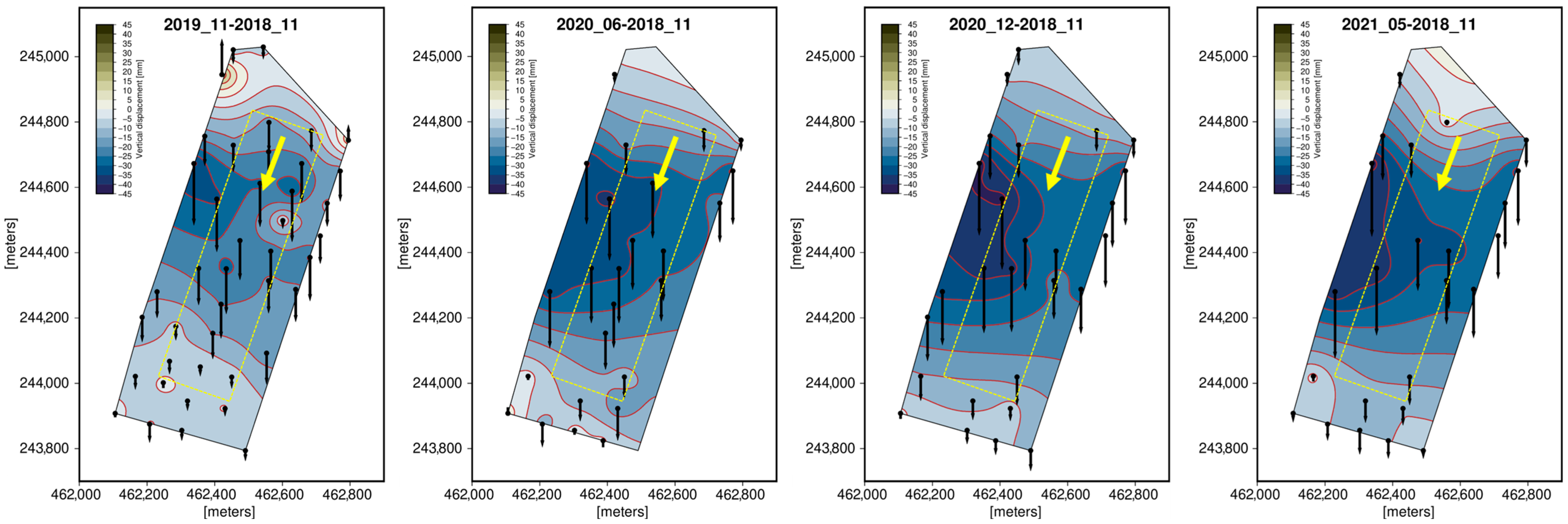
A catalog of displacements was generated based on the derived coordinates, using the earliest measurement epoch at each control point as the reference. Vertical displacements are dominated by subsidence, with values ranging from approximately −43 mm to +2 mm. The largest settlements occur mainly in the central and eastern parts of the network, with near-zero vertical changes observed at only a few points. No significant uplift was detected. The spatial distribution of vertical displacement reveals a well-defined subsidence trough, with deformation gradually decreasing toward the margins of the study area (Figure 3).
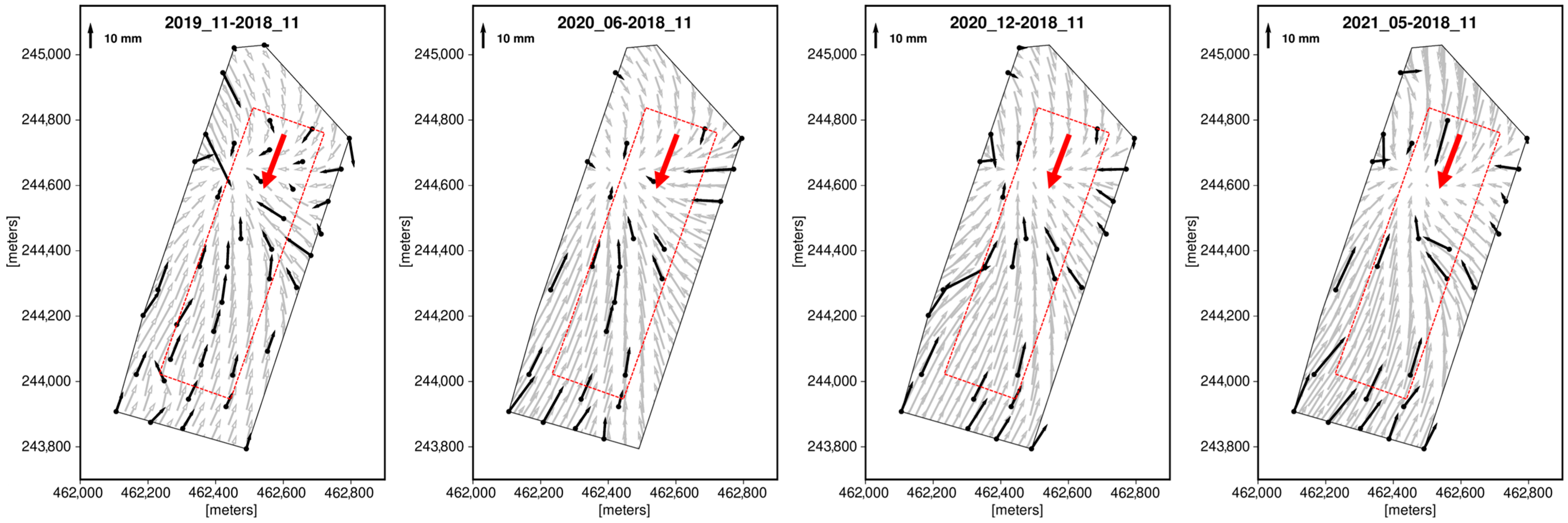
Horizontal displacements are smaller in magnitude but remain clearly detectable, reaching up to approximately 17 mm in the North component and 12 mm in the East component. The spatial distribution of horizontal deformation indicates non-uniform displacement directions across the network (Figure 4). The displacement pattern remains generally consistent between successive measurement epochs, although the largest relative changes are concentrated in the central sector of the study area, particularly along the northern part of the subsidence zone.

3.2. Changes in Parcel Areas

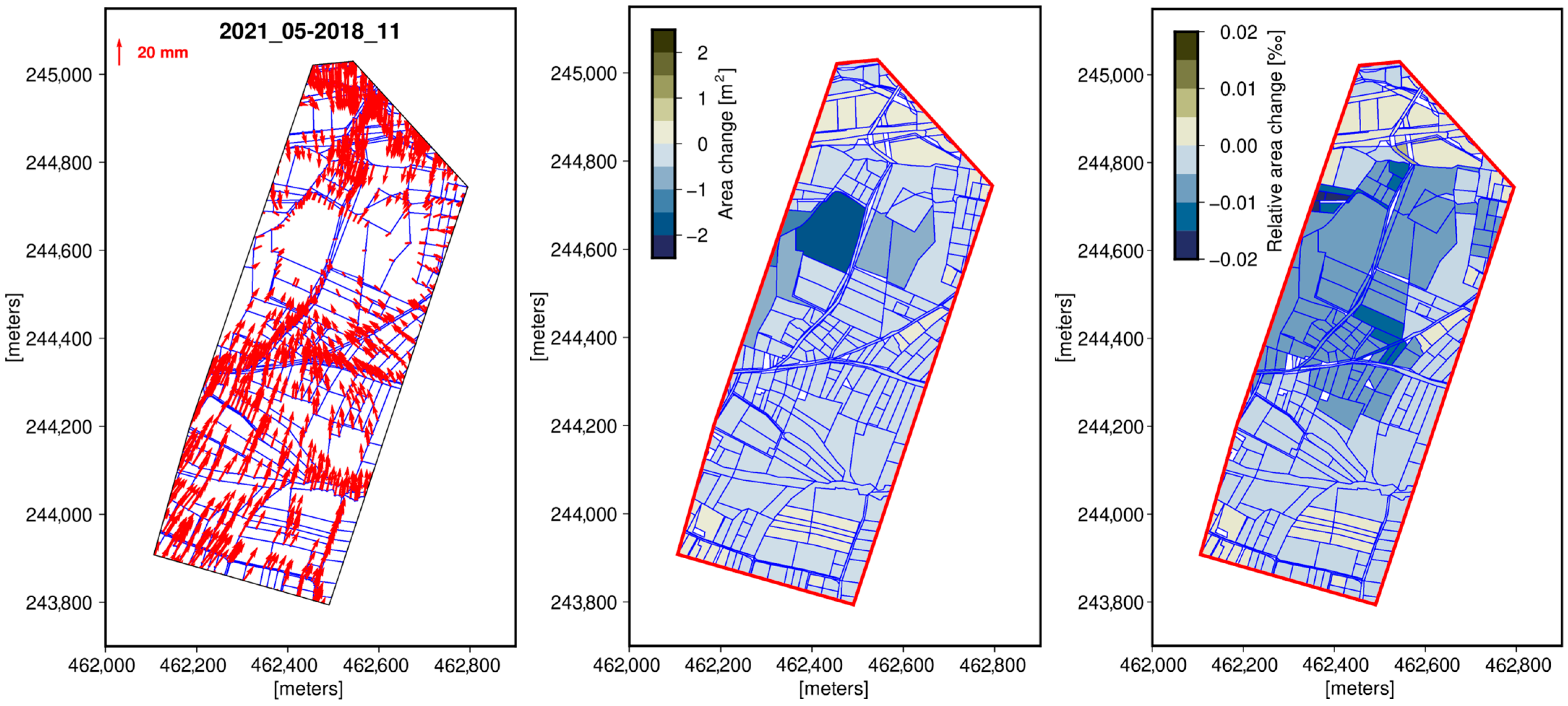
Based on the displacements determined for the GNSS surveying points, the displacement values for all parcel vertices within the study area were spatially interpolated. The analysis of parcel area changes was carried out using the most recent displacement model, representing the period from November 2018 to May 2021 (Table A1). The interpolation was performed using a continuous surface modelling method with a tension parameter of 0.25, ensuring a smooth surface while preserving the local variability of the deformation field [50]. A total of 644 cadastral parcels were analyzed to assess the impact of mining-induced ground deformation on parcel area consistency. Horizontal displacements of vertices varied from 1.0 to 3.5 cm (Figure 5 left). Based on the displacements of the parcel vertices, changes in parcel areas were calculated and expressed in both absolute (Figure 5 middle) and relative terms (Figure 5 right). The calculations were performed in a planar coordinate system (map projection).

4. Discussion

The dominance of vertical subsidence and the spatial concentration of the largest settlements in the central and western parts of the network are consistent with the location of the study area relative to the zone of maximum influence of the mined longwall. The presence of a clearly developed subsidence trough reflects the typical ground response to underground mining activity, with deformation gradually diminishing toward the periphery. Although gravimetric measurements do not directly quantify surface displacements, the GNSS-derived subsidence field shows a strong spatial correspondence with the differential gravity anomalies reported in [6]. This agreement indicates that zones of maximum surface settlement spatially coincide with areas of pronounced stress-related density changes within the overburden, pointing to a coupled deformation–density response to longwall extraction. It should be noted that the analyzed displacements correspond to a post-mining stage approximately two years after the completion of extraction, during which ongoing compaction and stress relaxation may dominate over tensile surface cracking. In this phase, after mining has been completed, horizontal displacements are expected to be significantly smaller than during active mining and will be primarily related to delayed relaxation and gradual redistribution of stresses in the overburden above the mined panel. Maximum deformations usually occur during production and decrease significantly within approximately two years after the end of mining, while subsequent processes have a much weaker impact on both horizontal and vertical surface displacements.
At the same time, it should be emphasized that the strongest relative deformation effects are not necessarily located at the center of the subsidence trough. Instead, the largest displacement gradients and gravity-field variations are observed near the margins of the mining influence zone and, locally, beyond the geometric projection of the longwall. This behavior reflects the mechanical response of the rock mass, in which stress redistribution and horizontal strain are maximized at the transition between subsiding and relatively stable areas rather than directly above the extracted panel.
Such a spatial pattern is consistent with both the GNSS observations and the gravimetric results reported in [4], which demonstrate that stress-related density changes may extend several hundred meters beyond the longwall projection. The observed correspondence indicates that while maximum absolute subsidence occurs above the panel, the most dynamically evolving deformation processes develop along the periphery of the subsidence trough, where cumulative effects of stress concentration, geological heterogeneity, and previous mining activity play a dominant role.
Although horizontal displacements are smaller in magnitude than vertical subsidence, their spatial variability and non-uniform directions indicate differential horizontal strain associated with the subsidence process. The observed lateral movements, particularly in the central and northern parts of the study area, suggest the coexistence of horizontal stretching and compression around the margins of the subsidence basin. The persistence of similar displacement patterns across consecutive measurement epochs implies a relatively stable deformation regime, while localized increases in relative displacement highlight zones of enhanced deformation dynamics concentrated along the subsidence boundary.
The observed spatial variability of vertical and horizontal deformation should be interpreted in the context of key geological and mining-related controlling factors. The mechanical properties and heterogeneity of the overburden, including variations in lithology, stiffness, stratification, and the presence of faults or weakened zones, may locally amplify or attenuate subsidence and horizontal strain, leading to non-uniform deformation patterns [1,2]. The magnitude and spatial extent of surface deformation are also influenced by mining geometry and exploitation strategy. Sequential extraction of multiple longwalls may produce cumulative and overlapping deformation effects, resulting in larger deviations in spatial coordinates [2,3]. In contrast, the single-longwall case analyzed in this study naturally limits the observed displacement magnitudes and represents an early stage of mining-induced surface transformation. Mining depth and extraction parameters further control subsidence characteristics. Greater depths generally result in broader and smoother subsidence troughs, whereas shallower mining tends to produce steeper deformation gradients and stronger spatial variability [1,5]. Additionally, coal seam thickness influences the scale of stress redistribution, with thicker seams typically inducing larger vertical and horizontal deformation components [1,3]. Although these factors were not analyzed quantitatively, they provide an important interpretative framework for the deformation patterns observed in the study area.
From a cadastral perspective, the observed deformation patterns translate into minor but spatially non-uniform changes in parcel geometry. While absolute changes in parcel area remain small, the analysis of relative area changes, which are less dependent on parcel size, provides additional insight into the spatial distribution of deformation effects. The largest relative area changes, although still very small in magnitude, are concentrated near the boundaries of the subsidence trough and locally beyond the zone of maximum vertical settlement. This spatial pattern closely follows the distribution of displacement gradients and horizontal strain identified in the GNSS analysis.
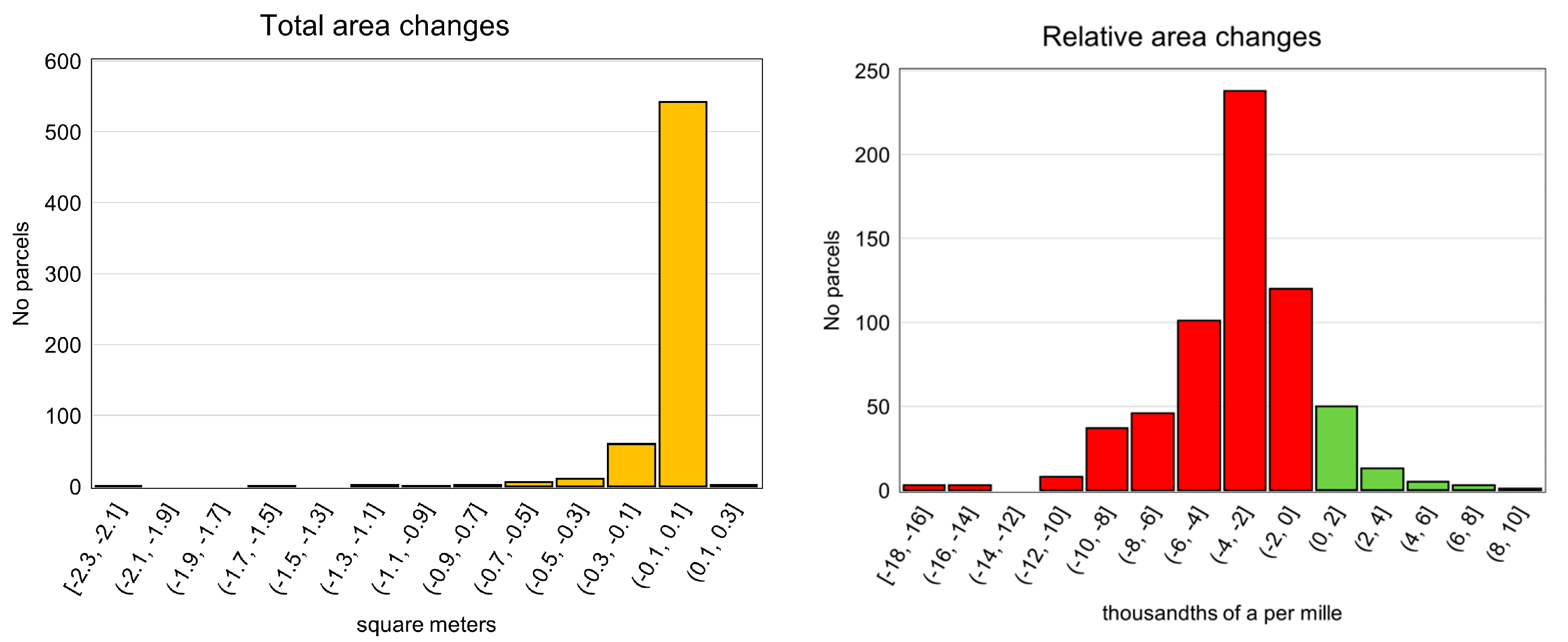
The calculated parcel area changes ranged from +0.17 m2 to −2.31 m2, affecting a total of 72 parcels, with an average change of only 0.02 m2. The cumulative reduction in parcel area across the entire study site amounted to 43 m2. The tendency for both absolute and relative area changes to occur predominantly near the periphery of the mining influence zone reflects the natural outward redistribution of deformation, consistent with deformation propagation mechanisms described in classical mining subsidence models (e.g., Knothe–Budryk-type behavior [37]). The total parcel area reduction of 43 m2 observed in this study is small when compared with deformation effects reported for areas subjected to long-term or multi-longwall exploitation in the Upper Silesian Coal Basin. Previous studies indicate that cumulative subsidence and horizontal strain associated with sequential mining panels may lead to substantially larger and spatially more extensive surface deformation, including pronounced parcel geometry changes over longer time scales (e.g., [8,9,32]). In this context, the magnitude of area changes identified here is consistent with deformation patterns characteristic of a single-longwall extraction scenario and represents a localized response rather than a regional deformation trend.
The largest absolute area reduction was observed for parcel No. 153/29, designated as industrial land, which experienced a decrease of 2.3 m2 (Table 1). This parcel lies just outside the region directly covered by geodetic control points, suggesting that extrapolation of the deformation field may have contributed to the estimated magnitude of the change. Similar effects were identified for parcels located at or beyond the monitored extent. In contrast, among parcels fully covered by measurements, the largest change was recorded for parcel 3618/35, whose area decreased by 1.6 m2.
Importantly, all parcels exhibiting area changes greater than 1 m2 are non-residential properties, predominantly classified as industrial land, wooded and scrubland, or grassland (Table 1). Only one residential parcel showed an area change exceeding 0.5 m2; however, given its large total area, the relative change remains negligible. This observation highlights that, at the current stage of mining activity, the practical impact of deformation on residential cadastral units remains limited, while larger parcels with extensive land-use categories are more sensitive to detectable geometric changes.
Relative changes in parcel area, which are less correlated with the absolute parcel size, show a stronger correspondence with the observed ground deformation patterns (Figure 6). The largest relative changes, although still very small (approximately −0.017‰), were recorded for parcels 183/22 (residential), 184/22 (partially residential), and 231/22 (arable land). For a representative parcel with an area of 1000 m2, this corresponds to a change of about 0.16 m2, meaning it should be considered negligible from a practical perspective.

5. Conclusions

  • Underground coal extraction along longwall VIII-E-E1 in seam 703/1 resulted in a well-developed subsidence trough, with the strongest deformation occurring directly above the exploited panel and gradually diminishing with distance.
  • The horizontal displacement field complements vertical subsidence, indicating ongoing stabilization of the rock mass and redistribution of strain toward peripheral zones where mining influence decreases.
  • The integration of GNSS-derived deformation data with cadastral information enables a reliable assessment of mining-induced surface changes and their impact on the accuracy and currency of cadastral records.
  • Although the analysis is limited to a single longwall panel at one mining site, the results indicate that relative parcel area changes remain negligible at the present stage and do not require updates of parcel boundaries in the Land and Building Register.
  • Based on the present results, cadastral updates would become necessary only under cumulative deformation scenarios involving multiple sequential longwalls, where displacement magnitudes exceed practical cadastral accuracy thresholds.
  • Current geological and mining conditions highlight the broader relevance of systematic deformation monitoring in Poland. According to the Polish Geological Institute—National Research Institute [51], more than 20 hard-coal mines remain active, and mining-affected areas extend far beyond the Upper Silesian Coal Basin.
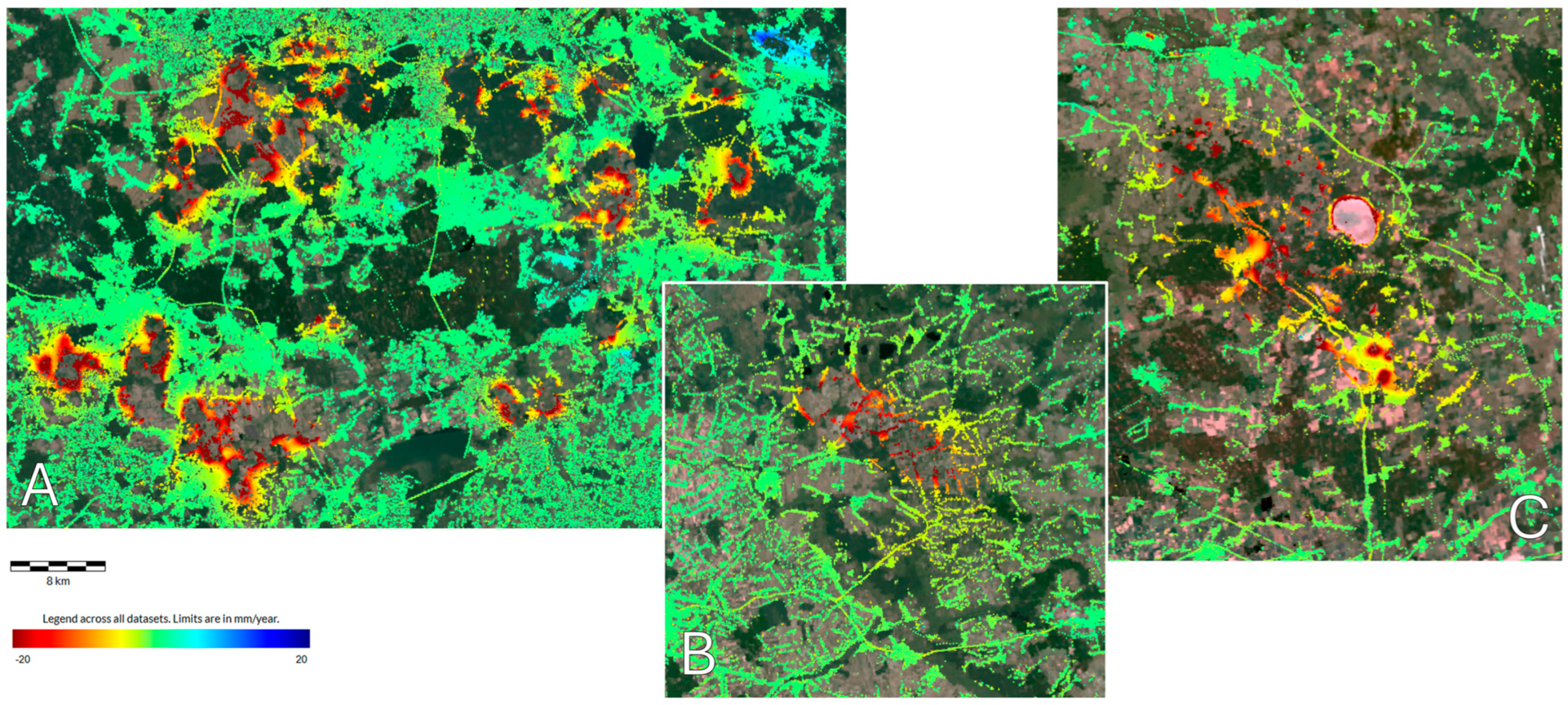
  • Data from the European Ground Motion Service (EGMS) confirm that subsidence affects numerous regions nationwide (Figure 7), emphasizing the necessity of long-term monitoring to preserve cadastral integrity under ongoing anthropogenic pressure.

Author Contributions

Conceptualization, A.A. and K.K.; methodology, A.A. and K.K.; software, K.K.; validation, A.A.; formal analysis, K.K.; investigation, K.K. an A.A.; resources, A.A.; data curation, K.K.; writing—original draft preparation, K.K.; writing—review and editing, A.A.; visualization, A.A.; supervision, A.A. All authors have read and agreed to the published version of the manuscript.

Funding

This research was funded by Military University of Technology in Warsaw, Faculty of Civil Engineering and Geodesy, Institute of Geospatial Engineering and Geodesy statutory research funds UGB/22-785/2025/WAT.

Institutional Review Board Statement

Not applicable.

Informed Consent Statement

Not applicable.

Data Availability Statement

The observation data are available through the GNSS Data Research Infrastructure Center (http://www.gnss.wat.edu.pl/data/campaing/muse, accessed on 17 May 2025). Cadastral data used in this study are available through the GUGiK service and can be accessed via the National Register of Boundaries (ULDK) portal: https://uldk.gugik.gov.pl/?lang=en (accessed on 13 October 2025). The coordinates obtained during the GNSS surveying campaigns are available on the Episodes platform under the KWK ROW Rydultowy episode: https://episodesplatform.eu/?lang=pl#episode:KWK_ROW_Rydultowy (accessed on 30 October 2025). Other data and results are available upon request.

Acknowledgments

The GNSS analyses were performed on the IT infrastructure of the GNSS Data Research Infrastructure Centre, expanded with EU funds under the EPOS-PL project (POIR.04.02.00-14-A0003/16). Figures and maps were drawn using Generic Mapping Tools 6.2 [50]. The language editing of this manuscript was assisted by the Bielik v3.0 [53]. The authors are fully responsible for the content and any remaining errors.

Conflicts of Interest

The authors declare no conflicts of interest.

Appendix A

Table A1. Horizontal displacements of the points between November 2018 and May 2021.
Point IDMeasured
Displacement [mm]
Interpolated
Displacement [mm]
Residuals [mm]
NorthEastNorthEastNorthEast
M20112.0 ± 2.84.6 ± 1.515.06.53.01.9
M20312.0 ± 3.37.7 ± 2.011.58.4−0.50.7
M2049.0 ± 1.65.6 ± 4.310.43.81.4−1.8
M2059.7 ± 1.96.3 ± 3.310.35.20.6−1.1
M20614.9 ± 1.66.8 ± 1.214.812.3−0.15.5
M20811.0 ± 1.25.6 ± 1.313.86.52.80.9
M2098.6 ± 3.24.2 ± 2.98.46.3−0.22.1
M21413.1 ± 1.13.1 ± 1.014.94.51.81.4
M2410.8 ± 1.96.8 ± 1.60.67.0−0.20.2
M21613.2 ± 2.48.7 ± 1.415.09.21.80.5
M2219.5 ± 4.718.7 ± 3.617.17.97.6−10.8
M22710.2 ± 7.95.0 ± 5.412.94.82.7−0.2
M22811.4 ± 1.91.8 ± 1.811.10.1−0.3−1.7
M22910.0 ± 2.1−3.1 ± 1.710.7−8.30.7−5.2
M2308.3 ± 1.6−5.9 ± 1.310.9−5.12.60.8
M2338.8 ± 1.7−1.0 ± 1.19.1−1.30.3−0.3
M2348.9 ± 4.5−4.9 ± 2.65.0−10.3−3.9−5.4
M2375.8 ± 3.70.9 ± 1.73.62.7−2.21.8
M2404.8 ± 3.0−3.6 ± 2.45.0−3.60.20.0
M2454.9 ± 1.7−6.9 ± 1.33.5−2.1−1.44.8
M246−13.4 ± 2.91.9 ± 2.6−13.30.30.1−1.6
M247−7.3 ± 1.7−0.9 ± 1.2−4.5−2.22.8−1.3
M250−0.3 ± 1.8−11.8 ± 2.01.4−9.61.72.2
M254−6.2 ± 0.7−0.5 ± 0.6−9.2−3.1−3.0−2.6
M255−4.4 ± 2.1−0.4 ± 1.5−2.10.32.30.7
M256−2.3 ± 1.24.1 ± 0.90.58.52.84.4
M2610.0 ± 1.93.3 ± 1.4−16.82.0−16.8−1.3
RMSE4.0 mm3.3 mm
MAE2.4 mm2.3 mm

References

  1. Peng, S.S. Coal Mine Ground Control; Wiley: Hoboken, NJ, USA, 2008. [Google Scholar]
  2. Kratzsch, H. Mining Subsidence Engineering; Springer: Berlin/Heidelberg, Germany, 1983. [Google Scholar]
  3. Liu, P.; Li, H.; Wang, L.; Yin, S. Impacts of Surface Deformation Induced by Underground Mining of Metal Mines on Above-Ground Structures: A Case Study. Minerals 2023, 13, 1510. [Google Scholar] [CrossRef]
  4. Cieślik, K.; Milczarek, W.; Warchala, E.; Kosydor, P.; Rożek, R. Identifying Factors Influencing Surface Deformations from Underground Mining Using SAR Data, Machine Learning, and the SHAP Method. Remote Sens. 2024, 16, 2428. [Google Scholar] [CrossRef]
  5. Bo, H.; Li, Y.; Tan, X.; Dong, Z.; Zheng, G.; Wang, Q.; Yu, K. Estimation of Ground Subsidence Deformation Induced by Un-derground Coal Mining with GNSS-IR. Remote Sens. 2023, 15, 96. [Google Scholar] [CrossRef]
  6. Kortas, Ł. Gravity Field Changes During Deep Exploitation of the Coal Longwall and Their Relation to Stress Distribution and Seismic Activity. J. Sustain. Min. 2021, 20, 228–239. [Google Scholar] [CrossRef]
  7. Mutke, G.; Kotyrba, A.; Lurka, A.; Olszewska, D.; Dykowski, P.; Borkowski, A.; Araszkiewicz, A.; Barański, A. Upper Silesian Geophysical Observation System—A Unit of the EPOS Project. J. Sustain. Min. 2019, 18, 198–207. [Google Scholar] [CrossRef]
  8. Marcak, H.; Mutke, G. Seismic activation of tectonic stresses by mining. J. Seismol. 2013, 17, 1139–1148. [Google Scholar] [CrossRef]
  9. Dubiński, J.; Stec, K.; Bukowska, M. Geomechanical and tectonophysical conditions of mining-induced seismicity in the Upper Silesian Coal Basin in Poland: A case study. Arch. Min. Sci. 2019, 64, 163–180. [Google Scholar] [CrossRef]
  10. Stec, K. Characteristics of seismic activity in the Upper Silesian Coal Basin in Poland. Geophys. J. Int. 2015, 200, 1185–1197. [Google Scholar] [CrossRef]
  11. Mutke, G.; Stec, K. Seismicity in the Upper Silesian Coal Basin, Poland: Strong regional seismic events. In Rockbursts and Seismicity in Mines; Gibowicz, S.J., Lasocki, S., Eds.; A.A. Balkema: Rotterdam, The Netherlands, 1997. [Google Scholar]
  12. Fajklewicz, Z. Applied Gravimetry; AGH University of Science and Technology Press: Cracow, Poland, 2007. [Google Scholar]
  13. Meng, X.; Roberts, G.W.; Dodson, A.H.; Ince, S.; Waugh, S. GNSS for Structural Deformation and Deflection Monitoring: Implementation and Data Analysis. In Proceedings of the 3rd IAG/12th FIG Symposium, Baden, Austria, 22–24 May 2006. [Google Scholar]
  14. Caldera, S.; Barindelli, S.; Sansò, F.; Pardi, L. Monitoring of Structures and Infrastructures by Low-Cost GNSS Receivers. Appl. Sci. 2022, 12, 12468. [Google Scholar] [CrossRef]
  15. Nguyen, H.V.; Pham, K.C.; Nguyen, D.B.; Nguyen, L.Q. Application of the GNSS Method in the Monitoring of Mine Surface Displacement: A Systemic Review. Inżynieria Miner. 2024, 2, 247–255. [Google Scholar] [CrossRef]
  16. Tondaś, D.; Ilieva, M.; van Leijen, F.; van der Marel, H.; Rohm, W. Kalman Filter-Based Integration of GNSS and InSAR Observations for Local Non-linear Strong Deformations. J. Geod. 2023, 97, 109. [Google Scholar] [CrossRef]
  17. Strzałkowski, P. Duration of the Final Phase of Mining-Area Deformation Process in the Conditions of Upper Silesia (Poland). J. Sustain. Min. 2021, 80, 5769–5780. [Google Scholar] [CrossRef]
  18. Przyłucka, D.; Kowalski, Z.; Perski, Z. Long-Term Subsidence over the Upper Silesia Coal Basin Identified on Differential LIDAR (2012–2021) and InSAR (2015–2020) Data. Geol. Q. 2024, 68, 17. [Google Scholar] [CrossRef]
  19. Pawłuszek-Filipiak, K.; Wielgocka, M.; Rudziński, Ł. The Detectability of Post-Seismic Ground Displacement Using DInSAR and SBAS in Longwall Coal Mining: A Case Study in the Upper Silesian Coal Basin, Poland. Remote Sens. 2024, 16, 2533. [Google Scholar] [CrossRef]
  20. Kwinta, A. The Impact of Mining Exploitation on Parcel Geometry. Infrastruct. Ecol. Rural Areas 2012, 2, 187–197. [Google Scholar]
  21. Mika, M.; Siejka, M.; Stręk, Ż.; Hudecová, Ľ. General Problems of the Cadastre System—Case Study in Poland. Acta Sci. Pol. Adm. Locorum 2024, 23, 281–302. [Google Scholar] [CrossRef]
  22. Cienciała, A.; Sajnóg, N.; Sobolewska-Mikulska, K. Unreliability of Cadastral Data on Parcel Area and Its Effect on Sustainable Real Estate Valuation. Rep. Geod. Geoinf. 2023, 116, 39–46. [Google Scholar] [CrossRef]
  23. Karabin, M. Survey Maps for Design Purposes in Poland—Technical and Legal Aspects with Particular Emphasis on the Role of Cadastral Parcel Boundaries. Rep. Geod. Geoinf. 2025, 120, 14–24. [Google Scholar] [CrossRef]
  24. European Commission, Joint Research Centre (JRC). LPIS Core Concept and Development; Publications Office of the European Union: Luxembourg, 2017. [Google Scholar]
  25. Kocur-Bera, M. Coherence of Cadastral Data in Land Management: A Case Study from Central Poland. Land 2021, 10, 399. [Google Scholar] [CrossRef]
  26. Benduch, P. The Assessment of the Influence of Cadastral Parcel Boundary Points Location Errors on the Accuracy of Analytical Determination of Their Surface Area. Geomat. Environ. Eng. 2016, 10, 17–31. [Google Scholar] [CrossRef]
  27. Zwirowicz-Rutkowska, A.; Michalik, A. The Use of Spatial Data Infrastructure in Environmental Management: An Ex-ample from the Spatial Planning Practice in Poland. Environ. Manag. 2016, 58, 619–635. [Google Scholar] [CrossRef]
  28. Izdebski, W.; Zwirowicz-Rutkowska, A.; Nowak Da Costa, J.K. Open Data in Spatial Data Infrastructure: The Practices and Experiences of Poland. Int. J. Digit. Earth 2021, 14, 1547–1560. [Google Scholar] [CrossRef]
  29. Whittles, D.N.; Lowndes, I.S.; Kingman, S.W.; Yates, C.; Jobling, S. Influence of geotechnical factors on gas flow experienced in a UK longwall coal mine panel. Int. J. Rock. Mech. Min. Sci. 2006, 43, 369–387. [Google Scholar] [CrossRef]
  30. Buttafuoco, G.; Tallarico, A.; Falcone, G. Mapping Soil Gas Radon Concentration: A Comparative Study of Geostatistical Methods. Environ. Monit. Assess. 2007, 131, 135–151. [Google Scholar] [CrossRef]
  31. Nunes, L.J.R.; Curado, A.; Lopes, S.I. The Relationship between Radon and Geology: Sources, Transport and Indoor Accumulation. Appl. Sci. 2023, 13, 7460. [Google Scholar] [CrossRef]
  32. Karacan, C.Ö.; Goodman, G.V.R. Reconciling longwall gob gas reservoirs and venthole performance for methane drainage. Int. J. Coal Geol. 2009, 80, 181–195. [Google Scholar] [CrossRef]
  33. Younger, P.L. Abandoned coal mines: From environmental liabilities to low-carbon energy assets. Int. J. Coal Geol. 2016, 164, 1–2. [Google Scholar] [CrossRef]
  34. Main Mining Institute—National Research Institute. Geodynamic and Hydrogeological Hazards in Mining and Post-Mining Areas in the Upper Silesian Coal Basin: Quarterly Report No. 02/2024; Task 1.3—Monitoring of Terrain Deformation in Mining and Post-Mining Areas; GIG-PIB: Katowice, Poland, 2024. (In Polish) [Google Scholar]
  35. Strzałkowski, P.; Szafulera, K. Occurrence of Linear Discontinuous Deformations in Upper Silesia (Poland) in Conditions of Intensive Mining Extraction—Case Study. Energies 2020, 13, 1897. [Google Scholar] [CrossRef]
  36. Sopata, P.; Stoch, T.; Wójcik, A.; Mrocheń, D. Land Surface Subsidence Due to Mining-Induced Tremors in the Upper Silesian Coal Basin (Poland)—Case Study. Remote Sens. 2020, 12, 3923. [Google Scholar] [CrossRef]
  37. Apanowicz, B.; Kowalski, A.; Gruchlik, P.; Polanin, P. Examples of the Knothe–Budryk Theory Parameter Determination Under Complex Geological and Mining Conditions. Min. Sci. 2022, 29, 19–32. [Google Scholar] [CrossRef]
  38. Siwek, S. Study of the Relationship of Tidal Changes in Gravity with the Time of Mining Tremors in the Area of the Mining Longwall in a Coal Mine—Case Study in USCB, Poland. J. Sustain. Min. 2021, 20, 241–250. [Google Scholar] [CrossRef]
  39. Araszkiewicz, A.; Calka, B.; Kiliszek, D.; Kozma, M.; Mierzwiak, M.; Moscicka, A.; Nowak Da Costa, J.; Pokonieczny, K.; Szolucha, M.; Wabinski, J.; et al. Geoportal of the GNSS Data Research Infrastructure Center. Ann. Geomat. 2022, 20, 7–16. (In Polish) [Google Scholar]
  40. Tondaś, D.; Kazmierski, K.; Kapłon, J. Real-Time and Near Real-Time Displacement Monitoring with GNSS Observations in the Mining Activity Areas. IEEE J. Sel. Top. Appl. Earth Obs. Remote Sens. 2023, 16, 5963–5972. [Google Scholar] [CrossRef]
  41. Bruyninx, C.; Legrand, J.; Fabian, A.; Pottiaux, E. GNSS Metadata and Data Validation in the EUREF Permanent Network. GPS Solut. 2019, 23, 106. [Google Scholar] [CrossRef]
  42. Araszkiewicz, A.; Kiliszek, D.; Mierzwiak, M.; Nowak Da Costa, J.; Szołucha, M. GPS-Based Multi-Temporal Variation in Precipitable Water over the Territory of Poland. Remote Sens. 2021, 13, 2960. [Google Scholar] [CrossRef]
  43. Araszkiewicz, A. Integration of Distributed Dense Polish GNSS Data for Monitoring the Low Deformation Rates of Earth’s Crust. Remote Sens. 2023, 15, 1504. [Google Scholar] [CrossRef]
  44. Leptokaropoulos, K.; Cielesta, S.; Staszek, M.; Olszewska, D.; Lizurek, G.; Kocot, J.; Lasocki, S.; Orlecka-Sikora, B.; Sterzel, M.; Szepieniec, T. IS-EPOS: A Platform for Anthropogenic Seismicity Research. Acta Geophys. 2019, 67, 299–310. [Google Scholar] [CrossRef]
  45. EPOS PL. Episode: MUSE2 KWK ROW–Rydułtowy; EPOS PL: Warszawa, Poland, 2022. [Google Scholar] [CrossRef]
  46. Izdebski, W. Analysis of Major Problems of Integrating County WMS Services Related to the Cadastre Data in Poland. Ann. Geomat. 2018, 16, 319–331. [Google Scholar]
  47. GUGiK. National Geoportal [Orthophotomap]; Head Office of Geodesy and Cartography: Warsaw, Poland, 2024. Available online: https://mapy.geoportal.gov.pl/imap/Imgp_2.html (accessed on 2 December 2025).
  48. Maślanka, J. Entering Parcel Boundaries into the Polish Register of Land and Buildings—An Analysis of the Current State and Proposed Changes. Geomat. Environ. Eng. 2020, 14, 63–87. [Google Scholar] [CrossRef]
  49. Bydłosz, J.; Bieda, A. The Application of the Land Administration Domain Model in Building a Country Profile for the Polish Cadastre. Land Use Policy 2015, 49, 598–605. [Google Scholar] [CrossRef]
  50. Wessel, P.; Luis, J.F.; Uieda, L.; Scharroo, R.; Wobbe, F.; Smith, W.H.F.; Tian, D. The Generic Mapping Tools version 6. Geochem. Geophys. Geosystems 2019, 20, 5556–5564. [Google Scholar] [CrossRef]
  51. Polish Geological Institute—National Research Institute. Hard Coal. 2024. Available online: https://www.pgi.gov.pl/en/mineral-resources/energy-raw-materials/13952-hard-coal.html (accessed on 2 December 2025).
  52. European Ground Motion Service. EGMS Basic Dataset. Copernicus Land Monitoring Service. 2025. Available online: https://egms.land.copernicus.eu/ (accessed on 2 December 2025).
  53. Ociepa, K.; Flis, Ł.; Wróbel, K.; Gwoździej, A.; Kinas, R. Bielik 7B v0.1: A Polish Language Model—Development, Insights and Evaluation. arXiv 2024. [Google Scholar] [CrossRef]
Figure 1. Geodetic control points established in the USCB for assessing mining-induced surface displacement.
Applsci 16 01281 g001
Figure 2. (Left): Cadastral parcels retrieved from ULDK, with the red outline marking the monitored area. (Right): Orthophoto [47] of the study site together with the projection of the longwall panel.
Applsci 16 01281 g002
Figure 3. Vertical displacements observed at the MUSE22 test site during and after mining operations in panel VIII-E-E1, referenced to the second survey campaign (November 2018). The four subplots correspond to successive measurement campaigns. Colored surfaces show vertical displacement values interpolated on a regular grid and clipped to the area covered by GNSS observations. Maps are presented in the local projection (EPSG:2180). Ground projection of the longwall and the direction of longwall advance, shown in yellow.
Applsci 16 01281 g003
Figure 4. Horizontal displacements observed at the MUSE22 test site during and after mining operations in panel VIII-E-E1, referenced to the second survey campaign (November 2018). The four subplots correspond to successive measurement campaigns, showing the evolution of horizontal point movements. Black vectors indicate the measured displacements, whereas grey vectors represent values interpolated on a regular grid and clipped to the area covered by GNSS observations. Maps are presented in the local projection (EPSG:2180). Ground projection of the longwall and the direction of longwall advance, shown in red.
Applsci 16 01281 g004
Figure 5. Changes in cadastral parcel areas above mining panel VIII-E-E1/703 caused by mining-induced ground deformation. (Left): displacement of parcel boundary vertices. (Middle): absolute area change (in m2). (Right): relative area change (in ‰).
Applsci 16 01281 g005
Figure 6. (Left): Histogram of total cadastral parcel area changes (in m2). (Right): Histogram of relative parcel area changes expressed as a thousandths of a permille of the original parcel area: positive change in green, negative change in red.
Applsci 16 01281 g006
Figure 7. Subsidence areas associated with mining activities visible on the European Ground Motion Service [52]. (A): Upper Silesian Coal Basin, (B): Bogdanka Coal Mine Area, (C): Legnica–Głogów Copper Mining District.
Applsci 16 01281 g007
Table 1. Parcels with the largest changes in area.
Parcel IDAreaArea ChangeLand
Classification *
AbsoluteRelative
247301_1.0065.AR_6.153/2953,551.0 m2−2.3 m2−0.004‰Ba
247301_1.0063.AR_1.3618/3517,918.0 m2−1.6 m2−0.009‰Lz, Ps
247301_1.0065.AR_9.234/2214,013.1 m2−1.2 m2−0.009‰Lz
247301_1.0065.AR_6.231/927,398.4 m2−1.2 m2−0.004‰Ba
247301_1.0065.AR_6.165/2924,400.2 m2−1.1 m2−0.004‰Ba
247301_1.0065.AR_6.1515,093.3 m2−0.9 m2−0.006‰Ba
247301_1.0063.AR_1.3343/2711,629.6 m2−0.8 m2−0.007‰Ls, R
247301_1.0063.AR_1.1910/2810,631.9 m2−0.7 m2−0.006‰Ls, R, B
247301_1.0065.AR_6.1012,849.2 m2−0.7 m2−0.005‰Ba
247301_1.0065.AR_4.2116,442.5 m2−0.6 m2−0.004‰Tk
* Lz—wooded and scrubland, Ls—forest land, Ba—industrial areas, B—residential areas, R—arable land, Ps—grassland used for grazing, Tk—communication infrastructure land.
Disclaimer/Publisher’s Note: The statements, opinions and data contained in all publications are solely those of the individual author(s) and contributor(s) and not of MDPI and/or the editor(s). MDPI and/or the editor(s) disclaim responsibility for any injury to people or property resulting from any ideas, methods, instructions or products referred to in the content.