Article

Effects of Graded Crude Protein Levels Under Fixed Amino Acid Supplementation on Growth Metabolism, Slaughter Quality, Nitrogen Emission, and Breeding Efficiency of Small White-Feather Broilers

1
Poultry Institute, Shandong Academy of Agricultural Sciences, Jinan 250100, China
2
Shandong Provincial Key Laboratory of Livestock and Poultry Breeding, Jinan 250100, China
3
Shandong Animal Products Quality and Safety Center, Jinan 250100, China
*
Author to whom correspondence should be addressed.
Appl. Sci. 2026, 16(3), 1282; https://doi.org/10.3390/app16031282
Submission received: 24 December 2025 / Revised: 16 January 2026 / Accepted: 21 January 2026 / Published: 27 January 2026
(This article belongs to the Special Issue Animal Nutrition: Latest Advances and Prospects)

Featured Application

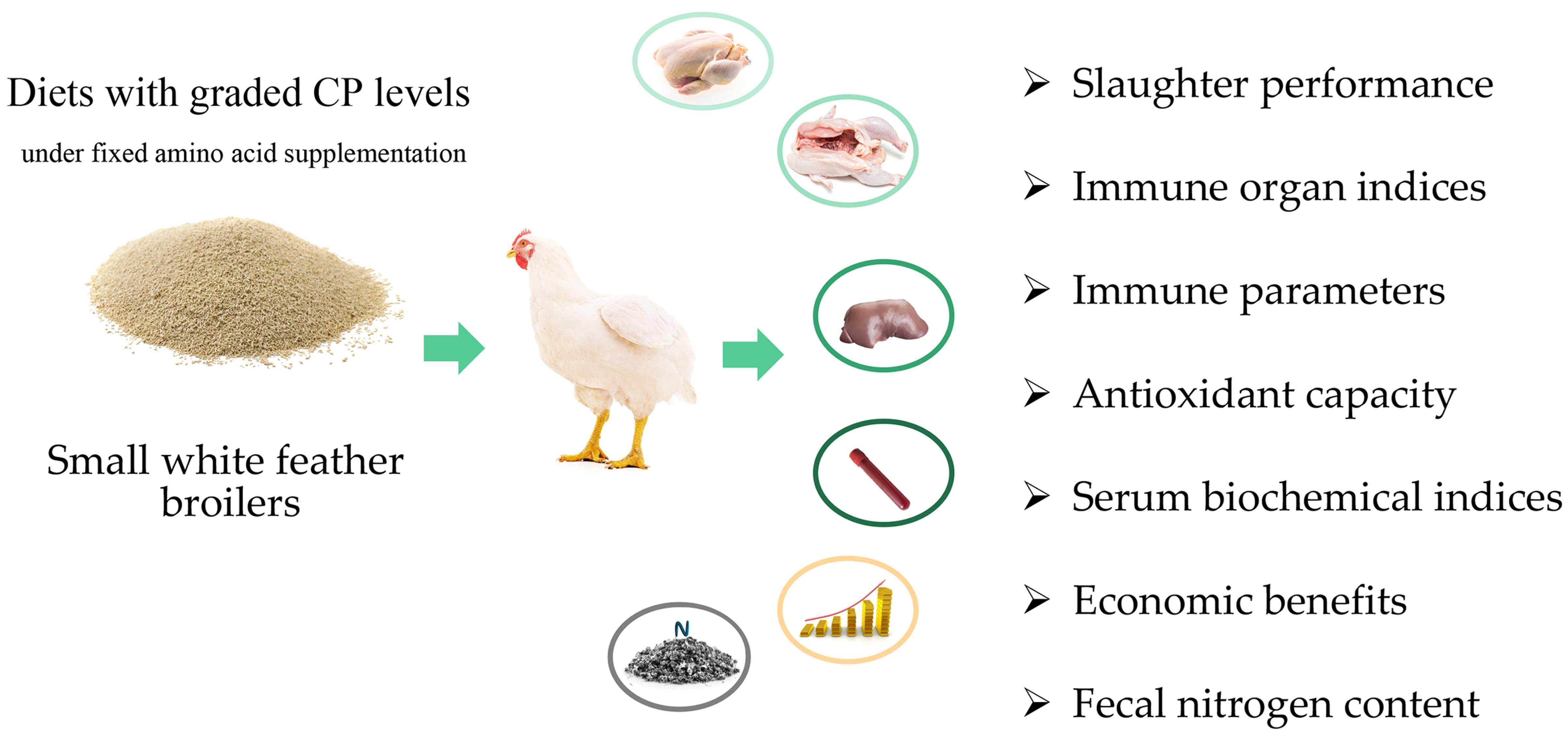
Small white-feather broilers—a distinctive hybrid breed developed in China through integrating genetic advantages from paternal standard broiler lines and maternal high-yielding laying hens—deliver significant economic benefits. Currently, most operations raising these birds utilize feeds formulated for standard white-feathered broilers, where excessive energy–protein levels compromise economic returns while contributing to unnecessary fecal nitrogen emissions. In this study, we aimed to evaluate protein reduction feasibility under controlled amino acid conditions. This study provides theoretical support for the dynamic nutritional requirements of small white-feather broilers on low-protein diets.

Abstract

The suboptimal efficacy of a low-protein diet in small white-feather broilers is due to a lack of alignment with their specific nutritional requirements. To investigate these precise requirements and to promote the application of low-protein diets in these birds’ feeding, we evaluated the effects of graded crude protein (CP) levels under fixed amino acid supplementation in small white-feather broilers. A two-phase feeding trial (1–21 and 22–42 days) was conducted using 480 chicks that were 1 day old, and the experimental diets contained varying CP levels (Phase 1: 18, 19, 20, 21%; Phase 2: 16, 17, 18, 19%) while maintaining constant levels of limiting amino acids. Key findings revealed that Group 3 (Phase 1: 20% CP; Phase 2: 18% CP) exhibited superior early growth performance during days 1–21, with fecal nitrogen excretion reduced by 11% relative to that in Group 4. Additionally, carcass characteristics, serum biochemical parameters, and serum antioxidant capacity were compared across all groups. These findings offer initial insights into the effects of low-protein diets on small white-feather broilers and lay the groundwork for future amino acid optimization studies.

1. Introduction

As a characteristic hybrid breed cultivated independently in China, small white-feather broilers are a unique open breeding mode formed through the integration of genetic advantages of paternal fast–large broilers (e.g., AA and Ross 308) and maternal high-yield laying hens, resulting in significant economic benefits. Data show that the cost and market price of commercial chickens are 61.8 and 68.5% lower than those of large white-feather broilers (38.2 vs. 100%) and 45.5 and 55.1% lower than those of yellow-feather broilers (54.5 vs. 100%). At the same time, small white-feather broilers can be used to accurately adapt to consumption demands for chilled chickens, fast-food chains, and traditional whole chickens [1]. In 2022, the number of slaughtered chickens reached 2.04 billion, accounting for 17.2% of the total output of broilers in China [2]. However, the unique genetic background of small white-feather broilers leads to significant differences in the nutritional metabolism characteristics of conventional varieties. The existing nutrition standards for small white-feather broilers show systematic deviations: metabolic energy requirements, CP utilization, and limiting amino acid thresholds are inconsistent with traditional models, which seriously restricts production potential [3].
The global livestock and poultry industry faces dual challenges of protein scarcity and environmental pressure. In this context, adopting low-protein diet modification has emerged as a key pathway for the transformation of animal husbandry [4,5,6]. This refers to reducing the protein content of feed by 2–4% and adding an appropriate amount of synthetic amino acids so as to ensure the basic amino acid requirements required by livestock and poultry. This modification allows the basic growth and development needs of animals to be met, without changing production performance, while improving their feed-to-gain ratio, reducing the emission of amino acids and nitrogen, and reducing environmental pollution [7]. Studies have shown that every 1% reduction in dietary CP can reduce soybean meal and nitrogen emissions by 2% and 8–10%, respectively. This modification has achieved a significant 23% increase in nitrogen utilization in fast-growing broilers [8,9].
Although low-protein diet modification has achieved notable success in other poultry breeds, its application in small white-feathered broilers has not yielded significant results due to a lack of data on their dynamic nutritional requirements. Therefore, it is crucial to analyze the specific metabolic characteristics of their growth stage and construct a dynamic nutrition model. In this study, we systematically evaluated the effects of different protein levels (18–21%) on the growth performance, slaughter performance, blood biochemical indices, and economic benefits of small white-feather broilers under fixed amino acid supplementation. This study provides theoretical support for meeting the dynamic nutritional requirements of small white-feather broilers on low-protein diets.

2. Materials and Methods

2.1. Experimental Design

A total of 480 one-day-old Ross 308 × Hailan brown small white-feather broilers (Shandong Xianghui Animal Breeding Co., Ltd., Rizhao, Shandong, China)were used in this study. They were randomly assigned to 4 groups, with 6 replicates per group and 20 broilers per replicate (half male and half female). From 1 to 42 days of age, all birds were fed a corn-soybean meal diet. The experiment was conducted at the Poultry Science Laboratory of the Poultry Institute, Shandong Academy of Agricultural Sciences. The formulation of the basal diet was based on the “Feeding Standard of Chicken” (NY/T33-2004 [10]), adhering to its recommended nutrient requirements for broilers. The contents of digestible lysine, methionine + cystine, and threonine in the four groups were the same. The CP levels of the four groups from 1 to 21 days of age were 18, 19, 20, and 21%, respectively, and those from 21 to 42 days of age were 16, 17, 18, and 19%, respectively. The experimental diet formulas and nutritional levels are shown in Table 1.

2.2. Animal Management

The experimental henhouse was fully closed with two layers of cages. The temperature, humidity, and ventilation of the henhouse were semi-automatically controlled by mechanization. The light intensity was 15 Lux from days 1 to 14 and 10 Lux after 14 days of age. The chickens were allowed to drink freely through the water line. The experimental diet consisted of powder and artificial feeding 4 times a day before 7 days of age and then 3 times a day. The feces were cleaned once a day before 7 days of age and then twice a day thereafter.

2.3. Sample Collection and Chemical Analysis

The body weight and feed consumption of 12 h fasting chickens were measured every week, and the average body weight and feed consumption per week were calculated. We performed statistical analyses of body weight at 21 and 42 days of age, daily weight gain, feed intake, and the feed-to-gain ratio for the 1–21- and 22–42-day periods, respectively. To evaluate the cumulative effects of long-term feeding programs, subsequent samples were collected on the last day of the experiment (day 42) to measure indicators reflecting blood biochemistry, slaughter characteristics, and fecal nitrogen excretion.
At 42 days of age, 2 small white-feather broilers with medium body size and similar body weight were selected for slaughter in each replicate group; 12 broilers were selected for each of the 4 treatments, totaling 48 birds. After 12 h of fasting, the chickens were weighed, the carotid artery was bled, the feathers were removed, and the beak shell was weighed. The chickens were then dissected following routine procedures, with the weights of the semi-eviscerated carcass, eviscerated carcass, abdominal fat, liver, spleen, and bursa of Fabricius recorded for statistical analysis of slaughter indicators.
Two broilers close to the average body weight were selected from each replicate at 42 days of age. Blood samples were collected from the jugular vein to obtain a volume of 10 mL. After the blood samples were allowed to stand, the serum was centrifuged at 3500 r/min for 15 min and stored at −20 °C for later use. The Cobas C311 (Yaojie Laboratory Equipment Co., Ltd., Jinan, China) automatic biochemical analyzer was used to determine the activity of serum total protein, albumin, glucose, urea nitrogen, total cholesterol, triglyceride, immunoglobulin A, immunoglobulin G, immunoglobulin M, glutathione peroxidase, superoxide dismutase, total antioxidant capacity, and malondialdehyde.
At 42 days of age, approximately 400 g of fresh chicken manure was collected from the fecal belt below the chicken flock in a repeated unit, and the mixed feathers were removed, dried, crushed, and loaded into a sample bag for use. The nitrogen content in the dry chicken manure was detected (GB/T 6432-2018 [11]).
To evaluate the economic returns under early marketing scenarios, a retrospective simulation of profitability was conducted based on growth performance data from days 1 to 35 and 42.
Gross profit (CNY/bird) = sales price (CNY/bird) − feed cost (CNY/bird);
Sales price (CNY/bird) = the weight of bird (kg/bird) × the price of bird (CNY/kg);
Feed cost (CNY/bird) = the sum of the feed cost per bird in the three experimental stages.
Because the costs of labor, water, electricity, and vaccines in each treatment group are the same, these costs are not included in the gross profit calculation.

2.4. Calculations and Statistical Analysis

The GLM program of SAS 9.1.3 was used to analyze the experimental data. The findings were analyzed using one-way ANOVA, which assumes homogeneity of variances, and differences between groups were assessed via Tukey’s HSD multiple-comparison test. The overall standard error (SEM) was calculated from the mean square error in the ANOVA model, where MSE is the mean square error and n is the number of replicates per group. Because the model estimates are based on the pooled error variance, a unified overall SEM is reported to represent measurement error across groups.

3. Results

3.1. Effects of Growth Performance

Body weight gain (BWG): The BWG at 1–21 days of age was significantly affected by dietary protein levels (p < 0.05); that of Group 3 was significantly higher than that of Group 1 and Group 2 (p < 0.05) and higher than that of Group 4, albeit not significantly (p > 0.05). Group 1’s BWG at 22–42 days of age was significantly lower than that of other groups, and the difference between the other groups was not significant (Table 2).
Feed intake (FI): There was no significant difference in feed consumption between days 1–21 and 22–42. Group 3 had the highest FI (704 g) from days 1 to 21 and 21 to 24, albeit not significantly so (p > 0.05). Group 4 had the lowest FI (652 g) between days 1 and 21; however, from days 21 to 24, the first group had the lowest (1700 g).
Feed-to-gain ratio (F/G): The F/G of each group decreased as the dietary protein level increased. Group 4’s was significantly lower than the others (p < 0.05), and those of Groups 2 and 3 were significantly lower than that of Group 1 (p < 0.05).
Feed protein consumed per unit of weight gain (FPW): From 1 to 21 days of age, the FPW of Group 4 was significantly higher than that of Groups 1 and 2 (p < 0.05); from 22 to 42 days of age, the FPW of each group increased significantly with the increase in dietary protein level (p < 0.05).

3.2. Effects of Slaughter Performance and Serum Index

The rates of slaughter, semi-evisceration, evisceration, and abdominal fat did not differ among the groups. The liver index decreased with increasing dietary protein levels, and Group 4’s was the lowest, which was significantly lower than that of Groups 1 and 2 (p < 0.05). There were no significant differences in the spleen and bursa indices among the groups (Table 3).
Serum biochemical indices: Group 1’s was the lowest, significantly lower than those of Groups 3 and 4 (p < 0.05) and lower than that of Group 2, albeit not significantly (p > 0.05).
Serum antioxidant capacity index: There were no significant differences in serum glutathione peroxidase, superoxide dismutase, total antioxidant capacity, malondialdehyde, IgM, IgA, and IgG among the groups (Table 4).

3.3. Analysis of Economic Benefits and Fecal Nitrogen Content

In this study, broilers were selected to determine their economic benefits. Table 5 shows that the gross profit of the different experimental groups increased with the increase in dietary protein level. Group 1’s was the lowest, significantly lower than that of Groups 3 and 4 (p < 0.05) and lower than that of Group 3, albeit not significantly (p < 0.05).
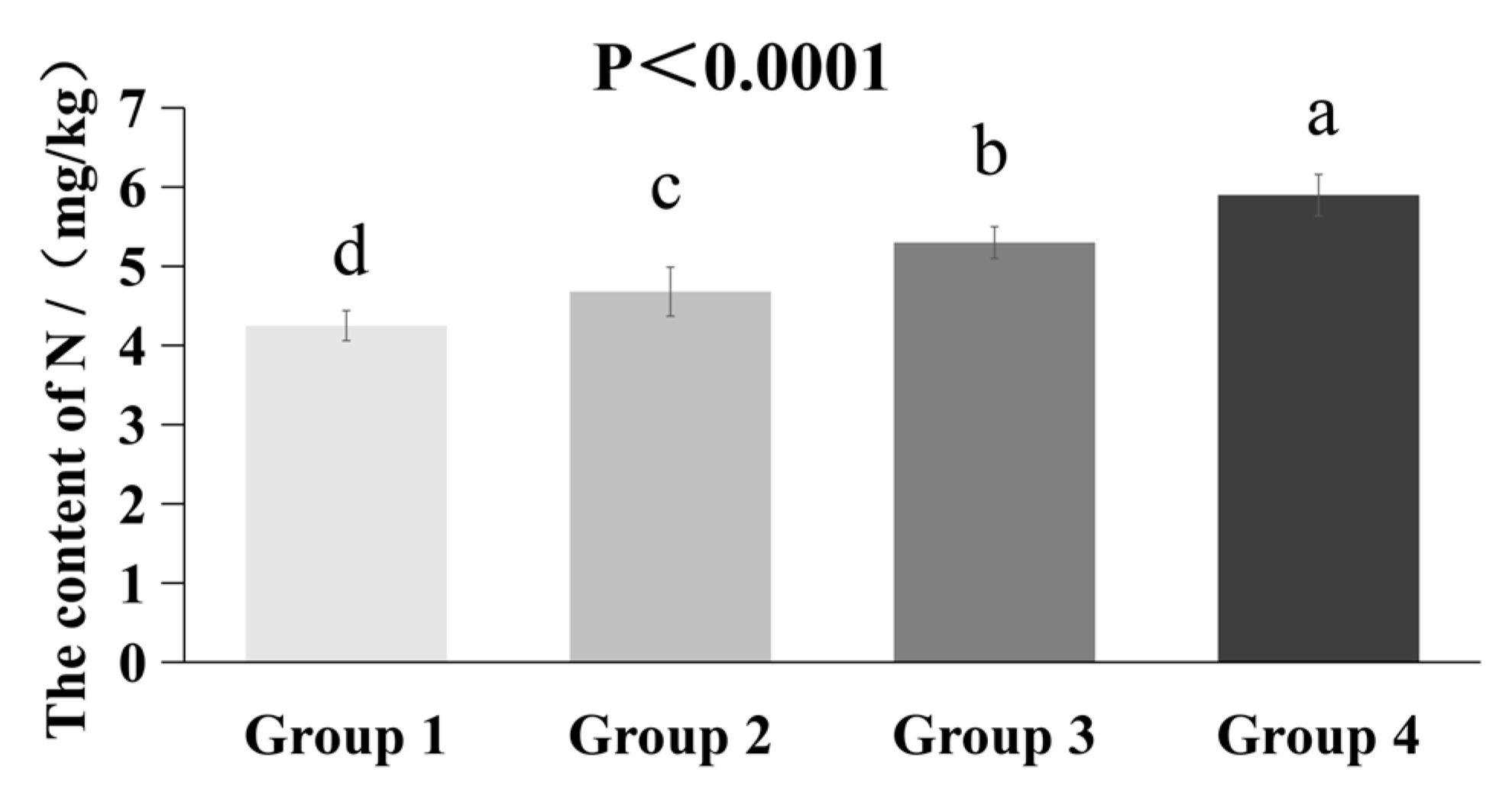
The fecal nitrogen content of the different experimental groups increased with increasing dietary protein content. Group 1’s was the lowest, which was significantly lower than that of the other three groups (Figure 1).

4. Discussion

Low-protein diets can optimize amino acid balance, reduce protein waste, and reduce nitrogen emissions by accurately supplementing synthetic amino acids (e.g., lysine and methionine) [14]. Many studies have shown that proper reduction in dietary protein levels with amino acid balance has no adverse effect on the weight gain of broilers [5,15]. In this study, the exploration of precise nutrition in small white-feather broilers showed a similar trend throughout the entire feeding period; although there was a 1-percentage-point difference in dietary CP levels between Group 3 and Group 4, no significant difference (p > 0.05) was observed in growth performance between the two groups. It is noteworthy that during the 21–42-day period, no significant difference in growth performance was observed for Group 2 either, despite a 2-percentage-point difference in its dietary CP levels compared to those of Group 4. Group 2 gradually adapted to the nutritional level of the diet with the increase in age, and the gap between its body weight gain and that of Group 3 and Group 4 was reduced. This shows that the effect of dietary protein level on production performance was significantly stage-dependent.
The F/G is a critical metric for evaluating livestock production efficiency, directly reflecting an animal’s capacity to convert feed into body mass. When reducing dietary crude protein, it is essential to adjust the amino acid balance to counteract its potential adverse impacts [16,17]. However, in this experiment, the F/G still decreased with increasing dietary protein levels, particularly during the 22~42-day growth phase. This indicates that the optimal amino acid balance in low-protein diets for small white-feathered broilers was not precisely achieved in our study. Two primary reasons may account for this: (1) only the first three limiting amino acids (lysine, methionine + cysteine, and threonine) were maintained at constant levels across all treatment groups, while other potentially limiting amino acids were not adjusted [18,19,20]; (2) the precise nutritional requirements of these broilers require further clarification. Nevertheless, these findings provide a foundational basis for future research on amino acid optimization.
Analyses of serum biochemical indices, immune parameters, and antioxidant activity in small white-feather broilers revealed no significant effects of low-protein diets supplemented with the target amino acids. This indicates that such amino acid modulation did not compromise growth performance or health status under the current experimental conditions.
The balance between slaughter performance and metabolic health is a key indicator for evaluating the feasibility of low-protein diets [21]. In this study, there was no significant difference in the slaughter and evisceration rates among all groups, and the abdominal fat rate did not increase due to changes in protein levels, indicating that low-protein diets did not damage meat production performance or cause excessive fat deposition while reducing nitrogen emissions, which was consistent with many previous research results [18,19,22].
Notably, in this study, the bursa of Fabricius and spleen indices of the chickens differed from those typically reported for fast-growing commercial broilers [23]. Specifically, a relatively lower bursa index and a higher spleen index were observed. This pattern likely reflects inherent physiological differences between the two breeds in terms of baseline immune organ development. Furthermore, the birds remained healthy and medication-free throughout the trial, a condition which may be associated with the observed lower bursa index. This finding aligns with the report by Cazaban [24], which suggested a potential link between rapid growth rates in modern broiler production and a relative reduction in bursal weight.
Nitrogen in chicken excreta contributes to eutrophication, nitrous oxide production, and global warming [6,15,25]. Therefore, reducing nitrogen excretion is essential for sustainable poultry production; in litter, it can be decreased by approximately 10% by lowering CP in the diet by 1% [8]. Reduced nitrogen levels decrease ammonia in poultry houses and improve poultry foot pads [26,27]. Our study clearly shows that a low-CP diet can reduce N excretion in a dose-dependent manner. The promotion of a low-protein diet should consider the balance between economic and environmental benefits. This study demonstrated that, although the high-protein group (Group 4) had the highest annual profit, its fecal nitrogen content was significantly higher than that of the other groups, which may aggravate environmental pollution in the long run. The third group (medium protein level) achieved a reduction in fecal nitrogen emissions (8–10% lower than those of the fourth group) and feed cost savings (approximately 2% reduction in soybean meal dosage) with no significant difference in body weight gain and feed–weight ratio compared to the high-protein group, showing higher comprehensive application potential.
The most critical limitation was the failure to determine the precise amino acid supplementation ratio and protein threshold levels for small white-feather broilers. This prevented the assessment of key hepatic metabolic factor expression under optimized nutritional supply and complicated the interpretation of planned microbiome analysis, significantly increasing its uncertainty. A follow-up study is planned to develop a dynamic nutritional requirement model for small white-feather broilers and, building on existing research on methionine–lysine balance, to systematically determine the requirements of potential limiting amino acids (histidine, phenylalanine + tyrosine).

5. Conclusions

This study was conducted against the backdrop of insufficient understanding of the nutritional requirements of small white-feather broilers. Examining the feasibility of reducing protein levels under controlled amino acid conditions provides a basis for future amino acid optimization research. Although a complete parameter system for achieving amino acid balance has not yet been established, the findings underscore the need to further quantify specific amino acid requirements in low-protein diets. Future work should focus on determining precise amino acid ratios and threshold levels that can simultaneously enhance production performance and ecological benefits.

Author Contributions

Conceptualization, H.Z. and K.Z.; methodology, P.Y.; software, C.F.; investigation, X.L. (Xia Li) and X.L. (Xuelan Liu); data curation, T.S.; writing—original draft preparation, H.Z.; writing—review and editing, Q.G. and Y.S.; project administration, Y.D.; funding acquisition, T.S. All authors have read and agreed to the published version of the manuscript.

Funding

This research was funded by The Shandong Poultry Industry Technology System Project, funded by The Key Research and Development Plan of Shandong Province, Department of Science & Technology of Shandong Province, grant number SDAIT-11-06 and 2024TZXD029; and Shandong Academy of Agricultural Sciences Agricultural Science and Technology Innovation Project, grant numbers CXGC2025F10 and CXGC2025B03.

Institutional Review Board Statement

The experimental procedures were approved by the Institutional Animal Care and Use Committee of Shandong Academy of Agricultural Sciences (SAAS-2025-054), approved on 25 February 2025.

Informed Consent Statement

Not applicable.

Data Availability Statement

The original contributions presented in this study are included in the article material. Further inquiries can be directed to the corresponding author.

Conflicts of Interest

The authors declare no conflicts of interest.

Abbreviations

The following abbreviations are used in this manuscript:
CPCrude protein
MEMetabolizable energy
F/GFeed-to-gain ratio
CNYChinese Yuan
BWGBody weight gain
FIFeed intake
FPWFeed protein consumed per unit of weight gain

References

  1. Zhou, Z.; Cai, D.; Zhang, Z.; Cai, B.; Yang, X.; Kong, S.; Wu, R.; Lin, D.; Yuan, R.; Mo, Y.; et al. Metabolomic lipidomic and transcriptomic reveal meat quality differences among hybrid, indigenous and commercial broiler. LWT 2024, 209, 116765. [Google Scholar] [CrossRef]
  2. Kong, S.; Cai, X.; Cai, B.; Xian, Y.; Zhou, Z.; Cai, D.; Yang, X.; Lin, D.; Nie, Q. Genomic and transcriptomic analyses unveil the genetic basis of green shank trait in small white-feather chickens. Poult. Sci. 2025, 104, 104912. [Google Scholar] [CrossRef] [PubMed]
  3. Li, J.; Zhou, Z.; Zhang, Z.; Zheng, X.; Sun, Y.; Guo, S.; Li, Y.; Yang, X.; Kong, S.; Cai, D.; et al. Indigenous broilers in crossbreeding: Impacts on meat quality and candidate gene screening. Poult. Sci. 2025, 104, 105245. [Google Scholar] [CrossRef] [PubMed]
  4. Adhikari, R.; Rochell, S.J.; Kriseldi, R.; Silva, M.; Greiner, L.; Williams, C.; Matton, B.; Anderson, A.; Erf, G.F.; Park, E.; et al. Recent advances in protein and amino acid nutritional dynamics in relation to performance, health, welfare, and cost of production. Poult. Sci. 2025, 104, 104852. [Google Scholar] [CrossRef]
  5. Salem, S.M.; Nguyen, L.; Mohamed, T.I.; Orma, O.A.; Davis, D.A. Efficacy of crystalline amino acids supplementation in reduction of intact protein level in channel catfish Ictalurus punctatus diets. Anim. Feed. Sci. Technol. 2022, 292, 115428. [Google Scholar] [CrossRef]
  6. Song, M.Q.; Yu, Q.R.; Li, E.C.; Song, Y.; Cai, X.Y.; Huang, Y.X.; Qin, C.J.; Wang, X.D.; Qin, J.G.; Chen, L.Q. Leucine improves dietary protein use efficiency by regulating protein synthesis by activating amino acid transporters and the mTORC1 pathways in Chinese mitten crab (Eriocheir sinensis). Aquaculture 2024, 581, 740423. [Google Scholar] [CrossRef]
  7. Zhang, W.; Sun, S.; Zhang, Y.; Zhang, Y.; Wang, J.; Liu, Z.; Yang, K. Benzoic acid supplementation improves the growth performance, nutrient digestibility and nitrogen metabolism of weaned lambs. Front. Vet. Sci. 2024, 11, 1351394. [Google Scholar] [CrossRef]
  8. De Rauglaudre, T.; Méda, B.; Fontaine, S.; Lambert, W.; Fournel, S.; Létourneau-Montminy, M.-P. Meta-analysis of the effect of low-protein diets on the growth performance, nitrogen excretion, and fat deposition in broilers. Front. Anim. Sci. 2023, 4, 1214076. [Google Scholar] [CrossRef]
  9. Dunmire, K.M.; Lee, J.; Haydon, K.; Stark, C.R.; Paulk, C.B. Influence of dietary fat and crystalline amino acid inclusion on broiler diet formulation and subsequent pellet quality. J. Appl. Poult. Res. 2024, 33, 100386. [Google Scholar] [CrossRef]
  10. NY/T33-2004; Feeding Standard of Chicken. The National Standards of the People’s Republic of China: Beijing, China, 2004.
  11. GB/T 6432-2018; Determination of Crude Protein in Feeds—Kjeldahl Method. The National Standards of the People’s Republic of China: Beijing, China, 2018.
  12. GB/T 6436-201; Determination of Calcium in Feeds. The National Standards of the People’s Republic of China: Beijing, China, 2018.
  13. GB/T 18246-2019; Determination of Amino Acids in Feeds. The National Standards of the People’s Republic of China: Beijing, China, 2019.
  14. Liu, H.; Xu, K.; Wang, H.; Lin, H.; Yang, X.; Wang, X.; Zhao, J.; Ma, B.; Shu, Q.; Lu, Y.; et al. Effects of different forms of amino acid supplementation on the performance and intestinal barrier function of laying hens fed a low-protein diet. Poult. Sci. 2024, 103, 104375. [Google Scholar] [CrossRef]
  15. Zhao, Y.; Tian, G.; Chen, D.; Zheng, P.; Yu, J.; He, J.; Mao, X.; Huang, Z.; Luo, Y.; Luo, J.; et al. Dietary protein levels and amino acid supplementation patterns alter the composition and functions of colonic microbiota in pigs. Anim. Nutr. 2020, 6, 143–151. [Google Scholar] [CrossRef] [PubMed]
  16. He, L.; Cai, Y.; Tang, X.; Li, X.; Cao, S.; Xu, L.; Xiao, Y.; Li, D.; Zhong, G.; Zeng, P.; et al. Changes in growth performance, gene expressions related to protein absorption and hepatic metabolism of triploid crucian carp (Carassius carassius triploid) caused by dietary protein level. Aquacult. Rep. 2024, 35, 102023. [Google Scholar] [CrossRef]
  17. Hofmann, P.; Siegert, W.; Naranjo, V.D.; Rodehutscord, M. Effects of supplemented nonessential amino acids and nonprotein nitrogen on growth and nitrogen excretion characteristics of broiler chickens fed diets with very low crude protein concentrations. Poult. Sci. 2020, 99, 6848–6858. [Google Scholar] [CrossRef] [PubMed]
  18. Herring, C.M.; Bazer, F.W.; Wu, G. Amino acid nutrition for optimum growth, development, reproduction, and health of zoo animals. In Amino Acids in Nutrition and Health; Advances in experimental medicine and biology; Wu, G., Ed.; Springer: Cham, Switzerland, 2021; Volume 1285, pp. 233–253. ISBN 978-3-030-54461-4. [Google Scholar]
  19. Zhu, X.; Jiao, J.; Zhou, C.; Tang, S.; Wang, M.; Kang, J.; Han, X.; Tan, Z. Effects of dietary methionine and lysine supplementation on nutrients digestion, serum parameters and mRNA expression of related amino acid sensing and transporting genes in growing goats. Small Rumin. Res. 2018, 166, 1–6. [Google Scholar] [CrossRef]
  20. Wang, X.; Qiao, S.Y.; Liu, M.; Ma, Y.X. Effects of graded levels of true ileal digestible threonine on performance, serum parameters and immune function of 10–25 kg pigs. Anim. Feed. Sci. Technol. 2006, 129, 264–278. [Google Scholar] [CrossRef]
  21. Rakhshandeh, A.; De Lange, C.F.M.; Htoo, J.K.; Gheisari, A.; Rakhshandeh, A.R. Immune system stimulation increases the plasma cysteine flux and whole-body glutathione synthesis rate in starter pigs1. J. Anim. Sci. 2019, 97, 3871–3881. [Google Scholar] [CrossRef]
  22. Macelline, S.P.; Kidd, M.T.; Chrystal, P.V.; Toghyani, M.; Selle, P.H.; Liu, S.Y. The influence of non-bound amino acid inclusions and starch-protein digestive dynamics on growth performance of broiler chickens offered wheat-based diets with two crude protein concentrations. Anim. Nutr. 2023, 15, 399–408. [Google Scholar] [CrossRef]
  23. Bean-Hodgins, L.; Mohammadigheisar, M.; Edwards, A.M.; Kiarie, E.G. Comparative impact of conventional and alternative gut health management programs on plasma and tibia attributes in broiler chickens raised in commercial and research settings. Can. J. Anim. Sci. 2024, 104, 466–476. [Google Scholar] [CrossRef]
  24. Cazaban, C.; Masferrer, N.M.; Pascual, R.D.; Espadamala, M.N.; Costa, T.; Gardin, Y. Proposed bursa of fabricius weight to body weight ratio standard in commercial broilers. Poul Sci. 2015, 94, 2088. [Google Scholar] [CrossRef]
  25. Alvarenga, L.; Kemp, J.A.; Baptista, B.G.; Ribeiro, M.; Lima, L.S.; Mafra, D. Production of toxins by the gut microbiota: The role of dietary protein. Curr. Nutr. Rep. 2024, 13, 340–350. [Google Scholar] [CrossRef]
  26. Khodadadi, M.; Masoumi, A.; Sadeghi, M. Drying, a practical technology for reduction of poultry litter (environmental) pollution: Methods and their effects on important parameters. Poult. Sci. 2024, 103, 104277. [Google Scholar] [CrossRef]
  27. Liu, M.; Geng, S.; Wang, Q.; Mi, J.; Zhao, L.; Zhang, J.; Ji, C.; Wang, H.; Ma, Q.; Huang, S. Using low-protein diet in egg production for win-win of productivity and environmental benefits should be prudent: Evidence from pilot test. Sci. Total Environ. 2024, 912, 169148. [Google Scholar] [CrossRef]
Figure 1. The fecal nitrogen content of small white-feather broilers. Different superscript letters within a row denote statistically significant differences (p < 0.05).
Applsci 16 01282 g001
Table 1. Ingredients and nutrient composition of diets for small white-feather broilers from 1 to 42 days of age.
ItemsD 1~21D 21~42
Group 1
(CP 18%)
Group 2
(CP 19%)
Group 3
(CP 20%)
Group 4
(CP 21%)
Group 1
(CP 16%)
Group 2
(CP 17%)
Group 3
(CP 18%)
Group 4
(CP 19%)
Corn70.5666.9463.3459.7276.7373.1669.6966.02
Soybean meal (46%) 21.7624.9028.0331.1613.7016.8019.8023.00
Wheat bran1.501.501.501.501.501.501.501.50
Corn gluten meal (58%) 2.002.002.002.004.004.004.004.00
Stone powder1.761.791.811.841.631.651.681.70
Calcium hydrogen phosphate0.650.600.540.490.510.460.400.35
Soybean oil 0.420.921.431.940.601.101.602.10
Salt 0.350.350.350.350.330.330.330.33
Premix 11.001.001.001.001.001.001.001.00
Lys0.210.140.080.020.280.220.160.10
Met0.250.230.210.180.200.180.160.14
Thr0.140.110.070.040.170.130.100.06
Total (%)100.00100.00100.00100.00100.00100.00100.00100.00
Nutrient composition 2
Metabolizable energy ME/(MJ/kg)12.3412.3412.3412.3412.7612.7612.7612.76
Crude protein, CP18.0019.0020.0021.0016.0017.0018.0019.00
Dig. Lys0.980.980.980.980.900.900.900.90
Dig. Met0.520.510.500.490.460.450.440.43
Dig. Met + Cys0.760.760.760.760.680.680.680.68
Dig. Thr0.680.680.680.680.640.640.640.64
Calcium, Ca1.001.001.001.000.900.900.900.90
Total phosphorus, TP0.450.450.450.450.400.400.400.40
Note: (1) Abbreviations: CP: crude protein; Lys: lysine; Met: methionine; Thr: threonine. (2) 1 Provided per kilogram of diet: vitamin A, 10,000 IU; vitamin D3, 2400 IU; vitamin E, 20 IU; vitamin K3, 2.0 mg; vitamin B1, 1.6 mg; vitamin B2, 6.4 mg; vitamin B6, 2.4 mg; vitamin B12, 0.02 mg; nicotinic acid, 30 mg; pantothenic acid, 9.2 mg; folic acid, 1.0 mg; biotin, 0.1 mg, Cu (as copper sulfate), 8 mg; Fe (as ferrous sulfate), 100 mg; Mn (as manganese sulfate), 120 mg; Zn (as zinc sulfate), 100 mg; Se (as sodium selenite), 0.30 mg; phytase, 5000 FTU. 2 ME and TP were calculated values based on the Tables of Feed Composition and Nutritive Values in China (31st Edition, 2020); CP, Ca, Lys, Met, Cys, and Thr were measured based on GB/T 6432-2018 [11], GB/T 6436-2018 [12], and GB/T 18246-2019 [13].
Table 2. BWG, FI, F/G, and FPW of broilers aged 1–42 days fed experimental diets.
ItemGroup 1Group 2Group 3Group 4SEMp-Value
1~21 dBWG (g)395 b394 b422 a407 ab160.0212
FI (g)688662704652480.2701
F/G (g/g)1.75 a1.68 ab1.66 ab1.60 b0.070.0203
FPW (g/g)0.31 c0.31 bc0.32 ab0.33 a0.010.0215
21~42 dBWG (g)808 b856 a884 a889 a310.0009
FI (g)1700175817811725630.1616
F/G (g/g)2.11 a2.05 b2.02 b1.94 c0.030.0001
FPW (g/g)0.34 d0.35 c0.36 b0.37 a0.010.0001
1~42 dBWG (g)1203.42 c1251.02 bc1307.18 a1297.23 ab440.0021
FI (g)23882420248523771030.2981
F/G (g/g)1.99 a1.93 b1.90 b1.83 c0.040.0001
FPW (g/g)0.33 c0.34 b0.35 a0.36 a0.010.0001
Note: (1) Abbreviations: BWG: body weight gain; FI: feed intake; F/G: feed-to-gain ratio; FPW: feed protein consumed per unit of weight gain. (2) Different superscript letters within a row denote statistically significant differences (p < 0.05).
Table 3. Slaughter performance and immune organ indices of small white-feather broilers on day 42 after being fed the experimental diets.
ItemGroup 1Group 2Group 3Group 4SEMp-Value
Slaughter rate (%)89.8489.7786.7490.553.040.1672
Semi-evisceration rate (%)81.7782.1482.0382.671.600.7980
Full-bore rate (%)66.3567.1467.3568.541.690.1971
Abdominal fat rate (%)2.533.383.212.091.130.2029
Liver index (%)2.04 a1.89 ab1.70 bc1.61 c0.160.0009
Spleen index (%)0.160.140.140.180.040.1124
Bursal index (%)0.190.260.220.240.080.5238
Note: (1) Specifically, each indicator was calculated by dividing the measured weight (e.g., eviscerated carcass weight or spleen weight) by the live body weight prior to slaughter. (2) Different superscript letters within a row denote statistically significant differences (p < 0.05).
Table 4. Serum biochemical indices, immune parameters, and antioxidant capacity of small white-feather broilers at day 42 post-experimental diet initiation.
ItemGroup 1Group 2Group 3Group 4SEMp-Value
TP (g/L)71.23 ab66.97 b77.05 a76.58 a5.840.0214
ALB (g/L)43.1844.9543.9044.700.400.9622
GLU (mmol/L) 8.248.918.018.711.890.8300
BUN (mmol/L) 5.075.815.116.121.260.4047
TC (mmol/L) 4.475.144.794.540.710.3805
TG (mmol/L) 2.002.462.242.170.540.5467
GSH-Px (ng/mL) 12.8011.1814.4213.843.290.3628
SOD (pg/mL) 16411722192316014500.6199
TAC (U/mL) 6.947.265.796.191.750.4672
MDA (mmol/L) 7.797.167.156.481.420.4799
IgM (ng/mL) 3553803333381020.8546
IgA (µg/mL) 48.8762.9056.4359.7515.760.4697
IgG (µg/mL) 19.0219.0018.8818.910.030.9999
Note: (1)Abbreviations: TP: serum total protein; ALB: albumin; GLU: glucose; BUN: urea nitrogen; TC: total cholesterol; TG: triglyceride; GSH-Px: glutathione peroxidase; SOD: superoxide dismutase; TAC: total antioxidant capacity; MDA: malondialdehyde; IgA: immunoglobulin A; IgG: immunoglobulin G; IgM: immunoglobulin M. (2) Different superscript letters within a row denote statistically significant differences (p < 0.05).
Table 5. Economic benefits of small white-feather broilers fed experimental diets.
Listing TimeItemGroup 1Group 2Group 3Group 4SEMp-Value
35 dBody weight/g980 c1016 bc1065 a1051 ab340.0016
Profit of all chickens/(CNY) 1.11 c1.26 bc1.40 ab1.48 a0.12 0.0002
42 dBody weight/g1245 b1293 ab 1349 a1339 a440.0022
Profits of all chickens/(CNY) 1.41 c1.60 b1.74 ab1.87 a0.16 0.0004
Note: Different superscript letters within a row denote statistically significant differences (p < 0.05).
Disclaimer/Publisher’s Note: The statements, opinions and data contained in all publications are solely those of the individual author(s) and contributor(s) and not of MDPI and/or the editor(s). MDPI and/or the editor(s) disclaim responsibility for any injury to people or property resulting from any ideas, methods, instructions or products referred to in the content.