


Abstract
Focusing on the challenges posed by the strong randomness, weak manifestation, and difficulty in diagnosing intermittent faults (IFs) in high-density integrated circuits (HDICs)—often induced by bonding wire defects—this paper takes the GPIO interfaces of a typical DSP chip as the research object. It systematically analyzes the response characteristics of intermittent short-circuit and open-circuit faults and proposes a hybrid intelligent diagnosis method based on the Sparrow Search Algorithm-optimized Variational Mode Decomposition and Attention-based Support Vector Machine (SSA–VMD–Attention–SVM). A dedicated fault injection circuit is designed to accurately replicate IFs and acquire the power supply current response signals. The Sparrow Search Algorithm (SSA) is employed to adaptively optimize the parameters of Variational Mode Decomposition (VMD) for effective extraction of frequency-domain features from fault signals. A three-level attention mechanism is introduced to adaptively weight multi-domain features, thereby highlighting the key fault components. Finally, the Support Vector Machine (SVM) is utilized to achieve high-precision fault classification under small-sample conditions. Experimental results demonstrate that the proposed method achieves a diagnostic accuracy of 97.78% for intermittent short-circuit and open-circuit faults in the GPIO interfaces of the DSP chip, significantly outperforming traditional methods and exhibiting notable advantages in terms of diagnostic accuracy, robustness, and interpretability.
1. Introduction
Electronic devices are increasingly deployed in critical fields such as aerospace, medical applications, and industrial control. With the continuous advancement of integrated circuit technology, high-density integrated circuits (HDICs) have progressively become core components of modern electronic systems. Among various interconnection technologies, wire bonding has become the dominant method in HDICs due to its process simplicity and strong adaptability [1,2,3]. Bonding wires are critical electrical connection components within HDICs, and their reliability directly impacts the overall circuit performance. Therefore, this paper focuses on them as the key research subject.
Intermittent Faults (IFs) are a type of non-permanent fault characterized by their sudden occurrence and ability to disappear spontaneously without external intervention [4]. Such faults are often accompanied by the progressive degradation of device performance and feature short duration, random occurrence, and repeatability [5]. Research indicates that intermittent faults are widespread in various electronic devices, constituting the majority of faults detected by modern systems. Within integrated circuits, the occurrence rate of intermittent faults is typically significantly higher than that of permanent faults [6]. As the core of electronic devices, ensuring the reliability of HDICs is particularly important. However, existing research predominantly focuses on diagnosing permanent faults, with relatively insufficient in-depth analysis of IFs. Given that IFs are often precursors to permanent faults, conducting targeted diagnostic research holds significant value.
At present, most research focuses on permanent faults, while there is relatively less attention paid to IFs. Regarding IF diagnosis, existing methods can be broadly categorized into three types: model-based, data-driven, and hybrid methods [7].
Model-based methods rely on in-depth analysis of fault mechanisms. They establish accurate system models and detect and locate faults by comparing actual outputs with expected outputs. For instance, Preparata et al. proposed the PMC model for system-level faults in multi-processor systems, achieving diagnosis through inter-node testing [8,9]. Sun utilized a dissipativity-based observer design to enhance fault detection stability under noisy conditions [10]. For systems with model uncertainties and external disturbances, adaptive non-deterministic observer techniques achieve precise fault identification using time-varying thresholds [11]. Shigen Gao et al. implemented rapid detection and unbiased estimation of IFs in analog circuits by designing a time-varying threshold function and a signed-rectified regressor, thereby enhancing the robustness and timeliness of observer-based methods in dealing with such transient, random faults [12]. Although model-based methods are theoretically rigorous and have clear physical interpretations, they heavily depend on model accuracy, and modeling difficulty increases significantly with system complexity.
Data-driven methods do not rely on mechanistic models. Instead, they extract fault features from operational data and build classification models using pattern recognition and machine learning algorithms. Traditional algorithms like Support Vector Machines (SVM), backpropagation networks, and k-Nearest Neighbors (k-NN) are widely used in fault diagnosis [13,14,15]. With the development of deep learning, methods combining signal processing and neural networks have demonstrated superior performance. For example, diagnostic models combining Empirical Mode Decomposition (EMD) with Convolutional Neural Networks (CNNs) [16], the VMD-CNN-SVM joint diagnosis method [17], IFs diagnosis method combining EEMD and LSTM [18], and fault location techniques based on Graph Convolutional Networks (GCNs) [19]. To address the critical challenge of scarce fault data in data-driven diagnosis, a study proposed an improved Generative Adversarial Network (GAN) framework capable of generating synthetic fault data. This approach enhances detection capability using only a small number of real fault samples and has demonstrated promising results in analog circuit applications [20]. However, while data-driven methods possess strong feature learning and can adapt, hybrid methods aim to combine the strengths of model-based and data-driven approaches, enhancing diagnostic performance through the integration of mechanism and data. For example, comprehensive symptom diagnosis methods combining system-level diagnostic models with neural networks [21], hybrid diagnostic frameworks utilizing moving horizon estimators and residual analysis [22], a hybrid method for intermittent fault detection and fault-tolerant control in nonlinear systems by constructing a state observer that integrates a system model with a constrained neural network [23], and approaches combining model-based moving horizon estimation with data-driven triggering mechanisms for IFs diagnosis [24]. Although these methods seek a balance between interpretability and adaptability, they still face challenges related to model complexity and data requirements.
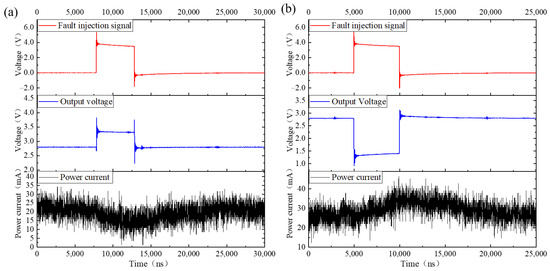
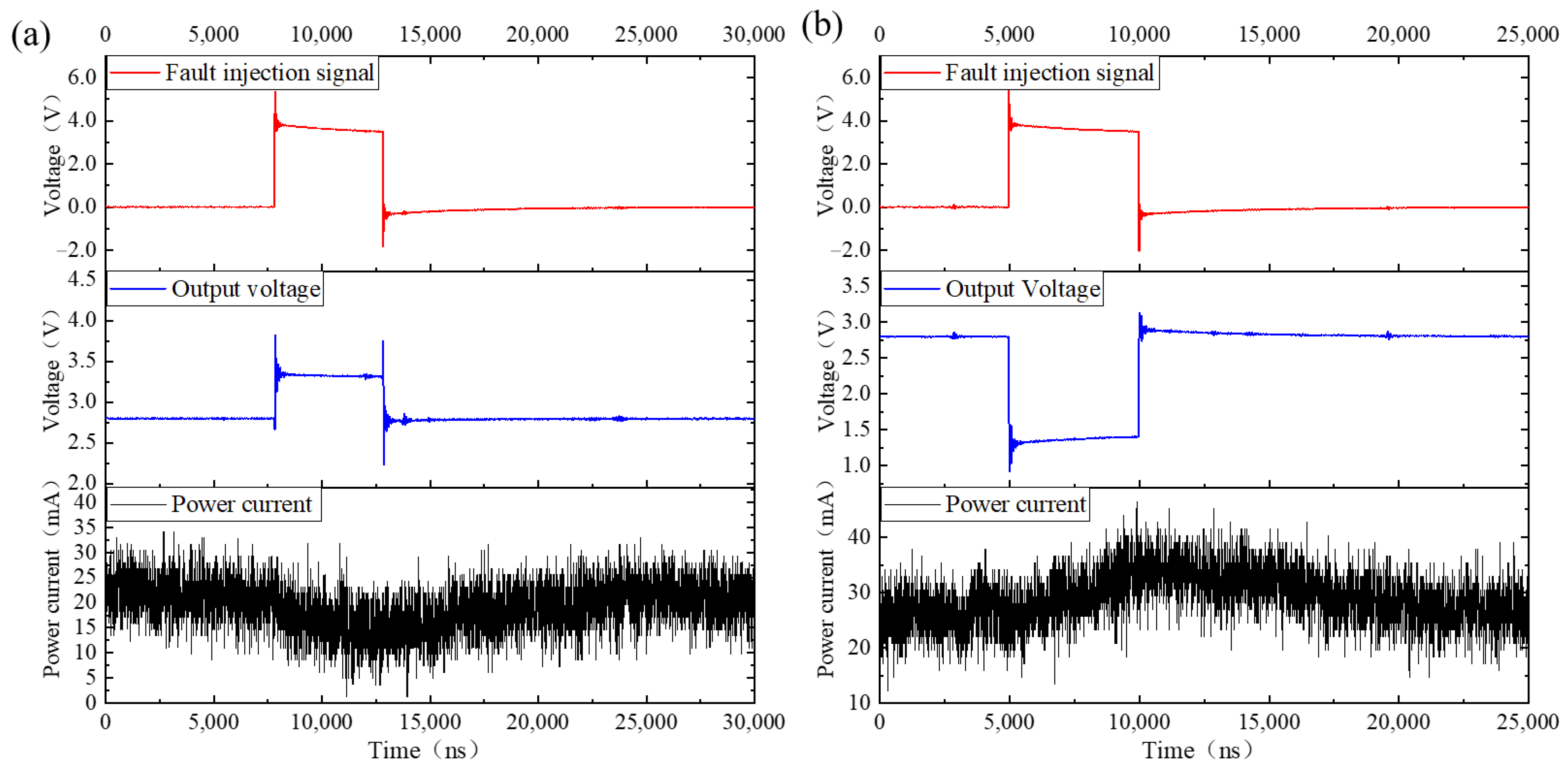
To address the aforementioned challenges, and based on the recognition that analyzing circuit response characteristics is a key approach to understanding and assessing circuit functionality, this work consists of two core parts. First, it systematically acquires and analyzes the response characteristics of HDICs under intermittent faults. The precise characterization and analysis of electrical responses (e.g., current, voltage, error) is not only the cornerstone of fault diagnosis but also a common technology for achieving circuit performance optimization and functional assurance, as evidenced in various fields [25,26]. This study first focuses on the General-Purpose Input/Output (GPIO) interfaces of a typical Digital Signal Processor (DSP) chip. Through a dedicated fault injection circuit, fundamental observations of the power supply current (I_DD) response to intermittent open-circuit and short-circuit faults were conducted under laboratory conditions. As shown in Figure 1, during an intermittent open-circuit fault, the I_DD exhibits a discernible, slowly varying decreasing and recovery process. In contrast, during an intermittent short-circuit fault, it presents a steep rising peak. Critically, compared to the weak or atypical manifestations of these two faults on the logic voltage, the characteristic transient responses they induce in the I_DD signal have a clear temporal correlation. This observation confirms that the power supply current is a highly sensitive and information-rich physical quantity for capturing such “hidden” intermittent faults. It also clarifies the core task of this research: how to reliably extract, enhance, and ultimately classify these weak transient features, which are closely related to the fault mechanism, from strong background noise.
Figure 1.
(a) Intermittent open-circuit and (b) intermittent short-circuit faults: comparison of power supply current, output voltage, and fault injection signals.
Accordingly, this paper proposes a hybrid intelligent diagnosis framework based on the Sparrow Search Algorithm-optimized Variational Mode Decomposition and Attention-based Support Vector Machine (SSA–VMD–Attention–SVM). This framework follows a systematic design of “feature enhancement → feature selection → decision classification”. Firstly, the Sparrow Search Algorithm (SSA) is introduced to adaptively optimize the core parameters of Variational Mode Decomposition (VMD), aiming to improve the decomposition quality and stability for weak transient components within the fault signal. Subsequently, a three-level attention mechanism is employed to adaptively weight the high-dimensional multi-domain features extracted from each modal component, thereby suppressing redundancy and highlighting key discriminative information. Finally, targeting small-sample scenarios, a Support Vector Machine (SVM) is utilized to construct a robust classification boundary. Through the above cooperative mechanism, this method aims to achieve high-accuracy, highly interpretable intermittent fault diagnosis, providing a new approach for ensuring HDIC reliability.
The subsequent structure of this paper is arranged as follows: Section 2 introduces the experimental design and data acquisition methods for obtaining HDIC intermittent fault response characteristics. Section 3.1 systematically analyzes the response characteristics of HDIC intermittent faults, focusing on the influence of fault occurrence timing, location, and physical parameters on the I_DD response, and compares the response characteristics of different fault types. Section 3.2 details the construction process of the fault diagnosis model based on SSA-VMD and the attention mechanism, including SSA-VMD, multi-domain feature extraction, and the attention weighting mechanism, along with diagnostic result analysis and validation targeting DSP chip intermittent faults. Finally, Section 4 summarizes the full work and outlines future research directions.
2. Materials and Methods
2.1. Acquisition of IFs Response Characteristics in HDICs
Previous studies have shown that bonding wires, as the fine metal wires connecting chip pads to package pins, are a critical link in the packaging interconnection system and are also recognized as mechanical and electrical weak points [27,28]. Environmental stresses such as thermal cycling, mechanical shock, and vibration can easily cause damage to the bonding wire itself or its solder joint interfaces in both plastic and ceramic packages, thereby inducing Intermittent Faults (IFs). This type of fault is essentially an early or intermittent manifestation of permanent faults, making its study of significant importance for early warning.
The physical mechanisms of IFs can be primarily categorized into the following two types:
Intermittent Open-Circuit: Usually caused by fatigue micro-cracks in the bonding wire itself or contact degradation at the pad interface. Under cyclic stress induced by temperature changes or mechanical vibration, micro-cracks may repeatedly open and close, or the contact interface may undergo microscopic displacement. This causes the resistance to randomly transition between the normal value and a high-resistance state (even approaching an open circuit), manifesting as intermittent conduction failure.
Intermittent Short-Circuit: Mainly originates from insulation failure between adjacent bonding wires. Under mechanical vibration or shock conditions, two scenarios may occur: (a) instantaneous contact between adjacent bonding wires due to deformation or displacement, forming a momentary short circuit; (b) in the presence of contamination or metal migration, an unstable conductive path may form between the wires, causing random, transient low-resistance connections.
The suddenness, randomness, and transient nature of such faults cause them to remain completely latent under stable conditions, appearing only when triggered by specific stresses. This makes it extremely difficult for traditional testing methods to reliably replicate and capture them, constituting a core challenge of the research. To overcome this obstacle and achieve systematic analysis of fault response characteristics, this study abandons the difficult experimental approach of quantitative fault injection inside the chip and instead opts for simulation at the circuit level. This study designed a dedicated fault injection circuit, combined with high-speed switches, to achieve laboratory-accurate simulation and controllable injection of the electrical behavior of intermittent open-circuit and short-circuit faults. This method supports independent, quantitative adjustment of key variables such as fault amplitude, location, and duration. This enables the systematic investigation of HDIC fault response characteristics under different conditions and, accordingly, the analysis of effective feature extraction methods. This injection strategy based on analog circuits not only ensures high-precision control of fault parameters and closer proximity to actual electrical behavior compared to pure simulation but also provides a substantial amount of repeatable, traceable experimental data for the subsequent development of diagnostic algorithms, significantly enhancing research efficiency and the reliability of conclusions.
Regarding testing methods, traditional HDIC diagnosis typically employs techniques such as functional testing, boundary scan, or thermal imaging. However, these methods have significant limitations: functional testing can only perform passive detection when a fault affects system function or requires running dedicated programs, failing to achieve effective detection of IFs while consuming system computing resources; boundary scan relies on dedicated test interfaces and has a limited detection range; thermal imaging technology lacks sufficient resolution, making it difficult to capture transient fault characteristics. In contrast, I_DD monitoring method demonstrates significant advantages. This study monitors transient changes in the I_DD in real-time through differential sampling. This method is non-intrusive, enables global monitoring, supports online detection, and requires relatively simple equipment. It can effectively capture the weak current fluctuations caused by IFs and can also serve as a supplementary means for general fault detection, providing a high-quality data foundation for subsequent fault diagnosis based on SSA-VMD and attention mechanisms.
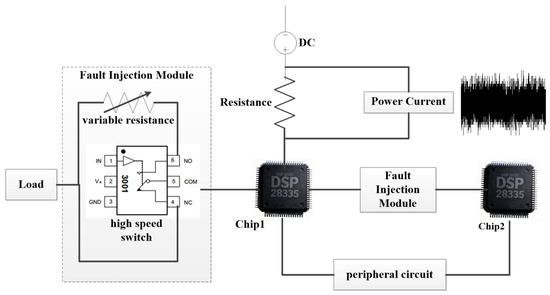
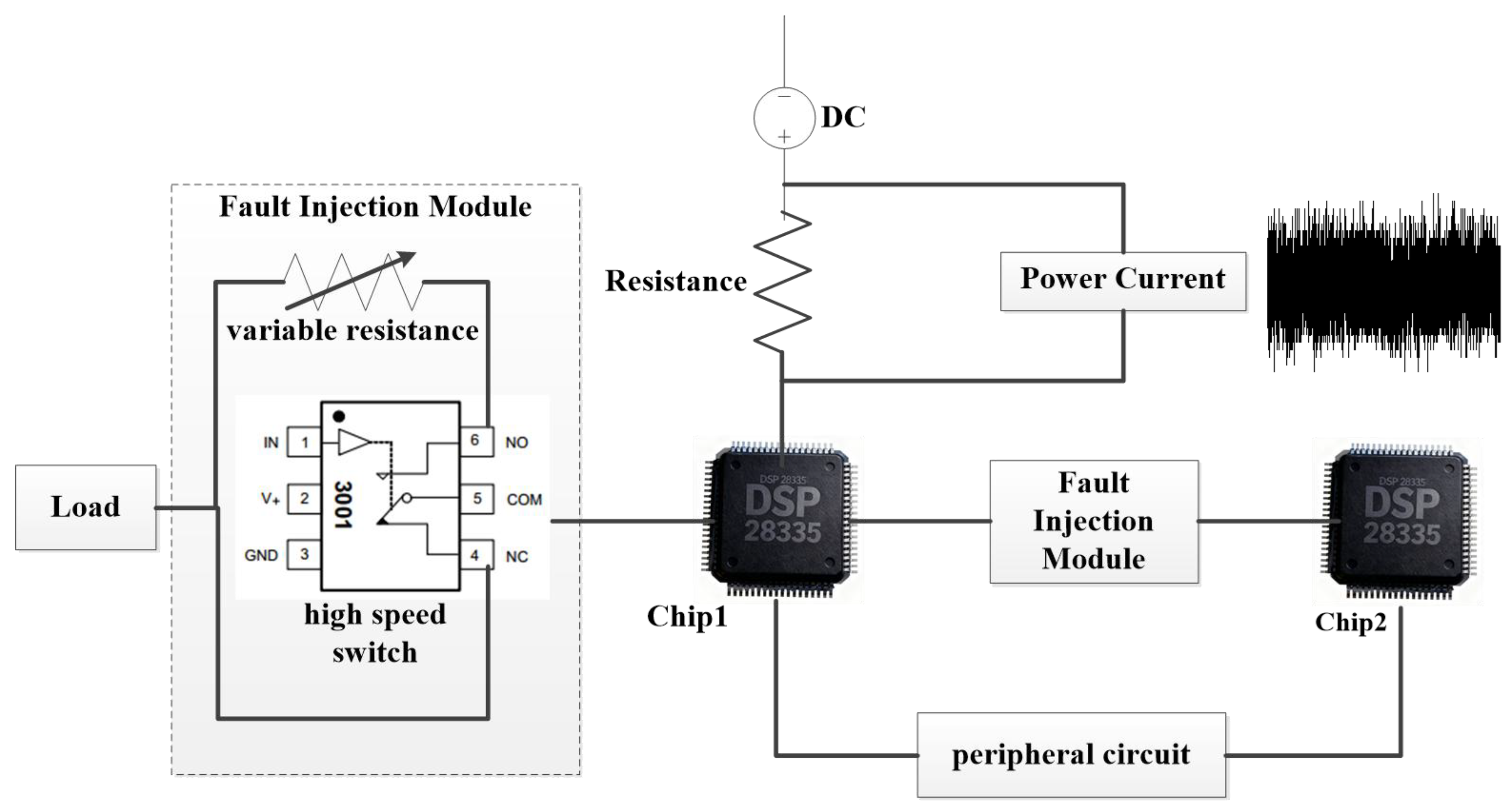
Figure 2 shows the schematic architecture of the IF experimental system. The system consists of two DSP chips with their peripheral circuits, a fault injection module, and a detection circuit. The chip model is T35PQDS01D-ZC (Hunan Guliang Microelectronics Co., Ltd., Changsha, China), and the high-speed switch model is SGM3001 (SG Micro, Beijing, China). Among them, the two peripheral circuits are used to simulate the normal working state of the HDIC and the normal communication state between the chips, respectively. Based on the mechanism analysis, the essence of an intermittent open-circuit fault is the intermittent change in bonding wire resistance, and an intermittent short-circuit fault is the intermittent connection between lines. Therefore, this paper employs a fault injection module that utilizes high-speed switches to achieve rapid switching between lines, uses variable resistors to regulate the fault amplitude and load resistance, and controls the fault duration through the switching time of the high-speed switches. The combination of these regulation methods enables the quantitative injection of intermittent open-circuit and short-circuit faults at specified locations. For example, momentarily switching a line to a floating pin or a high-value resistor simulates an intermittent open-circuit fault, while momentarily connecting it to another line simulates a short-circuit fault; the amplitude can be adjusted using the variable resistor. The current acquisition circuit obtains the I_DD signal through differential sampling, ensuring the accuracy and reliability of signal acquisition.
Figure 2.
Schematic diagram of the HDICs IFs experimental circuit.
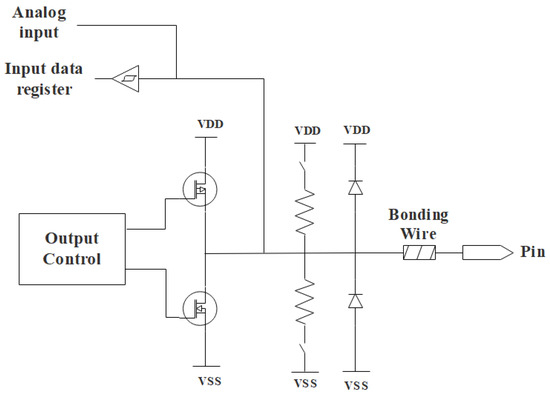
Based on previous analysis, GPIO interfaces hold an important position in DSP chips, constituting the majority of DSP chip ports. The local structures of other ports are also highly similar to GPIO. Therefore, the experiments in this paper primarily target GPIO ports. The output mode used is push-pull output, which is also the most common output mode for most GPIO ports. A local circuit diagram of the GPIO port is shown in Figure 3.
Figure 3.
Schematic diagram of the local GPIO port circuit.
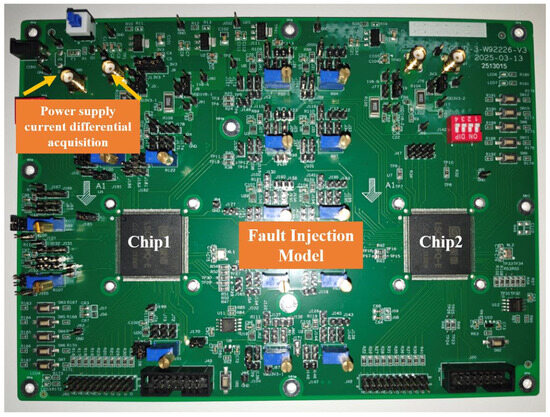
The experimental circuit is shown in Figure 4.
Figure 4.
HDIC IF experimental circuit.
2.2. Methods
2.2.1. Fault Diagnosis Features
Feature extraction is often required prior to fault diagnosis, as changes in these features are closely related to device status. Common features include time-domain features, frequency-domain features, time-frequency domain features, and nonlinear features. Based on the previous analysis of HDICs response characteristics, HDICs fault signals are weak, stochastic, and exhibit transient impulse-like characteristics. Accordingly, 22 features were selected from the perspectives of time-domain statistics, frequency-domain distribution, frequency band energy, nonlinear complexity, time-frequency joint analysis, spectral morphology, and fault-specific characteristics, as detailed in Table 1.
Table 1.
Features Used in This Study.
Aimed at the response characteristics of IFs, the design of the above multi-domain feature set is intended to comprehensively capture their key patterns from the raw fault current signal. Taking an intermittent short-circuit fault as an example, its time-domain waveform manifests as a rapid current rise impulse. This pattern can be effectively characterized by features from different categories: In the time domain, the amplitude and steepness of the impulse can be quantified by the peak and kurtosis, while its transient nature is reflected in the increase in the impact factor. In the frequency domain, this rapid transient contains rich high-frequency energy, causing the spectral centroid to shift upward and the high-frequency energy ratio to increase significantly. In the time-frequency domain, the wavelet packet transform can locate the time and frequency band of the impulse occurrence, manifested as a sudden increase in the wavelet packet energy of the corresponding sub-band. Regarding complexity, such a sudden transient briefly increases the irregularity of the signal, reflected as an increase in sample entropy.
Through this joint analysis of multi-domain features, the physical phenomena in the raw current signal are transformed into a set of high-dimensional, quantifiable feature vectors with clear physical meanings. This provides an informational foundation for subsequent classifiers to distinguish fault types. However, directly extracting features from the raw signal may still be limited by factors such as noise interference, feature redundancy, or imbalanced distribution, potentially failing to fully exploit discriminative information. Therefore, the subsequent sections of this paper will introduce the SSA-optimized VMD and attention weighting mechanism to further enhance the representational capacity and distinguishability of the features.
2.2.2. SSA-VMD Parameter Optimization
Variational Mode Decomposition (VMD) is an adaptive, non-recursive signal processing method suitable for handling non-stationary and nonlinear signals [29]. Its core objective is to decompose a complex input signal f(t) into K discrete, band-limited Intrinsic Mode Function (IMF) components uk(t). Each IMF component oscillates around a specific center frequency ωk, thereby achieving sparse representation and effective separation of the signal in the frequency domain. Unlike recursive methods such as Empirical Mode Decomposition (EMD), VMD achieves globally optimal decomposition by solving a constrained variational optimization problem.
The mathematical model of this constrained variational problem aims to find a set of modes {uk} and their corresponding center frequencies {ωk} that minimize the sum of the estimated bandwidths of all modes, while satisfying the constraint that the sum of all modes equals the original signal [29]. Its mathematical expression is as follows:
where K is the preset number of modes for decomposition. uk(t) represents the k-th IMF component obtained from the decomposition. ωk represents the center frequency (unit: rad/s) of the k-th IMF component. ∂t denotes the partial derivative with respect to time t. δ(t) is the Dirac delta function. j is the imaginary unit. ∗ represents the convolution operation.
This problem is typically solved by introducing a quadratic penalty term α and a Lagrange multiplier λ(t) to construct the augmented Lagrangian function, and then employing the Alternating Direction Method of Multipliers (ADMM) for iterative solution. The algorithm iteratively updates uk, ωk, and λ until convergence criteria are met.
The performance of VMD is highly sensitive to two key parameters:
Number of Modes K: Determines the granularity of signal decomposition. A value of K that is too small leads to under-decomposition, causing modal aliasing; a value that is too large results in over-decomposition, generating meaningless spurious components.
Penalty Factor α: Controls the bandwidth of each IMF component, directly affecting frequency resolution. A larger αvalue produces smaller bandwidth (high resolution), while a smaller α value allows larger bandwidth (low resolution).
However, there is currently a lack of universal theoretical methods to determine the optimal combination of (K, α). Traditional methods relying on expert experience or grid search are inefficient and often fail to guarantee optimality and robustness across different signals and operating conditions. This limitation hinders the generalization capability of VMD in complex applications such as intermittent fault diagnosis in high-density integrated circuits.
To address the above issues, this study introduces the Sparrow Search Algorithm (SSA) [30] to construct an intelligent adaptive parameter optimization framework for VMD (SSA-VMD) [31,32]. SSA is a meta-heuristic optimization algorithm inspired by the foraging and anti-predation behaviors of sparrows. In SSA, population individuals are divided into three roles:
Discoverers: Responsible for exploring new food source areas (global search).
Followers: Follow discoverers to promising areas for exploitation (local search).
Scouters: Monitor environmental dangers and probabilistically guide the population to escape local optima.
By simulating the cooperation and competition among these three roles, SSA can effectively balance global exploration and local exploitation capabilities, thereby efficiently searching the parameter space.
The core of this framework is the design of a multi-objective fitness function F that comprehensively evaluates the quality of VMD. This function integrates signal processing characteristics and fault diagnosis requirements, and its expression is as follows:
where Ē is the average envelope entropy of all IMF components, measuring the overall complexity and randomness of the signal. A smaller value indicates a purer, more regular signal. σE is the standard deviation of the envelope entropy, used to control the consistency of complexity across IMF components and avoid uneven decomposition. R is the variance of the reconstruction residual, assessing the completeness and accuracy of the decomposition. A smaller value indicates a smaller reconstruction error. Kmax is the maximum kurtosis value among all IMF components. Kurtosis is highly sensitive to impulses or transient impacts in the signal. This metric aims to highlight transient features associated with intermittent faults. ω1, ω2, ω3, ω4 are the weighting coefficients corresponding to each component, used to adjust the influence of each indicator based on diagnostic priority.
The optimization process of SSA-VMD is as follows: First, a sparrow population is initialized within a predefined parameter search space, where each individual’s position vector represents a candidate pair of (K, α) values. Subsequently, during iteration, SSA updates the positions of discoverers, followers, and scouters in the population according to its rules. For each parameter set, VMD is performed, and the fitness value Fis calculated according to Formula (3). The iterative optimization aims to find the optimal parameter combination (Kopt, αopt) that minimizes F.
Based on prior knowledge and experimental analysis, the parameter search space is defined as follows:
K ∈ [2, 8], integer. The lower bound of 2 ensures effective decomposition, while the upper bound of 8 controls computational cost while maintaining sufficient decomposition granularity.
α ∈ [100, 3000], continuous value. This range avoids modal aliasing caused by excessively wide bandwidth (when α is too small) and potential loss of fault features due to excessively narrow bandwidth (when α is too large).
This SSA-VMD framework, through automated and intelligent parameter optimization, significantly enhances VMD’s capability to extract weak features of intermittent faults in high-density integrated circuits under complex operating conditions. It lays a solid foundation for subsequent accurate classification based on the attention mechanism and support vector machines.
2.2.3. Attention Mechanism and Support Vector Machine
The attention mechanism draws on the principle of the human visual system’s ability to filter important information [33]. In machine learning, it achieves differentiated weighting of input features to enhance the perception of key characteristics. To address the issue of imbalanced feature contribution in fault diagnosis of HDICs, this study integrates an attention mechanism at the feature dimension. Through adaptive weight allocation, it dynamically adjusts the contribution proportion of each feature parameter in the diagnosis process, thereby improving recognition accuracy and robustness.
This study employs a three-level attention mechanism to adaptively weight the features decomposed by VMD:
- IMF-level attention evaluates the importance of modal components.
- Feature-level attention performs refined weighting on each feature dimension.
- Global-level attention assesses the overall feature quality at the sample level.
The weights from these three levels are fused via weighted summation to obtain a comprehensive attention weight, forming a multi-level feature screening and enhancement mechanism. This mechanism acts as an intelligent filter, automatically learning the distribution of key features under different fault modes and effectively highlighting discriminative components.
The selection of SVM is primarily based on its advantages in small-sample fault diagnosis: its structural risk minimization principle ensures generalization capability, and its kernel trick effectively handles the nonlinear relationships of high-dimensional features, which highly matches the output of VMD. The attention mechanism and SVM form a hybrid architecture—the attention mechanism is responsible for feature learning and weighting, while SVM focuses on optimizing the classification boundary. This combines the advantages of deep learning in feature learning with the small-sample generalization capability of traditional machine learning.
Advantages of the Hybrid Model:
- Feature weighting enhances quality, enabling SVM to construct a more accurate classification hyperplane in the optimized feature space.
- Attention weights are traceable to key fault features, enhancing model interpretability.
- It balances data efficiency and stability, making it suitable for small-sample, multi-fault-mode diagnosis scenarios.
The SVM is a supervised classification model based on statistical learning theory. Its fundamental principle is to find an optimal classification hyperplane in the feature space to achieve maximum margin separation between samples of different classes [34,35]. This study uses the RBF kernel function to map features into a high-dimensional space and optimizes the hyperparameters C and γ through grid search, enhancing the ability to identify IF modes.
In this study, adaptive weighting of the features decomposed by VMD is performed through a three-level attention mechanism. Given the original feature matrix (where N is the number of samples and d is the feature dimension), the mathematical expression for the three-level attention weighting is:
where σ(⋅) is the sigmoid activation function, ReLU(⋅) denotes the Rectified Linear Unit activation function, Wi are trainable weight matrices, Ximf is the feature matrix reorganized according to the source Intrinsic Mode Functions (IMFs), X is the original flattened feature matrix input to the attention mechanism and is the feature mean vector. The three-level attention weights are fused by weighted summation to obtain the comprehensive attention weight A = λimfAimf + λfeatAfeat + λglobalAglobal, where λimf + λfeat + λglobal = 1.
The weighted features are represented as , where ⊙ denotes element-wise multiplication. This process achieves multi-level screening and enhancement of the original features, effectively highlighting the discriminative components relevant to fault diagnosis. After introducing the attention weights, the primal optimization problem for SVM is transformed into:
where ϕ(⋅) represents the feature mapping induced by the kernel function, w is weight vector defining the hyperplane in the feature space, xi is the original feature vector of the i-th sample, Ai is its corresponding comprehensive attention weight vector, and ξi are slack variables. The corresponding decision function is:
The synergistic effect between the attention mechanism and SVM is reflected in the adaptive adjustment of the feature space by the attention weights A, enhancing the influence of discriminative features, while SVM seeks the maximum margin hyperplane in this optimized feature space.
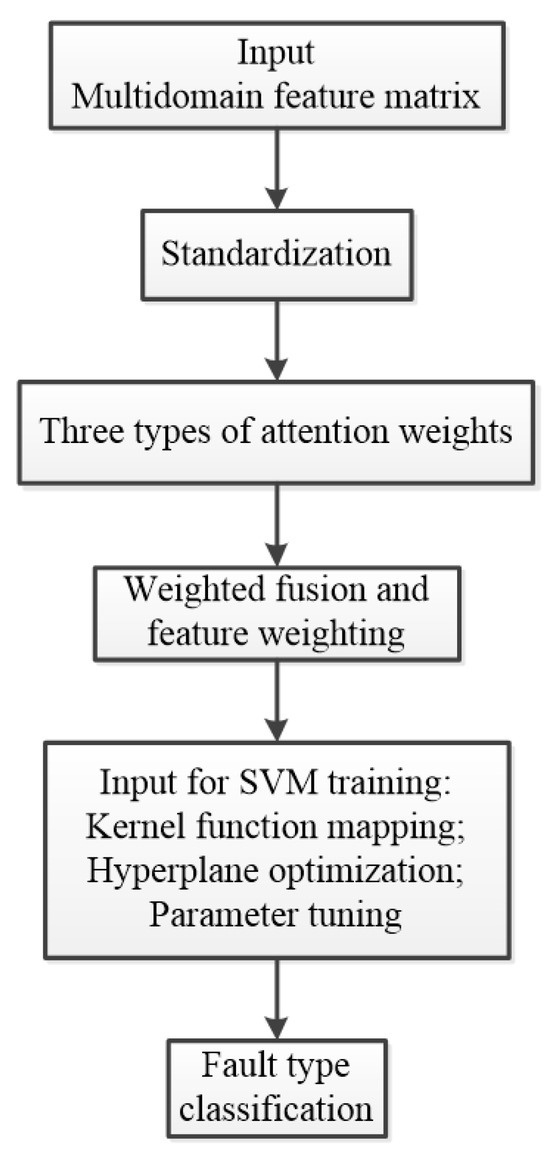
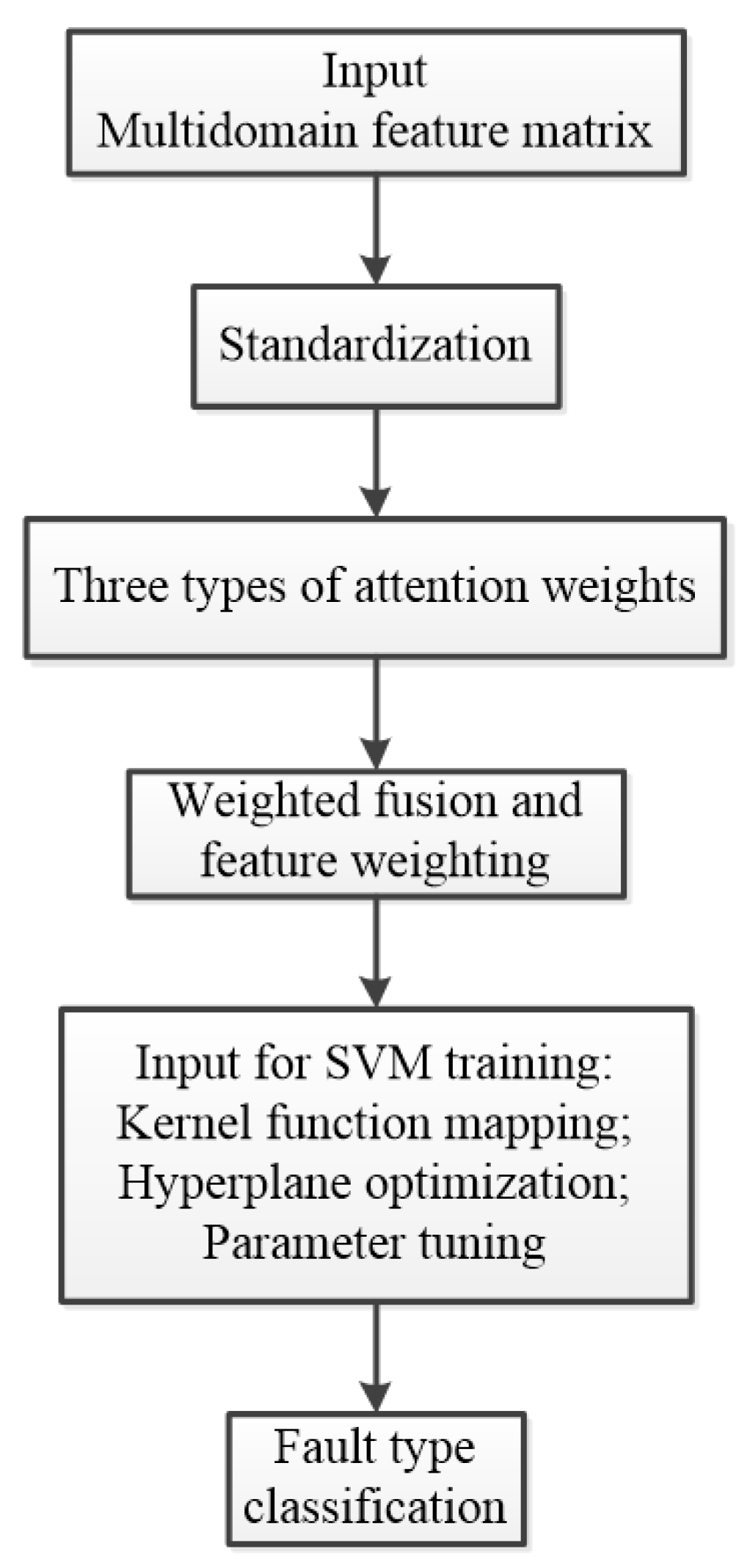
The diagnostic steps of the Attention–SVM model, which integrates the attention mechanism, are shown in Figure 5:
Figure 5.
Flowchart of the SVM fault diagnosis method integrated with the attention mechanism.
- The multi-domain feature matrix extracted by SSA-VMD is fed into a standardization processor.
- Three types of attention weights are computed in parallel: IMF-level attention weights, feature-level attention weights, and global attention weights, to assess the overall importance of the samples.
- The three-level attention weights are fused in a certain proportion to generate a comprehensive attention weight vector, which is used to weight the standardized feature matrix.
- The weighted feature matrix is used to train the SVM, employing the RBF kernel function and optimizing hyperparameters —the penalty factor C and the kernel coefficient γ—through grid search.
- Features of the sample to be diagnosed are input into the trained Attention–SVM model, which outputs the fault type classification result.
2.3. Overall Fault Diagnosis Model Construction Process
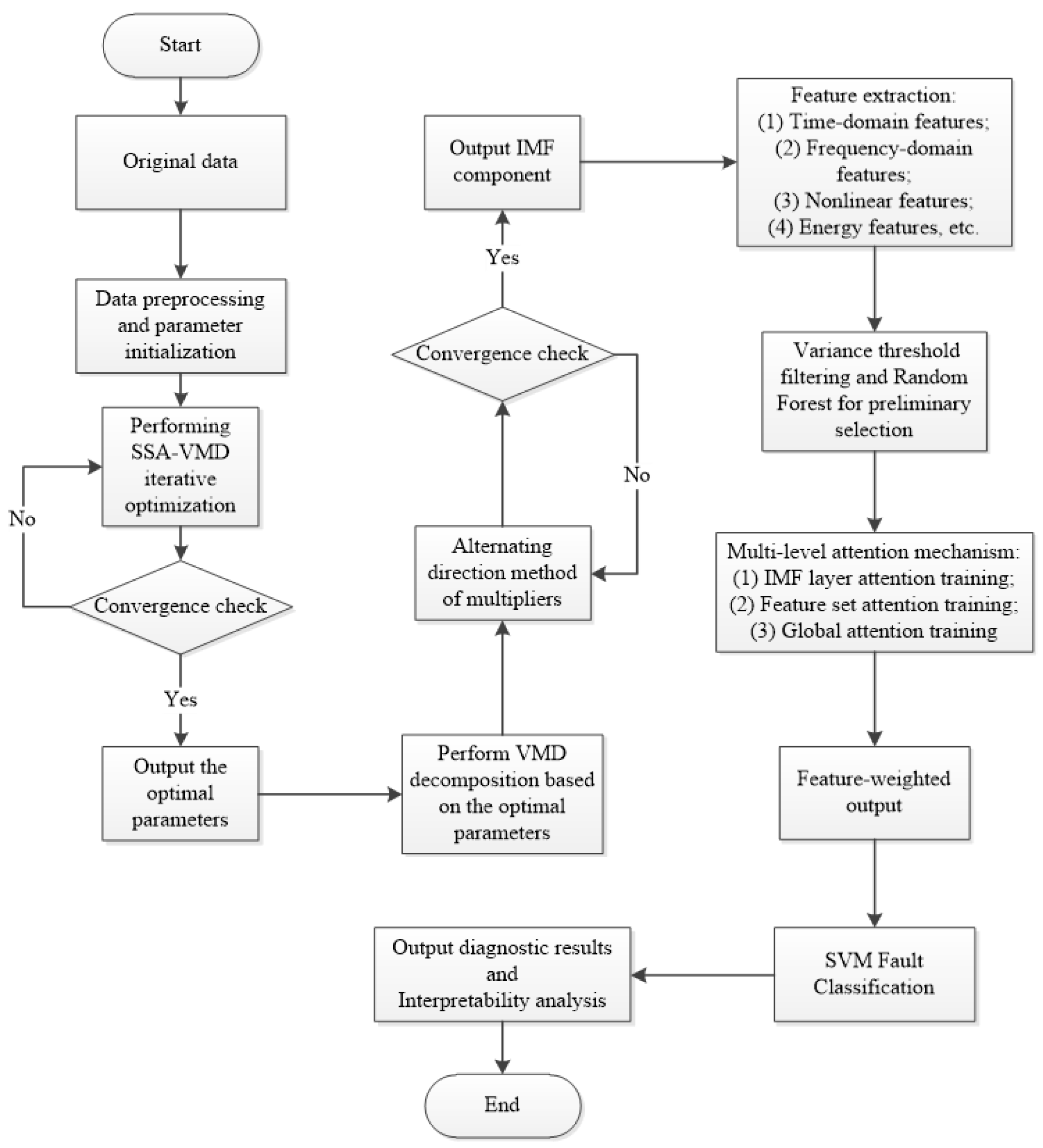
The overall workflow for constructing the fault diagnosis model in this study is as follows:
(1) Import the original signal, perform data preprocessing (e.g., remove DC component), and initialize parameters.
(2) Decompose the signal using the SSA-VMD method. Specifically, for the discoverers in the SSA, adaptive weights and Lévy flight are adopted to enhance global search capability. For the followers, a sine-cosine hybrid strategy is employed to balance exploration and exploitation. For the vigilants, Cauchy–Gaussian hybrid mutation and adaptive opposition-based learning are used to avoid local optima.
(3) After signal decomposition in steps (1) and (2), features are extracted from each IMF component. The extracted features undergo preliminary selection using variance threshold filtering and Random Forest to reduce feature dimensionality.
(4) The preprocessed features are input into an SVM model integrated with an attention mechanism for model training and validation.
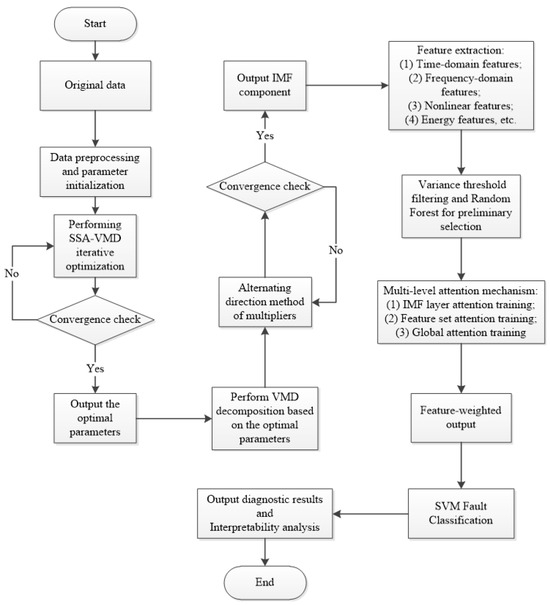
The overall flowchart of the diagnostic model is shown in Figure 6.
Figure 6.
Overall flowchart of the diagnostic algorithm.
3. Results and Discussion
3.1. Analysis of HDICs IFs Response Characteristics
Appropriate physical parameters enable a more quantitative description of intermittent faults. This section primarily analyzes the fault amplitude and duration, as these two parameters reflect the intensity of the intermittent fault and its impact duration, respectively, and are considered key parameters.
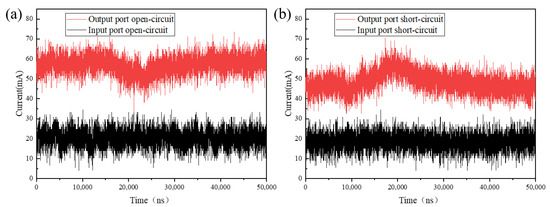
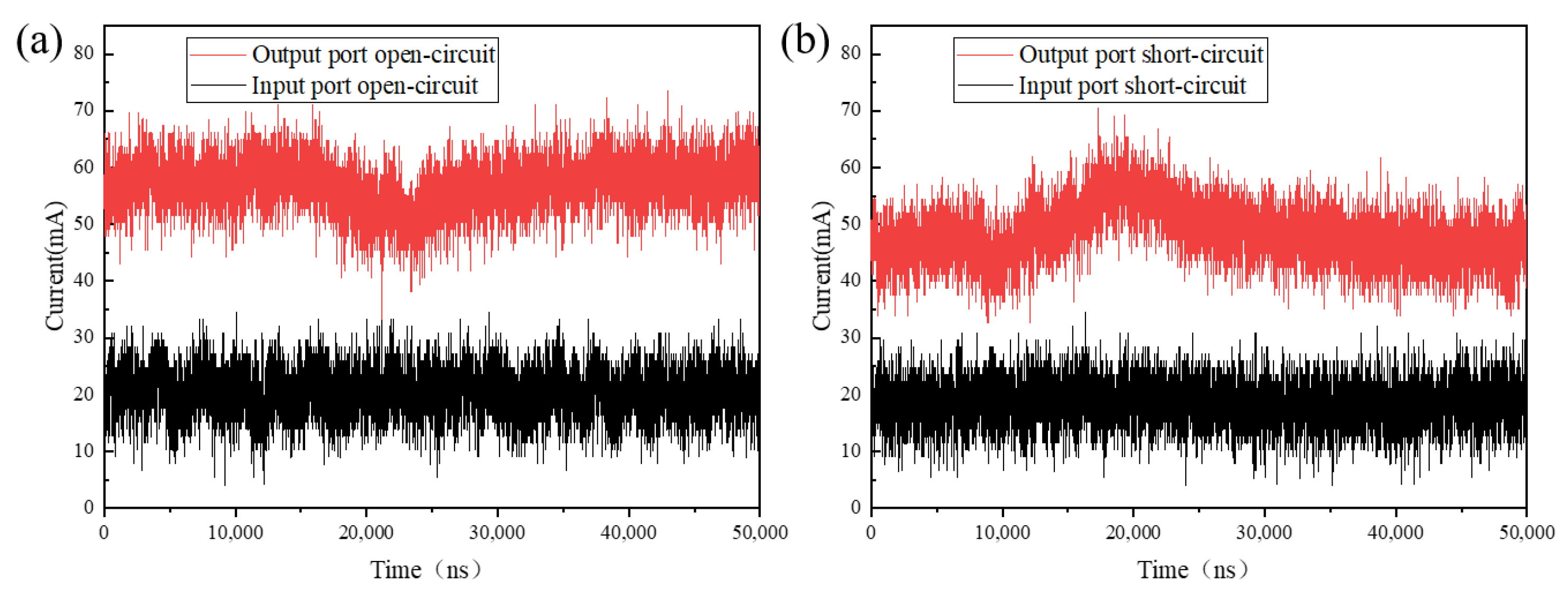
Furthermore, since the majority of pins in DSP chips are GPIO pins, this study primarily uses them as a typical case for investigation. The impact of open-circuit and short-circuit faults in GPIO pins on the I_DD is shown in Figure 7.
Figure 7.
Comparison of I_DD responses for intermittent (a) open and (b) short circuit faults on GPIO lines.
It can be observed that faults on output lines have a more significant impact on the chip’s I_DD, while faults on input lines have almost no effect. For both intermittent open-circuit and short-circuit faults, their impact on the I_DD response curve is greater during the high-level period of an output line than during its low-level period. For short-circuit faults, a significant I_DD response is triggered only when the fault affects the logic level of an output line. Therefore, the response characteristics studied in this paper are all based on this scenario.
3.1.1. Response Characteristics of Typical Ifs in HDICs Under Different Physical Parameters
Appropriate physical parameters can provide a quantitative description of IFs. This section primarily analyzes the fault amplitude and duration, as these two parameters reflect the intensity of the IF and its impact duration, respectively, and are considered key parameters.
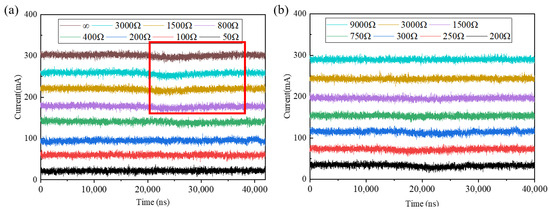
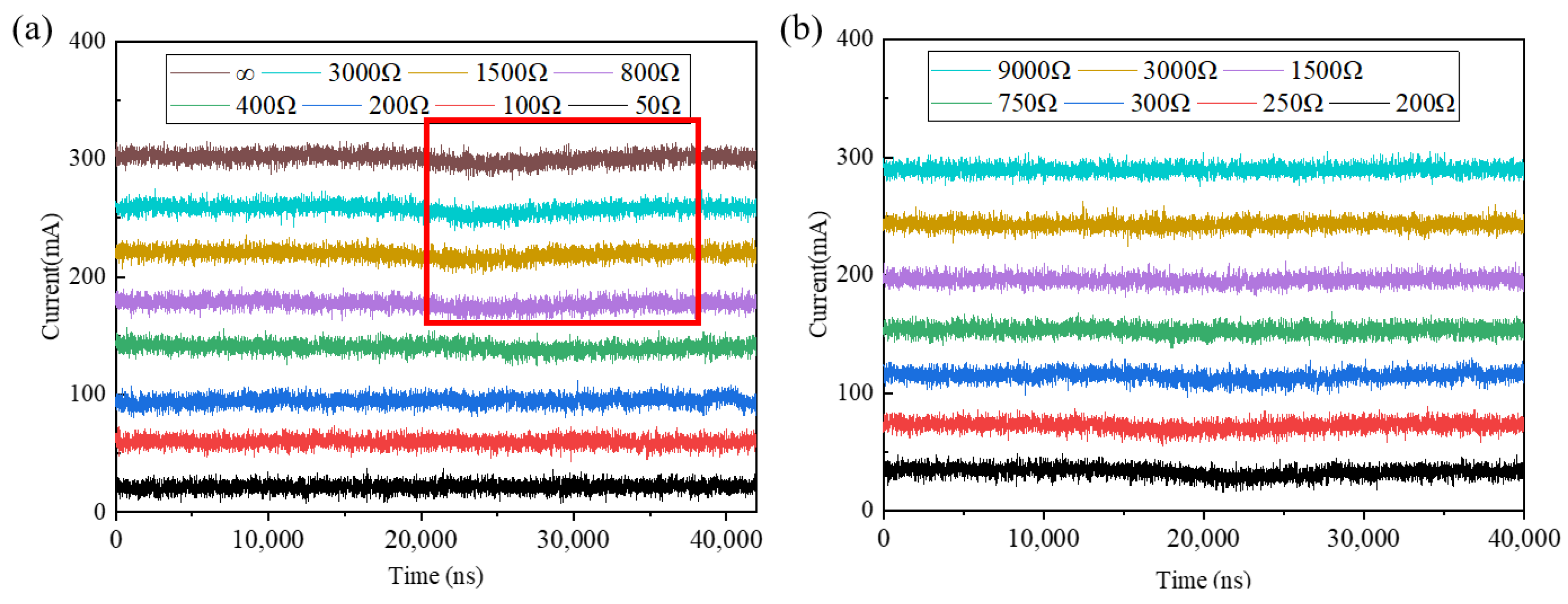
Using the IFs simulation circuit module, the amplitude of the intermittent open-circuit fault was varied to the following values: 50 Ω, 100 Ω, 200 Ω, 400 Ω, 1 kΩ, 2 kΩ, 4 kΩ, 9 kΩ, and a complete open circuit. The fault duration was maintained at 5 μs. The results presented here correspond to faults occurring during the high-level phase of the line with a load of 200 Ω. Figure 8a shows the I_DD response curves for intermittent open-circuit faults with different amplitudes.
Figure 8.
I_DD response curves for intermittent open-circuit faults (a) with different amplitudes, (b) under different loads. (The red box indicates the location where the I_DD fluctuates due to the fault).
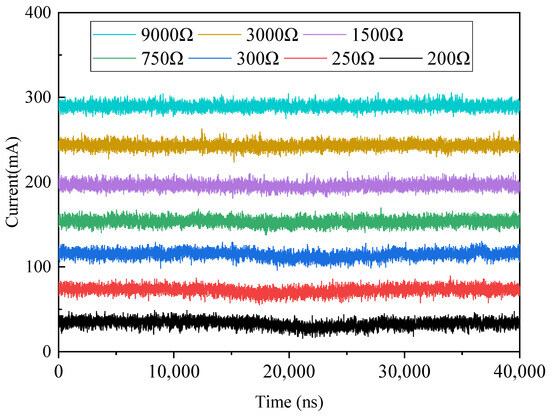
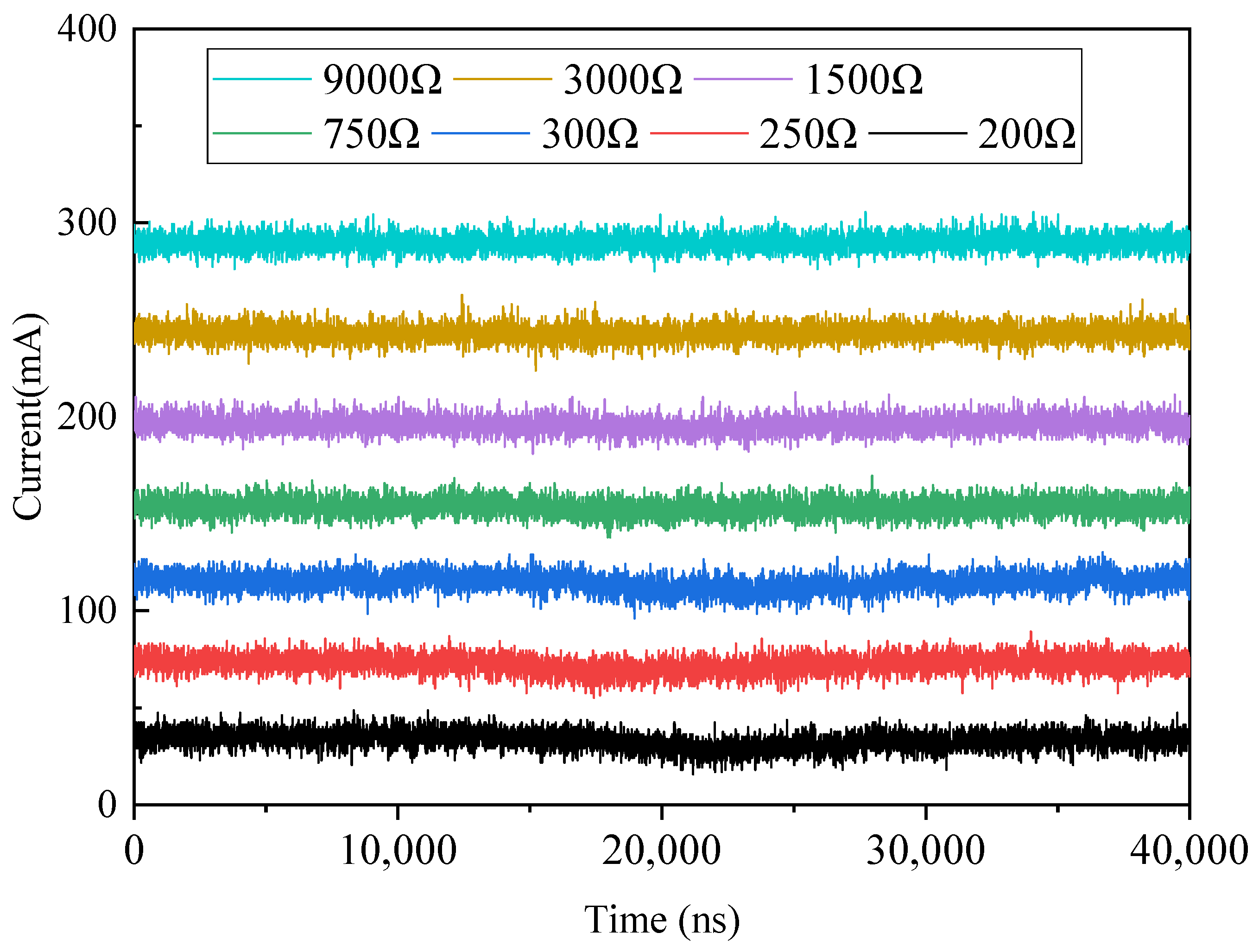
It can be observed that even under relatively low load conditions, the I_DD response caused by an intermittent open-circuit fault is not significant. A faint decreasing trend in the current is discernible in the time-domain signal only when approaching a complete open circuit (i.e., when the fault amplitude approaches infinity). At this point, the logic levels of the circuit remain largely unaffected, whereas the line is near rupture, posing a substantial risk. This phenomenon is primarily attributed to two factors: firstly, the current of a single GPIO interface is inherently limited, resulting in a confined impact on the total I_DD; secondly, the brief duration of the IF, combined with the charging and discharging effects of inductive and capacitive components in the circuit, suppresses current fluctuations.
Figure 8b illustrates the impact of intermittent open-circuit faults on the I_DD under different load conditions. It is evident that for load resistances greater than 300 Ω, the I_DD response to the fault is not pronounced in the time domain. The reason is that the operating current is very small under high load conditions; even an open circuit has a minor effect on the total current, unless multiple paths fail simultaneously or the fault duration is extended, which would require more advanced analysis techniques for further investigation.
Based on the preceding analysis, IFs at the output port elicit a significant I_DD response only when a short circuit occurs between lines at different logic levels (high and low). Therefore, this study focuses on the scenario where an intermittent short circuit occurs between a high-level output line and a low-level input line, using intermittent short-circuit faults at the GPIO port as the experimental subject.
Taking the short circuit between a high-level output line and a low-level input line as an example, the influence of the short-circuit amplitude (here referring to the short-circuit resistance) on the I_DD is shown in Figure 9.
Figure 9.
Influence of different short-circuit amplitudes on the I_DD for intermittent short circuits.
It is apparent that when an intermittent short-circuit fault occurs, the short-circuit amplitude has a significant impact on the I_DD response. The response amplitude decreases as the short-circuit resistance increases. When the resistance exceeds 200 Ω, the response becomes difficult to identify directly from the time-domain signal. The main reasons are the short fault duration and the suppression of current fluctuations by the charging/discharging processes of capacitive and inductive components in the circuit. Furthermore, although the load at the output port decreases instantaneously at the moment of the short circuit, the extent of load change is limited under a large short-circuit resistance, and the resulting current fluctuation might be smaller than the normal operational current fluctuations and noise level.
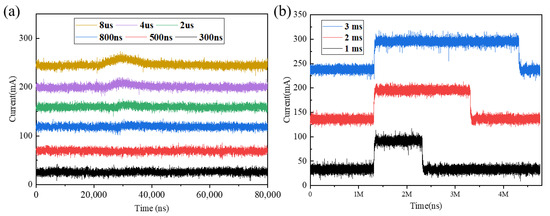
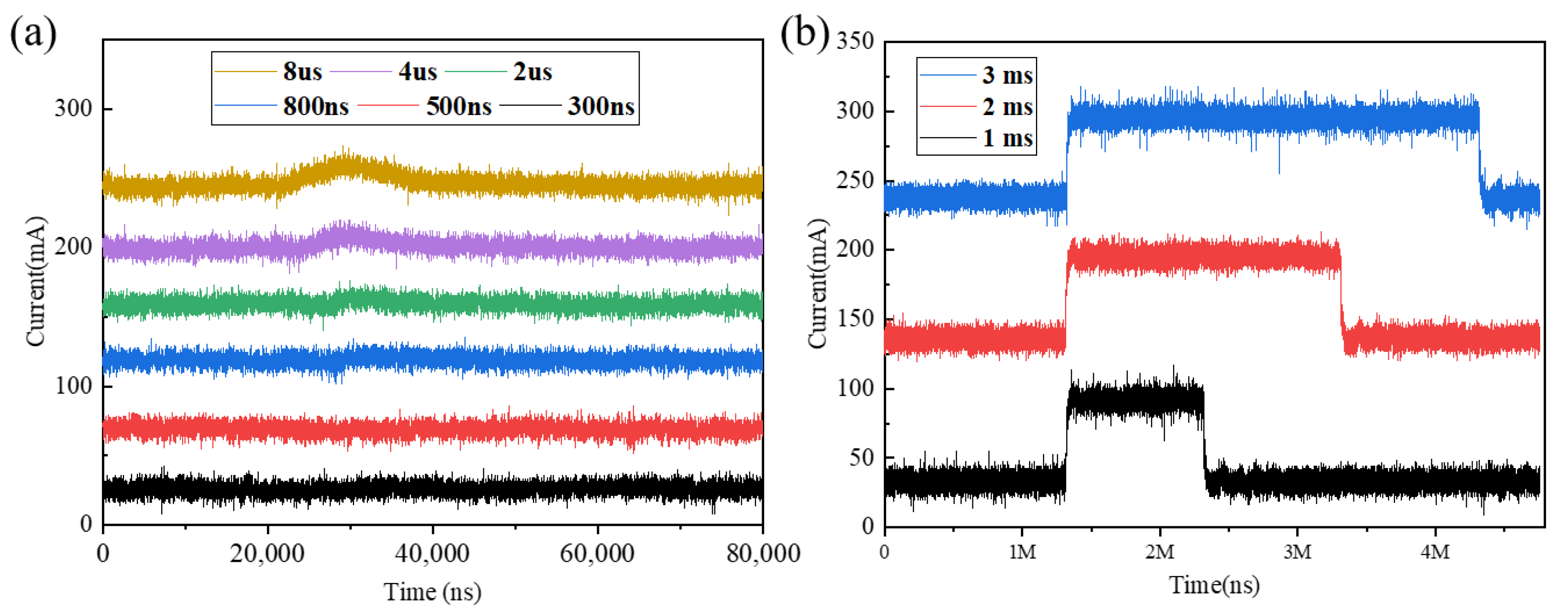
To analyze the influence of IF duration on the I_DD, experiments were conducted by controlling the duration of the IF using a high-speed switch. Specifically, the intermittent short-circuit duration was set to: 300 ns, 500 ns, 800 ns, 2 μs, 4 μs, 8 μs, 1 ms, 2 ms, and 3 ms. The I_DD response was acquired when a GPIO output at a high level was intermittently shorted to ground (load: 200 Ω, short-circuit resistance: 0 Ω). The I_DD response curves are shown in Figure 10.
Figure 10.
I_DD response curves for intermittent short-circuit faults with (a) nanosecond-to-microsecond and (b) millisecond durations, respectively.
It can be observed that when a short circuit to low-level occurs in a high-level output line, the I_DD exhibits an increasing trend. Within a certain duration range, the peak value and duration of the current increase show a significant positive correlation with the fault duration. This is due to the inductive and capacitive components in the circuit suppressing rapid current fluctuations, preventing the current change from synchronizing perfectly with the fault signal. When the fault duration is relatively long (e.g., reaching the millisecond level), the current rises to a certain value and stabilizes until the fault disappears before recovering. It should be noted that such prolonged faults typically cause significant abnormalities in DSP chip systems, and this paper will not further discuss them.
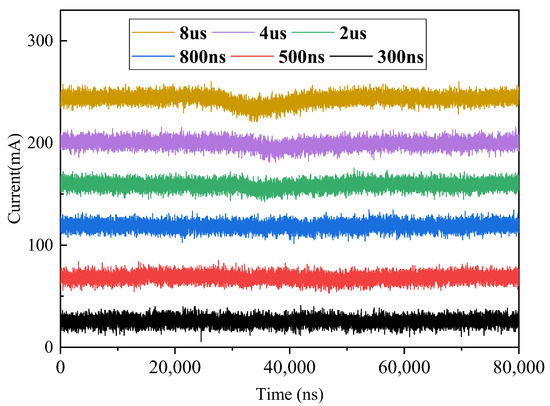
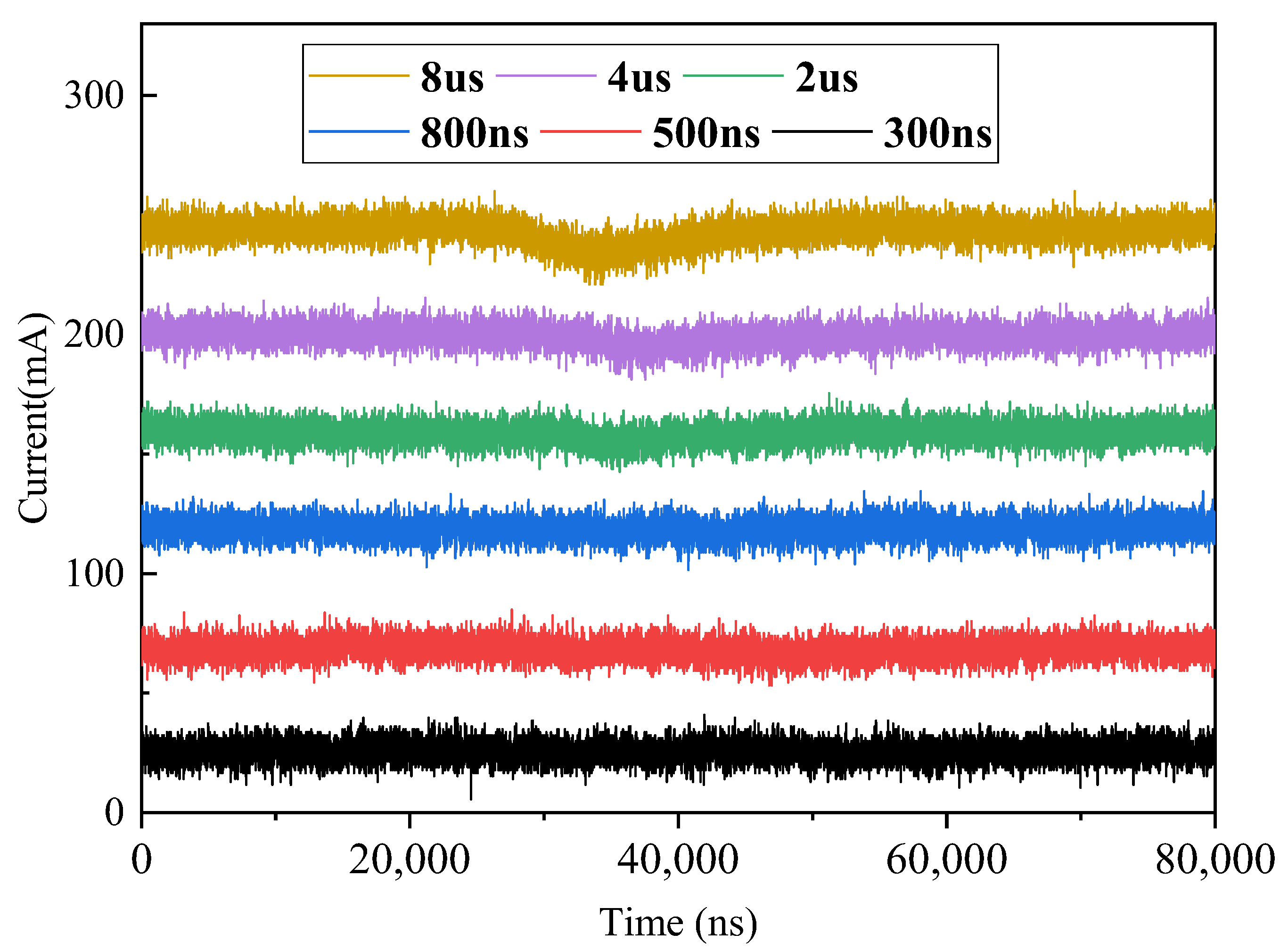
For intermittent open-circuit faults, this study set the durations to 300 ns, 500 ns, 800 ns, 2 μs, 4 μs, and 8 μs, with a load of 200 Ω. The I_DD response curves for intermittent open-circuit faults are shown in Figure 11. The I_DD fluctuation also intensifies as the IF duration increases.
Figure 11.
I_DD response curves for different intermittent open-circuit durations.
3.1.2. Comparative Analysis of Response Characteristics of Different IFs
This section compares the impact of different IFs types on the I_DD to investigate the feasibility of fault diagnosis based on current characteristics.
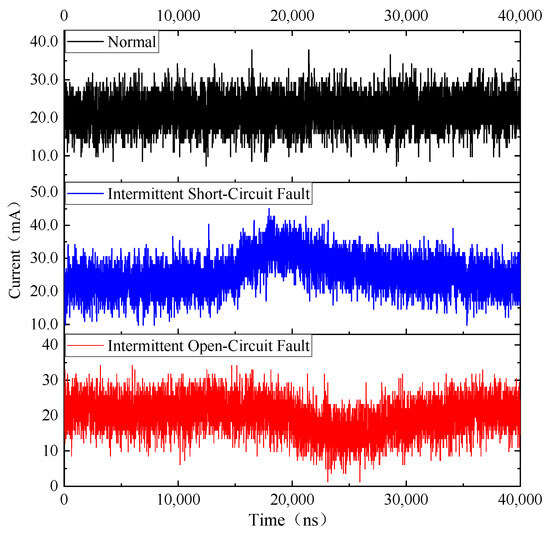
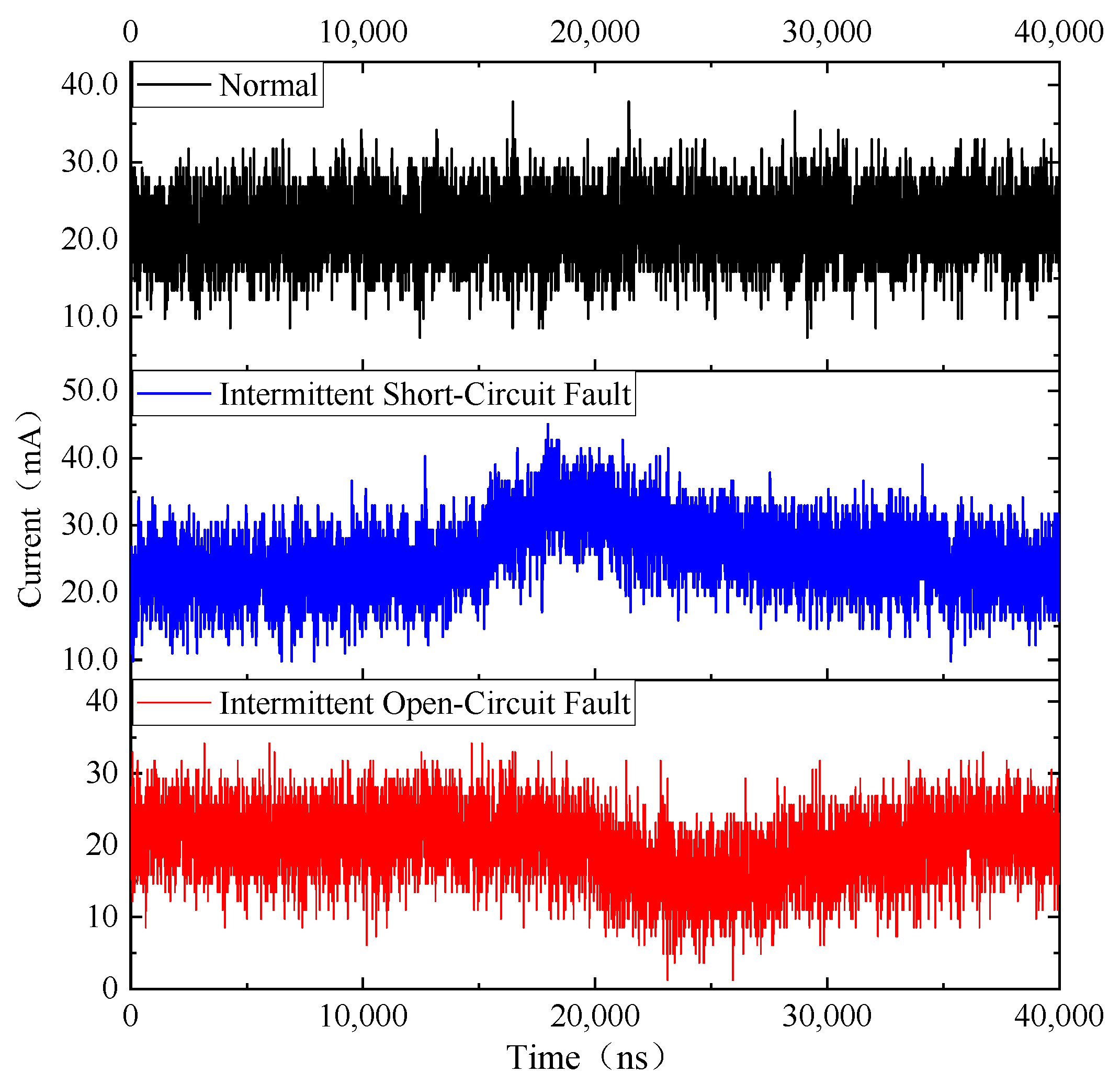
The GPIO interface, with a typical output current below 20 mA, serves as a representative case study. Its I_DD response was compared under three conditions (conditions with relatively pronounced responses are shown here for easier comparative analysis): normal high-level output, intermittent open-circuit fault (complete disconnect), and intermittent short-circuit fault (short-circuit amplitude 0 Ω). The test conditions were a set load of 200 Ω and a single IF duration of 5 μs. The results are shown in Figure 12.
Figure 12.
Comparison of I_DD responses under normal conditions, intermittent short-circuit fault, and intermittent open-circuit fault.
The results indicate that the intermittent open-circuit fault primarily causes a sudden short-term drop in the I_DD, whereas the short-circuit fault manifests as a rapid current increase. The current amplitude is significantly influenced by the fault impedance and load conditions. These response characteristics can serve as a basis for distinguishing between fault types.
It should be noted that, as analyzed previously, open-circuit faults are more noticeable under low-load conditions, and short-circuit faults exhibit distinct features mainly when the short-circuit impedance is low. In most other cases, it is difficult to differentiate them directly from time-domain waveforms, necessitating further feature extraction and analytical methods for identification.
3.1.3. Summary
This section systematically analyzed the I_DD response characteristics of IFs in HDICs. The study clarified the specific influence laws of key parameters—including fault amplitude, duration, and occurrence location (input/output lines, high/low logic levels)—on the response patterns and amplitudes. The analysis indicates that intermittent open-circuit and short-circuit faults exhibit typical decreasing and increasing trends in the current, respectively. Notably, the response of short-circuit faults demonstrates transient impact-like characteristics. These findings provide a clear physical basis and screening criteria for effectively extracting discriminative features that are highly correlated with the fault physical mechanisms from complex current signals, serving as a crucial foundation for the subsequent construction of intelligent diagnostic models.
3.2. Integrated IFs Diagnosis for HDICs Based on SSA-VMD and Attention–SVM
3.2.1. SSA-VMD Signal Decomposition
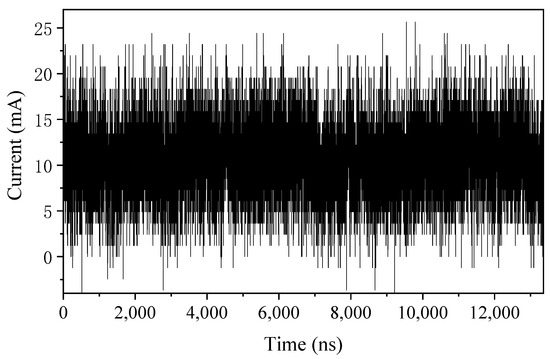
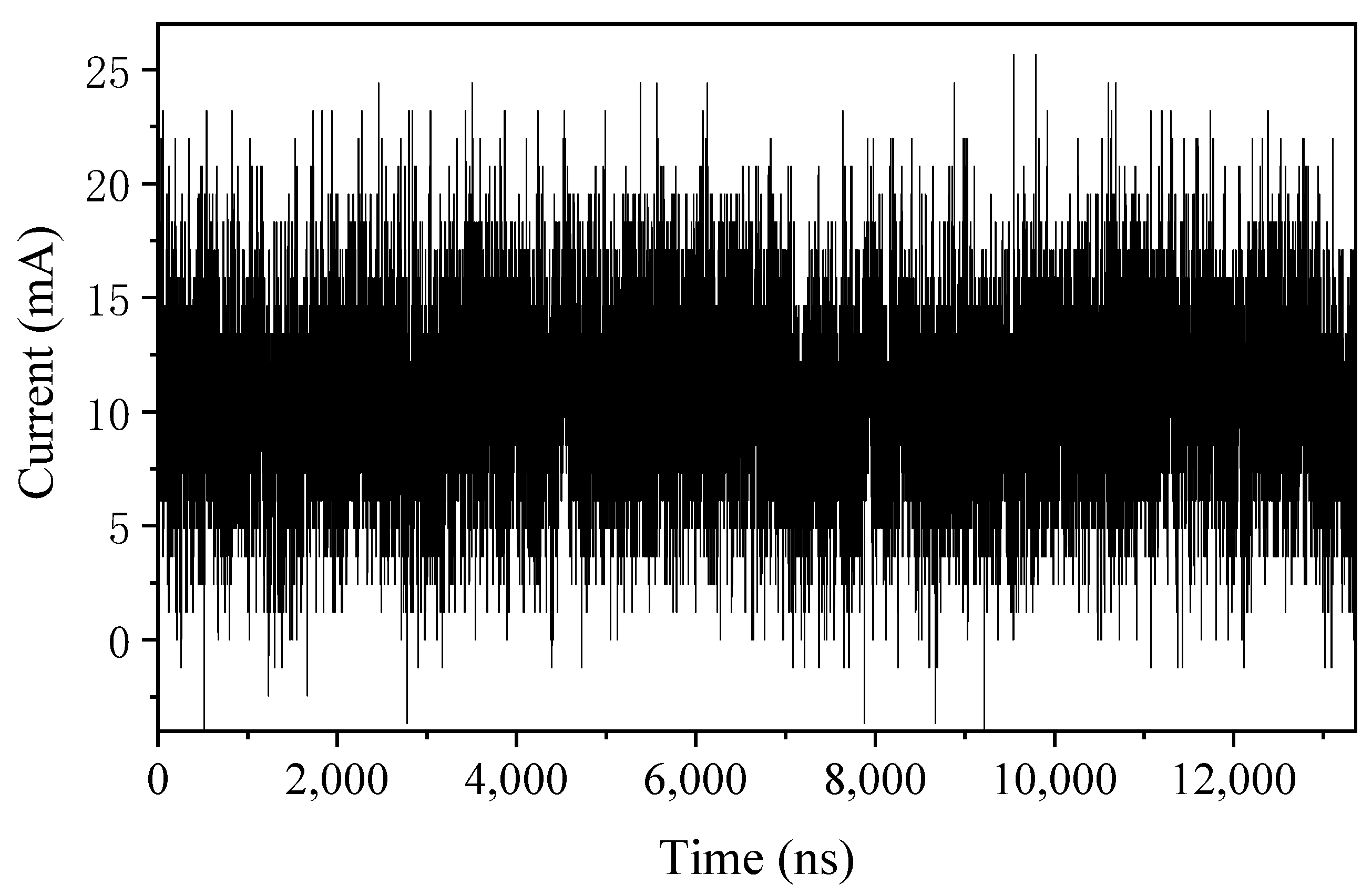
Prior to feature extraction, the fault signal is decomposed using SSA-VMD. Taking an open-circuit fault under a 2000 Ω load as an example, the original signal is shown in Figure 13.
Figure 13.
Original data of the intermittent open-circuit fault under a 2000 Ω load.
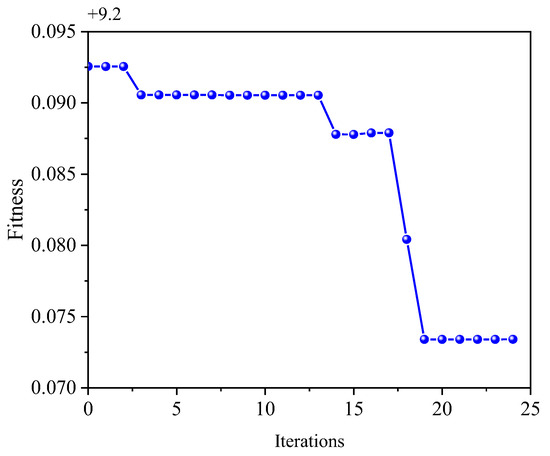
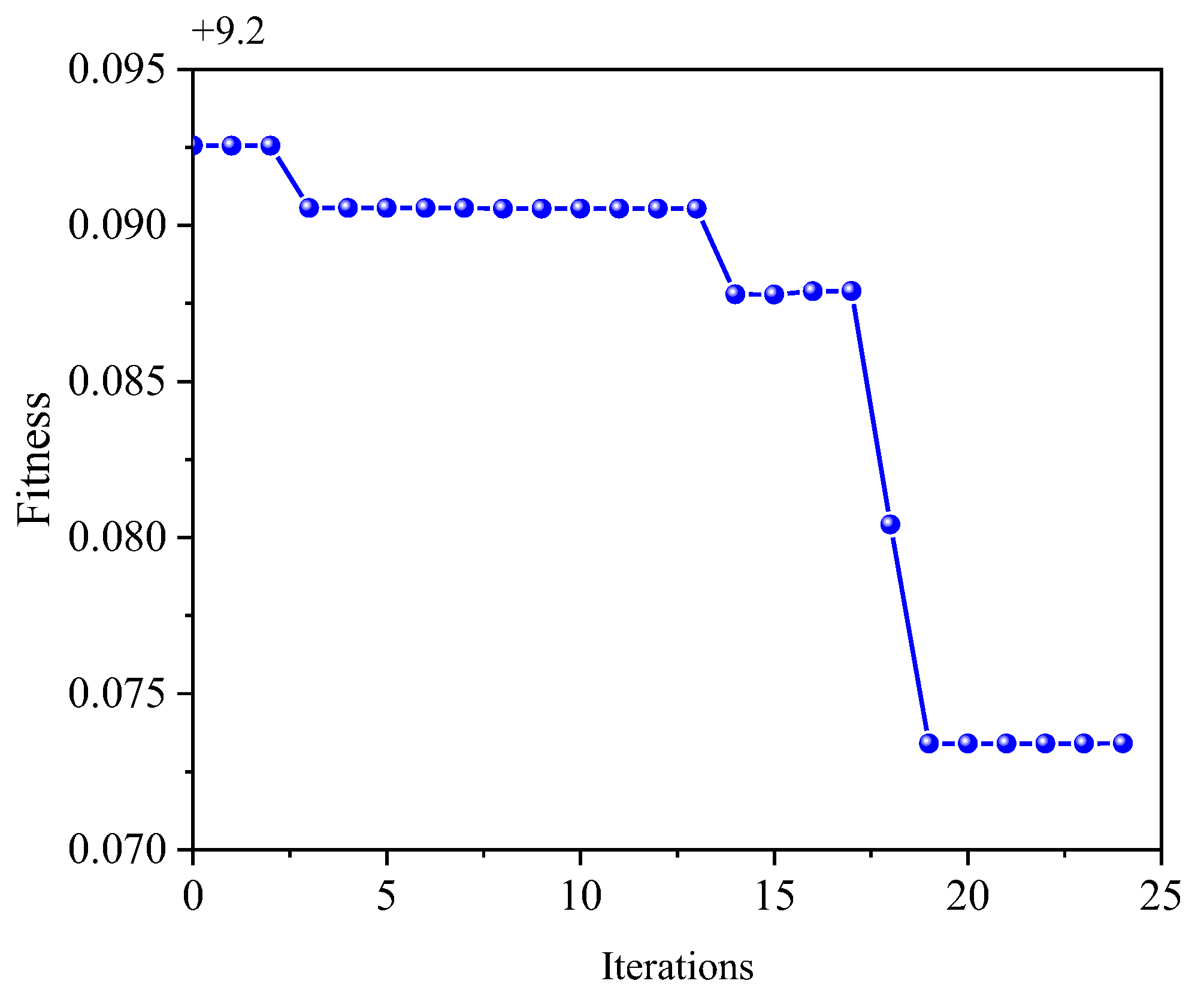
The SSA optimizes the number of modal components K and the penalty factor α for VMD. Based on the fitness function for SSA-optimized VMD parameters, the optimization process ran for 25 iterations. The fitness function curve is shown in Figure 14. The fitness function converged at the 19th iteration, reaching a minimum value of 9.2734. The near-optimal number of decomposition layers and penalty factor obtained at this point are [7, 2763.0], respectively.
Figure 14.
Fitness function curve.
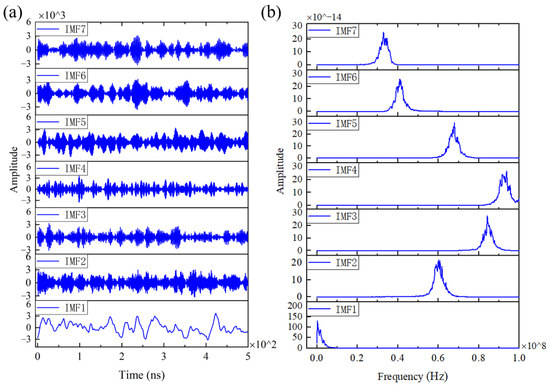
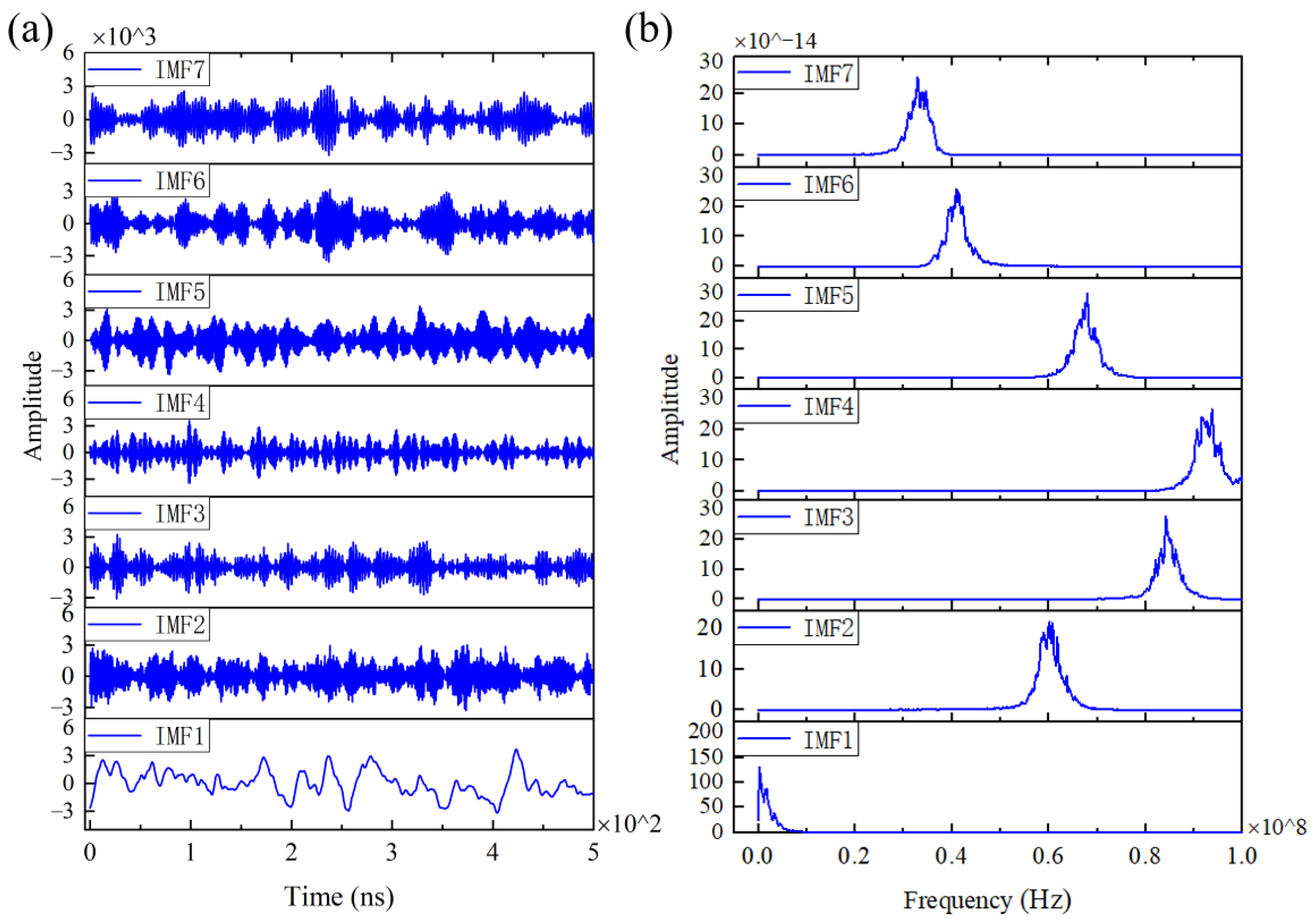
The time-domain and frequency-domain plots of the signal after decomposition by the SSA-VMD algorithm are shown in Figure 15. The first component primarily consists of low-frequency elements, representing the general operating current of the circuit. The other high-frequency components demonstrate effective signal decomposition without significant mode mixing. It is noteworthy that transient impact responses caused by faults are typically contained within the high-frequency IMF components, which aligns with the physical characteristics of IFs.
Figure 15.
(a) Time-domain and (b) frequency-domain diagrams of the IMF components after SSA-VMD.
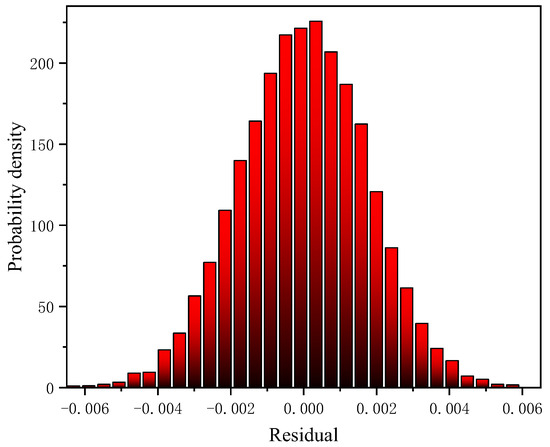
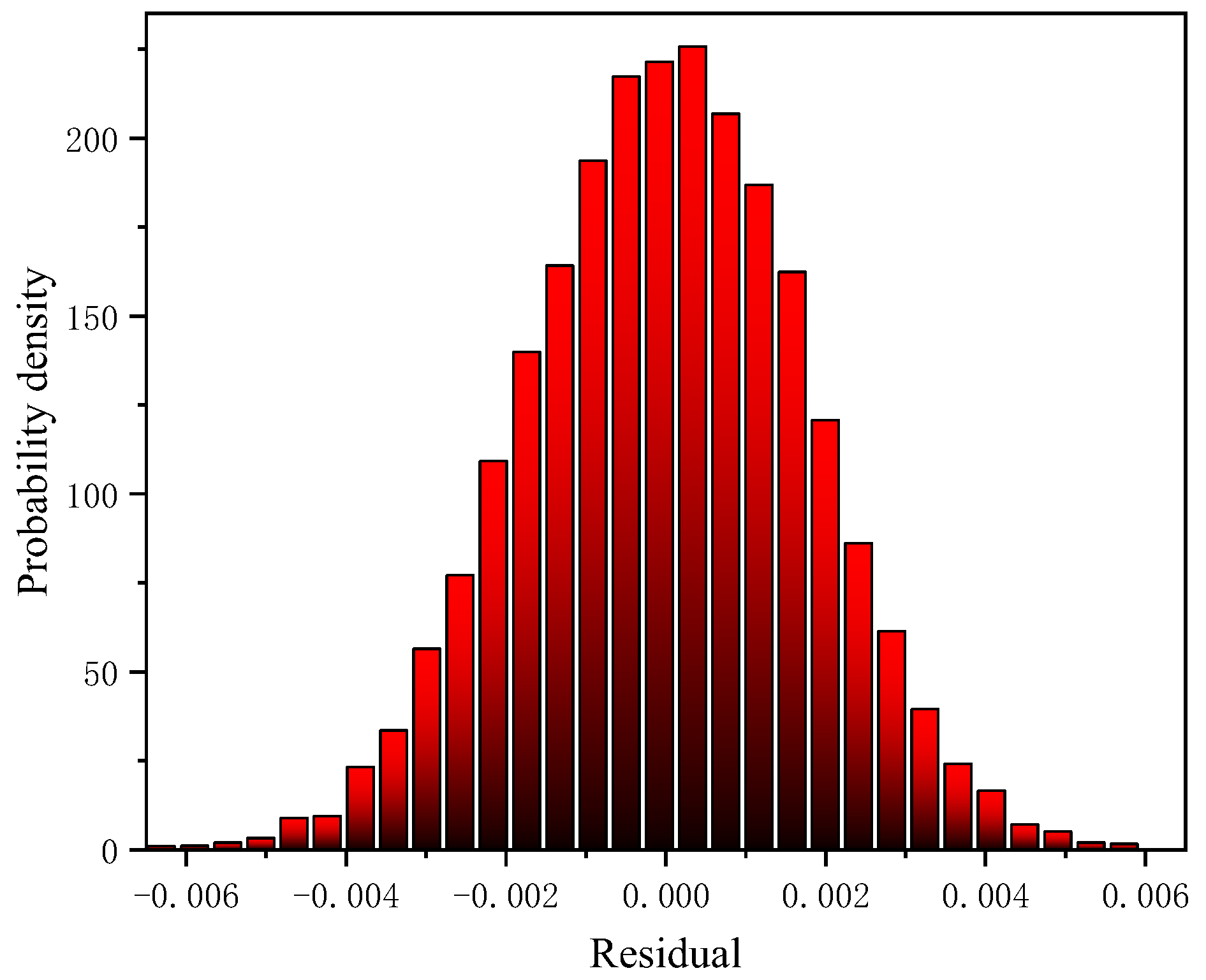
The primary objective of using SSA-VMD in this study is to extract more discriminative deep-level features through refined frequency band separation, rather than being limited to frequency component analysis alone. To achieve this goal, we aim to obtain a sufficiently detailed decomposition while preserving the integrity of the signal information as much as possible. Therefore, this study uses the residual between the reconstructed signal and the original signal as an important evaluation metric. As shown in Figure 16, the residual is concentrated at a low level, indicating that SSA-VMD achieves fine-grained decomposition while maintaining good signal integrity and effectively avoiding information loss.
Figure 16.
Residual distribution plot.
In summary, the SSA-VMD method in this study is primarily used to provide modality components with high fidelity and sufficient decomposition for subsequent feature extraction, thereby laying the foundation for the fault diagnosis task.
3.2.2. Diagnostic Model Construction and Analysis
This study begins by classifying the types of IFs in HDICs. Based on the analysis of response characteristics, HDICs IFs are mainly categorized into intermittent open-circuit faults and intermittent short-circuit faults. Intermittent open-circuit faults are highly correlated with load conditions, while intermittent short-circuit faults are strongly influenced by amplitude and are also affected by factors such as duration. Considering the root causes of the faults and their impact on the I_DD, this study focuses on typical HDIC IFs induced by bonding wires. The fault types are defined as follows: an intermittent open-circuit fault refers to a situation where the resistance of a bonding wire increases suddenly for a very brief duration and then recovers; an intermittent short-circuit fault refers to a situation where a bonding wire briefly shorts to another line for a very short time and then recovers. Accordingly, the dataset for model training and validation is composed as follows:
- Intermittent open-circuit faults: Samples of intermittent open-circuit faults on output lines under different load conditions (200 Ω to 30 kΩ), and samples with different durations (300 ns to 8 μs).
- Intermittent short-circuit faults: Samples of intermittent short-circuit faults (amplitude 0 to 2000 Ω), and samples with different short-circuit durations (300 ns to 8 μs).
- Normal operation: Original data under fault-free conditions with different loads (200 Ω to 30 kΩ).
The training set and test set were randomly split from the dataset in a 4:1 ratio.
According to the overall model construction workflow described previously, the input data undergoes SSA-VMD. After obtaining K IMF components via SSA-VMD, feature extraction is performed at two levels: (1) Component Level: The 22-dimensional features listed in Table 1 are calculated for each IMF component, aiming to capture local patterns associated with specific frequency bands. (2) Global Level: Two global statistical features are calculated from the total residual signal after decomposition to capture global anomalies not captured by the IMFs, including: Residual Variance (residual_var), which measures the completeness of the decomposition and reconstruction; and Residual Skewness (residual_skew), which detects asymmetric fault impact components within the residual. Finally, the feature vector for each sample is formed by concatenating all IMF component features and the global residual features, resulting in a total of 156 dimensions. Selected features for normal, intermittent open-circuit, and intermittent short-circuit fault conditions are presented in Table 2.
Table 2.
Partial Features after SSA-VMD.
The features extracted from the IMF components exhibit discernible differences among normal conditions, intermittent open-circuit faults, and intermittent short-circuit faults. This discriminative power enhances fault diagnosis capability.
Compared to direct feature extraction from the raw signal, performing feature extraction after VMD offers the following advantages:
- Fault Feature Separation and Enhancement
Weak fault features in the original signal are often masked by strong background noise and normal operational signals. Through SSA-VMD, the signal is adaptively decomposed into IMF components across different frequency bands, enabling effective separation and enhancement of fault-related features within specific IMFs. For instance, high-frequency transient fault characteristics are primarily concentrated in the latter high-frequency IMF components, while low-frequency slowly varying fault features and general operating current characteristics are reflected in the first IMF. This frequency band separation effect makes weak fault features that are difficult to detect in the original signal more prominent and identifiable within specific IMF components.
- 2.
- Multi-Scale Fault Information Capture
Extracting features directly from the raw signal only yields global statistical characteristics, losing the multi-scale nature of the fault. The IMF components generated by SSA-VMD inherently possess multi-scale properties. Extracting features from each IMF is equivalent to analyzing fault characteristics from multiple temporal scales.
- 3.
- Improved Fault Diagnosis Accuracy
Features extracted directly from the raw signal are global statistics and cannot provide information about the timing or frequency band of the fault occurrence. In contrast, feature extraction based on IMF components can clearly indicate in which frequency band component the main fault features appear, providing important clues for fault source localization and facilitating improved diagnostic accuracy.
- 4.
- Optimal Balance between Feature Dimension and Information Content
Directly extracting a fixed number of features (e.g., 22) from the raw signal results in limited dimensionality that may contain substantial redundant information. Extracting the same number of features from each of the K IMF components yields a total feature dimension of 22 × K. Although the dimensionality increases, each feature targets a specific frequency band, resulting in low information redundancy and strong complementarity. Subsequent feature selection algorithms (e.g., Random Forest importance ranking) can select the most discriminative feature subset from these 22 × K features, achieving an optimal balance between feature dimension and information content.
- 5.
- Adaptation to Non-Stationary Characteristics of IFs
HDIC IFs exhibit significant non-stationarity and randomness. Global features extracted directly struggle to effectively capture this dynamic behavior. Each IMF component from SSA-VMD can be regarded as a relatively stationary representation of the original signal within a specific frequency band. Extracting features from these relatively stationary components better reflects the essential characteristics of the fault. This is particularly true for nonlinear features like sample entropy and multiscale entropy, whose calculation is more accurate and reliable on the stationary IMF components.
- 6.
- Enhanced Interpretability
Features based on IMF components have clearer physical interpretations. Each IMF corresponds to a specific oscillation mode and frequency band, and its feature values directly reflect the degree of fault within that mode. In contrast, global features from the original signal often represent a mixture of multiple physical processes, resulting in poorer interpretability. This correspondence provides strong support for the interpretability of the diagnostic model.
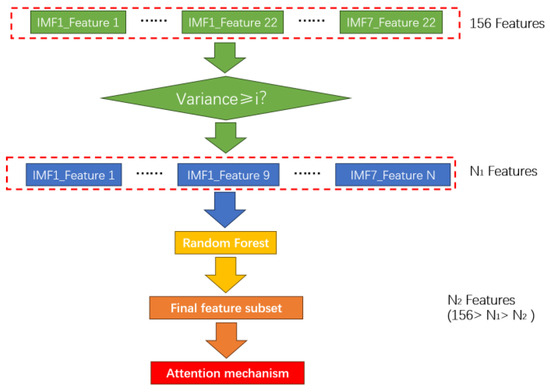
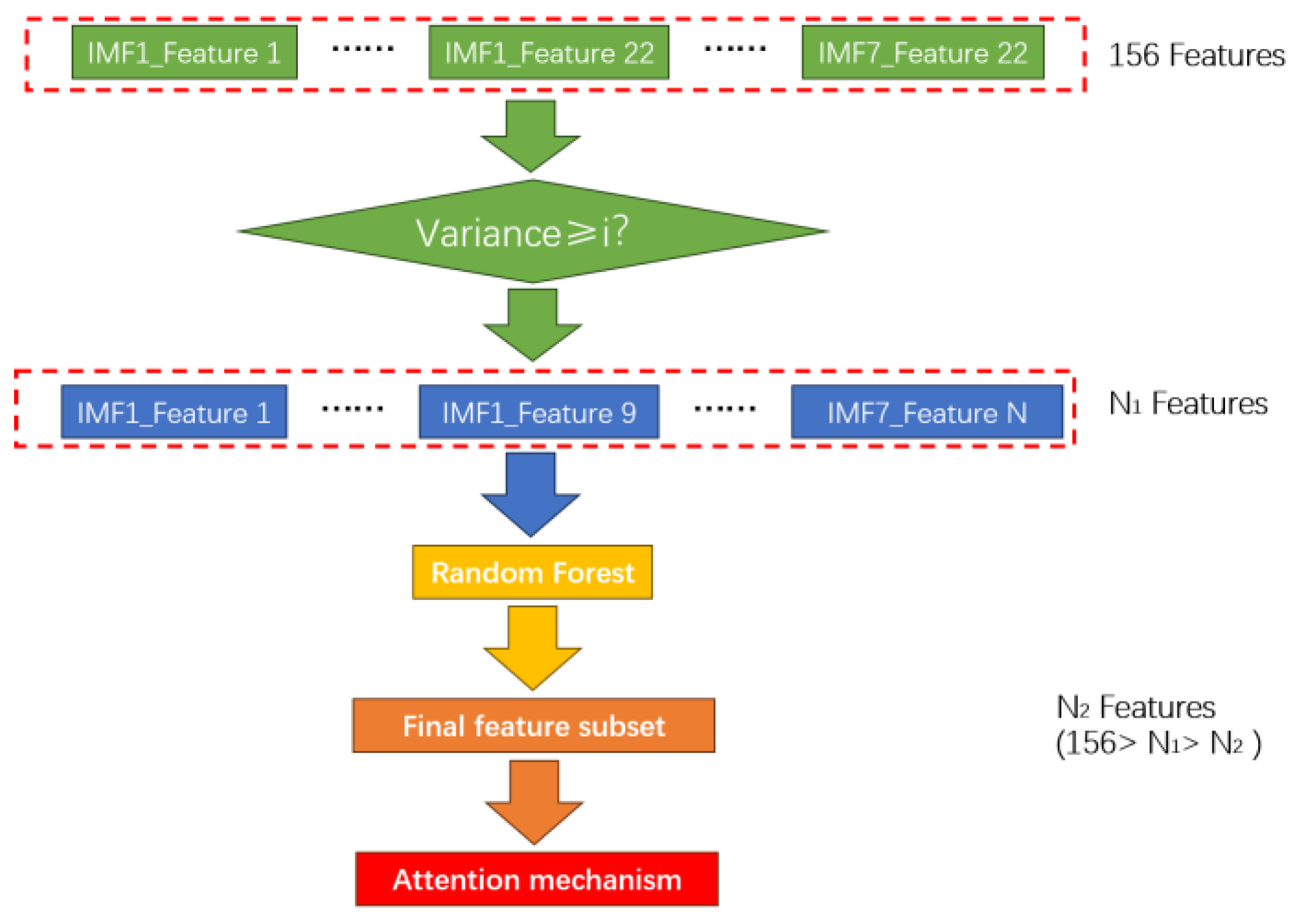
During the feature engineering stage, the initial feature dimension is as high as 156. Directly inputting this high-dimensional feature set into a classifier would not only significantly increase computational complexity but also easily trigger the “curse of dimensionality,” leading to model overfitting and weakened generalization ability. To address this, this study adopts a two-stage feature engineering strategy: first, static feature pre-selection is performed, followed by the introduction of dynamic attention mechanism-based weighting during model training. The flowchart is shown in Figure 17.
Figure 17.
Schematic diagram of feature pre-selection.
Stage 1: Hybrid Feature Pre-selection Based on Variance Threshold and Random Forest
This stage aims to filter the most discriminative feature subset from the original 156-dimensional features. The core principles are as follows:
- Variance Threshold Screening:
The variance of each feature across all samples is calculated. Features with variance close to zero exhibit almost no variation across different samples and contain very little discriminative information. By setting a threshold (0.01 in this study), these low-variance features can be removed, equivalent to performing preliminary filtering of ineffective information. This method is computationally highly efficient, is an unsupervised approach that does not rely on model labels, and can quickly and effectively eliminate obviously non-discriminative features, reducing the burden for subsequent fine screening.
- 2.
- Random Forest Importance Ranking:
Based on the variance screening, a Random Forest model is trained. Random Forest evaluates feature importance by calculating the average decrease in impurity (Gini impurity or information gain) contributed by each feature when used for node splitting across numerous decision trees. Features with higher importance scores indicate a greater contribution to classification decisions. This is a model-based method whose evaluation criteria are directly related to the final classification task, resulting in a selected feature subset with stronger discriminative power. Furthermore, Random Forest is insensitive to data noise and outliers, yielding relatively robust evaluation results.
By combining the above two methods, a “coarse screening first, fine screening later” workflow is formed. Variance threshold serves as the initial screening, rapidly removing noise; Random Forest serves as the fine screening, selecting key features based on model performance. This hybrid strategy ensures feature quality while balancing computational efficiency. After this stage, the feature dimension is reduced from 156 to 42, significantly lowering data complexity and the risk of overfitting while retaining the vast majority of effective information.
Stage 2: Dynamic Feature Weighting Driven by Attention Mechanism
The pre-selected 42-dimensional features are then input into an SVM model integrated with an attention mechanism. At this stage, the attention mechanism acts as a dynamic feature filter. Rather than simply retaining or discarding a feature, the attention mechanism learns, through training, to assign a continuous weight to each feature. This weight reflects the importance of the feature for the current classification task. Features with high importance receive “attention” (amplification) in subsequent classification, while features with low importance are “suppressed” (weakened). Unlike the “all-or-nothing” hard selection of the first stage, attention weighting is a finer, more adaptive soft selection. It can dynamically adjust the focus based on the specific sample, enhancing the model’s expressive power. Finally, the ranking obtained from the average attention weights across samples clearly reveals the key diagnostic features relied upon by the model.
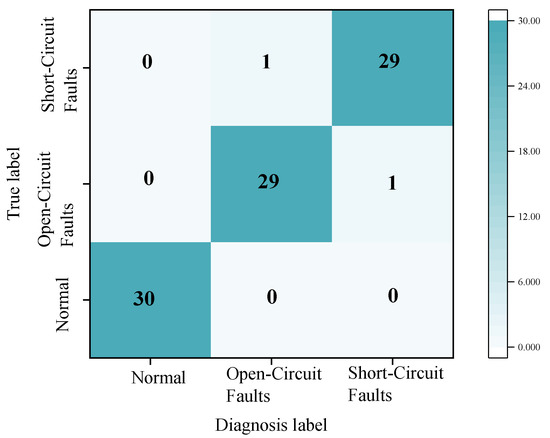
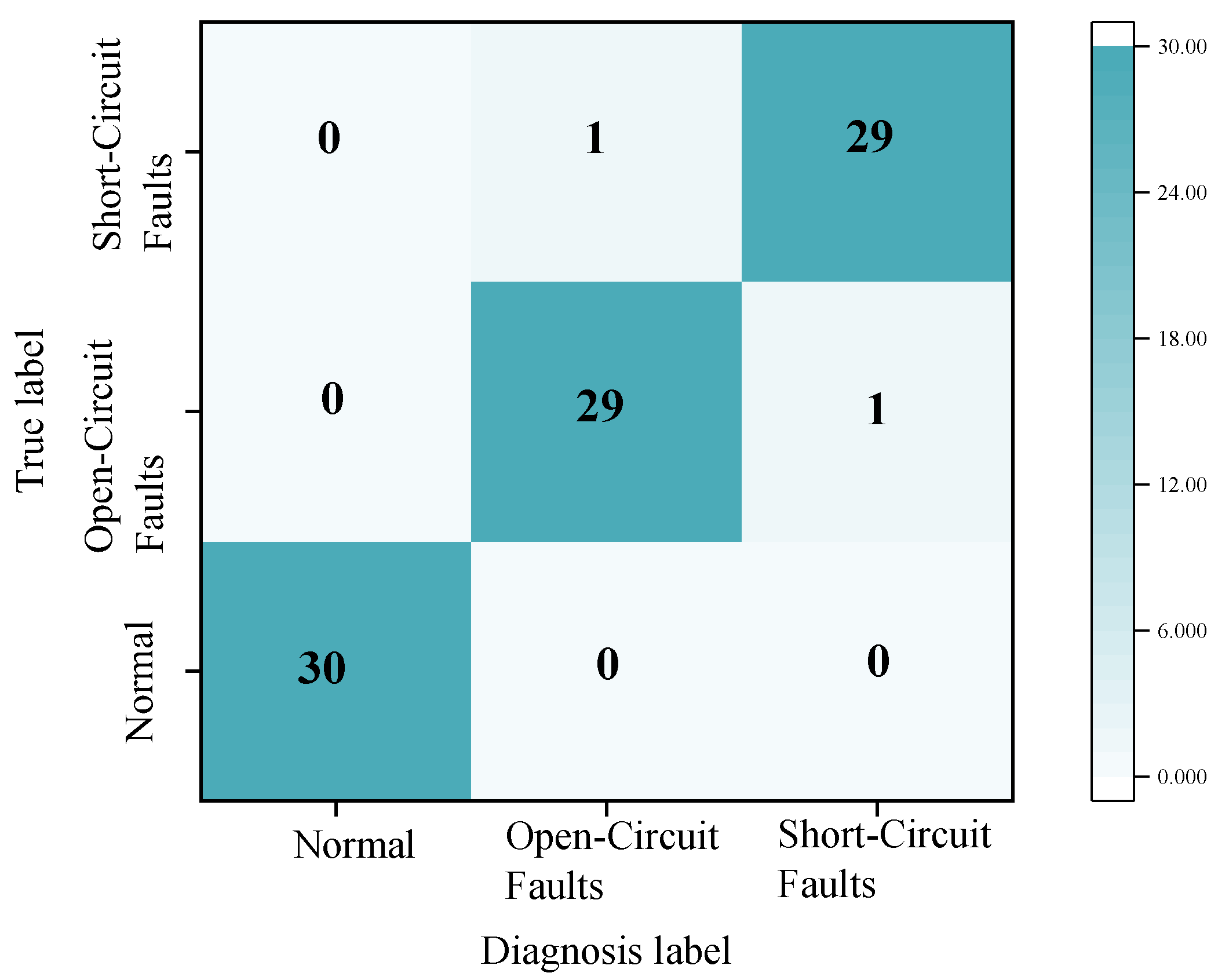
Following the aforementioned dataset partitioning principle, there are 150 samples each for intermittent open-circuit faults, short-circuit faults, and normal conditions, resulting in a total of 450 samples. Consequently, the training set contains 360 samples, and the test set contains 90 samples. After feature extraction is completed, model training and testing can be performed. Diagnostic results are obtained upon importing the data. The final performance on the test set is shown in Figure 18.
Figure 18.
Confusion Matrix for the Test Set.
It can be observed that the model achieved an overall accuracy of 97.78% on the test set. The confusion matrix indicates that diagnostic errors primarily involve the misclassification between a few intermittent open-circuit and short-circuit samples, while the recognition accuracy for normal samples is 100%. This demonstrates the model’s high specificity; that is, even in the rare event of fault type misclassification, it almost never mistakes a fault condition for a normal state, effectively avoiding false alarms and proving the model’s high reliability and stability in practical applications.
The recall rates for both intermittent open-circuit faults and short-circuit faults are 97%, indicating high detection sensitivity for both fault types and a controllable risk of missed detections. The high recall rate reflects the model’s ability to effectively capture the vast majority of fault events, particularly meeting the stringent requirements for low missed detection rates in practical engineering scenarios. For open-circuit faults, the high recall signifies the model’s sensitivity to current decrease characteristics; for short-circuit faults, the equally high recall indicates its stable capability to capture current surge features. The parity in recall rates between the two fault types further validates the model’s consistent detection performance across different fault categories.
The F1-score, being the harmonic mean of precision and recall, comprehensively reflects the model’s classification ability for a specific category. The results show that all categories achieved F1-scores above 0.97, demonstrating the model’s strong overall performance.
Normal Condition F1 = 1.00: Reaffirms the model’s high reliability in distinguishing between normal and abnormal states.
Similar F1-scores for Open-Circuit and Short-Circuit Faults: Indicates that the model’s overall discrimination ability for both fault types is comparable, with no significant performance imbalance. This shows that the model achieves high overall performance without sacrificing the detection capability for either fault type.
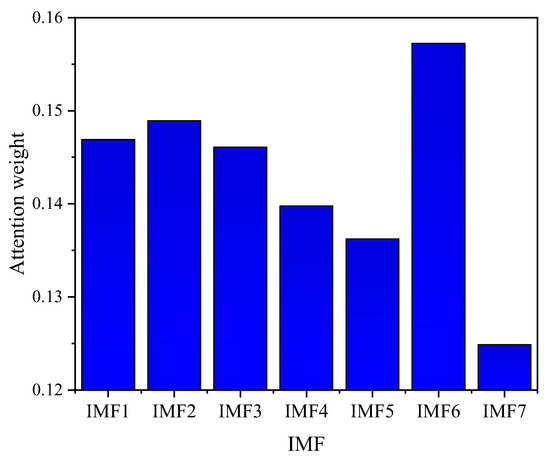
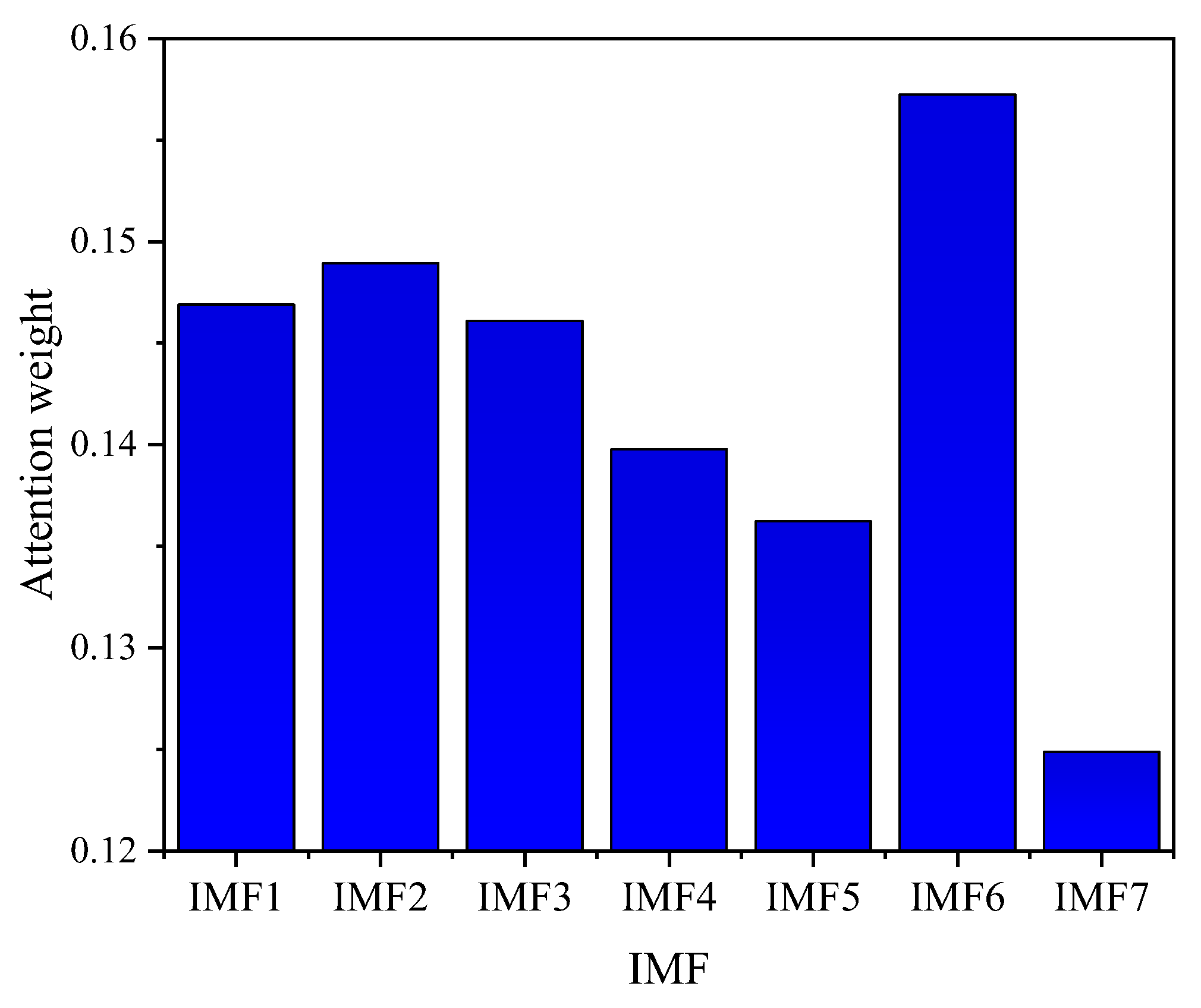
During the model training phase, the attention mechanism acts as a refined, adaptive feature re-weighter. It learns and optimizes weights at three levels—IMF-level, feature-level, and global-level—dynamically adjusting the contribution of each feature to the final diagnostic decision. After training, the attention weights for each IMF component at the IMF-level are shown in Figure 19.
Figure 19.
Attention Weights for Each IMF Component.
From the figure, it can be observed that IMF6 and IMF2 have the highest weights, indicating that high-frequency components hold the most significant discriminative value in fault diagnosis. By calculating the average attention weights across all test set samples, the key features most relied upon by the model in actual decision-making can be further identified. Table 3 lists the top 22 features by average weight, revealing the primary basis for the model’s fault discrimination.
Table 3.
Top 22 Features by Average Attention Weight.
Analysis of the results shows that the top-ranked features primarily originate from mid-to-high frequency IMF components (IMF2 to IMF7), highlighting the critical role of high-frequency components in characterizing fault features. Impact-related features such as Impact Factor, Impulse Factor, and Crest Factor dominate the list, indicating that the model relies heavily on the transient impact characteristics within the current signal for discriminating IFs. The prevalence of Kurtosis features across multiple IMF components further emphasizes that the steepness of the signal distribution (i.e., the salience of impact components) holds significant value for fault identification. Additionally, the appearance of Multiscale Entropy features reflects that the model also considers complexity changes across different time scales. Overall, the distribution of attention weights demonstrates that the model can adaptively focus on the combination of features that characterize the transient impact nature of IFs, which aligns highly with their physical mechanism.
To objectively evaluate the comprehensive performance of the proposed model, comparative experiments were conducted with various mainstream diagnostic methods. The results are shown in Table 4. The comparison shows that the approach using only SSA-optimized VMD parameters followed by SVM (Entry 6) achieved an accuracy of 93.83%, which is only a limited improvement over the SVM baseline model using directly extracted original features (Entry 2, 92.8%). However, when the attention mechanism was introduced (this study, Entry 5), performance leaped significantly, with accuracy increasing substantially to 97.78%. This comparative result strongly demonstrates that the introduction of the attention mechanism is key to the performance gain. It not only significantly optimizes the quality of features input to the SVM through adaptive feature weighting, thereby improving classification accuracy, but also enhances the model’s interpretability through its weight allocation, clearly identifying the most important features for fault diagnosis. Overall, the proposed SSA–VMD–Attention–SVM framework demonstrates significant advantages and substantial application potential in the task of HDIC IF diagnosis.
Table 4.
Comparative Analysis of Fault Diagnosis Performance.
3.2.3. Summary
This section systematically elaborates on the hybrid SSA–VMD–Attention–SVM diagnostic framework. By introducing the SSA to adaptively optimize the key parameters of VMD, fine-grained decomposition and feature extraction of non-stationary fault signals are achieved. After feature pre-selection, a three-level attention mechanism is integrated to adaptively weight multi-domain features, effectively highlighting key fault components. Finally, the SVM is employed to accomplish fault classification.
Experimental results demonstrate that the diagnostic model based on this framework achieves an overall classification accuracy of 97.78% for intermittent open-circuit and short-circuit faults in the GPIO interfaces of the DSP chip, significantly outperforming comparison methods such as traditional VMD-SVM and standard SVM. Visualization analysis of the attention weights indicates that the model can adaptively focus on impact-like features and time-frequency energy features within high-frequency IMF components. This decision-making basis aligns closely with the transient impact physical mechanism of IFs, substantially enhancing the reliability and interpretability of the diagnostic process.
4. Conclusions
This paper focuses on IFs in high-density integrated circuits, specifically those induced by bonding wire defects and typified by DSP chips with a high proportion of GPIO interfaces. A systematic study was conducted to address the diagnostic challenges posed by these faults. The research primarily consists of two closely linked parts: “Fault Response Characteristic Analysis” and “Intelligent Diagnostic Model Construction.” The main conclusions are as follows:
In terms of response characteristic analysis, this paper systematically investigated the influence of dynamic parameters, occurrence location (input/output lines, high/low logic levels), and duration of intermittent open-circuit and short-circuit faults on the I_DD response, utilizing a dedicated fault injection module and experimental circuit. Experimental analysis reveals that: (1) The I_DD signal is sensitive to both intermittent open-circuit and short-circuit fault events in GPIO interfaces. It exhibits clearly correlated fluctuations during the fault period and the subsequent recovery phase, validating the feasibility of fault detection based on current monitoring. (2) The amplitude and shape of the I_DD response can effectively characterize the severity of the fault, though a comprehensive interpretation requires consideration of the specific logic level and location of fault occurrence. (3) The fault amplitude and duration are key parameters influencing the I_DD response pattern, predominantly governing the response intensity and transient pulse width, respectively. (4) The logic level state (high/low) at which the fault occurs leads to significantly different I_DD response patterns. (5) Intermittent open-circuit and short-circuit faults exhibit distinguishable decreasing and increasing trends, respectively, in the I_DD, along with impact-like transient characteristics. This provides a direct physical basis for subsequent feature-based pattern recognition.
Regarding the diagnostic method, to address the challenges posed by the non-stationarity, weak manifestation, and small sample size of IF signals, this paper proposes a hybrid intelligent diagnostic framework based on the Sparrow Search Algorithm-optimized Variational Mode Decomposition and Attention-based Support Vector Machine (SSA–VMD–Attention–SVM). This framework employs the SSA to adaptively optimize VMD parameters (the number of modes K and the penalty factor α), thereby enhancing the decomposition quality for weak transient features. A three-level attention mechanism is utilized to adaptively screen and weight the high-dimensional multi-domain features extracted from each IMF component, effectively highlighting key components related to the physical mechanism of bonding wire faults. Finally, high-precision classification is achieved under small-sample conditions using the SVM. Experimental results demonstrate that the proposed model achieves a diagnostic accuracy of 97.78% for intermittent open-circuit and short-circuit faults in the GPIO interfaces of the DSP chip. Ablation studies further verify the critical role of SSA parameter optimization and the attention mechanism in improving the model’s accuracy, robustness, and interpretability.
In summary, this paper not only systematically reveals the response patterns of bonding wire-induced intermittent faults in the I_DD of DSP chips but also constructs a novel diagnostic framework that integrates adaptive signal decomposition, intelligent feature weighting, and efficient classification decision-making. This research provides a complete example for diagnosing specific types of integrated circuit intermittent faults, encompassing theoretical analysis, methodological innovation, and experimental validation. It holds positive significance for enhancing the reliability of high-density integrated circuits and the predictive maintenance capabilities of related electronic equipment in critical fields such as aerospace and industrial control.
Author Contributions
Conceptualization, W.Y., G.L., J.Q. and K.L.; software, W.Y. and X.L.; validation, W.Y., X.C., X.L. and K.L.; formal analysis G.L., J.Q. and K.L.; investigation, W.Y., Y.Z. and X.L.; resources, Y.Z., G.L., J.Q. and K.L.; data curation, W.Y. and Y.Z.; writing—original draft preparation, W.Y., Y.Z. and K.L.; writing—review and editing, X.C., G.L. and J.Q.; visualization, W.Y.; supervision, G.L. and J.Q.; project administration, Y.Z. and K.L.; funding acquisition, G.L. and J.Q. All authors have read and agreed to the published version of the manuscript.
Funding
This research was funded by the National Natural Science Foundation of China, grant number 52405607.
Institutional Review Board Statement
Not applicable.
Informed Consent Statement
Not applicable.
Data Availability Statement
The original contributions presented in this study are included in the article. Further inquiries can be directed to the corresponding author.
Conflicts of Interest
The authors declare no conflicts of interest.
References
- Ahmad, S.S.; Smith, S.C. Au/Al Wire Bond Interface Resistance Degradation Rate Simulations. IEEE Trans. Device Mater. Reliab. 2019, 19, 774–781. [Google Scholar] [CrossRef] [Scilit]
- Azahar, A.Z.; Bakar, M.A.; Jalar, A.; Ani, F.C. Effect of Die Deflection during Au Wire Bonding Process on Bonding Quality in Overhang Semiconductor Package. J. Mater. Eng. Perform. 2024, 33, 5836–5845. [Google Scholar] [CrossRef] [Scilit]
- Xu, K.; Zhang, W.; Luo, J.; Yu, H.; Yuan, H.; Wang, B.; Wu, D. Evolution mechanism of interfacial multi-layer intermetallic compounds and failure behavior in the Al–Au wire bonding. J. Mater. Res. Technol. 2024, 32, 2843–2856. [Google Scholar] [CrossRef] [Scilit]
- Zhong, T.; Qu, J.; Fang, X.; Li, H.; Wang, Z. The intermittent fault diagnosis of analog circuits based on EEMD-DBN. Neurocomputing 2021, 436, 74–91. [Google Scholar] [CrossRef] [Scilit]
- Zhou, D.; Zhao, Y.; Wang, Z.; He, X.; Gao, M. Review on Diagnosis Techniques for Intermittent Faults in Dynamic Systems. IEEE Trans. Ind. Electron. 2020, 67, 2337–2347. [Google Scholar] [CrossRef] [Scilit]
- Pan, S.; Hu, Y.; Li, X. IVF: Characterizing the Vulnerability of Microprocessor Structures to Intermittent Faults. IEEE Trans. Very Large Scale Integr. VLSI Syst. 2012, 20, 777–790. [Google Scholar] [CrossRef] [Scilit]
- Fang, X.; Qu, J.; Chai, Y.; Liu, B. Adaptive multiscale and dual subnet convolutional auto-encoder for intermittent fault detection of analog circuits in noise environment. ISA Trans. 2023, 136, 428–441. [Google Scholar] [CrossRef] [Scilit]
- Li, X.; Huang, J.; Du, Y.; Fan, Y.; Chen, X. The g-Good-Neighbor Conditional Diagnosabilities of Hypermesh Optical Interconnection Networks Under the PMC and Comparison Models. Int. J. Found. Comput. S. 2023, 35, 313–325. [Google Scholar] [CrossRef] [Scilit]
- Yuan, C.; Zou, C.; Wu, J.; Feng, H.; Li, J. IFDA: Intermittent Fault Diagnosis Algorithm for Augmented Cubes Under the PMC Model. Appl. Sci. 2025, 15, 8197. [Google Scholar] [CrossRef] [Scilit]
- Sun, S.; Zhang, H.; Wang, Y.; Zhang, J. Dissipativity-Based Intermittent Fault Detection and Fault-Tolerant Control for Uncertain Switched Random Nonlinear Systems with Multiple Delays. IEEE Trans. Syst. Man Cybern. Syst. 2022, 52, 7457–7468. [Google Scholar] [CrossRef] [Scilit]
- Gao, S.; Zhao, K. Intermittent Fault Diagnosis of Dynamic Systems with Model Uncertainty and Disturbance: An Adaptive Nondeterministic Observer Approach. IEEE Trans. Reliab. 2025, 74, 4131–4142. [Google Scholar] [CrossRef] [Scilit]
- Gao, S.; Zhao, K.; Si, W.; Wen, C. Time-Varying Threshold and Signed-Rectified Regressor Design of Diagnosis Observer for Analog Circuits with Intermittent Fault. IEEE Trans. Instrum. Meas. 2025, 74, 3510513. [Google Scholar] [CrossRef] [Scilit]
- Laidani, I.; Bourouba, N. Analog Circuit Fault Classification and Data Reduction Using PCA-ANFIS Technique Aided by K-means Clustering Approach. Adv. Electr. Comput. Eng. 2022, 22, 73–82. [Google Scholar] [CrossRef] [Scilit]
- Qu, J.; Fang, X.; Chai, Y.; Tang, Q.; Liu, J. An intermittent fault diagnosis method of analog circuits based on variational modal decomposition and adaptive dynamic density peak clustering. Soft Comput. 2022, 26, 8603–8615. [Google Scholar] [CrossRef] [Scilit]
- Arabi, A.; Ayad, M.; Bourouba, N.; Benziane, M.; Griche, I.; Ghoneim, S.S.M.; Ali, E.; Elsisi, M.; Ghaly, R.N.R. An efficient method for faults diagnosis in analog circuits based on machine learning classifiers. Alex. Eng. J. 2023, 77, 109–125. [Google Scholar] [CrossRef] [Scilit]
- Liu, C.; Yang, Z.; Xiang, G.; Yu, Y.; Tian, J. An Intermittent Fault Detection Method for Three- phase PFC Converters Using EMD-CNN. In Proceedings of the 2022 Global Reliability and Prognostics and Health Management (PHM-Yantai), Yantai, China, 13–16 October 2022; pp. 1–5. [Google Scholar]
- Cheng, X.; Lv, K.; Zhang, Y.; Yang, W.; Wang, L.; Zhao, W.; Liu, G.; Qiu, J. Intermittent fault diagnosis in connector components based on arc wave characteristics. Proc. Inst. Mech. Eng. Part G J. Aerosp. Eng. 2024, 238, 1068–1081. [Google Scholar] [CrossRef] [Scilit]
- Shi, J.; Hou, Y.; Wang, Z.; Yang, Z.; Lv, Z. A diagnostic method for noise and intermittent faults in analog circuits based on the EEMD-SR filtering algorithm and LSTM-CM. Measurement 2025, 254, 117871. [Google Scholar] [CrossRef] [Scilit]
- Shi, J.; Zhou, H.; Yang, Z. Intermittent Fault Diagnosis Method Based on Graph Convolutional Neural Network. In Proceedings of the 2023 Global Reliability and Prognostics and Health Management Conference (PHM-Hangzhou), Hangzhou, China, 12–15 October 2023; pp. 1–5. [Google Scholar]
- Fang, X.; Qu, J.; Liu, B.; Chai, Y. Overcoming Limited Fault Data: Intermittent Fault Detection in Analog Circuits via Improved GAN. IEEE Trans. Instrum. Meas. 2024, 73, 3500111. [Google Scholar] [CrossRef] [Scilit]
- Lin, L.; Zhou, S.; Hsieh, S.Y. Neural Network Enabled Intermittent Fault Diagnosis Under Comparison Model. IEEE Trans. Reliab. 2023, 72, 1206–1219. [Google Scholar] [CrossRef] [Scilit]
- Niu, Y.; Sheng, L.; Gao, M.; Zhou, D. Distributed Intermittent Fault Detection for Linear Stochastic Systems Over Sensor Network. IEEE Trans. Cybern. 2022, 52, 9208–9218. [Google Scholar] [CrossRef] [Scilit]
- Fan, T. Intermittent Fault Detection and Fault-Tolerant Control Algorithm Based on Neural Network in Nonlinear Systems. In Proceedings of the 2025 4th International Conference on Sentiment Analysis and Deep Learning (ICSADL), Hong Kong, China, 18–20 February 2025; pp. 1268–1273. [Google Scholar]
- Gao, M.; Huai, W.; Sheng, L.; Zhou, D. Dynamic Event-Triggered Intermittent Fault Detection for Time-Varying Stochastic Systems. IEEE Trans. Ind. Electron. 2024, 71, 3074–3082. [Google Scholar] [CrossRef] [Scilit]
- Meo, G.D.; Caro, D.D.; Saggese, G.; Napoli, E.; Petra, N.; Strollo, A.G.M. A Novel Module-Sign Low-Power Implementation for the DLMS Adaptive Filter with Low Steady-State Error. IEEE Trans. Circuits Syst. Regul. Pap. 2022, 69, 297–308. [Google Scholar] [CrossRef] [Scilit]
- Wang, P.Y.; Zhan, J.H.C.; Chang, H.H.; Chang, H.M.S. A Digital Intensive Fractional-N PLL and All-Digital Self-Calibration Schemes. IEEE J. Solid-State Circuits 2009, 44, 2182–2192. [Google Scholar] [CrossRef] [Scilit]
- Yang, W.X.; Zhang, Y.; Qiu, J.; Lv, K.H. Research on intermittent fault of bond wire under thermal and vibration shock based on simulation and experiments. Microelectron. Reliab. 2023, 150, 115214. [Google Scholar] [CrossRef] [Scilit]
- Yang, W.; Liu, G.; Lyu, K.; Luo, X.; Shen, K.; Qiu, J. Research on intermittent fault mechanism of bond wire under vibration and environmental shock based on simulation. In Proceedings of the 2024 IEEE International Symposium on the Physical and Failure Analysis of Integrated Circuits (IPFA), Singapore, 15–18 July 2024; pp. 1–5. [Google Scholar]
- Dragomiretskiy, K.; Zosso, D. Variational Mode Decomposition. IEEE Trans. Signal Process. 2014, 62, 531–544. [Google Scholar] [CrossRef] [Scilit]
- Xue, J.; Shen, B. A novel swarm intelligence optimization approach: Sparrow search algorithm. Syst. Sci. Control Eng. 2020, 8, 22–34. [Google Scholar] [CrossRef] [Scilit]
- Du, H.; Wang, J.; Qian, W.; Zhang, X. An Improved Sparrow Search Algorithm for the Optimization of Variational Modal Decomposition Parameters. Appl. Sci. 2024, 14, 2174. [Google Scholar] [CrossRef] [Scilit]
- Luan, X.C.; Zhong, C.H.; Zhao, F.T.; Sha, Y.D.; Liu, G.M. Bearing fault damage degree identification method based on SSA-VMD and Shannon entropy-exponential entropy decision. Struct. Health Monit. Int. J. 2024, 23, 3105–3133. [Google Scholar] [CrossRef] [Scilit]
- Hnini, G.; Riffi, J.; Mahraz, M.A.; Yahyaouy, A.; Tairi, H. Attention Mechanism and Support Vector Machine for Image-Based E-Mail Spam Filtering. Big Data Cogn. Comput. 2023, 7, 87. [Google Scholar]
- Wang, G.; Tu, Y.; Nie, J. An analog circuit fault diagnosis method using improved sparrow search algorithm and support vector machine. Rev. Sci. Instrum. 2024, 95, 055110. [Google Scholar] [CrossRef] [Scilit]
- Suthaharan, S. Support Vector Machine. In Machine Learning Models and Algorithms for Big Data Classification: Thinking with Examples for Effective Learning; Suthaharan, S., Ed.; Springer: Boston, MA, USA, 2016; pp. 207–235. [Google Scholar]

Disclaimer/Publisher’s Note: The statements, opinions and data contained in all publications are solely those of the individual author(s) and contributor(s) and not of MDPI and/or the editor(s). MDPI and/or the editor(s) disclaim responsibility for any injury to people or property resulting from any ideas, methods, instructions or products referred to in the content. |
© 2026 by the authors. Licensee MDPI, Basel, Switzerland. This article is an open access article distributed under the terms and conditions of the Creative Commons Attribution (CC BY) license.