
Article

Evaluation of the Chemical and Sensory Composition of a Marshmallow Product Enriched with Tomato Pomace Powder (Lycopersicon esculentum)

by
Dumitrița Flaiș
1 and
Mircea Oroian
1,2,*
1
Faculty of Food Engineering, Stefan cel Mare University, 720229 Suceava, Romania
2
Suceava-Botoșani Regional Innovative Bioeconomy Cluster Association, 720134 Suceava, Romania
*
Author to whom correspondence should be addressed.
Appl. Sci. 2026, 16(2), 951; https://doi.org/10.3390/app16020951
Submission received: 5 December 2025 / Revised: 9 January 2026 / Accepted: 9 January 2026 / Published: 16 January 2026

Abstract

This study evaluated the physicochemical, antioxidant, and sensory properties of marshmallows enriched with tomato pomace (Lycopersicon esculentum), a by-product rich in fiber and bioactive compounds. Formulations with 0–6% pomace (Control, P1–P3) were analyzed during 20 days of storage. Tomato pomace addition increased crude fiber (from 0.00% to 0.42%) and protein (from 4.62% to 7.05%), while lipid and ash contents remained low (<0.15% and <0.90%, respectively). Carbohydrates ranged around 57–64 g/100 g, resulting in energy values near 270 kcal/100 g. Antioxidant activity (DPPH) increased from 34% in the control to 44% in enriched samples, confirming the contribution of polyphenols and carotenoids. Sensory evaluation (n = 20, 10-point scale) showed good overall acceptability, with enriched samples maintaining color and texture during storage. The results demonstrate that tomato pomace enhances the nutritional and antioxidant profile of marshmallows without negatively affecting sensory quality, supporting its use as a functional ingredient in confectionery formulations.

1. Introduction

The global confectionery market, valued at $201.3 billion in 2019, is growing at an annual rate of 3.6% and is projected to reach $270.5 billion by 2027. From a public health perspective, this growth is concerning, as the high intake of added sugars is a major contributing factor to the global rise in obesity and diabetes. Consequently, the prevalence of sugar-related diseases may also increase. In recent decades, global dietary patterns have shifted towards a higher intake of processed foods, characterized by elevated levels of sugars, fats, and sodium. This dietary shift has been linked to the increasing prevalence of metabolic diseases such as obesity and type 2 diabetes, which represent major public health challenges worldwide [1]. However, the segment of medicated or functional confectionery is expanding, offering sweet products with added health benefits. This category is expected to grow at a higher annual rate of 4.1% between 2019 and 2027 [2]. Among these confections, marshmallows stand out as a unique type of aerated candy, created by incorporating air into a sugar-based mixture. They are produced in various shapes, sizes, and textures depending on their intended use. Typically, the formulation includes a sugar solution, foaming agents such as egg albumin and gelatin, along with flavorings and colorings [3]. Marshmallow is a soft, aerated confectionery product traditionally made by whipping sugar, glucose syrup, and gelatin into a foamy structure. It was first developed in France under the name Pâte de Guimauve, by combining egg and sugar with an extract from the root of Althaea officinalis, a marshland plant native to the region [4]. Beyond their traditional formulation, marshmallows provide a versatile matrix for functional ingredient incorporation, allowing for the development of health-oriented confectionery products.
Gelatin remains the most effective foaming and gelling agent in marshmallow production, but its animal origin has raised ethical, religious, and dietary concerns among certain consumer groups, including Halal, Kosher, and vegan populations. This has led to increased interest in developing alternative hydrocolloids from plant or marine sources, such as carrageenan, agar, and alginate, which are widely used in the food industry for their functional properties [5].
Despite their popularity, marshmallow-type products are rarely subjected to detailed chemical and sensory evaluation outside the food industry. Chemical composition analysis is essential for understanding nutritional value and functional behavior, while sensory evaluation provides insight into consumer acceptability. Although marshmallows typically have low lipid content, components such as ash (minerals) and fiber may vary depending on added ingredients. Despite its popularity, the scientific literature on the compositional and functional evaluation of marshmallow-based products remains limited. Tomato pomace was selected as a functional ingredient due to its high availability as an agro-industrial by-product and its rich composition in dietary fiber, carotenoids, and polyphenolic compounds. Beyond its nutritional and antioxidant potential, tomato pomace represents a valuable raw material for waste valorization and sustainable food processing. Although its incorporation has been widely explored in savory food products, its application in sweet confectionery matrices remains limited. These aspects justify the selection of tomato pomace for the development of novel marshmallow formulations with enhanced functional properties. Therefore, the aim of this study is to characterize an artisanal marshmallow product through physicochemical analysis (including texture, fiber, protein, lipid, and ash content), as well as sensory evaluation, in order to provide a comprehensive overview of its quality. This study also seeks to examine the influence of tomato pomace addition on antioxidant capacity and compositional balance, highlighting its potential as a natural functional ingredient.
This study aimed to develop functional marshmallows by incorporating an innovative ingredient—tomato pomace (Lycopersicon esculentum), a by-product rich in dietary fiber, natural pigments, and antioxidants. The main objective was to evaluate the improvement in nutritional value and antioxidant potential of the enriched product. The chemical composition (moisture, protein, lipid, ash, fiber, carbohydrate, and energy value) and antioxidant properties were determined according to FAO/WHO (2003) guidelines. Antioxidant activity and bioactive compounds (polyphenols, flavonoids, and carotenoids) were analyzed using spectrophotometric methods reported in recent studies. The results were interpreted through multivariate statistical analysis (PCA) to assess relationships between nutritional and functional parameters. The inclusion of tomato pomace significantly enhanced both the nutritional profile and antioxidant capacity of the marshmallows.

2. Materials and Methods

2.1. Materials

Marshmallow samples were prepared using granulated white sugar, food-grade gelatin of animal origin, a small amount of salt, natural vanilla extract, freshly squeezed lemon juice, and tomato pomace (Lycopersicon esculentum), which served as a functional ingredient with antioxidant potential. All raw materials were sourced from a local supermarket in Suceava city. The tomato pomace obtained from ox heart tomatoes (Lycopersicon esculentum) was dried at 40 °C until a constant mass was reached, indicating minimal remaining moisture. The dried material was then milled using a BOSCH TSM6A013B grinder (Bosch, Stuttgart, Germany) and subsequently sieved with a Retsch AS200 Basic (Retsch GmbH, Haan, Germany) vibrating sieve shaker equipped with mesh sizes of <700 µm, <500 µm, <300 µm, and <200 µm. Fractions with particle sizes smaller than 200 µm were selected for incorporation into the marshmallow formulation and for subsequent analyses.

2.2. Methods

2.2.1. Technological Process for Marshmallow Production

To prepare the marshmallow samples, the following basic ingredients were used: 200 g of granulated white sugar, 100 mL of water (for the sugar solution), 10 g of food-grade gelatin, 50 mL of hot water (for gelatin hydration), 1 mL of natural vanilla extract, and tomato pomace powder (Lycopersicon esculentum), added in three different concentrations: 2 g of tomato powder (P1), 4 g of tomato powder (P2), and 6 g of tomato powder (P3). Each variant represents a different level of functional enrichment of the base formula. The preparation process began with the sugar solution, by mixing the sugar with 100 mL of water and heating the mixture to approximately 80 °C for 10 min, until the sugar was fully dissolved and a homogeneous syrup was obtained. In parallel, the gelatin was hydrated by adding 50 mL of hot water (approximately 75 °C), allowing it to rest for 5 min to ensure complete dissolution. The gelatin solution was then gradually poured into the hot sugar syrup, gently mixed until homogeneous. The vanilla extract and the corresponding amount of tomato pomace powder (according to the specific variant: P1, P2, or P3) were added to the mixture. The entire composition was whipped at high speed for approximately 10 min using an electric mixer, until a light, stable, and aerated foam was obtained. The resulting foam was poured into a tray lined with cornstarch to prevent sticking and allow for easy removal. The samples were then refrigerated at 5 °C for 8 h to allow for proper setting and stabilization of the marshmallow texture. After the aging period, the product was cut into cubes of approximately 3 × 3 × 3 cm for further physicochemical and sensory evaluation [6].

2.2.2. Physico-Chemical Analysis of Marshmallow

Determination of Moisture Content
Moisture content was determined using the oven-drying method. About 5 g of marshmallow sample were placed in previously dried and weighed aluminum dishes. The samples were dried in a hot air oven at 105 °C for 4 h, cooled in a desiccator for 30 min, and reweighed. The process was repeated until a constant weight was reached. Moisture content (%) was calculated as the weight loss of the sample relative to its initial weight.
Determination of Ash Content
The ash content was determined by incineration in a muffle furnace according to AOAC (2016) methods. Approximately 2 g of each marshmallow sample were weighed into pre-weighed porcelain crucibles. The samples were first carbonized over a low flame and then placed in a muffle furnace at 550 ± 10 °C until a constant weight was obtained (approximately 6 h). After cooling in a desiccator, the crucibles were weighed, and the ash content was expressed as a percentage of the initial sample weight.
Determination of Protein Content (Kjeldahl Method)
The protein content of the marshmallow samples was determined using the classical Kjeldahl method, which quantifies total organic nitrogen. Gelatin, the main protein source in the formulation, was considered to contain approximately 85–90% protein, according to manufacturer specifications. Approximately 1 g of each sample was weighed and digested with 15 mL of concentrated sulfuric acid (H2SO4) in the presence of a catalytic mixture (potassium sulfate and selenium). Digestion was continued until a clear solution was obtained, indicating the complete conversion of organic nitrogen into ammonium sulfate. After cooling, the digested mixture was neutralized with 40% sodium hydroxide (NaOH) and subjected to distillation using a Kjeldahl distillation unit (UDK 129, VELP Scientifica, Milan, Italy). The liberated ammonia was trapped in 2% boric acid solution and titrated with standardized 0.1 N hydrochloric acid (HCl) until the endpoint was reached. The nitrogen content was calculated and multiplied by a conversion factor of 6.25 to estimate the total protein content. All measurements were performed in duplicate, and the results are reported as average value [7].
Fat Content
The fat content of marshmallow samples was determined using the Soxhlet extraction method with an automatic extraction system (SER 148/6, VELP Scientifica, Milan, Italy). Approximately 5 g of homogenized sample were weighed and placed into a cellulose extraction thimble. Petroleum ether (boiling range 40–60 °C) was used as the extraction solvent. The extraction protocol consisted of a 60 min immersion phase, followed by a 10 min solvent removal phase, a 60 min washing phase, solvent recovery for 20 min, and a final cooling period of 5 min. After extraction, the collection flasks were dried in an oven at 105 °C for 1 h to remove residual solvent. Fat content was calculated gravimetrically and expressed as grams of fat per 100 g of sample (g/100 g). All determinations were carried out in duplicate, and the results are reported as mean values.
Determination of Carbohydrates
The total carbohydrate content of the samples was determined by difference, according to standard proximate analysis methods. The percentage of carbohydrates was calculated by subtracting the sum of moisture, protein, lipid, ash, and fiber contents from 100. The results were expressed as grams of carbohydrates per 100 g of sample (g/100 g). All measurements were performed in triplicate, and the data were reported as average values [8].
Carbohydrates (%) = 100 − [Moisture (%) + Protein (%) + Lipids (%) + Ash (%) + Fiber (%)]
The results were expressed as grams of carbohydrate per 100 g of sample (g/100 g). All determinations were carried out in triplicate, and the values are reported as average values.
Determination of Crude Fiber Content
Crude fibre was determined according to ISO 20483 [7] (gravimetric Weende method) using an automated fibre analyser (C. Gerhardt GmbH & Co. KG, Königswinter, Germany). About 2.0 g of dried, defatted sample (m1) were weighed into a fibre bag and successively digested with 1.25% (w/v) H2SO4 and 1.25% (w/v) NaOH under controlled temperature and agitation (instrument programme). After each digestion the bags were rinsed with hot distilled water to neutrality. Bags were dried at 105 °C to constant mass and weighed to obtain the mass of bag + residue (m2); the empty-bag mass (m3) was used for tare correction. The residues were then ashed at 550 °C for 4 h, cooled in a desiccator and weighed to obtain ash mass (m4).
The crude fiber content was calculated using the following equation:
% crude   fiber = m 2 m 3 m 4 m 1 × 100
where:
m 1 = weight of the initial dried sample (g);
m 2 = weight of the fiber bag + residue after digestion (g);
m 3 = weight of the empty fiber bag (g);
m 4 = weight of the ash residue after incineration (g).
Determination of Energy Value
The caloric value (energy content) of the samples was calculated using the Atwater conversion factors, based on the contribution of macronutrients. Dietary fiber was also included in the energy value calculation using a conversion factor of 2 kcal/g. The calculation was performed according to the following equation:
Energy   ( kcal )   =   ( 4   × Protein )   +   ( 4   × Carbohydrates )   +   ( 9   ×   Lipids )
where the values of protein, carbohydrate, and lipid contents were obtained from the proximate composition analysis. The energy content was expressed as kilocalories per 100 g of sample (kcal/100 g). All analyses were conducted in triplicate, and the results were presented as average values.
DPPH
For antioxidant activity determination, marshmallow samples were extracted with 80% methanol (v/v) under continuous stirring for 30 min at room temperature, followed by filtration. The obtained extracts were directly used for the DPPH radical scavenging activity assay. The antioxidant activity was determined using the DPPH (2,2-diphenyl-1-picrylhydrazyl) method according to Brand-Williams et al. A 0.1 mM DPPH methanolic solution was prepared and mixed (2 mL) with 1 mL of the sample extract. After 30 min incubation in the dark, the absorbance was measured at 517 nm [8].
The antioxidant activity was calculated using the following formula:
DPPH   ( % )   =   A 0 A s A 0 × 100
where:
A 0 = absorbance of the blank (DPPH solution without sample);
A s = absorbance of the sample extract;
The results were expressed as the percentage of radical inhibition (%).
Total Polyphenol Content (TPC)
Total phenolic content was determined using extracts obtained by extracting marshmallow samples with 80% methanol (v/v) at room temperature under continuous stirring for 30 min, followed by filtration. The total phenolic content was then determined using the Folin–Ciocalteu method [9]. Briefly, 0.5 mL of extract was mixed with 2.5 mL of Folin–Ciocalteu reagent (1:10, v/v) and 2 mL of 7.5% Na2CO3 solution. After 30 min in the dark, absorbance was read at 765 nm. The polyphenol concentration was determined from a gallic acid standard curve, and the results were expressed as milligrams of gallic acid equivalents per gram of sample (mg GAE/g), according to the following equation:
TPC = c G A × V m
where:
TPC = total phenolic content (mg GAE/g);
c G A = concentration obtained from the gallic acid calibration curve (mg/mL);
V = volume of extract (mL);
m = mass of sample (g).
Total Flavones Content
The total flavone content was determined using the aluminum chloride colorimetric method described by Chang et al. [10] One milliliter of extract was mixed with 4 mL of distilled water and 0.3 mL of 5% NaNO2. After 5 min, 0.3 mL of 10% AlCl3 was added. After another 6 min, 2 mL of 1 M NaOH was added, and the volume was made up to 10 mL with distilled water. Absorbance was read at 510 nm, and the results were expressed as mg quercetin equivalents per gram of sample (mg QE/g):
TFC = c Q × V m
where:
TFC = total flavones content (mg QE/g);
c Q = concentration obtained from the quercetin calibration curve (mg/mL);
V = volume of extract (mL);
m = mass of sample (g).
Total Carotenoid Content
Total carotenoid content was determined following the method described by Rodriguez-Amaya, with minor adaptations. Briefly, marshmallow samples were extracted with a mixture of hexane and acetone under continuous stirring until complete pigment extraction. The organic phase was collected and absorbance was measured spectrophotometrically at 450 nm. Total carotenoid content was calculated using the appropriate extinction coefficient and expressed as mg carotenoids per g of sample [11]. Although lycopene is the predominant carotenoid in tomato pomace, total carotenoid content was expressed as β-carotene equivalents, which is standard practice for spectrophotometric determination of total carotenoids.
The concentration of carotenoids was calculated according to the analytical procedure applied in this study, using the following equation:
Carotenoids mg kg = A 470 × 10 3 × 25 2000 × 7.5
where
A 470 is the absorbance measured at 470 nm, 25 is the final extract volume (mL), 7.5 represents the mass of the analyzed sample (g), and 2000 is a correction factor integrating the extinction coefficient and dilution adjustment.
The results were expressed as mg β-carotene equivalents per kilogram of sample (mg/kg).
Texture
Texture was measured using a Perten TVT texture analyzer (Perten Instruments, Hägersten, Sweden) fitted with a 5 kg load cell and a stainless-steel cylindrical probe (Ø 7 mm). Marshmallow samples were cut into ~20 × 20 × 20 mm cubes, leveled to a uniform height, and equilibrated for 60 min at 20 ± 1 °C in closed containers to minimize moisture loss. A double-compression TPA test was performed to 50% strain with pre-test, test, and post-test speeds of 1.0 mm s−1, a trigger force of 5 g, and a 5-s dwell between compressions. From force–distance curves we obtained hardness, springiness, cohesiveness, gumminess (hardness × cohesiveness), chewiness (gumminess × springiness), adhesiveness (negative area, N·s), and stickiness (minimum negative force, N). Each sample was tested in 10 replicates and the results are reported as average values. The instrument was calibrated before testing (zero plus standard weight); all measurements were taken on the same sample face, and sample height was verified with a caliper.
CIE L* a* b* Determination
The colour of the samples was measured using a CM-5 spectrophotometer (Konica Minolta, Foster City, CA, USA). This analysis is important as it shows that incorporating tomato pomace in different amounts imparts a brick-red hue to the tomatoes while also providing health benefits due to its strong antioxidant properties. The method followed was adapted from Stinco [12]. A 5 g portion of each sample was placed in a transparent container, and colour measurements were carried out on the CIE L*a*b* scale, with three replicates per sample.
Colour intensity (chroma) was calculated according to Equation (7):
C * = a * 2 + b * 2
where:
C * = is chroma (colour intensity);
a * = is the red-green coordinate;
b * = is the yellow-blue coordinate.
Sensory Analysis
Sensory evaluation was conducted with an untrained panel of 20 assessors (faculty colleagues, 23–50 years old) in individual booths under controlled conditions (20 ± 2 °C, standard lighting). Samples (control, P1–P3) were portioned into randomly coded containers (three-digit codes), served at the same temperature, and presented in randomized order to minimize order and fatigue effects. Each assessor rated color, odor, taste, consistency, creaminess, overall appearance, and overall acceptability on a 10-point hedonic scale (1 = very poor, 10 = excellent). Water and unsalted crackers were provided for palate cleansing between samples. Evaluations were performed at three storage times (Day 1, Day 10, Day 20) under identical serving conditions. Data were recorded on standardized score sheets and expressed as mean scores.
Statistical Analysis
Principal component analysis (PCA) was performed using Unscrambler X 10.1 (CAMO, Oslo, Norway), while one-way analysis of variance (ANOVA) was conducted using the XLSTAT (trial version) software. A significance level of p < 0.05 was applied to all tests.

3. Results and Discussion

3.1. Physico-Chemical Results

The chemical composition of the control and tomato pomace–enriched marshmallow samples during storage is presented in Table 1. The addition of tomato pomace powder produced a clear, dose-dependent increase in crude fibre. Crude fiber content increased proportionally with tomato pomace addition, while remaining stable throughout storage. Across storage, fibre remained essentially constant (max drift ≤ 0.01–0.02 percentage points between day 1 and day 20), indicating good compositional stability and confirming that the measured differences arise from the formulation rather than from storage. Protein contents ranged from approximately 4.6% to 7.1%. The highest values were consistently recorded in P3 (5.57–7.05%), followed by P1 (4.98–6.50%) and P2 (4.62–6.73%), while the control showed the lowest values (4.78–6.40%). Protein increased progressively during storage, particularly in the pomace-enriched samples. This apparent increase does not indicate protein formation, but rather reflects a concentration effect associated with moisture loss and changes in water distribution within the marshmallow matrix, as protein content was expressed on a mass basis (g/100 g). Ash remained low (≈0.44–0.89%), with the control showing the highest ash levels (0.79–0.88%) and pomace-containing samples slightly lower (0.44–0.72%), consistent with the dilution effect of the sugar-rich matrix. Lipids were minimal (≈0.04–0.10%) and showed no meaningful drift over the 20-day storage period. Moisture ranged from approximately 32.0% to 39.0%. During storage, control and P1 showed noticeable decreases, while P2 and P3 remained relatively stable, varying by ≤1 percentage point.
Taken together, the data show that tomato pomace mainly modulates the fibre fraction (and, as shown separately, colour), while ash and lipids remain low and show no meaningful changes during 20 days of storage. Tomato pomace powder is typically characterized by a high dietary fiber content and relevant levels of carotenoids and polyphenolic compounds, and the compositional trends observed in the present study are consistent with those reported in previous works using tomato pomace as a functional ingredient in food formulations [13,14]. Protein levels increase slightly over time, particularly in the enriched samples, but the major compositional differences are driven by formulation rather than storage. The day-to-day shifts observed are modest and do not alter the overall trend.
The carbohydrate content of the samples ranged from approximately 57.6 to 64.5%, with higher values consistently observed in the tomato pomace–enriched formulations (P1–P3) compared to the control. The control sample showed the lowest carbohydrate levels, while the highest value was recorded for P3 on Day 20 (approx. 64.5%). These increases are primarily linked to the additional solids and dietary fibre supplied by tomato pomace. Similar trends were reported by González-Coria et al. in tomato pomace–enriched sauces, where TP enrichment significantly influenced the levels of bioactive and nutritional compounds [14]. The calculated energy values ranged from approximately 250 to 274 kcal/100 g, with P2 and P3 exhibiting the highest values, reflecting their greater carbohydrate and protein contents in accordance with the Atwater system. Although some day-to-day variations were observed, the dominant trend indicates that tomato pomace enrichment increases both carbohydrate content and energy value (FAO/WHO). The observed variation among treatments may also be related to the compositional differences induced by TP addition, which modifies the balance between moisture and solid components. Overall, the enrichment with tomato pomace increased the nutritional value of the marshmallow samples, particularly in terms of carbohydrate contribution and total energy, supporting the potential of TP as a functional ingredient in confectionery formulations.
The chemical composition of the marshmallow samples enriched with tomato pomace was consistent with recent findings reported in the literature. The moisture content of our samples ranged from approximately 27% to 39%, which falls within the broader interval reported by Colmenares-Cuevas et al. for marshmallows enriched with honey and encapsulated probiotics (25–36%). The ash content in our formulations ranged from ≈0.44% to 0.89%, with lower values in the pomace-enriched samples, reflecting dilution rather than mineral contribution. Regarding lipids, our samples presented very low values (≈0.04–0.10%), confirming the non-lipidic character of this confectionery, in agreement with literature reports (<0.15%). The protein content in our formulations ranged from approximately 4.6% to 7.0%, reflecting the use of gelatin and plant-based components, which may provide additional nutritional benefits [15].
Similar findings were reported by González-Coria et al., who investigated the effect of tomato pomace enrichment on tomato sauces and observed that TP addition significantly modified the nutritional composition, particularly by increasing fiber and bioactive compound contents. Although the matrix in their study was different, the trend observed in our marshmallow samples is comparable, as the inclusion of tomato pomace increased the total carbohydrate content and consequently the energy value [14].
Nakov et al. [13] also reported an improvement in the nutritional profile of bakery products fortified with tomato pomace, showing higher levels of carbohydrates and dietary fiber compared to control samples. Similarly, Begliţa et al. highlighted that tomato pomace powder can be effectively used as a functional ingredient to enhance the nutritional density of various food products due to its high fiber and residual sugar content [16]. Therefore, the increase in carbohydrate and energy values observed in this study is consistent with previously reported results, confirming that tomato pomace incorporation contributes to a richer macronutrient composition and improved nutritional value in formulated foods [16]. The results obtained in the present study are consistent with those reported by Rehal et al., who evaluated the nutritional composition of a gluten-free snack enriched with tomato pomace. Their study indicated a carbohydrate content of 34.52% and an energy value of 248.2 kcal/100 g, values that increased compared to the control sample, confirming the nutritional potential of tomato pomace as a functional ingredient. Similarly, in our marshmallow samples, tomato pomace enrichment led to higher carbohydrate levels (up to approximately 64.5 g/100 g) and increased energy values (up to approximately 274 kcal/100 g). This trend supports the idea that tomato pomace addition improves the nutritional density of food products by contributing both dietary fibers and residual carbohydrates, resulting in higher caloric content and improved functional properties [17]. Since compositional parameters were expressed on a wet weight basis, part of the observed changes during storage can be attributed to moisture variations and concentration effects rather than absolute compositional modifications.

3.2. Antioxidant Activity and Bioactive Compound Content of the Sample

Table 2 clearly shows that tomato pomace enrichment substantially increased the bioactive compound content and antioxidant activity of the marshmallow samples. Carotene, flavone, and polyphenol levels were consistently higher in samples P1–P3 than in the control at all storage times, indicating that tomato pomace enrichment represented the main source of these phytochemicals. The highest concentrations were generally recorded in P3, confirming a dose-dependent effect of tomato pomace addition. A similar trend was observed for DPPH radical-scavenging activity. While the control samples remained nearly unchanged throughout storage (≈35–36%), all enriched samples exhibited higher antioxidant activity, reaching values of up to approximately 45% in the most enriched formulation. Antioxidant activity was expressed as percentage of DPPH radical inhibition (DPPH (%)) to enable direct comparison among the studied formulations. Although reporting IC50 values or Trolox equivalent antioxidant capacity would allow for broader comparison with the literature, the chosen approach is appropriate for relative evaluation within the present study.

3.3. Color Parameters

The colorimetric analysis showed that tomato pomace incorporation produced clear and statistically significant changes in the CIE L*, a* and b* coordinates (Table 3). Lightness (L) was highest in the control sample at Day 1 (82.8)**, while the enriched samples—particularly P2 and P3—displayed visibly lower L values (68.6 and 57.8, respectively), indicating a darker appearance caused by the pigment content of tomato pomace. During storage, L values fluctuated rather than decreasing progressively*, with some samples showing temporary increases at Day 10 (e.g., P2 and P3), but the enriched samples remained consistently darker than the control across all time points, as confirmed by highly significant p-values (p < 0.001). For the a* coordinate (red–green axis), the enriched samples exhibited markedly higher redness at Day 1, with P3 reaching the highest value (9.0), compared to the control (5.3). Although values shifted substantially by Day 10 and Day 20, the overall trend indicates greater redness in tomato pomace samples, reflecting the contribution of natural pigments and phenolic compounds. The strong statistical significance (p < 0.001) highlights that enrichment level was the dominant factor influencing redness. Regarding the b* coordinate (yellow–blue axis), enriched samples showed higher yellowness at Day 1 (38–39), compared to the control (≈31). Although storage led to notable fluctuations and decreases at later time points, P3 and P2 maintained higher b* values than the control by Day 20, indicating a persistent yellow–orange hue associated with carotenoid-rich pomace. The p-values (p < 0.001) confirm that these differences were statistically significant. Taken together, the data demonstrate that tomato pomace consistently darkened the samples and enhanced red/yellow tones compared to the control, regardless of storage-related variability. These colorimetric changes are consistent with the higher carotenoid content measured in tomato pomace–enriched samples, as carotenoids such as lycopene and β-carotene are primarily responsible for red–yellow pigmentation. In addition, polyphenolic compounds may contribute to color stability during storage through their antioxidant activity, thereby limiting pigment degradation.
Our findings align with previous reports on marshmallows enriched with plant-based powders: a decrease in lightness (L*) and an increase in redness (a*). The divergence lies in the b* coordinate: tomato pomace led to higher yellowness (b*↑), whereas grape skin extract produced bluish–purple tones (b*↓). This contrast reflects the distinct pigment profile, i.e., carotenoids versus anthocyanins [18].

3.4. Texture (TPA)

Table 4 illustrates the evolution of texture parameters in the control and tomato pomace–enriched marshmallow samples over 20 days of storage. Firmness showed marked differences between formulations and across time. At Day 1, the control sample displayed the lowest firmness (8 g), whereas the enriched samples presented higher values, particularly P1 (34 g) and P3 (30 g). By Day 10, firmness increased substantially in all samples, reaching approximately 90 g in P1, 68 g in P2, 30 g in P3 and 48 g in the control. At Day 20, firmness declined again in the control and P1, but continued to rise in P2 (77 g) and P3 (67 g), indicating that intermediate and higher pomace levels contributed to a more sustained structural resistance during storage. These trends are supported by the highly significant p-values, confirming that both formulation and storage influenced firmness. Elasticity values remained very low overall (0.002–0.009) and did not show a clear directional trend, suggesting that springiness was only minimally affected by tomato pomace addition. Cohesiveness varied between ≈0.02 and 0.033, with P2 showing a slight increase by Day 20, while P3 maintained lower and more variable values, consistent with a softer and less internally bound matrix. Gumminess and chewiness followed patterns similar to firmness. The highest values were recorded in P1 at Day 10, reflecting a dense and resistant structure at mid-storage, while P2 reached its maximum at Day 20, indicating the most stable texture over time. P3 consistently showed the lowest gumminess and chewiness at the beginning of storage but increased by Day 20, whereas the control remained below the enriched samples throughout the entire period. Stickiness and adhesiveness decreased between Day 1 and Day 10 in all samples, with P3 displaying the lowest stickiness at Day 20. The control sample remained more adhesive than the enriched formulations across all time points, suggesting that tomato pomace reduced surface tackiness. Overall, the data in Table 4 indicate that tomato pomace incorporation altered texture in a formulation-dependent manner: P1 generated the firmest and most resistant structure at mid-storage but weakened by Day 20, P2 exhibited the greatest stability throughout storage, and P3 remained the softest initially yet strengthened over time. These changes are consistent with differences in solid content and moisture redistribution within the gelatin–sugar matrix during storage.
Previous studies have reported that symbiotic marshmallows formulated with different concentrations of gelatin and konjac glucomannan and reported that higher levels of solid structuring agents led to significantly increased hardness, gumminess, and chewiness, as the reinforced gel network produced a firmer and more resistant texture. Similarly, in our tomato pomace–enriched marshmallow system, all enriched samples exhibited higher firmness than the control at Day 1 (P1 ≈ 34 g, P3 ≈ 30 g, P2 ≈ 25 g vs. control ≈ 8 g), indicating that insoluble fibres and solid particles from tomato pomace contributed to strengthening the gelatin–sugar matrix. This strengthening effect was also reflected in greater gumminess and chewiness values compared to the control. Over storage, the behaviour of our samples diverged slightly from the symbiotic marshmallows [19]. While the control and P1 showed a reduction in firmness by Day 20, P2 and P3 continued to increase in firmness, demonstrating progressive structural reinforcement and superior textural stability. Adhesiveness generally decreased in the enriched samples; however, sample P3 maintained higher adhesiveness during storage, indicating a distinct surface behavior compared to the other formulations. The observed increase in adhesiveness, particularly for sample P3, may be associated with the hygroscopic nature of dietary fibers present in tomato pomace. These fibers can attract and retain moisture at the product surface, promoting partial dissolution of sugars and the formation of a sticky surface layer. This mechanism could explain why adhesiveness did not decrease uniformly across all formulations during storage, despite similar trends in other textural parameters. Despite differences in formulation strategy (dietary fibres from tomato pomace vs. hydrocolloid blends) and microstructure (aerated foam matrix in both studies), the two datasets support a common conclusion: solid content and ingredient composition are major drivers of texture development in marshmallow systems, determining how mechanical properties evolve during storage.

3.5. Sensory Analysis

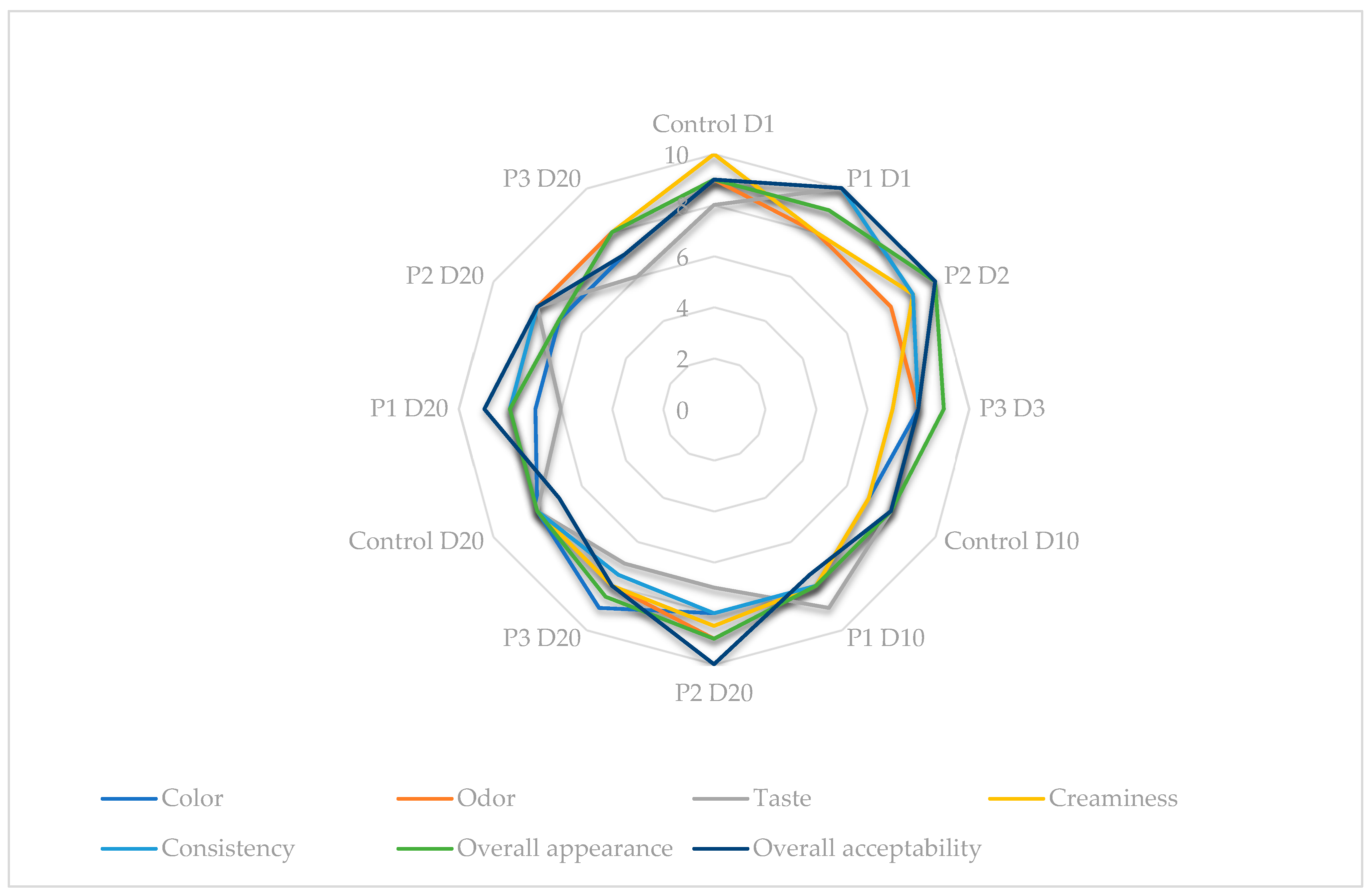
The sensory evaluation of the marshmallow samples was carried out by a panel of 20 assessors (colleagues from the faculty, aged between 23 and 50 years). Each assessor was asked to evaluate attributes such as color, odor, taste, consistency, creaminess, overall appearance, and overall acceptability using a 10-point hedonic scale (1 = very poor, 10 = excellent). The results were illustrated using a radar chart (Figure 1), which clearly shows the differences among samples and storage times (day 1, day 10, day 20). At day 1, all samples obtained high scores (between 8 and 10) for most attributes, reflecting very good initial acceptability. The control sample and P1 were most appreciated in terms of color and overall acceptability, while P2 and P3 received higher scores for consistency and creaminess. At day 10, a moderate decrease in taste and odor scores was observed, particularly in the control sample. In contrast, P2 and P3 maintained higher scores for consistency and overall appearance, which may be attributed to the fiber and bioactive compounds provided by tomato pomace. At day 20, all samples showed a clear decline in scores, indicating freshness loss and sensory changes during storage. However, P2 and P3 continued to perform better than the control, especially in terms of color and consistency, suggesting a protective effect of phenolic compounds and fibers on sensory stability. These findings confirm that the enrichment with tomato pomace not only improves the nutritional value of the products but also helps to preserve their sensory attributes during storage.
Sensory analysis (n = 20, 10-point hedonic scale) showed high initial mean scores (8–10) for all samples at Day 1, with the Control and P1 receiving the highest ratings for color and overall acceptability, while P2 and P3 scored higher in consistency and creaminess. During storage, a moderate decline in taste and odor was more evident in the Control at Day 10, whereas P2 and P3 maintained their consistency and overall appearance. By Day 20, all samples showed reduced scores; however, P2 and P3 still outperformed the Control in color and consistency, indicating a possible protective effect of tomato-pomace fibers and phenolic compounds on sensory attributes. Linggo et al. (n = 100, 9-point scale) reported that partial replacement of sucrose with fructooligosaccharides (FOS) up to 25% maintained high acceptability, while higher FOS levels reduced liking and increased hardness and density [20]. In comparison, tomato pomace enrichment in our marshmallow samples (P2/P3) did not reduce acceptability and even helped preserve color and texture during storage (Day 10–Day 20). Thus, while higher FOS substitution compromised sensory quality, tomato pomace contributed to both nutritional enhancement and sensory stability over time.

3.6. Principal Component Analysis (PCA)

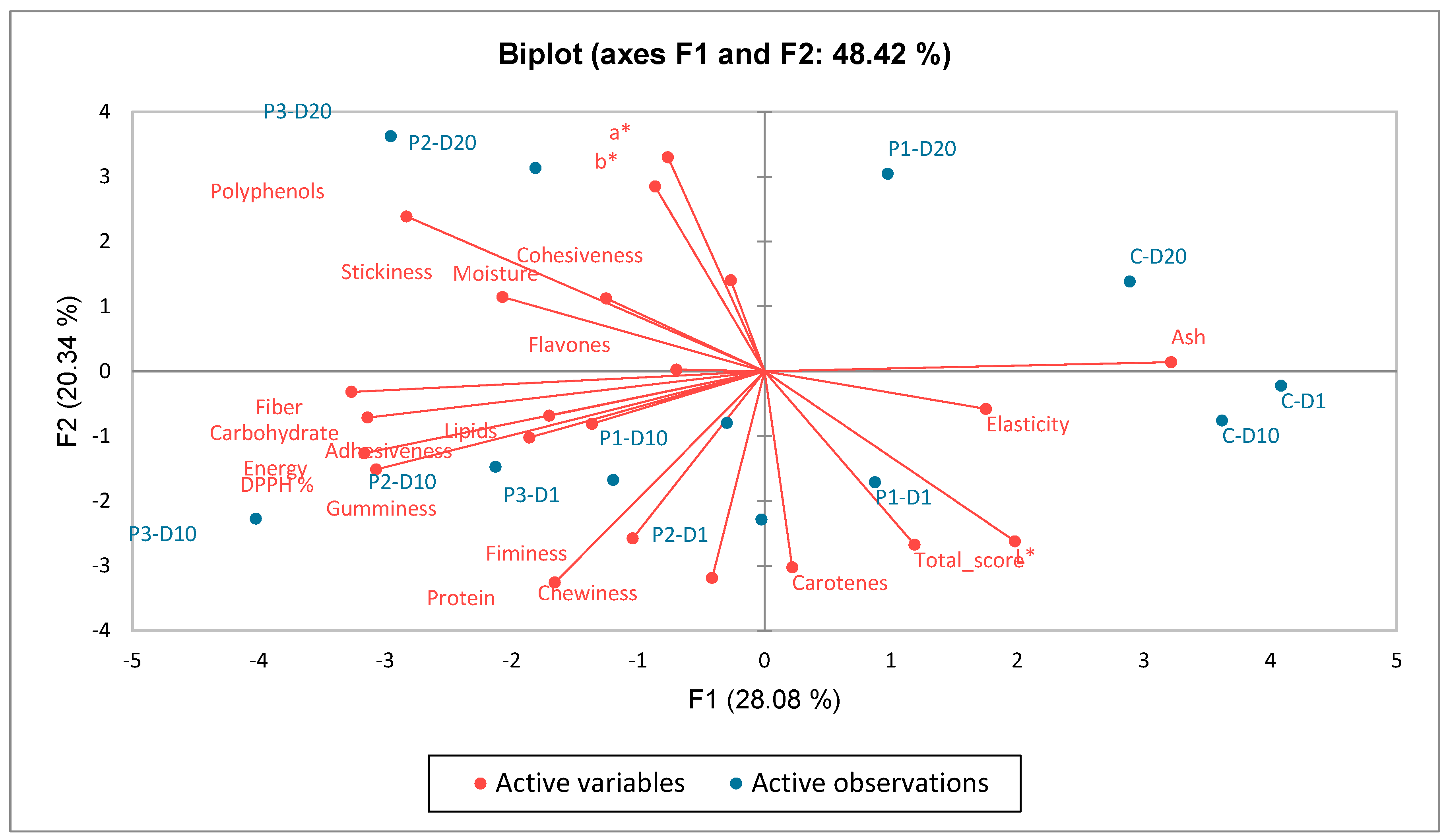
The Principal Component Analysis (PCA) was used to explore associations among physicochemical, textural, antioxidant, and sensory parameters in the marshmallow samples (Figure 2). The first two components, F1 (28.08%) and F2 (20.34%), explained 48.42% of overall variability and provided a meaningful two-dimensional representation of sample structure. Although the cumulative variance explained by PC1 and PC2 was moderate, this level is commonly accepted in applied food studies, where PCA is mainly used as an exploratory tool to visualize relationships among samples and variables. The relative positioning of carotenoids and control samples reflects multivariate correlations rather than absolute concentrations. As shown in the biplot, variables pointed in different directions, indicating their relative contributions to sample discrimination. Total score, together with carotenes, elasticity, and protein, projected mainly along the positive F1 axis, implying that these traits contribute strongly to sample differentiation and link perceived quality to firmness and carotenoid presence. Conversely, moisture, cohesiveness, stickiness, polyphenols, flavones, and colour coordinates (a*, b*) showed high positive projection on F2 and were located near tomato-pomace-enriched samples, consistent with enrichment effects on both antioxidant potential and structural attributes.
Carbohydrates, fiber, energy, and DPPH% were directed toward negative F2 values, indicating that they represent an alternative source of variability, possibly related to compositional balance or stability differences among formulations. Sample distribution showed clear groupings: control treatments (C-D1, C-D10, C-D20) projected toward positive F1 and aligned with ash and elasticity vectors, indicating that non-enriched formulations are characterised by firmer structure and mineral-associated loadings. Enriched formulations (particularly P2 and P3 at day 20) shifted toward the positive F2 space in proximity to colour attributes and antioxidant-related vectors, reflecting cumulative effects of pomace incorporation.
Storage time further influenced separation: freshly produced marshmallows (day-1 samples) associated with lipid-, protein-, and adhesiveness-related vectors, whereas day-20 samples moved closer to antioxidant and carotenoid attributes, suggesting temporal shifts in matrix interactions or relative expression of these components. Overall, the PCA clearly distinguished enriched treatments from controls and highlighted that tomato pomace supplementation modulates both structural and nutritional aspects of the confection, contributing to improved functional properties and sensory performance.
A comparable analytical approach was reported by González-Coria et al., who applied PCA to assess the influence of tomato pomace enrichment in tomato sauces. In the present study, the first two principal components were selected based on their eigenvalues and their ability to provide a meaningful two-dimensional representation of the data. According to the Kaiser criterion, only components with eigenvalues greater than 1 were considered relevant. Although the cumulative variance explained by PC1 and PC2 was 44.5%, these components captured the main structure and relationships among variables, while subsequent components each accounted for a substantially lower proportion of variance. A similar pattern emerged in our investigation: marshmallows containing tomato pomace (P1–P3) clustered in the direction of antioxidant-related variables, including polyphenols, flavones, and DPPH%, whereas the control samples were positioned toward the opposite side of the plot, aligning more strongly with moisture and lipid content. This separation reinforces the notion that tomato pomace systematically enhances antioxidant attributes across different food matrices, as previously reported in the literature [14].
However, our results diverge from the tomato sauce study with respect to carotenoids. While González-Coria et al. [14] observed no substantial change in carotenoid levels following enrichment, the present PCA indicates that carotene content contributed meaningfully to sample distribution, particularly along the F1 axis. This contrast suggests that the food matrix—marshmallow versus sauce—may play a decisive role in carotenoid stability, release, and extractability. The aerated, low-fat structure of marshmallows may provide a more favorable environment for carotenoid retention compared to the thermally processed, oil-rich matrix of tomato sauce.

4. Conclusions

The analyzed marshmallow shows a balanced physicochemical profile, with low lipid and fiber levels and a moderate protein content attributable to gelatin, alongside a carbohydrate-rich composition typical of aerated confectionery. The physicochemical indices (moisture/water activity, ash, and crude fiber) fell within the expected ranges, indicating technological stability and satisfactory shelf performance over the storage period. Instrumental texture profile analysis (TPA) revealed a soft-elastic structure with good resilience, in agreement with sensory panel evaluations, which highlighted high overall liking—particularly for taste, softness/consistency, and appearance. The correlation between TPA parameters (hardness, springiness, cohesiveness) and sensory scores supports the reliability of the evaluation.
Across all assays, tomato pomace enrichment (P2/P3) significantly increased fiber content and antioxidant potential, improved color stability, and maintained desirable softness and sensory quality throughout storage—outperforming the control without altering key physicochemical attributes. The PCA results (F1 = 28.08%, F2 = 20.34%) further confirmed the differentiation between enriched and control samples, with bioactive parameters (phenolics, flavones, carotenoids) contributing positively to sample discrimination, while moisture and lipids showed opposite trends. This demonstrates that tomato pomace addition effectively enhances the functional profile of the product without compromising textural or sensory performance.
These findings confirm the product’s fitness for consumption and strong commercial potential. The current formulation provides a robust foundation for future functional developments, such as fiber enrichment, fruit-based inclusions, or reduced-sugar variants, while preserving the favorable sensory and technological characteristics observed in this study.

Author Contributions

Conceptualization, D.F.; Methodology, D.F.; Software, D.F. and M.O.; Validation, D.F. and M.O.; Formal analysis, D.F. and M.O.; Investigation, D.F.; Writing—original draft, D.F.; Writing—review and editing, M.O.; Project administration, M.O.; Funding acquisition, M.O. All authors have read and agreed to the published version of the manuscript.

Funding

This work was supported by the Competitiveness Operational Program—Call POC/975/1/1/Large Infrastructures—Projects for Innovation Clusters, under contract no. SMIS 2014+153837, and by the Romanian National Council for Higher Education Funding (CNFIS), project number CNFIS-FDI-2025-F-0603.

Institutional Review Board Statement

The study was conducted in accordance with the Declaration of Helsinki, and approved by the Ethics Committee of Stefan cel Mare University of Suceava (protocol code PO-04, 6 December 2016).

Informed Consent Statement

Informed consent was obtained from all subjects involved in the study.

Data Availability Statement

The original contributions presented in the study are included in the article, further inquiries can be directed to the corresponding author.

Conflicts of Interest

The authors declare no conflict of interest.

References

  1. Chen, Z.; Khandpur, N.; Desjardins, C.; Wang, L.; Monteiro, C.A.; Rossato, S.L.; Fung, T.T.; Manson, J.E.; Willett, W.C.; Rimm, E.B.; et al. Ultra-Processed Food Consumption and Risk of Type 2 Diabetes: Three Large Prospective U.S. Cohort Studies. Diabetes Care 2023, 46, 1335–1344. [Google Scholar] [CrossRef] [PubMed]
  2. Thorat, B.; Deshmukh, R. Confectionery Market by Product Type (Hard-Boiled Sweets, Mints, Gums & Jellies, Chocolate, Caramels & Toffees, Medicated Confectionery, Fine Bakery Wares, and Others), Age Group (Children, Adults, and Geriatric), and Price Point (Economy and Mid-Range); Allied Market Research: Portland, OR, USA, 2020; Available online: https://www.alliedmarketresearch.com/confectionery-market (accessed on 15 January 2023).
  3. Konar, N.; Gunes, R.; Palabiyik, I.; Toker, O.S. Health Conscious Consumers and Sugar Confectionery: Present Aspects and Projections. Trends Food Sci. Technol. 2022, 123, 57–68. [Google Scholar] [CrossRef]
  4. Çelekli, A.; Maraşlı, S. Effect of Arthrospira Platensis on Physicochemical, Texture, and Microstructure Properties of Low-Density Marshmallows. Food Humanit. 2024, 2, 100196. [Google Scholar] [CrossRef]
  5. Gomez, L.P.; Alvarez, C.; Zhao, M.; Tiwari, U.; Curtin, J.; Garcia-Vaquero, M.; Tiwari, B.K. Innovative Processing Strategies and Technologies to Obtain Hydrocolloids from Macroalgae for Food Applications. Carbohydr. Polym. 2020, 248, 116783. [Google Scholar] [CrossRef] [PubMed]
  6. Rafi Ahnaf, M.N. Rosida Effect of Gelatin And Egg White Addition on the Characteristics Marshmallow Made from Siwalan and Red Dragon Fruit Peel. AJARCDE Asian J. Appl. Res. Community Dev. Empower. 2025, 9, 208–214. [Google Scholar] [CrossRef]
  7. ISO 20483:2013; Cereals and Pulses—Determination of the Nitrogen Content and Calculation of the Crude Protein Content—Kjeldahl Method. International Organization for Standardization (ISO): Geneva, Switzerland, 2013.
  8. Brand-Williams, W.; Cuvelier, M.E.; Berset, C. Use of a Free Radical Method to Evaluate Antioxidant Activity. LWT - Food Sci. Technol. 1995, 28, 25–30. [Google Scholar] [CrossRef]
  9. Singleton, V.L.; Rossi, J.A. Colorimetry of Total Phenolics with Phosphomolybdic-Phosphotungstic Acid Reagents. Am. J. Enol. Vitic. 1965, 16, 144–158. [Google Scholar] [CrossRef]
  10. Chang, C.-C.; Yang, M.-H.; Wen, H.-M.; Chern, J.-C. Estimation of Total Flavonoid Content in Propolis. J. Food Drug Anal. 2002, 10, 178–182. [Google Scholar] [CrossRef]
  11. Chabi, I.B.; Zannou, O.; Dedehou, E.S.C.A.; Ayegnon, B.P.; Oscar Odouaro, O.B.; Maqsood, S.; Galanakis, C.M.; Pierre Polycarpe Kayodé, A. Tomato Pomace as a Source of Valuable Functional Ingredients for Improving Physicochemical and Sensory Properties and Extending the Shelf Life of Foods: A Review. Heliyon 2024, 10, e25261. [Google Scholar] [CrossRef]
  12. Stinco, C.M.; Rodríguez-Pulido, F.J.; Escudero-Gilete, M.L.; Gordillo, B.; Vicario, I.M.; Meléndez-Martínez, A.J. Lycopene Isomers in Fresh and Processed Tomato Products: Correlations with Instrumental Color Measurements by Digital Image Analysis and Spectroradiometry. Food Res. Int. 2013, 50, 176–185. [Google Scholar] [CrossRef]
  13. Nakov, G.; Brandolini, A.; Estivi, L.; Bertuglia, K.; Ivanova, N.; Jukić, M.; Komlenić, D.K.; Lukinac, J.; Hidalgo, A. Effect of Tomato Pomace Addition on Chemical, Technological, Nutritional, and Sensorial Properties of Cream Crackers. Antioxidants 2022, 11, 2087. [Google Scholar] [CrossRef]
  14. González-Coria, J.; Mesirca-Prevedello, C.; Lozano-Castellón, J.; Casadei, E.; Valli, E.; López-Yerena, A.; Jaime-Rodríguez, C.; Pinto, D.; Illan, M.; Torrado, X.; et al. Chemometric Study on the Effect of Cooking on Bioactive Compounds in Tomato Pomace Enriched Sauces. npj Sci. Food 2024, 8, 58. [Google Scholar] [CrossRef]
  15. Colmenares-Cuevas, S.I.; Contreras-Oliva, A.; Salinas-Ruiz, J.; Hidalgo-Contreras, J.V.; Flores-Andrade, E.; García-Ramírez, E.J. Development and Study of the Functional Properties of Marshmallow Enriched with Bee (Apis Mellifera) Honey and Encapsulated Probiotics (Lactobacillus rhamnosus). Front. Nutr. 2024, 11, 1353530. [Google Scholar] [CrossRef]
  16. Begliţa, V.; Ungureanu-Iuga, M.; Mironeasa, S. Assessing the Features of Tomato Pomace Powder in Suspensions. Appl. Sci. 2023, 13, 2235. [Google Scholar] [CrossRef]
  17. Rehal, J.K.; Aggarwal, P.; Dhaliwal, I.; Sharma, M.; Kaushik, P. A Tomato Pomace Enriched Gluten-Free Ready-to-Cook Snack’s Nutritional Profile, Quality, and Shelf Life Evaluation. Horticulturae 2022, 8, 403. [Google Scholar] [CrossRef]
  18. Covaliov, E.; Suhodol, N.; Chirsanova, A.; Capcanari, T.; Grosu, C.; Siminiuc, R. Effect of Grape Skin Powder Extract Addition on Functional and Physicochemical Properties of Marshmallow. Ukr. Food J. 2021, 10, 333–345. [Google Scholar] [CrossRef]
  19. Bintoro, V.P.; Nugraheni, M.; Anwar, S.; Putri, R.M.S. The effect of gelatin and konjac glucomannan concentrations on moisture content, water activity, texture, density, and protein content in synbiotic marshmallows. IOP Conf. Ser. Mater. Sci. Eng. 2024, 1244, 012056. [Google Scholar] [CrossRef] [PubMed]
  20. Linggo, G.; Phothisoot, T.; Kongpichitchoke, T.; Lo, D. Utilization of Fructose-Olygosaccharides as Sugar Substitute in Marshmallow and Its Effect on the Physicochemical and Consumer Acceptance. IOP Conf. Ser. Earth Environ. Sci. 2025, 1449, 012164. [Google Scholar] [CrossRef]
Figure 1. Sensory radar (10-point hedonic scale) for marshmallow samples—Control, P1, P2, P3—at day 1, 10, and 20, showing scores for color, odor, taste, consistency, creaminess, overall appearance, and overall acceptability.
Applsci 16 00951 g001
Figure 2. PCA results: Biplot of samples and variables.
Applsci 16 00951 g002
Table 1. Physicochemical Composition of marshmallow during storage.
Moisture (%)pAsh (%)pProtein (%)pLipids (%)pCarbohydrate (% g/100 g)pFiber (%)pEnergy (kcal/100 g)p
SD1D10D20 D1D10D20 4.91 ± 0.02 bA4.78 ± 0.02 aB6.40 ± 0.02 aA959 ***D1D10D20 60.9 ± 0.3 bB59.3 ± 0.3 aA57.6 ± 0.3 aC35 ***0.00 a0.00 a0.00 a D1D10D20
C35.1 ± 0.3 c27.0 ± 0.3 a29.5 ± 0.3 a753 ***0.84 ± 0.02 dC0.88 ± 0.02 dA0.79 ± 0.03 cB144 ***4.98 ± 0.02 bB5.97 ± 0.02 bC6.50 ± 0.01 aA529 ***0.04 ± 0.02 aB0.06 ± 0.04 aA0.04 ± 0.04 aA264 ***59.0 ± 0.2 aB61.2 ± 0.3 bB62.4 ± 0.2 bA24 **0.07 ± 0.01 b0.07 ± 0.01 b0.06 ± 0.02 b 253 ± 1 bA250 ± 3 aA251 ± 3 aA
P139.0 ± 0.3 dB35.3 ± 0.2 dA33.6 ± 0.3 cC181 ***0.62 ± 0.02 bC0.71 ± 0.02 cB0.65 ± 0.02 bA173 ***4.62 ± 0.02 aB5.95 ± 0.01 bC6.73 ± 0.01 bA1023 ***0.08 ± 0.03 cB0.09 ± 0.02 cA0.08 ± 0.03 cA272 ***63.0 ± 0.2 cA62.4 ± 0.3 bA61.9 ± 0.1 bA0.37 ± 0.02 c0.37 ± 0.03 c0.36 ± 0.02 c 246 ± 2 aB260 ± 1 bC267 ± 2 bcA55 ***
P234.0 ± 0.1 bA33.8 ± 0.2 cA33.9 ± 0.2 cA0.3°0.72 ± 0.02 cB0.68 ± 0.02 bA0.64 ± 0.02 bC99 ***5.57 ± 0.03 cB6.83 ± 0.06 cC7.05 ± 0.03 cA457°0.09 ± 0.01 dB0.10 ± 0.02 dB0.10 ± 0.02 dA118 ***63.2 ± 0.2 cA64.1 ± 0.2 cA64.5 ± 0.2 cA0.43 ± 0.02 d0.42 ± 0.02 d0.43 ± 0.03 d 265 ± 1 cA266 ± 2 bA266 ± 2 bA0.1°
P332.3 ± 0.3 aA32.2 ± 0.2 bA32.0 ± 0.2 bA0.47 ± 0.02 aC0.49 ± 0.02 aA0.44 ± 0.02 aB75 ***40 ***736 ***56 *** 0.07 ± 0.04 bA0.07 ± 0.02 bA0.06 ± 0.03 bB89 ***30 ***41 ***66 *** 14524 ***1728 ***17641 *** 272 ± 2 dA273 ± 2 cA274 ± 2 cA0.2°
P199 ***470 ***115 *** 1684 ***2652 ***1558 *** 4.91 ± 0.02 bA4.78 ± 0.02 aB6.40 ± 0.02 aA959 ***2324 ***1075 ***3199 *** 60.9 ± 0.3 bB59.3 ± 0.3 aA57.6 ± 0.3 aC35 ***0.00 a0.00 a0.00 a 63 ***55 ***39 ***
Values are expressed as mean ± SD (n = 3). Different lowercase letters within the same column indicate significant differences between samples at the same storage time, whereas different uppercase letters within the same row indicate significant differences during storage (p < 0.05). Asterisks (**, ***) denote significance at p < 0.01, and p < 0.001, respectively.
Table 2. Evolution of carotene, flavone, polyphenol contents, and antioxidant activity (DPPH %) in control and tomato pomace–enriched marshmallow samples during storage (D1–D20).
Carotenes (mg/kg)pFlavones (mgQE/kg)pPolyphenols (mgGAE/kg)pDPPH (%)p
SD1D10D20 D1D10D20 D1D10D20 D1D10D20
C0.06 ± 0.02 bB0.08 ± 0.02 abC0.11 ± 0.01 bA1116 ***0.08 ± 0.01 aAB0.08 ± 0.03 bB0.08 ± 0.04 aA5 *0.20 ± 0.02 aA0.18 ± 0.04 bC0.22 ± 0.01 aB184 ***35 ± 0.2 aA35 ± 0.4 aA35 ± 0.3 aA
P10.05 ± 0.01 aC0.16 ± 0.03 cB0.13 ± 0.05 cA7166 ***0.10 ± 0.02 bA0.05 ± 0.02 aC0.59 ± 0.03 dB22,577 ***0.34 ± 0.01 bA0.15 ± 0.02 aC0.37 ± 0.01 bB4903 ***36 ± 0.1 bA36 ± 0.1 bB39 ± 0.1 bA54 ***
P20.06 ± 0.01 cB0.08 ± 0.03 aC0.11 ± 0.02 bA2408 ***0.14 ± 0.02 cA0.13 ± 0.01 cB0.14 ± 0.02 cAB14 **0.57 ± 0.01 cA0.26 ± 0.02 cB0.42 ± 0.02 cC3839 ***3 ± 0.2 cC44 ± 0.2 dB43 ± 0.2 cA161 ***
P30.07 ± 0.02 dB0.09 ± 0.02 bC0.11 ± 0.02 aA1610 ***0.20 ± 0.03 dA0.05 ± 0.02 aB0.14 ± 0.02 bC8693 ***0.83 ± 0.01 dA0.36 ± 0.03 dB0.46 ± 0.02 dC5450 ***42 ± 0.1 dA42 ± 0.2 cB45 ± 0.1 dA41 ***
P729 ***2107 ***189 *** 2704 ***7867 ***16,783 *** 7917 ***5039 ***1975 *** 161 ***522 ***288 ***
* Values are expressed as mean ± SD (n = 3). Different lowercase letters within the same column indicate significant differences between samples at the same storage time, whereas different uppercase letters within the same row indicate significant differences during storage (p < 0.05). Asterisks (**, ***) indicate significance at p < 0.01 and p < 0.001, respectively.
Table 3. CIE L*a*b* Values (±SD), D1–D20.
L*pa*pb*p
SD1D10D20 D1D10D20 D1D10D20
C82.8 ± 0.2 dB83.0 ± 0.3 bA81.2 ± 0.2 cAB6 *5.3 ± 0.3 aB3.7 ± 0.2 bA0.3 ± 0.1 aC21,407 ***31.0 ± 0.3 aB30.0 ± 0.2 bA19.1 ± 0.3 Ac3031 ***
P175.5 ± 0.1 cA74.0 ± 0.1 aB80.8 ± 0.1 cA65 ***6.0 ± 0.3 bB5.6 ± 0.1 cA0.3 ± 0.1 aC13,893 ***38.3 ± 0.2 bB37.9 ± 0.1 dA20.0 ± 0.3 bB3033 ***
P268.6 ± 0.2 bB85.2 ± 0.3 cA69.4 ± 0.2 aA476 ***6.5 ± 0.3 bA0.7 ± 0.2 aB3.4 ± 0.1 cC13,297 ***39.1 ± 0.3 bcA19.7 ± 0.2 bB30.0 ± 0.1 cC3071 ***
P357.8 ± 0.3 aC85.7 ± 0.2 cB78.5 ± 0.2 bA1140 ***9.0 ± 0.3 cA0.6 ± 0.2 aB3.3 ± 0.3 bC18,057 ***39.3 ± 0.2 cA18.8 ± 0.3 aB31.7 ± 0.3 dC3413 ***
P668 ***178 ***154 *** 1835 ***22,023 ***16,985 *** 356 ***4654 ***1976 ***
Values are expressed as mean ± SD (n = 3). Different lowercase letters within the same column indicate significant differences between samples at the same storage time, while different uppercase letters within the same row indicate significant differences during storage (p < 0.05). Asterisks (*, ***) indicate significance at p < 0.05, and p < 0.001, respectively.
Table 4. Texture Profile Analysis (TPA) Parameters of Samples at Days 1, 10, and 20.
Firmness (g)pElasticity, mmpCohesivenesspGumminess (g)pChewiness (g)pStickiness (g)pAdhesiveness (J)p
SD1D10D20 D1D10D20 D1D10D20 D1D10D20 D1D10D20 D1D10D20 D1D10D20
C8.4 ± 0.1 aC48.1 ± 0.3 cB20.3 ± 0.3 aA78,930 ***0.009 ± 0.001 dA0.002 ± 0.002 aB0.005 ± 0.004 cC70 ***0.008 ± 0.001 bB0.015 ± 0.003 aA0.009 ± 0.001 cA51 ***15.9 ± 0.2 cA2.6 ± 0.2 aB5.8 ± 0.3 aC15,387 ***10.6 ± 0.2 dC14.7 ± 0.2 cB12.3 ± 0.1 bA1459°0.82 ± 0.02 aA0.47 ± 0.01 aB0.82 ± 0.01 aB2666 ***11.61 ± 0.02 dB4.54 ± 0.03 dA4.04 ± 0.02 aC10,946 ***
P134.1 ± 0.1 dC90.3 ± 0.1 dA25.2 ± 0.1 bB11,486 ***0.004 ± 0.001 bA0.002 ± 0.001 aB0.003 ± 0.002 bC3165 ***0.011 ± 0.002 cB5.050 ± 0.002 bA0.015 ± 0.002 dA30,443 ***7.3 ± 0.2 bC18.2 ± 0.2 cB11.2 ± 0.1 bA5386 ***3.7 ± 0.2 cC22.0 ± 0.1 dB5.01 ± 0.2 aA18,355 ***1.74 ± 0.01 dA0.82 ± 0.01 bB1.27 ± 0.02 bC3571 ***0.75 ± 0.01 aB3.17 ± 0.01 cC4.30 ± 0.01 aA10,385 ***
P225.1 ± 0.2 bB68.2 ± 0.2 cC77.2 ± 0.4 dA6319 ***0.003 ± 0.02 aC0.051 ± 0.001 cA0.002 ± 0.001 aB27,485 ***0.033 ± 0.003 dC0.071 ± 0.001 aA0.006 ± 0.002 aB15,730 ***25.9 ± 0.1 dA12.0 ± 0.1 bB22.7 ± 0.2 cC3660 ***3.4 ± 0.2 bB11.6 ± 0.1 aC12.9 ± 0.2 cA8517 ***1.25 ± 0.02 cA0.47 ± 0.02 aB0.83 ± 0.01 aC5583 ***9.92 ± 0.02 cA2.20 ± 0.03 aC13.61 ± 0.03 bB10,804 ***
P330.2 ± 0.1 cA29.7 ± 0.3 aB67.3 ± 0.3 cA6740 ***0.005 ± 0.003 cC0.007 ± 0.002 bA0.003 ± 0.001 bB4424 ***0.007 ± 0.002 aC0.016 ± 0.001 aB0.008 ± 0.003 bA6054 ***2.3 ± 0.1 aB11.7 ± 0.2 bC23.9 ± 0.2 dA14,955 ***2.4 ± 0.1 aB12.8 ± 0.2 bC32.0 ± 0.2 dA17,285 ***1.12 ± 0.02 bB1.25 ± 0.01 cC1.81 ± 0.03 cA1990 ***2.13 ± 0.03 bB2.84 ± 0.02 bC16.61 ± 0.02 cA21,194 ***
P5637 ***6080 ***8873 *** 6463 ***3332 ***4123 *** 13,963 ***30,166 ***4522 *** 13234 ***8163 ***7656 *** 12,675 ***3359 ***11,850 *** 2698 ***6601 ***4271 *** 15306 ***5172 ***10230 ***
Values are expressed as mean ± SD (n = 3). Different lowercase letters within the same column indicate significant differences between samples at the same storage time, whereas different uppercase letters within the same row indicate significant differences during storage (p < 0.05). Asterisks (***) denote significance at p < 0.001. The values reported in the columns labeled “p” and in the row labeled “P” correspond to F-values obtained from ANOVA.
Disclaimer/Publisher’s Note: The statements, opinions and data contained in all publications are solely those of the individual author(s) and contributor(s) and not of MDPI and/or the editor(s). MDPI and/or the editor(s) disclaim responsibility for any injury to people or property resulting from any ideas, methods, instructions or products referred to in the content.