


Abstract
Background: Hair loss (alopecia) is primarily driven by the premature transition of hair follicles from the anagen (growth) to the catagen (regression) phase. Intracellular calcium signaling is implicated in hair follicle biology, including the regulation of Wnt/β-catenin activity and the modulation of catagen-associated factors such as TGF-β2. Cyclic ADP-ribose (cADPR), a calcium-mobilizing second messenger synthesized by CD38, has recently emerged as a potential modulator of intracellular calcium dynamics. This study investigated whether cADPR is associated with changes in intracellular calcium retention and anagen-associated signaling pathways in human hair follicle dermal papilla cells (HHDPCs). Methods: HHDPCs were treated with cADPR (0.001–0.5 ppm) and analyzed for cell viability, intracellular calcium retention, β-catenin-dependent transcription, and the gene expression of LEF-1 and TGF-β2. Cell viability was evaluated using the MTT assay, intracellular calcium content was quantified by ICP–OES, β-catenin activation was assessed using a TOPFlash luciferase assay, and gene expression was measured by qRT-PCR. Results: cADPR did not induce marked cytotoxicity, maintaining more than 98% cell viability across all concentrations. The highest response was observed at 0.05 ppm, at which intracellular calcium content remained elevated for up to six hours as assessed by ICP–OES. At this concentration, β-catenin-dependent transcription increased by approximately 2.3-fold relative to control, LEF-1 expression was significantly upregulated (~2.5-fold), and TGF-β2 expression was significantly downregulated (~0.3-fold). These responses showed an overall concentration-dependent trend across assays. Conclusions: These findings indicate an association between cADPR treatment and modulation of intracellular calcium retention and anagen-related signaling readouts in HHDPCs, supporting the need for further studies to establish mechanistic causality and physiological relevance.
Keywords:
cADPR; calcium signaling; Wnt/β-catenin; LEF-1; TGF-β2; anagen phase; hair loss prevention 1. Introduction
Hair loss, or alopecia, is a multifactorial disorder characterized by an imbalance in hair follicle cycling. The hair follicle periodically undergoes three distinct phases: anagen (growth), catagen (regression), and telogen (rest). Under normal physiological conditions, these phases are tightly regulated to ensure continuous follicular renewal. However, when this balance is disrupted, follicles prematurely enter the catagen phase, leading to reduced hair density and progressive thinning of the scalp [1,2]. The increasing prevalence of alopecia in both men and women, including individuals in their twenties and thirties, underscores the need for safer and more effective intervention strategies [3].
Current pharmacological treatments for alopecia primarily target either androgen inhibition or vasodilation. Finasteride and dutasteride, both 5α-reductase inhibitors, reduce dihydrotestosterone (DHT) levels and slow follicular miniaturization [4]. Minoxidil, originally developed as an antihypertensive agent, was later repurposed for hair loss therapy due to its ability to enhance follicular blood flow and potassium channel activity [5]. Despite their clinical utility, these agents exhibit limited efficacy and may cause adverse effects such as sexual dysfunction and rebound shedding after discontinuation [6,7]. Therefore, there is a growing demand for alternative intervention strategies that may mitigate hair loss progression without hormonal interference or systemic side effects.
Hair follicle morphogenesis and cycling are governed by multiple signaling pathways, among which the Wnt/β-catenin signaling axis plays a central role in anagen induction and maintenance [8]. Activation of β-catenin promotes stem cell differentiation in the follicular bulge, stimulates dermal papilla cell proliferation, and supports matrix keratinocyte activity necessary for hair shaft elongation [9]. Conversely, inhibition of this pathway accelerates catagen onset through the induction of transforming growth factor-β (TGF-β), Dickkopf-1 (DKK1), and bone morphogenetic proteins (BMPs), all of which drive follicular regression [10,11]. Recent studies have suggested that intracellular calcium signaling interacts with Wnt/β-catenin signaling, potentially influencing β-catenin stability by suppressing glycogen synthase kinase-3β (GSK-3β)–mediated degradation [12]. These findings indicate that calcium-related intracellular signaling may contribute to the regulation of the anagen phase and delays follicular regression.
Intracellular calcium homeostasis is regulated by specific second messengers such as nicotinic acid adenine dinucleotide phosphate (NAADP) and cyclic ADP-ribose (cADPR). In particular, the potential involvement of cyclic ADP-ribose (cADPR) a ryanodine receptor–associated Ca2+-mobilizing messenger, has not been well characterized in hair-follicle-related pathways. This represents a distinct intracellular signaling route that differs fundamentally from the extracellular Wnt activators and Ca2+ modulators previously investigated in hair biology.
Both molecules mobilize calcium from intracellular stores, but they differ in their release mechanisms and signal duration. NAADP releases calcium from acidic organelles and is limited by short signal persistence and pH dependency [13]. In contrast, cADPR has been reported to activate ryanodine receptors (RyRs) in the endoplasmic reticulum under neutral conditions, inducing calcium-induced calcium release (CICR) and supporting relatively prolonged calcium-related responses in certain cellular contexts [14,15]. Such calcium-dependent processes have been implicated in dermal papilla cell function, including growth factor secretion and matrix–cell proliferation [16]. Accordingly, cADPR may function as an intrinsic modulator influencing calcium dynamics and β-catenin–associated signaling, as well as TGF-β2–related pathways relevant to anagen regulation.
2. Materials and Methods
2.1. Preparation of cADPR Samples
Cyclic ADP-ribose (cADPR; CAS No. 119340-53-3) was obtained from Sigma-Aldrich (St. Louis, MO, USA). The compound was mixed with phospholipids, lecithin, oleic acid, and caprylyl glycol at a weight ratio of 1:1:0.05:0.05 to enhance solubility and stability. The mixture was homogenized using a high-speed mechanical homogenizer to obtain a uniform emulsion. The emulsion was diluted in purified water to yield a 1 ppm stock solution. Working concentrations were prepared at 0.001, 0.005, 0.01, 0.05, 0.1, and 0.5 ppm (corresponding to approximately 2.3 nM, 11.5 nM, 23 nM, 115 nM, 230 nM, and 1.15 μM, respectively), referred to as S1 through S6. Concentrations are reported in both ppm and molar units to facilitate biological comparability. All samples were stored at 4 °C and protected from light to preserve stability. The concentration range was selected based on preliminary viability data showing sufficient biological activity within this range while maintaining cell safety. A vehicle-only control containing the same excipient composition without cADPR was not included in the present study, which is acknowledged as a limitation. The experimental composition of the samples is summarized in Table 1. The pH, osmolality, and endotoxin levels of the working solutions were not measured in this study and are therefore not reported. All experiments were performed using three independent biological replicates unless otherwise stated.
Table 1.
Composition of Experimental Samples (Unit: ppm).
2.2. Cell Culture and Viability Assay
Human hair follicle dermal papilla cells (HHDPCs; PromoCell, Heidelberg, Germany) were maintained in dermal papilla cell growth medium (PromoCell C-26507) at 37 °C in a humidified atmosphere containing 5% CO2 [16]. Cells were seeded in 24-well plates at a density of 3 × 10⁴ cells/well and incubated for 18 h to allow adherence. Each well was then treated with cADPR samples (0.001–0.5 ppm) for 48 h. A vehicle-only control containing the same excipient composition without cADPR was not included in this assay. Cytotoxicity was determined by the MTT assay as described previously [17]. Briefly, cells were incubated with MTT solution (5 mg/mL, Sigma-Aldrich) for 2.5 h. After incubation, the medium was removed, and formazan crystals were dissolved in dimethyl sulfoxide (DMSO; Sigma-Aldrich). Absorbance was measured at 570 nm using a microplate reader (Bio-Rad, Hercules, CA, USA). Cell viability was expressed as a percentage of the untreated control, reflecting relative metabolic activity rather than comprehensive cellular safety.
2.3. Measurement of Intracellular Calcium Retention
Calcium concentration was quantified using inductively coupled plasma–optical emission spectrometry (ICP-OES; Teledyne Leeman Labs, Hudson, NH, USA). HHDPCs were treated with cADPR at concentrations of 0.001–0.5 ppm, and calcium levels were measured at 30, 60, 120, 180, 240, and 360 min after treatment. In this study, “intracellular calcium retention” refers to bulk intracellular calcium content measured at discrete time points rather than real-time calcium signaling dynamics or spatial calcium flux. Calcium emission was detected at 422.67 nm, and concentrations were determined using a calibration curve prepared from calcium standards [15]. Measurements were obtained independently for each time point from separate wells to avoid pseudo-replication, and each measurement was performed in triplicate to ensure reproducibility.
2.4. β-Catenin Transcriptional Activity Assay
β-Catenin signaling activity was evaluated using the TOPFlash/FOPFlash luciferase reporter system [18]. HHDPCs were seeded in 6-well plates at a density of 1 × 10⁵ cells/well and incubated for 18 h. Cells were transfected with 0.3 µg/mL TOPFlash plasmid or 1 µg/mL FOPFlash plasmid using Lipofectamine 2000 (Invitrogen, Carlsbad, CA, USA). After 24 h of transfection, cells were treated with cADPR samples in serum-free medium for an additional 24 h. No exogenous Wnt pathway activators or inhibitors were included as internal positive or negative controls in this assay. The cells were washed with phosphate-buffered saline (PBS) and lysed in Reporter Lysis Buffer (Promega, Madison, WI, USA). Luciferase activity was measured using a luminometer (Berthold Technologies, Bad Wildbad, Germany). Luciferase signals were normalized to Renilla luciferase activity to control for transfection efficiency, and the ratio of TOPFlash to FOPFlash activity was used to assess β-catenin–specific transcriptional responses. All TOPFlash/FOPFlash assays were performed using three independent biological replicates, each measured in technical duplicate. Luciferase reporter readouts were interpreted as relative transcriptional activity and do not provide direct information on β-catenin protein levels or subcellular localization.
2.5. Quantitative Gene Expression Analysis
Gene expression levels of lymphoid enhancer-binding factor-1 (LEF-1) and transforming growth factor-beta 2 (TGF-β2) were analyzed by quantitative reverse-transcription polymerase chain reaction (qRT-PCR). HHDPCs were seeded in 6-well plates (3 × 10⁵ cells/well) and treated with cADPR samples for 24 h. Gene expression analysis was conducted at a single time point to assess transcriptional associations rather than temporal dynamics. Total RNA was extracted using the RNeasy Mini Kit (Qiagen, Hilden, Germany). RNA concentration and purity were determined spectrophotometrically (A260/A280). Complementary DNA (cDNA) synthesis was performed using the High-Capacity cDNA Reverse Transcription Kit (Applied Biosystems, Foster City, CA, USA). Gene amplification was carried out using TaqMan Universal PCR Master Mix and probes for LEF-1(Hs01547250_m1) and TGF-β2(Hs00234244_m1) (Applied Biosystems). β-Actin (Hs99999903_m1) was used as the internal control. Relative gene expression was calculated using the comparative 2−ΔΔCt method [19]. Primer specificity was confirmed by melting curve analysis, and β-actin was verified as a stable reference gene under all experimental conditions. mRNA expression data were not complemented by protein-level validation in the present study.
2.6. Statistical Analysis
Cell viability and gene expression data were analyzed using the Kruskal–Wallis test followed by the Dunn–Bonferroni post hoc test, as the datasets did not satisfy normality assumptions [17]. Intracellular calcium retention data were presented descriptively without inferential statistical analysis, as the objective was to characterize time-dependent changes in bulk intracellular calcium content at discrete time points rather than to assess dynamic calcium signaling or perform group-wise comparisons. β-Catenin transcriptional activity was analyzed using two-way analysis of variance (ANOVA; reporter type × concentration), followed by the Bonferroni post hoc test to evaluate interactions between reporter type and dose. Effect size estimation, confidence interval reporting, and trajectory-based modeling were not performed in the present study and are considered priorities for future investigations.
3. Results
3.1. Cell Viability
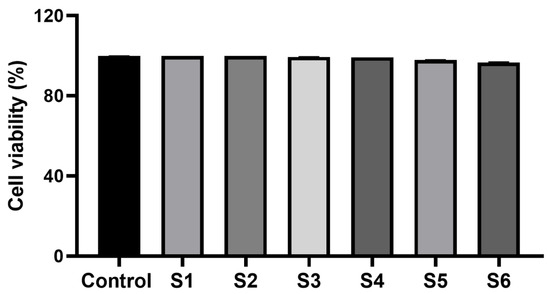
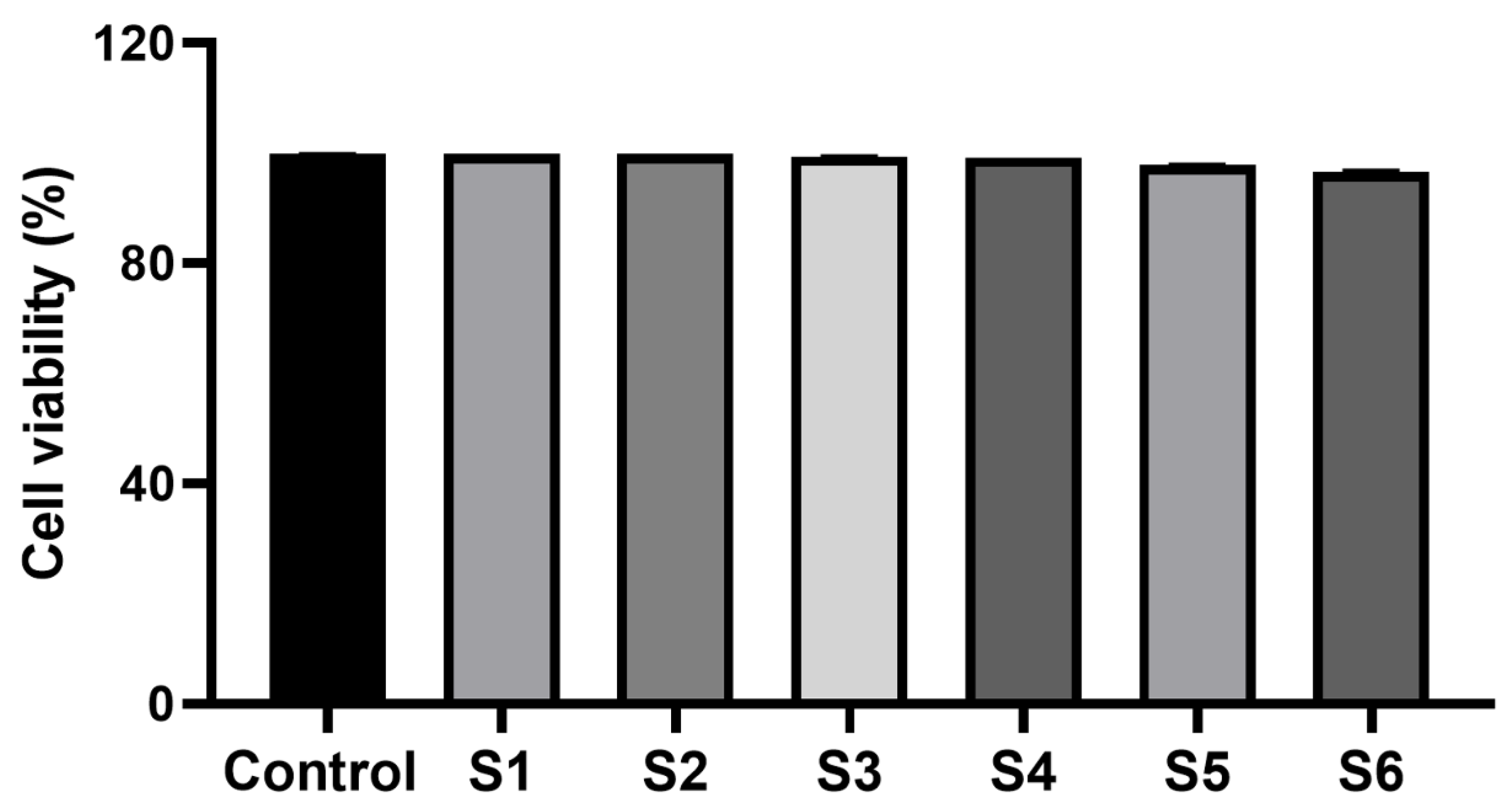
Treatment of human hair follicle dermal papilla cells (HHDPCs) with cyclic ADP-ribose (cADPR) at concentrations ranging from 0.001 to 0.5 ppm was not associated with overt cytotoxic effects (Figure 1). MTT analysis demonstrated that cell viability remained above 98% in all treated groups compared with the untreated control. Because the data did not meet the assumption of normal distribution due to near-zero variance, a non-parametric Kruskal–Wallis test was applied. Statistical analysis (χ2(6) = 19.206, p = 0.004), followed by the Dunn–Bonferroni post hoc test, revealed minor differences between the Control and S5 (p < 0.05) as well as S6 (p < 0.01). Despite these statistically significant differences, cell viability remained above 95% across all treated groups, suggesting that the biological relevance of these differences was limited within the context of metabolic activity measured by the MTT assay. No morphological alterations, such as cell shrinkage or detachment, were observed under microscopic inspection. Collectively, these results suggest that cADPR treatment did not markedly impair cellular metabolic activity in HHDPCs under the tested concentrations and exposure duration.
Figure 1.
Cell Viability of HHDPCs Treated with cADPR. Cell viability of human hair follicle dermal papilla cells (HHDPCs) treated with various concentrations of cyclic ADP-ribose (cADPR; 0.001–0.5 ppm) for 48 h. C indicates the untreated control, and S1–S6 represent increasing cADPR concentrations. Data were analyzed using the Kruskal–Wallis test (χ2(6) = 19.206, p = 0.004), followed by the Dunn–Bonferroni post hoc test, which revealed significant differences between the Control and S5 (p < 0.05) and S6 (p < 0.01). Although statistically significant differences were observed between the Control and S5/S6 groups, all treated groups maintained cell viability above 95%. Under these short-term exposure conditions, cADPR did not induce detectable cytotoxicity at concentrations up to 0.5 ppm, and the observed differences appear to be of limited biological relevance. Values are presented as mean ± SD (n = 3).
3.2. Intracellular Calcium Retention
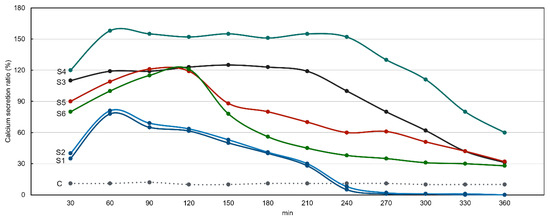
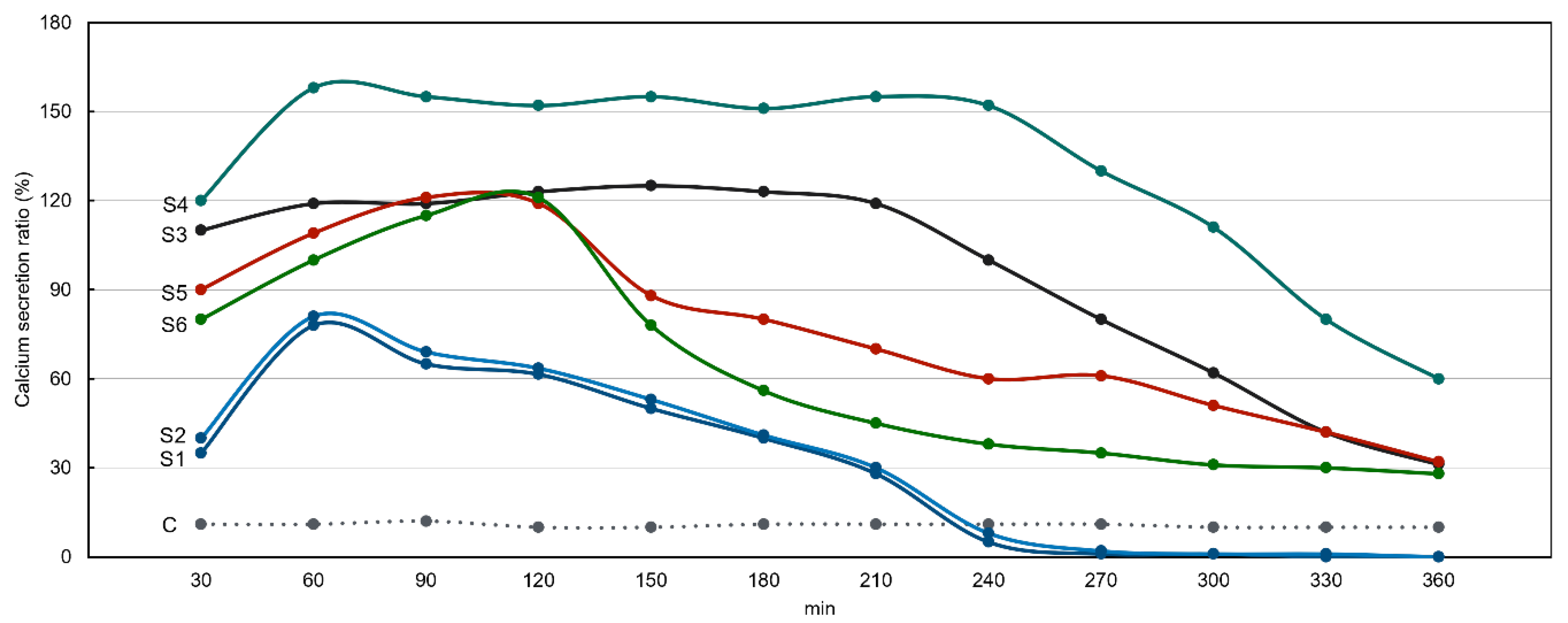
Measurement of intracellular calcium concentration using ICP–OES showed time- and concentration-related changes following cADPR treatment (Figure 2). In the control group, calcium levels remained nearly constant during the 6 h observation period. Because calcium measurements were obtained as bulk intracellular calcium content at discrete time points, results are presented descriptively without inferential statistical comparison.
Figure 2.
Time-dependent intracellular calcium retention in human hair follicle dermal papilla cells (HHDPCs) treated with cyclic ADP-ribose (cADPR). Intracellular calcium levels were measured using inductively coupled plasma–optical emission spectrometry (ICP–OES) at 30, 60, 120, 180, 240, and 360 min after treatment with cADPR at various concentrations (0.001–0.5 ppm). Each line represents the relative calcium retention ratio (%) compared with the baseline level (0 min). Because representative measurements were obtained at each time point to illustrate overall kinetic behavior, no inferential statistical analysis was performed, and the data are presented descriptively. Among the tested concentrations, treatment with 0.05 ppm (S4) showed the most prolonged calcium retention over the 6 h observation period.
In contrast, cells treated with cADPR at 0.01–0.1 ppm exhibited higher intracellular calcium levels relative to the control group, reaching approximately 120–160% of baseline levels. Among all groups, the 0.05 ppm condition showed relatively higher calcium levels over an extended observation period before gradually returning to baseline. These observations indicate that cADPR treatment was associated with increased intracellular calcium content under the present experimental conditions and should be interpreted as calcium retention measured by ICP–OES rather than evidence of dynamic Ca2+ signaling or direct stabilization of the anagen phase.
3.3. β-Catenin Transcriptional Activity
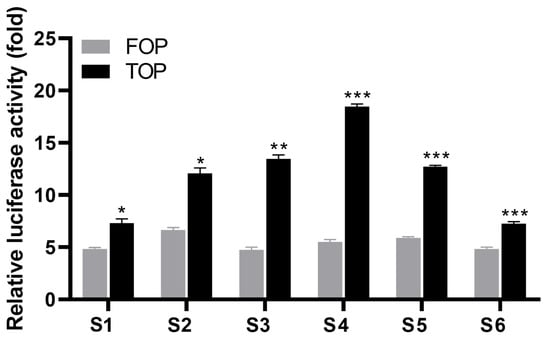
β-Catenin-dependent transcriptional activity was assessed using the TOPFlash/FOPFlash dual-luciferase reporter assay (Figure 3). Treatment of human hair follicle dermal papilla cells (HHDPCs) with cADPR was associated with an increase in β-catenin-dependent transcriptional activity across the tested concentration range. TOPFlash activity increased significantly across all tested concentrations, whereas FOPFlash activity remained unchanged, supporting specificity for β-catenin–responsive transcriptional elements. The largest relative increase was observed at 0.05 ppm (S4), corresponding to an approximately 2.3-fold change relative to baseline.
Figure 3.
β-Catenin Transcriptional Activity in HHDPCs Treated with cADPR. β-Catenin-dependent transcriptional activity in human hair follicle dermal papilla cells (HHDPCs) following treatment with cyclic ADP-ribose (cADPR; 0.001–0.5 ppm) for 24 h. Cells were transiently transfected with either TOPFlash (β-catenin–responsive) or FOPFlash (mutated TCF-binding site, negative control) reporter constructs. Luciferase activity was measured using a dual-luciferase assay system and normalized to Renilla luciferase activity. Data were analyzed by two-way ANOVA (factors: flash type × concentration), followed by the Bonferroni post hoc test. A significant interaction between flash type and concentration indicated β-catenin–specific transcriptional activation by cADPR (p < 0.001). Data are presented as mean ± SD from three independent biological replicates (n = 3). * p < 0.05, ** p < 0.01, *** p < 0.001 vs. FOPFlash at the same concentration.
Although these findings demonstrate an association between cADPR treatment and enhanced β-catenin-dependent transcriptional readouts, the present results do not establish a direct causal relationship between intracellular Ca2+ mobilization and β-catenin activation. Two-way ANOVA (factors: flash type × concentration) revealed a significant interaction between flash type and concentration (p < 0.001), indicating that the transcriptional response differed between TOPFlash and FOPFlash reporters across concentrations. Because formal dose–response modeling was not performed, the observed concentration pattern should be interpreted descriptively rather than as evidence of an optimal dose. Taken together, these results are consistent with an association between cADPR treatment and anagen-associated transcriptional responses in HHDPCs under in vitro conditions.
3.4. Gene Expression Regulation
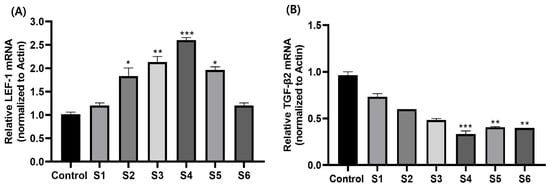
(A) LEF-1 mRNA Expression. cADPR treatment was associated with higher LEF-1 mRNA expression across the tested concentration range (Figure 4A). The largest relative increase was observed at 0.05 ppm (S4), reaching approximately 2.5-fold compared with the control. As the data did not satisfy normality assumptions, a Kruskal–Wallis test was applied (χ2(6) = 18.284, p = 0.006), followed by the Dunn–Bonferroni post hoc test. Significant differences were detected between the Control and S2 (p < 0.05), S3 (p < 0.01), S4 (p < 0.001), and S5 (p < 0.05).
Figure 4.
Effects of cADPR on (A) LEF-1 and (B) TGF-β2 gene expression in human hair follicle dermal papilla cells (HHDPCs). HHDPCs were treated with cyclic ADP-ribose (cADPR; 0.001–0.5 ppm) for 24 h. Gene expression levels were quantified by qRT-PCR and normalized to β-actin. Because the data did not meet normality assumptions, the Kruskal–Wallis test followed by the Dunn–Bonferroni post hoc test was applied. (A) LEF-1 mRNA expression: χ2(6) = 18.284, p = 0.006; significant differences versus Control were observed at S2 (p < 0.05), S3 (p < 0.01), S4 (p < 0.001), and S5 (p < 0.05). (B) TGF-β2 mRNA expression: χ2(6) = 19.377, p = 0.004; significant reductions versus Control were observed at S4 (p < 0.001), S5 (p < 0.01), and S6 (p < 0.01). Data are presented as mean ± SD from three independent biological replicates (n = 3). * p < 0.05, ** p < 0.01, *** p < 0.001 vs. Control.
(B) TGF-β2 mRNA Expression. In contrast, cADPR treatment was associated with lower TGF-β2 mRNA expression relative to the control (Figure 4B). The most pronounced reduction was observed at 0.05 ppm (S4), corresponding to approximately 0.3-fold of control levels. Non-parametric analysis (χ2(6) = 19.377, p = 0.004) revealed significant decreases at S4 (p < 0.001), S5 (p < 0.01), and S6 (p < 0.01). Taken together, these reciprocal transcriptional changes indicate an association between cADPR treatment and altered LEF-1 and TGF-β2 mRNA expression in HHDPCs under in vitro conditions.
4. Discussion
This study investigated the effects of cyclic ADP-ribose (cADPR) on intracellular calcium retention and β-catenin–associated signaling in human hair follicle dermal papilla cells. Across multiple in vitro assays, cADPR treatment was associated with higher intracellular calcium content, increased β-catenin-dependent transcriptional readouts, elevated LEF-1 mRNA expression, and reduced TGF-β2 mRNA expression under the tested conditions. These findings indicate an association between calcium retention–related measurements and signaling pathways relevant to hair follicle cycling, rather than establishing mechanistic causality.
Previous studies have established that calcium signaling plays a fundamental role in hair follicle morphogenesis and regeneration. Wnt/β-catenin activation, a central pathway in follicular renewal, has been reported to interact with intracellular calcium-related signaling processes, potentially influencing regulate β-catenin stabilization and nuclear translocation [8,12]. Under physiological conditions, Ca2+ signaling influences keratinocyte proliferation and contributes to the regulation of anagen–catagen transitions [9,11]. Transforming growth factor-β2 (TGF-β2), in particular, acts as a catagen-inducing factor that is upregulated when β-catenin signaling is suppressed [10]. In this context, the present results—showing parallel changes in intracellular calcium content, β-catenin-dependent transcriptional activity, and reciprocal LEF-1 and TGF-β2 mRNA expression—are consistent with previously described associations between calcium homeostasis and follicular signaling balance.
cADPR is a calcium-mobilizing second messenger generated from nicotinamide adenine dinucleotide (NAD+) by CD38 and has been reported to function through ryanodine receptor–associated calcium release from the endoplasmic reticulum [14,16]. Unlike nicotinic acid adenine dinucleotide phosphate (NAADP), which mobilizes calcium from acidic stores with transient signaling characteristics, cADPR has been described as supporting calcium-induced calcium release (CICR) under neutral conditions [13,14,15]. Such calcium-dependent processes have been implicated in dermal papilla cell function, including growth factor secretion and matrix–cell activity [19]. Because calcium levels in this study were quantified using ICP–OES, which provides bulk intracellular calcium measurements without spatial or temporal resolution, the observed effects should be interpreted as calcium retention–related changes rather than evidence of dynamic Ca2+ oscillatory signaling. Future studies employing live-cell calcium imaging will be necessary to determine whether cADPR modulates physiologically relevant Ca2+ dynamics in follicular cells.
The concentration-related patterns observed in this study were evaluated descriptively rather than through formal dose–response modeling; therefore, attenuation of responses at higher concentrations cannot be conclusively interpreted. Future investigations incorporating EC50 estimation and curve fitting will be required to clarify whether cADPR exhibits a bell-shaped or threshold-dependent activity profile. Mechanistically, calcium-mediated inhibition of glycogen synthase kinase-3β (GSK-3β) has been suggested to contribute to β-catenin stabilization and transcriptional activation of LEF-1-dependent target genes [12]. The parallel changes in calcium retention–related measurements, β-catenin transcriptional activity, and LEF-1 mRNA expression observed here are consistent with this relationship, but do not establish direct mechanistic linkage. Conversely, suppression of TGF-β2 expression suggests attenuation of catagen-associated transcriptional responses. Together, these reciprocal molecular changes are consistent with an association between cADPR treatment and anagen-related signaling readouts under in vitro conditions.
Compared with conventional anti-alopecia agents such as minoxidil and finasteride, which act primarily through vasodilation or androgen suppression, cADPR represents a mechanistically distinct intracellular signaling modulator [4,5,6]. However, the present study was not designed to evaluate therapeutic efficacy, clinical benefit, or long-term safety. Accordingly, no conclusions regarding clinical applicability can be drawn at this stage. Rather, these findings highlight a conceptually distinct intracellular signaling context that may warrant further mechanistic investigation.
Several limitations of the present study should be acknowledged. Protein-level validation of β-catenin, LEF-1, and TGF-β2 was not performed, and transcriptional changes were assessed at a single time point. Additional follicle-related markers such as ALP, IGF-1, KGF/FGF7, VEGF, or DKK1 were not examined. Moreover, the formulation used to deliver cADPR contained phospholipids and excipients, and a vehicle-only control was not included, limiting attribution of effects to cADPR alone. Safety assessments were limited to short-term metabolic viability in a single cell type, and long-term, multicellular, or in vivo effects were not evaluated.
Future studies should prioritize validation of intracellular cADPR delivery, mechanistic interrogation of CD38/RyR-dependent calcium signaling, protein-level confirmation of key targets, and extension to more complex biological systems, including three-dimensional follicle organoids or in vivo models that incorporate epithelial–mesenchymal interactions [20]. Omics-based approaches may further elucidate regulatory networks involving the CD38–cADPR–RyR axis. Collectively, the present study provides foundational in vitro evidence linking cADPR treatment to coordinated changes in calcium retention–related measurements and β-catenin–associated transcriptional responses in human hair follicle dermal papilla cells.
5. Conclusions
This study provides in vitro evidence that cADPR treatment is associated with changes in intracellular calcium retention–related measurements, increased Wnt/β-catenin-dependent transcriptional readouts, and reduced TGF-β2 mRNA expression in human hair follicle dermal papilla cells. Taken together, these findings indicate an association between cADPR exposure and modulation of anagen-associated signaling readouts in HHDPCs under the tested experimental conditions, while not establishing mechanistic causality or direct relevance to hair loss prevention.
Author Contributions
Conceptualization, J.S.; methodology, J.S. and M.Y.; formal analysis, M.Y.; investigation, M.Y. and G.J.; data curation, M.Y.; writing—original draft preparation, J.S.; writing—review and editing, J.S.; supervision, J.S.; project administration, J.S. All authors have read and agreed to the published version of the manuscript.
Funding
This research received no external funding.
Institutional Review Board Statement
Not applicable.
Informed Consent Statement
Not applicable.
Data Availability Statement
The original contributions presented in this study are included in the article. Further inquiries can be directed to the corresponding author.
Acknowledgments
The authors would like to thank Constant Co., Ltd. for providing administrative and laboratory support during the study.
Conflicts of Interest
Authors Miyoung Yang and Geunsik Jung were employed by the company Constant Co., Ltd. The remaining authors declare that the research was conducted in the absence of any commercial or financial relationships that could be construed as a potential conflict of interest.
References
- Natarelli, N.; Gahoonia, N.; Sivamani, R.K. Integrative and mechanistic approach to the hair growth cycle and hair loss. J. Clin. Med. 2023, 12, 893. [Google Scholar] [CrossRef] [Scilit] [PubMed]
- Lin, S.J.; Huang, W.Y.; Chen, C.C.; Lei, M.; Hong, J.B. Hair follicle stem cells and hair regeneration. In Cell Engineering and Regeneration; Springer: Cham, Switzerland, 2020; pp. 265–296. [Google Scholar]
- Gupta, A.K.; Talukder, M.; Williams, G. Emerging and traditional 5α-reductase inhibitors and androgen receptor antagonists for androgenetic alopecia. Expert Opin. Emerg. Drugs 2024, 29, 251–261. [Google Scholar] [CrossRef] [Scilit] [PubMed]
- Traish, A.M.; Hassani, J.; Guay, A.T.; Zitzmann, M.; Hansen, M.L. Adverse side effects of 5α-reductase inhibitors therapy. J. Sex. Med. 2011, 8, 872–884. [Google Scholar] [CrossRef] [Scilit] [PubMed]
- Messenger, A.G.; Rundegren, J. Minoxidil: Mechanisms of action on hair growth. Br. J. Dermatol. 2004, 150, 186–194. [Google Scholar] [CrossRef] [Scilit] [PubMed]
- Hirshburg, J.M.; Kelsey, P.A.; Therrien, C.A.; Gavino, A.C.; Reichenberg, J.S. Safety of 5α-reductase inhibitors. J. Clin. Aesthet. Dermatol. 2016, 9, 56–62. [Google Scholar] [PubMed]
- Kim, D.Y.; Park, S.J. Pharmacological therapeutics in androgenetic alopecia. J. Korean Med. Assoc. 2020, 63, 277–285. [Google Scholar] [CrossRef] [Scilit]
- Liu, J.; Xiao, Q.; Xiao, J.; Niu, C.; Li, Y.; Zhang, X.; Zhou, Z.; Shu, G.; Yin, G. Wnt/β-catenin signalling: Function and therapeutic opportunities. Signal Transduct. Target. Ther. 2022, 7, 3. [Google Scholar] [CrossRef] [Scilit] [PubMed]
- Tsai, S.-Y.; Sennett, R.; Rezza, A.; Clavel, C.; Grisanti, L.; Zemla, R.; Najam, S.; Rendl, M. Wnt/β-catenin signaling in dermal condensates is required for hair follicle formation. Dev. Biol. 2014, 385, 179–188. [Google Scholar] [CrossRef] [Scilit] [PubMed]
- Soma, T.; Tsuji, Y.; Hibino, T. Involvement of transforming growth factor-β2 in catagen induction during the human hair cycle. J. Invest. Dermatol. 2002, 118, 993–997. [Google Scholar] [CrossRef] [Scilit] [PubMed]
- Plikus, M.V. New activators and inhibitors in the hair cycle clock. J. Investig. Dermatol. 2012, 132, 1321–1324. [Google Scholar] [CrossRef] [Scilit] [PubMed]
- Thrasivoulou, C.; Millar, M.; Ahmed, A. Activation of intracellular calcium by multiple Wnt ligands and nuclear β-catenin translocation. J. Biol. Chem. 2013, 288, 35651–35659. [Google Scholar] [CrossRef] [Scilit] [PubMed]
- Calcraft, P.J.; Ruas, M.; Pan, Z.; Cheng, X.; Arredouani, A.; Hao, X.; Tang, J.; Rietdorf, K.; Teboul, L.; Chuang, K.-T.; et al. NAADP mobilizes calcium from acidic organelles through two-pore channels. Nature 2009, 459, 596–600. [Google Scholar] [CrossRef] [Scilit] [PubMed]
- Takasawa, S. CD38–cyclic ADP-ribose signal system in physiology and pathophysiology. Int. J. Mol. Sci. 2022, 23, 4306. [Google Scholar] [CrossRef] [Scilit] [PubMed]
- Galione, A.; Churchill, G.C. Cyclic ADP-ribose as a calcium-mobilizing messenger. Sci. STKE 2000, 2000, pe1. [Google Scholar] [CrossRef] [PubMed]
- Thibaut, S.; Bernard, B.A. The role of dermal papilla cells in hair follicle cycling and growth control. J. Dermatol. Sci. 2020, 99, 2–10. [Google Scholar]
- Mosmann, T. Rapid colorimetric assay for cellular growth and survival: Application to proliferation and cytotoxicity assays. J. Immunol. Methods 1983, 65, 55–63. [Google Scholar] [CrossRef] [Scilit] [PubMed]
- Hsu, S.C.; Galceran, J.; Grosschedl, R. Modulation of transcriptional regulation by LEF-1 in response to Wnt-1 signaling. Mol. Cell. Biol. 1998, 18, 4807–4818. [Google Scholar] [CrossRef] [Scilit] [PubMed]
- Livak, K.J.; Schmittgen, T.D. Analysis of relative gene expression data using real-time quantitative PCR and the 2−ΔΔCt method. Methods 2001, 25, 402–408. [Google Scholar] [CrossRef] [Scilit] [PubMed]
- Higgins, C.A.; Chen, J.C.; Cerise, J.E.; Jahoda, C.A.; Christiano, A.M. Microenvironmental reprogramming by three-dimensional culture enables dermal papilla cells to induce de novo human hair-follicle growth. Proc. Natl. Acad. Sci. USA 2013, 110, 19679–19684. [Google Scholar] [CrossRef] [Scilit] [PubMed]

Disclaimer/Publisher’s Note: The statements, opinions and data contained in all publications are solely those of the individual author(s) and contributor(s) and not of MDPI and/or the editor(s). MDPI and/or the editor(s) disclaim responsibility for any injury to people or property resulting from any ideas, methods, instructions or products referred to in the content. |
© 2026 by the authors. Licensee MDPI, Basel, Switzerland. This article is an open access article distributed under the terms and conditions of the Creative Commons Attribution (CC BY) license.