Article

The Effect of Selected Phenolic Acids on the Functional Properties of Pectin-Based Packaging Films

Warsaw University of Life Sciences, Institute of Food Sciences, Department of Food Engineering and Process Management, 02-776 Warsaw, Poland
*
Author to whom correspondence should be addressed.
Appl. Sci. 2026, 16(2), 797; https://doi.org/10.3390/app16020797
Submission received: 21 October 2025 / Revised: 31 December 2025 / Accepted: 8 January 2026 / Published: 13 January 2026

Abstract

In this study, pectin packaging films were enhanced with selected phenolic acids, including caffeic, coumaric, ferulic, gallic, protocatechuic, and sinapic acids. Edible films were created from apple pectin aqueous solutions that were plasticised with glycerol. The evaluation covered various properties, including optical, barrier, mechanical, thermal, structural, and antioxidant activity. The findings showed that phenolic acids are beneficial and compatible components for pectin films. A higher barrier against UV-VIS light and mechanical strength, as well as a more resilient structure, was observed. All the films exhibited a compact and uniform structure, along with transparency and a light colour. The addition of phenolic acids caused greater permeability to oxygen and carbon. Except for caffeic and protocatechuic acids, which resulted in lower values of permeability for both gases, the other acids improved gas transmission. Fourier transform infrared spectroscopy (FT-IR) analysis confirmed several functional groups, including hydroxyl (−OH) and carbonyl (C=O) groups. All films containing phenolic acids demonstrated increased antioxidant activity, with variations depending on the specific compound.

1. Introduction

Many packaging materials used for food products are also composed of petrochemical polymers, which, when discarded as waste, can have a harmful consequence on both the environment and human health due to the migration of certain substances [1,2]. The emphasis on using environmentally friendly alternative packaging solutions is growing. Therefore, there is a need for new resources for packaging films, mainly those made from renewable sources [3]. These materials offer a viable alternative to synthetic packaging, especially because of their biodegradability [4,5]. Additionally, utilising coatings and films derived from polysaccharides presents new opportunities for developing innovative packaging systems [6,7,8]. Plasticisers are used to correct mechanical and barrier limitations in edible films, increasing their flexibility. This allows for the preparation of packaging materials for various food products [9]. This approach offers alternatives to traditional packaging and the opportunity to meet consumer expectations for more sustainable and environmentally friendly solutions [10,11,12].
Edible packaging films are thin layers created from bio-based materials such as polysaccharides, proteins and lipids [13]. They can be placed on food products or sandwiched between food ingredients [14] and used as self-standing edible pouch packaging for different applications [15]. The properties of edible packaging films depend mainly on the physical and chemical properties of the biopolymers used [16,17]. It is important to select edible packaging materials that align with the food product category and storage conditions while paying particular attention to temperature [18].
Edible films not only serve protective purposes but can also be designed to offer antimicrobial and antioxidant benefits. They can enhance consumer sensory experiences by incorporating various flavours or colours for personalisation. Furthermore, edible films can be fortified with vitamins or minerals, enabling products to be customised to meet specific consumer needs [19,20]. Integrating innovative biomaterials enables continuous improvement of edible packaging and is in line with circular approach [14]. The creation of biodegradable and functional materials that incorporate bioactive compounds derived from plants and agricultural products offers a sustainable alternative to conventional packaging [12,21]. These materials provide important functional and antioxidant advantages that improve food preservation, minimise environmental impact, and inhibit food spoilage and microbial growth [22]. Embedding active compounds within polymer matrices can effectively resolve challenges such as inadequate mechanical strength, subpar water resistance, and restricted antioxidant capabilities. To overcome these issues, natural bioactive compounds like phenolic acids are employed to improve both functional and protective characteristics [23,24].
Pectin, a polysaccharide found primarily in plants, is considered ideal for producing composite coatings or films. It has a branched structure and is made of β-(1,4)-D-galacturonic acid [25]. Pectin is particularly appreciated for its natural characteristics and its sustainable character, as it can be obtained from byproducts. The primary waste that is used for production of pectin include fruit peels, mainly from oranges and lemons, and fruit pomace, both of which can be converted into valuable packaging materials [18,26]. One advantage of pectin films is their high transparency and resistance to moisture and gases. Additionally, controlling gas exchange helps preserve the colour, texture, and nutritional value of products [25]. Applying pectin as a coating material provides numerous advantages, such as its nutraceutical and probiotic benefits [27].
Polysaccharide coatings and films have limitations compared to plastic-based options, including poor mechanical properties and a higher risk of microbial contamination [28]. One method is to incorporate bioactive compounds, like phenolic compounds or extracts that are high in polyphenols. The incorporation of these ingredients aims to formulate multifunctional films and coatings to enhance their physical and chemical properties [12,29]. By combining pectin with a selected phenolic acid, a new substance can be synthesised that exhibits improved biological activity, including enhanced antioxidant and antibacterial properties [30]. Additionally, the inclusion of phenolic acids enhances the amphiphilic properties of hydrophilic pectin, improving its emulsifying capabilities and broadening its applications in food preservation [31]. Karaki et al. [32] In their study showed that incorporating ferulic acid units into the pectin structure enhanced its hydrophobicity and antioxidant activity.
Phenolic compounds are naturally occurring bioactive substances present in various plant sources, including fruits, vegetables, oils, herbs, agricultural waste, and industrial byproducts. They exhibit considerable functional and structural diversity, which enhances oxidative stability and imparts antimicrobial properties to food products [33]. Incorporating phenolic acids enhances the amphiphilic characteristics of hydrophilic pectin, leading to improved emulsifying properties. As a result, modifying pectin with phenolic acids could greatly broaden its potential uses within the food industry [31,34]. Phenolic compounds are substances that contain one hydroxyl group directly (at least) bonded with benzene ring [35].
Gallic acid as a bioactive compound is a crucial antioxidant compound that scavenges free radicals, and when incorporated into a film matrix, it improve the film properties. As a secondary plant metabolite, it possesses antioxidant and antimicrobial properties and contributes to improved thermal stability. However, incorporating larger amounts of gallic acid into edible films may lead to decreased water solubility and diminished elongation at breaks [36]. Gamma-hydroxypropyl acid is recognised for its capacity to change the mechanical resistance of biopolymers. It functions as a compatible component, serving as both a natural cross-linking agent and a plasticizer. Because of this property, it is frequently used as an additive in food packaging materials [37]. Sinapic acid has several attributes such as antioxidant and antibacterial capacity. Although it is a common compound in the plant world and has widespread applications, there are still few reports on its use as a modifier for biopolymers. Additionally, there is limited research on how sinapic acid affects the properties of biopolymer materials [38].
The study aimed to analyse the effect of selected phenolic acids, including caffeic, coumaric, ferulic, gallic, protocatechuic, and sinapic acids, on the functional properties of edible films based on pectin. The evaluation covered optical, barrier, mechanical, thermal, structural, and antioxidant activity.

2. Materials and Methods

2.1. Materials

Apple pectin was supplied by Pektowin S.A. (Jasło, Poland). The chosen phenolic acids included caffeic acid, coumaric acid, ferulic acid and gallic acid from POL-AURA (Warsaw, Poland), along with protocatechuic acid from Thermo Scientific (Gdańsk, Poland) and sinapic acid from Acros Organics (Poznań, Poland). Glycerol (Avantor Performance Materials, Gliwice, Poland) served as a plasticising agent. Radicals for the analysis of antioxidant activity were sourced from Sigma Aldrich (Poznań, Poland).

2.2. Film Preparation

The method for film preparation has been presented in our previous study [39]. Briefly, aqueous film-forming solutions containing pectin (5%), various phenolic acids, and plasticiser (50% apple pectin by weight). were prepared and dried at 50 °C in a SUP-65W dryer (Wamed, Warsaw, Poland).

2.3. Optical Properties

2.3.1. UV-VIS Light Transmittance

The UV-VIS light transmittance was evaluated based on the method described by Łyczak et al. [40].

2.3.2. Colour Stability

The colour of edible films was measured with a CR-400 colorimeter (KONICA MINOLTA, Inc., Tokyo, Japan). The CIE L* a* b* system was used and the measurement were made in 6 repetitions. The total colour difference (ΔE) between the films containing phenolic acids and the control films was obtained using the formula presented by Sobral et al. [41].

2.3.3. Gloss

The gloss of the films at angles of 20°, 60°, and 85° was evaluated in ten replicates using a Multi Gloss 268A (Konica Minolta, Tokyo, Japan). The precision was ±0.2°. Spectral sensitivity was an approximate function of CIE y (2°) for a CIE C source.

2.3.4. Opacity

The opacity of the edible films was determined using the average values of thickness and absorbance at 600 nm based on the formula:
O = A 600 l
where O is opacity (a.u./mm), A600 is absorbance value at a wavelength of 600 nm, and l is the film thickness (mm).

2.4. Barrier Properties

Gas permeability was determined against oxygen and carbon dioxide using C130 gas permeability tester (Labthink Instruments Co., Ltd., Jinan, China) based on the manometric method, in accordance with ASTM D1434-82 [42].

2.5. Thermogravimetric Analysis

Thermogravimetric analysis was performed based on the method described by Łyczak et al. [40] using a TGA thermal analyser (Mettler Toledo, Warsaw, Poland).

2.6. Fourier Transform Infrared Spectroscopy (FT-IR)

FT-IR was determined in triplicate using the ATR method using a Cary-630 spectrometer (Agilent Technologies, Cary, NC, USA). The spectra of the analysed samples were analysed using absorption in the range of 4000–650 cm−1 with a resolution of 4 cm−1. The spectra were presented as the average of 32 interferograms.

2.7. Mechanical Properties

Mechanical properties were measured using a TA-XT2i texture analyser. Edible films measuring 25 × 100 mm were tested. TextureExpert software (version 2.3) was utilised to determine the mechanical properties. This software recorded parameters related to the load and elongation of the film, which were then used to generate curves depicting the maximum force at break and the elongation of the film. Each determination was performed with a minimum of six repetitions.

2.8. Antioxidant Activity

The antioxidant activity of the analysed films was evaluated in triplicate against ABTS and DPPH radicals and expressed as mg of Trolox/g d.m. The absorbance of the samples was measured at wavelengths of 734 nm for ABTS and 515 nm for DPPH radicals.

2.9. Statistical Analysis

Statistical analysis was done in Statistica 13.0. A one-way analysis of variance (ANOVA) with repeated measures and Tukey’s post hoc test were conducted, with significance set at 0.05.

3. Results and Discussion

3.1. The Effect of Phenolic Acids on the Optical Properties of Pectin Packaging Films

3.1.1. UV-VIS Transmittance

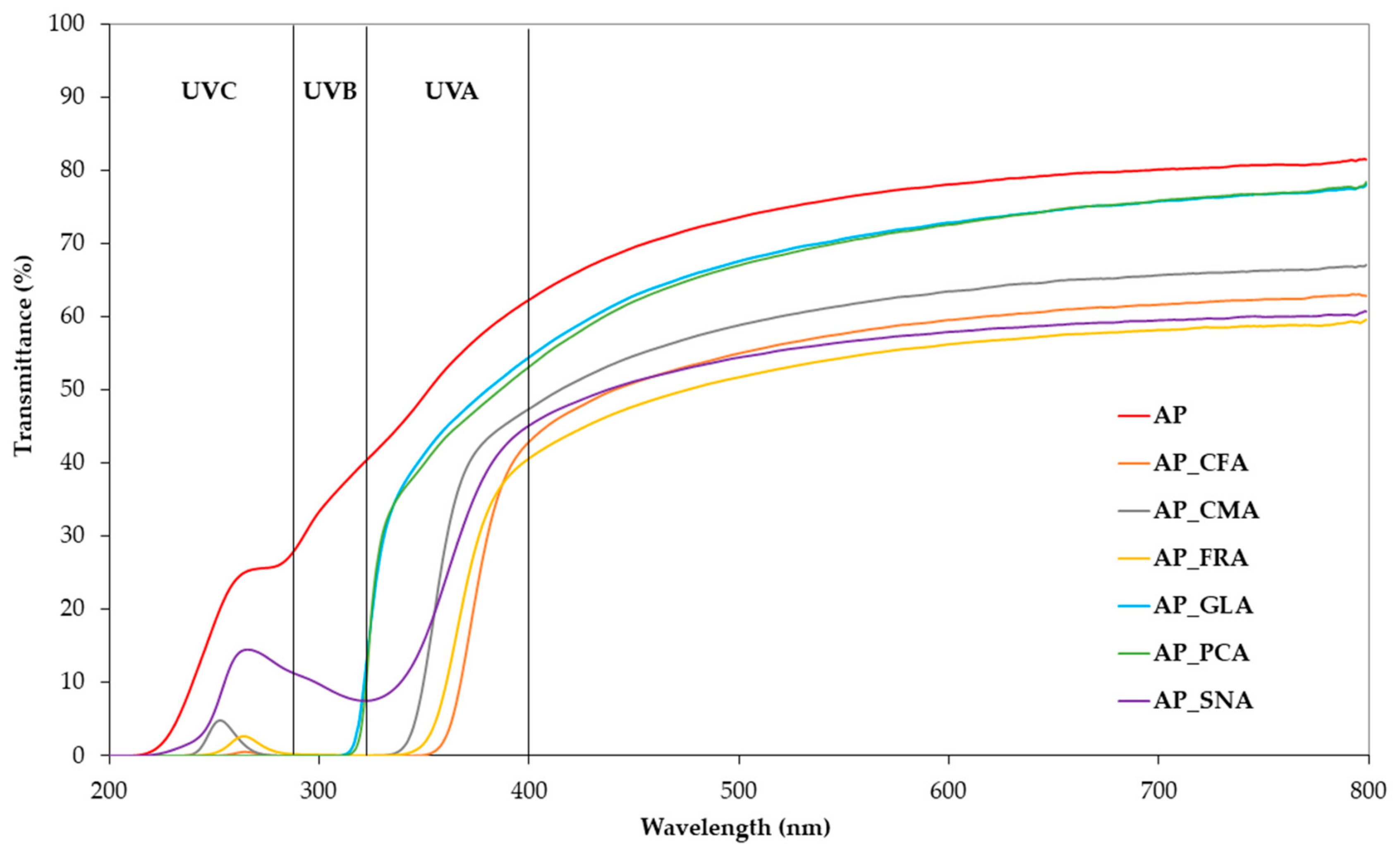
The effectiveness of a film in blocking visible and ultraviolet (UV) light is important for preserving packaged food. For food products, this blocking ability is essential for evaluating the level of radiation that reaches the food’s surface. This exposure can affect photooxidative reactions, which can influence the overall quality and shelf life of the food [43]. The results presented in Figure 1 show the transmittance of pectin films, including enhancement by the addition of various phenolic acids. This analysis measures the amount of light the film transmits at specific wavelengths. Transmittance measurements were conducted using wavelengths from 200 to 800 nm, allowing for the assessment of optical properties within the ultraviolet range together with visible light. Figure 1 reveals that the films without phenolic acid, treated as controls (AP), had the highest transmittance across the entire wavelength range tested, indicating the lowest level of absorbance. In contrast, a noticeable decrease in transmittance was observed in all variants after the addition of phenolic acids. Specifically, the film with ferulic acid (AP_FRA) exhibited the lowest transmittance values, indicating that it transmitted the least amount of light within the specified range. The phenolic acids—caffeic, coumaric, ferulic, gallic, and protocatechuic—present in the coatings displayed low transmittance within the 250–300 nm spectrum while showing improved transmittance in the 350–800 nm range. Therefore, it can be concluded that the addition of these acids enhances the film’s light barrier. Moreover, the low transmittance observed in the wavelength range below 300 nm suggests an effective capacity for absorbing ultraviolet radiation. Above this range, absorbance gradually decreases, which is characteristic of materials with UV barrier properties that still partially transmit light in the UV-VIS spectrum. Cai et al. [44] observed that the transparency of edible films, measured between 350–800 nm, gradually stabilises as the wavelengths of ultraviolet light increase. Films that exhibit low transmission in the UV-VIS range can be effective materials for protecting light-sensitive products. Therefore, controlling transparency in the visible light spectrum is crucial when designing edible packaging films to achieve specific barrier properties. Moll and Chiralt [43] also found that incorporating ferulic acid into PHBV films significantly reduced light transmission in both visible and UV light. This effect is likely due to the light-absorbing properties of the newly added molecules. Notably, ferulic acid had a more substantial impact on reducing UV light transmission than on visible light. Consequently, films containing active compounds may help to minimise the formation of free radicals in packaged foods, providing protection against light-induced oxidation and delaying the degradation of food components.

3.1.2. Colour

Analysing the colour of packaging film is crucial for consumer acceptance of food products [45]. All samples were analysed colourimetrically to determine their colour parameters, and the results are presented in Table 1. The L* parameter indicates the contrast between darkness and lightness, with a range from 0 to 100. The a* value reflects the shift in film colour from green to red, increasing from negative to positive values, while a rise in the b* parameter signifies that the film colour becomes more yellow [46]. Additionally, the total colour difference (∆E) relative to a control film (pectin films without phenolic acids) was calculated to assess the colour change in the films.
The control and composite films were visually transparent, smooth, and homogeneous. The L* values ranged from 80.65 ± 0.66 to 85.65 ± 0.70. The pectin film with ferulic acid (AP_FRA) exhibited the lowest L* value, indicating lightness. The addition of phenolic acids reduced the L* parameter in all film variants containing them. The a* values ranged from −1.49 ± 0.05 to 0.77 ± 0.33. Therefore, it can be noted that only the films with ferulic acid, characterised by a positive value, showed a tendency towards redness, while all other films showed a slight tendency towards greenness. According to Ngo et al. [47], colour changes in pectin films suggest that an increase in the a* colour parameter translates into a shift from green to red colours as the value changes from negative to positive. An increase in the b* parameter value indicates a more yellow appearance of the film. All films showed a tendency to yellow. Furthermore, the most pronounced change in yellow colour was observed for pectin films with gallic, caffeic, and coumaric acids. Similar observations were presented by Insaward et al. [48], who observed that the addition of ferulic, caffeic, and gallic acids significantly increased the yellow content of soy protein films. Liu et al. [49], however, observed a slight colour change in chitosan films after the addition of p-coumaric acid, from colourless to light yellow.
The differences in colour are especially apparent in the total colour difference (∆E). A value above 1 means no noticeable colour difference, while a trained observer may detect differences between values of 1 and 2. Results ranging from 2 to 3.5 are visible to an untrained people, and values above 5 signify a high colour difference compared to the control films [47]. The values obtained indicate significant colour differences that can even be noticed by non-experts. The total colour difference (∆E) in films with added phenolic acids ranged from 2.08 to 6.24. Among these, the pectin films containing gallic and protocatechuic acids exhibited the most similar values. Notably, the film with the ferulic acid additive (AP_FRA) was the most visually distinct, showing a greater colour difference compared to the other films.

3.1.3. Gloss and Opacity

The transparency and gloss of edible films are essential to their suitability when used as edible coatings, as these properties directly impact the appearance of coated products [50]. Currently, there is a widespread misinterpretation of opacity and transparency phenomena. Transparency describes a material’s ability to transmit light, while opacity refers to the degree to which the material avoids light transmission. However, this does not play a crucial role for light reflectance, which may be affected semi-transparent films [51]. The shine of edible packaging films plays a crucial role in enhancing the visual appeal of food products. It not only makes them look more appealing to consumers but also conveys a sense of quality and freshness. Glossy finishes can be imparted by lipids, waxes, and other ingredients incorporated into the film, contributing to the product’s overall aesthetic and influencing consumer purchasing decisions [52,53]. The gloss were measured at various angles of incidence (20°, 60°, and 85°) and are presented in Table 2. According to Fabra et al. [50], values at 45° are sufficient for assessing properties of medium-gloss surfaces. However, high-gloss films are better assessed at lower angles, and low-gloss surfaces are better distinguished at higher angles, due to increasing specular reflection with increasing angle of incidence. The incorporation of phenolic acids reduced the gloss of the films at both 20° and 60° angles, from 73.50 ± 2.47° to 25.38 ± 1.38° and from 100.48 ± 1.69° to 45.45 ± 1.40°, respectively. At 85°, a similar reducing tendency has been observed, from 76.60 ± 0.50° to 27.12 ± 0.80°, except for films containing protocatechuic acid. For this sample, higher values were obtained (76.66 ± 0.52°); however, the differences between values were not statistically significant (p < 0.05). Based on the results of the gloss measurements, the most significant changes were observed between the control films (AP) and those containing caffeic, ferulic, and sinapic acids. These findings indicate that films containing phenolic acids exhibited reduced glossiness, suggesting that these acids significantly altered the surface appearance of the pectin films. These results align with other optical parameters, such as colour values presented in Table 1 and the observations from the UV-VIS spectra shown in Figure 1.
Table 2 also presents the opacity of the films with added phenolic acids, referring to the degree of light blocking at a wavelength of 600 nm in the visible range. The film with sinapic acid exhibited the highest value (3.03 a.u./mm), indicating it was the most opaque sample tested. The lowest values were for films with coumaric and protocatechuic acids, 1.78 ± 0.16 and 1.78 ± 0.25 a.u./mm, respectively, which is even lower than that of the control films (2.15 ± 0.17 a.u./mm). The other phenolic acids showed higher values, suggesting an enhancement of the film’s light barrier properties. The higher the visible light transmittance value, the greater the film’s transparency. Higher opacity values indicate good light barrier properties. Li et al. [54] demonstrated that the opacity of composite films containing ferulic acid was higher than that of the control film made from chitosan and sodium alginate. These results indicate that the addition of ferulic acid enhanced the interaction between chitosan and sodium alginate, resulting in a denser film structure and reduced transparency.

3.2. The Effect of Phenolic Acids on the Barrier Properties of Pectin Packaging Films

Edible films are characterised by possessing crucial barrier properties that can regulate the migration of gases such as oxygen, carbon dioxide, and water vapour. However, when water vapour permeability if high can cause significant weight loss due to moisture evaporation in post-harvest fruits and vegetables, affecting their quality decline and shortening their shelf life. Therefore, effective gas barrier properties are essential for edible films and coatings to address these issues [55]. These properties play a significant role in protecting food products quality from oxidation, moisture loss, and other processes that can negatively impact their shelf life and quality during storage [56]. Table 3 contains the results for oxygen and carbon dioxide permeabilities of edible films obtained from apple pectin (AP) and selected phenolic acids. The oxygen permeability for the apple pectin film was 0.84 ± 0.02 × 10⁻¹⁶ g/m·s·Pa, and for carbon dioxide, it was 1.15 ± 0.07 × 10⁻¹⁶ g/m·s·Pa. The highest values for the pectin film with added phenolic acid were observed for the variant with apple pectin and sinapic acid: 1.65 ± 0.10 for oxygen and 2.33 ± 0.12 × 10⁻¹⁶ g/m·s·Pa for carbon dioxide. The increase in permeability of both gases may be caused by the disruption of the film’s polymer structure resulting from the addition of sinapic acid. Caffeic acid is characterised by low stability in the presence of oxygen [57]. Sun et al. [58] investigated the oxygen permeability of edible chitosan films with added gallic acid. The introduction of gallic acid improved oxygen permeability. The high value was probably due to the presence of non-crosslinking gallic acid molecules dispersed in the film, which reduced intermolecular forces between polymer chains and led to pore formation.
The permeability of both oxygen and carbon dioxide is essential because respiratory processes can affect the quality of fresh fruits, vegetables, and other products. Various factors play a role in the gas permeability of edible films, such as the integrity of the film, the balance between hydrophobic and hydrophilic areas, and the interactions between the polymers that comprise the film [7]. The presence of plasticisers or other additives also plays a role [59,60]. Moreover, in our previous study, we observed that the inclusion of phenolic acids increased the water vapour permeability from 7.16 ± 0.42 × 10⁻¹⁰ for control films to 10.46–10.68 × 10⁻¹⁰ g/m·s·Pa for films with coumaric, ferulic, and sinapic acids. However, films with gallic acid and protocatechuic acids showed similar values to control pectin films [39]. Those observations indicate that the presence of phenolic acid and its type are crucial in modifying the barrier properties of pectin films.

3.3. The Effect of Phenolic Acids on the Thermal Properties of Pectin Packaging Films

Thermal property assessment is essential to understanding the limitations of films in various applications. Films characterised by higher thermal stability can improve the integrity and functional properties of packaged foods, thus preserving them. Thermal stability assessment is most often performed using thermogravimetric analysis (TGA) [61]. These methods can reflect thermal behaviour, degradation rates, and variability in intermolecular interactions. Pectin films exhibit lower thermal stability due to the plasticising effect resulting from the hydration process. The addition of biopolymers with greater thermal stability may influence and modify the thermal parameters of pectin-based films [62]. Thermogravimetric analysis, on the other hand, can provide information on the thermal stability and can provide information about the degradation profiles of biopolymer-based films. This allows for the assessment of how functional compounds, such as plasticisers or bioactive substances, affect the thermal properties or overall stability of the film [63]. Table 4 presents the percentage weight loss of edible films during heating.
The film obtained from apple pectin exhibited the lowest percentage weight loss in the first two heating stages (30–100 °C and 100–280 °C), but the highest weight loss in the final heating stage at the highest temperature. The reduced weight loss of films containing added phenolic acids suggests increased hydrophobicity, a finding supported by the results on moisture content and water solubility [39]. For all films, the highest weight loss occurred in the second heating stage. The primary weight loss during the second heating stage can be attributed to thermal decomposition of polymers with low-molecular-weight. Additionally, glycerol evaporation and decomposition of polysaccharide chains are likely to have occurred [64]. However, according to Giz et al. [65], the dense network structure formed by cross-linking can increase the energy that is required to rupture the molecular chains. This phenomenon slows the rate that characterises thermal degradation and enhances the film’s thermal stability. Glycerol and sorbitol have been shown to have no significant effect on the thermal properties of the films when compared to plasticisers, materials with no plasticisers, or with other plasticisers. Yerramathi et al. [66] demonstrated that the addition of ferulic acid increased the thermal stability of the films, likely due to the interaction of polyphenols with sodium alginate. This enhancement was probably due to the presence of hydrogen bonds, as well as a denser film network structure.
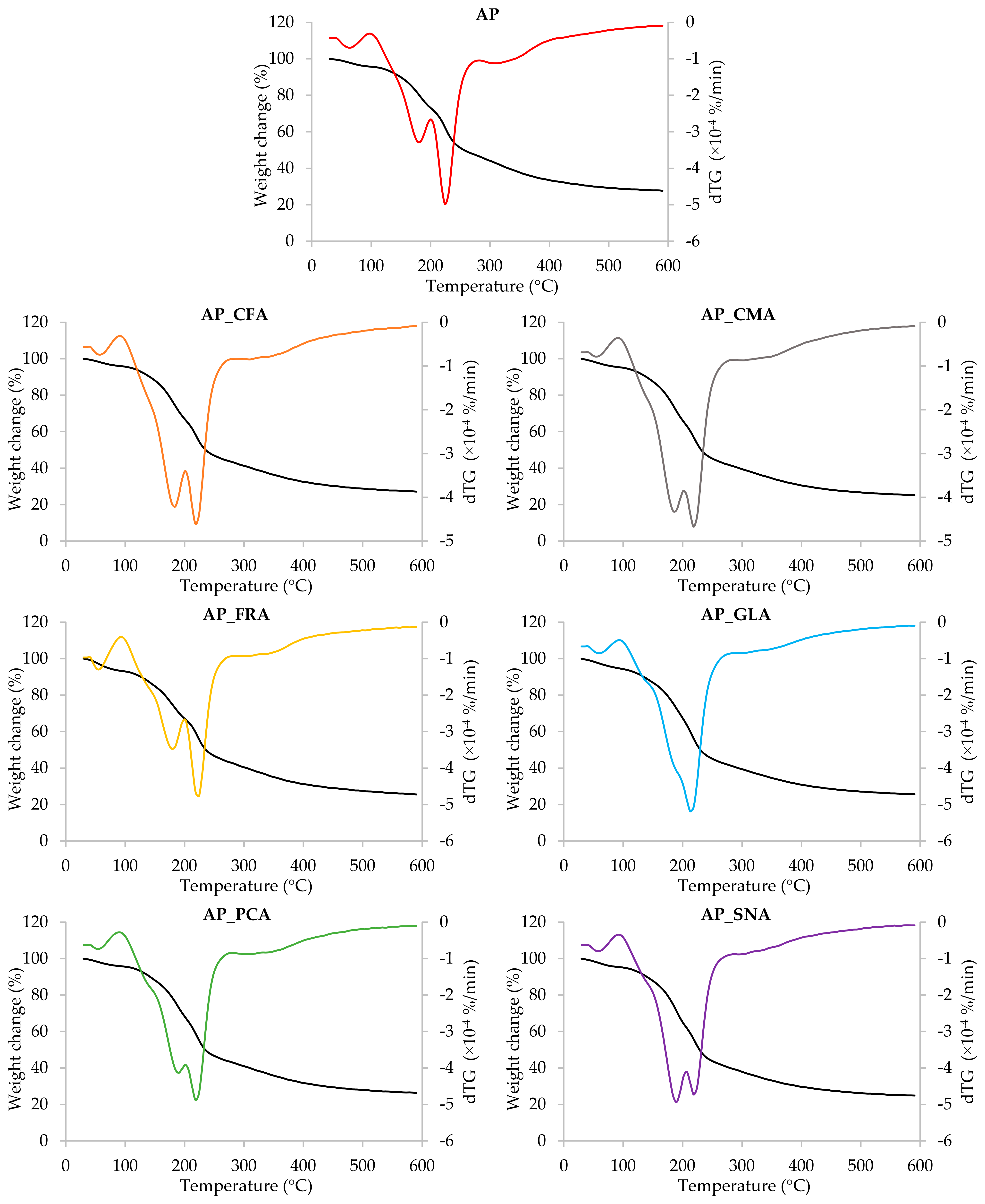
Investigating the thermal properties of the packaging films is crucial, as they may undergo various processes at elevated temperatures during packaging, transport, and storage [67]. The thermal properties of analysed films with selected phenolic acids were examined using thermogravimetric analysis to quantitatively measure the change in sample mass with increasing temperature (Figure 2). The first stage of thermogravimetric analysis, in the temperature range of 25 °C to 200 °C, is due to the evaporation of water as well as volatile components. Pectin, has side chains that responsible for steric hindrance with adjacent molecules, affecting higher intermolecular distances. This minimise molecule-molecule interactions and lowers degradation temperatures [68]. Cruz et al. [69] observed a pectin film mass loss of approximately 12% and 5% in the first and second stages, occurring in the temperature ranges of 10–136 °C and 136–204 °C, respectively. These stages were associated with water evaporation and the release of low-molecular-weight substances, such as volatile compounds. Moreover, the third stage (204–308 °C) was responsible for a greater mass loss, resulting from depolymerisation and polysaccharide degradation.
The low thermal stability of packaging materials hinders their use in packaging material. The thermal stability of biopolymer films is crucial for maintaining continuous structure and limiting degradation at various temperatures that may occur during processing, transport, and storage, which translates into protecting food quality and safety. Investigating the interactions between processing conditions and thermal behaviour supports the development of stable edible films. Furthermore, this allows for the preservation of the structural integrity and functionality of films [61]. Thermal degradation of polysaccharides up to approximately 200 °C results in the removal of bound and unbound water molecules (dehydration). This is succeeded by the breaking apart and separation of hydrocarbon chains, resulting in a notable reduction in weight and the creation of volatile products [70].

3.4. The Effect of Phenolic Acids on the Structural Properties of Pectin Packaging Films

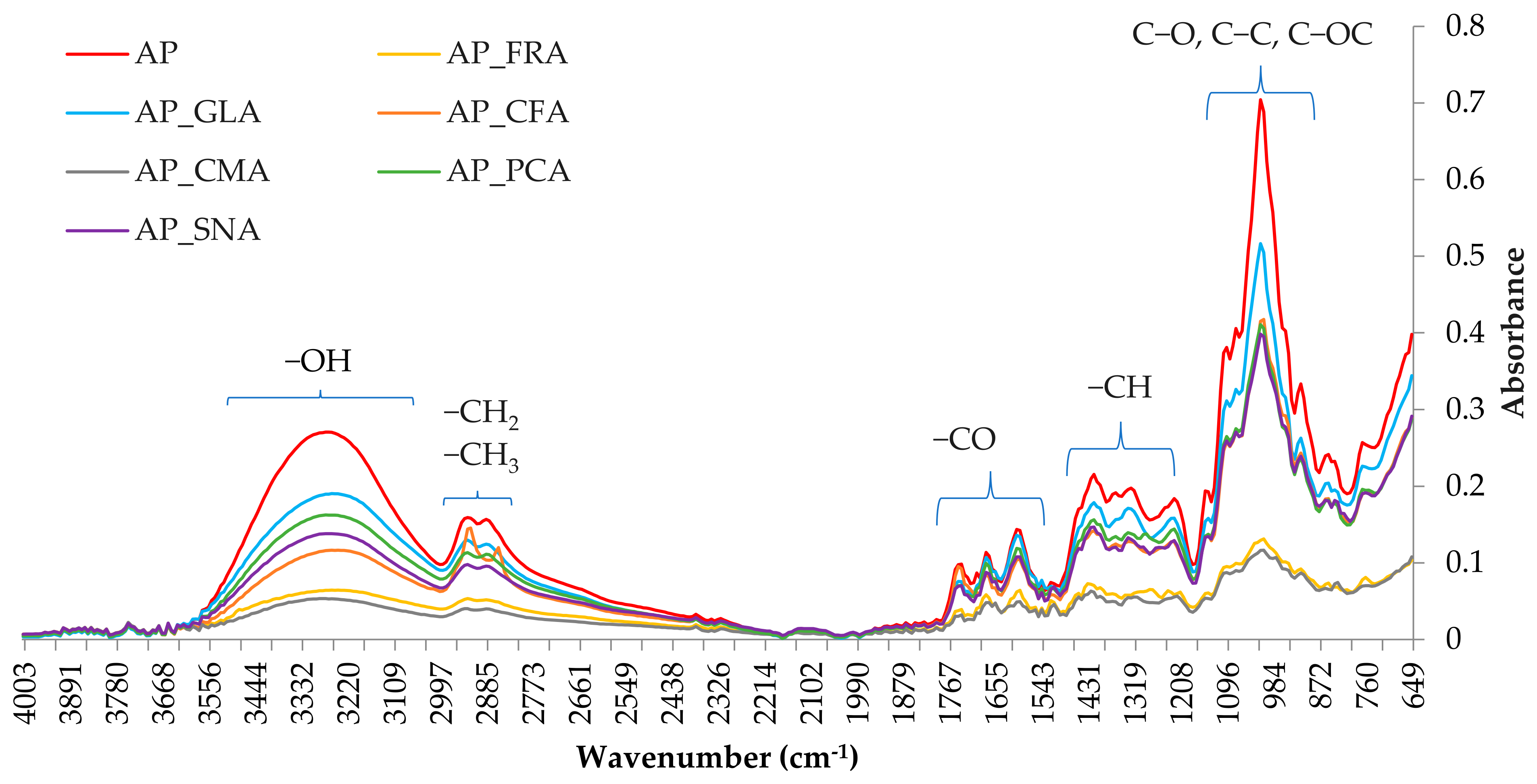
Fourier transform infrared spectroscopy (FT-IR) is based on the interaction of infrared radiation with matter. Infrared radiation is absorbed by functional groups present in the analyte, influencing the vibrations of covalently bonded atoms. This method enables the identification of specific functional groups (hydroxyl, carbonyl, and ether), which are important for predicting the chemical behaviour and interactions of films [63]. Furthermore, it is possible to analyse chemical changes occurring during processing, assess the degree of cross-linking, and monitor interactions with other compounds that may influence the changes in barrier, optical and mechanical properties of films [71]. FT-IR analysis was performed to investigate functional and intermolecular interactions. Furthermore, these interactions were assessed by incorporating phenolic acids into edible film formulations. This analysis identified specific wavelengths assigned to different functional groups in the 4000–650 cm−1 spectrum. The results are presented in Figure 3.
The transmittance of the films showed important variations in the UV range (403–649 nm). The introduction of ferulic and coumaric acids led to a significant attenuation of UV radiation, indicating that their addition effectively enhanced the UV-blocking properties of the films. However, the inclusion of gallic acid significantly reduced transmittance of visible light, which increased light scattering and reflection, and consequently increased the opacity value. The main peaks in the spectral range of 3220–3332 cm−1 characterise the stretching of hydroxyl groups. Cabrera-Barjas et al. [72] described characteristic bands between 3000 and 3700 cm−1 as associated with −OH groups, between 3000 and 2800 cm−1 with −CH groups, and around 1640 cm−1 as attributed to C=C groups. Moreover, the area between 1455 and 1400 cm−1 is characteristic of the bending vibration of −CH groups, and bands in the region between 1150 and 1000 cm−1 are related to the antisymmetric stretching vibrations of the C-O-C bridge and C-O groups.
Serrafi et al. [73] discovered that the shift in O-H vibration bands in pectin to lower frequencies is due to the production of hydrogen bonds and alterations in the chemical environment of the hydroxyl groups. The formation of hydrogen bonds between the hydroxyl group (O-H) and other functional groups reduces the energy required to stretch the O-H bond, resulting in a shift in the absorption band toward lower frequencies. Additionally, a lower amount of water molecules associated with pectin may also contribute to this change. In conclusion, films that contain phenolic acids may have lower hydration levels than the apple pectin film sample. The study by Bhatia et al. [60] showed that the peak observed at 2923 cm−1 corresponded to C–H vibrations, specific to the presence of glycerol. However, Chaves et al. [68] reported that intermolecular interactions, particularly hydrogen bonds between polymers, plasticiser, and water, broaden and shift the bands characteristic of the absorption maximum. Dobrucka et al. [74] also observed a significant peak at 1000 cm−1, which was attributed to the stretching of the saccharide structure of pectin in the C-O-C direction.

3.5. The Effect of Phenolic Acids on the Mechanical Properties of Pectin Packaging Films

Assessing the mechanical properties of films is important because it indicates their durability and ability to maintain food integrity during handling, transport, and storage. The tensile strength parameter indicates the maximum elongation of the film when stretched [1,75]. An ideal edible packaging film should exhibit flexibility and elasticity, conforming to the shape of the packaged food while also being resistant to mechanical abrasion [76]. The higher molecular weight and dry matter of pectin is responsible for longer polymer chains that increase intermolecular entanglement, as well as film-forming solution viscosity. Compared to protein films, they typically exhibit good tensile strength but lower elasticity [25]. The mechanical resistance of the films was evaluated by characterising tensile strength, elongation, and Young’s modulus, with the results shown in Table 5. The values of tensile strength for films ranged from 2.78 (AP) to 4.45 MPa. The addition of phenolic acids increased the tensile strength, with significantly higher values observed in films containing caffeic, protocatechuic, and sinapic acids. A plasticising effect of the phenolic acids was noted for caffeic, ferulic, and protocatechuic acids, leading to a significant increase in elongation at break from 9.71 ± 1.16% to a range of 12.51–15.07%. Furthermore, the Young’s modulus values for all films containing phenolic acids were significantly higher, ranging from 5.28 to 5.98 MPa, compared to the control films, which had a Young’s modulus of 3.48 ± 0.73 MPa.
Gupta et al. [77] characterise ferulic acid by its ability to increase the mechanical strength and barrier properties of films, in addition to its strong antioxidant properties. Kaczmarek et al. [78] reported that adding ferulic acid to collagen films significantly increased mechanical resistance. An improvement in the tensile properties of chitosan–alginate films was also observed with the addition of ferulic acid [79]. Furthermore, ferulic acid was found to play a key role as a compatible agent and enhance the physical, chemical, and biological properties of the films. Wu et al. [80] reported that the increased tensile strength of films prepared with chitosan and gallic acid was attributed to cooperative cross-linking. This cross-linking results from the formation of hydrogen bonds between gallic acid and the chitosan chain, which influences the structure of the resulting films. Woranuch et al. [81] reported that the development of chitosan films with ferulic acid showed minimal impact on tensile strength and elastic modulus. However, elongation at break increased to 16.24%, compared to control films, which had a tensile strength of 19.09 MPa, an elastic modulus of 1103.72 MPa, and an elongation at break of 10.95%. This phenomenon can be attributed to the plasticising effect of small phenolic acid molecules, which made the film more flexible after the addition of ferulic acid. Yerramathi et al. [62] developed sodium alginate films with the addition of ferulic acid and also observed an improvement in mechanical properties. The addition of phenolic acids (ferulic acid, caffeic acid, tannic acid, and gallic acid) also improved the mechanical properties of chitosan films [82]. Liu et al. [83] observed an improvement in the mechanical properties of the films with the introduction of gallic acid, increasing tensile strength (TS) from 6.00 MPa to 15.97–20.06 MPa and elongation at break from 3.49% to 6.37–7.29%. Other researchers also observed a significant improvement in mechanical strength obtained through the formation of hydrogen bonds and covalent interactions with pectin molecules, resulting in a denser and stiffer polymer network. The use of tannic acid increased the tensile strength of the films by 40.14% compared to films made with pure pectin. This increased mechanical strength is closely related to the film’s barrier properties, as it reduces water vapour permeability. Furthermore, it enhances the protective effect when used for perishable foods [84,85]. Improved mechanical strength of pectin-based films was also obtained by adding tannic acid, which influences the formation of hydrogen bonds and covalent interactions with pectin molecules, resulting in a denser and stiffer polymer network [25]. Liu et al. [49] observed increased tensile strength and elongation at break in edible chitosan films with the addition of coumaric acid. This phenomenon was likely due to an appropriate grafting rate, which could have reduced molecular speed and free volume of the chains, thus creating a denser film structure.

3.6. The Effect of Phenolic Acids on the Antioxidant Properties of Pectin Packaging Films

Introducing phenolic acids into the pectin structure offers the possibility of obtaining new matrices with satisfactory antioxidant properties and extending the functional properties of pectin-based films. Antioxidant capacity has been widely studied using common assays such as electron or radical capture detection, known as the DPPH (2,2-diphenyl-1-picrylhydrazyl) assay and the ABTS (2,2′-azinobis-3-ethylbenzothiazoline-6-sulfonic acid) assay. Direct measurement of a film formulation requires first isolating (extracting) the antioxidant from the matrix (material of coating or film) using an appropriate solvent [86]. The results for antioxidant activity for composite pectin films are in Table 6. The ABTS free radical scavenging capacity in the tested edible films ranged from 0.36 ± 0.12 for control films to 38.08 ± 0.69 mg TE/g d.m for films containing ferulic acid. The antioxidant activity against DPPH radical ranged from 0.83 mg TE/g d.m. for the control films to 131.48 mg Trolox/g d.m. for the films containing ferulic acid. In general, all types of phenolic acids affected the antioxidant activity of pectin films. Phenolic compounds, naturally occurring and extracted from plants, exhibit various properties, such as antioxidant anti-inflammatory effects, as well as anticancer property. They are effective antibacterial agents due to their ability to destabilise bacterial membranes and inhibit protein synthesis in microbial cells [87,88]. Therefore, the addition of phenolic acids may enhance both antioxidant and antibacterial properties. Conversely, edible films created from pectin offer antioxidant benefits and help slow down the decline of various types of methanogens, thereby maintaining of food quality and safety [18]. In general, antioxidants convert the stable free DPPH radicals, which are purple, into their reduced form, DPPH-H, which are yellow. The ability to scavenge the DPPH radical is closely related to the antioxidant’s capacity to donate hydrogen [89,90]. According to Dey et al. [91], the antioxidant capacity of phenolic acids correlates with their ability to donate hydrogen through the phenolic hydroxyl group, thereby terminating the radical oxidation of lipids or other biomolecules.
The DPPH activity of hydroxycinnamic acids is often presented in the following order: caffeic acid > sinapic acid > ferulic acid > coumaric acid [92]. The variations in the outcomes of this study could be linked to the distinct structures of phenolic acids and how well they interact and blend with the pectin matrix during the formation of the film. Thus, although the presence of two aromatic hydroxyl groups in caffeic acid is responsible for higher scavenging activity compared to ferulic acid, which contains a single hydroxyl group, this did not affect the results in the case of pectin films [93]. The presence of a CH=COOH group in cinnamic acid derivatives contributes to greater antioxidant activity than the COOH groups in benzoic acids [94].

4. Conclusions

This study showed that various phenolic acids are suitable compatible materials for apple pectin-based films. Each film exhibited a consistent, uniform structure along with a slight yellow tint. UV-VIS analysis revealed that the control film achieved the highest transmittance value. However, incorporating phenolic acids resulted in a reduction in this value, enhancing the film’s effectiveness as a barrier against UV-VIS light. The incorporation of phenolic acids affected lower values of lightness (parameter L*) in all film variants. For all films, the highest mass loss was observed in the second heating stage, ranging from 100 to 280 °C. The lower mass loss of films containing phenolic acids, compared to pectin films, indicates their higher hydrophobicity. The analysis using Fourier transform infrared spectroscopy indicated that there were no interactions that may occur between the phenolic acids and the film matrix. It showcased the functional groups found in pectin, including carbonyl (C=O) and hydroxyl (−OH) groups. Phenolic acids enhanced both the mechanical strength and antioxidant properties of the pectin films. Consequently, it can be noted that the resulting edible films possess significant potential when used for food products.

Author Contributions

Conceptualization, S.G.; methodology, M.M. and S.G.; software, M.M. and S.G.; validation, S.G.; formal analysis, M.M. and S.G.; investigation, M.M. and S.G.; resources, M.M. and S.G.; data curation, M.M. and S.G.; writing—original draft preparation, M.M.; writing—review and editing, M.M. and S.G.; visualisation, M.M. and S.G.; supervision, S.G.; project administration, S.G.; funding acquisition, S.G. All authors have read and agreed to the published version of the manuscript.

Funding

This research received no external funding.

Institutional Review Board Statement

Not applicable.

Informed Consent Statement

Not applicable.

Data Availability Statement

The dataset is available upon request from the authors. The raw data supporting the conclusions of this article will be made available by the authors upon request.

Acknowledgments

The authors thank Magdalena Karwacka for her support in conducting thermogravimetric analysis and Katarzyna Rybak for performing the antioxidant activity analysis.

Conflicts of Interest

The authors declare no conflicts of interest.

References

  1. Pacheco, N.; Naal-Ek, M.G.; Ayora-Talavera, T.; Shirai, K.; Roman-Guerrero, A.; Fabela-Moron, M.F.; Cuevas-Bernardino, J.C. Effect of bio-chemical chitosan and gallic acid into rheology and physicochemical properties of ternary edible films. Int. J. Biol. Macromol. 2019, 125, 149–158. [Google Scholar] [CrossRef] [PubMed]
  2. Mahmud, M.Z.A.; Mobarak, M.H.; Hossain, N. Emerging trends in biomaterials for sustainable food packaging: A comprehensive review. Heliyon 2024, 10, e24122. [Google Scholar] [CrossRef] [PubMed]
  3. Ribeiro, I.S.; Maciel, G.M.; Bortolini, D.G.; Fernandes, I.d.A.A.; Maroldi, W.V.; Pedro, A.C.; Rubio, F.T.V.; Haminiuk, C.W.I. Sustainable innovations in edible films and coatings: An overview. Trends Food Sci. Technol. 2024, 143, 104272. [Google Scholar] [CrossRef]
  4. Ali, M.; Ali, A.; Ali, S.; Chen, H.; Wu, W.; Liu, R.; Chen, H.; Ahmed, Z.F.R.; Gao, H. Global insights and advances in edible coatings or films toward quality maintenance and reduced postharvest losses of fruit and vegetables: An updated review. Compr. Rev. Food Sci. Food Saf. 2025, 24, e70103. [Google Scholar] [CrossRef]
  5. Wu, Y.; Wu, H.; Hu, L. Recent Advances of Proteins, Polysaccharides and Lipids-Based Edible Films/Coatings for Food Packaging Applications: A Review. Food Biophys. 2024, 19, 29–45. [Google Scholar] [CrossRef]
  6. Saidi, L.; Wang, Y.; Wich, P.R.; Selomulya, C. Polysaccharide-based edible films—Strategies to minimize water vapor permeability. Curr. Opin. Food Sci. 2025, 61, 101258. [Google Scholar] [CrossRef]
  7. Kocira, A.; Kozlowicz, K.; Panasiewicz, K.; Staniak, M.; Szpunar-Krok, E.; Hortynska, P. Polysaccharides as Edible Films and Coatings: Characteristics and Influence on Fruit and Vegetable Quality-A Review. Agronomy 2021, 11, 813. [Google Scholar] [CrossRef]
  8. Pan, J.; Li, C.; Liu, J.; Jiao, Z.; Zhang, Q.; Lv, Z.; Yang, W.; Chen, D.; Liu, H. Polysaccharide-Based Packaging Coatings and Films with Phenolic Compounds in Preservation of Fruits and Vegetables—A Review. Foods 2024, 13, 3896. [Google Scholar] [CrossRef]
  9. Pawase, P.A.; Rout, S.; Tripathy, S.; Pathare, A.M.; Srivastav, P.P.; Bashir, O.; Panghal, A. Recent advances in cellulose, chitosan, and protein-based edible films for sustainable food packaging: A comprehensive review. Int. J. Biol. Macromol. 2025, 321, 146172. [Google Scholar] [CrossRef]
  10. Figueroa-Enriquez, C.E.; Rodríguez-Félix, F.; Ruiz-Cruz, S.; Castro-Enriquez, D.D.; Gonzalez-Rios, H.; Perez-Alvarez, J.Á.; Madera-Santana, T.J.; Burruel-Ibarra, S.E.; Tapia-Hernández, J.A.; Estrella-Osuna, D.E. Edible Coating of Sodium Alginate With Gelatin Nanoparticles and Pitaya Extract (Stenocereus thurberi): Physicochemical and Antioxidant Properties. J. Food Qual. 2025, 2025, 5756522. [Google Scholar] [CrossRef]
  11. Teixeira, S.C.; de Oliveira, T.V.; de Fátima Ferreira Soares, N.; Raymundo-Pereira, P.A. Sustainable and biodegradable polymer packaging: Perspectives, challenges, and opportunities. Food Chem. 2025, 470, 142652. [Google Scholar] [CrossRef]
  12. Nahar, L.; Habibi, E.; Gavril, G.-L.; Abdelfattah, G.M.M.; Wrona, M.; Nerín, C.; Guo, M.; Sarker, S.D. Towards sustainable food packaging using natural compounds: A review of current research update. Food Bioprod. Process. 2025, 150, 260–274. [Google Scholar] [CrossRef]
  13. Oliveira, I.; Pinto, T.; Afonso, S.; Karaś, M.; Szymanowska, U.; Gonçalves, B.; Vilela, A. Sustainability in Bio-Based Edible Films, Coatings, and Packaging for Small Fruits. Appl. Sci. 2025, 15, 1462. [Google Scholar] [CrossRef]
  14. Usman, I.; Sana, S.; Jaffar, H.M.; Munir, M.; Afzal, A.; Sukhera, S.; Boateng, I.D.; Afzaal, M.; Urugo, M.M. Recent progress in edible films and coatings: Toward green and sustainable food packaging technologies. Appl. Food Res. 2025, 5, 101070. [Google Scholar] [CrossRef]
  15. Omid Jeivan, A.; Galus, S. Edible Pouch Packaging for Food Applications—A Review. Processes 2025, 13, 2910. [Google Scholar] [CrossRef]
  16. Kumar, L.; Ramakanth, D.; Akhila, K.; Gaikwad, K.K. Edible films and coatings for food packaging applications: A review. Environ. Chem. Lett. 2022, 20, 875–900. [Google Scholar] [CrossRef]
  17. Bisht, B.; Lohani, U.C.; Kumar, V.; Gururani, P.; Sinhmar, R. Edible hydrocolloids as sustainable substitute for non-biodegradable materials. Crit. Rev. Food Sci. Nutr. 2022, 62, 693–725. [Google Scholar] [CrossRef]
  18. Syarifuddin, A.; Muflih, M.H.; Izzah, N.; Fadillah, U.; Ainani, A.F.; Dirpan, A. Pectin-based edible films and coatings: From extraction to application on food packaging towards circular economy—A review. Carbohydr. Polym. Technol. Appl. 2025, 9, 100680. [Google Scholar] [CrossRef]
  19. Mikus, M.; Galus, S. Biopolymer active materials for food. Food Sci. Technol. Qual. 2023, 30, 18–32. [Google Scholar] [CrossRef]
  20. Bremenkamp, I.; Sousa Gallagher, M.J. Edible Coatings for Ready-to-Eat Products: Critical Review of Recent Studies, Sustainable Packaging Perspectives, Challenges and Emerging Trends. Polymers 2025, 17, 376. [Google Scholar] [CrossRef]
  21. Upadhyay, A.; Agbesi, P.; Arafat, K.M.Y.; Urdaneta, F.; Dey, M.; Basak, M.; Hong, S.; Umeileka, C.; Argyropoulos, D. Bio-based smart packaging: Fundamentals and functions in sustainable food systems. Trends Food Sci. Technol. 2024, 145, 104369. [Google Scholar] [CrossRef]
  22. Cazón, P.; Mateus, A.R.; Silva, A.S. Advances in active packaging using natural biopolymers and fruit by-products for enhanced food preservation. Food Res. Int. 2025, 213, 116439. [Google Scholar] [CrossRef] [PubMed]
  23. Sun, W.; Hu, Y.; Pandi, A.; Yi, G.; Tan, Z. Caffeic acid-integrated biopolymer systems: Advancing sustainable active packaging for food preservation. Food Chem. X 2025, 29, 102763. [Google Scholar] [CrossRef] [PubMed]
  24. Kaur, J.; Singh, J.; Rasane, P.; Gupta, P.; Kaur, S.; Sharma, N.; Sowdhanya, D. Natural additives as active components in edible films and coatings. Food Biosci. 2023, 53, 102689. [Google Scholar] [CrossRef]
  25. Said, N.S.; Lee, W.Y. Pectin-Based Active and Smart Film Packaging: A Comprehensive Review of Recent Advancements in Antimicrobial, Antioxidant, and Smart Colorimetric Systems for Enhanced Food Preservation. Molecules 2025, 30, 1144. [Google Scholar] [CrossRef]
  26. Assifaoui, A.; Hayrapetyan, G.; Gallery, C.; Agoda-Tandjawa, G. Exploring techno-functional properties, synergies, and challenges of pectins: A review. Carbohydr. Polym. Technol. Appl. 2024, 7, 100496. [Google Scholar] [CrossRef]
  27. Kalita, P.; Bhattacharjee, B.; Pachuau, L.; Roy, S. Recent trends in pectin sources, extraction, and active-edible coating applications. Food Control 2025, 171, 111105. [Google Scholar] [CrossRef]
  28. Yao, Q.-b.; Huang, F.; Lu, Y.-h.; Huang, J.-m.; Ali, M.; Jia, X.-Z.; Zeng, X.-A.; Huang, Y.-y. Polysaccharide-based food packaging and intelligent packaging applications: A comprehensive review. Trends Food Sci. Technol. 2024, 147, 104390. [Google Scholar] [CrossRef]
  29. Lee, C.R.; Lee, S.J.; Kim, T.I.; Chathuranga, K.; Lee, J.S.; Kim, S.; Kim, M.H.; Park, W.H. Chitosan-gallic acid conjugate edible coating film for perishable fruits. Food Chem. 2025, 463, 141322. [Google Scholar] [CrossRef]
  30. Rubio-Senent, F.; Bermúdez-Oria, A.; Rodríguez-Gutiérrez, G.; Lama-Muñoz, A.; Fernández-Bolaños, J. Structural and antioxidant properties of hydroxytyrosol-pectin conjugates: Comparative analysis of adsorption and free radical methods and their impact on in vitro gastrointestinal process. Food Hydrocoll. 2025, 162, 110954. [Google Scholar] [CrossRef]
  31. Liu, J.; Wang, T.; Huang, B.; Zhuang, Y.; Hu, Y.; Fei, P. Pectin modified with phenolic acids: Evaluation of their emulsification properties, antioxidation activities, and antibacterial activities. Int. J. Biol. Macromol. 2021, 174, 485–493. [Google Scholar] [CrossRef] [PubMed]
  32. Karaki, N.; Aljawish, A.; Muniglia, L.; Humeau, C.; Jasniewski, J. Physicochemical characterization of pectin grafted with exogenous phenols. Food Hydrocoll. 2016, 60, 486–493. [Google Scholar] [CrossRef]
  33. Singh, A.K.; Kim, J.Y.; Lee, Y.S. Phenolic Compounds in Active Packaging and Edible Films/Coatings: Natural Bioactive Molecules and Novel Packaging Ingredients. Molecules 2022, 27, 7513. [Google Scholar] [CrossRef] [PubMed]
  34. Mikus, M.; Galus, S. Extending the Shelf Life of Apples After Harvest Using Edible Coatings as Active Packaging—A Review. Appl. Sci. 2025, 15, 767. [Google Scholar] [CrossRef]
  35. Rocchetti, G.; Gregorio, R.P.; Lorenzo, J.M.; Barba, F.J.; Oliveira, P.G.; Prieto, M.A.; Simal-Gandara, J.; Mosele, J.I.; Motilva, M.-J.; Tomas, M.; et al. Functional implications of bound phenolic compounds and phenolics–food interaction: A review. Compr. Rev. Food Sci. Food Saf. 2022, 21, 811–842. [Google Scholar] [CrossRef]
  36. Rahmawati, I.; Pratama, A.W.; Pratama, S.A.; Khozin, M.N.; Firmanda, A.; Irawan, F.H.; Asranudin; Ansori, A.N.M.; Sucipto, T.H. Gallic acid: A promising bioactive agent for food preservation and sustainable packaging development. Case Stud. Chem. Environ. Eng. 2024, 10, 100776. [Google Scholar] [CrossRef]
  37. Gangadharan, G.; Gupta, S.; Kudipady, M.L.; Puttaiahgowda, Y.M. Gallic Acid Based Polymers for Food Preservation: A Review. ACS Omega 2024, 9, 37530–37547. [Google Scholar] [CrossRef]
  38. Kaczmarek-Szczepańska, B.; Grabska-Zielińska, S.; Michalska-Sionkowska, M. The Application of Phenolic Acids in The Obtainment of Packaging Materials Based on Polymers—A Review. Foods 2023, 12, 1343. [Google Scholar] [CrossRef]
  39. Mikus, M.; Galus, S. The Effect of Phenolic Acids on the Sorption and Wetting Properties of Apple Pectin-Based Packaging Films. Molecules 2025, 30, 1960. [Google Scholar] [CrossRef]
  40. Łyczak, A.; Kirmani, I.; Galus, S. Valorisation of Cocoa Waste into Edible Packaging Films: Physicochemical Characterisation and Potential Use as Edible Pouches with Enhanced Light Barrier, Mechanical and Antioxidant Properties. Appl. Sci. 2025, 15, 11643. [Google Scholar] [CrossRef]
  41. Sobral, P.; Santos, J.; García, F. Effect of protein and plasticizer concentrations in film forming solutions on physical properties of edible films based on muscle proteins of a Thai Tilapia. J. Food Eng. 2005, 70, 93–100. [Google Scholar] [CrossRef]
  42. ASTM D1434-82; Standard Test Method for Determining Gas Permeability Characteristics of Plastic Film and Sheeting. ASTM International: West Conshohocken, PA, USA, 2015.
  43. Moll, E.; Chiralt, A. Active PHBV films with ferulic acid or rice straw extracts for food preservation. LWT 2025, 228, 118115. [Google Scholar] [CrossRef]
  44. Cai, L.; Shi, H.; Cao, A.; Jia, J. Characterization of gelatin/chitosan ploymer films integrated with docosahexaenoic acids fabricated by different methods. Sci. Rep. 2019, 9, 8375. [Google Scholar] [CrossRef] [PubMed]
  45. Spence, C.; Velasco, C. On the multiple effects of packaging colour on consumer behaviour and product experience in the ‘food and beverage’ and ‘home and personal care’ categories. Food Qual. Prefer. 2018, 68, 226–237. [Google Scholar] [CrossRef]
  46. Durmus, A. CIELAB color space boundaries under theoretical spectra and 99 test color samples. Color Res. Appl. 2020, 45, 796–802. [Google Scholar] [CrossRef]
  47. Ngo, T.M.P.; Nguyen, T.H.; Dang, T.M.Q.; Tran, T.X.; Rachtanapun, P. Characteristics and Antimicrobial Properties of Active Edible Films Based on Pectin and Nanochitosan. Int. J. Mol. Sci. 2020, 21, 2224. [Google Scholar] [CrossRef]
  48. Insaward, A.; Duangmal, K.; Mahawanich, T. Mechanical, Optical, and Barrier Properties of Soy Protein Film As Affected by Phenolic Acid Addition. J. Agric. Food Chem. 2015, 63, 9421–9426. [Google Scholar] [CrossRef]
  49. Liu, X.; Sun, X.; Du, H.; Li, Y.; Wen, Y.; Zhu, Z. A transparent p-coumaric acid-grafted-chitosan coating with antimicrobial, antioxidant and antifogging properties for fruit packaging applications. Carbohydr. Polym. 2024, 339, 122238. [Google Scholar] [CrossRef]
  50. Fabra, M.; Hambleton, A.; Talens, P.; Debeaufort, F.; Chiralt, A. Effect of ferulic acid and α-tocopherol antioxidants on properties of sodium caseinate edible films. Food Hydrocoll. 2011, 25, 1441–1447. [Google Scholar] [CrossRef]
  51. Kozakiewicz, G.; Małajowicz, J.; Karwacka, M.; Ciurzyńska, A.; Szulc, K.; Żelazko, A.; Janowicz, M.; Galus, S. The Effects of Gamma-Decalactone on the Physicochemical and Antimicrobial Properties of Pectin-Based Packaging Films. Materials 2025, 18, 3831. [Google Scholar] [CrossRef]
  52. Devi, L.S.; Jaiswal, A.K.; Jaiswal, S. Lipid incorporated biopolymer based edible films and coatings in food packaging: A review. Curr. Res. Food Sci. 2024, 8, 100720. [Google Scholar] [CrossRef] [PubMed]
  53. Olawade, D.B.; Wada, O.Z.; Ige, A.O. Advances and recent trends in plant-based materials and edible films: A mini-review. Front. Chem. 2024, 12, 1441650. [Google Scholar] [CrossRef] [PubMed]
  54. Li, K.; Zhu, J.; Guan, G.; Wu, H. Preparation of chitosan-sodium alginate films through layer-by-layer assembly and ferulic acid crosslinking: Film properties, characterization, and formation mechanism. Int. J. Biol. Macromol. 2019, 122, 485–492. [Google Scholar] [CrossRef] [PubMed]
  55. Fan, Y.; Ren, J.; Xiao, X.; Cao, Y.; Zou, Y.; Qi, B.; Luo, X.; Liu, F. Recent advances in polysaccharide-based edible films/coatings for food preservation: Fabrication, characterization, and applications in packaging. Carbohydr. Polym. 2025, 364, 123779. [Google Scholar] [CrossRef]
  56. Chhikara, S.; Kumar, D. Edible Coating and Edible Film as Food Packaging Material: A Review. J. Packag. Technol. Res. 2022, 6, 1–10. [Google Scholar] [CrossRef]
  57. Fathi, M.; Mirlohi, M.; Varshosaz, J.; Madani, G. Novel Caffeic Acid Nanocarrier: Production, Characterization, and Release Modeling. J. Nanomater. 2013, 2013, 434632. [Google Scholar] [CrossRef]
  58. Sun, X.; Wang, Z.; Kadouh, H.; Zhou, K. The antimicrobial, mechanical, physical and structural properties of chitosan–gallic acid films. LWT-Food Sci. Technol. 2014, 57, 83–89. [Google Scholar] [CrossRef]
  59. Eslami, Z.; Elkoun, S.; Robert, M.; Adjallé, K. A Review of the Effect of Plasticizers on the Physical and Mechanical Properties of Alginate-Based Films. Molecules 2023, 28, 6637. [Google Scholar] [CrossRef]
  60. Bhatia, S.; Al-Harrasi, A.; Shah, Y.A.; Saif Alrasbi, A.N.; Jawad, M.; Koca, E.; Aydemir, L.Y.; Alamoudi, J.A.; Almoshari, Y.; Mohan, S. Structural, mechanical, barrier and antioxidant properties of pectin and xanthan gum edible films loaded with grapefruit essential oil. Heliyon 2024, 10, e25501. [Google Scholar] [CrossRef]
  61. Shah, A.; Bhatia, S.; Al-Harrasi, A.; Oz, F.; Khan, M.; Roy, S.; Esatbeyoglu, T.; Pratap-Singh, A. Thermal Properties of Biopolymer Films: Insights for Sustainable Food Packaging Applications. Food Eng. Rev. 2024, 16, 497–512. [Google Scholar] [CrossRef]
  62. Huang, J.; Hu, Z.; Hu, L.; Li, G.; Yao, Q.; Hu, Y. Pectin-based active packaging: A critical review on preparation, physical properties and novel application in food preservation. Trends Food Sci. Technol. 2021, 118, 167–178. [Google Scholar] [CrossRef]
  63. Esfandiari, Z.; Hassani, B.; Sani, I.K.; Talebi, A.; Mohammadi, F.; Zomorodi, S.; Kaveh, M.; Assadpour, E.; Khodaei, S.M.; Eghbaljoo, H.; et al. Characterization of edible films made with plant carbohydrates for food packaging: A comprehensive review. Carbohydr. Polym. Technol. Appl. 2025, 11, 100979. [Google Scholar] [CrossRef]
  64. Cao, T.L.; Song, K.B. Effects of gum karaya addition on the characteristics of loquat seed starch films containing oregano essential oil. Food Hydrocoll. 2019, 97, 105198. [Google Scholar] [CrossRef]
  65. Giz, A.S.; Berberoglu, M.; Bener, S.; Aydelik-Ayazoglu, S.; Bayraktar, H.; Alaca, B.E.; Catalgil-Giz, H. A detailed investigation of the effect of calcium crosslinking and glycerol plasticizing on the physical properties of alginate films. Int. J. Biol. Macromol. 2020, 148, 49–55. [Google Scholar] [CrossRef] [PubMed]
  66. Yerramathi, B.B.; Kola, M.; Annem Muniraj, B.; Aluru, R.; Thirumanyam, M.; Zyryanov, G.V. Structural studies and bioactivity of sodium alginate edible films fabricated through ferulic acid crosslinking mechanism. J. Food Eng. 2021, 301, 110566. [Google Scholar] [CrossRef]
  67. Sharma, S.; Jaiswal, A.K.; Duffy, B.; Jaiswal, S. Ferulic acid incorporated active films based on poly(lactide)/poly(butylene adipate-co-terephthalate) blend for food packaging. Food Packag. Shelf Life 2020, 24, 100491. [Google Scholar] [CrossRef]
  68. Chaves, M.L.C.; Jesus, G.A.M.; Castro, M.C.; Bruni, A.R.S.; Monteiro, J.P.; SantosJunior, O.O.; Martins, A.F.; Bonafé, E.G. Biodegradable Pectin/Starch-Based Films Applied on Fresh Pears. ACS Omega 2025, 10, 24050–24062. [Google Scholar] [CrossRef]
  69. Cruz, R.M.S.; Rainer, B.; Wagner, I.; Krauter, V.; Janalíková, M.; Vicente, A.A.; Vieira, J.M. Valorization of Cork Stoppers, Coffee-Grounds and Walnut Shells in the Development and Characterization of Pectin-Based Composite Films: Physical, Barrier, Antioxidant, Genotoxic, and Biodegradation Properties. Polymers 2024, 16, 1053. [Google Scholar] [CrossRef]
  70. Lindi, A.M.; Gorgani, L.; Mohammadi, M.; Hamedi, S.; Darzi, G.N.; Cerruti, P.; Fattahi, E.; Moeini, A. Fenugreek seed mucilage-based active edible films for extending fresh fruit shelf life: Antimicrobial and physicochemical properties. Int. J. Biol. Macromol. 2024, 269, 132186. [Google Scholar] [CrossRef]
  71. Fiedot, M.; Rac-Rumijowska, O.; Suchorska-Woźniak, P.; Czajkowski, M.; Szustakiewicz, K.; Safandowska, M.; Różański, A.; Zdunek, A.; Stawiński, W.; Cybińska, J.; et al. The smart apple-based foil: The role of pectin-glycerol-lipid interactions on thermoresponsive mechanism. Food Hydrocoll. 2024, 154, 110067. [Google Scholar] [CrossRef]
  72. Cabrera-Barjas, G.; González, M.; Benavides-Valenzuela, S.; Preza, X.; Paredes-Padilla, Y.A.; Castaño-Rivera, P.; Segura, R.; Durán-Lara, E.F.; Nesic, A. Active Packaging Based on Hydroxypropyl Methyl Cellulose/Fungal Chitin Nanofibers Films for Controlled Release of Ferulic Acid. Polymers 2025, 17, 2113. [Google Scholar] [CrossRef] [PubMed]
  73. Serrafi, A.; Wikiera, A.; Cyprych, K.; Malik, M. Spectroscopic and Microscopic Analysis of Apple Pectins. Molecules 2025, 30, 1633. [Google Scholar] [CrossRef] [PubMed]
  74. Dobrucka, R.; Pawlik, M.; Szymański, M. Green Packaging Films with Antioxidant Activity Based on Pectin and Camellia sinensis Leaf Extract. Molecules 2024, 29, 4699. [Google Scholar] [CrossRef] [PubMed]
  75. Shah, Y.A.; Bhatia, S.; Al-Harrasi, A.; Afzaal, M.; Saeed, F.; Anwer, M.K.; Khan, M.R.; Jawad, M.; Akram, N.; Faisal, Z. Mechanical Properties of Protein-Based Food Packaging Materials. Polymers 2023, 15, 1724. [Google Scholar] [CrossRef]
  76. Xu, M.; Zhang, L.; Zeng, Y.; Zhou, Z.; Han, Y. Preparation and characterization of Levan composite film incorporating vanillin for use as a potential edible coating for peony seed oil. Int. J. Biol. Macromol. 2025, 288, 138732. [Google Scholar] [CrossRef]
  77. Gupta, R.K.; Rajan, D.; Meena, D.; Srivastav, P.P. Ferulic Acid as a Sustainable and Green Crosslinker for Biopolymer-Based Food Packaging Film. Macromol. Chem. Phys. 2025, 226, 2400441. [Google Scholar] [CrossRef]
  78. Kaczmarek, B.; Lewandowska, K.; Sionkowska, A. Modification of Collagen Properties with Ferulic Acid. Materials 2020, 13, 3419. [Google Scholar] [CrossRef]
  79. Zasada, L.; Chmielniak, D.; Gwizdalska, K.; Kaczmarek-Szczepańska, B. Preparation and comprehensive characterization of chitosan-based films enhanced with ferulic acid. Eng. Biomater. 2024, 27, 8. [Google Scholar] [CrossRef]
  80. Wu, C.; Tian, J.; Li, S.; Wu, T.; Hu, Y.; Chen, S.; Sugawara, T.; Ye, X. Structural properties of films and rheology of film-forming solutions of chitosan gallate for food packaging. Carbohydr. Polym. 2016, 146, 10–19. [Google Scholar] [CrossRef]
  81. Woranuch, S.; Yoksan, R.; Akashi, M. Ferulic acid-coupled chitosan: Thermal stability and utilization as an antioxidant for biodegradable active packaging film. Carbohydr. Polym. 2015, 115, 744–751. [Google Scholar] [CrossRef]
  82. Kaczmarek-Szczepańska, B.; Zasada, L.; Grabska-Zielińska, S. The Physicochemical, Antioxidant, and Color Properties of Thin Films Based on Chitosan Modified by Different Phenolic Acids. Coatings 2022, 12, 126. [Google Scholar] [CrossRef]
  83. Liu, Y.; Chen, J.; Li, H.; Wang, Y. Nanocomplexes film composed of gallic acid loaded ovalbumin/chitosan nanoparticles and pectin with excellent antibacterial activity: Preparation, characterization and application in coating preservation of salmon fillets. Int. J. Biol. Macromol. 2024, 259, 128934. [Google Scholar] [CrossRef] [PubMed]
  84. Zhang, W.; Cao, J.; Jiang, W. Effect of different cation in situ cross-linking on the properties of pectin-thymol active film. Food Hydrocoll. 2022, 128, 107594. [Google Scholar] [CrossRef]
  85. Yang, J.; Cai, W.; Rizwan Khan, M.; Ahmad, N.; Zhang, Z.; Meng, L.; Zhang, W. Application of Tannic Acid and Fe3+ Crosslinking-Enhanced Pectin Films for Passion Fruit Preservation. Foods 2023, 12, 3336. [Google Scholar] [CrossRef] [PubMed]
  86. Kurek, M.; Pišonić, P.; Ščetar, M.; Janči, T.; Čanak, I.; Vidaček Filipec, S.; Benbettaieb, N.; Debeaufort, F.; Galić, K. Edible Coatings for Fish Preservation: Literature Data on Storage Temperature, Product Requirements, Antioxidant Activity, and Coating Performance—A Review. Antioxidants 2024, 13, 1417. [Google Scholar] [CrossRef]
  87. Bhattacharya, M.; Mandal, S. Antibacterial activity of caffeic acid from plant sources: A review based on in silico, in vitro and in vivo approaches. Microbe 2025, 8, 100541. [Google Scholar] [CrossRef]
  88. Mandal, M.K.; Domb, A.J. Antimicrobial Activities of Natural Bioactive Polyphenols. Pharmaceutics 2024, 16, 718. [Google Scholar] [CrossRef]
  89. Higgins, C.L.; Filip, S.V.; Afsar, A.; Colquhoun, H.M.; Hayes, W. From Food to Mobility: Investigating a Screening Assay for New Automotive Antioxidants Using the Stable Radical DPPH. ChemistrySelect 2021, 6, 9179–9184. [Google Scholar] [CrossRef]
  90. Akar, Z.; Küçük, M.; Doğan, H. A new colorimetric DPPH(•) scavenging activity method with no need for a spectrophotometer applied on synthetic and natural antioxidants and medicinal herbs. J. Enzyme Inhib. Med. Chem. 2017, 32, 640–647. [Google Scholar] [CrossRef]
  91. Bhanja Dey, T.; Chakraborty, S.; Jain, K.K.; Sharma, A.; Kuhad, R.C. Antioxidant phenolics and their microbial production by submerged and solid state fermentation process: A review. Trends Food Sci. Technol. 2016, 53, 60–74. [Google Scholar] [CrossRef]
  92. Nićiforović, N.; Abramovič, H. Sinapic Acid and Its Derivatives: Natural Sources and Bioactivity. Compr. Rev. Food Sci. Food Saf. 2014, 13, 34–51. [Google Scholar] [CrossRef]
  93. Benbettaïeb, N.; Tanner, C.; Cayot, P.; Karbowiak, T.; Debeaufort, F. Impact of functional properties and release kinetics on antioxidant activity of biopolymer active films and coatings. Food Chem. 2018, 242, 369–377. [Google Scholar] [CrossRef]
  94. Arslan, D.; Tontul, İ.; Polak, T.; Ulrih, N.P. Use of Sinapic Acid Alkyl Esters as Antioxidants in Microencapsulated Flaxseed Oil. Food Bioprocess Technol. 2025, 18, 449–459. [Google Scholar] [CrossRef]
Figure 1. UV-VIS light spectra of packaging films incorporated with selected phenolic acids: CFA—caffeic acid, CMA—coumaric acid, FRA—ferulic acid, GLA—gallic acid, PCA—protocatechuic acid, SNA—sinapic acid.
Applsci 16 00797 g001
Figure 2. TGA (black) and (dTG) (coloured) curves of packaging films incorporated with selected phenolic acids: CFA—caffeic acid, CMA—coumaric acid, FRA—ferulic acid, GLA—gallic acid, PCA—protocatechuic acid, SNA—sinapic acid.
Applsci 16 00797 g002
Figure 3. The Fourier transform infrared spectra of packaging films incorporated with selected phenolic acids: CFA—caffeic acid, CMA—coumaric acid, FRA—ferulic acid, GLA—gallic acid, PCA—protocatechuic acid, SNA—sinapic acid.
Applsci 16 00797 g003
Table 1. Optical properties of packaging films incorporated with selected phenolic acids: CFA (caffeic acid), CMA (coumaric acid), FRA (ferulic acid), GLA (gallic acid), PCA (protocatechuic acid), and SNA (sinapic acid).
FilmL*a*b* E
AP85.65 ± 0.70 e−1.33 ± 0.10 a20.68 ± 2.26 bc-
AP_CFA82.02 ± 0.87 b−0.49 ± 0.20 c26.22 ± 2.94 de4.94 ± 1.94 ab
AP_CMA83.74 ± 1.02 c−1.02 ± 0.20 b25.13 ± 2.78 de3.29 ± 1.93 bc
AP_FRA80.65 ± 0.66 a0.77 ± 0.33 d27.21 ± 1.18 e6.24 ± 1.38 a
AP_GLA84.94 ± 0.44 de−1.49 ± 0.05 a18.23 ± 1.37 ab4.94 ± 1.44 ab
AP_PCA84.96 ± 0.83 de−0.95 ± 0.09 b17.43 ± 1.58 a5.78 ± 1.66 a
AP_SNA84.36 ± 0.70 cd−0.77 ± 0.16 b23.19 ± 2.11 cd2.08 ± 1.13 c
Mean values ± standard deviations. Different superscript letters (a–e) within the same column indicate significant differences between the films (p < 0.05).
Table 2. The gloss and opacity of packaging films incorporated with selected phenolic acids: CFA—caffeic acid, CMA—coumaric acid, FRA—ferulic acid, GLA—gallic acid, PCA—protocatechuic acid, SNA—sinapic acid.
FilmGloss (°)Opacity (a.u./mm)
206085
AP73.50 ± 2.47 e100.48 ± 1.69 d76.60 ± 0.50 c2.15 ± 0.17 ab
AP_CFA25.38 ± 1.38 a45.45 ± 1.40 a27.12 ± 0.80 a2.53 ± 0.15 b
AP_CMA39.81 ± 4.40 c64.56 ± 4.42 c35.53 ± 2.07 b1.78 ± 0.16 a
AP_FRA26.69 ± 2.67 a48.66 ± 2.87 a27.67 ± 1.64 a2.17 ± 0.27 ab
AP_GLA67.96 ± 3.02 d97.34 ± 1.50 d75.02 ± 1.63 c2.35 ± 0.51 b
AP_PCA70.42 ± 4.00 de100.22 ± 1.42 d76.66 ± 0.52 c1.78 ± 0.25 a
AP_SNA35.15 ± 2.00 b55.02 ± 1.79 b27.90 ± 1.64 a3.03 ± 0.46 c
Mean values ± standard deviations. Different superscript letters (a–e) within the same column indicate significant differences between the films (p < 0.05).
Table 3. The oxygen (O2P) and carbon dioxide (CO2P) permeability of packaging films incorporated with selected phenolic acids: CFA—caffeic acid, CMA—coumaric acid, FRA—ferulic acid, GLA—gallic acid, PCA—protocatechuic acid, SNA—sinapic acid.
FilmO2P
(×10−16 g/m·s·Pa)
CO2P
(×10−16 g/m·s·Pa)
AP0.84 ± 0.02 a1.15 ± 0.07 a
AP_CFA0.46 ± 0.03 a0.70 ± 0.01 a
AP_CMA0.89 ± 0.06 a1.33 ± 0.09 a
AP_FRA0.92 ± 0.12 a1.26 ± 0.17 b
AP_GLA0.88 ± 0.00 a1.46 ± 0.09 a
AP_PCA0.45 ± 0.08 b0.60 ± 0.09 b
AP_SNA1.65 ± 0.10 c2.33 ± 0.12 c
Mean values ± standard deviations. Different superscript letters (a–c) within the same column indicate significant differences between the films (p < 0.05).
Table 4. Temperatures and weight losses related to stages of TG/DTG curves of packaging films incorporated with selected phenolic acids: CFA—caffeic acid, CMA—coumaric acid, FRA—ferulic acid, GLA—gallic acid, PCA—protocatechuic acid, SNA—sinapic acid.
Film30–100 °C100–280 °C280–600 °C
°C%°C%°C%
AP63.594.27178.92
226.27
48.95331.9219.06
AP_CFA60.444.45182.01
220.00
52.16349.4416.32
AP_CMA58.755.00183.13
219.74
53.23351.5716.64
AP_FRA56.196.95179.02
221.59
50.19349.0317.29
AP_GLA61.555.68180.53
214.77
52.78345.2316.03
AP_PCA54.884.37188.28
220.07
52.41354.2816.94
AP_SNA58.524.94187.55
220.74
54.79309.5415.45
Table 5. The tensile strength (TS), elongation at break (E) and Young Modulus (YM) of packaging films incorporated with selected phenolic acids: CFA—caffeic acid, CMA—coumaric acid, FRA—ferulic acid, GLA—gallic acid, PCA—protocatechuic acid, SNA—sinapic acid.
FilmTS
(MPa)
E
(%)
YM
(MPa)
AP2.78 ± 0.40 a9.71 ± 1.16 a3.48 ± 0.73 a
AP_CFA4.09 ± 0.91 bc12.51 ± 1.83 b5.52 ± 0.68 b
AP_CMA3.37 ± 0.63 ab9.55 ± 1.62 a5.33 ± 0.63 b
AP_FRA3.61 ± 0.52 abc15.07 ± 1.74 c5.82 ± 0.69 b
AP_GLA3.32 ± 0.65 ab9.71 ± 1.45 a5.28 ± 0.94 b
AP_PCA4.45 ± 0.66 c12.51 ± 1.67 b5.47 ± 0.58 b
AP_SNA2.92 ± 0.40 a9.38 ± 1.80 a5.98 ± 0.58 b
The same superscript letters within the same column (a–c) indicate no significant differences between the samples (p < 0.05).
Table 6. The antioxidant activity of pectin films incorporated with caffeic (CFA), coumaric (CMA), ferulic (FRA), gallic (GLA), protocatechuic (PCA) and sinapic (SNA) acids.
FilmABTS (mg TE/g d.m.)DPPH (mg TE/g d.m.)
AP0.36 ± 0.12 a0.83 ± 0.02 a
AP_CFA10.13 ± 0.45 b12.65 ± 0.36 a
AP_CMA18.60 ± 0.91 c62.66 ± 3.51 c
AP_FRA38.08 ± 0.69 f131.48 ± 7.57 e
AP_GLA17.38 ± 0.23 c39.84 ± 0.84 b
AP_PCA23.13 ± 0.23 d57.99 ± 0.04 c
AP_SNA32.64 ± 0.42 e93.47 ± 5.69 d
Mean values ± standard deviations. Different superscript letters (a–f) within the same column indicate significant differences between the films (p < 0.05).
Disclaimer/Publisher’s Note: The statements, opinions and data contained in all publications are solely those of the individual author(s) and contributor(s) and not of MDPI and/or the editor(s). MDPI and/or the editor(s) disclaim responsibility for any injury to people or property resulting from any ideas, methods, instructions or products referred to in the content.