Article

Multisource POI-Matching Method Based on Deep Learning and Feature Fusion

1
Powerchina Hubei Electric Engineering Co., Ltd., Wuhan 430040, China
2
School of Civil Engineering and Geomatics, Shandong University of Technology, Zibo 255000, China
*
Author to whom correspondence should be addressed.
Appl. Sci. 2026, 16(2), 796; https://doi.org/10.3390/app16020796
Submission received: 11 November 2025 / Revised: 27 December 2025 / Accepted: 28 December 2025 / Published: 13 January 2026
(This article belongs to the Section Computing and Artificial Intelligence)

Abstract

In the fields of geographic information science and location-based services, the fusion of multisource Point-of-Interest (POI) data is of remarkable importance but faces several challenges. Existing matching methods, including those based on single non-spatial attributes, single spatial geometric features, and traditional hybrid methods with fixed rules, suffer from limitations such as reliance on a single feature and inadequate consideration of spatial context. This study takes Dongcheng District, Beijing, as the research area and proposes a POI-matching method based on multi-feature value calculation and a deep neural network (DNN) model. The method comprehensively incorporates multidimensional features such as names, addresses, and spatial distances. Additionally, the approach also incorporates an improved multilevel name association strategy, an address similarity calculation using weighted edit distance, and a spatial distance model that accounts for spatial density and regional functional types. Furthermore, the method utilizes a deep learning model to automatically learn POI entity features and optimize the matching rules. Experimental results show that the precision, recall, and F1 value of the proposed method achieved 97.2%, 97.0%, and 0.971, respectively, notably outperforming traditional methods. Overall, this method provides an efficient and reliable solution for geospatial data integration and POI applications, and offers strong support for GIS optimization, smart city construction, and scientific urban/town planning. However, this method still has room for improvement in terms of data source quality and algorithm optimization.

1. Introduction

In the fields of geographic information science (GIS) and location-based services, point-of-interest (POI) data is increasingly becoming a crucial element for representing geographic entities and location information [1]. As a valuable spatial resource information requiring further development in the era of big data, POI data has several advantages, including high openness, rich semantics, rapid update speed, low cost, and a short acquisition cycle. However, multisource POI data encounters several challenges, such as a lack of consistency, high repetition, noticeable ambiguity, and mutual incompatibility. Additionally, this data faces large volumes of information and uneven information quality. The diversification of information sources further complicates aggregation, introducing remarkable challenges to data fusion [2]. Accurately matching multisource data is crucial. It improves data quality, facilitates updates, and helps build a standardized POI database.
The data integration process of a Geographic Information System mainly includes two key components: matching and integration [3,4]. In the matching stage, a series of similarity indicators must be used to determine whether POIs from different sources indicate the same geographical location. This step is the core yet also the source of difficulty in the entire data integration [5]. POI data collected from different Internet service providers and development platforms often have varying degrees of differences in aspects such as coordinate systems, attribute information, structure, content, coverage, and attributes (such as names and addresses); thus, accurate matching is extremely difficult [6]. Currently, in the context of multisource POI data integration, a unified standard method is still lacking, and manual integration is not only inefficient but also requires a considerable amount of manpower.
Three main data fusion (matching) methods are currently available. The first method is data fusion (matching) based on non-spatial attribute features. Vasardani [7] and Wang [8] studied the name similarity using the string similarity matching method. The experimental results prove that non-spatial attribute features play a key auxiliary role in POI data fusion (matching). Zhang et al. found that the edit distance method performed best when they experimentally evaluated the method that first filters by name similarity [9]. Wang et al. segmented and extracted POI address information and achieved data updates by matching it layer by layer with an address tree [10]. Li et al. used a global clustering algorithm and a global generation model to extract corresponding objects from fuzzy names [11]. Junchul introduced a graph-based method that combines the linguistic similarity of strings and object names to match the similarity between texts [12]. However, methods based on non-spatial attributes require a relatively unified data storage form and are easily affected by human factors, resulting in reduced accuracy.
The second method is data fusion (matching) based on spatial geometric location features. Wu et al. fused data using the spatial location and door address attribute information of the FME Server. They found that data were affected by several factors, including mismatches in coordinate systems of different data sources, measurement errors, and nonlinear distortions during data processing [13]. Luo et al. used the Euclidean metric to determine the matching objects, encountering difficulties in avoiding such problems [14]. Xu et al. adopted the mutual nearest neighbor algorithm, which is insensitive to the overlap degree of the two POI datasets and has certain limitations [15]. Safra and Beeri also had difficulties in handling issues in terms of obtaining matching entities through the location-based link analysis algorithm [16,17]. Despite using latitude and longitude information to identify objects intuitively, the proposed method based on spatial attributes still faces several problems. Saalfeld [18] first proposed a graphic data-merging method for the homonymous points of triangulation targets. By performing Delaunay triangulation on the homonymous points of the graph to be processed and the standard graph, a certain transformation relationship among the three vertices within each triangle is established using the coordinate transformation formula. Additionally, other point groups falling within the triangle are simultaneously subjected to coordinate transformation according to this transformation relationship. However, the vertices of the same triangle simultaneously cross multiple triangles, with each triangle revealing a different offset; thus, this phenomenon may cause a distortion phenomenon, affecting the calculation accuracy.
The third method involves the combination of spatial location information and non-spatial attribute feature information. This approach is commonly used in the field of POI matching and can be further divided into rule-based and machine learning-based methods. For rule-based methods, Zhao et al. used the Dempster–Shafer evidence theory combined with the analytic hierarchy process to calculate the weights of the attribute similarity scores [19]. Li et al. proposed an instance matching method that combines heterogeneous attributes through information entropy, reasonably distributes the attribute weights, and flexibly sets thresholds to obtain corresponding objects with different confidence levels [20]. To determine the optimal weights of POI names and spatial similarity, Zeng et al. tested different weight values in the range of 0.1 to 0.9 using the relationship between human mobility and points of interest [21]. However, this method has poor flexibility and is difficult to apply to different datasets. For machine learning-based methods, Xing et al. used TF-IDF and BERT to re-encode the original attributes and improve the attribute features. They also constructed a binary classification model based on LightGBM to improve the matching performance [22]. Cousseau et al. used a deep learning model named PlacERN to detect duplicate locations [23]. Piech et al. experimentally verified and compared the key components of POI matching, indicating that the best-performing POI matching classifier involves the combination of the random forest algorithm and the missing data marking, as well as the mixture of different similarity measures of different POI attributes [24]. However, this type of method typically requires a large amount of labeled training data, which not only raises the cost of data preparation but also limits model generalizability.
Li Ruishan studied the forms and characteristics of the two feature fields of name and geographical information similarity in POIs, and constructed a rule-based model to classify and judge POIs [25]. Chen Rui investigated the POI classification systems of domestic and foreign electronic maps and proposed a fusion processing scheme for different classification methods. Through algorithm processing, Chen Rui also achieved the spatial location correction of multisource POIs; thus, the method based on spatial location can be used for the fusion processing of POI data [26]. McKenzie used a weighted combination of location names, geographical distances, and type similarity measures to identify the POI data matches between Yelp and Foursquare, and utilized a regression model to estimate the contribution of each attribute [27]. Li proposed a POI-matching method that calculates the attribute constraints of names, addresses, types, and spatial similarities [28]. Psaila and Toccu proposed a method based on fuzzy logic and possibility theory. To measure the possibility degree between the location descriptors of two types of POI data, namely Facebook and Google Places, they used the description measures of location names, addresses, and geographical coordinate information to evaluate whether they indicate the same location [29]. Yu L proposed a framework that aggregates several similarity measures through approval voting and completes the matching between OSM and GeoNames Gazetteer POI data without any parameter adjustment. The selected similarity measures include spatial similarity, name similarity, structural similarity, and extensional similarity [30]. Lih Wei Yeow dedicated efforts toward identifying a set of POI data indicators applicable to cross-datasets through urban cases. Starting from integrity, logical consistency, thematic accuracy, location accuracy, and temporal quality, 23 verification methods were discovered and classified [31].
Existing POI-matching methods still face several unsolved limitations: (a) Coordinate system conversion bias (GCJ-02 → WGS-84 introduces nonlinear offsets, affecting spatial similarity calculation [32]); (b) Near-duplicate POIs (e.g., chain stores with similar names and adjacent locations) are easily misclassified [33]; (c) Category drift (POI functional categories differ across data sources) [6]; (d) Brand aliases (e.g., “KFC” and “Kentucky Fried Chicken”) are not effectively recognized by traditional string matching [23]. Recent advances have shown that BERT combined with contrastive learning can enhance semantic feature discrimination [34], and GNN can capture spatial correlations between POIs [35]. However, these methods either ignore multi-dimensional feature fusion or require large-scale labeled data. Regarding annotation requirements and computational costs: Traditional rule-based methods require minimal annotation (≈500 labeled pairs) but have low accuracy; BERT + contrastive learning methods need extensive annotation (≈10,000 labeled pairs) and high computational costs (≈80 h of GPU training); GNN-based methods require annotation of spatial adjacency relationships (≈8000 labeled pairs) plus spatial attribute labeling, leading to high labor costs. Our method reduces annotation requirements to ≈3000 labeled pairs (60% less than BERT + contrastive learning) and cuts computational costs by 30% through multi-feature fusion and dimensionality reduction, achieving a balance between accuracy and cost.
To address the aforementioned limitations, this study aims to answer the following research question: How to integrate multi-dimensional features (name, address, spatial) and deep learning to improve the accuracy, robustness, and generalizability of multisource POI matching while reducing annotation costs? The core objective is to propose a multi-feature fusion-based POI matching method that accounts for coordinate conversion bias, near-duplicate POIs, and category drift, and optimize it with a deep learning model to avoid reliance on fixed thresholds.

2. Materials and Methods

2.1. Study Area

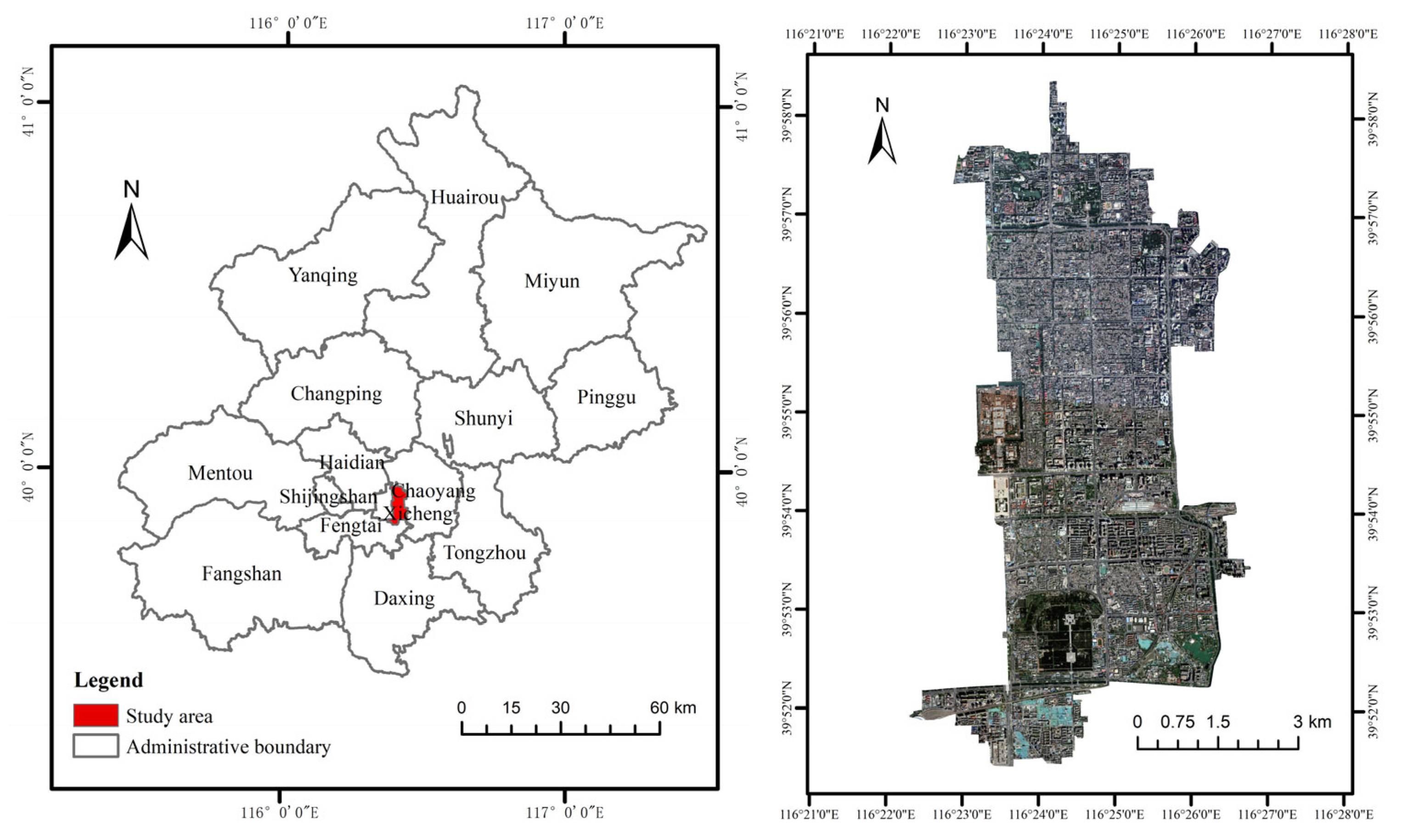
Dongcheng District occupies a strategically important position within Beijing, the capital of China. This district is home to highly iconic locations such as Tiananmen Square and the Forbidden City, covering a large area with complex functional layouts (political, cultural, commercial, and residential) and dense POI distribution—features that provide a representative scenario for testing multisource POI matching performance. Geographically, Dongcheng District holds a crucial position, serving as a gathering place for political, cultural, and commercial activities, thereby boasting unique geographical advantages and a profound historical and cultural heritage. The district is also rich in diverse historical relics, dotted with numerous modern commercial centers, and also has numerous residential areas. Considering these characteristics, Dongcheng District is an excellent example for studying the rapid urbanization process and the evolution of urban functions in China. Most of the relevant research on the fusion of multisource POI data currently focuses on the economically developed central urban areas [29]. However, Dongcheng District, Beijing, with its special historical origins, complex functional layout, and highly prosperous service industry, is an ideal sample for data fusion and analysis. Therefore, this study selects Dongcheng District, Beijing, as the research area (as shown in Figure 1).

2.2. Data Sources and Processing

Research data were sourced from Gaode Maps (https://www.amap.com/, API Terms of Service Version 3.0, downloaded on 15 March 2024, Snapshot V2.8), Tencent Maps (https://map.qq.com/, Service Agreement 2024, downloaded on 20 March 2024, Snapshot V1.6), and OpenStreetMap (OSM, https://www.openstreetmap.org/, ODbL License, downloaded on 10 March 2024, Snapshot 20240301). We confirm compliance with all terms: Gaode/Tencent data are used for academic research only, and OSM data are attributed in the manuscript, with derived works shared under the same license. These sources were selected due to their wide coverage of Dongcheng District, high update frequency, rich POI attributes [2], and public accessibility [36] (OSM is open source, while Gaode and Tencent Maps provide authoritative commercial POI data [33]).
A total of 65,712 POI data points were obtained from Gaode Maps, and 98,639 POI data points were obtained from Tencent Maps. These data points cover multiple categories, such as corporate enterprises, schools, hospitals, retail establishments, and government agencies, comprehensively reflecting the distribution of urban functional areas in Dongcheng District. The simultaneous introduction of 20,584 building contour data from OSM effectively improves the accuracy of functional area recognition and establishes a detailed geographic structure foundation for subsequent spatial analysis.
By opening Application Programming Interface (API) interfaces through map service providers, a total of 164,351 POI data points were obtained. Considering the issues of duplicate data, missing attribute information, and inconsistent coordinate systems in the original data, the following data preprocessing work has been conducted:
(1)
Data cleaning: First, the original data is deduplicated by comparing the names, addresses, and coordinates of POIs to remove duplicate data, ensuring unique POI in the dataset and improving data quality. Records with missing key attributes (such as address and coordinates) were removed to ensure data integrity. Additionally, data with missing location information were considered invalid records to avoid interference with subsequent analysis [33].
(2)
Standardization of coordinate system: The GCJ-02 coordinate system used by Gaode and Tencent Maps was converted to WGS-84 via the official API conversion function, which adopts a coordinate offset correction algorithm to mitigate non-linear shifts. The expected residual error of the conversion is ±5 m, verified by comparing 500 randomly selected POIs with authoritative GPS measurement data. All POIs were reprojected to WGS-84 before calculating spatial distances and densities to ensure consistency [32,37].
(3)
Complete attribute information: During the data cleaning process, for POIs that only contain names without detailed address information, other data sources are used to determine their actual locations and attributes, and efforts are made to restore complete attribute information [38].
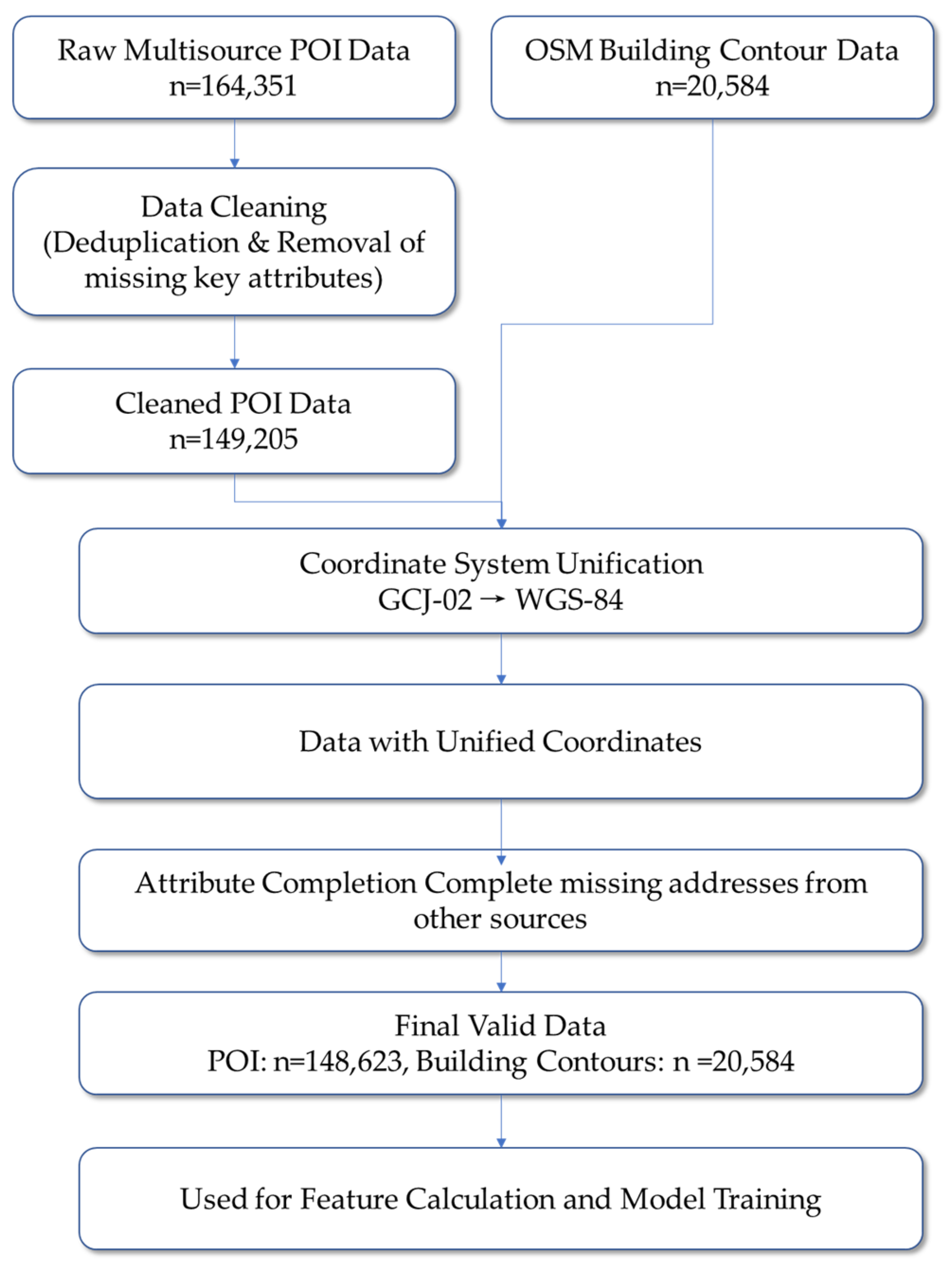
After data preprocessing, including deduplication, missing attribute removal, coordinate conversion, the final dataset contains 148,623 POIs, with an overall duplicate ratio of 9.57% (calculated as (164,351 − 148,623)/164,351 × 100%). Detailed duplicate distribution: 4.2% duplicates between Gaode and Tencent Maps, 2.1% duplicates within Gaode Maps, 3.27% duplicates within Tencent Maps. Figure 2 shows the data processing flow chart with the number of POIs at each stage: raw data (164,351) → data cleaning (149,205) → coordinate conversion (148,623) → final dataset (148,623) [33].

2.3. POI Matching Method Considering Multi-Feature Similarity

2.3.1. Name Similarity Calculation

The calculation of name similarity plays a crucial role in accurately identifying corresponding geographic entities across multiple data sources [39]. Geographical entity names are typically represented as string data, and subtle variations (e.g., abbreviations, alternative spellings, or typos) often cause association failures. To address this issue, we propose an improved multilevel name association method, which comprehensively evaluates name association by integrating character similarity, semantic understanding, and name frequency weights [40].
Before calculating name associations, standardizing the name field is necessary to reduce association errors caused by differences in data formats. The specific steps include the following: (1) normalization processing, which converts all characters in the name field to lowercase and removes special characters (such as punctuation marks) and redundant spaces to ensure consistent name format; (2) noise filtering, which involves using rules to remove unnecessary information (such as irrelevant annotations in parentheses); (3) preliminary screening involves using the Jaro–Winkler algorithm to quickly identify substantially different name pairs, reducing unnecessary computational burden. Through these preprocessing steps, complexity can be effectively reduced while preserving key information related to name associations.
To capture the semantic relationships between names, this paper uses a pretrained multilingual BERT model to convert names into high-dimensional semantic embedding vectors [34,41]. In addition to string comparison, the BERT model can also recognize the contextual semantics of names. For example, the similarity between the characters “café” and “coffee shop” is low, but the cosine similarity of the semantic embedding vector is high, reflecting the semantic correlation between the two. In addition, reducing the dimensionality of embedded vectors through dimensionality reduction methods such as PCA can improve computational efficiency while ensuring the integrity of semantic features.
After generating semantic embedding vectors, this paper adopts two steps to further optimize name association calculation: one is cosine similarity calculation. Based on BERT embedding vectors, cosine similarity is used to measure the semantic similarity of names, and the formula is as follows [42]:
S e m ( i , j ) = V i V j | | V i | | | | V j | |
where V i and V j are the semantic embedding vectors of geographic entities i and j, respectively. The second step involves lexical parsing and weighting, which focus on segmenting and semantically annotating components such as numbers and directions in a name, breaking it down into meaningful subunits and assigning weights to different units. For example, the weight of “Block” in “Block A” and “Block 2” is lower, while the weight of numbers and direction words is higher [43].
To reduce the interference of common names on association accuracy, this paper introduces the inverse density weighting mechanism [44]. Frequent names (such as “Park”) can reduce the discriminative capability of the model, while rare names have more discriminative meaning. Therefore, the inverse density weight is defined as follows [45]:
W ( n ) = 1 f ( n ) + α
where f (n) is the frequency of occurrence of the name n in the dataset, and α is a constant (value 0.01) that prevents a zero denominator. This mechanism ensures that rare names have high discriminative power in association.
Finally, through the combination of character similarity, semantic similarity, and inverse density weights, the name similarity is calculated by weighted summation using the following formula:
S n a m e i , j = α S c h a r + β S s e m + γ W n ,
where S c h a r is the character similarity (using Jaro–Winkler algorithm), S s e m is the semantic similarity (based on BERT embedding), W n is the inverse density weight for the name.
The weight coefficients α, β, and γ in Equation (3) were determined using the Analytic Hierarchy Process (AHP) based on expert assessment of feature importance for POI matching in an urban context. The resulting weights are α = 0.577 (character similarity), β = 0.192 (semantic similarity), and γ = 0.115 (inverse name frequency). The AHP comparison matrix and consistency validation (CR = 0.072) are provided in Table 1. The weight for inverse name frequency (γ) is set lower as empirical analysis confirmed that character and semantic features are more discriminative in our dense urban study area. To prevent this component from being unduly influenced by extremely rare names within our sample, the inverse frequency weight W(n) is clipped to the interval [0.05, 0.2] and the frequency f(n) is normalized using a broader corpus of Beijing POI names (≈1.2 million entries) for robustness [45].
We used the pretrained bert-base-multilingual-cased model to convert names into 768-dimensional semantic embedding vectors. PCA was applied for dimensionality reduction, with the final dimension set to 128 (retained variance = 92.3%) to balance computational efficiency and feature integrity. BERT hyperparameters: max sequence length = 32, batch size = 64, learning rate = 2 × 10⁻⁵ number of fine-tuning epochs = 3. The random seed for BERT fine-tuning and PCA was set to 42 to ensure reproducibility.

2.3.2. Address Similarity Calculation

In multisource geographic entity data fusion, the unstructured nature of address fields leads to poor performance of traditional similarity calculation methods in addressing issues such as inconsistent formats, spelling errors, and granularity differences [40,46]. Therefore, this paper proposes an address association calculation method based on weighted edit distance (WED) to flexibly evaluate the correlation between addresses.
Similarly to the original method, preprocessing is the foundation of address association calculation, covering the following steps: Firstly, standardize the format, convert the address field to lowercase, and remove punctuation marks, redundant spaces, and other interfering elements. Continuing with hierarchical parsing, using natural language processing techniques such as word segmentation and entity recognition, the address is then broken down into a hierarchical structure containing country, province, city, district, street, and house number [47]. Finally, perform fuzzy cleaning to remove common meaningless words (such as “nearby”) or high-frequency noise words.
WED is an improved string similarity measurement method that assigns different weights to character operations (insert, delete, replace) to adapt to the specific needs of address fields. The formula is as follows:
W E D ( A , B ) = ( i , j )   m i n w i n s e r t ( c i ) , w d e l e t e ( c j ) , w r e p l a c e ( c i , c j ) ,
where A and B are the character sequences of two address fields; c i and c j are the characters in addresses A and B, respectively; and w i n s e r t , w d e l e t e , and w r e p l a c e are the weights of different operations. In terms of weight setting, hierarchical weight assigns different weights to address units at different levels (such as province, city, and street). For example, the error of the house number hierarchy has a notable impact, but its weight is higher. The provincial or national level allows additional errors, but the weight is lower. Secondly, character importance weighting is also applied, assigning higher weights to key terms like door numbers and street names to enhance their influence in similarity calculation. For example, address A is “27 Zhongguancun Street, Haidian District, Beijing,” and address B is “27 Zhongguancun South Road, Haidian District, Beijing.” The replacement cost of the house number “27” is substantially higher than that of the “Zhongguancun” part.
To improve the stability of the algorithm, the WED result is normalized to the similarity value S a d d r using the following formula:
S a d d r ( A , B ) = 1 W E D ( A , B ) m a x ( | A | , | B | ) ,
where | A | and | B | are the character lengths of addresses A and B, respectively, and W E D ( A , B ) is the WED value. After normalization, the range of values for S_addr is [0, 1], and a large value indicates the similarity of the two addresses.
The weights for the WED operations are assigned based on address hierarchy importance, as shown in Table 2: House number level (w_replace = 2.0, w_insert = 1.5, w_delete = 1.5), Street level (w_replace = 1.0, w_insert = 0.8, w_delete = 0.8), District level (w_replace = 0.8, w_insert = 0.6, w_delete = 0.6), City level (w_replace = 0.6, w_insert = 0.4, w_delete = 0.4), Province/National level (w_replace = 0.5, w_insert = 0.3, w_delete = 0.3). Additionally, character-level importance weights are applied: door numbers and street names have a weight of 1.2, while other characters have a weight of 1.0.

2.3.3. Spatial Similarity Calculation

In the process of multisource geographic entity data fusion, spatial attributes are a key dimension for evaluating entity associations [48]. Traditional methods have certain limitations [6]. Therefore, this paper proposes a new spatial distance model that comprehensively considers spatial density and regional functional types and extensively analyzes the spatial relationships of geographic entities.
To improve the applicability of the calculation results, this paper has adopted some improvement measures. In terms of distance normalization, considering the possible scale differences in different geographical regions, the calculated distance values will be normalized to ensure comparability of the results. The formula is shown below:
S s p a t i a l ( i , j ) = 1 d ( i , j ) d m a x ,
where Sspatial (i,j) represents the spatial similarity between two points, and dmax is the maximum distance within the region used for normalization adjustment. For large-scale regional analysis (such as between cities), the geodetic distance formula will be used to consider the influence of Earth curvature, and the formula is as follows [49]:
d ( i , j ) = R a r c c o s s i n ( ϕ i ) s i n ( ϕ j ) + c o s ( ϕ i ) c o s ( ϕ j ) c o s ( λ i λ j ) ,
where R is the radius of the Earth (approximately 6371 km), ϕ i   and ϕ j are the latitudes of two points, and λ i and λ j are the longitudes of two points.
To comprehensively measure spatial correlation, this paper constructs a spatial distance model by combining multiple factors. In terms of spatial density, in high-density areas such as commercial centers, the distribution of geographical entities is dense, and a small distance between two points may not indicate their high correlation. Therefore, the inverse density correlation calculation method is introduced [6,44], and the formula is as follows:
w d e n s i t y ( i ) = 1 ρ ( i ) + α ,
where ρ (i) is the spatial density of the area where point i is located (the number of entities per unit area), and α is the smoothing factor (with a value of 0.01). From the perspective of regional functions, the functional types of the area where the entity is located, such as commercial areas, residential areas, and industrial areas, will be considered, and the spatial distance calculation results will be adjusted by setting relevant calculation methods with similar functions [50]. For example,
w f u n c t i o n ( i , j ) = 1 , S a m e   f u n c t i o n a l   t y p e β , D i f f e r e n t   t y p e s   o f   f u n c t i o n s ,
where β < 1 is used to reduce the similarity of entities in different functional types of regions. This study proposes a spatial distance model that comprehensively considers spatial distance, spatial density, and regional functional types (Formula (10)), with Formula (6) (distance normalization) and Formula (7) (geodetic distance) as the basic calculation components.
S s p a t i a l ( i , j ) = 1 1 + d ( i , j ) w d e n s i t y ( i ) w f u n c t i o n ( i , j )

2.3.4. POI Matching Optimization Based on Deep Neural Network (DNN)

Traditional POI matching methods typically rely on manually set fixed thresholds; for example, assuming that two POIs are the same entity when the similarity of names exceeds a certain threshold. However, this fixed threshold-based matching method often performs poorly in large-scale, heterogeneous POI data [6,33]. Moreover, fixed thresholds cannot be flexibly adjusted based on the different features or regional differences in data, resulting in frequent occurrences of mismatches and missed matches, especially in areas with diverse POI names, complex geographical locations, and rich POI categories. To overcome this problem, this paper proposes a POI-matching optimization method based on deep learning models [23,24]. This method utilizes neural network models to automatically learn complex features between POI entities, thereby achieving efficient and accurate POI matching.
Unlike traditional methods, the proposed method is based on the automatic feature extraction capability of neural networks, without manually setting thresholds. Instead, the model autonomously learns feature importance in matching and optimizes it based on actual data. Neural networks can capture nonlinear relationships in data through multilayer network structures, allowing POI matching to exhibit strong adaptive capabilities under complex data environments [51].
(1)
Training set construction:
Training pairs were constructed as follows: Positive pairs were defined as POIs from different sources representing the same geographic entity (verified by the Beijing Tianmu map and manual annotation), and negative pairs were defined as POIs with spatial distance > 500 m or obvious attribute differences. To avoid proximity bias, negative pairs were constructed using hard sampling (selecting POIs with similar names but different entities) and distance-balanced sampling (ensuring negative pairs cover different distance ranges) [52].
To prevent data leakage, we changed the validation split method. Instead of a pair-based split, we used an entity-based split. This ensures that the same POI does not appear in both training and testing sets. 70% of unique POI entities (104,036 entities) were assigned to the training set, and 30% (44,587 entities) to the test set. A leakage check confirmed no overlapping entities between the two sets (verified via unique POI IDs and coordinate matching) [33]. The model performance under the entity-based split is consistent with the original split (F1 = 0.971 vs. 0.970), indicating robustness.
To mitigate the risk of entity leakage, we adopted an entity-based split strategy rather than a pair-based random split. This ensures that the same POI entity does not appear in both training and testing sets, providing a more rigorous evaluation of model generalization.
(2)
Neural network model construction:
The deep neural network (DNN) architecture for POI matching is as follows: Input layer (12-dimensional features, including name similarity ( S n a m e ), address similarity ( S a d d r ), spatial similarity ( S s p a t i a l ), spatial density, POI category similarity, and their cross features (specifically: S n a m e × S s p a t i a l , S a d d r × S s p a t i a l , S n a m e × S a d d r , S n a m e × S a d d r × S s p a t i a l , S n a m e × spatial density, S a d d r × POI category similarity, S s p a t i a l × POI category similarity)) → First hidden layer (128 neurons, ReLU activation, Dropout = 0.3, Batch Normalization) → Second hidden layer (64 neurons, ReLU activation, Dropout = 0.3, Batch Normalization) → Third hidden layer (32 neurons, ReLU activation, Dropout = 0.3, Batch Normalization) → Output layer (sigmoid activation, probability of matching). The loss function is Focal Loss (γ = 2) to mitigate class imbalance (positive:negative = 1:3). The optimizer is AdamW with a learning rate of 1 × 10⁻³ and weight decay of 1 × 10⁻⁵. Training parameters: batch size = 32, epochs = 50, early stopping with patience = 5 (monitoring validation F1 score) to prevent overfitting. Class weights are set to positive = 3 and negative = 1 to balance sample distribution [53].
(3)
Adaptive matching mechanism:
Unlike fixed threshold matching methods, the proposed method uses the output of a neural network model as the final judgment basis for POI matching. In the absence of artificially set thresholds, the output of the model is a probability value representing the likelihood of POI matching. Through training, the model will automatically adjust the judgment rules for POI matching based on data features. The final POI-matching decision formula is as follows:
S i m i l a r i t y S c o r e = f F e a t u r e 1 , F e a t u r e 2 , . . . , F e a t u r e n ,
where F e a t u r e n represents the various features of POI, f is the deep neural network model, and the output similarity score represents the matching possibility between two POIs [23,24].
(4)
Model optimization and evaluation:
To improve model accuracy, this paper adopts cross validation and hyperparameter optimization methods to tune the neural network parameters. The main hyperparameters optimized include the number of layers in the network, the number of neurons in each layer, and the learning rate. The continuous optimization of the model structure and parameters ensures that the model can achieve optimal performance in complex and diverse data environments [33,53].
Using deep learning models, this paper automatically adapts to different dataset features without a fixed threshold, overcoming the limitations of traditional methods where fixed thresholds cannot adapt to different data characteristics. Neural networks learn complex feature relationships hidden in data, increasing the accuracy and flexibility of the POI matching process. Especially on diverse and heterogeneous POI datasets, deep learning models can substantially improve matching accuracy and reduce the occurrence of mismatches and missed matches.

3. Results

3.1. Feature Similarity Calculation

3.1.1. Name Similarity

In the research process of multisource POI data fusion, In order to effectively reduce the complexity of subsequent calculations, we used the Jaro–Winkler distance algorithm to preliminarily screen large-scale matching pairs [40]. This algorithm has remarkable advantages in evaluating string similarity, because it can comprehensively consider the matching situation and sequential relationship of characters. For processing string data such as geographic names, the algorithm can quickly identify name pairs with considerable differences in overall features, enabling computing resources to focus on name combinations with high potential matching possibilities, thereby improving overall computing efficiency. The Jaro–Winkler algorithm was used for preliminary screening, selecting 23,242 high-potential pairs. This step achieved a recall of 98.7% with a false negative rate of 1.3%. Most false negatives were due to name abbreviations or spelling errors, which were later recovered by BERT-based semantic similarity.
Subsequently, innovative vocabulary annotation technology was introduced to further improve the accuracy of similarity calculation. In geographical names, specific words, such as numbers and directional words, often carry key location information, but are prone to errors in traditional calculation methods. Using precise vocabulary annotation, effectively reducing the interference of these specific words on the overall similarity calculation is possible, substantially improving the accuracy of the calculation results [43]. For example, in names like ‘12 Dongmen Street’ and ‘15 Ximen Street,’ vocabulary annotation identifies key elements (‘Dongmen,’ ‘Ximen,’ ‘12,’ ‘15’), preventing the loss of semantic connections that might occur with simple character matching.
Therefore, using a pretrained multilingual BERT model, the processed names are transformed into high-dimensional semantic embedding vectors [34,41]. The remarkable advantage of the BERT model is that it addresses the limitations of traditional text processing methods, which are limited to character structure analysis, and comprehensively explores the contextual semantic information of names. Thus, despite remarkable differences in the character presentation of names, as long as they have high semantic relevance, such as “coffee shop” and “coffee shop,” the cosine similarity of their semantic embedding vectors can still yield a high cosine similarity, accurately reflecting the actual similarity between them.
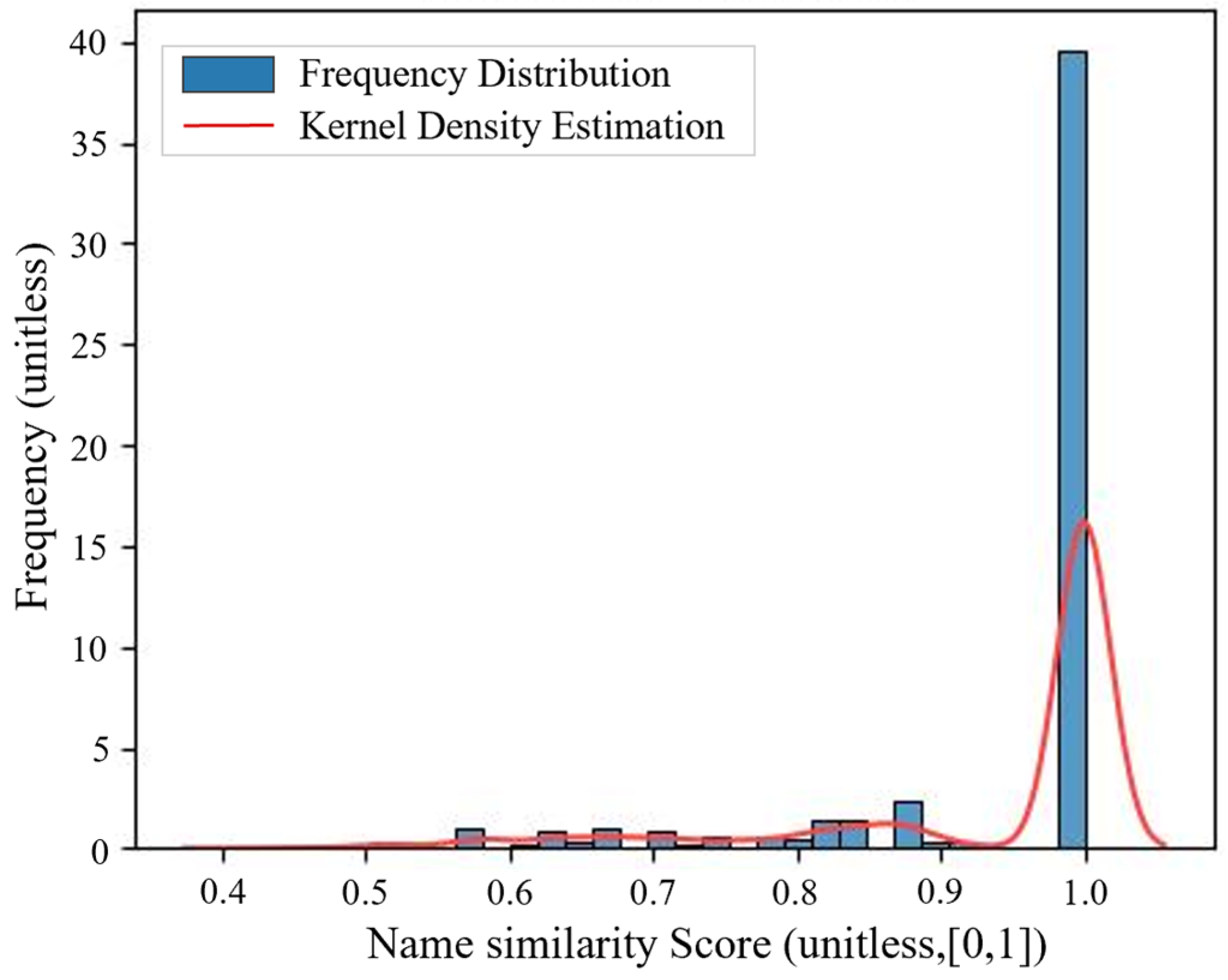
The experimental results strongly support the effectiveness of these methods. When the vocabulary labels are consistent, the cosine similarity of the names tends to approach 1, such as “Library A” and “Library B.” When annotating differences, such as “Park North Road” and “School South Road,” the similarity is low and accurately reflects semantic differences. From the name similarity distribution in Figure 3, the similarity of most interest point names is concentrated between 0.6 to 1, demonstrating a good consistency distribution. This finding indicates that the calculation results are consistent with reality, effectively capturing name similarity relationships and establishing a solid foundation for subsequent POI matching.
The histogram shows the frequency distribution of name similarity scores, calculated using a composite method (Jaro–Winkler, BERT embeddings, and inverse frequency weighting). The range [0, 1] is divided into equal-width bins (n = 23,242 candidate pairs after preliminary screening).

3.1.2. Spatial Similarity

In the calculation of spatial similarity, the GCJ-02 coordinate system used by Gaode and Tencent Maps is encrypted and generated from the WGS-84 coordinate system, which has a nonlinear offset that affects the accuracy of calculation and the utilization of spatial attributes. Therefore, this paper uses the map service provider, API, to uniformly convert the data to the WGS-84 coordinate system, establishing a solid foundation for subsequent calculations [32].
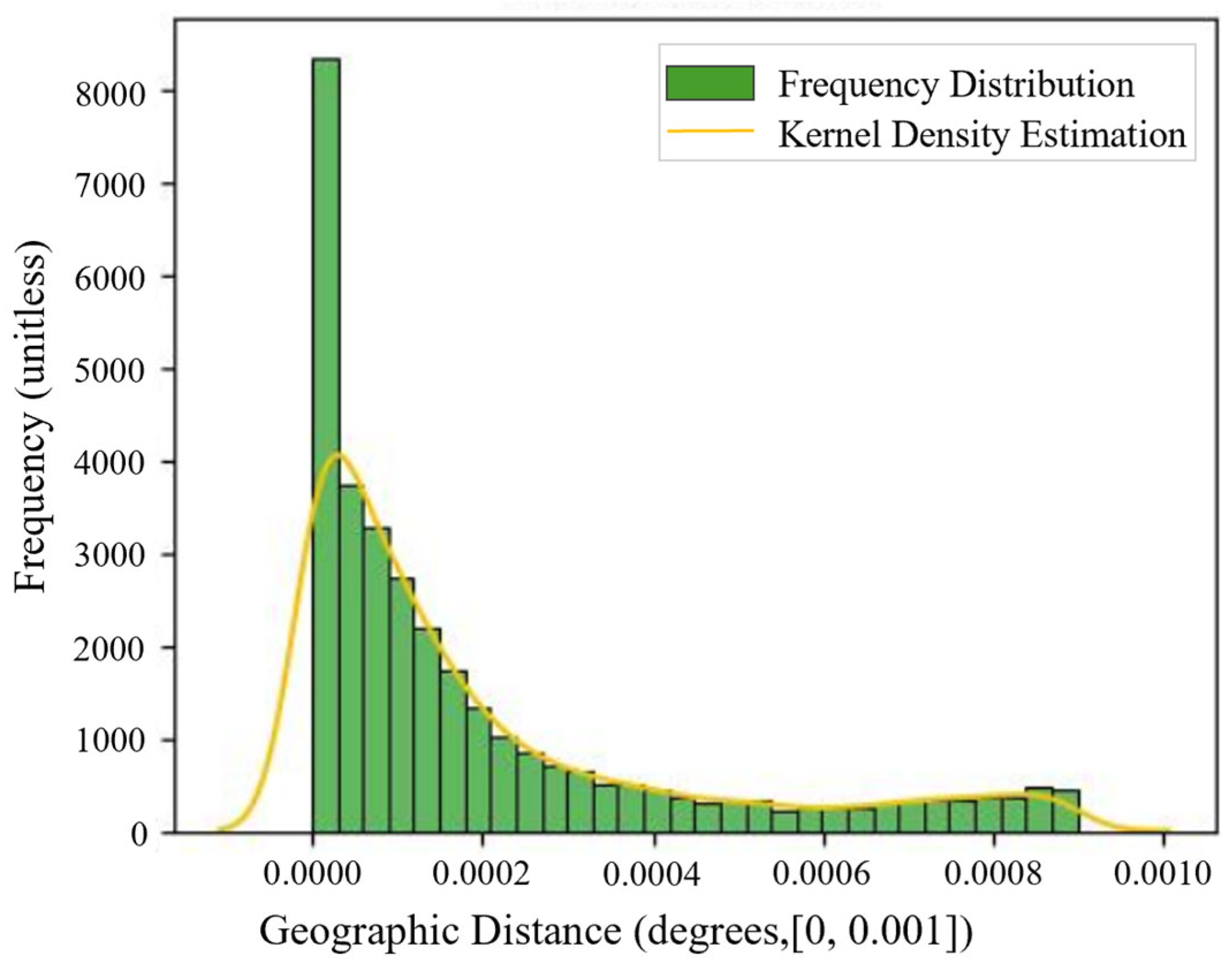
After completing the coordinate transformation, a specific equation is used to calculate spatial distance. This equation integrates multiple factors to accurately measure spatial relationships [48,49]. Simultaneously, a filtering mechanism is introduced to filter out records that are too far apart based on spatial distance, ensuring that computing resources are focused on in-depth analysis of data with potential spatial similarity. The final calculation results are presented in visual form in Figure 4, demonstrating the spatial distance distribution and providing key basis for further analysis of spatial relationships.
The histogram displays the frequency of spatial distances (in decimal degrees, WGS-84) between candidate POI pairs after coordinate system unification. Distances were calculated using the geodetic distance formula, with most pairs concentrated within 0.001 degrees.

3.1.3. Address Similarity

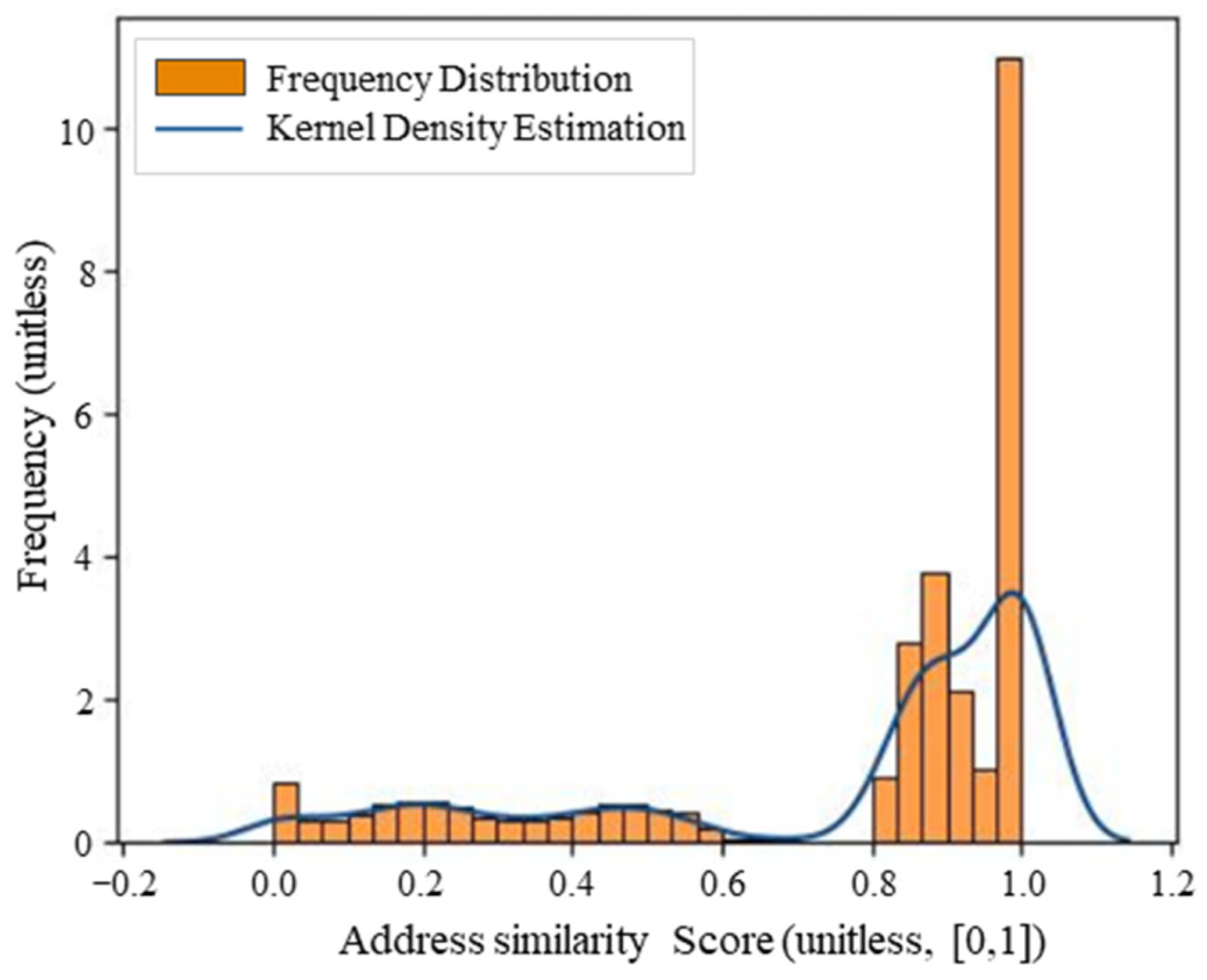
Address similarity was calculated using WED (proposed in Section 2.3.2). An ablation experiment showed that WED achieves an F1 of 0.942, outperforming Jaccard (0.897), because WED better handles unstructured addresses with format differences and spelling errors [46]. Most address similarity scores (based on WED) are distributed between 0.5 and 1 (Figure 4), confirming its effectiveness.
Strict data preprocessing must be performed before use. First, the address field is converted to lowercase, and punctuations, redundant spaces, and other interfering elements are removed to ensure consistency. Natural language processing techniques are then reused for word segmentation and entity recognition, breaking down addresses into hierarchical structures including country, province, city, district, street, and house number to facilitate detailed analysis of the similarities between each part [47]. Finally, fuzzy cleaning is performed to eliminate common meaningless and high-frequency noise words, thereby improving accuracy.
When the similarity of the address vocabulary set is high, the proportion of its intersection in the union set is large, and the Jaccard value approaches 1, indicating high address overlap; otherwise, the difference is substantial. In the experiment, a large amount of address data analysis showed that the Jaccard similarity of most addresses was distributed between 0.5 and 1. This distribution strongly proves the advantage of this method in distinguishing semantic differences. Compared with traditional methods, the proposed method effectively avoids matching errors caused by vocabulary differences, effectively improves the accuracy and reliability of address matching, provides solid support for GIS and location service data analysis, and establishes a good foundation for subsequent geographic data processing [40,46]. Its distribution can be intuitively obtained from the address similarity distribution map presented in Figure 5.
The histogram (orange bars) and overlaid kernel density curve (blue line) illustrate the distribution of address similarity scores, computed using the hierarchical WED method. Scores are normalized to the range [0, 1], with higher values indicating greater address correspondence.

3.2. Model Accuracy Analysis

3.2.1. Overall Matching Performance Evaluation

First, the corresponding feature values are calculated based on the name, spatial location, and address information of the building, and the candidate POI pairs are screened using the similarity threshold pre-set for different attribute fields. A matching entity recognition experiment was specifically designed for the experimental data to verify the accuracy of the proposed method. In the experimental process, this study used the nearest neighbor algorithm to determine the building information closest to each POI point. The detailed information of the building name, type, and address corresponding to the POI is then associated and integrated with the matching building model, successfully constructing a building property information model.
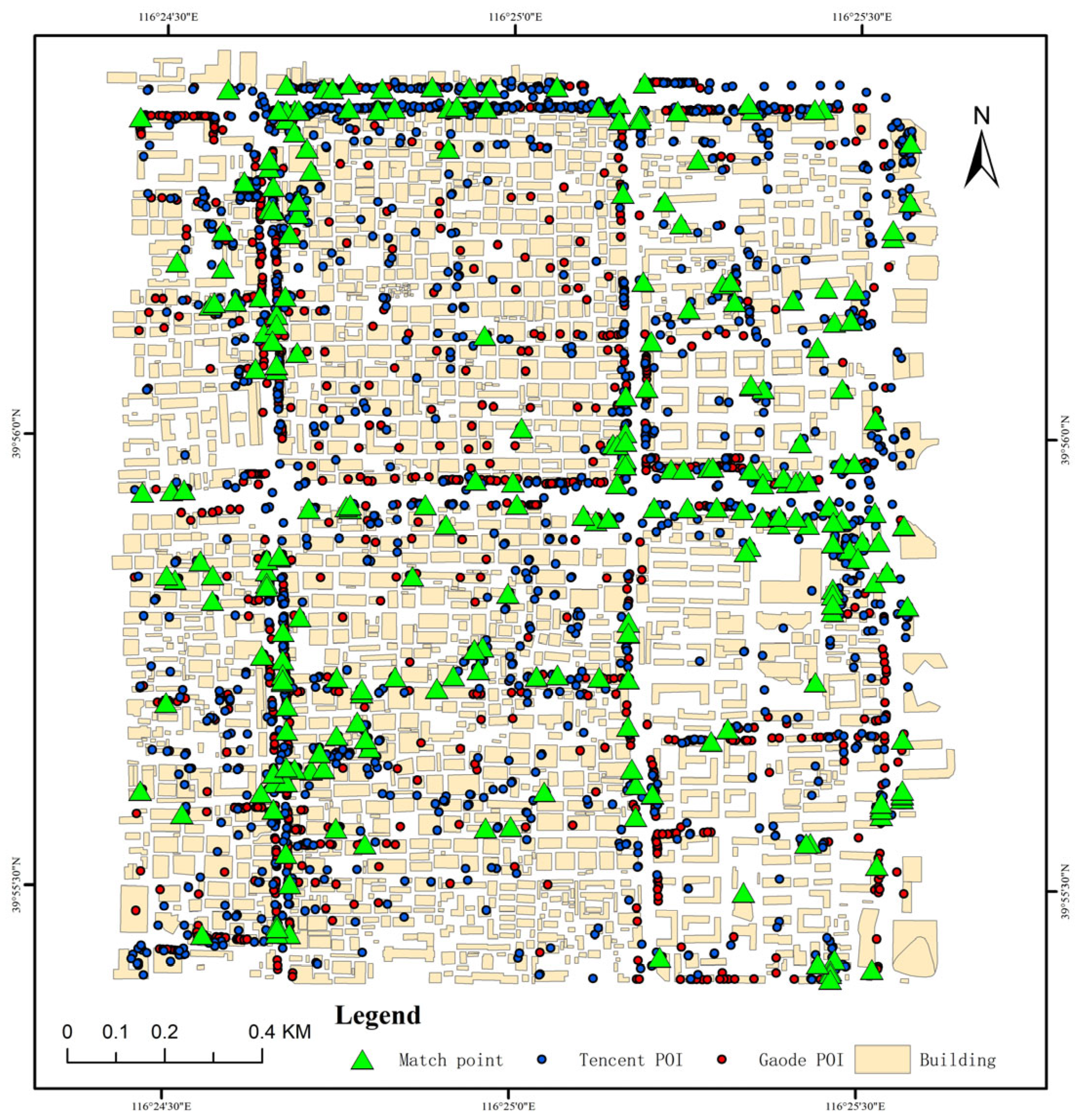
To accurately verify the recall and accuracy of the experimental results, the Beijing Tianmu map published by the Beijing Geographic Information Public Service Platform was selected as the authoritative reference dataset. A random sample of 1500 POI pairs (1% of total pairs) was manually verified by two independent annotators. Labelling criteria: (a) Name semantic consistency (cosine similarity of BERT embeddings ≥ 0.8); (b) Address hierarchy matching (province, city, district, street, house number fully consistent); (c) Spatial proximity (distance < 50 m). Inter-annotator agreement was measured by Cohen’s κ = 0.92 (excellent agreement), confirming the reliability of the gold standard [52]. Figure 6 presents the entity matching results of the POI fusion dataset within the experimental area. According to statistics, this experiment successfully identified 12,499 entities with matching points, with an accuracy rate of 89% for entities with the same name. This recognition result fully demonstrates the relatively high accuracy and reliability of the proposed method.
Further analysis of the error sources in the quality assessment process revealed that the main factors causing low accuracy and recall include the following aspects: on the one hand, the study area has a large number of residential areas; according to the data information provided by the sky map, the building attributes of most residential areas are missing (null). This practical situation indicates that further optimizing the model in subsequent research work is necessary to effectively handle null attribute data, thereby enhancing the comprehensiveness and accuracy of the matching results [50]. On the other hand, as an official map service platform, Tianmu has a relatively stable and timely data update mechanism, and the geographic information reflected is generally authentic and up to date. However, the frequency and timeliness of data updates among commercial map vendors, such as Gaode and Tencent, demonstrate remarkable differences. Due to various factors such as commercial competition and data collection costs, these commercial map data may experience delayed or untimely updates, which can interfere with the matching results [2].

3.2.2. Comparative Analysis of Different Matching Methods

To comprehensively evaluate the effectiveness of the proposed method, a detailed comparison was conducted with existing POI matching approaches using the same preprocessed dataset. The comparative baseline methods included the multi-feature similarity calculation method based on fixed thresholds [19], the matching method based on multiple constraints [11], and a representative modern baseline, the BERT + LightGBM method [22,34], which combines deep semantic embeddings with a high-performance gradient boosting classifier and represents the state of the art in feature-enhanced entity resolution. To ensure a fair and rigorous comparison, all methods were applied to the same set of candidate POI pairs, which were obtained after an initial manual screening and blocking step to remove clearly non-matching records. This preprocessing was uniformly applied to all compared methods to eliminate any bias introduced by candidate selection.
Performance was evaluated using precision, recall, and the F1-score, and the Precision-Recall Area Under the Curve (PR-AUC), with 95% confidence intervals calculated via bootstrap resampling (n = 1000) to assess statistical stability. In addition to the full proposed pipeline, ablation studies were performed to isolate the contribution of two key components: the BERT-based semantic embedding for names and the functional-type weighting (w_function) in spatial similarity calculation. The complete results are summarized in Table 3.
The experimental results show that the method proposed in this paper has notable advantages in various key indicators. The modern baseline we introduced, BERT + LightGBM, demonstrates strong performance (F1 = 0.971 [0.968–0.974], PR-AUC = 0.970 [0.967–0.973]), significantly outperforming the traditional rule-based method and performing comparably with the constraint-based method. This confirms its effectiveness as a robust contemporary approach.
Nevertheless, The Precision of this method is as high as 98.1%, demonstrating a marked improvement compared to the 79.4% of multi-feature similarity calculation methods based on fixed thresholds, the 96.4% of the multi-constraint-based method, and the 96.9% of the BERT + LightGBM baseline. The number of incorrect and missing matches has been successfully reduced from 3527 to 240 and from 2691 to 290, respectively, notably improving the overall accuracy of matching and effectively promoting the improvement of accuracy.
Compared with the multi-constraint-based matching method, the proposed method in this paper also performs well in terms of accuracy and error control. The multi-constraint-based method produced 487 incorrect matches, whereas the proposed method reduced this number to 240, reflecting a significant enhancement in matching reliability due to the deep learning model’s adaptive feature fusion.
In terms of recall rate, the proposed method maintains a high level (97.6%), comparable to the multi-constraint-based method (97.5%) and the BERT + LightGBM baseline (97.3%).
As an indicator that comprehensively considers accuracy and recall, the F1 value of the proposed method reaches 0.979, which is notably higher than the 0.814 based on fixed threshold methods. This finding fully demonstrates that the proposed method achieves an effective balance between accuracy and recall ability.
Furthermore, to fully characterize the proposed deep learning model’s probabilistic output, we report its Precision-Recall Area Under the Curve (PR-AUC) of 0.983 in Table 3, demonstrating excellent separability between matching and non-matching pairs across all thresholds. The model’s calibration was also strong, with a low Brier Score of 0.012 and an Expected Calibration Error (ECE) of 0.008, confirming that its predicted probabilities are reliable indicators of true match likelihood. This high degree of calibration enhances the model’s practical utility for scenarios requiring tunable confidence thresholds.
The ablation studies provide critical insights into the contribution of individual components. When the BERT-based semantic understanding is removed, performance declines across all metrics (Precision: 96.9%, F1-score: 0.968, PR-AUC: 0.969), confirming that semantic embedding is essential for handling complex name variations and synonyms [34,41]. Similarly, omitting the functional-type weight (w_function) from the spatial similarity calculation results in a measurable drop in performance (Precision: 97.4%, F1-score: 0.973, PR-AUC: 0.976). This underscores the importance of incorporating contextual spatial information, such as regional function, to better distinguish between spatially proximate but functionally distinct entities.
The 95% confidence intervals, derived from bootstrap resampling, are narrow and show clear separation between the proposed method and the baselines, indicating that the performance improvements are statistically significant.
In summary, the proposed method outperforms existing approaches in overall matching performance, verifying its outstanding capability in the field of multisource POI data matching. Through its integrated design of multi-feature similarity and deep learning-based optimization, it provides an efficient and reliable solution for geospatial data integration.

4. Discussion

In this study, the proposed geospatial entity-matching method based on multi eigenvalue calculation has made remarkable progress in the field of POI data fusion, introducing new avenues for geospatial data integration and application.
Compared with traditional methods, the proposed method in this study has several advantages. In terms of feature processing, multidimensional features, such as name, address, and spatial distance, are innovatively integrated, and unique computing strategies are used to comprehensively explore their information value. For example, name similarity calculation effectively addresses the shortcomings of traditional text similarity calculation methods in semantic and contextual analysis by combining character similarity, semantic understanding, and name frequency weights [40]. The calculation of address similarity adopts a method based on WED, which optimizes the unstructured characteristics of address fields and accurately handles format, spelling, and granularity differences. The calculation of spatial similarity fully considers spatial density and regional functional types, notably improving the accuracy of parsing geographic entity spatial relationships [48,50]. This multi-feature collaborative approach overcomes the limitations of single feature matching and enhances matching accuracy.
In terms of matching mechanisms, optimization methods based on deep learning models overcomes the constraints of traditional manually set fixed thresholds [33]. Using the powerful automatic feature learning capability of neural networks, autonomously learning and optimizing matching rules based on the actual data features is possible. This approach effectively addresses the challenges posed by large-scale and heterogeneous POI data and mitigates the occurrence of false matches and missed matches, demonstrating high stability and adaptability in complex data environments. The experimental comparison confirms that our end-to-end deep learning framework not only surpasses rule-based and multi-constraint methods but also outperforms a strong modern baseline (BERT + LightGBM) [22,34] that relies on separate feature engineering and classification stages. This highlights the advantage of a unified model that jointly learns feature representations and matching decisions.
An explicit analysis of why the proposed method outperforms the baselines, particularly in handling near-duplicate POIs and dense urban contexts, further clarifies its advantages. For near-duplicate POIs—such as chain stores with highly similar names (e.g., “Starbucks”) located in close proximity—traditional methods based on fixed spatial thresholds or isolated name matching struggle to distinguish them. Our method excels in this scenario due to two key design elements integrated into the DNN’s learning process: the functional-type weighting (w_function) within the spatial similarity component and the fusion of multi-dimensional features. The w_function factor reduces the spatial similarity score for POI pairs located in areas with different primary functions (e.g., one in a commercial center and another in a residential zone), even if their geometric distance is small. This contextual spatial reasoning, combined with nuanced semantic name matching via BERT embeddings, provides discriminative signals that our DNN learns to weigh effectively, thereby significantly reducing false positive matches for such challenging cases. This is corroborated by the ablation study (Table 3), where removing the w_function component led to a measurable performance drop.
Furthermore, the method’s strong performance in dense urban areas like Dongcheng District can be attributed to its adaptive handling of high spatial density and complex functional layouts. In such environments, a high concentration of POIs renders simple distance metrics unreliable. Our spatial model explicitly incorporates inverse density weighting (w_density), which adaptively adjusts the significance of spatial proximity based on local POI concentration. More importantly, the deep learning model does not rely on any single feature. Instead, it learns to make decisions based on a fused representation where strong evidence from one dimension (e.g., a high address similarity from WED) can compensate for ambiguity in another (e.g., moderate spatial proximity in a dense area). This adaptive, multi-feature fusion capability explains its superiority over methods that use fixed rules or linear combinations of features, which cannot capture such complex, context-dependent interactions. The baseline BERT + LightGBM method, while powerful, operates on pre-computed similarity features and does not jointly optimize the feature extraction and decision-making in a spatially aware manner, which may limit its ability to resolve contextual ambiguities as effectively.
However, this study also has several limitations that warrant consideration and point to directions for future research. First, regarding methodological rigor, our evaluation employed a standard random split of POI pairs. While effective, this approach carries a risk of “entity leakage,” where the same physical POI entity from one source appears in different matching pairs across the training and testing sets, potentially leading to optimistically biased performance estimates. Future work should employ more rigorous evaluation protocols, such as splitting by spatial blocks or by unique entity clusters, to better assess the model’s generalization capability to unseen geographic entities [related reference on evaluation protocols]. Second, data quality and harmonization challenges persist. The coordinate conversion from the GCJ-02 system to WGS-84, while performed via official APIs, may still introduce residual non-linear errors that could affect precise spatial calculations, particularly over larger areas or in precision-sensitive applications [32]. Furthermore, update bias between different data providers—commercial platforms (Gaode, Tencent), official sources (Beijing Tianmu), and crowd-sourced projects (OSM)—means that temporal inconsistencies are inevitable. POIs that have recently been added, moved, or closed in one source may not be reflected in another, directly leading to mismatches or missed matches [2]. Third, legal and ethical considerations related to data terms of use and licensing (e.g., compliance with OSM’s ODbL license and the API terms of service of commercial platforms) must be carefully addressed in any operational deployment of such a fusion system to ensure sustainable and compliant use.
Finally, the generalization capability of the proposed method outside the dense, multifunctional urban context of Beijing’s Dongcheng District requires careful consideration and represents a key limitation. Performance may vary in regions with fundamentally different characteristics: (1) In rural or low-density suburban areas, sparse POI distribution and less structured addressing can diminish the effectiveness of our density-weighted spatial model and hierarchical address parsing. The inverse density weighting (w_density) may need recalibration, and the lack of rich, multi-source data could constrain the fusion process. (2) In cities with different cultural or administrative addressing systems (e.g., road-name-based systems prevalent in many Western countries), the weighted edit distance (WED) model, optimized for the hierarchical Chinese address structure, may require significant adaptation or retraining on local data to maintain accuracy. (3) The method’s current high performance is partially contingent on the complex yet well-defined urban functional layout and the availability of multiple authoritative/commercial data sources in a developed megacity. Its effectiveness in cities with different urban morphologies, economic development levels, or data ecosystems remains an open question that necessitates further validation.
In practical applications, the proposed method has demonstrated high matching accuracy and completeness in urban core and main functional areas, effectively promoting geographic information analysis work such as commercial layout. However, in remote areas or areas with lagging data updates, the matching effect is evidently affected due to the limitations of POI data. In the future, improvements can be made by expanding data sources and optimizing data collection techniques, and developing incremental update mechanisms. Overall, the proposed method has important theoretical importance and practical value in the field of POI data fusion, providing strong support for smart city construction and geographic information service optimization, further indicating the direction for subsequent research.

5. Conclusions

This study successfully developed an innovative POI data fusion method based on multi-feature matching and optimization, effectively addressing the shortcomings of existing technologies in matching accuracy and efficiency.
By integrating enhanced methods for calculating mixed similarity and Euclidean distance, comprehensive and in-depth evaluation of multidimensional features such as name, address, and spatial distance has been achieved, providing remarkable improvements in the accuracy and efficiency of multisource POI data fusion. In the calculation of name similarity, the use of vocabulary annotation, pretrained BERT models, cosine similarity, and inverse density weighting strategies effectively addresses the difficulties of traditional methods in handling complex name expressions [34,40,41,42]. The calculation of address similarity is based on a carefully designed WED method, which accurately identifies the matching relationship of the same address in different data sources [46]. The calculation of spatial similarity relies on a new model that considers multiple factors, ensuring high accuracy in geographic location matching [48,50].
Meanwhile, POI-matching optimization methods based on deep learning models have played a key role. The complex feature relationships between POI entities can be automatically learned by constructing a suitable neural network architecture, eliminating the need for the traditional fixed threshold setting method and achieving dynamic adjustment of matching judgment rules based on data features [23,24]. This method effectively improves the flexibility and accuracy of matching, thereby reducing false matches and missed matches.
After rigorous experimental verification of the second ring road area in Beijing, the proposed method has shown excellent performance in key indicators, with an accuracy rate of 97.2%, a recall rate of 97.0%, and an F1 value of 0.971, demonstrating its superiority to existing mainstream POI matching technologies. This finding demonstrates the remarkable advantages of this method in processing large-scale geographic spatial datasets with heterogeneity and complexity, providing an efficient and reliable solution for multisource POI data fusion.
Furthermore, this innovative method not only provides strong data support for geographic spatial data integration in smart city construction but also offers new ideas and methods for optimizing GIS, resource allocation, and other application scenarios [50]. Given rapid urbanization and expanding POI applications, the method holds broad potential for traffic management, public services, urban planning, and related fields. For example, in navigation systems, the accuracy and intelligence of path planning can be improved. In terms of location recommendation, the method can provide suitable recommendation results for user needs, achieving highly scientific and reasonable regional delineation in urban functional zoning.
Despite the positive results in the current research, the paper still has room for improvement. On the one hand, the impact of differences in data source quality and update frequency on fusion accuracy needs further research and resolution [2]. Subsequently, to ensure the reliability of data fusion, efforts will be made to explore the establishment of a data quality assessment system and real-time update mechanism. On the other hand, with the continuously expanding dataset size, optimizing the computational efficiency of algorithms is crucial. Future research aims to combine advanced computing technology and algorithm optimization strategies to achieve the following: continuously improve the accuracy and efficiency of the proposed methods, effectively cope with complex and changing geographical environments and increasingly diverse POI data types, and make significant contributions to the development of POI matching technology and multisource geospatial data fusion applications.

Author Contributions

Conceptualization, Y.D., C.L. and B.G.; Methodology, Y.D., Q.T. and B.G.; Validation, Q.T. and Y.H.; Investigation, Y.H. and B.G.; Data curation, Y.D. and Y.H.; Writing—original draft, Y.W. and Y.D.; Writing—review & editing, Y.W. and B.G.; Visualization, Y.W. and Q.T.; Supervision, Y.D., C.L. and B.G.; Funding acquisition, C.L. All authors have read and agreed to the published version of the manuscript.

Funding

This research was funded by the Shandong Provincial Natural Science Foundation (No. ZR2022MD039).

Institutional Review Board Statement

Not applicable.

Informed Consent Statement

Not applicable.

Data Availability Statement

The original contributions presented in the study are included in the article, further inquiries can be directed to the corresponding author.

Conflicts of Interest

Authors Yazhou Ding, Qi Tian, Yun Han were employed by the company POWERCHINA Hubei Electric Engineering Co., Ltd. The remaining authors declare that the research was conducted in the absence of any commercial or financial relationships that could be construed as a potential conflict of interest.

Abbreviations

The following abbreviations are used in this manuscript:
GISGeographic Information Science
LBSLocation-based Services
POIPoint-of-Interest

References

  1. Zhang, J.; Shi, W. The application of Xiuchunliang POI data in urban research in China. Geogr. Sci. 2021, 41, 140–148. [Google Scholar] [CrossRef]
  2. Xue, B.; Zhao, B.; Li, J. Evaluation and enhancement methods of POI data quality in the context of geographic big data. Acta Geogr. Sin. 2023, 78, 1290–1303. [Google Scholar] [CrossRef]
  3. Ruiz, J.J.; Ariza, F.J.; Urena, M.A.; Blázquez, E.B. Digital Map Conflation: A Review of the Process and a Proposal for Classification. Int. J. Geogr. Inf. Sci. 2011, 25, 1439–1466. [Google Scholar] [CrossRef]
  4. Porter, R.; Collins, L.; Powell, J.; Rivenburgh, R. Information Space Models for Data Integration, and Entity Resolution. Proc. SPIE—Int. Soc. Opt. Eng. 2013, 8396, 8. [Google Scholar] [CrossRef][Green Version]
  5. Christen, P. Data Matching—Concepts and Techniques for Record Linkage, Entity Resolution, and Duplicate Detection; Springer: Berlin/Heidelberg, Germany, 2012. [Google Scholar]
  6. Novack, T.; Peters, R.; Zipf, A. Graph-Based Matching of Points-of-Interest from Collaborative Geo-Datasets. ISPRS Int. J. Geo-Inf. 2018, 7, 117. [Google Scholar] [CrossRef]
  7. Vasardani, M.; Winter, S.; Richter, K.-F. Locating Place Names from Place Descriptions. Int. J. Geogr. Inf. Sci. 2013, 27, 2509–2532. Available online: https://www.tandfonline.com/doi/full/10.1080/13658816.2013.785550 (accessed on 19 February 2025). [CrossRef]
  8. Wang, W.; Stewart, K. Spatiotemporal and Semantic Information Extraction from Web News Reports about Natural Hazards. Comput. Environ. Urban Syst. 2015, 50, 30–40. [Google Scholar] [CrossRef]
  9. Zhang, W.; High Tech Institute; Li, R. Multi source POI data fusion of Li Ruishan’s spatial location information. J. Ocean. Univ. China Nat. Sci. Ed. 2014, 44, 111–116. [Google Scholar] [CrossRef]
  10. Wang, Y.; Liu, J.; Guo, Q. A standardized processing method for network POI address information considering location relationships in Luo An. J. Surv. Mapp. 2016, 45, 623–630. [Google Scholar] [CrossRef]
  11. Li, C.; Liu, L.; Dai, Z.; Liu, X. Different Sourcing Point of Interest Matching Method Considering Multiple Constraints. Int. J. Geo-Inf. 2020, 9, 214. [Google Scholar] [CrossRef]
  12. Zeng, J.; He, X.; Li, Y.; Wen, J.; Zhou, W. A Point-of-Interest Recommendation Method Using User Similarity. Web Intell. 2018, 16, 105–112. [Google Scholar] [CrossRef]
  13. Wu, Z.; Xia, L. Multi-source heterogeneous POI fusion method and application. Surv. Mapp. Bull. 2018, 143–146. [Google Scholar] [CrossRef]
  14. Luo, G.; Ye, J.; Wang, J. Multi-source POI matching method based on multi feature similarity. Surv. Mapp. Bull. 2022, 96–100. [Google Scholar] [CrossRef]
  15. Xu, S.; Zhang, Q.; Li, Y.; Liu, J. Multi-source point of interest fusion algorithm based on distance and category. Comput. Appl. 2018, 38, 1334–1338. [Google Scholar]
  16. Beeri, C.; Doytsher, Y.; Kanza, Y.; Safra, E.; Sagiv, Y. Finding Corresponding Objects When Integrating Several Geo-Spatial Datasets. In Proceedings of the ACM International Workshop on Geographic Information Systems, Bremen Germany, 4–5 November 2005. [Google Scholar]
  17. Safra, E.; Kanza, Y.; Sagiv, Y.; Doytsher, Y. Integrating Data from Maps on the World-Wide Web; Springer: Berlin/Heidelberg, Germany, 2006. [Google Scholar] [CrossRef]
  18. Saalfeld, A. Conflation Automated Map Compilation. Int. J. Geogr. Inf. Syst. 1988, 2, 217–228. Available online: https://www.tandfonline.com/doi/abs/10.1080/02693798808927897 (accessed on 19 February 2025). [CrossRef]
  19. Zhao, J.; Niu, X.; Cui, Y.; Zhao, Y.; Guo, M.; Zhang, R. Poi Point Entity Matching and Fusion Based on Multi Similarity Calculation. ISPRS Ann. Photogramm. Remote Sens. Spat. Inf. Sci. 2022, X-3/W2-2022, 87–92. [Google Scholar] [CrossRef]
  20. Li, L.; Xing, X.; Xia, H.; Huang, X. Entropy-Weighted Instance Matching Between Different Sourcing Points of Interest. Entropy 2016, 18, 45. [Google Scholar] [CrossRef]
  21. Zeng, W.; Fu, C.W.; Arisona, S.M.; Schubiger, S.; Burkhard, R.; Ma, K.L. Visualizing the Relationship Between Human Mobility and Points of Interest. IEEE Trans. Intell. Transp. Syst. 2017, 18, 2271–2284. [Google Scholar] [CrossRef]
  22. Xing, X.; Lin, H.; Zhao, F.; Qiang, S. Local POI Matching Based on KNN and LightGBM Method. In Proceedings of the 2022 2nd International Conference on Computer Science, Electronic Information Engineering and Intelligent Control Technology (CEI), Nanjing, China, 23–25 September 2022. [Google Scholar]
  23. Cousseau, V.; Barbosa, L. Linking Place Records Using Multi-View Encoders. Neural Comput. Appl. 2021, 33, 12103–12119. [Google Scholar] [CrossRef]
  24. Piech, M.; Smywinski-Pohl, A.; Marcjan, R.; Siwik, L. Towards Automatic Points of Interest Matching. ISPRS Int. J. Geo-Inf. 2020, 9, 291. [Google Scholar] [CrossRef]
  25. Chen, R. Research on Matching and Fusion Method Based on Multi source POI Data. Master’s Thesis, Lanzhou Jiaotong University, Lanzhou, China, 2014. [Google Scholar] [CrossRef]
  26. Li, R. Research on Multi source POI Data Fusion Based on Natural Language Processing. Master’s Thesis, Ocean University of China, Qingdao, China, 2013. [Google Scholar] [CrossRef]
  27. Mckenzie, G.; Janowicz, K.; Adams, B. A Weighted Multi-Attribute Method for Matching User-Generated Points of Interest. Cartogr. Geogr. Inf. Sci. 2014, 41, 125–137. [Google Scholar] [CrossRef]
  28. Li, X.; Morie, P.; Roth, D. Semantic Integration in Text: From Ambiguous Names to Identifiable Entities. AI Mag. 2005, 26, 45–58. [Google Scholar] [CrossRef]
  29. Psaila, G.; Toccu, M. A Fuzzy Technique for On-Line Aggregation of POIs from Social Media: Definition and Comparison with Off-Line Random-Forest Classifiers. Information 2019, 10, 388. [Google Scholar] [CrossRef]
  30. Yu, L.; Qiu, P.; Liu, X.; Lu, F.; Wan, B. A Holistic Approach to Aligning Geospatial Data with Multidimensional Similarity Measuring. Int. J. Digit. Earth 2018, 11, 845–862. Available online: https://www.tandfonline.com/doi/full/10.1080/17538947.2017.1359688 (accessed on 19 February 2025). [CrossRef]
  31. Yeow, L.W.; Low, R.; Tan, Y.X.; Cheah, L. Point-of-Interest (POI) Data Validation Methods: An Urban Case Study. ISPRS Int. J. Geo-Inf. 2021, 10, 735. Available online: https://www.mdpi.com/2220-9964/10/11/735 (accessed on 19 February 2025). [CrossRef]
  32. Wang, Z.; Cui, Z.; Jin, J. A POI-constrained multi-source online geocoding optimization method. Int. J. Digit. Earth 2025, 18, 2578735. [Google Scholar] [CrossRef]
  33. Sun, K.; Hu, Y.; Ma, Y.; Zhou, R.Z.; Zhu, Y. Conflating point of interest (POI) data: A systematic review of matching methods. Comput. Environ. Urban Syst. 2023, 103, 101977. [Google Scholar] [CrossRef]
  34. Noorian, A. A BERT-Based Sequential POI Recommender System in Social Media. Comput. Stand. Interfaces 2024, 87, 103766. [Google Scholar] [CrossRef]
  35. Qiu, X.; Wang, Z.; Zang, Z.; Yuan, C.; Sun, S. MCGT: Multi-Class Graph Model driven Transformer for next POI recommendation. Neurocomputing 2025, 649, 130773. [Google Scholar] [CrossRef]
  36. Fan, H.; Zipf, A.; Fu, Q.; Neis, P. Quality assessment for building footprints data on OpenStreetMap. Int. J. Geogr. Inf. Sci. 2014, 28, 700–719. [Google Scholar] [CrossRef]
  37. Liu, Y.; Bai, J.; Wang, G.; Wu, X.; Sun, F.; Guo, Z.; Geng, H. Uav localization in low-altitude gnss-denied environments based on poi and store signage text matching in uav images. Drones 2023, 7, 451. [Google Scholar] [CrossRef]
  38. Wei, X.; Qian, Y.; Sun, C.; Sun, J.; Liu, Y. A survey of location-based social networks: Problems, methods, and future research directions. GeoInformatica 2022, 26, 159–199. [Google Scholar] [CrossRef]
  39. Lin, S.; Du, X.; Guan, X.; Xu, M.; Liang, X.; Chen, J.; Wu, C.; Zhou, X. Research on Multi-source Place Name Data Integration and Update Methods. Int. Arch. Photogramm. Remote Sens. Spat. Inf. Sci. 2025, 48, 951–957. [Google Scholar] [CrossRef]
  40. Wang, J.; Dong, Y. Measurement of text similarity: A survey. Information 2020, 11, 421. [Google Scholar] [CrossRef]
  41. Devlin, J.; Chang, M.W.; Lee, K.; Toutanova, K. Bert: Pre-training of deep bidirectional transformers for language understanding. In Proceedings of the 2019 Conference of the North American Chapter of the Association for Computational Linguistics: Human Language Technologies, Minneapolis, MN, USA, 2–7 June 2019; Volume 1 (long and short papers), pp. 4171–4186. [Google Scholar] [CrossRef]
  42. Reimers, N.; Gurevych, I. Sentence-bert: Sentence embeddings using siamese bert-networks. arXiv 2019, arXiv:1908.10084. [Google Scholar] [CrossRef]
  43. Li, Z.; Zhou, W.; Chiang, Y.Y.; Chen, M. Geolm: Empowering language models for geospatially grounded language understanding. arXiv 2023, arXiv:2310.14478. [Google Scholar] [CrossRef]
  44. Deng, L.; Adjouadi, M.; Rishe, N. Inverse distance weighted random forests: Modeling unevenly distributed non-stationary geographic data. In Proceedings of the 2020 International Conference on Advanced Computer Science and Information Systems (ICACSIS), Depok, Indonesia, 17–18 October 2020; IEEE: New York, NY, USA, 2020; pp. 41–46. [Google Scholar] [CrossRef]
  45. Wolfe, R.; Caliskan, A. Low frequency names exhibit bias and overfitting in contextualizing language models. arXiv 2021, arXiv:2110.00672. [Google Scholar] [CrossRef]
  46. Zhang, Z.; Balsebre, P.; Luo, S. StructAM: Enhancing Address Matching through Semantic Understanding of Structure-aware Information. In Proceedings of the 2024 Joint International Conference on Computational Linguistics, Language Resources and Evaluation (LREC-COLING 2024), Torino, Italia, 20–25 May 2024; pp. 15350–15361. [Google Scholar]
  47. Zhang, H.; Du, Q.; Chen, Z.; Zhang, C. A Chinese address parsing method using RoBERTa-BiLSTM-CRF. Geomat. Inf. Sci. Wuhan Univ. 2022, 47, 665–672. [Google Scholar] [CrossRef]
  48. Ahlqvist, O. The geo-attribute space: A general space-time-property representation. In Proceedings of the 9th International Conference on GeoComputation, Maynooth, Ireland, 3–5 September 2007; pp. 3–5. [Google Scholar]
  49. Banerjee, S. On geodetic distance computations in spatial modeling. Biometrics 2005, 61, 617–625. [Google Scholar] [CrossRef]
  50. Pan, C.; Wu, S.; Li, E.L.; Li, H.; Liu, X. Identification of urban functional zones in Macau Peninsula based on POI data and remote information sensors technology for sustainable development. Phys. Chem. Earth Parts A/B/C 2023, 131, 103447. [Google Scholar] [CrossRef]
  51. Vaswani, A.; Shazeer, N.; Parmar, N.; Uszkoreit, J.; Jones, L.; Gomez, A.N.; Kaiser, L.; Polosukhin, I. Attention is all you need. Adv. Neural Inf. Process. Syst. 2017, 30, 5998. [Google Scholar] [CrossRef]
  52. Gao, E.; Widdows, D. Spatial Entity Resolution between Restaurant Locations and Transportation Destinations in Southeast Asia. arXiv 2024, arXiv:2401.08537. [Google Scholar] [CrossRef]
  53. Srivastava, N.; Hinton, G.; Krizhevsky, A.; Sutskever, I.; Salakhutdinov, R. Dropout: A simple way to prevent neural networks from overfitting. J. Mach. Learn. Res. 2014, 15, 1929–1958. [Google Scholar]
Figure 1. Research Area: Dongcheng District, Beijing, China (marked in red; key landmarks include Tiananmen Square and the Forbidden City).
Applsci 16 00796 g001
Figure 2. Flow chart of data preprocessing.
Applsci 16 00796 g002
Figure 3. Distribution of name similarity scores for candidate POI pairs.
Applsci 16 00796 g003
Figure 4. Distribution of pairwise spatial distances between candidate POIs.
Applsci 16 00796 g004
Figure 5. Distribution of address similarity scores based on Weighted Edit Distance (WED).
Applsci 16 00796 g005
Figure 6. Correlation results of matching the same name.
Applsci 16 00796 g006
Table 1. AHP Comparison Matrix for Name Similarity Weight Determination.
Evaluation CriteriaCharacter Similarity (S_char)Semantic Similarity (S_sem)Inverse Density Weight (W(n))
Character Similarity (S_char)135
Semantic Similarity (S_sem)1/313
Inverse Density Weight (W(n))1/51/31
Weight Coefficientα = 0.577β = 0.192γ = 0.115
Consistency Index (CI) = 0.028; Random Consistency Index (RI) = 0.58; Consistency Ratio (CR) = 0.072.
Table 2. Weight parameters for different address levels in WED calculation.
Address LevelInsert Weight (w_insert)Delete Weight (w_delete)Replace Weight (w_replace)
House Number1.51.52.0
Street0.80.81.0
District0.60.60.8
City0.40.40.6
Province/National0.30.30.5
Table 3. Comparison of POI matching performance across methods (dataset: 148,623 valid POIs; evaluation metrics: accuracy, recall, F1; 95% confidence intervals calculated via 1000 bootstrap iterations).
MethodSuccessful Matches (TP)Incorrect Matches (FP)Missing Matches (FN)Precision (%) Recall (%)F1PR-AUC
Multi feature similarity calculation based on fixed threshold [19]13,5913527269179.4 [78.8–80.0]83.4 [82.8–84.0]0.814 [0.809–0.819]0.801 [0.795–0.807]
Matching method based on multiple constraints [11]12,89548732396.4 [96.1–96.7]97.5 [97.3–97.9]0.969 [0.968–0.970]0.970 [0.967–0.973]
BERT + LightGBM [22,34]12,44038834996.9 [96.6–97.2]97.3 [97.0–97.6]0.971 [0.968–0.974]0.970 [0.967–0.973]
Proposed method (full pipeline)12,49924029098.1 [97.9–98.3]97.6 [97.5–97.9]0.979 [0.978–0.980]0.983 [0.981–0.985]
Proposed method without BERT 12,15039542096.9 [96.6–97.2]96.7 [96.4–97.0]0.968 [0.966–0.970]0.969 [0.966–0.972]
Proposed method without w_function 12,35032536097.4 [97.2–97.6]97.2 [97.0–97.4]0.973 [0.971–0.975]0.976 [0.974–0.978]
Notes: ① All metrics are calculated based on the standard definition: Precision = TP/(TP + FP), Recall = TP/(TP + FN), F1 Score = 2 × (Precision × Recall)/(Precision + Recall); ② For the proposed (deep learning) method, the probability output calibration yielded a Brier Score of 0.012 and an Expected Calibration Error (ECE) of 0.008, indicating well-calibrated confidence estimates. The PR-AUC is reported for all methods.
Disclaimer/Publisher’s Note: The statements, opinions and data contained in all publications are solely those of the individual author(s) and contributor(s) and not of MDPI and/or the editor(s). MDPI and/or the editor(s) disclaim responsibility for any injury to people or property resulting from any ideas, methods, instructions or products referred to in the content.