


Abstract
Monogenic diabetes (MD) is a rare and heterogeneous group of disorders caused by genetic variants in genes involved in glucose metabolism. Among many MD genes, the insulin gene (INS) deserves special attention, as its variants are responsible for both permanent neonatal diabetes mellitus (PNDM) and transient neonatal diabetes mellitus (TNDM), as well as a form of MODY (maturity-onset diabetes of the young)—INS-MODY. The aim of the study was to perform a clinical and molecular analysis of patients focused on the evaluation of INS gene variants identified during molecular testing in patients referred with suspected MD, and to assess the prediction of their impact on protein structure using in silico methods. Between 2017 and 2024, 1043 unrelated probands were tested using targeted next-generation sequencing (tNGS) panels. Three pathogenic or likely pathogenic variants in the INS gene were identified in three unrelated families, indicating that this gene accounts for 0.38% of MD cases. This allowed for the diagnosis of PNDM in two patients with diabetes diagnosed within the first four months of life and INS-MODY in a patient with diabetes since the age of 16. Moreover, in the patient with PNDM and the INS:c.T104C variant, additional disorders were identified in the form of intrauterine growth restriction (IUGR) and neurological disorders. Importantly, two of the identified genetic variants, c.C103G and c.G3C, have not previously been described in the literature. Furthermore, in silico analysis of the variants at the protein level, i.e., investigation of mutations at the 35th residue, indicated that symptom severity correlates with the extent of structural changes in insulin. The results obtained broaden the spectrum of causative variants of the INS gene, but also emphasize the clinical significance of these variants in patients with various forms of diabetes, pointing to the key role of comprehensive genetic testing in enabling accurate diagnosis and targeted treatment of patients.
1. Introduction
Diagnosing monogenic diabetes remains a challenge for genetic diagnostic laboratories around the world. According to the WHO classification, there are three major types of monogenic diabetes (MD): those caused by defects in β-cell function, such as maturity-onset diabetes of the young (MODY), neonatal diabetes mellitus (NDM), and those that occur as part of other genetic syndromes that are sometimes linked with diabetes. The recent guidelines have already identified more than 40 different forms of diabetes that have a known genetic cause [1]. The main genes analyzed in MD, such as GCK, HNF1A, HNF4A, and HNF1B, account for between 77% and 89% of cases of different types of monogenic diabetes [2,3,4]. Although the insulin gene appears to be naturally associated with glucose metabolism, it is only responsible for around 0.8–1.7% of cases of MD [2,3,4]. Interesting, variants of the insulin (INS) gene could be responsible for the occurrence of both permanent neonatal diabetes mellitus (PNDM), transient neonatal diabetes mellitus (TNDM), and INS-MODY (formerly MODY10; maturity-onset diabetes of the young).
The insulin gene itself was one of the first to be cloned in 1980 [5]; however, the role of dominant heterozygous variants in the pathophysiology of monogenic diabetes was not described until 28 years later [6]. Insulin plays a key role in maintaining the body’s metabolic and energy balance by binding to receptors in the liver, muscles, and adipose tissue [7]. Dominant mutations in the insulin gene affect the function of pancreatic beta cells by disrupting the biosynthesis and secretion of insulin. Variants located in the signal peptide cause problems with the processing of pre-proinsulin into proinsulin, while mutations in A- and B-chains affect the protein structure of proinsulin itself.
The vast majority of dominant INS gene variants lead to the occurrence of the PNDM phenotype [8]. In addition to the dominant variants, the insulin gene also contains autosomal recessive variants. This causes patients to be homozygous or compound heterozygous. Most often, their presence leads to PNDM caused by loss of function and complete absence of insulin. The vast majority of patients then show symptoms within the first 6 months of life [9], while heterozygous carriers may develop gestational diabetes or diabetes later in life [10]. Despite many years of observation and research, the relationship between genetic variants in the INS gene and the patient’s phenotype remains unclear [9,11].
The study aims to present the characteristics of patients and their families in whom causative variants in the INS gene variants responsible for the disease have been identified, to predict the effects of the newly identified L35V mutation and other known variants on protein structure using in silico approaches.
2. Materials and Methods
2.1. Study Group
The study involved a retrospective analysis of molecular data from patients referred to the Outpatient Clinic for Rare Diseases in Children and Adolescents and Diabetogenetics in Lodz, Poland, between 2017 and 2024 due to suspected monogenic diabetes. The study group included 1043 individuals (47.1% female and 52.9% male), with a median age of 14.9 years (interquartile range [IQR]: 9–18). Autoimmune type 1 diabetes was ruled out in all patients, in accordance with WHO guidelines [1].
2.2. NGS Analysis
Written informed consent for genetic testing was obtained from all parents or guardians of participants and/or their relatives. DNA was isolated from peripheral blood (Maxwell, Promega, Madison, WI, USA) from each patient and available family members.
Patients’ samples (n = 1043) underwent next-generation sequencing (NGS) gene panel testing, which included analysis of the INS gene and other genes typically associated with MD, some of which were found to be causative ([12] and unpublished data). The analysis method and sequencing methodology were performed as described earlier [12]. This study presents variants of the INS gene that have been classified as pathogenic or potentially pathogenic based on the American College of Medical Genetics and Genomics (ACMG) classification [13].
2.3. In Silico Predictions
Information on the protein and amino acid sequence of human insulin (UniProt ID: P01308) was obtained from the UniProt database. The post-translational modification site information was downloaded from the PhosphositePlus database [14]. The structural analyses were performed by using high-resolution crystal structures: insulin: 5E7W.pdb [15], 1MSO.pdb [16], and 3W7Y.pdb [to be published (available at https://www.rcsb.org/structure/3W7Y; accessed on 24 August 2025)].
Secondary structure prediction was performed by using the GOR4 web server (https://npsa-prabi.ibcp.fr/cgi-bin/npsa_automat.pl?page=npsa_gor4.html; accessed on 1 September 2025) [17]. The effects of point mutations on protein stability were predicted based on the insulin protein sequence (UniProt ID: P01308) using the I-Mutant 2.0 online tool (sequence- and structure-based prediction (https://folding.biofold.org/i-mutant/i-mutant2.0.html; accessed on 1 September 2025). The effects were also predicted based on the protein structure by using I-Mutant 2.0, Site Directed Mutator (SDM) (https://compbio.medschl.cam.ac.uk/sdm2/; accessed on 1 September 2025) [18] and DynaMut (https://biosig.lab.uq.edu.au/dynamut/; accessed on 1 September 2025) [19] web servers.
3. Results
3.1. Genetic Results
Among 1043 patients with suspected monogenic diabetes, three probands from different families were found to have pathogenic or potentially pathogenic variants in the insulin gene, representing 0.38% of the patients. Table 1 shows the variants identified in the examined patients, two of which (c.C103G and c.G3C) have not been described in the literature before. We would like to point out that most of the causative variants responsible for various forms of monogenic diabetes were found in genes that are typically associated with MD, such as GCK, HNF1A, and HNF4A.
Table 1.
Causative variants were identified in the families of the patients analyzed.
3.2. Clinical Characteristics of Patients
Two families (#1 and #2) were found to be affected by variants that cause a change in the same codon and cause a mutation of the L35 amino acid residue at the protein level.
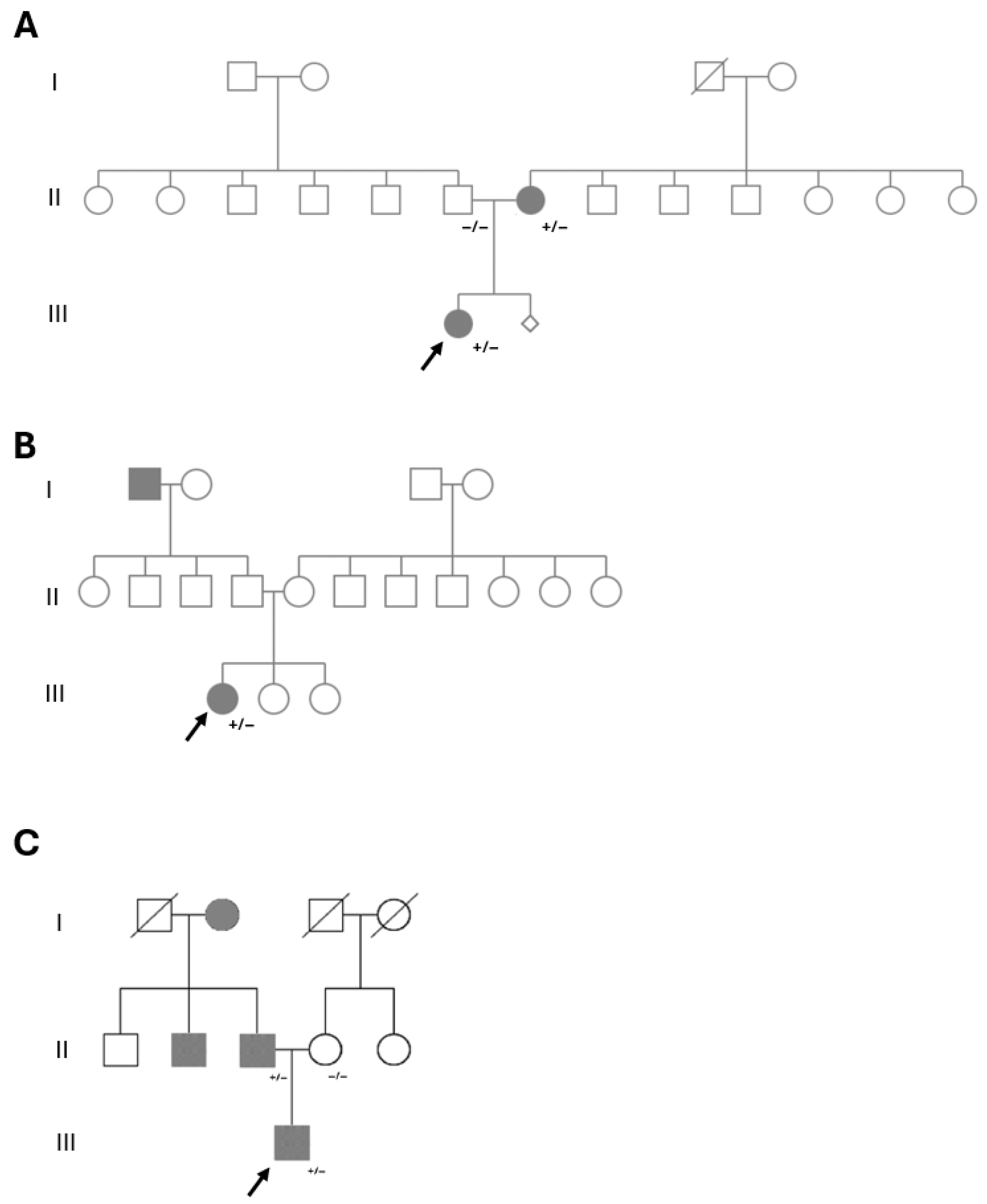
In Family #1, the subject (referred to as patient 1A in Table 2) was a one-month-old newborn who developed diabetes requiring insulin treatment in the first days of life. There were no signs of diabetic ketoacidosis (DKA). She was born at 35 weeks of gestation by caesarean section because of intrauterine growth restriction (IUGR), with 8 points in the Apgar scale and 1720 g of body weight. It was the second pregnancy of the mother, G2P1A1 (pregnancy 2, delivery 1, 1 miscarriage). Additionally, the patient also had hypotonia and persistent ductus arteriosus (PDA). On the other hand, the proband’s mother (patient 1B) was diagnosed with diabetes at 6 weeks of age, which also required insulin therapy. In addition, she was diagnosed with a cleft lip and palate, intellectual disability, short stature, and overweight. At the age of 23, she developed chronic complications of diabetes, such as diabetic retinopathy and nephropathy. Both patients (a child and her mother) were diagnosed with PNDM, confirmed by the result of genetic testing as a result of the causative variant INS:CT104C. The pedigree in Figure A1A, Appendix A, indicated that this variant probably arose de novo in this family in the proband’s mother, as there was no history of hyperglycemia/diabetes in other members of the subject’s family. Unfortunately, we were unable to confirm the genotype of the family members closest to the patient, so the above conclusion is based solely on their phenotype.
Table 2.
Detailed clinical characteristics of patients.
In the second case (Family #2), the patient (referred to as patient 2 in Table 2) was diagnosed with diabetes at the age of 4 months, without DKA, and was immediately treated with subcutaneous insulin therapy. The causative variant of the insulin gene, INS:CT103G, enabled the diagnosis of PNDM in the patient. As shown in the pedigree tree Figure A1B, Appendix A, the grandfather of the proband most likely had type 2 diabetes, probably unrelated.
The last family, referred to as Family #3, had a slightly different phenotype. The proband (referred to as patient 3A in Table 2) was diagnosed with symptomatic diabetes at the age of 16, without DKA, and started insulin treatment. Currently, the patient is also overweight and has hyperlipidemia. Diabetes was also diagnosed in his father at the age of 54 (patient 3B in Table 2), as well as in his paternal grandmother and paternal brother. There are no members in the proband’s mother’s family who have ever had a diabetic phenotype (Figure A1C, Appendix A). In addition to hyperlipidemia and obesity, patient 3B also suffers from hypertension, a heart defect, and hearing impairment. Due to the clinical picture in both patients—the proband and his father—molecular tests were performed, which led to the diagnosis of INS-MODY caused by the loss of the start codon (INS:c.G3C). Both patients are treated with insulin and an SGLT-2 inhibitor, and in the case of the father, additionally with metformin.
3.3. In Silico Analysis of the Mutations of the L35 Amino Acid Residue of Insulin
The identification of genetic variants c.T104C and c.C103G in members of Families #1 and #2 was found to result in a change of the amino acid sequence of insulin, being responsible for the L35P and L35V point mutations, respectively. Therefore, we decided to study the effects of these variations at the protein level and apply computational approaches to predict the effects of point mutations at the 35th position of full-length insulin. The effects of the L35P and L35V mutations were compared to those of other known mutations of this residue, L35Q and L35M (leucine to glutamine and leucine to methionine, respectively).
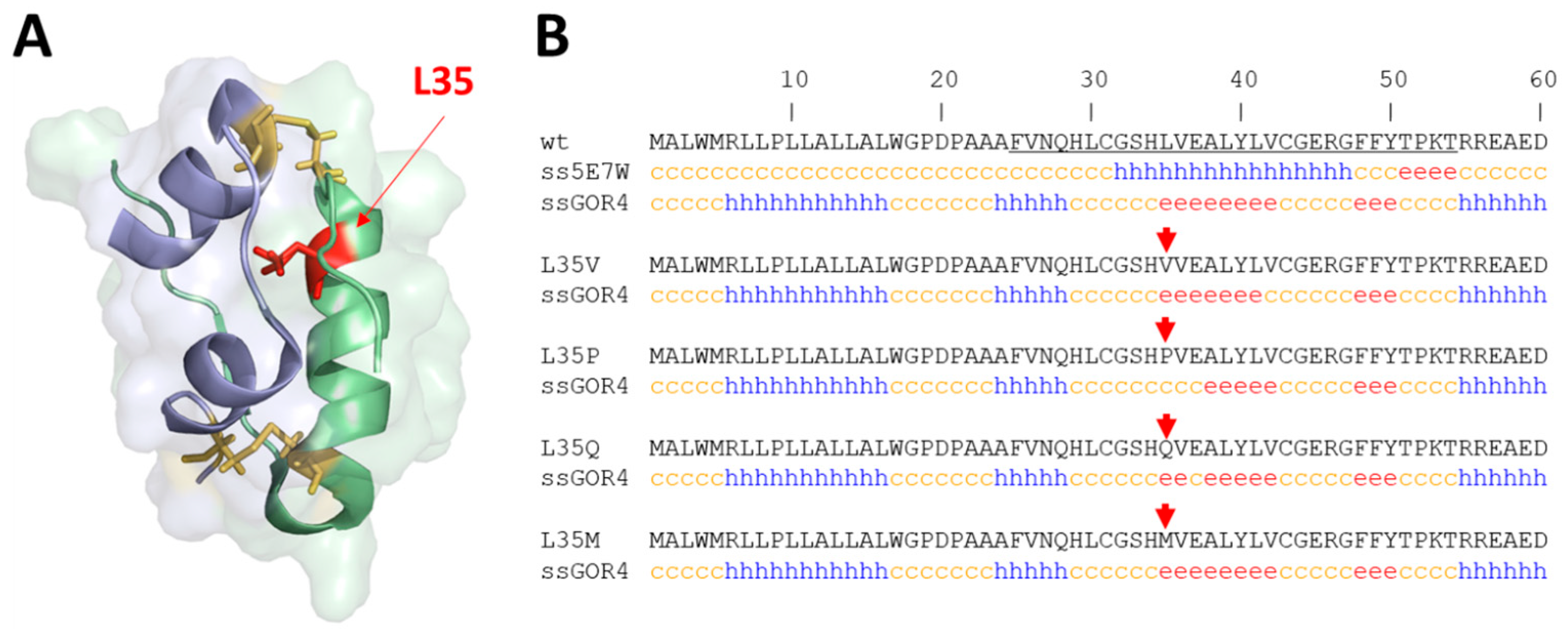
The L35 residue (based on the numbering of the full-length protein sequence) corresponds to the 11th residue of the B-chain in mature insulin; thus, it is also referred to as LeuB11. It is highly conserved across species and is located in the spatial proximity of regions responsible for forming interchain disulfide bonds [20]. It is essential for the correct formation of the B-chain α-helix. It contributes to the hydrophobic core of insulin containing L6, G8, L11, L15, V18, and G23 residues of chain B, as well as I2 and L16 residues of chain A [21,22] (Figure 1A).
Figure 1.
Structure of insulin and predicted changes in its secondary structure due to mutation at the L35 residue: (A) The structure of insulin is shown based on a high-resolution crystal structure (PDB ID: 5E7W). Chains A and B have blue and green colors, respectively. The cysteine residues forming disulfide bonds are labelled with yellow color, while the L35 residue is represented by red sticks. (B) The sequence of chain B (25–54 residues) is underlined within the sequence of insulin. Results of secondary structure predictions performed by the GOR4 online tool are shown. For comparison, the secondary structural organization of chain B is shown for the wild-type (ssGOR4) based on a crystal structure (PDB ID: 5E7W). The structure of the 1–24 region (signal peptide) preceding chain B is not shown; it is absent from the crystal structure. Code: h, helix; c, coil; e, extended strand. The sequence variations at position 35 are shown by red arrows.
To estimate the effects of mutations at the L35 residue, we predicted changes in the secondary structure using in silico tools (Figure 1B). Additionally, we employed both sequence- and structure-based computational methods to assess the potential effects of point mutations on protein stability and post-translational modifications. As mentioned above, in addition to the L35V and L35P mutations identified in this study, analyses were also performed for the other two known mutations at L35 (L35Q and L35M). The structure-based analyses were conducted in triplicate by examining three high-resolution crystal structures with three different predictors to ensure the reliability of the results.
The effects of the L35 mutation on protein stability were analyzed in silico (Table 3). Both sequence- and structure-based predictions suggested decreased stability upon the L35V mutation. The values calculated for the L35V mutation were the most comparable to those obtained for the L35M mutation. A considerable decrease in stability was calculated for the L35P compared to the L35V mutation. This is consistent with the results of secondary structure predictions, which suggested that the L35P mutation would cause significant alterations due to the helix-breaking nature of proline. According to the SDM prediction, the observed −2.23 kcal/mol change indicates a highly destabilizing effect of the L35P mutation (the threshold is −2.5 kcal/mol). The L35Q and L35M mutations were also predicted to decrease stability, but to a lesser extent. While SDM prediction identified the most notable change for the L35P mutation, I-Mutant 2.0 analysis showed the lowest value for the L35Q mutation, indicating a highly destabilizing effect. All studied mutations at the L35 residue were predicted to increase vibrational entropy energy, i.e., increase structural flexibility. Notably, the values calculated for the L35V mutant were similar to those of the L35P mutation, suggesting comparable changes in flexibility.
Table 3.
Predicted effects of point mutations on insulin stability.
When I-Mutant 2.0 was used for prediction, the predicted changes of DDG (kcal/mol) showed a correlation with the hydrophobicity of the mutant residue. Accordingly, the most remarkable change was expected for the L35Q mutation. The values calculated by using SDM and DynaMut did not correlate with the residues’ hydrophobicity.
Additionally, the 35th residue is not considered a post-translational modification site (according to the PhosphoSite database), so mutations at this site do not directly correlate with changes in the post-translational modification pattern.
4. Discussion
Using next-generation sequencing data, we identified three genetic variants that are clinically relevant: two that cause different changes at the 35th residue of insulin, and one that causes a loss of the start codon. The L35 residue of insulin corresponds to the 11th amino acid residue of the B-chain of the mature protein. This leucine is part of the protein’s hydrophobic core and is highly conserved at this position [21,23]. To date, only three missense variants at position 35 have been documented in patients with glucose metabolism-related problems: L35P [7], L35Q [23], and L35M [24]. Each variant is associated with PNDM due to decreased structural stability and secretion [25]. Most subjects with dominant INS variants in the B-chain are diagnosed with diabetes before their first year [8]. Edghill et al. predicted that the L35P substitution would cause prohibited steric contacts, leading to impaired disulfide bond formation and improper folding [7]. Family #1, in which the L35P variant was identified, exhibits symptoms that are clearly indicative of the PNDM phenotype, as described in previous reports [7,8]. A 2024 study showed that specific variants, including L35P, which we found, alter the structure of proinsulin. Consistent with our observations, computational analysis suggested that the L35P mutation (also known as LB11P) affects insulin’s hydrophobic core [26]. This results in the protein being retained in the endoplasmic reticulum rather than being efficiently secreted [27]. Consequently, misfolded proinsulin impairs beta-cell function and reduces insulin secretion. This initiates a pathological process where overworked beta cells produce more insulin, leading to their failure and the development of diabetes.
The variant detected in Family #2 involves a substitution of leucine for valine at the 35th position and has not been previously described in the literature. This mutation has only been analyzed in silico in a study investigating sequence variations of insulin based on nucleotide and amino acid sequences retrieved from the NCBI database [26]. To the best of our knowledge, none of the previous studies have reported the identification of variant c.C103G in combination with the PNDM phenotype. Our results suggest that the L35V does not alter the secondary structure, unlike the L35P point mutation, which disrupts the α-helix at its N-terminus due to its helix-breaking nature. However, stability analyses showed that all studied amino acid changes had a destabilizing effect. Our findings are consistent with a recent computational study that also predicted decreased stability of the L35V mutant [26]. Considering the phenotypes of patients described in the literature, cases involving mutations not expected to disrupt the secondary structure of pre-proinsulin, such as L35Q and L35M, have resulted in symptoms typical for PNDM [23,24]. The case of a patient in Family #2 with an L35V mutation, described in this paper for the first time, confirms that this site is crucial for insulin’s proper regulation of glucose metabolism in humans, leading to the PNDM phenotype.
The two families described in this paper, which carry different changes at the 35th position of the pre-proinsulin peptide (Family #1 and #2), seem to demonstrate a correlation between the severity of phenotypes and the degree of structural changes of the protein. The patient with the L35V variant (Family #2, Patient 2) exhibits only isolated symptoms of diabetes. In contrast, the individual with the L35P variant (Family #1, Patient 1A) shows heart problems and hypotonia in addition to diabetes. Furthermore, the onset of the first symptoms is earlier in the carrier of the L35P mutation (Family#1, Patient 1A). In both cases, the diagnosis was made very quickly, which resulted in the implementation of appropriate treatment, so environmental factors should not have a significant impact on the severity of the observed symptoms.
In summary, this report and the available literature clearly indicate that residue 35 in the polypeptide chain is critical for the body to respond properly to insulin. Evidence of a purely functional nature is available only for the L35P alteration, which suggests that it reduces insulin secretion. This causes beta cells to malfunction, resulting in their failure and the onset of diabetes. In the case of other changes, such as L35V, L35M, and L35Q, there are no functional studies, but most likely the pathophysiological mechanism will be similar to that in the case of the L35P mutation.
Furthermore, both changes causing PNDM likely arose de novo in the studied families, consistent with the literature indicating that over 60% of dominant variants are de novo in the INS gene (Figure A1A,B, Appendix A) [8]. Unfortunately, in the case of Family#2, this conclusion has been drawn based solely on the phenotype of its members.
The variant identified in Family #3, which causes the loss of the start codon c.G3C, was inherited from the father, and there is no indication that it was a de novo mutation. Several variants causing loss of the start codon, such as c.T1C [28], c.G3A, and c.G3T [9], have been described in the literature. The identified genetic variant appears to be novel and has not been reported before. It only affects insulin expression from one copy of the gene. In other words, heterozygous carriers often function without symptoms because they compensate for the lower protein expression. However, as indicated in the literature, some heterozygous carriers of such variants are at a higher risk of developing adult-onset diabetes or presenting with hyperglycemia compared with healthy individuals [29]. In a study of Garin et al., a heterozygous carrier of the c.G3T variant also showed symptoms of diabetes, which appeared after 6 months of age [9]. Considering the age of onset in Family #3, which is much later than in the case of PNDM, we may be dealing with a case where, in addition to the change in the INS gene, carriers have a multifactorial predisposition that caused the diabetic phenotype to manifest. In addition, both carriers of the c.G3C variant are overweight and have hyperlipidemia, which may indirectly suggest additional metabolic disorders that may have contributed to the final phenotype.
Furthermore, it is worth noting that both carriers of the causative variant in families #1 and #3 have been diagnosed with heart defects. Although changes in insulin do not in themselves cause damage to the heart muscle, in vivo studies suggest that impaired glucose metabolism may indirectly contribute to the development of diabetic cardiomyopathy [30,31].
A limitation of this study is that only simple computational approaches were used to predict the effects of changes in the L35 residue. Based on our results, the effects of the variants can be interpreted at the level of insulin structure. Still, they do not provide information about its binding to the insulin receptor. Molecular dynamics simulations are expected to provide deeper insights into structural changes and interactions between mutant insulin and the insulin receptor, similar to a previous study that analyzed the possible effects of multiple mutants [26]. Furthermore, in some cases, we did not have access to the complete family history and phenotypic data and the genotype of all family members, which may also have affected the detail of the proposed conclusions.
5. Conclusions
The presented cases indicate that symptoms accompanying variants in the INS gene may manifest themselves in a highly diverse clinical phenotype or age of onset, which may be misleading, suggesting other forms of glucose metabolism disorders. The observed correlation between phenotype severity and the impact of variants on protein structure suggests that changes at the same site in the polypeptide chain, despite causing diabetes, may result in differences in the clinical age of onset and additional accompanying symptoms. To confirm this definitively, more cases with a well-characterized phenotype and different changes in codon 35 are needed. Furthermore, additional symptoms accompanying diabetes in the analyzed patients raise the question of the strength of the influence of genetic changes in the INS gene on the phenotype of patients with diabetes, whether isolated or already syndromic. The results of the study also expanded the spectrum of INS gene variants causing diabetes by two new genetic variants: one introduces a novel amino acid change to the insulin protein (L35V), and the other is a new loss-of-start-codon mutation at the level of the coding sequence. This highlights the key role of comprehensive genetic testing in enabling accurate diagnosis, genetic counseling for the entire family, and targeted treatment of patients.
Author Contributions
Conceptualization: T.P., A.Z. and K.T.; Bioinformatic data analysis: T.P., S.S. and P.M.; In silico analysis: K.T. and J.A.M.; NGS experiments: T.P. and S.S.; Clinical data curation and interpretation: A.Z., T.P., K.P., M.B., B.S., L.C. and M.M.; Supervision: A.Z.; Writing—original draft: T.P., A.Z., K.T. and J.A.M. All authors have read and agreed to the published version of the manuscript.
Funding
This study was supported by the University of Debrecen, Debrecen, Hungary, by a Bridging Fund, and by a fund from the International Education Office, University of Debrecen, Debrecen, Hungary, for K.T.
Institutional Review Board Statement
Approval for the study was not required in accordance with the decision of the local bioethics committee.
Informed Consent Statement
Written informed consent has been obtained from the patient(s) to publish this manuscript.
Data Availability Statement
The datasets generated during and analyzed during the current study are available from the corresponding authors upon reasonable request. The data are not publicly available due to protecting participant confidentiality.
Conflicts of Interest
The authors declare no conflicts of interest.
Abbreviations
The following abbreviations are used in this manuscript:
| MD | Monogenic diabetes |
| PNDM | Permanent neonatal diabetes mellitus |
| TNDM | Transient neonatal diabetes mellitus |
| MODY | Maturity-onset diabetes of the young |
| IUGR | Intrauterine growth restriction |
| NDM | Neonatal diabetes mellitus |
| ACMG | American College of Medical Genetics and Genomics |
| NGS | Next-generation sequencing |
| SGLT-2 | Sodium-glucose cotransporter 2 |
Appendix A
Appendix A.1
Figure A1.
Genetic pedigrees of families with variants in the INS gene: (A) Family#1 (c.T104C); (B) Family#2 (c.T103G); (C) Family#3 (c.G3C). Genotype is shown underneath each symbol; − and + indicate wild-type and mutant allele, respectively. The squares represent male family members, and the circles, female members. Grey-filled symbols denote patients with diabetes; an arrow denotes the proband in the family.
Appendix A.2
Figure A2.
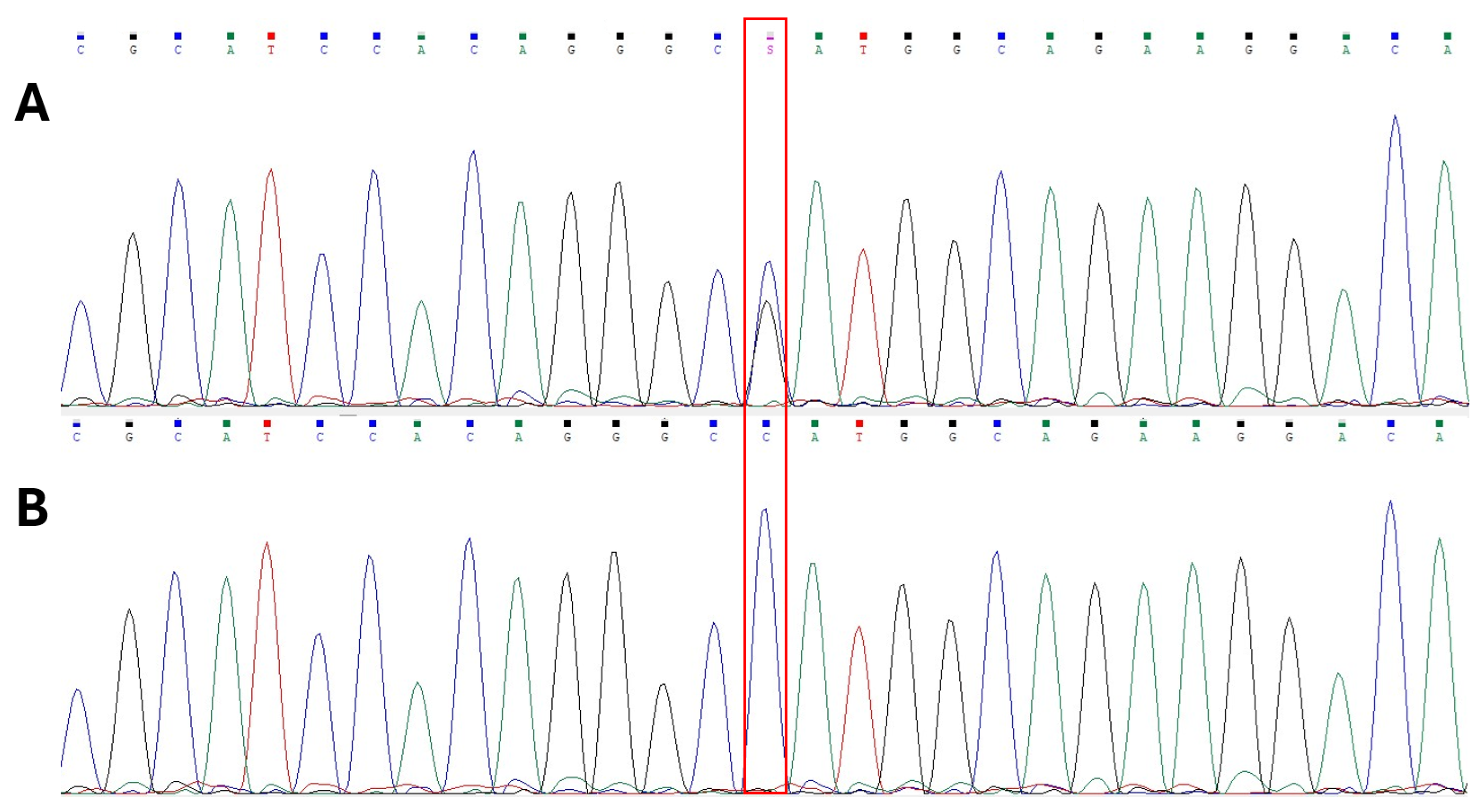
The sequence diagram confirming the INS:c.G3C variant in the father of the proband in Family#3. The variant is marked by a red rectangle: (A) patient number 3B; (B) wild-type.
References
- World Health Organization. Classification of Diabetes Mellitus; World Health Organization: Geneva, Switzerland, 2019. [Google Scholar]
- Zhou, Q.; Samadli, S.; Zhang, H.; Zheng, X.; Zheng, B.; Zhang, A.; Gu, W. Molecular and clinical profiles of pediatric monogenic diabetes subtypes: Comprehensive genetic analysis of 138 patients. J. Clin. Endocrinol. Metab. 2024, 110, 2314–2325. [Google Scholar] [CrossRef] [Scilit] [PubMed]
- Colclough, K.; Ellard, S.; Hattersley, A.; Patel, K. Syndromic Monogenic Diabetes Genes Should Be Tested in Patients with a Clinical Suspicion of Maturity-Onset Diabetes of the Young. Diabetes 2022, 71, 530–537. [Google Scholar] [CrossRef] [Scilit] [PubMed]
- Saint-Martin, C.; Bouvet, D.; Bastide, M.; Bellanné-Chantelot, C. Gene Panel Sequencing of Patients with Monogenic Diabetes Brings to Light Genes Typically Associated with Syndromic Presentations. Diabetes 2022, 71, 578–584. [Google Scholar] [CrossRef] [Scilit]
- Bell, G.I.; Pictet, R.L.; Rutter, W.J.; Cordell, B.; Tischer, E.; Goodman, H.M. Sequence of the human insulin gene. Nature 1980, 284, 26–32. [Google Scholar] [CrossRef] [Scilit]
- Colombo, C.; Porzio, O.; Liu, M.; Massa, O.; Vasta, M.; Salardi, S.; Beccaria, L.; Monciotti, C.; Toni, S.; Pedersen, O.; et al. Seven mutations in the human insulin gene linked to permanent neonatal/infancy-onset diabetes mellitus. J. Clin. Investig. 2008, 118, 2148–2156. [Google Scholar] [CrossRef] [Scilit]
- Edghill, E.L.; Flanagan, S.E.; Patch, A.-M.; Boustred, C.; Parrish, A.; Shields, B.; Shepherd, M.H.; Hussain, K.; Kapoor, R.R.; Malecki, M.; et al. Insulin Mutation Screening in 1044 Patients with Diabetes. Diabetes 2008, 57, 1034–1042. [Google Scholar] [CrossRef] [Scilit]
- Støy, J.; De Franco, E.; Ye, H.; Park, S.-Y.; Bell, G.I.; Hattersley, A.T. In celebration of a century with insulin—Update of insulin gene mutations in diabetes. Mol. Metab. 2021, 52, 101280. [Google Scholar] [CrossRef] [Scilit]
- Garin, I.; Edghill, E.L.; Akerman, I.; Rubio-Cabezas, O.; Rica, I.; Locke, J.M.; Maestro, M.A.; Alshaikh, A.; Bundak, R.; Del Castillo, G.; et al. Recessive mutations in the INS gene result in neonatal diabetes through reduced insulin biosynthesis. Proc. Natl. Acad. Sci. USA 2010, 107, 3105–3110. [Google Scholar] [CrossRef] [Scilit]
- Carmody, D.; Park, S.-Y.; Ye, H.; Perrone, M.E.; Alkorta-Aranburu, G.; Highland, H.M.; Hanis, C.L.; Philipson, L.H.; Bell, G.I.; Greeley, S.A.W. Continued lessons from the INS gene: An intronic mutation causing diabetes through a novel mechanism. J. Med. Genet. 2015, 52, 612–616. [Google Scholar] [CrossRef] [Scilit] [PubMed]
- Chen, H.; Fei, S.-J.; Deng, M.-Q.; Chen, X.-D.; Wang, W.-H.; Guo, L.-X.; Pan, Q. Maturity-onset diabetes of the young type 10 caused by an Ala2Thr mutation of INS: A case report. World J. Diabetes 2023, 14, 1877–1884. [Google Scholar] [CrossRef] [Scilit]
- Zmysłowska, A.; Jakiel, P.; Gadzalska, K.; Majos, A.; Płoszaj, T.; Ben-Skowronek, I.; Deja, G.; Glowinska-Olszewska, B.; Jarosz-Chobot, P.; Klonowska, B.; et al. Next- generation sequencing is an effective method for diagnosing patients with different forms of monogenic diabetes. Diabetes Res. Clin. Pract. 2022, 183, 109154. [Google Scholar] [CrossRef] [Scilit]
- Richards, S.; Aziz, N.; Bale, S.; Bick, D.; Das, S.; Gastier-Foster, J.; Grody, W.W.; Hegde, M.; Lyon, E.; Spector, E.; et al. Standards and guidelines for the interpretation of sequence variants: A joint consensus recommendation of the American College of Medical Genetics and Genomics and the Association for Molecular Pathology. Genet. Med. 2015, 17, 405–424. [Google Scholar] [CrossRef] [Scilit] [PubMed]
- Hornbeck, P.V.; Zhang, B.; Murray, B.; Kornhauser, J.M.; Latham, V.; Skrzypek, E. PhosphoSitePlus, 2014: Mutations, PTMs and recalibrations. Nucleic Acids Res. 2015, 43, D512–D520. [Google Scholar] [CrossRef] [Scilit] [PubMed]
- Lisgarten, D.R.; Palmer, R.A.; Lobley, C.M.C.; Naylor, C.E.; Chowdhry, B.Z.; Al-Kurdi, Z.I.; Badwan, A.A.; Howlin, B.J.; Gibbons, N.C.J.; Saldanha, J.W.; et al. Ultra-high resolution X-ray structures of two forms of human recombinant insulin at 100 K. Chem. Cent. J. 2017, 11, 73. [Google Scholar] [CrossRef] [Scilit]
- Smith, G.D.; Pangborn, W.A.; Blessing, R.H. The structure of T6 human insulin at 1.0 Å resolution. Acta Crystallogr. D Biol. Crystallogr. 2003, 59, 474–482. [Google Scholar] [CrossRef] [Scilit]
- Garnier, J.; Gibrat, J.-F.; Robson, B. GOR method for predicting protein secondary structure from amino acid sequence. In Methods Enzymol; Elsevier: Amsterdam, The Netherlands; pp. 540–553.
- Pandurangan, A.P.; Ochoa-Montaño, B.; Ascher, D.B.; Blundell, T.L. SDM: A server for predicting effects of mutations on protein stability. Nucleic Acids Res. 2017, 45, W229–W235. [Google Scholar] [CrossRef] [Scilit]
- Rodrigues, C.H.; Pires, D.E.; Ascher, D.B. DynaMut: Predicting the impact of mutations on protein conformation, flexibility and stability. Nucleic Acids Res. 2018, 46, W350–W355. [Google Scholar] [CrossRef] [Scilit]
- Conlon, J.M. Evolution of the insulin molecule: Insights into structure-activity and phylogenetic relationships. Peptides 2001, 22, 1183–1193. [Google Scholar] [CrossRef] [Scilit]
- Nakagawa, S.H.; Hua, Q.-X.; Hu, S.-Q.; Jia, W.; Wang, S.; Katsoyannis, P.G.; Weiss, M.A. Chiral Mutagenesis of Insulin. J. Biol. Chem. 2006, 281, 22386–22396. [Google Scholar] [CrossRef] [Scilit] [PubMed]
- Lawrence, M.C. Understanding insulin and its receptor from their three-dimensional structures. Mol. Metab. 2021, 52, 101255. [Google Scholar] [CrossRef] [Scilit]
- Wang, T.; Ding, S.; Li, S.; Guo, H.; Chen, X.; Huang, Y.; Huang, J.; Wu, J.; Hu, C.; Fang, C.; et al. A novel mutation in INS gene linked to permanent neonatal diabetes mellitus. Endocrine 2019, 64, 719–723. [Google Scholar] [CrossRef] [Scilit]
- Gopi, S.; Gowri, P.; Panda, J.K.; Sathyanarayana, S.O.; Gupta, S.; Chandru, S.; Chandni, R.; Raghupathy, P.; Dayal, D.; Mohan, V.; et al. Insulin gene mutations linked to permanent neonatal diabetes mellitus in Indian population. J. Diabetes Its Complicat. 2021, 35, 108022. [Google Scholar] [CrossRef] [Scilit]
- Dhayalan, B.; Chatterjee, D.; Chen, Y.-S.; Weiss, M.A. Structural Lessons from the Mutant Proinsulin Syndrome. Front. Endocrinol. 2021, 12, 754693. [Google Scholar] [CrossRef] [Scilit]
- Ahmed, E.M.; Elangeeb, M.E.; Adam, K.M.; Abuagla, H.A.; MohamedAhmed, A.A.E.; Ali, E.W.; Eltieb, E.I.; Edris, A.M.; Osman, H.M.A.; Idris, E.S.; et al. Computational Analysis of Deleterious nsSNPs in INS Gene Associated with Permanent Neonatal Diabetes Mellitus. J. Pers. Med. 2024, 14, 425. [Google Scholar] [CrossRef] [Scilit] [PubMed]
- Park, S.-Y.; Ye, H.; Steiner, D.F.; Bell, G.I. Mutant proinsulin proteins associated with neonatal diabetes are retained in the endoplasmic reticulum and not efficiently secreted. Biochem. Biophys. Res. Commun. 2010, 391, 1449–1454. [Google Scholar] [CrossRef] [Scilit]
- Tian, M.; Feng, Y.; Liu, Y.; Wang, H. Case report: A 10-year prognosis of neonatal diabetes caused by a novel INS gene mutation. Front. Endocrinol. 2023, 13, 1086785. [Google Scholar] [CrossRef] [Scilit] [PubMed]
- Arneth, B. Insulin gene mutations and posttranslational and translocation defects: Associations with diabetes. Endocrine 2020, 70, 488–497. [Google Scholar] [CrossRef] [Scilit] [PubMed]
- Lee, W.-S.; Kim, J. Application of Animal Models in Diabetic Cardiomyopathy. Diabetes Metab. J. 2021, 45, 129–145. [Google Scholar] [CrossRef] [Scilit]
- Ma, Y.; Wang, G.; Li, J. High glucose affects the cardiac function of diabetic Akita mice by inhibiting cardiac ATP synthase beta subunit. Int. J. Cardiol. Cardiovasc. Risk Prev. 2025, 24, 200369. [Google Scholar] [CrossRef] [Scilit]

Disclaimer/Publisher’s Note: The statements, opinions and data contained in all publications are solely those of the individual author(s) and contributor(s) and not of MDPI and/or the editor(s). MDPI and/or the editor(s) disclaim responsibility for any injury to people or property resulting from any ideas, methods, instructions or products referred to in the content. |
© 2026 by the authors. Licensee MDPI, Basel, Switzerland. This article is an open access article distributed under the terms and conditions of the Creative Commons Attribution (CC BY) license.