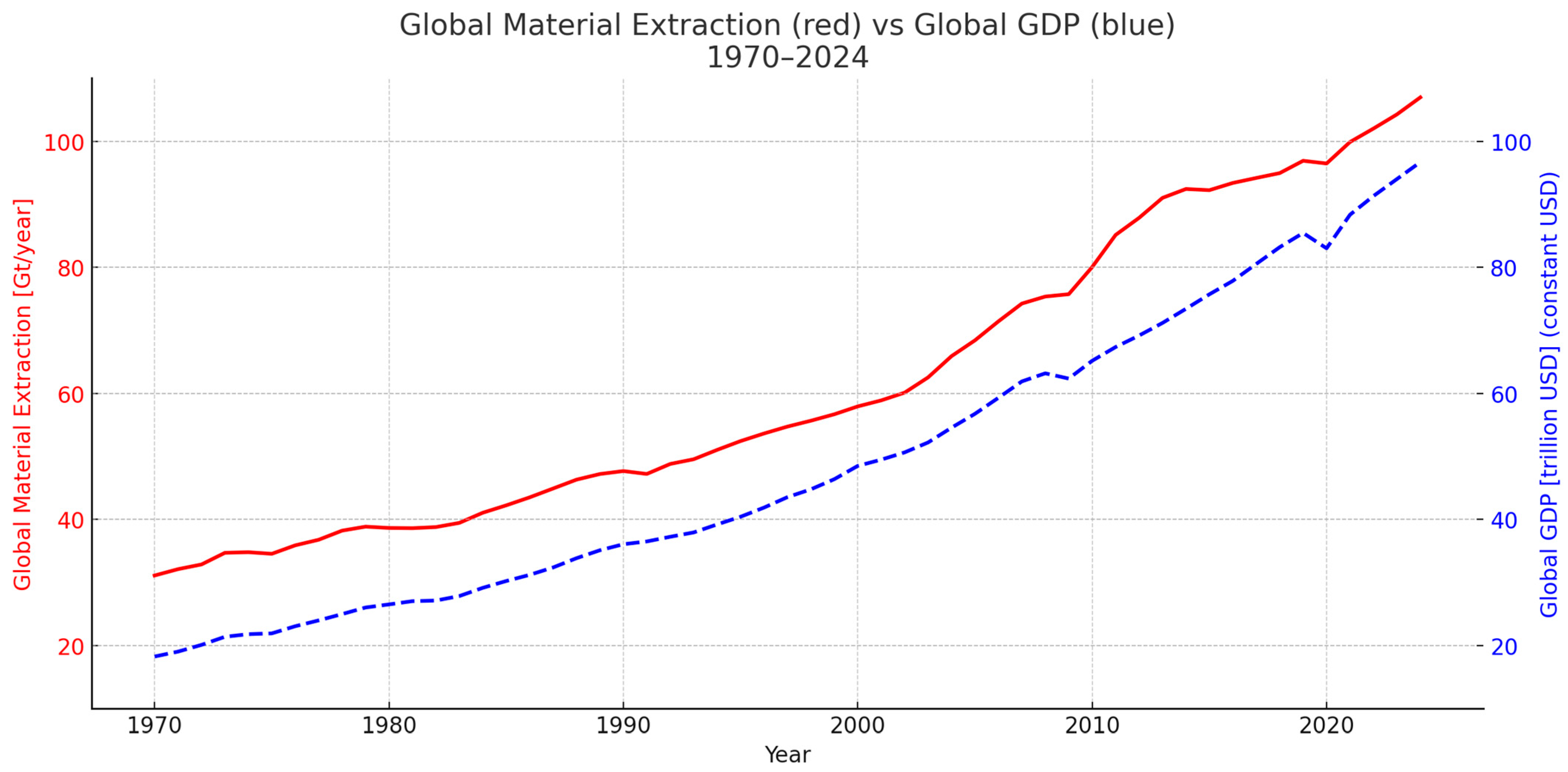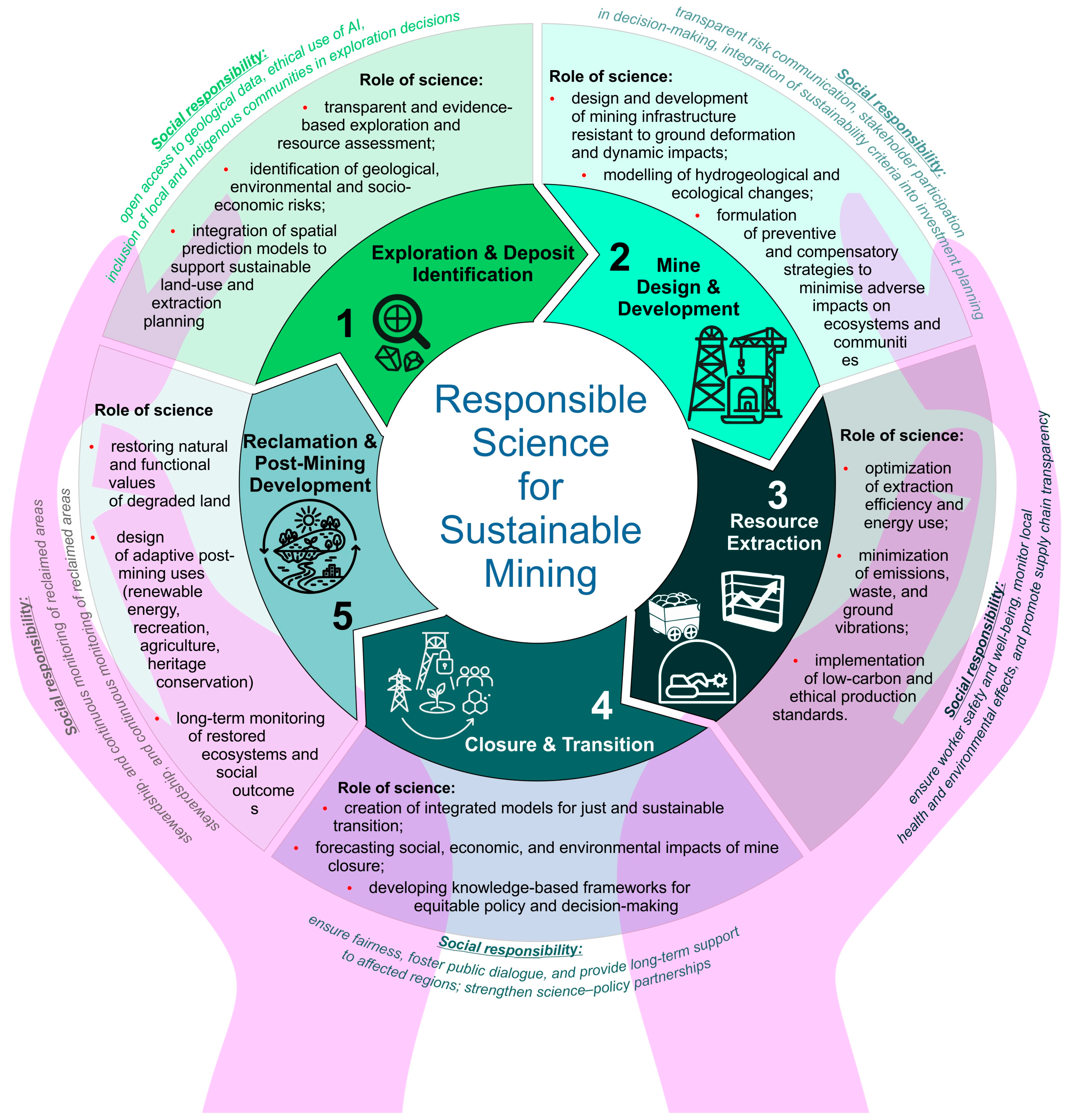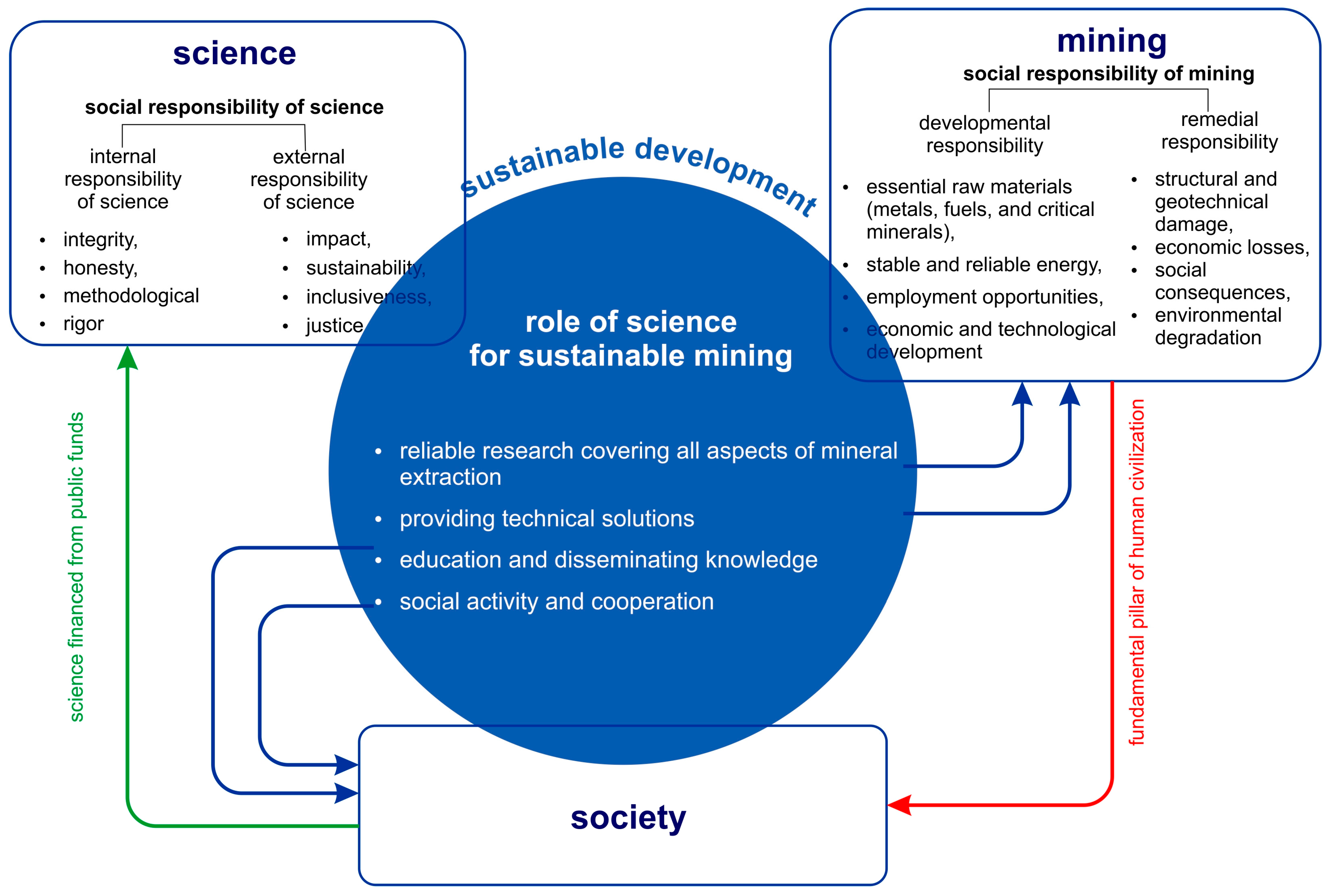
Social Responsibility of Science in the Sustainable Development of Mining and Post-Mining Areas

Abstract
1. Introduction
- Technical problems related to deposit extraction and its impact on the rock mass and the land surface;
- Economic issues related to economic profits from mining and related damage to the environment and infrastructure;
- Social issues related to employment in the mining sector and living in mining areas—both in the stage of active mining activity, as well as after its completion (transformation resulting from the closure of mines, post-mining areas).
- Triangulation ensured convergence of independent evidence streams and strengthened internal validity.
- Use of SDGs ensured traceability between empirical observations and societal relevance.
- No extrapolation was performed where international datasets lacked sufficient granularity (especially outside OECD jurisdictions).
2. A View on the Social Responsibility of Science
- RRI practices would require improving the justification for their use;
- One would expect a broader reflection on the theoretical implications of RRI to be introduced;
- The RRI described in the literature focused on the issue of sharing results, rather than on analyzing the consequences of the research.
- Seek to obtain appropriate knowledge about ongoing research and innovation activities, take into account the possible consequences of these activities, and be aware of possible scenarios for the development of the situation.
- Take into account ethical and social values important for society, such as prosperity, justice, equality, privacy, independence, security, sustainable development, responsibility, and democracy when designing scientific research, new products, and processes.
- Assess both the results and possible development or use scenarios in the perspective of the above-mentioned values [49]. However, putting these principles into practice is not easy and brings problems.
- “1. Mitigate personal biases in your research and when offering expert advice;
- 2. Foster the interests of young generations in science and engineers;
- 3. Take steps to prevent or minimize the risks to society associated with the conduct of your work/research;
- 4. Promote public access to scientific and technical information;
- 5. When it comes to your attention, address any improper use of your research findings or products by others;
- 6. Notify appropriate authorities of suspected or observed research/professional misconduct;
- 7. When deciding on what work/research to pursue, take into account whether its potential effects would benefit or harm society;
- 8. When communicating research findings, acknowledge other relevant research interpretations, whether or not consistent with your own;
- 9. Advocate for publicly funded science and engineering that improves the quality of life for some or all members of society; and
- 10. Communicate your work in a way that makes it understandable to the public” [56].
3. Responsibility in Science vs. Sustainability
- A set of guiding criteria for human actions;
- The goal of humanity;
- Subject of research;
- An approach to science.
- The three dimensions of sustainability: environmental, social, and economic;
- The three key actors: science (universities), government, and industry;
- The three research domains: environmental, social, and economic sciences [60].
4. Transformation of Mining Areas
- Physical and chemical processes related to the mining of deposits in the rock mass;
- Technical consequences of surface deformation for buildings and infrastructure;
- Economic and social effects of transformations on the development of mining and post-mining areas.
- Explain the processes underlying the closure of mines;
- Disseminate knowledge among society and decision-makers;
- Forecast problems correctly;
- Develop optimum solutions for problems;
- Engage in implementing solutions in the social–economic and political environment.
5. Major Sustainability Problems in Mining and Post-Mining Areas
5.1. Rock Mass and Land Surface Transformations
5.2. Consequences of Mining-Induced Surface Deformations
5.2.1. Technical Consequences
5.2.2. Economic Consequences
- FLOW—realized annual cash outflows (operational or public-budget expenditures for repairs, reclamation, and preventive reinforcement);
- STOCK—balance-sheet-disclosed obligations (provisions, financial guarantees, and security deposits) representing future compensation liabilities.
- PLN 46.6 million (EUR 9.0 million)—residential buildings;
- PLN 41.3 million (EUR 8.1 million)—roads, streets, bridges, and viaducts;
- PLN 36.0 million (EUR 7.5 million)—preventive reinforcement.

| Country | Audited/Reconstructed Financial * (EUR) | Financial Magnitude | Year | Financing/Liability Model | Legally Liable Payer | Cost Scope (i–v) | Audited/Governmental Source |
|---|---|---|---|---|---|---|---|
| Poland | 182 M (FLOW)/ 282 M (STOCK) | Dual FLOW/STOCK system (realized annual spending) | 2024 | Hybrid (corporate liability + public instruments) | Mining operator (ex ante and ex post) | (i)–(iii) | Statistics Poland (2024) [11]; Geological and Mining Law, Arts. 144–152 [121] and financial statements of mining companies: PGG S.A. [122], JSW S.A. [123], LW Bogdanka S.A. [95] and the Polish state-owned mine restructuring company (SRK S.A.) [124]. |
| Germany | FLOW - not reported; costs internalized in provisions/ 9.76 B (STOCK) | STOCK (balance-sheet provision for perpetual mining obligations—“Ewigkeitslasten”) | 2024 | Fund–reserve architecture (RAG-Stiftung financing long-term obligations of the former hard coal sector) | RAG-Stiftung (foundation legally responsible for financing and performing perpetual obligations of the former hard-coal sector | (i)–(iii) plus mine-water drainage, geotechnical stabilization of subsided areas, and flood-protection infrastructure | RAG-Stiftung (2024) [6]. Jahresabschluss der RAG-Stiftung. |
| Czech Rep. | 210.6 M (FLOW)/ 318 M (STOCK) | Dual FLOW/STOCK system | 2023–2024 | Hybrid (corporate provisions + public legacy spending) | Mining enterprise (ex ante) + State (legacy via DIAMO/ MPO) | (i)–(iii) plus mine-water drainage and geotechnical stabilization of post-mining areas | MPO Státní závěrečný účet 2023—Part H [125] and financial statements of mining companies: OKD a.s. [118]; Severní energetická [126]; Severočeské doly [127], Sokolovská uhelná [128], Vršanská uhelná [129]. |
| United Kingdom | 64.8 M (FLOW)/ 1.47 B (STOCK) | Dual FLOW (actual public expenditure)/ STOCK system | 2024/25 | Hybrid (public funding for legacy mines + corporate provisions for active mines) | State (legacy)/operator (active mines) | (i)–(iii) plus mine-water treatment, shaft and adit stabilization, and tip-safety measures | MRA Annual Report and Accounts (2024/25) [8] |
| USA | 1.12 B (FLOW)/15.62 B (STOCK) | FLOW (federal AML/BIL expenditures) | 2025 | Hybrid (federal AML fund + operator liability for active mines) | AML → state/public; active mines → operator | (i), (iii) plus mine-land reclamation, acid-mine drainage treatment, and stabilization of shafts and openings | OSMRE FY Budget Justification [130]; IIJA AML Guidance [131]; AMLIS Remaining Reclamation Cost [132]; OSMRE AML Payments FY23–25 [133] |
| China | No auditable aggregate value disclosed (descriptive segment-level indication only; ≈12% reported narratively) | —(Partial disclosure only) | 2023 | Hybrid (operational + local funds) Enterprise-based (with ad hoc local public support) | Mining enterprise | (i)–(iii) plus land reclamation, tailings-facility safety, and mine-water management | China Shenhua Energy Co. Annual Report [116] (enterprise-level disclosure) |
| Chile | FLOW—not reported/4.83 B (STOCK—guarantee-based) | STOCK (guarantee-based)+ no audited FLOW available | 2022 | Hybrid/ fund–assurance basedmodel (mandatory financial guarantee; Ley 20.551) | Mining enterprise + state (post-closure management) | (i)–(iii) plus slope and waste-dump stabilization, tailings-facility safety, and acid-rock drainage control | SERNAGEOMIN (2022) [134,135]; Ley 20.551 [111] |
| Australia | Public FLOW not applicable/ 7.01 B (STOCK)) | STOCK—dominant assurance-based system + public FLOW (not applicable) | 2023/24 | Assurance–deposit model (ex ante secured liability; no public cash-out) | Mining enterprise (liability secured through rehabilitation deposits and surety instruments) | (iii) plus mine rehabilitation and closure, mine-affected water management, and tailings/waste-rock stability | NSW Resources Regulator Annual Report 2022–23 [136]; Queensland GovernmentAnnual Report [137]; Government of Western Australia [138,139]. |
| FLOW (Realized Cost—Cash Outflow) | STOCK (Recognized Liability—Provisions/Deposits/Funds) | EXTERNALITIES (Unaccounted Social Cost—Not Visible in Accounting) | |
|---|---|---|---|
| Accounting status | Recorded in the income statement or public budget as a cash expenditure in the reporting year. | Recorded in the balance sheet as a future financial obligation, in line with IAS 37 [93]. | Not recorded in corporate accounts or public budgets; cost remains outside the financial system. |
| Timing of cost recognition | Ex post—only after damage has occurred and generated an invoice or budget expenditure. | Ex ante—liability is certain or highly probable, although payment will occur later. | Continuous, dispersed over time; no identifiable accounting event. |
| Cost bearer (default) | Mining operator or public sector (if classified as public expenditure). | Mining operator (reclamation funds, closure funds, security deposits, and provisions). | Property owners, infrastructure users, and local communities (cost shifted). |
| Economic nature | Realized financial outflow (cash cost). | Capitalized liability exposure (future cost). | Non-internalized socio-economic loss (value loss and functional degradation). |
| Examples | Repairs, reclamation, and preventive reinforcement of new structures (ex ante). | Closure funds, balance-sheet provisions, rehabilitation deposits, and perpetual funds (e.g., RAG-Stiftung; AML Fund). | Accelerated structural degradation (IV) and real estate devaluation (V). |
| Data sources/verification | Audited budget and financial reports (Statistics Poland 2024 [69]; OKD 2024 [76]; NSW DCS 2024 [79]. | Corporate/fund financial statements (RAG-Stiftung 2024 [6]; AML Fund 2025 [9]; OSMRE 2024 [131]) [78]. | Peer-reviewed studies: hedonic pricing models and life-cycle cost analysis [140,141,142,143,144,145]. |
| Use in this study | Comparison of absolute and unit costs (EUR/t of extraction). | Assessment of long-term fiscal and corporate risk (capital at risk). | Quantification of hidden costs that materially affect communities but are not financially reported. |
- STOCK (liability exposure)
- Developing and improving methods for predicting mining-induced ground deformation and structural response, as well as effective protection techniques;
- Disseminating knowledge on mining impacts and mitigation strategies to engineers, planners, and financial decision-makers;
- Participating in legislative processes that shape legal and financial liability for mining damage;
- Contributing to public and policy discourse.
- (iv) Accelerated technical wear and shortened service life of buildings;
- (v) Permanent loss of market value of real estate located within mining-influence zones.
- 45% for buildings ~50 years old;
- 50% for buildings ~100 years old;
- 60% for buildings ~130 years old.
- Williams [154]: value reduction of 0.34–1.7% at the county level associated with the presence of open-pit mines;
- Malikov [141]: houses located 1 mile closer to a rock mine sell at a 2.3–5.1% discount;
- Kolala [142]: properties ≤2 km from a mine sell at 20–30% lower prices than similar properties ≥6–7 km away.
- FLOW—expenditures already incurred and recorded (ex post), reflected in public budgets or company profit-and-loss accounts;
- STOCK—obligations secured in advance (ex ante), disclosed as provisions, and deposits or dedicated funds;
- EXTERNALITIES—unaccounted social and economic losses borne by property owners and communities (e.g., land-value reduction and accelerated degradation).
5.2.3. Social Consequences
- Psychosocial effects of mining-induced seismicity
- Health impacts of environmental exposure (Global South)
- Quantifying social impacts: S-LCA
- Empirical identification and quantification of impacts—deformation, seismicity, exposure, and psychosocial effects.
- Analytical tools that support compensation and prevention—from deformation forecasting to S-LCA-based valuation of social consequences.
- Reduction in information asymmetry—open access to data on ground deformation and seismicity, and expert support for local governments in spatial planning.
6. The Tasks of Responsible Science in the Context of Sustainable Development Goals (SDGs) for Mining and Post-Mining Areas
- Goal 1—elimination of poverty
- Transparent evidence on how mining-generated value is distributed across actors;
- Analytical tools that support benefit-sharing and compensation mechanisms;
- Data that strengthen the bargaining position of mining regions in national fiscal negotiations.
- Goal 3—good health and life quality
- Identification of exposure pathways;
- Quantification of population-level risk through biomonitoring and epidemiology;
- Development of mitigation strategies and regulatory instruments.
- Goal 6—clean water
- Hydrogeological modelling of mining-induced flow paths;
- Adaptive dewatering and reinjection systems;
- Geochemical control of mine drainage;
- Ecosystem-based restoration measures designed to recover water-retention and purification functions.
- Goal 7—clean and accessible energy
- Approaches that minimize harm in regions where extraction occurs;
- Low-impact energy generation and storage technologies, designed to reduce material and energy intensity across the entire life cycle (LCA), minimize emissions and waste, and limit ecosystem disturbance during raw-material acquisition, manufacturing, operation, and end-of-life management;
- Systemic methods for managing material and energy flows, aimed at maximizing resource efficiency, reducing material and energy intensity of technologies, and enabling dematerialisation through eco-design that minimizes the dependency on primary resources at the conceptual and infrastructural design stage.
- Goal 8—economic growth and decent work
- The share of mineral exports in total merchandise exports;
- Fiscal revenues from mining (taxes, royalties, and concession fees);
- The sector’s contribution to gross value added (GDP).
- Goal 10—less inequality
- Goal 11—sustainable cities and communities
- >91% of total exports in Botswana and the Democratic Republic of Congo;
- 85.6% in Mongolia;
- 82.6% in Guinea;
- 80.1% in Suriname;
- ≥76% in Burkina Faso and Zambia [27].
- Loss of employment and regional economic base;
- Accelerated impoverishment and demographic decline;
- Persistence of ground instability and deformation long after closure.
- Technical—monitoring and mitigating ground deformation, managing hydrological impacts;
- Economic—diversification and reconstruction of regional economies;
- Social—participatory governance, social inclusion and mitigation of marginalization;
- Environmental—land rehabilitation, ecological restoration, and long-term stewardship.
- Goal 12—responsible consumption and production
- Goal 15—life on land
- Goal 17—goal-oriented partnerships
7. Conclusions
- Reliable research covering all aspects of mineral extraction.
- The primary role of science is striving to know the truth. Therefore, the main task of responsible science is to conduct research to provide the most objective results about the impact of mining on the human environment and nature, in technical, economic, and social dimensions.
- Providing technical solutions.
- Another important role of science is to develop methods of mineral extraction that make this activity safe for people working in the mine and with the least possible impact on the environment. Technical sciences are also responsible for developing methods for protecting buildings and technical infrastructure against the effects of ground deformation, methods of repairing damage, and methods of reclaiming degraded areas, restoring their utility and natural functions.
- Education and disseminating knowledge.
- Acquired knowledge should benefit society. It should support the education of engineers and specialists responsible for exploring and documenting mineral deposits, planning extraction, designing and conducting mining operations, and developing mining-related infrastructure and equipment.
- Social activity and cooperation.
8. Practical Pathways for Implementing Responsible Research and Innovation (RRI)
- NSF Broader Impacts (United States) [191]—all funding proposals must demonstrate clear and verifiable societal benefits (National Science Foundation, 2024);
- RRI Toolkit (European Union)—a curated repository of more than 500 tools, checklists, and documented practices facilitating the implementation of RRI [192];
- RRI Monitoring Framework (Horizon Europe) [193]—a formal evaluation system using indicators such as anticipation, inclusion, and responsiveness (European Commission, 2021).
- UNESCO Open Science Framework [194]—an international commitment to openness and public accessibility of research results and data;
- Urban/Living Labs (EU innovation policy)—structured environments enabling experimentation and co-creation with stakeholders in real contexts (e.g., climate neutrality and regional transformation) [49];
- Triple Helix model [59]—a model of institutional interaction between science, government and industry, widely adopted in innovation clusters and technology parks.
9. Future Research Directions
- Developing harmonized datasets and indicators to quantify externalities (LCA/S-LCA, hedonic pricing, and long-term social and hydrogeological monitoring);
- Testing the FLOW–STOCK–EXTERNALITIES framework across different legal and institutional contexts;
- Linking financial-responsibility models with indicators of social resilience and ecosystem-service valuation.
Author Contributions
Funding
Data Availability Statement
Acknowledgments
Conflicts of Interest
Abbreviations
| ASM | Artisanal and Small-Scale Mining |
| CBA | Cost–Benefit Analysis |
| DALY | Disability-Adjusted Life Year |
| DRC | Democratic Republic of the Congo |
| FLOW–STOCK–EXTERNALITIES | Taxonomy of economic impacts of mining (flows, environmental stocks, externalities) |
| GDP | Gross Domestic Product |
| GUS | Statistics Poland (Główny Urząd Statystyczny) |
| ICMM | International Council on Mining and Metals |
| LCA | Life Cycle Assessment |
| MCI | Mining Contribution Index |
| OKD | Ostravsko—Karvinské Doly (Czech Mining Company) |
| PPV | Peak Particle Velocity |
| RAG | RAG-Stiftung (German Coal Mining Foundation) |
| REEs | Rare Earth Elements |
| RRI | Responsible Research and Innovation |
| S-LCA | Social Life Cycle Assessment |
| SDGs | Sustainable Development Goals |
| WELBY | Well-being-Adjusted Life Year |
Appendix A. Methodological Framework for the Estimation of Mining Damage Costs in Selected Countries (2021–2025)
- (i) Repair of damaged or destroyed structures;
- (ii) Protective works on existing structures;
- (iii) Preventive protection in newly constructed structures;
- (iv) Accelerated technical degradation of structures.
- Detailed derivation of national estimates:
- Poland
- Source: Statistics Poland [11] p. 58, Table 26:
- “Mining-damage elimination—current expenditure” = 463.6 million PLN (2023).
- Converted at EUR 1 = PLN 4.65 → EUR 99.7 million.
- Represents public budgetary expenditures (categories i–ii).
- (Volume-based unit costs were not recalculated due to lack of harmonized 2023 coal output data in the same source).
- → Stock (annual expenditure): 159.8+2.31+33.1+86.7=282 M EUR
- → Flow (annual expenditure): 99,7+42.6+0,7+14.0+25.0=182 M EUR.
- Germany
- Source: RAG-Stiftung (2024) [6]:
- “Rückstellungen für Ewigkeitslasten” = EUR 9.76 billion (as of 31 December 2024).
- Represents consolidated balance-sheet provisions for perpetual burdens (Ewigkeitslasten)—including mine-water pumping, reclamation, and compensation for subsidence damage.
- → Stock (balance-sheet provision).
- Reference: RAG-Stiftung 2024 [6].
- Czech Republic
- Public expenditure:
- Source: Ministry of Finance of the Czech Republic [125], State Final Account 2023 – Part H, chapter 322 (MPO).
- “Zahlazování následků hornické činnosti” = 5,202,790.08 tis. CZK (2023).
- Converted at EUR 1 = CZK 24.7 → EUR 210.6 million (categories (i)–(ii)).
- Corporate provisions (STOCK):
- Combined mine damage + reclamation reserves = CZK ≈ 7.85 billion → EUR 318 million.
- → Stock=318 M EUR (balance-sheet provisions)
- Represents corporate balance-sheet provisions for mine damage and reclamation.
- Corporate expenditure (FLOW) - not reported.
- Annual utilisation of mining provisions disclosed in corporate financial statements cannot be independently verified as cash-out expenditure and is therefore excluded from FLOW.
- → total FLOW = 216.6 M EUR
- → STOCK=318 M EUR
- United Kingdom
- Sources: Annual Report and Accounts 2024–25 [8].
- Total long-term provisions mining-related liabilities (“Provisions for liabilities and charges”) amount to GBP 1.709 billion (Statement of Financial Position, 31 March 2025).
- Converted at IMF 2024 rate (GBP = 1.16) → EUR 1.47 billion.
- This represents the cumulative long-term liability for legacy mining obligations (i–iii): subsidence management, mine-water treatment, tip safety, and public-safety interventions on abandoned mine workings.
- Annual operational expenditures on remediation are included in the departmental Grant-in-Aid reported as 64.8 M EUR for 2024–25. This represents the yearly Flow component of UK mining-remediation financing.
- → Stock (long-term provisions) = 1.47 B EUR
- → Flow(annual public expenditure) = 64.8 M EUR.
- References: Mining Remediation Authority 2025 [8].
- USA
- In the United States, mining-damage FLOW and STOCK were reconstructed from audited proxies, as no single financial statement consolidates AML liabilities and expenditures at the national level.
- Federal Abandoned Mine Land (AML) expenditures comprise: annual federal AML appropriations, mandatory AML payments to states and tribes, and Bipartisan Infrastructure Law (IIJA) AML allocations. Combined federal AML/BIL expenditures amount to approximately USD 1.03 billion per year.
- Converted → EUR 1 = USD 0.92 → EUR 1.12 billion per year.
- These expenditures represents public-funding for remediation of legacy coal-mining impacts covering cost categories (i) direct damage remediation and (iii) stabilization and hazard mitigation, including mine-land reclamation, acid mine drainage treatment, and stabilization of shafts and openings.
- → Flow (public fund expenditure)
- Public fund liabilities (STOCK):
- The cumulative national STOCK was reconstructed from: the AML Fund unappropriated balance, and the AMLIS-reported remaining reclamation cost for abandoned mine lands.
- Combined remaining AML liability amounts to USD 14.38 billion,
- Converted at EUR 1 = USD 0.92 → EUR 15.62 billion.
- This value represents reconstructed public-sector liability for legacy mining damage and reclamation obligations (categories (i)–(iii)), in the absence of consolidated balance-sheet provisions.
- → STOCK (reconstructed public liability).
- Corporate liability and expenditure:
- Corporate asset retirement obligations (ARO) and annual remediation expenditures for active mines are regulated under SMCRA Title V but are not aggregated at the national level and therefore are excluded from the national FLOW/STOCK totals.
- → FLOW = 1.12 B EUR (federal AML/BIL expenditures).
- → STOCK = 15.62 B EUR (reconstructed public liability).
- China
- Source: China Shenhua Energy Co., Ltd. (2024) [116].
- Discloses environmental and land-requisition expenditures under “Cost of sales,” but no explicit CNY figures.
- The statement that land acquisition, surface-subsidence compensation, and environmental protection account for approximately 12% of total costs is descriptive, not audited numerically.
- → Qualitative information only.
- Reference: China Shenhua Energy Co., 2024 [116].
- Chile
- “Total garantías financieras” = USD 5.25 billion (2022).
- Converted at USD → EUR = 0.92 → EUR 4.83 billion.
- The amount represents the aggregated value of mandatory mine-closure financial guarantees under Ley 20.551, securing approved closure and post-closure remediation measures.
- → FLOW = not reported
- → Stock (assurance-based) = 4.83 B EUR
- Australia
- New South Wales: Rehabilitation security deposits held by the government = AUD 3.70 billion (as at July 2023).
- Queensland: “Total surety held” (bank guarantees, insurance bonds, cash) = AUD 7.79 billion (as at 30 June 2024).
- Consolidated secured liabilities (STOCK): AUD 11.49 billion.
- Conversion: Currency values were converted using the IMF (2024) annual average exchange rate (EUR 1 = AUD 1.64).
- → STOCK = 7.01 B EUR
- Represents centrally secured corporate liabilities for mine damage, rehabilitation and closure (i–iii), functioning as an ex ante assurance mechanism.
- Corporate expenditure (FLOW)—not aggregated/not reported at national level.
- Although substantial ongoing expenditures on rehabilitation and damage mitigation are incurred by mining operators, these flows are private, decentralized and project-level, and no auditable national aggregate of annual cash-out is disclosed. Accordingly, corporate FLOW is excluded from the comparative table.
- → FLOW = N/A (public FLOW not applicable)
- → Stock = 7.01 B EUR
- Advanced economies (Germany, UK, and Australia) maintain long-term funded or guaranteed obligations;
- Emerging economies (Poland, Czech Republic, Peru, and Chile) combine public funding and enterprise-level reserves;
- Even large producers such as China lack transparent, audited disclosure of compensation and remediation costs.
| Country | Type | 2023–25 Value (EUR) | Nature | Primary Sources |
|---|---|---|---|---|
| Poland | Flow + Stock | 182 M (FLOW)/ 282 M (STOCK) | Public expenditure + corporate provisions | GUS 2024 [11], Geological and Mining Law [121]; company financial statements [122,123,124] |
| Germany | Stock | 9.76 B | Perpetual corporate obligations (Ewigkeitslasten) | RAG-Stiftung 2025 [6] |
| Czech Rep. | Flow + Stock | 210.6 M (FLOW)/ 318 M (STOCK) | Public legacy expenditure + Corporate provisions | MPO State Final Account 2023 [125], company financial statements [126,127,128,129] |
| UK | Flow + Stock | 64.8 M (FLOW)/ 1.47 B (STOCK) | Public liabilities + expenditure | MRA 2025 [8] |
| USA | Flow + Stock | 1.12 B (FLOW)/ 15.62 B (STOCK) | Federal AML fund allocation+ reconstructed liability | OSMRE FY2025 [130]; IIJA AML Guidance [131]; AMLIS Remaining Reclamation Cost [132]; OSMRE AML Payments FY23–25 [133] |
| China | Qualitative | – | – | China Shenhua Energy 2024 [116] |
| Chile | Stock | - (FLOW)/ 4.83 B (STOCK) | Mandatory financial guarantees (Ley 20.551) | SERNAGEOMIN 2022 [134,135]; Ley 20.551 [111] |
| Australia | Stock | - (FLOW)/ 7.01 B (STOCK) | Security liabilities (deposits + surety) public FLOW not applicable | NSW Resources Regulator 2022–23 [136]; QLD FPS 2024–25 [137]; WA Budget Papers [138,139] |
References
- Crutzen, P.J. The Anthropocene. In Earth System Science in the Anthropocene, 2nd ed.; Ehlers, E., Krafft, T., Eds.; Springer: Berlin/Heidelberg, Germany, 2006; Chapter: The Anthropocene; pp. 13–18. [Google Scholar] [CrossRef]
- Kasuga, F. Science as a common language for contribution to sustainability and peace. Sustain. Sci. 2021, 16, 1229–1231. [Google Scholar] [CrossRef] [PubMed]
- Denzin, N.K. The Research Act: A Theoretical Introduction to Sociological Methods, 1st ed.; Routledge Taylor & Francis Group: New York, NY, USA, 2009. [Google Scholar] [CrossRef]
- Jick, T.D. Mixing qualitative and quantitative methods: Triangulation in action. Adm. Sci. Q. 1979, 24, 602–611. [Google Scholar] [CrossRef]
- Yin, R.K. Case Study Research and Applications: Design and Methods, 6th ed.; Sage Publications: Thousand Oaks, CA, USA, 2018; Available online: https://books.google.it/books?id=6DwmDwAAQBAJ (accessed on 1 November 2025).
- RAG-Stiftung. Jahresabschluss 2024; (Annual Financial Statement 2024); RAG-Stiftung: Essen, Germany, 2025; Available online: https://www.rag-stiftung.de/fileadmin/user_upload/Jahresabschluss/RAG-Stiftung_Jahresabschluss_2024.pdf (accessed on 1 November 2025). (In German)
- The Coal Authority. Annual Report and Accounts 2022 to 2023; The Coal Authority: Mansfield, UK, 2023. Available online: https://assets.publishing.service.gov.uk/media/64be38ca06f78d0014742799/The_Coal_Authority_annual_report_and_accounts_2022_to_2023_large_print.pdf (accessed on 1 November 2025).
- Mining Remediation Authority (Coal Authority). Annual Report and Accounts 2024–25; (HC 1108); Mining Remediation Authority: Mansfield, UK, 2025. Available online: https://assets.publishing.service.gov.uk/media/689da5b6d2a1b0d5d1bb12cb/Mining_Remediation_Authority_annual_report_and_accounts_2024_to_2025_large_print.pdf (accessed on 1 November 2025).
- Office of Surface Mining Reclamation and Enforcement (OSMRE). Guidance for Project Eligibility Under the FY 2025 AMLER Program; Department of the Interior: Washington, DC, USA, 2025. Available online: https://www.osmre.gov/sites/default/files/inline-files/Guidance-for-Project-Eligibility-Under-the-FY-2025-AMLER-Program.pdf (accessed on 1 November 2025).
- Codelco. Sustainability Report 2024; Codelco: Santiago, Chile, 2025. Available online: https://www.codelco.com/prontus_codelco/site/docs/20250610/20250610162815/250717_codelco_alta.pdf (accessed on 1 November 2025).
- Statistics Poland. Economic Aspects of Environmental Protection 2024; Statistics Poland: Warsaw, Poland, 2024. Available online: https://stat.gov.pl/files/gfx/portalinformacyjny/en/defaultaktualnosci/3303/4/6/1/economic_aspects_of_environmental_protection_2024.pdf (accessed on 1 November 2025).
- UNEP International Resource Panel. Global Resources Outlook 2024: Bend the Trend—Pathways to Sustainability; United Nations Environment Programme: Nairobi, Kenya, 2024; Available online: https://www.resourcepanel.org/reports/global-resources-outlook-2024 (accessed on 1 November 2025).
- World Bank. Mine Closure: A Decade of Progress? World Bank: Washington, DC, USA, 2021; Available online: https://documents.worldbank.org/en/publication/documents-reports/documentdetail/915611613235433344/mine-closure-a-decade-of-progress (accessed on 1 November 2025).
- World Bank; EGPS Trust Fund. Artisanal and Small-Scale Mining (ASM); World Bank: Washington, DC, USA, 2024. [Google Scholar]
- World Bank. Managing Coal Mine Closure: Achieving a Just Transition for All; World Bank: Washington, DC, USA, 2018; Available online: https://documents1.worldbank.org/curated/en/484541544643269894/pdf/Managing-Coal-Mine-Closure-Achieving-a-Just-Transition-for-All.pdf (accessed on 1 November 2025).
- World Bank. Cobalt in the Democratic Republic of Congo: Exploring the Linkages Between Mining, Development and Child Labour; World Bank: Washington, DC, USA, 2022; Available online: https://documents1.worldbank.org/curated/en/099500001312236438/pdf/P1723770a0f570093092050c1bddd6a29df.pdf (accessed on 1 November 2025).
- Organisation for Economic Co-operation and Development (OECD). Cost-Benefit Analysis and the Environment: Further Developments and Policy Use; OECD Publishing: Paris, France, 2018. [Google Scholar] [CrossRef]
- Organisation for Economic Co-operation and Development (OECD). Assessing the Economic Impacts of Environmental Policies; OECD Publishing: Paris, France, 2021. [Google Scholar]
- Organisation for Economic Co-operation and Development (OECD). Environmental Liability Systems Across Countries; OECD: Paris, France, 2022; Available online: https://www.oecd.org/environment/environmental-liability-systems-across-countries.htm (accessed on 1 November 2025).
- Organisation for Economic Co-operation and Development (OECD). Due Diligence Guidance for Responsible Supply Chains of Minerals from Conflict-Affected and High-Risk Areas, 3rd ed.; OECD Publishing: Paris, France, 2016; Available online: https://www.oecd-ilibrary.org/governance/oecd-due-diligence-guidance-for-responsible-supply-chains-of-minerals-from-conflict-affected-and-high-risk-areas_9789264252479-en (accessed on 1 November 2025).
- Eurostat. Accidents at Work—Statistics by Economic Activity. 2024. Available online: https://ec.europa.eu/eurostat/statistics-explained/index.php?title=Accidents_at_work_-_statistics_by_economic_activity (accessed on 1 November 2025).
- Eurostat. Accidents at Work, Fatal Accidents at Work by NACE Rev. 2 Activity (HSW_N2_02). 2024. Available online: https://ec.europa.eu/eurostat/databrowser/view/HSW_N2_02/default/table (accessed on 1 November 2025).
- ILO—International Labour Organization; UNICEF—United Nations Children’s Fund. Child Labour: Global Estimates 2020, Trends and the Road Forward; ILO and UNICEF: Geneva, Switzerland, 2021; Available online: https://www.ilo.org/sites/default/files/wcmsp5/groups/public/@ed_norm/@ipec/documents/publication/wcms_797515.pdf (accessed on 1 November 2025).
- ILO—International Labour Organization. Child Labour in Mining and Quarrying; ILO: Geneva, Switzerland, 2019; Available online: https://www.ilo.org/media/406936/download (accessed on 1 November 2025).
- ILO—International Labour Organization. Social and Labour Issues in Small-Scale Mines. Report TMSSM/1999 Report for Discussion at the Tripartite Meeting on Social and Labour Issues in Small-Scale Mines; ILO: Geneva, Switzerland, 1999; Available online: https://www.ilo.org/resource/social-and-labour-issues-small-scale-mines-report-tmssm1999 (accessed on 1 November 2025).
- ILO—International Labour Organization. Safety and Health at the Heart of the Future of Work: Building on 100 Years of Experience; International Labour Organization: Geneva, Switzerland, 2019; Available online: https://www.ilo.org/sites/default/files/wcmsp5/groups/public/%40dgreports/%40dcomm/documents/publication/wcms_686645.pdf?utm_source=chatgpt.com_Report_Mining-r11.pdf (accessed on 1 November 2025).
- International Council on Mining & Metals (ICMM). Tax Contribution Report 2025; including the Mining Contribution Index (MCI), 7th ed.; ICMM: London, UK, 2025. [Google Scholar]
- International Council on Mining & Metals (ICMM). Safety Performance: Benchmarking Progress of ICMM Company Members in 2024; ICMM: London, UK, 2025; Available online: https://www.icmm.com/en-gb/research/health-safety/benchmarking-2024-safety-data (accessed on 1 November 2025).
- United Nations Children’s Fund (UNICEF). The Hazardous Work of Children in Mining and Quarryingr; UNICEF: New York, NY, USA, 2015; Available online: https://www.unicef.org/media/66336/file/Child-labour-mining-quarrying-2015.pdf (accessed on 1 November 2025).
- Human Rights Watch (HRW). Precious Metal, Cheap Labor Child Labour and Corporate Responsibility in Ghana’s Artisanal Gold Mines; Human Rights Watch: New York, NY, USA, 2015; Available online: https://www.hrw.org/report/2015/06/10/precious-metal-cheap-labor/child-labor-and-corporate-responsibility-ghanas (accessed on 1 November 2025).
- O’Hagan, A.; Buck, C.E.; Daneshkhah, A.; Eiser, J.R.; Garthwaite, P.; Jenkinson, D.J.; Oakley, J.E.; Rakow, T. Uncertain Judgements: Eliciting Experts’ Probabilities; John Wiley & Sons: Chichester, UK, 2006. [Google Scholar] [CrossRef]
- Collins, H.M.; Evans, R.J. The Third Wave of Science Studies: Studies of Expertise and Experience. Soc. Stud. Sci. 2002, 32, 235–296. [Google Scholar] [CrossRef]
- Glerup, C.; Horst, M. Mapping ‘social responsibility’ in science. J. Responsible Innov. 2014, 1, 31–50. [Google Scholar] [CrossRef]
- Shapin, S. The Scientific Life. A Moral History of a Late Modern Vocation; University of Chicago Press: Chicago, IL, USA, 2008. [Google Scholar]
- Douglas, H. The Moral Responsibility of Scientists (Tensions Between Autonomy and Responsibility). Am. Philos. Q. 2003, 40, 59–68. Available online: https://www.jstor.org/stable/20010097 (accessed on 1 November 2025).
- Kobylarek, A. Social responsibility of science. J. Educ. Cult. Soc. 2019, 10, 5–11. Available online: https://jecs.pl/index.php/jecs/issue/view/20 (accessed on 1 November 2025). [CrossRef]
- Braun, K.A.; Moore, A.; Herrmann, S.L.; Könninger, S. Science Governance and the Politics of Proper Talk: Governmental Bioethics as a New Technology of Reflexive Government. Econ. Soc. 2010, 39, 510–533. [Google Scholar] [CrossRef]
- Jasanoff, S. Constitutional Moments in Governing Science and Technology. Sci. Eng. Ethics 2011, 17, 621–638. [Google Scholar] [CrossRef]
- Carrier, M.; Gartzlaff, M. Responsible research and innovation: Hopes and fears in the scientific community in Europe. J. Responsible Innov. 2020, 7, 149–169. [Google Scholar] [CrossRef]
- Carrier, M. How to Conceive of Science for the Benefit of Society: Prospects of Responsible Research and Innovation. Synthese 2019, 198, S4749–S4768. [Google Scholar] [CrossRef]
- MacFadden, B.J. Broader Impacts of Science on Society; Cambridge University Press: Cambridge, UK, 2019. [Google Scholar] [CrossRef]
- Loroño-Leturiondo, M.; Davies, S. Responsibility and Science Communication: Scientsts’ Experiences of and Perspectives on Public Communication Activities. J. Responsible Innov. 2018, 5, 170–185. [Google Scholar] [CrossRef]
- Corley, E.A.; Kim, Y.; Scheufele, D.A. Scientists’ ethical obligations and social responsibility for nanotechnology research. Sci. Eng. Ethics 2016, 22, 111–132. [Google Scholar] [CrossRef] [PubMed]
- Cross, R.T.; Price, R.F. The social responsibility of science and public understanding. Int. J. Sci. Educ. 1999, 21, 775–785. [Google Scholar] [CrossRef]
- Burget, M.; Bardone, E.; Pedaste, M. Definitions and Conceptual Dimensions of Responsible Research and Innovation: A Literature Review. Sci. Eng. Ethics 2017, 23, 1–19. [Google Scholar] [CrossRef] [PubMed]
- von Schomberg, R. (Ed.) Towards Responsible Research and Innovation in the Information and Communication Technologies and Security Technologies Fields; Publications Office of the European Union: Luxembourg, 2011. Available online: http://ec.europa.eu/research/science-society/document_library/pdf_06/mep-rapport-2011_en.pdf (accessed on 1 November 2025).
- Owen, R.; Bessant, J.; Heintz, M. A Vision of Responsible Research and Innovation. In Responsible Innovation: Managing the Responsible Emergence of Science and Innovation in Society; von Schomberg, R., Ed.; John Wiley & Sons, Ltd.: Chichester, UK, 2013; pp. 27–50. [Google Scholar] [CrossRef]
- Schuijff, M.; Dijkstra, A.M. Practices of Responsible Research and Innovation: A Review. Sci. Eng. Ethics 2020, 26, 533–574. [Google Scholar] [CrossRef]
- European Commission. Responsible Research and Innovation—Europe’s Ability to Respond to Societal Challenges; Publications Office of the European Union: Luxembourg, 2012.
- Gonçalves, M.S.; Fountain, J.E.; Adamick, J.; Billings, M. Ethics in Science and Engineering: Redefining Tools and Resources—A Workshop Report; ESENCe; University of Massachusetts Amherst: Amherst, MA, USA, 2010. [Google Scholar]
- Powell, S.T.; Allison, M.A.; Kalichman, M.W. Effectiveness of a Responsible Conduct of Research Course: A Preliminary Study. Sci. Eng. Ethics 2007, 13, 249–264. [Google Scholar] [CrossRef]
- Smith-Doerr, L. Discourses of Dislike: Responses to Ethics Education Policies by Life Scientists in the U.K., Italy, and the U.S. J. Empir. Res. Hum. Res. Ethics 2009, 4, 49–57. [Google Scholar] [CrossRef]
- Joyce, K.A.; Darfler, K.; George, D.; Ludwig, J.; Unsworth, K. Engaging STEM Ethics Education. Engag. Sci. Technol. Soc. 2018, 4, 1–7. [Google Scholar] [CrossRef]
- Jasanof, S. Testing Time for Climate Science. Science 2010, 328, 695–696. [Google Scholar] [CrossRef]
- Krogsgaard-Larsen, P.; Thostrup, P.; Besenbacher, F. Scientific Social Responsibility: A Call to Arms. Angew. Chem. Int. Ed. 2011, 50, 10738–10740. [Google Scholar] [CrossRef]
- Wyndham, J.M.; Anderson, M.S.; Hinkins, S.; Ericsen, J.; Olson, A.; Jeske, M.; Liu, R.; Weeding, J.; Jaffe, R. The Social Responsibilities of Scientists and Engineers: A View from Within; American Association for the Advancement of Science: Washington, DC, USA, 2021. [Google Scholar]
- Salas-Zapata, W.A.; Ortiz-Muñoz, S.M. Analysis of meanings of the concept of sustainability. Sustain. Dev. 2019, 27, 153–161. [Google Scholar] [CrossRef]
- Hakkarainen, V.; Ovaska, U.; Soini, K.; Lindblom, L.; Kumpulainen, M. ‘Being’ and ‘doing’: Interconnections between researcher identity and conceptualizations of sustainability research. Sustain. Sci. 2023, 18, 2341–2355. [Google Scholar] [CrossRef]
- Etzkowitz, H. The triple helix as a model for innovation studies. Sci. Public Policy 1998, 25, 195–203. [Google Scholar] [CrossRef]
- Saviano, M.; Barile, S.; Farioli, F.; Orecchini, F. Strengthening the science–policy–industry interface for progressing toward sustainability: A systems thinking view. Sustain. Sci. 2019, 14, 1549–1564. [Google Scholar] [CrossRef]
- Miller, T.R. Constructing sustainability science: Emerging perspectives and research trajectories. Sustain. Sci. 2013, 8, 279–293. [Google Scholar] [CrossRef]
- Bulten, E.; Hessels, L.K.; Hordijk, M.; Segrave, A.J. Conflicting roles of researchers in sustainability transitions: Balancing action and reflection. Sustain. Sci. 2021, 16, 1269–1283. [Google Scholar] [CrossRef]
- Mulvaney, D.; Richards, R.M.; Bazilian, M.D.; Hensley, E.; Clough, G.; Sridhar, S. Progress towards a circular economy in materials to decarbonize electricity and mobility. Renew. Sustain. Energy Rev. 2021, 137, 110604. [Google Scholar] [CrossRef]
- Buchmayr, A.; Verhofstadt, E.; Van Ootegem, L.; Sanjuan Delmás, D.; Thomassen, G.; Dewulf, J. The path to sustainable energy supply systems: Proposal of an integrative sustainability assessment framework. Renew. Sustain. Energy Rev. 2021, 138, 110666. [Google Scholar] [CrossRef]
- Fthenakis, V.; Kim, H.C. Land use and electricity generation: A life-cycle analysis. Renew. Sustain. Energy Rev. 2009, 13, 1465–1474. [Google Scholar] [CrossRef]
- Hamed, M.M.; Mohammed, A.; Olabi, A.G. Renewable energy adoption decisions in Jordan’s industrial sector: Statistical analysis with unobserved heterogeneity. Renew. Sustain. Energy Rev. 2023, 184, 113568. [Google Scholar] [CrossRef]
- Ren, X.; Li, J.; He, F.; Lucey, B. Impact of climate policy uncertainty on traditional energy and green markets: Evidence from time-varying granger tests. Renew. Sustain. Energy Rev. 2023, 173, 113058. [Google Scholar] [CrossRef]
- Diluiso, F.; Walk, P.; Manych, N.; Cerutt, N.; Chipiga, V.; Workman, A.; Ayas, C.; Cui, Y.R.; Cui, D.; Song, K. Coal transitions-part 1: A systematic map and review of case study learnings from regional, national, and local coal phase-out experiences. Environ. Res. Lett. 2021, 16, 113003. [Google Scholar] [CrossRef]
- Ohlendorf, N.; Jakob, M.; Steckel, J.C. The political economy of coal phase-out: Exploring the actors, objectives, and contextual factors shaping policies in eight major coal countries. Energy Res. Soc. Sci. 2022, 90, 102590. [Google Scholar] [CrossRef]
- Oei, P.Y.; Brauers, H.; Herpich, P. Lessons from Germany’s hard coal mining phase-out: Policies and transition from 1950 to 2018. Clim. Policy 2020, 20, 963–979. [Google Scholar] [CrossRef]
- Braunger, I.; Walk, P. Power in transitions: Gendered power asymmetries in the United Kingdom and the United States coal transitions. Energy Res. Soc. Sci. 2022, 87, 102474. [Google Scholar] [CrossRef]
- Brauers, H.; Oei, P.Y. The political economy of coal in Poland: Drivers and barriers for a shift away from fossil fuels. Energy Policy 2020, 144, 111621. [Google Scholar] [CrossRef]
- Bosca, H.D.; Gillespie, J. The coal story: Generational coal mining communities and strategies of energy transition in Australia. Energy Policy 2018, 120, 734–740. [Google Scholar] [CrossRef]
- García-Muros, X.; Morris, J.; Paltsev, S.J. Toward a just energy transition: A distributional analysis of low-carbon policies in the USA. Energy Econ. 2022, 105, 105769. [Google Scholar] [CrossRef]
- NCSC. (National Center for Climate Change Strategy and International Cooperation). China’s Mid-Century Long-Term Low Greenhouse Gas Emission Development Strategy; NCSC: Beijing, China, 2021. Available online: https://unfccc.int/sites/default/files/resource/China%E2%80%99s%20Mid-Century%20Long-Term%20Low%20Greenhouse%20Gas%20Emission%20Development%20Strategy.pdf (accessed on 1 November 2025).
- Mu, Y.; Wang, C.; Cai, W. The economic impact of China’s INDC: Distinguishing the roles of the renewable energy quota and the carbon market. Renew. Sustain. Energy Rev. 2018, 81, 2955–2966. [Google Scholar] [CrossRef]
- Delina, L.L.; Sovacool, B.K. Of temporality and plurality: An epistemic and governance agenda for accelerating just transitions for energy access and sustainable development. Curr. Opin. Environ. Sustain. 2018, 34, 1–6. [Google Scholar] [CrossRef]
- Heffron, R.J.; McCauley, D. What is the ‘just transition’? Geoforum 2018, 88, 74–77. [Google Scholar] [CrossRef]
- Florkowska, L. Land subsidence due to Mining Operations in Disturbed Rock Mass, on the Example of Ruda Śląska (Poland). Arch. Min. Sci. 2010, 55, 691–701. [Google Scholar]
- Florkowska, L. Building protection against the backdrop of current situation and growth perspectives for polish mining industry. Arch. Min. Sci. 2012, 57, 645–655. [Google Scholar] [CrossRef]
- Saini, V.; Gupta, R.P.; Arora, M.K. Environmental impact studies in coalfields in India: A case study from Jharia coal-field. Renew. Sustain. Energy Rev. 2016, 53, 1222–1239. [Google Scholar] [CrossRef]
- Knothe, S. The Curvature of the Subsidence Basin. Bull. De L’academie Pol. Des Sci. 1953, 1, 41–45. [Google Scholar]
- Knothe, S. Observations of surface movements under influence of mining and their theoretical interpretation. In Proceedings of the European Congress on Ground Movement, Leeds, UK, 9–12 April 1957; The University of Leeds: Leeds, UK, 1957; pp. 210–215. [Google Scholar]
- Sroka, A.; Misa, R.; Tajduś, K. Modern applications of the Knothe theory in calculations of surface and rock mass deformations. Trans. Strat. Mech. Res. Inst. 2018, 20, 111–122. [Google Scholar]
- Scholz, R.W.; Steiner, G. The real type and ideal type of transdisciplinary processes: Part I—Theoretical foundations. Sustain. Sci. 2015, 10, 527–544. [Google Scholar] [CrossRef]
- Scholz, R.W.; Steiner, G. The real type and the ideal type of transdisciplinary processes. Part II—What constraints and obstacles do we meet in practice? Sustain. Sci. 2015, 10, 653–671. [Google Scholar] [CrossRef]
- Scholz, R.W.; Steiner, G. Transdisciplinarity at the crossroads. Sustain. Sci. 2015, 10, 521–526. [Google Scholar] [CrossRef]
- Florkowska, L. Example building damage caused by mining exploitation in disturbed rock mass. Stud. Geotech. Mech. 2013, 35, 19–38. [Google Scholar] [CrossRef]
- ISO 15686-1; Buildings and Constructed Assets—Service Life Planning—Part 1: General Principles. International Organization for Standardization: Geneva, Switzerland, 2011.
- Florkowska, L.; Bryt-Nitarska, I.; Kruczkowski, J. Deformation and damage to buildings caused by ground movements in mining areas (case study). Saf. Eng. Anthropog. Objects 2021, 4, 52–63. [Google Scholar] [CrossRef]
- Lausitzer und Mitteldeutsche Bergbau-Verwaltungsgesellschaft mbH (LMBV). Geschäftsbericht 2023; LMBV: Senftenberg, Germany, 2024; Available online: https://www.lmbv.de/wp-content/uploads/2024/06/Geschaeftsbericht_LMBV_2023.pdf (accessed on 1 November 2025).
- Ministerio de Energía y Minas (Perú) (MINEM). Inventario de Pasivos Ambientales Mineros; Ministerio de Energía y Minas: Lima, Peru, 2024. Available online: https://www.gob.pe/institucion/minem/colecciones/49656-inventario-2024 (accessed on 1 November 2025).
- International Accounting Standards Board (IASB). IAS 37—Provisions, Contingent Liabilities and Contingent Assets; IASB: London, UK, 1998; Available online: https://www.iasplus.com/en/standards/ias/ias37 (accessed on 1 November 2025).
- Journal of Laws of the Republic of Poland. Act of 29 September 1994 on Accounting (Ustawa z dnia 29 Września 1994 r. o Rachunkowości); Journal of Laws 1994, No. 121, Item 591. Available online: https://isap.sejm.gov.pl/isap.nsf/download.xsp/WDU19941210591/U/D19940591Lj.pdf (accessed on 1 November 2025).
- Lubelski Węgiel “Bogdanka” S.A. Consolidated Financial Statements for the Financial Year 2024; LW Bogdanka Group: Bogdanka, Poland, 2025. Available online: https://ri.lw.com.pl/en/download/7258/consolidated-financial-statements-for-financial-year-2024-lw-bogdanka-group-pdf (accessed on 1 November 2025).
- Ministry of Finance of the Czech Republic. Act No. 563/1991 Coll., on Accounting (Zákon č. 563/1991 Sb., o účetnictví); Ministry of Finance: Prague, Czech Republic, 1991. Available online: https://dip.gov.cz/dip/en/query/1/1991/563 (accessed on 1 November 2025).
- Federal Republic of Germany. Commercial Code (Handelsgesetzbuch—HGB); Federal Ministry of Justice: Berlin, Germany (Current Consolidated Version as at 1 January 2025). Available online: https://www.gesetze-im-internet.de/englisch_hgb/ (accessed on 1 November 2025).
- Institute of Chartered Accountants of India (ICAI). Indian Accounting Standard (Ind AS) 37: Provisions, Contingent Liabilities and Contingent Assets; ICAI: New Delhi, India, 2016; Available online: https://www.icai.org/post/8202 (accessed on 1 November 2025).
- Eastern Coalfields Limited (ECL). Annual Report 2019–20; Eastern Coalfields Limited (Subsidiary of Coal India Limited): Sanctoria, India, 2020; Available online: https://archive.coalindia.in/DesktopModules/DocumentList/documents/ECL_19-20%282%29.pdf (accessed on 1 November 2025).
- Schneider, T.; Michelon, G.; Maier, M. Environmental Liabilities and Diversity in Practice under International Financial Reporting Standards. Account. Audit. Account. J. 2017, 30, 378–403. [Google Scholar] [CrossRef]
- Paananen, M.; Runesson, E.; Samani, N. Time to Clean Up Environmental Liabilities Reporting: Disclosures, Media Exposure and Market Implications. Account. Forum 2021, 45, 85–116. [Google Scholar] [CrossRef]
- Oliveros-Sepúlveda, D.; Bascompta-Massanés, M.; Franco-Sepúlveda, G. Environmental and Closure Costs in Strategic Mine Planning, Models, Regulations, and Policies. Resources 2025, 14, 41. [Google Scholar] [CrossRef]
- Statutes of the RAG-Stiftung (as Amended on 1 September 2008); RAG-Stiftung: Essen, Germany, 2008; Available online: https://www.rag-stiftung.de/en/foundation/statutes/ (accessed on 1 November 2025).
- Erfolge. Meilensteine. Perspektiven. Unternehmensbroschüre 2018; RAG AG: Essen, Germany, 2018; Available online: https://www.rag.de/fileadmin/user_upload/03_Kommunikation/02_Publikationen/RAG_Unternehmensbroschu__re_2018.pdf (accessed on 1 November 2025).
- State Aid SA.24642 (N 708/2007)—Germany—Aid to the Hard Coal Industry (RAG-Stiftung); European Commission: Brussels, Belgium, 2011. Available online: https://ec.europa.eu/competition/state_aid/cases/242310/242310_1352004_47_1.pdf (accessed on 1 November 2025).
- Surface Mining Control and Reclamation Act of 1977 (SMCRA), Public Law 95-87, 3 August 1977; U.S. Government Publishing Office: Washington, DC, USA, 1977. Available online: https://www.ntc.blm.gov/krc/system/files/legacy/uploads/2771/Surface%20Mining%20Control%20and%20Reclamation%20Act.pdf (accessed on 1 November 2025).
- Abandoned Mine Land (AML) Reclamation Program—How Revenue Works; U.S. Department of the Interior: Washington, DC, USA, 2025. Available online: https://revenuedata.doi.gov/how-revenue-works/aml-reclamation-program/ (accessed on 1 November 2025).
- Guidelines for the Management of Mines Discontinued/Abandoned/Closed before the Year 2009; Ministry of Coal: New Delhi, India, 2022; Available online: https://coal.nic.in/sites/default/files/2022-11/28-10-2022a-act.pdf (accessed on 1 November 2025).
- Guidelines for Preparation of Mining Plan and Mine Closure Plan for Coal and Lignite Blocks 2025; Ministry of Coal: New Delhi, India, 2025. Available online: https://coalcontroller.gov.in/files/guidelines-acts-documents/final-mp-guidelines-2025.pdf (accessed on 1 November 2025).
- Reform of Coal Mine Closure Guidelines to Support a Just Transition; iFOREST: New Delhi, India, 2025; Available online: https://iforest.global/wp-content/uploads/2025/08/REFORM-1.pdf (accessed on 1 November 2025).
- Ley N° 20.551: Regula el Cierre de Faenas e Instalaciones Mineras; BCN: Santiago, Chile, 2011; Available online: https://www.bcn.cl/leychile/Navegar?idNorma=1032158 (accessed on 1 November 2025).
- Acuerdo N° 16/2013 sobre la aplicación de la Ley 20.551; Ministerio del Medio Ambiente: Santiago, Chile, 2013. Available online: https://mma.gob.cl/wp-content/uploads/2020/06/Acuerdo-No16-del-28-11-2013.pdf (accessed on 1 November 2025).
- Historia, aplicación y análisis de la Ley N° 20.551 que regula el cierre de faenas e instalaciones mineras; Minsus: Santiago, Chile, 2020. Available online: https://minsus.net/mineria-sustentable/wp-content/uploads/2020/09/PDF-Historia-aplicacion-y-analisis.pdf (accessed on 1 November 2025).
- Ministry of Land and Resources of the People’s Republic of China. Provisions on the Protection of the Geologic Environment of Mines; Order of the Ministry of Land and Resources No. 44; Ministry of Land and Resources: Beijing, China, 2009. Available online: https://faolex.fao.org/docs/pdf/chn98042E.pdf (accessed on 1 November 2025).
- Ministry of Natural Resources of the People’s Republic of China. China Mineral Resources 2020; Ministry of Natural Resources: Beijing, China, 2020. Available online: https://www.keaipublishing.com/media/j5vj3dr4/china-mineral-resources-2020.pdf (accessed on 1 November 2025).
- China Shenhua Energy Company Limited. 2023 Annual Report; China Shenhua Energy Company Limited: Beijing, China, 2024; Available online: https://www1.hkexnews.hk/listedco/listconews/sehk/2024/0325/2024032500003.pdf (accessed on 1 November 2025).
- Ministerio de Energía y Minas (MINEM). Anuario Minero 2024; Ministerio de Energía y Minas: Lima, Peru, 2025. Available online: https://www.gob.pe/institucion/minem/informes-publicaciones/6827926-anuario-minero-2024 (accessed on 1 November 2025).
- OKD, a.s. Výroční Zpráva 2023; (Annual Report 2023); OKD, a.s.: Karviná, Czech Republic, 2024; Available online: https://www.okd.cz/files_public/elfinder/724/1728377665_VZ%20OKD%202023.pdf (accessed on 1 November 2025). (In Czech)
- Ministry of Natural Resources of the People’s Republic of China (MNR). Measures for the Administration of the Recovery and Treatment of Geological Environment in Mines; MNR: Beijing, China, 2021. Available online: http://www.mnr.gov.cn (accessed on 1 November 2025). (In Chinese)
- International Monetary Fund (IMF). World Economic Outlook (WEO) Database—Annual Average Exchange Rates; IMF: Washington, DC, USA, 2024; Available online: https://www.imf.org/en/Publications/WEO/weo-database (accessed on 1 November 2025).
- Poland. Geological and Mining Law (Prawo Geologiczne i Górnicze), Act of 9 June 2011. Journal of Laws 2011, No. 163, Item 981, as amended. Available online: https://isap.sejm.gov.pl/isap.nsf/DocDetails.xsp?id=WDU20111630981 (accessed on 1 November 2025).
- Polska Grupa Górnicza S.A. Individual Financial Statements of Polska Grupa Górnicza S.A. in Accordance with IFRS as Adopted by the European Union for the Financial Year from 1 January to 31 December 2024; Polska Grupa Górnicza S.A.: Katowice, Poland, 2025; Available in the KRS Financial Documents Repository. Available online: https://ekrs.ms.gov.pl/rdf/pd/search_df (accessed on 1 November 2025).
- Jastrzębska Spółka Węglowa S.A. Standalone Financial Statements of Jastrzębska Spółka Węglowa S.A. for the Financial Year Ended 31 December 2024; Jastrzębska Spółka Węglowa S.A.: Jastrzębie-Zdrój, Poland, 2025; Available in the KRS Financial Documents Repository; Available online: https://www.jsw.pl/fileadmin/user_files_ri/raporty-okresowe/en/2024/1y/jednostkowy/3-Financial_Statement_of_the_JSW_S.A._for_2024.pdf (accessed on 1 November 2025).
- Spółka Restrukturyzacji Kopalń S.A. Financial Statements of Spółka Restrukturyzacji Kopalń S.A. for the Period from 1 January 2024 to 31 December 2024; Spółka Restrukturyzacji Kopalń S.A.: Bytom, Poland, 2025; Available in the KRS Financial Documents Repository. Available online: https://ekrs.ms.gov.pl/rdf/pd/search_df (accessed on 1 November 2025).
- Ministry of Finance of the Czech Republic. State Final Account of the Czech Republic for 2023—Part H: Results of Budgetary Management of Chapters (Státní Závěrečný Účet České Republiky za rok 2023—část H: Výsledky Rozpočtového Hospodaření Kapitol); Ministry of Finance: Prague, Czech Republic, 2024. Available online: https://www.mfcr.cz/assets/cs/media/2024-04-29_H-Vysledky-rozpoctoveho-hospodareni-kapitol.pdf (accessed on 1 November 2025).
- Severní Energetická a.s. Výroční Zpráva 2018 (Annual Report 2018); Severní Energetická a.s.: Most, Czech Republic, 2018; Available online: https://www.7.cz/files/Annual%20Report%20Severni%20energeticka%202018.pdf (accessed on 1 November 2025). (In Czech)
- Severočeské Doly, a.s. Výroční Zpráva 2023 (Annual Report 2023); Severočeské Doly, a.s.: Chomutov, Czech Republic, 2024; Available online: https://www.sdas.cz/vyrocni-zpravy/SD_VZ_2023.pdf (accessed on 1 November 2025). (In Czech)
- Sokolovská, uhelná a.s. Výroční Zpráva 2023 (Annual Report 2023); Sokolovská uhelná a.s.: Sokolov, Czech Republic, 2024; Available online: https://www.suas.cz/images/v%C3%BDro%C4%8Dn%C3%AD_zpr%C3%A1va_2023.pdf (accessed on 1 November 2025). (In Czech)
- Vršanská, uhelná a.s. Výroční Zpráva 2024 (Annual Report 2024); Vršanská uhelná a.s.: Most, Czech Republic, 2025; Available online: https://www.7.cz/cz/media/vz.html (accessed on 1 November 2025). (In Czech)
- The United States Department of the Interior; Office Of Surface Mining Reclamation and Enforcement (OSMRE). Budget Justification and Performance Information Fiscal Year 2025 (OSMRE FY2025 Budget Justification); U.S. Department of the Interior: Washington, DC, USA, 2024. Available online: https://www.doi.gov/sites/default/files/documents/2024-03/fy2025-508-os-dwp-greenbook_1.pdf (accessed on 1 November 2025).
- United States Department of the Interior; Office of Surface Mining Reclamation and Enforcement (OSMRE). Bipartisan Infrastructure Law—Abandoned Mine Land Reclamation Program: Implementation Guidance (IIJA AML Guidance); U.S. Department of the Interior: Washington, DC, USA, 2022. Available online: https://www.osmre.gov/sites/default/files/2022-01/AML_BIL_Guidance.pdf (accessed on 1 November 2025).
- United States Department of the Interior; Office of Surface Mining Reclamation and Enforcement (OSMRE). AML Reclamation Accomplishments: Historical Data Through September 30, 2023 (AMLIS Remaining Reclamation Cost); U.S. Department of the Interior: Washington, DC, USA, 2023. Available online: https://www.osmre.gov/sites/default/files/inline-files/AMLReclamationAccomplishments2023.pdf (accessed on 1 November 2025).
- United States Department of the Interior; Office of Surface Mining Reclamation and Enforcement (OSMRE). Payments to States and Tribes and Transfers to the UMWA: Fiscal Years 2023–2025 (OSMRE AML Payments FY23–25); U.S. Department of the Interior: Washington, DC, USA, 2024. Available online: https://www.osmre.gov/sites/default/files/inline-files/Payments-to-States-and-Tribes-and-UMWA-Transfers-FY2023-FY2025.pdf (accessed on 1 November 2025).
- Servicio Nacional de Geología y Minería (SERNAGEOMIN). Anuario de la Minería de Chile 2023; Servicio Nacional de Geología y Minería: Santiago, Chile, 2024. Available online: https://bibliotecadigital.ciren.cl/items/8ba0afb6-f0f4-418c-90ea-b76d32985674 (accessed on 1 November 2025). (In Spanish)
- León, A.; Skewes, R. Vida útil de una Faena Minera: Ley 20.551 Regula el Cierre de Faenas e Instalaciones Mineras; Servicio Nacional de Geología y Minería (SERNAGEOMIN): Santiago, Chile, 2022. Available online: https://www.comisionminera.cl/wp-content/uploads/2023/03/1-Vida-til-de-Faenas-Mineras-en-el-Contexto-de-la-Ley-N20.551-A.-Leon-y-R.-Skewell-Sernageomin.pdf (accessed on 1 November 2025).
- New South Wales (NSW). Resources Regulator Annual Report 2022–23; NSW Department of Regional NSW: Sydney, NSW, Australia, 2023. Available online: https://www.resources.nsw.gov.au/sites/default/files/2023-12/RR-annual-report-2022-23.pdf (accessed on 1 November 2025).
- Queensland Government. Financial Provisioning Scheme Annual Report 2024–25; Queensland Government: Brisbane, QLD, Australia, 2025. Available online: https://www.publications.qld.gov.au/dataset/financial-provisioning-scheme-annual-reports/resource/84b47d49-2717-4cc0-8cb7-f03089bd6c7e?inner_span=True (accessed on 1 November 2025).
- Government of Western Australia. Western Australia State Budget 2024–25: Budget Papers (Budget Paper No. 1–3); Government of Western Australia: Perth, WA, Australia, 2024. Available online: https://www.ourstatebudget.wa.gov.au/2024-25/ (accessed on 1 November 2025).
- Government of Western Australia; Department of Mines; Industry Regulation and Safety. Mining Rehabilitation Fund: Yearly Report 2023–24; Government of Western Australia: Perth, WA, Australia, 2024. Available online: https://www.wa.gov.au/system/files/2025-02/mrf-yearly_report2023-24.pdf (accessed on 1 November 2025).
- Biolek, V.; Hanák, T. Material life cycle costing of buildings: A case study. Organ. Technol. Manag. Constr. Int. J. 2023, 15, 1–12. [Google Scholar] [CrossRef]
- Malikov, E.; Sun, Y.; Hite, D. (Under)Mining local residential property values: A semiparametric spatial quantile autoregression. J. Appl. Econom. 2019, 34, 82–109. [Google Scholar] [CrossRef]
- Kolala, C.; Polyakov, M.; Fogarty, J. Impacts of mining on property values in Kalgoorlie-Boulder, Western Australia. Resour. Policy 2020, 68, 101777. [Google Scholar] [CrossRef]
- Kishk, M. On the Mathematical Modelling of Whole-Life Costs. In Proceedings of the21st Annual ARCOM Conference, SOAS, University of London, London, UK, 7–9 September 2005; Association of Researchers in Construction Management (ARCOM): Reading, UK, 2005; pp. 239–248. [Google Scholar]
- Bromilow, F.J.; Pawsey, M. Life cycle cost of university buildings. Constr. Manag. Econ. 1987, 5, S3–S22. [Google Scholar] [CrossRef]
- Sobanjo, J.O. Facility Life—Cycle Cost Analysis Based on Fuzzy Sets Theory. In Proceedings of the 8th International Conference Durability of Building Materials and Component (DBMC), Vancouver, BC, Canada, 30 May–3 June 1999; NRC Research Press: Ottawa, ON, Canada, 1999; pp. 1798–1809. [Google Scholar]
- Chrzan, T. A method for determining the financial cost of damage to buildings caused by seismic ground vibrations. Tech. Trans. 2021, 118, e2021022. [Google Scholar] [CrossRef]
- Bryt-Nitarska, I. Reasons of Technical Wear of Buildings on Areas Subject to Mining Operations. Sci. Pap. Miner. Energy Econ. Res. Inst. Pol. Acad. Sci. 2018, 101, 61–70. [Google Scholar]
- Bryt-Nitarska, I. Studies of masonry structure technical wear in mining areas. Arch. Min. Sci. 2019, 64, 239–249. [Google Scholar] [CrossRef]
- Wodyński, A.; Lasocki, S. Assessment of mining tremor influence on the technical wear of building. Acta Geodyn. Geomater. 2021, 50, 187–194. Available online: https://www.irsm.cas.cz/materialy/acta_content/2004_02/3_Wodynski.pdf (accessed on 1 November 2025).
- Wodyński, A.; Firek, K.; Rusek, J. Assessment of Time and Mining Exploitation Effects on the Technical Wear of Prefabricated Panel Building. In Proceedings of the 21st World Mining Congress & Expo—New Challenges and Visions for Mining; Risk Management & Subsidence Engineering—Sustainable Development in Mining Industry, Kraków, Poland, 7–11 September 2008; Mineral and Energy Economy Research Institute, Polish Academy of Sciences (MEERI PAS): Kraków, Poland, 2008. [Google Scholar]
- Rusek, J.; Wodyński, A. Creating a model of technical wear of buildings in mining areas with the use of fuzzy inference systems. Geomat. Environ. Eng. 2010, 4, 115–123. Available online: https://yadda.icm.edu.pl/baztech/element/bwmeta1.element.baztech-article-AGH8-0008-0012/c/Rusek.pdf (accessed on 1 November 2025).
- Rusek, J.; Firek, K.; Wodyński, A. Assessing the Influence of Mining Impacts on Buildings using SVM and MLR Method. IOP Conf. Ser. Mater. Sci. Eng. 2019, 471, 052060. [Google Scholar] [CrossRef]
- Bryt-Nitarska, I. Location of an immovable property in a mining area, as the factor of realestate value. Bull. Miner. Energy Econ. Res. Inst. Pol. Acad. Sci. 2016, 94, 119–125. [Google Scholar]
- Williams, K. Impact of Open-Pit Mining on Residential Property Values: A Hedonic Pricing Analysis. Bachelor’s Thesis, University of Tennessee, Knoxville, TN, USA, 2011. Available online: https://trace.tennessee.edu/utk_chanhonoproj/1414 (accessed on 1 November 2025).
- Florkowska, L.; Bryt-Nitarska, I. The requirements for implementing Sustainable Development Goals (SDGs) and for planning and implementing Integrated Territorial Investments (ITI) in mining areas. E3S Web Conf. 2018, 36, 01004. [Google Scholar] [CrossRef]
- van der Voort, N.; Vanclay, F. Social impacts of earthquakes caused by gas extraction in the Province of Groningen, The Netherlands. Environ. Impact Assess. Rev. 2015, 50, 1–15. [Google Scholar] [CrossRef]
- Lasocki, S.; Orlecka-Sikora, B. Seismic hazard assessment under complex source size distribution of mining-induced seismicity. Tectonophysics 2008, 456, 28–37. [Google Scholar] [CrossRef]
- Stroebe, K.; Kanis, B.; Richardson, J.; Oldersma, F.; Broer, J.; Greven, F.; Postmes, T. Chronic disaster impact: The long-term psychological and physical health consequences of housing damage due to induced earthquakes. BMJ Open 2021, 11, e040710. [Google Scholar] [CrossRef]
- Zijlstra, E.A.; Brummelaar, M.D.C.T.; Cuijpers, M.S.; Post, W.J.; Balkom, I.D.C.v.; Seddighi, H. A Safe Home? A Qualitative Study into the Experiences of Adolescents Growing Up in the Gas Extraction Area of Groningen. Int. J. Environ. Res. Public Health 2022, 19, 4716. [Google Scholar] [CrossRef]
- Nkulu, C.B.L.; Cansas, L.; Haufroid, V.; De Putter, T.; Saenen, N.D.; Kayembe-Kitenge, T.; Musa Obadia, P.; Wa Mukoma, D.K.; Lunda Ilunga, J.-M.; Nawrot, T.S.; et al. Sustainability of artisanal mining of cobalt in DR Congo. Nat. Sustain. 2018, 1, 495–504. [Google Scholar] [CrossRef]
- Nkulu Banza, C.L.; Nawrot, T.S.; Haufroid, V.; Decrée, S.; De Putter, T.; Smolders, E.; Ilunga Kabyla, B.; Luboya, O.N.; Ilunga, A.N.; Mutombo, A.M.; et al. High human exposure to cobalt and other metals in Katanga, a mining area of the Democratic Republic of Congo. Environ. Res. 2009, 109, 745–752. [Google Scholar] [CrossRef]
- Ashe, K. Elevated mercury concentrations in humans of Madre de Dios, Peru. PLoS ONE 2012, 7, e33305. [Google Scholar] [CrossRef] [PubMed]
- Diringer, S.E.; Feingold, B.J.; Ortiz, E.J.; Gallis, J.A.; Araújo-Flores, J.M.; Berky, A.; Pan, W.K.Y.; Hsu-Kim, H. River transport of mercury from artisanal and small-scale gold mining and risks for dietary mercury exposure in Madre de Dios, Peru. Environ. Sci. Process. Impacts 2015, 17, 478–487. [Google Scholar] [CrossRef] [PubMed]
- Adler, M.D.; Fleurbaey, M. The Oxford Handbook of Well-Being and Public Policy; Oxford University Press: Oxford, UK, 2016; Available online: https://global.oup.com/academic/product/the-oxford-handbook-of-well-being-and-public-policy-9780199325818 (accessed on 1 November 2025).
- Orola, A.; Härri, A.; Levänen, J.; Uusitalo, V.; Olsen, S.I. Assessing WELBY Social Life Cycle Assessment Approach through Cobalt Mining Case Study. Sustainability 2022, 14, 11732. [Google Scholar] [CrossRef]
- Springer, S.K.; Peregovich, B.; Schmidt, M. Capability of social life cycle assessment for analyzing the artisanal small-scale gold mining sector—Case study in the Amazonian rainforest in Brazil. Int. J. Life Cycle Assess. 2020, 25, 2102–2121. [Google Scholar] [CrossRef]
- D’Eusanio, M.; Zamagni, A.; Petti, L. Social Life-Cycle Assessment of a Piece of Jewellery. Resources 2019, 8, 158. [Google Scholar] [CrossRef]
- Hilson, G. Artisanal and Small-Scale Mining and Agriculture: Exploring Their Linkages to Rural Livelihoods; International Institute for Environment and Development (IIED): London, UK, 2016; Available online: https://www.iied.org/sites/default/files/pdfs/migrate/16617IIED.pdf (accessed on 1 November 2025).
- Verbrugge, B. Voices from below: Artisanal and small-scale mining as a product and catalyst of rural transformation. J. Rural Stud. 2016, 47, 108–116. [Google Scholar] [CrossRef]
- Wang, Q.Q.; Geng, C.-X.; Wang, L.; Zheng, T.-T.; Jiang, Q.-H.; Yang, T.; Liu, Y.-Q.; Wang, Z. Water Conservation and Ecological Water Requirement Prediction of Mining Area in Arid Region Based on RS-GIS and InVEST: A Case Study of Bayan Obo Mine in Baotou, China. Sustainability 2023, 15, 4238. [Google Scholar] [CrossRef]
- Smith, M.P.; Moore, K.; Kynicky, J. The origin of Bayan Obo: The world’s largest rare-earth element deposit. Ore Geol. Rev. 2015, 64, 459–476. [Google Scholar] [CrossRef]
- Liang, Y.; Kleijn, R.; Van der Voet, E. Increase in demand for critical materials under IEA Net-Zero emission by 2050 scenario. Appl. Energy 2023, 346, 121400. [Google Scholar] [CrossRef]
- Ahmad, T.; Zhang, D. A critical review of comparative global historical energy consumption and future demand: The story told so far. Energy Rep. 2020, 6, 1973–1991. [Google Scholar] [CrossRef]
- World Bank. World Development Indicators (WDI): GDP (Constant 2015 US$), Indicator NY.GDP.MKTP.KD; World Bank: Washington, DC, USA, 2024; Available online: https://databank.worldbank.org/source/world-development-indicators (accessed on 1 November 2025).
- International Labour Organization (ILO). Mining—An Overview. In ILO Encyclopaedia of Occupational Health and Safety; International Labour Office: Geneva, Switzerland, 2011; Available online: https://www.iloencyclopaedia.org/part-xi-36283/mining-and-quarrying/item/594-mining-an-overview (accessed on 1 November 2025).
- IGF—Intergovernmental Forum on Mining, Minerals, Metals and Sustainable Development. Global Trends in Artisanal and Small-Scale Mining (ASM): A Review of Key Numbers and Issues; International Institute for Sustainable Development (IISD): Winnipeg, MB, Canada, 2017; Available online: https://www.iisd.org/system/files/publications/igf-asm-global-trends.pdf (accessed on 1 November 2025).
- U.S. Department of Labor; Bureau of International Labor Affairs. Study on Child Labor in the Scrap Mica Supply Chain in India; Government of India & United States Department of Labor: New Delhi/Washington, DC, USA, 2023; p. 3,14. Available online: https://www.dol.gov/sites/dolgov/files/ILAB/Supply-Chain-India-Mica-508.pdf (accessed on 1 November 2025).
- Terre des Hommes. Child Labour in Madagascar’s Mica Sector; Terre des Hommes SOMO Stichting Onderzoek Multinationale Ondernemingen Centre for Research on Multinational Corporation: Amsterdam, The Netherlands, 2019; Available online: https://int.terredeshommes.nl/uploads/d3a76a5c-1623490704-child-labour-in-madagascars-mica-sector-terre-des-hommes.pdf (accessed on 1 November 2025).
- Maus, V.; Giljum, S.; da Silva, D.M.; Lückeneder, S.; Lieber, M.; Gutschlhofer, J.; Tost, M.; Kroisleitner, C.; Reiner, M.; Schaffartzik, A.; et al. An Update on Global Mining Land Use. Sci. Data 2022, 9, 433. [Google Scholar] [CrossRef] [PubMed]
- Maus, V.; Giljum, S.; Gutschlhofer, J.; da Silva, D.M.; Probst, M.; Gass, S.L.B.; Luckeneder, S.; Lieber, M.; McCallum, I. A global-scale data set of mining areas. Sci. Data 2020, 7, 289. [Google Scholar] [CrossRef] [PubMed]
- Oei, P.Y.; Hermann, H.; Herpich, P.; Holtemöller, O.; Lünenbürger, B.; Schult, C. Coal phase-out in Germany—Implications and policies for affected regions. Energy 2020, 196, 117004. [Google Scholar] [CrossRef]
- Johnstone, P.; Hielscher, S. Phasing out coal, sustaining coal communities? Living with technological decline in sustainability pathways. Extr. Ind. Soc. 2017, 4, 457–461. [Google Scholar] [CrossRef]
- Beatty, C.; Fothergill, S. Labour market adjustment in areas of chronic industrial decline: The case of the UK coalfields. Reg. Stud. 1996, 30, 627–640. Available online: https://ideas.repec.org/a/taf/regstd/v30y1996i7p627-640.html (accessed on 1 November 2025). [CrossRef]
- Mayer, A. Support for displaced coal workers is popular and bipartisan in the United States: Evidence from Western Colorado. Energy Res. Soc. Sci. 2022, 90, 102593. [Google Scholar] [CrossRef]
- Sicotte, D.M.; Joyce, K.A.; Hesse, A. Necessary, welcome or dreaded? Insights on low-carbon transitions from unionized energy workers in the United States. Energy Res. Soc. Sci. 2022, 88, 102511. [Google Scholar] [CrossRef]
- Jotzo, F.; Mazouz, S.; Wiseman, J. Coal Transition in Australia: An Overview of Issues; Centre for Climate and Energy Policy, Crawford School of Public Policy, Australian National University: Canberra, Australia, 2018; Available online: https://crawford.anu.edu.au/sites/default/files/2025-03/1811_0.pdf (accessed on 1 November 2025).
- Wiseman, J.; Workman, A.; Fastenrath, S.; Jotzo, F. After the Hazelwood Coal Fired Power Station Closure: Latrobe Valley Regional Transition Policies and Outcomes 2017–2020; Centre for Climate and Energy Policy, Crawford School of Public Policy, Australian National University: Canberra, Australia, 2020; Available online: https://crawford.anu.edu.au/sites/default/files/2025-03/ccep20-10_wiseman_workman_fastenrath_jotzo_after_hazelwood_0.pdf (accessed on 1 November 2025).
- Sharma, V.; Loginova, J.; Zhang, R.; Kemp, D.; Shi, G. How do past global experiences of coal phase-out inform China’s domestic approach to a just transition? Sustain. Sci. 2023, 18, 2059–2076. [Google Scholar] [CrossRef]
- Botezan, C.; Constantin, V.; Meltzer, M.; Radovici, A.; Pop, A.; Alexandrescu, F.; Stefanescu, L. Is There Sustainable Development after Mining? A Case Study of Three Mining Areas in the Apuseni Region (Romania). Sustainability 2020, 12, 9791. [Google Scholar] [CrossRef]
- Stilgoe, J.; Owen, R.; Macnaghten, P. Developing a framework for responsible innovation. Res. Policy 2013, 42, 1568–1580. [Google Scholar] [CrossRef]
- NSF—National Science Foundation. NSF Proposal & Award Policies and Procedures Guide (PAPPG); NSF: Alexandria, VA, USA, 2024. Available online: https://www.nsf.gov/publications/pub_summ.jsp?ods_key=pappg (accessed on 1 November 2025).
- RRI Tools Consortium. RRI Toolkit: A Practical Resource for Responsible Research and Innovation; European Commission: Brussels, Belgium, 2016. [Google Scholar]
- European Commission. Horizon Europe Programme Guide—RRI Monitoring Indicators; EU: Brussels, Belgium, 2021. Available online: https://research-and-innovation.ec.europa.eu/ (accessed on 1 November 2025).
- UNESCO—United Nations Educational, Scientific and Cultural Organization. UNESCO Recommendation on Open Science; UNESCO: Paris, France, 2021. Available online: https://unesdoc.unesco.org/ark:/48223/pf0000379949 (accessed on 1 November 2025).
- African Union Commission. Science, Technology and Innovation Strategy for Africa 2024 (STISA-2024); African Union: Addis Ababa, Ethiopia, 2024.
- LA Referencia; RedCLARA. Latin American Open Science Declaration; LA Referencia & RedCLARA: Montevideo, Uruguay, 2022. [Google Scholar]
- ISO 14040; Environmental Management—Life Cycle Assessment—Principles and Framework. International Organization for Standardization: Geneva, Switzerland, 2006.
- ISO 14044; Environmental Management—Life Cycle Assessment—Requirements and Guidelines. International Organization for Standardization: Geneva, Switzerland, 2006.


| Evidence Stream | Data Source | Function in the Analysis |
|---|---|---|
| Empirical field data | peer-reviewed publications of the authors documenting ground deformations, building damage, and mitigation measures in mining areas | basis for the technical dimension |
| Audited technical and financial | institutional and corporate reports (e.g., RAG—Germany [6]; Coal Authority—UK [7,8]; OSMRE—USA [9]; Codelco—Chile [10]; and Statistics Poland [11]) | basis for the economic dimension |
| International comparative datasets | UNEP IRP [12], World Bank [13,14,15,16], OECD [17,18,19,20], Eurostat [21,22], ILO/ILOSTAT [23,24,25,26], and ICMM [27,28], UNICEF [29], HWR [30] | global contextualization and SDG mapping |
| Model | Financing Mechanism | System Logic/ Liability Regime | Example Countries and Verified Sources |
|---|---|---|---|
| I. Expenditure-based | Damage repair and land reclamation financed through direct public spending (state budget or public funds). For such legacy or orphaned sites, enterprises are not required to recognize provisions. | Public liability model for the sites covered by the scheme. Financial responsibility for these legacy liabilities rests with the state; enterprises contribute indirectly via concession fees or taxation. | In Peru, the Pasivos Ambientales Mineros (PAM) system covers the inventory and remediation of high-risk abandoned mines, financed by the State through MINEM/AMSAC when the liable operator is unknown or insolvent [117]; In Germany, expenditure-based financing applies solely to historical mining legacies (Altbergbau) managed by LMBV. |
| II. Provision (reserve-based) | Future compensation obligations recorded as balance-sheet provisions in compliance with national/international accounting standards (IAS/Ind AS/HGB). | Individualized corporate liability. Obligations are capitalized on the enterprise balance sheet; high transparency of financial exposure. | Poland—Accounting Act (provisions for future liabilities, including environ-mental) [94]; Czechia—Zákon o účetnictví (general obligation to recognize provisions for future liabilities [96]); Germany—HGB §249 (requiring provisions for uncertain obligations and certain decommissioning/rehabilitation costs [97]); India—Ind AS 37 (applied by large mining and energy companies to recognize mine-closure and environmental provisions in their financial statements [98]); corporate filings: LW Bogdanka [95], OKD a.s. [118]. |
| III. Fund-based (capitalized) | Establishment of earmarked financial funds accumulating resources ex ante from extraction fees, enterprise contributions, or public transfers. | Pre-funded liability model. Funding is secured before damage occurs; obligation formation is decoupled from cash disbursement. | Germany—RAG-Stiftung Jahresabschluss (a dedicated foundation whose assets and income streams are used to finance the “Ewigkeitslasten” (perpetual obligations) of the former hard-coal sector [6]); USA—SMCRA (Abandoned Mine Land (AML) Fund, a federally administered non-capitalized trust fund financed by per-ton fees on coal production [106,107]); India—(Mine Closure Guidelines and escrow funding, which require operators to deposit closure costs into dedicated escrow accounts during the mine life [108,109,110]); Chile—Ley 20.551 (which mandates financial guarantees for mine closure plans (bonds, letters of credit, etc.) sized to the full closure cost [111]). |
| IV. Operational (cash-basis) | Compensation recorded as current operating expense; no valuation of long-term liabilities and no dedicated reserves or funds. | Transitional system. Low transparency of future exposure; costs materialize only when paid. | Comparative studies of mine-closure and liability systems show cash-basis practices in parts of Sub-Saharan Africa, Latin America and Southeast Asia, particularly in ASM sectors with weak formal accounting and enforcement: World Bank (2021) [13] |
| V. Hybrid/multi-layer | Parallel use of provisions, public funds, and direct expenditures; cost burden shared between enterprise and state with different instruments applied to active operations and legacy or orphaned liabilities. | Integrated liability architecture. Balances accounting efficiency with long-term social and environmental sustainability. | Poland—combination of enterprise provisions and substantial public support for mine closure and mining damages under special coal-sector laws and budgetary transfers Statistics Poland [11]; UK—funded through government grant-in-aid, levies and commercial income to manage abandoned coal-mine liabilities and subsidence compensation—Coal Authority Annual Report and Accounts [8]; USA—SMCRA [106] + AMLER/AML programmes, where industry-funded AML fees, federal and state budgets, and company-level provisions coexist in a layered liability architecture—OSMRE FY25 AML Guidance [9]; Chile—Codelco and private mines under Ley 20.551, where company-level provisions and mandatory financial guarantees operate alongside public programmes for legacy mining liabilities - Codelco Sustainability Report [10]; China—a combination of mandatory restoration fees and company-level provisions, together with central and provincial ecological-restoration funds, as reflected in MNR regulatory measures [119], national China Mineral Resources reports [114,115], and financial disclosures of large SOEs (e.g., China Shenhua [116]). |
| RRI Pathway | Institutional Basis/Existing RRI Instrument | Objective (Purpose of the Pathway) | Operational Actions Within Research Practice | External Impact (Effect Beyond Academia) | Related SDGs | Implementation Barriers (Realistic Constraints) |
|---|---|---|---|---|---|---|
| Open Evidence Pathway | UNESCO Recommendation on Open Science (2021) [194]; Horizon Europe RRI Monitoring Framework [193] | Ensure public accessibility and verifiability of data on mining-induced impacts | - Deposit research data in open repositories; - Standardize reporting of deformation, damage and economic consequences. | Scientific evidence becomes usable by municipalities, regulators, affected communities and courts | SDG 12, | Restricted access to corporate/administrative data |
| Local Impact Labs (co-creation of knowledge with stakeholders) | Living Labs (EU) [49]; Triple Helix collaboration framework [59] | Integrate research with local decision-making in mining regions | - Field studies with municipalities and residents; - Participatory mapping of impacts; - Iterative feedback loops. | Research outputs incorporated into spatial planning and risk-management documents | SDG 11, SDG 9 | Asymmetry of knowledge and institutional resistance to participation |
| Broader Impacts Pathway | NSF Broader Impacts Framework (USA) [191] | Require measurable societal benefits as a condition of research activity | - Define measurable outcomes relevant to communities; - Communicate results to public authorities. | Research results influence administrative and legal decisions | SDG 9 | Evaluation of research based only on academic output |
| Science for Justice Pathway | UNESCO Open Science [194]; African Union STISA-2024 [195] Latin American Open Science Declaration [196] | Reduce inequality by enabling communities to document mining-induced harm | - Provide Community Impact Toolkit (GPS + form + evidence logging); - Strengthen local capacity. | Communities gain agency and evidence for negotiations and compensation | SDG 10, SDG 1 | Power imbalance between industry and communities |
| Responsible Post-Mining Transition Pathway | RRI Toolkit (EU) [192]; LCA and CBA methodological frameworks [17,197,198] | Integrate scientific evidence into post-mining transition planning | - Evaluate multiple redevelopment scenarios (LCA/CBA); - Evidence-based recommendations before decisions. | Decisions on redevelopment are based on evidence, not economic pressure | SDG 11, SDG 12 | Short-term economic interests overriding sustainable planning |
Disclaimer/Publisher’s Note: The statements, opinions and data contained in all publications are solely those of the individual author(s) and contributor(s) and not of MDPI and/or the editor(s). MDPI and/or the editor(s) disclaim responsibility for any injury to people or property resulting from any ideas, methods, instructions or products referred to in the content. |
© 2026 by the authors. Licensee MDPI, Basel, Switzerland. This article is an open access article distributed under the terms and conditions of the Creative Commons Attribution (CC BY) license.
Share and Cite
Florkowska, L.; Bryt-Nitarska, I. Social Responsibility of Science in the Sustainable Development of Mining and Post-Mining Areas. Appl. Sci. 2026, 16, 776. https://doi.org/10.3390/app16020776
Florkowska L, Bryt-Nitarska I. Social Responsibility of Science in the Sustainable Development of Mining and Post-Mining Areas. Applied Sciences. 2026; 16(2):776. https://doi.org/10.3390/app16020776
Chicago/Turabian StyleFlorkowska, Lucyna, and Izabela Bryt-Nitarska. 2026. "Social Responsibility of Science in the Sustainable Development of Mining and Post-Mining Areas" Applied Sciences 16, no. 2: 776. https://doi.org/10.3390/app16020776
APA StyleFlorkowska, L., & Bryt-Nitarska, I. (2026). Social Responsibility of Science in the Sustainable Development of Mining and Post-Mining Areas. Applied Sciences, 16(2), 776. https://doi.org/10.3390/app16020776