Article

Impact of Pre-Granulated MSWI Fly Ash on Hydration, Microstructure, and Performance of Portland Cement Mortars


Laboratory of Composite Materials, Vilnius Gediminas Technical University, LT-08217 Vilnius, Lithuania
*
Author to whom correspondence should be addressed.
Appl. Sci. 2026, 16(2), 725; https://doi.org/10.3390/app16020725
Submission received: 15 December 2025 / Revised: 31 December 2025 / Accepted: 7 January 2026 / Published: 9 January 2026

Abstract

Portland cement (PC) is widely regarded as a cost-effective and reliable binding material for the stabilization and solidification of municipal solid waste incineration fly ash (MSWI FA). However, the soluble salts and heavy metals present in MSWI FA retard PC hydration, thereby limiting the amount of fly ash that can be incorporated. The present study investigates the feasibility of normalizing the hydration of PC-based mixtures containing MSWI FA by applying a fly ash pre-granulation step with 25% PC, followed by coating the resulting granules with a geopolymer layer to reduce the release of harmful ions during the early stages of hydration. Isothermal calorimetry, TG/DTA, XRD, SEM, and mechanical testing were used to investigate the hydration characteristics of composites containing such granules and to assess their properties at 7, 28, and 90 days. It was found that a 20% substitution of PC with the studied FA disrupted PC hydration within the first 48 h. In contrast, both types of granules exhibited the main exothermic peak within the first 10–12 h, with hydration heat release (about 300 J/g) comparable to that of sand-containing references. Uncoated granules exhibited more active behavior with hydration kinetics similar to pure cement paste, whereas the effect of geopolymer-coated granules was close to sand. TG/DTA revealed reduced calcite content in mixtures containing granules, whereas uncoated granules promoted greater portlandite formation than the sand-based system. Hardening the samples under wet conditions resulted in the development of a dense cement matrix, firm integration of the granules, redistribution of chlorine and sulfur ions, and mechanical properties that reached at least 93% of those of the sand-containing reference, despite a lower density of ~4.5%.

1. Introduction

Global municipal solid waste generation has reached nearly 3.5 million tonnes per day, creating severe environmental and resource management challenges [1,2,3]. Municipal solid waste incineration (MSWI) is currently the most widely used treatment method, as it substantially reduces waste volume, enables energy recovery, and achieves over 90% reductions in emissions [4]. However, incineration produces significant amounts of by-products, particularly municipal solid waste incineration fly ash (MSWI FA), which contains hazardous substances such as heavy metals, dioxins, and soluble salts [5,6,7,8]. In Europe, MSWI FA is classified as hazardous waste under code 19.01.05 in the European Waste Catalog. The high content of leachable metals and salts in MSWI FA necessitates specific treatment and disposal methods to minimize environmental risks. Owing to its fine particulate nature, MSWI FA poses serious risks during handling, transportation, and disposal, leading to strict regulations that require its stabilization or transformation into safer forms to prevent airborne dispersion.
Conventional treatments of MSWI FA include wet processes such as washing and selective leaching [7,8,9,10,11], as well as thermal methods such as sintering and melting [5,12,13,14]. While these techniques are effective in reducing contaminants, they are limited by high water or energy demands, incomplete removal of hazardous components, and limited consideration of their impact on subsequent cementitious systems. Solidification/stabilization (S/S) approaches using cementitious or alkali-activated binders [15,16,17,18,19] offer more practical and sustainable solutions by immobilizing hazardous species and reducing environmental impact.
Granulation represents a specific S/S route in which MSWI FA is pelletized with hydraulic binders such as Portland cement (PC), calcium aluminate cement (CAC), or geopolymers [20]. This method not only mitigates dust-related risks but also transforms reactive FA powders into discrete aggregates that inherently control ion-release kinetics and influence the interfacial transition zone between aggregates and the cement matrix [21,22,23,24]. Compared to conventional washing, thermal treatment, or S/S of powders, granulation with or without coating provides a more integrated approach that addresses both environmental safety and material functionality [25] and introduces a novel mechanism to regulate hydration kinetics, interface evolution, and ion redistribution, which has not been systematically evaluated in the literature. Extensive research on untreated MSWI FA powders has revealed major drawbacks, including delayed hydration, increased porosity, reduced strength, and compromised durability [17,26,27,28,29]. These effects are largely attributed to chlorides, soluble salts, and heavy metals in the ash. As a result, many studies recommend limiting raw FA additions to 5–10% [17,28,29], or up to 20% when pre-treatment or activation methods are applied [26,30].
The use of granulated FA as an aggregate provides a promising alternative, as hazardous constituents are encapsulated within the granule matrix, thereby reducing their adverse effects on cement hydration and improving the long-term durability of concrete. A further coating layer can serve as a diffusion barrier, improving interfacial bonding and minimizing leaching. For example, artificial aggregates produced from washed MSWI FA of 50–70% with Portland cement showed moderate mechanical performance, with bulk densities of 1000–1600 kg/m3, water absorption of 7–16%, and crushing strengths of 1.3–6.2 MPa [31]. A second coating step of Portland cement further improved stabilization efficiency.
Our recent work [20] demonstrated that granules produced directly from raw, untreated MSWI FA with a 25% Portland cement binder achieved compressive strengths of 2.33 MPa after 28 days and 6.09 MPa after 90 days at an average bulk density of 1115 kg/m3. These values are comparable to those of aggregates made from pretreated MSWI FA [31]. The granules also exhibited resistance to water, alkalis, and acids, thereby enabling post-washing to reduce chloride and soluble salt contents further. Additional coating minimizes the influence of MSWI FA on the interfacial transition zone and acts as a barrier to the release of hazardous elements. Geopolymers are particularly suitable as coating binders for chloride-rich systems such as MSWI FA [32,33] since their setting and hardening are less sensitive to chlorides than those of Portland cement. In these systems, external chlorides can be partly incorporated into the aluminosilicate gel or immobilized within pore solutions without significantly affecting geopolymerization.
The performance of cement-based composites depends not only on chemical interactions but also on the physical properties of aggregates, including size distribution, surface texture, and interface formation—which strongly influence workability, hydration, strength, and durability. Furthermore, MSWI FA is considered a supplementary cementitious material [8,9,10,11,34,35], but it has received limited attention in the literature regarding granular MSWI FA. Despite the growing interest in artificial aggregates derived from MSWI FA [20,24,36], most studies have focused on their production and physical characterization. In contrast, a systematic evaluation of their effects on cement hydration, hardening, and composite performance—especially when manufactured directly from untreated MSWI FA—remains scarce.
Therefore, unlike previous studies that primarily focused on washed or pre-treated MSWI FA powders, the present work investigates granules produced directly from untreated FA and systematically evaluates the combined effects of granulation and geopolymer coating on Portland cement hydration, hardening kinetics, and mechanical performance. This approach not only provides a more sustainable and practical route for valorizing hazardous waste but also addresses critical gaps in the literature on the influence of granular FA on ion-release kinetics, interfacial transition zone evolution, and the long-term durability of cement-based composites. By encapsulating hazardous constituents within the granule matrix and applying a diffusion-limiting coating, the study highlights a novel mechanism to mitigate deleterious ion migration while maintaining structural integrity, offering clear advancement over conventional S/S methods of pre-treated MSWI FA.

2. Materials and Methods

2.1. Characterization of Materials

The investigated municipal solid waste incineration fly ash (hereinafter FA) is rich in calcium phases (49.9%) and has a relatively low silica content (~3%) (Table 1). The concentrations of alumina, as well as iron oxide and magnesia, are each below 1%, and the combined CaO + Al2O3 + SiO2 content is 53.87 wt%. Furthermore, FA contains significant amounts of Cl (12%), S, K, Na, and Zn, as well as 1.1% of heavy and rare metals. Using the wet granulation method and Portland cement as the binder, granules (PCG) were produced from MSWI fly ash for the current study. PCG consists of 75% FA and 25% Portland cement Rocket M800 PC CEM IIA/LL 42/5R (Heidelberg Materials Cement Sweden AB, Stokholm, Sweden) with a water-to-cement ratio of 0.35. For encapsulating and immobilizing hazardous elements inside the granules, part of the PCG was coated with a geopolymer (GEO) BAUCIS LBNa (produced by České lupkové závody, a.s., Pecinov, Czech Republic) consisting of two inorganic components—an aluminosilicate binder based on metakaolin (part A) Mefisto LB05, and a liquid alkaline activator (part B)—in such a way that the geopolymer-coated granules (GEOG) were obtained. The mass part of the geopolymer coating was ~40% of the aggregate’s weight. The size of the aggregate used in the study was 710/1000 μm. PCG has an average bulk density of 1004 kg/m3, approximately 30% lower than that of sand (1408 kg/m3). After applying the GEO coating, the bulk density increased by approximately 50 kg/m3 to ~1051 kg/m3 for GEOG.
For the hydration studies and the investigation of other properties, Portland cement (PC) CEM I 42,5R (Akmenes cementas AB, Naujoji Akmenė, Lithuania) was used, with the main mineral phases being C3S and C2S, and a bulk density of 1100 kg/m3. Pure PC samples and PC compositions with sand were used as the references. To maintain the aggregate size factor [37], sand of the same fraction was used. The chemical compositions of the raw materials and granules used in the research are presented in Table 1.
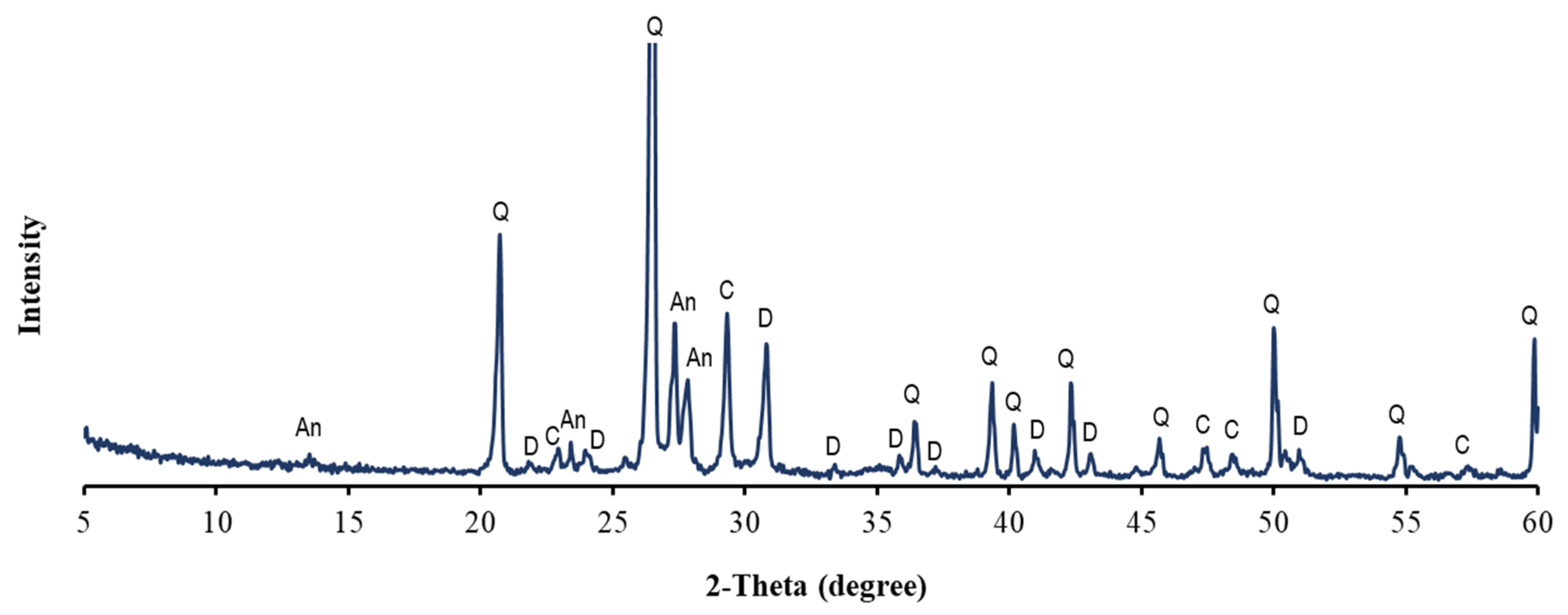
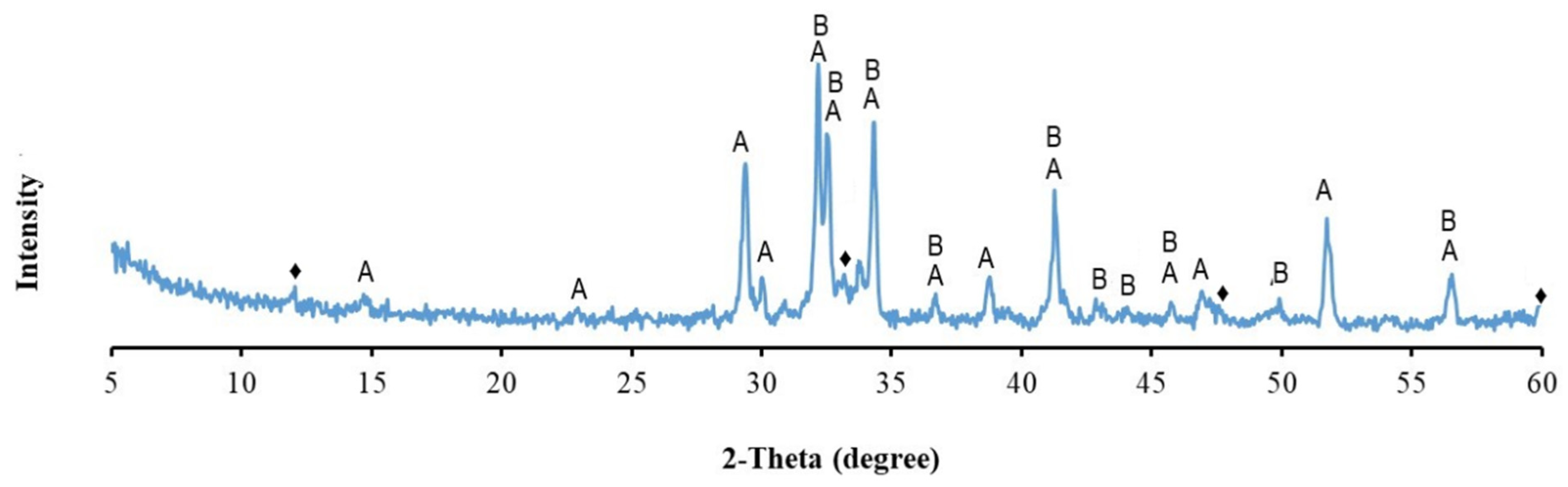
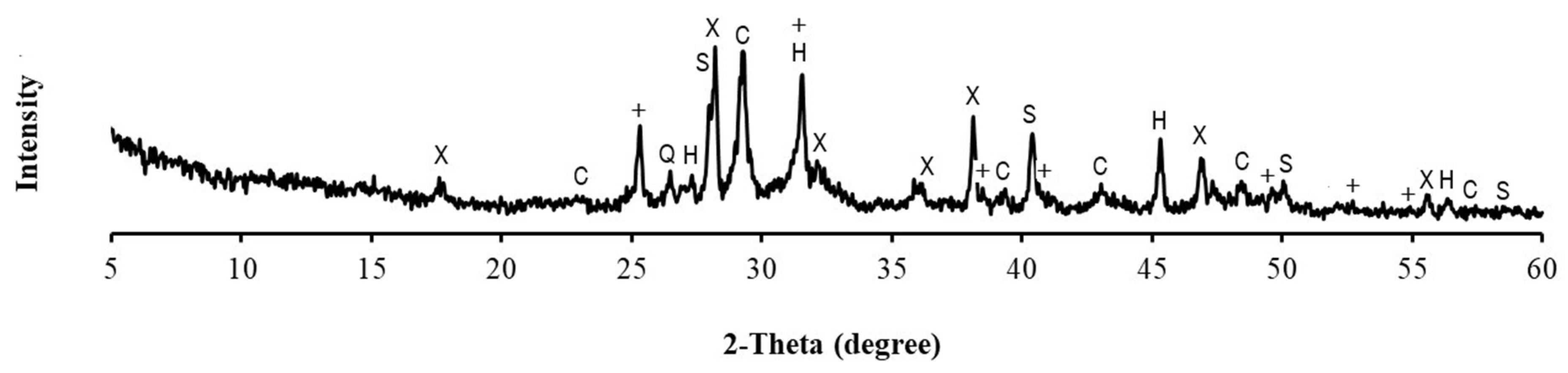
XRD pattern of sand reveals that it contains quartz, calcite, dolomite, and feldspar (Figure 1). Portland cement contains alite and belite (Figure 2). FA consists of crystalline compounds such as calcite, halite, sylvite, anhydrite, calcium chloride hydroxide CaCl(OH), and quartz (Figure 3). Raw MSWI FA appears as dust with a d90 of 54.3 µm and an average diameter of 27.1 µm.

2.2. Sample Preparation

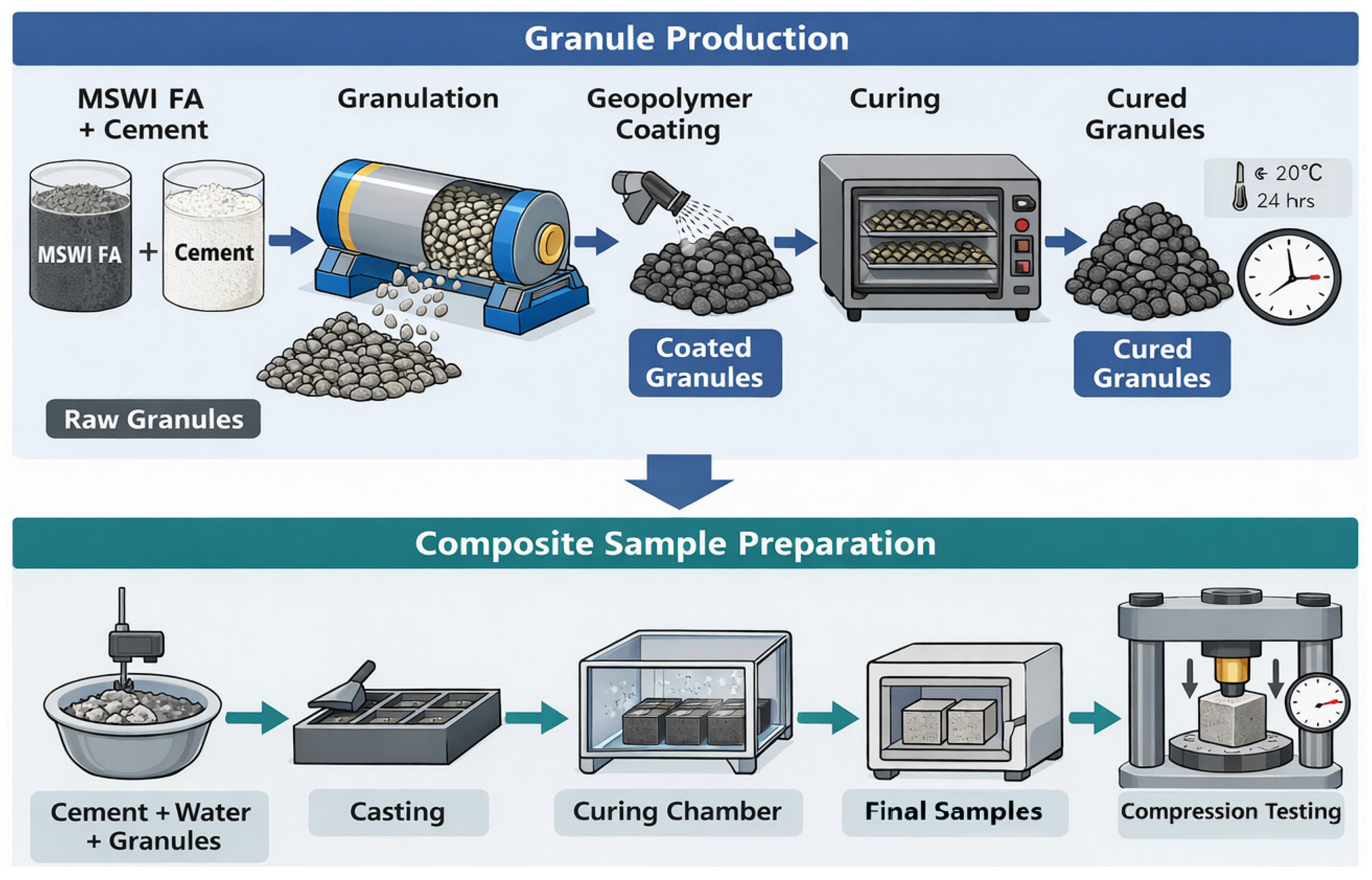
The composition of mortar samples is presented in Table 2. The dry components were mixed in a mixer for 3 min; then water was added and mixed for another 3 min at high speed. Then stop mixing, lift the mixture manually from the bottom, and blend for an additional 2 min at high speed. Cubic metal forms (40 × 40 × 40 mm) were manually filled with the mixture using slight vibration for 2–3 s. The samples were then covered with a film and left to harden at 20 ± 1 °C. After 24 h, the samples were demolded and placed in water at 20 ± 1 °C, where they remained until compression tests on the 7th, 28th, and 90th days after manufacture (Figure 4).
Prepared cementitious samples were measured and weighed before compression testing. Ultrasonic monitoring of structural changes was performed according to [38]. Changes in chemical composition after 5 days of water exposure were determined using crushed samples with a particle size of no more than 4 mm. This approach ensures the homogeneity of the analysed material and allows for more accurate and representative chemical analysis, particularly of leachable components, in accordance with European Standard EN 12457-1:2002 [39]. The grinding process enhances the reliability of elemental detection by eliminating surface contamination and capturing changes that may have occurred throughout the sample volume, rather than only on the surface. Testing after 5 days simulates potential environmental or operational leaching conditions. The observed chemical changes can help assess the material’s stability, ecological safety, and suitability for further applications (e.g., in construction composites).

2.3. Test Methods

2.3.1. Compressive Strength Test

Compressive strength measurements were performed using a Tinius Olsen universal testing machine (Tinius Olsen, Redhill, England), in accordance with the procedures outlined in EN 196-1 [40]. For each mix composition, a minimum of four 40 × 40 × 40 mm specimens were tested. The tests were conducted at 7, 28, and 90 days of curing to evaluate the development of strength over time.

2.3.2. Calorimetry Test and Thermal Analysis

Isothermal calorimetry was conducted using a TONICAL III semi-adiabatic calorimeter (Toni Technik GmbH, Berlin, Germany) to investigate the influence of FA-based artificial aggregates on the hydration of Portland cement. For each test, 100 g of a dry mixture consisting of 80 g OPC and 20 g additive (sand or granules, particle size 0.75–1 mm), and 35 g of water were used. Moreover, a cement composition incorporating initial MSWI FA was tested for comparison at the same proportions (80 g to 20 g, respectively) and water content. The heat-release rate and cumulative heat release were monitored over 48 h at 21 ± 1 °C.
Simultaneous thermal analysis, including thermogravimetric analysis (TG, DTG) and differential thermal analysis (DTA), was performed using a LINSEIS STA PT-1600 thermal analyser (Linseis, Selb, Germany). Approximately 20 mg of dried powdered sample was heated in ambient air from room temperature to 1000 °C at a constant heating rate of 10 °C/min. The obtained TG, DTG, and DTA curves were used to identify dehydration, decarbonation, and decomposition processes associated with cement hydration products and additives.

2.3.3. Chemical, Mineral Composition and Microstructure Analysis

The specimens tested for compression at 7, 28, and 90 days were dried at 65 °C for 5 h and then milled. The chemical composition of the samples before and after water soaking was analyzed using a ZSX Primus IV X-ray fluorescence (XRF) spectrometer (Rigaku, Osaca, Japan). XRD analysis was performed using a DRON-7 diffractometer equipped with a copper anode and a nickel filter. Measurement parameters were an anode voltage of 30 kV, an anode current of 15 mA, a scanning step of 0.02°, and an exposure time per step of 1 s. Peak identification on the XRD curve was conducted using the ICDD database. Microstructure observation and composition analysis were carried out using a JSM-7600F SEM microscope (JEOL Ltd., Akishima, Japan) with an X-Max Oxford energy dispersive X-ray spectrometer (EDS) (manufactured by Oxford Instruments plc, Abingdon, UK). The reported EDS results represent average values obtained from multiple spot and/or area analyses (n ≈ 5–10) and provide semi-quantitative information for comparative assessment of element distribution.

3. Results and Discussion

3.1. Characterisation of the Manufactured FA-Based Aggregates

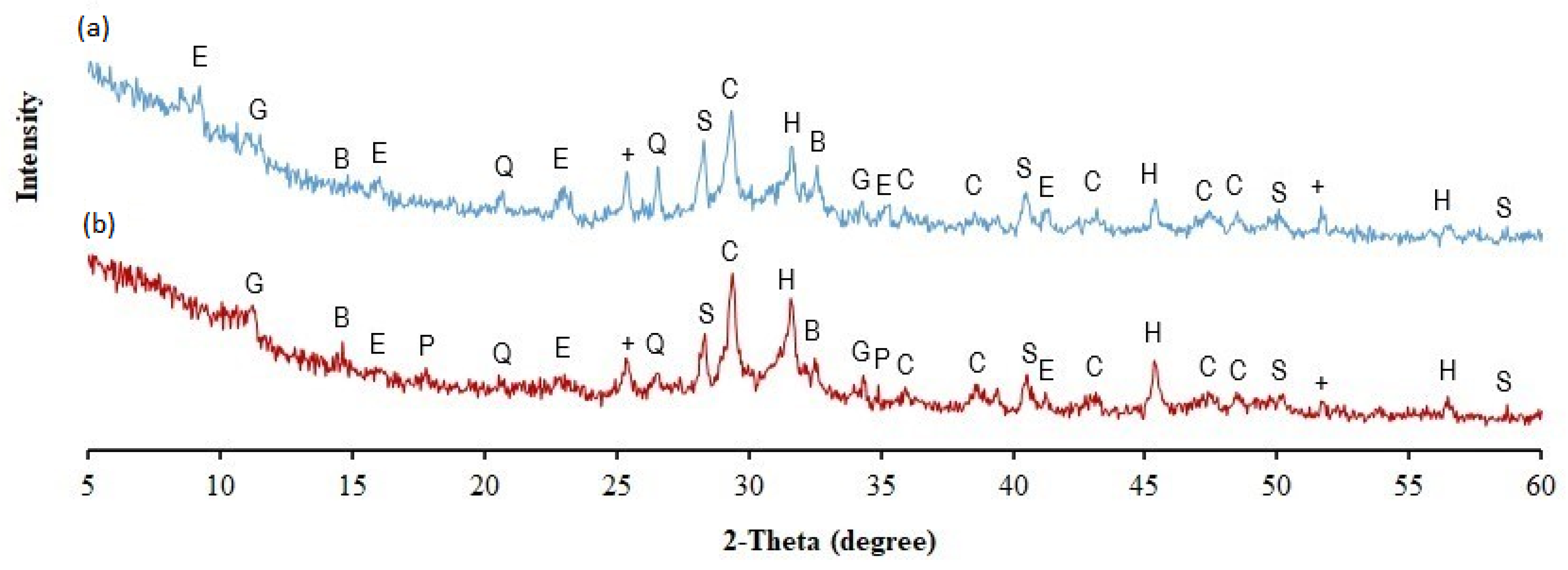
According to the XRD analysis results, calcite, anhydrite, and soluble salts such as halite and sylvite from the FA (Figure 3) remained in the PC-based granules after granulation (Figure 5a). The highly soluble calcium chloride hydroxide dissolved completely. Anhydrite reacted with water to form new phases such as gypsum and basanite, and through its reaction with Al(OH)4− ions released from C3A from PC (Figure 2), it contributed to the formation of ettringite. Moreover, the XRD halo observed between ~28° and ~33° indicated the presence of a C–S–H and other gel-like phases. The key difference between PCG and GEOG is the appearance of detectable portlandite reflections, an increase in the intensity of gypsum and halite peaks, and a lowering of ettringite and sylvite reflections (Figure 5b). The observed changes in the XRD pattern are likely attributable to the effects of the highly alkaline activator and the humidity of the geopolymer paste on the surface layers of PC-based granules during immersion in GEO. In the presence of a concentrated alkaline activator, partial dissolution of cement hydration products could occur, including C–S–H, ettringite (Ca6Al2(SO4)3(OH)12·26H2O), and sulfates such as gypsum, bassanite, and anhydrite, releasing Ca2+, SO42−, and Al(OH)4− into the pore solution. The elevated pH (high OH concentration) promotes supersaturation with respect to Ca(OH)2, leading to the crystallization of portlandite, which was not detected in PCG. The dissolution of ettringite and sulfate-bearing phases leads to the reprecipitation of gypsum, consistent with the observed increase in gypsum peak intensity. In contrast, the partial carbonation of newly formed portlandite could explain the increased calcite content. The presence of Na+ ions in the activator further shifts the chloride balance, increasing halite (NaCl) formation. At the same time, K+ can be partially incorporated into the GEO-matrix of the granule’s shell, reducing the intensity of the sylvite (KCl) peak. The addition of ~40 wt% geopolymer also dilutes the initial PCG phase composition, further reducing the relative intensity of ettringite reflections. Overall, these results indicate that the interaction between the alkaline GEO shell and the PC-based core initiates a dynamic redistribution of hydration and salt phases, characterized by the dissolution of early hydrates, the precipitation of portlandite and secondary sulfates, and carbonate formation, thereby modifying the phase assemblage at the interface.
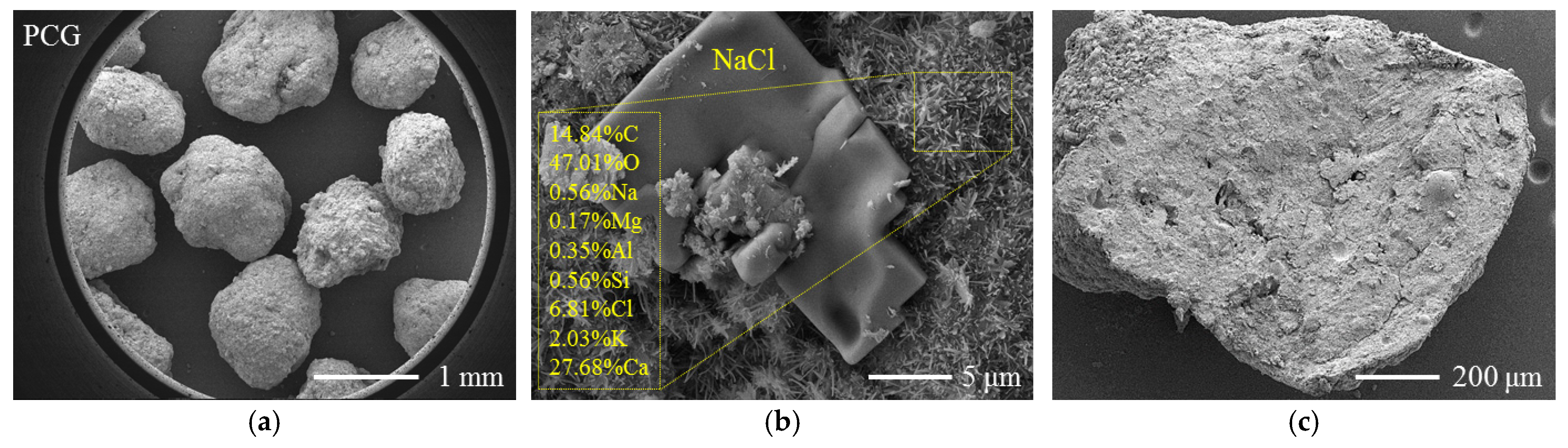
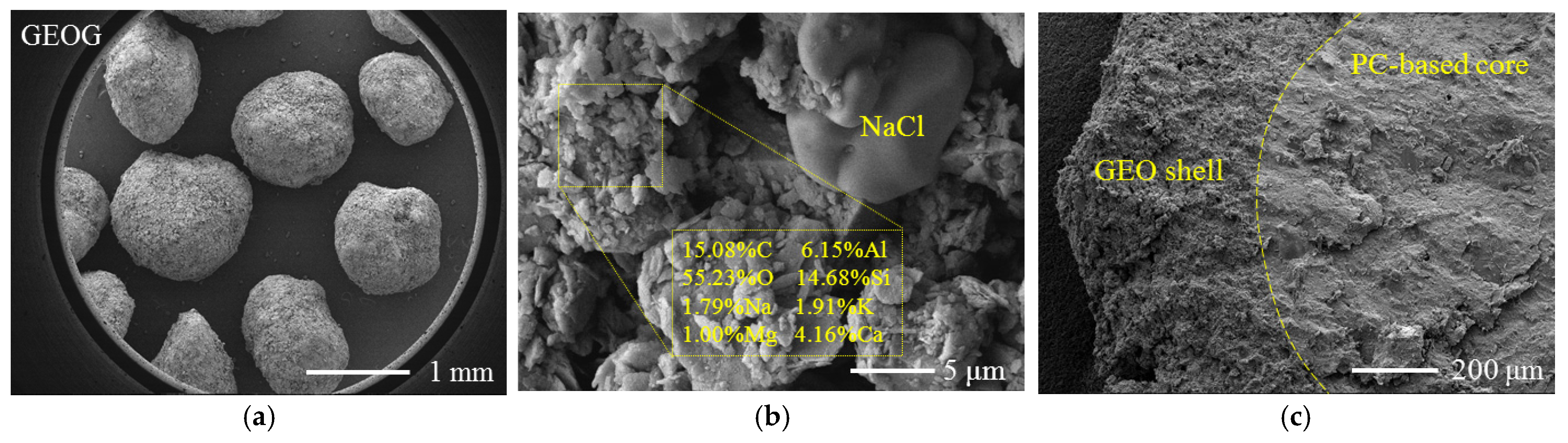
The morphology of the manufactured PCG and GEOG is shown in Figure 6a and Figure 7a, respectively. The granules are predominantly irregular in shape (Figure 6a and Figure 7a). PCG exhibits many recrystallized, coarser crystals of NaCl and KCl and fine crystals rich in Ca and Cl on their outer surfaces (Figure 6b), which are highly soluble and may influence the hydration process when PCG is incorporated into cement. Chloride accelerates hydration [41]; however, higher concentrations of Cl ions can inhibit the process in the early stages, followed by a later acceleration effect [42]. The geopolymer coating was applied by immersing the PC-based granule into the GEO paste. The absence of centrifugal forces during immersion resulted in a looser GEO-shell structure compared to the dense internal structure of the granule (Figure 6c and Figure 7c). However, the surface of GEOG contained many fewer crystals of soluble salts, confirming the expected protective role of GEO-shell (Figure 7b).
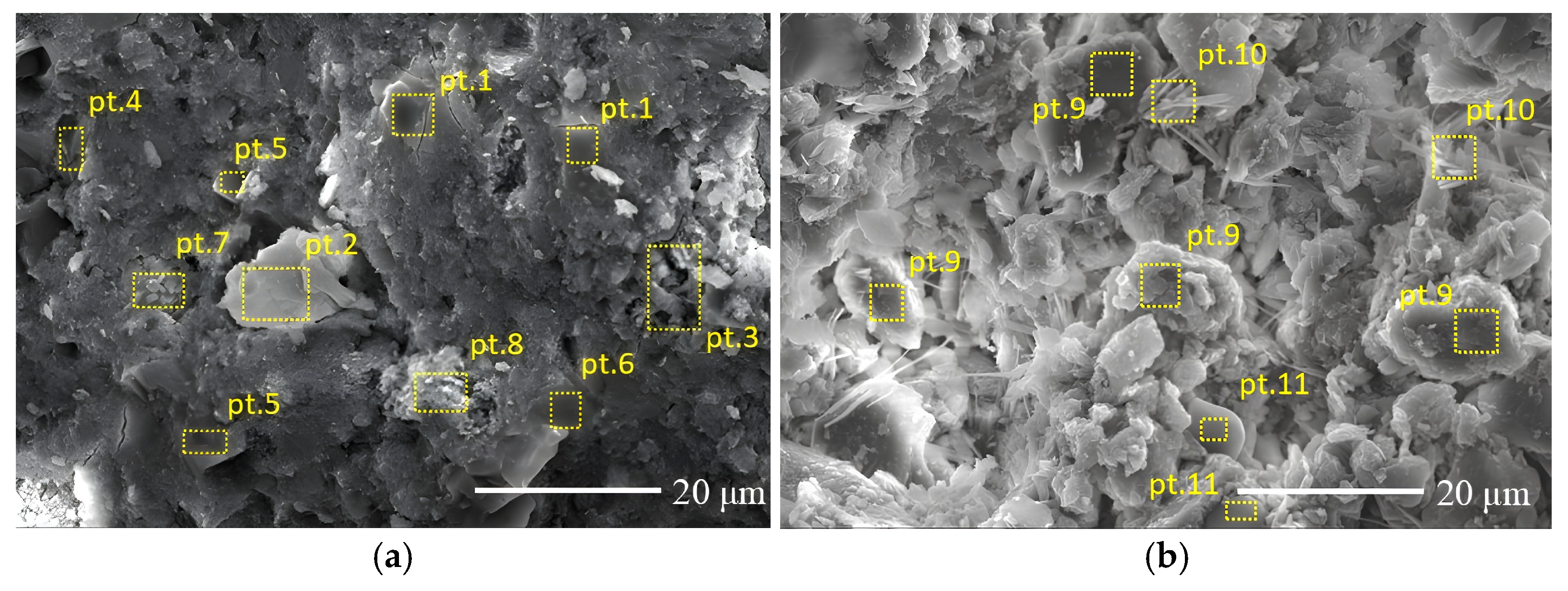
The typical microstructure of the PC-based core of the granules is shown in Figure 8a. A heterogeneous (C–S–H)-dominated matrix containing undissolved OPC clinker remnants (pt.1) and various finely dispersed secondary phases is observed. According to EDS analysis, very fine calcite particles are uniformly distributed throughout the matrix, consistent with the calcite reflections detected by XRD (Figure 5). In addition, mixed assemblages composed of CaCO3, CaSO4 (or CaSO4·0.5H2O), and CaCl(OH) (pt.2), as well as individual CaSO4 and CaSO4·0.5H2O-rich phases (pt.3, pt.4), were identified, directly supporting the presence of anhydrite-, gypsum-, and bassanite-related reflections in the XRD patterns. Discrete KCl (pt.5) and NaCl (pt.6) crystals observed by SEM correspond well with the halite and sylvite peaks detected by XRD, while their localized and coarse morphology explains the relatively high intensity of these reflections despite their limited volumetric fraction. Poorly identifiable crystals (pt.7) and accumulations (pt.8) are likely associated with poorly crystalline or mixed phases, which contribute to the broad amorphous halo between ~28° and 33° 2θ observed in XRD and attributed to C–S–H and other gel-like hydration products.
The microstructure of GEO-shell (Figure 8b) consists mainly of N-A-S-H gel fragments (pt.9), needle-like zeolite crystals (pt.10) and scaly shaped residues of metakaolin Al2O3·2SiO2, phases that are predominantly X-ray amorphous or poorly crystalline and therefore produce only a diffuse background in the corresponding XRD patterns. The rare occurrence of NaCl particles (pt.11) in the GEO shell is consistent with the increased intensity of halite reflections in the XRD pattern and confirms the partial immobilization of soluble salts by the geopolymer layer (Figure 5b).
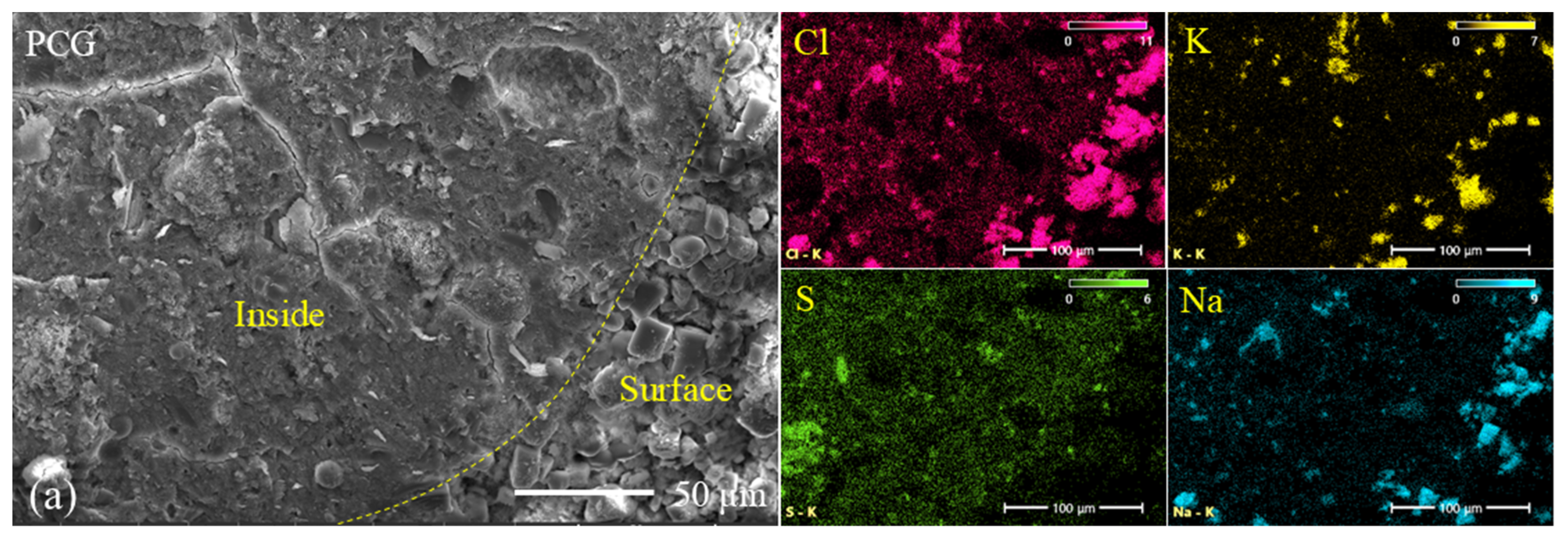
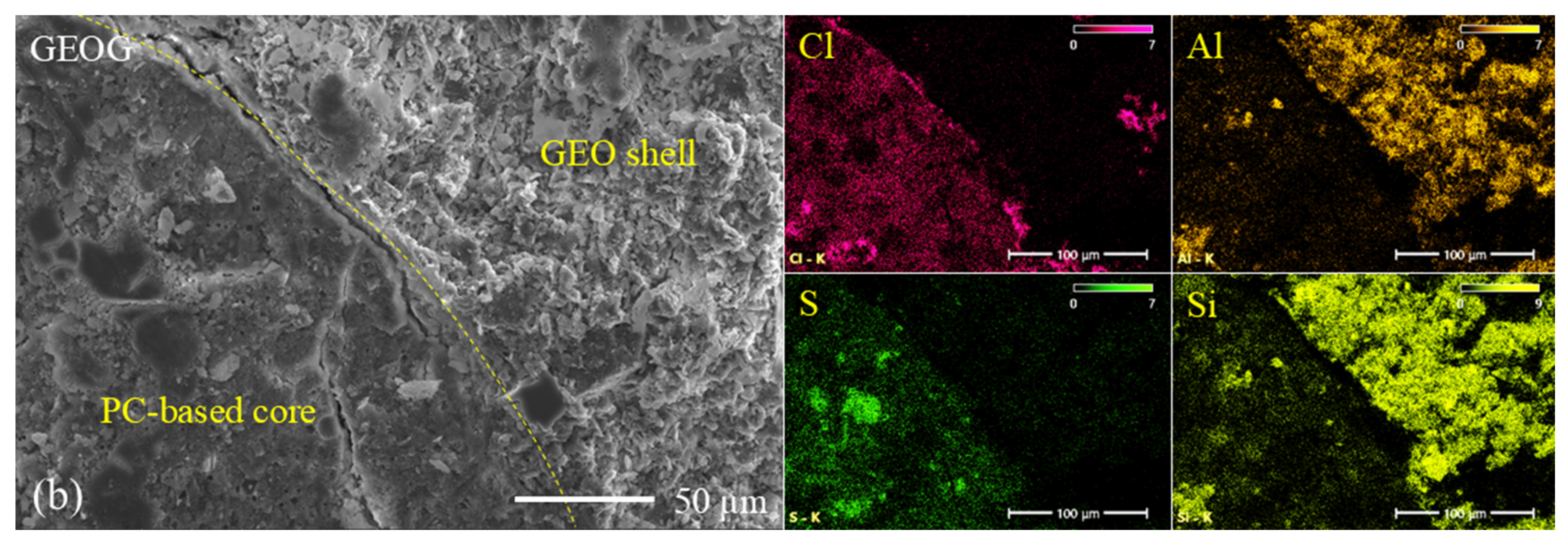
X-ray elemental mapping further corroborates the phase assemblage inferred from XRD. For PCG (Figure 9a), chlorine and sulfur are widely distributed throughout the internal structure of the granule and also concentrated in discrete particles, confirming the coexistence of chloride- and sulfate-bearing phases such as halite, sylvite, gypsum, and ettringite identified by XRD. The enrichment of Na and K at the PCG surface, as observed in the elemental maps, accounts for the pronounced halite and sylvite reflections in the corresponding diffraction patterns. In contrast, for GEOG (Figure 9b), Si and Al maps clearly delineate the geopolymer shell from the PC core, whereas chlorine and sulfur remain confined primarily within the PC-based core. This spatial immobilization of Cl and S directly accounts for the changes in chloride- and sulfate-related XRD reflections in the GEO-coated granule and confirms that the GEO shell acts as an effective barrier, limiting elemental migration.
The phase transformations inferred from XRD analysis are strongly supported by the elemental distribution revealed by SEM/EDS. In particular, the appearance of portlandite reflections in GEOG (Figure 5b) correlates with the increased availability and redistribution of Ca detected in the PC-based core, as evidenced by the Ca-rich regions observed in EDS maps (Figure 9b). Simultaneously, the reduced intensity of ettringite reflections is consistent with the partial dissolution of sulfate- and aluminum-bearing phases, which is confirmed by the distribution of sulfur within the PC core and its limited presence in the GEO shell. The increased intensity of gypsum reflections in GEOG corresponds well with localized S-rich and Ca-rich domains detected by EDS, indicating reprecipitation of calcium sulfate phases following the dissolution of primary sulfates and ettringite under highly alkaline conditions.

3.2. Isothermal Calorimetry Test

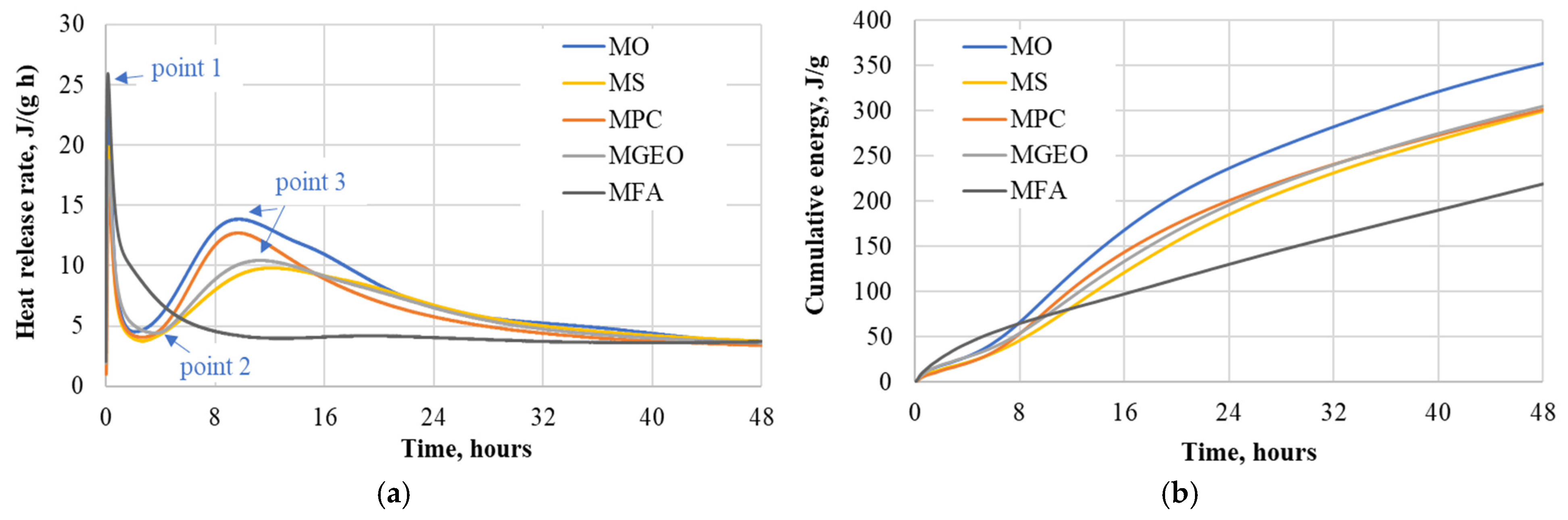
After mixing Portland cement with water, complex physical and chemical processes known as hydration begin, leading to the hardening and strength development of the cement paste. This process can be divided into several stages [43,44,45]. The initial stage involves the rapid wetting and dissolution of the cement minerals in water, releasing Ca2+, Al3+, OH and SO42− and saturating the solution with ions. This stage lasts for up to tens of minutes, with the maximum heat-release rate (HRR) corresponding to the first peak in the calorimetric curve (Figure 10a, “point 1”). It is followed by the second–induction (dormant)–period, during which reactions of dissolution and saturation are slow while ettringite and C–S–H nuclei form. During this period, the cement paste remains workable, and the workability typically lasts 2–4 h. Once the concentration of ions reaches a certain level, the acceleration stage begins (Figure 10a, “point 2”), characterized by rapid C–S–H and portlandite precipitation, significant heat evolution, and strength development. The maximum heat-release rate associated with this stage corresponds to the second peak in the calorimetric curve (Figure 10a, “point 3”). Afterward, the stages of deceleration and slow, ongoing hydration follow, leading to a gradual densification of the microstructure and long-term hardening.
When FA was introduced directly as dust, as in the sample MFA, the mortar showed a strong initial peak corresponding to the dissolution of soluble phases, which had the highest HRR1 among all compositions at 25.93 J/gh—even surpassing the neat cement’s mortar (24.12 J/gh) (Table 3). However, the second peak, associated with crystalline hydrate formation, is missing, indicating disrupted cement hydration within the first 48 h. This is generally consistent with findings reported in other works [46,47,48], which show that soluble salts such as KCl, NaCl, and CaSO4 can increase pH and ionic strength, thereby accelerating early hydration. Elevated concentrations of Cl and SO42− may interfere with the nucleation and growth of stable hydrate phases at later stages [26,41,42]. In addition, heavy metals such as Zn2+ and Pb2+ are reported to strongly inhibit clinker hydration by adsorbing onto reactive surfaces and forming poorly soluble hydroxide or complex layers, effectively suppressing C–S–H development [49,50]. Consequently, the mixture remains porous and fails to harden. These chemical effects, combined with the high specific surface area of FA dust and the resulting increase in water demand, jointly contribute to the disappearance of the second exothermic peak and to the system’s failure to harden. Overall, the calorimetric analysis demonstrates that the incorporation of 20 wt.% FA in the form of fine dust leads to pronounced deviations from normal PC hydration behavior (Figure 10).
On the contrary, mixtures (MPC and MGEO) containing 20% granulated FA exhibited a well-defined peak for the second exothermic event and hydration behavior generally similar to that of the reference M0 and MS compositions. In the early curing hours, MPC released more heat than samples with sand (MS) or GEO-coated aggregate (MGEO), and its heat-release profile closely resembled that of pure cement (M0) (Figure 10a). This occurs because chloride ions released from the granulated FA accelerate hydration, as chlorides are known to promote Portland cement setting [42], causing the peak heat release rate of MPC (10h) to shift by up to two hours on the acceleration side compared to MS (12.1 h) and MGEO (11.9 h) samples. In the case of uncoated PCG, the kinetics are more similar to those of pure cement. In contrast, the GEO-shell delays hydration, making the behavior more comparable to that of sand-containing samples. The GEO-shell acts as a barrier, encapsulating FA components and salts, thereby rendering the aggregate more inert and supporting the idea that harmful ions are effectively isolated.
Compared with pure cement mortar, the total heat released after 48 h decreased by 15.2%, 13.4%, and 14.5% with 20% replacement of cement by sand, PCG, and GEOG, respectively (Table 3), reflecting the combined effect of the reduced part of active material (cement) and the increased W/C ratio due to dilution. Thus, despite differences in early hydration kinetics, the total heat released after 48 h was nearly the same across mixes containing sand or FA granules (Figure 10b) and was 299–305 J/g (Table 3). Indicating that the applied FA granulation generally reduces the effect of soluble salts on Portland cement hydration and normalizes it in comparison with raw FA.

3.3. Thermogravimetric Analysis

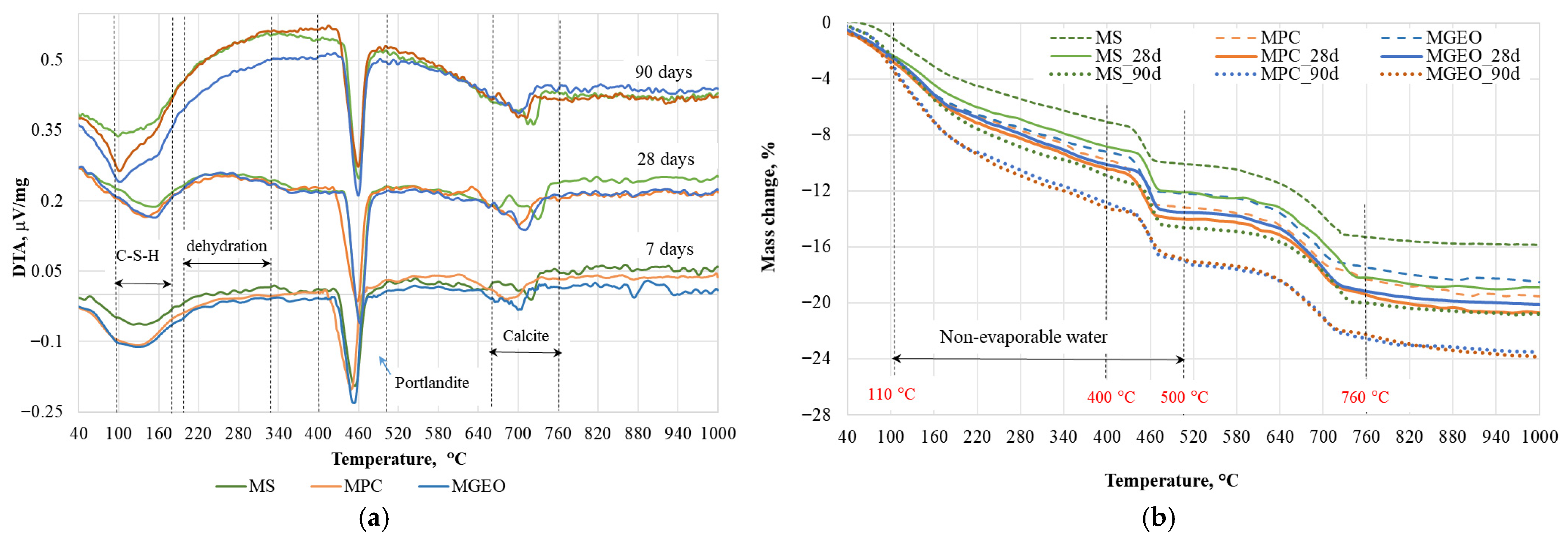
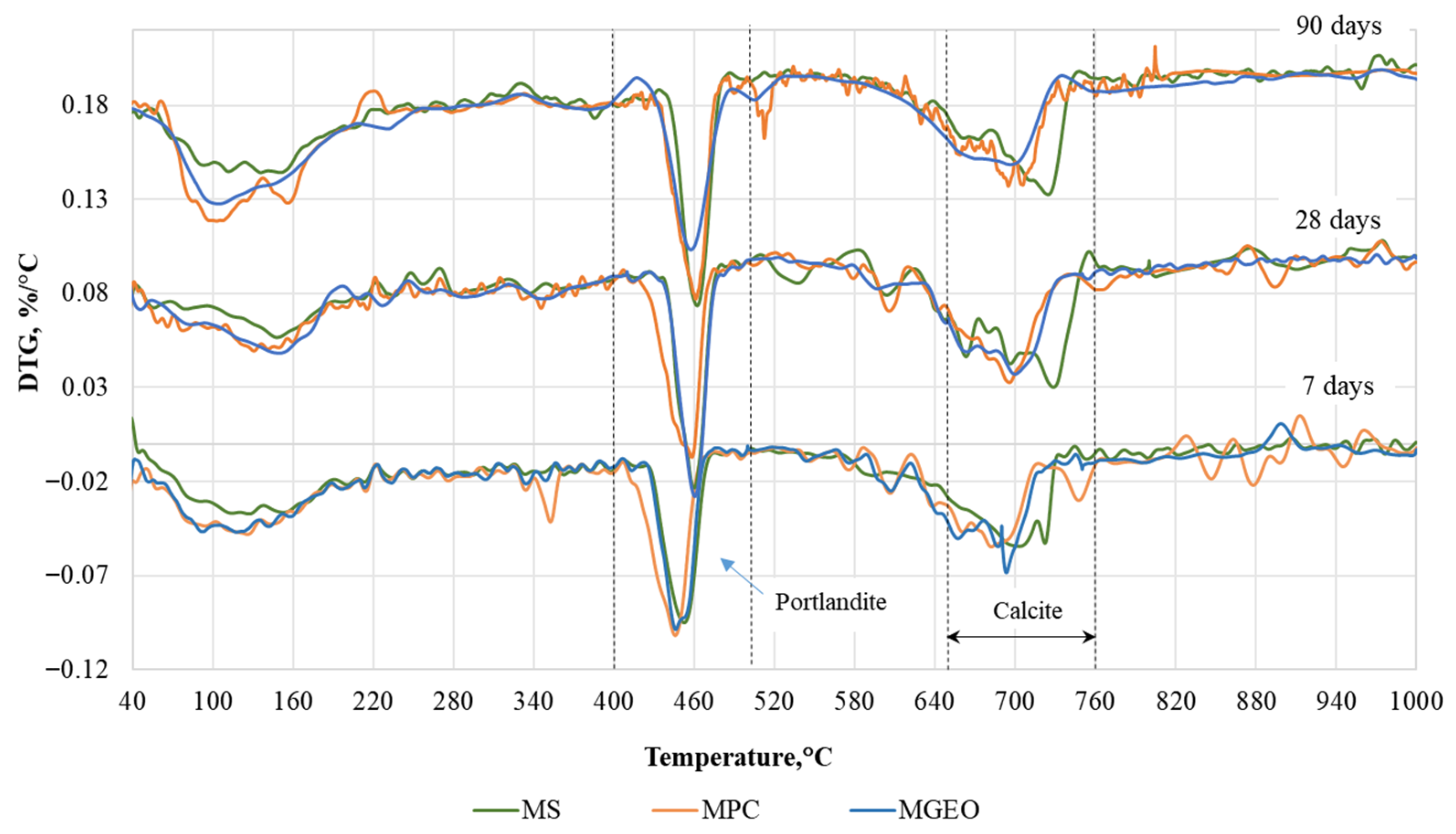
Differential thermal analysis (DTA) and thermogravimetric analysis (TG, DTG) were employed to study phase transformations in cementitious composites with different aggregates at 7, 28, and 90 days of curing (Figure 11). The mass losses within key temperature intervals are summarized in Table 4 and interpreted in accordance with previously established thermal decomposition ranges [51]. An increase in mass loss in one sample compared to another generally indicates a higher content of certain phases, particularly hydrates, portlandite, and carbonates [52]. The temperature range of 110–330 °C reflects the dehydration of AFm/AFt, C–S–H/C–A–H and C–A–S–H. Between 400 and 500 °C, portlandite decomposes, while CaCO3 decomposes between 650 and 760 °C. At higher temperatures, complete dehydroxylation of portlandite, decomposition of residual C–S–H phases, and decarbonation of carbonate phases occur, leading to further mass loss [53,54]. The amount of portlandite (mpd) present in the tested sample (Table 4) was calculated by [38]
m p d = m 400 500 74.09 18.02 ,
where m400–500, %, is the mass loss in the sample that decomposed in the 400–500 °C temperature range during the TGA analysis (Figure 10); 74.09/18.02 is the molar mass ratio of CaOH/H2O. Calcite amount CaCO3 (Table 4) was defined as [38,52]
m c a l = m 650 760 100.09 44.01 ,
where m650–760, %, is the mass loss in the sample that decomposed in the 650–760 °C temperature range during the TGA analysis (Figure 11); 100.09/44.01 is the molar mass ratio of CaCO3/CO2.
Samples with granules exhibited greater mass loss in the 110–330 °C range than the sand-containing MS sample. This loss was particularly pronounced after 90 days of curing, indicating the buildup of hydrates over time. Notably, in the 110–170 °C range (attributable to ettringite and hydrogel C–S–H decomposition), the MPC and MGEO samples experienced mass losses of 2.73–2.82% after 28 days and 3.65–4.02% after 90 days, that is 22–25% and 16–28% higher than the MS sample, respectively (Table 4). In the 180–330 °C range, which corresponds to further hydrate decomposition, the MPC and MGEO samples lost 2.93–3.03% (28 days) and 3.42–3.8% (90 days), compared to 2.6% and 3.34% for MS. This indicates that granules, especially uncoated, actively participated in PC hydration and contributed additional hydrate phases. The geopolymer coating had no significant effect on the formation of portlandite in the PC matrix, as MS and MGEO mass losses were nearly identical across this temperature range, indicating the inert nature of GEOG. Conversely, samples containing the uncoated PCG had the highest portlandite content 16.65% after 90 days, which can be due to the accelerating effect of soluble salts, presented on the surface of PCG, and to the additional cement content from unreacted PC minerals within the granule. Between 650 and 760 °C, several DTG peaks corresponding to CaCO3 decomposition were observed (Figure 12). These variations in peak shape and temperature are linked to carbonate particle size, crystallinity, impurities, and specific surface area. The MPC and MGEO samples exhibited their principal CaCO3 decomposition peak at approximately 690 °C, whereas the MS reference showed a higher-temperature peak near 730 °C. Additional decomposition peaks appeared in MPC between 600 and 700 °C over the curing period, reflecting internal structural heterogeneity in the newly formed carbonates. The MS develops a greater amount of secondary calcite via pore-solution carbonation, resulting in mass losses of 10.60% at 28 days and 9.35% at 90 days. In contrast, MPC shows lower mass losses of 9.01% and 8.71%, respectively, because part of the available Ca is incorporated into Ca–Al–Cl hydrates rather than remaining free for carbonation. MGEO (geopolymer-coated granules) exhibits the lowest carbonation, with only 8.03% mass loss after 90 days, indicating that the geopolymer coating stabilizes the granule surface and limits CO2/OH ingress into the granules.
At higher temperatures (760–1000 °C), granule-containing samples (MPC and MGEO) lost 0.93–1.61% of their mass, whereas MS lost only 0.56–0.76%. At ~880 °C, the MGEO sample (7 days) exhibited a distinct endothermic DTA peak (Figure 10a), whereas its mass loss was only 1.05%, lower than MPC (1.21%) but higher than MS (0.56%) (Table 4). After 90 days of water curing, soluble salt leaching from MGEO increased, leading to a mass loss of 1.605–more than MPC (0.97%) and MS (0.76%). This suggests salt migration, consistent with the XRF test results (Table 5), in which Cl counts increase in MGEO after 90 days of water curing to 0.73% in comparison with 0.69% after 28 days of curing. In contrast, in MPC, Cl counts decrease during curing, from 0.83% at 28 days to 0.8% at 90 days.

3.4. XRD Analysis

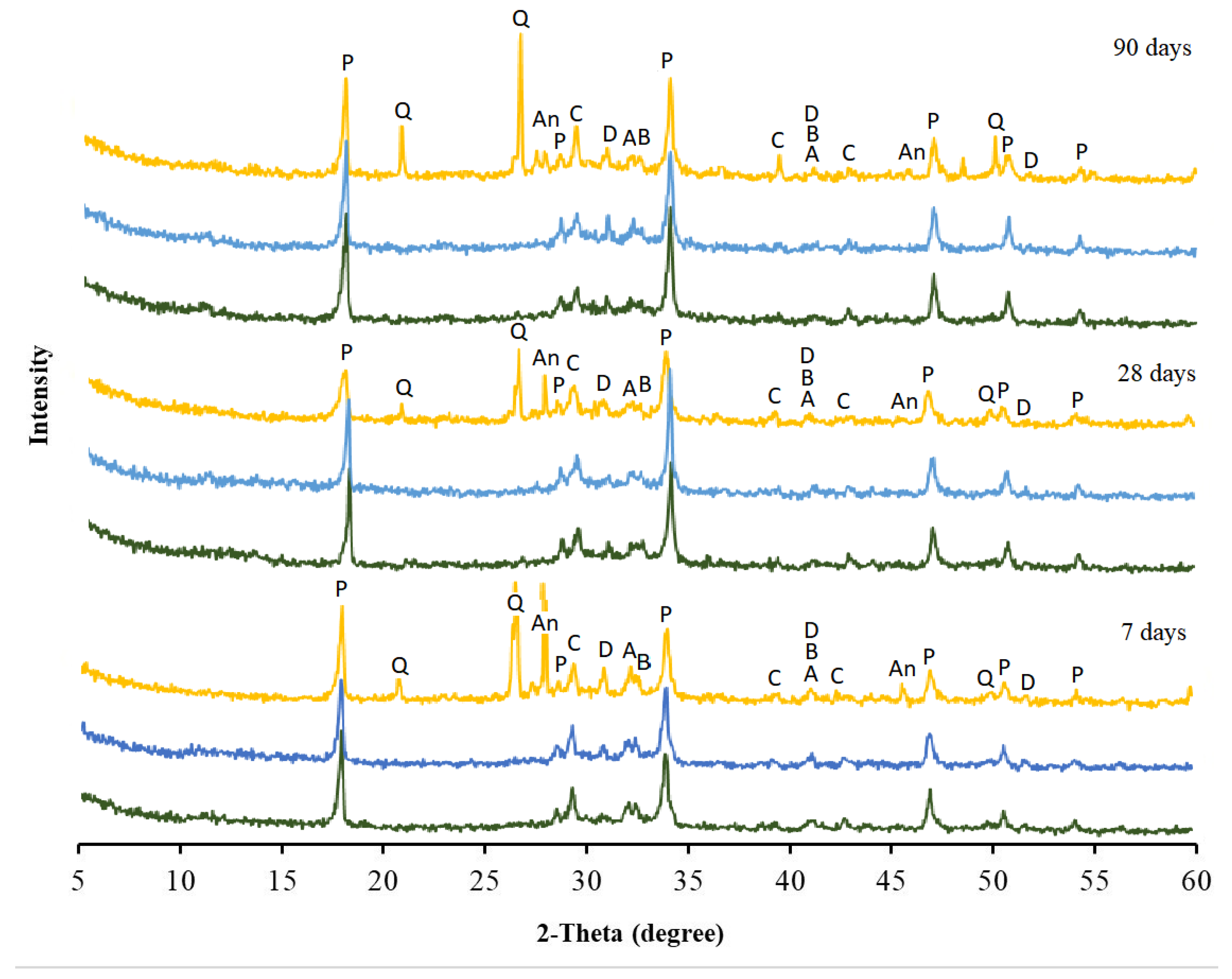
X-ray diffraction (XRD) analysis of compositions (Figure 13) revealed the presence of the formed portlandite (P) in all investigated samples, regardless of the additive used. The phases identified were calcite (C) transferred from the additive sand (Figure 1) and FA (Figure 3), and alite (A) and belite (B) from the PC composition (Figure 2). Dolomite was identified in the MGEO sample as a component of the geopolymer. The sand-containing sample additionally exhibited characteristic peaks of quartz (Q), dolomite, and anorthite, which are components of sand (Figure 1). During curing periods of 7, 28, and 90 days, the XRD patterns indicate a stable phase composition, except for sample MS, in which the anorthite content decreased over time. At this time, portlandite, as the dominant hydrate, is present in all samples. These results suggest that although FA-based granules introduce microstructural modifications and participate in hydration, they do not substantially alter the crystalline phase assemblage of the hardened cement paste.

3.5. SEM–EDS Analysis

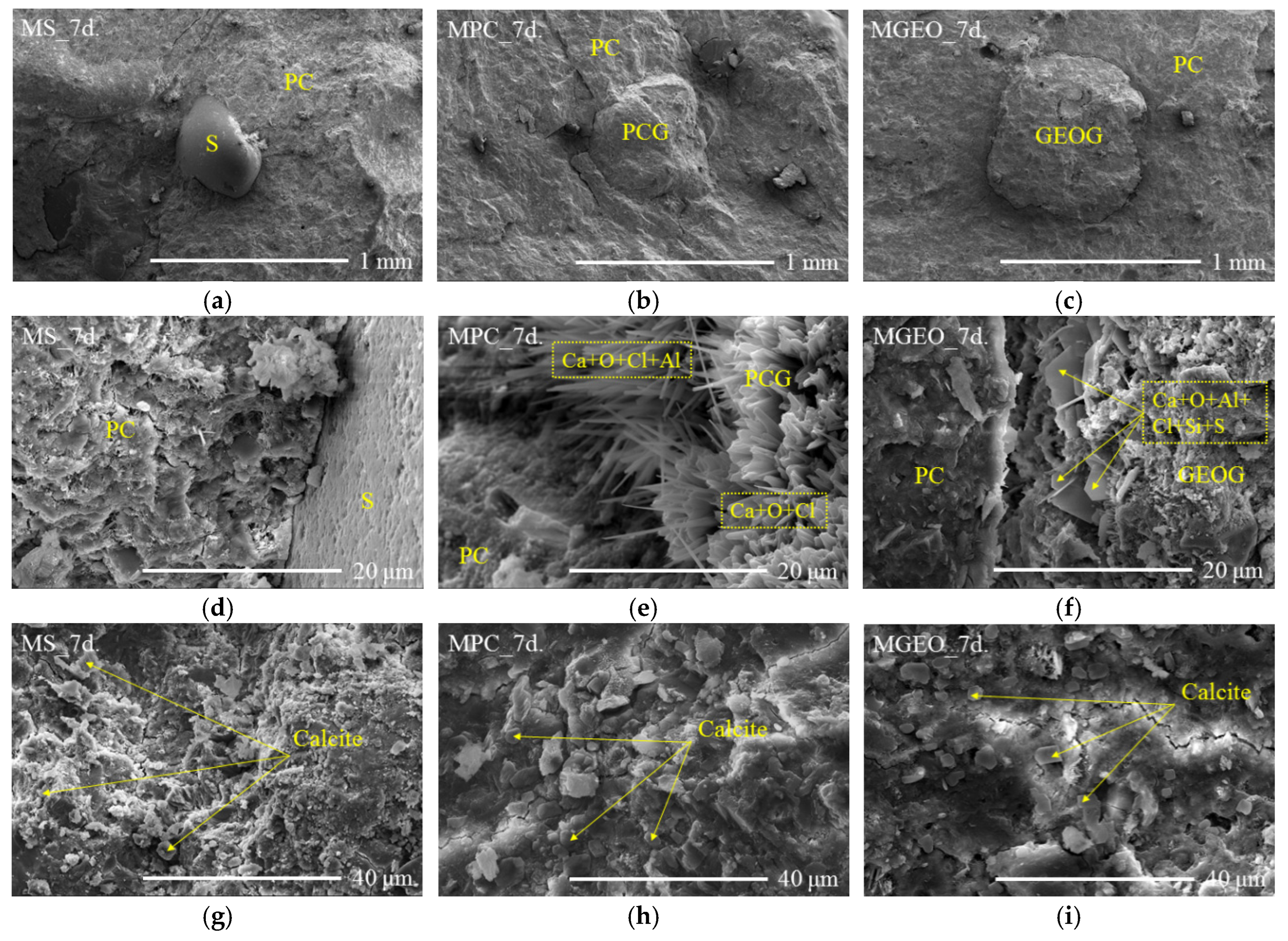
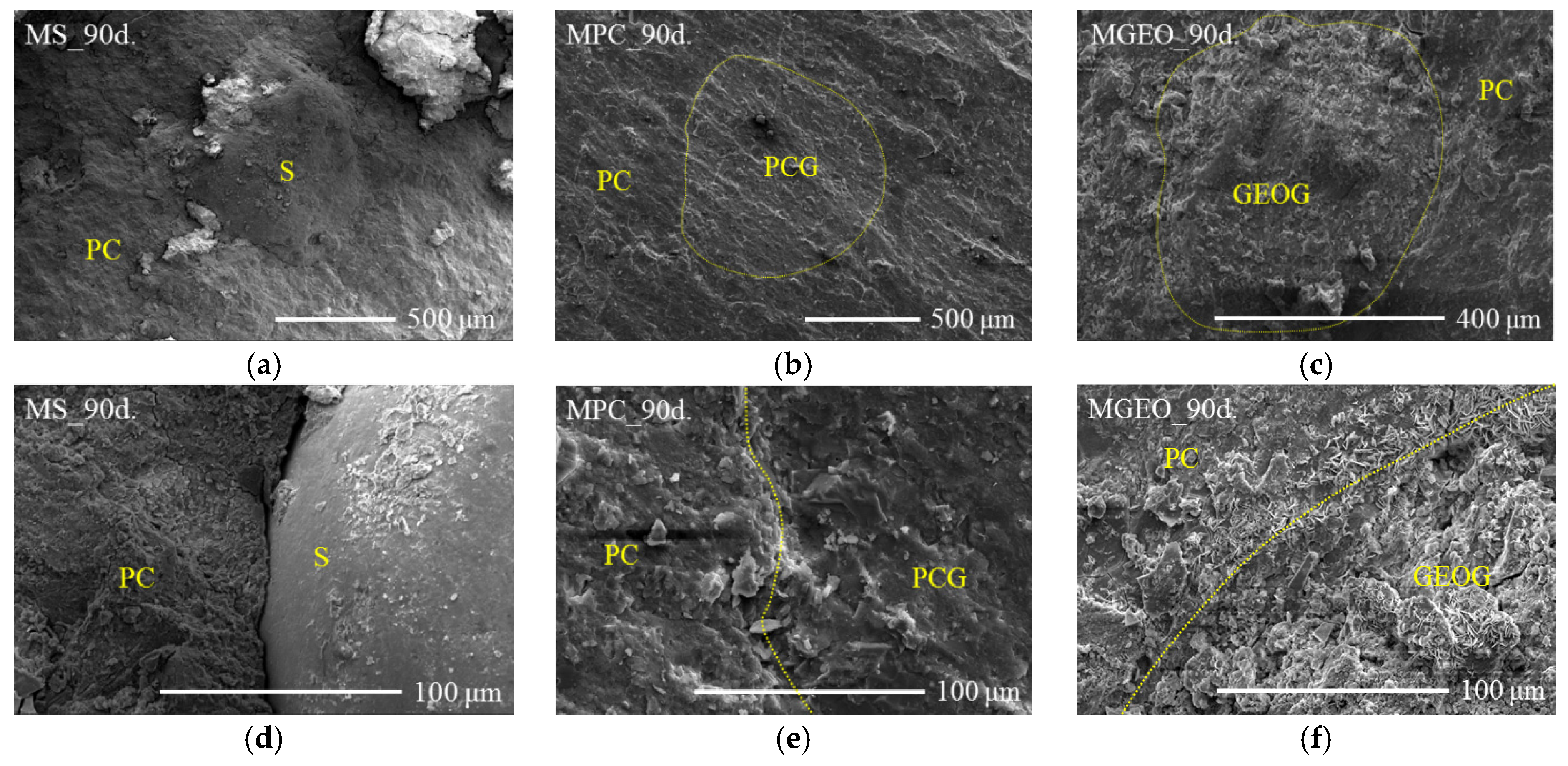
SEM–EDS analysis of the chemical composition of characteristic crystalline phases at the granule–matrix interface and within the granules was evaluated by multiple spot and area analyses. The reported Ca, Al, Cl, and S contents (wt.%) should therefore be interpreted as semi-quantitative, locally representative values describing phase-specific chemistry and ion redistribution, rather than bulk-averaged statistical data. The general view of the sand particle and the studied granules incorporated in a PC matrix is shown in Figure 14. Both PCG and GEOG are firmly incorporated in the PC matrix with no visible gaps or pores at the interface. The solubility of quartz (sand) in cement-water solutions is very low. After 7 curing days, the sand particle retains a smooth surface and a clear interface with the matrix (Figure 14d). For PCG and GEOG, crystal growth was observed at the interface with the PC matrix after 7 days (Figure 14e,f). For PCG, two characteristic groups of crystalline phases are formed. The first consists of long needle-shaped Ca-rich crystals containing Cl and Al (up to 6.4 and 3.2 wt.%, respectively), corresponding to Ca–Al–Cl hydrates such as basic calcium chloroaluminate. These crystals form dense bundles of parallel needles up to several tens of micrometers long, exhibiting an AFt-like morphology; however, the absence of sulfur indicates that they are not true AFt phases but Ca–Al–Cl needle-like hydrates. The second group includes columnar or prismatic crystals rich in Ca and Cl but lacking Al; their morphology corresponds to basic calcium chloride (CaClOH), which crystallizes as coarse columns and compact aggregates. In the case of GEOG, at the interface, the presence of hexagonal-shaped crystals rich in calcium, oxygen and aluminium, and containing up to 4.3 mas.% Cl along with some quantities of Si and S was detected (Figure 14f). Such morphology is typical for AFm phases (a hydrocalumite-like structure with general formula [Ca2(Al,Fe)(OH)6]·X·xH2O, where X is an exchangeable interlayer anion). The presence of Cl allows for this structure to be attributed to Fridel’s salt (X = Cl) [56]. However, due to the limited chloride concentration at the external part of geopolymer-covered granules, the amount of these crystals at the interface was insignificant.
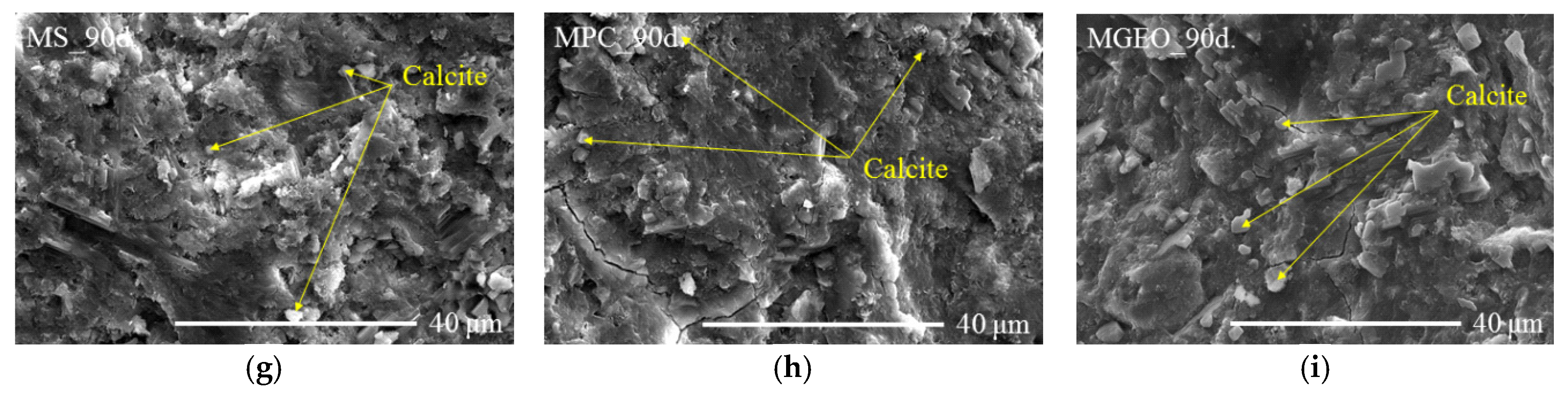
The fracture in the MPC and MGEO samples after compression occurred partially along the interface between the granules and matrix and partially through the granules. In all the studied compositions, a compact cement matrix was formed and many calcite crystals were observed (Figure 14g–i), consistent with the results of XRD analysis (Figure 13).
According to EDS analysis of MPC and MGEO samples after 7 days, the concentrations of Cl and S were as follows: inside granules—approx. 1.1–1.3% Cl and 0.7–1.0% S for PCG, and approx. 1.4% Cl and 0.4% S for GEOG; in the Portland cement matrix near the granules—approx. 1.3–1.4% Cl and 0.7% S for both granule types. The initial concentration of Cl in PCGs is 7.5% and 3.41% in GEOG (Table 1). This indicates that the release of Cl and S from granules led to their migration and redistribution after 7 days, but this process was effectively mitigated in subsequent stages of hydration. The concentrations of Cl and S in the matrix decreased with increasing distance from the granule, reaching near-zero values in some regions of the cement matrix.
After 90 curing days, the boundary between the matrix and the granules became less visible. Unlike MS (Figure 15a,d), the fractures of the samples MPC and MGEO occurred mainly within the granules, indicating that further structural integration of granules into the matrix occurred and that the strength along the interface increased (Figure 15b,c,e,f). In the case of PCG, the needle-like crystals disappeared and a compact structure formed at the interface, which did not visibly differ from the rest of the sample (Figure 15e). For GEOG, the formation of many plate-like crystals at the interface zone made it more distinguishable (Figure 15f). Both MPC and MGEO samples retained a compact microstructure of the matrix, which did not differ from the control sample MS (Figure 15g–i).
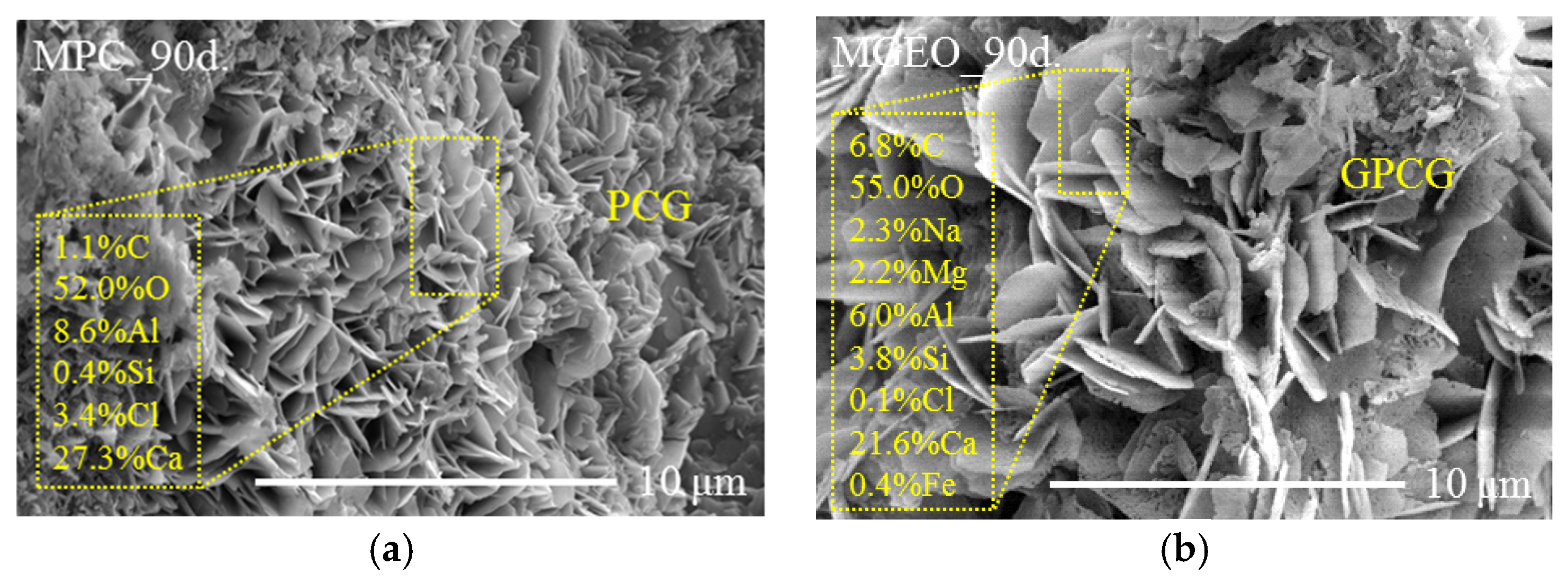
After 90 curing days, microscopic analysis of the internal part of PCGs incorporated into the PC matrix revealed accumulations of crystals with morphology typical of AFm phases and composition close to that of Fridel’s salts (Figure 16a). In the PC-based core of the granules covered with geopolymer, such structures were not observed. The interface between the GEO shell and the cement matrix (Figure 15f) contained plate-like crystals with a significant amount of carbon (~6.8 mas.%) and only traces of chloride (Figure 16b). This allows us to assume a monocarbonate AFm-type phase formation here rather than Fridel’s salts. The presence of Fridel’s salts in PCG and their absence in GEOG may indicate a limited water supply within GEOG, supporting the assumption that the GEO shell acts as a barrier, reducing water access inside the granule.
EDS analysis of MPC and MGEO samples after 90 days showed that Cl and S remain primarily concentrated in the PC-based part of both granule types and in the cement matrix near the granules, with concentrations up to 1.4% and 0.6%, respectively. The rest of the PC matrix contained approximately 0.2% Cl and 0.5% S. This distribution did not differ significantly from that after 7 curing days, indicating that the most intensive redistribution of ions occurred within the first days of curing.

3.6. Mechanical and Physical Properties

A critical factor limiting the amount of waste and recycled aggregates that can be added to cementitious systems is their adverse effect on mechanical strength. Previous studies [17,18,26,57] have reported that incorporating fine dust, including those derived from FA, often results in a progressive reduction in mechanical performance, thereby limiting their widespread use in building materials. In the present study, the strength-related characteristics of mortar samples incorporating FA-based granules were evaluated.
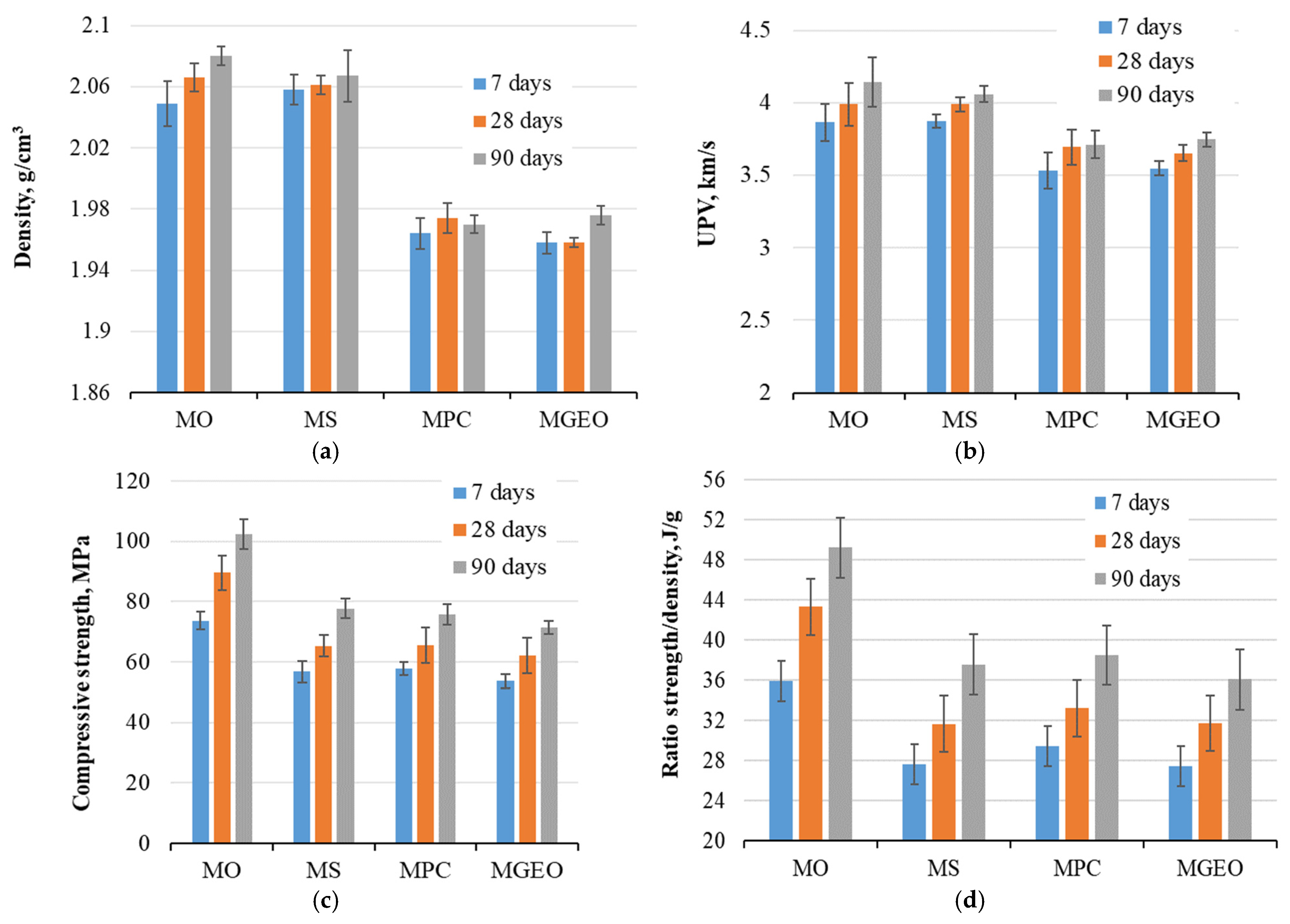
The density of the MPC and MGEO samples, which contain FA-based granules, was approximately 4.4% lower than that of the reference samples with quartz sand (MS) (Figure 17a). Ultrasonic pulse velocity (UPV), which correlates with material homogeneity and integrity [58,59], was lower in granule-containing samples by 8.5% after 7 days of curing, 7.5% after 28 days, and 8.4% after 90 days, as compared to sand-containing specimens (Figure 17b). Since SEM analysis has shown a similarly compact matrix structure across all compositions, the reduction in UPV can be attributed to the granules’ lower density, approximately 40% lower than that of natural sand.
Despite lower UPV and density, the compressive strength of MPC samples was nearly identical to that of samples containing sand (MS): 57 MPa at 7 days, 65 MPa at 28 days, and 76 MPa at 90 days (Figure 17c). The samples incorporating GEO-coated granules (MGEO) exhibited marginally reduced compressive strength: 54 MPa, 62 MPa, and 71 MPa at the corresponding curing times. Overall, mortars with 20% cement replacement by aggregate (sand or granules) exhibited average strengths that were approximately 23%, 27%, and 25% lower than those of pure cement paste at 7, 28, and 90 days, respectively.
The strength-to-density ratio was highest for the MPC sample, surpassing the MS reference by 6.6%, 4.8%, and 2.4% at 7, 28, and 90 days, respectively (Figure 17d). This enhanced ratio suggests that structures fabricated from this composition could achieve higher strength at a given mass or, conversely, lower mass for comparable load-bearing performance.
The work [17] noted that the strengths of the samples with FA after 565 days are lower than those at 90 days. This decrease in strength, observed under nonaggressive storage conditions, remains unexplained. Therefore, further research is required to determine the long-term strength and to make a final decision regarding the strength, stability, and potential use of FA-based granules in construction materials. Such studies should focus on the long-term evolution of hydration products and phase assemblage, ion migration and redistribution processes (particularly Cl, SO42−, Na+, and K+), microstructural changes in the granules and at the interfacial transition zone, delayed carbonation and decalcification phenomena, as well as the development of microcracking induced by internal stresses or secondary crystallization. A comprehensive correlation between these physicochemical processes and the evolution of mechanical properties is essential for assessing the durability and practical applicability of FA-based aggregates.

3.7. Chemical Composition of Samples After Soaking in Water

The use of waste in construction materials is regulated by limits on the content of hazardous substances [55]. According to current standards, the concentration of residual metals—such as zinc (Zn), copper (Cu), lead (Pb), barium (Ba), chromium (Cr), mercury (Hg), nickel (Ni), tin (Sn), strontium (Sr), arsenic (As), cadmium (Cd), vanadium (V), molybdenum (Mo), manganese (Mn) and cobalt (Co) must not exceed 5% of the total mass of ash and slag waste. Additionally, the total organic carbon (TOC) content must remain below 3%, and loss on ignition (LOI) should not exceed 6%. To evaluate the leaching behaviour of potentially hazardous elements, the chemical composition of the test samples was assessed after 28 and 90 days of curing. The samples were mechanically crushed to fragments no larger than 4 mm and then immersed in water for 5 days under intermittent stirring. The resulting data were compared with the chemical composition of intact samples cured for equivalent periods. The elemental analysis results are presented in Table 5.
The chemical composition analysis of cementitious samples containing FA-based aggregates (MPC, MGEO) after 28 days of curing revealed elevated chlorine (0.83% and 0.69%, respectively) and heavy metal contents (0.13%) compared to the reference mortar with quartz sand (0.07% Cl, 0.02% heavy metals) (Table 5). Subsequent water immersion of crushed samples had minimal effect on most elements, except for Na, Cl, K, Br, and Sr. Chlorine content in sand-based samples (MS) increased slightly from 0.07% to 0.11% after soaking, while granule-containing samples retained high Cl levels (0.70–0.80%) after curing for 90 d., with residual ranges of 0.5–0.6% after soaking crushed samples.
The leaching behavior of alkali metals showed considerable mobility of Na and K in MPC with uncoated FA granules. During water curing from 28 to 90 days, the sodium content decreased by 1.77% and the potassium content by 1.62%. In contrast, geopolymer-coated aggregates (MGEO) exhibited markedly improved ion retention, with Na and K content remaining stable over 90 days, indicating practical preservation of these elements within intact granules. However, after crushing, the previously retained Na and K were released at levels comparable to those in samples with uncoated PCGs. After soaking, Na contents were 0.05–0.02% for MPC and 0.06–0.05% for MGEO, while K contents were 0.10–0.07% for MPC and 0.14–0.11% for MGEO after 5 days of immersion. These results demonstrate that the encapsulation efficiency of the geopolymer coating is strongly dependent on the granules’ structural integrity.
Despite these chemical differences, the overall elemental composition of FA-based mortars resembled that of sand-based controls, though with higher Na and Cl contents. While elevated Cl and Na may pose durability and reinforcement corrosion risks, they can also enhance cement reactivity. The geopolymer coating mitigates leaching, potentially improving long-term performance. Total heavy metals (Ni, Cu, Zn, Pb) remained relatively stable across all samples, indicating effective immobilization within the cement matrix, and were below 0.17%. The stability of Ca, Si, and Al after soaking indicates preservation of the primary cement structure, with Ca content notably higher in MPC and MGEO (33.2%) compared to MS (30.2%).
Key limitations for using FA-based granules in structural concrete remain the high chloride content and loss on ignition (LOI). According to EN 12620 [60], allowable chloride levels range from 0.01 to 0.10% depending on exposure class, whereas measured Cl in FA-based aggregates was 0.7–0.8%, potentially risking steel corrosion and affecting cement hydration. Sulfate content (SO3) remained below 1%, within acceptable limits for natural aggregates. Heavy metals in MSWI FA also met regulatory thresholds (EN 12620 [60], EN 12457 [61], DIN 38414 [62]), and stable post-soaking concentrations confirmed their immobilization.
Overall, encapsulation of FA granules within a cement binder effectively reduces the mobility of hazardous elements. Mechanical performance of mortars with granulated FA was comparable to natural sand-based mixes when particle size distribution and water-to-binder ratio were maintained correctly. This supports reconsideration of regulatory limits when FA is used in blended binders or combined with additives that mitigate corrosion [63]. LOI of the tested FA was 4.5%, reflecting organic matter, unburnt carbon, and volatile components, and remained below the 5–7% threshold set by EN 13055 [64] for structural applications.

4. Conclusions

This study explores the effect of incorporating granulated municipal solid waste incineration fly ash on the hydration and properties of Portland cement mortars. The investigation assessed hydration kinetics supported by microstructure, compressive strength, and chemical stability over curing periods of 7, 28, and 90 days for cementitious samples. MSWI FA granules were produced via wet granulation using Portland cement as a binder. Two types of MSWI FA granules were studied: uncoated (PCG) and geopolymer-coated (GEOG).
The results demonstrate that the direct replacement of 20% of Portland cement with untreated MSWI FA powder significantly disrupted early hydration. In contrast, FA pre-granulation effectively normalized hydration kinetics and prevented performance degradation. Geopolymer-coated granules exhibited hydration behavior nearly identical to that of the sand-containing reference, with prominent exothermic peaks at 11.89 h and 13.03 h, respectively, confirming that the geopolymer shell acts as an effective diffusion barrier and renders the granules quasi-inert during early hydration. Uncoated granules exhibited slightly accelerated hydration due to the presence of soluble salts on the granules’ surface, producing a heat-release profile comparable to that of pure cement, with the main peak at approximately 10 h. In all granule-based systems, the total heat release after 48 h (~300 J/g) confirmed successful hydration.
Thermal analysis (DTA/TG) revealed similar phase evolution for sand- and granule-based mortars, with higher mass losses in granule-containing samples in the 110–330 °C range, attributed to the decomposition of C–S–H, AFt, and AFm phases. Compared to the sand reference, granule-containing systems showed reduced calcite formation, while uncoated granules promoted higher portlandite contents, supporting their accelerating effect on hydration. XRD confirmed the presence of typical hydration products in all samples, while SEM observations demonstrated that both types of granules were firmly incorporated into the PC matrix. Geopolymer-coated granules formed significantly fewer chloride-containing crystalline deposits at the interfacial transition zone. EDS analysis showed that curing under wet conditions induced redistribution of Cl and S ions from granules as early as 7 days, with a relatively stable distribution thereafter.
From a mechanical perspective, replacing 20% of sand with MSWI FA granules resulted in only a minor reduction in compressive strength (up to 7%) compared to the reference mortar. At 7 days, compressive strengths reached 56.85 ± 3.57 MPa (sand), 57.85 ± 2.29 MPa (PCG), and 53.74 ± 2.26 MPa (GEOG). After 90 days, strengths increased to 77.72 ± 3.30 MPa, 75.86 ± 3.36 MPa, and 71.35 ± 2.20 MPa, respectively. Simultaneously, the density of mortars containing PCG and GEOG was reduced by 5–7%, improving strength-to-weight ratios and highlighting their potential for lightweight structural applications.
Soaking tests revealed elevated concentrations of mobile ions such as Na+ and Cl in granule-containing systems, reflecting the intrinsic composition of MSWI FA. Chloride contents reached 0.83 wt.% in PCG and 0.69 wt.% in GEOG after 28 days, compared to 0.07 wt.% in the sand-based reference. Importantly, concentrations of heavy metals (Ni, Cu, Zn, Pb) remained consistently low across all samples, never exceeding 0.17 wt.% even after prolonged immersion, confirming effective encapsulation within the cement matrix and compliance with environmental safety requirements. Geopolymer coatings further improved the immobilization of chlorides and alkalis.
Overall, this study demonstrates that granulation—especially when combined with geopolymer surface modification—provides an effective strategy to convert hazardous MSWI FA into functional fine aggregates while preserving hydration kinetics, ensuring mechanical stability, reducing density, and maintaining environmental safety. The findings confirm the feasibility of using granulated MSWI FA as a sustainable construction material and contribute to advancing circular economy principles by enabling the upcycling of incineration residues into value-added cementitious composites. It should be noted that the present work establishes short- to medium-term performance trends based on curing periods up to 90 days rather than definitive long-term durability. Therefore, future research should focus on long-term mechanical stability, phase evolution, ion migration and immobilization mechanisms, durability under environmental exposure, as well as field-scale validation and life cycle assessment to support industrial implementation.

Author Contributions

M.S.: Conceptualisation, data curation, formal analysis, investigation, writing of the original draft. J.Š.: Conceptualisation, investigation, writing, review, and editing. J.M.: Conceptualisation, investigation, writing, review, and editing. V.A.: Supervision, writing—review and editing. R.S.: Supervision, writing—review and editing. All authors have read and agreed to the published version of the manuscript.

Funding

This research received no external funding.

Data Availability Statement

The original contributions presented in this study are included in the article. Further inquiries can be directed to the corresponding author.

Acknowledgments

The equipment and infrastructure of the Civil Engineering Research Centre of the Vilnius Gediminas Technical University were employed in the investigations. This research was supported by the Centre of Excellence project “Civil Engineering Research Centre” (Grant No. S-A-UEI-23-5).

Conflicts of Interest

The authors declare that they have no known competing financial interests or personal relationships that could have appeared to influence the work reported in this paper.

References

  1. Al-Ghouti, M.A.; Khan, M.; Nasser, M.S.; Al-Saad, K.; Heng, O.E. Recent advances and applications of municipal solid wastes bottom and fly ashes: Insights into sustainable management and conservation of resources. Environ. Technol. Innov. 2021, 21, 101267. [Google Scholar] [CrossRef]
  2. Bawab, J.; Khatib, J.; Kenai, S.; Sonebi, M. A Review on Cementitious Materials Including Municipal Solid Waste Incineration Bottom Ash (MSWI-BA) as Aggregates. Buildings 2021, 11, 179. [Google Scholar] [CrossRef]
  3. Malaiškienė, J.; Spudulis, E.; Stonys, R. The Effect of Milled Municipal Solid Waste Incineration Bottom Ash on Cement Hydration and Mortar Properties. Materials 2022, 16, 2528. [Google Scholar] [CrossRef] [PubMed]
  4. Lin, X.; Ma, Y.; Chen, T.; Wang, L.; Takaoka, M.; Pan, S.; Zhang, H.; Wu, A.; Li, X.; Yan, J. PCDD/Fs and heavy metals in the vicinity of landfill used for MSWI fly ash disposal: Pollutant distribution and environmental impact assessment. Environ. Pollut. 2022, 312, 120083. [Google Scholar] [CrossRef] [PubMed]
  5. Liu, J.; Wang, Z.; Li, Z.; Xie, G.; Zhang, W.; Jin, H.; Xing, F. Investigation of the cyclic separation of dioxins from municipal solid waste incineration fly ash by using fat. J. Clean. Prod. 2024, 450, 141840. [Google Scholar] [CrossRef]
  6. Teng, F.; Wang, Z.; Ren, K.; Liu, S.; Ding, H. Analysis of composition characteristics and treatment techniques of municipal solid waste incineration fly ash in China. J. Environ. Manag. 2024, 357, 120783. [Google Scholar] [CrossRef]
  7. Caviglia, C.; Destefanis, E.; Pastero, L.; Bernasconi, D.; Bonadiman, C.; Pavese, A. MSWI Fly Ash Multiple Washing: Kinetics of Dissolution in Water, as Function of Time, Temperature and Dilution. Minerals 2022, 12, 742. [Google Scholar] [CrossRef]
  8. Ren, Z.; Zhang, J.; Zhao, D.; Zhang, Q. Study on hydration and heavy metal leaching of washed MSWI FA as a green cementitious material. J. Build. Eng. 2024, 97, 110636. [Google Scholar] [CrossRef]
  9. Mangialardi, T. Effects of a washing pre-treatment of municipal solid waste incineration fly ash on the hydration behaviour and properties of ash—Portland cement mixtures. Adv. Cem. Res. 2004, 16, 45–54. [Google Scholar] [CrossRef]
  10. Tang, J.; Su, M.; Wu, Q.; Wei, L.; Wang, N.; Xiao, E.; Zhang, H.; Wei, Y.; Liu, Y.; Ekberg, C.; et al. Highly efficient recovery and clean-up of four heavy metals from MSWI fly ash by integrating leaching, selective extraction and adsorption. J. Clean. Prod. 2019, 234, 139–149. [Google Scholar] [CrossRef]
  11. Elomaa, H.; Seisko, S.; Lehtola, J.; Lundström, M. A study on selective leaching of heavy metals vs. iron from fly ash. J. Mater. Cycles Waste Manag. 2019, 21, 1004–1013. [Google Scholar] [CrossRef]
  12. He, T.; Li, J.; Ma, X.; Da, Y.; Yuan, H. Low Temperature Thermal Treatment of Incineration Fly Ash under Different Atmospheres and Its Recovery as Cement Admixture. Materials 2023, 16, 3923. [Google Scholar] [CrossRef]
  13. Wang, R.; Rong, B.; Ma, S.; Ma, D.; Wu, L.; Ma, H.; Ma, Y.; Wang, S.; Hu, H.; Liu, C. Prediction of ash fusion temperatures of municipal solid waste incinerator ash based on support vector regression. J. Energy Inst. 2023, 111, 101438. [Google Scholar] [CrossRef]
  14. Ma, X.; He, T.; Da, Y.; Lin, Y.; Feng, Y.; Zhang, W. Evaluation of the ability of cement prepared with incineration fly ash to solidify heavy metals at high temperatures. J. Build. Eng. 2023, 78, 107559. [Google Scholar] [CrossRef]
  15. Duan, Y.; Liu, X.; Ma, X.; Hong, W.; Lv, G.; Jiang, X. Comparison and mechanism analysis of MgO, CaO, and Portland cement for immobilization of heavy metals in MSWI fly ash. Waste Manag. 2024, 187, 285–295. [Google Scholar] [CrossRef]
  16. Chu, H.; Gu, Y.; Shi, W.; Jiang, J. Assessing the performance and sustainability of ecological mortar with municipal solid waste incineration fly ash solidified by sulphoaluminate cement. Constr. Build. Mater. 2024, 450, 138613. [Google Scholar] [CrossRef]
  17. Rémond, S.; Pimienta, P.; Bentz, D. Effects of the incorporation of Municipal Solid Waste Incineration fly ash in cement pastes and mortars: I. Experimental study. Cem. Concr. Res. 2002, 32, 303–311. [Google Scholar] [CrossRef]
  18. Tome, S.; Etoh, M.A.; Etame, J.; Kumar, S. Improved Reactivity of Volcanic Ash using Municipal Solid Incinerator Fly Ash for Alkali-Activated Cement Synthesis. Waste Biomass Valor. 2020, 11, 3035–3044. [Google Scholar] [CrossRef]
  19. Niu, M.; Zhang, P.; Guo, J.; Wang, J. Effect of municipal solid waste incineration fly ash on the mechanical properties and microstructure of geopolymer concrete. Gels 2022, 8, 341. [Google Scholar] [CrossRef] [PubMed]
  20. Shevtsova, M.; Malaiškienė, J.; Škamat, J.; Antonovič, V. Influence of Different Binders on the Municipal Solid Waste Incineration Fly Ash Granulation-Based Stabilization Process. Sustainability 2025, 17, 4573. [Google Scholar] [CrossRef]
  21. Ren, P.; Mehdizadeh, H.; Ling, T. Performance investigation of the artificial aggregate by integrally recycling incineration bottom ash and fly ash. Cem. Concr. Compos. 2024, 152, 105678. [Google Scholar] [CrossRef]
  22. Norlia, M.; Khairul, N.; Roshazita, C.; Nur, L.; Mustaqqim, A. Recycling Fly Ash from MSWI for Artificial Aggregate Production for Concrete. IOP Conf. Ser. Earth Environ. Sci. 2020, 616, 012049. [Google Scholar] [CrossRef]
  23. Yan, K.; Gao, F.; Sun, H.; Ge, D.; Yang, S. Effects of municipal solid waste incineration fly ash on the characterization of cement-stabilized macadam. Constr. Build. Mater. 2019, 207, 181–189. [Google Scholar] [CrossRef]
  24. Bekkeri, G.B.; Shetty, K.K.; Nayak, G. Synthesis of artificial aggregates and their impact on performance of concrete: A review. J. Mater. Cycles Waste Manag. 2023, 25, 1988–2011. [Google Scholar] [CrossRef]
  25. Zhang, X.; Xiao, Y.; Xue, Y.; Liu, J.; Chen, Z.; Zhang, R. Global Bibliometric Developments on Solid Waste Recycling in Concrete Construction Engineering. Materials 2021, 15, 4142. [Google Scholar] [CrossRef]
  26. Polettini, A.; Pomi, R.; Sirini, P.; Testa, F. Properties of Portland cement—Stabilised MSWI fly ashes. J. Hazard. Mater. 2001, 88, 123–138. [Google Scholar] [CrossRef]
  27. Lederer, J.; Trinkel, V.; Fellner, J. Wide-scale utilization of MSWI fly ashes in cement production and its impact on average heavy metal contents in cements: The case of Austria. Waste Manag. 2017, 60, 247–258. [Google Scholar] [CrossRef] [PubMed]
  28. Zhang, S.; Cheng, Y.; Wu, H.; Cong, J.; Zhou, Z.; Wei, D. Research on the Preparation of Dry Mixed Mortar Using Waste Incineration Fly Ash. Coatings 2024, 14, 1355. [Google Scholar] [CrossRef]
  29. Tang, Q.; Liu, Y.; Gu, F.; Zhou, T. Solidification/Stabilization of Fly Ash from a Municipal Solid Waste Incineration Facility Using Portland Cement. Adv. Mater. Sci. Eng. 2016, 2016, 7101243. [Google Scholar] [CrossRef]
  30. Colangelo, F.; Cioffi, R.; Montagnaro, F.; Santoro, L. Soluble salt removal from MSWI fly ash and its stabilization for safer disposal and recovery as road basement material. Waste Manag. 2012, 32, 1179–1185. [Google Scholar] [CrossRef] [PubMed]
  31. Colangelo, F.; Messina, F.; Cioffi, R. Recycling of MSWI fly ash by means of cementitious double step cold bonding pelletization: Technological assessment for the production of lightweight artificial aggregates. J. Hazard. Mater. 2015, 299, 181–191. [Google Scholar] [CrossRef]
  32. Gong, J.; Wang, M.; Yang, G.; Guo, H.; Yao, J.; Tao, Y.; Zhong, J.; Sun, Y. Non-sintered artificial aggregates made of ternary alkali-activated materials with natural carbonated MSWI fly ash incorporations. Dev. Built Environ. 2025, 21, 100603. [Google Scholar] [CrossRef]
  33. Tan, J.; Dan, H.; Li, J. Use of municipal waste incineration fly ashes (MSWI FA) in metakaolin-based geopolymer. Environ. Sci. Pollut. Res. 2022, 29, 80727–80738. [Google Scholar] [CrossRef] [PubMed]
  34. Bernal, S.A.; Juenger, M.C.G.; Ke, X.; Matthes, W.; Lothenbach, B.; De Belie, N.; Provis, J.L. Characterization of supplementary cementitious materials by thermal analysis. Mater. Struct. 2017, 50, 26. [Google Scholar] [CrossRef]
  35. Chaipanich, A.; Thongsomboon, S.; Chomyen, P. Thermogravimetric analysis and phase characterizations of Portland fly ash limestone cements. J. Therm. Anal. Calorim. 2020, 142, 183–190. [Google Scholar] [CrossRef]
  36. Li, Z.; Wu, Z.; Long, Q.; Feng, W.; Liu, S.; Yuan, X. Preparation of municipal waste incineration fly ash artificial aggregate using CO2 curing and its properties. J. CO2 Util. 2025, 93, 103042. [Google Scholar] [CrossRef]
  37. Santos, A.R.; Veiga, M.D.R.; Santos Silva, A.; De Brito, J. Microstructure as a critical factor of cement mortars’ behaviour: The effect of aggregates’ properties. Cem. Concr. Compos. 2020, 111, 103628. [Google Scholar] [CrossRef]
  38. Malaiskiene, J.; Costa, C.; Baneviciene, V.; Antonovic, V.; Vaiciene, M. The effect of nano SiO2 and spent fluid catalytic cracking catalyst on cement hydration and physical mechanical properties. Constr. Build. Mater. 2021, 299, 124281. [Google Scholar] [CrossRef]
  39. EN 12457-1:2002; Characterisation of waste—Leaching—Compliance test for leaching of granular waste materials and sludges—Part 1: One stage batch test at a liquid to solid ratio of 2 l/kg for materials with high solid content and with particle size below 4 mm (without or with size reduction). European Committee for Standardization (CEN): Brussels, Belgium, 2002.
  40. EN 196-1; Standard’s Title: Methods of testing cement—Part 1: Determination of strength. European Committee for Standardization (CEN): Brussels, Belgium, 2016.
  41. Wang, Y.; Lei, L.; Liu, J.; Ma, Y.; Liu, Y.; Xiao, Z.; Shi, C. Accelerators for normal concrete: A critical review on hydration, microstructure and properties of cement-based materials. Cem. Concr. Compos. 2022, 134, 104762. [Google Scholar] [CrossRef]
  42. Liu, W.; Du, H.; Li, Y.; Yi, P.; Luo, Y.; Tang, L.; Xing, F. Effects of chloride content on early hydration performance of cement pastes. Mater. Today Commun. 2023, 35, 106257. [Google Scholar] [CrossRef]
  43. Taylor, H.F.W. Cement Chemistry; Academic Press Limited: London, UK, 1990; 475p. [Google Scholar]
  44. Makar, J.M.; Chan, G.W. End of the Induction Period in Ordinary Portland Cement as Examined by High-Resolution Scanning Electron Microscopy. J. Am. Ceram. Soc. 2008, 91, 1292–1299. [Google Scholar] [CrossRef]
  45. Quennoz, A.; Scrivener, K.L. Interactions between alite and C3A-gypsum hydrations in model cements. Cem. Concr. Res. 2013, 44, 46–54. [Google Scholar] [CrossRef]
  46. Rocha, C.A.A.; Cordeiro, G.C.; Toledo Filho, R.D. Use of thermal analysis to determine the hydration products of oil well cement pastes containing NaCl and KCl. J. Therm. Anal. Calorim. 2015, 122, 1279–1288. [Google Scholar] [CrossRef]
  47. Ebert, B.A.R.; Geiker, M.R.; Kunther, W.; Kirkelund, G.M. Impact of electrodialytic remediation of MSWI fly ash on hydration and mechanical properties of blends with Portland cement. Constr. Build. Mater. 2021, 309, 125193. [Google Scholar] [CrossRef]
  48. Zajac, M.; Rossberg, A.; Le Saout, G.; Lothenbach, B. Influence of limestone and anhydrite on the hydration of Portland cements. Cem. Concr. Compos. 2014, 46, 99–108. [Google Scholar] [CrossRef]
  49. Xu, L.; Sun, Z.; Chen, Y.; Yang, K.; Yang, X.; Wu, K.; Lothenbach, B. Retardation mechanism of zinc on Portland cement and alite hydration. Cem. Concr. Res. 2024, 184, 107571. [Google Scholar] [CrossRef]
  50. Liu, Y.; Dalconi, M.C.; Bellotto, M.P.; Valentini, L.; Molinari, S.; Yuan, X.; Wang, D.; Hu, W.; Chen, Q.; Fernandez-Martinez, A.; et al. Pb-induced retardation of early hydration of Portland cement: Insights from in-situ XRD and implications for substitution with industrial by-products. Cem. Concr. Res. 2025, 193, 107867. [Google Scholar] [CrossRef]
  51. Bílek, V.; Švec, J.; Másilko, J.; Sedlačík, M.; Materak, K.; Wieczorek, A.; Koniorczyk, M.; Hajzler, J.; Kucharczyková, B. Comparison of thermogravimetry response of alkali-activated slag and Portland cement pastes after stopping their hydration using solvent exchange method. J. Therm. Anal. Calorim. 2025, 150, 1013–1037. [Google Scholar] [CrossRef]
  52. Wang, C.; Chazallon, C.; Braymand, S.; Hornych, P. Thermogravimetric analysis (TGA) for characterization of self-cementation of recycled concrete aggregates in pavement. Thermochim. Acta 2024, 733, 179680. [Google Scholar] [CrossRef]
  53. Zhang, Q.; Ye, G. Dehydration kinetics of Portland cement paste at high temperature. J. Therm. Anal. Calorim. 2012, 110, 153–158. [Google Scholar] [CrossRef]
  54. Khoury, G.A.; Majorana, C.E.; Pesavento, F.; Schrefler, B.A. Modelling of heated concrete. Mag. Concr. Res. 2002, 54, 77–101. [Google Scholar] [CrossRef]
  55. On the Amendment to the Order No. D1-805 of 25 November 2016 of the Minister of Environment of the Republic of Lithuania “On the Approval of Requirements for the Management of Ash and Slag Generated in Waste Incineration Plants and Co-incineration Plants”, Order No. D1-534 of 14 September 2021. (In Lithuanian) Available online: https://www.e-tar.lt/portal/de/legalAct/2f988090156011ec9f09e7df20500045 (accessed on 14 December 2025).
  56. Matschei, T.; Lothenbach, B.; Glasser, F. The AFm phase in Portland cement. Cem. Concr. Res. 2007, 37, 118–130. [Google Scholar] [CrossRef]
  57. Liu, B.; Yang, L.; Shi, J.; Zhang, S.; Yalçınkaya, Ç.; Alshalif, A.F. Effect of curing regime on the immobilization of municipal solid waste incineration fly ash in sustainable cement mortar. Environ. Pollut. 2023, 317, 120839. [Google Scholar] [CrossRef] [PubMed]
  58. Kowsalya, M.; Sindhu, N.; Anandh, S. Correlation Between Compressive Strength and Ultrasonic Pulse Velocity (UPV) of Fly ash Cenosphere Concrete. Eng. J. 2024, 28, 41–49. [Google Scholar] [CrossRef]
  59. Demirboğa, R.; Türkmen, İ.; Karakoç, M.B. Relationship between ultrasonic velocity and compressive strength for high-volume mineral-admixtured concrete. Cem. Concr. Res. 2004, 34, 2329–2336. [Google Scholar] [CrossRef]
  60. EN 12620; Aggregates for Concrete. European Committee for Standardization (CEN): Brussels, Belgium, 2013.
  61. EN 12457; Includes Parts 1–4 with Different L/S Ratios and Particle Size Requirements); Characterisation of Waste—Leaching—Compliance Test for Leaching of Granular Waste Materials and Sludges. European Committee for Standardization (CEN): Brussels, Belgium, 2002.
  62. DIN 38414-4; German Standard Methods for the Examination of Water, Waste Water and Sludge—Sludge and Sediments (Group S)—Part 4: Determination of Leachability by Water (S4). Deutsches Institut für Normung (DIN): Berlin, Germany, 1984.
  63. Blasenbauer, D.; Huber, F.; Lederer, J.; Quina, M.J.; Blanc-Biscarat, D.; Bogush, A.; Bontempi, E.; Blondeau, J.; Chimenos, J.M.; Dahlbo, H.; et al. Legal situation and current practice of waste incineration bottom ash utilisation in Europe. Waste Manag. 2020, 102, 868–883. [Google Scholar] [CrossRef]
  64. EN 13055; Lightweight Aggregates. European Committee for Standardization (CEN): Brussels, Belgium, 2016.
Figure 1. XRD pattern of sand: Q—quartz SiO2 (PDF®46-1045); C—calcite CaCO3 (PDF®24-27); D—dolomite CaMg(CO3)2 (PDF®36-426); An—anorthite CaAl2Si2O8 (PDF®41-1486).
Applsci 16 00725 g001
Figure 2. XRD pattern of PC CEM I 42,5R: A—alite 3CaO4 SiO2 (PDF®31-301); B—belite 2CaO3 SiO2 (PDF®33-302); Applsci 16 00725 i001—Ca3Al2O6 (C3A) (PDF®33-251).
Applsci 16 00725 g002
Figure 3. XRD pattern of MSWI FA: +—anhydrite CaSO4 (PDF®37-1496); C—calcite CaCO3 (PDF®24-27); H—halite NaCl (PDF®1-993); X—calcium chloride hydroxide CaCl(OH) (PDF®36-983); S—sylvite KCl (PDF®41-1476); Q—quartz SiO2 (PDF®46-1045).
Applsci 16 00725 g003
Figure 4. Schematic diagram of the granule production process and composite samples in the study.
Applsci 16 00725 g004
Figure 5. XRD patterns of PCGs (a) and granules coated by geopolymer GEOG (b): +—anhydrite CaSO4 (PDF®37-1496); C—calcite CaCO3 (PDF®24-27); H—halite, NaCl (PDF®1-993); Q—quartz, SiO2 (PDF®46-1045); E—ettringite Ca6Al2(SO4)3(OH)12∙26H2O (PDF®31-251); G—gypsum CaSO4⋅2H2O (PDF®33-311); P—portlandite Ca(OH)2 (PDF®44-1481); B—bassanite CaSO4⋅0.5H20 (PDF®33-310); S—sylvite KCl (PDF®41-1476).
Applsci 16 00725 g005
Figure 6. PC-based granules (PCG): (a) morphology of the granules; (b) microstructure of the outer granule surface with observed crystals of NaCl and Cl-rich fine needle crystals containing K and Ca; (c) interior of the granule.
Applsci 16 00725 g006
Figure 7. Geopolymer-coated PC-based granules (GEOG): (a) morphology of the granules; (b) microstructure of the outer granule surface with observed NaCl crystals and microstructural features typical for geopolymer; (c) interior of the granule with observed interface between PC-based core and GEO shell.
Applsci 16 00725 g007
Figure 8. Microstructure of PCG (a) and GEO-based shell of GEOG (b).
Applsci 16 00725 g008
Figure 9. SEM micrographs and EDS maps of the elemental distribution of PCG (a) and GEOG (b).
Applsci 16 00725 g009aApplsci 16 00725 g009b
Figure 10. Heat evolution curves (a) and total heat released (b) for studied compositions: point 1–time (τ1) of the maximum heat release rate of the first exothermic event; point 2—time (τ2) corresponding to the minimum heat release rate; point 3—time (τ3) of the maximum heat release rate of the second exothermic event.
Applsci 16 00725 g010
Figure 11. DTA (a) and mass change (TG) (b) curves of mortar compositions hardened for 7 days, 28 and 90 curing days.
Applsci 16 00725 g011
Figure 12. DTG (derivative mass) curves of mortar compositions hardened for 7 days, 28 days, and 90 days of curing.
Applsci 16 00725 g012
Figure 13. XRD patterns of the samples MS (yellow), MPC (green) and MGEO (blue) after 7 days, 28 days and 90 days of curing: C—calcite CaCO3 (PDF®24-27); P—portlandite Ca(OH)2 (PDF®44-1481); D—dolomite CaMg(CO3)2 (PDF®36-426); A—alite 3CaO⋅SiO2 (PDF®42-551); B—belite 2CaO⋅SiO2 (PDF®33-302); Q—quartz SiO2 (PDF®46-1045); An—anorthite CaAl2Si2O8 (PDF®41-1486).
Applsci 16 00725 g013
Figure 14. SEM micrographs of PC-based compositions with sand (MS) and FA-based granules (MPC, MGEO) after 7 days curing: (ac) general view of aggregate in PC matrix; (df) interface between aggregate and PC matrix; (gi) microstructure of PC matrix; PC—Portland cement matrix; S—sand.
Applsci 16 00725 g014
Figure 15. SEM micrographs of PC-based compositions with sand (MS) and artificial aggregates (MPC, MGEO) after 90 days curing: (ac) general view of aggregate in PC matrix; (df) interface between aggregate and PC matrix; (gi) microstructure of PC matrix; PC—Portland cement matrix; S—sand.
Applsci 16 00725 g015aApplsci 16 00725 g015b
Figure 16. Accumulations of hexagonal plate-like crystals observed inside PCG in MPC sample (a) and at the interface between GEOG and matrix in MGEO sample (b) after 90 days of curing; the elemental composition is in mas.% (EDS).
Applsci 16 00725 g016
Figure 17. Density (a), UPV (b), compressive strength (c) and average strength to density ratio (d) for samples after curing for 7 days, 28 days and 90 days.
Applsci 16 00725 g017
Table 1. Chemical composition of raw materials and granules (wt%).
CategoryCaOSiO2Al2O3Fe2O3SO3K2OMgONa2OTiO2ZnOClCO2Others
CEM I 42,5R56.016.24.202.731.961.212.910.150.270.020.0314.00.33
Rocket M80057.316.24.532.542.300.972.420.32-0.04-12.80.59
GEO *12.447.018.81.530.181.471.807.090.660.010.048.630.41
Sand14.056.75.970.8580.011.862.020.870.10-0.0217.40.19
MSWI FA49.92.990.980.953.664.140.544.610.471.3612.017.31.10
PCG51.37.282.741.563.583.111.372.900.661.027.5015.91.08
GEOG29.027.812.91.571.922.101.604.420.680.403.4113.01.21
* The part A to part B ratio is 4:5.
Table 2. Compositions of samples.
CompositionPC, wt% Additive TypeCount of Additive, wt%Ratio Water/Solid
M0100-00.35
MS80Sand200.35
MPC80PCG200.35
MGEO80GEOG200.35
Table 3. Points of minimum and maximum heat release rate (Figure 10a), and total cumulative heat for the studied compositions.
Compositionτ1, hHRR1,
J/g∙h
τ2, hHRR2,
J/g∙h
τ3, hHRR3,
J/g∙h
Cumulative Heat After 48 h, J/g
M00.1924.122.594.6610.0413.87353
MS0.2119.872.583.7313.039.80299
MPC0.2615.643.014.149.9812.72302
MGEO0.2218.623.254.4211.8910.43305
MFA0.1625.93----219
Table 4. Mass loss of samples (%) in accordance with temperature ranges after 7, 28 and 90 curing days.
Temperature Range, °C7 Days28 Days90 Days
MSMPCMGEOMSMPCMGEOMSMPCMGEO
110–1702.102.512.462.252.732.823.154.023.65
180–3302.382.642.552.603.032.933.343.423.80
400–5002.983.372.943.253.583.413.664.053.56
Amount of Ca(OH)212.2513.8512.0813.3614.7114.0215.0416.6514.63
650–7603.573.543.514.673.974.174.123.843.54
Amount of CaCO38.108.047.9610.609.019.479.358.718.03
760–10000.561.211.050.71.310.930.760.971.61
20–100015.8519.5318.5218.8920.7020.1020.7723.5123.88
Table 5. The chemical composition of the samples cured for 28 and 90 days and after soaking in water for 5 days (wt%).
ElementSamples After CuringCrushed Samples After Soaking in Water for 5 Days
28 Days90 Days28 Days90 Days
MSMPCMGEOMSMPCMGEOMSMPCMGEOMSMPCMGEO
Limiting elements of the sample for acceptable application [55]
Na0.120.160.180.140.090.240.100.050.060.110.020.05
S0.570.730.640.440.640.620.500.740.680.540.760.66
Cl0.070.830.690.060.800.730.110.540.500.070.610.57
K0.570.260.350.570.160.350.300.100.140.290.070.11
Mn0.030.030.030.030.030.030.030.040.040.030.030.04
Ni + Cu + Zn + Pb0.020.130.130.030.170.130.020.150.130.050.150.12
Sr0.050.050.060.050.050.050.050.050.060.050.050.05
Other elements of the sample
C3.193.072.933.142.833.123.343.293.463.453.453.23
O50.850.249.851.850.550.550.649.649.051.650.851.3
Ca30.933.233.329.633.532.330.634.23429.732.931.9
Mg1.181.141.011.141.101.101.010.970.931.131.101.12
Al1.901.671.931.991.691.942.141.731.941.971.711.94
Si8.916.747.189.366.627.159.56.687.229.436.597.16
P0.050.060.060.040.060.060.050.070.060.050.070.06
Ti0.130.150.180.120.150.150.150.170.170.130.150.15
Fe1.511.561.581.471.541.491.501.611.611.461.531.50
Br-0.010.01-0.010.01-0.010.01-0.010.01
Zr0.0030.0030.0030.0030.0030.0030.0020.0030.0020.0040.0030.009
Disclaimer/Publisher’s Note: The statements, opinions and data contained in all publications are solely those of the individual author(s) and contributor(s) and not of MDPI and/or the editor(s). MDPI and/or the editor(s) disclaim responsibility for any injury to people or property resulting from any ideas, methods, instructions or products referred to in the content.