1. Introduction
Marine gravity anomalies (MGA) are fundamental geophysical parameters that characterize variations in the Earth’s gravitational field caused by subsurface density distributions. Accurate MGA mapping is critical for understanding submarine geological structures, exploring offshore hydrocarbon reserves, and enabling gravity-aided navigation systems for autonomous underwater vehicles [
1,
2,
3,
4]. Among various measurement techniques, shipborne gravity surveys remain the most direct and fundamental method for determining MGA. Shipborne gravimeters have evolved from early mechanical systems to modern atomic gravimeters, offering high spatial resolution and accuracy with the capability to capture gravity signals across all wavelengths [
5,
6,
7]. Modern atomic gravimeters achieve measurement accuracy at submilligal levels, significantly enhancing our ability to resolve fine-scale gravity features. However, despite nearly a century of application, shipborne surveys have covered only a fraction of the global ocean due to their inherent limitations: low efficiency, high operational costs, and prolonged acquisition time make frequent wide-area surveys impractical [
8].
Most current large-scale MGA models rely primarily on satellite altimetry technology, which precisely measures sea surface height (SSH) data that closely corresponds to the geoid [
9]. Two principal approaches have been developed for marine gravity field modeling: the geoid undulation-based method using the inverse Stokes formula [
10,
11] and the deflection of the vertical (DOV)-based method employing the inverse Vening-Meinesz (IVM) formula [
12] or Laplace formula [
13]. Satellite altimetry has achieved coverage of more than 60% of the global ocean surface, effectively addressing issues such as sparse data acquisition, poor temporal repeatability, and the inaccessibility of remote marine areas [
14,
15]. Recent altimetry missions have improved spatial resolution and accuracy to levels approaching shipborne surveys in open ocean environments. However, satellite altimetry-derived gravity anomalies suffer from significant accuracy degradation in coastal and shallow-water areas, with errors typically ranging from 5 to 8 mGal due to complex sea surface conditions, land contamination of radar returns, and inadequate geophysical corrections. At such error levels, gravity-aided underwater navigation cannot perform effective position matching, and the detection of geologically significant short-wavelength anomalies becomes unreliable [
16,
17].
Integrating high-precision shipborne gravity data with altimeter-derived gravity anomalies has thus become a critical research priority. The least-squares collocation method is a commonly used approach for multi-source marine gravity fusion [
18], but it faces two fundamental challenges: (1) constructing empirical covariance functions requires dense observational data, and (2) numerical instability during covariance matrix inversion limits fusion performance. Huang et al. proposed a one-step fusion approach based on double-weighting factors and a stepwise method involving adjustment, fitting, extrapolation, and interpolation [
19]. Both approaches account for spatial correlation and accuracy-level differences among datasets to achieve gridded fitting of shipborne data to model data. Building on this framework, Zhao et al. [
20] introduced the residual constraint factor and improved the analytical fusion method for multi-source marine gravity data based on the multi-quadric function. Chen et al. [
21] effectively fused shipborne gravity data with altimetry-derived gravity fields in the frequency domain; however, their approach performed well only in regions with dense shipborne coverage and was less effective where observations were sparse. Despite these advances, traditional fusion methods share inherent weaknesses: (1) reliance on predefined mathematical models that may inadequately capture complex nonlinear relationships in multi-source gravity observations and (2) degraded performance in regions with sparse shipborne measurements or complex seabed topography. These limitations have motivated exploration of data-driven approaches. Convolutional neural networks (CNN) offer targeted solutions to these specific challenges: their multi-layer nonlinear architecture can automatically learn complex relationships between gravity anomalies and auxiliary geophysical parameters without requiring predefined mathematical formulations, while the convolutional structure effectively extracts local spatial features even from irregularly distributed observations. By integrating multiple marine geodetic parameters as multi-channel inputs, CNNs can exploit physical correlations that traditional single-parameter analytical methods cannot systematically utilize.
Deep learning has revolutionized data processing across geosciences, demonstrating exceptional capabilities in feature extraction and pattern recognition for geophysical inversion and seabed topography prediction [
9,
22,
23,
24]. Unlike traditional methods that require manually designed mathematical models, deep learning algorithms automatically discover complex patterns in data, making them particularly effective for processing marine geodetic data (MGD) characterized by highly nonlinear relationships. Among deep learning architectures, different network structures exhibit distinct characteristics and advantages for multi-source gravity fusion. Zhu et al. [
25] first proposed a method based on multi-layer perceptrons to refine altimeter-derived gravity anomaly models using shipborne gravity data, effectively improving accuracy in shallow water areas and regions with complex seabed topography. Building on this work, they further utilized convolutional neural networks (CNN) to capture nonlinear features between shipborne gravity and seabed topography data, demonstrating that the method could increase gravity accuracy by at least 4% [
26,
27]. Zhang et al. [
28] introduced a novel approach for RTM terrain gravity field modeling using fully connected deep neural networks, which directly learns the mapping relationship between topography and gravity anomalies to predict RTM terrain gravity anomalies at arbitrary elevations. However, multi-layer perceptrons struggle with local spatial correlations due to their lack of translation invariance, while deep fully connected architectures introduce noise amplification and parameter redundancy in multi-source data fusion scenarios. In contrast, convolutional neural networks can more effectively model multiscale interactions between gravity anomalies and auxiliary geodetic variables through spatially constrained convolutional kernels. Nevertheless, existing studies still have two critical limitations: (1) insufficient incorporation of multi-parameter marine geodetic data such as seabed topography derivatives that encode important gradient information and (2) lack of systematic quantitative analysis of individual parameter contributions to model performance. These deficiencies limit the potential for accuracy improvement in regions with complex seabed topography.
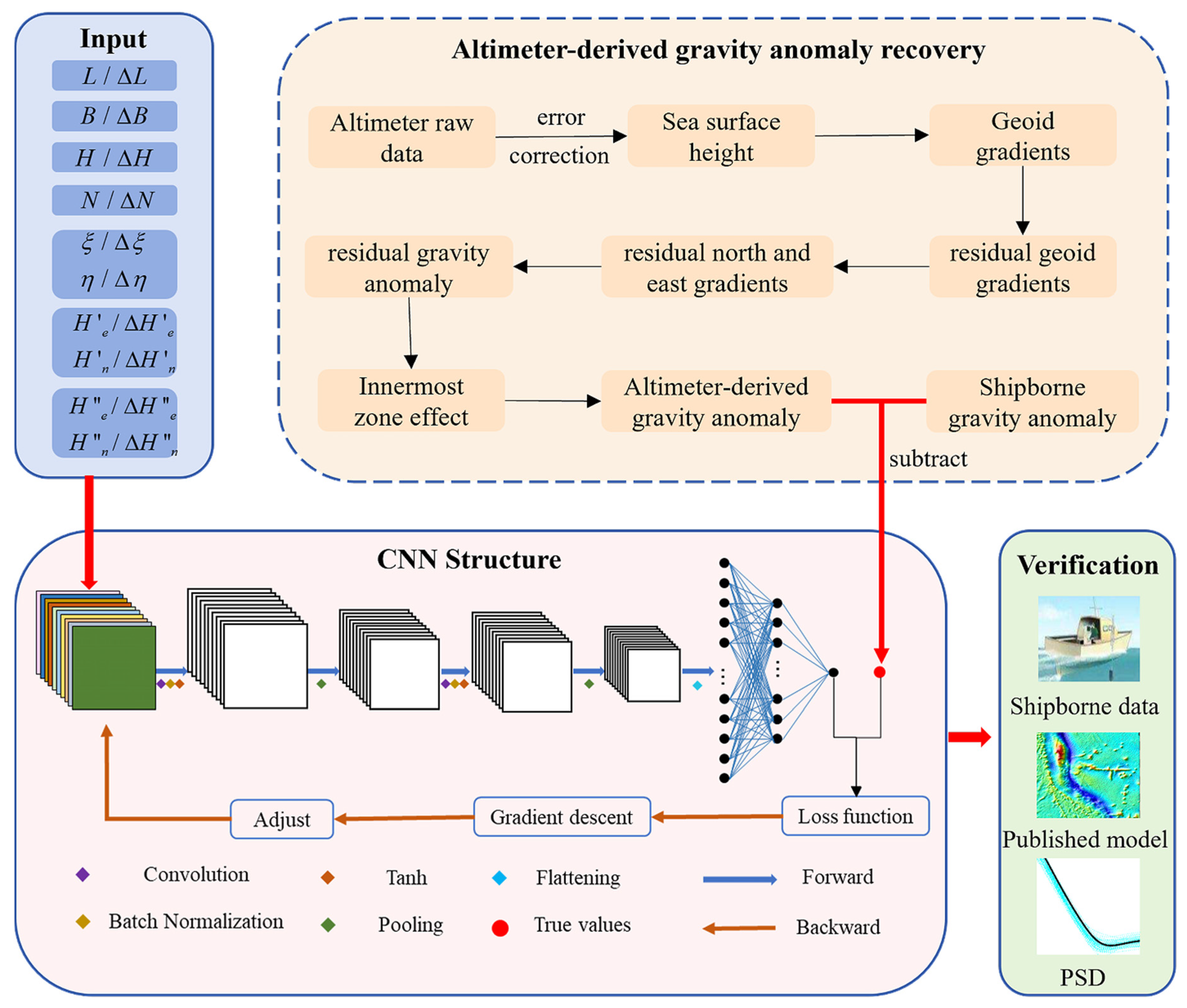
The study builds upon previous research by proposing the use of differential marine geodetic data as input parameters for deep learning and develops a differential marine geodetic data convolutional neural network (DMGD-CNN) framework for high-precision MGA mapping. Our approach encodes local gravity field variations—defined as differences between target points and surrounding grid points—as input features, enabling the model to explicitly capture spatial gradients, thereby functioning as a trainable high-pass filter that enhances the model’s sensitivity to short-wavelength signals, which are precisely those that conventional satellite altimetry processing struggles to recover. We first evaluate HY-2A-derived MGA accuracy across diverse marine environments using shipborne validation data. The DMGD-CNN framework then integrates HY-2A altimetry data with shipborne survey data to produce enhanced high-precision marine gravity anomaly fields. Our specific contributions include: (1) systematic quantification of individual marine geodetic parameter contributions through ablation studies, (2) comprehensive accuracy benchmarking against international gravity models (e.g., DTU, SDUST, SIO) across dominant wavelengths, and (3) practical guidance for data selection in application-specific scenarios.
4. Results and Analysis
4.1. Analysis of HY-2A Altimeter-Derived Gravity Anomaly Model
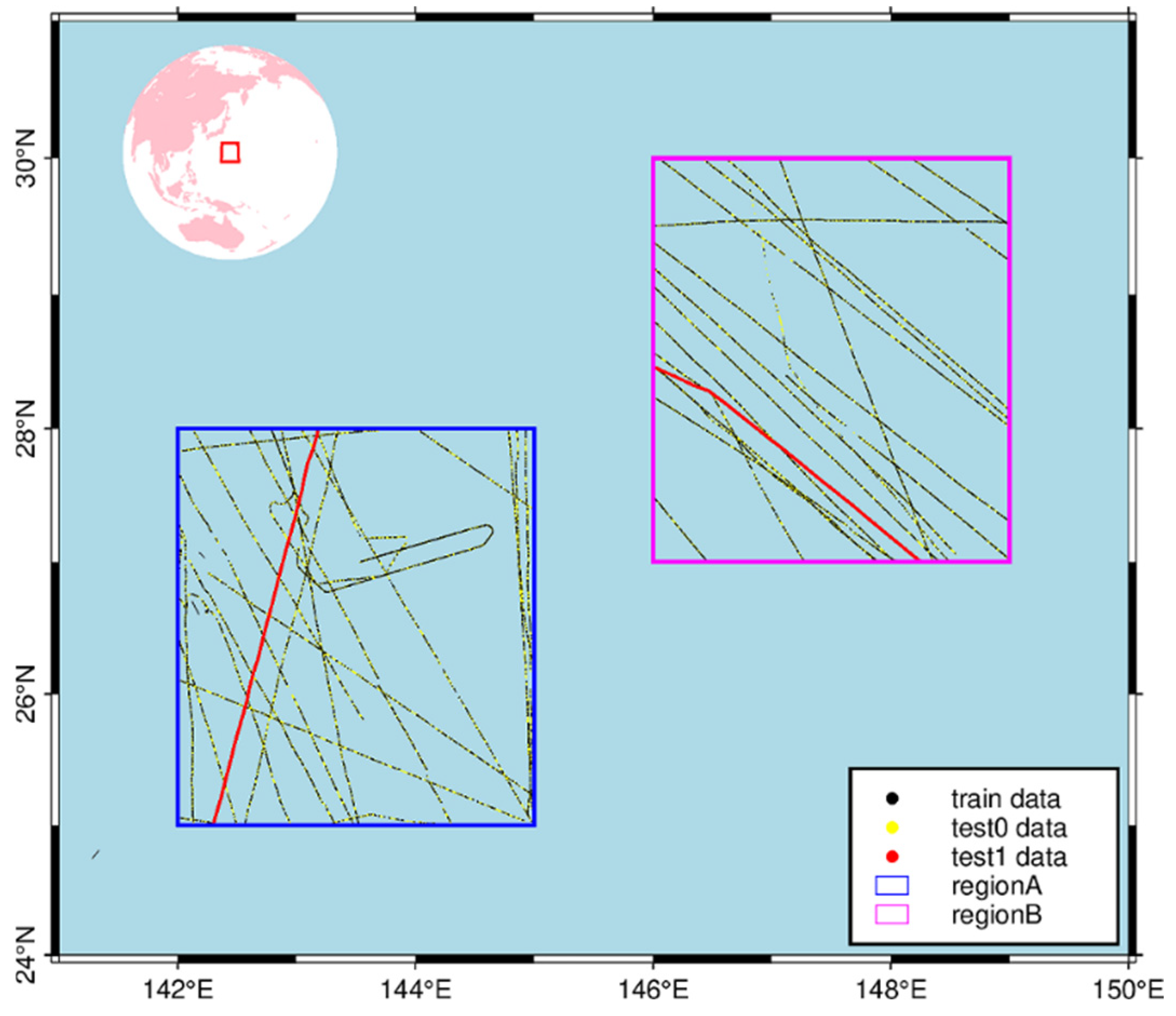
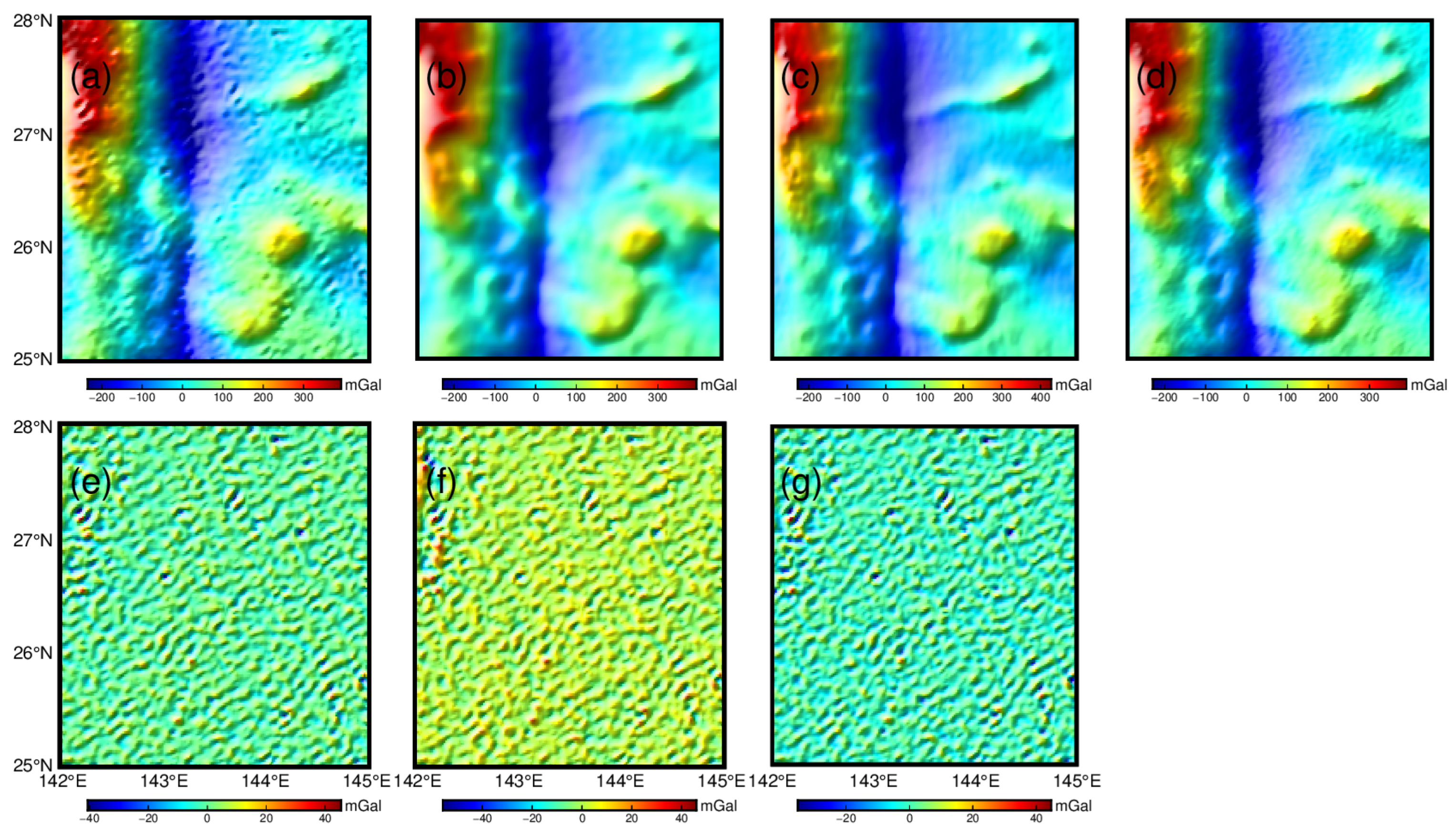
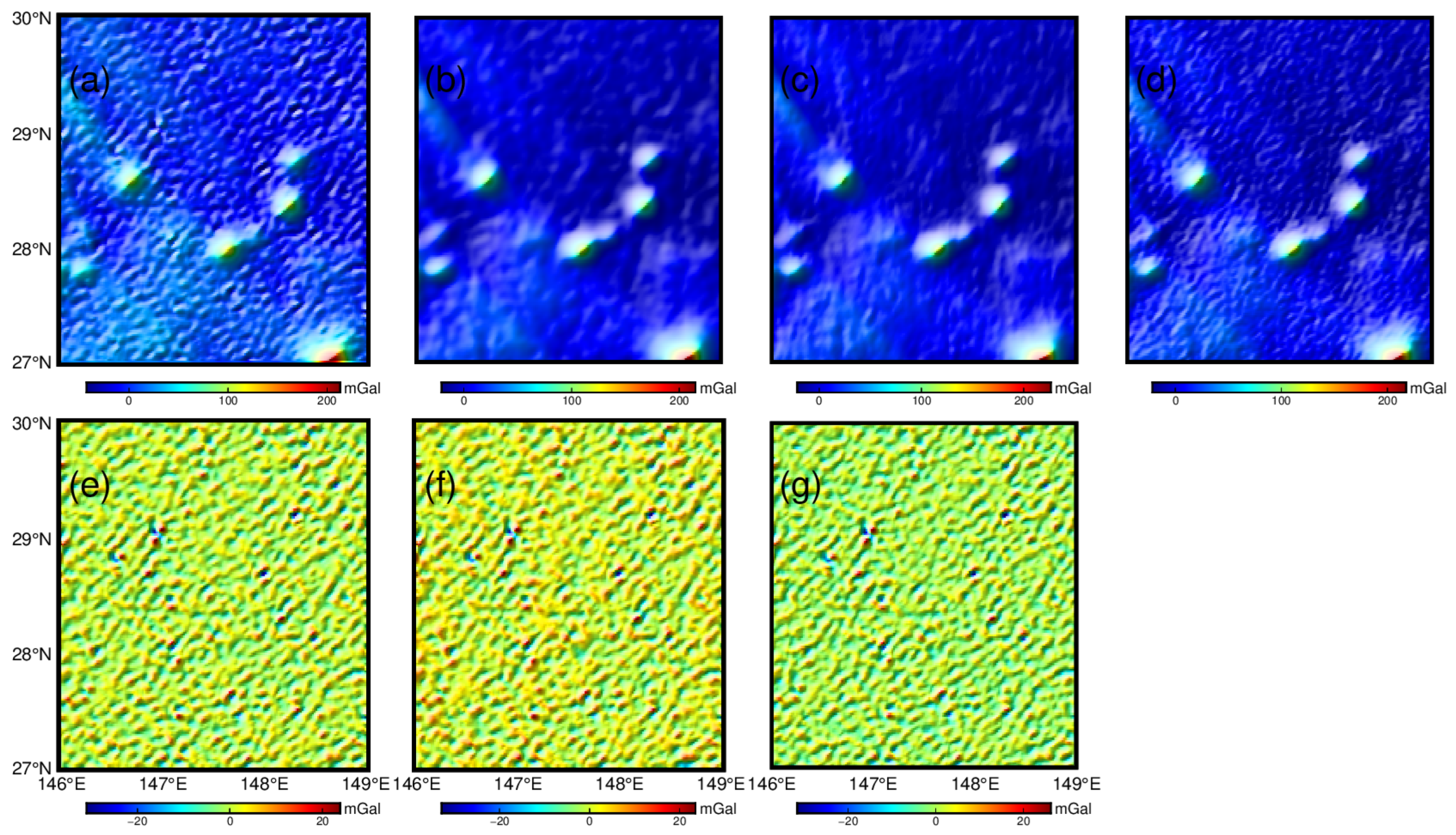
In Region A, the STDs between the HY-2A altimeter-derived gravity anomaly model and the DTU17, SIO V32.1, and SDUST2022 models were 4.0690, 4.8080, and 4.0109 mGal, respectively. In Region B, the corresponding STDs with DTU17, SIO V32.1, and SDUST2022 were 3.3266, 3.5331, and 3.2825 mGal. Comparative analysis revealed that STDs in Region B were consistently lower than those in Region A by approximately 18–27%, indicating higher inter-model consistency in Region B. Notably, the SDUST2022 model demonstrated optimal consistency in both regions, which can be attributed to its incorporation of HY-2A altimetry data during model construction—a critical data source that was excluded from the DTU17 and SIO V32.1 processing pipelines.
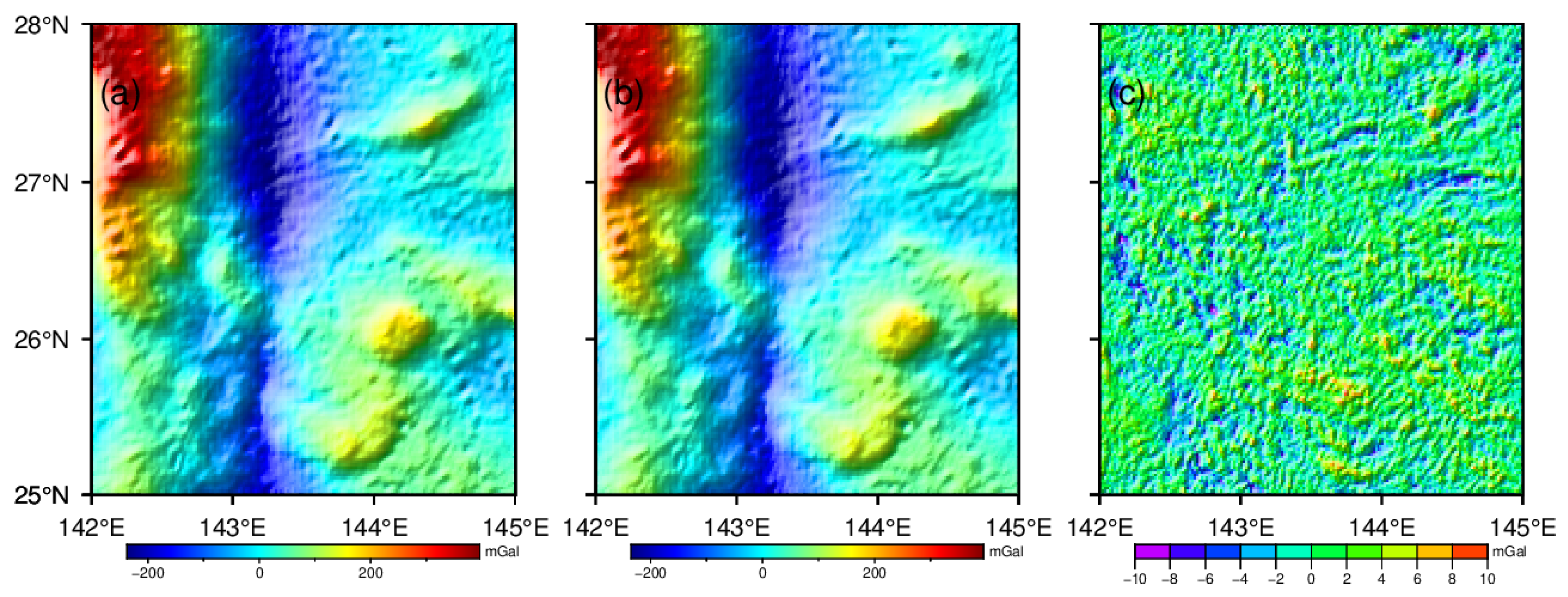
Figure 5 and
Figure 6 display the gravity field models from HY-2A, SIO V32.1, DTU17, and SDUST2022, as well as their corresponding discrepancies in Regions A and B, respectively. The analysis showed that the HY-2A altimeter-derived gravity anomaly model exhibited more pronounced random noise signatures compared to other models. This discrepancy primarily stemmed from insufficient observational redundancy due to single-source data constraints, coupled with inadequate suppression of high-frequency noise caused by the absence of post-processing smoothing algorithms.
As shown in
Table 2, validation against shipborne data revealed distinct regional characteristics. In Region A, the SDUST2022 model achieved the highest accuracy with an RMSE of 3.9650 mGal, while the HY-2A-derived model showed the lowest accuracy at 5.5780 mGal. This regional difference indicated that the SDUST2022 model exhibited superior adaptability in Region A, which is characterized by complex seafloor topography. In Region B, the DTU17 model demonstrated optimal performance with an RMSE of 5.4640 mGal, whereas the HY-2A-derived model again exhibited the lowest accuracy at 6.3623 mGal. Despite lower STDs between the HY-2A altimetry-derived gravity anomaly model and international public gravity field models in Region B compared to Region A, all models exhibited significantly higher RMSEs when validated against shipborne data in Region B, with increases ranging from 14.1% to 37.8%. This apparent contradiction suggested the presence of common systematic error sources affecting all satellite altimetry models in Region B. These systematic error factors appeared to exert similar influences on all satellite altimetry-based gravity field models, resulting in maintained inter-model consistency while collectively deviating systematically from shipborne surveys.
4.2. Analysis of Gravity Anomalies Recovery Using DMGD-CNN
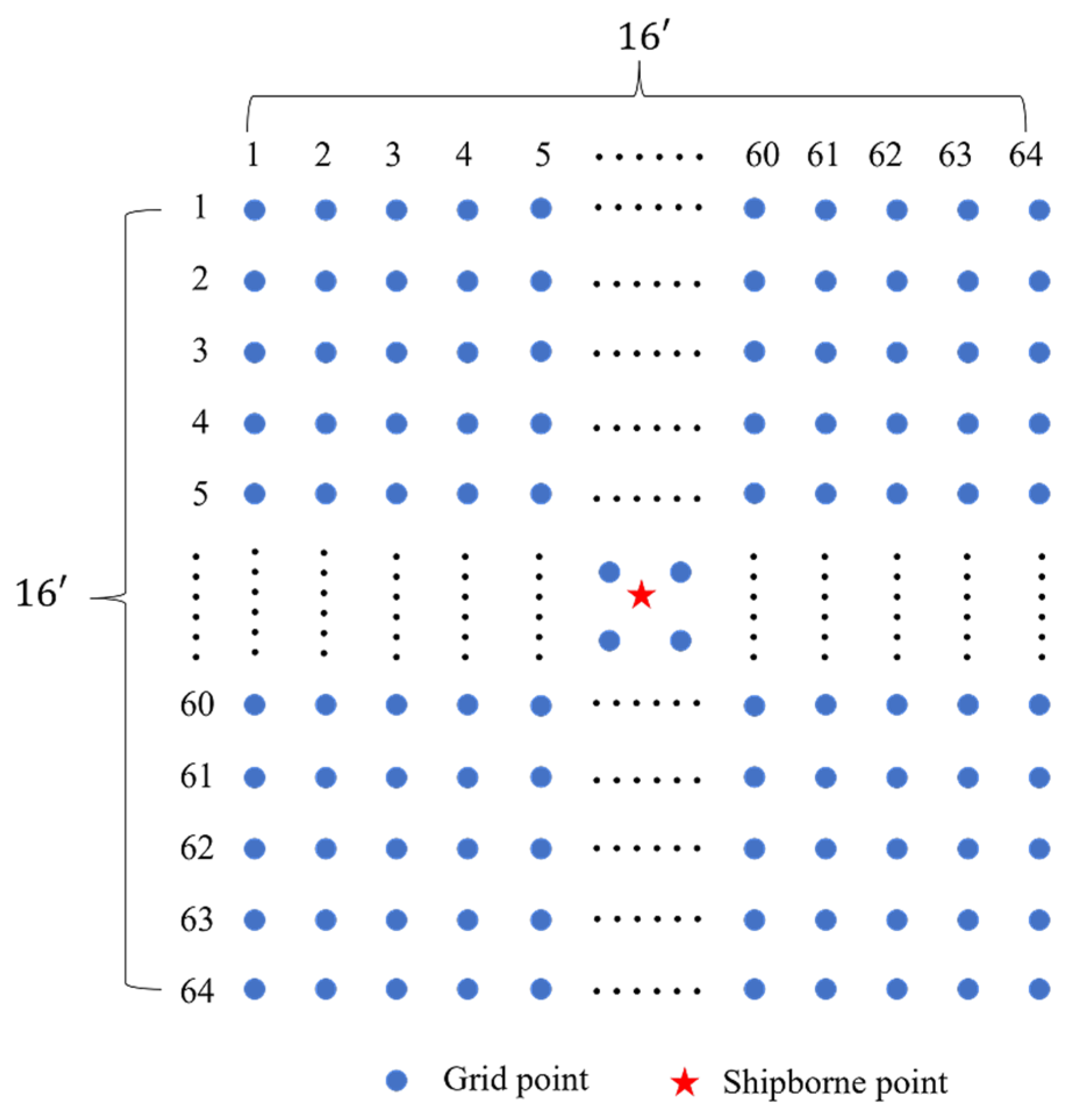
The grid size of input data exerted significant influence on model performance, computational efficiency, and feature extraction capabilities in CNN architectures. A systematic investigation was conducted to elucidate the influence mechanisms of grid dimensions on model performance. The experimental results demonstrated that larger grids (96 × 96) preserved richer spatial details, reducing the RMSE in the test0 dataset by approximately 7.20% compared to baseline grids (32 × 32), but introduced computational complexity, resulting in over a tenfold increase in training duration. Conversely, smaller grids (32 × 32) achieved optimal computational efficiency (shortest training time) at the expense of compromised representational capacity due to insufficient spatial resolution, leading to the highest RMSE. Through trade-off optimization between precision and efficiency, 64 × 64 grids were identified as the optimal input configuration, achieving an optimal balance between model performance and computational resources in comparative experiments across Regions A and B, as shown in
Table 3. While the 64 × 64 grid size proved optimal for our study region with 15 arc-second resolution input data, the universality of this choice warrants consideration. The optimal grid size depends on several factors, including: (1) the spatial resolution of input data, (2) the complexity of seafloor topography, (3) the density of training samples, and (4) computational constraints.
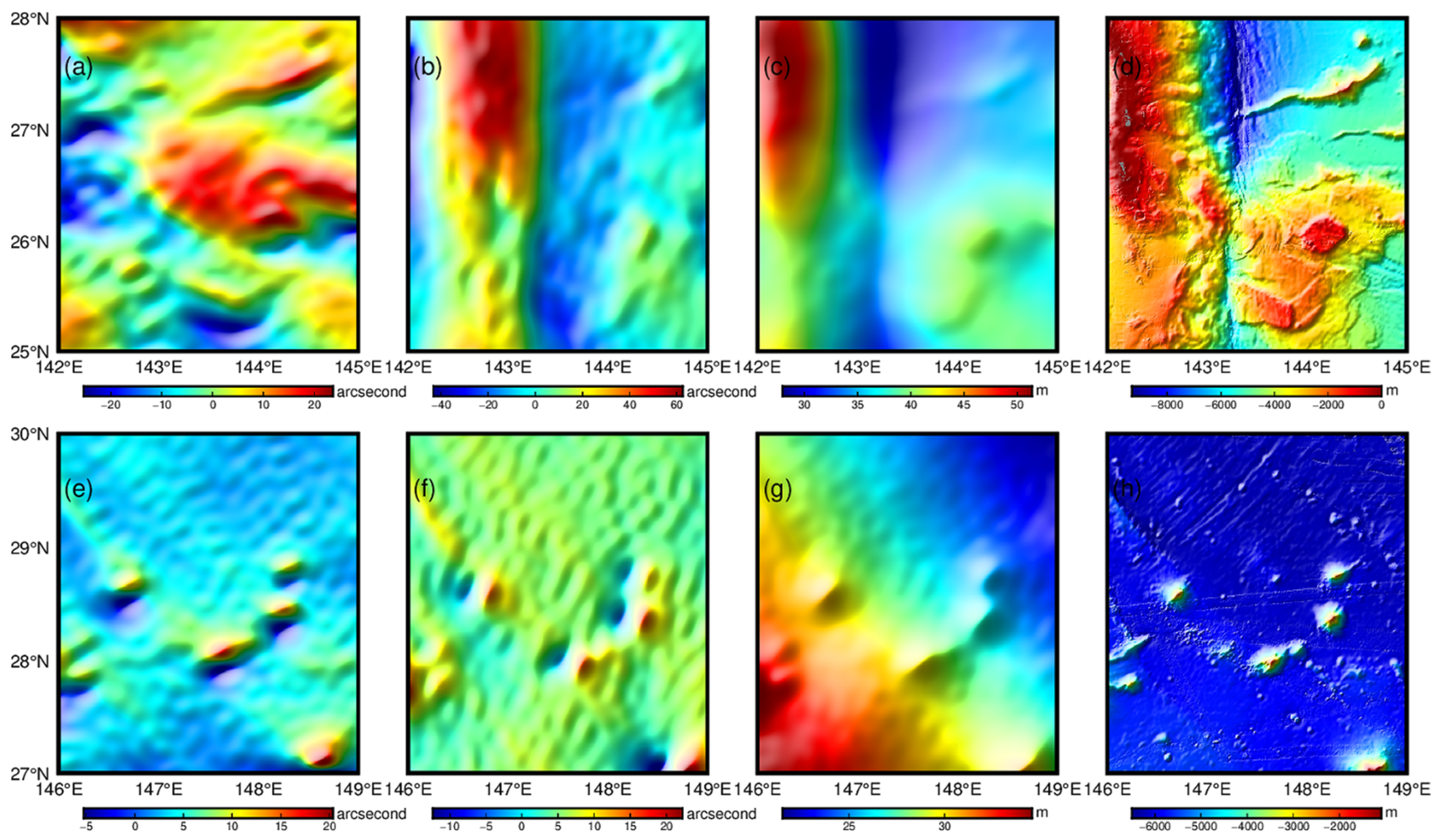
To compare the impact of different parameter combinations on gravity anomaly predictions, we designed eight experimental cases, as shown in
Table 4. There are ten input parameters in Case 1. Cases 2 and 3 each have eight input parameters, with the first-order derivative of seabed topography excluded in Case 2 and the second-order derivative excluded in Case 3. In Case 4, only six input parameters are retained, with no seabed topography derivatives included. From Case 5 to Case 7, the impact of the seabed topography, DOV, and geoid is tested, respectively. Compared with Case 1, Case 8 uses a DMGD-CNN for gravity anomaly recovery. The trained neural network model was utilized to predict the unknown points within the study area. The prediction results were added to the marine gravity anomaly values recovered by HY-2A to construct a CNN-based MGA model. To evaluate the accuracy of eight different cases for recovering MGA using CNN, independent shipborne gravity anomaly data were used to analyze results.
Table 5 lists the key statistical indicators of the differences between the predictions and shipborne gravity values, which evaluate the performance of different cases in marine gravity anomaly recovery. In Region A, Case 1 exhibited the best performance among the direct CNN models with an RMSE of 0.9390 mGal and an MAE of 0.6269 mGal. In contrast, Case 4 showed the poorest results, with the RMSE increasing from 0.9390 mGal to 2.2685 mGal and the MAE increasing from 0.6269 mGal to 1.5183 mGal. The performance degradation when excluding all topographic derivatives provides quantitative evidence of their critical importance and demonstrates robust model behavior: performance systematically correlates with the presence of gradient information rather than random variation. However, analysis of Cases 2 and 3 revealed that the first- and second-order derivatives of seabed topography exhibited minimal impact on modeling outcomes, with RMSEs of 0.9566 mGal and 0.9510 mGal, respectively. The similarity between Cases 2 and 3 (RMSE difference < 0.6%) indicates stable performance and redundancy in gradient information, confirming that either derivative order alone provides sufficient spatial gradient encoding. Furthermore, the nearly identical results from Cases 5, 6, and 7 revealed that seabed topography, deflection of the vertical (DOV), and geoid exerted similar influences on predictions, providing valuable insights for understanding the factors affecting marine gravity anomaly recovery. The proposed DMGD-CNN (Case 8) achieved an RMSE of 0.8575 mGal, representing an 8.7% improvement over Case 1 (0.9390 mGal), while the MAE decreased to 0.5639 mGal (10.1% improvement).
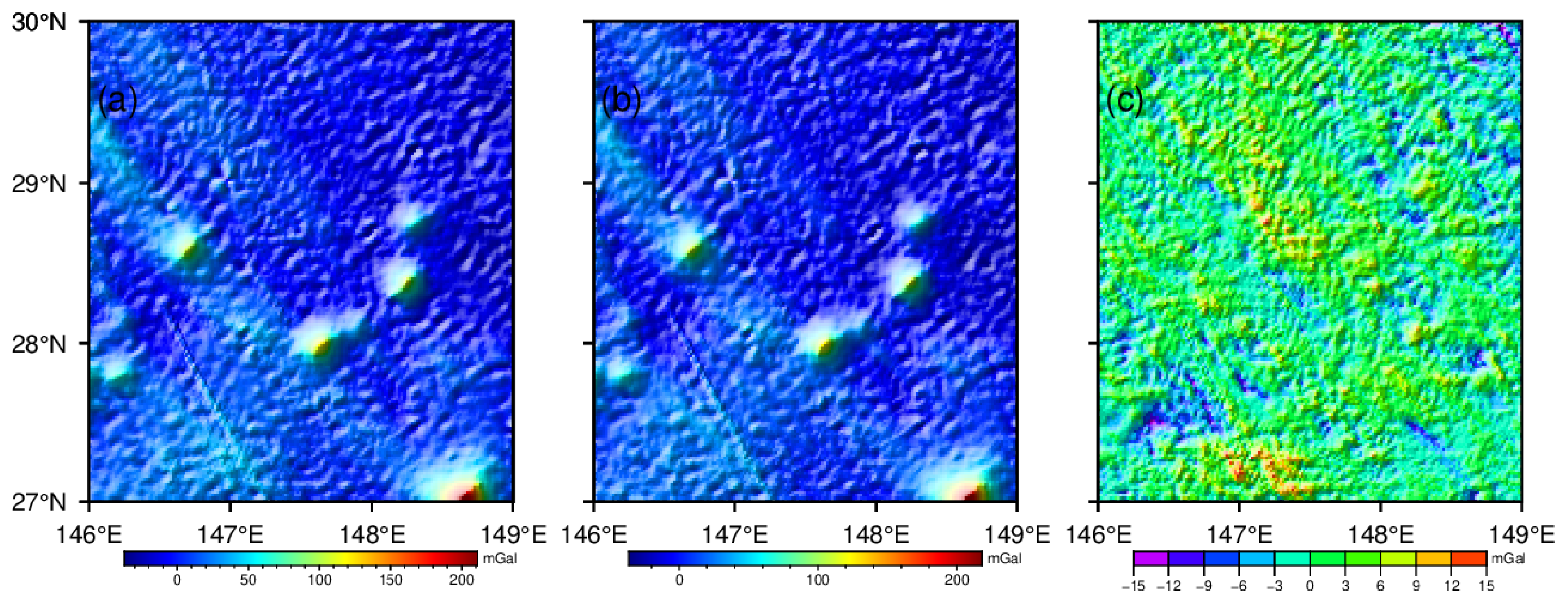
In Region B, characterized by gentle seabed topography variations, all parameters exhibited similar influence characteristics, though first- and second-order derivatives of seabed topography remained dominant. Notably, Case 8 demonstrated lower prediction accuracy than Case 1 in this region. This systematic regional difference represents repeatable behavior directly linked to topographic complexity, not random performance variation. The consistency of this pattern across both test0 and independent validation data confirms cross-regional repeatability and establishes clear applicability boundaries. These results revealed complementary advantages between the two methods under different topographic conditions: the DMGD-CNN approach showed superior performance in areas with drastic seabed topography variations, whereas the direct CNN method proved more effective in regions with gentle topographic variations. The gravity field grid models constructed from Case 1 and Case 8 were defined as the direct CNN model (CNN_case1) and differential CNN model (DMGD-CNN_case8), respectively. As shown in
Figure 7 and
Figure 8, comparative analysis of gravity anomaly predictions across 32,400 grid points in Regions A and B clearly demonstrates the performance differences between these two methods.
Table 6 presents comparative results between two CNN models and international marine gravity field models (SIO V32.1, DTU17, and SDUST2022). In Region A, CNN_case1 and DMGD-CNN_case8 exhibit maximum deviations of 3.6636 mGal relative to SIO V32.1, while demonstrating STDs closest to the SDUST2022 model at 2.6474 mGal and 2.5374 mGal, respectively. DMGD-CNN_case8 achieves accuracy improvements of 2% to 10% over CNN_case1 when compared against the three reference models. Notably, DMGD-CNN_case8 shows reduced accuracy in Region B, which stems from distinct feature extraction mechanisms between the two modeling approaches: The direct CNN model employs fully connected layers to capture global spatial correlations, demonstrating stable prediction performance in areas with gentle seabed topography. Conversely, the DMGD-CNN model enhances gradient responses to gravity anomalies in areas with complex seabed topography through residual computation between central points and their neighboring points. However, this mechanism becomes susceptible to random noise interference in flat regions with low signal-to-noise ratios, leading to prediction divergence.
This study utilized five grid-based gravity field datasets to calculate gravity anomaly values at independent shipborne measurement points using the “grdtrack” procedure in GMT with bilinear interpolation. Given the superior accuracy of the DMGD-CNN method in Region A, subsequent analysis focused exclusively on this area. To eliminate interpolation errors introduced by conventional grid-based approaches, we employed a direct prediction framework using DMGD-CNN to estimate gravity anomalies directly from geographic coordinates. As demonstrated in
Table 7, the direct prediction model reduces the STD to 3.3088 mGal, achieving a 7% to 16% improvement over grid interpolation methods. The bounded residual range quantifies prediction uncertainty and confirms that extreme errors remain within acceptable limits for operational marine gravity applications. This uncertainty characterization provides statistical confidence bounds for end-users interpreting model outputs. In conventional workflows, obtaining gravity values at specific locations requires first generating a gridded model and then applying interpolation algorithms. The trained DMGD-CNN can bypass this interpolation step by directly inputting the local MGD patch surrounding a query point and outputting the predicted gravity value. This capability offers computational efficiency advantages and eliminates the smoothing effects induced by interpolation.
4.3. Analysis of Marine Bathymetry and Power Spectrum
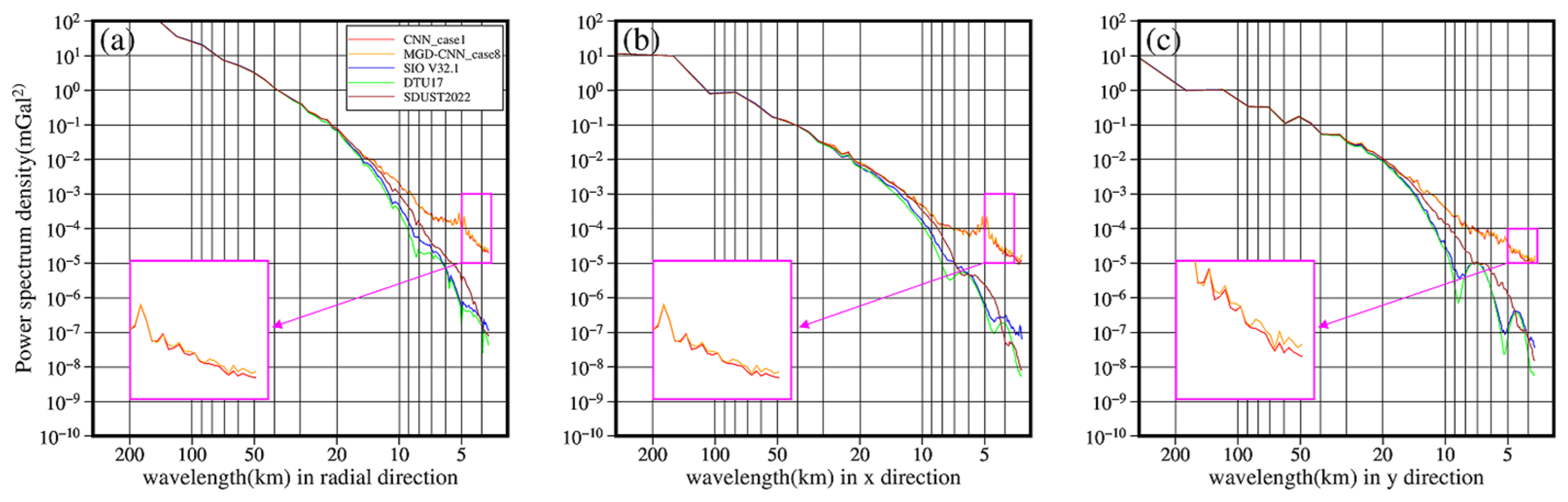
Based on the preceding analysis, we concluded that the DMGD-CNN method improves the gravity anomaly accuracy in Region A. Therefore, we proceeded to conduct a focused analysis on this region. Power spectral density (PSD) analysis can be used to understand the spatial scale of a model, and we calculated the PSD in different directions using the “grdfft” procedure in GMT.
Figure 9 shows the PSD of CNN_case1, DMGD-CNN_case8, SIO V32.1, DTU17 and SDUST2022 at different directions in Region A. Higher PSD values indicate stronger signal energy at corresponding wavelengths, reflecting better resolution of gravity anomaly variations. At wavelengths greater than 30 km, the power spectra of the five models are almost identical. At short wavelengths (less than 5 km), the DMGD-CNN_case8 performs slightly better than CNN_case1 and significantly outperforms SIO V32.1, DTU17 and SDUST2022, with higher power in all directions. This indicates that the high-frequency information associated with seafloor topography has been effectively utilized, and the CNN framework based on differential MGD further improves the accuracy of the gravity anomaly model.
The power spectral density analysis confirms the geophysical validity of differential learning. At wavelengths exceeding 30 km, all models exhibit nearly identical power spectra. This consistency arises because long-wavelength signals primarily reflect deep structural features, which remain largely insensitive to near-surface processing methods. At wavelengths below 5 km, DMGD-CNN_case8 demonstrates higher power spectral density than CNN_case1. This enhancement indicates that differential features more effectively preserve high-frequency information associated with shallow seafloor topography. The improvement is particularly pronounced in Region A, characterized by complex topography with dramatic seafloor relief. In this region, local topographic variations contribute substantially to short-wavelength gravity signals. However, traditional direct input methods tend to conflate short-wavelength signals with long-wavelength trends, which leads to the systematic attenuation of high-frequency components.
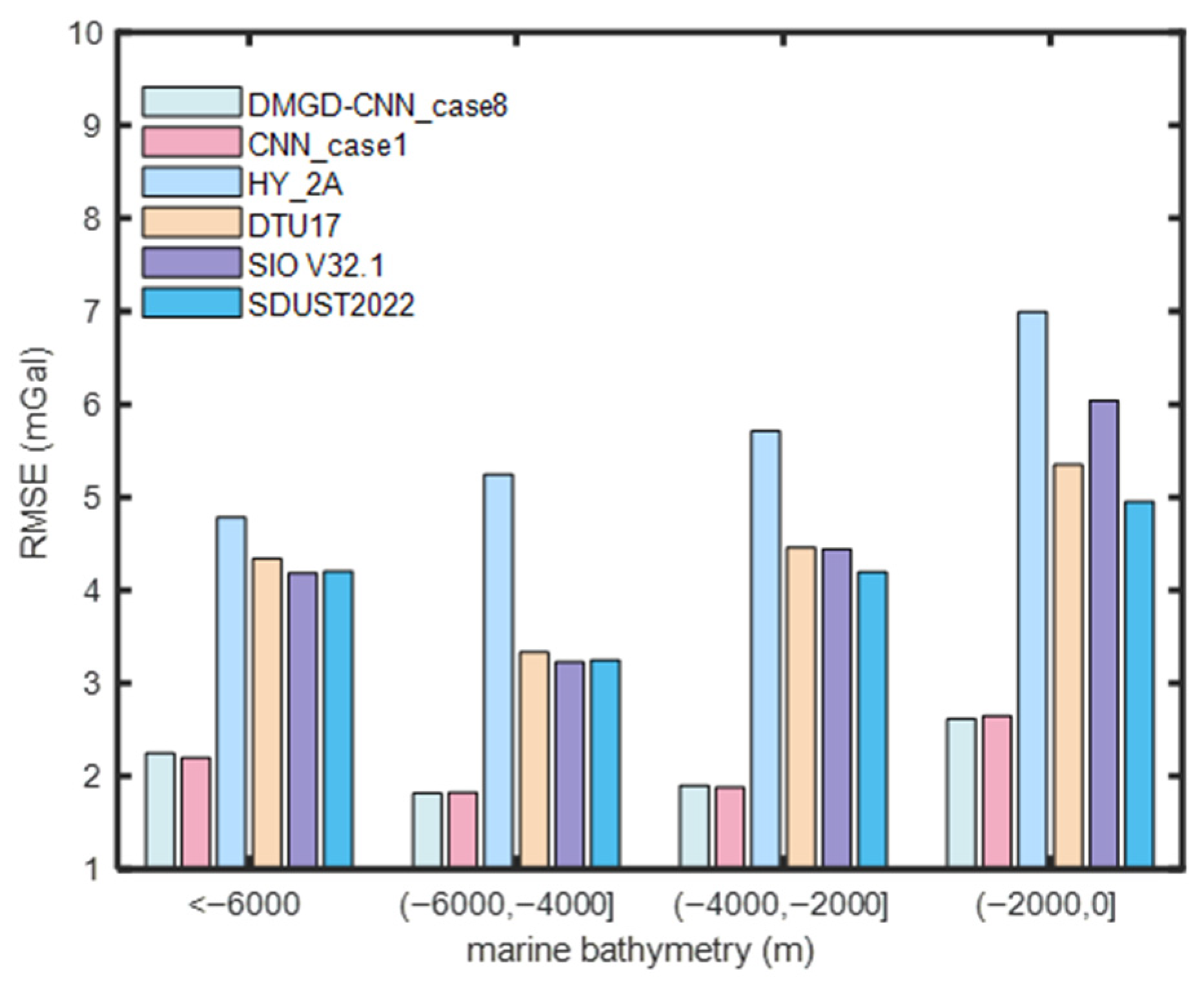
In addition, the RMSE of each model in different bathymetric zones relative to shipborne gravity data was analyzed. As shown in
Figure 10, DMGD-CNN_case8 performs best across four different bathymetric zones. It is well known that the accuracy of marine gravity anomaly models derived from altimetry data is relatively poor in shallow-water areas. In areas with water depths less than 2000 m, the RMSE values of HY-2A, DTU17, SIO V32.1, SDUST2022, and CNN_case1 are 6.99 mGal, 5.34 mGal, 6.04 mGal, 4.95 mGal, and 2.64 mGal, respectively, whereas the RMSE of DMGD-CNN_case8 is 2.61 mGal. The consistent RMSE progression across depth zones for all models validates that our framework responds appropriately to inherent physical signal characteristics rather than introducing artificial depth-dependent biases. This robustness across varying bathymetric conditions demonstrates reliable model generalization beyond specific depth regimes.
5. Conclusions
In this study, we evaluated the HY-2A altimeter-derived gravity anomaly model using independent shipborne surveys, demonstrating an RMSE of approximately 5–6 mGal in the study region. The model exhibited minimal discrepancies from the SDUST2022 model, which can be attributed to the incorporation of HY-2A altimetry data during the construction of the SDUST2022 model.
We further developed a DMGD-CNN framework for marine gravity anomaly recovery. Experimental results demonstrated that incorporating first- and second-order seabed topography derivatives significantly enhanced model performance, reducing the RMSE in Region A from 2.26 mGal to 0.93 mGal. The DMGD-CNN approach achieved further improvement, reducing the RMSE to 0.85 mGal. This improvement is attributed to the differential learning strategy’s ability to explicitly encode local spatial gradients, which are geometrically aligned with the physical mechanisms governing short-wavelength gravity variations dominated by shallow seafloor topography. Compared to direct CNN predictions, the DMGD-CNN model achieved accuracy improvements of 2–10% in complex topographic regions. However, it should be noted that in Region B with gentle seafloor topography, the direct CNN approach slightly outperformed DMGD-CNN. This limitation arises from the reduced signal-to-noise ratio when differential operations are applied to weak gradient signals, where noise amplification effects become more pronounced. Bathymetric correlation analysis confirmed that the CNN models demonstrated superior performance across varying water depth conditions when compared to international reference models (SIO V32.1, DTU17, SDUST2022). In regions with water depths less than 2000 m, DMGD-CNN achieved a 62.66% reduction in RMSE compared to the HY-2A altimeter-derived marine gravity anomaly model. PSD analysis revealed that the direct CNN exhibited enhanced predictive capabilities for gravity anomalies at wavelengths below 10 km, with further improvements at wavelengths below 5 km achieved using DMGD-CNN. These findings collectively demonstrate that the integration of multi-source differential marine geodetic data effectively enhances the modeling accuracy of marine gravity anomalies, particularly in capturing fine-scale gravitational features. Based on these results, we recommend a complementary usage strategy: DMGD-CNN is preferred for regions with complex seafloor topography, while the direct CNN approach may be more suitable for regions with gentle topography.