


Integrated Training Program for Rugby Sevens: A Multivariate Approach of Motor, Functional, and Metabolic Components



Abstract
1. Introduction
2. Materials and Methods
2.1. Participants
2.2. Research Design
2.3. Evaluation Tools
- Running tests: 10 m, 40 m, 100 m speed test performed with the Smart Speed Timing Gate system [30]. Motor evaluation was carried out with a free start from the standing position, in a straight line, measuring times for each running distance.
- Vertical jump test with prior flexion, performed on the Optojump platform (Microgate, 39100 Bolzano, Italy, 2020) [31]. A minimum of 3 jumps were performed to calculate the average for Counter Movement Jump (CMJ).
- Squat Jump test (SJ) without preloading phase, used to evaluate pure jumping capacity and explosive power specific for Squat jump (SJ).
- Lower-limb explosive performance was assessed using the Optojump Next system (Microgate, 39100 Bolzano, Italy, 2020). For the countermovement jump (CMJ), participants started from an upright position with hands on hips, performed a rapid countermovement, and immediately executed a maximal vertical jump. For the Squat Jump (SJ), participants began from a static semi-squat position (~90° knee flexion), held for 2–3 s to eliminate the stretch–shortening cycle. Then they performed a maximal vertical jump without prior countermovement.
- Three trials were performed for each test, with 30–60 s of rest between attempts. The highest jump height (cm), calculated from flight time by the Optojump software 2020, was retained for analysis.
- Cardio-pulmonary exercise test (CPET): for evaluating exercise capacity, performed with the Quark CPET system using the Bruce protocol on a treadmill. This graded test enabled the estimation of VO2max and the monitoring of cardiovascular and respiratory responses during progressive effort.
2.4. Statistical Analysis
3. Results
4. Discussions
4.1. Specific Discussion of the Study
4.2. The Limits of Study, Practical Implications and the Future Direction of the Study
5. Conclusions
Author Contributions
Funding
Institutional Review Board Statement
Informed Consent Statement
Data Availability Statement
Conflicts of Interest
References
- Sella, F.S.; McMaster, D.T.; Beaven, C.M.; Gill, N.D.; Hébert-Losier, K. Match Demands, Anthropometric Characteristics, and Physical Qualities of Female Rugby Sevens Athletes: A Systematic Review. J. Strength Cond. Res. 2019, 33, 3463–3474. [Google Scholar] [CrossRef] [PubMed]
- Schuster, J.; Howells, D.; Robineau, J.; Couderc, A.; Natera, A.; Lumley, N.; Gabbett, T.J.; Winkelman, N. Physical-Preparation Recommendations for Elite Rugby Sevens Performance. Int. J. Sports Physiol. Perform. 2018, 13, 255–267. [Google Scholar] [CrossRef] [PubMed]
- Zabaloy, S.; Giráldez, J.; Fink, B.; Alcaraz, P.E.; Pereira, L.A.; Freitas, T.T.; Loturco, I. Strength Deficit in Elite Young Rugby Players: Differences Between Playing Positions and Associations With Sprint and Jump Performance. J. Strength Cond. Res. 2022, 36, 920–926. [Google Scholar] [CrossRef] [PubMed]
- Alonso-Aubin, D.A.; Picón-Martínez, M.; Rebullido, T.R.; Faigenbaum, A.D.; Cortell-Tormo, J.M.; Chulvi-Medrano, I. Integrative Neuromuscular Training Enhances Physical Fitness in 6- to 14-Year-Old Rugby Players. J. Strength Cond. Res. 2021, 35, 2263–2271. [Google Scholar] [CrossRef]
- Rigon, M.; Signorini, G.; Scurati, R.; Trecroci, A.; Colella, D.; Formenti, D.; Merati, G.; Cherubini, D.; Invernizzi, P.L. Multisport-Integrated Training for Rugby Instructors: Success and Effects on Minirugby Players. J. Funct. Morphol. Kinesiol. 2024, 10, 11. [Google Scholar] [CrossRef]
- Piele, D.; Rusu, M.R.; Dragomir, M.M. The Relation Settled between Paravertebral and Whole Body Balance through Therapeutic Exercise in Chronic Low Back Pain Patient. Bull. Transilv. Univ. Braşov. Ser. IX Sci. Hum. Kinet. 2025, 18, 277–288. [Google Scholar] [CrossRef]
- Rusu, L.; Cosma, G.; Calina, M.L.; Dragomir, M.M.; Marin, M. Evaluation of two muscle training programs by assessment of the muscle tone. Sci. Sports 2015, 30, e65–e72. [Google Scholar] [CrossRef]
- Lino-Samaniego, A.; Martín-Castellanos, A.; Refoyo, I.; Álvarez-Portillo, M.; Blair, M.; Muriarte Solana, D. Analysis of Positional Physical Demands in Tier 2 Rugby Union: A Multivariate Approach over Speed Ranges. Sports 2025, 13, 260. [Google Scholar] [CrossRef]
- Pollard, B.T.; Turner, A.N.; Eager, R.; Cunningham, D.J.; Cook, C.J.; Hogben, P.; Kilduff, L.P. The ball in play demands of international rugby union. J. Sci. Med. Sport 2018, 21, 1090–1094. [Google Scholar] [CrossRef]
- Hartmann, H.; Wirth, K.; Keiner, M.; Mickel, C.; Sander, A.; Szilvas, E. Short-term Periodization Models: Effects on Strength and Speed-strength Performance. Sports Med. 2015, 45, 1373–1386. [Google Scholar] [CrossRef]
- Wang, W.; Wu, D.; Wang, H.; Zhang, Z.; Jiang, X.; Li, S.; Shi, Y.; Gao, X. Acute Effects of Breath-Hold Conditions on Aerobic Fitness in Elite Rugby Players. Life 2024, 14, 917. [Google Scholar] [CrossRef] [PubMed]
- Bouten, J.; Brick, M.; Saboua, A.; Hadjadj, J.L.; Piscione, J.; Margot, C.; Doucende, G.; Bourrel, N.; Millet, G.P.; Brocherie, F. Effects of 2 Different Protocols of Repeated-Sprint Training in Hypoxia in Elite Female Rugby Sevens Players During an Altitude Training Camp. Int. J. Sports Physiol. Perform. 2023, 18, 953–959. [Google Scholar] [CrossRef] [PubMed]
- Jimenez-Iglesias, J.; Castro-Piñero, J.; Landi-Fernández, M.; Perez-Bey, A.; de la Pascua-Roca, E.; Gonzalo-Skok, O. Comparative Effects of 2 Different Frequencies of Resistance Training in an Integral Periodization Approach on High-Intensity Actions and Noncontact Injuries in Young Trained Soccer Players. Int. J. Sports Physiol. Perform. 2025, 20, 1363–1369. [Google Scholar] [CrossRef] [PubMed]
- Oliver, J.L.; Ramachandran, A.K.; Singh, U.; Ramirez-Campillo, R.; Lloyd, R.S. The Effects of Strength, Plyometric and Combined Training on Strength, Power and Speed Characteristics in High-Level, Highly Trained Male Youth Soccer Players: A Systematic Review and Meta-Analysis. Sports Med. 2024, 54, 623–643. [Google Scholar] [CrossRef]
- Rodríguez-Rosell, D.; Franco-Márquez, F.; Pareja-Blanco, F.; Mora-Custodio, R.; Yáñez-García, J.M.; González-Suárez, J.M.; González-Badillo, J.J. Effects of 6 Weeks Resistance Training Combined With Plyometric and Speed Exercises on Physical Performance of Pre-Peak-Height-Velocity Soccer Players. Int. J. Sports Physiol. Perform. 2016, 11, 240–246. [Google Scholar] [CrossRef]
- Watkins, C.M.; Gill, N.D.; Maunder, E.; Downes, P.; Young, J.D.; McGuigan, M.R.; Storey, A.G. The Effect of Low-Volume Preseason Plyometric Training on Force-Velocity Profiles in Semiprofessional Rugby Union Players. J. Strength Cond. Res. 2021, 35, 604–615. [Google Scholar] [CrossRef]
- Sinclair, J.; Edmundson, C.J.; Metcalfe, J.; Bottoms, L.; Atkins, S.; Bentley, I. The Effects of Sprint vs. Resisted Sled-Based Training; an 8-Week in-Season Randomized Control Intervention in Elite Rugby League Players. Int. J. Environ. Res. Public Health 2021, 18, 9241. [Google Scholar] [CrossRef]
- Mathieu, B.; Robineau, J.; Piscione, J.; Babault, N. Concurrent Training Programming: The Acute Effects of Sprint Interval Exercise on the Subsequent Strength Training. Sports 2022, 10, 75. [Google Scholar] [CrossRef]
- Kobal, R.; Loturco, I.; Barroso, R.; Gil, S.; Cuniyochi, R.; Ugrinowitsch, C.; Roschel, H.; Tricoli, V. Effects of Different Combinations of Strength, Power, and Plyometric Training on the Physical Performance of Elite Young Soccer Players. J. Strength Cond. Res. 2017, 31, 1468–1476. [Google Scholar] [CrossRef]
- Sanz-Matesanz, M.; González-Fernández, F.T.; Blanco-Luengo, D.; Martínez-Aranda, L.M. Optimising Sprint Performance in Rugby: Insights from a Systematic Review of Training Methods. J. Funct. Morphol. Kinesiol. 2025, 10, 51. [Google Scholar] [CrossRef]
- Pereira, L.A.; Freitas, T.T.; Zabaloy, S.; Ferreira, R.C.A.; Silva, M.L.; Azevedo, P.H.S.M.; Loturco, I. Sprint and Jump Training on Sand vs. Grass Surfaces: Effects on the Physical Performance of Young Soccer Players. J. Strength Cond. Res. 2023, 37, 1828–1833. [Google Scholar] [CrossRef] [PubMed]
- Gabbett, T.J.; Jenkins, D.G.; Abernethy, B. Relationships between physiological, anthropometric, and skill qualities and playing performance in professional rugby league players. J. Sports Sci. 2011, 29, 1655–1664. [Google Scholar] [CrossRef] [PubMed]
- McCormack, S.; Jones, B.; Till, K. Training Practices of Academy Rugby League and their Alignment to Physical Qualities Deemed Important for Current and Future Performance. Int. J. Sports Sci. Coach. 2020, 15, 512–525. [Google Scholar] [CrossRef]
- Loturco, I.; Bishop, C.; Zabaloy, S.; Moura, T.B.M.A.; Ramos, M.S.; Pereira, L.A.; McGuigan, M.R. Variations in strength-speed-power performance across the season: Do true changes occur in elite rugby players? Biol. Sport 2024, 41, 201–211. [Google Scholar] [CrossRef]
- McQuilliam, S.J.; Clark, D.R.; Erskine, R.M.; Brownlee, T.E. Effect of High-Intensity vs. Moderate-Intensity Resistance Training on Strength, Power, and Muscle Soreness in Male Academy Soccer Players. J. Strength Cond. Res. 2023, 37, 1250–1258. [Google Scholar] [CrossRef]
- Zabaloy, S.; Tondelli, E.; Pereira, L.A.; Freitas, T.T.; Loturco, I. Training and testing practices of strength and conditioning coaches in Argentinian Rugby Union. Int. J. Sports Sci. Coach. 2022, 17, 1331–1344. [Google Scholar] [CrossRef]
- Gannon, E.A.; Stokes, K.A.; Trewartha, G. Strength and Power Development in Professional Rugby Union Players Over a Training and Playing Season. Int. J. Sports Physiol. Perform. 2016, 11, 381–387. [Google Scholar] [CrossRef]
- Mandorino, M.; Tessitore, A.; Leduc, C.; Persichetti, V.; Morabito, M.; Lacome, M. A New Approach to Quantify Soccer Players’ Readiness through Machine Learning Techniques. Appl. Sci. 2023, 13, 8808. [Google Scholar] [CrossRef]
- Kong, L.; Zhang, T.; Zhou, C.; Gomez, M.A.; Hu, Y.; Zhang, S. The evaluation of playing styles integrating with contextual variables in professional soccer. Front. Psychol. 2022, 13, 1002566. [Google Scholar] [CrossRef]
- Chaeroni, A.; Huda, A.; Sombolon, M.E.M.; Firdausi, D.K.A.; Pebriandani, C.; Andristi, G. The Development and Validation of a Low-Cost Timing Gate Prototype as an Alternative to a Stopwatch in Agility Testing. Phys. Educ. Theory Methodol. 2025, 25, 1450–1455. [Google Scholar] [CrossRef]
- Glatthorn, J.F.; Gouge, S.; Nussbaumer, S.; Stauffacher, S.; Impellizzeri, F.M.; Maffiuletti, N.A. Validity and reliability of Optojump photoelectric cells for estimating vertical jump height. J. Strength Cond. Res. 2011, 25, 556–560. [Google Scholar] [CrossRef] [PubMed]
- Crouter, S.E.; LaMunion, S.R.; Hibbing, P.R.; Kaplan, A.S.; Bassett, D.R., Jr. Accuracy of the Cosmed K5 portable calorimeter. PLoS ONE 2019, 14, e0226290. [Google Scholar] [CrossRef]
- Vandarakis, D.; Salacinski, A.J.; Broeder, C.E. A comparison of COSMED metabolic systems for the determination of resting metabolic rate. Res. Sports Med. 2013, 21, 187–194. [Google Scholar] [CrossRef] [PubMed]
- Couderc, A.; Gabbett, T.J.; Piscione, J.; Robineau, J.; Peeters, A.; Igarza, G.; Thomas, C.; Hanon, C.; Lacome, M. Repeated High-Intensity Effort Activity in International Male Rugby Sevens. J. Strength Cond. Res. 2023, ahead of print. [Google Scholar] [CrossRef] [PubMed]
- Zech, A.; Hollander, K.; Junge, A.; Steib, S.; Groll, A.; Heiner, J.; Nowak, F.; Pfeiffer, D.; Rahlf, A.L. Sex differences in injury rates in team-sport athletes: A systematic review and meta-regression analysis. J. Sport Health Sci. 2022, 11, 104–114. [Google Scholar] [CrossRef]
- Malone, S.; Earls, M.; Shovlin, A.; Eddy, A.; Winkelman, N. Match-Play Running Performance and Exercise Intensity in Elite International Women’s Rugby Sevens. J. Strength Cond. Res. 2020, 34, 1741–1749. [Google Scholar] [CrossRef]
- Peeters, A.; Carling, C.; Piscione, J.; Lacome, M. In-Match Physical Performance Fluctuations in International Rugby Sevens Competition. J. Sports Sci. Med. 2019, 18, 419–426. [Google Scholar]
- Falk Neto, J.H.; Parent, E.C.; Kennedy, M.D. Long-Term Athlete Development: Seasonal and Longitudinal Fitness Changes in Female University Rugby Players. J. Strength Cond. Res. 2021, 35, 3459–3465. [Google Scholar] [CrossRef]
- Hamlin, M.J.; Olsen, P.D.; Marshall, H.C.; Lizamore, C.A.; Elliot, C.A. Hypoxic Repeat Sprint Training Improves Rugby Player’s Repeated Sprint but Not Endurance Performance. Front. Physiol. 2017, 8, 24. [Google Scholar] [CrossRef]
- Suchomel, T.J.; Nimphius, S.; Bellon, C.R.; Stone, M.H. The Importance of Muscular Strength: Training Considerations. Sports Med. 2018, 48, 765–785. [Google Scholar] [CrossRef]
- Comfort, P.; Graham-Smith, P.; Matthews, M.J.; Bamber, C. Strength and power characteristics in English elite rugby league players. J. Strength Cond. Res. 2011, 25, 1374–1384. [Google Scholar] [CrossRef] [PubMed]
- Baena-Raya, A.; Sánchez-López, S.; Rodríguez-Pérez, M.A.; García-Ramos, A.; Jiménez-Reyes, P. Effects of two drop-jump protocols with different volumes on vertical jump performance and its association with the force-velocity profile. Eur. J. Appl. Physiol. 2020, 120, 317–324. [Google Scholar] [CrossRef] [PubMed]
- Pino-Ortega, J.; Rojas-Valverde, D.; Gómez-Carmona, C.D.; Rico-González, M. Training Design, Performance Analysis, and Talent Identification-A Systematic Review about the Most Relevant Variables through the Principal Component Analysis in Soccer, Basketball, and Rugby. Int. J. Environ. Res. Public Health 2021, 18, 2642. [Google Scholar] [CrossRef] [PubMed]
- Bradley, W.J.; Cavanagh, B.P.; Douglas, W.; Donovan, T.F.; Morton, J.P.; Close, G.L. Quantification of training load, energy intake, and physiological adaptations during a rugby preseason: A case study from an elite European rugby union squad. J. Strength Cond. Res. 2015, 29, 534–544. [Google Scholar] [CrossRef]
- Fu, T.; Yang, Y.W.; Wu, P.; Liu, G.J. The exploration of aerobic power and energy expenditure of Chinese rugby players. Chin. J. Appl. Physiol. 2019, 35, 215–218. [Google Scholar] [CrossRef]
- Costello, N.; Deighton, K.; Cummins, C.; Whitehead, S.; Preston, T.; Jones, B. Isolated & Combined Wearable Technology Underestimate the Total Energy Expenditure of Professional Young Rugby League Players; A Doubly Labelled Water Validation Study. J. Strength Cond. Res. 2022, 36, 3398–3403. [Google Scholar] [CrossRef]
- Thurlow, F.; McLaren, S.J.; Townshend, A.; Morrison, M.; Cowley, N.; Weakley, J. Repeated sprint training: The effects of session volume on acute physiological, neuromuscular, perceptual and performance outcomes in athletes. Eur. J. Sport Sci. 2025, 25, e12217. [Google Scholar] [CrossRef]
- Wang, S.; Tang, J.; Liu, S.; Li, H.; Li, Q.; Pan, L.; Chen, Z.; Liu, C. Improving of 6 weeks of repeated sprint training on the aerobic and anaerobic power of college-age male rugby players. Front. Physiol. 2025, 16, 1620197. [Google Scholar] [CrossRef]
- Huiberts, R.O.; Wüst, R.C.I.; van der Zwaard, S. Concurrent Strength and Endurance Training: A Systematic Review and Meta-Analysis on the Impact of Sex and Training Status. Sports Med. 2024, 54, 485–503. [Google Scholar] [CrossRef]
- Redman, K.J.; Wade, L.; Whitley, R.; Connick, M.J.; Kelly, V.G.; Beckman, E.M. Seasonal Muscular Power Changes: Considerations of Concurrent Resistance and Field-Based Training in Professional Rugby League. J. Strength Cond. Res. 2024, 38, 1620–1626. [Google Scholar] [CrossRef]
- Walsh, C.M.; Esformes, J.I.; Moody, J.A.; Byrne, P.J. Effects of a Combined Plyometric and Resistance Training Programme on Adolescent Rugby Union Players. Muscles 2025, 4, 17. [Google Scholar] [CrossRef] [PubMed]
- Wintershoven, K.; Beaven, C.M.; Gill, N.D.; McMaster, D.T. New Zealand Youth Rugby Sevens: A Comparative Match Demands Study. J. Funct. Morphol. Kinesiol. 2023, 8, 41. [Google Scholar] [CrossRef] [PubMed]
- Kobal, R.; Pereira, L.A.; Kitamura, K.; Paulo, A.C.; Ramos, H.A.; Carmo, E.; Roschel, H.; Tricoli, V.; Bishop, C.; Loturco, I. Post-Activation Potentiation: Is there an Optimal Training Volume and Intensity to Induce Improvements in Vertical Jump Ability in Highly-Trained Subjects? J. Hum. Kinet. 2019, 66, 195–203. [Google Scholar] [CrossRef] [PubMed]
- Higham, D.G.; Pyne, D.B.; Anson, J.M.; Eddy, A. Physiological, anthropometric, and performance characteristics of rugby sevens players. Int. J. Sports Physiol. Perform. 2013, 8, 19–27. [Google Scholar] [CrossRef]
- Ross, A.; Gill, N.; Cronin, J. The match demands of international rugby sevens. J. Sports Sci. 2015, 33, 1035–1041. [Google Scholar] [CrossRef]
- Haizlip, K.M.; Harrison, B.C.; Leinwand, L.A. Sex-based differences in skeletal muscle kinetics and fiber-type composition. Physiology 2015, 30, 30–39. [Google Scholar] [CrossRef]
- Tarnopolsky, M.A. Sex differences in exercise metabolism and the role of 17-beta estradiol. Med. Sci. Sports Exerc. 2008, 40, 648–654. [Google Scholar] [CrossRef]
- Hunter, S.K. Sex differences in human fatigability: Mechanisms and insight to physiological responses. Acta Physiol. 2014, 210, 768–789. [Google Scholar] [CrossRef]
- Napoli, L.; Semple, S.; McKune, A.J. Training and Competition Loads in Women’s Rugby Sevens Athletes: Are There Implications for Cardiovascular Health? Int. J. Sports Physiol. Perform. 2023, 18, 894–900. [Google Scholar] [CrossRef]
- Vescovi, J.D. Sprint profile of professional female soccer players during competitive matches: Female Athletes in Motion (FAiM) study. J. Sports Sci. 2012, 30, 1259–1265. [Google Scholar] [CrossRef]
- Bompa, T.O.; Buzzichelli, C. Periodization: Theory and Methodology of Training, 6th ed.; Human Kinetics: Champaign, IL, USA, 2019. [Google Scholar]
- Pereira, L.A.; Nakamura, F.Y.; Moraes, J.E.; Kitamura, K.; Ramos, S.P.; Loturco, I. Movement Patterns and Muscle Damage During Simulated Rugby Sevens Matches in National Team Players. J. Strength Cond. Res. 2018, 32, 3456–3465. [Google Scholar] [CrossRef]
- Dubois, R.; Paillard, T.; Lyons, M.; McGrath, D.; Maurelli, O.; Prioux, J. Running and Metabolic Demands of Elite Rugby Union Assessed Using Traditional, Metabolic Power, and Heart Rate Monitoring Methods. J. Sports Sci. Med. 2017, 16, 84–92. [Google Scholar]
- Ball, S.; Halaki, M.; Orr, R. Movement Demands of Rugby Sevens in Men and Women: A Systematic Review and Meta-Analysis. J. Strength Cond. Res. 2019, 33, 3475–3490. [Google Scholar] [CrossRef]
- Zabaloy, S.; Giráldez, J.; Gazzo, F.; Villaseca-Vicuña, R.; González, J.G. In-Season Assessment of Sprint Speed and Sprint Momentum in Rugby Players According To the Age Category and Playing Position. J. Hum. Kinet. 2021, 77, 274–286. [Google Scholar] [CrossRef]

| Integrated Exercise | Integrated Components | Brief Description | Main Objective |
|---|---|---|---|
| Squat + lateral movement + controlled contact | Strength + stability + rugby-specific | 3–5 barbell squats followed by a 5–7 m lateral movement and controlled contact using a pad or partner | Increase contact tolerance and knee/hip joint stability |
| Drop jump + sprint + change of direction | Explosive power + speed + decision making | Plyometric jump followed by a 10–20 m sprint and a change of direction in response to a visual or auditory cue | Improve acceleration and reactive ability in game situations |
| Nordic hamstring + rapid stand-up + 1 vs. 1 duel | Eccentric strength + injury prevention + game-specific | 2–4 Nordic hamstring repetitions followed by an explosive stand-up and a short 1 vs. 1 duel | Reduce the risk of posterior thigh muscle injuries |
| Small-sided game (3 vs. 3) with intensity rules | Aerobic capacity + tactics + contact | 30–60 s bouts with short recovery periods, including mandatory tackling/ruck involvement | Enhance intermittent high-intensity performance specific to rugby |
| Single-leg balance + lateral sprint | Proprioception + agility + neuromuscular control | 5–10 s single-leg balance followed by a 5–10 m lateral sprint and controlled deceleration | Prevent ankle sprains and improve movement control |
| Horizontal push (sled) + sprint | Rugby-specific strength + speed + anaerobic capacity | 10–15 s horizontal pushing followed by a 10 m sprint | Improve scrum-related explosive power production and transition speed |
| Zig-zag sprint + passing + final sprint | Speed + coordination + metabolic stress | Rapid changes of direction with passing while running, followed by a final sprint | Maintain technical accuracy under fatigue |
| Low-intensity running + mobility + breathing | Recovery + injury prevention + autonomic regulation | Active recovery combined with joint mobility exercises and controlled breathing | Optimize recovery and reduce accumulated fatigue |
| Components | Motor Test | Group | Time | Mean | SD | Variance | Shapiro–Wilk p |
|---|---|---|---|---|---|---|---|
| Speed | 10 m | Female | It | 2.008 | 0.066 | 0.004 | 0.287 |
| Ft | 1.895 | 0.089 | 0.008 | 0.353 | |||
| Male | It | 1.703 | 0.087 | 0.008 | 0.176 | ||
| Ft | 1.591 | 0.130 | 0.017 | 0.170 | |||
| 40 m | Female | It | 6.010 | 0.340 | 0.116 | 0.218 | |
| Ft | 5.713 | 0.317 | 0.101 | 0.453 | |||
| Male | It | 5.265 | 0.245 | 0.060 | 0.060 | ||
| Ft | 4.910 | 0.213 | 0.045 | 0.342 | |||
| 100 m | Female | It | 15.500 | 0.879 | 0.773 | 0.433 | |
| Ft | 15.065 | 0.728 | 0.531 | 0.805 | |||
| Male | It | 12.356 | 0.428 | 0.184 | 0.864 | ||
| Ft | 11.919 | 0.352 | 0.124 | 0.982 | |||
| Explosive power | CMJ (cm) | Female | It | 28.862 | 2.359 | 5.565 | 0.326 |
| Ft | 32.100 | 2.657 | 7.061 | 0.997 | |||
| Male | It | 41.724 | 7.127 | 50.801 | 0.124 | ||
| Ft | 44.626 | 6.408 | 41.068 | 0.201 | |||
| SJ (cm) | Female | It | 28.925 | 2.415 | 5.837 | 0.142 | |
| Ft | 32.562 | 2.747 | 7.548 | 0.618 | |||
| Male | It | 38.545 | 7.405 | 54.836 | 0.257 | ||
| Ft | 42.125 | 6.382 | 40.733 | 0.170 | |||
| Aerobic capacity | VO2max | Female | It | 34.256 | 4.907 | 24.081 | 0.404 |
| Ft | 39.531 | 3.580 | 12.822 | 0.285 | |||
| Male | It | 40.125 | 4.558 | 20.782 | 0.797 | ||
| Ft | 45.587 | 5.520 | 30.479 | 0.393 | |||
| VO2/L | Female | It | 2.093 | 0.323 | 0.105 | 0.809 | |
| Ft | 2.581 | 0.398 | 0.159 | 0.152 | |||
| Male | It | 3.562 | 0.495 | 0.245 | 0.468 | ||
| Ft | 3.781 | 0.545 | 0.298 | 0.176 | |||
| HRmax | Female | It | 186.312 | 9.890 | 97.829 | 0.612 | |
| Ft | 176.187 | 5.647 | 31.896 | 0.164 | |||
| Male | It | 192.500 | 8.302 | 68.933 | 0.959 | ||
| Ft | 182.625 | 8.578 | 73.583 | 0.709 | |||
| Metabolic changes | Kcal/day | Female | It | 1860.125 | 316.897 | 1004.117 | 0.905 |
| Ft | 1908.250 | 326.482 | 1065.000 | 0.112 | |||
| Male | It | 2530.625 | 398.028 | 1584.917 | 0.585 | ||
| Ft | 2641.437 | 300.138 | 900.196 | 0.990 | |||
| RQ | Female | It | 0.826 | 0.039 | 0.002 | 0.213 | |
| Ft | 0.732 | 0.036 | 0.001 | 0.313 | |||
| Male | It | 0.822 | 0.086 | 0.007 | 0.281 | ||
| Ft | 0.733 | 0.038 | 0.002 | 0.257 |
| Component | Motor Test | Group | Within-Subjects Effects | Pairwise Comparisons | |||||
|---|---|---|---|---|---|---|---|---|---|
| F | p | ηp2 | ΔX(Ft − It) | p a | 95% CI | ||||
| Lower | Upper | ||||||||
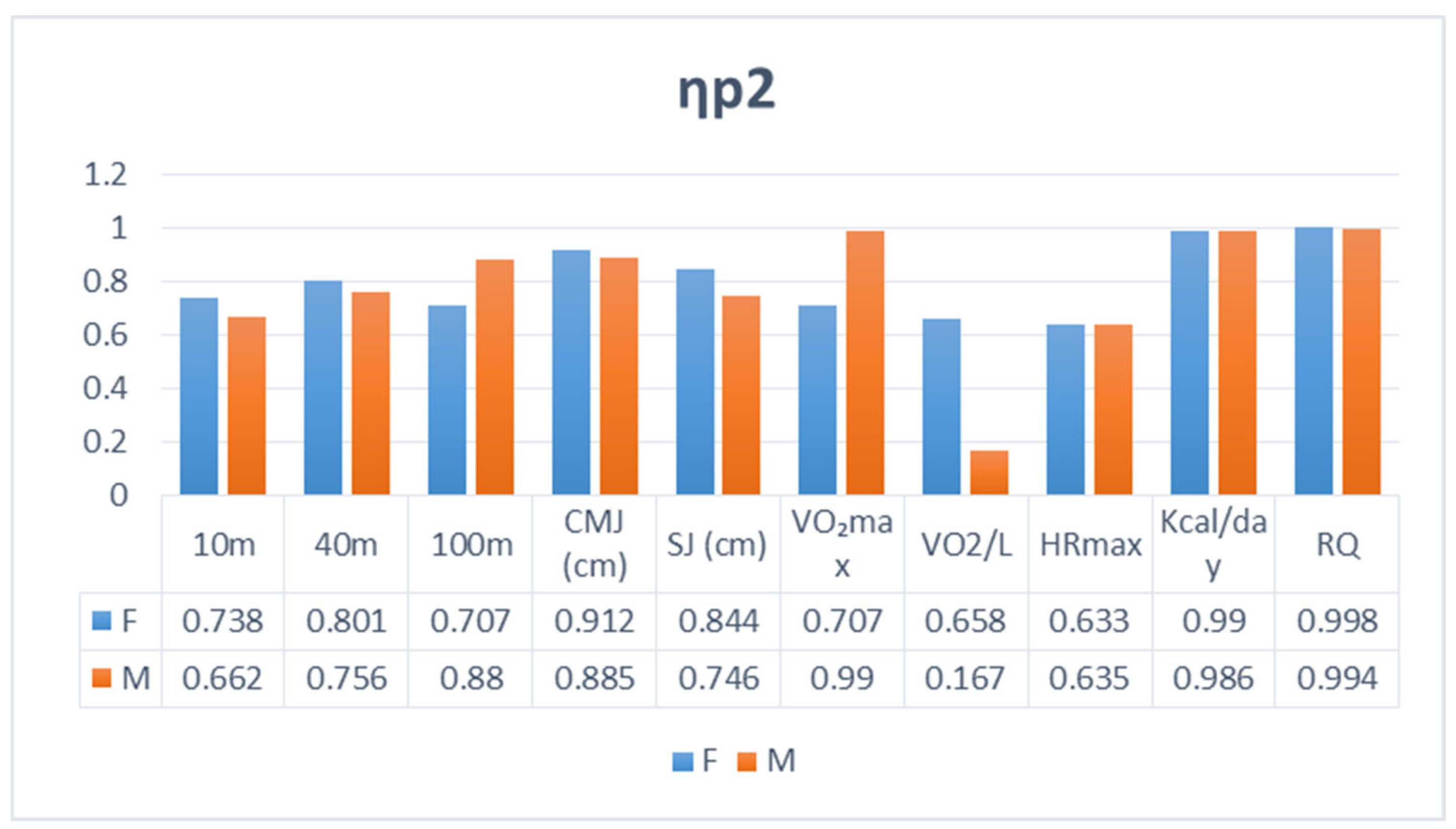
| Speed | 10 m | Female | 42.207 | <0.001 | 0.738 | −0.114 * | <0.001 ** | −0.151 | −0.076 |
| Male | 29.405 | <0.001 | 0.662 | −0.112 * | <0.001 ** | −0.157 | −0.068 | ||
| 40 m | Female | 60.307 | <0.001 | 0.801 | −0.297 * | <0.001 ** | −0.378 | −0.215 | |
| Male | 46.447 | <0.001 | 0.756 | −0.355 * | <0.001 ** | −0.466 | −0.244 | ||
| 100 m | Female | 36.198 | <0.001 | 0.707 | −0.436 * | <0.001 ** | −0.590 | −0.281 | |
| Male | 110.188 | <0.001 | 0.880 | −0.437 * | <0.001 ** | −0.526 | −0.349 | ||
| Explosive power | CMJ (cm) | Female | 155.496 | <0.001 | 0.912 | 3.237 * | <0.001 ** | 2.684 | 3.791 |
| Male | 115.338 | <0.001 | 0.885 | 2.902 * | <0.001 ** | 2.326 | 3.478 | ||
| SJ (cm) | Female | 81.179 | <0.001 | 0.844 | 3.637 * | <0.001 ** | 2.777 | 4.498 | |
| Male | 43.943 | <0.001 | 0.746 | 3.581 * | <0.001 ** | 2.429 | 4.732 | ||
| Aerobic capacity | VO2max | Female | 36.159 | <0.001 | 0.707 | 5.275 * | <0.001 ** | 3.405 | 7.145 |
| Male | 152.640 | <0.001 | 0.990 | 5.463 * | <0.001 ** | 2.785 | 8.140 | ||
| VO2/L | Female | 53.634 | <0.001 | 0.658 | 0.488 * | <0.001 ** | 0.294 | 0.681 | |
| Male | 23.003 | <0.001 | 0.167 | 0.219 | <0.001 ** | −0.050 | 0.488 | ||
| HRmax | Female | 25.906 | <0.001 | 0.633 | −10.125 * | <0.001 ** | −14.365 | −5.885 | |
| Male | 26.069 | <0.001 | 0.635 | −9.875 * | <0.001 ** | −13.997 | −5.753 | ||
| Metabolic changes | Kcal/day | Female | 1432.479 | <0.001 | 0.990 | 48.125 | <0.001 ** | −221.177 | 317.427 |
| Male | 1090.189 | <0.001 | 0.986 | 110.813 | <0.001 ** | −61.381 | 283.006 | ||
| RQ | Female | 9921.368 | <0.001 | 0.998 | −0.094 * | <0.001 ** | −0.117 | −0.071 | |
| Male | 2604.500 | <0.001 | 0.994 | −0.089 * | <0.001 ** | −0.119 | −0.059 | ||
| Component | Motor Test | Initial Test (It) | Final Test (Ft) | ||||
|---|---|---|---|---|---|---|---|
| Mean Difference | SDE | p | Mean Difference | SD | p | ||
| Speed | 10 m | −0.305 | 0.027 | <0.001 ** | −0.303 | 0.039 | <0.001 ** |
| 40 m | −0.744 | 0.104 | <0.001 ** | −0.802 | 0.095 | <0.001 ** | |
| 100 m | −3.143 | 0.244 | <0.001 ** | −3.145 | 0.202 | <0.001 ** | |
| Explosive power | CMJ (cm) | 12.8 | 1.876 | <0.001 ** | 12.526 | 1.734 | <0.001 ** |
| SJ (cm) | 9.620 | 1.947 | <0.001 ** | 9.563 | 1.737 | <0.001 ** | |
| Aerobic capacity | VO2max | 5.868 | 1.674 | 0.001 * | 6.056 | 1.645 | 0.001 * |
| VO2/L | −1.468 | 0.147 | <0.001 ** | −1.200 | 0.168 | <0.001 ** | |
| HRmax | −6.187 | 3.228 | 0.061 | −6.437 | 2.567 | 0.017 * | |
| Metabolic changes | Kcal/day | 670.500 | 127.193 | <0.001 ** | 733.187 | 110.8 | <0.001 ** |
| QR | −0.003 | 0.023 | 0.003 * | 0.001 | 0.0137 | 0.926 | |
Disclaimer/Publisher’s Note: The statements, opinions and data contained in all publications are solely those of the individual author(s) and contributor(s) and not of MDPI and/or the editor(s). MDPI and/or the editor(s) disclaim responsibility for any injury to people or property resulting from any ideas, methods, instructions or products referred to in the content. |
© 2026 by the authors. Licensee MDPI, Basel, Switzerland. This article is an open access article distributed under the terms and conditions of the Creative Commons Attribution (CC BY) license.
Share and Cite
Marius, S.; Badau, D.; Dreve, A.A. Integrated Training Program for Rugby Sevens: A Multivariate Approach of Motor, Functional, and Metabolic Components. Appl. Sci. 2026, 16, 664. https://doi.org/10.3390/app16020664
Marius S, Badau D, Dreve AA. Integrated Training Program for Rugby Sevens: A Multivariate Approach of Motor, Functional, and Metabolic Components. Applied Sciences. 2026; 16(2):664. https://doi.org/10.3390/app16020664
Chicago/Turabian StyleMarius, Stoica, Dana Badau, and Adina Andreea Dreve. 2026. "Integrated Training Program for Rugby Sevens: A Multivariate Approach of Motor, Functional, and Metabolic Components" Applied Sciences 16, no. 2: 664. https://doi.org/10.3390/app16020664
APA StyleMarius, S., Badau, D., & Dreve, A. A. (2026). Integrated Training Program for Rugby Sevens: A Multivariate Approach of Motor, Functional, and Metabolic Components. Applied Sciences, 16(2), 664. https://doi.org/10.3390/app16020664

