Article

Acute Effects of Isometric Conditioning Activity with Different Rest Intervals Between Sets on Countermovement Jump Performance in Resistance-Trained Participants

1
Institute of Sport Sciences, Academy of Physical Education, 40-065 Katowice, Poland
2
Department of Sport Games, Faculty of Physical Education and Sport, Charles University, 162 52 Prague, Czech Republic
*
Authors to whom correspondence should be addressed.
Appl. Sci. 2025, 15(22), 11989; https://doi.org/10.3390/app152211989
Submission received: 3 October 2025 / Revised: 7 November 2025 / Accepted: 9 November 2025 / Published: 11 November 2025
(This article belongs to the Special Issue Advances in Sport Physiology, Nutrition, and Metabolism)

Abstract

This study investigated the acute effects of different rest intervals between sets of isometric conditioning activity (ICA) on countermovement jump (CMJ) performance. Fifteen resistance-trained males completed four conditions: three ICA protocols with 1, 2, or 3 min rest intervals between sets and a control condition (CTRL). ICA was performed in the half-squat position at a 90° knee angle against an immovable barbell, with each protocol consisting of three sets of short maximal voluntary isometric contractions (3 × 3 s per set). CMJ performance was assessed before and at 3, 6, 9, and 12 min after ICA or CTRL. The results showed no significant effects of the ICA or rest interval on CMJ height or relative peak power. However, independent of rest duration, ICA induced transient alterations in jump mechanics, characterized by decreased stiffness at 9 min and reduced eccentric peak velocity at 6–12 min post-ICA. Similar fluctuations were observed in the CTRL condition, suggesting that these changes may reflect time-dependent variability rather than specific potentiation effects. In conclusion, the studied ICA protocols did not enhance CMJ height or power output, and the length of the rest interval did not influence the outcomes, indicating limited applicability of this approach in resistance-trained males.

1. Introduction

Post-activation performance enhancement (PAPE) refers to a short-term improvement in muscular performance in tasks such as sprinting and jumping following a specific conditioning activity (CA) [1]. While PAPE is often discussed alongside post-activation potentiation (PAP), the two phenomena differ in their underlying mechanisms and time course [2]. PAP has traditionally been linked to myosin light chain phosphorylation and assessed through single muscle twitch responses [2]. In contrast, PAPE likely involves additional physiological mechanisms, including increased motor unit recruitment, neural drive, and enhanced excitation-contraction coupling, which contribute to its prolonged effects beyond those of PAP alone [2,3]. In practical terms, a typical PAPE protocol involves performing a high-intensity resistance exercise (such as a heavy squat or loaded jump) followed by a short rest interval and then a biomechanically similar dynamic task, such as an unloaded jump or a sprint. This sequencing is designed to transiently enhance the neuromuscular readiness for the subsequent explosive task, thereby reflecting the PAPE effect [4]. Furthermore, optimizing neuromuscular readiness through PAPE-inducing protocols may have implications not only for enhancing performance in high-velocity tasks but also for improving joint stability during rapid transitions between concentric and eccentric phases, such as those occurring in jumping and landing tasks [5]. Isometric conditioning activity (ICA) has garnered growing interest in both scientific literature and athletic practice, owing to its potential to elicit performance benefits without inducing substantial mechanical or metabolic fatigue [6,7]. This makes it particularly appealing in contexts where rapid recovery and minimal muscle damage are desired, such as pre-competition warm-ups or in-season training [8,9]. The elicitation and magnitude of the PAPE effect induced by ICA are influenced by various factors, including joint angle [10], contraction intensity [11], the total duration and number of ICA sets [12], contraction distribution [13], and the athletes’ strength level and training experience [10,14,15]. Although various parameters have been explored, limited research has specifically examined the role of rest interval duration between ICA sets, which may be an important determinant of PAPE outcomes [12]. Investigating this variable is crucial because the balance between potentiation and fatigue is time-dependent: too short rest may not allow sufficient recovery and thus diminish performance, whereas excessively long intervals may attenuate the potentiation effect [16,17]. Determining the optimal rest duration could therefore enhance the practical application of ICA in both training and competition settings, ensuring that athletes maximize performance benefits while minimizing unnecessary fatigue.
Another important consideration is the duration of rest between completing CA and performing the subsequent explosive task, as research on traditional dynamic CA protocols generally recommends 3 to 8 min to optimize the potentiation response [9,18]. Together, these perspectives suggest that both intra-CA recovery (between sets) and post-CA recovery (between CA and the following task) should be systematically examined to establish evidence-based guidelines for the effective use of ICA in training and competition. It is important to consider that ICA may elicit different physiological responses compared to traditional dynamic CA, due to factors such as minimal muscle fiber disruption, lower metabolic cost, and reduced accumulation of peripheral fatigue [6,19]. These characteristics may influence the onset, magnitude, and duration of the PAPE response in ways distinct from those observed with dynamic resistance exercises [6]. These factors suggest that findings derived from research on dynamic CA may not be entirely generalizable to ICA [12]. Therefore, it is crucial not to rely solely on the existing literature regarding dynamic CA but to conduct direct comparisons of the inter-set rest durations specific to ICA. While rest intervals for dynamin CA have been investigated, particularly in the context of high-intensity, multi-joint movements, the appropriate recovery time between ICA sets remains less clearly defined and may be highly dependent on factors such as contraction intensity, volume, and an individual’s neuromuscular profile [12,20]. For example, Jarosz et al. [12] reported improvements in CMJ performance following three isometric sets (9 s each, half-squat position) with significant effects observed at 3 and 6 min post-ICA. Similarly, Spieszny et al. [14] found enhanced CMJ height after three sets of maximal isometric squats, with improvements occurring at both 4 and 8 min post-ICA. In contrast, Tsoukos et al. [10] demonstrated performance enhancements after protocols involving three sets of 3 s maximal isometric efforts with shorter 1 min rest periods between sets. In addition to rest interval duration, their protocols differed not only in rest duration but also in contraction length and joint position (90° and 140° of knee flexion). On the other hand Jarosz et al. [13] and Krzysztofik et al. [21] found no performance improvements when using the same 1 min rest period and number of sets (i.e., 3 sets) as in the study by Tsoukos et al. [10], but with different contraction structures. Specifically, Jarosz et al. [13] applied sets totaling 9 s each but distributed as either 9 × 1 s, 3 × 3 s, or 1 × 9 s isometric contractions, whereas Krzysztofik et al. [21] used 3 × 3 s maximal isometric half-squats. Jarosz et al. [13] employed the half-squat at approximately 120° of knee flexion, while Spieszny et al. [14] used 90°. These discrepancies in contraction duration, joint angle, and rest interval complicate direct comparisons and underscore the need to systematically examine how these factors interact to affect the PAPE response. Taken together, the inconsistencies highlight a clear methodological gap—there is a lack of studies that directly isolate the effect of rest interval duration between ICA sets while keeping other parameters (such as contraction time, joint position, and contraction distribution) constant [13].
Given conflicting reports on optimal rest, this study tested whether 1, 2, or 3 min rest intervals between ICA sets, with total contraction time held constant at 27 s across three sets, differentially affect subsequent CMJ performance in resistance-trained participants under the CTRL condition. It was hypothesized that protocols with longer inter-set rest intervals would be more likely to elicit improvements in CMJ performance, although these effects might emerge later during the recovery period compared to shorter rest conditions.

2. Materials and Methods

2.1. Experimental Approach to the Problem

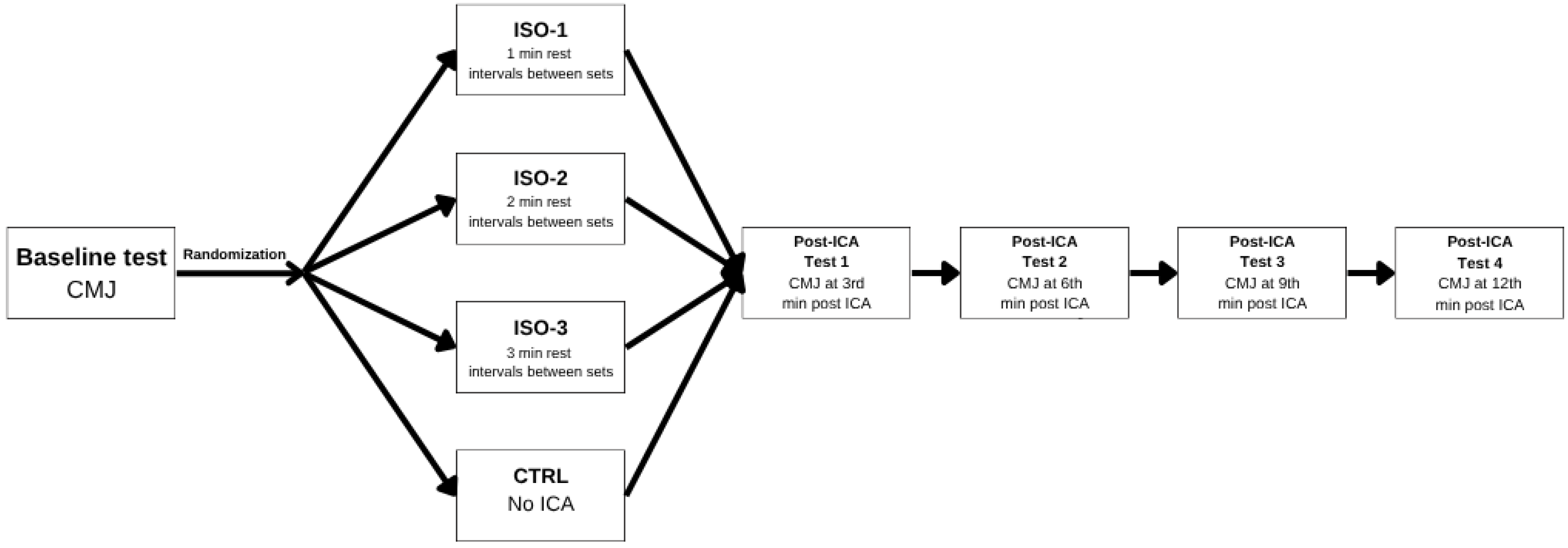
The experiment employed a randomized crossover design, in which each participant completed four experimental sessions to evaluate the acute effects of maximal isometric squats (used as the ICA) on subsequent CMJ performance. Prior to testing, participants underwent a familiarization session followed by four experimental sessions. In each experimental session, participants performed one of three ICA protocols or a CTRL condition. The ICA protocols differed in the rest intervals between sets: 1 min (ISO-1), 2 min (ISO-2), and 3 min (ISO-3). CMJ performance was assessed approximately 3 min before the ICA and at 3, 6, 9, and 12 min after its completion [10,13]. In the CTRL condition, CMJ measurements were taken at the same time intervals but without performing the ICA (Figure 1). Consecutive sessions were spaced 3 to 7 days apart.

2.2. Participants

The sample size estimation was performed using G*Power software (version 3.1.9.2, Düsseldorf, Germany). The calculation was based on the parameters for a “repeated measures ANOVA, within-subject factors” design, assuming one group of participants, four experimental conditions, and five measurement points. A statistical power of 0.8, a significance level of 0.05, and an anticipated medium effect size of approximately d = 0.5 were adopted, consistent with prior research investigating the acute effects of isometric activation exercises on jump performance [14,21]. The analysis indicated that a minimum of 10 participants was required.
The study involved 15 resistance-trained male participants classified based on training status and performance caliber (trained) according to McKay et al. [22] (Table 1). The inclusion criteria were as follows: (a) participation in resistance training at least three times per week for a minimum of two years; (b) no muscle injuries (resulting in an absence from training for more than four weeks) for at least six months prior to the start of the study. Participants were regularly engaged in traditional resistance training programs, including multi-joint free-weight exercises such as squats, deadlifts, and bench presses, performed at least three to four times per week. Participants were instructed to refrain from engaging in any resistance training for 48 h before the experimental session. Additionally, they were advised to maintain their usual dietary habits and avoid consuming any supplements or stimulants during the week preceding the experiment. At the beginning of the experimental session, body composition was assessed using multi-frequency bioelectrical impedance analysis conducted under laboratory conditions with the InBody 770 device (InBody, Seoul, Republic of Korea). Participants were informed about the potential risks and benefits associated with their involvement and were reminded of their right to withdraw from the study at any point without justification, prior to providing written informed consent. The experiment utilized a randomized crossover design. Although participants were aware of the immediate tasks being performed (e.g., isometric contractions or walking), they were blinded to the overall purpose and specific hypotheses of the study. Randomization was carried out using the randomization.org generator, which assigned each participant a unique number and session sequence. Written informed consent was obtained from all participants; however, detailed information concerning the study’s aims and expected outcomes was intentionally withheld to minimize bias.
All experimental procedures were conducted at the Academy of Physical Education in Katowice, Poland. The study protocol was reviewed and approved by the Bioethics Committee for Scientific Research at the Academy of Physical Education in Katowice (approval no. 3/2021), adhering to the ethical principles of the 1983 Declaration of Helsinki.

2.3. Procedure

All testing sessions were performed at the same time of day (±1 h) under identical laboratory conditions (temperature 21–22 °C, same equipment setup, and same supervising researchers) to ensure environmental and procedural consistency. Each session included an individualized, habitual warm-up routine for each participant. After completing the warm-up, participants performed a baseline CMJ assessment. Following a rest interval of approximately 3 min, they executed the isometric squats serving as the ICA according to the assigned condition, or no ICA in the CTRL trial, following a randomized order. During the ICA, an immovable barbell, securely fixed in place, was positioned across the participants’ shoulders. The squat depth was standardized to a 90° knee flexion angle [21], as determined during a familiarization session conducted three days before the main experimental trials. This measurement was performed by an experienced coach using a goniometer (EasyAngle, Meloq AB, Stockholm, Sweden). A qualified strength coach ensured consistent body positioning across all conditions, maintaining an upright trunk posture. At the verbal cue from the researcher, participants were instructed to “push the barbell vertically upward as hard and as fast as possible,” exerting maximal force by pressing their back against the barbell and driving their feet into the ground [12]. No restrictions were imposed on squat depth during the CMJ.
Participants completed, in randomized order, four conditions: CTRL (5 min of treadmill walking at 5 km·h−1 as an unrelated exercise condition to determine whether the conditioning activity was unique in its ability to elicit a performance response) and ISO-1/ISO-2/ISO-3 (each: three sets of ICA comprising 3 × 3 s maximal isometric contractions; 27 s total contraction time) with inter-set rest of 1, 2, or 3 min, respectively. The time required to complete each condition was monitored using a stopwatch.

2.4. Measurement of Countermovement Jump Performance

CMJ performance was assessed using a force platform (Force Decks, Vald Performance, Australia) operating at a sampling frequency of 1000 Hz [23], which has previously been recognized as a reliable instrument for assessing vertical jump kinematics [23]. Each participant performed three CMJs without arm swings, with 3 s rest intervals between attempts to ensure a stable standing position and correct posture before the next jump, while maintaining the continuity of a single testing series. During the measurement, participants began from a standing position with their hands on their hips, maintaining a straight back posture to minimize angular hip displacement. They were instructed to stand as still as possible for 1 s before initiating the countermovement. Then, they dropped into the countermovement position to a self-selected depth and were immediately followed by a maximal effort vertical jump. They were instructed to land in the same position as their take-off, centered on the force platform. All CMJ assessments were supervised by the same experienced evaluator (strength and conditioning coach with over five years of experience) to ensure consistent execution and cueing. The study’s dependent variables included various parameters related to jump height. First, jump height (JH) was calculated based on the velocity of the center of mass at take-off, using the impulse-momentum equation [12]. Additional variables, including relative peak power output (PP), eccentric peak velocity (EPV), and stiffness (S), were considered as independent factors potentially influencing jump height.

3. Statistical Analyses

All statistical analyses were conducted using JASP software (version 0.18.3; JASP Team, University of Amsterdam, Amsterdam, The Netherlands) and are presented as mean values with corresponding standard deviations (±SD). Statistical significance was established at p < 0.05. Both absolute values and percentage changes were reported where relevant. The Shapiro–Wilk test was applied to assess the normality of data distribution, while Levene’s and Mauchly’s tests were used to evaluate homogeneity of variance and sphericity, respectively. A two-way repeated-measures ANOVAs (4 conditions: CTRL, ISO-1, ISO-2, ISO-3 × 5 time points: pre-ICA, 3, 6, 9, and 12 min post-ICA) were employed to examine the effects of ICA on CMJ performance variables. Effect sizes for main effects and interactions were calculated using partial eta squared (η2), categorized as small (0.01–0.059), moderate (0.06–0.137), or large (>0.137). When significant main effects or interactions were identified, Bonferroni-adjusted (p_bonf) post hoc comparisons were performed. Additionally, Cohen’s d was used to quantify effect sizes for pairwise differences, interpreted as “trivial” (|d| < 0.20), “small” (0.20 ≤ |d| < 0.50), “moderate” (0.50 ≤ |d| < 0.80), and “large” (|d| ≥ 0.80) [24].

4. Results

4.1. Jump Height

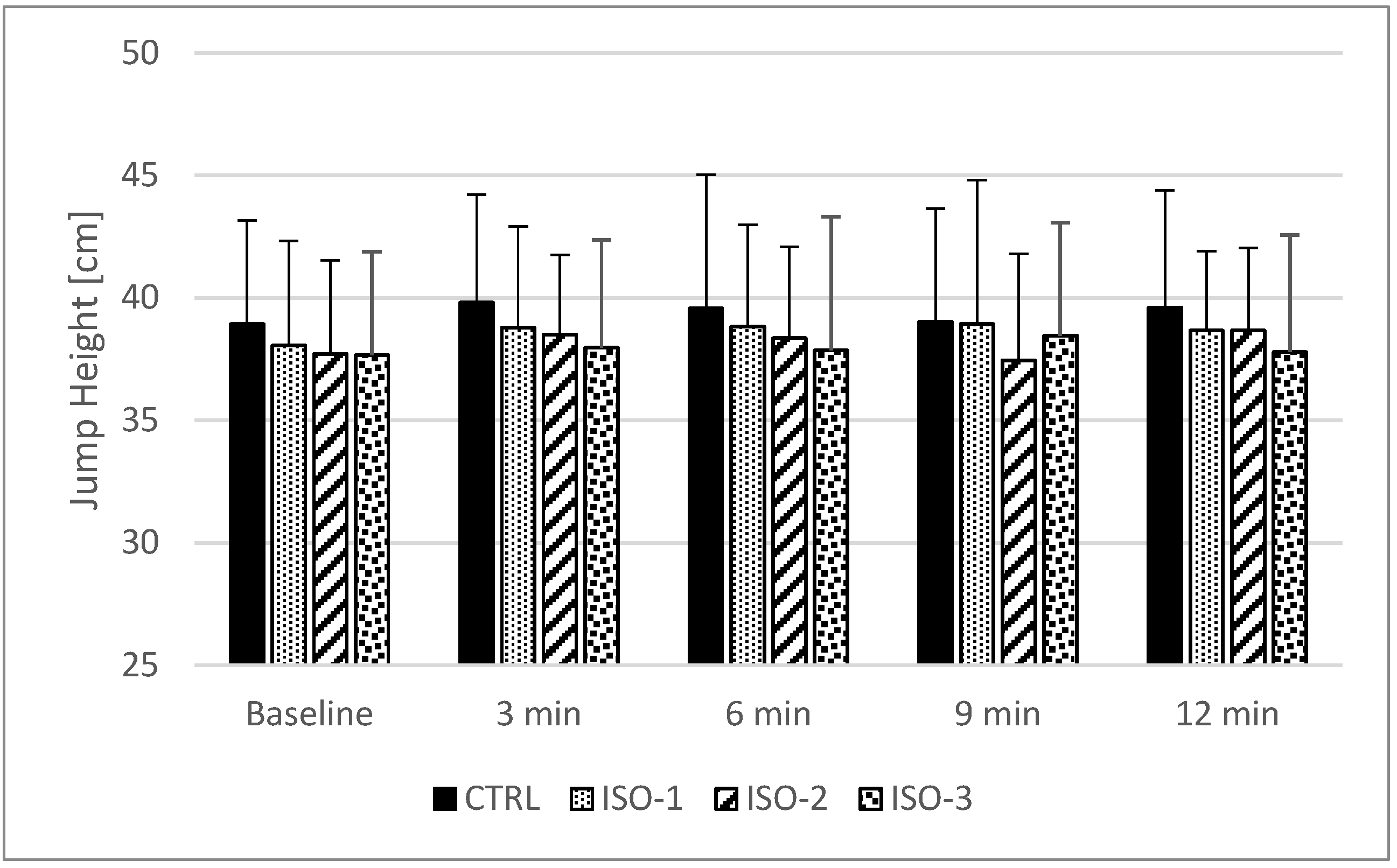
Repeated measures ANOVA showed no significant main effect of time for absolute scores (F = 0.923, p = 0.451) or percent changes (F = 0.281, p = 0.839), and no significant time × group interactions for either measure (absolute: F = 0.367, p = 0.974; percent change: F = 0.444, p = 0.910). Between-condition effects were also non-significant for absolute scores (F = 0.258, p = 0.855) and percent changes (F = 0.067, p = 0.977). (Figure 2).

4.2. Relative Peak Power

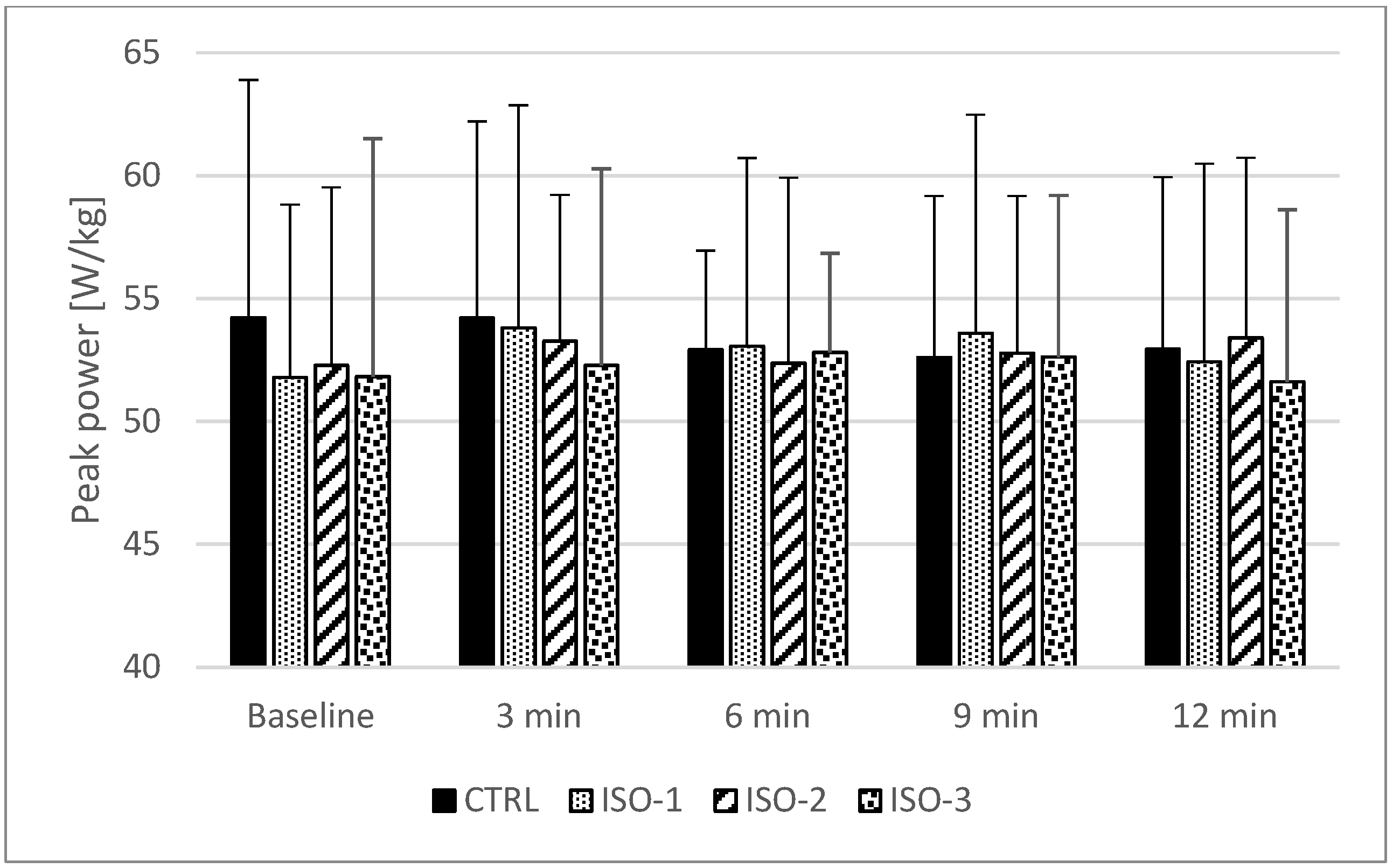
A repeated measures two-way ANOVA did not show statistically significant interaction (F = 0.769; p = 0.681), main effect of time (F = 0.587; p = 0.673), or condition (F = 0.177; p = 0.911) for relative PP (Figure 3).

4.3. CMJ Stiffness and CMJ Eccentric Peak Velocity

A repeated measures two-way ANOVA revealed a statistically significant main effect of time on CMJ S (F = 4.508, p = 0.003, ηp2 = 0.231) and CMJ EPV (F = 8.542, p_bonf < 0.001, ηp2 = 0.363) (Table 2). However, there were no significant differences between conditions (F = 0.013, p_bonf = 0.998) or interactions (F = 1.074, p_bonf = 0.385) for CMJ S, nor significant differences between conditions (F = 0.774, p_bonf = 0.532) or interactions (F = 0.770, p_bonf = 0.680) for CMJ EPV. Post hoc comparisons for CMJ S showed a significant decrease at 9th min post-ICA (Mean difference [MD] = −1083 ± 40 [N/m]; Cohen’s d = 0.243; p_bonf < 0.001) compared to pre-ICA. For CMJ EPV, significant decreases were observed at 6th min (MD = −0.22 ± 0.00 [m/s]; Cohen’s d = 0.225; p_bonf = 0.042), 9th min (MD = −0.34 ± 0.04 [m/s]; Cohen’s d = 0.364; p_bonf < 0.001), and 12th min (MD = −0.47 ± 0.23 [m/s]; Cohen’s d = 0.369; p_bonf < 0.001) post-ICA compared to pre-ICA, and at 9th min (MD = −0.17 ± 0.17 [m/s]; Cohen’s d = 0.222; p_bonf = 0.047) and 12th min (MD = −0.29 ± 0.10 [m/s]; Cohen’s d = 0.227; p_bonf = 0.039) compared to 3rd min post-ICA.

5. Discussion

The aim of this study was to compare the acute effects of ICA with different rest intervals between sets on subsequent CMJ performance in resistance-trained males. Contrary to the initial hypothesis, no significant improvements in JH or PP were observed in any condition, including ISO-1, ISO-2, ISO-3, and CTRL. Despite the lack of improvements, no decrease in JH or PP was found either, suggesting that neuromotor performance was preserved regardless of the rest duration between sets of ICA. Although at certain time points post-ICA a decrease in S (9th minute post-ICA) and an increase in EPV (6th, 9th, and 12th minutes post-ICA) were observed, similar changes also occurred in the CTRL condition. Therefore, these alterations cannot be attributed specifically to ICA and may reflect general fluctuations in movement mechanics over time rather than intervention-related effects. These findings suggest that 1–3 min rest intervals between ICA sets did not influence JH or PP, transient changes in S and EPV likely reflect compensatory neuromuscular adjustments unrelated to the ICA, possibly serving to maintain jump performance over time. To explore this aspect further, particular attention was given to transient modifications in jump mechanics, which may provide insight into how athletes regulate performance under varying neuromuscular states.
An interesting observation concerned transient alterations in jump mechanics: a decrease in stiffness at the 9th minute and an increase in eccentric phase velocity at the 6th, 9th, and 12th minutes post-ICA. However, similar fluctuations were also present in the control condition, indicating that these patterns more likely reflect time-dependent drift in movement mechanics rather than a true potentiation effect of ICA. Evidence from isolated muscle preparations suggests that lengthening can produce residual force enhancement, whereas subsequent active shortening can induce force depression, effectively reducing force for a given activation [11]. If analogous processes occur in vivo, repeated maximal isometric efforts followed by stretch–shortening actions could transiently modulate muscle–tendon stiffness by altering elastic energy storage and release via titin- and cross-bridge-related mechanisms [25]. This aligns with reports that reduced dynamic stiffness can impair force transmission efficiency during jumping [26]. A faster EPV combined with lower S observed in the present study may therefore represent a compensatory strategy to preserve jump height under such constraints, potentially reflecting mild fatigue or altered neuromuscular drive after sustained isometric efforts [27]. It should also be acknowledged that CMJ depth was self-selected to maintain natural movement patterns, which may have allowed subtle adjustments in countermovement amplitude or velocity across trials. Consequently, part of the variability in EPV and S could stem from modifications in jump strategy rather than purely neuromuscular responses. From a physiological standpoint, the absence of a measurable PAPE response may reflect an equilibrium between modest potentiation and low-level fatigue. Although brief maximal isometric actions can transiently enhance calcium sensitivity and motor unit recruitment via myosin regulatory light chain phosphorylation [2,4], the relatively short contraction duration and absence of direct feedback may have limited the degree of motor unit synchronization and overall neural drive. Moreover, insufficient activation of high-threshold motor units and minimal metabolic perturbation could have reduced transient changes in muscle temperature and intramuscular water content, all of which can influence contractile efficiency and power output. Collectively, these physiological and neuromuscular factors likely minimized observable performance gains despite preserved motor function. However, beyond these short-term mechanical fluctuations, another crucial factor that may explain the absence of PAPE responses in our study relates to participant characteristics and training background.
In the present study, no significant differences were observed in CMJ height or power output following ICA, regardless of whether inter-set rest intervals lasted 1, 2, or 3 min. The absence of changes in jumping performance as a function of rest duration may suggest that recovery time between ICA sets is not a primary factor modulating the occurrence of the PAPE effect in resistance-trained participants. Instead, other characteristics of the ICA protocol and their interactions may play a more decisive role.
One potential explanation for the lack of significant effects is the absence of direct monitoring of participants’ effort during ICA execution, for example, through maximal isometric force, which in previous studies has been assessed using force platforms [13]. Without an objective evaluation of the generated isometric force, it is plausible that participants did not perform contractions with maximal intent, despite verbal encouragement. As highlighted in previous work [28,29], exerting full effort during isometric exercise is crucial for recruiting high-threshold motor units and eliciting the intended adaptive response to the applied stimulus. Therefore, the use of a force platform would likely represent the most appropriate approach, as it provides a direct and reliable measure of isometric force. Consequently, irrespective of rest duration, the ICA protocol employed in this study may have been insufficient to induce a measurable PAPE effect in explosive lower-limb performance, primarily due to submaximal effort and limited neuromuscular activation. The absence of differences in ISO-1 is consistent with the findings of Jarosz et al. [13], who likewise reported no improvement in jumping performance when applying the same protocol in resistance-trained participants. Furthermore, the lack of significant differences in ISO-3 in the present study corroborates the comparative work of Jarosz et al. [30], which demonstrated that the ISO-3 protocol enhanced jumping performance in highly trained participants but not in those with only resistance-training experience. This highlights the importance of training status as a key moderator of the PAPE effect. To the authors’ knowledge, the ISO-2 protocol has not yet been examined in the literature, which limits the possibility of direct comparisons across studies. Taken together, these findings suggest that while training status moderates the overall effectiveness of different ISO protocols, more subtle, short-term alterations in movement mechanics may still emerge following ICA. Taken together, these findings point to the strong moderating role of training experience and specialization in shaping the PAPE response. A direct comparison with Tsoukos et al. [10] further illustrates how protocol-specific factors likely contributed to the divergent outcomes. In that study, national-level power athletes performed 3 × 3 s maximal isometric squats at both 90° and 140° knee angles, and a significant enhancement in CMJ height was observed only at the wider 140° position. The use of a shorter muscle length likely reduced fatigue while preserving potentiation mechanisms associated with regulatory light chain phosphorylation. By contrast, the present study maintained a fixed 90° angle and did not include real-time force monitoring, which may have increased the relative contribution of fatigue and reduced the mechanical stimulus necessary to trigger potentiation. Moreover, in a study by Tsoukos et al. [10], participants were national-level male track and field power athletes accustomed to high-intensity stretch–shortening actions, whereas the resistance-trained participants in the current study likely exhibited lower fatigue resistance. Together, these methodological and population-related factors provide a plausible explanation for the absence of a PAPE effect in the present experiment. A comparison with Spieszny et al. [14] further clarifies why our results diverged despite superficially similar ICA structures. In their study, semi-professional handball and soccer players performed 3 × (3 × 3 s) maximal isometric back squats at ~90° with 3 min inter-set rest and showed small-to-moderate improvements in both CMJ and SJ at 4–8 min post-ICA. Three protocol elements likely favored potentiation there but not in our cohort: (i) training background: semi-professional, SSC-acclimated athletes vs. our resistance-trained generalists implies higher fatigue resistance and more efficient recruitment of high-threshold motor units; (ii) task similarity: their SJ depth was mechanically constrained to match the ICA angle, improving transfer specificity, whereas in our design only CMJ (self-selected depth) was analyzed; (iii) response sampling: they analyzed the best post-ICA trial (individual-optimal timing), whereas our inference rested on fixed time points and group means. Notably, total contraction time (27 s) and the existence of a 3 min rest condition were aligned across studies; thus, the population specialization and transfer specificity-rather than rest duration per se, are the most parsimonious explanations for the presence of PAPE in Spieszny et al. [14] and its absence here. Nevertheless, methodological aspects of the present study also warrant consideration, as they may have further constrained the observed outcomes.
Despite previous reports demonstrating PAPE following ICA, the present study did not reveal significant improvements in CMJ height or peak power output across any of the ICA conditions. For instance, Jarosz et al. [12] observed significant improvements in CMJ height and relative peak power at 3 and 6 min post-ICA in elite volleyball players, while Spieszny et al. [14] reported enhanced CMJ and SJ performance in semi-professional handball and soccer players. In contrast, our findings are consistent with Jarosz et al. [13], who also found no changes in CMJ following the same ICA protocol in resistance-trained participants, although their analysis of intra-set contraction distribution indicated that shorter, intermittent contractions-performed either as nine 1 s efforts (SUST-1) or three 3 s efforts (SUST-3), enabled the generation of higher Force200 values, which, however, did not translate into improvements in jump performance. Interestingly, Jarosz et al. [12] showed that elite volleyball players-athletes accustomed to frequent explosive stretch–shortening cycle actions demonstrated more favorable responses to ICA than strength-trained but non-explosive populations, supporting the notion that training background is a decisive factor in whether potentiation outweighs fatigue [10,31]. In line with this, Spieszny et al. [14] reported improvements of 2.7–3.6% in CMJ and ~5% in SJ performance following multiple sets of short isometric squats in semi-professional handball and soccer players, whereas our resistance-trained but non-specialist participants likely lacked the neuromuscular adaptations needed to capitalize on potentiation. High-performance athletes also appear to possess superior fatigue resistance, enabling more effective buffering and clearance of fatigue-related metabolites, which may explain why Doma et al. [32] observed robust PAPE responses in anaerobically trained males, and Guerra et al. [33] in professional male soccer players, but not in cohorts comparable to ours. The findings of Jarosz & Szwarc [30] further substantiate this interpretation, showing that significant improvements in CMJ height occurred only in highly trained athletes, while moderately trained individuals exhibited no measurable benefits. In our study, the lack of improvement may therefore be linked not only to training status but also to participants’ younger biological age, shorter training history, and limited experience with isometric contractions, all of which likely constrained their responsiveness to ICA. Our participants, who lacked regular exposure to explosive or isometric modalities and did not represent a defined sport discipline, were likely less efficient in recruiting high-threshold motor units, which may have limited their ability to generate sufficient potentiation to outweigh fatigue. Taken together, the absence of PAPE in this study may thus reflect both protocol-specific factors (e.g., contraction duration, total volume) and participant characteristics (e.g., limited isometric experience, absence of sport specialization, younger age, reduced fatigue resistance). Moreover, the lack of direct verification of force output during ICA further limits the ability to determine whether participants truly performed contractions with maximal intent. These findings reinforce the idea that ICA does not universally induce potentiation, but rather that its effectiveness is contingent upon both methodological design and the adaptive profile of the athlete.
Future research should aim to distinguish between these mechanisms by incorporating objective indicators of fatigue and neuromuscular function (e.g., tensiomyography or biochemical markers such as lactate, creatine kinase, and cortisol). Several methodological limitations should also be acknowledged. First, force output during ICA was not recorded, making it difficult to fully verify participants’ effort and potentially attenuating the conditioning stimulus. Second, because participants were moderately trained males, the findings may not generalize to elite or female athletes, in whom PAPE responses might differ [4,9]. Third, only a single ICA configuration at a fixed knee angle (90°) was examined, limiting insight into how joint position and muscle length may influence the potentiation–fatigue balance. Finally, although participants were instructed to abstain from resistance training for 48 h before testing and to maintain similar pre-test routines, other potentially confounding factors, such as daily training load, sleep quality, and nutritional intake, were not directly monitored and could have introduced uncontrolled variability. Accordingly, future studies should employ objective measures of contraction intensity and fatigue and systematically explore the influence of ICA parameters (e.g., joint angle, contraction duration, and set structure) across populations differing in sex, strength, and training background to better clarify the practical relevance of ICA in sport and exercise settings.

6. Conclusions

This study showed that manipulating between-set rest (1, 2, or 3 min) during ICA with total contraction time matched at 27 s across three sets did not acutely enhance CMJ performance, nor jump height, nor peak power in resistance-trained males. Performance was maintained across all conditions, indicating preserved neuromotor function. Notably, a transient decrease in stiffness S accompanied by an increase in EPV suggested subtle shifts in movement mechanics rather than ICA-specific performance effects. Practically, ICA under these parameters is unlikely to acutely improve CMJ in trained individuals, but it also does not impair it; rest intervals may instead modulate jump strategy without altering outcomes.

Author Contributions

Conceptualization, J.J. and A.L.; methodology, J.J. and A.L.; formal analysis, J.J. and A.L.; investigation, A.L., J.J. and P.M.; data curation, A.L.; writing—original draft preparation, A.L.; writing—review and editing, J.J. and M.K.; visualization, A.L.; supervision, M.K.; project administration, A.L.; funding acquisition, M.K. All authors have read and agreed to the published version of the manuscript.

Funding

This research received no external funding.

Institutional Review Board Statement

The study was conducted in accordance with the Declaration of Helsinki and approved by the Bioethics Committee for Scientific Research at the Academy of Physical Education in Katowice (approval no. 3/2021).

Informed Consent Statement

Informed consent was obtained from all subjects involved in the study.

Data Availability Statement

The original contributions presented in the study are included in the article, further inquiries can be directed to the corresponding author/s.

Acknowledgments

During the preparation of this work, the authors used ChatGPT-4o Mini (OpenAI, model release September 2025) exclusively to improve the language and readability, with caution. After using this tool, the authors reviewed and edited the content as needed and take full responsibility for the content of the publication.

Conflicts of Interest

The authors declare no conflicts of interest.

References

  1. Liu, L.; Niu, X.; Zhou, Z. Acute Effects of Different Conditioning Activities on the Post-Activation Performance Enhancement in Athletes’ Jumping and Sprinting Performances: A Systematic Review and Meta-Analysis. Appl. Sci. 2024, 14, 9301. [Google Scholar] [CrossRef]
  2. Blazevich, A.J.; Babault, N. Post-Activation Potentiation Versus Post-Activation Performance Enhancement in Humans: Historical Perspective, Underlying Mechanisms, and Current Issues. Front. Physiol. 2019, 10, 1359. [Google Scholar] [CrossRef] [PubMed]
  3. Bartolomei, S.; Lanzoni, I.M.; Fantozzi, S.; Cortesi, M. A Comparison between Non-Localized Post-Activation Performance Enhancements Following Resistance Exercise for the Upper and the Lower Body. Appl. Sci. 2022, 12, 1639. [Google Scholar] [CrossRef]
  4. Prieske, O.; Behrens, M.; Chaabene, H.; Granacher, U.; Maffiuletti, N.A. Time to Differentiate Postactivation “Potentiation” from “Performance Enhancement” in the Strength and Conditioning Community. Sports Med. 2020, 50, 1559–1565. [Google Scholar] [CrossRef]
  5. Xu, D.; Jiang, X.; Cen, X.; Baker, J.S.; Gu, Y. Single-Leg Landings Following a Volleyball Spike May Increase the Risk of Anterior Cruciate Ligament Injury More than Landing on Both-Legs. Appl. Sci. 2020, 11, 130. [Google Scholar] [CrossRef]
  6. Newham, D.J.; Jones, D.A.; Turner, D.L.; McIntyre, D. The Metabolic Costs of Different Types of Contractile Activity of the Human Adductor Pollicis Muscle. J. Physiol. 1995, 488, 815–819. [Google Scholar] [CrossRef]
  7. Lum, D.; Barbosa, T.M. Brief Review: Effects of Isometric Strength Training on Strength and Dynamic Performance. Int. J. Sports Med. 2019, 40, 363–375. [Google Scholar] [CrossRef]
  8. Krzysztofik, M.; Wilk, M.; Stastny, P.; Golas, A. Post-Activation Performance Enhancement in the Bench Press Throw: A Systematic Review and Meta-Analysis. Front. Physiol. 2021, 11, 598628. [Google Scholar] [CrossRef]
  9. Seitz, L.B.; Haff, G.G. Factors Modulating Post-Activation Potentiation of Jump, Sprint, Throw, and Upper-Body Ballistic Performances: A Systematic Review with Meta-Analysis. Sports Med. 2016, 46, 231–240. [Google Scholar] [CrossRef]
  10. Tsoukos, A.; Bogdanis, G.C.; Terzis, G.; Veligekas, P. Acute Improvement of Vertical Jump Performance After Isometric Squats Depends on Knee Angle and Vertical Jumping Ability. J. Strength Cond. Res. 2016, 30, 2250–2257. [Google Scholar] [CrossRef]
  11. Fukutani, A.; Herzog, W. The Stretch-Shortening Cycle Effect Is Prominent in the Inhibited Force State. J. Biomech. 2021, 115, 110136. [Google Scholar] [CrossRef] [PubMed]
  12. Jarosz, J.; Gawel, D.; Socha, I.; Ewertowska, P.; Wilk, M.; Lum, D.; Krzysztofik, M. Acute Effects of Isometric Conditioning Activity with Different Set Volumes on Countermovement Jump Performance in Highly Trained Male Volleyball Players. Appl. Sci. 2025, 15, 2393. [Google Scholar] [CrossRef]
  13. Jarosz, J.; Drozd, M.; Gawel, D.; Wilk, M.; Helbin, J.; Krzysztofik, M. Acute Effects of Isometric Conditioning Activity with Different Distribution Contraction on Countermovement Jump Performance in Resistance Trained Participants. Sci. Rep. 2025, 15, 16960. [Google Scholar] [CrossRef] [PubMed]
  14. Spieszny, M.; Trybulski, R.; Biel, P.; Zając, A.; Krzysztofik, M. Post-Isometric Back Squat Performance Enhancement of Squat and Countermovement Jump. Int. J. Environ. Res. Public Health 2022, 19, 12720. [Google Scholar] [CrossRef]
  15. Chiu, L.Z.F.; Fry, A.C.; Weiss, L.W.; Schilling, B.K.; Brown, L.E.; Smith, S.L. Postactivation Potentiation Response in Athletic and Recreationally Trained Individuals. J. Strength Cond. Res. 2003, 17, 671–677. [Google Scholar]
  16. Docherty, D.; Hodgson, M.J. The Application of Postactivation Potentiation to Elite Sport. Int. J. Sports Physiol. Perform. 2007, 2, 439–444. [Google Scholar] [CrossRef]
  17. Xenofondos, A.; Bassa, E.; Vrabas, I.S.; Kotzamanidis, C.; Patikas, D.A. Muscle Twitch Torque During Two Different in Volume Isometric Exercise Protocols: Fatigue Effects on Postactivation Potentiation. J. Strength Cond. Res. 2018, 32, 578–586. [Google Scholar] [CrossRef]
  18. Xu, K.; Blazevich, A.J.; Boullosa, D.; Ramirez-Campillo, R.; Yin, M.; Zhong, Y.; Tian, Y.; Finlay, M.; Byrne, P.J.; Cuenca-Fernández, F.; et al. Optimizing Post-Activation Performance Enhancement in Athletic Tasks: A Systematic Review with Meta-Analysis for Prescription Variables and Research Methods. Sports Med. 2025, 55, 977–1008. [Google Scholar] [CrossRef]
  19. Stotz, A.; Maghames, E.; Mason, J.; Groll, A.; Zech, A. Maximum Isometric Torque at Individually-Adjusted Joint Angles Exceeds Eccentric and Concentric Torque in Lower Extremity Joint Actions. BMC Sports Sci. Med. Rehabil. 2022, 14, 13. [Google Scholar] [CrossRef]
  20. Boullosa, D. Post-Activation Performance Enhancement Strategies in Sport: A Brief Review for Practitioners. Hum. Mov. 2021, 22, 101–109. [Google Scholar] [CrossRef]
  21. Krzysztofik, M.; Spieszny, M.; Trybulski, R.; Wilk, M.; Pisz, A.; Kolinger, D.; Filip-Stachnik, A.; Stastny, P. Acute Effects of Isometric Conditioning Activity on the Viscoelastic Properties of Muscles and Sprint and Jumping Performance in Handball Players. J. Strength Cond. Res. 2023, 37, 1486–1494. [Google Scholar] [CrossRef] [PubMed]
  22. McKay, A.K.A.; Stellingwerff, T.; Smith, E.S.; Martin, D.T.; Mujika, I.; Goosey-Tolfrey, V.L.; Sheppard, J.; Burke, L.M. Defining Training and Performance Caliber: A Participant Classification Framework. Int. J. Sports Physiol. Perform. 2022, 17, 317–331. [Google Scholar] [CrossRef] [PubMed]
  23. Collings, T.J.; Lima, Y.L.; Dutaillis, B.; Bourne, M.N. Concurrent Validity and Test–Retest Reliability of VALD ForceDecks’ Strength, Balance, and Movement Assessment Tests. J. Sci. Med. Sport 2024, 27, 572–580. [Google Scholar] [CrossRef] [PubMed]
  24. Cohen, J. Statistical Power Analysis for the Behavioral Sciences; Routledge: Oxfordshire, UK, 2013; ISBN 978-1-134-74270-7. [Google Scholar]
  25. Vargas-Molina, S.; Salgado-Ramírez, U.; Chulvi-Medrano, I.; Carbone, L.; Maroto-Izquierdo, S.; Benítez-Porres, J. Comparison of Post-Activation Performance Enhancement (PAPE) after Isometric and Isotonic Exercise on Vertical Jump Performance. PLoS ONE 2021, 16, e0260866. [Google Scholar] [CrossRef]
  26. Jordan, M.J.; Aagaard, P.; Herzog, W. A Comparison of Lower Limb Stiffness and Mechanical Muscle Function in ACL-Reconstructed, Elite, and Adolescent Alpine Ski Racers/Ski Cross Athletes. J. Sport Health Sci. 2018, 7, 416–424. [Google Scholar] [CrossRef]
  27. Burnley, M.; Vanhatalo, A.; Jones, A.M. Distinct Profiles of Neuromuscular Fatigue during Muscle Contractions below and above the Critical Torque in Humans. J. Appl. Physiol. 2012, 113, 215–223. [Google Scholar] [CrossRef]
  28. Hough, P.A.; Ross, E.Z.; Howatson, G. Effects of Dynamic and Static Stretching on Vertical Jump Performance and Electromyographic Activity. J. Strength Cond. Res. 2009, 23, 507–512. [Google Scholar] [CrossRef]
  29. Mina, M.A.; Blazevich, A.J.; Giakas, G.; Kay, A.D. Influence of Variable Resistance Loading on Subsequent Free Weight Maximal Back Squat Performance. J. Strength Cond. Res. 2014, 28, 2988–2995. [Google Scholar] [CrossRef]
  30. Jarosz, J.; Szwarc, A. Isometric Conditioning Activity and Jump Performance: Impact of Training Status in Male Participants. J. Clin. Med. 2025, 14, 6214. [Google Scholar] [CrossRef]
  31. Tillin, N.A.; Bishop, D. Factors Modulating Post-Activation Potentiation and Its Effect on Performance of Subsequent Explosive Activities. Sports Med. 2009, 39, 147–166. [Google Scholar] [CrossRef]
  32. Doma, K.; Leicht, A.S.; Boullosa, D.; Woods, C.T. Lunge Exercises with Blood-Flow Restriction Induces Post-Activation Potentiation and Improves Vertical Jump Performance. Eur. J. Appl. Physiol. 2020, 120, 687–695. [Google Scholar] [CrossRef]
  33. Guerra, M.A.; Caldas, L.C.; Souza, H.L.; Tallis, J.; Duncan, M.J.; Guimarães-Ferreira, L. The Effects of Physical Fitness on Postactivation Potentiation in Professional Soccer Athletes. J. Strength Cond. Res. 2022, 36, 1643–1647. [Google Scholar] [CrossRef]
Figure 1. Study design flowchart. CMJ—countermovement jump; ICA—isometric conditioning activity; ISO-1—condition with 1 min rest intervals between sets; ISO-2—condition with 2 min rest intervals between sets; ISO-3—condition with 3 min rest intervals between sets; CTRL—control condition (without ICA).
Applsci 15 11989 g001
Figure 2. Change in jump height between conditions and time points. CTRL—control condition (without ICA); ISO-1—condition with 1 min rest intervals between ICA sets; ISO-2—condition with 2 min rest intervals between ICA sets; ISO-3—condition with 3 min rest intervals between ICA sets. BL—baseline, 3 min—3rd minute post-ICA, 6 min—6th minute post-ICA, 9 min—9th minute post-ICA, 12 min—12th minute post-ICA.
Applsci 15 11989 g002
Figure 3. Change in relative peak power between conditions and time points. CTRL—control condition (without ICA); ISO-1—condition with 1 min rest intervals between ICA sets; ISO-2—condition with 2 min rest intervals between ICA sets; ISO-3—condition with 3 min rest intervals between ICA sets. BL—baseline, 3 min—3rd minute post-ICA, 6 min—6th minute post-ICA, 9 min—9th minute post-ICA, 12 min—12th minute post-ICA.
Applsci 15 11989 g003
Table 1. Descriptive characteristics of the study participants.
Age [years]20.5 ± 1
Body mass [kg]79 ± 9
Resistance training experience [years]3 ± 1
Body fat [%]10.4 ± 3.6
Relative 1RM BS [kg/bm]1.26 ± 0.23
1RM—one repetition maximum, BS—back squat, bm—body mass.
Table 2. Changes in countermovement jump stiffness and eccentric peak velocity across conditions and time points.
ConditionBaseline3 min6 min9 min12 minTimeConditionTime x Condition
Stiffness [N/m]CTRL5664 ± 12405368 ± 11605249 ± 8705076 ± 1173 *5283 ± 952p = 0.003p = 0.998p = 0.385
ISO-15413 ± 11125438 ± 13875397 ± 13075207 ± 1237 *5256 ± 1275
ISO-25575 ± 8995295 ± 9985233 ± 9075355 ± 985 *5338 ± 912
ISO-35304 ± 9535320 ± 7705413 ± 9705235 ± 849 *5414 ± 1214
Eccentric peak velocity [m/s]CTRL−1.27 ± 0.26−1.31 ± 0.16−1.32 ± 0.14 *−1.37 ± 0.15 *−1.39 ± 0.07 *p < 0.001p = 0.532p = 0.680
ISO-1−1.21 ± 0.24−1.28 ± 0.08−1.28 ± 0.13 *−1.29 ± 0.29 *−1.37 ± 0.12 *
ISO-2−1.27 ± 0.06−1.28 ± 0.14−1.32 ± 0.22 *−1.29 ± 0.19 *−1.26 ± 0.14 *
ISO-3−1.22 ± 0.21−1.27 ± 0.26−1.27 ± 0.28 *−1.36 ± 0.17 *−1.40 ± 0.20 *
CTRL—control condition (without ICA); ISO-1—condition with 1 min rest intervals between ICA sets; ISO-2—condition with 2 min rest intervals between ICA sets; ISO-3—condition with 3 min rest intervals between ICA sets. BL—baseline, 3 min—3rd minute post-ICA, 6 min—6th minute post-ICA, 9 min—9th minute post-ICA, 12 min—12th minute post-ICA, *—significant differences between pairwise comparisons, p < 0.05.
Disclaimer/Publisher’s Note: The statements, opinions and data contained in all publications are solely those of the individual author(s) and contributor(s) and not of MDPI and/or the editor(s). MDPI and/or the editor(s) disclaim responsibility for any injury to people or property resulting from any ideas, methods, instructions or products referred to in the content.