Next Article in Journal
Comparative Evaluation of the Translucency Properties of CAD/CAM Anterior Crowns
Previous Article in Journal
Plant-Based Production and Immunogenicity Evaluation of a GCN4pII-Fused PCV2d Cap Protein in Mice
Previous Article in Special Issue
Using Virtual Reality to Promote Cognitive Engagement in Rett Syndrome: Eye-Tracking Evidence from Immersive Forest Tasks
error_outline You can access the new MDPI.com website here. Explore and share your feedback with us.
 
 
Article

Semantic Latent Geometry Reveals Imagination–Perception Structure in EEG

Mathematical Biology and Physiology, Department of Electronics and Telecommunications, Politecnico di Torino, 10129 Turin, Italy
*
Author to whom correspondence should be addressed.
Appl. Sci. 2026, 16(2), 661; https://doi.org/10.3390/app16020661
Submission received: 22 December 2025 / Revised: 3 January 2026 / Accepted: 5 January 2026 / Published: 8 January 2026
(This article belongs to the Special Issue Brain-Computer Interfaces: Development, Applications, and Challenges)

Abstract

We investigate whether representation-level, semantic diagnostics expose structure in electroencephalography (EEG) beyond conventional accuracy when contrasting perception and imagination and relating outcomes to self-reported imagery ability. Using a task-independent encoder that preserves scalp topology and temporal dependencies, we learn semantic features from multi-subject, multi-modal EEG (pictorial, orthographic, auditory) and evaluate subject-independent decoding with lightweight heads, achieving state-of-the-art or better accuracy with low variance across subjects. To probe the latent space directly, we introduce threshold-resolved correlation pruning and derive the Semantic Sensitivity Index (SSI) and cross-modal overlap (CMO). While correlations between Vividness of Visual Imagery Questionnaire (VVIQ)/Bucknell Auditory Imagery Scale (BAIS) and leave-one-subject-out (LOSO) accuracy are small and imprecise at n = 12, the semantic diagnostics reveal interpretable geometry: for several subjects, imagination retains a more compact, non-redundant latent subset than perception (positive SSI), and a substantial cross-modal core emerges (CMO ≈ 0.5–0.8). These effects suggest that accuracy alone under-reports cognitive organization in the learned space and that semantic compactness and redundancy patterns capture person-specific phase preferences. Given the small cohort and the subjectivity of questionnaires, the findings argue for semantic, representation-aware evaluation as a necessary complement to accuracy in EEG-based decoding and trait linkage.

1. Introduction

Brain–computer interface (BCI) systems seek reliable mappings between neural activity and user intent, with non-invasive electroencephalography (EEG) remaining the most practical sensing modality thanks to its millisecond temporal resolution, portability, and safety [1,2]. Among the most consequential BCI targets are imagination and perception, two cognitive regimes central to communication, assistive control, and neurorehabilitation, yet they are notoriously difficult to disentangle in EEG because their neural signatures often overlap and unfold across rapid, multiscale spatiotemporal patterns [3,4,5]. Establishing robust, generalizable decoding of imagination versus perception is therefore both scientifically important and technically challenging [6,7].
Progress is hampered by the intrinsic complexity of EEG: non-stationarity, low signal-to-noise ratios (SNR), cross-subject variability, and rich interactions across space, time, and frequency that encode high-level cognitive context. Traditional pipelines (e.g., band-power summaries, spectral power analysis, common spatial patterns (CSP)/functional-connectivity matrices, event-related potential (ERP) components) capture low-level or task-tied statistics while discarding topology, nonlinearity, and long-range dependencies. Classic machine learning (ML) stacks (e.g., support vector machines (SVMs) or random forests (RFs)) built on handcrafted features often overfit to a dataset or paradigm and provide limited leverage on cross-modal and cross-task invariances [8,9]. Meanwhile, applying conventional ML/deep learning (DL) directly to raw or minimally processed EEG imposes rigid inductive biases, demands large labeled cohorts, and often fails to preserve joint spatiotemporal structure, precisely where imagination/perception distinctions and cross-modal regularities reside. Even modern DL models (convolutional neural networks (CNNs), recurrent neural networks (RNNs), and Transformers) can learn strong representations, but they are typically tuned to single tasks (e.g., motor imagery (MI), ERP, or specific sensory modalities) and still struggle to generalize across datasets and experimental paradigms [10]. The net effect is brittle decoders and limited interpretability when faced with nuanced cognitive contrasts.
At the same time, EEG signal processing has advanced along several application fronts, underscoring the value of principled feature design and robust learning. Ensemble learning has strengthened MI classification [11]; CNN-based pipelines have delivered clinically meaningful outcome prediction for disorders of consciousness [12]; and adversarially trained frameworks have improved robustness and security in BCI architectures [13,14]. These gains illustrate how architectural choices and training paradigms can translate into tangible improvements, yet they also highlight a persistent representational limitation: progress within task-specific ecosystems does not by itself yield feature spaces that are portable across tasks, modalities, and subjects, nor do such features naturally support analyses that tie neural separability to human traits.
A parallel line of inquiry concerns the link between subjective imagery ability and neural representations [15]. The Vividness of Visual Imagery Questionnaire (VVIQ) and the Bucknell Auditory Imagery Scale (BAIS) quantify individual differences in the phenomenological clarity of visual and auditory imagery, respectively [16]. These psychometrics are increasingly relevant for BCIs because vividness may modulate both the separability and stability of neural patterns engaged during imagination and perception, with downstream implications for personalization, training efficiency, and reliability. Yet principled relationships between self-reported vividness and EEG characteristics remain elusive [17]. One reason is a representational mismatch: VVIQ and BAIS quantify subjective imagery vividness, whereas commonly used EEG descriptors, such as band-limited power and ERP component amplitudes, capture low-level signal statistics that are only indirectly related to phenomenological content. This mismatch helps explain why correlations with VVIQ/BAIS are often weak, inconsistent, or confounded by noise, task specifics, and subject heterogeneity.
These converging limitations point to the need for representations that emphasize semantic regularities, those components of the signal that covary with cognitive content rather than session or stimulus-specific idiosyncrasies [18,19]. We refer to this as semantic feature extraction: task-independent embeddings that retain the spatial organization of EEG while summarizing high-level, context-bearing structure assumed to be closer to meaning than to raw morphology [20,21]. In practical terms, such embeddings should support (a) subject-independent imagination/perception decoding and (b) trait-aware analyses that quantify how individual differences in imagery vividness relate to both decoding performance and the geometry of the learned latent space [8].
In this paper, we use the term “semantic” in an operational BCI sense: the latent representation is considered “semantic” if it preferentially captures structure related to cognitive content (here, the imagination vs. perception regime and its modality-invariant regularities) while suppressing nuisance variability such as exemplar-level stimulus differences and subject/session idiosyncrasies. Accordingly, we do not claim access to linguistic semantics from EEG; rather, we target content-linked representational organization that supports generalization and enables representation-level diagnostics beyond decoding accuracy.
Motivated by this, recent studies have begun to explore topography-preserving representations and task-independent EEG embeddings that retain spatial organization while capturing semantic structure [19,20,21,22,23,24]. These methods aim to encode the spatiotemporal morphology of EEG as it relates to cognitive content, thereby providing a more suitable substrate for robust imagination/perception decoding and for detecting trait-level relationships with VVIQ/BAIS [21,25]. However, two critical gaps remain:
  • (G1) evidence that semantically aligned representations support subject-independent decoding of imagination vs. perception across multiple sensory modalities;
  • (G2) evidence that such representations expose stable brain–behavior relationships with VVIQ/BAIS beyond what is observed with traditional features and standard classifiers.
We address these gaps by applying a task-independent semantic feature extraction framework to a multi-subject, multi-modality dataset of semantic concepts encompassing perception and imagination across visual–pictorial, visual–orthographic, and auditory modalities. The approach preserves topography and temporal structure while learning semantically oriented embeddings in an unsupervised manner; lightweight supervised heads are then trained for downstream decoding. Crucially, to the best of our knowledge, this is the first study to test whether learned semantic EEG representations align with individual differences in imagery vividness (VVIQ/BAIS), evaluating both outcome-level subject-independent decoding metrics and representation-level geometry (e.g., separability/compactness). Concretely, we pose two questions:
  • (Q1) Do semantically aligned features enable robust, subject-independent decoding of imagination vs. perception within each modality?
  • (Q2) Do VVIQ (visual) and BAIS (auditory) scores relate to (i) per-subject subject-independent decoding metrics and (ii) latent-space separability/compactness indices that quantify semantic geometry?
Our contributions are threefold and map directly to the gaps above:
  • (C1) A representation-centric framework for imagination/perception decoding that prioritizes semantic alignment, with multiscale embeddings learned without task labels, demonstrating subject-independent performance across three modalities (addresses G1).
  • (C2) To our knowledge, the first trait-aware linkage between psychometric vividness (VVIQ/BAIS) and semantic EEG representations, assessed at two levels: (i) subject-independent decoding metrics and (ii) representation geometry (latent separability/compactness and cross-modal overlap), yielding interpretable brain–behavior associations that standard pipelines often miss (addresses G2).
  • (C3) An empirical comparison against conventional models, showing that while direct accuracy–VVIQ/BAIS correlations are weak and imprecise in this cohort, representation-level semantic geometry diagnostics remain informative when outcome metrics saturate, revealing robust imagination/perception structure that conventional feature sets fail to expose.
The rest of this paper is organized as follows. Section 2 details the proposed methodology, including dataset description, task-independent preprocessing, semantic feature extraction, decoding heads, and correlation analysis with VVIQ/BAIS. Section 3 presents decoding and correlation outcomes alongside latent-space diagnostics; Section 4 discusses implications for semantically driven BCI design and personalization; and Section 5 concludes with key insights and future directions.

2. Methodology

In this section, we first detail the dataset and trial structure, and then the preprocessing applied to the curator-provided EEG. Next, we present unsupervised semantic feature learning with a hierarchical dual AutoEncoder, followed by the supervised imagination vs. perception decoding heads. We then specify the evaluation protocol, define the latent-geometry diagnostics, describe the trait-aware correlation analysis (VVIQ/BAIS), lay out the statistical procedures, and finally report a mixed-effects analysis of Keep_Ratio.

2.1. Dataset

We use the open-access EEG-based BCI Dataset of Semantic Concepts for Imagination and Perception Tasks (12 participants; 124 scalp EEG electrodes; 1024 Hz; 24-bit), recorded with active-shielded gel caps laid out according to the 5% system (reference CPz; ground at the left mastoid) [26]. Recordings were conducted in a sound- and light-attenuated room; triggers were time-stamped using lab streaming layer (LSL). The release follows the brain imaging data structure (BIDS) and provides both raw and curated preprocessed data: raw .cnt/.evt converted to .set/.fdt with aligned event .tsv, plus per-session .fif files containing MNE-readable EEG and events. Event labels encode the exact stimulus instance (e.g., modality, concept, complexity/voice).
Each participant completed two imagery vividness questionnaires prior to the task: VVIQ (1–5) and BAIS-V (1–7). Two participants did not provide questionnaire data; across the cohort, the mean (std) vividness scores are VVIQ 3.75 (0.55) and BAIS 4.76 (0.85).
The paradigm orthogonally varies the task (perception, imagination) and the modality (visual–pictorial, visual–orthographic, auditory), while holding semantic identity constant across exemplars (flower, penguin, guitar). Condition epoch durations are as follows: visual perception 3 s, visual imagination 4 s; auditory perception 2 s, and auditory imagination 4 s. For auditory trials, a 1 s white-noise mask separates perception and imagination to prevent carryover. Participants completed 1 or 2 sessions (9 subjects, single sessions; 3 subjects, two sessions).
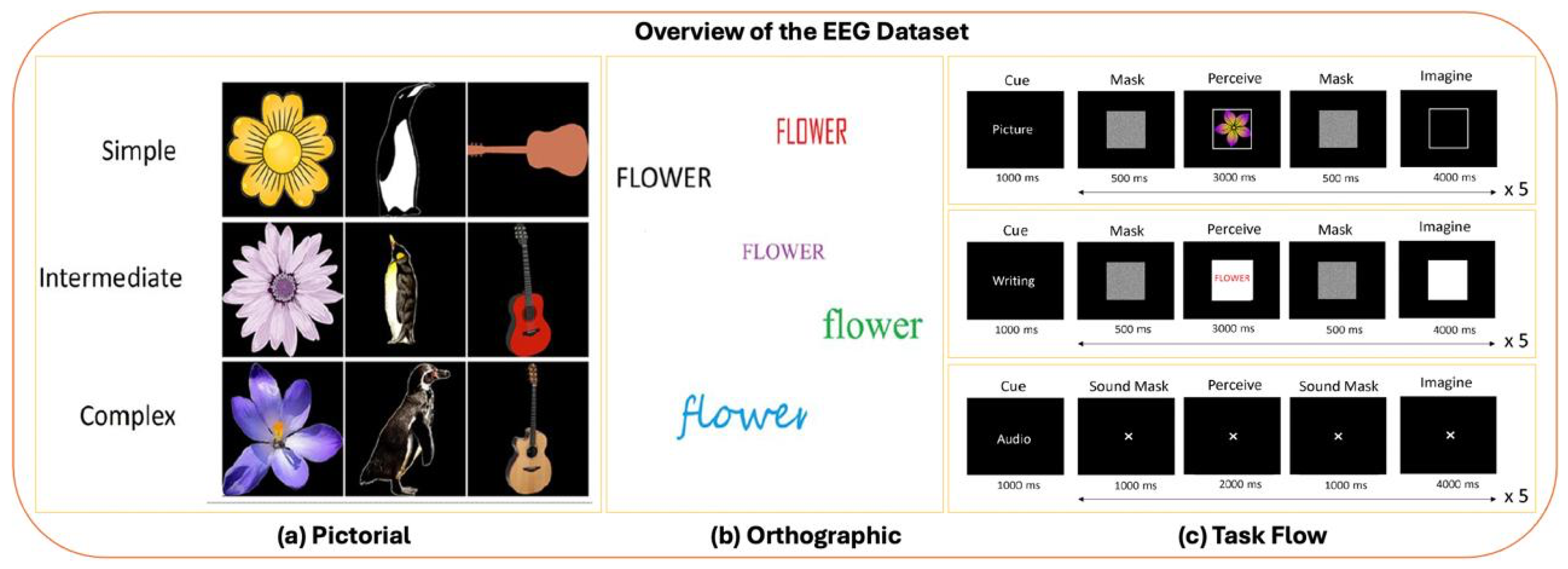
Figure 1 summarizes the stimulus types and the overall experimental structure. The dataset includes a diverse set of exemplars for each modality:
  • Pictorial: Images with three levels of complexity, i.e., simple, intermediate, and naturalistic, with eight exemplars at the simple level and nine at both intermediate and naturalistic for flower and guitar, and nine at each level for penguin.
  • Orthographic: Thirty text stimuli per category, presented in five colors and six font styles.
  • Audio: Spoken words recorded in three voice tones (normal, low, high).

2.1.1. Trial Structure and Epoching

Each trial comprises two phases—perception (stimulus presentation) and imagination (mental recreation)—separated by a brief mask (visual: 500 ms; auditory: 1000 ms). We follow the dataset’s event timing and define two non-overlapping EEG epochs per trial: one spanning the perception phase and one spanning the imagination phase. Epoch boundaries are aligned to the LSL time-stamps; the inter-phase mask and inter-trial intervals are excluded. For visual modalities, perception epochs are 3 s and imagination epochs are 4 s; for the auditory modality, perception epochs are 2 s and imagination epochs are 4 s.

2.1.2. Labeling

For each epoch, labels are derived from the orthogonal factors {Task ∈ [Perception, Imagination], Modality ∈ [Pictorial, Orthographic, Auditory], Concept ∈ [flower, penguin, guitar]}. Within-class exemplar variability (image complexity, text font/color, voice tone) is treated as nuisance variation and not used as a target label; these factors remain within-class to encourage semantic invariance.

2.1.3. Data Volume and Sessions

Across N = 12 participants (some subjects have 2 sessions), each condition (Task × Modality) contains up to 150 epochs per participant per session; actual completion typically ranges from 64 to 150 due to fatigue and breaks (see Table 2 for epoch durations and Table 4 for per-condition counts in [26]). Nine participants completed one session, and three completed two sessions. In all analyses, session identity is tracked for split integrity and session-transfer diagnostics.

2.2. Preprocessing

We start from the curators’ preprocessed .fif data (bad-channel handling via PyPREP, common average reference (CAR), 50/100/150 Hz notch, high-pass filter for independent component analysis (ICA), and ICA/Electrooculography (EOG) component removal) [26]. To that, we apply the minimal, leakage-safe steps required by our semantic framework [21]: (i) resample to 128 Hz; (ii) zero-phase finite impulse response (FIR) low-pass-filtered at 45 Hz; (iii) per-channel z-scoring with train-fold statistics only; (iv) epoching to the phase durations above; (v) 1 s windows with 50% overlap (128 × 124) excluding masks; (vi) light Gaussian noise ( σ 0.01 ) in train windows only. This preserves the curated denoising while standardizing bandwidth and windowing for our encoder.

2.3. Unsupervised Semantic Feature Learning

We reuse our hierarchical dual AutoEncoder from [21]: a CNN AutoEncoder captures local spatiotemporal structure and feeds a Transformer AutoEncoder for long-range dependencies (2 Transformer encoder/decoder layers, 8 heads, d model  = 128, feed-forward network (FFN) 256, dropout 0.1). Training minimizes mean squared error (MSE) with Adam (learning rate 10−4, batch size 64), early stopping, and a ReduceLROnPlateau scheduler, which decreases the learning rate when the validation loss stops improving. In each leave-one-subject-out (LOSO) fold, models are re-initialized and trained only on windows from training subjects; the encoder is then frozen for that fold. The Transformer encoder outputs a 128-D latent vector per 1 s window; we 2 -normalize and use the temporal mean as the window feature. A quality gate requires a relative reconstruction error of <1% before any supervised training. Component-level ablations of the encoder variants are reported in [21]; in the present work we treat the encoder as a fixed, previously validated semantic extractor and focus on representation-level diagnostics and trait-linkage analyses on this dataset.

2.4. Supervised Imagination (I) ↔ Perception (P) Decoding Heads

With the encoder frozen, we train a compact 2D-CNN head (64/128/256/512, 3 × 3 kernels, batch normalization, spatial attention, global average pooling (GAP), dropout 0.5) separately for each modality to discriminate between imagination and perception. Optimization used Adam (learning rate 10−3, weight decay 10−4) with early stopping on validation balanced accuracy. Decision thresholds were selected on the validation fold using Youden’s J statistic. We also probe cross-phase transfer (train on perception, test on imagination P→I, and vice versa I→P) within LOSO to quantify invariance [21].

2.5. Evaluation Protocol

Unless stated otherwise, evaluation is performed using LOSO: all sessions of the held-out subject constitute the test set; samples for inner validation are drawn from training subjects for early stopping and thresholding. All normalization parameters (z-score mean/std) are estimated on the training fold only and then applied to validation/test folds to prevent data snooping. The metric for the supervised task is balanced accuracy. To express uncertainty, we report 95% confidence intervals (CIs) via stratified bootstrap (B = 2000) and assess above-chance via label permutations (1000 shuffles per fold).

2.6. Latent-Geometry Diagnostics

We analyze the frozen latents using the held-out subject to relate representational structure to traits. A correlation-pruning step removes redundancy before computing diagnostics. Throughout, the frozen encoder outputs a d = 128-dimensional latent vector per window; within each subject × phase × modality, we compute a 128 × 128 Pearson correlation matrix across windows and apply greedy pruning to obtain the retained index set S ( τ ) . All diagnostics are computed post hoc on held-out-subject latents and are not used to tune the supervised decoder. Let T denote the set of correlation thresholds and | T | its cardinality:
  • Greedy correlation filtering: Within each subject × phase × modality, we iteratively prune latent channels whose absolute Pearson correlation with an already-kept channel exceeds a threshold ( τ ). This yields a retained set S ( τ ) of latent-channel indices at each τ . We evaluate a grid ( τ { 0.15 , 0.25 , , 0.85 } ) (8 thresholds).
  • Keep Ratio: At each τ , the fraction of latent channels retained after pruning, K ( τ ) . We define K ( τ ) = | S ( τ ) | / d (with d = 128 ). We also summarize the per-subject mean keep ratio, meanKR = 1 | T | τ T K ( τ ) , which is later used as a sparsity covariate.
  • Semantic Sensitivity Index (SSI): The signed area under the curve (AUC) of the phase-difference in Keep_Ratio, SSI = AUC Δ K ( τ ) , where
    Δ K ( τ ) = K imagine ( τ ) K perception ( τ ) .
    In practice, the SSI is computed by trapezoidal integration over the predefined τ grid, preserving the sign of Δ K ( τ ) .
  • Full Δ K ( τ ) curves: Subject-wise trajectories across ( τ ) to localize where phase differences emerge (e.g., only at aggressive pruning).
  • Cross-Modal Overlap (CMO): Jaccard overlap of kept-feature sets between modality pairs at matched τ (Audio–Pictorial, Audio–Orthographic, Orthographic–Pictorial). We report per-subject means across thresholds and distributions across subjects. At each τ , for a modality pair ( m 1 , m 2 ) , we compute CMO m 1 , m 2 ( τ ) = | S m 1 ( τ ) S m 2 ( τ ) | | S m 1 ( τ ) S m 2 ( τ ) | and summarize it by averaging over the τ grid.
  • Using a predefined grid avoids committing to a single arbitrary correlation cutoff and reduces the risk of cherry-picking. Accordingly, our primary indices (SSI and mean CMO) integrate information over τ , while threshold-resolved trajectories are reported to show where effects emerge and to verify robustness.

2.7. Trait-Aware Correlation Analysis (VVIQ/BAIS)

We test whether inter-individual imagery ability predicts (i) decodability and (ii) latent geometry:
  • Performance indices: Modality-specific LOSO balanced accuracy. We also summarize P→I and I→P transfer within LOSO.
  • Geometry indices:  SSI (overall and per modality), full Δ K ( τ ) behavior, and CMO.
    Questionnaires (VVIQ, BAIS) are used as released; subjects missing a questionnaire are excluded listwise for that trait. For partial correlations, we control for meanKR (global sparsity) and the other questionnaire (e.g., the partial correlation between SSI and VVIQ controlling for meanKR and BAIS).

2.8. Statistics

Because (n) is small and scales are ordinal, we report Spearman’s ρ with bias-corrected bootstrap 95% CIs (B = 5000) and permutation (p); Kendall’s τ b is provided for robustness. We control the false discovery rate (FDR) across pre-registered primaries (visual: VVIQ vs. visual balanced accuracy and SSI; auditory: BAIS vs. auditory balanced accuracy and SSI) via Benjamini–Hochberg (BH) at q = 0.10. Sensitivity checks: (i) 5% Winsorization of extreme performance values; (ii) skipped correlations; (iii) rank-based regression with usable-trial count and second-session present as pragmatic covariates.

2.9. Mixed-Effects Analysis of Keep_Ratio

To leverage within-subject trajectories at a fixed pruning level, we fit a linear mixed-effects model to K ( τ ) at τ = 0.35 : fixed effects for modality, phase, VVIQ, and BAIS; random intercepts and random slopes for phase by subject. This yields the random-slopes restricted maximum likelihood (REML) fit reported (group variance, phase-slope variance, and best linear unbiased predictor (BLUP) slopes used for trait correlations).
To consolidate the steps introduced above, Figure 2 summarizes the entire pipeline from data acquisition and psychometrics through preprocessing, unsupervised semantic encoding, and quality gating to downstream decoding and latent-geometry/trait analyses. The blocks in the diagram align with the steps in this Methodology and provide a single visual reference for the procedures used in Section 3.

3. Results

In this section, we report our results in three phases. First, we verify that the unsupervised encoder–decoder learns a stable latent space and reconstructs EEG within a pre-set error bound, reusing our previously introduced semantic feature extractor [21]. Next, we evaluate those latents in supervised decoding tasks. Finally, we analyze how both the learned semantic features and supervised outcomes relate to VVIQ/BAIS. Models were implemented in PyTorch 2.0+/Python 3.11 on a single NVIDIA RTX 4090 (CUDA 12.0).

3.1. Unsupervised Pretraining

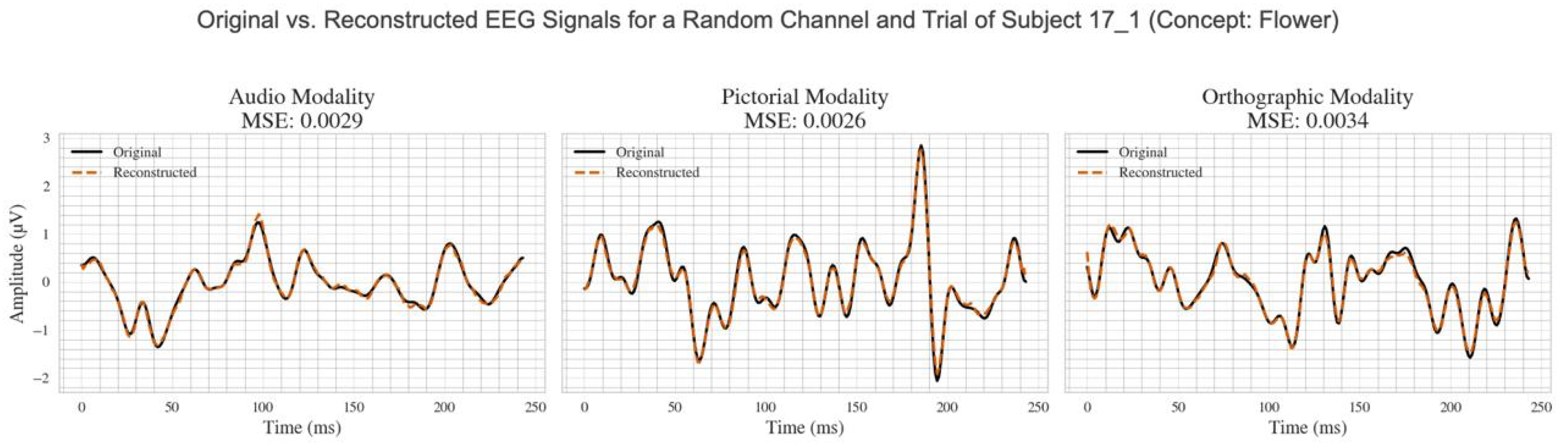
The pretraining objective reconstructs short EEG windows while preserving scalp topology and temporal dependencies, producing task-agnostic latent features reused in all downstream experiments. Figure 3 compares original vs. reconstructed EEG for a random channel/trial across the three modalities. The waveform overlap is tight; per-panel MSEs (≈0.0026–0.0034) satisfy our gate of MSE < 1 % of the signal variance, indicating that the bottleneck retains structured signal content rather than fitting noise. For completeness, the training/validation loss and learning-rate schedule (Figure S1) and a subject-colored t-SNE visualization of the learned latents (Figure S2) are provided in the Supplementary Materials.
Here, topology preservation refers to respecting the spatial neighborhood structure of scalp EEG in the encoder’s early (CNN) processing, while the Transformer models longer-range temporal dependencies. Moreover, the latent-channel correlation structure analyzed in SSI/CMO can be viewed as a representation-level analog of functional coupling (without claiming source-level connectivity), enabling interpretable redundancy/overlap diagnostics in a form consistent with network-style reasoning.

3.2. Supervised Downstream Decoding

We assess the utility of the learned latents for supervised decoding using a lightweight classifier (Section 2.4) trained on frozen representations under LOSO. Figure 4 summarizes balanced accuracy (mean ± SD across subjects) against representative baselines re-implemented following their original settings when applicable. Across all three modalities, our approach achieves the strongest mean performance with low across-subject variability (pictorial: 96.9 ± 0.9 % ; orthographic: 96.3 ± 1.1 % ; audio: 88.9 ± 2.2 % ). The full per-subject breakdown (15 subjects) for each modality, including all baseline methods, is provided in the Supplementary Materials (Tables S1–S3).

3.3. Correlation Analysis

We investigate whether inter-individual imagery ability (VVIQ) and auditory imagery control (BAIS) relate to (i) downstream decoding performance (LOSO accuracies from Section 3.2) and (ii) the geometry/robustness of the learned semantic features from Section 3.1. We report effect sizes with uncertainty and permutation tests; interpretation is deferred to the Discussion.
VVIQ and BAIS scores are available for n = 13 subjects; missing entries reduce the effective sample size in all trait analyses [26]. Full per-subject questionnaire values and dense ranks are provided in the Supplementary Materials (Table S4).
We test correlations between VVIQ/BAIS and LOSO accuracies (per modality and overall). Given small n and ordinal self-report scales, we emphasize Spearman correlations with bootstrap CIs and permutation p-values for the primary pairs (visual: pictorial vs. VVIQ; auditory: audio vs. BAIS), alongside overall accuracy. The full correlation panel (including Pearson and partial correlations controlling for mean Keep_Ratio) is reported in the Supplementary Materials (Table S5).
To connect traits to representation structure, we use threshold-resolved correlation filtering in the latent space: latent channels with absolute Pearson correlation | r | > τ are pruned (greedy survivor selection), and we track the retained-feature fraction (Keep_Ratio) per phase and modality. This yields
Δ K ( τ ) = K imagine ( τ ) K perception ( τ )
as a function of threshold. Figure 5 visualizes the post-filter latent correlation structure for one subject at τ = 0.45 . Representative pre-filter latent correlation maps are provided in the Supplementary Materials (Figure S3).

3.3.1. Semantic Sensitivity Index (SSI)

To summarize phase differences across thresholds, we define the Semantic Sensitivity Index as the signed area under the curve of Δ K ( τ ) : SSI = AUC ( Δ K ( τ ) ) . Figure 6 shows the distribution of the overall SSI distribution across subjects (thresholds: τ { 0.15 , , 0.85 } ). To localize where phase differences emerge (e.g., only at aggressive pruning), subject-wise Δ K ( τ ) trajectories are shown in the Supplementary Materials (Figure S4).

3.3.2. Cross-Modal Overlap (CMO)

Finally, to quantify cross-modal stability of the learned latent core, we compute the Jaccard overlap of kept-feature sets between modality pairs at matched thresholds. Figure 7 summarizes CMO distributions across subjects and thresholds for each modality pair. Values cluster around ∼0.5–0.8, indicating a substantial cross-modal latent core.
Across supervised outcomes and representation-level diagnostics, the associations with VVIQ/BAIS are small and imprecise at n = 13 , yet the latent-space probes (e.g., SSI and CMO) expose structure that accuracy alone does not capture. In the Discussion, we revisit these patterns, emphasizing sample-size constraints, potential self-report biases, and the value of complementary semantic feature diagnostics for brain decoding evaluation.

4. Discussion

This study evaluated whether representation-level semantic diagnostics can reveal subject-specific structure that conventional outcome metrics (e.g., accuracy) and traditional feature pipelines often obscure. Three findings stand out:
  • First, the proposed model achieves consistently high LOSO decoding performance across modalities (Figure 4), yet accuracy shows weak and imprecise associations with self-reported imagery traits (Supplementary Table S5);
  • Second, latent-geometry probes based on correlation-aware sparsification expose systematic imagination–perception asymmetries and cross-modal structure (Figure 5, Figure 6 and Figure 7) that are not visible at the outcome level;
  • Third, these probes provide mechanistic descriptors of how cognition occupies the learned space (compactness/redundancy/overlap), complementing performance-centric evaluation.
In the following subsections, we elaborate on each of these findings, interpreting their implications for imagination–perception decoding and semantic EEG representations.

4.1. Accuracy–Vividness Mismatch

Across pictorial, orthographic, and audio tasks, the decoder attains strong LOSO performance with low across-subject variability (Figure 4). However, correlations between accuracy and VVIQ/BAIS are small, unstable in sign across pairs, and non-significant in this cohort (Supplementary Table S5). This pattern is consistent with a measurement mismatch: accuracy reflects discriminability under a specific training/testing protocol, whereas VVIQ and BAIS measure self-reported vividness/control on coarse ordinal scales and outside the decoding context. In addition, the effective sample for trait analyses is modest ( n = 13 ; Supplementary Table S4), so even moderate associations would be difficult to estimate precisely.
A second, complementary perspective comes from subject-wise rank structure. In Supplementary Tables S1–S3, baseline pipelines induce a wide spread of ranks that separate “easy” and “hard” participants. In contrast, the rank ordering induced by this study is noticeably flatter, reflecting uniformly high performance across subjects. This compressed rank spread supports the interpretation that the learned semantic latents reduce subject-specific idiosyncrasies and yield a more subject-invariant representation than traditional pipelines, even though this invariance does not imply direct alignment with questionnaire scores.

4.2. Subject-Specific Heterogeneity and Threshold Sensitivity

Correlation-threshold filtering exposes substantial inter-individual variability in latent redundancy and in the proportion of retained features (Keep_Ratio) at a fixed threshold τ . While Figure 5 provides a representative post-filter visualization for one subject, the cohort-level behavior is not characterized by a universal pruning pattern. Instead, subjects exhibit distinct Δ K ( τ ) trajectories across thresholds (Supplementary Figure S4), indicating that imagination–perception differences can emerge at different sparsification regimes and with different magnitudes. Thus, the reported threshold-resolved curves (Supplementary Figure S4) serve as an explicit sensitivity analysis with respect to τ , while SSI/mean CMO summarize effects without selecting a single cutoff.
This observation is conceptually important: traditional handcrafted pipelines typically return a fixed-size feature vector for every participant, which limits their ability to express person-specific differences in redundancy or effective dimensionality. In contrast, semantics-preserving latents admit variable cardinality after pruning, enabling a direct, interpretable readout of how much non-redundant structure each subject retains under a common criterion. Consequently, subject-conditioned analyses are more appropriate than assuming a single, cohort-wide semantic subset.

4.3. Latent Geometry vs. Vividness

The latent space learned by unsupervised pretraining is stable and structured: reconstructions are tight (Figure 3), and the latent manifold exhibits organized subject-wise clustering (Supplementary Figure S2). Raw feature–feature correlations show structured redundancy (Supplementary Figure S3), motivating correlation-based sparsification as a diagnostic lens rather than a classification trick. Because the downstream decoder is evaluated under LOSO, subject identity cannot be used as a shortcut for imagination–perception classification; thus, subject-wise clustering is more plausibly interpreted as evidence of a low-noise and geometrically organized embedding.
Building on this foundation, the threshold-resolved diagnostics provide a representation-level view of imagination versus perception:
  • SSI indicates whether imagination tends to retain more (or less) non-redundant latent support than perception as sparsification tightens. The SSI distribution shows a meaningful between-subject spread around a near-zero center (Figure 6), consistent with heterogeneous phase preferences that are not captured by accuracy.
  • Full Δ K ( τ ) curves localize where differences occur across the threshold grid (Supplementary Figure S4). Several subjects exhibit positive imagination margins primarily at aggressive pruning (large τ ), suggesting that the most selective latent channels may preferentially support imagery for those individuals.
  • CMO indicates substantial cross-modal overlap of retained-feature sets (Figure 7), consistent with a modality-invariant latent core. This cross-modal stability provides a representation-level explanation for why frozen-latent decoders can perform strongly across modality-specific tasks.
Taken together, these diagnostics shift the interpretation from did the model classify? to what latent structure supports classification, and how does that structure differ across phases and individuals? This distinction matters when accuracy is already high and relatively uniform.

4.4. Why Questionnaire Alignment Is Weak in This Cohort

Two non-exclusive explanations appear to be the most plausible. First, VVIQ and BAIS are context-free self-reports and may not track the task-specific neural selectivity that governs imagination–perception separability under pruning. Second, statistical power is limited: with n = 13 , confidence intervals around correlations are necessarily wide (Supplementary Table S5). Under these constraints, the main scientific value of the present results is less about establishing strong trait correlations and more about demonstrating that latent geometry provides interpretable, phase- and modality-sensitive descriptors that remain informative when accuracy saturates.

4.5. Implications

These results suggest four practical implications for semantic EEG decoding:
  • High accuracy is necessary but not sufficient for scientific interpretation: strong LOSO performance can coexist with weak trait alignment when heterogeneous strategies are collapsed into a single scalar metric.
  • Representation-aware diagnostics provide interpretable mechanistic descriptors—compactness under pruning (SSI), modality-invariant structure (CMO), and threshold-localized phase differences ( Δ K ( τ ) )—that complement outcome metrics.
  • The observed cross-modal overlap supports the design of decoders that explicitly target modality-invariant structure, which may be essential for generalization beyond tightly controlled laboratory settings.
  • The magnitude of CMO (0.5–0.8) implies that, after redundancy pruning at matched thresholds, roughly 50–80% of the retained latent channels are shared across modality pairs, suggesting a modality-invariant semantic core. Practically, this supports parameter sharing or a unified decoder across modalities and motivates geometry-aware regularization (or multi-modal training objectives) that explicitly encourages cross-modal alignment to improve robustness when the stimulus modality varies or is partially missing.

4.6. Limitations and Future Directions

The cohort is modest, and questionnaire availability further reduces the effective sample size, limiting correlation precision and richer hierarchical modeling. In addition, public imagination–perception EEG datasets that also provide self-report imagery questionnaires are scarce, which constrains external validation of the trait-linkage analysis; accordingly, we frame the VVIQ/BAIS findings as exploratory and treat replication on an independent cohort/dataset as an important direction for future work.
This study is also positioned as an offline evaluation framework rather than embedded real-time deployment: the encoder is pretrained offline and then frozen, online inference requires only a single forward pass through the encoder plus a lightweight head, and the SSI/CMO diagnostics are post hoc computations on 128-D latents (correlations and greedy pruning over a small τ -grid) that do not add cost to online decoding.
We also fixed the windowing scheme (1 s windows with 50% overlap) to match the semantic extractor configuration; an explicit sensitivity sweep over window length and overlap, as well as testing whether the SSI and CMO remain stable across multiple temporal scales, is an important next step.
Questionnaires were self-reported and were not paired with task-anchored behavioral imagery probes; adding objective measures (e.g., imagery interference tasks, mental rotation, or trial-wise vividness ratings) would sharpen construct validity. Moreover, subject structure in the latent space (Supplementary Figure S2) suggests that future work could explicitly disentangle subject identity factors from semantic factors, potentially improving robustness under cross-session or cross-site transfer. Extending the framework beyond binary imagination vs. perception within each modality to multiclass semantic decoding across concepts and modalities would further test whether the cross-modal latent core supports compositional and clinically relevant semantic generalization.
As a complementary direction to strengthen multiscale semantic structure, future work could incorporate wavelet-based time–frequency attention mechanisms (e.g., as explored in [27]) to explicitly model cross-scale temporal dynamics in EEG while retaining interpretability.

5. Conclusions

This study shows that semantic, representation-level analyses provide information that accuracy cannot: despite strong LOSO performance, VVIQ and BAIS exhibit weak, imprecise associations with accuracy, yet the learned semantic latents expose clear phase-dependent geometry, positive SSI in a subset of participants indicates that imagination can rely on a sparser, higher-salience subset of features, and consistently high CMO points to a cross-modal semantic core. Together, these results reframe evaluation from “did it classify?” to “how does cognition inhabit the latent space?”, highlighting compactness and redundancy as meaningful axes for EEG interpretation. We stress two caveats: the questionnaire cohort is small ( n = 13 ), limiting power, and self-report vividness is noisy and task-external. Even so, the semantic diagnostics are stable, mechanistic, and practically useful for personalization and model design. Future work should scale n, include task-anchored behavioral imagery measures, quantify test–retest reliability of the SSI, and integrate geometry-aware regularization so that desirable properties, latent compactness, and cross-modal consistency are not only diagnosed but also learned.

Supplementary Materials

The following supporting information can be downloaded at https://www.mdpi.com/article/10.3390/app16020661/s1: Figure S1. Training/validation loss and learning-rate (LR) schedule for the unsupervised encoder–decoder. Curves show rapid early gains followed by LR-driven refinement; validation tracks training with a small gap, and early stopping fires at epochs 302/350, indicating stable generalization. Figure S2. t-SNE of learned semantic features colored by subject. Latents cluster into compact, separable groups, suggesting a well-organized manifold suitable for downstream decoding and correlation analyses. Figure S3. Raw latent correlation structure. Feature–feature Pearson r matrices for one subject across phases (rows) and modalities (columns). Off-diagonal patterns reveal clusters of correlated latent channels (redundancy) that a simple classifier may or may not exploit. Figure S4. Δ K ( τ ) per subject with mean ± standard error of the mean (SEM) band, split by modality (audio, orthographic, pictorial). Curves show where imagination–perception differences emerge: several subjects exhibit persistent positive margins at aggressive pruning (large τ ), suggesting more compact, less-redundant semantic structure during imagination. Table S1. Comparisons with state-of-the-art methods on pictorial modality; Table S2. Comparisons with state-of-the-art methods on orthographic modality; Table S3. Comparisons with state-of-the-art methods on audio modality; Table S4. VVIQ/BAIS per subject with ranks (1 = best; dense ranking) [26]; Table S5. Correlations between VVIQ/BAIS and accuracies. References [19,28,29,30,31,32,33,34,35] are cited in the Supplementary Materials.

Author Contributions

Conceptualization, H.A., M.I., and L.M.; methodology, H.A.; software, H.A. and M.I.; validation, H.A.; formal analysis, H.A. and M.I.; investigation, H.A.; resources, L.M.; data curation, H.A. and M.I.; writing—original draft preparation, H.A.; writing—review and editing, L.M.; visualization, H.A.; supervision, L.M. All authors have read and agreed to the published version of the manuscript.

Funding

This research received no external funding.

Institutional Review Board Statement

Not applicable.

Informed Consent Statement

Not applicable.

Data Availability Statement

The datasets utilized in this study are publicly accessible and can be found in the following reference: [26].

Conflicts of Interest

The authors declare no conflicts of interest.

Abbreviations

AcronymDefinitionAcronymDefinition
AUCArea Under the CurveGAPGlobal Average Pooling
BAISBucknell Auditory Imagery ScaleICAIndependent Component Analysis
BAIS-VBAIS—Vividness subscaleI↔PImagination ↔ Perception
BCaBias-Corrected and Accelerated (bootstrap)I→PTrain on Imagination, Test on Perception
BCIBrain–Computer InterfaceLRLearning Rate
BIDSBrain Imaging Data StructureLSLLab Streaming Layer
BHBenjamini–Hochberg (FDR control)LOSOLeave-One-Subject-Out
BLUPBest Linear Unbiased PredictorMNEMNE-Python toolkit
CARCommon Average ReferenceMSEMean Squared Error
CIConfidence IntervalP→ITrain on Perception, Test on Imagination
CMOCross-Modal OverlapPyPREPPython PREP (bad-channel handling)
CNNConvolutional Neural NetworkREMLRestricted Maximum Likelihood
CPzMidline Central–parietal ElectrodeRFRandom Forest
CSPCommon Spatial PatternRNNRecurrent Neural Network
EEGElectroencephalographySDStandard Deviation
EOGElectrooculographySEMStandard Error of the Mean
ERPEvent-Related PotentialSNRSignal-to-Noise Ratio
FBCSPFilter Bank Common Spatial PatternSSISemantic Sensitivity Index
FDRFalse Discovery RateSVMSupport Vector Machine
FFNFeed-Forward Networkt-SNEt-Distributed Stochastic Neighbor Embedding
FIRFinite Impulse ResponseVVIQVividness of Visual Imagery Questionnaire

References

  1. Pulvermüller, F.; Shtyrov, Y. Language outside the focus of attention: The mismatch negativity as a tool for studying higher cognitive processes. Prog. Neurobiol. 2006, 79, 49–71. [Google Scholar] [CrossRef]
  2. Michel, C.M.; Brunet, D. EEG Source Imaging: A Practical Review of the Analysis Steps. Front. Neurol. 2019, 10, 446653. [Google Scholar] [CrossRef]
  3. Farah, M.J. Is visual imagery really visual? Overlooked evidence from neuropsychology. Psychol. Rev. 1988, 95, 307–317. [Google Scholar] [CrossRef]
  4. Kosslyn, S.M.; Ganis, G.; Thompson, W.L. Neural foundations of imagery. Nat. Rev. Neurosci. 2001, 2, 635–642. [Google Scholar] [CrossRef] [PubMed]
  5. Dijkstra, N.; Bosch, S.E.; van Gerven, M.A. Vividness of Visual Imagery Depends on the Neural Overlap with Perception in Visual Areas. J. Neurosci. 2017, 37, 1367–1373. [Google Scholar] [CrossRef] [PubMed]
  6. Binder, J.R.; Desai, R.H.; Graves, W.W.; Conant, L.L. Where Is the Semantic System? A Critical Review and Meta-Analysis of 120 Functional Neuroimaging Studies. Cereb. Cortex 2009, 19, 2767–2796. [Google Scholar] [CrossRef] [PubMed]
  7. Schacter, D.L.; Addis, D.R.; Hassabis, D.; Martin, V.C.; Spreng, R.N.; Szpunar, K.K. The Future of Memory: Remembering, Imagining, and the Brain. Neuron 2012, 76, 677–694. [Google Scholar] [CrossRef]
  8. Rybář, M.; Daly, I. Neural Decoding of Semantic Concepts: A Systematic Literature Review. J. Neural Eng. 2022, 19, 021002. [Google Scholar] [CrossRef]
  9. Rekrut, M.; Sharma, M.; Schmitt, M.; Alexandersson, J.; Krüger, A. Decoding Semantic Categories from EEG Activity in Object-Based Decision Tasks. In Proceedings of the 2020 8th International Winter Conference on Brain-Computer Interface (BCI), Gangwon, Republic of Korea, 26–28 February 2020; pp. 1–7. [Google Scholar] [CrossRef]
  10. Lee, K.-W.; Lee, D.-H.; Kim, S.-J.; Lee, S.-W. Decoding Neural Correlation of Language-Specific Imagined Speech using EEG Signals. In Proceedings of the 2022 44th Annual International Conference of the IEEE Engineering in Medicine & Biology Society (EMBC), Glasgow, UK, 11–15 July 2022; pp. 1977–1980. [Google Scholar] [CrossRef]
  11. Ahmadi, H.; Mesin, L. Enhancing MI EEG Signal Classification With a Novel Weighted and Stacked Adaptive Integrated Ensemble Model: A Multi-Dataset Approach. IEEE Access 2024, 12, 103626–103646. [Google Scholar] [CrossRef]
  12. Ahmadi, H.; Costa, P.; Mesin, L. A Novel Hierarchical Binary Classification for Coma Outcome Prediction Using EEG, CNN, and Traditional ML Approaches. TechRxiv 2024. [Google Scholar] [CrossRef]
  13. Ahmadi, H.; Kuhestani, A.; Mesin, L. Adversarial Neural Network Training for Secure and Robust Brain-to-Brain Communication. IEEE Access 2024, 12, 39450–39469. [Google Scholar] [CrossRef]
  14. Ahmadi, H.; Kuhestani, A.; Keshavarzi, M.; Mesin, L. Securing Brain-to-Brain Communication Channels Using Adversarial Training on SSVEP EEG. IEEE Access 2025, 13, 14358–14378. [Google Scholar] [CrossRef]
  15. Marks, D.F. Visual imagery differences in the recall of pictures. Br. J. Psychol. 1973, 64, 17–24. [Google Scholar] [CrossRef] [PubMed]
  16. Shinkareva, S.V.; Malave, V.L.; Mason, R.A.; Mitchell, T.M.; Just, M.A. Commonality of neural representations of words and pictures. NeuroImage 2011, 54, 2418–2425. [Google Scholar] [CrossRef] [PubMed]
  17. Halpern, A.R. Differences in auditory imagery self-report predict neural and behavioral outcomes. Psychomusicol. Music Mind Brain 2015, 25, 37. Available online: https://api.semanticscholar.org/CorpusID:143273929 (accessed on 12 November 2025). [CrossRef]
  18. Rueschemeyer, A. Cross-Modal Integration of Lexical-Semantic Features during Word Processing: Evidence from Oscillatory Dynamics during EEG. PLoS ONE 2014, 9, e101042. [Google Scholar] [CrossRef]
  19. Huang, J.; Chang, Y.; Li, W.; Tong, J.; Du, S. A Spatio-Temporal Capsule Neural Network with Self-Correlation Routing for EEG Decoding of Semantic Concepts of Imagination and Perception Tasks. Sensors 2024, 24, 5988. [Google Scholar] [CrossRef]
  20. Chen, H.; He, L.; Liu, Y.; Yang, L. Visual Neural Decoding via Improved Visual-EEG Semantic Consistency. arXiv 2024. Available online: https://arxiv.org/abs/2408.06788 (accessed on 24 October 2025).
  21. Ahmadi, H.; Mesin, L. Universal semantic feature extraction from EEG signals: A task-independent framework. J. Neural. Eng. 2025, 22, 036003. [Google Scholar] [CrossRef]
  22. Fahimi Hnazaee, M.; Khachatryan, E.; Van Hulle, M.M. Semantic Features Reveal Different Networks During Word Processing: An EEG Source Localization Study. Front. Hum. Neurosci. 2018, 12, 503. [Google Scholar] [CrossRef]
  23. Zeng, H.; Xia, N.; Qian, D.; Hattori, M.; Wang, C.; Kong, W. DM-RE2I: A Framework Based on Diffusion Model for the Reconstruction from EEG to Image. Biomed. Signal Process. Control 2023, 86, 105125. [Google Scholar] [CrossRef]
  24. Ahmadi, H.; Mesin, L. Decoding Visual Imagination and Perception from EEG via Topomap Sequences. In Proceedings of the 2025 47th Annual International Conference of the IEEE Engineering in Medicine and Biology Society (EMBC), Copenhagen, Denmark, 14–17 July 2025; pp. 1–7. [Google Scholar] [CrossRef]
  25. Zeng, H.; Xia, N.; Tao, M.; Pan, D.; Zheng, H.; Wang, C.; Xu, F.; Zakaria, W.; Dai, G. DCAE: A Dual Conditional Autoencoder Framework for the Reconstruction from EEG into Image. Biomed. Signal Process. Control 2023, 81, 104440. [Google Scholar] [CrossRef]
  26. Wilson, H.; Golbabaee, M.; Proulx, M.J.; Charles, S. EEG-based BCI Dataset of Semantic Concepts for Imagination and Perception Tasks. Sci. Data 2023, 10, 386. [Google Scholar] [CrossRef]
  27. Wang, F.; Ke, H.; Cai, C. Deep Wavelet Self-Attention Non-negative Tensor Factorization for non-linear analysis and classification of fMRI data. Appl. Soft Comput. 2025, 182, 113522. [Google Scholar] [CrossRef]
  28. Lawhern, V.J.; Solon, A.J.; Waytowich, N.R.; Gordon, S.M.; Hung, C.P.; Lance, B.J. EEGNet: A compact convolutional neural network for EEG-based brain-computer interfaces. J. Neural Eng. 2018, 15, 056013. [Google Scholar] [CrossRef]
  29. Schirrmeister, R.T.; Springenberg, J.T.; Fiederer, L.D.J.; Glasstetter, M.; Eggensperger, K.; Tangermann, M.; Hutter, F.; Burgard, W.; Ball, T. Deep learning with convolutional neural networks for EEG decoding and visualization. Hum. Brain Mapp. 2017, 38, 5391–5420. [Google Scholar] [CrossRef]
  30. Sabour, S.; Frosst, N.; Hinton, G.E. Dynamic Routing Between Capsules. arXiv 2017. Available online: https://arxiv.org/abs/1710.09829 (accessed on 26 October 2025).
  31. Song, Y.; Jia, X.; Yang, L.; Xie, L. Transformer-based Spatial-Temporal Feature Learning for EEG Decoding. arXiv 2021. Available online: https://arxiv.org/abs/2106.11170 (accessed on 11 November 2025).
  32. Liu, Z.; Mao, H.; Wu, C.; Feichtenhofer, C.; Darrell, T.; Xie, S. A ConvNet for the 2020s. arXiv 2022. Available online: https://arxiv.org/abs/2201.03545 (accessed on 26 October 2025).
  33. Li, C.; Wang, B.; Zhang, S.; Liu, Y.; Song, R.; Cheng, J.; Chen, X. Emotion recognition from EEG based on multi-task learning with capsule network and attention mechanism. Comput. Biol. Med. 2022, 143, 105303. [Google Scholar] [CrossRef] [PubMed]
  34. Song, Y.; Zheng, Q.; Liu, B.; Gao, X. EEG Conformer: Convolutional Transformer for EEG Decoding and Visualization. IEEE Trans. Neural Syst. Rehabil. Eng. 2023, 31, 710–719. [Google Scholar] [CrossRef]
  35. Miao, Z.; Zhao, M.; Zhang, X.; Ming, D. LMDA-Net: A lightweight multi-dimensional attention network for general EEG-based brain-computer interfaces and interpretability. NeuroImage 2023, 276, 120209. [Google Scholar] [CrossRef] [PubMed]
Figure 1. Overview of the EEG dataset and experimental protocol [26]. (a) Pictorial modality: Exemplar images of three concepts rendered at three visual-complexity levels. (b) Orthographic modality: The same concepts presented as words with variation in font, size, and color. (c) Trial flow for each modality: Cue (1000 ms) → Mask (visual: 500 ms; audio: 1000 ms) → Perceive (visual: 3000 ms; audio: 2000 ms) → Mask (visual: 500 ms; audio: 1000 ms) → Imagine (4000 ms); each block is repeated ×5 per concept. The design targets semantic identity across modalities and contrasts perception vs. imagination, enabling decoding of conceptual meaning from EEG.
Applsci 16 00661 g001
Figure 2. System model and analysis flow. EEG and psychometrics (VVIQ/BAIS) are collected (left). Signals are resampled to 128 Hz, low-pass-filtered at 45 Hz, z-scored with train-fold statistics, windowed into 1 s segments with 50% overlap, and lightly noised on train only. A hierarchical dual AutoEncoder (CNN→Transformer) learns unsupervised semantic features; windows passing a quality gate (reconstruction MSE < 1% of signal variance) are frozen (middle). Evaluation (right) comprises (i) LOSO downstream decoding of imagination vs. perception per modality with per-subject balanced accuracy; (ii) correlation pruning across a threshold grid ( | r | > τ , τ [ 0.15 , 0.85 ] ) to obtain Keep_Ratio ( K ( τ ) ), its change Δ K ( τ ) , and the Semantic Sensitivity Index (SSI = AUC ( Δ K ) ); (iii) trait-aware correlations between VVIQ/BAIS and Accuracy/SSI/CMO. Statistical reporting uses Spearman’s ρ with bias-corrected and accelerated (BCa) bootstrap 95% CIs (B = 5000), permutation p-values, Kendall’s τ b , and Benjamini–Hochberg (BH) FDR at q = 0.10.
Applsci 16 00661 g002
Figure 3. Original vs. reconstructed EEG for a random channel/trial across modalities. Black: original; orange dashed: reconstruction. Per-panel MSEs meet the MSE < 1 % threshold, indicating that the encoder retains structured signal content while suppressing noise.
Applsci 16 00661 g003
Figure 4. Balanced accuracy (mean ± SD) under LOSO for three stimulus modalities.
Applsci 16 00661 g004
Figure 5. Post-filter latent structure ( | r | > τ pruning). Feature–feature Pearson r matrices for one subject–session across phase (rows) and modality (columns) after greedy correlation filtering at τ = 0.45 . Many off-diagonal entries disappear, indicating a leaner set of non-redundant latent features used to compute Keep_Ratio and Δ K ( τ ) . Subject labels follow the dataset convention subject_session (e.g., 3_3 = subject 3, session 3) as released in [26].
Applsci 16 00661 g005
Figure 6. Overall SSI distribution by subject–session. Positive values indicate that imagination retains more latent structure than perception when features are pruned by correlation threshold; negative values indicate the opposite. The SSI summarizes threshold effects via AUC of Δ K ( τ ) over τ { 0.15 , 0.25 , , 0.85 } (full Δ K ( τ ) curves are shown in Supplementary Figure S4). Subject labels follow subject_session naming from [26].
Applsci 16 00661 g006
Figure 7. CMO distributions across subjects and thresholds for each modality pair. Horizontal bars denote medians; wider regions denote more frequent overlaps. Values around ∼0.5–0.8 indicate a substantial cross-modal latent core.
Applsci 16 00661 g007
Disclaimer/Publisher’s Note: The statements, opinions and data contained in all publications are solely those of the individual author(s) and contributor(s) and not of MDPI and/or the editor(s). MDPI and/or the editor(s) disclaim responsibility for any injury to people or property resulting from any ideas, methods, instructions or products referred to in the content.