Article

Proactive Path Planning Using Centralized UAV-UGV Coordination in Semi-Structured Agricultural Environments


by
Dimitris Katikaridis
1,2,3,
Lefteris Benos
1,*,
Dimitrios Kateris
1,
Elpiniki Papageorgiou
4,
George Karras
2,
Ioannis Menexes
3,
Remigio Berruto
5,
Claus Grøn Sørensen
6 and
Dionysis Bochtis
1,3
1
Institute for Bio-Economy and Agri-Technology (IBO), Centre of Research and Technology-Hellas (CERTH), 6th km Charilaou-Thermi Rd., 57001 Thessaloniki, Greece
2
Department of Informatics and Telecommunications, University of Thessaly, 35131 Lamia, Greece
3
farmB Digital Agriculture S.A., Laertou 22, 55535 Thessaloniki, Greece
4
Department of Energy Systems, University of Thessaly, Gaiopolis Campus, 41500 Larisa, Greece
5
Interuniversity Department of Regional and Urban Studies and Planning (DIST), University of Turin, Viale Pier Andrea Mattioli 39, 10125 Torino, Italy
6
Department of Electrical and Computer Engineering, Aarhus University, 8000 Aarhus, Denmark
*
Author to whom correspondence should be addressed.
Appl. Sci. 2026, 16(2), 1143; https://doi.org/10.3390/app16021143
Submission received: 15 December 2025 / Revised: 14 January 2026 / Accepted: 21 January 2026 / Published: 22 January 2026
(This article belongs to the Special Issue The Use of Evolutionary Algorithms in Robotics)

Abstract

Unmanned ground vehicles (UGVs) in agriculture face challenges in navigating complex environments due to the presence of dynamic obstacles. This causes several practical problems including mission delays, higher energy consumption, and potential safety risks. This study addresses the challenge by shifting path planning from reactive local avoidance to proactive global optimization. To that end, it integrates aerial imagery from an unmanned aerial vehicle (UAV) to identify dynamic obstacles using a low-latency YOLOv8 detection pipeline. These are translated into georeferenced exclusion zones for the UGV. The UGV follows the optimized path while relying on a LiDAR-based reactive protocol to autonomously detect and respond to any missed obstacles. A farm management information system is used as the central coordinator. The system was tested in 30 real-field trials in a walnut orchard for two distinct scenarios with varying worker and vehicle loads. The system achieved high mission success, with the UGV completing all tasks safely, with four partial successes caused by worker detection failures under afternoon shadows. UAV energy consumption remained stable, while UGV energy and mission time increased during reactive maneuvers. Communication latency was low and consistent. This enabled timely execution of both proactive and reactive navigation protocols. In conclusion, the present UAV–UGV system ensured efficient and safe navigation, demonstrating practical applicability in real orchard conditions.

1. Introduction

Agricultural practices have been transformed by the incorporation of various information and communications technologies (ICTs), supporting data-driven precision agriculture [1]. Among the different ICTs, unmanned ground vehicles (UGVs) have already been integrated into a plethora of applications [2,3]. Ground robotic vehicles are used in labor-intensive operations such as automated harvesting, spraying, and weeding. They take advantage of the ever-increasing progress of sensor technology, deep learning, computer vision, and big data analytics [4,5,6]. These robotic systems can execute operations with minimal human intervention, thus, lowering labor costs and mitigating the safety risks associated with manual fieldwork. Their remarkable consistency and efficiency, especially in semi-structured environments, such as those of orchards [7,8], render them valuable for several agricultural tasks. Interestingly, the integration of cloud-based data management improves the scalability of UGV platforms [9]. This allows for continuous coordination with other smart farming machinery [10,11].
Despite their remarkable capabilities, UGVs often rely on local, limited perception coming from sensors like light detection and ranging (LiDAR). Hence, they may face challenges with navigation in agricultural settings with non-deterministic obstacles, including workers or an entire crop row being blocked by an agricultural vehicle. This limitation often imposes needless detours and wastes time and energy returning to the starting point. Consequently, it reduces the overall mission efficiency of the system [12].
To tackle the aforementioned challenges, coordinated operation of UAVs and UGVs has been proposed [13,14]. According to Mammarella et al. [15], this coordination can be split into three layers: (a) the “remote sensing phase”, where fixed-wing UAVs acquire aerial imagery of the target area using onboard cameras and sensors; (b) the “automatic semantic interpretation of point cloud maps” to generate a georeferenced 3D representation of the field that is both computationally efficient and compatible with downstream processing; and (c) the “in-field operations” of autonomous ground and aerial vehicles (rotary-wing UAVs) to execute well-designed agricultural tasks. The above methodology has been, partially or fully, followed by several scholars [16,17,18,19,20,21]. The core idea is the use of UAV-based aerial support to overcome the localized perception limitations of UGVs. In essence, the UAV provides a global perspective of the field assisting the UGV in identifying optimal routes. This global awareness relies on object detection algorithms, including YOLOv8 for fast, bounding-box detection of dynamic obstacles [22,23], and semantic segmentation networks [24,25], like U-Net or Mask R-CNN for pixel-wise delineation of static structures (e.g., tree lines and navigable inter-row corridors).
Focusing on open-field agricultural applications, Mammarella et al. [16] implemented the above collaborative framework in a vineyard. A quadcopter and a UGV autonomously navigated inter-row paths leveraging preliminary low-complexity maps generated from aerial imagery acquired by a fixed-wing drone. In a similar study, Xu et al. [17] developed a UAV-based framework for orchards, where aerial imagery was used to detect trees and rows with a deep learning model, which enables automated path planning for both UGVs and UAVs. Furthermore, Shi et al. [19] proposed a collaborative path planning system, where a control center generates operation plans and a UAV assists in obstacle avoidance. In turn, the ground vehicle receives dynamic guidance based on historical and current operation states.
Similarly, Katikaridis et al. [18] developed and experimentally validated a route-planning approach in which a rotary-wing UAV assists UGV navigation within an orchard environment. In this framework, the UAV first produces a detailed aerial map of the orchard. The UGV, utilizing data provided by a farm management information system (FMIS), computes an optimal trajectory in the field. A key distinction from [16], for example, is the different agricultural context and the use of a rotary instead of a fixed-wing UAV.
As can be deduced from the existing literature, UAV–UGV coordination strategies are broadly divided into centralized and decentralized. In the former strategy, a supervisory entity, often an FMIS [18], collects sensor data from every platform to assess the overall situation and distribute specific task commands to individual robotic agents. In practice, the information that is collected by the UAV is transmitted to the centralized controller, which computes optimal navigation tasks and assigns them to the ground robotic vehicle. In contrast, decentralized coordination distributes perception and decision-making tasks across the UAV and UGV. Hence, each platform reacts autonomously to perceived changes, while sharing only essential mission-state data. To that end, usually peer-to-peer message exchange protocols are used, such as the open-source communication protocol of micro air vehicle link (MAVLink) [26]. For the purpose of evaluating the two different communication architectures, namely centralized (FMIS-based) versus decentralized (MAVLink-based), experiments were conducted in [20] involving UAV-assisted UGV navigation in orchard conditions. It was concluded that protocol selection is primarily a trade-off guided by mission objectives. Specifically, decentralized communication is suitable for low-latency, time-critical tasks where immediate response is vital. Conversely, centralized communication is appropriate for operations that give priority to reliable data transfer in semi-structured settings. A summary of the main characteristics of centralized versus decentralized UAV–UGV coordination architectures is provided in Table 1.
While the synergistic concept of air-ground robotics has been investigated in agriculture with encouraging results, existing research usually focuses on sensor fusion for mapping or obstacle avoidance, or both. In practice, however, there is a need for addressing the challenge of proactive route optimization by integrating aerial imagery to generate mission-critical exclusions such as blocked rows, before the UGV starts its planned route. The term “proactive” is used here to distinguish the proposed approach from purely “reactive” navigation strategies, where collision avoidance is limited to the local perception horizon of the UGV’s primary sensors. In the present study, dynamic obstacles (workers and vehicles) are identified by a rotary-wing UAV and translated into georeferenced non-traversable zones. This enables the calculation of an optimal route for the UGV. This can lead to reduced mission time and optimized energy usage by reducing time-consuming UGV stops, backtracking, and reactive local planning. From a safety perspective, early hazard mitigation is supported, by detecting dynamic obstacles across the entire field much sooner than ground-level sensors. In addition, a centralized UAV–UGV communication through an FMIS is implemented similar to [18,20].
The primary contributions of this study are:
  • The use of UAV aerial mapping to generate georeferenced non-traversable zone exclusions for optimal path calculation, thus, reducing inefficient, reactive ground movement.
  • A low-latency YOLOv8-based detection [27] and georeferencing pipeline for dynamic obstacle monitoring tailored to field conditions.
  • A centralized UAV–UGV communication architecture via an FMIS so as to ensure reliable data transfer and coordination.
  • Experimental validation of a safety-critical redundancy mechanism that ensures worker safety in case of global intelligence failure.
  • Quantification of the operational cost (energetic and temporal penalties) required for the UGV to safely recover from vision failure in order to identify the primary system’s bottlenecks.
In summary, this study presents a novel UAV–UGV collaborative framework that exploits aerial imagery for proactive path optimization by excluding dynamically blocked rows. It also integrates a fail-operational reactive protocol, allowing the UGV to autonomously recover from undetected obstacles, ensuring safety in orchard environments. The study does not benchmark against a reactive-only baseline. Instead, its primary objectives are: (a) to validate the feasibility of a proactive planning framework in real-field experiments and (b) to quantify the energetic and temporal penalties presented, when the system transitions to a reactive recovery mode due to incomplete aerial perception.

2. Materials and Methods

2.1. Integrated System Operational Protocol

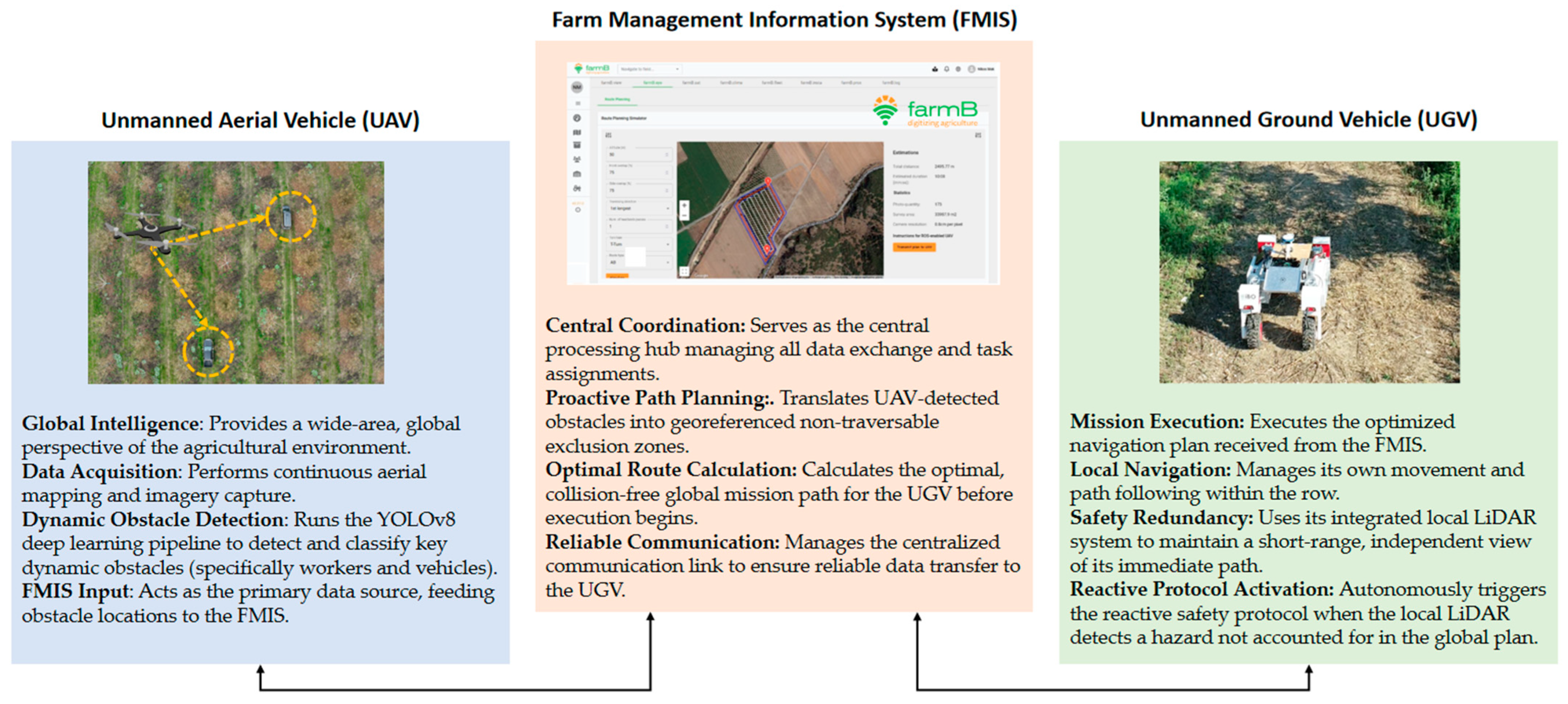
The developed collaborative system integrates three main elements whose coordination is accomplished via RESTful application programming interfaces (APIs): (a) a UAV platform; (b) a UGV platform; and (c) an FMIS (farmB Digital Agriculture S.A., version 3.28.0, Thessaloniki, Greece).
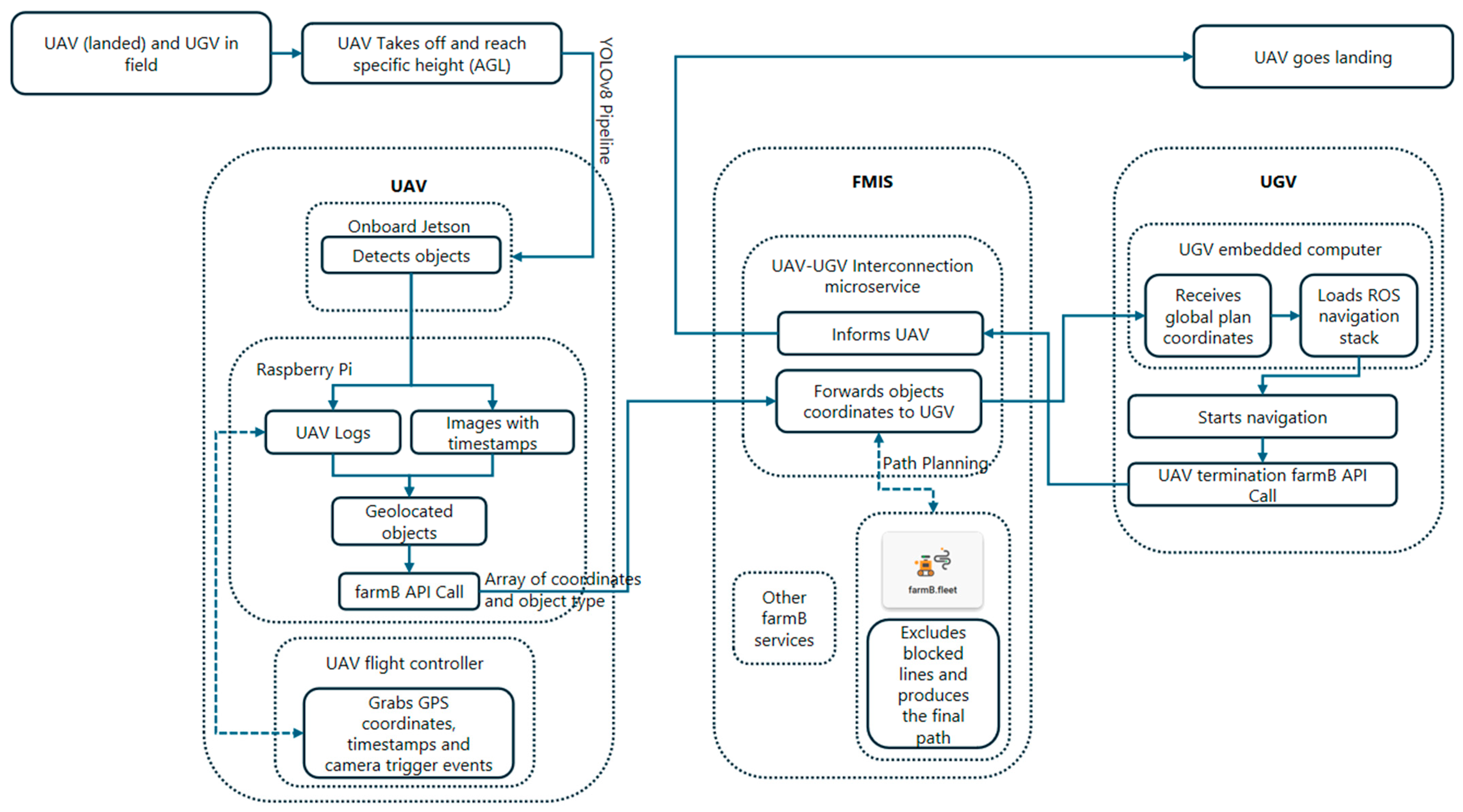
As summarized in Figure 1, the UAV first surveys the field from above and detects obstacles, sending their locations to the FMIS backend, which transmits the information to the UGV. Then, the UGV, with help from the backend route service, executes a route that avoids the rows including those obstacles. Finally, the UGV signals back when the mission planning is completed, so that the UAV knows it can land safely, while the UGV starts the mission. Each component, namely the UAV with its dual-board processing unit (Raspberry Pi 4 and NVIDIA Jetson), the backend server (FMIS) with the interconnection microservice and path planner, and the UGV with its navigation system, plays a crucial role in this RESTful API-driven coordination. The result is a centralized coordinated UAV–UGV operation in the field, where aerial reconnaissance and ground mobility are linked through a networked backend to achieve an optimal mission.
It should be mentioned that the UGV’s core capabilities, such as LiDAR-based SLAM mapping, inter-row path planning, and local obstacle avoidance, are implemented using previously validated methodology developed by our research team [18,20,28]. In this work, the focus is on integrating these capabilities with UAV-informed georeferenced exclusion zones in order to ensure both mission efficiency and worker safety.
Figure 2 depicts the system operational protocol in more detail. The process begins with the UAV taking off and ascending to the predetermined above ground level (AGL) required for thorough field surveying. For the generation of the UAV’s automated aerial coverage plan, the FMIS requires the import of the agricultural area of interest along with the specification of necessary flight planning parameters [18]. These parameters are: (a) sensor configuration (front and side image overlap, altitude/ground resolution); (b) path geometry (coverage flight direction, requirement for peripheral coverage); and (c) trajectory dynamics (type of turns used, sequence type of flight lines). Subsequently, the FMIS generates the complete coverage mission plan and transmits it to the ROS-enabled UAV via a dedicated transmission interface connected to the ground station computer. This ground station, which runs a Linux operating system, implements essential functions such as flight software using QGroundControl v4.1.1 (Dronecode Project, Inc., San Francisco, CA, USA). Communication between the ground station and the UAV’s flight controller is facilitated by custom ROS executables designed for machine-to-machine interaction. QGroundControl ensures flight safety by providing monitoring, telemetry, and configuration of failsafe mechanisms. To bridge these systems, MAVProxy version 1.8.74 (ArduPilot, Canberra, ACT, Australia) is required to handle serial port data transmission [20].
Once airborne, the UAV’s onboard NVIDIA Jetson (NVIDIA Corporation, Santa Clara, CA, USA) computer executes an AI-powered object detection pipeline based on a pre-trained algorithm of the YOLOv8 model version 8.3.0 (Ultralytics, Frederick, MD, USA) [29]. This open-source computer vision model is broadly used in agriculture-related research. For instance, it has been implemented for fruit and weed detection as well as pest and disease identification, mainly owing to its speed and accuracy [30,31,32]. YOLOv8 works by processing an input image via a deep neural network with the intention of detecting and classifying objects. It uses a CSPDarknet-like backbone to extract important visual features, followed by a neck network that combines multi-scale features for better detection. Afterwards, the detection head predicts bounding boxes, object categories, and confidence scores for each object to be recognized. A non-maximum suppression (NMS) step is used to eliminate overlapping predictions. Hence, the NMS step keeps only the most accurate results. YOLOv8 was specifically selected over other lightweight object detection models, such as YOLOv5, EfficientDet, or Single Shot MultiBox Detector (SSD), for instance, because of its superior combination of speed, multi-scale feature handling, and detection precision [33,34]. This makes it ideal for identifying both small (workers) and medium-sized (vehicles) objects in orchard environments, meeting also the computational constraints of the embedded UAV system.
In our case, the system continuously scans the field for the purpose of identifying objects of interest, namely vehicles (pickup truck and van) and workers on the field from an aerial perspective. The Jetson hardware enables the UAV to perform this heavy vision processing onboard, providing the computational power needed for detection without offloading data [35,36]. When the UAV detects an object, it immediately geo-tags these detections with location coordinates via raspberry’s access to UAV’s flight controller as shown at Figure 2. This georeferencing process is performed using a pinhole camera projection model combined with the UAV’s estimated pose. The Sony Alpha 6100 camera (Sony Group Corp., Minato, Tokyo, Japan) is calibrated offline using a checkerboard-based procedure following Zhang’s method [37], yielding the camera intrinsic matrix and radial distortion coefficients, which are used to undistort images prior to object localization.
Specifically, for each detected object, the image-space centroid is back-projected through the calibrated camera model and transformed from the camera frame to the UAV body frame using the fixed, known mounting geometry. The UAV’s flight controller provides the drone’s current GPS position, altitude, and orientation via onboard GPS and IMU sensors, allowing the back-projected ray to be intersected with a locally planar ground assumption. This process translates camera observations into real-world coordinates expressed in the ENU frame and subsequently converted to WGS84 latitude and longitude. As a result, for every detection made by the vision system, the UAV determines the geographic location of the detected pickup truck, van, or worker on the field map. The UAV aggregates all such location-tagged detections into a list of coordinate points, which is then transmitted to the backend through a RESTful API call to the FMIS server.
On the FMIS backend, the incoming data are received by the UAV–UGV interconnection microservice, which is a dedicated service responsible for mediating between the aerial and ground vehicles. This microservice first sends an acknowledgment message to the UAV confirming successful data reception and subsequently forwards the list of detected object coordinates to the UGV. In practice, this involves the backend service communicating the coordinate list to the UGV’s onboard system via an additional RESTful API call, thereby informing the ground vehicle of obstacles detected by the UAV’s scan. The accuracy of the georeferencing process was evaluated by comparing projected object locations against manually measured ground reference points. This resulted in a mean horizontal localization error of approximately 0.45 m, a standard deviation of 0.21 m, and a maximum observed error of 0.88 m. These results are consistent with reported georeferencing accuracies for low-altitude UAV imagery in outdoor environments [38,39]. These quantified error bounds were used to define conservative non-traversable exclusion zones, ensuring that localization uncertainty does not lead to improper row exclusion or unsafe UGV navigation decisions.
Backend connectivity is required only during the mission initialization phase and is not part of the UGV’s safety-critical control loop. Specifically, the UGV retrieves the UAV-derived obstacle coordinates and the corresponding navigation plan once at the beginning of the mission. If the backend does not respond successfully, the UGV performs a limited number of retries at fixed time intervals. After repeated unsuccessful attempts, the mission is safely aborted and the UGV does not initiate motion. Once a valid route has been obtained, the UGV executes the mission autonomously without further dependency on backend communication, relying entirely on onboard LiDAR-based perception, local path planning, and reactive obstacle avoidance. This design minimizes exposure to network instability and ensures that backend unavailability cannot result in unsafe behavior.
The following provides a brief overview of how the FMIS supports the developed system. For a detailed explanation of the backend services (area coverage plan generation, orchard mapping, orchard representation, field tracks’ extraction, path planning, and system integration), the reader can be referred to our previous work [18]. Among the eight available interoperable modules of farmB operating system, this study makes use of the “farmB.fleet”, which is a route-planning service for fleet management. Once the UGV has the proposed path plan, it proceeds to execute this path. The UGV sends a RESTful request to the “farmB.fleet”, asking for a navigation route through the field. In fact, the coordinates of the detected vehicles and workers are treated as regions to avoid. The route-planning service may initially provide a candidate path for the UGV, excluding any path segments that would intersect or come too close to obstacle coordinates. This ensures that the final chosen route steers well clear of the detected objects. By using the UAV’s overhead observations to inform its path, the UGV effectively prevents potential collisions or intrusions.
When this safe, obstacle-free route is finalized, the UGV begins its journey by autonomously navigating along the planned path through the field. When UGV starts the navigation process, it issues a command for the UAV to return and land at the home position. This reflects a closely coordinated interaction where the aerial and ground robots communicate via the backend at each step.

2.2. Hardware and Software of the Robotic Platforms

2.2.1. Unmanned Ground Vehicle Platform

In the present research, we implemented a ground robotic vehicle, namely the Thorvald UGV (SAGA Robotics SA, Oslo, Norway). Due to its modular and reconfigurable platform, it can be adapted to many crop types, field structures, and production systems [40,41]. Thorvald has been used for a number of agricultural applications, such as in-field transportation alongside field workers [42,43], phenotyping in plant breeding [44], and leaf-level crop inspection [45]. Following [20], the deployed UGV is equipped with an advanced array of sensors. The Velodyne VLP-16 Puck laser scanner (Velodyne Lidar Inc., San Jose, CA, USA) facilitates high-resolution 3D mapping and effective obstacle detection. Specifically, the UGV uses a LiDAR-based SLAM algorithm to construct a real-time local occupancy grid for autonomous navigation. This mapping process ensures precise localization within the orchard environment by continuously updating the vehicle’s position relative to tree rows. Moreover, the robotic platform is powered by an Intel NUC (Intel, Santa Clara, CA, USA) that includes an i5-6200U processor, 16 GB RAM, and 128 GB of internal storage, operating on running Ubuntu Linux 18.04.6 LTS (Canonical Ltd., London, UK). This setup supports the demanding computational requirements for real-time data analysis and autonomous movement.
The UGV platform uses ROS Melodic (Open Source Robotics Foundation, Mountain View, CA, USA) as its operating framework. This allows for modular software architecture, seamless integration, and interoperability with all robotic components [46,47]. Navigation is guided by the ROS-based Carrot Planner [48], which evaluates user-defined destination points. If a goal lies within an obstacle, the planner traces backward along the line connecting the robot and the goal until it identifies a viable, unobstructed location. This adjusted target is then relayed to the local planner or controller. This allows the robot to approach the original goal as closely as possible. The FMIS generates global paths for the UGV using a standard grid-based A* search strategy as implemented within the ROS navigation stack [49]. The safe distancing and velocity control were explicitly managed in this software, following our approach presented in [28]. This software integrates obstacle information from the UGV’s sensors and dynamically adjusts the robot’s velocity and path to maintain predefined operational limits. Specifically, a maximum speed of 0.2 m/s and a minimum safe distance of 0.9 m from detected obstacles were explicitly configured in the local planner and costmap parameters. These parameters ensure safe operation within the orchard environment while enabling timely execution of navigation tasks [28,50]. The Navigation Stack publishes sensor data and transform information via ROS topics and the transform frames (tf) tree, enabling real-time velocity modulation and collision avoidance in accordance with the local planner’s commands.
Motor control is managed through a PEAK CANbus interface (PEAK-System Technik GmbH, Darmstadt, Germany), which ensures stable and responsive communication with Robotec’s motors (Robotec, Warsaw, Masovian, Poland) [51]. For enhanced localization and navigation precision, the system integrates an Xsens MTi 630R SK Inertial Measurement Unit (Xsens Technologies B.V., Enschede, The Netherlands) and a Stonex S850 RTK GNSS receiver (Stonex Inc., Concord, NH, USA). These components provide accurate positioning critical for executing field tasks [20].

2.2.2. Unmanned Aerial Vehicle Platform

The aerial system, which is employed in this work, is a custom-built UAV that is lifted and propelled by four motor-propeller units. This drone allows for high-resolution imaging and autonomous functionality in orchards. The full configuration of the UAV and its integrated sensors have been presented in [20]. In short, at the heart of the system is the Pixhawk 4 flight controller (Holybro, Shenzhen, China), which is powered by a 32-bit ARM Cortex-M7 processor running at 216 MHz. This controller supports both ArduPilot (ArduPilot, Canberra, ACT, Australia) and PX4 firmware (Dronecode Project, Inc., San Francisco, CA, USA) that ensure stable flight dynamics and precise autonomous navigation. Towards assuring accurate positioning, the UAV uses the H-RTK F9P GNSS receiver (Holybro, Shenzhen, China). This receiver leverages multi-band signals as well as Real-Time Kinematic (RTK) corrections as a means of achieving centimeter-level accuracy. This is very important for georeferenced data collection.
Regarding visual data capture, the UAV is equipped with a Sony Alpha 6100 RGB camera featuring a 24.2 MP APS-C Exmor CMOS sensor (Sony Corporation, Tokyo, Japan). This allows for shooting high-quality images at up to 11 frames per second. The camera is synchronized with the navigation system via a Seagull Map-X2 trigger (Seagull UAV, Copenhagen, Denmark). This permits precise shutter control based on waypoint or distance criteria.
Regarding onboard computation and server communication, the UAV employs distributed dual-board architecture connected via a high-speed Ethernet bridge. A Raspberry Pi 4 Model B (quad-core Cortex-A72, 4 GB RAM) (Raspberry Pi Foundation, Cambridge, UK) serves as the system coordinator, managing the Sony Alpha 6100 image acquisition and data transmission. This is achieved through a 4G LTE module with downlink speeds reaching 150 Mbps. To meet the heavy computational demands of real-time computer vision, the Raspberry Pi transfers the captured imagery to an NVIDIA Jetson module. This dedicated AI engine executes the GPU-accelerated YOLOv8 object detection pipeline and returns the processed results to the Raspberry Pi.
Communication is further supported by an R9SX receiver (900 MHz) (FrSky Electronic Co., Ltd., Wuxi, China) for manual control via the FrSky Taranis X9D Plus transmitter (FrSky Electronic Co., Ltd., Wuxi, Jiangsu, China). The system’s dual-radio setup (4G LTE for FMIS) reflects the distinct communication needs of the centralized protocol. In particular, the FMIS demands high throughput to manage large JSON payloads and rich data exchanges, which are efficiently handled by the high-speed 4G LTE connection [20]. Mission planning and flight monitoring are conducted by utilizing QGroundControl (QGroundControl Development Team, Zurich, Switzerland). The UAV is powered by a 12,000 mAh 6-cell (22.2 V) LiPo battery (Tattu, Grepow Battery Co., Ltd., Shenzhen, Guangdong, China). This can deliver a typical flight duration of 30 to 40 min under standard field conditions.

2.3. Field Deployment and Validation Scenarios

With the goal of assessing the proposed FMIS-coordinated UAV–UGV collaborative framework under varying operational conditions, a structured experimental design was implemented with two distinct scenarios. These are referred to as “Scenario A” and “Scenario B” below.

2.3.1. Test Environment

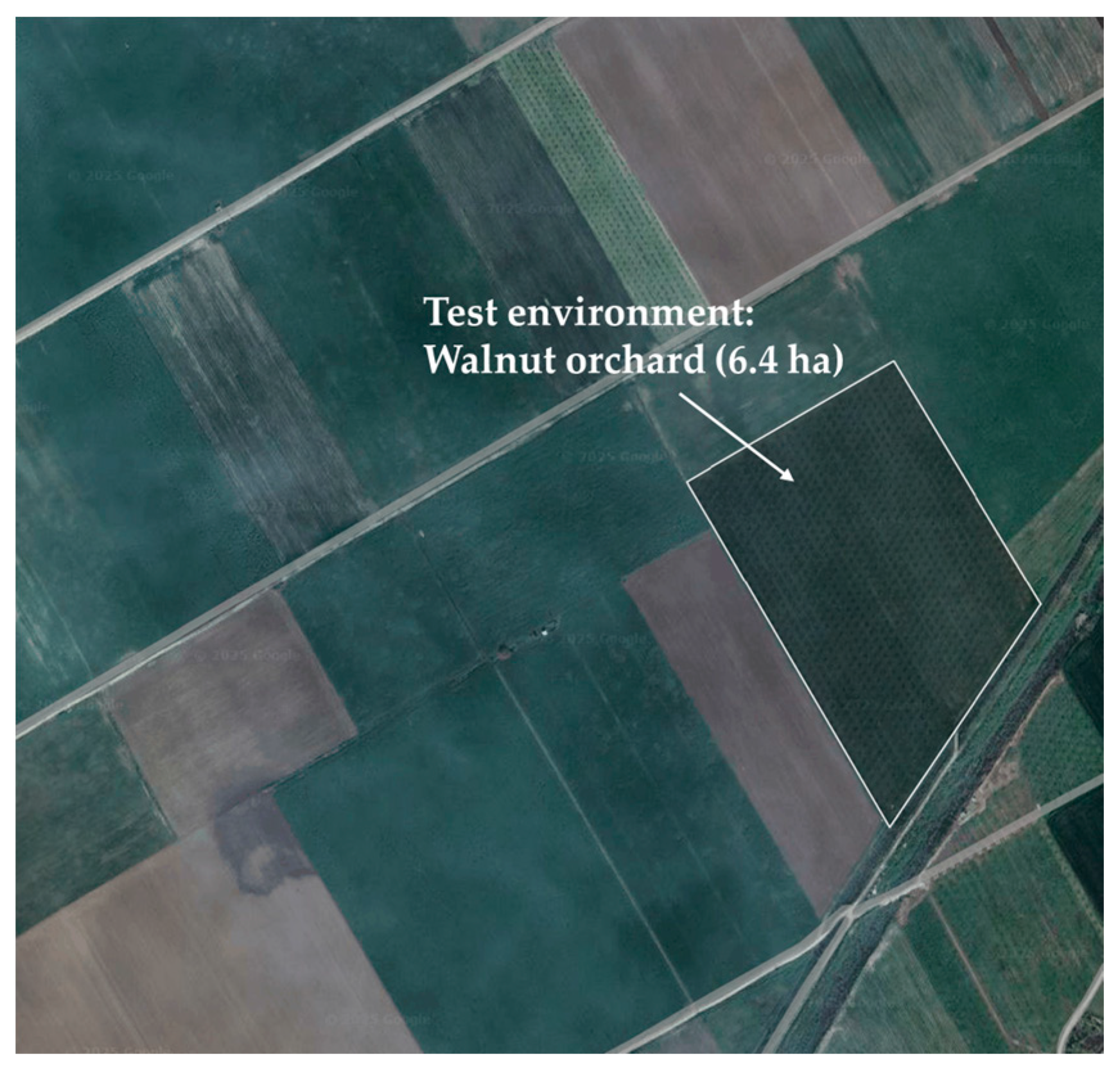
The trials were conducted in a commercial orchard, which is located within the Thessaly region of central Greece. The experimental site is a trapezoid-shaped field spanning 6.4 hectares. The field contains 995 walnut trees planted in a consistent 8 × 8 grid pattern with uniform spacing, forming a total of 26 inter-row corridors. Consequently, this setting provides the real-world complexities necessary for system validation, such as potential GPS signal degradation near tall tree canopies and the challenges of navigating uneven terrain [52,53]. A satellite view illustrating the experimental site is presented in Figure 3.
The experiments were executed on 10 October 2025, a day characterized by clear, sunny conditions. To account for variations in solar angle and intensity, which critically impact the performance of the vision system [54], all experiments were conducted during three distinct periods: morning, midday, and afternoon (Table 2).
Walnut orchards are considered semi-structured agricultural environments, since although their overall layout is organized, dynamic irregularities cause challenges for robotic operations. In essence, the trees are typically planted in uniform rows, providing navigable corridors facilitating path planning. However, variations in the size of the trees, canopy density as well as the presence of workers or agricultural vehicles can create partially unstructured conditions [55]. These irregularities require robotic platforms, such as UAVs and UGVs, to combine global navigation strategies with local obstacle detection and avoidance [56]. This makes orchards more complex to navigate and perceive as compared with fully structured environments like greenhouses, for example.

2.3.2. Obstacle Classification and System-Level Implications

The onboard object detection pipeline of the aerial vehicle, described in Section 2.1, utilizing the pre-trained YOLOv8 model, is able to identify and georeferencing two critical classes of obstacles in the field. The obstacle classification used in the deep learning detection pipeline was:
  • Vehicles: (a) Pickup truck: Medium-sized black utility vehicle with an elongated shape, solid enclosed front cab, and open rear cargo bed; (b) Van: Medium-sized fully enclosed black van with a compact, uniform silhouette and continuous roof.
  • Workers: Two human participants were utilized to simulate field workers.
Within the context of the proposed UAV–UGV collaborative framework, the detection outcomes along with their system-level implications are summarized in Table 3.
It should be noted that the onboard object detection module is not a methodological contribution of this work. It serves as an input to demonstrate the proposed UAV–UGV coordination framework. The system utilizes a publicly available, pre-trained YOLOv8-based model (WALDO30) [57], which was selected for its ability to recognize common field-relevant objects, such as pickup trucks, vans, and workers, from an aerial perspective. This detector was employed without further fine-tuning or modification by the authors. The proposed framework is designed to be detector-agnostic. Replacing the YOLOv8 model with an alternative detector would not affect the system architecture, since the pipeline treats these detections as modular upstream sensory data for the georeferencing and path-planning processes.
In addition to detecting the above dynamic obstacles, the UAV imagery is utilized to segment and identify tree rows, which define the navigable corridors for UGV traversal. Tree rows are detected based on the structured orchard layout, combining canopy outlines in RGB imagery with known planting grid geometry. This segmentation allows the system to distinguish between traversable inter-row paths and non-traversable areas occupied by trees [18].

2.3.3. Validation Scenarios

To explore how well the system can handle different data loads, we designed two scenarios:
  • Scenario A: The field incorporated a single vehicle obstacle (pickup truck) and two workers.
  • Scenario B: The field incorporated two vehicle obstacles (pickup truck and van) and one worker.
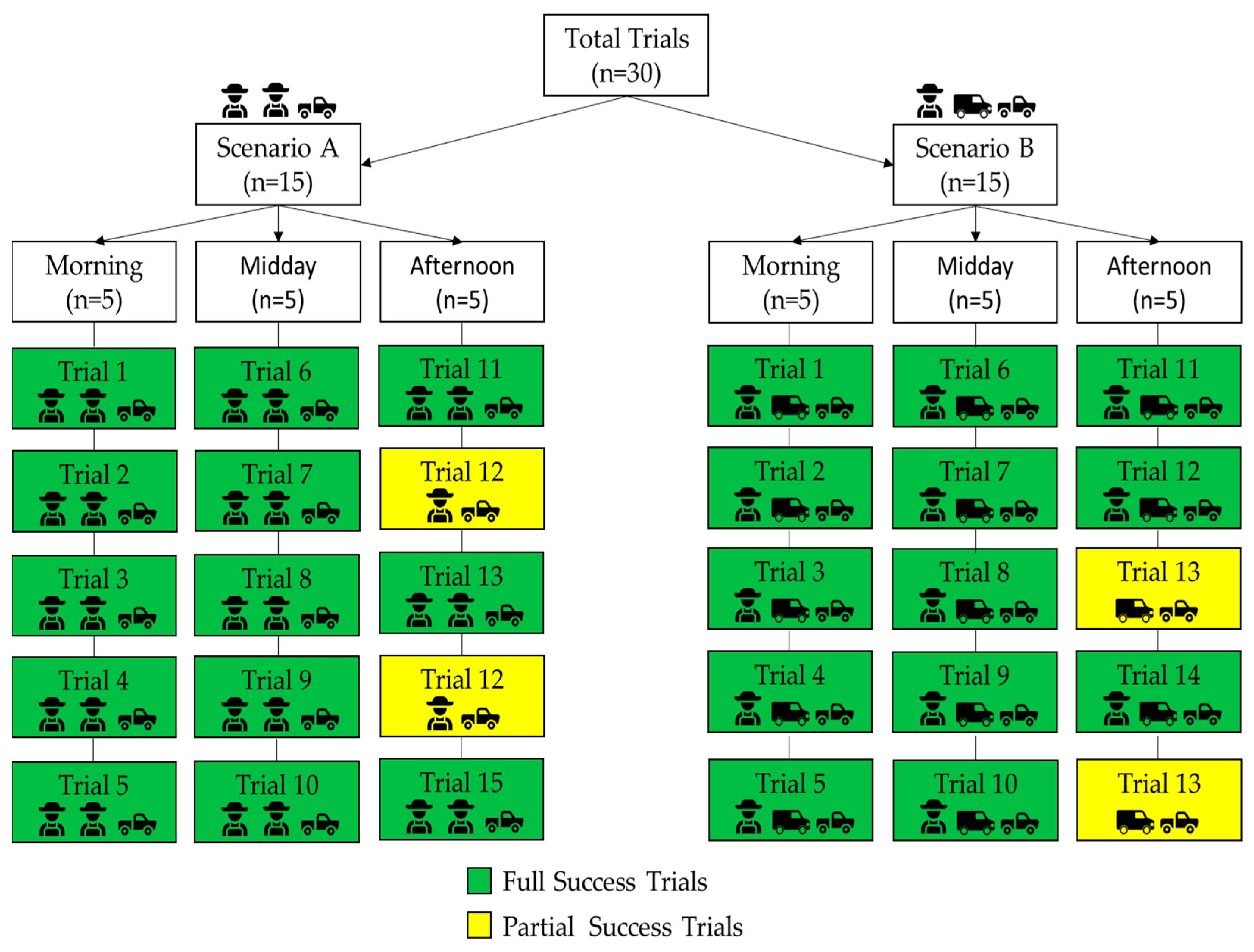
A total of 15 experimental trials were executed for each scenario, comprising five trials each conducted during the morning, midday, and afternoon periods. In both scenarios, the UGV’s mission was to traverse all accessible rows. If any obstacle was identified from the aerial detection system in a crop row, either vehicle or worker, that row was excluded from the UGV’s operational plan. In case of an FN, the UGV’s local LiDAR system autonomously activated the reactive safety protocol. This allowed us to see how effectively the system could detect obstacles, georeferenced their locations, and transmit information. It also enabled us to measure the precise energetic and temporal penalties required for the UGV to safely recover from a global intelligence failure and re-engage its navigation task.

2.4. Key Metrics for Assessing System Performance

To quantitatively assess the developed collaborative system, seven key metrics were analyzed, which can be further categorized for focused evaluation into temporal, vision, and energy consumption performance metrics. During all field experiments, these metrics were systematically documented for each trial using a structured Google Sheets-based data collection template.

2.4.1. Temporal Performance Metrics

The metrics of this category are:
  • Total mission completion time: This time interval (in seconds) is recorded from the moment the UGV began its planned path until it signaled mission fulfillment.
  • Latency: The total time interval (in milliseconds) is measured from the moment the onboard computer of the UAV successfully detects and georeferences an obstacle to the moment the navigation system of the UGV receives and processes the exclusion command from the FMIS.

2.4.2. Vision System Accuracy

These metrics, evaluating the reliability of the implemented YOLOv8-based detection pipeline, are:
  • Detected obstacle counts ( N i ): The total number of vehicles (maximum of 2 total present) and workers (maximum of 2 total present) that are successfully recognized by the UAV in the field.
  • Mean precision: Calculated as the ratio of true positives (TPs) to the sum of TPs and FPs, averaged across all detected objects.
  • Mean recall: Defined as the ratio of TPs to the total of TPs and FNs, averaged across all detected objects.
Note that both “mean precision” and “mean recall” are calculated over a set of image frames for each trial. This means that the metric is not a single, but rather an average performance across the entire duration the object was visible during that specific trial.

2.4.3. Energy Performance Metrics

These metrics, which quantify the resource usage of the two robotic platforms during the experimental sessions, are:
  • UGV battery drain: The percentage of battery capacity consumed by the UGV during the mission.
  • UAV battery drain: The percentage of battery capacity consumed by the UAV for its full operational period (pre-mission scan and dynamic monitoring).

3. Results

3.1. Overview of Mission Performance Across Experimental Scenarios and Time Windows

In the 30 field trials conducted in the orchard (15 for each scenario), the aerial detection system exhibited a high overall success rate, with most objects accurately identified, as evident in Figure 4. In this graphic, “Full Success” refers to missions completed solely through proactive aerial detection, whereas “Partial Success” refers to trials where the mission was completed, but required the activation of the UGV’s reactive LiDAR safety layer due to an FN.
It is also important to note that the UGV achieved full or partial mission success in all trials. In the four instances categorized with partial success, the UAV’s detection system failed to initially recognize a worker. However, the UGV’s local perception system, via LiDAR, served as a crucial safety back-up, autonomously detecting the “unknown” participant at close range. This mechanism ensures real-time avoidance of unforeseen dynamic obstructions not captured by the UAV’s global scan [20]. Thus, although this necessary reactive maneuver introduced a time delay, as will be elaborated next, it validated the UGV’s ability to maintain safety and complete the mission even when the aerial intelligence was incomplete. The mission is still considered a success, because the primary objective of safe field traversal without safety threshold violations was achieved through system-level redundancy.
The four erroneous cases of partial success, two per scenario, were concentrated exclusively within the afternoon period. The root cause of all failures was FNs involving the participants. This can be attributed to the challenging lighting conditions taking place during the afternoon period. This time window creates long shadows that can result in extreme contrast and feature degradation within the imagery [58,59].

3.2. Aerial Vision System Performance

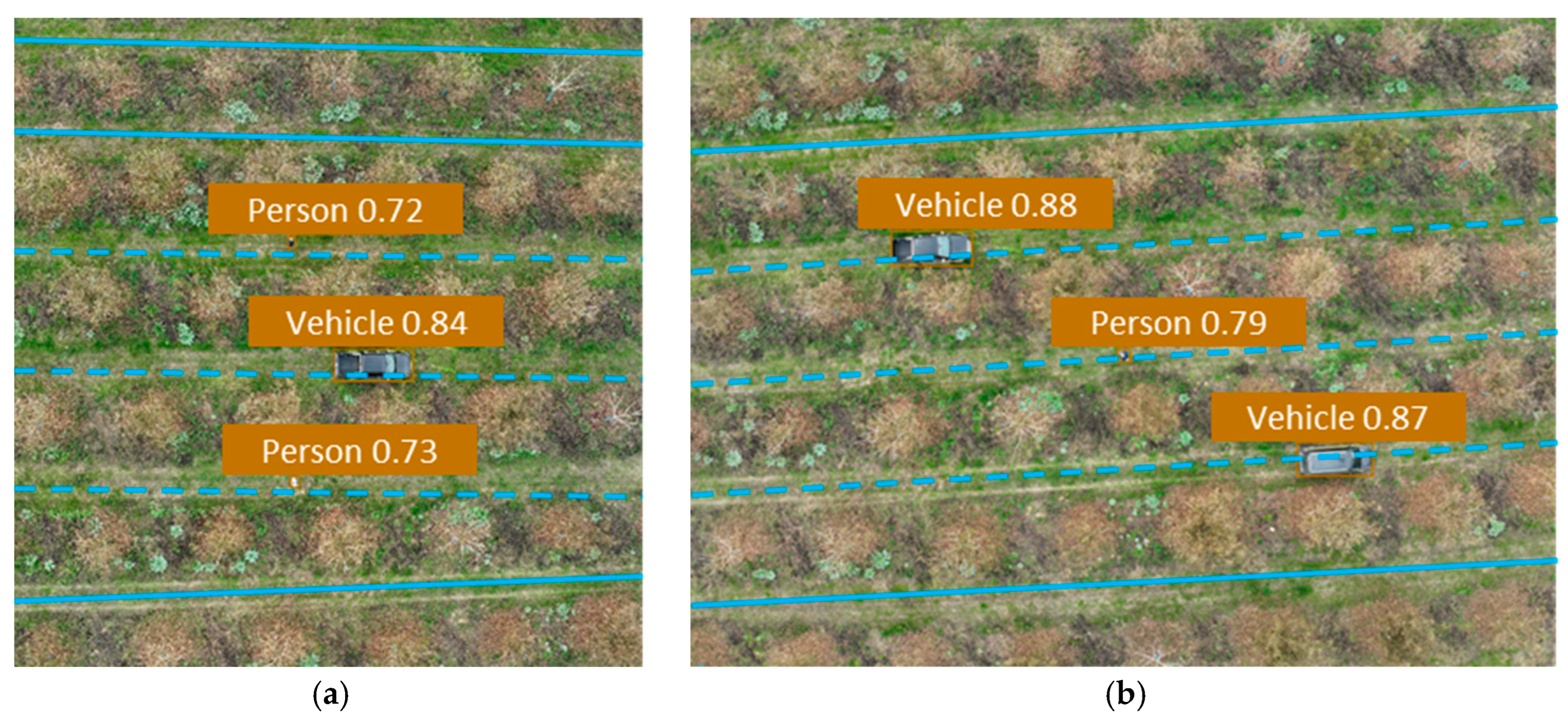
Figure 5a presents the confidence levels of the YOLOv8 model for a representative trial of full success executed in the context of Scenario A. In this case, the model successfully identified the pickup truck and the two participants: the vehicle with a high confidence level of 0.84 and the two participants with scores of 0.72 and 0.73. In the same vein, Figure 5b displays the confidence levels for an indicative trial of full success that took place in Scenario B. In this circumstance, the model successfully detected both vehicles and the person: the pickup truck and van with a high confidence level of 0.88 and 0.87, respectively, while the participant with 0.79. In Figure 5, blue lines qualitatively demonstrate the proactive path planning framework; solid lines denote navigable corridors, whereas dashed lines correspond to lines where passage is prohibited.
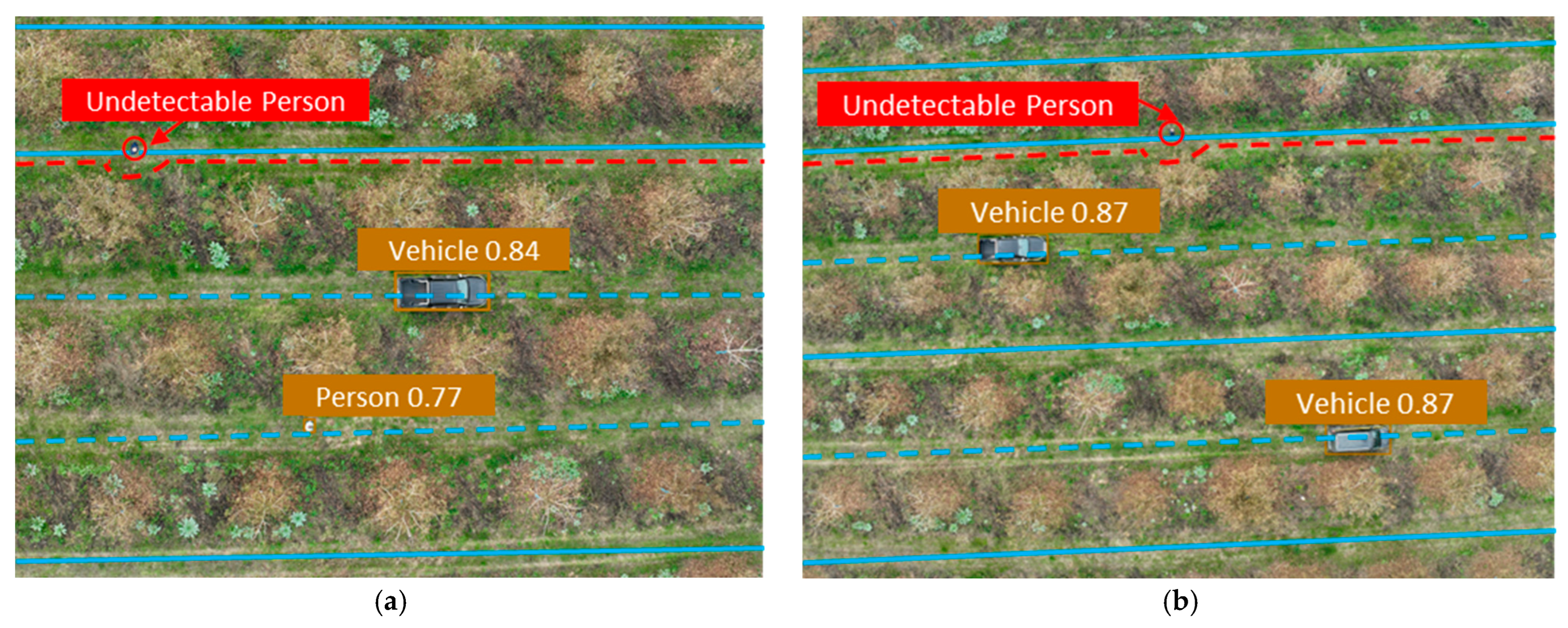
Representative images of both TPs and FNs are provided in Figure 6a,b for Scenario A and B, respectively. In Figure 6a, the model successfully detected the pickup truck (with a high confidence level of 0.84) but failed to recognize one of the two participants. For the participant who was successfully detected, the confidence level was 0.77. In Figure 6b, the model accurately detected the two vehicles (with a high confidence level of 0.87) but failed to detect the participant. Similarly to Figure 5, proactive path planning is denoted by blue lines; solid lines indicate navigable paths while dashed lines represent restricted paths. In addition, a red dashed line qualitatively shows a dynamic UGV trajectory adjustment necessitated by a ground-level detection after an aerial vision failure (FN).
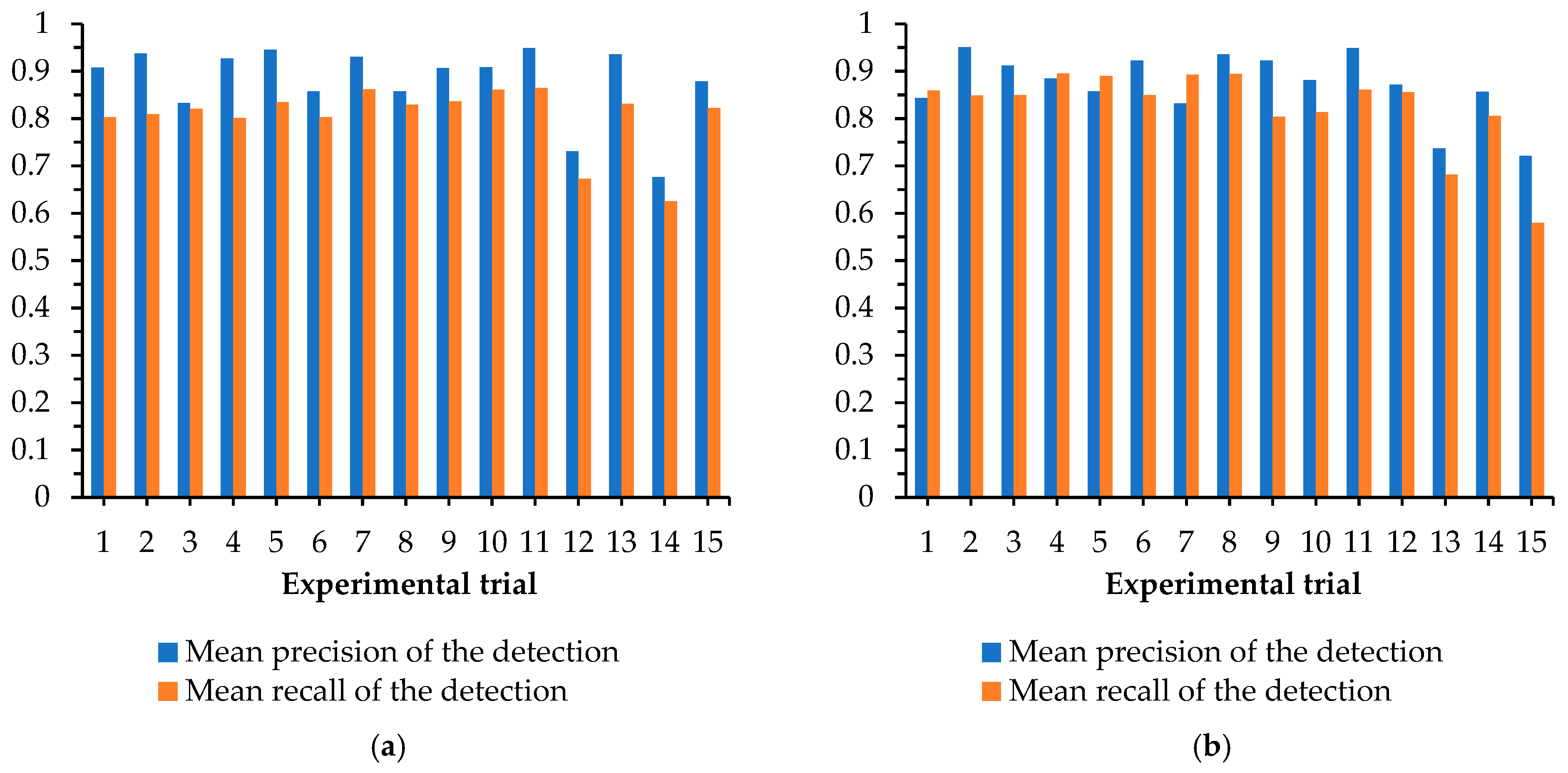
Overall, the quality of the input data, provided by the UAV’s pre-trained YOLOv8 model, was high enough, as can also be deduced from Figure 7a,b showing the mean precision and mean recall values for Scenario A and Scenario B, respectively, for all experimental trials. Regarding Scenario A, the average mean precision was 0.878 ± 0.080, and average mean recall was 0.805 ± 0.067. The corresponding values for Scenario B were 0.871 ± 0.069 and 0.825 ± 0.087, respectively. These scores show that the aerial vision pipeline provides both high purity and high completeness in obstacle detection, which is vital for correctly identifying rows for exclusion.
However, these aggregated averages can mask class-specific performance drops. As stressed above, the system achieved a high detection rate for the two vehicles with an estimated mean recall exceeding 0.95. However, it provided two FNs for the worker class across the 15 trials for each scenario. The magnitude of this class-specific failure is evident in the afternoon trials, namely trials #12 and #14 (Scenario A) and trials #13 and #15 (Scenario B), where the mean recall for the worker class dropped to approximately 0.58, effectively lowering the overall trial average seen in Figure 7. These FNs are directly correlated with the partial success mission outcomes and, specifically, in the smaller values of the corresponding mean precision and mean recall values of these trials. This temporal instability is associated with the findings in Section 3.1, as the FNs were concentrated exclusively in the afternoon. This demonstrates that the high contrast conditions of the low sun angle worsen these frame-to-frame detection inconsistencies for smaller targets like human participants.
The fractional values observed in Figure 7 occur because both mean precision and mean recall values are temporal averages across all image frames during each trial. Mean precision values below 1 confirm that the model occasionally made FPs, as a result of mistaking, for instance, tree trunks, or shadows as obstacles in certain frames. In the same vein, mean recall values below 1.0 demonstrate that FNs took place during the trial duration. These could be caused by the bounding box momentarily failing, or “flickering”, owing to motion blur, rapid movement, or partial occlusion [60]. The per-class breakdown indicates that while the aerial pipeline is highly reliable for large machinery, worker detection remains a safety-critical challenge in adverse lighting, which validates the necessity of the UGV’s secondary LiDAR-based safety redundancy.

3.3. Energy Performance

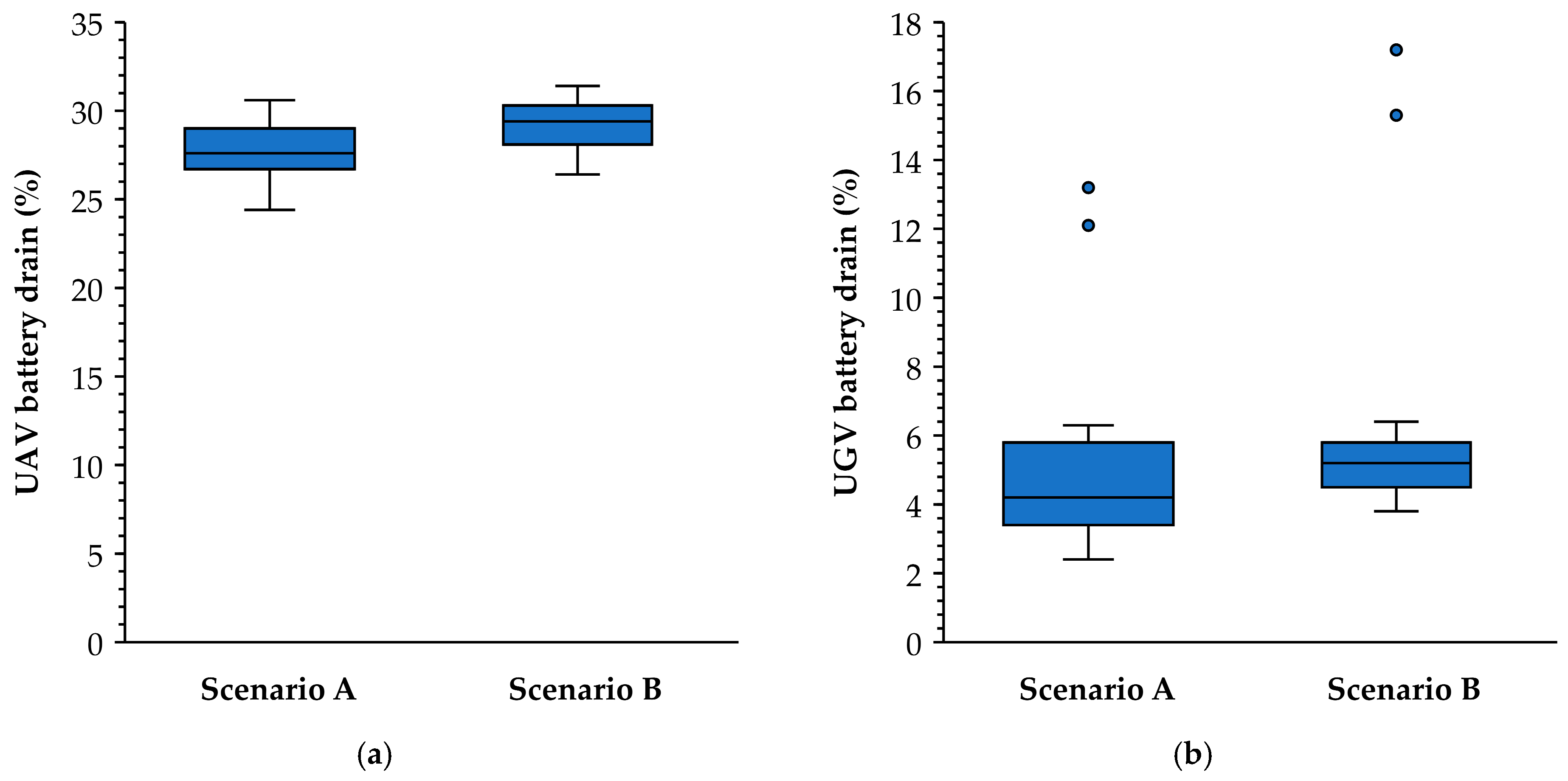
This section examines the battery consumption of both robotic platforms during experimental sessions. The box plot of Figure 8a was selected to demonstrate the stability and low variance of the aerial platform’s energy consumption, regardless of the compositional load in the environment. The Interquartile Range (IQR), which is represented by the box, contains the middle 50% of all observed UAV battery drain values. The narrow height of the boxes in both scenarios shows low statistical dispersion. The median, which is illustrated by the black horizontal line inside the box, is 27.6% and 29.4% for Scenario A and B, respectively. The short length of the whiskers indicates that the maximum variation in battery consumption is minimal. The lack of outliers denotes that the consumption offered for the UAV’s tasks, namely pre-mission scan and dynamic monitoring, is independent of the detection outcome.
The energy increase, which is expected in the partial success trials, is exclusively a consequence paid by the UGV’s reactive system. This is visually confirmed in Figure 8b by the presence of the four outliers (individual circles) that correspond to the partial success trials (#12 and #14 in Scenario A and #13 and #15 in Scenario B). The UGV battery drain increases to a maximum of 13.2% in Scenario A and 17.2% in Scenario B. This heightened consumption is due to the activation of the UGV’s local safety redundancy and reactive planning pipeline, as highlighted in Section 2.3.2. In short, when an FN occurs, the UGV responds with three actions: it halts instantly, activates LiDAR and onboard processing to identify the object, worker in our case, and executes appropriate avoidance maneuvers for a safe return to the row. Obviously, this demands significantly more energy than following the pre-calculated navigation path.

3.4. Temporal Performance

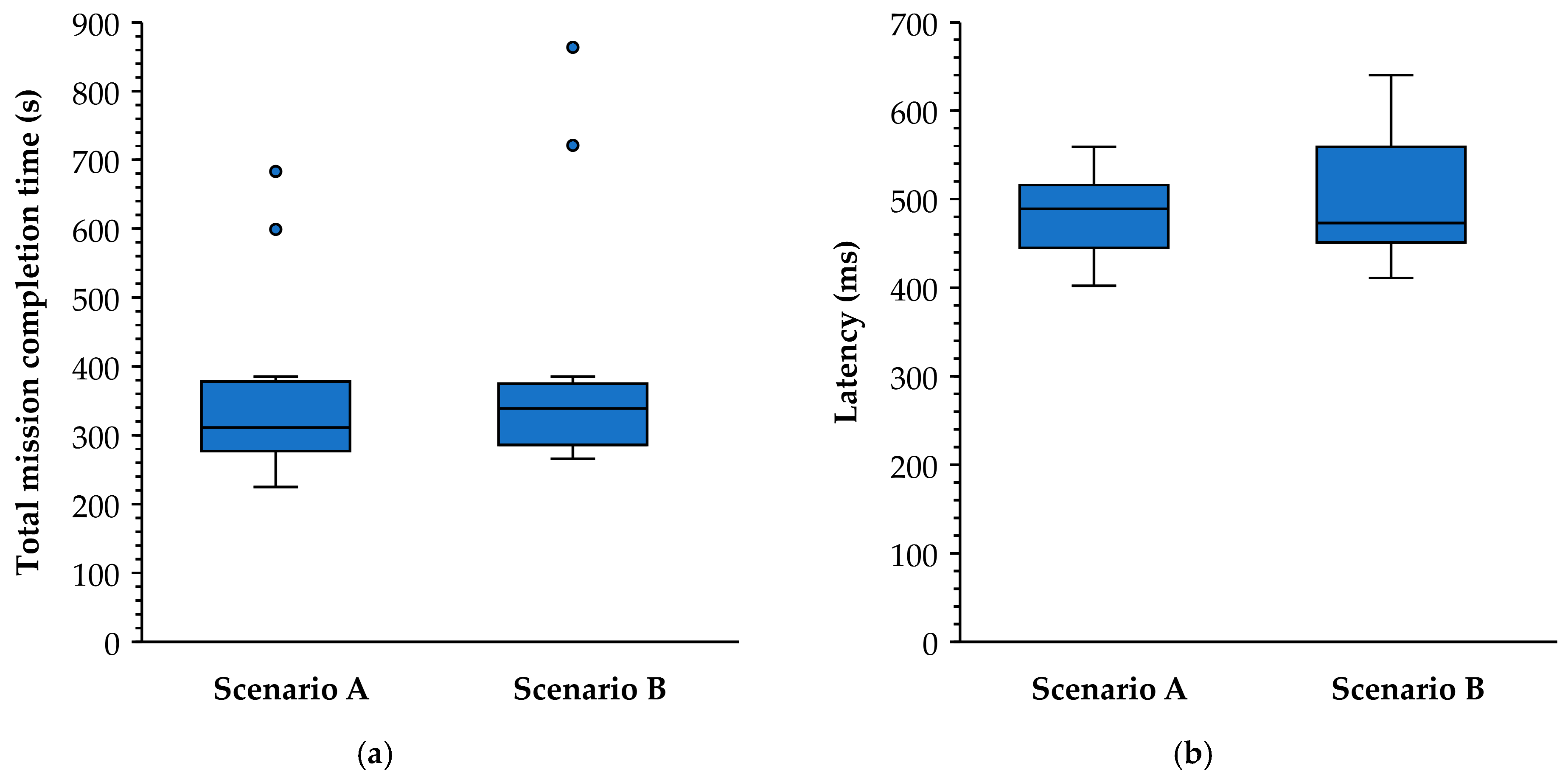
Figure 9a depicts the distribution and central tendency of the total mission completion time for the 15 trials for both scenarios. Most mission completion times fall between approximately 280 and 380 s. The median mission time is also consistent, near 310 and 340 s for Scenario A and B, respectively. This verifies the system’s baseline efficiency when the proactive path planning is fully successful. The tight distribution of the narrow boxes supports the low variance of these missions. The need for the high-energy actions executed by the UGV during the erroneous trials reasonably increases the total mission completion time recorded from start of the UGV’s planned path to the instant it reports successful completion of the task. As in the interpretation of Figure 8b, this can be illustrated by the four distinct outliers that occur above the main distribution. These individual circles correspond to the partial success trials mentioned above. The reactive safety protocol resulted in an average increase in total mission completion time of approximately 90% and 142% for Scenario A and B, respectively. The substantial extension of the required time observed in Scenario B can be attributed to the simultaneous presence of two vehicles. The pickup truck and the van significantly restricted the available maneuvering space of the UGV, necessitating a considerably longer reactive path around the undetectable worker compared to the less restricted Scenario A.
The latency distribution, depicted in Figure 9b, signifies the time interval between the UAV’s successful detection and georeferencing of a target and the moment the UGV’s navigation system receives and processes the exclusion command issued by the FMIS. In both scenarios, the median latency is approximately 480 ms. The IQR is relatively narrow, while no outliers are present. This stability ensures that even during the partial successful trials, the command to brake or maneuver, for example, is received quickly, regardless of the data load complexity.

4. Discussion

The system developed in this study is a hierarchical, safety-critical architecture designed for autonomous operation in semi-structured agricultural environments, such as that of a walnut orchard. It consists of two robotic platforms: a UAV that provides global intelligence and a UGV executing local navigation as well as a safety protocol. The process begins with the UAV mapping the orchard and executing an area scan using a pre-trained YOLOv8 model for wide-area object detection (workers and vehicles) and georeferencing. This critical information is then used by the FMIS to calculate and transmit the exclusion rows to the UGV. Next, the UGV receives the optimal path from the FMIS. Importantly, the UGV is also equipped with a LiDAR perception system that functions as a safety redundancy. This dual method ensures that although the aerial vehicle maximizes efficiency by means of proactive path planning, the ground vehicle can autonomously detect and react to unforeseen dynamic obstructions at close range [20]. This guarantees safety even when the aerial intelligence is temporarily incomplete.
In order to assess the efficiency of the collaborative system, a total of 30 field trials were conducted. These were implemented under two scenarios. Scenario A was characterized by a high worker load comprising one vehicle and two workers, while Scenario B from high vehicle load with two vehicles and one worker. The experimental orchard consisted of 26 inter-row corridors. The detection of an obstacle (vehicle or worker) within a given row resulted in the exclusion of that entire row from the UGV’s navigation plan for the duration of the mission. Consequently, at most, three rows could be excluded in any trial, corresponding to a maximum theoretical coverage reduction of 11.5%. We chose this row-level exclusion strategy to ensure operational safety and stability during uncertain localization, thus, favoring reliability over immediate coverage efficiency.
Overall, the results of the field trials provide three key insights into the performance of the developed system: (a) the significance of time window on detection; (b) the successful validation of the safety-critical redundancy and architectural success; and (c) the quantified operational energetic and time cost that is required to successfully complete the mission by finding a safe path back to its assigned navigation task. As compared to previous UAV–UGV frameworks in agricultural environments [16,17,18,19,20,21], the present collaborative system shows a distinctive advantage. While earlier studies mainly focused on either aerial mapping for path planning or obstacle avoidance, our framework integrates both proactive path optimization and a fail-operational reactive protocol. This ensures that the UGV can autonomously recover from missed detections while keeping mission safety.

4.1. Statistical Significance of Time Window on Aerial Detection

The analysis of the aerial vision system confirmed that while the mean precision and mean recall values were high enough, the overall stability of the system appears to be dependent on the time window. For the purpose of testing the association between mission result (full/partial success) and time window, a Chi-Square test of independence was conducted (via the Microsoft Excel “CHISQ.TEST” function). It used the aggregated full and partial success counts across all experimental conditions. The observed counts for each period are summarized in Table 4.
Expected counts were estimated through:
E i , j = R o w   t o t a l × C o l u m n   t o t a l Τ o t a l   t r i a l s .
and the chi-square statistic through:
χ 2 = O b s e r v e d   c o u n t E x p e c t e d   c o u n t 2 E x p e c t e d   c o u n t   .
The degrees of freedom ( d f ) for the chi-square test were calculated via:
d f = n u m b e r   o f   r o w s 1 × n u m b e r   o f   c o l u m n s 1 ,
where the number of rows and columns were 3 (Morning, Midday, Afternoon) and 2 (Full Success, Partial Success), respectively.
This analysis indicates a statistically significant association between solar period and recognition outcome: χ 2 2 , N = 30 9.23 and p 0.0099 p < 0.05 . Consequently, it was observed that lighting conditions significantly influenced the ability of the YOLOv8 model to perform reliable object segmentation [61,62]. This caused it to fail to differentiate objects from the background or shadows. This challenge, in spite of the remarkable progress of computer vision and object detection algorithms, remains an enduring open problem in agriculture, as has been emphasized in recent scholarly literature [27,63].
The consistent failure, in the present analysis, involved the worker class, as participants are the smallest targets in the field to be detected and are therefore the most susceptible to complete occlusion by long shadows. In fact, when shadows partially or completely cover a target, the lack of robust features prevents Convolutional Neural Networks (CNNs), including YOLOv8, from reaching the necessary confidence threshold [64]. This can result in the observed FNs [32], like in our study.

4.2. Successful Validation of Safety-Critical Redundancy and Architectural Success

Despite the statistically proven illumination-related weakness in the aerial perception system, the core mission objectives of achieving zero mission failures and assuring safety were met. Remarkably, in all four cases categorized as partial success, the localized LiDAR system on the UGV served as a crucial safety back-up, autonomously detecting the missed worker at close range. It proved that the ground platform is capable of autonomously overriding the erroneous global intelligence. To that end, UGV successfully performed a high-priority, multi-step command sequence, beginning with an emergency stop to prevent collision, followed by immediate reactive maneuvers to continue the mission. This is a fundamental indicator of field-ready autonomy which is vital for safety assurance and human–robot coexistence [65,66]. Orchards’ environments are inherently dynamic and characterized by variable environmental factors and the presence of humans and agricultural machinery. Under such challenging conditions, autonomous systems must balance safety assurance and operational continuity.

4.3. The Quantified Operational Cost of Mission Success and Safety

The system’s success in ensuring complete mission success and safety came at a quantifiable penalty to both mission energy consumption and time efficiency due to the additional actions required to execute the reactive safety protocol. Specifically, the analysis of energy and temporal performance revealed distinct patterns between the aerial and ground robotic platforms. On the one hand, the UAV maintained stable energy consumption, with median drain values of 27.6% and 29.4% for Scenarios A and B, respectively. Hence, the endurance of the UAV is sufficient for the designed mission segments. Moreover, the system protocol allows safe landing and battery replacement if required. This ensures that the collaborative UAV–UGV operation remains practical and effective in real orchard deployments. On the other hand, the UGV exhibited increased energy consumption, which was associated with the extension of mission duration in cases of partial success. These deviations correspond to instances where the system detected a worker FN, initiating the high-energy safety protocol mentioned above involving complex maneuvers. The energetic penalty is illustrated as outliers in battery drain distribution and mission completion times in Figure 8b and Figure 9a, respectively. As far as the latency analysis is concerned, it can be concluded that the communication between the UAV, FMIS, and UGV was consistent and reliable for all trials regardless of the degree of success. Although centralized, the system’s safety is unaffected by communication latency. The UAV provides pre-mission data, while the UGV uses local LiDAR for real-time sensing. This architecture ensures that safety reactions occur locally and instantly, independent of network speed.

4.4. Limitations of the Present Study

One remarkable limitation of the present study was the UAV vision system’s sensitivity to illumination conditions that occurred in the afternoon, when low sun angles and long shadows affected detection performance. Furthermore, we did not test the performance of the system under other environmental factors, such as heavy wind, rain, fog, or variable ground conditions. Studies have shown that such environmental stressors can cause drift and deviation in the UAV’s path and camera aim point [67,68,69] and UGV navigation challenges affecting traction, stability as well as sensor reliability [70,71]. Moreover, the experimental scenarios were predefined and carefully designed. The individuals serving as targets were not typical agricultural workers. In other words, the study did not explore the practical challenges along with the technical expertise required for end users, who may lack technical background, to install and use the communication systems and robotic platforms in daily operation [72,73]. In addition, decentralized coordination, via protocols like MAVLink [74], for example, could be a suitable alternative for time-sensitive operations that demand more rapid feedback. Nevertheless, the study used centralized coordination architecture via an FMIS to assure consistent communication in a complex agricultural environment, which was observed under the experimental conditions of this study.
Another limitation of this study is the reliance on a proprietary third-party dataset and a pre-trained detection algorithm for the aerial module, which precluded a detailed analysis of training statistics. It also prevented the optimization of the model for specific local orchard features. However, the framework is intentionally detector-agnostic; the vision module serves as a modular sensory input, ensuring that system-level coordination remains valid regardless of the specific algorithm employed. Moreover, a systematic quantitative evaluation of prolonged communication outages was not conducted in this study. However, because backend connectivity is required only during mission initialization and the UGV’s safety-critical functions are executed entirely onboard, temporary connectivity degradation does not compromise operational safety.
The quantification of the operational cost was based on a relatively small dataset of failure events, namely four partial success trials. This number may limit the generalizability of the estimated energy and temporal penalties. Thus, the reported values should be interpreted as indicative rather than definitive. Finally, the study was conducted in a walnut orchard. As a consequence, the results cannot generalize to other crop types, inter-row spacing, and canopy structure.

4.5. Future Research Directions

Based on the limitations identified in this study, a number of critical research directions can be suggested for improving the operational readiness of the present system. First, the main limitation, being the failure of the aerial vision system related to variable lighting, requires immediate attention. It necessitates the integration of advanced computer vision techniques to achieve consistent performance in variable lighting and improve performance against shadows. For example, an IR/near-infrared (NIR) or thermal camera could be integrated alongside the present red-green-blue (RGB) vision system. This can provide invariant cues when shadows degrade RGB detection [75]. Additionally, using a high dynamic range (HDR)-capable camera would help reduce our vision system’s illumination-related weakness by reducing scene variability and improving feature robustness [76]. Evaluation of the system under a full range of environmental factors, different crop systems and varying latency and packet-loss conditions is also recommended towards understanding their influences on UAV–UGV team performance in agricultural settings.
The proposed UAV–UGV collaborative framework is modular and can scale to larger fields. Larger field coverage could be enabled by extending UAV missions or using multiple UAVs [77]. Concerning multi-UGV scenarios, the FMIS could distribute georeferenced exclusion information to each UGV, with each UGV executing its own local planner and safety protocol. Although the architecture is scalable, its upper limit is constrained by the computational and communication capacity of the central FMIS node. Future research should examine the efficiency trade-offs of decentralized coordination, especially for agricultural operations requiring faster communication between robotic units.
While the current protocol utilizes a binary row-exclusion policy to ensure maximum safety distances, future work could implement a more granular spatial–temporal approach. For example, the UGV could treat a detected obstacle as a dynamic end-of-row marker. Instead of excluding the entire row, the FMIS could define a virtual stop line at the obstacle’s location. This would allow the UGV to enter the row and service all available trees up to a predefined safety buffer, ensuring that the presence of an obstacle only impacts the immediate vicinity rather than the entire orchard block’s productivity. Additionally, temporal re-scanning could be used to verify if an obstacle is stationary or transient, allowing the UGV to resume full row traversal once the path is clear. Expanding the dataset in future work, with additional failure events under varying environmental and operational conditions, will be necessary to provide more reliable quantitative benchmarks for mission cost analysis. The next phase of this research involves migrating from proprietary fleet management services to an entirely open-source, platform-agnostic software stack. This transition will focus on developing native ROS-based modules to ensure the framework’s full reproducibility within the academic community.

5. Conclusions

The present study successfully demonstrated the viability of a UAV–UGV collaborative system capable of autonomously operating in complex agricultural environments, such as walnut orchards. The UAV provides global intelligence through mapping and YOLOv8-based detection of workers and vehicles. The FMIS is used as the central coordinator, processing the UAV’s obstacle data to calculate exclusion zones and generate the optimal navigation path for the UGV. The UGV then receives this optimized path from the FMIS and executes local navigation.
Two distinct scenarios were designed for testing the efficiency of the system. Scenario A included one pickup truck and two workers, while Scenario B included two vehicles (one pickup truck and one van) and one worker.
The main findings are summarized as follows:
  • The system successfully validated its primary design objectives. These were zero mission failures and guaranteed worker safety in all trials. To that end, the UGV’s LiDAR system proved to be an essential safety redundancy for the necessary immediate reactive UGV’s maneuvers.
  • A statistically significant association was found between the afternoon solar period and mission outcome with workers identified as a highly challenging detection class.
  • The activation of the reactive protocol in partial success trials resulted in an average increase of ≈200% in UGV battery consumption accompanied by significant time penalties of ≈100% in both scenarios. These results confirmed that the energetic penalty for safety recovery is restricted solely to the ground platform.
  • The greater time cost was observed in Scenario B, since the high compositional complexity (restricted maneuvering space due to vehicles) increased the temporal cost required for the UGV to safely re-engage and complete its navigation task.
Based on the findings of the present study, future research should mainly focus on: (a) integrating advanced vision technologies and custom-trained detection models in order to enhance detection under variable lighting conditions; (b) systematically evaluating UAV–UGV performance for diverse environmental conditions; (c) exploring decentralized coordination; (d) implementing granular spatial–temporal exclusion policies to minimize productivity loss during safety interventions; and (e) expanding data on reactive maneuvers for the sake of improving predictions of energy use and mission duration in real-world agricultural operations.

Author Contributions

Conceptualization, D.K. (Dimitris Katikardis), L.B., and D.B.; methodology, D.K. (Dimitris Katikardis), L.B., E.P., G.K., I.M., and R.B.; validation, E.P. and D.K. (Dimitrios Kateris); formal analysis, E.P., R.B., G.K., and C.G.S.; investigation, D.K. (Dimitris Katikardis), L.B., and D.K. (Dimitrios Kateris); writing—original draft preparation, D.K. (Dimitris Katikardis) and L.B.; writing—review and editing, D.K. (Dimitris Kateris), E.P., G.K., I.M., R.B., C.G.S., and D.B.; visualization, D.K. (Dimitris Katikardis) and I.M.; supervision, D.B. All authors have read and agreed to the published version of the manuscript.

Funding

This research received no external funding.

Institutional Review Board Statement

Not applicable.

Informed Consent Statement

Informed consent was obtained from all subjects involved in the study.

Data Availability Statement

The dataset presented in this article is not readily available, because the data are part of an ongoing study. Requests to access the dataset should be directed to the authors of the article.

Conflicts of Interest

The authors Dimitris Katikaridis, Ioannis Menexes, and Dionysis Bochtis were employed by the company farmB Digital Agriculture S.A. The remaining authors declare that the research was conducted in the absence of any commercial or financial relationships that could be construed as a potential conflict of interest.

References

  1. Mulungu, K.; Kassie, M.; Tschopp, M. The role of information and communication technologies-based extension in agriculture: Application, opportunities and challenges. Inf. Technol. Dev. 2025, 31, 1117–1146. [Google Scholar] [CrossRef]
  2. Nkwocha, C.L.; Adewumi, A.; Folorunsho, S.O.; Eze, C.; Jjagwe, P.; Kemeshi, J.; Wang, N. A Comprehensive Review of Sensing, Control, and Networking in Agricultural Robots: From Perception to Coordination. Robotics 2025, 14, 159. [Google Scholar] [CrossRef]
  3. Ren, Z.; Zheng, H.; Chen, J.; Chen, T.; Xie, P.; Xu, Y.; Deng, J.; Wang, H.; Sun, M.; Jiao, W. Integrating UAV, UGV and UAV-UGV collaboration in future industrialized agriculture: Analysis, opportunities and challenges. Comput. Electron. Agric. 2024, 227, 109631. [Google Scholar] [CrossRef]
  4. Agelli, M.; Corona, N.; Maggio, F.; Moi, P.V. Unmanned Ground Vehicles for Continuous Crop Monitoring in Agriculture: Assessing the Readiness of Current ICT Technology. Machines 2024, 12, 750. [Google Scholar] [CrossRef]
  5. Farhan, S.M.; Yin, J.; Chen, Z.; Memon, M.S. A Comprehensive Review of LiDAR Applications in Crop Management for Precision Agriculture. Sensors 2024, 24, 5409. [Google Scholar] [CrossRef]
  6. Lochan, K.; Khan, A.; Elsayed, I.; Suthar, B.; Seneviratne, L.; Hussain, I. Advancements in Precision Spraying of Agricultural Robots: A Comprehensive Review. IEEE Access 2024, 12, 129447–129483. [Google Scholar] [CrossRef]
  7. Moysiadis, V.; Benos, L.; Karras, G.; Kateris, D.; Peruzzi, A.; Berruto, R.; Papageorgiou, E.; Bochtis, D. Human–Robot Interaction through Dynamic Movement Recognition for Agricultural Environments. AgriEngineering 2024, 6, 2494–2512. [Google Scholar] [CrossRef]
  8. Lin, Y.; Song, X.; Xiao, W.; Kuang, D.; Xia, S.; Chang, H.; Wongsuk, S.; He, X.; Liu, Y. Low-altitude remote sensing and deep learning-based canopy detection method for the navigation of orchard unmanned ground vehicles. Comput. Electron. Agric. 2025, 239, 111077. [Google Scholar] [CrossRef]
  9. Cyriac, R.; Thomas, J. Smart Farming with Cloud Supported Data Management Enabling Real-Time Monitoring and Prediction for Better Yield BT—Intelligent Robots and Drones for Precision Agriculture; Balasubramanian, S., Natarajan, G., Chelliah, P.R., Eds.; Springer Nature: Cham, Switzerland, 2024; pp. 283–306. [Google Scholar]
  10. Guebsi, R.; Mami, S.; Chokmani, K. Drones in Precision Agriculture: A Comprehensive Review of Applications, Technologies, and Challenges. Drones 2024, 8, 686. [Google Scholar] [CrossRef]
  11. Munasinghe, I.; Perera, A.; Deo, R.C. A Comprehensive Review of UAV-UGV Collaboration: Advancements and Challenges. J. Sens. Actuator Netw. 2024, 13, 81. [Google Scholar] [CrossRef]
  12. Benos, L.; Asiminari, G.; Busato, P.; Kateris, D.; Aidonis, D.; Bochtis, D. Explainable artificial intelligence-driven geometric feature selection for enhanced field traversing efficiency prediction. Comput. Electron. Agric. 2025, 239, 111049. [Google Scholar] [CrossRef]
  13. Chen, Y.; Liu, Z.; Xu, Z.; Lin, J.; Guan, X.; Zhou, Z.; Zheng, D.; Hewitt, A. UAVs-UGV cooperative boom sprayer system based on swarm control. Comput. Electron. Agric. 2025, 235, 110339. [Google Scholar] [CrossRef]
  14. Ciacco, A.; Giallombardo, G.; Guerriero, F.; Saccomanno, F.P. Monitoring agricultural fields through collaboration between autonomous robots and drones. In Proceedings of the 2025 IEEE Conference on Technologies for Sustainability (SusTech), Santa Ana, CA, USA, 20–23 April 2025; IEEE: New York, NY, USA, 2025; pp. 1–8. [Google Scholar]
  15. Mammarella, M.; Comba, L.; Biglia, A.; Dabbene, F.; Gay, P. Cooperation of unmanned systems for agricultural applications: A theoretical framework. Biosyst. Eng. 2022, 223, 61–80. [Google Scholar] [CrossRef]
  16. Mammarella, M.; Comba, L.; Biglia, A.; Dabbene, F.; Gay, P. Cooperation of unmanned systems for agricultural applications: A case study in a vineyard. Biosyst. Eng. 2022, 223, 81–102. [Google Scholar] [CrossRef]
  17. Xu, Y.; Xue, X.; Sun, Z.; Gu, W.; Cui, L.; Jin, Y.; Lan, Y. Global path planning for navigating orchard vehicle based on fruit tree positioning and planting rows detection from UAV imagery. Comput. Electron. Agric. 2025, 236, 110446. [Google Scholar] [CrossRef]
  18. Katikaridis, D.; Moysiadis, V.; Tsolakis, N.; Busato, P.; Kateris, D.; Pearson, S.; Sørensen, C.G.; Bochtis, D. UAV-Supported Route Planning for UGVs in Semi-Deterministic Agricultural Environments. Agronomy 2022, 12, 1937. [Google Scholar] [CrossRef]
  19. Shi, M.; Feng, X.; Pan, S.; Song, X.; Jiang, L. A Collaborative Path Planning Method for Intelligent Agricultural Machinery Based on Unmanned Aerial Vehicles. Electronics 2023, 12, 3232. [Google Scholar] [CrossRef]
  20. Katikaridis, D.; Benos, L.; Busato, P.; Kateris, D.; Papageorgiou, E.; Karras, G.; Bochtis, D. Experimental Comparative Analysis of Centralized vs. Decentralized Coordination of Aerial–Ground Robotic Teams for Agricultural Operations. Robotics 2025, 14, 119. [Google Scholar] [CrossRef]
  21. Mansur, H.; Gadhwal, M.; Abon, J.E.; Flippo, D. Mapping for Autonomous Navigation of Agricultural Robots Through Crop Rows Using UAV. Agriculture 2025, 15, 882. [Google Scholar] [CrossRef]
  22. Ma, M. Optimization of YOLOv8 for UAV-Based Object Detection: A Literature Review. Appl. Comput. Eng. 2025, 191, 65–74. [Google Scholar] [CrossRef]
  23. Rahman, S.; Rony, J.H.; Uddin, J.; Samad, M.A. Real-Time Obstacle Detection with YOLOv8 in a WSN Using UAV Aerial Photography. J. Imaging 2023, 9, 216. [Google Scholar] [CrossRef]
  24. Xu, N.; Ning, X.; Li, A.; Li, Z.; Song, Y.; Wu, W. Research on Orchard Navigation Line Recognition Method Based on U-Net. Sensors 2025, 25, 6828. [Google Scholar] [CrossRef]
  25. Li, G.; Le, F.; Si, S.; Cui, L.; Xue, X. Image Segmentation-Based Oilseed Rape Row Detection for Infield Navigation of Agri-Robot. Agronomy 2024, 14, 1886. [Google Scholar] [CrossRef]
  26. Dixit, B.; Ananthapadmanabha, A.; Thahsin, A.; Pathak, S.; Kasbekar, G.S.; Maity, A. A Novel Cipher for Enhancing MAVLink Security: Design, Security Analysis, and Performance Evaluation Using a Drone Testbed. arXiv 2025, arXiv:2504.20626. [Google Scholar] [CrossRef]
  27. Khan, Z.; Shen, Y.; Liu, H. ObjectDetection in Agriculture: A Comprehensive Review of Methods, Applications, Challenges, and Future Directions. Agriculture 2025, 15, 1351. [Google Scholar] [CrossRef]
  28. Moysiadis, V.; Katikaridis, D.; Benos, L.; Busato, P.; Anagnostis, A.; Kateris, D.; Pearson, S.; Bochtis, D. An Integrated Real-Time Hand Gesture Recognition Framework for Human-Robot Interaction in Agriculture. Appl. Sci. 2022, 12, 8160. [Google Scholar] [CrossRef]
  29. Ultralytics YOLOv8. Ultralytics. Available online: https://github.com/ultralytics/ultralytics (accessed on 5 November 2025).
  30. Khan, A.T.; Jensen, S.M.; Khan, A.R. Advancing precision agriculture: A comparative analysis of YOLOv8 for multi-class weed detection in cotton cultivation. Artif. Intell. Agric. 2025, 15, 182–191. [Google Scholar] [CrossRef]
  31. Shen, Y.; Yang, Z.; Khan, Z.; Liu, H.; Chen, W.; Duan, S. Optimization of Improved YOLOv8 for Precision Tomato Leaf Disease Detection in Sustainable Agriculture. Sensors 2025, 25, 1398. [Google Scholar] [CrossRef] [PubMed]
  32. Zhou, X.; Chen, W.; Wei, X. Improved Field Obstacle Detection Algorithm Based on YOLOv8. Agriculture 2024, 14, 2263. [Google Scholar] [CrossRef]
  33. Niu, S.; Nie, Z.; Li, G.; Zhu, W. Early Drought Detection in Maize Using UAV Images and YOLOv8+. Drones 2024, 8, 170. [Google Scholar] [CrossRef]
  34. Wu, W.; Liu, A.; Hu, J.; Mo, Y.; Xiang, S.; Duan, P.; Liang, Q. EUAVDet: An Efficient and Lightweight Object Detector for UAV Aerial Images with an Edge-Based Computing Platform. Drones 2024, 8, 261. [Google Scholar] [CrossRef]
  35. Abdalla, A.; Mohammed, M.M.A.; Adedeji, O.; Dotray, P.; Guo, W. Toward resource-efficient UAV systems: Deep learning model compression for onboard-ready weed detection in UAV imagery. Smart Agric. Technol. 2025, 12, 101086. [Google Scholar] [CrossRef]
  36. Machidon, A.L.; Krašovec, A.; Pejović, V.; Latini, D.; Sasidharan, S.T.; Del Frate, F.; Machidon, O.M. A Low-Cost UAV System and Dataset for Real-Time Weed Detection in Salad Crops. Electronics 2025, 14, 4082. [Google Scholar] [CrossRef]
  37. Zhang, Z. A flexible new technique for camera calibration. IEEE Trans. Pattern Anal. Mach. Intell. 2000, 22, 1330–1334. [Google Scholar] [CrossRef]
  38. Matese, A.; Toscano, P.; Di Gennaro, S.F.; Genesio, L.; Vaccari, F.P.; Primicerio, J.; Belli, C.; Zaldei, A.; Bianconi, R.; Gioli, B. Intercomparison of UAV, Aircraft and Satellite Remote Sensing Platforms for Precision Viticulture. Remote Sens. 2015, 7, 2971–2990. [Google Scholar] [CrossRef]
  39. Christiansen, M.; Laursen, M.; Jørgensen, R.; Skovsen, S.; Gislum, R. Designing and Testing a UAV Mapping System for Agricultural Field Surveying. Sensors 2017, 17, 2703. [Google Scholar] [CrossRef]
  40. Grimstad, L.; From, P.J. The Thorvald II Agricultural Robotic System. Robotics 2017, 6, 24. [Google Scholar] [CrossRef]
  41. Lytridis, C.; Kaburlasos, V.G.; Pachidis, T.; Manios, M.; Vrochidou, E.; Kalampokas, T.; Chatzistamatis, S. An Overview of Cooperative Robotics in Agriculture. Agronomy 2021, 11, 1818. [Google Scholar] [CrossRef]
  42. Baxter, P.; Cielniak, G.; Hanheide, M.; From, P.J. Safe Human-Robot Interaction in Agriculture. In Proceedings of the Companion of the 2018 ACM/IEEE International Conference on Human-Robot Interaction (HRI ’18), Chicago, IL, USA, 5–8 March 2018; Association for Computing Machinery: New York, NY, USA, 2018; pp. 59–60. [Google Scholar]
  43. Benos, L.; Tsaopoulos, D.; Tagarakis, A.C.; Kateris, D.; Busato, P.; Bochtis, D. Explainable AI-Enhanced Human Activity Recognition for Human–Robot Collaboration in Agriculture. Appl. Sci. 2025, 15, 650. [Google Scholar] [CrossRef]
  44. Burud, I.; Lange, G.; Lillemo, M.; Bleken, E.; Grimstad, L.; Johan From, P. Exploring Robots and UAVs as Phenotyping Tools in Plant Breeding. IFAC-PapersOnLine 2017, 50, 11479–11484. [Google Scholar] [CrossRef]
  45. Esser, F.; Marks, E.; Magistri, F.; Weyler, J.; Bultmann, S.; Zaenker, T.; Ahmadi, A.; Schreiber, M.; Kuhlmann, H.; McCool, C.; et al. Automated Leaf-Level Inspection of Crops Combining UAV and UGV Robots BT. In European Robotics Forum 2025; Huber, M., Verl, A., Kraus, W., Eds.; Springer Nature: Cham, Switzerland, 2025; pp. 35–41. [Google Scholar]
  46. Baek, E.-T.; Im, D.-Y. ROS-Based Unmanned Mobile Robot Platform for Agriculture. Appl. Sci. 2022, 12, 4335. [Google Scholar] [CrossRef]
  47. Niu, J.; Zhang, L.; Zhang, T.; Guan, J.; Shi, S. Orchard Robot Navigation via an Improved RTAB-Map Algorithm. Appl. Sci. 2025, 15, 11673. [Google Scholar] [CrossRef]
  48. Open Source Robotics Foundation. Carrot_Planner. ROS Wiki. Available online: https://wiki.ros.org/carrot_planner (accessed on 5 November 2025).
  49. Zheng, K. ROS Navigation Tuning Guide BT. In Robot Operating System (ROS): The Complete Reference; Koubaa, A., Ed.; Springer International Publishing: Cham, Switzerland, 2021; Volume 6, pp. 197–226. ISBN 978-3-030-75472-3. [Google Scholar]
  50. Vasconez, J.P.; Guevara, L.; Cheein, F.A. Social robot navigation based on HRI non-verbal communication: A case study on avocado harvesting. In Proceedings of the ACM Symposium on Applied Computing; Association for Computing Machinery: New York, NY, USA, 2019; Volume Part F147772, pp. 957–960. [Google Scholar]
  51. Lv, P.; Wang, B.; Cheng, F.; Xue, J. Multi-Objective Association Detection of Farmland Obstacles Based on Information Fusion of Millimeter Wave Radar and Camera. Sensors 2023, 23, 230. [Google Scholar] [CrossRef]
  52. Escolà, A.; Planas, S.; Rosell, J.R.; Pomar, J.; Camp, F.; Solanelles, F.; Gracia, F.; Llorens, J.; Gil, E. Performance of an Ultrasonic Ranging Sensor in Apple Tree Canopies. Sensors 2011, 11, 2459–2477. [Google Scholar] [CrossRef]
  53. Shen, Y.; Shen, Y.; Zhang, Y.; Huo, C.; Shen, Z.; Su, W.; Liu, H. Research Progress on Path Planning and Tracking Control Methods for Orchard Mobile Robots in Complex Scenarios. Agriculture 2025, 15, 1917. [Google Scholar] [CrossRef]
  54. Tang, Y.; Qiu, J.; Zhang, Y.; Wu, D.; Cao, Y.; Zhao, K.; Zhu, L. Optimization strategies of fruit detection to overcome the challenge of unstructured background in field orchard environment: A review. Precis. Agric. 2023, 24, 1183–1219. [Google Scholar] [CrossRef]
  55. Ye, L.; Wu, F.; Zou, X.; Li, J. Path planning for mobile robots in unstructured orchard environments: An improved kinematically constrained bi-directional RRT approach. Comput. Electron. Agric. 2023, 215, 108453. [Google Scholar] [CrossRef]
  56. Han, C.; Wu, W.; Luo, X.; Li, J. Visual Navigation and Obstacle Avoidance Control for Agricultural Robots via LiDAR and Camera. Remote Sens. 2023, 15, 5402. [Google Scholar] [CrossRef]
  57. StephanST/WALDO30 Whereabouts Ascertainment for Low-lying Detectable Objects. Hugging Face Model Repository. Available online: https://huggingface.co/StephanST/WALDO30 (accessed on 7 January 2025).
  58. Tariku, G.; Ghiglieno, I.; Simonetto, A.; Gentilin, F.; Armiraglio, S.; Gilioli, G.; Serina, I. Advanced Image Preprocessing and Integrated Modeling for UAV Plant Image Classification. Drones 2024, 8, 645. [Google Scholar] [CrossRef]
  59. Vélez, S.; Vacas, R.; Martín, H.; Ruano-Rosa, D.; Álvarez, S. A Novel Technique Using Planar Area and Ground Shadows Calculated from UAV RGB Imagery to Estimate Pistachio Tree (Pistacia vera L.) Canopy Volume. Remote Sens. 2022, 14, 6006. [Google Scholar] [CrossRef]
  60. Lin, Y.-W.; Liu, Y.-H.; Lin, Y.-B.; Hong, J.-C. FenceTalk: Exploring False Negatives in Moving Object Detection. Algorithms 2023, 16, 481. [Google Scholar] [CrossRef]
  61. Tummala, A.; Baskar, V.; Zaidi, S.H. Impact of Lighting-Based Biases on the Performance of YOLOv8 Object Detection Models. In Proceedings of the 2024 IEEE International Conference on Control & Automation, Electronics, Robotics, Internet of Things, and Artificial Intelligence (CERIA), Bandung, Indonesia, 17–18 October 2024; IEEE: New York, NY, USA, 2024; pp. 1–5. [Google Scholar]
  62. Gong, B.; Zhang, H.; Ma, B.; Tao, Z. Enhancing real-time low-light object detection via multi-scale edge and illumination-guided features in YOLOv8. J. Supercomput. 2025, 81, 1120. [Google Scholar] [CrossRef]
  63. Tapia-Mendez, E.; Hernandez-Sandoval, M.; Salazar-Colores, S.; Cruz-Albarran, I.A.; Tovar-Arriaga, S.; Morales-Hernandez, L.A. A Novel Deep Learning Approach for Precision Agriculture: Quality Detection in Fruits and Vegetables Using Object Detection Models. Agronomy 2025, 15, 1307. [Google Scholar] [CrossRef]
  64. Mat-Desa, S.; Mohd-Isa, W.-N.; Gomez-Krämer, P.; Roslee, M.; Hashim, N.; Abdullah, J.; Ali, A.; Che-Embi, Z.; Ibrahim, A. Dataset for small object detection with shadow (SODwS). Data Br. 2025, 60, 111482. [Google Scholar] [CrossRef]
  65. Benos, L.; Bechar, A.; Bochtis, D. Safety and ergonomics in human-robot interactive agricultural operations. Biosyst. Eng. 2020, 200, 55–72. [Google Scholar] [CrossRef]
  66. Pietrantoni, L.; Favilla, M.; Fraboni, F.; Mazzoni, E.; Morandini, S.; Benvenuti, M.; De Angelis, M. Integrating collaborative robots in manufacturing, logistics, and agriculture: Expert perspectives on technical, safety, and human factors. Front. Robot. AI 2024, 11, 1342130. [Google Scholar] [CrossRef]
  67. Jayaweera, H.M.P.C.; Hanoun, S. Path Planning of Unmanned Aerial Vehicles (UAVs) in Windy Environments. Drones 2022, 6, 101. [Google Scholar] [CrossRef]
  68. Sumi, Y.; Kim, B.K.; Ogure, T.; Kodama, M.; Sakai, N.; Kobayashi, M. Impact of Rainfall on the Detection Performance of Non-Contact Safety Sensors for UAVs/UGVs. Sensors 2024, 24, 2713. [Google Scholar] [CrossRef] [PubMed]
  69. Munir, A.; Siddiqui, A.J.; Anwar, S.; El-Maleh, A.; Khan, A.H.; Rehman, A. Impact of Adverse Weather and Image Distortions on Vision-Based UAV Detection: A Performance Evaluation of Deep Learning Models. Drones 2024, 8, 638. [Google Scholar] [CrossRef]
  70. Chakraborty, S.; Elangovan, D.; Govindarajan, P.L.; ELnaggar, M.F.; Alrashed, M.M.; Kamel, S. A Comprehensive Review of Path Planning for Agricultural Ground Robots. Sustainability 2022, 14, 9156. [Google Scholar] [CrossRef]
  71. Zhao, Z.; Zhang, Y.; Shi, J.; Long, L.; Lu, Z. Robust Lidar-Inertial Odometry with Ground Condition Perception and Optimization Algorithm for UGV. Sensors 2022, 22, 7424. [Google Scholar] [CrossRef]
  72. Suvittawat, A. Investigating Farmers’ Perceptions of Drone Technology in Thailand: Exploring Expectations, Product Quality, Perceived Value, and Adoption in Agriculture. Agriculture 2024, 14, 2183. [Google Scholar] [CrossRef]
  73. Marinoudi, V.; Benos, L.; Villa, C.C.; Lampridi, M.; Kateris, D.; Berruto, R.; Pearson, S.; Sørensen, C.G.; Bochtis, D. Adapting to the Agricultural Labor Market Shaped by Robotization. Sustainability 2024, 16, 7061. [Google Scholar] [CrossRef]
  74. Koubâa, A.; Allouch, A.; Alajlan, M.; Javed, Y.; Belghith, A.; Khalgui, M. Micro Air Vehicle Link (MAVlink) in a Nutshell: A Survey. IEEE Access 2019, 7, 87658–87680. [Google Scholar] [CrossRef]
  75. Fountas, S.; Malounas, I.; Athanasakos, L.; Avgoustakis, I.; Espejo-Garcia, B. AI-Assisted Vision for Agricultural Robots. AgriEngineering 2022, 4, 674–694. [Google Scholar] [CrossRef]
  76. Shan, B. A Computer Vision-Based Anti-Lodging Control System for Agricultural Machinery. In Proceedings of the 2025 6th International Conference on Computer Vision, Image and Deep Learning (CVIDL), Ningbo, China, 23–25 May 2025; IEEE: New York, NY, USA, 2025; pp. 1137–1142. [Google Scholar]
  77. Alqudsi, Y.; Makaraci, M. UAV swarms: Research, challenges, and future directions. J. Eng. Appl. Sci. 2025, 72, 12. [Google Scholar] [CrossRef]
Figure 1. Overview of the centralized UAV–UGV collaboration and functional breakdown. Three main elements are coordinated via RESTful APIs: (i) a UAV platform utilizing a YOLOv8 detector for global aerial reconnaissance and dynamic obstacle detection; (ii) an FMIS backend that processes obstacle locations to generate optimized, georeferenced route plans; and (iii) a UGV platform that executes the navigation mission while employing local LiDAR for reactive safety.
Applsci 16 01143 g001
Figure 2. Detailed system flowchart and communication protocol. The process integrates three nodes coordinated via a networked backend: (i) UAV Node: Ascends to a set Above Ground Level (AGL) for field surveying. An onboard YOLOv8-based pipeline is executed to detect workers and vehicles, geo-tagging obstacles by fusing GPS data with camera trigger logs; (ii) FMIS Backend: Acts as the mediator through a UAV–UGV interconnection microservice. It receives coordinate arrays via RESTful API calls, acknowledges the UAV, and forwards obstacle data to the UGV; (iii) UGV Node: Requests a navigation route from the farmB.fleet service, treating UAV-detected coordinates as exclusion zones to produce an obstacle-free path.
Applsci 16 01143 g002
Figure 3. Satellite image of the walnut orchard located in Thessaly, central Greece.
Applsci 16 01143 g003
Figure 4. Distribution of UGV mission results across experimental scenarios and time period; green indicates trials with full success, while yellow indicates trials with partial success.
Applsci 16 01143 g004
Figure 5. Indicative examples of images along with the confidence levels of the YOLOv8 model achieving full success for (a) Scenario A and (b) Scenario B. Blue lines denote proactive planning: solid for navigable corridors and dashed for prohibited zones due to the existence of an obstacle.
Applsci 16 01143 g005
Figure 6. Qualitative detection and path planning results for (a) Scenario A and (b) Scenario B. Confidence levels for YOLOv8 are shown, with the red circle identifying a “False Negative” (Undetectable Person). Blue lines denote proactive planning: solid for navigable corridors and dashed for prohibited zones. The red dashed line represents reactive avoidance triggered by a person detected within the navigable trajectory following an aerial sensing failure.
Applsci 16 01143 g006
Figure 7. Mean precision and mean recall values for: (a) Scenario A and (b) Scenario B across all experimental trials. Trials 11–15 correspond to the afternoon time window.
Applsci 16 01143 g007
Figure 8. Battery drain distribution across all experimental trials for: (a) UAV and (b) UGV platforms for both scenarios.
Applsci 16 01143 g008
Figure 9. (a) Total mission completion time and (b) latency distribution across all experimental trials for both scenarios.
Applsci 16 01143 g009
Table 1. Key differences between centralized and decentralized architectures for UAV–UGV coordination.
AspectCentralized CoordinationDecentralized Coordination
Decision-makingSupervisory node controls all agentsEach agent decides locally
Information flowAll data to central nodeAgents exchange state and intent directly
Situational awarenessGlobal view at central nodeLocal awareness; global emerges via interactions
OptimizationHigh: mission-wide planning possibleLocal: fleet-level optimality limited
Latency sensitivityHigh; network delays affect responseLow; local reactions fast
Computational loadCentralized; low onboard requirementDistributed; each agent needs processing power
ScalabilityLimited by central node capacityHigh; new agents easily added
ComplexityLower; deterministic and structuredHigher; emergent behaviors and coordination logic
Typical useStructured, supervised operationsTime-critical or unreliable-comm environments
Table 2. Experimental conditions for both scenarios.
Time PeriodTime Window (EET)Rationale for Vision System Testing
Low solar angle (morning)8:00 a.m.–10:30 a.m.Low, rising solar angle
Peak solar angle (midday)11:30 a.m.–2:00 p.m.High solar angle, centered on solar noon
Low solar angle (afternoon)2:30 p.m.–4:00 p.m.Low, descending solar angle
Table 3. Definition of detection outcomes and their system-level implications in the proposed UAV–UGV framework. “Obstacle” refers to “vehicle” and “worker”.
Detection OutcomeDefinitionSystem-Level Implication
True Positive (TP)The detection system correctly identifies a real obstacle present within a crop rowThe FMIS excludes this row from the UGV’s mission plan prior to traversal
True Negative (TN)The detection system correctly determines that no obstacle is present in a crop rowThe UGV is allowed to traverse the row as planned
False Positive (FP)The detection system reports an obstacle in a crop row where no obstacle existsThe row is unnecessarily excluded from the mission plan
False Negative (FN)An obstacle is present within a crop row, but the detection system fails to identify itThe UGV initiates an emergency stop, activates onboard LiDAR-based perception for obstacle classification, and executes a reactive avoidance maneuver to safely bypass the obstacle and resume navigation
Table 4. Observed and expected trial outcomes by time period.
Time PeriodObserved CountRow TotalExpected Count
Full SuccessPartial SuccessFull SuccessPartial Success
Morning100108.671.33
Midday100108.671.33
Afternoon64108.671.33
Total26430
Disclaimer/Publisher’s Note: The statements, opinions and data contained in all publications are solely those of the individual author(s) and contributor(s) and not of MDPI and/or the editor(s). MDPI and/or the editor(s) disclaim responsibility for any injury to people or property resulting from any ideas, methods, instructions or products referred to in the content.