Artificial Intelligence and Deep Learning-Based Methods and Devices for Measuring Vital Signs: A Systematic Review

 ,
,  , , ,
, , ,  , , ,
, , ,  ,
,  and
and 
Abstract
1. Introduction
- Comprehensive Review of Methodologies for Vital Sign Measurement. The paper synthesizes and compares both invasive and non-invasive techniques for measuring vital signs (heart rate, blood pressure, oxygen saturation, body temperature, and respiratory rate), highlighting technological advancements and emerging methods.
- Classification of Technologies by Contact Type. A clear taxonomy is established among devices: direct contact (e.g., piezoelectric sensors, thermistors, wearables), minimal contact (e.g., flexible patches, textile-integrated sensors), and contactless (e.g., radar, thermal cameras, remote photoplethysmography—rPPG).
- Analysis of Artificial Intelligence and Deep Learning-Based Techniques. We discuss the role of models such as CNNs, LSTMs, and hybrid architectures in enhancing measurement accuracy, particularly for cuffless blood pressure estimation and motion artifact removal.
- Integration of IoT Systems and Remote Monitoring Platforms. We examine how technologies such as Bluetooth Low Energy (BLE), cloud computing, and application programming interfaces (APIs) enable real-time monitoring and data visualization for clinical and home care applications.
- Comparison of Public Reference Datasets. We provide detailed descriptions of key databases (e.g., MIMIC-II, BIDMC, PPG-BP Challenge) that are essential for training and evaluating algorithms, thereby promoting reproducibility in research.
- Identification of Limitations and Future Challenges. We address persistent issues such as motion artifacts in optical devices, inter-subject variability in contactless measurements, and the need for frequent calibration in cuffless devices.
2. Research Methodology
- Population (P):Scientific articles published in medical and computational journals indexed in the Journal Citations Reports (JCR) or conference proceedings. Manuals and standards published by public or private health institutions were also considered.
- Intervention (I): Methods, instruments, and data processing using classical and AI algorithms for vital sign measurement, with an emphasis on body temperature, oxygen concentration, heart rate, respiratory rate, and blood pressure.
- Comparison (C): Comparative analyses of different methodologies and instruments for measuring and processing vital sign data.
- Outcomes (O): Included articles must present recent trends, developments, or highlight limitations and research opportunities in the aforementioned applications.
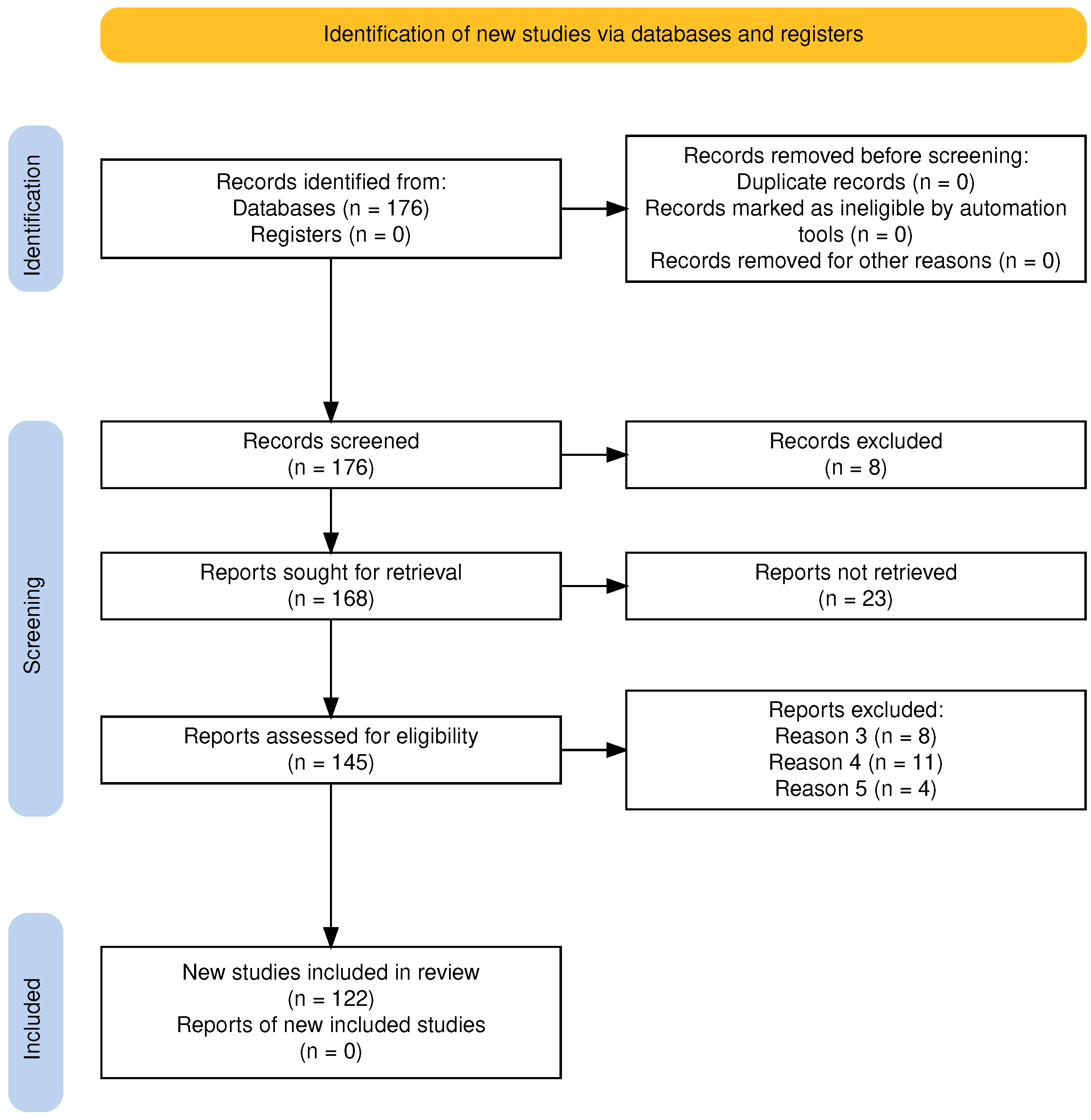
- Context (C): The review considers articles published from 2015 to 2025 for measurement methods and from 2020 to 2025 for instruments and data processing, sourced from the PubMed, IEEE Xplore, MDPI, Scopus, and Web of Science databases.
- 1.
- Articles published in journals indexed in JCR or endorsed by health institutions.
- 2.
- Publication date within the specified time frame.
- 3.
- The article presents a method, instrument, or algorithm for processing vital sign data.
- 4.
- Clear explanation of concepts, supplemented with diagrams, lists, or structured descriptions for each algorithm.
- 5.
- Results are presented in tables or graphs.
- 6.
- If applicable, the article includes schematic diagrams.
- 1.
- Articles not written in English or Spanish.
- 2.
- Articles published outside the defined time period.
- 3.
- Articles not published in academic journals or conference proceedings.
- 4.
- Articles that do not clearly explain methods, instruments, or algorithms.
- 5.
- Articles that do not present empirical results or practical applications in vital sign measurement or data processing.
- vital signs
- vital sign monitoring
- $$$$ measurement methods (where $$$$ were replaced by temperature, oxygen concentration, heart rate, respiratory rate OR blood pressure)
- $$$$ measurement instruments (where $$$$ were replaced by temperature, oxygen concentration, heart rate, respiratory rate OR blood pressure)
- vital signs ai OR vital signs machine learning
3. Background
- 1.
- Activity Monitoring. This classification encompasses devices employed in quotidian activities and non-clinical applications, including personal health tracking and rehabilitative interventions.
- 2.
- Medical Monitoring. These systems are predominantly utilized by clinical practitioners in healthcare facilities. This domain is subsequently stratified into three specialized subcategories:
- (a)
- Predictive Analytics. This methodology involves the extraction and computational processing of clinically significant features from physiological time-series data to forecast potential health deterioration, thereby furnishing clinicians with decision-support intelligence. The implementation typically integrates multimodal techniques including biosignal processing, machine learning regression, artificial intelligence architectures, and domain-specific clinical knowledge [24,25].
- (b)
- Anomaly Identification. This paradigm utilizes supervised classification algorithms to detect pathological deviations in physiological waveforms. The system architecture facilitates the generation of real-time alerts, with notification capabilities spanning local alarms to cloud-based telemedicine platforms following the recognition of aberrant patterns [26,27].
- (c)
- Clinical Decision Support. Representing a cornerstone of modern medical informatics, this subsystem enhances diagnostic accuracy through the multimodal integration of continuous physiological monitoring data, anomaly detection outputs, electronic health records, and evidence-based clinical protocols [27,28,29,30].
4. Results
4.1. Body Temperature
4.1.1. Skin Body Temperature
- Ref. [33] developed a system utilizing the MAX30205 Fever Click board (MikroElektronika, Belgrade, Serbia) for temperature measurement, coupled with an ESP8266 Wi-Fi module for cloud data transmission. The acquired data are visualized through a dedicated Android application named “Temperature Monitor”.
- Ref. [34] implemented an Arduino-based monitoring device incorporating a 1-Wire digital thermometer for temperature assessment.
- Ref. [21] proposed an infrared-based system using the MLX90614 sensor (Melexis, Ieper, Belgium), demonstrating excellent agreement (<0.1 °C absolute error) with mercury thermometer reference measurements.
- Ref. [38] proposed a carbon nanotube-based rubber sensor designed for comfortable skin contact during dynamic activities. While this represents a promising low-cost alternative for health monitoring, further research is required to optimize its integration into wearable technologies.
- Ref. [39] developed a transparent, stretchable electronic-skin sensor capable of simultaneous temperature, strain, and humidity measurement. This skin-adherent device exhibits conductivity changes proportional to temperature variations, demonstrating high precision (0.1 °C), suggesting strong potential for future affordable monitoring devices.
- Ref. [40] implemented a negative temperature coefficient (NTC) e-skin sensor using Ni/NiO transition channels. Their results indicate superior performance compared to conventional integrated circuit sensors; however, additional clinical validation is still needed.
- Ref. [41] engineered an ultra-sensitive epidermal sensor utilizing gold-doped silicon nanomembranes. The gold’s rapid diffusion properties facilitate electron–hole pair generation upon thermal excitation, resulting in a remarkable temperature coefficient of resistance of ppm °C−1, indicating exceptional sensitivity.
4.1.2. Core Body Temperature
4.2. Blood Oxygen Saturation
4.2.1. Invasive Methods
4.2.2. Non-Invasive Methods
4.3. Heart Rate
Deep Learning for Enhanced HR Estimation
4.4. Respiratory Rate
4.4.1. Contact-Based Methods
4.4.2. Contactless Methods
4.5. Blood Pressure
4.5.1. Contactless Methods
4.5.2. Contact-Based Methods
4.5.3. Deep Learning for Enhanced BP
- Fingertip photoplethysmogram (PPG “PLETH”).
- Invasive arterial blood pressure (ABP).
- Multiple electrocardiogram (ECG) leads.
4.6. Simultaneous Vital Sign Measurements
4.6.1. Radar-Based Methods
4.6.2. Contact-Based Methods
5. Discussion
6. Future Work
- Development of Multimodal Fusion Systems: Future work must focus on creating systems that intelligently fuse data from various sensors (e.g., RGB cameras, thermal imaging, radar, and acoustic sensors). By combining the strengths of different modalities, these systems can create a more complete and reliable physiological profile, improving accuracy and providing redundancy to overcome the limitations of any single sensor.
- Advancement of AI Algorithms: There is a critical need to improve the robustness and generalization of the AI algorithms used for signal processing. This includes training models on more diverse datasets that represent a wide range of ages, skin tones, and clinical conditions to ensure equity and reduce bias. Furthermore, developing computationally efficient models is essential for their deployment on low-power wearable and edge devices. Moreover, to facilitate clinical adoption, the development of Explainable AI (XAI) models is imperative. These techniques will allow clinicians to interpret the black-box decisions of deep learning algorithms, fostering the necessary trust for medical decision-making.
- Establishment of Clear Validation Pathways: A concerted effort is required from researchers, manufacturers, and regulatory bodies to establish standardized, accessible protocols for validating new monitoring technologies. This will ensure that devices, particularly those intended for clinical decision-making, meet stringent accuracy and reliability standards, thereby building trust among healthcare providers and patients.
6.1. Body Temperature
6.2. Blood Oxygen Saturation
6.3. Heart Rate
6.4. Respiratory Rate
6.5. Blood Pressure
7. Conclusions
Supplementary Materials
Author Contributions
Funding
Institutional Review Board Statement
Informed Consent Statement
Data Availability Statement
Acknowledgments
Conflicts of Interest
References
- Andrade, A.; Tassinari, A.; Bellini, B.; Facco, V.; da Rosa, R.; da Costa, C.; Victória, J. IoT-based vital sign monitoring: A literature review. Smart Health 2024, 32, 100462. [Google Scholar] [CrossRef]
- Junaid, S.; Imam, A.; Shuaibu, A.; Basri, S.; Kumar, G.; Surakat, Y.; Balogun, A.; Abdulkarim, M.; Garba, A.; Sahalu, Y.; et al. Artificial intelligence, sensors and vital health signs: A review. Appl. Sci. 2022, 12, 11475. [Google Scholar] [CrossRef]
- O’Dea, R.; Lagisz, M.; Jennions, M.; Koricheva, J.; Noble, D.; Parker, T.; Gurevitch, J.; Page, M.; Stewart, G.; Moher, D.; et al. Preferred reporting items for systematic reviews and meta-analyses in ecology and evolutionary biology: A PRISMA extension. Biol. Rev. 2021, 96, 1695–1722. [Google Scholar] [CrossRef] [PubMed]
- Kellett, J.; Sebat, F. Make vital signs great again—A call for action. Eur. J. Intern. Med. 2017, 45, 13–19. [Google Scholar] [CrossRef]
- Shirazi, M.H.; Yongchareon, S.; Singh, A.; Ma, J. A survey on machine learning approaches for vital sign monitoring using radar. Measurement 2025, 253, 117707. [Google Scholar] [CrossRef]
- Raheel, M.S.; Tubbal, F.; Raad, R.; Ogunbona, P.; Coyte, J.; Patterson, C.; Perlman, D.; Iranmanesh, S.; Odeh, N.; Foroughi, J. Contactless vital sign monitoring systems: A comprehensive survey of remote health sensing for heart rate and respiration in internet of things and sleep applications. Sens. Diagn. 2024, 3, 1085–1118. [Google Scholar] [CrossRef]
- Selvaraju, V.; Spicher, N.; Wang, J.; Ganapathy, N.; Warnecke, J.; Leonhardt, S.; Swaminathan, R.; Deserno, T. Continuous Monitoring of Vital Signs Using Cameras: A Systematic Review. Sensors 2022, 22, 4097. [Google Scholar] [CrossRef]
- Page, M.J.; Moher, D.; Bossuyt, P.M.; Boutron, I.; Hoffmann, T.C.; Mulrow, C.D.; Shamseer, L.; Tetzlaff, J.M.; Akl, E.A.; Brennan, S.E.; et al. PRISMA 2020 explanation and elaboration: Updated guidance and exemplars for reporting systematic reviews. BMJ 2021, 372, n160. [Google Scholar] [CrossRef]
- Haddaway, N.R.; Page, M.J.; Pritchard, C.C.; McGuinness, L.A. PRISMA2020: An R package and Shiny app for producing PRISMA 2020-compliant flow diagrams, with interactivity for optimised digital transparency and Open Synthesis. Campbell Syst. Rev. 2022, 18, e1230. [Google Scholar] [CrossRef]
- Petticrew, M.; Roberts, H. Starting the Review: Refining the Question and Defining the Boundaries. In Systematic Reviews in the Social Sciences: A Practical Guide; John Wiley & Sons, Ltd.: Hoboken, NJ, USA, 2006; Chapter 2; pp. 27–56. [Google Scholar] [CrossRef]
- Choo, Y.J.; Lee, G.W.; Moon, J.S.; Chang, M.C. Noncontact Sensors for Vital Signs Measurement: A Narrative Review. Med. Sci. Monit. 2024, 30, e944913. [Google Scholar] [CrossRef]
- Sapra, A.; Malik, A.; Bhandari, P. Vital Sign Assessment. In StatPearls [Internet]; StatPearls Publishing: Treasure Island, FL, USA, 2025. [Google Scholar]
- Lockwood, C.; Conroy-Hiller, T.; Page, T. Vital signs. JBI Rep. 2004, 2, 207–230. [Google Scholar] [CrossRef]
- Linschmann, O.; Leonhardt, S.; Vehkaoja, A.; Hoog Antink, C. Estimation of the respiratory rate from ballistocardiograms using the Hilbert transform. Biomed. Eng. Online 2022, 21, 54. [Google Scholar] [CrossRef] [PubMed]
- Dutta, D.N.; Das, R.; Pal, S. Automated real-time processing of single lead electrocardiogram for simultaneous heart rate and respiratory rate monitoring. J. Med. Devices 2017, 11, 024502. [Google Scholar] [CrossRef]
- Longmore, S.K.; Lui, G.Y.; Naik, G.; Breen, P.P.; Jalaludin, B.; Gargiulo, G.D. A comparison of reflective photoplethysmography for detection of heart rate, blood oxygen saturation, and respiration rate at various anatomical locations. Sensors 2019, 19, 1874. [Google Scholar] [CrossRef]
- Edanami, K.; Kurosawa, M.; Yen, H.T.; Kanazawa, T.; Abe, Y.; Kirimoto, T.; Yao, Y.; Matsui, T.; Sun, G. Remote sensing of vital signs by medical radar time-series signal using cardiac peak extraction and adaptive peak detection algorithm: Performance validation on healthy adults and application to neonatal monitoring at an NICU. Comput. Methods Programs Biomed. 2022, 226, 107163. [Google Scholar] [CrossRef]
- Caroppo, A.; Manni, A.; Rescio, G.; Siciliano, P.; Leone, A. Vital signs estimation in elderly using camera-based photoplethysmography. Multimed. Tools Appl. 2024, 83, 65363–65386. [Google Scholar] [CrossRef]
- Addison, P.S.; Antunes, A.; Montgomery, D.; Smit, P.; Borg, U.R. Robust non-contact monitoring of respiratory rate using a depth camera. J. Clin. Monit. Comput. 2023, 37, 1003–1010. [Google Scholar] [CrossRef]
- Costanzo, S.; Flores, A.M. IoT Non-contact Body Temperature Measurement System Implementing Access Control for COVID-19. In Proceedings of the World Conference on Information Systems and Technologies; Springer: Cham, Switzerland, 2021; pp. 255–264. [Google Scholar] [CrossRef]
- Varshini, B.; Yogesh, H.; Pasha, S.D.; Suhail, M.; Madhumitha, V.; Sasi, A. IoT-Enabled smart doors for monitoring body temperature and face mask detection. Glob. Transitions Proc. 2021, 2, 246–254. [Google Scholar] [CrossRef]
- Shu, S.; Liang, H.; Zhang, Y.; Zhang, Y.; Yang, Z. Non-contact measurement of human respiration using an infrared thermal camera and the deep learning method. Meas. Sci. Technol. 2022, 33, 075202. [Google Scholar] [CrossRef]
- Dias, D.; Paulo Silva Cunha, J. Wearable Health Devices—Vital Sign Monitoring, Systems and Technologies. Sensors 2018, 18, 2414. [Google Scholar] [CrossRef]
- Namazi, A.; Modiri, E.; Blesić, S.; Knežević, O.M.; Mirkov, D.M. Comparative Analysis of Machine Learning Techniques for Heart Rate Prediction Employing Wearable Sensor Data. Sports 2025, 13, 87. [Google Scholar] [CrossRef]
- Staffini, A.; Svensson, T.; Chung, U.i.; Svensson, A.K. Heart rate modeling and prediction using autoregressive models and deep learning. Sensors 2021, 22, 34. [Google Scholar] [CrossRef]
- Pankaj; Kumar, A.; Kumar, M.; Komaragiri, R. Edge-based computation of super-resolution superlet spectrograms for real-time estimation of heart rate using an IoMT-based reference-signal-less PPG sensor. IEEE Internet Things J. 2023, 11, 8647–8657. [Google Scholar] [CrossRef]
- Ni, A.; Azarang, A.; Kehtarnavaz, N. A review of deep learning-based contactless heart rate measurement methods. Sensors 2021, 21, 3719. [Google Scholar] [CrossRef] [PubMed]
- Chung, H.; Ko, H.; Lee, H.; Lee, J. Deep learning for heart rate estimation from reflectance photoplethysmography with acceleration power spectrum and acceleration intensity. IEEE Access 2020, 8, 63390–63402. [Google Scholar] [CrossRef]
- Reiss, A.; Indlekofer, I.; Schmidt, P.; Van Laerhoven, K. Deep PPG: Large-scale heart rate estimation with convolutional neural networks. Sensors 2019, 19, 3079. [Google Scholar] [CrossRef] [PubMed]
- Diamant, N.; Di Achille, P.; Weng, L.C.; Lau, E.S.; Khurshid, S.; Friedman, S.; Reeder, C.; Singh, P.; Wang, X.; Sarma, G.; et al. Deep learning on resting electrocardiogram to identify impaired heart rate recovery. Cardiovasc. Digit. Health J. 2022, 3, 161–170. [Google Scholar] [CrossRef] [PubMed]
- Cutuli, S.L.; Osawa, E.A.; Eyeington, C.T.; Proimos, H.; Canet, E.; Young, H.; Peck, L.; Eastwood, G.M.; Glassford, N.J.; Bailey, M.; et al. Accuracy of non-invasive body temperature measurement methods in critically ill patients: A prospective, bicentric, observational study. Crit. Care Resusc. 2021, 23, 346–353. [Google Scholar] [CrossRef]
- Mah, A.J.; Ghazi Zadeh, L.; Khoshnam Tehrani, M.; Askari, S.; Gandjbakhche, A.H.; Shadgan, B. Studying the accuracy and function of different thermometry techniques for measuring body temperature. Biology 2021, 10, 1327. [Google Scholar] [CrossRef]
- Sudha, S.; Shruthi, P.; Sharanya, M. IoT based measurement of body temperature using max30205. Int. Res. J. Eng. Technol. 2018, 5, 3913–3915. [Google Scholar]
- Karnadi, J.; Roihan, I.; Ekadiyanto, A.; Koestoer, R.A. Development of a low-cost Arduino-based patient monitoring system for heartrate, oxygen saturation and body temperature parameters. J. Appl. Sci. Eng. Technol. 2021, 1, 26–32. [Google Scholar] [CrossRef]
- Tamilselvi, V.; Sribalaji, S.; Vigneshwaran, P.; Vinu, P.; GeethaRamani, J. IoT based health monitoring system. In Proceedings of the 66th International Conference on Advanced Computing and Communication Systems (ICACCS), Coimbatore, India, 6–7 March 2020; IEEE: Piscataway, NJ, USA, 2020; pp. 386–389. [Google Scholar] [CrossRef]
- Bakar, A.A.; Rahim, S.S.A.; Razali, A.R.; Noorsal, E.; Radzali, R.; Abd Rahim, A.F. Wearable heart rate and body temperature monitoring device for healthcare. J. Phys. Conf. Ser. 2020, 1535, 012002. [Google Scholar] [CrossRef]
- Duan, K.; Ma, L.; Yi, Y.; Ren, W. Tunable diode laser-based two-line thermometry: A noncontact thermometer for active body temperature measurement. Appl. Opt. 2021, 60, 7036–7042. [Google Scholar] [CrossRef] [PubMed]
- Lin, M.; Zheng, Z.; Yang, L.; Luo, M.; Fu, L.; Lin, B.; Xu, C. A high-performance, sensitive, wearable multifunctional sensor based on rubber/CNT for human motion and skin temperature detection. Adv. Mater. 2022, 34, 2107309. [Google Scholar] [CrossRef]
- Chen, L.; Chang, X.; Wang, H.; Chen, J.; Zhu, Y. Stretchable and transparent multimodal electronic-skin sensors in detecting strain, temperature, and humidity. Nano Energy 2022, 96, 107077. [Google Scholar] [CrossRef]
- Shin, J.; Jeong, B.; Kim, J.; Nam, V.B.; Yoon, Y.; Jung, J.; Hong, S.; Lee, H.; Eom, H.; Yeo, J.; et al. Sensitive wearable temperature sensor with seamless monolithic integration. Adv. Mater. 2020, 32, 1905527. [Google Scholar] [CrossRef] [PubMed]
- Sang, M.; Kang, K.; Zhang, Y.; Zhang, H.; Kim, K.; Cho, M.; Shin, J.; Hong, J.H.; Kim, T.; Lee, S.K.; et al. Ultrahigh sensitive Au-doped silicon nanomembrane based wearable sensor arrays for continuous skin temperature monitoring with high precision. Adv. Mater. 2022, 34, 2105865. [Google Scholar] [CrossRef]
- Wang, Y.F.; Sekine, T.; Takeda, Y.; Yokosawa, K.; Matsui, H.; Kumaki, D.; Shiba, T.; Nishikawa, T.; Tokito, S. Fully printed PEDOT: PSS-based temperature sensor with high humidity stability for wireless healthcare monitoring. Sci. Rep. 2020, 10, 2467. [Google Scholar] [CrossRef]
- Luo, J.; Gao, S.; Luo, H.; Wang, L.; Huang, X.; Guo, Z.; Lai, X.; Lin, L.; Li, R.K.; Gao, J. Superhydrophobic and breathable smart MXene-based textile for multifunctional wearable sensing electronics. Chem. Eng. J. 2021, 406, 126898. [Google Scholar] [CrossRef]
- Lin, R.; Kim, H.J.; Achavananthadith, S.; Kurt, S.A.; Tan, S.C.; Yao, H.; Tee, B.C.; Lee, J.K.; Ho, J.S. Wireless battery-free body sensor networks using near-field-enabled clothing. Nat. Commun. 2020, 11, 444. [Google Scholar] [CrossRef]
- Suvorov, N.B.; Belov, A.V.; Kuliabin, K.G.; Anisimov, A.A.; Sergeev, T.V.; Markelov, O.A. High precision human skin temperature fluctuations measuring instrument. Sensors 2021, 21, 4101. [Google Scholar] [CrossRef]
- Yeh, C.Y.; Chung, Y.T.; Chuang, K.T.; Shu, Y.C.; Kao, H.Y.; Chen, P.L.; Ko, W.C.; Ko, N.Y. An innovative wearable device for monitoring continuous body surface temperature (HEARThermo): Instrument validation study. JMIR MHealth UHealth 2021, 9, e19210. [Google Scholar] [CrossRef]
- Burunkaya, M.; Yucel, M. Measurement and control of an incubator temperature by using conventional methods and fiber Bragg grating (FBG) based temperature sensors. J. Med. Syst. 2020, 44, 178. [Google Scholar] [CrossRef] [PubMed]
- Song, E.; Chen, M.; Chen, Z.; Zhou, Y.; Zhou, W.; Sun, H.T.; Yang, X.; Gan, J.; Ye, S.; Zhang, Q. Mn2+-activated dual-wavelength emitting materials toward wearable optical fibre temperature sensor. Nat. Commun. 2022, 13, 2166. [Google Scholar] [CrossRef] [PubMed]
- Ren, X.; Zhang, Y.; Yang, H.; Li, K.; Ye, X.; Zhou, C. Core body temperature estimation model with thermal contact resistance compensation. Measurement 2025, 241, 115687. [Google Scholar] [CrossRef]
- Tanaka, Y.; Matsunaga, D.; Tajima, T.; Seyama, M. Robust Skin Attachable Sensor for Core Body Temperature Monitoring. IEEE Sens. J. 2021, 21, 16118–16123. [Google Scholar] [CrossRef]
- Anuar, H.; Leow, P.L. Non-invasive Core Body Temperature Sensor for Continuous Monitoring. In Proceedings of the 2019 IEEE International Conference on Sensors and Nanotechnology, Penang, Malaysia, 24–25 July 2019; pp. 1–4. [Google Scholar] [CrossRef]
- Chaglla E., J.S.; Celik, N.; Balachandran, W. Measurement of Core Body Temperature Using Graphene-Inked Infrared Thermopile Sensor. Sensors 2018, 18, 3315. [Google Scholar] [CrossRef]
- Laxminarayan, S.; Rakesh, V.; Oyama, T.; Kazman, J.B.; Yanovich, R.; Ketko, I.; Epstein, Y.; Morrison, S.; Reifman, J. Individualized estimation of human core body temperature using noninvasive measurements. J. Appl. Physiol. 2018, 124, 1387–1402. [Google Scholar] [CrossRef]
- Takagi, T.; Fujii, T.; Nakamura, S.; Tsutsumi, Y.; Uezono, S. Accuracy of Pulse Oximetry and Risk Factors Associated with Discrepancy From Arterial Oxygenation in Asian Patients in the ICU: An Observational Study. Chest 2025, 168, 650–660. [Google Scholar] [CrossRef]
- Shi, C.; Goodall, M.; Dumville, J.; Hill, J.; Norman, G.; Hamer, O.; Clegg, A.; Watkins, C.L.; Georgiou, G.; Hodkinson, A.; et al. The accuracy of pulse oximetry in measuring oxygen saturation by levels of skin pigmentation: A systematic review and meta-analysis. BMC Med. 2022, 20, 267. [Google Scholar] [CrossRef]
- León-Valladares, D.; Barrio-Mateu, L.A.; Cortés-Carmona, N.; Fuentes-Lizana, G.; Cabanas, A.M.; Latorre-Progulakis, K.; Fuentes-Guajardo, M.; Martín-Escudero, P. Determining factors of pulse oximetry accuracy: A literature review. Rev. Clín. Esp. 2024, 224, 314–330. [Google Scholar] [CrossRef] [PubMed]
- Cheng, C.H.; Wong, K.L.; Chin, J.W.; Chan, T.T.; So, R.H. Deep learning methods for remote heart rate measurement: A review and future research agenda. Sensors 2021, 21, 6296. [Google Scholar] [CrossRef] [PubMed]
- Davies, H.J.; Williams, I.; Peters, N.S.; Mandic, D.P. In-ear spo2: A tool for wearable, unobtrusive monitoring of core blood oxygen saturation. Sensors 2020, 20, 4879. [Google Scholar] [CrossRef]
- Cabanas, A.M.; Sáez, N.; Collao-Caiconte, P.O.; Martín-Escudero, P.; Pagán, J.; Jiménez-Herranz, E.; Ayala, J.L. Evaluating AI Methods for Pulse Oximetry: Performance, Clinical Accuracy, and Comprehensive Bias Analysis. Bioengineering 2024, 11, 1061. [Google Scholar] [CrossRef] [PubMed]
- Hu, M.; Wu, X.; Wang, X.; Xing, Y.; An, N.; Shi, P. Contactless blood oxygen estimation from face videos: A multi-model fusion method based on deep learning. Biomed. Signal Process. Control 2023, 81, 104487. [Google Scholar] [CrossRef]
- Eskandari, M.; Parvaneh, S.; Ehsani, H.; Fain, M.; Toosizadeh, N. Frailty identification using heart rate dynamics: A deep learning approach. IEEE J. Biomed. Health Inform. 2022, 26, 3409–3417. [Google Scholar] [CrossRef]
- Chourpiliadis, C.; Bhardwaj, A. Physiology, Respiratory Rate. In StatPearls [Internet]; StatPearls Publishing: Treasure Island, FL, USA, 2022. [Google Scholar]
- Honarmand, K.; Wax, R.S.; Penoyer, D.; Lighthall, G.; Danesh, V.; Rochwerg, B.; Cheatham, M.L.; Davis, D.P.; DeVita, M.; Downar, J.; et al. Society of Critical Care Medicine Guidelines on Recognizing and Responding to Clinical Deterioration Outside the ICU: 2023. Crit. Care Med. 2024, 52, 314–330. [Google Scholar] [CrossRef]
- Henricson, J.; Glasin, J.; Rindebratt, S.; Wilhelms, D. Respiratory rate monitoring in healthy volunteers by central photoplethysmography compared to capnography. J. Biophotonics 2022, 15, e202100270. [Google Scholar] [CrossRef]
- Dehkordi, P.; Garde, A.; Molavi, B.; Ansermino, J.M.; Dumont, G.A. Extracting instantaneous respiratory rate from multiple photoplethysmogram respiratory-induced variations. Front. Physiol. 2018, 9, 948. [Google Scholar] [CrossRef]
- Birrenkott, D.A.; Pimentel, M.A.; Watkinson, P.J.; Clifton, D.A. A robust fusion model for estimating respiratory rate from photoplethysmography and electrocardiography. IEEE Trans. Biomed. Eng. 2017, 65, 2033–2041. [Google Scholar] [CrossRef]
- Baker, S.; Xiang, W.; Atkinson, I. Determining respiratory rate from photoplethysmogram and electrocardiogram signals using respiratory quality indices and neural networks. PLoS ONE 2021, 16, e0249843. [Google Scholar] [CrossRef] [PubMed]
- Iqbal, T.; Elahi, A.; Ganly, S.; Wijns, W.; Shahzad, A. Photoplethysmography-based respiratory rate estimation algorithm for health monitoring applications. J. Med. Biol. Eng. 2022, 42, 242–252. [Google Scholar] [CrossRef] [PubMed]
- Järvelä, K.; Takala, P.; Michard, F.; Vikatmaa, L. Clinical evaluation of a wearable sensor for mobile monitoring of respiratory rate on hospital wards. J. Clin. Monit. Comput. 2022, 36, 81–86. [Google Scholar] [CrossRef] [PubMed]
- Dietz-Terjung, S.; Geldmacher, J.; Brato, S.; Linker, C.M.; Welsner, M.; Schöbel, C.; Taube, C.; Götze, J.; Weinreich, G. A novel minimal-contact biomotion method for long-term respiratory rate monitoring. Sleep Breath. 2021, 25, 145–149. [Google Scholar] [CrossRef]
- Kim, J.s.; Kim, J. An accurate respiratory rate estimation algorithm for a rubber fiber respiratory sensor. J. Ind. Text. 2024, 54, 15280837241248181. [Google Scholar] [CrossRef]
- Park, S.W.; Das, P.S.; Chhetry, A.; Park, J.Y. A flexible capacitive pressure sensor for wearable respiration monitoring system. IEEE Sens. J. 2017, 17, 6558–6564. [Google Scholar] [CrossRef]
- Ouchi, K.; Fujiwara, S.; Sugiyama, K. Acoustic method respiratory rate monitoring is useful in patients under intravenous anesthesia. J. Clin. Monit. Comput. 2017, 31, 59–65. [Google Scholar] [CrossRef]
- Pant, S.; Umesh, S.; Asokan, S. Fiber Bragg grating respiratory measurement device. In Proceedings of the 2018 IEEE International Symposium on Medical Measurements and Applications (MeMeA), Rome, Italy, 11–13 June 2018; IEEE: Piscataway, NJ, USA, 2018; pp. 1–5. [Google Scholar] [CrossRef]
- Guo, J.; Zhang, J.; Dong, L.; Du, Y.; Guo, Z.; Chen, H.; Chen, D.; Wang, W. Parallel waveguide fiber Bragg gratings–Used for detecting human respiratory rate, trunk status, and pulse. Opt. Laser Technol. 2025, 181, 111960. [Google Scholar] [CrossRef]
- De Tommasi, F.; Presti, D.L.; Caponero, M.A.; Carassiti, M.; Schena, E.; Massaroni, C. Smart mattress based on multipoint fiber Bragg gratings for respiratory rate monitoring. IEEE Trans. Instrum. Meas. 2022, 72, 1–10. [Google Scholar] [CrossRef]
- Di Tocco, J.; Presti, D.L.; Zaltieri, M.; D’Alesio, G.; Filosa, M.; Massari, L.; Aliperta, A.; Di Rienzo, M.; Carrozza, M.C.; Ferrarin, M.; et al. A wearable system based on flexible sensors for unobtrusive respiratory monitoring in occupational settings. IEEE Sens. J. 2020, 21, 14369–14378. [Google Scholar] [CrossRef]
- Alafeef, M.; Fraiwan, M. Smartphone-based respiratory rate estimation using photoplethysmographic imaging and discrete wavelet transform. J. Ambient Intell. Humaniz. Comput. 2020, 11, 693–703. [Google Scholar] [CrossRef]
- Xu, K.; Fujita, Y.; Lu, Y.; Honda, S.; Shiomi, M.; Arie, T.; Akita, S.; Takei, K. A wearable body condition sensor system with wireless feedback alarm functions. Adv. Mater. 2021, 33, 2008701. [Google Scholar] [CrossRef] [PubMed]
- Güder, F.; Ainla, A.; Redston, J.; Mosadegh, B.; Glavan, A.; Martin, T.; Whitesides, G.M. Paper-based electrical respiration sensor. Angew. Chem. Int. Ed. 2016, 55, 5727–5732. [Google Scholar] [CrossRef] [PubMed]
- Wei, B.; He, X.; Zhang, C.; Wu, X. Non-contact, synchronous dynamic measurement of respiratory rate and heart rate based on dual sensitive regions. Biomed. Eng. Online 2017, 16, 17. [Google Scholar] [CrossRef]
- Chen, W.; McDuff, D. Deepphys: Video-based physiological measurement using convolutional attention networks. In Proceedings of the European Conference on Computer Vision, Munich, Germany, 8–14 September 2018; pp. 349–365. [Google Scholar] [CrossRef]
- Ahani, S.; Niknafs, N.; Lavoie, P.M.; Holsti, L.; Dumont, G.A. Video-based respiratory rate estimation for infants in the NICU. IEEE J. Transl. Eng. Health Med. 2024, 12, 684–696. [Google Scholar] [CrossRef]
- Havakuk, O.; Sadeh, B.; Merdler, I.; Zalevsky, Z.; Garcia-Monreal, J.; Polani, S.; Arbel, Y. Validation of a novel contact-free heart and respiratory rate monitor. J. Med. Eng. Technol. 2021, 45, 344–350. [Google Scholar] [CrossRef]
- Maurya, L.; Zwiggelaar, R.; Chawla, D.; Mahapatra, P. Non-contact respiratory rate monitoring using thermal and visible imaging: A pilot study on neonates. J. Clin. Monit. Comput. 2023, 37, 815–828. [Google Scholar] [CrossRef]
- Daw, W.; Kingshott, R.N.; Saatchi, R.; Burke, D.; Evans, R.; Holloway, A.; Travis, J.; Jones, A.; Hughes, B.; Elphick, H.E. A novel, contactless, portable “spot-check” device accurately measures respiratory rate. J. Med. Devices 2020, 14, 031002. [Google Scholar] [CrossRef]
- Scebba, G.; Da Poian, G.; Karlen, W. Multispectral video fusion for non-contact monitoring of respiratory rate and apnea. IEEE Trans. Biomed. Eng. 2020, 68, 350–359. [Google Scholar] [CrossRef]
- Troyee, T.G.; Gani, M.M.; Hasan, M. Design and Implementation of Low-Cost Respiratory Rate Measurement Device. Arab. J. Sci. Eng. 2024, 49, 6959–6969. [Google Scholar] [CrossRef]
- Tanaka, H.; Yokose, M.; Takaki, S.; Mihara, T.; Saigusa, Y.; Goto, T. Evaluation of respiratory rate monitoring using a microwave Doppler sensor mounted on the ceiling of an intensive care unit: A prospective observational study. J. Clin. Monit. Comput. 2022, 36, 71–79. [Google Scholar] [CrossRef] [PubMed]
- Dhariwal, N.; Yadav, P.; Kumari, M.; Kumar, V.; Thakur, O. Efficient fabrication of CrFeO3-based humidity sensing device with fast dynamics for real-time breath monitoring and contact-less sensing. Part. Part. Syst. Charact. 2025, 42, 2400072. [Google Scholar] [CrossRef]
- Alzaabi, A.; Arslan, T.; Polydorides, N. Non-contact wi-fi sensing of respiration rate for older adults in care: A validity and repeatability study. IEEE Access 2024, 12, 6400–6412. [Google Scholar] [CrossRef]
- Pramudita, A.A.; Suratman, F.Y. Low-power radar system for noncontact human respiration sensor. IEEE Trans. Instrum. Meas. 2021, 70, 1–15. [Google Scholar] [CrossRef]
- Whelton, P.K.; Carey, R.M.; Aronow, W.S.; Casey, D.E.; Collins, K.J.; Himmelfarb, C.D.; DePalma, S.M.; Gidding, S.; Jamerson, K.A.; Jones, D.W.; et al. 2017 ACC/AHA/AAPA/ABC/ACPM/AGS/APhA/ASH/ASPC/NMA/PCNA Guideline for the Prevention, Detection, Evaluation, and Management of High Blood Pressure in Adults: A Report of the American College of Cardiology/American Heart Association Task Force on Clinical Practice Guidelines. Circulation 2018, 138, e484–e594. [Google Scholar] [CrossRef]
- Unger, T.; Borghi, C.; Charchar, F.; Khan, N.A.; Poulter, N.R.; Prabhakaran, D.; Ramirez, A.; Schlaich, M.; Stergiou, G.S.; Tomaszewski, M.; et al. 2020 International Society of Hypertension Global Hypertension Practice Guidelines. Hypertension 2020, 75, 1334–1357. [Google Scholar] [CrossRef]
- Stergiou, G.S.; Palatini, P.; Parati, G.; O’Brien, E.; Januszewicz, A.; Lurbe, E.; Persu, A.; Mancia, G.; Kreutz, R.; European Society of Hypertension Council; et al. 2021 European Society of Hypertension practice guidelines for office and out-of-office blood pressure measurement. J. Hypertens. 2021, 39, 1293–1302. [Google Scholar] [CrossRef]
- Harfiya, L.N.; Chang, C.C.; Lee, Y.D. A deep learning model for cuffless blood pressure estimation using a recurrent neural network. Appl. Sci. 2021, 11, 5192. [Google Scholar] [CrossRef]
- Elgendi, M. Optimal Signal Quality Index for Photoplethysmogram Signals. Bioengineering 2016, 3, 21. [Google Scholar] [CrossRef]
- Chakraborty, A.; Sadhukhan, D.; Pal, S.; Mitra, M. PPG-Based Automated Estimation of Blood Pressure Using Patient-Specific Neural Network Modeling. J. Mech. Med. Biol. 2020, 20, 2050037. [Google Scholar] [CrossRef]
- Liu, J.; Zhang, Y.T.; Sharma, K.D. BePCon: A Photoplethysmography-Based Quality-Aware Continuous Beat-to-Beat Blood Pressure Measurement Technique Using Deep Learning. IEEE Trans. Instrum. Meas. 2021, 70, 1–11. [Google Scholar] [CrossRef]
- Liu, J.; Yan, B.P.; Zhang, Y.T. Multi-Wavelength Photoplethysmography Enabling Continuous Blood Pressure Measurement With Compact Wearable Electronics. IEEE Trans. Biomed. Eng. 2019, 66, 3093–3101. [Google Scholar] [CrossRef] [PubMed]
- Marzorati, D.; Bovio, D.; Salito, C.; Mainardi, L.; Cerveri, P. Chest Wearable Apparatus for Cuffless Continuous Blood Pressure Measurements Based on PPG and PCG Signals. IEEE Access 2020, 8, 55424–55437. [Google Scholar] [CrossRef]
- Zhou, Y.; Ni, H.; Zhang, Q. The Noninvasive Blood Pressure Measurement Based on Facial Images Processing. IEEE Sens. J. 2019, 19, 4971–4980. [Google Scholar] [CrossRef]
- Peng, C.; Chen, M.; Sim, H.K.; Zhu, Y.R.; Jiang, X. Noninvasive and Nonocclusive Blood Pressure Monitoring via a Flexible Piezo-Composite Ultrasonic Sensor. IEEE Sens. J. 2021, 21, 2642–2650. [Google Scholar] [CrossRef]
- Mejía-Mejía, E.; May, J.M.; Elgendi, M.; Kyriacou, P.A. Classification of blood pressure in critically ill patients using photoplethysmography and machine learning. Comput. Methods Programs Biomed. 2021, 208, 106222. [Google Scholar] [CrossRef]
- Sadhukhan, D.; Pal, S.; Mitra, M. A review of cuffless blood pressure estimation using deep learning. Health Technol. 2021, 11, 481–496. [Google Scholar]
- Ates, H.C.; Nguyen, P.Q.; Gonzalez-Macia, L.; Morales-Narváez, E.; Güder, F.; Collins, J.J.; Dincer, C. End-to-end design of wearable sensors. Nat. Rev. Mater. 2022, 7, 887–907. [Google Scholar] [CrossRef]
- Harfiya, L.N.; Chang, C.C.; Li, Y.H. Continuous Blood Pressure Estimation Using Exclusively Photopletysmography by LSTM-Based Signal-to-Signal Translation. Sensors 2021, 21, 2952. [Google Scholar] [CrossRef]
- Slapničar, G.; Mlakar, N.; Luštrek, M. Blood Pressure Estimation from Photoplethysmogram Using a Spectro-Temporal Deep Neural Network. Sensors 2019, 19, 3420. [Google Scholar] [CrossRef]
- Chen, X.; Yu, S.; Zhang, Y.; Chu, F.; Sun, B. Machine Learning Method for Continuous Noninvasive Blood Pressure Detection Based on Random Forest. IEEE Access 2021, 9, 34112–34118. [Google Scholar] [CrossRef]
- Wang, D.; Yang, X.; Liu, X.; Ma, L.; Li, L.; Wang, W. Photoplethysmography-Based Blood Pressure Estimation Combining Filter-Wrapper Collaborated Feature Selection With LASSO-LSTM Model. IEEE Trans. Instrum. Meas. 2021, 70, 1–14. [Google Scholar] [CrossRef]
- Tjahjadi, H.; Ramli, K.; Murfi, H. Noninvasive Classification of Blood Pressure Based on Photoplethysmography Signals Using Bidirectional Long Short-Term Memory and Time-Frequency Analysis. IEEE Access 2020, 8, 20735–20748. [Google Scholar] [CrossRef]
- Choi, M.; Lee, S.J. Oscillometry-Based Blood Pressure Estimation Using Convolutional Neural Networks. IEEE Access 2022, 10, 56813–56825. [Google Scholar] [CrossRef]
- Liu, Z.D.; Li, Y.; Zhang, Y.T.; Zeng, J.; Chen, Z.X.; Cui, Z.W.; Liu, J.K.; Miao, F. Cuffless blood pressure measurement using smartwatches: A large-scale validation study. IEEE J. Biomed. Health Inf. 2023, 27, 4216–4227. [Google Scholar] [CrossRef]
- Wang, D.; Li, Y. A novel blood pressure monitoring technique by smart HUAWEI WATCH: A validation study according to the ANSI/AAMI/ISO 81060-2:2018 guidelines. Front. Cardiovasc. Med. 2022, 9, 923655. [Google Scholar] [CrossRef]
- ANSI/AAMI/ISO 81060-2:2018; Non-Invasive sphygmomanometers—Part 2: Clinical Investigation of Intermittent Automated Measurement Type. International Organization for Standardization (ISO): Geneva, Switzerland; Association for the Advancement of Medical Instrumentation (AAMI): Arlington, VA, USA, 2018.
- Kuwabara, M.; Harada, K.; Hishiki, Y.; Kario, K. Validation of two watch-type wearable blood pressure monitors according to the ANSI/AAMI/ISO 81060-2:2013 guidelines: Omron HEM-6410T-ZM and HEM-6410T-ZL. J. Clin. Hypertens. 2019, 21, 853–858. [Google Scholar] [CrossRef]
- Zhou, S.; Park, G.; Longardner, K.; Lin, M.; Qi, B.; Yang, X.; Gao, X.; Huang, H.; Chen, X.; Bian, Y.; et al. Clinical validation of a wearable ultrasound sensor of blood pressure. Nat. Biomed. Eng. 2024, 9, 865–881. [Google Scholar] [CrossRef]
- Kirszenblat, R.; Edouard, P. Validation of the Withings ScanWatch as a wrist-worn reflective pulse oximeter: Prospective interventional clinical study. J. Med. Internet Res. 2021, 23, e27503. [Google Scholar] [CrossRef]
- Sola, J.; Vybornova, A.; Fallet, S.; Polychronopoulou, E.; Wurzner-Ghajarzadeh, A.; Wuerzner, G. Validation of the optical Aktiia bracelet in different body positions for the persistent monitoring of blood pressure. Sci. Rep. 2021, 11, 20644. [Google Scholar] [CrossRef]
- Islam, S.M.S.; Cartledge, S.; Karmakar, C.; Rawstorn, J.C.; Fraser, S.F.; Chow, C.; Maddison, R. Validation and acceptability of a cuffless wrist-worn wearable blood pressure monitoring device among users and health care professionals: Mixed methods study. JMIR Mhealth Uhealth 2019, 7, e14706. [Google Scholar] [CrossRef] [PubMed]
- Johnson, A.E.W.; Pollard, T.J.; Shen, L.; Lehman, L.w.H.; Feng, M.; Ghassemi, M.; Moody, B.; Szolovits, P.; Celi, L.A.; Mark, R.G. MIMIC-III, a freely accessible critical care database. Sci. Data 2016, 3, 160035. [Google Scholar] [CrossRef] [PubMed]
- Pimentel, M.A.F.; Johnson, A.E.W.; Charlton, P.H.; Birrenkott, D.; Watkinson, P.J.; Tarassenko, L.; Clifton, D.A. Toward a Robust Estimation of Respiratory Rate From Pulse Oximeters. IEEE Trans. Biomed. Eng. 2017, 64, 1914–1923. [Google Scholar] [CrossRef] [PubMed]
- Goldberger, A.L.; Amaral, L.A.N.; Glass, L.; Hausdorff, J.; Ivanov, P.; Mark, R.; Mietus, J.; Moody, G.; Peng, C.K.; Stanley, H. PhysioBank, PhysioToolkit, and PhysioNet: Components of a New Research Resource for Complex Physiologic Signals. Circulation 2000, 101, e215–e220. [Google Scholar] [CrossRef]
- Kachuee, M.; Kiani, M.M.; Mohammadzade, H.; Shabany, M. Cuff-less high-accuracy calibration-free blood pressure estimation using pulse transit time. In Proceedings of the 2015 IEEE International Symposium on Circuits and Systems (ISCAS), Lisbon, Portugal, 24–27 May 2015; pp. 1006–1009. [Google Scholar] [CrossRef]
- Liang, Y.; Chen, Z.; Liu, G.; Elgendi, M. PPG-BP Database; Type: Dataset; Figshare: London, UK, 2018. [Google Scholar] [CrossRef]
- Wang, W.; Mohseni, P.; Kilgore, K.L.; Najafizadeh, L. PulseDB: A large, cleaned dataset based on MIMIC-III and VitalDB for benchmarking cuff-less blood pressure estimation methods. Front. Digit. Health 2023, 4, 1090854. [Google Scholar] [CrossRef]
- Liu, Y.; Fu, X.; Tewari, R.C.; Wang, X.; Khong, A.W.H. Contactless Vital Sign Monitoring for Multiple People Using a Millimeter-wave MIMO Radar. In Proceedings of the IEEE International Conference on Acoustics, Speech and Signal Processing (ICASSP), Hyderabad, India, 6–11 April 2025; pp. 1–5. [Google Scholar] [CrossRef]
- Mercuri, M.; Lorato, I.R.; Liu, Y.; Wieringa, F.; van Hoof, C.; Torfs, T. Vital-sign monitoring and spatial tracking of multiple people using a contactless radar-based sensor. Nat. Electron. 2019, 2, 252–262. [Google Scholar] [CrossRef]
- Xu, Z.; Shi, C.; Zhang, T.; Li, S.; Yuan, Y.; Wu, C.T.M.; Chen, Y.; Petropulu, A. Simultaneous Monitoring of Multiple People’s Vital Sign Leveraging a Single Phased-MIMO Radar. IEEE J. Electromagn. RF Microw. Med. Biol. 2022, 6, 311–320. [Google Scholar] [CrossRef]
- Lim, S.M.; Li, P.; Braat, S.; Aung, Y.H.; Fu, S.; Johnson, D.F.; Lim, W.K. Validation of a Multi-Channel Ambient Sensor to Measure Vital Signs in Patients Within the Ward and at Home. Sensors 2025, 25, 1149. [Google Scholar] [CrossRef]
- Allataifeh, A.; Al Ahmad, M. Simultaneous piezoelectric noninvasive detection of multiple vital signs. Sci. Rep. 2020, 10, 416. [Google Scholar] [CrossRef]
- Breteler, M.J.M.; Leigard, E.; Hartung, L.C.; Welch, J.R.; Brealey, D.A.; Fritsch, S.J.; Konrad, D.; Hertzberg, D.; Bell, M.; Rienstra, H.; et al. Reliability of an all-in-one wearable sensor for continuous vital signs monitoring in high-risk patients: The NIGHTINGALE clinical validation study. J. Clin. Monit. Comput. 2025, 39, 1087–1100. [Google Scholar] [CrossRef]
- Rathy, G.; Sivasankar, P.; Tamara, Z.F. An efficient IoT based biomedical health monitoring and diagnosing system using myRIO. TELKOMNIKA Telecommun. Comput. Electron. Control. 2020, 18, 3050–3057. [Google Scholar] [CrossRef]
- Phan, D.T.; Nguyen, C.H.; Nguyen, T.D.P.; Tran, L.H.; Park, S.; Choi, J.; Lee, B.i.; Oh, J. A flexible, wearable, and wireless biosensor patch with internet of medical things applications. Biosensors 2022, 12, 139. [Google Scholar] [CrossRef]
- Durán-Vega, L.A.; Santana-Mancilla, P.C.; Buenrostro-Mariscal, R.; Contreras-Castillo, J.; Anido-Rifón, L.E.; García-Ruiz, M.A.; Montesinos-López, O.A.; Estrada-González, F. An IoT system for remote health monitoring in elderly adults through a wearable device and mobile application. Geriatrics 2019, 4, 34. [Google Scholar] [CrossRef]
- Rahman, M.H.; Islam, M.R.; Ahmad, M. Design and Implementation of a Smart Health Band for the Measurement of Blood Pressure, Pulse Rate and Body Temperature. In Proceedings of the 4th International Conference on Electrical Engineering and Information & Communication Technology (iCEEiCT), Dhaka, Bangladesh, 13–15 September 2018; pp. 156–161. [Google Scholar] [CrossRef]
- Page, M.J.; McKenzie, J.E.; Bossuyt, P.M.; Boutron, I.; Hoffmann, T.C.; Mulrow, C.D.; Shamseer, L.; Tetzlaff, J.M.; Akl, E.A.; Brennan, S.E.; et al. The PRISMA 2020 statement: An updated guideline for reporting systematic reviews. BMJ 2021, 372, n71. [Google Scholar] [CrossRef]


| Previous Reviews | Year | Scope | Our Review Contributions |
|---|---|---|---|
| Shirazi et al. [5] | 2025 | Focuses on radar-based vital sign monitoring, emphasizing classical and AI-based signal processing techniques. | Extends the analysis to radar systems for both single- and multi-person monitoring scenarios. |
| Raheel et al. [6] | 2024 | Focuses on measurement devices for heart rate (HR) and respiratory rate (RR), primarily using classical signal processing approaches. | Covers a broader range of measurement devices and includes both classical and AI-assisted processing methods. |
| Andrade et al. [1] | 2024 | Focuses on commercial devices and IoT protocols for data transmission and visualization of vital signs. | Also includes non-commercial devices designed for clinical and home monitoring environments. |
| Selvaraju et al. [7] | 2022 | Examines measurement methods for HR, RR, BP, skin temperature (ST), and SpO2 using RGB and infrared cameras, excluding other sensing modalities. | Considers a wider set of contactless sensing technologies and processing methods beyond RGB and infrared cameras. |
| Reference | Method | Strengths | Limitations | Best Use Case |
|---|---|---|---|---|
| Longmore [16] | Fingertip PPG | High accuracy at rest | Motion artifacts, poor perfusion sensitivity | Routine clinical monitoring |
| Davies [58] | In-Ear PPG | Fast central response, wearable integration | Low signal amplitude | Sleep apnea, ambulatory monitoring |
| Hu [60] | Remote (Facial) PPG | Contactless, deep learning-enhanced | Lighting/head movement sensitivity | Telemedicine, home health |
| León-Valladares [56] | Forehead PPG | Robust to motion, best for during activity | Weak RR detection | Critical care, surgery |
| Takagi, et al. [54] | Intensive Care Units |
| Reference | Technique | Sensors | RR Estimation Source |
|---|---|---|---|
| Linschmann [14] | Ballistocardiography (BCG) | Electro-mechanical film sensor (EMFi). | BCG signals. |
| Henricson [64] | Photoplethysmography (PPG) | Red/infrared photodetectors. | Blood flow. |
| Birrenkott [66] | PPG and ECG | Public datasets. | PPG and ECG data. |
| Kim [71] | Body movement | Capacitive pressure/resistive strain sensor. | Breathing process or body movements. |
| Ouchi [73] | Acoustic | Acoustic transducer. | Larynx vibrations. |
| [74,75,76,77] | Fiber Bragg Grating (FBG) | Fiber Bragg Grating optical fiber. | Nasal airflow or body movements. |
| Alafeef [78] | Image analysis | Smartphone (camera and flashlight) | Video processing. |
| Xu [79] | Laser-induced graphene (LIG) | Laser-induced strain sensor | Breathing process. |
| Güder [80] | Paper-based sensor | Cellulose paper-based moisture sensors | Humidity caused by breathing. |
| Dehkordi [65] | Multi PPG | Capnobase Dataset | Multi-PPG data. |
| Baker [67] | ECG and PPG | Medical Information Mart for Intensive Care (MIMIC-III) dataset | PPG and ECG data. |
| Iqbal [68] | PPG | BIDMC dataset | PPG data. |
| Longmore [16] | PPG | Red/Infrared photodetectors | Blood flow. |
| Jarvela [69] | Capnography | Capnography sensors | Breathing process. |
| Dietz-Terjung [70] | Polysomnography (PSG) | Piezoelectric | Breathing process. |
| Park [72] | RR | capacitive pressure | Breathing process. |
| Reference | Algorithm | Sensor | RR Estimation Source | Error (Breaths/min) |
|---|---|---|---|---|
| Shu [22] | YOLOv3 | Thermal camera | ROI in patients’ face | |
| Wei [81] | Blind source separation (BSS) | RGB camera | Facial motion artifacts | ≈1.5 |
| Chen [82] | CNN–attention layers | RGB camera | Nano-vibrations | ≈3.0 |
| Scebba [87] | Data fusion models | Near- and far-infrared camera | Air flow temperature | ≈1.6 |
| Maurya [85] | YOLO5Face | RGB+Thermal camera | ROI in patients’ face | ≈1.5 |
| Daw [86] | Classic | Self-heating thermistor | Air flow temperature | ≈4.5 |
| Tanaka [89] | Eulerian video magnification (EVM) | RGB camera | Body movements | ≈2.0 |
| Ahani [83] | ROI in chest and abdominal regions | RGB camera | Movements frequency | ≈1.5 |
| Havakuk [84] | Computer vision algorithms | RGB camera | Nano-vibrations | N/A |
| Addison [19] | ROI and peak detection algorithms | Depth camera | Chest cyclic patterns | ≈1.36 |
| Troyee [88] | Peak detection algorithms | Piezoelectric and ultrasonic sensors | Chest, upper and lower abdomen | N/A |
| Dhariwal [90] | Exhale detection algorithms | Humidity sensor | Respiration | N/A |
| Alzaabi [91] | Signal perturbation algorithms | Wi-Fi | Respiratory movements | ≈1.29 |
| Pramudita [92] | Multi-frequency signal perturbation algorithms | Radar | Thoracic displacements | N/A |
| Reference | Signals | Dataset | Preprocessing | Algorithm | Validation |
|---|---|---|---|---|---|
| Harfiya, Chang, Lee [96] | PPG (ankle), ECG (thoracic) | 40 cardiac patients | Baseline wander removal; ECG–PPG synchronization | ANOVA on PTT | Intra-subject comparison |
| Elgend [97] | PPG (sphygmomanometer) | 30 subjects (15M/15F) | Amplitude normalization; removal of motion artifacts | SVM (RBF kernel) | 5-fold CV; Accuracy: 88% |
| Chakraborty, Sadhukhan, Pal, Mitra [98] | PPG (finger, single site) | 30 subjects (public dataset) | Filtering; extraction of morphological features (amplitudes, widths, slopes) | Linear and polynomial regression | Correlation; MAE and DE vs. invasive BP |
| Liu & Zhang [99] | PPG (finger) | >1000 subjects (public dataset) | Signal segmentation; removal of low-quality beats | DNN with attention mechanism | Bland–Altman; BHS Grade A; MAE and DE |
| Liu, Yan, Zhang [100] | Multi-wavelength PPG (finger) | 33 subjects | Signal separation; ECG–PPG sync; PTT and feature extraction | Linear regression | Bland–Altman; r > 0.8 vs. Finapres |
| Marzorati, Bovio, Salito, Mainardi, Cerveri [101] | PPG (chest), PCG (chest) | 20 healthy volunteers | Band-pass filtering; peak detection (ECG R-peak as reference) | PTT-based model (ECG–PCG and ECG–PPG) | Bland–Altman; MAE and DE vs. sphygmomanometer |
| Zhou, Ni, Zhang [102] | Facial video (rPPG) | 42 subjects | Face detection; rPPG extraction; filtering and artifact removal | PTT-based with facial pulse-waveform features | Bland–Altman vs. Omron wrist device |
| Peng, Chen, Sim, Zhu, Jiang [103] | PPG | 107 subjects (MIMIC-II) | Extraction of 35 temporal and morphological features | Random Forest | 10-fold CV; MAE < 3.5 mmHg; DE < 6mmHg |
| Reference | Signals | Dataset | Architecture | Training | Metrics |
|---|---|---|---|---|---|
| Liu et al. [99] | PPG | >1000 subjects (public dataset) | DNN with attention mechanism | Adam, quality-aware training | Meets BHS Grade A |
| Mejía-Mejía et al. [104] | PPG single channel | 120 subjects (18–65 years) | CNN (3 conv. layers) and LSTM (2 layers) | Adam, , batch 32 | MAE: 4.8 mmHg (test) |
| Harfiya et al. [107] | PPG | 150 hypertensive patients | LSTM | Adam, , batch 64 | MAE: 6.0 mmHg |
| Slapnicar et al. [108] | PPG (wrist) | 100 volunteers (MIT-BIH subset) | Temporal Spectro DNN (ST-CNN with attention) | SGD, , batch 16 | |
| Chen et al. [109] | PPG | 107 subjects (MIMIC-II) | Random Forest | 10-fold cross-validation | MAE: 3.48 mmHg; DE: 5.96 mmHg |
| Wang et al. [110] | PPG | 47 subjects (public dataset) | LASSO + LSTM | Adam, 5-fold CV | MAE: 4.29 mmHg; DE: 6.23 mmHg |
| Tjahjadi et al. [111] | PPG | 219 subjects (MIMIC) | Bi-LSTM with time--frequency analysis | Adam, hold-out validation | Accuracy: 94.5% |
| Choi & Lee [112] | Oscillometric signal | 85 subjects | CNN (1D) | Adam, 5-fold CV | MAE: 3.16 mmHg; DE: 4.07 mmHg |
| Reference | Device | Signals | Protocol | Metrics |
|---|---|---|---|---|
| Lyu et al. [113] | Smartwatches (various) | PPG, ECG, PWA | Large-scale calibration and validation | MAE: 2.31 ± 9.57 mmHg (SBP), 1.33 ± 6.43 mmHg (DBP) |
| Wang et al. [114] | HUAWEI WATCH | Oscillometric (wrist) | ANSI/AAMI/ISO 81060-2:2018 | SBP: mmHg, DBP: mmHg |
| Kuwabara et al. [116] | Omron HeartGuide | Oscillometric (wrist) | ANSI/AAMI/ISO | MAE: 4.3 mmHg |
| Zhou et al. [117] | Wearable ultrasound sensor | Ultrasound | Validated against clinical standards | Meets the highest clinical standards |
| Maimbourg et al. [118] | Withings ScanWatch | PPG, ECG | Prospective clinical trial, SpO2 and ECG validation | Validated for SpO2 and ECG, with potential for future BP monitoring |
| Sola et al. [119] | Brazalete óptico Aktiia | PPG | Validado en diferentes posiciones corporales | Mean deviation of mmHg for systolic BP |
| Islam et al. [120] | TMART T2 device | Cuffless | Compared with ambulatory monitoring (ABPM) | SBP: mmHg, DBP: mmHg |
| Dataset | Patients | Age | Data | Vital Sign |
|---|---|---|---|---|
| MIMIC-III [121,123,124] | 38,597 and 7870 | >16 years, neonates | PLETH, ECG, ABP, CVP, and others. | HR, BP, BT, SpO2 |
| BIDMC PPG and Respiration Dataset [122,123] | 53 | 19–90 years | PPG, ECG, impedance respiratory signal | HR, BP, BT, SpO2 |
| PPG-BP Database [125] | 219 | 20–89 years | PPG | BP |
| PulseDB [126] | 5361 | approx. 45–76 | ECG, PPG, ABP | BP |
Disclaimer/Publisher’s Note: The statements, opinions and data contained in all publications are solely those of the individual author(s) and contributor(s) and not of MDPI and/or the editor(s). MDPI and/or the editor(s) disclaim responsibility for any injury to people or property resulting from any ideas, methods, instructions or products referred to in the content. |
© 2026 by the authors. Licensee MDPI, Basel, Switzerland. This article is an open access article distributed under the terms and conditions of the Creative Commons Attribution (CC BY) license.
Share and Cite
Castrejón-Peralta, C.; Montiel-Pérez, J.Y.; Gante-Díaz, S.A.; Cruz-Vazquez, J.A.; Rubín-Alvarado, A.A.; Reyes-Vera, Z.; Torres-Delgadillo, J.M.; Sossa-Azuela, J.H.; Vergara-Villegas, O.O.; Cruz-Sánchez, V.G. Artificial Intelligence and Deep Learning-Based Methods and Devices for Measuring Vital Signs: A Systematic Review. Appl. Sci. 2026, 16, 1126. https://doi.org/10.3390/app16021126
Castrejón-Peralta C, Montiel-Pérez JY, Gante-Díaz SA, Cruz-Vazquez JA, Rubín-Alvarado AA, Reyes-Vera Z, Torres-Delgadillo JM, Sossa-Azuela JH, Vergara-Villegas OO, Cruz-Sánchez VG. Artificial Intelligence and Deep Learning-Based Methods and Devices for Measuring Vital Signs: A Systematic Review. Applied Sciences. 2026; 16(2):1126. https://doi.org/10.3390/app16021126
Chicago/Turabian StyleCastrejón-Peralta, César, Jesús Yaljá Montiel-Pérez, Saulo Abraham Gante-Díaz, Jonathan Axel Cruz-Vazquez, Abel Alejandro Rubín-Alvarado, Zayra Reyes-Vera, Juan Manuel Torres-Delgadillo, Juan Humberto Sossa-Azuela, Osslan Osiris Vergara-Villegas, and Vianey Guadalupe Cruz-Sánchez. 2026. "Artificial Intelligence and Deep Learning-Based Methods and Devices for Measuring Vital Signs: A Systematic Review" Applied Sciences 16, no. 2: 1126. https://doi.org/10.3390/app16021126
APA StyleCastrejón-Peralta, C., Montiel-Pérez, J. Y., Gante-Díaz, S. A., Cruz-Vazquez, J. A., Rubín-Alvarado, A. A., Reyes-Vera, Z., Torres-Delgadillo, J. M., Sossa-Azuela, J. H., Vergara-Villegas, O. O., & Cruz-Sánchez, V. G. (2026). Artificial Intelligence and Deep Learning-Based Methods and Devices for Measuring Vital Signs: A Systematic Review. Applied Sciences, 16(2), 1126. https://doi.org/10.3390/app16021126