Sustainable Port Site Selection in Mountainous Areas Within Continuous Dam Zones: A Multi-Criteria Decision-Making Framework


Abstract
1. Introduction
2. Literature Review
2.1. Factors Influencing Port Site Selection in Mountainous Continuous Dam Areas
2.2. Port Site Selection Evaluation Methods
2.3. Summary and Research Gap
3. Construction of Evaluation Indicator System for Mountainous Port Site Selection
3.1. Identification of Factors Influencing Mountainous Port Site Selection
3.1.1. Natural Condition Factors
- (1)
- Water Conditions
- (2)
- Land Conditions
3.1.2. Engineering Technology Factors
- (1)
- Collection and Distribution Conditions
- (2)
- Port Construction Conditions
3.1.3. Socio-Economic Factors
- (1)
- Economic Benefits
- (2)
- Social Impacts
3.1.4. Environmental Protection
- (1)
- Ecological Constraints
3.2. Construction of the Comprehensive Evaluation Indicator System for Mountainous Port Site Selection
4. Methodology
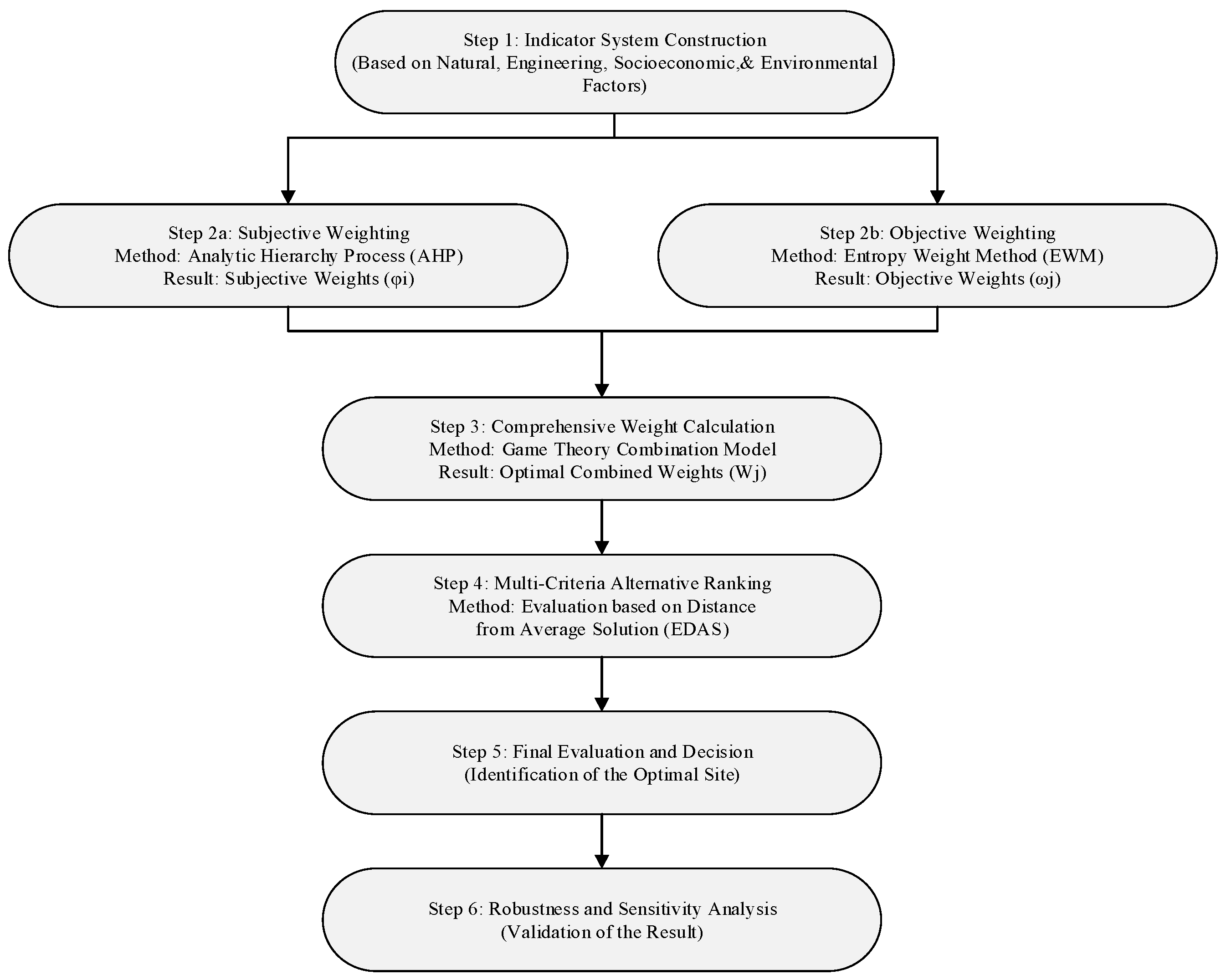
4.1. Selection of Research Methodology
4.2. Combination Weighting Based on Game Theory
4.2.1. Determination of Subjective Weights Using Analytic Hierarchy Process (AHP)
4.2.2. Determination of Objective Weights Using Entropy Weight Method (EWM)
4.2.3. Calculation of Combined Weights
4.3. Ranking of Alternatives Based on the EDAS Method
5. Case Validation
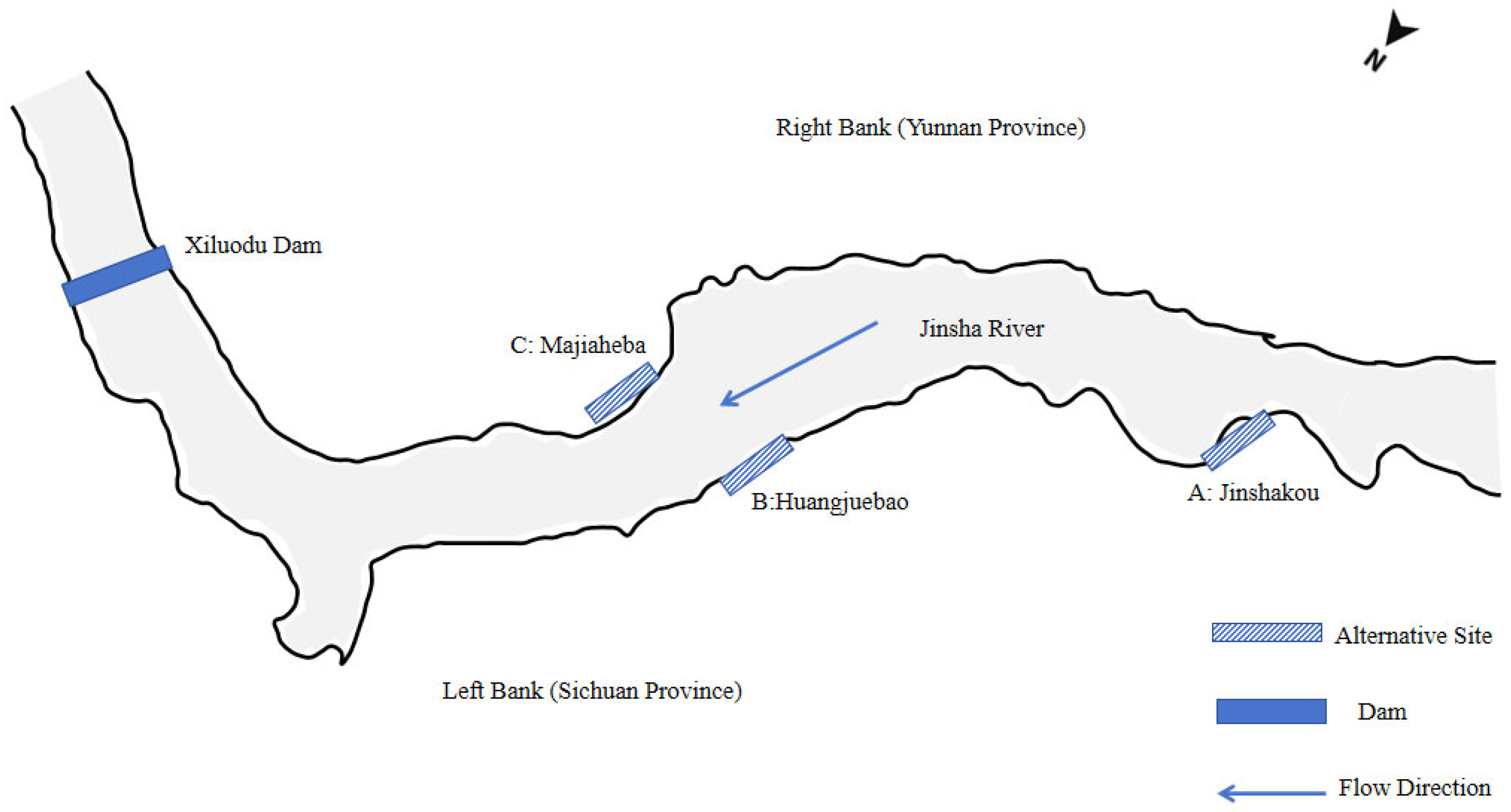
5.1. Case Overview
5.2. Alternatives and Data Acquisition
5.3. Results and Analysis
- (1)
- Initial Decision Matrix
- (2)
- Weight Calculation
- (3)
- Ranking of Alternatives Based on the EDAS Method
5.4. Discussion
5.5. Sensitivity and Comparative Analysis
5.5.1. Comparative Analysis with Other MCDM Methods
5.5.2. Sensitivity to Decision Preferences
6. Conclusions
Author Contributions
Funding
Institutional Review Board Statement
Informed Consent Statement
Data Availability Statement
Conflicts of Interest
Abbreviations
| ARAS | Additive Ratio Assessment |
| COPRAS | Complex Proportional Assessment |
| EDAS | Evaluation based on Distance from Average Solution |
| MCDM | Multi-Criteria Decision-Making |
| NDA | Negative Distance from Average |
| PDA | Positive Distance from Average |
| TOPSIS | Technique for Order Preference by Similarity to Ideal Solution |
| VIKOR | VIseKriterijumska Optimizacija I Kompromisno Resenje |
References
- National Water and Rain Information Network. Tennessee River Basin Comprehensive Development Project. Available online: http://xxfb.mwr.cn/slbk/zmslgc/zmslsnsdzzb/202303/t20230320_1669965.html (accessed on 30 December 2025).
- Habersack, H.; Hein, T.; Stanica, A.; Liska, I.; Mair, R.; Jäger, E.; Hauer, C.; Bradley, C. Challenges of river basin management: Current status of, and prospects for, the River Danube from a river engineering Perspective. Sci. Total Environ. 2016, 543, 828–845. [Google Scholar] [CrossRef]
- Zheng, Q.-Q.; Zhang, Y.; He, L.-J.; Tian, H.-W. Discrete Multi-objective artificial bee colony algorithm for green co-scheduling problem of ship lift and ship Lock. Adv. Eng. Inform. 2023, 55, 101897. [Google Scholar] [CrossRef]
- Qi, J.; Chen, D.; Li, R. Innovation and Practice of High-Quality Navigation of the Three Gorges-Gezhouba Cascade Hub in 20 Years. Strateg. Study CAE 2023, 25, 155–166. [Google Scholar] [CrossRef]
- Liangshan Prefecture Transportation Bureau. Overall Plan of Liangshan Port (Jinsha River Section) (Revised) (2023–2035). Available online: https://www.lsz.gov.cn/xxgk/zcwj/mtgz_47017/202507/t20250715_2859219.html (accessed on 24 September 2025).
- Li, H. Suggestions on Incorporating the Construction of the Panzhihua-Yibin Section of the Jinsha River into the “15th Five-Year Plan”. Available online: https://baijiahao.baidu.com/s?id=1820924634593742778&wfr=spider&for=pc (accessed on 24 September 2025).
- Yang, T.; Yang, C. Site selection factors for LNG terminal in coastal port. Port Waterw. Eng. 2024, 8, 71–75. [Google Scholar] [CrossRef]
- Lin, H. Location for cruise ports in Qingdao. World Shipp. 2010, 33, 28–31. [Google Scholar] [CrossRef]
- Kou, J. Site selection and construction scheme of terminal for railway ferry across the Taiwan Strait. Port Waterw. Eng. 2016, 11, 88–93. [Google Scholar] [CrossRef]
- Gao, Y. Site selection and anti-ice measures for wharves in seasonal freezing rivers. China Water Transp. 2013, 13, 303–304. Available online: https://kns.cnki.net/kcms2/article/abstract?v=Ow72tX7v2w14eRfcv83sXigS6nEQT8BLd-s7Sg3zmJV5ISKsL4YOCDVBflL09xkEN7107CQnWwdx1sO2aJFrO3-41Rw-nvZic_VC6sTM-pywm5owNiSw2_jAOAPm6E66O493LARAAVIgW_T0DueTuy-kYeeWxjHe0S6znQB_U8c552SOZlbxYg==&uniplatform=NZKPT&language=CHS (accessed on 1 January 2026).
- Yan, L. Study on site selection measures for interchange wharves of water conservancy hubs. Pearl River Water Transp. 2021, 23, 92–93. [Google Scholar] [CrossRef]
- Zhou, Q. Some problems of port site selecting. Ocean Eng. 1985, 4, 80–86. [Google Scholar] [CrossRef]
- Yang, Q. Structural forms and characteristics of major wharves in the upper reaches of the Yangtze River after impoundment of the Three Gorges Reservoir. Fire Prot. 2016, 7, 85. [Google Scholar] [CrossRef]
- Du, H. Research on port location selection based on Analytic Hierarchy Process. China Water Transp. 2012, 4, 32–33. Available online: https://kns.cnki.net/kcms2/article/abstract?v=Ow72tX7v2w2aMuHOVKj8fNYETnc6cSJRFfjKvsw8W0aqPqrDElGNk10BGXBFIGnE7XR3Bm1QOo5gLjbrOjZrwyGktVz2kvZj9Lg75o7uiF_tGiL6uXS_HWlq1ERO7sXCGG30YntdrBQ6_V-XE6fMuWZObaxkY01KKa8vQoPfwI4pqAWbSeUF_A==&uniplatform=NZKPT&language=CHS (accessed on 1 January 2026).
- Yu, T. Countermeasures for site selection of confluence wharves under the influence of water conservancy hubs in the upper reaches of the Yangtze River. Sci. Technol. Vis. 2015, 28, 296. [Google Scholar] [CrossRef]
- Liu, S.; Li, H.; Luo, B. Analysis of influencing factors on site selection of small and medium-sized river wharves. Eng. Constr. 2015, 6, 736–737. Available online: https://kns.cnki.net/kcms2/article/abstract?v=Ow72tX7v2w1NTlyQhfVfFMzgj6iIOogGgkn0G7Fux1x2iEQGMDPC1geS5hPuDqo4VoGxwLIAYB6T1u0qXunHCfhauXIOrtk6gAVjyUliQ08n24xwWtJYGrhkvz6v-ClnvwiKo-vuEuOox-vQvngFHwWloyU7xcoYtD3wIkfxqvep5ICDQnjTkQ==&uniplatform=NZKPT&language=CHS (accessed on 1 January 2026).
- Liu, X.-D.; Li, M.; Sun, H.-L. Study on the Anchorage Location Selection of the New Method. In Proceedings of the 2014 International Conference on Mechanics and Civil Engineering (ICMCE-14), Wuhan, China, 13–14 December 2014; Atlantis Press: Paris, France, 2014; pp. 870–875. [Google Scholar]
- Wisnicki, B.; Dybkowska-Stefek, D.; Relisko-Rybak, J.; Kolanda, Ł. Methodology for Determining the Location of River Ports on a Modernized Waterway Based on Non-Cost Criteria: A Case Study of the Odra River Waterway. Sustainability 2021, 13, 3571. [Google Scholar] [CrossRef]
- Li, G. Application of Grey System Correlation Degree in Harbour Site Selection. J. Hohai Univ. (Nat. Sci.) 1993, 21, 98–102. Available online: https://kns.cnki.net/kcms2/article/abstract?v=Ow72tX7v2w0BgxGBHuJuRFrTbt03b27Le00PLWZkojWVwFKxZCnNs9q0bt661LVEPPBS5L6Go3gN42Vw40LLiLxrU6IG3_Gav9VVfHXbL2sWenk0I_CJCo1b_hWQEZt8I2XzMB74GLGpNE0KA79XewpUfJxtP5-LUa0FBR73AAJea8wHS2lJeA==&uniplatform=NZKPT&language=CHS (accessed on 1 January 2026).
- Zhou, Q. Research on Port Site Selection Based on AHP and Grey Relational Theory. In Proceedings of the 2015 Academic Exchange Meeting of Sichuan Highway Society and Engineering Construction Professional Committee, Chengdu, China, 25–26 November 2015; Springer Singapore: Singapore, 2015. Available online: https://d.wanfangdata.com.cn/conference/9318635 (accessed on 1 January 2026).
- Liu, Z.; Liu, J. Fuzzy decision-making model based on entropy weight and AHP on port site selecting. Port Waterw. Eng. 2008, 11, 108–111. [Google Scholar] [CrossRef]
- Xiao, D.; Zhao, J.; Zhang, Y.; Qu, H. Analysis of Assessing the Site Selection of Port Based on Entropy Weight. Ship Ocean Eng. 2011, 40, 147–149. [Google Scholar] [CrossRef]
- Tadić, S.; Krstić, M.; Roso, V.; Brnjac, N. Dry Port Terminal Location Selection by Applying the Hybrid Grey MCDM Model. Sustainability 2020, 12, 6983. [Google Scholar] [CrossRef]
- Liang, F.; Verhoeven, K.; Brunelli, M.; Rezaei, J. Inland terminal location selection using the multi-stakeholder best-worst method. Int. J. Logist. Res. Appl. 2024, 27, 363–385. [Google Scholar] [CrossRef]
- Lv, R.; Li, C. Analysis on location selection of dry ports based on ANP. In Proceedings of the 2011 International Conference of Information Technology, Computer Engineering and Management Sciences, Nanjing, China, 24–25 September 2011; IEEE: Nanjing, China, 2011; pp. 184–187. [Google Scholar]
- Zhang, H.; Wang, P. The Research on the Site Selection of Cruise Terminal Based on Fuzzy Evaluation Method. J. Hebei Norm. Univ. Sci. Technol. 2020, 34, 74–80. [Google Scholar] [CrossRef]
- Wu, B.; Xu, M.; Chen, S.; Zhao, Y. Comparative Analysis of Site Selection Schemes for Xin Taohua Port Riverside Hub Project. Eng. Technol. 2024, 4, 161–164. Available online: https://www.cqvip.com/doc/journal/1000004037061?sign=a0b3a8140ea63bcf591eb25e86ce6322e563e0c9aa71e25c43ed2d6d2d163529&expireTime=1798683831837&resourceId=1000004037061 (accessed on 1 January 2026).
- Cheng, C.; Zheng, X. Discussion on Key Points of Preliminary Planning and Design and Site Selection Requirements for Port Terminals. Archit. Knowl. 2013, 11, 105. Available online: https://d.wanfangdata.com.cn/periodical/CiBQZXJpb2RpY2FsQ0hJU29scjkyMDI1MTIyNDE1NDU1NRIXUUtWMjAxMzIwMTQwNDA4MDAwMjczODUaCDl5OGFnZm1y (accessed on 1 January 2026).
- JTS 166-2020; Master Design Code for River Ports. Ministry of Transport of the People’s Republic of China, China Communications Press: Beijing, China, 2020. Available online: https://xxgk.mot.gov.cn/2020/jigou/syj/202006/t20200623_3314963.html (accessed on 30 December 2025).
- Wang, Y.; Jung, K.-A.; Yeo, G.-T.; Chou, C.-C. Selecting a cruise port of call location using the fuzzy-AHP method: A case study in East Asia. Tour. Manag. 2014, 42, 262–270. [Google Scholar] [CrossRef]
- Altınpınar, İ. Green Port and City Integration: Sustainable Approaches in Location Selection. J. Anatol. Environ. Anim. Sci. 2025, 10, 132–138. [Google Scholar] [CrossRef]
- Shen, Z.; Zhao, Q.; Fang, Q. Analysis of Green Traffic Development in Zhoushan Based on Entropy Weight TOPSIS. Sustainability 2021, 13, 8109. [Google Scholar] [CrossRef]
- He, H.; Tian, C.; Jin, G.; An, L. An Improved Uncertainty Measure Theory Based on Game Theory Weighting. Math. Probl. Eng. 2019, 2019, 1. [Google Scholar] [CrossRef]
- Ka, B. Application of Fuzzy AHP and ELECTRE to China Dry Port Location Selection. Asian J. Shipp. Logist. 2011, 27, 331–353. [Google Scholar] [CrossRef]
- Keshavarz Ghorabaee, M.; Zavadskas, E.K.; Olfat, L.; Turskis, Z. Multi-Criteria Inventory Classification Using a New Method of Evaluation Based on Distance from Average Solution (EDAS). Informatica 2015, 26, 435–451. [Google Scholar] [CrossRef]
- Tan, R.; Zhang, W. Decision-making method based on new entropy and refined single-valued neutrosophic sets and its application in typhoon disaster Assessment. Appl. Intell. 2020, 51, 283–307. [Google Scholar] [CrossRef]
- Özmen, M.; Aydoğan, E.K. Robust Multi-criteria decision making methodology for real life logistics center location Problem. Artif. Intell. Rev. 2019, 53, 725–751. [Google Scholar] [CrossRef]
- Keshavarz Ghorabaee, M.; Zavadskas, E.K.; Amiri, M.; Turskis, Z. Extended EDAS Method for Fuzzy Multi-criteria Decision-making: An Application to Supplier Selection. Int. J. Comput. Commun. Control 2016, 11, 358. [Google Scholar] [CrossRef]
- Torkayesh, A.E.; Deveci, M.; Karagoz, S.; Antucheviciene, J. A State-of-the-art survey of evaluation based on distance from average solution (EDAS): Developments and Applications. Expert Syst. Appl. 2023, 221, 119724. [Google Scholar] [CrossRef]
- Asante, D.; He, Z.; Adjei, N.O.; Asante, B. Exploring the barriers to renewable energy adoption utilising MULTIMOORA-EDAS Method. Energy Policy 2020, 142, 111479. [Google Scholar] [CrossRef]
- Lv, Z.; Xiong, J.; Zhuo, M.; Ke, Y.; Kang, Q. Resilience Assessment of Forest Fires Based on a Game-Theoretic Combination Weighting Method. Sustainability 2025, 17, 7907. [Google Scholar] [CrossRef]
- Hou, S.; Chen, J.; Ren, H.; Kuang, T.; Zhang, X.; Jiang, Y.; Lv, D. Multi-criteria comprehensive evaluation of hydrogen storage technologies for islanded grid peak shaving based on game-theoretic weighting and TOPSIS. Int. J. Hydrogen Energy 2025, 169, 151053. [Google Scholar] [CrossRef]
- Jiemian News. Sailing on the Jinsha River: Reflections on the Construction of the 800-km “Golden Waterway”. Available online: https://www.jiemian.com/article/11259383.html (accessed on 24 September 2025).
- Leibo County People’s Government. Notification on the Announcement and Implementation of the “Overall Plan for Mineral Resources of Leibo County, Sichuan Province (2021–2025)”. Available online: http://www.lbx.gov.cn/zfxxgk/zfxxgknr/zcwj_31017/xzfwjnew/202403/t20240312_2645089.html (accessed on 19 September 2025).
- The Paper. Small Loquat Trees Produce “Fruits of Hope”! “Xinhua Daily Telegraph” Praises the Loquat Industry in Yongshan, Yunnan. Available online: https://www.thepaper.cn/newsDetail_forward_27467785 (accessed on 24 September 2025).
- China Daily. Reading Zhaotong Economy: Letting “Zhaotong Flavor” Go National—A Side Note on Zhaotong City’s Rural Revitalization Agricultural Products Production and Sales Docking Activity. Available online: https://baijiahao.baidu.com/s?id=1809541355791380922&wfr=spider&for=pc (accessed on 30 December 2025).
- Sichuan Provincial People’s Government. Notification on Printing and Distributing the “Sichuan Inland Waterway Development Plan (2023–2035)”. Available online: https://www.sc.gov.cn/zfgbdb/detail/718aa4deb0a442b283a36ccc383d3d0e.shtml (accessed on 19 September 2025).
- Zhaotong Municipal People’s Government Office. Notification on Issuing the “Zhaotong Logistics Hub Layout and Construction Plan (2021–2035)”. Available online: https://www.zt.gov.cn/lanmu/zwgk/contents/5707/225993.html (accessed on 30 December 2025).
- Xu, W. Research on Navigation Conditions of Port Area of Dam-Turning Transfer Wharf in Xiluodu Fluctuating Backwater Area. Master’s Thesis, Chongqing Jiaotong University, Chongqing, China, 2021. [Google Scholar]



| Primary Criterion (Level 1) | Secondary Criterion (Level 2) | Code | Indicator (Level 3) | Description | Type |
|---|---|---|---|---|---|
| Natural Conditions (B1) | Water Conditions | C11 | Channel Flow Velocity (m/s) | Evaluates the regular flow velocity in the port area during non-flood and non-peak-shaving periods. | Cost |
| C12 | Water Depth at Terminal Frontage (m) | Evaluates the actual water depth at the terminal frontage under the design low water level. | Benefit | ||
| C13 | Channel Width (m) | Evaluates the navigable width of the river channel to ensure sufficient space for vessel turning and operations. | Benefit | ||
| C14 | Water Level Fluctuation Amplitude (m) | Evaluates the maximum daily water level fluctuation caused by dam peak-shaving operations. | Cost | ||
| C15 | Impact of Fluctuating Backwater Zone (0/1) | Determines whether the site is located within the hydrologically complex “fluctuating backwater zone.” | Cost | ||
| Land Conditions | C21 | Seismic Fortification Intensity | The statutory seismic design standard for the region determines the required earthquake resistance level. (Degree) | Cost | |
| C22 | Frequency of Geological Hazards (Freq/Year) | The relative annual frequency of landslides, collapses, or debris flows in the site vicinity. | Cost | ||
| C23 | Bank Slope Angle (Ratio) | The steepness of the natural bank slope; a smaller slope ratio indicates better stability. | Cost | ||
| C24 | Available Land Width (Depth) (m) | The average depth of flat land available behind the terminal for yard and facility construction. | Benefit | ||
| C25 | Usable Shoreline Length (m) | The total continuous length of shoreline suitable for berth layout. | Benefit | ||
| Engineering Technology (B2) | Collection and Distribution Conditions | C31 | Road Transshipment Distance for Dam Bypass (km) | The shortest road transport distance from the upstream port to the corresponding downstream reception point. | Cost |
| C32 | Construction Length of Connecting Access Roads (km) | The length of new or reconstructed roads required to connect the port to the existing regional highway network. | Cost | ||
| Port Construction Conditions | C41 | Difficulty of Berth Hydraulic Structure Construction | Evaluates the engineering difficulty of constructing frontage structures (e.g., piles, pontoons). | Benefit | |
| C42 | Conditions for Accessing Supporting Facilities | Evaluates the convenience of accessing water, power, and telecommunication infrastructure. | Benefit | ||
| C43 | Land Bearing Capacity (kPa) | Evaluates whether the foundation bearing capacity meets the load requirements of heavy facilities. | Benefit | ||
| Socio-economic Benefits (B3) | Economic Benefits | C51 | Potential Hinterland Cargo Volume (104 tons) | The estimated scale of waterborne cargo that the port can attract from its key economic hinterland. | Benefit |
| C52 | Long-term Development Potential | Evaluates whether sufficient shoreline and land space are reserved for future expansion. | Benefit | ||
| Social Impacts | C61 | Impact on Adjacent Residential Areas (0/1) | Whether the site is adjacent to population clusters (villages, schools), assessing noise and dust impacts. | Cost | |
| C62 | Occupation of Arable Land/Homesteads (0/1) | Evaluates whether construction requires occupying arable land (esp. basic farmland) or homesteads. | Cost | ||
| C63 | Difficulty of Cross-Regional Coordination | Evaluates policy coordination difficulties if the site is located on a provincial boundary river. | Benefit | ||
| Environmental Protection (B4) | Ecological Constraints | C71 | Ecological Red Line Constraints (0/1) | Whether the site occupies or is adjacent to statutory ecological protection red lines. | Cost |
| C72 | Ecological Vulnerability and Vegetation Impact | Evaluates the ecological fragility of the site and the impact of construction on vegetation and soil conservation. | Benefit | ||
| C73 | Construction Conditions for Environmental Facilities | Evaluates if there is sufficient land space to build sewage and waste treatment facilities. | Benefit |
| Scales | Interpretations |
|---|---|
| 1 | Factor i and j are equally important |
| 3 | Factor i is slightly more important than j |
| 5 | Factor i is significantly more important than j |
| 7 | Factor i is strongly more important than j |
| 9 | Factor i is extremely more important than j |
| 2, 4, 6, 8 | Intermediate values of the above scales |
| Reciprocal | If element i compared to j is aij, then j compared to i is 1/aij |
| n | 1 | 2 | 3 | 4 | 5 | 6 | 7 | 8 | 9 | 10 |
| RI | 0 | 0 | 0.58 | 0.9 | 1.12 | 1.24 | 1.32 | 1.41 | 1.45 | 1.49 |
| Comparison Dimension | Option A (Jinshakou) | Option B (Huangjuebao) | Option C (Majiaheba) |
|---|---|---|---|
| Bank Location | Left Bank (Sichuan side) | Left Bank (Sichuan side) | Right Bank (Yunnan side) |
| Distance to Dam | km Approx. 7.5 km | Approx. 3.7 km | Approx. 3.5 km |
| Topography and Landform | Precipitous bank slope | Moderate bank slope | Riverside terrace, gentle bank slope |
| Land Space | Extremely narrow | Insufficient | Relatively open |
| Adjacent Residential Areas | No | Yes (Residential areas and schools) | No |
| External Connectivity | Upgrade existing roads | Upgrade existing roads | New tunnel construction is required |
| Primary Hinterland | Cargo from the Sichuan side | Cargo from the Sichuan side | Cargo from the Yunnan side |
| Expert ID | Affiliation Type | Professional Title | Specialization/Expertise | Working Experience (Years) |
|---|---|---|---|---|
| E1 | University | Professor | Port and Coastal Engineering | 22 |
| E2 | University | Professor | Waterway Transportation Planning | 18 |
| E3 | Design Institute | Senior Engineer | Port Hydraulic Structure Design | 20 |
| E4 | Design Institute | Senior Engineer | Geotechnical Engineering | 16 |
| E5 | Design Institute | Senior Engineer | River Navigation Channel Engineering | 15 |
| E6 | Government | Official | Regional Strategy and Logistics | 16 |
| E7 | Government | Official | Port and Shipping Administration | 18 |
| E8 | Government | Official | Transport Planning and Investment | 17 |
| Level 3 Indicator | Type | Option A | Option B | Option C |
|---|---|---|---|---|
| Channel Flow Velocity(m/s) | Cost | 1.1 | 1 | 1 |
| Water Depth at Terminal Frontage | Benefit | 4.8 | 5.1 | 5.3 |
| Channel Width | Benefit | 160 | 280 | 300 |
| Water Level Fluctuation Amplitude | Cost | 2.8 | 3 | 3 |
| Impact of Fluctuating Backwater Zone | Cost | 1 | 1 | 1 |
| Seismic Fortification Intensity | Cost | 8 | 8 | 8 |
| Frequency of Geological Hazards | Cost | 0.2 | 0.3 | 0.1 |
| Bank Slope Angle (Stability) | Cost | 1 | 0.3 | 0.33 |
| Available Land Width (Depth) | Benefit | 100 | 140 | 200 |
| Usable Shoreline Length | Benefit | 930 | 460 | 600 |
| Road Transshipment Distance for Dam Bypass | Cost | 21.6 | 19.3 | 18.5 |
| Construction Length of Connecting Access Roads | Cost | 2 | 3.7 | 1.5 |
| Difficulty of Berth Hydraulic Structure Construction | Benefit | 3.15 | 4.25 | 4.1 |
| Conditions for Accessing Supporting Facilities | Benefit | 3.78 | 4.5 | 3.9 |
| Land Bearing Capacity | Benefit | 2000 | 1500 | 2000 |
| Potential Hinterland Cargo Volume | Benefit | 710 | 710 | 600 |
| Long-term Development Potential | Benefit | 3.9 | 3.6 | 4.25 |
| Impact on Adjacent Residential Areas | Cost | 0 | 1 | 0 |
| Occupation of Arable Land/Homesteads | Cost | 0 | 1 | 0 |
| Difficulty of Cross-Regional Coordination | Benefit | 3.55 | 3.7 | 4.6 |
| Ecological Red Line Constraints | Cost | 0 | 0 | 0 |
| Ecological Vulnerability and Vegetation Impact | Benefit | 4.16 | 3.67 | 3.9 |
| Construction Conditions for Environmental Facilities | Benefit | 3 | 3.6 | 4.12 |
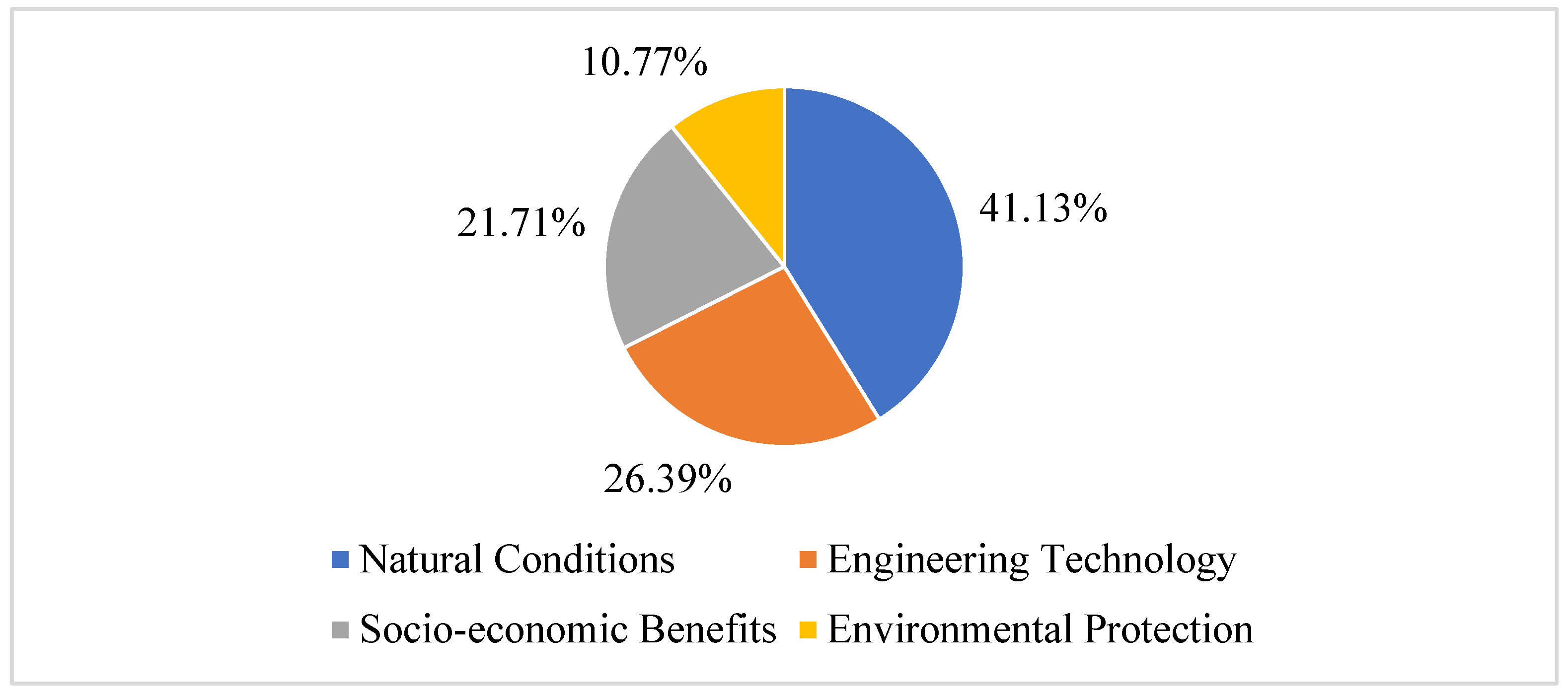
| Primary Criterion | Weight (WB) | Secondary Criterion | Weight (Wc) | Indicator | Subjective Weight (φi) |
|---|---|---|---|---|---|
| Natural Conditions (B1) | 0.3924 | Water Conditions(C1) | 0.4001 | C11 | 0.0214 |
| C12 | 0.0466 | ||||
| C13 | 0.0505 | ||||
| C14 | 0.0214 | ||||
| C15 | 0.0171 | ||||
| Land Conditions(C2) | 0.5999 | C21 | 0.0242 | ||
| C22 | 0.0818 | ||||
| C23 | 0.0489 | ||||
| C24 | 0.0438 | ||||
| C25 | 0.0368 | ||||
| Engineering Technology (B2) | 0.2937 | Collection and Distribution(C3) | 0.5756 | C31 | 0.1016 |
| C32 | 0.0675 | ||||
| Port Construction(C4) | 0.4244 | C41 | 0.0422 | ||
| C42 | 0.0149 | ||||
| C43 | 0.0675 | ||||
| Socio-economic Benefits (B3) | 0.1914 | Economic Benefits(C5) | 0.6631 | C51 | 0.0762 |
| C52 | 0.0507 | ||||
| Social Impacts(C6) | 0.3369 | C61 | 0.0291 | ||
| C62 | 0.0218 | ||||
| C63 | 0.0135 | ||||
| Environmental Protection (B4) | 0.1225 | Ecological Constraints(C7) | 1.0000 | C71 | 0.0497 |
| C72 | 0.0359 | ||||
| C73 | 0.0370 |
| Indicator | Information Entropy (Ej) | Information Redundancy (dj) | Objective Weight (ωj) |
|---|---|---|---|
| C11 | 0.6309 | 0.3691 | 0.0408 |
| C12 | 0.6022 | 0.3978 | 0.0439 |
| C13 | 0.6282 | 0.3718 | 0.0411 |
| C14 | 0.0000 | 1.0000 | 0.1104 |
| C15 | 1.0000 | 0.0000 | 0.0000 |
| C21 | 1.0000 | 0.0000 | 0.0000 |
| C22 | 0.5794 | 0.4206 | 0.0465 |
| C23 | 0.6307 | 0.3693 | 0.0408 |
| C24 | 0.5446 | 0.4554 | 0.0503 |
| C25 | 0.4903 | 0.5097 | 0.0563 |
| C31 | 0.6209 | 0.3791 | 0.0419 |
| C32 | 0.6234 | 0.3766 | 0.0416 |
| C41 | 0.6285 | 0.3715 | 0.0410 |
| C42 | 0.3733 | 0.6267 | 0.0692 |
| C43 | 0.6309 | 0.3691 | 0.0408 |
| C51 | 0.6309 | 0.3691 | 0.0408 |
| C52 | 0.5677 | 0.4323 | 0.0477 |
| C61 | 0.6309 | 0.3691 | 0.0408 |
| C62 | 0.6309 | 0.3691 | 0.0408 |
| C63 | 0.3430 | 0.6570 | 0.0726 |
| C71 | 1.0000 | 0.0000 | 0.0000 |
| C72 | 0.5702 | 0.4298 | 0.0475 |
| C73 | 0.5887 | 0.4113 | 0.0454 |
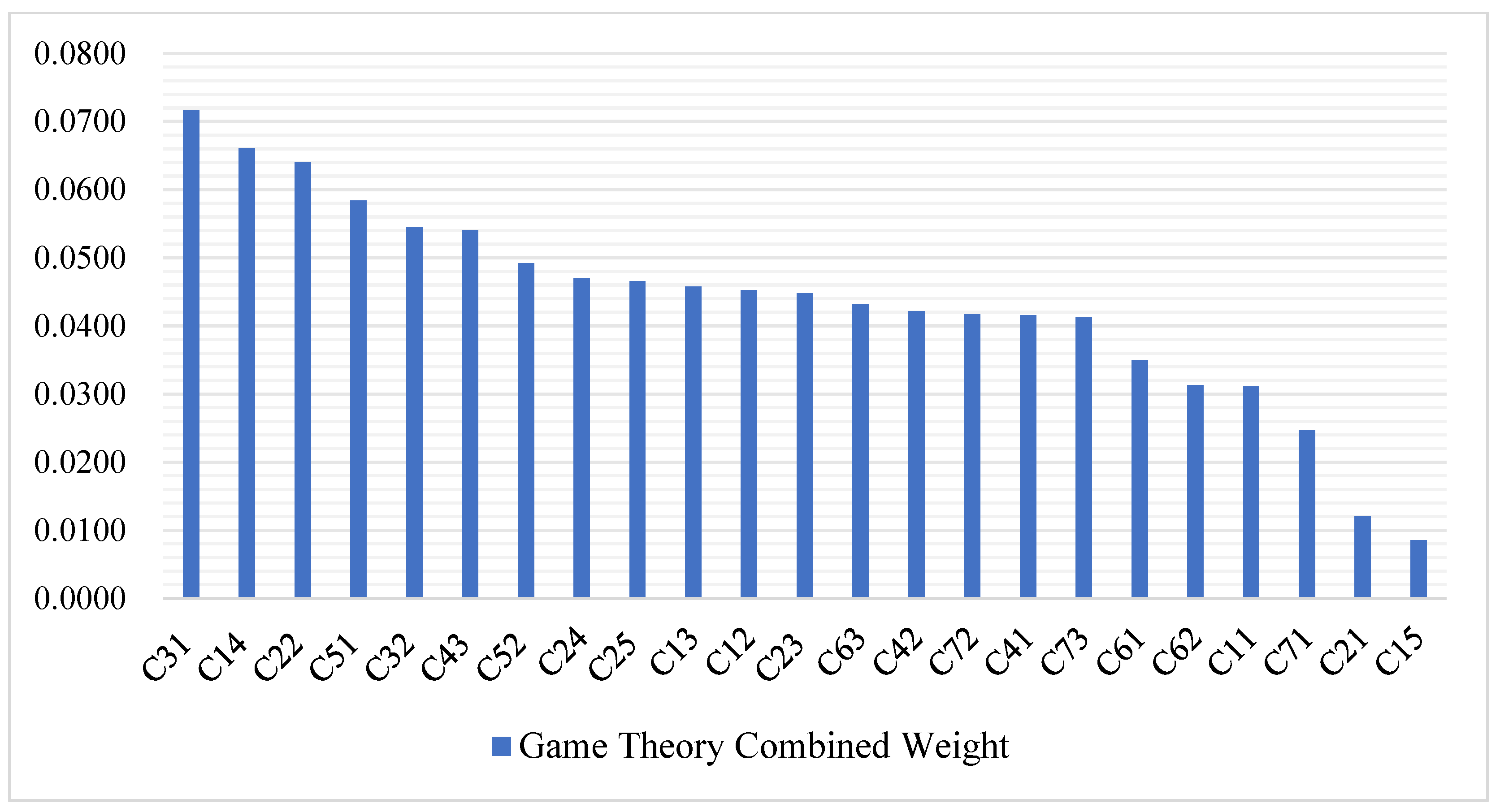
| Indicator | Type | Subjective Weight (φi) | ObjectiveWeight (ωj) | Game Theory Combined Weight (Wj) |
|---|---|---|---|---|
| C11 | Cost | 0.0214 | 0.0408 | 0.0311 |
| C12 | Benefit | 0.0466 | 0.0439 | 0.0452 |
| C13 | Benefit | 0.0505 | 0.0411 | 0.0458 |
| C14 | Cost | 0.0214 | 0.1104 | 0.0661 |
| C15 | Cost | 0.0171 | 0.0000 | 0.0085 |
| C21 | Cost | 0.0242 | 0.0000 | 0.0120 |
| C22 | Cost | 0.0818 | 0.0465 | 0.0641 |
| C23 | Cost | 0.0489 | 0.0408 | 0.0448 |
| C24 | Benefit | 0.0438 | 0.0503 | 0.0471 |
| C25 | Benefit | 0.0368 | 0.0563 | 0.0466 |
| C31 | Cost | 0.1016 | 0.0419 | 0.0716 |
| C32 | Cost | 0.0675 | 0.0416 | 0.0545 |
| C41 | Benefit | 0.0422 | 0.041 | 0.0416 |
| C42 | Benefit | 0.0149 | 0.0692 | 0.0422 |
| C43 | Benefit | 0.0675 | 0.0408 | 0.0541 |
| C51 | Benefit | 0.0762 | 0.0408 | 0.0584 |
| C52 | Benefit | 0.0507 | 0.0477 | 0.0492 |
| C61 | Cost | 0.0291 | 0.0408 | 0.0350 |
| C62 | Cost | 0.0218 | 0.0408 | 0.0313 |
| C63 | Benefit | 0.0135 | 0.0726 | 0.0432 |
| C71 | Cost | 0.0497 | 0.0000 | 0.0247 |
| C72 | Benefit | 0.0359 | 0.0475 | 0.0417 |
| C73 | Benefit | 0.0370 | 0.0454 | 0.0412 |
| Alternative | SPi | SNi | NSPi | NSNi | ASi | Rank |
|---|---|---|---|---|---|---|
| Option A (Jinshakou) | 0.1079 | 0.1011 | 0.5488 | 0.5625 | 0.5557 | 2 |
| Option B (Huangjuebao) | 0.0419 | 0.2312 | 0.2134 | 0.0000 | 0.1067 | 3 |
| Option C (Majiaheba) | 0.1966 | 0.0141 | 1.0000 | 0.9391 | 0.9695 | 1 |
| Alternative | EDAS Rank | TOPSIS Rank | VIKOR Rank | ARAS Rank | COPRAS Rank |
|---|---|---|---|---|---|
| Option C | 1 | 1 | 1 | 1 | 1 |
| Option A | 2 | 2 | 3 | 2 | 2 |
| Option B | 3 | 3 | 2 | 3 | 3 |
| Scenario | Option A | Option B | Option C | Rank_A | Rank_B | Rank_C |
|---|---|---|---|---|---|---|
| Baseline Scenario | 0.5557 | 0.1067 | 0.9695 | 2 | 3 | 1 |
| Scenario S1 | 0.4962 | 0.1158 | 0.9673 | 2 | 3 | 1 |
| Scenario S2 | 0.6199 | 0.0977 | 0.9717 | 2 | 3 | 1 |
| Scenario S3 | 0.6048 | 0.0962 | 0.9708 | 2 | 3 | 1 |
Disclaimer/Publisher’s Note: The statements, opinions and data contained in all publications are solely those of the individual author(s) and contributor(s) and not of MDPI and/or the editor(s). MDPI and/or the editor(s) disclaim responsibility for any injury to people or property resulting from any ideas, methods, instructions or products referred to in the content. |
© 2026 by the authors. Licensee MDPI, Basel, Switzerland. This article is an open access article distributed under the terms and conditions of the Creative Commons Attribution (CC BY) license.
Share and Cite
Wang, J.; Wang, H.; Tan, F. Sustainable Port Site Selection in Mountainous Areas Within Continuous Dam Zones: A Multi-Criteria Decision-Making Framework. Appl. Sci. 2026, 16, 1117. https://doi.org/10.3390/app16021117
Wang J, Wang H, Tan F. Sustainable Port Site Selection in Mountainous Areas Within Continuous Dam Zones: A Multi-Criteria Decision-Making Framework. Applied Sciences. 2026; 16(2):1117. https://doi.org/10.3390/app16021117
Chicago/Turabian StyleWang, Jianxun, Haiyan Wang, and Fuyou Tan. 2026. "Sustainable Port Site Selection in Mountainous Areas Within Continuous Dam Zones: A Multi-Criteria Decision-Making Framework" Applied Sciences 16, no. 2: 1117. https://doi.org/10.3390/app16021117
APA StyleWang, J., Wang, H., & Tan, F. (2026). Sustainable Port Site Selection in Mountainous Areas Within Continuous Dam Zones: A Multi-Criteria Decision-Making Framework. Applied Sciences, 16(2), 1117. https://doi.org/10.3390/app16021117