Deep Reinforcement Learning Algorithms for Intrusion Detection: A Bibliometric Analysis and Systematic Review

Abstract
1. Introduction
2. Motivation of This Study
3. Methodology
3.1. Bibliometric Analysis
- i.
- Annual publication trends;
- ii.
- Source-level citation counts;
- iii.
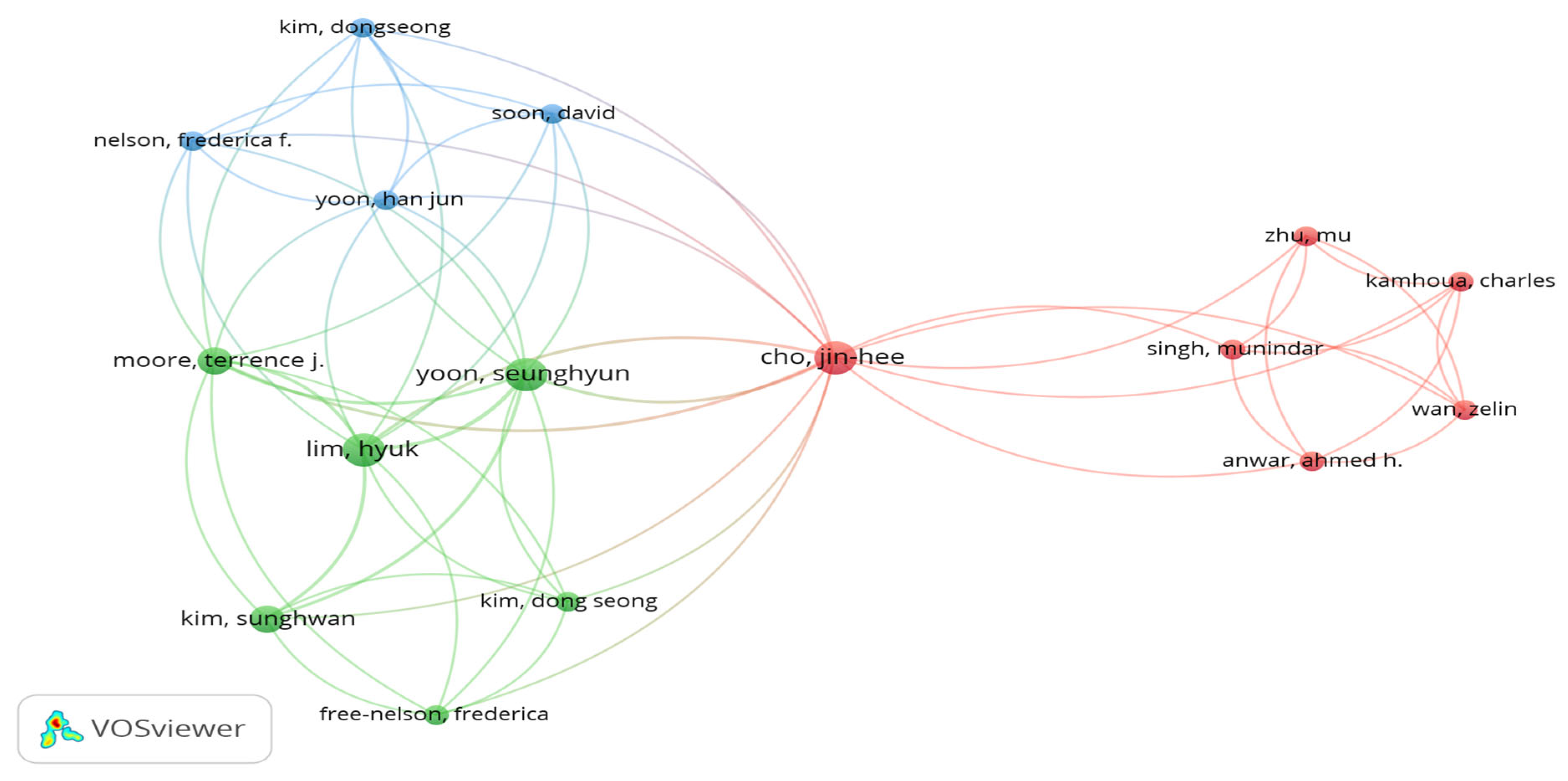
- Co-authorship networks;
- iv.
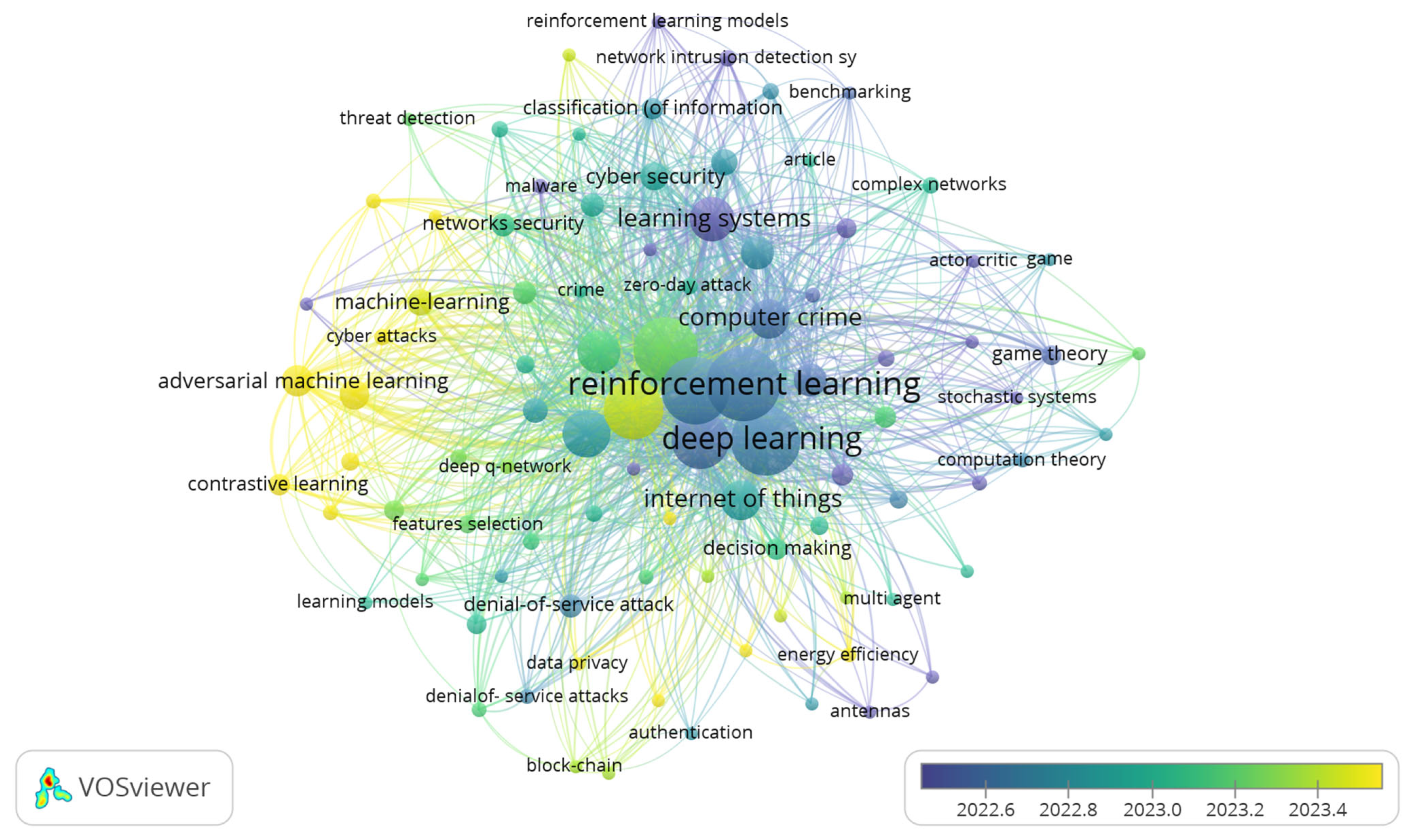
- Keyword and index-keyword co-occurrence;
- v.
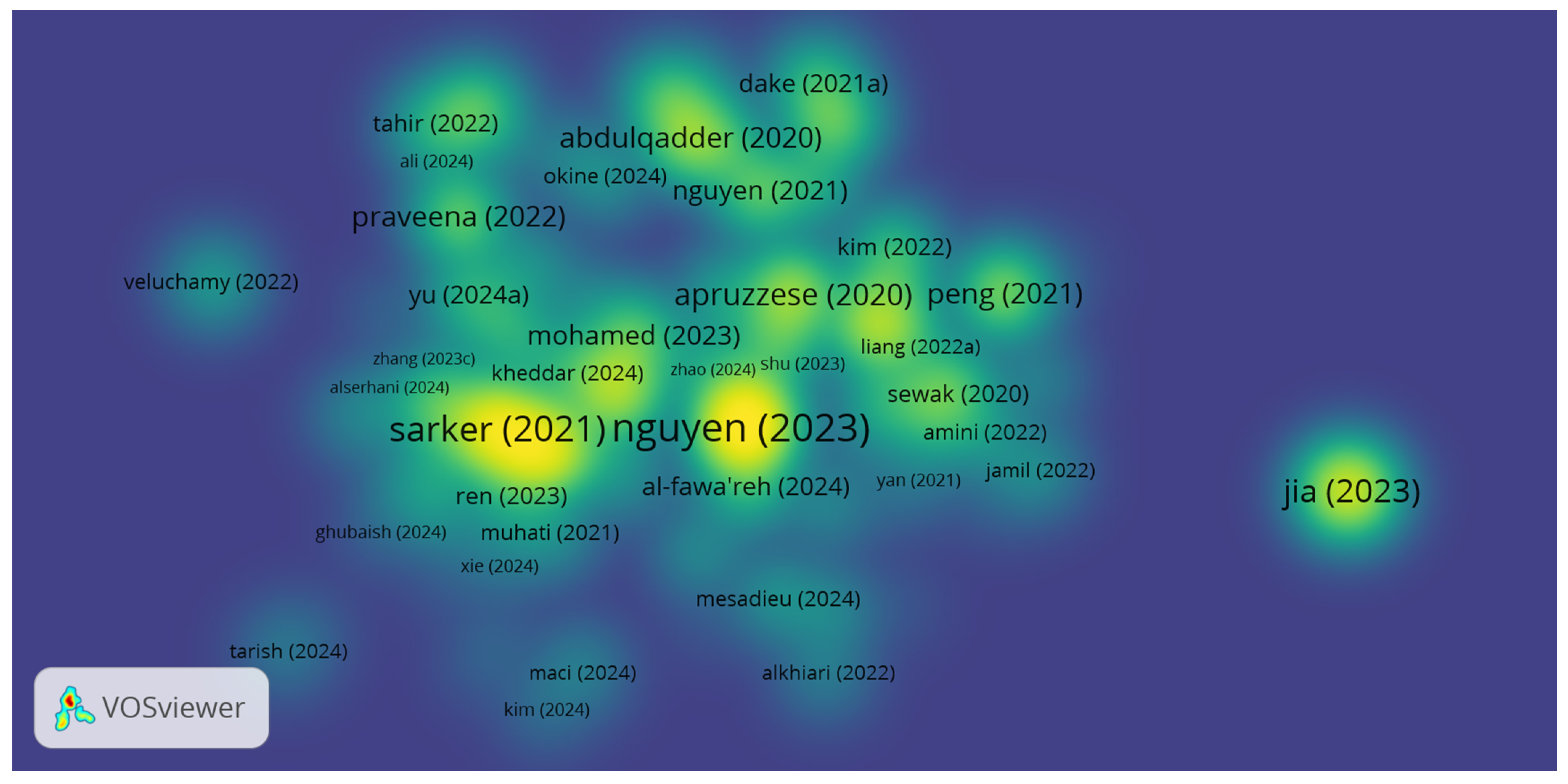
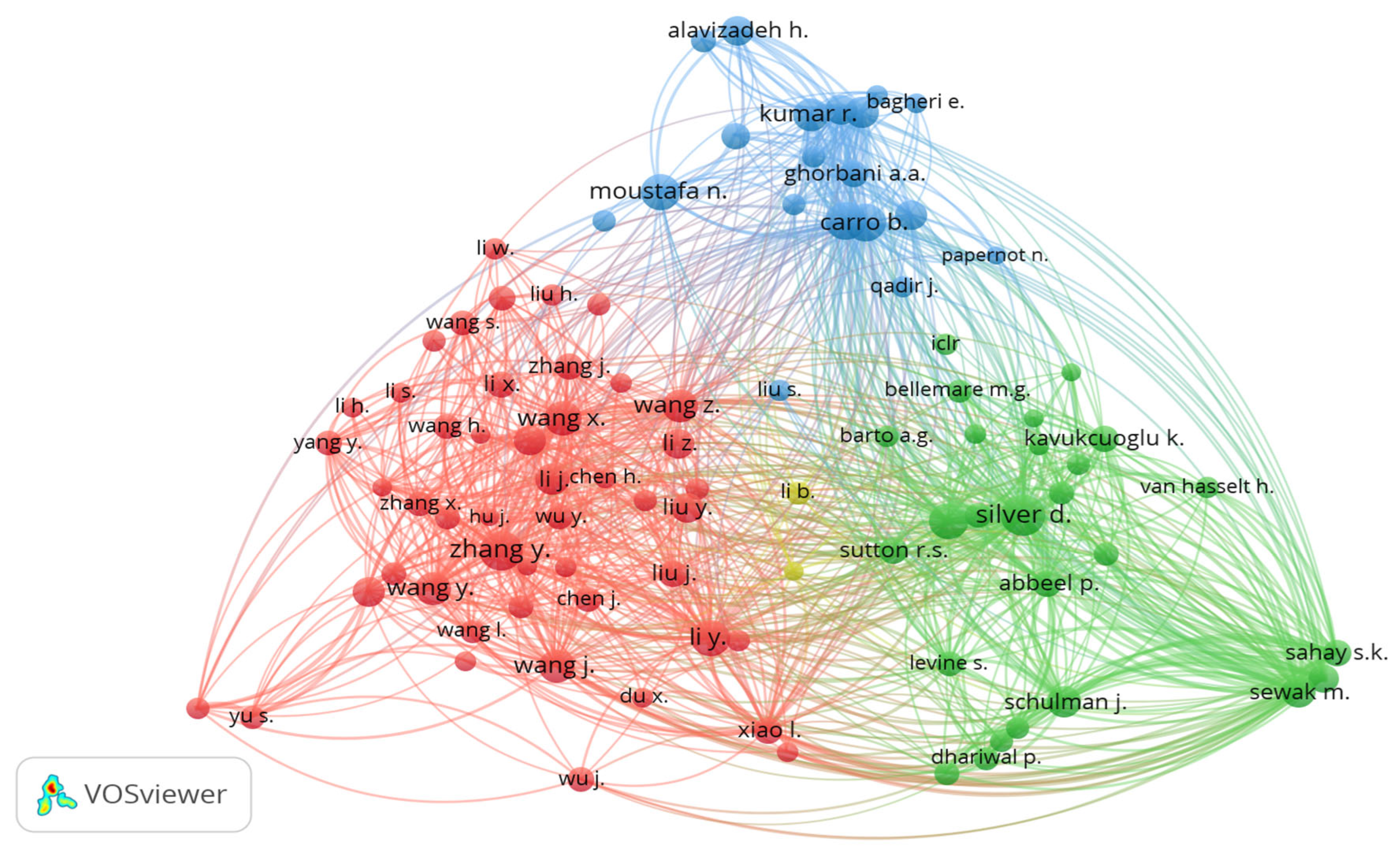
- Bibliographic coupling and co-citation relationships among documents and sources.
3.2. Systematic Literature Review (SLR)
3.2.1. Definition of Research Questions
- RQ1: What types of deep reinforcement learning techniques have been used to address intrusion detection?RQ1 aims to discuss the DRL techniques used to address intrusion detection. Current IDS applications using DRL models were analyzed.
- Population (P): IDS, network datasets;
- Intervention (I): DRL algorithms applied to IDS;
- Comparison (C): ML/DL baselines and RL variants;
- Outcomes (O): Types and characteristics of DRL techniques;
- Study Design (S): Experimental studies, bibliometric, and systematic review.
- RQ2: What is the overall performance of the reviewed DRL algorithms and the current limitations in applying them in dynamic and adversarial environments?RQ2 presents the performance of the model. Performance evaluation methods were used, focusing on the dataset used, the performance metrics utilized, the accuracy value, and limitations.
- Population (P): IDS in a dynamic/adversarial setting;
- Intervention (I): Performance evaluation of DRL algorithms;
- Comparison (C): Baseline models, alternative DRL methods;
- Outcomes (O): Performance metrics and limitations;
- Study Design (S): Experimental/comparative studies, systematic review.
3.2.2. Information Sources and Research Criteria
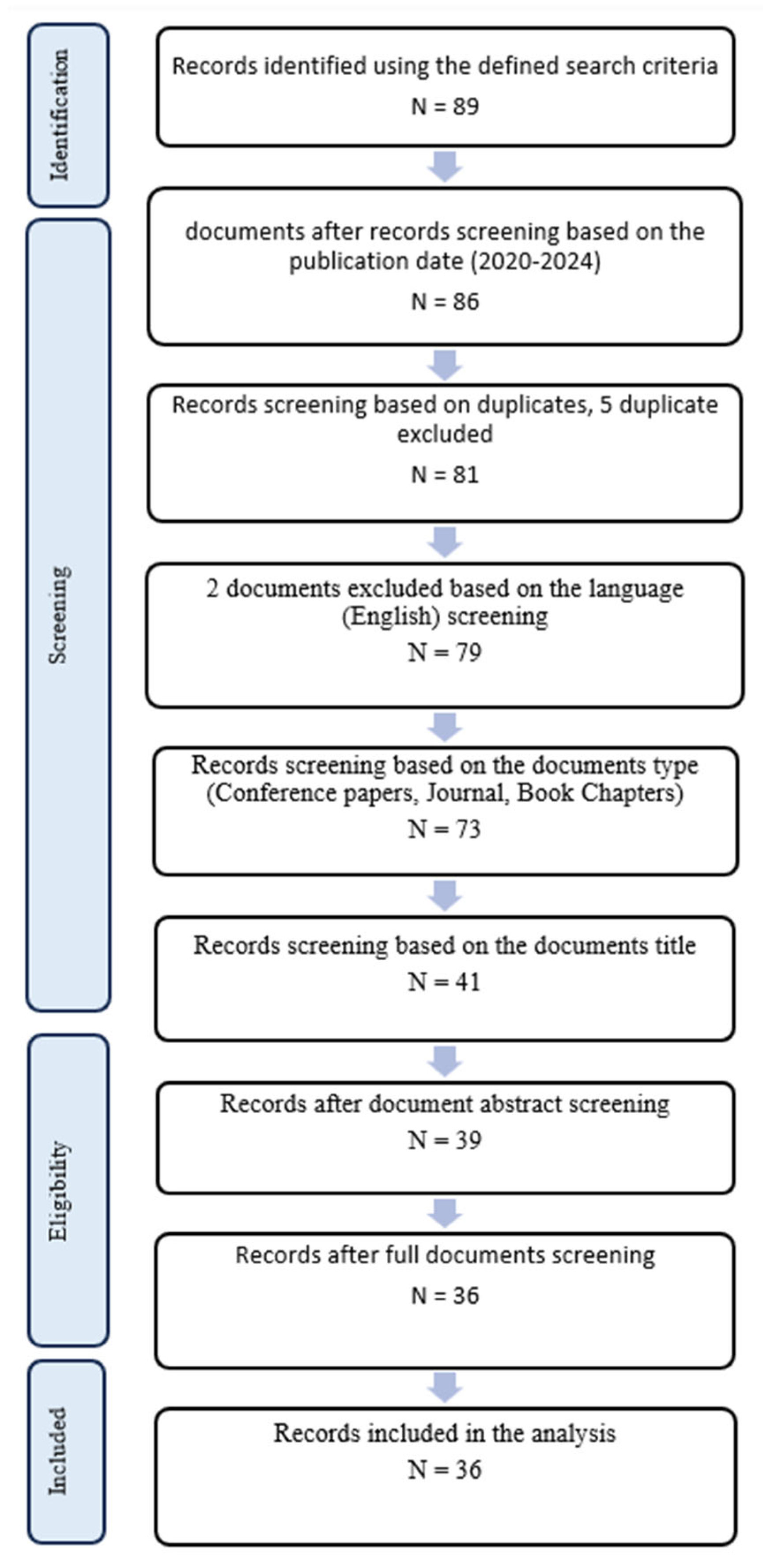
3.2.3. Eligibility Criteria
- i.
- Papers written in English;
- ii.
- Conference papers, journal papers, and book chapters;
- iii.
- Articles that applied deep reinforcement learning to intrusion detection;
- iv.
- Research published from 2020 to 2024.
- i.
- Papers written in a language other than English;
- ii.
- Papers that apply deep reinforcement learning to areas other than intrusion detection, as well as those that use machine learning techniques other than deep reinforcement learning for intrusion detection.
3.2.4. Resource Selection
- i.
- Remove duplicate records from the combined database search results.
- ii.
- Apply the inclusion and exclusion criteria to titles and abstracts to retain only potentially relevant articles.
- iii.
- Conduct full-text screening of the remaining articles to confirm their relevance to DRL-based intrusion detection.
- iv.
- Apply the quality assessment so that only documents that address the research questions are considered.
- v.
- Screen the reference lists of the included articles (backward snowballing) to identify additional relevant studies, and, where applicable, subject these additional records to the same screening and quality assessment steps (Steps i–v).
3.2.5. Quality Assessment Criteria
3.2.6. Data Extraction Process
3.2.7. Synthesis of Data Items
4. Results and Discussion
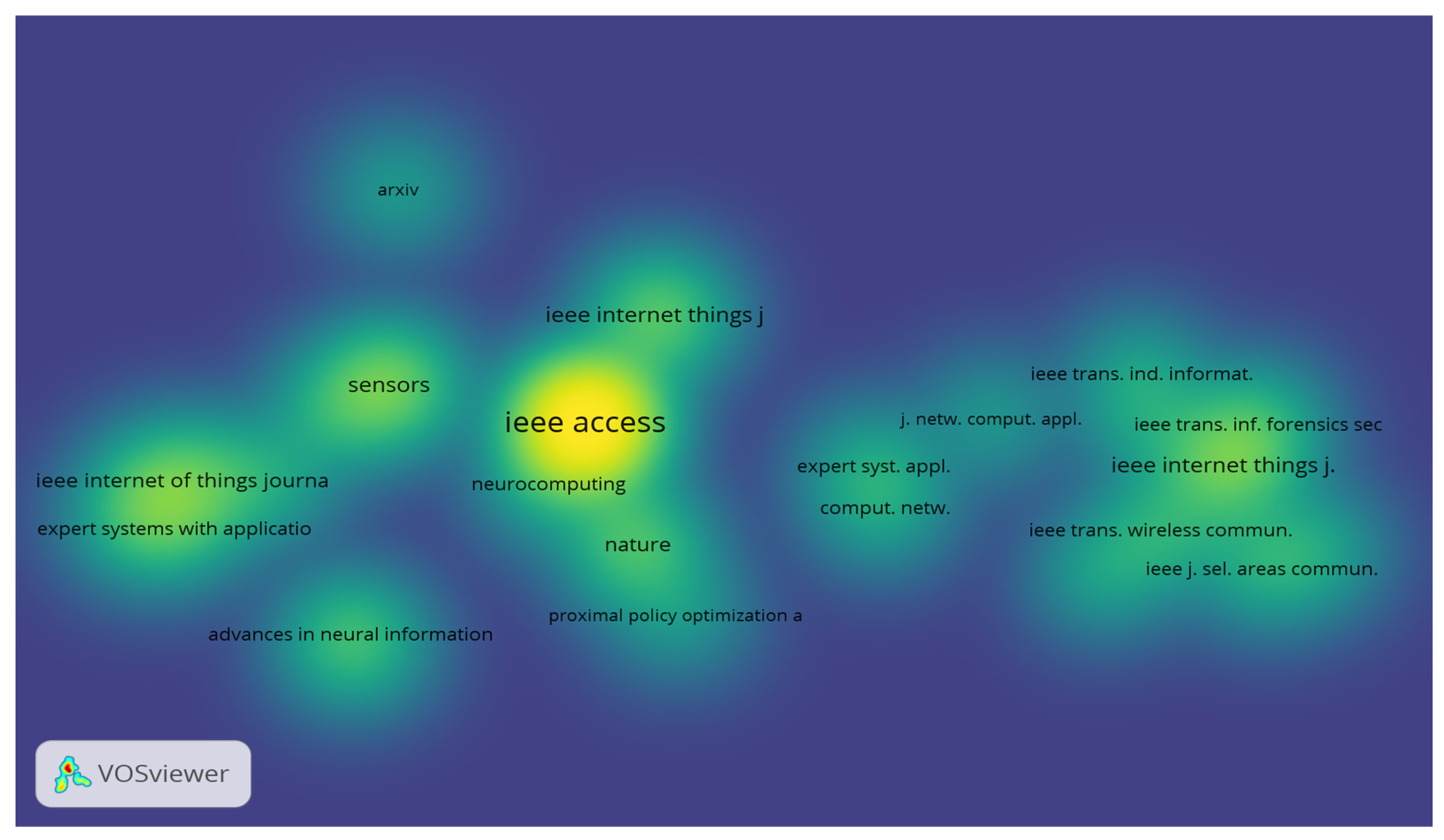
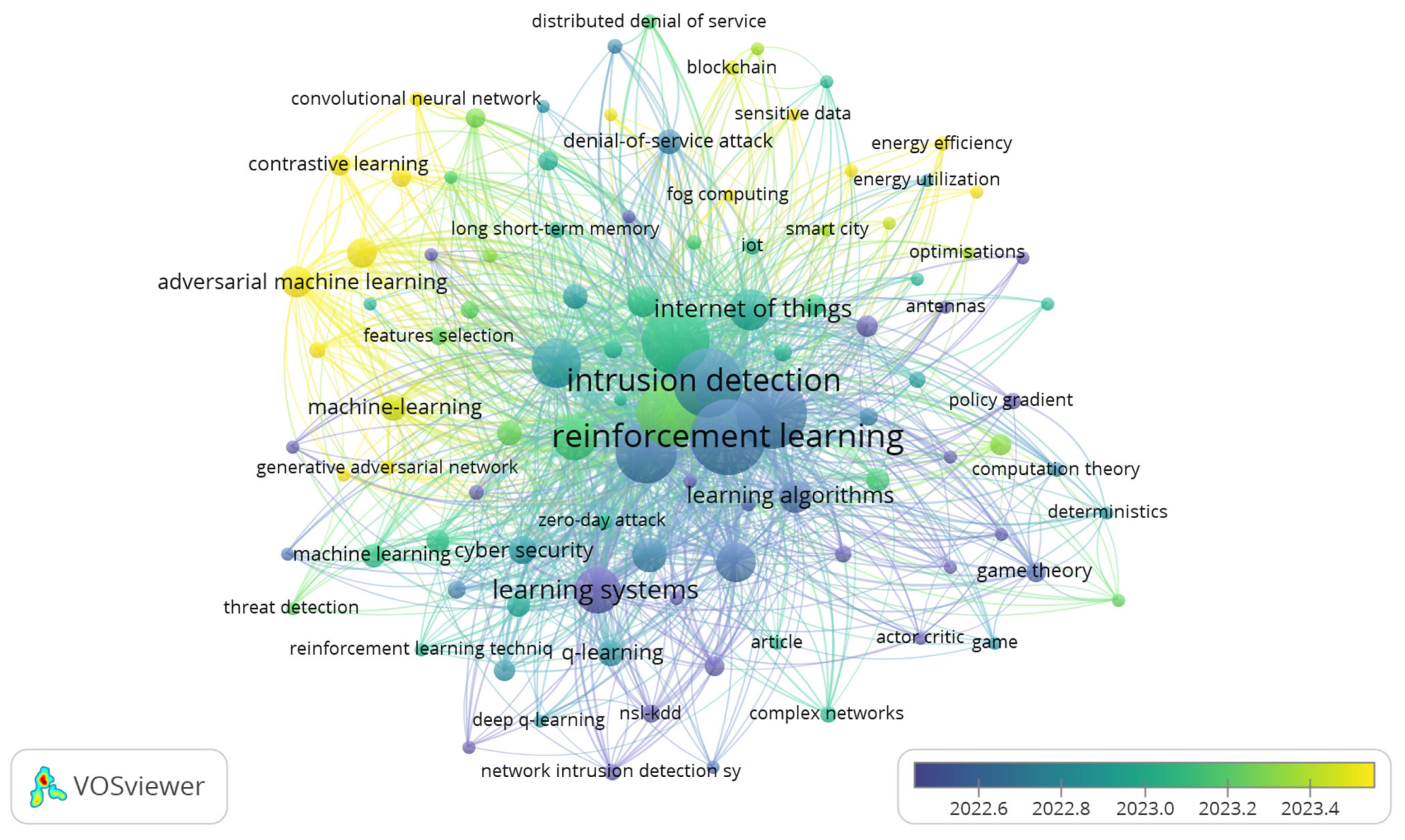
4.1. Bibliometric Results
4.2. Systematic Review Results
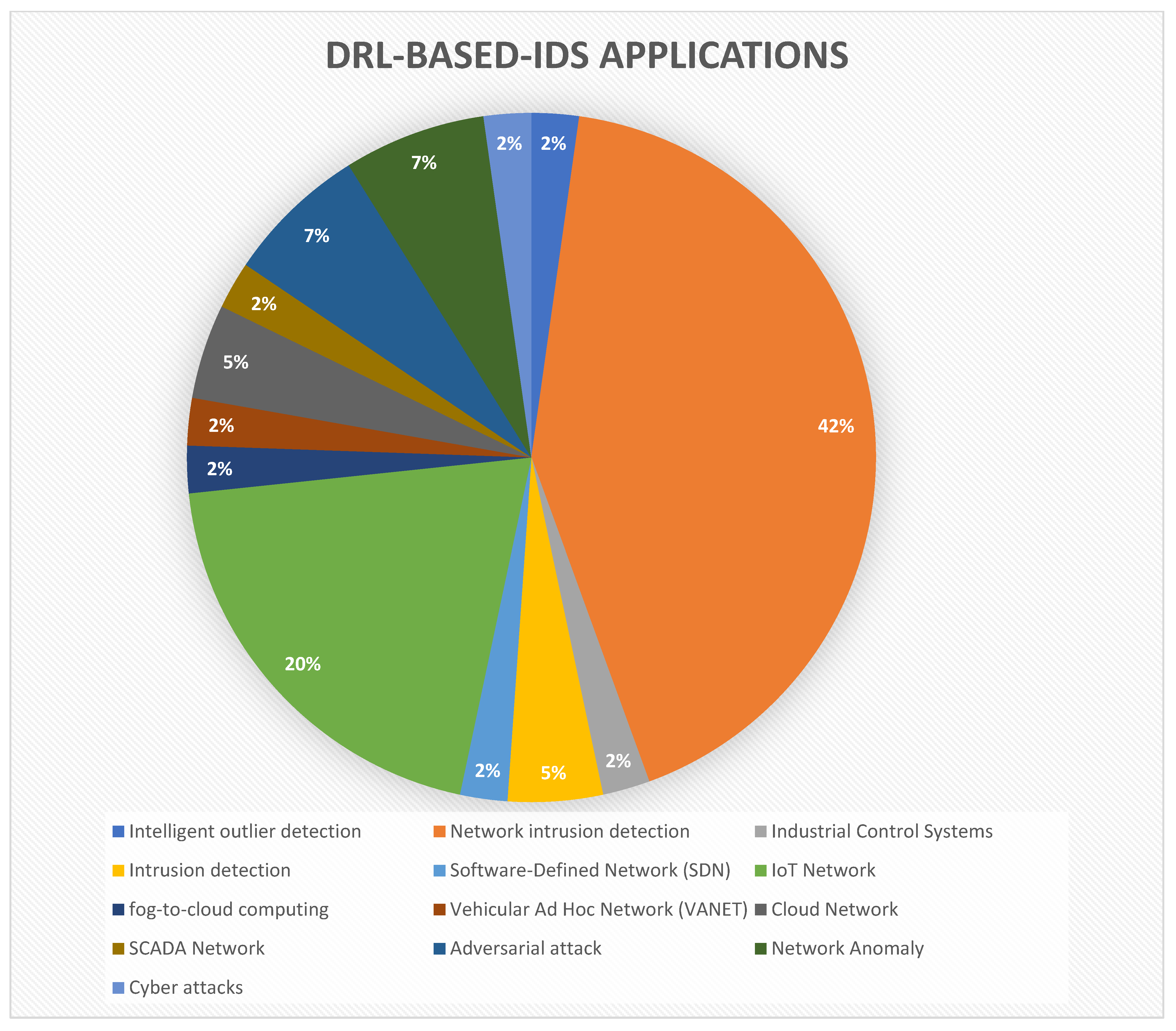
4.2.1. Applications of Intrusion Detection Systems (RQ1)
4.2.2. DRL Algorithms Utilized (RQ1)
Actor–Critic (AC) Algorithms
Proximal Policy Optimization 2 (PPO2)
Deep Q-Network, Double Deep Q-Network (DDQN), and Dueling Double Deep Q-Network (D3DQN)
Policy Gradient (PG)
Multi-Agent Reinforcement Learning (MARL)
Deep Neural Network (DNN)
Adversarial Reinforcement Learning (ARL)
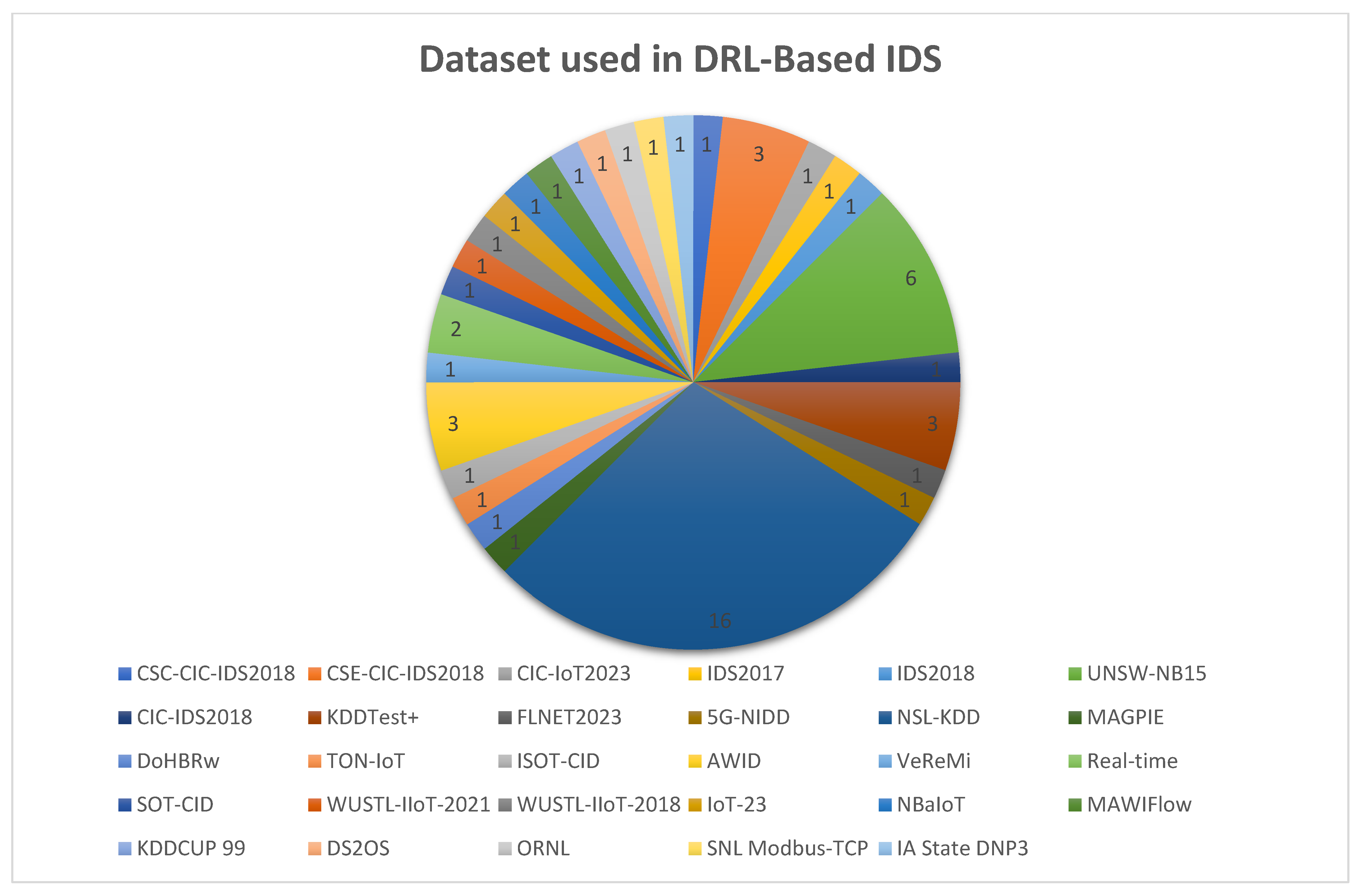
4.3. DRL Datasets Used and Performance Analysis of Deep Reinforcement Learning Algorithms (RQ2)
4.4. Research Gaps and Implications for Future DRL-Based IDS
5. Conclusions
Author Contributions
Funding
Institutional Review Board Statement
Informed Consent Statement
Data Availability Statement
Acknowledgments
Conflicts of Interest
References
- Goodman, M. Future Crimes: Inside the Digital Underground and the Battle for Our Connected World; Random House: New York, NY, USA, 2015. [Google Scholar]
- Achari, A. Cybersecurity in Cloud Computing; Educohack Press: Delhi, India, 2025. [Google Scholar]
- Pinto, L.; Davidson, J.; Sukthankar, R.; Gupta, A. Robust adversarial reinforcement learning. In Proceedings of the International Conference on Machine Learning; PMLR: Cambridge, MA, USA, 2017; pp. 2817–2826. [Google Scholar]
- Wang, X.; Qiao, Y.; Xiong, J.; Zhao, Z.; Zhang, N.; Feng, M.; Jiang, C. Advanced network intrusion detection with tabtransformer. J. Theory Pract. Eng. Sci. 2024, 4, 191–198. [Google Scholar] [CrossRef] [PubMed]
- Pitafi, S.; Anwar, T.; Widia, I.D.M.; Yimwadsana, B. Revolutionizing perimeter intrusion detection: A machine learning-driven approach with curated dataset generation for enhanced security. IEEE Access 2023, 11, 106954–106966. [Google Scholar] [CrossRef]
- Mallick, M.A.I.; Nath, R. Navigating the cyber security landscape: A comprehensive review of cyber-attacks, emerging trends, and recent developments. World Sci. News 2024, 190, 1–69. [Google Scholar]
- Zoppi, T.; Ceccarelli, A.; Capecchi, T.; Bondavalli, A. Unsupervised anomaly detectors to detect intrusions in the current threat landscape. ACM/IMS Trans. Data Sci. 2021, 2, 1–26. [Google Scholar] [CrossRef]
- Valencia-Arias, A.; González-Ruiz, J.D.; Flores, L.V.; Vega-Mori, L.; Rodríguez-Correa, P.; Santos, G.S. Machine learning and blockchain: A bibliometric study on security and privacy. Information 2024, 15, 65. [Google Scholar] [CrossRef]
- Tang, C.; Abbatematteo, B.; Hu, J.; Chandra, R.; Martín-Martín, R.; Stone, P. Deep reinforcement learning for robotics: A survey of real-world successes. In Proceedings of the AAAI Conference on Artificial Intelligence, Philadelphia, PA, USA, 25 February–4 March 2025; Volume 39, pp. 28694–28698. [Google Scholar]
- Hernández-Carlón, J.J.; Pérez-Romero, J.; Sallent, O.; Vilà, I.; Casadevall, F. A deep Q-network-based algorithm for multi-connectivity optimization in heterogeneous cellular-networks. Sensors 2022, 22, 6179. [Google Scholar] [CrossRef]
- Geng, X.; Zhang, B. Deep Q-network-based intelligent routing protocol for underwater acoustic sensor network. IEEE Sens. J. 2023, 23, 3936–3943. [Google Scholar] [CrossRef]
- Gök, M. Dynamic path planning via Dueling Double Deep Q-Network (D3QN) with prioritized experience replay. Appl. Soft Comput. 2024, 158, 111503. [Google Scholar] [CrossRef]
- Kumar, H.; Koppel, A.; Ribeiro, A. On the sample complexity of actor-critic method for reinforcement learning with function approximation. Mach. Learn. 2023, 112, 2433–2467. [Google Scholar] [CrossRef]
- Tiong, T.; Saad, I.; Teo, K.T.K.; Lago, H.B. Deep reinforcement learning with robust deep deterministic policy gradient. In Proceedings of the 2020 2nd International Conference on Electrical, Control and Instrumentation Engineering (ICECIE); IEEE: New York, NY, USA, 2020; pp. 1–5. [Google Scholar]
- Chen, D.; Chen, K.; Li, Z.; Chu, T.; Yao, R.; Qiu, F.; Lin, K. Powernet: Multi-agent deep reinforcement learning for scalable powergrid control. IEEE Trans. Power Syst. 2021, 37, 1007–1017. [Google Scholar] [CrossRef]
- Benaddi, H.; Ibrahimi, K.; Benslimane, A.; Jouhari, M.; Qadir, J. Robust enhancement of intrusion detection systems using deep reinforcement learning and stochastic game. IEEE Trans. Veh. Technol. 2022, 71, 11089–11102. [Google Scholar] [CrossRef]
- Umer, M.A.; Junejo, K.N.; Jilani, M.T.; Mathur, A.P. Machine learning for intrusion detection in industrial control systems: Applications, challenges, and recommendations. Int. J. Crit. Infrastruct. Prot. 2022, 38, 100516. [Google Scholar] [CrossRef]
- Aldallal, A.; Alisa, F. Effective intrusion detection system to secure data in cloud using machine learning. Symmetry 2021, 13, 2306. [Google Scholar] [CrossRef]
- Van Hasselt, H.P.; Guez, A.; Hessel, M.; Mnih, V.; Silver, D. Learning values across many orders of magnitude. arXiv 2016, arXiv:1602.07714. [Google Scholar] [CrossRef]
- Shen, S.; Cai, C.; Li, Z.; Shen, Y.; Wu, G.; Yu, S. Deep Q-network-based heuristic intrusion detection against edge-based SIoT zero-day attacks. Appl. Soft Comput. 2024, 150, 111080. [Google Scholar] [CrossRef]
- Suwannalai, E.; Polprasert, C. Network intrusion detection systems using adversarial reinforcement learning with deep Q-network. In Proceedings of the 2020 18th International Conference on ICT and Knowledge Engineering (ICT&KE); IEEE: New York, NY, USA, 2020; pp. 1–7. [Google Scholar]
- Zhu, Z.; Chen, M.; Zhu, C.; Zhu, Y. Effective defense strategies in network security using improved double dueling deep Q-network. Comput. Secur. 2024, 136, 103578. [Google Scholar] [CrossRef]
- Sangoleye, F.; Johnson, J.; Tsiropoulou, E.E. Intrusion detection in industrial control systems based on deep reinforcement learning. IEEE Access 2024, 12, 151444–151459. [Google Scholar] [CrossRef]
- Wang, Y.; Zou, S. Policy gradient method for robust reinforcement learning. In Proceedings of the International Conference on Machine Learning; PMLR: Cambridge, MA, USA, 2022; pp. 23484–23526. [Google Scholar]
- Louati, F.; Ktata, F.B.; Amous, I. Big-IDS: A decentralized multi agent reinforcement learning approach for distributed intrusion detection in big data networks. Clust. Comput. 2024, 27, 6823–6841. [Google Scholar] [CrossRef]
- Nassif, A.B.; Talib, M.A.; Nasir, Q.; Dakalbab, F.M. Machine learning for anomaly detection: A systematic review. IEEE Access 2021, 9, 78658–78700. [Google Scholar] [CrossRef]
- Arshad, K.; Ali, R.F.; Muneer, A.; Aziz, I.A.; Naseer, S.; Khan, N.S.; Taib, S.M. Deep reinforcement learning for anomaly detection: A systematic review. IEEE Access 2022, 10, 124017–124035. [Google Scholar] [CrossRef]
- Keele, S. Guidelines for Performing Systematic Literature Reviews in Software Engineering. Technical report, ver. 2.3 ebse Technical Report. ebse 2007. Available online: https://legacyfileshare.elsevier.com/promis_misc/525444systematicreviewsguide.pdf (accessed on 15 October 2025).
- Page, M.J.; Moher, D.; Bossuyt, P.M.; Boutron, I.; Hoffmann, T.C.; Mulrow, C.D.; Shamseer, L.; Tetzlaff, J.M.; Akl, E.A.; Brennan, S.E.; et al. PRISMA 2020 explanation and elaboration: Updated guidance and exemplars for reporting systematic reviews. Bmj 2021, 372, n160. [Google Scholar] [CrossRef]
- Nguyen, T.T.; Reddi, V.J. Deep reinforcement learning for cyber security. IEEE Trans. Neural Netw. Learn. Syst. 2021, 34, 3779–3795. [Google Scholar] [CrossRef] [PubMed]
- Sethi, K.; Rupesh, E.S.; Kumar, R.; Bera, P.; Madhav, Y.V. A context-aware robust intrusion detection system: A reinforcement learning-based approach. Int. J. Inf. Secur. 2020, 19, 657–678. [Google Scholar] [CrossRef]
- Priya, S.; PradeepMohankumar, K. Intelligent outlier detection with optimal deep reinforcement learning model for intrusion detection. In Proceedings of the 2021 4th International Conference on Computing and Communications Technologies (ICCCT); IEEE: New York, NY, USA, 2021; pp. 336–341. [Google Scholar]
- Wang, Z.; Wang, Y.; Xu, H.; Wang, Y. Effective anomaly detection based on reinforcement learning in network traffic data. In Proceedings of the 2021 IEEE 27th International Conference on Parallel and Distributed Systems (ICPADS); IEEE: New York, NY, USA, 2021; pp. 299–306. [Google Scholar]
- Su, Y.-J.; Wu, L.-C.; Chen, C.-H.; Chen, T.-Y. Combining Data Resampling and DRL Algorithm for Intrusion Detection. In Proceedings of the 2023 5th International Conference on Computer Communication and the Internet (ICCCI); IEEE: New York, NY, USA, 2023; pp. 47–51. [Google Scholar]
- Merzouk, M.A.; Delas, J.; Neal, C.; Cuppens, F.; Boulahia-Cuppens, N.; Yaich, R. Evading deep reinforcement learning-based network intrusion detection with adversarial attacks. In Proceedings of the 17th International Conference on Availability, Reliability and Security, Vienna, Austria, 23–26 August 2022; pp. 1–6. [Google Scholar]
- Tariq, Z.U.A.; Baccour, E.; Erbad, A.; Guizani, M.; Hamdi, M. Network intrusion detection for smart infrastructure using multi-armed bandit based reinforcement learning in adversarial environment. In Proceedings of the 2022 International Conference on Cyber Warfare and Security (ICCWS); IEEE: New York, NY, USA, 2022; pp. 75–82. [Google Scholar]
- He, M.; Wang, X.; Wei, P.; Yang, L.; Teng, Y.; Lyu, R. Reinforcement learning meets network intrusion detection: A transferable and adaptable framework for anomaly behavior identification. IEEE Trans. Netw. Serv. Manag. 2024, 21, 2477–2492. [Google Scholar] [CrossRef]
- Zolotukhin, M.; Kumar, S.; Hämäläinen, T. Reinforcement learning for attack mitigation in SDN-enabled networks. In Proceedings of the 2020 6th IEEE Conference on Network Softwarization (NetSoft); IEEE: New York, NY, USA, 2020; pp. 282–286. [Google Scholar]
- Sujatha, V.; Prasanna, K.L.; Niharika, K.; Charishma, V.; Sai, K.B. Network intrusion detection using deep reinforcement learning. In Proceedings of the 2023 7th International Conference on Computing Methodologies and Communication (ICCMC); IEEE: New York, NY, USA, 2023; pp. 1146–1150. [Google Scholar]
- Dang, Q.-V.; Vo, T.-H. Studying the Reinforcement Learning techniques for the problem of intrusion detection. In Proceedings of the 2021 4th International Conference on Artificial Intelligence and Big Data (ICAIBD); IEEE: New York, NY, USA, 2021; pp. 87–91. [Google Scholar]
- Bebortta, S.; Tripathy, S.S.; Sharma, V.; Behera, J.R.; Nayak, A. A Secure Deep Q-Reinforcement Learning Framework for Network Intrusion Detection in IoT-Fog Systems. In Proceedings of the 2024 OPJU International Technology Conference (OTCON) on Smart Computing for Innovation and Advancement in Industry 4.0; IEEE: New York, NY, USA, 2024; pp. 1–6. [Google Scholar]
- Rookard, C.; Khojandi, A. Applying deep reinforcement learning for detection of Internet-of-Things cyber attacks. In Proceedings of the 2023 IEEE 13th Annual Computing and Communication Workshop and Conference (CCWC); IEEE: New York, NY, USA, 2023; pp. 0389–0395. [Google Scholar]
- Vadigi, S.; Sethi, K.; Mohanty, D.; Das, S.P.; Bera, P. Federated reinforcement learning based intrusion detection system using dynamic attention mechanism. J. Inf. Secur. Appl. 2023, 78, 103608. [Google Scholar] [CrossRef]
- Hsu, Y.-F.; Matsuoka, M. A deep reinforcement learning approach for anomaly network intrusion detection system. In Proceedings of the 2020 IEEE 9th International Conference on Cloud Networking (CloudNet); IEEE: New York, NY, USA, 2020; pp. 1–6. [Google Scholar]
- Ren, K.; Zeng, Y.; Zhong, Y.; Sheng, B.; Zhang, Y. MAFSIDS: A reinforcement learning-based intrusion detection model for multi-agent feature selection networks. J. Big Data 2023, 10, 137. [Google Scholar] [CrossRef]
- Li, Z.; Huang, C.; Deng, S.; Qiu, W.; Gao, X. A soft actor-critic reinforcement learning algorithm for network intrusion detection. Comput. Secur. 2023, 135, 103502. [Google Scholar] [CrossRef]
- Benaddi, H.; Ibrahimi, K.; Benslimane, A.; Qadir, J. A deep reinforcement learning based intrusion detection system (drl-ids) for securing wireless sensor networks and internet of things. In Proceedings of the International Wireless Internet Conference; Springer: Berlin/Heidelberg, Germany, 2019; pp. 73–87. [Google Scholar]
- Najafli, S.; Haghighat, A.T.; Karasfi, B. A novel reinforcement learning-based hybrid intrusion detection system on fog-to-cloud computing. J. Supercomput. 2024, 80, 26088–26110. [Google Scholar] [CrossRef]
- Sharma, A.; Singh, M. Batch reinforcement learning approach using recursive feature elimination for network intrusion detection. Eng. Appl. Artif. Intell. 2024, 136, 109013. [Google Scholar] [CrossRef]
- Sultana, R.; Grover, J.; Tripathi, M. Intelligent defense strategies: Comprehensive attack detection in VANET with deep reinforcement learning. Pervasive Mob. Comput. 2024, 103, 101962. [Google Scholar] [CrossRef]
- Santos, R.R.D.; Viegas, E.K.; Santin, A.O.; Cogo, V.V. Reinforcement learning for intrusion detection: More model longness and fewer updates. IEEE Trans. Netw. Serv. Manag. 2022, 20, 2040–2055. [Google Scholar] [CrossRef]
- Sethi, K.; Kumar, R.; Prajapati, N.; Bera, P. Deep reinforcement learning based intrusion detection system for cloud infrastructure. In Proceedings of the 2020 International Conference on COMmunication Systems & NETworkS (COMSNETS); IEEE: New York, NY, USA, 2020; pp. 1–6. [Google Scholar]
- Ren, K.; Wang, M.; Zeng, Y.; Zhang, Y. An unmanned network intrusion detection model based on deep reinforcement learning. In Proceedings of the 2022 IEEE International Conference on Unmanned Systems (ICUS); IEEE: New York, NY, USA, 2022; pp. 1070–1076. [Google Scholar]
- Raj, N.N.; Rajesh, R.; Justin, A.; Shihab, F. Enhancing Network Intrusion Detection Using Deep Reinforcement Learning: An Adaptive Learning Approach. In Proceedings of the International Conference on Emerging Trends in Communication, Computing and Electronics; Springer: Berlin/Heidelberg, Germany, 2018; pp. 297–315. [Google Scholar]
- Alavizadeh, H.; Alavizadeh, H.; Jang-Jaccard, J. Deep Q-learning based reinforcement learning approach for network intrusion detection. Computers 2022, 11, 41. [Google Scholar] [CrossRef]
- Benaddi, H.; Jouhari, M.; Ibrahimi, K.; Othman, J.B.; Amhoud, E.M. Anomaly detection in industrial IoT using distributional reinforcement learning and generative adversarial networks. Sensors 2022, 22, 8085. [Google Scholar] [CrossRef]
- Dong, S.; Xia, Y.; Peng, T. Network abnormal traffic detection model based on semi-supervised deep reinforcement learning. IEEE Trans. Netw. Serv. Manag. 2021, 18, 4197–4212. [Google Scholar] [CrossRef]
- Tharewal, S.; Ashfaque, M.W.; Banu, S.S.; Uma, P.; Hassen, S.M.; Shabaz, M. Intrusion detection system for industrial Internet of Things based on deep reinforcement learning. Wirel. Commun. Mob. Comput. 2022, 2022, 9023719. [Google Scholar] [CrossRef]
- Ren, K.; Zeng, Y.; Cao, Z.; Zhang, Y. ID-RDRL: A deep reinforcement learning-based feature selection intrusion detection model. Sci. Rep. 2022, 12, 15370. [Google Scholar] [CrossRef] [PubMed]
- Mesadieu, F.; Torre, D.; Chennamaneni, A. Leveraging deep reinforcement learning technique for intrusion detection in SCADA infrastructure. IEEE Access 2024, 12, 63381–63399. [Google Scholar] [CrossRef]
- Baby, R.; Pooranian, Z.; Shojafar, M.; Tafazolli, R. A heterogenous IoT attack detection through deep reinforcement learning: A dynamic ML approach. In Proceedings of the ICC 2023-IEEE International Conference on Communications; IEEE: New York, NY, USA, 2023; pp. 479–484. [Google Scholar]
- Sethi, K.; Kumar, R.; Mohanty, D.; Bera, P. Robust adaptive cloud intrusion detection system using advanced deep reinforcement learning. In Proceedings of the International Conference on Security, Privacy, and Applied Cryptography Engineering; Springer: Berlin/Heidelberg, Germany, 2020; pp. 66–85. [Google Scholar]
- Geo Francis, E.; Sheeja, S. Enhanced intrusion detection in wireless sensor networks using deep reinforcement learning with improved feature extraction and selection. Multimed. Tools Appl. 2025, 84, 11943–11982. [Google Scholar] [CrossRef]
- Jia, Y.; Zhou, X.Y. Policy gradient and actor-critic learning in continuous time and space: Theory and algorithms. J. Mach. Learn. Res. 2022, 23, 1–50. [Google Scholar] [CrossRef]
- Bahdanau, D.; Brakel, P.; Xu, K.; Goyal, A.; Lowe, R.; Pineau, J.; Courville, A.; Bengio, Y. An Actor-Critic Algorithm for Sequence Prediction. arXiv 2016, arXiv:1607.07086. [Google Scholar]
- Duan, J.; Wang, W.; Xiao, L.; Gao, J.; Li, S.E.; Liu, C.; Zhang, Y.Q.; Cheng, B.; Li, K. Distributional soft actor-critic with three refinements. IEEE Trans. Pattern Anal. Mach. Intell. 2025, 47, 3935–3946. [Google Scholar] [CrossRef]
- Sutton, R.S.; Barto, A.G. Reinforcement learning: An introduction; MIT Press: Cambridge, MA, USA, 1998. [Google Scholar]
- Schulman, J.; Wolski, F.; Dhariwal, P.; Radford, A.; Klimov, O. Proximal Policy Optimization Algorithms. arXiv 2017, arXiv:1707.06347. [Google Scholar] [CrossRef]
- Van Hasselt, H.; Guez, A.; Silver, D. Deep reinforcement learning with double q-learning. In Proceedings of the AAAI Conference on Artificial Intelligence, Phoenix, AZ, USA, 12–17 February 2016; Volume 30. [Google Scholar]
- Wang, Z.; Schaul, T.; Hessel, M.; Hasselt, H.; Lanctot, M.; Freitas, N. Dueling network architectures for deep reinforcement learning. In Proceedings of the International Conference on Machine Learning; PMLR: Cambridge, MA, USA, 2016; pp. 1995–2003. [Google Scholar]
- Lopez-Martin, M.; Carro, B.; Sanchez-Esguevillas, A. Application of deep reinforcement learning to intrusion detection for supervised problems. Expert. Syst. Appl. 2020, 141, 112963. [Google Scholar] [CrossRef]
- Zhang, K.; Yang, Z.; Başar, T. Multi-agent reinforcement learning: A selective overview of theories and algorithms. Handb. Reinf. Learn. Control 2021, 325, 321–384. [Google Scholar]
- Albrecht, S.V.; Christianos, F.; Schäfer, L. Multi-Agent Reinforcement Learning: Foundations and Modern Approaches; MIT Press: Cambridge, MA, USA, 2024. [Google Scholar]
- Ghani, H.; Virdee, B.; Salekzamankhani, S. A deep learning approach for network intrusion detection using a small features vector. J. Cybersecur. Priv. 2023, 3, 451–463. [Google Scholar] [CrossRef]
- Zhang, H.; Chen, H.; Xiao, C.; Li, B.; Liu, M.; Boning, D.; Hsieh, C.J. Robust deep reinforcement learning against adversarial perturbations on state observations. Adv. Neural Inf. Process. Syst. 2020, 33, 21024–21037. [Google Scholar]



| Results | Number of Papers | Paper ID |
|---|---|---|
| Below 10 | 3 | Excluded |
| 11 | 1 | SS7 |
| 12 | 1 | SS21 |
| 13 | 5 | SS22, SS24, SS28, SS30, SS31 |
| 14 | 4 | SS1, SS8, SS25, SS27 |
| 15 | 5 | SS16, SS17, SS20, SS33, SS35 |
| 16 | 6 | SS2, SS3, SS4, SS10, SS11, SS29 |
| 17 | 4 | SS14, SS18, SS34, SS36 |
| 18 | 2 | SS19, SS23 |
| 19 | 3 | SS6, SS13, SS26 |
| 20 | 5 | SS5, SS9, SS12, SS15, SS32 |
| Paper ID | Title | Source | Type | Year | Reference |
|---|---|---|---|---|---|
| SS1 | “Intelligent outlier detection with optimal deep reinforcement learning model for intrusion detection” | IEEE | Conf. | 2021 | [32] |
| SS2 | “Effective Anomaly Detection Based on Reinforcement Learning in Network Traffic Data” | IEEE | Conf. | 2021 | [33] |
| SS3 | “Combining Data Resampling and DRL Algorithm for Intrusion Detection” | IEEE | Conf. | 2023 | [34] |
| SS4 | “Evading deep reinforcement learning-based network intrusion detection with adversarial attacks” | ACM | Conf. | 2022 | [35] |
| SS5 | “Network intrusion detection for smart infrastructure using multi-armed bandit based reinforcement learning in adversarial environment” | IEEE | Conf. | 2022 | [36] |
| SS6 | “Network intrusion detection systems using adversarial reinforcement learning with deep Q-network” | IEEE | Conf. | 2020 | [21] |
| SS7 | “Reinforcement learning meets network intrusion detection: A transferable and adaptable framework for anomaly behavior identification” | IEEE | Jour. | 2024 | [37] |
| SS8 | “Reinforcement learning for attack mitigation in SDN-enabled networks” | IEEE | Conf. | 2020 | [38] |
| SS9 | “Network intrusion detection using deep reinforcement learning” | IEEE | Conf. | 2023 | [39] |
| SS10 | “Studying the Reinforcement Learning techniques for the problem of intrusion detection” | IEEE | Conf. | 2021 | [40] |
| SS11 | “A Secure Deep Q-Reinforcement Learning Framework for Network Intrusion Detection in IoT-Fog Systems” | IEEE | Conf. | 2024 | [41] |
| SS12 | “Applying deep reinforcement learning for detection of internet-of-things cyber attacks” | IEEE | Conf. | 2023 | [42] |
| SS13 | “Federated reinforcement learning based intrusion detection system using dynamic attention mechanism” | Elsevier | Jour. | 2023 | [43] |
| SS14 | “A deep reinforcement learning approach for anomaly network intrusion detection system” | IEEE | Conf. | 2020 | [44] |
| SS15 | “MAFSIDS: a reinforcement learning-based intrusion detection model for multi-agent feature selection networks” | Springer | Jour. | 2023 | [45] |
| SS16 | “A soft actor-critic reinforcement learning algorithm for network intrusion detection” | Elsevier | Jour. | 2023 | [46] |
| SS17 | “A deep reinforcement learning based intrusion detection system (drl-ids) for securing wireless sensor networks and internet of things” | Springer | Conf. | 2020 | [47] |
| SS18 | “A novel reinforcement learning-based hybrid intrusion detection system on fog-to-cloud computing” | Springer | Jour. | 2024 | [48] |
| SS19 | “Batch reinforcement learning approach using recursive feature elimination for network intrusion detection” | Elsevier | Jour. | 2024 | [49] |
| SS20 | “Intelligent defense strategies: Comprehensive attack detection in VANET with deep reinforcement learning” | Elsevier | Jour. | 2024 | [50] |
| SS21 | “Reinforcement learning for intrusion detection: More model longness and fewer updates” | IEEE | Jour. | 2023 | [51] |
| SS22 | “Robust enhancement of intrusion detection systems using deep reinforcement learning and stochastic game” | IEEE | Jour. | 2022 | [16] |
| SS23 | “Deep reinforcement learning based intrusion detection system for cloud infrastructure” | IEEE | Conf. | 2020 | [52] |
| SS24 | “An unmanned network intrusion detection model based on deep reinforcement learning” | IEEE | Conf. | 2022 | [53] |
| SS25 | “Enhancing Network Intrusion Detection Using Deep Reinforcement Learning: An Adaptive Learning Approach” | Springer | Conf. | 2024 | [54] |
| SS26 | “Deep Q-learning based reinforcement learning approach for network intrusion detection” | MDPI | Jour. | 2022 | [55] |
| SS27 | “Anomaly detection in industrial IoT using distributional reinforcement learning and generative adversarial networks” | MDPI | Jour. | 2022 | [56] |
| SS28 | “Network abnormal traffic detection model based on semi-supervised deep reinforcement learning” | IEEE | Jour. | 2021 | [57] |
| SS29 | “Intrusion detection system for industrial Internet of Things based on deep reinforcement learning” | Wiley | Jour. | 2022 | [58] |
| SS30 | “ID-RDRL: a deep reinforcement learning-based feature selection intrusion detection model” | PubMed | Jour. | 2022 | [59] |
| SS31 | “Intrusion Detection in Industrial Control Systems Based on Deep Reinforcement Learning” | IEEE | Jour. | 2024 | [23] |
| SS32 | “Leveraging Deep Reinforcement Learning Technique for Intrusion Detection in SCADA Infrastructure” | IEEE | Jour. | 2024 | [60] |
| SS33 | “A heterogenous IoT attack detection through deep reinforcement learning: a dynamic ML approach” | IEEE | Conf. | 2023 | [61] |
| SS34 | “Robust adaptive cloud intrusion detection system using advanced deep reinforcement learning” | Springer | Conf. | 2020 | [62] |
| SS35 | “A context-aware robust intrusion detection system: a reinforcement learning-based approach” | Springer | Jour. | 2020 | [31] |
| SS36 | “Enhanced intrusion detection in wireless sensor networks using deep reinforcement learning with improved feature extraction and selection” | Springer | Jour. | 2024 | [63] |
| Application | Number of Studies | Paper ID |
|---|---|---|
| Intelligent outlier detection | 1 | SS1 |
| Network intrusion detection | 19 | SS2, SS3, SS4, SS6, SS9, SS11, SS13, SS14, SS15, SS16, SS19, SS21, SS22, SS23, SS24, SS26, SS30, SS35 |
| Industrial control systems | 1 | SS31 |
| Intrusion detection | 2 | SS7, SS10 |
| Software-defined network (SDN) | 1 | SS8 |
| IoT network | 9 | SS5, SS11, SS12, SS17, SS25, SS27, SS29, SS33, SS36 |
| Fog-to-cloud computing | 1 | SS18 |
| Vehicular ad hoc network (VANET) | 1 | SS20 |
| Cloud network | 2 | SS23, SS34 |
| SCADA network | 1 | SS32 |
| Adversarial attack | 3 | SS4, SS5, SS6 |
| Network anomaly | 3 | SS7, SS14, SS27, SS28 |
| Cyber attacks | 1 | SS12 |
| Paper ID | Proposed DRL Algorithm | Intrusion Detection Application |
|---|---|---|
| SS1 | Intelligent outlier detection with optimal deep reinforcement learning (IOD-ODRL) | Intrusion detection (ID) |
| SS2 | Convolutional neural networks (CNNs) | Intrusion detection systems (IDSs) |
| SS3 | Deep Q-network (DQN) | Intrusion detection system (IDS) |
| SS4 | Deep Q-network (DQN) | Intrusion detection system (IDS), adversarial attack |
| SS5 | Multi-armed Bandit (MAB) algorithm | Network intrusion detection (NID) |
| SS6 | Multi-agent reinforcement learning (MARL), adversarial reinforcement learning (ARL), deep Q-learning (DQN) | Anomaly-based network intrusion detection system (NIDS) |
| SS7 | Proximal policy optimization 2 (PPO2) | Anomaly behavior identification intrusion detection |
| SS8 | Deep Q-network (DQN), proximal policy optimization (PPO) | Network software-defined network (SDN) |
| SS9 | Multi-agent reinforcement learning (MARL), adversarial reinforcement learning (ARL), deep Q-learning (DQN) | Network intrusion detection |
| SS10 | Deep Q-network (DQN), double deep Q-network (DDQN), policy gradient (PG), actor–critic (AC) | Intrusion detection in a network |
| SS11 | Deep Q-reinforcement learning (DQRL) | Network intrusion detection in IoT-fog systems |
| SS12 | Deep Q-network (DQN) | Network intrusion detection system on IoT systems |
| SS13 | Q-learning, deep Q-learning | Network intrusion detection |
| SS14 | Deep reinforcement learning—deep Q-network (DRL-DQN) | Anomaly network intrusion detection system |
| SS15 | Deep Q-network (DQN) | Network traffic intrusion detection |
| SS16 | Stacked autoencoder–soft actor–critic (SA-AC) | Network intrusion detection |
| SS17 | Deep Q-network (DQN), deep reinforcement learning-based IDS (DRL-IDS) | Wireless sensor networks and Internet of Things |
| SS18 | Deep Q-network (DQN) | Intrusion detection system (IDS) on fog-to-cloud computing |
| SS19 | Deep Q-network (DQN) | Network traffic |
| SS20 | Deep Q-network (DQN) | Attack detection in VANET |
| SS21 | Q-learning—new IDS | Intrusion detection on network traffic |
| SS22 | Deep reinforcement learning-based IDS (DRL-IDS) | Intrusion detection systems |
| SS23 | Deep-Q-network (DQN) | Intrusion detection system for cloud infrastructure |
| SS24 | Deep Q-network (DQN) | Network IDS |
| SS25 | Deep Q-network (DQN) | Wireless sensor network (WSN) and Internet of Things (IoT) |
| SS26 | Deep Q-learning (DQL), deep neural network (DNN) | Network intrusion detection |
| SS27 | Distributional reinforcement learning (distributional—RL), generative adversarial network (GAN) | IoT network |
| SS28 | Semi-supervised double deep Q-network (SSDDQN) | Network abnormal traffic detection |
| SS29 | Double deep Q-network (DDQN), deep Q-network (DQN) | Intrusion detection system for Industrial IoT |
| SS30 | Recursive feature elimination with DT (DT + RFE) and DQD + RFE | Network intrusion detection |
| SS31 | Deep Q-network (DQN) and double deep Q-network (DDQN), dueling double deep Q-network (D3QN), actor–critic (AC), proximal policy optimization (PPO) | Intrusion detection for industrial control systems |
| SS32 | Actor–critic (AC), deep-Q-network (DQN) | Intrusion detection in SCADA network |
| SS33 | Deep neural network (DNN), deep reinforcement learning—intrusion detection system (DRL-IDS) | Heterogeneous IoT attack detection |
| SS34 | Double deep Q-network (DDQN) | Cloud intrusion detection system |
| SS35 | Multiple independent deep reinforcement learning (MI-DRL) | Robust intrusion detection system |
| SS36 | Deep reinforcement learning-based intrusion detection (DRL-IDS) | Intrusion detection in wireless sensor networks |
| Paper ID | Proposed DRL Algorithm | Dataset | Performance Metrics | Value or Comparison | Limitations |
|---|---|---|---|---|---|
| SS1 | Intelligent outlier detection with optimal deep reinforcement learning (IOD-ODRL) | UNSW-NB15 | Detection Rate | 95.29% | Lack of generalization to unseen attacks |
| Accuracy | 96.10% | ||||
| FPR | 5.30% | ||||
| SS2 | Convolutional neural networks (CNNs) | 5G-NIDD | Accuracy | 0.98 | Limited scalability to large-scale networks |
| FLNET2023 | Accuracy | 1.00 | |||
| SS3 | Deep Q-network (DQN) | UNSW-NB15 | Accuracy | 78% | The use of static datasets does not represent the full context or metadata |
| SS4 | Fast gradient sign method (FGSM), basic iterative method (BIM), adversarial attacks | NSL-KDD | Accuracy | 84.81% | Large deterioration in detection performance when adversarial attacks are used |
| F1-score | 84.09% | ||||
| SS5 | Multi-armed Bandit (MAB) algorithm | MAGPIE | Accuracy | 0.749 | Poor performance on adversarial networks |
| Recall | 0.780 | ||||
| Precision | 0.787 | ||||
| FPR | 0.281 | ||||
| SS6 | Multi-agent reinforcement learning (MARL), adversarial reinforcement learning (ARL), deep Q-learning (DQN) | KDDTest+ | Accuracy | 80% | Poor performance in a changing environment |
| F1 score | 79% | ||||
| SS7 | Proximal policy optimization 2 (PPO2) | IDS2017, IDS2018, NSL-KDD, UNSW-NB15, CIC-IoT2023 | Accuracy | Higher accuracy compared to alternative models | Limited application of multi-agent systems in the framework. Low accuracy of multi-classification and slow model training. |
| SS8 | Deep Q-network (DQN), proximal policy optimization (PPO) | Real-time | Ability to detect threads | Able to detect anomalies in the network | Further investigations needed for a bigger network environment. Not evaluated on real malware samples. |
| SS9 | Multi-Agent reinforcement learning (MARL), adversarial reinforcement learning (ARL), deep Q-learning (DQN) | NSL-KDD, KDDTest+ | F1 Score | 79% | Low intrusion detection performance against dynamic attacks. |
| Accuracy | 80% | ||||
| SS10 | Deep Q-network (DQN), double deep Q-network (DDQN), policy gradient (PG), actor–critic (AC) | DoHBRw | Accuracy | 0.9999 | Not tested on offline settings |
| DQN—Accuracy | 0.934 | ||||
| DDQN—Accuracy | 0.933 | ||||
| PG—Accuracy | 0.91 | ||||
| AC—Accuracy | 0.89 | ||||
| SS11 | Deep Q-reinforcement Learning (DQRL) | NSL-KDD | Latency | Low | Vulnerability to adversarial environments |
| Precision | High | ||||
| Energy efficiency | High | ||||
| SS12 | Deep Q-network (DQN) | TON-IoT | Accuracy | 0.7969 | Low performance |
| Precision | 0.7678 |
Disclaimer/Publisher’s Note: The statements, opinions and data contained in all publications are solely those of the individual author(s) and contributor(s) and not of MDPI and/or the editor(s). MDPI and/or the editor(s) disclaim responsibility for any injury to people or property resulting from any ideas, methods, instructions or products referred to in the content. |
© 2026 by the authors. Licensee MDPI, Basel, Switzerland. This article is an open access article distributed under the terms and conditions of the Creative Commons Attribution (CC BY) license.
Share and Cite
Mpoporo, L.J.; Owolawi, P.A.; Tu, C. Deep Reinforcement Learning Algorithms for Intrusion Detection: A Bibliometric Analysis and Systematic Review. Appl. Sci. 2026, 16, 1048. https://doi.org/10.3390/app16021048
Mpoporo LJ, Owolawi PA, Tu C. Deep Reinforcement Learning Algorithms for Intrusion Detection: A Bibliometric Analysis and Systematic Review. Applied Sciences. 2026; 16(2):1048. https://doi.org/10.3390/app16021048
Chicago/Turabian StyleMpoporo, Lekhetho Joseph, Pius Adewale Owolawi, and Chunling Tu. 2026. "Deep Reinforcement Learning Algorithms for Intrusion Detection: A Bibliometric Analysis and Systematic Review" Applied Sciences 16, no. 2: 1048. https://doi.org/10.3390/app16021048
APA StyleMpoporo, L. J., Owolawi, P. A., & Tu, C. (2026). Deep Reinforcement Learning Algorithms for Intrusion Detection: A Bibliometric Analysis and Systematic Review. Applied Sciences, 16(2), 1048. https://doi.org/10.3390/app16021048