1. Introduction
Ceramic materials are widely recognized for their exceptional mechanical strength, high hardness, wear resistance and thermal stability [
1], which make them highly suitable for demanding applications in various sectors such as aerospace, automotive, biomedical engineering and electronics [
2]. Despite these advantages, traditional ceramic processing techniques, such as hand throwing, die pressing, and slip casting, are associated with several limitations. These include long processing cycles, high tooling costs and low flexibility for complex geometries [
3,
4,
5].
In recent years, Additive Manufacturing (AM) has emerged as a disruptive technology with the potential to overcome many of the limitations of conventional ceramic processing [
6,
7]. AM encompasses a group of processes that build parts layer-by-layer directly from a digital 3D model, without the need for intermediate tooling. This manufacturing philosophy allows for a high degree of design freedom, rapid prototyping, and the economical production of small or highly customized series. AM is particularly advantageous for ceramic applications that require complex internal structures, integrated functionalities, or frequent design modifications [
8,
9,
10].
Several AM processes have been developed for the manufacturing of polymer materials due to their high processability, low melting points, and compatibility with a wide range of printing technologies [
2,
8]. Subsequent advancements enabled the adaptation of AM technologies to metal fabrication, addressing numerous challenges associated with material melting, solidification control, and structural integrity [
2,
9]. However, the extension of AM processes to ceramic materials has been significantly more complex due to the intrinsic difficulties of these materials, such as high sintering temperatures, brittle facture behavior and the need for thermal postprocessing [
8,
11].
Despite these difficulties, significant progress has been made in the development of AM technologies for ceramic materials in recent years [
12,
13]. Various AM techniques have been adapted for ceramic processing, enabling the manufacturing of complex prototypes and highly customizable ceramic products in low-volume productions [
3,
8]. Among the most prominent AM techniques applied to ceramics are stereolithography (SLA), selective laser sintering (SLS), direct ink writing (DIW), and binder jetting (BJT), among others [
11,
12,
13].
Material extrusion-based (MEX-AM) processes are being increasingly used due to their unique characteristics. Derived from Fused Deposition Modeling (FDM), highly used in the manufacturing of polymer materials products, these methods offer a cost-effective alternative due to their relatively low equipment and operating costs, while still enabling the production of parts with complex geometries and tailored properties [
4,
10].
In parallel, the concepts of Circular Economy (CE) and Circular Design (CD) have gained traction as a systemic response to the environmental and economic limitations of the linear “take–make–dispose” industrial model. CE and CD aim to minimize resource consumption and waste generation by promoting durability, reuse and recycling [
14]. In this context, AM has been recognized as a promising enabler of CE strategies due to its potential to reduce material waste, support decentralized production, extend product life through spare part fabrication and facilitate design for disassembly, reparability and maintenance [
15,
16].
However, the specific intersection between ceramic AM and CE principles remains underexplored. Current research in ceramic AM has predominantly focused on technological development, material performance and application-specific requirements, with little holistic consideration of environmental sustainability or circularity metrics. There is a lack of integrated assessments considering the life cycle impacts, recyclability of ceramic feedstocks, energy consumption during processing and end-of-life strategies for AM-produced ceramic components [
17]. This knowledge is essential for the industrial adoption of this technology. Therefore, this work aims to address the current gap in the integration of ceramic MEX-AM and CE by providing coherent tools and strategies to embed and assess the sustainability of these processes.
2. Methods
The aim of this work is to provide an updated and comprehensive overview of additive manufacturing technologies for ceramic materials, with a particular focus on extrusion-based processes (MEX-AM). To this end, a structured literature review was conducted, examining peer-reviewed publications available up to September 2025 and synthesizing recent advances, emerging trends and current limitations in the field. Building on this literature base, we apply a comparative analytical framework designed to identify and characterize the most relevant ceramic AM techniques, their operational principles, material requirements and technical performance metrics.
Moreover, an extensive analysis of MEX-AM technical characteristics, challenges and sustainability burdens has been conducted. This work presents an innovative perspective on sustainable extrusion-based ceramic AM production, therefore contributing to a foundation for future interdisciplinary efforts that may bridge the technological and strategic gaps between ceramic AM and Circular Economy paradigms. The review also identifies key research gaps and outlines a set of strategies that may enhance the sustainability performance of ceramic material extrusion-based additive manufacturing (MEX-AM).
This work lies in offering a coherent, methodologically grounded synthesis that integrates existing knowledge while proposing a unified perspective for assessing the maturity, applicability and sustainability of ceramic AM technologies. By combining a structured review methodology with a comparative evaluation, this work aims to clarify the relative strengths and constraints of current approaches and to support researchers and practitioners in selecting, optimizing, and further developing ceramic AM processes, particularly those based on material extrusion.
This work is divided into three parts: the first one describes the most significant ceramic AM processes; the second focuses on extrusion-based ceramic AM processes; and the third outlines the opportunities and challenges of ceramic MEX-AM regarding sustainability, highlights key aspects to be considered and discusses how these aspects can be related to CE underlying principles. Moreover, directions for future research are provided.
4. Extrusion-Based Additive Manufacturing Technologies
Extrusion-based additive manufacturing (MEX-AM) comprises a family of AM processes that fabricate components by depositing material layer by layer through controlled extrusion. In this approach, the feedstock is extruded through a nozzle and successive layers are precisely deposited to build the final geometry [
32,
33].
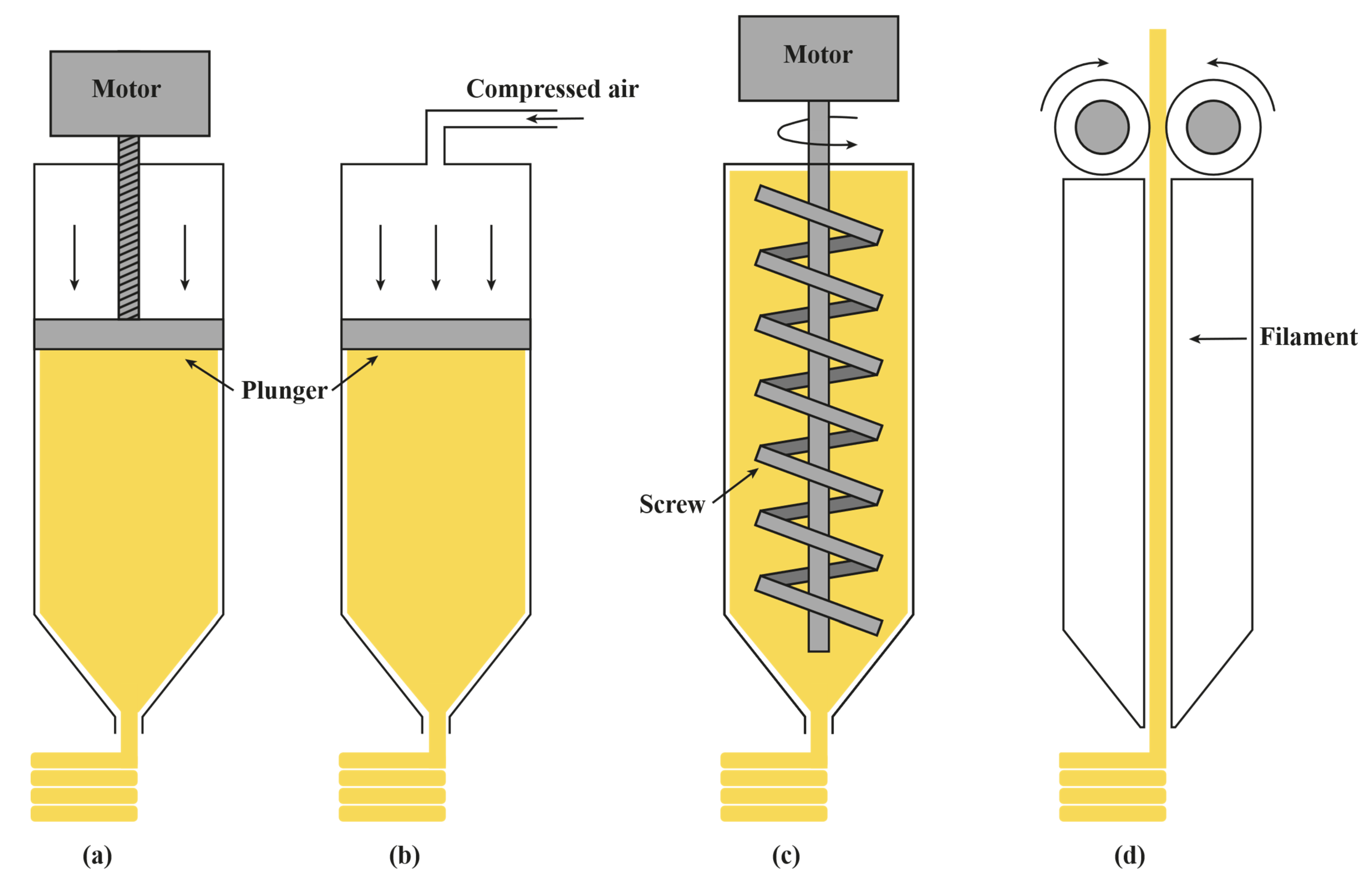
Depending on the extrusion mechanism, MEX-AM systems can be categorized into plunger- or ram-based extrusion, screw-based extrusion, and filament-based extrusion (see
Figure 1). In plunger-based extrusion, the material is forced through the nozzle by the linear displacement of a piston, which may be actuated mechanically, typically through a worm gear or pneumatically using compressed air. This configuration enables the processing of highly viscous ceramic pastes and offers straightforward operation, although flow rate control is comparatively limited and may exhibit pulsation effects depending on the system [
1,
3].
Screw-based extrusion relies on a rotating screw to transport, homogenize and pressurize the feedstock before deposition. This mechanism supports continuous and stable material flow, provides improved control over extrusion rate and facilitates the processing of feedstocks with higher solids content or more challenging rheological behavior. Moreover, the mixing action of the screw contributes to improved dispersion of ceramic particles, which can be advantageous for advanced ceramic formulations [
4].
Filament-based extrusion, by contrast, follows the same operational principle as polymer FDM and is typically employed with thermoplastic filaments highly loaded with ceramic particles. In this approach, the filament is driven into a heated liquefier, where the binder softens and allows material deposition. While filament-based systems offer high precision and ease of handling, they require specialized filament manufacturing and are therefore more constrained by feedstock availability and composition compared with paste-based approaches [
20,
34].
One of the most common technologies under the MEX-AM category includes Direct Ink Writing (DIW) [
3]. DIW utilizes highly viscous ceramic inks as feedstock material, consisting of ceramic powders dispersed in a solvent-binder system [
13,
21,
35]. These inks are designed to exhibit non-Newtonian, shear-thinning behavior, with controlled rheological properties that ensure the manufacturing of dense ceramic bodies [
35,
36]. The ink is extruded through a nozzle and the material is deposited layer-by-layer on the working bed [
12,
35]. The shear-thinning properties of the material give it enough structural integrity to self-support and maintain shape after deposition. This enables the manufacturing of freestanding structures, including high-aspect-ratio walls and spanning features, without the necessity of support materials [
3]. Following the printing stage, components undergo debinding and sintering to remove binder agents and achieve final densification [
13].
Similarly to FDM-produced parts, the quality of MEX-AM objects, such as surface roughness, dimensional accuracy and density, depend on the parameters of the manufacturing process and the feedstock used [
2]. Flow control is a key parameter in extrusion-based technologies. Flow control is determined by printing speed, extrusion pressure, nozzle diameter, layer height and material properties, among others [
32].
Ceramic feedstock used in MEX-AM processes generally displays non-Newtonian flow characteristics. Therefore, the feedstock properties are critical. Rheological characterization is indispensable for adjusting printing parameters and mitigating common defects such as nozzle blockages [
4,
6,
9,
35]. Successful feedstock material must present shear-thinning pseudoelastic behavior, allowing it to flow under applied pressure and rapidly regain shape post-deposition, a characteristic related to yield strength and stiffness of the material [
3,
35]. This behavior enables the manufacturing of suspended, self-supporting geometries with high-aspect-ratio features [
3].
A well formulated feedstock ensures that during the extrusion the shear stress in the interior nozzle exceeds the yield stress and the fluid flows. Once the material is extruded, shear stress drops and the fluid behaves as a viscoelastic solid, preserving its geometry during and after printing. To ensure dimensional accuracy, the feedstock material should be homogeneous, with ideally small ceramic particles. Vibratory sieving is employed to remove larger agglomerates and uniform the slurry texture and density, preventing air entrapment. Advanced formulations incorporate tailored additives that modulate rheological performance [
3].
The printed component is initially referred to as a green part, as it requires one or more post-processing steps to achieve its final properties. These post-processing stages are irreversible, as they modify the material’s chemical composition and mechanical response, generally enhancing strength while concurrently increasing brittleness [
2,
13]. When advanced feedstocks incorporating additives or binders such as thermoplastic polymers or waxes are utilized, a debinding stage is necessary. This step involves a controlled thermal treatment in which the organic binders are removed via pyrolysis [
37]. In contrast, conventional non-additivated ceramic pastes typically do not require debinding, as their formulation contains minimal or no organic binders.
Following debinding, densification is accomplished through sintering, a high-temperature thermal process. The objective of sintering is to enhance the density of the components through diffusion-driven particle coalescence. Achieving optimal densification and microstructural development requires full control of the processing atmosphere, temperature, holding zone and heating and cooling rates [
37].
Producing defect-free, near-net-shape ceramic parts with adequate surface finish, dimensional accuracy and mechanical properties remains a technical challenge. Several issues can arise during and after the manufacturing of ceramic parts, which still constrain the scalability and industrial adoption of ceramic AM [
24].
One of the most significant issues is the presence of porosity and voids, which limit the mechanical properties and application of manufactured parts. Porosity may arise from multiple sources. During feedstock preparation and handling, particularly while mixing the material or loading it into the extrusion barrel, air can become entrapped within the mixture. If the feedstock viscosity and extrusion pressure are not properly controlled, these air bubbles may not be expelled during deposition and can remain within the printed part [
21,
24]. Moreover, inadequate printing parameters, such as extrusion pressure and printing speed, can cause the apparition of interlayer porosity [
2,
24]. Interlayer porosity can disrupt the isotropy of the component, leading to variations in wall thickness that may subsequently promote crack formation during repeated heating and cooling cycles. In addition, these thickness variations can also favor the development of intergranular porosity, as non-uniform densification during sintering generates local temperature and shrinkage gradients within the part [
21].
Another significant issue is the appearance of cracks. Cracks typically arise from the buildup of internal stress from temperature gradients during drying, debinding or sintering [
2,
24]. Moreover, irregularities in the part, such as voids and uneven wall thickness, may increase the likelihood of crack formation. Furthermore, during drying, cracks frequently arise due to capillary forces generated as liquid evaporates from the porous green body. As humidity is removed, surface tension within the remaining liquid phase induces compressive stresses in the capillary network. If these stresses exceed the mechanical strength of the partially dried material, cracking will occur. This effect is particularly pronounced in geometries with thin walls or non-uniform cross-sections, where drying rates differ locally.
Shrinkage during drying and sintering can also produce defects in the final part. As mentioned before, uneven drying and temperature gradients will affect the final quality of the part [
2]. Shrinkage is intrinsic to ceramic sintering and can be substantial, typically ranging from 10% to 20% depending on the formulation and the particle packing density of the feedstock. If shrinkage is not uniform, due to non-homogeneous feedstock distribution, variations in layer thickness or temperature gradients dimensional inaccuracies, warpage and internal stresses may occur [
24]. Moreover, uneven shrinkage can produce cracks, as well as interlayer separation due to the internal stress of the part and poor interlayer adhesion [
21].
Together, these issues underscore the need for precise control of feedstock formulation, extrusion parameters, green-body handling and thermal post-processing in order to achieve reliable, high-performance ceramic components through MEX-AM. Heating and cooling cycles are essential, as well as sintering and other thermal processes.
Importantly, these same process sensitivities highlight the relevance of integrating sustainability principles into ceramic MEX-AM, as improvements in feedstock efficiency, thermal management and process optimization can simultaneously enhance component performance and reduce environmental burdens. The following sections will examine the environmental burdens associated with this technology and provide a critical discussion on how ceramic MEX-AM can be effectively integrated into broader sustainable practices.
5. Sustainability Integration in Ceramic MEX-AM Processes
The evolution of industrial systems under Industry 4.0 has introduced significant technological advancements, enhancing production efficiency and operational flexibility [
38]. Recent research has increasingly emphasized the importance of integrating sustainability within manufacturing processes, highlighting the need for modern production to not only optimize performance but also mitigate environmental impact, preserve natural resources and ensure social and economic viability across product lifecycles [
39]. In this context, AM has emerged as a key enabler in the transition towards sustainable production paradigms and Circular Economy (CE) models. The increasing urgency to address environmental degradation and the unsustainable depletion of natural resources has prompted a global shift away from linear economic models. This traditional paradigm, based on a take-make-dispose system, has proven environmentally and economically unsustainable [
14,
40,
41]. Subsequently, CE has emerged as a regenerative alternative, aiming to retain the value of products and materials withing the economic cycle through strategies such as reuse, remanufacturing and recycling [
16,
40,
41].
5.1. Sustainability Considerations of Ceramic MEX-AM
In the context of Industry 4.0, ceramic MEX-AM has become a relevant digital manufacturing route due to its capacity to fabricate components directly from CAD models through controlled material extrusion. Unlike mold-based ceramic processing, MEX-AM deposits material only where needed, which can reduce raw material losses and improve resource efficiency under appropriate process conditions [
3,
17]. Its compatibility with small-batch and on-demand production also allows manufacturing to occur closer to the point of use, potentially lowering the logistical requirements and inventory volumes typically associated with conventional ceramic manufacturing chains [
42].
From an environmental perspective, the layer-wise deposition characteristic of MEX-AM enables geometries that would be difficult or highly wasteful to produce with traditional forming techniques, contributing to efficient use of ceramic feedstocks [
17]. In extrusion-based systems, unused material, particularly in the case of aqueous pastes or simple clay formulations without organic additives, can often be recovered and reused prior to sintering, which supports partial material circularity. However, this advantage is strongly dependent on feedstock composition; advanced formulations containing binders are far more limited in recyclability, and their preparation entails additional upstream impacts associated with powder processing and binder synthesis [
43]. Furthermore, although MEX-AM itself generally operates at relatively low printing temperatures, it remains reliant on thermally intensive post-processing stages, especially sintering, which constitute the dominant share of the environmental burden of the route.
Economically, the digital workflow characteristic of MEX-AM can shorten lead times between design and prototyping, and its ability to consolidate certain geometries into single printed parts may reduce tooling needs compared with conventional ceramic processing [
44]. These effects can lower production costs in specific use cases, particularly when complex geometries or low-volume batches are required. At the same time, the economic benefits of MEX-AM are moderated by the cost of thermal equipment, the energy requirements of debinding and sintering and the potential losses associated with defects formed during printing or post-processing.
From a socio-technical standpoint, the relatively accessible equipment used in many MEX-AM systems enables integration into small laboratories, educational settings and decentralized facilities, supporting broader participation in ceramic manufacturing activities [
45]. Nevertheless, operator exposure to particulates, VOCs from binder pyrolysis and high-temperature furnaces underscores the need for appropriate safety protocols and ventilation systems.
Overall, while ceramic MEX-AM presents several sustainability-oriented opportunities, such as reduced material waste before sintering, on-demand production, and simplified geometric fabrication, it entails a series of environmental burdens that must be addressed.
5.2. Sustainability Burdens of Ceramic MEX-AM
Ceramic MEX-AM presents various sustainability burdens that arise from the characteristics of its materials, processing requirements and overall manufacturing efficiency. Its environmental impact is shaped by the interplay between feedstock formulation, the thermal post-processing steps required to achieve full densification and the rate at which defect-free components can be produced.
A major sustainability concern is the energy intensity of thermal post-processing, particularly sintering. Sintering requires prolonged heating at temperatures typically between 1200 and 1700 °C (or 800–1100 °C for low-temperature sintering routes), often sustained for several hours [
20]. This stage constitutes the dominant portion of the process’s total energy demand [
46]. Although sintering is a universal requirement across most ceramic manufacturing methods, its contribution to the environmental footprint of ceramic MEX-AM is worrying. Practices such as furnace underloading, long heating ramps and conservative dwell times further increase energy consumption per part.
In addition, the debinding process, necessary for advanced ceramic feedstocks containing organic binders, introduces further sustainability challenges. Debinding is itself energy-demanding and relies on pyrolysis to eliminate organic binders. This decomposition releases combustion gases and VOCs, contributing to localized emissions and necessitating adequate ventilation or filtration to prevent environmental contamination [
47]. Beyond environmental concerns, improper handling of off-gases poses potential health risks for operators, particularly in poorly ventilated environments. Moreover, heat losses through insulation during debinding or sintering can also increase energy consumption.
Defect formation constitutes another indirect yet substantial sustainability burden. Defects such as porosity, voids, delamination and cracking significantly reduce part yield. Each defective component represents a loss of raw material, machine time and energy, particularly when failures occur after extensive thermal post-processing. Residual porosity or voids that remain undetected in the green body can lead to cracking during sintering, resulting in the scrapping of a part after considerable energetic investment.
Beyond processing, material recycling remains highly problematic in ceramic MEX-AM. Once a ceramic feedstock, particularly an advanced binder-based formulation, undergoes any thermal process, its rheological properties are irreversibly altered, rendering it unsuitable for reuse. For filament-based systems, recycling is even more constrained: filaments loaded with ceramic particles cannot be easily remelted or re-extruded without degrading binder properties, particle dispersion or ceramic loading uniformity [
20,
34]. As a result, unused filament segments, support structures and failed prints often become non-recyclable waste.
A further sustainability consideration is the inherent paradox of promoting circularity in a process defined by irreversible material transformations. Ceramic manufacturing, whether additive or conventional, relies on irreversible thermochemical reactions that permanently alter the structure and properties of the feedstock. Once a green body has undergone debinding or sintering, it cannot be reprocessed, remelted or reconstituted into a new feedstock, as its phase composition, porosity, grain structure and mechanical behavior have fundamentally changed. This irreversibility stands in tension with circular-economy principles, which prioritize material recirculation, remanufacturing and closed-loop resource flows. In ceramic MEX-AM, this paradox is intensified by the difficulty of recycling unused or partially processed feedstock and by the high energy cost associated with each manufacturing cycle.
In summary, the sustainability burdens of ceramic MEX-AM are closely tied to its reliance on high-temperature post-processing, its feedstock compositions and the efficiency with which defect-free components can be manufactured.
6. Strategies and Tools for Sustainability in Ceramic MEX-AM
The integration of sustainability principles into ceramic MEX-AM represents a strategic imperative for advancing environmentally responsible production within the ceramic industry. This requires the adoption of tools and methodologies capable of assessing and improving the environmental performance of the process across its life cycle, from raw material selection to end-of-life management of components [
14].
Feedstock optimization. Feedstock optimization plays a central role in improving the environmental and functional performance of ceramic MEX-AM, as the composition and rheology of the material directly influence energy demand and defect formation.
A first key aspect involves the selection and reduction of organic binders, which are commonly used in both thermoplastic filaments and paste-based formulations to provide cohesion, flexibility and adequate extrusion flow. High binder fractions, however, increase the energy required for pyrolysis and lead to the release of volatile organic compounds and combustion by-products, needing additional ventilation or filtration systems. Replacing conventional petroleum-based polymers with low-VOC binders, bio-derived polymers or inorganic gel-forming systems can significantly reduce emissions during debinding. Likewise, minimizing the overall binder content, while preserving sufficient mechanical integrity of the green body, reduces both mass loss and gas generation during thermal decomposition, thereby lowering the risk of cracking and internal porosity [
48,
49]. Non-additivated paste-based feedstock is preferred.
Rheological control is equally critical, particularly for paste-based systems. Effective control of viscosity, yield stress and behavior is necessary to ensure stable extrusion, minimize entrapped air and reduce defect formation. The use of aqueous-based formulations could offer sustainability advantages, as water can be removed at low energy cost and without harmful emissions, unlike organic binders.
Ceramics recycling and repurposing. The recycling of ceramics is highly challenging due to their irreversible nature after being exposed to thermal processes. Pastes and clay-based formulations that contain minimal or no organic additives can often be recovered from failed prints, reconditioned and reintroduced into the process prior to sintering. This contrasts with thermoplastic or heavily modified advanced ceramic feedstocks, which are generally not recyclable once partially processed or contaminated. Designing feedstocks for reusability and low-impact disposal therefore enhances material efficiency and reduces the environmental burdens associated with powder synthesis and binder production. However, the recycling of green ceramics parts is not undemanding. Unfired feedstock must be rehydrated and homogenized before being incorporated into the production cycle. The presence of gradients in moisture content, localized binder depletion or non-uniform particle packing complicates their reintegration into fresh feedstock. Reintroducing such materials without prior conditioning can disrupt rheological stability, alter viscoelastic behavior, and compromise extrusion reliability.
Binder degradation also represents a critical barrier. During extrusion and shaping, organic binders may undergo partial thermal, mechanical or oxidative degradation. When green bodies are remixed into new feedstock, degraded binders negatively affect plasticity, green strength and the stability of filament or paste flow [
49]. Contamination is another significant issue. Green bodies may incorporate debris from the build chamber, residues from release agents or small quantities of dried material from previous cycles. Even minor contaminants can act as stress concentrators or interfere with particle rearrangement during sintering, increasing the likelihood of porosity or cracking in the final component.
One route involves the reconditioning of recycled material through controlled rehydration or re-plasticization, allowing restoration of the required rheological properties. This can be complemented by partial binder replenishment, in which a calibrated amount of fresh binder is added to compensate for thermal or mechanical degradation during prior processing steps. Establishing optimal replenishment ratios through rheological characterization enables consistent extrusion behavior [
50].
From a process-engineering perspective, the establishment of tiered recycling loops can help maintain quality. Green bodies with minor defects may be reintegrated into the main feedstock stream after minimal conditioning, whereas highly degraded material may be diverted to secondary applications (e.g., support materials, low-performance components). This hierarchical approach could contribute to the maximization of material recovery while preventing quality dilution.
Post-sintering recycling is mainly limited to downcycling strategies. Sintered rejects or end-of-life components can be mechanically crushed to obtain ceramic granulate for applications of reduced functional demand, such as refractory filler, abrasive media or aggregate in composite materials [
51,
52]. Although energy consumption for milling is non-negligible, its impact is substantially lower than the production of primary ceramic powders. Nevertheless, the incorporation of recycled ceramic particulates into new MEX-AM feedstocks is still challenging: the irregular morphology, broadened particle-size distribution, and lower sinterability of crushed ceramics tend to compromise extrusion rheology and densification behavior, making their use viable only at low substitution ratios.
Therefore, circularity must rely on alternative strategies that extend product lifetimes rather than attempting full material reprocessing. By integrating reliability considerations at the design stage, such as stress minimization through topology optimization, crack-resistant geometries, graded structures or the use of sacrificial features that mitigate localized stress concentrations, components can achieve longer service lives and reduced failure rates [
51]. Design for longevity can contribute to enhanced durability, which can lower material consumption at the system level, as fewer replacements are required across the product lifecycle [
14].
Complementing this, design for remanufacturing provides an additional circular strategy with higher feasibility than material recycling for sintered ceramics [
14]. Although ceramics cannot be reshaped, components can in some cases be refurbished through localized repair, such as the deposition of compatible ceramic pastes or coatings or the replacement of modular subcomponents specifically designed for easy disassembly. The geometric flexibility of MEX-AM supports the fabrication of repair-enabling features, alignment interfaces, accessible surfaces or geometries that accommodate future joining or overlay processes. These designs facilitate partial recovery of functionality without discarding the entire component.
Debinding and sintering optimization. Debinding and sintering constitute the most energy-intensive and environmentally consequential stages of ceramic MEX-AM [
51]. Their optimization is therefore essential not only for improving part quality but also for reducing the overall ecological footprint of the process [
53].
As mentioned before, adjustments in feedstock formulation, for example, by selecting binders with lower degradation temperatures or reducing total binder content, may lessen the energy demand associated with pyrolysis and reduce the volume of gaseous emissions released during heating. Optimization efforts generally aim to achieve sufficient densification while mitigating defect formation and reducing excessive energy use. Refined thermal schedules, including controlled heating and cooling ramps or multi-stage temperature plateaus, may encourage homogeneous diffusion-driven particle coalescence and lower the risk of thermal stresses that contribute to cracking. Atmospheric control, whether through inert, oxidizing or reducing conditions, can also influence grain growth, porosity evolution, and the stability of phases during firing.
One potential approach involves optimizing furnace utilization, for example, by maximizing load capacity so that more parts are processed simultaneously, reducing the energy consumed per component. Selecting furnaces that match the production scale could also help avoid unnecessary energy waste. Smaller furnaces may be more suitable for low-volume production, whereas larger units could be reserved for batch operations. Additionally, recovering residual heat from the furnace after sintering or debinding could be investigated to preheat other batches or to support upstream drying steps, potentially lowering overall energy demand. Moreover, strategies such as grouping parts with similar geometries or thermal requirements in the same batch could enhance energy efficiency, ensuring that heating is more uniform and reducing localized over- or under-firing.
The interplay between debinding and sintering directly affects part quality. Defects originating in the green body may propagate or intensify during high-temperature treatment, leading to part rejection at advanced processing stages. Such failures carry a notable sustainability burden, as the energy invested in printing, debinding and partial sintering is effectively lost. For this reason, strategies that stabilize binder removal, promote controlled densification and reduce thermal stresses are relevant not only for improving component reliability but also for limiting material waste and unnecessary energy consumption. While the degree of achievable optimization depends on the specific ceramic formulation, feedstock architecture and furnace capabilities, advances in thermal management, binder chemistry and sintering control could offer pathways toward more efficient and environmentally conscious ceramic MEX-AM workflows.
Sustainability indicators. Advancing the sustainability of ceramic MEX-AM requires coordinated efforts across multiple dimensions, including the development of environmentally responsible raw material and processing routes aimed at reducing ecological burdens, as well as strategies to enhance energy efficiency. A comprehensive life cycle perspective of the manufacturing process is essential, using the systematic application of Life Cycle Assessment (LCA) methodologies to account for impacts associated with raw material extraction, pre-processing, transportation, component use and end-of-life management [
15,
39]. Implementing advanced process control, modular machine design and the integration of LCA tools can enable real-time monitoring and continuous improvement of environmental performance, ultimately aligning MEX-AM with the principles of sustainable manufacturing.
In this context, the use of sustainability indicators can provide a structured framework to evaluate and guide improvements in ceramic MEX-AM processes. These instruments aim to assess products, processes or services by tracking their associated costs, as well as their environmental and social impacts, while identifying areas for improvement across their entire life cycle. Life Cycle Thinking (LCT) represents an emerging paradigm that advocates for the comprehensive consideration of all life cycle stages, ranging from design and implementation to distribution, prior to the development of a product [
54].
In order to measure the degree of sustainability of ceramic MEX-AM, it is necessary to establish adequate indicators. A wide range of indicators has been proposed in the literature. Among them, the most adequate for this technology are:
However, the large number of existing sustainability indicators, assessment methods and sustainability tools can hinder the effective integration of sustainability principles withing ceramic MEX-AM processes. The diversity of approaches often results in fragmented evaluations that complicate the establishment of standardized sustainability criteria. In this context, Multi-Criteria Decision-Making (MCDM) methods offer valuable tools for selecting materials, processes and systems in AM by evaluating alternatives across multiple criteria, such as mechanical performance, cost, energy consumption and environmental impact [
60,
61]. Integrating MCDM with sustainability frameworks can enhance AM’s contribution to sustainable development, particularly in areas where such evaluations are not yet fully established. Moreover, it can facilitate the integration of sustainability data-driven tools in industrial contexts, enabling and making LCA strategies more accessible in manufacturing frameworks. However, it should be noted that each process and industrial context is unique, and the specific conditions under which these strategies are to be applied must be carefully considered in order to develop a realistic and affective implementation plan.
However, to systematically apply these metrics, the development of a dedicated sustainability assessment framework for ceramic MEX-AM is necessary. Such a framework would standardize data collection, define relevant performance indicators and establish benchmarks for comparing different process configurations, materials and post-processing strategies. By linking indicators to specific process steps, it would enable the identification of environmental hotspots and prioritize interventions that can maximize resource efficiency and minimize emissions.
7. Future Work
Future research in the sustainability integration of ceramic MEX-AM should address several critical gaps that currently limit its industrial maturity and environmental performance. A first line of inquiry concerns feedstock formulation, particularly the need to understand how variations in binder chemistry, solid loading, rheology and additive content influence not only printability and defect formation but also emissions, debinding temperatures, overall energy demand and recycling. Future studies could examine whether alternative, lower-impact binder systems or reduced binder contents are feasible without compromising extrusion stability or part quality.
A second research direction involves debinding and sintering optimization, especially given their central contribution to the environmental burden of ceramic MEX-AM. Important questions include how thermal profiles can be adapted to minimize energy consumption while maintaining adequate densification and whether residual heat recovery, improved furnace loading strategies or scaled furnace selection can produce meaningful efficiency gains.
Another critical area relates to defect formation and its sustainability implications. Porosity, voids, interlayer adhesion issues, and sintering-induced cracks not only compromise mechanical performance but also result in discarded parts, increasing material waste and cumulative energy expenditure. Research is needed to better quantify the mechanisms linking printing parameters, feedstock handling and thermal treatment to defect evolution.
The challenges associated with recycling and circularity in ceramics also warrant further examination. In particular, the recycling of unfired green bodies remains poorly understood and questions persist regarding the feasibility of reprocessing binder-rich feedstocks without significant degradation of rheological or mechanical properties. For post-sintered components, where conventional recycling routes are largely impractical, research is needed to evaluate the viability of alternative circular strategies such as design for longevity, design for manufacturing and downcycling aggregate composites manufacturing.
Finally, the development of a dedicated sustainability assessment framework for ceramic MEX-AM represents an important future step. Key open questions include which indicators are most representative for this technology, how they should be weighted and how real-time process data may be integrated into such a framework to support decision-making. Establishing standardized metrics would enable more consistent comparisons across studies, materials and process variants, and would help identify the most effective pathways for reducing the environmental footprint of ceramic MEX-AM.
Overall, addressing these research questions will be essential for improving the technical robustness, resource efficiency, and broader sustainability of ceramic extrusion-based additive manufacturing.
8. Conclusions
This work has examined the current state of ceramic additive manufacturing with a focus on material extrusion processes, offering a structured analysis of their technical foundations, processing constraints and sustainability implications. Rather than presenting ceramic MEX-AM as an unequivocally advantageous technology, the study shows that it holds a more balanced position. Its geometric flexibility and material efficiency offer clear opportunities, but these benefits depend on several closely related factors, such as feedstock formulation, extrusion stability, debinding behavior and sintering response, that are not yet fully understood and still limit process reliability and final part quality.
The discussion has also highlighted that the sustainability performance of ceramic MEX-AM cannot be inferred from general AM narratives and must instead be assessed through the specificities of ceramic feedstocks, thermal post-processing and defect-related scrap rates. The environmental impact is strongly shaped by energy-intensive debinding and sintering stages, the difficulty of recycling unfired and post-sintered ceramics and the absence of standardized indicators for evaluating resource efficiency. This analysis therefore underscores a clear need for systematic, process-specific sustainability metrics capable of differentiating between technological potential and actual performance.
Beyond identifying benefits and limitations, the study provides a critical foundation for guiding future research trajectories. The proposed research questions point to key knowledge gaps that must be addressed to improve the scalability, environmental robustness and industrial relevance of ceramic MEX-AM. These include the development of feedstocks optimized for both printability and reduced environmental burden, the exploration of thermal treatments with lower energy demand, and the evaluation of circular strategies that extend component lifetimes where recycling is impractical.
Overall, the contribution of this work lies in reframing ceramic MEX-AM not as a mature solution but as a technology requiring coordinated advances in materials engineering, thermal processing and sustainability assessment. Strengthening these dimensions will be essential for establishing ceramic MEX-AM as a credible option within future sustainable manufacturing ecosystems.