Applications of Spectroscopy in the Study of Bioactive Compounds from Cornus mas L.



Abstract
1. Introduction
2. Materials and Methods
2.1. Chemicals and Reagents
2.2. Plant Material
2.3. Biochemical Parameters Determined from Ethanolic Extracts
2.4. Biochemical Parameters Determined from Aqueous Extracts
2.5. Determination of Lycopene and β-Carotene Content
2.6. UV-Vis and FTIR Analysis
2.7. Statistical Analysis
3. Results and Discussion
4. Conclusions
Supplementary Materials
Author Contributions
Funding
Institutional Review Board Statement
Informed Consent Statement
Data Availability Statement
Conflicts of Interest
References
- Borroto Fernandez, E.G.; Khayatzadeh, N.; Mészáros, G.; Fink, S.; Hanzer, V.; Sölkner, J.; Laimer, M. Genetic Evaluation of a Wildtype Population of Cornus mas Accessions in Austria. Diversity 2023, 15, 1031. [Google Scholar] [CrossRef] [Scilit]
- Hosseinpour-Jaghdani, F.; Shomali, T.; Gholipour-Shahraki, S.; Rahimi-Madiseh, M.; Rafieian-Kopaei, M. Cornus mas: A review on traditional uses and pharmacological properties. J. Complement. Integr. Med. 2017, 14, 20160137. [Google Scholar] [CrossRef] [Scilit]
- Çevik, C.K.; Taban Akça, K.; Süntar, İ. Cornelian Cherry (Cornus mas L.): Insight into its Phytochemistry and Bioactivity. J. Res. Pharm. 2025, 26, 1493–1512. [Google Scholar] [CrossRef] [Scilit]
- Czerwińska, M.E.; Melzig, M.F. Cornus mas and Cornus Officinalis-Analogies and Differences of Two Medicinal Plants Traditionally Used. Front. Pharmacol. 2018, 9, 894. [Google Scholar] [CrossRef] [Scilit]
- Enache, I.M.; Stănciuc, N.; Vasile, A.M.; Dinică, R.M.; Țupu, E.; Vizireanu, C. Cornus mas: From Plant Taxonomy and Distribution Area to Highly Valorization of Phytochemicals by Microencapsulation in Biopolymeric Matrices Containing Probiotics. Plants 2025, 14, 3298. [Google Scholar] [CrossRef] [Scilit] [PubMed]
- Frumuzachi, O.; Nicolescu, A.; Babotă, M.; Mocan, A.; Sisea, C.R.; Hera, O.; Sturzeanu, M.; Rohn, S.; Lucini, L.; Crișan, G.; et al. D-Optimal Design-Based Ultrasound-Assisted Extraction Optimization and Extensive Bio-Structural Analysis of Phenolic Compounds from Romanian Cornelian Cherry (Cornus mas L.) Genotypes. Food Bioprocess Technol. 2025, 18, 7915–7932. [Google Scholar] [CrossRef] [Scilit]
- Lazăr, A.; Benedek, A.M.; Sîrbu, I. Small Mammals in Forests of Romania: Habitat Type Use and Additive Diversity Partitioning. Forests 2021, 12, 1107. [Google Scholar] [CrossRef] [Scilit]
- Skender, A.; Hadžiabulić, S.; Ercisli, S.; Hasanbegović, J.; Dedić, S.; Almeer, R.; Sayed, A.A.; Ullah, R.; Assouguem, A. Morphological and Biochemical Properties in Fruits of Naturally Grown Cornelian Cherry (Cornus mas L.) Genotypes in Northwest Bosnia and Herzegovina. Sustainability 2022, 14, 4579. [Google Scholar] [CrossRef] [Scilit]
- Moskalets, T.; Bordiug, N.; Pelekhatyi, V.; Ishchuk, O.; Svitelskyi, M. Ecological Aspects of the Comparative Study of Cornus mas L. Genotypes According to Morphological Characteristics of the Fruits, the Content of Functional Groups of Biochemical Substances and Suitability for Healthy Food Production. Ecol. Eng. Environ. Technol. 2024, 25, 158–171. [Google Scholar] [CrossRef] [Scilit]
- Seeram, N.P.; Schutzki, R.; Chandra, A.; Nair, M.G. Characterization, quantification, and bioactivities of anthocyanins in Cornus species. J. Agric. Food Chem. 2002, 50, 2519–2523. [Google Scholar] [CrossRef] [Scilit]
- Aurori, M.; Niculae, M.; Hanganu, D.; Pall, E.; Cenariu, M.; Vodnar, D.C.; Bunea, A.; Fiţ, N.; Andrei, S. Phytochemical Profile, Antioxidant, Antimicrobial and Cytoprotective Effects of Cornelian Cherry (Cornus mas L.) Fruit Extracts. Pharmaceuticals 2023, 16, 420. [Google Scholar] [CrossRef] [Scilit]
- Jahanban, A.; Jahanban, R.; Jamei, R.; Jahanban, A. Morphology and physicochemical properties of 40 genotypes of almond (Amygdalus communis L.) fruits. Eur. J. Exp. Biol. 2012, 2, 2456–2464. [Google Scholar]
- Szczepaniak, O.M.; Kobus-Cisowska, J.; Kusek, W.; Przeor, M. Functional properties of Cornelian cherry (Cornus mas L.): A comprehensive review. Eur. Food Res. Technol. 2019, 245, 2071–2087. [Google Scholar] [CrossRef] [Scilit]
- Jurikova, T.; Skowronkova, N.; Zvonkova, M.; Orsavova, J.; Ercisli, S.; Dokoupil, L.; Fatrcova-Sramkova, K.; Adamkova, A.; Mlcek, J. Polyphenolic spectrum of cornelian cherry fruits and their health-promoting effect. Open Life Sci. 2025, 20, 20251117. [Google Scholar] [CrossRef] [Scilit] [PubMed]
- Cosmulescu, S.N.; Trandafir, I.; Cornescu, F. Antioxidant capacity, total phenols, total flavonoids and colour component of cornelian cherry (Cornus mas L.) wild genotypes. Not. Bot. Horti Agrobot. Cluj-Napoca 2019, 47, 390–394. [Google Scholar] [CrossRef] [Scilit]
- Pantelidis, G.E.; Vasilakakis, M.; Manganaris, G.A.; Diamantidis, G. Antioxidant capacity, phenol, anthocyanin and ascorbic acid contents in raspberries, blackberries, red currants, gooseberries and Cornelian cherries. Food Chem. 2007, 102, 777–783. [Google Scholar] [CrossRef] [Scilit]
- Szot, I.; Łysiak, G.P.; Sosnowska, B.; Chojdak-Łukasiewicz, J. Health-Promoting Properties of Anthocyanins from Cornelian Cherry (Cornus mas L.) Fruits. Molecules 2024, 29, 449. [Google Scholar] [CrossRef] [Scilit] [PubMed]
- Dinda, B.; Kyriakopoulos, A.M.; Dinda, S.; Zoumpourlis, V.; Thomaidis, N.S.; Velegraki, A.; Markopoulos, C.; Dinda, M. Cornus mas L. (cornelian cherry), an important European and Asian traditional food and medicine: Ethnomedicine, phytochemistry and pharmacology for its commercial utilization in drug industry. J. Ethnopharmacol. 2016, 193, 670–690. [Google Scholar] [CrossRef] [Scilit]
- Guo, L.; Qiao, J.; Huo, J.; Rupasinghe, H.P.V. Plant iridoids: Chemistry, dietary sources and potential health benefits. Food Chem. X 2025, 27, 102491. [Google Scholar] [CrossRef] [Scilit]
- Stachniuk, A.; Szmagara, A.; Stefaniak, E.A. Spectrophotometric Assessment of the Differences Between Total Nitrate/Nitrite Contents in Peel and Flesh of Cucumbers. Food Anal. Methods 2018, 11, 2969–2977. [Google Scholar] [CrossRef] [Scilit]
- Ajebe, E.G.; Bahiru, T.B. Spectrophotometric determination of nitrite and nitrate in some selected vegetables cultivated in Adami Tulu Judo Kombolicha district farms, Ethiopia. J. Anal. Bioanal. Tech. 2018, 9, 410. [Google Scholar] [CrossRef]
- Namdev, P.S.; Patel, R. Vitamin A and E quantification using spectrophotometric methods. J. Reatt. Ther. Develop. Diversit. 2023, 6, 534–551. [Google Scholar] [CrossRef] [Scilit]
- Li, X.; Lv, H.; Luo, W.; Yang, W.; Kong, L.; Zhu, Q.; Zeng, L. Recent advances in detection techniques for vitamin analysis: A comprehensive review. Food Chem. X 2025, 26, 102226. [Google Scholar] [CrossRef] [Scilit]
- Tirado-Kulieva, V.A.; Hernández-Martínez, E.; Suomela, J.P. Non-destructive assessment of vitamin C in foods: A review of the main findings and limitations of vibrational spectroscopic techniques. Eur. Food Res. Technol. 2022, 248, 2185–2195. [Google Scholar] [CrossRef] [Scilit]
- Gauillard, F.; Richard-Forget, F.; Nicolas, J. New spectrophotometric assay for polyphenol oxidase activity. Anal. Biochem. 1993, 215, 59–65. [Google Scholar] [CrossRef] [Scilit]
- Sadananda, C.; Singha, L.B.; Tripathi, O.P.; Dilip, S.; Premkumar, K.; Lulloo, P. Quantification of enzymatic antioxidants (catalase and peroxidase) and non-enzymatic antioxidants (ascorbic acid and chlorogenic acid) in the tender shoots of seven bamboo species and their products, found in Arunachal Pradesh, India. Adv. Bamboo Sci. 2023, 5, 100048. [Google Scholar] [CrossRef] [Scilit]
- Kurek, M.A.; Aktaş, H.; Pokorski, P.; Pogorzelska-Nowicka, E.; Custodio-Mendoza, J.A. A comprehensive review of analytical approaches for carotenoids assessment in plant-based foods: Advances, applications, and future directions. Appl. Sci. 2025, 15, 3506. [Google Scholar] [CrossRef] [Scilit]
- Kotecha, J.L.; Ram, V.R. Extraction and spectrophotometric determination of chlorophyll content and carotenoids from Cocos nucifera L. leaf using various solvents in Saurashtra region. Int. J. Plant Environ. 2023, 9, 364–368. [Google Scholar] [CrossRef] [Scilit]
- Sumanta, N.; Haque, C.I.; Nishika, J.; Suprakash, R. Spectrophotometric analysis of chlorophylls and carotenoids from commonly grown fern species by using various extracting solvents. Res. J. Chem. Sci. 2014, 4, 63–69. [Google Scholar]
- Stamin, F.D.; Vijan, L.E.; Topală, C.M.; Cosmulescu, S.N. The Influence of Genotype, Environmental Factors, and Location on the Nutraceutical Profile of Rosa canina L. Fruits. Agronomy 2024, 14, 2847. [Google Scholar] [CrossRef] [Scilit]
- Giura, S.; Botu, M.; Vulpe, M.; Vijan, L.E.; Mitrea, R. Evolution of the polyphenols, flavonoids, and tannins content in walnut leaves and green walnut husk during growing season. Not. Bot. Horti Agrobot. Cluj-Napoca 2019, 47, 1264–1271. [Google Scholar] [CrossRef] [Scilit]
- Tudor-Radu, M.; Vijan, L.E.; Tudor-Radu, C.M.; Tița, I.; Sima, R.; Mitrea, R. Assessment of ascorbic acid, polyphenols, flavonoids, anthocyanins and carotenoids content in tomato fruits. Not. Bot. Horti Agrobot. Cluj-Napoca 2016, 44, 477–483. [Google Scholar] [CrossRef] [Scilit]
- Munteanu, A.L.; Vijan, L.E.; Topală, C.M.; Mitrea, R. Influence of the phytosanitary status, cultivar, and harvest time on the phenolic, chlorophyll, and alkaloid content of Rosa sp. leaves. Horticulturae 2023, 9, 1169. [Google Scholar] [CrossRef] [Scilit]
- Falcioni, R.; Gonçalves, J.V.F.; de Oliveira, K.M.; de Oliveira, C.A.; Reis, A.S.; Crusiol, L.G.T.; Furlanetto, R.H.; Antunes, W.C.; Cezar, E.; de Oliveira, R.B. Chemometric analysis for the prediction of biochemical compounds in leaves using UV-VIS-NIR-SWIR hyperspectroscopy. Plants 2023, 12, 3424. [Google Scholar] [CrossRef] [Scilit] [PubMed]
- Wu, S.; Liu, Y.; Fan, X.; Shen, Y.; Qu, H. Trends and new process analytical technologies in pharmaceutical manufacturing. Int. J. Pharm. 2025, 682, 125957. [Google Scholar] [CrossRef] [Scilit]
- Casian, T.; Nagy, B.; Kovács, B.; Galata, D.L.; Hirsch, E.; Farkas, A. Challenges and opportunities of implementing data fusion in process analytical technology-a review. Molecules 2022, 27, 4846. [Google Scholar] [CrossRef] [Scilit]
- Topală, C.; Rusea, I. Analysis of leaves using FTIR spectroscopy and Principal Component Analysis. Discrimination of different plant samples. Curr. Trends Nat. Sci. 2018, 7, 286–291. [Google Scholar]
- Topală, C.M.; Tătaru, L.D. ATR-FTIR spectroscopy coupled with chemical and chemometric analysis to distinguish between some sweet wines. Rev. Chim. 2019, 70, 2355–2361. [Google Scholar] [CrossRef] [Scilit]
- Topală, C.M.; Vîjan, L.E.; Giura, S.; Botu, M. Attenuated total reflection Fourier transform infrared (ATR-FTIR): A method for the biochemical study of walnut leaves. Curr. Trends Nat. Sci. 2020, 9, 266–272. [Google Scholar] [CrossRef] [Scilit]
- Vîjan, L.E.; Mazilu, I.C.; Enache, C.; Enache, S.; Topală, C.M. Botanical origin influence on some honey physicochemical characteristics and antioxidant properties. Foods 2023, 12, 2134. [Google Scholar] [CrossRef] [Scilit]
- Mandache, M.B.; Topală, C.M.; Vijan, L.E.; Cosmulescu, S. Enhancing biscuit nutritional value through apple and sour cherry pomace fortification. Appl. Sci. 2025, 15, 11823. [Google Scholar] [CrossRef] [Scilit]
- ICDP. Available online: https://icdp.ro/en/cercetare/arbusti-fructiferi-si-capsun/ameliorarea-genetica-a-soiurilor/bordo/ (accessed on 2 November 2025).
- Hassanpour, H.; Hamidoghli, Y.; Samizadeh, H. Some fruit characteristics of iranian cornelian cherries (Cornus mas L.). Not. Bot. Horti Agrobot. Cluj-Napoca 2012, 40, 247–252. [Google Scholar] [CrossRef] [Scilit]
- Kazimierski, M.; Regula, J.; Molska, M. Cornelian cherry (Cornus mas L.)—Characteristics, nutritional and pro-health properties. Acta Sci. Pol. Technol. Aliment. 2019, 18, 5–12. [Google Scholar] [CrossRef] [Scilit]
- Klymenko, S.; Ilyinska, A. The new earliest cultivar of cornelian cherry (Cornus mas L.). Plant Introd. 2023, 97/98, 46–60. [Google Scholar] [CrossRef] [Scilit]
- Dokoupil, L.; Řezníček, V. Production and use of the Cornelian cherry—Cornus mas L. Acta Univ. Agric. Silvic. Mendel. Brun. 2012, 60, 49–58. [Google Scholar] [CrossRef] [Scilit]
- Klimenko, S. The cornelian cherry (Cornus mas L.): Collection, preservation, and utilization of genetic resources. J. Fruit. Ornam. Plant Res. 2004, 12, 93–98. [Google Scholar]
- Tural, S.; Koca, I. Physico-chemical and antioxidant properties of cornelian cherry fruits (Cornus mas L.) grown in Turkey. Sci. Hortic. 2008, 116, 362–366. [Google Scholar] [CrossRef] [Scilit]
- Güzel, N. Biometric and physico-chemical properties of cornelian cherry (Cornus mas L.) grown in Çorum, Turkey. Akad. Gıda 2021, 19, 373–380. [Google Scholar] [CrossRef] [Scilit]
- Kucharska, A.Z.; Sokół-Łętowska, A.; Piórecki, N. Morphological, physical and chemical, and antioxidant profiles of polish cultivars of cornelian cherry fruit (Cornus mas L.). Zywnosc Nauka. Technologia. Jakosc 2011, 3, 78–89. [Google Scholar]
- Bijelić, S.; Gološin, B.; Ninić-Todorović, J.; Cerović, S.; Popović, B. Physicochemical fruit characteristics of cornelian cherry (Cornus mas L.) genotypes from Serbia. HortScience 2011, 46, 849–853. [Google Scholar] [CrossRef] [Scilit]
- Hassanpour, H.; Yousef, H.; Jafar, H.; Mohammad, A. Antioxidant capacity and phytochemical properties of cornelian cherry (Cornus mas L.) genotypes in Iran. Sci. Hortic. 2011, 129, 459–463. [Google Scholar] [CrossRef] [Scilit]
- Antoniewska-Krzeska, A.; Ivanišová, E.; Klymenko, S.; Bieniek, A.; Fatrcová-Šramková, K.; Brindza, J. Nutrients content and composition in different morphological parts of Cornelian cherry (Cornus mas L.). Agrobiodiversity Improv. Nutr. Health Life Qual. 2022, 6, 1–10. [Google Scholar] [CrossRef] [Scilit]
- Herms, D.A.; Mattson, W.J. The dilemma of plants: To grow or defend. Q. Rev. Biol. 1992, 67, 283–335. [Google Scholar] [CrossRef] [Scilit]
- Roch, L.; Prigent, S.; Klose, H.; Cakpo, C.B.; Beauvoit, B.; Deborde, C.; Fouillen, L.; van Delft, P.; Jacob, D.; Usadel, B.; et al. Biomass composition explains fruit relative growth rate and discriminates climacteric from non-climacteric species. J. Exp. Bot. 2020, 71, 5823–5836. [Google Scholar] [CrossRef] [Scilit]
- Park, C.H.; Sathasivam, R.; Kim, T.J.; Park, B.B.; Kim, J.K.; Park, S.U. Metabolic profiling and secondary metabolite accumulation during fruit development of Cornus officinalis Sieb. et Zucc. Ind. Crops Prod. 2022, 189, 115779. [Google Scholar] [CrossRef] [Scilit]
- Durgawati; Balasubramanian, P.; Sutar, P.P. Development of a novel non-water infrared refractance window drying method for Malabar spinach: Optimization of process parameters using drying kinetics, mass transfer, and powder characterization. Dry. Technol. 2023, 41, 1620–1635. [Google Scholar] [CrossRef] [Scilit]
- Movasaghi, Z.; Rehman, S.; ur Rehman, I. Fourier Transform Infrared (FTIR) Spectroscopy of Biological Tissues. Appl. Spectrosc. Rev. 2008, 43, 134–179. [Google Scholar] [CrossRef] [Scilit]
- Kaba, B.; Yıkılkan, Y.; Pashazadeh, H.; Redha, A.A.; Koca, I. Production of cornelian cherry (Cornus mas L.) pulp powder by foam-mat drying: Analysis of physicochemical and antioxidant properties. Biomass Convers. Biorefinery 2025, 15, 3663–3678. [Google Scholar] [CrossRef] [Scilit]
- Moniri, H.; Farahmandfar, R.; Motamedzadegan, A. Investigation of hot air and foam-mat dried cress seed gum by FT-IR, zeta potential, steady shear viscosity, dynamic oscillatory behavior, and other physical properties. Food Sci. Nutr. 2020, 8, 2143–2155. [Google Scholar] [CrossRef] [Scilit]
- Pancerz, M.; Ptaszek, A.; Sofińska, K.; Barbasz, J.; Szlachcic, P.; Kucharek, M.; Łukasiewicz, M. Colligative and hydrodynamic properties of aqueous solutions of pectin from cornelian cherry and commercial apple pectin. Food Hydrocoll. 2019, 89, 406–415. [Google Scholar] [CrossRef] [Scilit]
- Athmaselvi, K.A.; Kumar, C.; Balasubramanian, M.; Roy, I. Thermal, structural, and physical properties of freeze dried tropical fruit powder. J. Food Process. 2014, 2014, 524705. [Google Scholar] [CrossRef] [Scilit]
- Kumar, P.S.; Keran, D.A.; Pushpavalli, S.; Shiva, K.N.; Uma, S. Effect of cellulose and gum derivatives on physicochemical, microstructural and prebiotic properties of foam-mat dried red banana powder. Int. J. Biol. Macromol. 2022, 218, 44–56. [Google Scholar] [CrossRef] [Scilit] [PubMed]
- Sarabandi, K.; Jafari, S.M.; Mahoonak, A.S.; Mohammadi, A. Application of gum Arabic and maltodextrin for encapsulation of eggplant peel extract as a natural antioxidant and color source. Int. J. Biol. Macromol. 2019, 140, 59–68. [Google Scholar] [CrossRef] [Scilit] [PubMed]


| Parameters | Calibration Curve | R2 | y | x |
|---|---|---|---|---|
| TSC | y = 0.0281 + 0.1593x | 0.9989 | the absorbance of the samples at 490 nm | the concentrations of glucose, which ranged from 0.54 to 10.8 mg/L |
| TPC | y = 0.0358 + 0.2649x | 0.9992 | the absorbance of the samples at 765 nm | the concentrations of gallic acid, which ranged from 0.1 to 1 mg/L |
| TFC | y = −0.0473 + 2.9818x | 0.9993 | the absorbance of the samples at 510 nm | the concentrations of catechin, which ranged from 0.1 to 0.6 mg/mL |
| TAC | y = 0.0029 + 0.1699x | 0.9987 | the absorbance of the samples at 520 nm | the concentrations of cyanidin 3-glucoside, which ranged from 0.1 to 0.7 mg/L |
| Parameters | TG-J-20-17 | TG-J-9-17 | MS-40-17 | MH-7-17 | Bordo |
|---|---|---|---|---|---|
| Berry weight, g/fruit | 1.35 ± 0.29 d | 1.97 ± 0.40 b | 1.72 ± 0.28 c | 1.74 ± 0.11 c | 3.07 ± 0.15 a |
| Fruit production, kg/plant | 3.93 ± 0.35 c | 4.60 ± 0.66 c | 6.37 ± 0.61 b | 7.37 ± 0.55 a | 8.24 ± 0.31 a |
| TSC, g GluE/100 g FW | 9.56 ± 0.05 a | 9.29 ± 0.07 b | 8.86 ± 0.10 c | 8.70 ± 0.06 d | 7.33 ± 0.04 e |
| TPC, mg GAE/100 g FW | 724.87 ± 32.37 b | 893.29 ± 60.18 a | 659.99 ± 32.60 b | 727.98 ± 35.56 b | 684.95 ± 58.97 b |
| TTC, mg GAE/100 g FW | 438.02 ± 16.71 b | 577.60 ± 31.40 a | 359.24 ± 43.10 c | 435.19 ± 19.22 b | 403.71 ± 15.39 bc |
| TFC, mg CE/100 g FW | 101.31 ± 3.26 a | 102.25 ± 3.52 a | 86.89 ± 2.87 b | 91.27 ± 3.28 b | 80.64 ± 2.56 c |
| TAC, mg C3GE/100 g FW | 13.97 ± 0.32 a | 10.58 ± 0.53 b | 10.23 ± 0.47 bc | 9.98 ± 0.57 bc | 9.43 ± 0.33 c |
| mg lycopene/100 g FW | 0.70 ± 0.01 e | 0.84 ± 0.01 b | 0.76 ± 0.01 d | 0.80 ± 0.01 c | 0.88 ± 0.01 a |
| mg β-carotene/100 g FW | 2.27 ± 0.01 c | 2.32 ± 0.01 b | 2.06 ± 0.02 e | 2.15 ± 0.01 d | 2.47 ± 0.01 a |
| RSA, % | 58.11 ± 0.06 b | 59.31 ± 0.07 a | 53.04 ± 0.06 e | 56.44 ± 0.04 c | 55.95 ± 0.06 d |
| Pearson Correlation | Fruit Production | Fruit Weight | TSC | TPC | TFC | TAC | Lycopene | β-Carotene |
|---|---|---|---|---|---|---|---|---|
| Fruit weight | 0.702 ** | 1 | ||||||
| TSC | −0.899 ** | −0.922 ** | 1 | |||||
| TPC | −0.530 * | −0.119 | 0.446 | 1 | ||||
| TFC | −0.919 ** | −0.691 ** | −0.893 ** | 0.730 ** | 1 | |||
| TAC | −0.815 ** | −0.667 ** | 0.704 ** | 0.075 | 0.690 ** | 1 | ||
| Lycopene | 0.625 * | 0.876 ** | −0.736 ** | 0.251 | −0.468 | −0.819 ** | 1 | |
| β-carotene | 0.657 ** | 0.941 ** | −0.919 ** | −0.326 | −0.711 ** | −0.437 | 0.672 ** | 1 |
| % RSA | −0.571 * | −0.116 | 0.392 | 0.822 ** | 0.762 ** | 0.422 | 0.071 | −0.145 |
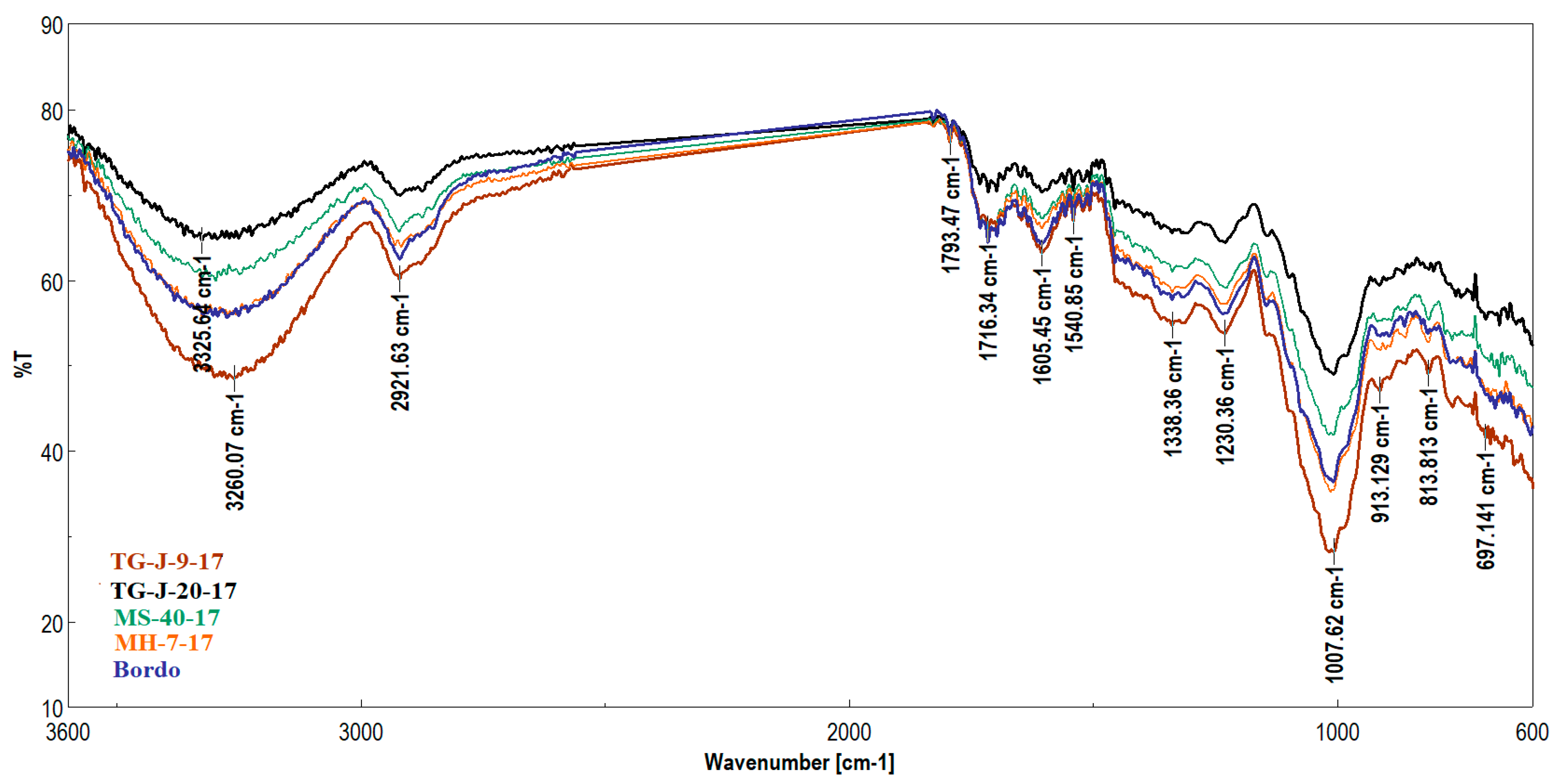
| TG-J-20-17 | TG-J-9-17 | MS-40-17 | MH-7-17 | Bordo | Assignation |
|---|---|---|---|---|---|
| 3326 | 3260 | 3297 | 3324 | 3274 | O–H stretching (water, phenolics, anthocyanins)—broad band |
| 2919 | 2921 | 2921 | 2917 | 2920 | Aliphatic C–H stretching (CH2/CH3)—lipids/aliphatic components |
| 1732 1716 | 1716 | 1716 | 1716 | 1716 1698 | C=O stretching (ester or carboxylic acid)—consistent with phenolic esters (e.g., chlorogenic acid) |
| 1646 | 1646 | 1646 | 1651 | 1646 | C=C aromatic/conjugated carbonyl vibrations (phenolic acids, flavonoids) [58] Amide I (disordered structure-non-hydrogen bonded) [57,59] |
| 1605 | 1605 | 1605 | 1606 | 1607 | Aromatic C=C stretching (phenolic acids, flavonoids) [58] |
| 1558 1541 1522 1507 | 1540 1521 1508 | 1558 1541 1521 1507 | 1558 1540 1521 1507 | 1558 1540 1521 1508 | Aromatic skeletal vibrations/conjugated systems (flavonoids) [58] Amide II [30] |
| 1456 | 1453 | 1453 | 1456 | 1488 | CH bending; phenolic or aliphatic contributions |
| 1311 | 1338 | 1338 | 1338 | 1338 | C–O stretching (phenolic)/C–O–C glycosidic bonds (anthocyanin glycosides) [58] |
| 1230 | 1230 | 1228 | 1238 | 1234 | C–O stretching (phenolic)/C–O–C glycosidic bonds (anthocyanin glycosides) |
| 1007 | 1007 | 1008 | 1014 | 1008 | Strong C–O and C–C stretching (sugars, glycosides, pectin)—major polysaccharide band [60] |
| 803 746 732 668 | 814 764 723 697 | 812 764 689 668 | 814 737 722 669 | 895 863 723 677 | Out-of-plane aromatic C–H bending (aromatic ring substitution patterns; fingerprint region) |
Disclaimer/Publisher’s Note: The statements, opinions and data contained in all publications are solely those of the individual author(s) and contributor(s) and not of MDPI and/or the editor(s). MDPI and/or the editor(s) disclaim responsibility for any injury to people or property resulting from any ideas, methods, instructions or products referred to in the content. |
© 2026 by the authors. Licensee MDPI, Basel, Switzerland. This article is an open access article distributed under the terms and conditions of the Creative Commons Attribution (CC BY) license.
Share and Cite
Topală, C.M.; Vijan, L.E.; Hera, O.; Sturzeanu, M. Applications of Spectroscopy in the Study of Bioactive Compounds from Cornus mas L. Appl. Sci. 2026, 16, 1007. https://doi.org/10.3390/app16021007
Topală CM, Vijan LE, Hera O, Sturzeanu M. Applications of Spectroscopy in the Study of Bioactive Compounds from Cornus mas L. Applied Sciences. 2026; 16(2):1007. https://doi.org/10.3390/app16021007
Chicago/Turabian StyleTopală, Carmen Mihaela, Loredana Elena Vijan, Oana Hera, and Monica Sturzeanu. 2026. "Applications of Spectroscopy in the Study of Bioactive Compounds from Cornus mas L." Applied Sciences 16, no. 2: 1007. https://doi.org/10.3390/app16021007
APA StyleTopală, C. M., Vijan, L. E., Hera, O., & Sturzeanu, M. (2026). Applications of Spectroscopy in the Study of Bioactive Compounds from Cornus mas L. Applied Sciences, 16(2), 1007. https://doi.org/10.3390/app16021007