1. Introduction
Anterior cruciate ligament (ACL) injuries represent one of the most severe and impactful musculoskeletal injuries in professional football, with substantial consequences for athletes and their teams [
1,
2,
3,
4,
5]. These injuries are characterized by long rehabilitation processes, prolonged absences from play, and a significant risk of long-term clinical consequences for athletes, such as new ipsilateral and contralateral injuries, early-onset osteoarthritis, and decreased career longevity [
1,
2,
3,
4,
6].
Given the severe impact of these injuries on professional players, understanding the precise injury mechanisms and the context in which they occur is a critical first step in developing targeted and evidence-based injury prevention strategies and rehabilitation protocols [
7,
8]. Although many different approaches (e.g., cadaveric studies, laboratory investigations, mathematical modeling studies) have already been attempted to increase epidemiological and etiological knowledge of ACL injuries [
9], systematic video analysis has emerged as a widely used and valid methodological approach for investigating the mechanisms, movement patterns, player behavior, and biomechanics preceding and during the injuries [
9]. Several systematic video analyses of ACL injuries across various sports have been published [
10,
11,
12,
13].
In football, recent studies using structured observational checklists have detailed a large number of ACL injuries, revealing specific injury mechanisms, situational patterns, and kinematics in Italian, Spanish, and English professional male football [
14,
15,
16], as well as in women’s professional leagues [
17]. These studies consistently showed that most ACL injuries occur without direct contact to the knee, in indirect-contact or non-contact situations [
14,
15,
16,
17]. They frequently happen during specific situational patterns such as pressing, tackling, being tackled, and landing from a jump [
14,
15,
16,
17]. Additionally, recent evidence highlights the crucial role of mechanical perturbations and neurocognitive errors, such as attentional or motor response inhibition, in the moments preceding non-contact injuries [
15,
18,
19]. While these studies, typically conducted within a single country, provide important clinical value, it is unknown if the study findings can be generalized across different countries and leagues. Leagues may present variations in playing styles, tactical formations, physical demands, refereeing tolerance, and cultural norms, which could potentially influence the predominant injury mechanisms. Consequently, it is essential to conduct a comprehensive study across multiple leagues to determine whether these identified injury profiles represent universal characteristics of elite football or if they are specific to each league.
Establishing a generalized understanding of the high-risk scenarios is crucial for developing robust protocols for injury prevention and rehabilitation that can be implemented in real-world settings. Therefore, the present study aimed to identify, through video analysis, the precise mechanisms, the predominant tactical and situational patterns, and the occurrence of specific neurocognitive errors associated with ACL injuries in a large cohort of professional male football players from clubs competing in the six main European men’s leagues (England, Italy, Spain, Germany, France, and Portugal).
2. Materials and Methods
This section describes the methodological steps used to analyze ACL injuries in elite football. It details the video selection process, as well as their processing and subsequent analysis, the observational checklist for biomechanical and neurocognitive variables, and the statistical methods applied to evaluate the data.
2.1. Study Design and Injury Identification
A retrospective pooled case series systematic video analysis study was conducted to identify ACL injuries across male professional football players affiliated with clubs from the six main European leagues (England, Italy, Spain, Germany, France, and Portugal) from 1 August 2020 to 30 April 2024. Consequently, the sample encompasses various fixtures, including domestic leagues, domestic and European cups, and national team matches. For this purpose, a systematic surveillance strategy was adopted using the Noisefeed® platform (Noisefeed V2, Chiavari, Italy), a specialized injury database for professional football. The database was filtered for “knee” injuries, specifically tagged as “ACL ruptures”, for match-related injuries, and for the seasons under analysis. To ensure data accuracy, a cross-verification process was conducted using publicly available sources, including official club press releases, reputable national media outlets, and the Transfermarkt database (Hamburg, Germany).
Injuries were included if: (1) they involved a complete ACL rupture; (2) they occurred during a match, regardless of the match context, encompassing league and cup matches, European club competitions, international fixtures (national teams), and friendly matches; and (3) broadcast-quality video footage of the injury event was available. As the research team did not have access to standardized, official medical reports, the classification of an injury as a complete ACL rupture, as well as its mechanism, was based on the following sources: the competitions’ injury databases, the researchers’ independent evaluation of the broadcast footage, and cross-checking against the verification sources described above. Cases in which either the mechanism or the diagnosis of a complete rupture could not be confidently established were excluded from the study. Each case was treated as a single-player event. Inclusion was strictly dependent on the availability of broadcast-quality video footage, which restricted the final dataset to injuries with sufficient media coverage. This inherent bias may have resulted in the exclusion of other ACL injuries sustained during these competitions. Exclusion criteria comprised injuries sustained during training sessions or match warm-ups, incomplete or partial tears managed conservatively, and cases where video footage was unavailable, was of low resolution, or failed to capture the injury mechanism. The study utilized the Quality Appraisal for Sports Injury Video Analysis Studies (QA-SIVAS) scale [
19,
20] and achieved a score of 15/18 (excellent) (
Supplemental Table S1).
2.2. Video Acquisition and Processing
Video footage relied on standard 2D broadcast data from the main broadcast camera angle. When available, multiple 2D camera angles and slow-motion replays were added to the sequence. The videos of confirmed injuries were analyzed directly on the Noisefeed platform. Each video was examined from approximately 12–15 s before to 3–5 s after the estimated injury frame (IF), as in previous studies [
14,
16], to evaluate the playing situation and injury mechanism accurately. The specific biomechanical IF was defined as the point of an externally observable event consistent with ligament failure (e.g., visible loss of knee-joint control or limb collapse) or, consistent with previous literature, as 40 ms following Initial Contact (IC) of the foot with the ground [
15,
16]. The videos used in this analysis were standard television and streaming broadcasts. Consequently, technical acquisition parameters, such as frame rate and image resolution, differed between matches. However, the initial-contact frame was determined without reliance on isolated still images. Each video encompassed the complete buildup to the injury, the injury itself, and several seconds of post-injury continuation, thereby enabling continuous visual inspection of the entire event. This facilitated the direct identification of the initial-contact frame from the broadcast footage. Given that standard broadcast video footage typically operates at 25 to 30 frames per second, with a single frame representing approximately 33 to 40 ms, this 40 ms criterion between initial contact (IC) and the injury frame (IF) was visually operationalized as an advance of exactly one video frame. However, because the effective frame rate and specific slow-motion playback factors were not individually verified for each recording, advancing a single frame does not represent a uniform 40-ms interval across all videos. Consequently, this operationalization must be considered approximate, and the resulting timing uncertainty is openly acknowledged. In cases where an externally observable event consistent with ligament failure was not possible to identify, the IF was established by identifying the exact moment of IC and advancing to the immediately subsequent frame.
2.3. Observational Checklist and Variables
The systematic video analysis observational checklist, available in the
Supplemental Table S2, was designed to capture a comprehensive range of contextual, situational, biomechanical, and anatomical factors. The following variables were collected: match minute and individual minutes played (evaluating the time elapsed since the player’s entry onto the pitch); injury situation, characterized as defensive or offensive based on ball possession; field location, mapped using a standardized pitch grid dividing the field into defensive, middle, and offensive thirds, intersected by left, central, and right corridors, resulting in nine specific zones [
14]; injury side based on video data and injury history information; dominant leg, defined as the preferred kicking leg (right or left); player contact preceding injury, which was used to identify three different injury mechanisms [(1) non-contact injury, occurring without any contact (at the knee or any other level) before or at IF; (2) indirect-contact injury, when the injury results from an external force applied to the player, but not directly to the injured leg; and (3) direct contact injury, when an external force directly applied to the injured leg causes the injury]; player situation (pressing, tackling, being tackled, regaining balance after kicking, landing from a jump, or other); and neurocognitive variables, namely attentional inhibition and motor response inhibition. Dominant leg information was retrieved directly from the Noisefeed platform, where it is provided as a pre-existing data point, allowing for a consistent classification of dominant leg across all cases.
Before the main analysis, a reliability test was conducted [
21]. Initially, weather conditions (presence of sunny weather and precipitation) and the horizontal and vertical speed of the action were also evaluated. However, these variables were excluded from the final analysis due to low intra- and inter-rater reliability [
21]. Notably, regarding precipitation, reliability could not even be calculated due to a lack of variability in the observed responses. Additionally, given the subjective nature of the neurocognitive variables, high rater agreement was particularly important. For attentional inhibition and motor response inhibition, the inter-rater reliability demonstrated, respectively, moderate (κ = 0.590) and substantial agreement (κ = 0.752), and the intra-rater reliability was also moderate (κ = 0.590 and κ = 0.503, respectively). These reliability values were derived from our preliminary dataset [
21], which overlaps with the final cohort of 119 injuries analyzed in the present study.
2.4. Video Analysis Procedures
Two independent observers (SO and KS for attentional inhibition and motor response inhibition, and SO and MC for the remaining variables) evaluated the video footage according to a predetermined checklist (
Supplemental Table S2). The evaluation team members have diverse professional backgrounds, including biomedical engineering (SO), sports science (KS), and epidemiology, biostatistics, and research in health (MC, currently a medical student). Before data collection, the raters underwent a familiarization process at a dedicated consensus meeting to review the checklist, align operational definitions, and establish standardized evaluation criteria. During formal evaluations, all raters had access to the same video clips, camera angles, and slow-motion replay conditions on the platform to ensure standardized observational conditions. The observers were blinded to each other’s assessments to prevent bias. After independent analysis, the two reviewers met for a comprehensive discussion to reach consensus on all items. A third reviewer was consulted to resolve any remaining differences (MC for neurocognitive variables and KS for the remaining ones).
2.5. Neurocognitive Analysis
Following established neurocognitive analysis protocols for ACL injuries [
15,
18,
19], we explored the role of inhibitory control, defined as the ability to regulate attention, behavior, thoughts, and emotions to overcome strong internal impulses or external distractions in favor of more appropriate situational actions [
22]. In line with previous research, we focused on two primary aspects of inhibitory control: attentional inhibition and motor response inhibition [
15,
18,
19].
Attentional inhibition refers to the player’s ability to resist interference from external environmental stimuli by maintaining selective attention on the task-relevant situation [
18,
22]. If the injured player shifted their selective attention away from the relevant action toward non-task-relevant stimuli that they could not directly impact, such as the ball or the peripheral environment, this represented an error in attentional inhibition. Such lapses in attentional focus may lead to spatial unawareness and altered neuromuscular control [
18].
Motor response inhibition was defined as the ability to stop unwanted or incorrect motor actions by blocking behaviors and interrupting inappropriate automatic reactions, thereby replacing those responses with better, more thought-out responses adapted to the situation [
15,
18,
19]. Given the inherent delay between the presentation of a stimulus, such as an opponent’s deceptive action, and the generation of an appropriate reactive response [
23], we operationalized a window of approximately 450–1200 ms for the player to change their motor response [
18,
23]. Because standard broadcast video relies on assumed frame rates of 25 to 30 frames per second (as detailed in
Section 2.2) and individual frame rates or slow-motion factors were not verified, this temporal window was visually operationalized through an approximate frame-counting protocol of roughly 11 to 36 frames following the stimulus. We acknowledge the inherent timing uncertainty in this method, as the actual temporal duration of these frames varied across different broadcast sources and replays. A key feature of this assessment was determining whether the player demonstrated poor motor-response inhibition by committing to a high-speed approach or by engaging in an inappropriate automatic action that could not be inhibited in time to adapt to the opponent’s deceptive cues. Consequently, an error was scored when this failure to direct attention and perception systems led to poor decision-making and, subsequently, to an inability to stop or alter the intended action before the event that caused the injury [
24].
Given that raters were aware that every analyzed sequence preceded a confirmed ACL injury, and no matched non-injury (successful) sequences were available for comparison, the attentional and motor response variables coded here should be interpreted merely as video-based behavioral indicators observed in the moments preceding injury, consistent with predefined operational criteria, rather than as confirmed causal injury factors or direct measurements of cognitive processes. Consequently, the study’s design carries an inherent risk of hindsight bias, as we cannot determine whether the coded behaviors occur more frequently before an injury than during comparable, successful athletic actions.
2.6. Seasonal, Match, and Field Distribution
Epidemiological data on the injury context were extracted for each included case. Seasonal distribution was analyzed by categorizing injuries by month. The game phase was divided into the first and second halves, and then segmented into 5-min intervals of the match. Both chronological match minutes and individual minutes played, defined as the time elapsed since the player’s entry onto the pitch, were evaluated. The field location of the injured player was mapped using a standardized pitch grid dividing the field into defensive, middle, and offensive thirds, intersected by left, central, and right corridors, resulting in nine specific zones.
2.7. Ethical Considerations
This study used publicly available video footage from televised professional football matches and data from a commercial subscription platform for analysis. No direct interaction with human participants occurred, no clinical interventions were performed, and no private health records were accessed. All player data were anonymized during the analysis phase. Accordingly, since the research involved only the secondary analysis of publicly broadcast video records, consistent with previous studies utilizing public domain video analysis, ethical approval and informed consent were not required. Nevertheless, the ethical principles of the Declaration of Helsinki were considered where relevant to the conduct of the research. Moreover, general ethical principles regarding research integrity, data protection, and confidentiality were strictly respected throughout the study.
2.8. Statistical Analysis
Statistical analyses were performed using JASP (v0.98.1, JASP Team, Amsterdam, The Netherlands, 2025). Descriptive statistics were used to summarize the data. All variables were categorical and were reported as absolute frequencies and percentages of the total number of observations. To provide robust descriptive estimates, 95% confidence intervals (95% CI) for all principal proportions were calculated using the Wilson score method.
To determine whether the observed frequencies of injury distributions were significantly different from a theoretical equal distribution, the Chi-square goodness-of-fit test was applied to each individual variable. It is crucial to note that because specific exposure data were unavailable, equal exposure across categories was not established for several variables (e.g., match phases, pitch zones, situational actions, and dominant versus non-dominant leg use). Therefore, the assumption of an equal expected distribution was used strictly as a theoretical baseline model. Consequently, all statistical outcomes and
p-values from these specific tests must be interpreted solely as the distribution of observed injury cases, and not as an estimation of true injury risk, incidence, or exposure-adjusted rates. This is of particular relevance to binary (yes/no) neurocognitive indicators, for which a significant goodness-of-fit result primarily reflects an unequal split between categories as opposed to a high absolute frequency of errors or an association with injury causation. For these tests, effect sizes were calculated using Cohen’s w and interpreted as small (≥0.10), medium (≥0.30), or large (≥0.50) [
25].
Additionally, to explore associations between specific categorical variables, namely situational patterns and neurocognitive errors within the non-contact and indirect-contact subgroup, cross-tabulation analyses were performed using the Chi-square test of independence. When expected cell counts were inadequate (less than five),
p-values were computed using Monte Carlo simulations (based on 100,000 iterations) conducted in R software (version 4.4.3 (2025-02-28 ucrt), R Foundation for Statistical Computing, Vienna, Austria) to ensure a robust analysis of sparse tables. For significant multi-category associations, a post hoc analysis of adjusted standardized residuals was conducted to identify the specific categories responsible for the overall significance. To control the family-wise error rate,
p-values for these residuals were adjusted using the Holm correction, applied specifically to the independent degrees of freedom within each comparison family. To assess the magnitude of these significant associations, effect sizes were calculated using Cramer’s V, interpreted as small (≥0.10), medium (≥0.30), or large (≥0.50) [
25].
The significance level was set a priori at p < 0.05.
In summary, these standardized video analysis procedures allowed for a systematic assessment of each ACL injury. The dataset generated from this methodology is detailed in the subsequent
Section 3.
3. Results
A total of 138 ACL match injuries were identified. Of these, 19 were excluded due to the absence of video footage (12), being only partial tears (5), failing to capture the injury mechanism (1), or occurring in a second-division match of the respective country rather than the first division (1). Therefore, 119 ACL injuries were included for analysis.
Of the injuries reviewed, 25 occurred in Italian competitions (Serie A (23), Coppa Italia (1), and Campionato Primavera 1 U19 (1)), 20 in English competitions (Premier League (16), FA Cup (3), and League Cup EFL (1)), 19 in Spanish competitions (La Liga), 18 in French competitions (League 1 (17) and Coupe de France (1)), 16 in Portuguese competitions (Liga Portugal (13), Taça de Portugal (2), and Taça da Liga (1)), 11 in German competitions (Bundesliga (9) and DFB-Pokal (2)), 2 in European competitions (UEFA Champions League (1) and UEFA Europa League (1)), 3 while playing for national teams (World Cup (1), Nations League (1), and Euro U21 (1)), and 5 in friendly matches. Although some injuries occurred in U-19 and U-21 competitions, the athletes who sustained them were part of the club’s main squad.
Table 1 summarizes the injury details and statistical analysis data.
3.1. Injury Characteristics and Match Context
Regarding anatomical distribution, there were 65 (55%) injuries to the right ACL and 54 (45%) to the left (p = 0.313). Furthermore, 74 (62%) injuries occurred in the dominant leg, while 45 (38%) affected the non-dominant leg (p = 0.008). When analyzing the playing phase at the time of injury, a higher proportion was observed during defensive actions (n = 71; 59%) compared to offensive situations (n = 48; 41%) (p = 0.035).
3.2. Field Distribution
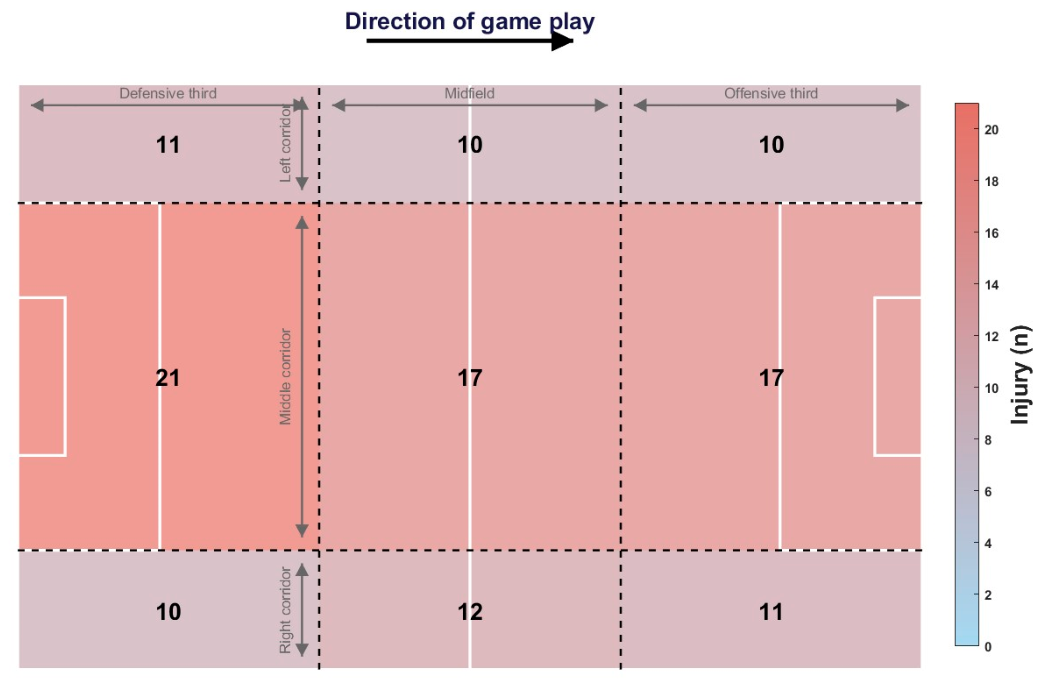
The defensive third registered the most injuries (n = 42; 35%), followed by the middle third (n = 39; 33%), and lastly the offensive third (n = 38; 32%) (
p = 0.897). Regarding corridors, a significant number of injuries occurred in the middle corridor (n = 55; 46%), followed by the right corridor (n = 33; 28%) and the left corridor (n = 31; 26%) (
p = 0.011). When the field was divided into nine sub-areas (three sectors and three corridors), the defensive third and the middle corridor accounted for the highest number of injuries (n = 21; 18%) (
Figure 1).
3.3. Injury Mechanism
Although this overall distribution was not statistically significant (p = 0.146), thirty injuries (25%) were categorized as direct contact injuries, 47 (40%) as indirect-contact injuries, and 42 (35%) as non-contact injuries. Among indirect-contact injuries, the upper body (n = 29 of 47; 62%) was the most frequently affected body part (p < 0.001), followed by the uninjured leg (n = 12 of 47; 26%). Most injuries (n = 105; 88%) involved loading on the injured leg at the injury frame (p < 0.001). Regarding the number of feet on the ground, single-limb contact was most frequently observed (n = 61; 51%), followed by double-limb contact (n = 51; 43%), while the remaining 7 cases (6%) were classified as “unsure” because the exact ground contact could not be clearly determined (p < 0.001).
3.4. Direct Contact Injuries
Direct contact injuries happened in both defensive (n = 17; 57%) and offensive (n = 13; 43%) phases. Defensive direct contact injuries occurred during tackling (n = 14; 82%), regaining balance after kicking (n = 1; 6%), or other (n = 2; 12%), while offensive injuries only occurred during being tackled (n = 13).
3.5. Indirect and Non-Contact Injuries
For non-contact and indirect-contact ACL injuries (n = 89), five main situational patterns were identified: pressing (n = 23; 26%), tackling (n = 15, 17%), being tackled (n = 8; 9%), landing from a jump (n = 7; 8%), and regaining balance after kicking (n = 7; 8%). The other 29 (33%) cases did not fit into one of the categories and were classified as “other”, encompassing actions such as dribbling, changing direction while running, passing, reaching to kick the ball, and shielding the ball from an opposing player.
Pressing and tackling injuries were the most predominant (n = 38; 43%) (
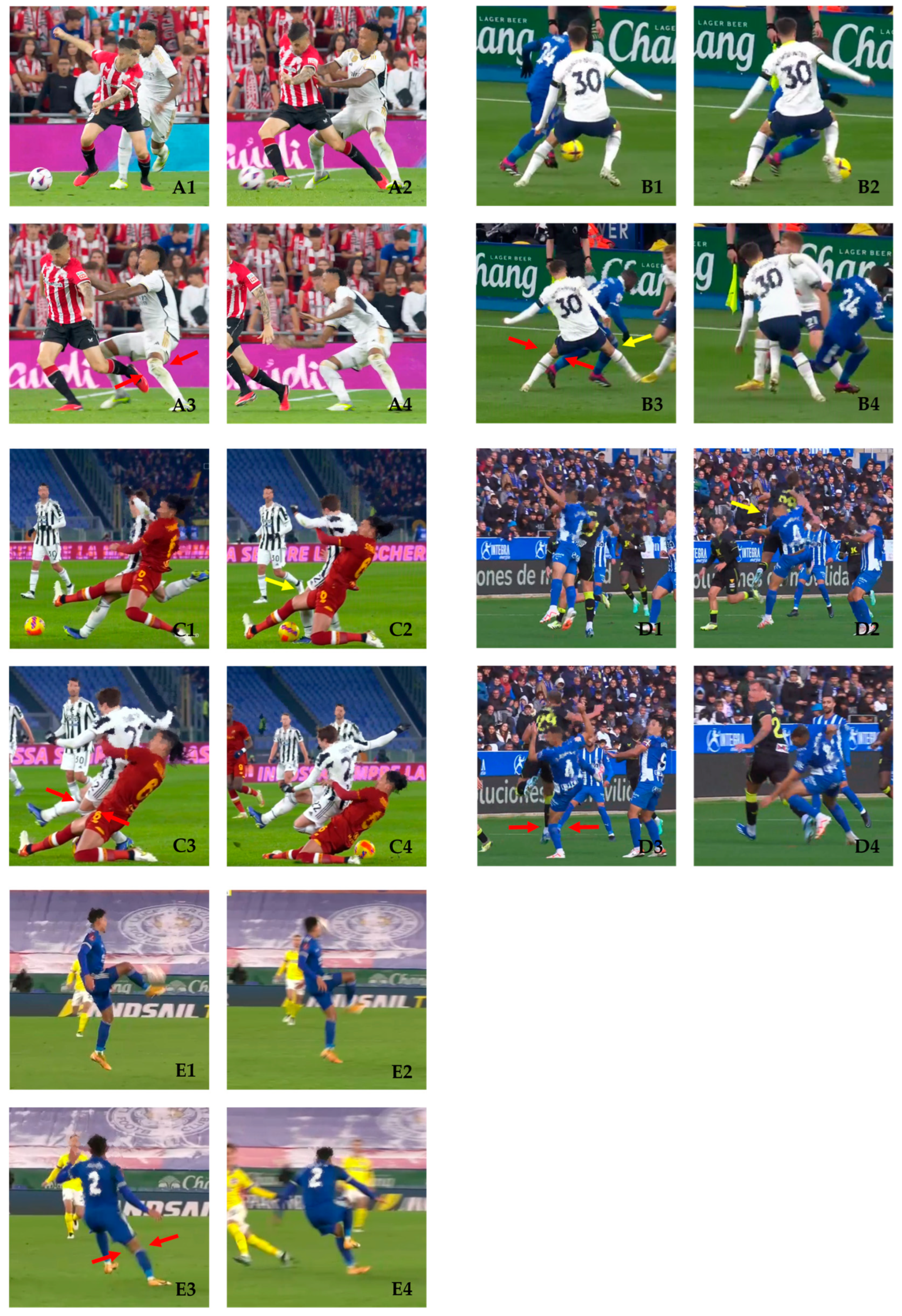
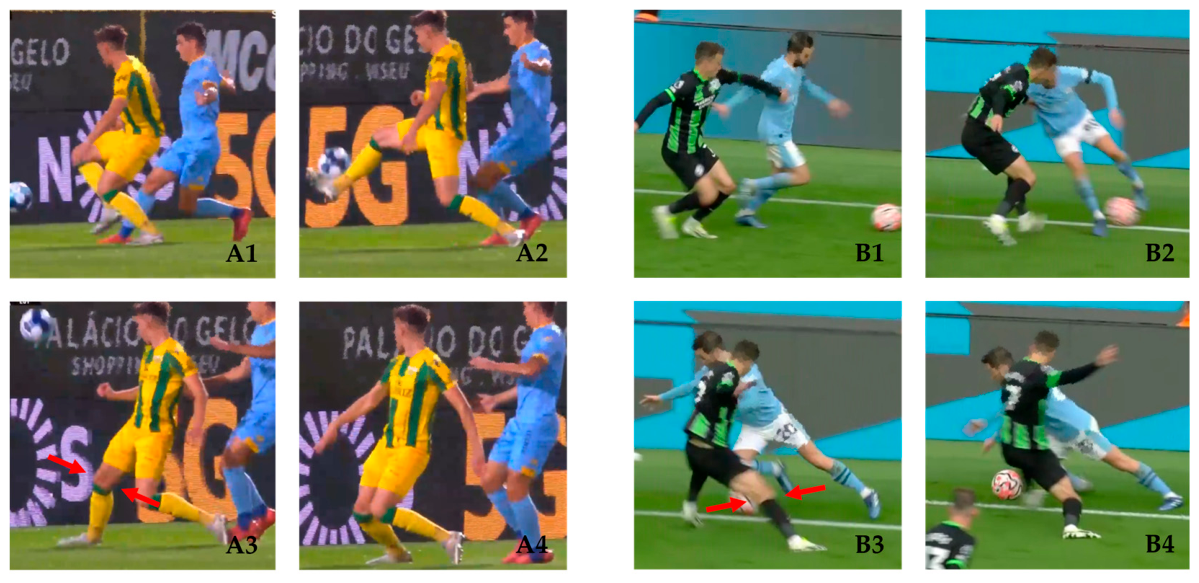
p < 0.001) and were all classified as defensive. In pressing scenarios, the player often sustained the injury when decelerating or changing direction as they approached their opponent, frequently without contact (
Figure 2(A1–A4)). In tackling situations, there was typically contact with the opponent before or at the estimated injury frame (
Figure 2(B1–B4)).
The third most common situation was being tackled, mainly involving indirect contact between the opponent and the injured player. Typically, there was a mechanical perturbation involving the upper body or the uninjured leg before or at the injury frame (
Figure 2(C1–C4)).
Landing from a jump was less frequent, with 4 cases involving indirect contact with the upper body or the uninjured leg and 3 without any contact. Five of these occurred during double-leg landings and two during single-leg landings (
Figure 2(D1–D4)).
Regaining balance after kicking was largely without contact (71%), in which the player loaded their injured leg after kicking the ball (
Figure 2(E1–E4)). Only two injuries involved indirect contact to the upper body.
A comprehensive analysis of the contextual, biomechanical, and neurocognitive characteristics categorized by each situational pattern is presented in
Table 2.
3.6. Timing of Injury and Role of Substitution
Although the difference between absolute match halves was not statistically significant (
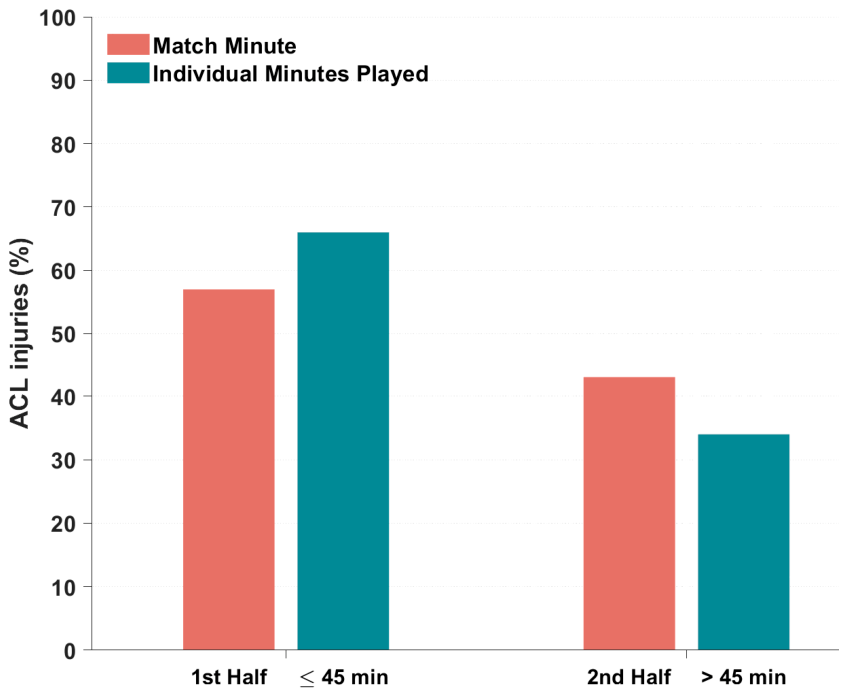
p = 0.119), the first half of the match showed a higher proportion of injuries (n = 68; 57%) than the second half (n = 51; 43%), with more than 30% of all injuries occurring in the first 25 min of the match (n = 39; 33%) (
Figure 3). When evaluating the time elapsed since the player’s entry onto the pitch, 78 injuries occurred during the initial 45 min of individual playing time (66%) and 41 after 45 min of individual playing time (34%) (
p < 0.001) (
Figure 3). Furthermore, at 25 min of individual minutes played, 48 of all injuries (40%) had already been sustained.
3.7. Seasonal Distribution
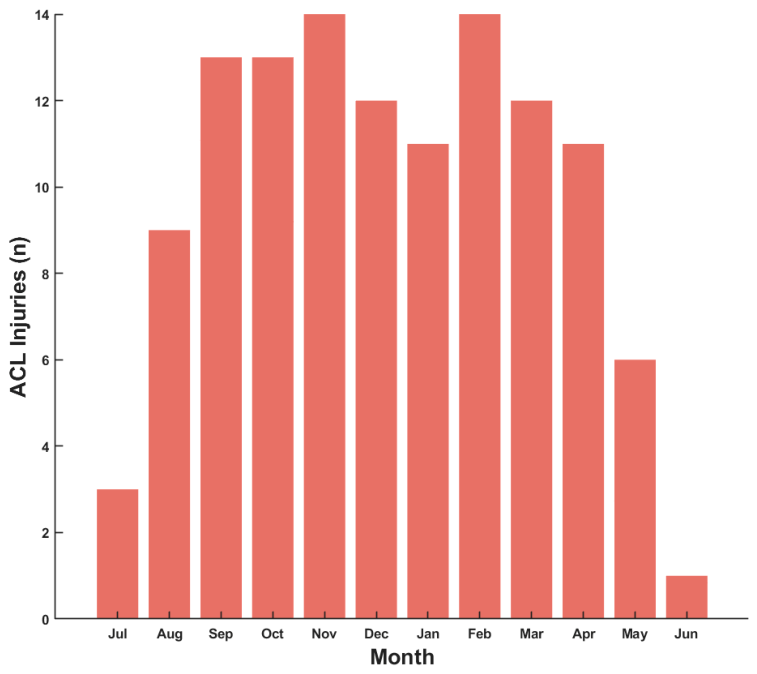
Seasonal distribution showed a peak early in the season (September to December) and a secondary peak later (February and March), with the highest absolute number of injuries occurring in November (n = 14; 12%) and February (n = 14; 12%) (
p = 0.035). The fewest injuries occurred in June (n = 1; 1%) and July (n = 3; 2%), which corresponds to the holiday period and the start of the pre-season for athletes (
Figure 4).
3.8. Neurocognitive Analysis
Of the 89 non-contact or indirect-contact injuries, 45 (51%) involved a neurocognitive error. Specifically, an attentional inhibition error was observed in 25 injuries (28%; 95% CI: [19.8–38.2%]), while a motor response inhibition error was present in 27 injuries (30%; 95% CI: [21.8–40.5%]). Notably, 7 (8%) of the total injury cases involved both attentional and motor response inhibition errors.
Distinct patterns emerged when examining the specific player actions preceding the injuries. Among the cases involving an attentional inhibition error, the errors were present while landing from a jump (n = 5), being tackled (n = 3), regaining balance after kicking (n = 3), pressing (n = 2), tackling (n = 2), and during other situational patterns (n = 10) (
Figure 5(A1–A4)). Conversely, for the injuries classified as involving motor response inhibition, nearly half occurred during pressing actions (n = 12, 44%) (
Figure 5(B1–B4)). The remaining cases occurred during tackling (n = 3), being tackled (n = 1), regaining balance after kicking (n = 1), and other actions (n = 10).
3.9. Contextual and Neurocognitive Associations
To further investigate the profiles of non-contact and indirect-contact injuries, cross-tabulation analyses were performed.
The distribution of situational patterns differed significantly between indirect-contact and non-contact mechanisms (χ2 (5, N = 89) = 14.63, p = 0.010, Cramer’s V = 0.41). Specifically, post hoc residual analysis adjusted with the Holm correction demonstrated that this overall association was primarily driven by higher-than-expected frequencies of “being tackled” during indirect-contact mechanisms (Holm-adjusted p = 0.030).
Furthermore, the distribution of video-coded neurocognitive indicators varied significantly according to the injury mechanism or the specific situational pattern. Motor response inhibition errors were significantly more frequent in non-contact injuries (50%) compared to indirect-contact injuries (13%) (χ2 (1, N = 89) = 14.55, p < 0.001, Cramer’s V = 0.40). Contextually, residual analysis confirmed a significant global association between situational patterns and motor response indicators (χ2 (5, N = 89) = 11.29, p = 0.040, Cramer’s V = 0.36), driven primarily by borderline significant higher-than-expected frequencies of these indicators during “pressing” actions (Holm-adjusted p = 0.049), which should be interpreted with caution.
Conversely, a distinct profile emerged for attentional inhibition errors. Unlike motor response errors, the proportion of attentional inhibition errors did not differ significantly between non-contact (33%) and indirect-contact (23%) injury mechanisms (χ2 (1, N = 89) = 1.08, p = 0.298, Cramer’s V = 0.11). However, these indicators were significantly associated with the situational pattern (χ2(5, N = 89) = 14.10, p = 0.014, Cramer’s V = 0.40). Subsequent examination of the adjusted residuals using the Holm correction demonstrated that this overall significance was driven primarily by borderline significantly higher-than-expected frequencies when players were “landing from a jump” (Holm-adjusted p = 0.047). Importantly, given the small number of observed cases for this specific action (n = 7) and its inherently low expected frequency (1.97), this particular finding must be interpreted with caution.
4. Discussion
The most important findings of the present study are the following: (1) most ACL injuries in professional male football occurred without a direct contact mechanism, with indirect contact being the most frequent followed by non-contact; (2) five main situational patterns were identified, with pressing, tackling, and being tackled accounting for more than half of the non-contact and indirect-contact ACL injuries; (3) a high number of injuries occurred early in matches, and during early or mid-season; and (4) neurocognitive errors, namely motor response inhibition or attentional inhibition, were present in half of the non-contact and indirect-contact injuries, exhibiting distinct statistical associations with specific situational patterns and injury mechanisms.
4.1. Injury Mechanisms and Situational Patterns
Our finding that most ACL injuries occurred without a direct contact mechanism, with indirect contact being slightly more frequent than non-contact, is highly consistent with recent evidence from English leagues (Premier League and Championship), which reported indirect contact in 42% of cases and non-contact in 38% [
14]. This challenges the traditional paradigm that non-contact mechanisms are overwhelmingly the most common. Indeed, data from the Italian and Spanish leagues had already shown that indirect and non-contact mechanisms were found to be roughly equally frequent [
15,
16].
4.2. Seasonal, Match, and Field Distribution
The higher proportion of injuries observed early in matches aligns with findings from English, Italian, and Spanish leagues, which consistently showed a higher proportion of ACL injuries in the first half of matches, ranging from 57% to 62% [
14,
15,
16]. Although the observed early-match injury peak could theoretically raise questions about the roles of accumulated fatigue, inadequate neuromuscular preparation among players who have just entered the game, or early high-intensity actions, the lack of exact exposure denominators precludes any causal inferences. Therefore, this study cannot definitively evaluate or challenge these physiological factors, and this temporal distribution must be interpreted strictly descriptively.
We found a relatively consistent pattern of ACL injuries throughout the year, in contrast to previous research in Italian football [
16]. This consistent pattern had already been observed in English and Spanish leagues [
14,
15]. As in previous studies, the lower proportion of injuries in June and July likely relates to the off-season and preseason periods, and the reduced number of competitive games played during these periods [
15,
16]. Additionally, the injury peaks observed at the start of the season and mid-season were also identified in Italian football (September–November) and Spanish football (February).
The field distribution showed a slightly higher frequency of injury in the defensive third, similar to another study in Italian football [
16], but contradictory to other studies in English and Spanish football, which showed a higher number of injuries in the midfield and offensive third, respectively [
14,
15]. In contrast, the higher number of injuries in the middle corridor was not consistent with previous studies, which reported more injuries in the lateral corridors [
14,
16]. Differences may relate to playing styles and divergence in situational patterns between leagues.
4.3. Neurocognition
A key novel aspect of the present study was the systematic evaluation of neurocognitive errors, which were identified in 50% of non-contact and indirect-contact injuries, a slightly lower proportion than reported in previous studies [
15,
19]. As stated in the Methods, these video-coded indicators were derived from camera broadcast footage by raters who were aware of the injury outcome, without matched non-injury comparison sequences. Therefore, they should be interpreted as behavioral indicators associated with the moments preceding injury, rather than as confirmed causal or risk factors. Crucially, the statistical analysis revealed a clear dissociation between the types of cognitive errors and injury profiles. We observed that motor response inhibition errors were significantly associated with non-contact mechanisms and occurred primarily during defensive pressing actions, often triggered by a deceptive opponent movement. Drawing on previous research, it is hypothesized that the inability to rapidly inhibit an already initiated motor response in the face of an unexpected visual stimulus, and to plan and execute a new movement within a short time window, leads to unplanned actions, which have been shown to result in high-risk knee biomechanics [
26].
Conversely, behaviors suggesting attentional inhibition errors were more frequently observed during landing from a jump. These observable attentional lapses were particularly linked to specific movement tasks, regardless of whether indirect physical contact occurred. In these scenarios, video footage showed players shifted their gaze and selective attention away from the movement task and towards the ball or the peripheral environment. As proposed by a previous study [
19], such behavioral shifts are hypothesized to lead to a loss of temporospatial awareness and poor neuromuscular preparation for ground contact. Ultimately, this highlights the distinct cognitive demands of different football actions, where video-coded motor response inhibitions are significantly associated with non-contact defensive approaches, while attentional inhibitions are linked to complex biomechanical tasks like landing.
4.4. Practical Implications and Future Research
The prevention strategies and training recommendations discussed below should be regarded as hypotheses warranting prospective testing, rather than as interventions validated by the present retrospective video-analysis design.
Understanding injury mechanisms is critical to designing effective injury risk prevention strategies [
7,
8]. The high frequency of indirect-contact injuries highlights the potential value of incorporating mechanical perturbation training into injury risk mitigation programs. Because a large portion of injuries occur during pressing, tackling, and landing scenarios, athletes may benefit from specifically training horizontal decelerations and cutting actions in response to unexpected mechanical stimuli. Additionally, to address the significant association between non-contact injuries and observable motor response errors during pressing, it could be important to consider incorporating cognitive-motor drills that require the rapid inhibition of an already initiated movement in response to unpredictable visual cues into training programs. The inferred neurocognitive demands of the game should also be considered. Prevention strategies could focus on improving the player’s ability to maintain temporospatial awareness and optimal muscle pre-activation, even when visually or cognitively distracted by a stimulus, such as the ball or an opponent’s deceptive actions. However, since the clinical effectiveness of these specific mechanical and cognitive-motor interventions was not directly tested in this observational study, these recommendations are presented as theoretical implications that require future empirical validation. Future research should aim to identify specific kinematic differences across various leagues and countries using objective biomechanical tracking, thereby reducing reliance on subjective visual estimates.
4.5. Strengths and Limitations
This study has some limitations. First, the methodology used to identify ACL injuries was systematic video analysis with access to kinematic data using videos and tools, as opposed to what is considered the gold standard for prospective studies involving frequent contact with medical teams or access to medical records. Moreover, injury situations could only be analyzed from a single camera view, sometimes with limited image quality, especially for situations far away from the midline camera position. Additionally, assessing neurocognitive variables from 2D television broadcasts inherently carries subjective bias. As detailed in our methodology, these specific variables achieved moderate to substantial rater agreement, which is lower than the near-perfect or perfect agreement typically observed for standard contextual variables. Furthermore, because effective frame rates and slow-motion playback factors varied across broadcasts and were not individually verified, the temporal precision of the video coding must be acknowledged as an approximation rather than an exact measure.
Another limitation is that we did not distinguish between ACL injuries alone and those with concomitant injuries, which could affect return-to-sport strategies. Furthermore, we only included complete ACL ruptures sustained during official matches, excluding those that occurred during training environments, which could potentially have affected the overall presentation of ACL injuries in professional soccer. This reliance on sufficiently clear video footage introduces a potential selection bias, as injuries occurring off-camera, in poor lighting, or where the mechanism of injury could not be captured were systematically excluded from the analysis. Finally, the lack of individual player exposure data precluded the calculation of true injury incidence rates, limiting our findings to the frequency and proportional distribution of the observed cases.
Nevertheless, this also has several strengths. The sample size (n = 119) can be considered large for video analysis of ACL injuries; moreover, the cohort included professional male elite athletes from six professional European leagues, while we are only aware of less comprehensive similar studies conducted in specific domestic leagues or contexts. Furthermore, the inclusion of field, match, and seasonal data, along with the neurocognitive analysis based on two executive functions, is an approach present in very few similar studies.
5. Conclusions
In conclusion, most ACL injuries in professional male football across the top six European leagues occur without direct contact to the knee, with indirect contact being the most frequent mechanism. These injuries are highly context-dependent, occurring predominantly during defensive actions, specifically pressing and tackling, and are most frequent during the early stages of a match. Although the absence of exposure-adjusted data does not allow for definitive conclusions regarding the role of accumulated physical fatigue, this time distribution suggests that high-intensity actions early in the game or inadequate neuromuscular readiness might serve as possible alternative explanations. Crucially, a key finding of this study is the high frequency of video-coded neurocognitive errors present in more than half of these injury scenarios, which highlights a potential complex interaction between unexpected mechanical perturbations and inferred cognitive demands, but warrants prospective confirmation combining observational data with objective cognitive assessments.
These findings provide valuable insights for both primary injury reduction and secondary rehabilitation settings. To better prepare athletes for the chaotic and dual-task demands of modern elite football, comprehensive risk mitigation strategies could benefit from incorporating unexpected mechanical perturbations, reactive horizontal decelerations, and cognitive challenges.




 ,
,