Road Noise Investigation in Concrete Pavements via OBSI Method Application—The Review


Featured Application
Abstract
1. Introduction
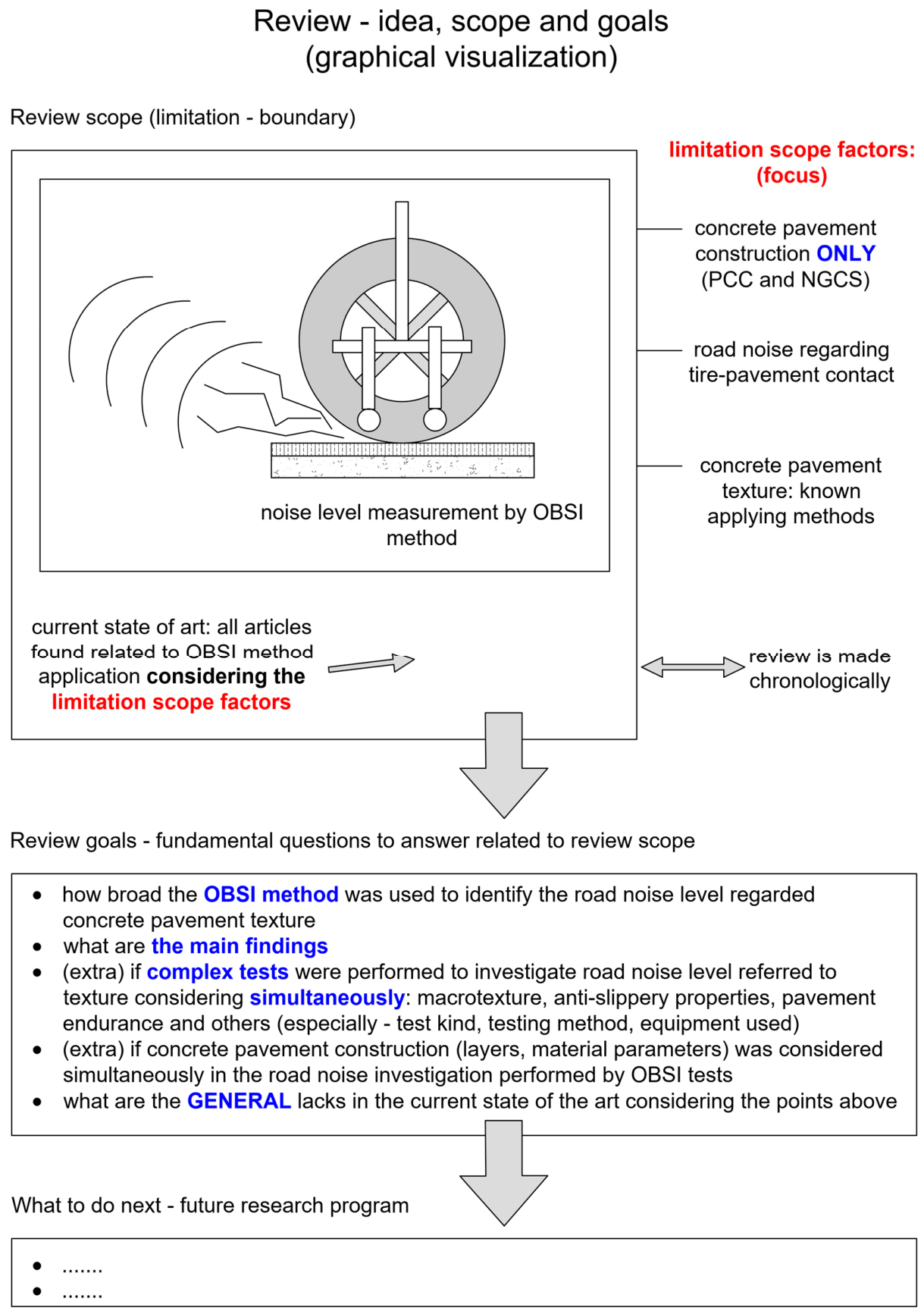
- The review scope is limited to the fundamental road noise component generated by vehicle traffic—the tire–surface contact. Using the sentence “road noise” in the article is equal to the noise generated by tire–surface contact.
- The review scope is limited to road noise (the tire–surface contact) investigation performed only with OBSI test method.
- The review scope is limited to road noise (the tire–surface contact) investigation only in concrete pavements considering surface texture types (application methods, configuration)—Portland Cement Concrete (PCC) surfaces and Next Generation Concrete Surface (NGCS).
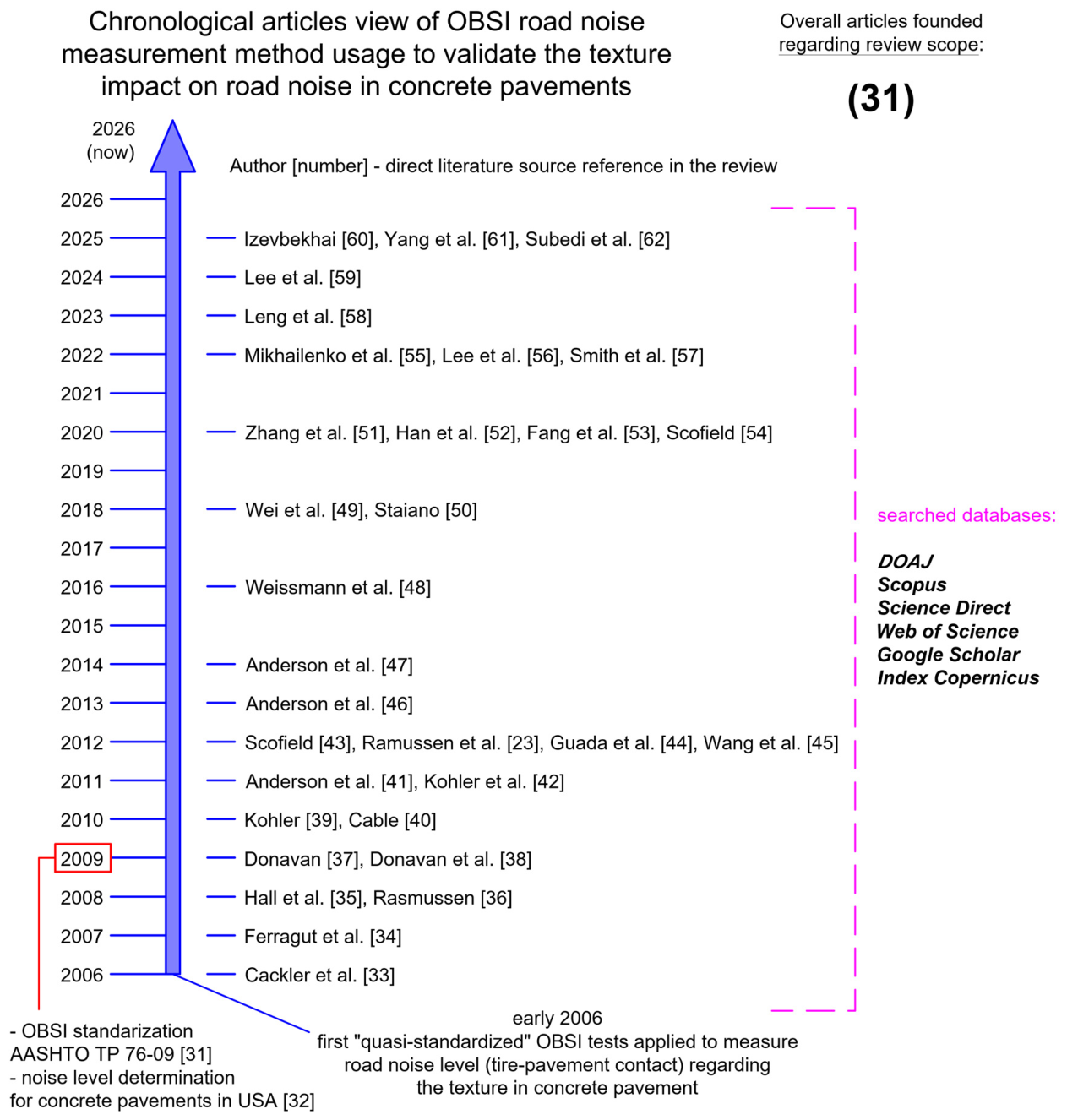
- The review is carried chronologically regarding the review scope limitation presented above. The time range is defined as the oldest OBSI test application literature source found to the present (end of 2025).
- The main goal is to answer how broadly the OBSI method was applied to investigate noise phenomenon in concrete pavements considering texture, and what the main findings are.
- The first optional goal is to check if complex tests considering other pavement parameters * (that may be related to road noise level as well as safety) were performed simultaneously (at once in one complex study) with the OBSI test application.
- * Remark: focus is set on which tests were applied—what pavement parameters verified, what devices type used to test and what was generally observed, if so.
- load-bearing capacity (endurance)—tested exemplary by FWD (Falling Weight Deflectometer);
- anti-slippery properties (friction coefficient)—tested by DFT (Dynamic Friction Tester), TWO or SRT-3;
- longitudinal evenness (IRI—International Roughness Index) + transverse evenness (rutting) + macrotexture (MPD—Mean Profile Depth)—tested by laser scanning via RSP-3 (Road Surface Profiler v3—with 21 laser sensors).
- The second optional goal is to check if pavement construction (layers, material parameters) was considered simultaneously with the road noise investigation performed by OBSI test.
- General review should clearly present knowledge gaps that might be filled and determine the future research plan directions—especially regarding to the OBSI test method application.
2. Literature Review
- burlap dragging or texture dragging,
- tining,
- shot blasting,
- brooming,
- diamond grooving or grooving,
- diamond grinding,
- exposed aggregate,
- hybrid methods—“grinding and grooving” (conventional as a mixed technique and for NGCS paves),
- porous concrete (large void content—material feature instead of pavement surface texturing method).
- On-board Sound Intensity,
- OBSI,
- concrete pavement noise,
- concrete pavement texturing methods,
- quiet concrete pavements,
- road noise,
- pavement noise,
- IRI,
- MPD,
- RSP,
- macrotexture,
- texture,
- acoustic degradation.
Chronological Review
- The evaluated texturing methods (artificial turf drag, burlap drag, longitudinal tining, and diamond grinding) initially reduce noise by up to 6 dB. Furthermore, they provide acceptable initial friction levels.
- Exposed aggregate and pervious concrete pavements exhibited the lowest noise levels. These technologies require further development.
- Texture surface impacts strongly the OBSI test result variability—several transverse tining sections were found to be quieter than some longitudinally tining ones.
- Overall noise investigation showed that three noise level (dB) range zones could be characterized from current study related to texture: 1—innovation zone with dB level below 99 dB; 2—mid quality zone with dB level between 99–104 dB; 3—avoid zone with dB level over 104 dB.
- The loudest surface texture was transverse tining—in most cases noise level referred to three zones; however, the quietest texturing methods were diamond grinding and burlap dragging (zone 2—99–102 dB).
- No concrete surface texture found in zone 1—statement that texturing methods must still be developing regarding texture parameters as well as quality application to achieve the desired noise level in zone 1.
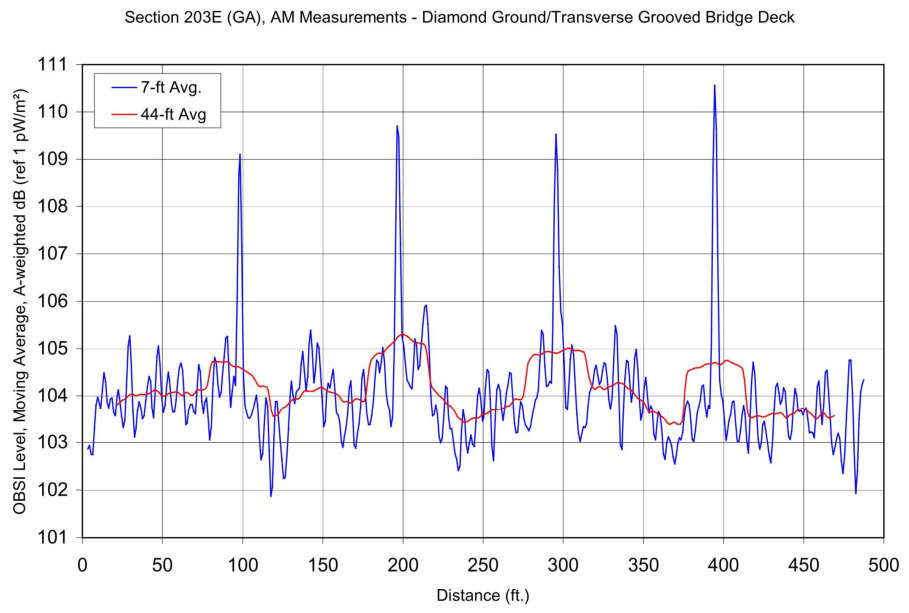
- Analyses showed that a car passing through expansion joints between slabs increases average noise by 1.5 dB, while locally, bridge expansion joints increase sound intensity by up to 5 dB. An exemplary observation is presented in Figure 4.
- macrotexture height—measured by RoboTex and CTM—Circular Texture Meter devices (to results comparison),
- coefficient of friction—measured by DFT—Dynamic Friction Tester device,
- longitudinal evenness—IRI—International Roughness Index—measured by inertial profiler device—two lasers,
- pavement and air temperature including air humidity.
- Texture and noise variability, which are significantly higher for longitudinal and transverse tining compared to drag textures. This difference indicates a relationship among concrete mix, surface texture, and noise levels. Further investigation of this relationship is necessary.
- Efficient tire–pavement noise control, which requires real-time feedback during surface texturing. Texture application methods and their evaluation must be improved. Customized textures require validation for both acoustic effectiveness and safety. Utilizing a line laser test device would be highly beneficial for this purpose.
- longitudinal diamond grooving—spacing: 5.59 mm, 6.22 mm; depth: 2.41 mm, 3.07 mm;
- longitudinal turf and burlap dragging—spacing: 1.91 mm, depth: 1.91 mm, 3.18 mm;
- longitudinal tining—spacing: 19.1 mm, depth: 4.76 mm.
- Increasing the groove depth in diamond grooving reduces noise levels by an average of 4 dB.
- Diamond grooving exhibited the highest noise variability (standard deviation of ±1.2 dB). Conversely, turf drag demonstrated the lowest variability (approximately ±0.2 dB).
- macrotexture—CTM and Sand Patch Method (SPM) devices (to results comparison),
- friction—DFT and E 274 trailer method (to results comparison).
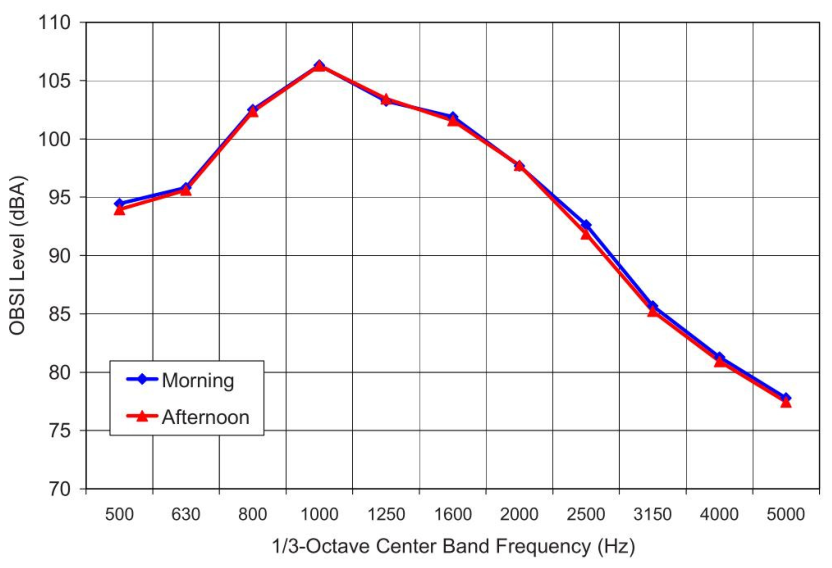
- the noise level for the assessed pavement was almost identical in the morning and evening.
- The highest noise levels were recorded at sound frequencies of 800, 1000, and 1250 [Hz]—the exemplary result is presented in Figure 5.
- tining (longitudinal, spacing/texture depth 2.4–3.2 mm/1.5–8 mm),
- burlap dragging (longitudinal),
- brooming (longitudinal),
- diamond grooving [disc spacing: 9.35–19.05 mm, depth: 3.18–6.35 mm],
- diamond grinding [disc spacing 2.67–3.05 mm],
- hybrid method (conventional “grinding + grooving”) [disc spacing 3.05 mm—grinding/19.05 mm—grooving + depth 9.35 mm].
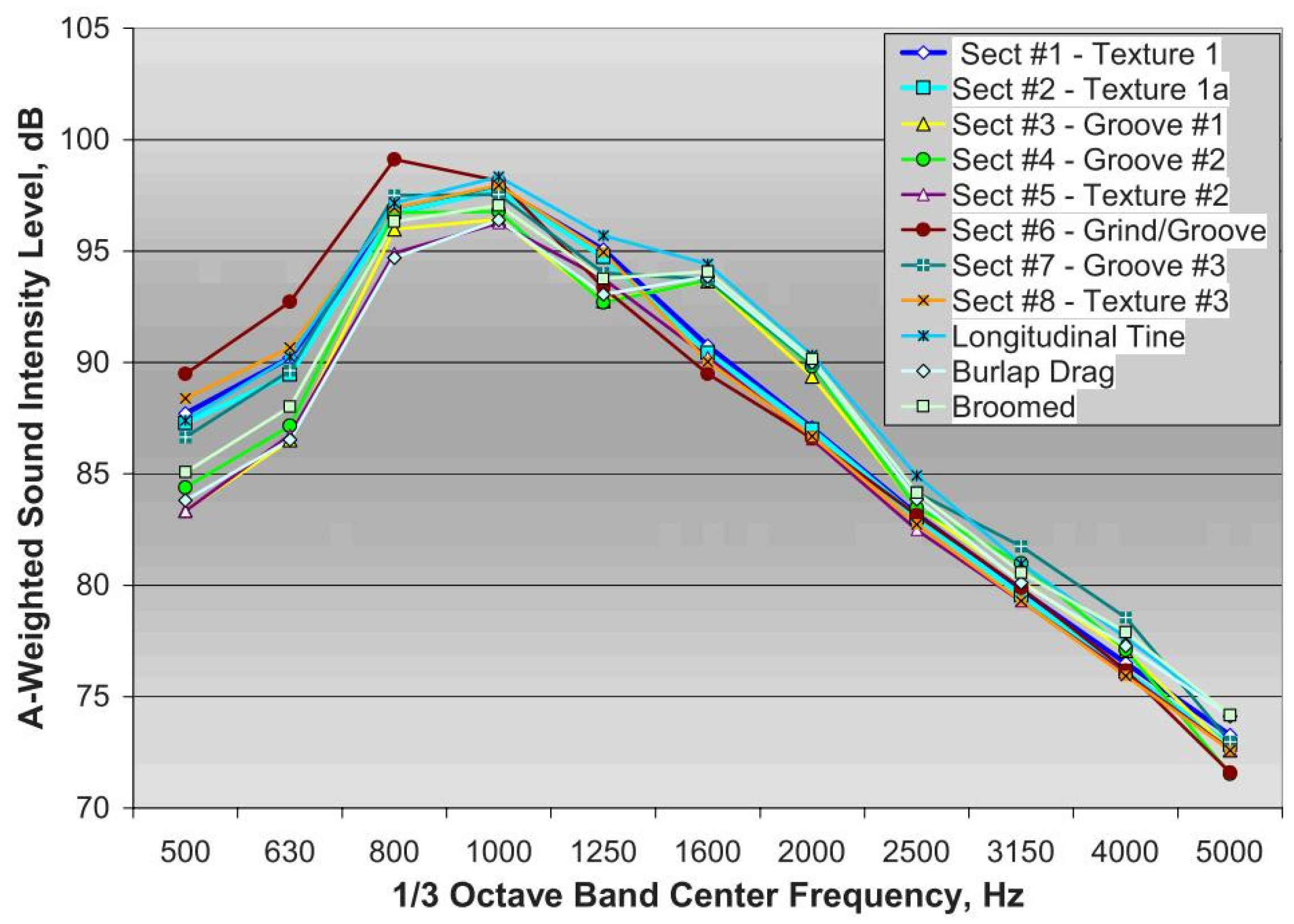
- the highest noise levels were recorded at frequencies of 900–1250 Hz, with an extreme peak at 900 Hz—highest noise spectrum peak is texture surface independent (exemplary results—Figure 6);
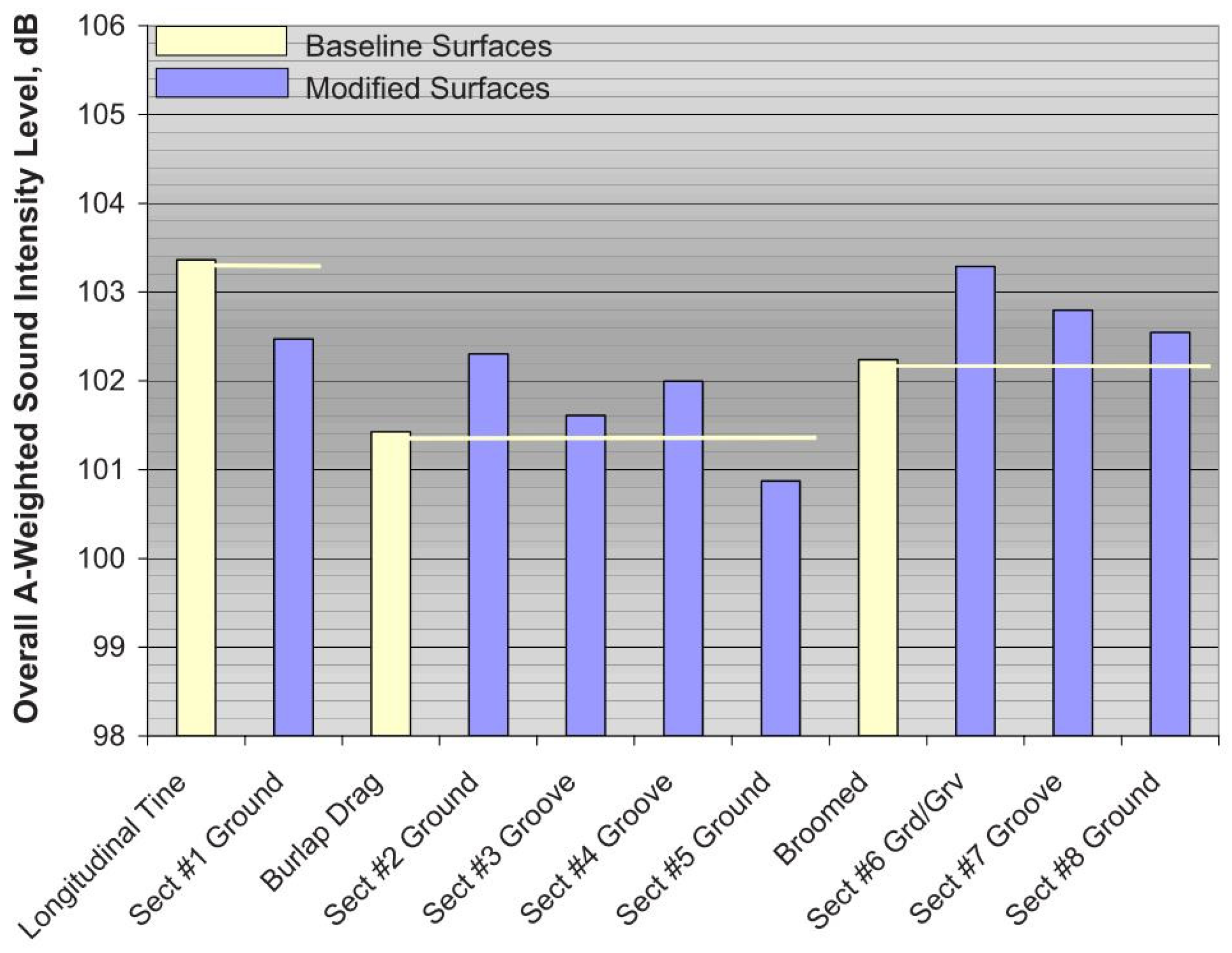
- the texture burlap dragging is quieter than brooming as well as tining, up to 2 dB less noise level;
- the lowest noise level (101 dB) was recorded for the surface originally textured with a burlap dragging, which was subsequently grinded (sect #5). This texturing combination reduced the noise level by up to 2.5 dB compared to other surfaces—exemplary results Figure 7;
- it has been confirmed that doweled and anchored pavements are up to 4 dB louder than those without them.
- Noise levels increase with vehicle speed.
- Narrower tires (25 ft) generate up to 15 dB higher noise levels than 50-ft-wide tires.
- Tire tread design, specifically height and shape, strongly influences noise levels, causing variations of up to 7 dB.
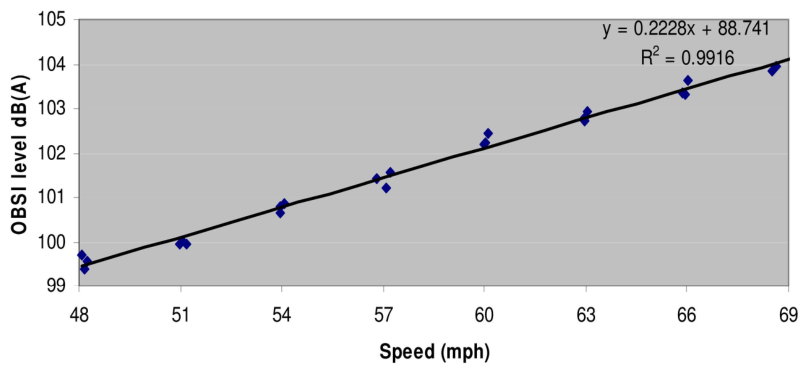
- Tire–pavement noise increases linearly with speed, regardless of surface texture. This strong linear relationship is supported by a high coefficient of determination (R2), as shown in Figure 8;
- Pavement temperature strongly influences OBSI noise measurements, causing significant data variability.
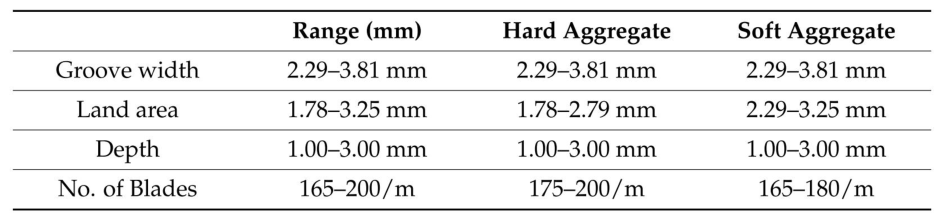
- The first section was made using NGCS technology (longitudinal grinding: spacing 0.8 mm; width: 0.3 mm, and longitudinal grooving: spacing 12.7 mm; width: 3.2 mm; depth: 3.2 mm).
- The second one is a combination of conventional grinding and grooving.
- Third—conventional grooving.
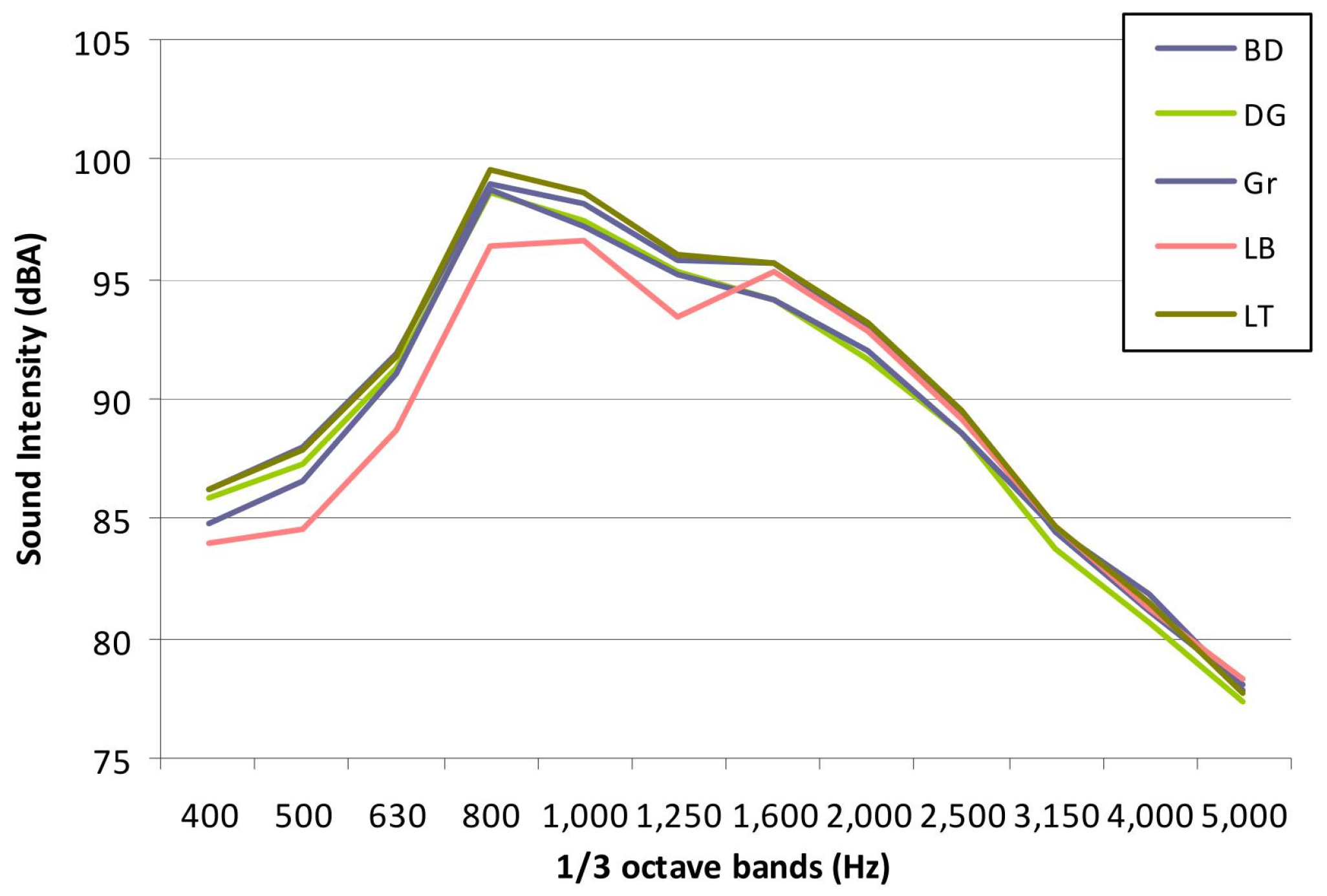
- For all evaluated textures, the highest noise levels occurred in the 800–1000 Hz frequency band, regardless of the texturing method.
- At the 800 Hz peak, LT surfaces were the loudest (approximately 99.6 dB), while LB surfaces were the quietest (approximately 97.2 dB). Exemplary average noise results—Figure 10.
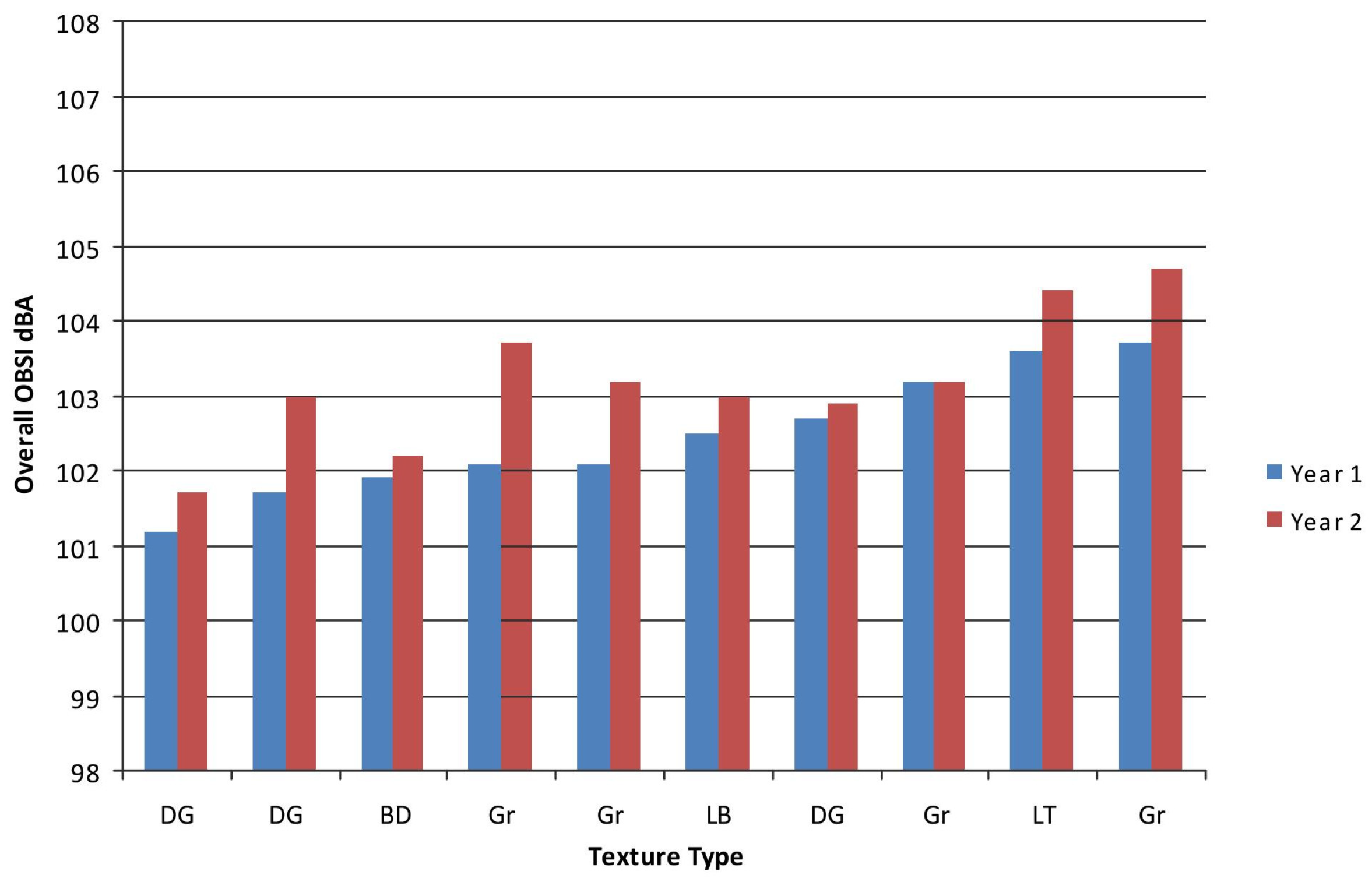
- Texture degradation over time increases noise levels. For the DGrind method, noise levels increased by an average of 8 dB.
- The BD technique exhibited the lowest acoustic variability over time, with an average noise increase of only 1.9 dB. Figure 11 presents selected OBSI results over a 2-year period.
- Based on LT data, new textures can be up to 2 dB quieter than aged or worn-out textures at the 800 Hz peak frequency.
- EA surfaces rehabilitated with CDG were the quietest (99.6 dB), closely followed by EA surfaces rehabilitated with NGCS (99.8 dB). The acoustic difference was marginal (0.2 dB).
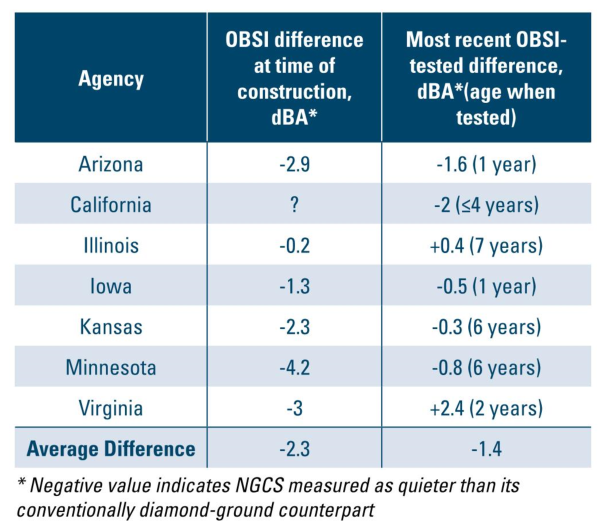
- After 1 to 4 years in service, NGCS surfaces exhibited an average acoustic degradation (noise increase) of 1.0 dB.
- Depending on the region, NGCS surfaces were, on average, up to 2.1 dB quieter than DGind and EA surfaces.
- The transverse tining method is the noisiest, with noise levels reaching up to 111.5 dB.
- The quietest texturing method is burlap dragging—noise levels reach around 100.5 dB.
- Compromise among all analyzed surfaces seems to be the diamond grinding texturing method—a noise level is quite similar to that of the burlap dragging (Figure 13).
- NGCS textures provided two to three times greater noise reduction than CDG textures. The average overall noise reduction was 3.6 dB for NGCS compared to 1.6 dB for CDG.
- The combined CDG+NGCS texture was more effective in reducing noise than standalone NGCS, being on average 0.9 dB quieter.
- NGCS was approximately 20% more cost-effective than CDG. The cost of noise reduction was USD 2.77/dB for NGCS versus USD 3.36/dB for CDG.
- friction (anti-slip properties) measured by a locked-wheel skid trailer device [ASTM E274], and DFT [ASTM E1911] separately;
- longitudinal evenness (IRI)—measured by an inertial lase profiler with a RolineTM high speed point laser [ASTM E950];
- macrotexture—CTM [ASTM E2157];
- surface drainability—measured by the Outflow Meter (OFM) [ASTM E2380].
- Tested CDG texture resulted in noise in the range of 100.8–104.9 dB (average 102.8 dB).
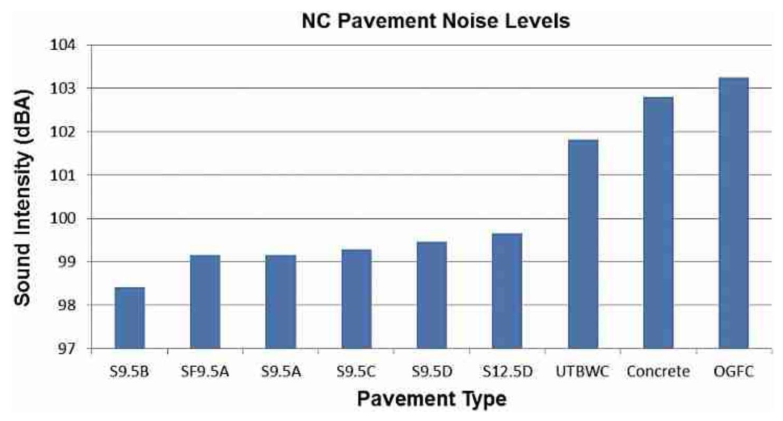
- PCC pavements textured by CDG method could be even 0.5 dB quieter than OGFC bitumen pavements (Figure 14).
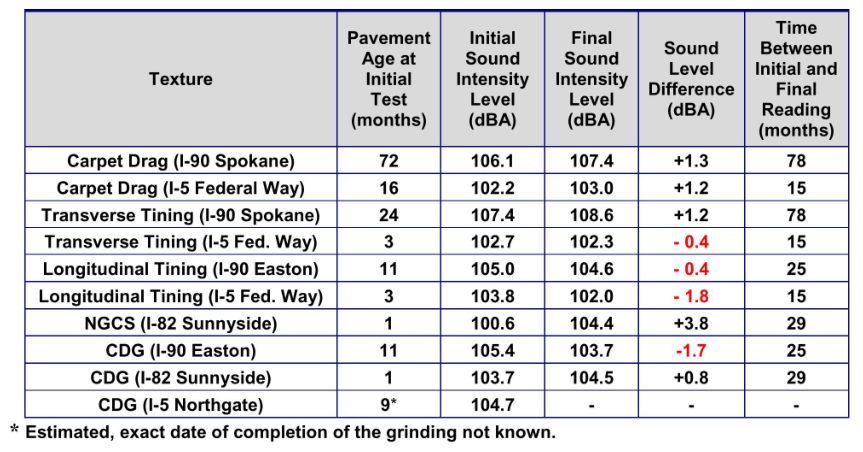
- NGCS surfaces degrade rapidly in terms of acoustics. Within the first four months, noise levels increased by approximately 2.6 dB, reaching a total increase of 3.8 dB after 29 months (Figure 15). Heavy traffic and studded tires exacerbate this degradation.
- PCC surfaces with carpet drag or transverse tining exhibited minimal acoustic changes over time. This indicates high durability under heavy traffic, with a maximum noise increase of 1.3 dB over 78 months. Similar results were observed for CDG textures.
- On longitudinally tined sections, heavy traffic actually decreased road noise. Noise levels dropped by up to 1.8 dB. This texture could serve as a viable alternative to NGCS in areas with heavy traffic and studded tire usage.
- NGCS: grind: diamond grind blades—0.125-inch width, spacers—0.030-inch width; groove: diamond groove blades—0.125-inch width, cut—0.125–0.375-inch depth, spacers—0.5-inch width
- CDG: diamond grind blades—0.125-inch width, spacers—0.030-inch width
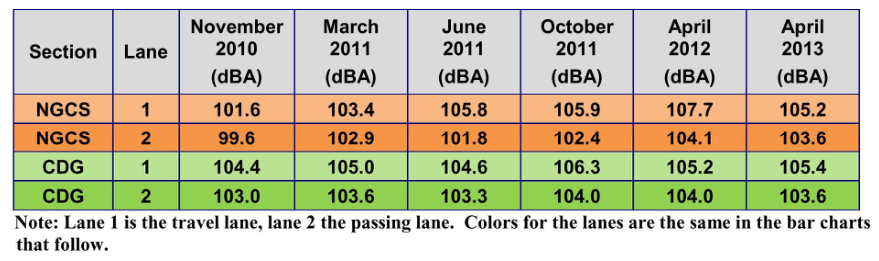
- Over three years, NGCS surfaces exhibited greater acoustic degradation than CDG surfaces. Average noise levels increased by 3.8 dB for NGCS and 0.8 dB for CDG.
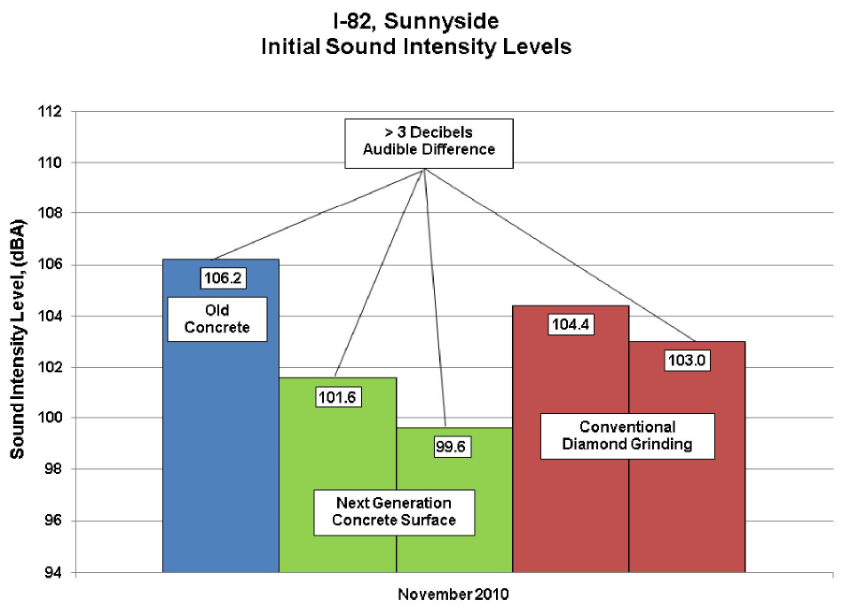
- Initially, NGCS surfaces were quieter than CDG surfaces. Initial noise levels were 99–102 dB for NGCS and 103–104 dB for CDG—Figure 16.
- Studded tires severely damage NGCS surfaces, resulting in a significant noise increase over time—Figure 16.
- Replacing the TT texture with NGDG reduced noise intensity by an average of 75%. Overall noise levels decreased from 107.6 dB to 101.7 dB.
- Results suggest that the NGDG surface requires approximately four times the traffic volume (V/h) to generate the same noise level as the original TT surface. However, this assumption requires further verification.
- The NGDG texture did not exhibit significant acoustic degradation (noise increase) over the tested period.
- macrotexture height (MPD) as well as longitudinal evenness (IRI)—measured by laser texture scanner device (ASTM E2157/E1845);
- skid resistance—measured by a locked-wheel skid trailer device (ASTM E274).
- Pavement noise increases with groove depth. This is caused by the air-pumping effect resulting from a larger groove volume.
- Prolonged tire–pavement contact over deeper grooves can increase noise due to resonance effects.
- longitudinal evenness (IRI)—continuous roughness tester (LXBP-3),
- macrotexture—Chinese sanding method,
- friction—sideway force (60 km/h)—friction coefficient test equipment (JGMC-2).
- A strong correlation exists between IRI and OBSI noise levels. The coefficient of determination (R2) was 0.74 for the combined data set of transverse and longitudinal grooves.
- Macrotexture also strongly correlates with OBSI noise levels. Depending on the groove type, (R2) values ranged from 0.60 to 0.64.
- Surface texture significantly influences road noise. This relationship requires further investigation, particularly at the standard testing speed of 100 km/h and for frequencies below 1600 Hz.
- Standard OBSI testing at 100 km/h may underestimate noise levels on urban roads and highways. Therefore, evaluations across a broader speed range (20–140 km/h) are necessary.
- Comprehensive studies evaluating OBSI road noise and texture levels at various speeds are strongly needed. Such data will improve the understanding of noise generation and help develop noise prediction models that incorporate pavement safety factors.
- The literature currently lacks long-term comprehensive studies. Continuous, year-by-year monitoring of acoustic performance and safety parameters is required. This monitoring will enable the development of precise regression models for noise variability over time.
- test speed 60, 70, 80, 90, 100 km/h;
- the OBSI test was made using a passenger car with a 225/60 16 tire;
- each section test length was equal to 200 m.
- The sound level progresses in four phases:
- Noise increases before reaching the tunnel.
- Noise stabilizes before entering the tunnel.
- Noise increases in the initial tunnel section (up to 200 m).
- Noise stabilizes inside the tunnel.
- The noise level increases by approximately 20 dB between phases 1 and 2, and by 23 dB between phases 3 and 4.
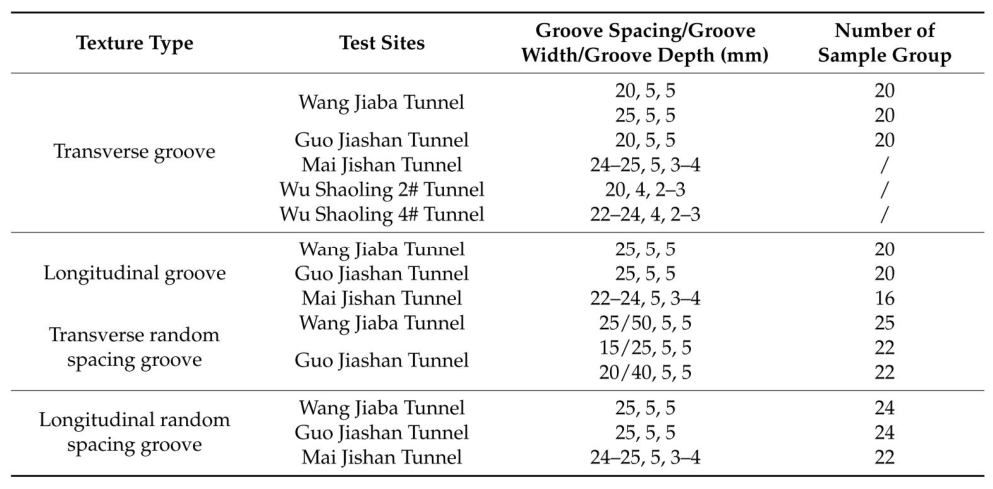
- Longitudinal grooving with a 25-mm spacing reduces noise by up to 2.5 dB compared to transverse grooving. For combined textures (longitudinal and transverse grooving), noise levels match those of transverse grooving.
- A linear model successfully characterized the relationship between test speed (60–100 km/h) and road noise for each grooving configuration. The coefficient of determination (R2) was nearly 1.0 (0.96–0.97). This indicates that noise phenomena inside tunnels do not dampen or resonate differently than in open environments.
- smooth texture.
- grooved longitudinally, spacing 25 mm, cutting depth and width 3 mm.
- grooved transversely spacing 25 mm, cutting depth and width 3 mm; 6 mm.
- The lowest noise levels were recorded in smooth texture specimens and for longitudinal grooves. The highest noise level was reached for transverse grooves.
- The largest relative changes reach 10 dB—comparison between smooth texture specimen vs. transverse grooves with a groove depth of 6 mm.
- It was found that ribbed tire (ASTM E501) applied to experiment was averagely quieter than smooth ones (ASTM E524) by approximately 1 dB.
- Polymer fiber-modified surfaces (PCC) reduced tunnel road noise to levels comparable to exposed aggregate textures (EACCP). Test results ranged from 93.27 dB to 99.8 dB.
- To ensure driving comfort, the authors recommend using texturing methods that generate peak noise levels below 105 dB.
- friction—sideway force (60 km/h)—friction coefficient test equipment (JGMC-2).
- A strong correlation exists between OBSI road noise and the sideway force coefficient (SFC). The coefficient of determination (R2) for the polynomial regression model was 0.79.
- An increase in skid resistance correlates with lower road noise. This is likely due to surface texture channels that allow compressed air to escape from under the tires, thereby reducing the air-pumping noise effect.
- NGCS surfaces can provide an average noise level of 99 dB, which is the lowest among known non-porous textures, particularly compared to CDG.
- NGCS surfaces undergo acoustic degradation over time due to traffic-induced structural changes, with the average noise level increasing to 103 dB during service.
- Laboratory experiments using OBSI testing showed that modifying the cutting configurations in NGCS technology affects noise levels as follows:
- Shallower grinds reduced road noise by an average of 0.5 dB.
- Varying blade widths yielded inconsistent results, requiring further investigation.
- Narrower spacers reduced road noise by more than 1 dB on average.
- Very few studies have investigated road noise using the OBSI method, particularly regarding NGCS textures and exposed aggregate PCC pavements.
- Conventionally grooved PCC pavements are 1 to 5 dB louder than exposed aggregate surfaces.
- NGCS textures can be up to 5 dB quieter than conventional PCC pavements.
- Further research is required to validate these findings using the OBSI method. Moreover, comprehensive studies are needed to evaluate the correlation between road noise and pavement safety parameters, as well as their combined impact on noise generation.
- Rehabilitated grooving reduced surface noise by an average of 0.3 dB compared to new grooving.
- OBSI measurements at speeds above 100 km/h may be unstable and require further investigation.
- NGCS surfaces provide an average long-term noise reduction of 1.4 dB compared to CDG textures.
- Frequent fluctuations in noise levels were observed, which were likely caused by construction defects.
- As a non-porous option, the NGCS texture can initially reduce noise emissions by 1 to 4 dB and provide excellent long-term skid resistance. However, it undergoes acoustic degradation over time, leading to a noise increase of 1 to 3 dB.
- Conventional diamond grinding and exposed aggregate textures are strong alternatives. They offer similar acoustic and skid resistance properties.
- No studies have thoroughly investigated the correlations and mechanisms linking road noise to other pavement parameters, such as surface texture and skid resistance.
- There is currently no comprehensive, authoritative comparison of concrete pavement textures that simultaneously evaluates road noise, safety parameters, and durability.
- transverse tining (TT),
- diamond grinding (DG),
- NGCS (NGCS GaG),
- longitudinal tining (LT).
- The acoustic spectrum (dB vs. Hz) revealed the highest noise peak at 900 Hz for the TT method. TT was the loudest among the investigated textures.
- The peak noise frequency is highly texture dependent. Furthermore, the study confirmed that the highest pavement noise levels occur within the 800–1150 Hz frequency range.
- NGCS surfaces were, on average, 14 dB quieter than TT concrete surfaces.
- macrotexture—MPD measured by circular track meter (CTM),
- longitudinal evenness—IRI—no device details exposed,
- temperature—no device details exposed.
- Increasing concrete porosity improves acoustic performance by reducing noise. However, an optimal porosity threshold exists, above which pavement performance may degrade. This aligns with existing literature.
- Measured road noise for the pervious concrete ranged from 98.1 to 103.9 dB at a test speed of 96 km/h.
- A strong relationship exists between IRI, macrotexture (MPD), temperature, and road noise. The proposed model demonstrated that all these parameters are statistically significant (p-value < 0.05) and achieved a good coefficient of determination (R2 = 0.77).
- Incorporating additional variables could improve the accuracy of the noise prediction model. Further research is required in this area.
- Wider groove spacing (approximately 25 mm or more) improved acoustic energy dispersion, significantly lowering and flattening the noise peaks (in dB).
- Higher test speeds (60 km/h and 80 km/h) increased noise peaks, particularly in the 1000 Hz frequency band. The overall road noise varied by 4 to 7 dB between these speeds.
- The relationship between pavement texture and tire–pavement noise is highly frequency-dependent.
- Optimizing the texture configuration can effectively mitigate mid-frequency noise.
- The developed 3D regression model achieved a coefficient of determination (R2) of 0.97. This indicates that road noise on concrete pavements can be accurately predicted by combining acoustic data (OBSI) with other variables, such as test speed. The authors recommended further development of this comprehensive approach.
- DG textures can initially reduce road noise by up to 6 dB (based on OBSI results) while providing excellent skid resistance. These acoustic and safety benefits are typically maintained for two years.
- Geometric configurations, such as cutting blade spacing, depth, and groove width, require further investigation to optimize pavements for noise, safety, and service life.
- Current acoustic data for DG is limited to short-term studies (2 to 5 years). There is a critical lack of long-term observations (10 to 15 years), particularly in comprehensive studies evaluating noise, safety, and other variables.
- No existing studies have evaluated these combined parameters for Continuously Reinforced Concrete Pavements (CRCP), including OBSI applications.
- There is a lack of comparative studies evaluating different texturing methods in terms of noise mitigation, safety, and other characteristics using the OBSI method.
- For DG surfaces, comprehensive research is needed to understand the correlations between road noise, safety, and structural parameters. This holistic approach is necessary for all concrete pavement texturing methods to fully understand noise generation phenomena.
3. Discussion and Conclusions
- Tire Vibration (low to mid-frequencies; <1000 Hz). Coarse, positive macrotexture causes tire tread blocks to impact the surface. This induces radial vibrations in the tire carcass. Higher MPD increases low-frequency noise.
- Air Pumping (high frequencies; >1000 Hz). Rolling tires trap and compress air between the tread and the pavement. Negative macrotexture (voids, grooves, porosity) provides air escape channels. This reduces air pumping noise.
- There is a lack of comprehensive road noise phenomenon investigation using the OBSI test application and also (simultaneously):
- longitudinal evenness (IRI);
- transverse evenness (rutting);
- macrotexture (MTD);
- surface roughness (anti-slip properties—friction coefficient) using, for example, Traction Watcher One (TWO) or Slip Resistance Tester v3 (SRT-3) equipment—moreover, no articles were found using this test equipment;
- surface load-bearing capacity (endurance) using FWD (Falling Weight Deflectometer)—moreover, no articles were found using this equipment and test in the aforementioned study);
- exploitation period;
- atmospheric conditions—temperature, humidity.
- Noise level was not broadly analyzed for specific construction solutions, including the relationship between noise and the construction solution i.e.,:
- the layers and material of the structure (no articles found combining road noise level with concrete pavement material and layer layout applied);
- the connection/implementation method (dowels, anchors, continuous reinforcement);
- the joint configuration of the connected panels (transverse, longitudinal).
- The impact of various surface texturing configurations on noise generation lacks comprehensive analysis. These configurations include combined textures and specific in situ application parameters. For example, diamond grooving parameters involve blade spacing, groove width, and cutting depth. Historically, most publications omitted these details (were not tested, excluding NGCS GaG case). However, research focus on this area has increased since 2020.
- Very few studies evaluate OBSI noise levels for shot blasting on concrete pavements. Only one or two papers address this specific texturing method.
- There are few studies on low-noise concrete pavements (PCC and NGCS) constructed using the following texture methods (OBSI test appliance): exposed aggregate (PCC), grinding (PCC), and grinding and grooving (NGCS). Similarly, a small number of studies are also reported on porous/pervious concrete pavements.
- There are no comprehensive studies on OBSI, MTD, IRI, TWO (u)/SRT-3 (u) conducted at a standardized measurement speed, e.g., 60 [km/h] as well as in identical weather conditions.
- The full speed spectrum (10–120 km/h) for OBSI testing on concrete pavements has not been thoroughly investigated. Comprehensive noise studies rarely cover this entire range.
- No existing articles correlate road noise with pavement structural layout and long-term endurance in a single comprehensive study.
- Few publications link sound measurements with concrete structural parameters, texturing methods, and texture configuration. Specifically, analyses focusing on the 800–1150 Hz frequency range—which contains peak noise levels within the 0–5000 Hz band—are scarce.
- Comprehensive analyses of OBSI noise levels under variable weather conditions (e.g., moisture, temperature) are missing. The impact of weather on combined acoustic and structural pavement performance requires further investigation.
- No established correlations exist between concrete texturing configurations (e.g., groove spacing, depth, and width) and noise levels. These correlations are necessary to optimize the balance between acoustic performance, traffic safety, and pavement durability.
- Few studies address pavement acoustic durability and long-term noise increase. While short-term acoustic degradation data exists for specific textures, broader investigations covering a 5- to 15-year period are needed.
- The literature lacks guidelines on maintaining low-noise concrete pavements throughout their entire service life.
4. Future Research Work
Funding
Institutional Review Board Statement
Informed Consent Statement
Data Availability Statement
Conflicts of Interest
Abbreviations
| BD | Burlap Dragging or Texture Dragging (texture) |
| T | Tining (texture) |
| SB | Shot Blasting (texture) |
| B | Brooming (texture) |
| DGrov | Diamond Grooving or Grooving (texture) |
| DGrind | Diamond Grinding (texture) |
| EA | Exposed Aggregate (texture) |
| PCC GaG | Portland Cement Concrete pavements—“grinding and grooving” conventional as a mixed technique of traditional DGrov and then traditional DGrind |
| NGCS GaG | New Generation Concrete Surface—new hybrid grinding and grooving method (standardized building operation layout including specified parameters of cutting blades) |
| PC | Porous Concrete (pervious concrete) (texture)—large void content—material feature instead of pavement surface texturing method |
| NGDG | Next Generation Diamond Grinding (texture) |
| CDG | Conventional Diamond Grinding (texture) |
| CTM | Circular Texture Meter |
| IRI | International Roughness Index |
| DFT | Dynamic Friction Tester |
| SPM | Sand Patch Method |
| OBSI | On-Board Sound Intensity test |
| MPD | Mean Profile Depth |
| RSP-3 | Road Surface Profiler v3—with 21 laser sensors |
| FWD | Falling Weight Deflectometer |
| TWO | Traction Watcher One |
| SRT-3 | Slip Resistance Tester v3 |
Appendix A
Appendix A.1

| Functional Road Category/Country | Investigated Concrete Pavement Texture Type | The OBSI Test Speed [km/h] | The Weather Test Conditions | Most Important Observation Related to Road Noise | Lit. Source |
|---|---|---|---|---|---|
| national/USA | BD, DGrov, DGrind, T, EA, PC | various, 40—75 | temperature and humidity measured, but no data exposed |
| [33] |
| national/USA | BD, DGrov, DGrind, T, EA, PC, SB | 97 | temperature and humidity measured, but no data exposed |
| [34] |
| national/USA | DGrov, BG, T | no data (probably 97) | no data |
| [35] |
| national/USA | BD, T | 97 | no data |
| [36] |
| national/USA | BD, T, B, DGrov, DGrind, PCC GaG | 97 | no data |
| [37] |
| national/USA | BD, T, B, DGrov, DGrind, PCC GaG | 88–112 | no data |
| [38] |
| no data/USA | no data exposed | 77–112 | 0, 5, 25, 33 (deg C) |
| [39] |
| built interstate (national)/USA | NGCS GaG, PCC GaG, DGrov | no data | no data |
| [40] |
| national/USA | NGCS GaG, DGrind, T | 97 | no data |
| [41] |
| national and provincial/USA | B, DGrind, DGrov, BD, T | 97 | no data |
| [42] |
| national/USA | NGCS GaG, DGrind, EA, | 97 | no data |
| [43] |
| no data/USA | DGrind, BD, T | 97 | no data |
| [23] |
| national/USA | DGrind, NGCS GaG, NGCS GaG + DGrind | 64, 81, 97 | no data |
| [44] |
| national/USA | DGrind | 40, 48, 56, 64, 72, 80, 88, 97 | no data |
| [45] |
| national, federal, provincial/USA | BD, T, NGCS GaG, DGrind | 97 | no data |
| [46] |
| national, federal, provincial/USA | NGCS GaG, DGrind | 97 | no data |
| [47] |
| national, provincial/USA | NGDG, T | 97 | no data |
| [48] |
| national (tunnels)/China | DGrov | 60 | no data |
| [49] |
| national/USA | - | 100 | no data | Source is general review exposing lacks in the OBSI test appliance to road noise investigation (2018):
| [50] |
| national (tunnels)/China | DGrov | 60, 70, 80, 90, 100 | no data |
| [51] |
| laboratory experiment/China | smooth (no texture), DGrov | 60 (lab. exp.) | no data |
| [52] |
| national (tunnels)/China | EA (modified with fibers), DGrov, DGrov + BD | 60 | no data |
| [53] |
| no data/USA | NGCS GaG, DGrind | 16, 48 (lab. exp. | 4, 16 (deg C) |
| [54] |
| no data/Switzerland | EA, DGrov, NGCS GaG | no data | no data |
| [55] |
| national/South Korea | DGrov, T + DGrov | 100 | no data |
| [56] |
| national/USA | DGrind, NGCS GaG | 97 | no data |
| [57] |
| no data/China | NGCS GaG, PC, EA, DGrind | no data | no data |
| [58] |
| national/South Korea | T, DGrind, NGCS GaG | 100 | no data |
| [59] |
| national/USA | PC, PC + T | 96 | temperature, no data exposed |
| [60] |
| national/China | DGrov, BD, DGrov + BD | 60, 80 | no data |
| [61] |
| national/USA | DGrind/NGCS GaG | no data | no data |
| [62] |
Appendix A.2
| Investigated Concrete Pavement Texture Type | Main Findings (Generally) | Other Pavement Performance Tests Conducted Alongside Road Noise Measurements | Other Pavement Performance Tests Data Integrated and Analyzed with OBSI Test Data to Investigate Road Noise Phenomenon Complex [YES/NO] | Literature Source |
|---|---|---|---|---|
| BD, DGrov, DGrind, T, EA, PC |
|
| NO (only a few general observation) | [33] |
| BD, DGrov, DGrind, T, EA, PC, SB |
|
| NO (only a few general observation) | [34] |
| DGrov, BG, T |
|
| NO | [35] |
| BD, T |
|
| NO (only general observation) | [36] |
| BD, T, B, DGrov, DGrind, PCC GaG |
|
| NO | [37] |
| BD, T, B, DGrov, DGrind, PCC GaG |
|
| NO | [38] |
| no data exposed |
|
| NO | [39] |
| NGCS GaG, PCC GaG, DGrov |
|
| NO | [40] |
| NGCS GaG, DGrind, T |
|
| NO | [41] |
| B, DGrind, DGrov, BD, T |
|
| NO | [42] |
| NGCS GaG, DGrind, EA |
|
| NO | [43] |
| DGrind, BD, T |
|
| NO | [23] |
| DGrind, NGCS GaG, NGCS GaG + DGrind |
|
| NO | [44] |
| DGrind |
|
| NO | [45] |
| BD, T, NGCS GaG, DGrind |
|
| NO | [46] |
| NGCS GaG, DGrind |
|
| NO | [47] |
| NGDG, T |
|
| NO | [48] |
| DGrov |
|
| YES (preliminary observations) | [49] |
| - | Source is general review exposing lacks in the OBSI test appliance to road noise investigation (2018):
|
| NO | [50] |
| DGrov |
|
| NO (only preliminary observation) | [51] |
| smooth (no texture), DGrov |
|
| NO | [52] |
| EA (modified with fibers), DGrov, DGrov + BD |
|
| YES (preliminary observations) | [53] |
| NGCS GaG, DGrind |
|
| NO | [54] |
| EA, DGrov, NGCS GaG | Source is general review—findings and lacks related to quiet pavements (OBSI test appliance) (2022):
|
| NO | [55] |
| DGrov, T + DGrov |
|
| NO | [56] |
| DGrind, NGCS GaG |
|
| NO | [57] |
| NGCS GaG, PC, EA, DGrind | Source is general review—findings and lacks related to quiet pavements (OBSI test appliance) (2023):
|
| NO | [58] |
| T, DGrind, NGCS GaG |
|
| NO | [59] |
| PC, PC + T |
|
| YES (preliminary observations) | [60] |
| DGrov, BD, DGrov + BD |
|
| YES | [61] |
| DGrind/NGCS GaG | Source is general review—findings and lacks related to quiet concrete pavements (DGrind texture considering OBSI test appliance data) (2025):
|
| NO | [62] |
References
- Singh, D.; Kumari, N.; Sharma, P. A Review of Adverse Effects of Road Traffic Noise on Human Health. Fluct. Noise Lett. 2018, 17, 1830001. [Google Scholar] [CrossRef] [Scilit]
- Wrótny, M.; Bohatkiewicz, J. Traffic Noise and Inhabitant Health—A Comparison of Road and Rail Noise. Sustainability 2021, 13, 7340. [Google Scholar] [CrossRef] [Scilit]
- Montes González, D.; Barrigón Morillas, J.M.; Rey-Gozalo, G. Effects of noise on pedestrians in urban environments where road traffic is the main source of sound. Sci. Total Environ. 2023, 857, 159406. [Google Scholar] [CrossRef] [Scilit] [PubMed]
- Arregi, A.; Vegas, O.; Lertxundi, A.; Silva, A.; Ferreira, I.; Bereziartua, A.; Cruz, M.T.; Lertxundi, N. Road traffic noise exposure and its impact on health: Evidence from animal and human studies-chronic stress, inflammation, and oxidative stress as key components of the complex downstream pathway underlying noise-induced non-auditory health effects. Environ. Sci. Pollut. Res. Int. 2024, 31, 46820–46839. [Google Scholar] [CrossRef] [Scilit] [PubMed]
- Barros, A.; K Kampen, J.; Vuye, C. Noise barriers as a mitigation measure for highway traffic noise: Empirical evidence from three study cases. J. Environ. Manag. 2024, 367, 121963. [Google Scholar] [CrossRef] [Scilit] [PubMed]
- Horizon Magazine. Reducing Noise Pollution with Acoustic Walls and Rubberised Roads. Available online: https://projects.research-and-innovation.ec.europa.eu/en/horizon-magazine/reducing-noise-pollution-acoustic-walls-and-rubberised-roads (accessed on 15 December 2025).
- Motylewicz, M.; Gierasimiuk, P.; Dębiński, M. Badania skuteczności i efektywności drogowych ekranów przeciwhałasowych. Constr. Mater. 2023, 1, 32–36. [Google Scholar] [CrossRef] [Scilit]
- Pietrzak, K.; Tokarski, Z.; Kowalski, K.J. Assessment of the traffic noise reduction when using tramway screening. Roads Bridges-Drog. I Mosty 2018, 17, 127–139. [Google Scholar] [CrossRef] [Scilit]
- Öztürk, T.; Öztürk, Z.; Çaliş, M. A case study on acoustic performance and construction costs of noise barriers. Sci. Res. Essays 2012, 7, 4213–4229. [Google Scholar]
- National Academies of Sciences, Engineering, and Medicine. Cost-Benefit Analysis for Noise Control. Available online: https://www.nationalacademies.org/read/12928/chapter/9#110 (accessed on 15 December 2025).
- Ecotière, D.; Pallas, M.-A. Reducing Speed, Changing Road Surfaces… What Solutions Are There to Combat Road Noise Pollution? Available online: https://reflexscience.univ-gustave-eiffel.fr/en/read/articles/reducing-speed-changing-road-surfaces-what-solutions-are-there-to-combat-road-noise-pollution (accessed on 15 December 2025).
- Ohiduzzaman, M.D.; Sirin, O.; Kassem, E.; Rochat, J. State-of-the-Art Review on Sustainable Design and Construction of Quieter Pavements—Part 1: Traffic Noise Measurement and Abatement Techniques. Sustainability 2016, 8, 742. [Google Scholar] [CrossRef] [Scilit]
- Abbott, P.G.; Morgan, P.A.; McKell, B. A Review of Current Research on Road Surface Noise Reduction Techniques PPR443, Scotland, United Kingdom. 2010. Available online: https://www.researchgate.net/profile/Phil-Abbott-3/publication/369182337_A_REVIEW_OF_CURRENT_RESEARCH_ON_ROAD_SURFACE_NOISE_REDUCTION_TECHNIQUES/links/640e29b0315dfb4cce7255ef/A-REVIEW-OF-CURRENT-RESEARCH-ON-ROAD-SURFACE-NOISE-REDUCTION-TECHNIQUES.pdf?_tp=eyJjb250ZXh0Ijp7ImZpcnN0UGFnZSI6InB1YmxpY2F0aW9uIiwicGFnZSI6InB1YmxpY2F0aW9uIn19 (accessed on 16 December 2025).
- Sirin, O. State-of-the-Art Review on Sustainable Design and Construction of Quieter Pavements—Part 2: Factors Affecting Tire-Pavement Noise and Prediction Models. Sustainability 2016, 8, 692. [Google Scholar] [CrossRef] [Scilit]
- National Research Council. Hearing Loss: Determining Eligibility for Social Security Benefits; The National Academies Press: Washington, DC, USA, 2005. [Google Scholar]
- Bendtsen, H.; Kohler, E.; Lu, Q.; Rymer, B. Temperature Influence on Noise Measurements. In Proceedings of the 2009 INTERNOISE Congress, Edinburgh, UK, 26–28 October 2009. No. 175. [Google Scholar]
- Pardo-Jadue, J.; Dragicevic, C.D.; Bowen, M.; Delano, P.H. On the Origin of the 1,000 Hz Peak in the Spectrum of the Human Tympanic Electrical Noise. Front. Neurosci. 2017, 11, 395. [Google Scholar] [CrossRef] [Scilit] [PubMed]
- Zofka, A.; Mechowski, T.; Graczyk, M.; Sudyka, J.; Harasim, P. Przegląd Literatury na Temat Metod Pomiaru Hałaśliwości Nawierzchni; GDDKiA: Warszawa, Poland, 2018. [Google Scholar]
- Cockings, T.; Sburlati, D.; Harrison, M. OBSI Measurements for the Purpose of Calibrating Road Surface Corrections for Cortn Based Road Models, Australia. 2015. Available online: https://acoustics.asn.au/conference_proceedings/AAS2015/papers/p106.pdf (accessed on 30 December 2025).
- Chiles, S. Alternative Systems for Road Surface CPX Measurements, Australia. 2015. Available online: https://scispace.com/pdf/alternative-system-for-road-surface-cpx-measurements-3s9pqlt6iu.pdf (accessed on 30 December 2025).
- Rasmussen, R.; Sohaney, R.; Wiegand, P. Measuring and Reporting Tire-Pavement Noise Using On-Board Sound Intensity (OBSI): Concrete Pavement Surface Characteristics Program, Iowa State University. 2011. Available online: www.cptechcenter.org (accessed on 30 December 2025).
- Tonin, R.; Saurer, T. Comparison of CPX and OBSI Noise Measurements for Different Road Surfaces, Hong Kong. 2017. Available online: https://ince.publisher.ingentaconnect.com/contentone/ince/incecp/2017/00000255/00000004/art00049?crawler=true (accessed on 30 December 2025).
- Rasmussen, R.; Wiegand, P.; Fick, G.; Harrington, D. How to Reduce Tire-Pavement Noise: Better Practices for Constructing and Texturing Concrete Pavement Surfaces. DTFH61-06-H-00011, USA. 2012. Available online: https://www.intrans.iastate.edu/wp-content/uploads/2018/08/How_to_Reduce_Tire-Pavement_Noise_final.pdf (accessed on 30 December 2025).
- Andrzej, M. Uszorstnienie Nawierzchni w Technologii Śrutowania, Warszawa. 2021. Available online: https://nbi.com.pl/archiwum-nbi/uszorstnienie-nawierzchni-w-technologii-srutowania/ (accessed on 30 December 2025).
- Wegarten. Nawierzchnie Betonowe Nowej Generacji. Available online: https://www.wegartenconstruction.com/media/broszura_ngcs.pdf (accessed on 30 December 2025).
- Federal Highway Administration. Concrete Pavement Texturing; Tech Brief: Washington, DC, USA, 2019. Available online: https://www.fhwa.dot.gov/pavement/pubs/hif17011.pdf (accessed on 30 December 2024).
- Sebastian, W.; Małgorzata, K.-P.; Wioletta, J.-R. Badania właściwości przeciwpoślizgowych nawierzchni betonowych oraz metody poprawy tych właściwości. Bud. Technol. Archit. 2017, 2017, 48–51. [Google Scholar]
- Michalski, W. Metody nadawania tekstury nawierzchniom betonowym. Drogownictwo 2016, 2016, 126–134. [Google Scholar]
- Gardziejczyk, W. Mobilne i stacjonarne metody pomiaru i oceny hałaśliwości nawierzchni drogowych. Constr. Mater. 2025, 1, 81–88. [Google Scholar] [CrossRef] [Scilit]
- Gardziejczyk, W. Hałaśliwość Nawierzchni Drogowych; Oficyna Wydawnicza Politechniki Białostockiej: Białystok, Poland, 2018. [Google Scholar]
- AASHTO TP 76-09; Measurement of Tire/Pavement Noise using the On-Board Sound 3 Intensity (OBSI) Method: TP 76-09. AASHTO: Washington, DC, USA, 2009.
- Transportation Research Board; National Academies of Sciences, Engineering; Medicine. Texturing of Concrete Pavements: National Cooperative Highway Research Program (NCHRP) Report 634: Texturing of Concrete Pavements; The National Academies Press: Washington, DC, USA, 2009. [Google Scholar]
- Cackler, T. Evaluation of U.S. and European Concrete Pavement Noise Reduction Methods, USA. 2006. Available online: https://rosap.ntl.bts.gov/view/dot/24417 (accessed on 30 December 2025).
- Ferragut, T.; Cackler, T. ISU-FHWA-ACPA Concrete Pavement Surface Characteristics Program Part 2: Preliminary Field Data Collection, USA. 2007. Available online: https://rosap.ntl.bts.gov/view/dot/38927 (accessed on 30 December 2025).
- Hall, J.W.; Smith, K.L.; Littleton, P. Texture of Concrete Pavements 10-67, USA. 2008. Available online: https://onlinepubs.trb.org/onlinepubs/nchrp/nchrp_rpt_634appendixes.pdf (accessed on 30 December 2025).
- Rasmussen, R. Measuring and modeling tire-pavement noise on various concrete pavement textures. Noise Control Eng. J. 2008, 57, 139. [Google Scholar] [CrossRef] [Scilit]
- Donavan, P.R. Noise evaluation of various pavement textures on new Portland cement concrete. Noise Constrol Eng. J. 2009, 2009, 63–76. [Google Scholar] [CrossRef] [Scilit]
- Donavan, P.R.; Lodico, D.M. Estimation of Vehicle Pass-By Noise Emission Levels from Onboard Sound Intensity Levels of Tire–Pavement Noise. Transp. Res. Rec. J. Transp. Res. Board 2009, 2123, 137–144. [Google Scholar] [CrossRef] [Scilit]
- Kohler, E. OBSI Testing—Dynatest Presentation. In Proceedings of the Pavement Evaluation 2010 Conference, Roanoke, VA, USA, 24–29 October 2010; Available online: https://www.vtti.vt.edu/PDFs/PE_2010/Kohler%20-%20OBSI%20Testing.pdf (accessed on 30 December 2025).
- Cable, J. Next Generation Grooving and Grinding Iowa Test Site Construction—Surface Characteristics, USA. 2010. Available online: https://www.intrans.iastate.edu/wp-content/uploads/2018/03/surface-grinding-report-web.pdf (accessed on 16 December 2025).
- Anderson, K.; Uhlmeyer, J.; Russell, M. Evaluation of Long-Term Pavement Performance and Noise Characteristics of the Next Generation Concrete Surface WA-RD 767.1, USA. 2011. Available online: https://www.wsdot.wa.gov/research/reports/fullreports/767.1.pdf (accessed on 30 December 2025).
- Kohler, E.; Harvey, J. Quieter Pavement Research: Concrete Pavement Tire Noise UCPRC-RR-2010-03, USA. 2011. Available online: https://dot.ca.gov/-/media/dot-media/programs/research-innovation-system-information/documents/f0016619-2012-05-task-1200a-1of5-pavement.pdf (accessed on 30 December 2025).
- Scofield, L. Development and Implementation of the Next Generation Concrete Surface, USA. 2012. Available online: https://1204075.sites.myregisteredsite.com/NGCSinfo/NGCS%20%20Development%20and%20Implrmentation%201-12-12.pdf (accessed on 16 December 2025).
- Guada, I.; Rezaei, A.; Harvey, J.; Spinner, D. Evaluation of Grind and Groove (Next Generation Concrete Surface) Pilot Projects in California UCPRC-RR-2013-01, USA. 2012. Available online: https://escholarship.org/content/qt72d3q2h4/qt72d3q2h4.pdf?v=lg (accessed on 16 December 2025).
- Wang, G.; Smith, G.; Shores, R. Pavement noise investigation on North Carolina highways: An on-board sound intensity approach. Can. J. Civ. Eng. 2012, 39, 878–886. [Google Scholar] [CrossRef] [Scilit]
- Anderson, K.; Sexton, T.; Uhlmeyer, J.; Russell, M.; Weston, J. Concrete Pavement Noise: I-90 Spokane, I-90 Easton, I-5 Federal Way, I-82 Sunnyside, and I-5 Northgate WA-RD 814.1, USA. 2013. Available online: https://www.wsdot.wa.gov/research/reports/fullreports/814.1.pdf (accessed on 17 December 2025).
- Anderson, K.; Uhlmeyer, J.; Sexton, T.; Russell, M.; Weston, J. Evaluation of Long-Term Pavement Performance and Noise Characteristics of the Next Generation Concrete Surface: Final Report WA-RD 767.2, USA. 2014. Available online: https://www.wsdot.wa.gov/research/reports/fullreports/767.2.pdf (accessed on 30 December 2025).
- Weissmann, A.; Weissmann, J.; Papagiannakis, A.T. Noise Abatement and Performance Evaluation of a Next-Generation Diamond Grinding Test Section in Harris County FHWA/TX-12/5-9046-03, USA. 2016. Available online: https://rosap.ntl.bts.gov/view/dot/54868/dot_54868_DS1.pdf (accessed on 30 December 2025).
- Wei, D.; Li, B.; Zhang, Z.; Han, F.; Zhang, X.; Zhang, M.; Li, L.; Wang, Q. Influence of Surface Texture Characteristics on the Noise in Grooving Concrete Pavement. Appl. Sci. 2018, 8, 2141. [Google Scholar] [CrossRef] [Scilit]
- Staiano, M.A. Tire–Pavement Noise and Pavement Texture. J. Transp. Eng. Part B Pavements 2018, 144, 4018034. [Google Scholar] [CrossRef] [Scilit]
- Zhang, Z.; Luan, B.; Liu, X.; Zhang, M. Effects of surface texture on tire-pavement noise and skid resistance in long freeway tunnels: From field investigation to technical practice. Appl. Acoust. 2020, 160, 107120. [Google Scholar] [CrossRef] [Scilit]
- Han, S.; Peng, B.; Chu, L.; Fwa, T.F. In-door laboratory high-speed testing of tire-pavement noise. Int. J. Pavement Eng. 2020, 23, 321–331. [Google Scholar] [CrossRef] [Scilit]
- Fang, J.; Tu, J.; Wu, K. Analysis of Skid Resistance and Noise Characteristics for Varieties of Concrete Pavement. Adv. Mater. Sci. Eng. 2020, 2020, 7427314. [Google Scholar] [CrossRef] [Scilit]
- Scofield, L. Development and Deployment of the Next Generation Concrete Surface: Map Brief, USA. 2020. Available online: www.cproadmap.org (accessed on 30 December 2025).
- Mikhailenko, P.; Piao, Z.; Kakar, M.R.; Bueno, M.; Athari, S.; Pieren, R.; Heutschi, K.; Poulikakos, L. Low-Noise pavement technologies and evaluation techniques: A literature review. Int. J. Pavement Eng. 2022, 23, 1911–1934. [Google Scholar] [CrossRef] [Scilit]
- Comparisons of Tire-Pavement Noise Characteristics Between Logitudinal Tining and Diamond Grinding Concrete Pavement; Lee, W.-Y., Kim, C.-W., Eds.; The International Congress on Acoustics: Funchal, Portugal, 2022. [Google Scholar]
- Smith, K.; Grogg, M.; Ram, P.; Smith, K.; Harrington, D. Concrete Pavement Preservation Guide, 3rd ed.; 2022; Available online: https://www.intrans.iastate.edu/wp-content/uploads/2022/08/concrete_pvmt_preservation_guide_3rd_edition_web.pdf (accessed on 30 December 2025).
- Leng, Z.; Fan, Z.; Liu, P.; Kollmann, J.; Oeser, M.; Wang, D.; Jiang, X. Texturing and evaluation of concrete pavement surface: A state-of-the-art review. J. Road Eng. 2023, 3, 252–265. [Google Scholar] [CrossRef] [Scilit]
- Lee, J.K.; Kim, B.K.; Choi, H.; Chang, S.I. Road-pavement classification by artificial neural network model based on tire-pavement noise and road-surface image. Appl. Acoust. 2024, 225, 110194. [Google Scholar] [CrossRef] [Scilit]
- Izevbekhai, B.; Aydin, C. Pervious Concrete Acoustics and Tire–Pavement Interaction Noise Prediction. Transp. Res. Rec. J. Transp. Res. Board 2025, 2679, 746–759. [Google Scholar] [CrossRef] [Scilit]
- Yang, S.; Wei, Y.; Ye, Z.; Liu, H.; Yang, B.; Liu, W.; Wang, L. Characterization and modeling of textured cement concrete pavement surfaces for tire-pavement noise prediction. Appl. Acoust. 2025, 227, 110183. [Google Scholar] [CrossRef] [Scilit]
- Subedi, A.; Jeong, K.-D.; Lee, M.-S.; Lee, S.-J. Effectiveness of Diamond Grinding in Enhancing Rigid Pavement Performance: A Review of Key Metrics. Appl. Sci. 2025, 15, 8980. [Google Scholar] [CrossRef] [Scilit]
- Losa, M.; Leandri, P.; Licitra, G. Mixture Design Optimization of Low-Noise Pavements. Transp. Res. Rec. J. Transp. Res. Board 2013, 2372, 25–33. [Google Scholar] [CrossRef] [Scilit]
- Sandberg, U.; Ejsmont, J. Tyre/Road Noise. Reference Book; Informex: Evere, Belgium, 2002. [Google Scholar]
- Rasmussen, R.O.; Bernhard, R.J.; Sandberg, U.; Mun, E.P. The Little Book of Quieter Pavements; FHWA-IF 08-004; US Department of Transportation: Washington, DC, USA, 2007. Available online: https://rosap.ntl.bts.gov/view/dot/41905 (accessed on 20 July 2026).
- Donavan, P.R. Measuring Tire-Pavement Noise at the Source; Transportation Research Board: Washington, DC, USA, 2009. [Google Scholar]


Disclaimer/Publisher’s Note: The statements, opinions and data contained in all publications are solely those of the individual author(s) and contributor(s) and not of MDPI and/or the editor(s). MDPI and/or the editor(s) disclaim responsibility for any injury to people or property resulting from any ideas, methods, instructions or products referred to in the content. |
© 2026 by the author. Licensee MDPI, Basel, Switzerland. This article is an open access article distributed under the terms and conditions of the Creative Commons Attribution (CC BY) license.
Share and Cite
Mączka, E. Road Noise Investigation in Concrete Pavements via OBSI Method Application—The Review. Appl. Sci. 2026, 16, 7550. https://doi.org/10.3390/app16157550
Mączka E. Road Noise Investigation in Concrete Pavements via OBSI Method Application—The Review. Applied Sciences. 2026; 16(15):7550. https://doi.org/10.3390/app16157550
Chicago/Turabian StyleMączka, Eryk. 2026. "Road Noise Investigation in Concrete Pavements via OBSI Method Application—The Review" Applied Sciences 16, no. 15: 7550. https://doi.org/10.3390/app16157550
APA StyleMączka, E. (2026). Road Noise Investigation in Concrete Pavements via OBSI Method Application—The Review. Applied Sciences, 16(15), 7550. https://doi.org/10.3390/app16157550