1. Introduction
Human–machine interaction (HMI) has become a defining concern in the development of autonomous driving. As road vehicles progress along the SAE levels of driving automation, control is increasingly shared between the human driver and the automated system, and the quality of this interaction—rather than raw automation capability alone—often determines safety and performance. A recurring finding is that partial automation does not improve human performance monotonically: during takeover, handover, and out-of-the-loop (OOTL) transitions, drivers who have been disengaged from the control loop exhibit degraded situation awareness and slower, less stable responses when control is returned to them [
1,
2,
3]. In particular, the relationship between automation exposure and takeover performance has been shown to be non-monotonic rather than linear [
3], and the quality of control transitions depends on interaction factors such as operator workload, trust calibration, and the specific take-over parameters involved [
1,
2]. These results indicate that introducing automation can transiently degrade, rather than enhance, overall human–automation performance.
These interaction risks are not confined to civilian road vehicles. As autonomy extends from automated driving to defense applications, manned–unmanned teaming (MUM-T) systems—in which a human operator supervises and cooperates with one or more unmanned vehicles—face the same class of human–automation interaction challenges, but under higher mission complexity, safety-critical constraints, and adversarial conditions. In such systems, a partially autonomous or remotely controlled unmanned vehicle can shift workload onto the operator and introduce supervisory and coordination bottlenecks, so that the net effect of adopting automation on mission effectiveness is not necessarily positive. Yet, effectiveness analysis of unmanned and MUM-T systems has largely developed within a weapon-system effectiveness tradition that treats autonomy as a fixed precondition rather than as an interaction variable. Understanding how partial autonomy reshapes effectiveness therefore requires extending the HMI perspective from automated driving to manned–unmanned vehicle teaming—the aim of this study.
In the defense domain, MUM-T denotes an operational concept in which manned and unmanned platforms execute missions complementarily within a common operational environment. It has emerged as a key operational capability across diverse mission domains, including surveillance and reconnaissance, maneuver and breaching, fire support, security and protection, and mine countermeasures (MCMs) [
4,
5]. The effectiveness of such systems depends not only on platform performance but also on operational factors, such as the command and control (C2) mode, the division of roles between manned and unmanned components, human–machine teaming (HMT), and the cooperative architecture of multiple platforms [
6]. Among these factors, the level of autonomy (LOA)—defined as the degree to which an unmanned system can perceive its environment, make judgments, and execute mission functions without continuous human intervention—is a key variable shaping the measures of effectiveness (MOEs) of unmanned and manned–unmanned systems [
7].
A range of definitions and classification schemes for LOA have been proposed across various domains, including human factors engineering, automotive engineering, and military robotics. Representative examples include Sheridan’s automation level model [
8,
9], the SAE driving automation levels [
10], and military-specific or multicriteria evaluation models, such as the Autonomy Levels for Unmanned Systems (ALFUS) framework [
7,
11], the North Atlantic Treaty Organization (NATO) Industrial Advisory Group (NIAG) framework for unmanned aerial vehicle (UAV) autonomy [
12,
13], and hierarchical models for unmanned platforms developed in subsequent literature [
14,
15,
16]. These schemes have made important contributions to the conceptualization and systematic classification of autonomy by structuring it into discrete stages and explaining shifts in human–machine role allocation. However, they have generally interpreted autonomy in terms of technological maturity or the reduction of human intervention [
17,
18]. Consequently, they have shown limitations in explaining how changes in LOA alter mission-functional measures of performance (MOPs), such as those associated with surveillance and detection, maneuver, fire or neutralization, C2, and HMT and how these changes propagate to MOEs.
Furthermore, the US Department of Defense (DoD) Mission Engineering (ME) framework provides a Critical Operational Issue (COI)–MOE–MOP hierarchy for mission-based effectiveness analysis and serves as a common analytical framework for weapon-system effectiveness evaluation [
19]. From an ME perspective, MOEs are mission-level indicators that assess whether “the system is doing the right things,” whereas MOPs are function- and system-level performance indicators that assess whether “the system is operating properly” [
19]. Several studies have explored the effectiveness of MUM-T and unmanned weapon systems using broader operational research frameworks, including agent-based modeling for amphibious operations, combat effectiveness analyses of unmanned surface vehicles, and the army weapon-system effectiveness analysis model (AWAM) for battalion-level Army TIGER analyses [
20,
21,
22]. However, most existing effectiveness studies, including those grounded in the ME framework, have typically treated LOA as a scenario precondition or a fixed attribute. Consequently, explicit modeling of autonomy as a variable that influences MOPs has been limited [
23,
24].
Taken together, the limitations of prior work can be organized into three recurring problems. The first problem (P1) is the representation of autonomy as a single, system-wide scalar. The operator-involvement scales—Sheridan’s ten-level model, the SAE driving-automation levels, and the hands-on-time frameworks of AIAA and AAD [
4,
8,
10,
16]—share this limitation directly, and the four-stage extension of Parasuraman et al. [
9] distinguishes generic stages of human–automation interaction but does not decompose autonomy by mission function. Although the multicriteria frameworks—ALFUS, MAP, ACL, and the Pyramid and Cobweb models [
7,
11,
14,
15,
25]—introduce multiple dimensions, these dimensions are generally not retained as mission-function-specific variables throughout an MOP–MOE effectiveness chain: some produce an aggregate score, whereas others preserve a multidimensional profile without specifying how the profile propagates to mission effectiveness. The second problem (P2) is that, in effectiveness evaluation, autonomy is typically omitted, fixed as a scenario condition, or implicitly treated as sufficiently mature for the evaluated endpoint, as in the reviewed effectiveness studies of amphibious, surface, land, and coastal-defense systems [
20,
21,
22,
23,
24], which model equipment performance explicitly but leave autonomy outside the MOP structure. The third problem (P3) is that the human–machine interaction reshaped by autonomy—operator workload, supervisory control, and the division of labor between operator and system—is rarely represented explicitly as a performance-shaping variable in MOP–MOE structures. This gap spans both of the preceding groups: the classification schemes treat the interaction as a design characteristic rather than as a variable that shapes mission performance, and the reviewed effectiveness studies leave it unmodeled even where operator involvement is acknowledged as a limiting factor [
20,
21,
22,
23,
24]. Yet, the literature on automated driving shows that precisely these interaction factors govern performance under partial automation [
1,
2,
3].
The framework proposed in this study addresses each problem directly. P1 is addressed by defining autonomy as a function-specific vector across surveillance, maneuver, fire or neutralization, C2, and human–machine teaming functions, so that uneven maturation across functions remains visible. P2 is addressed by treating LOA as an explicit conditional variable that shapes MOPs jointly with the environment and intrinsic system capability, rather than as a scenario assumption. P3 is addressed by elevating human–machine teaming to a first-class function whose LOA-dependent coefficient propagates operator workload and supervisory constraints through the MOP structure to the mission-level MOE.
Against this background, this study proposes an analytical framework for the effectiveness evaluation of unmanned and MUM-T systems that is designed to address P1–P3. In this framework, LOA is interpreted not as a single system-wide level but as a function-specific autonomy vector and MOPs are defined as conditional performances that emerge from the joint effects of LOA, environmental conditions, and intrinsic system performance. The applicability of the proposed framework is illustrated through a minehunter-centered MCM case modeled using equation-based methods. In the case, a fully manned configuration serves as a baseline (A0) and three progressive MUM-T configurations A1–A3 represent the introduction of remotely controlled, semiautonomous, and autonomous unmanned assets, respectively.
This study does not aim to present a high fidelity quantitative model that predicts the actual combat effectiveness of a specific weapon system. Instead, it proposes a case-based analytical framework for identifying and interpreting the structural pathways through which autonomy influences mission effectiveness. In particular, by representing LOA as a function-specific vector and treating MOPs as conditional variables dependent on autonomy, the framework can reveal non-monotonic effectiveness pathways that are typically obscured under single system-wide LOA assumptions. These pathways include scenarios in which the partial introduction of remotely controlled unmanned assets may temporarily degrade rather than improve mission effectiveness.
The remainder of this paper is organized as follows.
Section 2 presents a comparison and an analysis of the major LOA classification schemes proposed in industrial and military domains and summarizes their limitations.
Section 3 presents a review of prior research on the ME-based composition of MOEs and MOPs and the incorporation of autonomy into MOE- and MOP-based frameworks.
Section 4 proposes an LOA–MOP–MOE linkage framework based on a function-specific LOA vector and the conditional MOP concept.
Section 5 presents (a) the application of the proposed framework to a minehunter-centered MCM case, (b) an analysis of how function-specific LOAs propagate through MOPs to mission-level effectiveness, and (c) a comparison with a conventional scalar-LOA analysis.
Section 6 discusses the implications and advantages of the framework.
Section 7 concludes the paper by summarizing the research findings, limitations, and directions for future research.
4. A Function-Specific Human–Machine Interaction Framework for Effectiveness Analysis
This section proposes a function-specific human–machine interaction (HMI) framework for effectiveness analysis that addresses the two gaps identified in the preceding review: (i) the treatment of LOA as a single, system-wide scalar, and (ii) the omission of human–machine interaction—operator workload, supervisory control, and the human–machine division of labor—from the MOP–MOE structure. The framework retains the COI–MOE–MOP structure of mission engineering but defines LOA by function and treats it as a time-varying condition, so that autonomy shapes mission effectiveness through an explicit LOA–MOP–MOE pathway rather than through a single system-level assumption.
The framework operationalizes the function-specific view of human–machine interaction introduced in
Section 2. In a MUM-T mission, the domain-neutral stages of perception, assessment, decision, and action are instantiated as concrete mission functions: surveillance, maneuver, fire or neutralization, and inter-asset command and control (C2). To these we add human–machine teaming (HMT) as an explicit, first-class function that captures the operator–system division of labor itself, including hands-on time, workload, and supervisory structure. Human–machine interaction in this framework is therefore not a single channel but a property distributed across all five functions, each of which carries a different facet of it:
governs how perception and situational awareness are shared;
governs supervisory coordination across multiple assets;
governs the operator’s direct control and approval of engagement or neutralization;
governs how often the operator must intervene in movement; and
measures the operator–system division of labor most directly, through hands-on time, workload, and supervisory structure. Because the interaction is borne jointly by these axes rather than by a single index, the framework can expose interaction bottlenecks—functions whose low autonomy or heavy operator dependence constrains overall effectiveness even when other functions are highly autonomous—and locate them at the level of the responsible function.
4.1. Definition of Function-Specific LOA and the Time Index
Existing effectiveness evaluations tend to either treat LOA as a single scalar value applied to entire weapon systems or, for analytical convenience, assume that systems operate at the highest autonomy level throughout. However, in MUM-T systems, autonomy matures differently across operational functions, such as surveillance, maneuver, fire or neutralization, C2, and HMT, and mission outcomes are often determined by bottlenecks within these interconnected functions. Accordingly, the present framework defines autonomy not as a single system-level value but as a function-specific autonomy vector within the COI–MOE–MOP structure of ME:
—surveillance, detection, and identification autonomy (including situational awareness).
—maneuver and navigation autonomy (path planning, avoidance, and replanning).
—fire or neutralization autonomy (target selection, fire control, engagement, and neutralization management).
—inter-asset C2 autonomy (link independence, resilience, and distributed cooperation among assets).
—human–machine autonomy (hands-on time, workload, and supervisory structure between operator and system).
Because
is the axis that most directly represents the operator–system division of labor, it is defined operationally rather than as an abstract level. Following the human–autonomy teaming measurement literature [
27],
is assessed along three observable proxies: (i) the operator’s hands-on control time as a fraction of mission time, consistent with hands-on-time definitions of autonomy [
16]; (ii) operator workload, measured or predicted with a standard instrument such as the NASA Task Load Index [
28]; and (iii) the achievable span of control, i.e., the number of unmanned assets one operator can effectively supervise [
29]. A configuration dominated by continuous teleoperation—high hands-on time, high workload, and a span of control of at most one asset—corresponds to a low
and a reduced human–machine teaming contribution, whereas a configuration in which the operator supervises and approves autonomous action—low hands-on time, moderate workload, and a span of control greater than one—corresponds to a higher
. This operational definition makes
estimable from mission data or structured expert judgment rather than assigned by assumption. The dominant control mode provides the primary classification, and hands-on time, workload, and span of control serve as corroborating indicators; when the indicators disagree, a prespecified conservative rule or a structured expert-judgment procedure is applied. The framework does not fix the number of ordinal levels for
; the granularity is chosen per application, and the mapping used for the staged alternatives of the present case is given in
Section 5.3.
This five-function decomposition is the instantiation appropriate to the MCM mission rather than a fixed taxonomy. The framework requires only that autonomy be expressed as a vector of function-specific, interaction-bearing axes that propagate to the MOE; the particular axes are tailored to the mission and platform under study. Functions may be added, merged, or omitted accordingly—for example, a maritime surveillance task may drop
and refine
, whereas a strike task may elaborate it—while the human–machine teaming axis
remains across instantiations because some division of labor between operator and system is always present. This flexibility is what allows the same structure to be carried beyond the present case, a point taken up in
Section 6.
Furthermore,
t does not represent calendar time but a discrete index representing stages of autonomy evolution. Autonomy does not increase continuously over time; rather, it changes stepwise through events, such as sensor upgrades, algorithm updates, software improvements, operational data accumulation, and improvements in the HMI. Accordingly, autonomy at time step
is defined as
where
represents the autonomy level change of function
i at time step
t due to technological upgrades or operational learning effects.
4.2. Function-Specific LOA–MOP–MOE Linkage and Conditional MOPs
As discussed earlier, LOA is defined as a function-specific vector whose maturity varies across operational functions. In the proposed framework, LOA serves as an operational condition that shapes the MOPs associated with each function. Accordingly, the function-specific MOP at time step
t can be expressed as
—function-specific autonomy vector.
—environmental conditions, including mission difficulty, battlefield conditions, and threat level.
—intrinsic technical performance inputs of system components (e.g., reference platform speed, probabilistic performance, processing capacity, and component efficiency coefficients).
In the aforementioned formulation,
represents the intrinsic technical capabilities of the system components, which may evolve together with autonomy through improvements in sensing, processing, communication, and cooperative control technologies. Accordingly,
and
should not be interpreted as fully independent variables. Instead, the framework distinguishes them analytically to isolate the operational effects of autonomy from the underlying technical capabilities of the system. Similarly,
conditions both the realized intrinsic performance and the effective autonomy of each function—as reflected in the environmental-complexity dimension of autonomy schemes such as ALFUS [
7]—so the three inputs are mutually interdependent; the framework separates them analytically to isolate the operational effect of autonomy. In the present case,
is treated as an exogenous input and held constant across alternatives to isolate the effects of the function-specific LOA configuration. Depending on function, autonomy effects may be incorporated through (i) LOA-dependent multipliers on intrinsic performance, (ii) intrinsic values such as detection probabilities, or (iii) both. Therefore, MOP should be interpreted not as a fixed performance value but as a conditional performance jointly shaped by autonomy, operational environment, and technical capability.
The operational implications of this conditional MOP structure can be illustrated as follows. Consider two configurations that report a detection probability of 0.7. Under a low-LOA condition with human-centric search, heavy operator involvement and limited persistent surveillance may increase missed coverage and the likelihood of repeated search operations. Under a high-LOA condition with highly autonomous search, automatic path planning, persistent surveillance, and re-search capability can maintain the same nominal detection probability more consistently while enabling multiplatform cooperation and wider search coverage.
Thus, even when the same performance indicator is reported numerically, its operational meaning may differ depending on the LOA configuration. These differences influence how functions are sustained, coordinated, and repeated during mission execution, ultimately producing different MOE outcomes (e.g., mission success rate, completion time, losses, and ROI). In the proposed framework, these conditional MOPs may appear at different analytical levels, including function-level and mission-process MOPs, depending on the mission execution stage. Reflecting this structure, MOE can be represented as
Under this formulation, MOE is not interpreted as a simple aggregation of MOP values but as an outcome conditioned by the LOA structure under which these MOPs are realized. This differs from prior studies that implicitly fixed LOA or assumed the highest autonomy level throughout evaluation. By defining LOA as a function-specific vector, the proposed framework recognizes that operational functions mature at different rates and that deficiencies in individual functions may become mission bottlenecks. Likewise, by interpreting MOPs as conditional performances jointly shaped by LOA, operational environment, and intrinsic system capability, the framework explains how identical numerical performance values may yield different operational outcomes depending on persistence, cooperability, and scalability during mission execution.
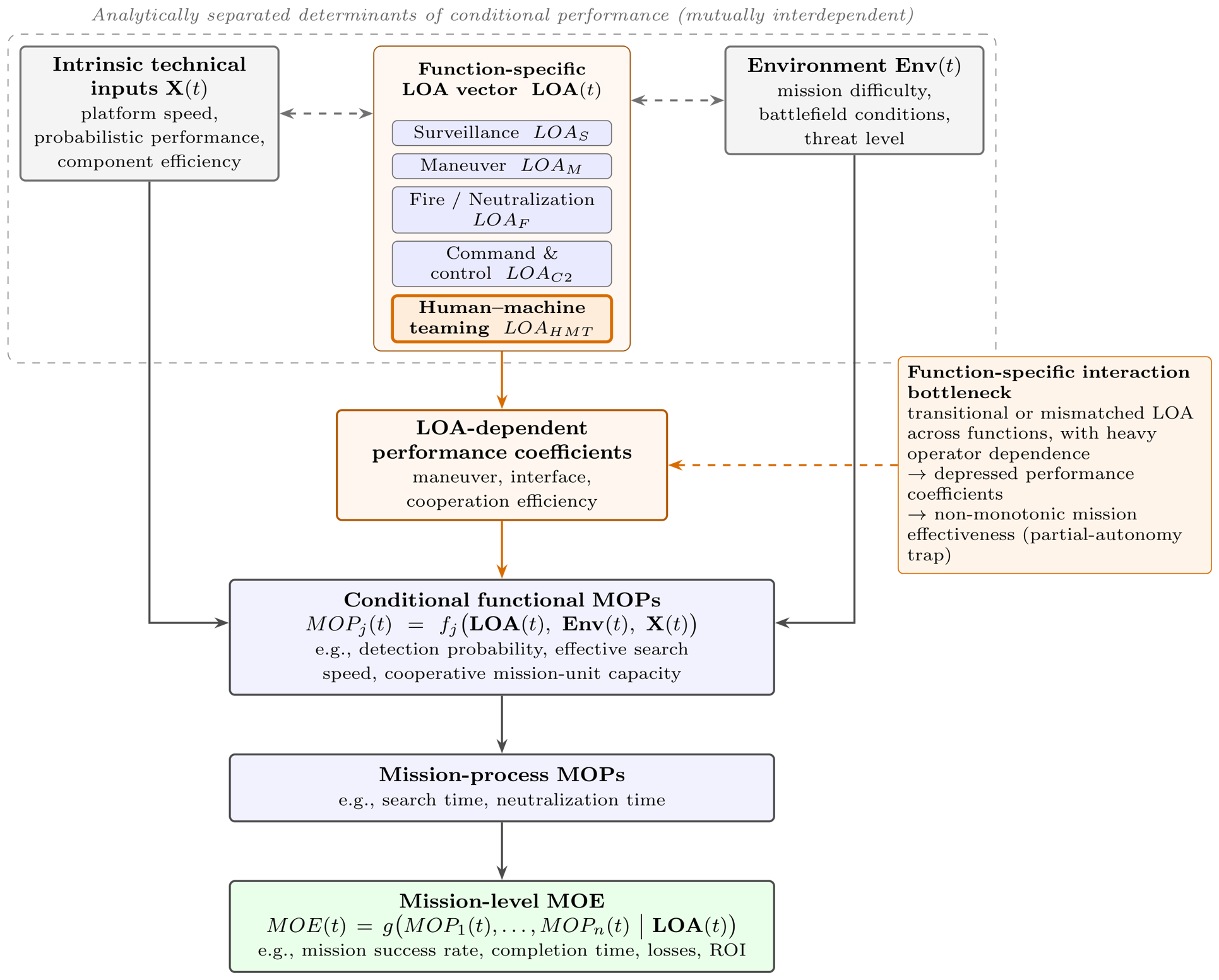
Operationally, the framework is structured into five analytical layers: (i) intrinsic system performance inputs, (ii) LOA-dependent performance coefficients, (iii) conditional functional MOPs, (iv) mission-process MOPs, and (v) mission-level MOEs. Function-specific LOA first modifies the performance coefficients, such as cooperation, interface, and maneuver efficiency. These coefficients then shape the functional MOPs, including detection probability, effective search speed, and effective cooperative mission-unit capacity. The functional MOPs aggregate into mission-process MOPs, such as search time and neutralization time, and the mission-process MOPs ultimately propagate into mission-level MOEs.
Figure 4 summarizes this five-layer structure, the three determinants of conditional performance, and the origin of the function-specific interaction bottleneck.
Section 5 presents the application of this five-layer structure to a minehunter-centered MCM case.
5. Application to a Minehunter-Centered MCM Case
5.1. Case Setup
Based on the development direction of the Republic of Korea Navy’s next-generation minehunter (MSH-II) and mine-warfare combat system, this case considers an operational concept wherein a manned minehunter serves as a mothership and C2 platform. Under this concept, mine search equipment, mine disposal vehicles (MDVs), underwater and surface unmanned assets, and the mine-warfare combat system are integrated stepwise [
30].
The operational scenario involves the rapid opening of a priority transit channel within a port-approach lane. The objective is not exhaustive mine clearance across the entire threat area but the timely opening of an operationally usable channel under binding time constraints. The search area is defined as a single channel of 5 nm × 0.5 nm, and the operational flow comprises two stages: search and individual neutralization. In this scenario, the case examines staged configurations A0–A3, which represent successive developmental stages of a minehunter-centered MCM system toward MUM-T integration.
Each alternative is specified as a representative configuration corresponding to a distinct developmental stage in autonomy and system integration. For each alternative, , , and are defined and the case analysis uses the alternative index instead of the generic time index t. The alternatives capture stepwise changes not only in LOA but also in mine search capability, neutralization capability, and combat system integration.
This case aims not to forecast the performance of a specific MCM system, but to demonstrate how the proposed function-specific LOA–MOP–MOE structure can be instantiated under staged MUM-T configurations. The operational concept and asset configuration of each alternative are summarized in
Table 7.
5.2. Model Formulation for the MCM Case
The MCM case instantiates the five-layer structure introduced at the end of
Section 4. In this case, the mission-level MOE, i.e., timely route-opening capability, is linked to mission-process MOPs, such as search time and neutralization time. These MOPs are derived from functional MOPs, including effective search speed, effective neutralization capacity, and stage-specific effective cooperative mission-unit capacity. The functional MOPs are jointly formed by LOA-dependent performance coefficients
, system-specific intrinsic technical inputs
, and mission-scenario inputs
. The variables and functions used in the case are mapped to the five-layer structure in
Table 8. In this MCM case, the general fire or neutralization dimension
is instantiated as mine neutralization autonomy.
The mission-level MOE for the present case, i.e.,
, measures the timely route-opening capability under required quality conditions:
where
denotes the required route-opening time.
is a quality gate that indicates whether the probabilistic mission requirements are satisfied:
where
,
, and
are the detection, identification, and neutralization probabilities for the alternative
j, respectively, and
,
, and
are the corresponding minimum required thresholds. Equation (
5) first applies the quality gate through
and then assigns a timeliness score using
, capped at 1. Thus, a quality failure yields zero effectiveness, while a time overrun is penalized proportionally when the quality requirements are satisfied.
The total MCM mission time is decomposed into search and neutralization times:
This decomposition represents MCM operations as a sequence of functional stages. The search and neutralization times are defined as
where
is the channel length,
is the number of round trips, and
Q is the number of objects to be neutralized. The factor
adjusts the effective search coverage time to reflect additional search effort caused by detection failure, while
is treated as a fixed maneuver overhead. The factor
adjusts the neutralization time to reflect reconfirmation or reprocessing caused by identification or neutralization failure.
The functional MOPs used in Equations (
8) and (
9) are
,
, and
, which represent effective search speed, effective neutralization capacity, and stage-specific effective cooperative mission-unit capacity, respectively. These MOPs are formed jointly by intrinsic technical inputs, LOA-dependent performance coefficients, and the nominal number of mission units assigned to each stage. For the case calculation,
is set to 2 for A0 and A1 and 4 for A2 and A3, whereas
is set to 2 for all alternatives. Because operator workload and supervisory burden may differ between search and neutralization, the HMT coefficient is defined at the stage level and denoted by
. In particular,
for A0 and A1 because their search configuration remains manned, whereas
for A2 and A3. For the neutralization stage,
for all alternatives. The functional MOPs are defined as follows:
The form of Equation (
12) reflects the assumption that the first mission unit is always fully effective, with additional units contributing only to the extent permitted by
and
. As
and
degrade, the effective number of cooperating units approaches one, even if multiple physical assets are deployed.
5.3. Input Values and LOA Settings
The intrinsic technical inputs
of each alternative are summarized in
Table 9. The reference values
and
are common to all alternatives. The platform-generation efficiency coefficients
and
, together with the probabilistic performance values
,
, and
, follow notional cumulative step-gain rules:
where
is the per-step efficiency gain,
denotes the per-step residual failure ratio, and
represents the number of generational steps that component
c has undergone in alternative
j. The present case applies the notional uniform values
and
. Under this rule, the mothership efficiency coefficient
advances once from A2 onward, whereas the neutralization equipment efficiency coefficient
advances at each stage after A0. The detection and identification probabilities
and
advance from A2 onward, whereas the neutralization probability
advances from A1 onward. The mission-scenario inputs, common to all alternatives, are
,
,
, and
, corresponding to the environmental conditions
in equation (
3). These inputs are held constant across alternatives to isolate the effect of function-specific LOA configurations on mission effectiveness.
The LOA-dependent performance coefficients are defined as step functions of the corresponding LOA values, as summarized in
Table 10. They follow two main patterns:
, representing maneuver efficiency, and
, representing C2 cooperation efficiency, increase monotonically with LOA and remain unchanged between LOA 1 and LOA 2. This reflects the assumption that path planning autonomy and inter-asset coordination do not improve substantially during the remote-control stage, but begin to improve when integrated combat system support and cooperative autonomy are introduced from LOA 3 onward.
Furthermore,
(representing fire or neutralization-stage efficiency) and the base HMT coefficient
exhibit a transient drop at LOA 2 before recovering at LOA 3 and improving further at LOA 4. This pattern is referred to as the LOA-2 valley. This valley reflects the teleoperation penalty introduced during the transition from manual operation to remote-controlled operation, including increased operator workload and limited supervisory scalability. In the case formulation, the realized HMT coefficient is applied at the mission-stage level as
using the step values in
Table 10 according to the stage (search or neutralization). This nonmonotonic structure is the primary reason that A1 shows a longer neutralization time than A0 and is central to the interpretation of the case results.
The nonmonotonic structures of
and
in
Table 10 are motivated by two related but distinct human-factors mechanisms. Under continuous teleoperation, the operator remains directly in the control loop but faces near-continuous control demands, mediated perception, interface burden, and control latency; these demands increase workload, reduce task efficiency, and limit the number of assets that one operator can manage effectively—so much so that a single teleoperated asset may require more than one operator [
29,
31]. Under partial or supervisory automation, a different mechanism arises: reduced continuous engagement can degrade situation awareness and impair the operator’s ability to re-enter the control loop during failures, exceptions, or control transitions—the out-of-the-loop performance decrement [
32,
33,
34]. Meta-analytic evidence further identifies partial automation as a problematic transition zone in which emergency-response performance is worse than under manual control while workload remains higher than under high automation [
35]. In the present case, the LOA-2 valley corresponds to the first mechanism—the continuous-teleoperation stage of A1—whereas the second mechanism explains why supervisory autonomy at higher LOA relieves workload and restores span of control without eliminating the operator’s residual monitoring burden [
27]; the incomplete recovery of
(0.70–0.85 rather than 1.00) reflects this residual supervisory cost.
The drop of
at LOA 2 reflects the same teleoperation penalty at the level of the neutralization task itself. Holding the neutralization equipment fixed, remotely operating a disposal vehicle is less efficient at the task than direct execution, because teleoperation removes the direct haptic and sensory feedback available to a diver and adds control latency and restricted perception. A meta-analysis of teleoperation systems shows that such direct feedback significantly improves task completion time and accuracy, so its absence degrades manipulation performance [
31], an effect further compounded by control delay [
29]. As operator-supervised semiautonomy (LOA 3) and operator-approved autonomy (LOA 4) restore automated assistance to the neutralization task,
recovers and exceeds the manual baseline. Here
denotes the per-task efficiency of the neutralization action under a given control mode with equipment held fixed; it does not represent the safety or force-protection benefits of removing personnel from the minefield, which are real but lie outside the mission-time MOE modeled here. The specific step magnitudes in
Table 10 (
,
at LOA 2) are notional values chosen to be consistent with the direction and stage-specificity established by this literature.
In interpreting
Table 10,
and
serve different analytical purposes.
is an ordinal category describing the dominant operator–system role-allocation mode, classified from the observable proxies defined in
Section 4.1, whereas
is a separately calibrated continuous multiplier representing the mission-performance contribution realized under that role allocation. The proxies support the classification of
; they do not numerically determine
by themselves.
Table 11 lists the operator–system role-allocation modes corresponding to the
values used in
Table 10 and
Table 12. The granularity follows the four staged configurations of the case, and the modes consolidate role-allocation distinctions that recur across the taxonomies reviewed in
Section 2 rather than introducing a new scale.
The function-specific LOA values for each alternative are summarized in
Table 12, reflecting the operational concept of each staged configuration defined in
Table 7. The values in parentheses indicate the corresponding base performance coefficients from
Table 10, where applicable.
is included to preserve the function-specific autonomy vector, but search-stage autonomy is reflected by the probabilistic performance values
and
in
Table 9 rather than by a separate
coefficient.
A0 represents the conventional manned-centric configuration. With no autonomy systems introduced and EOD divers performing direct neutralization, all functions are set to LOA 1. A1 introduces remote-controlled MDVs at the neutralization stage while retaining the existing minehunter and combat system. In this configuration,
advances to 2, representing teleoperation.
likewise advances to 2: continuous teleoperation of the MDV is assumed in this illustrative case to require near-continuous hands-on control, to impose high operator workload, and to confine the operator to a single asset (span of control
), placing
at the teleoperation level of the operational definition in
Section 4.1. Meanwhile,
,
, and
remain at LOA 1.
A2 reflects the initial MSH-II configuration with an integrated combat system, autonomous search vehicles, and semiautonomous MDV-IIs. advances to 3 through improved autonomous search capability, to 3 through automated path planning and replanning, to 3 through operator-supervised semiautonomous neutralization, to 3 through combat-system-mediated coordination, and to 3 as the operator shifts from direct control to supervision.
A3 represents the advanced MSH-II concept with networked UUV/USV search assets and operator-approved autonomous neutralization. , , , and advance to 4, whereas remains at 3: the A3 case assumes that the operator supervises and approves autonomous neutralization rather than controlling it directly, with low hands-on time, moderate workload, and a span of control greater than one, placing at the supervisory level. Thus, the case stops short of unsupervised operation.
5.4. Results
The inputs in
Table 9,
Table 10,
Table 11 and
Table 12 are notional and serve only to illustrate how the framework operates; the resulting magnitudes are not performance estimates for any specific system. The value of the case lies in showing how function-specific autonomy configurations propagate through the LOA–MOP–MOE structure, not in the particular numbers obtained.
Applying Equations (
7)–(
12) based on inputs from
Table 9,
Table 10,
Table 11 and
Table 12 and the stage-specific mission-unit assumptions yields the functional MOPs, mission-process MOPs, and mission-level MOE reported in
Table 13,
Table 14 and
Table 15. The required quality thresholds are
,
, and
, and the required route-opening time is
.
Under these notional values, the computation reproduces a specific pattern. Because A1 raises
and
to the teleoperation level while retaining A0’s manned search stage, the assumed coefficients
and
fall below their manual baseline, so the neutralization-stage MOPs and
are larger at A1 than at A0 (
Table 14). From A2 onward, higher cooperative and supervisory autonomy lowers
, and only A3 satisfies both the quality gate and the route-opening time, giving
(
Table 15). The interpretation of this pattern is taken up in the Discussion.
Three results deserve emphasis. First, the partial-autonomy trap appears quantitatively: introducing remotely controlled MDVs at A1 lengthens the neutralization time from 21.65 h to 33.91 h () and the total mission time from 26.62 h to 38.88 h () relative to the manned baseline, despite A1’s superior neutralization equipment (, ). Second, the degradation is localized: the search time is identical for A0 and A1 (4.97 h), confirming that the bottleneck lies entirely in the neutralization stage where and enter the teleoperation level. Third, at the mission level, only A3 satisfies both the probabilistic quality requirements and the required route-opening time (); A2 satisfies the quality requirements but only partially meets the time requirement (), whereas A0 and A1 fail the quality requirements (). It should be noted that the partial-autonomy trap is observed at the mission-process MOP level rather than as a decrease in the final : because both A0 and A1 fail the quality gate, their final MOE values are identically zero, and it is the layered structure that preserves the 46.1% increase in mission-completion time at A1, which a single final score would mask.
5.5. Comparison with a Conventional Scalar-LOA Analysis
To isolate the value added by the function-specific treatment, a conventional scalar-LOA benchmark was constructed as an ablation of the proposed model. Each configuration is assigned a single system-wide autonomy level by its platform-level naming (A0 manned, level 1; A1 remote-controlled, level 2; A2 semiautonomous, level 3; A3 autonomous, level 4). In the benchmark, this single level replaces the function-specific vector: every LOA-dependent coefficient of
Table 10 is evaluated at the common system-wide level. In addition, the two human–machine interaction elements—absent from the effectiveness studies reviewed in
Section 3—are removed: the HMT coefficient (
; no concept of operator workload or supervisory burden) and the teleoperation penalty (
in place of the LOA-2 valley). All other equations and inputs are identical to the proposed analysis; the technical benefits of autonomy (
,
at levels
,
) and the equipment gains (
X,
P) are retained.
The two analyses coincide at A0 (26.62 h) and diverge exactly where the removed elements act (
Table 16). At A1, the benchmark predicts a 13.3% improvement (23.09 h)—the natural conclusion when the human cost of continuous teleoperation has no representation—whereas the function-specific analysis reveals a 46.1% degradation (38.88 h). At A2 and A3 the gap is attributable to the HMT axis alone: the benchmark reports 11.93 h and 7.20 h vs. 14.01 h and 8.56 h, and certifies the route-opening requirement already at A2 (
vs. 0.857). Moreover, practice often does not distinguish the intermediate configurations at all and compares only the baseline and the target state; in such an A0-vs.-A3 comparison the benchmark reports a 73.0% improvement while the transition stages remain outside the analytical scope altogether.
The comparison shows what the two removed elements provide. Without the function-specific structure the bottleneck cannot be found—the scalar label attaches to the platform, not to a function—and without the interaction elements, the transition-stage degradation is replaced by a predicted gain. The staged function-specific analysis corrects the direction of the A1 prediction, localizes the degradation to teleoperated neutralization () combined with operator-intensive HMT (), and expresses the target-state constraint of retained operator approval () that scalarization cannot represent.
6. Discussion
The case is meant to show not a particular result but the kind of analysis the proposed framework makes possible under function-specific, interaction-aware modeling. Three capabilities are worth drawing out, each anchored in one of the results highlighted in
Section 5.4.
First, the framework can represent non-monotonic effects of autonomy adoption. Because every function carries its own LOA and its own performance coefficient, a configuration in which partial autonomy lowers an interaction coefficient—in the case, the assumed teleoperation values of and at A1—can produce a mission-process MOP worse than the manual baseline even when intrinsic equipment efficiency improves. An analysis that lacks the human–machine interaction elements replaces such a stage with a predicted gain, and a single-scalar representation cannot preserve the uneven maturation of the individual functions or the diagnostic attribution of the resulting degradation; either simplification may therefore overstate or misattribute the gains of unmanned-asset introduction.
Second, the framework can localize interaction bottlenecks to particular functions. By keeping intrinsic equipment gains () separate from LOA-dependent coefficient changes (, ) within the layered structure, it can attribute a degraded mission-process MOP to the conjunction of specific function-level conditions—in the case, and at the teleoperation level—rather than to the platform as a whole. The same separation yields a prescription: it indicates which functions would need to mature jointly, rather than which equipment would need to be added, to turn partial autonomy into a net gain. A single-scalar representation collapses this separation and would hide such a bottleneck.
Third, the framework preserves traceability from function-specific LOA, through functional and mission-process MOPs, to the mission-level MOE. The quality gate in Equation (
5) assigns a timeliness score only when the probabilistic mission requirements are met, so the MOE cannot be reduced to a single time-saving figure and retains the operational meaning of route opening as both timely and valid. This traceability is what would let the framework be used diagnostically once notional inputs are replaced by values grounded in test data, simulation, or structured expert elicitation.
These capabilities also clarify how the framework relates to the human–machine interaction literature on automated driving. That literature has largely characterized partial-autonomy effects at the level of the individual operator—degraded situation awareness, slower takeover responses, and trust miscalibration measured during control transitions [
1,
2,
3]. What the present framework adds is a route from those operator-level interaction factors to a mission-level outcome: the same influences that driving studies treat as dependent variables enter here as the HMT coefficient
, which then propagates through the functional and mission-process MOPs to the MOE. In effect, the framework offers one way to ask what an out-of-the-loop or handover penalty would mean not for a single driver but for the effectiveness of a multi-asset operation. The same flexibility in the function decomposition makes the converse mapping natural: an automated-driving task would instantiate the vector without a fire or neutralization axis, retaining perception (
), maneuver and path control (
), any vehicle-to-vehicle or infrastructure coordination (
), and—centrally—the driver–system teaming axis (
) that carries takeover and handover. In that setting, the framework would describe the same partial-autonomy effect that motivates this study, now expressed against a driving-appropriate MOE rather than route opening.
Beyond this structural correspondence, the qualitative pattern produced by the case is consistent with, rather than an empirical reproduction of, findings in the human–automation literature. In A1, the modeled teleoperation penalty produces mission-process performance below the manual baseline—paralleling the problematic transition zone identified for partial automation [
35] and the documented costs of continuous teleoperation [
29,
31]—whereas the reduced operator dependence assumed from A2 onward supports recovery, consistent with the workload relief reported for higher-autonomy human–autonomy teams [
27]. Notably, the two elements removed in the ablation benchmark of
Section 5.5 are precisely the two elements this literature establishes as real; their removal reproduces the optimistic conclusions of the conventional stance. This consistency provides structural motivation for the coefficient pattern, but it should not be interpreted as empirical validation: workload and situation awareness were not independently measured in the present case, and the coefficient magnitudes remain notional.
The comparison in
Section 5.5 also allows the prior effectiveness studies reviewed in
Section 3 to be positioned rather than merely criticized. The conventional scalar benchmark should be read as a controlled abstraction of two tendencies identified in the reviewed studies—endpoint-focused evaluation and the omission or uniform treatment of autonomy [
20,
21,
22,
23,
24]—rather than as a representation of any single prior study. Applied to the present scenario, that stance predicts a 13.3% improvement at the very stage where the interaction-aware analysis reveals a 46.1% degradation, certifies the mission requirement one stage early, and—in the endpoint-only form common in practice—reports a 73.0% improvement while the transition stages remain outside the analytical scope. The implication is not that prior end-state conclusions are wrong, but that they answer a different question—what the mature system delivers—whereas acquisition phasing, interim doctrine, and operator training depend on the question the staged analysis answers: what happens on the way there. In the same vein, the function-specific vector gives quantitative form to earlier qualitative observations, including the finding that a single LOA is insufficient for robot-swarm operations [
6] and the observation that raising the LOA transforms, rather than removes, the operator’s role [
17].
Two broader points follow. First, the partial-autonomy trap is not specific to minehunting or to the sea. The same situation can occur in any system where a human hands part of the control to an unmanned vehicle, whether on the road, in the air, or at sea. Methods that describe autonomy with a single number, or that assume a system always runs at its highest autonomy level, tend to miss this kind of effect. Second, the value of the proposed framework is that it keeps such an effect visible and tied to the function that causes it, instead of letting it disappear into an overall average. This is the main way it differs from effectiveness analyses that treat autonomy as fixed or always high. Confirming whether a real system actually shows this dip, and how large it is, would require coefficients obtained through a rigorous evaluation process—combining engineering analysis, structured expert elicitation, and modeling and simulation to derive reliable input data—and is left to future work.
7. Conclusions
This study proposed a function-specific, five-layer framework for analyzing the effectiveness of MUM-T systems and demonstrated its analytical utility through a minehunter-centered MCM case. The framework rejects representing autonomy as a single scalar for the entire system. Instead, it defines autonomy as a function-specific vector across mission functions. LOA-dependent performance coefficients translate function-specific LOA into measurable changes in functional and mission-process MOPs. The five-layer structure comprises intrinsic technical inputs, LOA-dependent performance coefficients, functional MOPs, mission-process MOPs, and the mission-level MOE. This structure provides an explicit pathway through which autonomy operates as an operational variable shaping mission effectiveness.
As elaborated in the Discussion, the framework treats autonomy as an operational, interaction-dependent variable rather than a fixed attribute. Its central contribution is to make the human–machine interaction visible within effectiveness analysis: by carrying autonomy as a function-specific vector, it can represent non-monotonic effects of autonomy adoption, localize interaction bottlenecks—such as the partial-autonomy trap—to the functions responsible, and preserve traceability from function-specific LOA to the mission-level MOE. In this way, the study extends human–machine interaction analysis, established for automated driving, to manned–unmanned vehicle teaming. Quantitatively, under the notional inputs, the framework reproduces the partial-autonomy trap: introducing remotely controlled unmanned assets at A1 increases total mission time from 26.6 h (A0) to 38.9 h—a degradation relative to the manned baseline driven by the teleoperation penalty in and —before cooperative and supervisory autonomy reduce it to 14.0 h (A2) and 8.6 h (A3); correspondingly, the timely route-opening MOE is 0 for A0 and A1, for A2, and only for A3.
The MCM case should be interpreted as a methodological demonstration rather than as a performance forecast for any specific system. The notional inputs in
Table 9,
Table 10 and
Table 12, including platform-generation efficiency coefficients, probabilistic performance values, and step functions of performance coefficients, are specified to illustrate the mechanics of the framework. When these inputs are replaced by values grounded in expert judgment and technical evidence, the same five-layer structure can support analytically meaningful diagnoses of functional bottlenecks, coordinated autonomy advancement, and staged MUM-T configurations. Thus, the A3 result should be interpreted as an illustrative target-state configuration under the specified operator-approval concept, rather than as an upper bound or a forecast for any specific future minehunter configuration.
Several issues remain to be resolved for future research. A limitation of the present study is that the LOA-dependent coefficients and the probabilistic inputs were specified notionally rather than measured; the case therefore demonstrates the structure of the framework, not calibrated performance. For application to a specific system, these inputs can be acquired through a staged path. First, the function-specific LOA levels are assigned by mapping documented system capabilities—design documentation, integration-test records, and observed behavior in operational testing—onto the established autonomy taxonomies reviewed in
Section 2 (e.g., management-by-consent vs. management-by-exception for
and
, or automated path-planning and replanning capability for
), while
is assigned from the three observable proxies defined in
Section 4.1. Second, the framework is instantiated for the mission at hand: the function decomposition, the operationally significant MOPs, and the mission stages at which each coefficient applies are determined through engineering analysis supported by structured expert methods, such as Delphi consensus and the analytic hierarchy process (AHP) for factor prioritization. Third, once the instantiation is fixed, parameter values are estimated: the intrinsic and probabilistic inputs (
X,
,
,
) from equipment test data and modeling and simulation; the interaction coefficients, including
and its LOA-2 penalty, from measurement of human-factors—operator workload (e.g., NASA-TLX [
28]), situation-awareness probes, and takeover or teleoperation performance trials [
29,
34,
35]; and, where direct measurement is infeasible, from structured expert elicitation such as Delphi-based estimation. Finally, the calibrated model is validated and refined in a closed loop: the manned baseline configuration (A0) serves, where available, as a validation anchor against operational records from past MCM exercises or comparable manned operations, and sensitivity analysis would identify the parameters that dominate mission-level outcomes—the present illustrative calculation suggests that
and
warrant particular attention—so that calibration effort can be concentrated where it matters most. This staged path makes each class of input acquirable in practice without altering the five-layer structure of the framework. The framework can also be extended to other MUM-T mission domains, such as surveillance and reconnaissance, maneuver and breaching, fire support, and security operations by tailoring the function decomposition and MOP–MOE structure to each mission process. Finally, the discrete time index
t, defined herein as an upgrade-and-learning stage, can be linked to acquisition milestones and capability roadmaps, allowing the framework to support acquisition planning and the sequencing of autonomy maturation. In addition, the present case instantiates a single mission-level MOE that combines two of the MOE categories of the ME framework (
Table 5): time, through the timeliness ratio, and mission satisfaction, through the probabilistic quality gate. The broader MOE set of the ME Guide—losses, expenditures, readiness, and return on investment—was not instantiated, and this choice bounds what the analysis can say about autonomy: the A1 trap and the A3 result are statements about timely route opening. Conceptually, each of the remaining categories would attach to the same function-specific LOA vector through its own pathway and would reflect different facets of autonomy and human–machine teaming. A losses MOE would have to distinguish the assets exposed inside the minefield, which differ across the alternatives (EOD personnel at A0; unmanned vehicles from A1 onward,
Table 7), and would therefore weigh personnel risk and equipment attrition differently across the stages. An expenditures MOE would track consumable neutralization assets and the reprocessing driven by identification and neutralization failures—the
factor of Equation (
9)—which autonomy alters through both the probabilistic inputs and the interaction coefficients. A readiness MOE would reflect the maintenance and availability of unmanned vehicles, communication links, and autonomy software—the RAM-C perspective recognized in both weapon-system ME and automated-driving safety engineering [
26]. A return-on-investment MOE would relate these outcomes to the acquisition and operating costs of the staged configurations. Because the five-layer structure ties any mission-level MOE to the same function-specific LOA vector through its own coefficients and pathways, such a multi-MOE evaluation is a direct extension of the framework; carrying it out is left to future work.