
Article

A Human-Centered Study of an Upper-Limb Rehabilitation Exoskeleton with Healthy Participants

1
INESC TEC—Institute for Systems and Computer Engineering, Technology and Science, Rua Dr. Roberto Frias, 4200-465 Porto, Portugal
2
CESPU—Escola Superior de Saúde do Vale do Ave, Cooperativa de Ensino Superior Politécnico e Universitário, Rua José António Vidal, 81, 4760-409 Vila Nova de Famalicão, Portugal
3
H2M—Health and Human Movement Unit, Cooperativa de Ensino Superior Politécnico e Universitário, CRL, 4760-409 Vila Nova de Famalicão, Portugal
4
FEUP—Faculty of Engineering, University of Porto, Rua Dr. Roberto Frias, 4200-465 Porto, Portugal
5
ISEP—Instituto Superior de Engenharia do Porto, Instituto Politécnico do Porto, Rua Dr. António Bernardino de Almeida, 4249-015 Porto, Portugal
*
Author to whom correspondence should be addressed.
Appl. Sci. 2026, 16(14), 6907; https://doi.org/10.3390/app16146907
Submission received: 3 June 2026 / Revised: 2 July 2026 / Accepted: 7 July 2026 / Published: 9 July 2026

Abstract

Upper-limb impairments affect a substantial portion of the global population, often limiting the ability to perform daily activities. Robotic rehabilitation systems offer a promising solution by enabling high-dose, task-oriented therapy with consistent and objective feedback. However, user acceptance and perceived comfort are critical for their successful adoption. This work presents a feasibility, performance, and comfort evaluation of a 2-degree-of-freedom upper-limb rehabilitation exoskeleton capable of performing elbow flexion/extension and forearm pronation/supination. A total of 47 healthy participants were enrolled and tested across three rehabilitation modalities: passive assist, active assist, and active resist. Passive assist enabled full range-of-motion execution, active assist supported movement, and active resist provided variable resistance via a sliding bar (0–100%). Objective performance metrics, including position, current, and temperature, were recorded and analyzed, revealing trajectory-tracking errors during passive assistance of 4.82° ± 0.02° for forearm movement and 1.20° ± 0.04° for elbow movement, with actuator temperatures remaining below their rated limits throughout the study. The active assist mode did not achieve a true assist-as-needed performance, indicating a need for further refinement. Subjective evaluation included the System Usability Scale, yielding a score of 87.1 ± 9.6, indicating excellent usability, and a safety and comfort assessment averaging 4.4 ± 0.4 out of 5. Perceived effort was assessed using the Borg CR-10 scale and generally scaled appropriately across modalities, although some variability suggests the need for further investigation. Qualitative feedback identified areas for improvement, particularly in ergonomics and control behavior. Overall, the results support the feasibility, usability, and safe operation of the proposed exoskeleton and provide insights for future device refinement and evaluation with target user populations.

1. Introduction

The 2025 Global Disability Inclusion Report states that around 1.3 billion people live with some form of disability [1]. This statistic highlights a global burden, driven by ageing populations and a rising prevalence of chronic diseases [2], indicating that the demand for rehabilitation services is not only high but continuing to escalate. Furthermore, there is a recognizable gap between rehabilitation needs and available physical therapists [3,4].
Upper-limb (UL) impairment is a common consequence of a wide range of neurological and musculoskeletal conditions, such as rotator cuff tendinitis or lateral epicondylitis [5,6]. These impairments frequently arise following events such as stroke, where up to 80% of survivors experience UL deficits and approximately half do not recover their previous level of function [7,8]. Similarly, conditions such as cervical spinal cord injury, which accounts for around 50% of spinal cord injury cases, often result in substantial reductions in UL function [9,10].
Regardless of the underlying condition, UL impairments commonly lead to reduced independence and difficulty performing activities of daily living (ADLs), including essential tasks such as eating, bathing, and mobility [8,11,12]. In some cases, recovery of the UL is slower than the lower limb [13,14,15]. This difference may be attributed to factors such as reduced spontaneous use of the affected limb, leading to learned non-use. Another contributing factor is the greater complexity of the UL, which has many degrees of freedom (DoF) to support its wide range of functions [16]. Moreover, lower-limb rehabilitation is often prioritized in the early stages of recovery, as regaining walking ability is strongly associated with functional independence and discharge from clinical care [17]. However, emerging evidence suggests that rehabilitation priorities evolve over time: while gait recovery is initially prioritized, UL recovery becomes increasingly important once individuals return to home and community environments, where independence in self-care and complex tasks is required [18]. Consequently, UL impairments can have a significant impact on quality of life and limit the ability to work or perform self-care [19].

1.1. The Importance of the Elbow and Forearm in ADLs

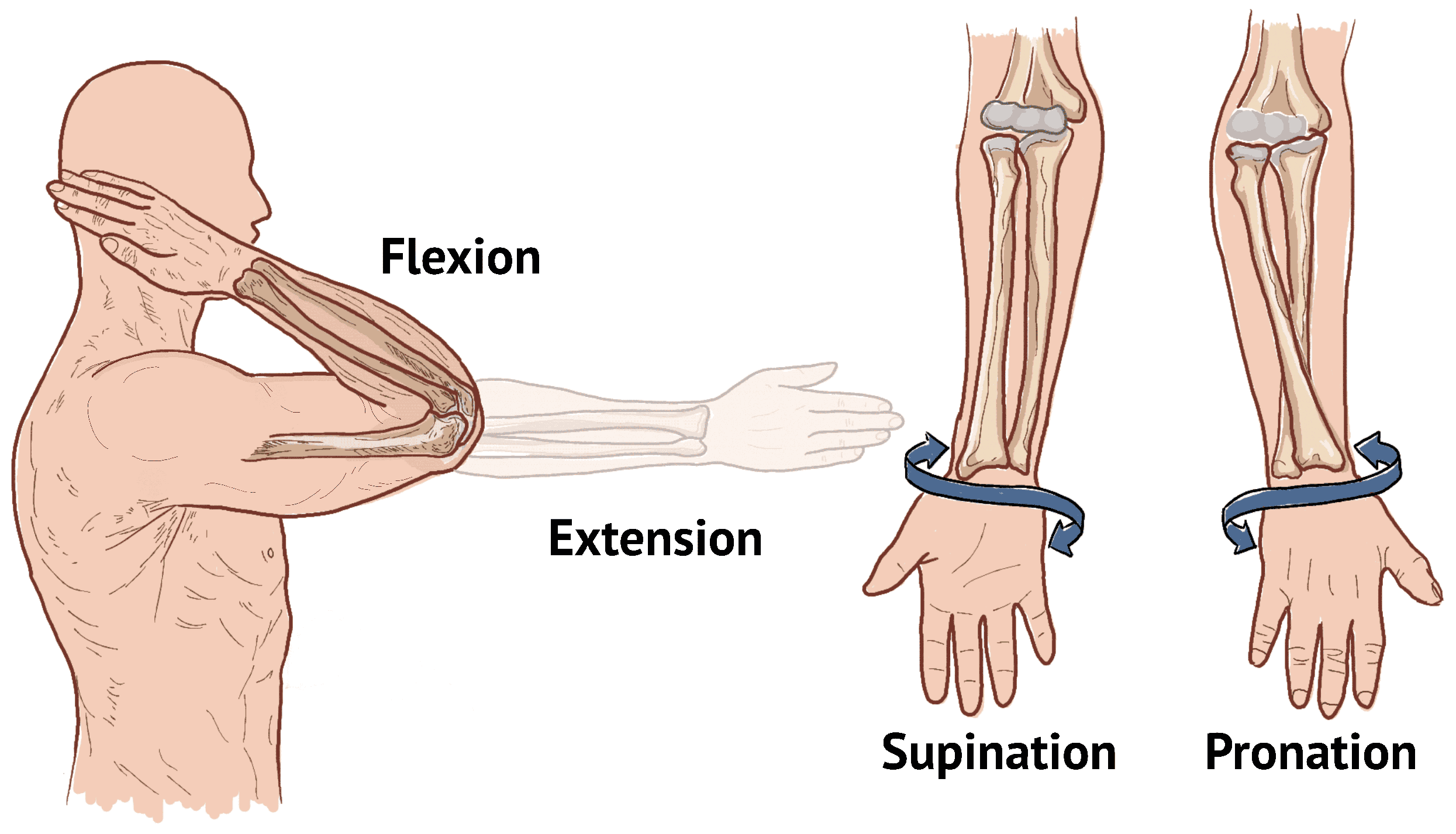
The elbow joint enables flexion and extension (F/E) and supports forearm pronation and supination (P/S), both of which are essential for functional UL use, visible in Figure 1. The physiological range of motion (RoM) spans approximately 0° (extension) to 150° (flexion) for F/E and 180° for P/S, approximately 90° each from the neutral forearm position [20]. However, most ADLs can be performed within a smaller functional arc, typically between 30° and 130° of flexion and around 100° of forearm rotation, distributed as roughly 50° of pronation and 50° of supination [21].
Elbow flexion plays a consistently critical role across ADLs, particularly in tasks involving hand-to-face interactions. Activities such as eating and drinking rely heavily on coordinated flexion, with supination contributing to appropriate hand orientation when using utensils or handling objects [22]. Similarly, personal care tasks, including face and hair washing, or talking on the phone, demand substantial flexion, with reported peak values exceeding 120°, reflecting the need for close hand positioning relative to the head [22,23]. In contrast, forearm rotation direction is more task-dependent. Supination is especially relevant in self-care tasks involving inward-facing hand positions, such as washing the face or eating [24]. On the other hand, pronation is generally less demanding, performed, for example, during teeth-brushing or using cutlery, though more prominent in instrumental ADLs [25] such as keyboard and computer mouse use [22].
Tasks involving object manipulation, such as turning doorknobs, using tools, or handling small items, require coordinated contributions from both F/E and P/S to achieve appropriate hand positioning and control [21,26]. Quantitative analyses indicate that a minimum of approximately 80° of elbow flexion is required across ADLs, with peak demands exceeding 120° in more demanding tasks. Forearm rotation requirements are typically asymmetric, with greater emphasis on supination, reaching up to approximately 50°, while pronation demands tend to remain comparatively limited [24].
Importantly, limitations in elbow or forearm mobility are often compensated by increased shoulder or trunk motion [27], which may allow task completion but reduces movement quality and efficiency. Restoring native elbow and forearm function is therefore essential not only for task execution but also for minimizing compensatory strategies and improving overall movement patterns [28,29]. These findings highlight the importance of prioritizing a sufficient flexion arc and adequate P/S in rehabilitation protocols, particularly in the design and control of robotic rehabilitation systems [24].

1.2. Robotic Therapy

Traditional physical therapy relies on repetitive, intensive exercise to promote neuroplasticity [30], the nervous system’s capacity to reorganize following injury [31]. In practice, however, therapists often manage multiple patients at once [32], compromising individualized care [33] and widening the gap between demand and service availability [3,4].
Rehabilitation robotics offers a scalable alternative: robotic systems can deliver the high-dose, task-oriented training shown to enhance neuroplasticity [30,32]. This can be done while providing tireless, precise assistance, enabling a single therapist to oversee multiple patients. Furthermore, it provides continuous feedback and objective progress tracking, even in remote or unsupervised settings. Given that recovery outcomes are strongly tied to therapy intensity [34], and that robot-assisted therapy typically yields more repetitions than conventional approaches [35], this represents a meaningful clinical advantage. Clinical evidence supports the aforementioned benefits [36,37,38,39,40,41], with several studies reporting robotic rehabilitation outcomes comparable to traditional therapy [42,43]. Although upfront costs are high, cost-effectiveness improves with utilization [44]. A hybrid model combining robotic and human therapy is widely regarded as optimal [45], with some evidence suggesting it outperforms conventional therapy alone [46,47].
Recent works continue to advance the field through diverse control approaches and evaluation frameworks. The innovations include: fuzzy logic-based adaptive stimulation control [48], machine-learning-driven hierarchical sEMG control evaluated in human-in-the-loop experiments [49], fully-actuated multi-DoF platforms assessed across a broad range of ADLs [50], novel motor recovery training and evaluation methods combining sEMG with virtual reality [51], and passive gravity compensation mechanisms designed for safe human-robot interaction [52].

1.3. Subjective Evaluation Metrics for Robotic Rehabilitation Systems

A common tool to assess system usability is the System Usability Scale (SUS). The SUS is a simple, standardised questionnaire used to measure how usable and user-friendly a system is. It consists of 10 statements that alternate between positive and negative wording, rated on a 5-point Likert scale (from strongly disagree to strongly agree). The scores are combined into a single usability score ranging from 0 to 100, where higher values indicate better usability [53]. It is widely used because it is quick to administer, easy to interpret, and applicable to a broad range of systems [54].
Measures of perceived physical effort, such as the Borg scale, which aims to measure an individual’s effort and fatigue during physical work [55,56], has been proven useful for a wide range of conditions [57,58].

1.4. Contributions and Paper Structure

This work presents a comprehensive evaluation of a 2-DoF UL exoskeleton targeting elbow F/E and forearm P/S. In contrast to much of the existing literature, which often relies on small cohorts, the system was evaluated with a comparatively large group of healthy participants. Based on the author’s knowledge, this represents the largest healthy-subject cohort in comparable works, improving the statistical relevance and generalization of the results. Furthermore, the study adopts an integrated evaluation framework that combines objective performance metrics, such as kinematic behaviour and torque output, with user-centered assessments including usability, comfort, and perceived effort. Moreover, evaluation is performed simultaneously across all three rehabilitation modes. To the best of the authors’ knowledge, no comparable work evaluates an exoskeleton across passive, active assistive, and active resistive modes within a single study while incorporating this combination of subjective metrics. It should be noted that healthy-participant testing constitutes a necessary initial validation step prior to clinical trials with target patient populations.
The following sections are organized as follows: Section 2 presents existing robotic rehabilitation devices and their testing protocols, mainly on healthy volunteers, and current status; Section 3 summarizes the exoskeleton development and highlights the methodology taken during the testing sessions; Section 4 displays and discusses the data recorded; Section 5 evaluates the answers given by the healthy volunteers; finally, Section 6 summarizes key findings and limitations found, mentions future work and offers a final reflection on this work.

2. Related Work

Over the past decades, a wide range of UL rehabilitation robotic systems have been proposed and experimentally validated [59]. These systems range from commercially available, clinically deployed devices, such as Armeo® Power [60] and ROBERT® [61], to research-oriented prototypes developed in laboratory environments. While their mechanical designs and control strategies differ significantly, a common aspect across many of these works is the inclusion of tests on healthy volunteers, often as an initial validation step.
Most studies prioritize objective, device-centered performance metrics. These typically include joint position tracking accuracy, trajectory tracking error, and kinematic consistency. For instance, the ALEx exoskeleton [62] was evaluated using electromyography (EMG), trajectory tracking, and movement smoothness metrics in healthy participants [63]. Similarly, the u-Rob system [64] and the 5-DoF exoskeleton presented by He et al. [65] focused on trajectory tracking accuracy during ADLs, alongside error quantification. Zhang et al. [66] also focus on the same metric but with different speeds and weights.
Kinematic and dynamic performance are also commonly assessed through measurements of velocity, torque, and interaction forces. For example, CLEVERarm [67] and the ANYexo 2.0 platform [50] evaluated joint positions, torques, and trajectory tracking, while Han et al. [68] reported end-effector trajectory errors and interaction forces. Likewise, systems such as eWrist [69] and PLUTO [70] included torque output, velocity, and RoM as key evaluation metrics. These objective measurements provide essential insight into control performance and mechanical capability, forming the foundation of most validation studies.
Several works extend evaluation to functional task execution, particularly ADLs. Systems such as CLEVERarm [71] and the forearm exoskeleton proposed by Su et al. [72] assess trajectory tracking and RoM during task-oriented movements. Additionally, Su et al. incorporated wearability assessments, including donning and doffing procedures, highlighting the importance of usability in practical deployment.
Despite the strong emphasis on objective metrics, subjective evaluation remains comparatively less explored. Among the available studies, usability is most commonly assessed using the SUS, as reported in multiple works [70,72,73,74,75,76]. Some studies also include user experience or comfort questionnaires, as seen in PLUTO [70] and AGREE [74]. However, broader assessments of user perception are not consistently applied across the literature.
Perceived physical effort, such as the Borg scale, is only rarely analyzed [76,77]. For instance, De Arco et al. [76] combined Borg ratings with kinematic analysis and additional subjective measures, including NASA-TLX [78] and SUS. While NASA-TLX enables multi-dimensional workload evaluation, encompassing mental demand and frustration, it is not commonly employed in rehabilitation robotics studies, particularly when the primary focus is on physical assistance rather than cognitive interaction. Further information regarding the reviewed rehabilitation robotic systems is available in Table 1.
A notable observation is the limited use of large cohorts, particularly in studies involving healthy participants. Many experimental validations are conducted with small sample sizes (<10), as can be seen in Table 1, which restricts the generalization of findings. Furthermore, while healthy-subject testing is widely used for early-stage validation, the scope of evaluation is often limited to device performance, with fewer studies systematically analyzing user-related outcomes such as exertion, comfort, or perceived assistance.
In summary, the literature demonstrates a clear emphasis on objective performance metrics, including kinematics, dynamics, and trajectory tracking accuracy. Functional task execution is occasionally considered, while subjective evaluation, especially related to perceived exertion and workload, remains underexplored. These gaps highlight the need for more detailed evaluation frameworks that integrate both objective performance and user-centered metrics, particularly in controlled studies with healthy participants prior to clinical validation.

3. Methodology

This section describes the methodology followed for the assessment of the exoskeleton’s feasibility, safety, and performance with healthy volunteers. Specifically, Section 3.1 presents the exoskeleton’s design, and Section 3.2 delves into the tests conducted and questionnaires asked during the system’s evaluation.

3.1. Exoskeleton Design

Gonçalves et al. [79] developed a 2-DoF exoskeleton capable of performing F/E and P/S for UL rehabilitation, shown in Figure 2. The device supports three distinct exercise modalities [33,59,80]:
  • Passive assist (PA)—typically applied to users with little to no mobility, aims to improve RoM. In this mode, the device moves the user’s limb along a predefined trajectory without requiring voluntary effort, which can promote blood circulation and reduce joint stiffness;
  • Active assist (AA)—allows the user to actively participate in the movement while the device provides assistance throughout its execution. This approach encourages voluntary motor engagement and supports the recovery of motor function and strength;
  • Active resist (AR)—opposes the user’s movements, increasing the effort required to perform them. This modality aims to improve muscular strength and endurance, preparing the user for real-life functional tasks following recovery.
The exoskeleton provides actuated mobilization throughout the whole RoM of both movements: 0° to 150° for elbow F/E and 180° of forearm P/S, safely maintained by mechanical barriers and limit switches. The exoskeleton is equipped with two brushless direct current actuators (CubeMars, Nanchang, Jiangxi Province, China), one for each movement. These actuators have a rated torque of 3 Nm for P/S [81] and 24 Nm for F/E [82], which have been shown to be adequate for their respective movement [79]. The exoskeleton was 3D-printed with Polylactic acid, is adaptable to various forearm lengths and weights, and weighs 4.5 kg. It was designed with mechanical barriers that prevent unsafe movements and possesses an emergency button to stop all exercises immediately, if required. Its control is performed with an Arduino Nano (Arduino Srl, Monza, Italy), and communication is done via Controller Area Network (CAN).
The control architecture implemented in the exoskeleton was previously described in detail by Gonçalves et al. [79]. The exoskeleton operates under three distinct control strategies, one per rehabilitation mode. Passive assist is implemented via velocity control, in which the actuators drive both joints through their full RoM at a predefined low speed, with smooth acceleration and deceleration profiles. Active resist employs current control, applying a fixed resistive torque opposing the user’s motion, with the resistance level set via a sliding bar in the user interface (UI) and adjustable in real time. Active assist combines gravity compensation, implemented as a cosine-based current profile proportional to the effective gravitational torque at each joint angle, with a performance-based adaptive correction that increases assistance when user motion slows or stalls and reduces it when movement is performed adequately.
Since Gonçalves et al. [79], minor upgrades have been introduced to the device. The adaptive anti-gravity support was revised to better reflect active assistance exercises typically performed during rehabilitation sessions. In the updated configuration, the AA control for F/E no longer provides baseline assistance independent of user effort. Instead, its behaviour now closely resembles that of PA, with the exoskeleton moving autonomously between flexion and extension at low speeds. The key distinction lies in user involvement: under verbal instruction from the therapist, participants are expected to actively follow the exoskeleton’s motion rather than being passively driven by it. When the task becomes challenging, the device compensates and assists the movement; conversely, when the participant is capable of performing the motion independently, they are encouraged to do so. This approach ensures that assistance is only provided when necessary, more closely replicating real rehabilitation practice. Additionally, this modification enables a direct comparison of the torques required for PA and AA. Given the similarity in motion and control strategy, the torque demanded in PA is expected to be higher than in AA. A similar update was applied to the AA control for P/S. For AR, implemented via current control, gravitational effects are now incorporated into F/E movements. Resistance is increased when moving with gravity and reduced when moving against it, ensuring that the user remains the primary driver of the motion. The PA mode for F/E, as well as both PA and AR modes for P/S, remain unchanged.
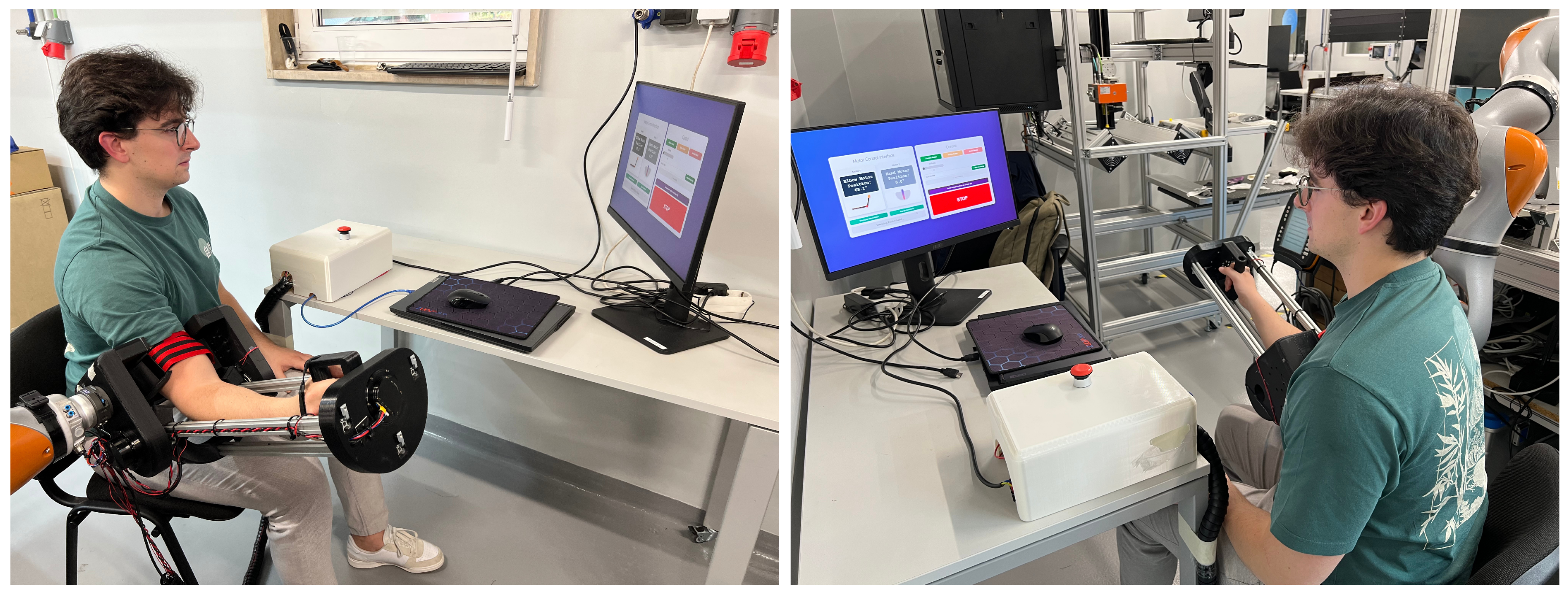
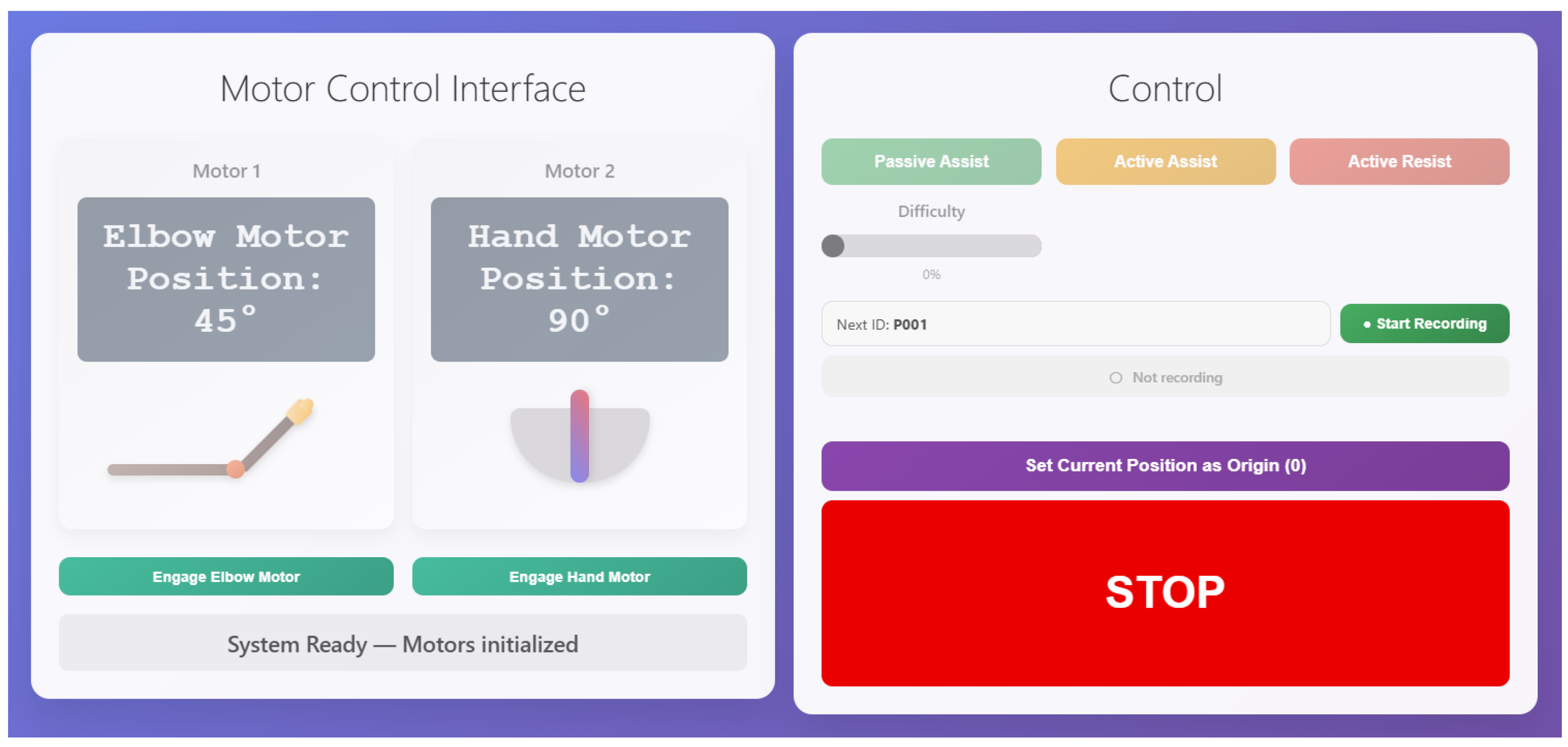
A UI, as illustrated in Figure 3, was also developed to enable therapists to easily select the exercise mode. It displays the current position of each DoF and the three modalities of exercises, highlighting the current exercise. This way, every participant can accompany their movement during execution. Finally, the exoskeleton was integrated with a KUKA LBR iiwa 14 collaborative robotic manipulator (KUKA SE & Co. KGaA, Augsburg, Germany), providing flexible and precise positioning, as well as enabling further research. For the tests described in this work, the manipulator was solely used as a positioning tool.

3.2. Exoskeleton Evaluation

In order to evaluate the exoskeleton’s feasibility and comfort for UL rehabilitation, 47 participants, whose information is summarized in Table 2, were enrolled in the study. The exclusion criteria were: (i) age below 20 years old, (ii) history of stroke, (iii) current or recent right UL injury, surgery, or impairment. Conditions affecting only the left UL were not considered exclusionary, as the protocol was conducted on the right UL exclusively. Before their experience, participants were asked the following:
  • Age range (20–24 to ≥60 years)
  • Height range (<140 to ≥200 cm)
  • Weight range (<50 to ≥120 kg)
  • Gender (male, female, other)
  • History of stroke (yes/no)
  • Current upper-limb injury or surgery (yes/no)
  • Affected side (right/left/not applicable)
  • Dominant hand (right/left)
Age, height and weight were collected as a categorical range rather than a continuous variable as a deliberate data minimization measure, intended to reduce participant identifiability in accordance with ethical data collection principles.
The study was carried out at the Industry and Innovation Laboratory, which belongs to the Centre of Robotics in Industry and Intelligent Systems from the Institute for Systems and Computer Engineering, Technology and Science (INESC TEC), in Porto, Portugal. The experimental protocol was approved by INESC TEC’s Ethics Committee, with reference CE-Par.03/26. All participants were fully informed about the study procedures and provided written informed consent, including consent for the use of data in scientific publications.
For each participant, the three rehabilitation modes were tested separately for both DoF, totaling six exercises. During F/E, the handle attached to the P/S module was fixed at the neutral position (0°, thumb pointing upwards). Throughout all exercises, actuator position, speed, current, and temperature were recorded, enabling evaluation of trajectory tracking error, speed profiles, instantaneous torque demands, and thermal behaviour. These metrics also allowed for correlation analysis between anthropometric data (age, weight, and height) and device performance. The experimental protocol was developed in collaboration with physiotherapy expertise, ensuring clinical relevance in the design of the rehabilitation modalities.
After their test, each volunteer was invited to answer an extensive subjective questionnaire. The first part of this questionnaire used the SUS, to which they answered each question with 1: Strongly Disagree–5: Strongly Agree. The only alteration occurred at the first point, where it was added “if I needed rehabilitation”, to better reflect the case study, and was displayed like this:
SUS1. 
I think that I would like to use this system frequently, if I needed rehabilitation.
SUS2. 
I found the system unnecessarily complex.
SUS3. 
I thought the system was easy to use.
SUS4. 
I think that I would need the support of a technical person to be able to use this system.
SUS5. 
I found the various functions in this system were well integrated.
SUS6. 
I thought there was too much inconsistency in this system.
SUS7. 
I would imagine that most people would learn to use this system very quickly.
SUS8. 
I found the system very cumbersome to use.
SUS9. 
I felt very confident using the system.
SUS10. 
I needed to learn a lot of things before I could get going with this system.
The Borg scale, specifically the Borg CR-10 scale, was also administered. Besides the aforementioned uses of the Borg Scale on exoskeletons, the Borg CR-10 scale has been extensively used to assess perceived exertion in various environments, such as office exercise training [83,84,85]. This scale was applied to all movement and exercise modalities: with no assistance, during PA, during AA, and during AR, for both F/E and P/S. An example of a Borg scale assessment is:
B1.
Perceived effort during Active Resistance.
0: Nothing at all–10: Extremely strong)
Safety and comfort were assessed using a 5-point Likert Scale (1: Strongly Disagree–5: Strongly Agree to evaluate each participant’s comfort and sense of safety. An additional space for suggestions, comments or opinions was added:
Q1. 
I felt safe while using the device.
Q2. 
I felt comfortable throughout the entire experience.
Q3. 
The different rehabilitation modes felt smooth and natural.
Q4. 
I would be willing to use this device regularly as part of a rehabilitation program.
Q5. 
I felt in control of the device during the entire experience.
Q6. 
The user interface was intuitive and easy to use.
Q7. 
The passive assist mode felt safe and did not provoke any awkward positions.
Q8. 
I could feel the exoskeleton helping me during Active Assist.
Q9. 
There was a notorious difference between the different levels of resistance during Active Resist.
Q10. 
Do you have any comments, opinions, or suggestions you would like to share with the development team? (Open text)

4. Objective Performance Assessment

The exoskeleton was attached to the collaborative robotic manipulator, which was adjusted to each participant, and positioned so that the participant’s arm formed a 45° angle with the horizontal plane to ensure a comfortable experience.
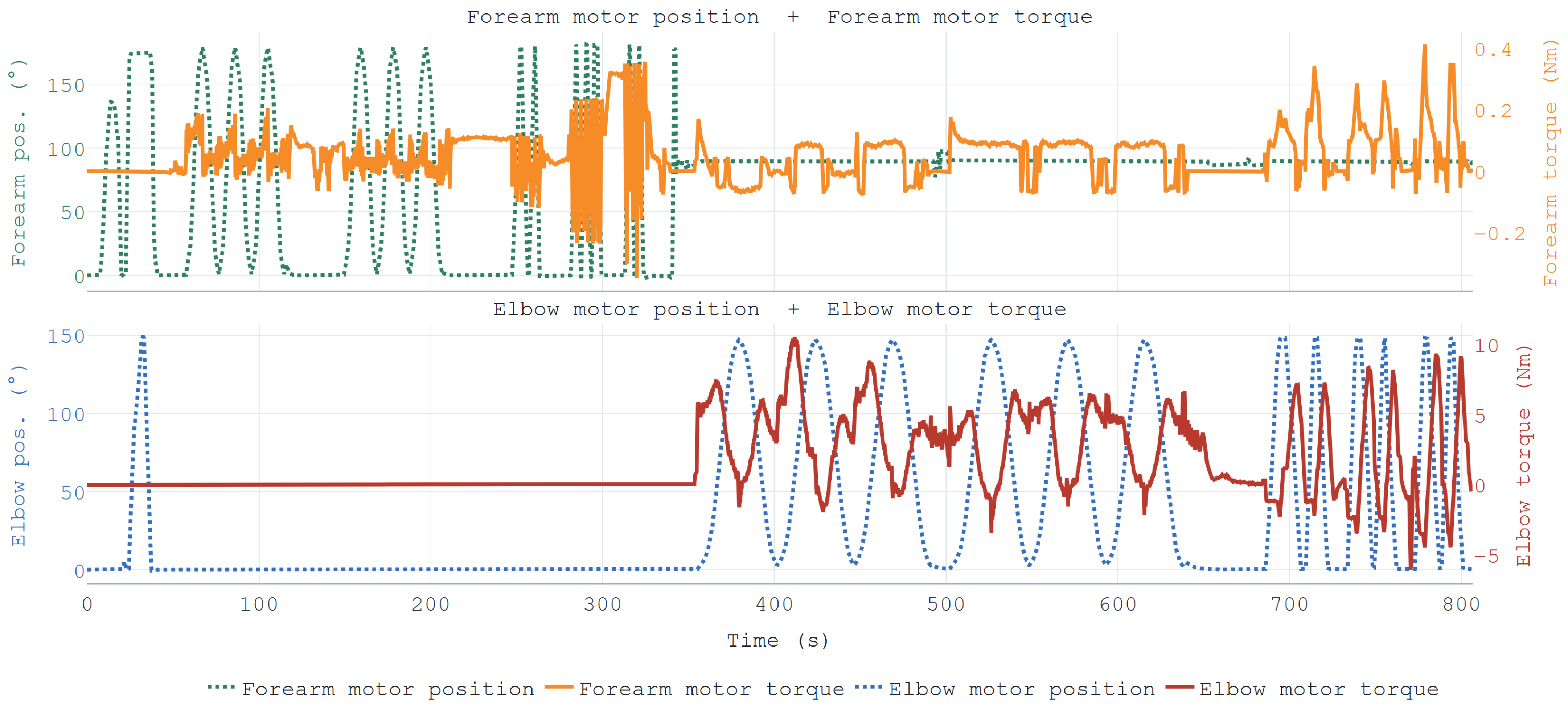
A total of 47 participants enrolled in the study and provided feedback regarding the exoskeleton and the experience. The exoskeleton’s performance metrics during each participant’s trial were also recorded. The time allocated to each participant was around 30 min, including pre-study questionnaires, experiment and post-study questionnaires. The average experiment time was 15.3 ± 4.8 min. Adjusting the exoskeleton position and forearm length to each user took around two minutes, and explanation of the protocol, various modes and movements to be performed took around three minutes. An example experience is displayed in Figure 4, where a participant experienced PA, AA and AR for P/S followed by PA/AA/AR for F/E.
As shown in Figure 4, the testing protocol started with both actuators idle (torque = 0). The participants were asked to move the exoskeleton on their own for two reasons: testing their unassisted RoM and getting accustomed to the exoskeleton’s movement and weight. For P/S, the average value was 178.5° ± 3.5°, and the minimum was 161.0°; for F/E, the average RoM was 146.6° ± 4.3°, and the minimum was 124.5°. The maximum value for both movements was the maximum RoM allowed by the exoskeleton. Afterwards, all three rehabilitation modalities were tested for forearm P/S, displayed in the top graph, with green-colored position and orange-colored torque profile. Torque for F/E (red line) remained at 0 Nm during the entire experience.
Firstly, around the 50 s mark, PA was tested for the full RoM: pronation-supination-pronation, with three repetitions. During this exercise, the participants were instructed to relax and not perform any motion, simply letting themselves be manipulated by the exoskeleton. Subsequently, at around 150 s, AA started and the volunteers now joined the exoskeleton in its motion, for the same three repetitions. Finally, around the 230 s mark, AR tested for three different levels of resistance (25%, 50% and 75%), two repetitions each. The protocol then focused on testing F/E and, as stated before, the handle was locked at 0° of P/S, a position all users could manage, which is why forearm motor torque (orange) is not 0 Nm during the remainder of the experience. As before, PA was tested first for three repetitions, and then the same was performed for AA. The experimental protocol was finalized with the same three levels of difficulty being tested with two repetitions each, for elbow F/E.
During PA, all participants were manipulated to the maximum values allowed by the exoskeleton: 0–179.5° for P/S and 0–148.5° for F/E. These values are an increase from the voluntary movements recorded: +1.0° for P/S and +1.9° for F/E. This difference is not very significant, which shows that most participants possess a healthy and complete RoM in their right UL. The lowest-performing natural movements displayed a greater improvement: +18.5° for P/S and +24.0° for F/E, with no discomfort or pain reported, consistent with literature findings that external manipulation usually leads to an extended RoM. During the entire study, the maximum temperature of the actuators was 43 °C (forearm) and 46 °C (elbow), even after a full day of experiments, which is below the safe operational limit of 50 °C. Furthermore, the actuators never surpassed their rated torques throughout the study.

4.1. PA Results

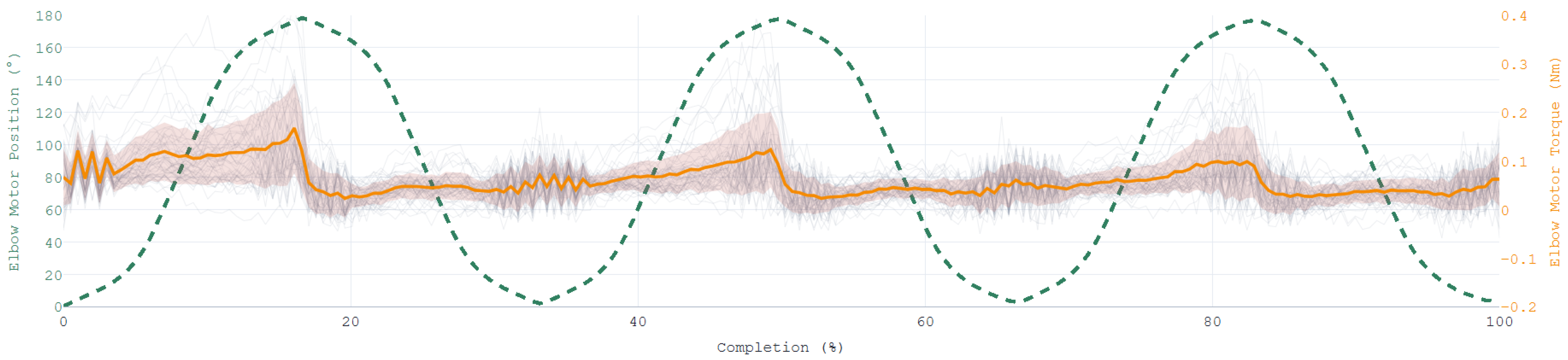
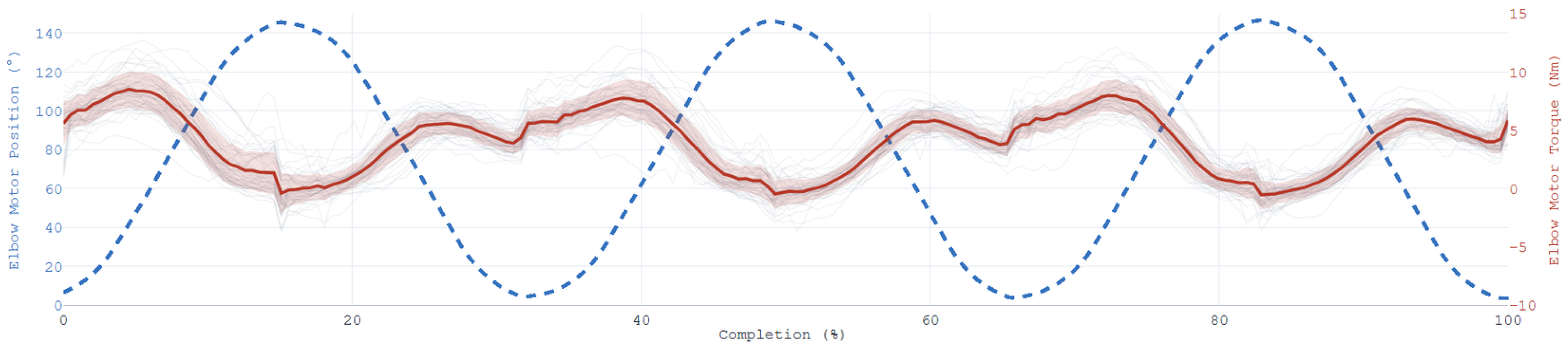
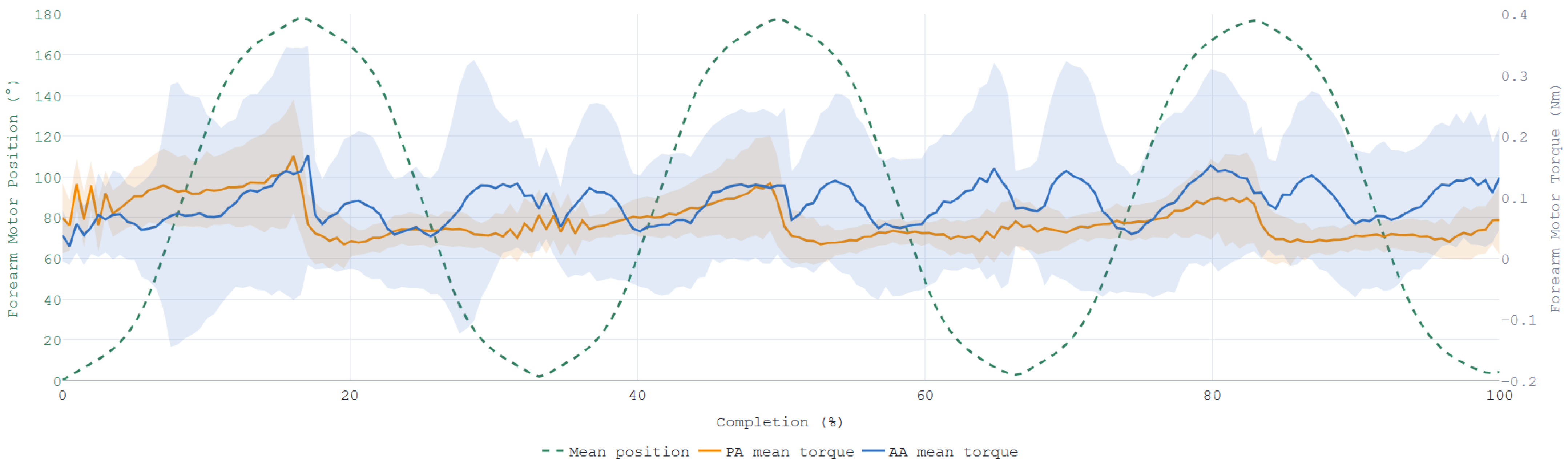
The mean PA exercise for P/S and F/E, as well as standard deviation, was computed and is displayed in Figure 5 and Figure 6, respectively.
During forearm P/S, the average torque required to perform the movement was low throughout the entire length of the movement (below 0.3 Nm). The maximum value recorded in this experience was 0.44 Nm, but 81% of the participants remained below a maximum value of 0.3 Nm. The mean PA maximum torque was 0.23 Nm ± 0.08. As PA is a predetermined motion, in which the user is not performing any movement, the average root mean square error (RMSE) of the trajectory was calculated to be 4.82° ± 0.02°, which is very consistent and similar to values previously obtained.
For elbow F/E, the average torque required was, as expected, higher, usually staying below 10 Nm, which was enough for 70% of the participants, with the maximum recorded value being 12.76 Nm. The mean PA maximum torque was 9.35 Nm ± 1.47, revealing a moderate variability between participants. The average RMSE value was calculated to be 1.20° ± 0.04°, highlighting the exoskeleton’s movement accuracy and consistency. These results suggest that the exoskeleton is able to passively manipulate the UL of a broad range of people, accurately performing forearm P/S and elbow F/E, in its full RoM.
Regarding the influence of anthropometric variables on PA torque requirements, height and weight were both significantly associated with mean and maximum torque during F/E (height: ρ = 0.430, p = 0.003 for mean; ρ = 0.381, p = 0.008 for max; weight: ρ = 0.437, p = 0.002 for mean; ρ = 0.362, p = 0.013 for max). Additionally, males required significantly more torque than females (mean: U = 104, p = 0.036; max: U = 108, p = 0.047). For P/S, height similarly predicted maximum passive assist torque ( ρ = 0.339, p = 0.020), with males also requiring higher peak torques (U = 101, p = 0.030). These findings are consistent with the biomechanical model underlying the device design, in which longer and heavier limbs generate greater gravitational torque at the elbow joint, and retrospectively validate the use of worst-case anthropometric estimates in the actuator selection process. No demographic variable significantly predicted trajectory tracking accuracy (RMSE) for either motor, confirming consistent kinematic performance across the participant population.

4.2. AA Results

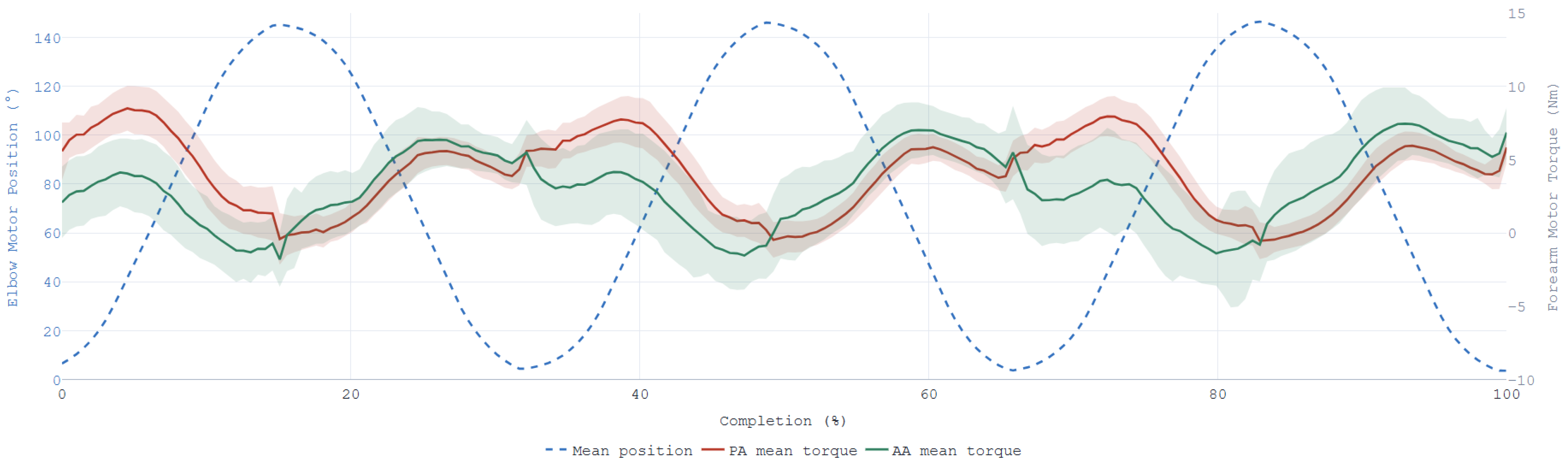
During the AA exercise, although the motion/assistance performed by the exoskeleton remained the same, the participants were invited to actively participate in the movement, accompanying the exoskeleton. The goal was to keep up with the exoskeleton, neither moving faster nor slower than it. Only when unable to perform the motion should they let the exoskeleton manipulate their UL. As such, it is interesting to compare the torque profiles for both PA and AA, whose mean is displayed in Figure 7 for P/S and Figure 8 for F/E.
It can be interpreted from Figure 7 that, as expected, the torque required for AA is very low. This confirms that the most required torque was near the supination position, meaning that the participants could not voluntarily perform the movement all the way and the exoskeleton had to assist them to complete the motion. It stands to reason that the required torques during the AA exercise would be lower than those for PA, as the user is moving the exoskeleton and not being moved by it. However, this was not verified, with 37 (79%) of participants requiring more torque to perform AA than PA, with the average maximum torque required being 0.43 Nm ± 0.31. A Wilcoxon signed-rank test confirmed that mean torque during AA was significantly higher than during PA for P/S (W = 130.0, p < 0.001 , r = 0.722), with a large effect size, corroborating the unexpected nature of this finding.
On the other hand, for elbow F/E in Figure 8, the AA mode behaves more similarly to what was expected. During flexion (0° to around 150°), the required torque for AA is consistently lower than that of PA, which can only be explained by the participants performing the movements voluntarily. Conversely during extension (moving towards 0°), the necessary torque for AA was higher than that of PA. The logical explanation is that, differently from PA, in which the exoskeleton only needed to carry the participants’ weight, during AA, the exoskeleton must also support the participant moving with gravity: when moving with gravity, the exoskeleton creates torque in the other direction, in order to allow for a smooth and controlled descent. In AA, the exoskeleton must oppose gravity pushing the participants’ weight down but also their force in the same direction, leading to a higher required torque. The mean maximum torque was 9.23 Nm ± 2.39, which is below the value reported for PA. This is not a very significant difference, but it shows a larger standard deviation, probably linked to the different participants’ UL strength. Despite the more positive results, 17 people (36%) recorded higher torques for AA over PA, which, although explained above, is not ideal. A Wilcoxon signed-rank test on mean torque confirmed that AA required significantly less torque than PA for F/E (W = 245.0, p < 0.001 , r = 0.507), indicating that participants did actively contribute to the movement, albeit with the limitations described above.
Older participants required significantly higher peak torque during AA for P/S ( ρ = 0.379, p = 0.009), which may reflect reduced voluntary forearm rotation strength in older individuals, leading to greater reliance on the device and consequently higher resistive torque when the participant’s motion exceeded the predefined trajectory speed. Conversely, heavier participants showed lower peak AA torque for P/S ( ρ = −0.293, p = 0.046), possibly reflecting slower voluntary movement in this group, which reduced kinematic mismatch with the device.
The results obtained during AA differed substantially between the two movements. For P/S, the mode failed to deliver assistive behavior, with the majority of participants overpowering the predefined trajectory. As the AA mode follows a predefined low-velocity trajectory, participants with sufficient voluntary strength naturally attempted to move faster than the exoskeleton. Instead of assisting the user, the controller was therefore required to actively oppose their motion in order to maintain the prescribed speed, generating resistive torque instead of assistive torque. For F/E, participants did actively contribute to the movement, as confirmed statistically, though the extension phase remained suboptimal due to gravitational loading. In both cases, the underlying limitation is the same: the current AA implementation relies on a fixed velocity profile rather than adapting to user intent, and is therefore inconsistent with an assist-as-needed (AAN) paradigm, in which assistance should be provided only when the user is unable to complete the movement independently.
A redesign of the control architecture is required to enable truly adaptive assistance. The current velocity-based approach, while simple and interpretable for an initial feasibility study, lacks the capacity to adapt to individual user intent in real time. Recent advances in human-centered control have produced strategies with this capability: deep reinforcement learning has been applied directly to exoskeleton control, enabling controllers to learn adaptive policies from interaction data [86]; hybrid shared control with game-theoretic learning [87] allows continuous negotiation between user intent and device assistance with formal performance guarantees; and variable admittance control [88] modulates the mechanical impedance of the device in response to interaction forces, offering a more transparent and responsive human-robot interface. These approaches represent a significant step beyond classical velocity and current control strategies. However, their adoption entails considerable implementation complexity, requires substantial training data, and demands real-time computational resources that were beyond the scope of the present feasibility study. Future work should therefore explore their integration, alongside real-time intent detection through torque sensing or electromyography, as the natural next step toward a truly adaptive AA paradigm.

4.3. AR Results

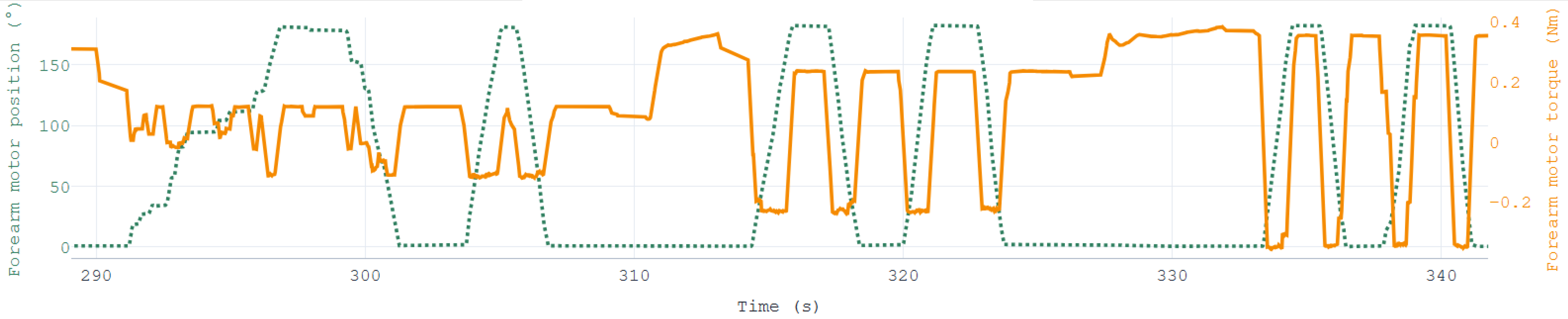
The final rehabilitation exercise tested was the AR mode. In this mode, no assistance was provided, but rather resistance, meaning that all movements had to be performed by the participants and the exoskeleton would make those movements more challenging. Examples of this mode are displayed in Figure 9 for P/S and Figure 10 for F/E.
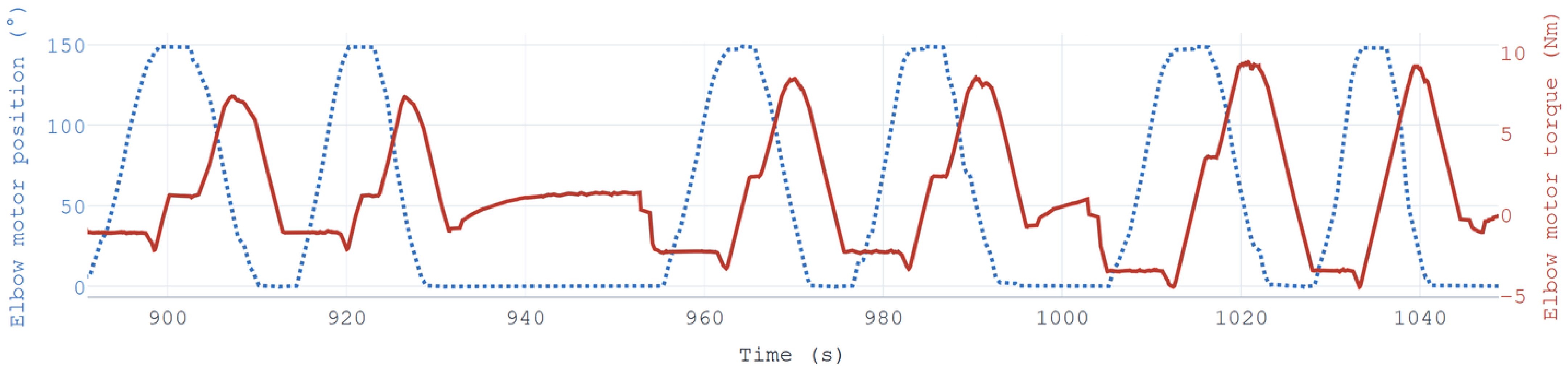
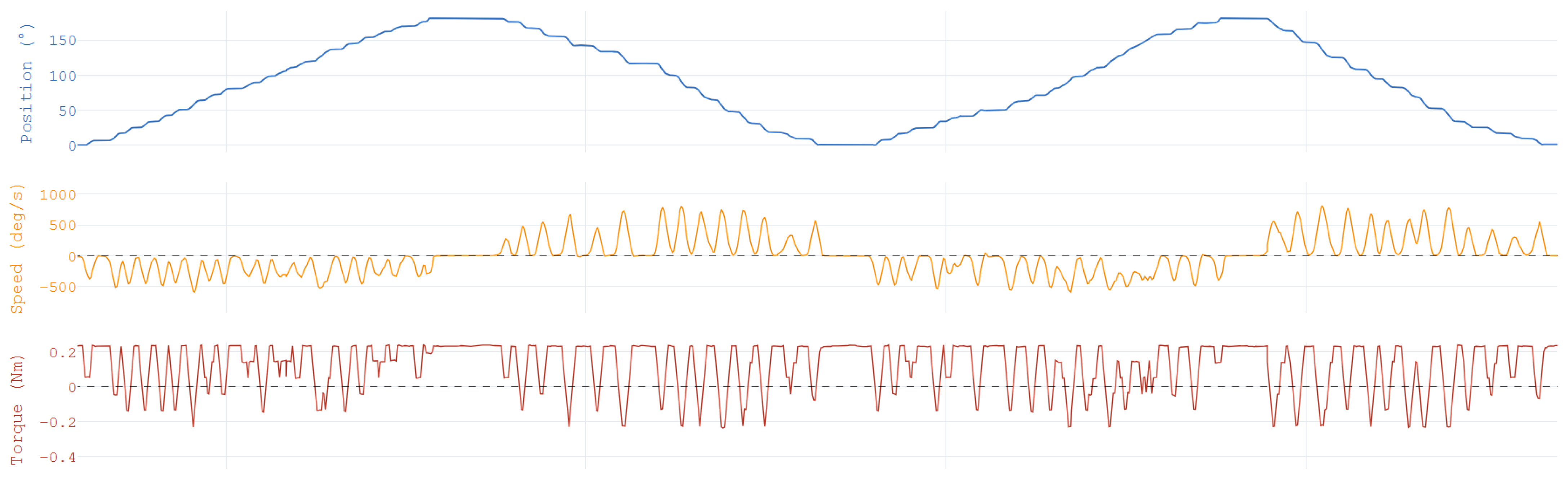
For P/S, the AR mode provided constant current in the direction opposite to the motion: whenever a participant tried to supinate, the exoskeleton attempted to perform the contrary motion. This can be seen in Figure 9, where the torque profile mainly sorts between positive and negative values, albeit equal in absolute value. Three very distinct levels of resistance can be seen in this graph, as was designed to do, which means that the exoskeleton could perform different levels of resistance to the movements according to the sliding bar present in the UI. However, between 290 s and 310 s (25% difficulty) the resistance profile is not very clear. The exoskeleton does provide a constant value of torque when not moving, but when the user moves it, the torque suddenly drops, recovering afterwards. This behaviour can be attributed to the generation of back electromotive force (EMF) generated when turning the actuator by hand. When the actuator is driven by the user, the resulting motion induces a back-EMF proportional to the angular velocity, which opposes the applied voltage. Consequently, the effective voltage is reduced, leading to a temporary decrease in current and, thus, output torque. This phenomenon explains the drops in actuator torque and the staircase-shaped position during this exercise. As is possible to see in the latter two difficulty levels, 310 s onwards, the same behaviour does not occur, which suggests that it only happens when the movement is performed in a faster fashion.
For F/E, the results obtained are better aligned to what was designed. In this mode, as it moves along the z-axis perpendicular to the ground, it is required to factor in gravity. Therefore, an anti-gravity torque was created which was only enough to stop the exoskeleton at each position, but easily movable if pushed. This way, all movements would be performed by the participants, either in favor or against gravity. On top of this torque, a constant torque profile was added, as for P/S, and only this added torque was chosen in the UI. When moving from 0° to 150°, as it is against gravity, the resistance is constant, but when reaching around 135° (90° of flexion plus 45° of exoskeleton position), the movement becomes with gravity, so the resistance is increased. Then, the participants remained in the flexion position until the resistance torque became linear again, because from 150° to 135° the movement is against gravity. Finally, from 135° to the extension position, the resistance lowers to account for the effective weight component, dependent on the angle. This behaviour can be seen for the same three different levels of resistance tested, and the effect of back-EMF was negligible.
To verify the back-EMF hypothesis, a segment-based Spearman correlation analysis was conducted between absolute actuator speed and output torque within individual half-movement strokes during AR, for both motors across all 47 participants. For the forearm P/S motor, a consistent negative correlation was observed across 45 of 47 participants (mean ρ = −0.051 ± 0.027), with a one-sample t-test confirming this effect was significantly different from zero (t(3673) = −17.70, p < 0.001 ). For the elbow F/E motor, a similar trend was found across 40 of 47 participants (mean ρ = −0.109 ± 0.097), also statistically significant (t(1305) = −9.89, p < 0.001 ). Although the correlation magnitudes are weak, reflecting the intermittent and transient nature of back-EMF events within otherwise slow movements, the consistency of the negative direction across participants and segments confirms the hypothesized mechanism. When the user drives the actuator at higher speeds, the resulting back-EMF reduces the effective supply voltage, transiently decreasing output torque and producing the irregular torque profile observed during AR. This effect was more pronounced in P/S, where the staircase-like position profile provides additional visual confirmation of the phenomenon. This was further confirmed by visually analyzing the recorded data, as displayed in Figure 11, where a clear inverse relationship was observed between actuator velocity and output current, consistent with the back-EMF phenomenon.
Although AR during F/E appears to show optimal results, this mode still requires some improvements. Mainly, the erratic movement of the exoskeleton performing P/S may turn this exercise into an unpleasant experience. The resistance should be linear, regardless of user performance. A possible solution for this issue would be to prepare the AR mode to add more current whenever the spikes in voltage occur: because back-EMF is angular velocity-dependent, it may be possible to increase the torque proportionally to the current speed, so that it remains constant. Nevertheless, it was possible to verify that the exoskeleton can provide differentiable levels of resistance for both movements. The AR mode also has a design characteristic which does not behave as required: the resistance only changes direction when the movement is completed, so, for example, participants who cannot supinate 90° were not able to perform and experience this mode in its entirety. This issue must be addressed in future iterations in order to make all modes available for any user.

5. Subjective User Experience Assessment

As stated before, after each participant completed the testing protocol, they were asked to fill out a subjective questionnaire regarding their experience.

5.1. SUS

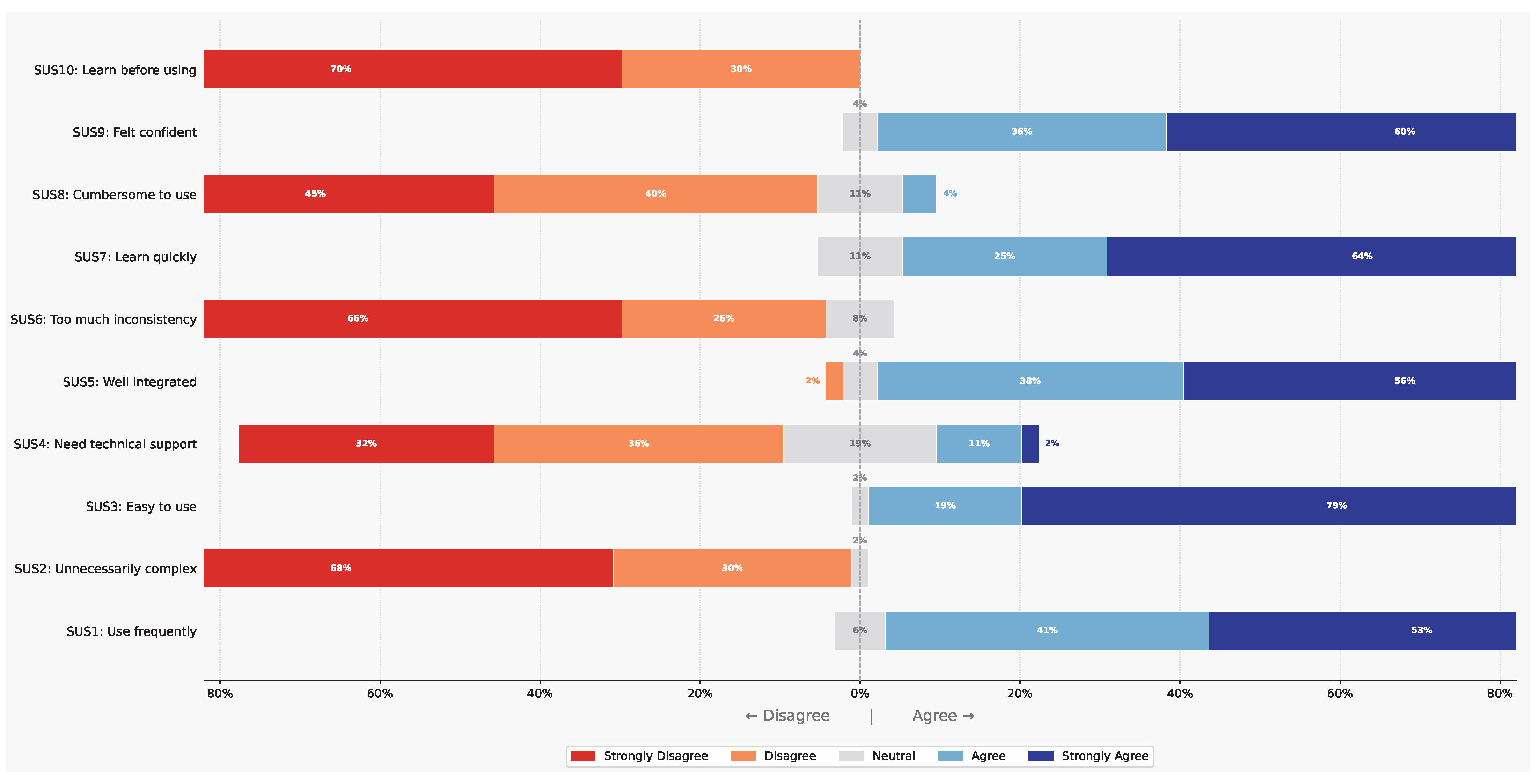
The questionnaire started with the SUS, whose results are displayed in Figure 12. SUS1 got very positive answers, with 94% of the participants stating that they would like to use this system frequently if in need of rehabilitation. Similarly, SUS2 and SUS3—98% of the participants stated that the system was not unnecessarily complex and easy to use. Regarding SUS4, although the majority of the participants, 68%, reported they required no outside support to use the exoskeleton, the remaining 32% did not agree. This suggests that the requirement of technical support may be aligned with the rehabilitation purpose rather than actual use of the exoskeleton, which was reported as easy. SUS5 evaluated how well all the functionalities of the exoskeleton were integrated, and 94% of the participants answered positively. 92% of the participants found the exoskeleton did not have many inconsistencies (SUS6) and 89% found they could learn quickly how to use it (SUS7). The greater part of the participants, 85%, found the system was not cumbersome to use (SUS8) and 96% felt confident during the exercises (SUS9). Finally, in SUS10, the participants were asked if they had to learn a lot before using the exoskeleton, which they all disagreed with.
The average SUS score was 87.1 ± 9.6 (CI [84.3, 89.7]), indicating a high level of usability, albeit with some variability across participants. The median score was 87.5 and the mode was 85. The lowest recorded score was 57.5, reflecting poor perceived usability in at least one case; however, the second-lowest score was 70, suggesting that the majority of participants rated the system within an acceptable to excellent usability range.

5.2. Borg Scale

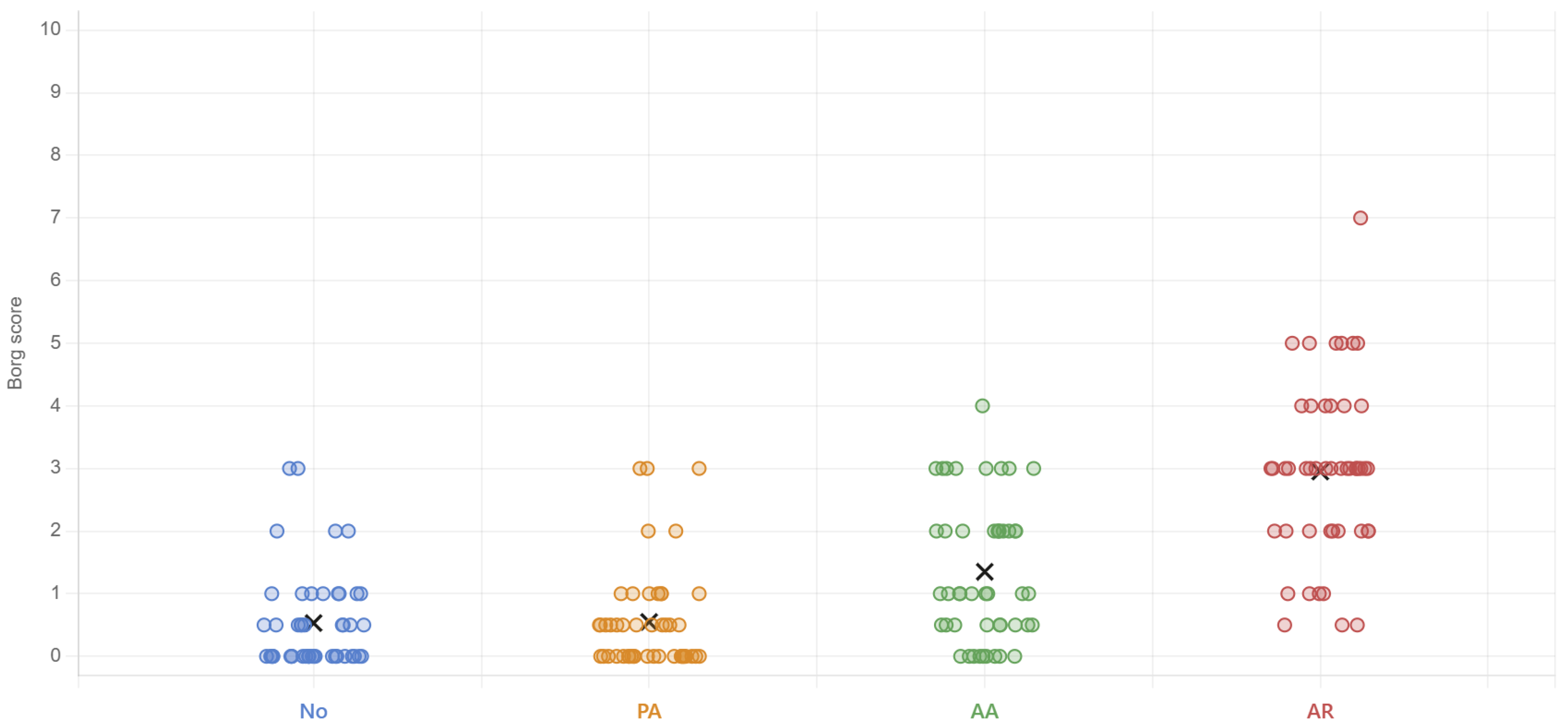
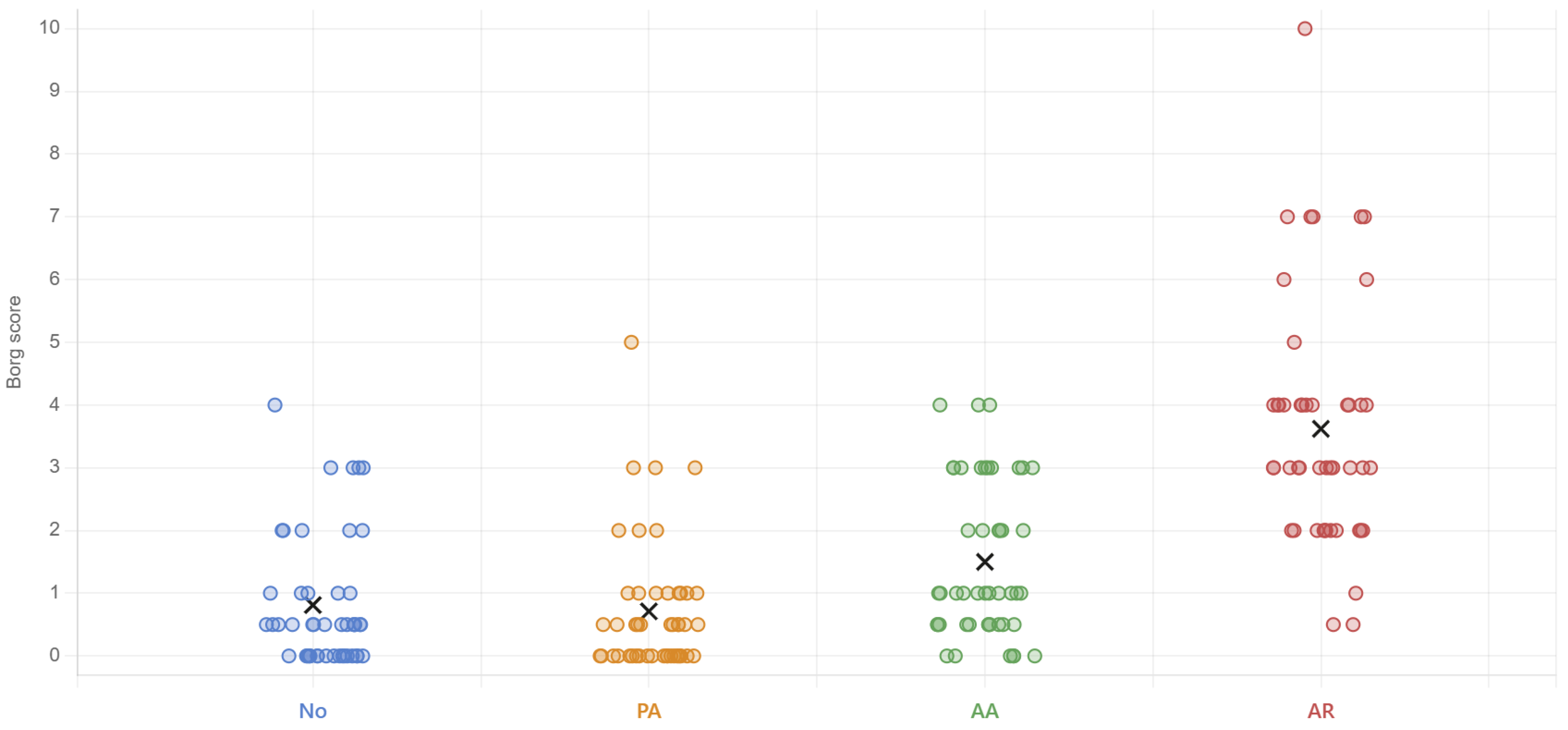
Following the SUS evaluation, the participants were asked to fill out a Borg scale questionnaire for both P/S and F/E in four modalities: no assistance, during PA, during AA and during AR. The results of this assessment for P/S are displayed in Figure 13.
The perceived effort when the exoskeleton was idle was close to 0, which aligns with the very low torque required to perform this movement. The average value reported was 0.53 ± 0.77, which, although it reveals variability, remains small. For PA, as the exoskeleton performs the entire movement for the subjects, it was expected to obtain values closer to 0, which was not observed. An average of 0.55 ± 0.82 was reported, with a median of 0.5 and a mode of 0. This discrepancy probably arises from those who cannot complete total supination by themselves, having to rely on the exoskeleton to complete the movement, and putting them in a supination angle they are not used to performing. AA results yielded a greater Borg average of 1.35 ± 1.12, with a median of 1 and mode of 2. The higher variability in AA compared to PA likely reflects individual differences in voluntary strength and movement speed: participants who could move faster than the exoskeleton experienced the mode differently from those who could not, leading to a wider spread of perceived effort. Additional contributing factors may include the lack of individual calibration of assistance thresholds, differences in how participants interpreted the task instructions, and the absence of real-time feedback guiding user behaviour during each mode. For AR, the answers seem to approach a normal distribution, with most values closer to the average of 2.95 ± 1.40 and then equally distributed up and down. Median and mode of 3 corroborate these results.
For F/E, displayed in Figure 14, similar results were obtained. With no assistance, the perceived effort got an average of 0.81 ± 1.04, higher than that of P/S, as this motion requires more torque to be completed. Regarding PA, a lower value was obtained, with an average of 0.71 ± 1.05, heavily influenced by seven participants reporting values over 1 (without whom the average would be 0.34). A median of 0.5 and a mode of 0 better represent the general opinion. The average Borg result for AA was 1.50 ± 1.23, reflecting the users’ effort in accompanying the exoskeleton during its movement. Both the median and mode answers were 1, revealing the effort to perform AA was greater than PA, but not by a large margin, and with similar variability patterns to P/S. Finally, during AR, the average perceived effort was scored at 3.62 ± 1.94, with a median of 3 and mode of 4. This exercise also followed a somewhat normal distribution, with one participant reporting a near-maximum value of 10, reflecting the wide range of individual responses to resistance-based exercise.
A Friedman test revealed a statistically significant effect of condition on perceived effort for P/S ( χ 2 ( 3 ) = 97.91 , p < 0.001 , Kendall’s W = 0.619 ) and for F/E ( χ 2 ( 3 ) = 93.09 , p < 0.001 , Kendall’s W = 0.597 ). Kendall’s W values of approximately 0.6 for both movements indicate a moderate-to-strong level of agreement across participants in how they ranked the conditions by perceived exertion, representing a meaningful and consistent effect.
To further characterize variability in perceived effort, Levene’s test confirmed that variance differed significantly across modalities for both P/S ( F = 4.528 , p = 0.013 ) and F/E ( F = 5.037 , p = 0.008 ), with pairwise comparisons showing that PA exhibited significantly lower variance than AR for both movements ( p = 0.009 and p = 0.005 , respectively). Variance increased progressively from PA to AA to AR, with AR displaying the highest standard deviations (1.40 for P/S and 1.94 for F/E). The progressive increase in both mean and variance is consistent with the increasing physical demand of each modality and with the wider range of individual differences in voluntary strength that become relevant as the modes require greater active participation. The high variability in AR is likely compounded by the torque irregularities arising from back-EMF during P/S, as discussed in Section 4, which produced inconsistent resistance perception across participants. The unexpectedly non-zero PA scores in a subset of participants highlight the need for individualized range of motion limits in future iterations, so that passive manipulation does not bring participants to uncomfortable joint positions.
Overall, Borg scale results aligned with expectations across most modalities, with the exception of PA for P/S. The goal of this scale is to observe perceived effort during the different modes, so during PA the answer should be 0. As a result, additional feedback must be recorded from the participants in future tests to further understand this unexpected occurrence.

5.3. Comfort and Safety

Comfort and feeling of safety were evaluated in the questionnaire, and the obtained responses are displayed in Figure 15. The average overall result was 4.4 ± 0.4, with a median of 4.4 and mode of 4.8. These are very positive results and reveal that the general consensus is that the system is comfortable to use and most participants felt safe during the entire experience, and 87% of the answers were either 4 or 5. A minimum value of 3.6 was recorded, which, although above the halfway mark, is not ideal. The highest scoring question was Q1, with an average score of 4.7, showing most participants felt safe during the entire experience. The lowest scoring question was Q3, focused on movement smoothness, which got an average value of 4. This score most likely arises from the back-EMF issue mentioned above during AR. Finally, although it was possible to see in Figure 9 and Figure 10 clear different levels of resistance, Q9 (evaluates noticeable different levels of resistance) underperformed. Given the healthy status of the participants, the resistance provided may have been conservative and required little effort.
Spearman correlation and Mann–Whitney U tests were conducted to examine associations between demographic variables (age, height, weight, gender, and dominant hand) and both subjective and objective outcomes. Regarding subjective outcomes, no significant associations were found between any demographic variable and Borg perceived effort or safety and comfort scores, indicating that the device delivered a consistent subjective experience across the participant population. A weak but significant negative correlation was found between weight and SUS score ( ρ = −0.290, p = 0.048), suggesting that heavier participants rated usability slightly lower, consistent with the ergonomic complaints reported qualitatively.
Analysis of associations between objective performance metrics and subjective outcomes revealed several significant relationships. Participants who required higher maximum torque during passive P/S reported lower SUS scores ( ρ = −0.324, p = 0.026), suggesting that individuals who were more difficult to passively manipulate had a less positive usability experience, possibly perceiving the device as less smooth. Higher mean torque during AA for P/S was associated with lower safety and comfort scores ( ρ = −0.315, p = 0.031), directly linking the control limitations of the AA mode to user-perceived comfort: when the device was required to actively oppose the participant’s motion, this was perceptible at the subjective level. Additionally, higher trajectory tracking error during F/E passive assist was associated with greater perceived effort during AA for both P/S ( ρ = 0.375, p = 0.009) and F/E ( ρ = 0.359, p = 0.013), suggesting that participants with greater limb resistance or stiffness experienced both less accurate passive manipulation and higher exertion during active exercises. Taken together, these findings indicate that objective performance metrics are meaningfully linked to subjective user experience, and that improvements in control smoothness and trajectory accuracy would likely translate directly into improved comfort and usability ratings.
At the end of the questionnaire, participants were invited to provide open-ended feedback regarding their experience. The responses were analyzed and grouped into key themes:
  • Mechanical Comfort and Ergonomics—Some participants reported discomfort related to the physical interface of the device. Common issues included pressure in the armpit region, particularly for shorter participants, insufficient cushioning, and discomfort during pronation/supination due to arm support and rotation constraints. Additionally, female participants highlighted the need for improved accommodation of chest anatomy, suggesting that the current structure may not be fully inclusive. The device was occasionally perceived as bulky, and during flexion movements, its trajectory approached the user’s head, requiring slight adjustments in posture (e.g., turning the head or upper body) to avoid contact. Furthermore, although the forearm was fixed at a neutral position during F/E, some participants reported discomfort when slight natural variations in pronation/supination were restricted. Suggestions for improvement included adapting the system to users with different ranges of motion, enhancing the handle design with more comfortable and higher-friction materials (e.g., rubber) to improve grip, and refining the overall ergonomics to better accommodate different body types.
  • AR Behaviour and Smoothness—A recurring concern was the lack of smoothness, particularly during the AR mode. Participants frequently described the motion as “jumping”, “stuck”, or inconsistent. These perceptions are consistent with the previously identified back-EMF effects, confirming that such control artifacts are noticeable at the user level. Additionally, the different levels of resistance were often perceived as insufficiently distinct, indicating that the scaling of resistance may need to be further refined to ensure clearer differentiation between difficulty levels.
  • AA Strategy—Multiple participants indicated that the AA mode did not behave as expected. Instead of assisting only when necessary, the system imposed a continuous predefined motion, leading users to feel that they were “waiting for the exoskeleton” to complete the movement. This feedback suggests that the current implementation does not fully align with AAN rehabilitation paradigms, where assistance should be adaptively provided based on user performance.
  • User Interface and Feedback—Feedback regarding the user interface was generally positive, particularly the real-time display of joint angles, which participants found helpful for tracking movement. However, several improvements were suggested, including the addition of real-time torque feedback, as well as clearer visual cues indicating when to reverse movement direction during exercises.
  • Safety and Practical Usability—Some usability concerns were raised regarding the emergency mechanism and attachment system. Participants noted that the elastic bands used for fixation may hinder rapid removal of the limb, and that the emergency stop should ensure immediate and complete release. Minor issues such as occasional discomfort caused by Velcro straps and handle design were also reported. These aspects, while not critical, highlight opportunities to further improve ease of use and overall user experience.
Overall, while the qualitative feedback corroborates the positive quantitative usability results, it also highlights specific areas for improvement, particularly in control smoothness, adaptive assistance strategies, and ergonomic design.
Comparing the present results with related systems, the trajectory tracking errors obtained, 4.82° ± 0.02° for P/S and 1.20° ± 0.04° for F/E, are consistent with values reported in similar lower-DoF rehabilitation exoskeletons [65,66,68]. Regarding subjective evaluation, the SUS score of 87.1 ± 9.6 compares favorably with scores reported in PLUTO [70] (73.3), Su et al. [72] (67.5) and AGREE [74] (68.7). Furthermore, the present study benefits from a considerably larger sample size (N = 47) than most comparable works, as shown in Table 1, where the majority of studies report fewer than 10 healthy participants [50,62,64,65,68,69,72,76]. Direct comparison should be interpreted cautiously, as the reported SUS score was obtained from healthy participants, whereas the mentioned works [70,72,74] performed this assessment in patients with impairments. Safety and comfort scores are less frequently reported in the literature, limiting direct comparison, but the average of 4.4 out of 5 suggests a level of user acceptance consistent with positive outcomes reported qualitatively in related works.

6. Conclusions

This work presents a human-centered study of a 2-DoF UL exoskeleton targeting F/E and P/S. The exoskeleton was evaluated through experimental trials with 47 healthy participants, combining objective performance metrics with subjective user feedback, including usability, perceived effort, and comfort.
During PA, the exoskeleton mobilized the participants’ UL through the full RoM with low RMSE values and within rated torque for both actuators throughout the entire study. The AA strategy did not fully align with the intended AAN paradigm, with mean torque during AA being significantly higher than during PA for P/S, indicating that the system opposed rather than assisted participant motion in the majority of cases. AR demonstrated different resistance levels for both movements, though the back-EMF phenomenon introduced torque irregularities during P/S that were perceivable by participants. Subjective assessment results were positive. The SUS yielded an average score of 87.1 ± 9.6, corresponding to an “Excellent” usability classification, indicating that participants found the system easy and intuitive to use. Safety and comfort scores averaged 4.4 out of 5, with participants reporting high confidence and a strong willingness to use the device in a real rehabilitation program. Borg scale results followed expected trends across the three modes, with perceived exertion increasing progressively from PA to AR.

Limitations and Future Work

The present study was conducted exclusively with healthy participants in a single session, limiting the direct applicability of the findings to clinical populations and precluding assessment of longitudinal effects. The AA mode requires a redesign to implement a true AAN strategy, incorporating real-time intent detection through torque or EMG sensors. Furthermore, advanced human-centered control strategies, including variable admittance and shared control approaches, offer promising directions to enhance adaptability in future iterations. For AR, back-EMF compensation should be implemented in the motor control loop, with possible strategies including current-controlled drive modes or alternative motor driver configurations. Individual ROM limits should be configurable to accommodate users with varying joint mobility. Ergonomic refinements are also warranted, particularly to better accommodate diverse body types. Following these improvements, evaluation with target clinical populations using validated outcome measures such as the Fugl–Meyer Assessment represents the necessary next step toward clinical validation.
In conclusion, the proposed exoskeleton demonstrated consistent technical performance and positive user acceptance, supporting its further development and evaluation in rehabilitation contexts. High usability scores and favorable comfort ratings were achieved across a healthy cohort, while qualitative feedback provided clear directions for iterative design improvements. The obtained results demonstrate the feasibility and usability of the proposed system in healthy participants. Further clinical validation involving stroke patients is required to assess its effectiveness and applicability in rehabilitation settings.

Author Contributions

Conceptualization, A.G., N.D. and C.D.R.; methodology, A.G., N.D. and C.D.R.; investigation, A.G. and N.D.; data curation, A.G., N.D. and C.D.R.; writing—original draft, A.G.; writing—review and editing A.G., N.D., H.M., M.F.S. and C.D.R.; visualization, A.G. and N.D.; supervision, H.M., M.F.S. and C.D.R.; project administration, H.M., M.F.S. and C.D.R.; funding acquisition, C.D.R. All authors have read and agreed to the published version of the manuscript.

Funding

This work is co-financed by Component 5—Capitalization and Business Innovation—of core funding for Technology and Innovation Centre (CTI), integrated in the Resilience Dimension of the Recovery and Resilience Plan within the scope of the Recovery and Resilience Mechanism (MRR) of the European Union (EU), framed in the Next Generation EU, for the period 2021–2026, with Reference 21.

Institutional Review Board Statement

The study was conducted in accordance with the Declaration of Helsinki, and approved by the Ethics Committee of INESC-TEC with reference CE-Par.03/26.

Informed Consent Statement

Informed consent was obtained from all subjects involved in the study. The images in this article depicting a person using the exoskeleton feature one of the authors, who has provided full consent for their publication.

Data Availability Statement

The original contributions presented in this study are included in the article. Further inquiries can be directed to the corresponding author.

Acknowledgments

The authors would like to thank all those who voluntarily enrolled in this study.

Conflicts of Interest

The authors declare no conflicts of interest.

Abbreviations

The following abbreviations are used in this manuscript:
AAActive Assist
AANAssist-as-Needed
ADLsActivities of Daily Living
ARActive Resist
CANController Area Network
EMFElectromotive Force
EMGElectromyography
F/EFlexion and Extension
INESC TECInstitute for Systems and Computer Engineering, Technology and Science
PAPassive Assist
P/SPronation and Supination
RMSERoot Mean Square Error
RoMRange of Motion
SUSSystem Usability Scale
UIUser Interface
ULUpper-Limb

References

  1. International Disability Alliance; World Health Organization; World Bank. Global Disability Inclusion Report: Accelerating Disability Inclusion in a Changing and Diverse World. 2025. Available online: https://www.globaldisabilitysummit.org/resource/global-disability-inclusion-report/ (accessed on 19 May 2026).
  2. World Health Organization. Rehabilitation. April 2024. Available online: https://www.who.int/news-room/fact-sheets/detail/rehabilitation (accessed on 4 November 2024).
  3. Neill, R.; Shawar, Y.R.; Ashraf, L.; Das, P.; Champagne, S.N.; Kautsar, H.; Zia, N.; Michlig, G.J.; Bachani, A.M. Prioritizing rehabilitation in low- and middle-income country national health systems: A qualitative thematic synthesis and development of a policy framework. Int. J. Equity Health 2023, 22, 91. [Google Scholar] [CrossRef] [PubMed]
  4. World Health Organization. Rehabilitation 2030: A Call for Action. Available online: https://www.who.int/publications/m/item/rehabilitation-2030-a-call-for-action (accessed on 7 February 2025).
  5. Walker-Bone, K.; Palmer, K.T.; Reading, I.; Coggon, D.; Cooper, C. Prevalence and impact of musculoskeletal disorders of the upper limb in the general population. Arthritis Care Res. 2004, 51, 642–651. [Google Scholar] [CrossRef] [PubMed]
  6. Zanesco, L.; Uthant, R.; Arai, C.; Assunção, J.; Checchia, C.; Beraldo, R.A.; Malavolta, E.A. Elbow disorders in an outpatient clinic: An epidemiological study. Cureus 2025, 17, e85029. [Google Scholar] [CrossRef] [PubMed]
  7. Persson, H.C.; Parziali, M.; Danielsson, A.; Sunnerhagen, K.S. Outcome and upper extremity function within 72 hours after first occasion of stroke in an unselected population at a stroke unit. A part of the salgot study. BMC Neurol. 2012, 12, 162. [Google Scholar] [CrossRef] [PubMed]
  8. Broeks, G.J.; Lankhorst, G.; Rumping, K.; Prevo, A.J.H. The long-term outcome of arm function after stroke: Results of a follow-up study. Disabil. Rehabil. 1999, 21, 357–364. [Google Scholar] [CrossRef] [PubMed]
  9. Lili, L.; Sunnerhagen, K.S.; Rekand, T.; Alt Murphy, M. Associations between upper extremity functioning and kinematics in people with spinal cord injury. J. Neuroeng. Rehabil. 2021, 18, 147. Available online: https://api.semanticscholar.org/CorpusID:237638832 (accessed on 16 April 2026). [CrossRef] [PubMed]
  10. Lee, K.S.; Zaman, M.; Hwang, J. Reduced muscle activity of the upper extremity in individuals with spinal cord injuries. Int. J. Environ. Res. Public Health 2022, 19, 4708. [Google Scholar] [CrossRef] [PubMed]
  11. Katz, S. Assessing self-maintenance: Activities of daily living, mobility, and instrumental activities of daily living. J. Am. Geriatr. Soc. 1983, 31, 721–727. [Google Scholar] [CrossRef] [PubMed]
  12. Edemekong, P.F.; Bomgaars, D.; Sukumaran, S.; Levy, S.B. Activities of daily living. In StatPearls; StatPearls Publishing LLC: Treasure Island, FL, USA, 2019. Available online: https://pubmed.ncbi.nlm.nih.gov/29261878/ (accessed on 16 April 2026).
  13. Friedman, P.J. Gait recovery after hemiplegic stroke. Int. Disabil. Stud. 1990, 12, 119–122. [Google Scholar] [CrossRef] [PubMed]
  14. Paci, M.; Nannetti, L.; Casavola, D.; Lombardi, B. Differences in motor recovery between upper and lower limbs: Does stroke subtype make the difference? Int. J. Rehabil. Res. 2016, 39, 185–187. [Google Scholar] [CrossRef] [PubMed]
  15. Rand, D.; Eng, J.J. Disparity between functional recovery and daily use of the upper and lower extremities during subacute stroke rehabilitation. Neurorehabil. Neural Repair 2012, 26, 76–84. [Google Scholar] [CrossRef] [PubMed]
  16. Abdullahi, A.; Wong, T.W.L.; Ng, S.S.M. Variation in the rate of recovery in motor function between the upper and lower limbs in patients with stroke: Some proposed hypotheses and their implications for research and practice. Front. Neurol. 2023, 14, 1225924. [Google Scholar] [CrossRef] [PubMed]
  17. Wodu, C.O.; Sweeney, G.; Kerr, A. Exploring the reasons behind the low focus on upper limb rehabilitation in the early stages after a stroke: A qualitative study. J. Hand Ther. 2025, 38, 52–60. [Google Scholar] [CrossRef] [PubMed]
  18. Purton, J.; Sim, J.; Hunter, S.M. Stroke survivors’ views on their priorities for upper-limb recovery and the availability of therapy services after stroke: A longitudinal, phenomenological study. Disabil. Rehabil. 2023, 45, 3059–3069. [Google Scholar] [CrossRef] [PubMed]
  19. O’Flaherty, D.; Ali, K. Recommendations for upper limb motor recovery: An overview of the uk and european rehabilitation after stroke guidelines (2023). Healthcare 2024, 12, 1433. [Google Scholar] [CrossRef] [PubMed]
  20. Eastman, J.; White, H.; Evans, J.; Augsburger, S.; Wallace, J.; Riley, S.; Iwinski, H. What is the minimum torque required to obtain passive elbow end range of motion? Gait Posture 2022, 93, 235–239. [Google Scholar] [CrossRef] [PubMed]
  21. Kisner, C.; Colby, L.A. The Elbow and Forearm Complex; McGraw-Hill Education: New York, NY, USA, 2012; Available online: https://fadavispt.mhmedical.com/content.aspx?bookid=1883&sectionid=140705090 (accessed on 17 April 2026).
  22. Sardelli, M.; Tashjian, R.Z.; MacWilliams, B.A. Functional elbow range of motion for contemporary tasks. JBJS 2011, 93, 471–477. [Google Scholar] [CrossRef] [PubMed]
  23. Inagaki, Y.; Ishida, T.; Sugimori, H.; Yoshimura, T.; Watanabe, A.; Naito, Y.; Sawamura, D. Functional range of motion for basic seated activities of daily living tasks. Front. Sports Act. Living 2025, 7, 1646326. [Google Scholar] [CrossRef] [PubMed]
  24. Gates, D.; Walters, L.; Cowley, J.; Wilken, J.; Resnik, L. Range of motion requirements for upper-limb activities of daily living. Am. J. Occup. Ther. Off. Publ. Am. Occup. Ther. Assoc. 2015, 70, 7001350010p1–7001350010p10. [Google Scholar] [CrossRef] [PubMed]
  25. Guo, H.J.; Sapra, A. Instrumental Activity of Ddaily Living, 2022. In StatPearls [Internet]; Updated 14 November 2022; StatPearls Publishing: Treasure Island, FL, USA, 2026. Available online: https://www.ncbi.nlm.nih.gov/books/NBK553126/ (accessed on 29 April 2026).
  26. Islam, S.U.; Glover, A.; MacFarlane, R.J.; Mehta, N.; Waseem, M. The anatomy and biomechanics of the elbow. Open Orthop. J. 2020, 14, 95–99. [Google Scholar] [CrossRef]
  27. Rocha, C.D.; Carneiro, I.; Torres, M.; Oliveira, H.P.; Solteiro Pires, E.J.; Silva, M.F. Post-stroke upper limb rehabilitation: Clinical practices, compensatory movements, assessment, and trends. Prog. Biomed. Eng. 2025, 7, 042001. [Google Scholar] [CrossRef] [PubMed]
  28. Duijn, R.G.A.; Meijering, D.; Vegter, R.J.K.; Albers, F.; Boerboom, A.L.; Eygendaal, D.; van den Bekerom, M.P.J.; Stevens, M.; Schelhaas, R.; Lamoth, C.J.C.; et al. Elbow joint loads during simulated activities of daily living: Implications for formulating recommendations after total elbow arthroplasty. J. Shoulder Elb. Surg. 2024, 33, 145–155. [Google Scholar] [CrossRef] [PubMed]
  29. Pereira, B.P.; Thambyah, A.; Lee, T. Limited forearm motion compensated by thoracohumeral kinematics when performing tasks requiring pronation and supination. J. Appl. Biomech. 2012, 28, 127–138. [Google Scholar] [CrossRef] [PubMed]
  30. Winstein, C.J.; Stein, J.; Arena, R.; Bates, B.; Cherney, L.R.; Cramer, S.C.; Deruyter, F.; Eng, J.J.; Fisher, B.; Harvey, R.L.; et al. Guidelines for adult stroke rehabilitation and recovery. Stroke 2016, 47, e98–e169. [Google Scholar] [CrossRef] [PubMed]
  31. National Institute of Health. Neuroplasticity. May 2023. Available online: https://www.ncbi.nlm.nih.gov/books/NBK557811/ (accessed on 4 November 2024).
  32. Bhujel, S.B.; Hasan, S.K. A comparative study of end-effector and exoskeleton type rehabilitation robots in human upper extremity rehabilitation. Hum.-Intell. Syst. Integr. 2023, 5, 11–42. [Google Scholar] [CrossRef]
  33. Hasan, S.K.; Bhujel, S.B.; Niemiec, G.S. Emerging trends in human upper extremity rehabilitation robot. Cogn. Robot. 2024, 4, 174–190. [Google Scholar] [CrossRef]
  34. Krakauer, J.W.; Carmichael, S.T.; Corbett, D.; Wittenberg, G.F. Getting neurorehabilitation right: What can be learned from animal models? Neurorehabil. Neural Repair 2012, 26, 923–931. [Google Scholar] [CrossRef] [PubMed]
  35. Grosmaire, A.G.; Pila, O.; Breuckmann, P.; Duret, C. Robot-assisted therapy for upper limb paresis after stroke: Use of robotic algorithms in advanced practice. NeuroRehabilitation 2022, 51, 577–593. [Google Scholar] [CrossRef] [PubMed]
  36. Bertani, R.; Melegari, C.; De Cola, M.C.; Bramanti, A.; Bramanti, P.; Calabrò, R.S. Effects of robot-assisted upper limb rehabilitation in stroke patients: A systematic review with meta-analysis. Neurol. Sci. 2017, 38, 1561–1569. [Google Scholar] [CrossRef] [PubMed]
  37. Veerbeek, J.; Langbroek-Amersfoort, A.; van Wegen, E.; Meskers, C.; Kwakkel, G. Effects of robot-assisted therapy for the upper limb after stroke: A systematic review and meta-analysis. Neurorehabil. Neural Repair 2017, 31, 107–121. [Google Scholar] [CrossRef] [PubMed]
  38. Fasoli, S.E.; Krebs, H.I.; Stein, J.; Frontera, W.R.; Hogan, N. Effects of robotic therapy on motor impairment and recovery in chronic stroke. Arch. Phys. Med. Rehabil. 2003, 84, 477–482. [Google Scholar] [CrossRef] [PubMed]
  39. Mehrholz, J.; Pohl, M.; Platz, T.; Kugler, J.; Elsner, B. Electromechanical and robot-assisted arm training for improving activities of daily living, arm function, and arm muscle strength after stroke. Cochrane Database Syst. Rev. 2018, 9, CD006876. [Google Scholar] [CrossRef] [PubMed]
  40. Kwakkel, G.; Kollen, B.J.; Krebs, H.I. Effects of robot-assisted therapy on upper limb recovery after stroke: A systematic review. Neurorehabil. Neural Repair 2008, 22, 111–121. [Google Scholar] [CrossRef] [PubMed]
  41. Langhorne, P.; Coupar, F.; Pollock, A. Motor recovery after stroke: A systematic review. Lancet Neurol. 2009, 8, 741–754. [Google Scholar] [CrossRef] [PubMed]
  42. Krebs, H.; Hogan, N.; Volpe, B.; Aisen, M.; Edelstein, L.; Diels, C. Overview of clinical trials with mit-manus: A robot-aided neuro- rehabilitation facility. Technol. Health Care Off. J. Eur. Soc. Eng. Med. 1999, 7, 419–423. [Google Scholar] [CrossRef]
  43. Lo, K.; Stephenson, M.; Lockwood, C. Effectiveness of robotic assisted rehabilitation for mobility and functional ability in adult stroke patients: A systematic review. JBI Database Syst. Rev. Implement. Rep. 2017, 15, 3049–3091. [Google Scholar] [CrossRef] [PubMed]
  44. Wagner, T.H.; Lo, A.C.; Peduzzi, P.; Bravata, D.M.; Huang, G.D.; Krebs, H.I.; Ringer, R.J.; Federman, D.G.; Richards, L.G.; Haselkorn, J.K.; et al. An economic analysis of robot-assisted therapy for long-term upper-limb impairment after stroke. Stroke 2011, 42, 2630–2632. [Google Scholar] [CrossRef] [PubMed]
  45. Gower, V.; Aprile, I.; Falchini, F.; Fasano, A.; Germanotta, M.; Randazzo, M.; Spinelli, F.; Trieste, L.; Gramatica, F.; Turchetti, G. Cost analysis of technological vs. conventional upper limb rehabilitation for patients with neurological disorders: An italian real-world data case study. Front. Public Health 2024, 12, 1445099. [Google Scholar] [CrossRef] [PubMed]
  46. Lo, K.; Stephenson, M. The economic cost of robotic rehabilitation for adult stroke patients: A systematic review. JBI Database Syst. Rev. Implement. Rep. 2019, 17, 520–547. [Google Scholar] [CrossRef] [PubMed]
  47. Jakob, I.; Kollreider, A.; Germanotta, M.; Benetti, F.; Cruciani, A.; Padua, L.; Aprile, I. Robotic and sensor technology for upper limb rehabilitation. PM&R 2018, 10, S189–S197. [Google Scholar] [CrossRef] [PubMed]
  48. Abdallah, I.B.; Bouteraa, Y. An optimized stimulation control system for upper limb exoskeleton robot-assisted rehabilitation using a fuzzy logic-based pain detection approach. Sensors 2024, 24, 1047. [Google Scholar] [CrossRef] [PubMed]
  49. Nasr, A.; Hunter, J.; Dickerson, C.R.; McPhee, J. Evaluation of a machine-learning-driven active–passive upper-limb exoskeleton robot: Experimental human-in-the-loop study. Wearable Technol. 2023, 4, e13. [Google Scholar] [CrossRef] [PubMed]
  50. Zimmermann, Y.; Sommerhalder, M.; Wolf, P.; Riener, R.; Hutter, M. Anyexo 2.0: A fully actuated upper-limb exoskeleton for manipulation and joint-oriented training in all stages of rehabilitation. IEEE Trans. Robot. 2023, 39, 2131–2150. [Google Scholar] [CrossRef]
  51. Cai, H.; Guo, S.; Yang, Z.; Guo, J. A motor recovery training and evaluation method for the upper limb rehabilitation robotic system. IEEE Sens. J. 2023, 23, 9871–9879. [Google Scholar] [CrossRef]
  52. Shi, K.; Yang, J.; Hou, Z.; Yu, H. Design and evaluation of a four-dof upper limb exoskeleton with gravity compensation. Mech. Mach. Theory 2024, 201, 105746. [Google Scholar] [CrossRef]
  53. Brooke, J. Sus: A quick and dirty usability scale. Usability Eval. Ind. 1995, 189, 4–7. [Google Scholar]
  54. Bangor, A.; Kortum, P.T.; Miller, J.T. An empirical evaluation of the system usability scale. Int. J. Hum.-Comput. Interact. 2008, 24, 574–594. [Google Scholar] [CrossRef]
  55. Borg, G. Borg’s Perceived Exertion And Pain Scales; Human Kinetics: Champaign, IL, USA, 1998. [Google Scholar]
  56. Williams, N. The borg rating of perceived exertion (rpe) scale. Occup. Med. 2017, 67, 404–405. [Google Scholar] [CrossRef]
  57. Ritchie, C. Rating of perceived exertion (rpe). J. Physiother. 2012, 58, 62. [Google Scholar] [CrossRef] [PubMed]
  58. Compagnat, M.; Salle, J.Y.; Mandigout, S.; Lacroix, J.; Vuillerme, N.; Daviet, J.C. Rating of perceived exertion with borg scale in stroke over two common activities of the daily living. Top. Stroke Rehabil. 2018, 25, 145–149. [Google Scholar] [CrossRef] [PubMed]
  59. Gonçalves, A.; Silva, M.F.; Mendonça, H.; Rocha, C.D. A review of robotic interfaces for post-stroke upper-limb rehabilitation: Assistance types, actuation methods, and control mechanisms. Robotics 2025, 14, 141. [Google Scholar] [CrossRef]
  60. Hocoma. Armeo®power. Available online: https://www.hocoma.com/us/solutions/armeo-power/ (accessed on 17 April 2026).
  61. Life Science Robotics. Robert®—Upper Extremity Module. Available online: https://www.lifescience-robotics.com/solutions/upper-extremities/ (accessed on 17 April 2026).
  62. Bergamasco, M.; Salsedo, F.; Lenzo, B. An exoskeleton Structure for Physical Interaction with a Human Being. International Patent No. WO2013186705A3, 11 June 2012. Available online: https://patents.google.com/patent/WO2013186705A3/en (accessed on 29 April 2026).
  63. Pirondini, E.; Coscia, M.; Marcheschi, S.; Roas, G.; Salsedo, F.; Frisoli, A.; Bergamasco, M.; Micera, S. Evaluation of the effects of the arm light exoskeleton on movement execution and muscle activities: A pilot study on healthy subjects. J. Neuroeng. Rehabil. 2016, 13, 9. [Google Scholar] [CrossRef] [PubMed]
  64. Islam, M.R.; Assad-Uz-Zaman, M.; Brahmi, B.; Bouteraa, Y.; Wang, I.; Rahman, M.H. Design and development of an upper limb rehabilitative robot with dual functionality. Micromachines 2021, 12, 870. [Google Scholar] [CrossRef] [PubMed]
  65. He, L.; Xiong, C.; Liu, K.; Huang, J.; He, C.; Chen, W. Mechatronic design of a synergetic upper limb exoskeletal robot and wrench-based assistive control. J. Bionic Eng. 2018, 15, 247–259. [Google Scholar] [CrossRef]
  66. Zhang, L.; Tian, X.; Fan, Y.; Jiang, T.; Gu, S.; Xu, L. Development and efficacy assessment of an angle sensor-integrated upper limb exoskeleton system for autonomous rehabilitation training. Sensors 2025, 25, 3984. [Google Scholar] [CrossRef] [PubMed]
  67. Zeiaee, A.; Zarrin, R.S.; Eib, A.; Langari, R.; Tafreshi, R. Cleverarm: A lightweight and compact exoskeleton for upper-limb rehabilitation. IEEE Robot. Autom. Lett. 2022, 7, 1880–1887. [Google Scholar] [CrossRef]
  68. Han, S.; Wang, H.; Yu, H. Human–robot interaction evaluation-based aan control for upper limb rehabilitation robots driven by series elastic actuators. IEEE Trans. Robot. 2023, 39, 3437–3451. [Google Scholar] [CrossRef]
  69. Lambelet, C.; Lyu, M.; Woolley, D.; Gassert, R.; Wenderoth, N. The eWrist—A wearable wrist exoskeleton with sEMG-based force control for stroke rehabilitation. In 2017 International Conference on Rehabilitation Robotics (ICORR), July 2017; IEEE: Piscataway, NJ, USA, 2017; pp. 726–733. [Google Scholar] [CrossRef] [PubMed]
  70. Nehrujee, A.; Andrew, H.; Reethajanetsurekha; Patricia, A.; Samuelkamaleshkumar, S.; Prakash, H.; Sujatha, S.; Balasubramanian, S. Plug-and-train robot (pluto) for hand rehabilitation: Design and preliminary evaluation. IEEE Access 2021, 9, 134957–134971. [Google Scholar] [CrossRef]
  71. Laskar, A.H.; Tafreshi, R.; Mughees, M.B.; Al-Halabi, K.; Langari, R.; Wahid, M.F. Assessing repeatability of cleverarm exoskeleton using healthy subjects: A pilot study. In 2025 International Conference On Rehabilitation Robotics (ICORR); IEEE: Piscataway, NJ, USA, 2025; pp. 160–165. [Google Scholar] [CrossRef] [PubMed]
  72. Su, H.; Lee, K.S.; Kim, Y.; Park, H.S. A soft, wearable skin-brace for assisting forearm pronation and supination with a low-profile design. IEEE Robot. Autom. Lett. 2022, 7, 12078–12085. [Google Scholar] [CrossRef]
  73. De Bock, S.; Ghillebert, J.; Govaerts, R.; Elprama, S.A.; Marusic, U.; Serrien, B.; Jacobs, A.; Geeroms, J.; Meeusen, R.; De Pauw, K. Passive shoulder exoskeletons: More effective in the lab than in the field? IEEE Trans. Neural Syst. Rehabil. Eng. 2021, 29, 173–183. [Google Scholar] [CrossRef] [PubMed]
  74. Marta, G.; Simona, F.; Andrea, C.; Dario, B.; Stefano, S.; Federico, V.; Marco, B.; Francesco, B.; Stefano, M.; Alessandra, P. Agree: An upper limb motorized exoskeleton for restoring arm functions: A single-blinded randomized controlled trial. J. Neuroeng. Rehabil. 2025, 22, 134. [Google Scholar] [CrossRef] [PubMed]
  75. Gandolla, M.; Luciani, B.; Longatelli, V.; Tropea, P.; Seregni, A.; Corbo, M.; Braghin, F.; Pedrocchi, A. Wearable biofeedback suit to promote and monitor aquatic exercises: A feasibility study. IEEE Trans. Instrum. Meas. 2020, 69, 1219–1231. [Google Scholar] [CrossRef]
  76. De Arco, L.; Gusakowski, K.; Cifuentes, C.A.; Munera, M.; Segatto, M.; Díaz, C.A.R. Mitigating muscle fatigue in upper-limb prosthesis users through exoskeletal weight compensation. IEEE Trans. Neural Syst. Rehabil. Eng. 2026, 34, 334–344. [Google Scholar] [CrossRef] [PubMed]
  77. Jiang, H.; Duerstock, B.S.; Wachs, J.P. Variability analysis on gestures for people with quadriplegia. IEEE Trans. Cybern. 2018, 48, 346–356. [Google Scholar] [CrossRef] [PubMed]
  78. NASA. Nasa Task Load Index (tlx). Available online: https://www.nasa.gov/human-systems-integration-division/nasa-task-load-index-tlx/ (accessed on 18 April 2026).
  79. Gonçalves, A.; Mendonça, H.S.; Silva, M.F.; Rocha, C.D. Design and control of an electromechanical human–robotic manipulator’s interface for upper-limb rehabilitation. IEEE Access 2026, 14, 59142–59157. [Google Scholar] [CrossRef]
  80. Narayan, J.; Kalita, B.; Dwivedy, S.K. Development of robot-based upper limb devices for rehabilitation purposes: A systematic review. Augment. Hum. Res. 2021, 6, 4. [Google Scholar] [CrossRef]
  81. Cubemars. AK60-6 V1.1 KV80. Available online: https://www.cubemars.com/product/ak60-6-v1-1-kv80-robotic-actuator.html (accessed on 23 June 2026).
  82. Cubemars. Ak60-39 v3.0 kv80. Available online: https://www.cubemars.com/product/ak60-39-v3-0-kv80-robotic-actuator.html (accessed on 3 February 2026).
  83. Frasie, A.; Bertrand-Charette, M.; Compagnat, M.; Bouyer, L.J.; Roy, J.S. Validation of the borg cr10 scale for the evaluation of shoulder perceived fatigue during work-related tasks. Appl. Ergon. 2024, 116, 104200. [Google Scholar] [CrossRef] [PubMed]
  84. Shariat, A.; Cleland, J.A.; Danaee, M.; Alizadeh, R.; Sangelaji, B.; Kargarfard, M.; Nakhostin Ansari, N.; Haghighi Sepehr, F.; Mohd Tamrin, S.B. Borg cr-10 scale as a new approach to monitoring office exercise training. Work 2018, 60, 549–554. [Google Scholar] [CrossRef] [PubMed]
  85. Zamunér, A.R.; Moreno, M.; Mendes de Camargo, T.; Graetz, J.; Rebelo, A.; Tamburus, N.; Silva, E. Assessment of subjective perceived exertion at the anaerobic threshold with the borg cr-10 scale. J. Sports Sci. Med. 2011, 10, 130–136. [Google Scholar] [PubMed]
  86. Rose, L.; Bazzocchi, M.C.; Nejat, G. End-to-end deep reinforcement learning for exoskeleton control. In 2020 IEEE International Conference on Systems, Man, and Cybernetics (SMC); IEEE: Piscataway, NJ, USA, 2020; pp. 4294–4301. [Google Scholar] [CrossRef]
  87. Xue, S.; Tan, J.; Guo, Z.; Niu, T.; Cao, H.; Chen, B. Human-robotics hybrid shared control with guaranteed performance: A fixed-time game-theoretic learning approach. Inf. Sci. 2026, 733, 122987. [Google Scholar]
  88. Xing, H.; Liu, Y.; Chen, J.; Li, W.; Ding, L.; Tavakoli, M. Variable admittance control for door opening with a wheeled mobile manipulator considering ground obstacles. Intell. Serv. Robot. 2026, 19, 41. [Google Scholar] [CrossRef]
Figure 1. Representation of the elbow and forearm movements.
Applsci 16 06907 g001
Figure 2. Test setup, with different perspectives.
Applsci 16 06907 g002
Figure 3. User interface.
Applsci 16 06907 g003
Figure 4. Protocol overview of one participant: both motors idle until 50 s. For P/S, PA lasted from the 50 s mark to around 120 s, AA from 120 s to 220 s, and AR from 220 s to around 320 s. For F/E, PA lasted from 350 s to 500 s, AA from 500 s to 650 s, and AR from 650 s until the end.
Applsci 16 06907 g004
Figure 5. Average PA exercise for forearm P/S, with standard deviation shading.
Applsci 16 06907 g005
Figure 6. Average PA exercise for elbow F/E, with standard deviation shading.
Applsci 16 06907 g006
Figure 7. Average AA and PA for forearm P/S, with standard deviation shading.
Applsci 16 06907 g007
Figure 8. Average AA and PA for elbow F/E, with standard deviation shading.
Applsci 16 06907 g008
Figure 9. Example of AR for forearm P/S. Difficulty of 25% from the beginning to 310 s, of 50% from 310 s to 330 s, and of 75% from 330 s until the end.
Applsci 16 06907 g009
Figure 10. Example of AR for elbow F/E. Difficulty of 25% from the beginning to 930 s, of 50% from 950 s to 1000 s, and of 75% from 1000 s until the end.
Applsci 16 06907 g010
Figure 11. Active resist mode for forearm pronation/supination (example of one participant). (Top): joint position (°), showing the characteristic staircase pattern resulting from back-EMF-induced torque drops. (Middle): actuator speed (°/s), alternating direction with each half-movement. (Bottom): output torque (Nm), which was expected to be constant, exhibiting transient drops coinciding with speed peaks, consistent with back-EMF reducing the effective supply voltage during user-driven motion.
Applsci 16 06907 g011
Figure 12. SUS results.
Applsci 16 06907 g012
Figure 13. Borg scale results for P/S, where X is the average value.
Applsci 16 06907 g013
Figure 14. Borg scale results for F/E, where X is the average value.
Applsci 16 06907 g014
Figure 15. Safety and comfort results.
Applsci 16 06907 g015
Table 1. Summary of evaluation methods used in upper-limb rehabilitation robotic systems, sorted chronologically, where “–” means no information was available.
SystemYearDoFMovements/ExercisesObjective MetricsSubjective MetricsParticipants
De Arco et al. [76]202615ADLs, reachingKinematicsBorg scale, NASA-TLX, SUS9 healthy
Zhang et al. [66]20252Passive and active training for elbow flexion/extension and wrist flexion/extension, same motions under different loads and speedsTrajectory tracking under varying loads and speeds20 healthy
AGREE [74]20254Reaching, hand to mouthJoint angles, velocities, interaction torquesSUS32 patients with various upper-limb impairments
Han et al. [68]2023End-effectorReachingTrajectory, tracking error, interaction force8 healthy
ANYexo 2.0 [50]20239ADLs, isometric strengthJoint positions, torques, trajectory tracking2 healthy
CLEVERarm [67]20228ADLsRoM, trajectory tracking, tracking error, ADLs trajectories18 healthy
Su et al. [72]20221Forearm pronation/supination, ADLsRoM (active vs. passive), output torque, ADLs RoMSUS, comfort questionnaire, donning/doffing3 patients (stroke) + 6 healthy
PLUTO [70]2021End-effector (multiple motions)Wrist flexion/extension, wrist ulnar/radial deviation, forearm pronation/supination, gross hand opening/closingTorque performanceSUS, user experience questionnaire15 patients (stroke, brain injury, Guillain–Barré syndrome, spinal cord injury, cerebral palsy, Parkinson’s disease) + 30 healthy
u-Rob [64]20219Shoulder abduction/adduction, shoulder vertical flexion/extension, wrist flexion/extension, reachingJoint position tracking, velocity tracking, torque output5 healthy
He et al. [65]20185Reaching, ADLsTrajectory tracking, error quantification6 healthy
eWrist [69]20171Wrist extensionOutput torque, velocity, RoM, EMGDonning and setup time5 healthy
ALEx [62]20126ReachingEMG, trajectory tracking, movement smoothness6 healthy
Table 2. Healthy participants’ demographics (n = 47).
CategoryValuen%
Age range (years)20–242348.9
25–291634.0
30–3436.4
35–3924.3
40–4424.3
50–5412.1
GenderMale3778.7
Female1021.3
Recovery statusNo4595.7
Yes24.3
Affected sideNone4595.7
Left24.3
Right00.0
Dominant handRight4391.5
Left48.5
Disclaimer/Publisher’s Note: The statements, opinions and data contained in all publications are solely those of the individual author(s) and contributor(s) and not of MDPI and/or the editor(s). MDPI and/or the editor(s) disclaim responsibility for any injury to people or property resulting from any ideas, methods, instructions or products referred to in the content.