Article

Regional Variation of Coda Q in Major Fault Zones of Anatolia and Its Implications

Department of Civil Engineering, Engineering Faculty, Ataturk University, Erzurum 25240, Turkey
Appl. Sci. 2026, 16(13), 6728; https://doi.org/10.3390/app16136728 (registering DOI)
Submission received: 22 May 2026 / Revised: 19 June 2026 / Accepted: 24 June 2026 / Published: 5 July 2026
(This article belongs to the Special Issue Soil Dynamics and Earthquake Engineering)

Abstract

This study utilizes coda wave analysis—focusing on scattering and attenuation mechanisms—to map the complex tectonic framework and active faulting characteristics of the East and Southeast Anatolia regions based on the single back-scattering model. For this research area, Q0 values range from 83 to 101, and η ranges from 0.86 to 0.98 in the frequency range from 1.5 to 20 Hz. The relationship calculated in this study, Qc = (91∓5)f 0.96 ∓ 0.04, demonstrates that attenuation is highly frequency-dependent. A comparative analysis across eight sub-regions demonstrates that large, high-density fault zones are characterized by low Qc and high η values. The frequency dependency (η) and coda (QC) values obtained in this study show changes that confirm the presence of three different seismotectonic regimes known to be in the north of the NAFZ, south of the EAFZ, and between the NAFZ and EAFZ. In this study, the relationship between the tectonic activity, lateral tectonic discontinuities, rating of faulting, and the coda waves and its frequency dependence manifested itself very effectively.

1. Introduction

The local values of the coda (QC) and its spatial variations are directly related to tectonics and seismicity, playing a vital role in seismic risk analysis and engineering seismology [1,2]. A powerful relationship between the frequency dependence factor (η) and seismotectonics has also been observed in other studies in different parts of the world [3,4,5,6,7,8,9,10,11,12,13]. Seismic attenuation and the quality factor are strongly affected by the geological structure of the crust [14]. The attenuation of seismic waves in the lithosphere is an important feature when examining the regional structure of the Earth, and seismicity is powerfully correlated with the coda Q−1 and the level of faulting in the upper crust [15]. The attenuation feature of a medium is generally measured by a zero-dimensional amount called the quality factor (Q), which is defined as the ratio of wave energy to energy lost via harmonic oscillation during propagation in an intermediate medium [16,17,18]. Regional and local coda envelopes allow for some of the most stable, low-variation estimates of seismic source spectra [18,19,20]. It has been suggested that seismic coda waves could be used to monitor scattering and the stress distribution in underground tectonic discontinuities [2,17]. The different frequencies reflect different depths in the determination of Qc. The increase in Qc with frequency is usually attributed to the “scattering Q” [21], and larger lapse times are associated with greater depths of scattering [3]. QC has also been evaluated [17,22,23] based on the fact that the coda wave is caused by the scattering of seismic waves from countless randomly distributed inhomogeneities in the Earth’s crust and the upper mantle. Moreover, refs. [2,24,25,26] roposed changes in QC as a precursor to major earthquakes. The attenuation properties of seismic waves are one of the basic properties of faulting boundaries used in seismological studies and earthquake engineering, being closely related to the fault size, faulting density, and regional tectonic activity of a particular area. Therefore, the regional attenuation of seismic waves in the lithosphere is an important property for studying the regional tectonic structure and seismogenic activity.
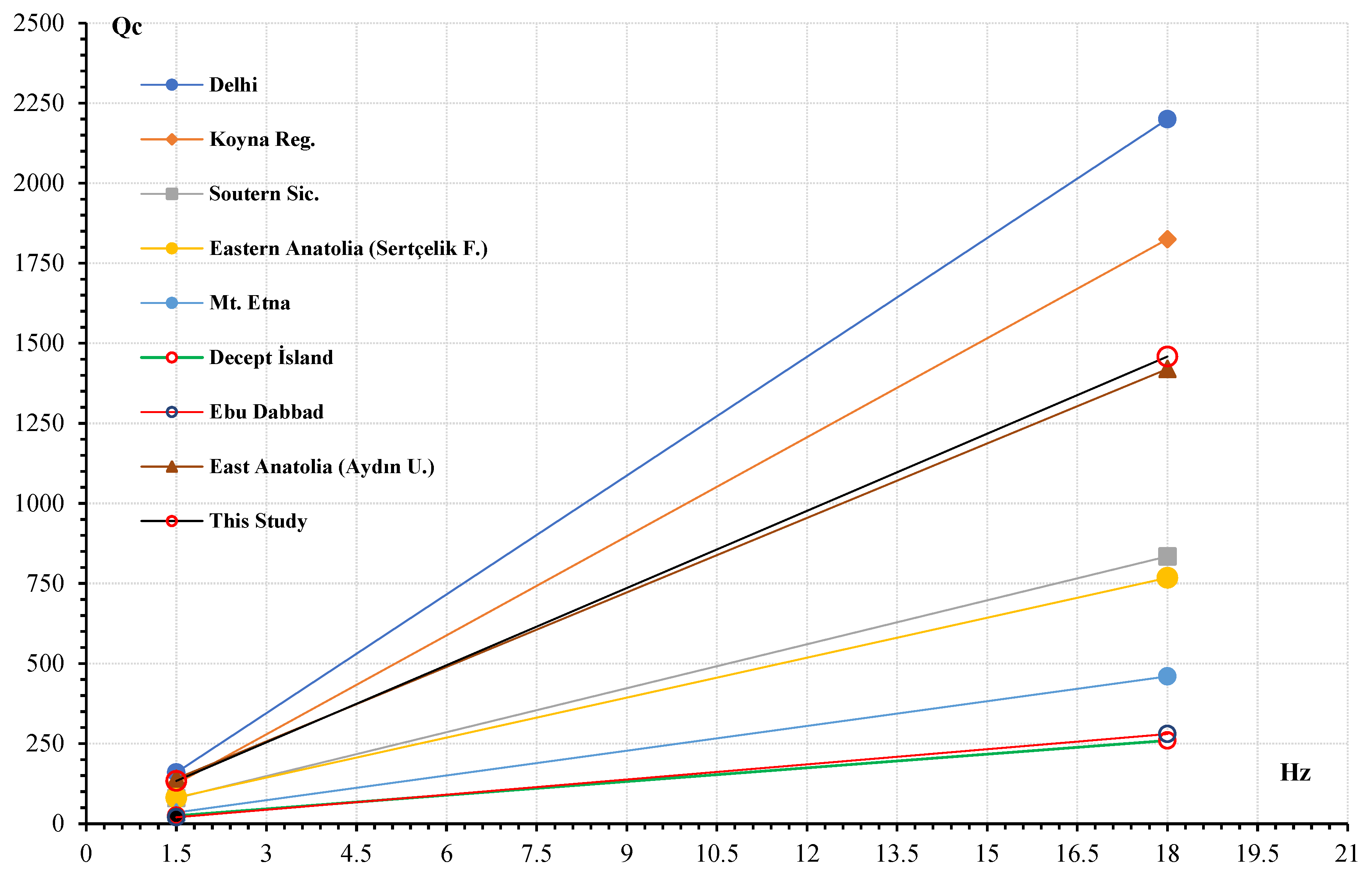
Coda analysis has been performed in several locations worldwide, including southeastern Sicily [27]; the Konya Region [28]; Mt. Etna [29]; Ebu Dabbad, Egypt [30]; Delhi [31]; and the Deception Island volcano [32] (Figure 8). Several works have been undertaken in diverse areas of Anatolia to detect the attenuation of coda waves in the crust [12,33,34,35,36,37]. For example, ref. [12] calculated the coda attenuation for eastern Anatolia using the single scattering model. Coda Q was found to change between 84 and 783 for a 50 s lapse time window in Erzincan and its vicinity [38]. Furthermore, ref. [38] obtained QC = 35 f 0.83 for 1.5–24 Hz for the Sea of Marmara. Refs. [12,37,39,40] studied differences in the crust tectonics of eastern Anatolia and found that different attenuation areas could be distinguished in the region. Other studies on coda absorption in seismically active regions around the world include the following: for the Qinghai–Tibet Plateau, which has active tectonism, the value Qc = (72.40 ± 9) f (1.01 ± 0.06) was obtained for 20 s windows [41], and for the NW Himalayas, the Qc value was calculated as Qc = 158 f 1.05 for lapse time windows from 25 to 60 s, starting at double the time of the primary S-wave [15].
The study area selected to investigate the exchange of attenuation and its frequency dependence is a complex seismic source zone, defined as a potential zone for destructive earthquakes. To date, the study area has been affected by several intermediate and strong earthquakes (e.g., the Tokat/Erbaa–Niksar earthquake on 20 December 1942, M = 5.6; the Sivas–Sincar earthquake on 20 February 2010, M = 4.7; the Erzurum–Pasinler earthquake on 13 September 1924, M = 6.8; the Erzincan earthquakes on 26 December 1979, M = 7.9; the Horasan–Narman earthquake on 30 October 1983, M = 6.9; the Kandilli–Aşkale earthquake on 25 March 2004, M = 5.3; the Erzincan earthquake on 13 March 1992, M = 6.8; and the Diyarbakır–Lice earthquake on 6 September 1975, M = 6.9). These earthquakes and tectonic structures make it a likely region for earthquake damage; as such, it would be useful to study the attenuation properties of this area and make the findings accessible to other researchers who would be interested in seismic hazard zoning in this area. As part of the body of research dedicated to understanding the faulting mechanism of the crust, an attempt has been made to gain knowledge regarding the earthquake wave attenuation parameters in the crust of the study area from S-wave coda data from eight local stations. Finally, this study aimed to use lateral changes in local coda attenuation and frequency dependence to investigate the tectonic setup, rate of faulting, and seismicity of the study region.

2. Tectonic Setting

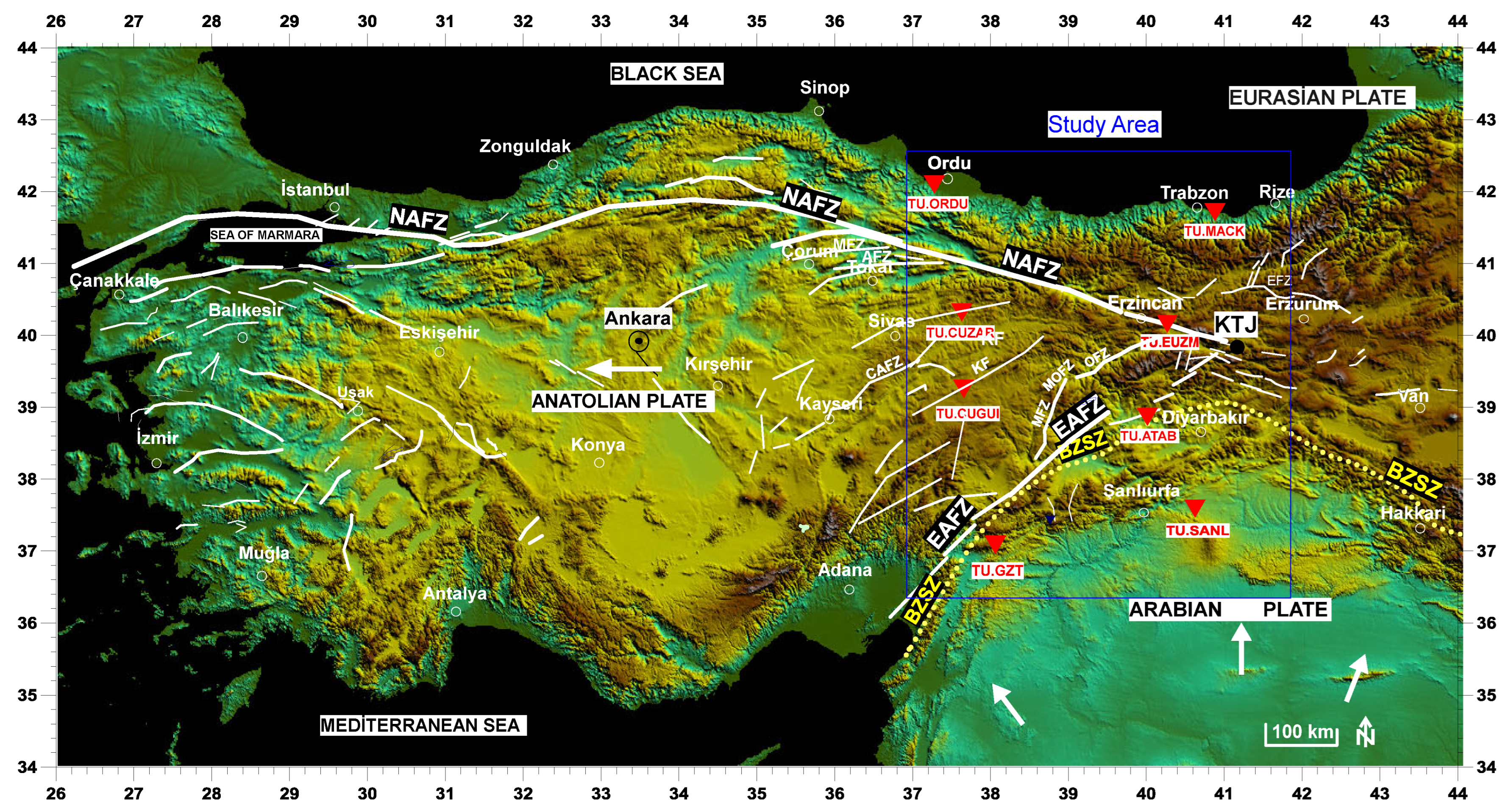
The seismicity of the Anatolian Block, including Turkey, is driven by three important tectonic units [42,43,44]. The Anatolian plate moves south-westward, bounded by strike–slip fault zones: the East Anatolian Fault Zone (EAFZ) to the south and the North Anatolian Fault Zone (NAFZ) to the north [45]. Anatolia (the Anatolian plate) has extruded westward between the NAFZ and the sinistral East Anatolian Fault (EAFZ) since the Serravalian–Tortonian atc. 12–13 Ma [44,46,47]. The collision between the Arabian and Eurasian plates led to the development of the Bitlis–Zagros orogenic prism and a number of tectonic structures [48] (Figure 1). The NAFZ was initiated during the Neogene in the context of a continental collision between Arabia and Eurasia. The sinistral Malatya–Ovacık Fault Zone (MOFZ) is one of the outstanding interpolate deformation belts within Anatolia [49] (Figure 1).
This study area is under the influence of three different active tectonic structures: (1) The North Anatolian Fault Zone (NAFZ) is a major dextral strike–slip fault extending about 1400 km from Karlıova in the east to Saros gulf in the northern Aegean [50]. (2) The East Anatolian Fault Zone (EAFZ) appears to be a left-handed conjugate fault to the North Anatolian Fault [44,51]. The EAFZ extends about 400 km from Karliova in the east to Maras in the west and marks the southeastern left-lateral, strike–slip boundary between the Anatolian “plate” and the Syrian Foreland [52]. (3) The Bitlis–Zagros suture zone (BZSZ) in Southeastern Anatolia is located in the boundary region between the Taurids and the Arabian platform and delimited by the Dead Sea Fault [53].
Figure 1. Simplified map of the study area. The main fault zones in the study area and nearby (modified from [54,55,56]). The study area (rectangle) and eight seismic stations (red filled triangles) are used in the study. The black circle represents the KTJ. The yellow dotted line is the major fault and trust belt BZSZ. Fault lines are shown with white thin lines and transform fault lines with white and thick lines. EAFZ—East Anatolian Fault Zone, NAFZ—North Anatolian Fault Zone, BZSZ—Bitlis–Zagros Suture Zone, OFZ—Ovacık Fault Zone, EFZ—Erzurum Fault Zone, MFZ—Merzifon Fault Zone, MOFZ—Malatya–Ovacık Fault Zone, AFZ—Almus Fault Zone; CAFZ—Central Anatolian Fault Zone; KF—Kangal Fault.
Applsci 16 06728 g001

3. Data

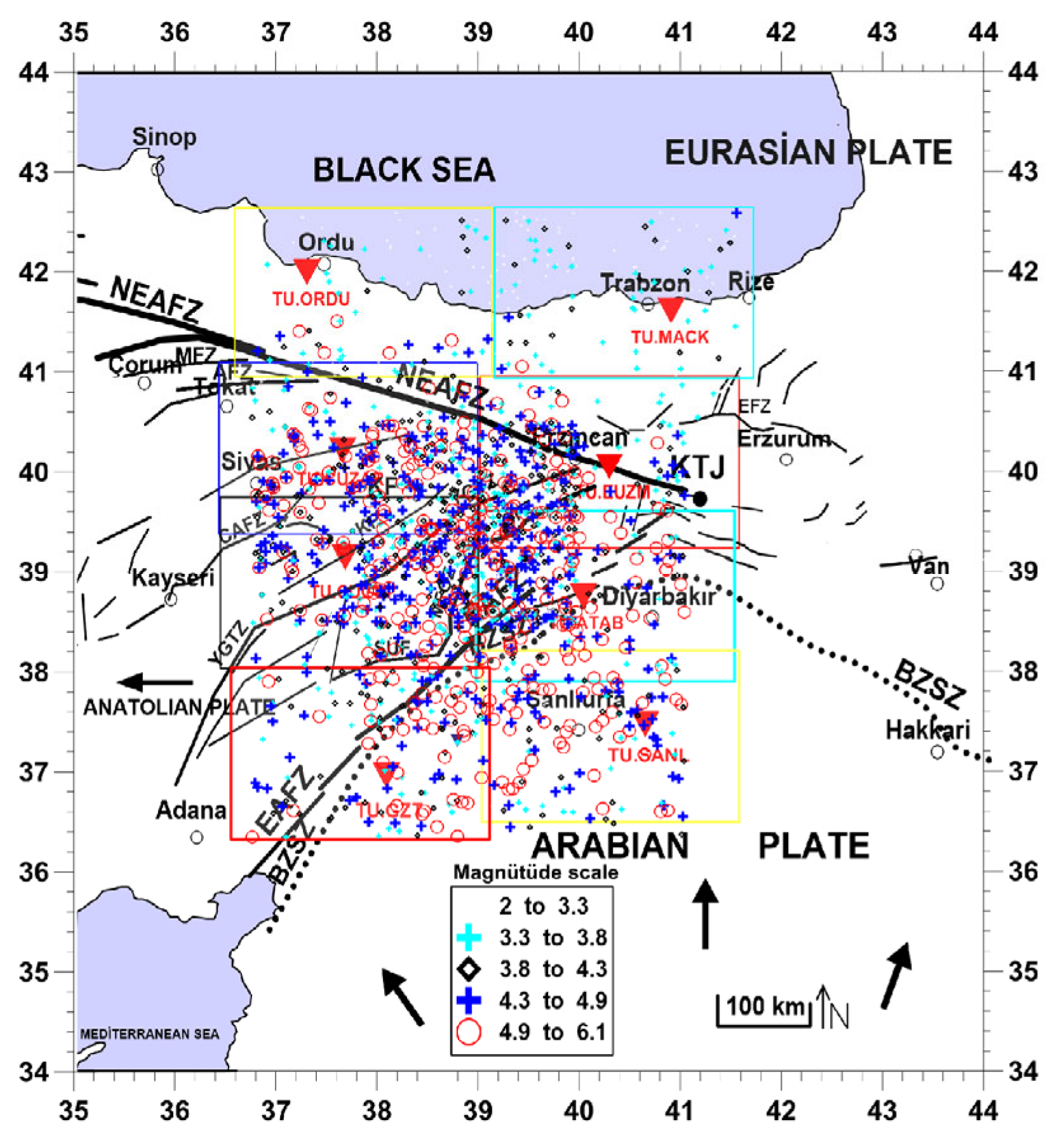
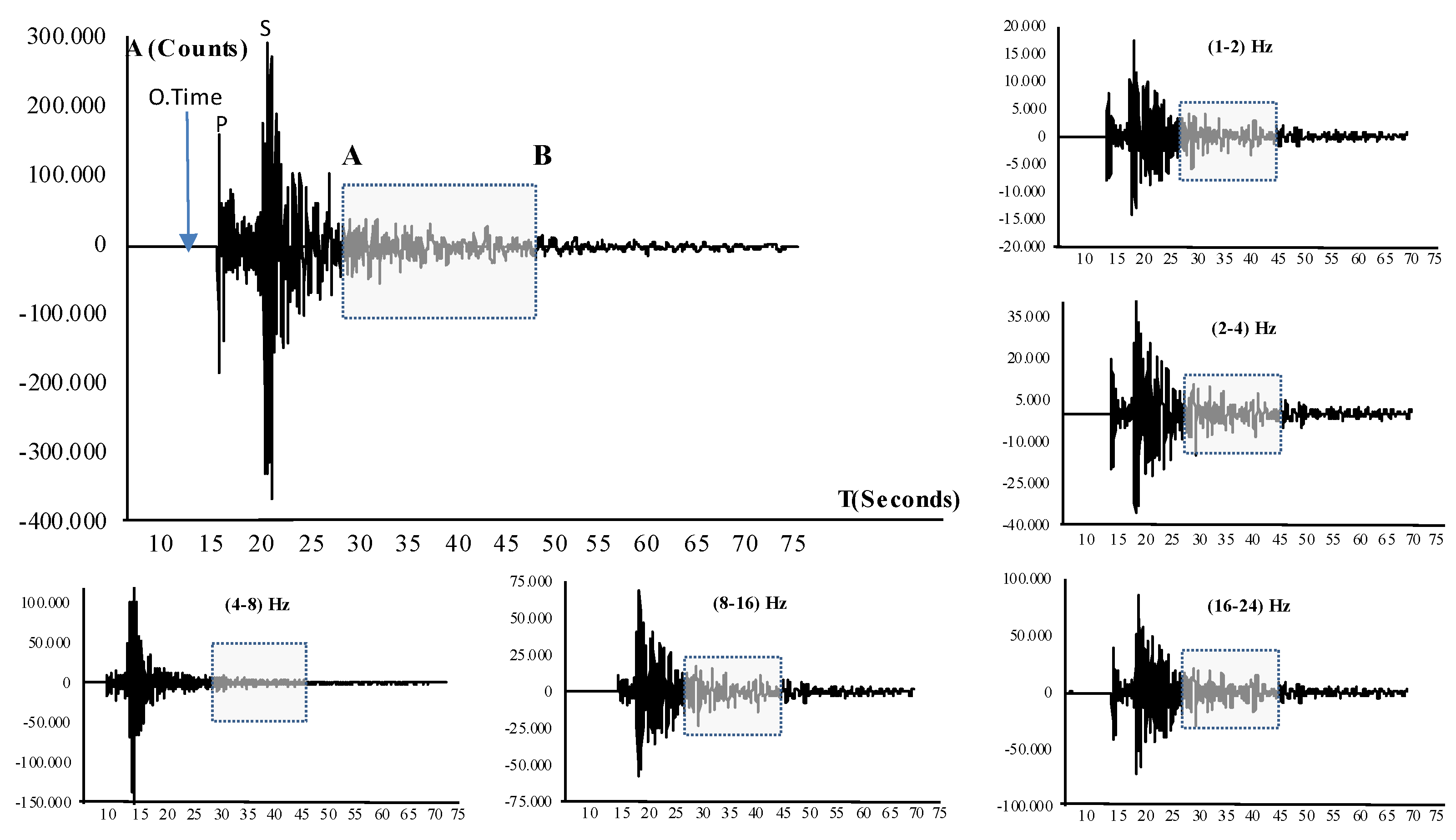
The study area includes major tectonic discontinuity structures of East and South Anatolia, which were shaped by the North Anatolian Fault Zone, the East Anatolian Fault Zone, the Bitlis–Zagros suture zone, the Malatya–Ovacık Fault Zone, the Merzifon Fault Zone, and the Erzurum Fault Zone (Figure 1 and Figure 2). In this study, a total of 1069 earthquakes that occurred in the period from 2006 to 2019 were analyzed (Figure 2). The eight stations investigated are operated by the AFAD (Disaster and Emergency Management Presidency). The 1069 earthquakes took place in an area bounded by 36.5–42 north latitude and 36.5–42.5 east longitude (Figure 2). The epicenter coordinates and magnitudes of the selected earthquakes have been defined by the AFAD. Their epicenter distances are between 15 and 193 km and their focal depths reach up to 36 km (Figure 1 and Figure 2; Table 1). The QC and η values were calculated for each of the eight stations, which had equal fields. The highest number of earthquakes was recorded as 205 at the TU.GUGUI station, while the lowest number was recorded as 102 at the TU.MACK station (Table 1). Two stations in the north of the North Anatolian Fault Zone, four stations between the North Anatolian Fault Zone and East Anatolian Fault Zone, and two stations in the south of the East Anatolian Fault Zone were used in this study (Figure 1 and Figure 2). The fields were selected equally for the eight sub-region station areas in the study. Seismic wave path corrections are not necessary with the coda method, as coda waves are scattered in the crustal volume [7,22]. The seismograms were filtered with recursive Butterworth filters at five different frequency bands with central frequency values of 1.5 (1–2), 3 (2–4), 6 (4–8), 12 (8–16), and 20 (16–24) Hz (Figure 3). An example of data processing is shown in Figure 3. Of the 1069 earthquake events, 1171 earthquake records (seismograms) were used, of which 102 were used jointly in some stations. Thus, the total number of earthquake records used was actually 1171 (Figure 2, Table 1). The quality factor (Qc) was associated with frequency via linear regression using the equation Qc = Q0fη. The logarithm of the product of RMS amplitude and lapse time is plotted against lapse time, as shown in Figure 3, to calculate Qc from the slope of the linear regression curve of ln (A (f, t) t) and t. These waves were selected individually following a number of criteria to ensure suitable quality of the data: the vertical component was selected, signals with a signal/noise ratios of less than 5 were rejected, and waves containing pointed or overlapping earthquakes were eliminated. The coda wave analysis commonly adopts the 2*ts criterion as the coda onset time. However, for some recordings, coda energy was observed to persist beyond this interval. This behavior is attributed to the strong scattering characteristics of the study area, low attenuation, and local geological heterogeneities. Therefore, since the coda phase was observed up to 24 s rather than 20 s, the coda-window termination time was selected this value.

4. Method

The single isotropic scattering model proposed by Sato (1977) [57] was utilized in this study. As an extension of the Aki and Chouet (1975) [17] method, this model accounts for non-coincident source and receiver geometries. A key advantage of this approach is that it enables analysis of the early portion of the coda wave rather than the late coda, which is highly susceptible to background noise, particularly when analyzing the low-magnitude events characteristic of this study.
Based on the assumption of global dispersion and isotropic scattering, the coda quality factor Qc is defined as
L n ( A c f , t / K ( α ) ) = L n A 0 f π f t / Q c .
Here, A 0   f , t is the amplitude of the coda wave, A 0 is the source factor, f is the frequency, and t is the time measured since the earthquake occurred. K(α) is the geometric propagation factor, defined as follows.
Sato’s model assumes a source and receiver embedded within an infinite medium that contains a random distribution of N scatterers, each characterized by a cross-sectional area α. Under this assumption, the total energy scattered by inhomogeneities located on the surface of an expanding ellipsoid—with the source and receiver acting as its foci—is expressed as follows:
E r , ω t = N σ Ω ω 4 π r 2 K ( α )
where r is the source-receiver distance, α = t/ts, ts is the S-wave lapse time, Ω(w) is the sum energy spread by the source within a unit angular frequency band, and
K ( α ) = 1 α l n α + 1 α 1
The single scattering model was used to calculate coda values [17]. In this study, Sato’s (1977) [57] single scattering model was applied. The Sato model assumes a source and a receiver embedded in an infinite medium filled with a random distribution of N scatterings in an infinite capacitance and cross-sectional area σ. According to this hypothesis, the total of the seismic energy scattered heterogeneously on the surface of a spreading ellipsoid, the focus of which are the source and receiver, is equal to the following:
Accounting for the geometric spreading and attenuation of body waves, the scattered energy is related to the root-mean-square (RMS) amplitude of the coda wave on a narrow bandpass-filtered seismogram as follows:
A r , ω t = 1 / ω Ω ω Δ f 2 π ρ L 1 2 K α 1 2 r e x p ω t / 2 Q
where the mean free path is L = 1/Nσ. Rearranging the terms for the source and the path and accepting the natural logarithms, the final expression is obtained as
l n A r , ω t / K ( α ) = l n C ( π f / Q ) t
The quality factor Q is determined from the slope of the linear fit applied to the time-dependent amplitude decay of the filtered signal. Finally, a power-law function is fitted to characterize the frequency dependence of attenuation within the frequency range investigated in this study (1.5–20 Hz).
Q = Q 0 f η
Coda reduction analysis can provide a better understanding of the factors affecting scatters in space. Q0 (Qc at f = 1 Hz) values allow for a more quantitative comparison from station to station and with other studies. This study utilized a 20 s window length, starting the first data point 4 s after the S-wave arrival. Calculations were based on the maximum time lapse of (ts + 24) s.

5. Results and Discussion

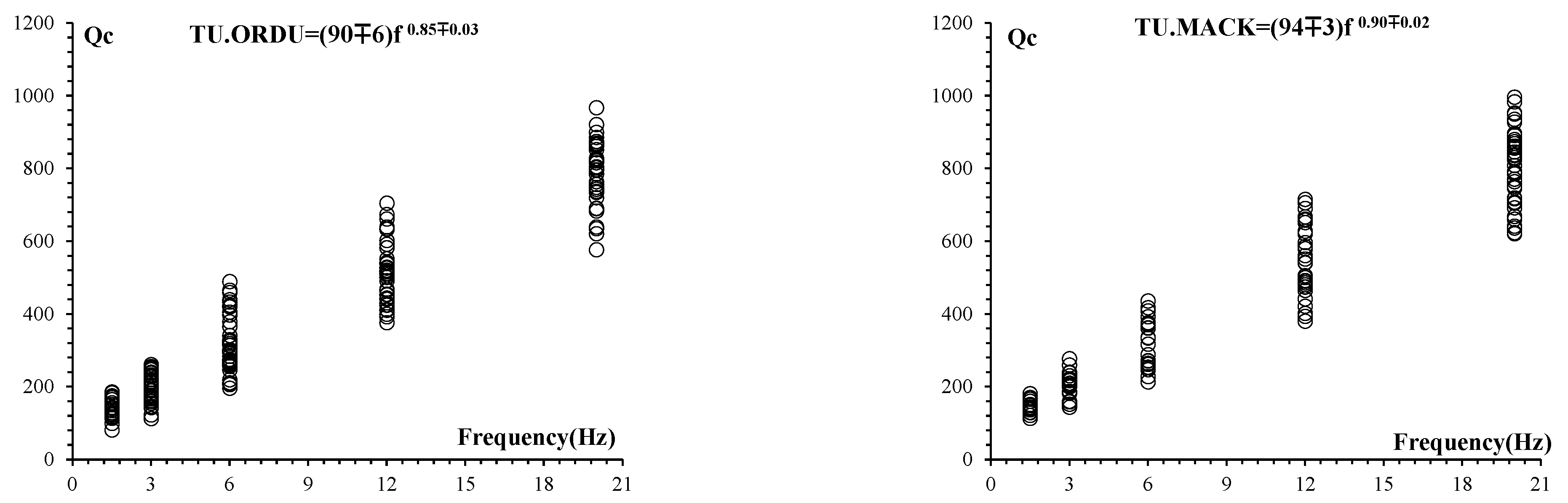
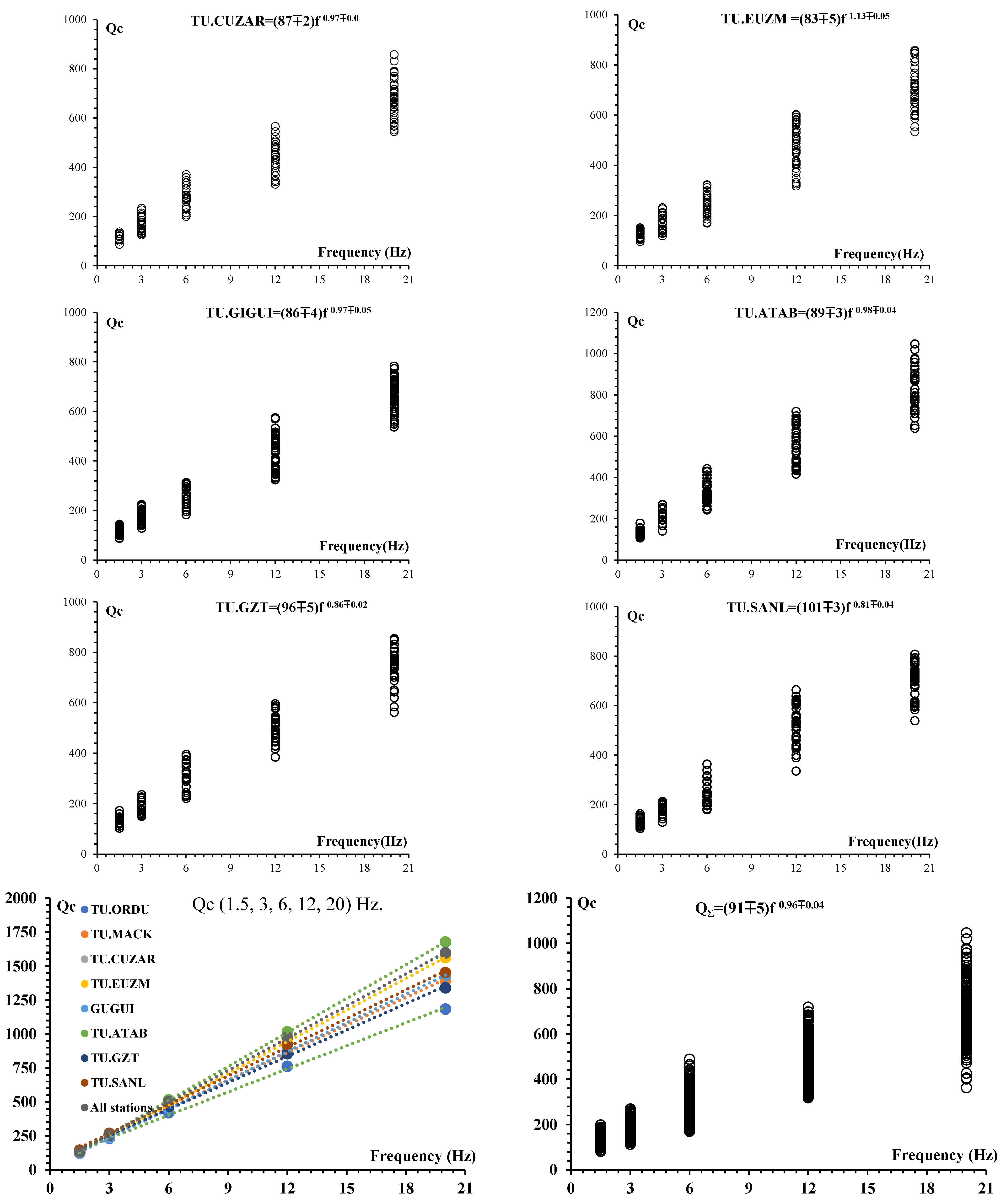
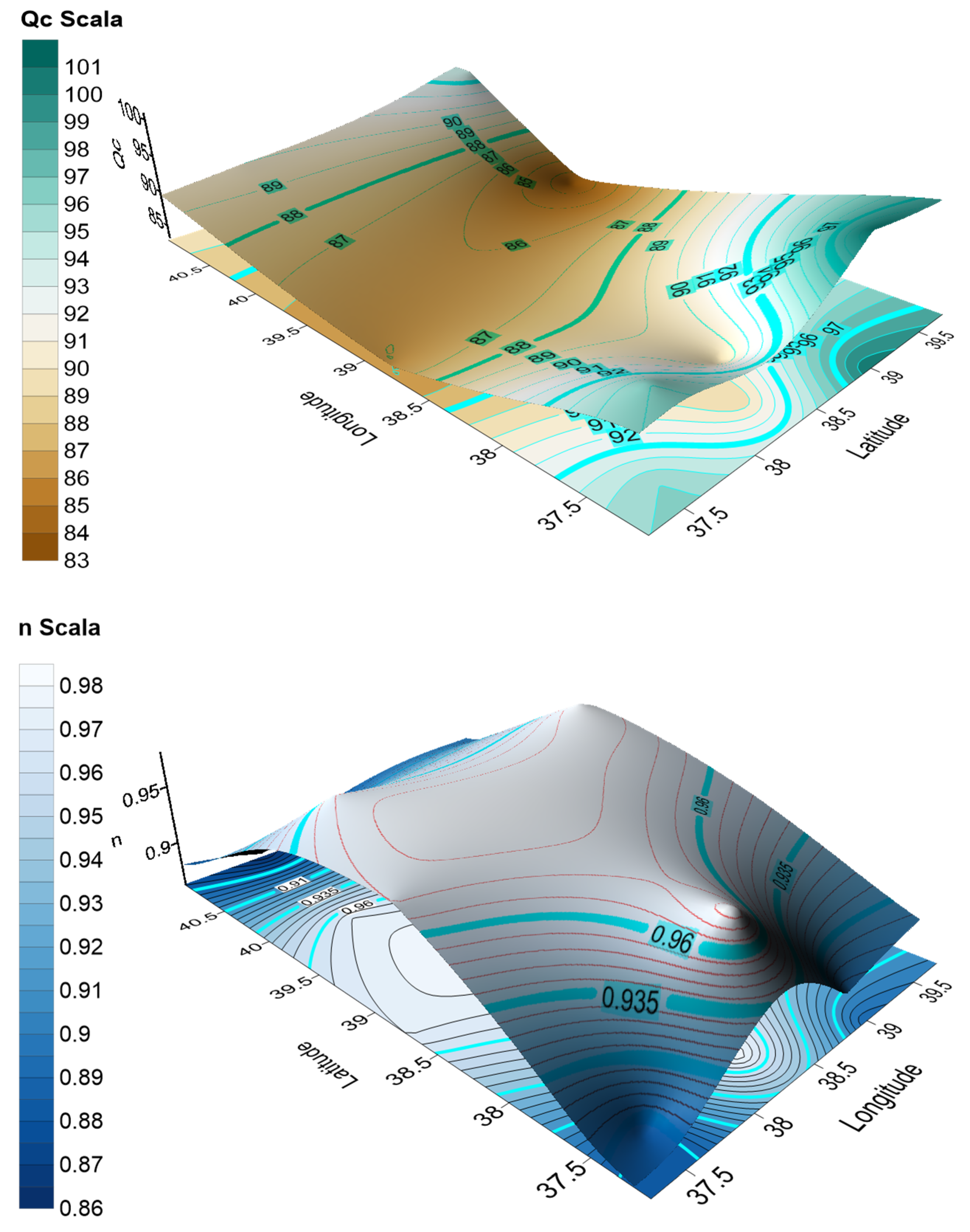
The Qc and frequency dependence (η) values for the eight sub-regions of eastern Turkey were calculated and correlated with the tectonics of the study area. The selected study field included the North Anatolian Fault Zone (NAFZ), East Anatolian Fault Zone (EAFZ), Bitlis–Zagros Suture Zone (BZSZ), and Karliova Triple Junction (KTJ), which are very active and well defined tectonic characteristics in east and southeast Anatolia. The estimated values of QC and η for each of the eight sub-region stations and all regions are shown in Figure 4, Figure 5, Figure 6 and Figure 7. To observe the frequency dependence of QC, using estimated QC values for all stations and plotting them against their center frequency, an empirical power law for QC in the form QC(f) = QO f η is created, where η is the frequency-dependent coefficient and Q0 is the QC value at 1 Hz. QC as a function of frequency in all sub-regions and comparison of the QC(f) fits for all sub-regions (bottom-right corner) are also shown, along with QC as a function of frequency in all sub-regions (bottom-left corner) (Figure 4).
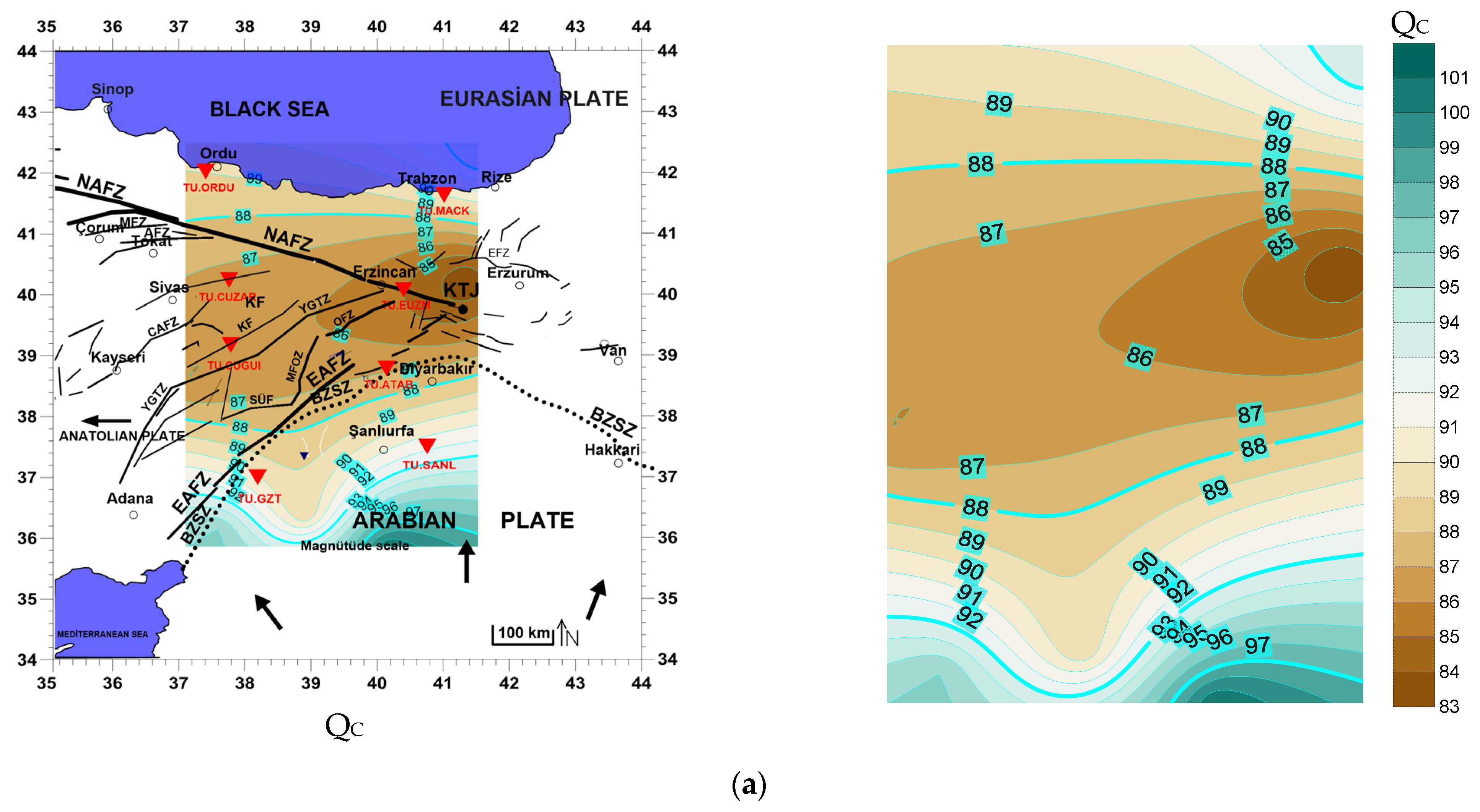
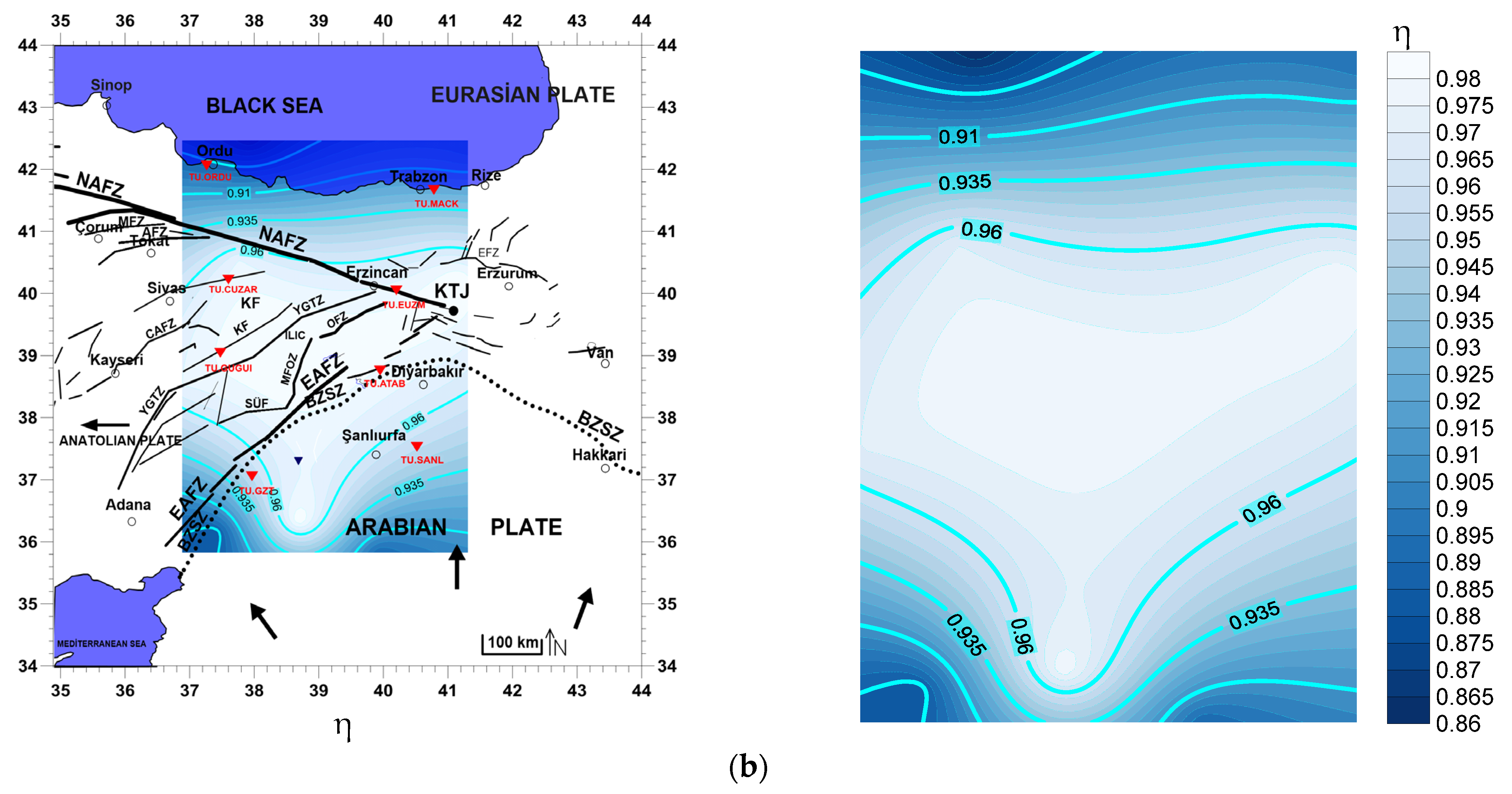
The frequency-dependent relationship for all regions is estimated as (91 ∓ 5) f 0.96 ∓ 0.04 for a 20 s window. The calculated coda (Qc) values ranged from (83 ∓ 5) f 0.98 ∓ 0.05 to (101 ∓ 3) f 0.89 ∓ 0.04, highlighting the seismicity of the study area (Figure 4 and Table 2). The Qc values ranged from a minimum of 83 for TU.EUZM to a maximum of 101 for TU.SANL, with an overall mean of 91 for the entire area. Frequency dependence (η) values ranged from 0.86 for TU.ORDU to 0.98 for TU.EUZM and TU.ATAB, while the overall (η) for the entire study area was 0.96 (Table 1, Figure 6 and Figure 7). The highest Qc values were obtained for the TU.SANL and TU.GZT stations, with values of 101 and 96, respectively. These stations are located in the southernmost part of the study area, north of the BZSZ, and in the least active region (Table 1, Figure 6). The lowest Qc values were obtained from the TU.EUZM and TU.GUGUI stations, which are located between NAFZ and EAFZ. (Table 1, Figure 6). The comparison of Qc and η values obtained from eight study areas and all study areas shows that large and high-density fault zones are characterized by low Qc and high η (Figure 6 and Figure 7). The Qc values are comparatively higher between the NAFZ and EAFZ; meanwhile, lower Qc values are observed to the north of the NAFZ and the south of the EAFZ (Table 1, Figure 6).
The seismic coda wave recorded in a seismogram of regional earthquakes is considered to be a superposition of backscattered wavelets created by the countless heterogeneities disturbed indiscriminately on the Earth’s crust and upper mantle [22,23]. The limits referring to the eight stations used in this study and coda quality factor and frequency dependence values are given in Figure 2 and Table 1. In summary, the obtained values of the frequency-dependent parameter in the study region are ~1, which indicates that the region is highly heterogeneous and tectonically very active (Figure 5 and Figure 6 and Table 1). From Table 1 and Figure 5 and Figure 6, it can be stated that clustering and decreasing values of QC attenuation are found in the north of the NAFZ. The higher Qc and lower η in the north of the NAFZ might be caused by very small broken structures of the crust and lower seismic activity (Figure 6 and Figure 7). The tectonically active regions are generally associated with low Q0 values and vice versa [1,2]. In this previous work, it was also noted that η is usually higher for tectonically active regions compared to the stable region.
The higher values of η found between the NAFZ and EAFZ indicate the higher heterogeneity, dense fracturing, and high seismicity present in this region (Figure 6 and Figure 7). This may be due to the impact of seismicity and the large, dense faulting mechanism and very fractured crustal structure in the NAFZ and EAFZ. Furthermore, the higher η and lower Qc found between the NAFZ and EAFZ might be caused by fault zones such as the Merzifon fault, Ovacık fault, and others (Table 1 and Figure 1, Figure 6 and Figure 7).
This observation of the frequency dependence of QC is associated with the degree of heterogeneity of the level of tectonic activity in the region [6]. The frequency dependence, based on the value η, is also directly correlated with the heterogeneities present within the crust [9]. A significant increase was obtained in the frequency dependence values obtained from the regions between the NAFZ and EAFZ (Figure 6 and Figure 7). In particular, changes in frequency dependence are reflected in high tectonic activity, which is compatible with the dense and large tectonic structures between the NAFZ and EAFZ. The area between the NAFZ and EAFZ is defined by dense dilatational and complex compressional deformations. This region is heterogeneous and has been characterized by intense and complex compressional deformations. Both η and Qc apparently represent the level of tectonic activity and degree of heterogeneities in the region [58]. In the 2D tomographic images, the Qc and η values around the KTJ were determined as the lowest and highest values within the study area, respectively (Table 1, Figure 6). Furthermore, moving outward from the KTJ perimeter, the Qc value increases, whereas the η value decreases (Figure 6 and Figure 7). These findings, obtained from the study, are confirmed by the triple junction structure, tectonic setup, rate of faulting, and seismicity of the region (Figure 6 and Figure 7). The relationship between Qc and η values obtained within this study has been confirmed previously, and the spatial patterns observed are consistent with the known tectonic divisions of the Anatolian region.
Q0 and η are generally affected by different factors, such as the subsurface medium, tectonic setup, rate of faulting, and seismicity of the region [59,60,61,62,63]. The highest frequency dependencies were obtained between the NAFZ and EAFZ, while the lowest frequency dependencies were obtained in the south and north areas. Referring to Table 1 and Figure 5, Figure 6 and Figure 7, three similar QC and η values for regions with three different tectonic regimes can be seen, clearly showing high-frequency dependence from the north and south areas in the region between the NAFZ and EAFZ. The study comprehensively analyzed the correlations of the Q coda and frequency dependency with known tectonic structures in order to understand the fractural mechanism of the study area.
Therefore, the study area can be divided into three different tectonic regions according to the frequency dependence and coda attenuation values obtained in the study. These three different results can be explained by the presence of three different regimes: the NAFZ, EAFZ, and BZSZ. Beyond these three regions, Qc and η values exhibited prominent variations at the Karliova Triple Junction (KTJ) (Figure 6 and Figure 7). The three different tectonic regimes can be clearly distinguished from the frequency dependence values in the study region (Figure 6b). This study confirmed the presence of correlations between the coda quality factor and frequency dependence and the tectonic activity and tectonic structures in the study field (Figure 6 and Figure 7). The data given in Table 1 are confirmed in Figure 6 and Figure 7. There are very few works focused on coda attenuation in and around the study area (Figure 8). The mean quality factor QC = 91 f0.96 determined in this study is slightly lower than that found by [12], QC = 97 f0.93, in the same region. Ref. [37] obtained QC = 57.5 f 0.82 for 1.5–20 Hz for six regions, ranging from 34.3 f 0.93 to 64.4 f 0.94 in Eastern Anatolia for different lapse time windows. The mean quality factor in this study, QC = 91 f0.96, is much higher than that found by Sertçelik for an area partially covering the same region. This study and the other study performed differ with regard to two main aspects: the data and the model. The coda attenuation and frequency dependence values obtained for our study region, Qc = (91 ∓ 5)f 0.96 ∓ 0.04 (91), are well bracketed by the representative ranges documented for active tectonic zones, such as the Qinghai–Tibet Plateau, Qc = (72.40 ± 9) f (1.01 ± 0.06) [41], and the NW Himalayas, Qc = 158 f 1.05 [15]. The coda absorption and frequency dependence values derived from these three regions successfully typify the characteristic intervals established for seismically active tectonic environments.

6. Conclusions

This investigation focused on major deformation zones, specifically the North Anatolian Fault Zone (NAFZ), the East Anatolian Fault Zone (EAFZ), the Bitlis–Zagros Suture Zone (BZSZ), and the Karlıova Triple Junction (KTJ). Stations TU.CUZAR, TU.GUGUI, TU.ATAB, and TU.EUZM exhibited higher frequency-dependence parameter (η) values due to a more heterogenous, fractured, and intensely deformed crustal structure at these locations compared to the other four stations. This high scattering environment, likely featuring active fault networks and potential fluid presence, causes higher seismic wave attenuation in these specific areas. A remarkable difference exists between the NAFZ and EAFZ, which may be primarily due to the presence of a compressional or dilatational effect in the large fault zones. Additionally, it may be due to the fact that the region between these three stations is characterized by an intense faulting mechanism. The frequency dependence (η) and coda (QC) values obtained in this study revealed changes in the way that the presence of three different seismotectonic regimes—namely, those in the north of the NAFZ, south of the EAFZ, and between the NAFZ and EAFZ—can be confirmed. In 2D tomography images, the Qc value was taken as the smallest value around the KTJ, while the η value was taken as the largest value. Furthermore, while the Qc value increased outwards from the KTJ perimeter, the η value decreased.
The findings obtained from the study explain the complications of the main tectonic discontinuity structures that have occurred as a result of the Arabian plate pushing the Anatolian plate in addition to the associated tectonic complications. Spatial variations in the coda quality factor (Qc) and the frequency-dependence parameter (η) highlight three distinct zones of varying lithospheric heterogeneity. In this study, the relationships between the tectonic activity, lateral tectonic discontinuities, rate of faulting, and coda waves and frequency dependence manifest themselves very effectively. Lateral variations and frequency dependence in aftershock attenuation have proven to be extremely effective tools for visualizing active tectonic discontinuities and mapping the physical state of the crust in areas where seismicity are pronounced. These variations help in mapping the intense energy loss and structural disruptions caused by faulting. This study clearly outlines practical implications for seismic hazard assessment in high-risk provinces of Eastern and Southern Anatolia. Consequently, the study area was successfully categorized into three distinct tectonic zones based on spatial variations in coda attenuation and frequency dependence values.

Funding

This research received no external funding.

Institutional Review Board Statement

Not applicable.

Informed Consent Statement

Not applicable.

Data Availability Statement

The data presented in this study are available on request from the corresponding author.

Acknowledgments

The Excel were used for coda quality factor and frequency dependence calculations. Most of the figures were prepared using Surfer 10 [64] programs. The fault and geological data were digitized from the Mineral Research and Exploration General Directorate, Turkey (MTA), using drawing editor [65]. The earthquake data were provided by Ataturk University Earthquake Research Center (ATA-NET) and the Disaster and Emergency Management Presidency (AFAD).

Conflicts of Interest

The author declares no conflict of interest.

References

  1. Singh, S.; Herrmann, R.B. Regionalization of crustal coda Q in the continental United States. J. Geophys. Res. Solid Earth 1983, 88, 527–538. [Google Scholar] [CrossRef]
  2. Jin, A.; Aki, K. Spatial and temporal correlation between coda Q and seismicity in China. Bull. Seismol. Soc. Am. 1988, 78, 741–769. [Google Scholar] [CrossRef]
  3. Singh, C.; Biswav, R.; Jaiswal, N.; Kumar, M.R. Spatial variations of coda wave attenuation in Andaman–Nicobar subduction zone. Geophys. J. Int. 2019, 217, 1515–1523. [Google Scholar] [CrossRef]
  4. Azguet, R.; Bouskri, G.; Timoulali, Y.; Harnafi, M.; Fellag, Y. Attenuation of coda waves in the SW of High-Atlas area, Morocco. Geod. Geodyn. 2019, 10, 297–306. [Google Scholar] [CrossRef]
  5. Fard, R.A.; Doloei, G.J.; Farrokhi, M.; Rahimi, H.; Mahood, M. Coda wave attenuation’s dependency on Lapse time and frequency in west of Iran plateau using local earthquakes. Ann. Geophys. 2020, 63, SE437. [Google Scholar] [CrossRef]
  6. Aki, K. Attenuation of shear-waves in the lithosphere for frequencies from 0.05 to 25 Hz. Phys. Earth Planet. Inter. 1980a, 21, 50–60. [Google Scholar] [CrossRef]
  7. Aki, K. Scattering and attenuation of shear waves in the lithosphere. J. Geophys. Res. Solid Earth 1980, 85, 6496–6504. [Google Scholar] [CrossRef]
  8. Pulli, J.J.; Aki, K. Attenuation of seismic waves in the lithosphere: Comparison of active and stable areas. Proc. Earthq. Earthq. Eng. 1981, 1, 129–141. [Google Scholar]
  9. Roecker, S.; Tucker, B.; King, J.; Hatzfeld, D. Estimates of Q in central Asia as a function of frequency and depth using the coda of locally recorded earthquakes. Bull. Seismol. Soc. Am. 1982, 72, 129–149. [Google Scholar] [CrossRef]
  10. Eck, T.V. Attenuation of coda waves in the Dead Sea region. Bull. Seismol. Soc. Am. 1988, 78, 770–779. [Google Scholar] [CrossRef]
  11. Akinci, A.; Taktak, A.; Ergintav, S. Attenuation of coda waves in Western Anatolia. Phys. Earth Planet. Inter. 1994, 87, 155–165. [Google Scholar] [CrossRef]
  12. Aydın, U. Estimation of seismodynamics differences and lateral variations of coda Q in Eastern Anatolia. Arab. J. Geosci. 2015, 8, 6363–6370. [Google Scholar]
  13. Del Pezzo, E.; Patané, D. Coda Q dependence on time, frequency and coda duration interval at Mt. Etna, Sicily. In Volcanic Seismology; Springer: Berlin/Heidelberg, Germany, 1992; pp. 109–119. [Google Scholar]
  14. Romanowicz, B.; Mitchell, B.J. Q of the Earth: Global, Regional, and Laboratory Studies; Birkhäuser: Basel, Switzerland, 2012. [Google Scholar]
  15. Kumar, N.; Parvez, I.A.; Virk, H. Estimation of coda wave attenuation for NW Himalayan region using local earthquakes. Phys. Earth Planet. Inter. 2005, 151, 243–258. [Google Scholar] [CrossRef]
  16. Knopoff, L.; Hudson, J. Scattering of elastic waves by small inhomogeneities. J. Acoust. Soc. Am. 1964, 36, 338–343. [Google Scholar] [CrossRef]
  17. Aki, K.; Chouet, B. Origin of coda waves: Source, attenuation, and scattering effects. J. Geophys. Res. 1975, 80, 3322–3342. [Google Scholar] [CrossRef]
  18. Eken, T.; Mayeda, K.; Hofstetter, A.; Gök, R.; Örgülü, G.; Turkelli, N. An application of the coda methodology for moment-rate spectra using broadband stations in Turkey. Geophys. Res. Lett. 2004, 31, 11. [Google Scholar] [CrossRef]
  19. Mayeda, K. mb (LgCoda): A stable single station estimator of magnitude. Bull. Seismol. Soc. Am. 1993, 83, 851–861. [Google Scholar] [CrossRef]
  20. Mayeda, K.; Gök, R.; Walter, W.R.; Hofstetter, A. Evidence for non-constant energy/moment scaling from coda-derived source spectra. Geophys. Res. Lett. 2005, 32, 10. [Google Scholar] [CrossRef]
  21. Dainty, A.M. A scattering model to explain seismic Q observations in the lithosphere between 1 and 30 Hz. Geophys. Res. Lett. 1981, 8, 1126–1128. [Google Scholar] [CrossRef]
  22. Aki, K. Analysis of the seismic coda of local earthquakes as scattered waves. J. Geophys. Res. 1969, 74, 615–631. [Google Scholar] [CrossRef]
  23. Rautian, T.; Khalturin, V. The use of the coda for determination of the earthquake source spectrum. Bull. Seismol. Soc. Am. 1978, 68, 923–948. [Google Scholar] [CrossRef]
  24. Sato, H. A precursorlike change in coda excitation before the western Nagano earthquake (Ms = 6.8) of 1984 in central Japan. J. Geophys. Res. Solid Earth 1987, 92, 1356–1360. [Google Scholar] [CrossRef]
  25. Guo, M.-Q.; Fu, L.-Y.; Ba, J. Comparison of stress-associated coda attenuation and intrinsic attenuation from ultrasonic measurements. Geophys. J. Int. 2009, 178, 447–456. [Google Scholar] [CrossRef]
  26. Novelo-Casanova, D.; Martinez-Bringas, A.; Valdés-González, C. Temporal variations of Qc− 1 and b-values associated to the December 2000–January 2001 volcanic activity at the Popocatepetl volcano, Mexico. J. Volcanol. Geotherm. Res. 2006, 152, 347–358. [Google Scholar] [CrossRef]
  27. Giampiccolo, E.; Gresta, S.; Rascona, F. Intrinsic and scattering attenuation from observed seismic codas in southeastern Sicily (Italy). Phys. Earth Planet. Inter. 2004, 145, 55–66. [Google Scholar] [CrossRef]
  28. Gupta, S.C.; Teotia, S.S.; Rai, S.S.; Gautam, N. Coda Q estimates in the Koyna region, India. Pure Appl. Geophys. 1998, 153, 713–731. [Google Scholar] [CrossRef]
  29. Del Pezzo, E.; Bianco, F.; Zaccarelli, L. Separation of Qi and Qs from passive data at Mt. Vesuvius: A reappraisal of the seismic attenuation estimates. Phys. Earth Planet. Inter. 2006, 159, 202–212. [Google Scholar] [CrossRef]
  30. Abdel-Fattah, A.K.; Morsy, M.; El-Hady, S.; Kim, K.; Sami, M. Intrinsic and scattering attenuation in the crust of the Abu Dabbab area in the eastern desert of Egypt. Phys. Earth Planet. Inter. 2008, 168, 103–112. [Google Scholar] [CrossRef]
  31. Mohanty, W.K.; Prakash, R.; Suresh, G.; Shukla, A.; Walling, M.Y.; Srivastava, J. Estimation of coda wave attenuation for the national capital region, Delhi, India using local earthquakes. Pure Appl. Geophys. 2009, 166, 429–449. [Google Scholar] [CrossRef]
  32. Martínez-Arévalo, C.; Bianco, F.; Ibáñez, J.M.; Del Pezzo, E. Shallow seismic attenuation and shear-wave splitting in the short period range of Deception Island volcano (Antarctica). J. Volcanol. Geotherm. Res. 2003, 128, 89–113. [Google Scholar] [CrossRef]
  33. Aydin, U.; Şahin, Ş. Comparison of the attenuation properties for two different areas in eastern Anatolia, Turkey. Soil Dyn. Earthq. Eng. 2011, 31, 1192–1195. [Google Scholar] [CrossRef]
  34. Şahin, Ş. Lateral variations of coda Q and attenuation of seismic waves in Southwest Anatolia. J. Seismol. 2008, 12, 367–376. [Google Scholar] [CrossRef]
  35. Akinci, A.; Eyidoǧan, H. Scattering and anelastic attenuation of seismic energy in the vicinity of north Anatolian fault zone, eastern Turkey. Phys. Earth Planet. Inter. 2000, 122, 229–239. [Google Scholar] [CrossRef]
  36. Horasan, G.; Boztepe-Güney, A. S-wave attenuation in the Sea of Marmara, Turkey. Phys. Earth Planet. Inter. 2004, 142, 215–224. [Google Scholar] [CrossRef]
  37. Sertçelik, F. Estimation of coda wave attenuation in the east Anatolia fault zone, Turkey. Pure Appl. Geophys. 2012, 169, 1189–1204. [Google Scholar]
  38. Akinci, A.; Eyidoǧan, H. Frequency-dependent attenuation of S and coda waves in Erzincan region (Turkey). Phys. Earth Planet. Inter. 1996, 97, 109–119. [Google Scholar] [CrossRef]
  39. Aydin, U.; Şahin, Ş.; Kalkan, E.; Yarbaşi, n.; Aksoy, G. Kemaliye Cevresinde Pg, Sg Soğurulmasi Ve Yeni Magnitüd Formülü. Sak. Univ. J. Sci. 2012, 16, 13–23. [Google Scholar] [CrossRef]
  40. Aydın, U.; Kadirov, A. Erzincan Ve Çevresinde P Dalgasi Soğurulmasi. Sak. Univ. J. Sci. 2008, 12, 1–8. [Google Scholar]
  41. Liang, Z.; Guo, X.; Xou, R.; Liu, X.; Qin, M.; Li, S. Spatiotemporal coda Q variations in the northeastern margin of the Qinghai–Tibet Plateau, China. J. Earth Syst. Sci. 2024, 133, 110. [Google Scholar] [CrossRef]
  42. Le Pichon, X.T.; Gaulier, J.-M. The rotation of Arabia and the Levant fault system. Tectonophysics 1988, 153, 271–294. [Google Scholar] [CrossRef]
  43. Celâl, A.; Yilmaz, Y. Tethyan evolution of Turkey: A plate tectonic approach. Tectonophysics 1981, 75, 181–241. [Google Scholar] [CrossRef]
  44. McKenzie, D. Active tectonics of the Mediterranean region. Geophys. J. Int. 1972, 30, 109–185. [Google Scholar] [CrossRef]
  45. Taymaz, T.; Yilmaz, Y.; Dilek, Y. The geodynamics of the Aegean and Anatolia: Introduction. Geol. Soc. Lond. Spec. Publ. 2007, 291, 1–16. [Google Scholar] [CrossRef]
  46. Şengör, A.; Görür, N.; Şaroğlu, F. Strike-Slip Faulting and Related Basin Formation in Zones of Tectonic Escape: Turkey as a Case Study; SEPM: Claremore, OK, USA, 1985; Volume 37, pp. 227–264. [Google Scholar] [CrossRef]
  47. Dewey, J.; Hempton, M.; Kidd, W.; Saroglu, F.; Şengör, A. Shortening of continental lithosphere: The neotectonics of Eastern Anatolia—A young collision zone. Geol. Soc. Lond. Spec. Publ. 1986, 19, 1–36. [Google Scholar] [CrossRef]
  48. Cavazza, W.; Albino, I.; Galoyan, G.; Zattin, M.; Cattò, S. Continental accretion and incremental deformation in the thermochronologic evolution of the Lesser Caucasus. Geosci. Front. 2019, 10, 2189–2202. [Google Scholar] [CrossRef]
  49. Sançar, T.; Zabcı, C.; Karabacak, V.; Akyüz, H.S. Geometry and Paleoseismology of the Malatya Fault (Malatya-Ovacık Fault Zone), Eastern Turkey: Implications for intraplate deformation of the Anatolian Scholle. J. Seismol. 2019, 23, 319–340. [Google Scholar]
  50. Ozden, S.; Over, S.; Unlungenc, U.C. Quaternary stress regime change along the eastern North Anatolian Fault Zone, Turkey. Int. Geol. Rev. 2002, 44, 1037–1052. [Google Scholar] [CrossRef]
  51. Arpat, E.; Şaroğlu, F. Doğu Anadolu Fayi ile ilgili bazi gözlemler ve düşünceler. MTA Derg. 1972, 78, 33–39. [Google Scholar]
  52. McKenzie, D. The East Anatolian Fault: A major structure in eastern Turkey. Earth Planet. Sci. Lett. 1976, 29, 189–193. [Google Scholar] [CrossRef]
  53. Bakkal, B.; Çinku, M.C.; Heller, F. Paleomagnetic results along the Bitlis-Zağros suture zone in SE Anatolia, Turkey: Implications for the activation of the Dead Sea Fault Zone. J. Asian Earth Sci. 2019, 172, 14–29. [Google Scholar] [CrossRef]
  54. Barka, A.A.; Kadinskycade, K. Strike-Slip-Fault Geometry in Turkey and Its Influence on Earthquake Activity. Tectonics 1988, 7, 663–684. [Google Scholar] [CrossRef]
  55. Saroglu, F.; Emre, O.; Kuscu, I. The east Anatolian fault zone of Turkey. Ann. Tecton. 1992, 6, 92–125. [Google Scholar]
  56. Bozkurt, E. Neotectonics of Turkey—A synthesis. Geodin. Acta 2001, 14, 3–30. [Google Scholar] [CrossRef]
  57. Sato, H. Energy propagation including scattering effects. Single isotropic scattering approximation. J. Phys. Earth 1977, 25, 27–41. [Google Scholar] [CrossRef]
  58. Kumar, C.P.; Sarma, C.; Shekar, M.; Chadha, R. Attenuation studies based on local earthquake coda waves in the southern Indian peninsular shield. Nat. Hazards 2007, 40, 527–536. [Google Scholar]
  59. Jin, A.; Aki, K. Spatial and temporal correlation between coda Q− 1 and seismicity and its physical mechanism. J. Geophys. Res. Solid Earth 1989, 94, 14041–14059. [Google Scholar] [CrossRef]
  60. Mitchell, B.J. Anelastic structure and evolution of the continental crust and upper mantle from seismic surface wave attenuation. Rev. Geophys. 1995, 33, 441–462. [Google Scholar] [CrossRef]
  61. Singh, D.; Govoni, A.; Bragato, P.L. Coda Q c attenuation and source parameter analysis in Friuli (NE Italy) and its vicinity. Pure Appl. Geophys. 2001, 158, 1737–1761. [Google Scholar] [CrossRef]
  62. Rahimi, H.; Hamzehloo, H. Lapse time and frequency-dependent attenuation of coda waves in the Zagros continental collision zone in Southwestern Iran. J. Geophys. Eng. 2008, 5, 173–185. [Google Scholar] [CrossRef]
  63. Aggarwal, S.K.; Khan, P.K. QLg tomography in Gujarat, Western India. Phys. Chem. Earth Parts A/B/C 2016, 95, 135–149. [Google Scholar] [CrossRef]
  64. Wessel, P.; Smith, W.H.F. New, improved version of Generic Mapping Tools released. Eos Trans. Am. Geophys. Union. 1998, 79, 579. [Google Scholar] [CrossRef]
  65. Emre, Ö.; Duman, T.Y.; Özalp, S.; Elmacı, H.; Olgun, Ş.; Şaroğlu, F. Active Fault Map of Turkey with an Explanatory Text. 1:1,250,000 Scale. Gen. Dir. Miner. Res. Explor. Spec. Publ. Ser. 2013, 30, 89. [Google Scholar]
Figure 2. Epicenter distributions of 1069 earthquakes obtained by eight stations used in the study; boundaries of those eight stations that are equal to each other in field terms are represented with different colors. Red triangles indicate seismic stations, black dashed line indicate BZSZ, black arrows indicate the direction of plate movement, and black lines indicate major fault lines.
Applsci 16 06728 g002
Figure 3. Horizontal component data processing example. Arrow A (t = ts + 4 s) and arrow B (t = ts + 24 s) limit the windows signal used in Qc calculus. Signals were filtered at 1.5, 3, 6, 12, and 20 Hz center frequency.
Applsci 16 06728 g003
Figure 4. The plot of average values of Qc with different central frequencies. The plot of the whole areas with linear regression frequency-dependent relationships. A comparison of QC as a function of frequency obtained at twenty lapse time windows in all regions (bottom-right corner) and eight sub-regions. Blue dots correspond to QC values estimated from a single seismogram. A comparison of the QC(f) fits for all sub-regions (bottom-left corner).
Applsci 16 06728 g004aApplsci 16 06728 g004b
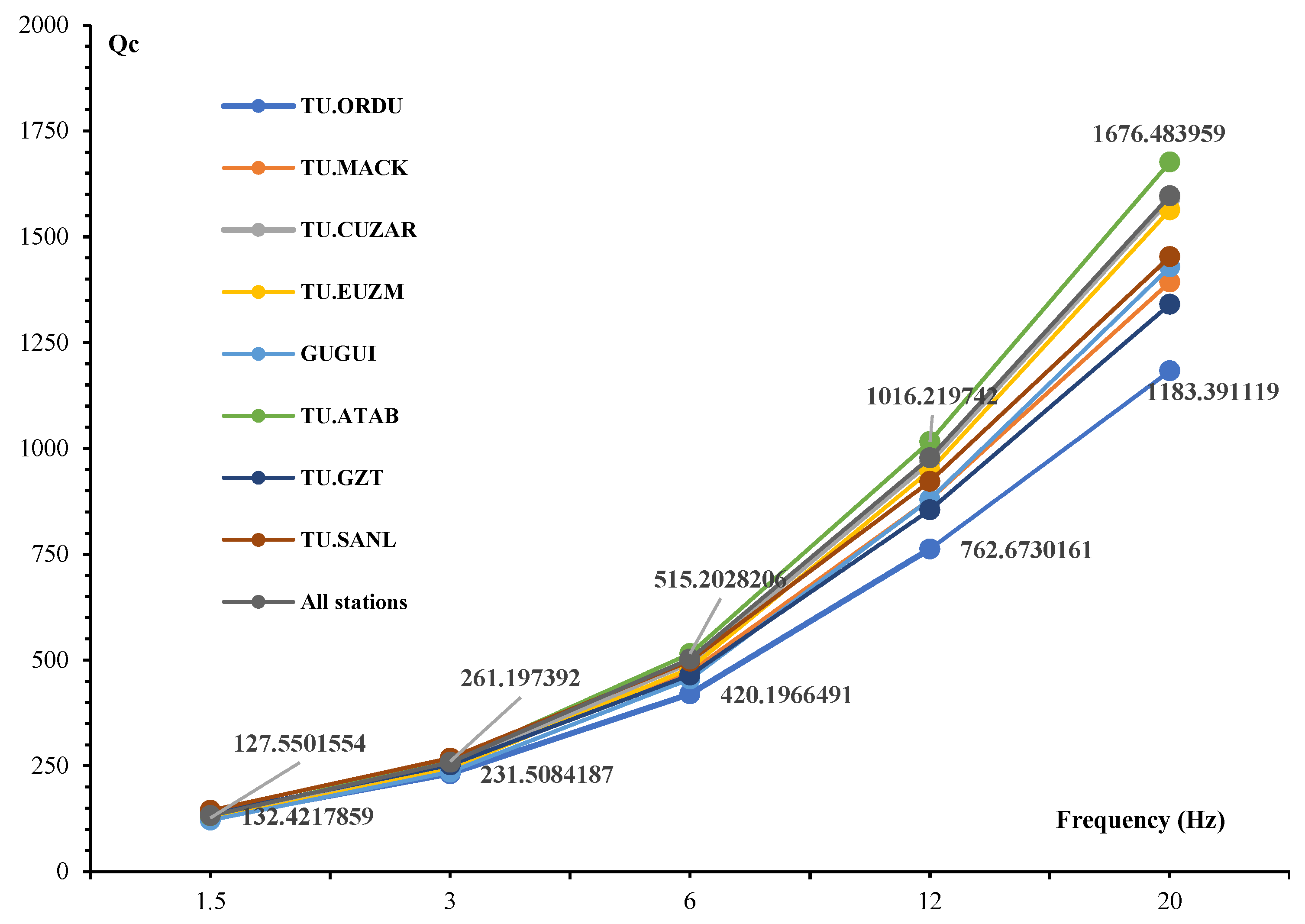
Figure 5. A comparison of the mean values of Qc as a function of frequency obtained at the lapse time window in all regions and eight sub-regions. QC values for different frequency values from 1.5 to 20 Hz belonging to the eight stations and all areas from the study area.
Applsci 16 06728 g005
Figure 6. Lateral variations in QC and η tomography for all study regions: (a) for QC, (b) for η.
Applsci 16 06728 g006aApplsci 16 06728 g006b
Figure 7. Three-dimensional tomography of QC and η values for the whole study area.
Applsci 16 06728 g007
Figure 8. Frequency dependence of QC for several active seismotectonic areas globally.
Applsci 16 06728 g008
Table 1. Qc values obtained using the single scattering model and standard deviation. The coordinates and the number of earthquake events of the eight sub-regions and the entire region used in the study are shown along with QC(f) functions for each area and all regions (Σ).
NoStation CodaLatitudeLongitudeEventQC = fη
1TU.ORDU41.00–42.8036.90–39.20127Q TU.ORDU = (90 ∓ 6)f 0.86 ∓ 0.03
2TU.MACK41.00–42.8039.50–42.00102Q TU.MACK = (94 ∓ 3)f 0.90 ∓ 0.02
3TU.CUZAR39.20–41.0036.90–39.20125Q TU.CUZAR = (87 ∓ 2)f 0.97 ∓ 0.0
4TU.EUZM39.20–41.0039.50–42.00212Q TU.EUZM = (83 ∓ 5)f 0.98 ∓ 0.05
5TU.GUGUI37.70–39.5036.90–39.20205Q TU.GUGUI = (86 ∓ 4)f 0.97 ∓ 0.05
6TU.ATAB37.70–39.5039.50–42.00145Q TU.ATAB = (89 ∓ 3)f 0.98 ∓ 0.04
7TU.GZT36.20–38.0036.90–39.20121Q TU.GZT = (96 ∓ 5)f 0.88 ∓ 0.02
8TU.SANL36.20–38.0039.50–42.00134Q TU.SANL = (101 ∓ 3)f 0.89 ∓ 0.04
ΣAll regions36.80–41.6036.40–42.601069Q All = (91 ∓ 5)f 0.96 ∓ 0.04
Table 2. The QC values and their standard deviations for eight sub-regions and the whole study area.
Hz.TU.ORDUTU.MACKTU.CUZARTU.EUZMTU.GUGUITU.ATABTU.GZTTU.SANLAll Stations
1.5127.55016 ± 6135.3973 ± 10128.92222 ± 4123.49447 ± 7122.0014 ± 6132.4218 ± 9137.1613 ± 7144.8914 ± 7132.8281 ± 8
3231.50842 ± 25252.6603 ± 14252.53808 ± 10243.58858 ± 30235.6912 ± 22261.1974 ± 24252.4282 ± 14268.5093 ± 10258.3919 ± 28
6420.19665 ± 94471.4808 ± 28494.68184 ± 25480.47005 ± 35455.3253 ± 30515.2028 ± 29464.5627 ± 28497.595 ± 29502.6523 ± 34
12762.67302 ± 108879.8142 ± 124969.00287 ± 102947.71055 ± 119879.6305 ± 1051016.22 ± 109854.9697 ± 127922.1311 ± 119977.8146 ± 111
201183.3911 ± 1321393.333 ± 1381590.4439 ± 1181563.4626 ± 1331429.08 ± 1371676.484 ± 1841340.225 ± 1191452.908 ± 1331596.729 ± 181
Disclaimer/Publisher’s Note: The statements, opinions and data contained in all publications are solely those of the individual author(s) and contributor(s) and not of MDPI and/or the editor(s). MDPI and/or the editor(s) disclaim responsibility for any injury to people or property resulting from any ideas, methods, instructions or products referred to in the content.