Article

Pavement Asset Condition Value Based on Full-Life-Cycle Deterioration Models

Department of Construction Management, Faculty of Civil Engineering, University of Zilina, Univerzitna 8215/1, 01026 Zilina, Slovakia
*
Author to whom correspondence should be addressed.
Appl. Sci. 2026, 16(13), 6629; https://doi.org/10.3390/app16136629
Submission received: 3 June 2026 / Revised: 26 June 2026 / Accepted: 29 June 2026 / Published: 2 July 2026

Abstract

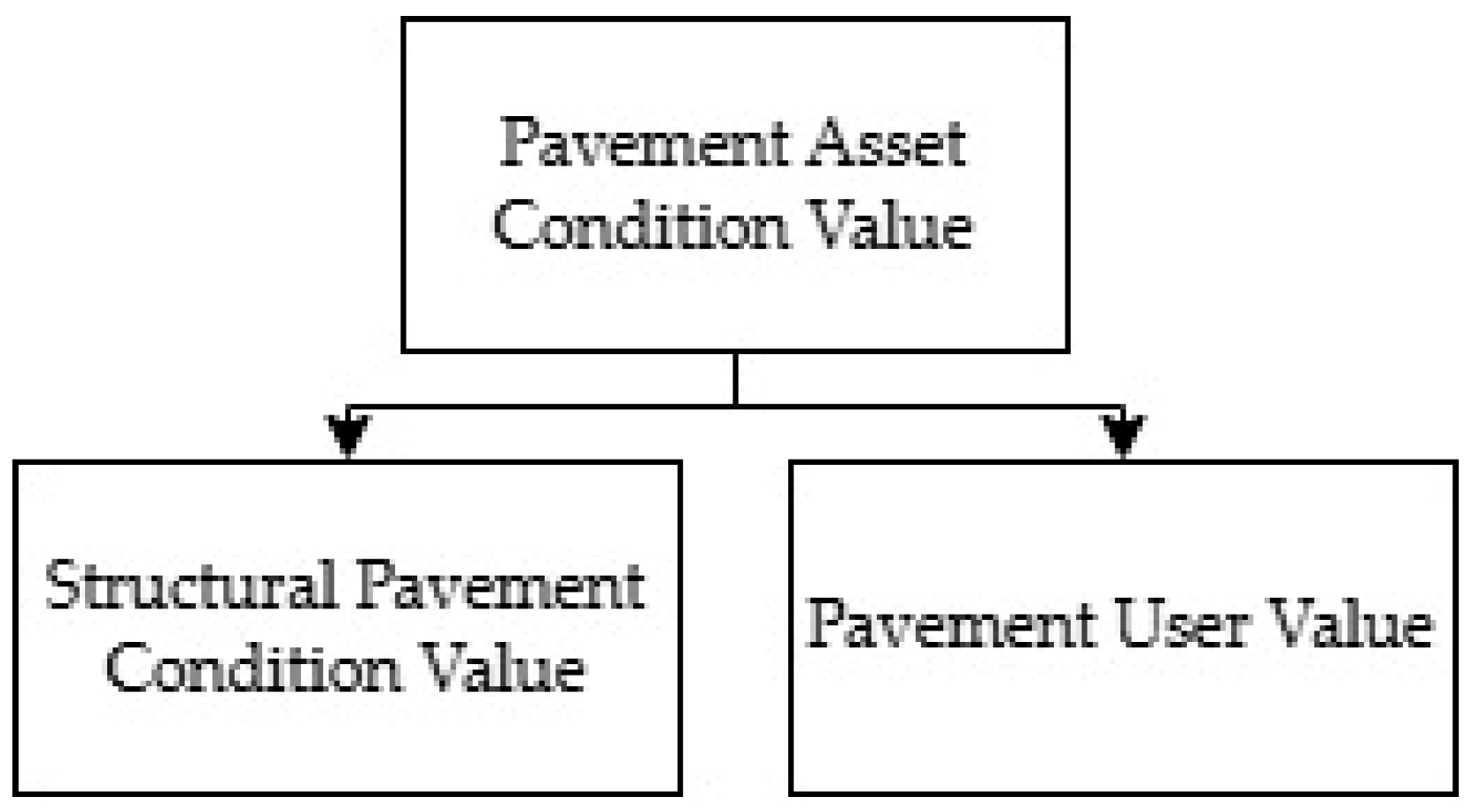
Road infrastructure managers are increasingly required to ensure adequate pavement performance under constrained financial resources. This has led to the widespread adoption of asset management principles, where infrastructure is evaluated not only from a technical perspective but also in terms of its economic value and the level of service provided to users. Pavement asset value can be understood as a function of two principal components: structural condition, reflecting the load-bearing capacity of the pavement, and user-related performance, primarily influenced by surface characteristics such as roughness. A key limitation of current approaches lies in the simplified representation of deterioration processes, which often fail to capture the full-life-cycle progression of degradation and may lead to inaccurate predictions of pavement condition, user costs, and optimal intervention timing. This paper proposes an integrated framework that links full-life-cycle pavement deterioration modeling with asset value assessment and decision-making processes. The methodology is based on experimentally validated and empirically supported deterioration models derived from accelerated pavement testing and long-term pavement performance monitoring of real road sections. This approach is demonstrated through a case study, illustrating the interaction between structural condition and user-related performance. The results demonstrate how a deterioration model derived from full-life-cycle observations can be incorporated into economic evaluation and resource-allocation processes in pavement management systems.
Keywords: pavement asset value; pavement deterioration models; life-cycle modeling; structural condition assessment; road user costs; pavement rehabilitation; asset management; cross-asset allocation; pavement performance pavement asset value; pavement deterioration models; life-cycle modeling; structural condition assessment; road user costs; pavement rehabilitation; asset management; cross-asset allocation; pavement performance