Review

Greenhouse Gas Emissions, Air Quality, and Human Security: A Review from an Integrated Public Health and Global Law Perspective


by
José Darío Argüello-Rueda
1,
Ippazio Cosimo Antonazzo
2,
Davide Rozza
3,
Marco Paccini
3,
Lorenzo Losa
3,
Lorenzo Giovanni Mantovani
3,4 and
Pietro Ferrara
3,4,*
1
Department of Public Law and Legal History Studies, Autonomous University of Barcelona, 08193 Cerdanyola del Vallès, Bellaterra, Spain
2
Department of Environmental and Prevention Sciences, University of Ferrara, 44121 Ferrara, Italy
3
Centre for Public Health Research, University of Milan-Bicocca, 20900 Monza, Italy
4
Laboratory of Public Health, IRCCS Istituto Auxologico Italiano, 20149 Milan, Italy
*
Author to whom correspondence should be addressed.
Appl. Sci. 2026, 16(13), 6598; https://doi.org/10.3390/app16136598
Submission received: 19 May 2026 / Revised: 20 June 2026 / Accepted: 30 June 2026 / Published: 2 July 2026
(This article belongs to the Special Issue Greenhouse Gas Emissions and Air Quality Assessment)

Abstract

Greenhouse gas emissions and air pollution are closely interconnected environmental challenges with major implications for human health and global sustainability. Many of the activities that drive climate change also release pollutants such as nitrogen dioxide, sulphur dioxide, carbon monoxide, and particulate matter, which directly affect air quality and population health. This review synthesises current evidence on the main sources of greenhouse gas emissions and atmospheric pollutants, the atmospheric processes that influence air quality, and the epidemiological evidence linking air pollution exposure to adverse health outcomes. The paper also discusses the public health co-benefits of climate mitigation strategies, including the transition to cleaner energy systems, sustainable transport policies, and urban environmental interventions. Finally, the review places air pollution and climate change within the broader framework of human security, highlighting their implications for health security, environmental stability, food systems, and economic resilience. By integrating perspectives from environmental epidemiology, public health, and global environmental governance, this review provides a multidisciplinary overview of the links between greenhouse gas emissions, air quality, and human well-being, and underscores the importance of coordinated policy responses to address these interconnected challenges.

1. Introduction

Anthropogenic emissions have profoundly altered the composition of the atmosphere, contributing simultaneously to global warming and to the deterioration of air quality [1]. Greenhouse gas (GHG) emissions and air pollutants often arise from shared sources, particularly fossil fuel combustion, energy production, transport, industrial activities, agriculture, waste management, and land-use change [2,3].
For this reason, climate change and air pollution should not be considered as separate environmental issues, but as interconnected processes with common drivers and overlapping policy responses. Exposure to air pollution is a major public health concern [4]. A large body of epidemiological evidence has shown that air pollution is associated with increased morbidity and premature mortality, particularly through cardiovascular, respiratory, oncological, metabolic, and neurological pathways [5,6,7,8,9]. At the same time, climate change affects health through multiple mechanisms, including rising temperatures, extreme weather events, ecosystem disruption, and changes in the distribution of vectors and pathogens [10]. These environmental pressures may also interact with social vulnerability, healthcare capacity, and inequalities in exposure and protection.
Because many GHG emissions and health-relevant air pollutants originate from the same sectors, climate mitigation strategies can generate important public health co-benefits by improving air quality and reducing population exposure to harmful pollutants [11,12]. However, the magnitude and distribution of these benefits depend on policy design, implementation capacity, energy systems, urban structure, and social equity. This makes the integration of environmental, health, and governance perspectives essential.
Beyond their direct environmental and health effects, climate change and air pollution can also be interpreted within the broader framework of human security [13,14]. Environmental degradation may threaten health security, environmental stability, food systems, economic resilience, and social stability, particularly among vulnerable populations [15,16]. Environmental degradation and climate instability can threaten several dimensions of human security, including health security, environmental security, food security, and economic stability [14]. Addressing these risks therefore requires coordinated responses that connect environmental policies, public health strategies, and legal and governance frameworks [14,17].
Against this background, the present review aims to synthesise current evidence linking GHG emissions, air pollution, and human health, and to discuss their implications for human security and global environmental governance. The added value of this work lies in its integrated and multidisciplinary framing of a problem that is often examined through separate disciplinary lenses. By connecting environmental sources, atmospheric processes, epidemiological impacts, mitigation co-benefits, human security dimensions, and legal/governance instruments, the review seeks to provide a conceptual bridge between environmental epidemiology, public health, and global environmental law.
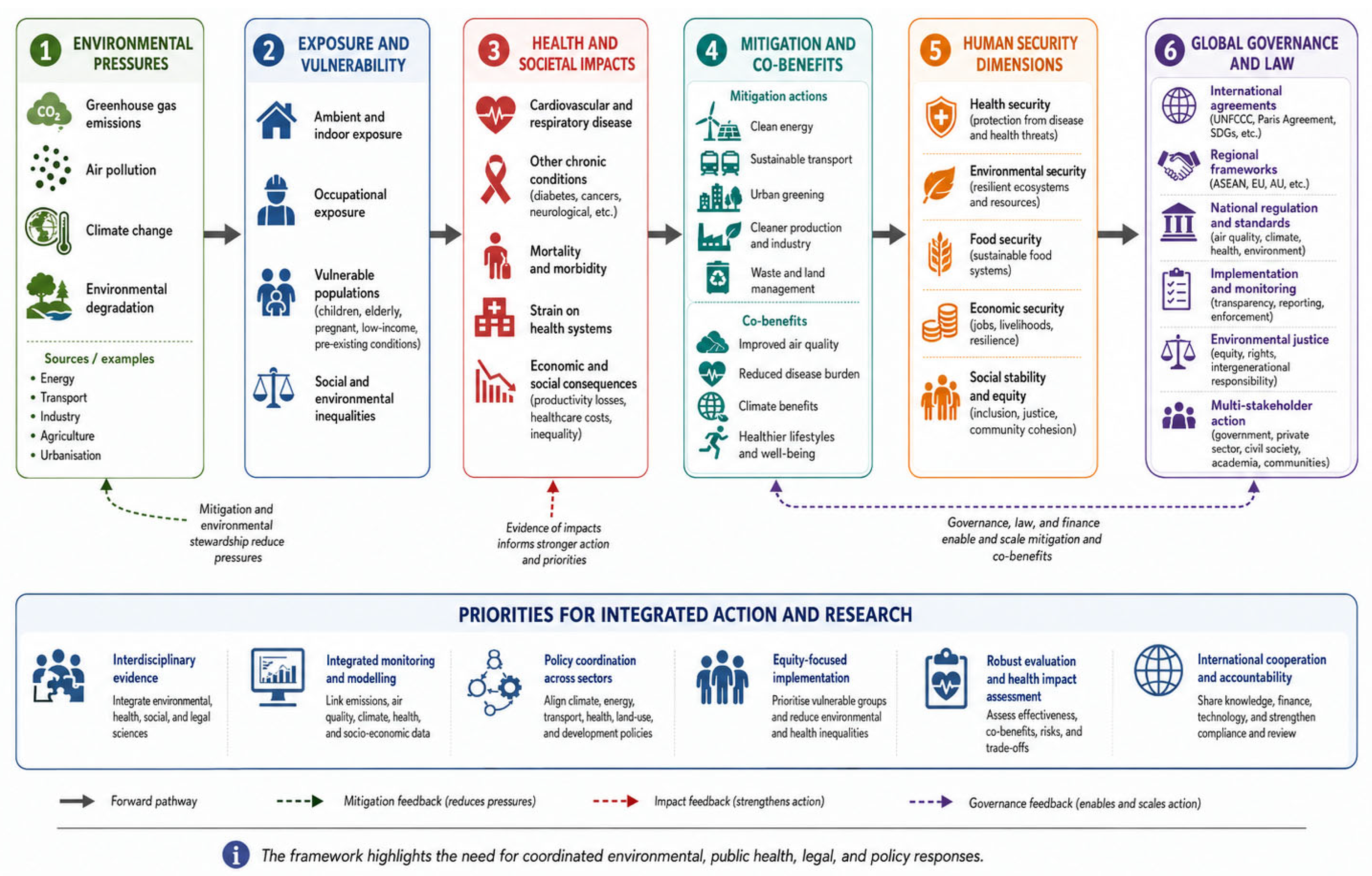
In this review, the global law perspective is understood as a broad global environmental law and governance perspective. It does not aim to provide a country-by-country doctrinal analysis of domestic legislation, but rather to examine the main legal and governance frameworks through which GHG emissions, air pollution, and health protection are addressed at international, regional, and selected national levels. These include binding climate agreements, air-quality regulatory standards, technical guidelines, reporting and monitoring obligations, implementation mechanisms, and enforcement challenges. The overall conceptual structure of the review is summarised in Figure 1.

2. Major Sources of Greenhouse Gas and Atmospheric Pollutant Emissions

The main emission sources discussed in this section are summarised in Table 1, which reports the principal GHG, atmospheric pollutants, emission processes, and mitigation or control approaches associated with each sector.

2.1. Fossil Fuel Combustion and Industrial Emissions

The combustion of fossil fuels for energy production is the largest source of GHG emissions worldwide [3]. Fossil fuels—coal, oil, and natural gas—are responsible for more than two thirds of global GHG emissions, according to United Nations estimates [18]. These fuels are widely used to generate electricity and heat for residential, commercial, and industrial activities. When burned, they release large amounts of carbon dioxide (CO2), which is the main GHG responsible for global warming [3,19]. Recent analyses by the International Energy Agency (IEA) indicate that energy-related CO2 emissions reached a new record level in 2024 [20]. Emission trends differed across regions, with increases in emerging market and developing economies, as well as in international aviation and maritime transport, outweighing reductions observed in several advanced economies, including the European Union (EU), Japan, and the United States (US). In addition, record high global temperatures in 2024 contributed to increased energy demand, particularly for cooling, further driving emissions from the energy sector [20].
In addition to CO2, energy production can also emit methane (CH4) and nitrous oxide (N2O) [21]: CH4 is released during the extraction, processing, and transport of fossil fuels, particularly from natural gas systems and coal mining; N2O may be produced during high-temperature combustion processes in power plants and industrial facilities. Fossil fuel combustion also releases several primary air pollutants that contribute to the deterioration of air quality, including nitrogen dioxide (NO2), sulphur dioxide (SO2), and carbon monoxide (CO). These pollutants are emitted directly from combustion sources such as power generation, transport, and industrial activities. Once released into the atmosphere, they can be transported over long distances and undergo a range of chemical transformation processes. Through these reactions, primary pollutants can generate secondary pollutants, including ground-level ozone (O3) and secondary particulate matter (PM), which further contribute to air pollution and its environmental and health impacts [22].
Reducing atmospheric pollution from industrial activities and other emitting sectors requires a combination of technological, regulatory, and organisational measures. In industry and energy production, relevant processes include the adoption of best available techniques, fuel switching, electrification where feasible, energy-efficiency improvements, and end-of-pipe control technologies such as flue-gas desulphurisation, selective catalytic reduction, electrostatic precipitators, fabric filters, and vapour recovery systems [23,24,25,26,27]. In other sectors, mitigation can be supported by improved fertiliser and manure management in agriculture, landfill gas capture and reduced open waste burning in waste management, and cleaner production and circular economy strategies across supply chains [28,29].
The energy sector therefore represents a critical domain for emission reduction efforts. Policies aimed at reducing dependence on fossil fuels—such as expanding renewable energy sources, improving energy efficiency, and modernising power systems—can substantially decrease both GHG emissions and air pollution. By lowering environmental exposures that affect human well-being, these measures contribute not only to climate mitigation but also to the protection of fundamental conditions necessary for human security.

2.2. Transport Systems

Transport is one of the major sources of GHG emissions and air pollutants worldwide. Road transport, aviation, and maritime shipping depend largely on fossil fuels such as petrol, diesel, and heavy fuel oils [30,31]. According to the IEA, global CO2 emissions from transport increased by about 3% in 2022 compared with the previous year, largely due to the recovery of passenger and freight mobility after the COVID-19 pandemic. Over the longer term, transport emissions have grown steadily, increasing at an average annual rate of about 1.7% between 1990 and 2022. This makes transport one of the fastest-growing sources of energy-related emissions. To align with pathways consistent with the Net Zero Emissions scenario by 2050, emissions from the transport sector would need to decline by more than 3% per year by 2030 [32].
Within the sector, road transport represents the largest share of emissions. Passenger vehicles, buses, and freight transport generate CO2 through fuel combustion during daily operations. At the same time, vehicles release several atmospheric pollutants that degrade air quality, including NOx, CO, PM, and volatile organic compounds (VOCs). Among others, diesel engines are particularly associated with higher emissions of NOx and fine PM2.5, pollutants that have been strongly linked to several health effects.
Transport-related atmospheric pollution differs substantially by mode of transport (Table 2) [33]. Road transport is generally the dominant contributor to urban transport-related exposure, particularly through emissions of NOx, CO, PM2.5, PM10, black carbon, and VOCs from exhaust, brake and tyre wear, and road dust resuspension. Aviation contributes mainly to CO2, NOx, ultrafine particles, SO2, and water vapour emissions, with impacts occurring both around airports and at cruising altitude. Maritime transport is an important source of CO2, NOx, SO2, PM, and black carbon, particularly where heavy fuel oils are used and in port areas with high ship density. Rail transport generally produces lower direct emissions when electrified, although diesel-powered rail systems may still emit NOx and PM [33].
Urban areas are especially vulnerable to transport-related air pollution. High traffic density, combined with large population concentrations, results in significant exposure to pollutants near roads and transport corridors. For this reason, emissions from the transport sector represent a key target for strategies aimed at improving both climate mitigation and population health [34,35].
Strategies to reduce transport-related atmospheric pollution should therefore combine technological, regulatory, infrastructural, and behavioural interventions [36]. Electrification can substantially reduce local tailpipe emissions, particularly when combined with low-carbon electricity generation, while stricter fuel-quality and emission standards remain important for reducing pollutants from internal combustion engines [37]. At the same time, modal shift towards public transport, walking, and cycling can reduce vehicle kilometres travelled and lower population exposure in urban areas [38]. Additional measures, including low- and zero-emission zones, traffic-demand management, port electrification, cleaner maritime fuels, and operational improvements in aviation, can further contribute to reducing atmospheric pollution [39,40]. Although the complete elimination of transport-related pollution is not immediately feasible across all modes, integrated policy packages can achieve substantial reductions in both GHG emissions and health-relevant air pollutants.

2.3. Agriculture and Land Use

Agriculture and land use have important impact on air quality and composition. In particular, agriculture is a major source of two GHG emissions, CH4 and N2O, both of which have a strong effect on climate change [41]. Methane emissions are largely associated with livestock production, particularly ruminant systems. In cattle, sheep, and goats, CH4 is mainly produced during digestion through enteric fermentation, which accounts for approximately 70–90% of livestock-related CH4 emissions, while manure management generally contributes around 10–12%. Overall, livestock production has been estimated to generate about 7.1 Gt CO2-eq per year, corresponding to approximately 14.5% of global anthropogenic GHG emissions, with cattle representing the largest contributor among livestock species [42,43]. Nitrous oxide emissions are mainly associated with the use of nitrogen-based fertilisers in agricultural soils. When fertilisers are applied to crops, soil microorganisms can convert nitrogen compounds into N2O through biological processes. These emissions can increase when fertilisers are used in large quantities or when agricultural practices lead to inefficient nitrogen use [44].
Agricultural activities also contribute to air pollution through the release of ammonia (NH3). In the atmosphere, NH3 undergoes chemical transformations that generate stable inorganic products, mainly ammonium (NH4+) and nitrate (NO3). These compounds are major constituents of PM2.5, especially in regions characterised by intensive agricultural activity. They are typically formed through reactions between NH3 and acidic species such as NOx and SO2, leading to the formation of secondary PM capable of travelling long distances and contributing to regional air pollution [45,46].
Land-use change, including deforestation and the conversion of natural ecosystems into agricultural land, plays a significant role in GHG emissions. Deforestation and forest degradation are estimated to account for approximately 10–20% of global anthropogenic CO2 emissions. When forests are cleared or degraded, the carbon stored in vegetation and soils is released into the atmosphere, primarily as CO2 [47,48]. At the same time, land use represents a complex sector in which ecosystems can act both as sources and as sinks of GHG, depending on how land is managed [47].
Promoting tree planting, afforestation, and reforestation, together with the restoration of degraded forest landscapes, can play a crucial role in reducing GHG emissions and enhancing the mitigation potential of ecosystems. Conversely, the loss of vegetation diminishes the capacity of ecosystems to absorb CO2 through natural processes. For this reason, afforestation and reforestation have become central components of climate change mitigation strategies worldwide [49].

2.4. Urbanisation

Urbanisation represents a key interface between GHG emissions, air pollution, population exposure, and environmental governance. Cities concentrate population, economic activities, infrastructure, transport systems, buildings, and services, thereby shaping patterns of energy consumption, mobility, land use, and resource demand. As a result, urban areas are major contributors to emissions from residential and commercial energy use, road transport, construction activities, waste management, and industrial or service-sector activities [50,51,52].
Urban areas, which currently host about 55% of the global population, account for approximately 75% of global energy consumption and are responsible for nearly 70% of global energy-related CO2 emissions, when both direct and indirect emissions associated with electricity and heat consumed by urban activities are considered [53,54]. Cities therefore concentrate the demand for energy, transport, buildings, infrastructure, and services that drives a large share of fossil-fuel-based emissions. Evidence from urban GHG monitoring also shows that near-surface CO2 and CH4 concentrations can help identify local emitting sources, while urban form and building-related energy use can substantially influence carbon emissions [53,54].
As an increasing proportion of the global population resides in urban areas, urbanisation has become a central factor in discussions on climate change and environmental governance. Urban growth, infrastructure systems, and modifications to urban environments influence emissions and carbon cycling, providing important insights for the development of more sustainable urban planning approaches and for addressing the environmental pressures associated with rapidly expanding cities [55].
Urbanisation also modifies land cover and carbon dynamics. Recent evidence shows that urbanised river systems exhibit substantial changes in carbon dynamics compared with less disturbed environments [55]. For example, urban sites have been observed to present approximately double the concentrations of dissolved and particulate organic carbon, while the mass of dissolved CH4 transported in urban streams can exceed that of non-urban systems by more than 100 times [56]. In addition, common interventions in urban landscapes—such as river channelisation—can significantly increase CO2 emissions due to enhanced water turbulence, highlighting the profound impact of urban land use on carbon fluxes in freshwater systems [56].
Overall, urbanisation should be understood not only as a driver of emissions and altered environmental processes, but also as a critical setting in which air-quality management, climate mitigation, public health protection, and environmental governance can be integrated.

3. Key Aspects of Atmospheric Processes and Air Quality Dynamics

3.1. Formation and Atmospheric Behaviour of Major Pollutants

Air pollutants can be emitted directly into the atmosphere as primary pollutants from human activities, or they can form through chemical reactions in the atmosphere, generating secondary pollutants such as ground-level O3 and secondary PM [57]. Their concentration and distribution are influenced by atmospheric processes including chemical transformation, dispersion, deposition, and long-range transport. As a result, air pollution reflects the interaction between emissions, atmospheric chemistry, and environmental conditions, often extending its effects beyond the areas where pollutants are originally produced [58]. This complexity highlights the importance of coordinated environmental policies and international cooperation in addressing air pollution and its health impacts.

3.2. Spatial and Temporal Patterns of Air Quality

Air pollution does not occur uniformly across space and time. The concentration of atmospheric pollutants can vary widely between regions, cities, and even within different areas of the same urban environment. These variations depend on several factors, including emission sources, meteorological conditions, geographical features, and patterns of human activity [57,58,59].
Spatial patterns of air pollution are often influenced by the distribution of emission sources. Urban and industrial areas typically experience higher levels of pollutants because of dense traffic, energy consumption, and industrial activities. Rural areas may generally be affected by long-range transport of pollutants or by emissions from agriculture and biomass burning [60].
Within cities, important spatial differences may also occur. Areas close to major roads, traffic intersections, or industrial facilities often show higher concentrations of NO2, PM2.5, and other traffic-related pollutants. Urban design and building density can further affect pollutant dispersion [61]. For example, narrow streets surrounded by tall buildings—often described as urban street canyons—may limit air circulation and lead to the accumulation of pollutants. Urban areas are also affected by the urban heat island effect, where built surfaces such as asphalt and concrete absorb and retain heat, leading to higher local temperatures and potentially influencing pollutant formation and dispersion [62]. Conversely, urban green spaces can play a beneficial role by improving air quality through mechanisms such as pollutant deposition on vegetation surfaces, microclimatic regulation, and enhanced air circulation [63].
Temporal variations in air pollution are also common. Pollutant levels can change throughout the day, across seasons, and over longer time periods. Daily patterns are often related to traffic flows and human activity. For instance, concentrations of traffic-related pollutants frequently increase during morning and evening rush hours. Seasonal patterns may be influenced by heating needs during winter, agricultural practices, and meteorological conditions such as temperature inversions, which can trap pollutants near the ground [64,65,66,67].

3.3. Modelling Approaches, Artificial Intelligence, and Implications for Global Governance and Human Security

Modelling of air pollution and climate change is an important tool for understanding how pollutants are emitted, transported, transformed, and distributed in the atmosphere. Since direct measurements are typically limited to monitoring stations, modelling approaches allow researchers to estimate pollutant concentrations across wider geographical areas and over different time periods. Modelling frameworks are commonly used, including emission models that estimate pollutants released from different sources, atmospheric dispersion models that simulate how pollutants spread under varying meteorological conditions, and chemical transport models that also account for atmospheric chemical reactions leading to the formation of secondary pollutants [68,69,70,71,72,73]. In addition, climate and environmental models are increasingly used to simulate temperature patterns and heat dynamics, including urban heat islands and extreme temperature events. These modelling approaches help evaluate how rising temperatures interact with air pollution processes and influence environmental exposure and health risks across populations [74].
Traditional modelling frameworks include emission models, atmospheric dispersion models, chemical transport models, land-use regression models, satellite-based exposure models, and integrated climate–environmental models. In recent years, artificial intelligence (AI) and machine-learning methods have become increasingly important in air-quality assessment and environmental modelling. AI-based approaches can support pollutant concentration prediction, short-term air-quality forecasting, exposure assessment, source attribution, anomaly detection, interpretation of complex pollutant–meteorological interactions, and decision-support systems for environmental management. Recent bibliometric evidence shows a rapid expansion of AI applications in air pollution research, with machine learning, deep learning, air pollutant concentration prediction, low-cost air-quality sensors, indoor air quality, and thermal comfort emerging as major research hotspots [75].
Several AI and machine-learning approaches have been applied to air pollution prediction and forecasting, including random forest, XGBoost, support vector machines, artificial neural networks, convolutional neural networks, long short-term memory models, transformer-based architectures, ensemble models, and hybrid spatio-temporal frameworks. These models can integrate pollutant concentrations, meteorological variables, land-use indicators, satellite data, traffic information, and other contextual predictors. Recent integrated AI frameworks have shown that ensemble and deep-learning models can achieve high predictive performance for several pollutants, including PM2.5, PM10, O3, CO, NO2, and SO2. In addition, interpretable AI methods, such as Shapley Additive exPlanations, can help identify the relative contribution of meteorological and chemical drivers, thereby improving the transparency and policy relevance of data-driven models [76].
AI-based modelling is also increasingly discussed in relation to climate-change impact prediction. Machine-learning approaches can analyse large and complex datasets, detect non-linear relationships, support scenario testing, and complement traditional physical climate models. This can be particularly useful for improving the spatial and temporal resolution of projections, identifying vulnerable areas, and supporting adaptation planning. However, AI should be understood as complementary to, rather than a replacement for, physical, chemical, and epidemiological models. Hybrid approaches that combine data-driven methods with mechanistic knowledge may be especially valuable for improving interpretability, robustness, and policy relevance [77].
Despite their potential, AI-based approaches also raise important methodological and governance challenges. Their performance depends strongly on data quality, temporal depth, spatial coverage, representativeness of monitoring networks, and the availability of linked meteorological, environmental, health, and socio-economic data. Missing data, short or fragmented time series, measurement error, inconsistent monitoring protocols, and limited data from low-resource settings can reduce predictive accuracy and transferability. Models trained in one geographical context may perform poorly in another because pollutant mixtures, meteorology, emission sources, urban form, and population behaviour differ across regions. Predictive power may also decline under extreme events or future climate scenarios that are poorly represented in historical training data. Additional challenges concern interpretability, uncertainty, ethics, and implementation. Some high-performing AI models are difficult to interpret, which may limit their use in regulatory or public health decision-making. Communicating uncertainty is also essential, particularly when model outputs are used to trigger warnings, guide mitigation policies, or prioritise interventions. Moreover, unequal access to digital infrastructure, technical expertise, high-quality data, and computational resources may create an AI divide between countries, regions, institutions, and communities. Concerns related to data protection, cybersecurity, algorithmic bias, accountability, and the environmental footprint of large-scale AI systems should also be considered when deploying AI for environmental sustainability [78,79].
From a governance and human security perspective, modelling results are increasingly important in discussions on global environmental governance, international law, and human security [68]. By identifying the sources, pathways, and population exposure to pollutants, these models can support international cooperation, inform regulatory frameworks, and help address environmental inequalities that arise when the health impacts of pollution are experienced far from where emissions originate. For this reason, the future development of environmental modelling should combine atmospheric science, AI, epidemiology, exposure assessment, legal governance, and equity-oriented decision-making.

4. Epidemiological Evidence on Air Pollution and Health Outcomes

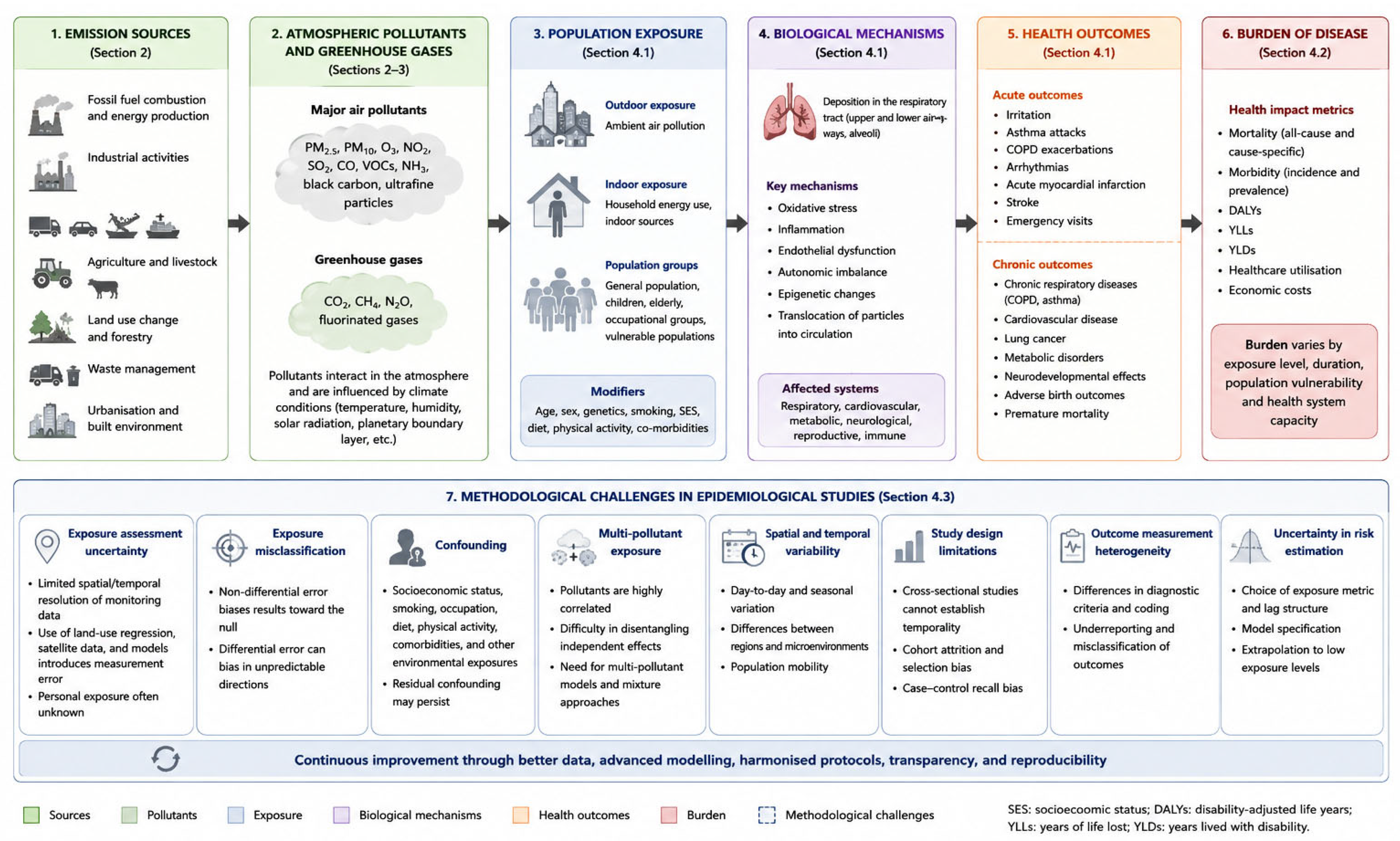
The epidemiological pathway linking emission sources, air pollutants, population exposure, biological mechanisms, health outcomes, and burden of disease is summarised in Figure 2, together with the main methodological challenges that affect the interpretation of evidence in this field.

4.1. Global Burden of Disease Attributable to Air Pollution

Air pollution is currently recognised as one of the leading environmental causes of disease and premature death worldwide. From an epidemiological perspective, it represents a typical example of a risk factor associated with relatively modest increases in individual risk but capable of generating a substantial burden of disease at the population level [6,80]. Estimates from global health assessments, including the Global Burden of Disease (GBD) study, indicate that exposure to ambient air pollution contributes to more than 8 million deaths worldwide each year [9], and fine PM2.5 is considered the most harmful air pollutant in terms of health impact [9]. Combustion of fossil fuels—such as coal, oil, and natural gas—remains a major contributor to these exposures and has been associated with approximately one million deaths globally [81].
The burden of disease linked to air pollution is not evenly distributed across the world. Low- and middle-income countries often experience higher levels of exposure because of rapid urbanisation, industrial growth, and limited environmental regulation. Countries in South Asia and Africa experience the highest levels of exposure and the greatest health impacts [9,81]. At the same time, vulnerable populations—including children, older adults, and people with pre-existing health conditions—are more likely to experience severe health effects [8].
Reducing exposure to air pollution, as well as to climate change, is essential not only for improving population health but also for safeguarding the environmental conditions on which human well-being and societal stability depend [82,83]. Air quality degradation can undermine multiple dimensions of human security, including health, environmental sustainability, and economic resilience [82]. Addressing emissions from key sectors such as energy production, transport, industry, and agriculture is therefore crucial for protecting both human health and the ecological systems that support safe and sustainable living conditions [84].

4.2. Major Health Outcomes

A large body of epidemiological research has documented the impact of air pollution on human health. Studies conducted in different regions of the world have consistently shown that exposure to air pollutants is associated with increased risks of morbidity and premature mortality. Both short-term and long-term exposures can affect health, although long-term exposure to fine PM2.5 and other pollutants is considered one of the most important environmental determinants of chronic disease [5,6,8,9]. Air pollution affects multiple organ systems. The strongest evidence concerns cardiovascular and respiratory diseases, but research has also identified associations with metabolic disorders, adverse pregnancy outcomes, cognitive impairment and neurological diseases, and various types of cancer [8].
Air pollutants can affect human health through several biological mechanisms. One of the main pathways involves systemic inflammation and oxidative stress. PM2.5 and other small particles can penetrate deep into the lungs when inhaled. Because of their small size, some particles can pass through the alveolar barrier and enter the bloodstream. This process can trigger inflammatory responses and increase the production of reactive oxygen species [85,86]. These reactions may lead to endothelial dysfunction, which affects the normal function of blood vessels and contributes to the development of cardiovascular diseases. Inflammation and oxidative stress can also influence immune responses, promote blood coagulation, and alter metabolic regulation [87,88]. Cardiovascular effects are among the most consistently documented consequences of air pollution exposure. Long-term exposure to PM2.5 and other pollutants has been associated with ischemic heart disease, stroke, hypertension, heart failure, and acceleration of atherosclerotic processes, while short-term exposure may trigger acute cardiovascular events [5,6,9,89]. Air pollutants can also cause direct irritation of the respiratory tract. Gases such as NO2 and O3 can damage airway tissues, increase airway inflammation, and reduce lung function [90]. Exposure to these pollutants has been associated with asthma exacerbations, chronic obstructive pulmonary disease (COPD), respiratory infections, and increased hospital admissions for respiratory conditions. Children and older adults are particularly vulnerable [6]. Growing evidence suggests links between air pollution exposure and adverse pregnancy outcomes, neurological development and cognitive function [8,91,92]. Similarly, several studies have also suggested links between air pollution exposure and metabolic disorders, including type 2 diabetes [93,94].

4.3. Methodological Challenges in Air Pollution Epidemiology

Population-based epidemiological studies use different designs to examine these associations. Together, these studies provide strong and consistent evidence that air pollution is a major environmental risk factor for disease worldwide. Although the association between air pollution and adverse health outcomes is supported by a large body of epidemiological evidence, several methodological challenges remain in the study of these relationships. These challenges mainly concern exposure assessment, confounding factors, and the interpretation of results across different study designs [95]. Such methodological issues are also schematically represented in Figure 2, which highlights the role of exposure misclassification, multi-pollutant exposure, spatial and temporal variability, residual confounding, outcome measurement heterogeneity, and uncertainty in risk estimation.
One of the main difficulties is the assessment of individual exposure to air pollutants [96]. In many studies, exposure is estimated using data from fixed air quality monitoring stations. While these measurements provide useful information on pollutant concentrations at the population level, they may not accurately reflect the exposure of individual participants. People spend time in different environments, including homes, workplaces, and transport settings, and pollution levels may vary significantly across these locations. As a result, exposure misclassification may occur. To address this limitation, several studies use modelling approaches, such as land-use regression models, satellite-based estimates, or atmospheric dispersion models, to estimate pollution levels at finer spatial resolution. These methods can improve exposure assessment but still involve uncertainty related to model assumptions and data availability [70,97]. Another challenge concerns the combined exposure to multiple pollutants. In real-world environments, individuals are exposed to mixtures of pollutants rather than to single substances. Disentangling the independent effects of specific pollutants can therefore be difficult, especially when pollutants are strongly correlated because they originate from the same emission sources [98,99].
Despite these challenges, advances in environmental monitoring, exposure modelling, and statistical methods have improved the ability to assess the health impacts of air pollution in recent years. Strengthening these analytical approaches is essential not only for improving scientific understanding of environmental health risks but also for informing policies that protect the environmental conditions necessary for human well-being. By providing more robust evidence on the links between environmental degradation and health outcomes, research in this field can support policy actions aimed at safeguarding ecological systems and enhancing the security and resilience of human populations.
Beyond exposure assessment and confounding, additional challenges arise from the need to integrate climate, air-quality, health, and socio-economic data collected at different spatial and temporal scales. The effects of air pollution and climate change are often mediated by complex pathways, including behavioural factors, occupational conditions, housing quality, access to healthcare, and pre-existing vulnerability. These elements complicate causal interpretation and make it difficult to translate epidemiological evidence into uniform policy recommendations across different populations and regions.
A critical implication of these methodological challenges is that evidence on air pollution and health should not be interpreted as a simple pollutant–outcome relationship. Most real-world exposures occur as mixtures, vary across space and time, and interact with socioeconomic strata, occupational conditions, housing quality, behavioural factors, and access to healthcare. Therefore, differences between studies should not necessarily be interpreted as contradictory findings, but may reflect heterogeneity in exposure assessment, population susceptibility, pollutant mixtures, outcome definitions, and contextual determinants. This reinforces the need for integrated analytical approaches that combine environmental monitoring, exposure modelling, epidemiology, and social vulnerability assessment.

5. Co-Benefits of Greenhouse Gas Mitigation for Public Health

Because many GHG and air pollutants originate from the same sources, policies that reduce fossil fuel use can simultaneously improve air quality and lower population exposure to harmful pollutants. These co-benefits have become an important topic in environmental and public health research [100,101].
Reducing emissions from key sectors such as energy production, transport, and industry can lead to measurable improvements in air quality within relatively short time frames. These improvements can in turn reduce the burden of disease associated with air pollution. In addition, some mitigation strategies may also encourage healthier lifestyles and contribute to broader health gains.
From a policy perspective, recognising the health co-benefits of climate mitigation can strengthen the case for ambitious environmental action. Integrating public health considerations into climate policies may help decision-makers better understand the full societal benefits of emission reduction strategies [102,103].

5.1. Energy Transition and Health Benefits

The transition from fossil fuels to cleaner energy sources represents one of the most important strategies for reducing GHG emissions [104]. Expanding the use of renewable energy sources such as wind, solar, and hydropower can significantly decrease emissions of carbon dioxide and other GHGs [105]. At the same time, this transition can reduce the release of air pollutants that are commonly produced during fossil fuel combustion. Replacing coal and oil with renewable energy sources can lead to substantial reductions in emissions of PM, NOx, and SO2. These reductions can improve air quality and decrease the risk of diseases associated with air pollution exposure. Epidemiological evidence has shown that improvements in air quality are often followed by measurable declines in mortality and hospital admissions related to air pollution-attributable conditions [106,107].
In addition to direct health benefits, the energy transition may support broader social and environmental improvements. Cleaner energy systems can reduce environmental degradation, improve urban air quality, and contribute to more sustainable patterns of economic development. For these reasons, the shift toward low-carbon energy systems is widely considered a key strategy for addressing both climate change and public health challenges [108,109].

5.2. Sustainable Transport Systems

The transport sector is a major source of GHG emissions and urban air pollution. As discussed earlier, road traffic contributes substantially to emissions of CO2, NOx, and PM [31,32]. For this reason, transforming transport systems is an important component of strategies aimed at reducing both climate change and air pollution.
Sustainable transport policies can generate important public health benefits by reducing emissions and improving urban air quality. One key strategy is the electrification of vehicles, particularly in urban areas. Electric vehicles produce no direct tailpipe emissions, eliminating local exhaust pollutants such as NOx and a substantial share of traffic-related PM. Empirical evidence show measurable air-quality improvements associated with the diffusion of zero-emission vehicles [110]. Modelling studies suggest that widespread electrification of vehicle fleets could produce substantial reductions in urban pollution levels. In some scenarios, large-scale replacement of internal combustion vehicles has been associated with reductions of 30–80% in NO2 and 30–70% in fine PM2.5, particularly in high-traffic metropolitan areas [111]. When electricity is generated from renewable energy sources, electrification can also lead to significant reductions in GHG emissions across the transport sector. In this context, the combined transition to low-emission mobility systems and cleaner energy generation can produce simultaneous benefits for climate mitigation, urban air quality, and population health [112]. However, the overall balance between health benefits and potential environmental burdens depends on context-specific life-cycle conditions, including the electricity mix, battery and material supply chains, charging infrastructure, vehicle lifetime, recycling capacity, and the costs and feasibility of retrofitting transport systems, particularly in remote or low-density areas. Therefore, electrification should not be interpreted as an isolated technological solution, but as part of an integrated transition combining cleaner electricity generation, public transport planning, demand management, life-cycle assessment, and end-of-life material recovery [113,114].
Another important approach is the promotion of public transport systems, including buses, rail networks, and other forms of shared mobility. Efficient and accessible public transport can substantially reduce the number of private vehicles on the road, thereby lowering emissions and traffic congestion [115]. Transport modelling studies indicate that a shift from private cars to public transport can reduce urban transport-related CO2 emissions in high-density metropolitan areas, depending on modal substitution and energy sources used in public transport fleets [116,117]. In addition, improvements in public transport availability have been associated with measurable reductions in traffic-related air pollutants in several urban settings [118]. Sustainable mobility also includes the promotion of active transport, such as walking and cycling. These forms of mobility produce no direct emissions and can reduce dependence on motorised transport, especially for short urban trips [115,119,120]. Beyond environmental benefits, active transport provides significant health advantages. Increasing walking and cycling levels has been associated with measurable decreases in the risk of cardiovascular disease, obesity, and type 2 diabetes at the population level [121,122,123,124]. As a result, policies that support active mobility can generate important co-benefits for both environmental sustainability and population health.

5.3. Urban Policies

Cities play a central role in both GHG emissions and population exposure to air pollution. Although urban areas occupy a relatively small share of the Earth’s land surface, they are responsible for around 70% of global energy-related CO2 emissions and host more than half of the world’s population [54]. Urban policies aimed at reducing emissions and improving air quality can therefore play an important role in climate mitigation and health protection. Urban planning strategies can also contribute to emission reductions and environmental improvements. Promoting compact urban development, mixed land use, and efficient public transport systems can reduce travel demand and decrease reliance on private vehicles [125].
One widely adopted measure is the introduction of low-emission zones (LEZs), where access for high-polluting vehicles is restricted or regulated. Evidence from European cities shows that these policies can lead to measurable improvements in urban air quality. Empirical evaluations indicate that LEZ implementation has been associated with significant reductions in pollutant concentrations—particularly NO2 and PM10—within LEZs, depending on the strictness of vehicle standards and complementary traffic measures, even though the public health benefits observed so far have generally been modest and variable across different urban contexts, reflecting differences in policy design, baseline pollution levels, and population exposure [126,127].
Another important strategy involves increasing urban green spaces, including parks, urban forests, and green corridors. Urban vegetation can contribute to improved environmental conditions by reducing urban heat island effects—often lowering local temperatures by 1–3 °C—and by supporting air circulation and limited removal of airborne particles [128,129]. In addition to environmental benefits, access to green spaces has been associated with increased physical activity, improved mental health, and reductions in stress-related conditions [130].
Building policies are also crucial in the urban context. Improving energy efficiency in buildings, promoting cleaner heating systems, and increasing the use of renewable energy in residential and commercial sectors can substantially reduce both GHG emissions and local air pollution [131,132]. In many cities, residential heating remains a significant source of winter pollution, accounting for up to 40% of urban PM2.5 emissions in some European metropolitan areas [133,134].
Finally, urban environmental policies often require coordination across multiple sectors, including transport, energy, housing, and public health. Integrated urban planning approaches that simultaneously address environmental sustainability and population health can therefore play a key role in tackling the interconnected challenges of climate change, air pollution, and urban resilience.

5.4. Evidence from Health Impact Assessment Studies

Health impact assessment (HIA) studies provide important evidence on the potential health benefits of policies aimed at reducing GHG emissions and improving air quality. In particular, quantitative HIAs combine environmental modelling, population exposure data, and epidemiological exposure–response functions to estimate how changes in environmental exposures under specific policy scenarios may translate into variations in health outcomes at the population level. These approaches typically rely on integrated modelling frameworks and counterfactual scenarios to quantify the health impacts of interventions affecting urban transport, land use, and emission patterns [135].
Many HIA studies have examined the effects of reducing air pollution through climate mitigation policies. For example, reductions in emissions from power generation, transport, and industrial activities have been associated with projected decreases in premature mortality and hospital admissions related to cardiovascular and respiratory diseases. These analyses often estimate the number of deaths that could be avoided if pollutant concentrations were reduced to specific policy targets or guideline levels [136,137,138]. In addition to mortality outcomes, some HIAs also consider broader indicators such as years of life lost, disability-adjusted life years, or healthcare costs [6,139,140]. These analyses help provide a more comprehensive picture of the societal benefits associated with environmental policies.
Health impact assessments are also used to evaluate the benefits of meeting international air quality standards, such as the guideline values proposed by the WHO. Several studies have shown that achieving these guideline levels for pollutants such as PM2.5 and NO2 could lead to substantial improvements in population health, particularly in urban areas where exposure levels are often higher [141,142].
Overall, evidence from HIA studies suggests that policies aimed at reducing GHG emissions can generate substantial benefits by improving air quality and reducing population exposure to harmful pollutants. Beyond their health effects, these measures help preserve the environmental conditions that support human well-being and social stability. Such findings highlight the importance of policy approaches that protect both ecological systems and the fundamental conditions necessary for the safety, health, and resilience of human communities.
The main mitigation strategies and public health co-benefits discussed in this section are summarised in Table 3. The table reports the principal intervention mechanisms, expected effects on air quality, potential health co-benefits, and implementation challenges across the main mitigation domains.
Although mitigation strategies can generate important public health co-benefits, these benefits should not be interpreted as automatic or uniformly distributed. Their magnitude depends on baseline pollution levels, population density, energy mix, technological feasibility, regulatory enforcement, and the extent to which interventions reduce exposure among vulnerable groups. Some low-carbon transitions may also involve trade-offs, including infrastructure costs, critical material demand, land-use pressures, and unequal access to clean technologies. For this reason, mitigation policies should be assessed not only in terms of emission reduction, but also in terms of life-cycle impacts, equity, affordability, and capacity to reduce health inequalities.

6. Greenhouse Gas Emissions and Air Pollution as Threats to Human Security

Climate change and air pollution can be understood not only as environmental problems but also as threats to human security [13,14]. The concept of human security focuses on protecting individuals and communities from risks that may affect their survival, well-being, and dignity [15]. Unlike traditional security approaches, which mainly emphasise military threats, human security highlights the importance of social, environmental, and health-related risks that may undermine the stability and safety of populations [143].
Considering human security as an operational framework for linking environmental exposures with concrete threats to population well-being, institutional resilience, and social stability, GHG emissions—as well as air pollution, and climate change—affect human security through several interconnected pathways: direct health impacts; pressure on healthcare systems; degradation of ecosystems and food systems; economic losses and livelihood disruption; displacement and migration pressures; and unequal exposure among socially and geographically vulnerable populations [144,145,146,147,148]. The main pathways linking GHG emissions, air pollution, climate change, and specific dimensions of human security are summarised in Table 4.
Of note, United Nations has recently shed lights on the links between climate change and human security, identifying five key pathways through which the climate crisis affects human security: (1) intensifying competition over land and water resources; (2) disrupting food production and increasing hunger; (3) forcing people to move and contributing to displacement; (4) deepening poverty and inequality; and (5) increasing security risks for vulnerable groups, particularly women and girls [149]. Environmental degradation, climate instability, and deteriorating air quality may affect health systems, food production, economic activities, and living conditions, particularly in vulnerable regions [150,151]. These risks are often interconnected and may reinforce existing social and economic inequalities. For instance, African settings are particularly relevant from a human security perspective. In many African countries, air pollution, climate change, rapid urbanisation, biomass use, transport emissions, waste burning, and limited air quality monitoring interact with pre-existing social and health vulnerabilities [152,153]. These conditions can amplify risks for health systems, food security, livelihoods, and urban resilience. At the same time, Africa also represents a key context for integrated policy approaches, because measures targeting short-lived climate pollutants, household energy, transport, agriculture, and waste management may simultaneously reduce air pollution, mitigate climate forcing, and protect vulnerable populations [152,153].
A detailed analysis of the issue highlights that one key dimension is health security. As previously mentioned, air pollution contributes to a substantial burden of disease worldwide, increasing the risk of cardiovascular and respiratory conditions, cancer, and other health problems [5,6]. At the same time, climate change can intensify heatwaves, extreme weather events, and the spread of climate-sensitive diseases. These environmental pressures may place additional strain on healthcare systems and increase health risks for vulnerable populations, including older adults, children, and people with chronic illnesses [150,151].
Another important aspect is environmental security. Rising temperatures, changing precipitation patterns, and increased frequency of extreme weather events can damage ecosystems and reduce the capacity of natural environments to support human life. Air pollution can further degrade environmental quality by affecting soil, water, and vegetation [154,155]. Together, these processes may weaken ecosystem services that are essential for human well-being [156].
Climate change and environmental degradation may also affect food security. Changes in temperature, water availability, and extreme weather events can influence agricultural productivity and food supply chains. Air pollution may also affect crop yields by damaging plant tissues or altering soil chemistry. These effects may increase the risk of food shortages or higher food prices in some regions [157,158].
Economic stability is another dimension of human security that may be affected by climate and environmental risks. Environmental degradation and damage caused by extreme weather events lead to economic losses and reduce productivity. In some regions, these pressures may affect livelihoods and contribute to social instability [149,159].
Climate change and environmental stress can also lead to population displacement. Extreme weather events, rising sea levels, droughts, and environmental degradation may force communities to relocate. This process, often described as climate-related displacement or migration, can create additional social and economic challenges, particularly in urban areas where displaced populations may concentrate [149,160]. The relevance of these issues has also been recognised at the European policy level. In 2023, the European Parliament highlighted the growing implications of climate change for human mobility, discussing the concept of “climate refugees” and the challenges associated with defining and addressing climate-related displacement [161].
Environmental inequality is therefore an important issue within the human security framework. Lower-income populations often live in areas with higher pollution levels or limited access to green spaces and healthcare services. As a result, the health and environmental impacts of air pollution and climate change may disproportionately affect already vulnerable groups [162,163]. Considering GHG emissions and air pollution through the lens of human security highlights that environmental risks are not limited to ecological degradation or disease burden alone. They can affect the conditions that allow individuals and communities to live safely, maintain health, access food and water, preserve livelihoods, and remain resilient to social and economic disruption. This perspective also clarifies why mitigation and adaptation policies should be assessed not only by their capacity to reduce emissions, but also by their ability to reduce vulnerability, strengthen health systems, protect ecosystems, prevent unequal exposure, and support social stability [164].

7. Global Governance and Environmental Law Implications

Addressing GHG emissions and air pollution requires coordinated action at national, regional, and global levels. Because both climate change and air pollution cross national boundaries, individual countries acting alone cannot fully address these challenges. For this reason, international cooperation and global governance mechanisms play an important role in environmental protection and public health. In recent years, global health governance has increasingly recognised environmental degradation as a key driver of population health, with a growing number of international resolutions and policy initiatives addressing environmental determinants of health. However, evidence also suggests that environmental issues are often still insufficiently integrated across different areas of global health policy, highlighting the need for stronger cross-sector coordination between environmental governance and health systems [165].
This field is characterised by the interaction between different sources and levels of governance. Binding international treaties, such as the United Nations Framework Convention on Climate Change (UNFCCC), the Kyoto Protocol, and the Paris Agreement, define the general architecture of climate cooperation, while regional and national legal instruments translate these commitments into emission standards, air-quality limits, permitting systems, monitoring requirements, and enforcement mechanisms. At the same time, non-binding instruments, including technical guidelines and policy recommendations, play an important role in shaping national regulatory choices and public health protection. The effectiveness of global environmental law therefore depends not only on the formal adoption of legal commitments, but also on implementation capacity, institutional accountability, regulatory enforcement, financial resources, and technical support.
Environmental law and international agreements provide frameworks through which countries can set common goals, coordinate emission reduction strategies, and monitor progress over time. These legal and institutional mechanisms help guide national policies while encouraging collaboration between governments, international organisations, and other stakeholders. However, global governance should not be understood as a single regulatory model, nor can emission patterns be interpreted only through country-level absolute emission figures. Different regions have developed distinct approaches according to their institutional structures, economic trajectories, environmental priorities, and implementation capacities. The EU has relied on binding regional standards and harmonised monitoring requirements [23]; the US has historically used federal regulation under the Clean Air Act [166,167]; China has implemented large-scale national action plans combining industrial restructuring, energy transition, transport measures, and local accountability mechanisms [168,169,170]; and African countries increasingly face the need to strengthen air quality governance while addressing climate vulnerability, urban growth, and development priorities [152]. These differences also show why country- and region-level GHG emission data require specific interpretation: absolute, per-capita, cumulative, and sector-specific emissions may lead to different assessments of responsibility and policy priority. For this reason, rather than providing an extensive country-by-country inventory, this review focuses on the broader governance implications of uneven emission patterns and their relevance for climate mitigation, air quality management, and human security.
From a legal and governance perspective, the challenge is not limited to the existence of international agreements, but also concerns their implementation, monitoring, accountability, and enforcement. Climate and air-quality governance depends on the interaction between binding legal standards, nationally determined commitments, reporting obligations, technical guidelines, regulatory agencies, judicial or administrative enforcement mechanisms, and financial and technological support for implementation [171]. An aspect that warrants attention, particularly considering that GHG emissions and air pollutants are transboundary phenomena, while regulatory capacity and economic resources remain unevenly distributed across countries and regions. Global environmental law therefore provides an essential framework for coordination, but its effectiveness depends on the ability to translate international commitments into enforceable national and regional policies.
In recent decades, global environmental governance has increasingly recognised the links between climate change, air pollution, and human health [165]. Many international initiatives now emphasise the need for integrated approaches that combine climate mitigation, environmental protection, and public health objectives.

7.1. International Climate Agreements

International climate agreements represent the main legal framework for global action on GHG emissions. One of the most important milestones in international climate governance is the UNFCCC, adopted in 1992. The Convention established the basic principles for international cooperation on climate change and created a platform for regular negotiations between countries [172]. Subsequent international agreements have progressively strengthened global climate action. An important step was the Kyoto Protocol adopted in 1997, which introduced legally binding emission reduction targets for industrialised countries and marked the first global attempt to operationalise the objectives of the UNFCCC [173]. In particular, the Protocol required industrialised countries to reduce their emissions by an average of 5.2% below 1990 levels during the first commitment period and introduced flexible mechanisms, including international emissions trading, Joint Implementation, and the Clean Development Mechanism. Its impact has been widely debated: empirical evaluations suggest measurable reductions among countries with binding commitments, including an estimated 6–7% reduction in GHG emissions compared with a counterfactual “No-Kyoto” scenario and an estimated 14% higher level of CO2 emissions that would have occurred in Annex I countries in the absence of Kyoto obligations. However, its effectiveness was constrained by partial country coverage, heterogeneous obligations, possible carbon leakage, “hot air” allowances, economic trade-offs, and the short duration of the first commitment period [174,175].
More recently, the Paris Agreement adopted in 2015 has become the central international treaty addressing climate change. The agreement aims to limit the increase in global average temperature to well below 2 °C above pre-industrial levels, while pursuing efforts to limit warming to 1.5 °C [176]. Under the Paris Agreement, countries are required to prepare and periodically update Nationally Determined Contributions (NDCs), which outline national strategies to reduce GHG emissions and adapt to climate impacts. Although the agreement relies largely on nationally defined commitments, it establishes mechanisms for transparency, reporting, and international cooperation that support collective climate action. Since its entry into force, the Paris Agreement has also accelerated the global transition toward low-carbon solutions, with an increasing number of countries, cities, and companies adopting carbon-neutrality targets, and zero-carbon technologies becoming competitive in sectors currently responsible for about 25% of global emissions, with the potential to expand to more than 70% by 2030 [176]. A key implementation challenge is that NDCs remain nationally determined and heterogeneous in ambition, scope, and enforceability; therefore, transparency mechanisms, periodic reporting, and international review processes are essential to strengthen accountability and support progressive increases in mitigation ambition.
While international climate agreements primarily focus on reducing GHG emissions, many of the mitigation strategies they promote also have important implications for air quality and public health. Measures such as reducing reliance on fossil fuels, improving energy efficiency, and promoting cleaner transport systems can simultaneously decrease GHG emissions and reduce exposure to harmful air pollutants. In this way, international climate agreements both contribute to climate mitigation and support broader environmental and public health objectives. Increasingly, integrating health considerations into climate policy discussions is recognised as an important step toward strengthening global climate governance and addressing the interconnected challenges of climate change and air pollution.

7.2. Air Quality Regulations

In addition to climate agreements, several regulatory frameworks specifically address air pollution and its effects on human health. Air quality regulations aim to limit the concentration of harmful pollutants in the atmosphere and to reduce emissions from major sources such as transport, energy production, and industrial activities. These policies play an important role in protecting population health and improving environmental conditions.
At the international level, the WHO provides scientific guidance on recommended exposure levels to major air pollutants through its Air Quality Guidelines [177]. In its assessments, the WHO does not identify a threshold below which no health risk exists. Instead, it defines guideline values based on the lowest concentration levels at which increases in all-cause mortality, cardiopulmonary mortality, and lung cancer mortality have been observed. In details, these guidelines establish recommended concentration limits for pollutants such as PM2.5 and PM10, NO2, O3, and SO2, based on a large body of epidemiological and toxicological evidence and aim to protect public health by identifying exposure levels associated with minimal health risks [177]. Although the WHO recommendations are not legally binding, they serve as an important reference for governments when designing national and regional air quality policies. Many countries use these recommendations as a basis for monitoring environmental performance [136,178]. According to the European Environment Agency (EEA) Burden of Disease Status Brief (2025), reducing air pollution to the levels recommended by the WHO Air Quality Guidelines could have prevented a substantial number of deaths in the EU. In 2023 alone, an estimated 182,000 deaths attributable to fine PM2.5 exposure, 63,000 deaths related to O3 exposure, and 34,000 deaths associated NO2 exposure might have been avoided if pollutant concentrations had complied with WHO guideline levels [179]. Air-quality governance also illustrates the distinction between scientific guidance and legal enforceability. WHO guideline values provide an authoritative health-based benchmark, but they are not legally binding; their practical effect depends on whether they are incorporated into regional or national regulatory frameworks, monitoring systems, and enforceable air-quality standards.
At the regional level, the European case—where the EU has developed a comprehensive regulatory framework to control air pollution—provides a paradigmatic example of how coordinated regulatory action can significantly reduce air pollution while also highlighting the persistent challenges that remain for some pollutants. Several EU directives set legally binding limits for key pollutants and require member states to monitor air quality and implement plans to reduce pollution levels when standards are exceeded. These directives also include emission standards for specific sectors, particularly road transport and industrial activities. Within the framework of the European Green Deal and the Zero Pollution Action Plan, the EU has set the objective of reducing the health impacts of air pollution, including premature deaths, by more than 55% by 2030 compared with 2005 levels. To support this goal, a revised Ambient Air Quality Directive (Directive 2881/2024/EU) was adopted in December 2024. The new directive introduces significantly stricter air quality standards to be achieved by 2030, bringing EU limit values closer to the levels recommended by the WHO, although they remain slightly higher than the WHO guideline values [23]. Over the past decades, EU air quality regulations have contributed to significant reductions in emissions of PM, NO2, and SO2 across many European countries. However, other pollutants remain a persistent concern, particularly ground-level O3, whose concentrations continue to exceed health-based guideline values in many regions. According to the latest EEA assessment, the EU long-term ozone objective was achieved at only 17% of monitoring stations in 2023 and 22% in 2024, indicating that ozone pollution remains a significant air quality challenge across Europe [180].
Beyond Europe, other policy contexts provide empirical examples of how air quality governance can produce measurable health, environmental, and economic effects. In the US, the Clean Air Act and its 1990 Amendments represent a long-standing federal regulatory framework based on National Ambient Air Quality Standards and emission controls for stationary and mobile sources. According to the US Environmental Protection Agency’s Second Prospective Study, the benefits of the 1990 Clean Air Act Amendments were projected to exceed costs by more than 30 to 1; by 2020, these provisions were estimated to prevent more than 230,000 early deaths, 200,000 acute myocardial infarctions, 2.4 million asthma exacerbations, 120,000 emergency department visits, and 17 million lost workdays annually [24]. More recent modelling has further suggested that, without enforcement of the 1970 Clean Air Act and its amendments, the contiguous US would experience approximately 298,000 additional premature deaths each year attributable to PM2.5 exposure, underlining the population-level relevance of sustained regulatory capacity [181]. In China, air quality governance has increasingly combined national clean-air policies with low-carbon urban experimentation. Evidence from a difference-in-differences analysis of China’s Low-Carbon City Pilot policy found significant reductions in air quality index (AQI) indicators in pilot cities compared with non-pilot cities, including reductions of 9.3% in mean AQI, 20.8% in maximum AQI, and 19.8% in AQI variability; these effects were attributed to green technological innovation, industrial restructuring, and changes in urban planning and landscape design [182]. Broader assessments of China’s synergetic clean-air and carbon-neutrality pathway also show substantial progress, with average PM2.5 concentrations in 337 cities decreasing from 45 µg/m3 in 2015 to 33 µg/m3 in 2020, although ozone pollution increased over the same period, highlighting the need for policies that address both particulate and photochemical pollution [25]. In African settings, the governance challenge is different but equally relevant: rapid urbanisation, household biomass use, transport emissions, open waste burning, industrial growth, natural dust, and limited monitoring capacity interact with high vulnerability. Recent evidence from African cities reported annual PM2.5 concentrations ranging from 19.3 µg/m3 in Bamako to 63.5 µg/m3 in Kano, while reviewed preventive policies were associated with emission reductions of 10–35% in energy and industrial sectors, and targeted control measures reduced PM2.5, SO2, NO2, VOCs, and ozone concentrations by 5–20%, depending on context [26]. The Africa Clean Air Programme identifies 37 mitigation measures across transport, residential energy, energy generation and industry, agriculture, and waste management, with the potential to prevent approximately 880,000 premature deaths annually by 2063 while supporting climate mitigation and sustainable development goals [152,183].
Despite these achievements, air pollution remains a major public health issue in many urban areas, where pollutant concentrations still exceed health-based guideline values. Evidence from different regulatory contexts indicates that air quality regulations can have a tangible population-level impact when they combine legally defined standards, systematic monitoring, enforcement mechanisms, and emission reduction strategies across key sectors [6,184]. Beyond their technical function, these frameworks also have an important legal and social justice dimension: by reducing unequal exposure to harmful pollutants, they contribute to the protection of vulnerable communities and to the broader recognition of a clean, healthy, and sustainable environment as a human right [185]. In this sense, air quality law is not only an instrument of environmental management, but also a mechanism for protecting health, reducing environmental inequalities, and strengthening procedural guarantees such as access to information, public participation, and access to justice in environmental matters [186]. Its impact, however, depends on sustained political commitment, periodic alignment with scientific evidence, and the ability to address persistent and emerging challenges, including ozone pollution, rapid urbanisation, energy transitions, and environmental inequalities.

7.3. Integrating Health into Climate Policy

In recent years, there has been increasing recognition that climate policies should also consider their implications for public health. Because many climate mitigation strategies directly influence air quality and environmental conditions, integrating health considerations into climate policy can help maximise the benefits of environmental action. This approach promotes the idea that climate change mitigation is not only an environmental priority but also a key opportunity to improve population health [187,188].
One important aspect of this integration is cross-sector governance. Climate and air quality policies often involve multiple sectors, including energy, transport, agriculture, urban planning, and public health. Effective policy responses therefore require coordination between different institutions and policy areas. Cross-sector governance encourages collaboration among ministries, regulatory agencies, local authorities, and international organisations to develop coherent strategies that address both environmental and health objectives [189,190].
While public health institutions can play a central role in this process, another important dimension involves the development of public health law approaches [191]. Legal frameworks can support the integration of health considerations into climate policies by establishing regulatory standards, protecting environmental rights, and ensuring accountability in environmental governance. In some countries, environmental legislation increasingly recognises the right to a healthy environment and links climate action with the protection of public health.
International organisations and public health agencies have also highlighted the importance of integrating health into climate decision-making processes. By framing climate change as a public health issue, policymakers may be better able to communicate the urgency of mitigation efforts and to promote policies that generate both environmental and health benefits. Integrating health into climate policy can strengthen environmental governance and support more comprehensive approaches to addressing climate change and air pollution. This perspective highlights the close relationship between environmental protection, population health, and sustainable development.

8. Future Directions

Although substantial progress has been made in understanding the links between GHG emissions, air pollution, and health, several research gaps remain. Future studies should aim to strengthen the integration of environmental science, epidemiology, and policy research to better inform climate mitigation strategies and public health interventions.
One important direction concerns the further integration of climate-change and air-pollution epidemiology. Although several studies have already examined the links between climate change, air pollution, and health, these domains are still often analysed through partly separate exposure, modelling, and policy frameworks. Future research should therefore strengthen approaches that assess climate-related exposures and air pollution together, including their shared drivers, combined and interactive effects, population vulnerability patterns, and the health co-benefits of mitigation and adaptation strategies. Such integrated approaches may help identify more effective strategies to reduce environmental risks and improve health outcomes.
Advances in big data and satellite monitoring also offer new opportunities for environmental health research. Satellite observations can provide information on pollutant concentrations and atmospheric conditions across large geographical areas, including regions where ground monitoring networks are limited. When combined with ground-based measurements, modelling approaches, and large health datasets, these technologies can improve exposure assessment and support more accurate analyses of environmental health risks.
Another promising area involves the expansion of HIA in climate policy. While several studies have already estimated the health benefits of emission reduction strategies, further work is needed to integrate these analyses more systematically into policy evaluation. HIA can help policymakers understand the potential health gains associated with climate mitigation measures and support evidence-based decision-making.
Finally, future research should promote interdisciplinary approaches that connect public health, environmental science, and legal and policy studies, as the challenges posed by climate change and air pollution require collaboration across multiple disciplines and sectors. Integrating perspectives from epidemiology, environmental law, economics, and social sciences may help develop more comprehensive solutions to environmental and health challenges. Future efforts should also expand comparative analyses across different governance contexts. Evidence from Europe, China, the US, and African countries may help clarify how regulatory design, monitoring capacity, enforcement mechanisms, economic development, and health system resilience influence the effectiveness of air quality and climate policies. Greater attention should be paid to low- and middle-income countries, where environmental exposures are often high but monitoring networks and epidemiological evidence remain more limited. Strengthening interdisciplinary research and improving data integration will be essential for advancing knowledge on the health impacts of climate change and air pollution and for supporting more effective environmental governance.
Figure 3 summarises the integrated framework proposed in this review, highlighting how environmental pressures, exposure and vulnerability, health and societal impacts, mitigation co-benefits, human security dimensions, and global governance and law should be connected within coordinated policy and research action.

9. Conclusions

Greenhouse gas emissions and air pollution are closely interconnected environmental challenges. Many of the activities that drive climate change—such as fossil fuel combustion in energy production, transport, and industry—also produce air pollutants that directly affect human health. As a result, climate change mitigation and air quality improvement should not be considered as separate policy areas, but rather as part of a shared environmental and public health agenda.
The epidemiological evidence clearly shows that air pollution is associated with a substantial burden of disease worldwide. Exposure to pollutants such as PM, NO2, and O3 contributes to cardiovascular diseases, respiratory conditions, cancer, and other health outcomes. At the same time, climate change is increasing environmental pressures through rising temperatures, extreme weather events, and ecosystem disruption. Together, these processes represent significant risks for population health.
Policies aimed at reducing GHG emissions can generate important co-benefits for public health. Strategies such as the transition to renewable energy, the development of sustainable transport systems, and improvements in urban environmental policies can reduce emissions while also lowering population exposure to harmful pollutants. These measures can lead to measurable health gains and help reduce the global burden of disease associated with environmental exposures.
Viewing climate change and air pollution through the lens of human security highlights their broader implications for society. Environmental degradation can affect health systems, food production, economic stability, and social well-being, particularly in vulnerable populations and rapidly urbanising regions. Addressing these risks therefore requires coordinated responses that consider environmental protection, public health, and social resilience.
Several implementation challenges also need to be considered. First, mitigation policies require coordination across sectors that are often governed separately, including energy, transport, industry, agriculture, housing, urban planning, and public health. Second, regulatory capacity, monitoring infrastructure, and enforcement mechanisms vary substantially across countries and regions, limiting the uniform implementation of air-quality and climate policies. Third, technological transitions may involve economic costs, infrastructure constraints, and potential trade-offs, particularly when low-carbon solutions require new supply chains, land use, or critical materials. Finally, equity remains a central challenge: populations that contribute least to GHG emissions and air pollution may experience disproportionate health, environmental, and economic consequences. For this reason, effective policy responses should combine emission reduction, health protection, social equity, and environmental justice.
Finally, integrating perspectives from public health, environmental science, and global law can strengthen governance frameworks aimed at addressing these challenges. International agreements, air quality regulations, and interdisciplinary policy approaches can help support more effective environmental action. By recognising the links between climate change, air pollution, and human security, policymakers may be better equipped to design strategies that protect both the environment and human health. However, governance frameworks and international declarations are not sufficient in isolation: their effectiveness depends on the capacity to translate commitments into technological innovation, industrial transformation, financing mechanisms, regulatory enforcement, and infrastructure investment. In particular, the transition to low-emission energy and industrial systems requires attention to the intermittency of renewable generation, grid flexibility, energy storage, demand-side management, cleaner production processes, and technological solutions for hard-to-abate sectors. Thus, global law and governance should be understood as enabling frameworks that can guide and coordinate action, but not as substitutes for the qualitative transformation of industrial and energy systems.
In this sense, the challenge ahead is not merely to reduce emissions or improve air quality, but to shape a world in which environmental protection, public health, and human security are treated as inseparable foundations of collective well-being. The promise of a healthier future depends on whether societies develop the awareness, responsibility, and collective resolve needed to translate scientific evidence, legal obligations, and political commitment into coordinated action.

Author Contributions

Conceptualization, P.F.; methodology, J.D.A.-R.; validation, J.D.A.-R., L.G.M. and P.F.; investigation, J.D.A.-R., I.C.A., D.R., M.P., L.L., L.G.M. and P.F.; resources, J.D.A.-R., I.C.A., L.G.M. and P.F.; data curation, J.D.A.-R., I.C.A., D.R., M.P. and L.L.; writing—original draft preparation, J.D.A.-R., I.C.A., D.R., M.P., L.L., L.G.M. and P.F.; writing—review and editing, J.D.A.-R., I.C.A., D.R., M.P., L.L., L.G.M. and P.F.; visualization, P.F.; supervision, P.F.; project administration, J.D.A.-R., I.C.A., L.G.M. and P.F. All authors have read and agreed to the published version of the manuscript.

Funding

This research received no external funding.

Institutional Review Board Statement

Not applicable.

Informed Consent Statement

Not applicable.

Data Availability Statement

Not applicable.

Conflicts of Interest

The authors declare no conflicts of interest.

Abbreviations

The following abbreviations are used in this manuscript:
AQIAir Quality Index
CH4Methane
COCarbon Monoxide
CO2Carbon Dioxide
COPDChronic Obstructive Pulmonary Disease
EEAEuropean Environment Agency
EUEuropean Union
GBDGlobal Burden of Disease
GHGGreenhouse Gas
HIAHealth Impact Assessment
IEAInternational Energy Agency
LEZLow-Emission Zone
NH3Ammonia
N2ONitrous Oxide
NO2Nitrogen Dioxide
O3Ozone
PMParticulate Matter
SO2Sulphur Dioxide
UNFCCCUnited Nations Framework Convention on Climate Change
USUnited States
VOCVolatile Organic Compound
WHOWorld Health Organization

References

  1. Salah, H.; Xiong, Y.; Partha, D.; Mariscal, N.; Wang, L.; Tilmes, S.; Tang, W.; Huang, Y. Impact of Anthropogenic Emission Estimates on Air Quality and Human Health Effects. GeoHealth 2025, 9, e2024GH001223. [Google Scholar] [CrossRef] [PubMed]
  2. Filonchyk, M.; Peterson, M.P.; Zhang, L.; Hurynovich, V.; He, Y. Greenhouse Gases Emissions and Global Climate Change: Examining the Influence of CO2, CH4, and N2O. Sci. Total Environ. 2024, 935, 173359. [Google Scholar] [CrossRef] [PubMed]
  3. Perera, F. Pollution from Fossil-Fuel Combustion is the Leading Environmental Threat to Global Pediatric Health and Equity: Solutions Exist. Int. J. Environ. Res. Public Health 2017, 15, 16. [Google Scholar] [CrossRef] [PubMed]
  4. World Health Organization. Ambient (Outdoor) Air Pollution. 2024. Available online: https://www.who.int/news-room/fact-sheets/detail/ambient-(outdoor)-air-quality-and-health (accessed on 8 March 2026).
  5. GBD 2023 Disease and Injury and Risk Factor Collaborators. Burden of 375 Diseases and Injuries, Risk-Attributable Burden of 88 Risk Factors, and Healthy Life Expectancy in 204 Countries and Territories, Including 660 Subnational Locations, 1990–2023: A Systematic Analysis for the Global Burden of Disease Study 2023. Lancet 2025, 406, 1873–1922. [Google Scholar] [CrossRef] [PubMed]
  6. Conti, S.; Fornari, C.; Ferrara, P.; Antonazzo, I.C.; Madotto, F.; Traini, E.; Levi, M.; Cernigliaro, A.; Armocida, B.; Bragazzi, N.L.; et al. Time-Trends in Air Pollution Impact on Health in Italy, 1990–2019: An Analysis from the Global Burden of Disease Study 2019. Int. J. Public Health 2023, 68, 1605959. [Google Scholar] [CrossRef] [PubMed]
  7. Huang, X.; Steinmetz, J.; Marsh, E.K.; Aravkin, A.Y.; Ashbaugh, C.; Murray, C.J.L.; Yang, F.; Ji, J.S.; Zheng, P.; Sorensen, R.J.D.; et al. A Systematic Review with a Burden of Proof Meta-Analysis of Health Effects of Long-Term Ambient Fine Particulate Matter (PM2.5) Exposure on Dementia. Nat. Aging 2025, 5, 897–908. [Google Scholar] [CrossRef] [PubMed]
  8. World Health Organization. Air Quality, Energy and Health. 2026. Available online: https://www.who.int/teams/environment-climate-change-and-health/air-quality-energy-and-health/health-impacts (accessed on 8 March 2026).
  9. Health Effects Institute. State of Global Air 2024. Special Report. 2024. Available online: https://www.healthdata.org/sites/default/files/2024-06/soga-2024-report.pdf (accessed on 8 March 2026).
  10. Abdul-Nabi, S.S.; Al Karaki, V.; Khalil, A.; El Zahran, T. Climate Change and Its Environmental and Health Effects from 2015 to 2022: A Scoping Review. Heliyon 2025, 11, e42315. [Google Scholar] [CrossRef] [PubMed]
  11. Jonidi Jafari, A.; Charkhloo, E.; Pasalari, H. Urban Air Pollution Control Policies and Strategies: A Systematic Review. J. Environ. Health Sci. Eng. 2021, 19, 1911–1940. [Google Scholar] [CrossRef] [PubMed]
  12. Fernandez-Guzman, D.; Lavarello, R.; Yglesias-González, M.; Hartinger, S.M.; Rojas-Rueda, D. A Scoping Review of the Health Co-Benefits of Climate Mitigation Strategies in South America. Lancet Reg. Health Am. 2023, 26, 100602. [Google Scholar] [CrossRef] [PubMed]
  13. McDonald, M. Climate Change, Security and the Institutional Prospects for Ecological Security. Geoforum 2024, 155, 104096. [Google Scholar] [CrossRef]
  14. Schulheiß, L.; Künzel, V.; Schwarz, R. Escalating Threats: How Climate Change Increasingly Affects Human Security. 2025. Available online: www.germanwatch.org/en/93087 (accessed on 8 March 2026).
  15. Federici, R. Human Security and Cooperative Security. Ital. Sociol. Rev. 2017, 7, 221. [Google Scholar] [CrossRef]
  16. United Nations What Is Human Security? 2018. Available online: https://www.un.org/humansecurity/what-is-human-security/ (accessed on 8 March 2026).
  17. Afifa; Arshad, K.; Hussain, N.; Ashraf, M.H.; Saleem, M.Z. Air Pollution and Climate Change as Grand Challenges to Sustainability. Sci. Total Environ. 2024, 928, 172370. [Google Scholar] [CrossRef] [PubMed]
  18. United Nations. Causes and Effects of Climate Change. 2025. Available online: https://www.un.org/en/climatechange/science/causes-effects-climate-change (accessed on 8 March 2026).
  19. Rezaei, S.; Hormaza Mejia, A.; Wu, Y.; Reed, J.; Brouwer, J. Global Warming Impacts of the Transition from Fossil Fuel Conversion and Infrastructure to Hydrogen. Appl. Energy 2025, 397, 126363. [Google Scholar] [CrossRef]
  20. International Energy Agency. CO2 Emissions. 2025. Available online: https://www.iea.org/reports/global-energy-review-2025/co2-emissions (accessed on 8 March 2026).
  21. Kwilinski, A.; Dobrovolska, O.; Wołowiec, T.; Cwynar, W.; Didenko, I.; Artyukhov, A.; Dluhopolskyi, O. Carbon Dioxide, Nitrous Oxide, and Methane: What Types of Greenhouse Gases Are Most Affected by Green Investments and Renewable Energy Development? Energies 2024, 17, 804. [Google Scholar] [CrossRef]
  22. Saxena, P.; Sonwani, S. Primary Criteria Air Pollutants: Environmental Health Effects. In Criteria Air Pollutants and their Impact on Environmental Health; Springer: Singapore, 2019; pp. 49–82. [Google Scholar] [CrossRef]
  23. European Parliamentary Research Service Parliament. Directive (EU) 2024/2881 of the European Parliament and of the Council of 23 October 2024 on Ambient Air Quality and Cleaner Air for Europe. 2024. Available online: https://eur-lex.europa.eu/legal-content/IT/ALL/?uri=CELEX:32024L2881 (accessed on 19 May 2026).
  24. US Environmental Protection Agency. Benefits and Costs of the Clean Air Act 1990–2020, the Second Prospective Study. 2026. Available online: https://www.epa.gov/clean-air-act-overview/benefits-and-costs-clean-air-act-1990-2020-second-prospective-study (accessed on 11 May 2026).
  25. Zhang, Q.; Yin, Z.; Lu, X.; Gong, J.; Lei, Y.; Cai, B.; Cai, C.; Chai, Q.; Chen, H.; Dai, H.; et al. Synergetic Roadmap of Carbon Neutrality and Clean Air for China. Environ. Sci. Ecotechnology 2023, 16, 100280. [Google Scholar] [CrossRef] [PubMed]
  26. Takal, S.U.; Tahiru, A.-W.; Owusu-Sekyere, E. Evaluating Advanced Strategies for Air Pollution Control in Africa: A Systematic Review. Discov. Environ. 2025, 3, 297. [Google Scholar] [CrossRef]
  27. Elehinafe, F.B.; Aondoakaa, E.A.; Akinyemi, A.F.; Agboola, O.; Okedere, O.B. Separation Processes for the Treatment of Industrial Flue Gases–Effective Methods for Global Industrial Air Pollution Control. Heliyon 2024, 10, e32428. [Google Scholar] [CrossRef] [PubMed]
  28. Srivastava, A.N.; Vuppaladadiyam, A.K.; Koroth, R.P.; Pfeifer, C.; Kaviti, A.K.; Fathi, J.; Maslani, A.; Barmavatu, P.; Buryi, M.; Pohorely, M.; et al. Circular Economy Approaches for Sustainable Waste Management: A Review on Integration of AI, Advanced Technologies and Policy Recommendations. Recycling 2026, 11, 99. [Google Scholar] [CrossRef]
  29. Symeon, G.K.; Akamati, K.; Dotas, V.; Karatosidi, D.; Bizelis, I.; Laliotis, G.P. Manure Management as a Potential Mitigation Tool to Eliminate Greenhouse Gas Emissions in Livestock Systems. Sustainability 2025, 17, 586. [Google Scholar] [CrossRef]
  30. Urban, F.; Nurdiawati, A.; Harahap, F.; Morozovska, K. Decarbonizing Maritime Shipping and Aviation: Disruption, Regime Resistance and Breaking through Carbon Lock-in and Path Dependency in Hard-to-Abate Transport Sectors. Environ. Innov. Soc. Transit. 2024, 52, 100854. [Google Scholar] [CrossRef]
  31. Liu, F.; Shafique, M.; Luo, X. Literature Review on Life Cycle Assessment of Transportation Alternative Fuels. Environ. Technol. Innov. 2023, 32, 103343. [Google Scholar] [CrossRef]
  32. International Energy Agency. Transport. 2025. Available online: https://www.iea.org/energy-system/transport (accessed on 8 March 2026).
  33. Hänninen, O.; Lehtomäki, H.; Korhonen, A.; Kokkola, T.; Hartikainen, A.; Sippula, O.; Haverinen-Shaughnessy, U.; Leviäkangas, P.; Rumrich, I.K. Health Risks Related to Air Pollution by Transport Categories and Vehicle Types: Comparison by Mortality Indicators. Environ. Int. 2025, 202, 109657. [Google Scholar] [CrossRef] [PubMed]
  34. Zhou, M.; Cao, X.; Qiu, W.; Guo, Y. Enhancing Air Quality in High-Density Cities: Investigating the Link Between Traffic-Related Air Pollution Distribution and Urban Ventilation. Atmosphere 2025, 16, 243. [Google Scholar] [CrossRef]
  35. Oluwalana-Sanusi, A.E.; Jombo, S.; Hlatywayo, J.; Munzeiwa, W.A.; Mafame, T.; Obagbuwa, I.C.; Speek, D.; Sefadi, J.S.; Gwenzi, W.; Chaukura, N. Dusty Streets: The Challenge of Dust-Borne Pollutants in Low-Income Countries. CLEAN Soil Air Water 2026, 54, e70121. [Google Scholar] [CrossRef]
  36. Süle, E.; Florez, M.F.; Horváth, A. Sustainable Urban Mobility Plans Policies and Implementation in Europe: Evidence from Vienna, Thessaloniki, Terrassa, Budapest, and York. In Advancing Urban and Local Governance in Western and Transition Europe; Džunić, M., Östh, J., Muratori, S., Eds.; Local and Urban Governance; Springer Nature: Cham, Switzerland, 2026; pp. 203–226. [Google Scholar] [CrossRef] [PubMed]
  37. Serrato, D.A.; Tibaquirá, J.E.; López, J.C.; Castillo, J.C.; Giraldo, M.; Quirama, L.F. Evaluating Electric Vehicle and Emission Standards Improvement in a Latin American City. Green Energy Intell. Transp. 2025, 4, 100284. [Google Scholar] [CrossRef]
  38. Han, K.; Liu, Y.; Zhong, W. Modal Shift, Environmental Benefits and Population Exposure Assessment on Contingent Transport Policies. Transp. Res. Part Transp. Environ. 2024, 133, 104296. [Google Scholar] [CrossRef]
  39. European Commission. Reducing Emissions from Aviation. 2026. Available online: https://climate.ec.europa.eu/eu-action/transport-decarbonisation/reducing-emissions-aviation_en (accessed on 19 June 2026).
  40. Fadaie, S.; Thornley, P.; Souppez, J.-B. A Systematic Review of Technologies, Measures, and CO2 Emission Reduction Potential for Maritime Transport Decarbonisation. Adv. Appl. Energy 2025, 20, 100255. [Google Scholar] [CrossRef]
  41. Czyżewski, A.; Michałowska, M. The Impact of Agriculture on Greenhouse Gas Emissions in the Visegrad Group Countries after the World Economic Crisis of 2008. Comparative Study of the Researched Countries. Energies 2022, 15, 2268. [Google Scholar] [CrossRef]
  42. Manono, B.O. Methane Emissions from Livestock Operations: Sources, Sinks, and Mitigation Strategies. Methane 2026, 5, 7. [Google Scholar] [CrossRef]
  43. Ghassemi Nejad, J.; Ju, M.-S.; Jo, J.-H.; Oh, K.-H.; Lee, Y.-S.; Lee, S.-D.; Kim, E.-J.; Roh, S.; Lee, H.-G. Advances in Methane Emission Estimation in Livestock: A Review of Data Collection Methods, Model Development and the Role of AI Technologies. Animals 2024, 14, 435. [Google Scholar] [CrossRef] [PubMed]
  44. Hou, D.; Meng, X.; Qin, M.; Zheng, E.; Chen, P.; Meng, F.; Zhang, C. Nitrous Oxide (N2O) Emission Characteristics of Farmland (Rice, Wheat, and Maize) Based on Different Fertilization Strategies. PLoS ONE 2024, 19, e0305385. [Google Scholar] [CrossRef] [PubMed]
  45. Dăncilă, A.M.; Modrogan, C.; Orbuleț, O.D. Effects of Nitrogen Fertilizer Application on N2O Emissions from Rice Cultivation: A Review. Environments 2025, 12, 383. [Google Scholar] [CrossRef]
  46. Wyer, K.E.; Kelleghan, D.B.; Blanes-Vidal, V.; Schauberger, G.; Curran, T.P. Ammonia Emissions from Agriculture and Their Contribution to Fine Particulate Matter: A Review of Implications for Human Health. J. Environ. Manag. 2022, 323, 116285. [Google Scholar] [CrossRef] [PubMed]
  47. Li, L.; Awada, T.; Zhang, Y.; Paustian, K. Global Land Use Change and Its Impact on Greenhouse Gas Emissions. Glob. Change Biol. 2024, 30, e17604. [Google Scholar] [CrossRef] [PubMed]
  48. Berhanu, Y.; Dalle, G.; Sintayehu, D.W.; Kelboro, G.; Nigussie, A. Land Use/Land Cover Change-Induced Greenhouse Gas Emissions in the Global Biosphere Reserve of Tropical Afromontane Forest. Sci. Afr. 2023, 21, e01811. [Google Scholar] [CrossRef]
  49. Psistaki, K.; Tsantopoulos, G.; Paschalidou, A.K. An Overview of the Role of Forests in Climate Change Mitigation. Sustainability 2024, 16, 6089. [Google Scholar] [CrossRef]
  50. Alberti, M. Cities of the Anthropocene: Urban Sustainability in an Eco-Evolutionary Perspective. Philos. Trans. R. Soc. B Biol. Sci. 2024, 379, 20220264. [Google Scholar] [CrossRef] [PubMed]
  51. Fremstad, A.; Underwood, A.; Zahran, S. The Environmental Impact of Sharing: Household and Urban Economies in CO2 Emissions. Ecol. Econ. 2018, 145, 137–147. [Google Scholar] [CrossRef]
  52. Zhao, Q.; Huang, S.; Wang, T.; Yu, Y.; Wang, Y.; Li, Y.; Gao, W. The Influencing Factors and Future Development of Energy Consumption and Carbon Emissions in Urban Households: A Review of China’s Experience. Appl. Sci. 2025, 15, 2961. [Google Scholar] [CrossRef]
  53. Venturi, S.; Cabassi, J.; Tassi, F.; Maioli, G.; Randazzo, A.; Capecchiacci, F.; Vaselli, O. Near-Surface Atmospheric Concentrations of Greenhouse Gases (CO2 and CH4) in Florence Urban Area: Inferring Emitting Sources through Carbon Isotopic Analysis. Urban Clim. 2021, 39, 100968. [Google Scholar] [CrossRef]
  54. Liu, Z.; Xu, Q.; Lyu, S.; Yang, R.; Wan, Z. A Review of the Impact of Urban Form on Building Carbon Emissions. Buildings 2025, 15, 2604. [Google Scholar] [CrossRef]
  55. Tobiloba, L.H.; Mustafa, A.; Lu, X.; Zhu, X.; Wei, W.; Ye, Q.; Yan, J.; Mo, J. How Urbanization Reshapes Soil Organic Carbon Stability in Urban Forests: A Critical Review. Carbon Res. 2025, 4, 70. [Google Scholar] [CrossRef]
  56. Lo, H.W.; Thomas, H.C.J.; Chung, N.M.; Liu, J.; Yang, Q.; Thibodeau, B.; Ran, L. Urbanisation Accelerates Carbon Cycling and Greenhouse Gas Emissions along a River-Ocean Continuum in the Humid Subtropics. Environ. Res. 2026, 296, 123975. [Google Scholar] [CrossRef] [PubMed]
  57. Bensouilah, R.; Knani, S.; Mansour, S.; Ksibi, Z. Air Pollution (Volatile Organic Compound, Etc.) and Climate Change. In Current Trends and Future Developments on (Bio-) Membranes; Elsevier: Amsterdam, The Netherlands, 2020; pp. 31–46. [Google Scholar] [CrossRef]
  58. Chen, F.; Zhang, W.; Mfarrej, M.F.B.; Saleem, M.H.; Khan, K.A.; Ma, J.; Raposo, A.; Han, H. Breathing in Danger: Understanding the Multifaceted Impact of Air Pollution on Health Impacts. Ecotoxicol. Environ. Saf. 2024, 280, 116532. [Google Scholar] [CrossRef] [PubMed]
  59. Bousiotis, D.; Brean, J.; Pope, F.D.; Dall’Osto, M.; Querol, X.; Alastuey, A.; Perez, N.; Petäjä, T.; Massling, A.; Nøjgaard, J.K.; et al. The Effect of Meteorological Conditions and Atmospheric Composition in the Occurrence and Development of New Particle Formation (NPF) Events in Europe. Atmos. Chem. Phys. 2021, 21, 3345–3370. [Google Scholar] [CrossRef]
  60. Sarmiento, L.; Wägner, N.; Zaklan, A. The Air Quality and Well-Being Effects of Low Emission Zones. J. Public Econ. 2023, 227, 105014. [Google Scholar] [CrossRef]
  61. Yuan, C.; Ng, E.; Norford, L.K. Improving Air Quality in High-Density Cities by Understanding the Relationship between Air Pollutant Dispersion and Urban Morphologies. Build. Environ. 2014, 71, 245–258. [Google Scholar] [CrossRef] [PubMed]
  62. Ulpiani, G. On the Linkage between Urban Heat Island and Urban Pollution Island: Three-Decade Literature Review towards a Conceptual Framework. Sci. Total Environ. 2021, 751, 141727. [Google Scholar] [CrossRef] [PubMed]
  63. Islam, A.; Pattnaik, N.; Moula, M.M.; Rötzer, T.; Pauleit, S.; Rahman, M.A. Impact of Urban Green Spaces on Air Quality: A Study of PM10 Reduction across Diverse Climates. Sci. Total Environ. 2024, 955, 176770. [Google Scholar] [CrossRef] [PubMed]
  64. Biancardi, M.; Zhou, Y.; Kang, W.; Xiao, T.; Grubesic, T.; Nelson, J.; Liang, L. Exploring Spatiotemporal Dynamics, Seasonality, and Time-of-Day Trends of PM2.5 Pollution with a Low-Cost Sensor Network: Insights from Classic and Spatially Explicit Markov Chains. Appl. Geogr. 2024, 172, 103414. [Google Scholar] [CrossRef]
  65. Kida, M.; Ziembowicz, S. The Impact of Seasonality on Air Quality in Terms of Pollution with Substances Hazardous to the Environment. Appl. Sci. 2025, 15, 6551. [Google Scholar] [CrossRef]
  66. Suthar, G.; Singh, S.; Kaul, N.; Khandelwal, S. Diurnal Variation of Air Pollutants and Their Relationship with Land Surface Temperature in Bengaluru and Hyderabad Cities of India. Remote Sens. Appl. Soc. Environ. 2024, 35, 101204. [Google Scholar] [CrossRef]
  67. Villeneuve, P.J.; Huynh, D.; Lavigne, É.; Colman, I.; Anisman, H.; Peters, C.; Rodríguez-Villamizar, L.A. Daily Changes in Ambient Air Pollution Concentrations and Temperature and Suicide Mortality in Canada: Findings from a National Time-Stratified Case-Crossover Study. Environ. Res. 2023, 223, 115477. [Google Scholar] [CrossRef] [PubMed]
  68. Shan, X.; Casey, J.A.; Shearston, J.A.; Henneman, L.R.F. Methods for Quantifying Source-Specific Air Pollution Exposure to Serve Epidemiology, Risk Assessment, and Environmental Justice. GeoHealth 2024, 8, e2024GH001188. [Google Scholar] [CrossRef] [PubMed]
  69. Lawrence, S.; Bhathmanabhan, S. Harnessing Deep Learning for Air Pollution Forecasting: Trends, Techniques, and Future Prospects. Artif. Intell. Rev. 2026, 59, 104. [Google Scholar] [CrossRef]
  70. Zhalehdoost, A.; Taleai, M. Unravelling the Importance of Spatial and Temporal Resolutions in Modeling Urban Air Pollution Using a Machine Learning Approach. Sci. Rep. 2025, 15, 27708. [Google Scholar] [CrossRef] [PubMed]
  71. Patiño, W.R.; Vlček, O.; Bauerová, P.; Belda, M.; Bureš, M.; Eben, K.; Fuka, V.; Geletič, J.; Jareš, R.; Karel, J.; et al. On the Suitability of Dispersion Models of Varying Degree of Complexity for Air Quality Assessment and Urban Planning. Build. Environ. 2024, 264, 111892. [Google Scholar] [CrossRef]
  72. Kerckhoffs, J.; Hofman, J.; Khan, J.; Adams, M.D.; Blanco, M.N.; deSouza, P.; Durant, J.L.; Faridi, S.; Fruin, S.; Hankey, S.; et al. Mobile Monitoring of Air Pollution − a Position Paper on Use Cases, Good Practices, Challenges, and Opportunities. Environ. Int. 2025, 202, 109582. [Google Scholar] [CrossRef] [PubMed]
  73. Dionisio, K.L.; Isakov, V.; Baxter, L.K.; Sarnat, J.A.; Sarnat, S.E.; Burke, J.; Rosenbaum, A.; Graham, S.E.; Cook, R.; Mulholland, J.; et al. Development and Evaluation of Alternative Approaches for Exposure Assessment of Multiple Air Pollutants in Atlanta, Georgia. J. Expo. Sci. Environ. Epidemiol. 2013, 23, 581–592. [Google Scholar] [CrossRef] [PubMed]
  74. Sharma, P.; Singh, R.; Yogeswaran, N. Global Review of Urban Heat Island Research across Varied Climatic Regions. Discov. Environ. 2026, 4, 84. [Google Scholar] [CrossRef]
  75. Guo, Q.; Ren, M.; Wu, S.; Sun, Y.; Wang, J.; Wang, Q.; Ma, Y.; Song, X.; Chen, Y. Applications of Artificial Intelligence in the Field of Air Pollution: A Bibliometric Analysis. Front. Public Health 2022, 10, 933665. [Google Scholar] [CrossRef] [PubMed]
  76. El Mghouchi, Y.; Udristioiu, M. Integrated AI Framework for Sustainable Environmental Management: Multivariate Air Pollution Interpretation and Prediction Using Ensemble and Deep Learning Models. Sustainability 2026, 18, 1457. [Google Scholar] [CrossRef]
  77. Ukoba, K.; Onisuru, O.R.; Jen, T.-C.; Madyira, D.M.; Olatunji, K.O. Predictive Modeling of Climate Change Impacts Using Artificial Intelligence: A Review for Equitable Governance and Sustainable Outcome. Environ. Sci. Pollut. Res. 2025, 32, 10705–10724. [Google Scholar] [CrossRef] [PubMed]
  78. Kergroach, S.; Héritier, J. Emerging Divides in the Transition to Artificial Intelligence, 147th ed.; OECD Regional Development Papers; OECD: Paris, France, 2025. [Google Scholar] [CrossRef]
  79. Toderas, M. Artificial Intelligence for Sustainability: A Systematic Review and Critical Analysis of AI Applications, Challenges, and Future Directions. Sustainability 2025, 17, 8049. [Google Scholar] [CrossRef]
  80. Thurston, G.D.; Kipen, H.; Annesi-Maesano, I.; Balmes, J.; Brook, R.D.; Cromar, K.; De Matteis, S.; Forastiere, F.; Forsberg, B.; Frampton, M.W.; et al. A Joint ERS/ATS Policy Statement: What Constitutes an Adverse Health Effect of Air Pollution? An Analytical Framework. Eur. Respir. J. 2017, 49, 1600419. [Google Scholar] [CrossRef] [PubMed]
  81. McDuffie, E.; Martin, R.; Yin, H.; Brauer, M. Global Burden of Disease from Major Air Pollution Sources (GBD MAPS): A Global Approach. Res. Rep. Health Eff. Inst. 2021, 2021, 210. [Google Scholar] [PubMed]
  82. Nguyen, T.T.; Grote, U.; Neubacher, F.; Rahut, D.B.; Do, M.H.; Paudel, G.P. Security Risks from Climate Change and Environmental Degradation: Implications for Sustainable Land Use Transformation in the Global South. Curr. Opin. Environ. Sustain. 2023, 63, 101322. [Google Scholar] [CrossRef]
  83. Adger, W.N.; Barnett, J.; Heath, S.; Jarillo, S. Climate Change Affects Multiple Dimensions of Well-Being through Impacts, Information and Policy Responses. Nat. Hum. Behav. 2022, 6, 1465–1473. [Google Scholar] [CrossRef] [PubMed]
  84. Ahlbäck, A.; Klingvall, H.; Nordell, E.; Eriksson, K.M. Impacts of Key Technologies on the Sustainable Development Goals to Reach Net Zero Greenhouse Gas Emissions in Sweden. Energy Sustain. Soc. 2026, 16, 4. [Google Scholar] [CrossRef]
  85. Soares, M.; Oliveira, H.; Alves, C. Airborne Particulate Matter Inhalation Bioaccessibility: A Review of Methodological Aspects. Chem. Biol. Interact. 2025, 408, 111403. [Google Scholar] [CrossRef] [PubMed]
  86. Thangavel, P.; Park, D.; Lee, Y.-C. Recent Insights into Particulate Matter (PM2.5)-Mediated Toxicity in Humans: An Overview. Int. J. Environ. Res. Public Health 2022, 19, 7511. [Google Scholar] [CrossRef] [PubMed]
  87. Młynarska, E.; Bojdo, K.; Frankenstein, H.; Krawiranda, K.; Kustosik, N.; Lisińska, W.; Rysz, J.; Franczyk, B. Endothelial Dysfunction as the Common Pathway Linking Obesity, Hypertension and Atherosclerosis. Int. J. Mol. Sci. 2025, 26, 10096. [Google Scholar] [CrossRef] [PubMed]
  88. Scioli, M.G.; Storti, G.; D’Amico, F.; Rodríguez Guzmán, R.; Centofanti, F.; Doldo, E.; Céspedes Miranda, E.M.; Orlandi, A. Oxidative Stress and New Pathogenetic Mechanisms in Endothelial Dysfunction: Potential Diagnostic Biomarkers and Therapeutic Targets. J. Clin. Med. 2020, 9, 1995. [Google Scholar] [CrossRef] [PubMed]
  89. Bhatnagar, A. Cardiovascular Effects of Particulate Air Pollution. Annu. Rev. Med. 2022, 73, 393–406. [Google Scholar] [CrossRef] [PubMed]
  90. Russo, R.C.; Togbe, D.; Couillin, I.; Segueni, N.; Han, L.; Quesniaux, V.F.J.; Stoeger, T.; Ryffel, B. Ozone-Induced Lung Injury and Inflammation: Pathways and Therapeutic Targets for Pulmonary Diseases Caused by Air Pollutants. Environ. Int. 2025, 198, 109391. [Google Scholar] [CrossRef] [PubMed]
  91. Parenteau, A.M.; Hang, S.; Swartz, J.R.; Wexler, A.S.; Hostinar, C.E. Clearing the Air: A Systematic Review of Studies on Air Pollution and Childhood Brain Outcomes to Mobilize Policy Change. Dev. Cogn. Neurosci. 2024, 69, 101436. [Google Scholar] [CrossRef] [PubMed]
  92. Zhu, L.; Zou, M. Air Pollution and Cognitive Function: The Potential Protective Effect of Physical Activity. Sci. Rep. 2025, 15, 45167. [Google Scholar] [CrossRef] [PubMed]
  93. Parasin, N.; Amnuaylojaroen, T.; Saokaew, S.; Sittichai, N.; Tabkhan, N.; Dilokthornsakul, P. Outdoor Air Pollution Exposure and the Risk of Type 2 Diabetes Mellitus: A Systematic Umbrella Review and Meta-Analysis. Environ. Res. 2025, 269, 120885. [Google Scholar] [CrossRef] [PubMed]
  94. Itziou, A.; Michou, V.; Lakioti, E.; Karayannis, V. Molecular Perspectives on the Association of Air Pollution Biomarkers with Type 2 Diabetes Mellitus and Gestational Diabetes. Appl. Sci. 2026, 16, 1898. [Google Scholar] [CrossRef]
  95. Forastiere, F.; Orru, H.; Krzyzanowski, M.; Spadaro, J.V. The Last Decade of Air Pollution Epidemiology and the Challenges of Quantitative Risk Assessment. Environ. Health 2024, 23, 98. [Google Scholar] [CrossRef] [PubMed]
  96. Lu, Y. Beyond Air Pollution at Home: Assessment of Personal Exposure to PM2.5 Using Activity-Based Travel Demand Model and Low-Cost Air Sensor Network Data. Environ. Res. 2021, 201, 111549. [Google Scholar] [CrossRef] [PubMed]
  97. Ma, X.; Zou, B.; Deng, J.; Gao, J.; Longley, I.; Xiao, S.; Guo, B.; Wu, Y.; Xu, T.; Xu, X.; et al. A Comprehensive Review of the Development of Land Use Regression Approaches for Modeling Spatiotemporal Variations of Ambient Air Pollution: A Perspective from 2011 to 2023. Environ. Int. 2024, 183, 108430. [Google Scholar] [CrossRef] [PubMed]
  98. Humphrey, J.L.; Kinnee, E.J.; Robinson, L.F.; Clougherty, J.E. Disentangling Impacts of Multiple Pollutants on Acute Cardiovascular Events in New York City: A Case-Crossover Analysis. Environ. Res. 2024, 242, 117758. [Google Scholar] [CrossRef] [PubMed]
  99. Godzinski, A.; Suarez Castillo, M. Disentangling the Effects of Air Pollutants with Many Instruments. J. Environ. Econ. Manag. 2021, 109, 102489. [Google Scholar] [CrossRef]
  100. Liu, Q.; Gao, J. Public Health Co-Benefits of Reducing Greenhouse Gas Emissions. In Health of People, Health of Planet and Our Responsibility; Al-Delaimy, W.K., Ramanathan, V., Sánchez Sorondo, M., Eds.; Springer International Publishing: Cham, Switzerland, 2020; pp. 295–307. [Google Scholar] [CrossRef]
  101. West, J.J.; Smith, S.J.; Silva, R.A.; Naik, V.; Zhang, Y.; Adelman, Z.; Fry, M.M.; Anenberg, S.; Horowitz, L.W.; Lamarque, J.-F. Co-Benefits of Mitigating Global Greenhouse Gas Emissions for Future Air Quality and Human Health. Nat. Clim. Change 2013, 3, 885–889. [Google Scholar] [CrossRef] [PubMed]
  102. Tonne, C.; Sieber, S.; Filippidou, F.; Tsiropoulos, I.; Petropoulou, V.; Kiesewetter, G.; Klimont, Z.; Höglund-Isaksson, L.; Witzke, P.; Springmann, M.; et al. Promoting Health through Climate Change Mitigation in Europe. Lancet Planet. Health 2025, 9, e431–e441. [Google Scholar] [CrossRef] [PubMed]
  103. Anton, B.; Haines, A.; Green, R.; Meinsma, N.; Reynolds, T.; Whitmee, S. Pathways to Health: Reporting on Health Co-Benefits from Urban Climate Mitigation Action Varies by Sector. npj Urban Sustain. 2025, 6, 9. [Google Scholar] [CrossRef] [PubMed]
  104. Yu, H.; Wen, B.; Zahidi, I.; Chow, M.F.; Liang, D.; Madsen, D.Ø. The Critical Role of Energy Transition in Addressing Climate Change at COP28. Results Eng. 2024, 22, 102324. [Google Scholar] [CrossRef]
  105. Elazab, M.A.; Elgohr, A.T.; Bassyouni, M.; Kabeel, A.E.; Attia, M.E.H.; Elshaarawy, M.K.; Hamed, A.K.; Alzahrani, H.A.H. Green Hydrogen: Unleashing the Potential for Sustainable Energy Generation. Results Eng. 2025, 27, 106031. [Google Scholar] [CrossRef]
  106. Peng, W.; Yang, J.; Wagner, F.; Mauzerall, D.L. Substantial Air Quality and Climate Co-Benefits Achievable Now with Sectoral Mitigation Strategies in China. Sci. Total Environ. 2017, 598, 1076–1084. [Google Scholar] [CrossRef] [PubMed]
  107. Tang, A.; Zhu, Y.; Gu, W.; Wang, C. Air Quality Benefits of Renewable Energy: Evidence from China’s Renewable Energy Heating Policy. Sustainability 2024, 16, 9268. [Google Scholar] [CrossRef]
  108. Ur Rehman, A.; Sanjari, M.J.; Elavarasan, R.M.; Jamal, T. Sustainability-Aligned Pathways for Energy Transition: A Review of Low-Carbon Energy Network Solutions. Renew. Sustain. Energy Rev. 2026, 226, 116428. [Google Scholar] [CrossRef]
  109. Yıldırım, D.Ç.; Esen, Ö.; Urgan, N.N.; Çınar, U.; Magazzino, C. Pathways to Environmental Welfare: Linking Energy Transitions, Globalisation, Natural Resource Rents, and Load Capacity Factor in the Advanced Emerging Countries. Environ. Dev. Sustain. 2025, 1–29. [Google Scholar] [CrossRef]
  110. Tilly, N.; Yigitcanlar, T.; Degirmenci, K.; Paz, A. How Sustainable Is Electric Vehicle Adoption? Insights from a PRISMA Review. Sustain. Cities Soc. 2024, 117, 105950. [Google Scholar] [CrossRef]
  111. Wang, L.; Chen, X.; Zhang, Y.; Li, M.; Li, P.; Jiang, L.; Xia, Y.; Li, Z.; Li, J.; Wang, L.; et al. Switching to Electric Vehicles Can Lead to Significant Reductions of PM2.5 and NO2 across China. One Earth 2021, 4, 1037–1048. [Google Scholar] [CrossRef]
  112. Spyropoulos, G.; Spyrakis, K.; Christopoulos, K.; Kostopoulos, E. Electrifying Transport: Assessing the Air Quality and Policy Implications of Battery Electric vs. Plug-In Hybrid Vehicles. Future Transp. 2025, 5, 167. [Google Scholar] [CrossRef]
  113. Miraftabzadeh, S.M.; Ranjgar, B.; Niccolai, A.; Longo, M. Comparative Analysis of Sustainable Electrification in Mediterranean Public Transportation. Sustainability 2024, 16, 2645. [Google Scholar] [CrossRef]
  114. Mayanti, B. Life Cycle Assessment of Lithium Iron Phosphate and Electrochemical Recuperator Cells for City Buses in Finland. Environ. Impact Assess. Rev. 2024, 105, 107413. [Google Scholar] [CrossRef]
  115. Papadakis, D.M.; Savvides, A.; Michael, A.; Michopoulos, A. Advancing Sustainable Urban Mobility: Insights from Best Practices and Case Studies. Fuel Commun. 2024, 20, 100125. [Google Scholar] [CrossRef]
  116. Liu, R.; Liu, N. Study on Urban Passenger Transport Carbon Reduction Pathways Based on System Dynamics. Sci. Rep. 2025, 15, 37471. [Google Scholar] [CrossRef] [PubMed]
  117. Hahn, A.; Pakusch, C.; Stevens, G. The Impact of Service Expansion on Modal Shift from Private Car to Public Transport. A Quantitative Analysis in the Bonn/Rhein-Sieg Area, Germany. J. Urban Mobil. 2023, 4, 100064. [Google Scholar] [CrossRef]
  118. Chiquetto, J.B.; Machado, P.G.; Mouette, D.; Ribeiro, F.N.D. Air Quality Improvements from a Transport Modal Change in the São Paulo Megacity. Sci. Total Environ. 2024, 945, 173968. [Google Scholar] [CrossRef] [PubMed]
  119. Shamsuddoha, M.; Kashem, M.A.; Nasir, T. A Review of Transportation 5.0: Advancing Sustainable Mobility Through Intelligent Technology and Renewable Energy. Future Transp. 2025, 5, 8. [Google Scholar] [CrossRef]
  120. Turan, B.; Hemmelmayr, V.; Larsen, A.; Puchinger, J. Transition towards Sustainable Mobility: The Role of Transport Optimization. Cent. Eur. J. Oper. Res. 2024, 32, 435–456. [Google Scholar] [CrossRef]
  121. Logan, G.; Somers, C.; Baker, G.; Connell, H.; Gray, S.; Kelly, P.; McIntosh, E.; Welsh, P.; Gray, C.M.; Gill, J.M.R. Benefits, Risks, Barriers, and Facilitators to Cycling: A Narrative Review. Front. Sports Act. Living 2023, 5, 1168357. [Google Scholar] [CrossRef] [PubMed]
  122. Ferrari, G.; Drenowatz, C.; Kovalskys, I.; Gómez, G.; Rigotti, A.; Cortés, L.Y.; García, M.Y.; Pareja, R.G.; Herrera-Cuenca, M.; Del’Arco, A.P.; et al. Walking and Cycling, as Active Transportation, and Obesity Factors in Adolescents from Eight Countries. BMC Pediatr. 2022, 22, 510. [Google Scholar] [CrossRef] [PubMed]
  123. Furie, G.L.; Desai, M.M. Active Transportation and Cardiovascular Disease Risk Factors in U.S. Adults. Am. J. Prev. Med. 2012, 43, 621–628. [Google Scholar] [CrossRef] [PubMed]
  124. Saunders, L.E.; Green, J.M.; Petticrew, M.P.; Steinbach, R.; Roberts, H. What Are the Health Benefits of Active Travel? A Systematic Review of Trials and Cohort Studies. PLoS ONE 2013, 8, e69912. [Google Scholar] [CrossRef] [PubMed]
  125. Fan, T.; Ren, Y.; Chapman, A. Unveiling the Carbon Neutrality Pathways of Compact Cities: A Simulation-Based Scenario Analysis from China. Humanit. Soc. Sci. Commun. 2025, 12, 1205. [Google Scholar] [CrossRef]
  126. Delgado-Lindeman, M.; Cordera, R.; Moura, J.L.; Rodriguez, A. Characteristics and Effects of Low Emission Zones in Europe. A Systematic Literature Review. Eur. Transp. Res. Rev. 2025, 17, 54. [Google Scholar] [CrossRef]
  127. Doval-Miñarro, M.; Bueso, M.C.; Guillén-Alcaraz, P.A. Assessing the Impact of a Low-Emission Zone on Air Quality Using Machine Learning Algorithms in a Business-As-Usual Scenario. Sustainability 2025, 17, 3582. [Google Scholar] [CrossRef]
  128. Tun, K.Z.; Pramanik, M.; Mallick, S.K.; Chakrabortty, R.; Halder, B.; Moharir, K.N.; Pande, C.B.; Zhran, M. Cooling the Cities: A Comprehensive Review of Urban Heat Island Mitigation Strategies in Southeast Asia. Hum. Settl. Sustain. 2025, 1, 91–102. [Google Scholar] [CrossRef]
  129. Azmeer, A.; Tahir, F.; Al-Ghamdi, S.G. Progress on Green Infrastructure for Urban Cooling: Evaluating Techniques, Design Strategies, and Benefits. Urban Clim. 2024, 56, 102077. [Google Scholar] [CrossRef]
  130. Jiang, C.; Zhang, X.; Feng, S.; Li, H. Engaging in Physical Activity in Green Spaces at Night Is Associated with Mental Well-Being and Happiness. Behav. Sci. 2025, 15, 313. [Google Scholar] [CrossRef] [PubMed]
  131. Chen, L.; Hu, Y.; Wang, R.; Li, X.; Chen, Z.; Hua, J.; Osman, A.I.; Farghali, M.; Huang, L.; Li, J.; et al. Green Building Practices to Integrate Renewable Energy in the Construction Sector: A Review. Environ. Chem. Lett. 2024, 22, 751–784. [Google Scholar] [CrossRef]
  132. Jørgensen, B.; Ma, Z. Energy Efficiency and Decarbonization Strategies in Buildings: A Review of Technologies, Policies, and Future Directions. Appl. Sci. 2025, 15, 11660. [Google Scholar] [CrossRef]
  133. Juda-Rezler, K.; Reizer, M.; Maciejewska, K.; Błaszczak, B.; Klejnowski, K. Characterization of Atmospheric PM2.5 Sources at a Central European Urban Background Site. Sci. Total Environ. 2020, 713, 136729. [Google Scholar] [CrossRef] [PubMed]
  134. Kukkonen, J.; López-Aparicio, S.; Segersson, D.; Geels, C.; Kangas, L.; Kauhaniemi, M.; Maragkidou, A.; Jensen, A.; Assmuth, T.; Karppinen, A.; et al. The Influence of Residential Wood Combustion on the Concentrations of PM2.5 in Four Nordic Cities. Atmos. Chem. Phys. 2019, 20, 4333–4365. [Google Scholar] [CrossRef]
  135. Woodcock, J.; Tatah, L.; Anciaes, P.; Andersen, Z.; Bardhan, R.; Chen, X.; De Nazelle, A.; Gehring, U.; Gössling, S.; Helbich, M.; et al. Quantitative Health Impact Assessment of Environmental Exposures Linked to Urban Transport and Land Use in Europe: State of Research and Research Agenda. Curr. Environ. Health Rep. 2025, 12, 38. [Google Scholar] [CrossRef] [PubMed]
  136. Khomenko, S.; Cirach, M.; Pereira-Barboza, E.; Mueller, N.; Barrera-Gómez, J.; Rojas-Rueda, D.; De Hoogh, K.; Hoek, G.; Nieuwenhuijsen, M. Premature Mortality Due to Air Pollution in European Cities: A Health Impact Assessment. Lancet Planet. Health 2021, 5, e121–e134. [Google Scholar] [CrossRef] [PubMed]
  137. Karim, N.; Hod, R.; Wahab, M.I.A.; Ahmad, N. Projecting Non-Communicable Diseases Attributable to Air Pollution in the Climate Change Era: A Systematic Review. BMJ Open 2024, 14, e079826. [Google Scholar] [CrossRef] [PubMed]
  138. Viana, M.; Rizza, V.; Tobías, A.; Carr, E.; Corbett, J.; Sofiev, M.; Karanasiou, A.; Buonanno, G.; Fann, N. Estimated Health Impacts from Maritime Transport in the Mediterranean Region and Benefits from the Use of Cleaner Fuels. Environ. Int. 2020, 138, 105670. [Google Scholar] [CrossRef] [PubMed]
  139. Ducrot, C.; Péron, J.; Delaye, M.; Pérol, D.; Durand-Zaleski, I.; Piffoux, M. Integrating Environmental Impact in Health Technology Assessment: An Exploratory Study. PharmacoEconomics 2025, 43, 1205–1222. [Google Scholar] [CrossRef] [PubMed]
  140. Belis, C.A.; Matkovic, V.; Ballocci, M.; Jevtic, M.; Millo, G.; Mata, E.; Van Dingenen, R. Assessment of Health Impacts and Costs Attributable to Air Pollution in Urban Areas Using Two Different Approaches. A Case Study in the Western Balkans. Environ. Int. 2023, 182, 108347. [Google Scholar] [CrossRef] [PubMed]
  141. Egerstrom, N.; Rojas-Rueda, D.; Martuzzi, M.; Jalaludin, B.; Nieuwenhuijsen, M.; So, R.; Lim, Y.-H.; Loft, S.; Jovanovic Andersen, Z.; Cole-Hunter, T. Health and Economic Benefits of WHO Air Quality Guidelines, Western Pacific Region. Bull. World Health Organ. 2023, 101, 130–139. [Google Scholar] [CrossRef] [PubMed]
  142. Hoffmann, B.; Brunekreef, B.; Andersen, Z.J.; Forastiere, F.; Boogaard, H. Benefits of Future Clean Air Policies in Europe: Proposed Analyses of the Mortality Impacts of PM2.5 and NO2. Environ. Epidemiol. 2022, 6, e221. [Google Scholar] [CrossRef] [PubMed]
  143. Adger, W.N.; Pulhin, J.; Barnett, J.; Dabelko, G.D.; Hovelsrud, G.K.; Levy, M.; Spring, Ú.O.; Vogel, C.H. Human Security. In Climate Change 2014: Impacts, Adaptation, and Vulnerability. Part A: Global and Sectoral Aspects. Contribution of Working Group II to the Fifth Assessment Report of the Intergovernmental Panel on Climate Change; Cambridge University Press: Cambridge, UK, 2014. [Google Scholar]
  144. Köse, Z.; Aliyev, P.; Dineri, E.; Özgüner, Z.; Öztekin, B.; Seyhan, E. Exploring the Linkages Between Climate Change, Food Security, Economic Growth, and Migration in Selected Countries. Sustainability 2026, 18, 5135. [Google Scholar] [CrossRef]
  145. Wang, W.; Mensah, I.A.; Atingabili, S.; Omari-Sasu, A.Y. Climate Change as a Game Changer: Rethinking Africa’s Food Security- Health Outcome Nexus through a Multi-Sectoral Lens. Sci. Rep. 2025, 15, 16824. [Google Scholar] [CrossRef] [PubMed]
  146. Benton, T.G.; Castro de La Mata, G.; Fanzo, J.; Guinto, R.; Hendriks, S.L.; Montgomery, H.; Myers, S. Food Security and Health in a Changing Environment: Recognizing and Mitigating Risks. Doha, Qatar: World Innovation Summit for Health. 2022. Available online: https://wish.org.qa/wp-content/uploads/2024/01/Food-security-and-health-in-a-changing-environment-EN.pdf (accessed on 20 June 2026).
  147. Mason, M. Climate Change and Human Security: The International Governance Architecture, Policies and Instruments. In Handbook on Climate Change and Human Security; Redclift, M.R., Grasso, M., Eds.; Edward Elgar: Cheltenham, UK, 2015; pp. 382–401. Available online: https://researchonline.lse.ac.uk/id/eprint/64751/1/Climate%20change.pdf (accessed on 20 June 2026).
  148. Adan, M.Y. Human Security under Climate Stress: Environmental Peacebuilding Pathways in Somalia. Front. Polit. Sci. 2025, 7, 1708512. [Google Scholar] [CrossRef]
  149. United Nations. Five Ways the Climate Crisis Impacts Human Security. 2025. Available online: https://www.un.org/en/climatechange/science/climate-issues/human-security (accessed on 9 March 2026).
  150. European Environment Agency. Healthy Environment, Healthy Lives: How the Environment Influences Health and Well-Being in Europe; EEA Report 21/2019; European Environment Agency: Copenhagen, Denmark, 2020. [Google Scholar] [CrossRef]
  151. Gkouliaveras, V.; Kalogiannidis, S.; Kalfas, D.; Kontsas, S. Effects of Climate Change on Health and Health Systems: A Systematic Review of Preparedness, Resilience, and Challenges. Int. J. Environ. Res. Public Health 2025, 22, 232. [Google Scholar] [CrossRef] [PubMed]
  152. United Nations—Environment Programme. Integrated Assessment of Air Pollution and Climate Change for Sustainable Development in Africa: Summary for Decision Makers. 2022. Available online: https://www.ccacoalition.org/sites/default/files/resources//AFRICAN_ASSESMENT_SDM.pdf (accessed on 19 May 2026).
  153. Atuyambe, L.M.; Arku, R.E.; Naidoo, N.; Kapwata, T.; Asante, K.P.; Cissé, G.; Simane, B.; Wright, C.Y.; Berhane, K. The Health Impacts of Air Pollution in the Context of Changing Climate in Africa: A Narrative Review with Recommendations for Action. Ann. Glob. Health 2024, 90, 76. [Google Scholar] [CrossRef] [PubMed]
  154. Kotru, V.; Sullo, J.; Ranjan, R.; Mehta, C.; Suratwala, A. Climate Change. In Standardising Carbon Markets; Inampudi, K., Rackoff, J., Eds.; Apress: Berkeley, CA, USA, 2025; pp. 1–26. [Google Scholar] [CrossRef]
  155. Bell, J.E.; Brown, C.L.; Conlon, K.; Herring, S.; Kunkel, K.E.; Lawrimore, J.; Luber, G.; Schreck, C.; Smith, A.; Uejio, C. Changes in Extreme Events and the Potential Impacts on Human Health. J. Air Waste Manag. Assoc. 2018, 68, 265–287. [Google Scholar] [CrossRef] [PubMed]
  156. Furtak, K.; Wolińska, A. The Impact of Extreme Weather Events as a Consequence of Climate Change on the Soil Moisture and on the Quality of the Soil Environment and Agriculture—A Review. CATENA 2023, 231, 107378. [Google Scholar] [CrossRef]
  157. Saleem, A.; Anwar, S.; Nawaz, T.; Fahad, S.; Saud, S.; Ur Rahman, T.; Khan, M.N.R.; Nawaz, T. Securing a Sustainable Future: The Climate Change Threat to Agriculture, Food Security, and Sustainable Development Goals. J. Umm Al-Qura Univ. Appl. Sci. 2025, 11, 595–611. [Google Scholar] [CrossRef]
  158. Duchenne-Moutien, R.A.; Neetoo, H. Climate Change and Emerging Food Safety Issues: A Review. J. Food Prot. 2021, 84, 1884–1897. [Google Scholar] [CrossRef] [PubMed]
  159. Agostino, M. Extreme Weather Events and Firms’ Energy Practices. The Role of Country Governance. Energy Policy 2024, 192, 114235. [Google Scholar] [CrossRef]
  160. Daraz, U.; Bojnec, Š.; Khan, Y. The Impact of Climate Change on Migration Patterns in Coastal Communities. Climate 2024, 12, 180. [Google Scholar] [CrossRef]
  161. European Parliamentary Research Service Parliament. The Concept of “Climate Refugee”. 2023. Available online: https://www.europarl.europa.eu/RegData/etudes/BRIE/2021/698753/EPRS_BRI(2021)698753_EN.pdf (accessed on 19 May 2026).
  162. Kruize, H.; Droomers, M.; Van Kamp, I.; Ruijsbroek, A. What Causes Environmental Inequalities and Related Health Effects? An Analysis of Evolving Concepts. Int. J. Environ. Res. Public Health 2014, 11, 5807–5827. [Google Scholar] [CrossRef] [PubMed]
  163. Rigolon, A.; Browning, M.H.E.M.; McAnirlin, O.; Yoon, H. Green Space and Health Equity: A Systematic Review on the Potential of Green Space to Reduce Health Disparities. Int. J. Environ. Res. Public Health 2021, 18, 2563. [Google Scholar] [CrossRef] [PubMed]
  164. Wang, F.; Harindintwali, J.D.; Wei, K.; Shan, Y.; Mi, Z.; Costello, M.J.; Grunwald, S.; Feng, Z.; Wang, F.; Guo, Y.; et al. Climate Change: Strategies for Mitigation and Adaptation. Innov. Geosci. 2023, 1, 100015. [Google Scholar] [CrossRef]
  165. Evrard, M.; Rieckhoff, A.; Shipton, L.; Jørgensen, P.S.; Falcone, J.-L.; Bouffanais, R.; Chopard, B.; Levrat, N.; Wernli, D. The Environment in Global Health Governance: An Analysis of Environment-Related Resolutions Adopted at the World Health Assembly from 1948 to 2023. Lancet Planet. Health 2025, 9, e103–e113. [Google Scholar] [CrossRef] [PubMed]
  166. US Environmental Protection Agency. Evolution of the Clean Air Act. 2025. Available online: https://www.epa.gov/clean-air-act-overview/evolution-clean-air-act (accessed on 19 May 2026).
  167. Thurston, G.D.; Gwynn, R.C.; Frampton, M. History and Future Outlook for the US Clean Air Act. Ann. Am. Thorac. Soc. 2025, 23, 34–37. [Google Scholar] [CrossRef] [PubMed]
  168. Dong, X.; Gong, Q.; Li, Y.; Kong, Z. The Process and Trends of China’s Energy Transition and the Strategic Repositioning of Natural Gas. Nat. Gas Ind. B 2025, 12, 750–765. [Google Scholar] [CrossRef]
  169. China’s State Council Information Office. Carbon Peaking and Carbon Neutrality China’s Plans and Solution. 2025. Available online: https://english.www.gov.cn/archive/whitepaper/202511/08/content_WS690ee812c6d00ca5f9a076cd.html (accessed on 19 May 2026).
  170. Yamineva, Y.; Liu, Z. Cleaning the Air, Protecting the Climate: Policy, Legal and Institutional Nexus to Reduce Black Carbon Emissions in China. Environ. Sci. Policy 2019, 95, 1–10. [Google Scholar] [CrossRef] [PubMed]
  171. Sanz, M.J.; Perea Blazquez, A.K. Analysis of International Climate Change Governance for the Agriculture, Forest and Land Use Sector: Gaps and Recommendations for Future Improvement. Earth Syst. Gov. 2025, 25, 100278. [Google Scholar] [CrossRef]
  172. United Nations. United Nations Framework Convention on Climate Change. 2012. Available online: https://unfccc.int/process-and-meetings/united-nations-framework-convention-on-climate-change (accessed on 9 March 2026).
  173. United Nations. The Kyoto Protocol. 2026. Available online: https://unfccc.int/process-and-meetings/the-kyoto-protocol (accessed on 9 March 2026).
  174. Kim, Y.; Tanaka, K.; Matsuoka, S. Environmental and Economic Effectiveness of the Kyoto Protocol. PLoS ONE 2020, 15, e0236299. [Google Scholar] [CrossRef] [PubMed]
  175. Maamoun, N. The Kyoto Protocol: Empirical Evidence of a Hidden Success. J. Environ. Econ. Manag. 2019, 95, 227–256. [Google Scholar] [CrossRef]
  176. United Nations. The Paris Agreement. Available online: https://unfccc.int/process-and-meetings/the-paris-agreement (accessed on 9 March 2026).
  177. World Health Organization. WHO Global Air Quality Guidelines: Particulate Matter (PM2.5 and PM10), Ozone, Nitrogen Dioxide, Sulfur Dioxide and Carbon Monoxide. 2021. Available online: https://www.who.int/publications/i/item/9789240034228 (accessed on 7 March 2026).
  178. Khomenko, S.; Cirach, M.; Pereira-Barboza, E.; Mueller, N.; Barrera-Gómez, J.; Rojas-Rueda, D.; De Hoogh, K.; Hoek, G.; Nieuwenhuijsen, M. Health Impacts of the New WHO Air Quality Guidelines in European Cities. Lancet Planet. Health 2021, 5, e764. [Google Scholar] [CrossRef] [PubMed]
  179. European Environment Agency. Harm to Human Health from Air Pollution in Europe: Burden of Disease Status. 2025. Available online: https://www.eea.europa.eu/en/analysis/publications/harm-to-human-health-from-air-pollution-burden-of-disease-status-2025 (accessed on 19 May 2026).
  180. European Environment Agency. Ozone—O3. 2025. Available online: https://www.eea.europa.eu/en/analysis/publications/air-quality-status-report-2025/ozone (accessed on 19 May 2026).
  181. Rosanka, S.; Carlton, A.M. The Legacy of the U.S. Clean Air Act at a Crossroads. npj Clean Air 2025, 1, 16. [Google Scholar] [CrossRef]
  182. Niu, X.; Liu, Y. Impacts of Low-Carbon Policies on Air Quality in China’s Metropolitan Areas: Evidence from a Difference-in-Differences Study. Atmosphere 2025, 16, 339. [Google Scholar] [CrossRef]
  183. Climate and Clean Air Coalition & United Nations—Environment Programme. Africa Clean Air Programme. Available online: https://www.ccacoalition.org/content/africa-clean-air-programme-acap (accessed on 11 May 2026).
  184. Rey-Álvarez, B.; Sánchez-Montañés, B.; Silvestre, E. Harmonizing Indoor Air Quality Standards across Europe: A Comparative Analysis Framework for Building Material Regulations and Public Health Protection. Build. Environ. 2026, 288, 113967. [Google Scholar] [CrossRef]
  185. United Nations General Assembly. The Human Right to a Clean, Healthy and Sustainable Environment—Resolution A/HRC/RES/48/13. 2021. Available online: https://digitallibrary.un.org/record/3945636?v=pdf (accessed on 12 May 2026).
  186. United Nations Economic Commission for Europe. Convention on Access to Information, Public Participation in Decision-Making and Access to Justice in Environmental Matters. 1998. Available online: https://unece.org/DAM/env/pp/documents/cep43e.pdf (accessed on 12 May 2026).
  187. Narang, P.; Teherani, A. Bridging Health and Global Climate Policy: Opportunities for Policymakers and Health Systems. J. Clim. Change Health 2025, 26, 100607. [Google Scholar] [CrossRef] [PubMed]
  188. Fox, M.; Zuidema, C.; Bauman, B.; Burke, T.; Sheehan, M. Integrating Public Health into Climate Change Policy and Planning: State of Practice Update. Int. J. Environ. Res. Public Health 2019, 16, 3232. [Google Scholar] [CrossRef] [PubMed]
  189. Wu, J.; Zuidema, C.; De Roo, G. Climate Policy Integration on Energy Transition: An Analysis on Chinese Cases at the Local Scale. Cities 2022, 120, 103469. [Google Scholar] [CrossRef]
  190. Yadav, A.; Anwer, N.; Mahapatra, K.; Shrivastava, M.K.; Khatiwada, D. Analyzing the Role of Polycentric Governance in Institutional Innovations: Insights from Urban Climate Governance in India. Sustainability 2024, 16, 10736. [Google Scholar] [CrossRef]
  191. Gostin, L.O.; Monahan, J.T.; Kaldor, J.; DeBartolo, M.; Friedman, E.A.; Gottschalk, K.; Kim, S.C.; Alwan, A.; Binagwaho, A.; Burci, G.L.; et al. The Legal Determinants of Health: Harnessing the Power of Law for Global Health and Sustainable Development. Lancet 2019, 393, 1857–1910. [Google Scholar] [CrossRef] [PubMed]
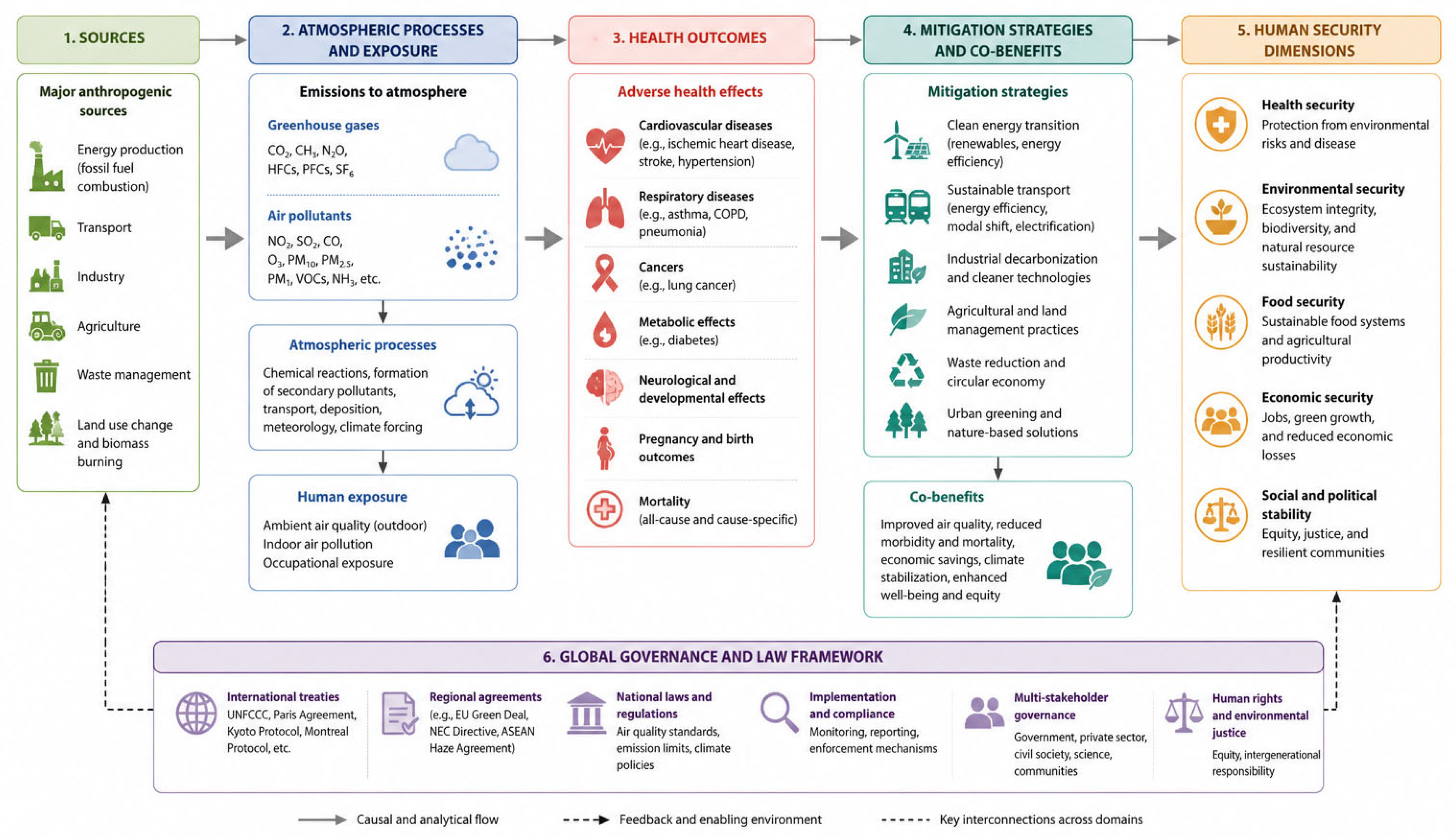
Figure 1. Schematic overview of the review. The figure illustrates the interconnections between major sources of greenhouse gas emissions and air pollutants, atmospheric processes and human exposure, health outcomes, mitigation strategies and their co-benefits, human security dimensions, and global governance and law frameworks. Abbreviations: ASEAN, Association of Southeast Asian Nations (The ASEAN Agreement on Transboundary Haze Pollution, a regional agreement aimed at preventing and controlling cross-border haze pollution in Southeast Asia); CH4, methane; CO, carbon monoxide; CO2, carbon dioxide; COPD, chronic obstructive pulmonary disease; EU, European Union; F-gases, fluorinated greenhouse gases; HFCs, hydrofluorocarbons; IHD, ischaemic heart disease; NEC Directive, National Emission reduction Commitments Directive (The EU National Emission reduction Commitments Directive, which sets national reduction commitments for selected air pollutants across EU Member States); N2O, nitrous oxide; NH3, ammonia; NOx, nitrogen oxides; O3, ozone; PFCs, perfluorocarbons; PM, particulate matter; PM2.5, particulate matter with an aerodynamic diameter of 2.5 μm or less; PM10, particulate matter with an aerodynamic diameter of 10 μm or less; SF6, sulphur hexafluoride; SO2, sulphur dioxide; UNFCCC, United Nations Framework Convention on Climate Change; VOCs, volatile organic compounds.
Applsci 16 06598 g001
Figure 2. Overview of epidemiological pathways and methodological challenges in air pollution research. The figure summarises the pathway from emission sources and atmospheric pollutants to population exposure, biological mechanisms, health outcomes, and burden of disease, while also highlighting key methodological challenges in epidemiological studies, including exposure assessment uncertainty, exposure misclassification, confounding, multi-pollutant exposure, spatial and temporal variability, study design limitations, outcome measurement heterogeneity, and uncertainty in risk estimation. Abbreviations: CH4, methane; CO, carbon monoxide; CO2, carbon dioxide; COPD, chronic obstructive pulmonary disease; DALYs, disability-adjusted life years; GBD, Global Burden of Disease; GHG, greenhouse gas; IHD, ischaemic heart disease; N2O, nitrous oxide; NH3, ammonia; NO2, nitrogen dioxide; NOx, nitrogen oxides; O3, ozone; PM, particulate matter; PM2.5, particulate matter with an aerodynamic diameter of 2.5 μm or less; PM10, particulate matter with an aerodynamic diameter of 10 μm or less; SES, socioeconomic status; SO2, sulphur dioxide; VOCs, volatile organic compounds; YLDs, years lived with disability; YLLs, years of life lost.
Applsci 16 06598 g002
Figure 3. Integrated framework for coordinated action on greenhouse gas emissions, air quality, public health, human security, and global governance. The figure illustrates the proposed framework linking environmental pressures, exposure and vulnerability, health and societal impacts, mitigation strategies and co-benefits, human security dimensions, and global governance and law. It also identifies cross-cutting priorities for integrated action and research, including interdisciplinary evidence generation, integrated monitoring and modelling, policy coordination across sectors, equity-focused implementation, robust evaluation, and international cooperation. Abbreviations: ASEAN, Association of Southeast Asian Nations; AU, African Union; CO2, carbon dioxide; EU, European Union; SDGs, Sustainable Development Goals; UNFCCC, United Nations Framework Convention on Climate Change.
Applsci 16 06598 g003
Table 1. Overview of major sources of greenhouse gas emissions and atmospheric pollutants.
Sector/SourceMain Greenhouse GasesMain Atmospheric PollutantsPrincipal Emission ProcessesRelevant Mitigation and Control Approaches
Fossil fuel combustion and energy productionCO2, CH4, N2ONOx, SO2, CO, PM2.5, PM10, black carbon, VOCsCombustion of coal, oil, and natural gas for electricity, heat, industrial processes, and power generation; fugitive emissions from fossil fuel extraction, processing, and transportRenewable energy deployment; fuel switching; energy-efficiency improvements; electrification where feasible; methane leak detection and repair; flue-gas desulphurisation; selective catalytic reduction; electrostatic precipitators and fabric filters; continuous emissions monitoring
Industrial activitiesCO2, CH4, N2O, fluorinated gasesNOx, SO2, PM, VOCs, heavy metals and other hazardous air pollutantsHigh-temperature industrial processes; combustion in manufacturing; cement, steel, chemical, and refinery activities; solvent use; process-related emissionsBest available techniques; cleaner production processes; low-carbon industrial technologies; process optimisation; circular economy approaches; carbon capture, utilisation, and storage where appropriate; stricter emission standards and regulatory enforcement
Transport systemsCO2, CH4, N2ONOx, CO, PM2.5, PM10, black carbon, VOCs, ultrafine particlesFuel combustion in road transport, aviation, maritime shipping, and diesel rail; non-exhaust emissions from brake and tyre wear and road dust resuspensionPublic transport expansion; active mobility; vehicle electrification with low-carbon electricity; stricter fuel-quality and emission standards; low- and zero-emission zones; traffic-demand management; cleaner maritime fuels; port electrification; operational efficiency in aviation and shipping
Agriculture and livestockCH4, N2O, CO2NH3, PM, bioaerosols, odorous compoundsEnteric fermentation; manure management; fertiliser application; soil microbial processes; agricultural machinery and biomass burningImproved fertiliser management; manure treatment; anaerobic digestion; feed and dietary interventions for livestock; reduced open burning; precision agriculture; sustainable soil management; promotion of low-emission agricultural practices
Land-use change and forestryCO2, CH4, N2OPM, black carbon, smoke-related pollutantsDeforestation; forest degradation; conversion of natural ecosystems into agricultural or urban land; vegetation burning and soil carbon lossAvoided deforestation; afforestation and reforestation; restoration of degraded ecosystems; sustainable land management; protection of carbon sinks; fire prevention and control
Waste managementCH4, CO2, N2OPM, VOCs, NOx, SO2, dioxins and other combustion-related pollutantsLandfill decomposition; wastewater treatment; open waste burning; uncontrolled combustion; waste transport and processingLandfill gas capture; improved wastewater treatment; recycling and composting; reduction of open burning; waste-to-energy systems with appropriate pollution-control technologies; circular economy strategies
Urbanisation and built environmentCO2, CH4, N2ONOx, PM2.5, PM10, O3 precursors, CO, VOCsEnergy demand in buildings; residential heating and cooling; traffic concentration; construction activities; urban heat island effects; altered carbon fluxes in urban ecosystemsCompact urban planning; energy-efficient buildings; clean heating and cooling systems; urban greening; sustainable mobility; low-emission zones; improved ventilation corridors; integrated urban climate and air-quality policies
Abbreviations: CH4, methane; CO, carbon monoxide; CO2, carbon dioxide; N2O, nitrous oxide; NH3, ammonia; NOx, nitrogen oxides; O3, ozone; PM, particulate matter; PM2.5, particulate matter with an aerodynamic diameter of 2.5 μm or less; PM10, particulate matter with an aerodynamic diameter of 10 μm or less; SO2, sulphur dioxide; VOCs, volatile organic compounds.
Table 2. Main atmospheric pollutants and mitigation strategies by mode of transport.
Mode of TransportMain Atmospheric PollutantsMain Emission CharacteristicsStrategies to Minimise Atmospheric Pollution
Road transportCO2, NOx, CO, PM2.5, PM10, black carbon, VOCsTailpipe emissions from petrol and diesel engines; non-exhaust emissions from brake and tyre wear and road dust resuspensionElectrification of vehicle fleets; stricter emission standards; low- and zero-emission zones; modal shift to public transport; traffic-demand management; cleaner fuels; promotion of active mobility
AviationCO2, NOx, ultrafine particles, SO2, water vapourEmissions from aircraft engines during landing, take-off, taxiing, and cruise; local effects around airports and climate-related effects at altitudeMore efficient aircraft and operations; sustainable aviation fuels; improved airport ground operations; electrification of ground-support equipment; demand management where appropriate
Maritime shippingCO2, NOx, SO2, PM, black carbonEmissions from marine engines, especially where heavy fuel oils are used; relevant exposure in port cities and coastal areasLow-sulphur fuels; shore-side electricity at ports; cleaner propulsion systems; operational efficiency; speed optimisation; emission-control areas
Rail transportCO2, NOx, PMLow direct emissions when electrified; diesel rail remains a source of combustion-related pollutantsRail electrification; renewable electricity supply; replacement of diesel locomotives; improved energy efficiency
Active mobilityNo direct tailpipe pollutantsNo direct atmospheric emissions; benefits depend on substitution of motorised tripsSafe walking and cycling infrastructure; integration with public transport; urban planning that reduces dependence on private cars
Abbreviations: CH4, methane; CO, carbon monoxide; CO2, carbon dioxide; N2O, nitrous oxide; NH3, ammonia; NOx, nitrogen oxides; O3, ozone; PM, particulate matter; PM2.5, particulate matter with an aerodynamic diameter of 2.5 μm or less; PM10, particulate matter with an aerodynamic diameter of 10 μm or less; SO2, sulphur dioxide; VOCs, volatile organic compounds.
Table 3. Greenhouse gas mitigation strategies and public health co-benefits.
Mitigation DomainMain Intervention MechanismsExpected Effects on Air QualityPotential Public Health Co-BenefitsMain Implementation Challenges
Energy transitionReplacement of coal, oil, and other high-emission fuels with renewable and low-carbon energy sources; improvement of energy efficiency; modernisation of power systemsReduction in PM2.5, PM10, NOx, SO2, CO, and other combustion-related pollutantsLower cardiovascular and respiratory morbidity and mortality; fewer hospital admissions; reduced population exposure to harmful pollutantsEnergy security; grid capacity; storage needs; investment costs; equity in access to clean energy
Industrial decarbonisationCleaner production processes; fuel switching; electrification where feasible; best available techniques; carbon capture, utilisation, and storage; end-of-pipe emission controlsReduction in industrial PM, SO2, NOx, VOCs, heavy metals, and process-related pollutantsReduced occupational and community exposure; lower burden of cardiopulmonary disease; improved environmental quality in industrial areasTechnological feasibility; costs for small and medium enterprises; regulatory enforcement; monitoring capacity
Sustainable transportExpansion of public transport; active mobility; vehicle electrification; low- and zero-emission zones; stricter fuel-quality and emission standards; traffic-demand managementReduction in traffic-related NOx, CO, PM2.5, PM10, black carbon, VOCs, and ultrafine particlesReduced cardiovascular and respiratory risks; fewer asthma and COPD exacerbations; increased physical activity from walking and cycling; reduced noise exposureInfrastructure needs; behavioural change; affordability; electricity mix; battery supply chains; urban–rural differences
Urban environmental policiesCompact urban planning; mixed land use; green infrastructure; urban forests and parks; ventilation corridors; reduction of urban heat islandsImproved pollutant dispersion; partial removal of airborne particles; reduction in heat-related pollutant formation and heat stressImproved mental health; increased physical activity; reduced heat-related morbidity and mortality; lower stress and improved quality of lifeLand availability; maintenance costs; unequal access to green space; risk of green gentrification; cross-sector coordination
Buildings, heating, and coolingEnergy-efficient buildings; insulation; clean heating systems; heat pumps; district heating; renewable energy integration; reduced reliance on biomass and fossil fuelsReduction in residential PM2.5, NOx, SO2, CO, and indoor pollutants from inefficient heating and combustionReduced respiratory symptoms; improved indoor air quality; fewer winter pollution episodes; protection of vulnerable populationsUpfront renovation costs; split incentives between owners and tenants; affordability; need for skilled workforce
Agriculture and land managementImproved fertiliser management; manure treatment; anaerobic digestion; reduced biomass burning; sustainable soil management; afforestation and reforestationReduction in NH3, CH4, N2O, secondary PM formation, smoke-related pollutants, and dust emissionsReduced exposure to secondary PM2.5; improved ecosystem services; protection of food systems; potential climate and health resilience benefitsFarmer adoption; economic incentives; land-use competition; monitoring emissions; balancing productivity and sustainability
Waste management and circular economyLandfill gas capture; recycling; composting; reduction of open waste burning; waste prevention; material reuse; waste-to-energy with appropriate pollution controlsReduction in CH4, PM, VOCs, dioxins, NOx, SO2, and other combustion-related pollutantsReduced community exposure to toxic emissions; improved urban hygiene; lower environmental contamination; reduced climate forcingInformal waste systems; infrastructure investment; governance capacity; public participation; pollution control in waste-to-energy systems
Health impact assessment and integrated modellingUse of counterfactual scenarios, exposure–response functions, environmental modelling, and population health data to estimate intervention impactsDoes not directly reduce pollutants but supports identification of policies with the greatest air-quality and health benefitsQuantification of avoided deaths, hospital admissions, years of life lost, disability-adjusted life years, and healthcare costsData availability; uncertainty in exposure–response functions; transferability across contexts; communication of uncertainty to policymakers
Abbreviations: CH4, methane; CO, carbon monoxide; CO2, carbon dioxide; N2O, nitrous oxide; NH3, ammonia; NOx, nitrogen oxides; O3, ozone; PM, particulate matter; PM2.5, particulate matter with an aerodynamic diameter of 2.5 μm or less; PM10, particulate matter with an aerodynamic diameter of 10 μm or less; SO2, sulphur dioxide; VOCs, volatile organic compounds.
Table 4. Pathways linking greenhouse gas emissions, air pollution, climate change, and human security dimensions.
Human Security DimensionEnvironmental PathwayConcrete ImplicationsPolicy and Governance Relevance
Health securityExposure to pollutants, heatwaves, extreme weather events, and climate-sensitive diseasesIncreased cardiovascular, respiratory, infectious, heat-related, and chronic disease burden; pressure on healthcare systemsAir-quality standards; climate-resilient health systems; heat-health plans; surveillance and early-warning systems
Environmental securityEcosystem degradation, biodiversity loss, soil and water contamination, altered precipitation, and extreme eventsReduced ecosystem services, environmental instability, and loss of natural protective functionsEnvironmental regulation; ecosystem restoration; pollution control; integrated climate and biodiversity policies
Food securityClimate-related crop losses, water scarcity, extreme events, and air pollution effects on crop yieldsReduced agricultural productivity, food supply disruption, and increased food pricesClimate-resilient agriculture; sustainable land management; food-system adaptation; protection of rural livelihoods
Economic securityProductivity losses, infrastructure damage, healthcare costs, and disruption of livelihoodsIncreased economic burden, reduced labour productivity, and greater vulnerability of low-income groupsJust transition policies; social protection; investment in clean technologies; disaster-risk financing
Personal and community securityDisplacement due to sea-level rise, droughts, extreme events, and environmental degradationMigration pressures, social instability, urban overcrowding, and increased vulnerability of displaced groupsClimate adaptation; urban planning; migration governance; protection of displaced populations
Equity and environmental justiceUnequal exposure to pollution and climate hazards; unequal access to healthcare, green space, and adaptive resourcesDisproportionate impacts on children, older adults, low-income communities, and marginalised populationsEquity-oriented implementation; targeted mitigation; participatory governance; environmental justice policies
Disclaimer/Publisher’s Note: The statements, opinions and data contained in all publications are solely those of the individual author(s) and contributor(s) and not of MDPI and/or the editor(s). MDPI and/or the editor(s) disclaim responsibility for any injury to people or property resulting from any ideas, methods, instructions or products referred to in the content.