Article

Evacuation Dynamics and Path Optimization in Metro-Connected Underground Commercial Spaces Under Smoke Constraints

1
School of Civil Engineering and Transportation, Yangzhou University, Yangzhou 225127, China
2
School of Construction Engineering, Yangzhou Polytechnic Institute, Yangzhou 225127, China
*
Author to whom correspondence should be addressed.
Appl. Sci. 2026, 16(13), 6599; https://doi.org/10.3390/app16136599
Submission received: 19 April 2026 / Revised: 11 May 2026 / Accepted: 2 June 2026 / Published: 2 July 2026
(This article belongs to the Section Civil Engineering)

Abstract

With the expansion of metro networks and the increasing integration of underground retail and transit facilities, metro-connected underground commercial spaces have become a common yet safety-sensitive urban form. In fire scenarios, evacuation in such environments is constrained not only by enclosure and limited egress capacity, but also by the interaction between smoke spread and strongly coupled pedestrian flows across connected zones. Existing studies have examined smoke propagation or evacuation performance in underground spaces, but fewer have explicitly addressed how smoke constraints reshape node-level safety and the relative effectiveness of different intervention strategies in metro-connected commercial environments. This study investigates smoke-constrained evacuation dynamics in a representative metro-connected underground commercial space in Nanjing, China. A coupled simulation framework integrating PyroSim and Pathfinder is employed to examine multiple fire-source scenarios. Available safe egress time (ASET) at critical evacuation nodes is assessed using tenability criteria including visibility, temperature, and CO concentration, and is then compared with evacuation performance to diagnose hazardous routes and node-level failures. On this basis, three intervention strategies—corridor widening, stair widening, and pedestrian diversion—are comparatively evaluated. The results show that, within the modeled case, visibility most frequently becomes the controlling tenability criterion, and stairway nodes tend to lose safety margins earlier than final exits. This indicates that smoke constraints in connected underground commercial environments can trigger an early node-failure process before overall exit capacity is exhausted. The comparison further shows that behavior-oriented pedestrian diversion is more effective than geometric enlargement alone in reducing critical-node pressure and improving system-level evacuation performance under the modeled conditions. Rather than proposing universally transferable design rules, this study provides case-grounded evidence on how smoke propagation and pedestrian convergence jointly shape evacuation vulnerability in metro-connected underground commercial spaces, and offers a structured basis for critical-node diagnosis and intervention comparison in similarly configured environments.

1. Introduction

With the rapid expansion of urban rail transit systems and the continuous intensification of underground space development, the integration of metro stations with adjacent underground commercial facilities has become an increasingly common urban form. Metro-connected underground commercial spaces simultaneously accommodate transfer, shopping, dining, leisure, and short-term gathering, and therefore exhibit a much higher degree of spatial and operational complexity than either standalone underground commercial buildings or isolated metro stations [1,2]. This integrated development pattern improves land-use efficiency and accessibility, but also creates a more challenging evacuation environment under emergency conditions. In particular, when a fire occurs, evacuation is no longer constrained only by enclosure and limited egress capacity, but also by the interaction between smoke spread and strongly coupled pedestrian flows across connected underground zones [3,4].
Among the hazards affecting underground public environments, fire remains one of the most critical threats to life safety. Because underground spaces usually have limited natural ventilation, relatively long evacuation paths, and strong dependence on vertical circulation, fire incidents are frequently accompanied by rapid smoke accumulation, reduced visibility, and deterioration of route usability [5,6]. In connected underground commercial environments, these problems become more severe because smoke is not confined to a single compartment or corridor. Instead, it can propagate through shared passages, affect multiple circulation nodes, and interact with converging pedestrian streams from both commercial and transit-related activities. Under such conditions, evacuation failure may occur before the nominal capacity of the entire exit system is exhausted, especially when critical nodes lose tenability earlier than the final exits themselves [7].
Previous studies have established a substantial knowledge base on fire evacuation in underground public spaces. In underground commercial environments, numerical simulation has become a major method for analyzing smoke spread and evacuation risk. Yao et al. used PyroSim to simulate fire development in an underground commercial space and showed that preventing smoke intrusion into critical circulation nodes such as stairways can significantly improve evacuation success [8]. Li et al. further determined ASET values for different exits in an underground commercial street under multiple fire scenarios and used these results to support spatial optimization [9]. Studies on smoke control have also shown that ventilation-related conditions can alter tenability distribution and influence evacuation safety in underground environments [10]. These studies demonstrate that in enclosed underground spaces, smoke-induced temporal constraints often arise before the entire environment becomes untenable and that these constraints exhibit strong spatial heterogeneity.
Related research on metro stations has likewise shown that evacuation safety in rail-related underground environments is strongly influenced by passenger density, node capacity, and flow interaction. Sajid et al. evaluated fire risk in a subway station using fire simulation and casualty probability analysis [11]. Yang et al. and Chen et al. investigated subway station evacuation from the perspectives of pedestrian density, fire conditions, and train-related passenger surges [12,13]. These studies confirm that rail-related underground spaces are highly sensitive to the interaction between hazardous environmental conditions and high-density pedestrian flows. However, compared with ordinary metro stations, metro-connected underground commercial spaces usually involve a more complex overlap of movement purposes, spatial interfaces, and shared evacuation routes, which can amplify local bottlenecks and make evacuation organization more difficult [14,15].
In recent years, virtual reality and perception-oriented studies have also enriched the understanding of evacuation behavior in fire scenarios. Wang et al. used VR experiments to explore the effects of visibility, alarm voice prompts, and individual characteristics on pre-movement time [16]. Li et al. combined VR and eye-tracking methods to analyze the visual effectiveness of evacuation signage at different heights [17]. These studies provide useful evidence on delay, route recognition, and perceptual constraints in smoky environments. At the same time, they also suggest that evacuation under fire conditions cannot be adequately explained by geometry alone; perception, route familiarity, and behavioral response have a significant influence on evacuation efficiency and route choice.
A broader review of existing work indicates that factors influencing underground fire evacuation can generally be grouped into three dimensions: the built environment, the fire environment, and occupant behavior. From the built-environment perspective, path width, stair configuration, obstacle arrangement, and exit layout directly affect movement efficiency and congestion formation. Studies have shown that stair form, exit distribution, and corridor width can significantly alter evacuation performance in underground commercial or transit spaces [18,19,20,21]. From the fire-environment perspective, visibility, temperature, and toxic gas concentration are widely treated as the key tenability indicators affecting movement speed, route recognition, and continued evacuability [22,23,24]. From the behavioral perspective, pre-movement delay, familiarity with space, and crowd interaction introduce substantial uncertainty into evacuation dynamics [25,26,27]. Although this three-dimensional framework is useful, in metro-connected underground commercial spaces these factors are not simply additive. Instead, they become strongly coupled through shared corridors, converging flows, and uneven information distribution, so that the resulting evacuation process is shaped by both environmental deterioration and load concentration across the circulation network.
Evacuation path optimization has also been widely studied. Existing work has applied shortest-path algorithms, dynamic path planning methods, and simulation-based optimization to improve evacuation performance under hazard conditions. Choi et al. incorporated node hazard-state judgment into path planning to avoid smoke exposure [28]. Sunita et al. improved Dijkstra-based path planning for time-dependent routing [29]. Peng et al. proposed a neural-network-based dynamic path planning approach [30], while Liu et al. combined PyroSim with dynamic evacuation path adjustment under smoke-threshold conditions [31]. In parallel, another line of research has focused on improving evacuation through engineering adjustment of physical components, such as widening exits, reorganizing stairs, or adjusting circulation facilities [32,33,34]. These studies have advanced evacuation analysis from static topology toward dynamic hazard-constrained routing and facility optimization.
However, several limitations remain in the current literature when viewed from the perspective of metro-connected underground commercial environments. First, a large proportion of existing studies still evaluate evacuation mainly in terms of total evacuation time, while giving insufficient attention to how smoke reshapes the temporal safety margins of individual nodes. Second, although many studies recognize bottlenecks, they often focus on final exits or global congestion intensity rather than on the sequence in which different nodes lose usability under smoke exposure. Third, studies comparing optimization strategies usually emphasize efficiency improvement, but rarely compare geometry-based interventions and behavior-oriented interventions under the same smoke-constrained framework. As a result, evacuation optimization is often discussed as a general time-reduction problem, while the more fundamental issue—how route continuity is broken through critical-node failure—remains insufficiently clarified.
These limitations are especially important in metro-connected underground commercial spaces because such spaces are not only larger or more crowded than ordinary underground facilities, but also more structurally interdependent. Shared corridors may simultaneously function as transfer passages, access channels, and evacuation routes. Stairways often serve as vertical egress components, but also act as convergence points for pedestrians coming from shops, atrium-related areas, and metro-connected interfaces. Under smoke-constrained conditions, these nodes may become functionally decisive well before the exit system as a whole reaches its nominal limit. Therefore, the key analytical question is not simply whether smoke reduces evacuation efficiency, but how smoke propagation, pedestrian convergence, and spatial connectivity jointly reshape node-level safety margins, thereby triggering route failure before complete exit-level overload occurs.
Against this background, the present study investigates smoke-constrained evacuation in the Dongfang Fulaide underground commercial area connected to Xinjiekou Station as a representative metro-connected underground commercial environment. A coupled simulation framework integrating PyroSim and Pathfinder is established to examine multiple fire-source scenarios and to analyze the interaction between smoke evolution and evacuation behavior. Available safe egress time (ASET) is assessed at critical evacuation nodes using multiple tenability criteria, and is then compared with evacuation demand in order to diagnose hazardous routes and node-level failures. On this basis, three intervention strategies—corridor widening, stair widening, and pedestrian diversion—are comparatively evaluated under the same smoke-constrained conditions.
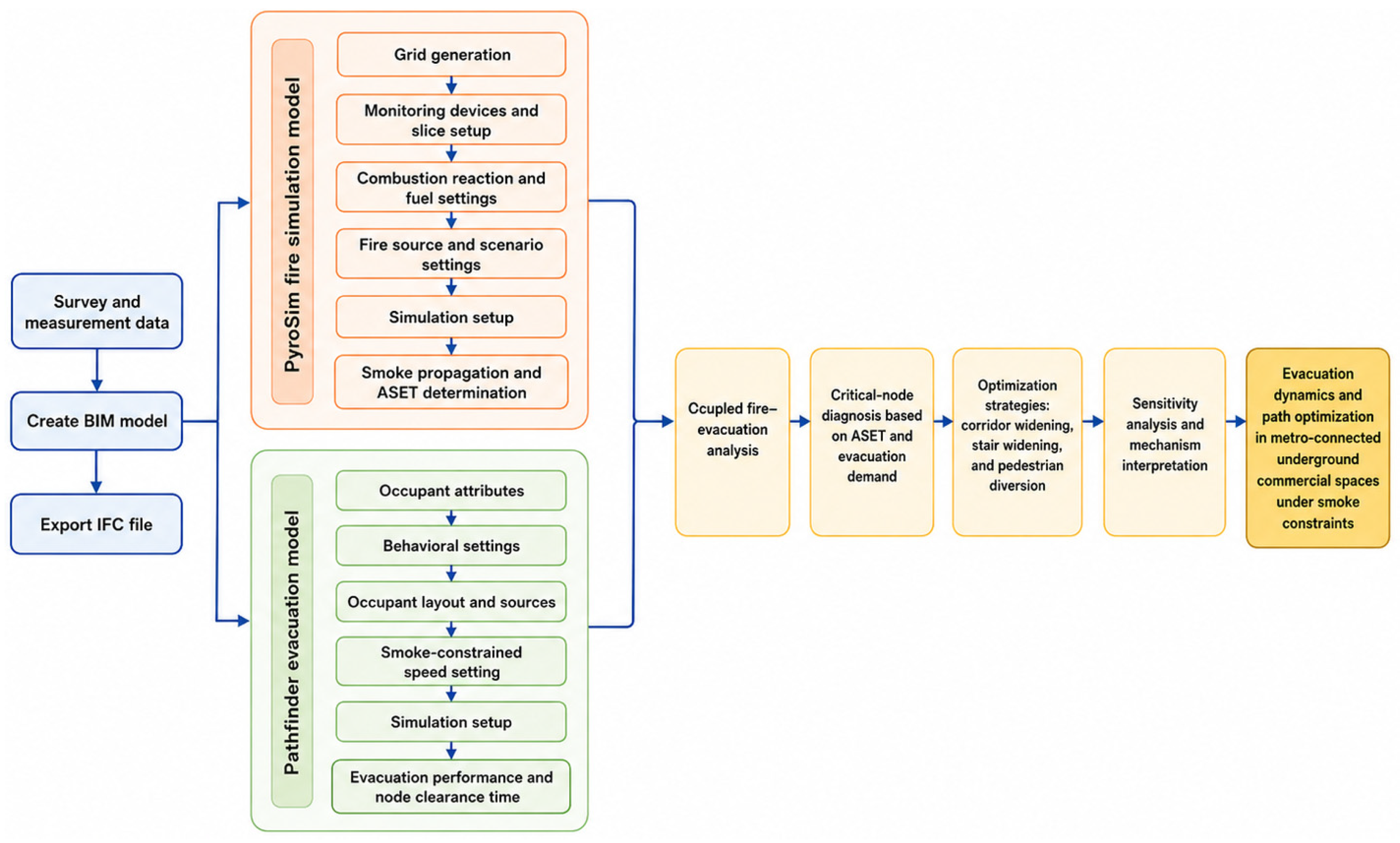
This study does not aim to propose a new simulation algorithm or to derive universally generalizable design rules from a single case. Instead, it uses a representative connected underground commercial environment to develop a more structured interpretation of evacuation vulnerability from a critical-node perspective. The objectives are threefold: (1) to identify how smoke propagation affects the temporal safety margins of critical evacuation nodes in a metro-connected underground commercial space; (2) to clarify how coupled smoke–pedestrian effects contribute to bottleneck formation and route failure, especially at vertically constrained nodes; and (3) to compare the roles of geometry-based and behavior-oriented interventions in relieving critical-node pressure under smoke constraints. By doing so, the study provides case-grounded evidence for node-level evacuation diagnosis and intervention comparison in similarly configured metro-connected underground commercial environments. The overall framework is illustrated in Figure 1.

2. Methodology

2.1. Study Area and Geometric Model Construction

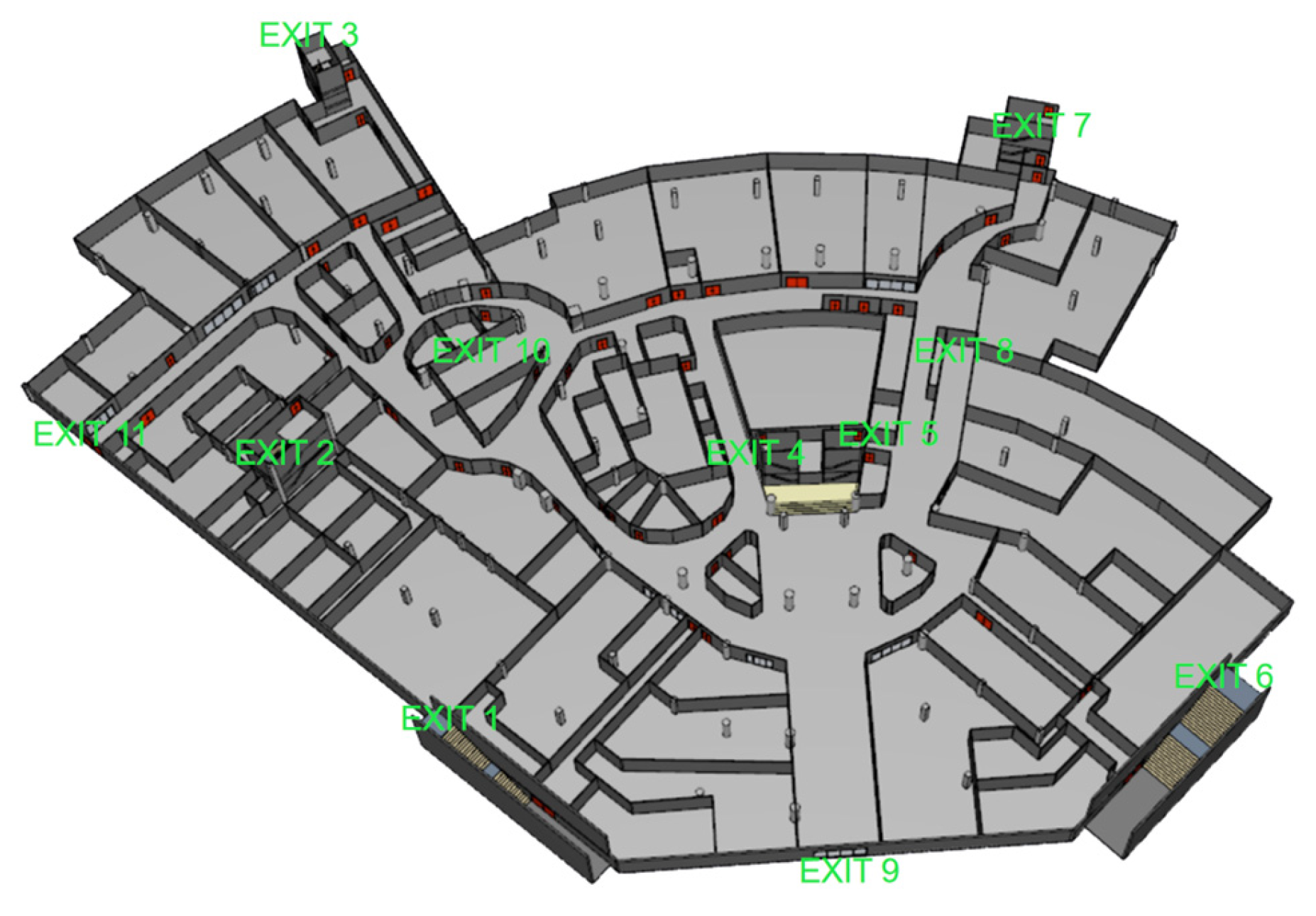
This study investigates the Dongfang Fulaide underground commercial area located in the Xinjiekou Station district as a representative metro-connected underground commercial space. To evaluate its evacuation safety under fire scenarios, a geometric simulation model was developed based on field survey data using Building Information Modeling (BIM) technology (Figure 2).
The case-study area is situated at the southwestern corner of Xinjiekou Station and contains an open public space of approximately 6500 m2. A total of 11 entrances and exits are provided for daily operation and emergency use. Among these, Exits 1–7 are designated as evacuation exits, and Exits 1 and 6 are directly connected to the metro station. Exits 9 and 11 are connected to the metro station but were not treated as formal evacuation exits in the present simulation because they are operated as circulation interfaces rather than emergency egress routes under the assumed management boundary of this case. Their exclusion should therefore be understood as a boundary-condition setting for the modeled evacuation system, rather than as an indication that these interfaces are universally unavailable in all emergency situations.

2.2. PyroSim Fire Simulation Model Construction

To apply the BIM model to fire dynamics simulation, PyroSim (Thunderhead Engineering, version 2024.2.1209) was used as the conversion platform. Through its built-in data interface, the IFC file generated from the BIM model was imported and parsed, allowing the fire geometry to be reconstructed for numerical simulation.

2.2.1. Grid Generation

To ensure the reliability of the numerical simulation, the characteristic fire diameter equation was used to verify the grid size (Equation (1)). In PyroSim, grid resolution is a key factor affecting simulation accuracy. Although a finer grid can improve the accuracy of the results, it also increases computational cost. Therefore, an appropriate balance between accuracy and computational efficiency is required.
D * = Q ρ c p T g 2 5
Here, D* denotes the characteristic diameter of the fire source (m); Q represents the heat release rate of the fire source; ρ is the ambient spatial density (set to 1.29 kg/m3); T indicates the internal ambient temperature (set to 293 K); Cp is the constant-pressure specific heat capacity (set to 1.005 kJ/(kg·K)); and g = 9.81 m/s2. The resulting ratio between the characteristic fire diameter and grid size falls within the commonly recommended range for FDS-based simulations, and was therefore considered adequate for balancing numerical reliability and computational cost across the tested scenarios [35]. Based on the above calculation, a mesh size of 0.3 m was adopted. This resolution was considered appropriate because the resulting ratio between the characteristic fire diameter and grid size falls within the commonly recommended range for FDS-based fire simulations, while also keeping the computational cost manageable across the multiple fire scenarios analyzed in this study [36]. Since the objective of the present work is comparative diagnosis of smoke-constrained evacuation performance rather than highly localized flame-resolution analysis, the selected grid size was regarded as sufficient for balancing numerical reliability and computational efficiency.

2.2.2. Monitoring Devices and Slice Setup

According to the principle of evacuation safety assessment, occupants can be regarded as capable of safe evacuation only when the available safe egress time (ASET) exceeds the required safe egress time (RSET). Since underground commercial spaces do not have a clearly defined ASET criterion similar to that used in metro systems, this study selected visibility, smoke temperature, and carbon monoxide (CO) concentration as the key indicators affecting evacuation efficiency and safety, based on previous studies [31,37,38,39].
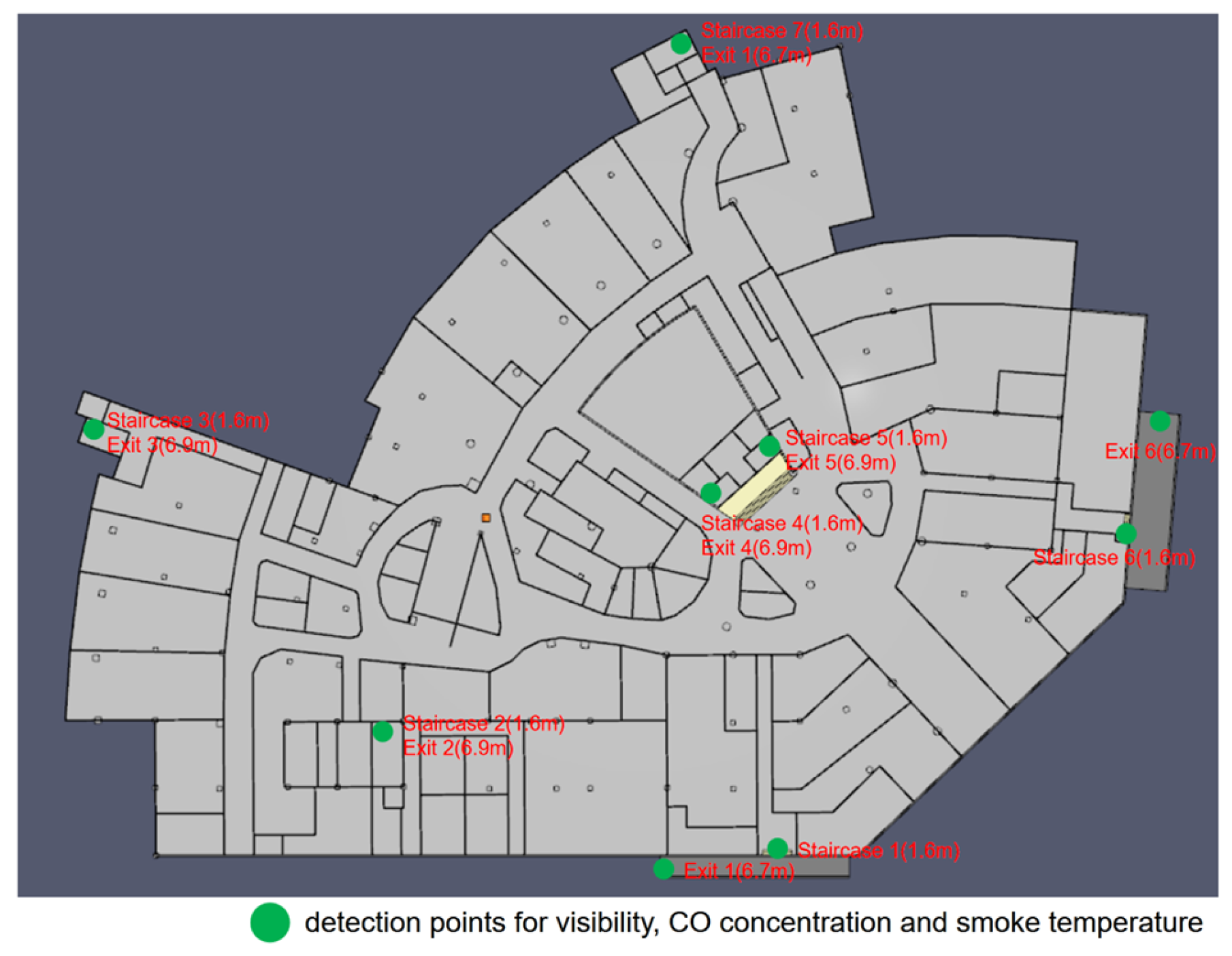
The effectiveness of monitoring depends strongly on sensor placement. In the vertical direction, the monitoring height should be consistent with ergonomic considerations so as to reflect the breathing and visual conditions experienced by evacuees. Based on previous studies, the sensors and slice planes were set at 1.6 m above the floor, corresponding approximately to average eye level. In the horizontal direction, monitoring points should be located at nodes that play a decisive role in evacuation. In addition to exits, previous studies have suggested that stair ascent nodes are also critical monitoring locations [31].
Accordingly, the ASET determination rules in this study were defined as follows: monitoring devices were placed at exits and stair ascent locations (the monitoring layout is shown in Figure 3); if any indicator reached its critical threshold during the simulation, the minimum time at which the thresholds were reached was taken as the ASET; if none of the indicators exceeded their threshold values throughout the simulation, the total simulation time was used as the reference value. The critical values adopted for each indicator are listed in Table 1.

2.2.3. Combustion Reaction

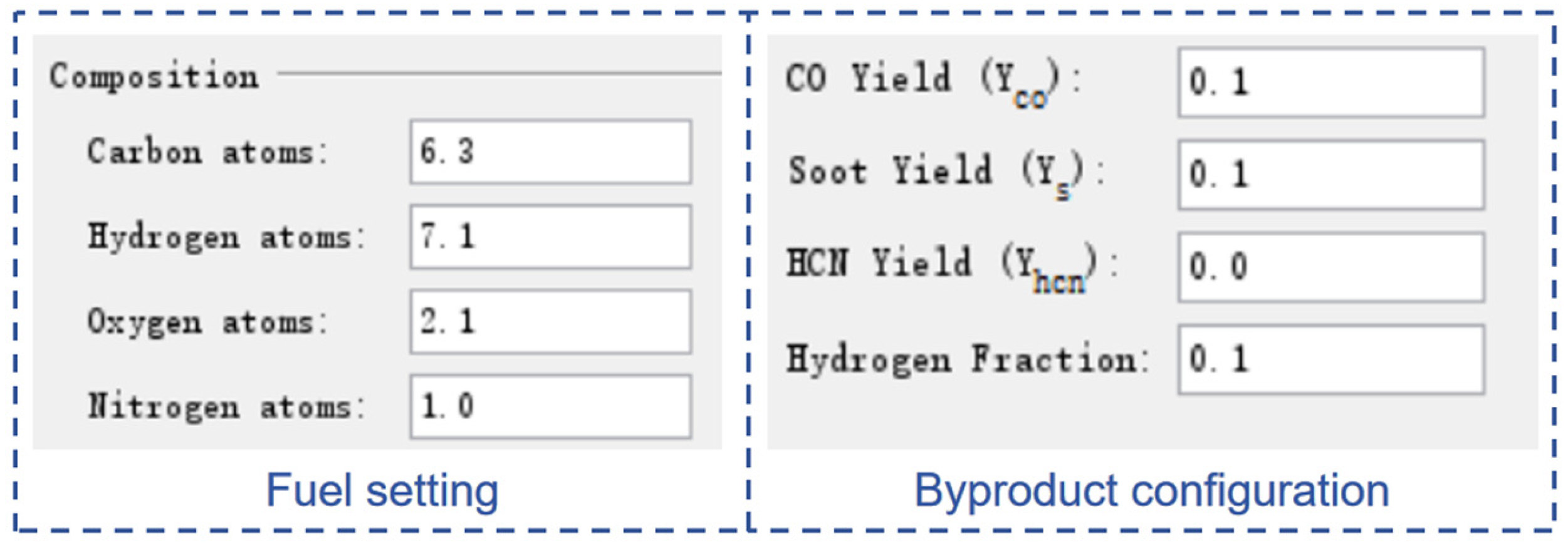
The combustible materials in metro-connected underground commercial spaces mainly include retail goods sold in shops and personal belongings carried by occupants, such as clothing and bags. Since many of these items are composed of synthetic fibers and are typically polyurethane-based, polyurethane was selected as the representative fuel species and its combustion reaction was activated in PyroSim. The corresponding fuel and combustion product parameters are shown in Figure 4.

2.2.4. Fire Source Setting

According to current Chinese smoke control and fire protection standards, metro-connected underground commercial buildings are classified as large occupant-dense public spaces. Given the presence of fire protection facilities, the heat release rate (HRR) was set to 3 MW/m2 according to the values listed in Table 2. The main combustible contents of the space, such as clothing, handbags, and plastic products, correspond to the combustion characteristics listed in Table 3, based on which the fire growth coefficient (α) was determined as 0.0469. Using the t2 fire growth model (Equation (2)) [8], the time required for the fire to reach an HRR of 3 MW was calculated as 253 s.
Q = α t 2
where Q denotes the fire heat release rate in kW, α represents the fire growth coefficient in kW/s2, and t indicates the fire growth time in s.
The selection of fire source locations is closely related to both fire development characteristics and evacuation urgency. In Dongfang Fulaide, pedestrian density varies considerably across different areas; therefore, fire sources should be placed in locations with high pedestrian convergence or high potential threat in order to capture representative simulation effects. Considering that fires are most likely to originate within shop areas, three fire scenarios were defined, corresponding to three fire source locations inside shops. These locations were selected at: (1) a shop near the main pedestrian convergence area along the principal corridor, (2) a small shop in the core zone of the commercial space, and (3) a shop located along the route leading to a shared exit. The fire area was set to 1 m2. The unit-area heat release rate was specified as 3 MW/m2 according to Table 2, and the t2 fire growth model was adopted. The fire was assumed to reach the preset heat release rate at 253 s.

2.2.5. Simulation Setting

Compared with ordinary metro areas, underground commercial spaces generally have more tortuous evacuation routes and greater evacuation difficulty. Therefore, although the Chinese Code for Metro Safety Evacuation (GB/T 33668-2017) [40] recommends that occupant evacuation time should be controlled within 360 s, the fire simulation duration in this study was extended to 400 s to provide a sufficient observation window.

2.3. Pathfinder Evacuation Model Construction

2.3.1. Occupant Attribute Settings

As the core participants in evacuation processes, the precise definition of personnel attributes and behavioral characteristics is critical to ensuring the reliability of evacuation simulation results.
(1)
Occupant categories
In constructing the personnel model for fire scenarios, this study categorized evacuees into six distinct attribute groups based on dual dimensions of age and gender. Given the negligible differences in behavioral characteristics between adolescent and elderly populations, the study retained adolescents (<18 years) and seniors (>60 years) as separate groups while further subdividing core demographics (youth aged 18–35 and middle-aged adults 36–60) into male and female subgroups. Specific threshold value configurations for age thresholds and demographic breakdowns across groups are detailed in Table 4.
(2)
Physical characteristics of occupants
Occupant physical characteristics, such as height, chest depth, and shoulder width, are important variables affecting evacuation efficiency, as they are directly related to movement speed and congestion risk when passing through narrow spaces such as doors, stairways, and corners. To ensure the reliability of the simulation, this study adopted representative anthropometric data in accordance with the Chinese standard Human Dimensions of Chinese Minors (GB/T 26158-2010) [41]. The body-dimension parameters used in the evacuation model are listed in Table 5 and serve as the basis for subsequent evacuation dynamics analysis.
(3)
Walking speed of occupants
Considering the constraints imposed by different path types on pedestrian movement, walking speeds were adjusted according to the characteristics of the evacuation route. Previous studies have shown that movement efficiency on stairways is significantly lower than that on level ground, with upward walking speed typically reduced to approximately 40% of horizontal walking speed and downward walking speed reduced to about 60%. Based on a review of previous studies, movement parameters on level surfaces and stairways were assigned separately in this study, as shown in Table 6 [42,43].
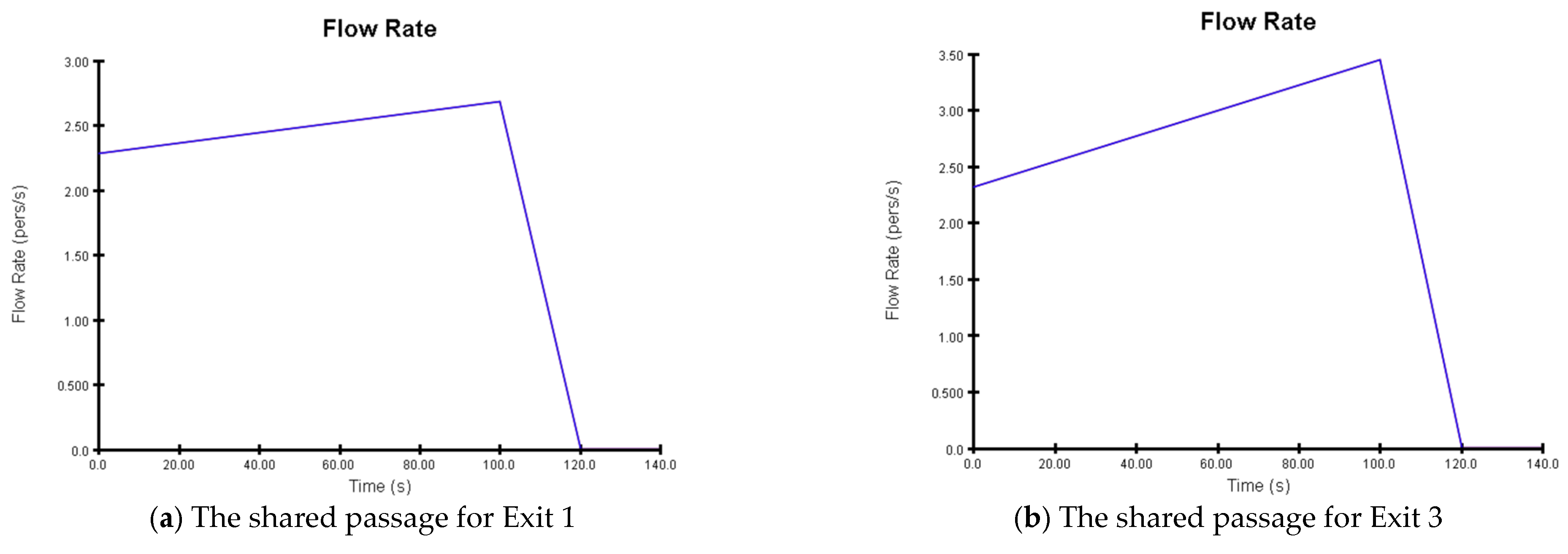
In addition, a typical passenger-flow intersection occurs between the metro system and the underground commercial space. To reproduce this condition, occupant sources representing passengers with different travel purposes were placed in the shared corridors. Based on field observations during peak periods, the flow rates of metro passengers in the shared corridors were determined (Table 7). Specifically, the flow rate at Exit 1 ranged from 2.28 to 2.68 persons/s, while that at Exit 6 ranged from 2.32 to 3.45 persons/s. The release duration of these occupant sources was set to 120 s. To reproduce the fluctuation in passenger flow caused by train arrival, a variable release mode was adopted: a lower flow rate was assigned during 0–100 s, followed by a higher flow rate after 100 s. The locations of the occupant sources are shown in Figure 5.
To better reproduce evacuation conditions under fire scenarios, the influence of smoke on pedestrian movement was incorporated into the speed adjustment process. Based on the visibility attenuation model proposed by Fridolf et al. in 2019 [44], occupant walking speed was dynamically updated according to the real-time smoke conditions. The corresponding formulation is given in Equation (3).
s p e e d = min s p e e d s m o k e - f r e e , max ( 0.2 , s p e e d s m o k e - f r e e 0.34 × ( 3 v i s )

2.3.2. Behavioral Settings of Occupants

To reproduce realistic fire evacuation scenarios, occupant pre-movement behavior was incorporated into the model. The assumed pre-movement interval was not intended to represent a site-specific empirical parameter, but rather a literature-informed behavioral simplification commonly adopted in simulation-based evacuation studies of enclosed public spaces. The 20 s evacuation start time and the additional 0–20 s random delay assigned to part of the occupants were used to reflect early alarm recognition together with non-synchronous response behavior [45,46]. The sensitivity of the main conclusions to this assumption was subsequently tested in Section 3.4.2.
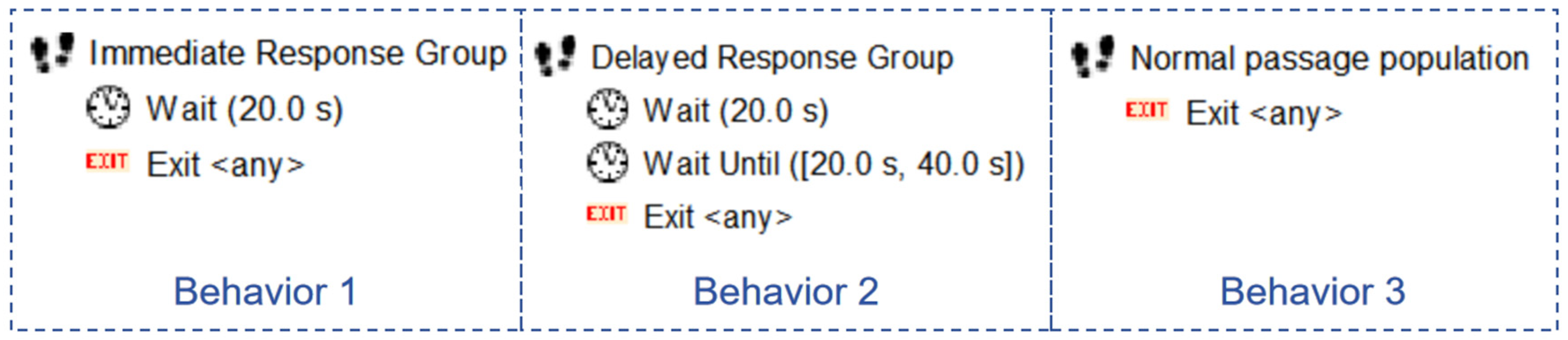
For occupants spawned at the starting positions of shared corridors, regular scenario settings are adopted: occupants start evacuation right after entering the corridor. Based on exit layout, metro passengers within the corridor are restricted to evacuate via the dedicated exit of the respective corridor without diverting to alternative exits. By contrast, occupants inside the shopping mall are assigned two behavioral modes: immediate evacuation and delayed evacuation, with relevant parameter configurations illustrated in Figure 6.

2.3.3. Simulation Settings

The Steering mode was adopted as the pedestrian movement algorithm in Pathfinder. Compared with the SFPE mode, the Steering mode provides more dynamic route adjustment capability and better represents pedestrian avoidance behavior in complex spaces, making it more suitable for simulating occupant movement under realistic fire evacuation conditions.
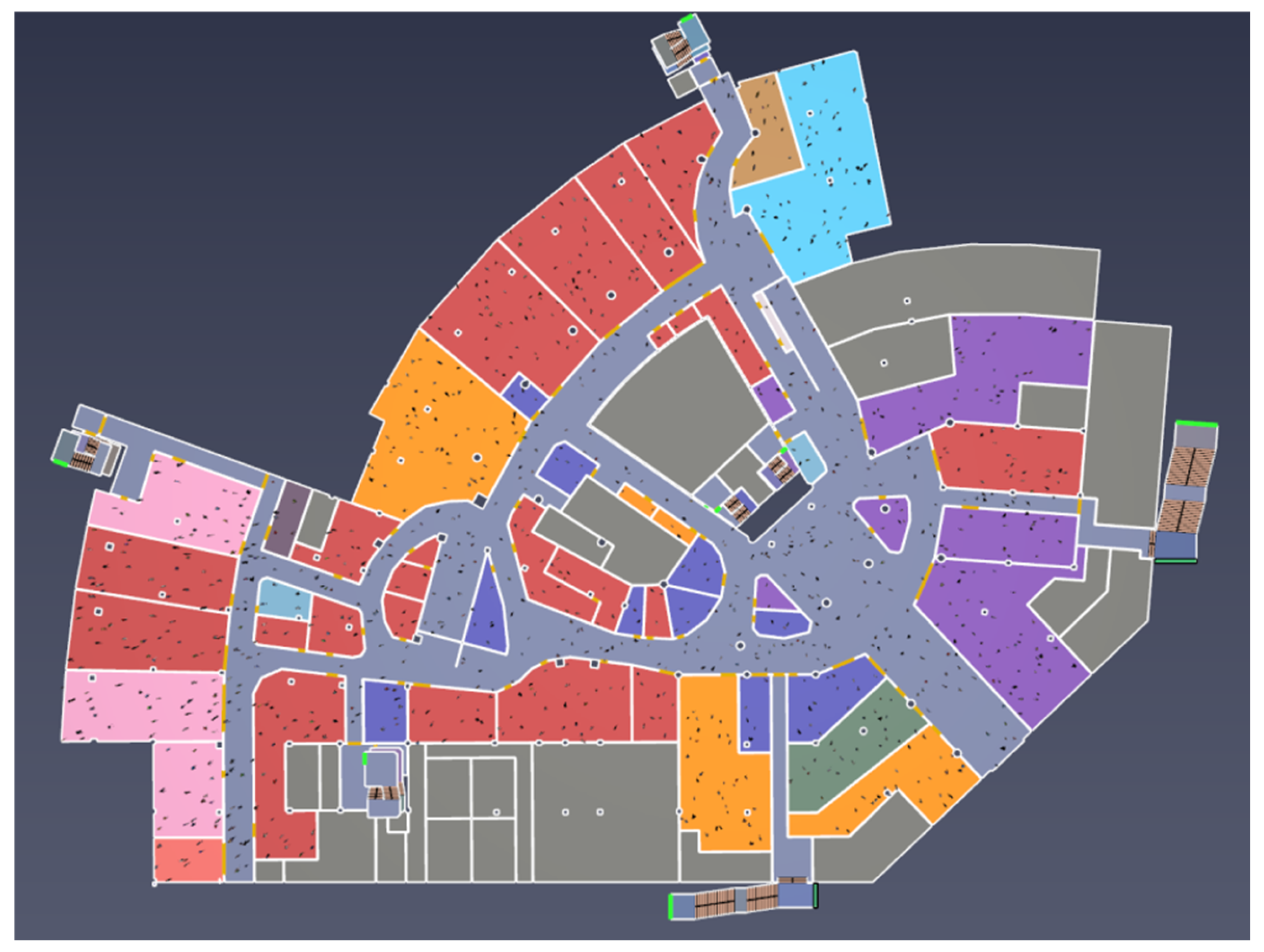
Based on field survey data collected during peak periods, the average number of occupants remaining in the underground commercial space is approximately 800 under normal conditions and about 1100 during peak hours, corresponding to an average occupancy area of 5.86 m2 per person. According to this occupancy density, 1100 evacuees were uniformly distributed throughout the target space. The resulting evacuation model is shown in Figure 7.

3. Case Study and Results Analysis

3.1. Fire Simulation Results

3.1.1. Smoke Propagation Under Different Scenarios

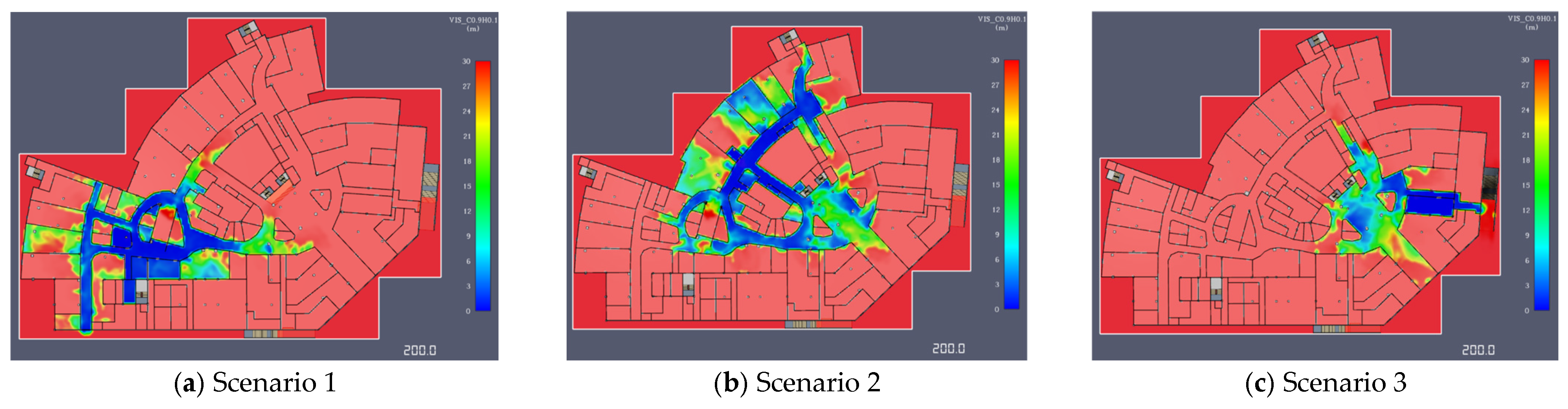
Overall, within the 400 s fire duration, smoke propagation under the three fire-source scenarios exhibited distinct stage-dependent characteristics. During the initial stage (0–100 s), smoke remained in the early release phase in all three scenarios and spread only within a very limited area near the fire source. No noticeable changes were observed at the monitoring points during this stage.
During the development stage (100–200 s), smoke in Scenario 1 began to spread directionally toward Stair 2, while smoke in Scenario 2 advanced steadily along the corridor toward Stair 4. In Scenario 3, smoke gradually propagated toward Stair 6. Between 200 and 300 s, Stair 2 in Scenario 1 became fully covered by smoke, and the smoke front further affected Stair 3. In Scenario 2, the core area was almost completely covered by smoke, and both Stair 4 and Stair 3 were affected. In Scenario 3, smoke accumulation near Exit 6 became significant, and a large amount of smoke was discharged along Exit 6, leading to an expanded affected area.
During the later stage (300–400 s), approximately one-third of the area in Scenario 1 was covered by smoke, affecting Exits 2, 3, 4, and 5. In Scenario 2, because the fire source was located in a small compartment at the center of the commercial space, smoke spread outward rapidly and eventually covered nearly the entire public area. All exits and corridors except Exit 3 were affected, although smoke concentration in the peripheral areas remained relatively low. In Scenario 3, smoke fully occupied the atrium and a large amount of smoke accumulated in the shared corridor, affecting not only occupants inside the commercial space but also passengers moving through the shared corridor. The smoke propagation patterns under the three scenarios are summarized in Table 8.

3.1.2. CO Concentration Under Different Scenarios

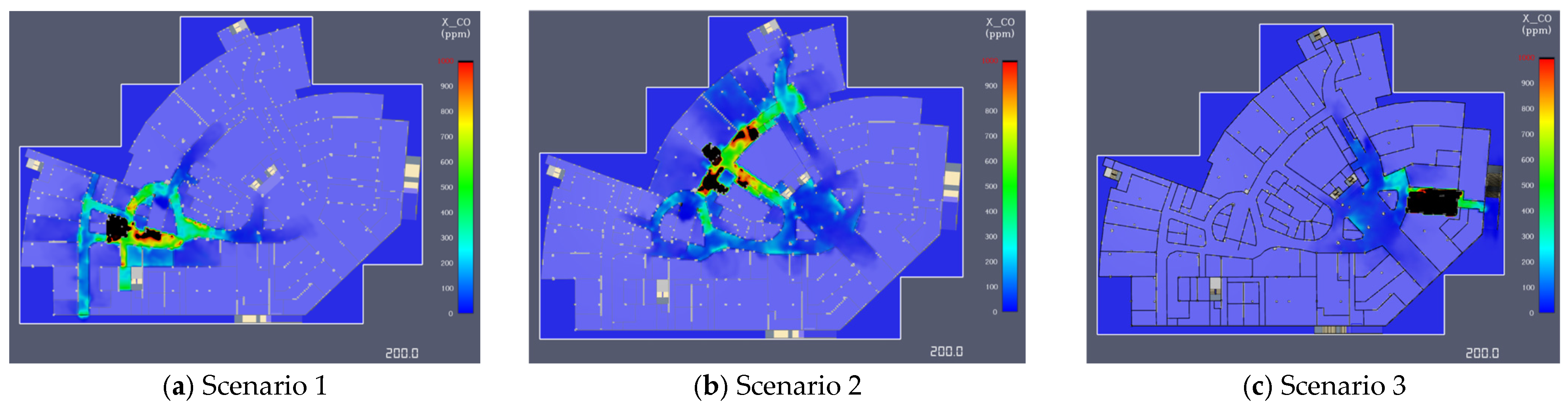
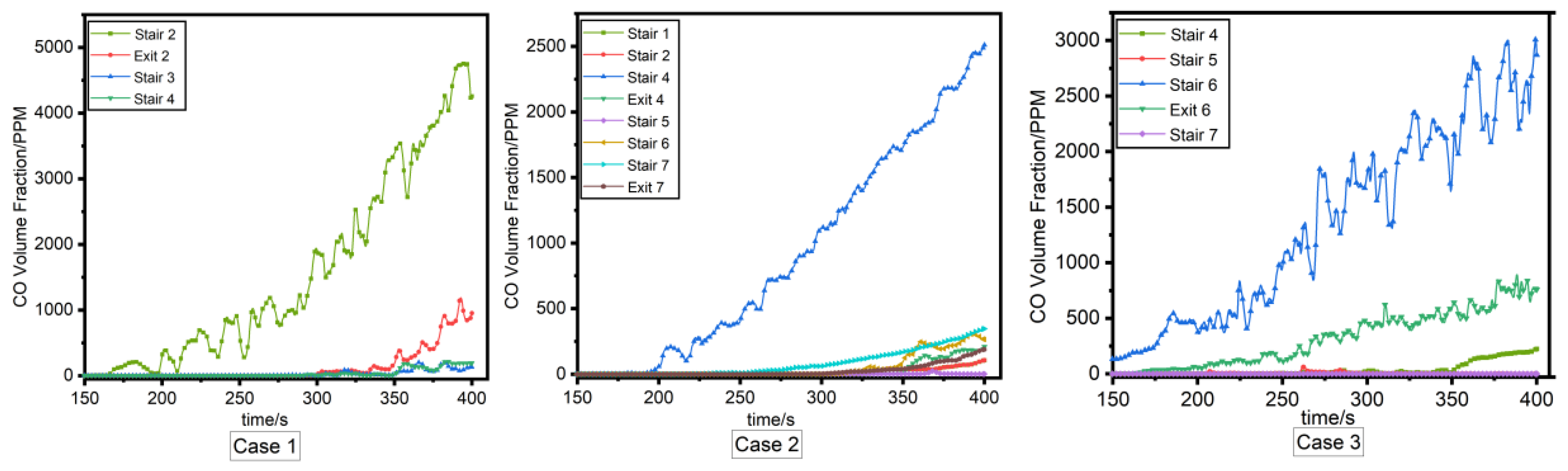
As shown in Figure 8, the CO concentration distributions under the three scenarios exhibited significant spatiotemporal differences. Only monitoring points influenced by smoke fluctuations are discussed here. In all scenarios, at least one monitoring point reached the critical threshold, indicating hazardous evacuation conditions.
In Scenario 1, the CO concentration at Stair 2 increased rapidly over time, exceeded the critical threshold of 1000 ppm at 258 s, and continued to rise, eventually approaching 5000 ppm. In contrast, the concentrations at Exit 2, Stair 3, and Stair 4 remained at relatively low levels. Only Exit 2 showed a late increase and reached the threshold at 391 s, while all other monitored stairs and exits remained below 500 ppm and therefore remained tenable for evacuation.
In Scenario 2, the CO concentration at Stair 4 showed a stable and continuous increase, exceeding the 1000 ppm threshold at approximately 296 s and eventually reaching more than 2500 ppm. Other monitoring points, such as Stair 1, Stair 2, and Exit 5, remained at relatively low levels and did not exceed the critical threshold.
In Scenario 3, the CO concentration at Stair 6 fluctuated while increasing and exceeded the threshold at approximately 250 s. It then continued to rise sharply, with a peak approaching 3000 ppm. Although concentrations at Stair 4, Exit 6, and Stair 7 also increased, only Exit 6 approached the threshold in the later stage, while the others remained below it.
The CO concentration curves indicate that, in each scenario, only one monitoring point experienced severe CO accumulation. Specifically, Stair 2 in Scenario 1, Stair 4 in Scenario 2, and Stair 6 in Scenario 3 represented the locations with the highest CO exposure risk, while the other monitoring points remained relatively safe. As shown in the CO concentration slices in Figure 9, although Scenario 2 exhibited a relatively later threshold time at the exit, the fire source was located in a confined compartment, allowing toxic gases to accumulate inside the shop and then spread outward more rapidly, causing several corridor areas to reach critical levels. Based on the overall CO hazard, the three scenarios can be ranked as Scenario 3 > Scenario 1 > Scenario 2.

3.1.3. Smoke Temperature Under Different Scenarios

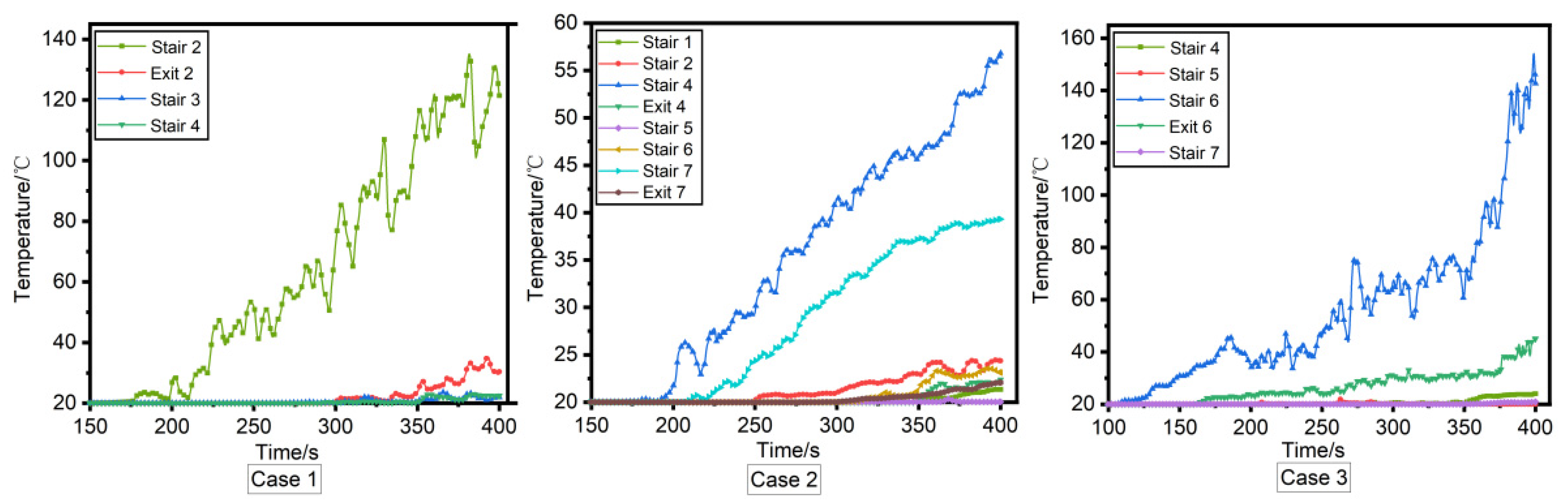
Figure 10 shows the evolution of smoke temperature under the three scenarios. In Scenario 1, temperature rise was mainly concentrated at Stair 2. The temperature at this node increased steadily from 223 s and reached the critical threshold at 280 s. After 350 s, it exceeded 120 °C and remained at a high level with noticeable fluctuations. By contrast, the temperatures at Exit 2, Stair 3, and Stair 4 remained relatively low throughout the simulation, with only a slight increase at Exit 2 in the final stage, which still remained below the evacuation threshold.
In Scenario 2, temperature evolution was centered on Stair 4 and displayed a stable and smooth increase. Although the temperature rose more rapidly during the middle stage of the fire, it did not reach the critical limit of 60 °C by the end of the simulation. Temperatures at the other exits remained almost unchanged and therefore did not significantly affect evacuation safety.
In Scenario 3, Stair 6, which was closest to the fire source, experienced the most severe thermal impact. The temperature at Stair 6 reached the critical threshold at 270 s and peaked at 154 °C by the end of the simulation. However, the increase in smoke temperature at Stair 6 did not lead to a comparable rise at Exit 6. This is likely because part of the smoke entered the shared corridor, which reduced the rate of heat accumulation at the exit. Other monitored locations, such as Stair 4 and Stair 7, showed only minor temperature variation, and their final temperatures remained below 40 °C.
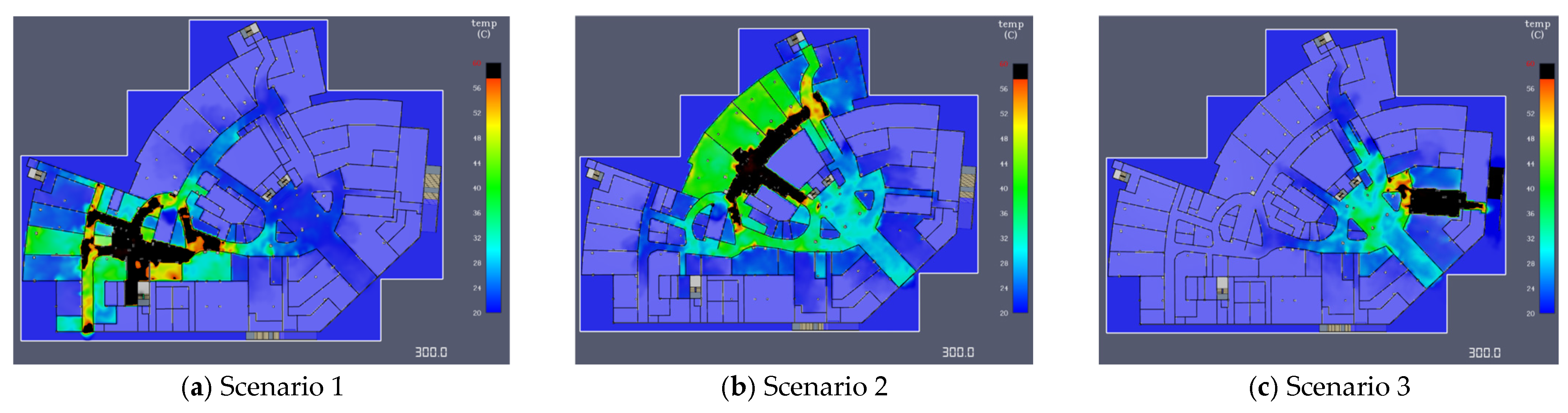
The temporal evolution of smoke temperature indicates that only Scenarios 1 and 2 reached critical temperature conditions, and the critical locations were mainly the stair ascent nodes rather than the exits. Because temperature changes were limited during the first 200 s, temperature slices at 300 s were further extracted, as shown in Figure 11. In Scenario 1, areas reaching the critical temperature threshold had already covered the main and secondary corridors in the core area and continued to expand outward. In Scenario 2, relatively large areas exceeded 40 °C, although the most critical temperature zone remained concentrated in the middle area. In Scenario 3, critical temperature zones were mainly confined to corridors and shop interiors. Because the fire source was close to the shared external exit, smoke tended to move outward, resulting in relatively limited thermal impact on the central part of the commercial space.

3.1.4. Visibility Under Different Scenarios

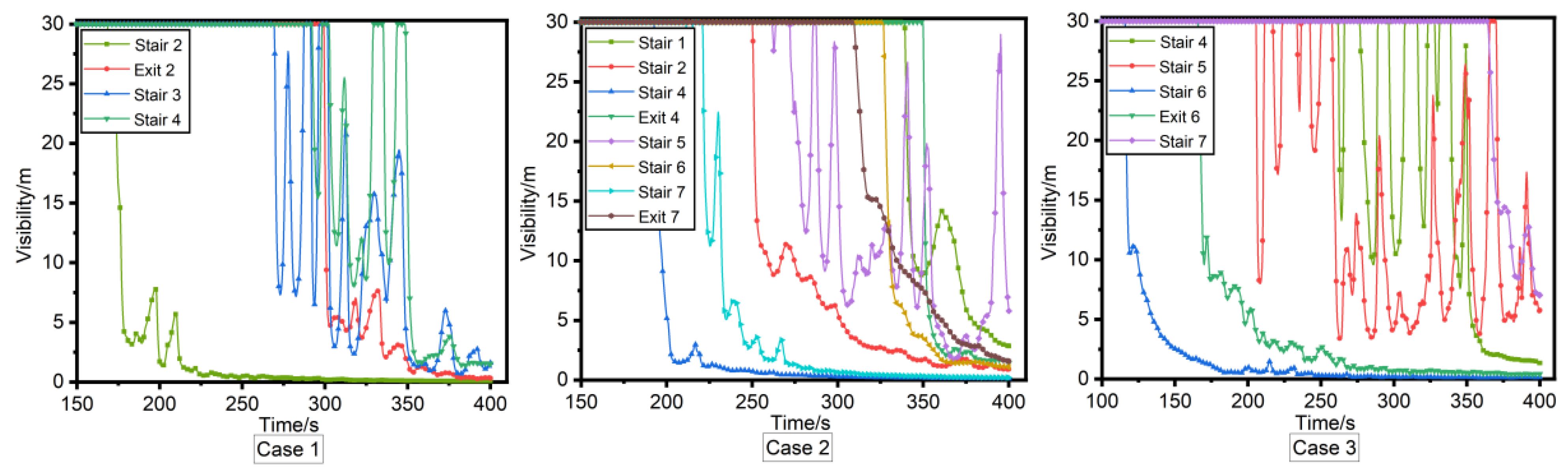
As shown in Figure 12, visibility posed a much greater threat to evacuation safety than either CO concentration or smoke temperature. Multiple stair nodes and exits reached the critical threshold in all three scenarios.
In Scenario 1, Exit 2 was the first location where visibility dropped below the critical threshold, at 177 s, followed closely by Stair 3 and Stair 4. As smoke continued to spread, Exit 2 was further affected, and its visibility dropped below 10 m at 301 s. In Scenario 2, because the fire source was located in the central part of the commercial space, a total of eight surrounding stair and exit nodes were affected. Stair 4 was the first node to experience visibility degradation, beginning at approximately 198 s, with visibility decreasing continuously from 30 m to nearly zero. Subsequently, Exit 7, Stair 2, Stair 5, and other critical nodes also experienced progressive visibility loss, and most monitoring points reached extremely low visibility levels by the end of the simulation. In Scenario 3, visibility reduction was mainly concentrated on one side of the commercial space, affecting Stair 4, Stair 5, Stair 6, and its corresponding exit, as well as Stair 7. Among them, Stair 6 was the first to be affected, with visibility dropping to the critical threshold as early as 125 s, and the affected zone gradually extended toward Exit 6 as the fire developed.
The visibility results clearly indicate that visibility was the dominant hazard among the three smoke-related indicators. Not only were the threshold times significantly earlier, but the number of affected critical nodes was also substantially greater than for CO concentration and temperature. The visibility slices in Figure 13 further show that, at 200 s, the main activity areas in Scenarios 1 and 2 had already fallen below 10 m, with surrounding areas approaching the same threshold. In Scenario 3, the visibility impact was mainly confined to the evacuation corridor. Although the smoke later spread to other parts of the commercial space, its impact remained relatively limited, and the shared exit was the main affected area.

3.1.5. Determination of ASET Under Different Scenarios

The simulation results under the three scenarios indicate that visibility was the most influential factor during the fire, as it reached the critical threshold earlier than the other indicators and affected a larger number of key nodes. Therefore, the determination of the available safe egress time (ASET) in this study was primarily based on visibility. The critical visibility times for each node under the three scenarios are summarized in Table 9.

3.2. Fire Evacuation Analysis of Dongfang Fulaide

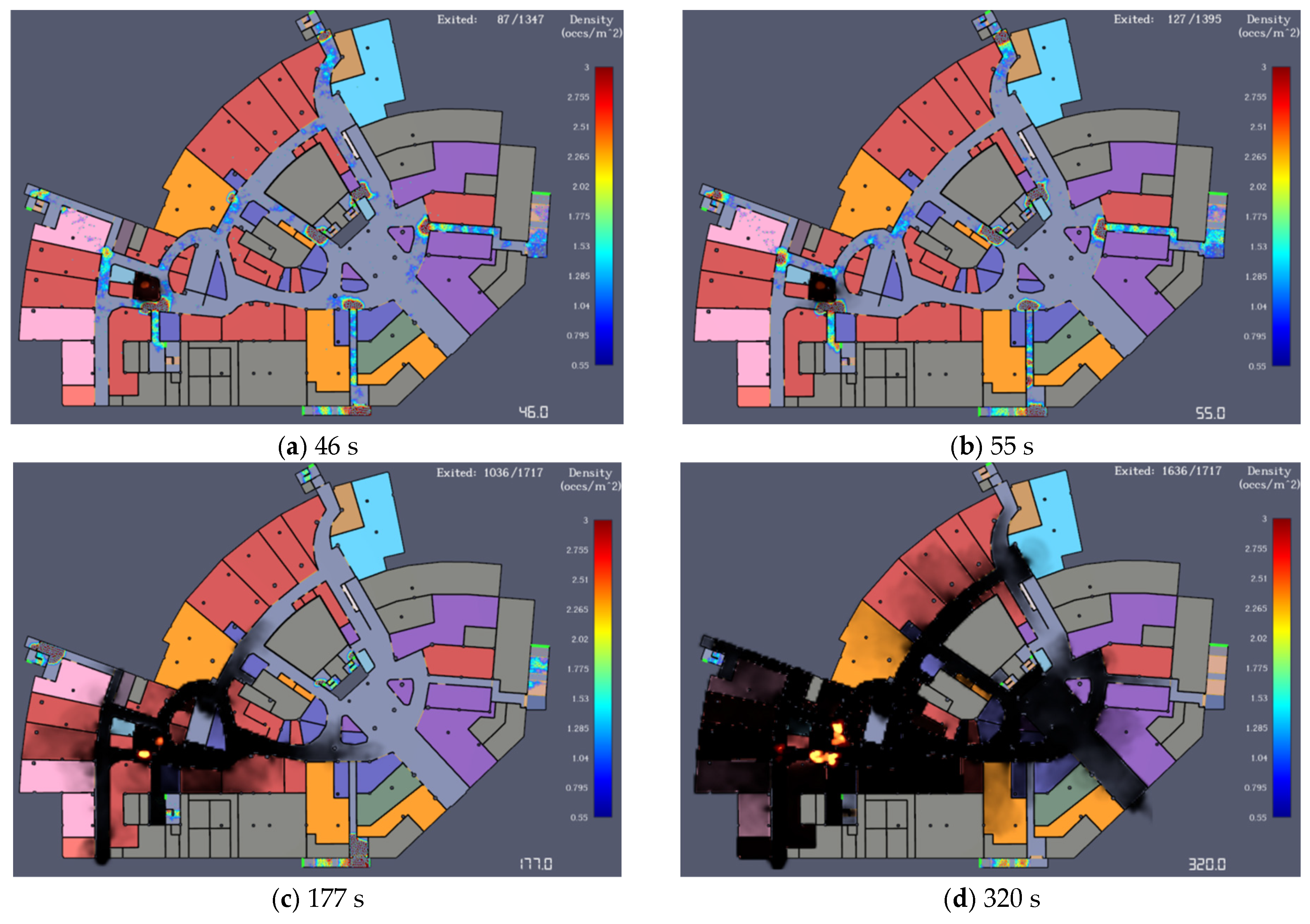
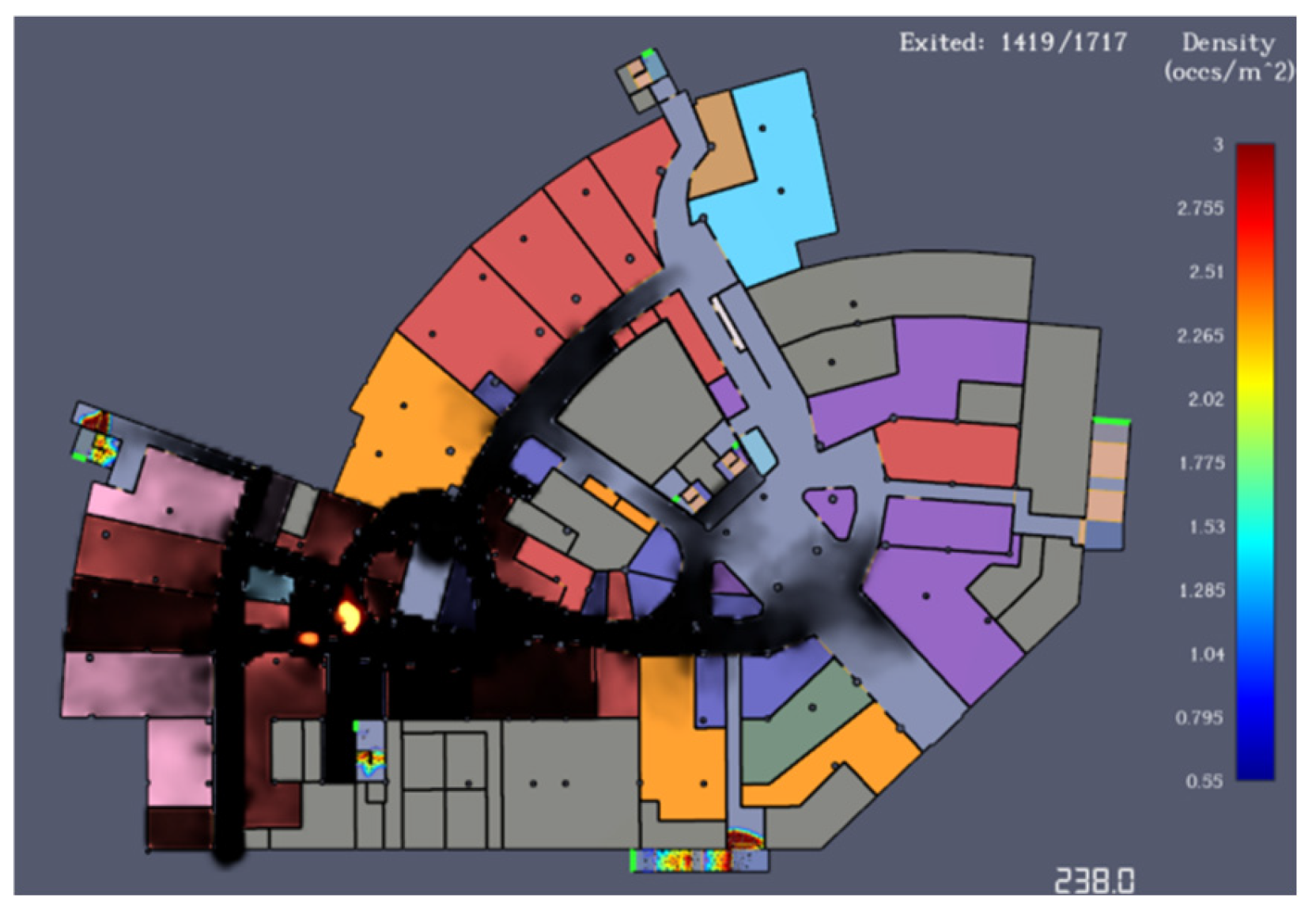
Based on the above fire simulation results, evacuation simulations were further conducted. A total of 1120 occupants were considered in the underground commercial space, excluding metro passengers exiting from the station. Scenario 1 was used as an example to illustrate the evacuation process. The total evacuation time under this scenario was 363 s, and the evacuation states at different times are shown in Figure 14.
All occupants began to evacuate gradually from 20 s after ignition. At 31 s, congestion first appeared in the corridor leading to Exit 2 and in the stairways leading to Exits 4 and 5. As evacuation continued, by 46 s, congestion had occurred in nearly all stairways and corridors leading to exits, with the most severe blockage observed along the paths to Exits 2, 4, and 5. The congestion associated with Exit 3 did not initially occur in the direct corridor to the exit; instead, many evacuees followed the shortest-path principle and passed through a service-related shop to shorten travel distance. However, severe crowding subsequently developed in the stairway associated with Exit 3 due to the large number of occupants entering this route. By 55 s, all occupants inside the shops had exited and were moving toward the evacuation routes.
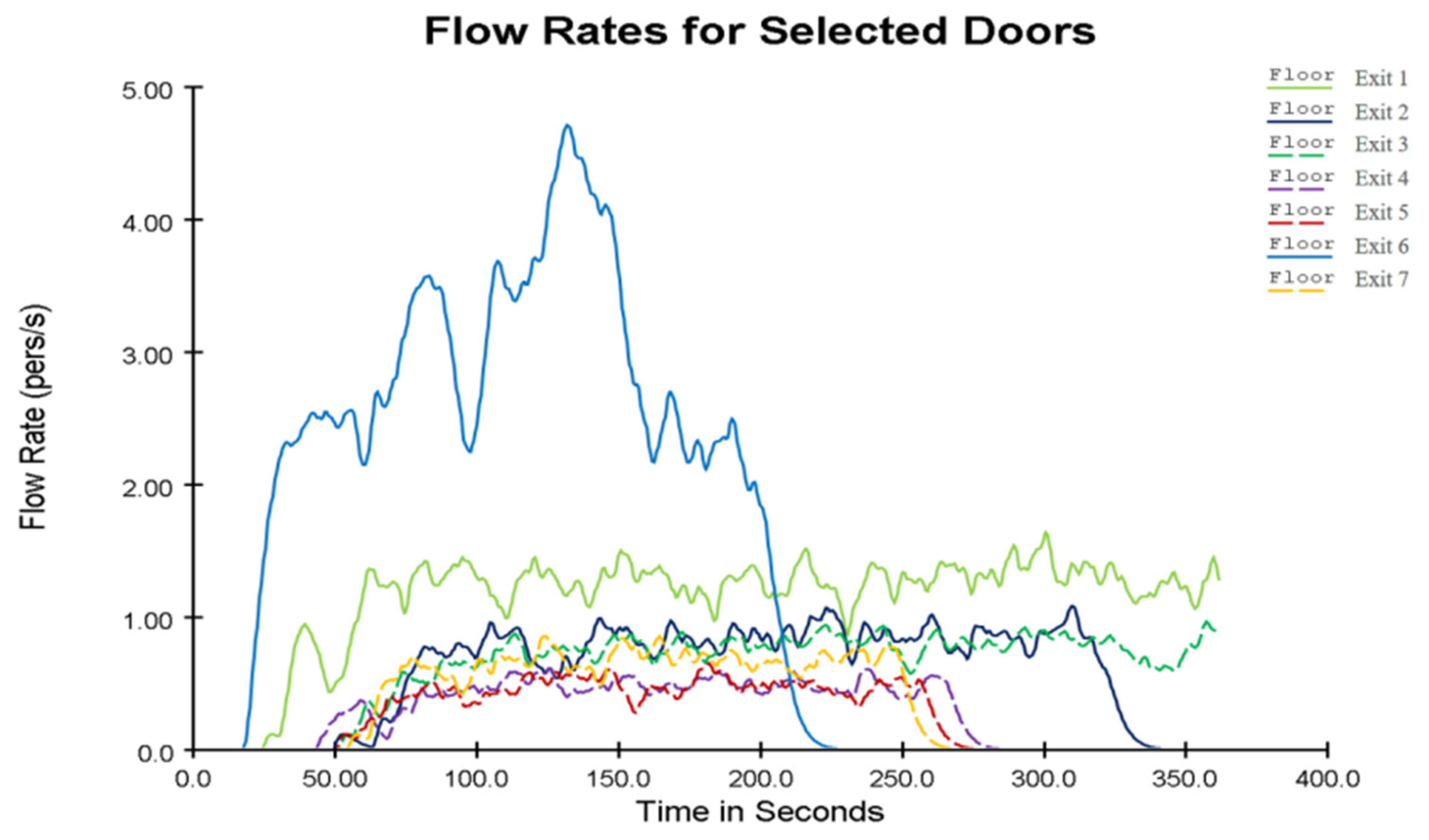
At 67 s, congestion was still present in the stairway leading to Exit 2, while smoke had already approached the corridor and began to spread inward within several seconds. The simulation also showed that evacuees in the shared corridors near Exits 1 and 6 experienced reduced movement speed due to interactions with metro passengers exiting from the station, resulting in evident crowd concentration at the flow-intersection points. By 177 s, the stairway associated with Exit 2 had already reached its ASET, but some evacuees were still trapped in this stairway, indicating that this route failed to meet the evacuation requirement. The last evacuee reached Exit 2 at 320 s. At this time, all occupants using Exits 4, 5, 6, and 7 had completed evacuation, with their respective completion times being 263 s, 254 s, 205 s, and 246 s. By 361 s, evacuation at Exit 1 was also completed. Because the commercial space and the metro station shared a corridor, the interaction of two pedestrian streams in this corridor created severe disruption to subsequent evacuation movement. The evacuation process ended at 363 s, with Exit 3 being the last exit to complete evacuation. Although the final evacuation time at Exit 3 did not exceed the allowable time at the exit itself, the stairway associated with Exit 3 exceeded the threshold time of 272 s. Overall, only Exits 2 and 3 failed to satisfy evacuation safety requirements, while the other exits remained tenable despite congestion and pedestrian interaction during the evacuation process.
The evacuation simulations for Scenarios 2 and 3 were conducted in the same manner, and the results are summarized in Table 10. The analysis shows that evacuation deficiencies occurred in all three scenarios. Scenario 1 was the most hazardous, with three critical nodes failing to satisfy the safe evacuation requirement. Scenario 2 ranked second, with two critical nodes failing, while Scenario 3 posed the lowest risk, involving only one failed node. Nodes with negative safety margins indicate that the actual evacuation time exceeded the available safe egress time and should therefore be regarded as hazardous evacuation routes. The number of such hazardous nodes directly reflects the overall risk level of each scenario. Further comparison shows that the negative safety margins at Stair 2 and Stair 3 in Scenario 1 were much greater than those in Scenario 2, whereas Scenario 3 had the smallest negative values. Therefore, considering both the number of hazardous nodes and the magnitude of safety margin deficits, Scenario 1 can be identified as the most dangerous fire scenario in Dongfang Fulaide, corresponding to a fire occurring at a pedestrian convergence point in the densely occupied area.

3.3. Evacuation Path Optimization in the Metro-Connected Underground Commercial Space

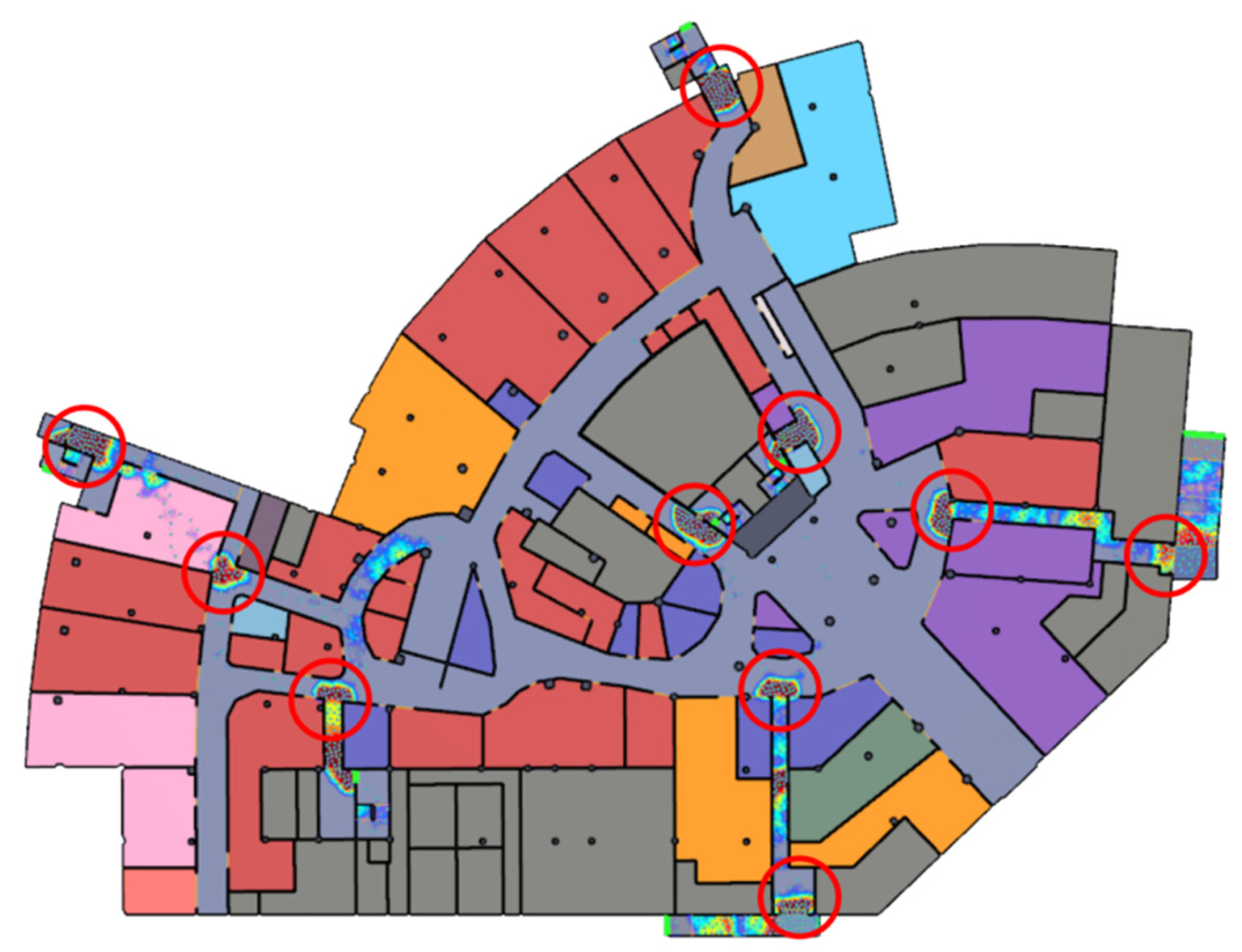
The simulation results under multiple scenarios indicate that the Dongfang Fulaide underground commercial space suffers from evident evacuation problems, including severe congestion bottlenecks, uneven occupant distribution, and low overall evacuation efficiency, as shown in Figure 15 and Figure 16.
These problems can be attributed to three main causes. First, the width of the horizontal evacuation paths is insufficient to accommodate high pedestrian flow. As shown in Figure 13, multiple bottlenecks occur along the evacuation routes, and congestion develops at corridor nodes even when stairway evacuation remains relatively unconstrained during the early stage. This limits overall evacuation performance and fails to satisfy the flow demand under peak occupancy conditions. Second, the vertical circulation system is unable to absorb instantaneous flow surges. The stairways, which serve as critical vertical evacuation nodes, are not well matched to the actual evacuation demand. Narrow stair widths directly restrict pedestrian throughput and become the primary bottlenecks during evacuation [39]. Third, exit use is highly unbalanced. Occupants generally follow a shortest-path preference and choose the nearest exit without considering congestion conditions at that exit. As a result, some exits remain underutilized in the later stage of evacuation, while the time difference between the earliest and latest completed exits approaches 100 s, which is detrimental to overall evacuation efficiency. Based on the above findings, the following optimization strategies were implemented without changing the overall occupant structure.
(1)
Corridor widening
The simulation results clearly show that corridor congestion is a prominent problem. Therefore, local widening of heavily congested corridor sections was adopted to improve overall evacuation efficiency [47]. However, corridor width should not simply be increased without restraint. Excessive widening may accelerate the arrival of occupants at stairways and exits, thereby causing premature downstream congestion and negatively affecting the overall evacuation process.
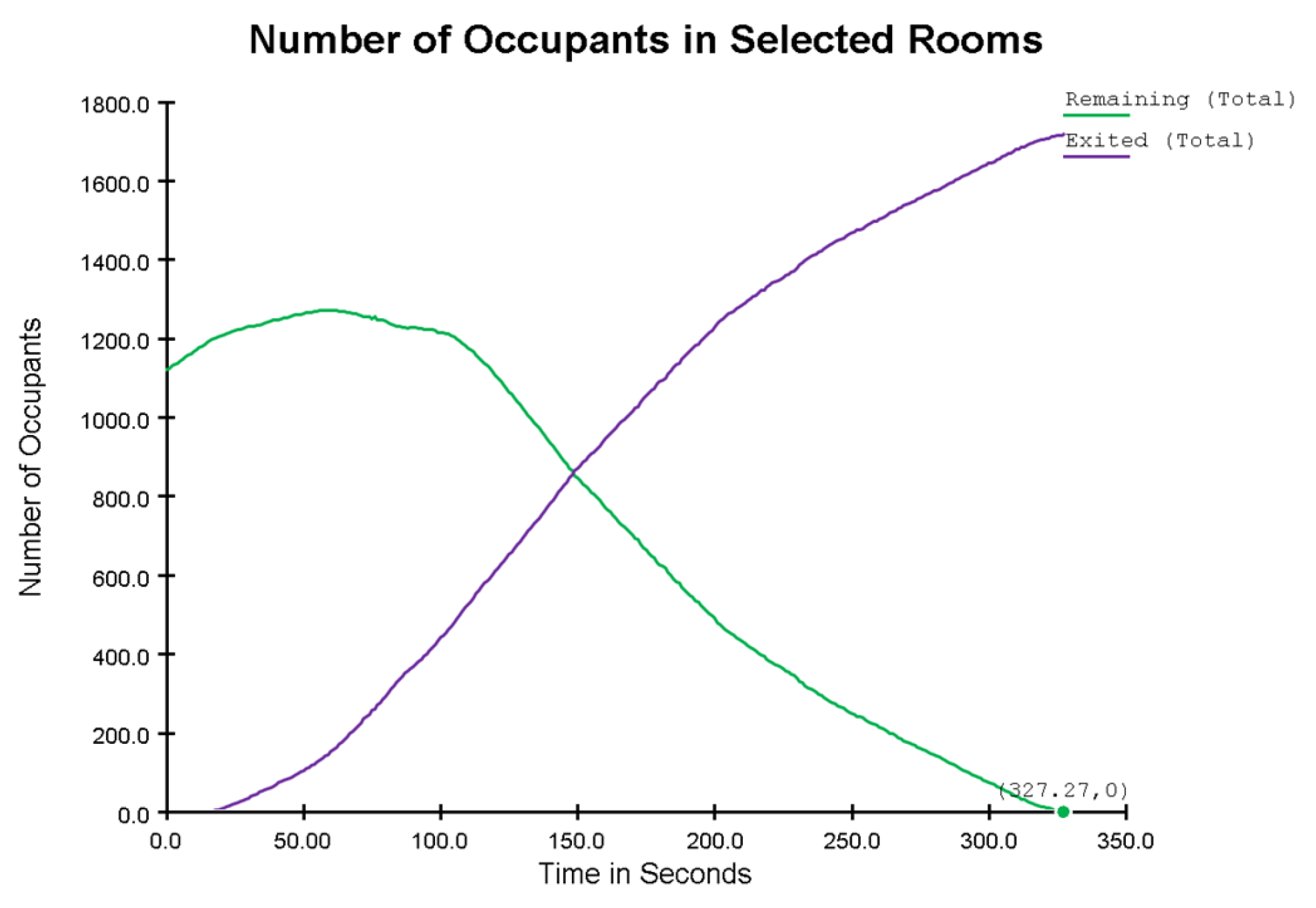
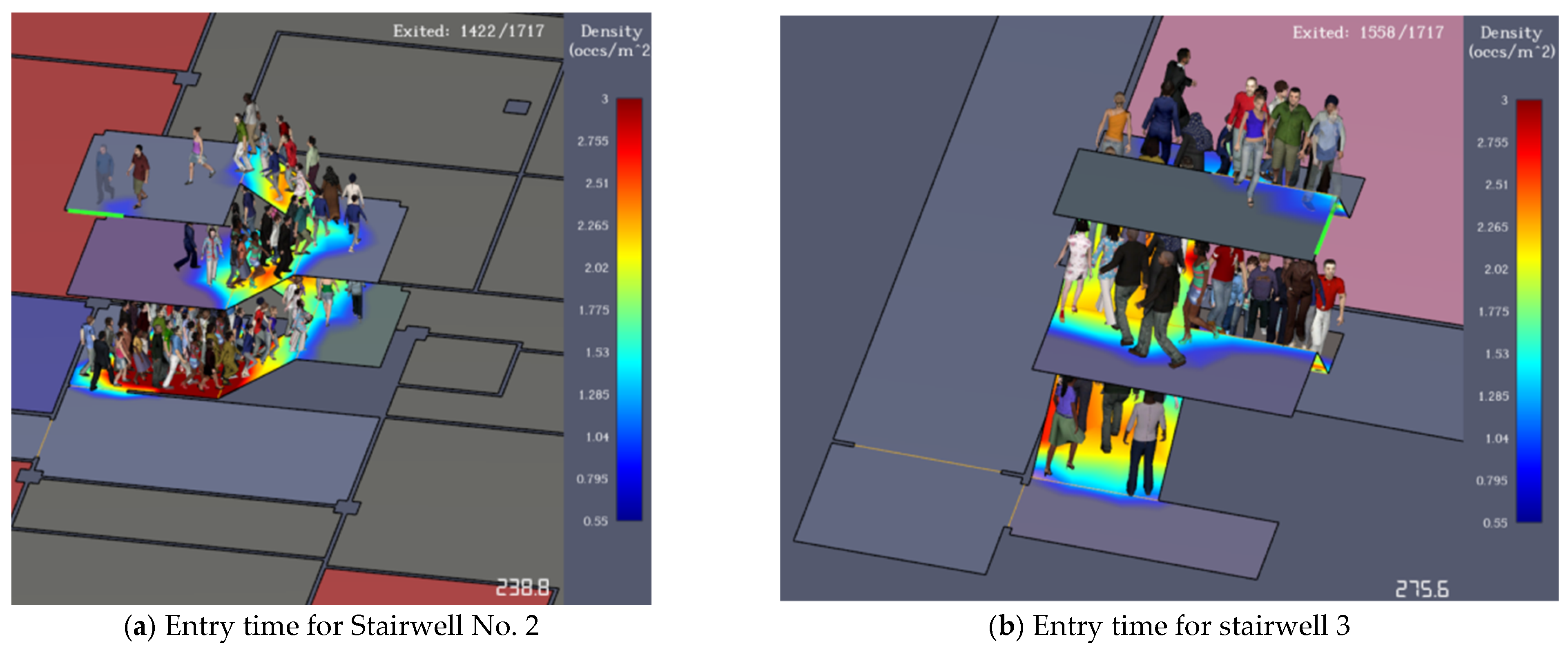
In this study, selected congested corridor sections were widened locally by 0.5 m. After optimization, the total evacuation time of the Dongfang Fulaide underground commercial space was reduced to 327 s (Figure 17), representing a decrease of 36 s compared with the original model. The last evacuee exited through Exit 1. Compared with the initial simulation, both the size and the duration of congestion nodes were significantly reduced, confirming the effectiveness of local corridor widening in shortening overall evacuation time. In terms of stair access performance, the time required for the last evacuee to enter the stairway leading to Exit 2 decreased from 263 s to 239 s, a reduction of 24 s. The corresponding time for Stair 3 decreased to 276 s; however, this still exceeded the ASET threshold of 272 s, indicating that further optimization was required (Figure 18).
(2)
Stair widening
The widths of the stairways in Dongfang Fulaide vary considerably. The stairways connected to the metro station are 2.5 m wide, whereas most internal stairways within the commercial space are no wider than 1.5 m, and the narrowest is only 1.1 m. Although these widths satisfy code requirements, a width of 1.1 m is clearly insufficient for densely occupied areas under actual evacuation conditions. If a fire occurs during peak occupancy, severe queuing may develop in the stairways, and some occupants may fail to ascend before the arrival of smoke.
To address this issue, all stairways narrower than 1.4 m were widened to 1.4 m, while the remaining stairways were widened by 0.2 m. After optimization, the total evacuation time decreased to 290 s, representing a reduction of 37 s compared with the previous model, and the last evacuee exited through Exit 3. At 238 s, all exits except Exits 1, 2, and 3 had already completed evacuation, indicating that subsequent evacuation relied only on these three exits and that exit utilization remained clearly imbalanced (Figure 19). A comparison of critical-node data shows that the evacuation time at Stair 3 already satisfied the safety requirement of completing upward movement before smoke arrival. However, the evacuation time at Stair 2 remained 196 s, still exceeding its ASET of 177 s. Therefore, additional optimization was still necessary.
(3)
Pedestrian diversion
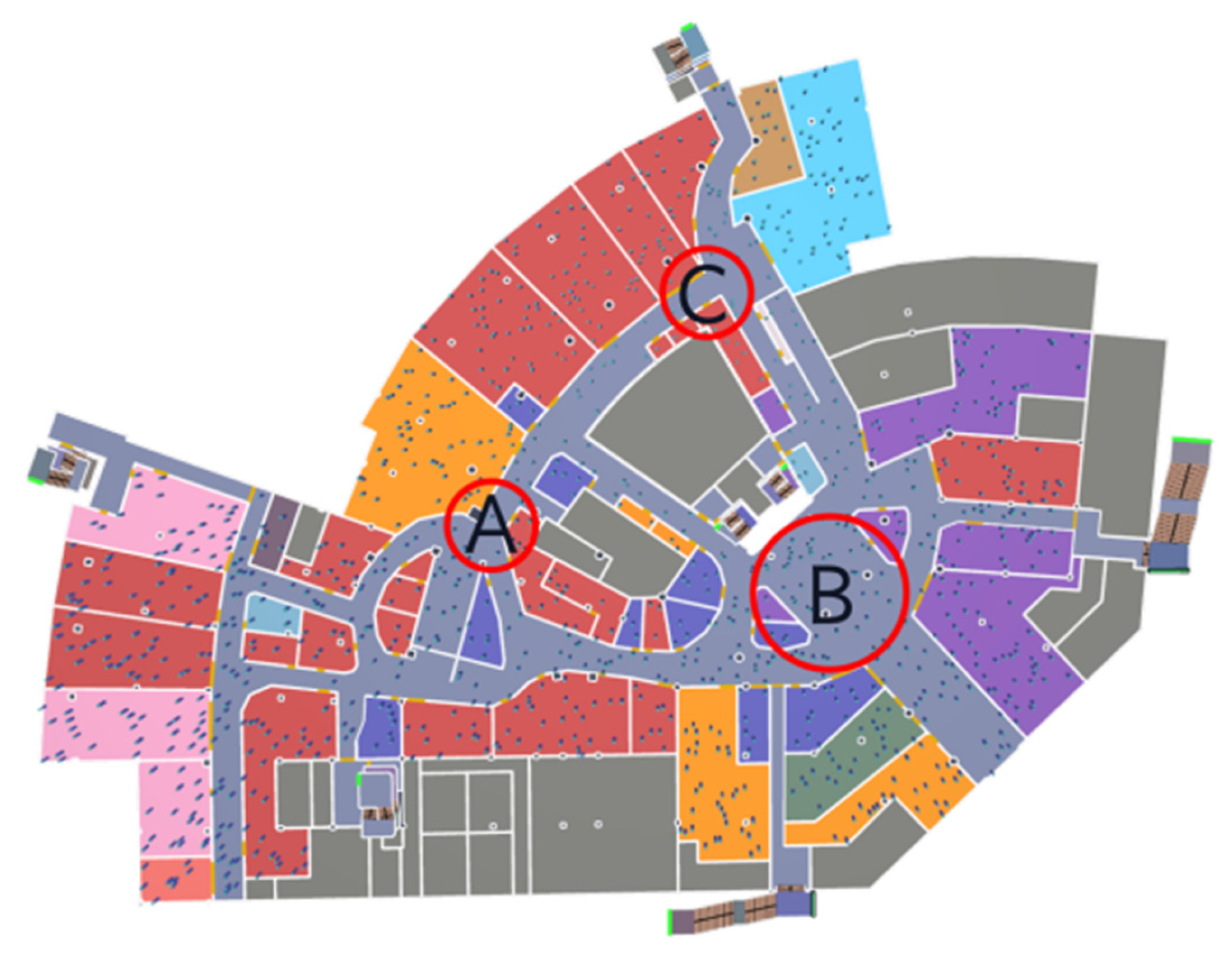
In Pathfinder, pedestrian diversion was implemented by assigning controlled waypoints and exit-preference constraints to selected occupant groups at Nodes A–C, so that part of the flow was redirected from overloaded exits to lower-loaded routes. The intervention was applied only to the affected commercial occupants in the corresponding circulation segments, while metro passengers in the shared corridors continued to follow their predefined exit assignments. In Scenario 1, the fire source was located in the densely occupied core area of the commercial space and was close to Exits 1, 2, and 3, making these exits the primary choices for evacuees. Under the combined influence of high flow demand and the later reduction in movement speed caused by smoke, the exits near this area became the last ones to complete evacuation. Among them, Exit 1 required the longest evacuation time because it had to accommodate both commercial occupants and metro passengers, resulting in particularly severe congestion. Throughout the evacuation process, the difference between the longest evacuation time at Exit 3 and the shortest time at Exit 6 approached 100 s, indicating substantial underutilization of exit resources. Based on these characteristics, a diversion strategy combining flow restriction and directional guidance was adopted.
Simulation analysis identified Nodes A, B, and C as key path nodes for evacuation control, as shown in Figure 20. Without diversion, occupants from shops near Node A mainly chose Exits 2 and 3. Since these exits also served nearby large commercial units, their initial evacuation loads were already close to saturation, and congestion could not be relieved naturally. Therefore, a flow-control barrier was introduced at Node A to prevent additional occupants from continuing toward Exits 2 and 3 [48].
At Node B, most occupants were initially directed toward Exit 1. However, Exit 1 also served the atrium, surrounding shops, and metro-transfer passengers, making it the last exit to complete evacuation. To alleviate this problem, a guidance point was placed at Node B, where directional signs or staff guidance [1] were used to divert part of the occupant flow toward Exit 6, which had the earliest evacuation completion time. Combined with the flow-control strategy at Node A, this measure further redirected evacuees toward Exit 6.
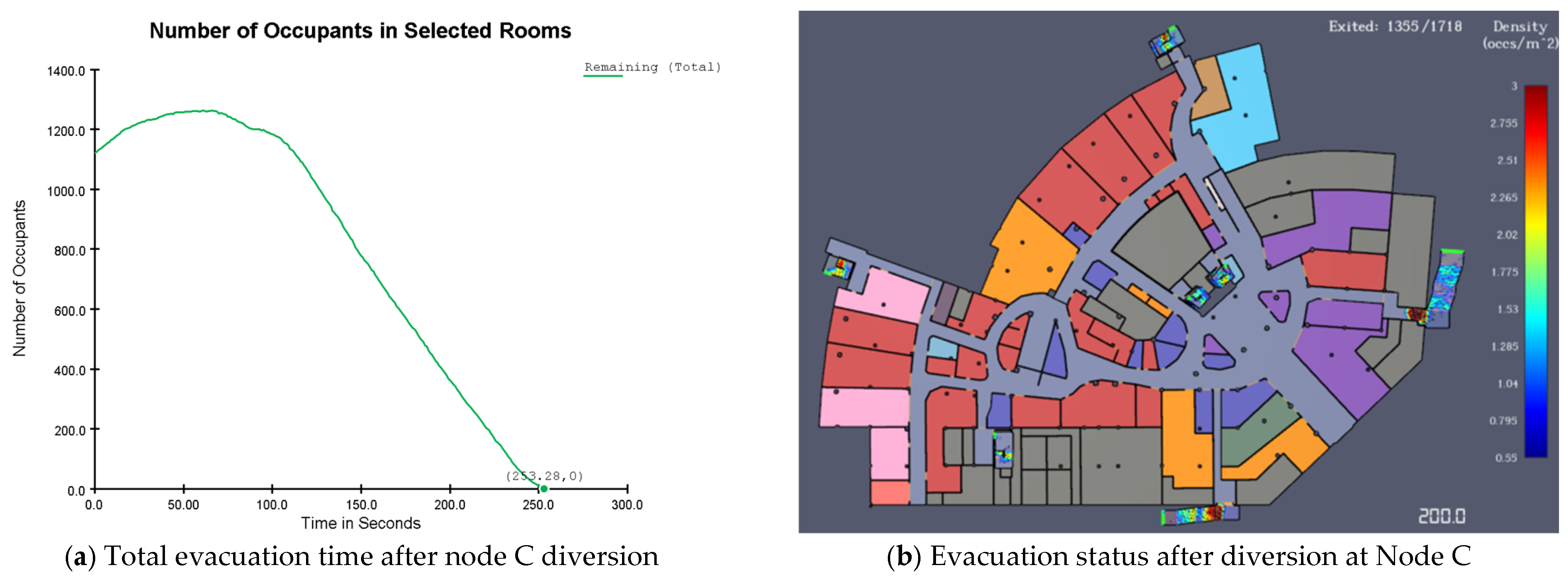
At Node C, because the restriction at Node A increased the evacuation load at Exit 7, the completion time of Exit 7 became delayed. To further improve overall evacuation efficiency, an additional guidance point was introduced at Node C, where some of the passing occupants were redirected toward the nearer Exits 5 and 6. After optimization, the total evacuation time decreased to 253 s, and all node-level evacuation requirements were satisfied, as shown in Figure 21.
(4)
Comparative evaluation of optimization strategies from a critical-node perspective
The above analyses show that the three intervention strategies improve evacuation performance through different mechanisms and should not be compared solely on the basis of total evacuation time. In the present case, evacuation vulnerability is governed primarily by the loss of safety margins at critical stairway nodes rather than by the nominal capacity of final exits. Accordingly, the comparative evaluation was extended from a system-level time comparison to a node-level safety assessment, with particular attention to the relationship between ASET and the clearance demand at the previously failed nodes.
Under the baseline scenario, the most hazardous condition was associated with negative safety margins at Stairway 2 and Stairway 3, indicating that the required evacuation demand at these nodes exceeded the available safe egress time under smoke exposure. This result confirms that, in the investigated metro-connected underground commercial environment, route failure originates at vertically constrained nodes before the exit system as a whole becomes ineffective. In other words, the dominant evacuation constraint is not simply “insufficient exit width,” but the earlier functional degradation of critical nodes embedded in the connected circulation network.
Corridor widening provides the first level of improvement by reducing congestion in the upstream horizontal paths. After local widening of the heavily congested corridor sections, the total evacuation time decreased from 363 s to 327 s. More importantly, the time required for occupants to reach the critical stairway nodes was shortened, especially at Stairway 2 and Stairway 3. However, the node-level comparison shows that this strategy only partially improves the safety condition. Stairway 3 moves close to the threshold, whereas Stairway 2 still remains in a failed state. This indicates that corridor widening mainly improves access efficiency, but does not fundamentally resolve the concentration of downstream evacuation demand. In smoke-constrained connected underground environments, accelerating arrival at a bottleneck does not necessarily eliminate the bottleneck itself.
Stair widening directly targets the vertical circulation constraint and therefore produces a stronger node-level improvement than corridor widening. After widening the narrower stairways, the total evacuation time was further reduced to 290 s. From the critical-node perspective, Stairway 3 was brought back into a tenable condition, while the safety deficit at Stairway 2 was substantially reduced but not fully eliminated. This result shows that increasing vertical throughput is more effective than widening only the upstream corridors when evacuation failure is governed by stairway-node congestion. Nevertheless, the residual failure at Stairway 2 also indicates that geometric enhancement alone remains constrained when pedestrian demand continues to concentrate along the same preferred routes.
Pedestrian diversion produces the most substantial improvement because it acts on the distribution of evacuation demand before occupants enter the most vulnerable routes. By introducing control and guidance at the key nodes, the strategy redistributes part of the flow away from the overloaded routes associated with Exits 1–3 and shifts demand toward less utilized exits. After this intervention, the total evacuation time was reduced to 253 s, and the previously failed nodes no longer exhibited negative safety margins under the modeled case. Compared with corridor widening and stair widening, pedestrian diversion does not merely increase local throughput. Instead, it changes the load allocation pattern of the connected evacuation system, thereby preventing the early accumulation of excessive demand at the critical stairway nodes.
Table 11 summarizes system-level evacuation time changes, whereas Table 12 reports the same comparison from a critical-node safety perspective. Taken together, the comparison reveals a clear difference between geometry-based and behavior-oriented interventions (Table 11). Corridor widening and stair widening both improve evacuation performance by increasing local movement capacity, but their effects remain bounded when route-choice concentration is not addressed. Pedestrian diversion, by contrast, improves evacuation safety through load redistribution and therefore more effectively interrupts the critical-node failure chain under smoke-constrained conditions. This finding does not imply that geometric improvement is unnecessary. Rather, it suggests that in metro-connected underground commercial spaces, geometry-based measures and behavior-oriented measures act at different levels of the system: the former improve component capacity, whereas the latter improve system-wide pressure distribution across connected routes and nodes.
From a practical perspective, the results indicate that optimization priorities in smoke-constrained connected underground environments should be established according to node-level safety diagnosis rather than overall evacuation time alone. If critical-node failure is caused primarily by insufficient vertical throughput, stair enhancement can provide substantial benefits. If the dominant problem is the excessive concentration of demand on a limited number of preferred routes, behavior-oriented redistribution becomes more important. In the present case, the largest gain is achieved when pedestrian flow is redirected before entering the most vulnerable circulation chain, which explains why pedestrian diversion outperforms purely geometric enlargement under the modeled conditions.
Therefore, the comparative evaluation supports a mechanism-oriented interpretation of intervention effectiveness: evacuation safety in the investigated case is governed less by isolated component size than by whether the intervention can restore positive safety margins at the critical nodes where smoke propagation and pedestrian convergence interact most strongly.
To compare the three intervention strategies on a common basis, the optimization results were further evaluated in terms of critical-node safety margin rather than total evacuation time alone. Since the main contribution of the present study lies in diagnosing node-level failure under smoke constraints, the comparison focuses on whether each strategy can reduce or eliminate the mismatch between available safe egress time (ASET) and evacuation demand at the most vulnerable nodes. The comparative results are summarized in Table 12.
As shown in Table 12, the three intervention strategies differ not only in their influence on total evacuation time, but also in the way they act on the critical-node failure chain. Corridor widening mainly improves upstream movement efficiency, while stair widening directly enhances vertical node capacity. However, only pedestrian diversion effectively redistributes demand before occupants enter the most vulnerable routes, thereby eliminating the negative safety margins at the previously failed nodes under the modeled case. This result supports the interpretation that, in smoke-constrained connected underground commercial environments, relieving concentrated node pressure is more effective than enlarging isolated geometric components alone.

3.4. Model Credibility and Sensitivity Analysis

Because the present study relies on a coupled fire evacuation simulation framework to diagnose node-level evacuation vulnerability, it is necessary to clarify both the credibility of the modeling approach and the robustness of the main findings under key assumption changes. The objective of this subsection is not to claim full empirical validation of every modeled process, but to demonstrate that the adopted framework is methodologically grounded, internally consistent with the research objective, and sufficiently robust for comparative diagnosis within the investigated case.

3.4.1. Model Credibility

The simulation framework adopted in this study combines PyroSim for smoke propagation analysis and Pathfinder for pedestrian evacuation analysis. This modeling route has been widely used in previous fire evacuation studies involving underground spaces, metro stations, underground commercial streets, and other enclosed public environments. In the present study, the framework was not intended to reproduce a specific historical fire event or a full-scale evacuation drill one-to-one. Instead, it was used to compare the relative effects of different fire-source locations and intervention strategies on smoke-constrained evacuation performance within the same connected underground commercial environment. Under this research objective, model credibility depends primarily on whether the assumptions, parameters, and evaluation logic are reasonable and transparent, and whether the outputs are consistent with known evacuation mechanisms reported in related studies.
Several features of the present model support its credibility for this purpose. First, the geometric model was constructed from field survey information and converted into the fire simulation environment through a BIM-based workflow, which helps maintain spatial consistency between the fire model and the evacuation model. Second, the tenability assessment was not based on a single indicator selected after the simulation; rather, visibility, smoke temperature, and CO concentration were all included as candidate criteria for determining the available safe egress time (ASET) at critical nodes. The subsequent dominance of visibility in the results therefore reflects the response of the modeled case under the adopted criteria, rather than an a priori exclusion of other tenability indicators. Third, the evacuation model incorporates differentiated occupant attributes, stair and corridor movement characteristics, and smoke-related speed reduction, so that pedestrian movement is not treated as a purely geometric shortest-path process.
The visibility-dominant tenability pattern observed in the present case is consistent with previous underground fire evacuation studies showing that visibility often becomes the earliest controlling factor in enclosed smoke-filled environments, especially where route recognition and walking efficiency deteriorate rapidly under smoke exposure [31,37,38,39,44]. Likewise, the early vulnerability of stairway-related nodes is consistent with previous simulation-based studies on underground commercial and metro-related spaces, which have shown that vertically constrained circulation nodes frequently act as the earliest bottlenecks under combined smoke and crowd-flow effects [8,9,31]. In particular, the results show that smoke-induced visibility degradation tends to become the controlling tenability factor earlier than temperature and CO concentration, and that vertically constrained nodes such as stairways are more likely than final exits to become early functional bottlenecks under smoke exposure. These tendencies are consistent with the general findings of earlier underground fire evacuation research cited in this manuscript, even though the present case has a specific spatial configuration and does not claim universal representativeness. Accordingly, the model is considered appropriate for comparative analysis of node-level safety margins, route failure, and intervention effects within the investigated metro-connected underground commercial environment.
At the same time, the limitations of the model should be acknowledged. The fire source was represented as a simplified design fire scenario using polyurethane as a representative fuel, and active smoke management systems such as mechanical exhaust or pressurization were not explicitly modeled. In addition, the evacuation model does not include full behavioral complexity such as panic contagion, adaptive rerouting based on real-time perception, or empirically calibrated response to guidance systems. These limitations mean that the model should be interpreted as a case-grounded analytical framework for comparative diagnosis rather than a complete digital twin of real emergency operation.

3.4.2. Sensitivity Analysis Design

To address the uncertainty associated with key assumptions and to test the robustness of the main conclusions, a sensitivity analysis was conducted for selected input parameters that were directly questioned by the reviewers or are known to influence evacuation performance. The purpose of this analysis was not to exhaustively explore the full parameter space, but to examine whether the central findings of the study remain stable under reasonable variations in key modeling assumptions.
Three categories of parameters were selected. The first category concerns pre-movement assumptions, because the base model assumes evacuation starts 20 s after ignition and assigns an additional 0–20 s random delay to 30% of occupants. To test whether the main conclusions depend excessively on this setting, an alternative delayed-response scenario was examined by extending the pre-movement time window. The second category concerns fire intensity assumptions, because the design fire in the base model uses a simplified t2 growth process and a preset peak heat release rate. To test the influence of fire severity on node-level safety diagnosis, an alternative fire scenario with a reduced peak intensity was considered. The third category concerns evacuation movement assumptions, especially the smoke-constrained walking process. Since the behavioral conclusions of the study partly depend on the interaction between smoke conditions and pedestrian motion, an alternative movement scenario was examined by adjusting the walking-speed-related assumption within a reasonable range.
The sensitivity analysis focuses on three outcome dimensions that are directly relevant to the revised contribution of the study. The first is the controlling tenability criterion, that is, whether visibility remains the earliest and most influential constraint at critical nodes when compared with temperature and CO concentration. The second is the sequence of node failure, namely whether stairway nodes continue to lose safety margins earlier than final exits under modified assumptions. The third is the relative effectiveness of intervention strategies, especially whether pedestrian diversion continues to show greater improvement in critical-node pressure relief than geometric enlargement alone. By organizing the sensitivity analysis around these three questions, the study evaluates robustness at the level of mechanism interpretation rather than only at the level of absolute evacuation time.
To test the robustness of the main conclusions under reasonable uncertainty in key assumptions, a targeted sensitivity analysis was designed around three categories of inputs that are directly relevant to the current case and were also explicitly questioned by the reviewers: pre-movement response, fire intensity, and movement-related assumptions. Rather than conducting a full parametric sweep, the present study adopts a bounded scenario-based sensitivity design aimed at examining whether the main interpretive conclusions remain stable under plausible changes in model inputs. The sensitivity design is summarized in Table 13.

3.4.3. Sensitivity Analysis Interpretation

To avoid overinterpreting the base-case outputs as deterministic results of a single parameter combination, the sensitivity cases were compared in terms of the stability of the main interpretive conclusions. Table 14 summarizes whether the central findings of the study—namely visibility dominance, early stairway-node vulnerability, and the relative advantage of pedestrian diversion—remain valid across the tested scenarios.
Table 14 provides a mechanism-oriented summary of the sensitivity results, while several representative numerical comparisons are presented here to anchor the interpretation. Under the delayed-response assumption (S1), total evacuation time increased from 363 s to 381.8 s, and the safety margin at Stairway 2 decreased from −86 s to −97.5 s, confirming that slower evacuation initiation aggravates but does not fundamentally reshape the node-failure pattern. Under the modified fire-intensity condition (S3/S4), the earliest visibility-controlled threshold at the critical node shifted from 177 s to 178 s and 173 s, whereas the controlling role of visibility remained unchanged. Under the high pedestrian load condition (S6), the total evacuation time increased from 363 s to 369 s, and the safety margin of Stairway 2 decreased from −86 s to −91 s, leading to a further expansion of the node-level safety deficit. Nevertheless, pedestrian diversion remained more effective than simply enlarging the geometric dimensions of passages in relieving the traffic pressure at critical nodes.


4. Discussion

4.1. Evacuation Failure Mechanism in Metro-Connected Underground Commercial Spaces Under Smoke Constraints

The results of the present study indicate that evacuation failure in metro-connected underground commercial spaces is governed less by the nominal capacity of final exits than by the earlier loss of safety margins at a limited number of critical circulation nodes. In the investigated case, the most hazardous condition does not arise when the entire exit system simultaneously becomes untenable. Instead, failure begins when certain stairway-related nodes lose usability under smoke exposure and can no longer accommodate the evacuation demand imposed on them [49]. This means that route interruption emerges first at the node level and only subsequently propagates to the system level through delayed clearance and accumulated congestion. From this perspective, the decisive issue is not simply whether enough exits exist in the abstract, but whether the connected circulation chain remains tenable long enough for occupants to reach those exits.
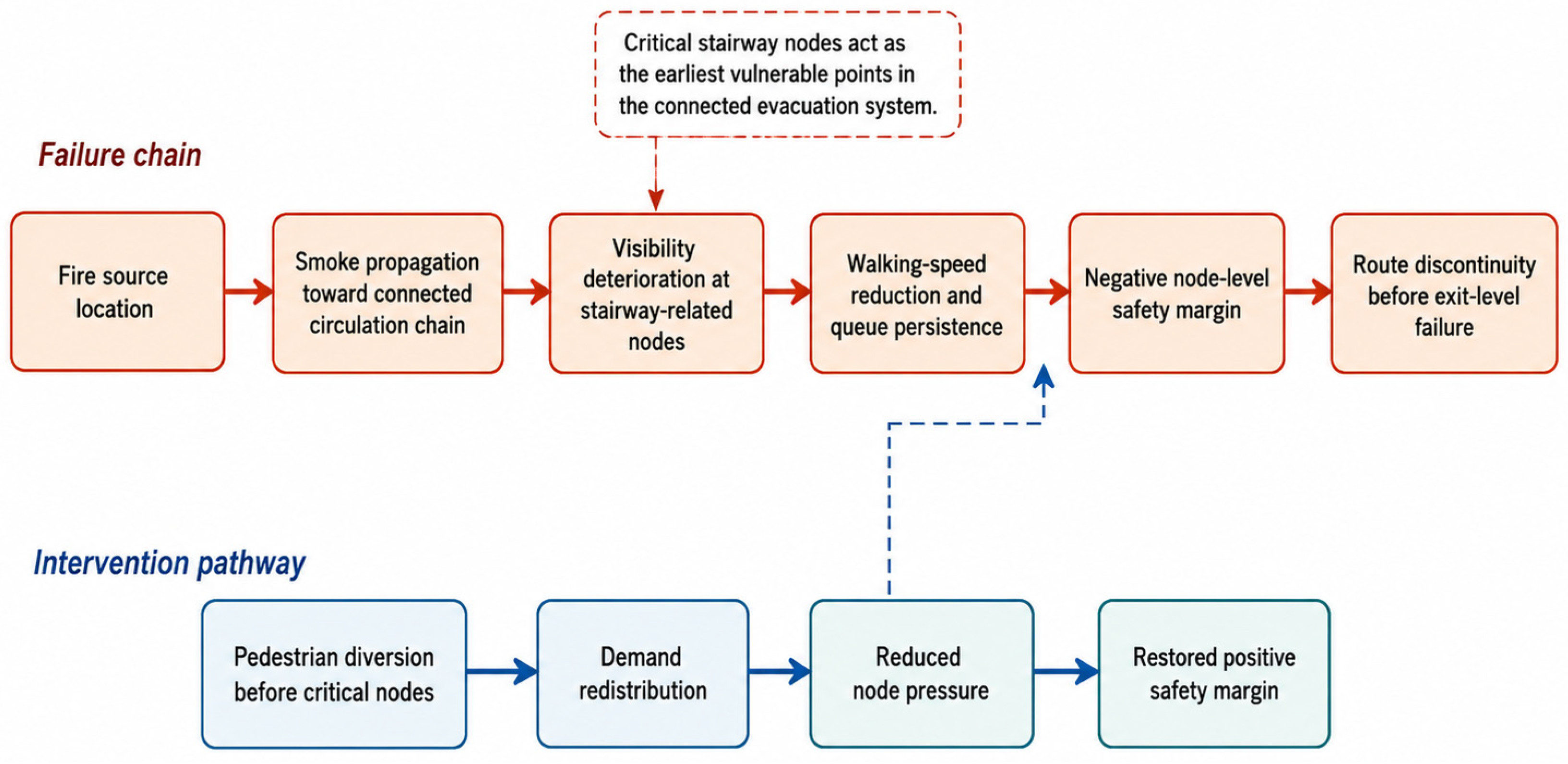
This mechanism is summarized in Figure 22, which schematically presents the critical-node failure chain identified in the present case. The chain begins with fire-source location and smoke propagation toward the connected circulation system, then develops into visibility deterioration at stairway-related nodes, followed by walking-speed reduction, queue persistence, negative node-level safety margin, and eventual route discontinuity before exit-level failure. The significance of this interpretation is that it shifts evacuation diagnosis away from a purely exit-centered view. In conventional evacuation evaluation, inadequate exit width or insufficient exit count is often treated as the principal cause of failure. However, the present case shows that several final exits may remain nominally available even after the most critical routes have already become unsafe, because upstream stairway nodes fail earlier and interrupt route continuity.
The prominence of stairway-related nodes can be explained by the particular spatial and behavioral characteristics of metro-connected underground commercial environments. Stairways are not only vertical circulation facilities, but also convergence points connecting shops, corridors, atrium-related spaces, and metro-linked interfaces. Their geometric capacity is more limited than that of open corridors, while their functional role makes them natural gathering points for multiple pedestrian streams. Under fire conditions, once smoke reaches these nodes, even a moderate decline in visibility can sharply reduce walking efficiency and prolong queue dissipation. This dual burden—restricted geometry and concentrated demand—causes stairway nodes to become the earliest vulnerable points in the connected evacuation system.
This interpretation should not be overstated as a universally fixed rule for all underground spaces. Rather, it should be understood as a mechanism identified in a representative case characterized by strong spatial connectivity, pronounced dependence on vertical circulation, and coupled commercial–transit pedestrian flows. Even with this caveat, the present findings suggest that in similarly configured underground commercial environments, node-level safety diagnosis may provide a more informative basis for evacuation assessment than aggregate evacuation time or final exit capacity alone.

4.2. Bottleneck Formation Under Coupled Smoke–Pedestrian Effects

The bottlenecks observed in this study are not produced solely by narrow geometry, nor solely by smoke spread, but by the dynamic coupling of the two. In the early stage of evacuation, occupants tend to move toward nearby or familiar routes, which causes rapid concentration at certain stairways and connected corridors. At this point, congestion is already present, but the system still retains some flexibility. As the fire develops and smoke begins to affect the same circulation chain, movement efficiency decreases, visible route recognition becomes more difficult, and local clearance times increase. The bottleneck therefore evolves from a high-density flow problem into a smoke-constrained functional failure problem.
This distinction is analytically important. A geometric bottleneck under normal conditions may still be manageable if throughput remains stable and no environmental hazard interferes with movement. Under smoke-constrained conditions, however, the same node becomes more fragile because the efficiency loss caused by reduced visibility is superimposed on an already concentrated flow pattern. In this sense, smoke does not merely add another layer of risk to a congested node; it changes the temporal behavior of the node by accelerating the transition from crowding to route failure. The process can be interpreted as a causal sequence in which visibility deterioration at stairway-related nodes leads to walking-speed reduction and queue persistence, which then produces negative safety margins.
Another important implication concerns the unevenness of route usage in connected underground systems. In the present case, some exits remain relatively underused even when other circulation paths experience severe overload. This means that evacuation inefficiency is not only a matter of insufficient total capacity, but also of highly asymmetric demand allocation across the network. Where route choice is strongly concentrated, even moderate smoke intrusion can make a specific node functionally decisive. By contrast, routes with lower demand may remain tenable but underutilized. Therefore, the essential bottleneck mechanism is not simply “too many people in too little space,” but the mismatch between smoke-constrained node usability and unevenly distributed pedestrian demand.
The relationship between ASET and route continuity further reinforces this interpretation. In the present study, tenability deterioration does not occur uniformly across the space. Certain nodes lose safety margin earlier than others, meaning that a route may remain topologically connected while already being functionally broken. This is why total evacuation time alone is insufficient for diagnosis. A route can still appear available on a plan, yet fail in practice because one critical stairway node within that route becomes untenable before the downstream exit does. Accordingly, the coupled smoke–pedestrian effect should be understood as a mechanism that selectively disrupts route continuity at the node level, rather than as a purely global reduction in evacuation performance.

4.3. Comparative Roles of Geometry-Based and Behavior-Oriented Interventions

The comparative analysis shows that corridor widening, stair widening, and pedestrian diversion should not be interpreted simply as three parallel ways of reducing total evacuation time. Instead, they act on different stages of the critical-node failure chain and therefore operate through different mechanisms. This difference is summarized in Table 15, which compares the three strategies from the perspective of critical-node safety margin rather than system-level evacuation time alone. In the baseline case, total evacuation time reached 363 s, and negative safety margins were observed at the previously identified failed nodes. After corridor widening, total evacuation time decreased to 327 s; after stair widening, it was further reduced to 290 s; and after pedestrian diversion, it decreased to 253 s. These values confirm that all three interventions improve system-level performance, but the node-level comparison shows that they do not improve safety in the same way.
Corridor widening provides the first level of improvement by reducing congestion in the upstream horizontal paths. It shortened access time to the critical stairway nodes and reduced the duration of upstream queueing. However, the node-level comparison shows that this strategy only partially improved the safety condition. In the tested case, Stairway 3 moved close to the tenability threshold, whereas Stairway 2 remained unsafe. This indicates that corridor widening mainly improves access efficiency, but does not fundamentally redistribute evacuation demand. As a result, downstream bottlenecks may still remain under critical pressure even when upstream movement becomes smoother.
Stair widening produced a stronger node-level effect because it directly enhanced the throughput of the vertically constrained components that acted as immediate bottlenecks. The reduction in total evacuation time from 327 s to 290 s reflected this improvement at the system level, while the node-level comparison indicates that Stairway 3 was brought back into a tenable condition and the safety deficit at Stairway 2 was substantially reduced. Even so, the most vulnerable node was not fully relieved. This suggests that local geometric enhancement is highly beneficial when evacuation failure is capacity-driven, but still remains bounded when pedestrian demand continues to converge along the same preferred routes.
Pedestrian diversion differed from both geometry-based strategies because it acted on the demand side of the system rather than only on the supply side. By redistributing part of the occupant flow before it entered the most vulnerable circulation chain, this strategy reduced node pressure at its source. Under the modeled case, total evacuation time was reduced further to 253 s, and the previously failed nodes no longer exhibited negative safety margins. In other words, the strongest improvement was achieved not simply by enlarging the congested components, but by changing how evacuation demand was allocated across the connected system. This intervention pathway corresponds to the lower branch of the failure-chain schematic and helps explain why load redistribution is able to interrupt the transition from queue persistence to negative node-level safety margin.
Taken together, the comparison indicates that geometry-based and behavior-oriented interventions act at different levels of the connected evacuation system. Corridor and stair widening improve component-level capacity, whereas pedestrian diversion improves system-level pressure distribution. The present findings therefore do not imply that one category should always replace the other. Instead, they suggest that intervention priorities should be determined by the dominant vulnerability mechanism. If failure is primarily caused by insufficient local throughput at a clearly identified node, geometric enhancement may be highly beneficial. If failure is driven by strong route-choice concentration under smoke-constrained node usability, behavior-oriented redistribution becomes more effective. In the present case, the largest safety gain was achieved when intervention restored positive safety margins at the nodes where smoke propagation and pedestrian convergence interacted most strongly.

4.4. Engineering Implications and Applicability Boundaries

The practical implication of the present study is that evacuation optimization in metro-connected underground commercial spaces should be guided by critical-node safety diagnosis rather than by total evacuation time or exit capacity alone. In the investigated case, the most vulnerable components of the evacuation system were not the final exits themselves, but the stairway-related nodes where smoke propagation, vertical movement constraint, and concentrated pedestrian demand intersected [50]. This suggests that design and management decisions in similar connected underground environments should first identify where early safety margin loss occurs, and then determine whether the dominant problem lies in insufficient local throughput or in excessive route-choice concentration. Viewed in this way, geometry-based measures such as corridor or stair widening are especially relevant when a specific component is clearly capacity-limited, whereas behavior-oriented measures such as guided diversion are more valuable when the primary problem is demand accumulation along a small number of preferred routes. The practical implication is therefore not that one intervention is universally superior, but that measures should be selected according to the location and mechanism of node-level failure within the connected circulation system.
At the same time, the applicability of the present findings should be interpreted with caution. This study is based on a single metro-connected underground commercial environment and is intended as a case-grounded analysis of smoke-constrained evacuation vulnerability rather than as a source of universally generalizable design rules. The conclusions are therefore most relevant to similarly configured underground complexes characterized by strong spatial connectivity, pronounced dependence on vertical circulation, and coupled commercial–transit pedestrian flows. Several limitations should also be acknowledged. The fire source was represented using a simplified design fire assumption with a representative fuel type, rather than a fully mixed retail fuel load with complete combustion evolution. Active smoke management systems, such as mechanical smoke exhaust or pressurization, were not explicitly modeled. In addition, although differentiated occupant attributes and smoke-constrained movement were considered, the evacuation model does not fully represent more complex behavioral responses such as adaptive rerouting, panic contagion, or empirically calibrated reaction to real guidance systems. Finally, the simulation framework was used for comparative diagnosis within the investigated case rather than for direct reconstruction of a real evacuation event. Future work should therefore extend the analysis through additional cases, alternative spatial configurations, active smoke-control scenarios, and richer behavioral or validation data to further test the robustness and wider applicability of the mechanism identified in this study.

5. Conclusions

This study investigated smoke-constrained evacuation in a representative metro-connected underground commercial space by coupling fire simulation with pedestrian evacuation analysis. Rather than evaluating evacuation performance only in terms of total egress time, the study focused on how smoke propagation reshapes the safety margins of critical circulation nodes and how different intervention strategies affect the resulting failure chain. Based on the modeled case, the main conclusions can be summarized as follows.
(1) In the investigated connected underground commercial environment, evacuation failure is governed more directly by the loss of safety margins at critical stairway-related nodes than by the nominal capacity of final exits. The results show that tenability deterioration does not occur uniformly across the evacuation system. Instead, certain vertically constrained nodes become unsafe earlier and interrupt route continuity before the exit system as a whole loses usability. This indicates that node-level diagnosis provides a more informative basis for evacuation assessment than aggregate evacuation time alone in this type of spatially connected environment.
(2) Among the tenability indicators considered in the present case, visibility most frequently acts as the controlling criterion at critical nodes under the modeled fire conditions. The results further suggest an early stairway-node failure tendency, in which smoke-constrained movement and concentrated pedestrian demand jointly accelerate bottleneck formation at vertically constrained nodes. This finding should be understood as a mechanism identified within the tested case and assumptions, rather than as a universally fixed sequence applicable to all underground spaces.
(3) The comparative intervention analysis shows that geometry-based and behavior-oriented strategies improve evacuation performance through different mechanisms. Corridor widening and stair widening mainly increase local movement capacity, whereas pedestrian diversion more directly reduces the concentration of demand on the most vulnerable routes. Under the modeled conditions, pedestrian diversion provides the strongest improvement in restoring positive safety margins at the previously failed nodes, indicating that demand redistribution can be more effective than isolated geometric enlargement when evacuation vulnerability is dominated by critical-node pressure.
Overall, the value of the present study lies not in proposing universally generalizable design rules from a single case, but in providing a case-grounded interpretation of how smoke propagation, pedestrian convergence, and spatial connectivity jointly shape evacuation vulnerability in metro-connected underground commercial spaces. Future research should further test the robustness of the identified mechanism through additional cases, alternative spatial configurations, active smoke-management scenarios, and richer behavioral or validation data.

Author Contributions

X.H.: Conceptualization, Methodology, Formal analysis, Supervision, Writing—original draft, Writing—review and editing. L.C.: Investigation, Software, Data curation, Validation, Visualization, Writing—review and editing. Y.L.: Investigation, Resources, Data curation, Visualization. All authors have read and agreed to the published version of the manuscript.

Funding

The authors appreciate the financial support for this work provided by the National Natural Science Foundation of China (Grant No. 52508041); the Jiangsu Provincial Basic Research Program (Grant No. BK20250902); the 2024 Jiangsu Provincial Higher Education Institutions Basic Science (Natural Science) Research Project (Grant No. 24KJB560025); the 2025 Jiangsu Provincial University Philosophy and Social Sciences Research Project (Grant No. 2025SJYB1534); the 2024 Jiangsu Provincial Young Scientific and Technological Talents Support Program (Grant No. JSTJ-2024-240); the Open Fund of the Key Laboratory of Underground Space Geological Safety in Coastal Cities, Ministry of Natural Resources (Grant No. BHKF2024Z02); the 2024 Yangzhou University Humanities and Social Sciences Research Fund Project (Grant No. xjj2024-35); and the 2023 Jiangsu Provincial Industry-University-Research Cooperation Project (Grant No. BY20231316).

Data Availability Statement

The original contributions presented in this study are included in the article. Further inquiries can be directed to the corresponding author.

Conflicts of Interest

The authors declare that they have no known competing financial interests or personal relationships that could have appeared to influence the work reported in this paper.

References

  1. Wei, J.J.; Deng, Q.G.; Zhang, L.X. Study on emergency evacuation in underground urban complexes. PLoS ONE 2022, 17, e0278521. [Google Scholar] [CrossRef]
  2. Wang, D.; Li, N.; Wu, S.; Zhou, T. The Impact of Corridor Directional Configuration on Wayfinding Behavior during Fire Evacuation in Underground Spaces: An Empirical Study Based on Virtual Reality. Fire 2024, 7, 294. [Google Scholar] [CrossRef]
  3. Yan, J.-W.; Zhang, S.-P. The Fire Safety Analysis of Semi-Underground Public Building. Adv. Mater. Res. 2011, 368–373, 739–744. [Google Scholar] [CrossRef]
  4. Zhang, S.; Zhu, Z.; Haotian, Z.; Huanhuan, Z. Research on the evacuation of people from a road tunnel fire based on a mathematical model. Heliyon 2024, 10, e23016. [Google Scholar] [CrossRef] [PubMed]
  5. Wang, N.; Gao, Y.; Li, C.-Y.; Gai, W.-M. Integrated agent-based simulation and evacuation risk-assessment model for underground building fire: A case study. J. Build. Eng. 2021, 40, 102609. [Google Scholar]
  6. Yuan, Q.; Zhu, H.; Zhang, X.; Zhang, B.; Zhang, X. An Integrated Quantitative Risk Assessment Method for Underground Engineering Fires. Int. J. Environ. Res. Public Health 2022, 19, 16934. [Google Scholar] [CrossRef]
  7. Chan, E.Y.Y.; Huang, Z.; Hung, K.K.C.; Chan, G.K.W.; Lam, H.C.Y.; Lo, E.S.K.; Yeung, M.P.S. Health Emergency Disaster Risk Management of Public Transport Systems: A Population-Based Study after the 2017 Subway Fire in Hong Kong, China. Int. J. Environ. Res. Public Health 2019, 16, 228. [Google Scholar] [CrossRef] [PubMed]
  8. Yao, H.-W.; Lv, K.-F.; Li, Y.-X.; Zhang, J.-G.; Lv, Z.-B.; Wang, D.; Zhan, Z.-Y.; Wei, X.-G.; Song, H.-T.; Qin, H.-J. Numerical Simulation of Fire in Underground Commercial Street. Comput. Intell. Neurosci. 2022, 2022, 4699471. [Google Scholar] [CrossRef] [PubMed]
  9. Li, X.; Wang, C.; Kassem, M.A.; Ali, K.N. Emergency evacuation of urban underground commercial street based on BIM approach. Ain Shams Eng. J. 2024, 15, 102633. [Google Scholar] [CrossRef]
  10. Kallianiotis, A.; Papakonstantinou, D.; Tolias, I.C.; Benardos, A. Evaluation of fire smoke control in underground space. Undergr. Space 2022, 7, 295–310. [Google Scholar] [CrossRef]
  11. Sajid, Z.; Yang, Y.; You, P.; Deng, H.; Cheng, X.; Danial, S.N. An Explorative Methodology to Assess the Risk of Fire and Human Fatalities in a Subway Station Using Fire Dynamics Simulator (FDS). Fire 2022, 5, 69. [Google Scholar] [CrossRef]
  12. Yang, X.X.; Dong, H.R.; Yao, X.M.; Sun, X.B. Pedestrian evacuation at the subway station under fire. Chin. Phys. B 2016, 25, 048902. [Google Scholar] [CrossRef]
  13. Chen, H.; Zhang, C.; Zhang, J.; Shu, Y.; Qi, X.; Jiang, C. Simulation of fire emergency evacuation in a large-passenger-flow subway station based on the on-site measured data of Shenzhen Metro. Transp. Saf. Environ. 2023, 6, tdad006. [Google Scholar] [CrossRef]
  14. Xu, H.; Chen, M. Simulation Analysis of the Efficiency of Evacuation Entrances of Strip-like Metro Commercial Streets: A Case Study of Wuhan Business District Metro Station. Buildings 2023, 13, 1826. [Google Scholar] [CrossRef]
  15. Siraj, T.; Debnath, B.; Payel, S.B.; Bari, A.M.; Islam, A.R.M.T. Analysis of the fire risks and mitigation approaches in the apparel manufacturing industry: Implications toward operational safety and sustainability. Heliyon 2023, 9, e20312. [Google Scholar] [CrossRef]
  16. Wang, D.; Zhou, T.; Li, X. Impacts of Environment and Individual Factors on Human Premovement Time in Underground Commercial Buildings in China: A Virtual Reality–Based Study. ASCE-ASME J. Risk Uncertain. Eng. Syst. Part A Civ. Eng. 2021, 7, 04020056. [Google Scholar] [CrossRef]
  17. Li, Y.; Men, T.; Ran, J.; Chen, X.; Wu, K.; Zhao, L.; Xu, H.; Liao, H. Assessment of Visual Effectiveness of Metro Evacuation Signage in Fire and Flood Scenarios: A VR-Based Eye-Movement Experiment. Buildings 2025, 15, 3771. [Google Scholar] [CrossRef]
  18. Li, X.; Chen, R.; Zhu, Y.; Jim, C. Emergency fire evacuation simulation of underground commercial street. Simul. Model. Pract. Theory 2024, 134, 102929. [Google Scholar] [CrossRef]
  19. Li, Z.; Huang, H.; Li, N.; Zan, M.L.C.; Law, K. An agent-based simulator for indoor crowd evacuation considering fire impacts. Autom. Constr. 2020, 120, 103395. [Google Scholar] [CrossRef]
  20. Lei, W.; Li, A.; Gao, R.; Hao, X.; Deng, B. Simulation of pedestrian crowds’ evacuation in a huge transit terminal subway station. Phys. A Stat. Mech. Appl. 2012, 391, 5355–5365. [Google Scholar] [CrossRef]
  21. Lian, H.; Zhang, S.; Li, G.; Zhang, Y. Pedestrian Simulation on Evacuation Behavior in Teaching Building of Primary School Emergencies and Optimized Design. Buildings 2023, 13, 1747. [Google Scholar] [CrossRef]
  22. Long, X.; Zhang, X.; Lou, B. Numerical simulation of dormitory building fire and personnel escape based on Pyrosim and Pathfinder. J. Chin. Inst. Eng. 2017, 40, 257–266. [Google Scholar] [CrossRef]
  23. Jeon, G.-Y.; Hong, W.-H. An experimental study on how phosphorescent guidance equipment influences on evacuation in impaired visibility. J. Loss Prev. Process Ind. 2009, 22, 934–942. [Google Scholar] [CrossRef]
  24. Jing, M.; Zhang, G.; Guo, S.; Wang, C. Simulation method for fire evacuation safety of teaching buildings in colleges and universities. Results Eng. 2025, 25, 104512. [Google Scholar] [CrossRef]
  25. Yoon, S.H.; Lee, M.J.; Yee, J.J. An Experimental Study on Evacuation Times in a Subway Station Using Evacuation Parameters. J. Asian Archit. Build. Eng. 2013, 12, 93–100. [Google Scholar] [CrossRef]
  26. Chen, Y.X.; Song, Y.H.; Huo, F.Z. Simulation of crowd evacuation behaviours at subway stations under panic emotion. Int. J. Simul. Model. 2023, 22, 667–678. [Google Scholar] [CrossRef]
  27. Gwynne, S.; Galea, E.R.; Lawrence, P.J.; Filippidis, L. Modelling occupant interaction with fire conditions using the buildingEXODUS evacuation model. Fire Saf. J. 2001, 36, 327–357. [Google Scholar] [CrossRef]
  28. Choi, M.; Chi, S. Optimal route selection model for fire evacuations based on hazard prediction data. Simul. Model. Pract. Theory 2019, 94, 321–333. [Google Scholar] [CrossRef]
  29. Sunita; Garg, D. Dynamizing Dijkstra: A solution to dynamic shortest path problem through retroactive priority queue. J. King Saud. Univ.-Comput. Inf. Sci. 2021, 33, 364–373. [Google Scholar] [CrossRef]
  30. Peng, Y.; Li, S.-W.; Hu, Z.-Z. A self-learning dynamic path planning method for evacuation in large public buildings based on neural networks. Neurocomputing 2019, 365, 71–85. [Google Scholar] [CrossRef]
  31. Liu, Z.; Zou, R. Dynamic evacuation path planning for subway station fire based on IACO. J. Build. Eng. 2024, 86, 108828. [Google Scholar] [CrossRef]
  32. Zhou, J.; Jia, X.; Jia, J. Effects of Different Staircase Design Factors on Evacuation of Children from Kindergarten Buildings Analyzed via Agent-Based Simulation. Healthcare 2020, 8, 56. [Google Scholar] [CrossRef]
  33. Li, W.; Chen, Z.; Xu, J.; Wang, W.; Zhang, P. Research on evacuation simulation of underground commercial street based on reciprocal velocity obstacle model. J. Asian Archit. Build. Eng. 2022, 21, 22–33. [Google Scholar]
  34. Zhang, R.; Yang, X.; Zhou, M.; Li, Y.; Yang, X. Stair/escalator/elevator selection behavior of passengers in subway stations based on the fuzzy logic theory. Simulation 2023, 99, 755–772. [Google Scholar]
  35. Yip, A.; Haelssig, J.B.; Pegg, M.J. Simulating fire dynamics in multicomponent pool fires. Fire Saf. J. 2021, 125, 103402. [Google Scholar] [CrossRef]
  36. Mcgrattan, K.-B.; Forney, G.-P. Fire Dynamics Simulator (Version 4); National Institute of Standards and Technology: Gaithersburg, MD, USA, 2004.
  37. Zhang, N.; Liang, Y.; Zhou, C.; Niu, M.; Wan, F. Study on Fire Smoke Distribution and Safety Evacuation of Subway Station Based on BIM. Appl. Sci. 2022, 12, 12808. [Google Scholar] [CrossRef]
  38. Yang, X.; Zhang, R.; Li, Y.; Pan, F. Passenger Evacuation Path Planning in Subway Station Under Multiple Fires Based on Multiobjective Robust Optimization. IEEE Trans. Intell. Transp. Syst. 2022, 23, 21915–21931. [Google Scholar] [CrossRef]
  39. Zheng, H.; Zhang, S.; Zhu, J.; Zhu, Z.; Fang, X. Evacuation in Buildings Based on BIM: Taking a Fire in a University Library as an Example. Int. J. Environ. Res. Public Health 2022, 19, 16254. [Google Scholar]
  40. GB/T 33668-2017; Code for Safety Evacuation of Subway. China Standards Press: Beijing, China, 2017.
  41. GB/T 26158-2010; Body dimensions of Chinese minors. China Standards Press: Beijing, China, 2010.
  42. Yang, S.; Jin, J.; Lu, X. Research on Spatial Arrangement of Metro Station Floor Facilities Based on Pathfinder. Am. J. Civ. Eng. 2019, 7, 147. [Google Scholar] [CrossRef]
  43. Qin, J.; Liu, C.; Huang, Q. Simulation on fire emergency evacuation in special subway station based on Pathfinder. Case Stud. Therm. Eng. 2020, 21, 100677. [Google Scholar] [CrossRef]
  44. Fridolf, K.; Ronchi, E.; Nilsson, D.; Frantzich, H. The representation of evacuation movement in smoke-filled underground transportation systems. Tunn. Undergr. Space Technol. 2019, 90, 28–41. [Google Scholar] [CrossRef]
  45. Guanquan, C.; Jinhua, S. The Effect of Pre-movement Time and Occupant Density on Evacuation Time. J. Fire Sci. 2006, 24, 237–259. [Google Scholar] [CrossRef]
  46. Forssberg, M.; Kjellström, J.; Frantzich, H.; Mossberg, A.; Nilsson, D. The Variation of Pre-movement Time in Building Evacuation. Fire Technol. 2019, 55, 2491–2513. [Google Scholar] [CrossRef]
  47. Topraklı, A.-Y.; Satır, M.-S. Optimizing Evacuation in Densely Populated Buildings: A Bottleneck Analysis. Gazi Univ. J. Sci. 2025, 38, 1094–1125. [Google Scholar]
  48. Zhou, M.; Dong, H.; Ioannou, P.-A.; Zhao, Y.; Wang, F.Y. Guided crowd evacuation: Approaches and challenges. IEEE/CAA J. Autom. Sin. 2019, 6, 1081–1094. [Google Scholar]
  49. Liu, H. Study on Indoor Fire Evacuation Path Planning Method Based on the Grey Wolf Optimization Algorithm. Highlights Sci. Eng. Technol. 2025, 156, 48–57. [Google Scholar] [CrossRef]
  50. Qi, Y.; Dong, X.; Li, X.; Qi, Y.; Peng, T.; Xue, K. Evacuation path planning during mine fires based on FDS and Pathfinder. J. Min. Sci. Technol. 2026, 11, 183–193. [Google Scholar]
Figure 1. Research framework of the study.
Applsci 16 06599 g001
Figure 2. Layout of entrances and exits in the Dongfang Fulaide underground commercial center.
Applsci 16 06599 g002
Figure 3. Fire simulation model of Dongfang Fulaide.
Applsci 16 06599 g003
Figure 4. Interface setup for polyurethane reaction.
Applsci 16 06599 g004
Figure 5. Occupant source settings in the shared corridors.
Applsci 16 06599 g005
Figure 6. Personnel Behavior Configuration Interface.
Applsci 16 06599 g006
Figure 7. Evacuation simulation model of Dongfang Fulaide.
Applsci 16 06599 g007
Figure 8. Temporal variation in CO concentration under different scenarios.
Applsci 16 06599 g008
Figure 9. CO concentration cloud map under various scenarios at 200 s.
Applsci 16 06599 g009
Figure 10. Temporal variation in smoke temperature under different scenarios.
Applsci 16 06599 g010
Figure 11. Smoke temperature contours under different scenarios at 300 s.
Applsci 16 06599 g011
Figure 12. Temporal variation in visibility under different scenarios.
Applsci 16 06599 g012
Figure 13. Visibility contours under different scenarios at 200 s.
Applsci 16 06599 g013
Figure 14. Evacuation status of Dongfang Fulaide at different time periods.
Applsci 16 06599 g014
Figure 15. Congestion points in the evacuation path of Dongfang Fulaide underground commercial space (marked by red circles).
Applsci 16 06599 g015
Figure 16. Variation in occupant flow rates at different exits of Dongfang Fulaide.
Applsci 16 06599 g016
Figure 17. Evacuation time after widening of the underground commercial space corridor at Dongfang Fulaide.
Applsci 16 06599 g017
Figure 18. Time for the last evacuee to enter Stairways 2 and 3 after stair widening.
Applsci 16 06599 g018
Figure 19. Evacuation status of Dongfang Fulaide at 238 s after stairway widening.
Applsci 16 06599 g019
Figure 20. Key nodes for evacuation and diversion in Dongfang Fulaide.
Applsci 16 06599 g020
Figure 21. Evacuation conditions after pedestrian diversion optimization in Dongfang Fulaide.
Applsci 16 06599 g021
Figure 22. Schematic interpretation of the critical-node failure chain under smoke-constrained evacuation.
Applsci 16 06599 g022
Table 1. Critical threshold values for smoke-related monitoring indicators [31,37,38].
IndicatorVisibility (m) CO Concentration (PPM)Smoke Temperature (°C) Smoke Layer Height (m)
Threshold value101000601.6
Table 2. Steady-state heat release rates for different building types.
Building CategorySprinkler ConditionHeat Release Rate Q (MW)
Office, Classroom, Guest Room, CorridorWithout sprinklers6.0
With sprinklers1.5
Store Exhibition HallWithout sprinklers10.0
With sprinklers3.0
Other public placesWithout sprinklers8.0
With sprinklers2.5
garageWithout sprinklers3.0
With sprinklers1.5
factory buildingWithout sprinklers8.0
With sprinklers2.5
storehouseWithout sprinklers20.0
With sprinklers4.0
Table 3. Representative combustible materials and corresponding fire growth coefficients.
Combustible MaterialFire Growth TypeFire Development Coefficient
(KW/s2)
Time Required for the Heat Release Rate to Reach 1 MW
General combustiblesSlow0.0029600
Non-cotton products, mattressesMedium0.0117300
plastic foam, wood, clothing, etc.Fast0.0469150
Alcoholic beveragesUltra-fast0.876075
Table 4. Different age segments.
Personnel CategoryAdolescentsYoung Men and WomenMiddle-Aged Men and WomenOlder Adults
age<1818~3536~60>60
Table 5. China Human Body Size Data.
Personnel CategoryHeight (m)Shoulder Breadth (cm)Chest Depth (cm)
Adolescents1.477~1.64834.2~3917.55~20.2
Young men1.706~1.7239.1~45.120.3~21.4
Young women1.588~1.59935.45~40.319.7~20.4
Middle-aged men 1.67038.3~44.922.3
Middle-aged women 1.56435.4~41.321.6
Older adults1.541~1.65236.2~42.4522.1~22.6
Table 6. Evacuation speed of different types of personnel.
Personnel CategoryAdolescentsYoung MenYoung WomenMiddle-Aged MenMiddle-Aged WomenOlder Adults
flat ground speed (m/s)0.89~1.351.1~1.811.0~1.741.0~1.760.97~1.670.72~1.22
Upward walking speed (m/s)0.36~0.540.44~0.720.4~0.70.4~0.70.39~0.670.29~0.49
Downward walking speed (m/s)0.53~0.810.44~1.090.6~1.040.6~1.060.58~1.00.43~0.73
Table 7. Passenger flow in shared corridors between Dongfang Fulaide underground commercial facilities and rail transit stations.
Shared Channel LocationNormal DaysHolidays
Minimum Flow Rate (Persons/Min) Maximum Rate (per Minute)Minimum Rate (per Minute) Maximum Rate (per Minute)
Entrance 176118137161
Entrance 694140139207
Table 8. Smoke propagation states under different scenarios.
TimeScenario 1Scenario 2Scenario 3
100 sApplsci 16 06599 i001Applsci 16 06599 i002Applsci 16 06599 i003
200 sApplsci 16 06599 i004Applsci 16 06599 i005Applsci 16 06599 i006
300 sApplsci 16 06599 i007Applsci 16 06599 i008Applsci 16 06599 i009
400 sApplsci 16 06599 i010Applsci 16 06599 i011Applsci 16 06599 i012
Table 9. Available safe egress time (ASET) at critical nodes under different scenarios.
LocationScenario 1Scenario 2Scenario 3
Staircase 1400345400
Exit 1400400400
Staircase 2177260400
Exit 2301400400
Staircase 3272400400
Exit 3400400400
Staircase 4315198344
Exit 4400352400
Staircase 5400292260
Exit 5400400400
Staircase 6400331125
Exit 6400400170
Staircase 7400232382
Exit 7400335400
Table 10. Comparison of node-level tenability limits and evacuation clearance times under different scenarios.
1#2#3#4#5#6#7#
StaircaseExitStaircaseExitStaircaseExitStaircaseExitStaircaseExitStaircaseExitStaircaseExit
Scenario 1400400177301272400315400400400400400400400
Scenario 2345400260400400400198352292400331400232335
Scenario 3400400400400400400344400260400125170382400
Evacuation clearance time302361263320324363211263206254166205200246
Table 11. System-level evacuation time changes under different optimization strategies.
Method Optimization MethodUnadjusted Evacuation Time (s) Adjusted Evacuation Time (s) Improvement Rate (%) Overall Improvement Rate (%)
Method 1Adjust channel width363327 s9.92%30.30%
Method 2Adjust the staircase width327290 s11.32%
Method 3pedestrian diversion290253 s12.76%
Table 12. Quantitative comparison of critical-node safety margins under different intervention strategies.
StrategyCritical NodeASET (s)TRSET/Node Clearance Time (s)Safety Margin (ASET − TRSET) (s)Status
BaselineStairway 2177263−86Failed
BaselineStairway 3272324−52Failed
Corridor wideningStairway 2177239−62Failed
Corridor wideningStairway 3272276−4Near threshold
Stair wideningStairway 2177196−19Failed
Stair wideningStairway 327221953Safe
Pedestrian diversionStairway 21771734Safe
Pedestrian diversionStairway 327222349Safe
Table 13. Sensitivity analysis design for key modeling assumptions.
CategoryScenario IDParameter AdjustedBaseline SettingSensitivity SettingKey Comparison Metrics
Pre-movement responseS1Evacuation start time and delayed-response proportionEvacuation starts at 20 s after ignition; 30% of occupants assigned a 0–20 s random delayDelayed-response case: evacuation starts at 30 s; 50% of occupants assigned a 0–30 s random delayControlling tenability criterion; critical-node failure sequence; total evacuation time; node safety margin
Pre-movement responseS2Evacuation start time and delayed-response proportionSame as baselineFast-response case: evacuation starts at 10 s; 20% of occupants assigned a 0–10 s random delaySame as above
Fire intensityS3Peak heat release rate (HRR)3 MW design fireReduced-intensity case: 2 MW peak HRRSame as above
Fire intensityS4Peak heat release rate (HRR)3 MW design fireIncreased-intensity case: 4 MW peak HRRSame as above
Fire growth conditionS5Fire growth rateBaseline t2 fire growth with fast-fire coefficientSlower-growth case with reduced growth coefficientSame as above
Occupancy load (optional)S6Occupant load1100 occupantsHigh-load case: 1250 occupantsSame as above
Table 14. Summary of sensitivity analysis results for the main interpretive conclusions.
Scenario IDVisibility Remains the Controlling Tenability Criterion?Stairway-Related Nodes Fail Earlier than Final Exits?Pedestrian Diversion Remains the Most Effective Intervention?InterpretationRepresentative Numerical Anchor
BaselineYesYesYesReference case
S1 (delayed response)YesYesYesSlower response reduces overall safety margins but does not alter the node-failure structureTotal evacuation time: 363 → 381.8 s; Stairway 2 safety margin: −86 → −97.5 s
S2 (fast response)YesMostly yesYesFaster response improves margins but does not eliminate early node vulnerabilityTotal evacuation time: 363 →358 s; Stairway 2 safety margin: −86 → −84 s
S3 (lower HRR)YesMostly yesYesLower fire intensity delays threshold exceedance while preserving the same general mechanismEarliest visibility threshold at critical node: 177 → 178 s
S4 (higher HRR)YesYesYesHigher fire intensity amplifies early node failure and strengthens the need for load redistributionEarliest visibility threshold at critical node: 177 → 173 s
S5 (slower fire growth)YesMostly yesYesReduced smoke development rate delays critical conditions but does not fundamentally change node hierarchyEarliest visibility threshold at critical node: 177 → 234 s
S6 (High load)YesYesYesCongestion duration increases, and total evacuation time is prolonged.Total evacuation time: 363 → 369 s; Stairway 2 safety margin: −86 → −91 s
Table 15. Mechanism-oriented interpretation of evacuation vulnerability and intervention effects in the studied metro-connected underground commercial space.
Discussion ThemeMain Observation in the CaseMechanism InterpretationPractical Implication
Critical-node failureStairway-related nodes lose safety margin earlier than final exitsRoute failure is governed by early node degradation rather than final exit capacity aloneCritical-node diagnosis should precede exit-capacity evaluation
Smoke–pedestrian couplingVisibility deterioration and concentrated pedestrian demand intensify bottlenecks at shared circulation nodesSmoke does not only reduce movement efficiency, but selectively disrupts route continuityNode-level tenability and demand concentration should be assessed together
Geometry-based interventionCorridor/stair widening improves local throughput but does not fully remove demand concentrationComponent-level enhancement is effective but bounded when route choice remains concentratedGeometric adjustment is necessary but insufficient alone in highly coupled systems
Disclaimer/Publisher’s Note: The statements, opinions and data contained in all publications are solely those of the individual author(s) and contributor(s) and not of MDPI and/or the editor(s). MDPI and/or the editor(s) disclaim responsibility for any injury to people or property resulting from any ideas, methods, instructions or products referred to in the content.