Article

Examining the Biological Effect of an 868 MHz Electromagnetic Field Emitted from Soil-Buried Antennas During the Early Stages of Development of Maize Plants


by
Momchil Paunov
1,*,
Boyana Angelova
1,
Blagovest Nikolaev Atanasov
2,
Nikolay Todorov Atanasov
2,
Margarita Kouzmanova
1 and
Vasilij Goltsev
1
1
Department of Biophysics and Radiobiology, Faculty of Biology, Sofia University “St. Kliment Ohridski”, 1164 Sofia, Bulgaria
2
Department of Communication and Computer Engineering, South-West University “Neofit Rilski”, 2700 Blagoevgrad, Bulgaria
*
Author to whom correspondence should be addressed.
Appl. Sci. 2026, 16(12), 6024; https://doi.org/10.3390/app16126024 (registering DOI)
Submission received: 4 May 2026 / Revised: 8 June 2026 / Accepted: 10 June 2026 / Published: 14 June 2026
(This article belongs to the Special Issue Electromagnetic Waves: Applications and Challenges)

Abstract

Internet of things long range (IoT/LoRa) devices emit radiofrequency electromagnetic fields (RF-EMF), ensuring long-range, low-power communication, and their use in precision agriculture continuously expands. Thus, the interest in the impact of low-intensity but long-term EMF exposure on plants has increased. In this study, maize plants were exposed to 868 MHz, 10 mW EMF for the first 28 days of their development with soil-buried antennas. Plants were divided into three groups: Control, Sham-exposed, and EMF-exposed. Biological effects were followed on morphological, physiological, and biochemical levels every week. The plant height values were fitted to a Gompertz function modeling the growth. The results showed slightly faster early development of EMF-exposed plants in about 21 days. The relative dry-leaf biomass from EMF-affected plants was a bit higher than in the Control and Sham groups until day 21. Chlorophyll fluorescence analysis (JIP-test) indicated photosynthetic stability. Antioxidant enzyme activity, antioxidant capacity, content of malondialdehyde, hydrogen peroxide, and reducing sugars were measured, and principal component analysis was done for all parameters. Overall, the developmental stage accounts for most of the observed variations in the data rather than EMF exposure. The results suggest that under the tested conditions, IoT/LoRa-emitted EMF did not provoke adverse effects in maize and acted as a modest modulator of physiological functions.

1. Introduction

Precision (smart) agriculture is the integration of modern information and communication technologies into farming in order to increase productivity, sustainability, and efficient use of resources. It is based on data collection and analysis, automation, artificial intelligence, and precise management methods. Data collection is carried out by wireless sensor networks based on Internet of Things (IoT) and Long Range (LoRa) protocols. LoRa works in the 868 MHz band in Europe and the 915 MHz band in North America. The specific characteristics of these bands ensure long-range, low-power communication with better penetration [1]. Indeed, the transmission power of a LoRa module varies from −4 dBm (0.4 mW) to 20 dBm (100 mW) [2]. An adaptive power adjustment at a step of 1 dB is applied depending on the communication channel quality. A typical range of the transmission is from 2 dBm (1.6 mW) to 20 dBm, and at a power equal to or higher than 17 dBm (50.1 mW), a 1% duty cycle is used, which significantly reduces the power averaged for the transmission cycle to 0.501 mW (at 17 dBm) and 1 mW (at 20 dBm) [2,3]. With the increasing need for effective management of soil in changeable weather conditions, specialized antennas designed for underground deployment are being developed and tested to provide reliable communication in smart agriculture systems. Underground antennas allow for effective monitoring and management of soil and plant parameters, ensuring continuous data exchange in real time [4,5,6]. These technologies are beneficial for modern agriculture and guarantee more rational use of resources, such as water and fertilizers, reduce the costs of plant growing, but increase the local electromagnetic (EM) background in agricultural environments. Plants are sessile organisms permanently exposed to these artificially generated radiofrequency electromagnetic fields (RF-EMF). Even subtle physiological alterations in crop plants induced by RF-EMF could affect the quantity and quality of production.
Therefore, it is necessary to study and control the impact of RF-EMFs on plants in order to minimize potential negative effects. EMFs affect plants at different levels—from molecular to cellular and tissue to the entire organism [7]. Perception of RF-EMFs begins with absorption of energy by water molecules, alterations in their interaction with ions and in hydration of biological macromolecules, followed by changes in ion transport and enzyme activity. A very important biophysical mechanism suggested for the non-thermal effects of low-intensity RF-EMF on plants involves the activation of voltage-gated calcium channels or their plant homologues, such as two-pore channels, located in the plasma membrane [8]. These channels are regulated by a highly sensitive voltage sensor. Due to the high electrical resistance and low dielectric constant of the plasma membrane, the effective force exerted on this sensor is strongly amplified relative to the aqueous phase [8]. The resultant channel opening triggers a rapid influx of Ca2+ into the cytosol, where calcium functions as a second messenger and modulates stress-responsive gene expression and downstream metabolic pathways [8,9,10]. Another basic mechanism of the biological effects of low-intensity RF-EMFs is related to alterations in enzyme activity. These initial biophysical events could provoke metabolic and proteomic alterations. Modified activity of antioxidant enzymes could lead to oxidative stress, resulting even in DNA damage.
RF-EMFs can alter the expression of genes associated with stress responses to induce mutagenic effects, changes in the mitotic index, and increased frequency of chromosomal aberrations [11,12,13]. In tomato plants, short-term exposure to 900 MHz (5 V/m) leads to rapid expression of stress-related genes, similar to the response to mechanical injury. This suggests that even weak fields can be perceived as a noxious stimulus [14].
All these mechanisms lead to changes at the metabolic, tissue, organ, and organismal levels, such as changes in metabolite synthesis, root and stem length, and total biomass, registered in different plant species, including wheat (Triticum aestivum L.), lettuce (Lactuca sativa), Arabidopsis thaliana (Col.), onion (Allium cepa), and duckweed (Lemna minor L.) exposed to RF-EMFs with different frequencies, intensity, time of irradiation, etc. [8,11,15,16,17].
At the whole-plant level, such cellular changes may result in alterations in growth rate, biomass accumulation, root development, or reproductive performance [10,18,19,20,21]. However, the effects described in the available literature reveal considerable variability: some studies report inhibitory, others stimulatory effects; some have not obtained measurable changes in investigated parameters, especially under chronic low-intensity exposure [10,18]. The inconsistencies observed may be attributed to the interplay of numerous technical and biological variables that differ substantially across studies. It should be kept in mind that biological outcomes depend strongly on applied EMF parameters—frequency, intensity, polarization, type of signal, continuous or pulsed irradiation, modulation, exposure duration, time intervals between exposure sessions, and post-treatment latency prior to measurements. Equally important are biological determinants, including species-specific and individual sensitivity, the ontogenetic stage at exposure, whether the entire organism or only a part of it is irradiated, and the trait being assessed—morphological, physiological, biochemical, etc. The results outline a species-specific dependence of effects, determined by species-specific sensitivity, with maize (Zea mays L.) among the more sensitive crops [10,18]. Plants’ capacity for phenotypic plasticity often enables adaptation to a constant low-level anthropogenic electromagnetic background [10,18]. Differences in plant-growing conditions and effects of other environmental factors should also be taken into consideration. Considerable diversity in these interacting parameters hampers systematic cross-study comparisons and analysis, making it difficult to establish clear thresholds for advantageous or harmful outcomes of RF-EMF exposure of plants and to set standards [7]. It would be highly beneficial to have a standard for describing experimental conditions—with all the possible details about EMF characteristics, object condition, and environmental factors.
Results of most of the cited publications are briefly presented in Table A1, with available characteristics of the RF-EMF used and the type of effects pointed out—positive, negative, or no effect. It could be seen that the most used frequency bands are about 900 MHz, 1800–1900 MHz, and 2.4–2.8 GHz. EMF intensity is given in different units—W, V/m, W/m2; in some experiments, specific absorption rate (SAR) was calculated. Such information is not always available. Almost all authors reported negative effects; a few reported positive or a lack of effects. In some cases, effects were dependent on EMF frequency [16,17], time of exposure [22], and exposure conditions—in the laboratory or in the field [11]. In the same experiment, opposite effects could be observed depending on investigated parameters [23,24]. There is a tendency to have no effect after short-term exposures and when a long time has elapsed after the end of the EMF treatment [22,23,25].
IoT/LoRa devices operate at frequencies used in mobile telephony but at lower power densities and specific duty cycles compared to the higher-intensity sources (e.g., experimental GSM simulators) used in many earlier studies [7]. Most existing research has applied higher-power continuous exposures. Controlled studies, which included a Control group and a Sham-exposed group and accounted for ontogenetic drift between leaf stages, are scarce. The aim of the present study was to investigate the physiological responses of maize plants (Zea mays L.) exposed, in early developmental stages, to low-power 868 MHz EMF (continuous wave, 10 mW, 28 days), simulating the most commonly used in precision agriculture IoT/LoRa systems, emitted under the root system by soil sensors. Under those conditions, we expected mild or no effects. By employing a three-group experimental design (Control, Sham-exposed group, and EMF-exposed group), growth dynamics modeling, and biochemical profiling of antioxidant capacity, hydrogen peroxide (H2O2), malondialdehyde (MDA), enzyme activity, and reducing sugars across distinct leaf ontogenetic stages, we aimed to determine whether IoT/LoRa emissions induce oxidative stress, disrupt carbohydrate metabolism, or alter the growth rate of young maize plants under controlled conditions in the laboratory.

2. Materials and Methods

Maize plants (Zea mays L. cultivar Knezha-683A from the Maize Research Institute, Knezha, Bulgaria) were grown, treated, and examined in a laboratory setting. Sixteen plastic 4 L pots were used, each containing 3 L of universal peat–soil mixture with pH 6.5 (Gamma Company Ltd., Sofia, Bulgaria), which corresponded to 755 ± 12 g of dry substrate mass. In total, 17 seeds per pot were evenly distributed and sown at 2–3 cm depth in 16 pots. The plants were grown for 28 days in growing chambers under the following conditions:
  • 80 μmol photonsm−2s−1 photosynthetic photon flux density;
  • 12/12 h light/dark photoperiod;
  • Ambient temperature and humidity in the range of 25–30 °C and 55–60%, respectively.
Every few days, the pots were properly watered and changed round in the chamber to minimize positional effects. The pots were divided into three experimental groups:
  • Control: Plants grown under controlled standard conditions (6 pots).
  • Sham-exposed: Plants grown with an antenna at the bottom of the pot buried under the soil but not emitting RF-EMF radiation in order to control potential biological effects of antenna body presence in the pot (4 pots).
  • EMF-exposed: Plants grown with an antenna at the bottom of the pot buried under the soil, emitting RF-EMF (6 pots).
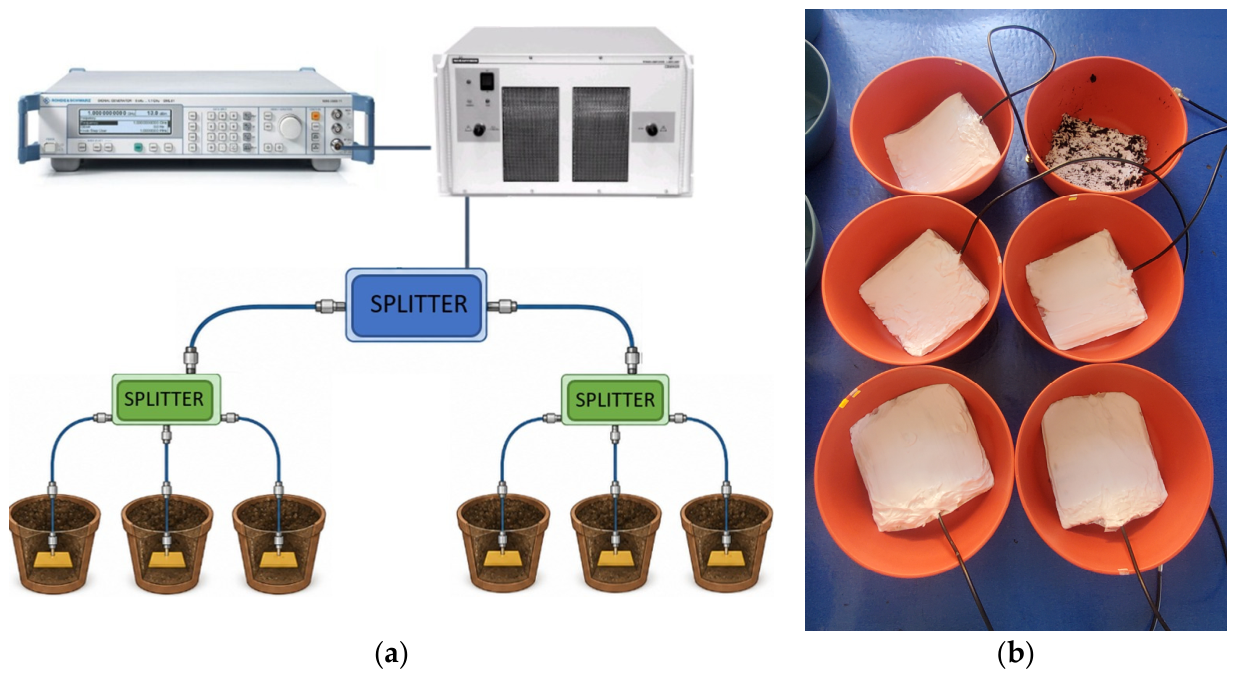
Flexible, low-profile antennas (2 mm thick) were designed and fabricated for the experiment. Each antenna was coated with sanitary silicone to protect against moisture when buried in soil at the bottom of a pot. The exposure setup is illustrated in Figure 1.
Each antenna placed at the bottom of a pot filled with soil was connected via a coaxial cable and an N-connector to a three-way power splitter. The two three-way splitters were connected via a two-way splitter to the output of a power amplifierCBA 9423 (Teseq, Luterbach, Switzerland) at 50 dB gain. The amplifier received a signal from a SML03 signal generator,9 kHz–3.3 GHz, (Rohde & Schwarz, Munich, Germany) at −23.8 dBm at 868 MHz. This setup delivered 10 mW (10 dBm) input power at 868 MHz to each antenna. The parameters of the signal employed for each of the six antennas (A1–A6) are listed in Table 1. The chosen power of 10 mW is close to values used in precision agriculture, particularly for underground-to-above-ground communications with LoRaWAN [26].
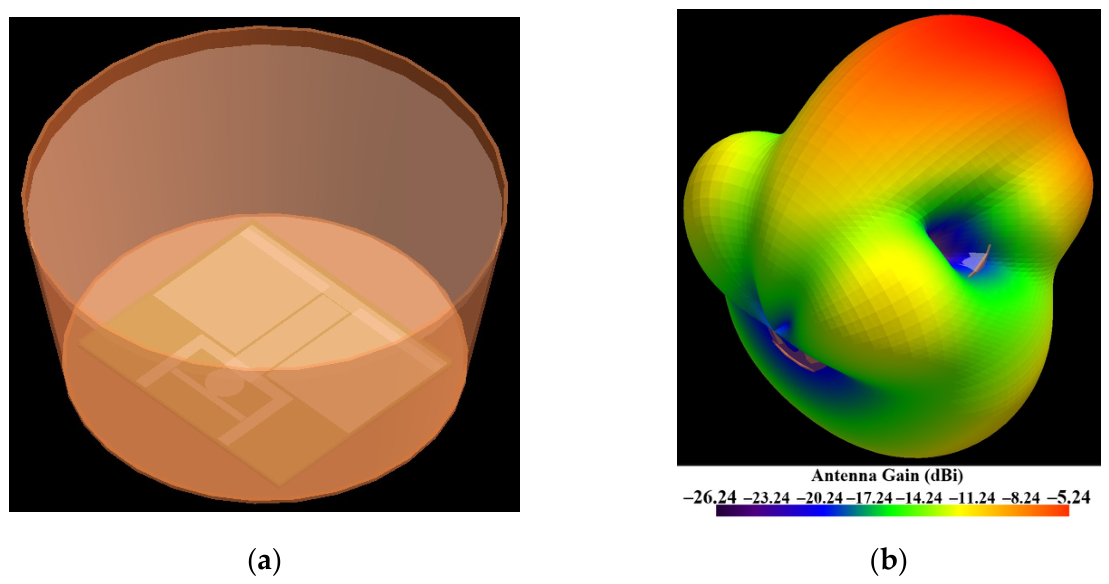
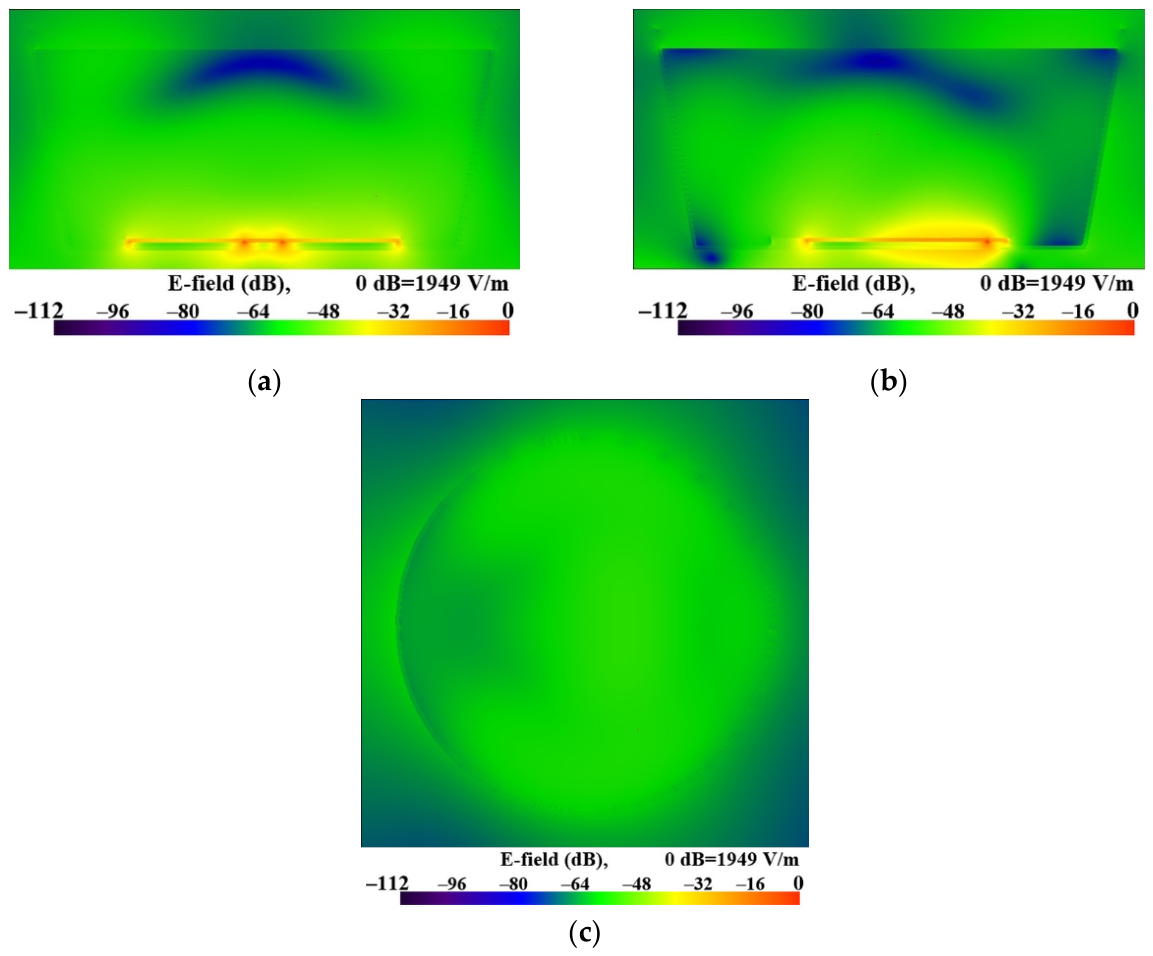
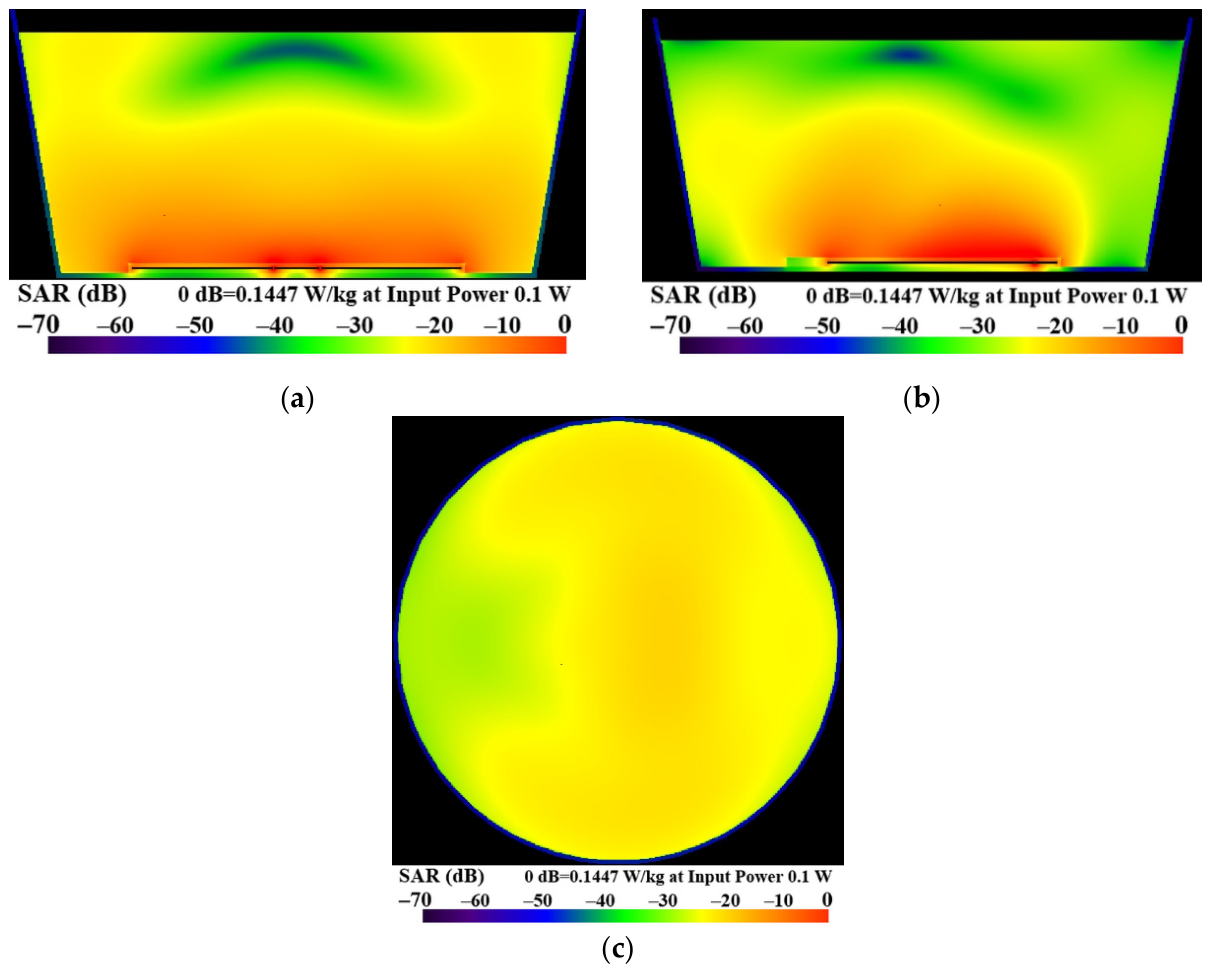
A numerical model of the antenna at the bottom of a pot filled with soil (moisture 50%) was developed (see Figure 2a). Using XFdtd version 7.10.2.3 (Remcom, State College, PA, USA), the electromagnetic field distribution in and around the pot, the SAR in the soil, and the 3D antenna radiation pattern were calculated. Figure 2b shows that the antenna exhibits a unidirectional radiation pattern, with the main lobe directed toward the plants. The distribution of the electric field in the xy, yz, and zx planes when the antenna is placed at the bottom of the pot is presented in Figure 3. In all planes, the E-field is highest around the antenna. Due to soil absorption, decay occurs along the vertical (y) axis. The E-field values in the soil range from around 7 V/m (−48.9 dB, green) to 0.2 V/m (−80 dB, blue) with a relatively uniform distribution in the xy and zx planes within the pot. The distribution of SAR in the soil is presented in Figure 4. As expected, SAR in the soil near the antenna is highest (0.1447 W/kg = 0 dB at 10 mW input power to the antenna) and about 40 dB lower in the soil at the pot surface.
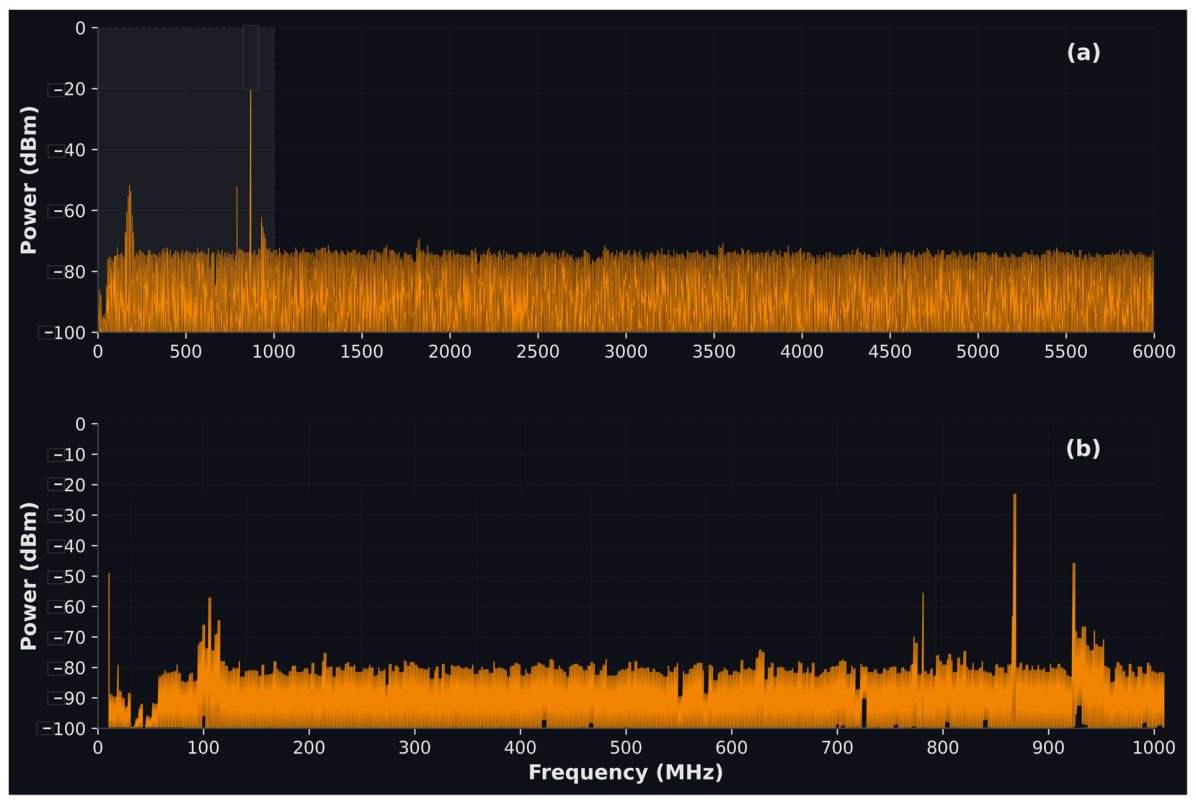
In addition, near the pots, measurements were performed using the R5550-427 spectrum analyzer (thinkRF, Kanata, ON, Canada) under the EMF exposure conditions described above (i.e., with the generator and amplifier delivering 10 mW to each antenna buried in the soil). The results presented in Figure 5 show that the 868 MHz signal is dominant, while all other signals are at least 30–50 dB below it.
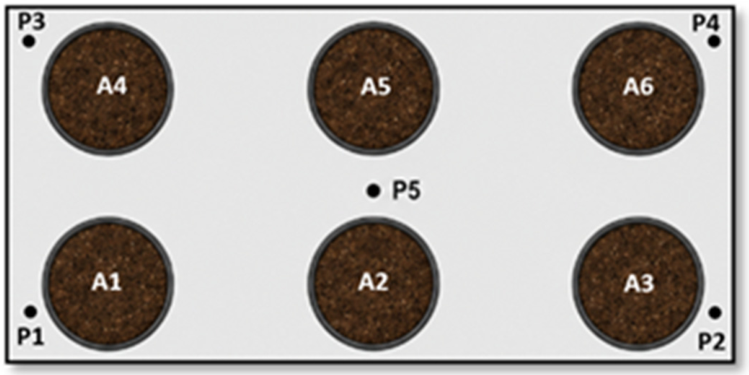
Additionally, the EMF level was measured at 10 cm above the pots, at five points within the chamber, as shown in Figure 6. The measurement results for horizontal and vertical orientation of the measuring antenna are presented in Table 2. The results show that the EMF is almost uniform. Slightly higher values are observed at point P5, which is likely due to positive interference. Hence, we can conclude that the EMF exposure conditions are well controlled and that any observed effects would be due to the applied EMF at 868 MHz, intended to simulate LoRaWAN communications in precision agriculture.
All pots were distributed between two identical growth chambers. The EMF-exposed group was placed in a separate laboratory to ensure that the Control and Sham groups were not subjected to the investigated 868 MHz EMF exposure. The EMF treatment was carried out throughout the 28-day experimental period covering the early stages of plant development as sprouts, seedlings, and young plants, when a high sensitivity to environmental factors is expected. The exposure was interrupted once a week for a short time just when analyses were performed.
The physiological state of the plants was evaluated every week by morphological, biochemical, and biophysical methods. EMF exposure from a soil-buried antenna is at a higher level in the roots than in the above-ground parts of a plant. Examinations of maize roots developing in soil are hardly feasible in practice because the roots are fragile, branched, and intertwined. Their good separation from soil is hardly possible. So, we have focused on aerial growth and leaf analyses. Moreover, any disturbance in root physiology would reflect on their function to provide the necessary water and nutrients to above-ground parts and would have consequences for the aerial parts and the crop yield.
Plant growth was assessed by measuring the length of the whole plant in centimeters from the soil to the top of the longest leaf on the 7th, 14th, 20th, and 27th day after the seeds were sown. At the same time periods, except on day 7, chlorophyll a fluorescence was recorded. Kinetics of chlorophyll a fluorescence were recorded using an M-PEA fluorometer (Hansatech Instruments Ltd., King’s Lynn, UK). The performance of photosynthetic light reactions was monitored by the JIP-test [27,28]. From each pot, 4 plants were chosen at random, excluding outliers significantly lagging in development. From those 4 plants, 4 leaves sharing the same ordinal number from the bottom up were measured: second leaf for days 14 and 20, 3rd leaf for day 27.
All leaf biochemical parameters were examined on the 14th, 21st, and 28th days, after the seeds were sown, by weighing, cutting, and mixing the leaves used for fluorescence measurement for each pot. Relative dry biomass (%) was assessed as
DW/FW,
where DW is dry weight, and FW is fresh weight of the top parts of the investigated leaves, both measured in grams on an analytical scale. The water balance was determined by calculating leaf water content (relative units) as
(FW − DW)/DW.
Fresh weight of the mixed-cut-leaves material sampled for biochemical analyses was measured separately, and its dry weight was calculated utilizing (1) as
DWbiochemistry = FWbiochemistry × (DW/FW).
Plant primary metabolism was probed by the reducing sugars content versus glucose standard (mg glucose/g DW) by the method of Plummer [29]. The redox status of the leaves was estimated by hydrogen peroxide (H2O2, nmol/g DW), malondialdehyde (MDA, nmol/g DW), total antioxidant content, and antioxidant enzyme activity. H2O2 and malondialdehyde (MDA) were determined following the Rainbow protocol [30]. Antioxidant capacity (µmol Trolox/g DW) was established versus the Trolox standard (Trolox equivalent antioxidant capacity, TEAC) by utilizing the ABTS radical cation decolorization assay [31] as described in Kouzmanova et al. [32]. Catalase (CAT) activity was determined by the spectrophotometric method of Aebi, measuring H2O2 decomposition at 240 nm [33]. Superoxide dismutase (SOD) activity was assayed by SOD Assay Kit, 19160, Sigma-Aldrich (Burlington, MA, US) [34].
The experimental results are presented as mean ± standard error of the mean (SEM) values summarized at the pot level for a treatment variant for each time period (day). Statistically significant differences were determined by one-way (factor: treatment) or two-way (factors: treatment and time) analysis of variance (ANOVA) followed by Duncan’s new multiple range test at p < 0.05. All data but the CAT dataset passed normality and homogeneity of variances tests. Since the discrepancy was not vast, ANOVA was still applied for CAT data. However, the 6th Control pot values for the last time point (day 28) were discarded a priori as a spurious outlier. All the above-mentioned statistical procedures, along with the plotting of figures, were done in R [35]. Principal component analysis (PCA) of the whole data set (each data point–parameter value for a pot on a day) was performed by the prcomp function in a custom R script. All variables were standardized (z-score) prior to analysis.
To characterize treatment-dependent growth trajectories, plant height data were analyzed using the Gompertz model, a non-linear sigmoid function commonly applied to plant growth processes. The model was fitted from day 7 onward, with sampling day as the predictor and plant height as the response variable. The Gompertz model was defined as
h(t) = A exp[−B exp(−kt)],
where h(t) is plant height (cm) at time t (day), A is the asymptotic (maximal) height (cm), B is a scaling constant, and k is the growth-rate constant (day−1). The inflection point (day), which is an indicator of the timing of maximal relative growth, was also extracted from the model. Representative treatment-level fits were obtained using the complete set of observed measurements for each treatment. To assess variability in the model parameters among experimental units, the Gompertz model was also fitted separately to pot-level mean values across sampling days. Parameter estimation was performed by non-linear least-squares fitting.
Generative artificial intelligence Kimi K2.6 (Moonshot AI) and Genspark AI Assistant 1.0.0 were used to rework Figure 5 from a picture to improve resolution and assist in interpreting the statistical results, including performing plant growth modeling to generate Figure 7b and data for Table 3, drafting and restructuring parts of Section 4 and Section 5, and harmonizing the academic style and language. All data analysis, modeling decisions, and scientific interpretations were performed by the authors, who reviewed, edited, and took full responsibility for the final content.

3. Results

Multiple morphological, physiological, biophysical and biochemical characteristics were monitored throughout the first month (28 days) of vegetative growth to examine the scope and nature of the putative biological effect of 868 MHz EMF employed by LoRaWAN precision agriculture devices during the early stages of development of maize plants. All experimental results are described in detail below.

3.1. Morphology Analyses

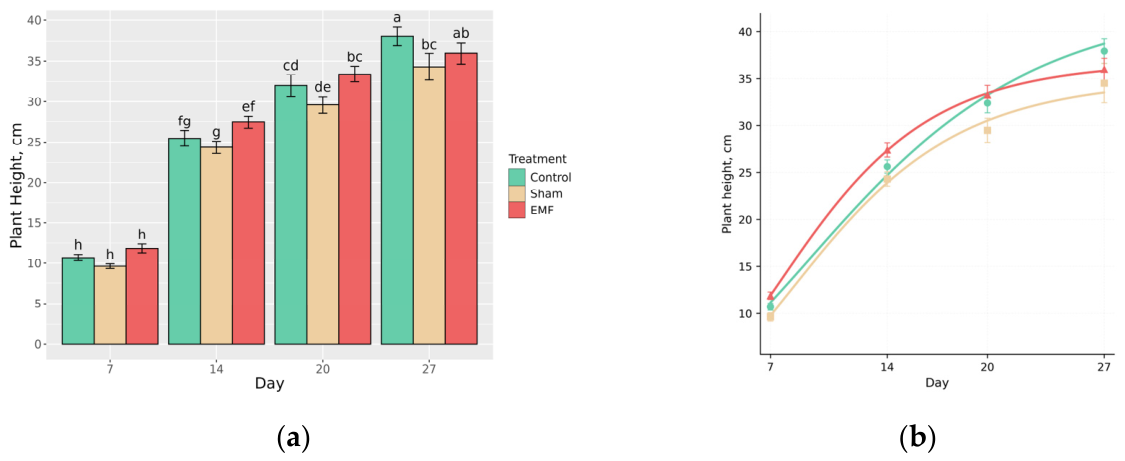
Plant height increased steadily in all treatment groups throughout the experiment (Figure 7a). Mean values rose from around 10 cm on day 7 to around 35 cm on day 27 after sowing. The growth was fastest in the period between the 7th and 14th days, when height was more than doubled. Sham-exposed plants displayed the lowest mean values for each time point, while EMF-treated plants were the tallest at each but on the last day. However, the discrepancy between Control and Sham increased steadily to become significant on the 27th day, but EMF-treated plants stayed within the Control confidence interval.
Figure 7. Growth of Z. mays plants at normal laboratory conditions (Control), with a non-working antenna buried in the soil (Sham), and irradiated with 868 MHz EM wave emitted from a soil-buried antenna (EMF) for 7, 14, 20, and 27 days after sowing: (a) plant height (cm). Presented values are mean ± standard error of the mean (SEM). Distinct letters denote statistically different experimental variants (two-way analysis of variance (ANOVA), Duncan’s MRT, p < 0.05); (b) Gompertz growth curves representative for each treatment group fitted to the observed plant-height data from day 7 onward. Points represent observed mean ± SEM values for each treatment, shown with different symbols, and lines represent fitted Gompertz trajectories. Colors are shared across panels and correspond to the three treatment variants: Control (green), Sham (yellow) and EMF (red).
Applsci 16 06024 g007
The Gompertz function was used to best model the growth of the treatment groups (Figure 7b). Overall, growth followed a largely common developmental trajectory across treatments. That is best underscored in the parameter summary presented in Table 3. The model yielded the highest growth-rate constant for the EMF group, followed by the Sham and Control groups. The estimated inflection point was likewise the earliest in the EMF treatment, followed by the Sham and Control treatments. Even so, the highest asymptotic height was estimated for the Control group, indicating that the slightly faster early trajectory under EMF did not result in greater final plant size. However, all those differences were not statistically significant.
Table 3. Gompertz growth model parameters.
VariantAsymptotic Height, cm *Inflection Point, Day *Growth Rate Constant, Day−1 *
Control41.11 ± 1.9 a8.9 ± 0.51 a0.16 ± 0.02 a
Sham35.84 ± 1.98 a8.61 ± 0.41 a0.17 ± 0.02 a
EMF37.6 ± 1.63 a7.86 ± 0.36 a0.2 ± 0.03 a
* Presented values are mean ± SEM. Same letters denote means that are not significantly different (one-way ANOVA, Duncan’s MRT, p < 0.05).
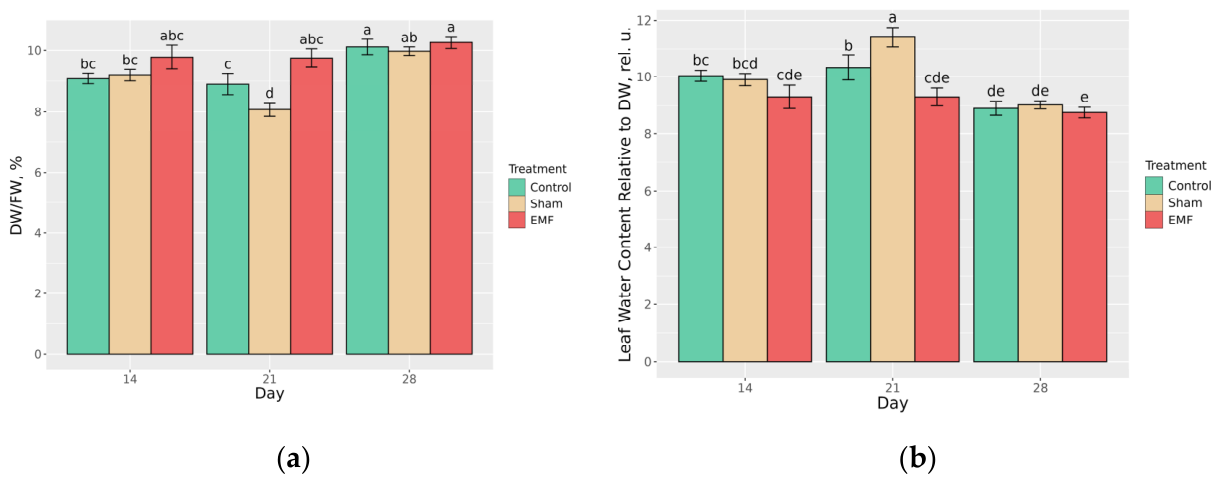
Dry leaf biomass as a percentage of fresh weight was much less dependent on time than growth, alternating in the range of 8–10% (Figure 8a). Only Sham-exposed plants exhibited full-term dynamics—DW/FW dipped on the 21st day but on the 28th day recovered to the level on the 7th day, suggesting a transient negative effect of the antenna presence in the soil on the plants. Control plants experienced an increase just at the last time point. Although EMF-exposed plants kept their relative dry weight unchanged throughout the experiment, it had pronounced tendencies for higher values before reaching the last day. That fact is reminiscent of the growth dynamics. However, it should be noted that leaf analyses on the last experimental day (28) included the third leaf of the maize plants instead of the second leaf as used at the previous two periods (days 14 and 21) because of its advanced senescence on the 28th day. That fact might help to better interpret the observed treatment effect discrepancies between examination days. Differences among treatment groups were most pronounced on day 21 when the second leaf is 1.5 times older than at the previous period, approaching the late phase of its life. The leaf’s non-optimal physiological state should make it much more susceptible to various stress factors and thus reveal the effect of Sham exposure on the relative dry biomass.
The leaf water content (relative to DW) follows the pattern of DW/FW but in a reverse direction because both parameters are reciprocally related (Figure 8a,b). We present both of them to highlight that the relative biomass changes could be influenced by metabolic changes and/or disturbances of the water balance, while absolute biomass measurements are prone to high variability pertaining to many factors concerning the individual plant. EMF radiation affected relative water content, leading to a mild deficit in aging second leaves as noted by the significant differences between EMF and both Control and Sham-exposed plants on the 21st day. At the same time point, Sham exhibited the highest water content, indicating improved leaf water balance. The leaf water content did not change with time from the 14th to 21st day for RF-EMF-treated plants—no statistically significant differences in the obtained values, no dependence on the leaf age. For Control plants, a statistically significant difference was observed on the 28th day (third leaf measured) in comparison to the previous two periods—7th and 14th days. Aging of the second leaf in Control plants was not relevant to leaf water content. However, due to the observed discrepancies in the water content, all the biochemical markers were expressed per gram of leaf DW (Equation (3)).

3.2. Primary Metabolism Evaluation

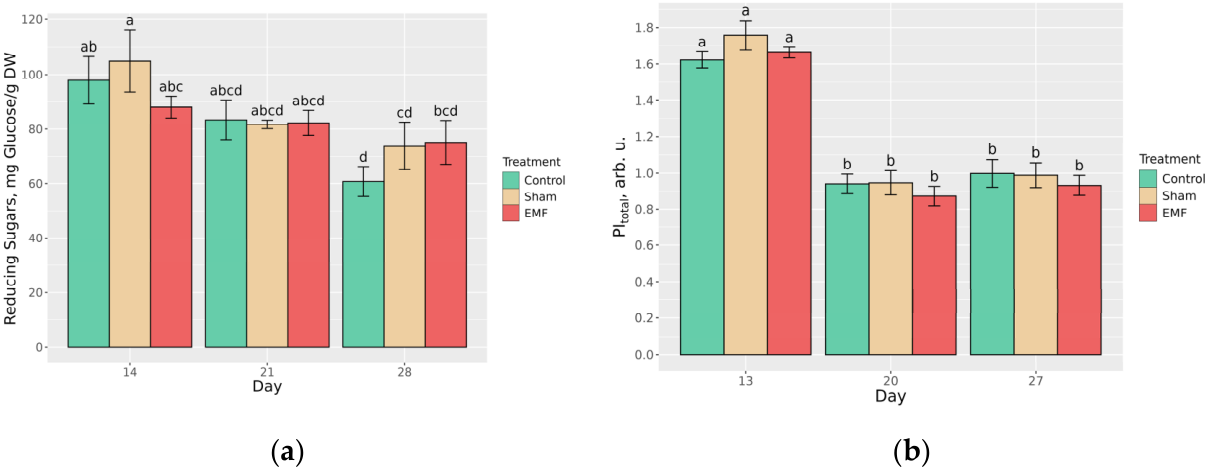
In order to explain the morphological alterations, primary leaf metabolism was evaluated by the performance of the light reactions in photosynthesis and by the content of reducing sugars as end photosynthetic products. Reducing sugars did not differ among treatment groups per day (Figure 9a). Their content decreased with time more strongly for Control than Sham but not for EMF-exposed plants.
The performance index of the total photosynthetic light phase (PItotal) probed by JIP-test did not depend on treatment but dropped sharply on the 20th day to stable levels (Figure 9b). This parameter integrates the concerted action of light absorption, primary photochemistry, electron transport, and production of NADPH (and ATP) in thylakoid membranes. The fluorescence data supported a picture of overall functional stability of the photosynthetic machinery that is consistent with the morphological layer. Here, the time progression also dominated over treatment in determining the final effect. Moreover, the clear time-dependent decrease in reducing sugars and PItotal and the lack of differences between 21/20 versus 28/27 days might underline the determining influence of whole-plant metabolism shifts during the development and not a leaf age dependence.

3.3. Redox Status Examination

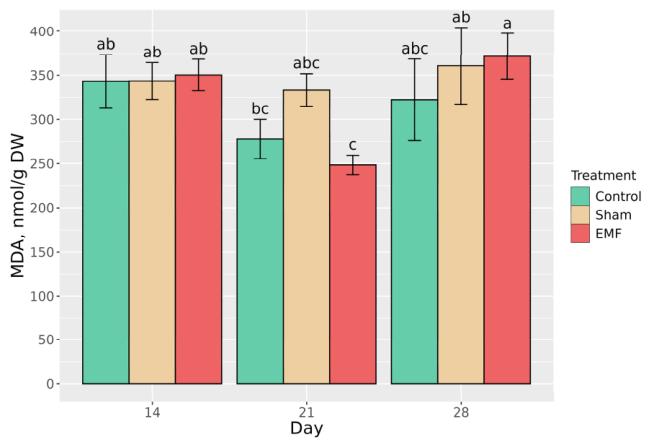
As a further step in seeking an 868 MHz EMF-related effect, the leaf redox status was investigated. Malondialdehyde, a marker of lipid peroxidation, was determined to explore the possibility of treatment-related oxidative stress (Figure 10). However, actual lipid damage correlated to treatment was not found. On the contrary, transient dynamic alterations in the opposite direction, i.e., lowering the oxidation level, were revealed. EMF-exposed plants displayed lower MDA content on the 21st day of growth and returned to initial levels at the end of the experiment. Similar but insignificant alterations in the midterm were present for the Control plants. MDA content in the Sham-exposed plants did not change over time.
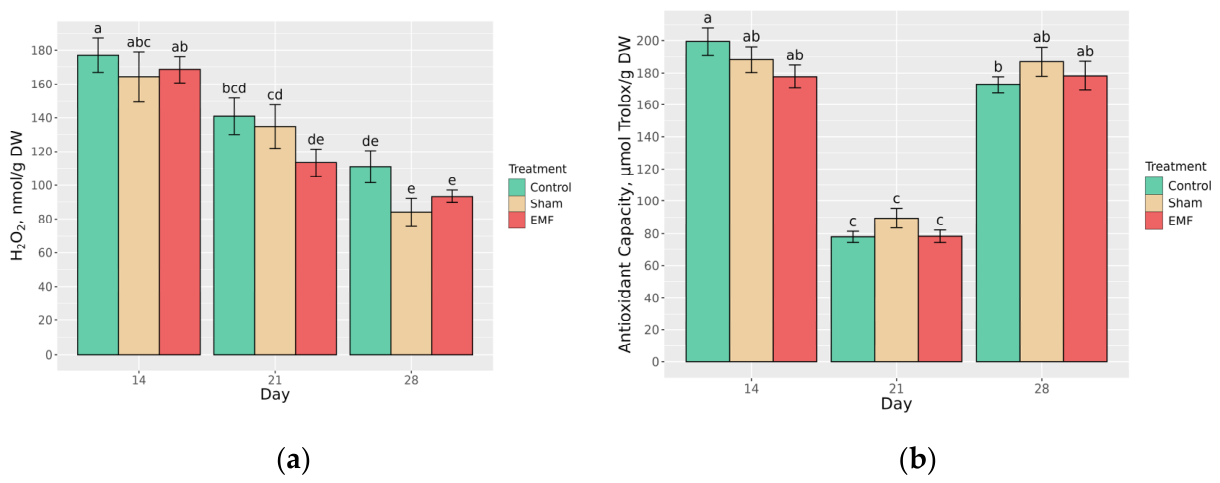
Since oxidative stress is determined by the imbalance of oxidants versus antioxidants in favor of the former, both substances were measured in the leaves. The hydrogen peroxide was measured as a (pro-)oxidant, giving the most dangerous reactive oxygen species (ROS) in vivo—the hydroxyl radical (·OH). H2O2 displayed clear time but no treatment dependence (Figure 11a). H2O2 is generated in all aerobic cells due to the vast presence of the best oxidant in biology—the molecular dioxygen—and its ability to extract single electrons from organic molecules, resulting in superoxide radical (·O2) at first, and consequently in H2O2. Hence, such strong linear dynamics might indicate diminishing metabolic activity during the vegetative period independent of EMF or Sham conditions and remind of the less pronounced time trend for reducing sugars.
The antioxidants were determined by the Trolox equivalent antioxidant capacity (TEAC) of the leaf extracts (Figure 11b). Once again, EMF or Sham exposure did not influence the parameter. On the other hand, there was a two-fold decrease in TEAC on the 21st day, while the values at the other two periods were identical, pointing to the leaf physiological age as the determinant of the antioxidant capacity.
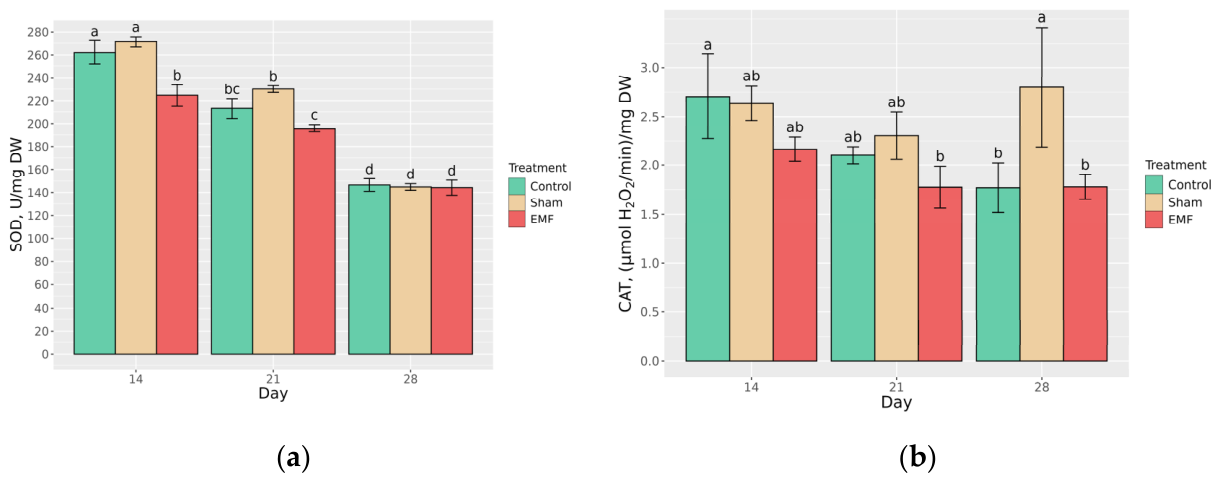
H2O2 is not just a byproduct of aerobic metabolism. It is an important messenger molecule in the cells, involved in many signal pathways, so its concentration is tightly regulated by its enzymatic production and degradation. The activity of superoxide dismutase (SOD)—the enzyme that generates H2O2—is shown in Figure 12a. The pattern in this figure highly resembles that of H2O2, which is to be expected—plant age-related physiology changes were the main factor in determining SOD activity. Surprisingly, some effect of 868 MHz EMF on SOD was revealed: the treatment lowered its activity moderately compared to Control/Sham at day 14 and just to Sham at day 21 but not at the last investigated period.
The activity of catalase (CAT)—the main enzyme degrading H2O2—showed much weaker dynamics than SOD. The decrease in CAT activity for the Control plants is significant between the 14th and 28th days only (Figure 12b). Moreover, Sham on the 28th day was the only variant to significantly deviate from the other treatment groups at a given time point. A tendency for values lowering with time was noticed for EMF, but no significant differences were found.

3.4. Multivariate Analysis

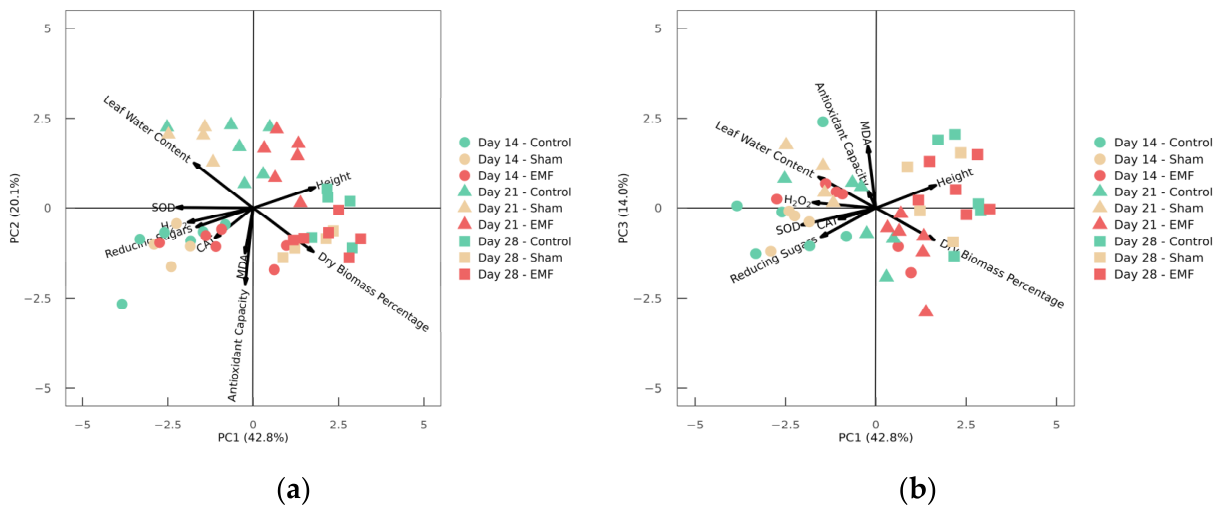
Principal component analysis of the full biochemical, physiological, and morphological dataset revealed that variation was structured primarily by developmental stage, with treatment-related displacement superimposed as a secondary pattern (Figure 13). The first three principal components (PCs) explained 73.1% of the total variance.
On the PC1–PC2 plane, samples were arranged along PC1 in a clear temporal sequence: day 14 (circles) at the negative end, day 21 (triangles) intermediate, and day 28 (squares) toward the positive end. The variable vectors indicate that PC1 was driven by plant height and dry biomass (positive direction), opposing reducing sugars, SOD, CAT, and H2O2 (negative direction). This inverse correlation reflects the metabolic reallocation associated with rapid stem elongation.
Treatment effects emerged along PC2. Control samples (green) concentrated in the lower half, Sham (yellow) displaced markedly upward, and EMF (red) showed greater scatter, particularly at day 14. By day 28, the EMF cluster tightened, suggesting consolidation of an initially variable phenotype. The partial EMF–Sham overlap, together with their joint separation from Control, indicates that exposure context introduced a measurable physiological component without producing a distinct EMF-specific signature.
The PC1–PC3 projection corroborated the temporal gradient, while PC3 captured additional variance linked to MDA and TEAC, contributing to fine-scale separation of late-stage samples.

4. Discussion

The maize growth indicates small transient treatment-related differences (Figure 7). EMF exposure had slightly accelerated the early growth without producing a bigger plant size at the end of the experiment. In the available literature, EMF-related effects on plant growth vary with field characteristics, exposure regime, developmental stage, and species. EM frequencies in the 900 and 1800 MHz ranges are widely investigated. Most of the studies report inhibition of early seedling growth, but stimulation or lack of measurable morphological effects was also noticed. Exposure of onion (Allium cepa) bulbs to 900 and 1800 MHz EMF (261 and 332 mW/m2, respectively) for 0.5, 1, 2, and 4 h affected root meristematic cells, and a reduction in root length and an increase in thickness were observed. A significant increase in the mitotic index after 2 and 4 h of exposure and in chromosomal aberrations during 0.5–4 h of exposure was also observed. The authors concluded that EMFs of 900 and 1800 MHz adversely affect root meristems in onion plants and induce cytotoxicity and DNA damage, more pronounced at 1800 MHz than at 900 MHz [16]. Wheat plants (Triticum aestivum L.) exposed to 2850 MHz also showed a reduction in root and stem length and in total biomass. A decrease in the concentration of photosynthetic pigments and in the activity of enzymes related to carbohydrate metabolism was also found [8]. Lettuce (Lactuca sativa) exposed to frequencies of 1890–1900 MHz (8000 µW/m2), 2.4 GHz (8000 µW/m2), and 5 GHz (2000 µW/m2) showed a significant decrease in photosynthetic efficiency under outdoor conditions, together with suppressed expression of stress-related genes and accelerated flowering [11]. Duckweed (Lemna minor L.) showed reduced growth when irradiated with 900 MHz (2 h, 23 V/m), while the same radiation at 400 MHz did not lead to a significant effect. At stronger fields (390 V/m), further growth suppression was found. A significant increase in peroxidase activity was observed at 900 MHz [17]. Maize seedlings irradiated with 1800 MHz and SAR 0.169 W/kg for 0.5–4 h showed significant physiological and biochemical changes, including reduced root and coleoptile length, a decrease in the content of photosynthetic pigments and total carbohydrates, as well as a strong increase in the activity of enzymes involved in metabolism [22]. In maize seeds (Zea mays) exposed to 900 MHz (23 V/m), an increased germination rate was reported [36].
In a previous study, we failed to register statistically significant changes in morphological (growth rate and biomass) and physiological characteristics (photosynthetic pigments, reducing sugars, anthocyanins, and malondialdehyde) measured 10 days after 2 h exposure of wheat and maize sprouts to 900 MHz EMF, 370 V/m, continuous wave [25]. The results of our current experiment are more consistent with mild modulation of growth dynamics than with either pronounced growth promotion or growth suppression. The alterations in relative dry biomass and leaf water content support this hypothesis—the differences between exposed and Control/Sham-exposed plants faded to the end of the experiment. The absence of significant differences in final seedling height, leaf biomass, and leaf water content suggests that maize plants can adapt to EMF with the investigated parameters and exposure conditions. However, interpretation of the day 28 leaf data requires explicit methodological contextualization. During the first three weeks of vegetative growth, the second leaf served as the primary photosynthetic organ and was the subject of all analyses on days 14 and 21. By day 28, this leaf had entered advanced senescence, necessitating a transition to the third leaf. At this chronological stage, the third leaf is functionally younger and physiologically less mature than the second leaf was at the 21st day. This ontogenetic reset introduces a discontinuity in the time series: the apparent convergence of relative dry biomass and water content across treatments on day 28 (Figure 8) reflects, at least in part, the inherent juvenility of the new leaf cohort rather than a genuine dissipation of treatment effects. Consequently, the EMF-related elevation in dry biomass and the Sham-related water-balance perturbation observed on day 21—measured on the same leaf at the same physiological age—represent the more reliable indicators of treatment-specific modulation. The data on day 28 contribute to treatment comparison completeness but must be weighted cautiously when inferring treatment trajectory.
The Sham condition introduced a measurable morphological signal distinct from both Control and EMF treatment. Sham-exposed plants consistently displayed the lowest mean height values, with the divergence from Control attaining statistical significance by day 27. Furthermore, the transient depression of relative dry weight in Sham plants on day 21, followed by apparent recovery on day 28, indicates that the physical presence of the antenna in the rhizosphere was not biologically neutral. Indeed, after checking the ingredients of the sanitary silicone used to isolate the antenna from the soil, a chemical agent plausibly affecting maize growth was found—4,5-dichloro-2-octyl-2H-isothiazol-3-one. That substance is a biocide controlling fungi and/or microorganisms and is regulated under EU Directive 98/8/EC “Concerning the placing of biocidal products on the market”. The chemical has been reported to affect shoot length and shoot dry weight in rice, a species from the same family as maize—Poaceae—in doses higher than 6.1 and 10 mg/kg dry soil weight, respectively [37]. Further detailed investigations are needed to establish the dose of the biocide in the soil under the applied experimental conditions and the exact dose–response dependence for the maize species to prove the hypothesis of a mild negative impact of the antenna’s silicone coating on the plants of the Sham-exposed variant. It is interesting that such a mild negative effect is not revealed for the EMF variant, suggesting interaction of the EMF with the potentially harmful chemical factor, but that speculation should be tested in future studies. In this line of thought, it should be stressed that the Sham condition is a handling control that introduces all the non-EMF antenna-related variables (mechanical soil disturbance, altered micro-hydrology, potential subtle chemical effects from the silicone-coated antenna body) and is not a procedural blank. The comparison between EMF and Sham isolates the electromagnetic component from all the confounding physical factors, whereas the EMF versus Control juxtaposition assesses the net effect of the entire exposure setup.
The photosynthetic and metabolic data reinforce the ontogenetic dominance observed at the morphological level. The performance index of total photosynthetic light reactions (PItotal), probed by the JIP-test, showed no treatment-dependent variation at any sampling point, indicating broad functional stability of PSII reaction centers, electron transport, and energy transduction [27,28,38]. This stability stands in contrast to reports of EMF-induced photosynthetic disruption at higher frequencies or power densities. Tang et al. demonstrated proteome-level disturbance of the photosynthetic machinery in Microcystis aeruginosa [9]; Pal et al. reported long-term effects of 2850 MHz EMF on carbohydrate metabolism in wheat [8]; and Roux et al. documented altered transcription, translation, and electric charges in tomatoes exposed to 900 MHz fields [39]. External RF-EMF can also interfere with the plant’s endogenous electrophysiological signaling based on electric potential fluctuations, potentially disturbing intercellular communication and adaptive responses to other environmental factors [40]. Stefi et al. investigated the non-thermal effects of exposure of Arabidopsis thaliana to 1882 MHz, 2072 V/m, 24/7 for 2, 3, or 4 weeks and found alterations in leaf development, a reduction in the number of chloroplasts, a decrease in stroma thylakoids, and the photosynthetic pigments, resulting in a weak photosynthetic potential and a consequent reduction in the primary productivity—reduced biomass of the above the ground parts and the roots, with roots more affected [15]. The absence of comparable perturbations under the present exposure parameters suggests that 868 MHz carrier-wave emissions from soil-buried LoRaWAN antennas do not impact photosynthetic machinery.
Reducing sugars and PItotal declined synchronously across all treatments between days 14 and 21, followed by apparent stabilization through day 28 (Figure 9). As with the morphological parameters, this temporal pattern must be interpreted through the lens of leaf-age discontinuity. The transition from the senescing second leaf (days 14 and 21) to the functionally younger third leaf (day 28) resets the physiological clock; the third leaf is expected to naturally retain higher photosynthetic capacity and greater soluble sugar content than its predecessor would have exhibited at the same chronological age of the plant. Thus, the plateau observed on day 28 should reflect an ontogenetic artifact rather than a metabolic recovery or treatment-specific effect. However, the clear time-dependent decrease in these parameters between days 14 and 21 and the lack of differences between the mid-term and terminal measurements could also be determined by whole-plant developmental shifts rather than leaf-age dependence per se.
The absence of treatment-specific differences in reducing sugar content indicates that carbon fixation and partitioning were not perturbed by EMF exposure. The metabolic reallocation is associated with the transition from heterotrophic seedling growth to autotrophic establishment—wherein stored reserves are mobilized and subsequently diluted by structural biomass accumulation [41]. These processes proceeded identically across all treatments. In this context, the insignificant Gompertz-derived acceleration in stem elongation observed for EMF plants (Table 3) cannot be attributed to enhanced photosynthetic output per unit leaf area. Rather, it suggests a more efficient utilization or altered partitioning of fixed carbon toward structural elongation, a quantitative adjustment of sink–source relationships that remained within the homeostatic range and did not coalesce into a generalized metabolic stress response. It should be noted that reducing sugars (all monosaccharides and many disaccharides) have many important roles in plants other than being nutrients: signaling molecules involved in stress responses and photosynthesis regulation, anti-oxidative processes, etc. Glucose, as a signaling molecule, regulates all processes of plant growth and development. A decrease in reducing sugar concentration could affect all these processes with the respective consequences for the plant.
Malondialdehyde, a widely employed proxy for lipid peroxidation [30], was not elevated in EMF-exposed plants. On the contrary, it was transiently lowered on day 21 relative to Control before returning to baseline levels by day 28 (Figure 10). This absence of treatment-related oxidative damage contrasts sharply with studies employing higher-intensity RF-EMF. Sharma et al. demonstrated that mobile phone radiation inhibited root growth in Vigna radiata by provoking oxidative stress, evidenced by elevated MDA and H2O2 levels [21]. Kumar et al. similarly linked 1800 MHz EMF-induced growth inhibition in maize to metabolic disruptions entailing redox imbalance [22]. Some authors also considered that exposure to RF-EMF in the 900 MHz–1.8 GHz range acts as an abiotic stressor, inducing oxidative stress assessed by increased MDA levels and membrane damage [18,36]. To compensate for this effect, plants upregulate antioxidant enzymes (e.g., catalase) and accumulate proline as an osmoprotectant [36,42].
Hydrogen peroxide and total antioxidant capacity (TEAC) exhibited no statistically significant differences between the treatment groups but pronounced temporal dynamics: H2O2 steadily decreased while TEAC dropped sharply on day 21 before recovering on day 28 (Figure 11). Once again, the day 28 recovery must be interpreted with circumspection owing to the leaf-age discontinuity: the third leaf, being metabolically younger, possesses a redox profile characteristic of earlier developmental stages, higher antioxidant capacity and lower steady-state H2O2 than the senescing second leaf would have displayed.
The enzymatic antioxidant profile, however, revealed a selective EMF effect that persisted independently of this confounder (Figure 12). SOD activity was moderately but significantly lower in EMF-exposed plants on day 14. Crucially, this reduction was not accompanied by significantly elevated H2O2 (despite the similar overall pattern between SOD and H2O2) or MDA, implying that diminished SOD activity reflected decreased substrate availability—i.e., reduced superoxide radical (·O2) generation—rather than compromised antioxidant defense. This interpretation aligns with the concept that low-intensity EMF may modulate mitochondrial and plasmalemmal electron leakage without imposing oxidative challenge [7]. Frequency-dependent modulation of antioxidant enzyme activity has been previously reported, supporting the plausibility of such parameter-specific adjustments [15,17].
CAT activity displayed weaker dynamics, with a non-significant tendency toward lower values in EMF plants and a notable elevation in Sham on day 28. The Sham-related deviation, statistically significant in comparison with Control, is particularly instructive because it was measured in the younger third leaf. The absence of a comparable Sham effect in the second leaf on days 14 and 21 suggests that the physical presence of the antenna may have induced a delayed adaptive response manifesting in the third leaf. Regardless of the specific mechanism behind such CAT activation, this divergence reinforces the conclusion that the Sham antenna was not biologically inert and should be interpreted as a handling control.
Collectively, the redox state data indicate that 868 MHz EMF exposure under LoRa-relevant conditions did not provoke oxidative stress in young maize. Instead, it induced a mild, quantitative adjustment of the antioxidant enzyme network superimposed on a developmentally driven redox landscape. The biochemical markers, being the most responsive analytical layer among morphology or fluorescence, captured the finest treatment-related modulation; yet, these changes remained trait-specific and did not coalesce into a generalized stress syndrome. This pattern of limited parameter-specific shifts, partial overlap with Sham, and attenuation over time is consistent with adaptive physiological tuning within the normal homeostatic range, as corroborated by the multivariate perspective discussed below.
The multivariate analysis (Figure 13) provides a consolidated view that summarizes the patterns observed at the univariate level. Across the three analytical layers—morphology, photosynthetic performance, and biochemistry—a consistent hierarchy emerged: developmental stage was the dominant source of variation, while treatment effects remained selective, trait-dependent, and context-sensitive. Such ontogenetic dominance over stress-related modulation is frequently observed in crop physiological studies employing integrated phenotyping approaches, where the maturation program sets the baseline against which environmental perturbations are superimposed [7,43].
The PCA revealed that the first principal component captured primarily the ontogenetic trajectory, with plant height and biomass driving the positive pole and metabolite pools (reducing sugars, antioxidant enzymes, and H2O2) loading in the opposite direction. This axis thus encapsulates the fundamental physiological trade-off between structural growth and metabolic maintenance that characterizes early vegetative development in maize [41]. Against this strong developmental background, treatment-related displacement was expressed mainly along PC2 and, to a lesser extent, PC3.
The upward shift in Sham samples along PC2, distinct from the Control cluster below, indicates that the physical presence of the antenna introduced a measurable multivariate signal even in the absence of active electromagnetic emission. This observation is methodologically important: it demonstrates that the exposure device itself—whether through subtle chemical, microclimatic effects, mechanical proximity, or other non-EMF cues—was not biologically neutral. Consequently, the Sham condition is a handling control rather than a strict procedural blank, a distinction that might be crucial in studies of low-intensity physical factors in plant biology. However, Sham-related findings should be interpreted with appropriate caution due to the unbalanced experimental design containing only four Sham pots due to material limitations.
The EMF group occupied an intermediate position, overlapping partially with Sham yet exhibiting greater dispersion, particularly on day 14. This scatter reflects the interplay of two concurrent processes: inherent biological heterogeneity, evident across all treatments and consistent with the natural variability documented in replicated plant physiological experiments [44], as well as treatment-induced phenotypic plasticity, whereby the physiological profile adjusted to the specific exposure context [45]. The concept of phenotypic plasticity as an adaptive mechanism allowing plants to cope with environmental heterogeneity is well established, and its expression under chronic low-intensity stressors has been reported in several crop species [46,47]. The consolidation of EMF samples into a tighter cluster by day 28 suggests that early-stage plasticity gradually attenuated as development progressed, possibly because the plants either acclimated to the chronic low-level exposure or because the developmental program itself increasingly constrained the range of permissible physiological states.
The multivariate pattern supports the interpretation that EMF exposure acted as a mild modulator rather than as a deterministic stressor. Had the electromagnetic field imposed severe physiological disruption, one would expect a coordinated displacement across multiple parameters—a generalized stress syndrome visible as a distinct, treatment-specific cluster in the PC space. Instead, the PCA serves as an integrative confirmation that EMF exposure in maize under the tested conditions is one of the quantitative physiological adjustments superimposed on developmental progression, rather than qualitative reorganization indicative of physiological impairment [19]. Similar modulatory effects of low-power EMF on plant antioxidant and metabolic status, without evidence of adverse physiological effects, have been described in maize and other crops under smart-agriculture-relevant exposure scenarios [7].
Combined effects are very interesting for understanding the full implications of RF-EMF effects on plants in real field conditions, but such investigations are very scarce in the available literature. The synergistic effects on plants could occur when the RF-EMFs act in combination with other stress factors (e.g., drought, light stress, temperature changes, diseases, etc.). Under such conditions, EMFs can weaken natural defense mechanisms of plants, leading to reduced photosynthetic efficiency and impaired cellular metabolism [11,19]. Another possibility is that RF-EMFs activate plants’ defense mechanisms to protect them against other stress factors applied after the EMF exposure—implying hormesis effects [11].
Tran et al. exposed lettuce plants (Lactuca sativa) (cultivars Larissa and Briweri) to 1890–1900 MHz (DECT), 2.4 GHz (Wi-Fi) (8000 µW/m2 peak value), and 5 GHz (Wi-Fi) (2000 µW/m2 peak value) in laboratory and real field conditions [11]. There were no discernible effects under greenhouse conditions, but negative effects under field conditions were observed for plant development and photosynthesis. The authors explained this difference with controlled environmental conditions (temperature, soil moisture, light regime, etc.) in the laboratory vs. permanent microclimatic changes in the field and concluded that RF-EMF reduced plant stress tolerance. In another experiment, these authors investigated the effects of 10-day exposure to the same combination of EMFs on the same plant—Lactuca sativa (cultivars Briweri and Lucinde)—together with drought stress [48]. They found negative effects on plants exposed to RF-EMF only, including reduced photosynthetic efficiency, lower density of active reaction centers, reduced energy flux, decreased quantum efficiency in end-acceptor reduction on the Photosystem I side, and significant reduction in plant growth (lower fresh and dry mass). Plants exposed to both RF-EMF and drought showed a significantly weaker physiological response to drought and a consistently lower percentage of “anomalies” compared to plants exposed to drought alone. The authors discussed a hormetic effect of drought and concluded that “RF-EMF exposure did not exacerbate the severity of drought stress, despite its interference with drought responses”. We consider this conclusion as contradictory to the reported results for some positive effect of RF-EMF in the group treated with RF EMF and drought. As the RF-EMF treatment was before the drought, we would suggest a hormetic effect of the EMF and consequent weaker physiological plant response to drought.
Verma et al. exposed tomato fruits to 9.8 GHz EMF for 5, 10, and 15 min (SAR 0.05 W/kg, 0.08 W/kg, and 0.17 W/kg, respectively) and found an increase in the shelf life of tomato fruits without compromising the nutritive quality [49]. This pretreatment could activate protective reactions and induce a kind of hormetic effect on fruits, resulting in slower decay and longer shelf life.
In this study, we have not investigated EMF in combination with other environmental factors—laboratory experiments were carried out under controlled environmental factors. The only changeable factor was the plant’s age. Of course, morphological and some biochemical parameters change with plant development. It could be expected that germs, sprouts, and young plants would be more sensitive to RF-EMF, but our results did not support this hypothesis. Growth rate was the only parameter that was investigated consistently throughout the experiment, and it is related to the whole plant condition. Changes in plants’ height related to their development were not affected by applied RF-EMF. Slightly faster early development of EMF-exposed plants for about 21 days did not result in a significant difference in plants’ height on the 27th day. For all other investigated indices, measurements were performed on the second leaf on the 14th and 21st days. On the 21st day, the second leaf was well matured and would die on the 28th day. That is why we changed the leaf, and on the 28th day, the third leaf was investigated, which could affect the results. The third leaf on the 28th day was almost the same age as the second leaf on the 14th day and was younger than the second leaf on the 21st day. Most of the significant differences were obtained on the 21st day. Unexpectedly, the statistically significant differences are mainly between Control and Sham-exposed plants (on the 21st day). The only significant difference between Control and EMF is again on the 21st day in the leaf water content.
As low-intensity RF-EMF exposure acts as a low-to-moderate abiotic stressor, it may induce mild oxidative stress, activating antioxidant systems and repair enzymes, increasing antioxidants and protective osmolytes production (proline). Such activation does not result in severe damage but boosts defenses and prepares the plant organism against further stress—the supposed mechanism of the above mentioned hormesis effect. Such a protective effect may explain the overall better performance of RF-EMF-exposed compared to Sham-exposed plants in our experiment.
Additional experiments with RF-EMF exposure in combination with other environmental factors (drought, high or low temperatures, diseases, pesticides, nutrient deficit, etc.) are needed to elucidate the possible effect of low-intensity RF-EMF used in smart agriculture on plants’ sensitivity to other environmental factors (synergism, sensitization, or hormesis). Future work would benefit from investigation of RF-EMF effects in real field conditions.

5. Conclusions

The present study examined the biological effects of 868 MHz EMF emitted from soil-buried antennas under conditions representative of IoT/LoRaWAN precision agriculture deployments on young maize plants during the first 28 days of vegetative development. Under the present experimental conditions, maize plants did not show any adverse response to EMF exposure at the morphological, photosynthetic, or biochemical level. Variation in the values of the investigated parameters was driven mainly by plant growth and development- and age-dependent physiological metabolic changes with only minor EMF-related differences. The biochemical parameters revealed the most sensitive parameters of the plants.
The 868 MHz EMF emitted from soil-buried LoRaWAN antennas functions as a mild, transient physiological modulator rather than a stressor. The field accelerated early growth kinetics without enhancing final biomass, left photosynthetic machinery functionally intact, and induced only trait-specific antioxidant adjustments—namely, reduced SOD activity in the absence of elevated H2O2 or lipid peroxidation—consistent with decreased ROS generation rather than compromised defense. These findings indicate that IoT/LoRa-relevant EMF levels are unlikely to impose adverse effects on maize under the tested conditions.
The silicone coating of the antenna and/or the physical presence of the antenna in the soil was not biologically neutral, introducing measurable morphological and biochemical signals distinct from Control. Coupled with the leaf-age discontinuity on day 28, this constrains the inferential weight of measurements at that time point and highlights the need for full-crop-cycle studies before definitive risk assessments for wireless sensor deployment in precision agriculture can be established. Alterations observed in the Sham exposed plants raise the question of potential effects of sensors that cannot be collected from the field after their operational lifetime, as well as the effects of materials used in their manufacture.
Although this study provides valuable insights into the intrinsic effects of RF-EMF on maize seedlings under controlled conditions, the results should be interpreted with caution regarding their direct extrapolation to real agricultural settings. Future field experiments are necessary to evaluate the ecological relevance and practical implications of RF-EMF exposure under natural environmental conditions.

Supplementary Materials

The following supporting information can be downloaded at https://www.mdpi.com/article/10.3390/app16126024/s1. Table S1: Plant height raw data; Table S2: Gompertz model parameters; Table S3: Leaf biomass raw data; Table S4: Reducing sugars raw data; Table S5: JIP-test parameters raw data; Table S6: MDA raw data; Table S7: Hydrogen peroxide raw data; Table S8: TEAC raw data; Table S9: SOD activity raw data; Table S10: CAT activity raw data; Table S11: Data used for PCA; Table S12: Correlation coefficients of examined parameters.

Author Contributions

Conceptualization, N.T.A. and M.K.; methodology, M.P., B.A. and M.K.; software, M.P.; validation, M.P., N.T.A. and M.K.; formal analysis, M.P. and V.G.; investigation, M.P., B.A. and M.K.; resources, B.N.A. and N.T.A.; data curation, M.P., M.K. and V.G.; writing—original draft preparation, M.P., B.A., B.N.A., N.T.A., M.K. and V.G.; writing—review and editing, M.P., B.A., B.N.A., N.T.A., M.K. and V.G.; visualization, M.P. and V.G.; supervision, M.K. and V.G.; project administration, M.P.; funding acquisition, N.T.A. All authors have read and agreed to the published version of the manuscript.

Funding

This research was funded by the Bulgarian National Science Fund at the Ministry of Education and Science, Bulgaria, grant number KP-06-H67/4, from 12 December 2022: “Development and testing of new models of radio channels and antennas for reliable and resilient wireless connectivity enabling innovative applications in future IoT-based precision agriculture”.

Institutional Review Board Statement

Not applicable.

Informed Consent Statement

Not applicable.

Data Availability Statement

The original contributions presented in this study are included in the article/Supplementary Material. Further inquiries can be directed to the corresponding author.

Acknowledgments

We are thankful to Sonya Goranovska from the Maize Research Institute, Knezha, for providing the maize seeds. We are grateful to students Alexandra Besheva and Teodora Vlachkova for their invaluable help with the experimental measurements. During the preparation of this manuscript, the authors used Kimi K2.6 (Moonshot AI) and Genspark AI Assistant 1.0.0 for the purposes of interpreting the statistical results, drafting and restructuring the Section 4 and Section 5, and harmonizing the academic style and language. All data analysis, modeling decisions, and scientific interpretations were performed by the authors, who reviewed and edited the text and take full responsibility for the final content of this publication.

Conflicts of Interest

The authors declare no conflicts of interest. The funders had no role in the design of the study; in the collection, analyses, or interpretation of data; in the writing of the manuscript; or in the decision to publish the results.

Abbreviations

The following abbreviations are used in this manuscript:
ANOVAAnalysis of Variance
ATPAdenosine Triphosphate
CATCatalase
DWDry Weight
EMElectromagnetic
EMFElectromagnetic Field
FWFresh Weight
IoTInternet of Things
LoRaLong Range Telecommunication
MDAMalondialdehyde
NADPHNicotinamide Adenine Dinucleotide Phosphate (Reduced Form)
PCPrincipal Component
PCAPrincipal Component Analysis
PItotalPerformance Index of the Total Light-dependent Photosynthetic Reactions
RFRadio Frequency
ROSReactive Oxygen Species
SARSpecific Absorption Rate
SEMStandard Error of the Mean
SODSuperoxide Dismutase
TEACTrolox Equivalent Antioxidant Capacity
UUnit of Enzyme Activity

Appendix A

Table A1. Summarized results of experiments with RF-EMF with different parameters—negative and positive or lack of effects.
ObjectEMF ExposureResultsReference
1Zea mays L. cv. Knezha-683A
Triticum aestivum L. cv. Enola
900 MHz EMF, 370 Vm−1,
continuous wave, 2 h exposure
Investigations 10 days later
No effects ** of the EMF on both plant species were found in development rate, pigment concentration, and lipid peroxidation (assessed by malondialdehyde and H2O2 concentrations) in leaves.[25]
2Allium cepa L. root meristems900 MHz, 261 ± 8.50 mWm−2
1800 MHz, 332 ± 10.36 mWm−2
0.5, 1, 2 and 4 h
Time and frequency-dependent decrease in root length and increase in root thickness; cytotoxic and DNA damage more pronounced for 1800 MHz.
Negative effects.
[16]
3Vigna radiata (mung bean) roots900 MHz bandwidth;
8.55 μWcm−2;
for ½, 1, 2, and 4 h
Time-dependent inhibition of germination and radicle development, oxidative stress, and decreased activity of antioxidant enzymes in roots were observed.
Negative effects.
[21]
4Tomato plants
(Lycopersicon esculentum Mill. VFN8)
900 MHz, 5 Vm−1, 10 min
Investigations 5, 15, 30, 60 min
after exposure
Momentarily after the EMF exposure, accumulation of stress-related mRNA was observed, which was completely suppressed by calcium ion removal. Cell energy charge decreased. 900 MHz EMF induced injury-like stress in tomato plants.
Negative effects.
[14]
5Tobacco shoot cells
(Nicotiana tabacum)
900 MHz continuous waves EMF
field strength of 23 Vm−1
for 4 h
Carbonyl group and MDA content increased;
The average median tail moment and tail DNA values of shoot tobacco nuclei exposed to 900 MHz EMF increased by 50% and 30%, respectively.
Negative effect.
[50]
6Duckweed (Lemna minor L.)900 MHz and 400 MHz
23 Vm−1 electric field,
2 h exposure
400, 900, and 1900 MHz
10 Vm−1 for 14 h
900 MHz, 23 Vm−1 EMF for 2 h decreased plant growth; the modulated field almost inhibited it. No effects of 400 MHz EMF with this intensity and duration. At both frequencies—900 and 400 MHz—time-dependent growth decrease was observed, up to strong growth inhibition by the highest intensity of 390 Vm−1. Effects of the 14 h exposure to the lowest investigated intensity of 10 Vm−1 on the duckweed growth were frequency-dependent: decrease after 400 and 1900 MHz exposure, no effect of 900 MHz EMF.
Growth effects are dependent on frequency, modulation and electric field strength.
[17]
7Zea mays L900 MHz EMF, 23 Vm−1, 48 h,
seeds940 MHz for 7 days, 3 or 5 h/day,
30 days old seedlings
The level of germination was significantly higher for 900 MHz-exposed seeds. Positive effect.
Increased MDA content in leaves; catalase enzyme activity increased (markers for oxidative stress and lipid peroxidation); increased proline content (abiotic stress) in 940 MHz-exposed seedlings. Negative effect.
[36]
8Zea mays1 GHz, 11.5W
1 to 8 h, seeds
Inhibitory influence on plant growth.
Significantly decreased total levels of DNA and RNA of plantlets developed from exposed seeds.
1GHz EMF was able to initiate a mutagenic effect and an inhibition of the cellular proliferation and differentiation in the exposed seeds.
Negative effects.
[20]
9Allium cepa900 MHz EMF
261 ± 8.50 mWm−2
 
1800 MHz EMF
332 ± 10.36 mWm−2
 
for 0.5 h, 1 h, 2 h, and 4 h.
After 4 h exposure to 900 MHz and 1800 MHz, root length declined, and root thickness was increased.
Exhibited clastogenic effects of EMF—increased chromosomal aberrations and mitotic index. More pronounced DNA damage at 1800 MHz than at 900 MHz.
Negative effects.
[16]
10Zea mays1800 MHz EMF, modulated
continuous wave, homogeneous,
SAR = 0.169 Wkg−1
for ½, 1, 2, and 4 h.
Short-term exposure did not induce any significant change—no effects.
After 4 h exposure—significant growth and biochemical alterations: reduction in the root and coleoptile length, contents of photosynthetic pigments and total carbohydrates declined, altered enzyme activity.
4 h exposure inhibited Z. mays seedling growth.
Negative effects.
[22]
11Arabidopsis thaliana Col.1882 MHz DECT * system, pulsed transmission mode
Electric field: average 2.072 Vm−1, integrated maximum 11.320 Vm−1, maximum—peak 27.460 Vm−1
24 h/7 days a week,
for 2, 3 and 4 weeks
The reduction in the number of chloroplasts, decrease in stroma thylakoids, and the photosynthetic pigments; this resulted in a weak photosynthetic potential and a consequent reduction in biomass production.
Negative effects.
[15]
12Zea mays L.DECT system
1882 MHz, pulsed transmission mode
24 h/7 days a week
for 2 weeks
No effects on sprouting, biomass of the plants, pigment concentration, and structure of leaves.
Negative effects on chloroplast structure in the exposed leaves; some swelling of thylakoids.
[23]
13Pine plants (Pinus halepensis M.)The same DECT system:
1882 MHz EMF
pulsed transmission mode
24 h a day, 7 days a week
For 50 days
1882 MHz EMF reduced pine plant germination and biomass; decreased pigment concentration in the exposed leaves, increased ROS levels, affected chloroplast structure. Negative effects.
No effects on cotyledons, young needles, primary stems and root morphology.
[24]
14Cotton plants
(Gossypium hirsutum L.)
1882 MHz EMF, DECT system,
Electric field: average 2.072 Vm−1, integrated maximum 11.320 Vm−1, maximum—peak 27.460 Vm−1
24 h/7 days a week,
for 21 days
Lower biomass of exposed plants, related to the observed decrease in the photosynthetic pigments concentration and changes in chloroplast structure.
Negative effect.
[51]
15Lettuce plants (Lactuca sativa)
(cultivars Larissa and Briweri)
In both indoor and outdoor
environments:
1890–1900 MHz (DECT) and
2.4 GHz (Wi-Fi), 8000 µWm−2
5 GHz (Wi-Fi), 2000 µWm−2 (peak values)
The power flux densities are comparable to the usual level in a city center.
RF-EMF emitted until senescence: 2–6 weeks
For genetic investigations: 0, 6, 12, 24, 48 h.
EMF slightly altered prompt chlorophyll fluorescence and did not affect flowering time of plants growing in controlled conditions in the greenhouse. Significant decrease in photosynthetic efficiency and accelerated flowering time were observed in open-field-exposed lettuce plants. At the molecular level, two stress-responsive genes—violaxanthin de-epoxidase and zeaxanthin epoxidase—were significantly down-regulated by applied EMF. Under light-stress conditions, treated plants displayed lower maximum photochemical quantum yield of Photosystem II (Fv/Fm) and reduced non-photochemical quenching in comparison with Controls.
These results indicate decreased stress tolerance.
No prominent effects of the EMF exposure on the greenhouse-grown plants.
Negative effects on plants grown in the open field conditions.
[11]
16Lettuce plants (Lactuca sativa)
(cultivars Briweri and Lucinde)
1880–1900 MHz DECT,
2.4 GHz WLAN, 8000 μWm−2
(peak measurement)
5 GHz WLAN, 2000 μWm−2
(peak measurement)
10 days exposure
RF-EMF: Reduced photosynthetic efficiency, lower density of active reaction centers, reduced energy flux, decreased quantum efficiency in end-acceptor reduction on the Photosystem I side; significant reduction in plant growth (lower fresh and dry matter).
Negative effect.
RF-EMF and drought stress: Plants exposed to both RF-EMF and drought showed a significantly weaker physiological response to drought compared to plants exposed to drought alone—some hormetic effect, consistently lower percentage of “anomalies” in
group ED (exposed to RF-EMFs and subjected to drought treatment) compared to group D (drought treatment).
Authors’ conclusion: RF-EMF exposure weakens the plant’s hormetic responses induced by drought treatment.
See the text for our comments.
[48]
17Cyanobacteria
Microcystis aeruginosa
1.8 GHz EMF, continuous sine wave, 40 Vm−1 24 cm above the sample, 24 h in darkProteomic screening of 30 differentially expressed proteins revealed upregulation of 15 proteins and downregulation of the other 15 investigated proteins in the exposed cyanobacteria. The altered proteins were linked to photosynthetic pigment metabolism, Photosystem II activity potential, electron-transport efficiency, and photophosphorylation. EMF does not affect protein function but suppressed their biosynthetic pathways.
Negative effects.
[9]
18Sunflower plants
Helianthus annuus
2.5 GHz EMF, 1.5 kVm−1,
50% duty cycle
 
High intensity
4-week-old plants; only the upper part (≈30 cm) of the plant stem (with leaves) was exposed to the EMF
The recorded electrophysiological signal emerged exclusively under conditions where the EMF inflicted physical tissue damage through dielectric heating, i.e., when internal plant temperature exceeded 60–65 °C. Once this thermal threshold was crossed, scorch-like lesions appeared promptly followed by electrical potential variations propagating along the stem axis.[39]
19Chickpea seeds
(Cicer arietinum L.)
2850 MHz
Seeds, 0–7 days, 1, 2 and 4 h/daily
Vigor index of seedlings of the irradiated seeds was the most affected; MDA content increased with the time of exposure; SOD and peroxidase activities were upregulated after 4 h exposure; chlorophyll a and total chlorophyll content reduced. Germination and growth of chickpea seedlings were impaired, and redox homeostasis was disturbed in plants growing from irradiated seeds, with 4 h exposure being the most disruptive.
Negative effects.
[52]
20Wheat
(Triticum aestivam L.)
2850 MHz EMF
on every alternate day for
30 and 60 days (30 min per day)
 
30 and 60-day-old wheat plants
Roots and shoots in exposed plants were shorter than in the Controls, overall biomass diminished, and photosynthetic pigment levels decreased markedly. Activity of enzymes involved in carbohydrate metabolism was reduced, and both water-soluble sugars and reducing sugars decreased.
Negative effects.
[8]
21Myriophyllum aquaticum2, 2.5, 3.5, and 5.5 GHz continuous wave EMR,
maximum field intensity 23–25 V/m
Both 2 GHz and 5.5 GHz EMF exposures led to decreases in rapid fluctuations of the electric potential. Restoration of the electric potential was registered after 2.5 GHz EMF exposure only.[40]
22Lime trees (Citrus aurantifolia)
infected with
Phytoplasma aurantifoliae
10 kHz quadratic EMF,
maximum power 9W
for 5 days, 5 h/day
EMF exposure of healthy or phytoplasma-infected trees results in higher fresh and dry leaf mass (but biomass of infected plants was much lower than the mass of healthy plants), together with elevated protein levels (in infected plants only) and depleted hydrogen peroxide content. Positive effects.
Conversely, higher level of malondialdehyde was observed, and an increase in proline concentration in infected plants only.
Negative effects.
[42]
* DECT—Digital Enhanced Cordless Telecommunications. ** Bold underscores the type of the observed effects: stimulating plant growth (positive), detrimental to it (negative) or lack of such (no effect).

References

  1. Hardesty, G. The Frequency Bands of IoT Wireless. In IoT Wireless Protocol Selection and Frequency Band Characteristics; Data Alliance: Nogales, AZ, USA, 2024. [Google Scholar]
  2. Bor, M.; Roedig, U. LoRa Transmission Parameter Selection. In Proceedings of the 2017 13th International Conference on Distributed Computing in Sensor Systems (DCOSS), Ottawa, ON, Canada, 5–7 June 2017; pp. 27–34. [Google Scholar]
  3. Philip, M.S.; Singh, P. Adaptive Transmit Power Control Algorithm for Dynamic LoRa Nodes in Water Quality Monitoring System. Sustain. Comput. Inform. Syst. 2021, 32, 100613. [Google Scholar] [CrossRef]
  4. Elboushi, A.; Telba, A.; Sebak, A.; Jamil, K. Electromagnetic Soil Characterization for Undergrounded RFID System Implementation. Electronics 2020, 9, 106. [Google Scholar] [CrossRef]
  5. Chen, X.; Lü, X.; Zhang, W.; Xue, C.; Zhu, X.; Bao, W. Miniaturized Buried Low-Frequency Acoustically Actuated Magnetoelectric Antenna for Soil Moisture Adaptive Underground Communication. iScience 2024, 27, 111151. [Google Scholar] [CrossRef]
  6. Atanasov, N.T.; Atanasov, B.N.; Atanasova, G.L. Evaluation of Impact of Soil on Performance of Monopole Antenna for IoT Applications in Urban Agriculture. Electronics 2025, 14, 544. [Google Scholar] [CrossRef]
  7. Kouzmanova, M.; Paunov, M.; Angelova, B.; Goltsev, V. From Exposure to Response: Mechanisms of Plant Interaction with Electromagnetic Fields Used in Smart Agriculture. Appl. Sci. 2026, 16, 370. [Google Scholar] [CrossRef]
  8. Pal, A.; Batish, D.R.; Kaur, S.; Singh, R. Investigating the Long-Term Exposure Effects of 2850 MHz EMF-r on Growth, Physiology and Carbohydrate Metabolism of Triticum aestivum L. Curr. Agric. Res. J. 2024, 12, 104–113. [Google Scholar] [CrossRef]
  9. Tang, C.; Yang, C.; Yu, H.; Tian, S.; Huang, X.; Wang, W.; Cai, P. Electromagnetic Radiation Disturbed the Photosynthesis of Microcystis Aeruginosa at the Proteomics Level. Sci. Rep. 2018, 8, 479. [Google Scholar] [CrossRef] [PubMed]
  10. Halgamuge, M.N. Review: Weak Radiofrequency Radiation Exposure from Mobile Phone Radiation on Plants. Electromagn. Biol. Med. 2017, 36, 213–235. [Google Scholar] [CrossRef]
  11. Tran, N.T.; Jokic, L.; Keller, J.; Geier, J.U.; Kaldenhoff, R. Impacts of Radio-Frequency Electromagnetic Field (RF-EMF) on Lettuce (Lactuca sativa)—Evidence for RF-EMF Interference with Plant Stress Responses. Plants 2023, 12, 1082. [Google Scholar] [CrossRef]
  12. Gustavino, B.; Carboni, G.; Petrillo, R.; Paoluzzi, G.; Santovetti, E.; Rizzoni, M. Exposure to 915 MHz Radiation Induces Micronuclei in Vicia Faba Root Tips. Mutagenesis 2016, 31, 187–192. [Google Scholar] [CrossRef]
  13. Vian, A.; Davies, E.; Gendraud, M.; Bonnet, P. Plant Responses to High Frequency Electromagnetic Fields. BioMed Res. Int. 2016, 2016, 1830262. [Google Scholar] [CrossRef]
  14. Roux, D.; Vian, A.; Girard, S.; Bonnet, P.; Paladian, F.; Davies, E.; Ledoigt, G. High Frequency (900 MHz) Low Amplitude (5 V M−1) Electromagnetic Field: A Genuine Environmental Stimulus That Affects Transcription, Translation, Calcium and Energy Charge in Tomato. Planta 2008, 227, 883–891. [Google Scholar] [CrossRef]
  15. Stefi, A.L.; Margaritis, L.H.; Christodoulakis, N.S. The Effect of the Non Ionizing Radiation on Cultivated Plants of Arabidopsis thaliana (Col.). Flora 2016, 223, 114–120. [Google Scholar] [CrossRef]
  16. Kumar, A.; Kaur, S.; Chandel, S.; Singh, H.P.; Batish, D.R.; Kohli, R.K. Comparative Cyto- and Genotoxicity of 900 MHz and 1800 MHz Electromagnetic Field Radiations in Root Meristems of Allium Cepa. Ecotoxicol. Environ. Saf. 2020, 188, 109786. [Google Scholar] [CrossRef]
  17. Tkalec, M.; Malarić, K.; Pevalek-Kozlina, B. Influence of 400, 900, and 1900 MHz Electromagnetic Fields on Lemna Minor Growth and Peroxidase Activity. Bioelectromagnetics 2005, 26, 185–193. [Google Scholar] [CrossRef]
  18. Karipidis, K.; Brzozek, C.; Mate, R.; Bhatt, C.R.; Loughran, S.; Wood, A.W. What Evidence Exists on the Impact of Anthropogenic Radiofrequency Electromagnetic Fields on Animals and Plants in the Environment: A Systematic Map. Environ. Evid. 2023, 12, 9. [Google Scholar] [CrossRef] [PubMed]
  19. Kaur, S.; Vian, A.; Chandel, S.; Singh, H.P.; Batish, D.R.; Kohli, R.K. Sensitivity of Plants to High Frequency Electromagnetic Radiation: Cellular Mechanisms and Morphological Changes. Rev. Environ. Sci. Biotechnol. 2021, 20, 55–74. [Google Scholar] [CrossRef]
  20. Racuciu, M.; Iftode, C.; Miclaus, S. Inhibitory Effects of Low Thermal Radiofrequency Radiation on Physiological Parameters of Zea mays Seedlings Growth. Romanian J. Phys. 2015, 60, 603–612. [Google Scholar]
  21. Sharma, V.P.; Singh, H.P.; Kohli, R.K.; Batish, D.R. Mobile Phone Radiation Inhibits Vigna radiata (Mung Bean) Root Growth by Inducing Oxidative Stress. Sci. Total Environ. 2009, 407, 5543–5547. [Google Scholar] [CrossRef]
  22. Kumar, A.; Singh, H.P.; Batish, D.R.; Kaur, S.; Kohli, R.K. EMF Radiations (1800 MHz)-Inhibited Early Seedling Growth of Maize (Zea mays) Involves Alterations in Starch and Sucrose Metabolism. Protoplasma 2016, 253, 1043–1049. [Google Scholar] [CrossRef]
  23. Stefi, A.L.; Margaritis, L.H.; Christodoulakis, N.S. The Effect of the Non-Ionizing Radiation on Exposed, Laboratory Cultivated Maize (Zea mays L.) Plants. Flora 2017, 233, 22–30. [Google Scholar] [CrossRef]
  24. Stefi, A.L.; Margaritis, L.H.; Christodoulakis, N.S. The Aftermath of Long-Term Exposure to Non-Ionizing Radiation on Laboratory Cultivated Pine Plants (Pinus halepensis M.). Flora 2017, 234, 173–186. [Google Scholar] [CrossRef]
  25. Paunov, M.; Angelova, B.; Goltsev, V.; Atanasova, G.; Atanasov, B.; Atanasov, N.; Kouzmanova, M. Electromagnetic Field Used in Precision Agriculture Does Not Induce Long-Term Effects in Wheat and Maize. Proc. Bulg. Acad. Sci. 2025, 78, 1083–1093. [Google Scholar] [CrossRef]
  26. Moiroux-Arvis, L.; Cariou, C.; Chanet, J.-P. Evaluation of LoRa Technology in 433-MHz and 868-MHz for Underground to Aboveground Data Transmission. Comput. Electron. Agric. 2022, 194, 106770. [Google Scholar] [CrossRef]
  27. Strasser, R.J.; Tsimilli-Michael, M.; Srivastava, A. Analysis of the Chlorophyll a Fluorescence Transient. In Chlorophyll a Fluorescence: A Signature of Photosynthesis; Papageorgiou, G., Govindjee, Eds.; Advances in Photosynthesis and Respiration; Springer: Dordrecht, The Netherlands, 2004; pp. 321–362. [Google Scholar]
  28. Strasser, R.J.; Tsimilli-Michael, M.; Qiang, S.; Goltsev, V. Simultaneous in Vivo Recording of Prompt and Delayed Fluorescence and 820-Nm Reflection Changes during Drying and after Rehydration of the Resurrection Plant Haberlea rhodopensis. Biochim Biophys. Acta 2010, 1797, 1313–1326. [Google Scholar] [CrossRef]
  29. Plummer, D.T. An Introduction to Practical Biochemistry; McGraw-Hill Book Company: London, UK, 1987. [Google Scholar]
  30. López-Hidalgo, C.; Meijón, M.; Lamelas, L.; Valledor, L. The Rainbow Protocol: A Sequential Method for Quantifying Pigments, Sugars, Free Amino Acids, Phenolics, Flavonoids and MDA from a Small Amount of Sample. Plant Cell Environ. 2021, 44, 1977–1986. [Google Scholar] [CrossRef]
  31. Re, R.; Pellegrini, N.; Proteggente, A.; Pannala, A.; Yang, M.; Rice-Evans, C. Antioxidant Activity Applying an Improved ABTS Radical Cation Decolorization Assay. Free Radic. Biol. Med. 1999, 26, 1231–1237. [Google Scholar] [CrossRef]
  32. Kouzmanova, M.; Angelova, B.; Atanasova, G.; Atanasov, B.; Atanasov, N.; Goltsev, V.; Paunov, M. Electromagnetic Fields in Precision Agriculture: Do They Provoke Oxidative Stress in Maize Plants? Bulg. J. Agric. Sci. 2024, 30, 118–124. [Google Scholar]
  33. Aebi, H. Catalase in Vitro. In Methods in Enzymology; Elsevier: Amsterdam, The Netherlands, 1984; Volume 105, pp. 121–126. [Google Scholar]
  34. SOD Assay Kit Sufficient for 500 Tests Superoxide Dismutase Assay Kit. Available online: https://www.sigmaaldrich.com/BG/en/product/sigma/19160 (accessed on 4 May 2026).
  35. Experimental Data Analysis/Two-Way ANOVA in R. GitLab. Available online: https://gitlab.com/experimental-data-analysis/two-way-anova-in-r (accessed on 2 May 2026).
  36. Zareh, H.; Mohsenzadeh, S. Electromagnetic Waves from GSM Mobile Phone Simulator Increase Germination and Abiotic Stress in. Zea Mays L 2015, 5, 382. [Google Scholar] [CrossRef]
  37. Active Substances. Available online: https://echa.europa.eu/information-on-chemicals/biocidal-active-substances/-/disas/factsheet/22/PT08 (accessed on 28 May 2026).
  38. Brestic, M.; Strasser, R.; Goltsev, V. In Vivo Measurements of Light Emission in Plants. In Photosynthesis: Open Questions and What We Know Today; Allakhverdiev, S.I., Rubin, A.B., Shuvalov, V.A., Eds.; Institute of Computer Science: Moscow, Russia, 2014. [Google Scholar]
  39. Roux, D.; Catrain, A.; Lallechere, S.; Joly, J.-C. Sunflower Exposed to High-Intensity Microwave-Frequency Electromagnetic Field: Electrophysiological Response Requires a Mechanical Injury to Initiate. Plant Signal. Behav. 2015, 10, e972787. [Google Scholar] [CrossRef]
  40. Senavirathna, M.; Asaeda, T. Radio-Frequency Electromagnetic Radiation Alters the Electric Potential of Myriophyllum Aquaticum. Biol. Plant. 2014, 58, 355–362. [Google Scholar] [CrossRef]
  41. Majeran, W.; Friso, G.; Ponnala, L.; Connolly, B.; Huang, M.; Reidel, E.; Zhang, C.; Asakura, Y.; Bhuiyan, N.H.; Sun, Q.; et al. Structural and Metabolic Transitions of C4 Leaf Development and Differentiation Defined by Microscopy and Quantitative Proteomics in Maize. Plant Cell 2010, 22, 3509–3542. [Google Scholar] [CrossRef]
  42. Abdollahi, F.; Niknam, V.; Ghanati, F.; Masroor, F.; Noorbakhsh, S.N. Biological Effects of Weak Electromagnetic Field on Healthy and Infected Lime (Citrus aurantifolia) Trees with Phytoplasma. Sci. World J. 2012, 2012, 716929. [Google Scholar] [CrossRef]
  43. Großkinsky, D.K.; Syaifullah, S.J.; Roitsch, T. Integration of Multi-Omics Techniques and Physiological Phenotyping within a Holistic Phenomics Approach to Study Senescence in Model and Crop Plants. J. Exp. Bot. 2018, 69, 825–844. [Google Scholar] [CrossRef]
  44. Tucker, S.L.; Dohleman, F.G.; Grapov, D.; Flagel, L.; Yang, S.; Wegener, K.M.; Kosola, K.; Swarup, S.; Rapp, R.A.; Bedair, M.; et al. Evaluating Maize Phenotypic Variance, Heritability, and Yield Relationships at Multiple Biological Scales across Agronomically Relevant Environments. Plant Cell Environ. 2020, 43, 880–902. [Google Scholar] [CrossRef]
  45. Seebacher, F.; Little, A.G. Mechanisms Underlying Phenotypic Plasticity in Response to Environmental Change. Biol. Rev. 2026, 101, 713–734. [Google Scholar] [CrossRef]
  46. Sultan, S.E. Phenotypic Plasticity for Plant Development, Function and Life History. Trends Plant Sci. 2000, 5, 537–542. [Google Scholar] [CrossRef]
  47. Nicotra, A.B.; Atkin, O.K.; Bonser, S.P.; Davidson, A.M.; Finnegan, E.J.; Mathesius, U.; Poot, P.; Purugganan, M.D.; Richards, C.L.; Valladares, F.; et al. Plant Phenotypic Plasticity in a Changing Climate. Trends Plant Sci. 2010, 15, 684–692. [Google Scholar] [CrossRef] [PubMed]
  48. Keller, J.; Geier, U.; Tran, N.T. In-Depth Analysis of Chlorophyll Fluorescence Rise Kinetics Reveals Interference Effects of a Radiofrequency Electromagnetic Field (RF-EMF) on Plant Hormetic Responses to Drought Stress. Int. J. Mol. Sci. 2025, 26, 7038. [Google Scholar] [CrossRef] [PubMed]
  49. Verma, S.; Sharma, V.; Kumari, N. Microwave Pretreatment of Tomato Seeds and Fruit to Enhance Plant Photosynthesis, Nutritive Quality and Shelf Life of Fruit. Postharvest Biol. Technol. 2020, 159, 111015. [Google Scholar] [CrossRef]
  50. Radic, S.; Cvjetko, P.; Malaric, K.; Tkalec, M.; Pevalek-Kozlina, B. Radio Frequency Electromagnetic Field (900 MHz) Induces Oxidative Damage to DNA and Biomembrane in Tobacco Shoot Cells (Nicotiana tabacum). In Proceedings of the 2007 IEEE/MTT-S International Microwave Symposium, Honolulu, HI, USA, 3–8 June 2007; pp. 2213–2216. [Google Scholar]
  51. Stefi, A.L.; Margaritis, L.H.; Christodoulakis, N.S. The Effect of the Non Ionizing Radiation on Exposed, Laboratory Cultivated Upland Cotton (Gossypium hirsutum L.) Plants. Flora 2017, 226, 55–64. [Google Scholar] [CrossRef]
  52. Johal, N.; Batish, D.; Pal, A.; Chandel, S.; Pal, M. Investigating the Effects of 2850 MHz Electromagnetic Field Radiations on the Growth, Germination and Antioxidative Defense System of Chickpea (Cicer arietinum L.) Seedlings. Russ. J. Plant Physiol. 2022, 69, 136. [Google Scholar] [CrossRef]
Figure 1. Exposure setup: (a) scheme of the EMF signal transmission from the generator (top left) through the amplifier and two splitters to the soil-buried antennas (bottom); (b) the silicone-coated antennas placed at the bottom of the pots just before filling them with the peat–soil mixture.
Applsci 16 06024 g001
Figure 2. Developed: (a) a numerical model; (b) a 3D radiation pattern of the antenna at the bottom of a pot filled with soil at 50% moisture.
Applsci 16 06024 g002
Figure 3. E-field distribution around the antenna in: (a) xy; (b) yz and (c) zx planes.
Applsci 16 06024 g003
Figure 4. Specific absorption rate (SAR) distribution around the antenna in: (a) xy; (b) yz and (c) zx planes.
Applsci 16 06024 g004
Figure 5. Measured electromagnetic spectrum in the vicinity of the pots under exposure conditions (10 mW per soil-buried antenna). The exposure EMF at 868 MHz has the highest peak among all other RF signals in the analyzed range from 0.03 to 6000 MHz (a). A detailed excerpt from 0.03 to 1000 MHz is presented for clarity (b).
Applsci 16 06024 g005
Figure 6. EMF level measurement positions in the growing chamber (top view). P—point of measurement; A—antenna (in pot). Numbers indicate different positions of measurement or different antenna (pot) labels.
Applsci 16 06024 g006
Figure 8. Leaf biomass of Z. mays plants grown at Control conditions, Sham-exposed and exposed to 868 MHz EMF emitting from soil-buried antennas for 14, 21 and 28 days after sowing: (a) relative dry biomass—dry/fresh weight ratio (DW/FW, %); (b) water content relative to DW. Presented values are mean ± SEM. Distinct letters denote statistically different experimental variants (two-way ANOVA, Duncan’s MRT, p < 0.05).
Applsci 16 06024 g008
Figure 9. Primary metabolism markers in Z. mays leaves for Control, Sham, and 868 MHz EMF-irradiated plants at 14, 21, and 28 days of treatment: (a) reducing sugars content (mg glucose/g DW); (b) performance index of the total light-dependent photosynthetic reactions (PItotal). Presented values are mean ± SEM. Distinct letters denote statistically different experimental variants (two-way ANOVA, Duncan’s MRT, p < 0.05).
Applsci 16 06024 g009
Figure 10. Malondialdehyde (MDA, nmol/g DW) in leaves of Control, Sham, and 868 MHz EMF-treated Z. mays plants after 14, 21, and 28 days. Presented values are mean ± SEM. Distinct letters denote statistically different experimental variants (two-way ANOVA, Duncan’s MRT, p < 0.05).
Applsci 16 06024 g010
Figure 11. Redox status of Z. mays leaves for Control, Sham, and 868 MHz EMF-exposed variants at 14, 21 and 28 days of treatment: (a) hydrogen peroxide quantity (H2O2, nmol/g DW); (b) total antioxidant capacity (µmol Trolox/g DW). Presented values are mean ± SEM. Distinct letters denote statistically different experimental variants (two-way ANOVA, Duncan’s MRT, p < 0.05).
Applsci 16 06024 g011
Figure 12. Antioxidant enzymes in Z. mays leaves from Control, Sham, and 868 MHz EMF-exposed plants at 14, 21 and 28 days of treatment: (a) superoxide dismutase (SOD) activity (U/mg DW); (b) catalase (CAT) activity (µmol H2O2/min)/mg DW. Presented values are mean ± SEM. Distinct letters denote statistically different experimental variants (two-way ANOVA, Duncan’s MRT, p < 0.05).
Applsci 16 06024 g012
Figure 13. Principal component analysis (PCA) biplot of morphological, biochemical, and physiological parameters measured in Z. mays across three treatments (Control, Sham, EMF) and three developmental stages (day 14, day 21, day 28): (a) PC1–PC2 plane; (b) PC1–PC3 plane. Percentage variance explained: PC1 = 35.6%, PC2 = 20.3%, PC3 = 18.6%. Symbols represent individual pots, coded by sampling day (circles = day 14, triangles = day 21, squares = day 28) and by treatment color (green = Control, yellow = Sham, red = EMF). Variable vectors indicate the contribution of each parameter (height, dry biomass percentage, leaf water content, reducing sugars, MDA, H2O2, TEAC, SOD, CAT) to the principal component axes; vector length reflects the strength of contribution, and orientation indicates the direction of correlation. All variables were standardized (z-score) prior to analysis. PCA was performed on the correlation matrix using the prcomp function in R.
Applsci 16 06024 g013
Table 1. Parameters of the signal employed for each of the six antennas (A1–A6).
AntennaFrequency, MHzPower, mWSignal TypeModulation
A186810Continuous WaveNone
A286810Continuous WaveNone
A386810Continuous WaveNone
A486810Continuous WaveNone
A586810Continuous WaveNone
A686810Continuous WaveNone
Table 2. EMF levels at the measurement points.
PointEMFHOR POL, dBmEMFVER POL, dBmFrequency, MHz
P1−18−22868
P2−18−20868
P3−20−22868
P4−19−21868
P5−14−18868
Disclaimer/Publisher’s Note: The statements, opinions and data contained in all publications are solely those of the individual author(s) and contributor(s) and not of MDPI and/or the editor(s). MDPI and/or the editor(s) disclaim responsibility for any injury to people or property resulting from any ideas, methods, instructions or products referred to in the content.