Review

From Exposure to Response: Mechanisms of Plant Interaction with Electromagnetic Fields Used in Smart Agriculture


by
Margarita Kouzmanova
*,
Momchil Paunov
,
Boyana Angelova
and
Vasilij Goltsev
Department of Biophysics and Radiobiology, Faculty of Biology, Sofia University “St. Kl. Ohridski”, 1164 Sofia, Bulgaria
*
Author to whom correspondence should be addressed.
Appl. Sci. 2026, 16(1), 370; https://doi.org/10.3390/app16010370
Submission received: 1 December 2025 / Revised: 22 December 2025 / Accepted: 23 December 2025 / Published: 29 December 2025
(This article belongs to the Special Issue Electromagnetic Waves: Applications and Challenges)

Abstract

Smart agriculture technology is rapidly spreading for its economic benefits and increase in farming efficiency. The management of agricultural activities is fulfilled by a network of connected devices and sensors, using wireless technologies and software to exchange data over the Internet. The electromagnetic fields (EMFs) these systems use increase the background level in farmlands, and the crop plants are exposed to unusual levels of unnatural, polarized, coherent, and variable EM radiation. This combination determines EMF influence on plants. Many studies found effects at different levels of organization—molecular, organismal, and even ecosystem levels—but the underlying mechanisms are still not well understood. In this review paper, we attempted to clarify possible mechanisms on the very basic molecular level involved in the realization of biological effects, discussing the interaction of EMFs with water molecules in living systems, from their effects on biologically significant molecules, membranes, ion channels, and ion transport, oxidative processes in cells, and photosynthesis to the effects on plant growth and development. In conclusion, we discuss the obstacles to defining the conditions for the manifestation of beneficial or adverse effects and setting exposure limits.

1. Introduction

Agriculture is a very important sector of the economy because it provides the bulk of food for humans and livestock. With the progressive growth of the human population, the need for more food increases, and accordingly, the demands on agriculture for more production increase. At the same time, humankind faces a major challenge with climate changes like rising temperatures and drought, which change environmental conditions and often make them unfavorable for local crops and lead to reduced yields. The obtained yield is usually less than the plants’ potential to produce. One possibility to increase yields is to improve the conditions for growing plants by using available resources more rationally. This could be achieved using recent technologies like smart (precision) agriculture. Monitoring soil and atmosphere compositions and plant physiological conditions, farmers can achieve better environmental conditions for growing plants and higher yields while using fewer resources. Precision agriculture uses specific equipment to increase efficiency and to decrease yield losses. This includes a complex network of different sensors and wireless communication devices. The increasing use of wireless communication devices in agriculture increases the level of artificial high-frequency electromagnetic fields (HF EMFs) in the environment and raises the question of potential deleterious effects on plants and on the quality of their production. Many researchers study the effects of EMF exposure on plants at different stages of development—seeds, sprouts, seedlings, and plants—tracking changes in different plant characteristics. The obtained results are contradictory: some have observed alterations at ecological, morphological, anatomical, physiological, and genetic levels, while others cannot find any variations. The mechanisms of interaction between EMFs and plants are still not fully understood. Among the hindering factors are differences in experimental conditions: EMF characteristics, such as frequencies, intensities, time of irradiation, and different sensitivities of the plants to EMF exposure, which depend on the plant species, stage of development, investigated plant organs and tissues, plant physiological condition, etc. An additional problem for comprehensive analysis of the EMF effects on plants is the fact that some authors do not provide detailed information about the characteristics of the applied EMFs, like frequency, intensity, modulation, polarization, distance of the object from antenna, time of exposure, etc.
The aim of this paper is to review the possible mechanisms of interaction of EMFs used in smart agriculture with plant organisms and their contribution to EMF effects on plants at different levels of organization.

2. Electromagnetic Fields in Smart Agriculture

2.1. Electromagnetic Fields (EMFs): Physical Characteristics and Classification by Frequency/Wavelength

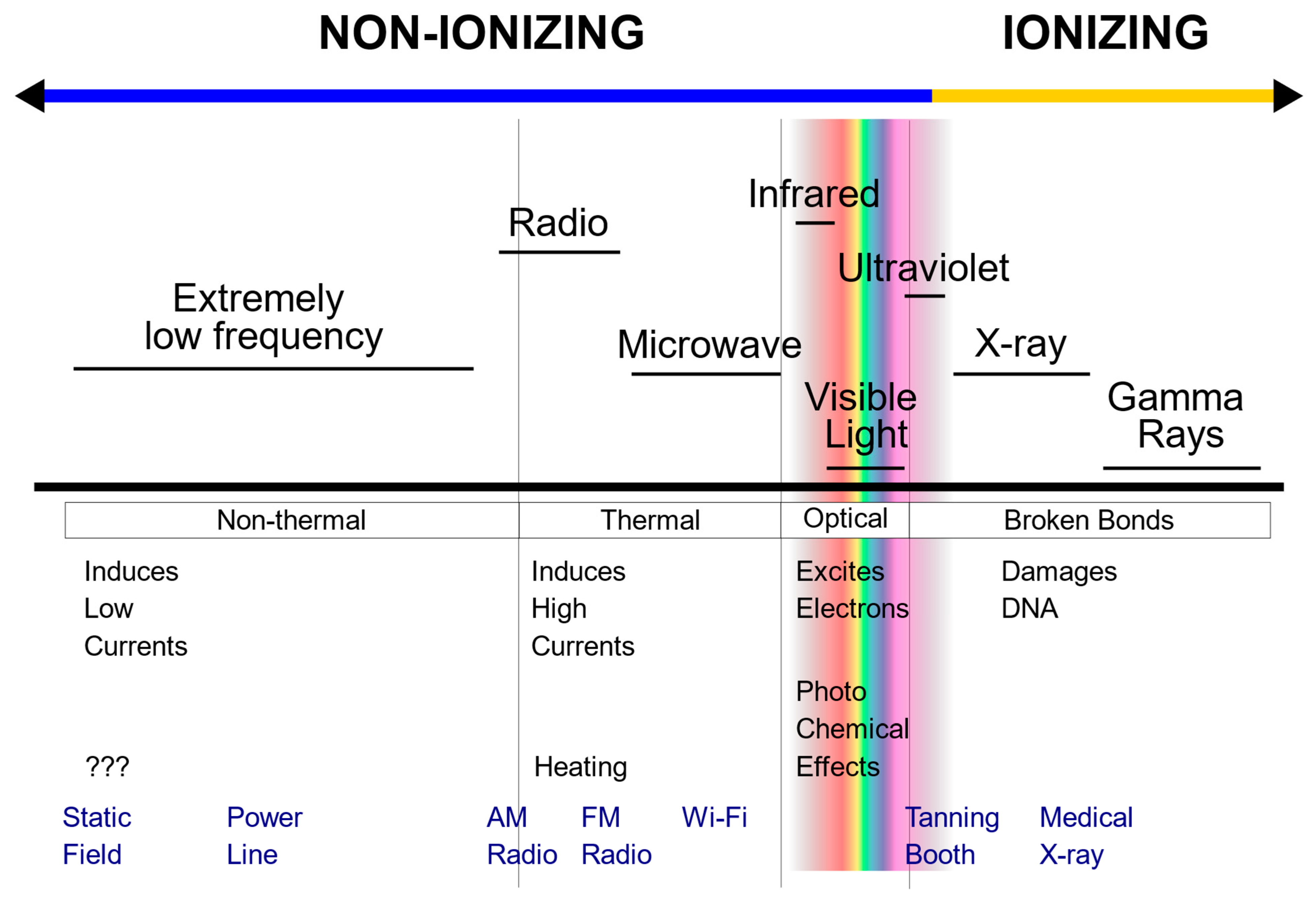
Electromagnetic radiation (EMR) is an energy flux flowing through free space or materials with the speed of light in the form of electromagnetic waves (EMWs) composed of electric and magnetic fields [1]. An EMW is characterized by its intensity and the frequency of the time variation of the electric and magnetic fields. EMR has a dual nature, having properties of waves (interference and diffraction when propagating) and having corpuscular properties (photons, or quanta, are discrete packets of energy that interact with the matter as particles, like in the photoelectric effect) at the same time. Each photon has a specific quantity of energy proportional to the EMW frequency and inversely proportional to the wavelength. Mechanisms of EMW interactions with matter depend on their energy. The number of photons determines the intensity of radiation. EMWs are classified by their frequency (or wavelength), as shown in the electromagnetic spectrum (Figure 1). The electromagnetic spectrum divides in two large bands: non-ionizing and ionizing radiation. X-rays and gamma rays are in the ionizing band; they have enough quantum energy to break covalent bonds and to ionize the matter they pass through. Extreme ultraviolet (EUV), wavelengths 121–10 nm, also has quantum energies high enough to break covalent bonds (10.26 to 124.24 eV) and belongs to ionizing radiation [2]. It is the most strongly absorbed part of the EM spectrum and completely absent in the atmosphere and on the surface of the earth. EUV needs a high vacuum to transmit [3]. UV with wavelengths <200 nm is absorbed by molecular oxygen, is not present in the atmosphere, and also needs a vacuum to spread—so-called vacuum UV—which overlaps with EUV, but wavelengths 200–100 nm are not ionizing. The boundary between ionizing and non-ionizing radiation is in the vacuum UV range (Figure 1). Non-ionizing bands include extremely low frequencies, radio waves, microwaves, infrared, visible light, and ultraviolet (UVA 400–315 nm, UVB 315–280 nm, and UVC 280–100 nm). Static fields are nonionizing, they have biological effects, inducing a charge on the surface of the body, but they have no frequency (0 Hz) and technically are not radiation. That is why they are marked with question marks in the figure.
There are many different detailed classifications of the RF and MW parts of the spectrum based on engineering practical needs. Usually, microwave radiation is considered a subset of radiofrequency radiation, i.e., the RF part of the electromagnetic spectrum extends from 3 kHz to 300 GHz. EMFs used in smart agriculture are in this frequency range. However some authors consider radio waves (3 kHz–300 MHz) and MWs (300 MHz–300 GHz) as two different spectral regions [4].

2.2. Electromagnetic Fields Sources in Precision Agriculture

The most interesting EMF sources for us are Internet of Things (IoT) and long range (LoRa) devices used in precision agriculture for control of field conditions. Technical aspects of how they work and the sensors they use are not the main topics of our review, but we will consider them to get an idea of how many sensors are being used in relation to the EMFs they emit and possible effects on the exposed agricultural plants.

2.2.1. Types of Sensors

Different types of sensors are used in smart agriculture to send information wirelessly [5]. They are classified by what they measure.
Environmental sensors monitor environmental factors:
-
Weather sensors track air temperature, humidity, wind speed, and rainfall (rain gauges).
-
Soil sensors can measure temperature, moisture, chemical properties like pH and nutrient concentrations, and mechanical properties of the soil. Data for soil properties are important for the optimization of soil fertility management and early identification of factors affecting the crop yield or quality of agricultural products. Especially useful are these data for large fields: they help to define water and fertilizer doses for each specific part of the field [5].
-
Location sensors provide positional data, like GPS data for mapping fields, guiding farm machinery and robots.
-
Others, such as light and gas sensors, measure the intensity of light and CO2 concentration, factors important for plants growth.
-
Gamma radiation sensors measure the level of gamma radiation in the soil.
Plant sensors give information about plant conditions before visible symptoms appear. They capture early markers of metabolic stress through thermographic mapping and spectroscopic analysis, such as chlorophyll fluorescence, often preceding morphological alterations. They can measure crop temperature, an indicator of plant stress and moisture content, and nutrient deficiencies and diseases (optical sensors); biosensors are used for many analyses, including detecting specific plant pathogens or assessing nutrient status.
One of the most challenging research areas is the invention of sensors to monitor the crops’ development due to different characteristics of different crops. Such sensors are used to detect the presence of weeds, water and nitrogen deficiency stresses, diseases, and infestation by pests and insects [6]. Two crop monitoring methods are currently in use: proximal (sensors are close or in direct contact with the sensed plant) and remote (sensors are far from the object). Aerial or orbital platforms are used to transport remote sensors [5,7]. One advantageous remote method for monitoring plant conditions is the measurement of chlorophyll fluorescence. The intensity of the fluorescence signal from illuminated leaves depends on the plant’s physiological condition. The signal is also species specific, which allows for the identification of weeds in the field [8]. Early detection and removal of weeds will help to prevent yield reduction. Nutrient deficiency and infestation by weeds, pests, and diseases are factors that decrease yield quantity and quality. Sensors for detecting pests and diseases and sensors for detecting plant nutritional stress are also beneficial for a crop to reach its productive potential [5].
The sensors employed in agriculture have many advantages. They provide farmers live data on various environmental and plant conditions such as soil moisture, temperature, nutrient availability, pest populations, and crop health. These data help farmers take timely actions for improved crop management to save resources, to reduce costs, to minimize environmental impacts, and, therefore, to reduce the yield losses.
But there are also some limitations for wider and faster implementation of these new technologies in agriculture. There is limited awareness among farmers about the benefits of smart technology adoption. The initial cost of the system—sensors, software, etc.—and its maintenance are too expensive an investment for many farmers, especially for small areas. Sensors provide huge amounts of data which need systems for data processing, analyzing, and interpreting to make decisions about the actions needed—an additional expense. Operating with data provided by sensors requires specific knowledge and skills. Another problem is the lack of standards for agricultural sensor technology, which makes it difficult to ensure compatibility and interoperability between different brands and systems. Good Internet coverage, which is essential for transmitting data, could be a problem for rural areas. Data ownership and security are additional concerns. For mobile sensors on platforms like drones, payload limitations can restrict the amount of equipment they can carry, affecting operational efficiency over large fields.

2.2.2. Environmental Impact: What Happens with Sensors After Their Lifetime?

After their functional lifetime, agricultural sensors may be disposed of in landfills, recycled to bring back valuable materials, or repaired for reuse in less demanding applications (for simpler tasks and/or in less harsh environments). What their destiny will be depends on whether it is economically viable to recycle or renovate. Sensor lifespans vary, but they eventually end up in landfills. The lifespan of the sensors is often just few months—during the growing season—and it is limited by their power source. To reduce environmental impact, manufacturers are developing sensors with improved durability and batteries with longer life. Another option for reducing the quantity of e-waste is to use environmentally friendly materials instead of the non-degradable components currently used in the IoT devices and, thus, reduce the environmental impact [9].

2.2.3. Electromagnetic Frequencies Used to Transmit Sensors Data

IoT is a network of connected devices (“things”) embedded with sensors, using software and other technologies to exchange data between devices and with other systems over the Internet. Sensors are a key component: they collect different data that should be analyzed. Nowadays, IoT devices generate tens zettabytes of raw data collected and stored within the network [10].
Sensor data can be stored locally in the sensor that collected the data (local storage), or they can be transmitted and stored at other nodes in the sensor network (in-network storage) or sent to some collection device outside of the sensor network (external storage) [11].
Usually, sensors are not designed to store data. They have limited internal memory and must transmit raw data as quickly as possible to another device for processing and analysis using a wireless module such as Wi-Fi, Bluetooth, and Zigbee [10].
IoT devices use several frequency ranges for wired and wireless connectivity. Organizations like the European Telecommunications Standards Institute (ETSI) and the Federal Communications Commission (FCC) define specific frequency ranges, transmission power limits, and duty cycle restrictions for each region to ensure interference-free operation [12,13]. Because of different regional regulations and requirements, Industrial, Scientific, and Medical (ISM) frequency bands differ between different countries. Using a device on the unallowed frequency band will lead to interference issues, non-compliance with the requirements, fines, legal action, and the need to modify non-compliant devices. IoT protocols mostly use ISM band frequencies of 433 MHz, 915 MHz, and 2.4 GHz to 5 GHz.
Characteristics of different frequency bands of IoT wireless are given in Table 1 [12,14].
LoRa works in the available unlicensed ISM (Industrial, Scientific, and Medical) bands that are different in different countries: 433 MHz (Asia), 470–510 MHz (China), 779–787 MHz (Canada and China), 868 MHz (Europe, Russia, India, and parts of Africa), and ~915 MHz (USA and Australia) [14].
Shorter-range connectivity, like Bluetooth and ZigBee, is most used in IoT in agriculture. ZigBee is a wireless personal area network (WPAN) operating at close proximity, with low power and a low data rate. It does not require line of sight (LOS). LOS refers to the propagation of the EM signal in a clear area, free of hills, trees, and buildings, between the transmitting and receiving antennae. The maximum distance the signal can travel in such an area is determined. Transmission distances are typically within 10 to 100 m [12].
For the medium range, the LTE Advanced network is almost exclusively preferred for its low latency, high data rates, and extended range [12]. Mid-range variants of Wi-Fi such as HaLow are also used. Wi-Fi HaLow uses a 900 MHz band, which allows for lower power consumption and longer-range connections compared to traditional Wi-Fi. The extended range—over 1 km vs. a few hundred meters for traditional Wi-Fi—and enhanced penetration through physical obstacles like tree foliage, buildings, etc., make this protocol preferred for smart cities, industrial automation, and precision agriculture [15].
LPWAN (Low-Power Wide-Area Network) is designed for sending small data packages over long distances, with economic power consumption (operating on a battery) and ensured low cost of transmission [14]. There are many LPWAN protocols: the three most popular are LoRaWAN (long-range transmissions > 10 km with low energy consumption), LTE-M (Long-Term Evolution for Machines), which permits both voice and data transfer with mobility, and NB-IoT (Narrowband Internet of Things, 200 kHz; low energy consumption and low cost for data transfer) [12].
Wired IoT devices use Ethernet, coaxial, or power communication cables [12].
Different applications require different characteristics of the network used. Suitable for agricultural applications are the long-range technologies LoRaWAN or NB-IoT for devices spread out over large areas; Zigbee or LoRa, with their low data rates, are sufficient to transmit small amounts of data from sensors. Low power consumption is a significant characteristic for devices that need to operate using batteries for extended periods without recharging; Bluetooth Low Energy (BLE) and Zigbee are good choices [12].
Some wireless technologies commonly used in Industrial IoT for agriculture are listed in [16].

3. How Does EMF Interact with Living Matter?

The physiological functions of living organisms at all levels of organizations—cellular, tissue, and organ levels—are controlled by endogenous electric fields like transmembrane potential. Biochemical reactions involve charged particles and generate weak intracellular electric currents, which control many processes such as cell growth, proliferation, and differentiation, while other electric currents within tissues control wound healing or tissue regeneration. All moving fluids are actually water solutions of ions: blood and lymph; vascular tissue, a complex tissue in plants consisting of xylem and phloem, transports water, nutrients, and organic substances internally. These fluids generate electromagnetic fields with their movement. The measurement and evaluation of the electric or magnetic component of EMFs generated by various organs is the basis of electrography and magnetography used in medicine. Electricity is an inherent characteristic of living organisms determining their interaction with external fields, both natural and artificial. Living organisms are well adapted to the constant terrestrial static electrical and magnetic fields, but they cannot easily adapt to changing fields, like unexpected magnetic storms or most man-made fields [17]. Alterations in cellular functions induced by external fields lead to consequences at organismal level. Living organisms respond to changes in the EM background like they do to environmental stress factors such as drought, temperature changes, etc. They do not have defense mechanisms against EM variations. They probably could adapt to new unchangeable or slightly variable fields. This is a possible reason for cells to activate heat shock protein synthesis even more rapidly and at a higher rate than for heat itself in response to artificial EMF exposure [17].
Natural EMFs have frequencies from infrared to gamma rays (3 × 10¹¹ Hz–3 × 10²² Hz). MW frequencies coming to the Earth with cosmic rays are strongly absorbed in the atmosphere and do not reach the Earth’s surface [18]. Living organisms use these frequency ranges for intercellular and interindividual communication. Artificial EMFs have frequencies ranging from a few Hz to ∼1010 Hz, reaching closely to the low limit of infrared (∼3 × 10¹¹ Hz). Their quantum energy is not sufficient to induce molecular or atomic excitation or ionization, but they can induce vibrations in the charged and polar molecules of living matter [16,17].
A very important difference between natural and artificial EMFs is in their polarization and coherence, explained in detail in [19]. Natural EMFs and few artificial ones (such as light from thermal and gas discharge bulbs) are not polarized and not coherent. Man-made EMFs are linearly polarized and oscillate in a certain polarization plane. Interference of linearly polarized EM waves can result in circularly or elliptically polarized fields. Polarized EMFs induce coherent forced oscillations on charged and polar particles within biological tissue. All biologically significant molecules are charged or polarized, but these induced oscillations are most pronounced on free mobile ions. Concentrations of mobile ions in intra- and extracellular fluids are high, and they are involved in practically all cellular processes/biological functions [19]. Oscillations of mobile ions, induced by an external polarized EMF, result in the generation of internal EMFs, which can affect the function of electrosensitive ion channels on the cell membranes and trigger deleterious biological effects, including DNA damage and cell death. Mullins et al. [20] propose that living cells recognize the special coherence of external EMFs over the cell membrane and, thus, recognize and react to those fields but not to random thermally generated EMFs. Polarization is possible trigger of induced biological effects of artificial EMFs [20].
Several EMFs of the same linear polarization could combine with constructive interference and, as a result, increase the field intensity and oscillation amplitude of the charged and polarized particles in the propagation medium. At these places, living systems are more sensitive to the induction of biological effects. EMFs with the same polarization and frequency can induce standing waves and places with maximum or minimum intensity. In the case of fixed polarization and differences in the frequencies between the interacting EMFs, the interference fringes are not fixed at certain locations: they change with time, producing temporary peaks at different locations [19], and biological effects could be provoked at any of these locations.
Natural light from two or more different sources does not produce interference effects: superposition of unpolarized EMFs increase the average wave intensity, but net fields at any location are zero. Electric forces on charged particles do not depend on the wave intensity but rather on electric and magnetic field intensities, so natural EMFs cannot induce any net forced oscillations on the charged biological molecules. They induce heat only, i.e., random oscillations in all possible directions due to momentary non-zero field intensities, but do not induce net electric or magnetic field and specific oscillations in a certain direction.
Due to thermal motion, all molecules in living systems oscillate randomly with velocities much higher than those induced by external man-made EMFs, and the only effect is the temperature increase in tissues. But coherent polarized oscillations forced by external EMFs, even with energy many times smaller than average thermal energy, can initiate biological effects [19]. Altered biological processes do not always lead to visible effects in the exposed object. Existing adaptive mechanisms of living organisms could eliminate the effects of external EMFs, but these mechanisms are not always completely effective, especially in combination with other stress factors. In such cases, EMFs could be a promoter, i.e., to enhance the probability of other stressors to induce adverse effects.
Biological effects of RF EMFs could be result of thermal and non-thermal direct or indirect interactions. Thermal effects, when a measurable increase in the object temperature occurs [21], are widely accepted, but they are not the same as the effects of the same temperature increase with conventional heating, i.e., thermal effects are a result not only of heating, but there are some specific effects of the applied field also. Non-thermal effects are discussed with low-intensity EMFs when there is no measurable temperature increase [22]. The mechanisms of EMF effects that are not directly related to temperature changes are not fully understood [23,24,25,26], but forced oscillations and interference of polarized and coherent artificial EMFs are involved.
As a rule, the quantity of absorbed energy determines how strong the reaction of the exposed system will be. However, living matter is very complexly organized, and the biological effects are not always determined by the amount of energy absorbed. With the same absorbed energy, some biomolecules could be damaged while others are not, e.g., lipids will probably be less damaged than proteins (enzymes), and protein damage will be smaller than that of DNA [17]. Direct effects are a result of energy absorption by the damaged biological molecules like lipids, proteins, and DNA. Indirect action is observed when energy is absorbed by another molecule in the surrounding area and through various mechanisms is transferred to a biologically important one. For example, damage in DNA may be a consequence of a chain of events starting with a conformational change in a membrane protein, followed by abnormal alterations of intracellular ionic concentrations, which, in turn, could trigger a signal for a cascade of intracellular reactions leading to increased free radical release or alter DNase activity, which finally damages DNA—an indirect effect [17].
Water is a medium for all living organisms, and it often mediates indirect effects of EMFs. Therefore, EMF-water interactions are very important in understanding the mechanisms of biological effects of RF EMFs.

3.1. EMF Interactions with Water in Biological Systems

Water, constituting over 70% of biological systems, is a critical medium for cellular processes and a primary target for electromagnetic fields (EMFs) due to its polar nature and ability to absorb energy in a wide frequency range, from kHz to THz [27]. Its molecular structure, interactions with ions and biologically significant molecules such as proteins, lipids, and DNA, and frequency-dependent dielectric properties determine direct mechanisms of EMF interactions with water molecules in biological systems and implications for natural systems (e.g., plant chloroplasts).

3.1.1. Molecular Structure and Properties of Water

Water molecules form dynamic hydrogen-bonded networks, including dimers, trimers, tetramers, and clusters of up to 200–300 molecules [28]. Liquid water retains a tetrahedral lattice like ice, where each water molecule bonds to four neighbors via hydrogen bonds, supporting 1011–1012 molecular movements per second near 0 °C [28]. Free water has a high dielectric constant (~80 at 20 °C), high mobility, and rapid diffusion. Structured water is bound to biomolecules with hydrogen bonds and has reduced mobility and altered dielectric properties [29]. Structured water stabilizes the structure of biomolecules and affects cellular processes such as membrane dynamics, enzymatic activity, and signaling [30].

3.1.2. Interactions with Ions and Proteins

Water forms hydration shells around ions, significantly affecting their mobility and electrostatic interactions. For example, calcium ions (Ca2+) are surrounded by 6–8 water molecules, modulating ion channel activity critical for cellular signaling, particularly in plant cells [31]. Proton (H+) and hydroxide (OH) ions exhibit high mobility due to rapid proton transfer (~10−12 s) through hydrogen bonds, enabling efficient charge transport [28]. This proton hopping mechanism, described by Eigen and De Maeyer (1958), allows H+ to move between water molecules, contributing to water’s high ionic conductivity [32]. In contrast, other ions diffuse with their hydration shells, which reduces their mobility [28]. Water also plays a pivotal role in protein structure and function. Hydrogen bonds with hydrophilic amino acids stabilize secondary and tertiary protein conformations, while hydrophobic regions exclude water and drive protein folding [33]. In chloroplasts, water’s interactions with photosystem proteins support electron transport, essential for photosynthesis [27]. Structured water forms a diffuse shell around proteins, reducing mobility and enhancing stability, while internal water molecules within protein cores facilitate catalytic activity [33]. Dynamic water networks provide flexibility, allowing functional protein conformations [28]. For instance, water-mediated hydrogen bonds connect specific protein sites, influencing enzymatic activity and signal transduction [34].

3.1.3. EMF Effects on Water Molecules

EMFs induce both thermal and non-thermal effects on water molecules, altering hydrogen bond networks and molecular dynamics. Non-thermal effects involve oscillations of water dipole absorbing EMF energy, weakening hydrogen bonds, and increasing molecular mobility [35]. This disrupts water clusters, altering local pH and interactions with membranes, as seen in E. coli and giant unilamellar vesicles (GUVs), where 18 GHz EMFs induce pore formation without compromising cell viability [35]. In plant thylakoid membranes, such changes may destabilize photosynthetic electron transport, increasing reactive oxygen species (ROS) production, which impacts growth and stress responses [36]. Thermal effects, prominent at higher frequencies (e.g., 2.45 GHz), elevate water kinetic energy, further disrupting hydrogen bonds and enhancing diffusion rates [37]. These alterations affect water role in stabilizing biomolecular structure, potentially impacting ion channel function and protein activity [31]. EMF interactions with water also influence covalent and hydrogen bond dynamics. At high frequencies, vibrational modes of water molecules are excited [35], and 0.3–19.5 THz EMFs enhance membrane permeability by altering water dipole behavior [35]. At lower frequencies, EMFs modulate proton transfer rates, affecting ionic conductivity [28]. Artacho-Cordon et al. (2013) suggest that EMF-induced changes in water structure enhance Ca2+ permeability, triggering signal transduction pathways (e.g., ERK1/2 and MAPK) and ROS production, which may lead to DNA damage via the free radical mechanism [31]. (ERK1/2 and MAPK signaling pathways in eukaryotic cells transmits signals from the cell surface to the nucleus, regulating cellular processes like proliferation, differentiation, and apoptosis).

3.2. Frequency-Dependent Dielectric Properties

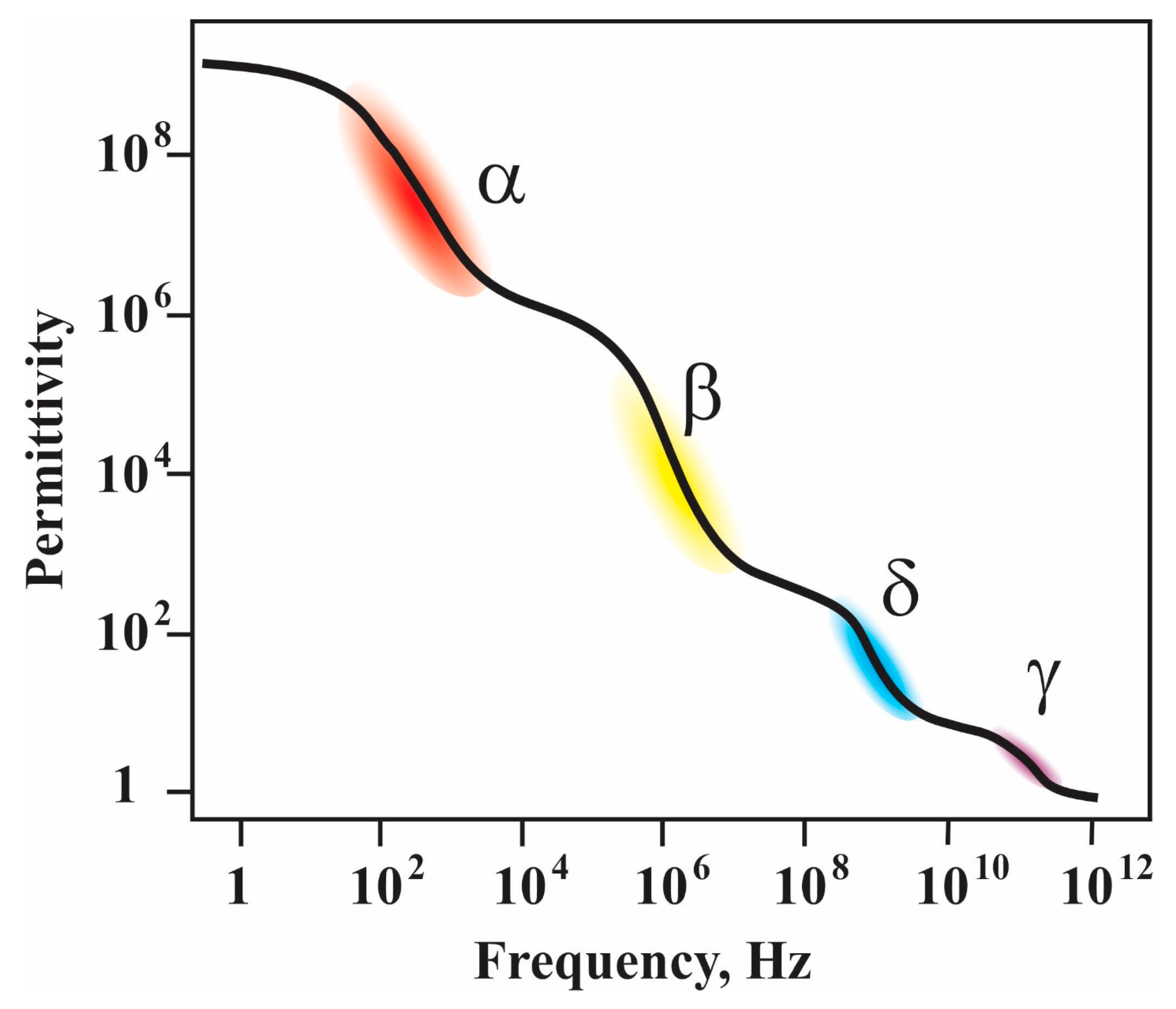
Biological tissues’ dielectric response to EMFs is characterized by α, β, γ, and δ dispersion, reflecting frequency-dependent energy absorption [38]. The permittivity dispersion curves for different tissues are similar. The specific features of the tissues (size and shape of the cells, permeability of their membranes, volume of the intercellular spaces, water content, and ion concentration) are reflected in variations in the curve parameters. This allows for differentiating tissues by analyzing their frequency-dependent dielectric properties, the basis for electrical impedance spectroscopy (EIS) [23]. The relative permittivity of a substance is frequency dependent and tends to decrease with an increasing frequency of the applied field.
The relative permittivity of tissues and cells in solution show four main dispersion regions, frequency ranges where the relative permittivity rapidly decreases (Figure 2): α-dispersion, in the ~100 Hz–10 kHz region, associated with ion diffusion across the cell surface; β-dispersion, in the sub-MHz–10 MHz range, related to charge accumulation at the cellular membrane; δ-dispersion in the sub-GHz frequencies, where the rotation of side groups of macromolecules is involved; and γ-dispersion in the ~10 GHz region, where the rotation of water dipolar molecules is dominant.
Relative permittivity at higher frequencies, like in the sub-GHz and GHz range, can provide information on the water content and protein concentrations within cells. However, these frequency ranges are rarely used for investigating cells and tissues due to technical issues for measurements [23].
At low frequencies (<1 kHz), ionic conduction dominates, driven by hydration shell dynamics and proton hopping [28]. The time period of the EM wave is long enough to allow time for the cell membranes to be recharged by ions inside and outside the cell. Therefore, the specific ionic conductivity is small, and the dielectric constant is large. The current flows primarily through the intercellular fluid. As the frequency increases above 1 kHz, surface polarization disappears, the intracellular fluid is involved in the formation of ionic currents due to the incomplete recharging of the membranes, and the dielectric permittivity drops sharply (α-dispersion). The specific conductivity increases due to the decrease in the capacitive resistance of the membranes. The impedance is very high in the α-dispersion frequency range, and impedance measurements give information about cell or tissue volume or size [39].
β-dispersion (1 kHz–10 MHz) arises from membrane polarization, affecting ion transport across cell membranes [35]. At these frequencies, macrostructural polarization of cellular and intracellular membranes occurs. β-dispersion is associated with a decrease in the polarization effect of interphase boundaries in biological systems. The dielectric permittivity decreases due to the involvement of intracellular fluid in the formation of ionic currents [40]. Impedance measurements in this frequency range provide information on cell and tissue membranes [39].
γ-dispersion: In the 1–100 GHz range, the water dielectric constant decreases as dipole reorientation lags EMF oscillations. Gamma dispersion depends on the water content of the tissue. Therefore, the electrical parameters of tissues containing little free water (such as adipose and bone tissue in animals; bark and woody stem in trees; and roots, especially those of desert plants) are practically frequency independent in the microwave range [40]. At higher frequencies (δ-dispersion, >10 GHz), molecular vibrations dominate. THz EMFs induce vibrational relaxation of hydrogen bonds [38]. The Debye relaxation model describes α-dispersion, while γ- and δ-dispersion reflect single-molecule rotation and vibrational modes, respectively [28]. These mechanisms enhance ion and molecule transport and alter cellular homeostasis [31].
It is evident that the dielectric properties of biological tissues are intricately tied to the tissues’ morphology, structure, composition, and functional state. Interactions with EMFs in the GHz range are related to the cells’ water content.

3.3. Implications for Biological Systems

In plants, EMF-induced changes in water structure have significant implications. For example, 2100 MHz EMFs increase Ca2+ and hydrogen peroxide (H2O2) flux in Allium cepa roots, indicating water-mediated ion channel modulation and ROS production [36]. These changes may disrupt photosynthetic electron transport in thylakoid membranes, reducing efficiency and triggering oxidative stress [27]. The dynamic nature of hydrogen bond networks in water increases EMF effects, affecting protein function, ion transport, and cellular signaling [31]. For example, EMF-induced water dipole oscillations may enhance ROS production, leading to gene expression changes and potential DNA damage [31]. The broad frequency range of EMF effects, from kHz to THz, suggests that as an energy absorber, water has important role in various biological contexts. Low-frequency EMFs (e.g., 100–300 kHz) may disrupt cytoskeletal organization, as noted by Artacho-Cordon et al. [31]. GHz and THz frequencies affect membrane permeability and protein stability [31,35].
The direct interaction of EMFs with water molecules underpins its effects on biological systems. By altering hydrogen bond networks, dipole dynamics, and dielectric properties, EMFs influence ion transport, protein function, and cellular homeostasis. The frequency-dependent nature of these interactions, characterized by α, β, γ, and δ dispersion, emphasizes water’s role as a primary mediator of EMF effects. These mechanisms are relevant to understanding the impacts of EMFs on plants. Some authors [41] explained the absence of long-term effects of 900 MHz EMFs on the morphology and physiology of young wheat and maize plants by the low quantum energy of the 900 MHz EMF employed. This energy is not enough to excite an electron transition in a molecule, but in liquid water, it is responsible for changes in the hydrogen bond network, giving rise to a broad microwave absorption spectrum [42]. Although biomolecules may have vibrations with microwave frequencies, such resonant coupling is not considered biologically significant due to their low energy compared with thermal energy and the strongly dampening aqueous environment [43].
Electric component of EMFs in millimeter wave (MMW) and microwave (MW) bands is strongly absorbed in water and in biological tissues depending on their water content. Tissue penetration depth is usually assessed for human skin. For MMWs, the electric field is almost completely absorbed in about 1 mm tissue depth; therefore, many scientists consider MMW (30–300 GHz, wavelength 1–10 mm) biological effects to be limited to the body surface and, for lower MW frequencies (400 MHz to 5 GHz range, wavelength 75–76 cm), to the outer 1–3 cm of the body [15]. Penetration depth of microwaves into biological tissues as a function of different frequencies is discussed by Fuchs et al. [44]. For frequencies of about 1 GHz, the penetration is above 3 cm; for 2.45 GHz, it is about 6 mm. These estimations are approximate, based mainly on the absorption from free water, but in living organisms, a portion of water molecules is hydrogen bonded to solutes and biological macromolecules. The ratio of free to bonded water is not a constant value and depends not only on the type of the tissue but also on its current physiological state. Structured water has lower electric field absorption, and the real MMW/MW penetration in living systems is higher. Tissues containing more water absorb MMW/MW EMFs more effectively. The exact depth of penetration depends on the tissue characteristics. For example, plant leaves have a relatively high water content and high MMW/MW EMF absorption, but for most plants, the leaves are thin, and when EMFs fall perpendicular to the leaf surface, EMF energy is absorbed throughout the entire leaf volume. The difference in MMW absorption between free and bonded water in living organisms only partially explains the deeper penetration of these EMFs. Absorption is low for the MMW/MW magnetic component and it is highly penetrating. Time-varying coherent magnetic fields can force the movement of free ions deep within the body [18]. This movement will induce an electric field, whose intensity is proportional to the variations of the magnetic field intensity [17]. Thus, the electric current in the tissue could originate directly from external EMFs (with shallow effects) or can be induced by the deeply penetrating magnetic component through free ion movements and produce effects deep in the body. It should be considered also that MMWs are strongly absorbed in the atmosphere, so they are almost absent from the natural EM background and living organisms are very sensitive to outer coherent artificial MMW EMFs.

4. Mechanisms of RF EMF Influence on Plants

4.1. Oxidative Stress

Reactive oxygen species are normal byproducts of the cellular metabolism. ROS generation may intensify in stress conditions due to the disturbance of cellular homeostasis between their generation and neutralization. The main sites of increased ROS production in plant cells during abiotic stress are the organelles with highly oxidizing metabolic activities or with sustained electron flows: chloroplasts, mitochondria, and microbodies [45]. If not neutralized, ROS can oxidize membrane lipids, proteins, photosynthetic pigments, and nucleic acids and, thus, damage plants. ROS are not just harmful; they also act as signaling molecules and trigger many cellular processes crucial for stress tolerance. The strong control of ROS level in cells is achieved by the antioxidant defense system, including various antioxidant enzymes and non-enzymatic antioxidant substances.
A view has been formulated that ROS production was evolutionarily selected to perform some useful role(s) in cellular metabolism, including as participants and modifiers of signaling pathways and for regulating the development and proliferation of cells [45]. ROS may have mitogenic effects and can mimic and amplify the action of growth factors. Therefore, ROS are not only damaging factors but also a means to transmit information, and control of their continuous formation and neutralization in living organisms is very important. H2O2 and/or superoxide (O2˙) are the best candidates for the signaling role [46]. The signaling role of H2O2 is conditioned by its enzyme-controlled production and removal, with some selectivity of reactions because of its low reactivity and easy penetration through membranes. H2O2 has notable biochemical properties: a relatively long half-life and solubility in both lipid and aqueous environments, which allow it to reach its cellular targets when applied extracellularly. There is only one argument against the signaling role of H2O2: its non-enzymatic formation [45]. The cell can sense sublethal doses of H2O2 and activate peroxide-detoxifying mechanisms. H2O2-producing mechanisms can be activated by different cell death stimuli, and as a result, self-destructive programmed cell death is triggered. H2O2 generated in low concentrations by various environmental and developmental stimuli can act as a signaling molecule that regulates plant development, stress adaptation, and programmed cell death. H2O2 acts as ROS at higher concentrations. Different signals (plant hormones and abiotic or biotic stress) can lead to an increased H2O2 concentration, which, in turn, induces responses as developmental processes, stress adaptation, or programmed cell death. The H2O2 signal is mediated through alterations in Ca2+ fluxes, redox changes, activation of MAPK cascades, and interactions with other signaling molecules like salicylic acid and nitric oxide [45,47].
Uncontrolled lipid peroxidation by ROS results in the destruction of biological membranes. Malondialdehyde (MDA) is a mutagenic and carcinogenic naturally occurring end product of reactions of ROS with polyunsaturated lipids. If not enzymatically metabolized, it can form covalent protein adducts and causes toxic stress in cells [48]. MDA concentration is used as a marker of the level of oxidative stress and the antioxidant status in an organism [49]. When analyzing the results of MDA measurements, it should be kept in mind that similarly to H2O2, MDA can induce damage in higher concentrations; at lower concentrations, it can have a positive role by activating regulatory genes involved in plant defense and development [49].
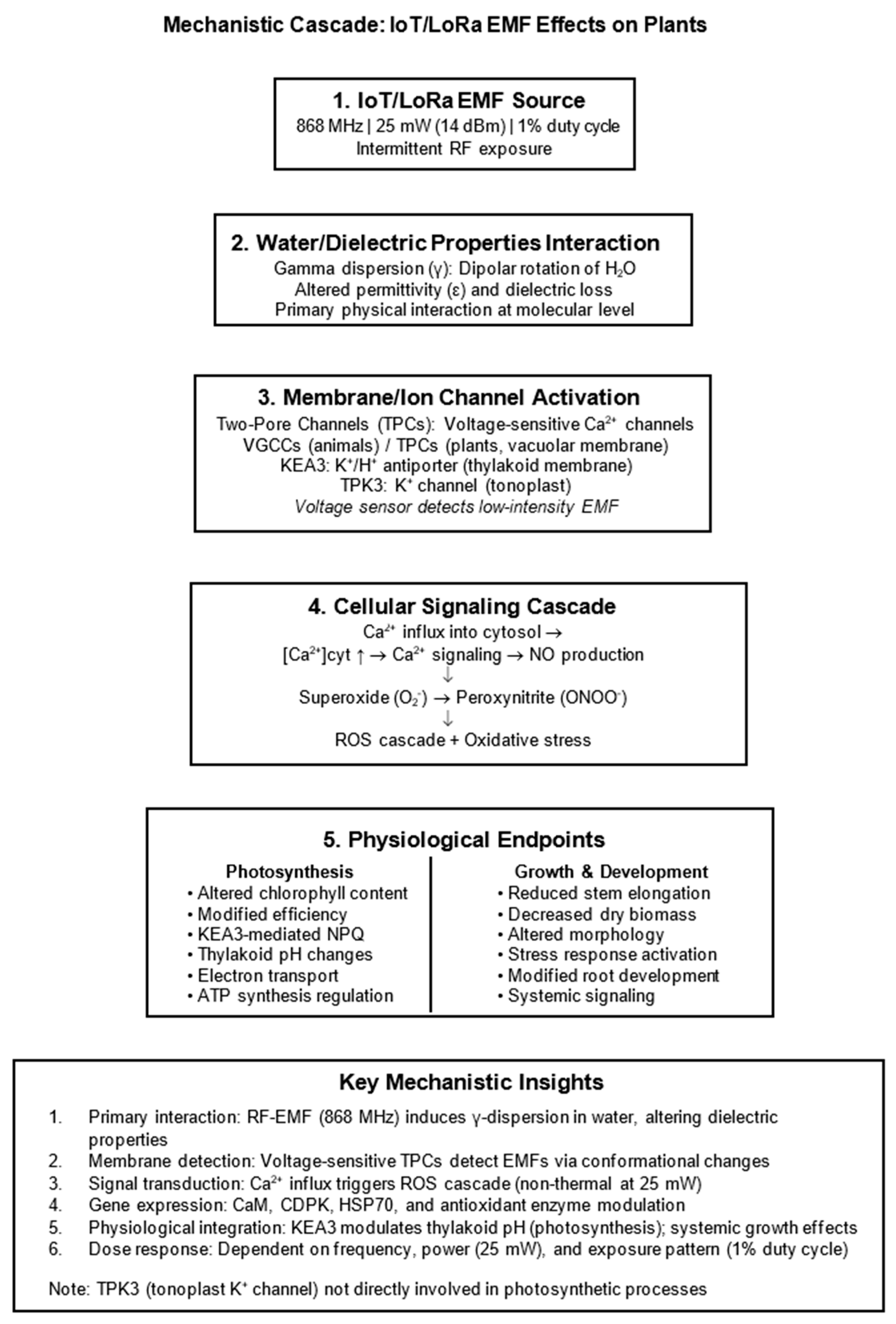
Increased ROS generation and oxidative stress is one of the most discussed possible mechanisms of the effects induced by EMFs in plant cells, like in animal cells. We will focus on the mechanisms of ROS generation and oxidative stress in plants.

4.2. ROS Generation in Plant Cells Under EMF Exposure

ROS, such as O2˙, H2O2, and hydroxyl radicals (OH·), are highly reactive particles produced in plant cells under various stressors, including EMFs [22,50]. ROS generation in living organisms is associated mainly with electron transfer: in electron transport chains in mitochondria and in chloroplasts, as well in some enzymatic reactions involving electron transfer. Exposure to RF EMFs can disrupt cellular homeostasis in plants and animals, leading to increased ROS production through the mechanisms systematized in Table 2.
Oxidative stress occurs when ROS production exceeds the organism’s antioxidant defenses, leading to the destruction of lipids, proteins, and DNA and affecting cellular function. In plants, this affects plant growth, photosynthesis, intercellular signaling, and stress responses [60,61]. In animals, it contributes to inflammation, apoptosis, or the development of diseases, like cancer. Antioxidant systems of plants and animals include enzymatic (e.g., superoxide dismutase (SOD) and catalase; ascorbate peroxidase in plants only) and non-enzymatic defenses (like glutathione and antioxidant vitamins C, E, and A (retinol) in animals and beta-carotene in plants). Prolonged EMF exposure can overwhelm these defenses, leading to cellular damage, inflammation, or even to induce apoptosis [51]. Calcium signaling plays a critical role in activating ROS-producing enzymes.
Oxidative stress is one of the primary mechanisms of the biological effects of RF EMFs [52]. Many authors reported the activation of ROS production in plants exposed to EMFs and increased MDA and H2O2 concentrations, which indicate possible membrane damage [44].
Tkalec et al. [62] observed enhanced H2O2 content and increased activities of isozymes of catalases, pyrogallol, and ascorbate peroxidase after exposure of Lemna minor to 400 and 900 MHz for 2 and 4 h. Radic et al. [63] exposed tobacco shoot cells (Nicotiana tabacum) to 900 MHz EMF, 23 V/m, for 4 h and found significant oxidative damage to proteins (increased content of carbonyl group) and lipids (increased MDA level), as well as some genotoxic effects (tail DNA and tail moment values). They concluded that 900 MHz EMFs predominantly affect the integrity of plasma membranes. Increased levels of H2O2 and upregulated activities of antioxidant enzymes (SOD, ascorbate peroxidase, guaiacol peroxidase, catalase, and glutathione reductase) were reported by Sharma et al. [64] and Singh et al. [65]. Inhibition of Vigna radiata root formation and growth was observed after exposure to mobile phone radiation (900 MHz). Single exposure of Allium cepa root tips to 2100 MHz EMF for 2 or 4 h resulted in elevated level of O2˙ and H2O2 [36]. Stefi et al. registered significant increases in ROS in Myrtus communis leaves after exposure to 1800 MHz EMF [66].
Exposure of Arabidopsis thaliana seedlings to 2.45 GHz EMFs for 48 h increased H2O2 content and decrease MDA [67]. The authors assumed that alterations in H2O2 and MDA content are not necessarily proportionally related. Other authors could not find significant alterations in H2O2 and MDA contents in leaves of exposed wheat plants (Triticum aestivum) after exposure to 900 MHz EMFs [68]. Exposure of young maize plants to 900 MHz, 370 V/m EMFs with different orientations of the electric field vector—parallel or perpendicular to the stems—did not show statistically significant differences in the H2O2 and thiobarbituric acid reactive substances (TBARS—products of lipid peroxidation, mainly MDA) contents or in the total antioxidant activity between exposed and control plants [41,69,70]. The conclusion is that under the investigated experimental conditions, a 900 MHz EMF does not induce oxidative stress in young maize plants.
Plants have an effective antioxidant system for scavenging ROS, which includes non-enzymatic (polyphenols and glutathione) antioxidant molecules and antioxidant enzymes (SOD, glutathione reductase, ascorbic acid oxidase, and catalase). When ROS production overwhelms the ability of antioxidants to neutralize the generated ROS, oxidative damage occurs. RF EMFs do not have enough quantum energy to directly form free radicals, but they could enhance their production or decrease their scavenging, altering the enzyme activity.

4.3. Ion Transport

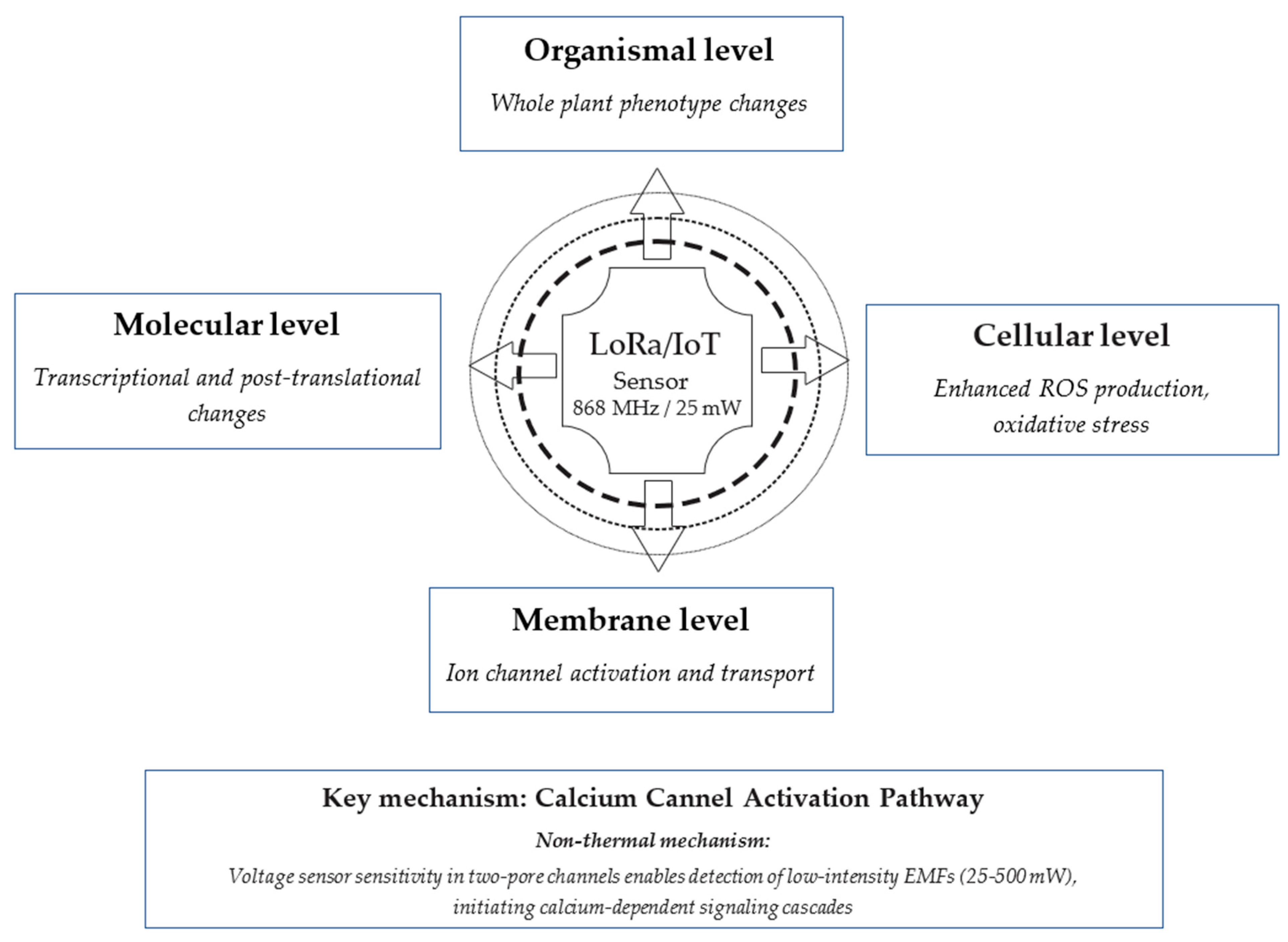
Plants need to sense changes in environmental conditions and to trigger adaptive reactions. Calcium is a major secondary messenger in plants, being involved in many physiological processes and in response to many environmental signals [71]. ROS and cytoplasmic Ca2+ concentrations are interlinked with adaptation mechanisms in response to external stressors. EMF, like other abiotic stressors (salinity, drought, heat, and cold), induce increases in cytosolic levels of Ca2+. EMF activate voltage-gated calcium channels (VGCC) [72,73]. Voltage-dependent ion channels are regulated by a voltage sensor, a structure containing multiple charges (20 charges in VGCC) located in alpha helixes within the lipid bilayer of plasma membranes. Changes in the electrical forces across the plasma membrane affect these 20 charges, and the voltage sensor opens the channel. Forces on charged groups are inversely proportional to the dielectric constant of the medium in which the charges are located. Dielectric constants of the aqueous phases in and out of cell are about 120 times higher than the dielectric constant of the lipid bilayer, i.e., the forces acting on each of the voltage sensor charges are about 120 times stronger than electrical forces on a charged group in the aqueous phase. Because of the high electrical resistance of the cell membrane, the electrical forces generated by EMFs across the lipid bilayer are also a hundred times amplified in comparison to forces in aqueous media. Thus, the forces influencing charges in a voltage sensor are millions of times stronger than the forces on a singly charged groups in aqueous phases [72,73]. Calcium ions activate Ca2+ sensor proteins (calmodulin, calmodulin-like proteins, and Ca2+-dependent protein kinases), which, in turn, react with other target proteins to evoke an adequate response. Calcium-sensing proteins bind to calcium ions and undergo conformational changes that enable interactions with other proteins and regulation of their activity (kinases, transcription factors, and other enzymes). Ca2+ signaling pathways are connected to ROS and other signaling pathways. EMFs could activate ROS generation through other mechanisms also (see Section 4.2). The elevated ROS concentration, in turn, activates Ca2+ signaling pathways in plants. Ca2+ can activate apoplastic ROS production and provoke further increases in cellular Ca2+ levels that activates the antioxidant systems to decrease ROS within the cytoplasm. Thus, Ca2+ and ROS determine plant responses to EMFs and other abiotic stressors [74]. The primary mechanism of action of low-intensity EMFs in producing non-thermal biological effects is the activation VGCCs via their voltage sensor. Important evidence for this activation mechanism is that the effects produced by EMF exposure, ranging from millimeter waves, microwaves, radiofrequencies, and extremely low frequencies (including 50 and 60 Hz) to static electric and magnetic fields, can be lowered or even blocked by specific VGCC blockers [72]. In normal conditions, the voltage sensor controls the opening of the VGCCs in response to partial depolarization across the plasma membrane.
Similar voltage sensors control voltage-gated sodium, potassium, and chloride channels, and they are also activated by low-intensity EMF exposure. However, they have relatively minor roles in achieving EMF effects compared with those of VGCC activation, resulting in increases in cellular Ca2+ concentration [18]. The voltage sensor of a plant’s two-pore channel (TPC) is also activated by EMFs and results in calcium-dependent effects. EMFs’ influence on all these voltage-gated channels suggests that the direct EMF targets are voltage sensors. The mechanisms of this activation are related to electrical forces produced even by weak electronically generated EMFs on the positive charges in the VGCC voltage sensor, and this is explained in detail in [18]. EMFs activate the VGCCs and other voltage-gated ion channels not via depolarization of the plasma membrane but rather via the direct forces they produce on the charges in the voltage sensor.
Marino et al. suggest that the direct interaction between the RF EMFs and ion channels in plasma membranes is mediated by the magnetic field component of RF EMFs, which induces electric field in living systems [75]. The magnetic stimulus is rapid and effective, and an induced electric field can modify the average open time of an ion channel.

4.4. Enzyme Activity

EMF-induced increases in ROS production and cytosolic calcium are the first trigger reactions that lead to various cellular responses, including changes in enzyme activities and in gene expression, and eventually end in immediate cellular alterations or delayed plant growth [61]. Considering all the above-discussed changes in protein conformation and in lipid–protein interactions in the cell membrane under the influence of EMFs, it should be expected to have alterations in the enzyme activity in exposed living objects. Many authors investigated effects of RF EMFs on antioxidant enzymes in relation to the very important role of ROS in the realization of EMF effects [76].

5. Effects of Electromagnetic Fields on Photosynthesis:

5.1. Overview of Photosynthesis and Thylakoid Membranes

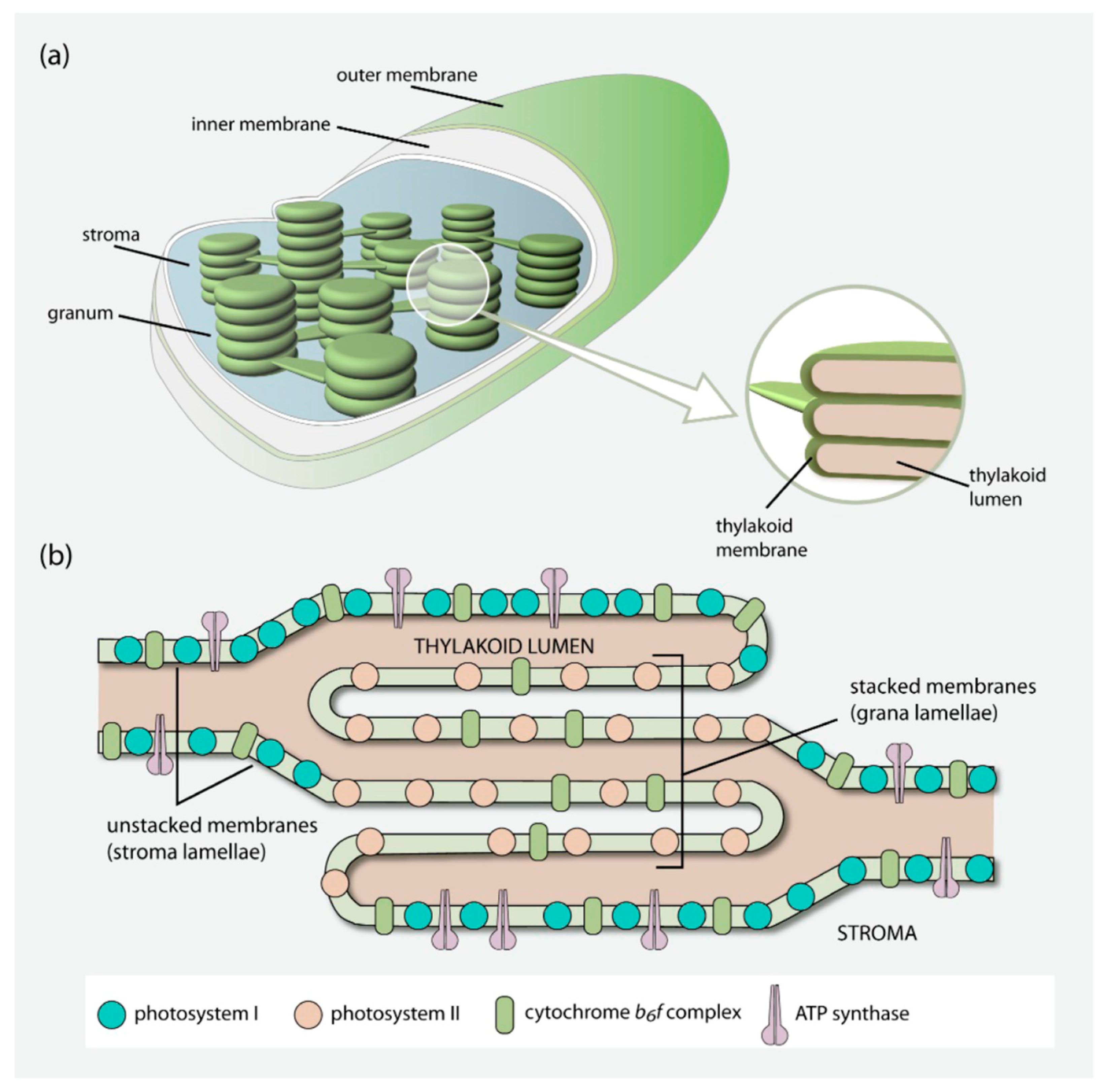
One of the most important structures in the plant cell in terms of its potential sensitivity and realization of the action of EMFs on plants is the photosynthetic apparatus of plants, located in specific structures: photosynthetic membranes. In higher plants, they are represented by thylakoid membranes, building a complex membrane network in the internal space of chloroplasts (Figure 3).
The complex chain of sequential processes of energy transformation into the free energy of chemical bonds of carbohydrates is conditionally divided into two phases: light and dark.
The so-called “light phase” of photosynthesis consists of three major subphases [78]:
  • Absorption of light and transfer of excitation energy within the pigment antenna, followed by its trapping at the reaction centers (excitation of the reaction center chlorophyll).
  • Transport of electrons: The primary event in the reaction centers involves the transfer of an excited electron in a chlorophyll molecule to an intermediate acceptor, that is, pheophytin (Pheo) (in photosystem II) or chlorophyll (in photosystem I).
  • Stabilization of the energy of electrons in oxidation–reduction reactions (the photosynthetic transport of electrons) during the generation of ATP and the formation of reducing power in the form of NADPH.
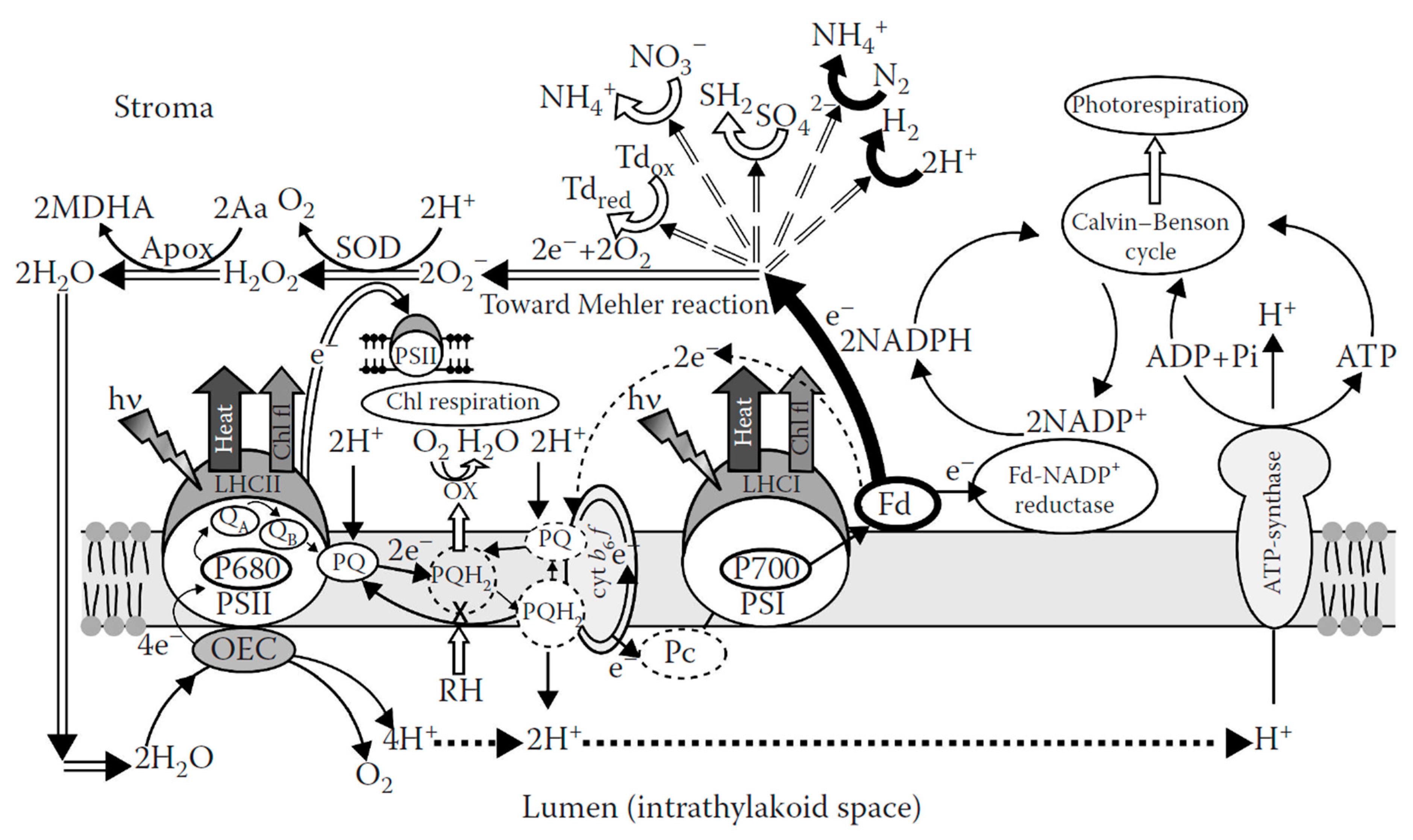
Photosynthesis in plants occurs in the chloroplasts, where thylakoid membranes house the photosynthetic machinery, including photosystem II (PSII), photosystem I (PSI), the cytochrome b6f complex, and ATP synthase. The thylakoid membrane is a lipid bilayer with a high degree of fluidity, which is important for the mobility and interactions of photosynthetic complexes. The electron transport chain (ETC) drives the light-dependent reactions, transferring electrons from water (via PSII) to NADP+ (via PSI), generating ATP and NADPH. This process is coupled with proton translocation across the thylakoid membrane, creating a proton motive force (pmf) that powers ATP synthesis [78] (Figure 4).
EMFs, particularly radiofrequency fields, can influence thylakoid membrane dynamics and ETC function by altering lipid mobility, protein conformation, and ROS production, as explained in previous sections. These changes can affect the efficiency of photosynthesis and the stability of photosynthetic complexes.

5.2. Sensitivity of Thylakoid Membrane Regions to EMFs

The thylakoid membrane is organized into grana (stacked regions enriched with PSII) and stroma lamellae (unstacked regions enriched with PSI and ATP synthase). Different regions have different sensitivities to EMFs due to their composition and function.
Grana (PSII-Enriched Regions) are very sensitive to EMFs due to the presence of PSII, which is prone to photodamage under stress. EMFs can disrupt the light-harvesting complex II (LHCII) and PSII reaction centers, altering electron transfer from water to plastoquinone (PQ). EMFs may increase thylakoid membrane fluidity by altering lipid packing or interactions with membrane proteins, affecting the lateral diffusion of LHCII and PQ [81]. This can disrupt their precise relative positioning required for efficient energy transfer to/from PSII reaction centers. Increased lipid mobility in the grana may destabilize the PSII-LHCII supercomplex, leading to reduced efficiency and increased ROS production. EMF-induced electron leakage at PSII (e.g., at the oxygen-evolving complex or QA/QB sites) generates singlet oxygen and superoxide, resulting in oxidative stress and damaging D1 protein in PSII. D1 protein is a part of PSII reaction center, which directly mediates photosynthetic electron transport and oxygen evolution, and is essential for oxygenic photosynthesis [82]. Non-Photochemical Quenching (NPQ) is a photoprotective mechanism that dissipates excess light energy as heat [83]. Changes in lipid mobility induced by EMFs could affect the conformational changes in LHCII required for NPQ activation [84].
Stroma Lamellae (PSI- and ATP synthase-Enriched Regions) contain PSI and the ATP synthase complex, which need precise electron transfer and proton gradient regulation [85]. EMFs can disrupt cyclic electron transport (CET) around PSI, mediated by the NADH dehydrogenase-like (NDH) complex or PGR5/PGRL1 pathway, affecting ATP/NADPH ratios. (PGR5/PGRL1 pathway is a part of CET, which helps plants balance ATP and NADPH production and protect photosystems from photoinhibition. It is vital for photosynthesis, especially under stress conditions. Possible mechanisms for these effects are as follows: increased lipid mobility may affect the positioning of PSI and ATP synthase, reducing the efficiency of CET or proton translocation; electron transport disruptions may occur, as EMFs may alter the redox state of PSI electron carriers (e.g., ferredoxin) or the cytochrome b6f complex located in stroma lamellae, leading to over-reduction and ROS production (e.g., superoxide at PSI); and EMFs can affect pmf via effects on ion transporters (e.g., TPK3 and KEA3) that regulate the trans-thylakoid pH gradient (ΔpH), disrupting ATP synthase activity and ATP production. (TPK3, a two-pore potassium channel, transports K+ across the thylakoid membrane, contributing to the regulation of the pmf. KEA3 is a K+/H+ antiporter that helps balance the pmf across the thylakoid membrane by moving protons from the lumen back into the stroma helping to reduce the ΔpH for photoprotection, especially under high light. TPK3 and KEA3 function is important for photoprotection and optimizing carbon fixation under different light conditions.)

5.3. Sensitivity of Electron Transport Chain Components to EMFs

ROS formation is associated with electron-transferring reactions, like electron transport chains in chloroplasts and in mitochondria. Very sensitive to EMF components of ETC are those involved in electron transfer and proton translocation, particularly where electron leakage or redox imbalances can occur.
Photosystem II is the most vulnerable ETC component because it is a place for water splitting and oxygen evolution [86], processes that can easily generate singlet oxygen under stress [87,88]. EMFs can disrupt the oxygen-evolving complex (OEC) or the QA/QB plastoquinone binding sites, disturbing the electron transfer from the PSII reaction center (P680) to the plastoquinone molecules QA and QB [89]. When electron transfer is slowed, over-reduction of QA can occur, leading to electron leakage to molecular oxygen, forming O2˙ [89]. What are the mechanisms involved in these effects? Lipid mobility [90], again, is one of the important mechanisms for EMF effects: increased thylakoid membrane fluidity can destabilize PSII-LHCII interactions, affects the positioning and binding efficiency of QA/QB, and, thus, reduce energy transfer efficiency and increase ROS production. Next is electron leakage: EMFs may cause misrouting of electrons from QA to oxygen, producing O2˙ or singlet oxygen, which damages the D1 protein and impairs PSII. Regarding photoinhibition, EMFs may impair NPQ or PSII repair mechanisms, leading to prolonged PSII inactivation and thus exacerbate photoinhibition. EMFs can trigger calcium fluxes across the thylakoid membrane, and elevated Ca2+ levels may disrupt the OEC, impairing water splitting and increasing electron leakage to oxygen, producing ROS [22].
Plastoquinone pool shuttles electrons between PSII and cytochrome b6f. Its function depends on membrane fluidity for diffusion, and this makes PQ sensitive to EMP through several mechanisms: EMF-induced changes in lipid mobility can accelerate or hinder PQ/PQH2 diffusion, disrupting electron transfer rates and increasing the likelihood of ROS formation via electron leakage to oxygen; regarding chlororespiration, EMFs could indirectly affect it by altering proteins conformation, enzyme activity, and membrane fluidity. EMFs may enhance chlororespiratory pathways, where the PQ pool is reduced non-photochemically, leading to redox imbalances and ROS production. (Chlororespiration is a respiratory process occurring in the thylakoid membranes of plant chloroplasts [91]. It functions as an electron transport chain with molecular oxygen as a terminal electron acceptor and interacts with the photosynthetic chain to help regulate the chloroplasts redox state, especially under stress conditions [92]).
Cytochrome b6f complex, located at the interface of grana and stroma lamellae (interconnecting region), plays role in plastoquinol (PQH2) oxidation and proton translocation. It is a rate-limiting step in the ETC, highly sensitive to EMF-induced changes in membrane dynamics and redox state. Cytochrome b6f complex is distributed in grana stacks and in unstacked stroma lamellae. There are variations in its abundance across different thylakoid domains, and its exact location can be influenced by light-harvesting and electron transfer conditions, leading to and changing in response to stimuli, such as phosphorylation of other thylakoid proteins, which can alter the complex’s access to different membrane regions [93].
Possible mechanisms involved in EMF effects on the cytochrome b6f complex are as follows: EMF-induced changes in lipid membrane dynamics can alter PQ mobility (PQ/PQH2 diffusion) within the thylakoid membrane, slowing electron transfer to cytochrome b6f; EMF-induced over-reduction of the PQ pool can lead to O2˙ formation at the cytochrome b6f complex and increased ROS production; EMFs may affect proton gradient regulation through the disruption of the Q-cycle and cytochrome b6f, thus disturbing proton release into the lumen and altering ΔpH across the membrane (Q-cycle is a mechanism in the ETC where the cytochrome b6f complex facilitates the transfer of electrons from plastoquinol to plastoquinone in parallel to plastocyanin); calcium signaling: EMFs induce calcium fluxes that modulate cytochrome b6f activity, further affecting electron and proton transport.
Photosystem I is less sensitive than PSII but can be affected by EMFs through over-reduction of its acceptor side, leading to ROS production (e.g., O2 via ferredoxin). Possible mechanisms are the disruption of CET, reducing ATP production and increasing NADPH/NADP+ ratios, which increases ROS generation, and photoprotection failure: EMFs can impair photoprotective mechanisms like NPQ or flavodiiron protein-mediated electron sinks, increasing PSI photodamage.
ATP synthase is sensitive to EMF-induced changes in the proton gradient (ΔpH) and membrane potential (Δψ), which are critical for its function. Mechanisms of impairment are alterations in transmembrane ion transport, e.g., in TPK3 and KEA3 activity, affecting ΔpH and ATP synthesis (see “What are possible mechanisms for EMF effects on grana?”), as well as consequences from altered lipid mobility/membrane fluidity on ATP synthase positioning and on proton-driven ATP production.
EMFs affect thylakoid membranes and the ETC through several mechanisms involving the following:
-
Lipid mobility: Chlorophyll fluorescence depends on the fluidity of thylakoid membranes [94]. The primary effect is probably mediated by water dynamics at the lipid–water interface or via altered hydration/ion distribution. It was shown that exposure of phosphatidylcholine vesicles to the 53.57–78.33 GHz frequency range, with incident power densities of 0.0035–0.010 mW/cm2, induces changes at the water–bilayer interface. These changes can have consequences on the properties and function of biological membranes. Many processes—lateral diffusion of lipids and proteins inside the membrane, passive diffusion of small molecules through the bilayer, and conformational changes of proteins inside the membrane—are dependent on the membrane hydration and permeability, and any change in the membrane properties can affect the regulations and functions of biological cells [95]. EMFs can alter the physical properties of the thylakoid membrane by disrupting lipid–lipid or lipid–protein interactions and increasing lipid fluidity. This enhances the lateral diffusion of PQ and LHCII but may destabilize large protein complexes like PSII and PSI, reducing their efficiency. For example, increased fluidity may facilitate PQH2 diffusion to cytochrome b6f but disrupt the precise alignment of LHCII with PSII, reducing energy transfer efficiency.
-
EMFs may induce protein alterations by conformational changes (e.g., PSII and cytochrome b6f) directly by affecting protein interactions with the lipid environment or through oxidative damage.
-
ROS generation: EMFs induce electron leakage at PSII (QA/QB sites), PSI (ferredoxin), or cytochrome b6f, producing O2˙, singlet oxygen (1O2), or H2O2. These ROS damage lipids, proteins (e.g., D1 in PSII), and even DNA, impairing photosynthetic efficiency. For example, singlet oxygen from PSII can initiate lipid peroxidation, further alter membrane fluidity, and increase ROS production. Increased ROS generation could be also a result of redox imbalances: EMF can over-reduce the PQ pool or PSI acceptor side, leading to ROS production. This is especially evident in CET disturbances, where imbalances in ATP/NADPH ratios occur.
-
Ion homeostasis: EMFs can activate voltage-gated calcium channels or affect ion transporters (e.g., TPK3 and KEA3), altering calcium and potassium fluxes across the thylakoid membrane. This disrupts ΔpH and Δψ, affecting ATP synthase and NPQ regulation. For example, calcium signaling may enhance NADPH oxidase/respiratory burst oxidase homolog activity, increasing O2 production in the apoplast and indirectly affecting thylakoid function [96].
The most sensitive to EMFs are the thylakoid membrane grana (PSII) and cytochrome b6f complex due to their roles in electron transfer and proton translocation, with mechanisms involving increased lipid mobility, ROS production, and ion homeostasis disruptions. Accelerated ROS generation occurs in several locations. PSII is particularly vulnerable, being a primary site for ROS production due to its role in water splitting and oxygen evolution. The oxygen-evolving complex and the plastoquinone binding sites (QA and QB) are particularly prone to electron leakage, generating singlet oxygen and superoxide under stress conditions, including EMF exposure. Electron leakage at QA/QB sites: EMF-induced alterations in thylakoid membrane fluidity affects the positioning and binding efficiency of QA/QB, and the electron transfer from the PSII reaction center (P680) to the plastoquinone molecules QA and QB could be disrupted. Slower electron transfer results in over-reduction of QA, leading to electron leakage to molecular oxygen, forming superoxide (O2˙) [89]. The PQ pool and cytochrome b6f are critical for maintaining ETC balance. EMF-induced changes in membrane fluidity can both facilitate and disrupt protein interactions, affecting photosynthetic efficiency.
-
Redox imbalance: Over-reduction of PQ and the PSI acceptor side promote electron leakage. If PSII is not properly downregulated under environmental stress, ROS are generated either via direct electron transfer from phylloquinone to oxygen (forming O2˙) or through 1O2 formed from 3P700 at light conditions [83]. The P700 triplets molecule could be formed at charge recombination during reverse reactions [97]. The generated ROS can subsequently react with Fe-S clusters to produce OH˙.
Mittler [54] and Foyer and Noctor [98,99] provide a robust framework for understanding ROS dynamics under stress, which can be applied to EMFs. The lack of direct studies on EMF interactions with chlorophyll or metal ions in the OEC highlights a research gap that warrants further investigation.
EMFs likely accelerate ROS formation through a synergistic combination of physical (membrane fluidity and ion channel activation) and biochemical (redox imbalances and calcium signaling) effects. PSII is the most critical site because of its inherent sensitivity to photodamage and singlet oxygen production. The PQ pool and cytochrome b6f are also important target points, as their rate-limiting nature amplifies redox imbalances.

5.4. Effects of RF EMFs on Chlorophyll Fluorescence: Experimental Results

Chlorophyll fluorescence measurement is a non-invasive method, which provide information about the physiological condition of plants [80,81,100]. Effects of EMFs on chlorophyll fluorescence observed by some authors are possible results of the above-discussed mechanisms of interaction.
Exposure of Microcystis aeruginosa to 1.8 GHz, 40 V/m EM radiation altered photosynthesis-related protein expression levels, photosynthetic pigments, photosystem II potential activity, the photosynthetic electron transport process, and the photosynthetic phosphorylation process. The photosynthetic apparatus in cyanobacteria was probably a target of EM radiation [89].
Verma et al. investigated chlorophyll a fluorescence of plants developed from tomato seeds of two varieties (NS-585 and NS-2535) exposed to 9.3 GHz EMFs and registered an increased electron transport rate and quantum efficiency of photosystem II in comparison with control plants [101].
One of the few experiments investigating the combined action of RF EMFs with another stress factor was carried out by Keller et al. They analyzed the chlorophyll fluorescence rise kinetics of lettuce plants (Lactuca sativa) in the presence of RF EMFs (1880–1900 MHz DECT, 2.4 and 5 GHz WLAN) and after a short drought treatment and found decreased photosynthetic performance in comparison with the control group [102]. Exposure to RF EMFs weakens the plant hormetic responses induced by drought treatment. The authors consider RF EMFs to interfere with plant stress responses.
The effects of exposure of wheat (Triticum aestivum L.) and maize (Zea mays L.) to GSM900 EMFs (single exposure 1 or 2 h, 902 MHz, standard GSM modulation, 577 μs pulse, 2 W output power, with simulating radiation from a base station during rush hours) on some parameters of the JIP test were analyzed from the induction curves of prompt chlorophyll fluorescence 1, 2, 24, and 48 h after the end of exposure. Maize (C4 mechanism of CO2 fixation) showed greater sensitivity to 900 MHz EMFs compared to wheat (C3 mechanism of CO2 fixation) [103]. Pea plants (Pisum sativum L.) were exposed to a homogeneous electric component 42.6 V/m of 947.5 MHz continuous EMFs for 1 h/day for 14 days and for 12 h single exposure in a specially designed camera during the dark period. These exposure conditions did not induce stress in pea plants, as estimated by prompt chlorophyll fluorescence parameters [104].
It could be concluded that, as for other parameters, the observed effects of RF EMFs on chlorophyll fluorescence depended on the plant species, characteristics of the EMF, pattern of the exposure (duration of the exposure sessions and pauses between them), and time elapsed after the end of exposure.

6. Growth and Development

All the possible alterations at the molecular and cellular levels induced in plants by RF EMFs appear as morphological and physiological changes and subsequent growth and development disorders. Many authors evaluate alterations in growth and development of plants after exposure of seeds or shoots to RF EMFs.
Tkalec et al. exposed seeds of Allium cepa L. cv. Srebrnjak Majski for 2 h to 400 and 900 MHz EMFs, with electric field strengths of 10, 23, 41, and 120 Vm−1, and did not find significant changes in the germination rate and root length [105]. An increased mitotic index was observed after exposure to higher field strengths at 900 MHz. Mitotic and chromosomal abnormalities were found after all the investigated exposures to 900 MHz, but they were found at 400 MHz only after exposure to higher field intensities and modulated fields. Non-thermal exposure to the radiofrequency fields investigated here can induce mitotic aberrations in root meristematic cells of A. cepa. The authors obtained similar results in their previous experiment: a significant effect was found with 900 MHz EMFs on the growth of L. minor and on parameters of oxidative stress, and at 400 MHz, the effect was observed only at the highest field strength and with field modulation [62]. The authors concluded that high intensities and modulated EMFs are more effective; as well, 900 MHz is more effective than 400 MHz EMFs.
Frequency-dependent effects were also reported by Kumar et al.: more pronounced damaging effects with 1800 MHz than 900 MHz EMFs in Allium cepa root meristematic cells (mitotic index and chromosomal aberrations) [106]. Decreased root size in maize plants exposed to 2.3625 GHz EMFs was also reported [107].
Havas and coauthors found reduced growth of garden cress (Lepidium sativum), broccoli (Brassica oleracea), red clover (Trifolium pratense), and pea (Pisum sativum), as well as decreased total biomass and dried biomass weight, but the seed germination was not affected after continuous exposure to 2.45 GHz EMFs, a frequency used in Bluetooth, Zigbee, and Wi-Fi technologies [108].
Continuous Wi-Fi exposure significantly decreased the water content of corn (Zea mays), basil (Ocimum basilicum), and eggplant (Solanum melongena) seedlings and reduced the fresh weight of corn and basil plants [109]. Roche et al. reported initially stimulated growth and development of corn exposed to Wi-Fi followed by suppression [110]. A dose-response slowing of plant growth was reported in bean shoots exposed to zero, one, two, or three Wi-Fi routers, with three routers inhibiting bean plant growth the most and the control (no router) yielding the highest growth [111].
Other authors have not obtained such well-pronounced effects. Long-term exposure (24 h/d, 7 d/w) of laboratory cultivated Zea mays L. to 1882 MHz EMFs (DECT base), with pulsed transmission mode, did not affect the sprouting potential, biomass production, leaf structure, and photosynthetic pigment content in the exposed plants, but a slight swelling of thylakoids was observed in the exposed leaves chloroplasts [112]. No statistically significant differences were found between the control and wheat and maize sprouts exposed for 2 h to 900 MHz, 370 V/m continuous EM waves 10 days after the exposure on the investigated morphological (growth rate and biomass) and physiological characteristics (photosynthetic pigments, reducing sugars, anthocyanins, and malondialdehyde) [41]. The conclusion is that two hours of exposure to a 900 MHz EMF is safe for crops subjected to precision agriculture technologies even at a strong electric field.
Organic peas and red clover seeds were continuously exposed to pulsed EMFs, 100 mW/m2, 2.45 and 5.8 GHz carrier waves from a Wi-Fi router, and their sprouts were generally smaller in appearance, with reduced fresh weight in comparison to control sprouts. Additional treatment was applied with the water structurer BioDisc-3. BioDisc-3 enhanced sprout growth of both species for both exposed and control plants [113].
In summary, RF EMFs can affect plant growth and development, and these effects depend on the exposure conditions—frequency, intensity, and duration of exposure—and characteristics of the object: plant species, stage of development, and investigated parameter.
Most of the experiments were carried out in laboratory conditions with short-term exposure using herbaceous plants. Widely used EMF frequencies in smart agriculture are 868/915 MHz and 2.4 GHz: Bluetooth, ZigBee, and LoRa connectivity (see Table 1). These frequencies are often used in laboratory experiments; moreover, the same frequencies are used in mobile telephony. IoT devices emit low-intensity EMFs to ensure longer battery life, in the μW/m2 to mW/m2 range. Investigations of these EMFs in real conditions—in the field or greenhouse—are related mainly to their transmission distance. The area they can cover depends on the height from the surface of the transmitting antenna (sensor) and receiving antenna (base station), EMF polarization, soil moisture, air humidity/precipitation drops, and obstructed line of sight, usually by the crop leaves, i.e., stage of development of plants. For example, in a corn field, the maximum communication distance is 140 m for 0.9 GHz EMFs and 65 m for 2.4 GHz when the sensor is located 0.5 m above the ground and the base station antenna is at 3.4 m height. The received signal highly attenuated for 0.9 GHz vertical polarization in comparison with horizontal polarization. Antenna polarization had minimal impact on the coverage area at 2.4 GHz [114]. There are too many factors influencing EMF distribution, which makes it hard, if not even impossible, to estimate the exact dose for crop plants at the field and to repeat exposure conditions in laboratory experiments. An important difference in exposure conditions between laboratory experiments and real field conditions is that the EMFs used in practice are modulated and pulsed, with a short duty cycle, but those in laboratories are often continuous wave, single exposure for different durations. Not many studies include long-time irradiation, trees as object, or observations in the field.
Effects of permanent exposure to 2450 MHz EMFs with power flux densities (PFDs) from 0.007 to 300 W/m, depending on the distance from the source, on young spruce and beech trees were monitored by Schmutz et al. for 3.5 years [115]. They did not find visual symptoms of damage or effects on crown transparency and height growth for both species and on photosynthesis in beech leaves, estimated using chlorophyll fluorescence. The only effect was a negative relationship between PFDs and foliar concentrations of calcium and sulfur in beech during the first two years of exposure, which disappears in the third year. The authors noted a heating effect at the highest PFD: a temperature increase of ~4 °C [115]. Significantly lower numbers of flowers and cones and germination percentage were also found for the Pinus brutia trees growing near the base station [116]. Czerwiński et al. consider that exposure to RF EMFs at background levels could induce irreversible effects in some plant species growing in the natural environment. Among these are Trifolium sp. and other legumes, which are important components in European grasslands. The authors proposed Trifolium arvense to be used as an indicator of man-made RF EMF effects in the environment [117].
Figure 5 present the mechanistic pathway of RF EMF effect development from exposure to occurrence of physiological effect in plants; for the example, a LoRa frequency of 868 MHz is used.

7. Discussion and Conclusions

With increasing use of wireless technologies, the man-made electromagnetic background increases continuously. Being unanimated, plants are continuously immersed in an ocean of non-ionizing radiation generated by communication technologies, industrial sources, and, recently, by the devices used in smart agriculture. They tend to adapt to environmental stressors and restore homeostasis, but will they always succeed?
Interest has grown in understanding whether and how these non-ionizing fields influence plant physiology, morphology, development, and yield. A broad range of responses were reported, from increased reactive oxygen species production and membrane-associated processes to alterations in germination rates, root and shoot growth, photosynthetic pigment content, metabolite synthesis, etc. Some studies registered well-pronounced effects of RF EMFs on different investigated parameters, others failed in finding any effects, as sometimes one parameter reacts to the exposure but others do not in the same experimental conditions. Many reasons could be involved in these contradictory results: differences in EMF characteristics and exposure conditions, such as the applied EM frequencies, intensity, continuous or pulsed field, time of exposure, exposure duration and intervals between exposure sessions, time elapsed after exposure when the measurements were taken, and many biological factors, like the specificity of the exposed object, including species sensitivity, whole-body or partial object exposure, stage of development, investigated parameter, etc. It is hard to compare and analyze results dependent on so many factors and to define the conditions for the manifestation of beneficial or adverse effects and to set exposure limits. An additional obstacle is the fact that not all the investigators explain in detail their experimental conditions, which makes the comparison with others’ results and repetition of the experiment impossible. Many studies were carried out with a limited number of plants: statistics is not sufficient. Although RF and MW EMFs do not carry enough energy to break chemical bonds directly, they may interact indirectly with biological systems by modifying redox status, membrane properties, ion transport, water behavior, or cellular signaling pathways. As the radio and microwave frequency background continues to expand, clarifying the mechanisms and significance of EMF effects on plants has become increasingly relevant for both plant biology and environmental risk assessment.
In this review, we discussed the relationship between the basic primary mechanisms of interaction of EMFs with living systems and the effects on cellular, metabolic, and organismal levels (see Figure 6). These primary mechanisms include absorption of EM energy from water molecules in living systems, EM-induced changes in ion transport and, in particular, the transport of calcium ions and the associated Ca-signaling cascade, possible conformational alterations in protein molecules that lead to changes in enzymatic activity, including antioxidant enzymes, and, thus, to the disruption of the redox balance in biological objects, alterations in lipid–protein interactions in cell membrane, and alterations in its fluidity. All these mechanisms are universal for animals and plants and contribute to the final measurable and visible consequences of EMF exposure. We discussed the possible roles of these primary mechanisms in realizing the observed changes in plants under the influence of RF EMFs.
Plant reactions to RF EMF exposure are diverse, and their intrinsic mechanisms are still not well understood. Smart agriculture development will increase the RF EMF background, and maintaining the physiological health of crops is important. Future efforts should focus on the development of multi-functional remote and proximal sensors capable of detecting real-time metabolic markers and specific pathogens before visible symptoms manifest. Expanding the use of high-resolution chlorophyll fluorescence imaging will be instrumental, as it allows for the automated discrimination of weeds and early diagnosis of nutrient deficiencies, thereby significantly reducing the application of chemical herbicides and fertilizers. We acknowledge the importance of optimizing exposure regimes to minimize damage: as the man-made electromagnetic background continues to grow, it is vital to define “safe exposure windows” regarding frequency, power flux density, and modulation. Research should prioritize identifying specific duty cycles and pulse patterns that minimize the risk of triggering non-thermal oxidative stress or disrupting thylakoid membrane dynamics. Establishing these standards will protect the productive potential of crops and ensure that technogenic fields do not inadvertently confuse plant stress signaling pathways.
Methodological rigor and field standardization are needed to resolve the current contradictions in EMF research. Standardized dosimetry should be carried out with each experiment, and detailed descriptions of experimental conditions, including polarization and antenna distance, should be provided. Furthermore, there is a critical need to transition from short-term laboratory studies on herbaceous models to long-term field observations, particularly on woody species and trees, which are subject to chronic exposure in established smart orchard environments.
This roadmap envisions a synergistic future where advanced electromagnetic technology acts not as a stressor but as a precise diagnostic tool, empowering agricultural producers to achieve higher yields in harmony with the plant’s natural physiology.

Author Contributions

Conceptualization, M.K., M.P., B.A. and V.G.; methodology, M.K., M.P., B.A. and V.G.; software, V.G.; validation, M.K., M.P., B.A. and V.G.; formal analysis, M.K., M.P., B.A. and V.G.; investigation, M.K., M.P., B.A. and V.G.; resources, M.K., M.P., B.A. and V.G.; data curation, M.K., M.P., B.A. and V.G.; writing—original draft preparation, M.K. and V.G.; writing—review and editing, M.P. and B.A.; visualization, V.G.; supervision, M.P. and B.A.; project administration, M.P.; funding acquisition, M.K. All authors have read and agreed to the published version of the manuscript.

Funding

This research was funded by the Bulgarian National Science Fund at the Ministry of Education and Science, Bulgaria, grant number KP-06-H67/4, from 12 December 2022: “Development and testing of new models of radio channels and antennas for reliable and resilient wireless connectivity enabling innovative applications in future IoT-based precision agriculture”.

Institutional Review Board Statement

Not applicable.

Informed Consent Statement

Not applicable.

Data Availability Statement

No new data were created or analyzed in this study. Data sharing is not applicable to this article.

Conflicts of Interest

The authors declare no conflicts of interest. The funders had no role in the design of the study; in the collection, analyses, or interpretation of data; in the writing of the manuscript; or in the decision to publish the results.

Abbreviations

CETcyclic electron transport
EMFelectromagnetic field
Fdferredoxin
HFhigh frequency
KEA3K+-exchange antiporter
MWmicrowave
MMWmillimeter wave
NPQnon-photochemical quenching
OECoxygen-evolving complex
PFDpower flux density
Pheopheophytin
PQplastoquinone
PSIphotosystem I
PSIIphotosystem II
RFradiofrequency
ROSreactive oxygen species
SODsuperoxide dismutase
TPK3two-pore potassium channel

References

  1. Fritzsche, H.; Phillips, M. Electromagnetic Radiation. Encyclopedia Britannica. Available online: https://www.britannica.com/science/electromagnetic-radiation (accessed on 28 October 2025).
  2. ISO 21348:2007; Space Environment (Natural and Artificial)—Process for Determining Solar Irradiances. ISO: Geneva, Switzerland, 2007.
  3. Wikipedia Contributors. Extreme Ultraviolet. Wikipedia, The Free Encyclopedia. 2025. Available online: https://en.wikipedia.org/w/index.php?title=Extreme_ultraviolet&oldid=1321593989 (accessed on 5 October 2025).
  4. Hitchcock, R.T. Radio-Frequency and Microwave Radiation; AIHA: Fairfax, VA, USA, 2004. [Google Scholar]
  5. de Queiroz, D.M.; de Freitas Coelho, A.L.; Valente, D.S.M.; Schueller, J.K. Sensors applied to Digital Agriculture: A review. Rev. Ciênc. Agronômica 2021, 51, e20207751. [Google Scholar] [CrossRef]
  6. Patrício, D.I.; Rieder, R. Computer vision and artificial intelligence in precision agriculture for grain crops: A systematic review. Comput. Electron. Agric. 2018, 153, 69–81. [Google Scholar] [CrossRef]
  7. Anastasiou, E.; Balafoutis, A.; Darra, N.; Psiroukis, V.; Biniari, A.; Xanthopoulos, G.; Fountas, S. Satellite and proximal sensing to estimate the yield and quality of table grapes. Agriculture 2018, 8, 94. [Google Scholar] [CrossRef]
  8. Su, W.-H.; Fennimore, S.A.; Slaughter, D.C. Fluorescence imaging for rapid monitoring of translocation behaviour of systemic markers in snap beans for automated crop/weed discrimination. Biosyst. Eng. 2019, 186, 156–167. [Google Scholar] [CrossRef]
  9. Atanasov, N.T.; Atanasov, B.N.; Atanasova, G.L. Electromagnetic Properties of Natural Plant Leaves for Eco-Friendly and Biodegradable Substrates for Wireless IoT Devices. Sensors 2025, 25, 1118. [Google Scholar] [CrossRef]
  10. Data from Sensors (and Other Connected Devices) 2023. Available online: https://versatek.com/data-from-sensors-and-other-connected-devices/#:~:text=%E2%80%9CSensor%20data%20can%20either%20be,in%2Dnetwork%20storage).%E2%80%9D (accessed on 11 September 2025).
  11. Gibbons, P.B. Data Storage and Indexing in Sensor Networks. In Encyclopedia of Database Systems; Liu, L., Özsu, M.T., Eds.; Springer: Boston, MA, USA, 2009; pp. 635–638. [Google Scholar] [CrossRef]
  12. Hardesty, G. IoT Wireless Protocol Selection and Frequency Band Characteristics. The Frequency Bands of IoT Wireless. 2024. Available online: https://www.data-alliance.net/blog/iot-internet-of-things-frequency-bands-and-antennas/ (accessed on 19 September 2025).
  13. Enless. LoRaWAN EU868 vs. LoRaWAN US915: Key Differences and Considerations. Available online: https://enless-wireless.com/lorawan-eu868-us915-differences/#:~:text=Geographic%20Location:,duty%20cycle%2C%20and%20electromagnetic%20compatibility (accessed on 19 September 2025).
  14. Range vs. Power. Available online: https://lora.readthedocs.io/en/latest/#range-vs-power (accessed on 11 September 2025).
  15. HaLow for Long-Range Mesh Connectivity. Meshmerize. 2024. Available online: https://meshmerize.net/meshmerize-on-wifi-halow-for-long-range-mesh (accessed on 13 September 2025).
  16. Hardesty, G. Agriculture IoT: Wireless Technologies for Ag Internet of Things. 2023. Available online: https://www.data-alliance.net/blog/agriculture-iot-wireless-technologies-for-ag-internet-of-things (accessed on 13 September 2025).
  17. Panagopoulos, D.J. Electromagnetic interaction between environmental fields and living systems determines health and well-being. In Electromagnetic Fields: Principles, Engineering Applications and Biophysical Effects; Kwang, M.H., Yoon, S.O., Eds.; Nova Science Publishers, Inc.: Hauppauge, NY, USA, 2013; ISBN 978-1-62417-063-8. [Google Scholar]
  18. Pall, M.L. Millimeter (MM) wave and microwave frequency radiation produce deeply penetrating effects: The biology and the physics. Rev. Environ. Health 2022, 37, 247–258. [Google Scholar] [CrossRef]
  19. Panagopoulos, D.J.; Johansson, O.; Carlo, G.L. Polarization: A Key Difference between Man-made and Natural Electromagnetic Fields, in regard to Biological Activity. Sci. Rep. 2015, 5, 14914. [Google Scholar] [CrossRef]
  20. Mullins, J.M.; Litovitz, T.A.; Montrose, C.J. The Role of Coherence in Electromagnetic Field-Induced Bioeffects: The Signal-to-Noise Dilemma; ACS Publications: Washington, DC, USA, 1995. [Google Scholar] [CrossRef]
  21. Antonio, C.; Deam, R.T. Can “microwave effects” be explained by enhanced diffusion? Phys. Chem. Chem. Phys. 2007, 9, 2976–2982. [Google Scholar] [CrossRef]
  22. Vian, A.; Davies, E.; Gendraud, M.; Bonnet, P. Plant responses to high frequency electromagnetic fields. BioMed Res. Int. 2016, 2016, 1830262. [Google Scholar] [CrossRef]
  23. Banik, S.; Bandyopadhyay, S.; Ganguly, S. Bioeffects of microwave—A brief review. Bioresour. Technol. 2003, 87, 155–159. [Google Scholar] [CrossRef]
  24. Nguyen, T.H.P.; Pham, V.T.; Nguyen, S.H.; Baulin, V.; Croft, R.J.; Phillips, B.; Crawford, R.J.; Ivanova, E.P. The bioeffects resulting from prokaryotic cells and yeast being exposed to an 18 GHz electromagnetic field. PLoS ONE 2016, 11, e0158135. [Google Scholar] [CrossRef]
  25. Ahortor, E.K.; Malyshev, D.; Williams, C.F.; Choi, H.; Lees, J.; Porch, A.; Baillie, L. The biological effect of 2.45 GHz microwaves on the viability and permeability of bacterial and yeast cells. J. Appl. Phys. 2020, 127, 204902. [Google Scholar] [CrossRef]
  26. Zhao, X.; Dong, G.; Wang, C. The non-thermal biological effects and mechanisms of microwave exposure. Int. J. Radiat. Res. 2021, 19, 483–494. [Google Scholar] [CrossRef]
  27. Foyer, C.H.; Shigeoka, S. Understanding oxidative stress and antioxidant functions to enhance photosynthesis. Plant Physiol. 2011, 155, 93–100. [Google Scholar] [CrossRef] [PubMed]
  28. Tigrek, S.; Barnes, F. Water structures and effects of electric and magnetic fields. In Non-Thermal Effects and Mechanisms of Interaction Between Electromagnetic Fields and Matter, European Journal of Oncology; Giuliani, L., Soffritti, M., Eds.; 2010; pp. 25–50. ISBN 978-88-6261-166-4. Available online: https://www.scirp.org/reference/referencespapers?referenceid=2518683 (accessed on 22 December 2025).
  29. Eisenberg, D.; Kauzmann, W. The Structure and Properties of Water; Oxford University Press: Oxford, UK, 2005. [Google Scholar]
  30. Ball, P. Water as an active constituent in cell biology. Chem. Rev. 2008, 108, 74–108. [Google Scholar] [CrossRef]
  31. Artacho-Cordón, F.; Calvente, I.; Ríos-Arrabal, S.; León, J.; Román-Marinetto, E.; Olea, N.; Núñez, M.I. Could radiotherapy effectiveness be enhanced by electromagnetic field treatment? Int. J. Mol. Sci. 2013, 14, 14974–14995. [Google Scholar] [CrossRef]
  32. Eigen, M.; De Maeyer, L. Self-dissociation and protonic charge transport in water and. Proc. R. Soc. Lond. Ser. Math. Phys. Sci. 1958, 247, 505–533. [Google Scholar] [CrossRef]
  33. Kyte, J.E. Structure in Protein Chemistry, 2nd ed.; Garland Pub.: New York, NY, USA, 2007. [Google Scholar]
  34. Voeikov, V.L.; Del Giudice, E. Water respiration-the basis of the living state. Water 2009, 1, 52–75. [Google Scholar]
  35. Perera, P.G.T. Electromagnetic Field Induced Permeability Response of Cells and Membranes. Ph.D. Thesis, Swinburne University of Technology, Hawthorn, VIC, Australia, 2020. [Google Scholar]
  36. Chandel, S.; Kaur, S.; Singh, H.P.; Batish, D.R.; Kohli, R.K. Exposure to 2100 MHz electromagnetic field radiations induces reactive oxygen species generation in Allium cepa roots. J. Microsc. Ultrastruct. 2017, 5, 225–229. [Google Scholar] [CrossRef]
  37. Challis, L.J. Mechanisms for interaction between RF fields and biological tissue. Bioelectromagnetics 2005, 26, S98–S106. [Google Scholar] [CrossRef]
  38. Vij, J.K.; Simpson, D.R.J.; Panarina, O.E. Far infrared spectroscopy of water at different temperatures: GHz to THz dielectric spectroscopy of water. J. Mol. Liq. 2004, 112, 125–135. [Google Scholar] [CrossRef]
  39. Bounik, R.; Cardes, F.; Ulusan, H.; Modena, M.M.; Hierlemann, A. Impedance imaging of cells and tissues: Design and applications. BME Front. 2022, 2022, 9857485. [Google Scholar] [CrossRef] [PubMed]
  40. Foster, K.R.; Schwan, H.P. Dielectric properties of tissues. In CRC Handbook of Biological Effects of Electromagnetic Fields; CRC Press: Boca Raton, FL, USA, 2019; pp. 27–96. [Google Scholar]
  41. Paunov, M.; Angelova, B.; Goltsev, V.; Atanasova, G.; Atanasov, B.; Atanasov, N.; Kouzmanova, M. Electromagnetic Field Used in Precision Agriculture Does Not Induce Long-term Effects in Wheat and Maize. Proc. Bulg. Acad. Sci. 2025, 78, 1083–1093. [Google Scholar] [CrossRef]
  42. Kaatze, U.; Behrends, R.; Pottel, R. Hydrogen network fluctuations and dielectric spectrometry of liquids. J. Non-Cryst. Solids 2002, 305, 19–28. [Google Scholar] [CrossRef]
  43. Adair, R.K. Vibrational Resonances in Biological Systems at Microwave Frequencies. Biophys. J. 2002, 82, 1147–1152. [Google Scholar] [CrossRef][Green Version]
  44. Fuchs, J.; Herrling, T.; Groth, N. Detection of free radicals in skin: A review of the literature and new developments. Curr. Probl. Dermatol. 2001, 29, 1–17. [Google Scholar]
  45. Gechev, T.S.; Hille, J. Hydrogen peroxide as a signal controlling plant programmed cell death. J. Cell Biol. 2005, 168, 17–20. [Google Scholar] [CrossRef]
  46. Smirnoff, N.; Arnaud, D. Hydrogen peroxide metabolism and functions in plants. New Phytol. 2019, 221, 1197–1214. [Google Scholar] [CrossRef]
  47. Niu, L.; Liao, W. Hydrogen Peroxide Signaling in Plant Development and Abiotic Responses: Crosstalk with Nitric Oxide and Calcium. Front. Plant Sci. 2016, 7, 230. [Google Scholar] [CrossRef]
  48. Ayala, A.; Muñoz, M.F.; Argüelles, S. Lipid Peroxidation: Production, Metabolism, and Signaling Mechanisms of Malondialdehyde and 4-Hydroxy-2-Nonenal. Oxid. Med. Cell. Longev. 2014, 2014, 360438. [Google Scholar] [CrossRef]
  49. Morales, M.; Munné-Bosch, S. Malondialdehyde: Facts and Artifacts. Plant Physiol. 2019, 180, 1246–1250. [Google Scholar] [CrossRef] [PubMed]
  50. Gill, S.S.; Tuteja, N. Reactive oxygen species and antioxidant machinery in abiotic stress tolerance in crop plants. Plant Physiol. Biochem. 2010, 48, 909–930. [Google Scholar] [CrossRef] [PubMed]
  51. Kıvrak, E.G.; Yurt, K.K.; Kaplan, A.A.; Alkan, I.; Altun, G. Effects of electromagnetic fields exposure on the antioxidant defense system. J. Microsc. Ultrastruct. 2017, 5, 167–176. [Google Scholar] [CrossRef] [PubMed]
  52. Yakymenko, I.; Tsybulin, O.; Sidorik, E.; Henshel, D.; Kyrylenko, O.; Kyrylenko, S. Oxidative mechanisms of biological activity of low-intensity radiofrequency radiation. Electromagn. Biol. Med. 2016, 35, 186–202. [Google Scholar] [CrossRef]
  53. Vian, A.; Roux, D.; Girard, S.; Bonnet, P.; Paladian, F.; Davies, E.; Ledoigt, G. Microwave Irradiation Affects Gene Expression in Plants. Plant Signal. Behav. 2006, 1, 67–69. [Google Scholar] [CrossRef]
  54. Mittler, R. Oxidative stress, antioxidants and stress tolerance. Trends Plant Sci. 2002, 7, 405–410. [Google Scholar] [CrossRef]
  55. Santini, S.J.; Cordone, V.; Falone, S.; Mijit, M.; Tatone, C.; Amicarelli, F.; Di Emidio, G. Role of mitochondria in the oxidative stress induced by electromagnetic fields: Focus on reproductive systems. Oxid. Med. Cell. Longev. 2018, 2018, 5076271. [Google Scholar] [CrossRef]
  56. Panagopoulos, D.J.; Yakymenko, I.; De Iuliis, G.N.; Chrousos, G.P. A comprehensive mechanism of biological and health effects of anthropogenic extremely low frequency and wireless communication electromagnetic fields. Front. Public Health 2025, 13, 1585441. [Google Scholar] [CrossRef]
  57. Han, J.; Köster, P.; Drerup, M.M.; Scholz, M.; Li, S.; Edel, K.H.; Hashimoto, K.; Kuchitsu, K.; Hippler, M.; Kudla, J. Fine-tuning of RBOHF activity is achieved by differential phosphorylation and Ca2+ binding. New Phytol. 2019, 221, 1935–1949. [Google Scholar] [CrossRef]
  58. Apel, K.; Hirt, H. Reactive oxygen species: Metabolism, oxidative stress, and signal transduction. Annu. Rev. Plant Biol. 2004, 55, 373–399. [Google Scholar] [CrossRef]
  59. Wang, W.; Chen, D.; Zhang, X.; Liu, D.; Cheng, Y.; Shen, F. Role of plant respiratory burst oxidase homologs in stress responses. Free Radic. Res. 2018, 52, 826–839. [Google Scholar] [CrossRef] [PubMed]
  60. Miller, G.; Suzuki, N.; Ciftci-Yilmaz, S.; Mittler, R. Reactive oxygen species homeostasis and signalling during drought and salinity stresses. Plant Cell Environ. 2010, 33, 453–467. [Google Scholar] [CrossRef] [PubMed]
  61. Kaur, S.; Vian, A.; Chandel, S.; Singh, H.P.; Batish, D.R.; Kohli, R.K. Sensitivity of plants to high frequency electromagnetic radiation: Cellular mechanisms and morphological changes. Rev. Environ. Sci. Biotechnol. 2021, 20, 55–74. [Google Scholar] [CrossRef]
  62. Tkalec, M.; Malarić, K.; Pevalek-Kozlina, B. Exposure to radiofrequency radiation induces oxidative stress in duckweed Lemna minor L. Sci. Total Environ. 2007, 388, 78–89. [Google Scholar] [CrossRef]
  63. Radic, S.; Cvjetko, P.; Malaric, K.; Tkalec, M.; Pevalek-Kozlina, B. Radio frequency electromagnetic field (900 MHz) induces oxidative damage to DNA and biomembrane in tobacco shoot cells (Nicotiana tabacum). In Proceedings of the 2007 IEEE/MTT-S International Microwave Symposium, Honolulu, HI, USA, 3–8 June 2007; pp. 2213–2216. [Google Scholar] [CrossRef]
  64. Sharma, V.P.; Singh, H.P.; Kohli, R.K.; Batish, D.R. Mobile phone radiation inhibits Vigna radiata (mung bean) root growth by inducing oxidative stress. Sci. Total Environ. 2009, 407, 5543–5547. [Google Scholar] [CrossRef]
  65. Singh, H.P.; Sharma, V.P.; Batish, D.R.; Kohli, R.K. Cell phone electromagnetic field radiations affect rhizogenesis through impairment of biochemical processes. Environ. Monit. Assess. 2012, 184, 1813–1821. [Google Scholar] [CrossRef]
  66. Stefi, A.L.; Vassilacopoulou, D.; Margaritis, L.H.; Christodoulakis, N.S. Oxidative stress and an animal neurotransmitter synthesizing enzyme in the leaves of wild growing myrtle after exposure to GSM radiation. Flora 2018, 243, 67–76. [Google Scholar] [CrossRef]
  67. Senevirathna, M.D.H.J.; Nagahage, I.S.P.; Muhetaer, G. Stimulatory effect of exposure to low-power-density 2.45 GHz microwaves on Arabidopsis thaliana seedlings in vitro. Braz. J. Bot. 2020, 43, 459–467. [Google Scholar] [CrossRef]
  68. Dragolova, D.; Dimitrova, M.; Kouzmanova, M. Does 900 MHz electromagnetic field induce oxidative stress in wheat plants? Biotechnology, Series F, Special volume. In Proceedings of the 2nd International Symposium “New Researches in Biotechnology”, Bucharest, Romania, 9–17 January 2009; pp. 317–329. Available online: https://www.cabidigitallibrary.org/doi/full/10.5555/20103071009 (accessed on 22 December 2025).
  69. Angelova, B.D.; Paunov, M.M.; Kouzmanova, M.A.; Goltsev, V.N.; Atanasova, G.L.; Atanasov, B.N.; Atanasov, N.T. Exposure to electromagnetic fields used in precision agriculture do not affect redox status in maize. Agric. Sci. Nauki 2025, 17, 154. [Google Scholar] [CrossRef]
  70. Kouzmanova, M.; Angelova, B.; Atanasova, G.; Atanasov, B.; Atanasov, N.; Goltsev, V.; Paunov, M. Electromagnetic fields in precision agriculture: Do they provoke oxidative stress in maize plants? Bulg. J. Agric. Sci. 2024, 30, 118–124. [Google Scholar]
  71. Thor, K. Calcium—Nutrient and messenger. Front. Plant Sci. 2019, 10, 440. [Google Scholar] [CrossRef] [PubMed]
  72. Pall, M.L. Electromagnetic fields act via activation of voltage-gated calcium channels to produce beneficial or adverse effects. J. Cell. Mol. Med. 2013, 17, 958–965. [Google Scholar] [CrossRef] [PubMed]
  73. Pall, M. Electromagnetic fields act similarly in plants as in animals: Probable activation of calcium channels via their voltage sensor. Curr. Chem. Biol. 2016, 10, 74–82. [Google Scholar] [CrossRef]
  74. Ravi, B.; Foyer, C.H.; Pandey, G.K. The integration of reactive oxygen species (ROS) and calcium signalling in abiotic stress responses. Plant Cell Environ. 2023, 46, 1985–2006. [Google Scholar] [CrossRef]
  75. Marino, A.A.; Carrubba, S.; Frilot, C.; Chesson, A.L., Jr. Evidence that transduction of electromagnetic field is mediated by a force receptor. Neurosci. Lett. 2009, 452, 119–123. [Google Scholar] [CrossRef]
  76. Handa, A.P.; Vian, A.; Singh, H.P.; Kohli, R.K.; Kaur, S.; Batish, D.R. Effect of 2850 MHz electromagnetic field radiation on the early growth, antioxidant activity, and secondary metabolite profile of red and green cabbage (Brassica oleracea L.). Environ. Sci. Pollut. Res. 2024, 31, 7465–7480. [Google Scholar] [CrossRef]
  77. Mirkovic, T.; Ostroumov, E.E.; Anna, J.M.; Van Grondelle, R.; Govindjee; Scholes, G.D. Light absorption and energy transfer in the antenna complexes of photosynthetic organisms. Chem. Rev. 2017, 117, 249–293. [Google Scholar] [CrossRef]
  78. Whitmarsh, J. Govindjee The Photosynthetic Process. In Concepts in Photobiology: Photosynthesis and Photomorphogenesis; Singhal, G.S., Renger, G., Sopory, S.K., Irrgang, K.-D., Govindjee, Eds.; Springer: Dordrecht, The Netherlands, 1999; pp. 11–51. [Google Scholar] [CrossRef]
  79. Kalaji, M.H.; Łoboda, T. Fluorescencja Chlorofilu W Badaniach Stanu Fizjologicznego Roślin; Wydawnictwo SGGW: Warszawa, Poland, 2009. [Google Scholar]
  80. Kalaji, M.H.; Goltsev, V.N.; Żuk-Gołaszewska, K.; Zivcak, M.; Brestic, M. Chlorophyll Fluorescence: Understanding Crop Performance—Basics and Applications; CRC Press: Boca Raton, FL, USA, 2017. [Google Scholar]
  81. Rochaix, J.-D. Regulation and Dynamics of the Light-Harvesting System. Annu. Rev. Plant Biol. 2014, 65, 287–309. [Google Scholar] [CrossRef]
  82. Blankenship, R.E. Molecular Mechanisms of Photosynthesis, 2nd ed.; John Wiley & Sons: West Sussex, UK, 2014. [Google Scholar]
  83. Takeuchi, K.; Harimoto, S.; Maekawa, S.; Miyake, C.; Ifuku, K. PSII Photoinhibition as a Protective Strategy: Maintaining an Oxidative State of PSI by Suppressing PSII Activity Under Environmental Stress. Physiol. Plant. 2025, 177, e70392. [Google Scholar] [CrossRef]
  84. Tran, N.T.; Jokic, L.; Keller, J.; Geier, J.U.; Kaldenhoff, R. Impacts of radio-frequency electromagnetic field (RF-EMF) on lettuce (Lactuca sativa)—Evidence for RF-EMF interference with plant stress responses. Plants 2023, 12, 1082. [Google Scholar] [CrossRef]
  85. Shikanai, T. Chapter Six—Regulation of photosynthesis by cyclic electron transport around photosystem I. In Advances in Botanical Research; Hisabori, T., Ed.; Academic Press: Cambridge, MA, USA, 2020; Volume 96, pp. 177–204. [Google Scholar] [CrossRef]
  86. Barber, J. A mechanism for water splitting and oxygen production in photosynthesis. Nat. Plants 2017, 3, 17041. [Google Scholar] [CrossRef] [PubMed]
  87. Krieger-Liszkay, A. Singlet oxygen production in photosynthesis. J. Exp. Bot. 2005, 56, 337–346. [Google Scholar] [CrossRef] [PubMed]
  88. Gupta, R. The oxygen-evolving complex: A super catalyst for life on earth, in response to abiotic stresses. Plant Signal. Behav. 2020, 15, 1824721. [Google Scholar] [CrossRef] [PubMed]
  89. Tang, C.; Yang, C.; Yu, H.; Tian, S.; Huang, X.; Wang, W.; Cai, P. Electromagnetic radiation disturbed the photosynthesis of Microcystis aeruginosa at the proteomics level. Sci. Rep. 2018, 8, 479. [Google Scholar] [CrossRef]
  90. Lin, Z.F.; Liu, N.; Lin, G.Z.; Peng, C.L. Factors altering the membrane fluidity of spinach thylakoid as determined by fluorescence polarization. Acta Physiol. Plant. 2011, 33, 1019–1024. [Google Scholar] [CrossRef]
  91. Nixon, P.J. Chlororespiration. Philos. Trans. R. Soc. Lond. B Biol. Sci. 2000, 355, 1541–1547. [Google Scholar] [CrossRef]
  92. Zolotareva, E.; Polishchuk, O. Chlororespiration as a Protective Stress-inducible Electron Transport Pathway in Chloroplasts. Open Agric. J. 2022, 16, e2208151. [Google Scholar] [CrossRef]
  93. Dumas, L.; Chazaux, M.; Peltier, G.; Johnson, X.; Alric, J. Cytochrome b 6 f function and localization, phosphorylation state of thylakoid membrane proteins and consequences on cyclic electron flow. Photosynth. Res. 2016, 129, 307–320. [Google Scholar] [CrossRef]
  94. Tovuu, A.; Zulfugarov, I.S.; Lee, C.-H. Correlations between the temperature dependence of chlorophyll fluorescence and the fluidity of thylakoid membranes. Physiol. Plant. 2013, 147, 409–416. [Google Scholar] [CrossRef]
  95. Beneduci, A.; Cosentino, K.; Chidichimo, G. Millimeter Wave Radiations Affect Membrane Hydration in Phosphatidylcholine Vesicles. Materials 2013, 6, 2701–2712. [Google Scholar] [CrossRef]
  96. Kuźniak, E.; Kopczewski, T. The chloroplast reactive oxygen species-redox system in plant immunity and disease. Front. Plant Sci. 2020, 11, 572686. [Google Scholar] [CrossRef] [PubMed]
  97. Rutherford, A.W.; Osyczka, A.; Rappaport, F. Back-reactions, short-circuits, leaks and other energy wasteful reactions in biological electron transfer: Redox tuning to survive life in O2. FEBS Lett. 2012, 586, 603–616. [Google Scholar] [CrossRef] [PubMed]
  98. Foyer, C.H.; Noctor, G. Oxidant and antioxidant signalling in plants: A re-evaluation of the concept of oxidative stress in a physiological context. Plant Cell Environ. 2005, 28, 1056–1071. [Google Scholar] [CrossRef]
  99. Foyer, C.H.; Noctor, G. Redox sensing and signalling associated with reactive oxygen in chloroplasts, peroxisomes and mitochondria. Physiol. Plant. 2003, 119, 355–364. [Google Scholar] [CrossRef]
  100. Kalaji, H.M.; Schansker, G.; Ladle, R.J.; Goltsev, V.; Bosa, K.; Allakhverdiev, S.I.; Brestic, M.; Bussotti, F.; Calatayud, A.; Dąbrowski, P.; et al. Frequently asked questions about in vivo chlorophyll fluorescence: Practical issues. Photosynth. Res. 2014, 122, 121–158. [Google Scholar] [CrossRef]
  101. Verma, S.; Sharma, V.; Kumari, N. Microwave pretreatment of tomato seeds and fruit to enhance plant photosynthesis, nutritive quality and shelf life of fruit. Postharvest Biol. Technol. 2020, 159, 111015. [Google Scholar] [CrossRef]
  102. Keller, J.; Geier, U.; Tran, N.T. In-Depth Analysis of Chlorophyll Fluorescence Rise Kinetics Reveals Interference Effects of a Radiofrequency Electromagnetic Field (RF-EMF) on Plant Hormetic Responses to Drought Stress. Int. J. Mol. Sci. 2025, 26, 7038. [Google Scholar] [CrossRef]
  103. Kouzmanova, M.; Gurmanova, M.; Tincheva, S.; Goltsev, V.; Atanasova, G.; Atanasov, N. Effects of GSM 900 electromagnetic fields on some parameters of chlorophyll fluorescence in crop plants wheat, maize and peas. Agric. Sci. 2010, II, 101–108. [Google Scholar] [CrossRef][Green Version]
  104. Kouzmanova, M.; Atanasova, G.; Atanasov, N.; Gurmanova, M.; Goltsev, V. Do GSM900 electromagnetic fields induce stress in pea plants Pisum sativum L.? Ii. Testing of possible stress using chlorophyll fluorescence parameters. In Proceedings of the 6th International Workshop on Biological Effects of Electromagnetic Fields, Bodrum, Turkey, 10–14 October 2010; Volume 14. [Google Scholar]
  105. Tkalec, M.; Malarić, K.; Pavlica, M.; Pevalek-Kozlina, B.; Vidaković-Cifrek, Ž. Effects of radiofrequency electromagnetic fields on seed germination and root meristematic cells of Allium cepa L. Mutat. Res. Toxicol. Environ. Mutagen. 2009, 672, 76–81. [Google Scholar] [CrossRef]
  106. Kumar, A.; Kaur, S.; Chandel, S.; Singh, H.P.; Batish, D.R.; Kohli, R.K. Comparative cyto- and genotoxicity of 900 MHz and 1800 MHz electromagnetic field radiations in root meristems of Allium cepa. Ecotoxicol. Environ. Saf. 2020, 188, 109786. [Google Scholar] [CrossRef]
  107. Simões, B.G.; Knoeller, E.N.; Menegatto, H.B.; Kondo, H.K.; de Oliveira, A.M. Analysis of the Effects of Electromagnetic Radiation on Plants Development; Instituto Federal de São Paulo: São Paulo, Brazil, 2023. [Google Scholar] [CrossRef]
  108. Havas, M.; Sheena Symington, M. Effects of Wi-Fi radiation on germination and growth of broccoli, pea, red clover and garden cress seedlings: A partial replication study. Curr. Chem. Biol. 2016, 10, 65–73. [Google Scholar] [CrossRef]
  109. Alattar, E.; Elwasife, K.; Radwan, E.; Elrifi, Y.A. Response of corn (Zea mays), basil (Ocimum basilicum), and eggplant (Solanum melongena) seedlings to Wi-Fi radiation. Rom. J. Biophys. 2017, 27, 137–150. [Google Scholar]
  110. Roche, J.; Didyk, N.P.; Ivanytska, B.O.; Zaimenko, N.V.; Chudovska, O.O. Effects of the electromagnetic field of Wi-Fi systems and experimental gadget M4 on growth, development and photosynthesis of wheat. Plant Introd. 2020, 15–24. [Google Scholar] [CrossRef]
  111. Yuwono, R.; Bakhri, A. Effect of 2.4 GHz WiFi Frequency Electromagnetic Wave Radiation on Green Bean’s Growth. J. Basic Appl. Res. Biomed. 2025, 2, 584–587. [Google Scholar]
  112. Stefi, A.L.; Margaritis, L.H.; Christodoulakis, N.S. The effect of the non-ionizing radiation on exposed, laboratory cultivated maize (Zea mays L.) plants. Flora 2017, 233, 22–30. [Google Scholar] [CrossRef]
  113. Rubik, B. Water Structuring Device Increases Growth of Plant Sprouts Exposed to Nonthermal Levels of Wireless Communication Radiation: A Pilot Study. Water 2025, 14, 180–195. [Google Scholar] [CrossRef]
  114. Atanasov, B.N.; Atanasov, N.T.; Atanasova, G.L. Reliable and Resilient Wireless Communications in IoT-Based Smart Agriculture: A Case Study of Radio Wave Propagation in a Corn Field. Telecom 2024, 5, 1161–1178. [Google Scholar] [CrossRef]
  115. Schmutz, P.; Siegenthaler, J.; Stäger, C.; Tarjan, D.; Bucher, J.B. Long-term exposure of young spruce and beech trees to 2450-MHz microwave radiation. Sci. Total Environ. 1996, 180, 43–48. [Google Scholar] [CrossRef]
  116. Ozel, H.B.; Cetin, M.; Sevik, H.; Varol, T.; Isik, B.; Yaman, B. The effects of base station as an electromagnetic radiation source on flower and cone yield and germination percentage in Pinus brutia Ten. Biol. Futura 2021, 72, 359–365. [Google Scholar] [CrossRef]
  117. Czerwiński, M.; Vian, A.; Woodcock, B.A.; Goliński, P.; Virto, L.R.; Januszkiewicz, Ł. Do electromagnetic fields used in telecommunications affect wild plant species? A control impact study conducted in the field. Ecol. Indic. 2023, 150, 110267. [Google Scholar] [CrossRef]
Figure 1. Electromagnetic spectrum [source: https://en.wikipedia.org/wiki/Non-ionizing_radiation (accessed on 2 October 2025); reproduced from Wikimedia Commons: https://commons.wikimedia.org/wiki/File:EM-spectrum.svg (accessed on 23 October 2025), licensed under CC BY-SA 4.0 by Spazturtle].
Applsci 16 00370 g001
Figure 2. Idealized spectrum of the relative permittivity of cells and tissues, showing four main dispersion regions (redrawn by the authors based on the concept from [39,40]).
Applsci 16 00370 g002
Figure 3. (a) Schematic representation of chloroplast, where the flattened thylakoids are stacked into grana. (b) Spatial distribution of complexes embedded in the thylakoid membrane. (Reprinted with permission from [77]. Copyright 2017 American Chemical Society).
Applsci 16 00370 g003
Figure 4. The fate of absorbed energy from photosynthetically active radiation (hν) in chloroplasts. PSII and PSI: photosystems II and I; P680 and P700: reaction centers of PSII and PSI (their absorption peaks occur at 680 and 700 nm, respectively); OEC: oxygen-evolving complex (the complex involved in water splitting); PC: plastocyanin; Fd: ferredoxin; Tdox and Tdred: oxidized and reduced thioredoxin; LHCII and LHCI: pigment protein complexes harvesting light in PSII and PSI; SOD: superoxide dismutase; Aa: ascorbic acid; Apox: ascorbate peroxidase; MDHA: monodehydroascorbate; Chl fl: chlorophyll a fluorescence; RH: inner reductant; OX: oxidase sensitive to n-propyl-gallate; SH2: hydrogen sulfide; continuous arrows: non-cyclic electron transport; broken arrows: cyclic electron transport; double continuous and double broken arrows: alternative paths of electron transport. (adapted from [79]; reprinted with permission from [80]; copyright 2017 Taylor & Francis Group).
Applsci 16 00370 g004
Figure 5. Mechanistic pathway from IoT/LoRa EMF exposure to plant physiological responses.
Applsci 16 00370 g005
Figure 6. Hierarchical biological impacts of RF-EMFs on plants. Radiofrequency electromagnetic fields from agricultural monitoring devices affect plant systems at organismal, cellular, membrane, and molecular levels through calcium channel-mediated pathways: organismal level: reduced stem growth and dry weight, altered chlorophyll content and photosynthetic efficiency, modified morphological development, and systemic stress response throughout the plant; cellular level: enhanced ROS production and oxidative stress, increased cytosolic Ca2+ concentration as primary EMF detection mechanism, smaller chloroplasts and mitochondria, thinner cell walls, and modified ATP/ADP ratio; membrane level: altered membrane permeability for Ca2+ ions modulates transmembrane ion transport, activation of two-pore channels (TPCs) with voltage sensors, and membrane receptor signaling cascade activation; and molecular level: regulation of stress-induced genes (CaM, CDPK, PI, and HSP70), heat shock protein synthesis, altered enzymatic activity of amylases, SOD, catalase, and peroxidase, cryptochrome-mediated radical pair mechanisms, and antioxidant enzyme modulation.
Applsci 16 00370 g006
Table 1. IoT wireless technologies and their frequency band characteristics.
FrequenciesFrequency BandTechnologyCharacteristicsRange/Tx Power
Lower443 MHz
868/915 MHz
LoRalonger range,
better penetration, and
lower data rate
2–5 km (urban) 20 mW
5–15 km (rural) 20 mW
>15 km (LOS)
Higher2.4 GHz ISMBluetooth
Zigbee
Wi-Fi
shorter range,
less penetration, and
higher data rates
10 m/2.5 mW

20–100 m
5 GHzWi-Fishorter range,
less penetration, and
higher data rates
50 m/80 mW
LTE
(Long-Term Evolution)
450 MHz–5 GHzNB-IoTextremely limited range and penetration,
very high data rates
not fixed
Millimeter waveSub-1GHz to mm Wave5G IoTextremely limited range and penetration,
very high data rates
not fixed
Table 2. Possible mechanisms of ROS generation under the influence of RF EMFs.
Site/ProcessEMF EffectsResultCellsReference
Mitochondrial electron transport chain (ETC)Alterations in mitochondrial
membrane potential; increasing electron leakage in the ETC,
particularly at complexes I and III
superoxide
production
plant
animal
[50,51,52,53,54,55,56]
NADPH
oxidases
RBOHs *Activated by EMF-induced
calcium signaling
extracellular
superoxide
plants[50,57]
NOX
enzymes
Activated by EMF-induced
calcium signaling
superoxideanimals[51,52,58]
PeroxisomesPhotorespiration and fatty acid β-oxidation can be exacerbated by EMF-induced metabolic changesH2O2plants
animals
[50,54]
ChloroplastsDisruption of the photosystem II electron transport chainROS production,
e.g., singlet oxygen
plants[50,51,53,54]
Lipid peroxidationEMF can initiate lipid peroxidation in cell membranesROS as secondary productsanimals
plant
[51]
* Respiratory burst oxidase homologs (RBOHs) catalyze the production of superoxide from oxygen and NADPH. They have key roles in plant growth and development, hormone signaling, and stress responses [58,59].
Disclaimer/Publisher’s Note: The statements, opinions and data contained in all publications are solely those of the individual author(s) and contributor(s) and not of MDPI and/or the editor(s). MDPI and/or the editor(s) disclaim responsibility for any injury to people or property resulting from any ideas, methods, instructions or products referred to in the content.