Article

Material Characterization and Seismic Assessment of the Historic Pamukçular Masonry Bridge

1
Department of Civil Engineering, Bitlis Eren University, Bitlis 13100, Türkiye
2
Independent Researcher, Bitlis 13100, Türkiye
3
Çan Vocational School, Çanakkale Onsekiz Mart University, Canakkale 17400, Türkiye
*
Authors to whom correspondence should be addressed.
Appl. Sci. 2026, 16(11), 5721; https://doi.org/10.3390/app16115721
Submission received: 5 May 2026 / Revised: 30 May 2026 / Accepted: 4 June 2026 / Published: 5 June 2026

Abstract

Türkiye has many historically rich cities that host structures of significant cultural value. These structures, especially masonry bridges, reflect the construction techniques and materials of the periods in which they were built. However, studies on the origins of these bridges and the structural deteriorations that develop over time are limited. This situation may lead to damage and even the risk of collapse if necessary precautions are not taken. In this study, stone and mortar samples were first collected from the historic Pamukçular (Şifalısu) Bridge in Bitlis, and the collected materials were analyzed. The structural behavior of the bridge under seismic effects was then investigated using the Finite Element Method (FEM). A three-dimensional geometric model of the bridge was created, and material parameters were defined based on values from the material analyses. Static analysis under self-weight and modal analysis were performed in the ABAQUS software (Version 6.14) to obtain the natural frequencies. Under the bridge’s self-weight, local stress concentrations were concentrated at the arch crown and pier-arch connections, with maximum tensile and compressive stresses reaching approximately 0.15 MPa and 0.27 MPa, respectively. These low stress levels demonstrate that the structure remains fully stable under static loading conditions. Finally, dynamic analyses in the time domain were carried out. In these analyses, records from the 2011 Van Earthquake and the 2023 Kahramanmaraş Earthquake were used to identify the bridge’s critical regions and evaluate its seismic performance. The results indicate that the overall structural stability is adequate; however, local stress concentrations occur in the arch crown and pier connection regions. The study provides engineering-based recommendations for preserving and strengthening historic masonry bridges.

1. Introduction

Historic masonry structures are significant cultural assets that preserve the engineering knowledge of past civilizations. The behavior of masonry structures under seismic effects is highly complex; however, recent studies using the finite element method (FEM) have proven effective in analyzing their seismic performance [1,2,3,4,5,6,7].
Historic masonry bridges located in various regions of Türkiye have also become an important subject of research [8,9,10,11]. In particular, numerous studies have focused on the geometric features, material behavior, and seismic responses of masonry arch bridges. In early studies, the static and dynamic behavior of historic arch bridges was analyzed using two- and three-dimensional finite element models. Şen [12] studied the seismic behavior of the Hemdat Israil Synagogue using 3D finite element modeling and linear elastic analysis. The study also evaluated the effects of window frames on the building’s seismic performance. Bayraktar et al. [13] developed a 3D finite element model of a historic stone-arch bridge and used Operational Modal Analysis of environmental vibrations to determine its dynamic behavior. They compared theoretical and experimental results and found that the first mode shapes were consistent and involved transverse displacement. Korkmaz et al. [14] modeled the 19th–20th century Timisvat Bridge using the finite element method. They conducted time-history dynamic analyses to determine displacement and stress values under seismic records, then compared and evaluated the results. Onat and Sayın [15] investigated the seismic behavior of the historical Tağar Bridge using nonlinear analysis methods and assessed its seismic performance. Işık et al. [16] developed a finite element model of the historic Ahlat Emir Bayındır Bridge based on on-site measurements. The study evaluated the bridge’s structural behavior under earthquake loading and the extent of existing damage. Demir [17] modeled the historic Dicle (On Gözlü) Bridge in Diyarbakır using SAP2000 to analyze its current seismic performance and evaluated the bridge’s displacement and stress responses under different earthquake records. Yeşil [18] developed three-dimensional models of two historical masonry arch bridges and performed static and dynamic analyses using the finite element method under different fault conditions. The study evaluated the effects of geometric variations on structural response by calculating stresses, deformations, and elastic strains. Özmen and Sayın [19] performed linear dynamic analyses of a historical masonry arch bridge to examine its behavior under seismic loading, determine displacements and maximum–minimum principal stresses, and evaluate the bridge’s seismic responses. Sözen and Çavuş [20] modeled the original and modified forms of the Yılanlı (Leylekli) Bridge using a 3D finite element model in ANSYS, Release 17.0. They performed static and time-history analyses to evaluate the bridge’s stress, deformation, and seismic performance. Öztürk et al. [21] modeled the historical Sultan Hamid masonry arch bridges in 3D using the SAP2000 program, performed static and modal analyses to determine their dynamic properties, and conducted time-history dynamic analyses to examine their seismic behavior. Karalar [22] conducted a numerical study on the historic Antik Iscehisar Bridge, investigating how variations in arch thickness and height affect its structural response. The bridge was analyzed under self-weight, moving loads, and dynamic earthquake excitations, with stresses, deformations, and seismic reliability evaluated using finite element methods. Adsız et al. [23] performed a seismic analysis of the historic three-span Uzunok Bridge using artificial earthquake records. The bridge was modeled in 3D with SAP2000, and its displacement and stress responses under seismic loading were evaluated. Oğuz [24] conducted a dynamic analysis of the historic Meram Bridge using macro-modeling in ABAQUS. The study evaluated the bridge’s modal properties and seismic response, identifying the maximum displacements at the arches and supports.
Studies on the Arta Bridge and Roman-era arch bridges have also shown that FEM is effective in representing the global behavior of historic bridges [25,26]. Similarly, the behavior of bridges has been evaluated using mathematical modeling and linear analysis approaches [27]. Nobile et al. [28] evaluated the 18th-century Clemente Bridge, a multi-span masonry arch bridge on the Savio River, to assess its static capacity under live loads. They used Limit State Analysis with the RING 3.0 software to determine the load multiplier required to cause collapse and evaluate the bridge’s safety. Zani et al. [29] investigated the vertical static response of the Azzone Visconti Bridge through both experimental and numerical analyses. The study examined the effect of soil-structure interaction on the bridge’s mechanical behavior by developing three different models and performing finite element analyses in ABAQUS. Zhao et al. [30] developed a 1:4 scaled model of the Wugui masonry arch bridge in Western Hunan and conducted both experimental and numerical analyses using ABAQUS. The study considered compressive, tensile, and shear failure modes and tested models with three different mortar thicknesses under load. Zizi et al. [31] modeled the five-span historic San Ferdinando II Bridge in Caserta, Italy, using ABAQUS. Modal analysis was performed, and the numerical results were compared with experimental data to validate the model.
The finite element method has been widely employed for the analysis and assessment of bridges constructed with different structural systems and design configurations. Liu et al. [32] developed an ABAQUS-based method to automate updates of cable-stayed bridge finite element models. Using sensitivity analysis, influence matrices, and hunter–prey optimization, cable parameters were adjusted so that the model’s displacements and forces closely matched measured data. Enshaeian et al. [33] developed finite element models of three bridges and validated them using strain data from wireless sensors under truck loading. The study demonstrated the accuracy of the numerical models and confirmed the reliability of the long-term structural health monitoring system. These studies provide engineering-based approaches and analysis methods to evaluate the seismic performance of the bridges and identify their critical regions.
This research stands out by integrating detailed material characterization with a comprehensive seismic assessment of the historic Pamukçular Bridge located in Bitlis/Türkiye. Firstly, a regional seismic risk assessment was conducted due to the high seismicity in Bitlis province. Rather than relying on generic literature data, the analysis utilizes laboratory-validated material properties and real ground motion histories from the 2011 Van and 2023 Kahramanmaraş earthquakes. Also, the structural behavior of the historical masonry bridge elements was numerically examined using the finite element method in ABAQUS. The bridge was analyzed under its self-weight, followed by a modal analysis to obtain the natural frequencies and mode shapes. Finally, time-history analyses were performed using different earthquake acceleration-time histories, and the maximum displacement values were obtained. Furthermore, the paper pinpoints critical stress concentrations, offering practical insights into the bridge’s structural vulnerabilities and long-term conservation needs.

2. Seismic Risk and Seismic Characteristics of Bitlis Province

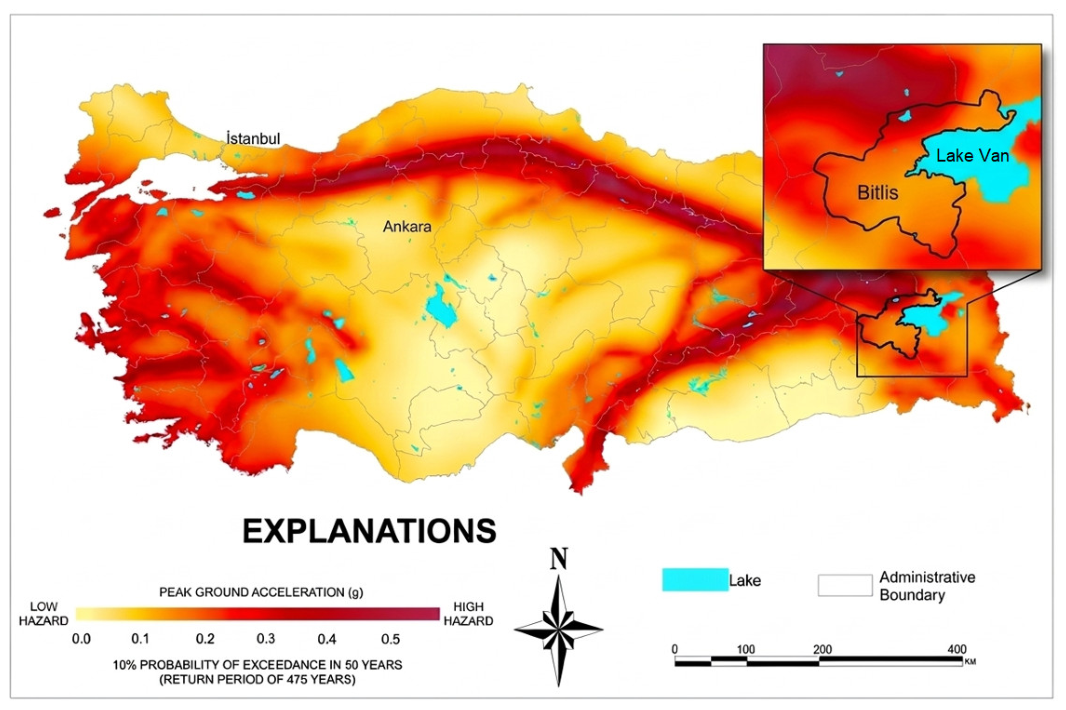
Bitlis Province is located within the Lake Van Basin. This basin is one of the regions in Türkiye where seismic activity is currently intensively observed. Earthquakes in the region and the resulting loss of life and property clearly indicate the basin’s high seismic hazard. Seismic hazard maps in Türkiye were updated in 1945, 1947, 1963, 1972, and 1996; most recently, they were revised in 2018 and came into force in 2019 [34].
With the updated seismic hazard map, seismic hazard assessments can now be performed specifically for exact geographic locations rather than relying on regional generalizations. In this context, the seismic design parameters for Bitlis Province are determined in accordance with the relevant code, taking into account local soil conditions and coordinate-based spectral acceleration values. The updated seismic hazard map and the location of Bitlis Province are presented in Figure 1.
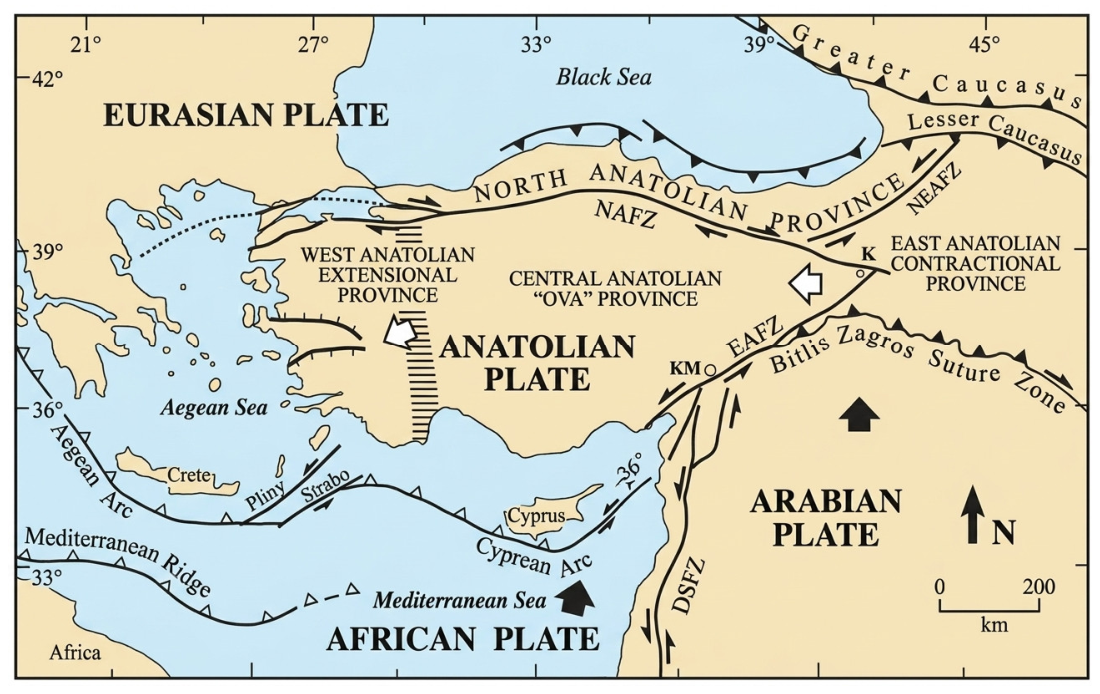
Bitlis Province and its surroundings lie within an important tectonic region on the collision zone between the Arabian and Anatolian Plates (Figure 2). The Bitlis–Zagros Suture Zone, which developed as a result of this collision, is one of the most significant tectonic structures in Eastern Anatolia and represents a fundamental element controlling the region’s seismotectonic character. The thrust faults, folded structures, and fracture systems that developed along this belt were formed as a result of the compression between the Arabian Plate moving northward and the Anatolian Plate. This process has led to the development of a complex deformation regime that began with the closure of the Tethys Ocean and continues to the present day. This compressional tectonic regime in the region is manifested by seismic activities occurring along active fault systems [36,37].
When the seismicity of Bitlis and its surroundings is examined, it is evident that seismic activity in the region extends beyond the Bitlis-Zagros Suture Zone and is also associated with active fault systems in the surrounding area. The faults in the region are generally characterized by thrust mechanisms, although strike-slip fault components are observed in certain segments. Studies indicate that numerous earthquakes of varying magnitudes have occurred in and around Bitlis, with most of these events concentrated along active fault zones. Furthermore, the distribution of earthquake hypocenters reveals that active tectonic processes are still ongoing in the vicinity of Bitlis [38,39].
An examination of historical earthquake records indicates that significant earthquakes have occurred in Bitlis and its surrounding regions. In particular, large earthquakes in the Lake Van Basin and its vicinity are among the key indicators of active tectonism in the region. This demonstrates that Bitlis lies within one of Türkiye’s major seismic zones. Historical records also show that major earthquakes occurring in Van, Muş, and their surroundings have had significant impacts on settlements. These earthquakes indicate that the stress accumulated along the Bitlis-Zagros Suture Zone can occasionally be released as large seismic events.
Recent studies and observed seismic activity indicate that the Bitlis-Zagros Suture Zone remains an active deformation zone, with ongoing stress accumulation. In particular, following major earthquakes in Eastern Anatolia, it has been reported that the stress distribution along this belt has changed, with increased stress accumulation in certain segments. This situation highlights the need to carefully monitor Bitlis and its surroundings for potential moderate to large earthquakes in the future.

3. Materials and Methods

3.1. Location and Characteristics of the Bridge

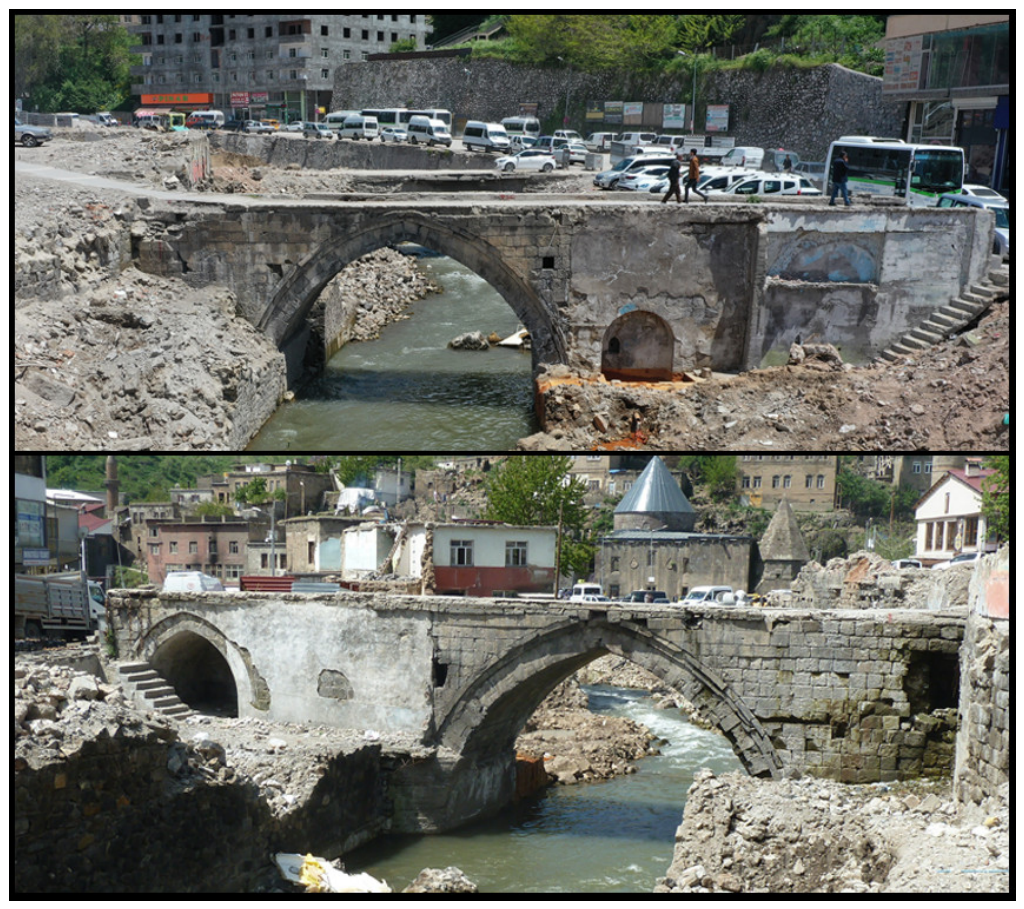
The historic Pamukçular Bridge spans the Bitlis Stream and is approximately 26 m long. The bridge has a two-span pointed arch form and was constructed using cut stone and lime mortar (Figure 3). The construction date of the bridge is 1446–1447 [40].
Until 2022, due to urban development activities around the structure, the bridge’s structural elements were largely obscured. Following river rehabilitation works, the bridge façades were uncovered. In the same year, the structure was included in the restoration program under the name “Pamukçular (Şifalısu) Bridge.”

3.2. Material Analysis of the Bridge

Before the restoration and conservation processes of structures whose structural integrity has been weakened or compromised over time, it is of great importance to comprehensively examine not only their architectural, historical, artistic, and aesthetic features but also their archaeometric properties. Such analyses enable the selection of repair materials that are compatible with the original structure.
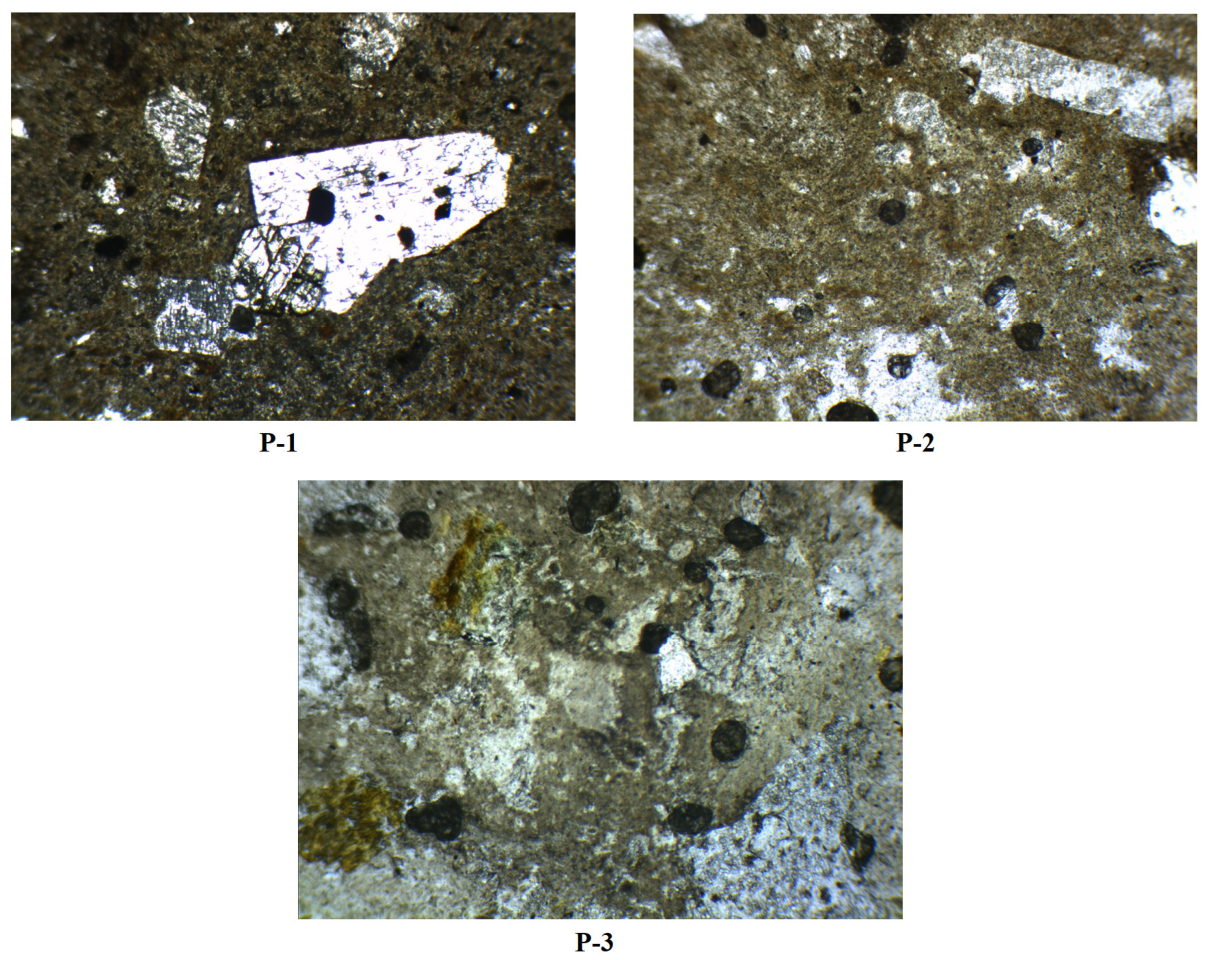
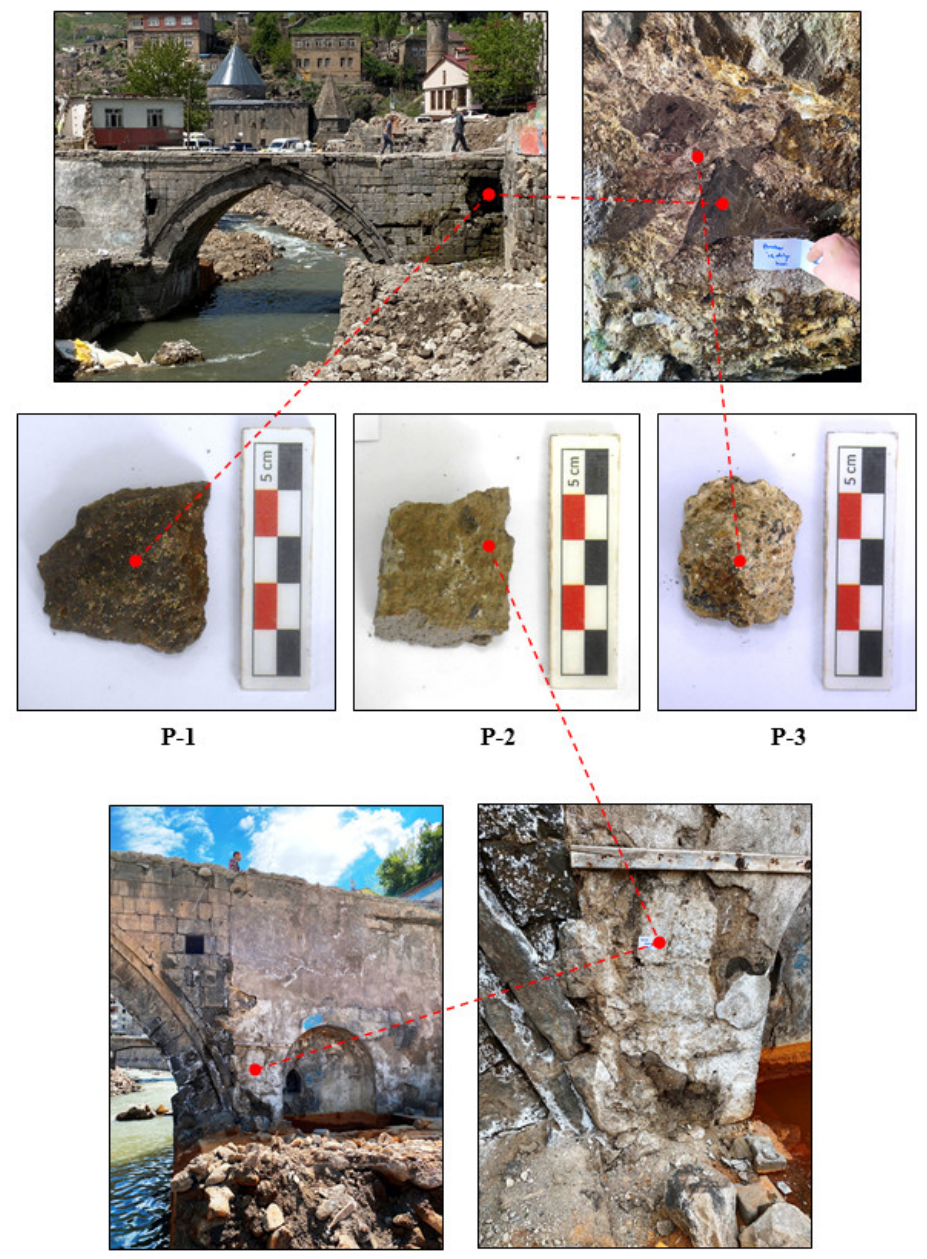
In this context, as a result of the architectural material analyses, documentation studies, and sampling process carried out on the Pamukçular Bridge, the collected stone and mortar samples were sent to the Historical Material Research and Conservation Laboratory (MAKLAB). The archaeometric examinations conducted on these samples and the findings obtained are presented below. The stone and mortar samples from the Pamukçular Bridge were first visually assessed, photographed for documentation, grouped, and separated for further analysis (Figure 4). A summary of these samples is presented in Table 1.
Basic physical tests were conducted on the stone samples from the Pamukçular Bridge (P-1 and P-2). In this context, the average unit weights of the samples were measured as approximately 14 kN/m3 and 16 kN/m3, respectively. Their total water absorption capacities were determined to be 7.22%, while their total porosity ratios averaged 14.70%. Structurally, these stones are characterized by low density and high porosity, which corresponds to lower mechanical performance.
After subjecting the mortar sample to acidic aggregate/binder analysis, the composition and particle types of the extracted aggregates were examined under a binocular microscope (Figure 5). The physical characteristics of the aggregates indicate that they predominantly belong to a coarse, rounded mixture. Detailed petrographic analysis of thin sections revealed that the mortar binder consists of a mixture of lime (85%) and clay (15%).

3.3. Geometric Modeling and Finite Element Model

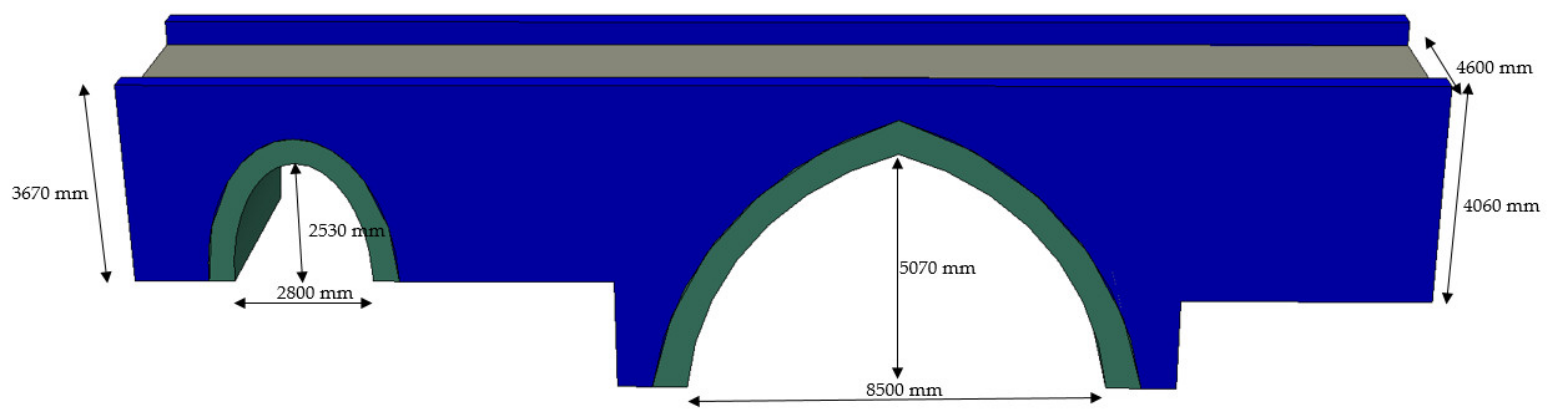
In this study, the ABAQUS software (Version 6.14), based on the finite element method, was used to numerically investigate the structural behavior of the historic masonry bridge elements [42]. Due to its user-friendly interface, extensive modeling capabilities, and potential for parametric analysis, the ABAQUS/Standard solver was preferred for the simulations. Three-dimensional geometric models of the masonry bridge components, such as arches, deck, and infill, were created in the ABAQUS/CAE software, with element definitions supported through command-based configurations. These models were combined to generate the full 26 m-long bridge model. This approach aims to represent the bridge elements realistically and reliably predict their structural behavior. The general view and dimensions of the modeled bridge are shown in Figure 6.
In the modeling process, eight-node solid elements were used, with a linear elastic material model applied. Solid elements are the most fundamental structural components capable of representing three-dimensional stress states in continuum-based finite element modeling approaches, and are widely adopted in structural analyses for this purpose [43,44,45]. In the finite element method (FEM), the mesh system plays a critical role, as both the accuracy of the results and the computation time directly depend on the element size, i.e., the mesh density. According to FEM theory, models with smaller elements and, consequently, denser meshes can produce highly accurate results; however, this significantly increases computational time. Conversely, models with larger elements and a coarser mesh may result in some loss of accuracy but allow for considerably faster analyses. Therefore, small elements should be used only when high precision is required, as they increase the model’s computational complexity. On the other hand, larger element sizes reduce the overall model complexity and are commonly used in simplified models to obtain rapid, approximate results during the design process.
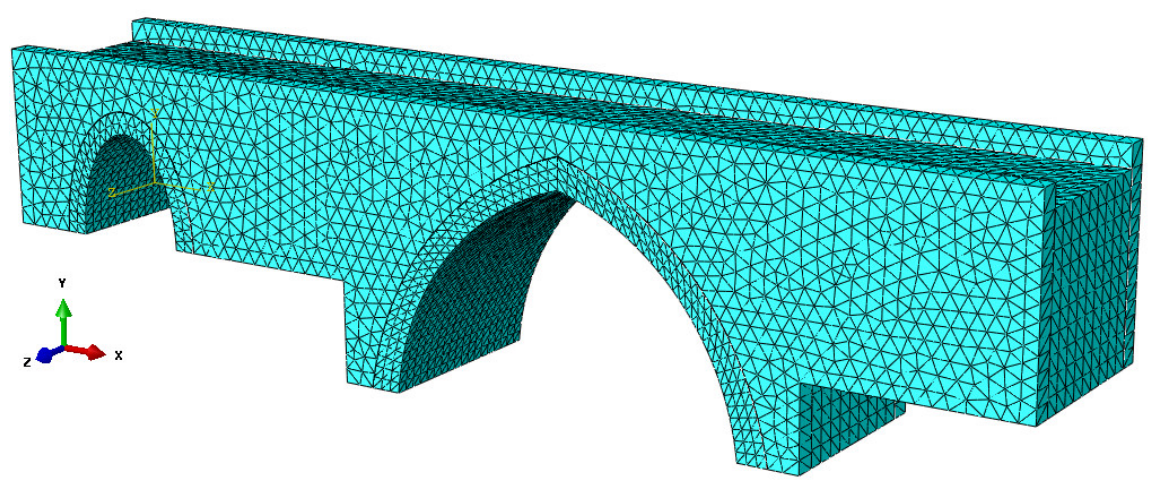
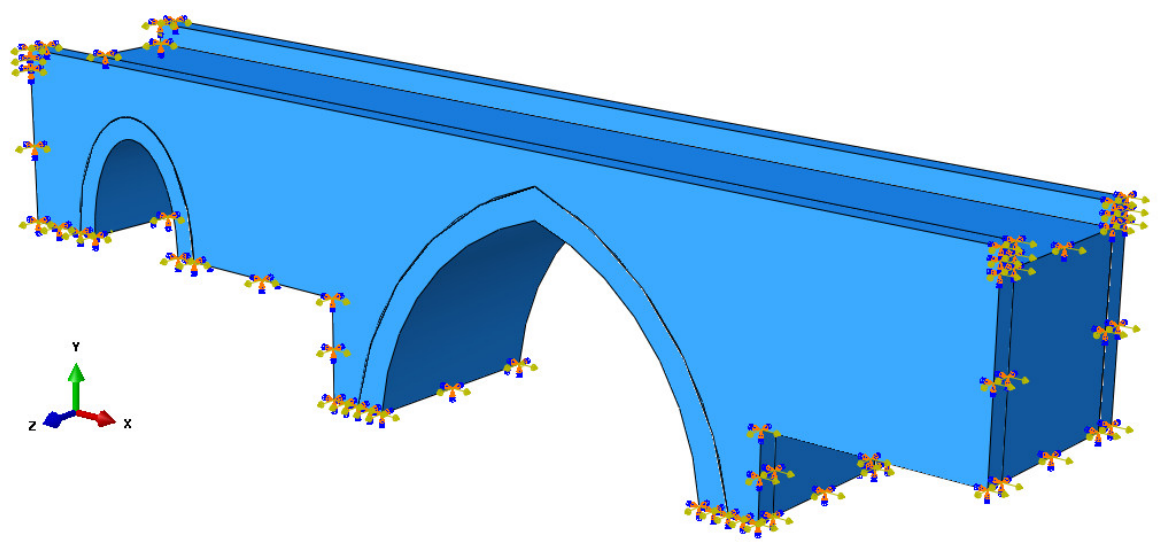
A visual representation of the finite element mesh used in this study is shown in Figure 7. The final model consists of 111,272 three-dimensional solid elements and 178,099 nodes. The numerical model employs fixed boundary conditions at the base, excluding soil-structure interaction from the current scope to prioritize the superstructure’s behavior. Although soil flexibility is known to affect displacement and stress distribution near support zones, this simplified boundary condition provides a baseline for the global response. The finite element model presented in Figure 8 was analyzed considering both the material properties and dynamic loading conditions.
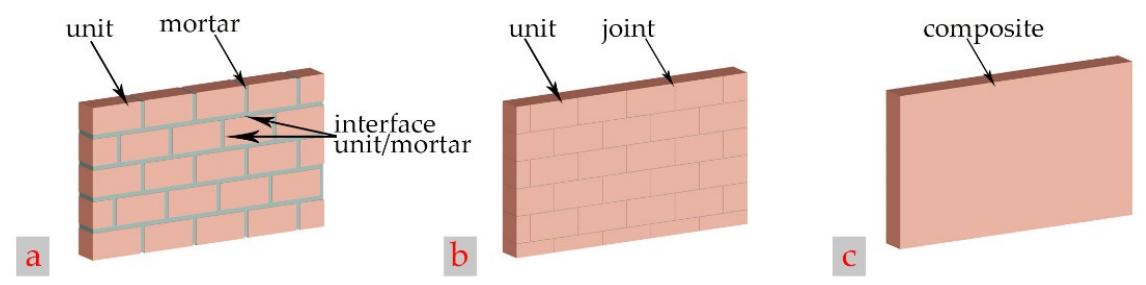
Modeling of masonry structures is of great importance for the assessment and design of both historical and modern masonry buildings. Masonry walls are typically modeled using three main approaches: detailed micro-modeling, simplified micro-modeling, and macro-modeling. These approaches differ mainly in how masonry components and their interactions are represented. In detailed micro-modeling, both units and mortar joints are explicitly modeled, whereas simplified micro-modeling reduces this level of detail through assumptions. On the other hand, macro-modeling treats masonry as a homogeneous material, enabling more efficient analyses at the structural scale. Illustrations of these modeling techniques are presented in Figure 9.
In this study, the bridge was modeled using the macro-modeling approach within the finite element framework. This method is widely preferred in the literature for analyzing masonry structures due to its efficiency at the structural scale. Numerous studies have adopted macro-modeling to investigate the seismic response of various masonry systems, including historic bell towers in the southeastern Lombardy region of Italy [46], masonry palaces in Switzerland and northern Italy [47], several historic masonry minarets located in Antalya, Türkiye [48], the San Pietro and San Benedetto churches in Italy [49], and Torre de la Vela in Spain [50]. In this approach, no distinction is made between the binding materials (such as mortar) and the masonry units during the analysis. Instead, the properties of the masonry units and mortar are homogenized into a single composite material, whose mechanical properties are defined by the homogenization process.
Macro-modeling is considered a more practical method due to its lower computational cost, while still providing sufficiently accurate stress distribution results within the masonry units and mortar [51,52,53]. In this study, the Bitlis stone used in the bridge and the mortar binding these stones were treated as a single material, with their properties represented based on the Bitlis stone’s characteristics.
The mechanical and physical properties of the main construction materials used in the bridge were determined through a combination of laboratory tests and non-destructive and semi-destructive testing. In this context, previously reported findings and experimental studies of similar historical structures were also considered references. The material properties of the historic bridge are presented in Table 2. The unit weights were established through laboratory tests on the collected stone samples. Due to sampling constraints, the elastic modulus, compressive strength, tensile strength, and Poisson’s ratio were adopted from empirical formulations and previous studies on comparable historical structures. In line with common practice in masonry numerical modeling, the tensile strength was taken as 10% of the compressive strength value [54,55,56].
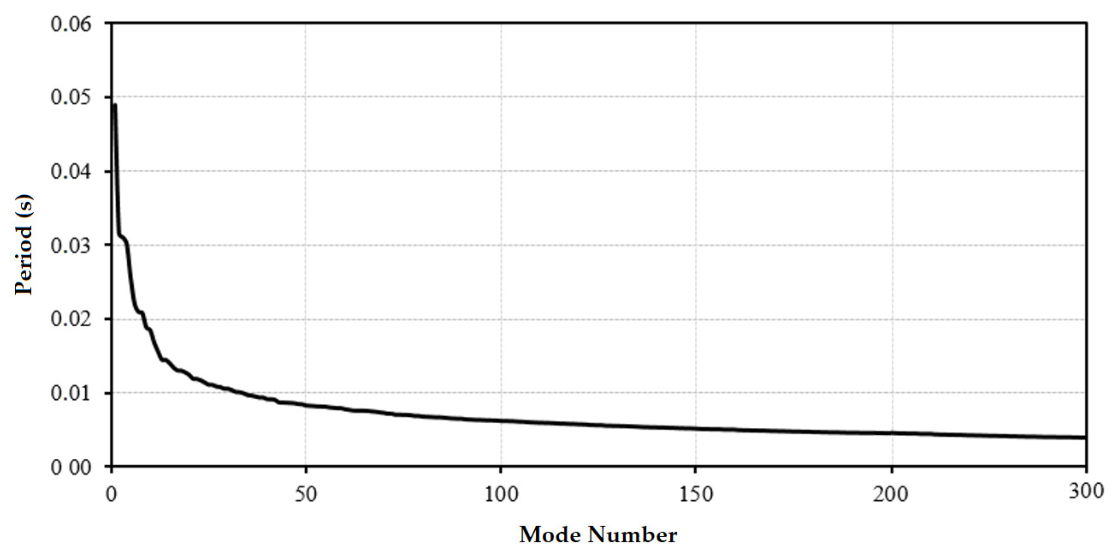
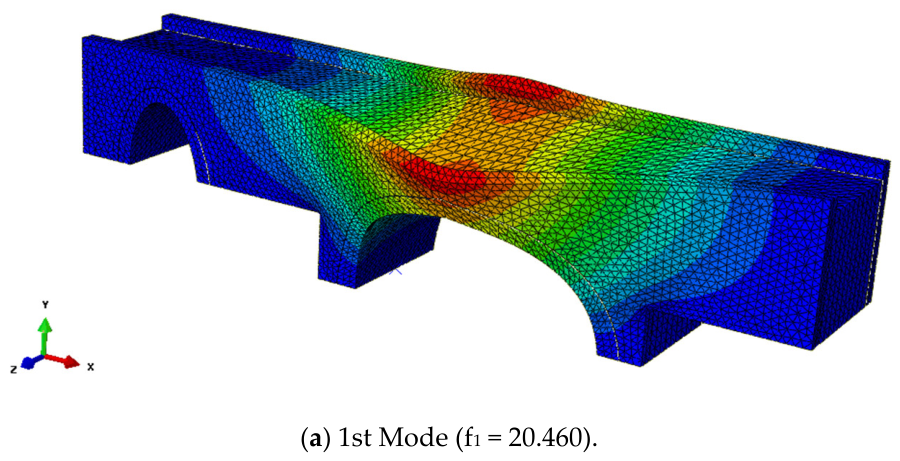
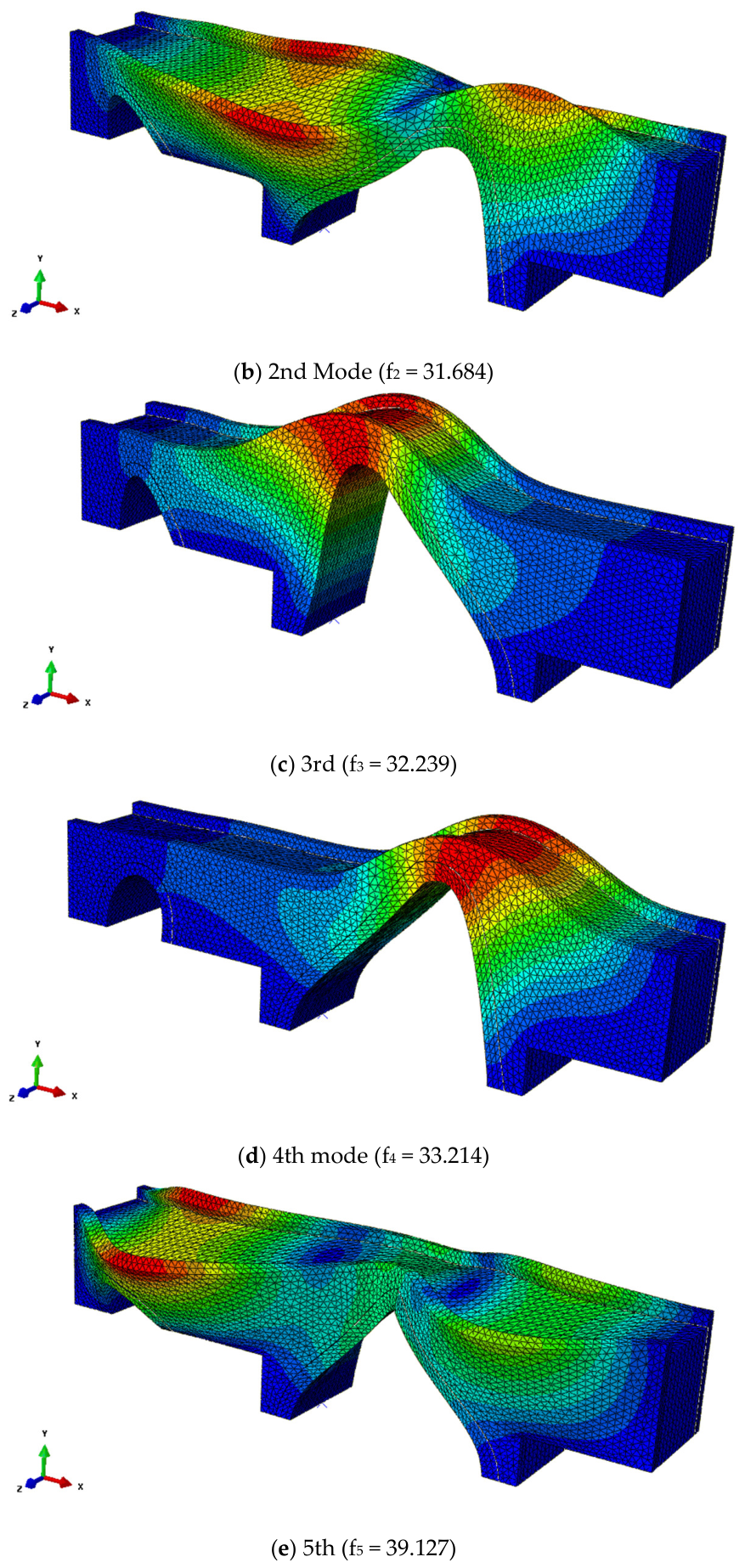
In this study, a modal analysis was first performed to determine the bridge’s dynamic characteristics. Modal analysis is a dynamic analysis method that allows for the identification of a structure’s free vibration periods, natural frequencies, mode shapes, and mass participation factors. As a result of the modal analysis, the natural vibration periods of the bridge were obtained. The analysis considered the first 300 modes of the structure, and the corresponding frequencies, periods, and mass participation factors were determined. The natural vibration periods and frequencies for the active modes are presented in Table 3, while the natural vibration periods for the first 300 modes are graphically illustrated in Figure 10. The calculated mass participation factors indicate the contribution of each mode to the structure’s overall dynamic response. For the bridge examined, it was observed that the total mass participation of the first 10 modes exceeds 60%.
The first five mode shapes obtained from the modal analysis of the Bitlis Pamukçular Bridge, performed using the software program, are presented in Figure 11.
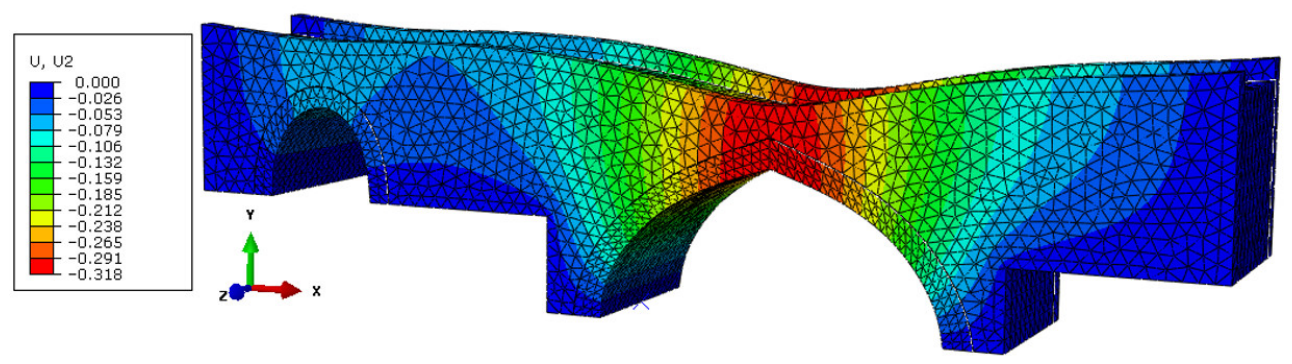
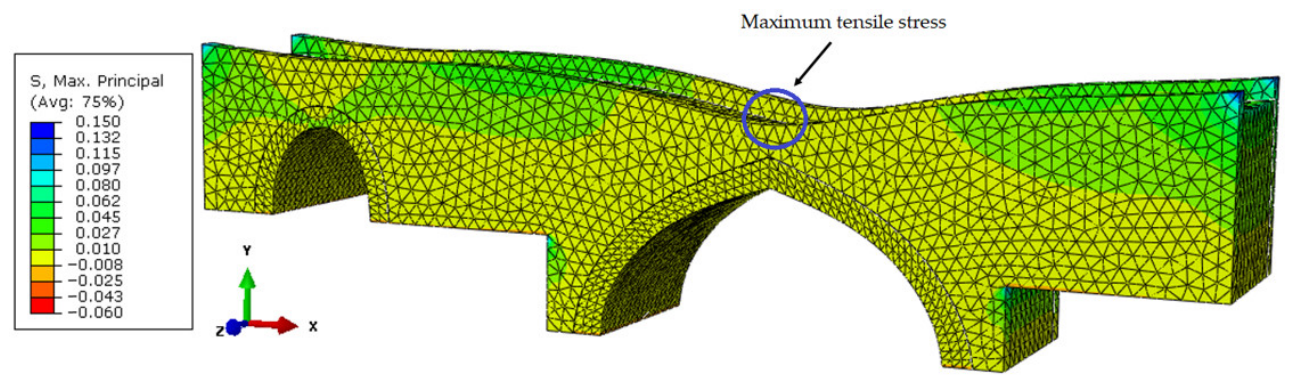
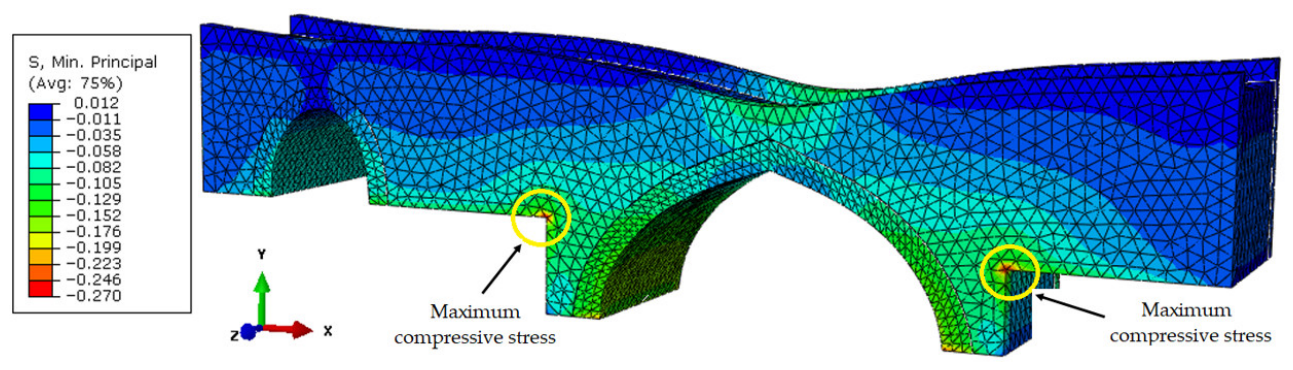
The bridge has several contact points with the ground, and these connections were defined as fixed supports in the numerical model. Therefore, the structure behaves relatively rigidly, which is considered to be the main reason for the high fundamental frequency value. Similar frequency values have also been reported in previous studies on historic masonry bridges [9,10,11]. After the modal analysis, the bridge model was subjected to a static analysis under its self-weight. The resulting stresses and maximum displacements are presented in Figure 12, Figure 13 and Figure 14, illustrating the effects of the self-weight on the structure.
The bridge’s self-weight induces tensile stress concentrations near the arch crown, while compressive stresses accumulate around the pier–arch connection zones. The corresponding maximum tensile and compressive stresses were determined as 0.15 MPa and 0.27 MPa, respectively. Following the established masonry literature [57,58,59], the material’s tensile strength was taken as 0.5–0.8 MPa for assessing the self-weight stresses of the historic Pamukçular Bridge. The results indicate that the tensile stresses remain well below the assumed tensile strength of the material. Therefore, no tensile-stress-induced damage is expected in the bridge. On the other hand, compressive stresses were observed in the areas where the arch supports rest on the ground. Assuming a compressive strength of 5–8 MPa for the masonry material, the calculated compressive stresses in these regions were also well below the material’s strength limits, and no compression-related damage occurred. The maximum displacement of the bridge under its self-weight was measured at the main arch, at 0.32 mm.
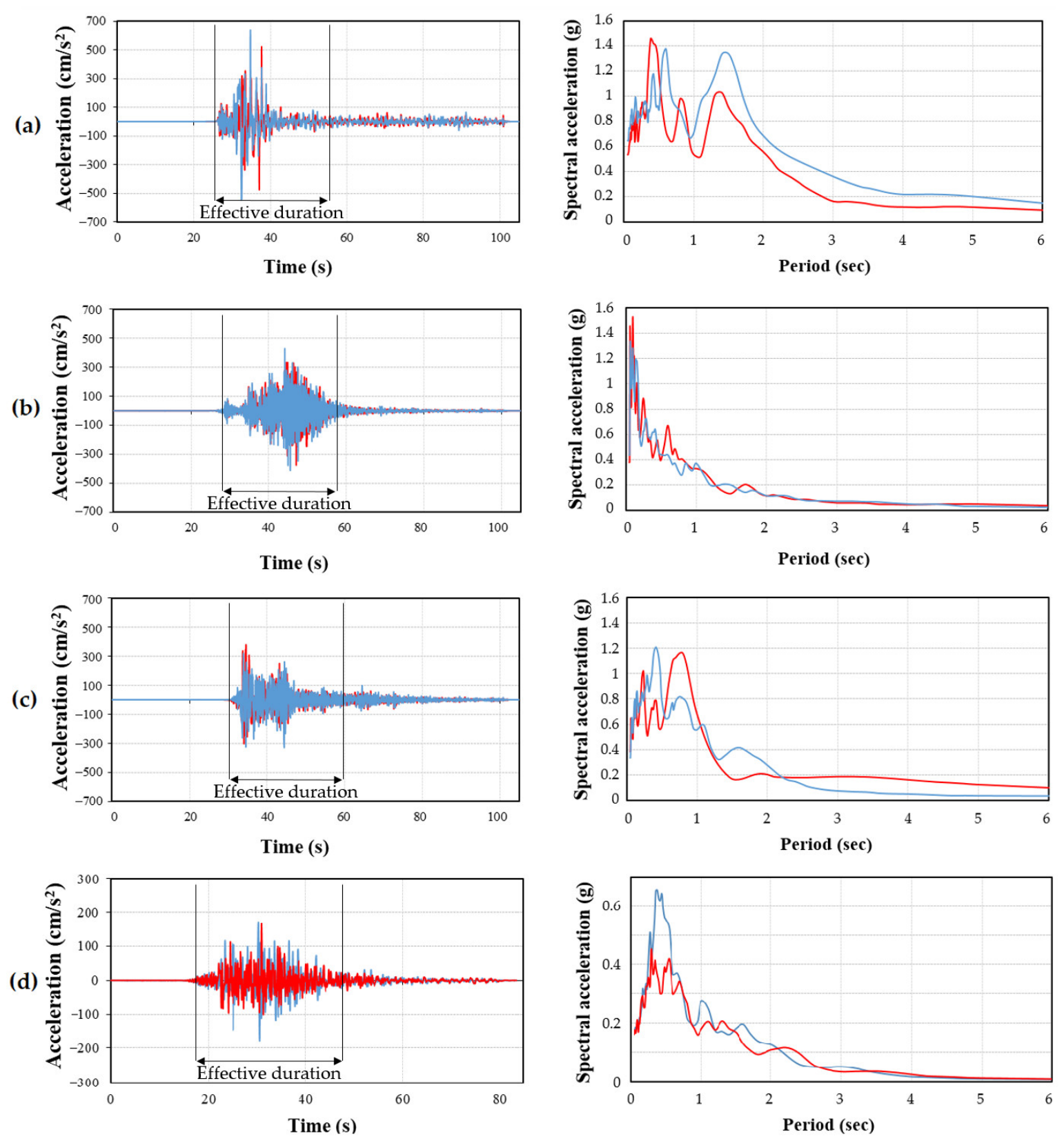
Time history analysis refers to the numerical solution of the structural equations of motion, accounting for its mass, damping, and stiffness properties, under a selected ground motion. In the relevant section of this study, time-domain structural analyses were performed for the Bitlis Pamukçular Bridge using acceleration records from the nearby 23 October 2011 Van earthquake and the more recent 2023 Kahramanmaraş earthquakes. The acceleration-time histories of these earthquakes are presented in Figure 15. In the time-domain analyses, solid elements were used in the finite element model, assuming homogeneous structural materials, and a linear elastic material model was adopted. We approached the masonry modeling using a linear elastic constitutive law within a macro-modeling framework. By treating the bridge components as homogeneous materials, we applied equivalent mechanical properties obtained from laboratory testing and literature-based assumptions. Consequently, nonlinear damage evolution and material degradation were kept outside the scope of these analyses. A damping ratio of 5% was considered in the time-history analyses, which is consistent with commonly adopted values for historical masonry structures reported in previous numerical studies [60,61,62].
The seismic behavior of the examined masonry bridge was analyzed using actual earthquake records. Real acceleration data recorded at four different stations (4612, 4406, 4631, and 6503) during the 2011 Van earthquake and the 2023 Kahramanmaraş earthquake sequence were utilized. To reduce analysis time, the effective 30-s acceleration records were considered. All ground motions were applied to the structure in both horizontal directions, with the shorter, structurally weaker direction used as the primary focus in the analyses. The acceleration records used in the time-domain analyses, along with the corresponding response spectra, are presented in Figure 15. Furthermore, the vertical component of the earthquakes was not considered in the analyses. This choice was made to enable a more accurate comparison with results obtained using simplified methods that also neglect the vertical component.
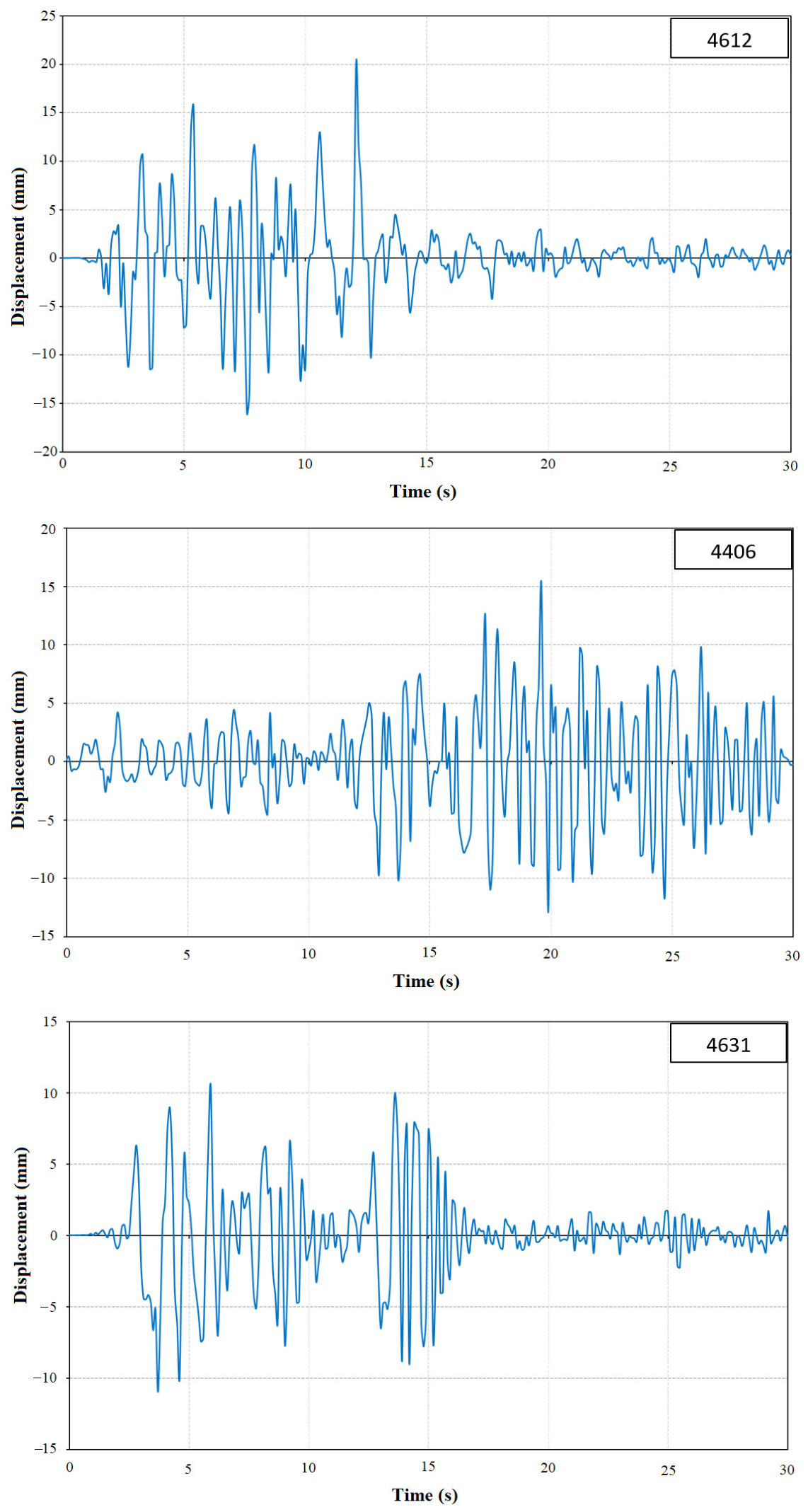
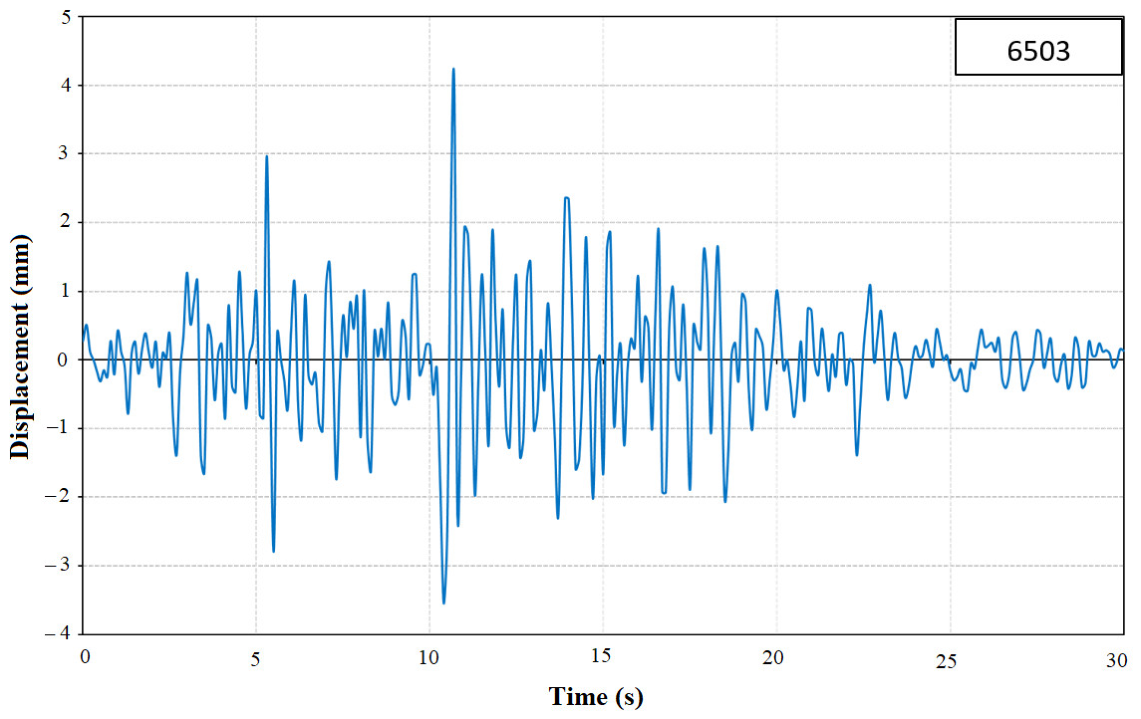
Based on analyses performed using acceleration-time records from four different seismograph stations, the bridge exhibited a maximum lateral displacement of 20.38 mm when considering data from station 4612, 15.42 mm for station 4406, 10.98 mm for station 4631, and 4.10 mm for station 6503. The displacement-time histories obtained from analyses considering the effective 30-s records are presented in Figure 16.
The displacement–time histories indicate that the Pamukçular Bridge exhibits a time-dependent response throughout the earthquake. In all records, the maximum displacements occur during the central time interval corresponding to the earthquake’s main energy input. Following this phase, the vibration amplitudes decrease, showing a damped response. Noticeable differences in displacement are observed among the records from different seismograph stations, indicating that the dynamic response of the bridge is influenced not only by the amplitude of the ground motion but also by the frequency content and effective duration of the earthquake records.

4. Conclusions

This paper examines the material properties of the historic Pamukçular Bridge in Bitlis, located in eastern Türkiye, and evaluates its structural behavior through finite element analyses. The results reveal that the mechanical properties of the stone and mortar used in the bridge have a significant impact on its structural response. The stone samples are characterized by relatively low unit weight and high porosity, indicating a lightweight material with limited mechanical strength and a comparatively weak internal structure. A porosity of around 14.70% and a water absorption rate of 7.22% also point to a material that is sensitive to environmental conditions. Over time, factors such as freeze–thaw action, moisture changes, and chemical effects may reduce its strength. The mortar analysis shows the presence of some clay content and that the binder is mainly lime-based. While this form of mortar is suitable for historic constructions, it often has lower strength and stiffness than more modern binding materials.
The structural model was developed in ABAQUS, and the modal analysis results indicate that the bridge’s dynamic behavior is largely controlled by the lower mode shapes. The high mass participation ratios obtained in the first modes indicate that the structure is particularly sensitive to certain vibration modes under earthquake effects. This shows that the bridge’s dynamic behavior is complex but concentrated in specific directions. In particular, the fact that the behavior in the short-span direction is more critical indicates that the structure is stiffer in the long-span direction.
The results of the static analysis under the bridge’s self-weight clearly show that the structure exhibits safe behavior. The tensile and compressive stresses remaining below the material’s accepted strength limits indicate that no structural damage is expected under only vertical loads in the current condition. The fact that the maximum displacement value remains at very low levels also supports this situation. These results confirm that historic bridges generally exhibit advantageous behavior under vertical loads, as they are compression-dominated systems. Time-history analyses performed using real acceleration–time data yield more critical results regarding the structure’s behavior under earthquake loading. In analyses using acceleration-time records from recent destructive earthquakes, maximum displacement values ranging from 4.10 mm to 20.38 mm indicate that the structure’s seismic behavior is quite stiff.
The analysis results also show that stress concentrations are particularly intense at the crown of the arches and at the pier–arch connection regions. These areas are already considered critical due to geometric discontinuities and load transfer mechanisms. Under earthquake effects, the increase in stress in these regions may lead to crack formation over time. In addition, it may also cause material degradation and the development of local damage. Therefore, these regions should be prioritized for intervention. The analyses indicate that the Pamukçular Bridge maintains overall stability in its current state. However, it can be said to carry risks of local damage, especially under dynamic conditions. This does not indicate that the structure is completely safe, but it shows that damage may occur under certain conditions. For this reason, strategies for preserving the bridge should not only aim to maintain its current condition but also to reduce potential risks. The obtained data have important implications for both the Pamukçular Bridge and historic bridges with similar characteristics. In particular, the identification of critical regions will enable strengthening and maintenance works to be carried out using appropriate materials. If applied in this way, it is of great importance for the long-term preservation of the structure.
Although the analysis demonstrates that the bridge maintains its global stability, the inherent limitations of the linear numerical framework warrant careful consideration. Because this study utilizes a linear elastic material model, complex nonlinear behaviors-including crack initiation, propagation, stiffness degradation, and cumulative damage-are outside the simulation scope. This boundary condition is particularly relevant in high-stress zones, where localized degradation is prone to develop under cyclic seismic demands.
The current analysis focused exclusively on linear-elastic behavior, meaning that nonlinear damage mechanisms inherent in masonry structures during strong earthquakes fell outside its scope. Consequently, effects like tensile cracking, stiffness degradation, and irreversible deformation were not explicitly modeled. To address this, subsequent studies could utilize nonlinear frameworks such as the Concrete Damage Plasticity model available in ABAQUS. Incorporating such models would better account for the asymmetric tension-compression behavior of masonry and its progressive failure under cyclic loading. Also, the numerical model was not calibrated using experimental modal analysis data. Therefore, uncertainties related to material properties, boundary conditions, and structural idealizations may affect the predicted dynamic characteristics of the bridge. Variations in elastic modulus, support conditions, and infill properties may influence the calculated natural frequencies and displacement responses.

Author Contributions

Conceptualization, F.A. and E.I.; methodology, F.A., A.Y. and A.B., software, F.A. and A.B.; validation, A.Y. and E.I.; formal analysis, A.B.; investigation, F.A. and A.Y.; writing—original draft preparation, F.A. and A.Y.; writing—review and editing, E.I. and A.B.; visualization, A.Y.; supervision, E.I. and A.B.; All authors have read and agreed to the published version of the manuscript.

Funding

This research received no external funding.

Data Availability Statement

The raw data supporting the conclusions of this article will be made available: by the authors on request.

Acknowledgments

This study is an expanded and revised version of the master’s thesis of the second author.

Conflicts of Interest

The authors declare no conflicts of interest.

References

  1. Valente, M.; Milani, G. Seismic assessment of historical masonry towers by means of simplified approaches and standard FEM. Constr. Build. Mater. 2016, 108, 74–104. [Google Scholar] [CrossRef]
  2. Pouraminian, M.; Didevar, E. Performance of Gaskar historical minaret against natural wind and earthquake hazards. Anal. Struct. Earthq. 2021, 18, 47–58. [Google Scholar]
  3. Pouraminian, M. Multi-hazard reliability assessment of historical brick minarets. J. Build. Pathol. Rehabil. 2022, 7, 10. [Google Scholar] [CrossRef]
  4. Nochebuena-Mora, E.; Mendes, N.; Calixto, V.; Oliveira, S. Explicit Method in the Seismic Assessment of Unreinforced Masonry Buildings through Plane Stress Elements. Appl. Sci. 2023, 13, 10602. [Google Scholar] [CrossRef]
  5. Pantoja-Rosero, B.G.; Achanta, R.; Beyer, K. Automated Image-Based Generation of Finite Element Models for Masonry Buildings. Bull. Earthq. Eng. 2024, 22, 3441–3469. [Google Scholar] [CrossRef]
  6. İzol, R.; Işık, E.; Avcil, F.; Arslan, M.H.; Arkan, E.; Büyüksaraç, A. Seismic Performance of Masonry Structures after 06 February 2023 Earthquakes; Site Survey and FE Modelling Approach. Soil Dyn. Earthq. Eng. 2024, 186, 108904. [Google Scholar] [CrossRef]
  7. Remus, A.; Tezcan, S.; Sun, J.; Milani, G.; Perucchio, R. Seismic Failure Assessment Using Energy Outputs of Finite Element Analysis: A Strategy for Complex Heritage Masonry Structures Modeled with Concrete Damaged Plasticity Material. Buildings 2025, 15, 318. [Google Scholar] [CrossRef]
  8. Altunisik, A.C.; Kanbur, B.; Genc, A.F.; Kalkan, E. Structural Response of Historical Masonry Arch Bridges under Different Arch Curvature Considering Soil-Structure Interaction. Geomech. Eng. 2019, 18, 141–151. [Google Scholar]
  9. Çavuşlu, M. Assessing Seismic Crack Performance of Diyarbakır Çüngüş Masonry Stone Bridge Considering 2023 Kahramanmaraş, Hatay, Malatya, Gaziantep Earthquakes. Bitlis Eren Üniversitesi Bilim. Derg. 2023, 12, 544–556. [Google Scholar] [CrossRef]
  10. Nemutlu, Ö.F.; Güzel, İ.; Balun, B.; Öztürk, M.; Sarı, A. Nonlinear Seismic Assessment of Historical Masonry Karaz Bridge under Different Ground Motion Records. Bitlis Eren Üniversitesi Bilim. Derg. 2023, 12, 247–260. [Google Scholar] [CrossRef]
  11. Cavuslu, M.; Ülger, T. Enhancing the Seismic Resilience of the Batıayaz Masonry Bridge, Aftermath of 2023 Kahramanmaraş Earthquakes, Using Iron and FRP Clamp-Dowel Connectors in the Arch: Failure Tests and Numerical Modelling. Eng. Fail. Anal. 2025, 175, 109544. [Google Scholar] [CrossRef]
  12. Şen, B. Modeling and Analysis of the Historical Masonry Structures. Master’s Thesis, Graduate School of Natural and Applied Sciences, Boğaziçi University, İstanbul, Turkey, 2006. [Google Scholar]
  13. Bayraktar, A.; Altunışık, A.C.; Türker, T.; Sevim, B. Tarihi Yığma Köprülerin Sonlu Eleman Modellerinin Operasyonal Modal Analiz Yöntemiyle İyileştirilmesi. In Proceedings of the Tarihi Eserlerin Güçlendirilmesi ve Geleceğe Güvenle Devredilmesi Sempozyumu 1, Ankara, Türkiye, 27–29 September 2007; pp. 429–440. [Google Scholar]
  14. Korkmaz, K.A.; Zabin, P.; Çarhoğlu, A.İ.; Nuhoğlu, A. Assessment of Seismic Behavior of Stone Arch Bridges: The Case of Timisvat Bridge. İleri Teknol. Bilim. Derg. 2013, 2, 66–75. [Google Scholar]
  15. Onat, O.; Sayın, E. Tarihi Tağar Köprüsünün Doğrusal Olmayan Sismik Analizi. In Proceedings of the 5th Tarihi Eserlerin Güçlendirilmesi ve Geleceğe Güvenle Devredilmesi Sempozyumu, Erzurum, Türkiye, 1–3 October 2015. [Google Scholar]
  16. Işık, E.; Antep, B.; Karaşin, İ.B. Structural Analysis of Ahlat Emir Bayındır Bridge. Bitlis Eren Univ. J. Sci. Technol. 2018, 8, 11–18. [Google Scholar] [CrossRef][Green Version]
  17. Demir, O. Analysis of Historical Diyarbakır Dicle (on Gözlü) Bridge by Using Finite Element Method. Master’s Thesis, Graduate School of Natural and Applied Sciences, Erzincan Binali Yıldırım University, Erzincan, Türkiye, 2019. (In Turkish) [Google Scholar]
  18. Yeşil, M. Investigation of Behavior Change of Conjic and Tokatlı Historical Masonry Stone Bridges with Different Openings and Belt Height under Near and Far Fault Using the Finite Element Method ANSYS and SAP2000. Master’s Thesis, Graduate School of Natural and Applied Sciences, Zonguldak Bülent Ecevit University, Zonguldak, Türkiye, 2019. (In Turkish) [Google Scholar]
  19. Özmen, A.; Sayın, E. Assessment of Seismic Behavior of a Historical Masonry Bridge. Niğde Ömer Halisdemir Üniversitesi Mühendislik Bilim. Derg. 2020, 9, 956–965. [Google Scholar] [CrossRef]
  20. Sözen, Ş.; Çavuş, M. Evaluation of the Effect of Form Change on the Seismic Behavior of Single-Span Historical Stone Bridges: The Case of Niksar Yılanlı (Leylekli) Bridge. Duzce Univ. J. Sci. Technol. 2020, 8, 48–59. [Google Scholar]
  21. Öztürk, Ç.O.; Çetin, S.Y.; Sayın, E. Dynamic Analysis of Historical Sultan Hamit Masonry Arch Bridges. Dicle Üniversitesi Mühendislik Fakültesi Mühendislik Derg. 2023, 14, 499–506. [Google Scholar]
  22. Karalar, M.; Çufalı, G. Structural Assessment of Historical Stone Bridges with the Finite Element Method under Dynamic Effects of Arch Shape: The Antik Iscehisar Bridge. Appl. Sci. 2023, 13, 10740. [Google Scholar] [CrossRef]
  23. Adsız, E.; Sayın, E.; Özmen, A. Seismic Analysis of a Masonry Arch Bridge under Artificial Earthquake Records. Dicle Univ. Eng. Fac. Eng. J. 2024, 15, 677–688. [Google Scholar]
  24. Oğuz, B. Examination of the Dynamic Behavior of the Historical Meram Bridge with the Shaking Table. Master’s Thesis, Graduate School of Natural and Applied Sciences, Konya Technical University, Konya, Türkiye, 2025. [Google Scholar]
  25. Hatzigeorgiou, G.D.; Beskos, D.E.; Teodorakopoulos, D.D.; Sfakianakis, M. Static and Dynamic Analysis of the Arta Bridge by Finite Elements. Archit. Civ. Eng. 1999, 2, 4–51. [Google Scholar]
  26. Tapkin, S.; Tercan, E.; Motsa, S.; Drosopoulos, G.; Stavroulaki, M.; Maravelakis, E.; Stavroulakis, G. Structural Investigation of Masonry Arch Bridges Using Various Nonlinear Finite-Element Models. J. Bridg. Eng. 2022, 27, 04022053. [Google Scholar] [CrossRef]
  27. Toker, S.; Ünay, A. Mathematical Modeling and Finite Element Analysis of Masonry Arch Bridges. Gazi Univ. J. Sci. 2004, 17, 129–139. [Google Scholar]
  28. Nobile, L.; Bartolomeo, V.; Bonagura, M. Structural Analysis of Historic Masonry Arch Bridges: Case Study of Clemente Bridge on Savio River. Key Eng. Mater. 2012, 488, 674–677. [Google Scholar]
  29. Zani, G.; Martinelli, P.; Galli, A.; di Prisco, M. Three-Dimensional Modelling of a Multi-Span Masonry Arch Bridge: Influence of Soil Compressibility on the Structural Response under Vertical Static Loads. Eng. Struct. 2020, 221, 110998. [Google Scholar] [CrossRef]
  30. Zhao, C.; Xiong, Y.; Zhong, X.; Shi, Z.; Yang, S. A Two-Phase Modeling Strategy for Analyzing the Failure Process of Masonry Arches. Eng. Struct. 2020, 212, 110525. [Google Scholar] [CrossRef]
  31. Zizi, M.; Chisari, C.; Iaderosa, R.; Bencivenga, P.; Lavino, A.; De Matteis, G. Dynamical Features and FE Modelling of a Multi-Span Historical Masonry Arch Bridge. Procedia Struct. Integr. 2024, 62, 430–437. [Google Scholar] [CrossRef]
  32. Liu, J.; Yang, P.; Liu, Q.; Wang, H.; Bu, J. Study on a Benchmark Finite Element Model of a Cable-Stayed Bridge Based on ABAQUS and IM-HPO. AIP Adv. 2023, 13, 035012. [Google Scholar] [CrossRef]
  33. Enshaeian, A.; Ghahremani, B.; Rizzo, P. Case Studies about Finite Element Modeling and Wireless Sensing of Three Pennsylvania Bridges. Sensors 2024, 24, 1714. [Google Scholar] [CrossRef]
  34. Işık, E.; Peker, F.; Büyüksaraç, A. The Effect of Vertical Earthquake Motion on Steel Structures Behaviour in Different Seismic Zones. J. Adv. Res. Nat. Appl. Sci. 2022, 8, 527–542. [Google Scholar] [CrossRef]
  35. AFAD. TDTH. Available online: https://tdth.afad.gov.tr (accessed on 2 March 2026).
  36. İmamoğlu, M.Ş.; Çetin, E. Güneydoğu Anadolu Bölgesi ve Yakın Yöresinin Depremselliği. Dicle Univ. Ziya Gokalp Educ. Fac. J. 2007, 9, 93–103. [Google Scholar]
  37. Işık, E.; Aydın, M.C.; Bakış, A.; Özlük, M.H. Bitlis ve civarındaki faylar ve bölgenin depremselliği. Bitlis Eren Üniversitesi Bilim. Derg. 2012, 1, 153–169. [Google Scholar]
  38. Medved, I.; Polat, G.; Koulakov, I. Crustal Structure of the Eastern Anatolia Region (Turkey) Based on Seismic Tomography. Geosciences 2021, 11, 91. [Google Scholar] [CrossRef]
  39. Isik, E.; Hamamcioglu, M. Risk Prioritization of RC Buildings in Bitlis (Türkiye) in the Light of the 2023 Kahramanmaraş Earthquakes. Buildings 2025, 15, 3552. [Google Scholar] [CrossRef]
  40. Tunç, G. Taş Köprülerimiz; KGM Matbaası: Ankara, Türkiye, 1978; p. 90.
  41. Karayolları Genel Müdürlüğü. Van. Available online: https://www.kgm.gov.tr (accessed on 2 March 2026).
  42. ABAQUS. Theory Manual, version 6.14; Dassault Systèmes Simulia: Providence, RI, USA, 2014.
  43. Ma, P. Analyzing Seismic Behavior and Micro-Modeling of Masonry Walls Using ABAQUS Software. Multiscale Multidiscip. Model. Exp. Des. 2024, 7, 2515–2534. [Google Scholar] [CrossRef]
  44. Gonçalves, M.; Ponte, M.; Bento, R. Seismic Assessment of Existing Masonry Buildings Using Damage Mechanics. Buildings 2024, 14, 2395. [Google Scholar] [CrossRef]
  45. Fan, X.; Lin, X.; Qiao, Y.; Peng, Y. Study on Seismic Performance of Composite Structures with Reinforced Concrete Columns and Masonry Walls. Buildings 2025, 15, 4481. [Google Scholar] [CrossRef]
  46. Valente, M. Seismic Vulnerability Assessment and Earthquake Response of Slender Historical Masonry Bell Towers in South-East Lombardia. Eng. Fail. Anal. 2021, 129, 105656. [Google Scholar] [CrossRef]
  47. Usta, P. Assessment of Seismic Behavior of Historic Masonry Minarets in Antalya, Turkey. Case Stud. Constr. Mater. 2021, 15, e00665. [Google Scholar] [CrossRef]
  48. Valente, M. Seismic Behavior and Damage Assessment of Two Historical Fortified Masonry Palaces with Corner Towers. Eng. Fail. Anal. 2022, 134, 106003. [Google Scholar] [CrossRef]
  49. Valente, M.; Milani, G. Advanced Numerical Insights into Failure Analysis and Strengthening of Monumental Masonry Churches under Seismic Actions. Eng. Fail. Anal. 2019, 103, 410–430. [Google Scholar] [CrossRef]
  50. Vuoto, A.; Ortega, J.; Lourenço, P.B.; Suárez, F.J.; Núñez, A.C. Safety Assessment of the Torre de la Vela in the Alhambra, Granada, Spain: The Role of On-Site Works. Eng. Struct. 2022, 264, 114443. [Google Scholar] [CrossRef]
  51. Pande, G.N.; Middleton, J.; Kralj, B. Computer Methods in Structural Masonry. In Proceedings of the Fourth International Symposium on Computer Methods in Structural Masonry; E & FN Spon: London, UK, 1998. [Google Scholar]
  52. Lourenço, P.B.; Rots, J.G.; Blaauwendraad, J. Two Approaches for the Analysis of Masonry Structures: Micro and Macro-Modeling. Heron 1995, 40, 4. [Google Scholar]
  53. Lourenço, P.B. Computations on Historic Masonry Structures. Prog. Struct. Eng. Mater. 2002, 4, 301–319. [Google Scholar] [CrossRef]
  54. García, H.; Jiménez-Pacheco, J.; Ulloa, J. Effective Properties of Masonry Structures and Macro-Model Analysis with Experimental Verification. Results Eng. 2024, 23, 102546. [Google Scholar] [CrossRef]
  55. Özmen, A. Seismic Performances of Different Strengthening Techniques in Masonry Residential Buildings. Teh. Vjesn. 2026, 33, 470–486. [Google Scholar]
  56. Bayraktar, A.; Hökelekli, E. Nonlinear Soil Deformability Effects on the Seismic Damage Mechanisms of Brick and Stone Masonry Arch Bridges. Int. J. Damage Mech. 2021, 30, 431–452. [Google Scholar] [CrossRef]
  57. Frunzio, G.; Monaco, M.; Gesualdo, A. 3D FEM Analysis of a Roman Arch Bridge. In Proceedings of the 3rd International Seminar on Structural Analysis of Historical Constructions (SAHC), Guimarães, Portugal, 7–9 November 2001; pp. 591–598. [Google Scholar]
  58. Fanning, P.J.; Boothby, T.E. Three-Dimensional Modelling and Full-Scale Testing of Stone Arch Bridges. Comput. Struct. 2001, 79, 2645–2662. [Google Scholar] [CrossRef]
  59. Modena, C.; Lourenço, P.B.; Roca, P. (Eds.) Structural Analysis of Historical Constructions: Possibilities of Numerical and Experimental Techniques. In Proceedings of the IVth International Seminar on Structural Analysis of Historical Constructions, Padova, Italy, 10–13 November 2004; CRC Press: Boca Raton, FL, USA, 2018. [Google Scholar]
  60. Avcil, F.; Radu, D.; Işık, E.; Yuzbasi, J.; Büyüksaraç, A.; Arkan, E.; Hadzima-Nyarko, M.; Topalan, M.; Topçubaşı, M. Post-2023 Kahramanmaraş Earthquake Assessment of Masonry Mosques and Minarets in Türkiye: Field Observations and Numerical Earthquake Analysis. Sustainability 2026, 18, 2680. [Google Scholar] [CrossRef]
  61. Boduroglu Yazici, B.; Uzdil, O. Comprehensive Material Characterization and Seismic Performance Evaluation of a Traditional Masonry Residential Building with Reinforced Concrete Slabs. Buildings 2025, 15, 1710. [Google Scholar] [CrossRef]
  62. AlShawa, O.; Liberatore, D.; Sorrentino, L. Pre- and post-simulations of shake-table tests on a stone masonry building aggregate using finite-discrete elements. Bull. Earthq. Eng. 2024, 22, 6093–6121. [Google Scholar] [CrossRef]
Figure 1. The Current Seismic Hazard Map of Türkiye (adapted from [35]).
Applsci 16 05721 g001
Figure 2. Major Tectonic Structures of Türkiye, adapted from [37].
Applsci 16 05721 g002
Figure 3. General view of the Pamukçular bridge.
Applsci 16 05721 g003
Figure 4. Stone and mortar samples from the Pamukçular Bridge [41].
Applsci 16 05721 g004
Figure 5. Optical microscopy (thin-section) images of stone and mortar specimens from the Pamukçular Bridge.
Applsci 16 05721 g005
Figure 6. General view of the modeled bridge.
Applsci 16 05721 g006
Figure 7. Mesh structure of the bridge model.
Applsci 16 05721 g007
Figure 8. Boundary conditions and loading configuration of the bridge model.
Applsci 16 05721 g008
Figure 9. Methods for modeling masonry structures: (a) Detailed micro-modeling, (b) Simplified micro-modeling, (c) Macro-modeling.
Applsci 16 05721 g009
Figure 10. Natural vibration periods corresponding to the first 300 modes.
Applsci 16 05721 g010
Figure 11. The first five mode shapes of the bridge model.
Applsci 16 05721 g011aApplsci 16 05721 g011b
Figure 12. Tensile stresses in the bridge resulting from its self-weight (MPa).
Applsci 16 05721 g012
Figure 13. Compressive stress distribution of the bridge under its self-weight (MPa).
Applsci 16 05721 g013
Figure 14. Bridge deformations resulting from its self-weight (mm).
Applsci 16 05721 g014
Figure 15. Horizontal components of the acceleration records used in the dynamic analyses (blue for North–South direction and red for East–West direction) and the corresponding response spectra for stations: (a) 4612, (b) 4406, (c) 4631, and (d) 6503.
Applsci 16 05721 g015
Figure 16. Displacement–time curves resulting from the four different earthquake records.
Applsci 16 05721 g016aApplsci 16 05721 g016b
Table 1. Samples from the Pamukçular Bridge: stone and mortar specimens.
SamplesDescriptionsMaterial Type
P-1Downstream spandrel stoneStone
P-2Upstream rubble fill stone
P-3Upstream fill mortarMortar
Table 2. Mechanical and physical properties of materials used in the bridge model.
Unit Weight, γ (kN/m3)Elastic Modulus, E (MPa)Compressive Strength, fc (MPa)Tensile Strength, ft (MPa)Poisson’s Ratio, νReference
Side walls14250070.70.2[57]
Fill material13150050.50.2[57,58,59]
Arches16300080.80.2[57]
Table 3. Results of the modal analysis for the bridge model.
ModeFrequency (Hz)Period (s)Mass Participation Ratio (X) (%)Mass Participation Ratio (Y) (%)Cumulative Mass Participation Ratio (X) (%)Cumulative Mass Participation Ratio (Y) (%)
120.4600.0490.0037.170.0037.17
231.6840.0320.001.020.0038.20
332.2390.03121.870.0021.8738.20
433.2140.03016.890.0038.7638.20
539.1270.0260.0016.9438.7655.14
645.2780.0220.007.2038.7662.34
747.6900.0210.001.6038.7663.94
848.0690.0211.140.0039.9063.94
952.9220.01921.250.0061.1463.94
1053.9840.0190.000.5861.1464.52
2080.1430.0120.001.8169.4377.19
50119.9500.0080.000.3174.5881.14
100159.7800.0060.000.0082.4086.28
150191.5600.0050.080.0085.1288.54
200217.8800.0050.000.1886.7789.32
300249.8500.0040.120.0990.6392.41
Disclaimer/Publisher’s Note: The statements, opinions and data contained in all publications are solely those of the individual author(s) and contributor(s) and not of MDPI and/or the editor(s). MDPI and/or the editor(s) disclaim responsibility for any injury to people or property resulting from any ideas, methods, instructions or products referred to in the content.