Article

Chemical Elements—Identifiers for Honey Quality

by
Elisaveta Mladenova
1,*,
Konstantina Priboyska
2,
Ina Yotkovska
3 and
Irina Karadjova
4
1
Laboratory of Atomic Absorption Spectrometry, Department of Analytical Chemistry, Faculty of Chemistry and Pharmacy, University of Sofia, 1 James Bourchier Blvd., 1164 Sofia, Bulgaria
2
Aquaterratest—ISSE Ltd., Slatinska Str. 23, 1574 Sofia, Bulgaria
3
Department of Chemistry and Biochemistry, Medical University-Pleven, 1 Saint Kliment Ohridski Str., 5800 Pleven, Bulgaria
4
Institute of General and Inorganic Chemistry, Bulgarian Academy of Sciences, Akad. G. Bonchev” Str., Bl. 11., 1505 Sofia, Bulgaria
*
Author to whom correspondence should be addressed.
Appl. Sci. 2026, 16(11), 5716; https://doi.org/10.3390/app16115716 (registering DOI)
Submission received: 31 March 2026 / Revised: 30 May 2026 / Accepted: 4 June 2026 / Published: 5 June 2026
(This article belongs to the Special Issue Advanced Food Detection Technology)

Abstract

Honey is a natural food product which in traditional production represents a clear example of the “farm-to-table” principle, as it excludes any processing of the original product. This study proposes an analytical approach for determining 30 most frequently determined chemical elements (Ag, Al, As, B, Ba, Bi, Ca, Cd, Co, Cr, Cs, Cu, Ga, In, Fe, K, Li, Mg, Mn, Na, Ni, P, Pb, Rb, S, Se, Sr, Te, V, and Zn) in honey, emphasizing the use of a relatively large sample mass to overcome sample heterogeneity and ensure accurate and reliable results. About 31 linden and 16 rapeseed honey samples from different Bulgarian regions were analyzed. Pollen analysis data showed that pollen content ranged from 30 to 78% for linden and 30 to 93% for rapeseed honey. The results identify a group of elements—K, Ca, Mg, Sr, and Rb—whose concentrations show statistically significant dependence on the floral origin and purity of the honey. Based on these findings, these elements are proposed as potential markers for identifying the botanical origin of honey. Furthermore, macronutrients and micronutrients (P, S, B, Cu, Fe, Mn, and Zn), which are generally subject to homeostatic regulation, as well as micro-elements (Al, As, Cd, Co, Cr, and Pb), which are more strongly influenced by environmental factors, showed limited discriminatory potential and no clear correlation with floral purity and botanical origin. Therefore, they should not be used as criteria when assessing the botanical origin of honey, but rather as indicators of environmental pollution and potential quality or safety concerns. Overall, the research contributes to improving the reliability of botanical classification of honey by combining robust analytical methodology with statistically validated elemental markers, while also distinguishing between natural compositional features and contamination-related signals.

1. Introduction

As one of the few natural foods still widely available on the market, honey stands out, making its authentication both a critical concern and the focus of extensive research [1,2]. Honey is classified into two primary categories—floral and honeydew—based on the source materials collected and processed by honeybees. Floral honey is produced when bees gather nectar from flowers, whereas honeydew honey originates from secretions of living plant parts or from the excretions of plant-sucking insects [3]. Floral honey can be divided into monofloral/unifloral and polyfloral/multifloral [4]. Monofloral honey is made predominantly from the nectar of a single plant species and is highly valued in the global market for its unique flavor, aroma, and medicinal properties [5]. Polyfloral honey is derived from the nectar of multiple plant species, offering a more diverse flavor profile and generally holds a lower market value [6].
Honey authenticity encompasses two main aspects: the authenticity of its production and processing [7], and the authenticity of its botanical [8] and geographical origins [9]. Beekeeping practices vary with climate and local traditions, influencing both the types and flavors of honey. Nectar sources shape sensory characteristics, while, in combination with the geographical origin, they also determine the chemical composition of honey [7,10,11]. Traditionally, the identification of pollen grains through microscopic examination is considered the most reliable method for determining the botanical origin of monofloral honey [12]. However, this technique is time-consuming and requires highly trained analysts with specialized knowledge in pollen morphology [13].
Various approaches, developed for the assessment of the geographical and botanical origin of honey, employing a wide range of chemical, physicochemical, and biological markers were presented in wide range of review papers [4,10,14,15,16]. Recently, AI-based methods for botanical origin determination of honey have also been reported in the literature [1,16,17]. It is well established that plants develop specific mechanisms for the uptake of essential elements required for their successful growth and development. These mechanisms vary among plant species, and it is likely that both the range of elements necessary for their development and their capacity for accumulation differ as well. Consequently, different plants accumulate distinct sets of elements and to varying extents. This process is further influenced by soil characteristics—such as clay mineral composition, pH, organic matter content, and cation exchange capacity—which determine the bioavailability of elements for plant uptake [18]. In addition, the translocation of elements within the plant leads to their redistribution among different plant tissues, a process that is also species-specific. It is well known that honey produced by bees reflects, to a certain extent, the composition of chemical elements accumulated in the specific parts of plants from which bees collect nectar or other resources [19]. However, it should be emphasized that elemental profiling should not be considered a standalone authentication approach, since the elemental composition of honey may also be influenced by geographical origin, environmental conditions, soil characteristics, and anthropogenic contamination. Researchers have attempted to quantify a wide range of chemical elements and apply statistical approaches to achieve reliable classification of honey samples and some of these studies have also confirmed the strong influence of geographical origin on the elemental composition of honey [20]. Therefore, the careful selection of suitable elemental markers is of critical importance for obtaining reliable classification results. In recent years, metabolomic studies for determining the botanical origin of honey are based on the comprehensive analysis of small molecules naturally present in honey, such as sugars, amino acids, phenolic compounds, flavonoids, and volatile substances, originating mainly from plant nectar. In this context, numerous approaches have been reported in the literature for determining the botanical origin of honey—plant-based secondary metabolites [14], isotopic ratios (carbon (δ13C) and nitrogen (δ15N)) [21], and compounds like enzymes [22] and antioxidants [23]. These methods have demonstrated excellent performance for the determination of botanical and geographical origin. Nevertheless, they often require sophisticated instrumentation, highly specialized expertise, and complex data processing, which may limit their routine implementation in quality control laboratories. However, a significant limitation in many of these studies is the use of small sample sizes of honey (typically 0.5–1 g), suitable for microwave digestion [24]. Honey, however, is a heterogeneous matrix, and such small sample amounts may lead to unreliable results. Only a limited number of studies have validated their classification results against pollen analysis, which remains the most reliable method for determining botanical origin [17].
Although metabolomic methods are powerful, they require expensive instrumentation, specialized expertise, and complex data analysis, which limits their routine application. For these reasons, simpler approaches based on selected elemental markers are still attractive for routine quality control and authentication studies. In this context, elemental profiling combined with chemometric analysis represents a practical and cost-effective alternative. The present study specifically focuses on the targeted selection of elemental markers that are less affected by environmental and geographical factors and more closely associated with botanical origin. The aim is to develop an analytical approach for the determination of at least 30 elements in a relatively large honey sample (on the order of 10 g), while recommending the most appropriate analytical techniques for the measurement of each element. Using two types of honey expected to exhibit significant differences—linden honey derived from tree blossoms, and rapeseed honey obtained from Brassica napus—the behavior of the investigated elements is examined in terms of plant-to-honey transfer and their potential for botanical origin identification. The production of truly monofloral honey is challenging; in most cases, a certain degree of floral purity is accepted as sufficient for classification. Accordingly, in the present study, pollen analysis was performed on the investigated samples, and changes in elemental concentrations were monitored as a function of floral purity in order to identify the most suitable elemental markers of botanical origin. The idea of the present study lies in a different conceptual approach, namely the targeted selection of elemental markers based on their demonstrated relationship with botanical purity, rather than relying on the inclusion of the largest possible number of elements. The main objective of this work is to demonstrate that the careful and scientifically justified selection of elemental identifiers is of greater importance for reliable classification than the overall number of measured elements. Macro- and micronutrients generally under homeostatic regulation and elements are not directly related to plant physiology, but instead reflect soil conditions or potential anthropogenic contamination that may introduce noise into the system and ultimately reduce the reliability of botanical origin determination.

2. Materials and Methods

2.1. Samples

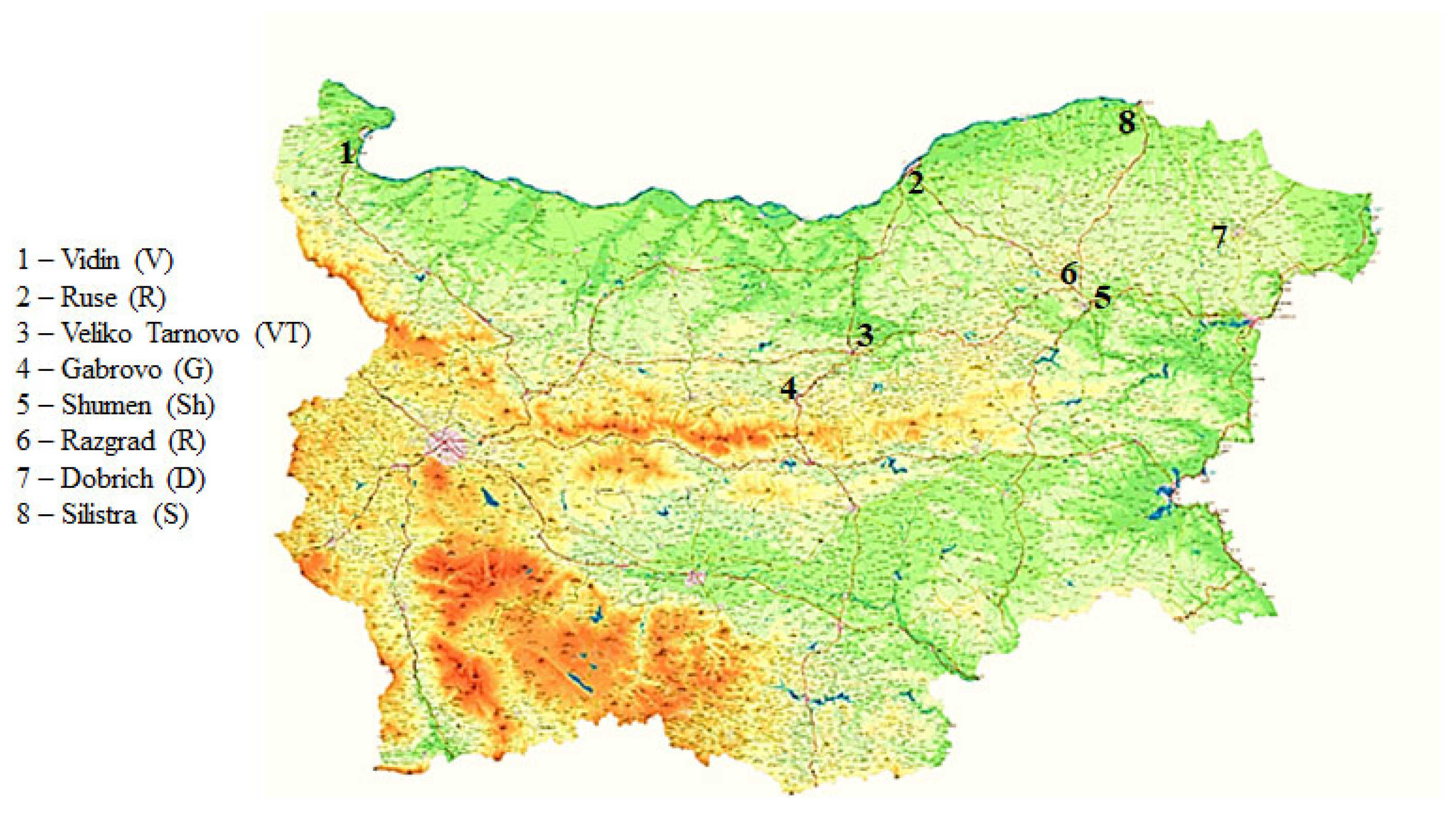
The bee honey samples used in the study were obtained from reliable producers, members of The Bulgarian Honey Producers Association, and were harvested in 2018. The difference in the number of samples also reflects the actual distribution within the country. The sample set comprised thirty-one linden honey samples, sourced from the following distinct geographical locations: Vidin (one samples), Ruse (five samples), Veliko Tarnovo (four sample), Gabrovo (one sample), Shumen (one sample), Razgrad (thirteen samples), and Dobrich (six samples). Additionally, sixteen rapeseed honey samples were included, collected from Ruse (ten samples), Razgrad (two samples), Dobrich (two samples) and Silistra (two samples). Sampling regions from Bulgaria are presented in Figure 1.
The botanical origin of all of the collected samples was preliminarily stated by the beekeepers and confirmed through melissopalynological analysis regarding the Bulgarian State Standard for Bee Honey 3050-80 [25]. In brief, ten grams of honey sample are dissolved in 30 mL of distilled water. The solution is centrifuged for 10 min at 10,000 rpm. A drop of the precipitate is transferred to a glass slide. For each honey sample, at least 200 pollen grains were counted. Honey samples were labeled as monofloral according to standard requirements. Linden honey samples contained 30–70% linden pollen and rapeseed honey samples contained 50–90% rapeseed pollen.
The honey samples were kept in dark, room temperature (20 to 25 °C) conditions, before conducting any analyses.

2.2. Determination of Chemical Elements

2.2.1. Sample Preparation Procedure

Honey is inhomogeneous matrix. To ensure homogeneity, the honey sample was heated for 5 min to about 40–50 °C before measuring appropriate mass. An amount of about 10 g was carefully weighed on an analytical balance (Kern ACS 220-4, d = 0.1 mg) placed in a glass beaker. A mixture of 12.5 mL ultrapure conc. HNO3 (≥69.0% TraceSELECT, Honeywell, Fluka, Seelze, Germany) and 3 mL 30% H2O2 (TraceSELECT, Honeywell, Fluka, Seelze, Germany) was added and the beaker was left to stand for 8 h covered with watch glass. After that, the beakers were carefully heated at 150 °C for still covered with watch glass for three hours. Then, the watch glass was removed and the solution was evaporated to near dryness. After cooling digested samples were quantitatively transferred into 50 mL volumetric flasks using Milli-Q water (Millipore purification system Synergy, Darmstadt, Germany). Three replicates were prepared from each honey sample. Simultaneously with the samples, a blank sample containing only concentrated HNO3 and H2O2 was passed through the whole procedure to control for possible contamination, estimate the limit of detection (LOD) and limit of quantification (LOQ)—Supplementary Table S6. All presented results for the content of chemical elements have been corrected according to their contents in the blank sample. An external calibration curve prepared with standard solutions in 0.1 mol/L nitric acid was used for quantification.

2.2.2. Instrumental Measurement of Chemical Elements’ Content

Honey samples are acid mineralized, so matrix interferences related to the organic matrix are not expected. The optimization of the instrumental parameters is aimed at selecting conditions that provide the maximum signal-to-noise ratio, eliminating possible inter-element and ionization interferences related to the high concentrations of alkaline elements, and selecting appropriate spectral lines and appropriate isotopes for measurement in wider concentration ranges.
Inductively Coupled Plasma with Optical Emission Spectrometer Vista MPX Simultaneous ICP-OES Series (Varian Pty Ltd, Mulgrave, Victoria, Australia.) was used for the measurement of elements Al, Ba, Ca, Cu, Fe, K, Mg, Mn, Na, P, S, Sr, and Zn. The established optimal parameters for conducting the measurements that provide the maximum signal-to-noise ratio are presented in Tables S1 and S2.
Inductively Coupled Plasma with Mass Spectrometer ICP-MS PlasmaQuant MS (Analytik Jena AG, Jena, Germany) was used for the measurement of elements Ag, Al, As, B, Ba, Bi, Cd, Co, Cr, Cs, Cu, Fe, Ga, In, Li, Ni, Pb, Rb, Se, Te, and V. The established isotopes and optimal parameters for conducting the measurements that provide the maximum signal-to-noise ratio are presented in Table S3. Taking into account relatively high contents of alkali and alkali earth elements, the observed isobaric interferences and appropriate m/z ratios should be evaluated. In order to check for any spectral and isobaric interferences, some elements that are presented in appropriate concentrations were measured by both instrumental methods used (ICP-OES and ICP-MS) and results obtained were compared using paired t-test. Spectrometer Perkin Elmer AAnalyst 400 (Waltham, MA, USA) was used for the confirmation analysis of elements Cs, Li, Na, K, and Rb in emission mode and for the confirmation analysis of elements Ca, Cu, Fe, Mg, Mn, and Zn in absorption mode in air-acetylene flame under conditions recommended by the manufacturer. The measurements are carried out with different sets of standard solutions, which allows conclusions to be drawn about the reproducibility of the proposed analytical procedure. Based on the known isobaric interferences and the comparative results obtained by using ICP-OES measurement, a selection of suitable measurement masses was done (Table S4). The experiments conducted showed that for the reliable determination of the elements Al, As, Cd, Co, Cr, Cu, Fe, Ga, Ni, Se, and V, it is necessary to use a collision cell. In addition, optimization experiments showed that a helium flow rate of 5 mL/min in the cell eliminates the observed isobaric interferences.
Multi-element standard solution (ICP multi-element standard solution IV, CertiPUR, Supelco, Bellefonte, PA, USA) with initial concentration of all of the 23 ingredient elements 1000 was used for the preparation of calibration standards of Al, Ba, Ca, Cu, Fe, K, Mg, Mn, Na, Sr, and Zn after appropriate dilution in order to obtain concentration levels from 1 mg/L to 100 mg/L. Single-element standard solutions of P (TraceCERT, Supelco, Bellefonte, PA, USA) and S (TraceCERT, Supelco, Bellefonte, PA, USA), with initial concentrations of 1000 mg/L, were mixed and after appropriate dilution were used for the preparation of calibration solutions in concentration range 1 to 10 mg/L.
The optimized instrumental parameters permit quantification against the external calibration graph. Multi-element standard solution 5 for ICP (TraceCERT, Supelco, Bellefonte, PA, USA) with initial concentration 100 mg/L Fe and 10 mg/L for Ag, Al, Ba, Bi, Cd, Co, Cr, Cs, Cu, Ga, In, Li, Ni, Pb, Rb, and V was used after appropriate dilution for the preparation of calibration standards in concentration levels from 1 mg/L to 10 µg/L. Multi-element standard solution (ICP multi-element standard solution VIII certified reference material, CertiPUR, Supelco, Bellefonte, PA, USA) with an initial concentration of 100 mg/L for B, Se, and Te was mixed with Arsenic standard for ICP-MS (TraceCERT, Supelco, Bellefonte, PA, USA) with an initial concentration 1 mg/L; after appropriate dilution, the mixture was used for the preparation of calibration solutions in the concentration range of 1 to 10 µg/L.
Single-element standard solution for Cs, Li, Na, K, and Rb (TraceCERT, Supelco, Bellefonte, PA, USA) with an initial concentration of 1 g/L was used after appropriate dilution for the preparation of calibration standards for FAES measurement in concentration range 2.5 to 50 µg/L.
Single-element standard solution for Ca, Cu, Fe, Mg, Mn, and Zn (TraceCERT, Supelco, Bellefonte, PA, USA) with an initial concentration of 1 g/L was used after appropriate dilution for the preparation of calibration standards for FAAS measurement in the concentration range of 0.25 to 100 µg/L.
All calibration solutions were prepared in 0.1 mol/L suprapure nitric with MilliQ water. The square of the correlation coefficients (R2) for all calibration curves was at least 0.998.

2.3. Statistical Analysis

All analytical measurements were performed in triplicate, and results are expressed as mean values. Statistical analyses were conducted using Microsoft Excel. Student’s t-test was used to evaluate the accuracy of the proposed analytical procedure applied to the analysis of the CRM apple leaf sample. For each element, the agreement between the obtained result and the certified value was assessed using Student’s t-test. The paired t-test was applied to evaluate the agreement between the results obtained for the chemical element content determined by two independent analytical methods, with statistical significance set at p < 0.05. Regression and correlation analyses were applied to assess the dependence of chemical element content on the floral purity of honey, with correlations considered statistically significant at p < 0.05 and with correlation coefficients > 0.5 indicating strong relationships. Principal component analysis was used to classify honey samples by botanical origin based on elemental composition, identifying key elements that act as markers for differentiation. The supervised Partial Least Squares Discriminant Analysis (PLS-DA) was performed in addition to PCA. Prior to analysis, the data were autoscaled (mean-centered and divided by the standard deviation). Model performance was assessed using cross-validation procedures, and Variable Importance in Projection (VIP) scores were used to identify the elements contributing most strongly to group separation.

3. Results

The latest European Directive 2014/63/EU [26] accepts the content of pollen as naturally present in honey and assumes a certain content of pollen in the final product—it is assumed that even after filtration to remove mechanical impurities, sufficient pollen particles remain in honey. Regulatory documents at both the EU [26] and national levels [25] accept pollen analysis as the most reliable method for proving the botanical origin of honey. It is believed that in order for honey to be considered monofloral (from a specific plant), the pollen from this plant must be no less than 40% of the total amount of pollen. For acacia and linden honey, the lower limit is 30%, and for lavender the lower limit is 15% [26]. The pollen content of monofloral honey samples analyzed varies from 31% to 83% for linden honeys and from 46% to 93% for rapeseed honeys. The pollen content for all samples is presented in Table S5.
In 31 linden and 16 rapeseed honey samples from Bulgaria, the content of 30 chemical elements (Ag, Al, As, B, Ba, Bi, Ca, Cd, Co, Cr, Cs, Cu, Ga, In, Fe, K, Li, Mg, Mn, Na, Ni, P, Pb, Rb, S, Se, Sr, Te, V, and Zn) were determined according to analytical procedure developed. Results obtained (mean ± SD) for selected elements content in all analyzed monofloral honey samples are presented in Table S5. Presented values are averaged from three replicates during the instrumental measurement of the three replicates prepared from each digested honey sample. The RSD% values varied in the range 5–25% for all studied elements.

4. Discussion

4.1. Optimization of Sample Preparation Procedure

As a first step, authors have to decide on the optimal procedure for honey analysis. It is well known that honey is soluble in water and direct analysis of chemical elements is possible even after simple honey sample dissolution in MilliQ water [24]. However, the high organic matter content in such case would create serious matrix interference and elemental carbon formation on the walls of plasma torch; in addition, spectral matrix interferences might be expected [27]. Certainly, wet digestion with powerful oxidation agents is preferable and among the most widely used mineralization procedures; microwave digestion using well-optimized temperature is faster and simpler, ensuring complete oxidation of sample organic matter [28].
Honey is highly inhomogeneous matrix and reliable results would be obtained only if a relatively larger amount of sample is subject to analysis. In the preliminary experiments, samples with different masses in the range of 2–10 g were analyzed in triplicate for elements typically present in honey at both high and low concentrations, namely K, Ca, Fe, Pb, and Cd, in order to compare analytical uncertainty with uncertainty arising from sample heterogeneity. The results clearly demonstrated that at least 10 g of honey sample is required to overcome the natural non-homogeneity of honey samples. However, such a large sample amount is impossible to be digested in the microwave furnace due to the extremely high pressure from gases formed from the digestion of organic matter. Sample digestion on a temperature-controlled heating plot was optimized for complete honey sample mineralization. As a preliminary step, 10 g of honey sample was placed in a glass beaker covered with watch glass and left to stand for at least 6–8 h to ensure preliminary oxidation and to avoid rapid reactions that could lead to excessive gas evolution and sample loss due to boiling. Experiments performed showed that at least 20 mL suprapur nitric acid is needed for complete sample mineralization on a hot plate for at least 3 h at relatively low temperature about 150 °C. Experiments with masses greater than 10 g required a high amount of nitric acid and more time for digestion, which significantly increases the signal of the blank sample and leads to poor reproducibility of the results for trace elements. As a result of the experiments conducted, 10 g of sample mass for digestion with final dilution with MilliQ water to a volume of 50 mL was accepted as optimal. To ensure homogeneity, the honey sample was heated to about 40–50 °C before measuring the mass.

4.2. Optimization of Instrumental Parameters

Most widely used spectral (FAES and ICP-OES) and mass spectrometric (ICP-MS) techniques have been optimized and tested for the determination of selected 30 elements in digested honey samples. In this case, it should be taken into account that, unlike typical published methodologies that use 0.5–1 g of sample, a relatively large amount of sample was digested and diluted to a final volume of 50 mL. This requires careful optimization of the instrumental parameters for each analytical method. The objective was to develop an approach that combines the advantages of each method for the determination of specific elements, in order to achieve maximum sensitivity while avoiding matrix interferences, and to enable external calibration using standard calibration curves prepared from commercial standard solutions. At the same time, each method was intended to operate within its optimal calibration range. Based on preliminary data, a set of elements present in the sample at suitable concentration levels was selected for each of the applied methods. Elements Cs, Li, Na, K, and Rb were determined by flame photometry (FAES); Ca, Cu, Fe, Mg, Mn, and Zn by flame atomic absorption spectrometry (FAAS); Al, B, Ba, Ca, Cr, Cu, Fe, K, Li, Mg, Mn, Na, Ni, P, Rb, S, Sr, V, and Zn by ICP-OES; and Ag, As, Bi, Cd, Co, Cr, Cu, Ga, In, Fe, Mg, Mn, Ni, Pb, Se, Te, V, and Zn by ICP-MS. Parallel samples were prepared, and after appropriate optimization of the instrumental parameters for each group of elements, measurements were carried out using the respective methods. Spectral, isobaric, and matrix interferences were evaluated based on the slopes of the calibration curves obtained. As a result, optimal combinations of analytical methods and corresponding element sets were established, ensuring reliable and accurate determination of elements within appropriate concentration ranges using external calibration (see optimized instrumental parameters—Section 2.2.2). In this way, the determination of about 30 elements in honey samples with the necessary accuracy and precision is ensured.

4.3. Assessment of the Accuracy and Repeatability of the Results Obtained

Honey represents a highly complex matrix dominated by carbohydrates, yet it also contains a wide range of organic and inorganic constituents. Ensuring traceability in the determination of trace elements is challenging, largely because suitable reference materials are lacking. This difficulty persists even though certain honey types, such as Robinia and Eucalyptus, have been investigated as potential candidates for certified reference materials (CRMs) [29].
Currently available CRMs rarely replicate the unique composition of honey, especially its high sugar content. As a result, researchers often rely on alternative materials, including tomato leaves [30]. In the absence of matrix-matched standards, other strategies are adopted, such as modifying sample preparation procedures [31] or employing different analytical techniques [32]. Additionally, method validation and quality control frequently involve recovery studies using spiked samples [33].
In the present study, two approaches were used to ensure the accuracy of the obtained results. First, a certified reference material (CRM), NIST Standard Reference Material® 1515 Apple Leaves (National Institute of Standards and Technology, Gaithersburg, MD, USA), was analyzed following the procedure described in Section 2.2.1 using a 0.3 g sample. The certified elements Al, B, Ba, Ca, Cu, Fe, Mg, Mn, P, Rb, Sr, and Zn were measured by ICP-OES, and the recoveries ranged from 95% (for B, P, and Rb) to 97% (for Ca, Mg, Fe, and Cu), all within the acceptable range. The certified elements Cd, Pb, Mo, Ni, and V were measured by ICP-MS, with recoveries ranging from 94% to 97% for all elements. A good agreement between the obtained results and the certified values was demonstrated by Student’s t-test, which indicated no significant differences at p < 0.05. In addition, recoveries above 94% were obtained for non-certified elements with recommended values, including Na (measured by ICP-OES) and Cr, Co, and Sb (measured by ICP-MS). The achieved recovery results clearly demonstrate that the proposed digestion and measurement procedure provides reliable results for the analyzed elements. As a second alternative, measurement accuracy was evaluated following an approach similar to that used in the development of certified reference materials for honey [29]. Results for element concentrations obtained by different instrumental methods were compared, considering only those elements present at concentration levels within the calibration range of the respective techniques. Elements were selected based on their susceptibility to spectral, isobaric, or matrix interferences in one method, while being relatively free from such effects in another. For example, aluminum determined by ICP-OES is expected to be affected by a high spectral background in the presence of elevated calcium concentrations. Therefore, its results were compared with those obtained by ICP-MS. Similarly, the determination of iron by ICP-MS is subject to significant isobaric interferences; thus, iron results were compared with those obtained by ICP-OES and, where appropriate, concentration levels were allowed, also by FAAS. Scatter plot analysis (Figure S1) was employed to examine the relationship between paired measurements obtained by the two instrumental methods across the relevant concentration range. Each point in the plot represents the mean value of three parallel measurements for a given sample. The slope of the regression lines of 0.89 for Cu, 1.1 for Fe and 1.03 for Al indicates good agreement between concentrations determined by ICP-OES and ICP-MS. Additionally, the correlation coefficients R2 above 0.8 demonstrates a strong linear relationship, confirming the consistency of the two methods within the studied range. To complement the graphical evaluation, a paired t-test was performed to assess whether statistically significant differences existed between the results obtained by the two methods. The calculated p-value exceeded 0.05, indicating no statistically significant difference at the 95% confidence level, as also supported by the condition t_stat < t_crit. The capabilities of ICP-OES and flame photometry for the determination of alkali elements (Li, Rb, Cs) were carefully evaluated. The comparison showed that flame photometry provides superior sensitivity and precision for these elements.
Due to the relatively large sample mass and the prolonged open-vessel digestion, the method of standard addition (“added–found”) was applied for volatile elements such as As, Cd, Se, and Zn. The spikes, at appropriate concentration levels were introduced prior to the digestion process. The obtained recoveries ranged from 94 to 97% for As and Se, and from 96 to 98% for Cd and Zn.
The evaluation of precision is essential, as it determines the statistical significance of the differences observed in element concentrations among the analyzed samples. Within the scope of this study, three parallel subsamples were analyzed for each honey sample.
Although the precision of the instrumental measurements themselves is considerably higher, the between-sample precision—reflecting variability among parallel honey subsamples—is of primary importance. To assess this, samples were analyzed by different operators using different standard solutions, in an effort to isolate and evaluate the component of precision associated solely with sample homogeneity. The obtained results for the measured concentrations did not differ by more than 10%, which indicates that the developed analytical procedure is characterized by good repeatability. However, experiments with replicate honey samples showed that despite the significant mass of the sample, some inhomogeneity still exists. The obtained results showed that for the elements B, K, P, S, Sr, the repeatability is very good and for almost 90% of the samples, it is in the range of 8–12%. For the elements Ba, Fe, Na, Zn, for almost 30% of the samples, the repeatability is between 12 and 15%. For trace elements, the expected repeatability is in most cases of the order of 20%, and for elements whose concentrations are close to the limits of determination, it is between 25%.

4.4. Chemical Element Content in Bulgarian Linden and Rapeseed Honey

The metal composition of honey is strongly influenced by the plant species from which bees collect raw materials such as nectar, pollen, propolis, and honeydew, which are subsequently transformed into honey. At the same time, botanical origin is closely associated with the geographical location of the apiary, as soil properties and climatic conditions determine the availability of nectar-producing plants. In addition, environmental contamination and other anthropogenic factors may contribute further metal inputs to honey. The botanical origin of the analyzed samples was initially determined by pollen analysis. It should be noted that obtaining completely monofloral honey is nearly impossible; therefore, trace elements used as markers of botanical origin are also related to the degree of floral purity. To address these aspects, 30 chemical elements were determined in two types of honey samples, namely linden and rapeseed, collected from different honey-producing regions. The observed variations in elemental composition are discussed with regard to their potential use as indicators of botanical origin and environmental pollution.

4.4.1. Content of Alkali Elements (K, Na, Li, Rb, Cs) in Bulgarian Linden and Rapeseed Honeys

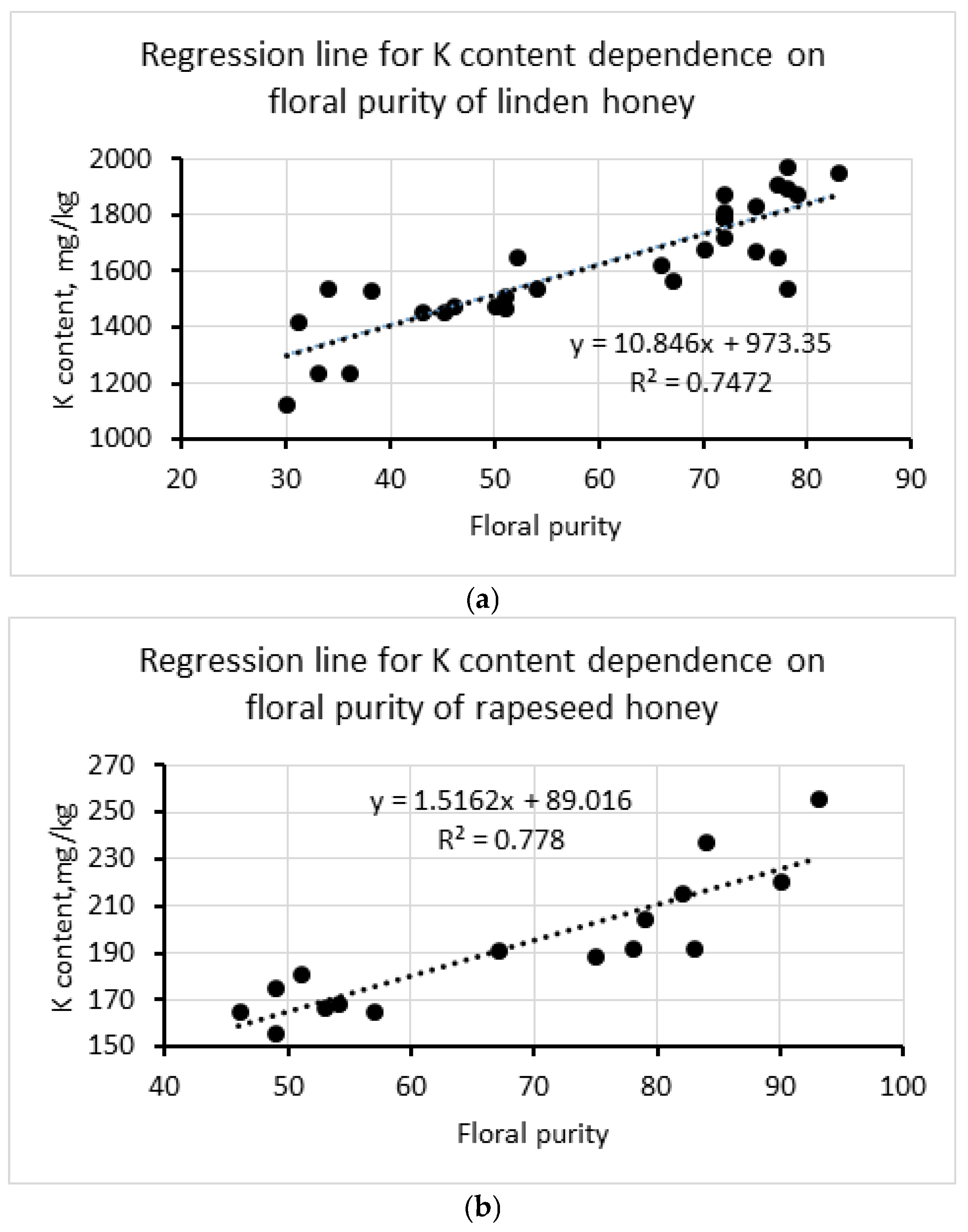
Alkali elements, including lithium (Li), sodium (Na), potassium (K), rubidium (Rb), and cesium (Cs), represent important inorganic markers for determining the botanical origin of honey. These elements are naturally present in nectar as a consequence of plant uptake from the soil and are subsequently transferred into honey, where they remain relatively stable and largely unaffected by processing. Their concentrations are influenced by both environmental conditions and plant species; however, selective uptake through specific root transport systems leads to characteristic elemental patterns that can be used to differentiate floral sources. Among these elements, potassium is generally the most abundant and appears to provide considerable discriminatory potential. It is associated with plant metabolism and nectar composition and may account for approximately 70–90% of the total mineral content in honey. As an essential macronutrient, potassium plays an important role in plant growth and physiological processes and is often considered one of the key nutrients after nitrogen. In the studied samples, potassium content was evaluated in relation to floral purity. Results presented in Figure 2 as a regression line between K content and the floral purity of linden (a) or rapeseed (b) honey undoubtedly demonstrates that potassium serves as a reliable indicator of botanical origin, even without extensive statistical treatment, which is consistent with previous findings reported for Serbian linden, sunflower, and acacia honeys [34].
In contrast, sodium is present at significantly lower concentrations compared to potassium and is more strongly influenced by environmental factors, such as soil composition and other sources. No clear relationship between sodium content and floral purity is observed, and the differences between the analyzed honey types are statistically insignificant. Consequently, sodium has limited specificity as a botanical marker. Lithium, Rb, and Cs occur in honey at trace or ultra-trace levels and enter plant roots primarily via the same transport pathways as potassium and sodium, including nonselective cation channels and high-affinity transport systems due to their similar physicochemical properties. Although these elements are not essential nutrients and may become toxic at elevated concentrations, their value as botanical markers lie in the variability of their uptake and translocation among plant species. Rubidium, in particular, closely resembles potassium in its chemical behavior and is readily absorbed by plants, resulting, in most cases, in significant variation between different floral origins and frequently proposed as a valuable trace-level indicator. Correlation coefficients between floral purity and Rb content are higher than 0.7, indicating its discriminating power. Lithium and Cs typically occur at very low concentrations and exhibit limited discriminatory power.

4.4.2. Content of Alkaline Earth Elements (Ca, Mg, Ba, Sr) in Bulgarian Linden and Rapeseed Honeys

Alkaline earth elements are common constituents of the mineral fraction of honey and may serve as potential indicators of botanical origin. Their presence is generally associated with the transfer of elements from soil to plants and subsequently into nectar. Calcium and Mg are essential macronutrients involved in various physiological processes in plants, including cell wall stabilization (Ca) and chlorophyll structure (Mg) [35]. Results in the present study indicate all three elements Ca, Mg and Sr as reliable identifiers of botanical origin with significant correlation coefficients: 0.88 for Ca, 0.70 for Mg, 0.65 for Sr. In addition, Sr has received considerable attention as an informative tracer due to its geochemical behavior and is often regarded as a strong indicator not only of geographical origin, especially when isotopic ratios (87Sr/86Sr) are considered but botanical origin. Barium exhibits behavior similar to strontium but is generally present at lower concentrations and shows more variable uptake by plants. Its transfer into honey depends on both soil composition and plant-specific factors; however, due to its lower mobility and less consistent incorporation into nectar, Ba is considered a weaker and less reliable marker.
Within the scope of this study, all four alkaline earth elements showed statistically higher concentrations in linden honey compared to rapeseed honey. Overall, alkaline earth elements provide complementary information in honey characterization. While Ca and Mg primarily reflect general plant nutrition and physiological processes, and Sr and Ba are also closely linked to geochemical background, these elements might offer strong discriminatory power for botanical origin if combined with other elemental data—particularly alkali elements such as K and rubidium Rb. They can contribute significantly to the development of robust models for the classification and authentication of honey according to both botanical and geographical origin.

4.4.3. Content of Essential Macronutrients P and S in Bulgarian Linden and Rapeseed Honeys

Phosphorus is a key macronutrient that plays a central role in energy transfer (via ATP), nucleic acid synthesis, and overall plant metabolism [36]. Due to its essential and regulated physiological functions, its concentration in plants—and consequently in nectar and honey—may remain relatively stable. Sulfur, another important macronutrient, is involved in the formation of amino acids such as cysteine and methionine, as well as proteins and volatile compounds that may contribute to the aroma of honey [37]. Our results indicate that the concentrations of both S and P show minimal dependence on floral purity even when it exceeds 50%. Although the levels of these elements may vary with plant species and environmental conditions, they are not strongly indicative of specific botanical origins in honey. Instead, their presence more closely reflects the overall nutritional status of the plant, soil fertility, and fertilizer application.
From this perspective, slightly elevated levels of phosphorus and sulfur in linden honey could be considered supportive evidence of its botanical origin, but only when interpreted alongside data for other elements.

4.4.4. Content of Essential Micronutrients B, Cu, Fe, Mn and Zn in Bulgarian Linden and Rapeseed Honeys

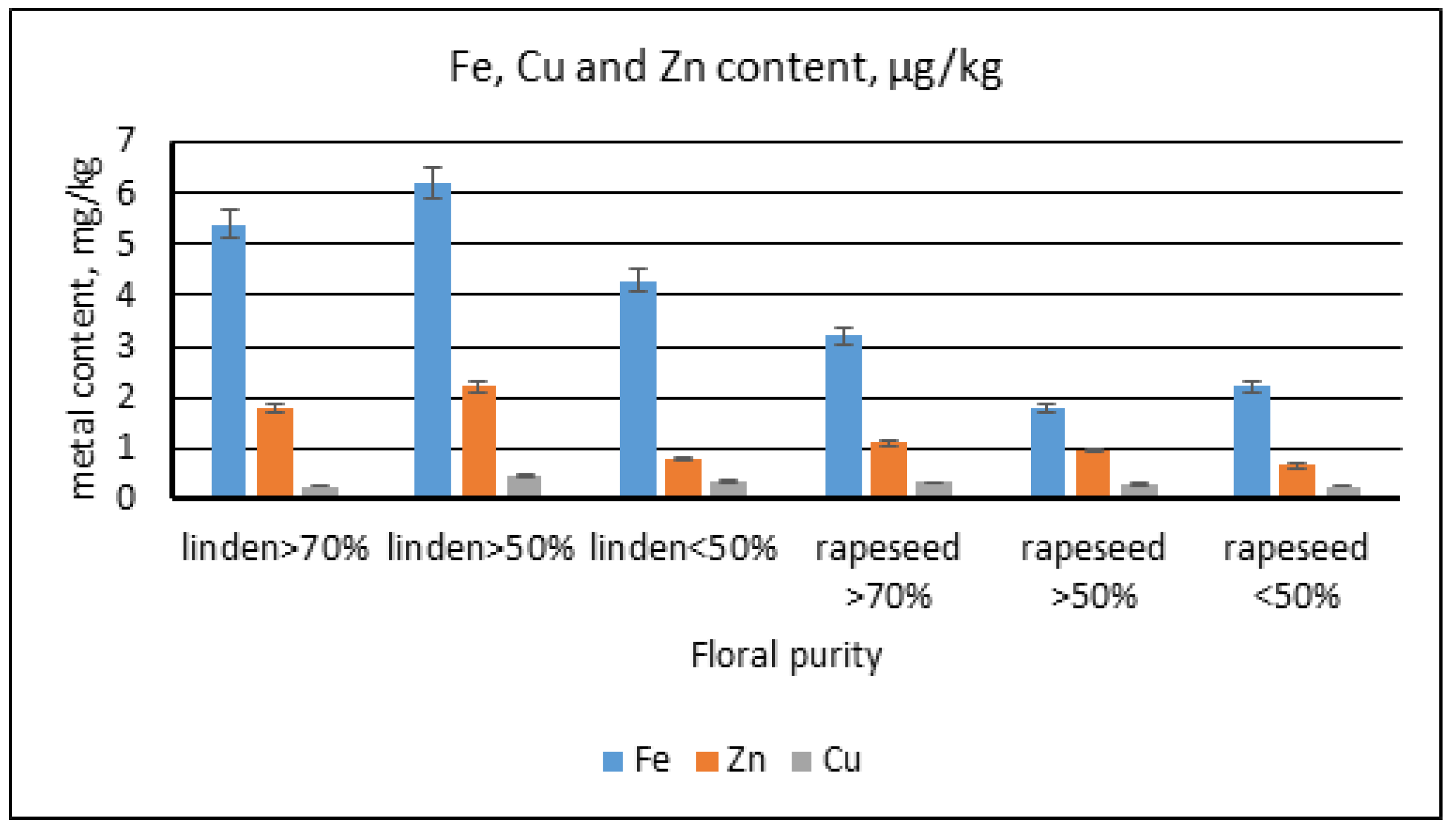
Micronutrients such as B, Cu, Fe, Mn, and Zn are important for plant growth and are generally regulated through homeostatic mechanisms controlling their uptake, transport, and storage in order to satisfy metabolic requirements while limiting toxicity. Consequently, the concentrations of these elements in nectar—and ultimately in honey—may be less affected by environmental and soil variations. In our study, the measured levels of B, Cu, Fe, Mn, and Zn did not show significant variation between honeys from different floral sources, indicating that these elements have limited discriminating power for botanical origin (see Figure 3 for Fe, Cu and Zn in linden and rapeseed honey). In addition, their bioavailability to plants is strongly influenced by soil properties such as pH, organic matter content, and cation exchange capacity. From this perspective, it can be expected that the concentrations of these elements might be more closely related to the characteristics of the soil and the geographical origin of the honey rather than to its botanical source. Oroian et al. reported the content of Li, Al, Mn, Fe, Cu and Zn in the range 1–30 mg/L [38]. It is observed that Cu and Mn content in our research is significantly lower than results reported by Oroian et al.

4.4.5. Content of Al, Co and Cr in Bulgarian Linden and Rapeseed Honeys

Elements Co and Cr are typically present in honey at trace or ultra-trace levels (<1 mg/kg [38]), and their significance as indicators of botanical origin is generally limited due to their complex behavior in the soil–plant–nectar system and strong environmental dependence. Data obtained for Co are below 0.05 mg/kg for all analyzed honey samples at almost identical levels independently of floral purity and type of honey. Chromium exhibits similarly low concentrations in honey samples analyzed. In plants, chromium is not an essential nutrient, and its uptake is generally limited and highly variable, influenced by soil characteristics, contamination sources, and environmental conditions [39]. Consequently, Cr levels in honey are often associated with external factors, including soil geochemistry and potential environmental pollution, rather than intrinsic botanical properties. From the perspective of botanical origin determination, both Co and Cr have low discriminatory power. Aluminum is not an essential element for most plants and is generally present as a result of soil-derived contamination or passive uptake, particularly in acidic soils where its mobility increases [40]. Its concentration in honey is therefore more strongly linked to environmental and geochemical factors rather than plant-specific physiology.

4.4.6. Content of Toxic Elements As, Cd Ni and Pb in Bulgarian Linden and Rapeseed Honeys

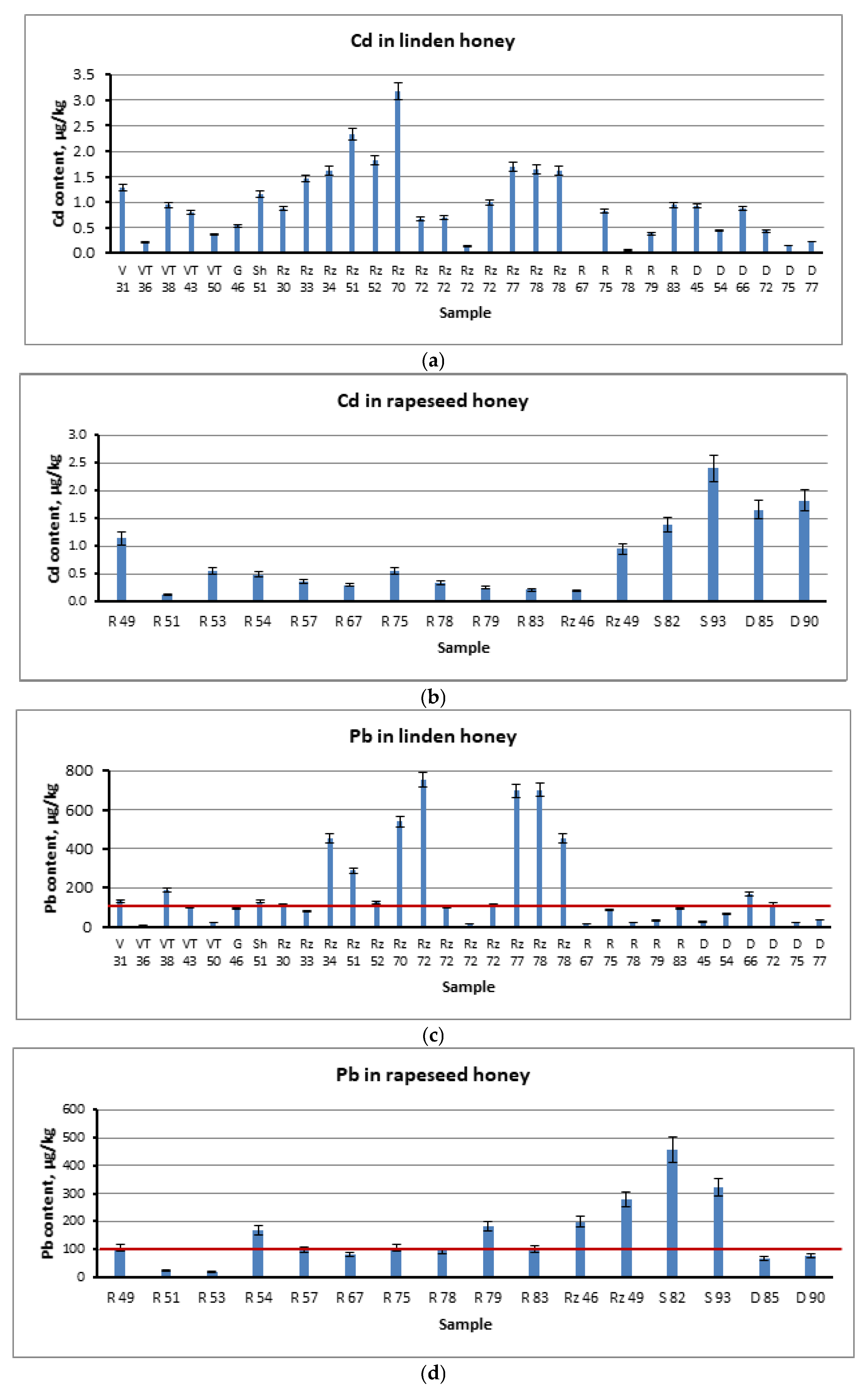
Toxic trace elements such as arsenic (As), nickel (Ni), lead (Pb), and cadmium (Cd) can have significant adverse effects on plant growth and physiology. Most of these effects are well-described in plant-focused scientific literature [41]. These elements may occur in nectar and honey in trace amounts when plants grow in contaminated soils, thus providing indirect information about environmental pollution [32]. However, data reported in the literature are somewhat contradictory. Some authors suggest that honey can serve as an indicator of anthropogenic pollution [42], whereas others report that honey is typically free of contaminants due to the presence of a biological barrier, with toxic elements preferentially accumulating in propolis rather than in honey [43]. The only specific limit in Commission Regulation (EU) 2023/915 is for Pb in honey—0.1 mg/kg [44]. No specific maximum levels are established for As, Cd, and Ni in honey under Commission Regulation (EU) 2023/915 on contaminants in food; indicative limits were derived from maximum levels set for comparable food matrices. For Cd, the range of 0.02–0.05 mg/kg is recommended, derived from limits set for cereals and vegetables and considering its cumulative toxicity. In the case of As, a proposed limit of 0.05–0.10 mg/kg is based on maximum levels established for other foods. For nickel Ni, for which no maximum level currently exists, a range of 0.10–0.50 mg/kg is suggested based on occurrence data. The results presented in Table S5 show that arsenic and cadmium (see also Figure 4a,b) concentrations were below 0.1 mg/kg in all honey samples, regardless of type. Nickel concentrations were generally below 0.1 mg/kg; however, several linden honey samples from the Razgrad region showed values approaching the upper guidance limit of 0.5 mg/kg. In the same samples, lead concentrations (see Table S5 and Figure 4c,d) exceeded the proposed permissible limit of 0.1 mg/kg, in some cases reaching values above 0.2 mg/kg. Similar findings—nickel concentrations close to 0.5 mg/kg and lead levels exceeding 0.1 mg/kg—were observed in rapeseed honey samples from the Razgrad region, as well as in rapeseed honey from the Silistra region. Notably, the samples with elevated Ni and Pb concentrations were collected from locations situated in close proximity to the national road II-23.

4.4.7. Rare Elements in Bulgarian Linden and Rapeseed Honeys

Both In and Ga are present in honey at extremely low, often ultra-trace concentrations, which can be attributed to their limited availability in the environment and restricted uptake by plants [45]. Their transfer from soil to nectar, and subsequently into honey, is minimal due to their non-essential role in plant metabolism and low mobility within biological systems. Although the presence of these elements may, in principle, reflect certain geochemical characteristics of the geographical origin, their practical application as markers is constrained.

4.4.8. Elements at Extremely Low Levels in Bulgarian Linden and Rapeseed Honeys

The results summarized in Table S5 indicate that Ag, Bi, Se, Te and V are present at extremely low concentrations in the analyzed samples and, in most cases, close to the limit of quantification. Consequently, the repeatability of replicate measurements is poor, ranging between 30% and 40%, which is expected at such low concentration levels. For this reason, these elements are not suitable for the identification of the botanical origin of honey.
Notably, the essential element Se occurs at very low concentrations, leading to the conclusion that honey is not a significant dietary source of selenium, particularly in Bulgaria.

4.5. Correlations

As a first step, the relationship between mineral composition and botanical origin was evaluated using linden and rapeseed honey samples with varying degrees of floral purity. Pearson correlation coefficients (r) between floral purity (% linden/rapeseed pollen) and each element are presented in Supplementary Table S7. The results demonstrate that only a limited number of macroelements are associated with pollen content. Among the analyzed elements, K, Ca and Sr showed the clearest relationship with linden pollen content. The elements exhibited a positive association with increasing floral purity. This trend was a bit less pronounced in rapeseed honey, where Ca and Sr showed less strong relationship with pollen percentage, still confirming their discriminatory power for floral purity. Potassium (K) did show a consistent linear relationship with floral purity in either honey type, showing relatively constant values for honeys with floral purity above 70%. Micro-elements in both honey types showed no consistent relationship with floral purity in either linden or rapeseed honey. Most elements, including Pb, Cr, Ni, As, and Se, displayed high variability and, in some cases, extreme values. These patterns clearly indicate that micro-element composition is predominantly influenced by environmental conditions, such as soil composition, pollution, and local anthropogenic factors, rather than botanical origin. In this respect, our findings are not in accordance with those of Oroian et al. who reported that As content strongly depend on the botanical origin of Romanian acacia, linden, sunflower and honeydew honey [46]. Rubidium was comparatively more stable across samples and did exhibit a clear dependence on floral purity.
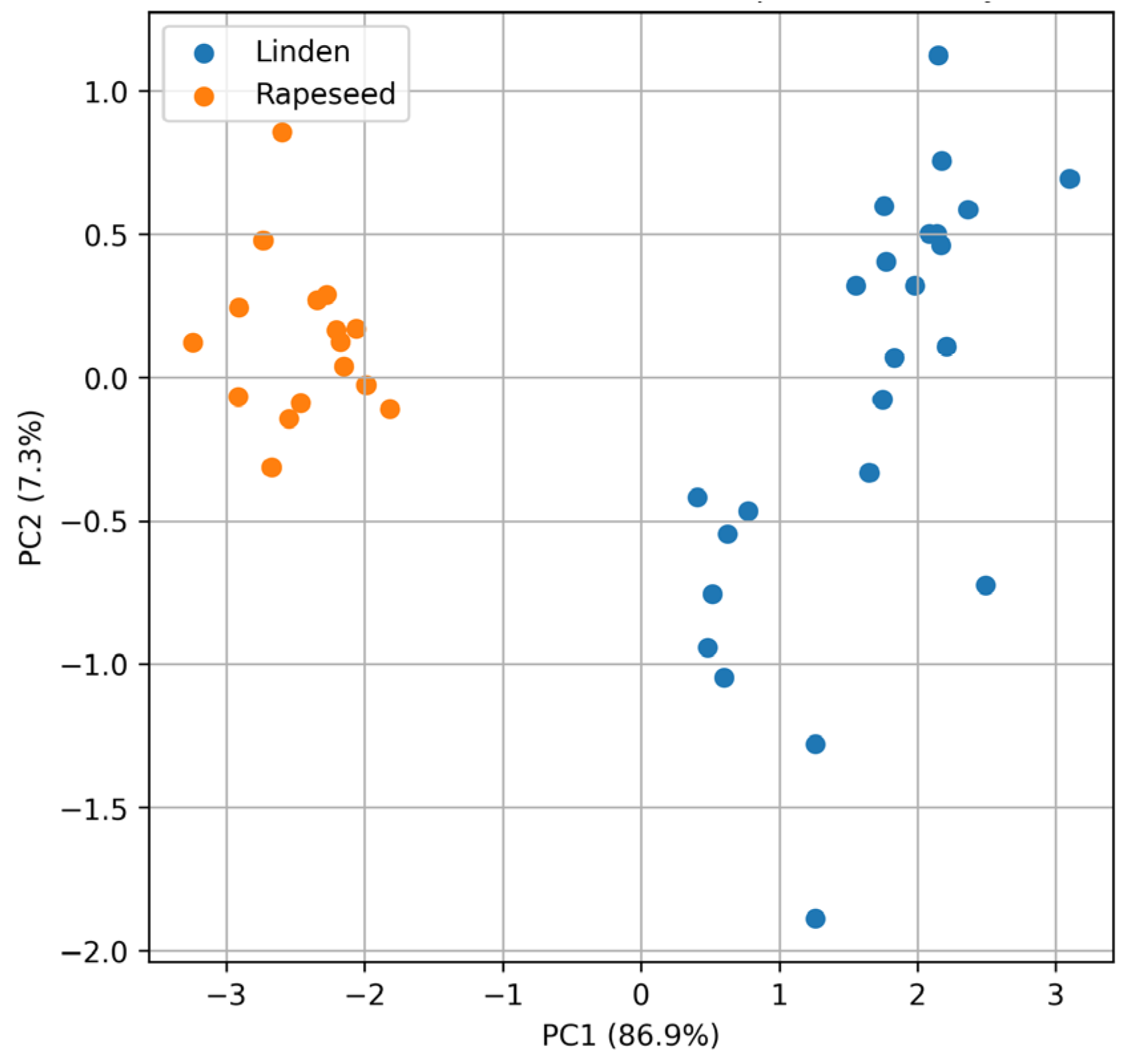
Principal component analysis (PCA) based on all determined elements showed limited separation between linden and rapeseed honey samples. The first principal component (PC1) was mainly associated with macroelements such as Ca and Sr, reflecting the botanical origin of the honey, while the second principal component (PC2) was dominated by micro-elements (Pb, Cr, Ni, As, and Se), representing environmental influences. The total variance explained by the first two principal components (PC1 and PC2) was only 49%, although the honey samples were still relatively separated (see Figure S2). The inclusion of micro-elements increased the overall variability but reduced the classification efficiency because these elements are not directly related to botanical origin. When the identified elemental indicators (Ca, Mg, K, Sr, and Rb) were included in the PCA, the discrimination between honey types improved substantially. PC1 explained 86.9% of the total variance, while PC2 explained 7.3%, resulting in a cumulative explained variance of 94.2% (see Figure 5). PCA loadings are presented in Table 1.
As shown, PC1 was mainly influenced by K, Rb, Mg, and Ca (negative direction) in contrast to Sr (positive direction), whereas PC2 was primarily dominated by Ca (negative direction) and Mg (positive direction). The high proportion of variance captured by PC1 indicates that the elemental composition effectively differentiates the botanical origin of the honey samples. We believe that the high cumulative explained variance (94.2%) obtained for PC1 and PC2 indicates that the selected elemental indicators efficiently summarize the variability of the dataset and provide reliable discrimination according to botanical origin. We are aware that our dataset is relatively small and needs additional verification in the future.
The clear separation observed by PCA was further confirmed by supervised PLS-DA, indicating that class discrimination reflects intrinsic compositional differences rather than model-driven optimization. The PCA analysis demonstrated an initial tendency for separation between the investigated honey groups according to their trace-element composition. To further validate these observations, supervised PLS-DA was additionally applied. The PLS-DA score plot showed improved discrimination between the groups, supporting the clustering tendencies observed in PCA (see Supplementary Figure S2).
The elements with the highest VIP scores contributed most strongly to the differentiation of the honey samples, indicating that trace-element composition may serve as a useful indicator of varietal discrimination.

5. Conclusions

The efficient approach for chemical element determination in honey samples used for the assessment of botanical origin is proposed. The best identifiers for chemical elements for floral purity such as K, Ca, Mg, Sr, and Rb were defined based on the analysis of linden and rapeseed honey samples. It was shown that these elements in honeys with high floral purity permit clear identification of honey botanical origin. Macro- and micronutrients (P, S, B, Cu, Fe, Mn, and Zn), generally regulated through homeostatic mechanisms as well as micro-elements (Al, As, Cd, Co, Cr and Pb), primarily influenced by environmental factors did not correlate with floral purity and showed limited discrimination power. Overall, the results indicate that elemental analysis can support the botanical characterization of honey, but its applicability is limited to specific elements and must be interpreted in the context of environmental variability.

Supplementary Materials

The following supporting information can be downloaded at https://www.mdpi.com/article/10.3390/app16115716/s1, Figure S1: Concentrations of Al, Fe and Cu measured by ICP-OES and ICP-MS; Figure S2. PLS-DA score plot for separation of linden and rapeseed honeys; Table S1: Optimal instrumental conditions for ICP-OES measurements; Table S2: Spectral lines used for elements’ measurement by ICP-OES; Table S3: Optimal instrumental conditions for ICP-MS measurements; Table S4: ICP-MS measurement conditions; Table S5: Elements’ concentrations in linden and rapeseed honey; Table S6. LOQ values for determined elements in analyzed honey samples; Table S7. Pearson correlation coefficients (r) between floral purity (% linden/rapeseed pollen) and each element.

Author Contributions

Conceptualization, I.K. and E.M.; methodology, I.K. and E.M.; software, K.P.; validation, K.P. and I.Y.; formal analysis, I.K. and E.M.; investigation, E.M., K.P. and I.Y.; resources, E.M. and I.Y.; data curation, I.K. and K.P.; writing—original draft preparation, E.M., I.K., K.P. and I.Y.; writing—review and editing, I.K. and E.M.; visualization, E.M. and I.K.; supervision, E.M. and I.K.; project administration, E.M.; funding acquisition, I.Y. All authors have read and agreed to the published version of the manuscript.

Funding

This research was funded by Medical University—Pleven, grant number D4/2024. The APC was funded by INFRAMAT.

Institutional Review Board Statement

Not applicable.

Informed Consent Statement

Not applicable.

Data Availability Statement

The original contributions presented in the study are included in the Supplementary Materials; further inquiries can be directed to the corresponding author.

Acknowledgments

Research equipment of the Distributed Research Infrastructure INFRAMAT, part of the Bulgarian National Roadmap for Research Infrastructures, supported by the Bulgarian Ministry of Education and Science, was used in this investigation.

Conflicts of Interest

Author Konstantina Priboyska was employed by the company Aquaterratest—ISSE Ltd. The remaining authors declare that the research was conducted in the absence of any commercial or financial relationships that could be construed as a potential conflict of interest.

Abbreviations

The following abbreviations are used in this manuscript:
FAESFlame Atomic Emission Spectrometry
FAASFlame Atomic Absorption Spectrometry
ICP-OESInductively Coupled Plasma with Optical Emission Spectrometry
ICP-MSInductively Coupled Plasma with Mass Spectrometry detection
EUEuropean Union
RSDRelative Standard Deviation
CRMCertified Reference Material
PCAPrincipal Component Analysis

References

  1. Khare, T.; Mossa, K.A.; Hamdy, R.; Elnaggar, A.; Malik, S.; Khan, S.K.; El-Keblawy, A.; Lamghari, F.; Alhmoudi, A.M.S.; Alyammahi, K.M. Cutting-edge approaches for honey authentication: Chemical, molecular, and AI-driven strategies for botanical origin verification. J. Food Comp. Anal. 2025, 146, 107974. [Google Scholar] [CrossRef]
  2. Żak, N.; Wilczyńska, A. The importance of testing the quality and authenticity of food products: The example of honey. Foods 2023, 12, 3210. [Google Scholar] [CrossRef]
  3. Sanz, M.L.; Gonzalez, M.; de Lorenzo, C.; Sanz, J.; Martinez-Castro, I. A Contribution to the differentiation between nectar honey and honeydew honey. Food Chem. 2005, 91, 313–317. [Google Scholar] [CrossRef]
  4. Tsagkaris, A.S.; Koulis, G.A.; Danezis, G.P.; Martakos, I.; Dasenaki, M.; Georgiou, C.A.; Thomaidis, N.S. Honey authenticity: Analytical techniques, state of the art and challenges. RSC Adv. 2021, 11, 11273–11294. [Google Scholar] [CrossRef] [PubMed]
  5. Haidamus, S.L.; Lorenzon, M.C.A.; Koshiyama, A.S.; Tassinari, W.D.S. Floral diversity in different types of honey. Braz. Arch. Biol. Technol. 2019, 62, e19180241. [Google Scholar] [CrossRef]
  6. Adamchuk, L.; Sukhenko, V.; Akulonok, O.; Bilotserkivets, T.; Vyshniak, V.; Lisohurska, D.; Lisohurska, O.; Slobodyanyuk, N.; Shanina, O.; Galyasnyj, I. Methods for determining the botanical origin of honey. Potravin. Slovac J. Food Sci. 2020, 14, 483–493. [Google Scholar] [CrossRef]
  7. Bose, D.; Padmavati, M. Honey Authentication: A review of the issues and challenges associated with honey adulteration. Food Biosci. 2024, 61, 105004. [Google Scholar] [CrossRef]
  8. El Sohaimy, S.A.; Masry, S.H.D.; Shehata, M.G. Physicochemical characteristics of honey from different origins. Ann. Agric. Sci. 2015, 60, 279–287. [Google Scholar] [CrossRef]
  9. Magdas, T.M.; David, M.; Hategan, A.R.; Filip, G.A.; Magdas, D.A. Geographical origin authentication—A mandatory step in the efficient involvement of honey in medical treatment. Foods 2024, 13, 532. [Google Scholar] [CrossRef]
  10. Li, N.; Song, M.; Li, H.; Liu, Z.; Jiang, A.; Lang, Y.; Chen, L. Advancement of foodomics techniques for honey botanical origins authentication: Past decade (2013–2023) and future perspectives. Trends Food Sci. Technol. 2024, 147, 104458. [Google Scholar] [CrossRef]
  11. Yao, L.; Datta, N.; Tomás-Barberán, F.A.; Ferreres, F.; Martos, I.; Singanusong, R. Flavonoids, phenolic acids and abscisic acid in Australian and New Zealand Leptospermum honeys. Food Chem. 2003, 81, 159–168. [Google Scholar] [CrossRef]
  12. von der Ohe, W.; Oddo, L.P.; Piana, M.L.; Morlot, M.; Martin, P. Harmonized methods of melissopalynology. Apidologie 2004, 35, S18–S25. [Google Scholar] [CrossRef]
  13. Escriche, I.; Juan-Borrás, M.; Visquert, M.; Valiente, J.M. An overview of the challenges when analysing pollen for monofloral honey classification. Food Control 2023, 143, 109305. [Google Scholar] [CrossRef]
  14. Koulis, G.A.; Tsagkaris, A.S.; Aalizadeh, R.; Dasenaki, M.E.; Panagopoulou, E.I.; Drivelos, S.; Halagarda, M.; Georgiou, C.A.; Proestos, C.; Thomaidis, N.S. Honey phenolic compound profiling and authenticity assessment using HRMS targeted and untargeted metabolomics. Molecules 2021, 26, 2769. [Google Scholar] [CrossRef]
  15. Kasiotis, K.M.; Baira, E.; Iosifidou, S.; Manea-Karga, E.; Tsipi, D.; Gounari, S.; Theologidis, I.; Barmpouni, T.; Danieli, P.P.; Lazzari, F.; et al. Fingerprinting chemical markers in the Mediterranean orange blossom honey: UHPLC-HRMS metabolomics study integrating melissopalynological analysis, GC-MS and HPLC-PDA-ESI/MS. Molecules 2023, 28, 3967. [Google Scholar] [CrossRef] [PubMed]
  16. Yan, S.; Yuan, Y.; Pan, F.; Mu, G.; Xu, H.; Xue, X. Distinguishing the botanical origins of rare honey through untargeted metabolomics and machine learning interpreting flavonoid profiles. Food Chem. 2025, 470, 142752. [Google Scholar] [CrossRef]
  17. Chippa, P.; Hu, S.; Pound, M.; Yawar, S.A.; Baniulis, D. Honey authentication using AI-based pollen analysis: A UK review. Br. Food J. 2025, 127, 4512–4529. [Google Scholar] [CrossRef]
  18. Raguž, V.; Jarsjö, J.; Grolander, S.; Lindborg, R.; Avila, R. Plant uptake of elements in soil and pore water: Field observations versus model assumptions. J. Environ. Manag. 2013, 126, 147–156. [Google Scholar] [CrossRef]
  19. Mustapha, L.S.; Obayomi, O.V.; Obayomi, K.S. A comprehensive review on potential heavy metals in the environment: Persistence, bioaccumulation, ecotoxicology, and agricultural impacts. Ecol. Front. 2026, 46, 434–449. [Google Scholar] [CrossRef]
  20. Squadrone, S.; Brizio, P.; Stella, C.; Mantia, M.; Pederiva, S.; Brusa, F.; Mogliotti, P.; Garrone, A.; Abete, M.C. Trace elements and rare earth elements in honeys from the Balkans, Kazakhstan, Italy, South America, and Tanzania. Environ. Sci. Pollut. Res. Int. 2020, 27, 12646–12657. [Google Scholar] [CrossRef]
  21. Bontempo, L.; Camin, F.; Ziller, L.; Perini, M.; Nicolini, G.; Larcher, R. Isotopic and elemental composition of selected types of Italian honey. Meas. J. Int. Meas. Confed. 2017, 98, 283–289. [Google Scholar] [CrossRef]
  22. Geana, E.I.; Ciucure, C.T. Establishing authenticity of honey via comprehensive Romanian honey analysis. Food Chem. 2020, 306, 125595. [Google Scholar] [CrossRef] [PubMed]
  23. Tomczyk, M.; Tarapatskyy, M.; Dżugan, M. The influence of geographical origin on honey composition studied by Polish and Slovak honeys. Czech. J. Food Sci. 2019, 37, 232–238. [Google Scholar] [CrossRef]
  24. Ploegaerts, G.; Desmecht, D.; Ernould, S.; Dubois, V. Determination of metals and metalloids in traces in honey: Evaluation of different sample preparation methods and assay techniques. J. Trace Elem. Miner. 2023, 4, 100070. [Google Scholar] [CrossRef]
  25. BDS 3050:1972; Bee Honey. Rules for Sampling and Testing Methods. Bulgarian Institute for Standardization (BDS/BIS): Sofia, Bulgaria, 1980. Available online: https://bds-bg.org/en/project/show/bds:proj:22905 (accessed on 1 March 2026).
  26. DIRECTIVE 2014/63/EU OF THE EUROPEAN PARLIAMENT AND OF THE COUNCIL of 15 May 2014 Amending Council Directive 2001/110/EC Relating to Honey. Official Journal of the European Union L 164/1. Available online: https://eur-lex.europa.eu/legal-content/EN/TXT/PDF/?uri=CELEX:32014L0063 (accessed on 15 March 2026).
  27. Smith, K.E.; Weis, D.; Amini, M.; Shiel, A.E.; Lai, V.W.M.; Gordon, K. Honey as a biomonitor for a changing world. Nat. Sustain. 2019, 2, 223–232. [Google Scholar] [CrossRef]
  28. Bommuraj, V.; Chen, Y.; Klein, H.; Sperling, R.; Barel, S.; Shimshoni, J.A. Pesticide and trace element residues in honey and beeswax combs from Israel in association with human risk assessment and honey adulteration. Food Chem. 2019, 299, 125123. [Google Scholar] [CrossRef]
  29. Caroli, S.; Forte, G.; Alessandrelli, M.; Cresti, R.; Spagnoli, M.; D’Ilio, S.; Pauwels, J.; Kramer, G.N. A pilot study for the production of a certified reference material for trace elements in honey. Microchem. J. 2000, 67, 227–233. [Google Scholar] [CrossRef]
  30. Ćirić, J.; Spirić, D.; Baltić, T.; Branković Lazić, I.; Trbović, D.; Parunović, N.; Petronijević, R.; Đorđević, V. Honeybees and their products as indicators of environmental element deposition. Biol. Trace Elem. Res. 2020, 119, 2312–2319. [Google Scholar] [CrossRef]
  31. Stoner, H.T.V.; Godebo, T.R.; Nyachoti, S.; Taylor, P.K.; Abdelghani, A. Dietary contribution of essential elements from honey consumed in the United States. Food Res. Int. 2025, 222, 117693. [Google Scholar] [CrossRef]
  32. Pohl, P.; Sergiel, I.; Stecka, H. Determination and fractionation of metals in honey. Crit. Rev. Anal. Chem. 2009, 39, 276–288. [Google Scholar] [CrossRef]
  33. Yuan, Y.; Mu, G.; Xu, H.; Xue, X.; Yan, S. Comprehensive screening strategy for potentially hazardous plant secondary metabolites in honey using natural deep eutectic solvent extraction combined with LC-MS/MS. Food Chem. 2026, 508, 148563. [Google Scholar] [CrossRef]
  34. Jovetić, M.; Trifković, J.; Stanković, D.; Manojlović, D.; Milojković-Opsenica, D. Mineral content as a tool for the assessment of honey authenticity. J. AOAC Int. 2017, 100, 862–870. [Google Scholar] [CrossRef]
  35. Tang, R.J.; Luan, S. Regulation of calcium and magnesium homeostasis in plants: From transporters to signaling network. Curr. Opin. Plant Biol. 2017, 39, 97–105. [Google Scholar] [CrossRef]
  36. Khan, F.; Siddique, A.B.; Shabala, S.; Zhou, M.; Zhao, C. Phosphorus plays key roles in regulating plants’ physiological responses to abiotic stresses. Plants 2023, 12, 2861. [Google Scholar] [CrossRef] [PubMed]
  37. Tripodi, G.; Merlino, M.; Torre, M.; Condurso, C.; Verzera, A.; Cincotta, F. Characterization of aroma, sensory properties, and consumer acceptability of honey from Capparis spinose L. Foods 2025, 14, 1978. [Google Scholar] [CrossRef] [PubMed]
  38. Oroian, M.; Amariei, S.; Leahu, A.; Gutt, G. Multi-element composition of honey as a suitable tool for its authenticity analysis. Pol. J. Food Nutr. Sci. 2015, 65, 93–100. [Google Scholar] [CrossRef]
  39. Samantaray, S.; Rout, G.R.; Das, P. Role of chromium on plant growth and metabolism. Acta Physiol. Plant. 1998, 20, 201–212. [Google Scholar] [CrossRef]
  40. Ofoe, R.; Thomas, R.H.; Asiedu, S.K.; Wang-Pruski, G.; Fofana, B.; Abbey, L. Aluminum in plant: Benefits, toxicity and tolerance mechanisms. Front. Plant Sci. 2023, 13, 1085998. [Google Scholar] [CrossRef]
  41. Vasile, G.-G.; Tenea, A.-G.; Dinu, C.; Iordache, A.M.M.; Gheorghe, S.; Mureseanu, M.; Pascu, L.F. Bioavailability, accumulation and distribution of toxic metals (As, Cd, Ni and Pb) and their impact on Sinapis alba plant nutrient metabolism. Int. J. Environ. Res. Public Health 2021, 18, 12947. [Google Scholar] [CrossRef]
  42. David, M.; Hategan, A.R.; Dehelean, A.; Puscas, R.; Cristea, G.; Belc, N.; Mustatea, G.; Magdas, D.A. Elemental and isotopic profile of honey—Insights related to the nature of the exploited plant and potential environmental influences. Microchem. J. 2025, 219, 115965. [Google Scholar] [CrossRef]
  43. Végh, R.; Csóka, M.; Mednyánszky, Z.; Sipos, L. Potentially toxic trace elements in bee bread, propolis, beeswax and royal jelly—A review of the literature and dietary risk assessment. Chemosphere 2023, 339, 139571. [Google Scholar] [CrossRef]
  44. Commission Regulation (EU) 2023/915 of 25 April 2023 on maximum levels for certain contaminants in food and repealing Regulation (EC) No 1881/2006. Off. J. Eur. Union 2023, L119, 103. Available online: https://eur-lex.europa.eu/legal-content/EN/TXT/PDF/?uri=CELEX:32023R0915 (accessed on 17 March 2025).
  45. Syu, C.-H.; Chen, L.-Y.; Lee, D.-Y. The growth and uptake of Gallium (Ga) and Indium (In) of wheat seedlings in Ga- and In-contaminated soils. Sci. Total Environ. 2021, 759, 143943. [Google Scholar] [CrossRef]
  46. Oroian, M.; Prisacaru, A.; Hretcanu, E.-C.; Stroe, S.-G.; Leahu, A.; Buculei, A. Heavy metals profile in honey as a potential indicator of botanical and geographical origin. Int. J. Food Prop. 2016, 19, 1825–1836. [Google Scholar] [CrossRef]
Figure 1. Geographical locations of honey sample collection areas.
Applsci 16 05716 g001
Figure 2. Regression line for potassium content in (a) linden and (b) rapeseed honey.
Applsci 16 05716 g002
Figure 3. Content of Fe, Cu, Zn in linden and rapeseed honey.
Applsci 16 05716 g003
Figure 4. Content of Cd in linden (a) and rapeseed (b) honey and of Pb in linden (c) and rapeseed (d) honey. Red line on (c,d) show maximum permissible level of Pb according to Commission Regulation (EU) 2023/915 [40].
Applsci 16 05716 g004
Figure 5. Principal component analysis based on elements in all linden and rapeseed honey samples.
Applsci 16 05716 g005
Table 1. PCA loadings.
ElementPCA1PCA2
Ca−0.412−0.803
K−0.4710.063
Mg−0.4220.482
Rb−0.472−0.109
Sr0.455−0.327
Disclaimer/Publisher’s Note: The statements, opinions and data contained in all publications are solely those of the individual author(s) and contributor(s) and not of MDPI and/or the editor(s). MDPI and/or the editor(s) disclaim responsibility for any injury to people or property resulting from any ideas, methods, instructions or products referred to in the content.