1. Introduction
Choosing an antiseizure medication (ASM) is a key challenge for neurologists because multiple clinical and patient-related factors should be considered. Among these factors, adverse events (AEs) may prevent people with epilepsy (PwE) from reaching effective therapeutic doses [
1]. Pharmacogenomics may help identify patients at increased risk of AEs by analyzing individual genetic variability, thereby providing additional information that may support therapeutic choices even in drug-resistant epilepsy [
2]. One of the first links between epilepsy and pharmacogenetics involved the cytochrome P450 system (CYP450), a superfamily of hepatic isoenzymes that catalyze biotransformation reactions and facilitate the excretion of xenobiotics [
3].
CYP2C19 belongs to the CYP450 family and contributes to the metabolism of several ASMs according to allelic variation [
4]. Most individuals are extensive metabolizers (EMs), with normal enzymatic activity and expected therapeutic plasma concentrations at standard doses. Ultra-rapid and rapid metabolizers (UMs) have increased enzyme activity and may show reduced exposure to some drugs. Conversely, poor metabolizers (PMs) have markedly reduced or absent enzymatic activity and may be at increased risk of drug accumulation and toxicity. Intermediate metabolizers (IMs) show reduced activity compared with EMs, but greater activity than PMs (
Table 1).
Significant regional heterogeneity is observed in the prevalence of CYP2C19 alleles, genotypes, and clinical phenotypes [
5]. For example, CYP2C19 poor metabolizer-associated alleles are generally more frequent in Asian populations than in populations of European ancestry [
5].
Regarding ASMs, previous literature suggests that CYP2C19 polymorphisms may be relevant to the metabolism or bioavailability of several drugs, including clobazam, phenobarbital, phenytoin, cannabidiol, brivaracetam, and lacosamide [
6]. The main CYP2C19-related interactions potentially relevant during cenobamate treatment are summarized below.
Here is a list of the main effects cenobamate could exert on ASMs by acting on CYP2C19:
- -
clobazam: N-desmethylclobazam, the active metabolite of clobazam, is metabolized by CYP2C19 and may increase approximately 2- to 6-fold due to the interaction between clobazam and cenobamate. This interaction may cause drowsiness or sleepiness because of the long half-life of the metabolite. Proactive clobazam dose reduction has been suggested when cenobamate is added [
7];
- -
phenobarbital: increased phenobarbital plasma levels are possible because the drug is partly metabolized by CYP2C19, with potential subsequent sleepiness or drowsiness;
- -
phenytoin: phenytoin is partly metabolized by CYP2C19, and cenobamate-mediated CYP2C19 inhibition may increase phenytoin plasma concentrations, with possible dizziness and ataxia. Pharmacokinetic data support increased phenytoin exposure in CYP2C19 IMs and PMs [
8];
- -
cannabidiol: a pharmacokinetic interaction between prescription cannabidiol and cenobamate has been hypothesized, with sleepiness as a possible central nervous system dose-related adverse effect. However, available evidence remains limited, and the active metabolite 7-hydroxy-cannabidiol has not been consistently associated with CYP2C19 genotype [
9,
10];
- -
brivaracetam: increased brivaracetam serum concentrations during cenobamate co-administration have been reported, probably through CYP2C19 inhibition. However, this interaction is not generally expected to cause AEs; therefore, brivaracetam was not considered among ASMs with potential CYP2C19-inhibition-related AEs in this study [
11,
12];
- -
lacosamide: CYP2C19 polymorphisms may influence lacosamide metabolism. However, available evidence suggests no clinically relevant pharmaco-kinetic differences between CYP2C19 PMs and EMs [
13].
Cenobamate is a relatively novel ASM indicated in Italy for the adjunctive treatment of drug-resistant focal epilepsy in adults [
6]. Real-world data also support the efficacy of this drug in other developmental and epileptic encephalopathies, including Lennox-Gastaut and Dravet syn-dromes [
14,
15].
Several studies have demonstrated that adding cenobamate to commonly prescribed ASMs can affect their metabolism because of cenobamate-mediated effects on CYP enzymes [
11,
16]. Cenobamate moderately inhibits CYP2C19, potentially increasing plasma concentrations of ASMs metabolized by this pathway [
11,
16]. However, the clinical consequences of this interaction are not yet fully understood.
In this study, we explored whether CYP2C19 genetic variability might be associated with an increased likelihood of AEs in patients receiving cenobamate alongside CYP2C19-substrate ASMs. Only gene-drug interactions involving CYP2C19 that were considered clinically relevant according to expert opinion-based recommendations, particularly clobazam, phenobarbital, and phenytoin during cenobamate co-administration [
7], were considered.
We hypothesized that cenobamate-induced modulation of CYP2C19 activity could, in some cases, functionally resemble a shift toward a lower metabolizer status (ultrarapid/rapid to extensive; extensive to intermediate; intermediate to poor), potentially increasing susceptibility to AEs. This hypothesis remains exploratory and requires prospective pharmacokinetic validation.
2. Materials and Methods
2.1. Patients’ Eligibility
This single-center retrospective study was conducted at the University Hospital Policlinico of Bari, Bari, Italy, between January 2025 and September 2025.
Patients and biological samples were collected and processed at Bari. The study protocol was developed jointly by the Bari and Catanzaro groups. The CRUISE Research Center, University Magna Graecia of Catanzaro, acted as the coordinating center and was responsible for scientific coordination, data analysis, and data interpretation. Inclusion criteria were: (1) age > 18 years; (2) diagnosis of drug-resistant epilepsy with focal seizures; and (3) current or previous treatment with cenobamate.
Exclusion criteria were: (1) moderate-to-severe hepatic or renal insufficiency; (2) poor compliance; and (3) incomplete clinical data availability.
The study was based on retrospective review of clinical data obtained during routine patient management. Data extraction and analysis were performed after approval by the Calabria Region Ethics Committee (CET Regione Calabria; protocol code 93/2026), which is the ethics committee competent for the coordinating center/PI, on 20 February 2026 and before manuscript preparation. Because the study was retrospective and data were anonymized, patient consent was waived.
2.2. CYP2C19 Determination and Genotype Identification
All included patients underwent CYP2C19 determination and were divided into four groups according to their CYP2C19 isoform: ultra-rapid/rapid metabolizers (UMs), extensive metabolizers (EMs), intermediate metabolizers (IMs) and poor metabolizers (PMs). CYP2C19 genotype was determined using the PGX-CYP2C19 StripAssay® (ViennaLab Diagnostics GmbH, Vienna, Austria), based on polymerase chain reaction (PCR) and reverse-hybridization.
This assay covers 8 polymorphic loci: c.681G>A (2C19*2), c.636G>A (2C19*3), c.1A>G (2C19*4), c.1297C>T (2C19*5), c.395G>A (2C19*6), c.819+2T>A (2C19*7), c.358T>C (2C19*8), c.-806C>T (2C19*17), which result into the phenotypes showed in
Table 1.
DNA isolated from 5 mL EDTA whole blood samples was amplified by multiplex PCR, using biotinylated primers. The amplification products were hybridized to test strips containing allele-specific oligonucleotide probes immobilized as an array of parallel lines. Bound biotinylated sequences are detected using streptavidin-alkaline phosphatase and color substrates. Test strips were fixed on CollectorTM sheet provided and the interpretation of the results was performed using ViennaLab SripAssay
® Evaluator software v2.19 (ViennaLab Diagnostics GmbH, Vienna, Austria) [
17].
2.3. Statistical Analysis
Patients were stratified into two groups based on exposure to ASMs metabolized by CYP2C19: those not receiving CYP2C19-metabolized ASMs (patients without CYP2C19 substrates) and those receiving at least one CYP2C19-metabolized ASM (patients with CYP2C19 substrates). For each patient, the number of CYP2C19-substrate ASMs was recorded. AEs were collected and classified using the Naranjo Adverse Reaction Probability Scale [
18]. AEs were then categorized as potentially CYP-mediated or likely unrelated to CYP-mediated pharmacokinetic mechanisms according to a predefined pharmacological-clinical framework. Classification considered:
- -
temporal relationship with cenobamate initiation or dose escalation;
- -
concomitant use of CYP2C19-substrate ASMs;
- -
known pharmacokinetic interaction pathways reported in the literature; and clinical improvement after dose reduction or withdrawal of the suspected ASM.
Events with plausible alternative non-CYP-mediated explanations were classified separately. Given the retrospective nature of the study, adjudication was not performed under blinded conditions with respect to genotype. Therefore, this classification should be interpreted as hypothesis-generating rather than confirmatory.
Descriptive statistics were computed separately for patients with CYP2C19 substrates and patients without CYP2C19 substrates. Only patients with complete clinical and pharmacogenetic information were included in the final analysis; therefore, no formal missing-data imputation procedures were applied. Distributional assumptions for continuous variables were assessed before statistical testing using visual inspection and/or normality testing as appropriate. Independent t-tests were applied for approximately normally distributed variables, whereas Mann-Whitney U tests were used for non-normally distributed data. Categorical variables were analyzed using chi-square tests or Fisher’s exact tests depending on expected cell frequencies.
The distribution of CYP2C19 genotypes was analyzed overall and within patients with CYP2C19 substrates and patients without CYP2C19 substrates. Associations between genotype and AEs were tested separately in each subgroup, with Fisher’s exact test as appropriate.
For prediction of potentially CYP-mediated AEs in patients with CYP2C19 substrates, we developed a logistic regression model with two prespecified predictors: IM phenotype (yes vs. no) and number of concomitant CYP2C19-substrate ASMs. Given the limited number of events and the low events-per-variable ratio, results were interpreted cautiously and confirmed with exact/Firth logistic regression to reduce sparse-data bias.
For clinical prediction, we subsequently developed a parsimonious model including the same two predictors using L2-regularized logistic regression with leave-one-out cross-validation. Model discrimination was assessed with the area under the ROC curve (AUC), and calibration with the Brier score.
3. Results
48 patients were enrolled. Demographic and clinical information are available in
Table 2 and
Table 3.
Among the 48 patients included, 28 (58.3%) were receiving at least one CYP2C19-substrate ASM (patients with CYP2C19 substrates) and 20 (41.7%) were not (patients without CYP2C19 substrates). The two groups did not differ in sex, age, epilepsy type, epilepsy etiology, or epilepsy duration.
Patients with CYP2C19 substrates had significantly more prior ASMs (11.9 ± 6.0 vs. 8.1 ± 4.1; p = 0.016) and more concomitant ASMs (2.8 ± 0.7 vs. 2.2 ± 0.7; p = 0.010), indicating greater treatment complexity in this group.
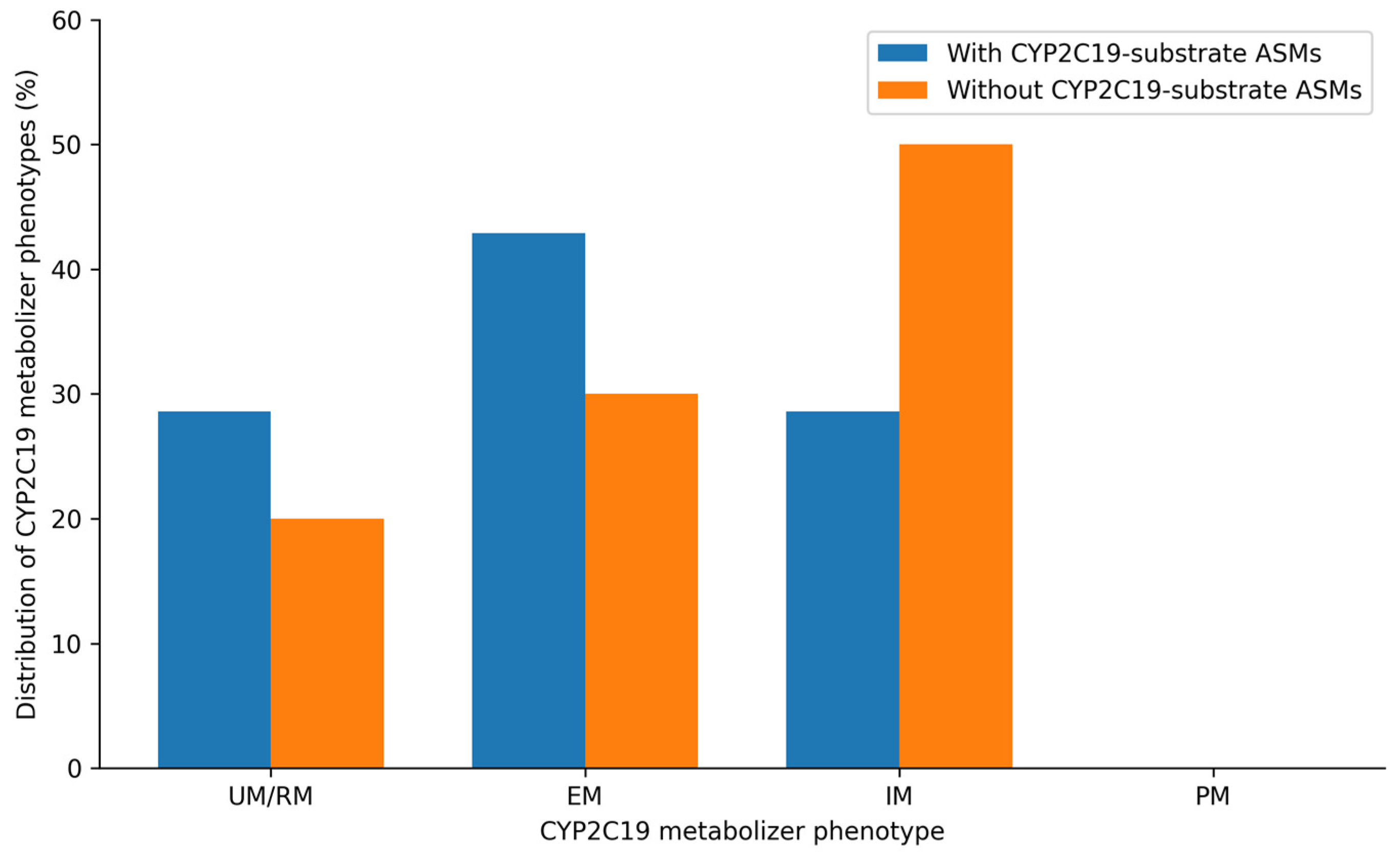
The distribution of CYP2C19 genotypes did not differ significantly between patients with CYP2C19 substrates (UM/RM 28.6%, EM 42.9%, IM 28.6%) and those without CYP2C19 substrates (UM/RM 20.0%, EM 30.0%, IM 50.0%; chi-square test,
p = 0.319) (
Figure 1).
AEs were significantly more frequent in patients with CYP2C19 substrates (20/28, 71.4%) compared with patients without CYP2C19 substrates (4/20, 20.0%; p = 0.001). Potentially CYP-mediated AEs (i.e., drowsiness/sleepiness) occurred exclusively in patients with CYP2C19 substrates (9/28, 32.1%), while no potentially CYP-mediated events were reported in patients without CYP2C19 substrates (0/20, 0.0%; Fisher’s exact test, p < 0.001).
The 4/20 AEs reported in patients without CYP2C19 substrates were considered likely unrelated to CYP-mediated pharmacokinetic mechanisms:
- –
diplopia during concomitant treatment with lamotrigine;
- –
somnolence in the context of symptomatic hyperammonemia;
- –
vomiting and ataxia during concomitant treatment with lacosamide;
- –
ataxia during concomitant treatment with lamotrigine.
In patients without CYP2C19 substrates, no potentially CYP-mediated AEs were observed, regardless of genotype. In patients with CYP2C19 substrates (n = 28), potentially CYP-mediated AEs occurred in 1/8 UM/RM (12.5%), 1/12 EM (8.3%), and 7/8 IM (87.5%). This distribution was significant (p < 0.001), indicating a disproportionate signal among IMs.
Most potentially CYP-mediated AEs occurred during the first three months of cenobamate treatment, most commonly at a cenobamate dose of 100 mg/day (n = 4). No significant association was observed between the number or dose of concomitant CYP2C19-substrate ASMs and the likelihood of potentially CYP-mediated AEs. IMs with potentially CYP-mediated AEs were receiving clobazam 10 mg/day (n = 3), clobazam 20 mg/day (n = 3), or phenobarbital 100 mg/day (n = 1), whereas the UM/RM and EM patients with potentially CYP-mediated AEs were both receiving clobazam 30 mg/day.
To explore the association between CYP2C19 genotype and potentially CYP-mediated AEs, we first performed a logistic regression model. In this inferential model, IM status was associated with potentially CYP-mediated AEs (OR 100.9, 95% CI 2.4–4151.6, p = 0.014), while the number of concomitant CYP2C19-substrate ASMs showed only a non-significant trend (OR 2.8, 95% CI 0.3–26.6, p = 0.360). Because of sparse data and the very wide confidence interval, this estimate should not be interpreted as a stable clinical effect size.
When tested in a parsimonious predictive model using L2-regularized logistic regression with leave-one-out cross-validation for single-patient prediction, the effect size for IM status was attenuated (OR 6.5), reflecting a more conservative and clinically interpretable estimate. Overall model performance showed an AUC of 0.74 and a Brier score of 0.154. The number of CYP2C19 substrates showed a weaker effect (OR approximately 1.1).
Given the small sample size and the limited number of events, the predictive model should be considered exploratory and was not retained as a clinically actionable risk tool.
4. Discussion
In this study, we observed an exploratory association between CYP2C19 genetic variability and the occurrence of AEs in patients treated with cenobamate in combination with CYP2C19-substrate ASMs. While potentially CYP-mediated AEs were not observed in patients without such co-medications, they appeared relatively frequent in those receiving both treatments. Because 25 of 28 patients with CYP2C19-substrate ASMs were receiving clobazam, the observed signal should be interpreted as being driven mainly by the cenobamate-clobazam interaction rather than by CYP2C19 substrates as a homogeneous class.
One possible interpretation is that cenobamate-mediated inhibition of CYP2C19 may contribute to increased plasma levels of some ASMs or active metabolites, particularly N-desmethylclobazam, thereby enhancing the risk of AEs. This mechanism is biologically plausible and consistent with prior pharmacokinetic data [
16,
19], but it was not directly demonstrated in the present study because plasma concentrations were not available.
Notably, IMs appeared to show a higher frequency of potentially CYP-mediated AEs. This could suggest that individuals with already reduced enzymatic activity may be more sensitive to further inhibition. One speculative model is that cenobamate might induce a functional shift in metabolic capacity, particularly in IMs, bringing them closer to a poor metabolizer phenotype. However, this interpretation should be approached with caution because it was not directly demonstrated by pharmacokinetic measurements in this study.
Interestingly, EMs did not appear to exhibit the expected increase in AEs. The absence of increased AEs among EMs may appear counterintuitive given the moderate CYP2C19 inhibitory effect of cenobamate. However, several pharmacological mechanisms may explain this observation. First, CYP2C19 inhibition by cenobamate is partial and may not produce clinically meaningful phenoconversion in all EM individuals. Second, residual enzymatic activity in EMs may remain sufficient to avoid substantial accumulation of concomitant ASMs. In addition, several of these drugs undergo metabolism through multiple parallel pathways, including CYP3A4, CYP2C9, glucuronidation, or non-hepatic elimination, which may mitigate the isolated effect of CYP2C19 inhibition. Finally, individuals with IM phenotype may already have reduced metabolic reserve, potentially making them more vulnerable to clinically relevant exposure increases when CYP2C19 activity is further inhibited.
The regression analyses suggested an association between IM status and potentially CYP-mediated AEs, although the wide confidence intervals indicate considerable uncertainty. The extremely large odds ratio observed in the standard logistic regression model should be interpreted cautiously, as sparse-data bias and quasi-separation may substantially inflate effect estimates in small datasets with few outcome events. For this reason, greater emphasis was placed on the penalized and cross-validated model, which yielded more conservative and clinically interpretable estimates.
No PMs were identified in the analyzed sample, and no genotype-based exclusion criteria were applied. A possible explanation may be the predominantly European ancestry of the cohort, since CYP2C19 phenotype frequencies show marked geographic and ethnic variability, with poor metabolizer-associated alleles generally reported at lower frequencies in European than Asian populations [
5]. Nevertheless, given the limited sample size, this observation should be interpreted cautiously. Therefore, the present findings cannot be directly extrapolated to PMs.
Patients with CYP2C19 substrates showed greater treatment complexity, including significantly higher numbers of concomitant ASMs and previous ASM exposures. These variables may reflect more severe or treatment-refractory epilepsy and could independently contribute to adverse-event susceptibility. Therefore, polypharmacy burden, disease severity, cumulative treatment history, and other unmeasured clinical factors may have acted as important confounders in the observed association between CYP2C19 phenotype and AEs.
Overall, these findings may point toward a potential role of pharmacogenetic profiling in identifying patients at higher risk of AEs. However, they should be considered preliminary and hypothesis-generating. Several limitations must be acknowledged. First, the relatively small sample size and low number of outcome events may have inflated effect estimates in the inferential analysis. This limitation was partly addressed using penalized and cross-validated logistic regression, which provided more stable and clinically interpretable estimates. Second, the study was retrospective and based on single-center clinical practice, with inherent variability in ASM regimens and dose adjustments. Third, attribution of some AEs to CYP2C19-mediated pharmacokinetic mechanisms was based on clinical interpretation, pharmacogenetic profile, temporal association, and literature-supported drug-drug interaction pathways rather than direct pharmacokinetic confirmation. Plasma concentrations of concomitant ASMs were not available, and adverse-event classification was not adjudicated under blinded conditions with respect to CYP2C19 genotype. Therefore, observer or confirmation bias cannot be excluded. Fourth, cenobamate also exerts enzymatic effects beyond CYP2C19 inhibition, including modulation of CYP3A4 and CYP2B6 activity, potentially affecting the metabolism of several concomitant ASMs. Therefore, the pharmacokinetic environment in patients receiving cenobamate is likely more complex than a single CYP2C19-mediated interaction model [
19]. These data need confirmation in larger prospective cohorts integrating pharmacogenetic testing with therapeutic drug monitoring.
5. Conclusions
CYP2C19 genetic variability may represent a potentially relevant factor in modulating the tolerability in patients treated with cenobamate, particularly when clobazam or other CYP2C19-substrate ASMs are co-administered. Our findings suggest that IMs could be at increased risk of potentially CYP-mediated AEs.
However, given the limitations of this study, including its retrospective design, small sample size, treatment-complexity imbalance between groups, and lack of pharmacokinetic measurements, these results should be interpreted with caution.
Rather than providing definitive evidence, they highlight a possible interaction that warrants further investigation.
Future prospective studies integrating pharmacogenetic testing with therapeutic drug monitoring will be essential to clarify the clinical relevance of these observations and to determine whether genotype-guided treatment strategies can meaningfully improve patient outcomes.
Author Contributions
Conceptualization, G.F. and E.R.; methodology, G.F. and V.D.; validation, T.F., A.I. and A.V.; formal analysis, G.F. and M.A.M.; investigation, G.F. and M.P. (Mariella Pafundi); resources, M.P. (Mariella Pafundi) and A.V.; data curation, G.F. and E.R.; writing—original draft preparation, G.F. and A.I.; writing—review and editing, M.A.M., A.V., M.P. (Mirko Perrone) and E.R.; All authors have read and agreed to the published version of the manuscript.
Funding
This research received no external funding.
Institutional Review Board Statement
The study was conducted in accordance with the Declaration of Helsinki and approved by the Calabria Region Ethics Committee (CET Regione Calabria; protocol code 93/2026, 20 February 2026), competent for the coordinating center/PI at the CRUISE Research Center, University Magna Graecia of Catanzaro.
Informed Consent Statement
Patient consent was waived because of the retrospective nature of the study and anonymized data analysis.
Data Availability Statement
The data supporting the findings of this study are included in the manuscript. Additional anonymized data may be made available from the corresponding author upon reasonable request.
Acknowledgments
During the preparation of this work the author(s) used ChatGPT 5.5 in order to improve readability and grammar check of the manuscript. After using this tool/service, the authors reviewed and edited the content as needed and take full responsibility for the content of the published article.
Conflicts of Interest
Emilio Russo has received speaker fees or funding from and has participated on advisory boards for Angelini Pharma, Eisai, Ethypharm, GW Pharmaceuticals, Jazz Pharmaceuticals, Kolfarma, Lundbeck and UCB Pharma. Giovanni Falcicchio has received speaker fees or funding from and has participated on advisory boards for Angelini Pharma, UCB Pharma, Lusofarmaco. Alessandro Introna has received speaker fees or funding from and has participated on advisory boards for Eli Lilly. The remaining authors had nothing to declare.
Abbreviations
The following abbreviations are used in this manuscript:
| ASM | antiseizure medication |
| UM | ultra-rapid/rapid metabolizer |
| EM | extensive metabolizer |
| IM | intermediate metabolizer |
| PM | poor metabolizer |
| PwE | people with epilepsy |
| CYP450 | cytochrome P450 system |
| PCR | polymerase chain reaction |
| AE | adverse event |
| DEE | developmental and epileptic encephalopathy |
References
- Barnard, S.N.; Chen, Z.; Kanner, A.M.; Holmes, M.G.; Klein, P.; Abou-Khalil, B.W.; Gidal, B.E.; French, J.; Perucca, P. Human Epilepsy Project. The Adverse Effects of Commonly Prescribed Antiseizure Medications in Adults with Newly Diagnosed Focal Epilepsy. Neurology 2024, 103, e209821. [Google Scholar] [CrossRef] [Scilit] [PubMed]
- Riva, A.; Roberti, R.; D’Onofrio, G.; Vari, M.S.; Amadori, E.; De Giorgis, V.; Cerminara, C.; Specchio, N.; Pietrafusa, N.; Tombini, M.; et al. A real-life pilot study of the clinical application of pharmacogenomics testing on saliva in epilepsy. Epilepsia Open 2023, 8, 1142–1150. [Google Scholar] [CrossRef] [Scilit] [PubMed] [PubMed Central]
- Lopez-Garcia, M.A.; Feria-Romero, I.A.; Fernando-Serrano, H.; Escalante-Santiago, D.; Grijalva, I.; Orozco-Suarez, S. Genetic polymorphisms associated with antiepileptic metabolism. Front. Biosci. 2014, 6, 377–386. [Google Scholar] [CrossRef] [Scilit] [PubMed]
- Nebert, D.W.; Zhang, G. 16-Pharmacogenomics. In Emery and Rimoin’s Principles and Practice of Medical Genetics and Genomics, 7th ed.; Pyeritz, R.E., Korf, B.R., Grody, W.W., Eds.; Academic Press: Cambridge, MA, USA, 2019; pp. 445–486. [Google Scholar] [CrossRef] [Scilit]
- Nieh, H.V.; Roman, Y.M. Major Allele Frequencies in CYP2C9 and CYP2C19 in Asian and European Populations: A Case Study to Disaggregate Data Among Large Racial Categories. J. Pers. Med. 2025, 15, 274. [Google Scholar] [CrossRef] [Scilit] [PubMed] [PubMed Central]
- De Bellis, M.; d’Orsi, G.; Rubino, E.M.; Arigliano, C.; Carella, M.; Sciruicchio, V.; Liantonio, A.; De Luca, A.; Imbrici, P. Adverse effects of antiseizure medications: A review of the impact of pharmacogenetics and drugs interactions in clinical practice. Front. Pharmacol. 2025, 16, 1584566. [Google Scholar] [CrossRef] [Scilit] [PubMed] [PubMed Central]
- Smith, M.C.; Klein, P.; Krauss, G.L.; Rashid, S.; Seiden, L.G.; Stern, J.M.; Rosenfeld, W.E. Dose Adjustment of Concomitant Antiseizure Medications During Cenobamate Treatment: Expert Opinion Consensus Recommendations. Neurol. Ther. 2022, 11, 1705–1720. [Google Scholar] [CrossRef] [Scilit] [PubMed] [PubMed Central]
- Milosavljevic, F.; Manojlovic, M.; Matkovic, L.; Molden, E.; Ingelman-Sundberg, M.; Leucht, S.; Jukic, M.M. Pharmacogenetic Variants and Plasma Concentrations of Antiseizure Drugs: A Systematic Review and Meta-Analysis. JAMA Netw. Open 2024, 7, e2425593. [Google Scholar] [CrossRef] [Scilit] [PubMed] [PubMed Central]
- Beers, J.L.; Fu, D.; Jackson, K.D. Cytochrome P450-Catalyzed Metabolism of Cannabidiol to the Active Metabolite 7-Hydroxy-Cannabidiol. Drug Metab. Dispos. 2021, 49, 882–891. [Google Scholar] [CrossRef] [Scilit] [PubMed] [PubMed Central]
- Keough, K.; Romick, A. Cenobamate for Adjunctive Treatment in Adult and Pediatric Patients with Refractory Lennox-Gastaut Syndrome: A Retrospective Chart Review. Neurol. Ther. 2025, 14, 1685–1694. [Google Scholar] [CrossRef] [Scilit] [PubMed] [PubMed Central]
- Roberti, R.; De Caro, C.; Iannone, L.F.; Zaccara, G.; Lattanzi, S.; Russo, E. Pharmacology of cenobamate: Mechanism of action, pharmacokinetics, drug-drug interactions and tolerability. CNS Drugs 2021, 35, 609–618. [Google Scholar] [CrossRef] [Scilit] [PubMed]
- Bender, L.; Hirsch, M.; Schulze-Bonhage, A. Increase of Brivaracetam serum concentration with introduction of Cenobamate. Front. Pharmacol. 2025, 16, 1571376. [Google Scholar] [CrossRef] [Scilit] [PubMed] [PubMed Central]
- D’Onofrio, G.; Santangelo, A.; Riva, A.; Striano, P. Genetic polymorphisms of drug-metabolizing enzymes in older and newer anti-seizure medications. Expert Opin. Drug Metab. Toxicol. 2024, 20, 407–410. [Google Scholar] [CrossRef] [Scilit] [PubMed]
- Falcicchio, G.; Lattanzi, S.; Negri, F.; de Tommaso, M.; La Neve, A.; Specchio, N. Treatment with Cenobamate in Adult Patients with Lennox-Gastaut Syndrome: A Case Series. J. Clin. Med. 2022, 12, 129. [Google Scholar] [CrossRef] [Scilit] [PubMed] [PubMed Central]
- Makridis, K.L.; Friedo, A.L.; Kellinghaus, C.; Losch, F.P.; Schmitz, B.; Boßelmann, C.; Kaindl, A.M. Successful treatment of adult Dravet syndrome patients with cenobamate. Epilepsia 2022, 63, e164–e171. [Google Scholar] [CrossRef] [Scilit] [PubMed]
- Greene, S.A.; Kwak, C.; Kamin, M.; Vernillet, L.; Glenn, K.J.; Gabriel, L.; Kim, H.W. Effect of cenobamate on the single-dose pharmacokinetics of multiple cytochrome P450 probes using a cocktail approach in healthy subjects. Clin. Transl. Sci. 2022, 15, 899–911. [Google Scholar] [CrossRef] [Scilit] [PubMed] [PubMed Central]
- Available online: https://www.viennalab.com/products/pharmacogenetics/pgx-cyp2c19?highlight=WyJjeXAyYzE5IiwicGd4LWN5cDJjMTkiLCJwZ3gtY3lwMmMxOS1zdHJpcGFzc2F5Il0= (accessed on 15 January 2026).
- Naranjo, C.A.; Busto, U.; Sellers, E.M.; Sandor, P.; Ruiz, I.; Roberts, E.A.; Janecek, E.; Domecq, C.; Greenblatt, D.J. A method for estimating the probability of adverse drug reactions. Clin. Pharmacol. Ther. 1981, 30, 239–245. [Google Scholar] [CrossRef] [Scilit] [PubMed]
- Landmark, C.J.; Belkilani, H.; Awad, L.; Burns, M.L.; Gottås, A.; Svendsen, T.; Sætre, E. Pharmacokinetic variability and complex two-way interactions with cenobamate in patients with refractory epilepsy. Epilepsia, 2026; Epub ahead of printing. [CrossRef] [Scilit] [PubMed]
| Disclaimer/Publisher’s Note: The statements, opinions and data contained in all publications are solely those of the individual author(s) and contributor(s) and not of MDPI and/or the editor(s). MDPI and/or the editor(s) disclaim responsibility for any injury to people or property resulting from any ideas, methods, instructions or products referred to in the content. |




 ,
,