Article

Width Optimization and Stability Control of Narrow Coal Pillars for Gob-Side Roadways with Retained Top Coal in Thick Soft Coal Seams

1
School of Mines, China University of Mining and Technology, Xuzhou 221116, China
2
Jiulishan Coal Mine, Henan Coking Coal Energy Co., Ltd., Jiaozuo 454173, China
3
School of Resources and Safety Engineering, Central South University, Changsha 410083, China
*
Author to whom correspondence should be addressed.
Appl. Sci. 2026, 16(11), 5677; https://doi.org/10.3390/app16115677 (registering DOI)
Submission received: 26 April 2026 / Revised: 26 May 2026 / Accepted: 1 June 2026 / Published: 5 June 2026
(This article belongs to the Section Applied Industrial Technologies)

Abstract

Gob-side roadways driven along the floor while retaining top coal in thick soft coal seams are prone to instability under strong mining-induced dynamic loading. To clarify the instability mechanism and develop an effective control method, the 1609 return airway of Jiulishan Mine was investigated using field survey, borehole imaging, FLAC3D numerical simulation, industrial testing, and field monitoring. The results show that, under the combined effects of large mining height, insufficient filling of the gob by the caved immediate roof, weak retained top coal, and low coal strength, shear failure planes tend to develop within the narrow coal pillar and extend from the gob-side roof toward the floor. Once the dominant shear plane cuts through the pillar, the overall bearing structure is destroyed, leading to shear slip, asymmetric rib deformation, roof subsidence toward the coal-pillar side, and rib–roof coupled instability. Based on a multi-index evaluation of pillar load-bearing capacity, plastic zone development, stress concentration, roadway deformation, and coal recovery, a 3 m coal pillar was determined as the rational width. A coordinated “narrow coal pillar + cross-rib anchorage” scheme was proposed, and field verification confirmed its effectiveness in controlling roof separation, roadway surface displacement, and internal surrounding-rock damage.

1. Introduction

As coal mining depth continues to increase, geological conditions are becoming increasingly complex, and roadway stability in thick soft coal seams has become a critical engineering issue. Such seams are typically characterized by low coal strength, well-developed joints and fractures, easy fragmentation, and strong deformability, which create major challenges for roadway excavation and surrounding-rock control [1,2,3]. Gob-side roadway layouts have clear advantages in improving coal recovery, reducing drivage workload, and lowering maintenance costs [4,5]. However, for gob-side roadways driven along the floor while retaining top coal in thick soft coal seams, one side of the roadway is adjacent to the gob, whereas the other side is bounded by solid coal. This results in strongly asymmetric boundary conditions and stress environments [6,7,8]. Under strong mining-induced dynamic loading, the narrow coal pillar is therefore prone to overall instability, which has become a key factor restricting the long-term stability of gob-side roadways [6,7,8].
Extensive research has been conducted on roadside coal pillar design and surrounding-rock control in gob-side roadways. Existing studies have mainly focused on three aspects: the evolution of mining-induced abutment pressure and the layout range of roadside coal pillars [9,10,11]; coal pillar width design based on numerical simulation, structural mechanics, and elastic foundation beam theory [12,13,14,15,16,17,18,19,20]; and theoretical analyses based on concepts such as the internal–external stress field and the stable core zone [14,15,16]. These studies have provided an important basis for coal pillar width design in gob-side roadways. However, most previous studies have focused on general seam conditions or conventional gob-side roadways. Targeted studies remain limited for gob-side roadways in thick soft coal seams with retained top coal, where the narrow coal pillar has a weak bearing structure, the surrounding rock shows pronounced asymmetric deformation, and mining disturbance is particularly strong [21,22].
In terms of support and control, previous studies have mainly focused on roof pressure relief, surrounding-rock structural regulation, and high-prestressed anchorage support [23,24,25,26,27,28,29,30,31]. Existing results indicate that technologies such as directional roof fracturing, roof cutting for pressure relief, high-strength and high-prestressed bolt/cable support, and asymmetric reinforcement can improve the stress environment of gob-side roadways and reduce roof subsidence and rib deformation to some extent [23,24,25,26,27,28,29,30,31]. In particular, asymmetric support can help control shallow deformation on the coal-pillar side by increasing local support strength [30]. Nevertheless, for gob-side roadways in thick soft coal seams with retained top coal, deep shear failure zones often develop within the narrow coal pillar, and the rib anchorage foundation is likely to fall into the plastic failure zone. Under such conditions, conventional asymmetric support mainly acts on the shallow fractured zone and cannot fundamentally change the overall bearing structure of the narrow coal pillar. Therefore, its effectiveness in controlling overall shear-slip instability and the associated rib–roof coupled instability remains limited [30,31].
In summary, considerable progress has been made in coal pillar width design, surrounding-rock structural evolution, and support control for gob-side roadways. However, under the special condition of gob-side roadways in thick soft coal seams with retained top coal, systematic studies are still lacking on the overall shear-slip instability mechanism of narrow coal pillars under strong mining-induced dynamic loading, the determination of a rational pillar width, and the reconstruction-based control of the bearing structure. In particular, when the coal pillar has low strength, well-developed fractures, and a rib anchorage foundation that is prone to failure, it remains difficult to achieve a balance among low-stress layout, pillar load-bearing capacity, and long-term surrounding-rock stability.
Therefore, taking the 1609 return airway of Jiulishan Mine as the engineering case, this study investigates the instability mechanism, rational width, and surrounding-rock control technology of narrow coal pillars in gob-side roadways driven along the floor while retaining top coal in thick soft coal seams. Field investigation, theoretical analysis, FLAC3D numerical simulation, industrial field testing, and field monitoring were combined in this study. First, the overall shear slip of the narrow coal pillar and the rib–roof coupled instability mechanism were clarified based on field failure characteristics and investigation of similar roadways. Second, the stress distribution, plastic zone development, and deformation characteristics of surrounding rock under different coal pillar widths were analyzed to determine a rational narrow coal pillar width. Finally, a coordinated control scheme of “narrow coal pillar + cross-rib anchorage” was proposed and verified through field testing and monitoring. The findings provide a reference for narrow coal pillar design and surrounding-rock control in gob-side roadways under similar geological and mining conditions.

2. Materials and Methods

2.1. Engineering Background and Roadway Layout

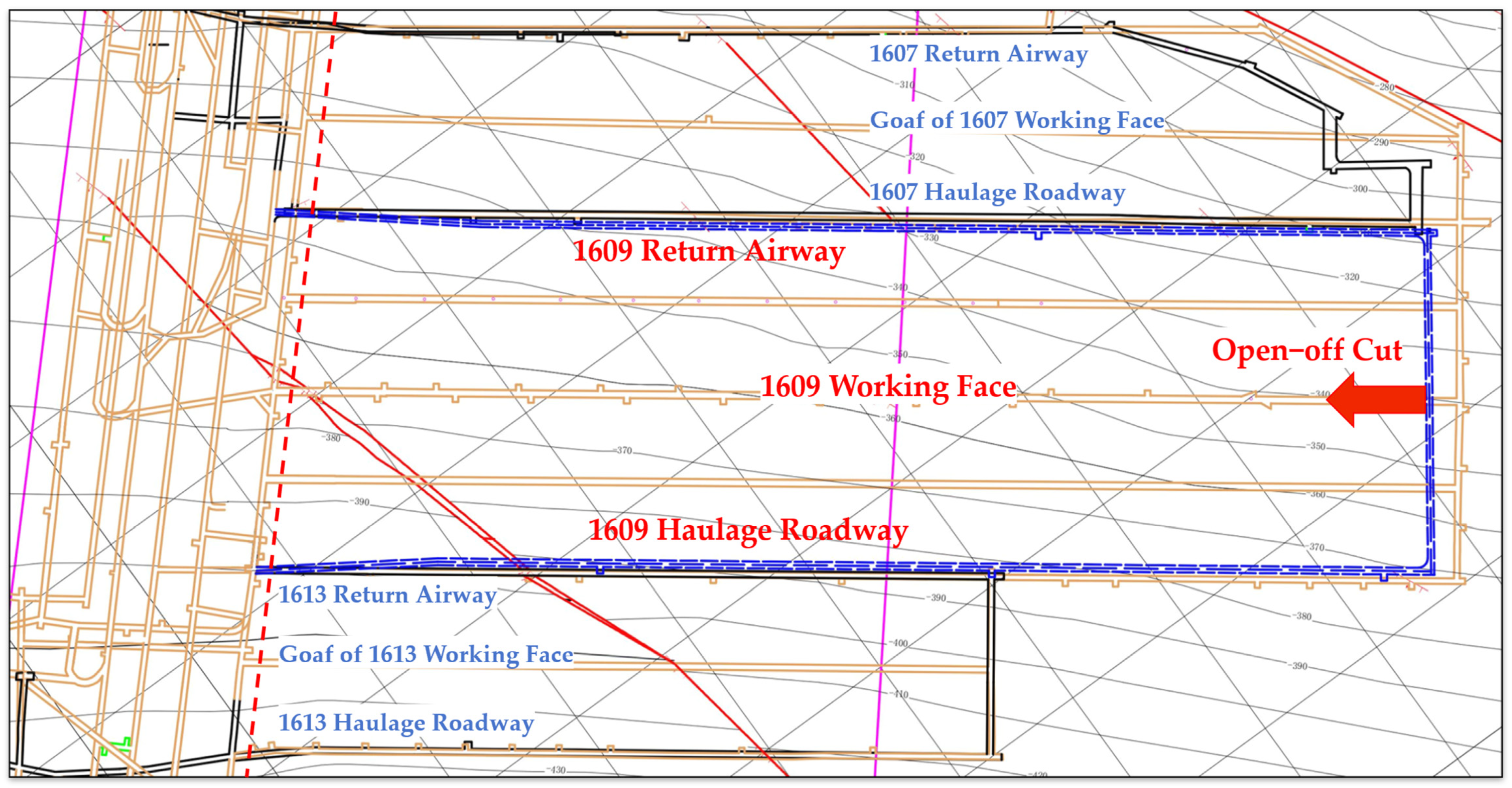
The 1609 working face in Jiulishan Mine is located between the previously mined 1607 and 1613 working faces. The recoverable lengths of the 1607 and 1609 panels are approximately 800 m and 803 m, respectively. Both adjacent panels had been fully extracted before the excavation of the 1609 return airway. Therefore, the 1609 working face is subjected to an island-panel-like mining condition, in which the roadway stress field is strongly affected by the adjacent gobs and residual coal-rock structures. The buried depth of the 1609 return airway is approximately 500 m, and no upper coal seam above the No. 2-1 coal seam had been previously mined within the main influence range. The 1609 return airway was driven along the floor of the No. 2-1 coal seam while retaining top coal, using gob-side entry driving technology. It is adjacent to the 1607 gob to the north, the 1609 working face to the south, the protective coal pillar of the dip roadway in Mining District 16 to the west, and the waterproof coal-rock pillar at the boundary between Mining Districts 16 and 21 to the east. The location of the 1609 return airway is shown in Figure 1.
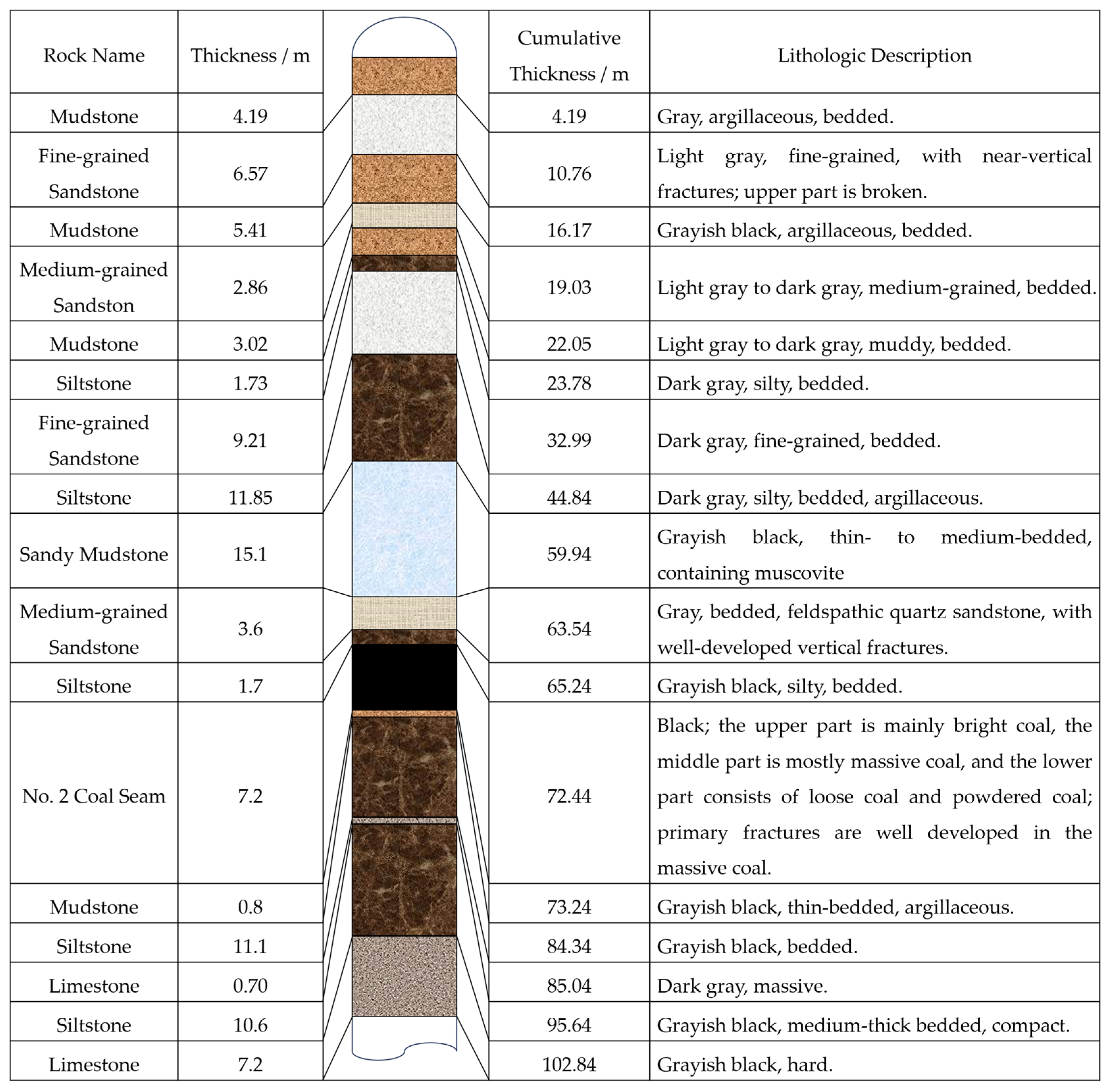
According to the geological report of this area, the No. 2-1 coal seam is 5.0–9.2 m thick, with an average thickness of 7.2 m. Its dip direction is 130–140°, and the average dip angle is 13°, indicating an overall monoclinic structure. The No. 2-1 coal seam is mainly composed of granular and massive semi-bright coal and is structurally classified as tectonically deformed coal. The upper 0.2 m consists of powdered coal, whereas the lower part is fractured coal occurring in flaky and blocky forms. According to the mechanical testing report for the 1609 return airway in Jiulishan Mine, the average uniaxial compressive strength of the No. 2-1 coal seam is 10.24 MPa, the Protodyakonov coefficient f is 0.8, and the internal friction angle is 24°. Joints and fractures are highly developed, indicating a typical thick soft and broken coal seam. The immediate roof consists of 1.7 m of siltstone and 3.6 m of medium-grained sandstone, the main roof is 15.1 m of sandy mudstone, the immediate floor is 0.8 m of mudstone, and the main floor consists of 11.1 m of siltstone, as shown in Figure 2.

2.2. Instability Characteristics of the Gob-Side Roadway

To clarify the main control targets and failure characteristics of the surrounding rock in the 1609 return airway, the deformation characteristics of the gob-side roadway and the failure behavior of the original support system under similar engineering conditions were first analyzed. The 1607 return airway in Jiulishan Mine is highly comparable to the 1609 return airway in terms of coal seam occurrence, roof-floor lithologic assemblage, gob-side entry driving method, spatial relationship with adjacent gobs, and fully mechanized top-coal caving conditions. Therefore, field investigation, borehole imaging, and observations of original support failure in the 1607 return airway were used to identify asymmetric large-deformation characteristics of the surrounding rock and provide a basis for subsequent analysis of the instability mechanism and control scheme of the narrow coal pillar.

2.2.1. Asymmetric Large-Deformation Characteristics of the Surrounding Rock

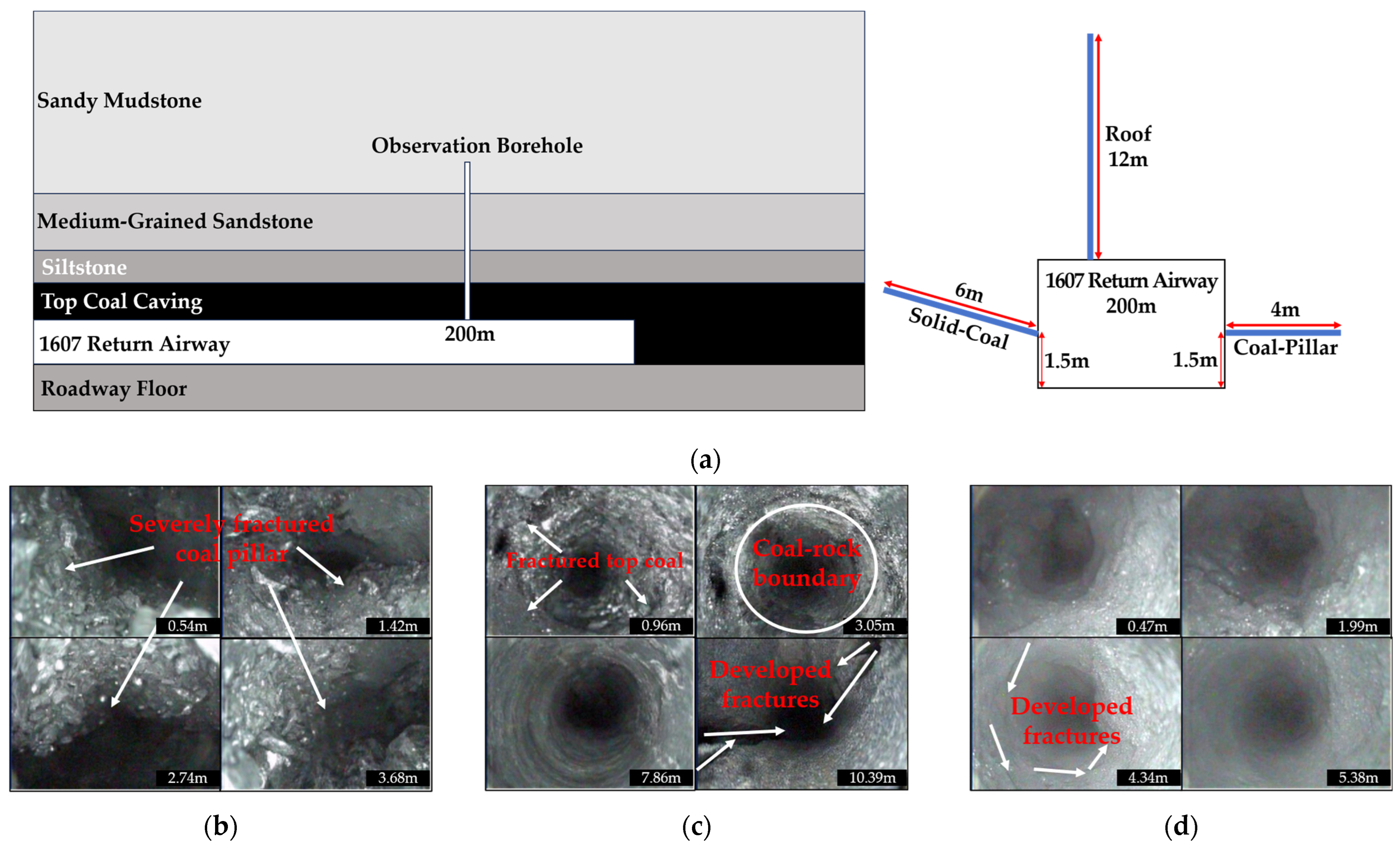
Field investigation and borehole imaging were conducted in the 1607 return airway using a ZKXG100 borehole camera (Wuhan Tianchen Weiye Geophysical Prospecting Technology Co., Ltd., Wuhan, China). Boreholes were arranged in the roof at a depth of 12 m, on the coal-pillar side at a depth of 4 m, and on the solid-coal side at a depth of 6 m, as shown in Figure 3.
Figure 3 also presents the roadway cross-section and borehole layout, which were used to identify roof fracturing and asymmetric rib damage. The results show the following pronounced asymmetric large-deformation characteristics.
(1)
Fragmentation of top coal and development of deep fractures.
The borehole imaging results from the roof indicate that the top coal is severely broken. Distinct fractures and bedding separations are observed in the overlying strata at different depths, suggesting a strong tendency toward overall roof subsidence.
(2)
Marked asymmetry in rib deformation.
Under the combined influence of mining-induced stress from the adjacent gob and the weak mechanical properties of the coal mass, the degree of damage on the two ribs is strongly asymmetric. Borehole observations show that the solid-coal side is only locally fractured and remains relatively intact, whereas the narrow coal pillar side is severely damaged and is generally loose and fragmented, with deformation far greater than that on the solid-coal side.
The borehole imaging results of the 1607 return airway indicate that, under gob-side entry driving along the floor while retaining top coal in a thick soft coal seam, surrounding-rock failure is strongly asymmetric. The main control difficulties lie in the instability of the deep bearing structure on the narrow coal pillar side and the development of roof fracturing and bedding separation. Given the similarity in engineering geological and mining conditions between the 1609 and 1607 return airways, the 1609 return airway is also expected to face a high risk of narrow-coal-pillar-dominated asymmetric large deformation.

2.2.2. Failure Characteristics and Causes of the Original Support System

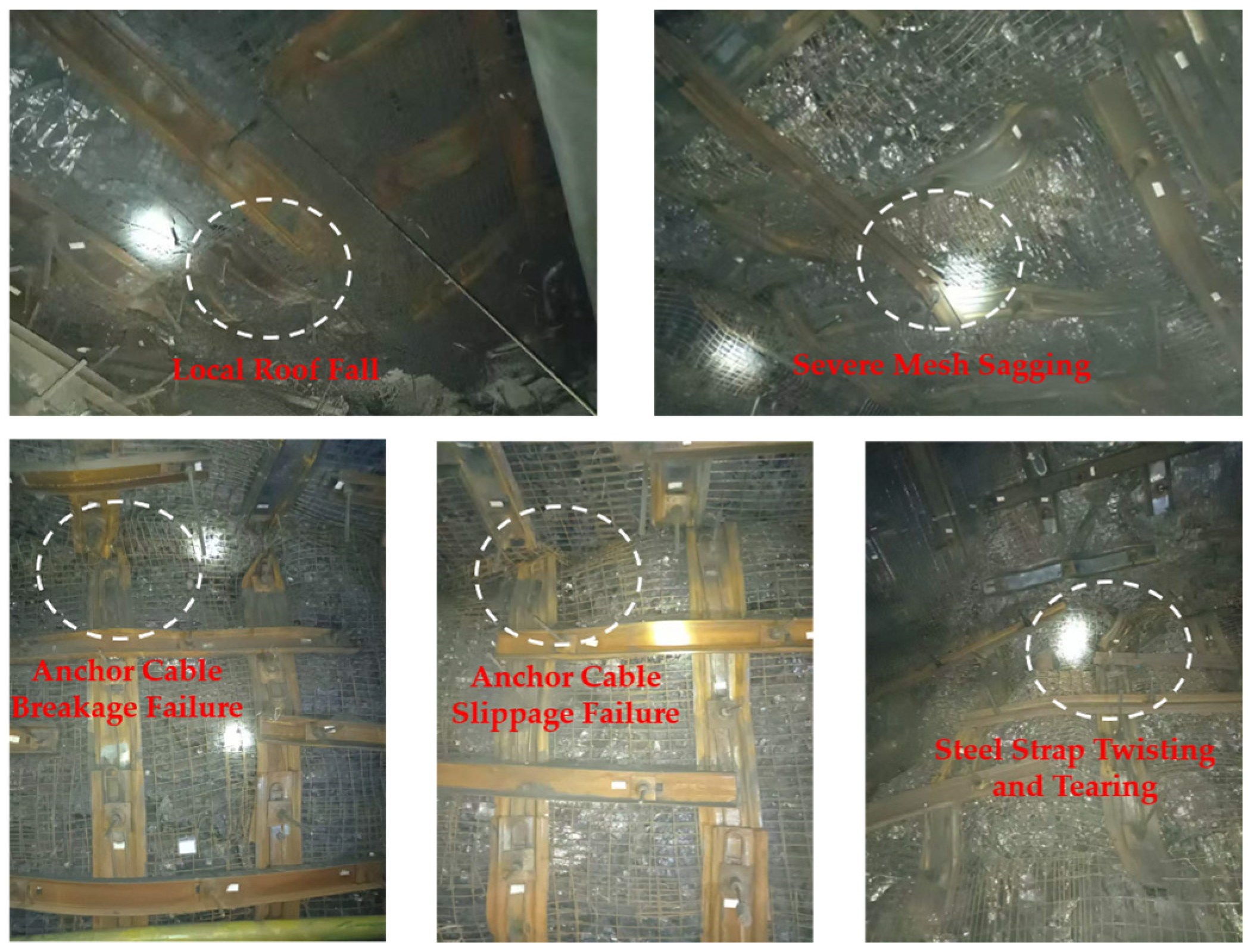
The roof of the 1607 return airway was supported by a bolt-mesh-cable system combined with W-shaped steel straps and steel ladder beams. The W-shaped steel straps were 4400 mm long. The anchor cables were Φ21.6 × 7200–9200 mm. The steel ladder beams were 2000 mm or 2400 mm long, and the overlap length was not less than 100 mm. The two ribs were supported by a bolt-mesh-cable system combined with steel ladder beams. The rib anchor cables were Φ21.6 × 4200 mm, and the ladder beam parameters were the same as those used for the roof. Field investigation showed that the original support system failed mainly in the following two forms, as illustrated in Figure 4.
(1)
Loss of anchorage foundation and slippage or breakage of anchor cables.
Because the surrounding rock on the narrow coal pillar side was severely damaged, the anchorage ends of the rib bolts and anchor cables were entirely located within the plastic failure zone, resulting in loss of effective anchorage capacity. Under the squeezing deformation in the thick soft coal seam, the anchor cables could not provide sustained support resistance. As a result, anchor cable slippage and even tensile breakage occurred frequently, causing asymmetric large deformation dominated by the coal pillar side.
(2)
Twisting and tearing of surface support components.
Under the continued action of asymmetric large deformation and bulking pressure from the surrounding rock, the surface support components were subjected to highly nonuniform loads. The roof subsided in a pocket-like pattern, causing the W-shaped steel straps, which were originally intended to redistribute load and provide coordinated support, to undergo severe twisting, deformation, and even tearing. Consequently, the shallow broken coal in the top coal and on the coal-pillar rib lost confinement, further aggravating the overall instability of the roadway.
In summary, the failure of the original support system was not caused simply by insufficient support parameters. The fundamental reason was that the surrounding rock on the narrow coal pillar side had already undergone deep-seated structural failure under strong mining disturbance, leading to the loss of the rib anchorage foundation and preventing the surface support components from maintaining sustained load-bearing capacity. Therefore, local strengthening merely by adjusting the type or parameters of support components cannot fundamentally solve the problem of asymmetric large deformation in this type of roadway. The intrinsic instability mechanism of the narrow coal pillar under strong mining-induced dynamic loading in a thick soft coal seam must still be clarified.

2.3. Instability Mechanism of the Narrow Coal Pillar

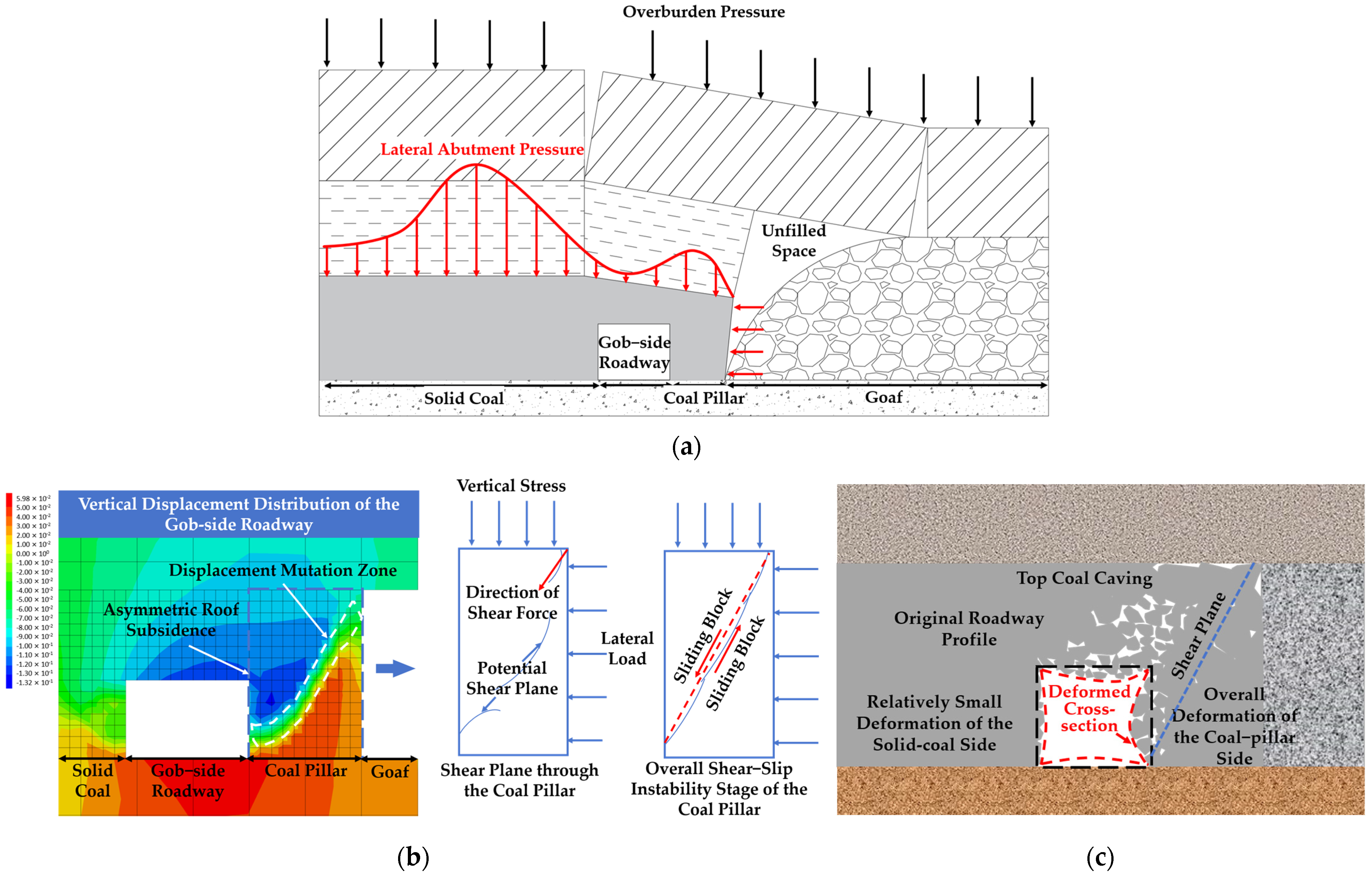
The 1607 working face adjacent to the 1609 return airway is a fully mechanized top-coal caving face in a thick coal seam. Compared with fully mechanized mining faces in thin and medium-thick coal seams, thick-seam top-coal caving faces are characterized by large mining height and a relatively thin immediate roof. After panel extraction, the caved immediate roof cannot fully fill the gob, resulting in intense movement of the overlying strata near the gob edge and pronounced mining disturbance, as shown in Figure 5a [32]. Although some compaction has occurred in the gob, the overburden structure had not fully stabilized after extraction of the 1607 working face, so the gob-side roadway remained significantly affected by mining disturbance. Moreover, under the condition of retained top coal, the roadway roof is directly composed of weak and fracture-prone coal rather than more competent rock strata, which further amplifies the instability of the roof–pillar system under strong mining disturbance.
The 1609 return airway was driven along the floor while retaining top coal. Its roof consists of low-strength soft coal with well-developed fractures. Under the combined action of the main-roof load, lateral abutment pressure, and mining disturbance from the adjacent gob, multiple shear failure planes are liable to develop within the narrow coal pillar because the coal mass has low shear strength, a small internal friction angle, and low cohesion. These shear planes extend obliquely downward from the gob-side roof toward the roadway floor. Once the dominant shear plane cuts through the narrow coal pillar, the overall bearing structure of the pillar is destroyed and transforms from a continuous load-bearing body into an asymmetric sliding block, resulting in overall shear-slip instability, as shown in Figure 5b [33].
From the perspective of the Mohr–Coulomb failure criterion, the potential shear plane in the coal pillar is closely related to the internal friction angle and the compression–shear stress state. The measured internal friction angle of the No. 2-1 coal seam is approximately 24°. Under the combined action of the main-roof load, lateral abutment pressure, and mining-induced disturbance from the adjacent gob, the low cohesion and low shear strength of the soft coal make the coal pillar prone to compression–shear failure. When the pillar width is insufficient, the shear failure zones initiated near the gob-side roof and floor boundaries are more likely to connect with each other, forming a through-going dominant shear plane.
Because one side of the roadway is bounded by the extremely weak narrow coal pillar and the gob, whereas the other side is bounded by solid coal, deformation is governed by strongly asymmetric boundary conditions. Once overall shear slip occurs in the narrow coal pillar, the fragmented coal near the roadway side slides and extrudes into the roadway along the shear plane, causing pronounced rib bulging and subsequent failure of the bolt-mesh-cable support system. By contrast, deformation on the solid-coal side remains relatively small because of the stronger confinement provided by the surrounding rock. After shear slip develops on the coal-pillar side, the overlying top coal loses effective support and undergoes asymmetric inclined subsidence toward the coal-pillar side. Tensile separation structures are then likely to form within the roof, triggering coupled rib-roof instability and eventually causing large-scale top-coal caving and slabbing on the solid-coal side, as shown in Figure 5c.
It should be noted that Figure 5 mainly illustrates the shear-slip instability mechanism of the narrow coal pillar. The stress, plastic failure, and displacement responses of the roadway–coal pillar–gob region are further analyzed in the subsequent numerical simulation results.
The above analysis indicates that, for gob-side roadways driven along the floor while retaining top coal in thick soft coal seams, the key to surrounding-rock control is not merely to reduce surface deformation. Rather, it is to suppress the overall shear slip of the narrow coal pillar, preserve its basic load-bearing capacity, and achieve stable surrounding-rock control by reconstructing the coal pillar-roof cooperative bearing structure. Accordingly, the subsequent analysis focuses on two aspects: determining a rational width for the narrow coal pillar and reconstructing its bearing structure.

2.4. Numerical Model and Simulation Scheme

To determine a rational narrow coal pillar width for the 1609 return airway under gob-side entry driving conditions in a thick soft coal seam with retained top coal, a FLAC3D numerical model (Itasca Consulting Group, Inc., Minneapolis, MN, USA) was established, and the lateral abutment pressure distribution after extraction of the upper 1607 working face was analyzed to determine the comparison schemes for coal pillar width. The numerical simulation was used to analyze the stress distribution, plastic zone evolution, and deformation response of the surrounding rock under different coal pillar widths, thereby providing the basis for determining a rational coal pillar width.

2.4.1. Model Geometry, Boundary Conditions, and Excavation Procedure

In gob-side entry driving, the coal pillar acts as a bearing bridge between the roadway and the gob. Its strength and stability directly control the stability of the surrounding rock around the roadway. As a key parameter governing the internal stress distribution, the extent of the stable core, and the load-bearing capacity of the pillar, coal pillar width directly determines whether the narrow coal pillar can provide the basic structural foundation required for stability. If the pillar width is improperly designed, even increasing support strength cannot fundamentally prevent shear slip of the coal pillar or the resulting rib-roof coupled instability.
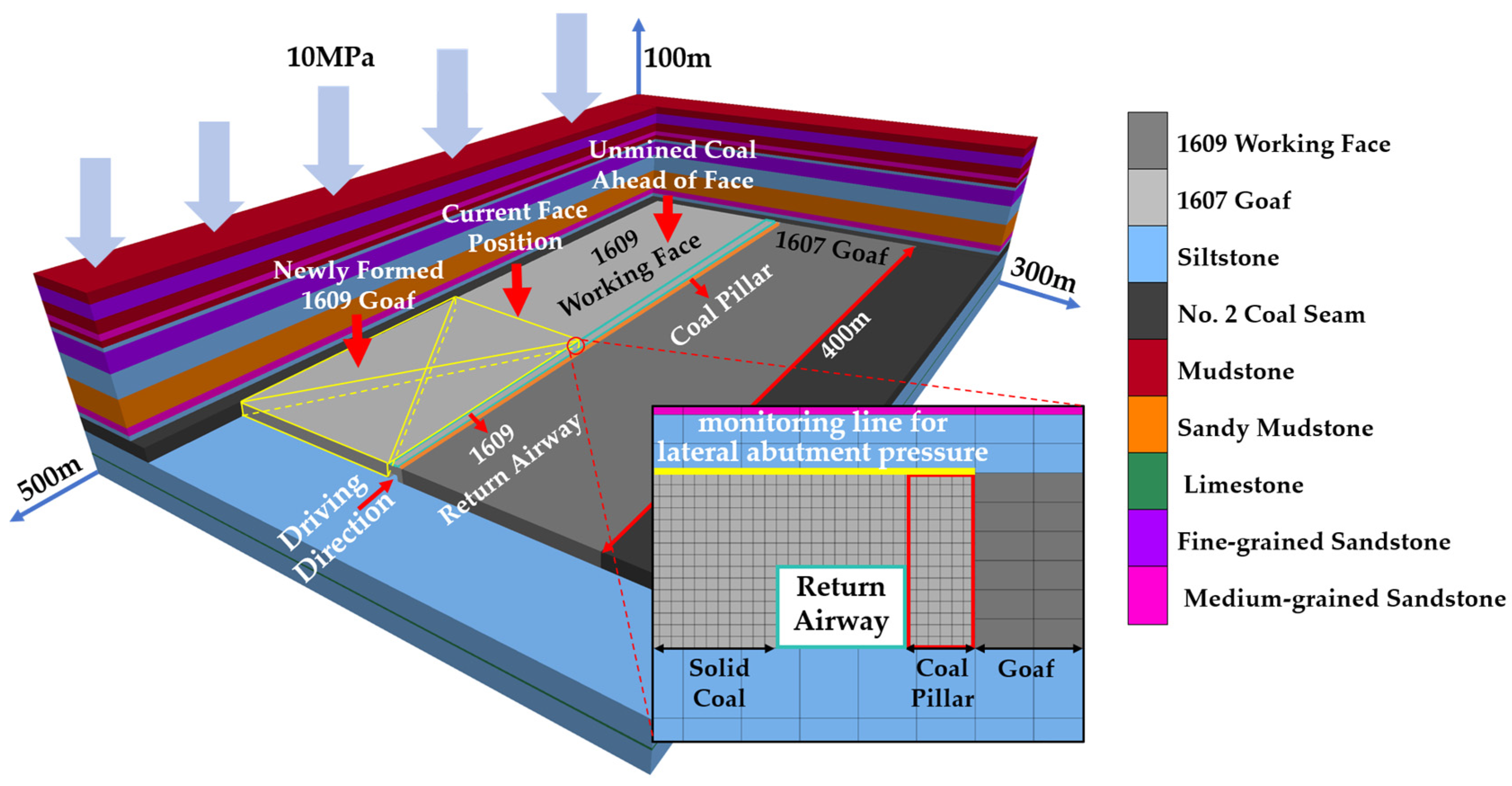
Based on the geological conditions of the surrounding rock at the 1609 working face in Jiulishan Mine, a FLAC3D finite-difference model with dimensions of 300 m × 500 m × 100 m was established, as shown in Figure 6. The actual recoverable lengths of the 1607 and 1609 panels are approximately 800 m and 803 m, respectively; in the numerical model, a representative 400 m longwall length was adopted to balance engineering representativeness and computational efficiency. The model consisted of 16 coal-rock layers and was meshed using hexahedral elements. The model contained 484,875 zones and 530,037 gridpoints. To better capture the stress redistribution, plastic failure, and displacement response in the key study area, local mesh refinement was applied in the roadway–coal pillar–gob region. The minimum element size around the roadway excavation was 0.5 m, allowing the 5.5 m × 3.5 m roadway section to be represented by 11 elements in width and 7 elements in height. The roadway excavation was simulated by deleting the zones within the designed excavation profile and advancing the excavation stepwise along the roadway direction.
According to the burial depth of the working face, a vertical stress of 10 MPa was applied to the top boundary to represent the overburden load. The bottom boundary was fixed in the vertical direction, and the lateral boundaries were constrained in their normal directions. In addition, 50 m wide boundary zones were reserved around the key excavation region to reduce boundary effects. The Mohr–Coulomb constitutive model was used to simulate the initial state of the coal-rock strata, whereas the Double-Yield constitutive model was used to simulate the compaction state of the gob after extraction of the 1607 working face. The gob parameters were calibrated according to the geological conditions, compaction characteristics of the collapsed rock mass, and repeated trial calculations.
The mechanical parameters of the surrounding rock used in the numerical model are listed in Table 1. These parameters were determined based on field mechanical tests, geological reports, and engineering experience. Considering the well-developed joints and fractures in the coal-rock mass, equivalent reduced rock-mass parameters were adopted to indirectly reflect the weakening effect of discontinuities, although individual joints were not explicitly modeled.

2.4.2. Gob Modeling and Parameter Calibration

The gob formed after extraction of the 1607 working face was not treated as an empty void. Instead, the caved rock mass was simulated using the Double-Yield constitutive model, which can represent the gradual compaction and stress recovery of broken rock mass during compression. Two compactable materials were defined in the model: loose gob material and caved roof material.
The mechanical parameters of the gob and caved roof materials are listed in Table 2. Compared with intact coal-rock strata, the gob material was assigned lower initial bulk and shear moduli to represent the loose and compressible state of the caved rock mass. Low cohesion was used to represent the residual interlocking and weak cementation between broken rock blocks, and the tensile strength was set to zero because the caved rock mass cannot sustain tensile stress. The gob and caved roof materials were assumed to exhibit progressive compaction rather than sudden brittle failure, which is consistent with the deformation behavior of broken caved rock masses under compression.
In the Double-Yield model, the compaction behavior of the caved rock mass was controlled by the cap-pressure–plastic volumetric strain relationship. The adopted compaction curves for the gob material and caved roof material are listed in Table 3. These relationships indicate that the bearing capacity and stiffness of the caved rock mass gradually increase with increasing plastic volumetric strain. The loose gob material shows a relatively slow increase in cap pressure at the initial compaction stage, whereas the caved roof material shows a faster stiffness recovery, corresponding to its relatively higher compactness and stronger blocky structure.
The parameters of the Double-Yield materials were calibrated by combining the mining height, roof caving characteristics, expected compaction behavior of the collapsed rock mass, and back-analysis of the lateral abutment pressure distribution after extraction of the 1607 working face. Repeated trial calculations were performed until the simulated lateral abutment pressure distribution reproduced the expected pattern of stress relief near the gob edge, stress increase away from the gob, and gradual recovery to the in situ stress state. This calibration process ensured that the gob was represented as a compactable load-bearing medium rather than an unsupported void.
To further evaluate the influence of gob compaction parameters on the lateral abutment pressure distribution, a sensitivity analysis was conducted by changing the cap-pressure values of the caved rock mass. Three schemes were considered: low compaction stiffness, calibrated compaction stiffness, and high compaction stiffness. The cap-pressure values were scaled by factors of 0.8, 1.0, and 1.2, respectively, while all other model conditions were kept unchanged. The sensitivity results are shown in Table 4.
As shown in Table 4, the variation in caved-rock compaction stiffness has only a limited influence on the lateral abutment pressure distribution. When the cap-pressure scaling factor increases from 0.8 to 1.2, the peak abutment pressure changes slightly from 23.32 MPa to 23.65 MPa, and the peak position remains at approximately 27 m from the gob edge. The stress-reduction zone remains within 0–11.6 m to 0–11.7 m, corresponding to a theoretical maximum pillar width of approximately 6.1–6.2 m after subtracting the 5.5 m roadway width.
Therefore, the representative pillar-width schemes were not sensitive to reasonable variations in caved-rock compaction stiffness, while the Double-Yield model allowed gob deformation and compaction to be considered through the gradual increase in cap pressure and stiffness.

2.4.3. Mesh Refinement and Mesh Sensitivity

Mesh size has an important influence on both the numerical accuracy and computational efficiency of FLAC3D simulations. In this study, local mesh refinement was adopted around the roadway and the narrow coal pillar, where stress concentration, plastic failure, and large deformation were expected to occur. Relatively coarser meshes were used in regions far from the roadway to reduce computational cost while maintaining overall model stability.
To verify the rationality of the adopted mesh, a mesh sensitivity analysis was conducted based on the 3 m coal pillar model. Two mesh schemes were compared, namely the adopted mesh and a refined mesh. In the adopted mesh, the minimum element size near the roadway was 0.5 m, and the roadway section was discretized into 11 × 7 elements. In the refined mesh, the minimum element size near the roadway was reduced to 0.25 m, and the roadway section was discretized into 22 × 14 elements. The peak vertical stress, maximum roof subsidence, and maximum rib displacement were selected as the main indicators for evaluating the influence of mesh size on the numerical results.
As shown in Table 5, reducing the minimum element size from 0.5 m to 0.25 m increased the numbers of zones and gridpoints by 139.21% and 131.38%, respectively, indicating a substantial increase in computational cost. However, the changes in the main response indicators remained limited: the peak vertical stress, maximum roof subsidence, and maximum rib displacement changed by 4.15%, 3.02%, and 6.41%, respectively. These relative differences were all less than 10%, indicating that the adopted mesh with a minimum local element size of 0.5 m can capture the main stress concentration, roof subsidence, and rib deformation characteristics while maintaining acceptable computational efficiency. Accordingly, the adopted mesh scheme was used in subsequent simulations.

2.4.4. Determination of Coal Pillar Width Schemes Based on Lateral Abutment Pressure

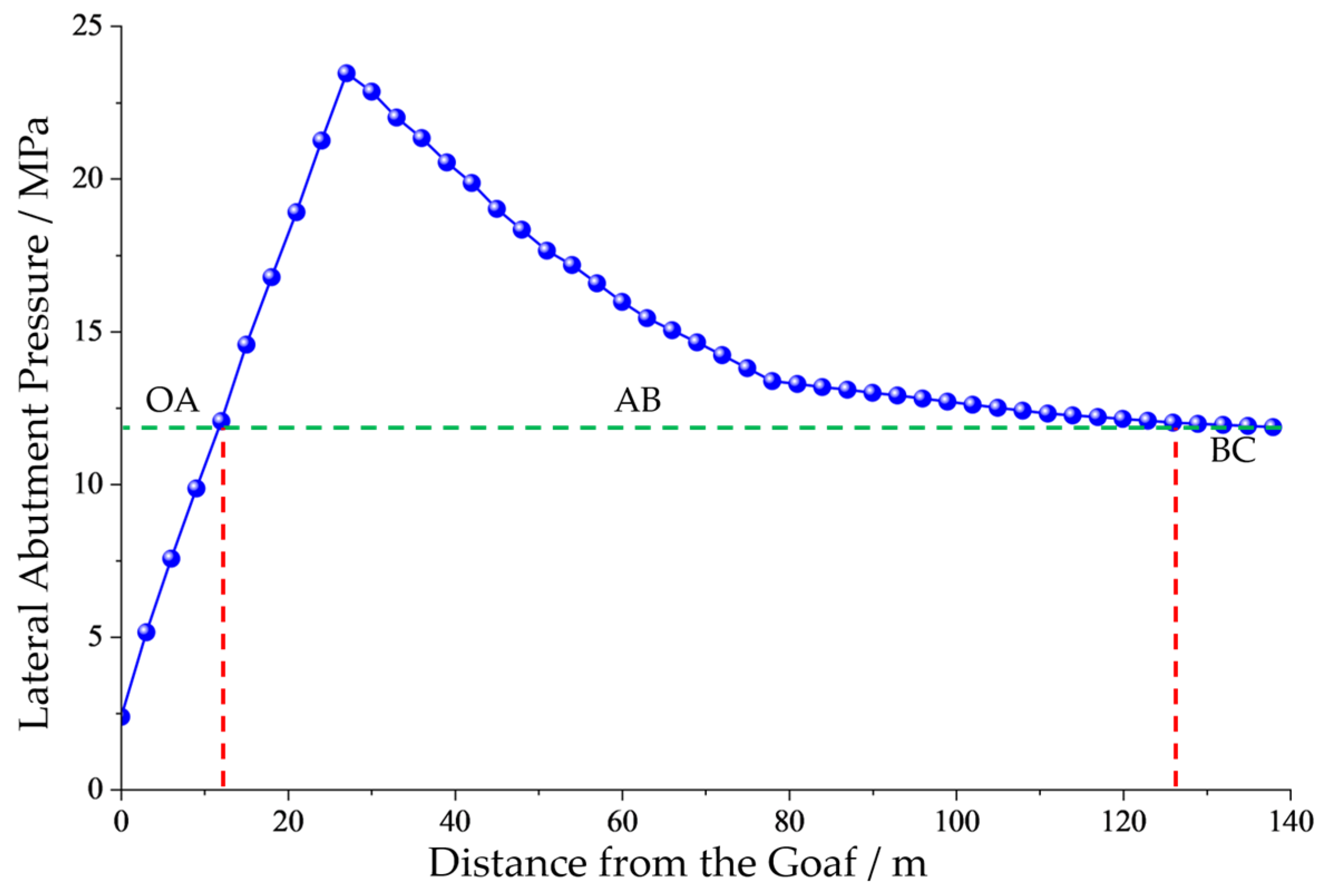
To reasonably determine the range of narrow coal pillar widths for the 1609 return airway under gob-side entry driving conditions, the lateral abutment pressure distribution on the gob side after extraction of the upper 1607 working face was first analyzed. The results show that, under the disturbance induced by fully mechanized top-coal caving in the upper panel, the stress in the coal mass on the gob side generally exhibits an initial decrease, a subsequent increase, and final stabilization. The corresponding lateral abutment pressure distribution curve is shown in Figure 7.
When the distance from the gob ranges from 0 to 11.7 m (segment OA), the coal mass lies within the mining-induced pressure-relief zone. In this range, the vertical stress is lower than the in situ stress, forming a lateral abutment pressure reduction zone. When the distance from the gob ranges from 11.7 to 126.8 m (segment AB), the coal seam is under the influence of abutment pressure, and the stress gradually increases above the in situ stress, forming a stress-increasing zone. At greater distances from the gob (segment BC), the disturbance to the rock mass gradually weakens, and the stress correspondingly approaches the in situ stress.
Based on the above analysis, both the roadside coal pillar and the roadway of the 1609 return airway should preferably be arranged within the lateral abutment pressure reduction zone on the gob side, so as to reduce the adverse effect of mining-induced stress concentration on surrounding-rock stability. However, the lateral abutment pressure distribution provides only a preliminary basis for determining the range of coal pillar widths. After roadway excavation, the stress field in the coal pillar and surrounding rock is redistributed, resulting in both stress concentration zones and stress relief zones around the roadway. In addition, if the coal pillar is too narrow, its own load-bearing capacity may become insufficient. Therefore, the optimal pillar width cannot be determined solely from the extent of the stress-reduction zone, and should be further evaluated by considering the vertical stress distribution, plastic zone development, roof subsidence, and rib displacement under different coal pillar widths after roadway excavation.
Based on the 0–11.7 m pressure-reduction range on the gob side and the roadway width of 5.5 m, the coal pillar width should theoretically not exceed 6.2 m if both the roadway and the pillar are to be preferentially located within the pressure-reduction zone. Considering practical engineering conditions for narrow coal pillars in gob-side roadways, the widths of 2, 3, 4, and 5 m were selected as representative engineering schemes covering extremely narrow, moderate, and relatively wide coal pillars within the stress-reduction zone. Moreover, considering roadway excavation accuracy and field construction feasibility, integer-meter width schemes were adopted instead of a finer parametric sweep. Accordingly, four integer-meter pillar width schemes, namely 2 m, 3 m, 4 m, and 5 m, were selected for subsequent numerical simulation.

2.5. Coordinated Control Concept and Support Parameters

Based on the above analysis of the shear-slip and rib-roof coupled instability mechanism of the narrow coal pillar, the key to surrounding-rock control in the 1609 return airway lies in suppressing the overall shear slip of the narrow coal pillar, preserving its basic load-bearing capacity, and coordinating the control of roof separation and asymmetric rib deformation. Accordingly, a coordinated control scheme of “narrow coal pillar + cross-rib anchorage” was proposed. By constructing a cross-rib anchor-cable bearing structure that penetrates the full section of the coal pillar and combining it with hierarchical roof support, coordinated stability control of the narrow coal pillar, the roof, and the two ribs can be achieved.

2.5.1. Coordinated Control Concept of “Narrow Coal Pillar + Cross-Rib Anchorage”

Conventional asymmetric support mainly alleviates rib deformation by increasing the support strength of the shallow surrounding rock on the coal-pillar side. However, its effect is generally limited to the shallow fractured zone and cannot penetrate the shear failure zone that has already formed, or is still developing, inside the narrow coal pillar. Once the pillar becomes unstable through overall slip along the dominant shear plane, simply increasing the number of bolts or anchor cables on the coal-pillar side, or raising the pretension, cannot effectively change the overall bearing structure of the pillar. On the contrary, failure may still occur because the anchorage ends are located within the plastic failure zone. Therefore, for this type of roadway, the key to surrounding-rock control is not merely to strengthen the coal-pillar side, but to reconstruct the integrity and shear resistance of the pillar through an anchorage system that penetrates the full section of the narrow coal pillar, thereby structurally blocking the development of shear slip.
Accordingly, a coordinated control concept of “narrow coal pillar + cross-rib anchorage” is proposed in this study. Aimed at the dominant instability mode of overall shear slip of the narrow coal pillar, this scheme forms a cross-rib anchor-cable bearing structure through the full section of the pillar from both sides, thereby enhancing the integrity and shear resistance of the narrow coal pillar and suppressing its overall slip. At the same time, short anchor cables, medium-long anchor cables, and long anchor cables are combined to provide hierarchical control of the shallow fractured zone, the medium-deep fracture zone, and the deep stable strata, respectively. In this way, a shallow-deep coordinated support structure is formed, allowing the narrow coal pillar, the roof, and the surrounding rock of the two ribs to work together as a stable bearing system and achieving coordinated control characterized by “shear resistance, slip restriction, crack control, and roof stabilization”.

2.5.2. Parameters of the Hierarchical Combined Support Scheme

For the 1609 return airway, a hierarchical combined support system of “cross-rib anchor cables + short anchor cables + medium-long anchor cables + long anchor cables” was adopted. In this system, support on the coal-pillar side focuses mainly on cross-rib anchorage and shear resistance, roof support relies mainly on layered suspension and coordinated shallow-deep bearing, and support on the solid-coal rib serves mainly as supplementary reinforcement and deformation coordination. The specific support parameters are as follows.
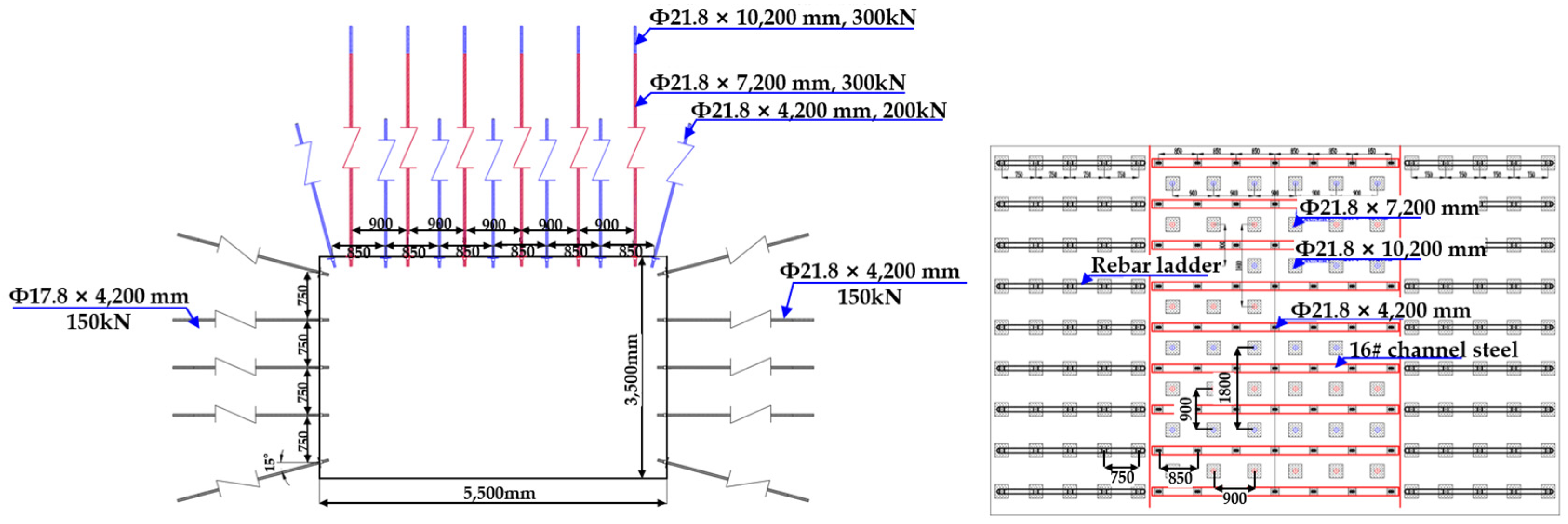
The roof short anchor cables are 1 × 19S steel strand anchor cables with a diameter of 21.8 mm and a length of 4200 mm, arranged with a cable spacing of 850 mm and a row spacing of 900 mm. The pretension is not less than 200 kN. The roof medium-long anchor cables are 1 × 19S steel strand anchor cables with a diameter of 21.8 mm and a length of 7200 mm. Six cables are installed in each row, with a cable spacing of 900 mm and a row spacing of 1800 mm. The pretension is not less than 300 kN. The roof long anchor cables are 1 × 19S steel strand anchor cables with a diameter of 21.8 mm and a length of 10,200 mm. Six cables are also arranged in each row, with a cable spacing and row spacing of 900 × 1800 mm, and the pretension is not less than 300 kN. Cross-rib anchor cables are used on the gob-side rib. The cross-rib anchor cables are Φ21.6 × 4200 mm, with a spacing and row spacing of 750 × 1000 mm. The pretension is not less than 150 kN, and the bearing plate size is 200 × 200 × 12 mm. The solid-coal rib is supported by 1 × 7S steel strand anchor cables with a diameter of 17.8 mm and a length of 4200 mm. The spacing and row spacing are 750 × 1000 mm, the pretension is not less than 150 kN, and the bearing plate size is also 200 × 200 × 12 mm. The support layout is shown in Figure 8.
In the numerical model, the bolts and anchor cables were simulated using FLAC3D structural cable elements. The cross-rib anchor cables were arranged through the narrow coal pillar to connect the surrounding rock on both sides and to form a transverse bearing structure across the potential shear plane. Cable elements with different IDs were used to represent different support components, including rib cables, short roof cables, medium-long roof cables, and long roof cables. The interaction between the cable and surrounding rock was represented by grout bonding parameters, including grout cohesion, grout friction, grout stiffness, and grout perimeter. The tensile capacity of the cable element was used as the failure criterion. Pretension was applied according to the field support design, with values of 150 kN for rib and cross-rib cables, 200 kN for short roof cables, and 300 kN for medium-long and long roof cables.

2.6. Field Test and Monitoring Methods

To verify the applicability and control performance of the proposed “narrow coal pillar + cross-rib anchorage” scheme under field conditions, an industrial field test was carried out in the 1609 return airway of Jiulishan Mine using the support parameters described above. The support effect on the surrounding rock was comprehensively evaluated by roof separation monitoring, roadway surface displacement monitoring, and borehole imaging.

2.6.1. Layout of the Monitoring Zone

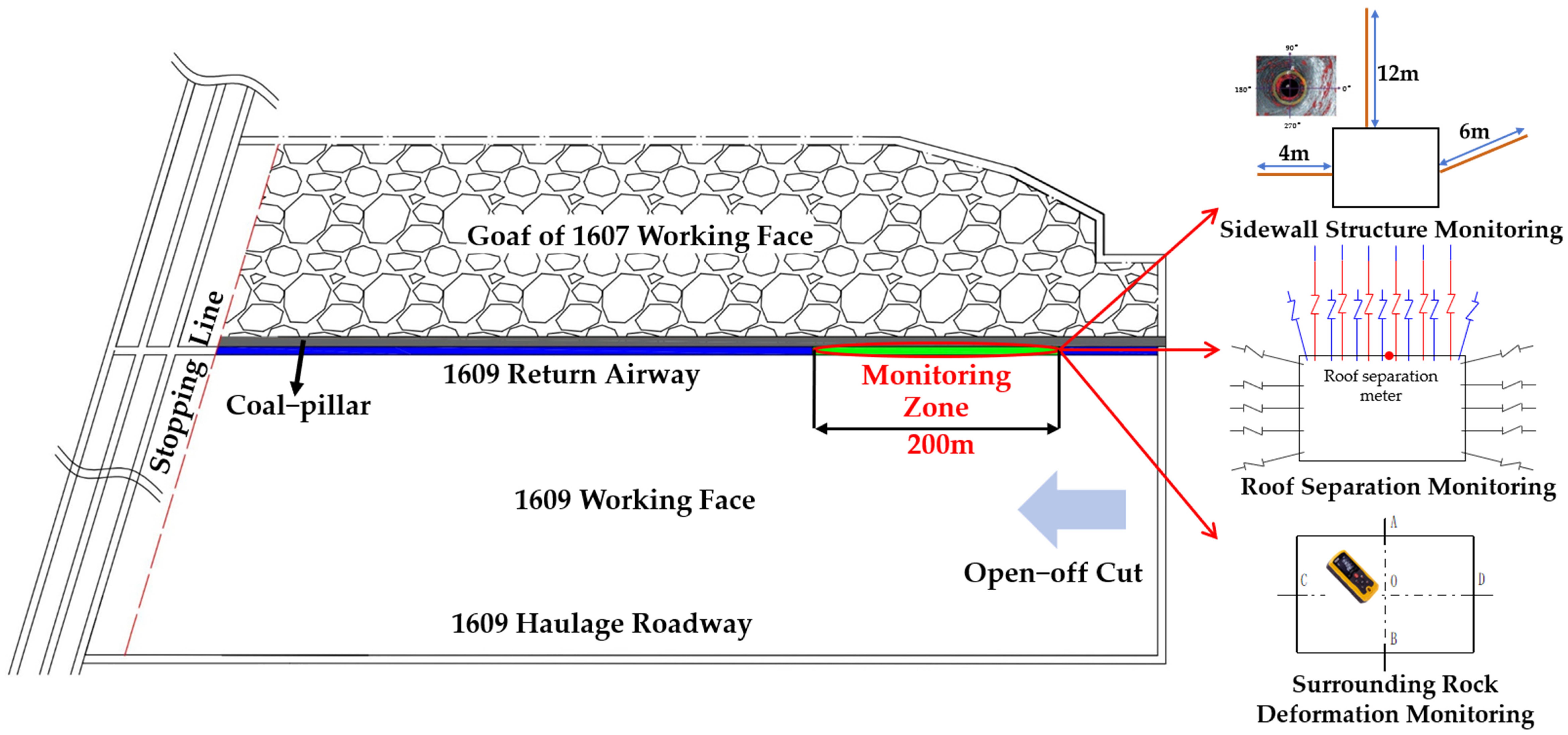
Starting from a point 100 m ahead of the open-off cut of the 1609 fully mechanized top-coal caving face, a 200 m long section of the 1609 return airway along the mining direction was selected as the field monitoring zone. According to the field monitoring scheme, monitoring stations were arranged at 100 m intervals within this zone. Roof separation monitoring stations and roadway surface displacement monitoring stations were installed at representative positions to capture the deformation evolution of the surrounding rock after excavation and support installation. In addition, borehole imaging was carried out at the 300 m section of the 1609 return airway to evaluate the internal structural condition of the roof and the two ribs after support. The monitoring layout is shown in Figure 9.

2.6.2. Monitoring Contents

Field monitoring mainly included the following three aspects.
(1)
Roof separation monitoring, which was used to characterize layered deformation in the shallow loosened zone and the medium-deep fracture zone of the roof after support, and to evaluate the ability of the support system to control roof separation.
(2)
Roadway surface displacement monitoring, which was used to record the deformation of the roof and the two ribs and to analyze the convergence process and time-dependent deformation characteristics of the surrounding rock after support.
(3)
Borehole imaging, which was used to observe fracture development, the extent of rock fragmentation, and the overall integrity of the roof and the two ribs after support, thereby further assessing the effectiveness of the support scheme in improving the internal structural stability of the surrounding rock.

2.6.3. Monitoring Methods

Roof separation was monitored using a WBY-13 multipoint roof separation meter. The monitoring depth was 2–8 m within the roof, and each instrument was equipped with three anchors to record the separation of the shallow, middle, and deep roof strata. One roof separation meter was installed at each monitoring station near the roadway centerline, and the lag distance between installation and the excavation face did not exceed 10 m. During the first 10 days after installation, especially within 50 m of the heading face, observations were conducted once per day. Thereafter, if the total roof separation remained below 50 mm, the monitoring interval was extended to no more than 7 days. If the total separation exceeded 50 mm within 10 days, daily observations were continued until no further separation was observed for 5 consecutive days, after which the interval was adjusted to no more than 7 days.
Roadway surface displacement was monitored using the cross-measurement method. The vertical and horizontal convergence of the roadway were measured using a steel tape at no fewer than two observation sections at each monitoring station, and the spacing between the two sections did not exceed the spacing of two rows of anchor cables. The measurement accuracy reached 1 mm, with estimation to 0.5 mm. During the first 10 days after installation, observations were conducted once per day. If the convergence of one rib remained below 300 mm, the monitoring interval was then extended to no more than 7 days. If the convergence of one rib exceeded 300 mm within 10 days, daily observations were continued until no further obvious deformation was observed for 5 consecutive days, after which the interval was adjusted to no more than 7 days.
To further assess the internal structural condition of the supported surrounding rock, borehole imaging was carried out at the 300 m section of the 1609 return airway in the roof, the coal-pillar side, and the solid-coal side. The borehole depths were 12 m in the roof, 4 m in the coal pillar, and 6 m in the solid-coal side. The development of internal fractures, the integrity of the coal-rock mass, and local fragmentation were identified and analyzed based on the borehole images. Monitoring data were summarized and statistically analyzed every 3 days. Based on these monitoring methods, the control effect of the proposed “narrow coal pillar + cross-rib anchorage” coordinated control scheme on roof separation, surrounding-rock deformation, and internal structural stability was comprehensively evaluated.

3. Results

3.1. Optimization Results of Narrow Coal Pillar Width

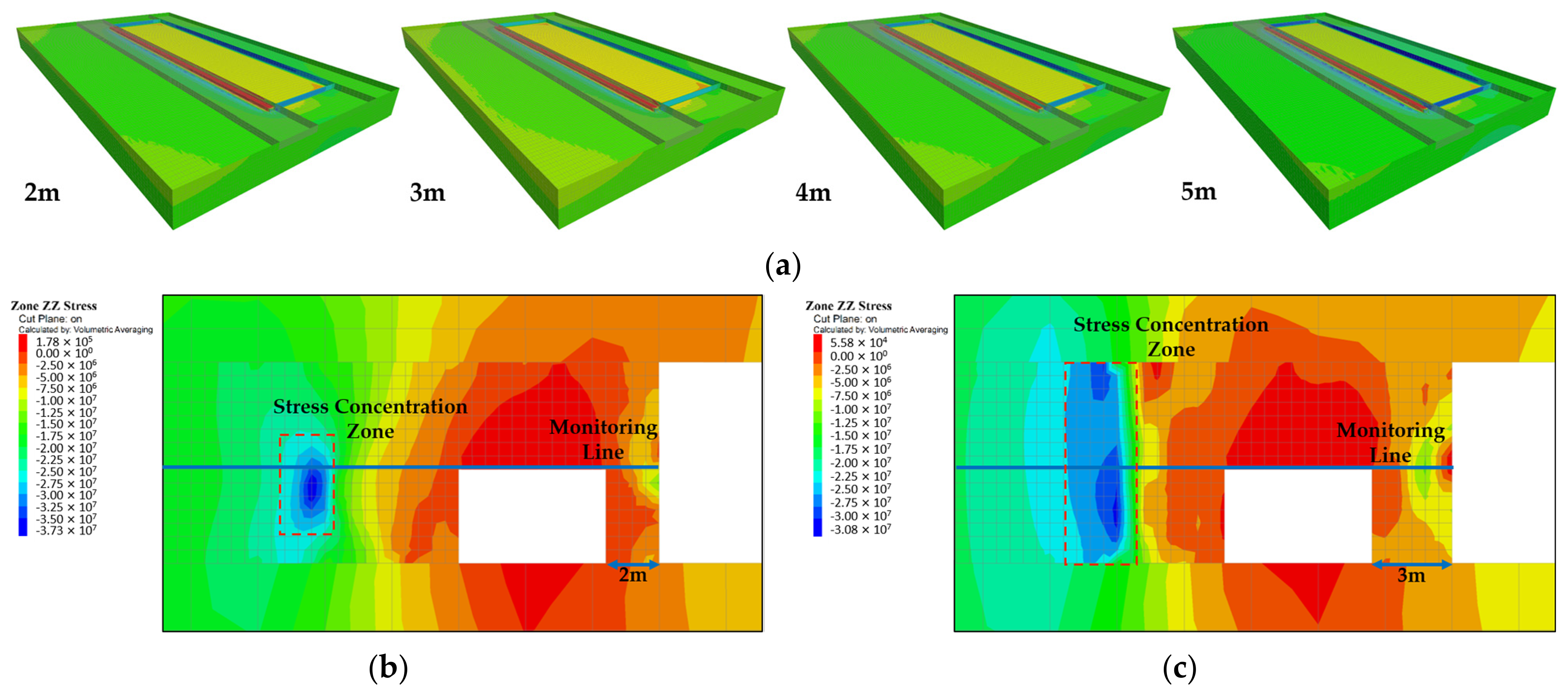
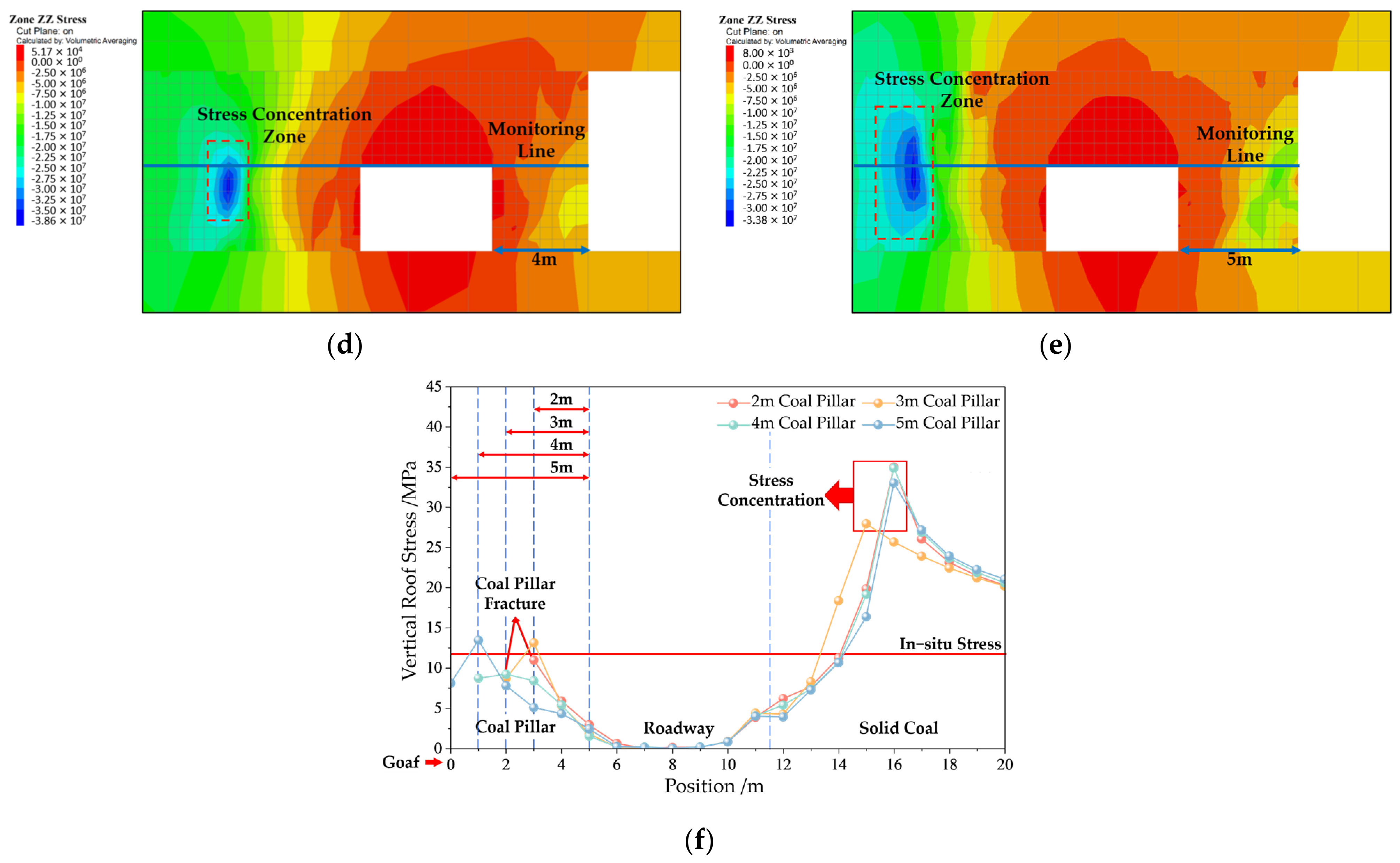
The stress distribution results show clear differences in the load-bearing state of the coal pillar and the stress environment around the roadway under different pillar widths. As shown in Figure 10, under the 2 m coal pillar condition, the vertical stress within the pillar remains low and fails to form an effective load-bearing core, indicating insufficient bearing capacity and poor overall stability. When the coal pillar width increases to 3 m, the internal stress level rises markedly, suggesting that the pillar has acquired a relatively good load-bearing capacity. Meanwhile, the stress distribution around the roadway becomes comparatively gentle, and the degree of stress concentration remains weak. When the pillar width is further increased to 4 m and 5 m, although the internal stress level of the pillar continues to increase, the peak stresses near the solid-coal rib and the roof also increase significantly, aggravating stress concentration around the roadway and becoming unfavorable for long-term surrounding-rock control.
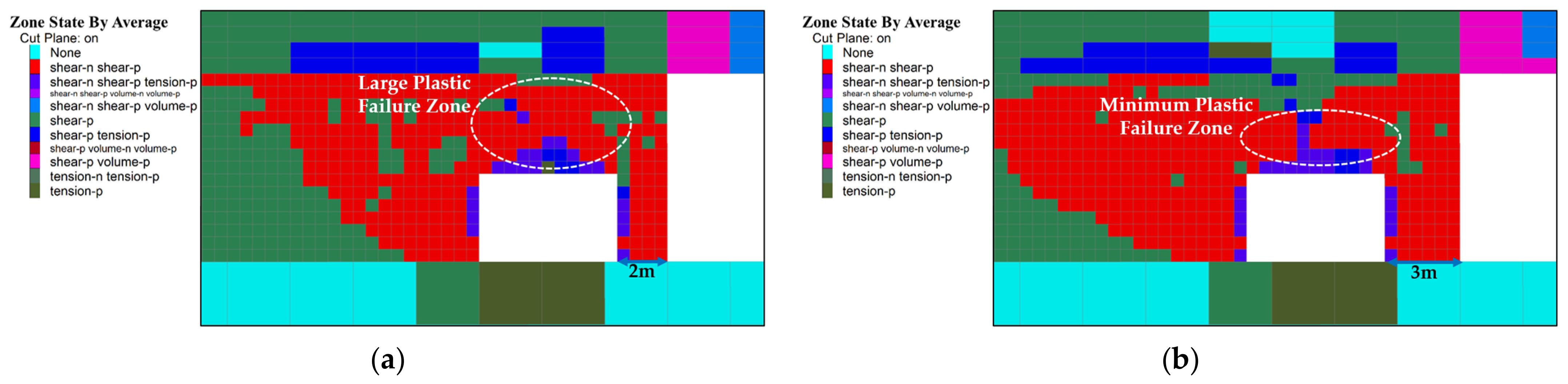
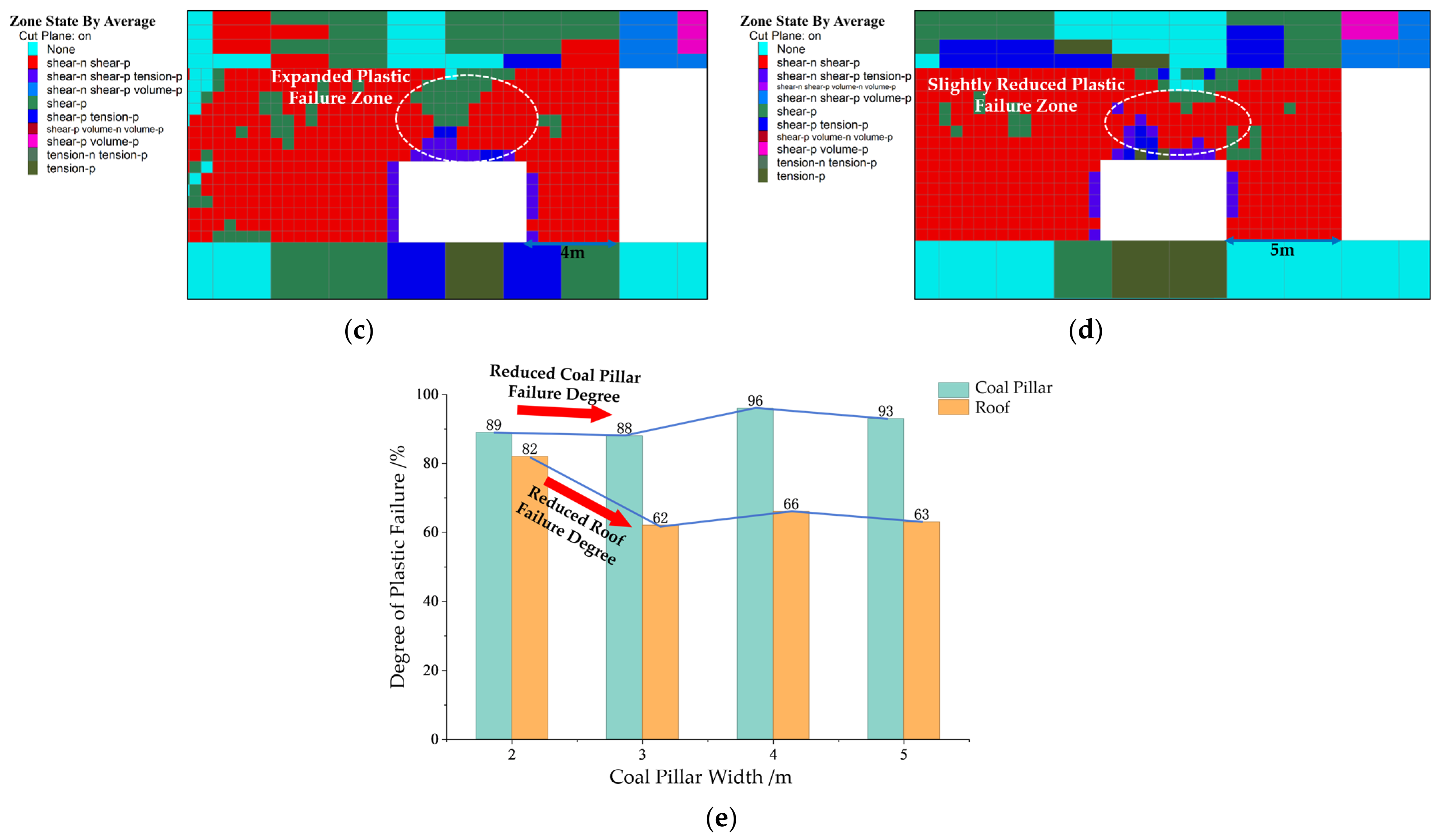
The plastic zone distribution results show that the 3 m coal pillar produces the smallest plastic failure zone around the roadway in Figure 11, indicating a more coordinated mechanical state of the coal pillar–surrounding rock system. By contrast, the 2 m coal pillar exhibits a relatively large plastic failure zone because of its insufficient width, reflecting inadequate pillar stability. Although the 4 m and 5 m coal pillars are wider, they do not further improve the overall plastic zone distribution of the surrounding rock, indicating that a wider coal pillar is not necessarily more favorable for the stability control of the gob-side roadway.
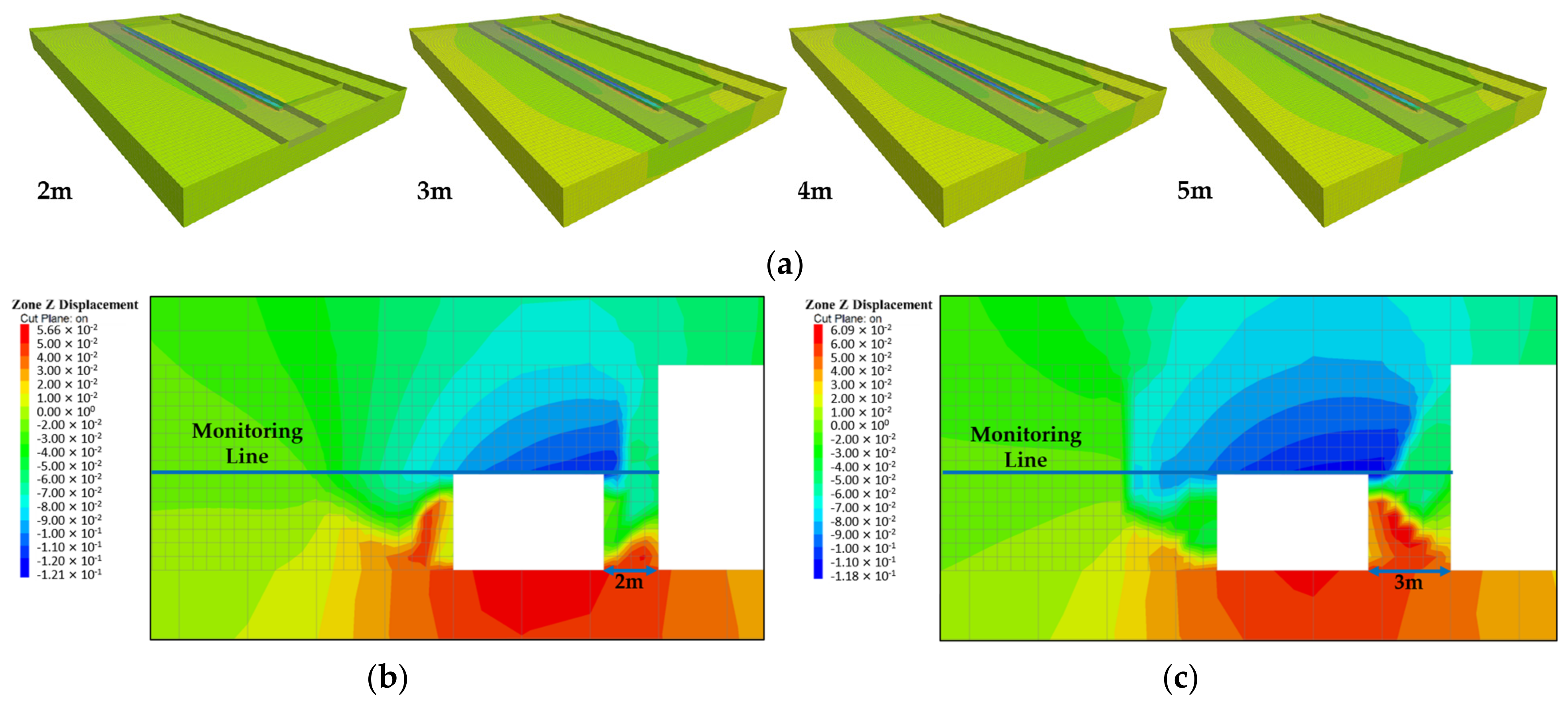
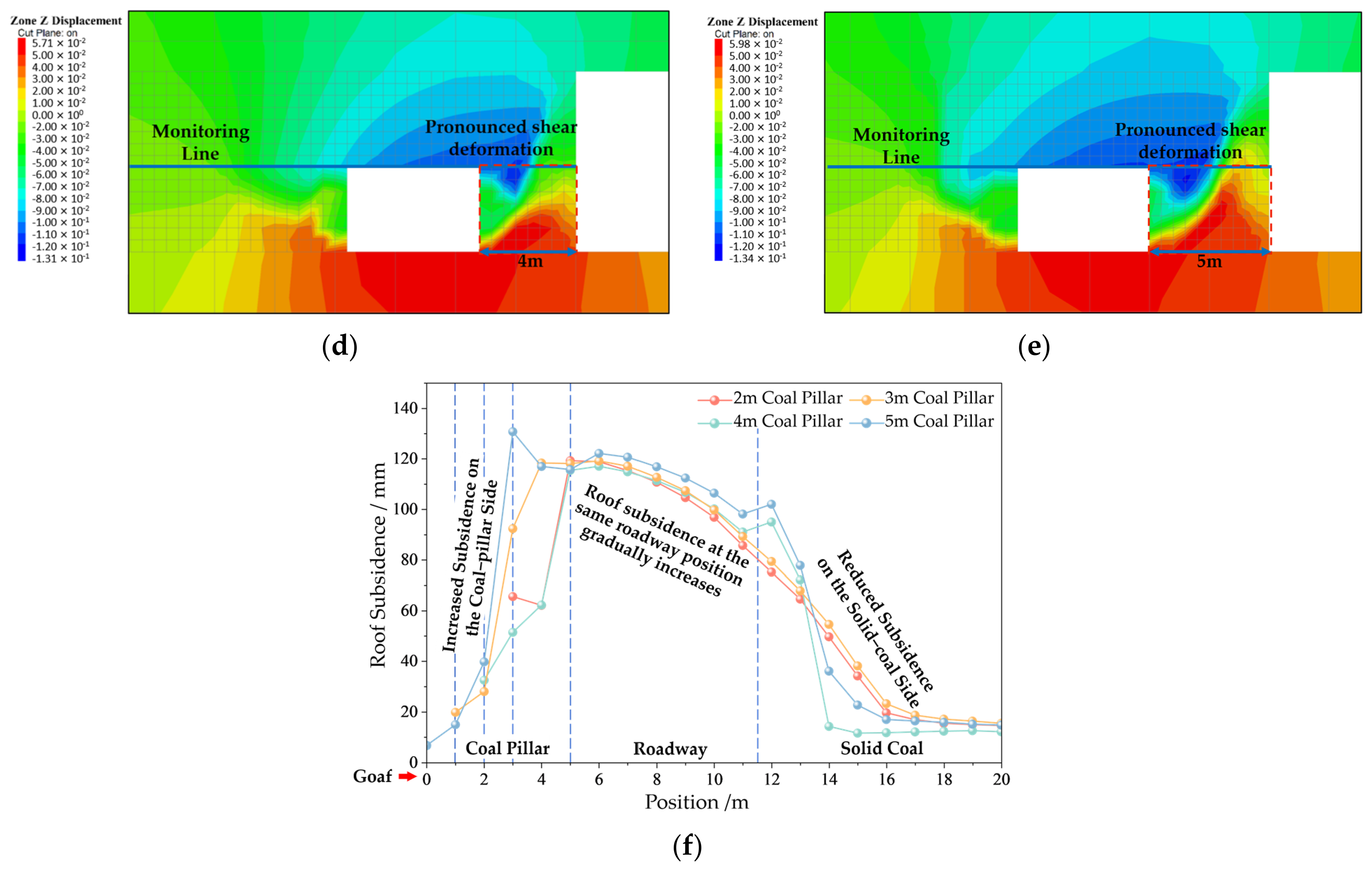
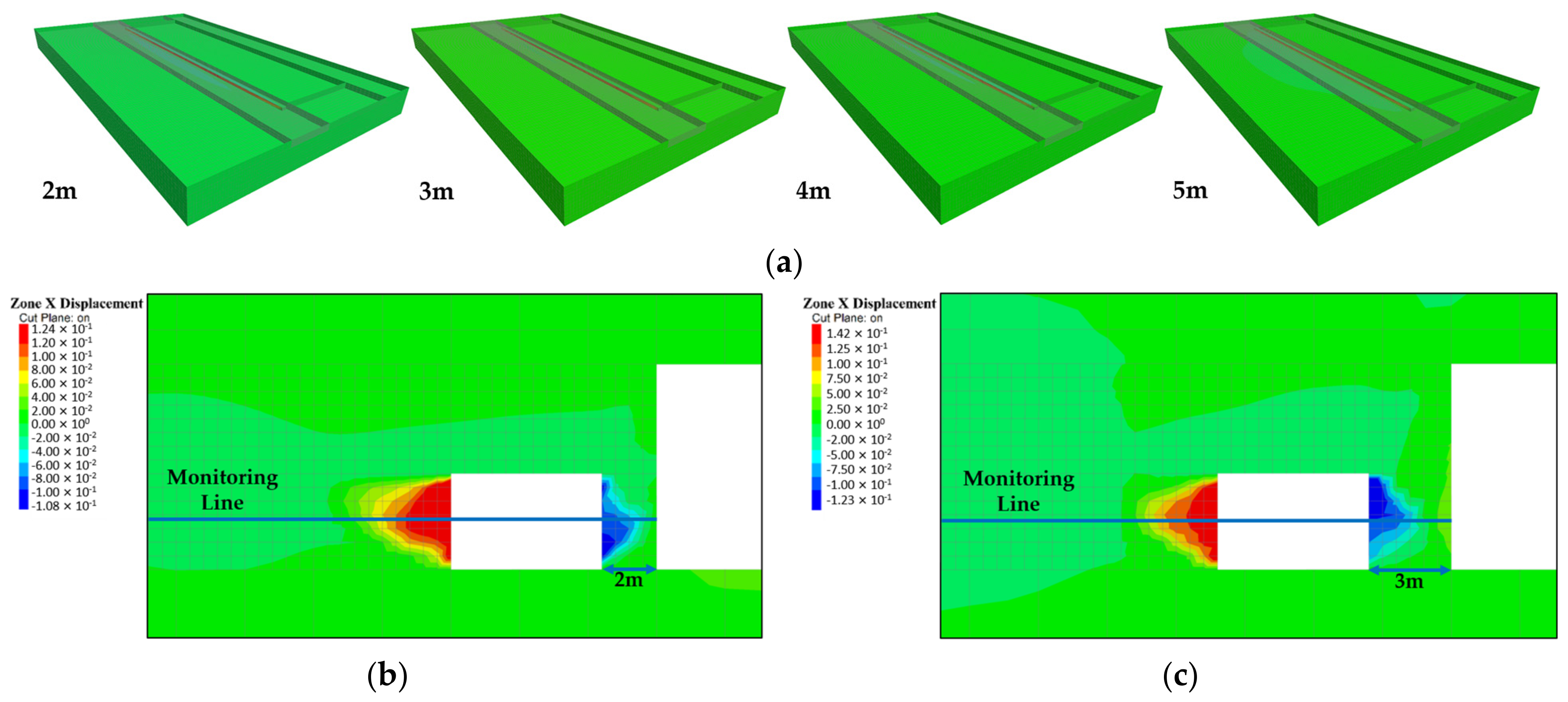
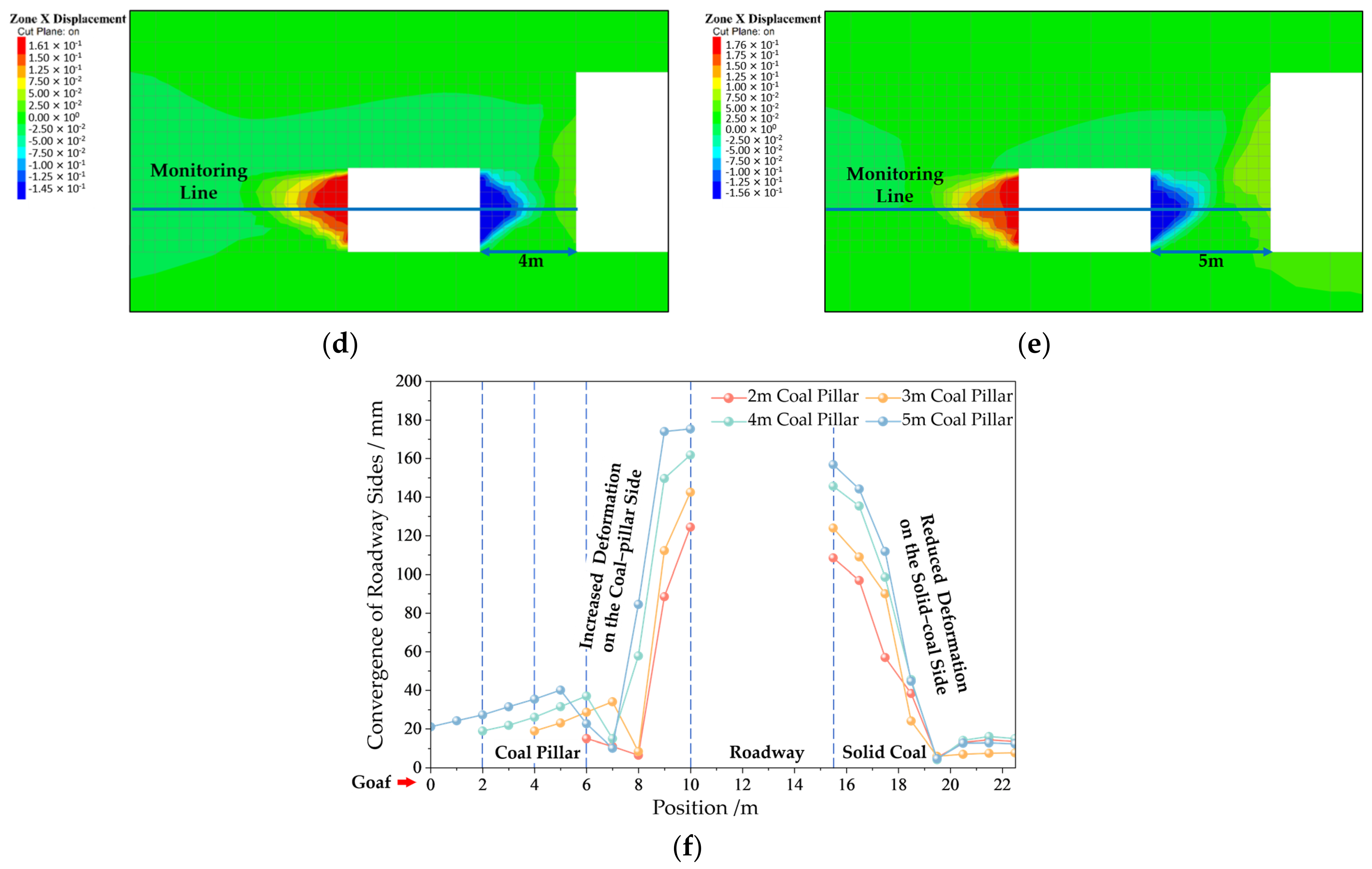
The displacement results indicate that rib convergence and roof subsidence generally increase as the coal pillar width increases. As shown in Figure 12 and Figure 13, deformation control under the 3 m coal pillar condition is clearly better than that under the 4 m and 5 m conditions. Both roof subsidence and rib convergence remain at relatively low levels, indicating that the overall roadway deformation is comparatively moderate at this width. In particular, when the coal pillar width increases from 3 m to 4 m, the increase in rib displacement becomes obvious, suggesting that once the width exceeds 3 m, a further increase in pillar width does not improve roadway deformation control but instead aggravates surrounding-rock convergence.
To reduce the subjectivity of pillar-width optimization, a multi-index evaluation was further conducted by considering pillar load-bearing capacity, plastic zone development, stress concentration, roadway deformation, and coal recovery. The evaluation results are summarized in Table 6.
Considering the stress distribution, plastic zone development, and deformation characteristics together, the 2 m coal pillar has insufficient load-bearing capacity and cannot satisfy the stability requirements of the gob-side roadway. Although the 4 m and 5 m coal pillars exhibit higher load-bearing stress levels, they also lead to more pronounced stress concentration around the roadway and larger surrounding-rock deformation. By comparison, the 3 m coal pillar not only provides a certain load-bearing capacity, but also effectively controls plastic zone expansion and overall roadway deformation, thereby achieving a better balance among low-stress layout, pillar load-bearing capacity, and surrounding-rock stability control. Accordingly, 3 m is determined to be the rational narrow coal pillar width for the 1609 return airway. However, because the 3 m coal pillar may still undergo local deformation and damage under strong mining disturbance, targeted coordinated support measures are still required to further improve its stability.

3.2. Numerical Verification Results of the Support Effect

To verify the control effect of the proposed “narrow coal pillar + cross-rib anchorage” scheme on the surrounding rock of the gob-side roadway in a thick soft coal seam, a supported numerical model was established based on the geological conditions of the 1609 return airway in Jiulishan Mine and compared with the results under unsupported conditions. The unsupported model was used only as an excavation-only reference model to evaluate the relative improvement provided by the proposed support scheme; it does not indicate that the roadway was unsupported in the field. The results indicate that the proposed support scheme performs well in optimizing the stress distribution of the surrounding rock, reducing the extent of plastic failure, and controlling roadway deformation.
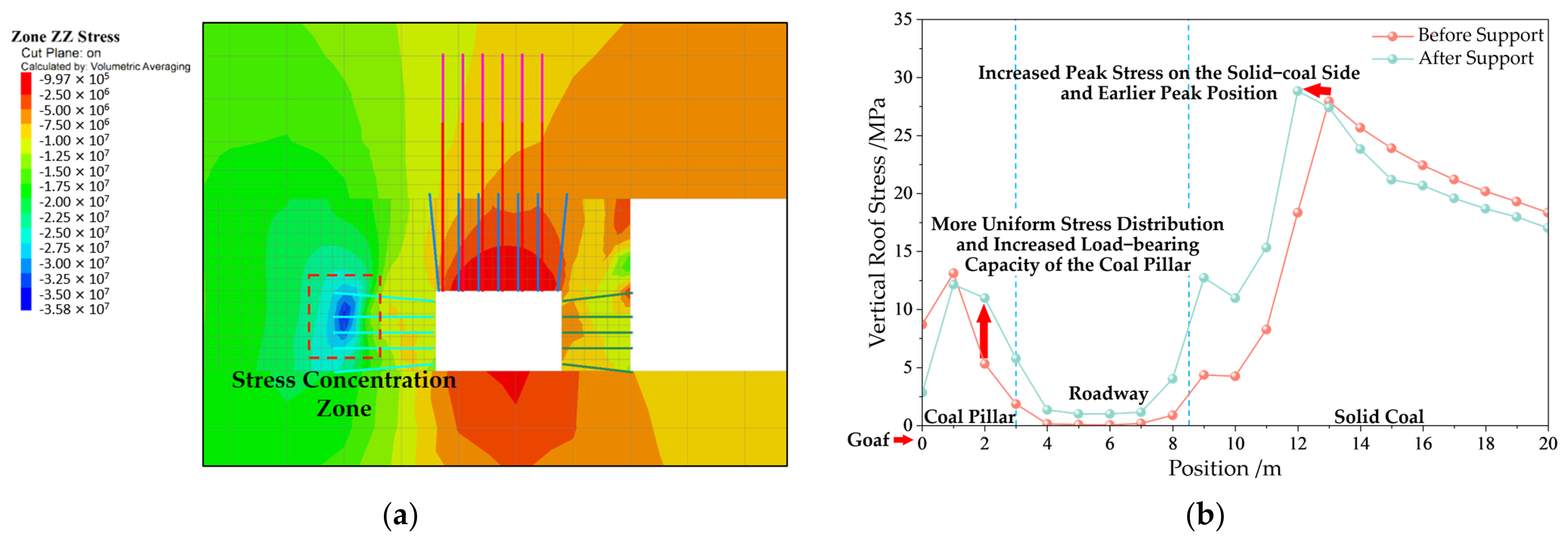
As shown in Figure 14a,b, after support was applied, the vertical stress distribution within the 3 m coal pillar became more continuous and uniform, and the internal stress level increased, indicating an improved load-bearing state of the pillar. At the same time, the peak stress on the solid-coal side increased slightly, and the peak position shifted forward relative to that under unsupported conditions. Although a slight local stress increase occurred on the solid-coal side, the overall stress distribution around the roadway became more reasonable, and the tendency toward stress concentration and local instability on the coal-pillar side was effectively alleviated.
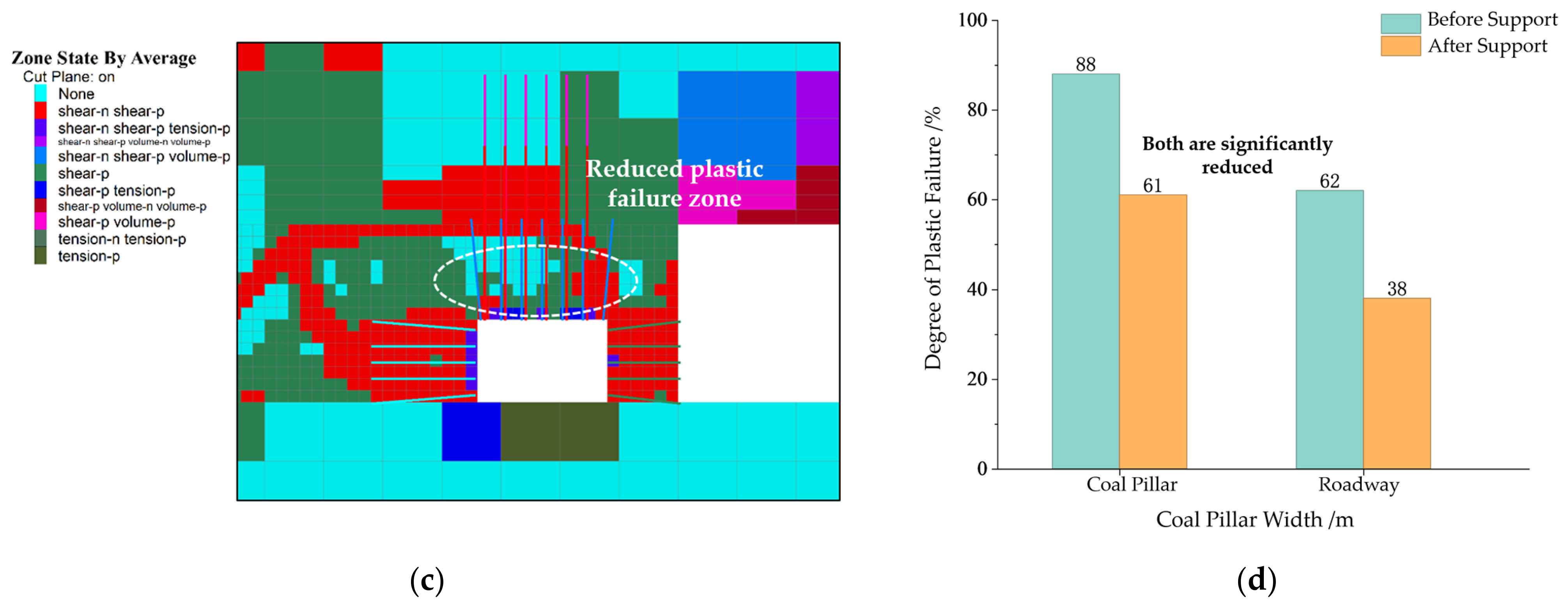
The plastic zone distribution results show that, after support installation, the plastic failure zones on the coal-pillar side and in the roof decreased markedly in Figure 14c,d. In particular, the expansion of shallow failure on the coal-pillar side and in the roof was effectively suppressed.
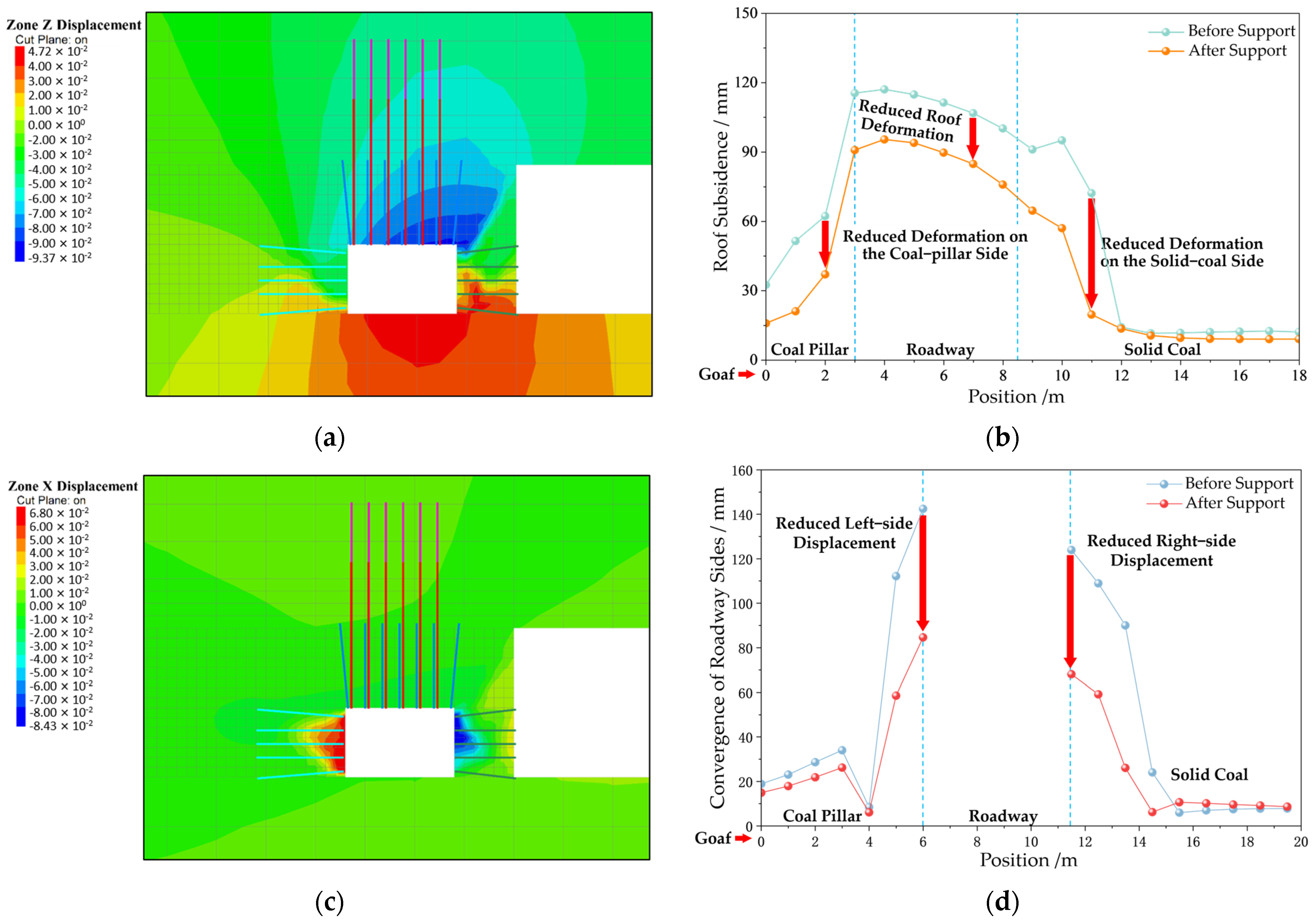
The displacement results further confirm the deformation-control effect of the support scheme. As shown in Figure 15a,b, the maximum vertical displacement of the roof decreased from 117 mm under unsupported conditions to 95 mm after support, corresponding to a reduction of about 18%. As shown in Figure 15c,d, the displacement control effect on the two ribs was even more significant. The rib convergence of the roadway decreased from 262 mm to 151 mm, corresponding to a reduction of about 42%.
Comprehensive analysis of the stress distribution, plastic zone, and deformation shows that the combined support system centered on cross-rib anchor cables improved the stress state of the 3 m narrow coal pillar, reduced the extent of surrounding-rock plastic failure, and significantly controlled roof subsidence and rib convergence. These results indicate that the proposed support scheme is suitable for surrounding-rock stability control in the 1609 return airway.

3.3. Field Monitoring and Borehole Imaging Results

3.3.1. Roof Separation Monitoring Results

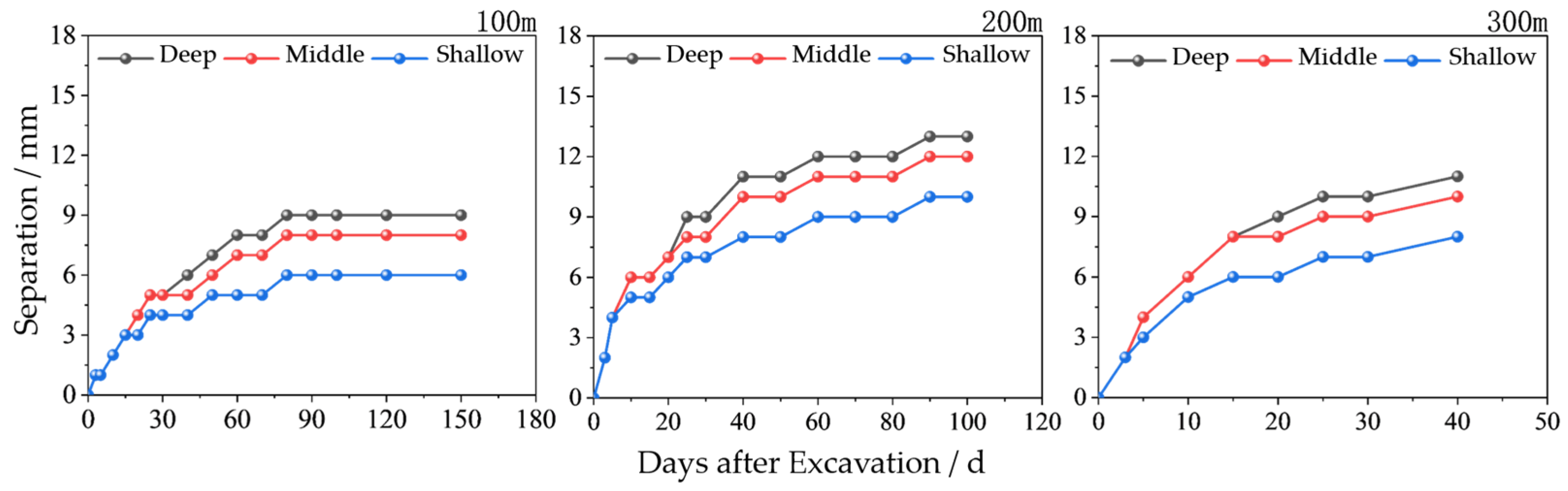
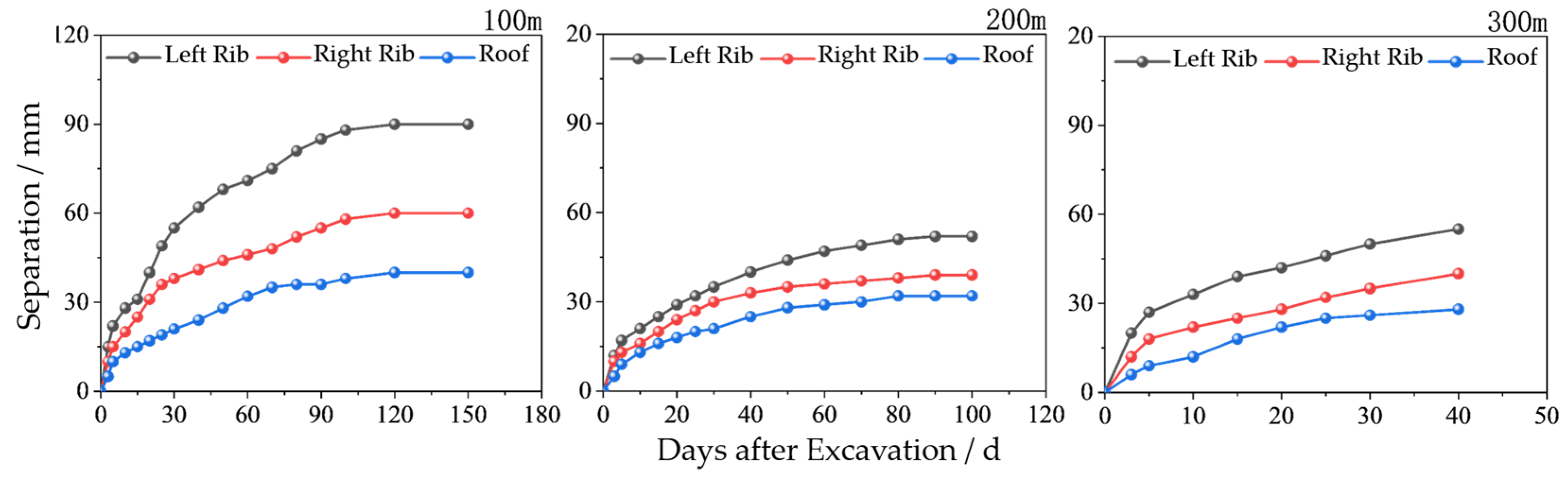
The roof separation monitoring results of the 1609 return airway are shown in Figure 16. The monitoring data indicate a clear hierarchical distribution pattern, namely deep separation > middle separation > shallow separation. At the 200 m monitoring station, the maximum deep separation was only about 13 mm, which indicates favorable roof control under the proposed support system. In terms of temporal evolution, roof separation at different depths increased slowly in a step-like manner during the first 60–90 days after roadway excavation. Thereafter, the separation curves gradually flattened and remained basically stable, indicating that the roof surrounding rock gradually reached a new equilibrium state after stress redistribution. These results demonstrate that the support system provides effective suspension and combined control for both the shallow loosened zone and the medium-deep fracture zone in the roof, and effectively suppresses the continued development of roof separation.

3.3.2. Roadway Surface Displacement Monitoring Results

The roadway surface displacement monitoring results of the 1609 return airway are shown in Figure 17. At different monitoring stations, the magnitude of surface deformation generally follows the order of left rib > right rib > roof, and the maximum surface deformation is controlled within 100 mm. The convergence process of the surrounding rock can be divided into three stages. During the first 40 days after excavation, the convergence rate was relatively high. From 40 to 80 days, the deformation rate gradually decreased. After 80 days, the displacement curves at all monitoring stations tended to stabilize. These results indicate that, under the support system, the deformation of the roadway surrounding rock was effectively controlled during the monitoring period, and the roadway exhibited a favorable stabilization trend.

3.3.3. Borehole Imaging Results

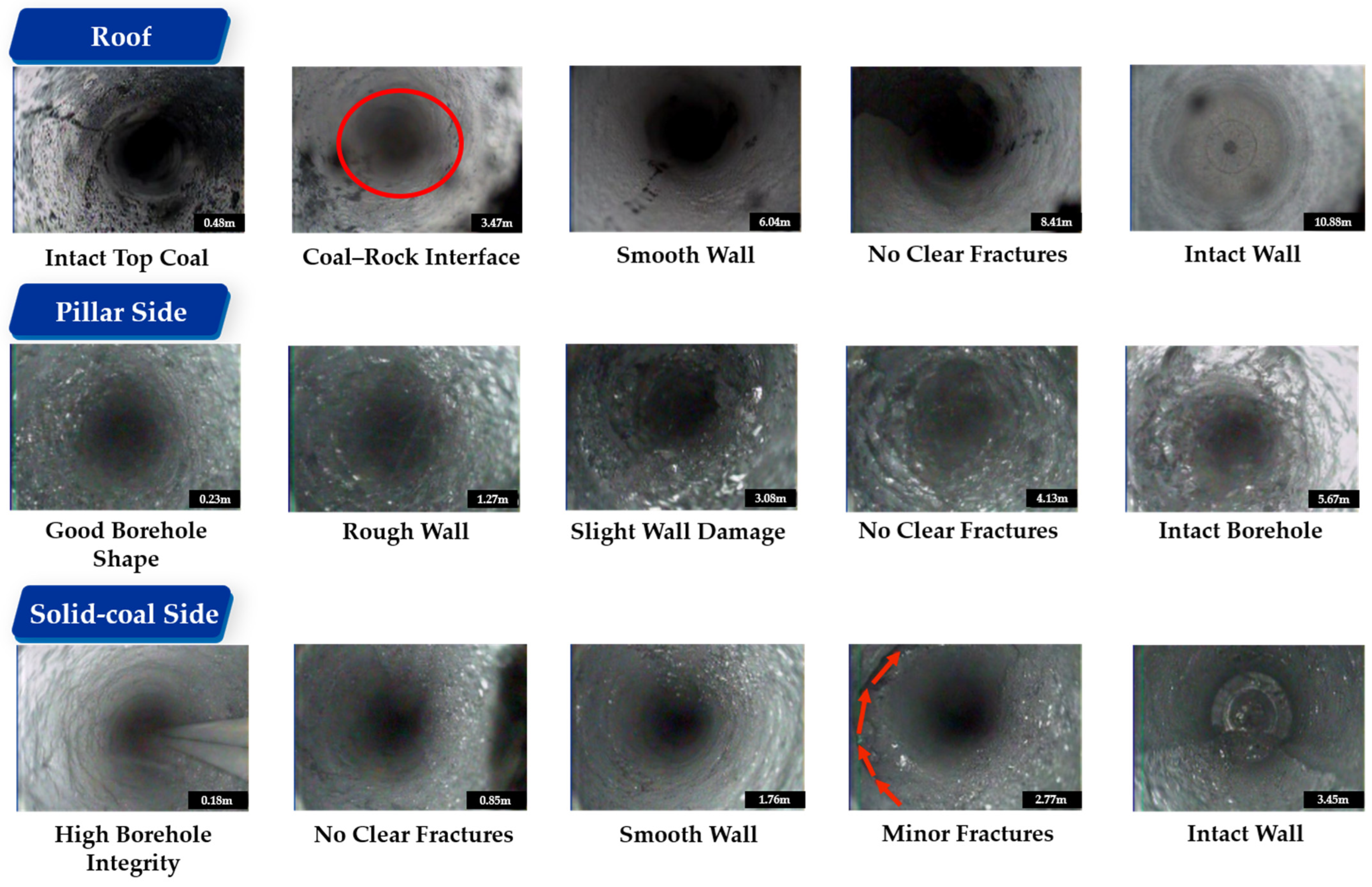
To further verify the internal structural condition of the surrounding rock after support, borehole imaging was carried out in the roof and the two ribs at the 300 m position of the 1609 return airway. The results are shown in Figure 18. The borehole images indicate that, although local fractures are still present within a certain depth range in the roof, the overall integrity of the roof remains relatively good. The surrounding rock conditions in the two ribs are more complex than those in the roof, but the coal wall as a whole maintains good integrity, and no large-scale through-going failure is observed. These results indicate that the proposed support scheme not only controls roadway surface deformation, but also improves the internal structural stability of the surrounding rock to some extent.
To further verify the reliability of the numerical model and the effectiveness of the proposed support scheme, the numerical results were compared with the field monitoring and borehole imaging results. The comparison mainly focuses on deformation patterns, failure distribution, and support effectiveness, as summarized in Table 7.
The comparison shows that the numerical simulation results are generally consistent with the field observations in terms of deformation patterns, failure distribution, and support effectiveness. Although a strict point-to-point quantitative comparison is difficult because of geological heterogeneity and differences in monitoring arrangements, the consistency in the main deformation characteristics indicates that the numerical model can reasonably reflect the surrounding-rock response of the 1609 return airway.
Overall, the field monitoring and borehole imaging results indicate that the proposed support scheme effectively controlled roof separation, roadway surface displacement, and internal surrounding-rock damage. The surrounding-rock gradually stabilized after excavation and no large-scale through-going failure was observed, demonstrate that the filed applicability of the proposed scheme for the 1609 return airway.

4. Discussion

The above results indicate that the stability of the gob-side roadway in a thick soft coal seam is jointly controlled by the load-bearing capacity of the narrow coal pillar, the stress redistribution around the roadway, and the effectiveness of the support structure. The numerical and field results consistently show that surrounding-rock control in this type of roadway cannot rely solely on local strengthening or on a single design parameter. Instead, it requires coordinated optimization of coal pillar width and structural reconstruction of the support system. Based on these findings, the following discussion focuses on the mechanical basis of the rational coal pillar width, the effectiveness of the proposed “narrow coal pillar + cross-rib anchorage” scheme, and its engineering implications and limitations.

4.1. Mechanism Underlying the Rational Width of the Narrow Coal Pillar

The numerical simulation results indicate that the width of the narrow coal pillar strongly affects the stability of the surrounding rock in the gob-side roadway. Its influence cannot be simply interpreted as “a wider pillar is always more stable” or “a narrower pillar is always more favorable for stress relief”. Instead, it depends on the overall balance among the load-bearing capacity of the coal pillar, the stress environment around the roadway, and the deformation response of the surrounding rock. For the gob-side roadway driven along the floor while retaining top coal in the thick soft coal seam considered in this study, if the coal pillar is too narrow, although the roadway and the pillar can be more easily arranged within the lateral abutment pressure reduction zone on the gob side, the pillar itself cannot form an effective load-bearing core. Its internal stress level remains low, and its structural integrity is insufficient. Under the combined action of strong mining disturbance and roof loading, the pillar is therefore more prone to overall shear slip and the expansion of plastic failure. Therefore, although the 2 m coal pillar has a certain advantage in low-stress layout, its load-bearing capacity is insufficient to satisfy the long-term stability requirements of the surrounding rock [17,18,19,20,21,22].
By contrast, when the coal pillar width is further increased to 4 m and 5 m, the internal stress level of the pillar increases, but stress concentration around the roadway, especially near the solid-coal rib and the roof, also becomes significantly stronger. In this case, the increase in pillar load-bearing capacity is achieved at the cost of a less favorable in the surrounding-rock stress environment, which makes the roof and the two ribs more susceptible to yielding expansion and deformation concentration. Thus, in gob-side roadways in thick soft coal seams, increasing the pillar width does not necessarily lead to a better control effect. On the contrary, an excessively wide pillar may strengthen the local concentrated bearing effect within the coal pillar-roof-solid coal system and aggravate incompatible deformation of the surrounding rock.
In comparison, the 3 m coal pillar shows better overall adaptability under the engineering conditions of this study [17,18,19,20,21,22]. On the one hand, this width allows the pillar to form a certain load-bearing core and maintain basic load-bearing capacity. On the other hand, it allows the roadway and the pillar to be preferentially arranged within the lateral abutment pressure reduction zone on the gob side, thereby reducing the adverse effect of mining-induced stress concentration on surrounding-rock stability. Therefore, the rationality of the 3 m coal pillar does not arise from a geometrically “moderate” size, but from the mechanical balance it achieves among pillar load-bearing capacity, stress redistribution, deformation control of the surrounding rock, and coal recovery. This judgment is also supported by the multi-index evaluation results, in which pillar load-bearing capacity, plastic zone development, stress concentration, roadway deformation, and coal recovery were considered together. The 2 m pillar is favorable for stress relief and coal recovery, but it cannot form a sufficiently continuous bearing core. The 4 m and 5 m pillars have higher load-bearing stress levels, but they produce stronger stress concentration and greater disturbance around the roadway. In contrast, the 3 m pillar maintains basic pillar continuity while keeping the roadway deformation and plastic failure within a relatively low range. This indicates that optimization of narrow coal pillar width should be based on a comprehensive criterion of “low-stress layout, effective bearing, controllable deformation, and reasonable coal recovery”, rather than on a single index. Different from studies that regarded pillar widening as the main stabilization strategy, the present case shows that the rational pillar width should be determined by balancing stability and engineering economy, as evidenced by the fact that the 3 m scheme provided better control over plastic failure and deformation than the 4 m and 5 m schemes.

4.2. Effectiveness of the “Narrow Coal Pillar + Cross-Rib Anchorage” Scheme

The proposed “narrow coal pillar + cross-rib anchorage” coordinated control scheme achieves effective control because it directly targets the dominant instability mechanism of the narrow coal pillar, namely overall shear slip, rather than merely strengthening the shallow broken surrounding rock locally [6,7,8,30,31]. Conventional asymmetric support usually limits rib deformation by strengthening the shallow surrounding rock on the coal-pillar side, and its effect is mainly concentrated within the shallow fractured zone. Once a through-going shear failure zone has already formed, or is still developing, inside the narrow coal pillar, simply increasing the number of shallow bolts or anchor cables, or raising the pretension, cannot fundamentally change the overall bearing structure of the pillar. In addition, the anchorage ends are likely to fall within the plastic failure zone and thus fail. Therefore, the ability of conventional support methods to control overall shear slip of the narrow coal pillar is limited [30,31].
In contrast, the cross-rib anchor cables penetrate the full section of the coal pillar and connect the surrounding rock on both sides, thereby enhancing the structural integrity of the narrow coal pillar and improving its weak internal stress state, local structural deficiency, and insufficient shear resistance. The mechanism of this support is not limited to increasing the confinement of the shallow surrounding rock on the pillar surface. More importantly, it reconstructs the internal load-transfer path of the pillar and enhances its coordinated bearing capacity across the shear plane, thereby suppressing the expansion of the dominant shear plane and preventing the further development of overall slip after shear-plane penetration [33]. The numerical simulation results show that, after support, the internal stress distribution of the 3 m coal pillar becomes more uniform and the plastic zone on the coal-pillar side is significantly reduced, indicating that cross-rib anchorage can effectively improve the stress state of the narrow coal pillar and enhance its overall shear resistance.
Besides strengthening the narrow coal pillar itself, the proposed scheme also improves roof stability through hierarchical anchorage. In addition, the hierarchical combined support system composed of short, medium-long, and long anchor cables forms a progressive control structure extending from the shallow loosened zone to the medium-deep fracture zone and finally to the deep stable strata in the roof. As a result, roof support no longer remains a local suspension measure at a single depth, but is transformed into a coordinated control mode involving shallow confinement, medium-deep combined bearing, and the mobilization of deep stable strata. In this way, the narrow coal pillar, the roof, and the surrounding rock of the two ribs no longer behave as independent deformation units, but gradually form a cooperative bearing structure. This is also the key reason why the proposed scheme can simultaneously reduce roof separation, suppress asymmetric convergence of the two ribs, and improve the internal structural stability of the surrounding rock.
Therefore, from the perspective of control mechanism, the advantage of the “narrow coal pillar + cross-rib anchorage” scheme does not simply lie in “higher support strength”, but in changing the bearing mode of the narrow coal pillar and the roof surrounding rock, thereby achieving a transition from “local passive strengthening” to “overall structural reconstruction”. This control concept, which is guided by the instability mechanism, has strong pertinence and potential applicability for the stability control of gob-side roadways under similar conditions in thick soft coal seams. Compared with conventional asymmetric support reported in previous studies [30,31], the present scheme focuses on structural reconstruction across the full section of the narrow coal pillar and therefore provides a more direct control path for suppressing overall shear slip, which is consistent with the observed redistribution of pillar stress and reduction in coal-pillar-side plastic failure in this case.

4.3. Engineering Implications and Limitations

From an engineering perspective, this study indicates that the key to surrounding-rock control in gob-side roadways driven along the floor while retaining top coal in thick soft coal seams does not lie simply in increasing support strength. Instead, it lies in reasonably determining the coal pillar width and reconstructing the cooperative bearing structure of the coal pillar and roof around the dominant instability mode of overall shear slip of the narrow coal pillar. For the 1609 return airway, the combined application of a 3 m coal pillar and the support system of “cross-rib anchor cables + short anchor cables + medium-long anchor cables + long anchor cables” reflects an integrated control concept of “width optimization-structural reconstruction-coordinated control”. The field monitoring results further demonstrate that this concept can effectively control roof separation, roadway surface displacement, and the extent of internal surrounding-rock damage, showing good field applicability. These results suggest that, for gob-side roadways characterized by low coal strength, well-developed joints and fractures, strong mining disturbance, and pronounced asymmetric surrounding-rock deformation, stability control can no longer rely solely on experience-based pillar width selection or local support strengthening [19,30]. Instead, coal pillar width optimization and support structure design must be considered in an integrated manner.
At the same time, several limitations of the present study should also be recognized. First, the numerical model necessarily simplifies the actual geological conditions and mining environment. Although the mechanical parameters used in the model were determined based on field tests, geological reports, engineering experience, and parameter calibration, the coal-rock mass was treated as an equivalent continuous medium. Individual joints and fractures were not explicitly modeled. Their weakening effect was indirectly considered through the reduced equivalent mechanical parameters, but the spatial distribution and progressive opening of discontinuities could not be fully reproduced. Second, although the Double-Yield model was used to simulate gob compaction and stress recovery, the full dynamic mining process of the 1609 working face was not explicitly simulated. The present numerical analysis mainly focused on the influence of the previously mined 1607 gob, roadway excavation, coal pillar width optimization, and support verification. Third, the conclusion that 3 m is the rational coal pillar width is mainly based on the specific geological conditions, burial depth, and mining environment of the 1609 return airway in Jiulishan Mine. Its applicability still needs to be verified under different coal seam thicknesses, roof-floor lithologic combinations, gob compaction states, and mining disturbance intensities. Fourth, the field monitoring results mainly reflect the surrounding-rock response after roadway excavation and during the early stabilization stage. Complete long-term monitoring data during the full advance of the 1609 working face are still not available, and continuous tracking during the subsequent mining-influenced stage is required. Finally, although the effectiveness of the proposed scheme has been verified by both numerical simulation and field testing, further studies are still needed on the sensitivity of different support parameters, different cross-rib anchorage layouts, and the coupling relationship between coal pillar width and support parameters.
Overall, by combining engineering geological analysis, instability mechanism study, numerical simulation, and field testing, this study systematically clarifies the key issues related to the stability control of narrow coal pillars in gob-side roadways in thick soft coal seams with retained top coal. The results indicate that determination of a rational narrow coal pillar width and construction of a coordinated support structure should be treated as an integrated task. This understanding provides a useful reference for optimizing surrounding-rock control schemes for gob-side roadways under similar conditions, although its broader applicability still requires further verification based on more engineering cases, longer-term field monitoring, and more refined numerical modeling that explicitly considers jointed coal-rock structures and dynamic mining disturbance.

5. Conclusions

Based on the engineering geological analysis, instability mechanism study, FLAC3D numerical simulation, and industrial field testing and monitoring, the main conclusions are as follows.
(1)
Gob-side roadways driven along the floor while retaining top coal in thick soft coal seams are strongly affected by adjacent-gob-induced stress redistribution and dynamic mining-induced loading. Under the combined effects of large mining height, insufficient filling of the gob by the caved immediate roof, weak retained top coal, and low coal strength, the narrow coal pillar is prone to compression–shear failure. A dominant shear plane can develop from the gob-side roof toward the floor and progressively cut through the pillar. Once this shear plane becomes through-going within the pillar, the continuous bearing structure of the pillar is destroyed, resulting in overall shear slip of the narrow coal pillar. As a result, coal-pillar-side rib bulging, asymmetric roof subsidence toward the pillar side, and rib–roof coupled instability are induced.
(2)
The rational width of the narrow coal pillar should be determined by considering not only the lateral abutment pressure reduction zone, but also the load-bearing capacity of the pillar, plastic zone development, stress concentration around the roadway, roadway deformation, and coal recovery. Comparative FLAC3D simulations of 2 m, 3 m, 4 m, and 5 m coal pillars show that the 2 m pillar has insufficient load-bearing capacity and cannot form a stable bearing core. Although the 4 m and 5 m pillars exhibit higher internal stress levels, they induce stronger stress concentration around the roadway and larger surrounding-rock deformation. Based on the multi-index evaluation, the 3 m coal pillar maintains a relatively continuous bearing core, effectively controls plastic zone expansion and roadway deformation, and provides a reasonable balance between surrounding-rock stability and coal recovery. Therefore, 3 m is determined as the rational narrow coal pillar width for the 1609 return airway.
(3)
A coordinated control scheme of “narrow coal pillar + cross-rib anchorage” was proposed to suppress overall shear slip of the narrow coal pillar and reconstruct the cooperative bearing structure of the pillar, roof, and ribs. Numerical verification shows that the proposed scheme improves the stress state of the 3 m coal pillar, reduces the plastic failure zone, and decreases roadway deformation. Field monitoring further confirms that roof separation increased slowly and then stabilized, the maximum deep roof separation was approximately 13 mm, and roadway surface displacement was controlled within 100 mm. Borehole imaging also shows that the internal surrounding rock remained generally stable after support implementation. These results indicate that the proposed scheme can effectively control roof separation, asymmetric rib deformation, and internal surrounding-rock damage, and that it has good engineering applicability for gob-side roadways under similar geological and mining conditions.

Author Contributions

Conceptualization, F.L. and J.L.; methodology, F.L. and G.F.; software, F.L. and G.X.; validation, J.L., G.F. and S.Z.; formal analysis, F.L.; investigation, F.L., D.Z. and S.Z.; resources, J.L., G.F. and S.L.; data curation, F.L. and G.X.; writing—original draft preparation, F.L.; writing—review and editing, J.L., G.F., D.Z. and S.L.; visualization, F.L. and G.X.; supervision, J.L. and G.F.; project administration, J.L. All authors have read and agreed to the published version of the manuscript.

Funding

This research was funded by the National Natural Science Foundation of China (No. 52574177), the Yunlong Lake Laboratory of Deep Underground Science and Engineering Project (No. 104024009), the Pioneering Project for Disciplinary Breakthroughs (No. JYB2025XDXM308).

Institutional Review Board Statement

Not applicable.

Informed Consent Statement

Not applicable.

Data Availability Statement

The data presented in this study are available on request from the corresponding author. The data are not publicly available due to privacy or ethical restrictions.

Acknowledgments

The authors would like to thank the technical staff and field engineers involved in the industrial field test and monitoring of the 1609 return airway for their support during data collection and field implementation.

Conflicts of Interest

Authors Feng Li and Di Zhang were employed by the company Jiulishan Coal Mine, Henan Coking Coal Energy Co., Ltd. The remaining authors declare that the research was conducted in the absence of any commercial or financial relationships that could be construed as a potential conflict of interest.

References

  1. Liu, W.T. Key mining technology for super-long fully mechanized top-coal caving face in soft thick seam. Coal Eng. 2019, 51, 38–43. [Google Scholar]
  2. Zhang, Z.G.; Zhu, Q.W.; Wan, X.; Tan, W.; Li, T. Roadway supporting control with extra-thick and soft coal seam in deep. Coal Min. Technol. 2019, 24, 67–72+21. [Google Scholar] [CrossRef]
  3. Yang, S.-Q.; Chen, M.; Jing, H.-W.; Chen, K.-F.; Meng, B. A case study on large deformation failure mechanism of deep soft rock roadway in Xin’an Coal Mine, China. Eng. Geol. 2017, 217, 89–101. [Google Scholar] [CrossRef]
  4. Kang, H.P.; Zhang, X.; Wang, D.P.; Tian, J.; Yi, Z.; Jiang, W. Strata control technology and applications of non-pillar coal mining. J. China Coal Soc. 2022, 47, 16–44. [Google Scholar] [CrossRef]
  5. Zhang, B.S.; Wang, P.F.; Cui, S.Q.; Fan, M.; Qiu, Y. Mechanism and surrounding rock control of roadway driving along gob in shallow-buried, large mining height and small coal pillars by roof cutting. J. China Coal Soc. 2021, 46, 2254–2267. [Google Scholar] [CrossRef]
  6. Fan, L.; Chang, J.; Chen, H. Rock failure mechanism and stability control of extraction roadways under extreme non-uniform pressure. Appl. Geophys. 2026, 23, 244–261. [Google Scholar] [CrossRef]
  7. Tian, M.; Han, L.; Yang, X.; Feng, Q.; Meng, Q.; Xie, Y.; Li, W.; Ma, C. Asymmetric deformation failure mechanism and support technology of roadways under non-uniform pressure from a mining disturbance. Bull. Eng. Geol. Environ. 2022, 81, 211. [Google Scholar] [CrossRef]
  8. Wang, D.; Zheng, Y.; He, F.; Song, J.; Zhang, J.; Wu, Y.; Jia, P.; Wang, X.; Liu, B.; Wang, F.; et al. Mechanism and control of asymmetric floor heave in the gob-side coal roadway under mining pressure in extra-thick coal seams. Energies 2023, 16, 4948. [Google Scholar] [CrossRef]
  9. Zheng, X.G.; Yao, Z.G.; Zhang, N. Stress distribution of coal pillar with gob-side entry driving in the process of excavation & mining. J. Min. Saf. Eng. 2012, 29, 459–465. [Google Scholar]
  10. Xie, G.X.; Yang, K.; Liu, Q.M. Study on distribution laws of stress in inclined coal pillar for fully mechanized top-coal caving face. Chin. J. Rock Mech. Eng. 2006, 25, 545–549. [Google Scholar]
  11. Li, L.; Bai, J.B.; Wang, X.Y. Rational position and control technique of roadway driving along next goaf in fully mechanized top-coal caving face. J. China Coal Soc. 2012, 37, 1564–1569. [Google Scholar] [CrossRef]
  12. Bai, J.B.; Hou, C.J.; Huang, H.F. Numerical simulation study on stability of narrow coal pillars roadway driving along goaf. Chin. J. Rock Mech. Eng. 2004, 23, 3475–3479. [Google Scholar]
  13. Zhang, J.; Liu, Q.Z.; Sun, Y.; Cai, W.; Zhang, J.; Chen, C. Structural stability of surrounding rock in shallow and thin bedrock gob-side entry driving. J. Min. Saf. Eng. 2020, 37, 647–654. [Google Scholar] [CrossRef]
  14. Peng, L.J.; Zhang, D.F.; Guo, Z.B.; Duan, Q. Numerical analysis of thick coal seam small pillar along gob roadway and its application. Rock Soil Mech. 2013, 34, 3609–3616+3632. [Google Scholar] [CrossRef]
  15. Hou, C.J.; Li, X.H. Stability principle of big and small structures of rock surrounding roadway driven along goaf in fully mechanized top-coal caving face. J. China Coal Soc. 2001, 26, 1–7. [Google Scholar] [CrossRef]
  16. Dong, W.; Peng, L.J.; Yan, X.Z.; He, W.S.; Jia, C. Research and application of small coal pillar gob-side entry driving in fully mechanized mining face with large mining height. Coal Eng. 2017, 49, 5–8+13. [Google Scholar]
  17. Wang, Q.; Gao, H.; Jiang, B.; Li, S.; He, M.; Wang, D.; Lu, W.; Qin, Q.; Gao, S.; Yu, H. Research on reasonable coal pillar width of roadway driven along goaf in deep mine. Arab. J. Geosci. 2017, 10, 466. [Google Scholar] [CrossRef]
  18. Jiang, L.; Zhang, P.; Chen, L.; Hao, Z.; Sainoki, A.; Mitri, H.S.; Wang, Q. Numerical approach for goaf-side entry layout and yield pillar design in fractured ground conditions. Rock Mech. Rock Eng. 2017, 50, 3049–3071. [Google Scholar] [CrossRef]
  19. Gao, Y.; Liu, D.; Zhang, X.; He, M. Analysis and optimization of entry stability in underground longwall mining. Sustainability 2017, 9, 2079. [Google Scholar] [CrossRef]
  20. Yang, T.; Zhang, Y.; Zhang, J.; Lin, H.; Bao, R.; He, Y.; Yan, Y.; Luo, P.; Wu, H.; Sun, J.; et al. Study on the stability and reasonable width of coal pillars in “three soft” coal seams based on a physical similarity simulation experiment. Appl. Sci. 2024, 14, 6127. [Google Scholar] [CrossRef]
  21. Xu, G.A.; Jing, H.W.; Ding, S.X.; Niu, S.J.; Ma, B. Evolution rules of stress and displacement for narrow coal pillars between double gob-side entries. J. Min. Saf. Eng. 2010, 27, 160–165. [Google Scholar]
  22. Wang, M.; Xu, Y.; Xu, Q.; Shan, C.; Li, Z.; Nan, H.; Li, Y.; Liu, H.; Chu, T. Stability control of overburden and coal pillars in the gob-side entry under dynamic pressure. Int. J. Rock Mech. Min. Sci. 2023, 170, 105490. [Google Scholar] [CrossRef]
  23. He, M.C.; Chen, S.Y.; Guo, Z.B.; Yang, J.; Gao, Y. Control of surrounding rock structure for gob-side entry retaining by cutting roof to release pressure and its engineering application. J. China Univ. Min. Technol. 2017, 46, 959–969. [Google Scholar] [CrossRef]
  24. Zhang, G.F.; He, M.C.; Yu, X.P.; Huang, Z.G. Research on the technique of no-pillar mining with gob-side entry formed by advanced roof caving in the protective seam of Baijiao Coal Mine. J. Min. Saf. Eng. 2011, 28, 511–516. [Google Scholar]
  25. He, M.C.; Gao, Y.B.; Yang, J.; Guo, Z.; Wang, E.; Wang, Y. An energy-gathered roof cutting technique in no-pillar mining and its impact on stress variation in surrounding rocks. Chin. J. Rock Mech. Eng. 2017, 36, 1314–1325. [Google Scholar] [CrossRef]
  26. Chai, Y.; Wang, M.; Meng, L.; Wang, C.; Liang, Z.; Yang, Y.; Liu, J. Influence of roof cutting depth on stability of gob side entry in thick coal seams with a bulky limestone roof. Sci. Rep. 2025, 15, 31267. [Google Scholar] [CrossRef] [PubMed]
  27. Kang, H.P.; Wang, J.H.; Lin, J. Case studies of rock bolting in coal mine roadways. Chin. J. Rock Mech. Eng. 2010, 29, 649–664. [Google Scholar]
  28. Kang, H.P.; Yan, L.X.; Guo, X.P.; Zhang, Z.; Gao, F. Characteristics of surrounding rock deformation and reinforcement technology of retained entry in working face with multi-entry layout. Chin. J. Rock Mech. Eng. 2012, 31, 2022–2036. [Google Scholar]
  29. Kang, H.P.; Lin, J.; Zhang, B.C. Study on small borehole pretensioned cable reinforcing complicated roadway. Chin. J. Rock Mech. Eng. 2003, 22, 387–390. [Google Scholar]
  30. Chen, X.X.; Zhang, T.; Wang, Y.L. Study on influencing factors of surrounding rock deformation and asymmetric support technology for roadway driving along goaf with narrow coal pillars. J. Henan Polytech. Univ. Nat. Sci. 2021, 40, 24–33. [Google Scholar] [CrossRef]
  31. Xie, S.; Wu, Y.; Chen, D.; Liu, R.; Han, X.; Ye, Q. Failure analysis and control technology of intersections of large-scale variable cross-section roadways in deep soft rock. Int. J. Coal Sci. Technol. 2022, 9, 19. [Google Scholar] [CrossRef]
  32. Zheng, W.; Wei, C.; Guo, S.; Zhuang, Z.; Shi, C. Overburden movement laws in thin bedrock workfaces under thick backfilled loose bodies. Sci. Rep. 2025, 15, 41874. [Google Scholar] [CrossRef]
  33. He, Z.-L.; Lu, C.-P.; Zhang, X.-F.; Guo, Y.; Wang, C.; Zhang, H.; Wang, B.-Q. Research on mechanisms and precursors of slip and fracture of coal–rock parting–coal structure. Rock Mech. Rock Eng. 2022, 55, 1343–1359. [Google Scholar] [CrossRef]
Figure 1. Plan view of the mining and excavation layout of the 1609 working face.
Applsci 16 05677 g001
Figure 2. Comprehensive stratigraphic column of the 1609 return airway.
Applsci 16 05677 g002
Figure 3. Roadway section, borehole layout, and borehole imaging results of the 1607 return airway: (a) borehole layout in the roadway section; (b) coal-pillar side; (c) roof; (d) solid-coal side. The white arrows indicate fractures observed in the borehole images.
Applsci 16 05677 g003
Figure 4. Deformation and failure characteristics of the 1607 return airway under the original support system.
Applsci 16 05677 g004
Figure 5. Schematic diagram of the shear-slip instability mechanism of the narrow coal pillar in the gob-side roadway with retained top coal: (a) stress distribution of the narrow coal pillar and overburden structure under mining disturbance; (b) shear-slip failure mechanism and stress evolution characteristics of the narrow coal pillar; (c) coordinated failure mode of the roadway surrounding rock.
Applsci 16 05677 g005
Figure 6. Three-dimensional numerical model and representative mining layout.
Applsci 16 05677 g006
Figure 7. Distribution curve of lateral abutment pressure on the gob side after extraction of the upper panel. The horizontal dashed line indicates the in situ stress level, and the red dashed lines mark the boundaries between the pressure-reduction, stress-increasing, and stress-stabilization zones.
Applsci 16 05677 g007
Figure 8. Schematic diagram of the hierarchical combined support system for the 1609 return airway. In the figure, “Φ” denotes the diameter of anchor cables, and “16# channel steel” refers to No. 16 channel steel.
Applsci 16 05677 g008
Figure 9. Layout of the monitoring scheme in the 1609 return airway.
Applsci 16 05677 g009
Figure 10. Vertical stress distribution and variation curves of the surrounding rock under different coal pillar widths: (a) three-dimensional numerical models for different coal pillar widths; (b) 2 m coal pillar; (c) 3 m coal pillar; (d) 4 m coal pillar; (e) 5 m coal pillar; (f) vertical stress variation curve.
Applsci 16 05677 g010aApplsci 16 05677 g010b
Figure 11. Distribution and range comparison of the plastic zone of the surrounding rock under different coal pillar widths: (a) 2 m coal pillar; (b) 3 m coal pillar; (c) 4 m coal pillar; (d) 5 m coal pillar; (e) comparison of plastic zone distribution and extent.
Applsci 16 05677 g011aApplsci 16 05677 g011b
Figure 12. Roof subsidence distribution and variation curves under different coal pillar widths: (a) three-dimensional numerical models for different coal pillar widths; (b) 2 m coal pillar; (c) 3 m coal pillar; (d) 4 m coal pillar; (e) 5 m coal pillar; (f) roof subsidence variation curve.
Applsci 16 05677 g012aApplsci 16 05677 g012b
Figure 13. Rib displacement distribution and variation curves under different coal pillar widths: (a) three-dimensional numerical models for different coal pillar widths; (b) 2 m coal pillar; (c) 3 m coal pillar; (d) 4 m coal pillar; (e) 5 m coal pillar; (f) rib displacement variation curve.
Applsci 16 05677 g013aApplsci 16 05677 g013b
Figure 14. Changes in stress distribution and plastic zone of the surrounding rock before and after support: (a) vertical stress distribution of the surrounding rock after support; (b) comparison of roof vertical stress before and after support; (c) plastic zone distribution of the surrounding rock after support; (d) comparison of the plastic zone before and after support.
Applsci 16 05677 g014aApplsci 16 05677 g014b
Figure 15. Comparison of displacement and deformation of the surrounding rock before and after support: (a) vertical displacement distribution of the surrounding rock after support; (b) comparison of roof subsidence before and after support; (c) horizontal displacement distribution of the surrounding rock after support; (d) comparison of rib convergence before and after support.
Applsci 16 05677 g015
Figure 16. Roof separation in the 1609 return airway.
Applsci 16 05677 g016
Figure 17. Roadway deformation in the 1609 return airway.
Applsci 16 05677 g017
Figure 18. Borehole imaging results at the 300 m section of the 1609 return airway. The red arrows and red circle indicate fractures observed in the borehole images.
Applsci 16 05677 g018
Table 1. Mechanical parameters of the coal and rock strata used in the numerical model.
LithologyElastic Modulus/GPaPoisson’s RatioCohesion
/MPa
Internal Friction Angle/(°)Density
/(kg·m−3)
Tensile Strength/MPa
Fine-grained sandstone6.30.231.93526002.3
Siltstone5.20.252.03425202.1
Sandy mudstone3.80.271.92922501.2
Medium-grained sandstone6.30.231.93526002.3
Siltstone4.30.262.23123801.6
Coal2.40.281.02414801.0
Mudstone3.80.271.92922501.2
Siltstone5.20.252.03425202.1
Table 2. Mechanical parameters of the gob and caved roof materials in the Double-Yield model.
MaterialDensity/kg·m−3Initial Bulk Modulus/GPaInitial Shear Modulus/GPaMaximum Bulk Modulus/GPaMaximum Shear Modulus/GPaCohesion/MPaInternal Friction Angle/°
Gob material16000.050.036.004.000.0130
Caved roof material20000.200.158.006.000.0135
Table 3. Compaction parameters of gob and caved roof materials.
MaterialPlastic Volumetric StrainCap Pressure/MPa
Gob material0.000.10
0.020.50
0.053.00
0.108.00
0.1515.00
0.2530.00
0.3550.00
Caved roof material0.000.50
0.012.00
0.0310.00
0.0625.00
0.1050.00
Table 4. Sensitivity of lateral abutment pressure distribution to caved-rock compaction stiffness.
SchemeCap-Pressure Scaling FactorPeak Abutment Pressure/MPaPeak Position from Gob Edge/mStress-Reduction Zone/mTheoretical Maximum Pillar Width/m
Low compaction stiffness0.823.32≈270–11.66.1
Calibrated compaction stiffness1.023.61≈270–11.76.2
High compaction stiffness1.223.65≈270–11.76.2
Table 5. Mesh sensitivity analysis of the 3 m coal pillar model.
Mesh SchemeMinimum Element Size Near the Roadway/mRoadway Section DiscretizationNumber of ZonesNumber of GridpointsPeak Vertical Stress/MPaMaximum Roof Subsidence/mmMaximum Rib Displacement/mm
Adopted mesh0.511 × 7484,875530,03730.87117.72265.20
Refined mesh0.2522 × 141,159,8751,226,40932.15121.27248.19
Difference/%--139.21 1131.38 14.15 13.02 1−6.41 1
1 The relative difference was calculated using the adopted mesh result as the reference value, as follows: D i f f e r e n c e = X r e f i n e d     X a d o p t e d X a d o p t e d × 100 % . where Xadopted and Xrefined represent the numerical results obtained from the adopted mesh and refined mesh, respectively.
Table 6. Multi-index evaluation of coal pillar width.
Coal Pillar Width/mLoad-Bearing Capacity of PillarPlastic Zone DevelopmentStress Concentration Around RoadwayRoadway DeformationCoal RecoveryOverall Evaluation
2Insufficient; difficult to form an effective bearing coreRelatively large plastic failure zoneLow internal stress but weak bearing structureRelatively large deformationHighestUnstable
3Moderate and continuous bearing capacityPlastic zone is effectively controlledRelatively gentle stress distributionRoof and rib deformation are effectively controlledHighOptimal
4Higher bearing stress levelPlastic zone does not further decrease significantlyStress concentration near the roadway increasesDeformation increases locallyLowerAcceptable but not preferred
5Higher bearing stress levelPlastic zone control does not improve significantlyMore pronounced stress concentrationLarger surrounding-rock deformationLowestNot recommended
Table 7. Comparison between numerical simulation results and field observations.
ItemNumerical Simulation ResultField Monitoring/Observation ResultConsistency
Roof
deformation
After support, the maximum roof subsidence decreased from 117 mm to 95 mm, indicating that roof deformation was effectively controlledRoof separation increased slowly during the first 60–90 days and then stabilized; the maximum deep separation at the 200 m station was about 13 mmGenerally
consistent
Rib
deformation
After support, rib convergence decreased from 262 mm to 151 mm, indicating that rib deformation was significantly reducedRoadway surface displacement gradually stabilized after about 80 days, and the maximum surface displacement was controlled within 100 mmGenerally
consistent
Failure
distribution
The plastic failure zone on the coal-pillar side and in the roof decreased after supportBorehole imaging showed that the roof and two ribs remained generally intact, and no large-scale through-going failure was observedConsistent
Control
effect
The support scheme improved the stress state of the 3 m narrow coal pillar, reduced plastic failure, and controlled roof and rib deformationField monitoring showed that roof separation, roadway surface displacement, and internal surrounding-rock damage were effectively controlledConsistent
Disclaimer/Publisher’s Note: The statements, opinions and data contained in all publications are solely those of the individual author(s) and contributor(s) and not of MDPI and/or the editor(s). MDPI and/or the editor(s) disclaim responsibility for any injury to people or property resulting from any ideas, methods, instructions or products referred to in the content.