Article

Changes in the Soil Microbiome of Arable Soils in the Permafrost-Affected Zone During Their Transition to a Fallow State


1
Department of Applied Ecology, Faculty of Biology, St. Petersburg State University, 7/9 Universitetskaya Nab., 199034 St. Petersburg, Russia
2
Cryosphere Research Station on the Qinghai–Tibet Plateau, State Key Laboratory of Cryospheric Science and Frozen Soil Engineering, Northwest Institute of Eco-Environment and Resources (NIEER), Chinese Academy of Sciences, 320 Donggang West Road, Lanzhou 730000, China
3
All-Russian Research Institute for Agricultural Microbiology (ARRIAM), 3 Podbelsky Chaussee, 196608 St. Petersburg, Russia
*
Author to whom correspondence should be addressed.
Appl. Sci. 2026, 16(11), 5613; https://doi.org/10.3390/app16115613
Submission received: 5 May 2026 / Revised: 26 May 2026 / Accepted: 29 May 2026 / Published: 3 June 2026
(This article belongs to the Section Ecology Science and Engineering)

Abstract

Agricultural land abandonment is widespread in high-latitude regions, yet its effects on soil microbial communities in permafrost ecosystems remain insufficiently understood. In this study, we used a 0–25 year chronosequence of abandoned soils in the Yamalo–Nenets Autonomous Okrug to analyze the succession of soil microbial communities and compared them with mature reference Podzols. Soil physicochemical properties, microbial community composition, and potential functional changes were systematically assessed using 16S rRNA gene sequencing, multivariate statistical analyses, and functional prediction. The results showed that, in mature soils, SOC was the key factor driving microbial community variation, whereas in agricultural and abandoned soils, available nutrients were the main factors influencing microbial community structure. The abandonment process also constrained soil microbial mineralization. The dominant microbial phyla mainly included Proteobacteria, Acidobacteriota, Verrucomicrobiota, Bacteroidota, and Actinobacteriota, while the relative abundances of other taxa differed markedly among land-use stages. Agricultural soils were dominated by copiotrophic microbial groups, whereas microbial communities in abandoned soils gradually shifted toward oligotrophic groups with increasing recovery time, and some taxa associated with the degradation of complex carbon substrates also increased in abundance. Functional analysis further indicated that carbon and phosphorus cycling functions in soil microbial communities exhibited a certain degree of functional redundancy, whereas nitrogen-cycling functions depended more strongly on specific microbial taxa. Land abandonment promoted an increase in the abundance of genes related to microbial carbon metabolism in soil. However, even after 25 years of abandonment, microbial community composition and functional potential had not fully recovered to the level of mature reference Podzols, indicating that agricultural disturbance exerts long-term legacy effects on soil microbiomes in permafrost-affected regions.

1. Introduction

Over the past two decades, driven by global population growth and rising food demand, agricultural land has expanded substantially; approximately 90% of forest loss has occurred within agriculture-driven landscapes, yet only about half of that area has actually been converted into productive agricultural land, with the remainder persisting as degraded lands and other low-productivity states [1]. The conversion of natural ecosystems to agricultural use induces taxonomic and functional homogenization of soil microbial communities and reshapes functional guilds: genes associated with biological nitrogen fixation and phosphorus acquisition/transport are markedly depleted in croplands, whereas genes involved in nitrification and denitrification are elevated [2]. This shift tends to increase emissions of the greenhouse gas N2O [3] and to diminish ecosystem multifunctionality and stability. Given the central role of the soil microbiome in crop health and yield [4] and in the formation and stabilization of soil structure [5], such changes have direct implications for human well-being. Meanwhile, the microbiome drives biogeochemical cycles, governs the formation and turnover of soil organic carbon (SOC), and is tightly linked to forest soil carbon stocks, thereby influencing greenhouse gas fluxes [6]. Because subarctic regions store vast soil-carbon pools that are strongly modulated by freeze–thaw dynamics, they play a pivotal role in the global carbon balance [7].
In the post-Soviet period, Russia experienced large-scale abandonment of cropland and other agricultural lands; subsequent early recultivation in some areas may have reduced carbon sequestration rates in original boreal forests [8]. The Salekhard area lies in the transition zone of discontinuous permafrost, with soils dominated by Cryosols and Podzols and extensive peat soils (Histosols) [9]. In this region, post-agricultural soils tend to develop toward the state of mature reference Podzols as time since abandonment increases [10]. The morphological characteristics of abandoned agricultural soils appear to remain relatively stable over time, likely because cryoturbation is less pronounced in sandy substrates than in clay-rich tundra soils. Surface acidification intensifies eluviation, and further strengthening of leaching may lead to degradation of the plow layer [11]. Regionally, fallow Plaggic Podzols exhibit significantly lower SOC and total nitrogen than tundra Histic Cryosols [12]. Meanwhile, mature reference soils here possess thick organic horizons and are strongly regulated by freeze–thaw dynamics. Against this background, systematically analyzing the soil microbial community structure and function in this area will help formulate management strategies for fallow lands and promote the sound use of land resources in cold permafrost regions.
This study aimed to analyze the temporal dynamics of the microbiome and its environmental drivers after conversion of cultivated land to fallow in Russia’s permafrost zone (Yamalo-Nenets Autonomous Okrug as a case study). To this end, the following objectives were defined: (1) to analyze the relationships between major environmental factors and soil microbial community composition across soils of different abandonment ages and mature reference soils; (2) to identify succession patterns of soil microbial community composition and taxonomic diversity during fallow land development under permafrost conditions; (3) to evaluate changes in functional diversity and metabolic potential of microbial communities associated with carbon, nitrogen, and phosphorus cycling; and (4) to investigate the relationship between taxonomic diversity and functional diversity, and to assess the degree of soil microbiome recovery after the cessation of agricultural activities.
We hypothesized that increasing time since agricultural abandonment would shift soil bacterial communities toward those of mature Podzols, with a decline in copiotrophic taxa associated with nutrient-rich agricultural soils and an increase in oligotrophic and organic-matter-decomposing taxa adapted to acidic, carbon-rich Podzol conditions. We further hypothesized that these taxonomic changes would be accompanied by enhanced predicted carbon-cycling functions. Functional redundancy was expected to help maintain key soil functions despite changes in microbial community composition.

2. Materials and Methods

2.1. Study Area Description

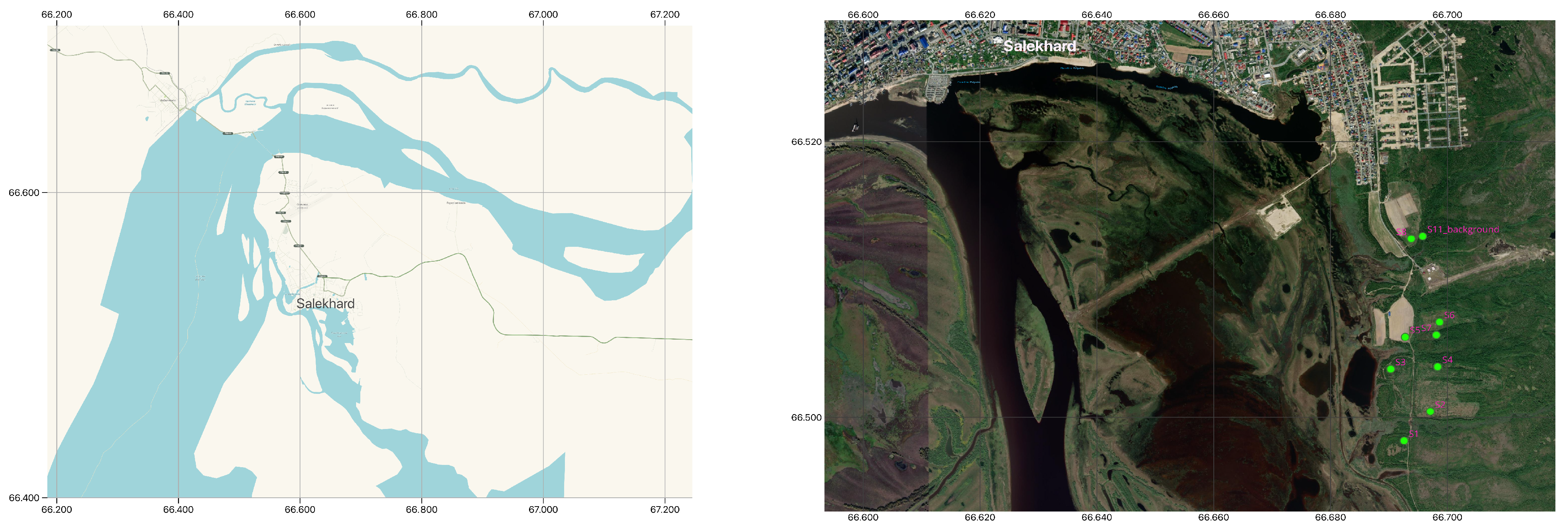
The study was conducted in the vicinity of Salekhard, the administrative center of the Yamalo-Nenets Autonomous Okrug (YNAO), Russia, situated directly on the Ob River and lying near the Arctic Circle (approximately 66°30′ N, 66°42′ E). The experimental plots lie within floodplain terraces, wetlands, and gently undulating terrain characteristic of the tundra–forest tundra transition zone (Figure 1).
Figure 1. Location of the study area and sampling sites in the vicinity of Salekhard, Yamalo-Nenets Autonomous Okrug, Russian Subarctic. The map shows the position of the study area and the distribution of the nine sampling sites representing active agricultural soil, abandoned agricultural soils of different abandonment ages, and mature reference Podzols (Table 1).
Applsci 16 05613 g001
The Salekhard area is underlain predominantly by sandy and sandy-loam Quaternary deposits, which historically facilitated drainage and made agricultural use feasible in the past [13]. The area is characterized by a Subarctic climate (Köppen classification: Dfc), with a mean annual air temperature of about −5.1 °C; average temperatures reach approximately −23.1 °C in January and +15 °C in July. Sub-zero temperatures persist for up to 240 days per year, and the growing season lasts fewer than 70 days. Annual precipitation is around 500 mm, with a marked summer maximum [14]. Permafrost is widespread and largely continuous or near-continuous, with only a seasonally thawed active layer developing above the frozen ground [13]. The most common soil types include Podzols in forests and sparse woodlands, as well as peat soils and Histic Gleysols in swampy areas.
The surveyed abandoned and cultivated fields are located on the high right bank of the Ob River. According to archival records, this land parcel belonged to the Yamal Experimental Agricultural Station and was subjected to regular crop rotation until the 1990s, with potato as the main cultivated crop. In 2019, the fields were completely abandoned, leading to their transition into an unmanaged ecosystem [15,16,17].
Table 1. Description of sampling locations.
SampleSoil UsageNESoil TypeHorizonRoutine AnalysisMicrobiological Analysis
S5Active agriculture
(0 years)
66.505866.6928Hortic Podzol (Arenic, Cordic)AY++
S6Abandoned agriculture (5 years)66.506966.6987Plaggic Albic Podzol (Arenic, Cordic)AYpa++
S8Abandoned agriculture (10 years)66.513066.6938Plaggic Ortsteinic Podzol (Arenic)AYpa++
S4Abandoned agriculture (16 years)66.503766.6983Plaggic Turbic Gleyic Ortsteinic Podzol (Arenic)AYpa++
S2Abandoned agriculture (17 years)66.500466.6971Plaggic Turbic Ortsteinic Podzol (Siltic)AYpa++
S3Abandoned agriculture (20 years)66.503566.6903Plaggic Podzol (Siltic, Cordic)AYpa++
S1Abandoned agriculture (25 years)66.498366.6926Plaggic Ortsteinic Podzol (Siltic)AYpa++
S7Mature reference soil66.506066.6981Folic PodzolAH++
S11 (background)Mature reference soil66.513166.6958Histic Entic Podzol (Folic)—undisturbedTJ++
Note: “+” indicates presence. Soil types are given according to the World Reference Base for Soil Resources (WRB) [18]. Horizon designations follow the Russian soil classification system: AY = grey-humus/soddy humus horizon; AYpa = post-agrogenic grey-humus horizon; AH = muck-dark humus horizon; TJ = dry peat horizon [19].

2.2. Soil Sampling Strategy

The fieldwork was conducted in August 2023 at nine sampling sites. For microbiological analysis, soil was collected from the surface organomineral horizons (A) of agricultural and abandoned soils and from the organic horizon (H) of the mature Histic Podzol. Six independent sequencing samples were collected from each site, giving a total of 54 samples (Table 1). Soil physicochemical properties were available for three samples per site. Microbiological samples were transported at +4 °C and stored at −20 °C until analysis.
For soil chemical analyses, subsamples from the 5–15 cm layer were air-dried, sieved, and homogenized before further analysis. Detailed physicochemical analytical procedures are provided in previous studies [17].

2.3. DNA Extraction

Total soil DNA was extracted using the Research Institute for Agricultural Microbiology (RIAM) protocol [20], which employs a high-phosphate buffer to minimize DNA adsorption onto soil minerals and Cetyltrimethylammonium bromide (CTAB)-mediated precipitation to achieve efficient isolation from humic-rich substrates. The quality and integrity of the extracted DNA were assessed by PCR amplification followed by agarose gel electrophoresis. The hypervariable V4 region of the bacterial 16S rRNA gene was amplified using the universal primers 515F (5′-GTGCCAGCMGCCGCGGTAA-3′) and 806R (5′-GGACTACVSGGGTATCTAAT-3′) [21]. High-throughput sequencing was subsequently performed on the Illumina MiSeq platform (Illumina, San Diego, CA, USA) at the Centre for Genomic Technologies, Proteomics and Cell Biology (ARRIAM, St. Peterburg, Russia).

2.4. Bioinformatic Analysis

Raw sequence data were analyzed using R version 4.5.0 [22]. Paired-end FASTQ files were processed with the dada2 package (v1.36.0) [23], including quality filtering and trimming (minimum length thresholds of 290 bp for forward reads and 210 bp for reverse reads, with maximum expected error rates [maxEE] set to 2 for both directions). Error rates were learned from the data, and denoising was performed to infer amplicon sequence variants (ASVs). Forward and reverse reads were subsequently merged, chimeras removed, and an ASV table was constructed. ASVs were taxonomically classified using the naïve Bayesian classifier in dada2 with the SILVA reference database (v138.1) [24]. The ASV table, taxonomy assignments, and metadata were integrated into a phyloseq object (v1.52.0) [25,26] for downstream analysis, including diversity estimation and visualization.
Alpha-diversity metrics (observed richness, Chao1, Shannon, Simpson) were computed with phyloseq (v1.52.0) and visualized using ggplot2 (v3.5.2) [27]. Differences among soil groups were assessed by one-way ANOVA followed by Tukey’s HSD post hoc tests. Beta diversity was quantified as Bray–Curtis dissimilarities computed with vegan (v2.7.1) [28]. Ordination was performed by NMDS and group differences tested with PERMANOVA (adonis2) [29].
Pearson correlation analysis was performed to examine the relationships between soil physicochemical properties and age of abandonment, with statistical significance set at p < 0.05 [30]. Spearman’s rank correlation was used to quantify associations between genera and different carbon fractions [31]. Solid-state 13C NMR spectral data for carbon functional group proportions were obtained from the literature [14].
Functional profiles were predicted from the original ASV table using PICRUSt2 (v2.6.3) [32]. PICRUSt2 places representative sequences into a reference phylogeny and predicts KEGG Orthology (KO) abundances. Predicted relative abundances of KOs related to carbon, nitrogen, and phosphorus cycling were visualized using boxplots [33]. Differences among soil groups were tested using the Kruskal–Wallis test [34], followed by Dunn’s post hoc test with Benjamini–Hochberg correction, implemented in the rstatix package [35,36]. Genes with p < 0.01 were considered significantly different among groups.
Thirteen carbon cycle-related pathways were identified from the KEGG database, and the corresponding KO genes were extracted from the PICRUSt2-predicted functional profiles. Hellinger-transformed abundance data were analyzed using canonical correspondence analysis (CCA) [37], as detrended correspondence analysis (DCA) revealed a long gradient on the first axis (8.38 SD). Environmental variables (pHw, SOC, TN, C:N, P, K, NH4+, NO3, DOC, SOCpm, and BAS) were z-standardized, and highly collinear predictors (|r| ≥ 0.7 or VIF ≥ 10) were excluded.

3. Results

3.1. Soil Microbiota

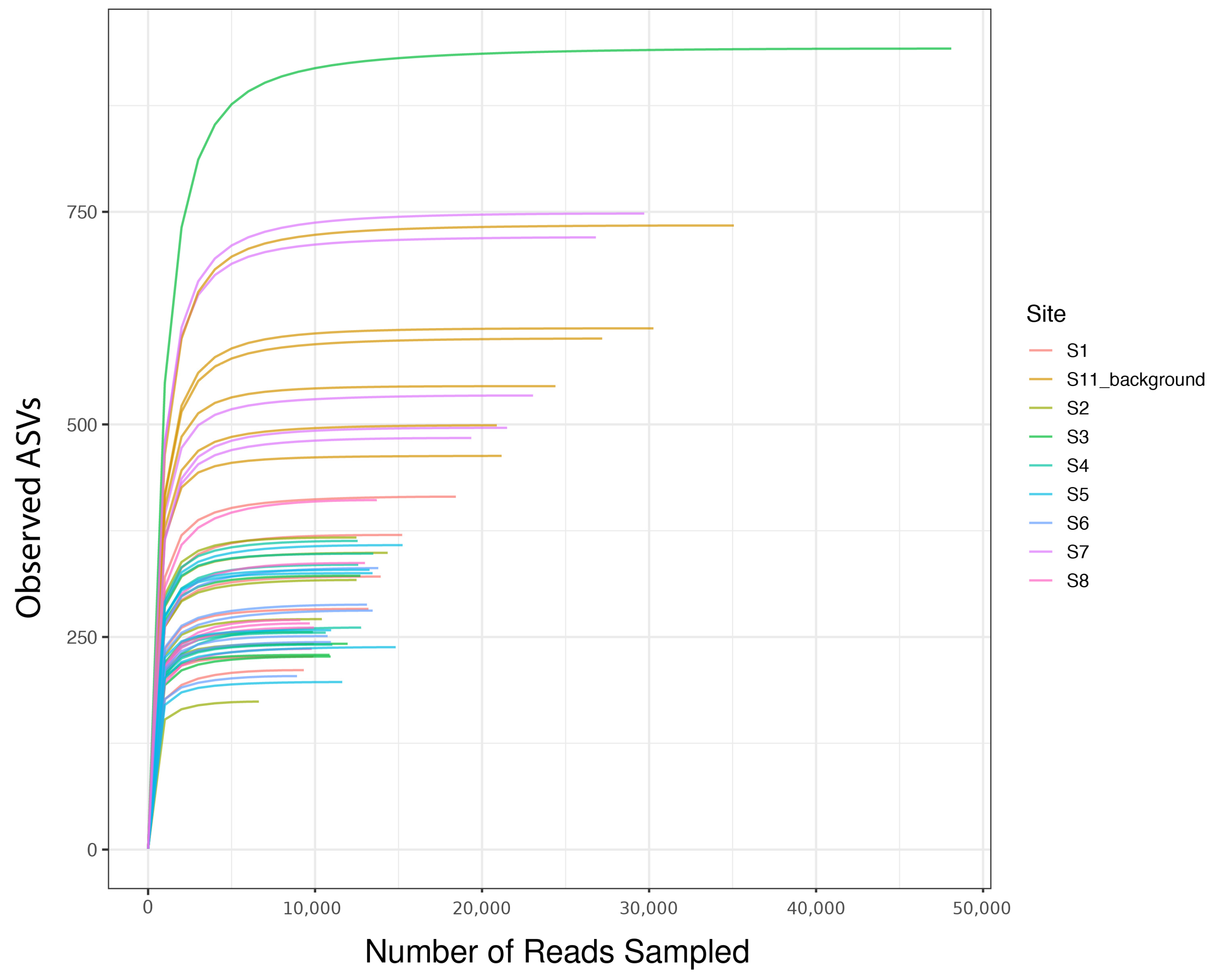
Following quality filtering, denoising and chimera removal, 841,548 high-quality reads were retained from 54 soil samples and resolved into 9324 amplicon sequence variants (ASVs). Sequencing depth after quality control ranged from 6632 to 48,095 reads per sample, with a mean of 15,584 reads and a median of 13,044 reads. The rarefaction curves increased steeply at low sequencing depths and then gradually approached an asymptote (Figure 2), indicating that the sequencing depth was sufficient to characterize the main patterns of bacterial diversity. For downstream diversity analyses, all libraries were rarefied to 6600 reads per sample, slightly below the lowest post-QC library size in the dataset (6632 reads). This threshold retained all 54 samples while standardizing sequencing effort and reducing biases associated with unequal library sizes.
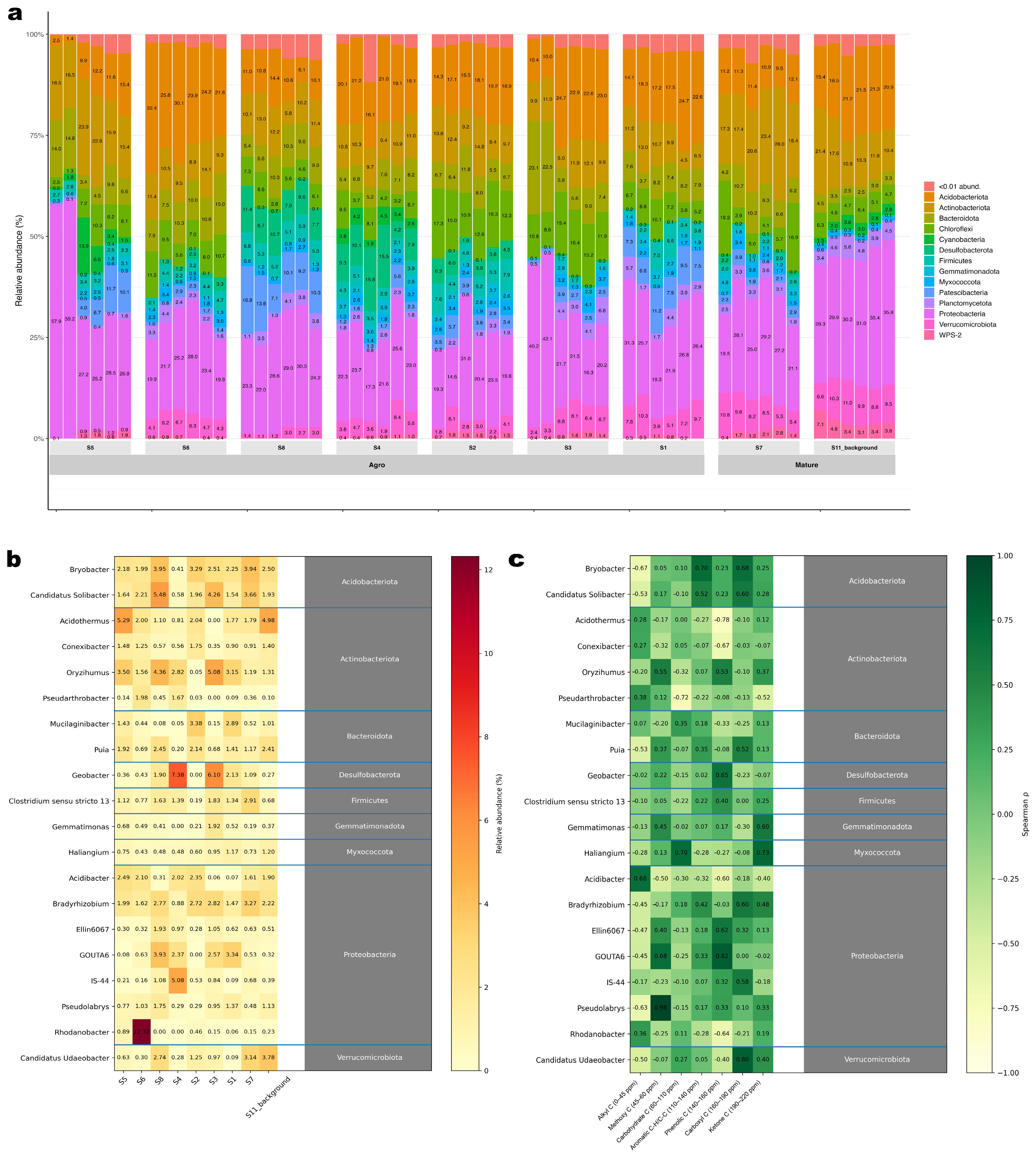
The taxonomic composition at the phylum level was dominated by Proteobacteria (mean 30.4%), Acidobacteriota (mean 16.7%), and Actinobacteriota (14.9%), followed by Chloroflexi and Bacteroidota (Figure 3a). Other phyla such as Verrucomicrobiota, Desulfobacterota, Patescibacteria, Firmicutes, and Planctomycetota were also consistently detected at lower relative abundances.
Across land-use types, agricultural soils (0 year) were characterized by elevated Proteobacteria (up to 59.2%), Cyanobacteria, and Bacteroidota with lower Acidobacteriota. Abandoned soils (5–25 years) showed enrichment of Acidobacteriota (up to 30.1%) and Verrucomicrobiota, alongside a decline in Actinobacteriota. Chloroflexi displayed a temporary peak in mid-term fallows (17–20 years). In mature reference soils, the relative abundances of Acidobacteriota, Verrucomicrobiota, and Actinobacteriota were relatively high.
Based on genus-level analysis, the 20 most abundant genera were identified (Figure 3b). In both agricultural and mature reference soils, members of Actinobacteriota such as Oryzihumus and Acidothermus were relatively abundant. Genus Rhodanobacter (Proteobacteria) showed higher relative abundance in agricultural soils. In abandoned soils, members of the Geobacter lineage (Desulfobacterota), GOUTA6, the iron-reducing bacterium Acidibacter (Proteobacteria), and Pseudolabrys (Actinobacteriota) were relatively more abundant. Genera such as Bryobacter, Candidatus Solibacter, and Puia were more prevalent in late-stage abandoned soils and mature reference soils. Spearman’s rank correlations (Figure 3c) revealed that Haliangium (Myxococcota) exhibited a strong positive correlation with Carbohydrate C (60–110 ppm) (ρ = 0.70), and Pseudolabrys (Proteobacteria) was highly significantly positively correlated with Methoxy C (45–60 ppm) (ρ = 0.98).
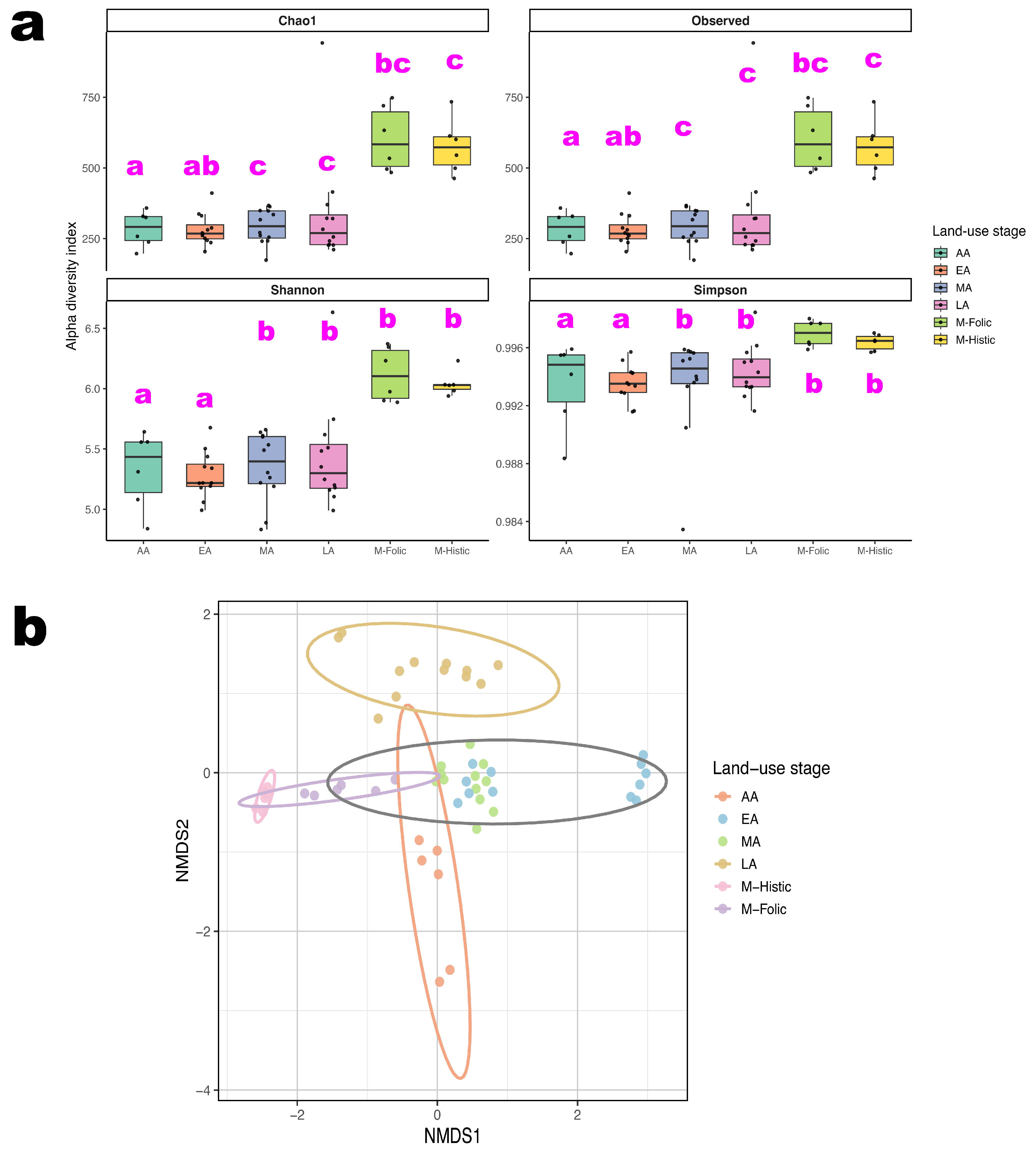
The α-diversity of the samples is presented in Figure 4a. One-way ANOVA revealed significant differences among soil types for Observed ASVs (F = 11.77, p < 0.001), Chao1 (F = 11.77, p < 0.001), Shannon (F = 11.58, p < 0.001), and Simpson indices (F = 3.42, p = 0.010). Tukey’s HSD tests revealed that mature soils (M-Folic and M-Histic) had significantly higher observed richness, Chao1, and Shannon diversity than agricultural and abandonment soils (p < 0.01). In comparison, β-diversity revealed clearer separation of communities across land-use types. PERMANOVA confirmed that community composition differed significantly among groups (F = 4.15, R2 = 0.302, p = 0.001).
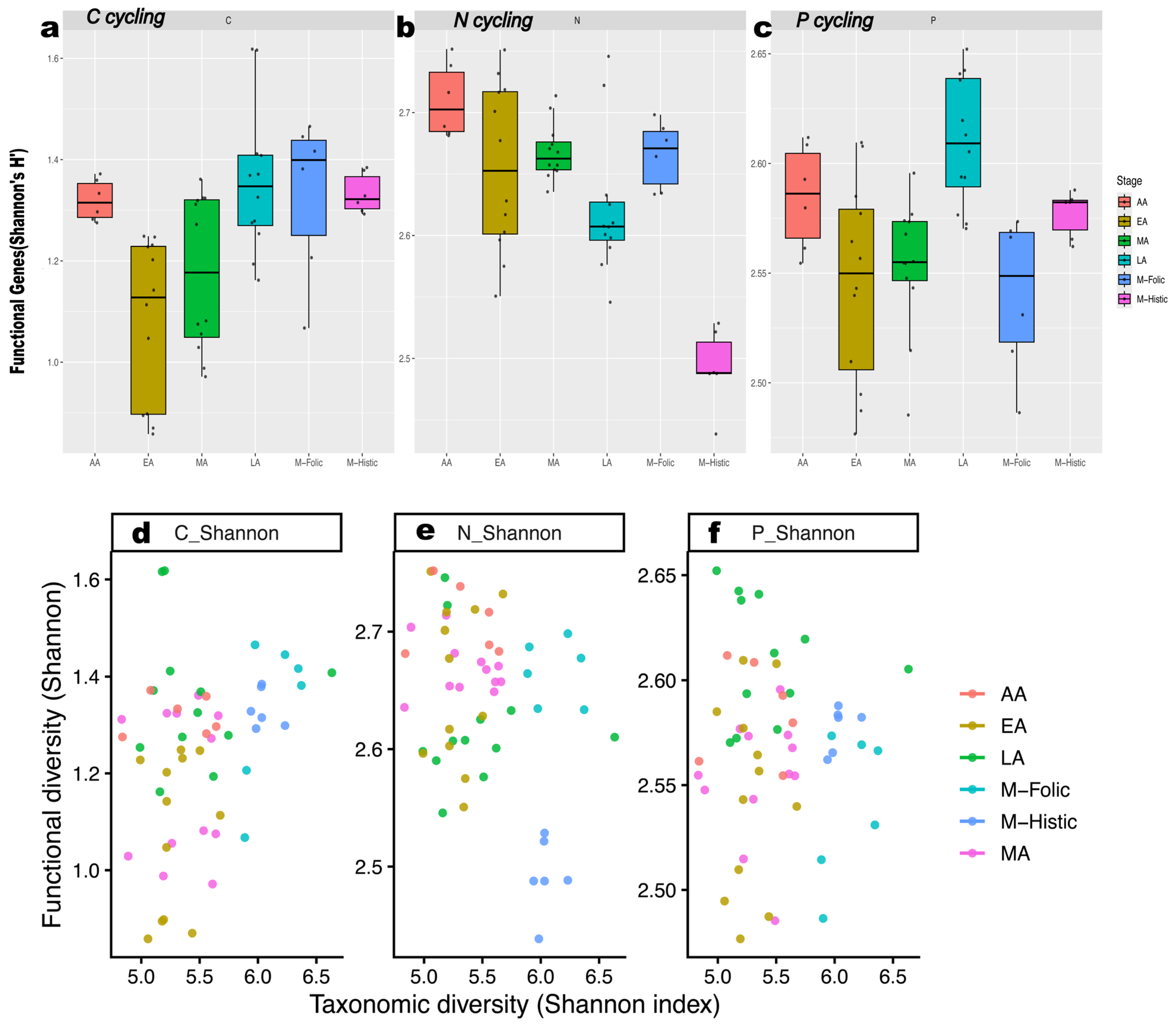
The results showed clear differences in functional diversity among the land-use stages (Table 2 and Table 3). For C-cycling genes, functional diversity was relatively low during the early abandonment stage (EA) but gradually increased with increasing abandonment time (Figure 5a), reaching higher levels in the late abandonment stage and mature soils. For N-cycling genes, functional diversity was relatively higher in agricultural soils and early abandoned soils (Figure 5b), whereas the mature reference soil (M-Histic) exhibited lower functional diversity. For P-cycling genes, functional diversity generally increased with increasing abandonment time (Figure 5c).
Furthermore, ordinary least squares (OLS) regression revealed that carbon cycling functional diversity varied significantly across soil stages and exhibited a significant coupling with taxonomic diversity; however, this relationship did not differ significantly among soil groups (Carbon: Shannon p = 0.011, Stage p < 0.001, Interaction p = 0.710). Nitrogen cycling functional diversity showed even stronger coupling with taxonomic diversity (Nitrogen: Shannon p < 0.001, Stage p < 0.001, Interaction p = 0.996). In contrast, no significant coupling between phosphorus cycling functional diversity and taxonomic diversity was observed (Phosphorus: Shannon p = 0.863, Stage p < 0.001, Interaction p = 0.861) (Table 4).

3.2. Canonical Correspondence Analysis

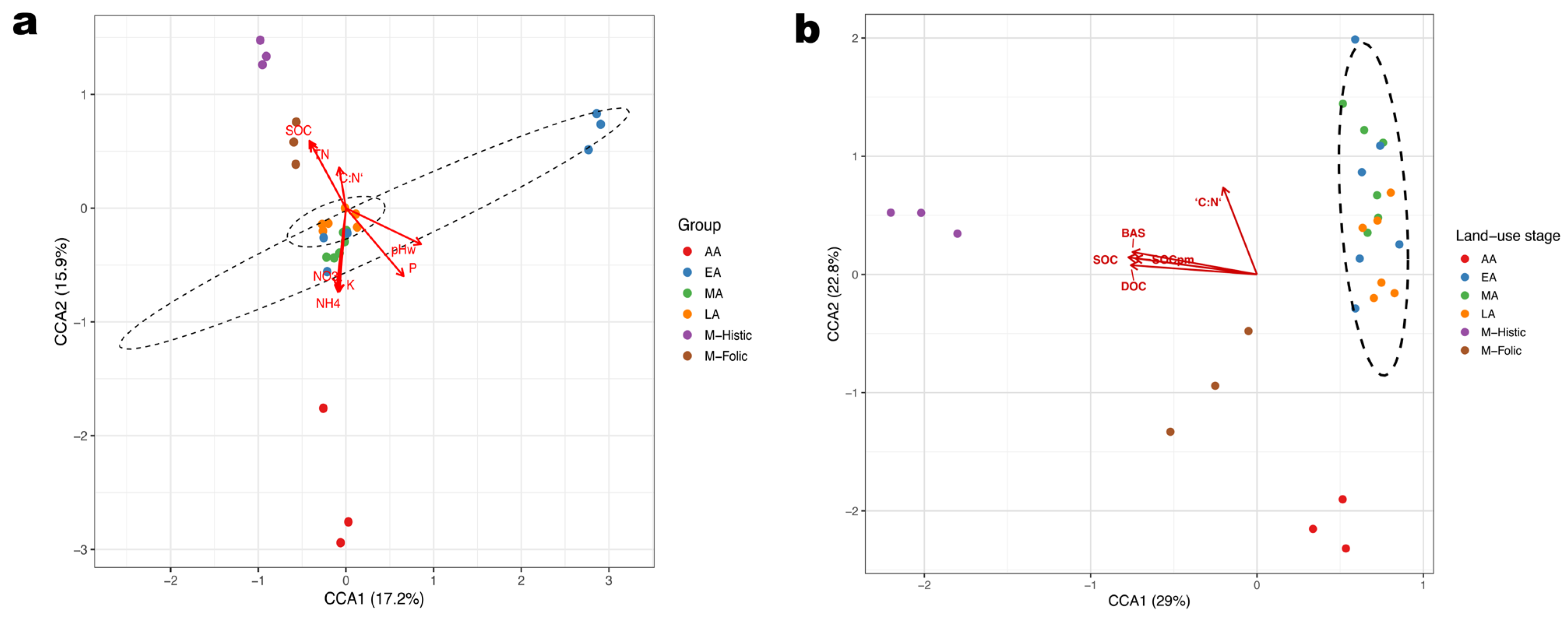
CCA revealed that the first two axes explained 33.1% of the variation in microbial community composition, with CCA1 and CCA2 accounting for 17.2% and 15.9%, respectively (Figure 6a). Agricultural soil samples were clearly separated from abandoned and mature soils, whereas abandoned soil samples were more tightly clustered. Mature soils formed a distinct cluster, reflecting a community composition different from that of agricultural soils. Permutation tests indicated that SOC, pH, C:N, P, K, and NO3 had significant effects on microbial community structure (p < 0.05). Agricultural soils were mainly associated with higher concentrations of NH4+, NO3, and K. Abandoned soils clustered together and were related to soil pH and available phosphorus. Mature soils were positively correlated with SOC, TN, and C:N ratio.
CCA based on soil organic carbon fractions (Figure 6b) explained a substantial proportion of variation; the first two axes accounted for 29% and 22.8% of the total variation. SOC, SOCpm, DOC, and BAS vectors showed similar orientations, whereas the C:N ratio represented a separate environmental gradient. Mature soils were associated with higher SOC, SOCpm, DOC, and BAS, while agricultural soils showed lower organic carbon accumulation.

3.3. Microbial Functional Gene Prediction Analysis

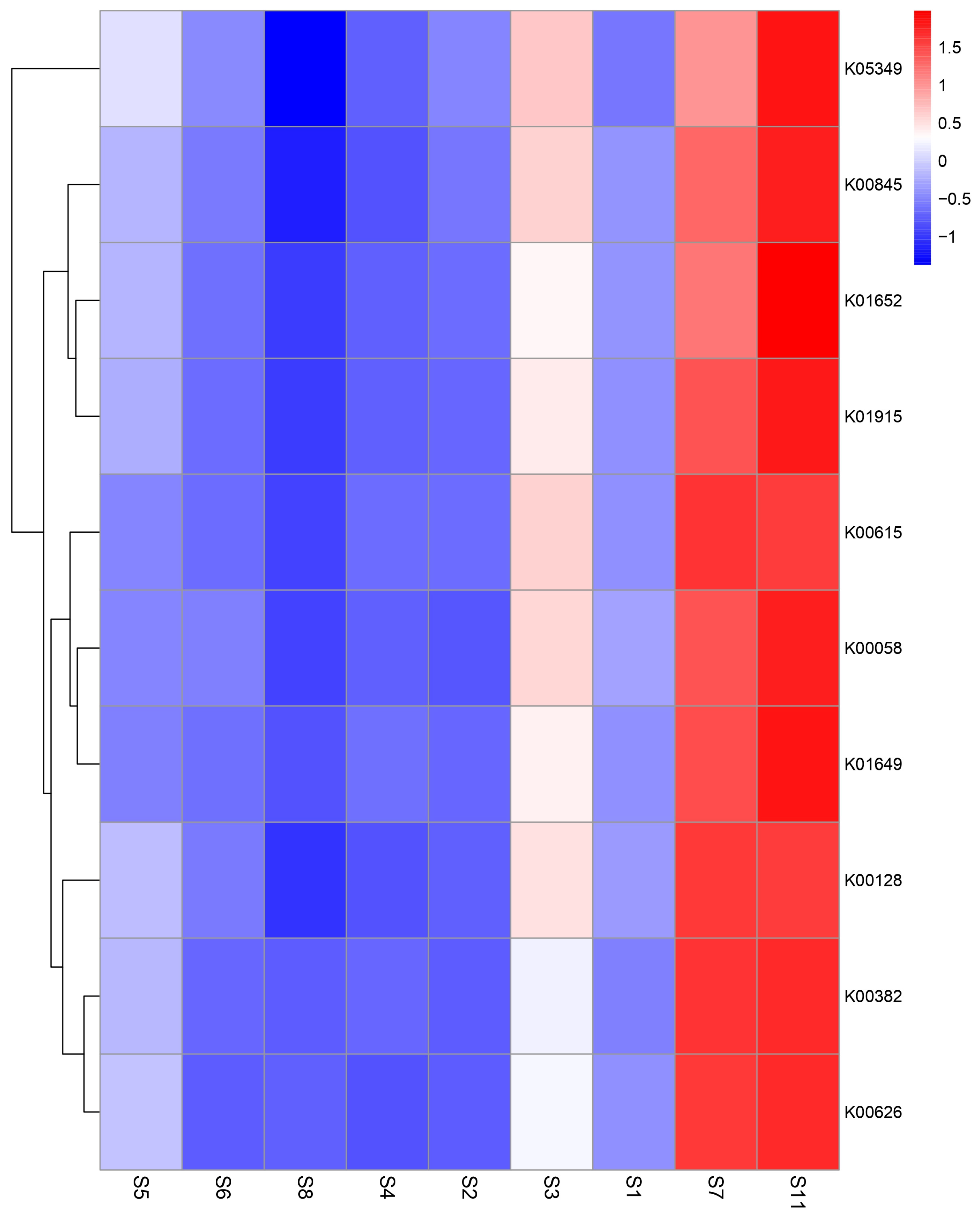
To assess changes in microbial carbon functions during soil recovery, we selected 13 carbon-metabolism pathways from KEGG and extracted the corresponding KOs. These predicted pathways include key processes such as plant-residue decomposition, glycolysis, the pentose phosphate pathway and central carbon metabolism, and may indicate shifts in microbial carbon-use strategies during post-agricultural recovery (Table 5). The carbon-cycling KOs were ranked according to the standard deviation of their abundance across sites, and the top 10 KOs with the highest variability were selected for further analysis.
The heatmap of the top 10 carbon cycling genes showed clear differences among sampling sites (Figure 7). Most KOs exhibited low standardized abundance in abandoned soils (S6–S2), whereas substantially higher abundances were observed in mature soils (S7 and S11). Agricultural soil (S5) showed intermediate levels. These results indicate that the potential for microbial carbon cycling increased along the ecosystem recovery gradient.

4. Discussion

In subarctic permafrost-affected regions, soil pH has been shown to be one of the main properties shaping bacterial community structure and diversity [38]. The generally acidic soils observed in the Salekhard region are consistent with previous reports from other subarctic permafrost areas [39,40]. The persistence of acidity is mainly related to the cold and wet permafrost environment, where decomposition is slow and organic acids tend to accumulate, and to the properties of the parent material [13,41,42].
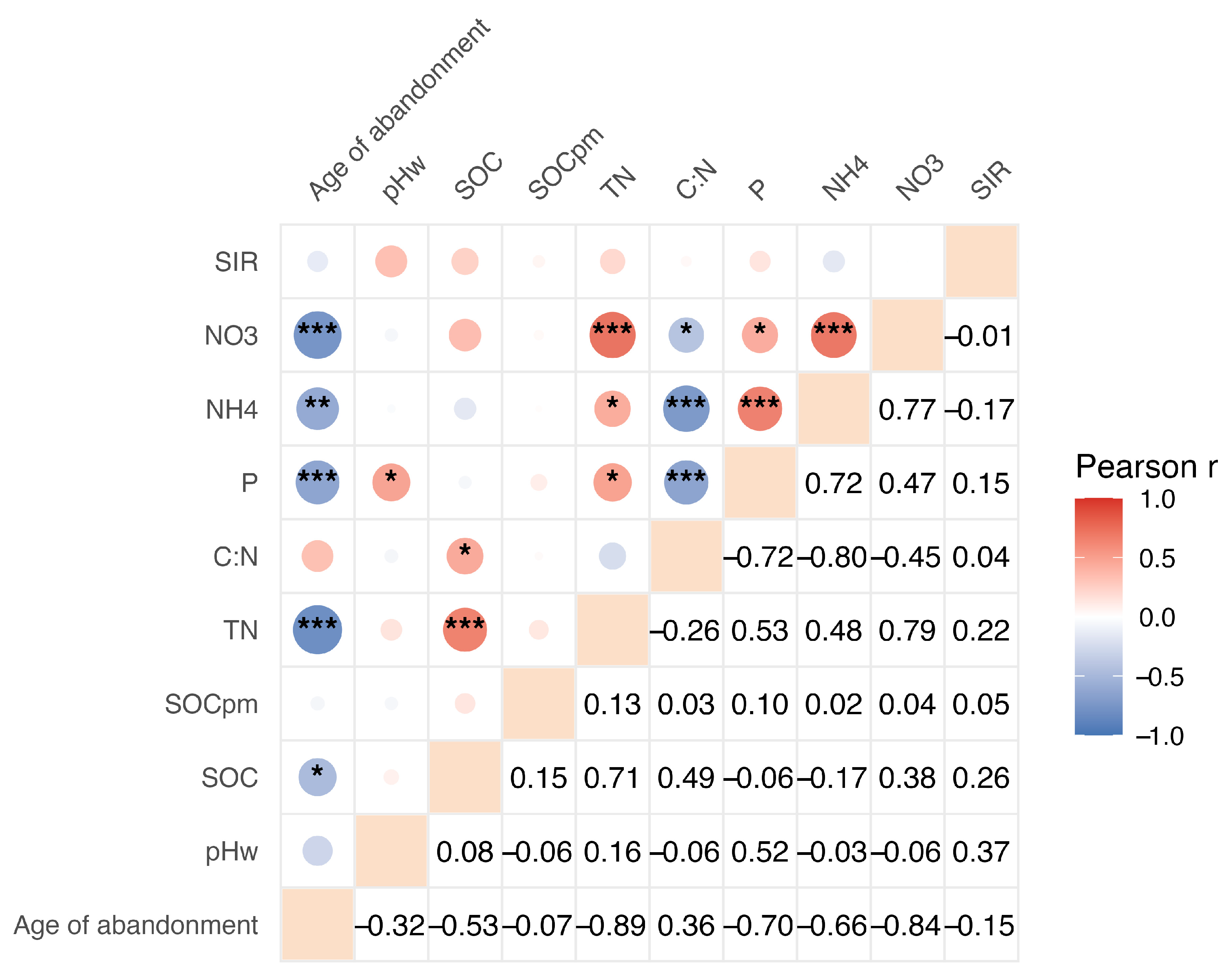
In the surface soils of the permafrost zone, abandonment age was significantly negatively correlated with total nitrogen (TN), nitrate (NO3), phosphorus (P), and ammonium (NH4+) (Figure 8), indicating a gradual decline in soil nutrient availability with increasing time since abandonment. This nutrient decline likely reflects the gradual weakening of a mixed agricultural legacy caused by former potato cultivation, tillage and fertilization. These practices may have increased available nutrients during cultivation and early abandonment, but after management ceased, nutrient inputs declined and cold, wet permafrost conditions limited organic matter turnover and nutrient replenishment [43,44]. The significant positive correlation between SOC and TN indicates close coupling of carbon and nitrogen dynamics in these soils, a typical feature of cold-region ecosystems where SOC and TN are commonly controlled by plant-derived organic matter inputs and slow decomposition [45]. In addition, negative correlations of C:N with P and NH4+ indicate that higher C:N ratios are usually associated with lower nutrient availability, suggesting that nutrient limitation may gradually intensify and mineralization may slow down along the abandonment gradient [46].
We found that microbial community responses during land abandonment varied depending on soil land-use type and the diversity dimension considered. Overall, taxonomic diversity in agricultural and abandoned soils did not change substantially; however, their microbial richness was significantly lower than that of mature soils (Figure 4a). This suggests that agricultural practices substantially reduce soil microbial richness, and that such effects cannot be fully reversed within approximately 25 years [47]. Consistent with the NMDS ordination (Figure 4b), PERMANOVA analyses showed significant differences in microbial community composition among different abandonment stages, with early abandoned soils showing the greatest divergence from reference mature soils.
The predicted functional profiles further showed stage-dependent shifts in C-, N- and P-cycling gene diversity (Figure 5; Table 2 and Table 3). In terms of functional diversity, the diversity of carbon- and phosphorus-cycling functional genes increased with increasing abandonment time, suggesting an enhancement of the microbial potential for carbon and phosphorus metabolism during soil recovery. In contrast, the diversity of nitrogen-cycling functional genes decreased with increasing abandonment time, which may be attributed to fertilization practices in agricultural soils enriching genes associated with nitrogen cycling processes such as nitrification and denitrification [48]. With increasing time since abandonment, microorganisms increasingly assimilate NH4+ and NO3 from the soil to meet their growth demands [49]. At the same time, soil C:N ratios gradually increase, which slows organic matter mineralization [50]. These patterns are consistent with typical characteristics of soil recovery following agricultural abandonment [51].
The lack of a significant relationship between taxonomic diversity and phosphorus cycling functional diversity suggests a high degree of functional redundancy, as in highly redundant systems the removal of certain taxa does not necessarily affect overall functional potential [52]. Our results indicate that nitrogen cycling functions may depend on specific microbial taxa [53], while differences in carbon cycling functions are more likely related to the metabolic capabilities of different microorganisms to utilize diverse carbon substrates [54].
The taxonomic profiles in Figure 3a showed that Proteobacteria dominated agricultural soils, which is consistent with their preference for carbon-rich environments [55]. At the genus level (Figure 3b), Rhodanobacter was more abundant in agricultural and early abandoned soils, in agreement with the characteristics of agricultural systems receiving high nitrate inputs [56,57]. Actinobacteriota was characteristic in both agricultural and mature reference soils, as this group can dominate in highly disturbed agricultural environments but also maintain strong competitiveness under oligotrophic conditions [10,58]. Among them, Oryzihumus and Acidothermus were representative genera with strong cellulose-degrading abilities that contribute to carbon cycling [59,60,61,62,63,64,65,66].
In contrast, Figure 3a showed that Acidobacteriota became more abundant in abandoned soils, particularly in later stages of abandonment, which may be related to its ecological adaptation to acidic and nutrient-poor environments [67,68]. The relative abundance of Acidobacteriota in soil abandoned for 25 years had already approached that observed in mature reference soil, suggesting that the resource-utilization strategy of microbial communities gradually shifts toward that of mature reference soils [69,70,71]. Members of Desulfobacterota, represented by Geobacter, increased in abundance during the later stages of abandonment, indicating that reduced soil aeration and repeated freeze–thaw disruption of soil aggregates altered pore structure and oxygen diffusion, creating localized anaerobic microsites favorable for reductive processes [72,73,74].
The correlation heatmap (Figure 3c) further linked several dominant genera with specific carbon functional groups. Taxa such as Bryobacter, Candidatus Solibacter, Puia, and Candidatus Udaeobacter were relatively more abundant in mid- to late-stage abandoned soils. Their significant positive correlations with Aromatic C and Carboxyl C suggest that these taxa have the potential to participate in the transformation of lignin and lignin-like compounds, and may utilize organic acids as carbon sources [75,76,77,78]. Furthermore, the relative abundance of Mucilaginibacter (Bacteroidota), which is known for its ability to degrade complex organic compounds such as xylan, was positively correlated with Carbohydrate C and significantly enriched in late-stage abandoned soils, indicating that vegetation recovery and plant residue input following abandonment promoted the ecological advantage of microorganisms involved in complex organic matter decomposition [79,80,81].
Subsequently, we screened the most significant differential functional genes associated with carbon cycling pathways (Table 5; Figure 7). We found that the relative abundance of K05349 (β-glucosidase) increased with increasing abandonment time [82], closely related to the accumulation of plant residues in the soil and the increased input of complex carbon substrates [83,84,85,86]. Genes involved in glycolysis (glucokinase K00845), the pentose phosphate pathway (transketolase K00615), serine synthesis (K00058), aldehyde dehydrogenase (K00128), dihydrolipoamide dehydrogenase associated with pyruvate and the TCA complex (K00382), and the core carbon metabolism enzyme ACAT all showed increased abundance during long-term abandonment recovery, indicating enhancement of overall carbon metabolic capacity [7,87,88,89,90,91,92]. Although the abundance of several carbon metabolism-related functional genes generally increased with increasing recovery time, their abundance had not yet reached the levels observed in Folic Podzol even after 25 years, consistent with observations from multiple ecological metagenomic studies indicating that recovery of soil microbial functional genes often requires longer timescales [93,94].
Because positive and negative control samples were not included, potential background contamination could not be formally assessed. The interpretation of microbial community patterns was therefore based on sequencing depth, rarefaction performance and consistency among biological replicates.
After targeted experimental validation, the microbial taxa and predicted functional genes identified here may serve as candidate bioindicators for tracking the recovery of abandoned agricultural soils in permafrost-affected regions. Integrating these microbial markers with long-term soil physicochemical and climate records could help predict carbon-cycling and nutrient-cycling trajectories and inform restoration-oriented land management under ongoing climate change.

5. Conclusions

This study investigated the dynamics of soil microbial communities in abandoned agricultural soils in the permafrost zone of the Yamalo–Nenets Autonomous Okrug and compared them with those in mature reference soils and agricultural soils. Land abandonment triggered significant changes in soil physicochemical properties and microbial community structure. In agricultural and abandoned soils, nitrate nitrogen, ammonium nitrogen, and exchangeable potassium were the main factors influencing microbial community structure, whereas in mature soils, organic matter content was the key factor driving microbial community variation.
Although the taxonomic diversity of microbial communities differed only slightly between agricultural and abandoned soils, both their richness and evenness were lower than those of the mature reference soils. Microbial community composition showed clear differences across land-use stages. Agricultural soils were dominated by copiotrophic microorganisms such as Rhodanobacter, whereas abandoned soils gradually shifted toward oligotrophic microorganisms typical of acidic natural ecosystems, including Bryobacter and Candidatus Solibacter. The relative abundance of microbial taxa associated with the transformation of recalcitrant organic matter (e.g., cellulose and lignin) increased.
Functional analysis further revealed significant differences in the diversity of genes related to carbon, nitrogen, and phosphorus cycling. The functional diversity of carbon- and phosphorus-cycling genes gradually increased along the abandonment chronosequence, while the functional diversity of nitrogen cycling decreased with increasing abandonment time. The results indicate a certain degree of functional redundancy within soil microbial communities for carbon and phosphorus cycling, whereas nitrogen-related functions appeared to depend more strongly on specific microbial taxa.
In addition, land abandonment promoted an increase in the abundance of microbial carbon metabolism-related genes, and the preferred carbon substrates for microbial decomposition gradually shifted from labile carbon sources toward more complex organic matter. However, even after 25 years of abandonment, microbial community composition and functional potential had not fully recovered to the level observed in mature reference soils, indicating that agricultural disturbance exerts long-term legacy effects on soil microbiomes in permafrost-affected ecosystems.

Author Contributions

Conceptualization, T.N. and E.A. (Evgeny Abakumov); Methodology, T.N., J.M. and A.K.; Software, J.M.; Validation, S.Y. and X.W.; Formal analysis, J.M.; Investigation, T.N. and E.A. (Evgeny Abakumov); Resources, E.A. (Evgeny Abakumov), S.Y. and E.A. (Evgeny Andronov); Data curation, T.N.; Writing—original draft preparation, J.M.; Writing—review and editing, T.N. and E.A. (Evgeny Abakumov); Visualization, J.M.; Supervision, E.A. (Evgeny Abakumov) and T.N.; Project administration, E.A. (Evgeny Abakumov); Funding acquisition, E.A. (Evgeny Abakumov) and S.Y. All authors have read and agreed to the published version of the manuscript.

Funding

For T.N., E.A. (Evgeny Abakumov) and A.K., research was funded by the Russian Science Foundation (Grant No. 24-44-00006); for S.Y. and X.W., research was funded by the National Natural Science Foundation of China (Grant No. 32361133551).

Institutional Review Board Statement

Not applicable. This study did not involve humans or animals.

Informed Consent Statement

Not applicable, as this study did not involve humans.

Data Availability Statement

The data that support this study are available from the corresponding author upon reasonable request. The findings of this study will form part of the Master’s thesis by Jialu Ma currently in preparation.

Acknowledgments

The authors gratefully acknowledge the Scientific Park of Saint Petersburg State University, Chemical Analysis and Materials Research Centre, for technical support. The authors sincerely acknowledge the Russian Science Foundation and the National Natural Science Foundation of China for financial support. We also thank the reviewers for their valuable comments and suggestions, which helped improve this manuscript. We thank all members of our laboratory for their assistance in sample collection, data analysis, and manuscript preparation.

Conflicts of Interest

The authors declare no conflicts of interest. The funders had no role in the design of the study; in the collection, analyses, or interpretation of data; in the writing of the manuscript; or in the decision to publish the results.

References

  1. Pendrill, F.; Gardner, T.A.; Meyfroidt, P.; Persson, U.M.; Adams, J.; Azevedo, T.; Bastos Lima, M.G.; Baumann, M.; Curtis, P.G.; De Sy, V.; et al. Disentangling the numbers behind agriculture-driven tropical deforestation. Science 2022, 377, eabm9267. [Google Scholar] [CrossRef]
  2. Peng, Z.; Qian, X.; Liu, Y.; Li, X.; Gao, H.; An, Y.; Qi, J.; Jiang, L.; Zhang, Y.; Chen, S.; et al. Land conversion to agriculture induces taxonomic homogenization of soil microbial communities globally. Nat. Commun. 2024, 15, 3624. [Google Scholar] [CrossRef]
  3. Lawrence, N.C.; Tenesaca, C.G.; VanLoocke, A.; Hall, S.J. Nitrous oxide emissions from agricultural soils challenge climate sustainability in the US Corn Belt. Proc. Natl. Acad. Sci. USA 2021, 118, e2112108118. [Google Scholar] [CrossRef]
  4. Berendsen, R.L.; Pieterse, C.M.J.; Bakker, P.A.H.M. The rhizosphere microbiome and plant health. Trends Plant Sci. 2012, 17, 478–486. [Google Scholar] [CrossRef]
  5. Angulo, V.; Bleichrodt, R.-J.; Dijksterhuis, J.; Erktan, A.; Hefting, M.M.; Kraak, B.; Kowalchuk, G.A. Enhancement of soil aggregation and physical properties through fungal amendments under varying moisture conditions. Environ. Microbiol. 2024, 26, e16627. [Google Scholar] [CrossRef]
  6. Naylor, D.; Sadler, N.; Bhattacharjee, A.; Graham, E.B.; Anderton, C.R.; McClure, R.; Naylor, D.; Sadler, N.; Bhattacharjee, A.; Graham, E.B.; et al. Soil Microbiomes Under Climate Change and Implications for Carbon Cycling. Annu. Rev. Environ. Resour. 2020, 45, 29–59. [Google Scholar] [CrossRef]
  7. Schuur, E.A.G.; McGuire, A.D.; Schädel, C.; Grosse, G.; Harden, J.W.; Hayes, D.J.; Hugelius, G.; Koven, C.D.; Kuhry, P.; Lawrence, D.M.; et al. Climate change and the permafrost carbon feedback. Nature 2015, 520, 171–179. [Google Scholar] [CrossRef] [PubMed]
  8. Schierhorn, F.; Müller, D.; Beringer, T.; Prishchepov, A.V.; Kuemmerle, T.; Balmann, A. Post-Soviet cropland abandonment and carbon sequestration in European Russia, Ukraine, and Belarus. Glob. Biogeochem. Cycles 2013, 27, 1175–1185. [Google Scholar] [CrossRef]
  9. Kukkonen, I.T.; Suhonen, E.; Ezhova, E.; Lappalainen, H.; Gennadinik, V.; Ponomareva, O.; Kukkonen, I.T.; Suhonen, E.; Ezhova, E.; Lappalainen, H.; et al. Observations and modelling of ground temperature evolution in the discontinuous permafrost zone in Nadym, north-west Siberia. Permafr. Periglac. Process. 2020, 31, 264–280. [Google Scholar] [CrossRef]
  10. Nizamutdinov, T.; Zhemchueva, D.; Zverev, A.; Andronov, E.; Pechkin, A.; Abakumov, E. Agropedogenesis and related changes in morphology, fertility and microbiome diversity of soils in cryogenic ecosystems on the example of the central part of Yamal region (West Siberia). Geoderma 2024, 449, 117014. [Google Scholar] [CrossRef]
  11. Abakumov, E.; Morgun, E.; Pechkin, A.; Polyakov, V. Abandoned agricultural soils from the central part of the Yamal region of Russia: Morphology, diversity, and chemical properties. Open Agric. 2020, 5, 94–106. [Google Scholar] [CrossRef]
  12. Wang, W.; Nizamutdinov, T.; Pechkin, A.; Morgun, E.; Li, G.; Wu, X.; Wang, W.; Nizamutdinov, T.; Pechkin, A.; Morgun, E.; et al. Ecological Status Assessment of Permafrost-Affected Soils in the Nadym Region, Yamalo-Nenets Autonomous District, Russian Arctic. Land 2024, 13, 1406. [Google Scholar] [CrossRef]
  13. Alekseev, I.; Abakumov, E. Permafrost-affected former agricultural soils of the Salekhard city (Central part of Yamal region). Czech Polar Rep. 2018, 8, 119–131. [Google Scholar] [CrossRef]
  14. Nizamutdinov, T.; Yang, S.; Wu, X.; Gurzhiy, V.; Abakumov, E. Multivariate Insight into Soil Organic Matter Dynamics in Subarctic Abandoned Farmland by the Chronosequence Approach. Agronomy 2025, 15, 893. [Google Scholar] [CrossRef]
  15. Tikhanovsky, A. Potatoes in Yamal; Publishing House “Akademizdat”: Moscow, Russia, 2021. [Google Scholar]
  16. Nizamutdinov, T.; Suleymanov, A.; Morgun, E.; Yakkonen, K.; Abakumov, E. Soils and olericultural practices in circumpolar region of Russia at present and in the past. Front. Sustain. Food Syst. 2022, 6, 1032058. [Google Scholar] [CrossRef]
  17. Nizamutdinov, T.; Yang, S.; Abakumov, E. Post-Agricultural Shifts in Soils of Subarctic Environment on the Example of Plaggic Podzols Chronosequence. Agronomy 2025, 15, 584. [Google Scholar] [CrossRef]
  18. Mantel, S.; Dondeyne, S.; Deckers, S. World reference base for soil resources (WRB). Encycl. Soils Environ. 2023, 4, 206–217. [Google Scholar]
  19. Gerasimova, M.I. Russian soil classification system: Towards the next approximation. Eurasian Soil Sci. 2019, 52, 25–33. [Google Scholar] [CrossRef]
  20. Pinaev, A.G.; Kichko, A.A.; Aksenova, T.S.; Safronova, V.I.; Kozhenkova, E.V.; Andronov, E.E. RIAM: A Universal Accessible Protocol for the Isolation of High Purity DNA from Various Soils and Other Humic Substances. Methods Protoc. 2022, 5, 99. [Google Scholar] [CrossRef]
  21. Caporaso, J.G.; Lauber, C.L.; Walters, W.A.; Berg-Lyons, D.; Huntley, J.; Fierer, N.; Caporaso, J.G.; Lauber, C.L.; Walters, W.A.; Berg-Lyons, D.; et al. Ultra-high-throughput microbial community analysis on the Illumina HiSeq and MiSeq platforms. ISME J. 2012, 6, 1621–1624. [Google Scholar] [CrossRef]
  22. Team, R.C. R: A Language and Environment for Statistical Computing; R Foundation for Statistical Computing: Vienna, Austria, 2019. [Google Scholar]
  23. Callahan, B.J.; McMurdie, P.J.; Rosen, M.J.; Han, A.W.; Johnson, A.J.A.; Holmes, S.P. DADA2: High-resolution sample inference from Illumina amplicon data. Nat. Methods 2016, 13, 581–583. [Google Scholar] [CrossRef] [PubMed]
  24. Quast, C.; Pruesse, E.; Yilmaz, P.; Gerken, J.; Schweer, T.; Yarza, P.; Quast, C.; Pruesse, E.; Yilmaz, P.; Gerken, J.; et al. The SILVA ribosomal RNA gene database project: Improved data processing and web-based tools. Nucleic Acids Res. 2013, 41, D590–D596. [Google Scholar] [CrossRef]
  25. McMurdie, P.J.; Holmes, S. phyloseq: An R Package for Reproducible Interactive Analysis and Graphics of Microbiome Census Data. PLoS ONE 2013, 8, e61217. [Google Scholar] [CrossRef]
  26. Ssekagiri, A.; Sloan, W.T.; Ijaz, U.Z. microbiomeSeq: An R package for analysis of microbial communities in an environmental context. In ISCB Africa ASBCB Conference on Bioinformatics; ISCB: Kumasi, Ghana, 2017; Volume 10. [Google Scholar]
  27. Wickham, H. ggplot2: Elegant Graphics for Data Analysis; Springer: New York, NY, USA, 2016. [Google Scholar]
  28. Oksanen, J. Vegan: Community Ecology Package, R package version 2.2-1; CRAN: Vienna, Austria, 2015; Available online: https://cran.r-project.org/web/packages/vegan/index.html (accessed on 27 November 2025).
  29. Anderson, M.J. Permutational Multivariate Analysis of Variance (PERMANOVA). In Wiley StatsRef: Statistics Reference Online; John Wiley & Sons, Ltd.: Hoboken, NJ, USA, 2005; pp. 1–15. [Google Scholar] [CrossRef]
  30. Sedgwick, P. Pearson’s correlation coefficient. BMJ 2012, 345, e4483. [Google Scholar] [CrossRef]
  31. Sedgwick, P. Spearman’s rank correlation coefficient. BMJ 2014, 349, g7327. [Google Scholar] [CrossRef]
  32. Yang, C.; Mai, J.; Cao, X.; Burberry, A.; Cominelli, F.; Zhang, L. ggpicrust2: An R package for PICRUSt2 predicted functional profile analysis and visualization. Bioinformatics 2023, 39, btad470. [Google Scholar] [CrossRef] [PubMed]
  33. Singavarapu, B.; Du, J.; Beugnon, R.; Cesarz, S.; Eisenhauer, N.; Xue, K.; Singavarapu, B.; Du, J.; Beugnon, R.; Cesarz, S.; et al. Functional Potential of Soil Microbial Communities and Their Subcommunities Varies with Tree Mycorrhizal Type and Tree Diversity. Microbiol. Spectr. 2023, 11, e0457822. [Google Scholar] [CrossRef] [PubMed]
  34. McKight, P.E.; Najab, J. Kruskal-Wallis Test. In Corsini Encyclopedia of Psychology; John Wiley & Sons, Ltd.: Hoboken, NJ, USA, 2010. [Google Scholar]
  35. Dinno, A. Nonparametric pairwise multiple comparisons in independent groups using Dunn’s test. Stata J. 2015, 15, 292–300. [Google Scholar] [CrossRef]
  36. Thissen, D.; Steinberg, L.; Kuang, D. Quick and Easy Implementation of the Benjamini-Hochberg Procedure for Controlling the False Positive Rate in Multiple Comparisons. J. Educ. Behav. Stat. 2002, 27, 77–83. [Google Scholar] [CrossRef]
  37. Ramette, A. Multivariate analyses in microbial ecology. FEMS Microbiol. Ecol. 2007, 62, 142–160. [Google Scholar] [CrossRef]
  38. Ren, B.; Hu, Y.; Chen, B.; Zhang, Y.; Thiele, J.; Shi, R.; Ren, B.; Hu, Y.; Chen, B.; Zhang, Y.; et al. Soil pH and plant diversity shape soil bacterial community structure in the active layer across the latitudinal gradients in continuous permafrost region of Northeastern China. Sci. Rep. 2018, 8, 5619. [Google Scholar] [CrossRef]
  39. Wang, D.; Zang, S.; Wu, X.; Ma, D.; Li, M.; Chen, Q.; Wang, D.; Zang, S.; Wu, X.; Ma, D.; et al. Soil organic carbon stabilization in permafrost peatlands. Saudi J. Biol. Sci. 2021, 28, 7037–7045. [Google Scholar] [CrossRef] [PubMed]
  40. Kim, H.M.; Jung, J.Y.; Yergeau, E.; Hwang, C.Y.; Hinzman, L.; Nam, S.; Kim, H.M.; Jung, J.Y.; Yergeau, E.; Hwang, C.Y.; et al. Bacterial community structure and soil properties of a subarctic tundra soil in Council, Alaska. FEMS Microbiol. Ecol. 2014, 89, 465–475. [Google Scholar] [CrossRef]
  41. Alekseev, I.A.; Petrova, A.; Vorona-Slivinskaya, L. Evaluation of the Ecotoxicological State of Selected Soils from Urban Environments of Russian Arctic. MATEC Web Conf. 2018, 170, 04001. [Google Scholar] [CrossRef]
  42. Deng, J.; Gu, Y.; Zhang, J.; Xue, K.; Qin, Y.; Yuan, M.; Deng, J.; Gu, Y.; Zhang, J.; Xue, K.; et al. Shifts of tundra bacterial and archaeal communities along a permafrost thaw gradient in Alaska. Mol. Ecol. 2015, 24, 222–234. [Google Scholar] [CrossRef]
  43. Nizamutdinov, T.; Abakumov, E.; Morgun, E. Morphological features, productivity and pollution state of abandoned agricultural soils in the Russian Arctic (Yamal Region). One Ecosyst. 2021, 6, e68408. [Google Scholar] [CrossRef]
  44. Monteux, S.; Keuper, F.; Fontaine, S.; Gavazov, K.; Hedlund, K.; Lavorel, S.; Monteux, S.; Keuper, F.; Fontaine, S.; Gavazov, K.; et al. Carbon and nitrogen cycling in Yedoma permafrost controlled by microbial functional limitations. Nat. Geosci. 2020, 13, 794–798. [Google Scholar] [CrossRef]
  45. Duan, B.; Man, X.; Cai, T.; Xiao, R.; Ge, Z. Increasing soil organic carbon and nitrogen stocks along with secondary forest succession in permafrost region of the Daxing’an mountains, northeast China. Glob. Ecol. Conserv. 2020, 24, e01258. [Google Scholar] [CrossRef]
  46. Li, H.; Qiu, Y.; Yao, T.; Han, D.; Gao, Y.; Zhang, J.; Li, H.; Qiu, Y.; Yao, T.; Han, D.; et al. Nutrients available in the soil regulate the changes of soil microbial community alongside degradation of alpine meadows in the northeast of the Qinghai-Tibet Plateau. Sci. Total Environ. 2021, 792, 148363. [Google Scholar] [CrossRef]
  47. Nagendra, H. Opposite trends in response for the Shannon and Simpson indices of landscape diversity. Appl. Geogr. 2002, 22, 175–186. [Google Scholar] [CrossRef]
  48. Wang, F.; Chen, S.; Wang, Y.; Zhang, Y.; Hu, C.; Liu, B. Long-Term Nitrogen Fertilization Elevates the Activity and Abundance of Nitrifying and Denitrifying Microbial Communities in an Upland Soil. Front. Microbiol. 2018, 9, 2424. [Google Scholar] [CrossRef]
  49. Smith, C.R.; Blair, P.L.; Boyd, C.; Cody, B.; Hazel, A.; Hedrick, A.; Smith, C.R.; Blair, P.L.; Boyd, C.; Cody, B.; et al. Microbial community responses to soil tillage and crop rotation in a corn/soybean agroecosystem. Ecol. Evol. 2016, 6, 8075–8084. [Google Scholar] [CrossRef]
  50. Springob, G.; Kirchmann, H. Bulk soil C to N ratio as a simple measure of net N mineralization from stabilized soil organic matter in sandy arable soils. Soil Biol. Biochem. 2003, 35, 629–632. [Google Scholar] [CrossRef]
  51. Zhou, Y.; Zhang, Y.; Li, W.; Li, J.; Li, Z.; Zhong, Y. Effects of cropland abandonment succession on soil microorganism and multifunctionality in the arid zone of Northwest China. Appl. Soil Ecol. 2025, 207, 105954. [Google Scholar] [CrossRef]
  52. Sveen, T.R.; Viketoft, M.; Bengtsson, J.; Strengbom, J.; Lejoly, J.; Buegger, F.; Sveen, T.R.; Viketoft, M.; Bengtsson, J.; Strengbom, J.; et al. Functional diversity of soil microbial communities increases with ecosystem development. Nat. Commun. 2025, 16, 10408. [Google Scholar] [CrossRef]
  53. Liu, Y.; Chi, Q.; Cheng, H.; Ding, H.; Wen, T.; Zhao, J.; Liu, Y.; Chi, Q.; Cheng, H.; Ding, H.; et al. Comparative Microbial Nitrogen Functional Gene Abundances in the Topsoil vs. Subsoil of Three Grassland Habitats in Northern China. Front. Plant Sci. 2022, 12, 792002. [Google Scholar] [CrossRef] [PubMed]
  54. Trivedi, P.; Delgado-Baquerizo, M.; Trivedi, C.; Hu, H.; Anderson, I.C.; Jeffries, T.C.; Trivedi, P.; Delgado-Baquerizo, M.; Trivedi, C.; Hu, H.; et al. Microbial regulation of the soil carbon cycle: Evidence from gene–enzyme relationships. ISME J. 2016, 10, 2593–2604. [Google Scholar] [CrossRef]
  55. Fierer, N.; Bradford, M.A.; Jackson, R.B. Toward an ecological classification of soil bacteria. Ecology 2007, 88, 1354–1364. [Google Scholar] [CrossRef] [PubMed]
  56. Green, S.J.; Prakash, O.; Jasrotia, P.; Overholt, W.A.; Cardenas, E.; Hubbard, D.; Green, S.J.; Prakash, O.; Jasrotia, P.; Overholt, W.A.; et al. Denitrifying bacteria from the genus Rhodanobacter dominate bacterial communities in the highly contaminated subsurface of a nuclear legacy waste site. Appl. Environ. Microbiol. 2012, 78, 1039–1047. [Google Scholar] [CrossRef]
  57. Fierer, N.; Jackson, R.B. The diversity and biogeography of soil bacterial communities. Proc. Natl. Acad. Sci. USA 2006, 103, 626–631. [Google Scholar] [CrossRef]
  58. Bao, Y.; Dolfing, J.; Guo, Z.; Chen, R.; Wu, M.; Li, Z.; Lin, X.; Feng, Y. Important ecophysiological roles of non-dominant Actinobacteria in plant residue decomposition, especially in less fertile soils. Microbiome 2021, 9, 84. [Google Scholar] [CrossRef] [PubMed]
  59. Shiang, M.; Linden, J.C.; Mohagneghi, A.; Rivard, C.J.; Grohmann, K.; Himmel, M.E. Cellulase production by Acidothermus cellulolyticus. Appl. Biochem. Biotechnol. 1990, 24, 223–235. [Google Scholar] [CrossRef]
  60. Kim, D.U.; Kim, S.G.; Lee, H.; Park, A.Y.; Ka, J.O. Oryzihumus soli sp. nov., isolated from soil and emended description of the genus Oryzihumus. Int. J. Syst. Evol. Microbiol. 2017, 67, 3960–3964. [Google Scholar] [CrossRef]
  61. Lauber, C.L.; Hamady, M.; Knight, R.; Fierer, N. Pyrosequencing-Based Assessment of Soil pH as a Predictor of Soil Bacterial Community Structure at the Continental Scale. Appl. Environ. Microbiol. 2009, 75, 5111–5120. [Google Scholar] [CrossRef]
  62. Rousk, J.; Bååth, E.; Brookes, P.C.; Lauber, C.L.; Lozupone, C.; Caporaso, J.G.; Rousk, J.; Bååth, E.; Brookes, P.C.; Lauber, C.L.; et al. Soil bacterial and fungal communities across a pH gradient in an arable soil. ISME J. 2010, 4, 1340–1351. [Google Scholar] [CrossRef]
  63. Leff, J.W.; Jones, S.E.; Prober, S.M.; Barberán, A.; Borer, E.T.; Firn, J.L.; Leff, J.W.; Jones, S.E.; Prober, S.M.; Barberán, A.; et al. Consistent responses of soil microbial communities to elevated nutrient inputs in grasslands across the globe. Proc. Natl. Acad. Sci. USA 2015, 112, 10967–10972. [Google Scholar] [CrossRef] [PubMed]
  64. Ramirez, K.S.; Lauber, C.L.; Knight, R.; Bradford, M.A.; Fierer, N. Consistent effects of nitrogen fertilization on soil bacterial communities in contrasting systems. Ecology 2010, 91, 3463–3470. [Google Scholar] [CrossRef]
  65. Zeng, J.; Liu, X.; Song, L.; Lin, X.; Zhang, H.; Shen, C.; Chu, H. Nitrogen fertilization directly affects soil bacterial diversity and indirectly affects bacterial community composition. Soil Biol. Biochem. 2016, 92, 41–49. [Google Scholar] [CrossRef]
  66. Fierer, N.; Lauber, C.L.; Ramirez, K.S.; Zaneveld, J.; Bradford, M.A.; Knight, R. Comparative metagenomic, phylogenetic and physiological analyses of soil microbial communities across nitrogen gradients. ISME J. 2012, 6, 1007–1017. [Google Scholar] [CrossRef]
  67. Kielak, A.M.; Barreto, C.C.; Kowalchuk, G.A.; Van Veen, J.A.; Kuramae, E.E. The ecology of Acidobacteria: Moving beyond genes and genomes. Front. Microbiol. 2016, 7, 744. [Google Scholar] [CrossRef] [PubMed]
  68. Eichorst, S.A.; Trojan, D.; Roux, S.; Schwarz, C.; Soditch, D.; Smith, D.A.; Eichorst, S.A.; Trojan, D.; Roux, S.; Herbold, C.; et al. Genomic insights into the Acidobacteria reveal strategies for their success in terrestrial environments. Environ. Microbiol. 2018, 20, 1041–1063. [Google Scholar] [CrossRef]
  69. Ho, A.; Di Lonardo, D.P.; Bodelier, P.L.E. Revisiting life strategy concepts in environmental microbial ecology. FEMS Microbiol. Ecol. 2017, 93, fix006. [Google Scholar] [CrossRef]
  70. He, X.; McLean, J.S.; Edlund, A.; Yooseph, S.; Hall, A.P.; Liu, S.Y.; He, X.; McLean, J.S.; Edlund, A.; Yooseph, S.; et al. Cultivation of a human-associated TM7 phylotype reveals a reduced genome and epibiotic parasitic lifestyle. Proc. Natl. Acad. Sci. USA 2015, 112, 244–249. [Google Scholar] [CrossRef]
  71. Kindaichi, T.; Yamaoka, S.; Uehara, R.; Ozaki, N.; Ohashi, A.; Albertsen, M.; Kindaichi, T.; Yamaoka, S.; Uehara, R.; Ozaki, N.; et al. Phylogenetic diversity and ecophysiology of Candidate phylum Saccharibacteria in activated sludge. FEMS Microbiol. Ecol. 2016, 92, fiw078. [Google Scholar] [CrossRef]
  72. Keiluweit, M.; Gee, K.; Denney, A.; Fendorf, S. Anoxic microsites in upland soils dominantly controlled by clay content. Soil Biol. Biochem. 2018, 118, 42–50. [Google Scholar] [CrossRef]
  73. Liu, C.; Cui, Y.; Li, X.; Yao, M. microeco: An R package for data mining in microbial community ecology. FEMS Microbiol. Ecol. 2021, 97, fiaa255. [Google Scholar] [CrossRef]
  74. Li, Y.; Adams, J.; Shi, Y.; Wang, H.; He, J.S.; Chu, H. Distinct Soil Microbial Communities in habitats of differing soil water balance on the Tibetan Plateau. Sci. Rep. 2017, 7, 46407. [Google Scholar] [CrossRef]
  75. Yu, W.; Huang, W.; Hammel, K.E.; Li, Y.; Zhang, S.; Yi, B.; Yu, W.; Huang, W.; Hammel, K.E.; Li, Y.; et al. Microbial taxa and interactions can predict lignin mineralization in soil at continental scale. Soil Biol. Biochem. 2025, 204, 109763. [Google Scholar] [CrossRef]
  76. Kulichevskaya, I.S.; Suzina, N.E.; Liesack, W.; Dedysh, S.N. Bryobacter aggregatus gen. nov., sp. nov., a peat-inhabiting, aerobic chemo-organotroph from subdivision 3 of the Acidobacteria. Int. J. Syst. Evol. Microbiol. 2010, 60, 301–306. [Google Scholar] [CrossRef]
  77. Žifčáková, L.; Větrovský, T.; Howe, A.; Baldrian, P. Microbial activity in forest soil reflects the changes in ecosystem properties between summer and winter. Environ. Microbiol. 2016, 18, 288–301. [Google Scholar] [CrossRef]
  78. Voříšková, J.; Brabcová, V.; Cajthaml, T.; Baldrian, P. Seasonal dynamics of fungal communities in a temperate oak forest soil. New Phytol. 2014, 201, 269–278. [Google Scholar] [CrossRef]
  79. Vasconcelos, A.L.S.; Andreote, F.D.; Defalco, T.; Delbaje, E.; Barrientos, L.; Dias, A.C.F.; Vasconcelos, A.L.S.; Andreote, F.D.; Defalco, T.; Delbaje, E.; et al. Mucilaginibacter sp. Strain Metal(loid) and Antibiotic Resistance Isolated from Estuarine Soil Contaminated Mine Tailing from the Fundão Dam. Genes 2022, 13, 174. [Google Scholar] [CrossRef]
  80. Zhao, W.; Thomas, E.C.; Debnath, D.; Scott, F.J.; Mentink-Vigier, F.; White, J.R.; Zhao, W.; Thomas, E.C.; Debnath, D.; Scott, F.J.; et al. Enriched molecular-level view of saline wetland soil carbon by sensitivity-enhanced solid-state NMR. J. Am. Chem. Soc. 2024, 147, 519–531. [Google Scholar] [CrossRef]
  81. Sterkenburg, E.; Bahr, A.; Brandström Durling, M.; Clemmensen, K.E.; Lindahl, B.D. Changes in fungal communities along a boreal forest soil fertility gradient. New Phytol. 2015, 207, 1145–1158. [Google Scholar] [CrossRef]
  82. Ketudat Cairns, J.R.; Esen, A. β-Glucosidases. Cell. Mol. Life Sci. 2010, 67, 3389–3405. [Google Scholar] [CrossRef]
  83. Cui, Y.; Peng, S.; Rillig, M.C.; Camenzind, T.; Delgado-Baquerizo, M.; Terrer, C.; Cui, Y.; Peng, S.; Rillig, M.C.; Camenzind, T.; et al. Global patterns of nutrient limitation in soil microorganisms. Proc. Natl. Acad. Sci. USA 2025, 122, e2424552122. [Google Scholar] [CrossRef]
  84. Peay, K.G.; Kennedy, P.G.; Talbot, J.M. Dimensions of biodiversity in the Earth mycobiome. Nat. Rev. Microbiol. 2016, 14, 434–447. [Google Scholar] [CrossRef]
  85. Tedersoo, L.; Bahram, M.; Põlme, S.; Kõljalg, U.; Yorou, N.S.; Wijesundera, R.; Tedersoo, L.; Bahram, M.; Põlme, S.; Kõljalg, U.; et al. Global diversity and geography of soil fungi. Science 2014, 346, 1256688. [Google Scholar] [CrossRef]
  86. Nguyen, N.H.; Song, Z.; Bates, S.T.; Branco, S.; Tedersoo, L.; Menke, J.; Nguyen, N.H.; Song, Z.; Bates, S.T.; Branco, S.; et al. FUNGuild: An open annotation tool for parsing fungal community datasets by ecological guild. Fungal Ecol. 2016, 20, 241–248. [Google Scholar] [CrossRef]
  87. Irwin, D.M.; Tan, H. Evolution of glucose utilization: Glucokinase and glucokinase regulator protein. Mol. Phylogenet. Evol. 2014, 70, 195–203. [Google Scholar] [CrossRef]
  88. Shortall, K.; Djeghader, A.; Magner, E.; Soulimane, T. Insights into Aldehyde Dehydrogenase Enzymes: A Structural Perspective. Front. Mol. Biosci. 2021, 8, 659550. [Google Scholar] [CrossRef]
  89. Dezfulian, M.H.; Foreman, C.; Jalili, E.; Pal, M.; Dhaliwal, R.K.; Roberto, D.K.A.; Dezfulian, M.H.; Foreman, C.; Jalili, E.; Pal, M.; et al. Acetolactate synthase regulatory subunits play divergent and overlapping roles in branched-chain amino acid synthesis and Arabidopsis development. BMC Plant Biol. 2017, 17, 71. [Google Scholar] [CrossRef] [PubMed]
  90. Morrison, H. Chapter 14—Dihydrolipoamide dehydrogenase. In Enzyme Active Sites and Their Reaction Mechanisms; Academic Press: Cambridge, MA, USA, 2021; pp. 71–77. [Google Scholar]
  91. Huang, Y.; Ciais, P.; Luo, Y.; Zhu, D.; Wang, Y.; Qiu, C.; Huang, Y.; Ciais, P.; Luo, Y.; Zhu, D.; et al. Tradeoff of CO2 and CH4 emissions from global peatlands under water-table drawdown. Nat. Clim. Change 2021, 11, 618–622. [Google Scholar] [CrossRef]
  92. Voigt, C.; Marushchak, M.E.; Lamprecht, R.E.; Jackowicz-Korczyński, M.; Lindgren, A.; Mastepanov, M.; Voigt, C.; Marushchak, M.E.; Lamprecht, R.E.; Jackowicz-Korczyński, M.; et al. Increased nitrous oxide emissions from Arctic peatlands after permafrost thaw. Proc. Natl. Acad. Sci. USA 2017, 114, 6238–6243. [Google Scholar] [CrossRef]
  93. Choi, S.; Song, H.; Tripathi, B.M.; Kerfahi, D.; Kim, H.; Adams, J.M. Effect of experimental soil disturbance and recovery on structure and function of soil community: A metagenomic and metagenetic approach. Sci. Rep. 2017, 7, 2260. [Google Scholar] [CrossRef] [PubMed]
  94. Tecson, M.C.; Geluz, C.; Cruz, Y.; Greene, E.R. Glutamine synthetase: Diverse roles in nitrogen metabolism and beyond. Appl. Microbiol. Biotechnol. 2024, 108, 1–15. [Google Scholar] [CrossRef]
Figure 2. Rarefaction curves of bacterial ASVs across soil samples. Each curve represents an individual sequencing sample colored by sampling site. The x-axis shows the number of reads sampled, and the y-axis shows observed ASVs. The curves gradually approach an asymptote, indicating sufficient sequencing depth.
Applsci 16 05613 g002
Figure 3. Soil bacterial community composition and associations with carbon functional groups. (a) Relative abundance of dominant bacterial phyla across individual soil samples from the nine sampling sites. Colors represent bacterial phyla. (b) Relative abundance heatmap of the 20 most abundant bacterial genera across sites, with phylum-level grouping shown on the right. (c) Spearman’s rank correlation heatmap between the top 20 bacterial genera and 13C NMR-derived soil carbon functional groups. Cell colors and values indicate Spearman’s ρ based on 999 permutations.
Applsci 16 05613 g003
Figure 4. (a) Alpha diversity indices (Chao1, Observed richness, Shannon, and Simpson) of all samples grouped by Source. Different lowercase letters indicate significant differences among land-use stages (p < 0.05); groups sharing at least one letter are not significantly different. (b) Beta-diversity NMDS of Bray–Curtis distances. (S7 → M-Folic: Mature Folic Podzol; S11 → M-Histic: Histic Entic Podzol; S6, S8 → EA: Early abandonment; S2, S4 → MA: Mid-term abandonment; S3, S1 → LA: Late abandonment; S5 → AA: Active agriculture).
Applsci 16 05613 g004
Figure 5. Functional diversity of microbial genes involved in carbon (C), nitrogen (N), and phosphorus (P) cycling. (ac) Shannon diversity (H′) of functional genes across soil stages. (df) Relationships between taxonomic diversity and functional gene diversity for C, N, and P cycling, respectively.
Applsci 16 05613 g005
Figure 6. (a) CCA showing relationships between microbial community composition and soil chemical properties (pHw, SOC, TN, C:N, P, K, NH4+, NO3). (b) CCA showing relationships between microbial community composition and carbon-related variables (SOC, DOC, SOCpm, C:N, BAS). Percentages on the axis represent the proportion of explained variance.
Applsci 16 05613 g006
Figure 7. Heatmap of the top 10 predicted carbon-cycling KEGG orthologs (KOs) across soil sites. Values represent Z-score-standardized abundance.
Applsci 16 05613 g007
Figure 8. Pearson correlation heatmap of soil physicochemical properties across the abandonment chronosequence. Significance levels: * p < 0.05, ** p < 0.01, *** p < 0.001.
Applsci 16 05613 g008
Table 2. Significant differences among stages were detected using the Kruskal–Wallis test.
CyclenStatisticdfp
C5423.250.001
N5425.550.001
P5422.250.001
Table 3. Pairwise comparisons of microbial functional diversity among successional stages based on Dunn’s post hoc test. p values adjusted using the Benjamini–Hochberg method. * p < 0.05, ** p < 0.01, *** p < 0.001.
CycleComparisonZp.adjSignificance
CAA–EA−2.860.016*
EA–LA3.740.003**
EA–M-Folic3.280.007**
EA–M-Histic3.200.007**
NAA–LA−3.040.007**
AA–M-Histic−4.53<0.001***
EA–M-Histic−3.370.004**
M-Folic–M-Histic−3.210.005**
M-Histic–MA3.700.002**
PEA–LA3.650.002**
LA–M-Folic−3.470.003**
LA–MA−3.650.002**
Table 4. Relationship between taxonomic diversity (Shannon’s H′) and functional diversity (Shannon’s H′) of microbial communities across different stages of abandonment and mature soil types.
Cyclep (Shannon_tax)p (Stage)p (Interaction)Model pR2Adj R2
Carbon0.011<0.001 0.7100.002980.4580.315
Nitrogen<0.001 <0.001 0.9962.86 × 10−60.6340.539
Phosphorus0.863<0.0010.8610.005290.4380.291
Table 5. Functional annotation of the top 10 predicted carbon-cycling KEGG orthologs (KOs) identified from 13 carbon metabolism pathways.
KO IDEC NumberEnzyme NameKEGG PathwayDescription
K053493.2.1.21β-glucosidasemap00500Starch and sucrose metabolism
K008452.7.1.2Glucokinasemap00010; map00500; map01200Glycolysis/Gluconeogenesis; Starch and sucrose metabolism; Carbon metabolism
K016522.2.1.6Acetolactate synthase (ALS)map00650Butanoate metabolism
K019156.3.1.2Glutamine synthetasemap00630Glyoxylate and dicarboxylate metabolism
K006152.2.1.1Transketolase (TKT)map00030; map00710; map01200Pentose phosphate pathway; Carbon fixation; Carbon metabolism
K000581.1.1.95D-3-phosphoglycerate dehydrogenasemap00680; map01200Methane metabolism; Carbon metabolism
K016492.3.3.132-Isopropylmalate synthasemap00620Pyruvate metabolism
K001281.2.1.3Aldehyde dehydrogenase (NAD+)map00010Glycolysis/Gluconeogenesis
K003821.8.1.4Dihydrolipoamide dehydrogenasemap00010; map00020; map00620;
map00630; map00640; map01200
Glycolysis; TCA cycle; Pyruvate metabolism; Glyoxylate metabolism; Propanoate metabolism; Carbon metabolism
K006262.3.1.9Acetyl-CoA C-acetyltransferasemap00620; map00640; map00650; map00680; map01120; map01200Pyruvate metabolism; Propanoate metabolism; Butanoate metabolism; Methane metabolism; Carbon metabolism
Disclaimer/Publisher’s Note: The statements, opinions and data contained in all publications are solely those of the individual author(s) and contributor(s) and not of MDPI and/or the editor(s). MDPI and/or the editor(s) disclaim responsibility for any injury to people or property resulting from any ideas, methods, instructions or products referred to in the content.