Review

Knowledge Base, Thematic Structure, and Evolutionary Trends in Global Rock Glacier Research: A Bibliometric and Science Mapping Analysis


1
State Key Laboratory of Cryospheric Science and Frozen Soil Engineering, Northwest Institute of Eco-Environment and Resources, Chinese Academy of Sciences, Lanzhou 730000, China
2
Da Xing’anling Observation and Research Station of Frozen-Ground Engineering and Environment, Northwest Institute of Eco-Environment and Resources, Chinese Academy of Sciences, Da Xing’anling 165000, China
3
Qinghai-Beiluhe Plateau Frozen Soil Engineering Safety National Observation and Research, Northwest Institute of Eco-Environment and Resources, Chinese Academy of Sciences, Lanzhou 730000, China
4
Department of Earth and Atmospheric Sciences, University of Alberta, Edmonton, AB T6G 2E3, Canada
5
School of Engineering Science, University of Chinese Academy of Sciences, Beijing 100049, China
*
Authors to whom correspondence should be addressed.
Appl. Sci. 2026, 16(11), 5567; https://doi.org/10.3390/app16115567
Submission received: 8 May 2026 / Revised: 30 May 2026 / Accepted: 1 June 2026 / Published: 2 June 2026
(This article belongs to the Special Issue Recent Research in Frozen Soil Mechanics and Cold Regions Engineering)

Featured Application

This study offers a systematic knowledge map of indexed global rock glacier research, helping researchers identify major developmental stages, foundational literature, current hotspots, and emerging frontiers. It can be used to guide future studies on mountain permafrost degradation, rock glacier monitoring, hydrological functions, and climate change-related high-mountain hazards.

Abstract

Rock glaciers are important ice-debris landforms in high-mountain permafrost environments, but the development, knowledge base, and emerging directions of this research field remain insufficiently synthesized. This study retrieved English-language article and article/data paper records from the Science Citation Index Expanded database of the Web of Science Core Collection using the query TS = (“rock glacier*” OR “rock glacier*”). After document-type filtering and manual screening, 1125 valid records published between 1910 and 2025 were analyzed. Descriptive bibliometrics were used to characterize scientific production and collaboration patterns, Reference Publication Year Spectroscopy (RPYS) was used to identify historically influential publication years and foundational references, and keyword co-occurrence networks, thematic mapping, and thematic evolution analysis were used to trace associations among research topics. A Logistic life-cycle model was used only as a diagnostic tool for the current publication stage, not as a deterministic forecast. The results indicate that global rock glacier research remains in an active growth stage, although model-derived saturation values should be interpreted cautiously because bibliometric trajectories are affected by database coverage, indexing practices, research funding, technological change, and policy demand. RPYS shows that the knowledge base evolved from geomorphological description, classification, and genetic debate toward permafrost creep, internal structure, thermo-mechanical response, and hydrological significance. Keyword and thematic analyses show increasing attention to climate change, mountain permafrost, InSAR, ground-penetrating radar, hydrological processes, and multi-source monitoring. Because the dataset is restricted to English-language SCI-Expanded records, the results should be interpreted as a map of indexed international literature rather than a complete inventory of all rock glacier knowledge.

1. Introduction

Rock glaciers are typical ice-debris landforms in cold high-mountain regions. Early geomorphological work established them as debris-mantled landforms with distinctive morphology and slow movement [1]. Later classification studies refined activity-status and morphological categories, while also clarifying why rock glaciers must be distinguished from debris-covered glaciers, ice-cored moraines, and other periglacial accumulations [2,3]. Subsequent permafrost-oriented studies shifted the emphasis from external form alone to the coupled role of internal ice, sediment supply, deformation history, and mountain permafrost conditions [4,5].
The concept of a rock glacier is therefore interpretive rather than purely descriptive. A central tension in the field is whether rock glaciers should be defined primarily by visible morphology or by genetic and process-based criteria [6]. This distinction matters because similar-looking ice-debris bodies may form through permafrost creep, buried glacier ice, rockslide-derived material, or transitional and polygenetic pathways [3,7]. Field and experimental studies further show that transverse ridges, furrows, and surface deformation can be produced by different internal structures and rheological conditions [8,9]. In this review, rock glaciers are therefore treated as cryo-conditioned landform systems whose interpretation requires linking form, material, thermal state, movement, and environmental setting.
The environmental significance of rock glaciers lies in their role as visible indicators of mountain permafrost [10], archives of past high-mountain conditions [11], and active components of present cryospheric change [12,13]. However, this significance cannot be generalized from surface form alone. Rock glaciers that look similar may differ in ice content, thermal state, hydraulic connectivity, deformation mechanism, and instability potential [14,15]. This uncertainty is especially important under climate warming, because changes in velocity, ground temperature, liquid water, and subsurface structure may have different implications for permafrost degradation, water storage, and high-mountain hazards [16,17,18]. A major knowledge gap is therefore not simply where rock glaciers occur, but how the field has moved from recognizing landforms to interpreting coupled geomorphic, thermal, hydrological, and mechanical processes.
Observation technologies have changed not only the amount of available information but also the questions that can be asked. Field surveys and aerial photographs supported early morphological inventories and activity classification. Boreholes [19], GPR [20], ERT [17], electromagnetic surveys [21], and thermal measurements made internal ice [22], frozen-ground architecture [23], active-layer conditions [24], and shear zones more directly observable. InSAR [25,26], optical remote sensing [27,28,29], UAV/TLS surveys [30], and DEM differencing [31] enabled repeated monitoring of surface displacement from individual landforms to regional inventories [12,26,32]. More recently, machine learning and deep learning approaches have expanded mapping capacity in large or poorly accessible mountain regions [33,34]. These developments have shifted rock glacier research from recognizing landforms toward integrating surface motion, subsurface structure, thermal state, hydrological context, and instability potential.
Taken together, these developments show that rock glacier research has expanded from landform recognition toward a multi-dimensional field linking morphology, genesis, permafrost processes, monitoring technology, hydrology, and hazards. This expansion makes expert synthesis increasingly difficult because the literature now contains multiple regional traditions, methodological lineages, and applied research goals. Bibliometric and science mapping methods can therefore complement narrative reviews by identifying publication stages, citation roots, collaboration structures, and thematic transitions from a large and reproducible literature dataset.
Based on this rationale, this study uses the Science Citation Index Expanded database of the Web of Science Core Collection to construct an English-language dataset of rock glacier research from 1910 to 2025. The analysis combines complementary bibliometric methods. Descriptive indicators characterize publication growth, citation impact, source journals, authors, affiliations, countries, and collaboration patterns. RPYS identifies historically influential publication years and foundational references. Keyword co-occurrence networks and thematic mapping reveal how research topics are associated in the literature, whereas thematic evolution analysis traces how these associations changed through time. The study asks four linked questions: whether publication output shows signs of maturity, which references form the intellectual roots of the field, how research actors and hotspots are structured, and which frontiers are emerging.
This study contributes to rock glacier research in three ways. First, it evaluates the scientific production of the field from a life-cycle perspective rather than relying only on annual publication counts. Second, it combines RPYS with content-based interpretation to clarify how the knowledge base developed from early geomorphological description and classification toward internal deformation, thermal response, hydrological significance, and multi-source monitoring. Third, it uses cleaned author keywords and thematic evolution analysis to identify how current research is shifting toward integrated interpretation of surface displacement, subsurface structure, thermal state, hydrological processes, and high-mountain hazards.

2. Data and Methods

2.1. Data Source and Search Strategy

This study takes literature related to rock glacier research as the analytical object. The data were obtained from the Science Citation Index Expanded database of the Web of Science Core Collection. To construct a reproducible and high-precision core dataset centered on the dominant English spelling variants of rock glacier research, the main search query was set as TS = (“rock glacier*” OR “rock-glacier*”).
The retrieval date was 16 April 2026, and the publication timespan was limited to records up to 31 December 2025. To ensure academic consistency and comparability of the sample, only English-language documents were retained, and the document types were restricted to article and article/data paper records as indexed by the Web of Science. The initial search returned 1306 records; after applying the English-language and document-type restrictions, 1176 records remained. We then manually screened titles, abstracts, keywords, and, when necessary, full bibliographic information to exclude records in which the expression rock glacier was used only incidentally or where the main object was not a rock glacier or closely related ice-debris/permafrost landform. Records were retained when rock glaciers were a central geomorphological, permafrost, hydrological, remote sensing, or hazard-related object of study. Records were excluded when they focused only on unrelated glaciers, general landslides, debris flows, or periglacial landforms without a clear rock glacier component. A final set of 1125 valid records published between 1910 and 2025 was obtained as the data basis for subsequent analyses.
To test whether the compact spelling variant “rockglacier*” would retrieve records not captured by the main query, we conducted an exclusion-based sensitivity search using TS = (“rockglacier*”) NOT TS = (“rock glacier*” OR “rock-glacier*”) under the same database, timespan, language, and document-type restrictions. This search returned only two additional records, corresponding to approximately 0.18% of the final 1125-record dataset. Therefore, the main analysis retained the predefined query TS = (“rock glacier*” OR “rock-glacier*”), while the sensitivity result is reported to clarify the search boundary.
The restriction to SCI-Expanded and English-language records was adopted to ensure consistent citation metadata and reproducible bibliometric indicators, especially for RPYS and bibliometrix-based science mapping. However, this choice may underrepresent local-language studies, technical reports, national inventories, long-term institutional monitoring datasets, and records indexed only in Scopus, Google Scholar, or regional databases. Therefore, the patterns reported here should be interpreted as the structure of indexed international literature rather than a complete inventory of all scientific and technical knowledge on rock glaciers.
Table 1 lists the main bibliometric information of the dataset. The sample documents involve 194 source journals or publications, cite a total of 35,838 references, have an average of 34.24 citations per document, and have an average document age of 12 years. In terms of document type, the dataset contains 1123 article records and 2 article/data paper records, indicating that it mainly reflects formal scholarly article outputs in the field of rock glacier research. At the author level, the sample involves 2894 authors, includes 114 single-authored documents, has an average of 4.73 co-authors per document, and shows an international co-authorship rate of 39.91%. Average citations per document and document average age are descriptive indicators of the citation environment of the dataset; they are not used here to rank the scientific quality of individual studies. The co-authors per document and international co-authorship rate are interpreted as indicators of the collaborative structure of the field, especially the extent to which rock glacier research has moved from local case studies toward international mountain permafrost research networks.
For keyword processing, the sample documents contained 2124 Keywords Plus and 1693 author keywords. The compact spelling “rockglacier” was included in the post-retrieval thesaurus because this spelling appeared in keyword metadata within the retrieved records and because it represents the same conceptual object as “rock glacier”. The thesaurus step standardized keyword nodes within the retrieved dataset; it did not expand the dataset or add records. The exclusion-based sensitivity search described above showed that “rockglacier*” retrieved only two records not captured by the main spaced/hyphenated query, indicating that this spelling variant had a negligible effect on the dataset boundary. Terms such as rock-glacier, rock glaciers, and rockglacier were merged into rock glacier to avoid splitting the same concept across multiple nodes. Method terms were also standardized where abbreviations and full names refer to the same technique, for example InSAR, GPR, and ERT. The complete keyword thesaurus is provided in Supplementary Materials Table S1. Subsequent analyses of high-frequency keywords, keyword co-occurrence networks, thematic maps, and thematic evolution were all based on the cleaned author keyword field.

2.2. Bibliometric Analysis Methods

This study first used descriptive bibliometric indicators to characterize annual output, citation impact, source journals, productive authors, affiliations, countries, and collaboration patterns. A Logistic model [35,36] was then fitted to cumulative publication output to diagnose the scientific production life cycle: C(t) = K/{1 + exp[−r(t − t0)]}, where C(t) is cumulative publication output in year t, K is the estimated saturation level, r is the growth-rate parameter, and t0 is the inflection year at which the annual production curve reaches its modeled maximum. The model is used here as a stage-diagnosis tool, not as a deterministic forecast. Its interpretation depends on future database coverage, indexing practices, research funding, monitoring technologies, climate-adaptation demand, and the continued expansion of rock glacier inventories and observation networks.
To identify the knowledge base, RPYS was applied to the references cited by the 1125 sample documents. RPYS detects years in which cited references are unusually concentrated and is useful for identifying intellectual roots and turning points in a field [37]. To reduce subjectivity in RPYS interpretation, each peak year was interpreted using a cross-checking procedure. We first identified the peak year and its deviation from the centered five-year median, then examined the locally cited references and globally cited sample documents associated with that year, and finally read the substantive content of representative papers to determine whether the peak corresponded to geomorphological description, classification, permafrost creep, internal structure, thermo-mechanical response, hydrology, or monitoring methods.
For research hotspots and thematic structure, author keyword co-occurrence networks were constructed after thesaurus cleaning. If two keywords appeared in the same document, they were considered to have a co-occurrence relationship; a higher co-occurrence frequency indicates a closer thematic connection. Network clustering was then used to identify thematic groups of keywords, and node size, edge weight, and clustering results were used to display relationships among themes [38]. The thematic map uses centrality and density as core indicators. Centrality reflects the degree of connection between a theme and other themes, whereas density reflects the strength of associations among keywords within the theme. Together, these indicators can be used to judge the relative position of a theme within the research field. It is important to note that keyword co-occurrence, thematic maps, and thematic evolution identify bibliometric associations among terms and documents; they do not by themselves demonstrate causal relationships among climate forcing, permafrost degradation, hydrological response, and rock glacier motion. Causal interpretation requires integration with process-based geomorphology, geophysics, hydrology, and field monitoring.
Thematic evolution analysis was used to identify continuity and change across four periods: 1910–1999, 2000–2009, 2010–2017, and 2018–2025. These periods were selected to separate the long low-output stage, the early expansion of permafrost and geophysical studies, the rise in regional inventories and InSAR-based monitoring, and the recent diversification toward machine learning, hydrology, and hazard-oriented applications.

2.3. Software Tools and Figure Drawing

R (version 4.5.3) was used for data processing, statistical analysis, and figure drawing. Bibliometrix and Biblioshiny provided the core bibliometric outputs and science mapping functions [39]. The exported results were then reorganized and redrawn to improve readability and to ensure that figures reflect the cleaned keyword thesaurus and the interpretation framework used in this study. For network and thematic figures, labels were filtered or repositioned to reduce overlap, font sizes were increased, and color contrast was improved. Figure captions were expanded to explain the meanings of node size, edge weight, cluster color, centrality, density, and temporal flow width where applicable.
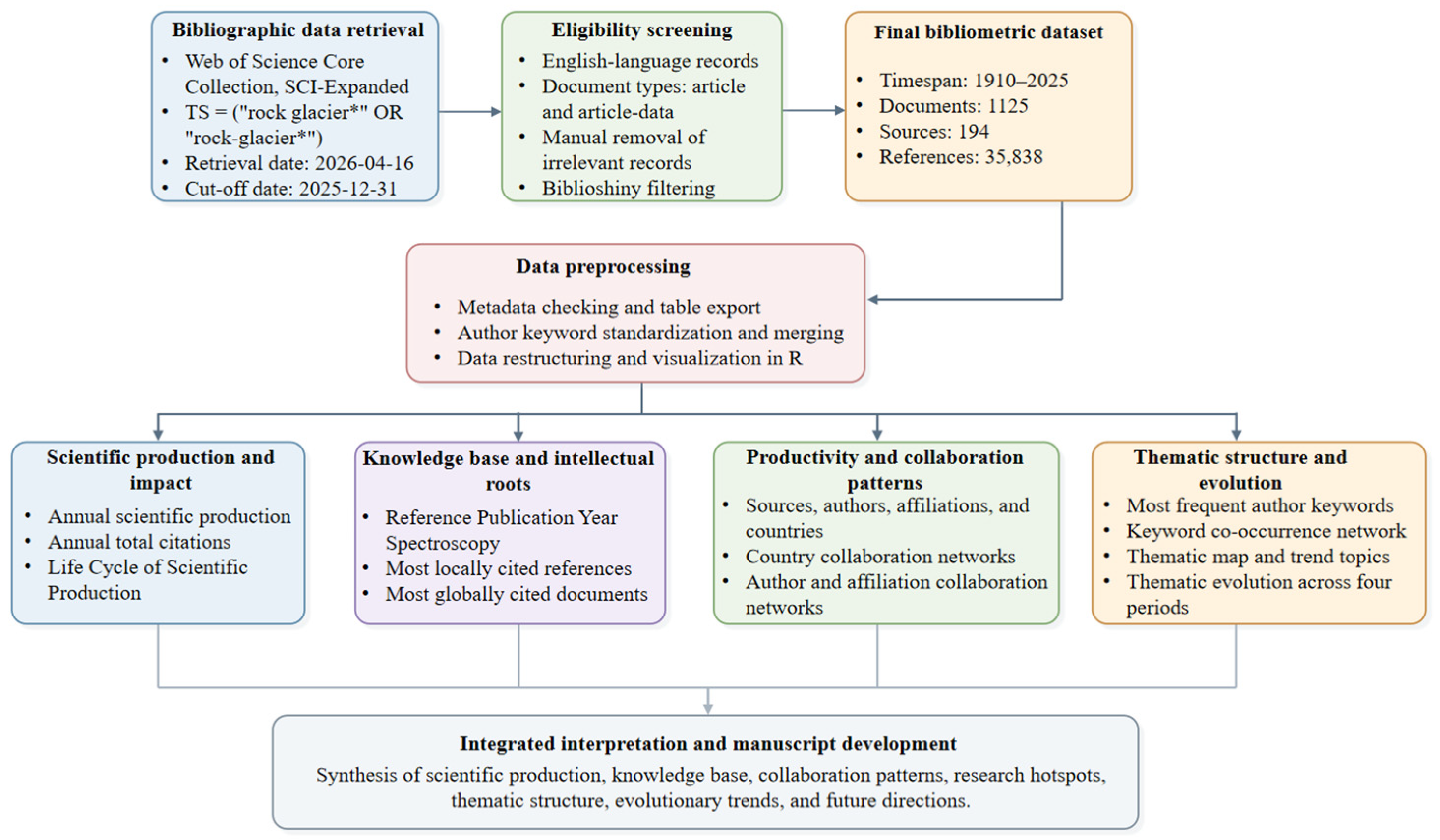
Figure 1 summarizes the research workflow. The workflow includes literature data retrieval, language and document-type filtering, manual screening, sensitivity checking, preprocessing, bibliometric analysis, and result interpretation. The workflow highlights the relationships among raw bibliographic data, keyword standardization, major analytical modules, and final interpretation. It also clarifies that this study did not simply export default software results; instead, the analytical conclusions were formed after data cleaning, keyword merging, model fitting, figure redrawing, and content-based interpretation.

3. Results

3.1. Scientific Production Growth and Life-Cycle Characteristics

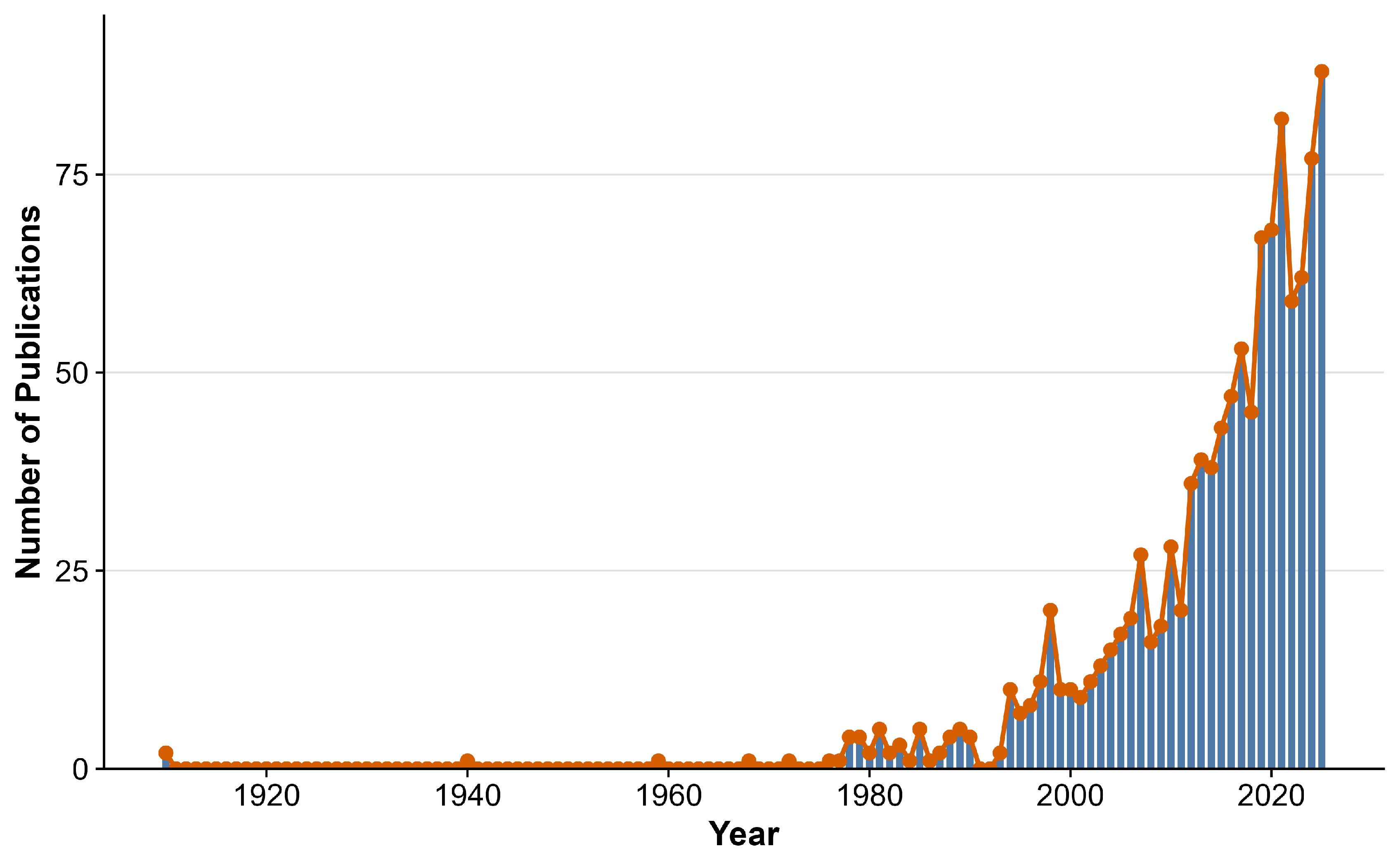
Between 1910 and 2025, rock glacier research produced 1125 valid documents and showed a combined pattern of long-term low output and rapid recent growth. Figure 2 shows that annual publication output remained generally low for a long period of the twentieth century, indicating that rock glacier research initially existed as a relatively specialized topic within periglacial geomorphology and mountain environmental research. Since the end of the twentieth century, especially after 2000, annual output has increased markedly. This increase coincides with growing attention to mountain permafrost degradation, cryospheric change, remote sensing monitoring, hydrological significance, and high-mountain environmental risk, although the bibliometric pattern alone does not establish a causal relationship among these factors.
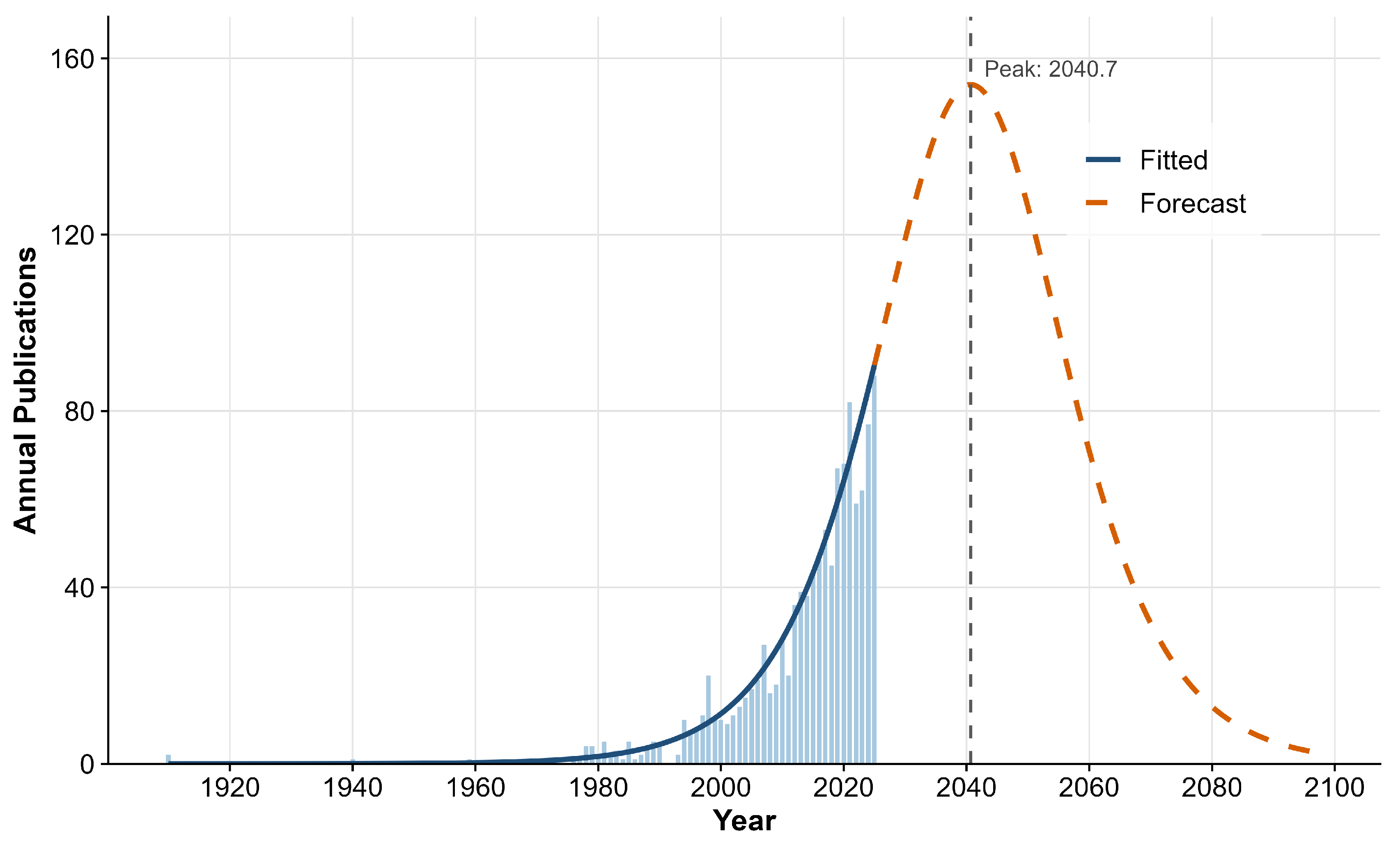
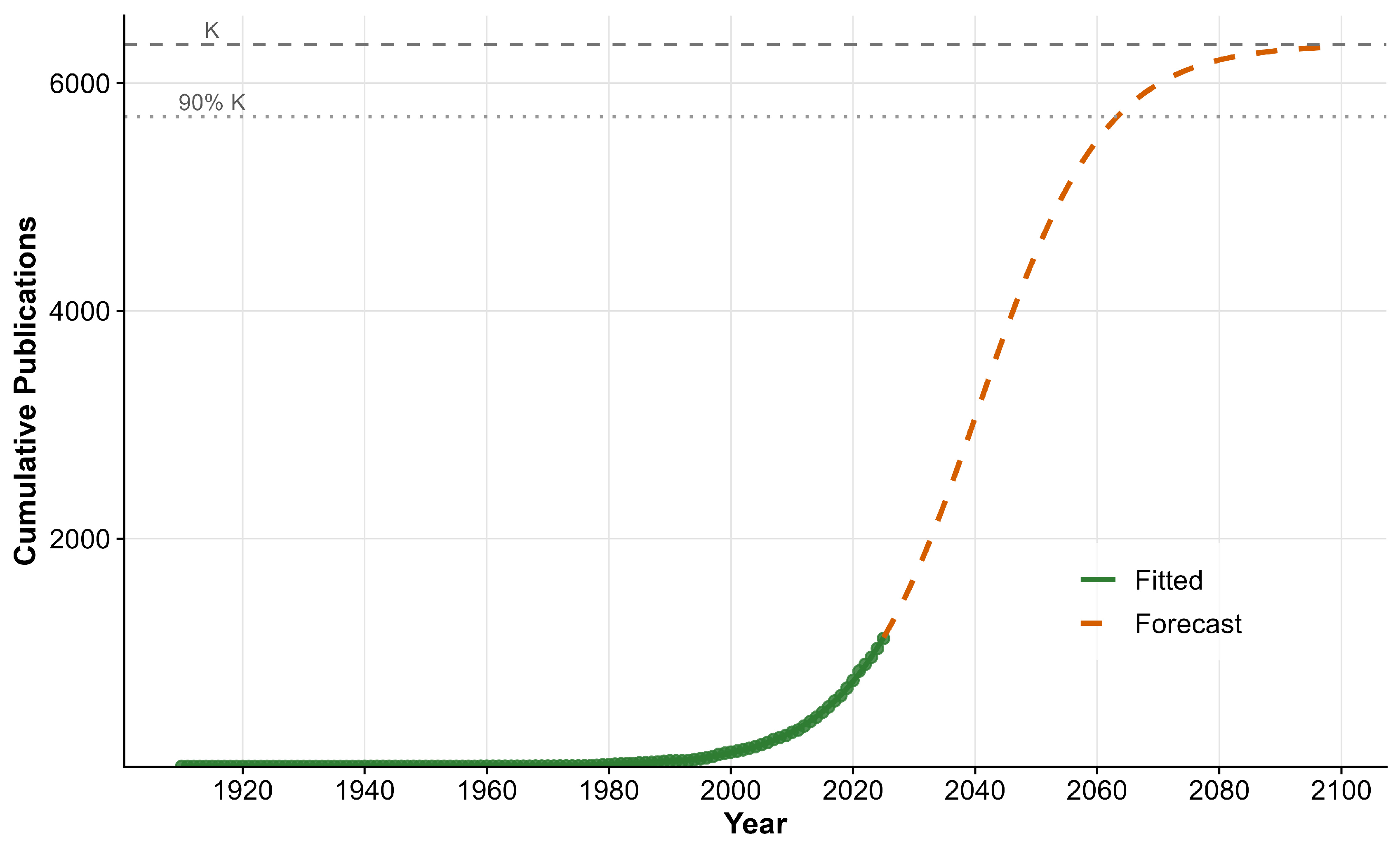
The Logistic model based on cumulative publication output provides a model-dependent diagnosis of the current growth stage of the field. As shown in Figure 3, the fitted cumulative curve remains below the estimated saturation level. In this model, the estimated saturation level is approximately 6338 publications, and the observed cumulative output in 2025 was 1125 publications, corresponding to 17.75% of the model-estimated saturation level. The high R2 of the cumulative fit indicates that the model reproduces the historical cumulative trajectory in the present dataset, but it should not be interpreted as proof that future publication growth will necessarily follow the same curve. The result is therefore used to support the interpretation that rock glacier research remains in an active growth stage rather than to predict a fixed saturation endpoint.
The annual-output curve derived from the Logistic model also suggests, under the assumptions of this model, that the annual production peak has not yet appeared in the observed dataset. The fitted curve places the inflection point around 2041, with a model-estimated annual maximum of approximately 154 publications per year. It also estimates that the field reached about 10% of the saturation level in 2018 and would approach 90% around 2063 if the historical trajectory continued. These values should be read as diagnostic indicators of the current growth stage rather than as precise forecasts, because future publication output may change with database coverage, monitoring products, funding priorities, policy demand, and the development of new research technologies.
It is important to emphasize that the main value of Figure 3 and Figure 4 lies in identifying the current developmental stage and growth potential, not in mechanically predicting future publication numbers. The subsequent growth of rock glacier research will be affected by multiple factors, including the intensity of climate-change concerns, high-mountain hazard risk, advances in InSAR and remote sensing technologies, construction of long-term monitoring networks, demand for water-resource research, database coverage, and indexing practices [40]. Therefore, the estimated saturation level, the 17.75% value for 2025, and the projected annual peak around 2041 are used here as stage-diagnosis indicators rather than deterministic predictions.

3.2. Knowledge Base and Classic Intellectual Roots

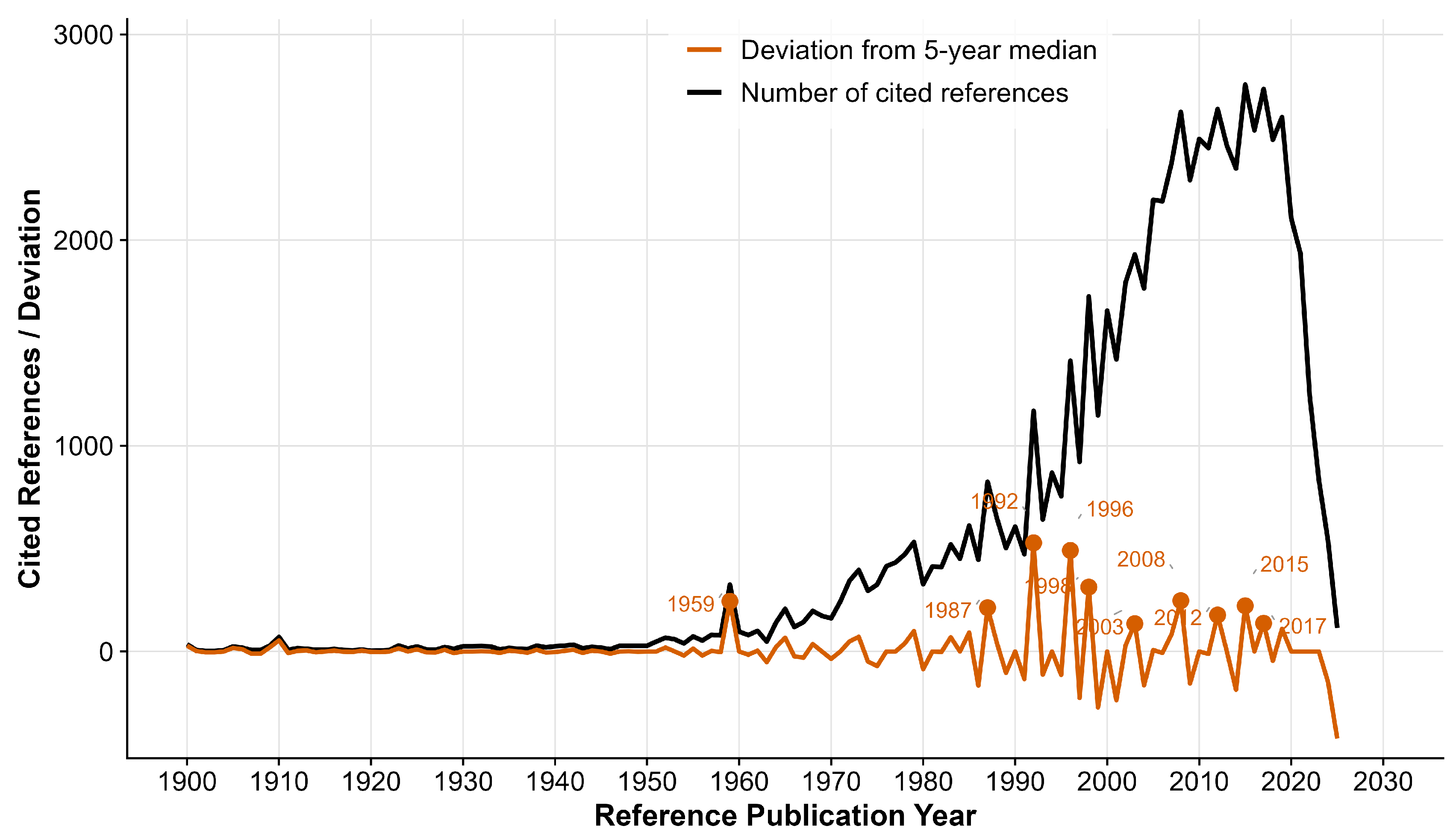
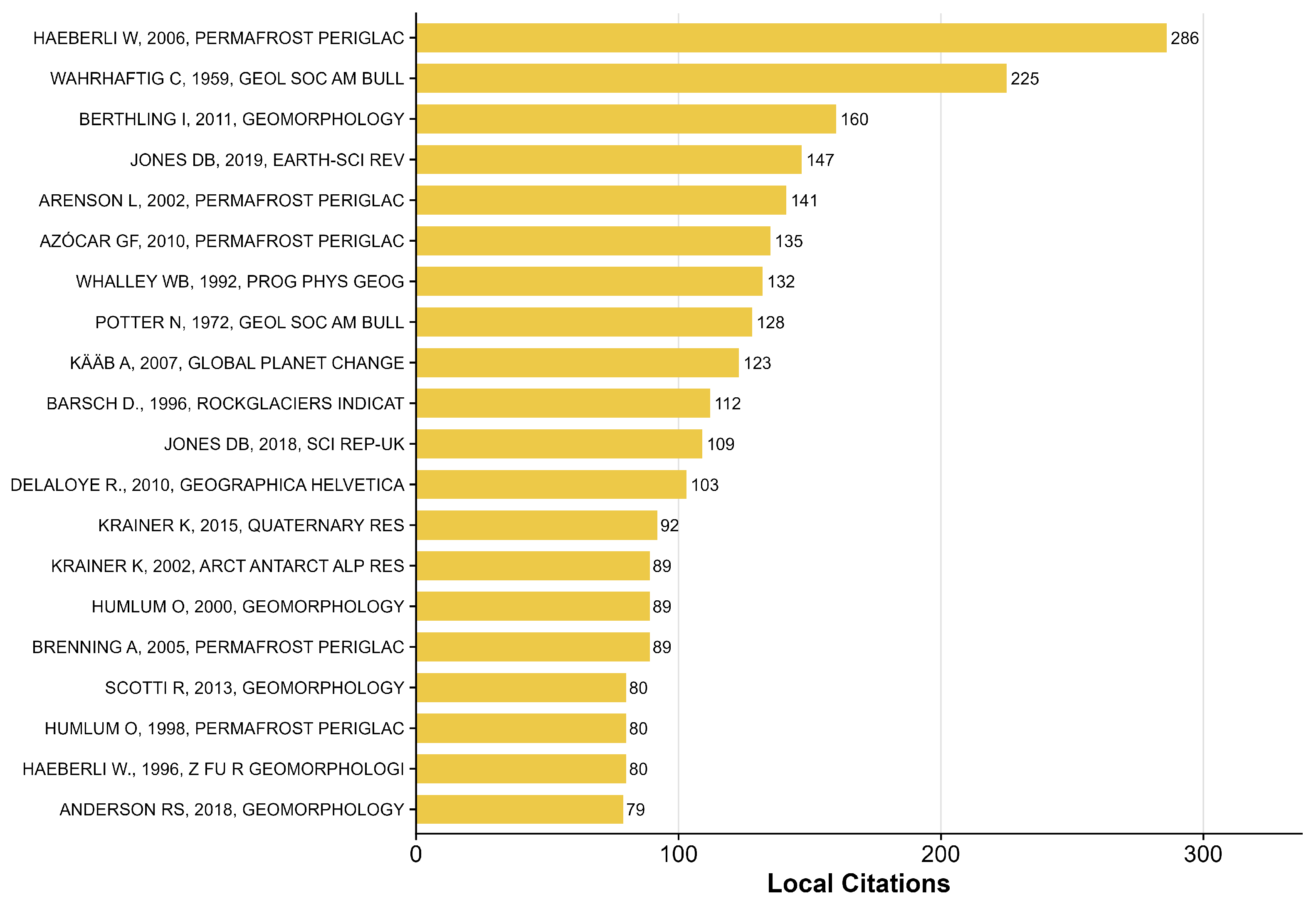
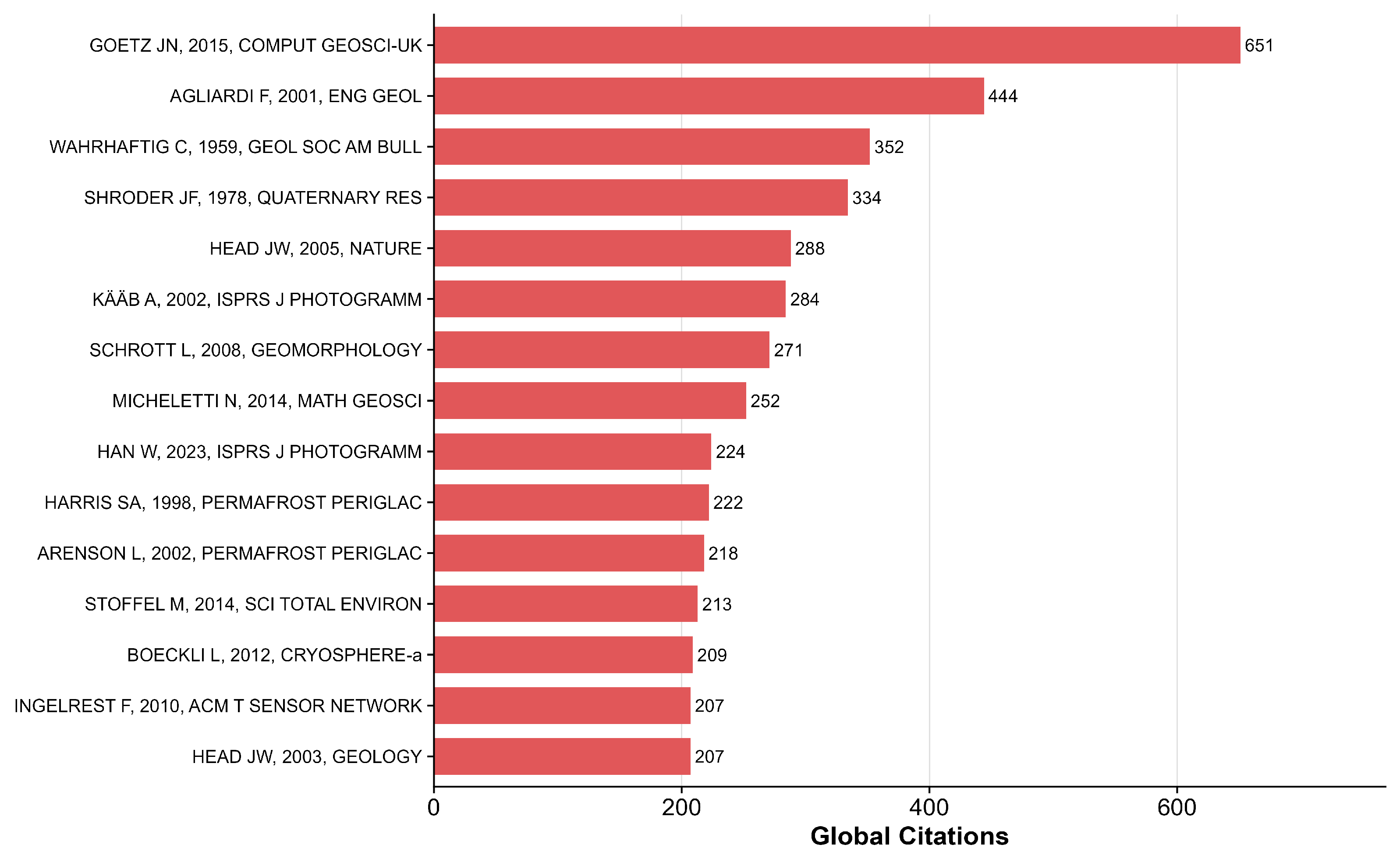
The RPYS results show that the knowledge base of rock glacier research did not accumulate uniformly but instead formed clear peaks in several key years. Figure 5 shows the publication-year distribution of cited references and its deviation from the centered five-year median. The 1959 peak corresponds to the systematic geomorphological framing of Alaskan rock glaciers [1]; the 1987–1996 peaks reflect classification, genetic models, and high-mountain geoecological interpretation [2,3,4]; the early 2000s mark the rise in internal deformation measurements, permafrost creep theory, and radar interferometric motion mapping [5,41,42]; and later peaks correspond to conceptual clarification, climate-response interpretation, and hydrological synthesis [6,16,43]. To reduce the subjectivity of peak interpretation, these assignments were cross-checked against the locally cited references in Figure 6, the globally cited sample documents in Figure 7, and the substantive content of representative studies. Thus, the RPYS peaks were interpreted as content-based turning points rather than as isolated citation-count anomalies [37].
The core significance of the 1959 peak lies in the systematic study of rock glaciers in the Alaska Range by Wahrhaftig and Cox. That study discussed rock glaciers as high-mountain landforms with independent morphological, movement, and environmental significance, establishing a basic observational framework for subsequent research. Barsch in 1996 also regarded the work of Wahrhaftig and Cox as an important starting point of modern rock glacier research and further interpreted active rock glaciers as visible geomorphic indicators of mountain permafrost environments [1,44,45].
The 1992 peak corresponds to in-depth discussion of rock glacier formation mechanisms and classification models. Whalley and Martin in 1992 systematically reviewed different genetic interpretations, including the permafrost model, glacier ice-core model, and rockslide model [3]. They emphasized that rock glacier origin cannot be judged only by morphological similarity and that all ice-debris landforms should not be incorporated into a single explanatory framework. This work promoted the shift in rock glacier research from external morphological description toward discussion of genetic models and dynamic processes [2,3,7].
The 1996 peak is mainly related to Barsch’s systematic research. Barsch did not treat rock glaciers only as a landform type, but placed them within high-mountain environmental systems, mountain permafrost zones, debris transport processes, and palaeoenvironmental indicator systems. He proposed that active rock glaciers can serve as visible expressions of mountain permafrost, whereas inactive and relict rock glaciers can provide information on past environments and palaeoclimate. This framework expanded rock glacier research from local geomorphic description to the broader integrated level of high-mountain geoecology and mountain permafrost monitoring [4,46,47,48,49].
Arenson et al. in 2002 [41] advanced rock glacier dynamics research from surface-motion observation to analysis of internal deformation structure. Based on borehole deformation measurements, temperature profiles, and internal-structure data from three active rock glaciers in the Swiss Alps, the study showed that internal deformation in rock glaciers does not necessarily form a continuous deformation profile similar to that in temperate glaciers, but is often concentrated in specific shear zones. The results indicate that, even when surface morphologies are similar, different rock glaciers may differ substantially in ice content, air voids, thermal state, bedrock slope, and grain composition, and that these differences can affect creep rate and potential stability [41,50,51,52,53]. This work provided an empirical basis for later interpretations of rock glacier dynamics that combine borehole data, geophysical investigation, photogrammetry, and remote sensing monitoring.
The importance of Haeberli et al. in 2006 [5] lies in incorporating rock glacier dynamic processes into an integrated framework in which thermal state, internal composition, kinematics, and rheology are mutually coupled. Figure 6 further demonstrates the influence of these classic studies within the field from the perspective of local citations. The publication of Haeberli et al. in 2006 [5] is the most locally cited reference, followed by key works including Wahrhaftig and Cox in 1959 [1], Berthling in 2011 [6], Arenson et al. in 2002 [41], Kääb et al. in 2007 [43], and Jones et al. in 2019 [13]. Together, these publications constitute the knowledge base of rock glacier research from geomorphic form, genetic debate, internal deformation, and temperature response to hydrological function.
In addition to locally highly cited references, globally highly cited documents reflect the visibility of rock-glacier-related research in the broader scholarly environment. Figure 7 shows the papers with the highest global citation counts among the sample documents. Unlike Figure 6, which reflects how repeatedly a reference is cited within the rock glacier sample and is therefore more suitable for identifying the field’s knowledge base, Figure 7 reflects the overall influence of documents within the Web of Science citation system. This influence may be jointly affected by cross-disciplinary dissemination, journal impact, publication time, and the outward diffusion of research topics. Therefore, locally highly cited references and globally highly cited documents answer different questions. The former emphasizes the internal knowledge roots of the field, whereas the latter emphasizes the reach of documents within a broader academic network.
Kääb et al. in 2007 linked rock glacier creep to climate warming [43]. Using a one-dimensional thermo-mechanical coupling model, the global relationship between rock glacier velocity and mean annual air temperature, and long-term monitoring data from the Swiss Alps, the study showed that increasing surface temperature can produce changes in rock glacier velocity comparable to observed magnitudes. However, this response is jointly controlled by slope, debris content, ice thickness, liquid water, and internal structure. Rock glaciers with temperatures close to 0 °C usually creep faster than colder rock glaciers and are more sensitive to thermal forcing [22,43,54,55,56,57]. This study demonstrates that climate change is not only a background condition for rock glacier research; it can influence rock glacier movement by changing thermal state, moisture conditions, and mechanical properties.
Highly cited studies around 2011 reflect a conceptual reconsideration of rock glaciers. Berthling in 2011 argued that the long-standing confusion in rock glacier research is not merely a terminological issue but arises from differences in classificatory foundations [6]. Morphological definitions can group landforms with similar appearances but different origins into one category, whereas overly narrow genetic definitions may exclude transitional and polygenetic objects [3,6,8,58,59]. The proposed perspective of cryo-conditioned landforms means that rock glaciers should no longer be simply understood as “debris bodies that look like glaciers”; instead, they should be placed within a theoretical framework involving low-temperature conditions, ice-debris deformation, and geomorphic emergence.

3.3. Major Knowledge Producers and Collaboration Patterns

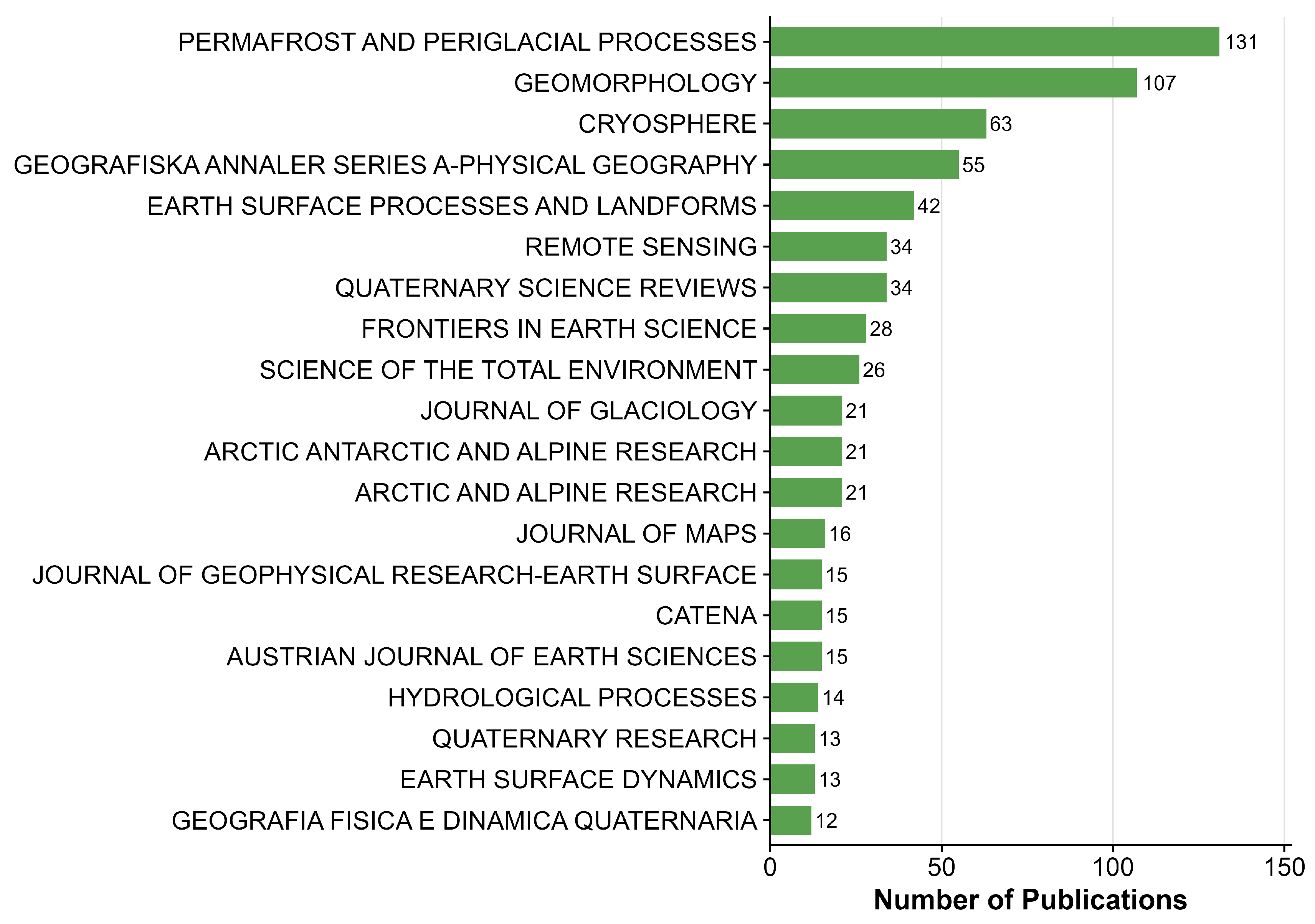
In terms of source journals, rock glacier research shows clear interdisciplinary publishing characteristics, but its core outlets remain concentrated in journals related to permafrost, geomorphology, cryospheric science, and Earth surface processes. Figure 8 shows that Permafrost and Periglacial Processes, Geomorphology, and The Cryosphere are the most productive source journals in the field. Permafrost and Periglacial Processes ranks first, with 131 publications, indicating that rock glacier research has long been closely related to permafrost and periglacial processes. Geomorphology published 107 papers, reflecting the foundational position of geomorphic processes, landform evolution, and rock glacier morphological identification in the field. The Cryosphere published 63 papers, indicating that rock glacier research has increasingly entered the framework of cryospheric change and global environmental change in recent years. Other productive sources, such as Earth Surface Processes and Landforms, Quaternary Science Reviews, and Remote Sensing, show that research topics have expanded toward Quaternary environments, Earth surface processes, and remote sensing monitoring.
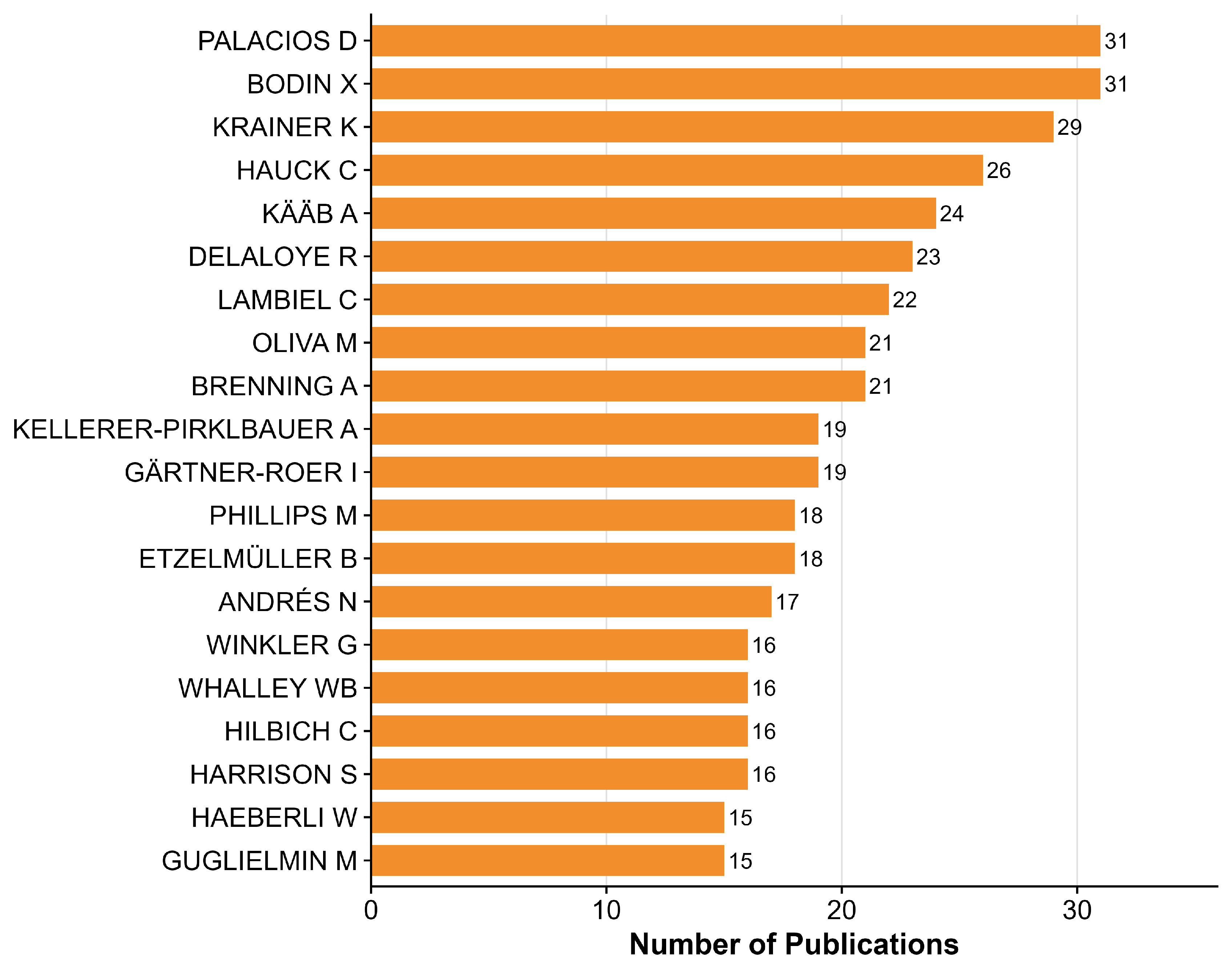
From the author distribution, rock glacier research has formed a group of core authors with sustained productivity. Figure 9 shows that Bodin X and Palacios D each published 31 papers and rank among the most productive authors. Krainer K, Hauck C, Kääb A, Delaloye R, Lambiel C, Brenning A, Oliva M, and Gärtner-Roer I also show high output. Their research is mostly related to Alpine regions, permafrost monitoring, rock glacier motion, remote sensing observation, and geomorphic evolution. Productive authors are not necessarily the same as the most influential authors, but their sustained output indicates that the field has developed relatively stable research teams and scholarly communities.
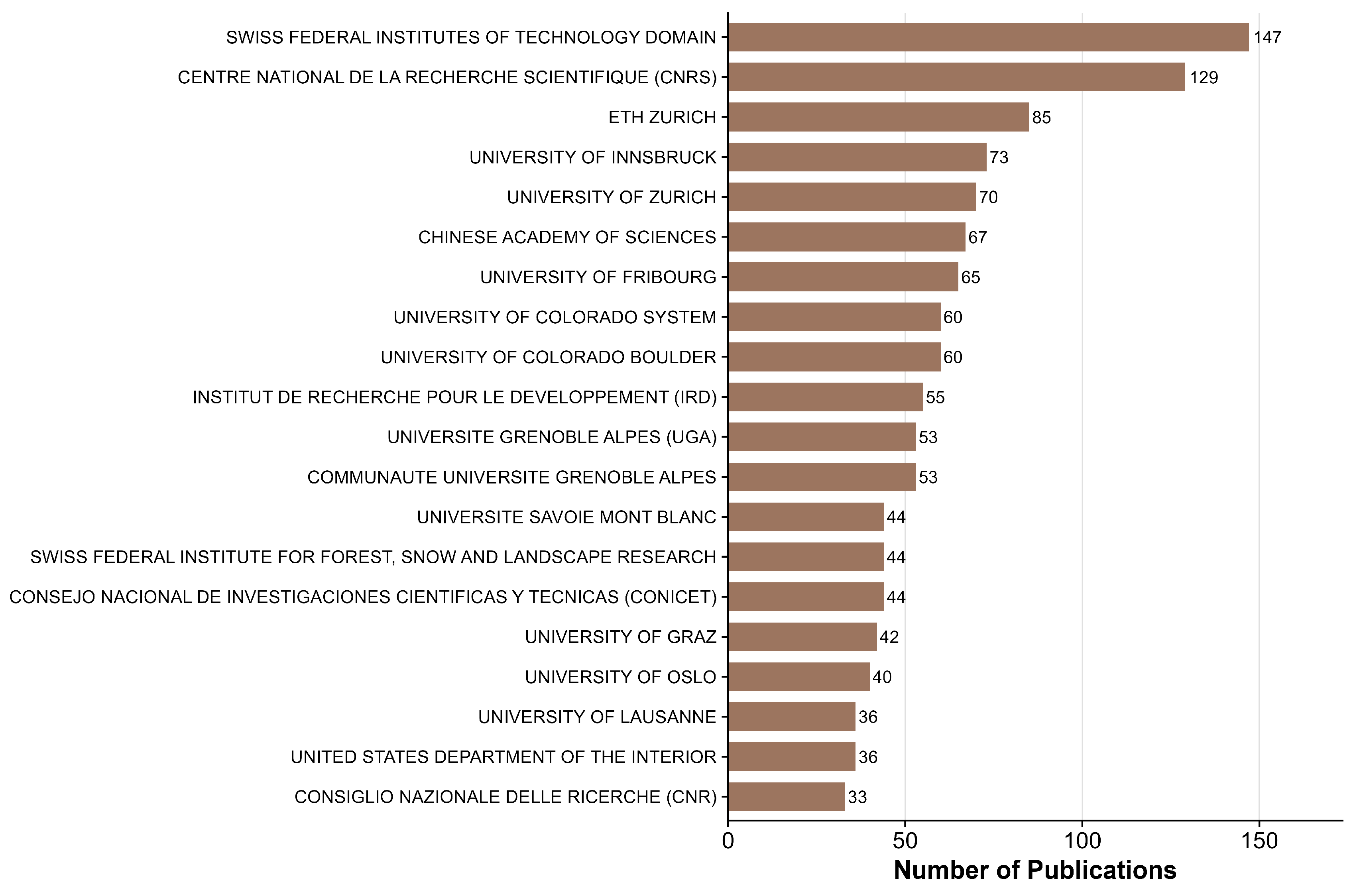
In terms of affiliation distribution, European mountain and permafrost research institutions occupy an important position in rock glacier research. Figure 10 shows that the Swiss Federal Institutes of Technology Domain ranks first with 147 papers, followed by the Centre National de la Recherche Scientifique, ETH Zurich, the University of Innsbruck, and the University of Zurich. The Chinese Academy of Sciences, University of Fribourg, University of Colorado Boulder, University of Colorado System, and Institut de Recherche pour le Développement also rank among the productive affiliations. This pattern shows that the core knowledge production of rock glacier research is concentrated in institutions related to the Alps in Switzerland, Austria, and France, while also gradually expanding to China, North America, and other high-mountain cold-region research institutions.
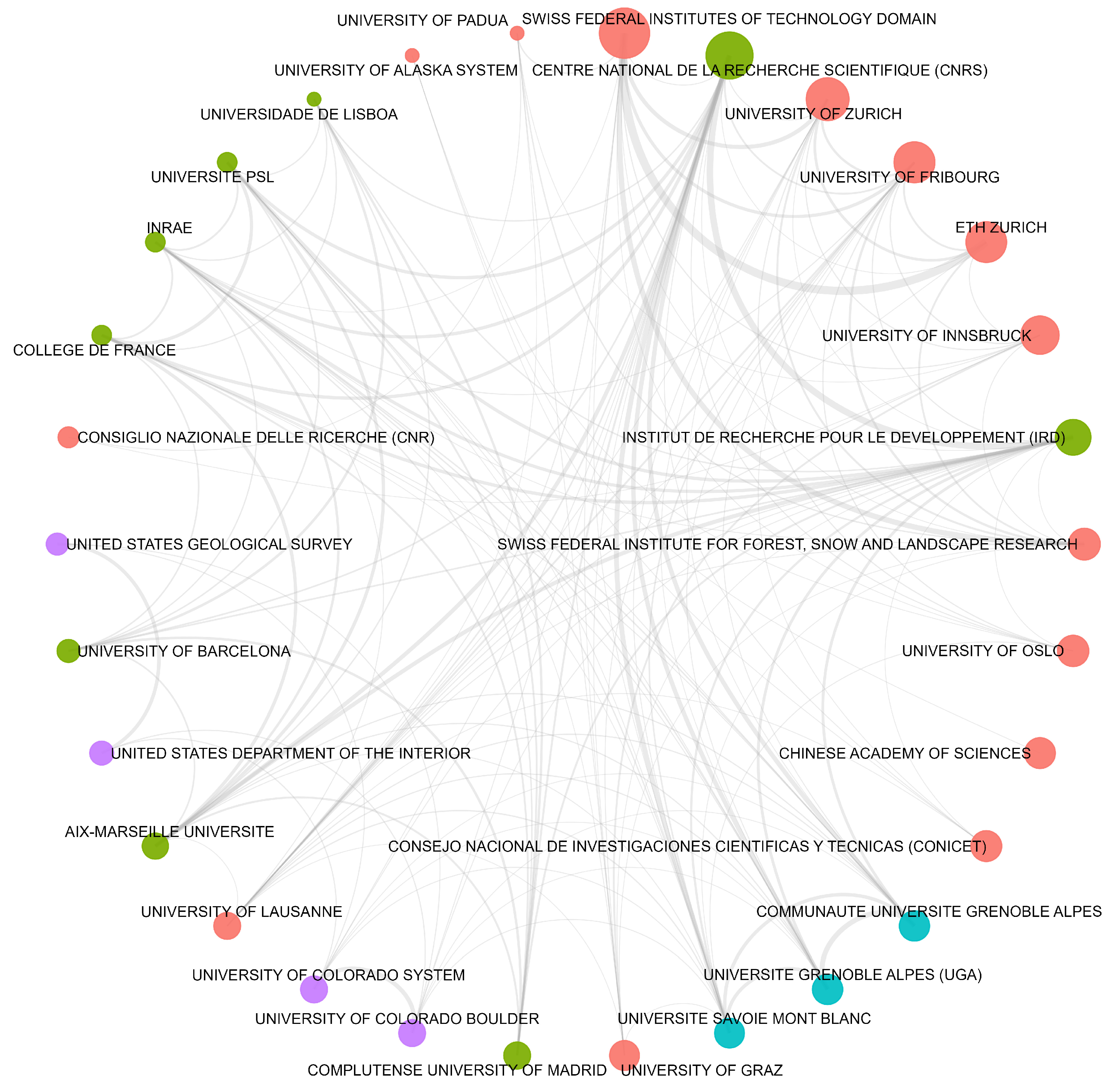
The affiliation collaboration network further shows the organizational characteristics of rock glacier research. Figure 11 indicates that collaboration links among institutions are not uniformly distributed, but are concentrated around institutions that have long conducted research on mountain permafrost, cryospheric change, and rock glacier dynamic processes. Links among European institutions in Switzerland, France, Austria, and Germany are particularly prominent, reflecting the long-term advantage of the Alpine region in rock glacier research. At the same time, the participation of the Chinese Academy of Sciences, North American universities, and other high-mountain cold-region research institutions indicates that the collaboration network is expanding from the traditional European core toward a broader range of mountain permafrost regions.
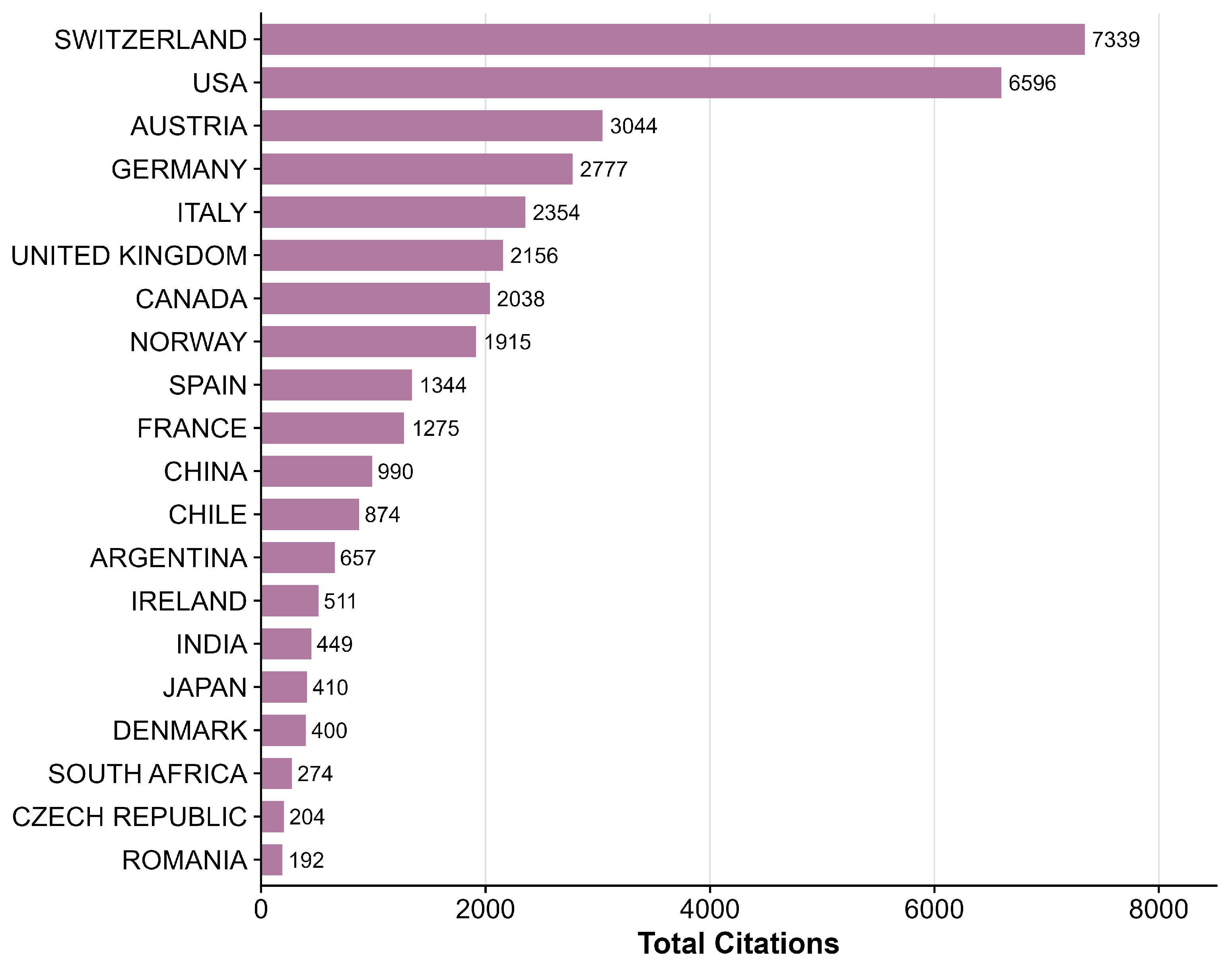
Country-level citation impact shows that a small number of countries have high knowledge influence in rock glacier research. Figure 12 shows that Switzerland, the United States, Austria, Germany, Italy, the United Kingdom, and Canada have high total citation counts. Switzerland ranks first with 7339 total citations, followed by the United States with 6596. Switzerland not only has a high publication output but also reaches an average of 52.4 citations per paper, indicating that its influence in rock glacier research comes from both publication quantity and long-term monitoring accumulation, classic case studies, and high-impact research teams. Norway’s total publication volume is lower than that of Switzerland and the United States, but its average citations per paper reach 50.4, also indicating that some of its outputs have strong influence.
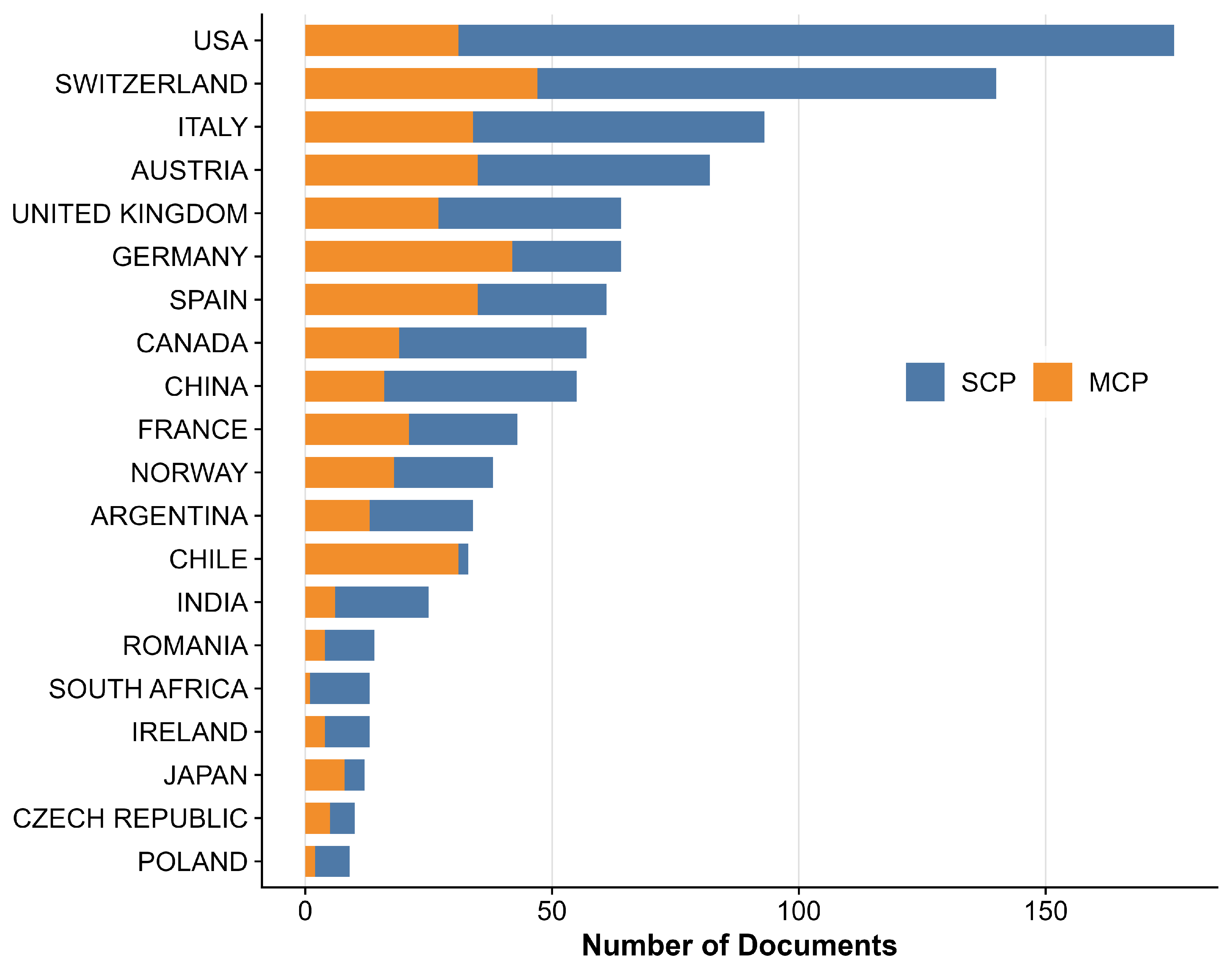
Country-level publication output and collaboration modes further reveal different ways of producing knowledge across countries. Figure 13 shows that the United States, Switzerland, Italy, Austria, Germany, the United Kingdom, Spain, Canada, China, and France are the main publishing countries. The United States ranks first with 176 papers, followed by Switzerland with 140, Italy with 93, Austria with 82, and Germany and the United Kingdom each with 64. The Single Country Publications and Multiple Country Publications (SCP/MCP) structure in Figure 13 indicates clear differences in the proportions of domestic and international collaboration among countries. The United States has the highest output, but its MCP proportion is 17.61%, indicating that a considerable share of its outputs were completed by domestic teams. Germany, France, and Spain have higher MCP proportions, showing stronger transnational collaboration in rock glacier research. Switzerland, Italy, and Austria show both high SCP and high MCP, indicating that these countries have strong domestic research bases while also actively participating in international collaboration.
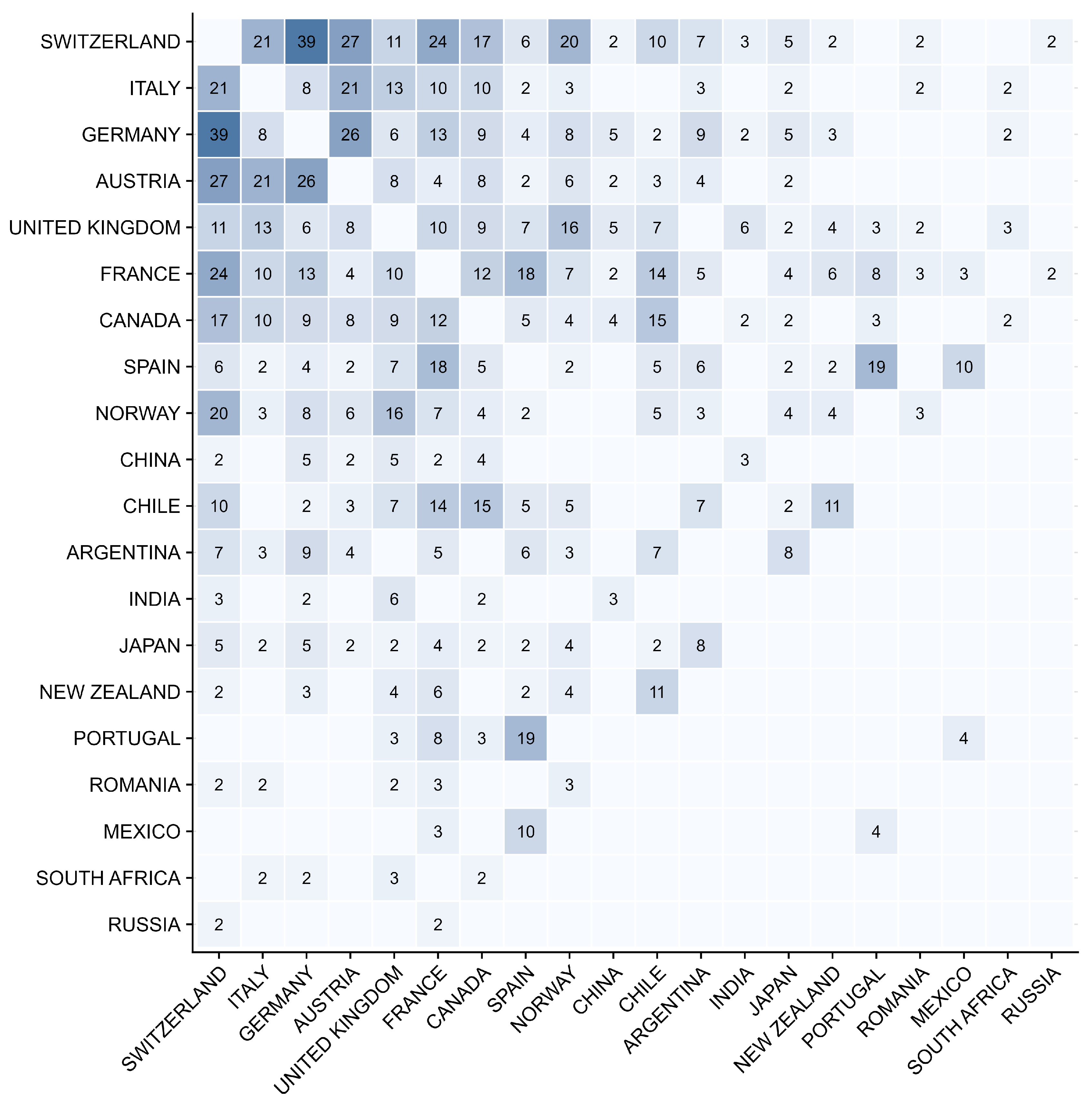
The country collaboration matrix further refines international collaboration relationships. Figure 14 shows that international collaboration is mainly concentrated among Alpine-related countries and further connects Europe, North America, and other high-mountain research communities. This pattern is related to the geographical basis of rock glacier research. The Alpine region has a long history of rock glacier observation, mature permafrost monitoring networks, and dense high-mountain research institutions, and has therefore formed a strong collaboration center. The participation of China, Canada, the United States, and other high-mountain cold-region countries indicates that rock glacier research is expanding from the traditional Alpine center toward global mountain permafrost regions. Figure 13 and Figure 14 complement each other: the former emphasizes the strength of collaboration among countries, whereas the latter reveals the relative proportions of domestic and international collaboration within each country’s output.
Overall, the collaboration results indicate that rock glacier research has developed from regionally concentrated case-study traditions into a more international mountain permafrost research network. The strong role of Alpine institutions reflects the long history of monitoring and methodological development in European mountain environments, whereas the increasing participation of institutions from China, North America, the Andes, the Himalayas, and other mountain regions indicates the geographical broadening of the field. This pattern helps explain why recent thematic growth is linked not only to conceptual development but also to the expansion of regional inventories, remote sensing datasets, and international monitoring collaborations.

3.4. Research Hotspots and Keyword Structure

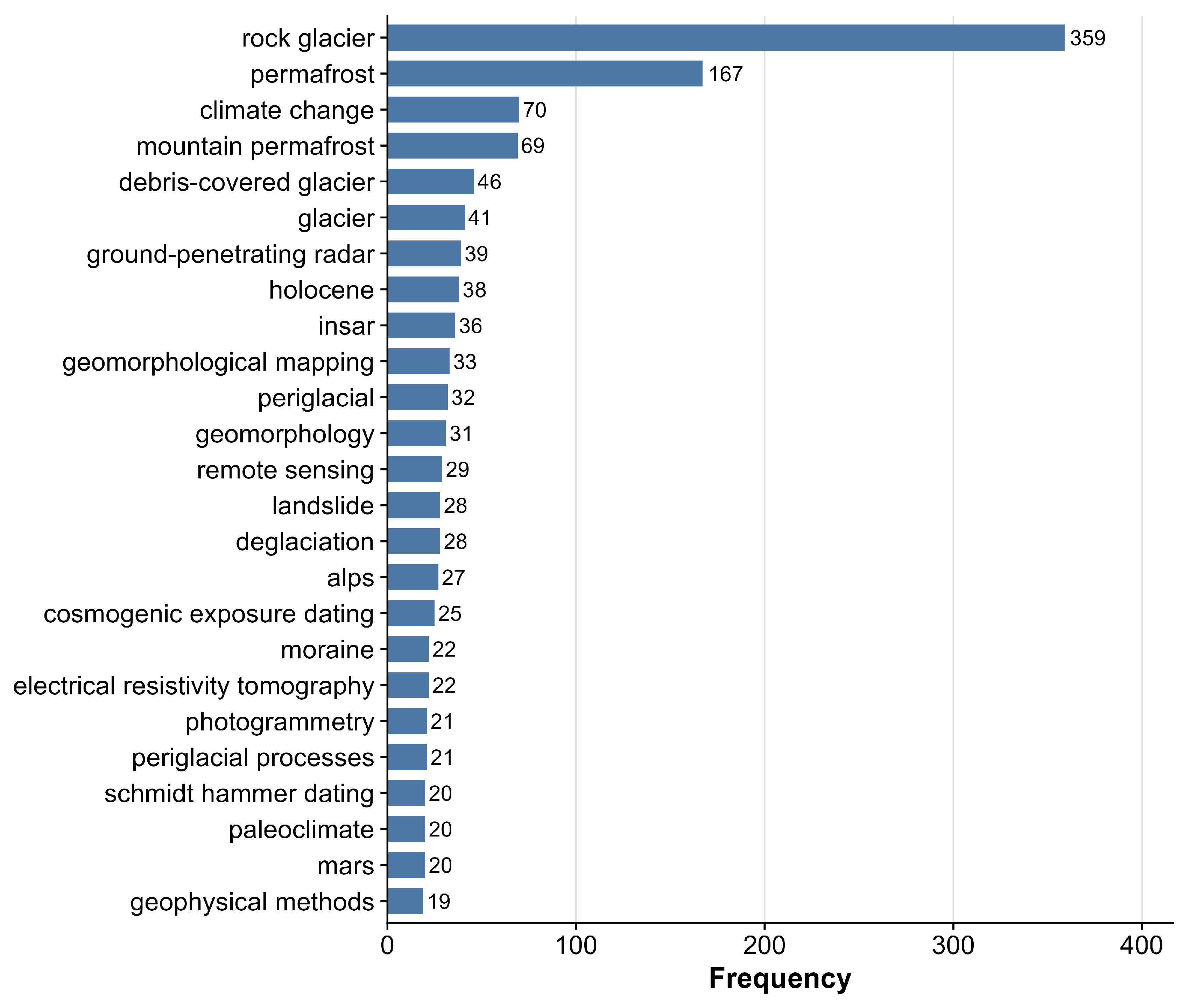
Author keyword frequency results show that the thematic structure of rock glacier research is highly concentrated around a small number of core concepts, while also showing a trend of continuous expansion toward methods, processes, and applications. As shown in Figure 15, rock glacier and permafrost dominate the author keyword frequencies. After cleaning and merging author keywords, rock glacier appears 359 times and permafrost appears 167 times, indicating that the relationship between rock glaciers and permafrost constitutes the most stable conceptual core of the field. Climate change appears 70 times and mountain permafrost appears 69 times, showing that mountain permafrost degradation and rock glacier response under climate change have become important research directions.
The keyword results are interpreted as bibliometric associations among topics rather than direct evidence of causal relationships among environmental drivers and rock glacier processes. They indicate how authors have linked concepts in the indexed literature, but process-based interpretation still requires field, geophysical, hydrological, and remote sensing evidence.
Figure 15 also shows that keywords such as debris-covered glacier, glacier, InSAR, and ground-penetrating radar rank among the high-frequency terms. This pattern is consistent with case studies showing that rock glaciers may grade into debris-covered glaciers or glacier-derived debris-ice systems [60,61,62]. Regional inventories in Asia, the Andes, the Alps, and other mountain systems increasingly classify active, transitional, and relict features across large areas [11,28,33], while velocity inventories and global datasets show why activity status and kinematics must be treated as dynamic attributes rather than fixed labels [63,64].
The strengthening of method-related keywords is not merely a technical fashion. Borehole deformation measurements and thermal observations show that internal deformation can concentrate in shear zones [41,51]; ERT and GPR studies demonstrate that ice content and internal architecture vary substantially among rock glaciers [53,65]; and discontinuous-permafrost studies show that ground-temperature measurements and ERT can jointly identify active-layer depth, frozen-ground boundaries, and substrate effects [66,67,68]. Electromagnetic and thermal studies of talus slopes and overcooled debris also show that surface form alone cannot identify the physical state of the subsurface [69,70,71], and radar or active-layer investigations further constrain material contrasts that are invisible at the surface [10,19,21,72]. Therefore, InSAR, optical remote sensing, GPR, ERT, TLS, digital elevation model (DEM) analysis, and UAV photogrammetry should be interpreted as complementary methods that observe different physical dimensions of the same coupled system.
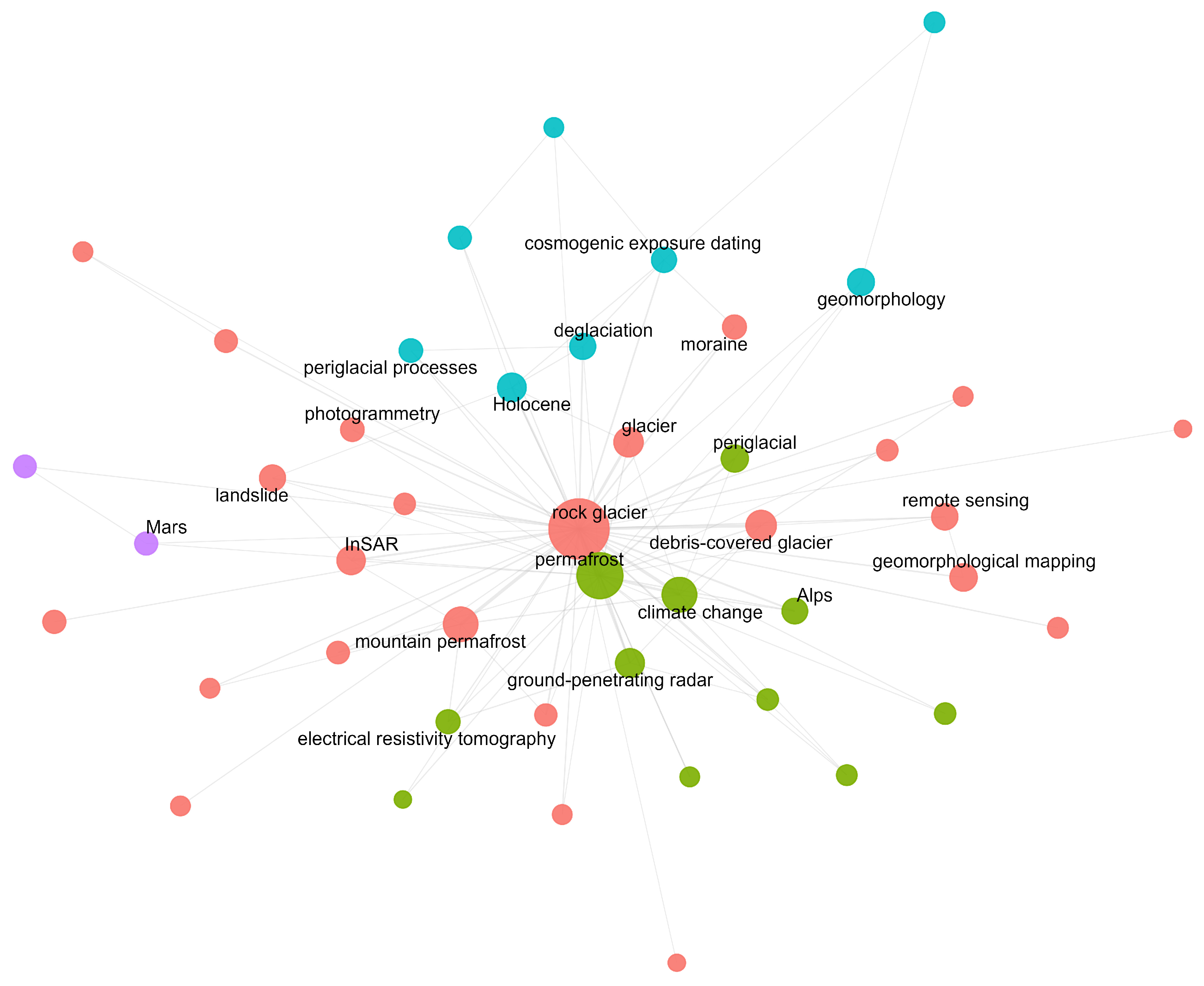
The keyword co-occurrence network further reveals structural relationships among themes. Figure 16 shows that rock glacier and permafrost form the core nodes of the keyword network, while methodological and environmental-change terms form extended connections around them. This structure indicates that rock glacier research has formed close links among the geomorphic object, permafrost processes, the climate-change context, and multi-source monitoring methods. The strengthening of links between methodological and process-related keywords indicates that researchers are attempting to combine surface-motion monitoring, internal-structure detection, and environmental driving mechanisms to construct a more complete interpretive framework for rock glacier change.
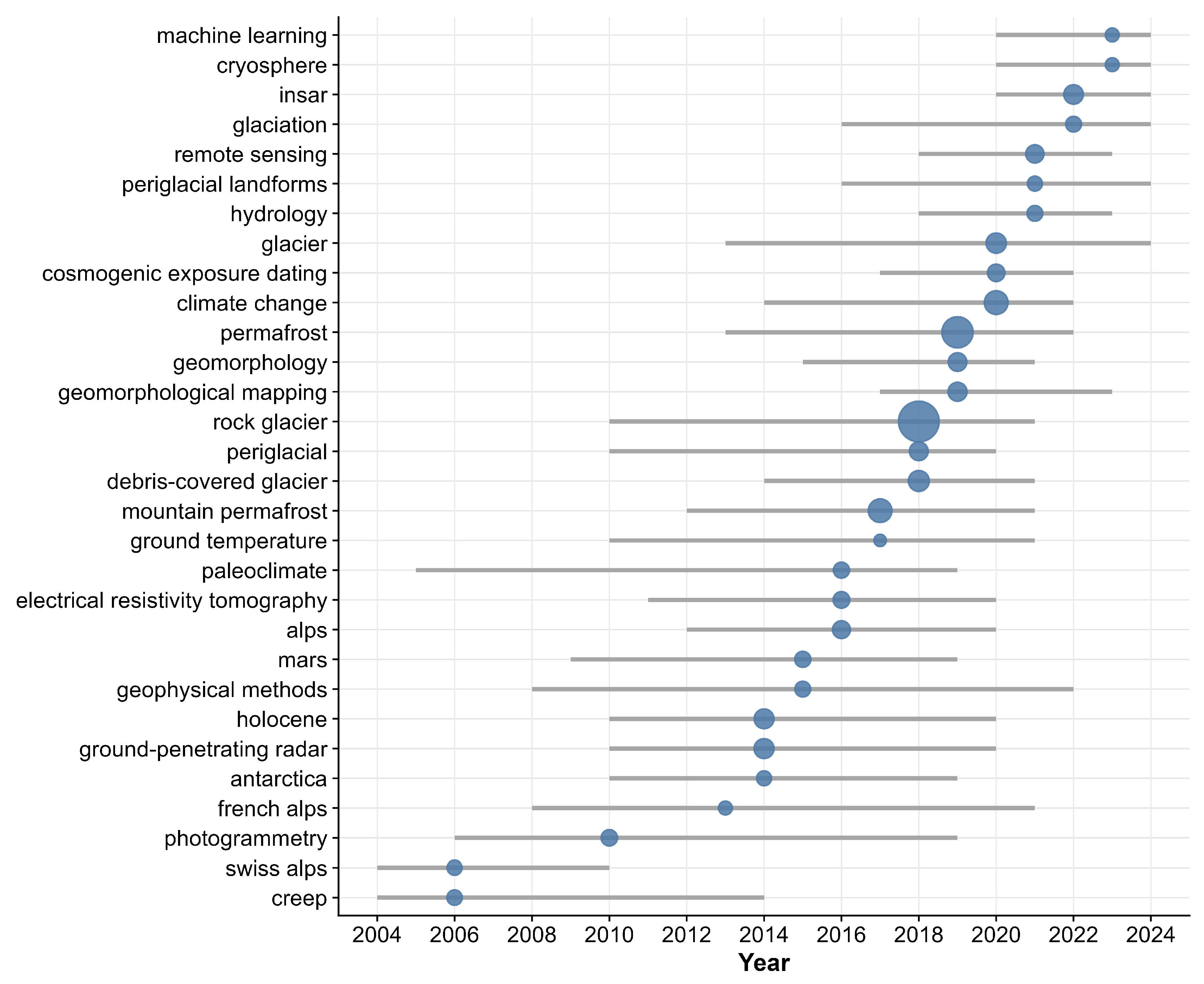
The trend-topic results reveal temporal shifts in research attention. As shown in Figure 17, earlier themes such as creep, blockfield, electrical resistivity, and photogrammetry were associated with field geomorphology, surface-motion measurement, and the first quantitative interpretations of permafrost creep [1,3,5,9]. Electrical resistivity, GPR, and related geophysical themes then became more visible because they directly address ice content, active-layer thickness, and internal heterogeneity [19,68]. More recent themes such as InSAR and remote sensing reflect the shift toward repeated regional monitoring of surface displacement [12,26,32,73], while machine learning and deep learning indicate the need to build inventories in extensive or data-poor mountain regions [28,33,34]. The thematic trend therefore records a methodological progression from local recognition to regional, multi-source, and increasingly automated analysis rather than a simple replacement of old topics by new ones.

3.5. Strategic Thematic Structure

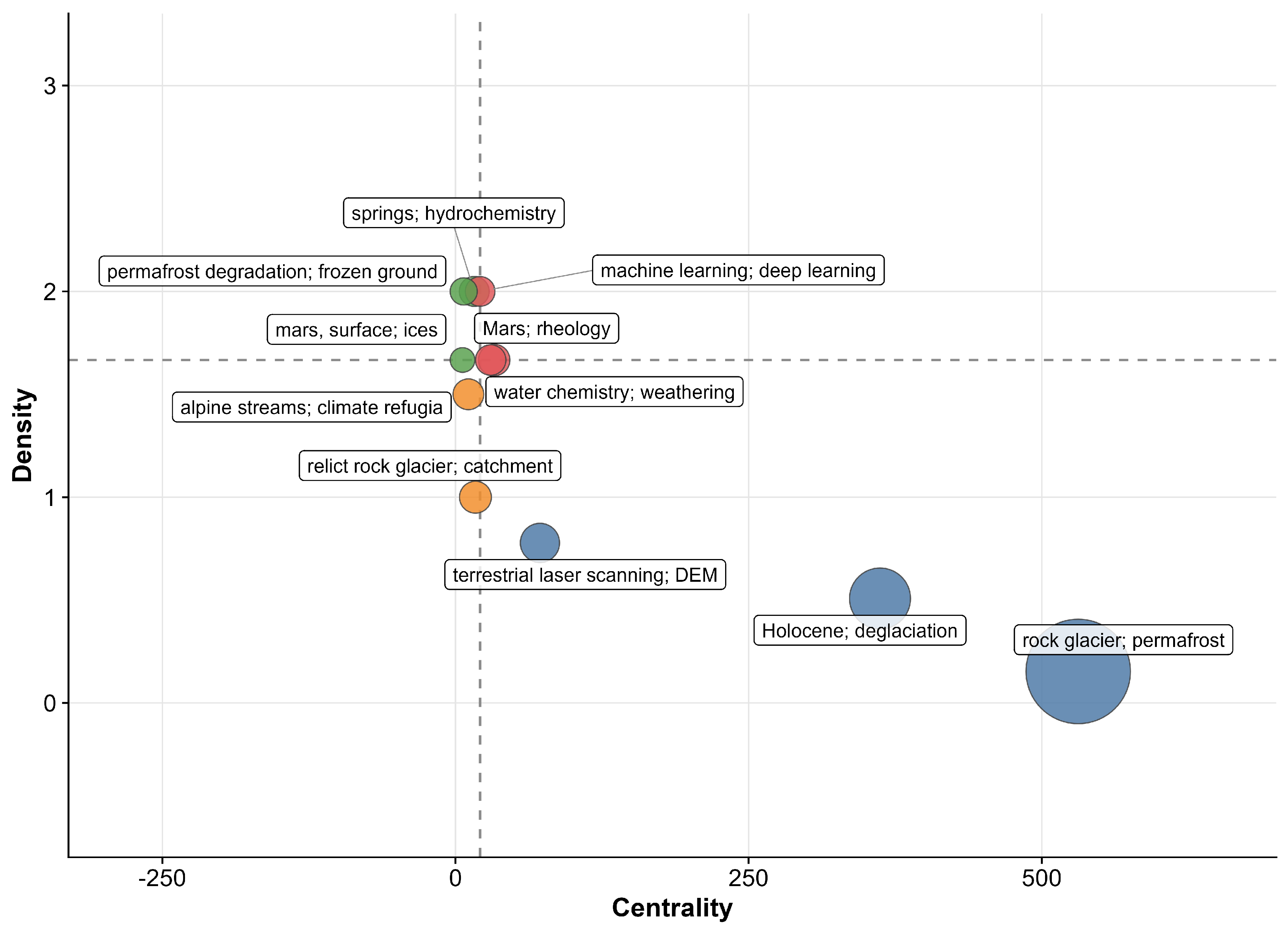
To further analyze the structural positions of different research themes, this study constructed a thematic map based on the author keyword co-occurrence network. As shown in Figure 18, the thematic map distinguishes author keyword clusters according to centrality and density, thereby identifying basic themes, motor themes, niche themes, and emerging or declining themes. It should be noted that emerging or declining themes only indicate that the related themes have both low centrality and low density in the current network. Whether they specifically represent emerging directions or declining directions needs to be judged together with thematic evolution and trend-topic results.
Figure 18 shows that rock glacier research is not composed of several isolated hotspots, but presents a relatively clear hierarchical structure. The theme centered on rock glacier; permafrost occupies a foundational position in the network, indicating that the relationship between rock glaciers and mountain permafrost remains the conceptual center of the field. This theme has high centrality, meaning that it maintains connections with climate change, geomorphic evolution, geophysical investigation [74], remote sensing monitoring, and cryospheric hydrology [75,76]. Together with Figure 15, this shows that rock glacier, permafrost, and climate change jointly form the most stable thematic backbone of rock glacier research.
Themes related to Holocene and deglaciation are more oriented toward palaeoenvironmental and geomorphic-evolution interpretation. They connect rock glaciers with postglacial landform development, buried ice persistence, glacier retreat, weathering records, and regional deglaciation histories [62,77,78,79,80]. Studies of debris-covered glaciers, ice-cored moraines, and buried ice further show why rock glacier interpretation often requires separating permafrost creep from paraglacial inheritance [44,81,82,83]. These topics are not necessarily the fastest-growing frontiers, but they provide essential context for distinguishing active permafrost landforms from relict or paraglacial assemblages [63,84].
Method-driven themes, including mountain permafrost, ground-penetrating radar, InSAR, remote sensing, and electrical resistivity tomography, represent the methodological chain linking identification, motion monitoring, subsurface interpretation, and process inference. GPR and ERT constrain ice-rich layers and internal heterogeneity [52,66], while electromagnetic, radar, and thermal studies refine the interpretation of frozen debris, overcooled talus, and active layers [10,19,85]; InSAR and optical remote sensing quantify spatially extensive displacement fields [26,32,76]; and multi-sensor studies show that combining these methods can reveal cyclical destabilization or internal-structure controls that would remain hidden in single-method analyses.
Emerging themes such as permafrost degradation, frozen ground, machine learning, and deep learning reflect two connected developments: the expansion of rock glacier inventories into poorly mapped regions and the need to identify climate-sensitive or dynamically unstable landforms at scale. Regional studies from the Carpathians, Tibetan Plateau, Himalayas, and Andes show that these computational tools are useful only when calibrated against geomorphological expertise and physical evidence. Additional studies of inventories, debris-flow relevance, and mountain water resources show that automated mapping must still be interpreted within regional environmental settings.

3.6. Thematic Evolution and Research Frontiers

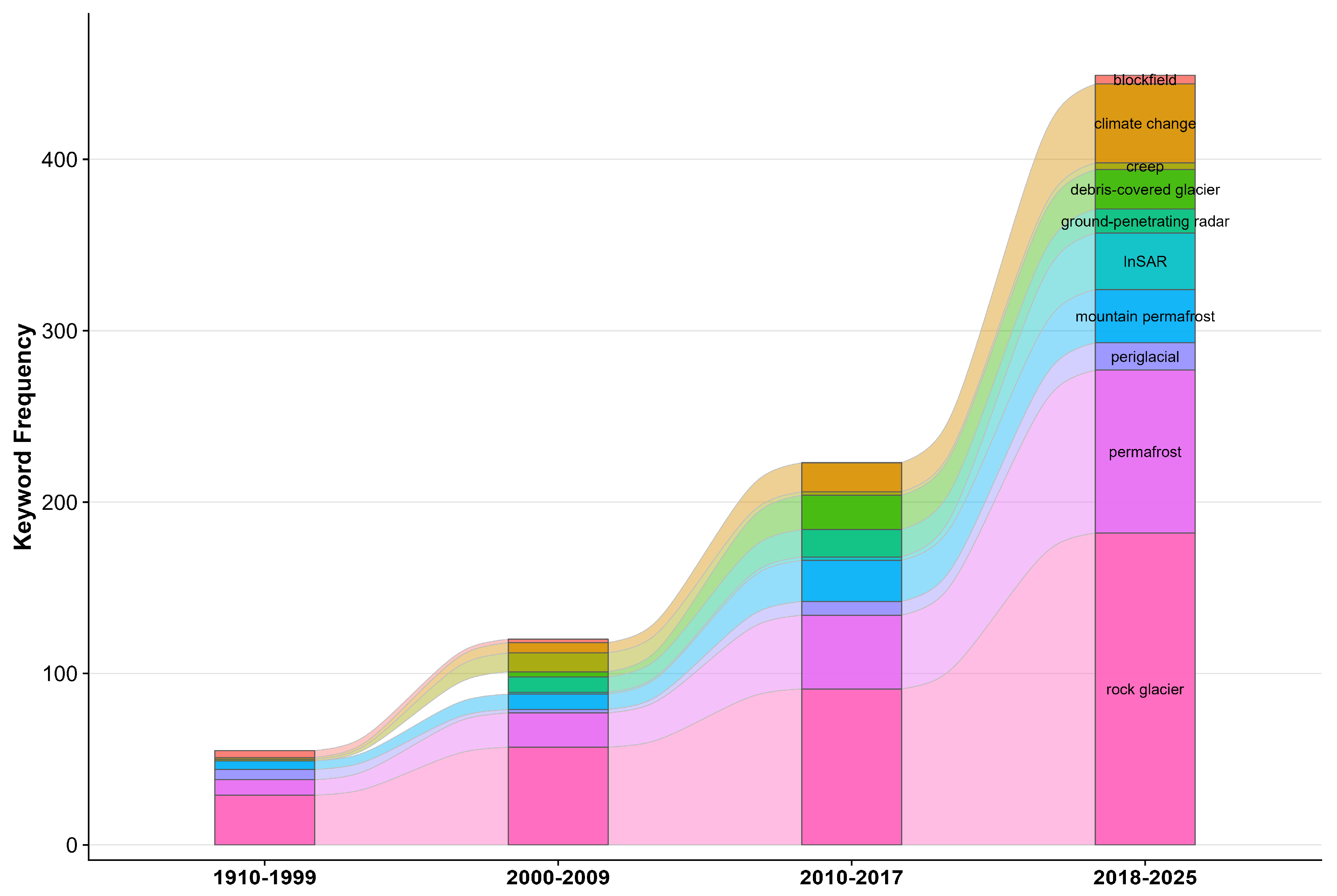
Thematic evolution analysis further reveals the continuity and shifts in rock glacier research themes across different stages. Figure 19 shows the evolutionary relationships of author keywords in four periods: 1910–1999, 2000–2009, 2010–2017, and 2018–2025. The figure illustrates both the continuity of core themes such as rock glacier and permafrost and the strengthening of recent themes such as InSAR, remote sensing, climate change, and mountain permafrost.
The main signal in Figure 19 is not the replacement of one topic by another, but the progressive addition of analytical dimensions: morphology and classification remained foundational, while permafrost processes, geophysical structure, remote sensing kinematics, hydrology, and hazard-oriented applications were gradually layered onto this foundation.
During 1910–1999, rock glacier research mainly revolved around rock glacier, permafrost, periglacial, creep, and regional geomorphic environments. The research focus during this period was concentrated on morphological identification, genetic interpretation, movement characteristics, and periglacial geomorphic attributes of rock glaciers [1,2,3,86]. Because observation methods were limited, early research mainly relied on field surveys, geomorphological mapping, aerial-photograph interpretation, and local monitoring, while later work began to separate active permafrost landforms from debris-covered glacier and deglaciation assemblages [44,77].
After entering 2000–2009, themes such as climate change, mountain permafrost, and ground-penetrating radar gradually strengthened, indicating that rock glacier research began to shift toward mountain permafrost response and internal-structure investigation. Monitoring and thermal studies treated rock glaciers as indicators of changing permafrost conditions [87,88,89,90], while thermo-mechanical studies linked velocity change to temperature, liquid water, slope, and ice-debris composition [43,56]. At the same time, GPR, ERT, and related geophysical work made subsurface ice and frozen debris more directly observable [53,66].
During 2010–2017, rock glacier research became more technical and quantitative. Optical imagery, DEMs, photogrammetry, and terrain analysis expanded the basis for inventory construction and geomorphic change detection [91,92]. InSAR and related remote sensing approaches then enabled repeated measurements of surface displacement over larger regions [29]. This period therefore marks the transition from point-based field investigation to regional-scale monitoring and spatiotemporal analysis.
During 2018–2025, Figure 19 shows that rock glacier, permafrost, mountain permafrost, InSAR, ground-penetrating radar, and climate change constituted the core themes of recent research. New regional studies extended rock glacier interpretation into marginal or previously underrepresented periglacial environments [81,93,94]. The simultaneous presence of InSAR, GPR, ERT, heat-flux analysis, and numerical modeling reflects a framework in which surface motion is interpreted together with internal structure and thermal forcing [95,96,97,98]. Machine learning and deep learning studies demonstrate the rapid expansion of inventory mapping [33,34], while hydrological and ecological studies show that rock glaciers are increasingly analyzed as parts of mountain water and ecosystem systems [14,30,31,99,100,101]. Hazard-oriented monitoring and microseismic studies [102] further indicate a growing concern with instability and risk under warming conditions.
The joint strengthening of climate change, mountain permafrost, and InSAR among recent themes indicates that rock glacier research has shifted from describing phenomena under the background of climate change toward explaining temperature-dynamic response mechanisms. Thermo-mechanical and borehole studies show that motion is controlled by ground temperature, ice content, slope, shear-zone geometry, and liquid-water conditions [41,43,50]. GPR, ERT, and electromagnetic studies provide the internal-structure constraints needed to interpret these velocity changes physically [10,19,52,53,66].
The thematic evolution shown in Figure 19 can be summarized as several interrelated transitions: from geomorphic morphological identification toward process-mechanism explanation; from local field investigation toward multi-source observation combining remote sensing, InSAR, geophysics, and ground monitoring [73,75]; from individual rock glacier objects toward system-level issues such as mountain permafrost, debris-covered glaciers, hydrological processes, and hazard risk [13,16,25,103]; and from manual interpretation and traditional statistics toward intelligent methods such as machine learning, deep learning, and large-scale inventory construction [33,34].

4. Discussion

4.1. From Geomorphic Description to Process-Oriented Permafrost Geomorphology

The bibliometric results indicate a shift in explanatory depth rather than a simple change in terminology. Early rock glacier studies [1,2,3,44,77,86] established recognizable landforms and classification criteria, whereas later work increasingly linked surface expression to internal ice, thermal state, deformation mechanism, hydrology, and sediment supply [4,5,6,7,8,9,59]. This transition matters because a morphologically coherent landform may contain different proportions of buried glacier ice, ice-rich permafrost, air voids, and deforming debris. The field has therefore moved from asking whether a feature should be labeled as a rock glacier toward asking how its material composition, thermal regime, hydrological condition, and deformation history interact.
Surface morphology alone is therefore insufficient for mechanistic interpretation. Active rock glaciers can indicate mountain permafrost [4,46,47,48], but measured creep and stability depend on subsurface temperature, shear-zone depth, and ice content [22,41,43,50]. Furrow-and-ridge morphology may record compressive flow and buckle folding rather than simple surface decoration [51,104], while grain interlocking, liquid water, and ventilation in coarse blocky layers can further modulate motion and thermal conditions [54,55,57,97]. Dendrogeomorphic and ecological indicators can also record persistent movement or environmental change on rock glacier surfaces, but they should be interpreted together with physical measurements [14,105,106].
The conceptual debate reviewed by Berthling is therefore not merely semantic [6]. If rock glaciers are defined only by shape, debris-covered glaciers, ice-cored moraines, protalus ramparts, and relict boulder landforms may be grouped incorrectly [63,83,95]. Conversely, an overly narrow genetic definition may exclude transitional or polygenetic landforms that are central to understanding mountain cryosphere evolution [62,78,81]. This has practical implications for inventories and science mapping because inconsistent landform definitions can propagate into keyword networks, regional statistics, hydrological estimates, and hazard screening.
This critique does not mean that classification systems are unnecessary. Standardized morphological and activity classes remain essential for regional inventories, mapping, database construction, and communication among research groups. The key point is that such classes should be treated as scale-appropriate descriptors that require process-based verification when they are used to infer origin, internal ice content, hydrological function, or instability.

4.2. Multi-Source Monitoring as a Response to the Internal Complexity of Rock Glaciers

The recent prominence of InSAR, remote sensing, GPR, ERT, TLS, UAV photogrammetry, and DEM differencing reflects the internal complexity of rock glaciers rather than a simple change in preferred tools. InSAR and optical imagery are powerful for detecting surface displacement and regional kinematics [12,26,32,76], but they cannot by themselves determine whether motion is driven by ice-rich permafrost creep, glacier ice deformation, liquid-water pressure, or shear-zone reorganization. GPR, ERT, electromagnetic methods, and borehole data directly address internal ice and frozen-ground conditions [41,52,53,66], and active-layer, electromagnetic, radar, and thermal studies refine how frozen debris and ground ice are interpreted [19,21,85,107].
This internal structure determines the limits of single-method interpretation. Studies comparing geophysical methods show that resistivity, radar stratigraphy, electromagnetic response, and borehole temperature each constrain different aspects of subsurface ice and thermal state [52,53,66,85]. Radar and thermal studies provide additional constraints on active layers, frozen debris, and overcooled subsurface conditions [10,19,21,107]. Multi-sensor studies further show that the integration of InSAR, ERT, GPR, and field observations can reveal links between surface kinematics and internal architecture [61,74,75]. Therefore, a robust monitoring design should first define the physical question being asked—velocity anomaly, ice-content distribution, active-layer thickness, meltwater production, or instability—and then combine methods accordingly [15,69,97]. This also means that negative or ambiguous results are informative: weak radar reflections, low resistivity contrasts, or spatially patchy coherence may indicate heterogeneity, liquid water, coarse blocky layers, or method-specific resolution limits rather than absence of permafrost.
The appropriate method combination also depends on spatial scale and research purpose. At the landform scale, boreholes, GPR, ERT, UAV/TLS surveys, and repeated field observations can directly connect surface deformation with internal structure. At the regional scale, InSAR, optical image correlation, DEM differencing, and inventory mapping are more suitable for detecting spatial patterns and selecting targets for detailed investigation. Hydrological or hazard applications require an additional layer of discharge, hydrochemical, thermal, topographic, and exposure information. Multi-source monitoring should therefore be understood as a scale-dependent design strategy rather than a fixed list of techniques.
The warming-response evidence also supports this integrated approach. Kääb et al. showed that warmer rock glaciers can respond sensitively to surface-temperature increases [43], while long-term velocity records and thermal studies show that creep rates vary with local topography, snow cover, ground temperature, and internal conditions [89,90,108]. This means that a remotely detected acceleration is a hypothesis-generating observation: it becomes geomorphologically meaningful only when interpreted with information on thermal state, material composition, hydrology, and landform setting [52,75,109]. For this reason, future monitoring should avoid relying on single-year velocity anomalies and should instead distinguish seasonal forcing, multi-year climatic response, and structural destabilization by combining repeated kinematic observations with subsurface and hydrological measurements.

4.3. Hydrological Significance as an Emerging System-Level Question

The hydrological significance of rock glaciers is now a major system-level frontier. Global and review studies argue that rock glaciers can store hydrologically relevant ice and may remain important where exposed glaciers retreat [13,16]. Regional studies in the Dry Andes, Sierra Nevada, Great Basin, and European Alps show that their hydrological role depends on climate setting, catchment position, activity status, ice content, and hydraulic connectivity [17,18,64,110]. Recent work further uses spring-water temperature, ground-ice characterization, energy budgets, and geophysics-based upscaling to quantify subsurface ice and meltwater contributions more directly [15,61,99,100]. The key advance is that hydrological interpretation is shifting from treating rock glaciers as static ice reservoirs toward evaluating when, where, and how stored ice can become hydrologically connected to streams and aquifers [13,15,17].
However, it would be scientifically misleading to treat all rock glaciers as important water sources. Geophysical upscaling in the Central Andes shows that conventional estimates can overestimate ground ice when they rely only on generalized rock glacier assumptions [31,100]. Stream and ecosystem studies also indicate that rock glacier thaw may affect water temperature, chemistry, and downstream ecological conditions, but the magnitude and direction of these effects are catchment-specific [23,101]. Therefore, hydrological interpretation should combine geomorphic inventory, geophysics, discharge monitoring, hydrochemistry, isotopes, and water-balance modeling rather than assuming a universal hydrological function.
From a bibliometric perspective, the growth of hydrology-related terms should therefore be read as evidence of increasing research attention and conceptual integration, not as proof that the magnitude of rock glacier water contribution is already well constrained across mountain regions. The key question is how rock glaciers interact with glaciers, snow cover, talus systems, permafrost degradation, and catchment hydrology under warming climates [13,17,98]. This question is especially relevant in arid and semi-arid mountain systems, where rock glaciers and related periglacial landforms may become relatively more important as glacier storage declines [31,64,100]. A productive next step is to connect inventory-based estimates with process observations, including discharge timing, hydrochemistry, isotopes, ground temperature, and geophysics-derived ice-content uncertainty.

4.4. From Motion Acceleration to Hazard Interpretation: A Conditional Relationship

The link between acceleration and hazard is conditional rather than automatic. Climate warming can enhance creep where permafrost is warm [43], and internal shear zones or liquid water can reduce stability [41,52,53]. Yet, surface acceleration alone does not establish imminent failure. Hazard-oriented studies show that debris-flow susceptibility and downstream risk depend on slope geometry, sediment availability, hydrological triggering, channel connectivity, and exposure [24,53,103]. Numerical modeling and multi-sensor monitoring further indicate that destabilization may involve time-dependent feedbacks among geometry, ice content, thermal state, and mechanical weakening [75,102,109]. This distinction is central for risk communication: acceleration should be treated as an early-warning variable that requires contextual evaluation, not as a stand-alone hazard threshold.
The mechanical basis for cautious interpretation comes from internal-structure studies. Borehole measurements, ERT, and GPR show that active rock glaciers may contain shear zones, heterogeneous ice-rich layers, air voids, and variable water pathways [19,52,53,67]. Field studies of individual rock glaciers demonstrate that movement rates can vary over decades and may reflect both climatic forcing and local material controls [56,111]. Consequently, risk interpretation should distinguish reversible seasonal or multi-year acceleration from structural destabilization that is accompanied by cracking, frontal collapse, water-pressure increase, or connection to debris-flow channels.
This distinction is important for mountain infrastructure and hazard management. For roads, tourism facilities, hydropower projects, pipelines, and high-mountain valleys, the relevant question is not simply whether motion is detected, but whether motion intersects with unstable fronts, available debris, steep channels, or exposed downstream assets [103,112]. Case studies from Svalbard, the Canadian Rockies, the Alps, and other mountain regions show that local terrain analysis and velocity measurements are still necessary for site-specific interpretation [102,111]. Thus, hazard-oriented use of remote sensing should combine kinematic anomalies with topography, internal structure, thermal degradation, hydrological connectivity, and exposure [75,103,109]. For bibliometric interpretation, the recent rise in hazard-related keywords therefore reflects a broadening from landform science toward applied cryosphere risk, but it should not be read as evidence that operational forecasting frameworks are already mature.

4.5. Boundaries of Bibliometric Evidence

Bibliometric methods are useful for identifying knowledge structures, but they cannot replace process-based geomorphology, permafrost science, hydrology, or hazard analysis. In this study, RPYS identifies historically influential years, but the meaning of a peak must be interpreted through the content of the publications behind it [37]. Similarly, keyword co-occurrence networks and thematic maps reveal associations among topics, but they do not prove causal relationships among climate forcing, permafrost degradation, hydrological response, and surface motion [39]. The value of the bibliometric evidence is therefore diagnostic: it identifies where the field has concentrated attention and where expert reading must evaluate whether the concentration reflects conceptual progress, methodological fashion, or regional data availability.
This point is particularly important for a field such as rock glacier research, where the same keywords may represent different scientific meanings in different contexts. For example, InSAR may indicate regional inventory construction, long-term velocity monitoring, or hazard screening [75,76,113]; GPR and ERT may indicate landform classification, ice-content estimation, or permafrost degradation assessment [31,52,53,66,98]; and hydrology may refer to water storage [114], meltwater contribution, stream ecology, or catchment-scale resource assessment [13,16,101]. Therefore, the thematic clusters reported in this study should be read as structured entry points for expert interpretation rather than as final explanatory categories.
The use of SCI-Expanded and English-language article/data paper records improves metadata consistency but also narrows the evidence base by excluding records indexed only in Scopus, Google Scholar, regional databases, local-language journals, technical reports, national inventories, and long-term institutional monitoring datasets. This matters for rock glacier research because important observations have been produced through long-term monitoring traditions in the Alps [88,89,90], through Andes-focused studies of dry-mountain permafrost and water resources [87,115], and through regional inventory and remote sensing studies in the Carpathians, Tibetan Plateau, Himalaya, and other mountain areas [116,117]. Therefore, the patterns reported here should be interpreted as the structure of indexed international literature rather than a complete inventory of all scientific and technical knowledge on rock glaciers. This limitation is especially relevant for applied monitoring, where technical reports, national inventories, local-language studies, and long-term institutional datasets may contain observations that are scientifically important but less visible in citation databases.
Keyword standardization and life-cycle modeling also introduce interpretive choices. Merging spelling variants improves clarity, but different thesaurus decisions may change keyword frequencies and cluster boundaries. Likewise, Logistic fitting describes the current publication trajectory but cannot anticipate abrupt changes caused by new global inventories, monitoring products, policy priorities, or funding initiatives [33,34,37,39]. These limitations do not invalidate the analysis; rather, they define the boundary within which bibliometric evidence should be used. For future bibliometric work, transparent search strings, explicit thesaurus rules, sensitivity tests for keyword merging, and comparison among databases would improve reproducibility and help separate robust disciplinary signals from database-specific artifacts.
The absolute publication count should also be interpreted within the boundary of the predefined search strategy. However, the exclusion-based sensitivity search showed that the compact spelling variant “rockglacier*” retrieved only two records not captured by the main query, indicating that this spelling variant has a negligible effect on the dataset boundary.

5. Conclusions

Based on 1125 English-language article and article/data paper records from 1910 to 2025 in the SCI-Expanded database of the Web of Science Core Collection, this study used bibliometrix, RPYS, keyword co-occurrence networks, thematic mapping, and thematic evolution analysis to systematically reveal the knowledge production process, knowledge base, collaboration patterns, research hotspots, and thematic evolution characteristics of global rock glacier research. The main conclusions are as follows.
(1)
Rock glacier research remains in an active growth stage rather than a mature saturation stage. Annual publication trends show rapid expansion in recent decades, and the Logistic life-cycle model provides a consistent stage-diagnosis signal. In the model, the observed cumulative publication output in 2025 corresponds to 17.75% of the estimated saturation level, suggesting that the field still has substantial growth potential. This value should be interpreted as a model-dependent diagnostic estimate rather than a precise forecast of future publication output.
(2)
The knowledge base of rock glacier research is organized around several key turning points. The 1959 peak represents the establishment of modern geomorphological foundations; the 1987–1996 period reflects the consolidation of classification, formation models, and high-mountain geoecological interpretation; the 2002–2007 period marks the rise in internal deformation, thermo-mechanical response, and process-oriented interpretation; and later conceptual and hydrological studies pushed the field toward system-level analysis.
(3)
Thematic analysis shows that rock glacier and permafrost constitute the most stable conceptual core of the field, while climate change, mountain permafrost, debris-covered glacier, InSAR, remote sensing, and ground-penetrating radar represent major extensions of the research agenda. Rock glacier research is moving from single-landform identification toward integrated analysis of surface motion, internal structure, thermal state, hydrological conditions, and environmental change.
(4)
The convergence of remote sensing, geophysical investigation, hydrogeological observation, and field monitoring represents a major future direction revealed by the bibliometric analysis. InSAR, optical remote sensing, UAV/TLS topographic monitoring, and DEM differencing provide regional and repeated information on surface displacement, whereas GPR, ERT, borehole temperature/deformation measurements, hydrochemistry, isotopes, and discharge monitoring constrain internal structure, thermal state, water pathways, and instability mechanisms. Future research should therefore move from single-method detection toward integrated observation frameworks that link surface kinematics with ice-debris composition, shear-zone dynamics, hydrological connectivity, water-resource significance, and potential hazard processes under climate warming.

Supplementary Materials

The following supporting information can be downloaded at: https://www.mdpi.com/article/10.3390/app16115567/s1, Table S1: Author keyword thesaurus and standardization (author_keywords_thesaurus_merged.csv), Table S2: Most locally cited references in rock glacier research (Most locally cited references.csv), and Table S3: Globally highly cited papers in the sample documents (Globally highly cited papers.csv).

Author Contributions

Conceptualization, Q.D., G.L., W.M. and Y.M.; methodology, Q.D. and G.L.; software, Q.D.; validation, G.L., W.M. and Y.M.; formal analysis, Q.D.; investigation, Q.D. and G.L.; resources, Q.D.; data curation, Q.D.; writing—original draft preparation, Q.D.; writing—review and editing, G.L., W.M. and Y.M.; visualization, Q.D. All authors have read and agreed to the published version of the manuscript.

Funding

This research was funded by the National Natural Science Foundation of China, grant number U23A2013, the Program of the Gansu Province Science and Technology Foundation for Youths, grant number 25JRRA515, the Science and Technology Program of Xizang Autonomous Region, grant number XZ202401ZY0040, the Science and Technology Program of Gansu Province, grant number 23ZDFA017, and the Research Project of the Qinghai Provincial Key Laboratory of Tibet Plateau Highway Construction and Maintenance Technology, grant number 2024-JY-D-03.

Data Availability Statement

The bibliographic data used in this study were retrieved from the Web of Science Core Collection. The processed datasets and Supplementary Materials generated during the study are available from the corresponding authors upon reasonable request.

Acknowledgments

The authors acknowledge the R (version 4.5.3) Core Team and the developers of bibliometrix/Biblioshiny for providing the open-source tools used in this study. The authors also thank the University of Alberta for providing institutional access to the Web of Science Core Collection.

Conflicts of Interest

The authors declare no conflicts of interest.

References

  1. Wahrhaftig, C.; Cox, A. Rock Glaciers in the Alaska Range. GSA Bull. 1959, 70, 383–436. [Google Scholar] [CrossRef]
  2. Elizabeth Martin, H.; Whalley, W.B. Rock Glaciers: Part 1: Rock Glacier Morphology: Classification and Distribution. Prog. Phys. Geogr. Earth Environ. 1987, 11, 260–282. [Google Scholar] [CrossRef]
  3. Whalley, W.B.; Martin, H.E. Rock Glaciers: II Models and Mechanisms. Prog. Phys. Geogr. Earth Environ. 1992, 16, 127–186. [Google Scholar] [CrossRef]
  4. Barsch, D. Rockglaciers; Springer Series in Physical Environment; Springer: Berlin/Heidelberg, Germany, 1996; Volume 16. [Google Scholar]
  5. Haeberli, W.; Hallet, B.; Arenson, L.; Elconin, R.; Humlum, O.; Kääb, A.; Kaufmann, V.; Ladanyi, B.; Matsuoka, N.; Springman, S.; et al. Permafrost Creep and Rock Glacier Dynamics. Permafr. Periglac. Process. 2006, 17, 189–214. [Google Scholar] [CrossRef]
  6. Berthling, I. Beyond Confusion: Rock Glaciers as Cryo-Conditioned Landforms. Geomorphology 2011, 131, 98–106. [Google Scholar] [CrossRef]
  7. Whalley, W.B.; Azizi, F. Rheological Models of Active Rock Glaciers: Evaluation, Critique and a Possible Test. Permafr. Periglac. Process. 1994, 5, 37–51. [Google Scholar] [CrossRef]
  8. Yamamoto, Y.; Springman, S.M. Triaxial Stress Path Tests on Artificially Prepared Analogue Alpine Permafrost Soil. Can. Geotech. J. 2019, 56, 1448–1460. [Google Scholar] [CrossRef]
  9. Kääb, A.; Weber, M. Development of Transverse Ridges on Rock Glaciers: Field Measurements and Laboratory Experiments. Permafr. Periglac. Process. 2004, 15, 379–391. [Google Scholar] [CrossRef]
  10. Hauck, C.; Vonder Mühll, D. Inversion and Interpretation of Two-Dimensional Geoelectrical Measurements for Detecting Permafrost in Mountainous Regions. Permafr. Periglac. Process. 2003, 14, 305–318. [Google Scholar] [CrossRef]
  11. Uxa, T.; Mida, P. Rock Glaciers in the Western and High Tatra Mountains, Western Carpathians. J. Maps 2017, 13, 844–857. [Google Scholar] [CrossRef]
  12. Liu, Y.; Chen, W.; Li, R. Dynamics and Distribution of Rock Glaciers in the Middle Reaches of the Yarlung Zangbo River. J. Geol. 2023, 131, 461–475. [Google Scholar] [CrossRef]
  13. Jones, D.B.; Harrison, S.; Anderson, K.; Whalley, W.B. Rock Glaciers and Mountain Hydrology: A Review. Earth-Sci. Rev. 2019, 193, 66–90. [Google Scholar] [CrossRef]
  14. Cannone, N.; Piccinelli, S. Changes of Rock Glacier Vegetation in 25 Years of Climate Warming in the Italian Alps. CATENA 2021, 206, 105562. [Google Scholar] [CrossRef]
  15. Amschwand, D.; Tschan, S.; Scherler, M.; Hoelzle, M.; Krummenacher, B.; Haberkorn, A.; Kienholz, C.; Aschwanden, L.; Gubler, H. Seasonal Ice Storage Changes and Meltwater Generation at Murtèl Rock Glacier (Engadine, Eastern Swiss Alps): Estimates from Measurements and Energy Budgets in the Coarse Blocky Active Layer. Hydrol. Earth Syst. Sci. 2025, 29, 2219–2253. [Google Scholar] [CrossRef]
  16. Jones, D.B.; Harrison, S.; Anderson, K.; Betts, R.A. Author Correction: Mountain Rock Glaciers Contain Globally Significant Water Stores. Sci. Rep. 2021, 11, 23536. [Google Scholar] [CrossRef]
  17. Millar, C.I.; Westfall, R.D.; Delany, D.L. Thermal and Hydrologic Attributes of Rock Glaciers and Periglacial Talus Landforms: Sierra Nevada, California, USA. Quat. Int. 2013, 310, 169–180. [Google Scholar] [CrossRef]
  18. Millar, C.I.; Westfall, R.D. Geographic, Hydrological, and Climatic Significance of Rock Glaciers in the Great Basin, USA. Arct. Antarct. Alp. Res. 2019, 51, 232–249. [Google Scholar] [CrossRef]
  19. Scapozza, C.; Lambiel, C.; Baron, L.; Marescot, L.; Reynard, E. Internal Structure and Permafrost Distribution in Two Alpine Periglacial Talus Slopes, Valais, Swiss Alps. Geomorphology 2011, 132, 208–221. [Google Scholar] [CrossRef]
  20. Berthling, I.; Etzelmüller, B.; Isaksen, K.; Sollid, J.L. Rock Glaciers on Prins Karls Forland. II: GPR Soundings and the Development of Internal Structures. Permafr. Periglac. Process. 2000, 11, 357–369. [Google Scholar] [CrossRef]
  21. Pavoni, M.; Sirch, F.; Boaga, J. Electrical and Electromagnetic Geophysical Prospecting for the Monitoring of Rock Glaciers in the Dolomites, Northeast Italy. Sensors 2021, 21, 1294. [Google Scholar] [CrossRef]
  22. Pruessner, L.; Phillips, M.; Farinotti, D.; Hoelzle, M.; Lehning, M. Near-Surface Ventilation as a Key for Modeling the Thermal Regime of Coarse Blocky Rock Glaciers. Permafr. Periglac. Process. 2018, 29, 152–163. [Google Scholar] [CrossRef]
  23. Millar, C.I.; Westfall, R.D. Rock Glaciers and Related Periglacial Landforms in the Sierra Nevada, CA, USA; Inventory, Distribution and Climatic Relationships. Quat. Int. 2008, 188, 90–104. [Google Scholar] [CrossRef]
  24. Lugon, R.; Stoffel, M. Rock-Glacier Dynamics and Magnitude–Frequency Relations of Debris Flows in a High-Elevation Watershed: Ritigraben, Swiss Alps. Glob. Planet. Change 2010, 73, 202–210. [Google Scholar] [CrossRef]
  25. Bertone, A.; Barboux, C.; Bodin, X.; Bolch, T.; Brardinoni, F.; Caduff, R.; Christiansen, H.H.; Darrow, M.M.; Delaloye, R.; Etzelmüller, B.; et al. Incorporating InSAR Kinematics into Rock Glacier Inventories: Insights from 11 Regions Worldwide. Cryosphere 2022, 16, 2769–2792. [Google Scholar] [CrossRef]
  26. Lambiel, C.; Strozzi, T.; Paillex, N.; Vivero, S.; Jones, N. Inventory and Kinematics of Active and Transitional Rock Glaciers in the Southern Alps of New Zealand from Sentinel-1 InSAR. Arct. Antarct. Alp. Res. 2023, 55, 2183999. [Google Scholar] [CrossRef]
  27. Baral, P.; Haq, M.A.; Yaragal, S. Assessment of Rock Glaciers and Permafrost Distribution in Uttarakhand, India. Permafr. Periglac. Process. 2020, 31, 31–56. [Google Scholar] [CrossRef]
  28. Hassan, J.; Berg, D.L.; Lippert, E.Y.H.; Chen, X.; Hassan, W.; Hassan, M.; Hussain, I.; Bazai, N.A.; Khan, S.A. Rock Glacier Distribution and Kinematics in Shigar and Shayok Basins Based on Radar and Optical Remote Sensing. Earth Surf. Process. Landf. 2024, 49, 2278–2290. [Google Scholar] [CrossRef]
  29. Necsoiu, M.; Onaca, A.; Wigginton, S.; Urdea, P. Rock Glacier Dynamics in Southern Carpathian Mountains from High-Resolution Optical and Multi-Temporal SAR Satellite Imagery. Remote Sens. Environ. 2016, 177, 21–36. [Google Scholar] [CrossRef]
  30. Vivero, S.; Lambiel, C. Annual Surface Elevation Changes of Rock Glaciers and Their Geomorphological Significance: Examples from the Swiss Alps. Geomorphology 2024, 467, 109487. [Google Scholar] [CrossRef]
  31. Mathys, T.; Hilbich, C.; Arenson, L.U.; Wainstein, P.A.; Hauck, C. Towards Accurate Quantification of Ice Content in Permafrost of the Central Andes—Part 2: An Upscaling Strategy of Geophysical Measurements to the Catchment Scale at Two Study Sites. Cryosphere 2022, 16, 2595–2615. [Google Scholar] [CrossRef]
  32. Zhang, X.; Feng, M.; Xu, J.; Yan, D.; Wang, J.; Zhou, X.; Li, T.; Zhang, X. Kinematic Inventory of Rock Glaciers in the Nyainqentanglha Range Using the MT-InSAR Method. Int. J. Digit. Earth 2023, 16, 3923–3948. [Google Scholar] [CrossRef]
  33. Hu, Y.; Liu, L.; Huang, L.; Zhao, L.; Wu, T.; Wang, X.; Cai, J. Mapping and Characterizing Rock Glaciers in the Arid Western Kunlun Mountains Supported by InSAR and Deep Learning. J. Geophys. Res.-Earth Surf. 2023, 128, e2023JF007206. [Google Scholar] [CrossRef]
  34. Yan, D.; Feng, M.; Hu, Z.; Xu, J.; Li, X. Improving Permafrost Mapping in Southern Tibetan Plateau Using Machine Learning and Rock Glacier Inventory. Permafr. Periglac. Process. 2025, 36, 230–244. [Google Scholar] [CrossRef]
  35. Sangwal, K. Growth Dynamics of Citations of Cumulative Papers of Individual Authors According to Progressive Nucleation Mechanism: Concept of Citation Acceleration. Inf. Process. Manag. 2013, 49, 757–772. [Google Scholar] [CrossRef]
  36. Aria, M.; Misuraca, M.; Spano, M. Mapping the Evolution of Social Research and Data Science on 30 Years of Social Indicators Research. Soc. Indic. Res. 2020, 149, 803–831. [Google Scholar] [CrossRef]
  37. Thor, A.; Bornmann, L.; Marx, W.; Mutz, R. Identifying Single Influential Publications in a Research Field: New Analysis Opportunities of the CRExplorer. Scientometrics 2018, 116, 591–608. [Google Scholar] [CrossRef]
  38. Aria, M.; Cuccurullo, C. Science Mapping Analysis—A Primer with Biblioshiny; McGraw-Hill: Singapore, 2026. [Google Scholar]
  39. Aria, M.; Cuccurullo, C. Bibliometrix: An R-Tool for Comprehensive Science Mapping Analysis. J. Informetr. 2017, 11, 959–975. [Google Scholar] [CrossRef]
  40. Zhou, Y.; Li, G.; Ma, W.; Jin, H.; Chen, D.; Mao, Y.; Du, Q. Formation Mechanism, Movement Characteristics and Hydrological Effect of Rock Glaciers: A Review. J. Glaciol. Geocryol. 2023, 45, 409–422. [Google Scholar] [CrossRef]
  41. Arenson, L.; Hoelzle, M.; Springman, S. Borehole Deformation Measurements and Internal Structure of Some Rock Glaciers in Switzerland. Permafr. Periglac. Process. 2002, 13, 117–135. [Google Scholar] [CrossRef]
  42. Rignot, E.; Hallet, B.; Fountain, A. Rock Glacier Surface Motion in Beacon Valley, Antarctica, from Synthetic-Aperture Radar Interferometry. Geophys. Res. Lett. 2002, 29, 48-1–48-4. [Google Scholar] [CrossRef]
  43. Kaeaeb, A.; Frauenfelder, R.; Roer, I. On the Response of Rockglacier Creep to Surface Temperature Increase. Glob. Planet. Change 2007, 56, 172–187. [Google Scholar] [CrossRef]
  44. Ackert, R.P. A Rock Glacier/Debris-Covered Glacier System at Galena Creek, Absaroka Mountains, Wyoming. Geogr. Ann. Ser. A Phys. Geogr. 1998, 80, 267–276. [Google Scholar] [CrossRef]
  45. Potter, N., Jr. Ice-Cored Rock Glacier, Galena Creek, Northern Absaroka Mountains, Wyoming. GSA Bull. 1972, 83, 3025–3058. [Google Scholar] [CrossRef]
  46. Barsch, D. Nature and Importance of Mass-Wasting by Rock Glaciers in Alpine Permafrost Environments. Earth Surf. Process. 1977, 2, 231–245. [Google Scholar] [CrossRef]
  47. Harris, S.A. Distribution of Active Glaciers and Rock Glaciers Compared to the Distribution of Permafrost Landforms, Based on Freezing and Thawing Indices. Can. J. Earth Sci. 1981, 18, 376–381. [Google Scholar] [CrossRef]
  48. Harris, S.A. Climatic Zonality of Periglacial Landforms in Mountain Areas. Arctic 1994, 47, 184–192. [Google Scholar] [CrossRef]
  49. Etzelmüller, B.; Frauenfelder, R. Factors Controlling The Distribution of Mountain Permafrost in The Northern Hemisphere and Their Influence on Sediment Transfer. Arct. Antarct. Alp. Res. 2009, 41, 48–58. [Google Scholar] [CrossRef]
  50. Vondermuhll, D.; Haeberli, W. Thermal-Characteristics of the Permafrost Within an Active Rock Glacier (Murtel Corvatsch, Grisons, Swiss Alps). J. Glaciol. 1990, 36, 151–158. [Google Scholar] [CrossRef]
  51. Barsch, D.; Fierz, H.; Haeberli, W. Shallow Core Drilling and Bore-Hole Measurements in the Permafrost of an Active Rock Glacier Near the Grubengletscher, Wallis, Swiss Alps. Arct. Alp. Res. 1979, 11, 215–228. [Google Scholar] [CrossRef]
  52. Hilbich, C.; Marescot, L.; Hauck, C.; Loke, M.H.; Maeusbacher, R. Applicability of Electrical Resistivity Tomography Monitoring to Coarse Blocky and Ice-Rich Permafrost Landforms. Permafr. Periglac. Process. 2009, 20, 269–284. [Google Scholar] [CrossRef]
  53. Hausmann, H.; Krainer, K.; Brueckl, E.; Mostler, W. Internal Structure and Ice Content of Reichenkar Rock Glacier (Stubai Alps, Austria) Assessed by Geophysical Investigations. Permafr. Periglac. Process. 2007, 18, 351–367. [Google Scholar] [CrossRef]
  54. Wagner, T.; Pauritsch, M.; Mayaud, C.; Kellerer-Pirklbauer, A.; Thalheim, F.; Winkler, G. Controlling Factors of Microclimate in Blocky Surface Layers of Two Nearby Relict Rock Glaciers (Niedere Tauern Range, Austria). Geogr. Ann. Ser. A Phys. Geogr. 2019, 101, 310–333. [Google Scholar] [CrossRef]
  55. Apaloo, J.; Brenning, A.; Bodin, X. Interactions between Seasonal Snow Cover, Ground Surface Temperature and Topography (Andes of Santiago, Chile, 33.5° S). Permafr. Periglac. Process. 2012, 23, 277–291. [Google Scholar] [CrossRef]
  56. Janke, J.R. Long-Term Flow Measurements (1961–2002) of the Arapaho, Taylor, and Fair Rock Glaciers, Front Range, Colorado. Phys. Geogr. 2005, 26, 313–336. [Google Scholar] [CrossRef]
  57. Whalley, W.B.; Palmer, C.F.; Hamilton, S.J.; Martin, H.E. An Assessment of Rock Glacier Sliding Using Seventeen Years of Velocity Data: Nautárdalur Rock Glacier, North Iceland. Arct. Alp. Res. 1995, 27, 345–351. [Google Scholar] [CrossRef]
  58. Dobinski, W. The Cryosphere and Glacial Permafrost as Its Integral Component. Cent. Eur. J. Geosci. 2012, 4, 623–640. [Google Scholar] [CrossRef]
  59. Ishikawa, M. Thermal Regimes at the Snow-Ground Interface and Their Implications for Permafrost Investigation. Geomorphology 2003, 52, 105–120. [Google Scholar] [CrossRef]
  60. Krainer, K.; Mostler, W. Reichenkar Rock Glacier: A Glacier Derived Debris-Ice System in the Western Stubai Alps, Austria. Permafr. Periglac. Process. 2000, 11, 267–275. [Google Scholar] [CrossRef]
  61. Wee, J.; Vivero, S.; Mathys, T.; Mollaret, C.; Hauck, C.; Lambiel, C.; Beutel, J.; Haeberli, W. Characterizing Ground Ice Content and Origin to Better Understand the Seasonal Surface Dynamics of the Gruben Rock Glacier and the Adjacent Gruben Debris-Covered Glacier (Southern Swiss Alps). Cryosphere 2024, 18, 5939–5963. [Google Scholar] [CrossRef]
  62. Oliva, M.; Ventura, J.; Turu, V.; Ros, X.; Echeverria, A.; Çiner, A.; Sarıkaya, M.A.; Pérez-Ramos, C.; García-Oteyza, J.; Bonsoms, J.M.; et al. Climate Warming and the Persistence of Buried Ice in the Pyrenees: Multi-Proxy Evidence from Clots de La Menera Cirque (Andorra). Quat. Sci. Rev. 2025, 368, 109564. [Google Scholar] [CrossRef]
  63. Colucci, R.R.; Forte, E.; Žebre, M.; Maset, E.; Zanettini, C.; Guglielmin, M. Is That a Relict Rock Glacier? Geomorphology 2019, 330, 177–189. [Google Scholar] [CrossRef]
  64. Falaschi, D.; Castro, M.; Masiokas, M.; Tadono, T.; Lia Ahumada, A. Rock Glacier Inventory of the Valles Calchaqu Es Region (∼25° S), Salta, Argentina, Derived from ALOS Data. Permafr. Periglac. Process. 2014, 25, 69–75. [Google Scholar] [CrossRef]
  65. Evin, M.; Fabre, D.; Johnson, P.G. Electrical Resistivity Measurements on the Rock Glaciers of Grizzly Creek, St Elias Mountains, Yukon. Permafr. Periglac. Process. 1997, 8, 181–191. [Google Scholar] [CrossRef]
  66. Kneisel, C.; Hauck, C.; Fortier, R.; Moorman, B. Advances in Geophysical Methods for Permafrost Investigations. Permafr. Periglac. Process. 2008, 19, 157–178. [Google Scholar] [CrossRef]
  67. Ribolini, A.; Guglielmin, M.; Fabre, D.; Bodin, X.; Marchisio, M.; Sartini, S.; Spagnolo, M.; Schoeneich, P. The Internal Structure of Rock Glaciers and Recently Deglaciated Slopes as Revealed by Geoelectrical Tomography: Insights on Permafrost and Recent Glacial Evolution in the Central and Western Alps (Italy-France). Quat. Sci. Rev. 2010, 29, 507–521. [Google Scholar] [CrossRef]
  68. Lewkowicz, A.G.; Etzelmüller, B.; Smith, S.L. Characteristics of Discontinuous Permafrost Based on Ground Temperature Measurements and Electrical Resistivity Tomography, Southern Yukon, Canada. Permafr. Periglac. Process. 2011, 22, 320–342. [Google Scholar] [CrossRef]
  69. Villarroel, C.D.; Forte, A.P.; Ortiz, D.A.; Tamburini Beliveau, G.; Güell, A. Active Layer and Permafrost Thickness in Rock Glaciers Derived from Geophysical Methods in the Semiarid Andes of Argentina. Geomorphology 2020, 365, 107249. [Google Scholar] [CrossRef]
  70. Ikeda, A.; Matsuoka, N. Degradation of Talus-Derived Rock Glaciers in the Upper Engadin, Swiss Alps. Permafr. Periglac. Process. 2002, 13, 145–161. [Google Scholar] [CrossRef]
  71. Senderak, K.; Kondracka, M.; Gądek, B. Processes Controlling the Development of Talus Slopes in SW Spitsbergen: The Role of Deglaciation and Periglacial Conditions. Land Degrad. Dev. 2021, 32, 208–223. [Google Scholar] [CrossRef]
  72. Popescu, R.; Vespremeanu-Stroe, A.; Onaca, A.; Vasile, M.; Cruceru, N.; Pop, O. Low-Altitude Permafrost Research in an Overcooled Talus Slope Rock Glacier System in the Romanian Carpathians (Detunata Goala, Apuseni Mountains). Geomorphology 2017, 295, 840–854. [Google Scholar] [CrossRef]
  73. Strozzi, T.; Caduff, R.; Jones, N.; Barboux, C.; Delaloye, R.; Bodin, X.; Kaab, A.; Matzler, E.; Schrott, L. Monitoring Rock Glacier Kinematics with Satellite Synthetic Aperture Radar. Remote Sens. 2020, 12, 559. [Google Scholar] [CrossRef]
  74. Buchelt, S.; Kunz, J.; Wiegand, T.; Kneisel, C. Dynamics and Internal Structure of a Rock Glacier: Inferring Relationships from the Combined Use of Differential Synthetic Aperture Radar Interferometry, Electrical Resistivity Tomography and Ground-Penetrating Radar. Earth Surf. Process. Landf. 2024, 49, 4743–4758. [Google Scholar] [CrossRef]
  75. Hartl, L.; Zieher, T.; Bremer, M.; Stocker-Waldhuber, M.; Zahs, V.; Hoefle, B.; Klug, C.; Cicoira, A. Multi-Sensor Monitoring and Data Integration Reveal Cyclical Destabilization of the Ausseres Hochebenkar Rock Glacier. Earth Surf. Dyn. 2023, 11, 117–147. [Google Scholar] [CrossRef]
  76. Bertone, A.; Jones, N.; Mair, V.; Scotti, R.; Strozzi, T.; Brardinoni, F. A Climate-Driven, Altitudinal Transition in Rock Glacier Dynamics Detected through Integration of Geomorphological Mapping and Synthetic Aperture Radar Interferometry (InSAR)-Based Kinematics. Cryosphere 2024, 18, 2335–2356. [Google Scholar] [CrossRef]
  77. Wilson, P. Morphology, Sedimentological Characteristics and Origin of a Fossil Rock Glacier on Muckish Mountain, Northwest Ireland. Geogr. Ann. Ser. A Phys. Geogr. 1990, 72, 237–247. [Google Scholar] [CrossRef]
  78. Nesje, A.; Matthews, J.A.; Linge, H.; Bredal, M.; Wilson, P.; Winkler, S. New Evidence for Active Talus-Foot Rock Glaciers at Øyberget, Southern Norway, and Their Development during the Holocene. Holocene 2021, 31, 1786–1796. [Google Scholar] [CrossRef]
  79. Frauenfelder, R.; Kääb, A. Towards a Palaeoclimatic Model of Rock-Glacier Formation in the Swiss Alps. Ann. Glaciol. 2000, 31, 281–286. [Google Scholar] [CrossRef]
  80. Gómez-Ortiz, A.; Palacios, D.; Palade, B.; Vázquez-Selem, L.; Salvador-Franch, F. The Deglaciation of the Sierra Nevada (Southern Spain). Geomorphology 2012, 159–160, 93–105. [Google Scholar] [CrossRef]
  81. Kenner, R. Geomorphological Analysis on the Interaction of Alpine Glaciers and Rock Glaciers since the Little Ice Age. Land Degrad. Dev. 2019, 30, 580–591. [Google Scholar] [CrossRef]
  82. Cossart, E.; Fort, M.; Bourles, D.; Carcaillet, J.; Perrier, R.; Siame, L.; Braucher, R. Climatic Significance of Glacier Retreat and Rockglaciers Re-Assessed in the Light of Cosmogenic Dating and Weathering Rind Thickness in Clarée Valley (Briançonnais, French Alps). CATENA 2010, 80, 204–219. [Google Scholar] [CrossRef]
  83. Wilson, P.; Matthews, J.A.; Mourne, R.W.; Linge, H.; Olsen, J. Interpretation, Age and Significance of a Relict Paraglacial and Periglacial Boulder-Dominated Landform Assemblage in Alnesdalen, Romsdalsalpane, Southern Norway. Geomorphology 2020, 369, 107362. [Google Scholar] [CrossRef]
  84. Gordon, L.S.; Ballantyne, C.K. ‘Protalus Ramparts’ on Navajo Mountain, Utah, USA: Reinterpretation as Blockslope-Sourced Rock Glaciers. Permafr. Periglac. Process. 2006, 17, 179–187. [Google Scholar] [CrossRef]
  85. Merz, K.; Maurer, H.; Buchli, T.; Horstmeyer, H.; Green, A.G.; Springman, S.M. Evaluation of Ground-Based and Helicopter Ground-Penetrating Radar Data Acquired Across an Alpine Rock Glacier. Permafr. Periglac. Process. 2015, 26, 13–27. [Google Scholar] [CrossRef]
  86. Serrano, E.; Agudo, C.; Martinez De Pisón, E. Rock Glaciers in the Pyrenees. Permafr. Periglac. Process. 1999, 10, 101–106. [Google Scholar] [CrossRef]
  87. Brenning, A.; Trombotto, D. Logistic Regression Modeling of Rock Glacier and Glacier Distribution: Topographic and Climatic Controls in the Semi-Arid Andes. Geomorphology 2006, 81, 141–154. [Google Scholar] [CrossRef]
  88. Matsuoka, N. Contemporary Permafrost and Periglaciation in Asian High Mountains: An Overview. Z. Geomorphol. 2003, 47, 145–166. [Google Scholar]
  89. Berthling, I.; Etzelmüller, B.; Eiken, T.; Sollid, J.L. The Rock Glaciers on Prins Karls Forland: Corrections of Surface Displacement Rates. Permafr. Periglac. Process. 2003, 14, 291–293. [Google Scholar] [CrossRef]
  90. Fukui, K.; Fujii, Y.; Mikhailov, N.; Ostanin, O.; Iwahana, G. The Lower Limit of Mountain Permafrost in the Russian Altai Mountains. Permafr. Periglac. Process. 2007, 18, 129–136. [Google Scholar] [CrossRef]
  91. Gärtner-Roer, I. Sediment Transfer Rates of Two Active Rockglaciers in the Swiss Alps. Geomorphology 2012, 167–168, 45–50. [Google Scholar] [CrossRef]
  92. Müller, J.; Gärtner-Roer, I.; Kenner, R.; Thee, P.; Morche, D. Sediment Storage and Transfer on a Periglacial Mountain Slope (Corvatsch, Switzerland). Geomorphology 2014, 218, 35–44. [Google Scholar] [CrossRef]
  93. Soto, V.; Yoshikawa, K.; Torres-Orozco, R.; Welsh-Rodríguez, C.M.; Delgado-Granados, H. Creeping Permafrost in Mexico: Environmental Status of “Nevado” Rock Glacier, Nevado de Toluca Volcano. J. Mt. Sci. 2025, 22, 3154–3166. [Google Scholar] [CrossRef]
  94. Dede, V.; Dengız, O.; Demırağ Turan, İ.; Türkeş, M.; Şenol, H.; Serın, S. Development of Periglacial Landforms and Soil Formation in the Ilgaz Mountains and Effect of Climate (Western Black Sea Region-Türkiye). J. Geogr. Sci. 2024, 34, 543–570. [Google Scholar] [CrossRef]
  95. Ribolini, A.; Forte, E.; Khajuria, V.; Colucci, R.R.; Paro, L.; Guglielmin, M. Scratching beneath the Surface: Using Ground-Penetrating Radar to Disentangle Pronival Ramparts, Embryonic Rock Glaciers and Moraines (Gardetta Plateau, Southwestern Alps). Geomorphology 2025, 474, 109647. [Google Scholar] [CrossRef]
  96. Braun, E.C.; Mansutti, D.; Rajagopal, K.R. Numerical Solution of a Two-Dimensional Rock-Glacier Flow Model via the Pressure Method. Math. Comput. Simul. 2025, 234, 102–112. [Google Scholar] [CrossRef]
  97. Amschwand, D.; Scherler, M.; Hoelzle, M.; Krummenacher, B.; Haberkorn, A.; Kienholz, C.; Gubler, H. Surface Heat Fluxes at Coarse Blocky Murtèl Rock Glacier (Engadine, Eastern Swiss Alps). Cryosphere 2024, 18, 2103–2139. [Google Scholar] [CrossRef]
  98. Buckel, J.; Mudler, J.; Gardeweg, R.; Hauck, C.; Hilbich, C.; Frauenfelder, R.; Kneisel, C.; Buchelt, S.; Blöthe, J.H.; Hördt, A.; et al. Identifying Mountain Permafrost Degradation by Repeating Historical Electrical Resistivity Tomography (ERT) Measurements. Cryosphere 2023, 17, 2919–2940. [Google Scholar] [CrossRef]
  99. Carturan, L.; Zuecco, G.; Andreotti, A.; Boaga, J.; Morino, C.; Pavoni, M.; Seppi, R.; Tolotti, M.; Zanoner, T.; Zumiani, M. Spring-Water Temperature Suggests Widespread Occurrence of Alpine Permafrost in Pseudo-Relict Rock Glaciers. Cryosphere 2024, 18, 5713–5733. [Google Scholar] [CrossRef]
  100. Hilbich, C.; Hauck, C.; Mollaret, C.; Wainstein, P.; Arenson, L.U. Towards Accurate Quantification of Ice Content in Permafrost of the Central Andes—Part 1: Geophysics-Based Estimates from Three Different Regions. Cryosphere 2022, 16, 1845–1872. [Google Scholar] [CrossRef]
  101. Brighenti, S.; Tolotti, M.; Bruno, M.C.; Wharton, G.; Pusch, M.T.; Bertoldi, W. Ecosystem Shifts in Alpine Streams under Glacier Retreat and Rock Glacier Thaw: A Review. Sci. Total Environ. 2019, 675, 542–559. [Google Scholar] [CrossRef] [PubMed]
  102. Colombero, C.; Di Toro, L.; Khosro Anjom, F.; Godio, A.; Morra Di Cella, U. Ambient Seismic Noise and Microseismicity Monitoring of Periglacial Bodies: A Case Study on the Gran Sometta Rock Glacier (NW Italian Alps). Permafr. Periglac. Process. 2025, 36, 580–595. [Google Scholar] [CrossRef]
  103. Yu, G.-A.; Yao, W.; Huang, H.Q.; Liu, Z. Debris Flows Originating in the Mountain Cryosphere under a Changing Climate: A Review. Prog. Phys. Geogr. Earth Environ. 2021, 45, 339–374. [Google Scholar] [CrossRef]
  104. Frehner, M.; Ling, A.H.M.; Gärtner-Roer, I. Furrow-and-Ridge Morphology on Rockglaciers Explained by Gravity-Driven Buckle Folding: A Case Study From the Murtèl Rockglacier (Switzerland). Permafr. Periglac. Process. 2015, 26, 57–66. [Google Scholar] [CrossRef]
  105. Gärtner-Roer, I.; Heinrich, I.; Gärtner, H. Wood Anatomical Analysis of Swiss Willow (Salix helvetica) Shrubs Growing on Creeping Mountain Permafrost. Dendrochronologia 2013, 31, 97–104. [Google Scholar] [CrossRef]
  106. Burga, C.A.; Frauenfelder, R.; Ruffet, J.; Hoelzle, M.; Kääb, A. Vegetation on Alpine Rock Glacier Surfaces: A Contribution to Abundance and Dynamics on Extreme Plant Habitats. Flora—Morphol. Distrib. Funct. Ecol. Plants 2004, 199, 505–515. [Google Scholar] [CrossRef]
  107. Boaga, J.; Phillips, M.; Noetzli, J.; Haberkorn, A.; Kenner, R.; Bast, A. A Comparison of Frequency Domain Electro-Magnetometry, Electrical Resistivity Tomography and Borehole Temperatures to Assess the Presence of Ice in a Rock Glacier. Front. Earth Sci. 2020, 8, 586430. [Google Scholar] [CrossRef]
  108. Ribolini, A.; Fabre, D. Shallow Active Layer Temperature and DC Resistivity of a Rock Glacier in the Argentera Massif, Maritime Alps, Italy. Z. Geomorphol. 2007, 51, 55–77. [Google Scholar] [CrossRef]
  109. Müller, J.; Vieli, A.; Gärtner-Roer, I. Rock Glaciers on the Run—Understanding Rock Glacier Landform Evolution and Recent Changes from Numerical Flow Modeling. Cryosphere 2016, 10, 2865–2886. [Google Scholar] [CrossRef]
  110. Azocar, G.F.; Brenning, A. Hydrological and Geomorphological Significance of Rock Glaciers in the Dry Andes, Chile (27°–33° S). Permafr. Periglac. Process. 2010, 21, 42–53. [Google Scholar] [CrossRef]
  111. Ødegård, R.S.; Isaksen, K.; Eiken, T.; Ludvig Sollid, J. Terrain Analyses and Surface Velocity Measurements of the Hiorthfjellet Rock Glacier, Svalbard. Permafr. Periglac. Process. 2003, 14, 359–365. [Google Scholar] [CrossRef]
  112. Kneisel, C.; Rothenbühler, C.; Keller, F.; Haeberli, W. Hazard Assessment of Potential Periglacial Debris Flows Based on GIS-Based Spatial Modelling and Geophysical Field Surveys: A Case Study in the Swiss Alps. Permafr. Periglac. Process. 2007, 18, 259–268. [Google Scholar] [CrossRef]
  113. Sahrane, R.; Bounab, A.; El Kharim, Y.; Obda, O.; El Miloudi, Y.; Mihraje, A.-I.; Ahniche, M.; El Afi, M. Landslide–Anthropogenic Interactions in Urban Areas: A Multidisciplinary Case Study from Taounate, Morocco. Geotech. Geol. Eng. 2025, 43, 238. [Google Scholar] [CrossRef]
  114. Ahmad, I.; Farooq, R.; Ashraf, M.; Waseem, M.; Shangguan, D. Improving Flood Hazard Susceptibility Assessment by Integrating Hydrodynamic Modeling with Remote Sensing and Ensemble Machine Learning. Nat. Hazards 2025, 121, 7839–7868. [Google Scholar] [CrossRef]
  115. Bodin, X.; Rojas, F.; Brenning, A. Status and Evolution of the Cryosphere in the Andes of Santiago (Chile, 33.5° S). Geomorphology 2010, 118, 453–464. [Google Scholar] [CrossRef]
  116. Onaca, A.; Sirbu, F.; Poncos, V.; Hilbich, C.; Strozzi, T.; Urdea, P.; Popescu, R.; Berzescu, O.; Etzelmuller, B.; Vespremeanu-Stroe, A.; et al. Slow-Moving Rock Glaciers in Marginal Periglacial Environment of Southern Carpathians. Earth Surf. Dyn. 2025, 13, 981–1001. [Google Scholar] [CrossRef]
  117. Drewes, J.; Moreiras, S.; Korup, O. Permafrost Activity and Atmospheric Warming in the Argentinian Andes. Geomorphology 2018, 323, 13–24. [Google Scholar] [CrossRef]
Figure 1. Workflow of the bibliometric and science mapping analysis. The workflow includes literature retrieval, language and document-type filtering, manual screening, keyword standardization, sensitivity checks, bibliometric analysis, and content-based interpretation (The asterisk * is a wildcard/truncation symbol used in Web of Science to retrieve variant word endings. For example, rock glacier* retrieves both “rock glacier” and “rock glaciers”).
Applsci 16 05567 g001
Figure 2. Annual publication output of rock glacier research from 1910 to 2025.
Applsci 16 05567 g002
Figure 3. Logistic life-cycle fitting of cumulative publication output in rock glacier research. The dashed curve represents a model-derived trajectory under Logistic assumptions and should be interpreted as a stage-diagnosis estimate rather than a deterministic forecast.
Applsci 16 05567 g003
Figure 4. Annual publication output derived from the Logistic life-cycle model. The light blue column shows the current number of articles published each year. The projected peak year and annual maximum are model-dependent estimates and should not be interpreted as precise forecasts.
Applsci 16 05567 g004
Figure 5. Reference Publication Year Spectroscopy of cited references in rock glacier research.
Applsci 16 05567 g005
Figure 6. Most locally cited references in rock glacier research. The y-axis labels show abbreviated records of the locally most cited references. Full bibliographic information for all references shown in this figure is provided in Supplementary Table S2.
Applsci 16 05567 g006
Figure 7. Globally highly cited papers in the sample documents. The y-axis labels show abbreviated records of the globally most cited papers. Full bibliographic information for all references shown in this figure is provided in Supplementary Table S3.
Applsci 16 05567 g007
Figure 8. Major source journals in rock glacier research.
Applsci 16 05567 g008
Figure 9. Productive authors in rock glacier research.
Applsci 16 05567 g009
Figure 10. Productive affiliations in rock glacier research.
Applsci 16 05567 g010
Figure 11. Core affiliation collaboration network in rock glacier research.
Applsci 16 05567 g011
Figure 12. Total citations of major countries in rock glacier research.
Applsci 16 05567 g012
Figure 13. Major corresponding-author countries and SCP/MCP structure in rock glacier research.
Applsci 16 05567 g013
Figure 14. Collaboration matrix of major countries in rock glacier research.
Applsci 16 05567 g014
Figure 15. High-frequency author keywords in rock glacier research.
Applsci 16 05567 g015
Figure 16. Author keyword co-occurrence network based on cleaned author keywords. Node size indicates keyword frequency, edge width indicates co-occurrence strength, and colors represent network clusters. Low-frequency keywords were filtered to improve readability.
Applsci 16 05567 g016
Figure 17. Trend topics of author keywords in rock glacier research.
Applsci 16 05567 g017
Figure 18. Thematic map of cleaned author keywords in rock glacier research. Bubble size indicates theme frequency, centrality represents the degree of connection with other themes, and density represents the internal cohesion of a theme. Colors distinguish keyword clusters. The four quadrants represent motor themes, basic themes, niche themes, and emerging or declining themes.
Applsci 16 05567 g018
Figure 19. Thematic evolution of cleaned author keywords across four periods. The width of each flow indicates the frequency or linkage strength between themes across consecutive periods, and colors distinguish thematic lineages.
Applsci 16 05567 g019
Table 1. Main information of the rock glacier bibliometric dataset.
Bibliometric InformationValue
DatabaseWeb of Science Core Collection, SCI-Expanded
Search queryTS = (“rock glacier*” OR “rock-glacier*”)
Sensitivity searchTS = (“rockglacier*”) NOT TS = (“rock glacier*” OR “rock-glacier*”): 2 additional records (0.18%)
Date of retrieval16 April 2026
Cut-off date31 December 2025
LanguageEnglish
Document typeArticle; article/data paper
Timespan1910–2025
Sources194
Documents1125
Initial search records1306
Records after language/document-type filtering1176
Records excluded during manual screening51
Annual growth rate, full period (1910–2025)3.35%
Annual growth rate, recent period (2000–2025)9.09%
Document average age12 years
Average citations per document34.24
References35,838
Keywords Plus2124
Author keywords1693
Authors2894
Single-authored documents114
Co-authors per document4.73
International co-authorships39.91%
Note: The asterisk * is a wildcard/truncation symbol used in Web of Science to retrieve variant word endings. For example, rock glacier* retrieves both “rock glacier” and “rock glaciers”.
Disclaimer/Publisher’s Note: The statements, opinions and data contained in all publications are solely those of the individual author(s) and contributor(s) and not of MDPI and/or the editor(s). MDPI and/or the editor(s) disclaim responsibility for any injury to people or property resulting from any ideas, methods, instructions or products referred to in the content.