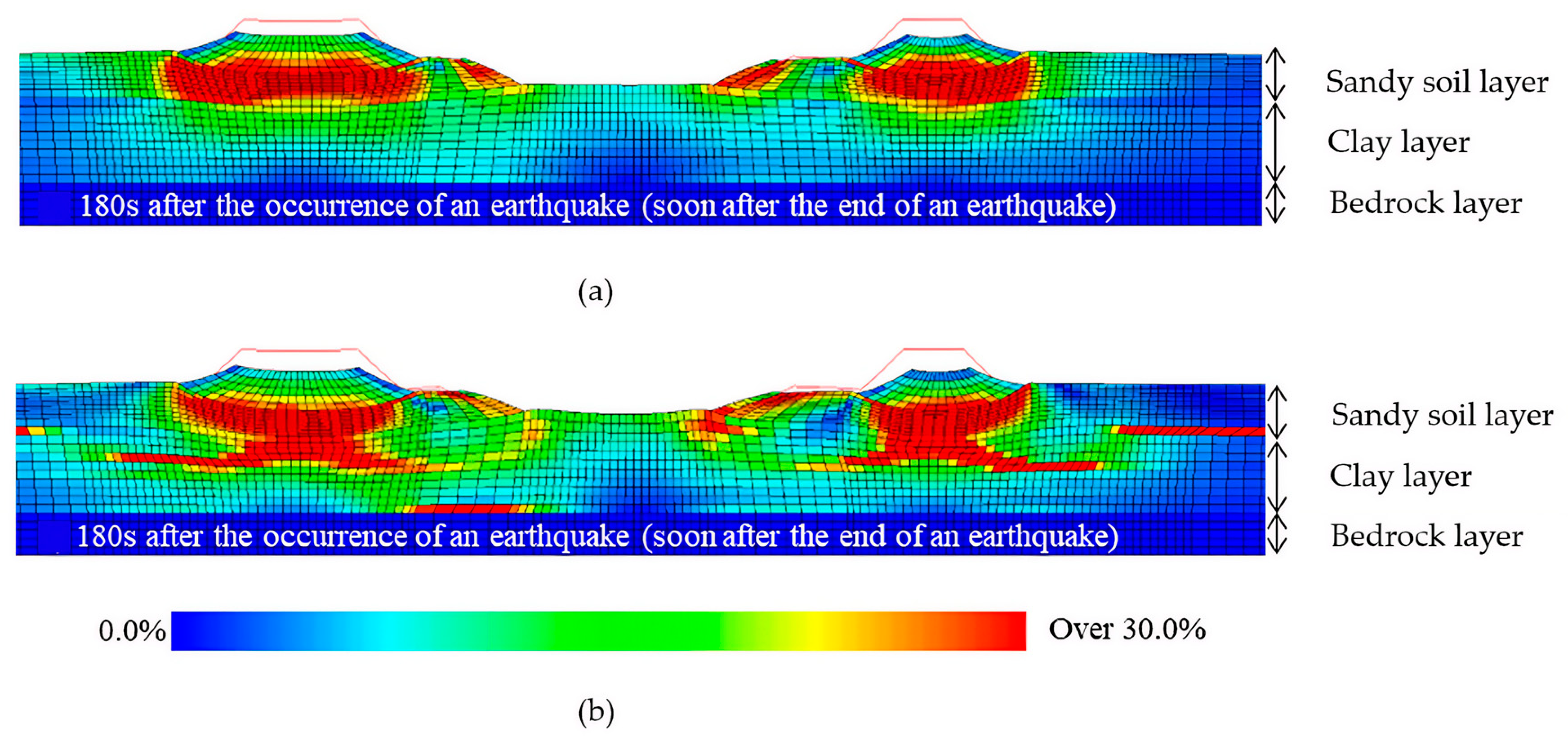
Figure 1.
Seismic damage simulation soon after the end of an earthquake on (a) normal clay soil and (b) soft clay soil.
Figure 1.
Seismic damage simulation soon after the end of an earthquake on (a) normal clay soil and (b) soft clay soil.
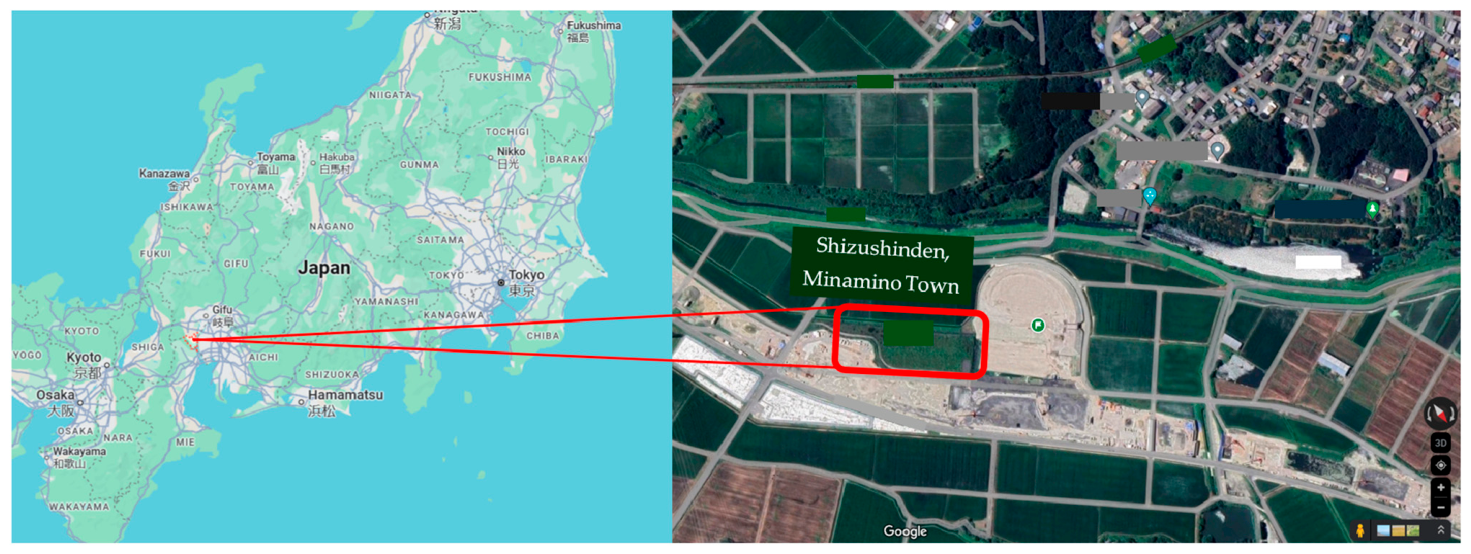
Figure 2.
Site location in Kaizu, Gifu Prefecture.
Figure 2.
Site location in Kaizu, Gifu Prefecture.
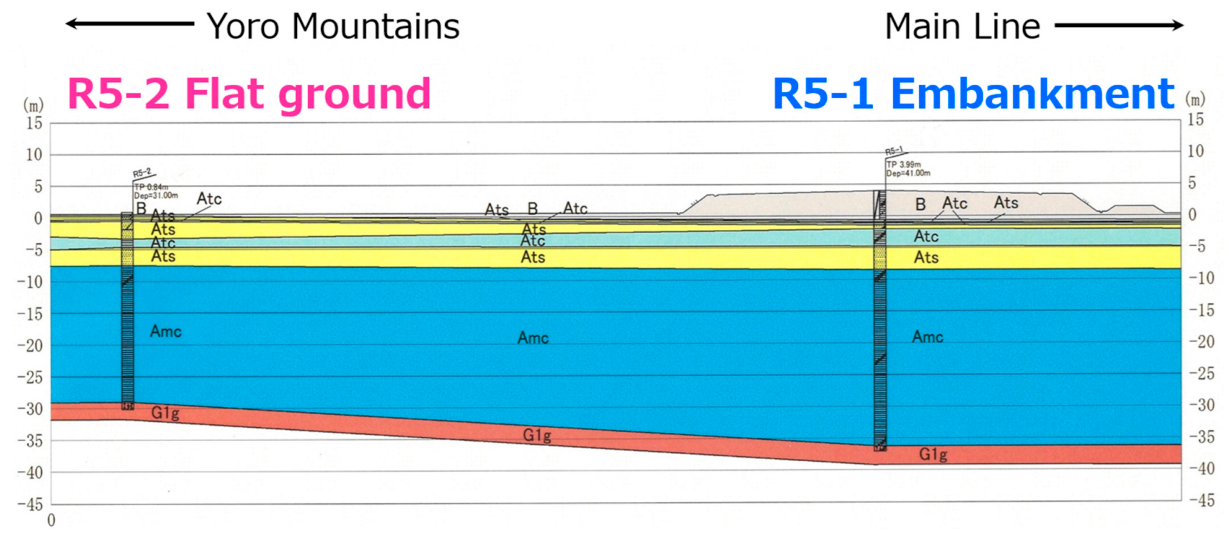
Figure 3.
Geological cross section of the site.
Figure 3.
Geological cross section of the site.
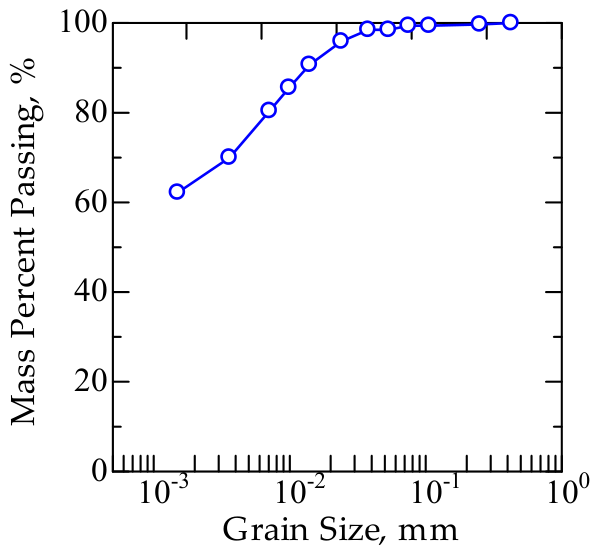
Figure 4.
Grain size distribution curve of Kaizu soft clay.
Figure 4.
Grain size distribution curve of Kaizu soft clay.
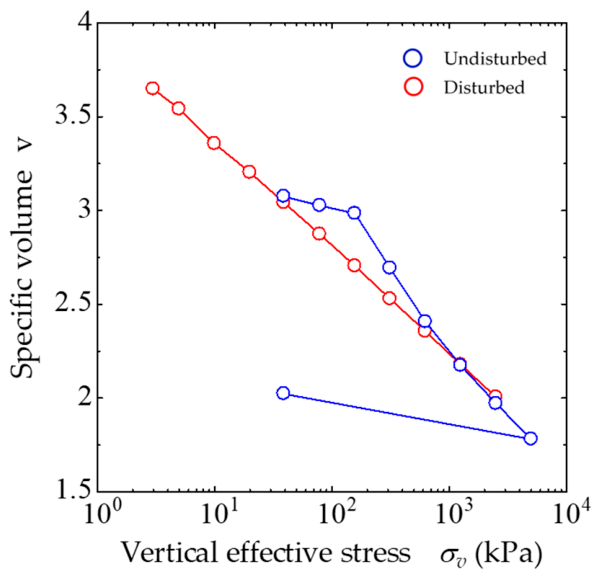
Figure 5.
1-D consolidation behavior of UDS and disturbed Kaizu soft clay.
Figure 5.
1-D consolidation behavior of UDS and disturbed Kaizu soft clay.
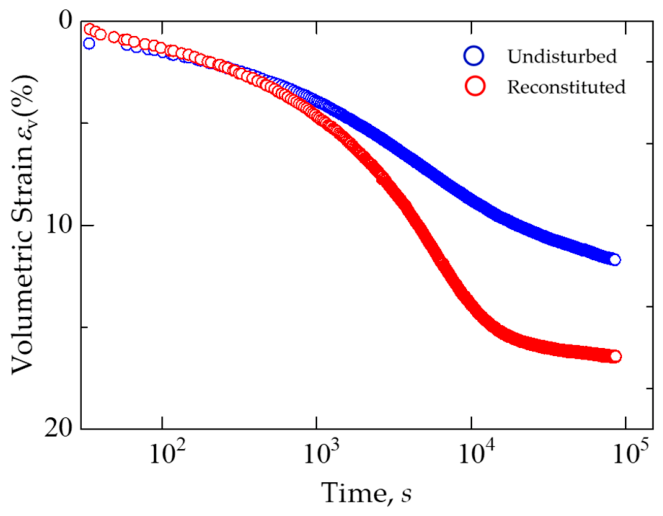
Figure 6.
Consolidation behavior of UDS and REC specimens under isotropic conditions.
Figure 6.
Consolidation behavior of UDS and REC specimens under isotropic conditions.
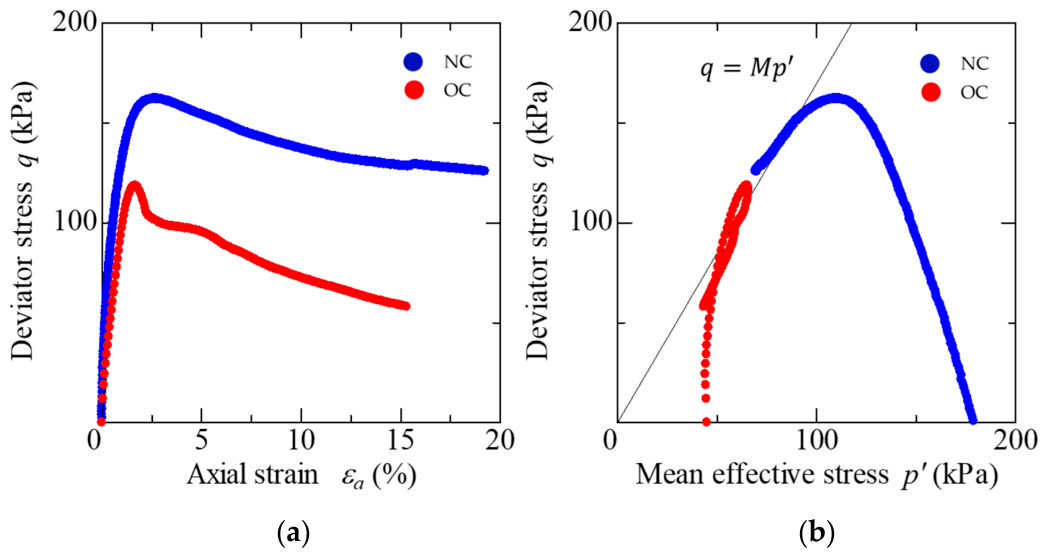
Figure 7.
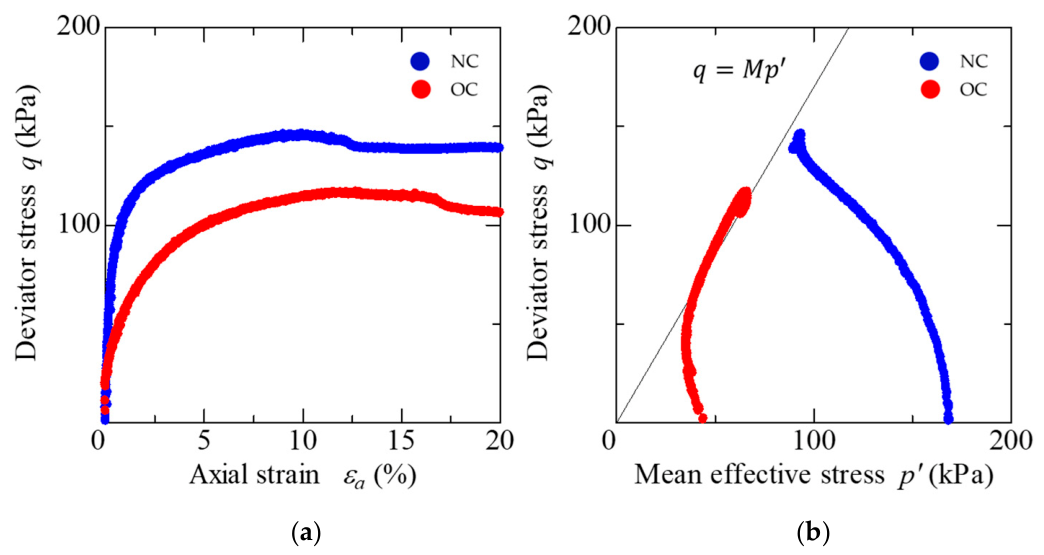
Monotonic shear behavior under NC and OC conditions on UDS soft clay: (a) stress–strain graph and (b) effective stress path.
Figure 7.
Monotonic shear behavior under NC and OC conditions on UDS soft clay: (a) stress–strain graph and (b) effective stress path.
Figure 8.
Monotonic shear behavior under NC and OC conditions on REC soft clay: (a) stress–strain graph and (b) effective stress path.
Figure 8.
Monotonic shear behavior under NC and OC conditions on REC soft clay: (a) stress–strain graph and (b) effective stress path.
Figure 9.
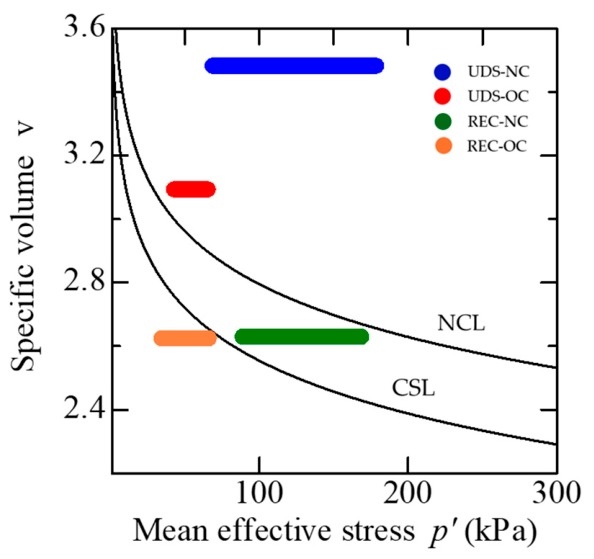
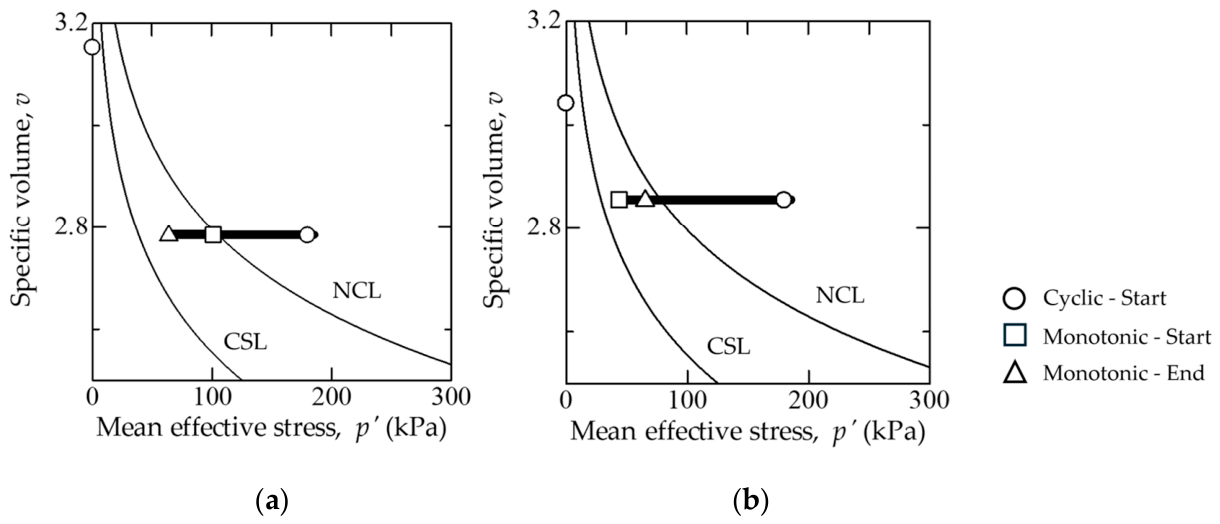
Graph of specific volume vs. effective stress of UDS-NC and UDS-OC and REC-NC and REC-OC specimens.
Figure 9.
Graph of specific volume vs. effective stress of UDS-NC and UDS-OC and REC-NC and REC-OC specimens.
Figure 10.
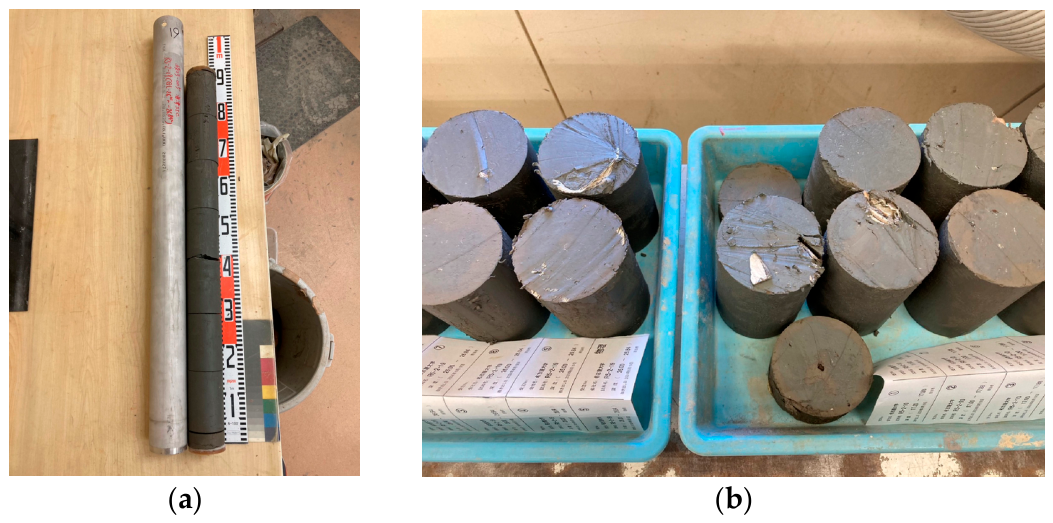
(a) Extraction from the thin-walled Shelby tube sampler and (b) cutting specimens according to desired dimensions.
Figure 10.
(a) Extraction from the thin-walled Shelby tube sampler and (b) cutting specimens according to desired dimensions.
Figure 11.
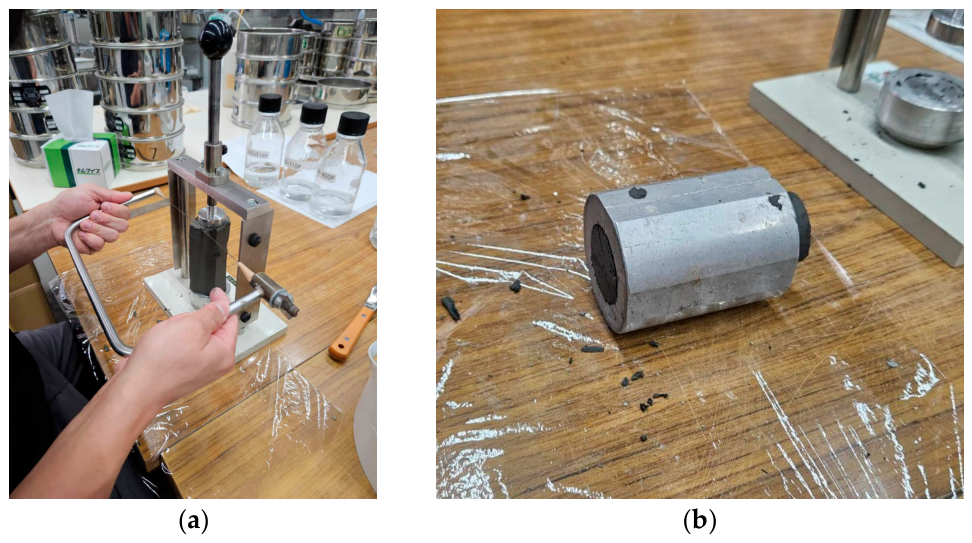
Soil specimen preparation by trimming to the desired (a) diameter and (b) height.
Figure 11.
Soil specimen preparation by trimming to the desired (a) diameter and (b) height.
Figure 12.
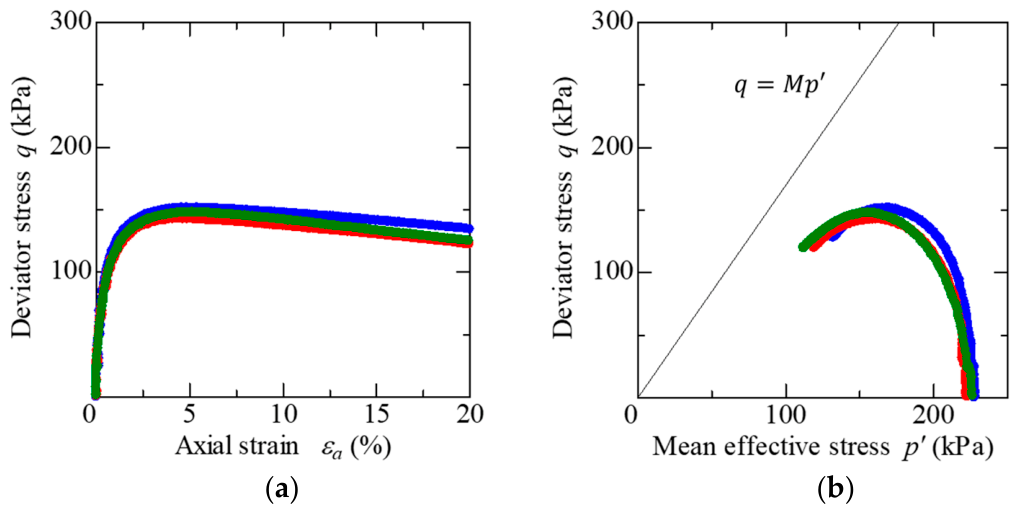
Undrained monotonic shear test under isotropic conditions on UDS specimens: (a) stress–strain graph and (b) q-p′ graph.
Figure 12.
Undrained monotonic shear test under isotropic conditions on UDS specimens: (a) stress–strain graph and (b) q-p′ graph.
Figure 13.
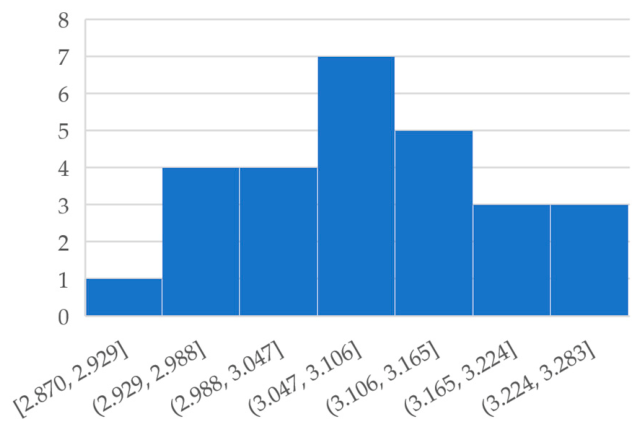
Histogram of the initial specific volumes of all specimens used.
Figure 13.
Histogram of the initial specific volumes of all specimens used.
Figure 14.
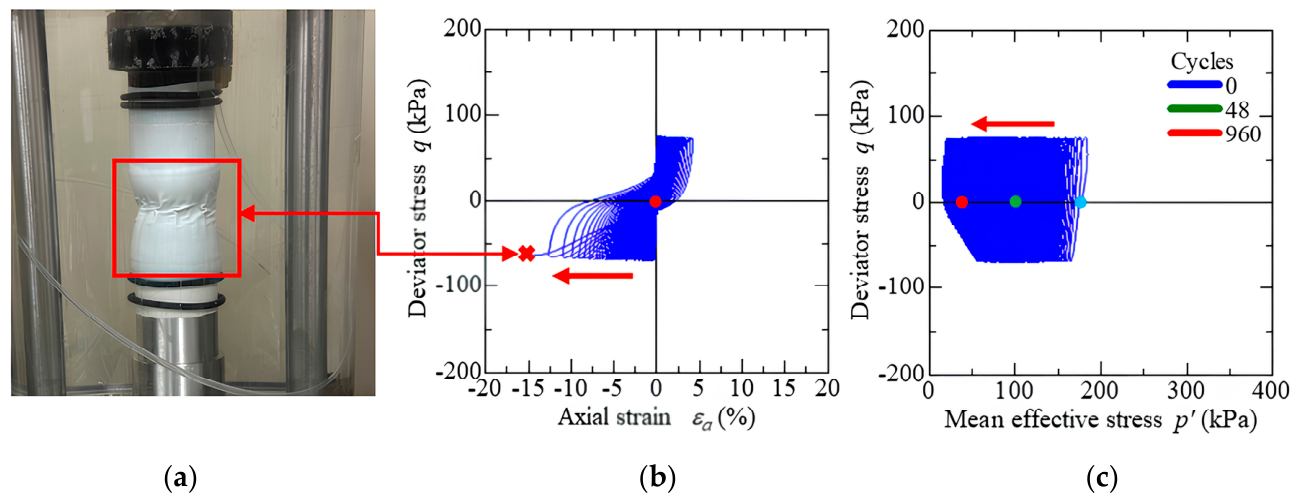
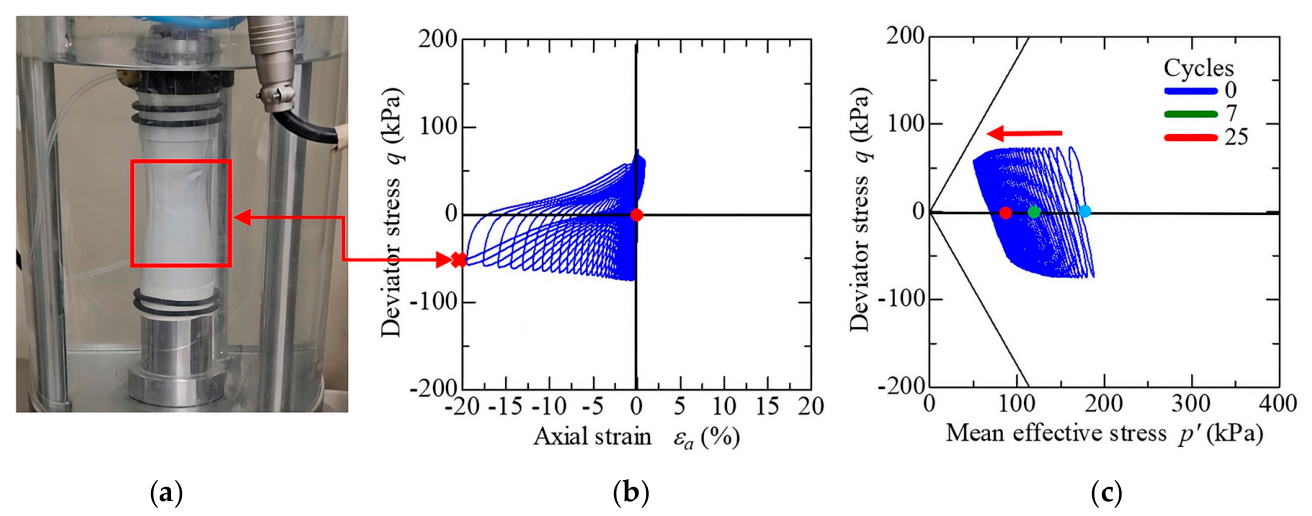
Cyclic shear behavior of UDS specimen. The subfigures show (a) shear band at failure, (b) axial strain propagation during cyclic loading, and (c) mean effective stress reduction during cyclic loading.
Figure 14.
Cyclic shear behavior of UDS specimen. The subfigures show (a) shear band at failure, (b) axial strain propagation during cyclic loading, and (c) mean effective stress reduction during cyclic loading.
Figure 15.
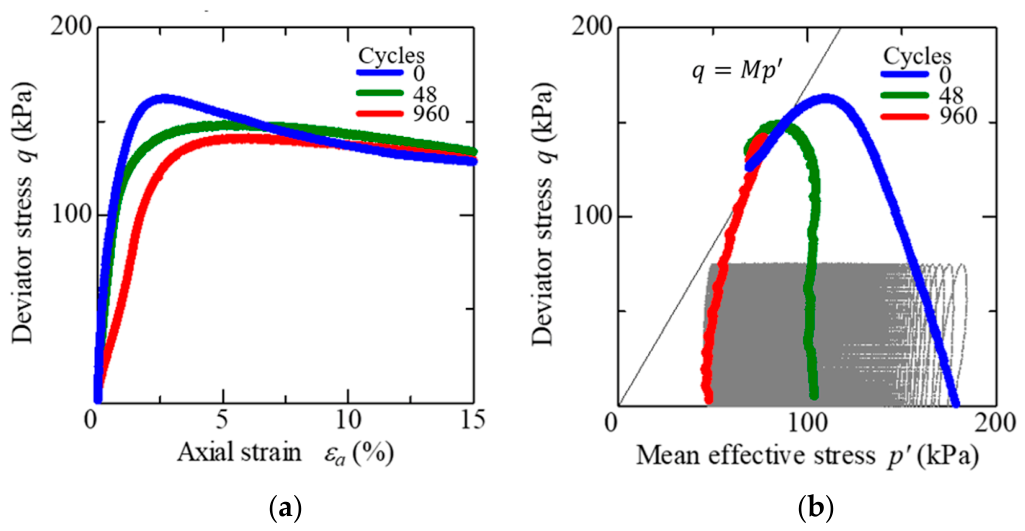
Subsequent monotonic shear test on UDS specimen. The subfigures show the (a) stress–strain graph and (b) effective stress path.
Figure 15.
Subsequent monotonic shear test on UDS specimen. The subfigures show the (a) stress–strain graph and (b) effective stress path.
Figure 16.
Cyclic shear behavior of REC specimen. The subfigures show (a) shear band at failure, (b) axial strain propagation during cyclic loading, and (c) mean effective stress reduction during cyclic loading.
Figure 16.
Cyclic shear behavior of REC specimen. The subfigures show (a) shear band at failure, (b) axial strain propagation during cyclic loading, and (c) mean effective stress reduction during cyclic loading.
Figure 17.
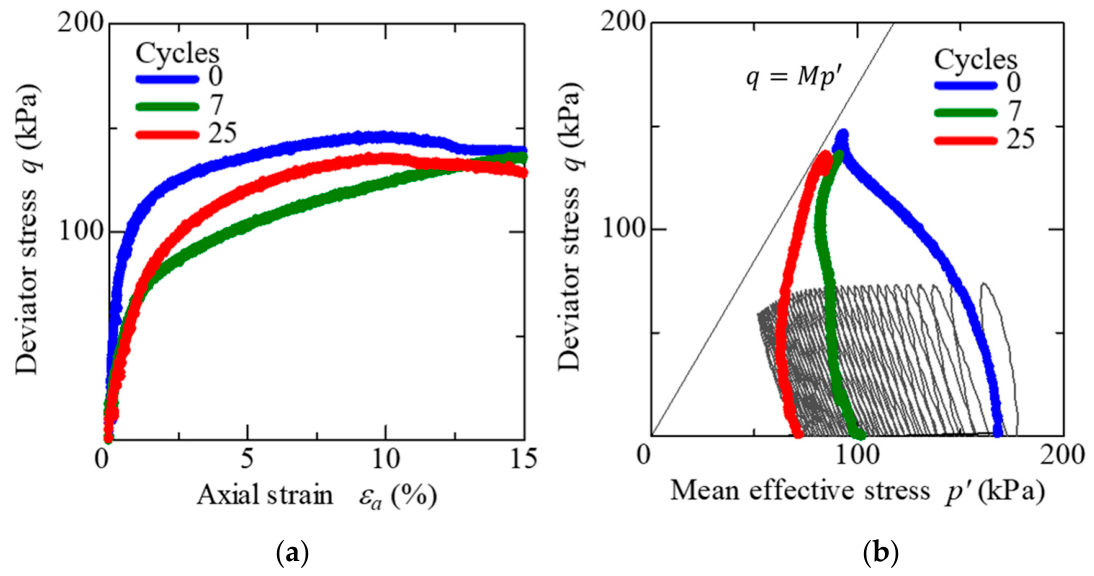
Subsequent monotonic shear test on REC specimen. The subfigures show the (a) stress–strain graph and (b) q-p′ graph.
Figure 17.
Subsequent monotonic shear test on REC specimen. The subfigures show the (a) stress–strain graph and (b) q-p′ graph.
Figure 18.
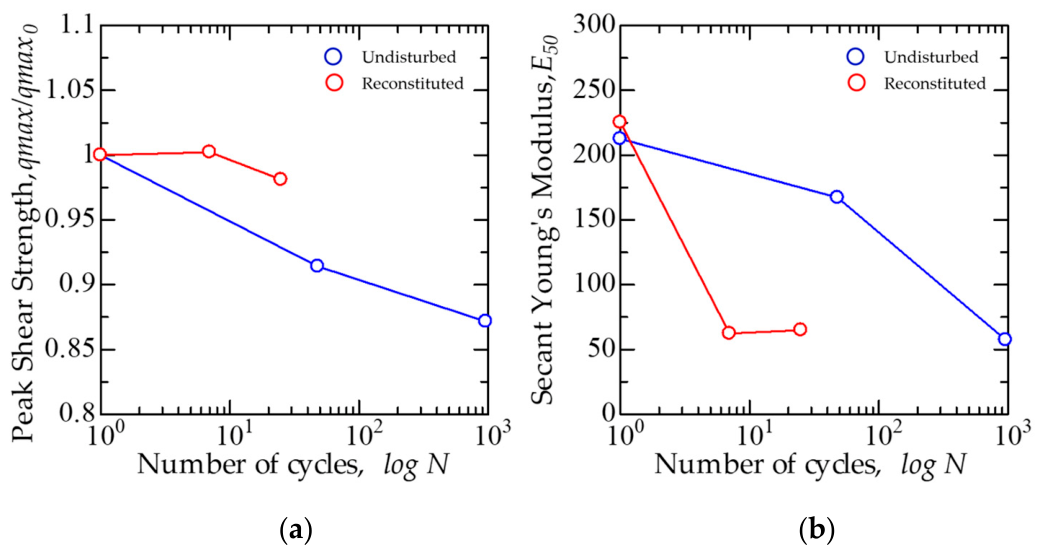
Graphs of (a) peak shear strength degradation and (b) stiffness degradation against the number of cycles on a logarithmic scale.
Figure 18.
Graphs of (a) peak shear strength degradation and (b) stiffness degradation against the number of cycles on a logarithmic scale.
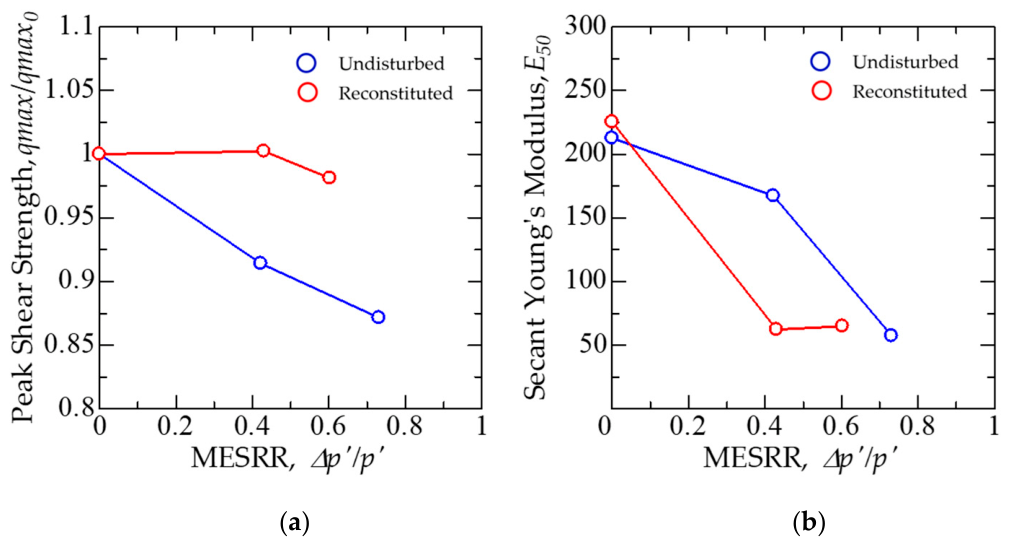
Figure 19.
Graphs of (a) peak shear strength degradation and (b) stiffness degradation against mean effective stress reduction ratio (MESRR).
Figure 19.
Graphs of (a) peak shear strength degradation and (b) stiffness degradation against mean effective stress reduction ratio (MESRR).
Figure 20.
Graph of soil structure degradation on UDS specimens after (a) 48 cycles and (b) 960 cycles.
Figure 20.
Graph of soil structure degradation on UDS specimens after (a) 48 cycles and (b) 960 cycles.
Figure 21.
Graph of soil structure degradation on REC specimens after (a) 7 cycles and (b) 25 cycles.
Figure 21.
Graph of soil structure degradation on REC specimens after (a) 7 cycles and (b) 25 cycles.
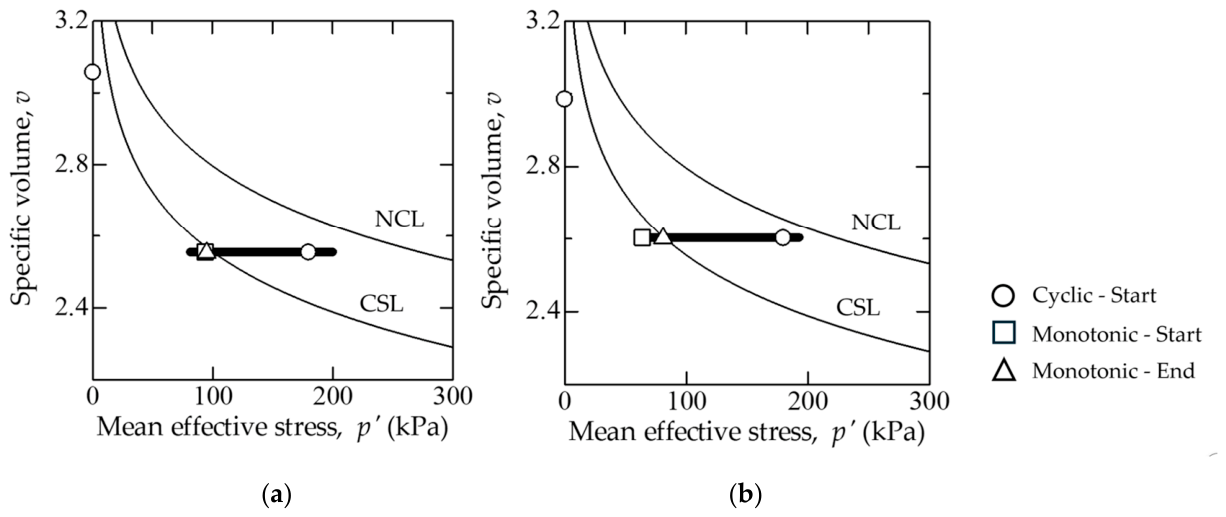
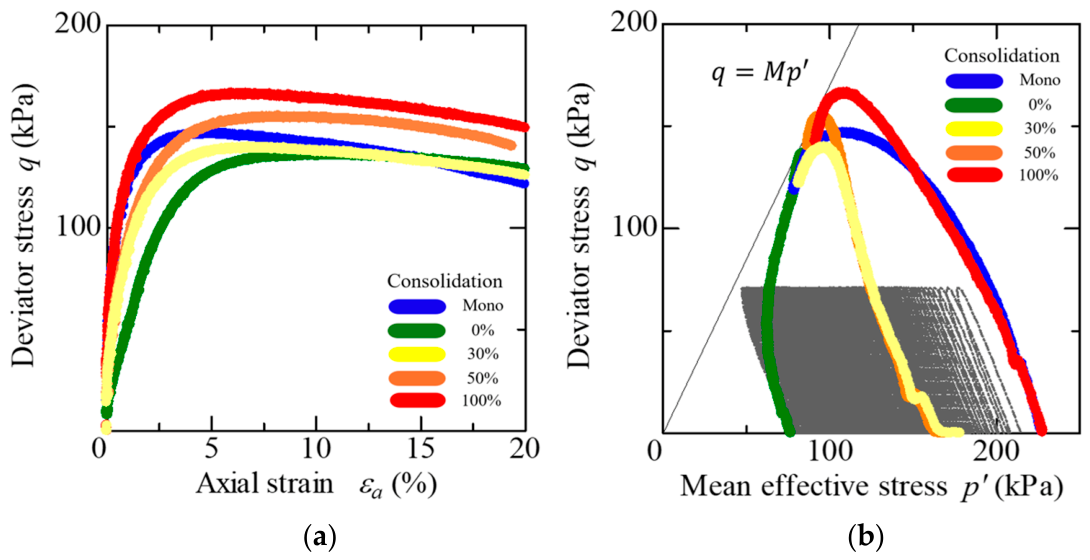
Figure 22.
Subsequent monotonic shear test on UDS specimens with different post-cyclic consolidation progress. The graphs show the (a) stress–strain graph and (b) q-p′ graph of the UDS specimen.
Figure 22.
Subsequent monotonic shear test on UDS specimens with different post-cyclic consolidation progress. The graphs show the (a) stress–strain graph and (b) q-p′ graph of the UDS specimen.
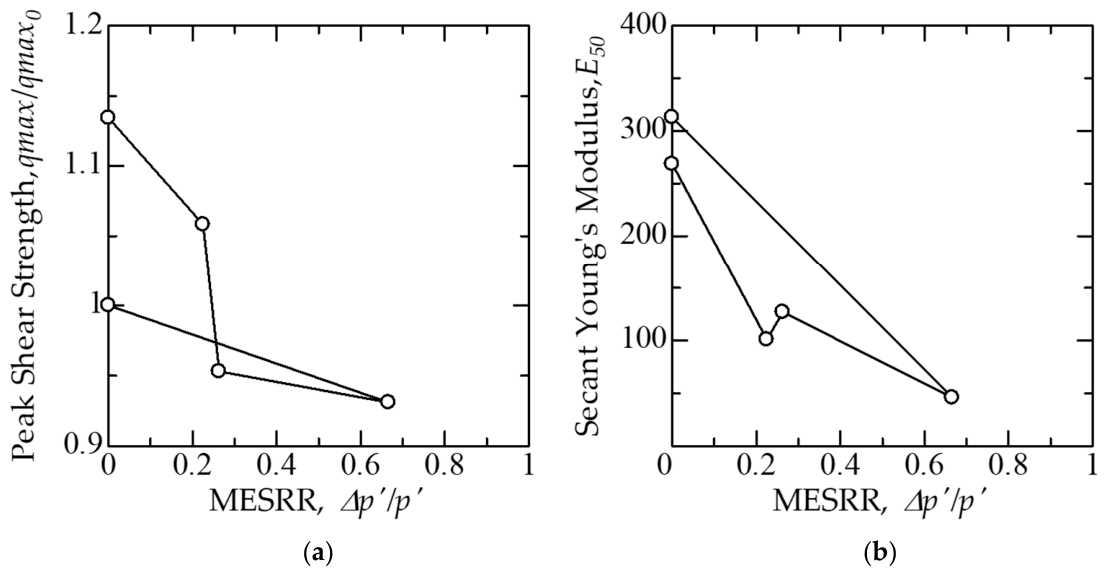
Figure 23.
Graphs of (a) peak shear strength and (b) stiffness degradation and recovery against mean effective stress reduction ratio (MESRR).
Figure 23.
Graphs of (a) peak shear strength and (b) stiffness degradation and recovery against mean effective stress reduction ratio (MESRR).
Table 1.
Summary of index properties of Kaizu soft clay.
Table 1.
Summary of index properties of Kaizu soft clay.
| Index Properties | Values |
|---|
| Specific Gravity, Gs | 2.69 |
| % Passing No. 200 Sieve (%) | 99.40 |
| Liquid Limit, LL (%) | 83 |
| Plastic Limit, PL | 33 |
| Plasticity Index, PI | 50 |
| USCS Classification | Clay, High Plasticity (CH) |
Table 2.
Physical properties of the UDS specimen after subsequent isotropic monotonic shear test.
Table 2.
Physical properties of the UDS specimen after subsequent isotropic monotonic shear test.
| Parameters | Trial 1 | Trial 2 | Trial 3 |
|---|
| Initial specific volume, v0 | 3.031 | 3.175 | 3.224 |
| Specific volume, v | 2.646 | 2.701 | 2.648 |
| Water content (cans), wc | 66.57% | 75.52% | 76.34% |
| Water content (spec.), ws | 75.51% | 80.06% | 81.46% |
| Shear strength, qmax (kPa) | 151.929 | 143.407 | 148.264 |
| qmax reduction | 0 | −5.6 | −2.4 |
Table 3.
Physical properties of specimen after cyclic shear test on UDS until failure.
Table 3.
Physical properties of specimen after cyclic shear test on UDS until failure.
| Parameters | Values |
|---|
| Initial specific volume, v0 | 3.190 |
| Specific volume after consolidation, v | 3.092 |
Table 4.
Physical properties of UDS specimen after subsequent monotonic shear test.
Table 4.
Physical properties of UDS specimen after subsequent monotonic shear test.
| Parameters | 0 Cycles | 48 Cycles | 960 Cycles |
|---|
| Initial Specific Volume, v0 | 2.965 | 3.152 | 3.041 |
| Specific Volume, v | 2.757 | 2.783 | 2.854 |
| Shear Strength, qmax (kPa) | 162.448 | 148.501 | 141.586 |
| Secant Young’s Modulus, E50 | 212.628 | 167.271 | 57.417 |
Table 5.
Physical properties of specimen after cyclic shear test on REC until failure.
Table 5.
Physical properties of specimen after cyclic shear test on REC until failure.
| Parameters | Values |
|---|
| Initial specific volume, v0 | 2.965 |
| Specific volume after consolidation, v | 2.611 |
Table 6.
Physical properties of the REC specimen after the subsequent monotonic shear test.
Table 6.
Physical properties of the REC specimen after the subsequent monotonic shear test.
| Parameters | 0 Cycles | 7 Cycles | 25 Cycles |
|---|
| Initial Specific Volume, v0 | 2.994 | 3.056 | 2.984 |
| Specific Volume, v | 2.627 | 2.553 | 2.601 |
| Shear Strength, qmax (kPa) | 138.582 | 138.902 | 135.971 |
| Secant Young’s Modulus, E50 | 225.294 | 62.366 | 64.934 |
Table 7.
Physical properties of subsequent monotonic shear test on UDS specimens with different post-cyclic consolidation progress.
Table 7.
Physical properties of subsequent monotonic shear test on UDS specimens with different post-cyclic consolidation progress.
| Parameters | Mono | 0% | 30% | 50% | 100% |
|---|
| Initial Specific Volume, v0 | 3.108 | 3.088 | 3.176 | 3.069 | 3.258 |
| Specific Volume (after isotropic consolidation), v1 | 2.795 | 2.787 | 2.757 | 2.711 | 2.920 |
| Specific Volume (after post-cyclic consolidation), v2 | no data | no data | 2.714 | 2.663 | 2.822 |
| Shear Strength, qmax (kPa) | 146.779 | 136.656 | 139.895 | 155.324 | 166.494 |
| Secant Young’s Modulus, E50 | 312.974 | 45.998 | 126.947 | 101.011 | 268.539 |