Laboratory Model Tests and Numerical Investigation of Gravelly Silt Slope Instability Under Extreme Rainfall Conditions

Abstract
1. Introduction
2. Materials and Methods
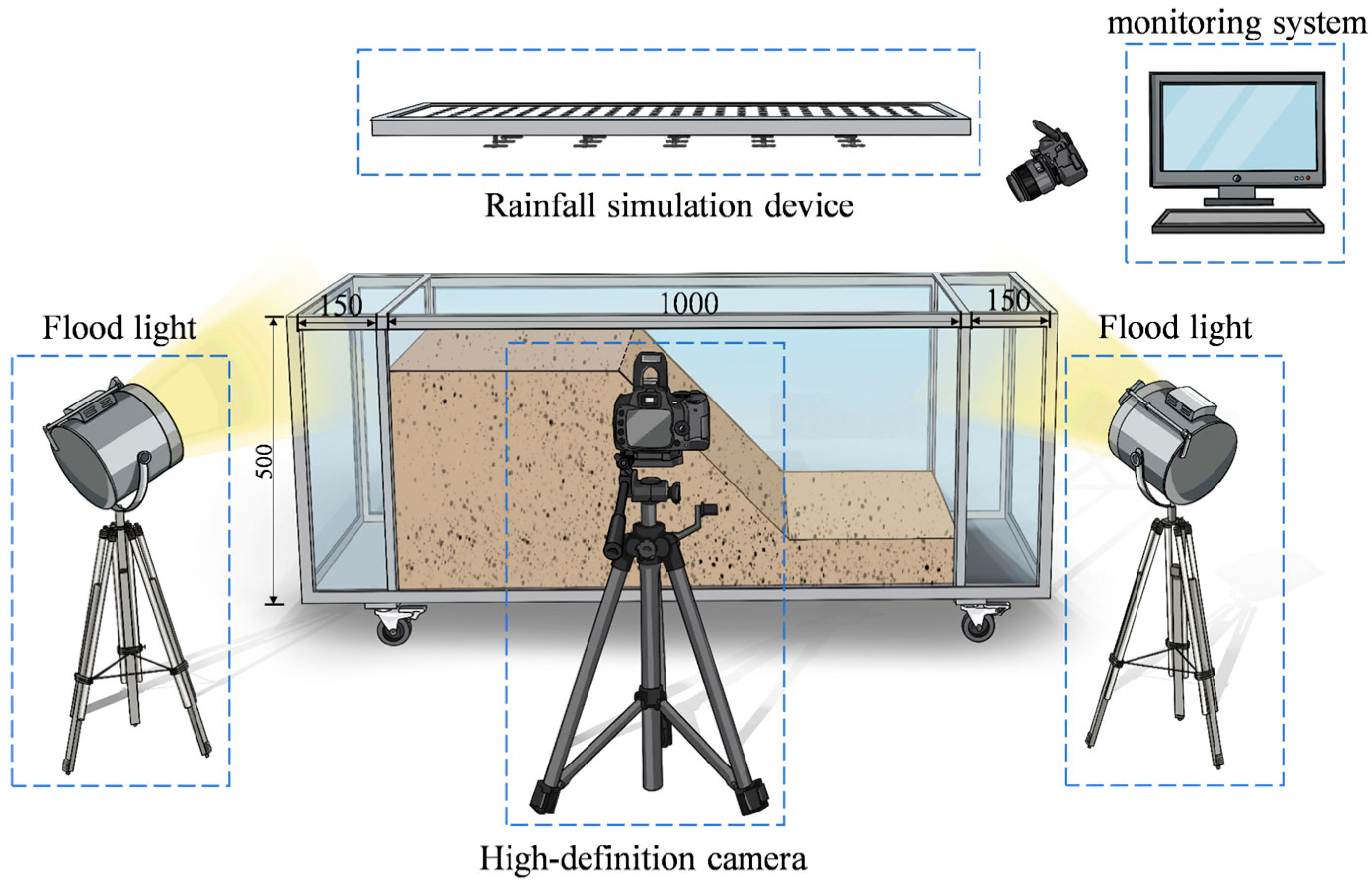
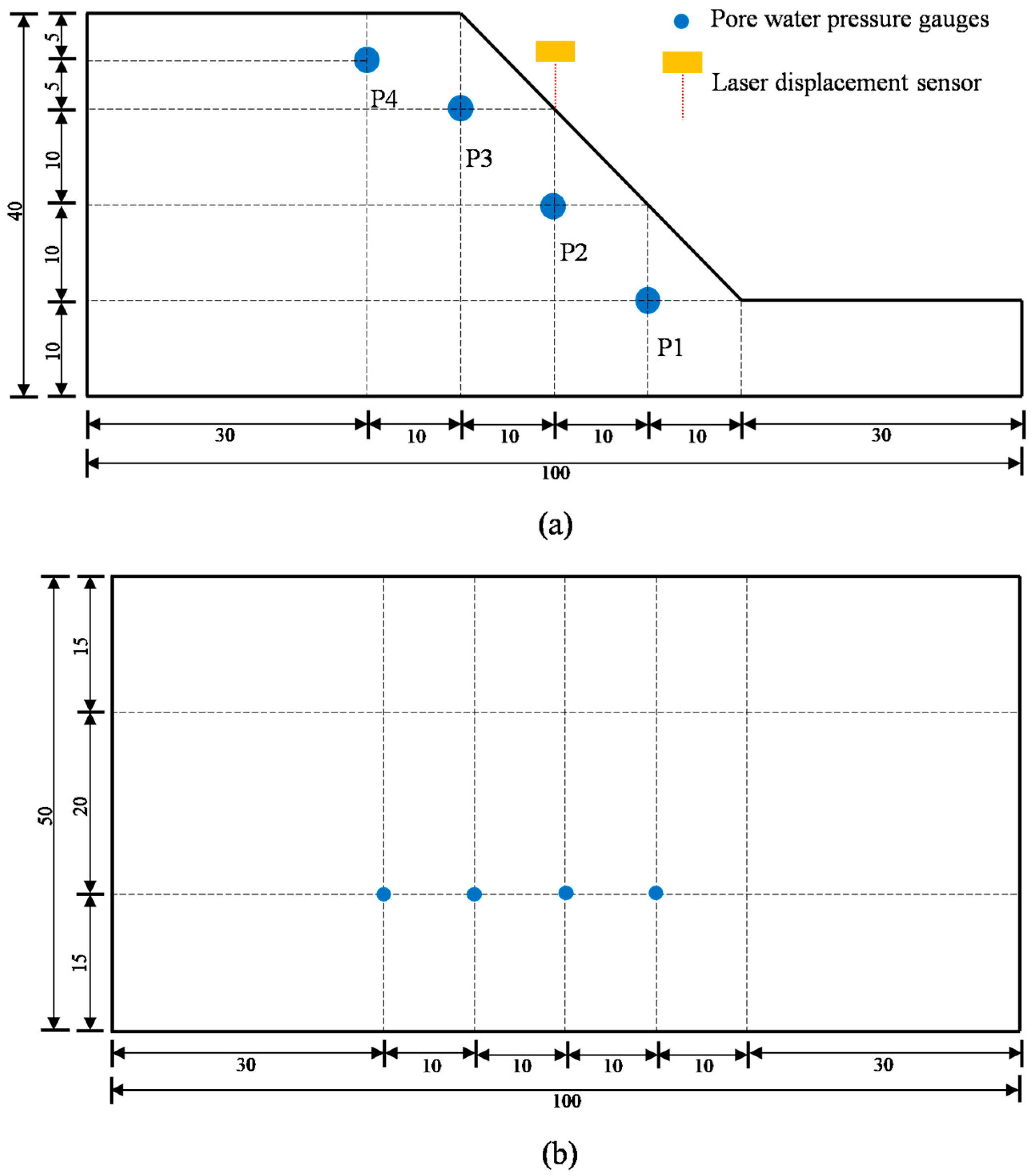
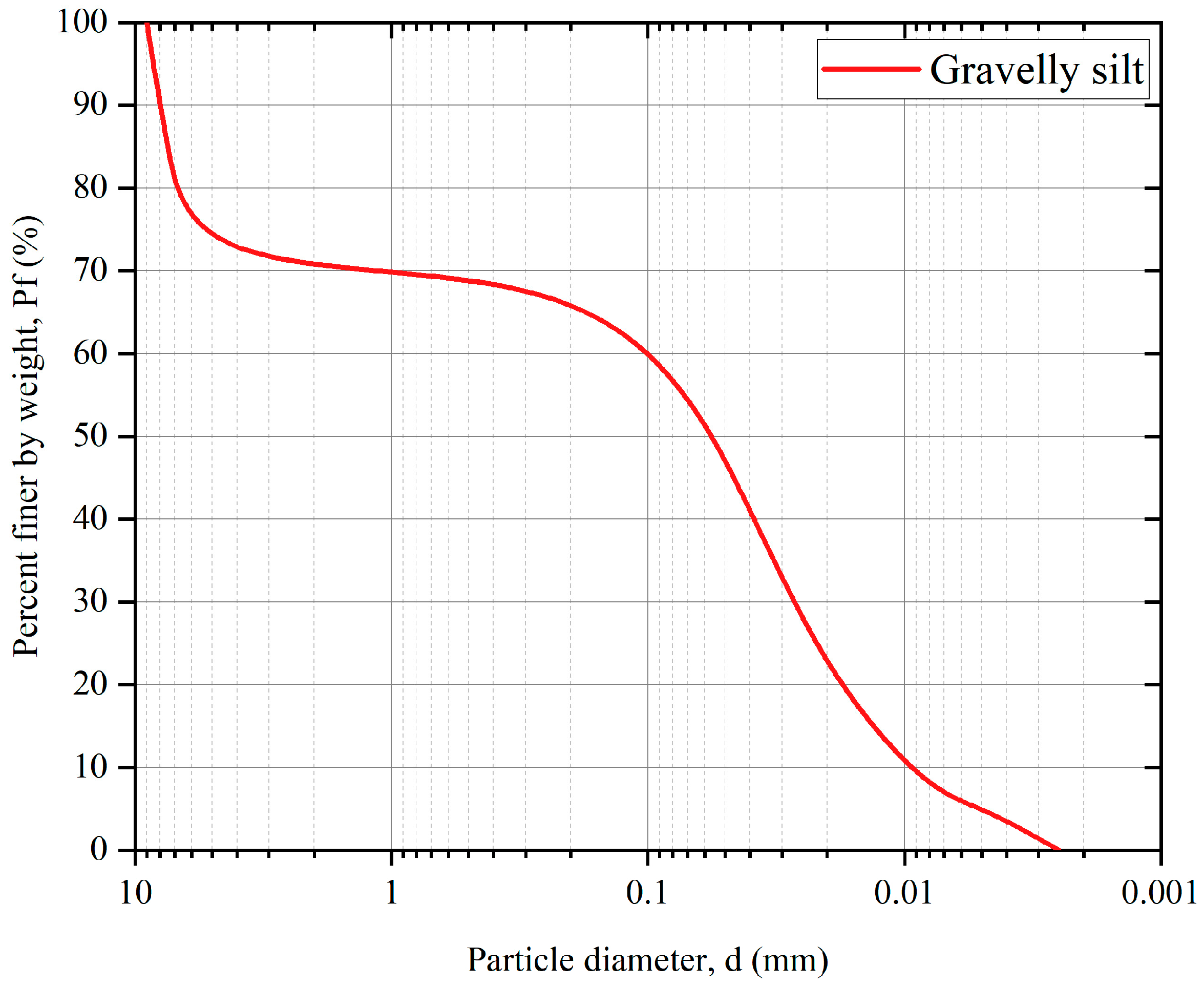
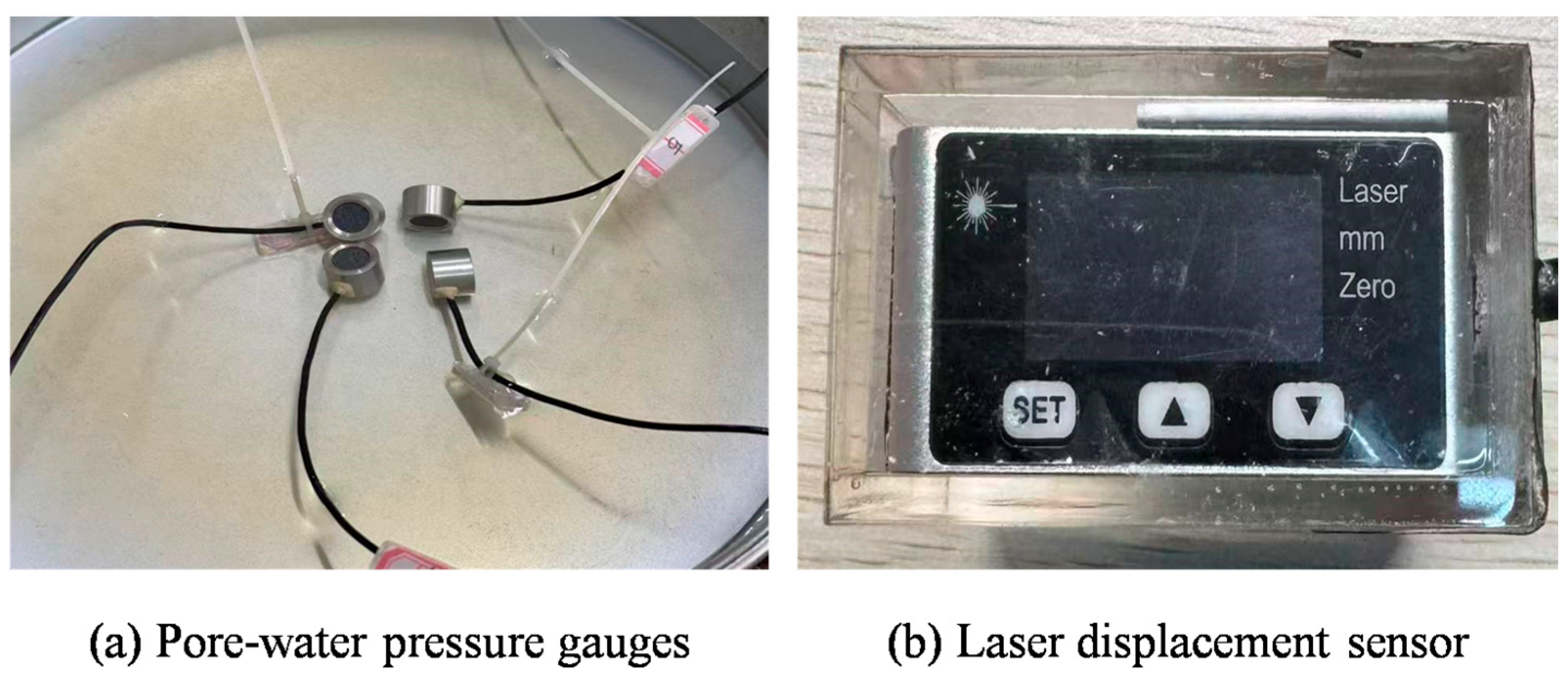
2.1. Experimental Apparatus and Materials
2.2. Model Slope Preparation
2.3. Calibration of Rainfall Intensity and Test Conditions
2.4. Experimental and Numerical Methods
3. Model Test Results and Instability Evolution Analysis
3.1. Slope Deformation and Failure Process
3.2. Multi-Source Monitoring Response Characteristics
4. Numerical Modeling of Rainfall-Induced Failure Mechanisms in Gravelly Silt Slopes
4.1. Development and Validation of the Numerical Model
4.1.1. Development of the Coupled Macro–Micro Fluid–Solid Model
4.1.2. Cross Validation Between Physical Experiments and the Numerical Model
4.1.3. Quantitative Evaluation of Pore Water Pressure Simulation
4.2. Spatiotemporal Evolution of the Rainfall-Driven Multiphase Flow Field
4.3. Macroscopic Instability and Morphological Evolution Driven by Fluid–Solid Coupling
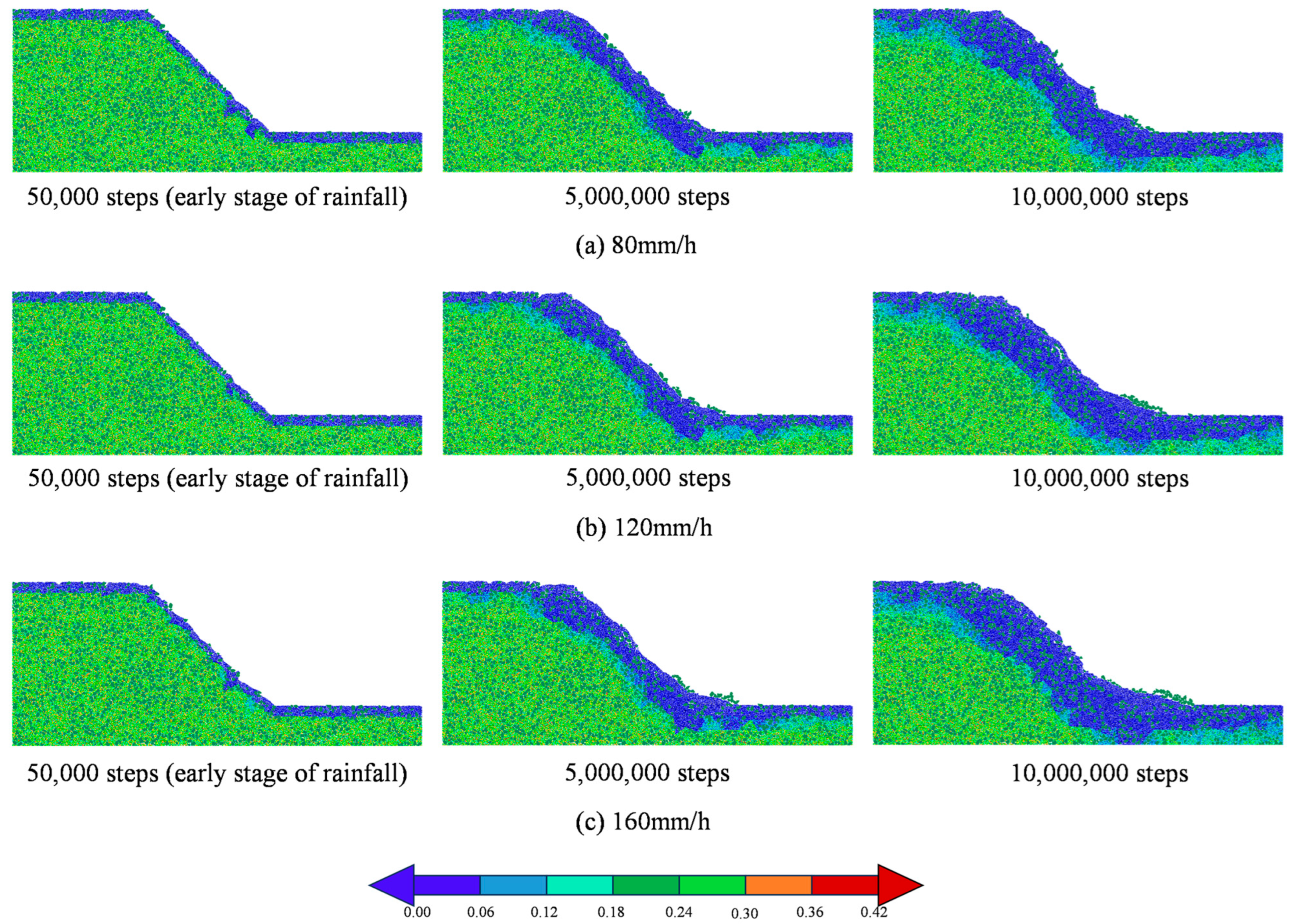
4.3.1. Degradation Mechanisms of Matric Suction and Shear Strength
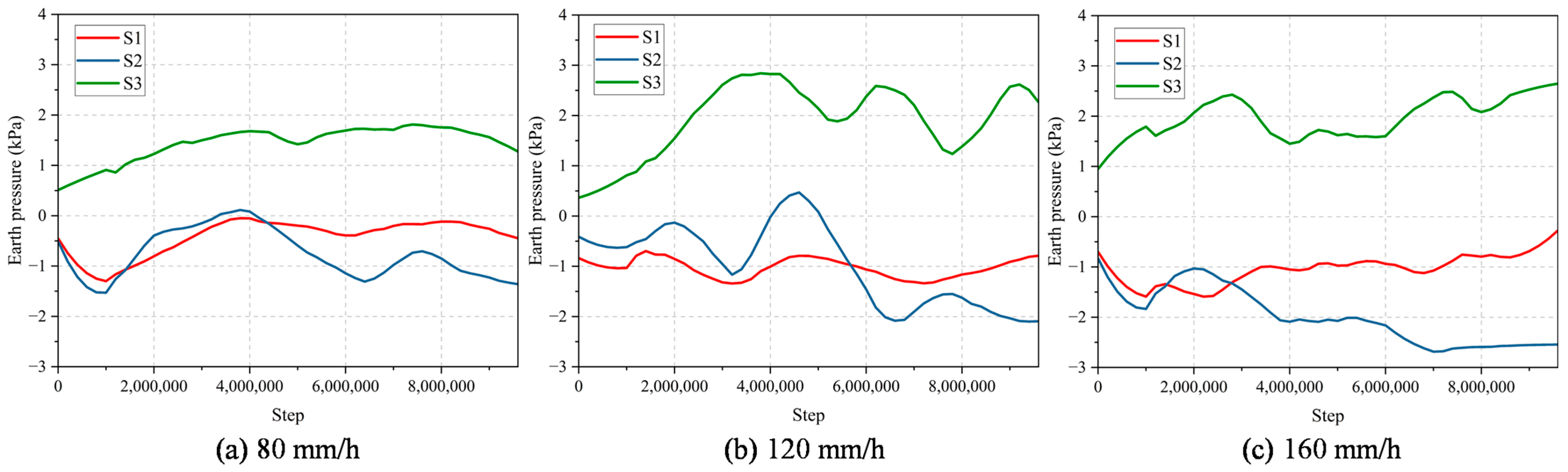
4.3.2. Dynamic Redistribution of the Micromechanical Stress Field and Progressive Failure
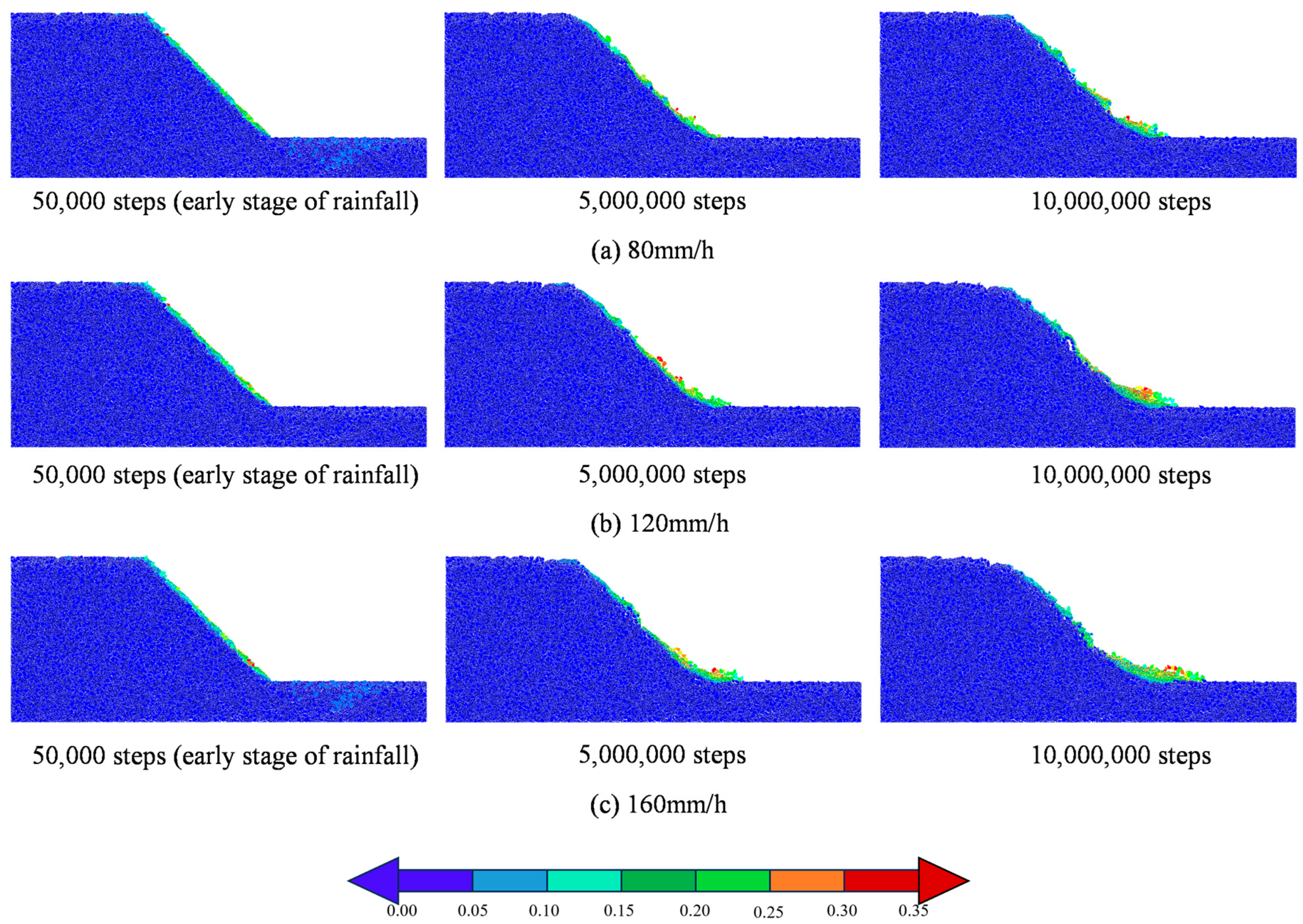
4.3.3. Macroscopic Particle Displacement and Morphological Evolution
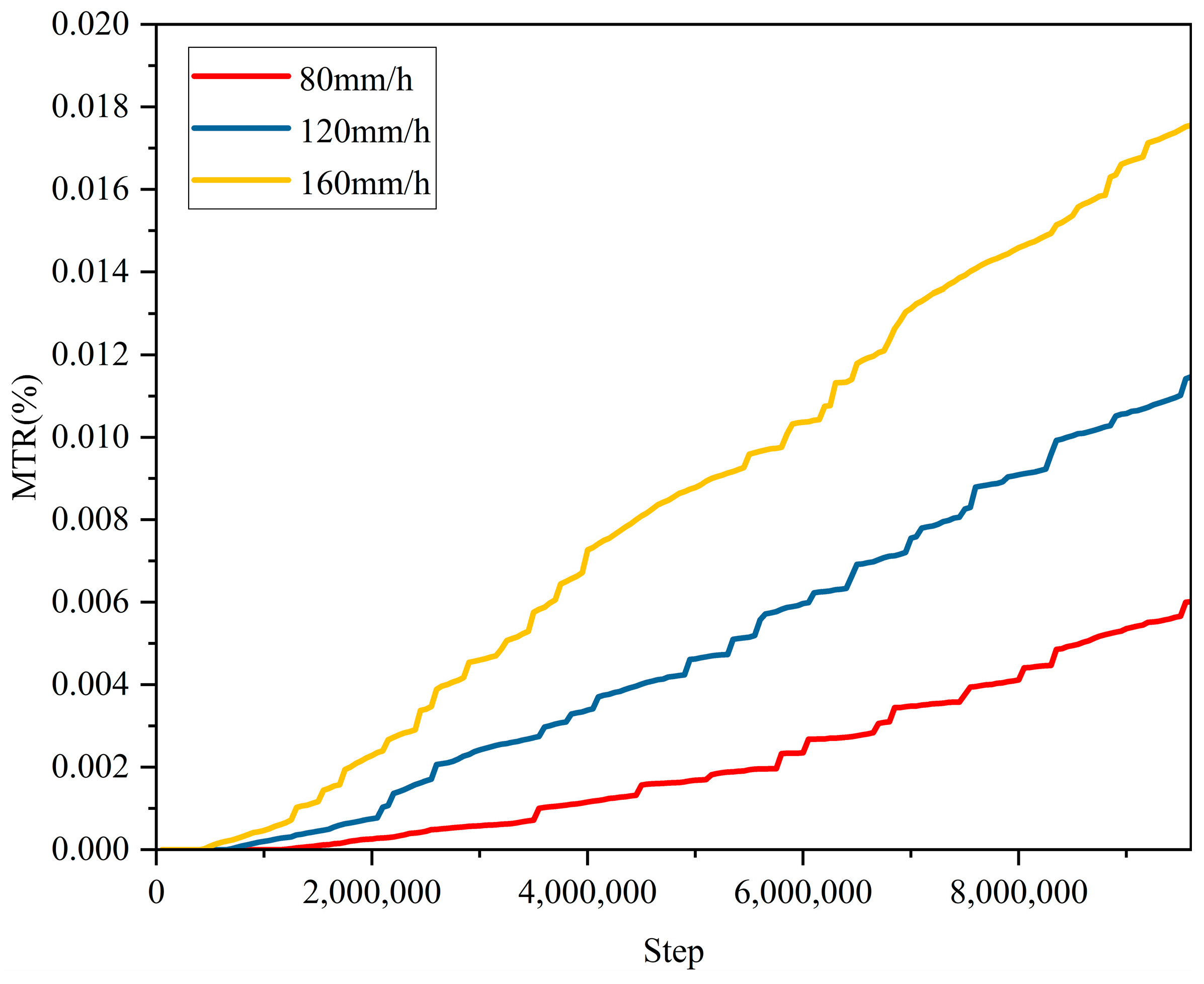
4.3.4. Temporal Evolution of the Mass Transport Ratio (MTR)
4.4. Micromechanical Mechanisms of Differential Particle Transport and Synergistic Failure
4.5. Model Assumptions and Limitations
5. Discussion
6. Conclusions
- (1)
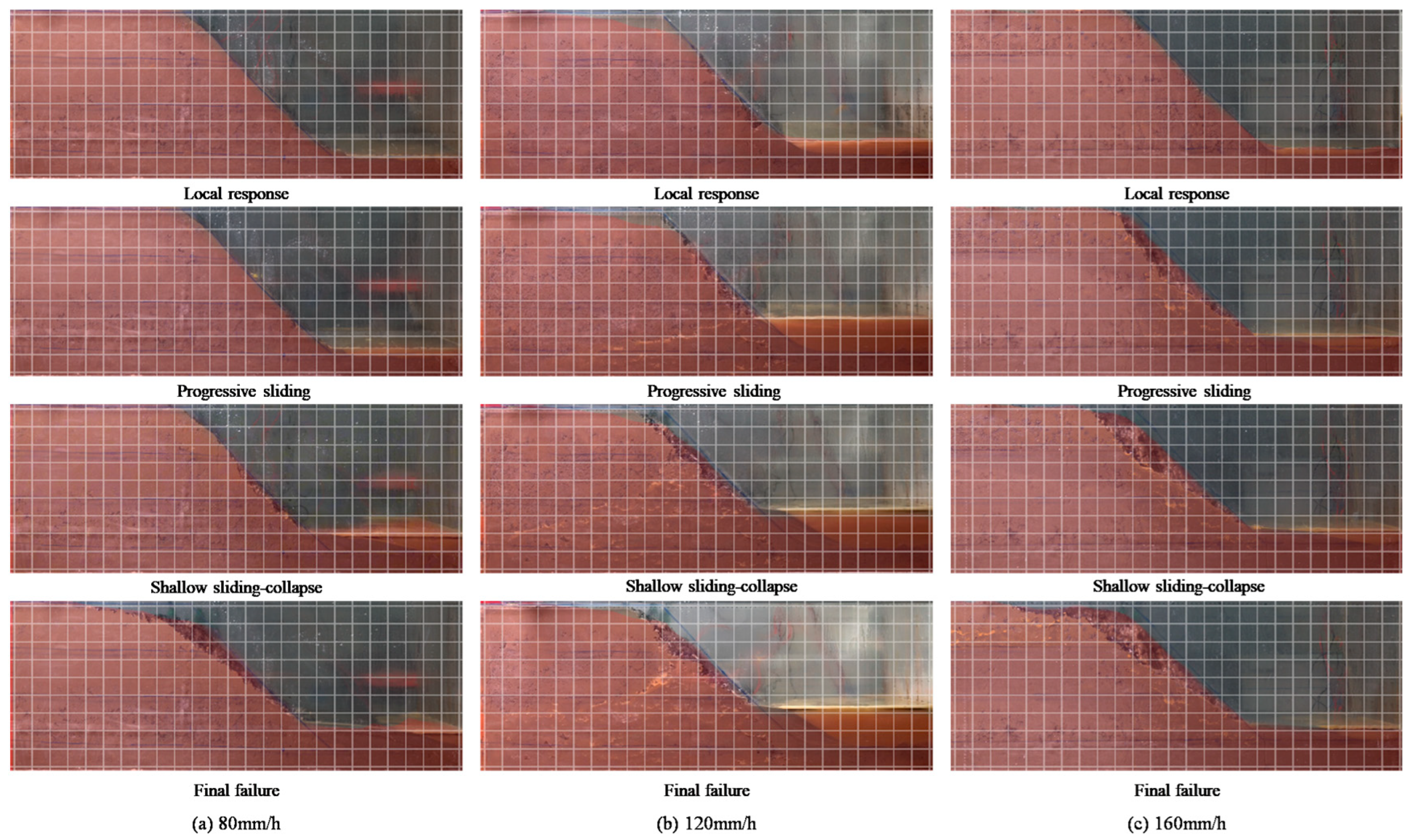
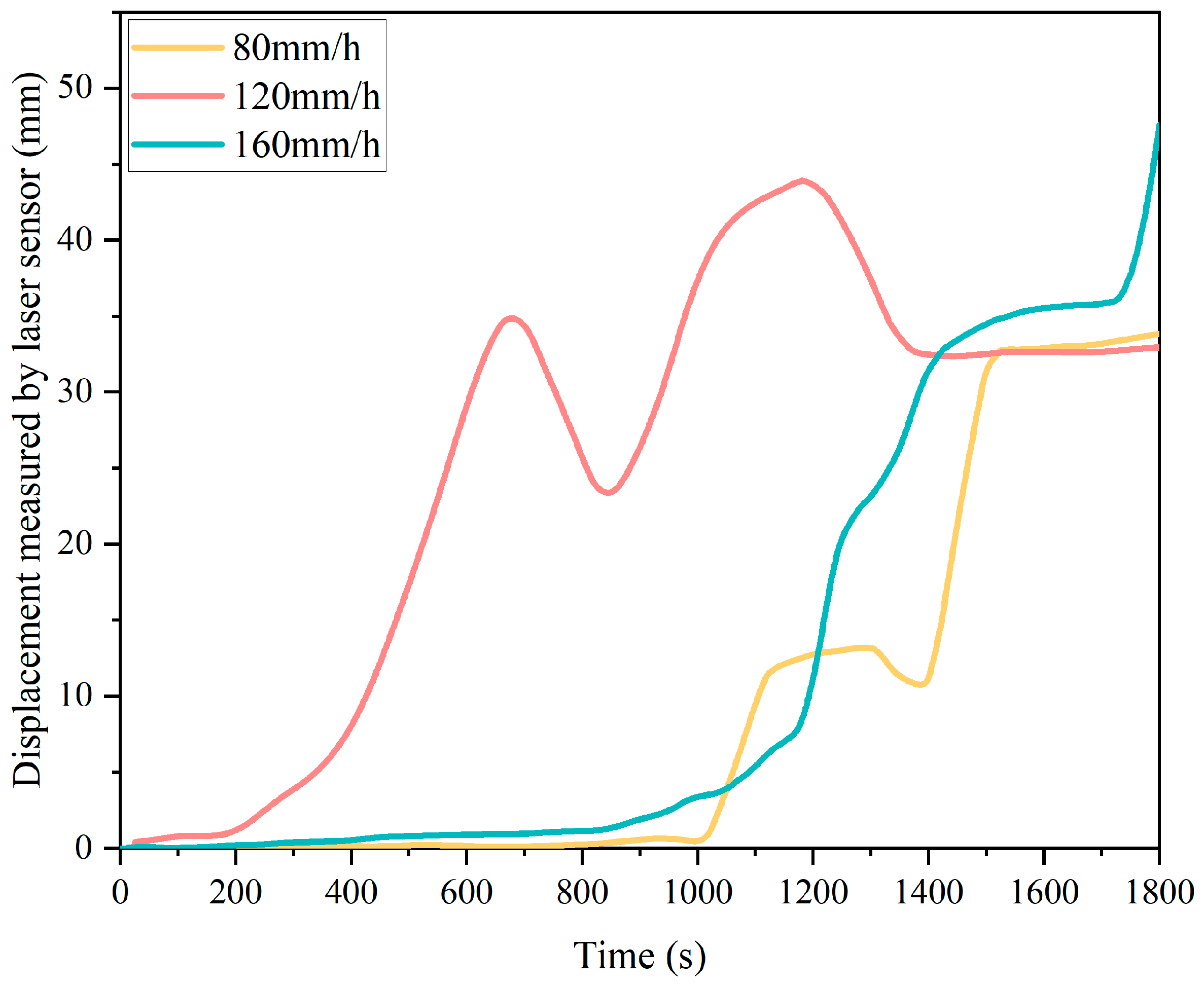
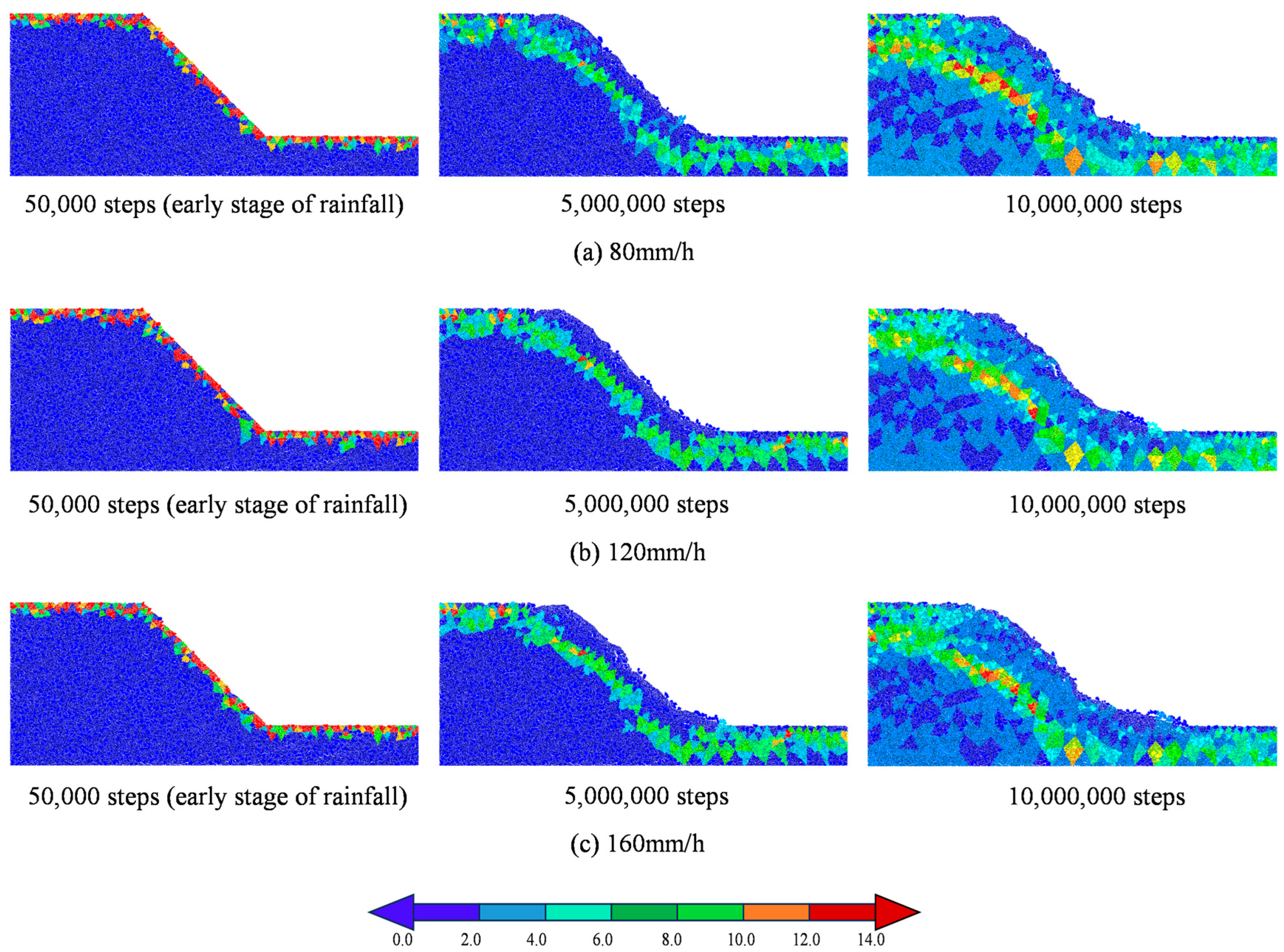
- Experimental image records and laser displacement curves show that all three model slopes developed shallow instability under the tested extreme rainfall conditions, but the failure process changed with rainfall intensity. The 80 mm/h case showed slow progressive shallow sliding, the 120 mm/h case showed faster progressive instability, and the 160 mm/h case showed earlier toe erosion and stronger flow-like transport.
- (2)
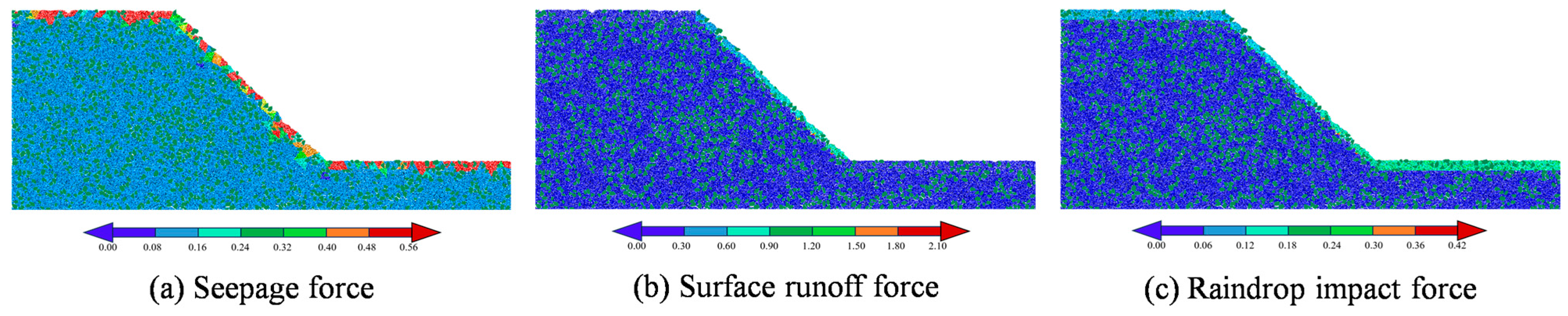
- The comparison between rainfall intensity and the measured saturated permeability of the gravelly silt, together with the simulated hydraulic gradient field, indicates that the three rainfall cases should be interpreted as infiltration-excess rainfall conditions. Under the present model scale, rainfall duration, and soil hydraulic properties, the additional rainfall mainly increased surface runoff, toe erosion, and failed mass mobility rather than proportionally increasing the infiltration depth.
- (3)
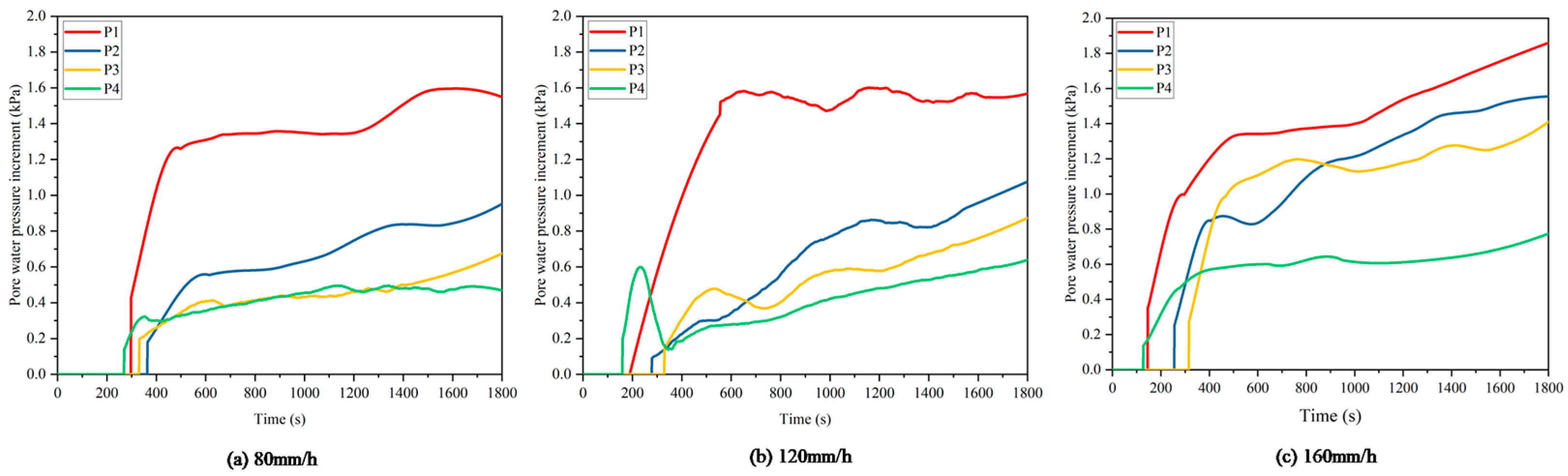
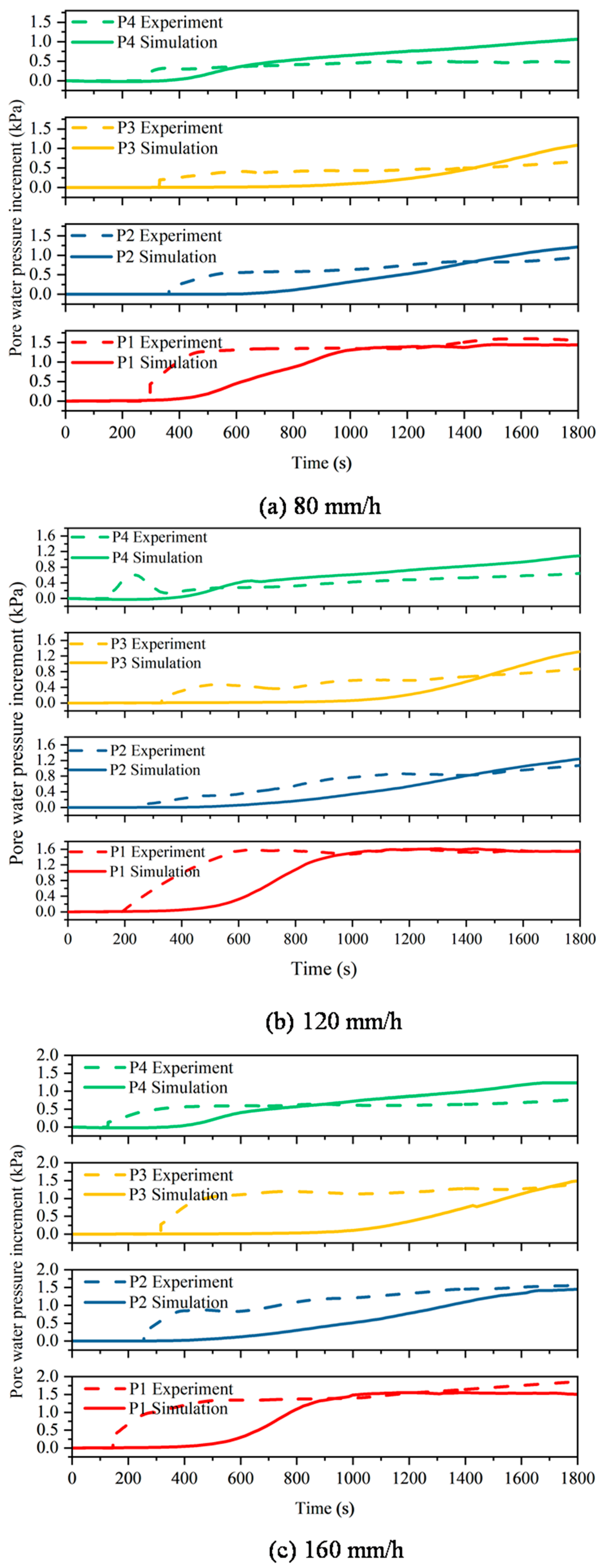
- The measured pore water pressure increments show clear spatial and temporal differentiation. The shallow crest region responded earlier, while the lower slope/toe-adjacent region showed greater later-stage accumulation. This evidence indicates that rainfall-induced wetting and local saturation were coupled with downward seepage and toe-adjacent water accumulation.
- (4)
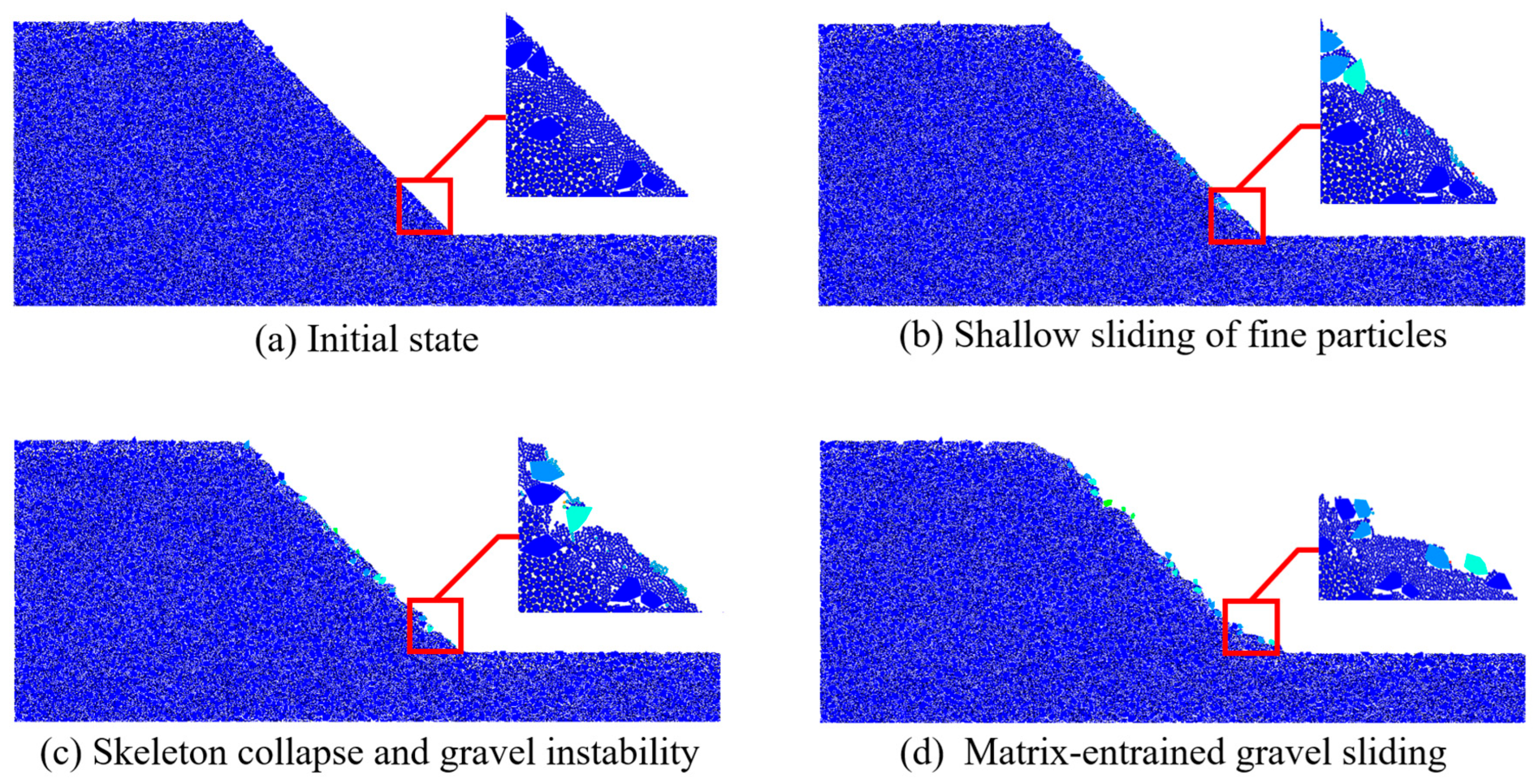
- The numerical particle displacement field, suction-dependent equivalent bonding results, and mass transport ratio indicate a progressive particle-scale failure sequence. The failure process can be interpreted as equivalent fine matrix mobilization, gravel destabilization, local skeleton collapse, and matrix-entrained gravel movement. Because equivalent particle upscaling and suction-dependent bonding simplification were adopted, the micromechanical results should be interpreted as relative failure evolution rather than exact pore-scale particle transport.
Author Contributions
Funding
Institutional Review Board Statement
Informed Consent Statement
Data Availability Statement
Acknowledgments
Conflicts of Interest
References
- Lumb, P. Slope failures in Hong Kong. Q. J. Eng. Geol. 1975, 8, 31–65. [Google Scholar] [CrossRef] [Scilit]
- Li, S.; Feng, W.; Yi, X.; Liu, K.; Guo, C.; Tang, X.; Wu, Z. Clustered shallow landslides triggered by heavy rainfall in May 2022 in Wuping County, Fujian Province, China. Bull. Eng. Geol. Environ. 2025, 84, 257. [Google Scholar] [CrossRef] [Scilit]
- Chen, S.; Xu, W.; Xu, X.; Yan, L.; Wu, W.; Xie, W.-C. Deformation response and mechanism induced by rainfall of the Zhoujia landslide in Southwestern China. Nat. Hazards 2025, 121, 8039–8059. [Google Scholar] [CrossRef] [Scilit]
- Li, Q.; Duan, Y. Tropical cyclone strikes at the coastal cities of China from 1949 to 2008. Meteorol. Atmos. Phys. 2010, 107, 1–7. [Google Scholar] [CrossRef] [Scilit]
- Zhuang, Y.; Xing, A.; Sun, Q.; Jiang, Y. Insights into initiation of typhoon-induced deep-seated landslides in Southeast coastal China. Nat. Hazards 2023, 119, 721–749. [Google Scholar] [CrossRef] [Scilit]
- Bellprat, O.; Guemas, V.; Doblas-Reyes, F.; Donat, M.G. Towards reliable extreme weather and climate event attribution. Nat. Commun. 2019, 10, 1732. [Google Scholar] [CrossRef] [Scilit]
- Iverson, R.M. Landslide triggering by rain infiltration. Water Resour. Res. 2000, 36, 1897–1910. [Google Scholar] [CrossRef] [Scilit]
- Ling, H.I.; Wu, M.-H.; Leshchinsky, D.; Leshchinsky, B. Centrifuge modeling of slope instability. J. Geotech. Geoenviron. Eng. 2009, 135, 758–767. [Google Scholar] [CrossRef] [Scilit]
- Liu, Y.; Deng, Z.; Wang, X. The effects of rainfall, soil type and slope on the processes and mechanisms of rainfall-induced shallow landslides. Appl. Sci. 2021, 11, 11652. [Google Scholar] [CrossRef] [Scilit]
- Song, X.; Tan, Y. Experimental investigation on the influences of rainfall patterns on instability of sandy slopes. Environ. Earth Sci. 2021, 80, 816. [Google Scholar] [CrossRef] [Scilit]
- Qu, L.; Du, Q.; Xue, J. Model test study of the influence of rainfall intensity and soil permeability on slope instability. KSCE J. Civ. Eng. 2024, 28, 2722–2737. [Google Scholar] [CrossRef] [Scilit]
- Prabowo, B.E.; Rachmayani, F.; Adiguna, G.A.; Hamdany, A.H.; Bahsan, E.; Wijaya, M.; Prakoso, W.A.; Rahayu, W.; Gofar, N.; Dewangga, E.; et al. Rainfall duration effect on slope stability of unsaturated silty sand soil. Front. Built Environ. 2026, 11, 1680297. [Google Scholar] [CrossRef] [Scilit]
- Durukan, S. Evaluation of the antecedent saturation and rainfall conditions on the slope failure mechanism triggered by rainfalls. Appl. Sci. 2024, 14, 9478. [Google Scholar] [CrossRef] [Scilit]
- Natalia, L.; Yang, J. Influence of combined antecedent and main rainfall temporal patterns on landslides. Nat. Hazards 2026, 122, 147. [Google Scholar] [CrossRef] [Scilit]
- Guo, S.; Xu, P.; Zhang, P.; Wang, S. Numerical investigation of the anti-infiltration and anti-erosion performance of composite layers mixed with polyacrylamide and basalt fibre for the protection of silt subgrade slopes. Front. Earth Sci. 2022, 10, 815602. [Google Scholar] [CrossRef] [Scilit]
- Li, X.; Geng, J.; Ren, K.; Yin, S.; Sun, Y.; Tan, Y. Constitutive behavior of silt under dry–wet cycles and nonlinear strength effects. Geotech. Geol. Eng. 2025, 43, 151. [Google Scholar] [CrossRef] [Scilit]
- Xia, D.; Arenson, L.U.; Biggar, K.W.; Sego, D.C. Freezing process in Devon silt—Using time-lapse photography. In Proceedings of the 58th Canadian Geotechnical Conference, Saskatoon, SK, Canada, 18–21 September 2005. [Google Scholar]
- Quan, X.; He, J.; Cai, Q.; Sun, L.; Li, X.; Wang, S. Soil erosion and deposition characteristics of slope surfaces for two loess soils using indoor simulated rainfall experiment. Soil Tillage Res. 2020, 204, 104714. [Google Scholar] [CrossRef] [Scilit]
- He, Y.; Du, J.; Gu, Z.; Li, Y.; Ni, J.; Wu, J.; Liao, G.; Zeng, M. Study of the hydrological and erosion characteristics of typical spoil heaps in the Yangtze River Delta of China. Water 2025, 17, 1220. [Google Scholar] [CrossRef] [Scilit]
- Zhao, B.; Zhang, X.; Shi, W.; Zhu, W.; Zhang, L.; Xia, Z.; Liu, D.; Wu, Z.; Gao, R.; Xu, W. Distribution Characteristics of Eroded Sediment Particles on Sloping Farmland Containing Gravel Under Simulated Rainfall Conditions. Land Degrad. Dev. 2026. [Google Scholar] [CrossRef] [Scilit]
- Valencia-Gallego, V.; Montoya, L.-J. Erosion mechanisms in unpaved roads: Effects of slope, rainfall, and soil type. Air Soil Water Res. 2024, 17, 11786221241272396. [Google Scholar] [CrossRef] [Scilit]
- Chen, G.; Meng, X.; Qiao, L.; Zhang, Y.; Wang, S. Response of a loess landslide to rainfall: Observations from a field artificial rainfall experiment in Bailong River Basin, China. Landslides 2018, 15, 895–911. [Google Scholar]
- Ganesh Kumar, S.; Sarkar, S. Large-scale experimental simulation studies on rainfall-induced landslides using artificial rainfall simulator and its evaluation using conventional- and optical-based monitoring method. Indian Geotech. J. 2024, 54, 2207–2228. [Google Scholar] [CrossRef] [Scilit]
- Wang, B.; Li, J.; Wang, J.; Chen, P. Model tests on accumulation landslides induced by extreme rainfall. Rock Soil Mech. 2023, 44, 234–248. (In Chinese) [Google Scholar] [CrossRef]
- Askarinejad, A.; Springman, S.M. A novel technique to monitor subsurface movements of landslides. Can. Geotech. J. 2018, 55, 620–630. [Google Scholar] [CrossRef] [Scilit]
- Kang, X.; Wang, S.; Wu, W.; Xu, G.; Zhao, J.; Liu, F. Soil–water interaction affecting a deep-seated landslide: From field monitoring to experimental analysis. Bull. Eng. Geol. Environ. 2022, 81, 82. [Google Scholar]
- Li, Q.; Wang, Y.M.; Zhang, K.B.; Yu, H.; Tao, Z.Y. Field investigation and numerical study of a siltstone slope instability induced by excavation and rainfall. Landslides 2020, 17, 1485–1499. [Google Scholar] [CrossRef] [Scilit]
- Wang, J.H.; Xu, W.J.; Liu, X.X. A slope stability analysis method considering the rainfall hydrology process. Eng. Geol. 2024, 343, 107775. [Google Scholar] [CrossRef] [Scilit]
- Mburu, J.W.; Li, A.-J.; Lin, H.-D.; Lu, C.-W. Investigations of unsaturated slopes subjected to rainfall infiltration using numerical approaches—A parametric study and comparative review. Sustainability 2022, 14, 14465. [Google Scholar] [CrossRef] [Scilit]
- Zeng, Y.; Zhang, Y.; Hu, W.; Chen, M.; Hu, Q.; Liu, X.; Zhu, X. A case study on soil slope landslide failure and parameter analysis of influencing factors for safety factor based on strength reduction method and orthogonal experimental design. PLoS ONE 2024, 19, e0300586. [Google Scholar] [CrossRef] [Scilit]
- Li, S.H.; Wang, J.G.; Liu, B.S.; Dong, D.P. Analysis of critical excavation depth for a jointed rock slope using a face-to-face discrete element method. Rock Mech. Rock Eng. 2007, 40, 331–348. [Google Scholar] [CrossRef] [Scilit]
- Chen, H.; Liu, S.H. Slope failure characteristics and stabilization methods. Can. Geotech. J. 2007, 44, 377–391. [Google Scholar] [CrossRef] [Scilit]
- Cui, K.; Ci, W.; Yang, S. Discrete-element method simulations of shallow landslides triggered by rainfall. Eur. J. Environ. Civ. Eng. 2025, 29, 489–506. [Google Scholar] [CrossRef] [Scilit]
- Nie, W.; Tian, C.; Song, D.; Liu, X.; Wang, E. Disaster process and multisource information monitoring and warning method for rainfall-triggered landslide: A case study in the southeastern coastal area of China. Nat. Hazards 2025, 121, 2535–2564. [Google Scholar] [CrossRef] [Scilit]
- Zakipour, F.; Saadatmandi, A. A novel fractional Bernoulli-Picard iteration method to solve fractional differential equations. J. Math. Model. 2025, 13, 139–152. [Google Scholar]
- Guo, J.; Jan, C.D. General infiltration law for structured soils from the porous media momentum equation and its simplification for Horton’s law. J. Hydrol. Eng. 2025, 30, 04025010. [Google Scholar] [CrossRef] [Scilit]
- Wang, L.; Dai, X.; Wang, G.; Yinglan, A.; Miao, C.; Xue, B.; Wang, Y.; Zhu, Y. Establishment of a slope-scale innovated rainfall-runoff model by combining infiltration equation and motion wave equation for watershed flash flood risk prediction. J. Hydrol. 2025, 652, 132700. [Google Scholar] [CrossRef] [Scilit]



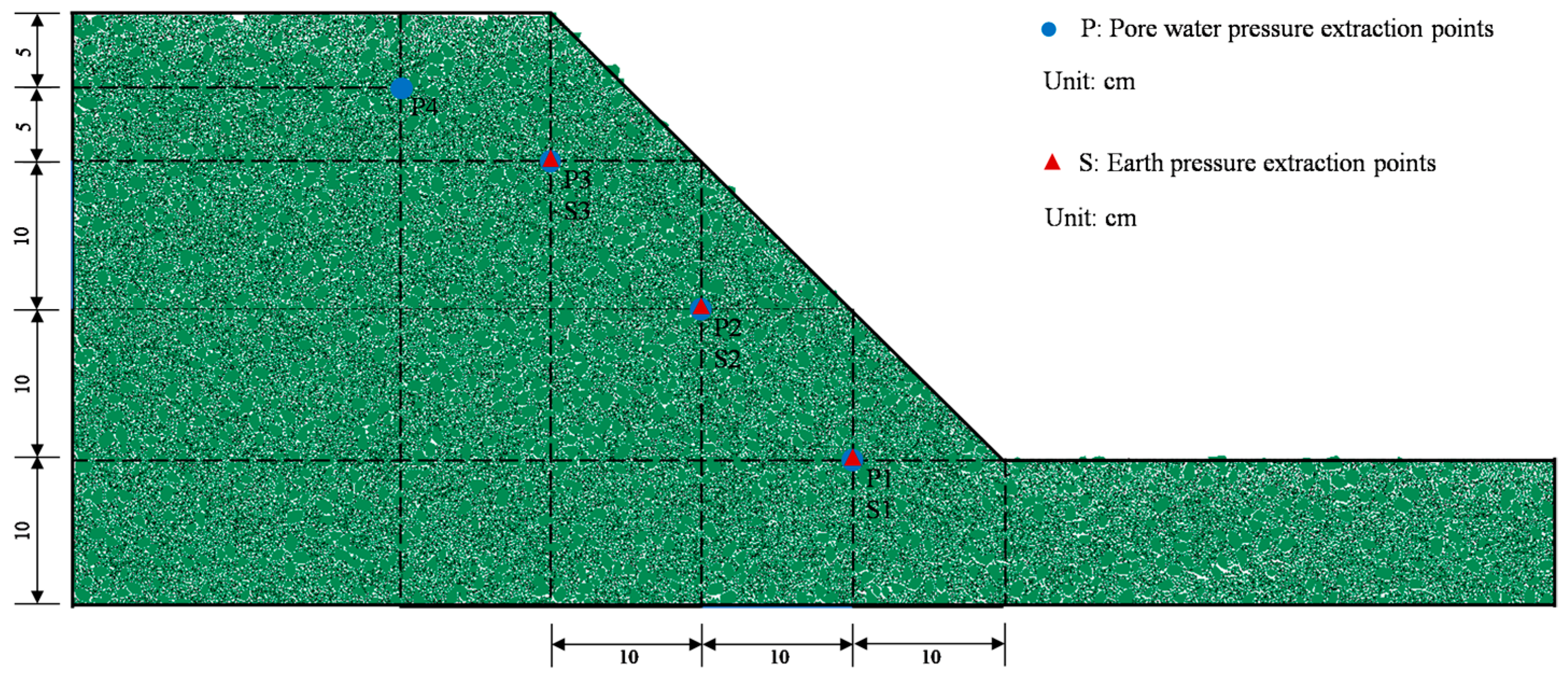
| Gauge | x-Coordinate (m) | z-Coordinate (m) | Vertical Cover Depth (m) | Monitoring Zone |
|---|---|---|---|---|
| P1 | 0.60 | 0.10 | 0.10 | Lower slope/toe-adjacent region |
| P2 | 0.50 | 0.20 | 0.10 | Middle-lower slope |
| P3 | 0.40 | 0.30 | 0.10 | Middle-upper slope |
| P4 | 0.30 | 0.35 | 0.05 | Shallow crest region |
| Specific Gravity, | Unit Weight, | Cohesion, | Internal Friction Angle, | Permeability Coefficient, | Uniformity Coefficient, Cu | Curvature Coefficient, Cc |
|---|---|---|---|---|---|---|
| 2.70 | 19.2 | 3.8 | 31.4 | 6.0 × 10⁻⁶ | 13.3 | 0.58 |
| Case | Gravel Content (%) | Rainfall Intensity (mm/h) | Slope Angle (°) | Initial Water Content (%) | Test Purpose |
|---|---|---|---|---|---|
| E1 | 30 | 80 | 45 | ~30 | Extreme rainfall with relatively lower rainfall excess runoff |
| E2 | 30 | 120 | 45 | ~30 | Reference infiltration-excess rainfall case |
| E3 | 30 | 160 | 45 | ~30 | Extreme rainfall with stronger runoff and toe erosion |
| Soil Parameters | Gravel Parameters | |
|---|---|---|
| Density, | 2.7 103 | 2.8 103 |
| Radius, | 0.78~1.38 | 7~13 |
| Friction coefficient, | 0.64 | 0.8 |
| Normal stiffness, | 1.0 108 | 2.8 108 |
| Shear stiffness, | 1.214 108 | 3.0 108 |
| Normal damping ratio, | 0.7 | 0.7 |
| Shear damping ratio, | 0.7 | 0.7 |
| Rolling resistance coefficient, | 0.1 | 0.4 |
| Rolling resistance moment | 0.1 | 0.4 |
| Rainfall Intensity | Monitoring Point | RMSE (kPa) | MAE (kPa) | Relative Peak Error (%) | Evaluation | |
|---|---|---|---|---|---|---|
| 80 mm/h | P1 | 0.34 | 0.28 | 10.8 | 0.70 | Acceptable |
| 80 mm/h | P2 | 0.27 | 0.22 | 23.5 | 0.64 | Acceptable |
| 80 mm/h | P3 | 0.23 | 0.18 | 31.4 | 0.61 | Acceptable |
| 80 mm/h | P4 | 0.24 | 0.19 | 38.6 | 0.58 | Acceptable |
| 120 mm/h | P1 | 0.39 | 0.31 | 5.2 | 0.72 | Good |
| 120 mm/h | P2 | 0.29 | 0.23 | 13.8 | 0.68 | Acceptable |
| 120 mm/h | P3 | 0.31 | 0.24 | 35.7 | 0.57 | Acceptable |
| 120 mm/h | P4 | 0.26 | 0.20 | 28.9 | 0.60 | Acceptable |
| 160 mm/h | P1 | 0.42 | 0.34 | 15.6 | 0.69 | Acceptable |
| 160 mm/h | P2 | 0.37 | 0.30 | 11.2 | 0.66 | Acceptable |
| 160 mm/h | P3 | 0.40 | 0.32 | 9.8 | 0.63 | Acceptable |
| 160 mm/h | P4 | 0.28 | 0.22 | 25.4 | 0.62 | Acceptable |
| Average | All points | 0.32 | 0.25 | 20.8 | 0.64 | Acceptable |
Disclaimer/Publisher’s Note: The statements, opinions and data contained in all publications are solely those of the individual author(s) and contributor(s) and not of MDPI and/or the editor(s). MDPI and/or the editor(s) disclaim responsibility for any injury to people or property resulting from any ideas, methods, instructions or products referred to in the content. |
© 2026 by the authors. Licensee MDPI, Basel, Switzerland. This article is an open access article distributed under the terms and conditions of the Creative Commons Attribution (CC BY) license.
Share and Cite
Gu, Y.; Lu, Y.; Li, X. Laboratory Model Tests and Numerical Investigation of Gravelly Silt Slope Instability Under Extreme Rainfall Conditions. Appl. Sci. 2026, 16, 5517. https://doi.org/10.3390/app16115517
Gu Y, Lu Y, Li X. Laboratory Model Tests and Numerical Investigation of Gravelly Silt Slope Instability Under Extreme Rainfall Conditions. Applied Sciences. 2026; 16(11):5517. https://doi.org/10.3390/app16115517
Chicago/Turabian StyleGu, Yefen, Ye Lu, and Xunan Li. 2026. "Laboratory Model Tests and Numerical Investigation of Gravelly Silt Slope Instability Under Extreme Rainfall Conditions" Applied Sciences 16, no. 11: 5517. https://doi.org/10.3390/app16115517
APA StyleGu, Y., Lu, Y., & Li, X. (2026). Laboratory Model Tests and Numerical Investigation of Gravelly Silt Slope Instability Under Extreme Rainfall Conditions. Applied Sciences, 16(11), 5517. https://doi.org/10.3390/app16115517