Adaptive Online Assessment in Higher Education: An Improved UEMD-GA Approach with Independent Rating

Abstract
1. Introduction
- 1.
- Development of an integrated educational platform. By combining a personalized repository with automated judging, the system enhances autonomous learning and computational thinking. Robust class management functionalities also alleviate administrative burdens, allowing educators to focus on pedagogical design.
- 2.
- Advancement of architecture and recommendation algorithms. A unified judging interface ensures high scalability. Furthermore, we propose the UEMD-GA algorithm for personalized recommendations. Avoiding complex deep learning architectures, this method achieves high accuracy with low computational overhead, ensuring interpretability and ease of deployment.
- 3.
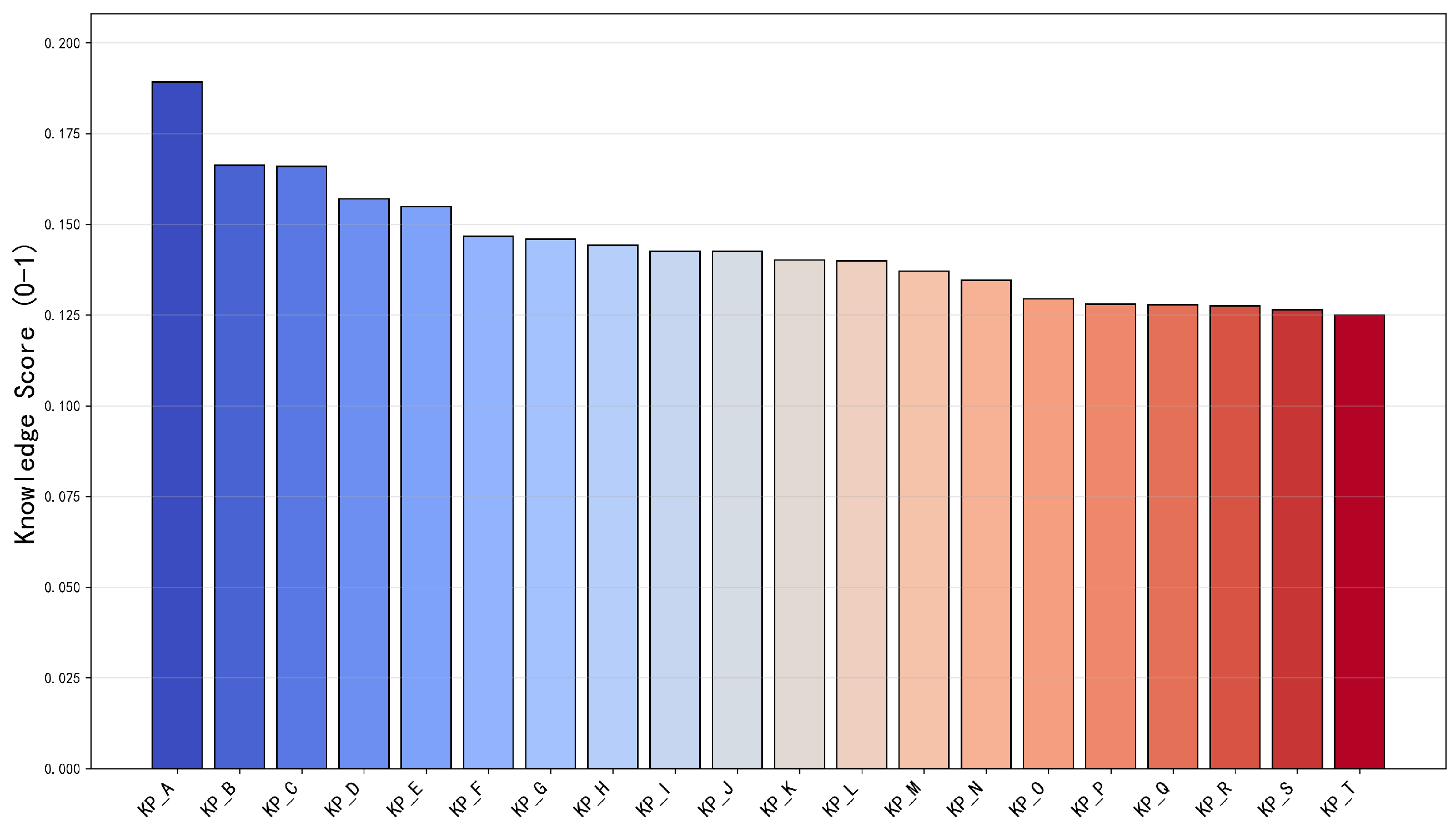
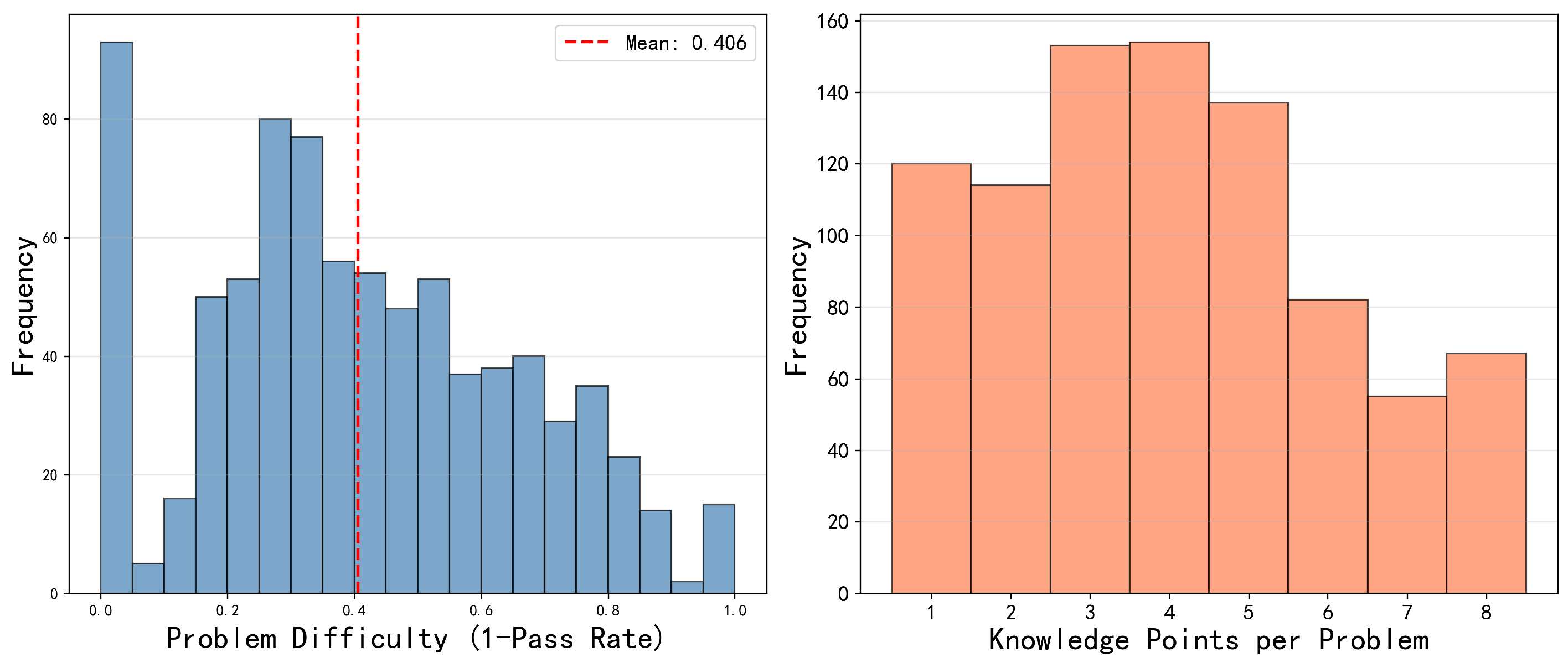
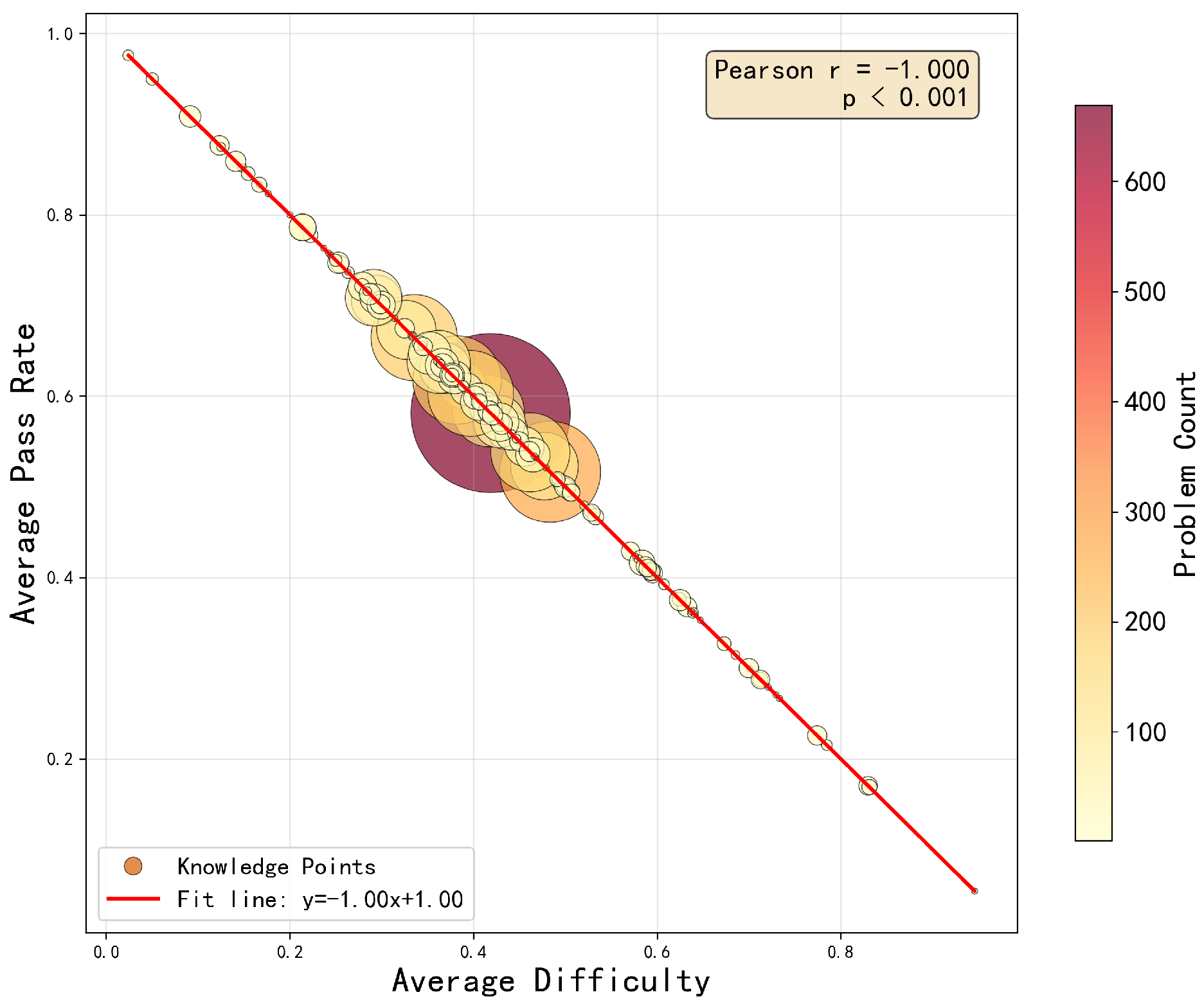
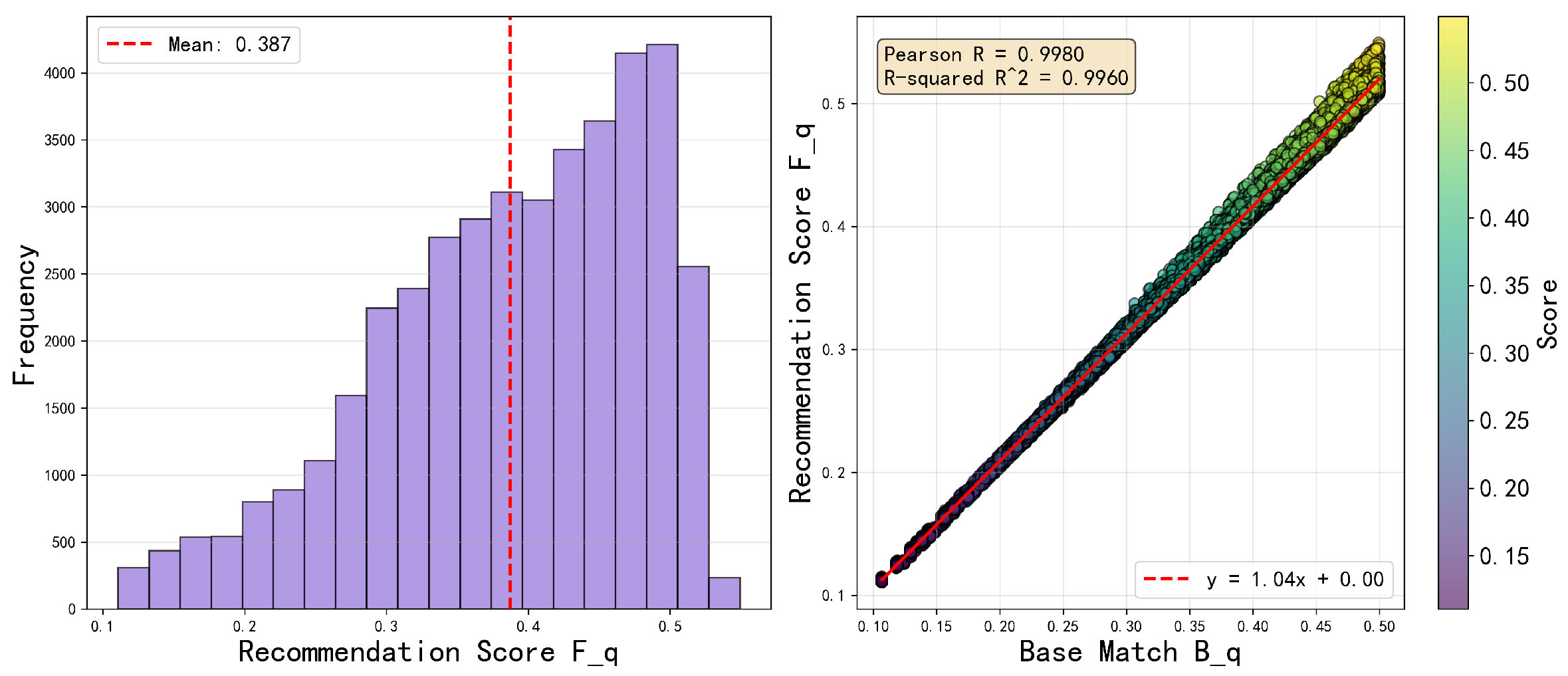
- Analysis of experimental results and insights. Empirical validation using data from a higher education institution reveals the proposed system effectively mitigates stochastic biases through architectural diversity, with a strong positive correlation between exercise difficulty and student performance. The algorithm’s basic matching degree also significantly correlates with final recommendation scores, validating the proposed approach. These findings provide valuable insights for improving online assessment systems.
2. System Architecture and Overall Design
2.1. Current Technical Architectures
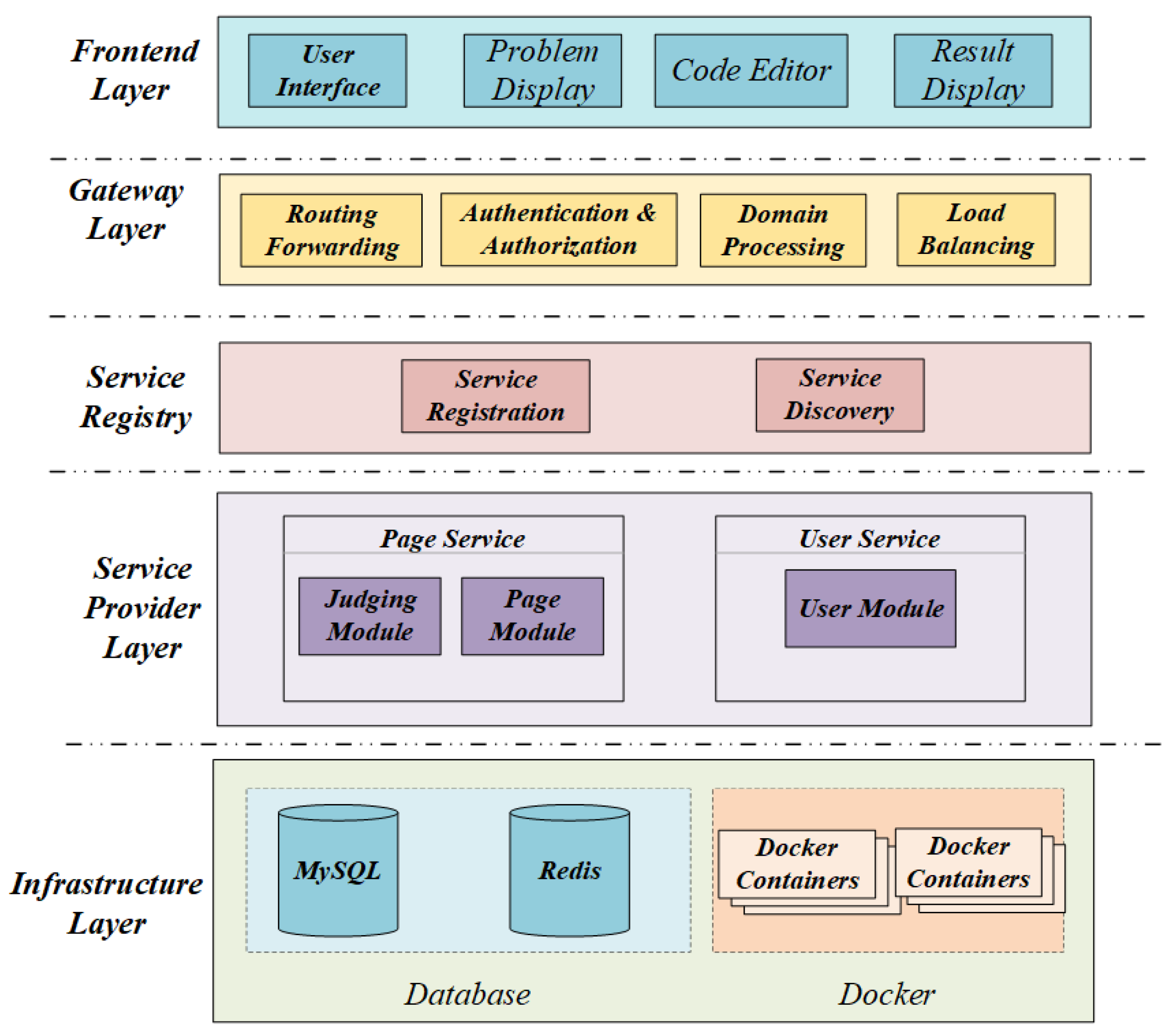
2.2. System Architecture
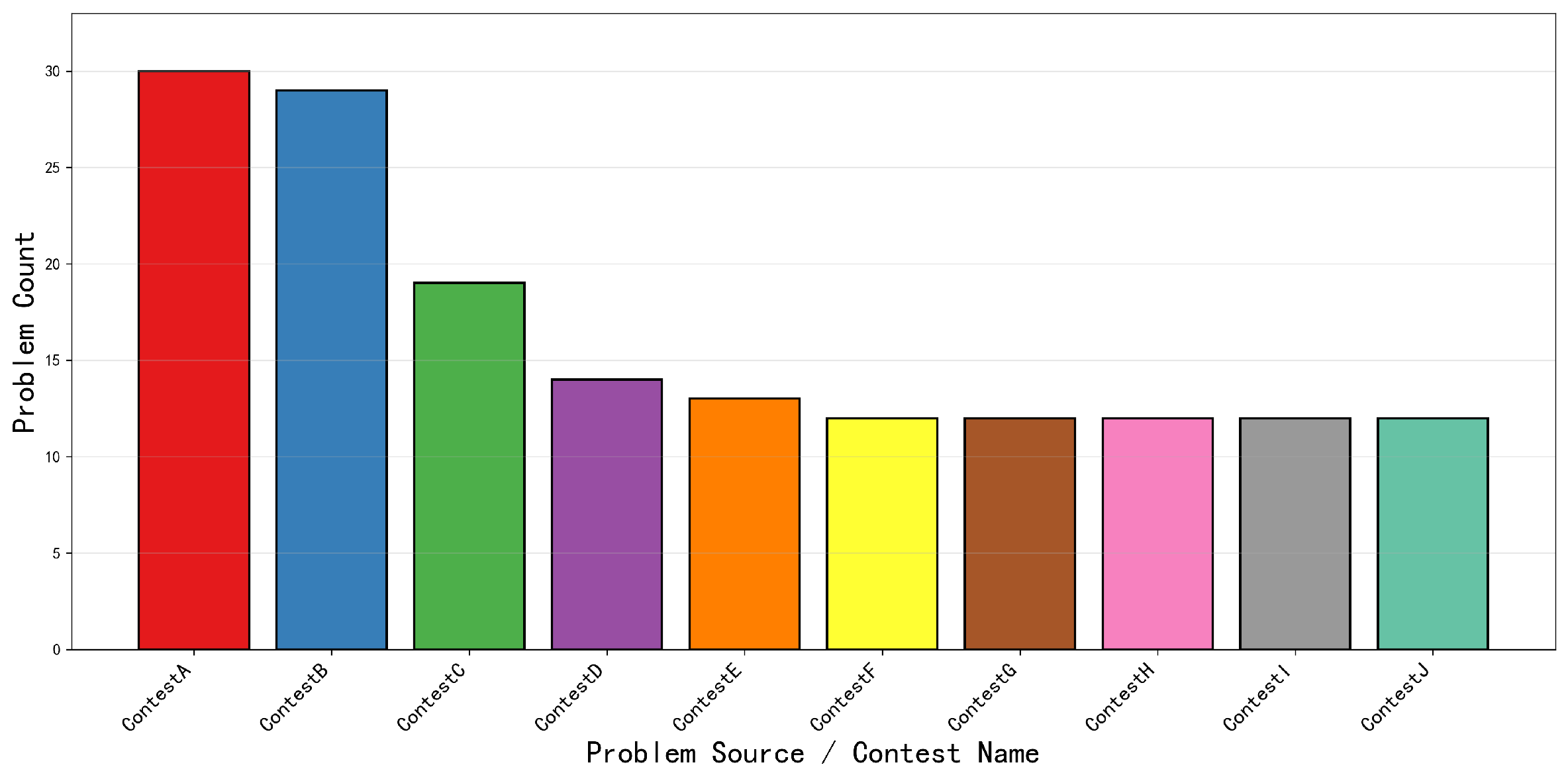
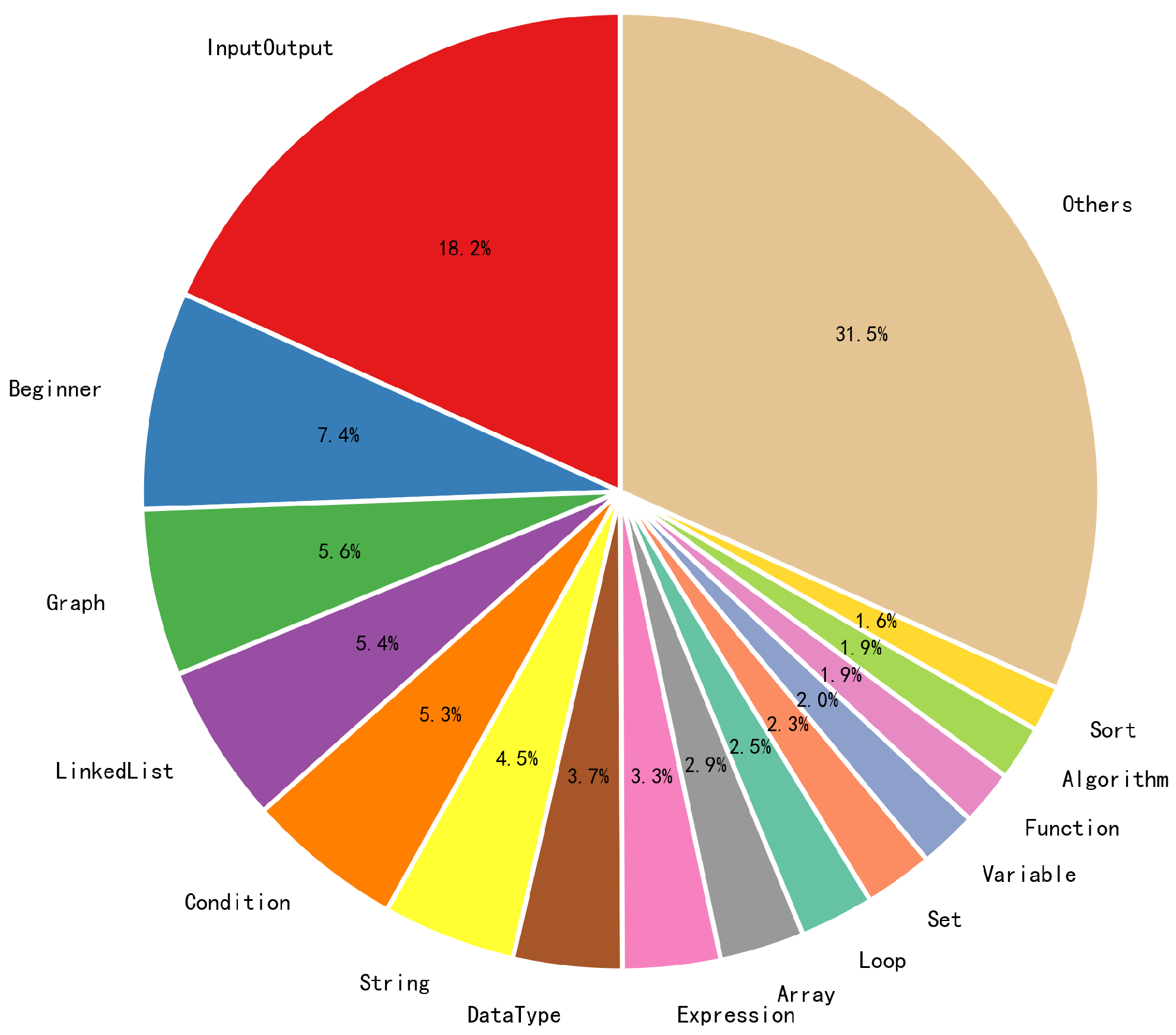
2.3. Database Design
3. Formal Problem Definition
4. Implementation of Core Technologies
4.1. Judger Architecture
| Algorithm 1 Judging Engine Algorithm |
| Input: Judging Code Class J Output: Judging result correctness information 1. DoJudge(J) // Initialize judging logic 2. JudgeCode.init() // Initialize judging parameters 3. JudgeCode.choiceLanguage() // Instantiate Docker container based on language 4. JudgeCode.compile() 5. JudgeCode.execute() 6. JudgeCode.checkAnswer() End |
| Algorithm 2 Judging Process Algorithm |
| Input: Judging Code Class J Test Sample Set Output: Test Result Set Begin: 1. WorkPath(J) // Generate unique working directory 2. CreatContainer(J) // Create corresponding judging container 3. ContainerRun(J) // Execute judging code class J in the container and return result information 4. DeleteContainer(J) // Asynchronously delete container End |
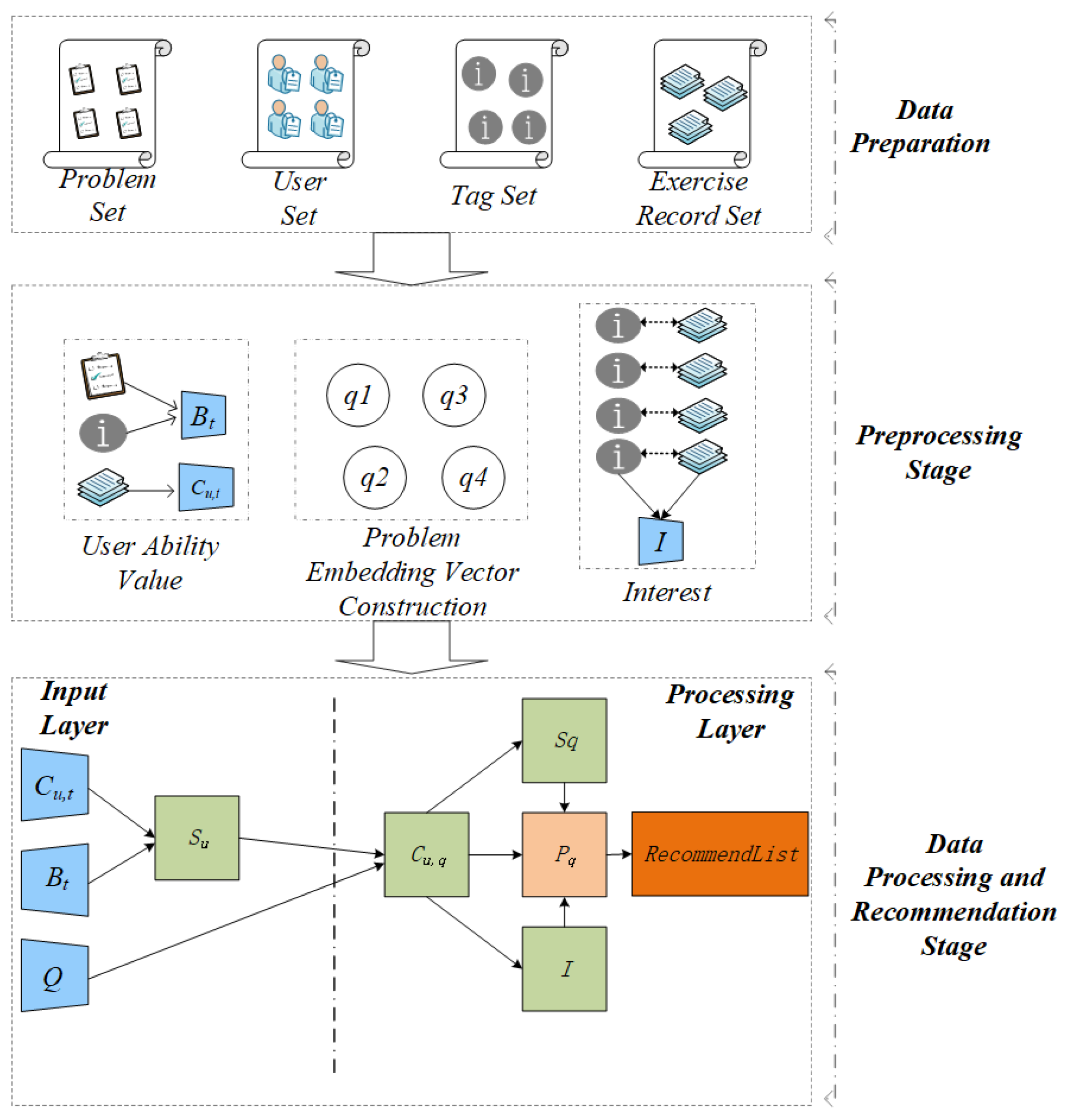
4.2. Problem Recommendation Algorithm
5. Analysis of Experimental Results
5.1. Analysis of Selection
5.2. Pedagogical Implications and Learning Outcomes
5.3. Complexity and Scalability Analysis
- Recommendation Calculation: For each user, the algorithm evaluates the matching score across all problems. This results in a time complexity of .
- Time Decay Calculation: The time decay factor only depends on the user’s history. Thus, its complexity is .
- Recommendation Time: Execution time of the core recommendation algorithm, with a time complexity of .
- Total Time: Complete execution time of the algorithm (including recommendation and time decay calculations), dominated by .
- Throughput: Number of operations processed per second, serving as an efficiency metric.
5.4. Comparative Evaluation of Recommendation Performance
6. Conclusions
Author Contributions
Funding
Institutional Review Board Statement
Informed Consent Statement
Data Availability Statement
Acknowledgments
Conflicts of Interest
References
- Shou, Z.; Shi, Z.; Wen, H.; Liu, J.; Zhang, H. Learning Peer Recommendation Based on Weighted Heterogeneous Information Networks on Online Learning Platforms. Electronics 2023, 12, 2051. [Google Scholar] [CrossRef] [Scilit]
- Yang, Y.; Lin, Y.; Chen, Z.; Lei, Y.; Liu, X.; Zhang, Y.; Sun, Y.; Wang, X. SNPERS: A Physical Exercise Recommendation System Integrating Statistical Principles and Natural Language Processing. Electronics 2023, 12, 61. [Google Scholar] [CrossRef] [Scilit]
- Lin, Y.; Wu, Z. Learning Path Recommendation Enhanced by Knowledge Tracing and Large Language Model. Electronics 2025, 14, 4385. [Google Scholar] [CrossRef] [Scilit]
- Stitini, O.; Kaloun, S. Towards a Multi-Objective and Contextual Multi-Criteria Recommender System for Enhancing User Well-Being in Sustainable Smart Homes. Electronics 2025, 14, 809. [Google Scholar] [CrossRef] [Scilit]
- Wasik, S.; Antczak, M.; Badura, J.; Laskowski, A.; Sternal, T. A Survey on Online Judge Systems and Their Applications. ACM Comput. Surv. 2018, 51, 1–34. [Google Scholar] [CrossRef] [Scilit]
- Han, Y.; Zhang, Z.; Yuan, B.; Bi, H.; Shahzad, M.N.; Liu, L. An Experimental Online Judge System Based on Docker Container for Learning and Teaching Assistance. In Proceedings of the 2019 IEEE SmartWorld, Ubiquitous Intelligence & Computing, Advanced & Trusted Computing, Scalable Computing & Communications, Cloud & Big Data Computing, Internet of People and Smart City Innovation (SmartWorld/SCALCOM/UIC/ATC/CBDCom/IOP/SCI); IEEE: Piscataway, NJ, USA, 2019; pp. 1462–1467. [Google Scholar]
- Chen, K.; Huang, F.; Liu, Z.; Wang, Y.; Zhang, L. ACcoding: A graph-based dataset for online judge programming. Sci. Data 2024, 11, 548. [Google Scholar] [CrossRef] [Scilit] [PubMed]
- Mentari, M.; Funabiki, N.; Kinari, S.A.; Puspitasari, D.; Kao, W.C. A Study of Introductory Exercise Problems for Novice Students in Java Programming Learning Assistant System. IAENG Int. J. Comput. Sci. 2025, 52, 3526–3544. [Google Scholar]
- Dai, Z.; Lv, S.; Zhang, Q. A Programming Learning Engagement Assessment Model and Teaching Application Based on Online Judgement System. Front. Educ. Res. 2024, 7, 223–234. [Google Scholar] [CrossRef] [Scilit]
- Rico-Juan, J.; Sánchez-Cartagena, V.M.; Valero-Mas, J.J.; Gallego, A.J. Identifying student profiles within online judge systems using explainable artificial intelligence. IEEE Trans. Learn. Technol. 2023, 16, 955–969. [Google Scholar] [CrossRef] [Scilit]
- Messer, M.; Brown, N.C.C.; Kölling, M.; Shi, M. Automated Grading and Feedback Tools for Programming Education: A Systematic Review. ACM Trans. Comput. Educ. 2024, 24, 1–43. [Google Scholar] [CrossRef] [Scilit]
- Hwang, J.; Lee, H. From knowledge tracing to preference tracing: Capturing dynamic user preferences for personalized recommendation. Electron. Commer. Res. Appl. 2025, 73, 101527. [Google Scholar] [CrossRef] [Scilit]
- Chen, Y.; Guo, Q.; Qiu, Q.; Li, X.; Wang, Z. The Impact and Pathways of Digital Game-Based Learning on STEM Undergraduates’ Engineering Concepts: Integrating Self-Determination Theory and Flow Theory. Comput. Appl. Eng. Educ. 2025, 33, e70066. [Google Scholar] [CrossRef] [Scilit]
- Karnalim, O. A Low-Level Structure-based Approach for Detecting Source Code Plagiarism. IAENG Int. J. Comput. Sci. 2017, 44. [Google Scholar]
- Vyas, R. Comparative analysis on front-end frameworks for web applications. Int. J. Res. Appl. Sci. Eng. Technol. 2022, 10, 298–307. [Google Scholar] [CrossRef] [Scilit]
- Medin, H.F.; Vieyra, A.N.; Robles, K.A.A.; Santos, J.M.; Cruz, R.L. How to improve web application development using a layered reference model and quality indicators. J. Eng. Res. 2023, 3, 2–16. [Google Scholar] [CrossRef] [Scilit]
- Bao, X. Deep learning-driven personalized recommendations and layout optimization for UI interaction design. Prog. Artif. Intell. 2025. [Google Scholar] [CrossRef] [Scilit]
- Cheng, F. Talent Recruitment Management System for Small and Micro Enterprises Based on Springboot Framework. Adv. Educ. Technol. Psychol. 2021, 5, 99–105. [Google Scholar]
- Rodriguez, R.S.K.; Galindo, A.D.J.; Juan, T.J.; Santos, M.R.; Garcia, P.L. Secure Development Methodology for Full Stack Web Applications: Proof of the Methodology Applied to Vue.js, Spring Boot and MySQL. Comput. Mater. Contin. 2025, 85, 1807–1858. [Google Scholar] [CrossRef] [Scilit]
- Preeti, P.; Nakul, M.; Dudeja, C.; Singh, R.; Kumar, A. MeXDocker: An integrated application for transposon identification and annotation based on the Docker platform. Gene Rep. 2025, 41, 102364. [Google Scholar] [CrossRef] [Scilit]
- Andrijević, N.; Lovreković, Z.; Salkić, H.; Matić, I.; Ćosić, K. Benchmarking PHP–MySQL Communication: A Comparative Study of MySQLi and PDO Under Varying Query Complexity. Electronics 2025, 15, 21. [Google Scholar] [CrossRef] [Scilit]
- Belalem, G.; Matallah, H.; Bouamrane, K. Evaluation of NoSQL Databases: MongoDB, Cassandra, HBase, Redis, Couchbase, OrientDB. Int. J. Softw. Sci. Comput. Intell. 2020, 12, 71–91. [Google Scholar]
- Attouche, L.; Baazizi, A.M.; Colazzo, D.; Ghelli, G.; Klessinger, S.; Sartiani, C.; Scherzinger, S. Elimination of annotation dependencies in validation for Modern JSON Schema. Theor. Comput. Sci. 2026, 1063, 115645. [Google Scholar] [CrossRef] [Scilit]
- Kuo, J.Y.; Wen, Z.J.; Hsieh, T.F.; Lin, C.H.; Chen, W.H. A Study on the Security of Online Judge System Applied Sandbox Technology. Electronics 2023, 12, 3018. [Google Scholar] [CrossRef] [Scilit]
- Ye, J.; Song, J.; Zhang, K.; Li, M.; Wang, H. Research on exercise recommendation algorithm for online judge system enhanced by knowledge graph. J. Chin. Comput. Syst. 2023, 44, 2558–2565. [Google Scholar]



| Field Name | Data Type | Description |
|---|---|---|
| solution_id | int | Submission ID |
| qid | int | Problem ID |
| user_id | char(48) | User ID |
| nick | char(20) | Nickname |
| time | int | Runtime |
| memory | int | Memory Usage |
| in_date | datetime | Submission Time |
| result | int | Result |
| language | int | Use Language |
| cid | int | Homework ID |
| valid | int | Is Judged |
| code_length | int | Code Length |
| judgetime | datetime | Judge Time |
| pass_rate | decimal(3, 2) | Pass Rate |
| Users | Rec. Time (ms) | Total Time (ms) | Throughput (ops/s) |
|---|---|---|---|
| 50 | 336.30 | 336.37 | 132,888 |
| 100 | 698.02 | 698.10 | 128,061 |
| 200 | 1594.59 | 1594.74 | 112,118 |
| 400 | 2911.59 | 2911.70 | 122,814 |
| 800 | 6101.85 | 6102.11 | 117,205 |
| 1000 | 8389.10 | 8389.27 | 106,564 |
| K | Algorithm | Precision | Recall | Hit Rate | MAP | NDCG |
|---|---|---|---|---|---|---|
| 5 | Random | 0.2740 | 0.3745 | 0.8400 | 0.2252 | 0.3356 |
| Popularity | 0.4500 | 0.6220 | 0.9800 | 0.5454 | 0.6550 | |
| Difficulty-Only | 0.2920 | 0.4526 | 0.9500 | 0.3177 | 0.4362 | |
| KP-Coverage | 0.0340 | 0.0301 | 0.1900 | 0.0235 | 0.0409 | |
| Item-KNN | 0.4040 | 0.5709 | 0.9900 | 0.4265 | 0.5440 | |
| UEMD-GA | 0.3020 | 0.4199 | 0.9000 | 0.3277 | 0.4420 | |
| 10 | Random | 0.2130 | 0.5747 | 0.9900 | 0.2593 | 0.4108 |
| Popularity | 0.2880 | 0.7653 | 1.0000 | 0.5724 | 0.6990 | |
| Difficulty-Only | 0.2260 | 0.6320 | 1.0000 | 0.3606 | 0.5108 | |
| KP-Coverage | 0.1050 | 0.2675 | 0.8100 | 0.0546 | 0.1459 | |
| Item-KNN | 0.2930 | 0.7734 | 0.9900 | 0.4890 | 0.6255 | |
| UEMD-GA | 0.2460 | 0.6683 | 1.0000 | 0.3885 | 0.5429 | |
| 20 | Random | 0.1585 | 0.8192 | 1.0000 | 0.3137 | 0.5051 |
| Popularity | 0.1640 | 0.8626 | 1.0000 | 0.6013 | 0.7386 | |
| Difficulty-Only | 0.1590 | 0.8316 | 1.0000 | 0.4113 | 0.5920 | |
| KP-Coverage | 0.1225 | 0.6468 | 1.0000 | 0.1136 | 0.2887 | |
| Item-KNN | 0.1725 | 0.8894 | 0.9900 | 0.5239 | 0.6725 | |
| UEMD-GA | 0.1555 | 0.8130 | 1.0000 | 0.4245 | 0.6003 |
| Algorithm | WCR | RD | PD | ||||||
|---|---|---|---|---|---|---|---|---|---|
| K = 5 | K = 10 | K = 20 | K = 5 | K = 10 | K = 20 | K = 5 | K = 10 | K = 20 | |
| Random | 0.2460 | 0.3674 | 0.6268 | 0.1935 | 0.2972 | 0.4030 | 0.7456 | 0.6257 | 0.4681 |
| Popularity | 0.3310 | 0.5436 | 0.7124 | 0.1258 | 0.1638 | 0.2000 | 0.2824 | 0.2744 | 0.2260 |
| Difficulty-Only | 0.2512 | 0.4242 | 0.6310 | 0.1987 | 0.2898 | 0.3933 | 0.7759 | 0.6778 | 0.4910 |
| KP-Coverage | 0.0172 | 0.1348 | 0.3587 | 0.4230 | 0.4787 | 0.5782 | 0.5610 | 0.4512 | 0.1762 |
| Item-KNN | 0.2392 | 0.5069 | 0.6750 | 0.1368 | 0.1990 | 0.2618 | 0.4919 | 0.3925 | 0.2305 |
| UEMD-GA | 0.2072 | 0.3949 | 0.5477 | 0.1842 | 0.2915 | 0.3778 | 0.7505 | 0.6325 | 0.4778 |
Disclaimer/Publisher’s Note: The statements, opinions and data contained in all publications are solely those of the individual author(s) and contributor(s) and not of MDPI and/or the editor(s). MDPI and/or the editor(s) disclaim responsibility for any injury to people or property resulting from any ideas, methods, instructions or products referred to in the content. |
© 2026 by the authors. Licensee MDPI, Basel, Switzerland. This article is an open access article distributed under the terms and conditions of the Creative Commons Attribution (CC BY) license.
Share and Cite
Li, T.; Wang, H. Adaptive Online Assessment in Higher Education: An Improved UEMD-GA Approach with Independent Rating. Appl. Sci. 2026, 16, 5516. https://doi.org/10.3390/app16115516
Li T, Wang H. Adaptive Online Assessment in Higher Education: An Improved UEMD-GA Approach with Independent Rating. Applied Sciences. 2026; 16(11):5516. https://doi.org/10.3390/app16115516
Chicago/Turabian StyleLi, Tianrui, and Handong Wang. 2026. "Adaptive Online Assessment in Higher Education: An Improved UEMD-GA Approach with Independent Rating" Applied Sciences 16, no. 11: 5516. https://doi.org/10.3390/app16115516
APA StyleLi, T., & Wang, H. (2026). Adaptive Online Assessment in Higher Education: An Improved UEMD-GA Approach with Independent Rating. Applied Sciences, 16(11), 5516. https://doi.org/10.3390/app16115516