1. Introduction
Fermented dairy beverages remain one of the most widely accepted categories of functional foods because they combine high nutritional value, a positive sensory profile, and the presence of live cells of lactic acid bacteria within a well-established food matrix [
1,
2,
3]. Dairy-based fermented products are also attractive carriers for added bioactive ingredients, if fortification does not adversely affect fermentation performance, gel structure, or storage stability [
4,
5,
6,
7]. For this reason, the development of novel fermented milk beverages should be justified not only by nutritional arguments, but also by technological feasibility and product quality considerations [
6,
7,
8,
9,
10].
Among ingredients currently attracting growing interest, hydrolysed collagen is particularly relevant. Unlike native collagen or gelatine, hydrolysed collagen consists of low-molecular-weight peptides that are more suitable for dispersion in foods and more promising for gastrointestinal absorption after ingestion [
11,
12,
13,
14]. Oral collagen supplementation has been investigated primarily for skin, connective tissue, and joint support, although the strength of the reported effects depends on peptide characteristics, dose, and study design [
15,
16,
17]. From a food science perspective, this means that the value of collagen fortification lies not only in its potential biological relevance, but also in its ability to be incorporated into real food products without compromising their technological properties [
11,
12,
13,
18].
Fermented milk beverages appear to be a promising carrier for collagen peptides, but only when vitamin C is present in adequate amounts. This specific combination allows the fermented dairy matrix to support the stability and bioavailability of the added bioactive components while providing a delivery system familiar to consumers [
19,
20,
21]. Such a formulation aligns with the growing demand for multi-component functional foods that integrate the traditional benefits of lactic acid bacteria with targeted supplementation of collagen and its essential co-factors [
4,
22,
23,
24]. At the same time, the idea of combining collagen peptides with fermented dairy products may be discussed in the broader context of the gut skin axis, where probiotic-containing foods and collagen-derived ingredients are seen as potentially complementary, although such health-related links still require careful interpretation and should not be overstated in product-oriented studies [
5,
25,
26]. Vitamin C is also scientifically relevant in this context because it acts as a cofactor in collagen biosynthesis [
27,
28,
29,
30].
However, collagen fortification in fermented milk is not a purely nutritional issue. Protein enrichment may alter acidification kinetics, buffering capacity, texture, colour, whey syneresis, mouthfeel, flavour perception, and the viability of starter bacteria during production or storage [
31,
32,
33,
34]. These effects may depend not only on collagen dose, but also on collagen origin and on the molecular properties of the hydrolysate. Fish and bovine collagens differ in raw material source, amino acid profile, amino acid content, thermal stability, peptide-size distribution after hydrolysis, and charge-related properties such as the isoelectric region [
11,
35,
36,
37]. In a fermented dairy matrix, these differences may influence the way collagen peptides distribute within the casein network, interact with serum proteins, bind water, and contribute to the buffering of lactic acid produced by yoghurt cultures. Consequently, hydrolysed collagen should not be treated as a neutral protein supplement, because its molecular characteristics may translate into different gelling behaviour, syneresis, and storage stability of fermented milk products. Previous studies on collagen-enriched fermented dairy products have already suggested that collagen addition may increase post-fermentation pH and modify acid development, which underscores the importance of comparing collagen peptides from different biological origins in dairy matrices [
32,
38,
39].
The aim of this study was to compare the effects of hydrolysed fish collagen and hydrolysed bovine collagen, added at graded concentrations, on the fermentation performance, physicochemical quality, and storage stability of fermented milk enriched with vitamin C. The study was structured around three core scientific questions: (1) do source-related differences between fish and bovine collagen hydrolysates lead to different acidification behaviour, gel properties, water-holding capacity, colour development, and microbial stability; (2) are these effects dependent on collagen dose; and (3) do the observed source- and dose-related effects remain stable during 28 days of refrigerated storage? The scope of the study included acidification kinetics during fermentation and the assessment of colour, texture, microbiological stability, pH, and water-holding capacity during storage. The study focused on technological and quality-related effects of collagen fortification rather than on direct clinical verification of health outcomes in humans.
2. Materials and Methods
2.1. Materials
The base material to produce fermented milk beverages was commercial UHT milk with a fat content of 3.2% (w/w), purchased from a local market. Two types of hydrolysed collagen were used as functional additives:
Hydrolysed fish collagen (sample “R”): 100% natural Type I fish collagen (Forest Vitamin, GREAT-MASS s.c., Kraków, Poland). The product holds Friend of the Sea and ASC (Aquaculture Stewardship Council) certifications, ensuring sustainable sourcing.
Hydrolysed bovine collagen (sample “W”): 100% pure bovine collagen (Słodkie Zdrowie, PPHU Jerzy Siemionczyk, Białystok, Poland). According to the manufacturer’s documentation, the raw material originated from selected lots from the EU and non-EU countries.
Both collagen samples were characterised as highly pure. Independent laboratory analyses confirmed that the heavy metal content in both additives was significantly below safety limits: lead (Pb) ≤ 0.022 mg/kg, cadmium (Cd) ≤ 0.0020 mg/kg, and mercury (Hg) ≤ 0.0016 mg/kg. Vitamin C was supplemented in the form of L-ascorbic acid powder (Intenson, Karczew, Poland). Batch-specific molecular characteristics of the collagen hydrolysates were not available in the suppliers’ specifications and were not determined experimentally in the present study. Therefore, molecular-weight distribution, average molecular weight, peptide profile, amino acid composition, isoelectric point and buffering capacity were not included as measured independent variables. The terms “fish collagen hydrolysate” and “bovine collagen hydrolysate” refer to the commercial preparations used in this experiment. Any discussion of possible differences in peptide size, amino acid composition, charge-related properties or interactions with the casein network is therefore based on literature data and should be interpreted as a plausible explanation rather than direct molecular evidence.
The fermentation process was conducted using a commercial freeze-dried DVS (Direct Vat Set) yoghurt culture, YC-X16 (Chr. Hansen, Hørsholm, Denmark), which contains symbiotic strains of Lactobacillus delbrueckii subsp. bulgaricus and Streptococcus thermophilus. The YC-X16 culture was selected for its proven ability to produce yoghurt with high viscosity and a mild flavour profile, as well as for its low post-acidification during refrigerated storage. These characteristics provide a stable and representative dairy matrix, which is essential for accurately evaluating the impact of functional additives, such as hydrolysed collagen and vitamin C, on the final product’s quality. All reagents and additives used were of food-grade quality.
2.2. Preparation of Fermented Milk Samples
The experimental design included a control sample and several fortified variants. The control sample (K) consisted of UHT milk without any additives. The experimental samples were prepared by incorporating hydrolysed collagen (fish or bovine) and vitamin C into the milk according to the doses specified in
Table 1.
The milk was heated to 40 °C to facilitate the dissolution of the powdered additives. After the complete dissolution of collagen and L-ascorbic acid, the mixtures were cooled to the inoculation temperature of 37 °C. The yoghurt culture YC-X16 was prepared according to the manufacturer’s instructions and inoculated into the milk base. Subsequently, the mixtures were divided into 200 g portions and transferred into individual containers. For each designated measurement point, separate samples were prepared to ensure that each container was analysed only once, thereby preventing potential contamination or physical disruption of the matrix during sampling. The fermentation process was carried out in a laboratory incubator at 37 °C for 4.5 h until the pH reached approximately 4.6. Following fermentation, the samples were cooled to 6 °C to terminate the starter culture’s metabolic activity, then stored under refrigeration for further analysis. The entire production process was performed in triplicate to ensure the reproducibility of the results.
2.3. Determination of Acidification Kinetics
The acidification kinetics of the fermented milk beverages were monitored over the 6 h fermentation at 37 °C. Acidification curves were established by measuring the active acidity (pH) of the samples at regular intervals. The measurements were performed using a digital pH meter equipped with a temperature sensor and a glass electrode, which were inserted directly into the fermented milk samples. The pH values were recorded once the reading reached stabilisation on the instrument’s display. All measurements were carried out in duplicate to ensure the accuracy and reproducibility of the results.
To further characterise the fermentation process and the performance of the starter cultures, the following kinetic parameters were determined [
40]:
- ○
Maximum acidification rate (Vmax), expressed as the maximum change in pH units per unit of time (∆pH/∆t).
- ○
Time at which the maximum acidification rate was achieved (Tmax).
- ○
Time required to reach the target pH level of 4.6 (Te), which is considered an indicator of the completion of the fermentation process for yoghurt-type products.
The maximum acidification rate was calculated according to the following Equation (1) [
40]:
where ∆pH represents the variation in pH over a specific time interval ∆t. These kinetic indicators allowed for a comprehensive assessment of the impact of the experimental factors on the rate and efficiency of the lactic fermentation process.
2.4. Colour Measurement
The colour coordinates of the fermented milk beverages were determined using a Konica Minolta CM-5 spectrophotometer (Konica Minolta Co., Ltd., Osaka, Japan) equipped with a specialised attachment for liquid and semi-solid samples. The analysis was performed using the CIE L*a*b* system, where L* represents lightness (0 for black to 100 for white), a* indicates the green–red axis (negative values for green, positive for red), and b* indicates the blue–yellow axis (negative values for blue, positive for yellow) [
41].
The measurements were conducted in reflectance mode, using a D65 illuminant and a 10 ° standard observer angle. The instrument was calibrated against a white standard plate before each measurement series. Samples were analysed 24 h after fermentation (Day 1) to establish baseline values. Subsequent measurements were performed at 7-day intervals (Days 7, 14, 21, and 28) during refrigerated storage at 6 °C.
To quantify the magnitude of colour changes during storage, the total colour difference (∆E*) between the samples on a given storage day and the initial samples (Day 1) was calculated using the following Equation (2):
where ∆L*, ∆a*, and ∆b* are the differences between the colour parameters of the stored and fresh samples. All measurements were performed in triplicate, and the results were expressed as mean ± standard deviation. For technological interpretation, ∆E* values below approximately 2–3 were considered small or weakly perceptible, whereas values above approximately 5 were interpreted as clearly visible instrumental colour differences. These ranges were used only as practical indicators, not as substitutes for sensory acceptability testing.
2.5. Texture Analysis
The texture profile analysis (TPA) of the fermented milk samples was conducted using a CT3 10 K Texture Analyzer (Brookfield Engineering Laboratories Inc., Middleborough, MA, USA) equipped with TexturePro CT V 1.4 Build 17 software. Two primary parameters were determined: hardness and adhesiveness. Measurements were performed using a TA4/1000 cylindrical probe (38.1 mm in diameter and 20 mm in height; Brookfield Engineering Laboratories Inc., Middleborough, MA, USA) [
40].
The analysis was carried out under the following technical conditions: a trigger force of 0.04 N was applied, and the probe moved toward the sample at a constant test speed of 2 mm/s. During the return stroke, the probe moved at 4.5 mm/s. Data were collected at a rate of 10 measurements per second.
The measurements were performed at a controlled temperature of 6 °C to reflect refrigerated storage conditions. Hardness was defined as the maximum force recorded during the compression cycle, while adhesiveness was calculated as the work required to overcome the attractive forces between the sample surface and the probe.
Texture analysis was conducted at five time points: 1 day after completion of the fermentation process (initial measurement) and at 7-day intervals during refrigerated storage (days 7, 14, 21, and 28). To ensure accuracy and reproducibility, all analyses were performed in triplicate for each sample variant.
2.6. Microbiological Analysis
Microbiological analyses were conducted to evaluate the survival of the starter microflora and the microbiological safety of the fermented milk beverages during storage. The assessments were performed 24 h after completion of the fermentation process and then at 7-day intervals (days 7, 14, 21, and 28) throughout the 28-day refrigerated storage period at 6 °C.
Sample preparation followed ISO 6887-1 [
42]. Ten grams of each fermented beverage were homogenised with 90 mL of sterile peptone water (0.1%
w/
v) to prepare the initial dilution, followed by the preparation of serial decimal dilutions in the same diluent.
The enumeration of specific bacterial populations was carried out using the pour plate method:
Streptococcus thermophilus population: Determined using M17 agar (Merck, Darmstadt, Germany) after aerobic incubation at 37 °C for 48–72 h.
Lactobacillus spp. population: Enumerated on MRS (de Man, Rogosa, and Sharpe) agar (Merck, Darmstadt, Germany) with incubation at 37 °C for 72 h under anaerobic conditions.
The microbiological purity of the samples was verified by monitoring the absence of contaminants:
All results were expressed as the decadic logarithm of colony-forming units per gram (log10 CFU/g). The analyses were performed in triplicate to ensure the accuracy and reliability of the data.
2.7. pH Determination
The active acidity (pH) of the fermented beverages was measured using a digital pH-meter (model CP-505; Elmetron, Zabrze, Poland). The device was equipped with a dedicated electrode and a temperature sensor, and measurements were conducted using a temperature compensation strategy [
44]. Before each measurement session, the pH meter was calibrated using standard buffer solutions. The pH values were recorded 1 day after completion of the fermentation process (initial measurement) and subsequently at 7-day intervals (days 7, 14, 21, and 28) during refrigerated storage at 6 °C. All analyses were performed in triplicate for each sample to ensure accuracy, and results were recorded to 0.01 pH units.
2.8. Syneresis and Water-Holding Capacity
The susceptibility of fermented milk beverages to syneresis was evaluated by centrifugation, with results expressed as water-holding capacity (WHC). Measurements were conducted 1 day after completion of the fermentation process (Day 1) and subsequently at 7-day intervals (Days 7, 14, 21, and 28) during refrigerated storage at 6 °C.
For each analysis, 40.00 g (A) of the beverage sample was weighed into a centrifuge tube and centrifuged at 3250×
g for 20 min at 4 °C. Following centrifugation, the expelled whey (B) was carefully separated and weighed using an analytical balance. The syneresis, reflected by the WHC, was calculated according to the following Equation (3) [
40]:
where:
All analyses were performed in triplicate to ensure reproducibility, and the mean values were reported. Visual assessment of the samples, including consistency and homogeneity, was performed prior to instrumental analysis to complement the quantitative findings.
2.9. Statistical Analysis
All determinations were performed in triplicate (n = 3), and the results are presented as mean values accompanied by the standard deviation. To evaluate the significance of differences between the means across individual sample variants and storage days, a one-way analysis of variance (ANOVA) was applied. The significance of differences between means was verified using a post hoc test (e.g., Tukey’s test) at the p < 0.05 level.
To comprehensively evaluate the relationships among physicochemical properties, microbiological stability, and storage time for beverages fortified with vitamin C and varying doses of fish and bovine collagen, Principal Component Analysis (PCA) was conducted. Before PCA, variables expressed in different units were mean-centred and standardised to unit variance to prevent variables with larger numerical scales from dominating the solution. The number of principal components was determined from the scree plot and eigenvalues greater than 1, while interpretability of the loading structure was also considered. Because PCA was used as an exploratory multivariate tool, the percentage of explained variance was interpreted together with the biological and technological coherence of sample clustering and variable loadings.
3. Results
3.1. Acidification Kinetics
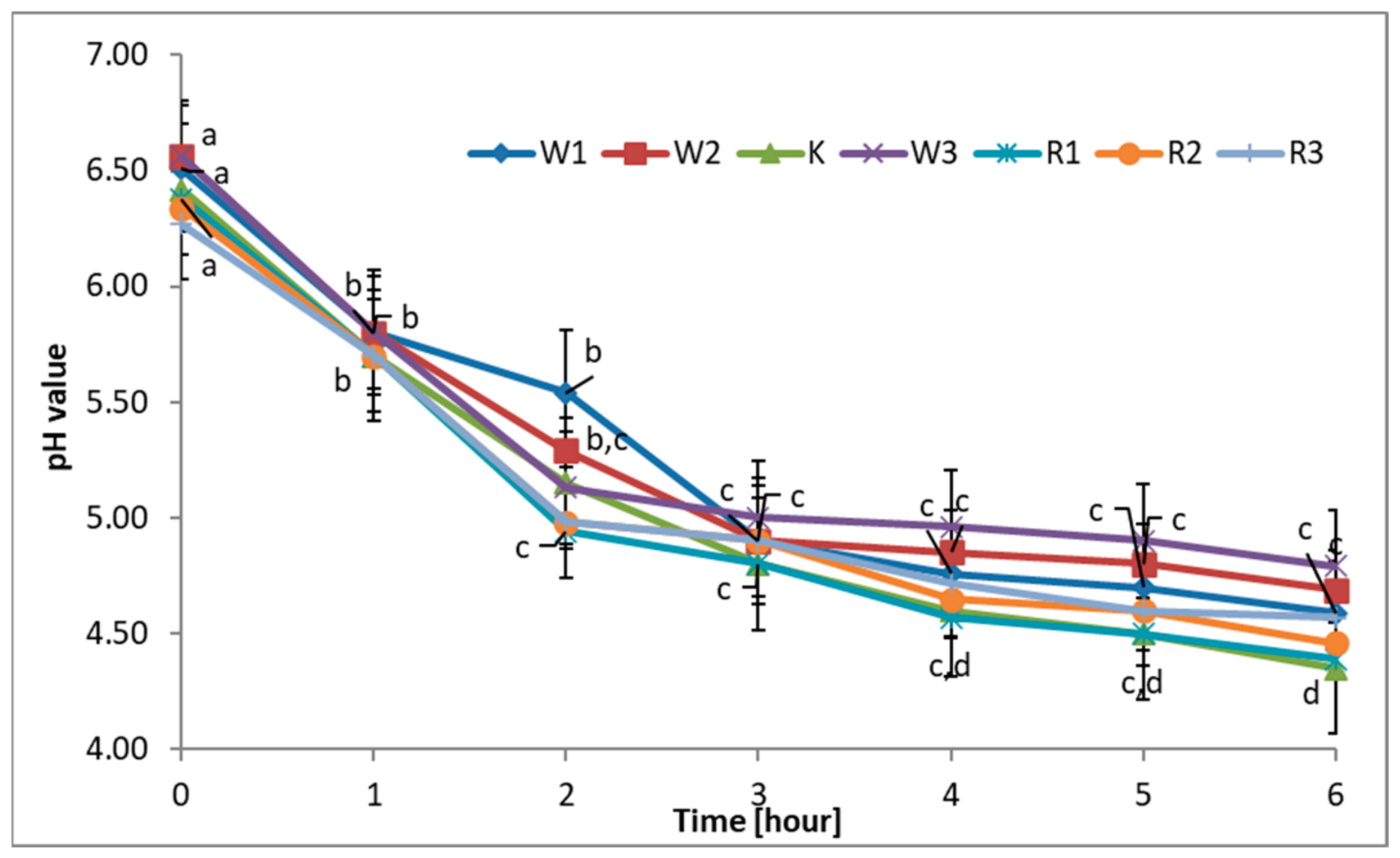
The acidification curves presented in
Figure 1 showed a gradual decrease in pH in all fermented milk samples during incubation at 37 °C, confirming the metabolic activity of the yoghurt starter culture. In all variants, the most pronounced pH decline was observed during the first hours of fermentation, followed by a slower decrease in the later stage of the process. Although the initial pH values were relatively similar, clear differences among the samples emerged after 2 to 3 h of incubation.
The kinetic parameters presented in
Table 2 confirmed these observations and showed two main trends. First, the effect of collagen supplementation was dose-dependent, as higher doses generally prolonged the time to reach the target pH. Second, this delay was more pronounced for bovine collagen than for fish collagen. The control sample (K) and the sample supplemented with 1.25% fish collagen (R1) showed the most favourable acidification behaviour. These variants reached pH 4.6 after 4.0 and 3.9 h, respectively, with no significant differences between them. In contrast, increasing the concentration of fish collagen prolonged the fermentation time, as reflected by Te values of 5.0 h for R2 and 5.5 h for R3. A stronger delaying effect was observed in samples fortified with bovine collagen. Sample W1 reached pH 4.6 after 5.8 h, W2 after 6.5 h, whereas W3 did not attain this value within 7 h of incubation. This indicates that bovine collagen, especially at higher doses, markedly slowed acid development in fermented milk enriched with vitamin C. The maximum acidification rate (Vmax) ranged from 0.71 to 0.76 ΔpH/h. The highest values were recorded for W2, W3, and R1, whereas the lowest value was observed for W1. However, a higher Vmax did not necessarily correspond to a shorter time required to reach the final pH. This was particularly evident in the bovine collagen samples, which, despite relatively high maximum acidification rates, exhibited substantially prolonged Te values. Therefore, the differences between samples were associated not only with the intensity of acidification but also with the shape and duration of the entire acidification curve.
An additional difference concerned the time at which the maximum acidification rate was reached. In the control and all bovine collagen samples, Tmax occurred after 1.0 h, whereas in all fish collagen variants, it was shifted to 2.0 h. This may suggest that fish collagen altered the dynamics of starter culture activity differently from bovine collagen. From a technological point of view, the results indicate that the addition of 1.25% fish collagen did not adversely affect the fermentation process and maintained acidification kinetics comparable to those of the control. By contrast, increasing collagen concentration, particularly in bovine variants, significantly extends fermentation time, which should be considered when designing fermented milk enriched with vitamin C.
3.2. Colour Analysis During Storage
The colour stability of fermented milk during 28 days of refrigerated storage was influenced mainly by changes in the chromatic coordinates a* and b*, whereas the lightness parameter L* remained relatively stable in all variants (
Table 3). Immediately after fermentation, all samples showed very high L* values of 97.33, confirming the bright appearance typical of fermented milk beverages. During storage, only slight decreases in L* were observed. These changes were statistically significant in the bovine collagen variants (W1, W2, and W3), especially from day 21 onward, while the control sample and fish collagen variants showed no significant differences over time. This indicates that refrigerated storage caused only limited darkening of the beverages, with a slightly greater effect in samples enriched with bovine collagen.
Changes in the a* coordinate showed a gradual reduction in the green hue during storage. In the control sample, a* increased from −5.00 after fermentation to −3.00 on day 28. A similar trend was observed in all fortified samples. The greatest shift was noted in W3 and R3, where a* reached −2.00 at the end of storage. In most cases, the changes became statistically significant after 14 or 21 days of storage, indicating progressive modification of the colour balance over time.
The most pronounced storage-related changes were found for the b* parameter. In all samples, b* increased significantly throughout refrigerated storage, which indicates a progressive increase in yellow colour intensity. The control sample showed a moderate rise from 13.33 to 15.33. In contrast, collagen-enriched beverages reached markedly higher final b* values, from 16.33 to 20.33. The bovine collagen samples generally exhibited higher b* values than the fish collagen samples, particularly at later storage stages. The highest b* value on day 28 was recorded for W1 (20.33), whereas among fish collagen variants, the lowest final yellowness was found for R3 (16.33). It is also noteworthy that fish collagen samples, especially R1, showed lower initial b* values after fermentation than the control and bovine collagen variants, suggesting that the collagen source affected the initial visual properties of the fermented milk enriched with vitamin C.
The total colour difference (ΔE*) increased progressively in all samples during storage, confirming a gradual deviation from the colour measured immediately after fermentation. The control sample showed the lowest ΔE* values throughout the experiment, reaching only 2.38 on day 28. The observed progressive increase in ΔE* for the control sample, reaching 2.38 after 28 days of storage, can be attributed to several factors typical of UHT-based fermented dairy products. Firstly, Maillard reaction products and their precursors, inherently present in UHT milk due to high-temperature processing, may undergo further slow transformations during refrigerated storage, subtly affecting the chromatic profile. Secondly, the gradual post-acidification and potential rearrangements in the casein network can lead to changes in light scattering properties of the gel, which is reflected in the shifting of a* and b* coordinates.
In contrast, all collagen-fortified samples exhibited substantially greater colour differences. After 28 days, the highest ΔE* values were observed for W1 (7.48) and R1 (7.45), followed by W3 (6.70), R2 (6.29), W2 (5.63), and R3 (4.69). These results show that collagen addition reduced instrumental colour stability during storage, although the magnitude of this effect depended on both collagen type and dose. In general, the colour changes were driven mainly by increasing b* values and, to a lesser extent, by shifts in a*, while L* remained comparatively stable. From an industrial perspective, this trend is important because fermented milk beverages are expected to retain a white or cream-white appearance during shelf life. ΔE* values above approximately 5, as observed in most collagen-fortified variants at day 28, indicate colour changes likely to be noticeable to consumers. However, no sensory colour acceptability threshold was determined in this study; therefore, consumer relevance should be verified in future sensory tests.
3.3. Texture Profile Analysis
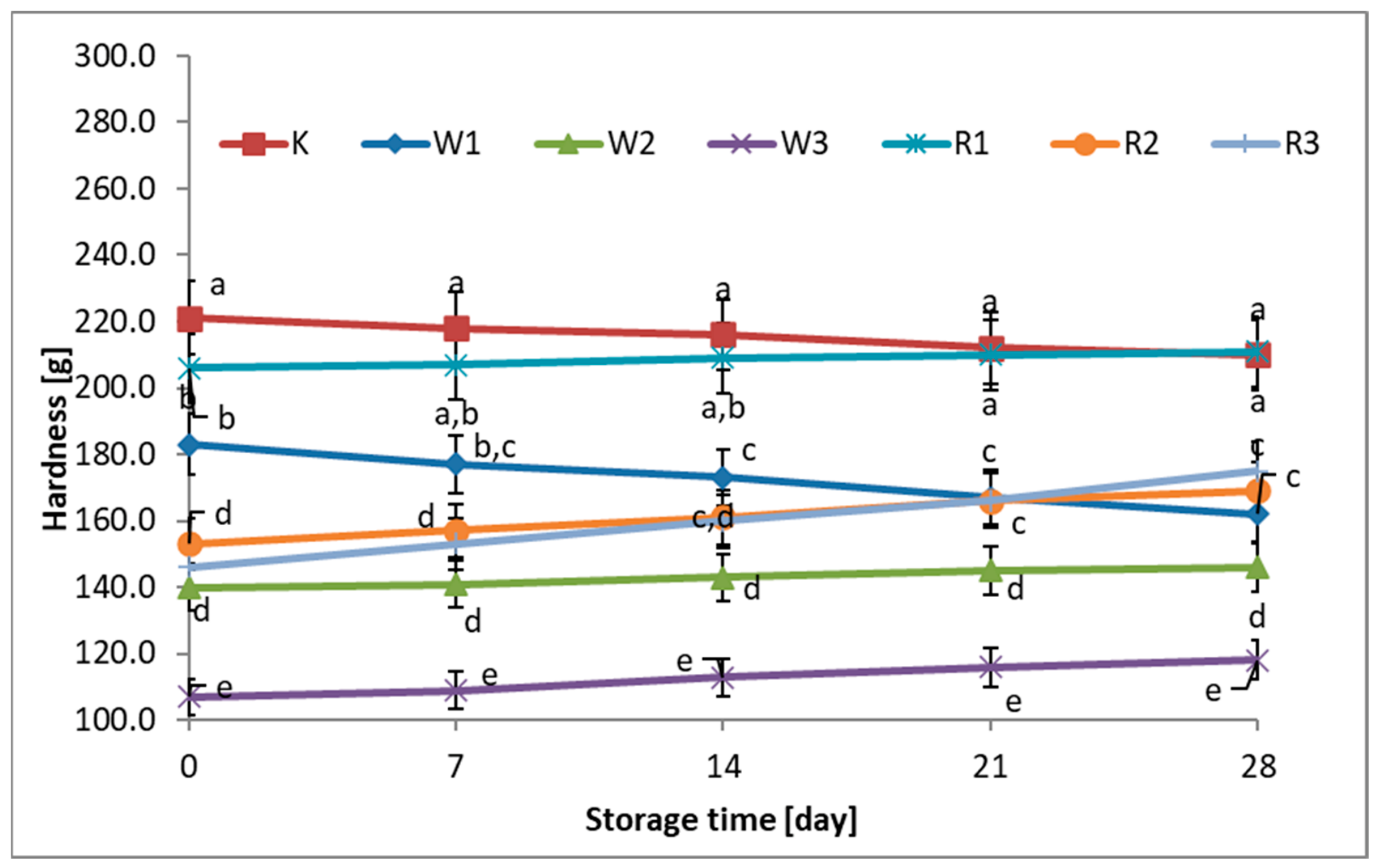
Hardness was significantly affected by collagen type, supplementation level, and storage time (
Figure 2). The control sample (K) showed the highest hardness at the beginning of storage and remained relatively stable throughout the 28-day period, with only a slight decrease by day 28. A similar situation was observed for sample R1, whose hardness remained close to that of the control during the entire storage period. This indicates that the addition of 1.25% fish collagen did not impair gel firmness. While R1 remained stable, R2 and R3 showed a gradual increase in hardness during storage. By day 28, the hardness of R2 and R3 was clearly higher than at day 0, suggesting progressive strengthening of the gel matrix during refrigerated storage. In contrast, the bovine collagen samples showed a clear concentration-dependent reduction in hardness. Sample W1 exhibited a gradual decrease during storage, whereas W2 and especially W3 remained markedly softer than the control at all measurement points. The lowest hardness values were observed for W3, indicating that the highest bovine collagen dose weakened the fermented milk gel structure. Overall, fish collagen was better tolerated by the fermented milk than bovine collagen, especially at the lowest supplementation level.
The adhesiveness of fermented milk was significantly influenced by both the source and concentration of collagen throughout the 28-day refrigerated storage period (
Table 4). The control sample (K) consistently exhibited the highest adhesiveness, despite a decrease from 11.83 mJ to 10.50 mJ, suggesting that the absence of collagen additives allows the milk matrix to retain the greatest resistance to probe detachment. In contrast, the addition of collagen generally reduced adhesiveness in a dose-dependent manner, with the impact varying by source. Fish collagen demonstrated a superior ability to preserve textural properties closer to the control; specifically, the 1.25% fish collagen sample (R1) showed no significant difference from the control immediately after fermentation (11.10 mJ), though it gradually declined to 9.30 mJ by day 28. Higher concentrations of fish collagen (R2 and R3) remained relatively stable, maintaining values between 7.00 and 7.40 mJ.
Bovine collagen exerted a more pronounced reductive effect on adhesiveness compared to fish collagen, particularly at higher concentrations. Sample W1 (1.25% bovine) remained lower than both the control and its fish-derived counterpart (R1) across all time points, while the lowest overall values were recorded for the 5.0% bovine collagen sample (W3), which ranged from 4.40 to 3.90 mJ. This comparative analysis shows that fish collagen exhibits significantly greater adhesiveness than bovine collagen at equivalent doses, a trend most evident at 1.25% and 5.0%. Ultimately, while bovine collagen markedly disrupts the adhesive properties of the fermented milk matrix, fish collagen, especially at the lowest enrichment level, better preserves the original textural profile.
3.4. Microbiological Stability of Fermented Milk Beverages During Cold Storage
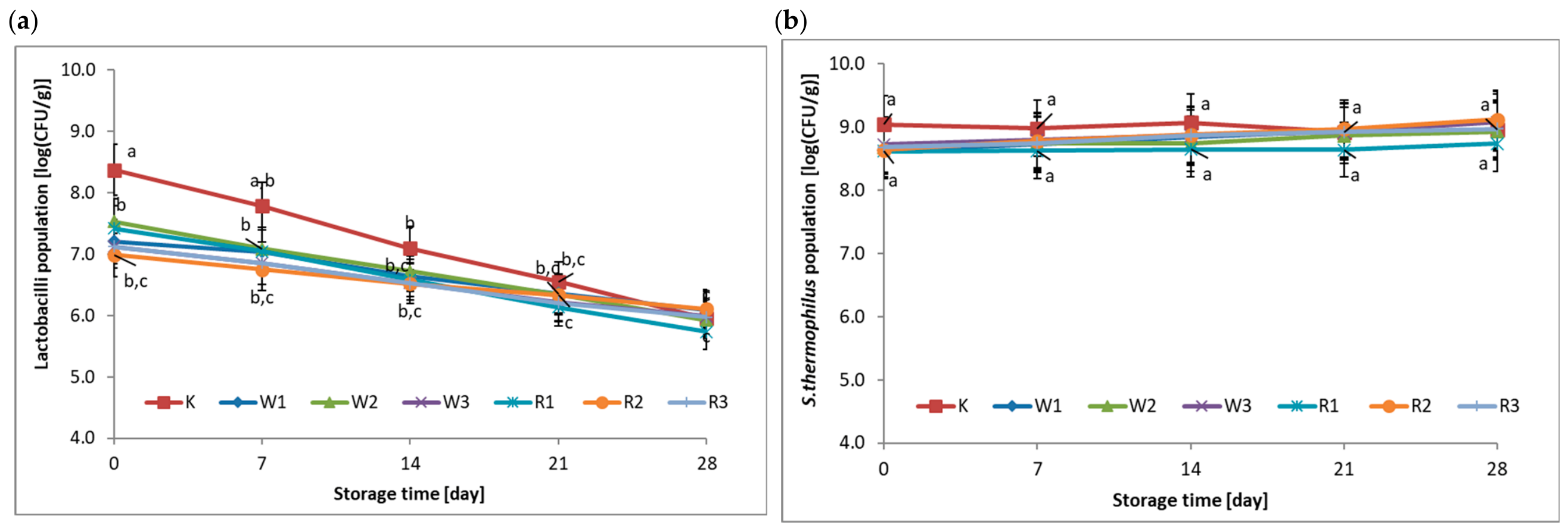
The microbiological stability of the fermented milk during 28 days of refrigerated storage is presented in
Figure 3. Throughout the 28-day storage period, all analysed samples exhibited a systematic decline in
Lactobacillus spp. populations. Initial counts on day 0 ranged from 6.9 to 8.4 log CFU/g, with the control sample (K) recording the highest baseline value compared to the collagen-enriched variants. Although statistically significant differences were observed between samples on specific days, these differences diminished over time. By day 28, the counts across all samples had converged to a similar range of 5.7–6.1 log CFU/g. This suggests that the addition of hydrolysed collagen, regardless of its origin or concentration, does not significantly destabilise the survival of Lactobacillus spp. during refrigerated storage. In contrast, the
S. thermophilus population remained highly stable throughout the entire storage period. Its counts remained within a narrow range of approximately 8.6 to 9.1 log CFU/g across all samples. No statistically significant differences were found between the control and collagen-fortified fermented milk samples at any sampling point. These results show that
S. thermophilus was more resistant to refrigerated storage conditions than
Lactobacillus spp., and that the presence of fish or bovine collagen, even at the highest tested level, did not adversely affect its viability.
Overall, the obtained results indicate that supplementation with hydrolysed collagen and vitamin C did not impair the microbiological stability of the fermented milk. Although a gradual reduction in Lactobacillus counts was observed during storage, both starter bacteria remained detectable throughout the 28-day period. The greater stability of S. thermophilus compared with Lactobacillus spp. may indicate greater tolerance to the acidic, refrigerated environment of the fermented milk matrix. Hydrolysed collagen peptides could theoretically provide small peptides and amino acids as additional nitrogen sources for starter bacteria; however, the present data do not show a clear growth-promoting effect. If such a nutritional effect occurred, it was likely weaker than those of post-acidification, low storage temperature, and matrix-related stress, particularly for Lactobacillus spp.
The microbiological safety of the fermented milk was confirmed throughout the entire 28-day storage period. According to analyses of VRBD and YGC media, all samples, including the control and those enriched with bovine (W) or fish (R) collagen, showed no Enterobacteriaceae, yeasts, or moulds. The counts for these contaminant groups remained below the detection limit (<1 log CFU/g) across all tested samples. These results demonstrate that the production process was conducted under strict hygienic conditions and that the addition of hydrolysed collagen and L-ascorbic acid did not introduce any microbial contamination, ensuring the high quality and safety of the functional fermented milks.
3.5. pH Stability During Storage
The pH values of all fermented milks decreased slightly during 28 days of refrigerated storage, indicating gradual post-acidification of the products (
Table 5). However, the magnitude of this decrease was relatively small, which suggests satisfactory pH stability throughout the storage period. In the control sample, pH decreased from 4.34 ± 0.11 after fermentation to 4.21 ± 0.10 on day 28. The addition of hydrolysed collagen increased the pH of fermented milks immediately after fermentation, and this effect was more pronounced in samples fortified with bovine collagen than in those containing fish collagen. Among all variants, sample W3 showed the highest pH after fermentation at 4.79 ± 0.13, followed by W2 at 4.68 ± 0.12. In contrast, the fish collagen variants showed a more moderate increase in pH, ranging from 4.41 ± 0.07 in R1 to 4.53 ± 0.11 in R3. This indicates that bovine collagen, especially at 2.5% and 5.0%, more effectively limited post-fermentation acidification than fish collagen. A dose-dependent effect was also observed, especially for the bovine collagen variants. Increasing the collagen concentration from 1.25% to 5.0% was associated with progressively higher pH values both after fermentation and throughout storage.
The results indicate that collagen supplementation modified the pH stability of fermented milks enriched with vitamin C during refrigerated storage, and that this effect depended on both collagen source and concentration. Bovine collagen showed a stronger pH-stabilising effect than fish collagen, which may be related to higher buffering capacity or to source-dependent peptide interactions with the fermented milk matrix. Because the molecular-weight distribution, amino acid composition, and isoelectric properties of the hydrolysates were not determined, this explanation should be treated as a plausible mechanism rather than direct molecular evidence.
3.6. Water-Holding Capacity (WHC)
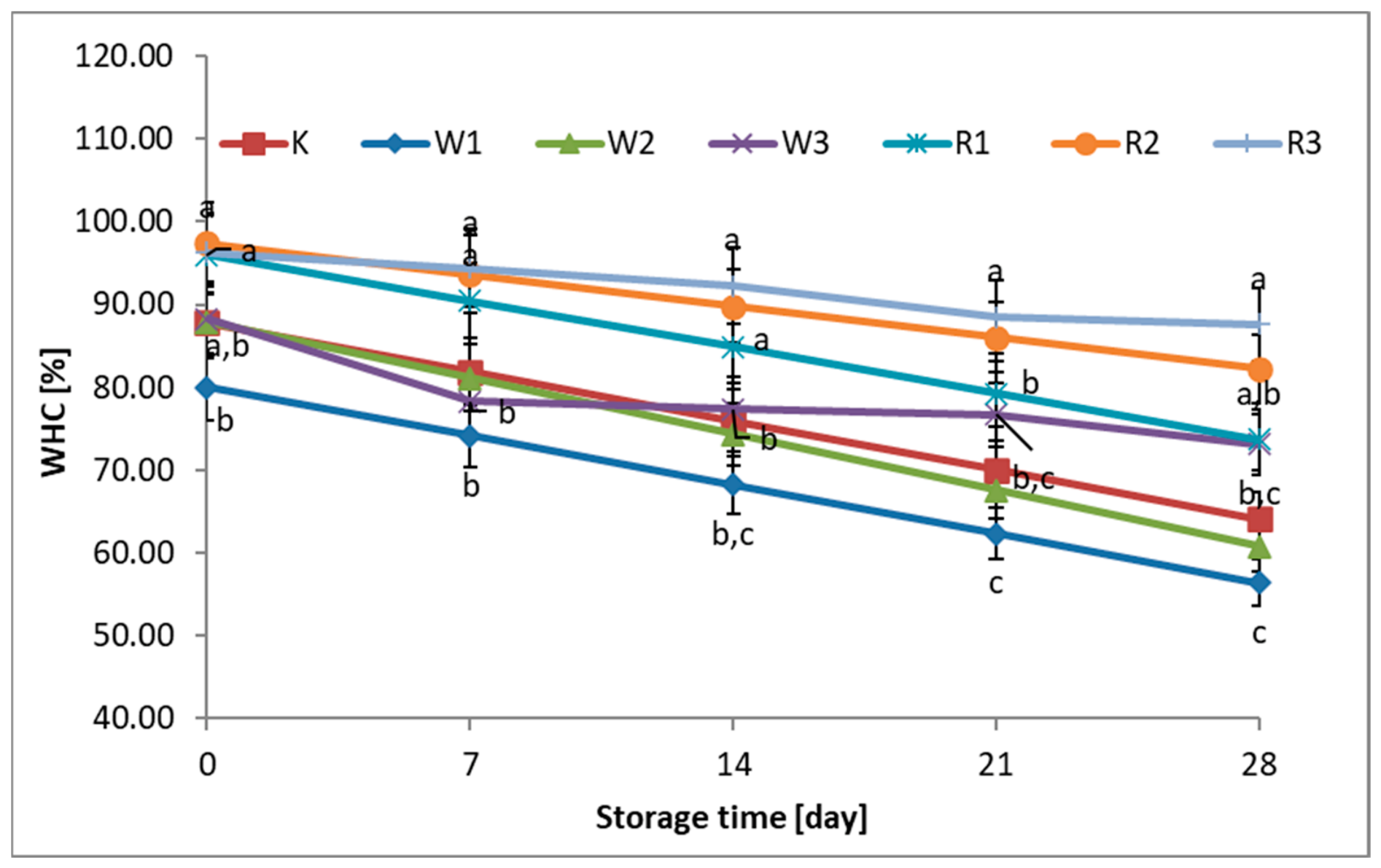
Water-holding capacity (WHC) decreased gradually in all fermented milks during 28 days of refrigerated storage (
Figure 4). However, the extent of this decrease depended strongly on the type and dose of collagen added. In general, samples enriched with fish collagen showed higher WHC than the control and bovine collagen variants throughout storage. A clear dose-dependent effect was observed for fish collagen, with the following order: R3 > R2 > R1. Among all samples, R3 maintained the highest WHC throughout the storage period, whereas W1 showed the lowest WHC at most time points. At the end of storage, the control sample exhibited a marked reduction in WHC, while the fermented milks supplemented with fish collagen, especially at 2.5% and 5.0%, retained water more effectively. The highest final WHC was noted for sample R3, followed by R2, whereas the lowest WHC was observed for W1. The bovine collagen samples showed a less consistent effect. In particular, the lower doses of bovine collagen (W1 and W2) did not improve water retention to the same extent as fish collagen. Only the highest bovine collagen level, W3, resulted in a noticeable improvement in WHC during storage.
These findings indicate that both the collagen source and concentration significantly affect the water-binding properties of the fermented milk enriched with vitamin C. Since all fortified samples contained the same amount of vitamin C, the observed differences in WHC can be attributed mainly to the type and level of collagen added. The superior performance of fish collagen suggests more favourable interactions with the fermented milk gel network, which may have improved whey immobilisation and contributed to better physical stability during storage.
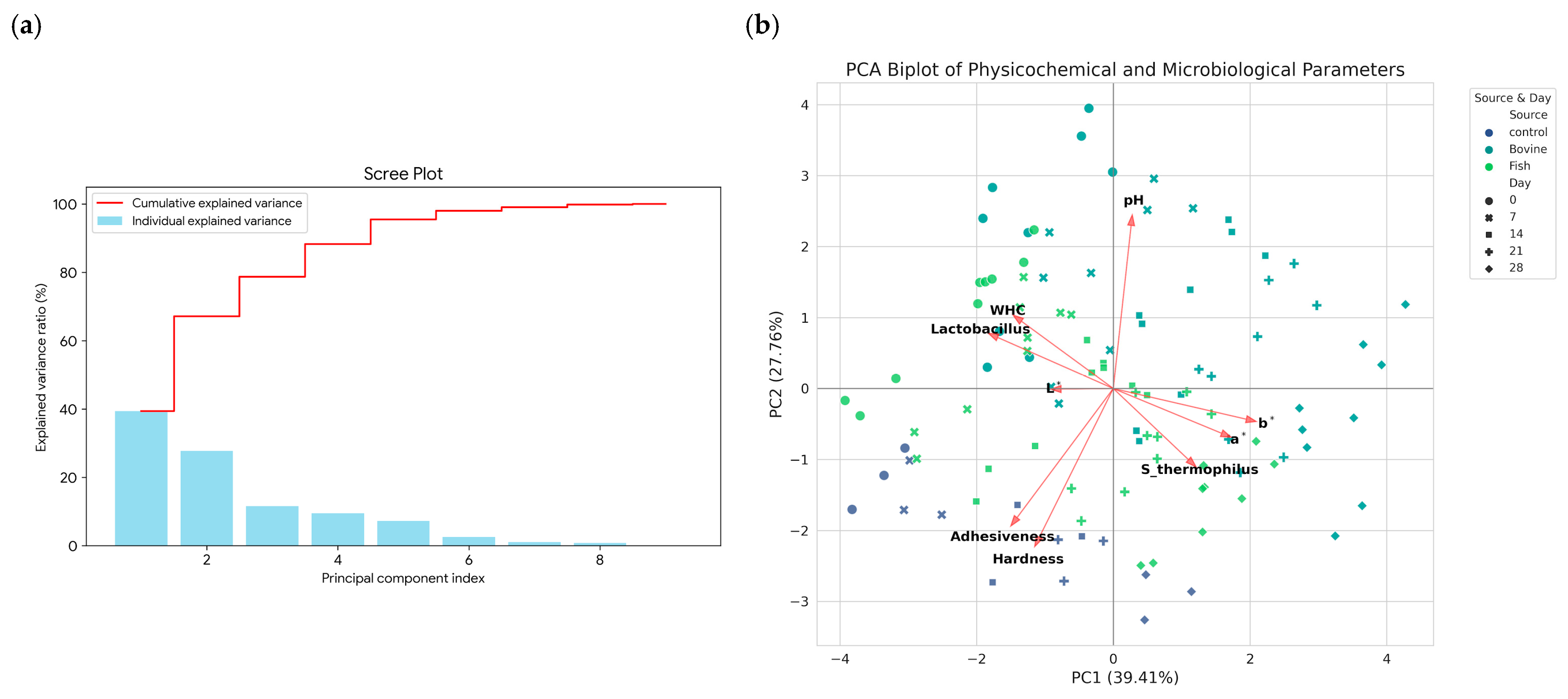
To comprehensively evaluate the relationships between the physicochemical properties, microbiological stability, and storage time of fermented milk beverages enriched with vitamin C and graded doses of fish or bovine collagen, a Principal Component Analysis (PCA) was performed. The first two principal components (PC1 and PC2) accounted for 67.17% of the total variance (39.41% and 27.76%, respectively). This level of explained variance was considered adequate for exploratory interpretation of a complex food matrix, because it captured the dominant gradients related to collagen source, dose, and storage time. At the same time, 32.83% of variance remained outside the first two components; therefore, the biplot was not used as a confirmatory model and minor separations were interpreted with caution. The scree plot (
Figure 5a) supported retaining these two components, as the third component showed a substantially lower contribution. The PCA biplot (
Figure 5b) illustrates the distribution of samples and the contribution of individual variables. PC2 was primarily associated with acidification kinetics and textural evolution during storage. Samples at day 0 showed higher pH values and were positioned in the upper quadrants, whereas samples after 28 days of storage shifted towards the lower quadrants, correlating with increased hardness and adhesiveness. PC1 was strongly influenced by the colour parameters (a* and b*) and water-holding capacity (WHC). The loading vectors for b* and a* pointed to the right-hand side of the plot, indicating that collagen fortification, particularly at higher doses, altered sample chromaticity relative to the control. PCA also showed a positive alignment between
Lactobacillus counts and WHC. This association may reflect a parallel response to the fish collagen treatment rather than a direct causal relationship between bacterial survival and water retention. The separation between bovine (W) and fish (R) collagen samples indicates that the collagen source significantly modulated the final quality attributes of the fermented milk enriched with vitamin C.
Overall, PCA supported the univariate results by showing that fish collagen variants were more closely associated with higher WHC and more favourable storage-related structural behaviour, whereas bovine collagen variants were more closely associated with pH modification and textural weakening. Thus, the multivariate analysis confirmed that collagen source and dose were formulation variables with measurable technological consequences rather than neutral additions to the fermented milk matrix.
4. Discussion
The present study showed that the technological response of fermented milks enriched with vitamin C to collagen fortification depended strongly on both collagen source and collagen dose. The results were therefore consistent with the three research questions formulated in the Introduction: source-related differences, dose effects, and storage stability all contributed to the final quality of the beverages. This finding is relevant for dairy product design because hydrolysed collagen cannot be treated solely as a protein enrichment ingredient. Depending on its origin and dose, it may modify fermentation performance, gel structure, colour, water retention, and microbiological stability [
39,
45,
46]. In practical terms, this determines whether collagen can be incorporated without compromising process efficiency and shelf-life quality [
41,
47,
48].
One of the most important findings concerned acidification behaviour during fermentation. The control sample and the milks containing 1.25% fish collagen showed the most favourable fermentation profile, whereas increasing collagen concentration, especially in the bovine variants, progressively extended the time required to reach the target pH. This result suggests that collagen enrichment altered acidification dynamics in a source-dependent manner. The higher pH values recorded in bovine collagen samples, both after fermentation and during storage, are consistent with a stronger buffering effect or with source-dependent differences in the way the commercial collagen hydrolysates behaved in the acidified milk matrix. However, because direct molecular characterisation and protein interaction studies were not performed, these mechanisms should be regarded as plausible technological explanations rather than confirmed molecular pathways [
41,
49,
50]. However, because the molecular-weight distribution, amino acid composition, peptide profile, and isoelectric point of the hydrolysates were not experimentally determined, this interpretation must remain cautious. The present data demonstrate technological differences between fish and bovine collagen preparations, but they do not allow direct attribution of these differences to a specific molecular fraction. A similar tendency, namely slower acid development and higher final pH after collagen addition, has been reported in collagen-enriched fermented milk samples, although the magnitude of the effect appears to depend on collagen characteristics, formulation, and starter culture composition [
32,
39,
41]. From a technological point of view, low-level fish collagen supplementation may be compatible with standard yoghurt-type fermentation schedules, whereas higher bovine collagen doses may require process adjustments, such as longer incubation times or milk reformulation [
39,
41,
45].
The shift in T
max between fish collagen and bovine collagen variants is also noteworthy. In all fish collagen samples, the maximum acidification rate occurred later than in the control and bovine collagen beverages. This may indicate that fish collagen influenced the early adaptation phase of starter bacteria differently, even when the overall acidification rate was not markedly reduced at the lowest dose. Such a result supports the view that kinetic descriptors should be interpreted jointly rather than separately, because a similar Vmax does not necessarily translate into similar fermentation efficiency [
41,
51,
52]. In the present study, this was particularly evident in bovine collagen samples, where relatively high Vmax values coexisted with prolonged T
e values. Therefore, the practical suitability of collagen fortification cannot be judged solely on the basis of a single kinetic parameter.
In addition, the observed differences in acidification kinetics, particularly the delay in samples fortified with bovine collagen, could be related to the interaction between collagen peptides, buffering capacity, and the proteolytic activity of the YC-X16 starter culture. L. delbrueckii subsp. bulgaricus and S. thermophilus use proteolytic systems to release peptides and amino acids from milk proteins, which support bacterial growth and acid production. Hydrolysed collagen may introduce additional peptide nitrogen into the system, but it may also increase buffering capacity or compete with milk peptides in the aqueous phase of the gel. The fact that bovine collagen prolonged Te despite relatively high Vmax suggests that the main effect was not simple stimulation of starter activity. Rather, the bovine hydrolysate may have changed the acid-base balance or the local environment of bacterial metabolism. This explanation remains hypothetical because free amino acids, peptide profiles, and buffering curves of the collagen preparations were not measured.
The longer time required to reach pH 4.6 in samples containing bovine collagen hydrolysate cannot be attributed to one specific molecular factor, because the molecular-weight distribution, peptide profile, amino acid composition and buffering capacity of the hydrolysates were not determined. However, the coexistence of relatively high Vmax values with prolonged Te values suggests that the delay was not caused simply by inhibition of starter culture activity. A more plausible explanation is that the bovine collagen preparation modified the acid-base response of the matrix, for example, through higher buffering contribution or different peptide charge and hydration behaviour. Such effects could slow the decrease in pH despite ongoing lactic acid production. This interpretation remains hypothetical and should be verified in future studies by molecular-weight profiling, amino acid analysis, buffering capacity measurements and rheological characterisation.
The textural results further confirmed that the collagen source was a major determinant of product quality. Fish collagen, especially at 1.25%, preserved hardness and adhesiveness closer to the control, whereas bovine collagen reduced both parameters in a concentration-dependent manner. At the same time, higher fish collagen doses gradually increased the hardness of fermented milk samples during storage, suggesting progressive rearrangement or strengthening of the protein network under refrigerated conditions [
38,
39,
41]. These findings suggest that fish collagen peptides may be better integrated into the acid milk gel, supporting matrix cohesion without the pronounced softening observed for bovine collagen.
The observed differences in the technological performance of fish and bovine collagens may be linked to their distinct molecular characteristics, but this link should be interpreted as literature-based rather than directly demonstrated in the present work. Fish collagen hydrolysates are often described as having lower thermal stability, lower amino acid content, and different peptide-size distributions than bovine preparations [
11,
35,
36,
37]. In an acidified milk system, peptide size, charge distribution, hydration, and the proximity of the system pH to the isoelectric region of milk proteins may influence whether collagen peptides behave as soluble fillers, water-binding components, or disruptors of casein aggregation. Smaller, more soluble peptide fractions may distribute more readily within the interstitial spaces of the developing casein network, supporting water immobilisation without weakening the gel. In contrast, peptide fractions with different charge or hydration behaviour may interfere with casein-casein contacts or increase buffering, thereby delaying the approach to pH 4.6 and reducing gel firmness. These mechanisms are consistent with the higher WHC and better textural preservation observed in fish collagen samples, as well as the softening observed in bovine collagen variants, but they require verification through molecular-weight profiling, amino acid analysis, and rheological measurements. Previous studies on protein-enriched fermented milks have shown that added proteins and peptides may either reinforce or disrupt the gel, depending on their molecular properties, hydration behaviour, and compatibility with casein aggregation during acidification [
39,
44,
53].
The water-holding capacity data provide an important complement to the texture results. Fish collagen improved WHC more effectively than bovine collagen, with a clear dose response from R1 to R3. This indicates that fish collagen promoted serum retention and limited syneresis more efficiently during storage. Because all fortified samples contained the same amount of vitamin C, the differences observed between R and W variants can be attributed primarily to the collagen source and concentration rather than to the ascorbic acid itself [
34,
54,
55,
56]. The higher WHC of the fish collagen-enriched fermented milks suggests more favourable interactions with the fermented milk gel, possibly through improved water binding, peptide hydration, or immobilisation of serum within the protein network [
11,
32,
41]. Similar relationships between network integrity, syneresis reduction, and added protein ingredients have been described in fermented dairy products fortified with functional protein preparations [
44,
57,
58].
The colour results indicate that collagen fortification improved some aspects of physical stability but reduced colour stability relative to the control. The colour change in the control sample provides a baseline for the natural evolution of the dairy matrix over time. Since the ΔE* values for the control remained below the commonly used perceptibility range of approximately 2–3 throughout the study, the substantially higher ΔE* values observed in collagen-fortified samples can be attributed mainly to the additives and their interactions with the matrix. In all collagen-enriched fermented milks, total colour difference increased during storage, mainly because of increasing b* values, while L* remained relatively stable. This means that the main visual effect of storage was gradual yellowing rather than darkening. The higher b* values found particularly in bovine collagen samples may be related to the intrinsic colour of the added material, peptide composition, storage-induced interactions within the matrix, or oxidative and non-enzymatic changes occurring during refrigerated storage [
32,
57]. From an industrial perspective, this is important because even nutritionally attractive fermented milk beverages may be rejected if yellowing is perceived as ageing, oxidation, or loss of freshness. Values of ΔE* above approximately 5, recorded in most fortified variants at the end of storage, suggest clearly visible colour differences [
56,
57,
59]. However, the present work did not include sensory analysis; therefore, the consumer acceptability threshold for yellowness in these specific products remains unknown. The lowest final ΔE* was observed for R3, suggesting that high-dose fish collagen may have provided a better balance between water retention and visual stability than the corresponding bovine treatments.
Another important outcome of the study is that collagen fortification did not adversely affect microbiological stability. In all variants,
S. thermophilus remained highly stable during 28 days of cold storage, whereas
Lactobacillus counts decreased gradually but remained detectable until the end of storage. This behaviour is typical for yoghurt-type products, in which streptococci often show greater resistance to storage stress than lactobacilli [
39,
40,
58]. Hydrolysed collagen peptides may theoretically act as readily available nitrogen sources for lactic acid bacteria, especially if they contain low-molecular-weight peptides and free amino acids. In the present study, however, collagen addition did not consistently increase starter counts compared with the control. This suggests that any potential nutritional effect of collagen peptides was limited or counterbalanced by acid stress, storage temperature, matrix composition, and source-dependent effects on pH and gel structure. The absence of Enterobacteriaceae, yeasts, and moulds throughout storage confirms that the enrichment strategy did not reduce microbiological safety.
The moderate pH decrease observed during refrigerated storage confirms typical post-acidification, but its extent remained limited. In practical terms, this is favourable because excessive post-acidification may lead to over-sour taste, texture defects, and lower consumer acceptance [
39,
57,
58]. The fact that bovine collagen maintained the highest pH values throughout storage suggests a stronger buffering capacity or a more pronounced impact on starter activity after fermentation. This is an important result from the standpoint of functional product development, because the addition of bioactive ingredients should not compromise the viability of fermentation cultures [
60,
61]. However, this effect cannot be treated as unequivocally beneficial, because the same bovine variants also showed delayed fermentation and less favourable textural properties. For this reason, pH stability should be interpreted together with hardness, adhesiveness, WHC, and colour rather than as an isolated quality attribute.
Potential sensory consequences should also be considered. Collagen hydrolysates may influence flavour through their own source-related notes, peptide-associated bitterness, or interactions with acidity perception. Fish-derived ingredients may raise concerns about marine or fishy notes, whereas bovine collagen may be perceived as more neutral by some consumers but may still affect mouth-coating, viscosity, and aftertaste. In the present study, bovine collagen limited post-acidification more strongly, which could reduce sourness during storage, but this potential advantage was accompanied by softer gels and higher yellowness. Fish collagen better preserved gel structure and WHC, which may support a fuller mouthfeel and lower syneresis, but sensory validation is required before any consumer-oriented conclusion can be made.
The PCA results support this integrated interpretation, but they should be read as exploratory. The first two components explained 67.17% of total variance, which is sufficient to visualise the dominant technological gradients in a complex food matrix but does not capture all sources of variability. Therefore, the PCA biplot was used to support patterns already observed in the univariate results rather than to establish independent causal relationships. The separation between fish and bovine collagen samples confirms that collagen origin was a major source of variation. Fish collagen was more closely associated with favourable WHC and more balanced storage behaviour, whereas bovine collagen had a stronger impact on pH and textural differentiation. Storage time systematically modified product properties, especially through post-acidification, colour change, and structural evolution. The observed alignment between
Lactobacillus counts and WHC warrants careful interpretation. It may reflect a coincidental alignment driven by the fish collagen treatment, which simultaneously supported higher water retention without impairing bacterial survival, rather than a direct biological dependence of WHC on
Lactobacillus counts. Importantly, PCA did not indicate general technological failure of enriched beverages. Instead, it showed that the direction and magnitude of change depended on collagen source and dose, which reinforces the conclusion that collagen fortification should be optimised as a formulation variable rather than treated as a neutral protein addition [
32,
38,
39].
The results indicate that the suitability of the collagen source depends on the specific technological target. While hydrolysed fish collagen is better for maintaining efficient fermentation, high WHC, and textural properties closer to the control, bovine collagen might be a better choice when high buffering capacity is required to limit post-acidification during storage, even if it entails certain textural trade-offs. Therefore, the optimal choice of collagen depends on the intended technological target. If the goal is to preserve gel integrity and water retention, fish collagen appears to be the better option. If modulation of acidity during storage is prioritised, bovine collagen may offer some advantages, but these come at the cost of less favourable fermentation and texture performance [
48,
49,
50].
This study has several practical implications, but also some limitations that should be acknowledged. First, the work focused on technological and microbiological quality and did not include sensory analysis [
56,
57]. Therefore, the consumer acceptability of increased yellowness, potential collagen-related flavour notes, sourness modulation, and mouthfeel changes was not determined. Second, the independent role of vitamin C could not be distinguished because all collagen-fortified variants contained the same amount of this additive. A major limitation of the present study is the lack of batch-specific molecular characterisation of the collagen hydrolysates. Molecular-weight distribution, peptide profile, amino acid composition, isoelectric properties and buffering capacity were not determined. These parameters are important because they may influence peptide solubility, water binding, acid-base behaviour and compatibility with the casein network. Consequently, the study demonstrates source and dose dependent technological effects of the commercial fish and bovine collagen hydrolysates, but it does not allow these effects to be directly assigned to specific molecular fractions or amino acid profiles. Future research should include size exclusion chromatography or comparable molecular-weight profiling, amino acid analysis, buffering capacity measurements, zeta potential or charge-related measurements, and rheological studies of the acid milk gel. Future studies should include size-exclusion chromatography or comparable molecular-weight profiling, amino acid analysis, assessment of buffering capacity, and rheological measurements to verify the mechanisms proposed here. Nevertheless, within the technological scope of the present work, the results clearly demonstrate that collagen origin and dose significantly affect fermentation behaviour, physical stability, colour, and storage performance of fermented milk enriched with vitamin C.