Article

Regional Variability of Normalized Signal Intensity in the Native Anterior Cruciate Ligament: A Quantitative MRI Study

by
Marcin Plenzler
1,2,*,
Magdalena Stawińska-Baran
1,2,
Andrzej Mastalerz
2,
Beata Ciszkowska-Łysoń
1,
Ida Wiszomirska
3 and
Robert Śmigielski
1
1
Life Medical Center, 02-972 Warsaw, Poland
2
Department of Biomedical Sciences, Józef Piłsudski University of Physical Education in Warsaw, 00-968 Warsaw, Poland
3
Department of Fundamentals of Physiotherapy, Józef Piłsudski University of Physical Education in Warsaw, 00-968 Warsaw, Poland
*
Author to whom correspondence should be addressed.
Appl. Sci. 2026, 16(11), 5476; https://doi.org/10.3390/app16115476
Submission received: 10 April 2026 / Revised: 5 May 2026 / Accepted: 22 May 2026 / Published: 1 June 2026
(This article belongs to the Section Applied Biosciences and Bioengineering)

Abstract

Aims: This retrospective clinical MRI study aimed to evaluate regional differences in normalized signal intensity (SI) of the native anterior cruciate ligament (ACL) and to assess the influence of demographic and clinical factors on SI distribution. Methods: MRI scans obtained on a 3T scanner from 84 patients were analyzed. Regions of interest were defined in the proximal, middle, and distal portions of the native ACL, with normalization to the posterior cruciate ligament (PCL) tibial insertion. SI was expressed as the anterior–posterior native cruciate ligament ratio (APRn). A linear mixed-effects model with a random intercept for the patient was used to account for repeated measurements, and pairwise regional comparisons were performed with Tukey adjustment. Statistical significance was set at p < 0.05. Results: A significant regional effect was observed (p = 0.0001), with the distal portion demonstrating the highest SI, followed by the proximal and middle regions. Compared with the distal region, both the middle (β = −0.557, p = 0.0001) and proximal (β = −0.568, p = 0.0002) portions showed significantly lower SI values. The ACL signal was approximately 1.65–2.45 times higher than that of the PCL. Post hoc Tukey comparisons confirmed significant differences between all anatomical regions. The log-transformed model demonstrated improved fit (marginal R2 = 0.24; conditional R2 = 0.26). Inter- and intra-observer reproducibility demonstrated excellent agreement (ICC = 0.88–0.91). Conclusions: Native ACL signal intensity demonstrates a location-specific pattern, with the distal region showing the highest values. These findings provide reference data for regional native ACL signal distribution in a clinical cohort.

1. Introduction

Anterior cruciate ligament (ACL) rupture is a common sports injury [1], and reconstruction is crucial for restoring the injured knee’s anatomy and kinematics [2].
Currently, evaluating ACL treatment and return-to-sport timing includes clinical, functional, and patient-reported outcomes [3,4]. However, these indirect evaluation techniques may not effectively gauge the structural integrity of an ACL graft, risking re-ruptures or poor knee stability [3,5]. Therefore, there is a growing need for objective, imaging-based biomarkers that reflect graft structure and maturation in vivo.
Early graft failure may result from biological graft structure failure during maturation when the intra-articular tendon-like structure adapts to the ligament form [6]. Early healing characteristics may predict later biomechanical properties of the graft [7,8].
The gold standard for investigating graft maturation has been limited to histologic analysis of biopsy grafts during second-look arthroscopy at various post-ACL reconstruction (ACLR) time points [9]. However, it is invasive and not representative of the follow-up method. This limitation highlights the importance of non-invasive imaging approaches capable of longitudinal assessment [10].
Magnetic resonance imaging (MRI) is widely used to identify ACL injury, graft impingement, meniscal, and cartilage status [11]. It is considered the optimal tool for assessing graft maturity in vivo and guiding return-to-sport timing [12]. The MR-derived signal intensity (SI) parameter is an independent predictor of graft healing and biomechanical outcomes in anterior tibia subluxation 3 months after ACLR [13]. It is used as a surrogate for tissue quality, with a lower signal (darker appearance) indicating a more organized and mature ligament [7,13,14]. A high SI (i.e., higher water content) indicates a more severe or very intensive remodeling process, depending on the time after reconstruction [5]. Recent studies have further supported the use of quantitative MRI metrics in ACL research, showing that normalized signal intensity can track postoperative graft remodeling and that the detected signal changes may depend on the MRI sequence used [15]. In addition, regional heterogeneity of ACL signal intensity has been demonstrated both in surgically treated ligaments and in the native ACL, suggesting that spatial signal differences should be considered when interpreting quantitative MRI findings [3]. Recent findings show that the most hyper-intensive period in MRI SI occurs between 3 and 9 months. Still, it is unknown how long, if at all, the graft maturation process will achieve the SI level of the native (intact) ACL (ACLn) [4,9,16]. A few findings suggest it can be even after 2 years post-surgery [15,16,17].
Most studies focus on graft remodeling and use contralateral or healthy knees as controls [3,17]. However, the native ACL itself is not well characterized quantitatively, and its signal intensity is often implicitly treated as a homogeneous reference. The methods used to determine SI vary considerably, and there is no consensus on normalization strategies or reference values for ACLn. This lack of standardization limits comparability across studies and hinders the development of reliable imaging biomarkers.
Furthermore, emerging evidence suggests that graft maturation is a spatially heterogeneous and non-linear process, with different portions of the ligament demonstrating distinct SI patterns [11]. Despite this, the regional variability of SI within the intact ACL remains poorly understood and under-investigated. To the best of our knowledge, only limited data from small cohorts have explored this phenomenon, and no comprehensive statistical modeling of within-subject variability has been conducted.
Importantly, previous studies have relied primarily on simplified statistical approaches that do not account for repeated measurements within individuals, potentially biasing estimates of regional differences [3]. Advanced analytical frameworks, such as linear mixed-effects models, enable more accurate assessment of spatial variability and covariate influence.
Therefore, a critical knowledge gap exists regarding the regional distribution of normalized SI in the native ACL, the influence of demographic factors on these patterns, and the appropriate statistical framework for analyzing such data.
This study aimed to evaluate the normalized SI of the native ACL and its regional variability, and to investigate the effects of age and sex using a linear mixed-effects modeling approach. We hypothesized that signal intensity would differ across anatomical regions, with the distal region showing the highest values, and that age and sex would not demonstrate a strong overall independent effect, although region-specific interactions might be present.

2. Materials and Methods

2.1. Study Patients

A total of 119 participants, aged 18–65 years, who were patients at our clinic from June 2020 to December 2022 and had knee MRIs performed during medical visits, were potentially recruited to the study and were retrospectively reviewed. Patients were excluded if they had previously sustained an ACL injury or undergone ACL surgery, a posterior cruciate ligament (PCL) injury, advanced cartilage damage, tissue inflammation, signs of osteoarthritis stage >2 according to the Outerbridge classification, combined ligament injuries, multisystem trauma, or fractures. A certified radiologist confirmed the intact status of the ACLs. Patient demographic data and the meniscal and cartilage details were extracted from medical documentation and radiologic measures.
Finally, 84 patients were fully qualified. The study was conducted in accordance with the Declaration of Helsinki and approved by the University Ethics Committee for Scientific Research at Jerzy Kukuczka Academy of Physical Education in Katowice (Uchwała Nr 4a/2021, date: 23 June 2022). Written informed consent was obtained from all participants before inclusion. Because this was a retrospective study based on consecutively eligible clinical MRI examinations, no formal a priori sample size calculation was performed.

2.2. MRI Parameters

MRI scans were acquired using a 3T whole-body scanner (Ingenia, Philips Healthcare, The Netherlands) and a dedicated 8-channel knee coil. The 3T scanner offers an improved signal-to-noise ratio (SNR), higher spatial resolution, and enhanced contrast. A specific MRI protocol known as sagittal proton density-weighted high-resolution fat suppression (PDW HR SPAIR) with 3 mm slice thickness was used for analysis. T2-weighted MRI sequences were employed to visualize soft tissues such as the ACL. The repetition time (TR) was 5000 ms, the echo time (TE) was 40 ms, the field of view (FOV) was 16 × 16 cm, and the intersection gap was 3.3 mm.

2.3. Signal Intensity (SI) Measurement

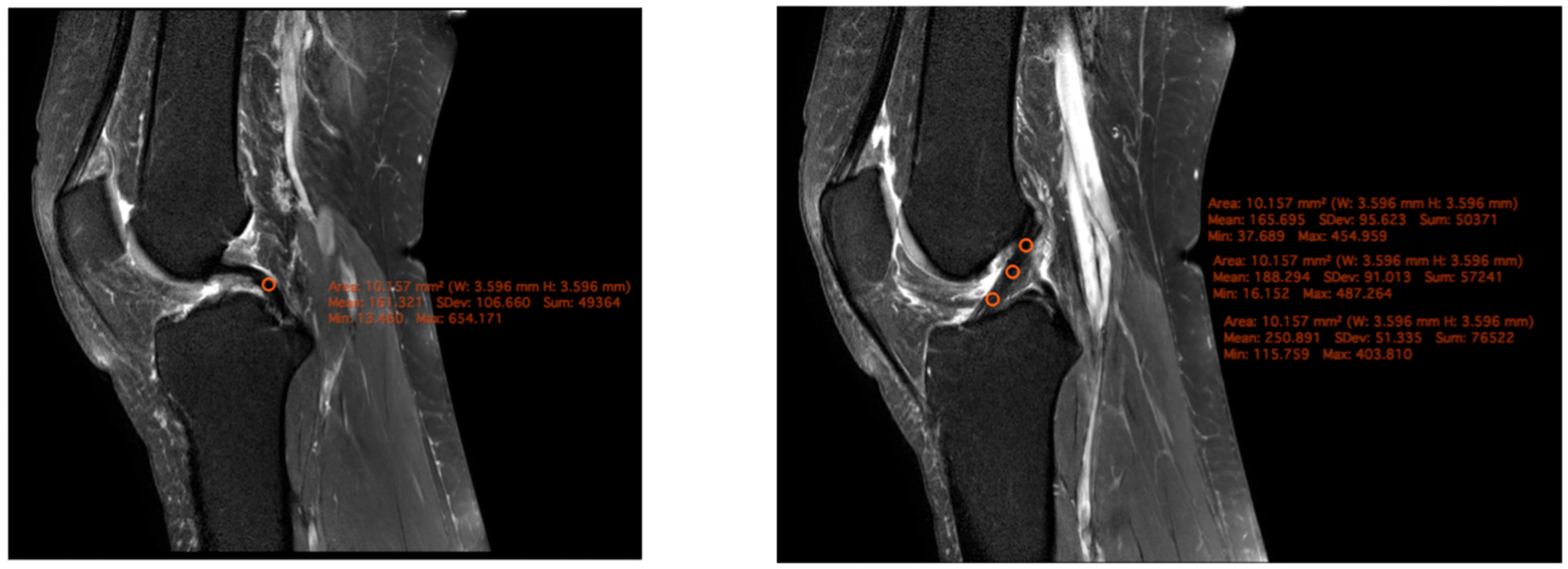
The sagittal slice that best demonstrated the full-length intra-articular ACL and the slice that best exemplified the tibial insertion of the PCL were selected for analysis. The region of interest (ROI) was measured using MR image viewing software (Horos version 3.0; Horos Project). The ROI tool with a standardized diameter circle of 3.6 mm, area 10 mm2, was manually drawn in three regions along the full thickness of the ACLn: proximal (prx) ACLn, middle (mid) ACLn, distal (dsl) ACLn, and one region along the tibial insertion of the PCLn. The mean SI and standard deviation (SD) were automatically calculated by the imaging software, based on pixel values as the absolute SI. An example of ROI circle placement is shown in Figure 1. To quantify the normalized SI of the ACLn, the anterior–posterior native cruciate ligament ratio (APRn) was calculated by dividing the SI of the ACLn in each of the three regions by the signal of the distal portion of the native PCL (dsl SI PCLn).

2.4. Reliability of the Measurement

The measurements were performed by a radiologist with >15 years’ experience in ACL MRI (intra-observer ICC = 0.92, 95% CI: 0.87–0.96). To assess inter-observer reliability, a randomly selected subset (2 × 20 patients) was reanalyzed by two other examiners after targeted training (each measuring 20 patients independently, blinded). Inter-observer ICC was 0.89 (95% CI: 0.83–0.94), demonstrating excellent reproducibility.

2.5. Statistical Analysis

All statistical analyses were performed in the R version 4.4.3 statistical environment (R Foundation for Statistical Computing, Vienna, Austria). The following R packages were used: lme4, lmerTest, performance, MuMIn, car, emmeans, and irr.
The distribution of continuous variables was assessed using the Shapiro–Wilk test. Because the normalized ACL-to-PCL signal intensity ratio (APRn) deviated from normality, APRn values were log-transformed before further analyses. Descriptive statistics were reported as mean and standard deviation (SD), as well as median and interquartile range (IQR), where appropriate.
To account for repeated measurements within subjects (three anatomical regions per patient), a linear mixed-effects model with a random intercept for the patient was applied. The dependent variable was the log-transformed normalized ACL-to-PCL signal intensity ratio (APRn), whereas anatomical region (distal, middle, proximal), age, sex, meniscus tear (medial/lateral/none), and patellofemoral cartilage damage were included as fixed effects. Interaction terms between region and age were also tested. Pairwise comparisons between anatomical regions were performed using estimated marginal means with Tukey adjustment for multiple comparisons. Model coefficients (β) with 95% confidence intervals (95% CI) were reported. p-values for fixed effects were obtained using Satterthwaite’s approximation. Model fit was evaluated using marginal and conditional R2, as well as Akaike (AIC) and Bayesian (BIC) information criteria. Maximum likelihood (ML) estimation was used for model comparison, whereas final models were fitted using restricted maximum likelihood (REML). A sensitivity analysis was performed using log-transformed data to assess the robustness of the findings. Inter- and intra-observer reproducibility of ROI placement was evaluated using the intraclass correlation coefficient (ICC) with 95% confidence intervals. Statistical significance was set at p < 0.05.

3. Results

3.1. Study Patients

The demographic and clinical characteristics of the study population are presented in Table 1. A total of 84 patients were included, with a mean age of 44 ± 12.5 years. The cohort consisted of 35 men and 49 women. The left knee was assessed in 31 cases, and the right knee in 53. To explore potential age-related differences, patients were stratified into two groups: 18–39 years (n = 31) and 40–65 years (n = 53). The younger group included 19 women and 12 men, while the older group included 30 women and 23 men.
Medial meniscus tears were identified in 28 patients (33.3%), lateral meniscus tears in five patients (6.0%), and patellofemoral cartilage lesions in 43 patients (51.2%). Patellofemoral pain syndrome (PFPS) was present in 19 patients (22.6%).
Legend: Baseline demographic and clinical characteristics of the study population. Data are presented as mean ± standard deviation (SD) or counts with percentages.

3.2. Regional Differences in ACL Signal Intensity

A linear mixed-effects model demonstrated a significant fixed effect of anatomical region on the log-transformed normalized ACL-to-PCL signal intensity ratio (APRn) (p = 0.0001). The dependent variable subjected to log-transformation was the normalized ACL-to-PCL signal intensity ratio (APRn). Compared with the distal portion (reference category), both the middle (β = −0.557, 95% CI: −0.83 to −0.28, p = 0.0002) and proximal regions (β = −0.568, 95% CI: −0.84 to −0.29, p = 0.0001) demonstrated significantly lower signal intensity values. Clinically, the negative β coefficients indicate proportionally lower normalized ACL signal intensity in the middle and proximal regions relative to the distal region after logarithmic transformation of APRn values. Across regions, the distal portion exhibited the highest signal intensity, followed by the proximal and middle regions. Descriptive statistics for each anatomical region are presented in Table 2.
Post hoc pairwise comparisons using estimated marginal means with Tukey adjustment confirmed significant differences between all anatomical regions. The distal region demonstrated significantly higher normalized signal intensity compared with both the proximal (adjusted p = 0.0003) and middle regions (adjusted p = 0.00003), while the proximal region also showed significantly higher signal intensity than the middle region (adjusted p = 0.0012).

3.3. Multiple Factors Analysis

The mixed-effects model, including demographic and clinical covariates, confirmed that anatomical region remained the only strong independent predictor of ACL signal intensity (Table 3). Neither age nor sex demonstrated a significant independent association with log-transformed normalized ACL-to-PCL signal intensity ratio (APRn) after adjustment for regional and clinical covariates. Age was not significantly associated with signal intensity (β = −0.002, p = 0.743), and no significant effect of sex was observed (β = −0.059, p = 0.687). A non-significant trend toward increased signal intensity was observed in patients with medial meniscus tears (β = 0.279, 95% CI: −0.01 to 0.57, p = 0.063). No significant associations were found for lateral meniscus tears (β = 0.334, 95% CI: −0.32 to 0.99, p = 0.316) or patellofemoral cartilage lesions (β = 0.002, 95% CI: −0.29 to 0.29, p = 0.992).

3.4. Interaction Effects

A significant interaction between anatomical region and age was observed for the proximal portion (β = 0.007, 95% CI: 0.002 to 0.013, p = 0.007), indicating an age-dependent increase in signal intensity in this anatomical region (Table 3). No significant interaction between age and the middle region was found (p = 0.295). This suggests that the association between age and signal intensity may vary by anatomical region rather than being uniform across the ligament.

3.5. Model Fit, Sensitivity Analysis, and Reproducibility

The log-transformed model demonstrated improved fit compared with the raw-scale model, with higher explained variance (marginal R2 = 0.24 vs. 0.18; conditional R2 = 0.26 vs. 0.19) and lower information criteria (AIC: 1764.8 vs. 1987.2; BIC: 1812.6 vs. 2034.5). The direction and significance of the observed effects remained unchanged after transformation, confirming the robustness of the findings. Inter- and intra-observer reproducibility of ROI placement demonstrated excellent agreement. The intra-observer ICC was 0.91 (95% CI: 0.86–0.95), whereas the inter-observer ICC was 0.88 (95% CI: 0.82–0.93).

4. Discussion

In this study, we established location-specific normalized signal intensity (SI) values for the native anterior cruciate ligament (ACLn) using a standardized anterior–posterior ratio (APRn) normalized to the posterior cruciate ligament tibial insertion (PCLn). The distal ACLn region exhibited significantly higher APRn (2.45 ± 1.03) compared to the proximal (1.96 ± 0.78) and middle (1.65 ± 0.60) portions (p = 0.0001). Although no overall independent association between age and APRn was identified, a significant interaction between age and the proximal region was observed (β = 0.007, p = 0.007), indicating that regional signal distribution may partially vary with age. Therefore, age cannot be considered entirely unrelated to ACL signal characteristics. Rather than providing reference data for healthy knees, the present study describes reference APRn distributions in structurally intact native ACLs obtained from a clinical MRI cohort with limited low-grade concomitant pathology.
Biomechanical testing and insight into the graft in a non-invasive way are impossible in humans, and MRI-based approaches have therefore been proposed as an alternative to histological examination for evaluating the entire ACL graft in vivo. MRI is widely used to qualitatively monitor the ACL graft postoperatively and is often considered the gold standard for assessing graft maturity. Weiler et al. demonstrated that graft vascularity and biomechanical parameters can be predicted from MRI-derived parameters, and animal model studies have shown that graft volume and greyscale values are predictive of tissue remodeling processes. Variable quantitative MRI parameters have been proposed as predictors of the human ligament healing process, and Biercevicz et al. reported that T2* relaxation time correlates with the level of tissue organization. T2*-based techniques are well suited for imaging highly organized collagenous structures, and T2* relaxation, which is sensitive to variations in tissue magnetic susceptibility, plays an important role in generating image contrast and assessing tissue properties [18,19,20,21,22,23].

4.1. Technical Validation of the APRn Protocol

Despite the growing interest in quantitative MRI, direct comparison between scans and patients remains challenging because SI depends on scanner hardware, voxel size, pulse sequence, and weighting. To minimize variability, several normalization strategies have been proposed, including signal-to-noise quotient (SNQ) and signal intensity ratio (SIR) using background noise as a reference. However, background-based approaches are sensitive to acquisition noise, and recent studies suggest that omitting the background can improve measurement accuracy. Panos et al. demonstrated the superior performance of median SI without background over SNQ [9].
In the present study, we used a consistent imaging protocol on a 3T scanner and normalized ACLn SI to the tibial insertion of the native PCL, which has been reported to provide more stable signal characteristics than background regions [5]. The PCL insertion was selected because it demonstrates low intra-subject variability and remains consistently visible across examinations, thereby improving reproducibility of internal normalization. The resulting APRn values showed that ACLn SI was approximately 1.65–2.45 times higher than PCLn, which is generally consistent with previously reported control-knee ratios. However, the present study did not independently validate PCL signal stability across different demographic or clinical subgroups, and therefore the APRn method should be interpreted as a relative normalization approach rather than fully validated reference data [20].
One of the critical factors influencing MRI measurements is the partial volume effect (PVE), which occurs when multiple tissue types are present within a single voxel. In such cases, SI depends not only on sequence parameters and tissue properties but also on the relative proportions of each tissue within the voxel. The ACL has been described as a flat, ribbon-like, twisted structure with a C-shaped tibial insertion, which predisposes the distal region to greater PVE. Consequently, the higher distal APRn observed in our study may reflect both true regional tissue characteristics and technical imaging effects. For this reason, the distal region should not be interpreted as a definitive biological benchmark of ligament quality, but rather as a reproducible imaging feature observed under standardized acquisition conditions. This limitation is particularly important when extrapolating these findings to graft evaluation [24,25,26,27,28].

4.2. Regional Differences and Relation to Graft Remodeling

Our findings in the ACLn, where the distal region exhibited approximately 20% higher normalized SI than the proximal region, are consistent with this pattern and support the presence of regional differences in signal distribution. Lutz et al. similarly observed higher distal SI compared with other regions in control knees. In contrast, Hofbauer et al. found that at six months after ACL reconstruction, the tibial region had the lowest SNQ, indicating more advanced healing at that site. Taken together, these data highlight that the time point after surgery and the specific SI metric used (SNQ, SIR, APRn) strongly influence the interpretation of regional graft maturity [20]. Quantitative MRI has shown promise for assessing ACL healing, but reported results vary across sequences, graft types, and time points, underscoring the need for standardized acquisition and analysis methods. In this context, our native ACL data may serve as a preliminary regional reference rather than a definitive reference data [13].
In recent years, SI has become a widely used parameter for studying the temporal aspects of graft healing. During the first two years after surgery, the graft undergoes substantial ligamentization, initially presenting high SI at around six months and gradually approaching the pattern of the ACLn at one to two years postoperatively. Ntoulia et al. demonstrated that the degree and distribution of revascularization significantly affect graft MRI appearance over time. By two years, revascularization is largely complete, and graft SI tends to become homogeneously low, resembling native ACL. However, because the present cohort was not a truly asymptomatic healthy population and included patients referred for clinical MRI evaluation, the APRn values reported here should not be interpreted as reference data. Instead, they may serve as reference values for future comparative studies performed using similar imaging protocols [17,29,30,31].

4.3. Influence of Age and Sex

An important finding of the present study is that age did not show a significant overall main effect on APRn; however, a significant interaction between age and the proximal region was observed. This suggests that the association between age and signal intensity may vary by anatomical region rather than being uniform across the ligament. Sex was not significantly associated with APRn in the present cohort [14,30,32].
This is in agreement with Barnett et al., who reported that ACL size, but not SI, is influenced by sex, body size, and knee anatomy, and with Putnis et al., who did not identify a strong age-related effect on graft SI one year after hamstring autograft reconstruction [18]. In contrast, Chiba et al. reported lower graft SI among older patients (over 30 years old) in the early postoperative phase, which they linked to differences in activity levels and loading patterns. Importantly, the mixed-effects model demonstrated a significant interaction between age and the proximal region, indicating that age-related effects may differ depending on anatomical location within the ACL. Accordingly, the absence of a global age effect should not be interpreted as evidence that age has no influence whatsoever on ACL signal characteristics. Rather, the findings suggest that age-related variation is region-specific and relatively modest compared with the dominant effect of anatomical location [2,14].

4.4. Clinical and Technical Implications

The present findings may be relevant for future studies that aim to compare graft signal characteristics with regional signal distribution in the native ACL. However, because this study did not include reconstructed grafts or longitudinal follow-up, the current data should be interpreted cautiously and not as direct validation of APRn for graft monitoring or return-to-sport decision-making.
It is already known that by approximately two years after ACL reconstruction, graft SI tends to resemble the pattern observed in the ACLn, yet a standardized reference for normal SI has been lacking. The APRn-based reference data from our cohort provide such a reference and may help contextualize future comparisons.
From a methodological perspective, the distal ACL region appears particularly relevant. Because this region exhibits the highest normalized SI in the ACLn, it may be the most sensitive site for detecting abnormal hyperintensity during the graft remodeling phase. Elevated distal APRn beyond the native range may warrant caution in interpretation, as it could indicate delayed maturation or persistent edema, while convergence toward the native distal APRn (approximately 2.45 ± 1.03) over time may signal appropriate progression of ligamentization. Furthermore, incorporating APRn into structured MRI follow-up protocols could improve the objectivity of imaging-based decisions. Although only a small percentage of surgeons currently rely on MRI appearance for return-to-sport decisions, standardized, reproducible metrics such as APRn may increase confidence in using MRI alongside clinical and functional assessments.
From a technical standpoint, the APRn method is simple, relies on internal normalization, and is easily implementable with standard clinical sequences. It does not require advanced acquisitions such as DTI or MR fingerprinting, which, although promising, are time-consuming and not yet widely validated for routine clinical use in ACL grafts. Future work could combine APRn with quantitative techniques such as T2* or UTE-T2* mapping to further refine the assessment of collagen organization and graft quality [17,18,33,34,35].

4.5. Limitations

This study has several limitations. The major limitation is the sample size and single-center design, which may limit generalizability of the reference data. Larger, multi-center cohorts using different scanners and vendors are needed to validate and refine APRn thresholds. Despite using a standardized protocol and internal normalization, MRI measurements remain susceptible to technical factors such as reconstruction filters and sequence parameters, which could influence absolute SI. The retrospective single-center design and relatively limited sample size may reduce generalizability. Additionally, the study population was not a truly healthy asymptomatic cohort, as some participants demonstrated low-grade meniscal or patellofemoral abnormalities. Although these variables were included in the mixed-effects model and did not significantly influence APRn values, their presence limits interpretation of the reported values as strictly normative. The explanatory power of the mixed-effects model was moderate (marginal R2 = 0.24), indicating that additional biological and technical factors influencing ACL SI were likely not captured by the present analysis. Manual ROI placement and single-slice measurements may also introduce measurement variability and partial volume bias despite the high ICC values observed in reproducibility analyses.
Despite these limitations, the present study provides clinically relevant reference data for regional ACLn SI and proposes a practical APRn-based protocol that can be used in future research and may inform future clinical studies on graft remodeling, support individualized rehabilitation, and help minimize the risk of re-injury.

5. Conclusions

The MRI-based assessment of the native ACL demonstrated a clear location-specific signal intensity pattern, with the distal region showing the highest normalized SI values. Anatomical region was the strongest independent predictor of APRn values, whereas age and sex did not demonstrate significant overall main effects after adjustment for covariates. However, a significant proximal region × age interaction suggests that age-related changes may be region dependent.
The present findings describe regional signal distribution characteristics in structurally intact native ACLs rather than reference data for healthy knees. The distal region demonstrated consistently higher SI values; however, this observation may partially reflect anatomical and technical imaging factors, including partial volume effects.
The APRn approach may be feasible as a standardized quantitative MRI method for research applications in ACL imaging. Nevertheless, further multi-center and longitudinal studies, including reconstructed grafts and external validation cohorts, are required before clinical implementation or graft-monitoring applications can be recommended.

Author Contributions

Conceptualization, M.P. and R.Ś.; Methodology, B.C.-Ł.; Validation, M.S.-B., A.M. and B.C.-Ł.; Formal analysis, A.M., I.W.; Investigation, M.P.; Resources, M.P. and M.S.-B.; Data curation, M.S.-B., B.C.-Ł.; Writing—original draft, M.P., M.S.-B.; Writing—review and editing, M.P.; Supervision, M.P., A.M. and R.Ś.; Funding acquisition, A.M. All authors have read and agreed to the published version of the manuscript.

Funding

This research was funded by the Ministry of Science and Higher Education in 2025/2026 as part of the University Research Project of the Józef Piłsudski University of Physical Education in Warsaw, UPB No. 12: “The influence of genetic conditions on sports performance profiling based on candidate genetic variants”.

Institutional Review Board Statement

The study was conducted in accordance with the Declaration of Helsinki and approved by the University Ethics Committee for Scientific Research at Jerzy Kukuczka Academy of Physical Education in Katowice (Uchwała Nr 4a/2021, date: 23 June 2022).

Informed Consent Statement

Informed consent was obtained from all subjects involved in the study.

Data Availability Statement

The data presented in this study are available on request from the corresponding author. The data are not publicly available due to privacy restrictions.

Conflicts of Interest

Authors Marcin Plenzler, Magdalena Stawińska-Baran, Beata Ciszkowska-Łysoń and Robert Śmigielski were employed by the company Life Medical Center. The remaining authors declare that the research was conducted in the absence of any commercial or financial relationships that could be construed as a potential conflict of interest.

References

  1. Ruiter, S.J.S.; Brouwer, R.W.; Meys, T.W.G.M.; Slump, C.H.; van Raay, J.J.A.M. MRI signal intensity of anterior cruciate ligament graft after transtibial versus anteromedial portal technique (TRANSIG): A randomized controlled clinical trial design. BMC Musculoskelet. Disord. 2016, 17, 334. [Google Scholar] [CrossRef]
  2. Chiba, D.; Yamamoto, Y.; Kimura, Y.; Sasaki, E.; Sasaki, S.; Tsuda, E.; Ishibashi, Y. Association Between Early Postoperative Graft Signal Intensity and Residual Knee Laxity After Anterior Cruciate Ligament Reconstruction. Orthop. J. Sports Med. 2022, 10, 23259671221109610. [Google Scholar] [CrossRef]
  3. Kiapour, A.M.; Flannery, S.W.; Murray, M.M.; Miller, P.E.; Team, B.T.; Proffen, B.L.; Sant, N.; Portilla, G.; Sanborn, R.; Freiberger, C.; et al. Regional Differences in Anterior Cruciate Ligament Signal Intensity After Surgical Treatment. Am. J. Sports Med. 2021, 49, 3833–3841. [Google Scholar] [CrossRef] [PubMed]
  4. Miyawaki, M.; Hensler, D.; Illingworth, K.D.; Irrgang, J.J.; Fu, F.H. Signal intensity on magnetic resonance imaging after allograft double-bundle anterior cruciate ligament reconstruction. Knee Surg. Sports Traumatol. Arthrosc. 2014, 22, 1002–1008. [Google Scholar] [CrossRef]
  5. van Groningen, B.; van der Steen, M.C.; Janssen, D.M.; van Rhijn, L.W.; van der Linden, A.N.; Janssen, R.P.A. Assessment of Graft Maturity After Anterior Cruciate Ligament Reconstruction Using Autografts: A Systematic Review of Biopsy and Magnetic Resonance Imaging Studies. Arthrosc. Sports Med. Rehabil. 2020, 2, e377–e388. [Google Scholar] [CrossRef]
  6. Liu, S.; Li, H.; Tao, H.; Sun, Y.; Chen, S.; Chen, J. A Randomized Clinical Trial to Evaluate Attached Hamstring Anterior Cruciate Ligament Graft Maturity with Magnetic Resonance Imaging. Am. J. Sports Med. 2018, 46, 1143–1149. [Google Scholar] [CrossRef]
  7. Biercevicz, A.M.; Akelman, M.R.; Fadale, P.D.; Hulstyn, M.J.; Shalvoy, R.M.; Badger, G.J.; Tung, G.A.; Oksendahl, H.L.; Fleming, B.C. MRI Volume and Signal Intensity of ACL Graft Predict Clinical, Functional, and Patient-Oriented Outcome Measures After ACL Reconstruction. Am. J. Sports Med. 2015, 43, 693–699. [Google Scholar] [CrossRef]
  8. Hofbauer, M.; Soldati, F.; Szomolanyi, P.; Trattnig, S.; Bartolucci, F.; Fu, F.; Denti, M. Hamstring tendon autografts do not show complete graft maturity 6 months postoperatively after anterior cruciate ligament reconstruction. Knee Surg. Sports Traumatol. Arthrosc. 2019, 27, 130–136. [Google Scholar] [CrossRef]
  9. Panos, J.A.; Devitt, B.M.; Feller, J.A.; Klemm, H.J.; Hewett, T.E.; Webster, K.E. Effect of Time on MRI Appearance of Graft After ACL Reconstruction: A Comparison of Autologous Hamstring and Quadriceps Tendon Grafts. Orthop. J. Sports Med. 2021, 9, 23259671211023510. [Google Scholar] [CrossRef] [PubMed]
  10. Ahn, J.H.; Choi, S.H.; Wang, J.H.; Yoo, J.C.; Yim, H.S.; Chang, M.J. Outcomes and Second-Look Arthroscopic Evaluation After Double-Bundle Anterior Cruciate Ligament Reconstruction with Use of a Single Tibial Tunnel. J. Bone Jt. Surg. Am. 2011, 93, 1865–1872. [Google Scholar] [CrossRef] [PubMed]
  11. Dyck, P.V.; Zazulia, K.; Smekens, C.; Heusdens, C.H.W.; Janssens, T.; Sijbers, J. Assessment of Anterior Cruciate Ligament Graft Maturity with Conventional Magnetic Resonance Imaging: A Systematic Literature Review. Orthop. J. Sports Med. 2019, 7, 2325967119849012. [Google Scholar] [CrossRef]
  12. Grassi, A.; Bailey, J.R.; Signorelli, C.; Carbone, G.; Wakam, A.T.; Lucidi, G.A.; Zaffagnini, S. Magnetic resonance imaging after anterior cruciate ligament reconstruction: A practical guide. World J. Orthop. 2016, 7, 638–649. [Google Scholar] [CrossRef]
  13. Kiapour, A.M.; Ecklund, K.; Murray, M.M.; Team, B.T.; Flutie, B.; Freiberger, C.; Henderson, R.; Kramer, D.; Micheli, L.; Thurber, L.; et al. Changes in Cross-sectional Area and Signal Intensity of Healing Anterior Cruciate Ligaments and Grafts in the First 2 Years After Surgery. Am. J. Sports Med. 2019, 47, 1831–1843. [Google Scholar] [CrossRef]
  14. Barnett, S.C.; Murray, M.M.; Flannery, S.W.; Team, B.T.; Menghini, D.; Fleming, B.C.; Kiapour, A.M.; Proffen, B.; Sant, N.; Portilla, G.; et al. ACL Size, but Not Signal Intensity, Is Influenced by Sex, Body Size, and Knee Anatomy. Orthop. J. Sports Med. 2021, 9, 23259671211063836. [Google Scholar] [CrossRef]
  15. Kaushal, S.G.; Kim, J.Y.; Singh, M.; Han, M.; Flannery, S.W.; Barnes, D.A.; Ecklund, K.; Murray, M.M.; Badger, G.J.; Fleming, B.C.; et al. Comprehensive Evaluation of MRI Sequences for Signal Intensity-Based Assessment of ACL Healing Following Surgical Treatment. J. Orthop. Res. 2024, 42, 1587–1598. [Google Scholar] [CrossRef]
  16. Zdanowicz, U.; Ciszkowska-Łysoń, B.; Paśnik, M.; Drwięga, M.; Ratajczak, K.; Fulawka, K.; Lee, Y.C.; Śmigielski, R. Evaluation of ACL Graft Remodeling and Prediction of Graft Insufficiency in Sequenced MRI—Two-Year Follow-Up. Appl. Sci. 2021, 11, 5278. [Google Scholar] [CrossRef]
  17. Ntoulia, A.; Papadopoulou, F.; Zampeli, F.; Ristanis, S.; Argyropoulou, M.; Georgoulis, A. Evaluation with contrast-enhanced magnetic resonance imaging of the anterior cruciate ligament graft during its healing process: A two-year prospective study. Skelet. Radiol. 2013, 42, 541–552. [Google Scholar] [CrossRef]
  18. Putnis, S.E.; Oshima, T.; Klasan, A.; Grasso, S.; Neri, T.; Fritsch, B.A.; Parker, D.A. Magnetic Resonance Imaging 1 Year After Hamstring Autograft Anterior Cruciate Ligament Reconstruction Can Identify Those at Higher Risk of Graft Failure: An Analysis of 250 Cases. Am. J. Sports Med. 2021, 49, 1270–1278. [Google Scholar] [CrossRef] [PubMed]
  19. Weiler, A.; Peters, G.; Mäurer, J.; Unterhauser, F.N.; Südkamp, N.P. Biomechanical Properties and Vascularity of an Anterior Cruciate Ligament Graft Can Be Predicted by Contrast-Enhanced Magnetic Resonance Imaging. Am. J. Sports Med. 2001, 29, 751–761. [Google Scholar] [CrossRef] [PubMed]
  20. Lutz, P.M.; Achtnich, A.; Schütte, V.; Woertler, K.; Imhoff, A.B.; Willinger, L. Anterior cruciate ligament autograft maturation on sequential postoperative MRI is not correlated with clinical outcome and anterior knee stability. Knee Surg. Sports Traumatol. Arthrosc. 2022, 30, 3258–3267. [Google Scholar] [CrossRef]
  21. Ma, Y.; Murawski, C.D.; Rahnemai-Azar, A.A.; Maldjian, C.; Lynch, A.D.; Fu, F.H. Graft maturity of the reconstructed anterior cruciate ligament 6 months postoperatively: A magnetic resonance imaging evaluation of quadriceps tendon with bone block and hamstring tendon autografts. Knee Surg. Sports Traumatol. Arthrosc. 2015, 23, 661–668. [Google Scholar] [CrossRef] [PubMed]
  22. Miller, T.T. MR Imaging of the Knee. Sports Med. Arthrosc. Rev. 2009, 17, 56–67. [Google Scholar] [CrossRef]
  23. Biercevicz, A.M.; Murray, M.M.; Walsh, E.G.; Miranda, D.L.; Machan, J.T.; Fleming, B.C. T2 MR Relaxometry and Ligament Volume Are Associated with the Structural Properties of the Healing ACL. J. Orthop. Res. 2014, 32, 492–499. [Google Scholar] [CrossRef] [PubMed]
  24. Kostretzis, L.; Nakamura, K.; Siebold, M.; Fink, C.; Śmigielski, R.; Siebold, R. Flat anatomy of ACL and “ribbon-like” ACL reconstruction. J. Res. Pract. Musculoskelet. Syst. 2018, 2, 113–117. [Google Scholar] [CrossRef]
  25. Śmigielski, R.; Zdanowicz, U.; Drwięga, M.; Ciszek, B.; Ciszkowska-Łysoń, B.; Siebold, R. Ribbon like the appearance of the midsubstance fibers of the anterior cruciate ligament close to its femoral insertion site: A cadaveric study including 111 knees. Knee Surg. Sports Traumatol. Arthrosc. 2015, 23, 3143–3150. [Google Scholar] [CrossRef]
  26. Śmigielski, R.; Zdanowicz, U.; Drwięga, M.; Ciszek, B.; Williams, A. The anatomy of the anterior cruciate ligament and its relevance to the technique of reconstruction. Bone Jt. J. 2016, 98-B, 1020–1026. [Google Scholar] [CrossRef]
  27. Siebold, R.; Schuhmacher, P.; Fernandez, F.; Śmigielski, R.; Fink, C.; Brehmer, A.; Kirsch, J. Flat midsubstance of the anterior cruciate ligament with tibial “C”-shaped insertion site. Knee Surg. Sports Traumatol. Arthrosc. 2015, 23, 3136–3142. [Google Scholar] [CrossRef]
  28. Ballester, M.Á.G.; Zisserman, A.P.; Brady, M. Estimation of the partial volume effect in MRI. Med. Image Anal. 2002, 6, 389–405. [Google Scholar] [CrossRef]
  29. Howell, S.M.; Knox, K.E.; Farley, T.E.; Taylor, M.A. Revascularization of a Human Anterior Cruciate Ligament Graft During the First Two Years of Implantation. Am. J. Sports Med. 1995, 23, 42–49. [Google Scholar] [CrossRef]
  30. Tashiro, Y.; Gale, T.; Sundaram, V.; Nagai, K.; Irrgang, J.J.; Anderst, W.; Nakashima, Y.; Tashman, S.; Fu, F.H. The Graft Bending Angle Can Affect Early Graft Healing After Anterior Cruciate Ligament Reconstruction: In Vivo Analysis with 2 Years’ Follow-up. Am. J. Sports Med. 2017, 45, 1829–1836. [Google Scholar] [CrossRef] [PubMed]
  31. Petersen, W.; Zantop, T. Return to play following ACL reconstruction: A survey among experienced arthroscopic surgeons (AGA instructors). Arch. Orthop. Trauma Surg. 2013, 133, 969–977. [Google Scholar] [CrossRef]
  32. Aitchison, A.H.; Alcoloumbre, D.; Mintz, D.N.; Perea, S.H.; Nguyen, J.T.; Cordasco, F.A.; Green, D.W. MRI Signal Intensity of Quadriceps Tendon Autograft and Hamstring Tendon Autograft 1 Year After Anterior Cruciate Ligament Reconstruction in Adolescent Athletes. Am. J. Sports Med. 2021, 49, 3502–3507. [Google Scholar] [CrossRef]
  33. Van Dyck, P.; Froeling, M.; De Smet, E.; Pullens, P.; Torfs, M.; Verdonk, P.; Sijbers, J.; Parizel, P.M.; Jeurissen, B. Diffusion tensor imaging of the anterior cruciate ligament graft. J. Magn. Reson. Imaging 2017, 46, 1423–1432. [Google Scholar] [CrossRef] [PubMed]
  34. Ma, D.; Gulani, V.; Seiberlich, N.; Liu, K.; Sunshine, J.L.; Duerk, J.L.; Griswold, M.A. Magnetic resonance fingerprinting. Nature 2013, 495, 187–192. [Google Scholar] [CrossRef]
  35. Chu, C.R.; Williams, A.A. Quantitative MRI UTE-T2 and T2 Show Progressive and Continued Graft Maturation over 2 Years in Human Patients after Anterior Cruciate Ligament Reconstruction. Orthop. J. Sports Med. 2019, 7, 2325967119863056. [Google Scholar] [CrossRef] [PubMed]
Figure 1. Example of ROI placement on sagittal PDW HR SPAIR MRI. Proximal (prx), middle (mid), distal (dsl) ACLn regions and PCLn tibial insertion (3.6 mm circle, 10 mm2).
Applsci 16 05476 g001
Table 1. Demographic and clinical characteristics of the study population.
VariableTotal Cohort (n = 84)
Age (years), mean ± SD44 ± 12.5
Age group 18–39 years, n (%)31 (36.9)
Age group 40–65 years, n (%)53 (63.1)
Sex (men:women)35:49
Side (left:right)31:53
Medial meniscus tear, n (%)28 (33.3)
Lateral meniscus tear, n (%)5 (6.0)
Any meniscus tear, n (%)33 (39.3)
Patellofemoral cartilage lesion, n (%)43 (51.2)
Patellofemoral pain syndrome (PFPS), n (%)19 (22.6)
Table 2. Descriptive statistics of normalized ACL signal intensity by region.
RegionMeanSDMedianIQR
Distal2.451.032.211.68–2.92
Proximal1.960.781.791.42–2.33
Middle1.650.601.541.23–1.92
Legend: Descriptive statistics of normalized anterior cruciate ligament (ACL) signal intensity relative to the posterior cruciate ligament (PCL) across anatomical regions. Values are presented as mean, standard deviation (SD), median, and interquartile range (IQR). Post hoc pairwise comparisons with Tukey adjustment demonstrated significant differences between all anatomical regions (distal vs. proximal: adjusted p = 0.0003; distal vs. middle: adjusted p = 0.0003; proximal vs. middle: adjusted p = 0.0012).
Table 3. Linear mixed-effects model for normalized ACL signal intensity (log-transformed APRn).
VariableβSE95% CIp-Value
Intercept5.0240.2844.47–5.580.0001
Anatomical region (reference: distal)
Middle−0.5570.141−0.83–−0.280.0002
Proximal−0.5680.141−0.84–−0.290.0001
Age (years)−0.0020.006−0.01–0.010.743
Sex (female)−0.0590.145−0.34–0.220.687
Meniscus tear (reference: none)
Medial0.2790.150−0.01–0.570.063
Lateral0.3340.333−0.32–0.990.316
Patellofemoral cartilage lesion0.0020.149−0.29–0.290.992
Anatomical region × age interaction
Middle × age0.0030.003−0.003–0.0080.295
Proximal × age0.0070.0030.002–0.0130.007
Legend: Results of the linear mixed-effects model with a random intercept for patient. The dependent variable was the log-transformed normalized ACL-to-PCL signal intensity ratio (APRn). The distal region served as the reference category. β coefficients represent proportional differences in normalized signal intensity after logarithmic transformation. SE—standard error; CI—confidence interval.
Disclaimer/Publisher’s Note: The statements, opinions and data contained in all publications are solely those of the individual author(s) and contributor(s) and not of MDPI and/or the editor(s). MDPI and/or the editor(s) disclaim responsibility for any injury to people or property resulting from any ideas, methods, instructions or products referred to in the content.