Article

In Vitro Study of Autofluorescence Dynamics in Selected Fungal Strains Under 405 nm Laser Excitation


1
Department of Pediatric Dentistry and Preclinical Dentistry, Wroclaw Medical University, Krakowska 26, 50-425 Wroclaw, Poland
2
Department of Microbiology, Faculty of Medicine, Wroclaw Medical University, Chalubinskiego 4, 50-368 Wroclaw, Poland
3
Division of Ultrastructural Research, Wroclaw Medical University, Chalubinskiego 6a, 50-368 Wroclaw, Poland
4
Department of Periodontal Diseases and Oral Mucosa Diseases, Faculty of Medical Sciences in Zabrze, Medical University of Silesia, 40-055 Katowice, Poland
5
Dental Surgery Department, Wroclaw Medical University, Krakowska 26, 50-425 Wroclaw, Poland
*
Authors to whom correspondence should be addressed.
Appl. Sci. 2026, 16(11), 5475; https://doi.org/10.3390/app16115475 (registering DOI)
Submission received: 3 May 2026 / Revised: 23 May 2026 / Accepted: 27 May 2026 / Published: 1 June 2026

Abstract

Autofluorescence of microorganisms has emerged as a potential tool in diagnostics. However, the temporal behaviour of fungal autofluorescence and its objective quantitative evaluation remain insufficiently characterised. The present in vitro study investigated the temporal dynamics of autofluorescence in 16 reference fungal strains under 405 nm laser excitation, with a particular focus on quantitative colour analysis. Standardised fungal suspensions were cultured on Sabouraud dextrose agar and imaged after 24–168 h of incubation. Fluorescence images were acquired during excitation with a 405 nm diode laser. The images were analysed in ImageJ using the HSV colour model, with the mean hue value of the colony used as the primary quantitative parameter. Multifactorial ANOVA demonstrated significant effects of fungal strain and strain × time interaction on hue values (p < 0.001), whereas time alone was not significant. Most strains exhibited a progressive decrease in mean hue during cultivation, although strain-specific temporal patterns were observed. Blastoschizomyces capitatus maintained a stable high mean hue throughout the observation, while Candida guilliermondii showed a marked increase after 168 h. These findings underline the strain- and time-dependent nature of fungal autofluorescence and the importance of standardised imaging conditions not only for its potential diagnostic application but also for its use as an experimental tool in studies of fungal metabolism or stress responses.

1. Introduction

Microorganism autofluorescence is a phenomenon involving light emission by chemical compounds naturally present in cells following excitation by radiation of a specific wavelength [1]. In yeast-like fungi such as Candida spp., this phenomenon predominantly originates from endogenous fluorophores [2]. These include a range of intracellular compounds associated with cellular metabolism and structure, such as coenzymes, amino acids, structural proteins, and intermediates of heme biosynthesis [2,3]. Autofluorescence has important biological and potential diagnostic relevance, as it may serve as a rapid indicator of the presence of microorganisms in a biological environment [4]. In microbiological studies, it can be used for the preliminary identification of microorganisms, biofilm analysis, or the assessment of metabolic changes occurring within cells [5,6]. In the case of yeast-like fungi colonising the oral cavity, the ability to detect characteristic fluorescence may facilitate early pathogen detection and support the diagnosis of conditions related to their excessive growth [2]. Since many Candida species are also present in healthy individuals as an element of the natural microbiota, the analysis of autofluorescence may be a useful tool for monitoring changes in their biological activity and potential pathogenicity [7,8].
One of the most frequently used excitation ranges for microorganism autofluorescence is radiation with a wavelength of approximately 405 nm, corresponding to the violet region of the visible light spectrum [9]. Light at this wavelength effectively excites many natural fluorophores present in microbial cells, including porphyrins, which emit light in the red-orange region of the spectrum [2,10]. This enables the acquisition of a detectable fluorescence signal while maintaining relatively simple measurement equipment [2,11]. At the same time, the intensity and colour of autofluorescence are not constant and may change over time. This phenomenon results from dynamic processes within microbial cells, such as colony growth, metabolic changes, and differences in fluorophore concentration [12]. The literature also suggests that environmental factors may influence the level of fluorescence, including the composition of the culture medium, nutrient availability, pH, and the presence of carbohydrates in the cellular environment [12,13]. As microbial colonies develop, their spatial structure and metabolic activity also change, which may lead to variations in both the intensity and the spectral distribution of fluorescence observed over time [14,15].
In studies on microorganism autofluorescence, various assessment methods are employed, including both visual analysis and quantitative measurements based on digital image processing [16]. The most commonly analysed parameters are fluorescence emission intensity and its temporal changes, which can be used to assess colony metabolic activity and the presence of specific fluorophores [17,18]. Increasingly, the analysis of fluorescence colour recorded by digital cameras is also being used, as it can provide additional information about the spectral composition of the emitted light [19]. Despite the growing interest in this topic, methods for the objective, quantitative analysis of fluorescence colour remain relatively uncommon. In many studies, colour assessment is still primarily qualitative or based on simple intensity measures [20]. Analysis in the HSV colour space, particularly using the Hue parameter, may enable more precise and comparable monitoring of fluorescence changes across samples or stages of microbial growth [21]. Unlike RGB, which defines colour as a combination of red, green, and blue components, the HSV model separates colour into three independent parameters. Hue (H) defines the colour tone and is expressed in degrees (0–360°), where 0° corresponds to red, 60° to yellow, 120° to green, and 240° to blue. Saturation (S) describes colour intensity, ranging from 0% (desaturated) to 100% (fully saturated). Value (V) represents brightness, ranging from 0% to 100% [22].
Currently, the detection and identification of fungi are most often based on traditional laboratory methods such as culture techniques, microscopic observation, and biochemical tests. More advanced approaches are also used, including proteomic methods like matrix-assisted laser desorption/ionisation time-of-flight mass spectrometry (MALDI-TOF MS), as well as molecular techniques such as polymerase chain reaction (PCR) assays and sequencing [23]. Although these methods provide reliable results, they often require specialised laboratory equipment, additional reagents, longer cultivation times, or involve destructive sample preparation [20,24]. In this context, autofluorescence imaging should be seen as a complementary tool rather than a replacement for standard diagnostic methods. Its main advantages include the ability to obtain signals without labelling, minimal sample preparation, fast image acquisition, and the option to repeatedly monitor the same colony during its growth under controlled conditions [4,16,25,26]. Analysis of fluorescence intensity can provide information about both the amount and spatial distribution of the emitted signal, which may help assess the metabolic activity of the colony and the presence of specific fluorophores [17,18]. Additionally, colour-based analysis—such as evaluating hue in the HSV colour space—can offer further insight into the spectral composition of the emitted light and may reflect changes in the relative contribution of endogenous fluorophores over time [19,21,22]. Therefore, autofluorescence imaging can be particularly useful not only for preliminary microbial detection, but also as a research tool for monitoring fungal growth, metabolic activity, and stress-related changes under standardised culture conditions [25,26,27,28].
The main objective of this study was to evaluate whether fluorescence colour analysis induced by a 405 nm diode laser may serve as an objective and reliable tool for monitoring changes in the autofluorescence of fungal colonies during growth. Considering the diagnostic potential of this phenomenon and the limitations of existing quantitative approaches, there is a need to develop methods that enable reproducible and objective comparison of fluorescence changes over time. Accordingly, the null hypothesis was that mean hue would not differ significantly over time or among the analysed fungal strains. In contrast, the alternative hypothesis was that mean hue would undergo measurable changes during colony development, reflecting alterations in the autofluorescence of the studied microorganisms.

2. Materials and Methods

2.1. Fungal Strains

A total of 16 reference fungal strains representing different species were included in this study. The strains originated from the American Type Culture Collection (ATCC) (Manassas, VA, USA), the Polish Collection of Microorganisms (PCM) (Wroclaw, Poland), and the Belgian Co-ordinated Collections of Microorganisms (BCCM/IHEM) (Brussels, Belgium). Detailed characteristics of the analysed strains are provided in Table 1.

2.2. Strain Storage and Culture Conditions

The analysed strains were stored in a deep freezer (−80 °C) in a liquid tryptic soy broth (TSB; Biomaxima, Lublin, Poland) medium with 15% glycerol. Before each experimental cycle, the strains were grown on Sabouraud agar (Biomaxima, Lublin, Poland), at 37 °C, aerobically, for 24–48 h [24]. A 0.5 McFarland (1.5 × 10⁶ CFU/mL) suspension was prepared from fresh cultures of each fungal strain using a densitometer DEN-1 densitometer (Grant Instruments, Argenta, Poland). Subsequently, 5 µL of each standardised fungal suspension was inoculated onto Sabouraud dextrose agar (SDA) in eight replicates and imaged after 24, 48, 72, 96, and 168 h of incubation.

2.3. Fluorescence Imaging

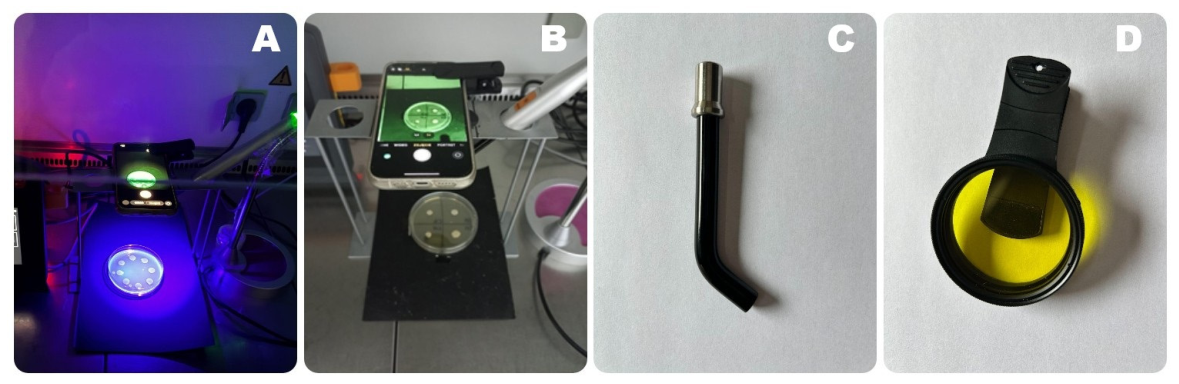
After incubation, fluorescence images of the colonies were acquired during excitation with a 405 nm continuous-wave (CW) diode laser (SmartM, Lasotronix, Piaseczno, Poland) at a power output of 200 mW for 45 s. The laser beam was delivered through a fibre-optic handpiece (Figure 1C) and positioned at a standardised working distance of 11 cm from the colony surface, perpendicular to the plate. The illumination spot at the sample surface had a diameter of 8 mm, corresponding to a calculated irradiance of 398 mW/cm2. The beam produced a circular illumination area sufficient to cover individual colonies under standardised conditions. Immediately following laser exposure, fluorescence images were acquired through a yellow emission filter using an iPhone 14 (Apple, Cupertino, CA, USA) at a fixed camera-to-sample distance of 19 cm. The yellow emission filter was used to suppress reflected excitation light while selectively transmitting longer wavelengths corresponding to autofluorescence emission (green to red range), enabling visualisation of fluorescence signals that would otherwise be obscured by the violet excitation light. During image acquisition, all camera modes and automatic image enhancement functions were disabled to avoid artificial modification in colour and brightness parameters and to ensure standardised and reproducible imaging conditions. The experimental setup is shown in Figure 1A–D.

2.4. Image Preprocessing, ROI Selection, and Quantitative Analysis

Raw RGB images were imported into ImageJ software (version 1.54) for analysis. Each image was processed independently. Images were converted from RGB to HSB colour space using the HSB Stack function, and the Hue channel was extracted for further quantitative analysis. The HSB/HSV colour model was selected because it separates colour tone from saturation and brightness, whereas RGB values combine chromatic and intensity-related information in three colour channels. Since the purpose of this study was to monitor temporal changes in the apparent fluorescence colour rather than absolute fluorescence intensity, the Hue parameter was considered the most appropriate descriptor. This approach reduced the direct influence of brightness variations and enabled a more comparable assessment of colour shifts in fungal autofluorescence over time. Hue values were expressed on a scale from 0 to 255.
For each plate, regions of interest (ROIs) were manually defined, including individual ROIs corresponding to fungal colonies (c1–c8) and one background ROI selected from an agar area devoid of colonies and distant from plate edges. Background ROIs were consistently defined on the agar surface to minimise illumination-related bias. Colony ROIs were selected using circular areas while avoiding colony edges to reduce optical artifacts and illumination gradients.
For each ROI, the minimum (Hmin), mean (Hmean), and maximum (Hmax) hue values were recorded. The mean hue of the agar background (Hmean_BG) was also calculated for each plate. The primary quantitative parameter used for statistical analysis in the present study was the mean hue value (Hmean) of the colony ROI.

2.5. Qualitative Visual Assessment of Images

In addition to quantitative image analysis, fluorescence images acquired at each incubation time point were subjected to qualitative visual assessment. The aim of this assessment was to determine the visible presence of autofluorescence in the analysed fungal strains and to describe its apparent changes during colony growth.
The image analysis was performed by one researcher experienced in the assessment of fungal autofluorescence. The visual evaluation focused on the presence or absence of detectable signal, its apparent intensity, colour appearance, and spatial distribution within individual colonies. The assessment also included observation of temporal changes in the apparent autofluorescence signal across successive incubation time points. Particular attention was paid to the spatial distribution of the autofluorescence signal, specifically whether it was homogeneous (diffuse) or localised within specific regions of the colony.
The qualitative assessment served as a descriptive complement to the quantitative analysis of mean hue values and was not used as an independent criterion for statistical classification.

2.6. Statistical Analysis

In the current analysis, main focus was put on defining the source of differences in hue among different fungal strains. Since hue is a “circular” variable (where 255 defines hue is almost the same as 1), appropriate (sinusoidal/cosinusoidal) data transformation was considered. However, because the results were restricted to a narrow range (4–114), circular boundary effects are neglected. Therefore, hue could be treated as a normal continuous variable without biasing the results. Multifactorial ANOVA was used to determine the factors influencing the hue, and Tukey’s post hoc test within single growth time was used to determine significance of differences in hue among different strains. Due to large number of comparisons, confidence threshold was set to p = 0.01. Statistical analysis was performed in R statistical environment v 4.4.2 (R Core Team, 2024, R Foundation for Statistical Computing, Vienna, Austria) with additional libraries [29,30], used for data visualisation.

3. Results

3.1. Effect of Strain and Time on Mean Colony Hue

Both fungal strain and the interaction between strain and colony incubation time significantly affected mean colony hue values (p < 0.001; Table 2, Supplementary Table S1). This indicates that the pattern of hue change over colony incubation time was strain dependent.

3.2. Strain-Specific Temporal Patterns of Hue Change

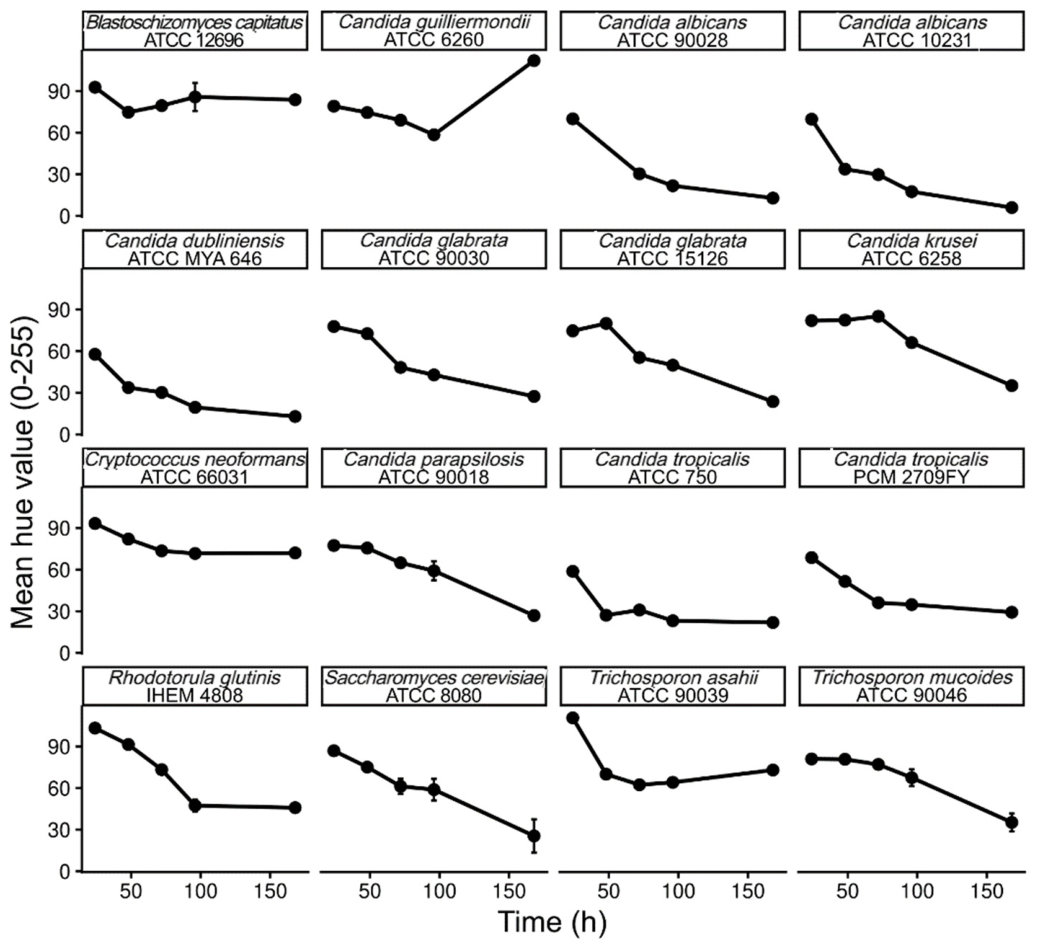
As shown in Figure 2, most fungal strains exhibited an overall decrease in mean hue during cultivation, although the magnitude and temporal pattern of this decrease varied between strains. In several strains, the reduction in mean hue was already evident between 24 h and 48 h, whereas in others it became more pronounced at later incubation stages. This indicates that temporal changes in autofluorescence were not uniform but followed strain-specific trajectories. A relatively stable pattern was observed for Blastoschizomyces capitatus ATCC 12696, which maintained high mean hue values throughout the entire observation period, showing only minor fluctuations. In contrast, Candida guilliermondii ATCC 6260 displayed a distinct non-monotonic pattern: after an initial decrease between 24 h and 96 h, a marked increase in mean hue was observed at 168 h, making this strain clearly different from the general downward trend seen in most other strains.
Several strains, including Candida albicans ATCC 90028, Candida albicans ATCC 10231, Candida dubliniensis ATCC MYA 646, Candida glabrata ATCC 90030, Candida glabrata ATCC 15126, Candida krusei ATCC 6258, Candida parapsilosis ATCC 90018, Rhodotorula glutinis IHEM 4808, Saccharomyces cerevisiae ATCC 8080, and Trichosporon mucoides ATCC 90046, showed a more typical decreasing pattern, with progressively lower mean hue values over colony incubation time. However, the steepness of decline differed between strains, suggesting differences in the dynamics of autofluorescence changes during colony growth. A less uniform temporal pattern was observed for Trichosporon asahii ATCC 90039, Candida tropicalis ATCC 750, and Candida tropicalis PCM 2709FY. In these strains, the decrease in mean hue was not continuous across all incubation time points and was followed by relative stabilisation after 48 h. This suggests that, in some strains, the most pronounced change in autofluorescence occurred during the early phase of cultivation, whereas later incubation time points were characterised by smaller fluctuations.

3.3. Differences Between Strains at Individual Incubation Time Points

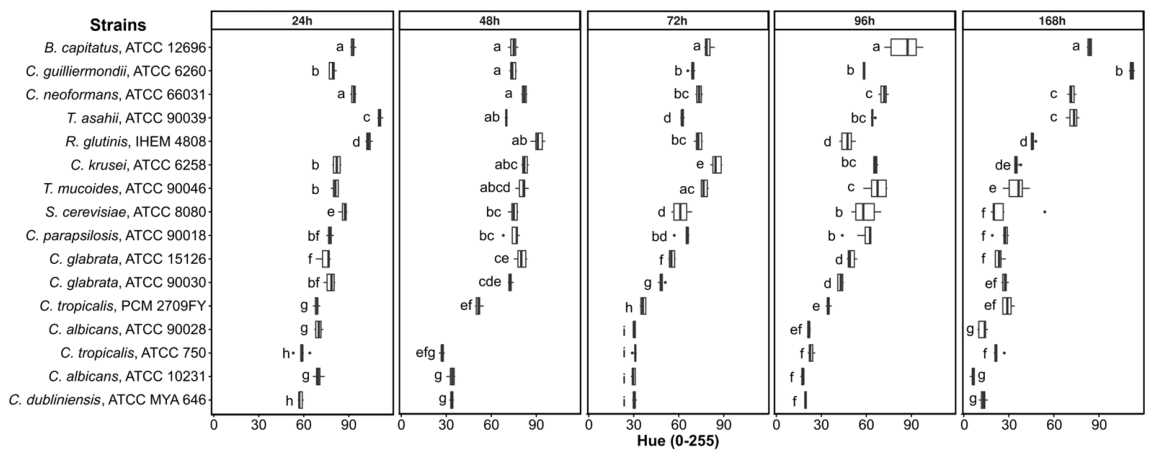
At individual incubation time points, most strains differed significantly from one another (Figure 3). The measurements showed low within-group variability, as indicated by the narrow distributions observed in most groups. In addition, some strains displayed distinct mean hue values, being significantly different from the remaining strains at selected incubation time points: Trichosporon asahii ATCC 90039, Rhodotorula glutinis IHEM 4808, and Saccharomyces cerevisiae ATCC 8080 at 24 h; Candida krusei ATCC 6258, Candida glabrata ATCC 15126, and Candida glabrata ATCC 90030 at 72 h; Blastoschizomyces capitatus ATCC 12696 at 96 h; and Blastoschizomyces capitatus ATCC 12696 together with Candida guilliermondii ATCC 6260 at 168 h.

3.4. Overall Mean Hue Range Across the Entire Observation Period

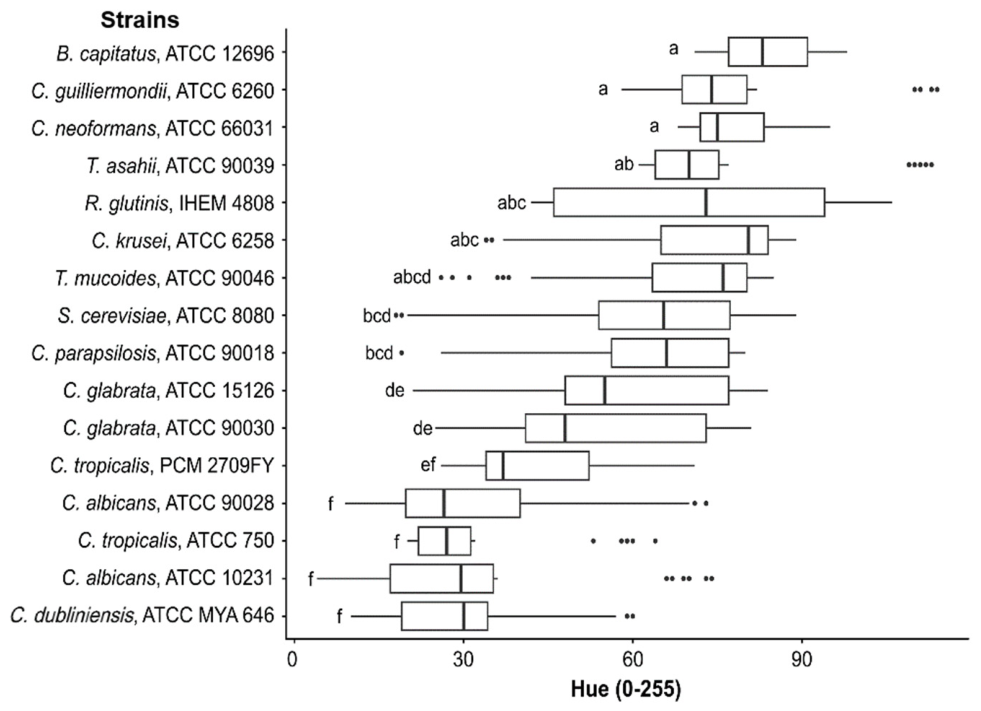
When measurements from all incubation time points were analysed together, the range of mean hue values observed for each strain became broader and the separation between strains was less distinct than at individual cultivation time points (Figure 4). This broadening of within-strain distributions reflects temporal variability in colony autofluorescence during growth. As a result, strains that appeared clearly separated at selected incubation times showed partially overlapping mean hue ranges when the full 24–168 h cultivation period was considered. Despite this overlap, some strains still occupied relatively distinct positions within the overall distribution. Blastoschizomyces capitatus ATCC 12696 and Candida guilliermondii ATCC 6260 were located in the upper part of the hue range, whereas Candida albicans ATCC 10231, Candida dubliniensis ATCC MYA 646, and Candida tropicalis ATCC 750 were among the strains with the lowest mean hue values. Most of the remaining strains formed intermediate and partially overlapping distributions, indicating limited discriminatory value of mean hue when all cultivation times were analysed jointly.
The grouping indicated by lowercase letters further shows that, although some statistically significant differences between strains were retained, the overall pattern was less distinct than in the time-specific comparisons. These findings can indicate that mean hue may be useful for differentiating fungal strains under strictly controlled incubation times, but its discriminatory power decreases when temporal variation across the entire cultivation period is included.

3.5. Qualitative Assessment of Autofluorescence

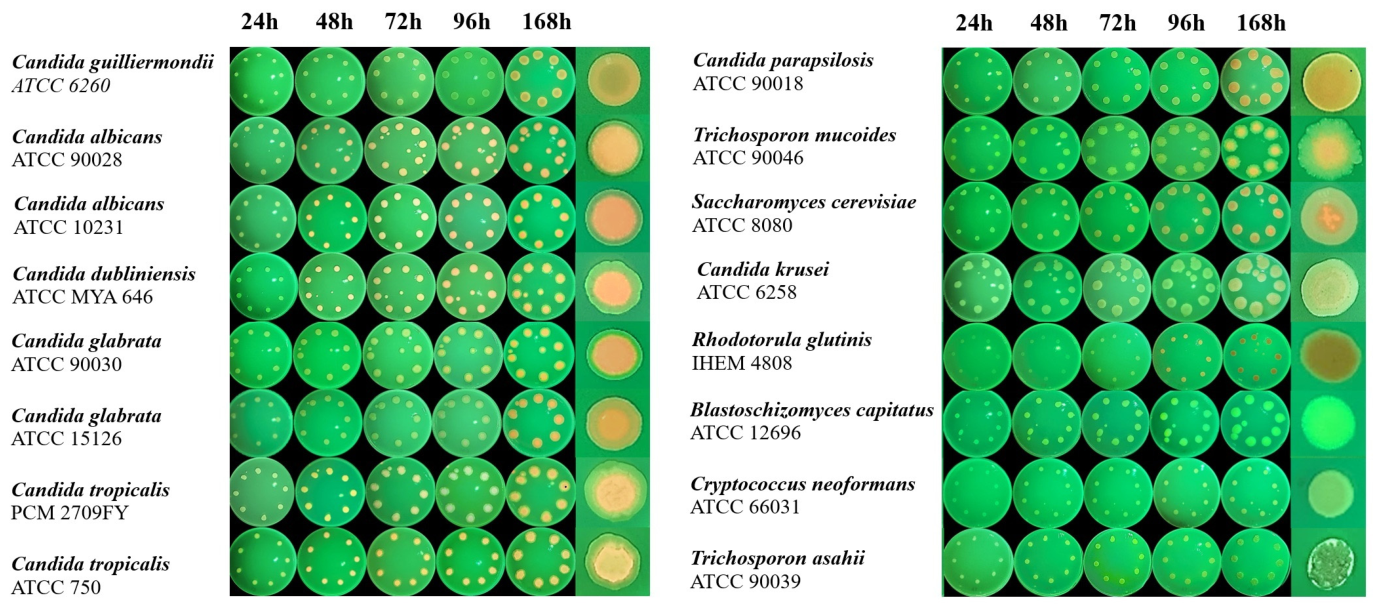
Fluorescence images acquired at successive incubation time points revealed visual differences in the autofluorescence characteristics of the analysed fungal strains (Figure 5). In most strains, a gradual shift in colony colour from green towards yellow and orange tones was observed over time, consistent with the decrease in mean hue values obtained in the quantitative analysis. This transition was particularly evident between early (24–48 h) and late (96–168 h) stages of incubation. The spatial distribution of autofluorescence within colonies also varied between strains. In some cases, the fluorescence signal appeared relatively uniform across the colony surface, whereas in others it was more localised, forming distinct regions of increased intensity. Certain strains exhibited distinct visual patterns that corresponded to the quantitative findings demonstrated a noticeable shift towards warmer colour tones at 168 h. Other strains showed more gradual or less pronounced changes, reflecting the strain-specific dynamics of autofluorescence observed in the statistical analysis. Notably, Candida spp. tended to exhibit more pronounced temporal changes, compared to other genera, reflected by a stronger shift toward warmer hues during incubation. However, these observations relate to changes in hue rather than absolute fluorescence intensity.

4. Discussion

Autofluorescence of the studied fungal strains exhibited marked temporal variability and significant inter-strain differentiation, confirming its dynamic nature. The present study demonstrated that mean hue values differed significantly between strains at individual incubation time points, with low within-group variability, indicating good measurement repeatability. These findings suggest that autofluorescence-based colour analysis may support strain differentiation under strictly defined growth conditions. However, when the entire cultivation period (24–168 h) was analysed jointly, substantial overlap in mean hue ranges was observed between strains, which markedly limited the usefulness of this parameter as a standalone identification marker. At the same time, the different temporal trajectories of colour change observed in individual strains indicate the presence of strain-specific autofluorescence profiles, consistent with the significant strain × time interaction found in the statistical analysis. Overall, these findings suggest that mean hue can support differentiation under controlled conditions, but its diagnostic value depends heavily on standardised incubation timing and an understanding of the temporal behaviour of the fluorescence signal. Similar challenges related to time-dependent variability have been noted in earlier studies [2,10].
The observed temporal changes in autofluorescence are likely to have a biological basis and to be related to cellular metabolic activity. Microbial fluorescence results from the presence of endogenous fluorophores, such as NAD(P)H, flavins, and porphyrins, whose concentrations and relative proportions may change during colony growth. Importantly, emission in the red to orange spectral range is primarily associated with porphyrins, including protoporphyrin IX, coproporphyrin III, and uroporphyrins, whereas flavins and NAD(P)H typically contribute to green to yellow fluorescence. The composition of these fluorophores is heterogeneous and strain-dependent, reflecting differences in metabolic pathways and redox balance [2,10]. Moreover, porphyrins are not uniformly present throughout colony development but may accumulate as metabolic by-products over time, contributing to the observed temporal shifts toward warmer hue values. Changes in the levels of these compounds, particularly in the context of redox reactions and cofactor biosynthesis, may lead to shifts in the emission spectrum, which can be reflected in changes in mean hue [27,31,32]. Differences in the course of these processes between strains may explain the strain-specific dynamics of autofluorescence observed in the present study. In our results, most strains showed an overall decrease in mean hue during cultivation, whereas Blastoschizomyces capitatus remained relatively stable and Candida guilliermondii exhibited a marked increase at 168 h, indicating distinct temporal patterns of fluorescence change between strains. According to data from Tkaczyk et al. [33], autofluorescence levels are closely related to the metabolic state of cells, while Wiench et al. [2] demonstrated that differences between Candida strains may result from distinct metabolic profiles. Additionally, Petruzzi et al. [10] indicated that, in vivo, this relationship may be further modulated by the presence of biofilm, thereby increasing signal variability. Our results support the idea that autofluorescence reflects ongoing biological activity and that its interpretation must account for both incubation time and strain-specific metabolic characteristics.
The type of excitation light source used is crucial for the interpretation of autofluorescence results. Autofluorescence can be induced by excitation in both the ultraviolet (250–380 nm) and visible (400–450 nm) spectral ranges. In the present study, a 405 nm laser was used, allowing for effective excitation of a broad range of endogenous fluorophores, including NAD(P)H, flavins, and porphyrins associated with microbial metabolic activity [2,25]. The use of 405 nm excitation represents a compromise between signal intensity and selectivity, as this wavelength lies close to the absorption maxima of many biologically relevant fluorophores, enabling strong and high-contrast fluorescence signals. At the same time, it is less harmful than UV excitation and more compatible with standard optical systems. Compared to LED-based systems such as VELscope, which use broadband light (400–460 nm), laser excitation provides a more targeted stimulus and may offer greater specificity of the fluorescence signal [25,34,35]. However, despite the use of a selective excitation source, overlap in mean hue ranges between strains was observed when the full cultivation period was analysed jointly. In our results, strain-specific differences were more distinct at individual time points, whereas pooling the 24–168 h observations reduced the separation between strains. This may suggest that the limitations of the method stem not only from technical parameters but primarily from the biological variability in autofluorescence, which is related to the dynamics of metabolic processes [36].
Previous studies have focused primarily on signal intensity analysis [26,37]. The present study demonstrated that mean hue changed over time and differed between strains, which may reflect changes in the relative contribution of individual fluorophores. Analysis in HSV space allows for a more objective assessment of colour than the RGB model and is less directly influenced by changes in light intensity, as has been shown in studies on biomedical image analysis [38,39]. Therefore, mean hue may represent a sensitive indicator of biological changes occurring during colony growth. At the same time, it should be emphasised that analysis covering the entire cultivation period revealed substantial overlap in mean hue ranges between strains, limiting the diagnostic value of this parameter when used alone. In our results, strain-specific differences were clearer at individual incubation time points, whereas pooling all time points reduced the separation between strains. This may indicate that colour analysis should be considered a supportive approach that requires further validation and combination with other analytical methods. Although the mean hue value has limited diagnostic value as a standalone parameter throughout the culture period, the presented approach may have broader applications as a research tool [40]. Quantitative autofluorescence analysis based on the HSV model may support studies evaluating fungal metabolism, stress responses, and temporal autofluorescence dynamics under controlled monoculture conditions [28]. In particular, the strain-dependent trajectories observed in our study suggest that autofluorescence patterns may reflect fundamental physiological and metabolic processes. Therefore, this approach could be particularly useful in microbiology and biotechnology, where environmental conditions can be strictly standardised and biological variability is lower than in clinical settings.
Last but not least, the observed differences in autofluorescence between species should be interpreted not only as a reflection of variations in cellular metabolic activity, but also in the context of the specific mycobiological characteristics of the fungi studied. The analysed group included representatives of taxonomically and physiologically diverse genera—such as Candida, Trichosporon, Cryptococcus, Rhodotorula, and Blastoschizomyces—which differ in phylogeny, colony morphology, ability to form filaments, pigment production, capsule presence, and cell surface organisation. For this reason, fungal autofluorescence should be viewed as a complex phenotypic optical signal arising from the combined effects of endogenous fluorophores, light-absorbing pigments, cellular structural features, and culture conditions. In addition to metabolic fluorophores such as NAD(P)H, flavins, and porphyrins, other compounds—including carotenoids, melanins, phenolic pigments, and lipofuscin-like substances—may also contribute to the recorded signal. This is particularly important in pigmented genera. For example, yeasts of the genus Rhodotorula produce carotenoids such as β-carotene, torulene, and torularhodin. These pigments are responsible for the characteristic yellow–orange to pink–red coloration of the colonies and may influence autofluorescence by selectively absorbing light and altering its propagation within the colony [41]. Similarly, Cryptococcus neoformans is known for its polysaccharide capsule and ability to synthesise melanin. Melanin and melanin-like compounds can absorb and scatter light in the UV and visible ranges, which may attenuate, mask, or shift the spectral properties of fluorescence emitted by other endogenous fluorophores [42]. A similar mechanism may also apply to Trichosporon spp., which have been reported to produce melanin-like particles in the presence of phenolic precursors such as L-DOPA [43]. In contrast, in Candida spp., autofluorescence is more likely to be associated primarily with endogenous metabolic fluorophores—such as porphyrins, flavins, and NAD(P)H—rather than visible pigmentation, although stress-induced mitochondrial changes may also affect autofluorescent properties [44]. Finally, autofluorescence excited by 405 nm light should not be interpreted as a marker of a single chemical compound, but rather as a global optical signature of fungal colonies. It is also important to note that hue analysis does not allow for the direct identification of individual fluorophores or pigments, nor can it distinguish between true fluorescence emission and optical effects such as absorption or scattering caused by pigments like carotenoids or melanins.
A key limitation of this study is its in vitro design, which does not fully capture the complexity of clinical environments. In vivo, autofluorescence may be influenced by biofilm formation, interactions with other microorganisms, and environmental factors such as pH or nutrient availability [45]. Moreover, because the fungal strains were exposed to repeated laser excitation, photobleaching and light-induced biological reactions may have occurred. Since light illumination may act as a stress factor in fungal strains, part of the observed temporal variability in hue could have been influenced by repeated exposure [28,45]. Although all strains were analysed under the same conditions, allowing for relative comparisons between groups, future studies should include colonies maintained in darkness between excitation sessions and/or independent samples exposed only once at each time point. This would help to better distinguish intrinsic biological autofluorescence dynamics from light-induced effects. Another limitation is the strong temporal variability in mean hue, which leads to overlapping ranges between strains and reduces its diagnostic value as a standalone parameter. A practical aspect worth noting is that the images were captured using a smartphone rather than a professional imaging system. Although this might be considered a limitation in highly controlled optical studies, all imaging parameters, including distance, filtration, and camera settings, were standardised in our setup. This demonstrates that a simple and accessible imaging approach can still provide internally consistent measurements. Future work should focus on strict timing standardisation and on analysing a broader set of image-derived features. Combining colour information with intensity, texture, or structural parameters, potentially through machine learning, may significantly improve classification accuracy and enhance the analytical and classification potential of autofluorescence-based methods. It should be noted that the present study was conducted using reference strains, which are relatively homogeneous in terms of metabolic activity. Future studies should therefore include clinical isolates obtained directly from patients, which may better reflect the biological variability encountered in vivo. In particular, investigating mixed-species biofilms, including typical bacterial–fungal communities of the oral cavity, may provide more clinically relevant insights into autofluorescence patterns. Additionally, correlating in vitro findings with in vivo observations, for example on oral mucosal surfaces, would be essential for validating the potential applicability of this approach. In this context, autofluorescence imaging may have potential as a rapid screening tool for the detection and differentiation of microbial colonisation.

5. Conclusions

This study shows that the autofluorescence of fungal colonies illuminated with 405 nm light varies with both the strain and the incubation time. At several observation points, the strains displayed significantly different mean hue values, which suggests that colour-based fluorescence analysis can help distinguish strains when experimental conditions are tightly controlled. However, when the entire growth period was considered, the hue ranges overlapped to a large extent, limiting the usefulness of mean hue as an independent diagnostic measure. The findings also indicate that analysing fluorescence colour in the HSV space, particularly through mean hue, offers an objective and reproducible way to track temporal changes in fungal autofluorescence. The distinct patterns observed for individual strains further support the idea that autofluorescence reflects dynamic biological processes occurring during colony development. Therefore, mean hue analysis may serve as a supportive tool in autofluorescence studies and as a useful experimental approach for investigating fungal metabolism or stress responses under controlled culture conditions. Still, broader diagnostic use will require strict standardisation of imaging conditions and incubation timing, as well as validation in models that better reflect clinical settings. Future studies should also explore combining colour-based metrics with additional image-derived features to improve classification performance and broaden the applicability of autofluorescence analysis in the fields of experimental microbiology and biotechnology.

Supplementary Materials

The following supporting information can be downloaded at: https://www.mdpi.com/article/10.3390/app16115475/s1, Table S1. Raw data containing the mean hue values obtained for the analysed fungal strains at each incubation time point.

Author Contributions

Conceptualisation, A.U., J.M. and M.D.; methodology, J.M., M.P., J.N.; software, A.U.; validation, J.M., M.D., R.W. and D.S.; formal analysis, M.K.; investigation, M.P. and J.N.; resources, M.D., J.N., M.P.; data curation, M.K. and A.U.; writing—original draft preparation, A.U., M.P., J.N. and J.K.; writing—review and editing, J.M., R.W. and J.K.; visualisation, J.K.; supervision, J.M., R.W. and D.S.; project administration, J.M.; funding acquisition, J.M. and M.D. All authors have read and agreed to the published version of the manuscript.

Funding

The APC costs were co-financed by a subsidy from Wroclaw Medical University, number SUBZ.B180.26.012.

Institutional Review Board Statement

Not applicable.

Informed Consent Statement

Not applicable.

Data Availability Statement

The original contributions presented in this study are included in the article/Supplementary Materials. Further inquiries can be directed to the corresponding author.

Acknowledgments

This work was carried out as part of project No. 1/05/2025 entitled “Application of the 405 nm SMARTm laser manufactured by LASOTRONIX® for the detection of red-orange autofluorescence of pathogenic bacteria”.

Conflicts of Interest

The authors declare no conflicts of interest.

References

  1. Lane, P.M.; Gilhuly, T.; Whitehead, P.; Zeng, H.; Poh, C.F.; Ng, S.; Williams, P.M.; Zhang, L.; Rosin, M.P.; MacAulay, C.E. Simple Device for the Direct Visualization of Oral-Cavity Tissue Fluorescence. J. Biomed. Opt. 2006, 11, 024006. [Google Scholar] [CrossRef] [PubMed]
  2. Wiench, R.; Paliga, D.; Mertas, A.; Bobela, E.; Kuśka-Kiełbratowska, A.; Bordin-Aykroyd, S.; Kawczyk-Krupka, A.; Grzech-Leśniak, K.; Lukomska-Szymanska, M.; Lynch, E.; et al. Red/Orange Autofluorescence in Selected Candida Strains Exposed to 405 Nm Laser Light. Dent. J. 2024, 12, 48. [Google Scholar] [CrossRef]
  3. Lemire, S.; Thoma, O.-M.; Kreiss, L.; Völkl, S.; Friedrich, O.; Neurath, M.F.; Schürmann, S.; Waldner, M.J. Natural NADH and FAD Autofluorescence as Label-Free Biomarkers for Discriminating Subtypes and Functional States of Immune Cells. Int. J. Mol. Sci. 2022, 23, 2338. [Google Scholar] [CrossRef]
  4. Muñoz-Egea, M.-C.; García-Pedrazuela, M.; Mahillo, I.; García, M.J.; Esteban, J. Autofluorescence as a Tool for Structural Analysis of Biofilms Formed by Nonpigmented Rapidly Growing Mycobacteria. Appl. Environ. Microbiol. 2013, 79, 1065–1067. [Google Scholar] [CrossRef]
  5. Okebiorun, M.O.; Oberbeck, C.; Waite, C.; Clark, S.; Alomar, Z.; Miller, D.; Cornell, K.; Browning, J. Autofluorescence-Guided Removal of Bacterial Biofilms From Tissues Using Cold Atmospheric Pressure Plasma (CAP). IEEE Trans. Radiat. Plasma Med. Sci. 2024, 8, 990–996. [Google Scholar] [CrossRef] [PubMed]
  6. Weisel, R.L. Auto Fluorescence Allows Us to Detect Early Signs of Oral Cancer and Much More. J. Dent. Oral Sci. 2021, 3, 1–6. [Google Scholar] [CrossRef]
  7. Fukatsu, A.; Tsuzukibashi, O.; Fuchigami, M.; Ono, Y.; Uchibori, S.; Takahashi, Y.; Komine, C.; Umezawa, K.; Hayashi, S.; Asano, T.; et al. Origin of Candida albicans in Human Oral Cavity. Open J. Stomatol. 2022, 12, 137–145. [Google Scholar] [CrossRef]
  8. Jayatilake, J.A.M.S.; Samaranayake, Y.H.; Cheung, L.K.; Samaranayake, L.P. Quantitative Evaluation of Tissue Invasion by Wild Type, Hyphal and SAP Mutants of Candida albicans, and Non-albicans Candida Species in Reconstituted Human Oral Epithelium. J. Oral Pathol. Med. 2006, 35, 484–491. [Google Scholar] [CrossRef] [PubMed]
  9. Sun, J.; Vellappan, S.; Akdemir, J.; Steier, L.; Feinbloom, R.; Yadavalli, S.S. Imaging of Porphyrin-Specific Fluorescence in Pathogenic Bacteria In Vitro Using a Wearable, Hands-Free System. J. Microbiol. Methods 2024, 237, 107225. [Google Scholar] [CrossRef]
  10. Petruzzi, M.; Della Vella, F.; Cassandro, A.; Mosca, A.; Di Comite, M.; Contaldo, M.; Grassi, F.R.; Lauritano, D. Dorsal Tongue Porphyrin Autofluorescence and Candida Saprophytism: A Prospective Observational Study. PLoS ONE 2019, 14, e0223072. [Google Scholar] [CrossRef]
  11. Reynolds, J.; Sosnowski, K.; Carlson, C.; McGuire, T.D.; Roman, W.; Yoon, J.-Y. Smartphone-Based Multispectral Autofluorescence Analysis of Bacteria Mixtures of Staphylococci Using Convolutional Neural Network. J. Biol. Eng. 2026, 20, 15. [Google Scholar] [CrossRef] [PubMed]
  12. Sun, X.; Wang, Y.; Du, A.; Dong, M.; Wang, Y.; Zhang, Y.; Zhang, Y.; Huang, Y.; Huang, X.; Liu, Y.; et al. Autofluorescence Properties of Wound-Associated Bacteria Cultured Under Various Temperature, Salinity, and pH Conditions. BMC Microbiol. 2025, 25, 511. [Google Scholar] [CrossRef]
  13. Ticer, T.D.; Tingler, A.M.; Glover, J.S.; Dooley, S.A.; Kendrick, J.; Zackular, J.P.; Devkota, S.; Wu, G.D.; Mahalak, K.; Engevik, A.; et al. Bacterial Metabolites Influence the Autofluorescence of Clostridioides Difficile. Front. Microbiol. 2024, 15, 1459795. [Google Scholar] [CrossRef]
  14. Irianto, V.S.; Plocek, V.; Bharti, R.; Maršíková, J.; Váchová, L.; Palková, Z. Spatial Structure of Yeast Biofilms and the Role of Cell Adhesion across Different Media. Biofilm 2025, 10, 100306. [Google Scholar] [CrossRef]
  15. Da Silva, F.C.; Fernandes Rodrigues, P.L.; Santos Dantas Araújo, T.; Sousa Santos, M.; De Oliveira, J.M.; Pereira Rosa, L.; De Oliveira Santos, G.P.; De Araújo, B.P.; Bagnato, V.S. Fluorescence Spectroscopy of Candida albicans Biofilms in Bone Cavities Treated with Photodynamic Therapy Using Blue LED (450 Nm) and Curcumin. Photodiagnosis Photodyn. Ther. 2019, 26, 366–370. [Google Scholar] [CrossRef] [PubMed]
  16. Daims, H.; Wagner, M. Quantification of Uncultured Microorganisms by Fluorescence Microscopy and Digital Image Analysis. Appl. Microbiol. Biotechnol. 2007, 75, 237–248. [Google Scholar] [CrossRef] [PubMed]
  17. Breeuwer, P.; Abee, T. Assessment of Viability of Microorganisms Employing Fluorescence Techniques. Int. J. Food Microbiol. 2000, 55, 193–200. [Google Scholar] [CrossRef]
  18. Bhattacharjee, A.; Datta, R.; Gratton, E.; Hochbaum, A.I. Metabolic Fingerprinting of Bacteria by Fluorescence Lifetime Imaging Microscopy. Sci. Rep. 2017, 7, 3743. [Google Scholar] [CrossRef] [PubMed]
  19. Huang, H.-W.; Zhang, Y. Flame Colour Characterization in the Visible and Infrared Spectrum Using a Digital Camera and Image Processing. Meas. Sci. Technol. 2008, 19, 085406. [Google Scholar] [CrossRef]
  20. Soni, A.; Dixit, Y.; Reis, M.M.; Brightwell, G. Hyperspectral Imaging and Machine Learning in Food Microbiology: Developments and Challenges in Detection of Bacterial, Fungal, and Viral Contaminants. Compr. Rev. Food Sci. Food Saf. 2022, 21, 3717–3745. [Google Scholar] [CrossRef]
  21. Kurniastuti, I.; Yuliati, E.N.I.; Yudianto, F.; Wulan, T.D. Determination of Hue Saturation Value (HSV) Color Feature in Kidney Histology Image. J. Phys. Conf. Ser. 2022, 2157, 012020. [Google Scholar] [CrossRef]
  22. Muratbekova, M.; Toganas, N.; Igali, A.; Shagyrov, M.; Kadyrgali, E.; Yerkin, A.; Shamoi, P. Color Models in Image Processing: A Review and Experimental Comparison. Discov. Appl. Sci. 2026, 8, 494. [Google Scholar] [CrossRef]
  23. Matys, J.; Kensy, J.; Gedrange, T.; Zawiślak, I.; Grzech-Leśniak, K.; Dobrzyński, M. A Molecular Approach for Detecting Bacteria and Fungi in Healthcare Environment Aerosols: A Systematic Review. Int. J. Mol. Sci. 2024, 25, 4154. [Google Scholar] [CrossRef] [PubMed]
  24. Evren, E.; Göçmen, J.S.; İŞtar, E.H.; Yavuzdemir, Ş.; Tekeli, F.A.; Yavuz, Y.; Karahan, Z.C. Medically Important Candida spp. Identification: An Era beyond Traditional Methods. Turk. J. Med. Sci. 2022, 52, 834–840. [Google Scholar] [CrossRef] [PubMed]
  25. Croce, A.C.; Bottiroli, G. Autofluorescence Spectroscopy and Imaging: A Tool for Biomedical Research and Diagnosis. Eur. J. Histochem. 2014, 58, 2461. [Google Scholar] [CrossRef]
  26. Müllerová, L.; Marková, K.; Obruča, S.; Mravec, F. Use of Flavin-Related Cellular Autofluorescence to Monitor Processes in Microbial Biotechnology. Microorganisms 2022, 10, 1179. [Google Scholar] [CrossRef] [PubMed]
  27. Croce, A.C.; Bottiroli, G. Autofluorescence Spectroscopy for Monitoring Metabolism in Animal Cells and Tissues. In Histochemistry of Single Molecules; Pellicciari, C., Biggiogera, M., Eds.; Methods in Molecular Biology; Springer: New York, NY, USA, 2017; Volume 1560, pp. 15–43. [Google Scholar]
  28. Camponeschi, I.; Montanari, A.; Mazzoni, C.; Bianchi, M.M. Light Stress in Yeasts: Signaling and Responses in Creatures of the Night. Int. J. Mol. Sci. 2023, 24, 6929. [Google Scholar] [CrossRef]
  29. Wickham, H. Ggplot2; Use R! Springer International Publishing: Cham, Switzerland, 2016; ISBN 978-3-319-24275-0. [Google Scholar]
  30. Wickham, H.; Bryan, J. R Packages; O’Reilly Media, Inc.: Sebastopol, CA, USA, 2023; ISBN 978-1-0981-3491-4. [Google Scholar]
  31. Stiefel, P.; Schmidt-Emrich, S.; Maniura-Weber, K.; Ren, Q. Critical Aspects of Using Bacterial Cell Viability Assays with the Fluorophores SYTO9 and Propidium Iodide. BMC Microbiol. 2015, 15, 36. [Google Scholar] [CrossRef]
  32. Malakar, P.K.; Brocklehurst, T.F.; Mackie, A.R.; Wilson, P.D.G.; Zwietering, M.H.; Van’T Riet, K. Microgradients in Bacterial Colonies: Use of Fluorescence Ratio Imaging, a Non-Invasive Technique. Int. J. Food Microbiol. 2000, 56, 71–80. [Google Scholar] [CrossRef]
  33. Tkaczyk, M.; Mertas, A.; Kuśka-Kiełbratowska, A.; Fiegler-Rudol, J.; Bobela, E.; Cisowska, M.; Morawiec, T.; Skaba, D.; Wiench, R. In Vitro Evaluation of Candida Spp. and Staphylococcus aureus Sensitivity to 450 Nm Diode Laser-Mediated Antimicrobial Photodynamic Therapy with Curcumin and Riboflavin. Int. J. Mol. Sci. 2025, 26, 5645. [Google Scholar] [CrossRef]
  34. Mukunda, D.C.; Joshi, V.K.; Mahato, K.K. Light Emitting Diodes (LEDs) in Fluorescence-Based Analytical Applications: A Review. Appl. Spectrosc. Rev. 2022, 57, 1–38. [Google Scholar] [CrossRef]
  35. Croce, A.C. Light and Autofluorescence, Multitasking Features in Living Organisms. Photochem 2021, 1, 67–124. [Google Scholar] [CrossRef]
  36. Chacko, J.V.; Eliceiri, K.W. Autofluorescence Lifetime Imaging of Cellular Metabolism: Sensitivity towards Cell Density, pH, Intracellular and Intercellular Heterogeneity. Cytom. Part A 2019, 95, 56–69. [Google Scholar] [CrossRef]
  37. Monici, M. Cell and Tissue Autofluorescence Research and Diagnostic Applications. In Biotechnology Annual Review; Elsevier: Amsterdam, The Netherlands, 2005; Volume 11, pp. 227–256. [Google Scholar]
  38. Satrya, G.B.; Ramatryana, I.N.A.; Shin, S.Y. Compressive Sensing of Medical Images Based on HSV Color Space. Sensors 2023, 23, 2616. [Google Scholar] [CrossRef]
  39. Cheng, H.D.; Jiang, X.H.; Sun, Y.; Wang, J. Color Image Segmentation: Advances and Prospects. Pattern Recognit. 2001, 34, 2259–2281. [Google Scholar] [CrossRef]
  40. Yamin, D.; Uskoković, V.; Wakil, A.M.; Goni, M.D.; Shamsuddin, S.H.; Mustafa, F.H.; Alfouzan, W.A.; Alissa, M.; Alshengeti, A.; Almaghrabi, R.H.; et al. Current and Future Technologies for the Detection of Antibiotic-Resistant Bacteria. Diagnostics 2023, 13, 3246. [Google Scholar] [CrossRef] [PubMed]
  41. Kot, A.M.; Błażejak, S.; Kurcz, A.; Gientka, I.; Kieliszek, M. Rhodotorula glutinis—Potential source of lipids, carotenoids, and enzymes for use in industries. Appl. Microbiol. Biotechnol. 2016, 100, 6103–6117. [Google Scholar] [CrossRef] [PubMed]
  42. Zaragoza, O. Basic principles of the virulence of Cryptococcus. Virulence 2019, 10, 490–501. [Google Scholar] [CrossRef] [PubMed]
  43. Figueiredo-Carvalho, M.H.; dos Santos, F.B.; Nosanchuk, J.D.; Zancope-Oliveira, R.M.; Almeida-Paes, R. L-Dihydroxyphenylalanine induces melanin production by members of the genus Trichosporon. FEMS Yeast Res. 2014, 14, 988–991. [Google Scholar] [CrossRef]
  44. Diaz, G.; Polonelli, L.; Conti, S.; Messana, I.; Cabras, T.; Putzolu, M.; Falchi, A.M.; Fadda, M.E.; Cosentino, S.; Isola, R. Mitochondrial alterations and autofluorescent conversion of Candida albicans induced by histatins. Microsc. Res. Tech. 2005, 66, 219–228. [Google Scholar] [CrossRef]
  45. Leiva-Sabadini, C.; Berríos, P.; Saavedra, P.; Carrasco-Rojas, J.; González-Aramundiz, J.V.; Vera, M.; Tarifeño-Saldivia, E.; Schuh, C.M.A.P.; Aguayo, S. Biofilm Formation on Collagen Substrates Modulates Streptococcus mutans Bacterial Extracellular Nanovesicle Production and Cargo. Nanoscale Adv. 2025, 7, 5670–5680. [Google Scholar] [CrossRef]
Figure 1. Experimental setup and accessories used for fluorescence imaging: (A) colony imaging under 405 nm laser excitation; (B) diagnostic laser handpiece with a light-sensitive glass applicator and mobile phone used for image acquisition; (C) glass fibre optic applicator (diameter: 8 mm); and (D) yellow emission filter clip (internal diameter: 46 mm).
Applsci 16 05475 g001
Figure 2. Temporal dynamics of mean colony hue in the analysed fungal strains.
Applsci 16 05475 g002
Figure 3. Comparison of colony mean hue distributions among fungal strains at individual cultivation time points; different lowercase letters indicate statistically significant differences between groups, whereas groups sharing the same lowercase letter did not differ significantly according to Tukey’s post hoc test.
Applsci 16 05475 g003
Figure 4. Overall range of colony mean hue values in fungal strains across the 24–168 h cultivation period; different lowercase letters indicate statistically significant differences between groups, whereas groups sharing the same lowercase letter did not differ significantly according to Tukey’s post hoc test.
Applsci 16 05475 g004
Figure 5. Representative fluorescence images of fungal colonies during incubation under 405 nm laser excitation at 24, 48, 72, 96, and 168 h. Changes in colony colour from green toward yellow/orange tones reflect shifts in autofluorescence hue over time.
Applsci 16 05475 g005
Table 1. Reference fungal strains included in this study.
SpeciesCollection No.
Candida albicansATCC 90028
Candida albicansATCC 10231
Candida dubliniensisATCC MYA 646
Candida glabrataATCC 90030
Candida glabrataATCC 15126
Candida parapsilosisATCC 90018
Candida kruseiATCC 6258
Candida tropicalisATCC 750
Candida tropicalisPCM 2709FY
Candida guilliermondiiATCC 6260
Trichosporon asahiiATCC 90039
Trichosporon mucoidesATCC 90046
Rhodotorula glutinisIHEM 4808
Saccharomyces cerevisiaeATCC 8080
Blastoschizomyces capitatusATCC 12696
Cryptococcus neoformansATCC 66031
Table 2. Results of the multifactorial ANOVA. Strain had a significant effect on mean colony hue values. The main effect of incubation time was not significant, indicating that, when averaged across all strains, mean hue did not change consistently over incubation time.
Sum SqDfF Valuep-Value
(Intercept)76,2431887.055<0.001
strain50,7271539.3457<0.001
time1410.16340.6862
Strain × time44,6401534.6248<0.001
Residuals51,570600
Disclaimer/Publisher’s Note: The statements, opinions and data contained in all publications are solely those of the individual author(s) and contributor(s) and not of MDPI and/or the editor(s). MDPI and/or the editor(s) disclaim responsibility for any injury to people or property resulting from any ideas, methods, instructions or products referred to in the content.