Article

Femtosecond Laser Filamentation for Precision Sapphire Dicing: Evolution of Damage Morphology and Sacrificial-Layer-Assisted Optimisation

State Key Laboratory of Widegap Semiconductor Optoelectronic Materials and Technologies, North University of China, Taiyuan 030051, China
*
Author to whom correspondence should be addressed.
Appl. Sci. 2026, 16(11), 5474; https://doi.org/10.3390/app16115474
Submission received: 4 May 2026 / Revised: 22 May 2026 / Accepted: 22 May 2026 / Published: 1 June 2026
(This article belongs to the Special Issue New Trends in Laser Processing for Advanced Manufacturing)

Abstract

To address the critical challenges of edge chipping and poor processing quality in sapphire precision dicing, this paper proposes a femtosecond laser filamentation-guided dicing technology. By systematically investigating the influence of pulse overlap rate, energy, and scan counts on damage evolution, the physical differences between 343 nm UV and 515 nm visible lasers in suppressing plasma shielding and breaking through processing saturation limits are revealed. The results indicate that an extremely high pulse overlap rate (>98%) significantly inhibits lateral energy dissipation and drives the efficient propagation of the filament deep along the optical axis; furthermore, the 343 nm laser demonstrates superior removal rates and localisation compared to the 515 nm laser. Using super-resolution imaging, the precision cleavage cross-section is clearly categorised into four evolutionary stages: general ablation, filament ablation, transition, and mechanical cleavage. To mitigate morphological degradation induced by multiple scans, a sacrificial-layer-assisted strategy is innovatively proposed to achieve spatial damage transfer and in situ self-polishing, effectively eliminating longitudinal damage striations and residual stress-induced hackles. Finally, taper-free, high-precision separation of 1 mm × 450 μm micro-units is successfully achieved on a 220-μm-thick sapphire wafer. This technology not only achieves ultra-low-loss dicing but also establishes a highly efficient, contamination-free in situ characterisation paradigm for buried structures in hard and brittle materials.

1. Introduction

Sapphire (Al2O3) is a quintessential wide-bandgap, hard, and brittle material characterised by excellent optical transparency, extreme mechanical hardness, and high chemical inertness [1]. Consequently, it finds extensive applications in microelectronic packaging, aerospace sensors, and high-end optical windows [2,3,4]. However, these intrinsic hard and brittle properties pose significant challenges for traditional mechanical machining, which frequently leads to severe edge chipping and residual stress. Although non-contact long-pulse laser machining [5,6] improves efficiency, the intense thermal effects often cause substantial ablation loss, random cracking, and uncontrollable macroscopic deformation near the focal zone, failing to meet the manufacturing requirements of high-performance devices [7,8]. In recent years, femtosecond (fs) lasers have emerged as an effective tool for the precision manufacturing of transparent, hard and brittle media like sapphire [9]. By leveraging ultrashort pulse widths and extremely high peak power, they enable “cold machining” through non-linear multi-photon and avalanche ionisation, effectively suppressing the heat-affected zone (HAZ).
Currently, ultrafast laser machining methods for transparent hard and brittle materials encompass various strategies. Laser-induced modification followed by selective etching enables the fabrication of complex geometries, such as modifying the crystalline state for millimetre-long internal structures via wet etching [10,11,12] and the rapid engraving of artificial compound eyes via dry selective etching [13]. Alternatively, laser-induced backside machining relies on interfacial energy transfer to enhance absorption. For instance, backside wet etching utilises mechanisms like laser-induced carbothermal reduction to achieve environmentally friendly processing [14], or employs specific absorbing liquids to lower the etching threshold [15], while dual-beam plasma-assisted ablation has been developed to fabricate crack-free, high-aspect-ratio microstructures [16]. Furthermore, fluid-dynamics-based approaches have been proposed to facilitate material removal; these include liquid-assisted rear-surface drilling [17] and cavitation-assisted ablation, which ingeniously utilises cavitation dynamics to refresh the solid–liquid interface for stable, true 3D nano-sculpturing [18]. However, these hybrid machining methods often involve complex process steps and exhibit low material removal efficiency, making them difficult to apply to macroscopic engineering tasks like dicing thick wafers. To achieve high-precision cutting, researchers have proposed spatial light field modulation techniques, such as Bessel beams, to optimise energy distribution. Rapp et al. [19] utilised high-numerical-aperture Bessel beams to induce nano-voids with aspect ratios of 100:1 inside sapphire and further explored the dynamics of Bessel-beam-induced cleavage [20]. Meyer et al. [21] implemented an improved beam shaper to realise the stealth dicing of centimetre-thick glass, expanding the processing depth. Nevertheless, the essence of this technology lies in generating a series of isolated damage channels inside the material. The linear arrangement of these discrete points forms a weakened plane, which is subsequently fractured by external stress. This often leads to crack propagation deviating from the preset trajectory, resulting in significant edge burrs. Moreover, low energy utilisation and complex optical configurations have limited its widespread industrial application.
In contrast, femtosecond laser-induced filamentation machining (FILM), driven by the non-linear self-focusing effect, has become a rational solution for the precision dicing of high-hardness crystals due to its advantages of long focal depth and high aspect ratio [22]. Liao et al. [23] optimised the light field distribution using circularly polarised light to fabricate smooth millimetre-scale microchannels with a depth of 1.2 mm. Xue et al. [24] achieved high-precision dicing of quartz glass wafers using UV femtosecond laser filaments, confirming that high photon energy in the UV spectrum effectively reduces thermal damage. Wang et al. [25] further combined filament ablation with stealth dicing to realise quartz wafer separation by inducing internal stress-concentration planes. Although FILM has made significant progress in quartz and glass materials, current research mostly focuses on the optimisation of single process parameters [26]. For high-hardness crystals like sapphire, the filament evolution mechanisms and energy deposition laws are far more complex. While ensuring sufficient longitudinal damage depth, challenges such as wide-mouth surface ablation caused by the Gaussian envelope and internal residual stress fluctuations remain to be addressed.
This paper aims to systematically reveal the multi-scale physical laws governing the interaction between femtosecond lasers of different wavelengths and sapphire, thereby achieving high-quality filament-guided precision dicing of sapphire wafers. Utilising a parameter decoupling strategy, the effects of pulse overlap rate, pulse energy, and the number of scans on groove morphology, damage propagation, and material removal efficiency are explored in detail. The physical differences between 343 nm UV and 515 nm visible wavelengths in suppressing plasma shielding and breaking through processing depth saturation limits are comparatively analysed. Furthermore, to address the inevitable V-shaped ablation defects and internal residual stress fluctuations associated with conventional surface focusing, this study proposes a sacrificial-layer-assisted pre-bonding strategy. This approach aims to achieve the spatial transfer of wide-mouth surface damage and in situ plasma polishing. Ultimately, the micro-morphology and regional evolution mechanisms of the stealth dicing composite fractured surface are analysed using optimised UV filament-guided parameters. This research not only expands the process window for ultrafast laser-sapphire interactions but also demonstrates the significant advantages of this scheme in achieving mirror-like flat cross-sections, offering a new perspective for low-loss precision separation and efficient sample preparation of buried structures in high-hardness wafers.

2. Processing Principles and Experimental Methods

2.1. Filamentation Machining Principle

Sapphire crystals exhibit intense nonlinear optical effects under femtosecond laser irradiation. At extremely high peak power, the refractive index of the material undergoes non-linear changes following the laser intensity distribution, causing an increase in the refractive index at the beam centre. This induces a convex-lens-like effect, leading to the continuous contraction of the beam toward the optical axis, known as the Kerr self-focusing effect [27]. The refractive index change induced by the Kerr effect can be expressed as:
Δ n = n 2 I ,
where n 2 is the non-linear refractive index coefficient and I is the laser intensity. The critical peak power P c r required for a femtosecond laser to trigger self-focusing in a medium is given by [28]:
P c r = 3.77 λ 2 8 π n 0 n 2 ,
where λ is the central wavelength of the laser, and n 0 is the linear refractive index of the material. It can be observed that the critical power is proportional to the square of the wavelength; therefore, using a shorter wavelength UV femtosecond laser theoretically yields a lower threshold power for filamentation.
When the peak power of the incident laser exceeds the critical value P c r , the self-focusing effect increases the optical power density, triggering multi-photon ionisation and the formation of high-density plasma. The plasma exerts a defocusing effect on the beam, causing the beam focused by the Kerr effect to re-diverge. Simultaneously, the inherent diffraction effect during beam propagation also contributes to defocusing. When a dynamic equilibrium is reached among Kerr self-focusing, plasma defocusing, and diffraction defocusing, the laser beam propagates stably over a long distance with a nearly constant cross-sectional size, generating the filamentation effect.
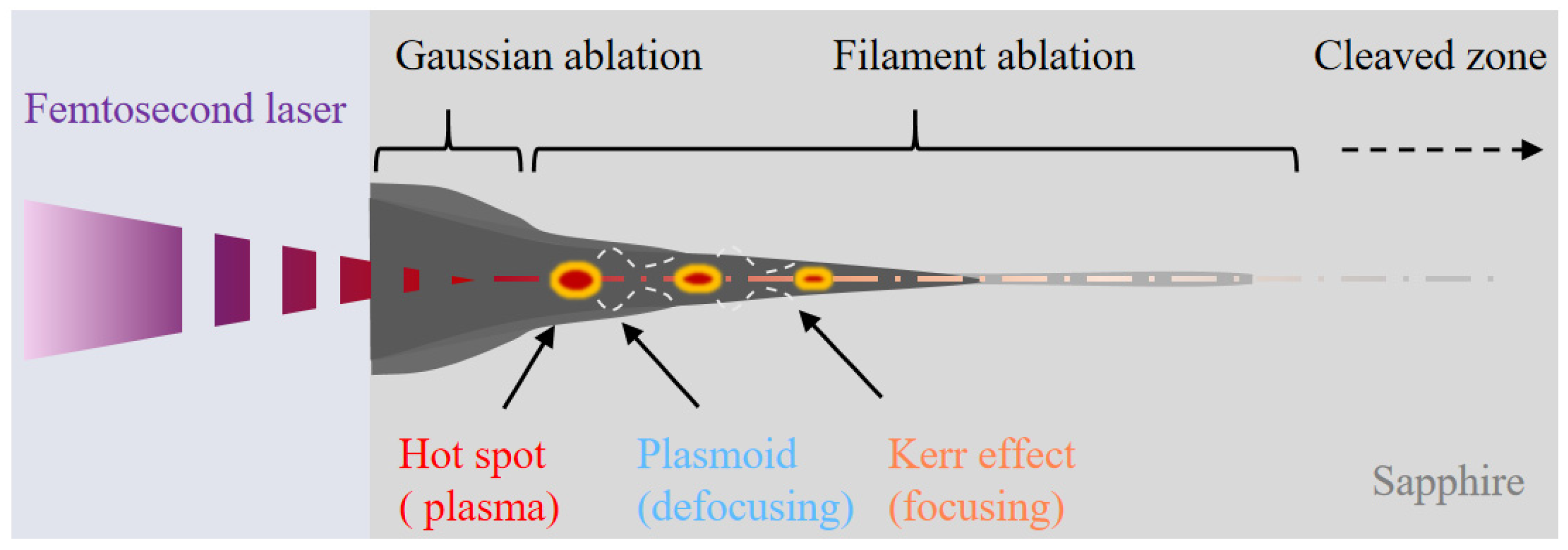
The overall mechanism of sapphire dicing via this femtosecond laser filamentation is schematically illustrated in Figure 1. The dynamic balance between the Kerr focusing effect and plasma defocusing leads to the formation of filaments. As the laser focuses from the material surface, the process transitions from surface Gaussian ablation to internal filament ablation, forming a high-aspect-ratio micro-groove internally along the optical axis with a length far exceeding the Rayleigh length of a Gaussian beam. This induces localised lattice damage and stress concentration at the groove bottom and its extended regions. Upon application of a minimal external mechanical force, cracks propagate directionally along the stress-concentration plane modified by the filament and naturally split along the intrinsic cleavage plane in the bottom region not directly acted upon by the laser, thereby achieving high-quality stealth dicing with zero taper and no edge chipping.

2.2. Experimental Setup and Machining Method

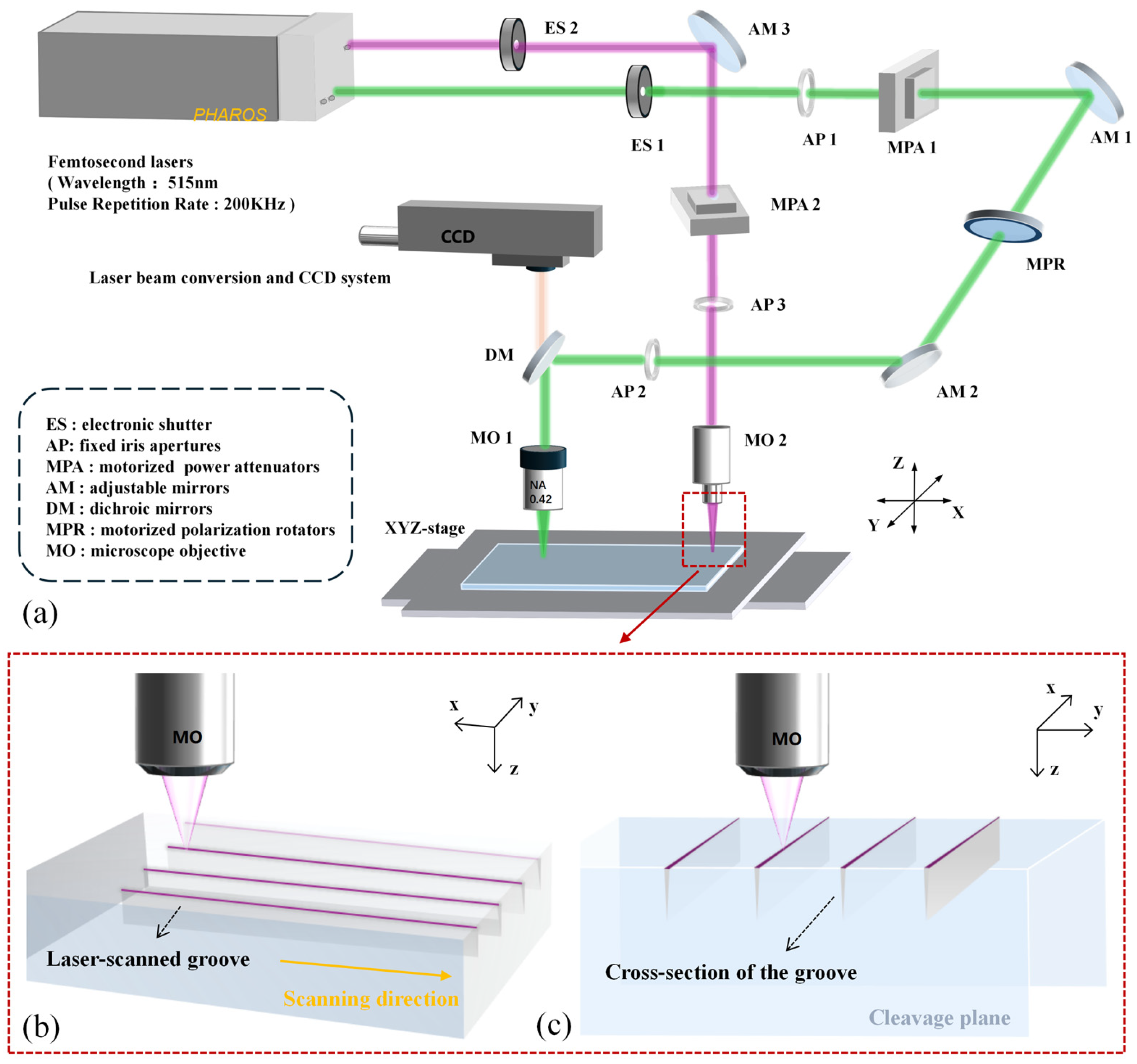
A femtosecond laser machining platform was constructed as shown in Figure 2a, primarily consisting of a femtosecond laser source, a transmission and control optical path, a high-precision positioning stage, and an in situ observation system. A Yb: KGW femtosecond laser was employed, outputting pulses with a pulse width of 290 fs and a central wavelength of 1030 nm. Two working bands, 515 nm and 343 nm, were generated through harmonic generation. The repetition rate was adjustable from a single pulse to 200 kHz, and the laser energy exhibited a near-Gaussian distribution. The output beam passed sequentially through a motorised attenuator and a motorised polarisation rotator to precisely control the pulse energy and polarisation direction. Laser beams of both wavelengths were focused onto the sapphire sample surface via matched optical objectives. To accurately determine the laser-matter interaction parameters, the effective focal spot diameters ( 2 w 0 ) for both wavelengths were experimentally characterised using the diameter-squared ( D 2 ) technique. All fundamental specifications of the femtosecond laser system are summarised in Table 1. The <0001> oriented sapphire wafers (Hefei Kejing Materials Technology Co., Ltd., Hefei, China) were selected for the experiments and fixed onto a high-precision air-bearing triaxial stage (repeatable positioning accuracy of ±0.15 μm, resolution of 1 nm) via gas adsorption. Simultaneously, a beam splitter was used to direct the reflected light from the machining area into a CCD camera to monitor the entire process.
The machining strategy for sapphire groove ablation and precision dicing is illustrated in Figure 2b. A control-variable approach was employed under both laser wavelengths to systematically investigate the effects of pulse overlap rate, pulse energy, and scan counts on the resulting groove morphology, damage depth, and overall dicing quality. To ensure the statistical reliability of these quantitative analyses, all measurements concerning groove dimensions were performed in triplicate through independent machining experiments. The reported data points represent the average values of these measurements, with corresponding error bars indicating the standard deviation. Furthermore, since the average optical power dynamically varies with the set pulse energy and repetition rate, the actual pulse energy ( E a c ) reaching the sample surface was carefully calibrated by accounting for optical transmission losses. Based on E a c and the measured effective focal spot sizes, the actual peak fluence ( F 0 ) and peak intensity ( I 0 ) were accurately calculated. All detailed processing parameters across the different experimental groups are systematically summarised in Table 2.
Following the laser processing, the samples were immersed in a 48.5 wt% hydrofluoric acid (HF) solution at room temperature for 1 h. This step effectively removes laser-induced amorphous debris without significantly altering the intrinsic microstructure of the sapphire substrate. The samples were subsequently rinsed with deionised water, ultrasonically cleaned in anhydrous ethanol, and dried with nitrogen gas. Consequently, it should be clarified that all field-emission scanning electron microscope (FE-SEM, ZEISS, SUPRA-55, Oberkochen Germany) images presented in this study correspond to the chemically etched state. Additionally, a laser confocal microscope (Olympus, LEXT OLS4100, Tokyo Japan) was utilised to profile the surface microstructure and 3D morphology of the machined areas. Notably, the high-quality cross-sectional observations (as shown in Figure 2c) of the sapphire samples were prepared exclusively using our proposed filament-guided precision dicing technology. Based on the optimised parameter sets, minimal external mechanical stress was applied along the scanning direction to induce natural cleavage, allowing for a detailed SEM analysis of the fractured surface morphologies. The successful implementation of this methodology not only facilitates the precise characterisation within this study but also demonstrates its immense potential for high-throughput sample preparation, potentially serving as a highly efficient alternative to certain tasks conventionally performed by Focused Ion Beam (FIB) technology.

3. Results and Discussion

3.1. Influence of Pulse Overlap Rate on Damage Morphology

In femtosecond laser machining, the scanning of the laser spot on the material surface is composed of a series of discrete pulse arrays. To investigate the influence of the effective number of deposited pulses on the machining morphology of sapphire, the evolution of the groove surface and cross-sectional morphologies under different overlap rates was studied. The pulse overlap rate η x can be expressed as:
η x = ( 1 d / D e ) × 100 % ,
where d is the spacing between adjacent pulses, and D e is the effective damage zone diameter formed by a single pulse at a given energy on the material surface.
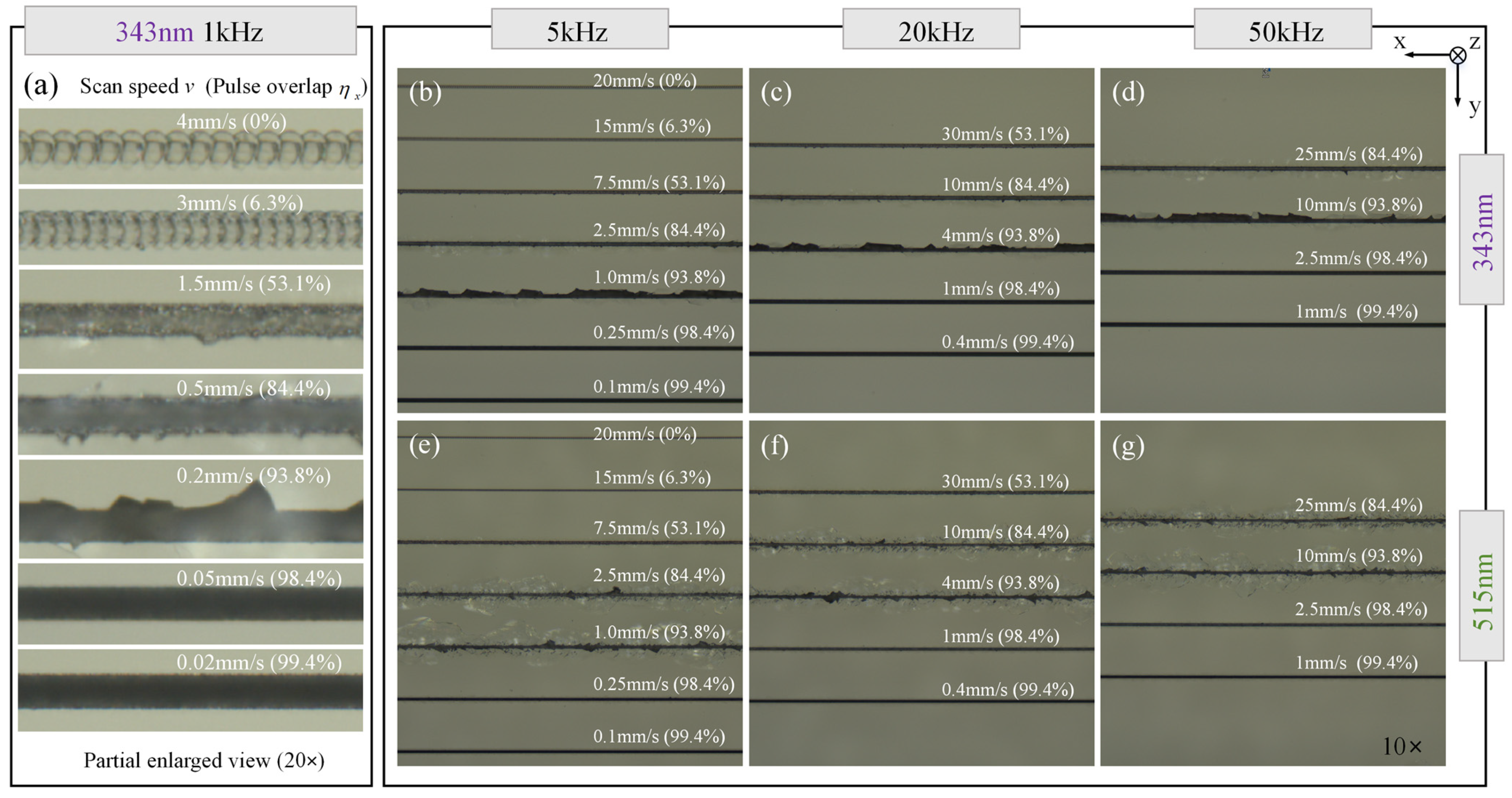
The influence of pulse overlap rate on the surface morphology of the grooves under different wavelengths and repetition rates was characterised using optical microscopy, with the set pulse energy maintained at 30 μJ (corresponding to actual peak fluences of 243.0 J / c m 2 and 262.7 J / c m 2 for 343 nm and 515 nm, respectively, as detailed in Experiment 1 of Table 2). The results are shown in Figure 3. From the partially enlarged surface morphologies corresponding to different overlap rates in Figure 3a, it can be observed that when the overlap rate is too low, adjacent pulses are separated, forming a series of discrete ablation pits. As the overlap rate increases to 50–80%, the pulse spots begin to connect, the bottom of the groove gradually becomes flatter, and the edges remain relatively intact. However, when the overlap rate falls within the range of 84.4–93.8%, severe edge chipping and irregular fracturing occur. A comparison of Figure 3b–g shows that this chipping phenomenon is prevalent across different repetition rates (5, 20, 50 kHz) and wavelengths (343 nm, 515 nm), indicating that its occurrence is primarily governed by the spatial pulse overlap rate and has no significant correlation with the pulse time interval or laser wavelength. When the overlap rate is further increased to η x 98.4 % , the chipping phenomenon completely disappears, and the groove edges become smooth and tidy.
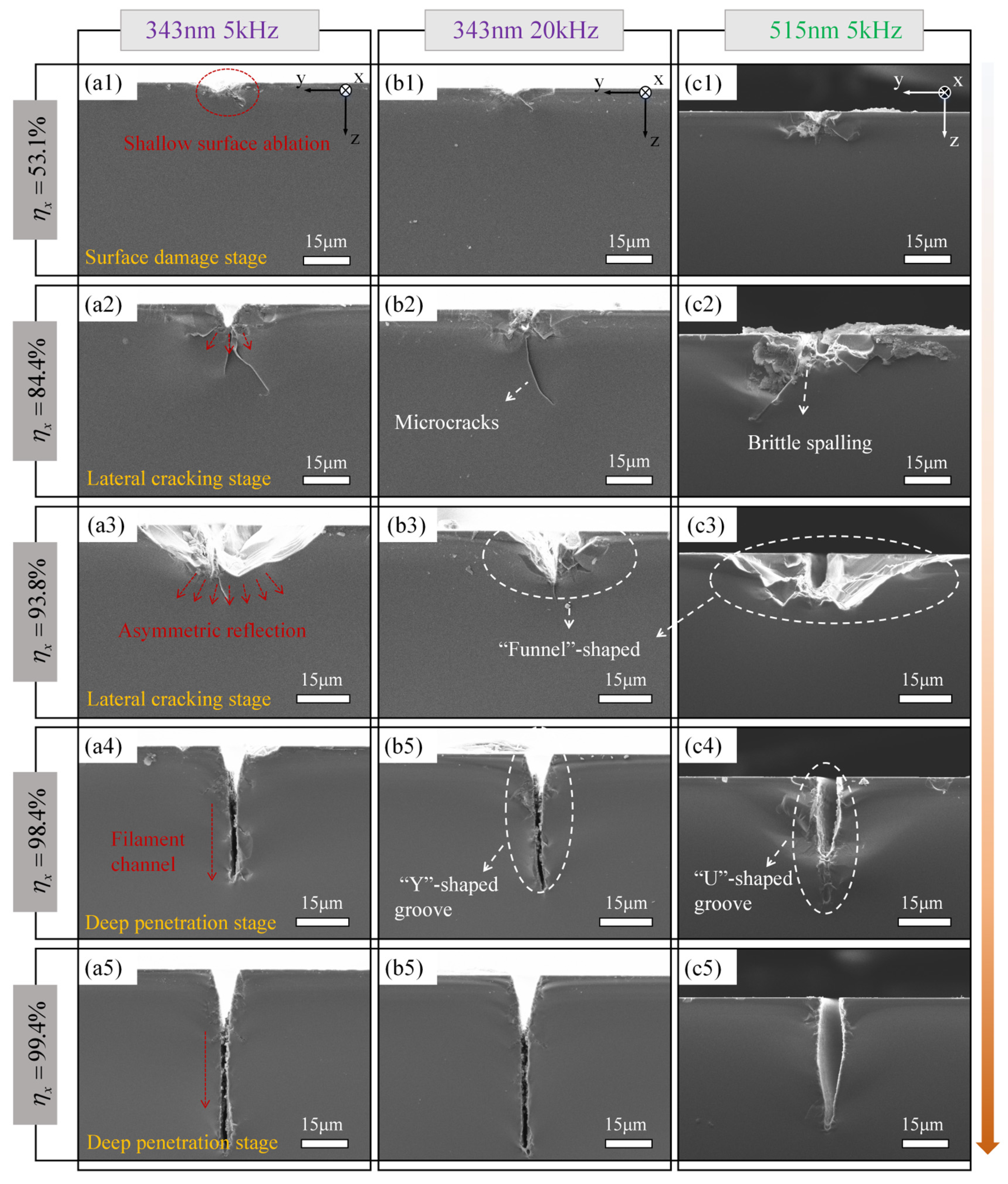
To further reveal the energy deposition patterns behind the abrupt changes in surface morphology, SEM was used to characterise the cross-sectional morphologies of the corresponding grooves, as shown in Figure 4. The evolution of the cross-sectional morphology with the overlap rate presents three distinct stages, which are hypothesised to reflect a fundamental transition from surface scattering to internal filamentary conduction.
The first is the Surface damage stage (Figure 4(a1–c1)): when η x 53.1 % , the laser energy is deposited on the material surface, forming only extremely shallow surface etching. The second is the Lateral cracking stage (Figure 4(a2–c2,a3–c3)): when 84.4 % η x 93.8 % , the groove depth does not increase significantly, and the groove entrance exhibits a “funnel”-shaped profile. As suggested by wave optics models [29], this funnel geometry likely causes multiple reflections that shift the Maximum Laser Intensity (MLI) point upward. Consequently, the laser energy diffuses laterally rather than axially, generating intense lateral stress waves that trigger the observed macroscopic cracks and spalling. The final stage is the Deep penetration stage (Figure 4(a4–c4,a5–c5)): at a pulse overlap rate of η x 98.4 % , the lateral expansion of the groove entrance is suppressed. At such high spatial overlap rates, adjacent pulses rapidly process an initial micro-groove with a minimal taper angle. According to theoretical investigations based on transient Maxwell’s wave equations [30], a micro-structure created by preceding laser pulses can act as a waveguide, where its steep sidewalls significantly modulate the beam profile of subsequent propagating pulses. Building on this theoretical framework, it is hypothesised that the minimal taper angle of the initial groove effectively provides this waveguide-like spatial confinement. As a result, the laser energy is efficiently restricted and deposited downward along the optical axis, significantly reducing the lateral stress responsible for edge chipping, and ultimately driving the formation of fine, deep grooves with high aspect ratios and vertical side walls.

3.2. Influence of Pulse Energy on Damage Morphology

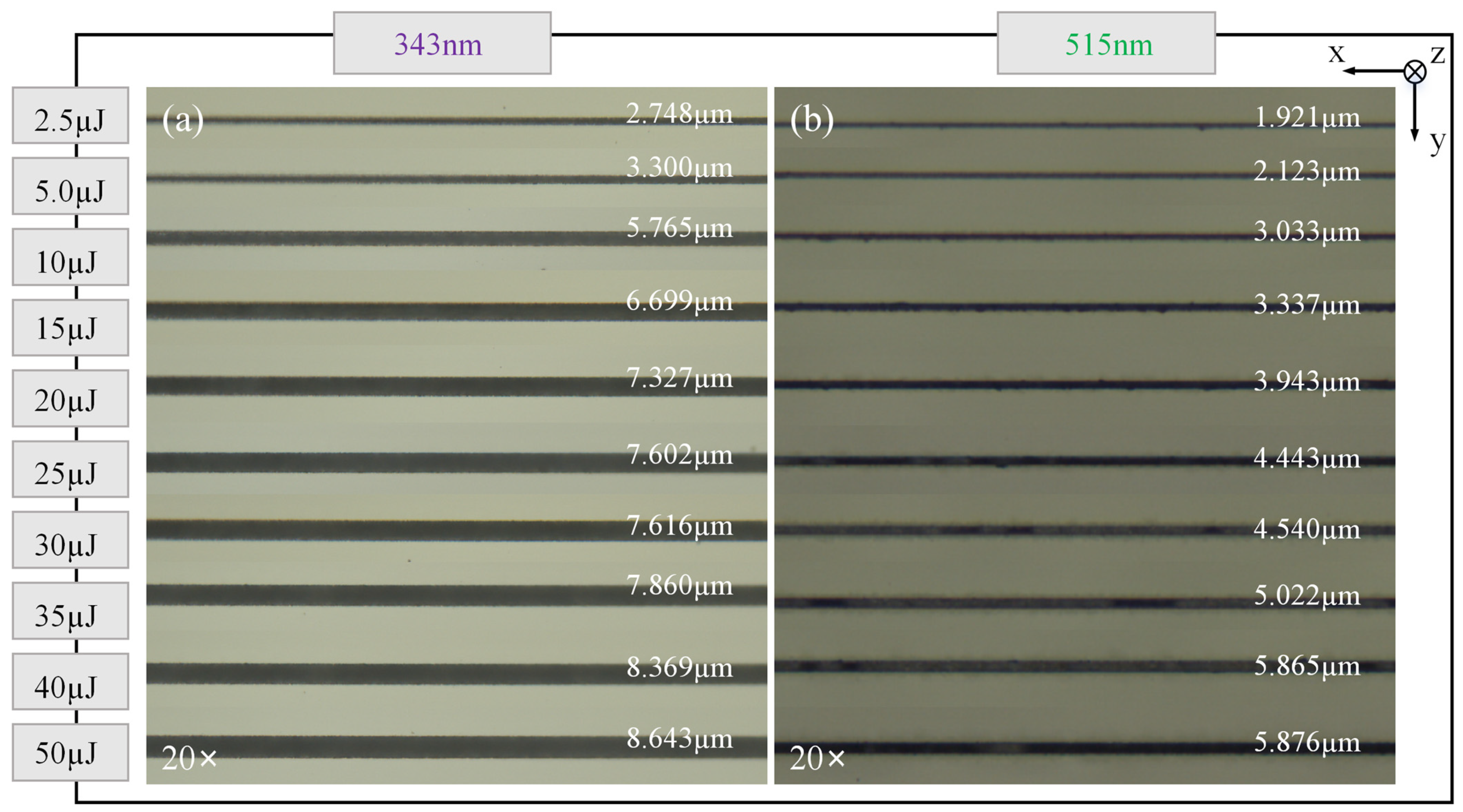
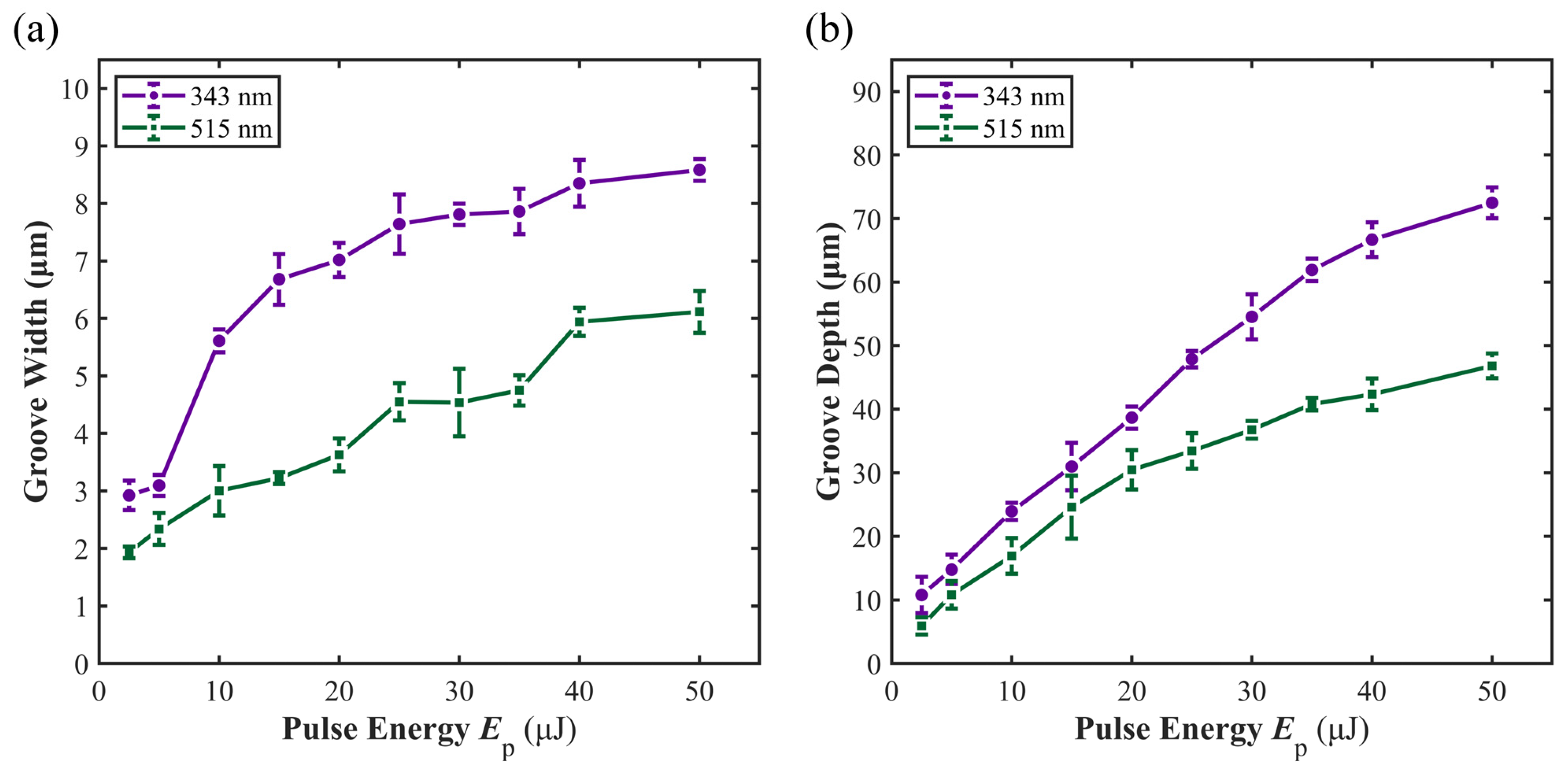
The average laser power is determined jointly by the pulse repetition rate and the pulse energy E p . Modifying E p can directly modulate the peak power density of the laser. To decouple the cumulative effect from the intensity effect, the repetition rate was fixed at 100 kHz and the scanning speed at 5 mm/s. Under the premise of ensuring uniform spatial overlap and controllable heat accumulation, the pulse energy E p was varied within the range of 2.5 μJ to 50 μJ (the corresponding calibrated actual energies, fluences, and intensities are comprehensively listed in Experiment 2 of Table 2). Figure 5 and Figure 6a present the surface morphologies and width variation curves of the grooves under different energies, which are used to analyse the regulatory mechanisms of pulse energy on the morphology and geometric dimensions of the sapphire grooves. It can be observed that as E p gradually increase, the groove widths machined by both wavelengths exhibit a significant increasing trend, while the groove edges consistently maintain excellent clarity. Furthermore, under the same energy input, the width of the grooves ablated by the 343 nm UV wavelength is generally larger than that by the 515 nm visible wavelength. This is primarily because the UV femtosecond laser possesses a higher single-photon energy, thereby inducing lower-order non-linear multi-photon absorption in the sapphire material, which consequently achieves a higher laser-material energy coupling efficiency.
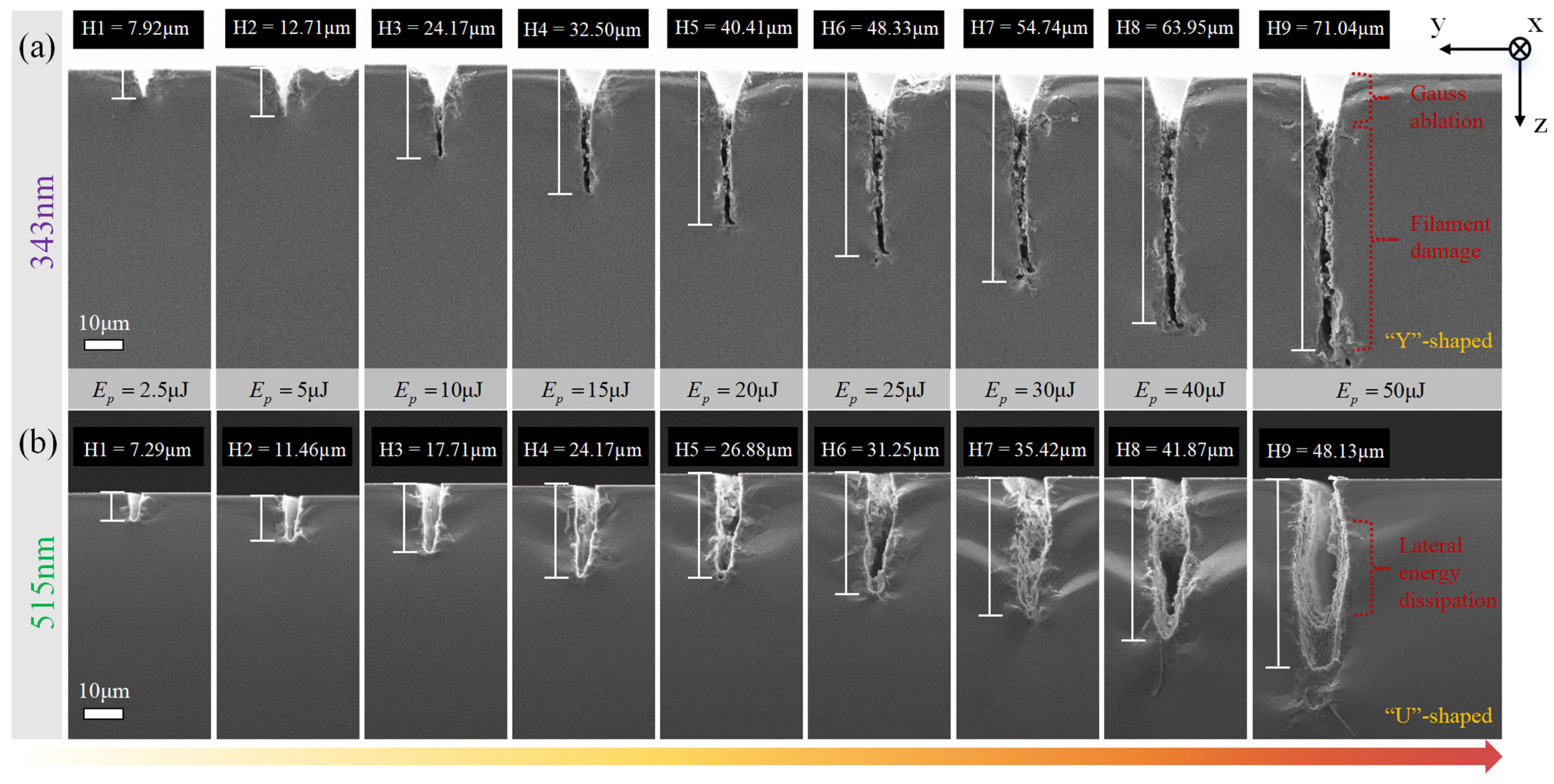
To further reveal the significant differences in the axial material removal capability induced by pulse energy, the cross-sectional morphologies of the sapphire grooves were observed via SEM, and the depth variation curves under different energies were obtained, as shown in Figure 6b and Figure 7. It can be seen that for the 343 nm UV laser, the groove depth increases approximately linearly with the energy, reaching a depth of 71.04 μm at 50 μJ, and the groove bottom consistently maintains a sharp, high-aspect-ratio “Y”-shaped feature. This is attributed to the lower critical power for Kerr self-focusing of the UV laser in the medium; therefore, it is easier to excite and form a slender, stable filamentary channel within the confined micro-groove. Simultaneously, the high-energy pulses can significantly stimulate and sustain the stable transmission of the filamentation effect, efficiently guiding the energy deep into the material. When the laser wavelength is 515 nm, a higher energy is required to achieve the equivalent non-linear coupling intensity. During deep transmission, the self-focusing effect is relatively weak, and the energy is highly prone to lateral scattering and defocusing into the surrounding space. Consequently, the cross-section of the groove gradually evolves into a wider “U”-shape, accompanied by obvious mechanical microcracks and material spalling marks around the side walls, as shown in Figure 7b. This attenuation of axial transmission energy and the exacerbation of lateral scattering result in more energy being consumed by the mechanical destruction of the side walls, thereby forming a “U”-shaped structure with microcracks, yielding a depth of only 48.13 μm at 50 μJ. Therefore, pulse energy has a promoting effect on the machining depth, and the machining morphology and axial penetration depth are superior under the 343 nm wavelength.
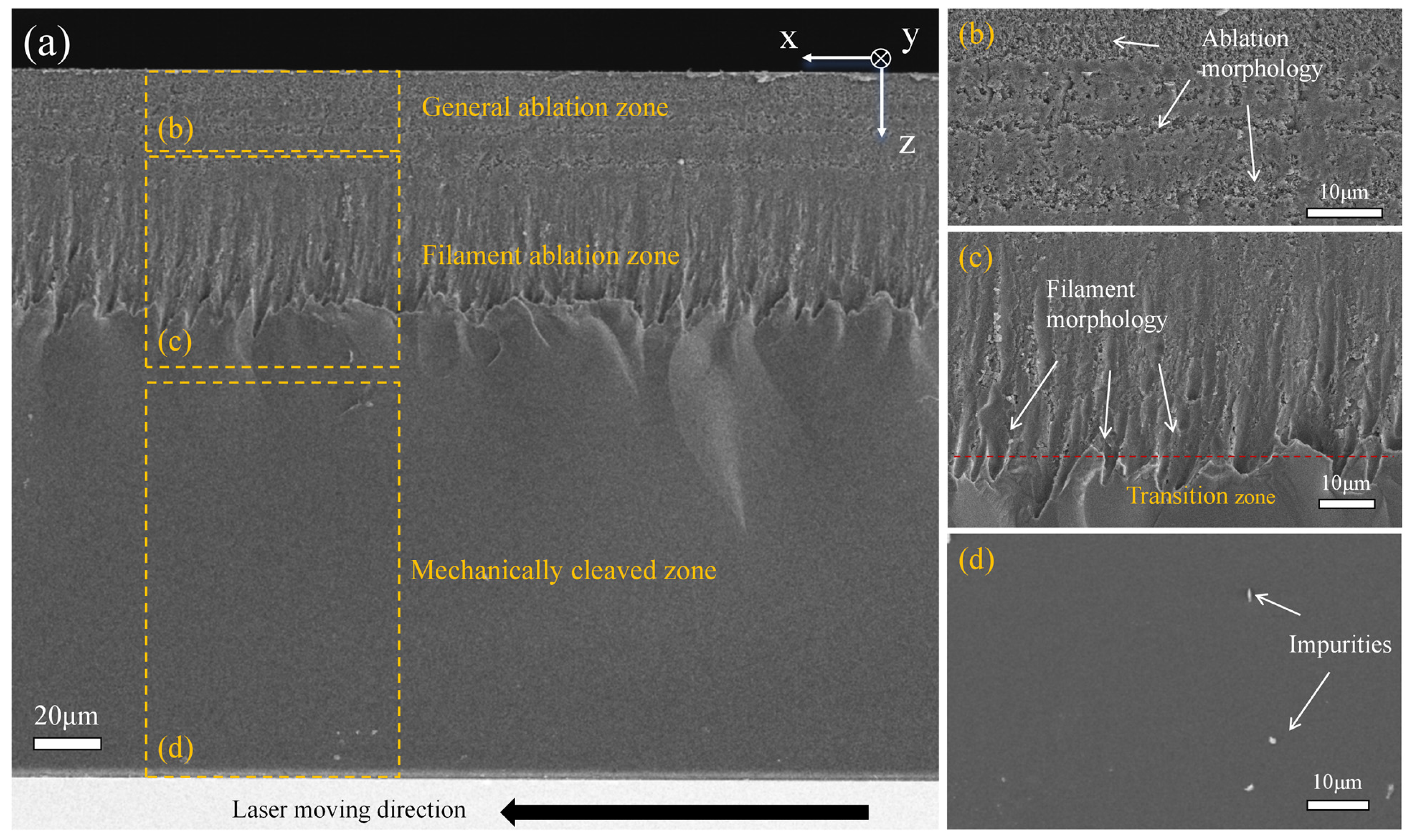
Based on the experimental results in Figure 7, a minimal external mechanical stress was applied to a 220-μm-thick sapphire wafer along the Y-shaped filamentary damage trajectory obtained under the optimal machining parameters (343 nm wavelength, 50 μJ set pulse energy), successfully achieving the precision cleavage of the wafer. As shown in Figure 8a, its cleaved cross-section exhibits four distinctive evolutionary zones from top to bottom: the general ablation zone located at the topmost surface of the material, the internal filament ablation zone, the transition zone, and the mechanically cleaved zone at the very bottom. Among these four zones, the topmost general ablation zone (Figure 8b) is primarily affected by the extremely high peak energy density near the laser focus, accompanied by intense multi-photon ionisation and plasma phase-change vaporisation, presenting a porous and rough thermal ablation morphology. The filament ablation zone (Figure 8c) is left with dense, striation-like damage trajectories arranged vertically along the laser incidence direction, which are induced by the stable filamentary channel maintained by non-linear self-focusing. This forms a stress-concentration guiding plane penetrating the interior of the material. As the laser energy propagates into the deeper layers and gradually dissipates to the threshold margin of material damage, the fractured surface enters the transition zone, where the vertical damage striations gradually become shallower and eventually disappear. The remaining bottom region is the mechanically cleaved zone (Figure 8d). Triggered by a minimal external mechanical stress, the crack rapidly bypasses the transition zone, propagates precisely along the localised stress plane formed by the upper filamentary groove, and instantaneously undergoes purely brittle tearing downward along the intrinsic cleavage plane. This region remains completely unaffected by the laser’s thermal impact and exhibits an extremely flat, pristine crystal plane, reaching a mirror-like cleaved flatness.

3.3. Influence of Scan Counts on Material Removal Efficiency and Saturation Effects

After clarifying the regulatory laws of single-pulse energy and spatial overlap rate on the groove morphology, the damage characteristics of sapphire were comparatively analysed as the number of scans N increased from 1 to 20. This was done to further break through the processing depth limit and explore the evolution of material removal. The laser pulse energy was set at 40 μJ, the repetition rate at 100 kHz, and the scanning speed at 5 mm/s. The corresponding calibrated parameters, including actual energy and peak fluence, are summarised in Experiment 3 of Table 2.
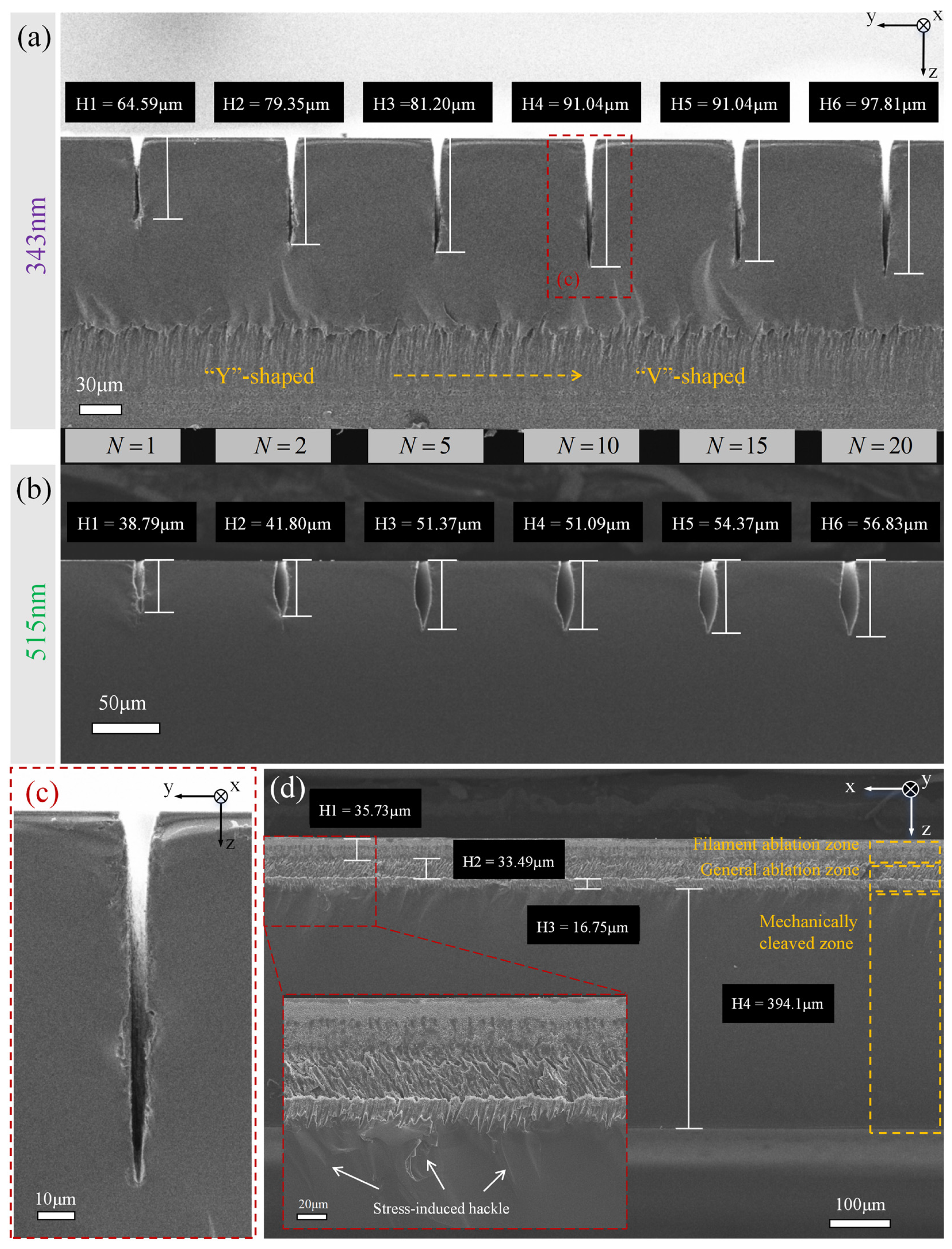
Figure 9 displays the cross-sectional SEM morphologies of the grooves under different scan counts. As observed in Figure 9a, for the 343 nm UV laser, the number of scans exerts a significant regulatory effect on the damage morphology. At N 2 , the damage primarily manifests as slender “Y”-shaped filamentary features. However, with a further increase in the number of scans, the wide-mouth region at the top of the groove significantly expands downward, and the morphology gradually transitions from a “Y”-shape to a “V”-shape. This indicates that while the depth increases, the proportion of macroscopic thermal ablation induced by the Gaussian energy component rises significantly, thereby increasing additional material loss. In contrast, as shown in Figure 9b, the 515 nm laser consistently presents a blunt “U”-shaped groove after multiple scans, accompanied by obvious lateral energy diffusion in the middle and lower parts of the groove.
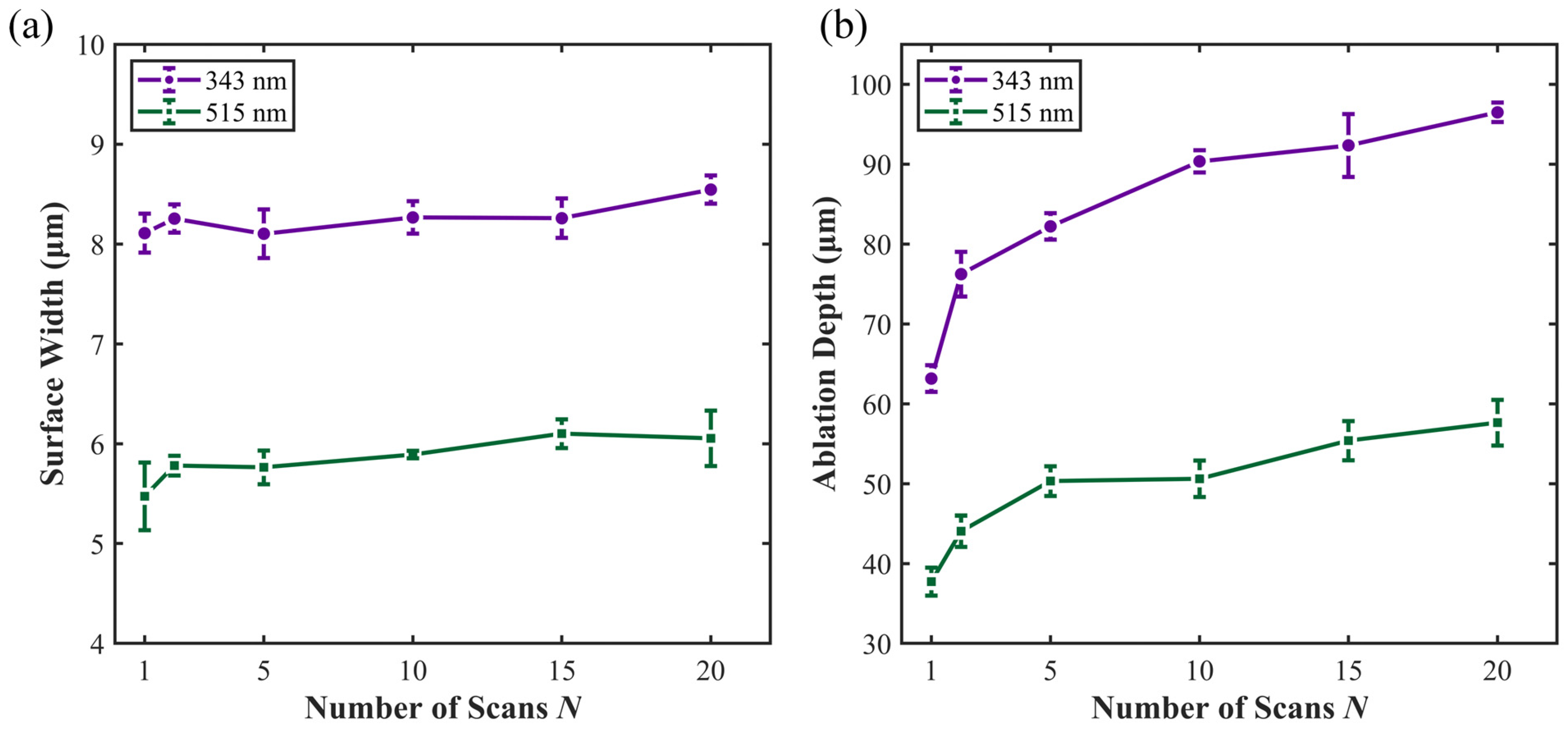
The evolution curves of the width and depth of the damage structures shown in Figure 10 indicate that with the increase in scan counts, no significant lateral expansion of the groove entrance occurred for either wavelength. The width of the 343 nm wavelength group remained stable in the range of 8.0–8.4 μm, while the 515 nm group stabilised near 5.4–6.0 μm. This phenomenon confirms that under a stable filamentary conduction mechanism, the energy accumulation effect of multi-round scanning primarily contributes to material removal along the laser propagation direction, effectively suppressing lateral thermal damage broadening. Conversely, the depth exhibits a staged growth and saturation trend with increasing scan counts. For the 343 nm UV laser, the first 10 scans show extremely high single-pass removal efficiency, after which the depth increment slows down significantly, tending toward a limit of 97.81 μm after 20 scans. The axial removal rate of the 515 nm laser is lower, with a depth of only 56.83 μm after 20 repetitive scans. Based on established ablation models [31], this depth saturation is likely attributable to the transient plasma shielding effect, where the dense plasma trapped within the deep gap absorbs subsequent pulse energy. Furthermore, as the groove gradually widens into a “V”-shape, multiple sidewall reflections dissipate the incident energy laterally. This geometric alteration is expected to exacerbate thermal damage to the side walls rather than promote further axial penetration.
To verify the role of the deep-hole stress plane induced by multi-round scanning in the precision separation of thick wafers, a minimal mechanical force was applied to the grooves generated by 10 scans at 343 nm. As shown in Figure 9c,d, even on a sapphire wafer with a thickness of 480 μm, the cracks can still undergo controlled separation along the stress plane induced by the filament. However, from the magnified cross-sectional view in Figure 9d, it can be clearly observed that multiple scans exacerbate the ablation in the surface “V”-shaped zone (with significant depths H 1 and H 2 ), and the complex residual stress field at the end of the filament induces prominent stress-induced hackles.

3.4. Sacrificial-Layer-Assisted Filamentation Precision Dicing

Although increasing the number of scans can effectively enhance the processing depth, the “Y-V” morphological transition inevitably increases material loss at the surface. Experimental observations reveal that even when the focal point is shifted downward in an attempt to eliminate surface damage, the spatial energy envelope distribution of the Gaussian femtosecond beam still triggers intense nonlinear absorption at the material’s incident surface. This results in the formation of a wide-mouth V-shaped ablation zone. Such macroscopic damage not only limits the further improvement of dicing precision but also generates non-uniform shockwaves that induce stress-induced hackles, thereby compromising the flatness of the cross-section.
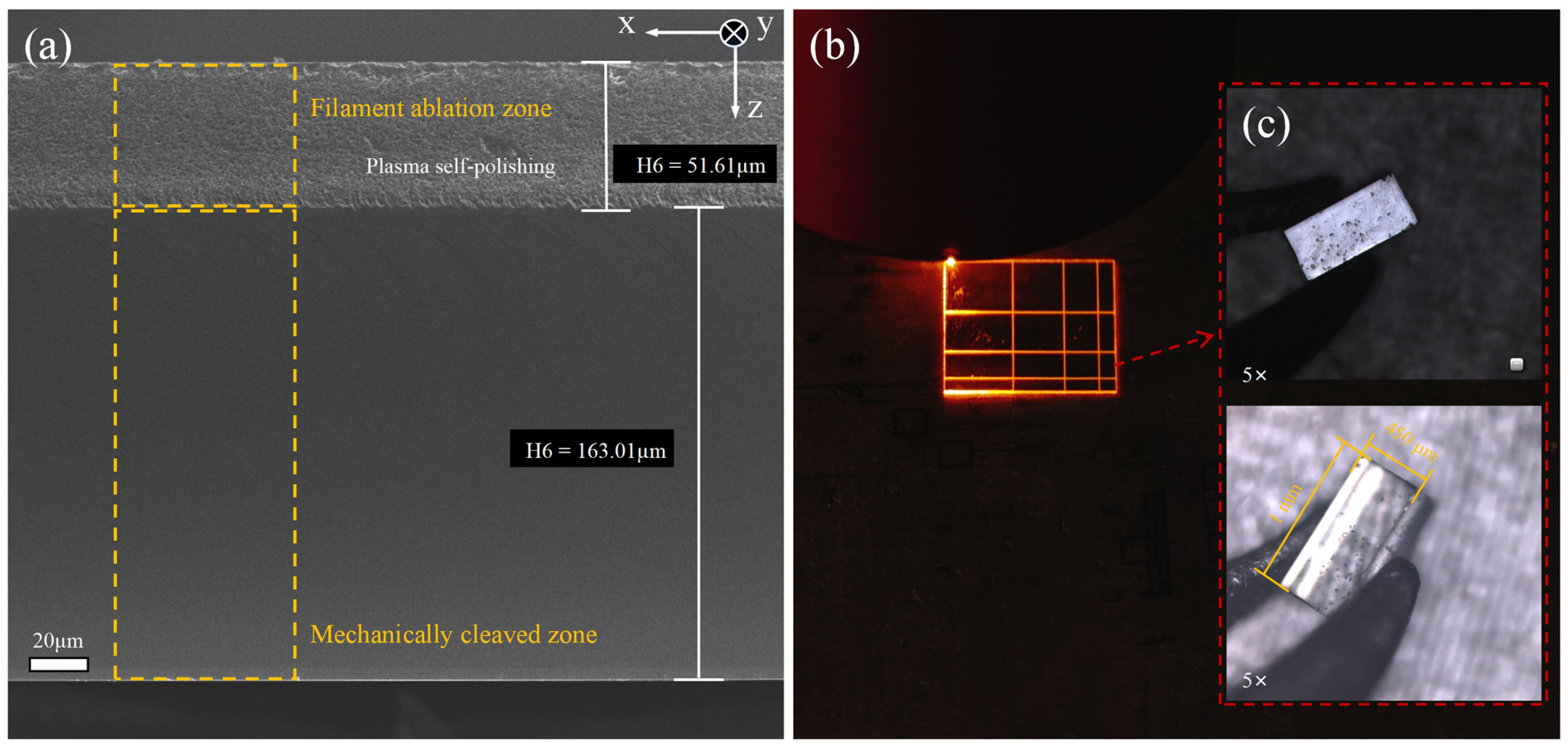
In response, this section proposes a sacrificial-layer-assisted pre-bonding filamentation strategy. By pre-placing an ultra-thin sapphire sacrificial layer on the surface of the target wafer, the spatial transfer of damage is achieved. The wide-mouth ablation zone of the Gaussian beam is confined within the sacrificial layer, leaving the target wafer with only the damage formed by the high-energy-density filament with a sub-micron diameter. Under multiple repetitive scans, the plasma flow exerts a significant self-polishing effect on the side walls of the channel. This not only smooths out the longitudinal filamentary damage striations but also homogenises the residual stress field in the modified zone. Consequently, only extremely narrow filamentary initiation marks remain on the surface of the target wafer, and the cleaved cross-section exhibits a mirror-like natural flatness across more than 75% of its area, eliminating the stress deflection in the transition zone, as shown in Figure 11a.
Based on the aforementioned optimised scheme, an engineering case study of high-precision dicing was conducted. Figure 11b demonstrates the successful separation of micro-units with dimensions of only 1 mm × 450 μm from a 220-μm-thick sapphire wafer. Benefiting from the ultra-high resolution (1 nm) and repeatable positioning accuracy (±0.15 μm) of the displacement stage, combined with the sub-micron (<2 μm) narrow and deep stress plane induced by the filament, this scheme achieves exceptional dicing precision and edge verticality. To further evaluate its technical superiority, Table 3 provides a comprehensive performance comparison with existing laser dicing strategies. Traditional ablation is limited by severe chipping and large tapers (>5°). Meanwhile, although Bessel stealth dicing achieves a near-zero taper, it often suffers from notable burrs due to its discrete damage spots. In contrast, the proposed sacrificial-layer-assisted, filamentation-guided dicing strategy features a continuous cutting trajectory and smooth edges, effectively eliminating chipping and burrs while maintaining a zero taper. Moreover, based on the spatial pulse overlap scaling principle discussed in Section 3.1, the dicing speed can be proportionally increased alongside the repetition rate without compromising edge quality. For instance, utilising the 200 kHz maximum of our current platform achieves a speed of 10 mm/s, indicating that the proposed method can be significantly scaled up for high-throughput manufacturing using industrial MHz-level femtosecond lasers. Finally, compared to complex beam-shaping technologies that require rigorous optical alignment, this process provides a more robust and efficient solution with a moderate optical configuration.
Furthermore, over 75% of the generated cross-section features a mirror-like mechanical cleavage zone ( R a < 50 nm ) . This exceptional surface integrity enables the rapid, in situ exposure of internal structures—such as buried waveguides [34,35] or microfluidic channels [12,36]—for high-throughput characterisation, as shown in Figure 9a. By circumventing the abrasive embedding of traditional polishing and the chemical/mechanical wear of Focused Ion Beam (FIB) milling, this approach improves processing efficiency by several orders of magnitude, establishing a non-destructive and efficient paradigm for studying internal modifications in hard and brittle materials. Looking forward, while this study establishes a solid physical baseline using single-pulse irradiation, integrating burst-mode lasers [37] represents a highly promising avenue. Precisely tailoring localised heat accumulation and transient plasma dynamics via burst-mode could further optimise filamentation and crack evolution, thereby unlocking new potential for next-generation sapphire micro-manufacturing.

4. Conclusions

To break through the quality bottlenecks in the precision dicing of highly hard and brittle wafers such as sapphire, this paper proposes a precision dicing technology guided by femtosecond laser filamentation. The non-linear filament evolution mechanisms and energy deposition regulatory laws were systematically revealed. The main conclusions are as follows:
(1) By comparing the regulatory effects of pulse overlap rate and pulse energy on damage morphology, the boundary conditions for spatial overlap to suppress surface chipping were identified. Results show that an extremely high pulse overlap rate (>98%) effectively suppresses lateral energy scattering and drives efficient energy conduction along the optical axis. In this regard, the 343 nm UV laser significantly outperforms the 515 nm laser in terms of axial removal efficiency and damage localisation.
(2) Through super-resolution imaging of the precision cleaved cross-sections, the fracture surface was clearly classified into four evolutionary regions: the general ablation zone, the filament ablation zone, the transition zone, and the mechanically cleaved zone. This regional division elucidates the micro-morphological evolution and fractured mechanism of the filament-guided dicing process.
(3) To address the “Y-V” morphological evolution and wide-mouth surface loss caused by the Gaussian envelope during multiple scans, a sacrificial-layer-assisted strategy was proposed. This approach realises the spatial transfer of surface damage and utilises the in situ self-polishing effect of confined plasma to eliminate longitudinal damage striations and residual stress-induced hackles. This strategy yielded mirror-like cleaved cross-sections and achieved taper-free, low-loss, and high-precision separation of 1 mm × 450 μm micro-units on a 220-μm-thick sapphire wafer.
(4) The efficient, in situ cross-sectional exposure method enabled by this technology effectively circumvents the contamination and wear issues associated with traditional grinding and FIB preparation. It provides a novel sample preparation paradigm for the microstructural characterisation of buried structures in hard and brittle materials.

Author Contributions

Y.Z.: Investigation, Formal analysis, Methodology, Conceptualisation, Software, Visualisation, Data curation, Writing—original draft, Writing—review and editing. Z.W.: Investigation, Visualisation. J.L.: Funding acquisition, Resources, Validation. G.A.: Methodology, Writing—review and editing. H.W.: Visualisation, Writing—review and editing. Q.R.: Funding acquisition, Software. P.J.: Funding acquisition, Resources, Supervision. All authors have read and agreed to the published version of the manuscript.

Funding

This work is financially supported by the National Key Research and Development Program of China under Grant 2023YFB406900, in part by the National Natural Science Foundation of China under Grant 52505617, and in part by the Shanxi Province Science Foundation for Youths under Grant 202303021212192.

Institutional Review Board Statement

Not applicable.

Informed Consent Statement

Not applicable.

Data Availability Statement

Data will be made available on request.

Conflicts of Interest

The authors declare that they have no known competing financial interests or personal relationships that could have appeared to influence the work reported in this paper.

References

  1. Pishchik, V.; Lytvynov, L.A.; Dobrovinskaya, E.R. Sapphire: Material, Manufacturing, Applications; Springer: Boston, MA, USA, 2009. [Google Scholar]
  2. Yue, Z.; He, L.; Cui, Q.; Gao, W.; Yin, Y.; Meng, L.; Chen, C.; Liao, Y.; Leng, Y.; Wang, Z.; et al. Fabrication of sapphire optical windows with infrared transmittance enhancement and visible transmittance reduction by femtosecond laser direct writing. Opt. Laser Technol. 2025, 188, 112989. [Google Scholar] [CrossRef]
  3. Kefer, S.; Roth, G.-L.; Zettl, J.; Schmauss, B.; Hellmann, R. Sapphire Photonic Crystal Waveguides with Integrated Bragg Grating Structure. Photonics 2022, 9, 234. [Google Scholar] [CrossRef]
  4. Lu, Y.; Li, Y.-F.; Wang, G.; Yu, Y.; Bai, Z.; Wang, Y.; Lu, Z. Femtosecond Laser Fabrication of Microchannels in Transparent Hard Materials. Adv. Mater. Technol. 2023, 8, 2300015. [Google Scholar] [CrossRef]
  5. Xie, X.; Gao, X.; Chen, W.; Wei, X.; Hu, W.; Che, H. Study on scribing parameters of sapphire substrate with pulse green laser. Chin. J. Lasers 2013, 40, 1203010. [Google Scholar]
  6. Yi, Z.X.; Jia, X.S.; Chen, Y.Y.; Xu, J.; Guo, C.; Li, K.; Wang, C.; Li, Z.; Han, K.; Ma, Z.; et al. Millisecond laser processing of sapphire assisted by femtosecond laser-induced air filament. J. Cent. South Univ. 2025, 32, 3272–3284. [Google Scholar] [CrossRef]
  7. Li, Z.C.; Pei, Z.J.; Funkenbusch, P.D. Machining processes for sapphire wafers: A literature review. Proc. Inst. Mech. Eng. Part B J. Eng. Manuf. 2011, 225, 975–989. [Google Scholar] [CrossRef]
  8. Qin, B.; Liu, H.; Cheng, J.; Tian, J.; Sun, J.; Zhou, Z.; Ma, C.; Chen, M. Subsurface damage detection and prediction of thin-walled complex curved-surface component. Int. J. Mech. Sci. 2024, 272, 109165. [Google Scholar] [CrossRef]
  9. Gao, L.; Zhang, Q.; Gu, M. Femtosecond laser micro/nano processing: From fundamental to applications. Int. J. Extrem. Manuf. 2024, 7, 022010. [Google Scholar] [CrossRef]
  10. Juodkazis, S.; Nishimura, K.; Misawa, H.; Ebisui, T.; Waki, R.; Matsuo, S.; Okada, T. Control over the crystalline state of sapphire. Adv. Mater. 2005, 18, 1361–1364. [Google Scholar] [CrossRef]
  11. Lu, Y.-M.; Liu, X.-Q.; Zhu, L.; Chen, Q.-D.; Juodkazis, S.; Sun, H.-B. Vector scanning subtractive manufacturing technology for laser rapid fabrication. Opt. Lett. 2021, 46, 1963–1966. [Google Scholar] [CrossRef]
  12. Capuano, L.; Tiggelaar, R.M.; Berenschot, J.W.; Gardeniers, J.G.E.; Römer, G.R.B.E. Fabrication of millimeter-long structures in sapphire using femtosecond infrared laser pulses and selective etching. Opt. Lasers Eng. 2020, 133, 106114. [Google Scholar] [CrossRef]
  13. Liu, X.-Q.; Yang, S.-N.; Yu, L.; Chen, Q.-D.; Zhang, Y.-L.; Sun, H.-B. Rapid engraving of artificial compound eyes from curved sapphire substrate. Adv. Funct. Mater. 2019, 29, 1900037. [Google Scholar] [CrossRef]
  14. Yan, T.; Ji, L.; Hong, M. Backside wet etching of sapphire substrate by laser-induced carbothermal reduction. Opt. Laser Technol. 2022, 149, 107900. [Google Scholar] [CrossRef]
  15. Xie, X.; Zhou, C.; Wei, X.; Hu, W.; Ren, Q. Laser machining of transparent brittle materials: From machining strategies to applications. Opto-Electron. Adv. 2019, 2, 180017. [Google Scholar] [CrossRef]
  16. Liu, H.; Li, Y.; Lin, W.; Hong, M. High-aspect-ratio crack-free microstructures fabrication on sapphire by femtosecond laser ablation. Opt. Laser Technol. 2020, 132, 106472. [Google Scholar] [CrossRef]
  17. Li, Y.; Itoh, K.; Watanabe, W.; Yamada, K.; Kuroda, D.; Nishii, J.; Jiang, Y. Three-dimensional hole drilling of silica glass from the rear surface with femtosecond laser pulses. Opt. Lett. 2001, 26, 1912–1914. [Google Scholar] [CrossRef]
  18. Hua, J.-G.; Ren, H.; Huang, J.; Luan, M.-L.; Chen, Q.-D.; Juodkazis, S.; Sun, H.-B. Laser-Induced Cavitation-Assisted True 3D Nano-Sculpturing of Hard Materials. Small 2023, 19, 2207968. [Google Scholar] [CrossRef]
  19. Rapp, L.; Meyer, R.; Giust, R.; Furfaro, L.; Jacquot, M.; Lacourt, P.A.; Dudley, J.M.; Courvoisier, F. High aspect ratio micro-explosions in the bulk of sapphire generated by femtosecond bessel beams. Sci. Rep. 2016, 6, 34286. [Google Scholar] [CrossRef]
  20. Rapp, L.; Meyer, R.; Furfaro, L.; Billet, C.; Giust, R.; Courvoisier, F. High speed cleaving of crystals with ultrafast bessel beams. Opt. Express 2017, 25, 9312–9317. [Google Scholar] [CrossRef]
  21. Meyer, R.; Froehly, L.; Giust, R.; Del Hoyo, J.; Furfaro, L.; Billet, C.; Courvoisier, F. Extremely high-aspect-ratio ultrafast bessel beam generation and stealth dicing of multi-millimeter thick glass. Appl. Phys. Lett. 2019, 114, 201105. [Google Scholar] [CrossRef]
  22. Couairon, A.; Mysyrowicz, A. Femtosecond filamentation in transparent media. Phys. Rep. 2007, 441, 47–189. [Google Scholar] [CrossRef]
  23. Liao, K.; Wang, W.; Mei, X.; Liu, B. Fabrication of millimeter-scale deep microchannels in fused silica by femtosecond laser filamentation effect. Opt. Laser Technol. 2021, 142, 107201. [Google Scholar] [CrossRef]
  24. Xue, B.; Jia, P.G.; An, G.W.; Su, J.; Wang, Y.; Yang, N.; Xiong, J. High-precision processing technology of quartz glass with ultraviolet femtosecond laser filaments. Chin. J. Lasers 2024, 51, 2002403. [Google Scholar]
  25. Wang, Y.; Dai, Y.; Mumtaz, F.; Luo, K. Advanced techniques in quartz wafer precision processing: Stealth dicing based on filament-induced laser machining. Opt. Laser Technol. 2024, 171, 110474. [Google Scholar] [CrossRef]
  26. Qi, L.; Nishii, K.; Yasui, M.; Aoki, H.; Namba, Y. Femtosecond laser ablation of sapphire on different crystallographic facet planes by single and multiple laser pulses irradiation. Opt. Lasers Eng. 2010, 48, 1000–1007. [Google Scholar] [CrossRef]
  27. Esser, D.; Rezaei, S.; Li, J.; Herman, P.R.; Gottmann, J. Time dynamics of burst-train filamentation assisted femtosecond laser machining in glasses. Opt. Express 2011, 19, 25632–25642. [Google Scholar] [CrossRef] [PubMed]
  28. Shlenov, S.A.; Dergachev, A.A.; Ionin, A.A.; Kandidov, V.P.; Mokrousova, D.V.; Seleznev, L.V.; Sinitsyn, D.V.; Sunchugasheva, E.S.; Shustikova, A.P. Femtosecond laser filament and plasma channels in focused beam in air. In Proceedings of the 18th International School on Quantum Electronics: Laser Physics and Applications, Sozopol, Bulgaria, 21–25 September 2014; Tonev, T., Dreischuh, A.A., Eds.; SPIE: Bellingham, WA, USA, 2015; Volume 9447, p. 944717. [Google Scholar]
  29. Jiao, L.S.; Ng, E.Y.K.; Zheng, H.Y.; Zhang, Y.L. Theoretical study of pre-formed hole geometries on femtosecond pulse energy distribution in laser drilling. Opt. Express 2015, 23, 4927–4934. [Google Scholar] [CrossRef]
  30. Tao, S.; Wu, B.; Lei, S. Study of laser beam propagation in microholes and the effect on femtosecond laser micromachining. J. Appl. Phys. 2011, 109, 123506. [Google Scholar] [CrossRef]
  31. Tan, S.; Wu, J.; Zhang, Y.; Wang, M.; Ou, Y. A Model of Ultra-Short Pulsed Laser Ablation of Metal with Considering Plasma Shielding and Non-Fourier Effect. Energies 2018, 11, 3163. [Google Scholar] [CrossRef]
  32. Horisawa, H.; Emura, H.; Yasunaga, N. Surface machining characteristics of sapphire with fifth harmonic YAG laser pulses. Vacuum 2004, 73, 661–666. [Google Scholar] [CrossRef]
  33. Li, Z.; Wang, X.; Wang, J.; Allegre, O.; Guo, W.; Gao, W.; Jia, N.; Li, L. Stealth dicing of sapphire sheets with low surface roughness, zero kerf width, debris/crack-free and zero taper using a femtosecond bessel beam. Opt. Laser Technol. 2021, 135, 106713. [Google Scholar] [CrossRef]
  34. Ren, Y.; Zhang, L.; Xing, H.; Romero, C.; Vázquez de Aldana, J.R.; Chen, F. Cladding waveguide splitters fabricated by femtosecond laser inscription in ti: Sapphire crystal. Opt. Laser Technol. 2018, 103, 82–88. [Google Scholar] [CrossRef]
  35. Zhang, B.; Yan, W.; Chen, F. Recent advances in femtosecond laser direct writing of three-dimensional periodic photonic structures in transparent materials. Adv. Photonics 2025, 7, 034002. [Google Scholar] [CrossRef]
  36. Li, J.; Zhong, S.; Huang, J.; Qiu, P.; Wang, P.; Li, H.; Qin, C.; Miao, D.; Xu, S. Laser-guided anisotropic etching for precision machining of micro-engineered glass components. Int. J. Mach. Tools Manuf. 2024, 198, 104152. [Google Scholar] [CrossRef]
  37. Gedvilas, M.; Račiukaitis, G. Spatial zigzag evolution of cracks in moving sapphire initiated by bursts of picosecond laser pulses for ultrafast wafer dicing. RSC Adv. 2020, 10, 33213–33220. [Google Scholar] [CrossRef]
Figure 1. Schematic illustration of the femtosecond laser filament-guided precision dicing process in sapphire.
Applsci 16 05474 g001
Figure 2. Schematic of the femtosecond laser micro-machining platform and processing strategy: (a) Femtosecond laser processing system; (b) Single/multiple scribe-scanning experiments; (c) Cross-sectional preparation and observation perpendicular to the groove direction.
Applsci 16 05474 g002
Figure 3. Effect of pulse overlap rate on the surface morphology of sapphire grooves under different femtosecond laser wavelengths and repetition rates: (a) Partially enlarged surface morphology at 343 nm, 1 kHz; (bd) Morphologies at 343 nm wavelength with repetition rates of 5, 20, and 50 kHz, respectively; (eg) Morphologies at 515 nm wavelength with repetition rates of 5, 20, and 50 kHz, respectively.
Applsci 16 05474 g003
Figure 4. Influence of pulse overlap rates on the cross-sectional evolution of sapphire grooves characterised by SEM: (a1a5) 343 nm wavelength, 5 kHz repetition rate; (b1b5) 343 nm wavelength, 20 kHz repetition rate; (c1c5) 515 nm wavelength, 5 kHz repetition rate. The figure details the three stages of morphological evolution as the overlap ratio changes.
Applsci 16 05474 g004
Figure 5. Comparison of surface morphologies of sapphire grooves at different pulse energies: (a) 343 nm wavelength; (b) 515 nm wavelength.
Applsci 16 05474 g005
Figure 6. Influence of pulse energy on the geometric dimensions of sapphire grooves: (a) Surface width; (b) Ablation depth. Error bars represent the standard deviation calculated from three independent measurements.
Applsci 16 05474 g006
Figure 7. Evolution of cross-sectional SEM morphologies of sapphire grooves at different pulse energies: (a) 343 nm wavelength; (b) 515 nm wavelength.
Applsci 16 05474 g007
Figure 8. Cross-sectional morphologies of sapphire precision dicing induced by a single-pass UV femtosecond laser (343 nm, 50 μJ): (a) Global cross-sectional morphology showing four evolutionary zones; (b) Magnified view of the general ablation zone; (c) Magnified view of the filament ablation zone and transition zone; (d) Magnified view of the mechanically cleaved zone.
Applsci 16 05474 g008
Figure 9. Evolution of cross-sectional SEM morphologies of sapphire grooves with scan counts N: (a) 343 nm wavelength group, with cross-sections exposed on highly flat cleaved planes; (b) 515 nm wavelength group; (c) Magnified view of the high-aspect-ratio groove induced by 10 scans of 343 nm laser; (d) Cleaved cross-section of a 480-μm-thick sapphire wafer, showing the distribution of evolutionary zones and stress-induced hackles.
Applsci 16 05474 g009
Figure 10. Influence of scan counts on the geometric dimensions of sapphire grooves: (a) Surface width; (b) Ablation depth. Error bars represent the standard deviation calculated from three independent measurements.
Applsci 16 05474 g010
Figure 11. Results and engineering applications of sacrificial-layer-assisted filamentation precision dicing: (a) SEM morphology of the optimised cleavage cross-section, showing the localised filament initiation zone and mirror-like cleavage plane; (b) Macroscopic image of high-precision dicing on a sapphire wafer; (c) Morphological characterisation of the separated 1 mm × 450 μm sapphire micro-units.
Applsci 16 05474 g011
Table 1. Fundamental specifications of the femtosecond laser system.
ParametersValues
Wavelength ( λ ) 343 nm/515 nm
Pulse duration ( τ ) 290 fs
Maximum output power10 W
Beam quality factor ( M 2 ) <1.2
XYZ stage precision±0.4 µm
Effective focal spot diameter ( 2 w 0 ) 2.28 μm (343 nm)/2.02 μm (515 nm)
Table 2. Summary of experimental processing parameters and calibrated energy densities.
Processing Parameters (Variable)Experiment 1Experiment 2Experiment 3
Repetition rate ( f ) 1–100 kHz100 kHz100 kHz
Scanning speed ( v ) 0.02–30 mm/s5 mm/s5 mm/s
Set pulse energy ( E p ) 30 μJ2.5–50 μJ40 μJ
Number of scans ( N ) 111–20
Actual Energy ( E a c ) 4.96 μJ 1
4.21 μJ 2
0.4–8.06 μJ 6.41 μJ
0.35–7.74 μJ 5.65 μJ
Peak Fluence ( F 0 ) *243.0 J / c m 2 19.6–394.8 J / c m 2 314.0 J / c m 2  1
262.7 J / c m 2 21.8–483.0 J / c m 2 352.6 J / c m 2  2
Peak Intensity ( I 0 ) *838 T W / c m 2 68–1361 T W / c m 2 1083 T W / c m 2  1
906 T W / c m 2 75–1665 T W / c m 2 1216 T W / c m 2  2
* Peak fluence and Peak intensity are calculated using the experimentally determined effective focal spot sizes (2.28 μm for 343 nm and 2.02 μm for 515 nm). 1 Experimental parameters under the optical path condition with a wavelength of 343 nm. 2 Experimental parameters under the optical path condition with a wavelength of 515 nm.
Table 3. Performance comparison of different laser dicing strategies for sapphire.
Processing StrategySurface Roughness ( R a )Edge Quality
(Burrs/Chipping)
Taper AngleDicing Speed (mm/s)Process
Complexity
Traditional
Ablation [32]
>400 nmSevere ChippingLarge (>5°)~1–10Low
Bessel Stealth
Dicing [20,33]
~200 nmNotable BurrsNon-tapered4–125 1High
Proposed
(Without sacrificial layer)
250–300 nm (Ablation zone)Slight ChippingNon-tapered5–10 2Moderate
<50 nm (Mirror-like,
Cleaved zone)
Proposed
(With sacrificial layer)
<50 nm (Mirror-like,
Cleaved zone, >75%)
NoneNon-tapered5–10 2Moderate
1 Li et al. [33]: 4 mm/s, 1 kHz; Rapp et al. [20]: 125 mm/s, 5 kHz, 2 Proposed: 5 mm/s, 100 kHz/10 mm/s, 200 kHz (scalable to >100 mm/s with MHz laser).
Disclaimer/Publisher’s Note: The statements, opinions and data contained in all publications are solely those of the individual author(s) and contributor(s) and not of MDPI and/or the editor(s). MDPI and/or the editor(s) disclaim responsibility for any injury to people or property resulting from any ideas, methods, instructions or products referred to in the content.