Article

Molecular Mechanism of Selective Displacement and Competitive Adsorption of Associated Gas Components by CO2 in Nanopores During Miscible Flooding


1
The 12th Oil Production Plant, Changqing Oilfield Company, PetroChina, Xi’an 710065, China
2
School of Earth Sciences and Engineering, Xi’an Shiyou University, Xi’an 710065, China
3
Shaanxi Key Laboratory of Petroleum Accumulation Geology, Xi’an Shiyou University, Xi’an 710065, China
4
Research Institute of Petroleum Exploration and Development, SINOPEC, Beijing 100086, China
*
Author to whom correspondence should be addressed.
Appl. Sci. 2026, 16(11), 5473; https://doi.org/10.3390/app16115473
Submission received: 7 April 2026 / Revised: 1 May 2026 / Accepted: 5 May 2026 / Published: 1 June 2026

Abstract

Associated gas recovery and CO2 displacement mechanisms in nanopores are critical for optimizing tight oil reservoir development. To investigate these processes in the Hesui area of the Ordos Basin, molecular dynamics simulations utilizing the COMPASSIII force field and NVT ensemble were conducted on experimental associated gas mixtures within 5 nm polar quartz and non-polar graphite slit-pores. The study evaluated free diffusion, adsorption energies, and displacement behaviors. Results reveal that pore walls generally suppress gas diffusion compared to free states, although CO2 exhibits anomalously high diffusion on graphite due to surface slip. Additionally, non-polar graphite demonstrates stronger alkane adsorption than quartz, forming stable, low-energy layered structures. During CO2 injection, displacement on quartz yields an incomplete layered structure governed by Poiseuille flow. Conversely, graphite facilitates displacement primarily in the pore center, characterized by low-friction slip flow and superior transport efficiency. In conclusion, pore wall polarity and chemical composition fundamentally govern associated gas migration and CO2 displacement efficiency. These microscopic insights provide theoretical guidance for enhancing resource utilization and CO2 displacement strategies in tight oil reservoirs.

1. Introduction

Associated gas, produced alongside crude oil during oilfield development, is a valuable resource whose yield and composition significantly affect reservoir evaluation, gathering and transportation process design, comprehensive resource utilization, and carbon emission reduction [1,2]. In the context of global energy transition and carbon neutrality, the efficient development of associated gas has become a key direction for the sustainable development of the petroleum industry [3,4,5]. As the world’s second-largest oil consumer and natural gas importer, China possesses abundant associated gas resources [6,7]. However, its utilization rate remains low, and flaring or inefficient use of associated gas not only wastes resources but also exacerbates greenhouse gas emissions. The Ordos Basin, China’s largest continental sedimentary basin, hosts enormous associated gas resources in tight oil reservoirs. Changqing Oilfield has established the country’s first large-scale tight oil development base. Nevertheless, a lack of in-depth understanding of the microscopic occurrence, diffusion, and displacement mechanisms of associated gas in nanopores continues to limit development efficiency and recovery rates [8,9].
Associated gas mainly comprises methane (CH4), ethane (C2H6), propane (C3H8), butane (C4H10), pentane (C5H12), nitrogen (N2), and carbon dioxide (CO2). Its adsorption, diffusion, and CO2 displacement behaviors vary markedly across different mineral surfaces (e.g., quartz representing inorganic minerals and graphite representing organic matter) [10,11]. Polar quartz surfaces exhibit strong affinity for CO2, while non-polar graphite surfaces preferentially adsorb alkanes. These surface properties directly regulate the occurrence state and migration efficiency of associated gas [12,13,14]. CO2 displacement, which simultaneously enhances oil recovery and enables geological storage, holds great potential for associated gas reservoirs [15,16]. However, competitive adsorption and residual effects induced by wall polarity limit displacement efficiency.
Molecular dynamics (MD) simulation has emerged as a powerful tool for investigating fluid microscopic behavior in nanopores, enabling precise capture of parameters such as adsorption layers, density distributions, mean squared displacement (MSD), and diffusion coefficients [17,18,19,20,21,22]. While recent studies have employed MD to examine methane adsorption and diffusion in graphite, kerogen, and quartz nanopores, research on the differential mechanisms of multi-component associated gas across realistic mineral surfaces (quartz vs. graphite) and the competitive adsorption and flow characteristics during CO2 displacement remains limited. The associated gas from the Hesui area of the Ordos Basin exhibits typical continental tight oil characteristics, with average molar fractions of CH4 54.734%, C2H6 13.222%, C3H8 17.052%, C4H10 7.381%, C5H12 2.932%, N2 2.164%, and CO2 0.976%. Building on this composition, the present study constructs mixed associated gas models and 5 nm slit-pore models (with quartz and graphite walls) and conducts MD simulations using the COMPASSIII force field under the NVT ensemble to systematically investigate free diffusion, wall adsorption energy distribution, adsorption energies, diffusion coefficients, and CO2 displacement processes.
The objective of this study is to elucidate the regulatory mechanisms of wall polarity on the microscopic occurrence and migration of associated gas, clarify the competitive adsorption and flow characteristics during CO2 displacement, and provide theoretical support for efficient associated gas development and CO2 geological storage in tight oil reservoirs of the Ordos Basin. The findings are expected to guide comprehensive associated gas utilization in Changqing Oilfield and contribute to the optimization of CO2 displacement processes and the achievement of carbon reduction goals in China’s tight oil reservoirs.

2. Methodology

2.1. Experimental Measurement of Associated Gas Composition

Associated gas, produced alongside crude oil during oilfield development, is the core research object of this work, and its accurate compositional data is the fundamental basis for the construction of the subsequent molecular dynamics simulation system [23,24]. The composition of associated gas samples from the Hesui area of the Ordos Basin was measured following the mature oilfield associated gas separation and gas chromatography analysis method described in previous studies [25,26,27]. The final molar fractions of each component (CH4, C2H6, C3H8, C4H10, C5H12, CO2, and N2) are listed in Table 1, which provides the core input parameters for all subsequent molecular modeling work.

2.2. Molecular Models and Simulation Methods

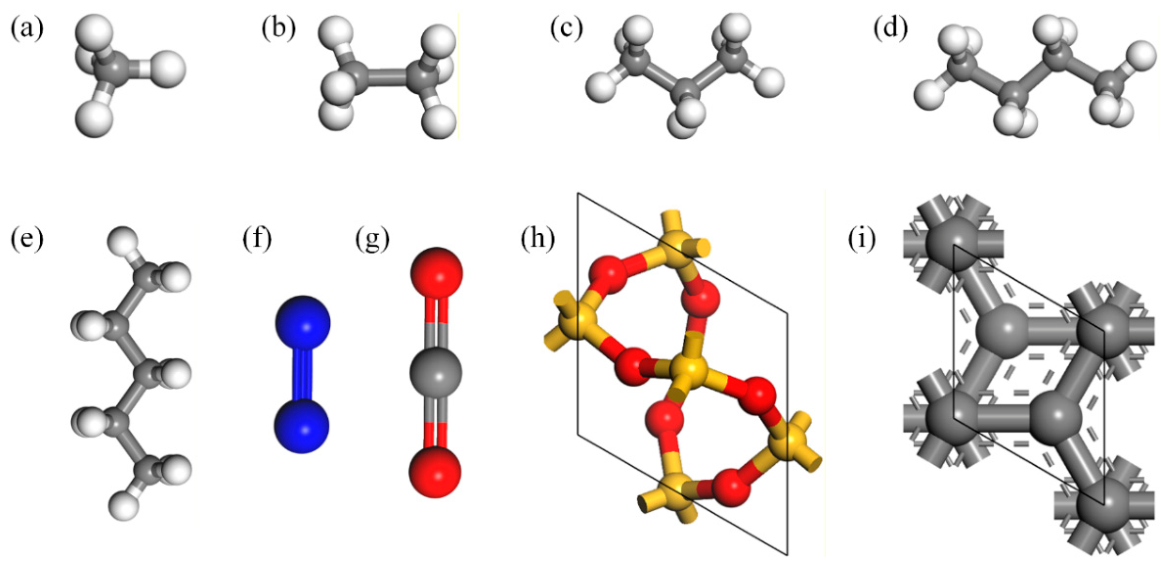
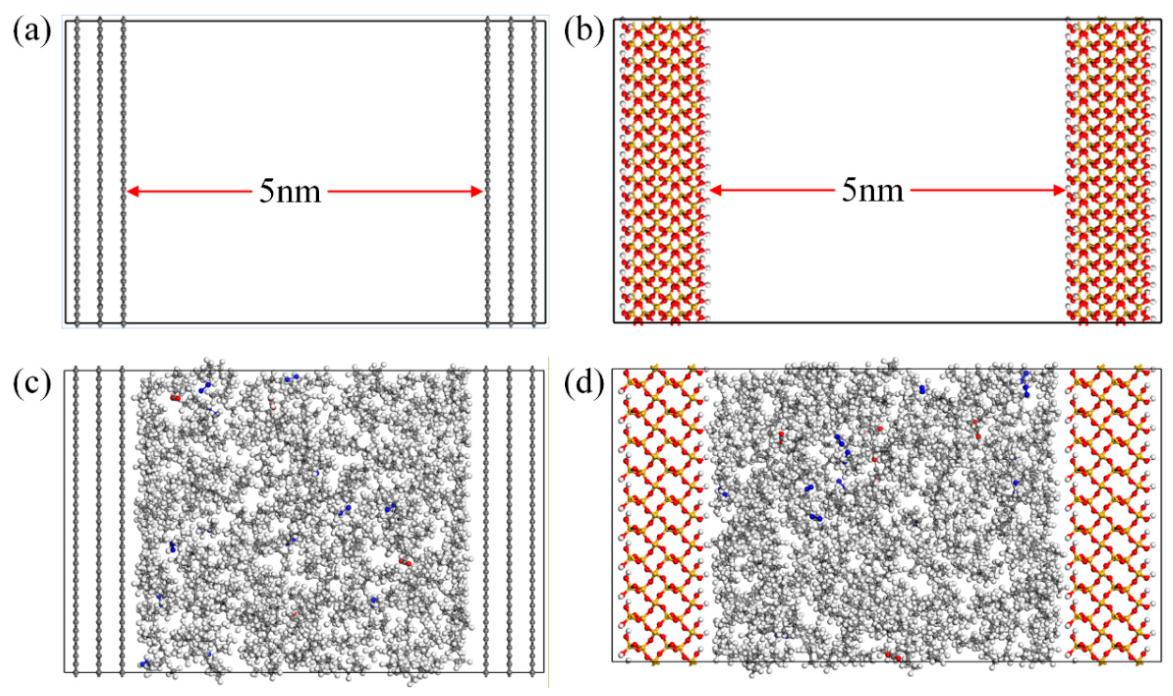
Based on the associated gas compositional analysis presented in Section 2.1 (Table 1), molecular simulation systems were constructed, including methane (CH4), ethane (C2H6), propane (C3H8), butane (C4H10), pentane (C5H12), carbon dioxide (CO2), nitrogen (N2), and quartz (Quartz) and graphite (Graphite) wall structures. The molecular structures are illustrated in Figure 1. To investigate the occurrence state of associated gas in slit pores, 5 nm slit-pore models were built as shown in Figure 2.
For graphite and quartz crystals, the Cleave Surface tool was used to cut along the (0 0 1) plane with a thickness of 15 Å. Supercells were then created using the Supercell function, resulting in lattice parameters of 44.22 Å × 42.55 Å × 15 Å. The associated gas mixture was constructed in an amorphous cell using the Amorphous Cell tool. Subsequently, the Build Layer tool was employed to assemble the graphite or quartz walls with the gas box into composite systems.
After construction, geometric optimization was performed using the Geometry Optimization task in the Forcite module. Molecular dynamics (MD) simulations were then conducted using the COMPASSIII force field in the NVT ensemble, with medium precision, Ewald summation for electrostatic interactions, and atom-based summation for van der Waals interactions. The total simulation time was 500 ps with a time step of 1 fs [18,28].
Post-simulation analysis utilized the Forcite Analysis tools, extracting equilibrium data from the final 200 ps. Density distributions were analyzed with the Density Distribution tool, and mean squared displacement (MSD) curves and diffusion coefficients were calculated using the MSD tool.
To study the flow behavior of associated gas in nanopores, equilibrium molecular dynamics was first applied to obtain the adsorbed equilibrium microstructure. Subsequently, a Perl script in Materials Studio was used to apply driving forces, enabling non-equilibrium molecular dynamics simulations. A constant force of 100 kcal/mol/Å was applied to each CO2 molecule in the x-direction to induce gas flow. Details are discussed in Section 3.3.

2.3. Calculation Methods

2.3.1. Density Distribution

To determine the spatial distribution of oil and gas molecules, the shale pore space was divided along the z-direction into equal-volume bins, assuming macroscopic properties are centered in each bin. The position function is defined as [29]:
H n z i , j = 1             n 1 z < z i < n z H n z i , j = 0               otherwise
The number density and mass density of oil/gas molecules in the nth bin from timestep J a to J b are then:
ρ n u m b e r = 1 A z J a J b + 1 J M J = J N N i = 1 H N z i , j
ρ m a s s = 10 21 N A 1 A z J a J b + 1 J M J = J N N i = 1 H N z i , j M i
where z is the direction normal to flow; J is the timestep; z i is the coordinate of the ith molecule in the nth bin; A is the XY-plane area; N A is Avogadro’s constant; and M i is the molecular weight.

2.3.2. Mean Square Displacement and Diffusion Coefficient

Mean square displacement (MSD) represents the average squared change in particle position from initial to subsequent times, reflecting temporal offsets and inversely correlating with shale adsorption strength. Higher diffusion coefficients indicate greater molecular freedom and weaker adsorption. The diffusion coefficient, which quantifies particle mobility and positional variation over time, is derived from MSD. The self-diffusion coefficient for interlayer sodium ions and water molecules in three dimensions is given by Einstein’s equation [30,31]:
D = 1 6 N α lim t d d t i = 1 N α [ r i t r i 0 ] 2
where [ r i t r i 0 ] 2 is the MSD of the molecular center of mass, and N α is the total number of α-type atoms. Thus, D is one-sixth the slope of the MSD curve.

2.3.3. Adsorption Energy Calculation

Adsorption behavior is primarily governed by gas–surface interactions, with gas–gas interactions being negligible in the present context. Consequently, the focus is placed on gas–surface effects. The total system energy is dominated by van der Waals forces. The interaction energy ( E i n t ) is negative, indicating spontaneous adsorption and a reduction in overall system energy; more negative values correspond to stronger adsorption affinity. It has been reported that adsorption energy becomes more negative with increasing pressure [21,32].
The interaction energy is calculated as follows:
E i n t = E A B E A E B
where E A B is the total energy of the AB complex; E A is the energy of isolated A; and E B is the energy of isolated B.
To obtain more accurate diffusion coefficients, this study conducted four independent repetitions for each data set. The average diffusion coefficient for each set was calculated, and the corresponding standard deviation was reported.

2.3.4. Velocity Distribution

Molecular dynamics simulations yield atomic positions, velocities, and forces directly. To obtain fluid velocity distribution in pores, statistical mechanics processes simulation results. Pores are divided into bins parallel to solid walls, with alkane velocity in each bin calculated as [33,34]:
υ = i = 1 N   m i v i , x i = 1 N   m i
where υ is velocity (m/s); i indexes atoms in the bin; N is the total atoms in the bin; m i is mass of atom i (g); and v i , x is the x -component of velocity for atom i (m/s).

3. Results and Discussion

3.1. Free Diffusion Characteristics of Associated Gas Components

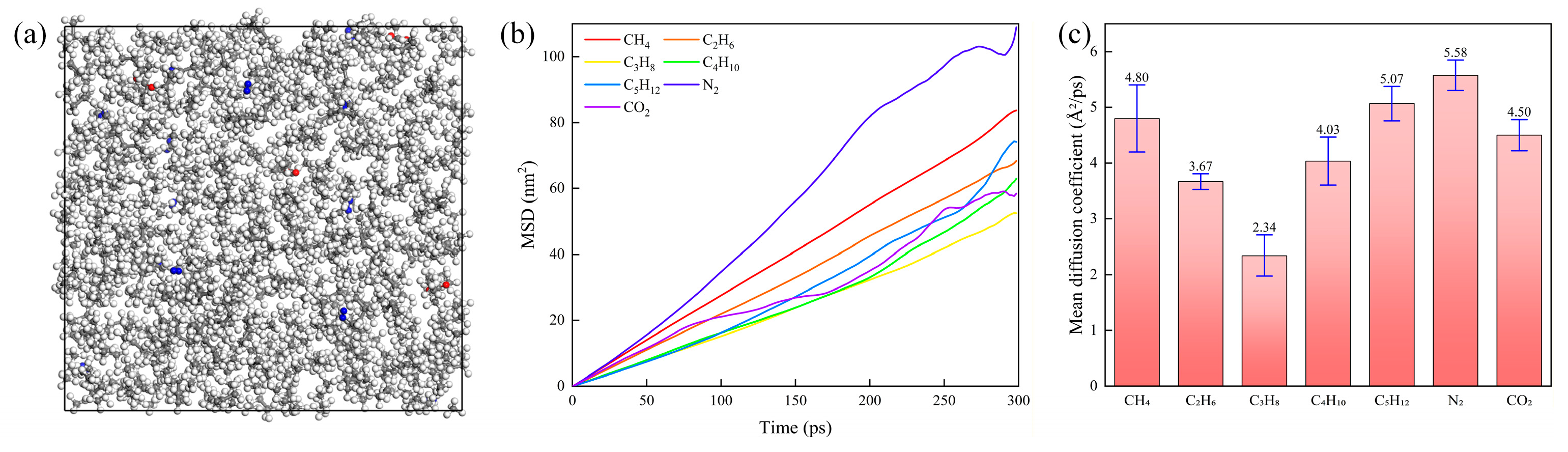
Based on the average composition of associated gas from the Hesui area obtained in Section 2.1, a molecular model of the mixed associated gas was constructed using the Amorphous Cell tool in Materials Studio 2023 software, generating a simulation box (see Figure 3). Molecular dynamics simulations were then performed at 323 K and 20 MPa to investigate the diffusion behavior of the associated gas. The mean squared displacement (MSD) curves for each component were calculated during the simulation, and diffusion coefficients were obtained by fitting the curves according to the Einstein relation. The MSD curves exhibited excellent linearity with time for all components, confirming that the system had reached a stable diffusive state and that the derived diffusion coefficients are reliable.
The diffusion coefficients (in Å2/ps) were as follows: CH4 4.80, C2H6 3.67, C3H8 2.34, C4H10 4.03, C5H12 5.07, N2 5.58, CO2 4.50. The overall order was N2 > C5H12 > CH4 > CO2 > C4H10 > C2H6 > C3H8, indicating that N2 exhibits the strongest diffusion ability while C3H8 exhibits the weakest.
To validate the reliability of the molecular dynamics simulation results, this study compared the simulated diffusion coefficients of methane under various conditions with experimental data reported in the literature. According to Chen et al. [35], the experimentally measured diffusion coefficient of methane was approximately 1.90 × 10⁻⁸ m2/s, while the value obtained from the present simulations was 4.80 × 10⁻⁸ m2/s. The two values are of the same order of magnitude and numerically close, indicating that the model constructed in this study is reasonable and that the simulation results exhibit high fidelity and reliability.
These differences arise primarily from the combined effects of molecular mass, size, shape, and intermolecular interactions. N2 and CH4 have simple structures, low mass, and weak polarity, resulting in minimal interaction with surrounding molecules and walls and thus lower resistance to motion. As the carbon chain length of alkanes increases, molecular volume grows and van der Waals interactions strengthen, restricting molecular mobility and leading to a general decline in diffusion coefficients. Although CO2 has a higher molecular weight, its linear structure provides greater conformational flexibility, enabling superior diffusion compared to C3H8 at similar molecular weight. In low-pressure mixed systems, factors such as collision frequency, transient spatial arrangement, and surface diffusion effects contribute to the non-monotonic trend observed for C4H10 and C5H12 [36]. Furthermore, it is worth noting that the current diffusion analysis assumes an ideal mixture. In a complex seven-component system, the cross effects (the mutual influence between diffusing components) are significant and are likely a major contributor to this non-monotonic behavior. Due to the tremendous computational and theoretical complexity required to decouple multi-component cross-diffusion matrices, this specific phenomenon will be systematically investigated as an independent topic in our future work. Under ambient conditions, small, low-polarity components in the Hesui associated gas display higher diffusion ability, while complex molecules with stronger interactions diffuse more slowly. These findings provide important theoretical insight into the microscopic migration mechanisms of associated gas in tight reservoirs of the Hesui area, Ordos Basin, and support subsequent separation and utilization processes.

3.2. Microscopic Behavior of Associated Gas in Nanopore Slits

3.2.1. Occurrence and Energy Characteristics in Nanopore Slits

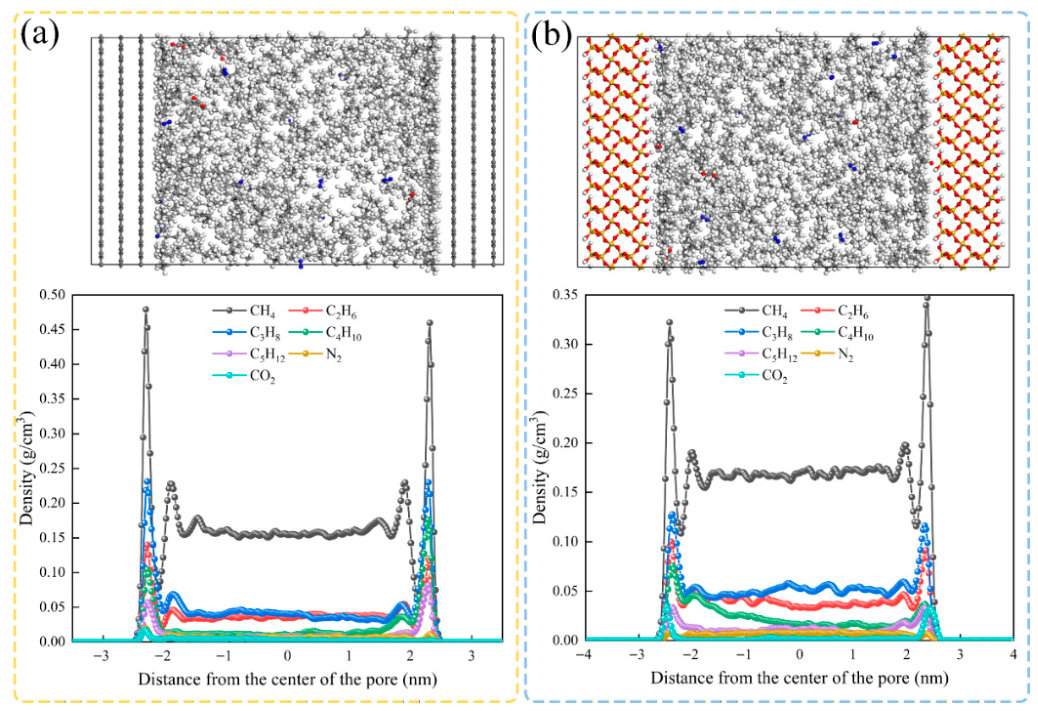
To investigate the occurrence state and characteristics of associated gas in quartz and graphite slit pores, molecular dynamics simulations were conducted at 323 K and 20 MPa. The results are shown in Figure 4.
In both quartz and graphite slit pores, the associated gas consists of adsorbed and free gas phases. Within the adsorbed phase, methane exhibits the strongest affinity for the wall surface, displaying the highest density peaks and most pronounced adsorption, followed by propane, ethane, butane, and pentane, with CO2 and N2 showing the weakest adsorption. Notably, alkane adsorption is stronger on graphite slit pores than on quartz slit pores. Detailed analysis of adsorption energies is presented below.
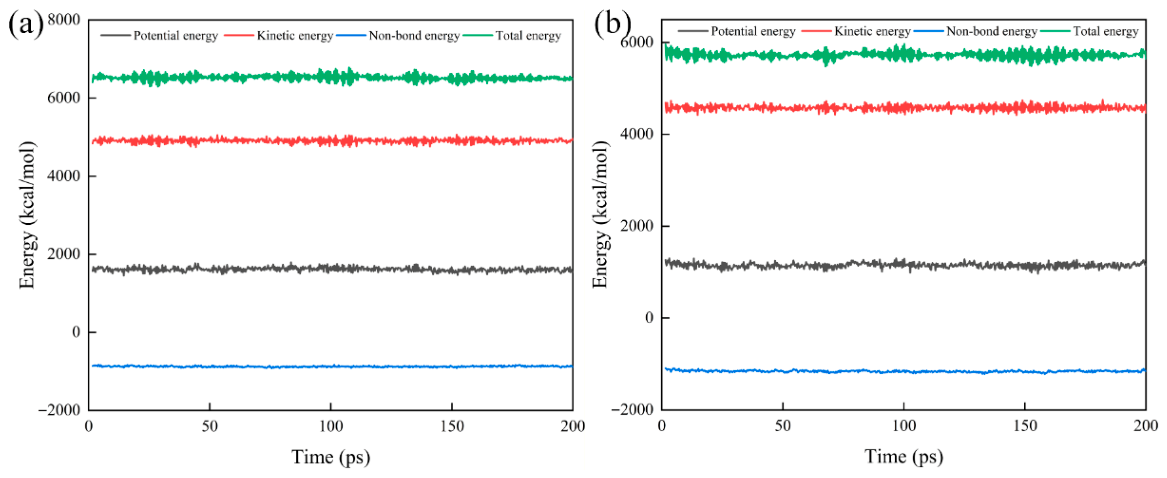
As shown in Figure 5 and Table 2, under identical temperature and pressure conditions, the total system energy in the graphite slit pore (5727 kcal/mol) is significantly lower than in the quartz slit pore (6523 kcal/mol), with a difference of approximately 796 kcal/mol. This disparity is primarily attributed to the substantial reduction in non-bonded energy: −1157 kcal/mol in the graphite system versus −872 kcal/mol in the quartz system, indicating stronger adsorption interactions on graphite and greater energy release from van der Waals and electrostatic forces. The potential energy is also lower in the graphite system (1149 kcal/mol) than in the quartz system (1615 kcal/mol), reflecting more stable molecular conformations and lower overall system potential. The kinetic energy is similarly reduced (4578 kcal/mol vs. 4908 kcal/mol), suggesting greater restriction of molecular thermal motion.
These energy differences stem fundamentally from the distinct chemical properties of the wall surfaces. Graphite, as a non-polar hydrophobic surface rich in π-electron clouds, forms strong dispersion and induction forces with alkane molecules (e.g., CH4, C2H6) and the quadrupole moment of CO2, promoting parallel adsorption and stable layered structures, thereby enhancing adsorption affinity and reducing non-bonded and total energy [37,38,39]. In contrast, quartz (SiO2) surfaces, rich in polar Si–O bonds and hydroxyl groups, exhibit hydrophilic characteristics and weaker interactions with associated gas molecules, relying mainly on electrostatic forces and hydrogen bonding, resulting in looser adsorption and higher non-bonded and potential energies [40]. Non-hydrocarbon components (N2 and CO2) also show stronger affinity for graphite, further amplifying the energy difference. These results demonstrate that wall chemical composition and polarity are the dominant factors controlling the energetic state of associated gas occurrence in nanopore slits. Graphite pores favor stable, low-energy occurrence, while quartz pores exhibit relatively weak adsorption.
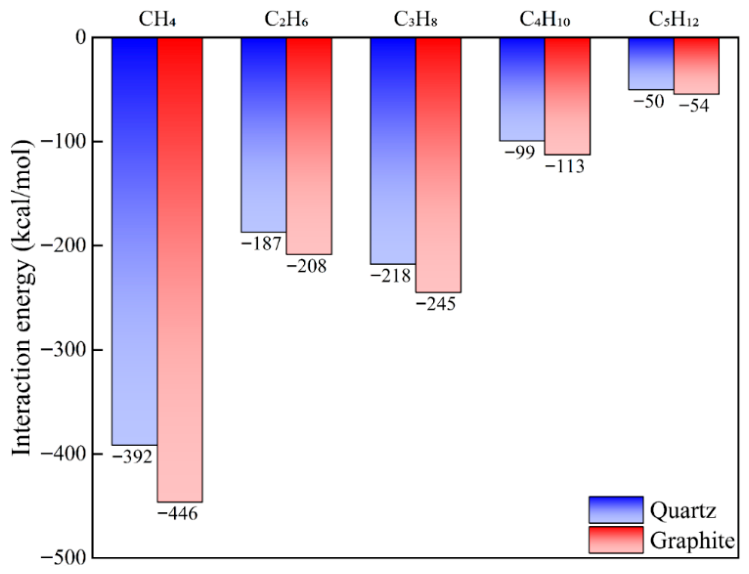
Furthermore, adsorption energies for individual alkane components (C1–C5) on graphite and quartz slit pores were calculated (Figure 6, units: kcal/mol). The absolute values of adsorption energies on graphite are significantly higher than on quartz for all alkanes. For example, methane adsorption energy is −446.118 kcal/mol on graphite versus −391.609 kcal/mol on quartz (an enhancement of approximately 14%); enhancements for ethane, propane, butane, and pentane are about 12%, 12%, 13%, and 8%, respectively. This trend indicates stronger overall adsorption affinity of graphite for associated gas alkanes, with the advantage more pronounced for shorter carbon chains. Adsorption energy decreases in magnitude with increasing chain length, primarily due to reduced effective adsorption sites as molecular volume grows; however, graphite maintains a consistent advantage across components.
These differences arise from the fundamental contrast in wall chemistry: graphite’s non-polar, π-electron-rich hydrophobic surface enables strong π–π dispersion and induction interactions with alkane C–H bonds, promoting parallel adsorption and stable layered structures with substantial energy release [39]. Quartz’s polar, hydrophilic surface interacts more weakly through electrostatic and induction forces, resulting in uneven adsorption sites and lower affinity [41,42]. These adsorption energy results align closely with the preceding energy distribution and diffusion behaviors: stronger adsorption on graphite stabilizes gas molecules, restricts thermal motion, and significantly suppresses diffusion coefficients (except for CO2), while weaker adsorption on quartz corresponds to higher diffusion ability. These findings confirm the critical role of wall polarity and chemical composition in differentially regulating adsorption–diffusion behavior in nanopores and provide quantitative insight into the impact of mineral pore types on gas occurrence and migration in tight reservoirs. They also offer valuable guidance for pore-type evaluation and gas flow simulation in oil and gas field development.

3.2.2. Effect of Wall Surfaces on Diffusion of Associated Gas

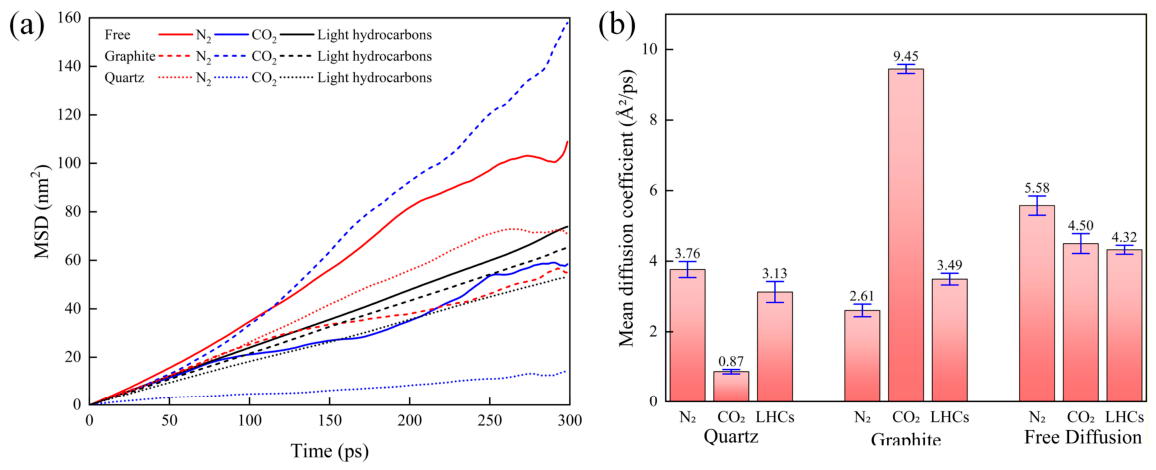
To investigate the influence of wall properties on the diffusion behavior of associated gas, molecular dynamics simulations were performed under three conditions: free diffusion (no walls), graphite slit pores, and quartz slit pores. The mean squared displacement (MSD) curves and corresponding diffusion coefficients (in Å2/ps) for each component were calculated. The results are presented in Figure 7.
The simulations reveal that the presence of walls significantly suppresses the diffusion of associated gas. Compared to free diffusion, diffusion coefficients of N2 and light hydrocarbons (average for alkanes) decreased markedly in both slit-pore systems. The suppression was stronger in graphite slit pores (N2 reduced by ~52%, light hydrocarbons by ~14%) than in quartz slit pores (N2 by ~31%, light hydrocarbons by ~27%). This effect is primarily attributed to increased molecular migration resistance due to wall adsorption. The non-polar graphite surface promotes strong π–π dispersion and induction interactions, facilitating parallel adsorption of associated gas molecules (especially N2 and alkanes) and forming dense layered structures that substantially restrict movement along the pore axis. In contrast, although quartz exhibits hydrophilic characteristics, its interactions with non-polar components of associated gas are relatively weaker, resulting in looser adsorption layers and less pronounced diffusion suppression.
Notably, CO2 diffusion in graphite slit pores (9.45 Å2/ps) is substantially higher than in free diffusion (4.50 Å2/ps), whereas it drops sharply to 0.87 Å2/ps in quartz slit pores. This anomalous behavior arises from CO2’s linear molecular structure and quadrupole moment. On non-polar graphite, CO2 readily aligns parallel to the surface and undergoes rapid surface slip, resulting in enhanced diffusion dominated by surface mechanisms [43,44,45]. On polar quartz, however, CO2 forms strong electrostatic interactions and hydrogen bonds with surface hydroxyl groups, leading to firm adsorption and severely restricted mobility [42,46].
These results demonstrate that wall chemical composition and polarity exert component-specific effects on diffusion in nanopore slits: graphite walls strongly inhibit diffusion for most components (except CO2), while quartz walls exert a more pronounced inhibitory effect on CO2.

3.2.3. Effect of Temperature on the Diffusion of Associated Gas

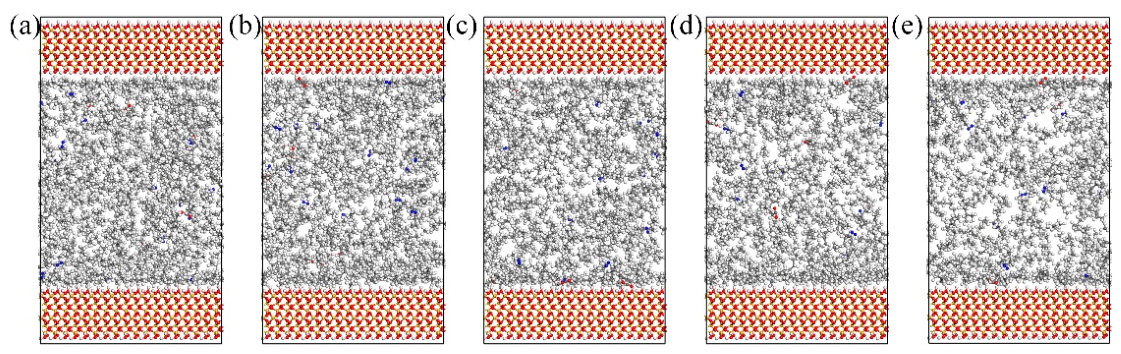
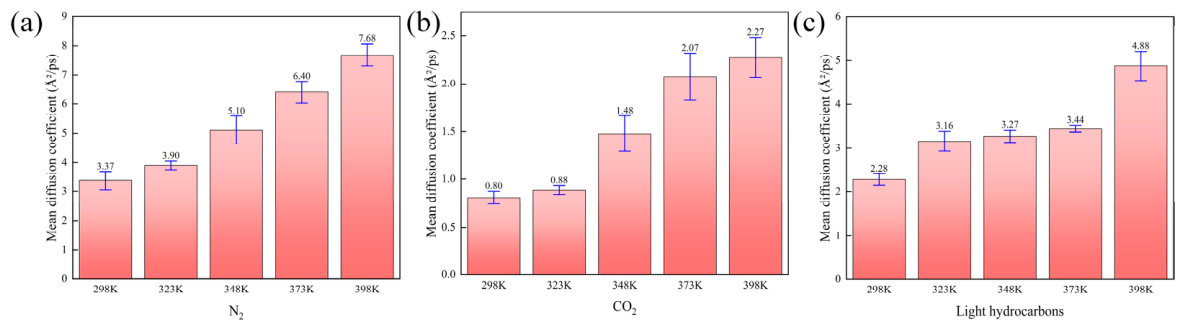
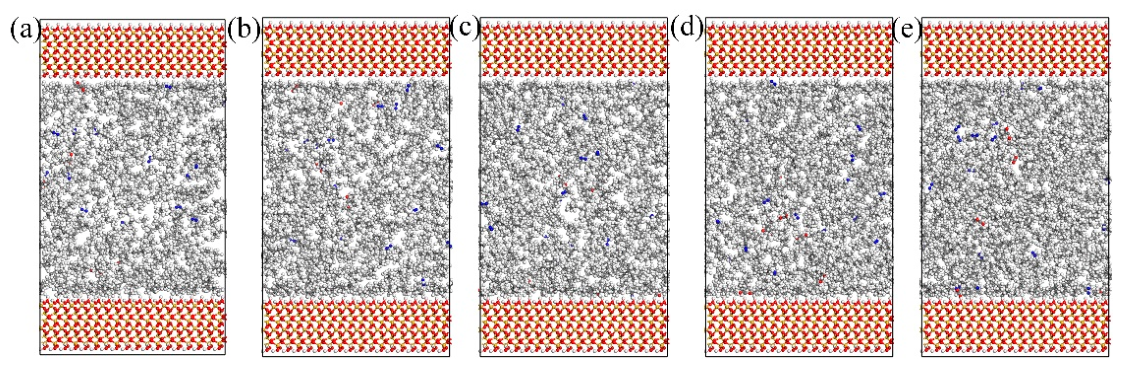
This study employed molecular dynamics simulations to systematically investigate the effect of temperature on the diffusion behavior of associated gas (N2, CO2, and light hydrocarbons) within shale nano-quartz slits. As shown in Figure 8 and Figure 9, the average diffusion coefficients of all three gas molecules exhibited a significant positive correlation with increasing temperature from 298 K to 398 K.
Specifically, non-polar N2 exhibited the highest diffusivity and the strongest temperature response, with its diffusion coefficient increasing sharply from 3.37 Å2/ps at 298 K to 7.68 Å2/ps at 398 K. In contrast, CO2 displayed a relatively low overall diffusion coefficient due to strong adsorption on the pore walls; nevertheless, its diffusion coefficient still increased significantly from 0.80 Å2/ps to 2.27 Å2/ps with rising temperature, representing nearly a threefold enhancement. The diffusivity of light hydrocarbons fell between the two, rising gradually from 2.28 Å2/ps to 4.88 Å2/ps as temperature increased.
From a microscopic perspective, the positive temperature dependence arises because higher temperatures impart greater thermal kinetic energy to the gas molecules. In the nano-confined space, the intensified molecular thermal motion enables the gas molecules to more effectively overcome the van der Waals attractions and adsorption energy barriers of the solid walls. This results in reduced residence time of molecules on the pore surfaces, increased conversion from the adsorbed state to the free state, and a higher frequency of molecular jumps and shuttling within the pore channels, ultimately manifesting as a significant increase in the macroscopic diffusion coefficient.

3.2.4. Effect of Pressure on the Diffusion of Associated Gas

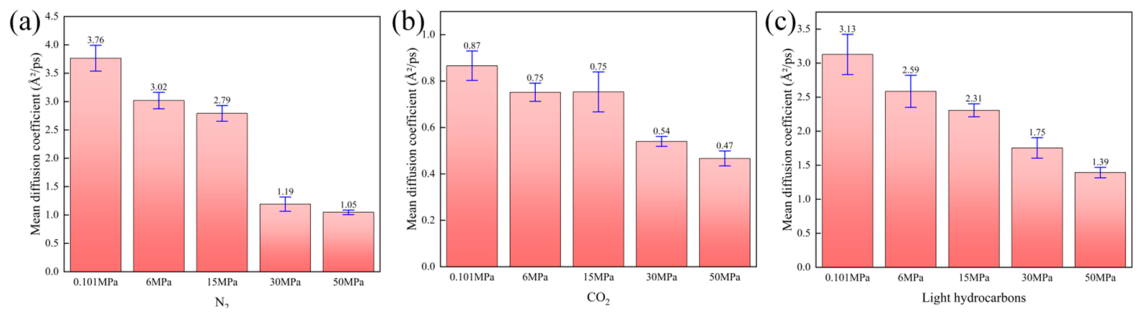
This study utilized molecular dynamics simulations to systematically examine the influence of pressure on the diffusion behavior of associated gas (N2, CO2, and light hydrocarbons) in shale nano-quartz slits. As illustrated in Figure 10 and Figure 11, the diffusion coefficients of the associated gas system showed a significant negative correlation as the system pressure increased from 0.101 MPa to 50 MPa.
As the pressure increased from 0.101 MPa to 50 MPa, the average diffusion coefficients of N2, CO2, and light hydrocarbons all exhibited a monotonic decreasing trend. Notably, N2 was most sensitive to pressure in the low-pressure regime (<6 MPa), with its diffusion coefficient decreasing sharply from 3.76 Å2/ps to 1.05 Å2/ps. The diffusion coefficient of light hydrocarbons showed a relatively gradual decline, decreasing from 3.13 Å2/ps to 1.39 Å2/ps. In comparison, CO2 maintained the lowest diffusion coefficient overall, remaining relatively stable (approximately 0.75 Å2/ps) in the medium-pressure range (6–15 MPa), before slowly decreasing to 0.47 Å2/ps at higher pressures.
From a microscopic perspective, the increase in pressure significantly raises the fluid density within the confined space and markedly reduces the mean free path of the molecules. The resulting increase in intermolecular collision frequency and the compression of free volume strongly restrict molecular migration and jumping, which macroscopically manifests as a reduction in the diffusion coefficient. This pressure dependence indicates that during the later stages of reservoir depressurization, the microscopic diffusion and transport capacity of associated gas will be effectively enhanced. These findings hold important theoretical significance for accurately evaluating the recovery efficiency and ultimate recovery factor of unconventional oil and gas reservoirs under depletion development.

3.2.5. Effect of Nanopore Size on the Diffusion of Associated Gas

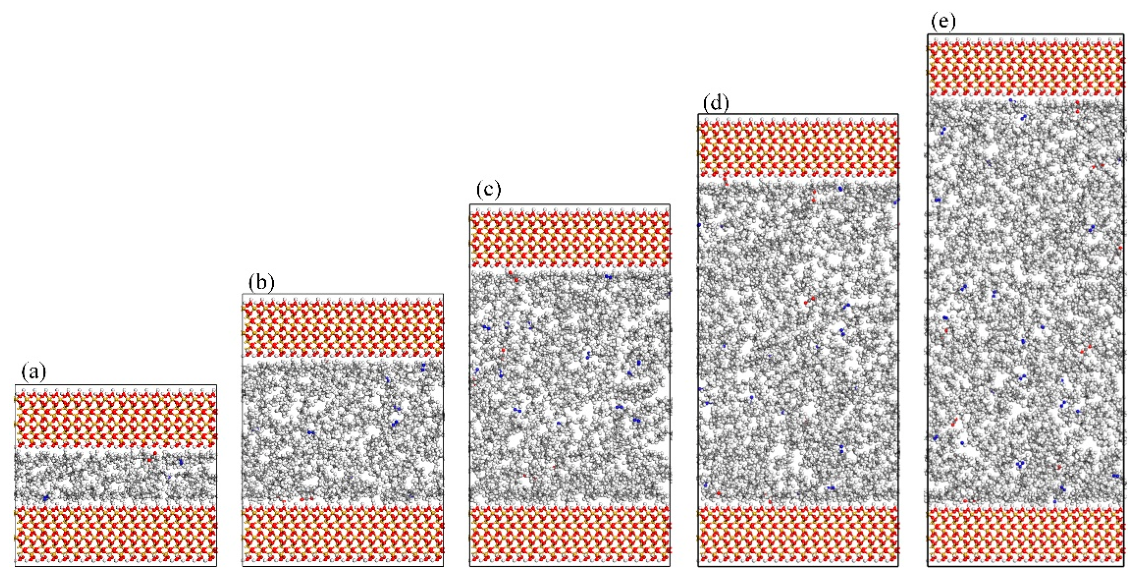
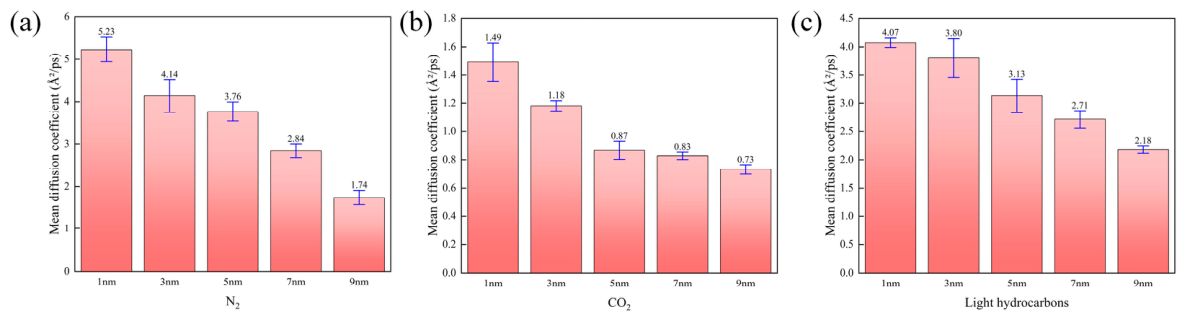
This study systematically investigated the nanoconfinement effect of different pore sizes (1–9 nm) on the diffusion behavior of associated gas (N2, CO2, and light hydrocarbons) in shale. As shown in Figure 12 and Figure 13, the average diffusion coefficients of all three gas molecules exhibited a significant monotonic decreasing trend with increasing pore diameter.
Specifically, the diffusion coefficient of N2 reached 5.23 Å2/ps in the extremely confined 1 nm slit and decreased substantially to 1.74 Å2/ps when the pore size increased to 9 nm. Light hydrocarbons exhibited a similar but milder decline, decreasing from 4.07 Å2/ps to 2.18 Å2/ps. In contrast, CO2 consistently showed the lowest diffusion coefficient among the three, decreasing slowly from 1.49 Å2/ps at 1 nm to 0.73 Å2/ps at 9 nm.
From a microscopic dynamics perspective, this phenomenon is primarily attributed to the transition in molecular flow regime and the change in wall slip effects within the confined space. In the 1 nm extremely confined pore, gas molecules experience strong overlapping potential fields from both walls, tending to form highly ordered layered arrangements. Intermolecular collisions are minimal, and transport is dominated by specular collisions with the walls. When the wall surface is relatively smooth (e.g., carbon-based organic matter), strong surface slip effects can induce near “frictionless” rapid transport. However, as the pore size increases to 9 nm, the free gas volume in the pore center expands significantly, causing molecular motion to shift from wall-dominated to fluid interior-dominated. The sharp increase in molecule–molecule collisions leads to enhanced internal friction and greater kinetic energy dissipation, which substantially weakens the slip enhancement effect at the nanoscale and results in a macroscopic decrease in the diffusion coefficient.
Additionally, the consistently lowest diffusion coefficient of CO2 further confirms its strong adsorption affinity with the pore walls. These nanoscale confinement transport characteristics indicate that in extremely small shale pores, N2 and light hydrocarbons can maintain high transport efficiency through slip effects. This finding is of great theoretical importance for accurately assessing microscopic seepage capacity in unconventional reservoirs and optimizing gas displacement strategies.

3.2.6. Effect of Pore Water on the Diffusion of Associated Gas

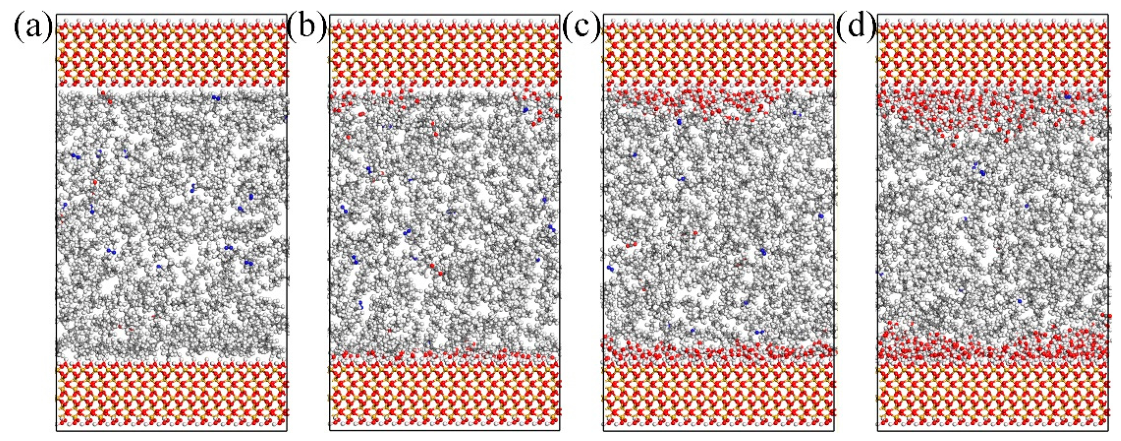
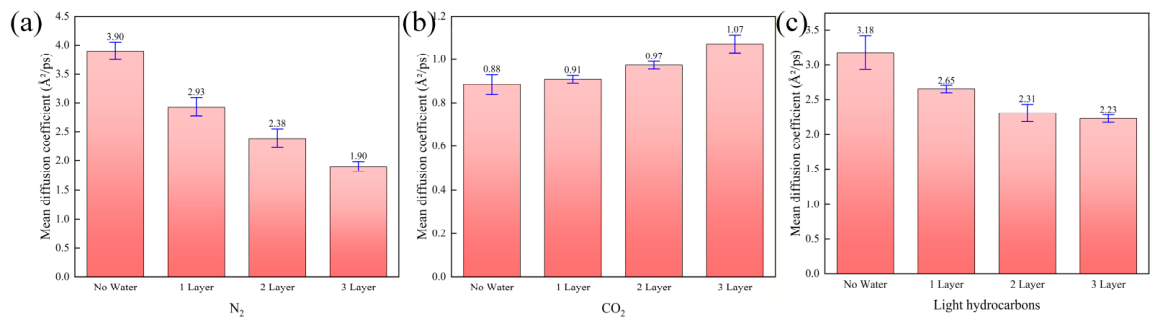
This study systematically evaluated the nanoconfinement effect of varying pore wall hydration states (from anhydrous to three-layer water film) on the diffusion behavior of associated gas (N2, CO2, and light hydrocarbons) in shale nano-slits. As shown in Figure 14 and Figure 15, non-polar gases (N2 and light hydrocarbons) and polar gas (CO2) exhibited distinctly opposite diffusion trends with increasing water content.
Specifically, the average diffusion coefficients of N2 and light hydrocarbons decreased significantly with increasing water film thickness. The diffusion coefficient of N2 dropped from 3.90 Å2/ps under anhydrous conditions to 1.90 Å2/ps under three water layers, a reduction of over 50%. Light hydrocarbons showed a more moderate decline, decreasing from 3.18 Å2/ps to 2.23 Å2/ps. From a microscopic perspective, the dense water molecule network not only occupies the effective free volume within the pores and narrows the gas transport pathways but also generates strong repulsive forces and steric hindrance against non-polar gas molecules due to its highly polar surface. This leads to a substantial reduction in gas-phase permeability, known as the typical microscopic “water blocking effect.”
In contrast, the diffusion coefficient of CO2 exhibited an anomalous slight increasing trend with increasing water film thickness (from 0.88 Å2/ps to 1.07 Å2/ps). This reversal is primarily attributed to the preferential adsorption of water molecules on the inorganic mineral surface. Water molecules occupy high-energy adsorption sites on the pore walls through strong hydrogen bonding, thereby effectively shielding the strong van der Waals interaction between the solid wall and CO2. After being “desorbed” from the wall by the water film, CO2 experiences a smoother slip boundary at the water–gas interface, resulting in an increased effective diffusion coefficient.
These results suggest that under water-bearing formation conditions, CO2 injection can effectively mitigate the water blocking effect through competitive adsorption mechanisms, demonstrating superior sweep efficiency and transport potential compared to N2. This finding provides important microscopic theoretical support for the application of CO2 displacement technology in unconventional oil and gas reservoirs.

3.3. Mechanisms of CO2 Displacement of Associated Gas

3.3.1. Competitive Adsorption Mechanisms Between CO2 and Associated Gas

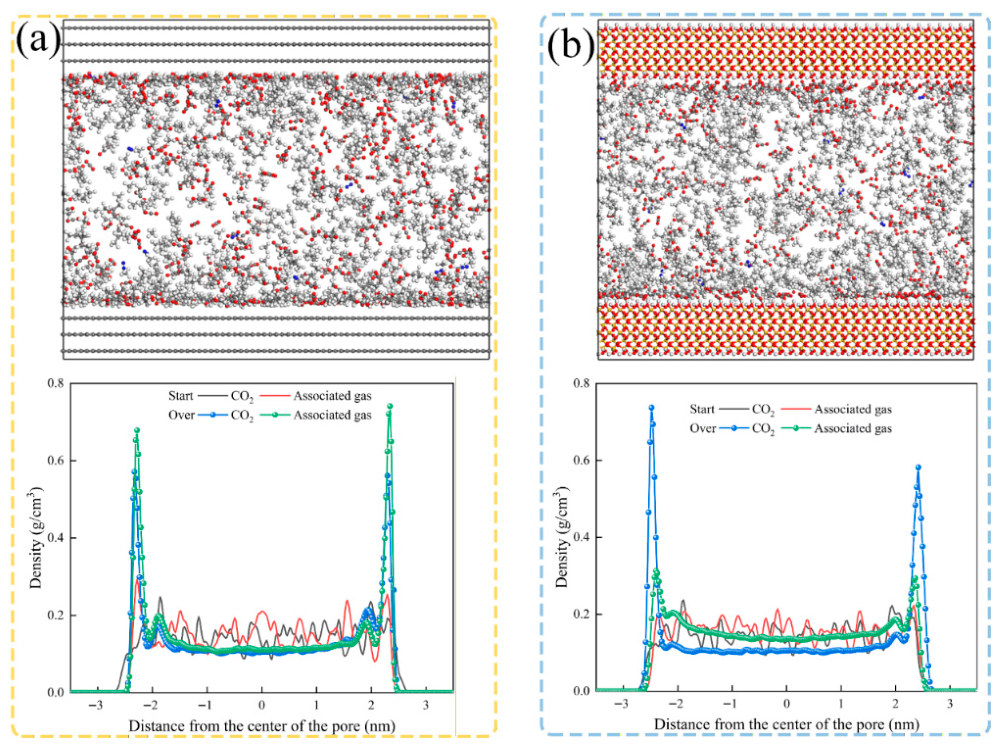
To elucidate the displacement of associated gas from slit pores by CO2, density distributions before and after CO2 injection were compared in quartz and graphite slit-pore systems. The results indicate that (Figure 16), in both wall types, CO2 injection leads to the formation of distinct adsorption layers near the walls for both CO2 and associated gas, though the adsorption behavior and displacement efficiency differ significantly.
In quartz slit pores, CO2 exhibits a much stronger affinity for the wall than associated gas, preferentially occupying adsorption sites and forming a dense CO2 layer. Associated gas molecules (primarily alkanes) are partially displaced to the pore center, but a substantial fraction remains near the wall, resulting in a composite “associated gas outer layer + CO2 inner layer” structure. This reflects the significant competitive advantage of CO2 on quartz due to its polar Si–O bonds and hydroxyl groups, which enable strong electrostatic induction and hydrogen bonding with CO2’s quadrupole moment. In contrast, non-polar alkanes in associated gas interact more weakly with quartz, making them more easily displaced from the wall; however, residual associated gas remains adsorbed in the outer layer, limiting complete displacement.
In graphite slit pores, although CO2 forms a noticeable adsorption layer and exhibits high diffusion, the non-polar π-electron-rich surface of graphite interacts far more strongly with alkanes than with CO2 (despite CO2’s quadrupole-induced adsorption). Consequently, associated gas alkanes remain firmly adsorbed, and CO2 struggles to compete for wall sites. Displacement primarily occurs in the pore center, with more associated gas retained near the wall.
Overall, polar quartz walls confer a competitive adsorption advantage to CO2 but result in incomplete displacement due to residual associated gas. Non-polar graphite walls favor strong associated gas retention, rendering CO2 less effective at displacing wall-adsorbed molecules [47,48,49]. These findings highlight the critical regulatory role of wall polarity in CO2 displacement processes: polar walls (e.g., quartz) promote CO2 adsorption but limit displacement efficiency, while non-polar walls (e.g., graphite) enhance associated gas stability but weaken CO2 competition. The results provide important microscopic mechanistic insight for CO2 flooding and gas displacement design in tight reservoirs, particularly regarding pore mineral type selection.
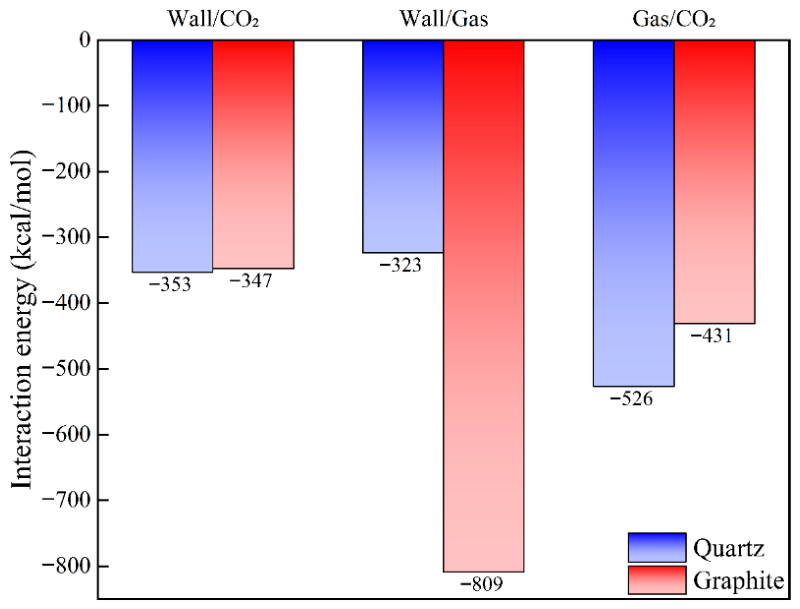
Adsorption energies for associated gas and CO2 on different walls were further calculated (Figure 17). Graphite exhibits a much higher absolute adsorption energy for associated gas (−808.583 kcal/mol) than quartz (−323.253 kcal/mol), reflecting stronger affinity driven by π–π dispersion and induction interactions with alkane C–H bonds, which promote stable parallel adsorption layers. For pure CO2, adsorption energies are similar (quartz −352.775 kcal/mol vs. graphite −347.397 kcal/mol), with quartz slightly stronger due to better electrostatic and hydrogen-bonding interactions.
In mixed CO2 + associated gas systems, quartz shows a higher absolute total adsorption energy (−526.395 kcal/mol) than graphite (−430.727 kcal/mol). This indicates that quartz preferentially adsorbs CO2 while partially retaining associated gas, forming a stable composite layer. On graphite, the total adsorption energy is dominated by associated gas, with CO2 contributing less, confirming its weaker competitive ability.
Further analysis reveals that on quartz, the mixed-system adsorption energy (−526.395 kcal/mol) exceeds that of pure CO2 (−352.775 kcal/mol) or pure associated gas (−323.253 kcal/mol) but is less than their sum (~−676 kcal/mol), indicating competitive rather than fully synergistic effects. CO2 occupies inner sites, displacing alkanes to the outer layer. On graphite, the mixed-system value (−430.727 kcal/mol) is much lower than pure associated gas (−808.583 kcal/mol) but only slightly higher than pure CO2 (−347.397 kcal/mol), demonstrating that CO2 significantly weakens associated gas adsorption without fully replacing it.
In summary, wall polarity differentially regulates CO2 displacement of associated gas: strong polarity (quartz) favors CO2 competition but leaves residual associated gas; strong non-polarity (graphite) enhances associated gas retention, limiting CO2 effectiveness. These findings offer quantitative mechanistic guidance for CO2 injection optimization and pore-type evaluation in tight reservoir development [50].

3.3.2. Flow Characteristics of CO2 Displacement of Associated Gas in Nanopores

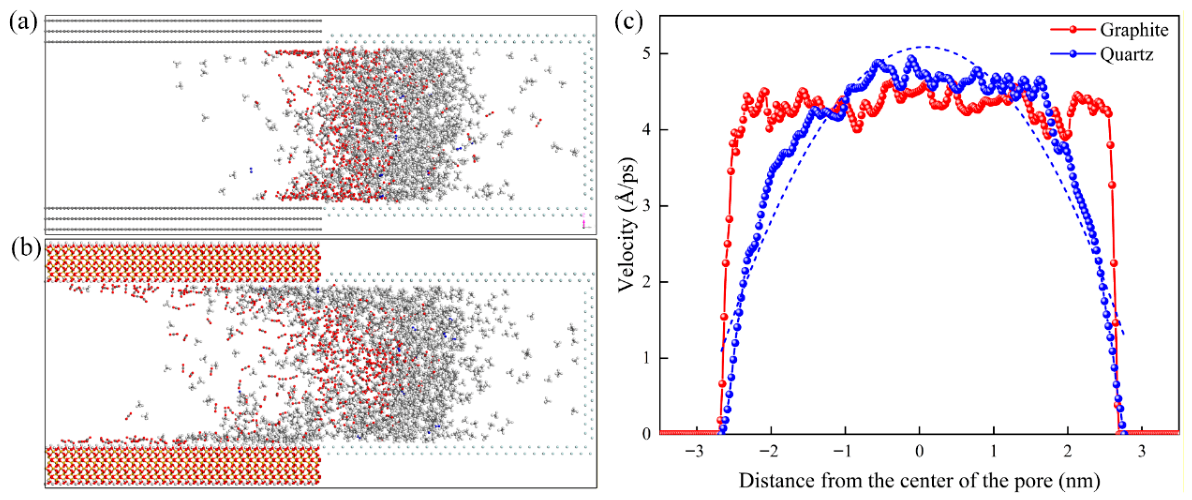
To investigate the flow characteristics of associated gas displacement by CO2 in nanopores, displacement models were constructed using the previously established associated gas molecular models in slit pores with different wall properties (Figure 18). The simulation results show that CO2 can enter quartz slit pores and displace associated gas; however, residual associated gas molecules remain in the pores after displacement, indicating that complete removal of associated gas is challenging at the nanoscale due to strong adsorption effects that significantly restrict gas desorption and migration.
The velocity distribution profiles of associated gas during CO2 displacement (Figure 18c) in quartz slit pores exhibit a typical parabolic shape, with low velocities near the walls and higher velocities in the pore center—resembling macroscopic Poiseuille flow. This pattern arises because associated gas molecules near the walls experience strong van der Waals interactions, forming stable adsorption layers that markedly reduce molecular mobility. In contrast, free molecules in the pore center are less constrained by the walls and respond more rapidly to external driving forces, resulting in higher flow velocities. Consequently, the presence of adsorption layers effectively reduces the effective flow space and increases flow resistance, thereby lowering overall permeability.
In graphite slit pores, the surface exhibits ultra-low friction and weak adsorption characteristics, resulting in negligible adsorption lag and a nearly flat velocity profile indicative of plug-like, near-rigid-body slip flow [51,52]. This significantly enhances fluid transport efficiency.
Overall, the stronger adsorption and higher interfacial friction in quartz pores limit CO2 displacement of associated gas, whereas the weak adsorption and low-friction interface in graphite pores promote superior seepage capacity [53,54]. These findings demonstrate that the efficiency of CO2 displacement of associated gas in nanopores is primarily governed by pore wall interfacial properties, with adsorption strength and friction characteristics serving as key factors influencing displacement effectiveness and flow behavior [51,53]. This understanding provides important theoretical guidance for enhancing associated gas recovery through interfacial modification.

4. Conclusions

This study utilized molecular dynamics simulations to systematically investigate the microscopic occurrence, diffusion behavior, and CO2 displacement mechanisms of associated gas from the Hesui area in nanopores, with emphasis on the regulatory role of wall polarity (graphite versus quartz). The results highlight wall chemical composition and polarity as key factors governing associated gas migration and displacement efficiency, providing valuable microscopic theoretical guidance for tight reservoir development.
The main conclusions are:
(1) Diffusion behavior differs markedly between free space and nanopore slits. In free diffusion, coefficients depend on molecular mass, size, shape, and interactions, with N2 showing the highest and C3H8 the lowest diffusivity. Walls suppress diffusion, with graphite exerting stronger inhibition on most components (except CO2). CO2 exhibits anomalously enhanced diffusion in graphite pores due to linear structure and surface slip, while it is severely restricted on quartz.
(2) Wall properties control the energetic state and adsorption strength. Non-polar graphite displays stronger alkane affinity than polar quartz, yielding lower system and non-bonded energies and more stable layered structures. This stems from graphite’s strong π-dispersion interactions with alkanes versus quartz’s weaker polar interactions, explaining differential occurrence stability across mineral pores.
(3) CO2 displacement efficiency depends on wall polarity. On polar quartz, CO2 competitively adsorbs, forming an “associated gas outer—CO2 inner” layer, but residuals limit completeness. On non-polar graphite, associated gas binds firmly, restricting CO2 to pore-center displacement. Quartz pores show Poiseuille flow with high friction and low efficiency; graphite exhibits low-friction slip flow, enhancing transport.

Author Contributions

Conceptualization, X.Z. and J.J.; data curation, J.Z., X.L., Y.G. and Z.C.; formal analysis, S.C. and X.Z.; funding acquisition, S.C.; methodology, J.Z., X.L. and J.J.; Investigation, J.Z., J.Z. and X.Z.; supervision, X.Z. and S.C.; visualization, Y.G. and Z.C.; writing—original draft, X.Z.; writing—review and editing, S.C. and Y.G. All authors have read and agreed to the published version of the manuscript.

Funding

This study was supported by the National Natural Science Foundation of China (42504135).

Institutional Review Board Statement

Not applicable.

Informed Consent Statement

Not applicable.

Data Availability Statement

Further inquiries about the data in this study can be directed to the corresponding author.

Acknowledgments

We are grateful to the journal editor and reviewers for their contributions to this article.

Conflicts of Interest

Authors Jinfeng Jia, Xiyao Li, Jiangang Zheng, Yangkai Guo, and Zhuo Chen were employed by PetroChina. Author Shijing Chen was employed by SINOPEC. The remaining authors declare that the research was conducted in the absence of any commercial or financial relationships that could be construed as a potential conflict of interest.

References

  1. Mu, L.; Chen, Y.; Xu, A.; Wang, R. Technological Progress and Development Directions of PetroChina Overseas Oil and Gas Field Production. Pet. Explor. Dev. 2020, 47, 124–133. [Google Scholar] [CrossRef]
  2. Fu, J.; Fan, L.; Liu, X.; Huang, D. Gas Accumulation Conditions and Key Technologies for Exploration & Development of Sulige Gasfield. Pet. Res. 2018, 3, 91–109. [Google Scholar] [CrossRef]
  3. De La Peña, L.; Guo, R.; Cao, X.; Ni, X.; Zhang, W. Accelerating the Energy Transition to Achieve Carbon Neutrality. Resour. Conserv. Recycl. 2022, 177, 105957. [Google Scholar] [CrossRef]
  4. Zou, C.; Lin, M.; Ma, F.; Liu, H.; Yang, Z.; Zhang, G.; Yang, Y.; Guan, C.; Liang, Y.; Wang, Y.; et al. Development, Challenges and Strategies of Natural Gas Industry under Carbon Neutral Target in China. Pet. Explor. Dev. 2024, 51, 476–497. [Google Scholar] [CrossRef]
  5. Awosusi, A.A.; Ozdeser, H.; Seraj, M.; Adegboye, O.R. Achieving Carbon Neutrality in Energy Transition Economies: Exploring the Environmental Efficiency of Natural Gas Efficiency, Coal Efficiency, and Resources Efficiency. Clean Technol. Environ. Policy 2025, 27, 2103–2118. [Google Scholar] [CrossRef]
  6. Zou, C.; Dong, D.; Wang, S.; Li, J.; Li, X.; Wang, Y.; Li, D.; Cheng, K. Geological Characteristics and Resource Potential of Shale Gas in China. Pet. Explor. Dev. 2010, 37, 641–653. [Google Scholar] [CrossRef]
  7. Dai, J.; Qin, S.; Hu, G.; Ni, Y.; Gan, L.; Huang, S.; Hong, F. Major Progress in the Natural Gas Exploration and Development in the Past Seven Decades in China. Pet. Explor. Dev. 2019, 46, 1100–1110. [Google Scholar] [CrossRef]
  8. Yan, K.; Lu, X.; Zhang, R.; Xiong, J.; Qiao, Y.; Li, X.; Yu, Z. Molecular Diffusion in Nanoreactors’ Pore Channel System: Measurement Techniques, Structural Regulation, and Catalytic Effects. Small 2023, 19, 2304008. [Google Scholar] [CrossRef]
  9. Zhang, H.; Moh, D.Y.; Wang, X.; Qiao, R. Review on Pore-Scale Physics of Shale Gas Recovery Dynamics: Insights from Molecular Dynamics Simulations. Energy Fuels 2022, 36, 14657–14672. [Google Scholar] [CrossRef]
  10. Espinoza, D.N.; Santamarina, J.C. Water-CO2-Mineral Systems: Interfacial Tension, Contact Angle, and Diffusion—Implications to CO2 Geological Storage. Water Resour. Res. 2010, 46, 14657–14672. [Google Scholar] [CrossRef]
  11. Liang, Y.; Tsuji, S.; Jia, J.; Tsuji, T.; Matsuoka, T. Modeling CO2–Water–Mineral Wettability and Mineralization for Carbon Geosequestration. Acc. Chem. Res. 2017, 50, 1530–1540. [Google Scholar] [CrossRef]
  12. Zhang, Y.; Li, S.; Dou, X.; Wang, S.; He, Y.; Feng, Q. Molecular Insights into the Natural Gas Regulating Tight Oil Movability. Energy 2023, 270, 126895. [Google Scholar] [CrossRef]
  13. Wang, H.; Li, T.; Zou, Q.; Cheng, Z.; Yang, Z. Influences of Path Control Effects on Characteristics of Gas Migration in a Coal Reservoir. Fuel 2020, 267, 117212. [Google Scholar] [CrossRef]
  14. Wang, Z.; Zhang, J.; Liu, X.; Zhao, H.; Ren, D.; Qi, Y.; Yuan, Y.; Kang, Q. Influence of Aspect Ratio of Migration Space on Gas Migration and Accumulation Mechanisms of Different Types of Gas Reservoirs. Nat. Resour. Res. 2025, 34, 427–457. [Google Scholar] [CrossRef]
  15. Bai, M.; Zhang, Z.; Fu, X. A Review on Well Integrity Issues for CO2 Geological Storage and Enhanced Gas Recovery. Renew. Sustain. Energy Rev. 2016, 59, 920–926. [Google Scholar] [CrossRef]
  16. Wei, B.; Wang, B.; Li, X.; Aishan, M.; Ju, Y. CO2 Storage in Depleted Oil and Gas Reservoirs: A Review. Adv. Geo-Energy Res. 2023, 9, 76–93. [Google Scholar] [CrossRef]
  17. Dang, W.; Zhang, X.; Zhang, J.; Shangguan, L.; He, Y. Research on the Characteristics and Mechanisms of Supercritical CO2 Displacement of Shale Oil Under Nanoscale Confinement. Energy Sci. Eng. 2025, 13, 4417–4432. [Google Scholar] [CrossRef]
  18. Zhang, X.; Dang, W.; Zhang, Q.; Nie, H.; Chen, S.; Feng, Y.; Shangguan, L.; Qiu, Z. Pore-Scale Gas Storage Mechanisms, Characteristics, and Influencing Factors in Water-Bearing Shale: Insights from Molecular Dynamics Simulations. ACS Omega 2024, 9, 47005–47022. [Google Scholar] [CrossRef] [PubMed]
  19. Collell, J.; Ungerer, P.; Galliero, G.; Yiannourakou, M.; Montel, F.; Pujol, M. Molecular Simulation of Bulk Organic Matter in Type II Shales in the Middle of the Oil Formation Window. Energy Fuels 2014, 28, 7457–7466. [Google Scholar] [CrossRef]
  20. Zhang, W.; Feng, Q.; Wang, S.; Xing, X. Oil Diffusion in Shale Nanopores: Insight of Molecular Dynamics Simulation. J. Mol. Liq. 2019, 290, 111183. [Google Scholar] [CrossRef]
  21. Zhang, M.; Li, J.; Zhao, J.; Cui, Y.; Luo, X. Comparison of CH4 and CO2 Adsorptions onto Calcite(10.4), Aragonite(011)Ca, and Vaterite(010)CO3 Surfaces: An MD and DFT Investigation. ACS Omega 2020, 5, 11369–11377. [Google Scholar] [CrossRef]
  22. Xu, G. Molecular Dynamics Numerical Simulation of Adsorption Characteristics and Exploitation Limits in Shale Oil Microscopic Pore Spaces. Fluid Dyn. Mater. Process. 2024, 20, 1915–1924. [Google Scholar] [CrossRef]
  23. Rui, Z.; Lu, J.; Zhang, Z.; Guo, R.; Ling, K.; Zhang, R.; Patil, S. A Quantitative Oil and Gas Reservoir Evaluation System for Development. J. Nat. Gas Sci. Eng. 2017, 42, 31–39. [Google Scholar] [CrossRef]
  24. Guo, X.; Hu, D.; Li, Y.; Duan, J.; Zhang, X.; Fan, X.; Duan, H.; Li, W. Theoretical Progress and Key Technologies of Onshore Ultra-Deep Oil/Gas Exploration. Engineering 2019, 5, 458–470. [Google Scholar] [CrossRef]
  25. Dörr, H.; Koturbash, T.; Kutcherov, V. Review of Impacts of Gas Qualities with Regard to Quality Determination and Energy Metering of Natural Gas. Meas. Sci. Technol. 2019, 30, 022001. [Google Scholar] [CrossRef]
  26. Barratt, R.S. The Preparation of Standard Gas Mixtures. A Review. Analyst 1981, 106, 817–849. [Google Scholar] [CrossRef]
  27. der Wouden, E.V.; Groenesteijn, J.; Wiegerink, R.; Lötters, J.; der Wouden, E.V.; Groenesteijn, J.; Wiegerink, R.; Lötters, J. Multi Parameter Flow Meter for On-Line Measurement of Gas Mixture Composition. Micromachines 2015, 6, 452–461. [Google Scholar] [CrossRef]
  28. Wang, Z.; Li, S.; Li, S.; Zhu, J.; Yang, H. Molecular Dynamics Simulation of the Synergistic Effect of a Compound Surfactant on the Stability of CO2 Oil-Based Foam. AIChE J. 2023, 69, e18150. [Google Scholar] [CrossRef]
  29. Xu, J.L.; Zhou, Z.Q. Molecular Dynamics Simulation of Liquid Argon Flow at Platinum Surfaces. Heat Mass Transf. 2004, 40, 859–869. [Google Scholar] [CrossRef]
  30. Ernst, D.; Köhler, J. Measuring a Diffusion Coefficient by Single-Particle Tracking: Statistical Analysis of Experimental Mean Squared Displacement Curves. Phys. Chem. Chem. Phys. 2012, 15, 845–849. [Google Scholar] [CrossRef]
  31. Nagai, T.; Tsurumaki, S.; Urano, R.; Fujimoto, K.; Shinoda, W.; Okazaki, S. Position-Dependent Diffusion Constant of Molecules in Heterogeneous Systems as Evaluated by the Local Mean Squared Displacement. J. Chem. Theory Comput. 2020, 16, 7239–7254. [Google Scholar] [CrossRef] [PubMed]
  32. Yu, C.; Zhang, Y.; Wang, Z.; Zhao, J.; Liu, H.; Liao, H.; Wang, S.; Hu, Y. The influence of mineral wettability on the adsorption of shale gas. J. At. Mol. Phys. 2024, 41, 41–50. [Google Scholar] [CrossRef]
  33. Hansen, J.S. Prediction of Fluid Velocity Slip at Solid Surfaces. Phys. Rev. E 2011, 84, 016313. [Google Scholar] [CrossRef]
  34. Cao, X. Influence of Mineral Composition on Shale Oil Seepage Mechanism. Fault-Block Oil Gas Field 2021, 28, 609–613. [Google Scholar]
  35. Chen, M.; Kang, Y.; Zhang, T.; You, L.; Li, X.; Chen, Z.; Wu, K.; Yang, B. Methane Diffusion in Shales with Multiple Pore Sizes at Supercritical Conditions. Chem. Eng. J. 2018, 334, 1455–1465. [Google Scholar] [CrossRef]
  36. Shen, C.; Zhou, X.; Zou, B.; Wang, B.; Zhang, K.; Zeng, F. Experimental Study on the Effect of Pressure Decline Rate on Foamy Oil Flow Characteristics in a Heavy Oil–CO2-C3H8 System. Can. J. Chem. Eng. 2022, 100, 2707–2717. [Google Scholar] [CrossRef]
  37. Hamieh, T. Temperature-Controlled Surface Adhesion in Graphene Materials: Experimental Trends, Surfaces, and Interfaces Physical Chemistry. RSC Adv. 2025, 15, 27941–27950. [Google Scholar] [CrossRef] [PubMed]
  38. Zhan, J.; Lei, Z.; Zhang, Y. Non-Covalent Interactions of Graphene Surface: Mechanisms and Applications. Chem 2022, 8, 947–979. [Google Scholar] [CrossRef]
  39. Pignatello, J.J.; Mitch, W.A.; Xu, W. Activity and Reactivity of Pyrogenic Carbonaceous Matter toward Organic Compounds. Environ. Sci. Technol. 2017, 51, 8893–8908. [Google Scholar] [CrossRef]
  40. Zhang, J.; Wang, Y.; Jia, H.; Wang, K.; Jia, Y.; Ren, X.; Li, Y.; Tong, L. Mechanism of Wetting by Anionic Surfactants with Different Polar Groups on Hydrophilic and Hydrophobic Nano-Silica. J. Mol. Model. 2025, 31, 170. [Google Scholar] [CrossRef]
  41. Bahmaninia, H.; Ansari, S.; Mohammadi, M.-R.; Norouzi-Apourvari, S.; Hemmati-Sarapardeh, A.; Schaffie, M.; Ranjbar, M. Toward Mechanistic Understanding of Asphaltene Adsorption onto Quartz Surface: The Roles of Size, Concentration, and Hydrophobicity of Quartz, Asphaltene Composition, Flow Condition, and Aqueous Phase. J. Pet. Sci. Eng. 2021, 205, 108820. [Google Scholar] [CrossRef]
  42. Zhang, H.; Xu, Z.; Sun, W.; Zhu, Y.; Chen, D.; Zhang, C. Hydroxylation Structure of Quartz Surface and Its Molecular Hydrophobicity. Appl. Surf. Sci. 2023, 612, 155884. [Google Scholar] [CrossRef]
  43. Li, M.; Idros, M.N.; Wu, Y.; Burdyny, T.; Garg, S.; Zhao, X.S.; Wang, G.; Rufford, T.E. The Role of Electrode Wettability in Electrochemical Reduction of Carbon Dioxide. J. Mater. Chem. A 2021, 9, 19369–19409. [Google Scholar] [CrossRef]
  44. Perkin, S. Ionic Liquids in Confined Geometries. Phys. Chem. Chem. Phys. 2012, 14, 5052–5062. [Google Scholar] [CrossRef]
  45. Dong, Y.; Liu, C.; Rui, M.; Zhang, X.; Guan, Y.; Chen, L.; Huang, Q.; Wang, M.; Su, Y.; Wu, F.; et al. Review on Graphite Anodes for Fast-Charging Lithium-Ion Batteries: Mechanism, Modification and Characterizations. Adv. Funct. Mater. 2025, 35, 2506190. [Google Scholar] [CrossRef]
  46. Chen, C.; Zhang, N.; Li, W.; Song, Y. Water Contact Angle Dependence with Hydroxyl Functional Groups on Silica Surfaces under CO2 Sequestration Conditions. Environ. Sci. Technol. 2015, 49, 14680–14687. [Google Scholar] [CrossRef]
  47. Ali, M.; Yekeen, N.; Ali, M.; Hosseini, M.; Pal, N.; Keshavarz, A.; Iglauer, S.; Hoteit, H. Effects of Various Solvents on Adsorption of Organics for Porous and Nonporous Quartz/CO2/Brine Systems: Implications for CO2 Geo-Storage. Energy Fuels 2022, 36, 11089–11099. [Google Scholar] [CrossRef]
  48. Liu, S.; Sun, B.; Xu, J.; Li, H.; Wang, X. Study on Competitive Adsorption and Displacing Properties of CO2 Enhanced Shale Gas Recovery: Advances and Challenges. Geofluids 2020, 2020, 6657995. [Google Scholar] [CrossRef]
  49. Iglauer, S.; Mathew, M.S.; Bresme, F. Molecular Dynamics Computations of Brine–CO2 Interfacial Tensions and Brine–CO2–Quartz Contact Angles and Their Effects on Structural and Residual Trapping Mechanisms in Carbon Geo-Sequestration. J. Colloid Interface Sci. 2012, 386, 405–414. [Google Scholar] [CrossRef]
  50. Shen, M.; Guo, W.; Tong, L.; Wang, L.; Chu, P.K.; Kawi, S.; Ding, Y. Behavior, Mechanisms, and Applications of Low-Concentration CO2 in Energy Media. Chem. Soc. Rev. 2025, 54, 2762–2831. [Google Scholar] [CrossRef] [PubMed]
  51. Wu, S.; Wang, H.; Yuan, G.; Hu, B.; Sun, Z.; Yan, S.; Li, Y. Carbon Dioxide Flow Behavior through Nanopores: Implication for CO2 Sequestration in Unconventional Gas Reservoirs. Ind. Eng. Chem. Res. 2022, 61, 16869–16882. [Google Scholar] [CrossRef]
  52. Sun, J.; Du, S. Application of Graphene Derivatives and Their Nanocomposites in Tribology and Lubrication: A Review. RSC Adv. 2019, 9, 40642–40661. [Google Scholar] [CrossRef] [PubMed]
  53. Yu, J.; Du, M.; Zhang, Y.; Chen, X.; Yang, Z.; Yu, J.; Du, M.; Zhang, Y.; Chen, X.; Yang, Z. Research Progress on Micro/Nanopore Flow Behavior. Molecules 2025, 30, 1807. [Google Scholar] [CrossRef] [PubMed]
  54. Zhang, K.; Feng, Y.; Wang, F.; Yang, Z.; Wang, J. Two Dimensional Hexagonal Boron Nitride (2D-hBN): Synthesis, Properties and Applications. J. Mater. Chem. C 2017, 5, 11992–12022. [Google Scholar] [CrossRef]
Figure 1. Molecular structures of (a) methane (CH4), (b) ethane (C2H6), (c) propane (C3H8), (d) butane (C4H10), (e) pentane (C5H12), (f) nitrogen (N2), (g) carbon dioxide (CO2), (h) quartz, (i) graphite.
Applsci 16 05473 g001
Figure 2. Slit-pore models of associated gas: (a) quartz slit pore, (b) graphite slit pore, (c) associated gas in graphite slit pore, (d) associated gas in quartz slit pore.
Applsci 16 05473 g002
Figure 3. Free diffusion characteristics of associated gas: (a) diffusion model, (b) MSD curves, (c) mean diffusion coefficients.
Applsci 16 05473 g003
Figure 4. Occurrence characteristics of associated gas: (a) graphite slit pore, (b) quartz slit pore.
Applsci 16 05473 g004
Figure 5. Energy distribution: (a) quartz slit pore, (b) graphite slit pore.
Applsci 16 05473 g005
Figure 6. Adsorption energies of wall surfaces on light hydrocarbons.
Applsci 16 05473 g006
Figure 7. Effect of wall properties on diffusion of associated gas molecules: (a) MSD curves, (b) mean diffusion coefficients.
Applsci 16 05473 g007
Figure 8. Molecular simulation models of associated gas in shale nano-quartz slits at different temperatures: (a) 298 K, (b) 323 K, (c) 348 K, (d) 373 K, (e) 398 K.
Applsci 16 05473 g008
Figure 9. Diffusion coefficients of the associated gas system at different temperatures: (a) N2, (b) CO2, (c) light hydrocarbons.
Applsci 16 05473 g009
Figure 10. Molecular simulation models of associated gas in shale nano-quartz slits under different pressures: (a) 0.101 MPa, (b) 6 MPa, (c) 15 MPa, (d) 30 MPa, (e) 50 MPa.
Applsci 16 05473 g010
Figure 11. Diffusion coefficients of the associated gas system at different pressures: (a) N2, (b) CO2, (c) light hydrocarbons.
Applsci 16 05473 g011
Figure 12. Molecular simulation models of associated gas in shale nano-quartz slits with different pore sizes: (a) 1 nm, (b) 3 nm, (c) 5 nm, (d) 7 nm, (e) 9 nm.
Applsci 16 05473 g012
Figure 13. Diffusion coefficients of the associated gas system at different pore sizes: (a) N2, (b) CO2, (c) light hydrocarbons.
Applsci 16 05473 g013
Figure 14. Molecular simulation models of associated gas in shale nano-slits under different hydration states: (a) no water, (b) one water layer, (c) two water layers, (d) three water layers.
Applsci 16 05473 g014
Figure 15. Diffusion coefficients of the associated gas system under different pore water conditions: (a) N2, (b) CO2, (c) light hydrocarbons.
Applsci 16 05473 g015
Figure 16. Competitive adsorption of associated gas and CO2: (a) graphite slit pore, (b) quartz slit pore.
Applsci 16 05473 g016
Figure 17. Adsorption energies of different walls for associated gas and CO2.
Applsci 16 05473 g017
Figure 18. Characteristics of CO2 displacement of associated gas. (a) Displacement characteristics in graphene slit pores; (b) Displacement characteristics in quartz slit pores; (c) Driving velocity of the associated gas.
Applsci 16 05473 g018
Table 1. Compositional analysis of associated gas from different blocks in the Hesui area (molar fractions, %).
BlockHorizonCH4C2H6C3H8C4H10C5H12N2CO2
Hesui shallowChang 3 and above44.6613.3523.9310.712.862.930.38
Hesui extensionChang 645.0011.6021.3010.708.303.000.25
Hesui extensionChang 862.4014.2011.003.700.001.303.55
Hesui Chang 6Chang 647.4115.3619.239.8953.4111.490.25
Hesui Chang 7Chang 774.2011.609.801.900.102.100.45
Average54.7313.2217.057.382.932.160.98
Table 2. Energy distribution of associated gas in different slit-pore walls (average values, kcal/mol).
Energy TypeQuartz Slit PoreGraphite Slit Pore
Potential energy16151149
Kinetic energy49084578
Non-bond energy−872−1157
Total energy65235727
Disclaimer/Publisher’s Note: The statements, opinions and data contained in all publications are solely those of the individual author(s) and contributor(s) and not of MDPI and/or the editor(s). MDPI and/or the editor(s) disclaim responsibility for any injury to people or property resulting from any ideas, methods, instructions or products referred to in the content.