Article

Research on Latent Space Convolution Filtering Algorithm for Water Hammer Signal

1
College of Petroleum Engineering, China University of Petroleum (Beijing), Beijing 102249, China
2
Department of Mining Engineering, Shanxi Institute of Energy, Taiyuan 030000, China
3
State Key Laboratory of Petroleum Resources and Engineering, China University of Petroleum (Beijing), Beijing 102249, China
4
School of Petroleum, China University of Petroleum-Beijing at Karamay, Karamay 834000, China
5
PetroChina Changqing Oilfield Company, Xi’an 710018, China
*
Authors to whom correspondence should be addressed.
Appl. Sci. 2026, 16(11), 5478; https://doi.org/10.3390/app16115478
Submission received: 9 May 2026 / Revised: 27 May 2026 / Accepted: 28 May 2026 / Published: 1 June 2026

Abstract

Fracture diagnosis with water hammer pressure data is an important technology for petroleum exploration and development. Efficient filtering of acquired pressure data is a critical process to enhance diagnostic accuracy. The water hammer pressure monitored at the wellhead is observed data, whose generation process is influenced by multiple known or unknown factors such as fractures and the pipeline friction, and contains uncertain noise. Existing filtering algorithms mainly focus on the water hammer signal itself, ignore the uncertainty of its generation factors, and have poor filtering ability for the complex wellbore and formation environments. From the perspective of data generation, this study formulates the factors affecting water hammer generation as latent variables, and proposes a latent space convolutional filtering (LSCF) model. The model estimates the probability distribution of latent variables, samples to obtain latent variables, then uses a convolutional neural network to filter out noise factors, and finally infers the probability distribution of the clean water hammer signal. Filtering experiments were conducted on both water hammer simulated datasets and field datasets using the model, with correlation coefficient (CC), mean squared error (MSE) and signal-to-noise ratio (SNR) adopted as quantitative evaluation metrics, combined with qualitative analysis of spectrum and cepstrum. Compared with existing advanced filtering algorithms, the LSCF model achieves optimal performance across all filtering metrics, verifying the advancement of the filtering strategy, providing a new technical reference for noise reduction and filtering of fracturing pump shutdown water hammer data.

1. Introduction

At present, the exploration and development of oil and gas resources in China have gradually shifted towards unconventional oil and gas resources such as tight oil, shale oil and coalbed methane [1,2]. As the main technology for developing tight oil and gas, hydraulic fracturing involves using equipment at the wellhead to pump high-pressure fluids into the formation, creating numerous fractures that connect the pathways for oil and gas flow, reducing the resistance of fluid movement, and thereby increasing the oil and gas production [3,4]. The evaluation of fracturing effect is one of the important steps in hydraulic fracturing construction. Methods, such as potential microseismic-distributed optical fiber and tracer monitoring, are commonly used techniques in current fracture diagnosis [5,6,7,8]. However, there were challenges, such as complex operations and high costs, during the construction. In recent years, some researchers have used the data of pump-stop water hammer pressure to diagnose fractures [9,10,11,12,13,14,15]. A small number of procedures is involved; it is possible for real-time monitoring and easy to operate. The water hammer pressure data recorded at the wellhead during the fracturing operation contains crucial information related to the wellbore, the formation, and the fractures. Comprehensive analysis of the data and extraction of valuable information have significant economic implications for the petroleum upstream sector. The water hammer pressure during pump shutdown is observed data. Its generation is influenced by various factors such as fractures, along-the-way friction, and changes in pipe diameter [16]. These factors are collectively referred to as the latent variables in the paper. Due to the complexity of the wellbore and formation conditions, there are other unknown factors in the latent variables that are not related to the fracture factors. This leads to the generation of uncertain noise in the pump-stop water hammer pressure data, which affects the accurate calculation of the fracture location and its geometric dimensions. Therefore, effectively filtering out the noise data generated by other factors and accurately identifying the effective signals related to the fractures in the data are the key to the water hammer pressure technology for diagnosing fractures.
At present, main filtering methods include wavelet denoising [17,18], median filtering [19,20], Savitzky–Golay (SG) filtering, refs. [21,22] and Kalman filtering [23,24]. These methods deliver good filtering performance in various signal denoising fields, as shown in Table 1. A. M. Wink [25] proposed a general wavelet-based denoising scheme for functional magnetic resonance imaging data. Compared with the traditional Gaussian smoothing denoising method, this scheme has smaller overall error and can better retain the original shape of activated regions. M.R. Lone et al. [26] addressed the challenges of image quality degradation caused by impulse noise and the high computational cost of existing denoising methods. They proposed a nearest-neighbor median filtering method that leverages the correlation between image pixels. M. H. Hsieh et al. [27] proposed a new median filter that uses prior information to capture natural pixels for restoration. This algorithm does not require any iteration for noise detection, boasts high fidelity and fast speed, and is suitable for real-time processing. S. Balan et al. [28] provided two noise reduction methods for underwater acoustic signals. One is a denoising algorithm based on Stationary wavelet transform, and the other is the SG filter, which is used to eliminate the influence of various underwater noises. A. John et al. [29] addressed the parameter optimization problem of the SG filter under non-Gaussian noise conditions, and proposed a method within the framework of risk estimation that optimizes the order and length of the SG filter by minimizing the unbiased estimation of MSE. W. Liu et al. [30] pre-processed the injection-production data using the Kalman filtering algorithm and the nonlinear diffusion filter respectively and improved the accuracy of connectivity analysis. M. Fujimoto et al. [31] proposed a noise reduction method based on the Kalman filter for noisy speech recognition, which could reduce a large quantity of computation, without losing the accuracy.
However, the above algorithms only focus on filtering noise frequency in observed data, and ignore the uncertainty of latent variables that affect the generation of observed data. Their filtering ability is low for water hammer signal-filtering tasks in complex and changeable wellbore and formation environments. For example, when the same water hammer signal is generated in different fracture characteristics and noise factors, existing filtering algorithms will either filter out valid information or ignore real noise.
In conclusion, the uncertainty in the generation process of the pump shutdown water hammer signal is the key issue restricting the filtering performance. The unknown factors in the latent variables are the direct cause of this uncertainty, that is, the noise generation. Based on this, this paper proposes a Latent Space Convolutional-Filtering (LSCF) model for water hammer signals. LSCF first estimates the probability distribution of the latent variables and samples to obtain the latent variables; then it uses convolutional neural networks [32,33,34] to filter the latent variables; finally, it generates the ideal water hammer signal. The main works of this paper are as follows:
(1)
Defined the factors influencing the generation of water hammer signals as latent variables, estimated their probability distribution, modeled their uncertainty, and ensured the robustness of the filtering algorithm;
(2)
Sampled to generate latent variables and employed convolutional neural networks for filtering to generate ideal data, solved the problem of poor filtering performance caused by uncertain factors;
(3)
Designed the strategy of a prior filtering network for pre-training and guiding the on-site data filtering network, solved the problem of effective filtering under the condition of unknown clean signals;
(4)
Verified the filtering performance of LSCF on both simulated and on-site water hammer data, and compared it with existing filtering models. The results demonstrate a significant improvement in SNR.

2. Latent Space Convolutional Filtering

2.1. Technical Introduction

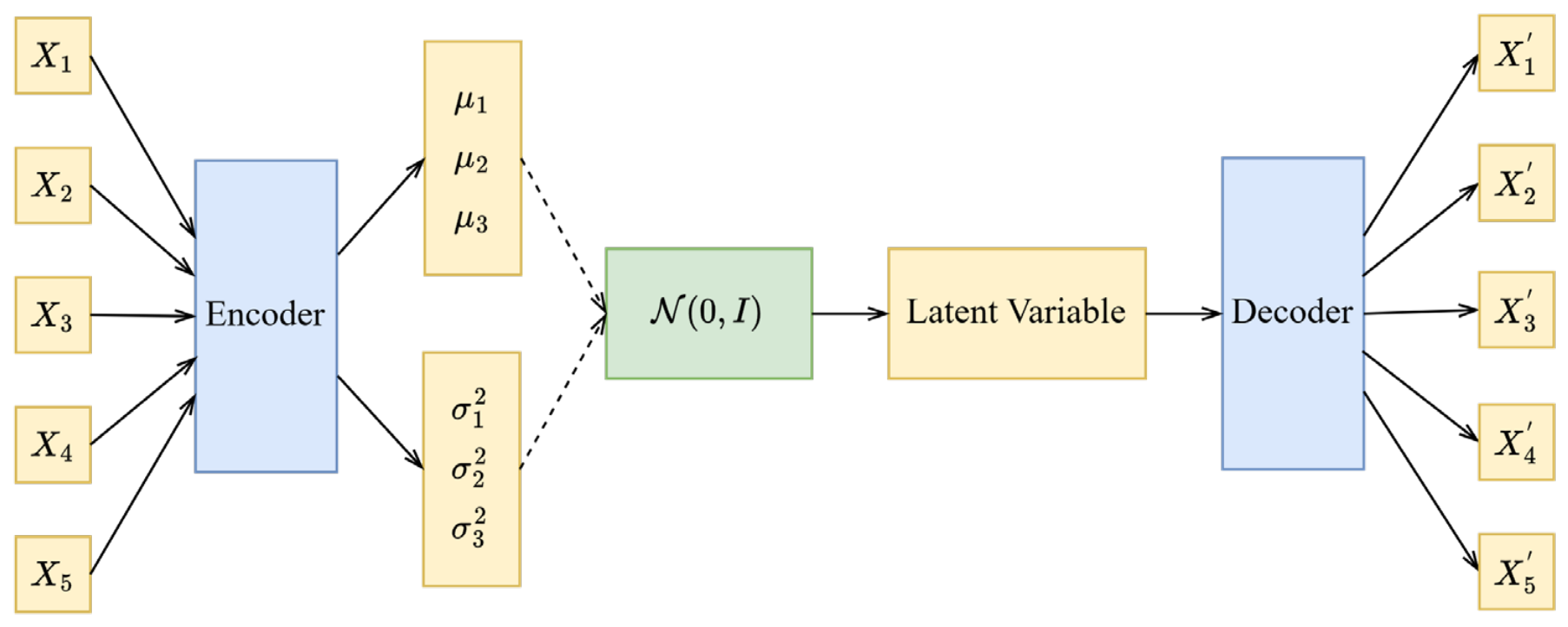
The Variational Auto-Encoder (VAE) [35] encodes the data into a low-dimensional latent space, outputting the probability distribution P, the mean and variance of the latent variables; the decoder samples from P to obtain the latent variables and thereby infers the probability distribution of the original data, and then generates new data. The structure of VAE is shown in Figure 1.
Convolutional neural networks are a type of deep learning model, whose core lies in using convolutional calculations to extract hierarchical features of the input data. One-dimensional convolutional networks excel in filtering performance for the data of time series and natural language processing by extracting local dependency features of the sequences. For the research topic, this paper employs one-dimensional convolutional neural networks [36] to process time-pressure sequence data.

2.2. Data Background

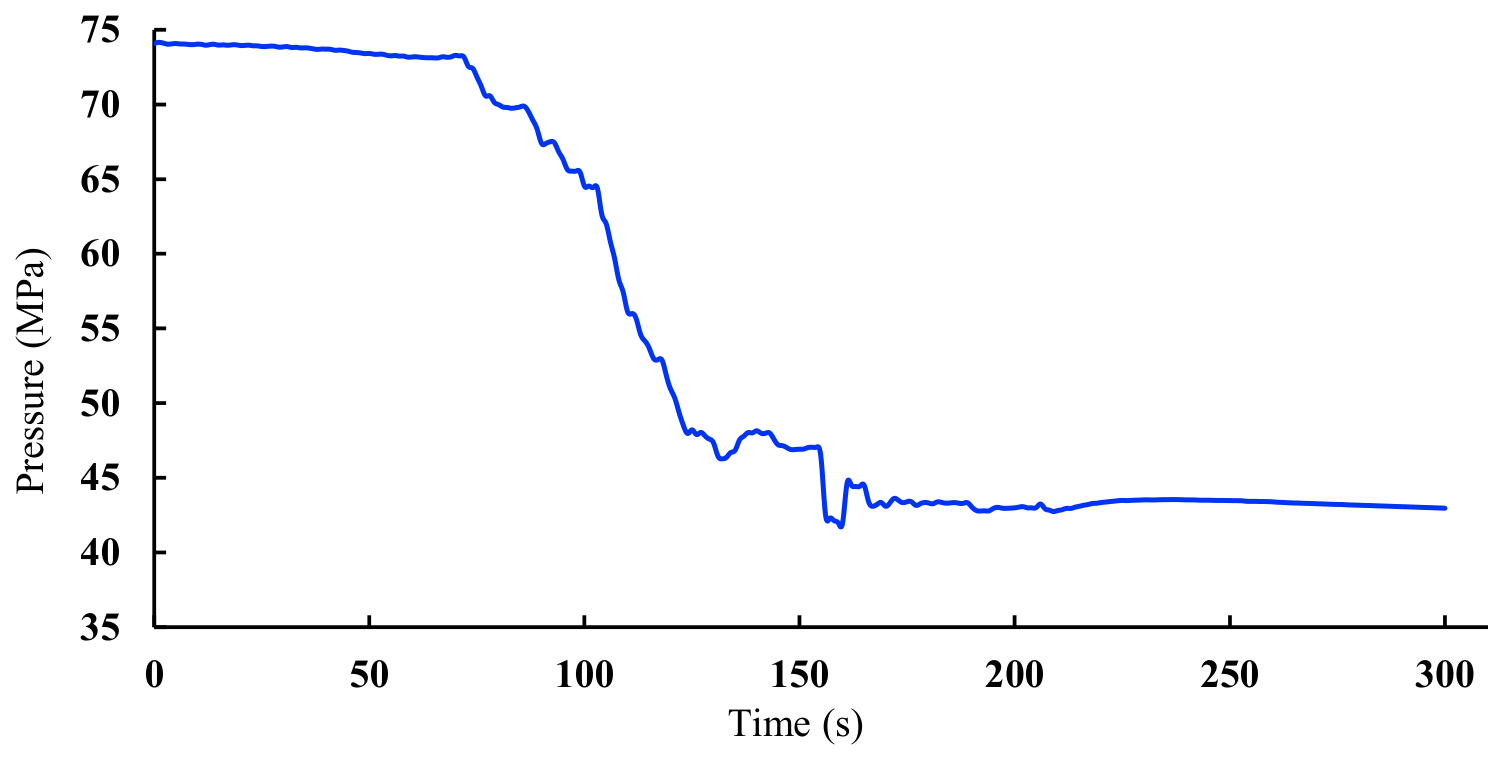
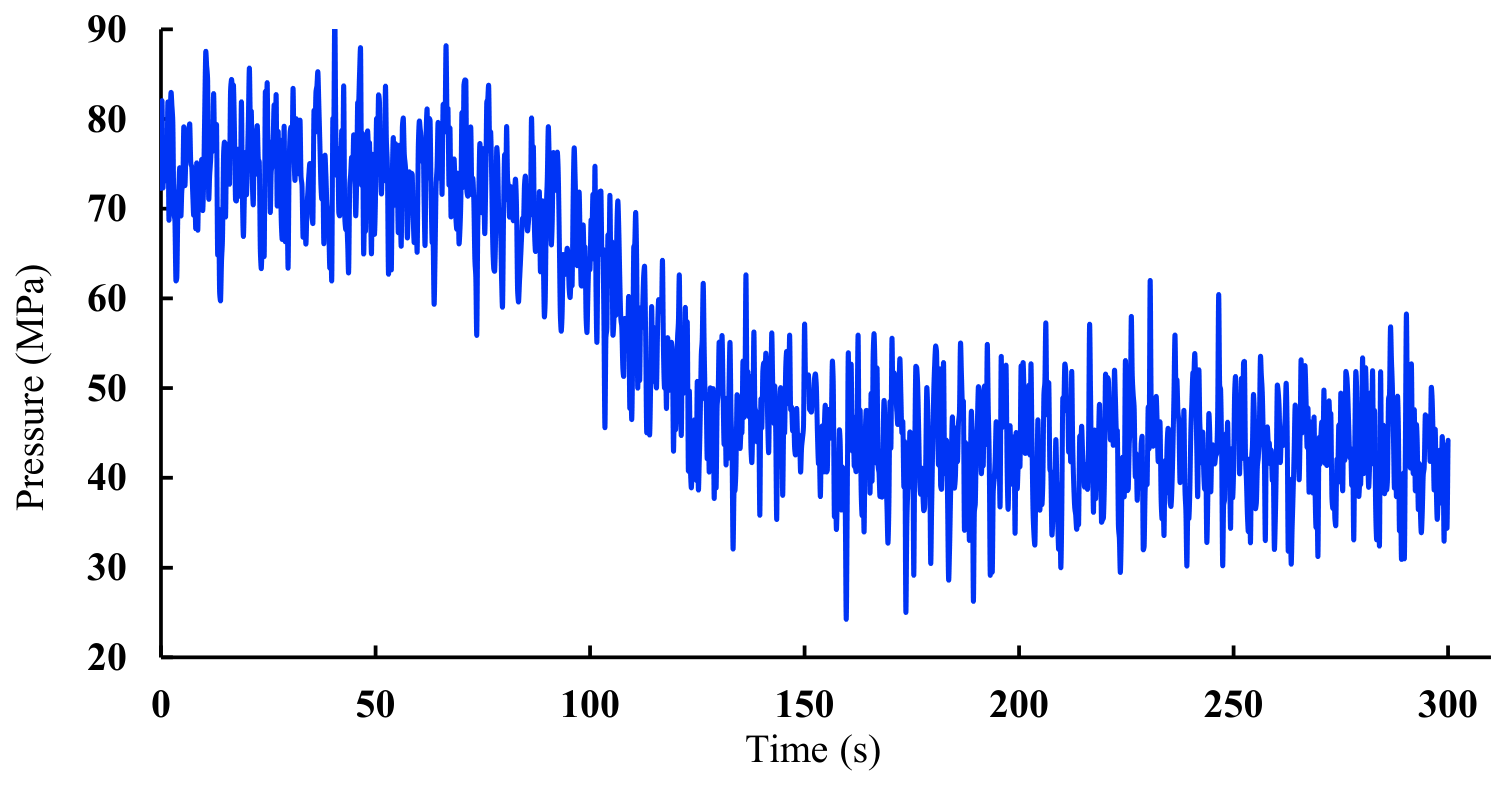
The pump shutdown water hammer data are monitoring data and exhibit a phased characteristic. As shown in Figure 2, before the pump was shut down, the pressure data remained stable. At approximately the 70th second, the pump shutdown operation was carried out, and the pressure began to drop. It gradually oscillated and decayed, eventually stabilizing at a low-pressure state, thereby forming the pressure suppression of water hammer waves.
During fracturing operations at the construction site, the monitored water hammer data contain random and fixed-frequency noise. Random noise refers to the noise whose frequency and propagation direction have no fixed pattern. Fixed-frequency noise refers to the noise with a specific frequency that does not change over time. During the fracturing process, random noise is inevitable, while mechanical vibration and other factors can generate fixed-frequency noise. The noise factors lead to an increase in errors in the inversion of fracture positions and geometric dimensions and other indicators, thereby affecting the subsequent fracturing design and construction.

2.3. Problem Definition

Fracturing shut-off pump water hammer signal: X = e t 1 , , e t i , , e t n , here, t i represents the time corresponding to the collection of the i-th data, and e t i represents the pressure value measured at time t i . X meets the condition: t i < t i + 1 , 1 i n , t i + 1 t i = d , d R , and d represents a constant value. The filtering process is as shown in the following formula:
Y = M X
X = Y + ε
Y represents the clean water hammer data without noise, and ε represents the noise in the formula.
During the fracturing process, frequent pump stops can cause severe sand production from the formation [37], causing the clogging of the fractures. Therefore, during on-site fracturing operations, the water hammer data are only obtained when the pump is turned off after the fracturing is completed. The number of data samples collected on-site is limited, and the clean signal is unknown, that is, the true water hammer signal generated by the hydraulic fracture is also uncertain. To simulate real fracturing scenarios, this paper first constructs a simulated water hammer signal from pump shutdown during fracturing operations, to which random noise and fixed-frequency noise are added, thereby generating a noisy mixed signal that mimics the field-monitored water hammer pressure signals following pump shutdown in fracturing operations.
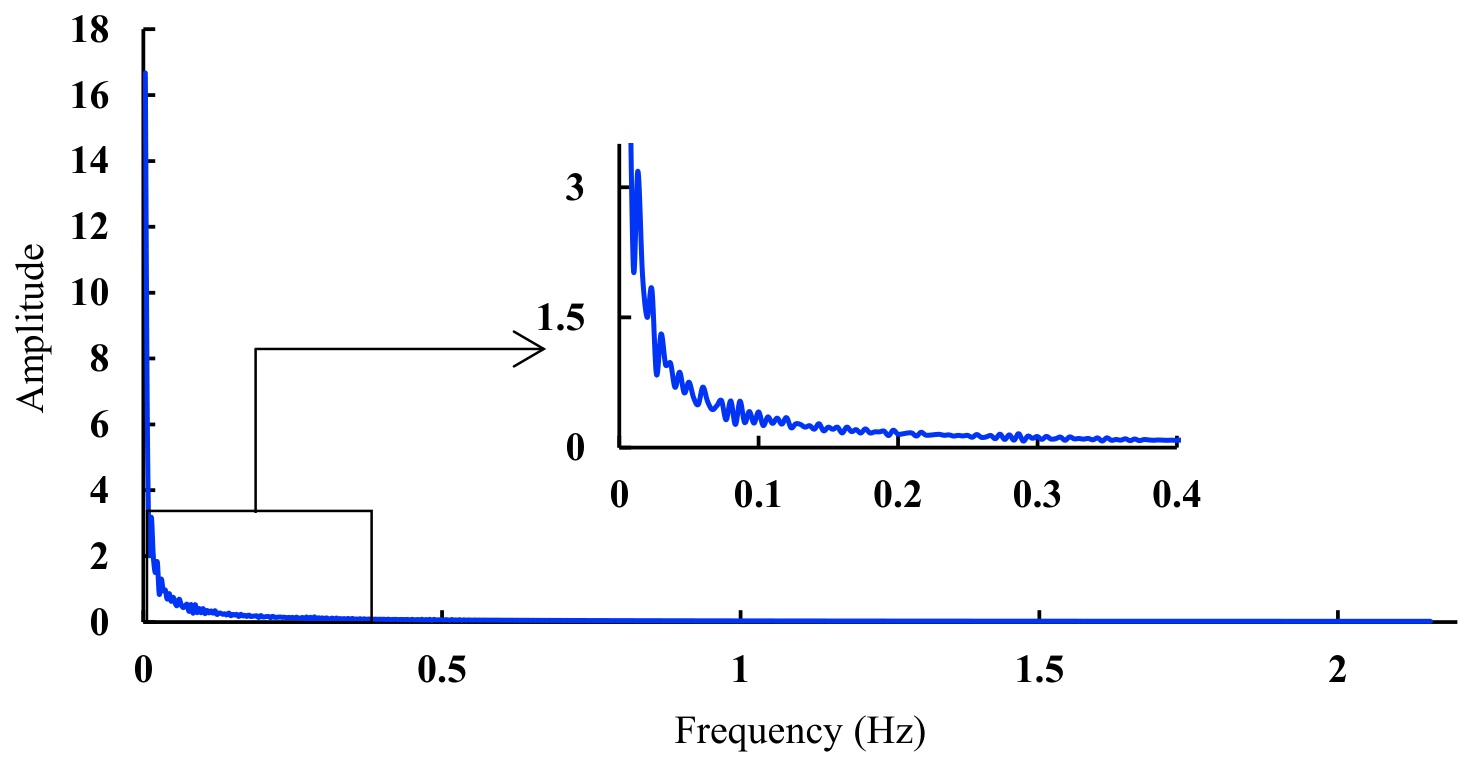
With the regard to the noise reduction and filtering of pump shutdown water hammer data, currently, analysis methods such as spectral and cepstrum analysis [38,39], are commonly used to evaluate the filtering performance. Spectrum analysis can identify the frequency distribution characteristics of water hammer signals, providing a basis for subsequent data denoising and the identification of effective signals. A spectrum analysis was conducted on one set of pump-off water hammer data collected from the fracturing site of a certain well in the G oilfield, as shown in Figure 3. The frequency of the signals is mainly concentrated in the range of 0~0.5 Hz. Among them, the amplitude is relatively large in the range of 0~0.1 Hz, and the signal fluctuation characteristics are obvious. There are also slight fluctuations in the range of 0.3~0.5 Hz, which may be caused by unobservable factors such as friction along the pipeline. In the same well, staged fracturing was carried out, and the pump was stopped after the fracturing process was completed. A total of 20 sets of pump-stop water hammer data were monitored and collected, denoted as X t . The effective response frequency of all these data remained within the range of 0~0.5 Hz, and the effective frequency was recorded as p .
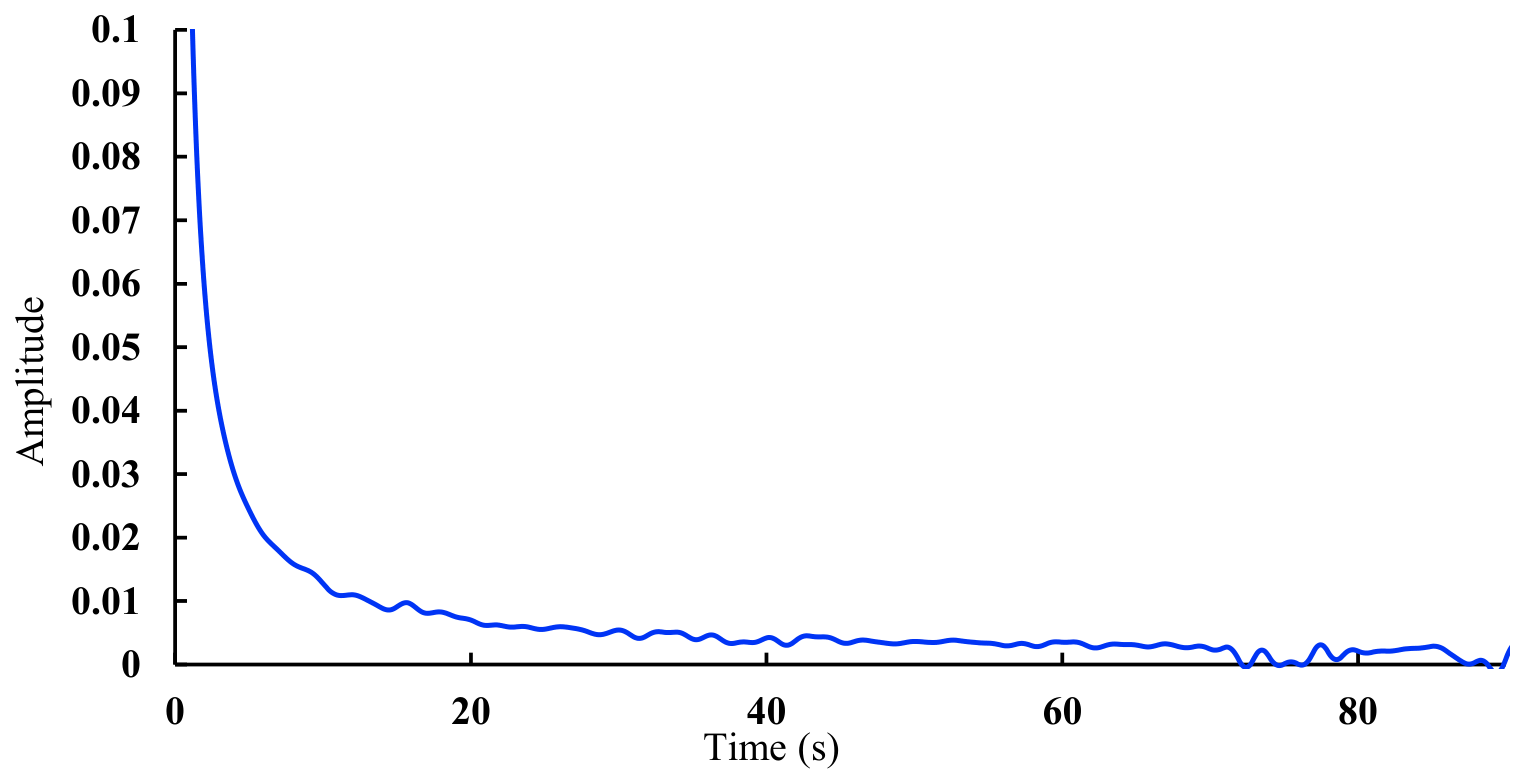
The cepstrum analysis presented the non-stationary fluctuation information in the signal and can be used to identify the abnormal time points of the signal in the fracture response [40]. The spectral analysis was conducted on one of the signal groups in the pump shutdown water hammer data X t , as shown in Figure 4. From 0~70 s, the cepstrum amplitude fluctuated slightly and remained basically stable. From 70~90 s, the fluctuation was significant. Due to the presence of on-site interference factors, the specific time of fracture response could not be determined. Therefore, effective filtering of the on-site data is required to obtain the accurate fracture response position.
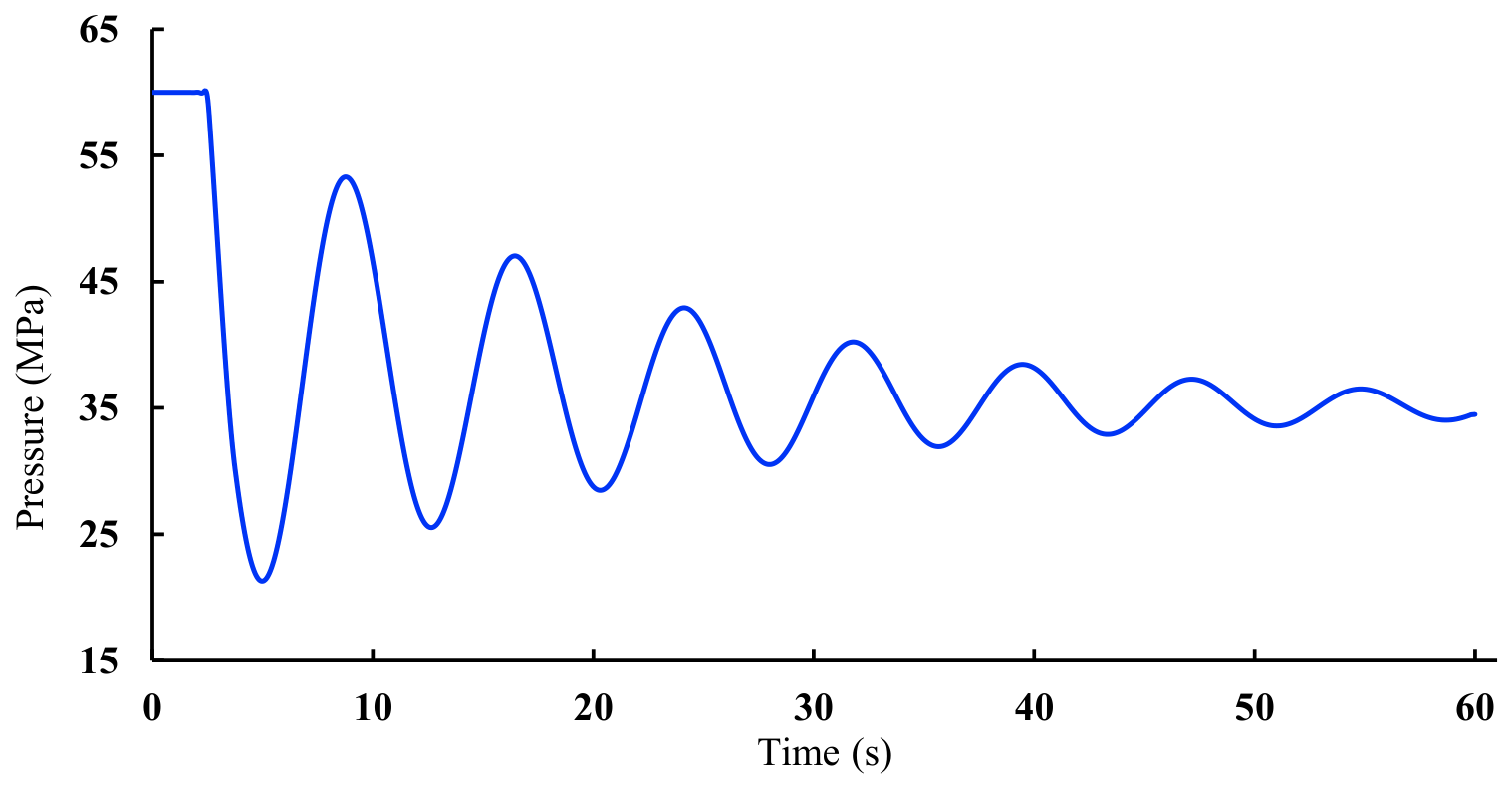
After the pump shutdown, the pressure keeps decreasing, generally showing the characteristics of oscillation and attenuation. Therefore, a pressure data simulation of the water hammer signal that decays over time was constructed, with a total of 20 groups, denoted as X s . One of the signals is shown in Figure 5.
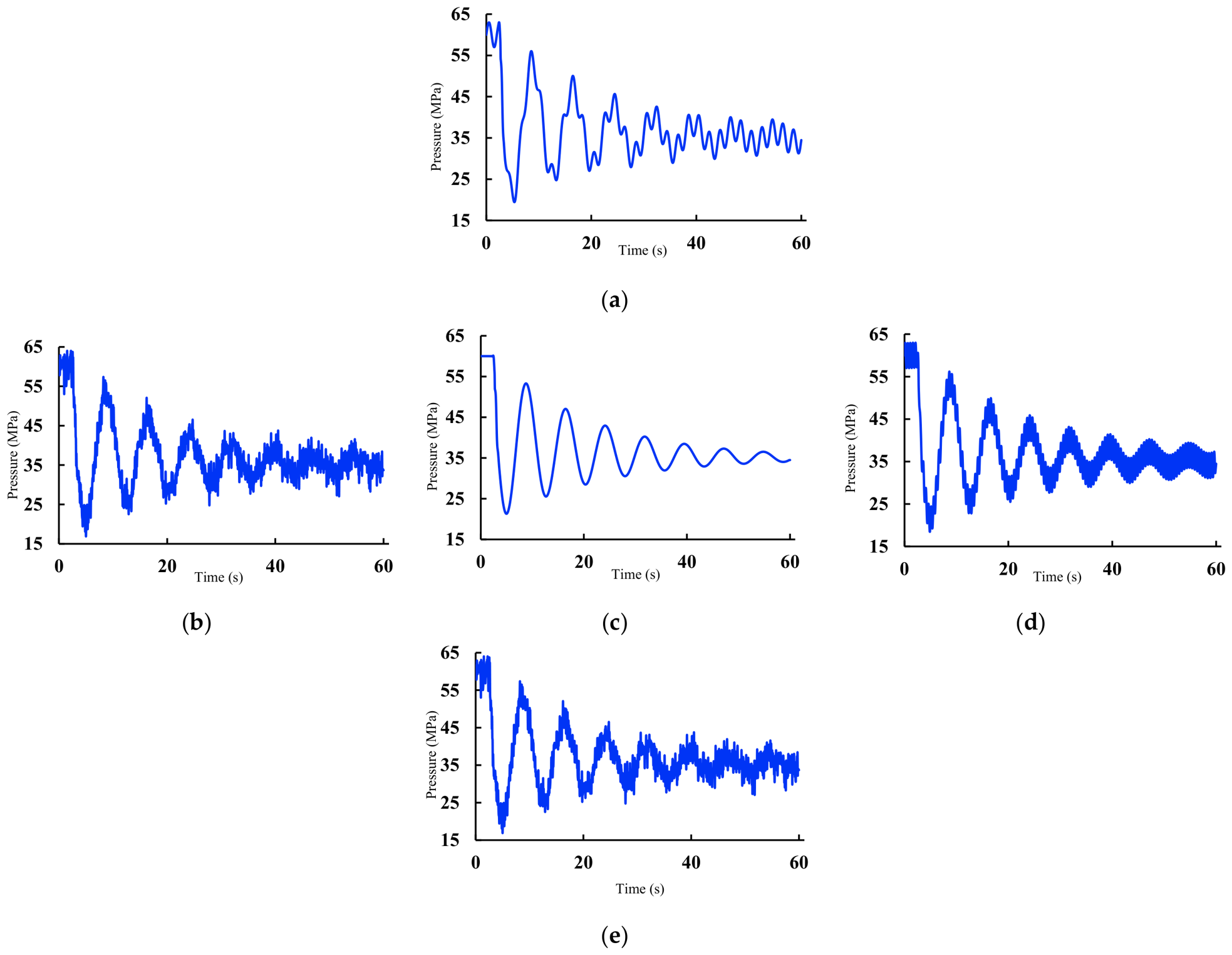
To accurately reproduce the water hammer data monitored during the pump shutdown operation in the fracturing process, on the basis of the simulated water hammer signal data X s , four different types of noise were added respectively. In datasets 1~5, random-frequency noise conforming to a Gaussian distribution is added. In datasets 6~10, fixed-frequency noise close to the effective frequency p is introduced. In datasets 11~15, fixed-frequency noise with frequency higher than the p is incorporated. In datasets 16~20, a combination of random-frequency noise and the aforementioned two types of fixed-frequency noise is superimposed and added. As shown in Figure 6.
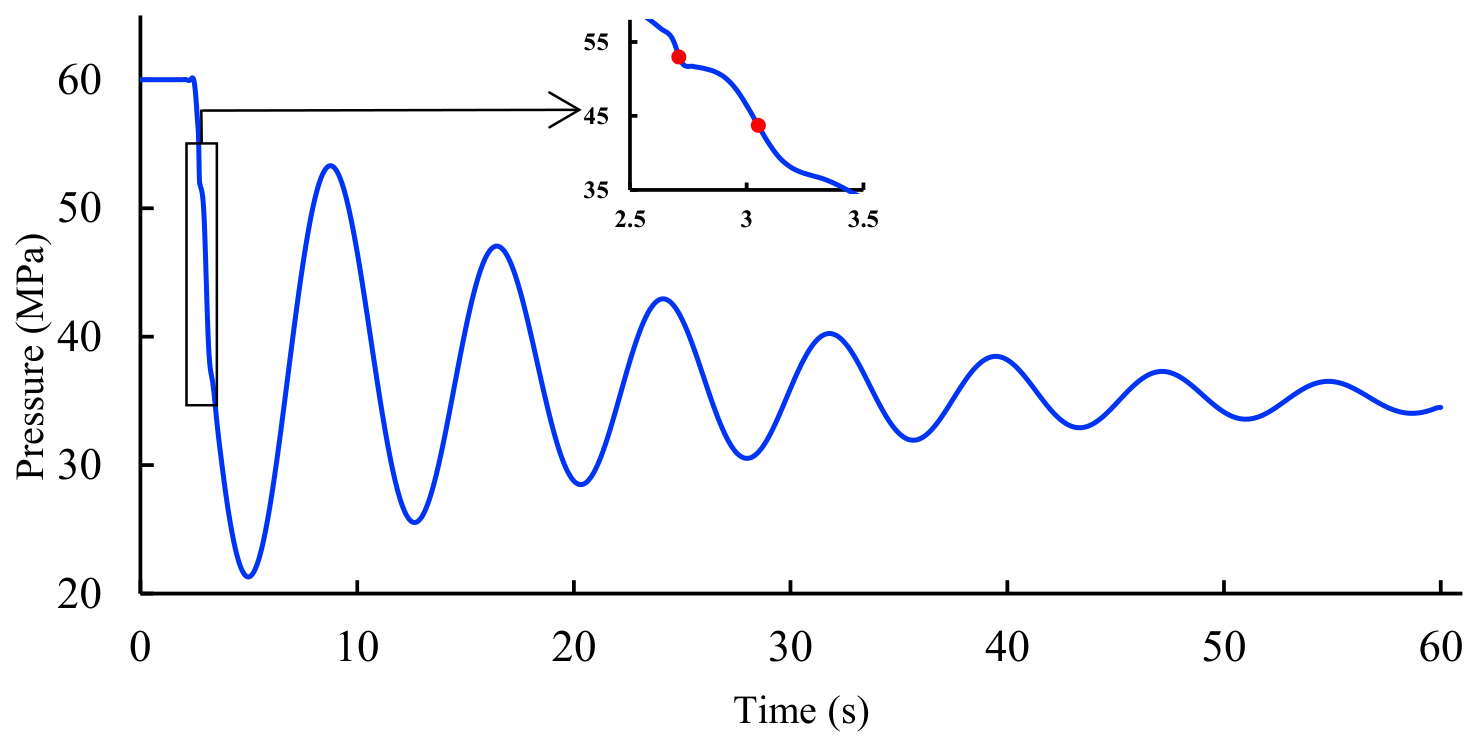
To simulate the fracture response characteristics observed in the pump shutdown pressure data after fracturing, two decaying sinusoidal signals with different amplitudes were superimposed on the simulated decaying pressure wave signal, modeling two distinct fracture responses. By introducing different pressure disturbances at specific times, the responses of the bottom-of-well fractures during the pressure fluctuation process after pump shutdown were characterized. One set of signals is shown in Figure 7. There were minor fluctuations at 2.71 s and 3.05 s, suggesting the arrival of pressure waves at the fractures and the subsequent pressure reflections at these moments.
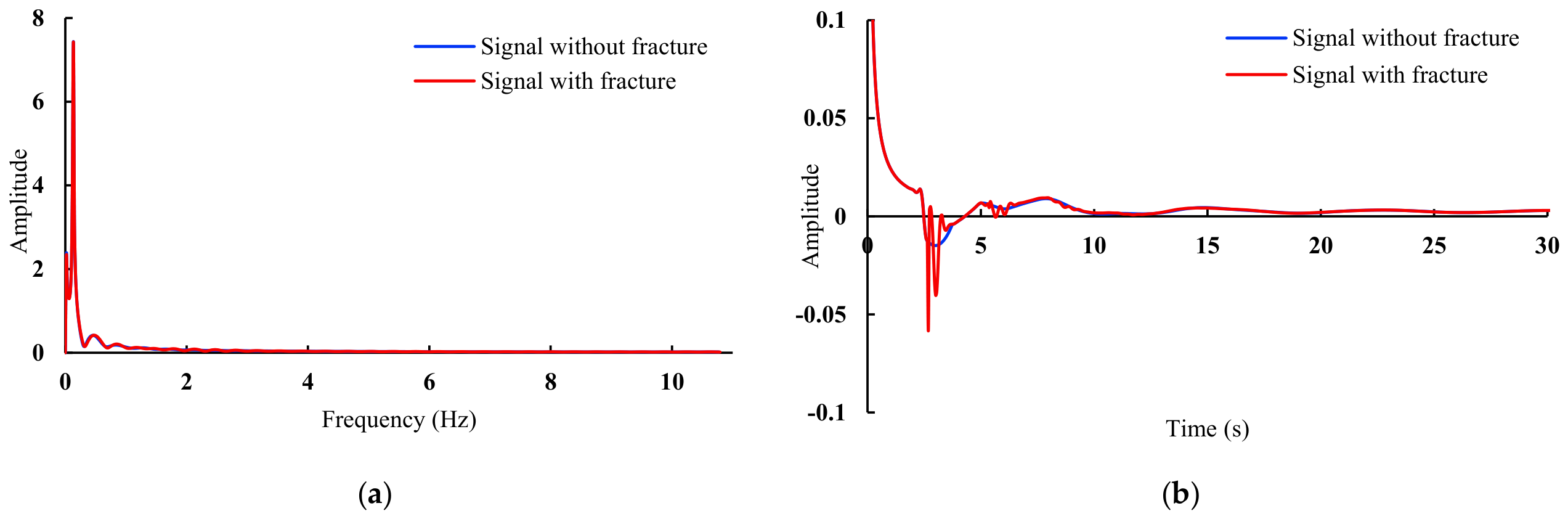
Spectral and cepstral transforms are applied to both the simulated pump shutdown data without fracture response and those with fracture response, as shown in Figure 8. The frequency of simulated pump shutdown data during fracturing is primarily concentrated in the range of 0~4 Hz. In the cepstrum diagram, local perturbations are observed at 2.71 s and 3.05 s, namely fracture responses, and can be clearly identified.
In Section 3.2 of this paper, the water hammer signal data used for filtering performance verification under different noise scenarios were all augmented with fracture response, and noise was subsequently added to the augmented data. The proposed filtering model LSCF was then applied to process the noisy signals, yielding the filtered output signals.

2.4. LSCF of Water Hammer Signals

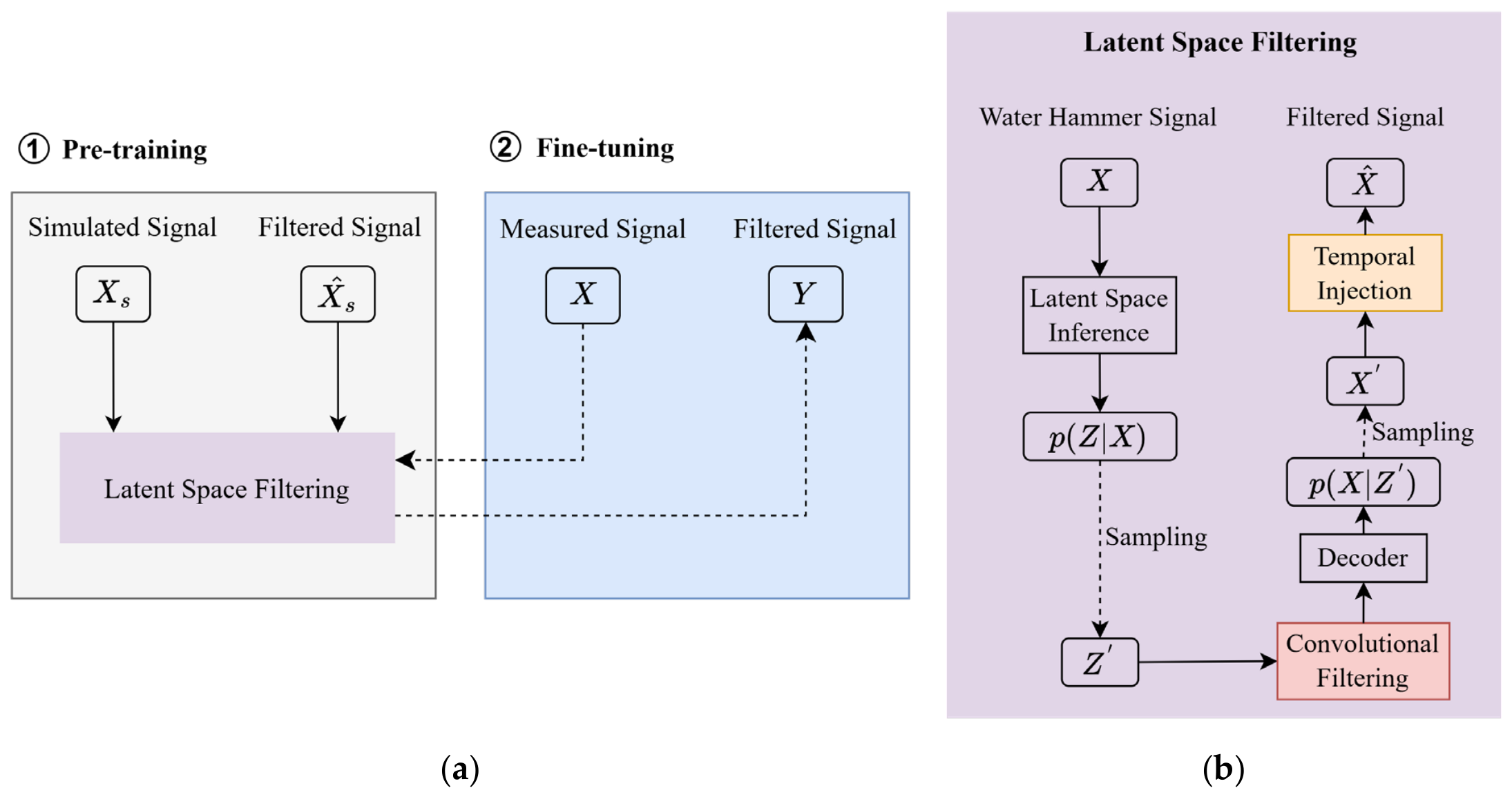
Water hammer signals are governed by latent variables and exhibit uncertainty. These latent variables are denoted as Z , where Z R d , and d represent the dimension of the latent variables. In this paper, we first infer the probability distribution of Z , then perform sampling and filtering, and further infer the clean observation signals. Filtering process: (1) First, the probability distribution P ( Z | X ) of the latent variable Z is inferred from the water hammer signal X . (2) A convolutional neural network is employed to filter Z , generating the filtered latent variable Z . (3) The conditional probability distribution P ( X | Z ) is then inferred, and the filtered signal X is generated through sampling. Given that the clean signal is unavailable, simulated water hammer signals are employed to pre-train the filtering model, which is subsequently fine-tuned using field water hammer signals. The simulated and field-measured water hammer data are denoted as X s and X t , respectively. The framework of the proposed filtering model is illustrated in Figure 9.

2.4.1. Latent Space Inference

The input signal X is passed through an encoder to map it into the latent space, where the output consists of the mean vector μ and the diagonal covariance matrix d i a g ( Σ ) of the latent variable Z , assuming Z ~ N μ , d i a g ( Σ ) . A reparameterized sample of the latent variable Z is then drawn. The relevant calculation formula is as follows:
μ Z = M L P Z , μ X
d i a g ( Σ Z ) = M L P Z , σ X
here, M L P Z , μ and M L P Z , σ are multilayer perceptrons (MLPs) for estimating the mean and variance, respectively, with the sampling formula defined as follows:
Z = μ Z + ϵ e x p ( 1 2 log diag ( Σ Z ) 2 )
here, ϵ denotes white noise. To enhance the stability of latent space sampling, the latent variable is sampled 100 times, and the average value is taken.
Z = 1 100 i = 1 100 Z i
here, Z i denotes the latent variable obtained from the i-th sampling.

2.4.2. Convolution Filtering

Noise generation stems from uncertain latent variables, and thus filtering is applied to the generated latent variables. LSCF employs a one-dimensional convolutional neural network to filter Z and incorporates a residual network. The formulation is as follows:
Z = c o n v Z
here, Z denotes the filtered latent variable, and c o n v represents the convolutional neural network.

2.4.3. Clean Signal Generation

The filtered latent variable Z is mapped through the decoder into the probability space of the clean signal, followed by a second application of reparameterized sampling to obtain the clean signal. The formulation is as follows:
X = μ X + ϵ e x p ( 1 2 log σ X 2 )
σ X 2 = M L P X , σ Z
μ X = M L P X , μ Z
here, X denotes the water hammer signal generated via sampling, and X r e c o n is obtained by computing the mean over multiple independent samples. The formulation is as follows:
X r e c o n = 1 100 i = 1 100 X i
here, X i denotes the water hammer signal obtained from the i-th sampling.

2.4.4. Temporal Injection

Water hammer signals exhibit temporal characteristics, implying correlations between sequential data points; therefore, temporal features are injected into the generated data X r e c o n . LSCF employs an attention network augmented with positional encoding to capture the temporal dependency features of water hammer signals. The formulation for positional encoding is as follows:
P E ( t i ) = s i n ( t i t n )
here, P E ( t i ) denotes the positional encoding value corresponding to t i , where t i represents the position index within the signal sequence, satisfying 0 t i < t n . Causal masked scaled dot-product self-attention is employed to capture long-range temporal dependencies in the signal sequence. The formulation is as follows:
Y = s o f t m a x ( Q K T d k + M m a s k ) V
Q = X r e c o n + P E ( t i ) W Q
K = X r e c o n + P E ( t i ) W K
V = X r e c o n + P E ( t i ) W V
here, W Q , W K , and W V denote the learnable linear transformation weight matrices, d k represents the feature dimension of Q / K , M m a s k is the mask matrix, and Y denotes the final filtered output.

2.5. Model Training

Since the true clean signal is unavailable, simulated water hammer signals are employed to pre-train the latent space convolutional filtering model, thereby endowing it with filtering capabilities. Subsequently, the model undergoes reconstruction training using field-measured water hammer data to preserve key signal characteristics while maintaining effective filtering.
To further optimize the latent space convolutional filtering model, the objective function is formulated as a combination of reconstruction error and KL divergence, as follows:
L = L M S E + L K L
L M S E = 1 n i = 1 n X i X ^ i 2
L K L = 1 2 log d i a g ( Σ z ) 2 + μ z 2 + d i a g ( Σ z ) 2 1
here, X i denotes the i-th sample and X ^ i represents its filtered counterpart.

3. Experiments

3.1. Experimental Setup

Parameter Settings: The Adam optimizer is adopted as the optimization algorithm for all experiments. To prevent parameter update oscillation and suboptimal convergence caused by a fixed learning rate, a step-wise learning rate decay strategy is employed to improve convergence accuracy. Specifically, the initial learning rate is set to 1 × 10⁻⁴, with decay applied every 1000 epochs using a decay factor of 0.7. Other hyperparameter configurations are detailed in Table 2.
Evaluation Metrics: To evaluate the filtering performance of the proposed LSCF model, this study employs the Correlation Coefficient (CC), Mean Square Error (MSE), and Signal-to-Noise Ratio (SNR) as quantitative metrics. Furthermore, spectral analysis and cepstral analysis are integrated to comprehensively assess the model’s effectiveness. The formulations are as follows:
C C = i = 1 n x i x ¯ y i y ¯ i = 1 n ( x i x ¯ ) 2 i = 1 n ( y i y ¯ ) 2
S N R = 10 log 10 ( i = 1 n y i 2 i = 1 n ( x i y i ) 2 )
M S E = 1 n i = 1 n ( x i y i ) 2
Experimental Types: Three types of experiments are designed in this study: multi-noise interference filtering experiments, field data filtering experiments, and filtering algorithm comparison experiments. To verify the adaptability of the LSCF model in complex noise environments, three noise interference experiments are conducted, including random frequency, fixed-frequency and mixed-frequency noise experiments. Based on the generated water hammer simulation data X s , different types of noise are added to the benchmark data to construct a noisy dataset for experiments, which is then split into training and test sets at a ratio of 7:3.

3.2. Noise Interference Filtering Experiments

3.2.1. Filtering of Random-Frequency Noise

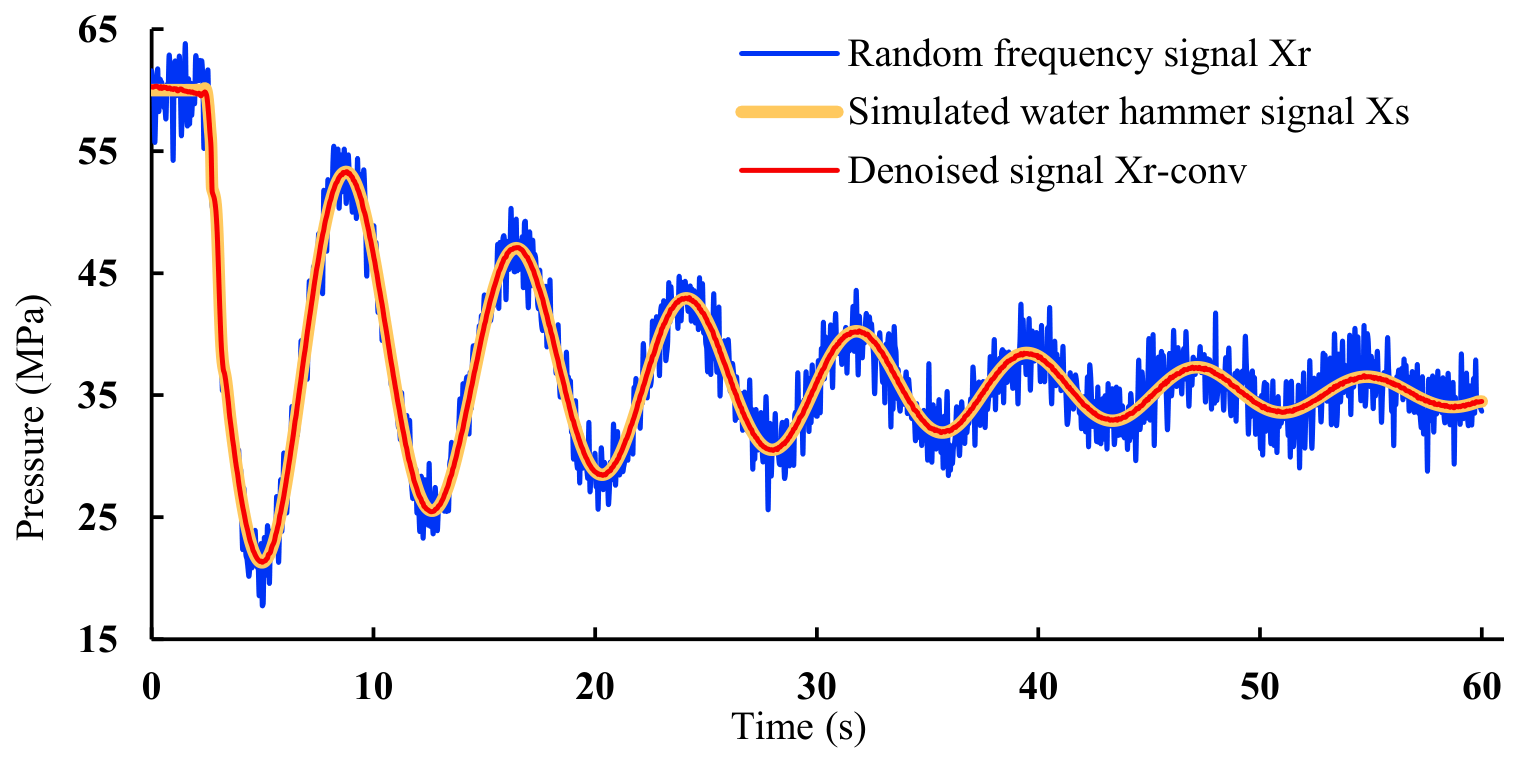
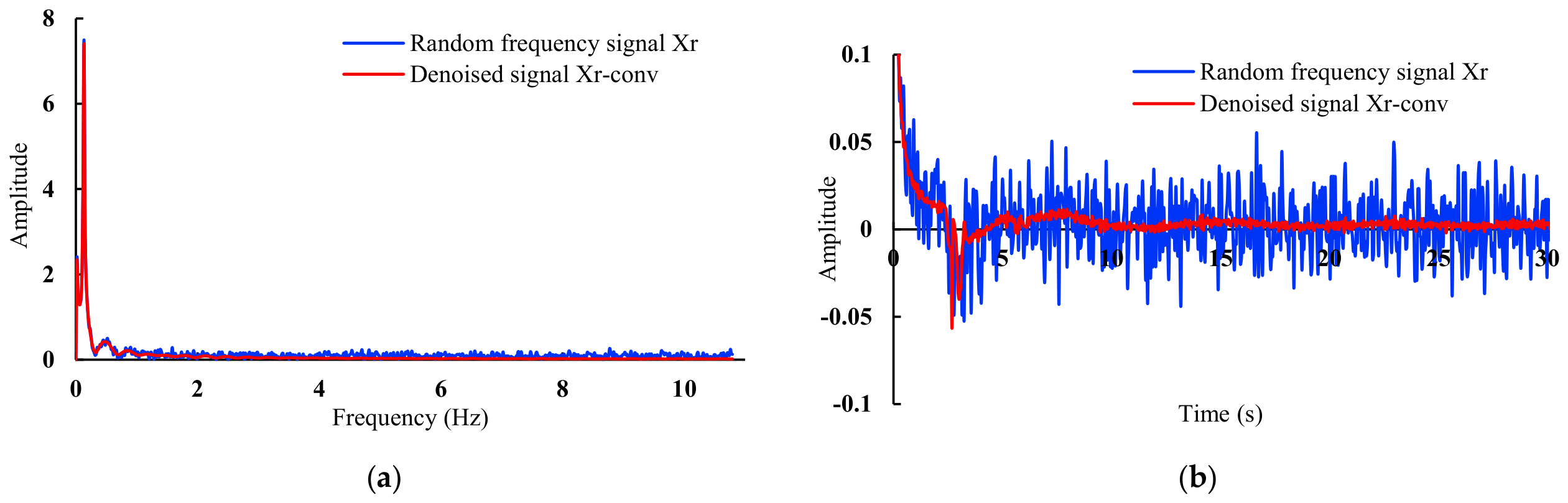
Random-frequency noise primarily consists of non-periodic noise such as formation random interference and equipment mechanical vibration. In this study, random-frequency noise following a Gaussian distribution is added to the simulated water hammer signal X s to generate noisy water hammer data X r . The LSCF model is then applied to filter X r , yielding the filtered signal X r C o n v , as illustrated in Figure 10. Compared with X s , X r exhibits increased noise complexity and enhanced fluctuation randomness. A comparison between X r and X r C o n v demonstrates that the LSCF model effectively suppresses Gaussian random noise while preserving critical features of water hammer data, such as fracture response.
The experimental evaluation metrics are presented in Table 3. Regarding X r , the correlation coefficient is 0.972826, while after filtering by LSCF, the correlation coefficient of X r C o n v reaches 0.999923, representing an increase of 0.027097 (2.79% improvement). The SNR of X r before filtering is 26.511227 dB, and after filtering, the SNR of X r C o n v rises to 52.137091 dB, indicating an increase of 25.625864 dB (96.66% improvement). The MSE of X r is relatively large at 3.186533, whereas the MSE of X r C o n v after filtering is only 0.008724, representing a reduction of 3.177809 (99.73% decrease). A comparison of the data before and after filtering demonstrates that the LSCF model achieves favorable filtering performance on simulated water hammer signals contaminated with random-frequency noise.
A comparison of the spectral and cepstral transforms of X r and X r C o n v is shown in Figure 11. The spectrum exhibits high complexity, making it difficult to identify the key effective frequency characteristics of the water hammer signal. By applying the LSCF model, random-frequency noise is effectively removed while preserving the dominant frequency components of the clean signal X s . After cepstral transformation, a comparison between X r and X r C o n v reveals that the cepstral amplitude of X r exhibits complex fluctuations, with the effective features of the water hammer signal masked by noise. In contrast, such fluctuations disappear after filtering, and the subtle fluctuations at 2.71 s and 3.05 s on the cepstral axis corresponding to the effective fracture response features are preserved and clearly distinguishable in X r C o n v .

3.2.2. Filtering of Fixed-Frequency Noise

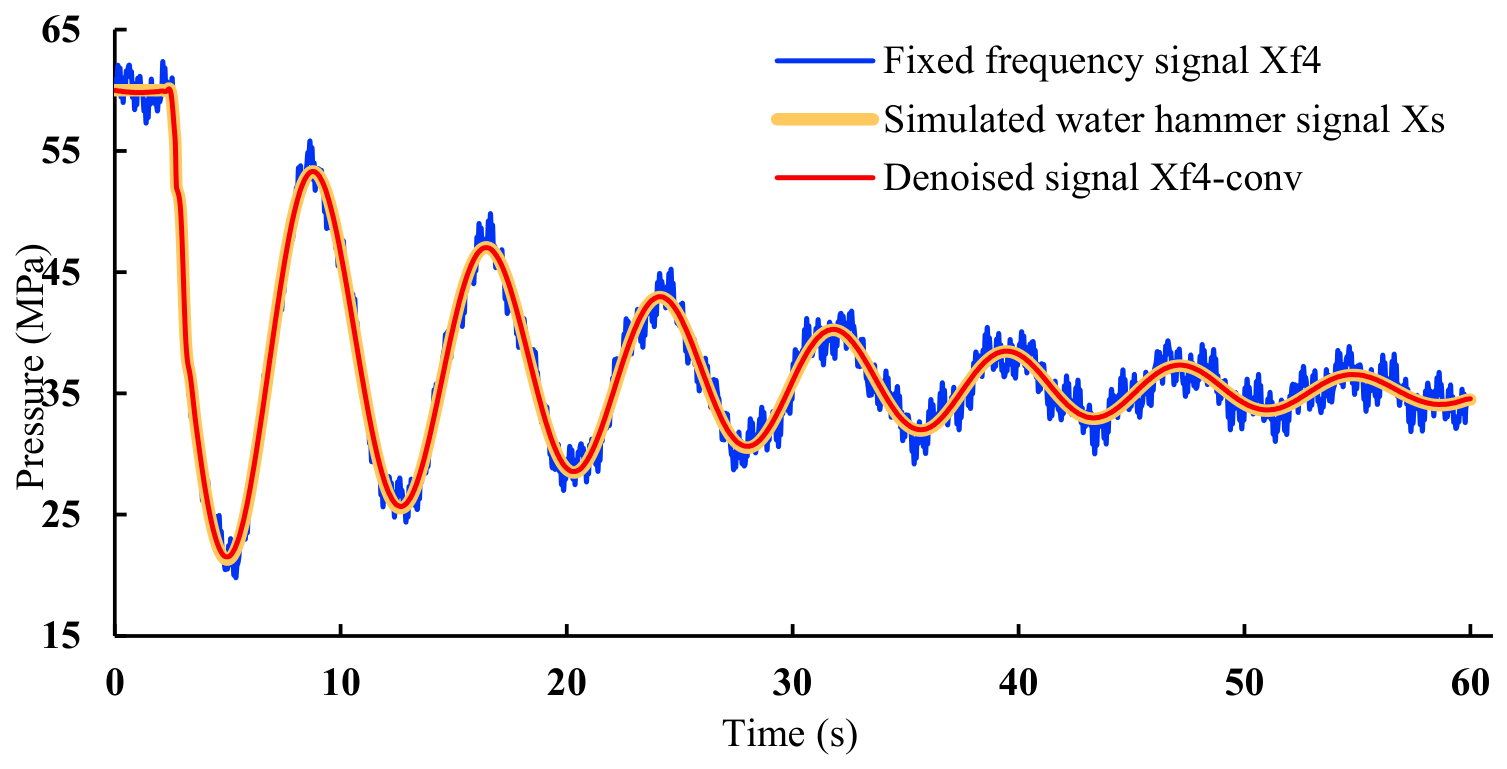
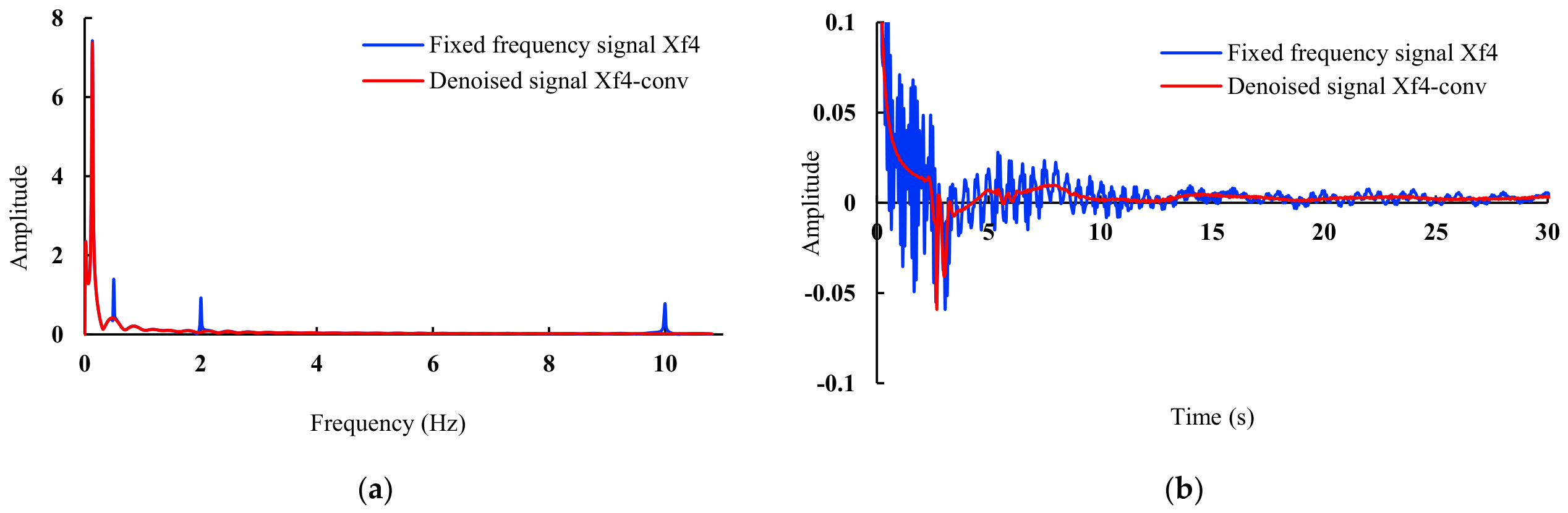
Fixed-frequency noise primarily refers to periodic noise such as pipeline resonance and fixed-frequency interference from pump units. Given the abundance of interference factors in field environments, the frequency range of field-collected data is almost consistently constrained to 0~0.5 Hz. In this experiment, fixed-frequency noise components with frequencies of 0.5 Hz (close to the effective signal frequency), 2 Hz, and 10 Hz (both higher than the effective signal frequency) are separately added to the simulated shutdown water hammer data X s of fracturing operations, generating noisy datasets X f 1 , X f 2 , and X f 3 . To simulate the real-world scenario of multiple fixed-frequency noise components superimposed in field conditions, the combined noise signal—formed by superimposing 0.5 Hz, 2 Hz, and 10 Hz fixed-frequency noise—is added to X s , generating simulated water hammer data X f 4 contaminated with composite fixed-frequency noise. The LSCF model is then applied to filter the aforementioned noisy datasets, yielding the filtered outputs X f 1 C o n v , X f 2 C o n v , X f 3 C o n v , and X f 4 C o n v . A comparison of the filtering performance on X f 4 , before and after processing, is illustrated in Figure 12.
The fixed frequencies of noise in the noisy datasets increase gradually from 0.5 Hz, 2 Hz to 10 Hz. The LSCF model is capable of eliminating the interference caused by fixed-frequency noise in all cases, and its filtering performance remains essentially consistent as the fixed frequency of noise increases. A comparison of the metrics before and after filtering is presented in Table 4.
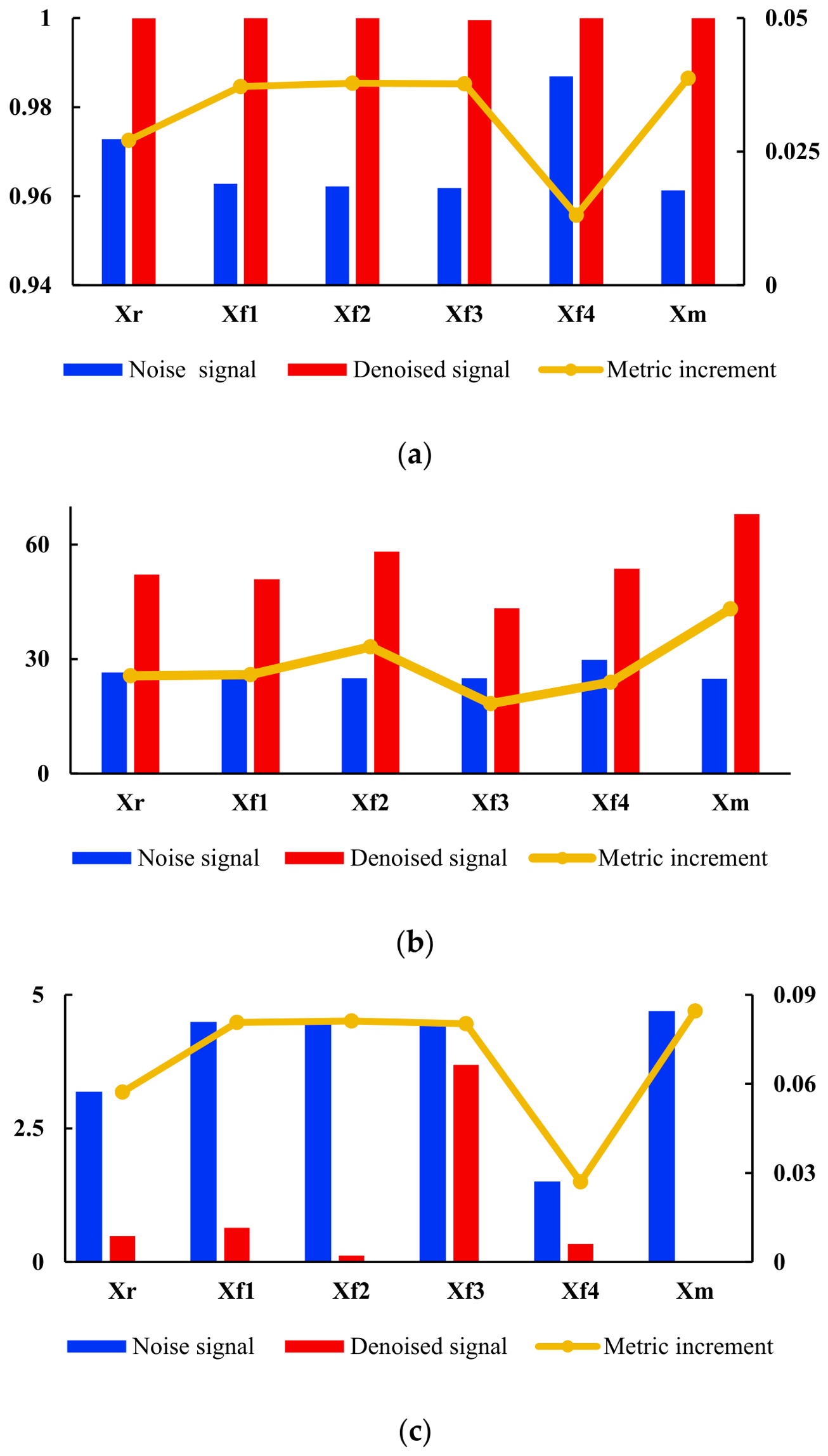
The correlation coefficients of X f 1 , X f 2 , and X f 3 are 0.962821, 0.962185, and 0.961813 respectively, showing a gradual decrease as the noise frequency increases. Among them, the water hammer data X f 4 contaminated with composite fixed-frequency noise has the highest correlation coefficient of 0.986887. After filtering, the correlation coefficients of the resulting X f 1 C o n v , X f 2 C o n v , X f 3 C o n v , and X f 4 C o n v all increase to above 0.999, with increments ranging from 0.013105 to 0.037807 and growth rates ranging from 1.33% to 3.93%, indicating enhanced correlation.
Before filtering, the SNR of X f 1 , X f 2 , X f 3 , and X f 4 are 24.990953 dB, 25.003228 dB, 24.993584 dB, and 29.768858 dB, respectively. After filtering, their SNRs increase to 50.933979 dB, 58.210743 dB, 43.327614 dB, and 53.707374 dB, with respective increments of 25.94303 dB, 33.20752 dB, 18.33403 dB, and 23.93852 dB. The improvement ratios range from 73.35% to 132.81%, demonstrating that the LSCF model effectively suppresses noise interference and enhances the signal quality of simulated water hammer data from fracturing operations.
The MSE of X f 1 , X f 2 , X f 3 , and X f 4 are 4.4955, 4.514694, 4.525786, and 1.505066, respectively. After filtering, these values decrease significantly to 0.011523, 0.002157, 0.066419, and 0.006077, with reduction rates ranging from 98.532% to 99.952%, indicating a substantial mitigation of reconstruction error.
The spectral and cepstral transforms are applied to the data X f 4 contaminated with composite fixed-frequency noise and the filtered data X f 4 C o n v , respectively, as illustrated in Figure 13.
A comparison of the spectrograms before and after filtering shows that the LSCF model can effectively eliminate all the added fixed-frequency noise. The continuous fluctuations on the cepstrum are filtered out, and the fracture response information at 2.71 s and 3.05 s on the cepstral axis can be clearly identified.

3.2.3. Filtering of Mixed-Frequency Noise

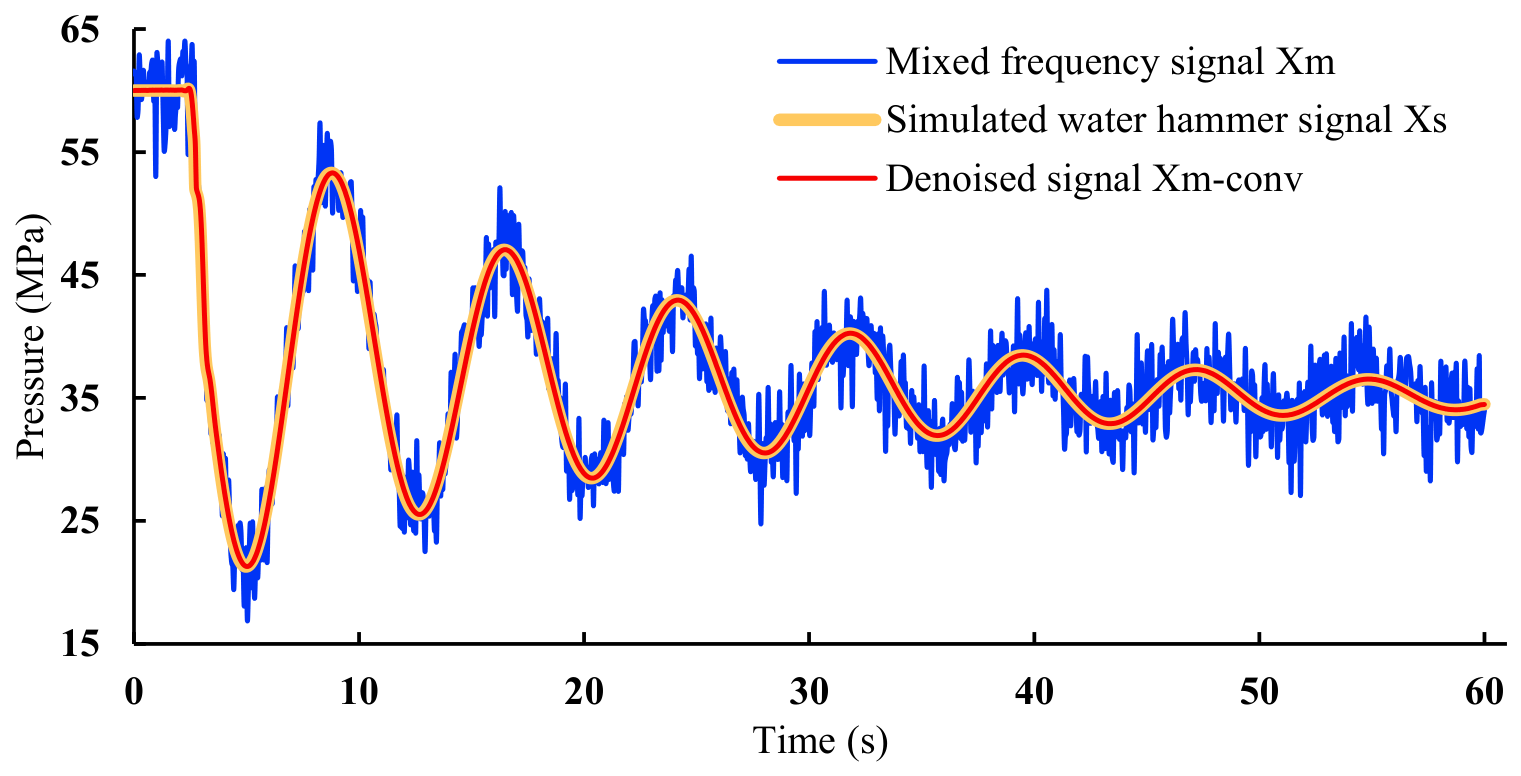
The simulated water hammer data X s is contaminated with mixed frequency noise to emulate the complex noise environments of field conditions. A combination of Gaussian-distributed random-frequency noise and various fixed-frequency noise components is superimposed and added to X s , generating noisy data X m . The LSCF model is then applied to filter X m , yielding the filtered output X m C o n v , with the filtering performance illustrated in Figure 14.
The pre-filtered data X m exhibits complex water hammer signals due to the superposition of random and fixed-frequency noise. After filtering, the LSCF model effectively removes the introduced mixed noise, resulting in X m C o n v with improved peak accuracy in the main oscillation region and enhanced stability in the flat regions. A comparison of the metrics before and after filtering is presented in Table 5.
After the superposition of fixed-frequency and random-frequency noise, the noisy data X m has a correlation coefficient of 0.961269, a SNR of 24.830831 dB, and a MSE of 4.697514. Due to the increased complexity of the signal resulting from the superposition of fixed-frequency and random-frequency noise, all evaluation metrics of X m are the poorest compared with those in Section 3.2.1 and Section 3.2.2. After filtering, the correlation coefficient, SNR, and MSE of X m C o n v are 0.999999, 68.012301 dB, and 0.000226, respectively. The comparison shows that the correlation coefficient increases by 0.03873 (a 4.03% improvement), the SNR increases by 43.18147 dB (a 173.90% improvement), and the MSE decreases by 4.69729 (a 99.995% reduction).
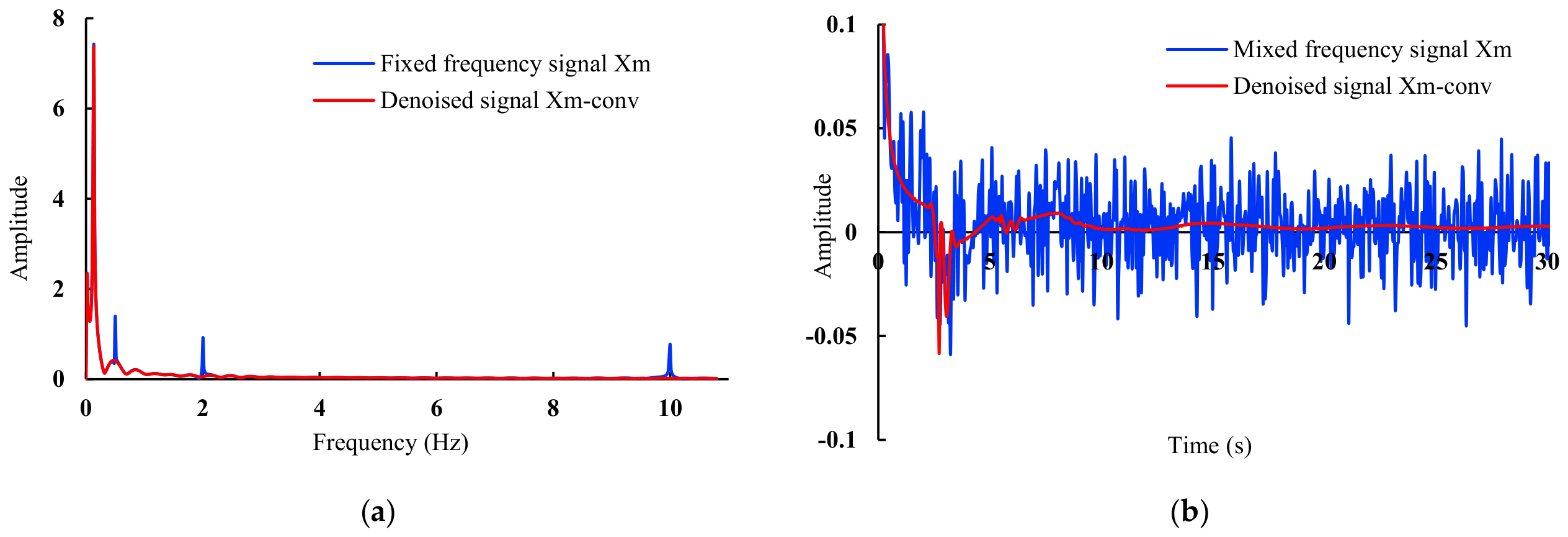
The spectral and cepstral transforms of X m and X m C o n v are applied, as illustrated in Figure 15. The signal X m is contaminated with random-frequency and periodic fixed-frequency noise, exhibiting complex frequency characteristics. After filtering, nearly all complex and fixed-frequency noise components are removed, while the critical effective frequency features are preserved. Cepstral analysis reveals that the event responses in X m are chaotic, and it is difficult to identify the effective fracture response at the wellbore. In contrast, after filtering to obtain X m C o n v , the effective fracture response features become clearly distinguishable in the cepstrum.
The LSCF model demonstrates excellent filtering performance across three types of noise interference, as illustrated in Figure 16, with post-filtering correlation coefficients all above 0.999; with SNR maintained above 50 dB, and improvement ranging from 73.3549% to 173.9026%; with MSE reduced below 0.01, and reduction ratios between 98.532% and 99.995%. LSCF effectively preserves key characteristics of water hammer signals under random-, fixed-, and mixed-frequency noise environments, exhibiting robustness and broad applicability.
By introducing convolutional filtering into the latent space, LSCF effectively separates noise latent variables from water hammer signals. While preserving the key features of clean water hammer signals, it achieves efficient filtering of different types of noise, demonstrating strong robustness.


3.3. Field Data Filtering Experiments

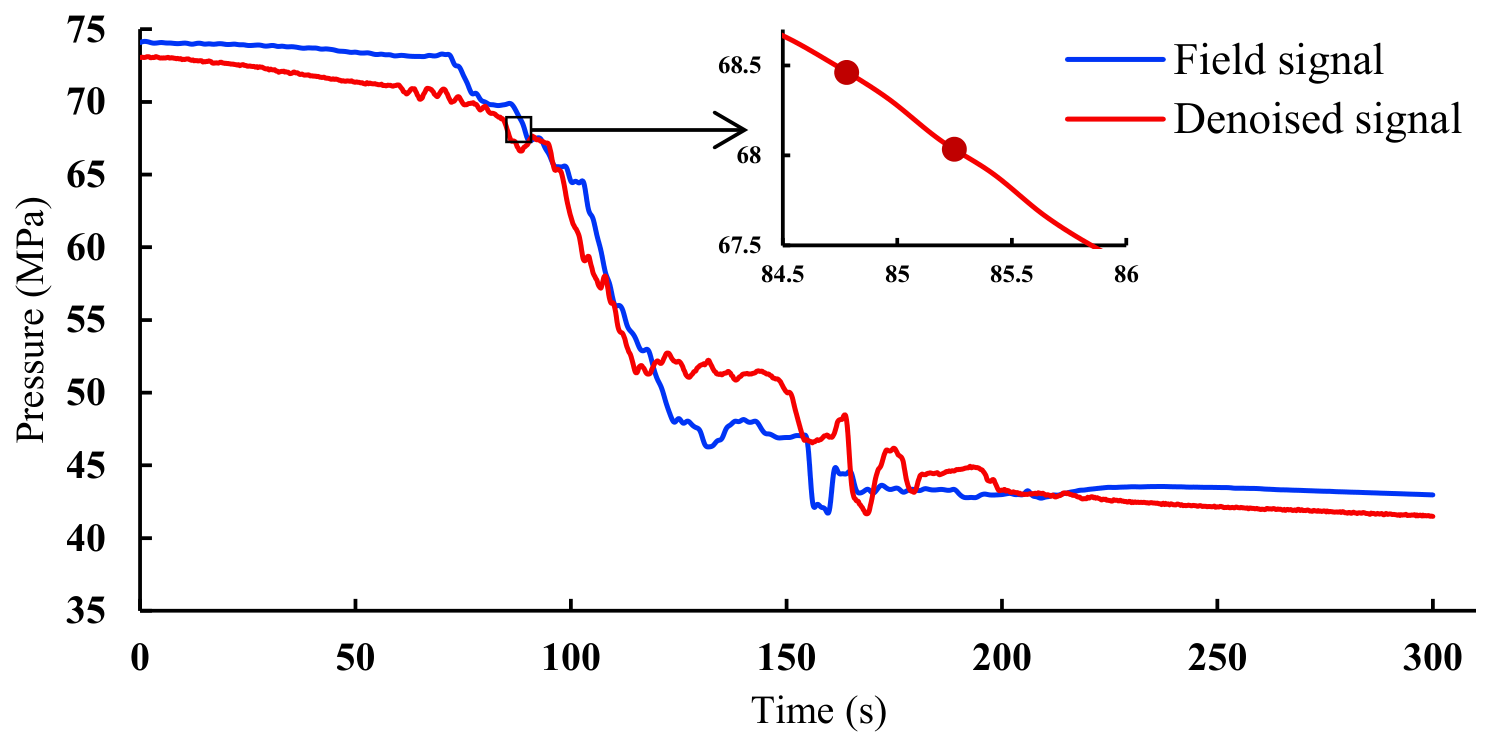
The water hammer dataset collected on-site from pump shutdown at the wellhead is a relatively stable preliminary filtered dataset. Due to the uncertainty of influencing factors during data acquisition, the initial filtering performed by acquisition equipment may erroneously eliminate useful signal information while retaining unwanted noise. To allow the model not only to retain fracture response features while maintaining filtering capability, but also to reproduce all fluctuation characteristics of clean water hammer data, this study conducts model training on on-site-collected dataset, and injects fixed-frequency and random-frequency noise into it, as shown in Figure 17.
LSCF effectively removes noise and preserves key features while filtering field data with added noise, as shown in Figure 18, demonstrating its strong noise suppression capability and high signal fidelity under realistic conditions.
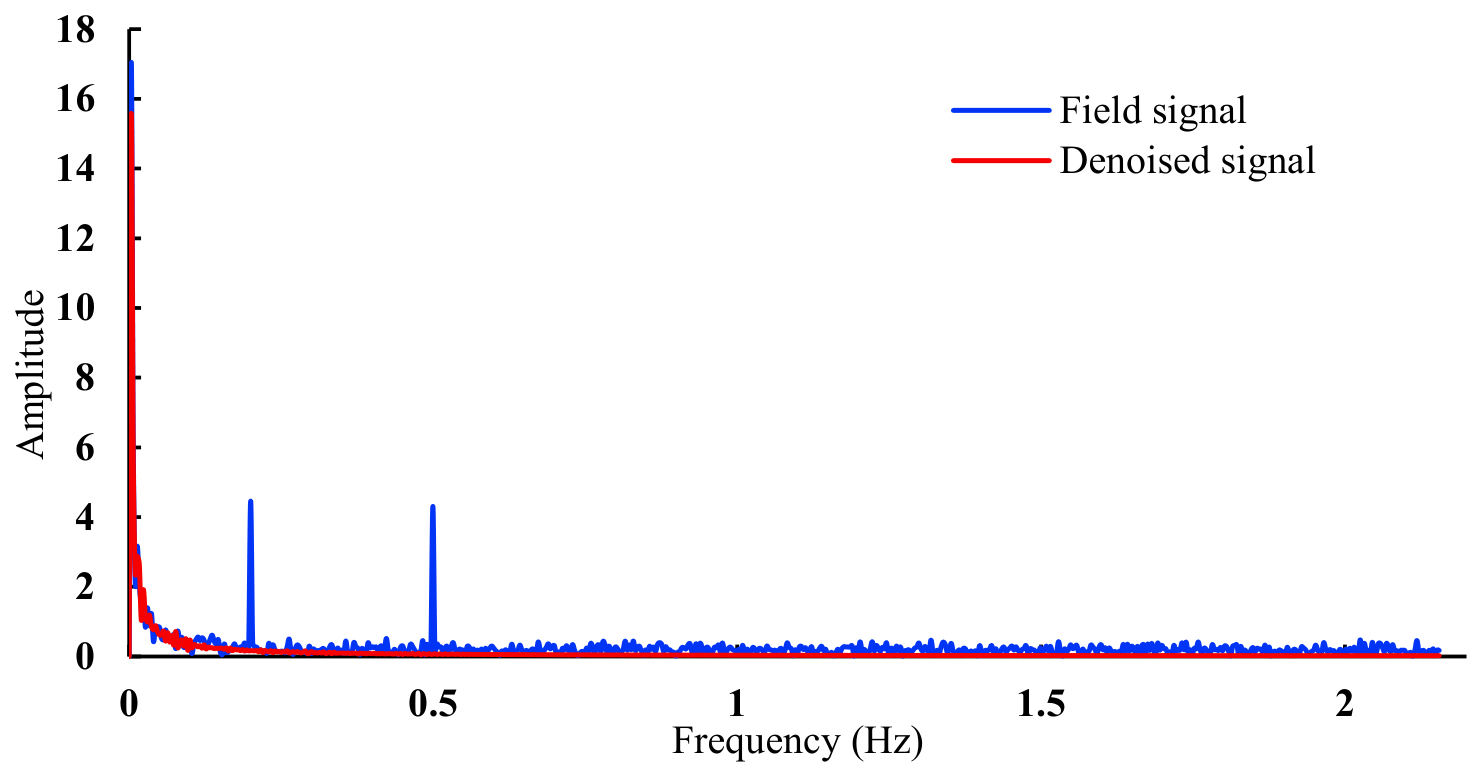
LSCF effectively suppresses both added and inherent noise in field data, as shown in Figure 19. After noise injection, the number of frequency components increases across the spectrum with large amplitude fluctuations, obscuring the effective frequency band (0–0.5 Hz) of the original signal. After filtering, the artificially introduced noise frequencies are successfully removed, and the inherent noise within the field data is also significantly attenuated, demonstrating high filtering performance.
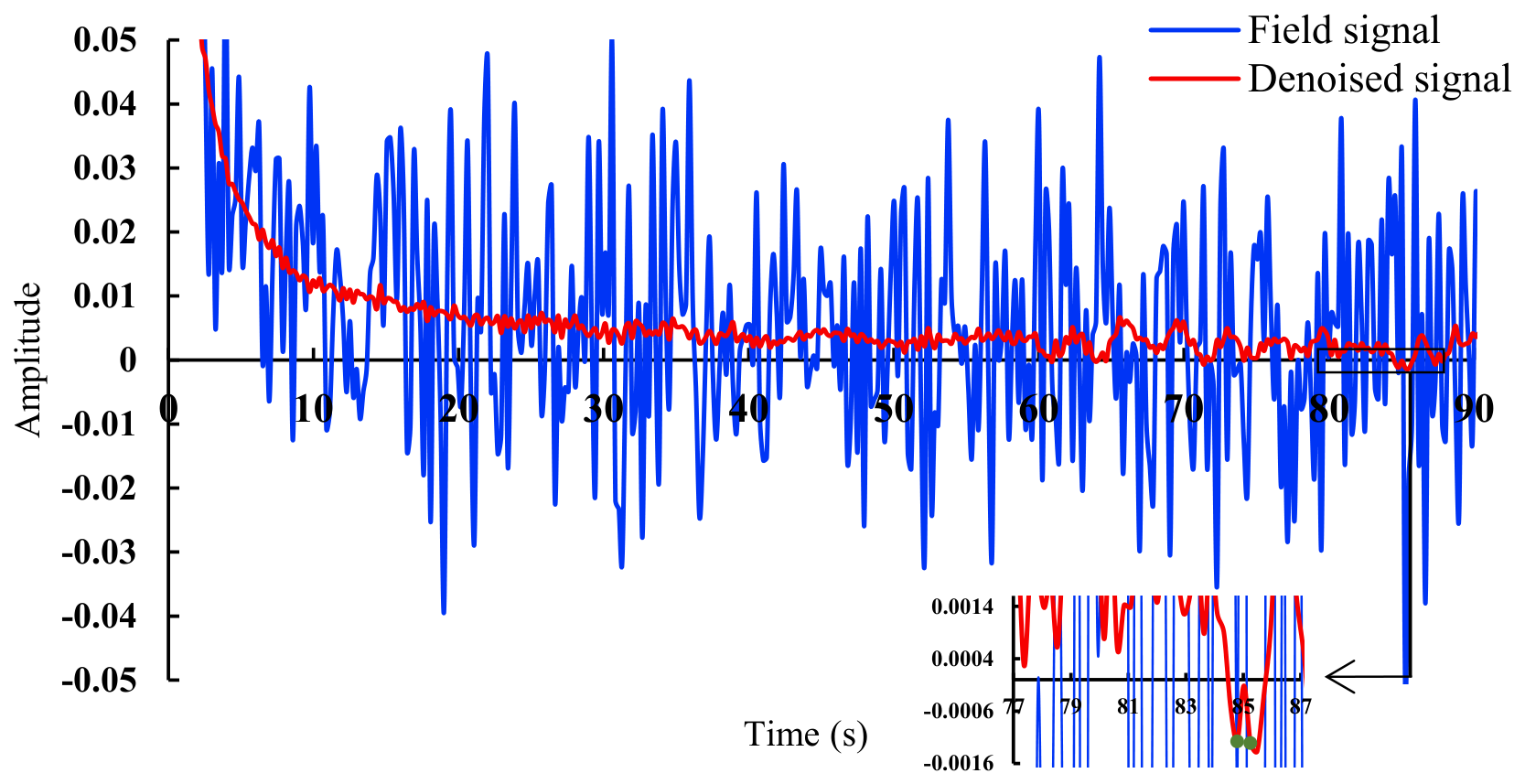
LSCF significantly enhances the clarity of fracture response timing in the cepstrum diagram, as shown in Figure 20. Before filtering, event responses appear random with pronounced fluctuations, making it impossible to identify the timing of fracture responses. After filtering, the fluctuation intensity is markedly reduced, enabling clear localization of the fracture responses at 84.78 s and 85.25 s in the quefrency domain. These results demonstrate that LSCF achieves effective noise suppression while preserving critical signal features, thereby improving the interpretability of field water hammer data.
The method successfully retains critical fluctuation characteristics in water hammer signals, such as those reflecting downhole fracture responses, while significantly suppressing artificially added fixed-frequency and random-frequency noise, highlighting its robustness and adaptability in practical field applications.

3.4. Comparison of Filtering Methods’ Performance

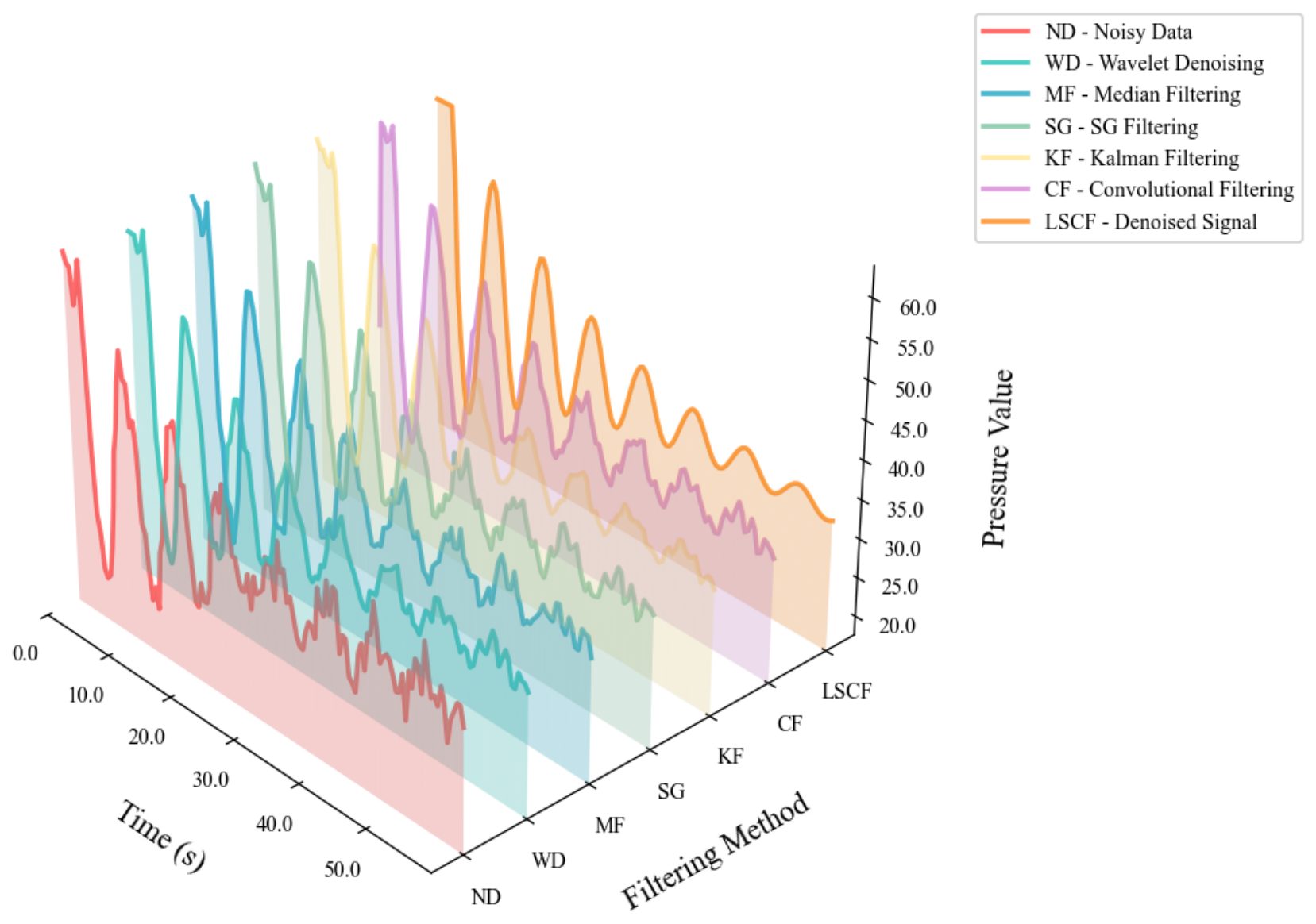
To further validate the superiority of LSCF, this study employs a set of representative filtering methods widely adopted in hydraulic fracturing signal processing for comparative experiments, such as wavelet denoising [41], median filtering [42], SG filtering [43], Kalman filtering [44], and convolutional filtering. To verify the impact of the Transformer module’s temporal relation capturing on filtering performance, the temporal injection module in LSCF is removed and the resulting variant is denoted as LSCF-T; to validate the rationality of the latent space filtering strategy, the convolution module in LSCF is replaced with the wavelet method, and the variant is denoted as LSCF-C.
Comparative filtering experiments were conducted using the mixed-frequency noise-contaminated dataset X m generated in Section 3.2.3 as input. The quantitative comparison of evaluation metrics before and after filtering is presented in Table 6, while the visual comparison of filtering performance is illustrated in Figure 21.
Through a comparative experiment involving eight filtering methods applied to noise-contaminated dataset X m , the quantitative analysis of key evaluation metrics before and after denoising demonstrates that the LSCF method outperforms all competing approaches, exhibiting superior performance in terms of CC, SNR, and MSE. The degraded filtering performance of LSCF-T indicates that temporal injection effectively captures the temporal dependencies in pressure signals; the superior performance of LSCF-C validates the rationality of conducting water hammer feature filtering within the latent space.

3.5. Hyperparameter Analysis

To evaluate the impact of latent space dimensionality on the LSCF performance, filtering experiments with varying latent space dimensions were conducted on the noisy dataset X m . The experimental results are compared in Table 7.
As the latent space dimension increases, filtering performance gradually improves and evaluation metrics show significant enhancement, reaching the best at 512. The results suggest that water hammer data generation is influenced by multiple factors; higher dimensions better capture unknown variables, reduce uncertainty, and more comprehensively remove latent noise, thereby boosting the LSCF model’s filtering capability.

4. Conclusions

(1) Considering the problems of multiple influencing factors and sparse data volume in the water hammer data acquisition process, this study designs the LSCF model from the perspective of data generation and adopts a pre-training paradigm to improve the filtering ability of the model. Filtering experiments on simulated dataset with random-frequency, fixed-frequency and mixed-frequency noise all verify the effectiveness of LSCF, with the SNR improved by more than 96.66%, 73.35%, and 173.90% respectively. In the field dataset filtering experiment, LSCF effectively filters noise while retaining fracture response characteristics. In the comparative experiment, the filtering performance of LSCF outperforms existing state-of-the-art filtering algorithms. In addition, there are experiments including timing injection removal, replacement of latent space filtering algorithms and latent variable dimension analysis, which verify the effectiveness of the generative latent space filtering strategy. Comprehensive experimental results show that the generative filtering algorithm of LSCF has better filtering performance and can better solve the filtering problem in complex and sparse water hammer data scenarios.
(2) From the perspective of data generation, in the field of petroleum and natural gas engineering, the LSCF model can be applied to the leakage signal detection and evaluation of buried long-distance oil and gas pipelines, enabling accurate calculation of leakage locations. Furthermore, it can provide a reliable basis for data denoising and filtering in petroleum well logging, seismic exploration, measurement while drilling, dynamic monitoring of oil and gas production and other related fields. In addition, this model can be further extended to signal denoising for leakage detection of municipal water supply pipe networks.
(3) In the future, the application scope of water hammer data filtering technology will gradually expand. Its data generation scenarios will become more complex, which makes the inference of generation mechanisms more challenging. The network depth of the latent space filtering studied in this paper is a research direction for filtering efficiency. Specifically, exploring the multi-step generation law of water hammer signals via diffusion principles can better guide the selection of filtering operators and adapt to more complex filtering scenarios.

Author Contributions

Conceptualization, B.H., Z.Z. (Zhiwei Zhai) and Z.Z. (Zhenfeng Zhao); Methodology, K.L. and Z.Z. (Zhiwei Zhai); Software, X.Y.; Investigation, B.H. and K.L.; Resources, B.H.; Data curation, K.L., X.Y. and Z.Z. (Zhenfeng Zhao); Writing—original draft preparation, K.L.; Writing—review and editing, Z.Z. (Zhiwei Zhai), X.Y. and Z.Z. (Zhenfeng Zhao). All authors have read and agreed to the published version of the manuscript.

Funding

This research was funded by the Science and Technology Program of Xinjiang Uyghur Autonomous Region (2024B01014), the Key Research and Development Program Project of Shanxi Province (202502080302019), and the Scientific and Technological Innovation Programs of Higher Education Institutions in Shanxi (2023L407).

Institutional Review Board Statement

Not applicable.

Informed Consent Statement

Not applicable.

Data Availability Statement

The original contributions presented in this study are included in the article. Further inquiries can be directed to the corresponding author.

Acknowledgments

The author gratefully acknowledges the technical support from the Rock Mechanics Laboratory of China University of Petroleum (Beijing), which was essential for the successful completion of the experiments in this study.

Conflicts of Interest

Author Zhenfeng Zhao is employed by PetroChina Changqing Oilfield Company. The remaining authors declare that the research was conducted in the absence of any commercial or financial relationships that could be construed as a potential conflict of interest.

Abbreviations

The following abbreviations are used in this manuscript:
LSCFLatent space convolutional filtering
CCCorrelation coefficient, dimensionless
MSEMean squared error, dimensionless
SNRSignal-to-noise ratio, dB
VAEVariational auto-encoder
SGSavitzky–Golay filter
YClean water hammer data, MPa
XPump shutdown water hammer signal, MPa
εNoise, MPa
pThe effective frequency of water hammer signal, Hz
XtOn-site water hammer data, MPa
XsSimulated water hammer data, MPa
XrSimulated data with Gaussian random-frequency noise, MPa
Xr−convFiltered water hammer data, MPa
Xf1Simulated data with fixed-frequency noise of 0.5 Hz, MPa
Xf1−convFiltered result of Xf1, MPa
Xf2Simulated data with fixed-frequency noise of 2 Hz, MPa
Xf2−convFiltered result of Xf2, MPa
Xf3Simulated data with fixed-frequency noise of 10 Hz, MPa
Xf3−convFiltered result of Xf3, MPa
Xf4Simulated data with composite fixed-frequency noise, MPa
Xf4−convFiltered result of Xf4, MPa
XmSimulated data with mixed-frequency noise, MPa
Xm−convFiltered result of Xm, MPa

References

  1. Jia, C.Z. Prospects and five future theoretical and technical challenges of the upstream petroleum industry in China. Acta Pet. Sin. 2024, 45, 1–14. [Google Scholar]
  2. Wang, Y.; Lu, Y.; Li, Y.; Wang, X.; Yan, X.; Zhang, Z. Progress and application of hydraulic fracturing technology in unconventional reservoir. Acta Pet. Sin. 2012, 33, 149–158. [Google Scholar]
  3. Hou, B.; Liao, Z.; Zhang, Z.; Luo, J.; Ju, Y.; Wang, W. Review on the digitalization and intelligent development of physical simulation methods for hydraulic fracturing. J. Liaoning Petrochem. Univ. 2025, 45, 1–12. [Google Scholar]
  4. Tong, S.K.; Gao, D.L. Basic research progress and development suggestions on hydraulic fracturing. Oil Drill. Prod. Technol. 2019, 41, 101–115. [Google Scholar]
  5. Ding, D.W. Research on Hydraulic Fracturing Monitoring Based on Surface-Borehole Potential Method. Master’s Thesis, China University of Petroleum (Beijing), Beijing, China, 2018. [Google Scholar]
  6. Liu, X. Study on Characterization Method of Complex Fracture Network of Deep Shale After Fracturing Based on Microseismic Monitoring. Doctoral Dissertation, China University of Petroleum (Beijing), Beijing, China, 2022. [Google Scholar]
  7. Sui, W.; Wen, C.; Sun, W.; Li, J.; Guo, H.; Yang, Y.; Song, J. Joint application of distributed optical fiber sensing technologies for hydraulic fracturing monitoring. Nat. Gas Ind. 2023, 43, 87–103. [Google Scholar]
  8. Li, H.; Deng, J.; Feng, Y.; Dong, B.; Ding, J.; Cao, Z. Research status and development trend of oilfield tracer technology. Appl. Chem. Ind. 2023, 52, 3163–3168+3174. [Google Scholar]
  9. Mondal, S. Pressure Transients in Wellbores: Water Hammer Effects and Implications for Fracture Diagnostics Diagnostics. Master’s Thesis, The University of Texas at Austin, Austin, TX, USA, December 2010. [Google Scholar]
  10. Iriarte, J.; Merritt, J.; Kreyche, B. Using water hammer characteristics as a fracture treatment diagnostic. In Proceedings of the SPE Oklahoma City Oil and Gas Symposium/Production and Operations Symposium; SPE: Richardson, TX, USA, 2017; p. D031S007R004. [Google Scholar]
  11. Parkhonyuk, S.; Fedorov, A.; Kabannik, A.; Korkin, R.; Nikolaev, M.; Tsygulev, I. Measurements while fracturing: Nonintrusive method of hydraulic fracturing monitoring. In Proceedings of the SPE Hydraulic Fracturing Technology Conference and Exhibition; SPE: Richardson, TX, USA, 2018; p. D031S007R005. [Google Scholar]
  12. Luo, Y.H. Decay Characteristics of Water Hammer Pressure Wave and Intelligent Evaluation Method of Fracture Morphology in Fracturing Pump-Stopping. Master’s Thesis, China University of Petroleum (Beijing), Beijing, China, 2023. [Google Scholar]
  13. Wen, J.; Tian, W.; Bi, Q.; Li, X.; Lu, D. A new data inversion analysis method based on digital filtered pump-stop data of hydraulic fracturing. J. Univ. Sci. Technol. China 2018, 48, 392–399. [Google Scholar] [CrossRef]
  14. Zhu, Z.Y. Research on Fracture Diagnosis Technology for Horizontal Well Fracturing Based on Water Hammer Effect. Master’s Thesis, Chengdu University of Technology, Chengdu, China, 2023. [Google Scholar]
  15. Zhang, S.Y. Evaluation of Fracture Parameters of Fractured Horizontal Wells in Shale Gas Reservoirs Based on Fracturing Shut-in Data. Master’s Thesis, Southwest Petroleum University, Chengdu, China, 2023. [Google Scholar]
  16. Hu, X.D.; Zhou, F.J.; Li, Y.J.; Qiu, Y.; Li, Z.L. Filtering methods and characteristic analysis of water hammer pressure-wave signals from fracturing stop pumps. Pet. Sci. Bull. 2021, 6, 79–91. [Google Scholar]
  17. Wu, Y. Research on Signal Denoising Method Based on Wavelet. Master’s Thesis, Wuhan University of Technology, Wuhan, China, 2007. [Google Scholar]
  18. Wen, L.; Liu, Z.S.; Ge, Y.J. Several methods of wavelet denoising. J. Hefei Univ. Technol. (Nat. Sci.) 2002, 25, 167–172. [Google Scholar]
  19. Nodes, T.; Gallagher, N. Median filters: Some modifications and their properties. IEEE Trans. Acoust. Speech Signal Process. 2003, 30, 739–746. [Google Scholar] [CrossRef]
  20. Guan, X.P.; Zhao, L.X.; Tang, Y.G. Hybrid filtering method for image denoising. J. Image Graph. 2005, 10, 332–337. [Google Scholar]
  21. Cai, T.J.; Tang, H. A review of the least squares fitting principle of the Savitzky-Golay smoothing filter. Digit. Commun. 2011, 38, 63–68+82. [Google Scholar]
  22. Zhang, B.; Zhou, L.; Yang, T. Fault diagnosis method of rolling bearing combining Savitzky-Golay filtering and local mean decomposition. Mach. Des. Manuf. 2017, 3, 192–196. [Google Scholar] [CrossRef]
  23. Kalman, R.E. A new approach to linear filtering and prediction problems. Trans. ASME–J. Basic Eng. 1960, 82, 35–45. [Google Scholar] [CrossRef]
  24. Peng, D. Basic principles and applications of Kalman filter. Softw. Guide 2009, 8, 32–34. [Google Scholar]
  25. Wink, A.M.; Roerdink, J.B.T.M. Denoising functional MR images: A comparison of wavelet denoising and Gaussian smoothing. IEEE Trans. Med. Imaging 2004, 23, 374–387. [Google Scholar] [CrossRef]
  26. Lone, M.R.; Sandhu, A.K. Enhancing image quality: A nearest neighbor median filter approach for impulse noise reduction. Multimed. Tools Appl. 2024, 83, 56865–56881. [Google Scholar] [CrossRef]
  27. Hsieh, M.H.; Cheng, F.C.; Shie, M.C.; Ruan, S.J. Fast and efficient median filter for removing 1–99% levels of salt-and-pepper noise in images. Eng. Appl. Artif. Intell. 2013, 26, 1333–1338. [Google Scholar] [CrossRef]
  28. Balan, S.; Khaparde, A.; Tank, V.; Rade, T.; Takalkar, K. Under Water Noise Reduction Using Wavelet and Savitzky-Golay. CS IT Conf. Proc. 2014, 4, 243–250. [Google Scholar]
  29. John, A.; Sadasivan, J.; Seelamantula, C.S. Adaptive Savitzky-Golay filtering in non-Gaussian noise. IEEE Trans. Signal Process. 2021, 69, 5021–5036. [Google Scholar] [CrossRef]
  30. Liu, W.; Liu, W.; Gu, J.; Sui, G. Research on interwell connectivity of oil reservoirs based on Kalman filter and artificial neural network. Pet. Geol. Recovery Effic. 2020, 27, 118–124. [Google Scholar] [CrossRef]
  31. Fujimoto, M.; Ariki, Y. Noisy speech recognition using noise reduction method based on Kalman filter. In Proceedings of the IEEE International Conference on Acoustics, Speech, and Signal Processing. Proceedings (Cat. No.00CH37100), Istanbul, Turkey, 5–9 June 2000; pp. 1727–1730. [Google Scholar] [CrossRef]
  32. Zhou, F.Y.; Jin, L.P.; Dong, J. Review of convolutional neural network. Chin. J. Comput. 2017, 40, 1229–1251. [Google Scholar]
  33. Lv, Z.M. A Latent Space Based Representative Training Method on Active Learning. Master’s Thesis, University of Electronic Science and Technology of China, Chengdu, China, 2023. [Google Scholar]
  34. Bao, Z.P. Research on Generative Image Steganography Method Based on Latent Space Vector Encoding. Master’s Thesis, Nanjing University of Information Science & Technology, Nanjing, China, 2024. [Google Scholar]
  35. Kingma, D.P.; Welling, M. Auto-Encoding Variational Bayes. Stat 2014, 1050, 1. [Google Scholar]
  36. Sun, Z.J.; Xue, L.; Xu, Y.; Wang, Z. Overview of deep learning. Appl. Res. Comput. 2012, 29, 2806–2810. [Google Scholar]
  37. Vaziri, H.H.; Nouri, A.; Hovem, K.A.; Wang, X. Computation of sand production in water injectors. SPE Prod. Oper. 2008, 23, 518–524. [Google Scholar] [CrossRef]
  38. Li, Y.J. Research on Intelligent Filtering Method for Water Hammer Pressure Wave Signals Pump Shut-In During Hydraulic Fracturing. Master’s Thesis, China University of Petroleum (Beijing), Beijing, China, 2022. [Google Scholar]
  39. Robert, B.R. A history of cepstrum analysis and its application to mechanical problems. Mech. Syst. Signal Process. 2017, 97, 3–19. [Google Scholar] [CrossRef]
  40. Tian, R.F.; Cao, J.X. The sensitivity analysis of signal abnormality detection based on cepstrum. Prog. Geophys. 2011, 26, 1298–1303. [Google Scholar]
  41. Cohen, R. Signal Denoising Using Wavelets; Project Report; Department of Electrical Engineering Technion, Israel Institute of Technology: Haifa, Israel, 2012. [Google Scholar]
  42. Justusson, B.I. Median filtering: Statistical properties. In Two-Dimensional Digital Signal Processing II: Transforms and Median Filters; Springer: Berlin/Heidelberg, Germany, 2006; pp. 161–196. [Google Scholar]
  43. Schafer, R.W. What is a savitzky-golay filter? [lecture notes]. IEEE Signal Process. Mag. 2011, 28, 111–117. [Google Scholar] [CrossRef]
  44. Welch, G.; Bishop, G. An Introduction to the Kalman Filter; Rep. TR 95-041; Department of Computer Science at the University of North Carolina: Chapel Hill, NC, USA, 1995. [Google Scholar]
Figure 1. Schematic diagram of the VAE.
Applsci 16 05478 g001
Figure 2. Water hammer data in a certain well of G Oilfield after fracturing pump shutdown.
Applsci 16 05478 g002
Figure 3. Spectrum analysis of water hammer data in a certain well of G Oilfield after fracturing pump shutdown.
Applsci 16 05478 g003
Figure 4. Cepstrum analysis of water hammer data in a certain well of G Oilfield after fracturing pump shutdown.
Applsci 16 05478 g004
Figure 5. Simulated water hammer signal after fracturing pump shutdown.
Applsci 16 05478 g005
Figure 6. Simulated water hammer signal after fracturing pump shutdown with added noise: (a) Signal X s +   ε 1 , ε 1 is random-frequency noise. (b) Signal X s +   ε 2 , ε 2 is fixed-frequency noise, the frequency of ε 2 close to p . (c) Signal X s . (d) Signal X s +   ε 3 , the frequency of ε 3 higher than p . (e) Signal X s +   ε 2 + ε 3 .
Applsci 16 05478 g006
Figure 7. Simulated water hammer signal with fracture response.
Applsci 16 05478 g007
Figure 8. Spectrum and cepstrum analysis of simulated water hammer signals: (a) Spectrum diagram. (b) Cepstrum diagram.
Applsci 16 05478 g008
Figure 9. Logic diagram of the filtering model: (a) Filtering framework. (b) Latent space filtering process.
Applsci 16 05478 g009
Figure 10. Filtering performance of LSCF on simulated water hammer signal X r with random noise.
Applsci 16 05478 g010
Figure 11. Spectrum and cepstrum analysis of the simulated water hammer signal X r with random noise before and after filtering: (a) Spectrum diagram. (b) Cepstrum diagram.
Applsci 16 05478 g011
Figure 12. Filtering performance of LSCF on simulated water hammer signal X f 4 with fixed-frequency noise.
Applsci 16 05478 g012
Figure 13. Spectrum and cepstrum analysis of the simulated water hammer signal X f 4 with fixed-frequency noise before and after filtering: (a) Spectrum diagram. (b) Cepstrum diagram.
Applsci 16 05478 g013
Figure 14. Filtering performance of LSCF on simulated water hammer signal X m with mixed-frequency noise.
Applsci 16 05478 g014
Figure 15. Spectrum and cepstrum analysis of the simulated water hammer signal X m with mixed-frequency noise before and after filtering: (a) Spectrum diagram. (b) Cepstrum diagram.
Applsci 16 05478 g015
Figure 16. Comparison of metrics for evaluating filtering performance: (a) Correlation coefficients; (b) SNR; (c) MSE.
Applsci 16 05478 g016
Figure 17. On-site water hammer signal after fracturing pump shutdown with artificially added noise.
Applsci 16 05478 g017
Figure 18. Filtering performance of LSCF on on-site water hammer signal after fracturing pump shutdown with artificially added noise.
Applsci 16 05478 g018
Figure 19. Spectrum analysis of the on-site water hammer signal with artificially added noise before and after filtering.
Applsci 16 05478 g019
Figure 20. Cepstrum analysis of the on-site water hammer signal with artificially added noise before and after filtering.
Applsci 16 05478 g020
Figure 21. Comparison of filtering performance among various filtering methods.
Applsci 16 05478 g021
Table 1. Comparison of filtering methods.
Filtering MethodsFiltering PrinciplesAdvantages
Wavelet DenoisingMulti resolution characteristics, filters with determined design time and frequency.Filtering out known position noise and possessing time-frequency positioning properties.
Median FilteringTo suppress pulse noise, the output is set to the median of local data.Simple to calculate and effectively reduces pulse noise.
SG FilteringFit with the local least squares approach and output the midway.Denoising preserves the signal’s peak, valley, slope, and curvature, which can be utilized to filter out random noise.
Kalman FilteringBased on the Gaussian linear assumption, the state estimation is constantly updated through two alternating processes of prediction and update.Real-time solution for state or parameter estimation problems in stochastic linear discrete systems.
Table 2. Settings of experimental parameters.
Relevant ParametersValues
Latent Variable Dimension512
Convolution Kernel Size3
Batch Size2
Training Epochs20,000
Perceptron Layers26
Table 3. Comparison of metrics for the simulated water hammer data X r with random noise before and after filtering.
Evaluation Metrics X r X r C o n v
CC0.9728260.999923
SNR (dB)26.51122752.137091
MSE3.1865330.008724
Table 4. Comparison of metrics for the simulated water hammer data with fixed-frequency noise before and after filtering.
Data TypeCCSNR (dB)MSE
X f 1 0.96282124.9909534.4955
X f 1 C o n v 0.99999350.9339790.011523
X f 2 0.96218525.0032284.514694
X f 2 C o n v 0.99999258.2107430.002157
X f 3 0.96181324.9935844.525786
X f 3 C o n v 0.99953343.3276140.066419
X f 4 0.98688729.7688581.505066
X f 4 C o n v 0.99999253.7073740.006077
Table 5. Comparison of metrics for the simulated water hammer data X m with mixed-frequency noise before and after filtering.
Evaluation Metrics X m X m C o n v
CC0.9612690.999999
SNR (dB)24.83083168.012301
MSE4.6975140.000226
Table 6. Comparison of metrics for various filtering methods.
Filtering MethodCCSNR (dB)MSE
Noisy Data0.96126924.8308314.697514
Wavelet Denoising0.99199131.8708880.928672
Median Filtering0.98506429.0772991.766938
SG Filtering0.98760329.9501821.445217
Kalman Filtering0.95615224.6001534.95377
Convolutional Filtering0.98258228.6244531.961128
LSCF-T0.94713523.3310686.649251
LSCF-C0.99999953.2030490.010069
LSCF0.99999968.0123010.000226
Table 7. Comparison of metrics of various latent space dimensions.
Latent Space DimensionCCSNR (dB)MSE
80.99148231.6468290.979881
160.98190528.3215862.107160
320.99513133.9421910.577621
640.99999961.0334190.002068
1280.99455933.5559750.631337
2560.99999951.0617220.013294
5120.99999968.0123010.000226
Disclaimer/Publisher’s Note: The statements, opinions and data contained in all publications are solely those of the individual author(s) and contributor(s) and not of MDPI and/or the editor(s). MDPI and/or the editor(s) disclaim responsibility for any injury to people or property resulting from any ideas, methods, instructions or products referred to in the content.